Start up: China’s smartphone wall, Glass stops?, PC slowdown ahead, Monument Valley sales stats, and more


Lots of this, but hard to sell more? Photo by japp1967 on Flickr.

A selection of 9 links for you. Use them wisely. I’m charlesarthur on Twitter. Observations and links welcome.

Smartphones at tipping point in China » Forbes

Doug Young:

The year ahead will be a pivotal one for smartphone makers in China, where around a dozen domestic manufacturers are all vying for a piece of a market that is the world’s largest but also one that’s contracting due to saturation. Leading players include Huawei, Lenovo , ZTE and Xioami, all of which are well funded and have the resources to survive the slowdown. But smaller, newer names like Oppo, OnePlus and Smartisan may not be so lucky, and I expect that 2 or 3 will be forced to close before 2015 ends.

Sales of all phones fell by 22% to 452m units: 64% fall in 2G phones, 46% fall in non-smart 3G. Total of 1.28bn users, implying penetration of 95%. Smartphone shipments actually dropped by 8.2% overall to 389m units. And quite a few of those might be sitting on shelves.


Intel forecast misses estimates, signalling deeper PC slump » Bloomberg

Intel Corp, the largest maker of chips that run personal computers, forecast first-quarter sales that may fall short of analysts’ estimates, sparking concern that the PC industry is headed for a steeper decline.

Revenue will be $13.7bn, plus or minus $500m, the company said today in a statement. On average, analysts had estimated sales of $13.8bn, according to data compiled by Bloomberg.

While corporate demand for new machines helped moderate the PC market’s deterioration last year, the industry has failed to attract enough consumers with new slim laptops designed to compete with tablets and smartphones. Users have learned to live without the keyboards and larger screens of the computers powered by Intel’s processors, said Gus Richard, an analyst at Northland Securities Inc.

“Why would the consumer ever want to buy a PC?” said Richard, who has the equivalent of a hold rating on Intel stock. “The first thing that people do in the morning is check their smartphones.”

Incomes and revenues up, but outlook down.


Apple’s diversifying and maturing user base » Tech.pinions

Jan Dawson:

Apple has gone from tens of millions of Mac users to hundreds of millions of iPhone customers and to a billion iOS devices sold. Whereas Apple once served a fairly small number of specific niches, it now serves almost every kind of customer imaginable: from the power user to the first time smartphone owner, from the wealthy American to the rising Chinese middle class. It’s also increasingly being adopted in the enterprise market and the IBM deal will only accelerate this trend. To be sure, Apple still isn’t universal in its appeal, especially since its devices tend to be costlier than those from other manufacturers, particularly in markets where phones aren’t heavily subsidized. But Apple’s customer base is becoming ever more diverse over time.

The other thing that’s happening is Apple’s customer base is maturing. I don’t mean it’s getting older (though that is almost certainly the case), but an increasing proportion of its customer base is using its third, fourth or fifth Apple device. These customers are becoming accustomed to a certain way of doing things, becoming “trained” in the Apple way of delivering tightly coupled software and hardware. Their expectations of how Apple will act, therefore, start to harden over time, leading to less flexibility in response to major changes in iOS and OS X.

As he explains, that has deeper – perhaps Microsoft-like – implications.


Monument Valley sales data » UsTwo

An infographic (apologies) but packed full of fascinating detail about the sales and revenues by country and platform for the twisty mindbending game. For all those saying it was “too short”, only 50% completed it, according to the data.

The data also provides an interesting comparison with these estimates of its sales.


RadioShack prepares bankruptcy filing » WSJ

RadioShack Corp. is preparing to file for bankruptcy protection as early as next month, people familiar with the matter said, following a sputtering turnaround effort that left the electronics chain short on cash.

A filing could come in the first week of February, one of the people said. The Fort Worth, Texas, company has reached out to potential lenders who could help fund its operations during the process, another person said.

Might get sold to a private equity company. Cumulative losses over the past seven quarters: $770m or so. Electronics is tough; started in the 1920s but couldn’t adapt to the web age.

And next…


Sony announces that it will close all stores in Canada » Androidheadlines.com

Cory McNutt:

As Sony struggles to reinvent itself, they made a rather surprising announcement – Sony is closing all fourteen of its Sony Stores in Canada over the next two months. Toronto had the heaviest concentration with five Sony Stores and one Sony Style Store. There are three Sony Stores in Vancouver, two in Calgary, and just one in Ottawa, Edmonton, Montreal and Quebec City. The employees were informed in an announcement today and then released a news statement to The Citizen.

Toronto had six Sony stores?! If you’ve got a good memory you might remember that in February 2014 Sony said it would shut 20 of its 31 US stores by the end of 2014. Wonder how those 11 are doing.


BlackBerry shares slide 16% after denying Samsung talks » MarketWatch

Shares of BlackBerry fell more than 16% in premarket trade Thursday after the company denied reports that it was approached by Samsung Electronics regarding a potential $7.5bn takeover. The stock was up as much as 28% on Wednesday after Reuters reported that the two had been in talks about a possible deal. Reuters late Wednesday said Samsung approached BlackBerry with a buyout price range of $13.35 to $15.49 a share. Samsung reportedly called the report “groundless.” BlackBerry in a post on its website said it has not engaged with discussions with Samsung with respect to “any possible offer to purchase BlackBerry.”

Hey ho. Still a lot of road to go though. Patents? QNX? Corporate accounts? Samsung could want all or part of them. Then again, BlackBerry has been “sold” about 10 times in the past two years by market rumours.


Goodbye » SuperSite for Windows

Paul Thurrott is moving on. But the site will remain:

What changed over time is just the usual work-related stuff. Penton purchased Duke Publishing several months after I signed on, in August 2000, and over time the impact of being part of a big company weighed ever more heavily on me. For many years, I was insulated from this as the Duke team in Colorado effectively sheltered me. But as my friends and coworkers were in some cases promoted within “big Penton” (as I thought of it) or were laid off—hey, it’s a big company with priorities that extend far beyond my little group—the layers between me and the corporation around me grew thin and then disappeared.

This isn’t a dig at Penton. It’s a great company, and was a wonderful benefactor for all these years. And I’m friends with—and care deeply for—many people at Penton. I’m just not fit for corporate life. I need to be on my own or with a smaller team to thrive, and over the course of the past I year I felt increasingly that it was time to move on. I do so with a deep sense of regret because I know I’m letting down some people whom I care for, and because I’m leaving behind the legacy of this site.

But I’m also hopeful for the future. I plan to continue doing what I do at thurrott.com and I’ve partnered with some new friends to make that happen.

Everyone’s going individual, have you noticed? Also, everyone seems to be doing it with email newsletters. (Pause for thought.)


Google makes changes to its Glass project » WSJ

Alistair Barr:

Glass is moving from the Google X research lab to be a stand-alone unit led by Ivy Ross. Ms. Ross and her team will report to Tony Fadell, a former Apple executive who heads Nest Labs, the smart-home device company Google acquired for $3.2 billion in February 2014. Mr. Fadell will still run Nest, but he also will oversee Glass and provide strategic guidance to Ms. Ross.

Google will stop selling the initial version of Glass to individuals through its Explorer program after Jan. 19. Google will still sell Glass to companies and developers for work applications.

Google plans to release a new version of Glass in 2015, but it hasn’t been more specific about timing.

The changes usher in a new strategy for Glass that will shun large, public tests of hardware prototypes in favor of the approach used by Apple and Nest, which develop consumer gadgets in secret and release them as fully finished products.

Does that mean we’re not going to hear any more about that bloody self-driving car and the diabetes-diagnosing contact lenses until they’re actually ready, rather than five or more years from ready?


Start up: bitcoin’s price spiral, Siri gets smarter, Samsung + BlackBerry?, the truth about Google’s 20% time, and more


Is bitcoin’s price heading down this way? Photo by Christopher Chan on Flickr.

A selection of 11 links for you. Use them wisely. I’m charlesarthur on Twitter. Observations and links welcome.

As bitcoin’s price slides, signs of a squeeze » NYTimes.com

Sydney Ember:

the [bitcoin mining] industry is starting to feel the effects of the sustained decline. Some mining companies that invested heavily in resources when the price of Bitcoin was rising are struggling to keep their operations open.

“It obviously makes the environment for Bitcoin businesses difficult,” said Jonathan Levin, a digital currency consultant.

Bitcoin miners are computers that run Bitcoin’s open-source program and perform complex algorithms. If they find the solution before other miners, they are rewarded with a block of 25 Bitcoins — essentially “unearthing” new Bitcoins from the digital currency’s decentralized network. Such mining operations, though potentially lucrative, are also expensive, requiring huge amounts of equipment and electricity.

Now, these miners, who had bet on a higher price of the virtual currency to pay for resources, are selling their Bitcoins to keep their electricity running and return money to their lenders.

“People have these very real fiat-based liabilities that they have to pony up for, and to do that, they’re going to have to sell Bitcoins,” Mr. Schvey of TradeBlock said. These sales could in turn be driving down the price further.

This seems to me the best explanation for why bitcoin’s price is falling (along with Russia cracking down on exchanges there, which would also force sales). That in turn suggests a lower long-term price – some miners will be driven out permanently. (You can see the real-time price at coindesk.com/price – $172 as I write, below any level since October 2013.)


Bitcoin ponzi CryptoDouble disappears with at least 2233 bitcoins » CryptoCoinsNews

Bitcoin scams are back. CryptoDouble, a website founded on the promise of doubling its users’ deposits within 100 hours, ceased all its operations. At least 2233 BTC (about $500,000) have been cashed out on BTC-E, leaving thousands of customers out of pocket.

The service gained a significant popularity on Bitcointalk, where customers first testified about the service and its supposed effectiveness.

Despite several warnings from advanced Bitcoin users and previous Bitcoin Ponzi scams, a significant number of users have been attracted by the website’s promises and its investment possibilities.

Stories like this continue to demonstrate that bitcoin users aren’t somehow smarter than the rest of us.


Apple, Ericsson clash on LTE patents » Light Reading

Apple, however, appears to have initiated legal proceedings, filing a lawsuit in a US court on January 12 to prove that it has not infringed a subset of Ericsson’s patents and should pay lower royalties than the networks giant has demanded.

The device maker believes royalties should be based on the cost of the chips used in its devices, according to Reuters, but says Ericsson has been calculating licensing fees as a percentage of the value of the whole device.

Ericsson defended its approach in an email sent to Light Reading.

“Our view is that royalties should be based on the value that the technology in the device brings to the end-user,” said an Ericsson spokesperson. “The price of the chip-set has nothing to do with the value the technology brings to the end-user.”

Ericsson has also called on US legal authorities to determine whether its licensing offer to Apple is fair, reasonable and non-discriminatory.

Possibly the previous deal was set up when Ericsson still had a mobile phone unit (with Sony), which led to prices being bargained down via patent swaps. Now, Ericsson just makes network kit – so there’s nothing for Apple to bargain against.

Alternatively, Ericsson is demanding a ton of money.


This is what happens when you create an online community without any rules » The Washington Post

Caitlin Dewey:

8chan, the more-lawless, more-libertarian, more “free” follow-up to 4chan, disappeared from the internet under predictable circumstances Monday: Multiple people complained to 8chan’s registrar that the message board hosted child porn.

8chan has since resurfaced at a new URL, 8ch.net, and purportedly recovered its original domain. But that doesn’t erase the inevitable lesson of the matter: When you create an Internet community with virtually no rules, things are bound to go down the drain.

The response of the denizens of 8chan: dox Dewey.


Exclusive: Samsung approaches BlackBerry about buyout – source » Reuters

Jennifer Ablan and Liana Baker:

Samsung Electronics recently approached BlackBerry about buying the smartphone maker for as much as $7.5bn in a play for its patent portfolio, according to a person familiar with the matter and documents seen by Reuters.

South Korea’s Samsung proposed an initial price range of $13.35 to $15.49 per share, representing a premium of 38% to 60% over BlackBerry’s current trading price, the source said.

Executives from the two companies, which are working with advisers, met last week to discuss a potential transaction, the source said, asking not to be identified because the conversations are private.

It remains unclear whether Blackberry, which has regained some of its lost swagger under CEO John Chen over the past year or so, was open to the approach. Representatives for the company declined to comment.

BlackBerry’s patents have for some time seemed like the only thing with ongoing value that it has. Its corporate and government customers might be happy enough with Samsung buying it.

For my analysis of BlackBerry’s most recent results, read There must be a horse in there somewhere.


360 Security climbs Google Play chart to top Tools and Free App categories » 360Safe

An excited press release from the company:

It’s safe to say that the third version of 360 Security, which we’ve just announced, is off to an explosive start.

On Tuesday 360 Security climbed to the top of the Google Play charts, peaking at No. 1 among Android Tools in 20 countries and counting. 360 Security has also broken into the Top 3 among all free Android apps in the U.S.

We knew heading into the development of 360 Security that the awareness surrounding smartphone threats and performance were low. Topping the Google Play chart means that the general audience in not only the US but also around the world are increasingly attentive today of the vulnerabilities and performance problems that may lurk within their devices.

I find this depressing.


Mayer: Google’s ‘20% Time’ does not exist » Business Insider

Nicholas Carlson (who has written a well-received book about Yahoo, and Marissa Mayer’s tenure there so far:

I learned that in the spring of 2013, Mayer stood up on stage during an all-employee meeting at Yahoo and debunked the 20% time myth.

Mayer was announcing something called the CEO Challenge — an initiative where teams that came up with cool new product ideas would get spot bonuses of $250,000. Mayer warned Yahoo employees not to work on CEO Challenge products instead of doing their regular work.

“It’s funny,” she said. “People have been asking me since I got here, ‘When is Yahoo going to have 20% time?'”

“I’ve got to tell you the dirty little secret of Google’s 20% time. It’s really 120% time.”

As in, work them into the ground. Play on their insecurities about what they can get done compared to those around them. Lots of companies do it.


As Blinkbox sold, just 4% in UK use the service monthly » GlobalWebIndex

Blinkbox, bought by TalkTalk and soon to be shut down, was reported to be making Tesco a considerable loss – and it’s easy to see why. Only 4% of UK online adults used Blinkbox last month. Even when we extend this to those who have used the service ever, the figure rises to just 14%.

Like most VOD services, Blinkbox could claim peaks among younger consumers. But these numbers were still low – 7% of 16-34s in the UK used the service monthly.

Perhaps most significantly, almost a fifth of UK internet users say they have never even heard of Blinkbox. In an industry where Netflix is grabbing Emmy awards, brand recognition problems of this type are pretty telling.

In fact, Netflix can boast a 22% usage rate in the UK – with almost 4 in 10 UK internet users saying they have used Netflix at some point.

Tesco is big, but I’m not that surprised about Blinkbox. Launched in 2007, Tesco bought into it in 2011, but it was still a hard sell: Tesco might have pushed it, but it had other distractions at the time. (Even so, 14% is creditable.)


Samsung returns to roots in components as phones stall » Bloomberg

This is from 8 January, so a week old – but I find it interesting for the analyst estimates:

Operating profit from semiconductors was probably 2.7trn won in the fourth quarter on sales of 10.8trn won, according to the median estimate of six analysts surveyed by Bloomberg News. That would be a 35% increase in earnings from a year earlier.

Samsung and Globalfoundries Inc. are teaming up in the made-to-order chip business, an alliance aimed at winning orders from Taiwan Semiconductor Manufacturing Co In October, Samsung said it would spend 15.6trn won building a chip plant south of Seoul.

“Samsung’s main business is now shifting back to semiconductors,” Peter Lee, a Seoul-based analyst at NH Investment & Securities (016420), said in a Jan. 2 report. The annual operating profit from the chip business this year will outpace that of the mobile unit, he said.

Operating income at the phone division probably fell to 1.6trn won on sales of 27trn won, according to the analyst survey. That would be the unit’s smallest quarterly profit in almost four years as Samsung faces increasing competition in China and India, the world’s two biggest smartphone markets.

Fewer shipments and higher marketing spending for new models during the quarter curtailed profit growth and limited the benefits of the September release of the large-screen Note 4, said Lee Seung Woo, an analyst at IBK Securities Co. in Seoul…

…Samsung probably shipped 75 million smartphones worldwide in the last three months of 2014, after selling 78.7 million units in the third quarter, according to HMC’s Roh.


Doonesbury Collection: the Newton

From August 1993. I was on a tour of Silicon Valley not long after, and visited companies including General Magic – whose staff included Andy Rubin, who went on to Danger and of course to found Android, and you know the rest there. I can’t remember if I met him or not. But I do remember that these strips were stuck beside doors as an Awful Warning.

Contrast that to now…


Quick thoughts: on Apple’s subtle machine learning improvements » Beyond Devices

Jan Dawson, following up on reports that Apple’s Siri has quietly got faster, notes that it has also got smarter about telling him how long it would take to get to his basketball game:

What Apple’s machine learning engine did here was (as far as I can guess 1):

• Note that I had an item called “Basketball” in my calendar for that morning
• Make a connection with past appointments on Saturday mornings also called “Basketball”
• Look up past location behavior in its location database to connect a particular location with past instances of “Basketball” in my calendar
• Look up this address and calculate driving time between my current location and this destination
• Present it to me at a relevant time in the Today screen.

Again, Apple has talked up some functionality around using calendar locations explicitly entered in your calendar to provide these sorts of alerts, but I’m not sure it’s ever talked about the deeper machine learning stuff in evidence here. I’ve never seen exactly this sort of extrapolation from past behavior again since this occasion, but I have received other notifications on this screen that it’s time to leave for appointments where I’ve explicitly entered a location in my calendar, based on heavy traffic (it happened to me this past week at CES, for example).

Siri got a stuttering start, rather like Maps. Both function sufficiently well now; it’s the under-the-hood things that Apple is working on, slowly but surely.


Start up: Google Ventures investment in focus, Apple Watch controls in view, don’t buy Pono!, and more


Genes. Picture by Libertas Academica on Flickr.

A selection of 8 links for you. Do not use on exposed skin. I’m charlesarthur on Twitter. Observations and links welcome.

The man investing Google’s billions says we shouldn’t be afraid to live forever » The Verge

Ben Popper:

Google Ventures, the investment arm tasked with spending the search giant’s billions on exciting new companies, released its annual report last night. Interestingly, the majority of its money did not go into the areas of consumer internet services, mobile apps, and enterprise software that Google is best known for. Instead, of the $1.6bn it has under management, it put a whopping 35% of its new bets in 2014 into the category of life sciences and health, way up from less than 10% in the two years prior.

Google’s PR in action again. Life sciences and health have been attracting colossal amounts of investment for years now; there’s nothing magical about Google Ventures putting money into it. For comparison, VC funding in life sciences increased by 15% in 1Q 2014 to $1.7bn – up from $1.4bn in the same period a year before.

Note that we’re not told how much of the $1.6bn in Google Ventures has gone into life sciences. But it’s got Google’s name, and there’s an offer of a phone interview with someone who runs it and enthuses mightily about living forever – he was behind Project Calico, based on the idea that “no one was studying ageing at the genetic level”. I feel pretty certain that’s false, based on the many scientific researchers I spoke to between 1995 and 2004 at The Independent; just search for news stories about “telomeres” from 2000 onwards. Even so, this not-important announcement gets a big credulous doggie slurp – and doesn’t even get the comparative context I just gave you about investment levels.

And we call this journalism?


Apple Watch iPhone ‘Companion’ app revealed w/ new Watch features, monograms » 9to5Mac

Mark Gurman (yes, him again – Mr 12in Powerbook):

Yesterday, we reported that the latest iOS 8.2 beta reveals that an Apple Watch application for the iPhone is in the works. Now, we have some more details. Within Apple, the application is currently called the Apple Watch “Companion” app for iPhone. This application manages settings for Apple Watch applications, as well as settings for iPhone/Watch interactivity. The Companion app’s settings reveal some novel new functions that are coming to the Apple Watch. Below, we highlight some of the most interesting new features and settings.

Looks, well, like some settings. Not sure about the notifications, unless you can choose which ones you get on the watch – who needs to know they’ve received an email?


The ‘Internet of Things’ now belongs to the product managers » DIGITS to DOLLARS

Jay Goldberg:

the real business of building ecosystems is beginning. It will not be one ‘industry’ but new products and features in many industries.

I think this was best on display at the Lowe’s booth [at CES]. Lowe’s is giant hardware retailer, and I only stopped in their booth by accident, a friend of mine had just bought some locks for his home and saw a new model on display. Lowe’s was promoting its Iris ecosystem of connected devices. Beyond locks, this also included thermostats, sprinklers, windows, alarms and a whole range of other products you could expect to see on their shelves. I do not know much about Iris. It is a freemium service that sends sensor alerts for free and charges a monthly subscription of $10 if you want to apply more detailed rules to that (e.g. alerts when a window opens after 10pm). But they had a whole booth filled with partners. They are not relying on Nest or Apple or AT&T, but Schlage, Pella and other hardware suppliers. Traditional tech industry wisdom holds that eventually there will be one common platform that dominates. That is the economics of software. I think this may not happen in the home IoT segment. The market is just too big, with too many players. We could very well see multiple ecosystems thriving.

How many is “multiple”, though? Mobile just about supports three (iOS, Google Android, AOSP), with two also-rans (BlackBerry, Windows Phone). Would, or could, the IoT have more?


Sony CEO eyes options as pressure mounts on weak TV, mobile » Reuters

Ritsuko Ando:

As he prepares the latest revival plan ahead of the new business year, [chief executive Kazuo] Hirai, 54, must decide what to do with the financially weak operations that have already been subject to heavy cost cuts.

He told a small group of reporters at the Las Vegas show that his reforms have succeeded “in some parts but not in others”.

“Electronics in general, along with entertainment and finance, will continue to be an important business,” he said. “But within that there are some operations that will need to be run with caution – and that might be TV or mobile, for example.”

Yet cost cuts and a focus on high-end phones, a strategy led by Hiroki Totoki, the new chief of Sony’s mobile division, aren’t enough, said Citigroup analyst Kota Ezawa.

“The mobile and TV businesses both require a drastic overhaul,” he said. “Without drastic reforms such as joint ventures or alliances, they will both be in the red three years from now.”

Exiting the TV business would mean heavy restructuring costs and lost sales. Potential buyers might not want all the division’s assets, let alone at a high premium.

Sony only bought the half of the mobile business from Ericsson in 2012; already it’s looking distinctly peaky.


How Amazon tricks you into thinking it always has the lowest prices » Re/code

Jason Del Rey:

a study conducted by a startup called Boomerang Commerce reveals that Amazon’s pricing strategy is much more nuanced than simply undercutting the competition.

Boomerang, founded by Amazon veteran Guru Hariharan, makes software that tracks prices on shopping sites that compete with its clients, then recommends price changes dynamically. Those changes are based on rules its clients set about which products to match prices on and which to boost higher or drop lower than a competitor’s to boost profits or sales, respectively.

The study of Amazon’s pricing uncovered some interesting tactics. First, Amazon doesn’t have the lowest prices across the board, which may not surprise industry insiders but might surprise Amazon shoppers.

Instead, according to Boomerang’s analysis, Amazon identifies the most popular products on its site and consistently prices them under the competition. In one example, Boomerang observed Amazon testing price reductions on a $350 Samsung TV — one of the most popular TVs on Amazon — over the six months leading up to Black Friday. Then, on Black Friday, it dropped the price to $250, coming in well below competitors’ prices.

But when it comes to the HD cables that customers often buy with a new TV, Amazon actually pushed up the price by 33 percent ahead of the holidays.


Don’t buy what Neil Young is selling » Gizmodo

Mario Aguilar:

Though Young and Pono have failed to produce double-blind studies on the benefits of high-rate audio or their music player, inquiring minds have taken the time to do it. In a 2007 paper published in the Journal of the Audio Engineering Society, Brad Meyer and David Moran outline the results of a study in which they presented a large sample of “serious” listeners with a double blind test comparing 44.1 kHz audio from “the best high resolution discs we could find.” The goal was not to show which was better, but simply to find out if people could even tell the difference.

“None of these variables have shown any correlation with the results, or any difference between the answers and coin-flip results,” they write in their conclusion. Later they note, “Further claims that careful 16/44.1 encoding audibly degrades high-resolution signals must be supported by properly controlled double-blind tests.”

There are proponents of high-quality audio, and with really good systems – as in multi-thousand pound/dollar speakers and master tapes – you can definitely hear the difference; I’ve experienced it myself on visits to hi-fi companies, most recently Meridian. But outside listening rooms, out in the real world? You’ll be lucky to notice any difference between an MP3, AAC and CD.


May 2013: Microsoft and Google working together on new YouTube Windows Phone app » The Verge

Tom Warren:

Google is announcing today that it’s working together with Microsoft on a new YouTube application for Windows Phone. Following a fight with Microsoft over its unauthorized YouTube app, the pair appear to have resolved some of their differences. Google demanded that Microsoft should remove its app by May 22nd, but Microsoft issued an update to address some of Google’s concerns earlier this week. Google says “Microsoft and YouTube are working together to update the new YouTube for Windows Phone app to enable compliance with YouTube’s API terms of service, including enabling ads, in the coming weeks.”

January 2015: still nada. Some weeks have more trouble arriving than others. In fact, relations between Google and Microsoft have if anything gotten even worse of late.


AILW: Beta 4 Documentation Changes » David Smith

Smith is a third-party developer who has been doing a lot of work on Apple Watch app development:

I’ve set up a script to go out to download and normalize the WatchKit Programming Guide and Apple Watch Human Interface Guidelines. Nothing fancy but it means that when a new Beta has been released I can easily diff between the old and new to look for relevant, interesting changes.

As you’d expect there are a bunch of little changes — Typos, rewordings, etc. I’m not interested in those for the purpose of this. Just material changes that will affect how I build apps.

They are shown below. Text in green (with an alternate background) is new. Struckthrough text was removed.


Start up: PC sales droop, app store revenues, security on Android and Microsoft, Apple Watch promise, and more


Not so many of these. Pic by PeeZeeZicht on Flickr.

A selection of 8 links for you. Do not use as a sterile swab. I’m charlesarthur on Twitter. Observations and links welcome.

PC leaders continue growth and share gains as market remains slow » IDC

Worldwide PC shipments totalled 80.8m units in the fourth quarter of 2014 (4Q14), a year-on-year decline of -2.4%, according to the International Data Corporation (IDC) Worldwide Quarterly PC Tracker. Total shipments were slightly above expectations of -4.8% growth, but the market still contracted both year on year and in comparison to the third quarter.

Although the holiday quarter saw shipment volume inch above 80m for the first time in 2014, the final quarter nonetheless marked the end of yet another difficult year – the third consecutive year with overall volumes declining. On an annual basis, 2014 shipments totaled 308.6m units, down -2.1% from the prior year.

Gartner gives 4Q 2014 a +1% growth, to 83.7m, and the whole year essentially level at 315.9m. Gartner includes 2-in-1 units, where IDC doesn’t. And growth came from enterprise – consumer sales kept falling.

Also remarkable: Apple shows as fifth largest, ahead of Asus, for IDC, with 5.75m; Gartner reckons Asus shipped 6.2m units (because it includes 2-in-1s).


App Annie Index Market Q3 2014 » App Annie

Google Play worldwide quarterly downloads were about 60% higher than iOS App Store downloads in Q3 2014, roughly the same lead as last quarter.

Emerging markets continued to show remarkable growth on Google Play and have helped drive the store’s impressive download growth over the last year. In the Q3 2013 Market Index, Google Play downloads were only 25% higher than iOS App Store downloads.

iOS retained its strong lead in app store revenue over Google Play. In Q3 2014, iOS App Store’s revenue was around 60% higher than Google Play’s.

Japan, iOS’ second largest market behind the US, led revenue growth in Q3 2014.

So iOS gets 62% of the downloads (100/160) but 160% of the revenue – in other words, 2.5x as much revenue per download on average (160/(100/160)). That gap is likely to expand as Android reaches more emerging markets. If you want to reach lots of users with a free app, Android is increasingly the place to go (other things being equal); if you want the money, it’s iOS.

Lots of other fascinating trends, including Indonesia’s growth and what is driving Google Play download growth.


Slick, useful apps put the wow in Apple Watch » WSJ

Chris Mims:

I’ve seen some of the applications that will launch for the Apple Watch when it makes its debut as early as March, albeit in simulation, and some are extraordinary. Along with the details Apple has already released about how the watch will work, it’s convinced me Apple Watch will be a launching pad for the next wave of billion-dollar consumer-tech startups…

To use a historical analogy, the shift to mobile is one reason messaging supplanted email. Email was a product of a particular set of behaviours, including sitting down at a computer at a designated time and putting a certain amount of thought into responses. BlackBerry turned email into something like messaging, and touch-screen smartphones made it apparent that email was itself an anachronism, merely one conduit among many for what has become real-time communication.

Consider the same sequence of events for contextual information—that is, alerts delivered at a particular time and place, such as reminders. Our phones buzz, we pull them out of our pockets or purses, read a push alert, swipe to unlock, wait a split second for an app to load, then perform an action that might have been designed with more free time and attention in mind than we have at that moment, if we’re on the go or preoccupied. All that friction is one reason, I suspect, why location-based social networks like Foursquare never took off.

An insightful piece; Mims isn’t just lauding the idea of a watch, but the interaction model. (Subscription required.)


A call for better coordinated vulnerability disclosure (CVD) » Microsoft Security Response Center

Chris Betz is Microsoft’s Google’s senior director of the MSRC, and one might guess that he’s mightily pissed off just now:

CVD philosophy and action is playing out today as one company – Google – has released information about a vulnerability in a Microsoft product, two days before our planned fix on our well known and coordinated Patch Tuesday cadence, despite our request that they avoid doing so. Specifically, we asked Google to work with us to protect customers by withholding details until Tuesday, January 13, when we will be releasing a fix. Although following through keeps to Google’s announced timeline for disclosure, the decision feels less like principles and more like a “gotcha”, with customers the ones who may suffer as a result. What’s right for Google is not always right for customers. We urge Google to make protection of customers our collective primary goal. 

Google gave Microsoft 90 days to fix the vulnerability – and declined to hold back to 93 days so the fix could be rolled out. Just a bit childish?

However Google has form on this: in 2010 one of its researchers, TravisOrmandy, gave Microsoft just five days to issue a fix – and then issued proof-of-concept code when it didn’t hit that deadline. The POC was exploited in the wild.

On the other hand, Jonathan Zdziarski points to this 2005 paper (PDF) which uses empirical data to indicate that “Our results suggest that early disclosure has significant positive impact on the vendor patching speed”. Sure, but Microsoft was patching. It just wanted to do it on its own, clear, schedule; Google’s assumption is that it knows Microsoft’s security priorities better than Microsoft does.


Google under fire for quietly killing critical Android security updates for nearly one billion » Forbes

Thomas Fox-Brewster:

Android smartphone owners who aren’t running the latest version of their operating system might get some nasty surprises from malicious hackers in 2015. That’s because one of the core components of their phones won’t be getting any security updates from Google, the owner of the Android operating system.

Without openly warning any of the 939 million [devices] affected, Google has decided to stop pushing out security updates for the WebView tool within Android to those on Android 4.3, better known as Jelly Bean, or below, according to appalled security researchers. That means two-thirds of users won’t receive cover from Google, the researchers noted.

It’s a wonder that Microsoft can resist discovering a few exploits and publicising them. But it seems that Rapid7 and Rafay Baloch have been churning them out pretty regularly, so no need to bother.

Apple also stops security fixes of iOS version [x-2] – but the proportion, and number, using those is generally tiny: at present it’s 4% by Apple’s figures – compared to 60.1% running a version of Android below 4.4.


Samsung considers rolling out Windows phone » Korea Times

This is one of those “all the promise at the front, all the disappointment at the back” stories. Begin:

In a move to cut reliance on Google’s Android mobile operating system, Samsung Electronics is considering releasing cheaper handsets running on Microsoft’s Windows 8.1 platform, sources said Sunday.

“Samsung has run pilot programs on the stability of Windows 8.1 software on devices. It is interested in promoting Windows mobiles,” said an official directly involved.

But the key issue is whether Samsung and Microsoft will settle their ongoing legal dispute over royalties.

“If the companies settle their litigation, then Samsung will manufacture handsets powered by the Microsoft-developed mobile platform,” the official said. “The timing could be the third quarter of this year at the earliest.”

Third quarter? Gah. That’s not going to move the needle – if Windows Phone is still a thing in the third quarter.


Vodafone UK’s CEO talks 4G and the future of the network » Vodafone blog

“For us it’s about having the strongest network,” [CEO] Jeroen [Hoencamp] says of 4G. “One of the things that makes us different from others is that we have our ‘low band spectrum’. What that means is that our 4G is on a lower frequency, which travels further and deeper indoors. Forget all the technicalities, though: all it means is that we can offer great indoor coverage, and that’s important because the bulk of mobile activity actually takes place indoors – whether people are at work and at home.

“Wherever we build 4G, we’ve proved that we can deliver great unbeatable 4G speeds and coverage, but it’s not a race to have the highest speeds because when it comes to mobile, speed only gets you so far.”

Jeroen explains that you need to have something extra to make that speed worth having:

“We could build a network just to achieve massive speeds,” he says, “but the reality is that you don’t currently need anything beyond 20Mbps on a mobile device. Even for streaming video you only need a couple of megabits per second, so we think less about absolute speed and more about using that bandwidth to enable more customers to enjoy great content on the move, even in the busiest places and at the busiest times.”

He also claims that “customers don’t buy 4G for the latest technology – they switch to Vodafone 4G because there’s particular content they want to access.” This sounds half-right – who cares about a snazzy tech name – but you can get what you want on any network. “The strongest 4G signal” sounds like something Vodafone is going to built an ad campaign around, though.


Here’s what happens when you install the top 10 Download.com apps » How-To Geek

Lowell Heddings watched his PC suffer so that you wouldn’t have to. It’s all pretty predictable (and horrible, and entertaining), but here’s the payoff:

Freeware software vendors make almost all of their money by bundling complete nonsense and scareware that tricks users into paying to clean up their PC, despite the fact that you could prevent the need to clean up your PC by just not installing the crappy freeware to begin with.

And no matter how technical you might be, most of the installers are so confusing that there’s no way a non-geek could figure out how to avoid the awful. So if you recommend a piece of software to somebody, you are basically asking them to infect their computer.

Also read the comments, where one person claiming to run a freeware download site (it seems) says that they’ve been offered up to $1.50 per download to bundle software. Multiply by a few million…

You wondered why innovation died on the desktop? Partly it was the rise of mobile. But it is also the prevalence of this sort of thing. Imagine if you were wary of recommending any less-known app to anyone on the grounds that it could screw up their phone and spill their life out.


Start up: USB-C in brief, understanding CES, jobs that vanished (in pictures), Apple Pay’s next step, and more


There was a time when these were new and “USB” was too. Photo by raneko on Flickr.

A selection of 9 links for you. Test on non-visible part of material. I’m charlesarthur on Twitter. Observations and links welcome.

Reversible USB Type-C finally on its way, alongside USB 3.1’s 10Gbit performance » ExtremeTech

The near-universal frustration over attempts to connect USB devices to computers has been a staple of nerd humor and lampooned in various ways until Intel finally found a way to take the joke quantum.

USB Type-C promises to solve this problem with a universal connector that’s also capableof twice the theoretical throughput of USB 3.0 and can provide far more power. Type-C connectors will not be the only type of connector that’s produced, but apparently hybrid cabling won’t be allowed. There will be USB 3.1 cables that are backwards compatible with existing USB 3.0 ports, but no Type-C adapters with conventional USB at one end and the new connector at the other.

Can carry 100W and can also act as a DisplayPort connector. But is it chainable, like FireWire? Still, lots of opportunities for the cable industry to sell us new USB cables.. in time.


Anonymous claims first victim in ‘Operation Charlie Hebdo’ » Mashable

The group claimed on Saturday to have hacked the website ansar-alhaqq.net on Saturday afternoon. In 2013, French newspapers described it as a French jihadist website.

Ansar-alhaqq.net was down for more than an hour after Anonymous’ announcement, but had returned online at the time of this writing.

It’s unclear how the hackers were able to take down the site, but Anonymous’ usual weapon of choice is a cyberattack known as Distributed Denial of Service (DDoS), which consists of flooding a website with traffic. This kind of attack is not particularly sophisticated, and there are even off-the-shelf tools that allow almost anyone to mount something similar, according to security experts.

Amorphous group attacks amorphous group. Bound to go well and produce a clear outcome.


CES: ingredients not just products » Learning by Shipping

Steve Sinofsky (you know, the used-to-be-at-Microsoft-running-Windows guy):

CES is best viewed not as a display of new products to run out and buy but as a display of ingredients for future products. It is great to go to CES and see the latest TVs, displays, or in-car systems. By and large there is little news in these in-market products and categories. It is also great to see the forward-looking vision presentations from the big companies. Similarly, these are good directionally but often don’t represent what you can act on reliably.

Taking an ingredients view, one (along with 140,000 others) can look across the over 2 million feet of 3,600 exhibitors for where things are heading (CES is one of the top trade shows globally, with CeBIT, Photokina, and Computex all vying for top ranking depending on how you count).

If you take a product view, CES can get repetitive or boring rather quickly. I probably saw a dozen selfie-sticks. After a while, every curved 4K TV looks the same. And certainly, there’s a limit to how many IP cameras the market can support. After a few decades you learn to quickly spot the me-too and not dwell on the repetition.

It is worth a brief description of why CES is filled with so many me-too (and often poorly executed) products…

…An astute observer can pick out the me-too products and get a sense for what ingredients will be available and where they are on the price / maturity curve. One can also gauge the suppliers who are doing the most innovative integrations and manufacturing.

Sometimes the whole industry gets it wrong. The most recent example of this would be 3D TV, which just doesn’t seem to be catching on.

Really fascinating post.


Jobs that no longer exist » Imgur

Bowling alley pinsetter, human alarm clock, ice cutter, aircraft listener, rat catcher, lamplighter, milkman, log driver, switchboard operator, factory reader… a great collection of old photos of lost jobs, driven out by automation.

Wait, rat catcher?


Thunderstrike 31c3 » Trammell Hudson’s Projects

Hudson outlined an attack – given physical access – whereby you could install a rootkit in a Mac through a weakness in its Thunderbolt connector that couldn’t be detected. All terrifying if you think the NSA (or similar) might be after you and your computer’s content; mostly unconcerning otherwise. But here are the amelioration measures:

Apple has a partial fix that they have started shipping in the new Mac Mini’s and iMac Retinas, and they plan to release it for older Macs soon as a firmware update. Their fix is to not load Option ROMs during firmware updates, which is effective against the current proof-of-concept.

However… it is not a complete fix. Option ROMs are still loaded on normal boots, allowing snare’s 2012 attack to continue working. Older Macs are subject to downgrade attacks by “updating” to a vulnerable firmware version.

And a Thunderstrike v2 could use the new “Dark Jedi Sleep” attack.

What is the Dark Jedi attack? I just learned about it last night at Rafal and Corey’s excellent talk here at CCC. Folllowing a S3 sleep, the system restarts with the FLOCKDN register that we discussed earlier and all the other BIOS protection registers unlocked. This means that the Option ROM can arrange for arbitrary code can be run in PEI before anything is locked, allowing trivial rewrites to the flash. Thunderbolt Option ROMs can do all this without having to mess around with SCAP files and signatures or anything.

If Apple revised their hardware to include Trusted Boot hardware again — they used to have TPM chips, but never used them and removed them in more recent models, they could at least detect this sort of error. It’s not perfect, as we can tell from all of the presentations into circumventing the various forms of secure boot, but it is a good first step.


Logitech looking to mobile peripherals for growth » WSJ

John Revill:

The company, whose PC mouse devices could be found on desks the world over in the first wave of the IT revolution, is now focusing on accessories for mobile devices and gaming in an effort to reignite double-digit growth, chief executive Bracken Darrell said.

Logitech will also soon release a low-cost video device for collaboration between individuals or small groups.

The company also has a string of research projects which are working on “logical but surprising” new areas of digital technology which tap into key trends including mobile, although Mr. Darrell declined to give further details.

Possibly the most engaging thing about this piece is how the WSJ struggles with the plural of mouse (as in, the computer accessory). A front-page headline called them “mouses”. In the story, it hands off to “mouse devices”. Can’t we just say “mice”?


Consumer Monitor Study » Iowa State University department of Kinesiology

It tested a number of fitness trackers to see how they fared in assessing peoples’ exercise after some sedentary time (rather like your average office person):

Four of the monitors produced error rates between 15 and 18% (BodyMedia Core, Fitbit Flex, Jawbone Up24 and Nike Fuelband SE). The two most accurate monitors were the BodyMedia Core followed by the Fitbit Flex in second. This was the same pattern observed in the previously published paper. The overall error rates were lower in the original study (~12-16% for the top monitors) but the BodyMedia Core and the Fitbit Flex were similarly ranked as the two most accurate monitors.


ApplePay in browser by summer 2015 » Starpoint Blog

Tom Noyes:

Today ApplePay is limited to in-App purchase and at the POS (using NFC). Per my blog last week, mCommerce is one of the fastest growing trends in the industry right now. Apple will be extending the “touch ID” payment experience to all Safari browsers (with merchant support). Contrary to the poor POS/NFC uptake.. this will be a MASSIVE SUCCESS!!

Pre-requisite/Set Up

1) Merchant implements new ApplePay API that looks for supporting browser/device. Similar to what Google Checkout, Stripe, Braintree have done for accepting a token in lieu of card and cardholder data
2) There is likely some other device/browser information going to merchant (like ApplePay plug-in on browser)
3) Consumer has at least one touch ID compliant device (iphone 5s or 6)

User case 1 – ApplePay on MacBook – Easiest one to explain

1) Consumer Checks Out
2) Merchant checkout page finds supporting device/plug-in and displays “pay with Applepay”
3) Consumer selects pay with Apple Pay
4) Consumer’s iPhone 6 comes up with Touch ID prompt (Touch ID to complete purchase with Merchant X). Side note somehow Apple Keychain management is involved in exchange between devices
5) Merchant receives token(s) for user ID and for card. User ID token is resolved through Apple service, Token is routed as current token is today.

In case you’re wondering who Tom Noyes is, he’s the guy who in April 2014 was telling the world (which wasn’t listening) that Apple would introduce a contactless payment system in the iPhone 6. So worth listening to.


Samsung, LG, Panasonic bent on competing against Android TV » Digitimes Research

Tom Lo:

Observing major LCD TV brand vendors’ strategies for 2015, Google’s Android TV has become the official platform for Sony’s and Sharp’s smart TVs, but vendors such as Samsung Electronics, LG Electronics and Panasonic are still resisting Android, and bent on using their in-house developed platforms to carve out their own territories in the market.

During their pre-show press conferences for CES 2015, Sony and Sharp have respectively noted that Android TV will be fully adopted into their mid-range and high-end product lines in 2015, a strong advance for Google as its previous-generation Google TV platform was only available in Sony and LG Electronics’ entry-level TVs.

Their move also indicates that the two Japan-based TV vendors, whose market shares have been declining in the past few years, have formed a strategic alliance over their smart TV platform’s development, which is expected to help strengthen the Android TV camp.

This is the point about Android TV. Its backers (so far) are struggling players: Sony’s TV division is spun off from the main company, and Sharp has been hurting for years and only recently returned to profit. Samsung and LG have about 40% share of smart TVs, and when you add in Panasonic, it’s up to 50% or so. Sony and Sharp aren’t the big players.


Start up: digging into Samsung’s numbers, Pono launches, a billion tablets!, a CES wearables binge, and more


These, but multiplied by a big number. Photo of tablets by Martin Voltri on Flickr.

A selection of 8 links for you. Contains small parts. I’m charlesarthur on Twitter. Observations and links welcome.

I tried on 56 wearables today. Here’s a photo of every single one of them » VentureBeat

Harrison Weber:

I just tried on every single wearable I could find at CES 2015, and yes, I’m freaking exhausted.

The total count (so far) totals to 56 wearables across every category you can think of, from clip-on trackers to full-fledged Android and Linux-powered wrist computers. Heck, I even wore a smart sweatband.

Really worth scrolling through this lot.


Tablet users to surpass 1 billion worldwide in 2015 » eMarketer

More than 1 billion people worldwide will use a tablet in 2015, according to new figures from eMarketer, representing nearly 15% of the global population and more than double the number three years ago. By 2018, the number of tablet users in the world will reach 1.43 billion.

This is the first time eMarketer has made projections for the number of tablet users worldwide. The key takeaway is that growth in the global tablet-using population will slow dramatically in 2015 and continue to taper off.

That’s almost as many tablets as PCs; and that 2018 figure surely is. The slowing growth in sales of tablets doesn’t mean people are giving up on tablets – just that they’ve sold in amazing numbers already.


The truth about 4K and curved TVs » Business Insider

Let Henry Blodget walk the floor of CES and tell you it like it is:

true: 4K TVs do look sharper than regular high-definition TVs. But they do not offer anywhere near the same leap in sharpness and enjoyment as the jump from regular def to high-def did. So don’t prepare to be astounded.

As I was getting my first look at 4K TVs, I asked myself how much the 4K feature would be worth to me.

I concluded that if both TVs were the same price, I’d take the 4K. Why not? It’s sharper.

I concluded that if the 4K were maybe 10% or 20% more than the HD, I might even shell out that much extra for the 4K.

But there is no way I would pay two times the premium that 4K TVs are commanding.

Wait until you hear what he thinks of curved screens, too.


Samsung’s mobile moment of Truth – The Information

Jessica Lessin:

The world’s largest consumer electronics company showed off a giant television, a slew of “Internet of Things” connected devices and an oven that cooks two dishes at once. (Don’t all ovens do that?)

But the spectacle was all a sideshow for what really matters for the hardware company. That is how it plans to remain relevant in the area of technology that will end up controlling these futuristic connected devices: smartphones…

…Most at risk is Samsung’s mobile chief J.K. Shin. While he survived a management shakeup at the end of last year, people who work at the company say he may only have one more chance to prove he can stabilize the business. He will fire that shot in the spring with the launch of the latest version of Samsung’s Galaxy phones, the hotly anticipated S6…

…Unfortunately for Mr. Shin, according to those people [in his mobile group] there’s little about the device that could help restore Samsung’s momentum. While company executives have been internally praising its slick design, reported images leaked online show a device that is little different from the most recent Galaxy phone.

(Subscription required)


Samsung earnings hint at recovery » WSJ

Jonathan Cheng, on the pre-announcement announcement from Samsung Electronics that Q4 2014 revenues will be down about 12%, and operating profit down about 37% (to a margin of 10%):

In the third quarter of 2014, Samsung’s mobile profit margins dropped to just 7.1% from nearly 20% at the beginning of the year.

In the fourth quarter, the mobile division likely suffered a drop in handset shipments compared with the third quarter, even as the company rolled out its new Galaxy Note 4 smartphone-tablet hybrid, according to a person familiar with the matter.

The company is already beginning to look beyond smartphones for growth. Earlier this week, Samsung co-chief executive B.K. Yoon said in a keynote address at the Consumer Electronics Show in Las Vegas that by 2020, “every single piece of Samsung hardware will be an IoT device, whether it is an air purifier or an oven.”

I’ve tried modelling how many handsets Samsung shipped, based on this small amount of data; the “drop in handset shipments” suggests fewer than 78.5m.

The only way I could get that is (1) mobile revenues are about 45% of total revenues and (2) average selling price (ASP) is $300-$325, substantially ahead of the $230 ASP of Q3. That would give a range of 72-78m. A lower ASP or higher proportion of revenues could easily push it to 80m. We’ll see.


Yahoo’s US share on Firefox quadruples after deal » Computerworld

Gregg Keizer, with more fine-grained detail that I wondered about yesterday:

As of Jan. 6, Yahoo’s search usage share on Firefox 34 was 32.2%, or more than four times the 7.5% that Yahoo had on Firefox 33 on the same day.

The Yahoo increase in Firefox 34 came at the expense of Google, which had a 60.8% share in that version, significantly lower than the 86.1% in Firefox 33. Meanwhile, Microsoft’s Bing search engine, at 5.5% in Firefox 34, was only slightly up from the 5.4% in Firefox 33.

On Jan. 6, StatCounter’s search provider usage shares for all browsers in the US were 75.3% for Google, 12.4% for Bing and 10.5% for Yahoo. In other words, Firefox 34 users were more than three times likelier to reach a destination page from a Yahoo search than the US average because of the new default.

Now wondering how much value that yields to Yahoo, and whether it will have to detail the financial arrangement in its next quarterly filing.. this month.


Palm makes a comeback! China’s TCL to ‘recreate’ the brand » Facebook

Lynn Hill Fox, a PR, noted the CNet story about this and wondered what Ed Colligan – who ran Palm – thought of it. Colligan popped up to comment:

I think it’s amazing these companies think they can buy a brand and stick some crappy products under it, and somehow they will get the benefit of the brand. The reason the brand was strong is we built compelling products that delighted our customers over 15 years. The word Palm is still a great name for mobile products, but they’ll have to actually build great products and be a great company to instill brand value in it again. Good luck to them.

I think that last sentence actually means the opposite of what he said.


PonoMusic store launches with album prices up to $27.49 » Musically

Stuart Dredge:

The store’s launch provides an answer to one of the key questions about PonoMusic: how much it would charge for its high-definition albums. More than regular downloads, yes, but how much more? Judging by the music available at launch, individual tracks are going for between $1.99 and $2.99, while albums can range from $17.99 up to $27.49 – although admittedly the latter is for the deluxe version of Led Zeppelin IV.

The obvious comparison is with vinyl rather than iTunes. However, there may be some concerns over fragmentation on the PonoMusic store, not just in terms of price but in terms of audio quality.

Pono has a “music quality spectrum” infographic showing that music will be available in four separate tiers of quality: from 16-bit 44.1KHz up to 24-bit 192Khz, with an “audio resolution” bar showing which each album falls into. It is difficult to imagine, say, Apple following a similar path rather than standardising a quality level for its suppliers.

This will sink straight off the slipway.


In the land of the refuseniks: what Kantar’s latest smartphone data reveals

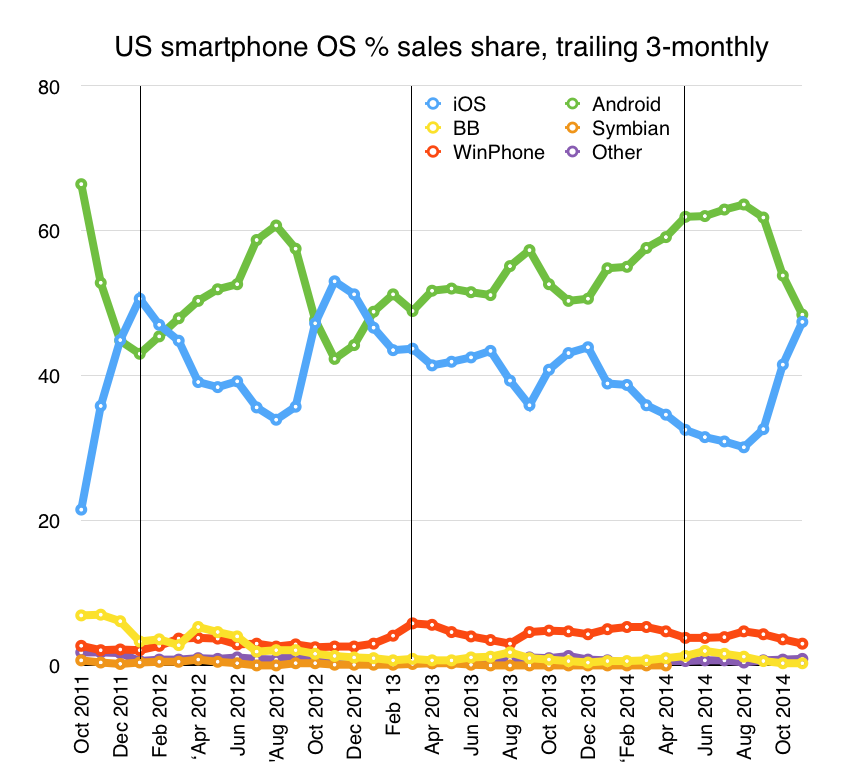
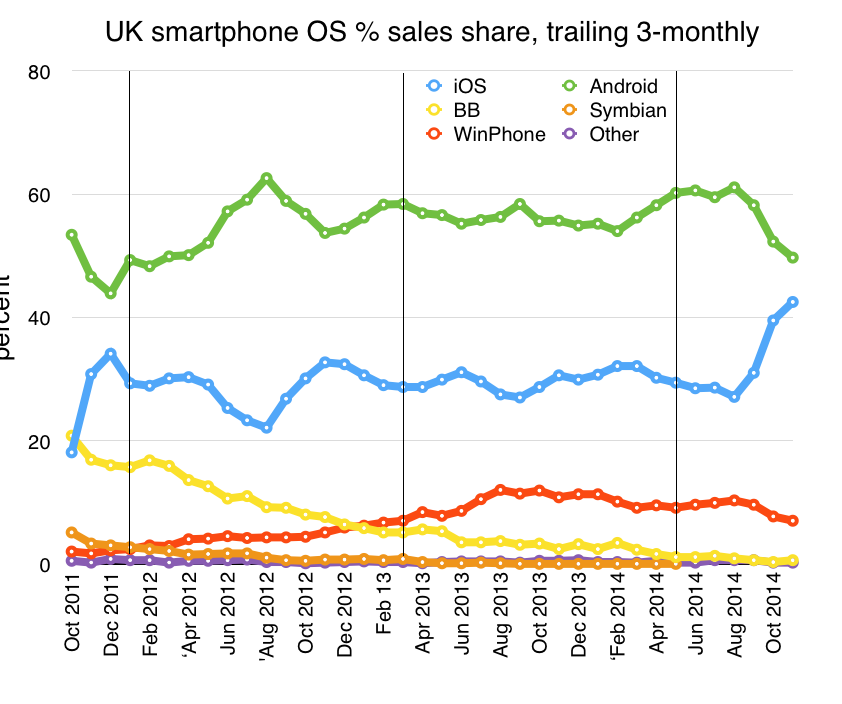
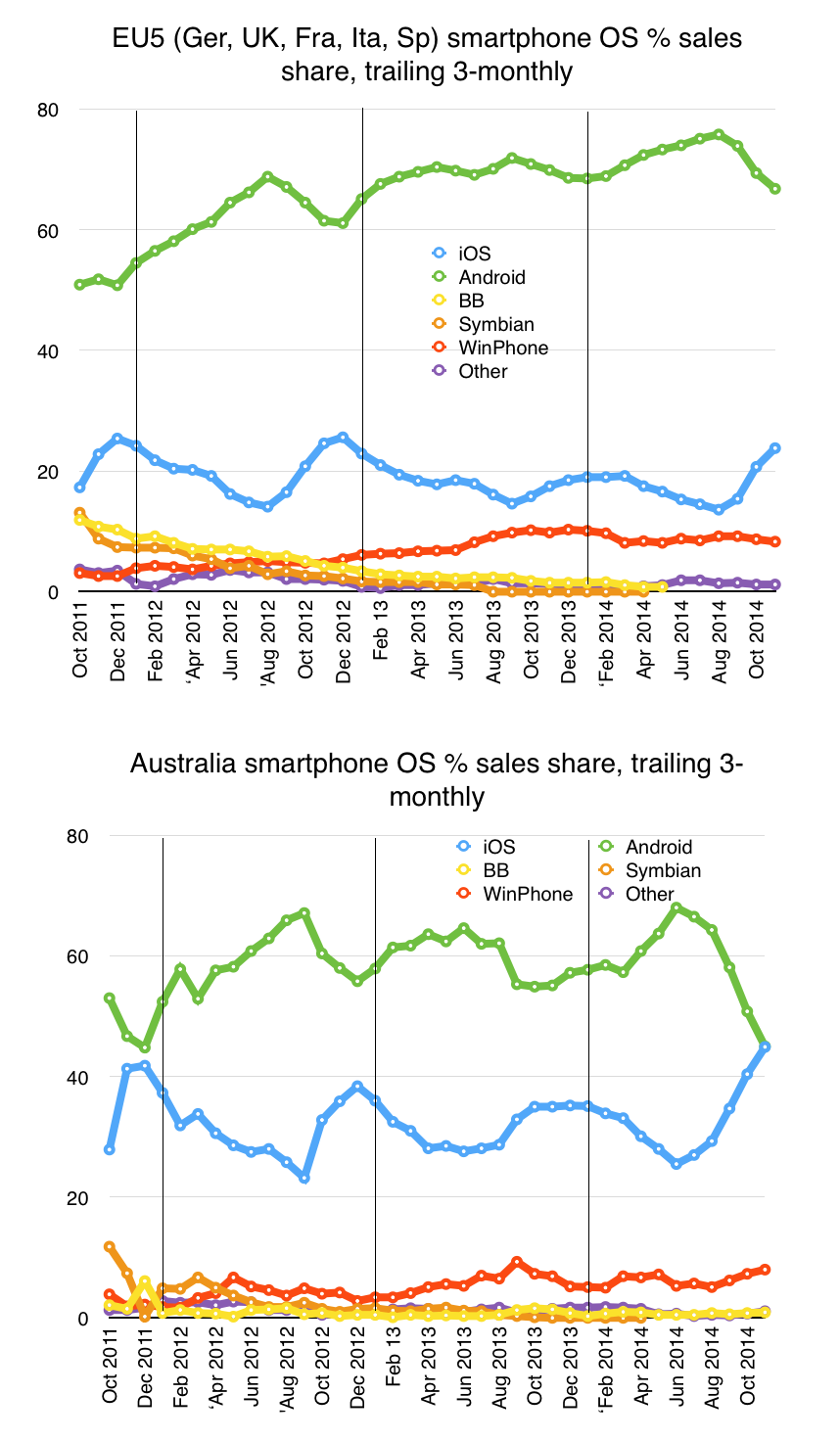
Kantar ComTech Worldpanel’s latest numbers for smartphone sales share are out (or dig the groovy but very dark animation), and pretty much as expected they show that iPhones have had a terrific time in sales terms for the three months to the end of November – so that covers September, October, and November, basically all the time that the new range has been on sale.

My only frustration with Kantar is that it doesn’t index the numbers from year to year; there’s no way to know if sales in 2014 are lower, higher or the same than the previous year or year before. You might think that because more people own smartphones that volume must be increasing, but it’s not necessarily the case; GfK data suggested that mobile phone sales value fell in Christmas 2013 compared to 2012, though increased in 2014 (helped, one suspects, by the Apple phones).

I’ve asked Kantar previously to include an indexing figure (eg 2012 = 100, 2013 = 105, ie 5% greater in sales volume) with these numbers, but they haven’t. (In a future post I’ll try estimating this from general levels of mobile sales from quarter to quarter, and country populations and smartphone shares.)

In the absence of that, we just have the graphs – which I’ll put below. But there’s a much more interesting story which hasn’t been picked out of the press release, though they put it in there. It’s about the refuseniks: the people who have a featurephone, but are determined not to move to a smartphone.

US smartphone sales share to end November 2014

Data from Kantar. iPhone share is high, but not as high as the iPhone 5 launch. (No comparative data on volumes, however.)

UK smartphone sales share to end November 2014

UK smartphone sales share to end November 2014, from Kantar; iOS share is highest ever recorded

EU5 and Australia smartphone sales share

Share of smartphone sales for three months to end November 2014, via Kantar. (EU5 = Germany, UK, France, Italy, Spain = 184m smartphone users; Australia = 16.4m smartphone users)

(Note among all these that Windows Phone is still not making anything resembling progress; nor is “other”, though Firefox phones are few and very far between in these countries. The smartphone platform space is played out.)

Here’s the most interesting part, left to the very last paragraph of the release:

Smartphone penetration reached 58% in the US and 65% across Europe’s big five economies. “While die-hard featurephone owners state they are not planning to buy a smartphone in the next 12 months, they might not have a choice as vendors continue to transition their portfolio away from featurephones to smartphones”, concluded [Kantar head of research Carolina] Milanesi. Forty-seven percent of featurephones owners looking to change their current device in the next six months in the US and 35% across Europe’s top five [countries] are not planning to upgrade to a smartphone.

Once again: 47% and 35% of featurephone owners in the US and EU5 (Germany, UK, Italy, Spain, France) who are looking to change device won’t go to a smartphone.

Now, you could flip those numbers over: out of all (remaining) featurephone owners, 53% in the US and 65% in the EU5 may go to a smartphone in the next six months. It’s only “may” because they haven’t said they will, only that it isn’t definite they won’t.

The longrunning ComScore data in the US, meanwhile, which tracks installed base, shows that at the end of October there were about 65m featurephone users remaining there. For the UK, I calculate that smartphone penetration of mobile phone users is now 80.2% – based on the data and calculations I did for a piece last April using Kantar’s data.

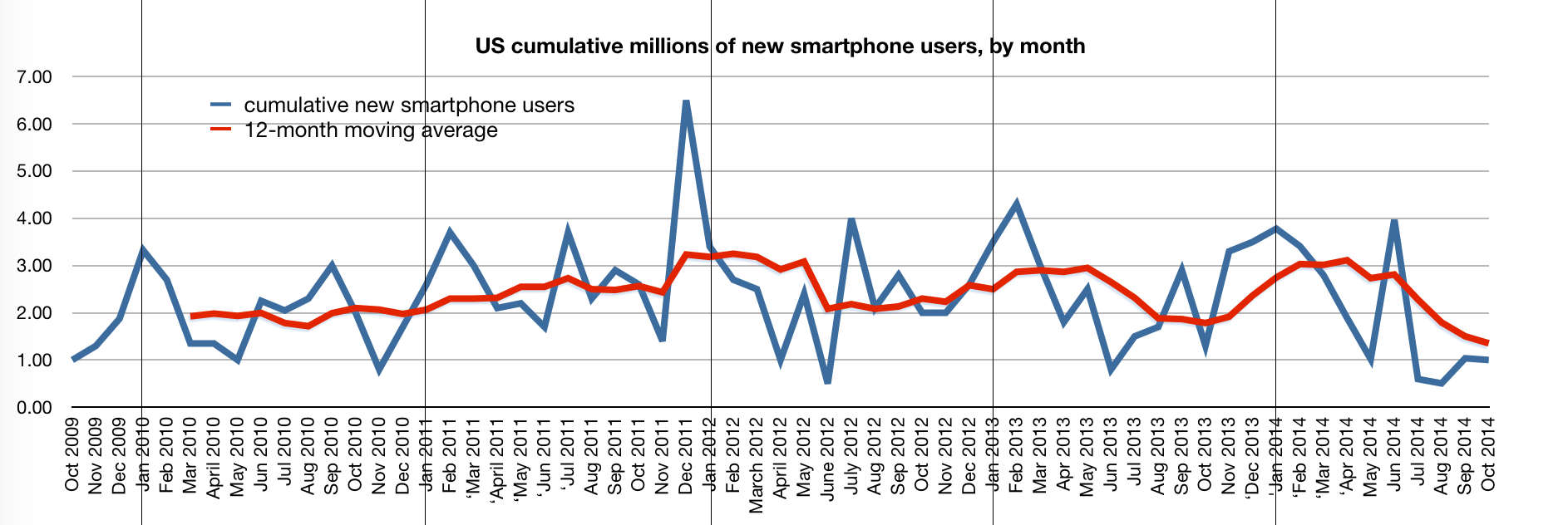
In the US, the number of featurephone users converting to smartphones had been fairly constant, at a few million per month, but as the graph below shows, it nosedived during 2014 (the data only goes up to the end of October) – indicating that fewer are shifting up to smartphones.

Number of US featurephone users moving to smartphones, by month

Data calculated from ComScore, showing how many featurephone users shifted to smartphones in the US. The trendline seems to have fallen off in 2014.

And indeed, why would you shift to a smartphone in the US if you don’t particularly need one, given its crazy system where you pay a huge per-month fee for the phone, and then for carrier service, and then for data, and then perhaps for “extras” (loosely defined)?

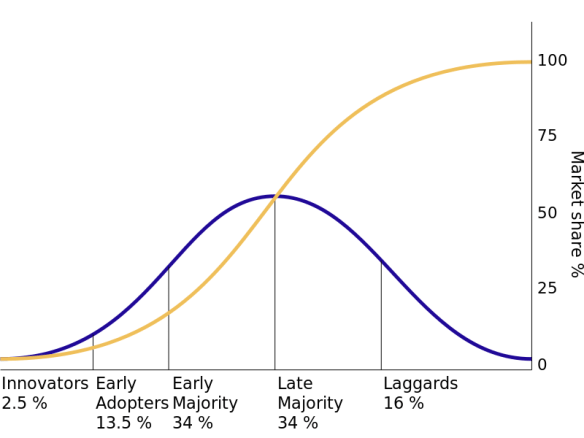
Thus we may now be at the point where the only ones without smartphones are the refuseniks – the people who don’t want a smartphone. In other words, we’re hitting the “laggards” – the 16% who don’t care. Given that the best fit for the data suggests smartphone penetration will top out at 92%-95%, and with 80% already using them (in the UK), we’re clearly in laggard territory.

Diffusion of innovations: segmentation

Stages of adoption of innovations. Source: Wikipedia

What does this mean? Mostly, that selling more phones becomes a battle where the existing smartphone platforms try to win people over from their rivals, while there’s also a gradual accretion from the last featurephone holdouts – who, as Milanesi says, might find they have barely any choice when it comes to replacing their dead one.

For BlackBerry, this is almost played out; it’s down to something like 40m users worldwide, of whom perhaps 8m are consumers and thus remain to be poached.

For Windows Phone – well, it’s unclear quite what’s happening there. The numbers sold remain consistently small, and low-end, and there just doesn’t seem to be a lot of movement. There’s some anecdotal suggestions that many of the low-end ones are used as sort of semi-smartphones, with pay-as-you-go contracts and little use made of their internet capabilities.

Android and iOS

The more interesting flow, aka churn, is between iOS and Android, and Android and iOS: in percentage terms for the three months, 11% of iPhone buyers were previously Android users; and 13% of Android buyers were previously iPhone buyers.

I know – the simplistic view would be that iOS is losing users overall. Except the numbers don’t work out that way; there are more Android users than iPhone users in the US (92m v 73.7m), so that iOS is actually gaining users.

Here’s how:
• 13% of 73.7 = 9.6 iPhone users shifting to Android;
• 11% of 92 = 10.1 Android users shifting to iOS.
Assume that the number of people changing phone is proportional to the total installed base at any time (which is likely), and the iPhone user base grows – just.

Even so, that churn must be a concern to Apple. Maybe the new screen sizes of the iPhone 6 and 6 Plus will reduce that, or perhaps it’s inherent in the dynamics of smartphone platforms.

Meanwhile, if you know a refusenik, do ask them what they’ll do when their phone breaks. Smartphone without data? Buy a featurephone on eBay?

Whatever; it’s unlikely the refuseniks are going to make a big impact now. In the developed world, the smartphone platform wars are so played out.

Start up: Monumental confusion, obligatory (useless) 4K, drone cost surprise, Yahoo’s search inroad, ereaders stall, and more


However, it’s rather difficult to define quite what constitutes “piracy” in some situations. Photo from robotson on Flickr.

A selection of 11 links for you. Not valid in Ohio. I’m charlesarthur on Twitter. Observations and links welcome.

Mobile game piracy isn’t all bad, says Monument Valley producer (Q&A) » Re/code

Remember the remarkable “95% unpaid installs on Android, 60% on iOS” stat from Us Two Games? Here’s a followup:

Re/code: First off, how was that 95 percent statistic determined?

Dan Gray: Five percent are paid downloads, so the ratio is 9.5 to 1, but a portion of those are people who have both a phone and a tablet, people who have more than one Android device with them. So a small portion of that 95 percent is going to be taken up by those installs.

Q: Do you know how big that portion is?

A: It’s impossible for us to track that data. The only thing we can do is, two bits of data: One, how many purchases we have and, two, how many installs we’ve got. And we just leave people to draw conclusions from that as they wish, because we can’t clarify any further than that…

…When you compare the most affluent regions, obviously that kind of slants it toward developing markets and Android devices, where people are less inclined to spend $4 on a game. Let’s say you take U.S. only: those paid rates for Android and iOS are actually considerably closer. They’re closer than five and 40%.


The TidBITS Wishlist for Apple in 2015 » TidBITS

Though Apple fulfilled many user wishes in 2014, there is still more to be done. Here are some of what the TidBITS crew would like to see from Apple in 2015. We’ll circle back to this article at the end of the year to see what changed.

Tidbits is a longstanding online Mac weekly newsletter/site, and all the points made here – too many to enumerate briefly – are spot-on. This ought to be circulated within Apple.


4K TVs are coming for you, even if you don’t want them » Yahoo Tech

Rob Pegoraro, pointing out that manufacturers are pushing 4K resolution as hard as they can, despite the lack of bandwidth to transmit it or content to show. And there’s another thing:

Will you see that added resolution from your couch? You will on the CES show floor, where the crowds force you to within a few feet of sets that span from 50 to more than 100in across. From that perspective, 4K TVs almost always look spectacular.

Things change when you’re gazing at a 4K screen smaller than 55 inches (Samsung’s start at 48 inches and Sharp’s at 43 inches) from across the living room. In many cases, your existing set already shows all the resolution you can discern with 20/20 vision.

How close will you need to sit to see all those extra pixels? A Panasonic rep said the company recommends a viewing distance of 3.5 feet for a 50in 4K set, the smallest it will sell this year. That’s cozy even by Manhattan-apartment standards.

The average screen size has crept up — the NPD Group says 50 to 64in now represents the mainstream of the market — but the math of visual acuity suggests that to get sufficient benefit from 4K, you’re best off buying at the upper end of that scale.

I’ve seen the point made repeatedly that you won’t get any benefit from 4K across the average living room. This isn’t going to prevent a spec-based marketing push though.


The privacy tool that wasn’t: SocialPath malware pretends to protect your data, then steals it » Lookout Blog

Lookout recently discovered SocialPath, a piece of malware that advertises itself as an online reputation management tool. It claims that it will alert its users any time their photo is uploaded somewhere on the Internet. Instead, it steals the victim’s data.

We found one variant associated with this family in Google Play. We alerted Google to the malware and it has since been removed. This app offers a slightly different service — it promises to act as a backup service saving your contacts. It says it will also soon add features for saving your photos, videos, and other data “so if you lose your phone, you will not lose its contents.”

SocialPath targets Sudan predominantly — a region that has been rife with political unrest since the country split when an oil-rich South Sudan seceded.

Unclear whether it’s a nefarious government scheme – seems unlikely, but just possible. However then we come to Lookout’s advice:

You should always:
• Download apps from trusted developers — read reviews, research the developers, make sure you’re choosing a trustworthy product, especially if this tool is promising to help you protect sensitive information
• Don’t download apps from third party marketplaces

But this was on Google Play, at least in one variant. How do you decide in that situation?


Can drones deliver? (PDF) » IEEE Xplore

A guest editorial on the economic viability (or otherwise) of Amazon’s drone delivery, by Rafaeillo D’Andrea, formerly of Kiva:

A high-end lithium-ion battery costs roughly $300/kW h, and can be cycled about 500 times, resulting in a cost of roughly 0.8 cents per km for a 2 kg payload. The total cost of batteries and power is thus 1 cent per km for a 2 kg payload.

So, is package delivery using flying machines feasible? From a cost perspective, the numbers do not look unreasonable: the operating costs directly associated with the vehicle are on the order of 10 cents for a 2 kg payload and a 10 km range. I compare this to the 60 cents per item that we used over a decade ago in our Kiva business plan for the total cost of delivery, and it does not seem outlandish.

This seems surprising, and it would be helpful to know what proportion of Amazon deliveries are 2kg or less. There’s a non-PDF version with more discussion at Robohub.


Xiaomi’s Ambition » stratechery

Ben Thompson, explaining how demographics and non-renting in China works in Xiaomi’s favour as it expands its portfolio with super-keen fan buyers:

This, then, is the key to understanding Xiaomi: they’re not so much selling smartphones as they are selling a lifestyle, and the key to that lifestyle is MiUI, Xiaomi’s software layer that ties all of these things together.

In fact, you could argue that Xiaomi is actually the first “Internet of Things” company: unlike Google (Nest), Apple (HomeKit), or even Samsung (SmartThings), all of whom are offering some sort of open SDK to tie everything together (a necessity given that most of their customers already have appliances that won’t be replaced anytime soon) Xiaomi is integrating everything itself and selling everything one needs on Mi.com to a fan base primed to outfit their homes for the very first time. It’s absolutely a vertical strategy – the company is like Apple after all – it’s just that the product offering is far broader than anything even Gene Munster [proponent for years of a TV set from Apple] could imagine. The services Lei Jun talks about sell the products and tie them all together, but they are all Xiaomi products in the end.

Just bear in mind that there are about a billion people in China, and the one-child rule is being relaxed, and you begin to glimpse how big Xiaomi could be. “A computer on every desk”? Pah. A Xiaomi device in every room in all of China and beyond, more like.


“Best” Apple Mac mini (Late 2014) 2.8GHz review » Macworld UK

Andrew Harrison:

one thing we don’t ordinarily expect is for a newly revised computer to appear which computes more slower than the model that it replaces. Particularly when there’s been not one but two long years between the now-obsolete and shiny new editions.

That’s exactly what’s happened with Apple’s 2014 model of the Mac mini though. Today’s 2014 Mac mini range is in many respects slower than the 2012 range it replaces. Read: 2014 Mac mini v 2012 Mac mini comparison review.

Utterly amazing. It doesn’t offer a quad-core option, the RAM is soldered in place, and changing the disk drive is nigh on impossible. It’s like the worst sort of con job that Apple used to pull when Steve Jobs was in charge. I’d love to hear the reasons for these changes-that-aren’t-improvements.


Yahoo achieves highest US search share since 2009 » StatCounter Global Stats

In December Yahoo achieved its highest US search share for over five years according to the latest data from StatCounter, the independent website analytics provider. Google fell to the lowest monthly share yet recorded by the company*. These December stats coincide with Mozilla making Yahoo the default search engine for Firefox 34 users in the US.

StatCounter Global Stats reports that in December Google took 75.2% of US search referrals followed by Bing on 12.5% and Yahoo on 10.4%.

If you allow that StatCounter’s numbers are correct, Yahoo moved from 8.2% of US search in November 2014 to 10.4% in December. How many Firefox users does that represent? How many have yet to move to version 34? How many have/will switch their default from Yahoo back to Google? One to watch.


Kindle sales have ‘disappeared’, says UK’s largest book retailer » Telegraph

Waterstones, which expects to break even this year. plans to open at least a dozen more shops this year as the ebook revolution appears to go in reverse.

Amazon launched the Kindle, which is now in its seventh generation, in 2007. Sales peaked in 2011 at around 13.44m, according to Forbes. That figure fell to 9.7m in 2012, with sales flat the following year. It is estimated that Amazon has sold around 30m Kindles in total.
At the same time, British consumers spent £2.2bn on print in 2013, compared with just £300m on ebooks, according to Nielsen.

London bookstore Foyles has reported a surge in sales of physical books over Christmas.
US book giant Barnes & Noble is looking to spin off its Nook ereader business, which is estimated to be losing $70m a year. Meanwhile, core sales, excluding Nook, rose 5pc in the most recent quarter.

It seems that e-readers had a natural ceiling on adoption, which was far short of 100% (or even 90%). That in turn means that ebooks aren’t going to take over the world. Physical books, meanwhile, are pretty much guaranteed a readership somewhere. Now the challenge for publishers is working out the correct balance of effort and investment to put into ebooks and physical ones.


A&E in crisis: a special report » Daily Telegraph

Robert Colville:

here’s where I’m going to start: in a small green-painted room off one of the main corridors of that same hospital, where 10 women and two men are studying the spreadsheet projected on the walls and firing jargon back and forth.

“Four in urology with a decision to admit.” “306 is gone, 728 still waiting.” “With all that agreed, does that give you any ITU capacity?” “They’re desperate to bring the liver over from Worcester.” “Time to be seen is at 1hr 54.”

This is the “Ops Centre” of one of the country’s biggest hospitals, where I am spending the week as a fly on the wall. At this and other daily bed meetings, the senior nurses and managers get together to work out who is in the hospital, and where they need to go next.
They go through, ward by ward, listing spare beds and allocating them to the people in A&E. They can see who’s been waiting longest, where the pressure points are, and what needs to be done to resolve them.

This, then, is the story about the NHS that I want to tell. It’s the story of the NHS as a system – a system that takes millions of patients through from the GP surgery and A&E department to treatment, recovery and discharge.

This is a tour de force from Colville, in a piece so long and deep it could have come from the New Yorker (of the 1980s). If you want to understand the pressures on the UK’s NHS emergency services – which are clearly shown here not to be just about “money” – this is the single article to read.


Reporting on cyberattacks: the media’s urgent problem » Medium

Dave Lee is a (terrific) BBC technology writer, here writing in a personal capacity about the impossibility of knowing what’s really going on in some stories:

Let’s take an active story. The hack on Sony Pictures raises many issues about the reporting of hack attacks, and the coverage so far carries worrying implications.

Experts are queueing up to dispute the FBI’s confident claim that it was North Korea — mainly because the evidence pointing the finger at Kim Jong-un is either a) flakey at best or b) top secret, and therefore not open to scrutiny, journalistic or otherwise.

The result of this political back-and-forth is far-reaching, and one that from here on in is being reported on without anyone having any real clue whether the basis of the story — that it was North Korea — is in any way accurate.

We simply don’t know who did it — and yet the atmosphere created by the coverage means the US is considering reclassifying North Korea as a terrorist state. That move would open the door significantly when it comes to what the US considers a “proportional response” to the attack on Sony.


Start up: inside the Fire Phone debacle, a selfie stick successor, CES beats the bedroom, CNN’s last-ever video, and more


The Mayday button on the Amazon Fire Phone. Perhaps should have been used before it went on sale. Photo by TechStage on Flickr.

A selection of 8 links for you. Do not use as a flotation device. I’m charlesarthur on Twitter. Observations and links welcome.

The real story behind Jeff Bezos’s Fire Phone debacle and what it means for Amazon’s future » Fast Company

Austin Carr, in a terrific long read, explaining how the Fire Phone project began in 2010, and had Bezos as a micro-manager:

Some designers bristled at Bezos’s presence and privately questioned his taste, while others who were wowed by his wide-ranging insights loved his approach. Regardless, Bezos’s heavy hand certainly took getting used to, even for Chris Green, Lab126’s VP of industrial design. “In the beginning, Chris would take Jeff’s feedback a bit literally,” says Randall, the former Lab126 VP, “and there was many an evening spent over beers and sushi counseling him, saying, ‘Calm down, it’s going to get better.’”

Bezos drove the team hard on one particular feature: Dynamic Perspective, the 3-D effects engine that is perhaps most representative of what went wrong with the Fire Phone. Dynamic Perspective presented the team with a challenge: Create a 3-D display that requires no glasses and is visible from multiple angles. The key would be facial recognition, which would allow the phone’s cameras to track a user’s gaze and adjust the 3-D effect accordingly. After a first set of leaders assigned to the project failed to deliver, their replacements went on a hiring spree. One team even set up a room that they essentially turned into a costume store, filling it with wigs, sunglasses, fake moustaches, and earrings that they donned for the cameras in order to improve facial recognition. “I want this feature,” Bezos said, telling the team he didn’t care how long it took or how much it cost.

Turns out Bezos isn’t as good a micro-manager for building a phone as Steve Jobs. Result:

According to three sources familiar with the company’s numbers, the Fire Phone sold just tens of thousands of units in the weeks that preceded the company’s radical price cuts.

Was it perhaps somewhere around the 35,000 that I estimated in August? My range was between 26,000 and, generously, 35,000. I’d love to hear the actual figure.

The whole piece, though, gives terrific insight into how Bezos can get it wrong. He thought a single phone – one piece of hardware – could reshape Amazon’s brand, and turn it from a “get stuff cheap online” one, into a “we customers love you, take our money” brand. The two aren’t the same.


February 2014: What the world really needs: A telescopic SELFIE STICK » The Register

Simon Rockman in February 2014:

Mobile World Congress is often as interesting for the silly gadgets as it is for the mainstream announcements.

This (right) is the Selfie Stick, an extendable pole with a Bluetooth control for your phone.

The Selfie comes in two versions: a general one and one for Samsung phones where you have focus control.

Hahahahahawhatdo you mean they’re sold out everywhere?


The first wearable camera that can fly » Nixie

Wearable and flyable

The first wrist-band camera quadcopter.
Nixie flies, takes your photo, and comes back to you.

This feels like it could easily be one of those Great Ideas that is too easily bungled in the execution, but if it works well it could put selfie sticks out of business. Until selfie stick owners swat them out of the sky.


CES, the World’s Largest Trade Show, Is Too Big for Vegas » Bloomberg

The Consumer Electronics Show in Las Vegas has a problem that many events would love to have: It’s become too big. And it doesn’t want to get any bigger.

With as many as 160,000 visitors to CES—the world’s largest annual trade show—the Nevada city’s sprawling hotels are stretched to the limit. Last January’s gathering of gadget-loving geeks somehow packed in a full 10,000 more people than Las Vegas has rooms for them to sleep in.

The Consumer Electronics Association, the folks who put on the conference and expo, says CES 2015 will have the equivalent of 35 football fields, or about 2 miles of floor space, filled with phones, televisions, smartwatches, washing machines and throngs of people trying to see it all. “In order to enhance the experience for our attendees, we aim to keep attendance between 150,000 and 160,000 so that everyone can get where they need to go,” says CEA Vice President Karen Chupka.

That’s OK – they can sleep in the lines for press conferences showing off LG’s new dishwasher. Actually, the graph with the story suggests that attendees has exceeded the number of available hotel rooms since 2012. I’m pretty sure I slept there in 2012. Could it be that, shock, some people share rooms? Also, how’s AirBnB coming along there? And might some attendees, um, live in Vegas?


The weirdly-synched life of the Google Nest household » The Register

Richard Chirgwin:

At first glance it looks like the typical Utopian vision of Silicon Valley, but Vulture South took a second look and asked ourselves: “what kinds of life does Google think we live?”

The short answer: wealthy, lazy, and either lonely or in a strange 1950’s-sitcom family synchronisation. Everybody rises and sleeps at the same time, everybody leaves and arrives together, and we’re rich enough to have ‘leccy cars but too poor to charge them.

The most obvious believer in the synchronised family is appliance giant Whirlpool. Its Nest integration can “let your washer and dryer know when you’re home and they will automatically switch to quiet mode”. Unless only one occupant is recognised, that means the only time the appliances are allowed to let their hair down and party is when everyone’s away.

The August Smart Lock will tell Nest to change your thermostat settings when you arrive (warm the house up) or leave (switch off the heating) – which begs the question “what if I lock the front door while other people are still at home?” At least the Kwikset Kevo smart lock understands that more than one person might be in a household.

The Withings Sleep System: when you go to sleep it will “let your Nest Thermostat to a comfortable nighttime temperature. Wake up and it will tell Nest you’re ready to start the day.” Once again, the idea that a household might have sleep and wake times staggered by hours seems alien to the developer.

This is my general objection to “internet of things” and “homes of the future” visions: they don’t account for how we actually live. Them: Look, you’ll be able to get your coffee maker to make coffee before you get out of bed! Me: so I’ll have had to put the coffee in the night before. As I have to go downstairs to get the coffee, why not just make it fresh while I’m there?

And so on. Most IOT/HOTF concepts seem to come from 20-somethings who have no concept of running a household. Hence, I think, their limited success.


This is the video CNN will play when the world ends » Jalopnik

Michael Ballaban, who unearthed this Holy Grail-style rumoured-but-until-now-never-confirmed video, which has the notice:

“HFR till end of the world confirmed.”

Hold for release. CNN, once ever so thorough in its factchecking, knew that the last employee alive couldn’t be trusted to make a call as consequential as one from the Book of Revelation. The end of the world must be confirmed.

That leaves open a whole host of unanswered questions. If this is the last CNN employee alive, in the last CNN bureau on Earth, who do they confirm it with? What does confirmation look like? Who can be the one to make that determination, to pronounce the universe itself dead? Is it Wolf Blitzer himself, ever a fan of the Washington Wizards, and thus a man who would know death when he saw it? Would it be Rick Davis, CNN’s head of standards of practices, who has been with the company since its birth and who thus would know CNN’s journalistic practices better than anyone?

Or would it be some sort of living embodiment of CNN itself, ready to proclaim its own demise, as Judgment Day is truly the only thing able to bring about the long-anticipated death of cable news?

And who would be around to watch it?

Um.. that CNN employee? The machines grinding us into nanoparticles to feed into their hoppers? Take your pick.


Breach puts Morgan Stanley client data up for sale » NYTimes.com

Nathaniel Popper:

the bank traced the breach to a financial adviser working out of its New York offices, a 30-year-old named Galen Marsh, according to a person involved in the investigation who spoke on the condition of anonymity.

Mr. Marsh, who had been with Morgan Stanley since 2008, was quickly fired and is currently the subject of a criminal investigation by the Federal Bureau of Investigation, a person briefed on the investigation said. The Financial Industry Regulatory Authority is also examining the matter.

Morgan Stanley said on Monday that it had determined that Mr. Marsh took data on about 10% of its 3.5 million wealth management customers, including transactional information from customer statements.

The bank said that Mr. Marsh did not take any sensitive passwords or Social Security numbers, and that it had not found any evidence that the breach resulted in any losses to customers. A lawyer for Mr. Marsh, Robert C. Gottlieb, acknowledged on Monday that his client did take the information in question but said that he did not post it online, share it or try to sell it.

Afghanistan war logs: insider breach. NSA/GCHQ documents: insider breach. Morgan Stanley: insider breach. Sony Pictures..?


Hit mobile game Monument Valley and piracy: ‘Only 5%’ of Android players paid for it » VenureBeat

Jeff Grubb:

Piracy is still a big problem on Android.

Developer Ustwo had one of the break out mobile hits in 2014 with its isometric puzzler Monument Valley, but a successful game is not impervious to piracy. The studio confirmed on Twitter today that Monument Valley has had an especially tough time with “unpaid installs” on Android. The company said that 95% of the people playing the game on Google’s mobile operating system did not buy it — although, Ustwo did explain that a small number of those installs are legitimate and were not illegally downloaded. This makes a big dent in Ustwo’s earnings since Monument Valley is a premium-priced game that does not have in-app purchases like Candy Crush Saga or other lucrative mobile releases. Gaming on smart devices surpassed $21bn last year, but it potentially could have more if it weren’t for piracy.

The paid rate was much better on iOS, but it’s still alarming. Ustwo said that 40% of the people who have the game on an Apple mobile device paid for it. Again, that means the majority did not give the developer money.

Depressing numbers, for a game that costs just $4. There’s certainly piracy on iOS – but the astronomical amount on Android really isn’t good news. Does this get factored into the quotes about “revenues from app stores” we see?

There is some confusion over the iOS figure though: it’s not clear whether someone who buys on the iPhone and then downloads to their iPad counts as an “unpaid install”. We also don’t know if that’s how it works on Android – though do 95% of Android owners have multiple devices?


Start up: more on AMOLED deterioration, Panic in the stores, tracking the trolls, questions for 2015 and more


AMOLED screens. What will they look like in a few years’ time? Photo by RafeB on Flickr.

A selection of 9 links for you. May contain nuts. I’m charlesarthur on Twitter. Observations and links welcome.

Are AMOLED displays at risk of burn-in? >> PC Pro

Paul Ockenden:

The blacks are better on an AMOLED screen, since its pixels are turned off and emit no light; IPS black pixels merely attempt to block the backlight, with only partial success. AMOLED screens aren’t as sharp as IPS panels, however, and can be more difficult to read in bright sunlight. To my mind, however, the biggest problem with AMOLED displays is that they suffer from screen burn.

The problem is the “O” in the AMOLED acronym, which stands for “organic”. The organic compounds used in AMOLED displays are polymers or copolymers, such as polyfluorene (PFO) and polyphenylene vinylene (PPV), both of which degrade with use.

This is partly due to the fact that the chemistry involved in creating the electroluminescence is irreversible, so the luminous pixels degrade as they’re used up, like a battery. These organic materials tend to crystallise, too – an effect that is exacerbated at higher temperatures. That’s something to bear in mind the next time your phone becomes warm while you’re playing a game or watching a video.

The answer to the headline’s question is “yes”. This seems like the sort of thing that would be easily overlooked by reviewers who use a device for a few days and praise its “gorgeous AMOLED screen“. But come back in a couple of years, and is it still?


The 2014 Panic report >> Panic Blog

Cabel Sasser:

This is the biggest problem we’ve been grappling with all year: we simply don’t make enough money from our iOS apps. We’re building apps that are, if I may say so, world-class and desktop-quality. They are packed with features, they look stunning, we offer excellent support for them, and development is constant. I’m deeply proud of our iOS apps. But… they’re hard to justify working on.
Here’s a way to visualize the situation. First up is a sample look at Units Sold for the month of November 2014: Wow! 51% of our unit sales came from iOS apps! That’s great!

But now look at this revenue chart for the same month… Despite selling more than half of our total units, iOS represents just 17% of our total revenue.
There are a few things at work here:
1. We’re not charging enough for our iOS apps. Or Mac users are simply willing to pay more for apps. Or both.
2. We’re not getting the word out well enough about our iOS apps.
3. The type of software we make just isn’t as compelling to iOS users as it is to Mac users. Our professional tools are geared for a type of user that simply might not exist on the iPad — admins and coders. We might have misjudged that market.

It’s really hard to say for sure. One thing is for certain: we are more likely to increase the price of our iOS software over time in an effort to make it make sense. And we’re less likely to tackle any huge new iOS projects until we get this figured out.

The problem with getting enough revenues from the iOS store, quite apart from the hassle Panic had when one of its apps was yanked from the store by Apple, is one that will be echoed by many companies. The question is whether it’s inherent to mobile – that niche apps (high value-added, small user numbers) – or to Apple’s store structures, which don’t allow trials (for example).


Global smartphone market to record de-growth [in value] for the first time in 2015, semiconductor to advance as high return industry >> ETNews Korea

It has been forecast that 2015 will be a year in which the global smartphone market will record the first negative growth in history based on the amount. Although a growth is expected based on the forwarding volume, the rate at which average selling price (ASP) decreases has accelerated. The global smartphone market scale in 2014 is estimated at $298.1bn, which increased by 10% from the year before. However, it is forecast that the scale will decrease by 4.3% to $285.2bn next year.

Stock market analyst Kim Hye-yong from Woori Investment and Securities forecast, “The global smartphone ASP this year [2014] is $234.50, which decreased by 13.9% from last year. Next year [2014], it will drop by 16.3% to $196.”

According to Kim, common carrier subsidy policy is not working in the emerging market that centers on the open market and, as a result, high-end smartphones are not selling well across the world. He estimated that Chinese companies, despite their growth on the outside, will record a deficit or just about meeting the breakeven point as their profitability is insufficient.


The Death Of Expertise >> The Federalist

Tom Nichols:

I am (or at least think I am) an expert. Not on everything, but in a particular area of human knowledge, specifically social science and public policy. When I say something on those subjects, I expect that my opinion holds more weight than that of most other people.

I never thought those were particularly controversial statements. As it turns out, they’re plenty controversial. Today, any assertion of expertise produces an explosion of anger from certain quarters of the American public, who immediately complain that such claims are nothing more than fallacious “appeals to authority,” sure signs of dreadful “elitism,” and an obvious effort to use credentials to stifle the dialogue required by a “real” democracy…

…I fear we are witnessing the “death of expertise”: a Google-fueled, Wikipedia-based, blog-sodden collapse of any division between professionals and laymen, students and teachers, knowers and wonderers – in other words, between those of any achievement in an area and those with none at all…

…None of this ignorance stops people from arguing as though they are research scientists. Tackle a complex policy issue with a layman today, and you will get snippy and sophistic demands to show ever increasing amounts of “proof” or “evidence” for your case, even though the ordinary interlocutor in such debates isn’t really equipped to decide what constitutes “evidence” or to know it when it’s presented. The use of evidence is a specialized form of knowledge that takes a long time to learn, which is why articles and books are subjected to “peer review” and not to “everyone review,” but don’t tell that to someone hectoring you about the how things really work in Moscow or Beijing or Washington.

This is a storming essay about the ways in which the value of real domain expertise is being degraded and devalued. Read it and gape.


20 questions for 2015 >> Benedict Evans

I wrote a detailed post a few weeks ago looking at some of the key structural questions in mobile – with the platform wars over (their first phase, at least), what’s happening to Android, what will happen to interaction models and so on. But it’s also worth looking at just how much could change just in 2015 – or even in January. Everything is wide open. So, here, in no special order, are 20 questions for 2015, any one of which would change things a lot. I’ve written about most of these topics already in 2014 – in 2015 they’re even more interesting.


Apple questions for 2015 >> Above Avalon

Neil Cybart:

In recognition of the beginning of a new year, I want to share my running list of questions that I have been keeping for Apple in 2015. By no means is this an exhaustive list, but rather things that I know to be on the lookout for.

It’s a pretty long list, if not exhaustive. Some key questions in there, with designer Marc Newson, SVP operations Jeff Williams and ex-iOS chief Scott Forstall all in there. Plus would you believe in an Apple Pen?


Meet the dogged researchers who try to unmask haters online >> MIT Technology Review

Adrian Chen:

Internet hatred [näthat] is a problem anywhere a significant part of life is lived online. But the problem is sharpened by Sweden’s cultural and legal commitment to free expression, according to Mårten Schultz, a law professor at Stockholm University and a regular guest on Troll Hunter, where he discusses the legal issues surrounding each case. Swedes tend to approach näthat as the unpleasant but unavoidable side effect of having the liberty to say what you wish. Proposed legislation to combat online harassment is met with strong resistance from free speech and Internet rights activists.

What’s more, Sweden’s liberal freedom-of-information laws offer easy access to personal information about nearly anyone, including people’s personal identity numbers, their addresses, even their taxable income. That can make online harassment uniquely invasive. “The government publicly disseminates a lot of information you wouldn’t be able to get outside of Scandinavia,” Schultz says. “We have quite weak protection of privacy in Sweden.”

Imagine what the childish (and sometimes dangerous) doxxing wars being played out over various hashtags would look like if every country made available the amount of information that Sweden does. Stieg Larsson, author of the “Dragon Tattoo” books and an investigator into far-right hate groups, didn’t get married because doing so would have required him to state his place of residence.


What it would really take to reverse climate change >> IEEE Spectrum

Ross Koningstein and David Fork were in charge of Google’s “moonshot” announced in 2007 to come up with renewable energy sources that cost less than coal. It was shut down in 2011:

Our reckoning showed that reversing the trend would require both radical technological advances in cheap zero-carbon energy, as well as a method of extracting CO2 from the atmosphere and sequestering the carbon.

Those calculations cast our work at Google’s RE<C program in a sobering new light. Suppose for a moment that it had achieved the most extraordinary success possible, and that we had found cheap renewable energy technologies that could gradually replace all the world’s coal plants—a situation roughly equivalent to the energy innovation study’s best-case scenario. Even if that dream had come to pass, it still wouldn’t have solved climate change. This realisation was frankly shocking: Not only had RE<C failed to reach its goal of creating energy cheaper than coal, but that goal had not been ambitious enough to reverse climate change.

We’re a long way down the climate change road; what would really be needed would be an all-in effort on something like fusion and solar power.


No credit >> All this

Dr Drang:

Thursday night I got a fraud notice via text and email. When I called the bank, I found several charges from an online video game company that my older son uses. He’d made a single purchase, which went through, and then fifteen minutes later four or five charges from that same vendor were attempted and blocked. Was this a programming error at the game company? fraud by the company? fraud by some third party masquerading as the game company? Don’t know. I do know it wasn’t because my son was buying things by mistake—he’s eighteen and has enough experience online to know better. The bank cancelled the credit card and we canceled his game account. Happy New Year.

As I said, this will be our fifth card in the past twelve months. We started 2014 with a card we’d had for a couple of years, but it was replaced in early February after the Target breach. Sometime in spring, the bank caught a fraudulent charge at a Kmart in Chicago, so our 3–4 month old card was cancelled and a new one issued. That one lasted all the way to October, when it was cancelled because of the Home Depot breach. And now this.

When the new card arrives on Monday, I’ll go through the list of accounts and change them all to the new number. My list is on paper, but this time I’m going to switch to a system like Jamie Phelps’s, that’ll allow me to just click a single link instead of dig my way through a series of pages for each account.

It’s puzzling how European banks and retailers were able to coordinate the introduction of Chip+PIN – which would kill this sort of fraud almost dead – and yet the US has completely failed at it. The UK introduced Chip+PIN in 2004. The problem hasn’t gone away – it’s forced it to different places, principally online, where phishing is still a big problem that await Apple Pay-style methods to reduce them.