Start up: Google’s ad stop, hacking phishers, the lost phone mystery, the adblocking browser and more

A game with these will give you an insight into production processes. Photo by judy_and_ed on Flickr.

You can now sign up to receive each day’s Start Up post by email. You’ll need to click a confirmation link, so no spam.

A selection of 10 links for you. Use them wisely. I’m charlesarthur on Twitter. Observations and links welcome.

Why is your team falling behind? Ask ‘The Penny Game’ » Atomicobject

Eric Shull:

The book Velocity describes an enlightening simulation, a model of a simple manufacturing line. The game uses pennies and dice to represent pieces of work flowing through stations in a factory. It may be simple, but the penny game can improve our understanding of how software teams work, how the interaction of variable processes affect the system as as whole.

In the penny game, pennies come in at one end of the line, are processed by each station, then exit at the other end. This would be rather mundane but for one complication: each station does not always process the same number of pennies.

In the simulation, rolled dice indicate how many pennies each station is allowed to move.

This is fascinating – and gives you real insight into the problems that have to be overcome in manufacturing to tight deadlines. Imagine now if you were processing millions of “pennies”, except they were phones.
link to this extract


Google disabled 49% more ads in 2015 » WSJ Digits blog

Alistair Barr:

More than 1,000 of Google’s 60,000 employees monitor and remove ads, an important task because the company gets about 90% of its revenue from advertising. It’s also been hit financially for not adequately monitoring ads. In 2011, the company agreed to pay $500m to settle allegations by the U.S. Department of Justice that ads for Canadian online pharmacies contributed to the illegal importation of prescription drugs. In the settlement, Google acknowledged it acted “improperly.”

Google blocked more than 12.5m ads in 2015 for drugs that were unapproved or that made misleading claims, up from 9.6m a year earlier.

Ads making misleading weight-loss claims were a big source of user complaints last year, prompting Google to suspend more than 30,000 websites from its ad systems. It declined to give a comparable number for 2014.

Rob Leathern has the growth figure for ad disabling: it’s growing by 50% annually, but still a long way short of catching them all.
link to this extract


How I stumbled upon thousands of Facebook passwords » Medium

“Rukshan”, a Colombo-based medical undergrad and hacker, received a Facebook phishing email and twiddled around with the phishing page:

after modifying the url I checked the folder which contained the php script that handles the post requests and I knew at that moment I hit the jackpot.

There was no index.html file to make sure no one else see the files in that directory or any .htaccess modification, well like I said phishing people are too bored to do all these tech stuff anyway, they’d rather get the passwords and go away.

So I opened the password.html file and I was greeted to the sight of hundreds of Facebook passwords, and by looking at the credentials one there was a pattern:

•Almost all of these accounts belonged to girls who are in their early 20s or teens.
• Almost all of the accounts belonged to females who are from Colombo.

Neat idea; neater still would be to wipe the files. But that would be one sizeable hack further (and probably illegal).
link to this extract


Why don’t you have an Android version? (Or why we develop for iOS first) » Impossible Ventures

Joel Runyon:

Android users may download more apps, but they spend less money than iTunes users.

But that’s not just fake studies either, in our experience with Paleo (io) – a top 20 app in iTunes and ranked even higher in Google Play – we make about 3x the sales on our iTunes listing as we do on Google Play (even though we have a higher ranking in Google Play than iTunes).

Which brings me to the next point: apps are not free to make.

As an app developer, you have to spend time & money on this concept that you have in your head to bring it to reality. The  MVP on an app can cost anywhere between $2k and $20k to build and launch. It might not seem like much if you spend all your time raising VC money and have a $1M+ in the bank, but it can add up if you’re bootstrapping.

In fact, with every dollar you spend, there’s a very real cost (along with another equally as real, opportunity cost).

Of course the argument is completely different in Asia, where it’s generally Android-first (except in Japan, and who knows in China?).
link to this extract


Finding the tennis suspects » Medium

Russell Kaplan, Jason Teplitz, and Christina Wadsworth:

The tennis world was sent reeling when BuzzFeed News and the BBC jointly published The Tennis Racket, which revealed “evidence of widespread match-fixing by players at the upper level of world tennis”. But BuzzFeed refused to publish the names of those players.

We dove into the data and found the names ourselves.

Unless you follow tennis really closely you won’t have heard of any of the names but one, and I do wonder if that one is thrown up by some weird quirk of the analysis. Seems robust, though. I think this might dissuade players – and administrators – from trying to hide this in future, knowing that there are people analysing public data for oddities. Will it put off the gamblers, though?
link to this extract


Why do people keep coming to this couple’s home looking for lost phones? » Fusion

Kashmir Hill:

It started the first month that Christina Lee and Michael Saba started living together. An angry family came knocking at their door demanding the return of a stolen phone. Two months later, a group of friends came with the same request. One month, it happened four times. The visitors, who show up in the morning, afternoon, and in the middle of the night, sometimes accompanied by police officers, always say the same thing: their phone-tracking apps are telling them that their smartphones are in this house in a suburb of Atlanta.

But the phones aren’t there, Lee and Saba always protest, mystified at being fingered by these apps more than a dozen times since February 2015. “I’m sorry you came all this way. This happens a lot,” they’d explain. Most of the people believe them, but about a quarter of them remain suspicious, convinced that the technology is reliable and that Lee and Saba are lying.

“My biggest fear is that someone dangerous or violent is going to visit our house because of this,” said Saba by email. (Like this guy.) “If or when that happens, I doubt our polite explanations are gonna go very far.”

It’s billed as “a tech mystery”, and it really is.
link to this extract


Brave is the name, ad-blocking the game of new browser » Computerworld

Former Mozilla CEO (for 11 days) Brendan Eich is behind a new browser for desktop and mobile which blocks all ads and tracking by default:

“We are building a new browser and a connected private cloud service with anonymous ads,” Eich said.

In effect, Brave will first scrub websites of most of their ads and all tracking, then replace those ads with its own. But the latter will be aimed not at individuals but at the anonymous aggregate of the browser’s user base. If enough people gravitate to the browser, Brave will share its ad revenue with users and content publishers.

“We will target ads based on browser-side intent signals phrased in a standard vocabulary, and without a persistent user id or highly re-identifiable cookie,” Eich said. “By default Brave will insert ads only in a few standard-sized spaces. We find those spaces via a cloud robot.”

No user data will be recorded or stored by Brave, Eich promised.

Elsewhere, Eich said that 55% of Brave’s revenue would be shared with site publishers, and 15% with users, who could then turn that money over to their favorite sites or keep it.

Al Hilwa, an analyst with research firm IDC, applauded the concept of creating an alternate revenue stream from traditional advertising, but wondered whether the browser could compete, even in the niche that Eich described. “This is a laudable idea, but fighting ‘free’ is always risky,” said Hilwa in an email reply to questions.

Not sure the world has an appetite for a new browser, but one can envisage adblocking becoming built in and then enabled, just as pop-up blocking in browsers went from “pop-up what?” to “optional” to “on by default”.
link to this extract


Apple pushes to bolster market share in India » WSJ

Newley Purnell:

India’s smartphone market is expanding quickly and by next year it should overtake the U.S. as the world’s second-biggest behind China, according to research firm IDC.

Just 35% of mobile phones sold in India now are smartphones, meaning there is room for growth as people upgrade from basic devices. Indian consumers, however, tend to purchase inexpensive devices: The average smartphone selling price in the country is likely to fall to $102 in 2018 from $135 in 2014, IDC says.

Apple’s problem has been that the sweet spot for smartphone sales in India has been handsets that cost less than $150. In a country where the average person earns about $1,500 a year and even middle-class consumers make less than $8,000 a year, the standard iPhone — which usually costs between $500 and $1,000 without a data plan — was just too expensive for most people to consider.

“Buying an iPhone is so expensive,” said Sakshi Maurya, a 20-year-old university student in New Delhi. She said she doesn’t understand why an iPhone is five times as expensive as some locally available Android phones. “It’s a luxurious thing.”

India poses a particular marketing challenge for Apple: it’s a mixture of very tech-savvy buyers and low-income buyers. Which does it target first, and how?
link to this extract


iPhone 6S/6S Plus underperform year-ago sales » Consumer Intelligence Research Partners

CIRP finds that the new iPhone 6s and 6s Plus accounted for 67% of total US iPhone sales, with iPhone 6s at 48% and iPhone 6s Plus at 19%. In the December 2014 quarter, iPhone 6 and 6 Plus accounted for 75% of total US iPhone sales with 30% iPhone 6 Plus.

“The iPhone 6s and 6s Plus did quite well,” said Josh Lowitz, CIRP Partner and Co- Founder. “Yet, they did not dominate the same way that iPhone 6 and 6 Plus did a year ago. The total share of the new flagship models fell below the share of the then-new phones in 2014, and the large-format iPhone 6s Plus share of sales dropped compared to the iPhone 6 Plus as well. Customers continue to choose the year-old iPhone 6 and 6 Plus, and even the two-year old iPhone 5S.”

CIRP can’t say whether total sales are higher or lower (it samples 500 buyers of Apple devices in the previous quarter), just the mix. This looks like a subtle price deflation of the iPhone as people opt for 2014’s models over 2015’s – after all, they look the same to other people, even if the newer models has extra features.
link to this extract


Issue 3434 – android – Add APIs for low-latency audio – Android Open Source Project – Issue Tracker

On Tuesday, Apple released its “Music Memos” app, which is intended to let musicians (of any standard) record little musical thoughts that come to them on the guitar or piano directly to their iPhone or iPad, and add musical accompaniment.

Android doesn’t have that, because as has been noted here before its audio latency is too long – over 10 milliseconds, which is the longest pro musicians can bear. So how long have developers been prodding Google to improve Android’s audio latency?

I am developer of real-time audio signal processing applications. I am interested in creating
applications for sale in the android marketplace, but found that android has no method for real-
time low latency audio.

This is the first entry in a bug/feature request which continues to the present (latest entry is June 2015). The date of the entry? July 31, 2009 – slightly over nine months after the first Android phone. Is six and a half years a long time for a feature request to lie open? (And here’s Google’s official list of device latencies. Look for any at 10ms or below.)

Apple effectively gets 100% of the professional audience through this feature.
link to this extract


Errata, corrigenda and ai no corrida:

Start up: debunking 2015’s fake pics, wearables grow, Apple’s 800 camera people, and more


The Internet of Things might help warn about this. Photo by freefotouk on Flickr.

You’re not too late to sign up to receive each day’s Start Up post by email. Think of it as a Christmas present to yourself. Actually, it’ll stop for two weeks after Christmas, but anyway.

A selection of 9 links for you. Use them wisely. I’m charlesarthur on Twitter. Observations and links welcome.

76 viral images from 2015 that were totally fake » Gizmodo

Matt Novak:

We debunked dozens of fake photos this year, covering everything from Charles Manson’s baby photos to John Lennon’s skateboarding skills, and everything in between. It was another busy year for anyone spreading fake images on the internet.

Below, we have 76 photos that you may have seen floating around the internet in 2015. Some are deliberate photoshops created by people who want to deceive. Others are just images that got mixed up in this big, weird game of Telephone we call the internet.

76! That’s more than one a week. Actually, there’s only one fake a week?
link to this extract


US probes Theranos complaints » WSJ

John Carreyrou:

U.S. health regulators are investigating complaints about laboratory and research practices at Theranos Inc. by two former employees of the blood-testing startup company, according to people familiar with the inquiries.

A complaint filed in September by a former Theranos lab employee to the Centers for Medicare and Medicaid Services alleged that management instructed lab employees to keep testing patients with the company’s blood-analysis devices despite indications of “major stability, precision and accuracy” problems with those devices.

The second complaint was sent to the Food and Drug Administration earlier this month by another ex-employee, who alleged that the study submitted by Theranos last year to win the agency’s approval for a herpes test was tainted by breaches in research protocol.

Really not going well for Theranos. All been going downhill since the WSJ article in October.


Worldwide shipments of wearables to surpass 200m in 2019, driven by strong smartwatch growth » IDC

According to the International Data Corporation (IDC ) Worldwide Quarterly Wearable Device Tracker , the worldwide wearable device market will reach a total of 111.1m units shipped in 2016, up a strong 44.4% from the 80m units expected to ship shipped in 2015. By 2019, the final year of the forecast, total shipments will reach 214.6m units, resulting in a five-year compound annual growth rate (CAGR) of 28%.

“The most common type of wearables today are fairly basic, like fitness trackers, but over the next few years we expect a proliferation of form factors and device types,” said Jitesh Ubrani , Senior Research Analyst for IDC Mobile Device Trackers. “Smarter clothing, eyewear, and even hearables (ear-worn devices) are all in their early stages of mass adoption. Though at present these may not be significantly smarter than their analog counterparts, the next generation of wearables are on track to offer vastly improved experiences and perhaps even augment human abilities.”

One of the most popular types of wearables will be smartwatches, reaching a total of 34.3m units shipped in 2016, up from the 21.3m units expected to ship in 2015. By 2019, the final year of the forecast, total shipments will reach 88.3m units, resulting in a five-year CAGR of 42.8%.

“In a short amount of time, smartwatches have evolved from being extensions of the smartphone to wearable computers capable of communications, notifications, applications, and numerous other functionalities,” noted Ramon Llamas , Research Manager for IDC’s Wearables team. “The smartwatch we have today will look nothing like the smartwatch we will see in the future. Cellular connectivity, health sensors, not to mention the explosive third-party application market all stand to change the game and will raise both the appeal and value of the market going forward.

Apple Watch forecast to continue dominating through to 2019, though Android Wear coming up strongly. Tizen not going anywhere.
link to this extract


‘Internet of Things’ technology powers an interactive flood map and sensor network » Nominet

Nominet, in association with the Flood Network, is today launching an interactive, online map which visualises river and stream levels around Oxford. The map, showing how technology can be a part of flood defence systems anywhere, has been developed following a successful pilot project with the Oxford Flood Network. The project has been focused on exploring the potential of the Internet of Things (IoT) to create an extensive, localised, early-warning system for flood-prone areas for the first time in the UK.

The Flood Network is powered by two pieces of innovative technology developed by Nominet:

• A set of IoT tools to help innovators build and scale IoT applications in real environments. The tools utilise existing internet standards, such as DNS, to provide proven scalable solutions with an existing support eco-system.

•The use of TV white space to connect a number of hard-to-reach devices in the network. Nominet’s recently qualified TV white space (TVWS) database performs complex calculations that informs devices what frequencies they can use in which area, at what power and for how long.

The map, an application built on top of the tools, is being released as a beta version today to gather feedback from local residents and encourage further community engagement.

First use I’ve seen of TV white space (analogue frequencies left over by the switch to digital TV). And, finally, the Environment Agency providing data from its sensors at river locks – after years when the EA resolutely refused to release its data to public use.

Also: an IoT application that really makes sense.
link to this extract


‘Unauthorized code’ that decrypts VPNs found in Juniper’s ScreenOS » The Register

Simon Sharwood:

Juniper Networks has admitted that “unauthorized code” has been found in ScreenOS, the operating system for its NetScreen firewalls.

The code “could allow a knowledgeable attacker to gain administrative access to NetScreen devices and to decrypt VPN connections.”

And on The Register’s reading of the situation, the unauthorised code may have been present since 2008, an assertion we make because Juniper’s notice about the problem says it impacts ScreenOS 6.2.0r15 through 6.2.0r18 and 6.3.0r12 through 6.3.0r20. ScreenOS 6.2 was released in 2008. Screen OS 6.3 came out in 2009.

We’ve asked Juniper if it has any theories about the origin of the code and have been told the company has nothing to say on the matter beyond the post we’ve linked to above and canned statements from its PR team.

Just what happened is therefore obscure for now, but the obvious scenarios aren’t good news for Juniper.

Or, indeed, its customers. Two views on this: (1) shows terrible effects of having backdoors because it means those “knowledgeable attackers” can read everything; (2) what effects has it had, exactly?
link to this extract


The iPhone’s camera is so good because 800 people are working on it » The Verge

Chris Welch writes up the CBS 60 Minutes interview with Apple, which mostly revealed nothing the tech world hasn’t obsessed over for years, but for this:

the episode did reveal one semi-interesting new detail: Apple now says there are 800 people solely dedicated to working on the iPhone’s camera. That team of “engineers and other specialists” is led by Graham Townsend, who took Rose on a tour of the camera testing lab.

“There’s over 200 separate individual parts” in the iPhone’s camera module, Townsend said. Then he demonstrated how Apple simulates various conditions to test out the camera’s performance, from sunsets to lousy indoor lighting. “We can simulate all those here,” Townsend said. Apple’s competitors certainly conduct many of those same tests, but the sheer size of Apple’s camera team shows you how high up on the priority list it’s risen. Apple has built entire ad campaigns around the iPhone’s camera, and always makes it a point to highlight improvements with each new iPhone revision.

Generally, the interview lacked anything else noteworthy.

Love to know how that 800 breaks down between software and hardware. And beyond a certain minimum, is it just sheer numbers of people beavering away that makes good? How many do Samsung and LG have on this?
link to this extract


Toshiba Revitalization Action Plan and FY2015 forecast (PDF) » Toshiba

Following its accounting scandal, the company is cutting thousands of jobs and selling off its TV business, and reorganising its PC business:

The Personal & Client Solutions Company will be split off from Toshiba Corporation and merged with a BtoB PC sales company in Japan.

• Headcount reduction of 1,300, about 30% of its global total, within FY2015.
• Close and sell Ome Complex, the Japanese development base of PC and visual products.
• A 60.0bn yen [US$490m] cost for structural reform is forecast for FY2015.
• Reduce total fixed costs by more than 30.0bn yen [US$245m] in FY2016 against FY2015.
• Downsize global sales scale to 3 million units a year, and make the business profitable.

The split will happen in January, and be effective from April. A separate PDF of the reorganisation for the PC business alone suggests that it had sales in the year to March 2015 of 97.3bn yen (US$800m) and operating profit of 209m yen (US$1.7m) – which, on 3m PCs sold, would be an average price per PC of $266 and operating profit of $0.56 each.

Toshiba was the first company to produce a mass-market laptop, in 1985. Lots can happen in 30 years.
link to this extract


How the online hate mob set its sights on me » The Guardian

Jon Ronson:

A train crashed in Philadelphia [in May 2015]. Passenger cars were ripped apart. Eight people died and 200 more were hospitalised. A survivor emerged from the wreckage and tweeted: “Thanks a lot for derailing my train. Can I please get my violin back from the 2nd car of the train?”

In the early days, Twitter was a place of curiosity and empathy. Back then, people might have responded to this woman: “Are you OK?” or “What was it like?” But that’s not how Twitter and Facebook responded in 2015. Instead, it was: “Some spoiled asshole is whining about her violin being on that Amtrak that derailed. People died on that train” and |“I hope the violin is crushed” and “I hope someone picks it up and smacks it against the train” and…

And worse. Much worse. But as Ronson asks, why are hate mobs so much quicker to form? Why are people being unpaid shaming interns for Twitter and Google too?
link to this extract


Ericsson and Apple sign patent deal, settle litigation | Reuters

Olof Swahnberg:

Ericsson did not specify how much it would earn from the deal but estimated overall revenue from intellectual property rights in 2015 would hit 13 to 14 billion crowns ($1.52-$1.64 billion), including positive effects from the settlement with Apple, up from 9.9 billion crowns in 2014.

Investment bank ABG Sundal Collier said in a note to clients it believed the deal meant Apple would be charged around 0.5 percent of its revenue on iPads and iPhones by Ericsson.

Ericsson Chief Intellectual Property Officer Kasim Alfalahi said the agreement was broad, covering the latest 4G-LTE generation of mobile technology, as well as the earlier 2G and 3G technologies.

Quick settlement for a patent row: case was filed in January 2015.
link to this extract


Errata, corrigenda and ai no corrida: in yesterday’s links it said that Linux was vulnerable to the 28-backspace hack for passwords. That should be GRUB.
Start up: the smartphone generation, OLED for iPhone?, VR’s Atari moment, and more


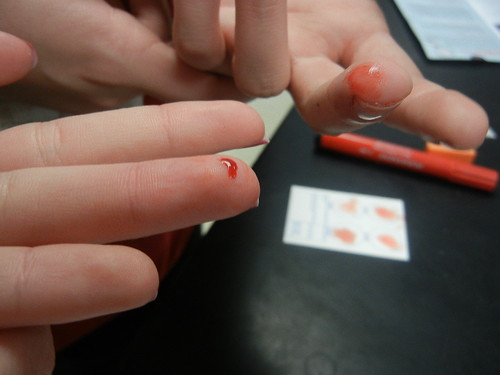
A new paper says this might not be enough to give an accurate measurement of your blood. Oh, hello, Theranos, didn’t see you there. Photo by biologycorner on Flickr.

You can now sign up to receive each day’s Start Up post by email. You’ll need to click a confirmation link, so no spam.

A selection of 10 links for you. (Ooh, are those turkey sandwiches?) I’m charlesarthur on Twitter. Observations and links welcome.

The generation that doesn’t remember life before smartphones » Popular Mechanics

Jacqueline Detwiler:

Zac [aged 18] probably started developing memories around 1999, the year Napster upended the music industry by turning songs into sharable files that nobody owned. Or maybe in 2000, the year Google became Google. Regardless, he is part of the first generation of human beings who never really lived before the whole world was connected by pocket-sized electronic devices. These kids might never read a map or stop at a gas station to ask directions, nor have they ever seen their parents do so. They will never need to remember anyone’s phone number. Their late-night dorm-room arguments over whether Peyton or Eli Manning won more Super Bowl MVPs will never go unsettled for more than a few seconds. They may never have to buy a flashlight. Zac is one of the first teenagers in the history of teenagers whose adult personality will be shaped by which apps he uses, how frequently he texts, and whether he’s on Facebook or Instagram or Twitter or Snapchat. Or whatever comes after Snapchat. Clicking like, clicking download, clicking buy, clicking send—each is an infinitesimal decision in the course of the modern American teenager’s life. They do this, collectively, millions of times a minute. But together these tiny decisions make up an alarming percentage of their lives. This generation is the first for whom the freedom to express every impulse to the entire world is as easy as it used to be to open your mouth and talk to a friend.

link to this extract


Samsung Gear VR review: virtual reality finds its Atari moment » WSJ

Geoffrey Fowler:

unlike other phone-goggle contraptions, the Gear VR headset has its own motion sensors, so it does a much better job of tracking your head movements when you’re turning or looking up. And it pushes the Samsung phone’s processor to cut motion delay to under 20 milliseconds, reducing the nausea-inducing blur. (My test Galaxy S6 Edge Plus worked so hard when mounted, it could blow through its huge battery with an hour or two of intensive VR.)

Other improvements also make Gear VR much more comfortable: The headset itself is less heavy—slimmed 19% from an experimental headset Samsung debuted last year. You can comfortably fit glasses inside, and there’s also a focus adjustment that makes the view more pleasurable for aging eyes.

Yet there’s still some discomfort. Wearing anything on your face for an hour can get old. Also, I occasionally encountered what appeared to be a flicker in the brightest parts of the screen. (Samsung says that’s rare, and has to do with the way my brain processes the screen refresh itself.)

link to this extract


Home Office meeting re IPBill » RevK’s rants

Adrian Kennard (who runs an internet service provider) went to talk to MPs about their Draft Investigatory Powers bill:

At the start of the briefing the the bill was explained, and we heard a story very similar to Theresa May’s comments along the lines of:-

“Consider the case of a teenage girl going missing. At present we can ask her mobile provider for call records before she went missing which could be invaluable to finding her. But for Internet access, all we get is that the Internet was accessed 300 times. What would be useful would be to know she accessed twitter just before she went missing in the same way as we could see she make a phone call”

Now, I am sure this is a well-practised speech, used many times before. I am sure the response has been nodding of heads and agreement with how important “Internet connection records” are, obviously.

However, I, and other ISPA members immediately pointed out the huge flaw in this argument. If the mobile provider was even able to tell that she had used Twitter at all (which is not as easy as it sounds), it would show that the phone had been connected to Twitter 24 hours a day, and probably Facebook as well. This is because the very nature of messaging and social media applications is that they stay connected so that they can quickly alert you to messages, calls, or amusing cat videos, without any delay.

This seemed to fool them somewhat and they had no real answer – we were not just nodding and agreeing, and that was unexpected 🙂

Not much wisdom on any other point either – including whether he could be compelled to lie if he were to use a “canary” over search warrants.
link to this extract


Apple to adopt OLED display for iPhone from 2018 » Nikkei Asian Review

Apple plans to introduce organic light-emitting diode displays for iPhones starting in 2018, sending suppliers racing to fine-tune the technology and invest in capacity expansion.

In light of the decision, South Korea’s LG Display is already planning capacity upgrades. But securing enough panels for the more than 200m phones Apples ships globally every year will likely prove difficult. The US company is thus likely to opt for offering OLED iPhones alongside those using LCD screens.

There are technical challenges as well. The brightness, energy-saving capacity and other functions of OLED panels tend to degrade over time. Apple has begun consulting with display makers and their suppliers of manufacturing equipment about the technology. The companies will work over the next year or so to see whether those drawbacks can be eliminated and a stable supply of screens secured…

…Apple’s shift to OLED displays will have major implications for two Japanese suppliers – Sharp, which is scrambling to rebuild its faltering operations, and Japan Display, which relies on the technology giant for 30% of its business.

2018? That’s a long way off. Why not jump to AMOLED? (Note: LG is spending $8.7bn on a new OLED plant to begin production in the first half of 2018. Coincidence?
link to this extract


New study spills doubt on some fingerprick blood tests » Ars Technica UK

Beth Mole:

Tiny blood droplets that leak successively from a pricked finger can have widely variable contents, researchers reported in the American Journal of Clinical Pathology. In some cases, test results on such finger-bled droplets had nearly eight times more variation than vein-harvested blood samples—the gold standard. Only when the authors tested upwards of five drops combined (60 to 100 microliters) were they able to get accurate results. The study raises concerns that new diagnostic tests that rely on blood drops may yield inaccurate results.

*turns slowly to look at Theranos*
link to this extract


OnePlus concedes that its USB type-C cables are out of spec, will offer refunds » Android Police

Ryan Whitwam:

Google engineer Benson Leung recently started a crusade against bad USB type-C cables, and one of the cables he warned people to stay away from is the one sold by OnePlus. Now OnePlus has responded to the uproar, saying that it will offer refunds to customers who purchased these cables. Well, you can apply for a refund. It’s not clear how long it’ll take.

The issue is that OP’s type-C cable and the type-C adapter both have a 10kΩ resistor, which as Benson Leung has been pointing out, is potentially dangerous to use with some devices. A proper type-C cable has a 56kΩ resistor, and OnePlus says it is in the process of designing a new version of its accessories that have this resistor. OnePlus’ Carl Pei stresses that the cable and adapter are safe to use with the OnePlus 2 because it only pulls 2A of current. However, a phone like the Nexus 5X or 6P draws 3A, and that can cause damage to the power source.

Seems like a big oversight to miss getting the correct resistor.
link to this extract


Reader’s Digest and other WordPress sites compromised to push Angler EK » Malwarebytes Unpacked

Jérôme Segura:

We’re seeing another uptick in WordPress compromises, using a slightly different modus operandi than the EITest campaign we recently blogged about, being responsible for a large number of infections via the Angler exploit kit.

The attack consists of a malicious script injected within compromised WordPress sites that launches another URL whose final purpose is to load the Angler exploit kit. Site owners that have been affected should keep in mind that those injected scripts/URLs will vary over time, although they are all using the same pattern (see IOCs below for some examples).

The website of popular magazine Reader’s Digest is one of the victims of this campaign and people who have visited the portal recently should make sure they have not been infected. The payload we observed at the time of capture was Bedep which loaded Necurs a backdoor Trojan, but that of course can change from day to day.

Solution: don’t read sites on desktop? (Thanks Ivan Ivanovich.)
link to this extract


Macbook charger teardown: the surprising complexity inside Apple’s power adapter » Righto

The wonderful Ken Shirriff, who does electronics teardowns of fabulous sophistication and insight:

The Macbook 85W charger costs $79 from Apple, but for $14 you can get a charger on eBay that looks identical. Do you get anything for the extra $65? I opened up an imitation Macbook charger to see how it compares with the genuine charger. From the outside, the charger looks just like an 85W Apple charger except it lacks the Apple name and logo. But looking inside reveals big differences. The photos below show the genuine Apple charger on the left and the imitation on the right.


Inside the Apple 85W Macbook charger (left) vs an imitation charger (right). The genuine charger is crammed full of components, while the imitation has fewer parts.

The imitation charger has about half the components of the genuine charger and a lot of blank space on the circuit board. While the genuine Apple charger is crammed full of components, the imitation leaves out a lot of filtering and regulation as well as the entire PFC [Power Factor Correction] circuit. The transformer in the imitation charger (big yellow rectangle) is much bulkier than in Apple’s charger; the higher frequency of Apple’s more advanced resonant converter allows a smaller transformer to be used.

Also included: a microprocessor with as much power as the original Mac.
link to this extract


The Telharmonium was the Spotify of 1906 » Atlas Obscura

Ella Morton:

Invented by lawyer Thaddeus Cahill and initially known as the dynamophone, the telharmonium made use of telephone networks to transmit music from a central hub in midtown Manhattan to restaurants, hotels, and homes around the city. Subscribers could pick up their phone, ask the operator to connect them to the telharmonium, and the wires of their phone line would be linked with the wires emerging from the telharmonium station. The electrically generated tunes would then stream from their phone receiver, which was fitted with a large paper funnel to help pump up the volume. (The electric amplifier had not yet been invented.) 

The music was generated live at what Cahill called a “music plant,” which was located at Broadway and 39th Street. An entire floor of the building, which came to be known as Telharmonic Hall, was filled with the 200 tons of machinery required to generate the telharmonium’s tunes. With its banks of spinning rotors, switchboards, transformers, and alternators, the behemoth instrument gave “the impression of nothing so much as a busy machine-shop, or the center of a considerable manufacturing industry,” according to a 1906 article in McClure’s Magazine.

“Facebook, invented by Thaddeus Zuckerberg..” Why isn’t anyone called Thaddeus anymore? Notice also that this is an American publication, yet it uses “Spotify” as its shortcut for “streaming service” rather than, say, Pandora.
link to this extract


Jonathan Mayer, well-known online security expert, joins F.C.C. » The New York Times

Natasha Singer:

Among digital security experts, Mr. Mayer is known, among other things, as the Stanford computer scientist who reported in 2012 that Google was bypassing privacy settings in Apple’s Safari browser by placing bits of code in digital ads that tracked the sites users visited. Google subsequently agreed to pay a $22.5 million fine to settle charges by the Federal Trade Commission that the company had misrepresented its privacy practices.

Now Mr. Mayer, 28, has a new handle: federal regulator.

On Tuesday, the Federal Communications Commission said it had hired Mr. Mayer as chief technologist in the agency’s enforcement bureau.

Impressive hiring.
link to this extract


Errata, corrigenda and ai no corrida: none notified.

Android, iOS and Ericsson’s new leaky bucket meet the featurephone swamp


“You sell those Apple-Google-Samsung phones here?” Photo by rante_to4ak on Flickr.

Amid the tedious rows that punctuate the smartphone landscape, a recurrent cause of outraged comments is the idea of “switching”: that people might actually move from one smartphone platform to another, and do it of their own volition, and to a platform that is different from the one the commenter uses.

This tends to be seen not as an interesting insight into consumer behaviour, but instead as some sort of outright offence. That in itself is quite telling: it shows how personal our smartphones are. Insult (or leave) my smartphone platform, insult me.

That said, study after study tends to suggest the same thing: as a smartphone platform, Android is a “leaky bucket”: people join, but they leave too. By contrast, the iPhone is more of a roach motel (or Hotel California, if you prefer): people join, and they tend to stay.

There are plenty of examples of earlier studies that suggested this. Here’s an August 2013 piece I did on the “leaky bucket” prediction by Yankee Group, which has some supporting data from CIRP, and another from January 2014 by a UK company called Foolproof. Note how a lot of the comments say it’s nonsense because, well, it just must be.

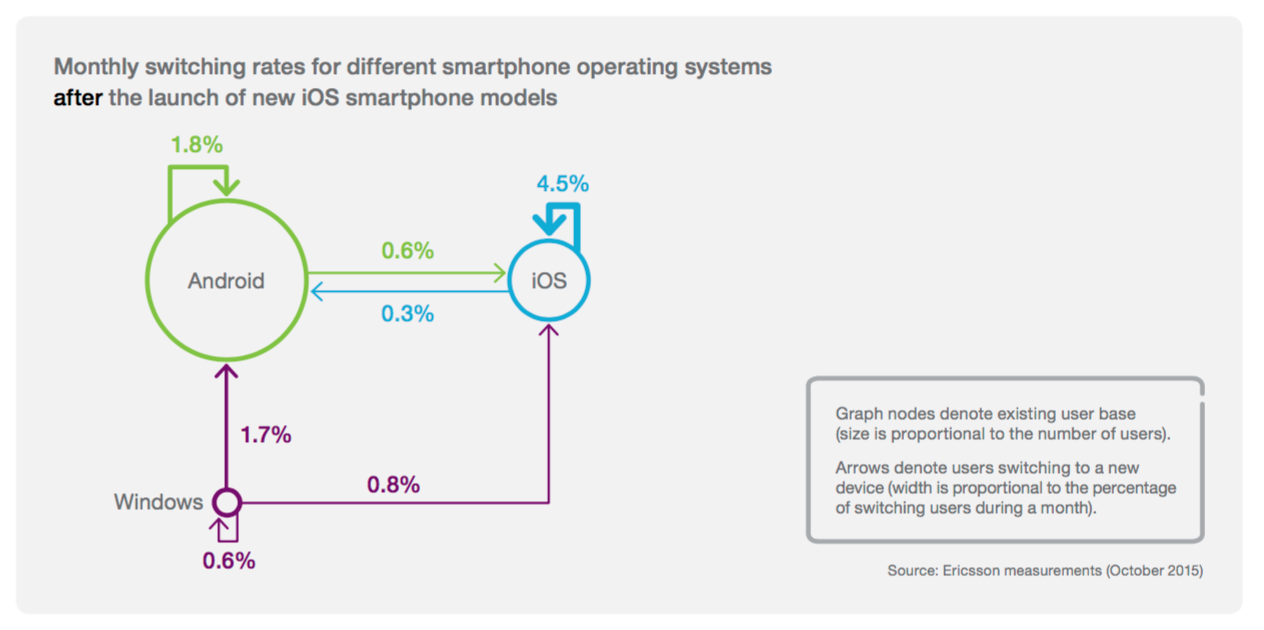
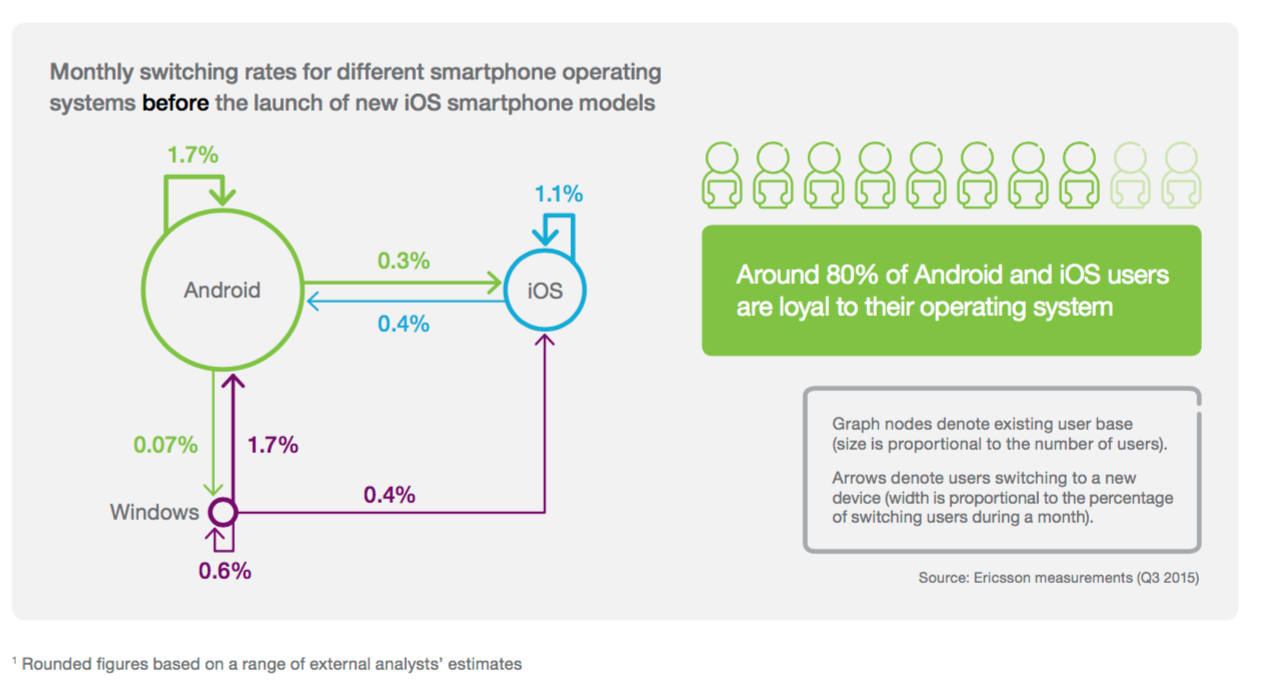
Now there’s a new switching study, embedded in Ericsson’s Mobility Report for Q3 2015. You have to scroll down a fair way to find it (it’s on page 28/9), but it’s summed up in two graphics, where it splits the movement between the three mobile ecosystems into a “before a new iPhone launch” and “after a new iPhone launch”. Here’s “before”:

Ericsson: switching behaviour before iPhone  launch

And “after”:

Ericsson: platform loyalty after iPhone launch

Note the caveat of where the data comes from:

“This analysis is based on measurements before and after the launch of new iOS smartphone models in a selected number of mature mobile broadband networks in Europe, Asia and North America. The study encompassed iOS, Android and Windows devices. Other operating systems like BlackBerry, Symbian and FirefoxOS had very low penetration in all measured networks and therefore were not included.”

“Mature markets” probably means the US, Canada, some or most of the “big five” in Europe (UK, Germany, France, Spain, Italy) and perhaps a couple of others, plus Japan, China and perhaps South Korea.

So those who want to disagree with this data will already be saying “bah, mature markets”.

The mature approach

That overlooks the fact though that all markets for a product eventually become mature markets. Ericsson is giving us a glimpse of the future.

What the data says is quite informative. A few quick takeaways:
• in a “before” month, 6.3% of people buy a new phone – though only 2.87% (45% of them) change platforms
• in an “after” month, 10.3% buy a new phone – with 3.4% (33%) of them changing platforms. (Nearly half of those buying a new phone are iPhone owners.)
• nobody, by this data, ever changes from an iPhone to Windows. Yes, yes, I know your second aunt’s cousin who works in IT did, but we’re talking here about scale – across millions of users. 0.01% of a million equates to 100 people. Apparently not even at that scale does this happen enough to register.
• on the 6.3% and 10.3% turnover rate, everyone replaces their phone somewhere between 10 and 16 months.
• Windows Phone users seem to be the busiest in buying phones.

I thought it would be interesting to model how this changes the user base if it’s repeated over time. Note that Ericsson is suggesting it’s only a snapshot for a few weeks, and only for people who get a new phone and stay on the same carrier. (But the latter is true of most people.) If this is how things play out, perhaps we can learn something. So I put the data into a spreadsheet, and set up the algorithm to step through month by month according to the Ericsson platform change stats. So from 10,000 Android users, in a “before” month you’d get 30 going to iOS and 7 to Windows Phone (see the diagram above). And so on.

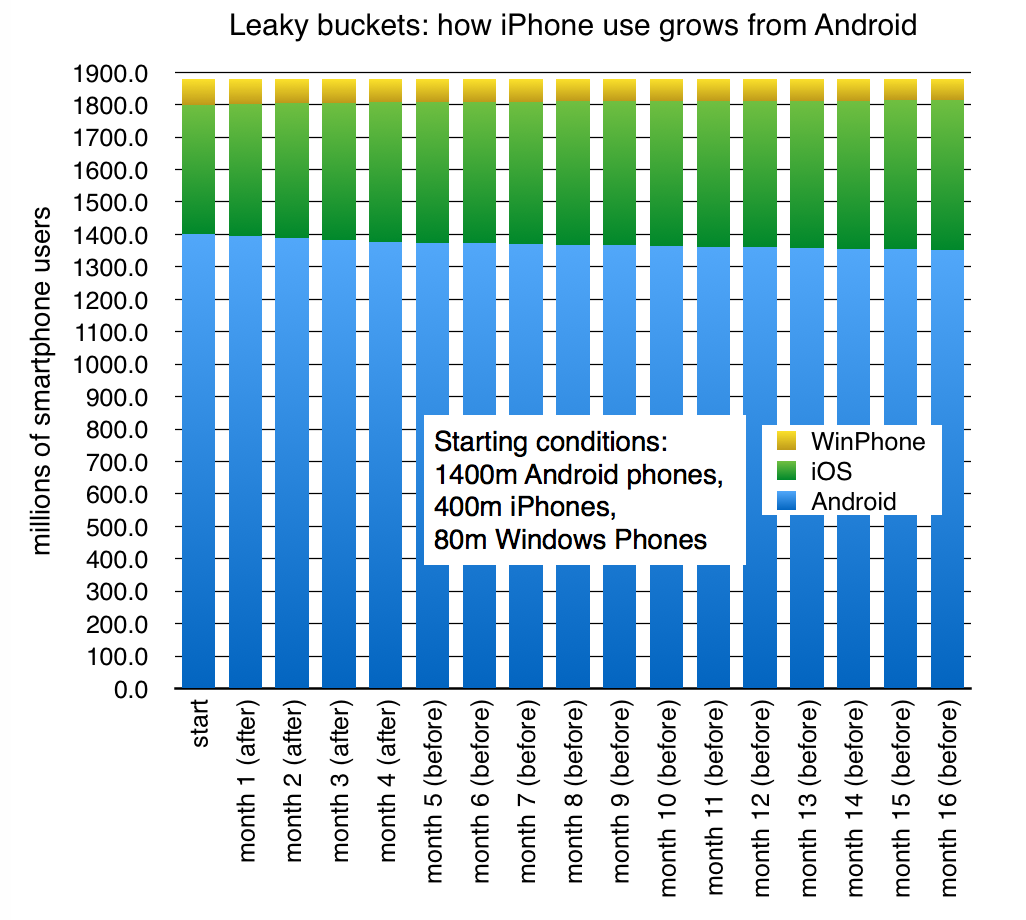
My spreadsheet is here. I used the 1.4bn figure for the Android base, 400m for the iPhone, and 80m for Windows Phone – about the total number of Lumias sold since their inception. (The extra 0.1 that appears over time is due to imprecision in the calculation – each “before” month adds 0.01 to the figure.)

The graph doesn’t show much perceptible change:

Modelling platform change from Ericsson data

Note that this assumes 15 months with only one iPhone launch.

Note that this is over 16 months, but with only one iPhone “launch” right at the start (whose effects then carry on for four months) – so you can see that the iPhone launch doesn’t make a big difference to the general trend.

Equally, you can also see that there isn’t a huge amount of movement. The iPhone chunk gets wider: in this example, with a four-month “after launch” period and eight-month “before launch” period, by the end of the 12th month
• the iPhone has gained 51.9m users
• Android has lost 40.1m
• Windows Phone has lost 11.8m.

In percentage terms, it’s pretty unimportant to Android – 2.9% loss – but big for iPhone (+13.0%) and bigger for Windows Phone (-14.8%).

If you change to a 12-month “before launch” year, the changes are -25.1m for Android (1.8% change), +31.1m for iPhone (+7.2%), and -5.9m for Windows Phone (8.2%).

You can quibble with the starting figures. Playing around with them, I found the following properties:
• the larger the initial figure for Android, the larger its final fall (obvious) but also the larger its percentage fall
• the larger the initial figure for iOS, the smaller the absolute and percentage growth
• iOS is the only platform to show overall growth on any combination of the “before launch”/”after launch” model.

The featurephone swamp

In which case, you might ask, howcome Android’s installed base is still growing? Simple: there’s still a huge base of featurephone owners who are being converted upwards to smartphones. They’re easy to overlook, but key to this dynamic.

For instance, in the Yankee Group study from August 2013 quoted above, the key mistake that it made in forecasting that iPhone use would overtake Android use by 2014 was to overlook the continuing source of new Android users – from featurephone owners moving to smartphones. In August 2013, there were 90m of them, according to ComScore; the latest figure, from September 2015, says there are still 56.2m of them (so 33.8m fewer).

In that period,
•the number of US iPhone users has grown from 59.0m to 84.3m (up 25.3m);
• the number of Android users has grown from 74.8m to 98.8m (up 24m).

There’s hardly a dramatic difference in growth between Android and the iPhone (contrary to what Forrester expected). You wonder where the other net users came from besides featurephones? The fall in BlackBerry users (5.8m to 2.3m). In the same period, Windows Phone users barely grew (4.6m to 5.5m). And there are 12m extra featurephone users in September 2015 compared to August 2013 making up the gap.

As for Windows Phone: if Ericsson’s numbers say it’s losing users, the obvious question is: how did it get to 80m (or so) users in the first place? The easy answer: Ericsson’s diagrams don’t show the pipeline bringing users into Windows Phone from featurephones – usually via the Lumia 5xx low-end range.

The eternal puzzle of iPhone growth

Even allowing for that, it’s notable that the ComScore data says that in the US iPhone users have grown more (both in percentage and sheer numbers) than Android users. Sure, home distortions and all that. But why is that the case in the other mature markets too? Why is iPhone ownership growing in other places, and why don’t they leave?

It’s this last point which befuddles and almost infuriates people. Why on earth, they say, do people buy iPhones, which only have a dual-core CPU with 2GB of RAM running at 1.8GHz and without an SD card slot, when for less money they can get an octacore phone running at 2.6GHz with 4GB of RAM, an SD card slot, removable battery and a QuadHD screen? You can hear the puzzlement in comments from people who can read a spec list, yet can’t see why the inertial scroll on the iPhone is a more pleasing experience than the rolling velcro on even top-end Android phones. (I keep going and checking the scrolling on each new Android phone. Still isn’t smooth. Clearly 2012’s Project Butter still needs to be supplanted by Project Ghee.)

There’s more than that, though. I don’t think anyone buys an iPhone by accident. I don’t think people walk into a store not intending to buy an iPhone and then find themselves surprised to be holding one as they walk out.

Whereas choosing between Android phones can be like a beauty contest of clones. You put various models of Samsung phone against LG phones against the slightly harder edges of the Sony against the iPhone-alikeness of the HTC models, and you try to pick. How do you choose? Probably on some subtle mixture of the price tag, tickboxes and comparative sizes of numbers on the spec list and.. that’s probably about it.

You can argue (and oh my giddy aunt people do) about why people buy iPhones. I’d say there’s clearly a perception among those who do that they’re getting something premium. The price tag alone suggests that.

That isn’t enough however to keep people on a platform if the experience didn’t also work for them. Do some people migrate from Android to iPhone, and then migrate back? Undoubtedly. But the data suggests most who make the shift don’t.

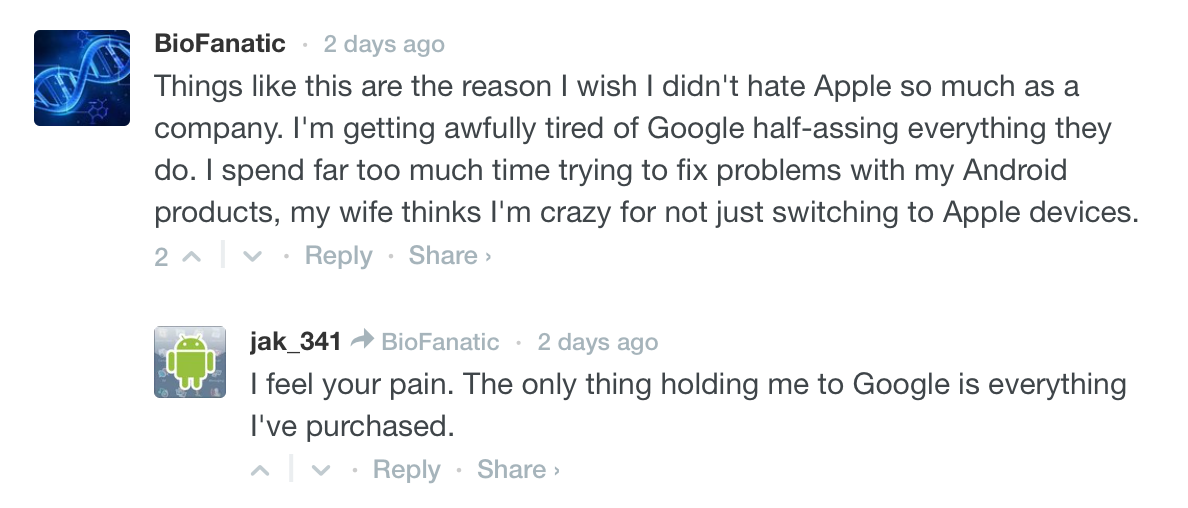
Is your argument that people get “locked in to the Apple ecosystem”? Perhaps. But it’s not just on iOS, as this comment from an article about Android Wear demonstrates:

Comment on Android Wear

Note the nose-spiting-face nature of the first one..

On that basis, people should be just as reluctant to move to iOS as away from it. Again, the evidence disagrees.

I think there’s a frustration factor driving some movement too; I watched the friend of a relative struggle to get the maps on her Sony phone work recently. First to find the apps, then to find the maps app, then to get any sensible input, then to get sensible output. (Since you ask, she’s one of the country’s leading barristers.)

I couldn’t help but wonder if she would have found it simpler to have a Maps icon front and centre. Apple’s reputation for simplicity is actually a selling point for such users, even if it isn’t for the gigahertz-SD-RAM-removable battery crowd.

Feeling it

Conveniently, just as I was writing this piece, Ben Thompson wrote a piece on Stratechery about “Selling feelings“, with this notable point:

how silly must you be to carry a $5,000 handbag with far less functionality than another a fraction of the price, or wear a $10,000 watch or $200 necktie? What about flying first class or staying in a five-star hotel — you can’t take either with you! It’s completely irrational.

Or, rather, it’s irrational if you only look at features. The entire point is how these purchases make you feel, and it’s that feeling, whether it be an appreciation for craftsmanship, status, or simply being pampered, that provides the sort of differentiation that makes all of these products profitable. One could argue that an insistence on limiting the calculation of value to items that are permanent, physical, and easily listed on a spreadsheet is the real irrationality.

There’s no shortage of that latter group who’ll tell you that the iPhone is rubbish. Meanwhile, continuing evidence from a growing number of studies says that over time, the iPhone base continues to grow. The question is, once the swamp of featurephone users is drained, what happens over the longer term?

Start up: the $10 iPhone, the mobile data boom, Watch 2 in June? and more


Clickbait! (Translation optional, but it’s nothing too shocking.) Photo by pvantees on Flickr.

You can now sign up to receive each day’s Start Up post by email. You’ll need to click a confirmation link, so no spam.

A selection of 11 links for you. Use them wisely. I’m charlesarthur on Twitter. Observations and links welcome.

Walmart’s $10 smartphone has better specs than the original iPhone » Motherboard

Nicholas Deleon:

Walmart is now selling a TracFone-branded LG smartphone that costs $9.82 (it also ships free if your online order total tops $50). Now, there are a few reasons why you may not want such a smartphone—for one, it’s running an outdated version of Android that may make it vulnerable to hackers—but there’s no denying that it represents something pretty special.

For less than $10 (plus the cost of data access) the user gets access to the Google Play app store, giving him or her the power to summon transportation at the push of a button, instantly connect with friends, and watch livestreams from all over the world. A bona fide smartphone, in other words.

It’s perhaps even more impressive when you consider that its modest specs — a 3.8in display, 3G and Wi-Fi networking, and a 3-megapixel camera — surpass those of the original iPhone, which was referred to in the tech press at the time as the “Jesus phone.”

It’s been eight years, so, what, three Moore’s Law cycles? Impressive nonetheless.
link to this extract


Funniest new Twitter feed of the day: Clickbait Robot » Quirker

Michael Moran:

it’s easy to get sucked in – especially when a clickbait story piggybacks on a current trend and gets mixed in with genuine news.

Understandably, web users don’t much like it. And actually, most web professionals don’t like it much either.

Rob Manuel, is just such an internet professional. In the past he has devised quizzes, games and animations for B3ta and UsVsTh3m that might have been called clickbait, but generally did deliver on their promise.

And now he’s devised the ultimate clickbait machine. It scrapes Twitter’s current trending topics and boils them down into crazy-sounding headlines without any human intervention. It’s weird, and it’s very very funny…

link to this extract


A team of robots may learn to grasp a million objects » MIT Technology Review

Will Knight:

[Stefanie] Tellex [of Brown University] says robotics researchers are increasingly looking for more efficient ways of training robots to perform tasks such as manipulation. “We have powerful algorithms now—such as deep learning—that can learn from large data sets, but these algorithms require data,” she says. “Robot practice is a way to acquire the data that a robot needs for learning to robustly manipulate objects.”

Tellex also notes that there are around 300 Baxter robots in various research labs around the world today. If each of those robots were to use both arms to examine new objects, she says, it would be possible for them to learn to grasp a million objects in 11 days. “By having robots share what they’ve learned, it’s possible to increase the speed of data collection by orders of magnitude,” she says.

link to this extract


Ericsson Mobility Report » Ericsson

The Ericsson Mobility Report is one of the leading analyses of mobile network data traffic. It provides in-depth measurements from the world’s largest selection of live networks spread all around the globe, with analysis based on these measurements, internal forecasts and other relevant studies. The report provides insights into the current mobile network data traffic and market trends, applicable to both consumers and enterprises.

This one is for the third quarter: suggests 3.4bn smartphone subscriptions, up from 2.6bn last year, and 1.4GB of data per user on average per month, up from 1.0GB a year ago. In western Europe it’s 2.0GB per user per month. Lots of interesting data, including one about churn between iOS, Android and Windows Phone.

5G doesn’t look like a big winner though.
link to this extract


Encrypted messaging apps face new scrutiny over possible role in Paris attacks » The New York Times

David Sanger and Nicole Perlroth:

American and French officials say there is still no definitive evidence to back up their presumption that the terrorists who massacred 129 people in Paris used new, difficult-to-crack encryption technologies to organize the plot.

But in interviews, Obama administration officials say the Islamic State has used a range of encryption technologies over the past year and a half, many of which defy cracking by the National Security Agency. Other encryption technologies, the officials hint, are less secure than terrorist and criminal groups may believe, and clearly they want to keep those adversaries guessing which ones the N.S.A. has pierced.

Some of the most powerful technologies are free, easily available encryption apps with names like Signal, Wickr and Telegram, which encode mobile messages from cellphones. Islamic State militants used Telegram two weeks ago to claim responsibility for the crash of the Russian jet in the Sinai Peninsula that killed 224 people, and used it again last week, in Arabic, English and French, to broadcast responsibility for the Paris carnage.

This argument isn’t going to go away; it’s going to continue between privacy advocates and governments (who are always seeking to surveil and gather). Every incident like that in Paris becomes ammunition, in a near-literal sense.
link to this extract


The TalkTalk hack can’t be shrugged off » The Guardian

John Naughton:

Imagine a chemicals company that, as part of its operations, needs to process hazardous, carcinogenic materials, and therefore has to store them on site. Now imagine that some unscrupulous guy siphons off large quantities of the hazardous gunk and when this crime is revealed by the company, the boss is unable to tell reporters whether the tank containing the hazardous material was locked, or even covered.

If TalkTalk had been a chemicals producer and toxic chemicals had been stolen, the public outrage would be palpable. But because it’s a communications company, the response is just a resigned shrug. It’s just personal data, theft of which goes on every week: just think of the infidelity site Ashley Madison and the US health insurer Anthem. Stuff happens, move on.

The trouble is that personal data in the wrong hands is a very hazardous substance indeed. It’s the raw material that fuels a vast global industry, which uses it for phishing, pharming, malware distribution, hacking of corporate databases, extortion and blackmail.

Also worth it for the David Runciman quote about the difference between a scandal and a crisis.
link to this extract


​How to easily defeat Linux Encoder ransomware » ZDNet

Neat, from Steven Vaughan-Nichols:

just crack open your files yourself.

You see the would-be cyber-criminals made a fundamental mistake. Their encryption method uses a faulty implementation of Advanced Encryption Standard (AES) to generate the encryption key. Specifically, as the anti-virus company Bitdefender reported, the “AES key is generated locally on the victim’s computer. … rather than generating secure random keys and IVs [initialization vector], the sample would derive these two pieces of information from the libc rand() function seeded with the current system time-stamp at the moment of encryption. This information can be easily retrieved by looking at the file’s time-stamp.”

Armed with this, it’s trivial – well, for encryption experts – to find the key you need to restore your files. Since most of you don’t know your AES from your Playfair, Bitdefender is offering a free Python 2.7 script to obtain the Linux.Encoder key and IV for your containinated server.

They probably won’t make the same mistake next time, though.
link to this extract


We are not getting out of PCs, says Fujitsu exec » The Register

Paul Kunert:

Fujitsu is the latest bit part PC player to state its commitment to the product line, as it prepares to spin off the computer and mobile businesses into two separate subsidiaries.

The units were part of the Ubiquitous Solutions division but at some point in the next 12 months will be distinct entities sitting under the Product division, the company told us.

“We are super committed to the PC business,” said head of product EMEA, India and Africa, Michael Keegan.

“It’s a very big part of the overall P&L [account] but we recognise that it is a massively changing business and needs more focus.”

I think you’ll find Fujitsu’s PCs are probably part of the “loss” in P&L, which swung to a loss for the half-year. But as it’s splitting the mobile phone and PC businesses, we’ll be able to see more clearly in future.
link to this extract


Wearable devices becoming main growth driver for ODMs » Digitimes

Aaron Lee and Joseph Tsai:

Quanta and Compal together have already acquired over 50% of the overall notebook orders for 2016, but both are still pessimistic about overall shipments in 2016. In 2016, the market watchers expect the market will gradually lean toward both the entry-level and high-end segments. More inexpensive Windows-based notebooks and Chromebooks are expected to be introduced, while vendors will also focus more on high-end products such as gaming notebooks.

Meanwhile, wearable device shipments are also expected to grow dramatically. Quanta, the maker of the Apple Watch, is expected to see related orders surging in 2016 and the ODM reportedly has also received orders for Apple’s second-generation Apple Watch for the second quarter of 2016.

Jeez, talk about burying the intro. “APPLE WATCH 2 TO SHIP IN APRIL?” is the way to write this. Although that rumour is already doing the rounds.
link to this extract


Google to contest Russia’s antitrust ruling on Android » Reuters

Maria Kiselyova:

Google will contest in court a ruling by Russia’s antitrust agency that it broke competition law by abusing its dominant position with its Android mobile platform, the U.S. technology company said on Tuesday.

Russia’s competition watchdog ruled in September that Google had broken the law by requiring pre-installation of certain applications on mobile devices running on Android.

“We intend to contest this decision and explain in court why we consider it unfounded,” Google said in its official Russian blog.

Google has until Dec. 18 to amend its contracts with smartphone manufacturers in order to comply with the ruling in the case that was launched by local rival Yandex.

link to this extract


Google removes another app from the Play Store for dodgy reasons, this time it’s the notorious Tasker » Android Police

Rita El Khoury:

the app isn’t just useful for gimmicks and even if many of us feel overwhelmed by it or don’t need it, it’s still part of the foundation of Android and the poster child for all the possibilities you have with the platform.

Taking Tasker out without a notice isn’t just reckless, it’s being stupidly blind to the entire history of Android, especially when the grounds for removal are dodgy at best. We’ve contacted Pent, Tasker’s developer to see what’s going on, and so far the story is as weird as it gets.

Pent didn’t get a warning regarding the removal and in the Developer Console, he sees this explanation:

“This app has been removed from Google Play for a violation of the Google Play Developer Programme Policy regarding Dangerous Products. Please review the Optimising for Doze and App Standby article, modify your app’s manifest and resubmit. More details have been emailed to the account owner.”

It seems that the removal was based on the existence of a dangerous permission that disables Doze in the app’s manifest: android.permission.REQUEST_IGNORE_BATTERY_OPTIMIZATIONS. The same reason was given to Stefan Pledl for the removal of his app LocalCast from the Play Store.

However, and here’s the weird part, that permission isn’t in the Play Store version of Tasker. As a matter of fact, Pent tells us the app wasn’t published in any form to the Play Store with that permission.

People will be up in arms about this, right? Update: as of Wednesday morning, it’s back.
link to this extract


Errata, corrigenda and ai no corrida: none notified.

Start up: why Android should encrypt, Facebook v the intifada, 3D Touch v page parking, wary drones and more


“My GPS says we finished ages ago!” Photo by A Brand New Minneapolis on Flickr.

You can now sign up to receive each day’s Start Up post by email. You’ll need to click a confirmation link, so no spam.

A selection of 9 links for you. Please note: if reading the emails, you can’t link directly to the extracts. Monkeys, eh. I’m charlesarthur on Twitter. Observations and links welcome.

Is Google’s lacklustre support for encryption a human rights issue? » MIT Technology Review

Tom Simonite, reporting on a conference where American Civil Liberties Union (ACLU) principal technologist Chris Soghioan argued thus:

People using phones powered by Google’s Android software are not so well protected, said Soghioan. The company said last year that it would make Android phones encrypt all stored data by default, like Apple devices do, but reversed that decision early this year. Google said this month it will require only devices meeting certain hardware performance standards to encrypt stored data, which Soghioan thinks will exclude cheaper devices. Google’s Hangouts text and video chat service bundled with Android does not use end-to-end encryption.

Soghioan said this means that someone who uses a cheap Android device is a much easier target for law enforcement or intelligence agencies — which he argues are prone to abusing their surveillance powers. He cited the way the FBI snooped on Martin Luther King’s phone calls and said he fears that US and overseas activists of today and tomorrow will be even easier targets. “The next civil rights movement will use the technology against which surveillance works best,” he said. Protest movements don’t typically start in society’s upper socioeconomic echelons, he noted.

The difference between Apple and Google’s stances on encryption for mobile devices appears to be due to corporate rather than technical reasons, said Soghioan. “Google has by far the best security team of any company in Silicon Valley, and the security people I know at Google are embarrassed by Android,” he said. “But Apple sells luxury goods and Google gives away services for free in return for access to data.”

That point about protest movements is so important. Would you want people in a repressive regime to have phones that could or couldn’t be tapped? Now you’ve decided, we move on to the next conundrum…
link to this extract


The Facebook intifada » The New York Times

Micah Lakin Avni’s (Israeli) father was stabbed and shot by two Palestinian men in Jerusalem, who acted in the latest intifada (uprising) by Palestinians:

Watching the well-wishers congregating in the intensive care unit, however, I realized that the world leaders who were having the most impact on the situation in the Middle East right now weren’t Mr. Ban or Prime Minister Benjamin Netanyahu, but Mark Zuckerberg of Facebook, Jack Dorsey of Twitter and other young entrepreneurs who shape the social media platforms most of us use every day.

It may sound strange to talk of Twitter and Facebook as relevant players in the war against terror, but as the recent wave of violence in Israel has proved, that is increasingly the case. The young men who boarded the bus that day intent on murdering my 76-year-old father did not make their decision in a vacuum. One was a regular on Facebook, where he had already posted a “will for any martyr.” Very likely, they made use of one of the thousands of posts, manuals and instructional videos circulating in Palestinian society these last few weeks, like the image, shared by thousands on Facebook, showing an anatomical chart of the human body with advice on where to stab for maximal damage…

…Just as it is universally recognized that shouting fire in a crowded theater is dangerous and should be prohibited, so, too, must we now recognize that rampant online incitement is a danger that must be reckoned with immediately, before more innocent people end up as victims.

Before Facebook or Twitter or Google, those charts would have been available in a library, or in books on sale or smuggled in. What’s different now is the scale and speed with which information can be disseminated. It sounds trite, but what Israel and Palestine need is more speech, not less – but speech of the right kind, to negotiate their differences.
link to this extract


Google owner accuses EU of antitrust about-face » WSJ

Tom Fairless and Natalia Drozdiak:

Google owner Alphabet Inc. accused European Union regulators of making an unexplained about-face in their decision to file antitrust charges against the US search giant, and warned that there was “no basis” for imposing fines, according to a redacted copy of Google’s response seen by The Wall Street Journal.

The response, which runs to almost 130 pages and leans heavily on legal opinions and case law, suggests that Google is gearing up for a protracted legal battle against the European Commission, which has alleged the search giant skewed search results to favor its own comparison-shopping service.

“The theory on which the [EU’s] preliminary conclusions rest is so ambiguous that the Commission itself concluded three times that the concern had been resolved,” Google’s lawyers wrote in the document.

It’s certainly a good point that the EC antitrust team were ready to okay everything, and then decided not to. But the EC would say that new evidence became available (which it did) and that changed things. Less convincing on Google’s part is its quoting of a US academic who used to be in the US Department of Justice antitrust side. That’s not likely to hold any sway.
link to this extract


Why every GPS overestimates distance travelled » IEEE Spectrum

Douglas McCormick on how an Austrian team discovered subtle but persistent errors in GPS:

Not content with mere calculation, Ranacher, Reich, and their colleagues went on to test their findings experimentally. In an empty parking lot, they staked out a square course 10 m on a side, reference-marked each side at precise 1-m intervals, and set a GPS-equipped pedestrian (a volunteer, one hopes) to walk the perimeter 25 times, taking a position reading at each reference mark.

The researchers analyzed the data for segment lengths of 1 meter and 5 meters. They found that the mean GPS measurement for the 1-m reference distance was 1.02m (σ2 = 0.3) and the mean GPS measurement for the 5-m reference distance was 5.06m (σ2 = 2.0).  They also ran a similar experiment with automobiles on a longer course, with similar results.

Now, that pedestrian-course error of 1.2% to 2% isn’t huge. But it is big enough that your GPS watch could tell you you’re crossing the finish line of a 42,195-metre [26-mile] marathon while the real terminus is more than 400 meters ahead.

Sooo.. how do they measure a marathon? Does someone go around with one of those wheel things? Asking for all my marathon-running friends.
link to this extract


3D Touch on iPhone 6S: embrace the Force » Nielsen-Norman Group

Raluca Budiu:

Is this a feature worth having? Yes, as an enhancement. There is a lot of potential for improving the user experience and supporting behaviors that mobile and desktop users are engaging in already. Two of them come to mind: microsessions and avoiding pogo sticking.

Microsessions are phone sessions that are 15 seconds or shorter. Recent research by Denzil Ferreira and colleagues shows that 40% of app launches are microsessions, namely short interactions in which users are able to quickly satisfy their goals. A common microsession activity is checking for updates in an app (such as Email or Facebook); the quick actions offer an opportunity for rapid access to such frequent tasks or content. Peek-and-pop views should also make many microsessions more efficient for users.

Pogo sticking refers to alternating between inspecting a collection of items (such as a list of products) and looking at each item individually (a product in the list). It is usually an inefficient behavior because it makes users jump back and forth between pages, losing not only time for loading the page but also the time needed for recovering context. Our recent research with Millennials shows that pogo sticking is so annoying that, on desktop, users have developed a special behavior called page parking to avoid it. On mobile phones, page parking is a lot more difficult.

“Page parking” is basically “open that link in another tab/window while I get on with this”. Other points: interstitials screw up the previewing experience, and so do “can we use your location?” questions.
link to this extract


Back-alley upgrades: in China, $100 can get you an 128GB iPhone boost » WSJ

Yang Jie and Josh Chin:

If you’re an Apple Inc. device user, you can also now boost your iPhone’s storage from the cramped-feeling 16GB standard to a cavernous 128GB for less than a hundred bucks.

Mobile phone repair shops in major cities like Beijing and Shanghai have sparked curiosity on sidewalks and social media by offering the service, which appears aimed at the many aspirational Chinese device users who can’t afford the roughly $200 premium attached to large-capacity iPhones.

Some are offering the service through online shops on China’s biggest e-commerce site Taobao. One such shop offers to upgrade an iPhone 6 or iPhone 6 Plus from 16GB to 128GB for 500 yuan ($79). Descriptions posted by several Taobao vendors indicate that the new storage card is hand-welded into the phone after the old card is removed. An unnamed software [program] is then used to trick the device into accepting the unapproved hardware.

Love the comment from one customer: “I’ve used it for a day. It feels so great.”
link to this extract


Huawei emerges as 2nd largest Android brand in EU’s big five » Kantar Worldpanel

“In urban China, with a market share that grew 72% over the third quarter of 2014, Huawei remained the top brand followed by Xiaomi and Apple,” Tamsin Timpson, strategic insight director at Kantar Worldpanel ComTech Asia, commented. “iOS continued to grow year over year with 56% of iPhone buyers during the quarter switching from Android and with iPhone 6 and 6Plus retaining their positions as the best selling and second best-selling smartphones.

“Next month all eyes will be on Apple’s performance in the US and China, as many observers continue to doubt the size of the remaining opportunity for Apple,” Milanesi explained. “28% of consumers in China who own smartphones plan to upgrade in the next 12 months. Among them, 79% of those who own iPhones, and 25% of those who own Android devices, say they prefer Apple.”

That “56% of iPhone buyers in China were switchers” number is remarkable – perhaps it was people waiting for the 6S/Plus. Meanwhile in the UK, Samsung and LG were the only Android makers to grow their share; the implication seems to be that people were switching to iPhones.
link to this extract


Self-flying drone dips, darts and dives through trees at 30 mph » MIT CSAIL

Adam Conner-Simons of MIT’s Computer Science and Artificial Intelligence Laboratory:

“Everyone is building drones these days, but nobody knows how to get them to stop running into things,” says CSAIL PhD student Andrew Barry, who developed the system as part of his thesis with MIT professor Russ Tedrake. “Sensors like lidar are too heavy to put on small aircraft, and creating maps of the environment in advance isn’t practical. If we want drones that can fly quickly and navigate in the real world, we need better, faster algorithms.”

Running 20 times faster than existing software, Barry’s stereo-vision algorithm allows the drone to detect objects and build a full map of its surroundings in real-time. Operating at 120 frames per second, the software – which is open-source and available online – extracts depth information at a speed of 8.3 milliseconds per frame.

The drone, which weighs just over a pound and has a 34-inch wingspan, was made from off-the-shelf components costing about $1,700, including a camera on each wing and two processors no fancier than the ones you’d find on a cellphone.

If this doesn’t lead to an amazing VR “fox and hounds” sort of game soon, someone’s missing a trick. Quad-core CPUs and stereo cameras. Expect the price to halve in a year or so.

link to this extract


Hilton obstructed investigation into Wi-Fi blocking at hotels, FCC says » Ars Technica

Jon Brodkin:

The Federal Communications Commission yesterday issued proposed fines against two companies in its latest actions against Wi-Fi blocking at hotels and convention centers.

The FCC said it proposed a $25,000 fine against Hilton Worldwide Holdings “for its apparent obstruction of an investigation into whether Hilton engaged in the blocking of consumers’ Wi-Fi devices.” The FCC also plans a $718,000 fine against M.C. Dean, a Wi-Fi access provider that is accused of “blocking consumers’ Wi-Fi connections at the Baltimore Convention Center” on dozens of occasions.

Each company has been accused of blocking personal Wi-Fi hotspots that let consumers share mobile data access with other devices such as laptops and tablets. Hilton and M.C. Dean must pay the fines within 30 days or file written statements seeking reduction or cancellation of the penalties.

The FCC last year received a complaint against a Hilton hotel in Anaheim, California that the company “blocked Wi-Fi access for visitors at the venue unless they paid a $500 fee.” More complaints against other Hilton properties followed, and in November 2014, the FCC issued Hilton a letter of inquiry seeking information about its Wi-Fi management practices at various Hilton-owned hotel chains.

Obstructing the FCC seems to be a parlour game for some companies. Remember Google and its Wi-Fi sniffing? That earned a $25,000 FCC fine for impeding investigation in 2012.
link to this extract


Errata, corrigenda and ai no corrida: gave the wrong link for the Microsoft OneDrive story in yesterday’s email – this is the right one (damn ZDNet scrolling system). And no, you won’t use up 5GB of storage with 10 Microsoft Word documents. Unless they’re very big.
Start up: the convertible laptop dream, Pagefair’s malvertising hack, Samsung’s bulging bottom, and more


Keeping your personal information out of other sites is hard too. Photo by xiaming on Flickr.

You can now sign up to receive each day’s Start Up post by email. You’ll need to click a confirmation link, so no spam.

A selection of 10 links for you. Count them if you like. I’m charlesarthur on Twitter. Observations and links welcome.

Laptop is a state of mind | Karma

Paul Miller:

There’s no such thing as “best of both worlds” in computers. Choices matter. Hybrids like the Surface Book are great for people who perfectly straddle the tablet and laptop use cases — who constantly switch between keyboard and pen, desk and walk-and-talks, angry memos and Angry Birds. Everyone else’s perfect “laptop” will probably be a lot more boring, and a good deal cheaper.

But.

You know what would be cool? A world where we actually needed Surface Books. What if our lives were like Microsoft Surface commercials? We’d flit effortlessly between different roles. An architect for one moment, consulting with a professional on your home remodel. Then you’re drawing up a clever football play for Russell Wilson. Then you’re playing Madden, streamed from your Xbox. Then you’re answering work emails and flicking away distractions with your finger. And then you’re in some big song-and-dance number, and you can’t even remember where you put your Surface Book because your life is amazing and who even cares anymore you’re going to die happy, loved by your family and respected by your peers.

The Surface Book is not an inferior product because its hardware is too ambitious. It’s an inferior product because its hardware is more ambitious than the digital lives we’ve thus far concocted.

link to this extract


CryptoWall 3.0 cost victims $325m – report » Infosecurity Magazine

Phil Muncaster:

The report noted:

“It was discovered that a number of primary [bitcoin] wallets were shared between campaigns, further supporting the notion that all of the campaigns, regardless of the campaign ID, are being operated by the same entity.”

Unfortunately for those unlucky enough to get infected by CryptoWall 3.0, the report paints the picture of a highly efficient operation running solid encryption, meaning victims usually do have to pay up to get their files back.

Even an FBI Special Agent was quoted as saying last week that it might be better for infected businesses to just pay the ransom.

link to this extract


Who knows what about me? A survey of apps’ behind-the-scenes personal data sharing to third parties » Technology Science

Jinyan Zang, Krysta Dummit, James Graves, Paul Lisker, and Latanya Sweeney:

We found that the average Android app sends potentially sensitive data to 3.1 third-party domains, and the average iOS app connects to 2.6 third-party domains. Android apps are more likely than iOS apps to share with a third party personally identifying information such as name (73% of Android apps vs. 16% of iOS apps) and email address (73% vs. 16%).

For location data, including geo-coordinates, more iOS apps (47%) than Android apps (33%) share that data with a third party. In terms of potentially sensitive behavioral data, we found that 3 out of the 30 Medical and Health & Fitness category apps in the sample share medically-related search terms and user inputs with a third party.

Finally, the third-party domains that receive sensitive data from the most apps are Google.com (36% of apps), Googleapis.com (18%), Apple.com (17%), and Facebook.com (14%). 93% of Android apps tested connected to a mysterious domain, safemovedm.com, likely due to a background process of the Android phone. Our results show that many mobile apps share potentially sensitive user data with third parties, and that they do not need visible permission requests to access the data.

Hardly seems a source of complaint if they’re sharing with Google and Apple, if it’s with permission. As for safemovedm.com, it seems to exist – since February 2008 – but not actually be active in any way; that makes it sound like an Android function.
link to this extract


Chrome OS is here to stay » Google Chrome Blog

Hiroshi Lockheimer, SVP Android, ChromeOS and Chromecast:

Over the last few days, there’s been some confusion about the future of Chrome OS and Chromebooks based on speculation that Chrome OS will be folded into Android. While we’ve been working on ways to bring together the best of both operating systems, there’s no plan to phase out Chrome OS.

With the launch of Chrome OS six years ago, we set out to make computers better—faster, simpler and more secure—for everyone. We’ve since seen that vision come to life in classrooms, offices and homes around the world. In fact, every school day, 30,000 new Chromebooks are activated in U.S. classrooms—that’s more than all other education devices combined. And more than 2 million teachers and students in more than 150 countries have the Share to Classroom Chrome extension, which launched in September and gets students onto the same webpage, instantly. Meanwhile, companies such as Netflix, Sanmina, Starbucks and of course Google, are using Chromebooks given the ease of deployment, the ability to easily integrate with existing technologies, and a security model that protects users at all levels, from hardware to user data. (Chromebooks are so secure you don’t need antivirus software!)

“Working on ways to bring together the best of both operating systems” implies that the two are coming together somehow – you wouldn’t have a third OS. Android isn’t going away. So Lockheimer hasn’t explained how ChromeOS is here to stay; instead, by avoiding the question while also acknowledging that something is happening, he’s making it more mysterious.
link to this extract


The Apple iPhone 6s and iPhone 6s Plus review » Anandtech

Ryan Smith and Joshua Ho:

The only real issues I can think of are that the iPhone 6s doesn’t have OIS and that the base SKU is still 16GB of storage. To be fair, the 16GB SKU can become a noticeable user experience issue if you’re constantly dealing with the limits of this storage, and the jump from 16 to 64 GB feels like it’s simply designed to encourage buying a more expensive SKU. There are arguments that users that don’t really take a ton of photos or videos and stream all their media will be fine, but it’s still a user experience problem in this day and age. However, despite these issues I would argue that the iPhone 6s’ are the best phones you can buy today.

Of course, this sounds like a rather hollow recommendation to those that have followed our reviews for the past year. This year, more than ever it feels like Android smartphones at the high end have stood still, as if smartphone improvements have become a zero sum game. To make the best phone this year is therefore a pretty low bar to clear.

The benchmarks, especially for storage, are remarkable: the new iPhones seem to knock everything aside in the raw processing power space. They stumble only a little in the battery life area, and even there it’s not a huge difference. (Thanks @papanic for the link.)
link to this extract


Samsung sells more phones — but for less money » WSJ Digits blog

Jonathan Cheng:

Samsung has been selling more cheaper smartphones, and fewer high-end premium devices, than it did even compared to Samsung’s rocky 2014, according to numbers from data firm Counterpoint Technology Market Research.

Samsung doesn’t separately disclose smartphone sales numbers.

Samsung shipped 84m smartphones in the third quarter of 2015, 6.3% more than during the same stretch last year and more than the No. 2 and No. 3 players, Apple and Huawei Technologies, combined, according to Counterpoint.

But while 55% of its smartphones were priced at $301 per unit or more at this time last year, that high-end segment has fallen to just 40% of Samsung’s overall smartphone sales, Counterpoint said.

Phones priced $200 or below now account for 38% of total units shipped at Samsung, versus 30% this time last year.

So while Samsung is indeed shipping more smartphones, it isn’t charging as much for them — or making as much money from them as it may have during the salad days of 2012 and 2013.

But the numbers also suggest that Samsung is willing and able to take the fight to the low-cost Chinese competitors that emerged in 2013 and 2014, eating away at its market share and profits.

If you calculate the numbers (I did) this means that Samsung sold 10m fewer phones in the $300+ bracket than last year – effectively ceding that chunk of the market to Apple – and sold 8m more than last year in the sub-$200 bracket.
link to this extract


Brazilian smartphone users quicker to adopt new Android OS than Indian users » Jana Blog

Globally, 93% of Android users are using versions of either the Lollipop, KitKat, or Jelly Bean operating systems on their devices. When we looked at the market share of each Android OS in India and Brazil among mCent users, we saw a similar theme. 98% of mCent users in India and 97% of users in Brazil are using either Lollipop, KitKat, or Jelly Bean. KitKat is the most popular OS among mCent users in both countries…

…In the case of Samsung, the top device brand in India and Brazil, older versions of the Galaxy and the Note will never get the new Marshmallow OS update. So while some users may want to upgrade, they simply may not be able to depending on which device and carrier they have…

…When looking across the three popular Android OS, Lollipop, KitKat, and Jelly Bean, Brazilian users are currently pretty evenly spread out across the three. But when we look at India, the majority of users—52%— are on KitKat. As users in Brazil move to new operating systems, users in India are staying on older OS versions much longer.

This is hardly amazing; Jelly Bean was released in late 2012. You’d be more surprised if newcomers to the smartphone market were on much older OSs.
link to this extract


What do recruiters look for in a resumé at first glance? »Quora

Abra Benjamin responded:

Our world is a lot simpler than you think. “Does this candidate seem like they stand a chance of being a good match for this role? If yes, proceed to next step. If no, reject.” Each recruiter is different, so there’s no one way to answer this question. But I’ll highlight briefly (actually, not so briefly) how I personally absorb a resume.  I should preface this by saying that currently I primarily recruit for senior-level software engineers.

It’s definitely useful if you’re looking around for jobs, especially the stuff about education not mattering much, nor formatting (duh), nor “uncomfortably personal details”, nor cover letters.
link to this extract


Halloween Security Breach » Inside PageFair

Pagefair being, of course, the company which is complaining about the cost of adblocking to publishers, and which offers analytics to them:

If you are a publisher using our free analytics service, you have good reason to be very angry and disappointed with us right now. For 83 minutes last night, the PageFair analytics service was compromised by hackers, who succeeded in getting malicious javascript to execute on websites via our service, which prompted some visitors to these websites to download an executable file. I am very sorry that this occurred and would like to assure you that it is no longer happening.

The attack was sophisticated and specifically targeted against PageFair, but it is unacceptable that the hackers could gain access to any of our systems. We identified the breach immediately, but it still took over 80 minutes to fully shut it down.  During this time, visitors to websites owned by the publishers who have placed their trust in us were targeted by these hackers.

The damage was mitigated by our standard security practices, but the attackers still gained access.  I want to take some time here to describe exactly what happened, how it may have affected some of your visitors, and what we are doing to prevent this from ever happening again.

Spearphish email to take over account on CDN (Content Distribution Network) which offered a fake Adobe Flash advert which would install a bitcoin mining trojan. The breach was spotted within 5 minutes – but it took another 80 to regain control. Among the sites infected was Anandtech.

Once more, episodes like this make people who use adblockers utterly certain that they’ve made the right decision, while making those who haven’t wonder if they should. It’s a ratchet.
link to this extract


Apple indoor positioning app ‘Indoor Survey’ spotted on iOS App Store » Apple Insider

Mikey Campbell:

According to Indoor Survey’s iOS App Store page, spotted by developer Steve Troughton-Smith, the Apple-branded software enables indoor positioning within a venue by using radio frequency signals and an iPhone’s onboard sensors.

“By dropping ‘points’ on a map within the Survey App, you indicate your position within the venue as you walk through,” reads the app description. “As you do so, the indoor Survey App measures the radio frequency (RF) signal data and combines it with an iPhone’s sensor data. The end result is indoor positioning without the need to install special hardware.”

While not an exact match, the described system smacks of technology pioneered by indoor positioning startup WiFiSLAM, a Silicon Valley firm Apple snapped up for $20m in 2013.

Google has been doing something similar since 2012 for museums and a SLAM (simultaneous location and mapping) system since September 2014.
link to this extract


Start up: SXSW’s silencing problem, the Strava bicycle thief, Apple claims Android switchers, Google gets chippy, and more

You can now sign up to receive each day’s Start Up post by email. You’ll need to click a confirmation link, so no spam.

A selection of 9 links for you. Use them wisely. I’m charlesarthur on Twitter. Observations and links welcome.

Vox Media and The Verge will not attend SXSW unless it takes harassment seriously » The Verge

After the organizers of the SXSW conference canceled an anti-harassment panel due to alleged Gamergate-related “threats of violence,” Vox Media is reevaluating its participation in the SXSW conference. Vox, the parent company of The Verge, says it will not be participating in this year’s conference unless changes are made.

This is quickly going to turn into a big problem for SXSW (which made a stupid decision in the first place) unless it reinstates the panels; you can see more organisations making the same stand, until not withdrawing comes to look like supporting Gamergate’s lunatic fringe (which is basically all of it).
link to this extract


The superconductor that works at earth temperature » MIT Technology Review

The world of superconductivity is in uproar. Last year, Mikhail Eremets and a couple of pals from the Max Planck Institute for Chemistry in Mainz, Germany, made the extraordinary claim that they had seen hydrogen sulphide superconducting at -70 °C. That’s some 20 degrees hotter than any other material—a huge increase over the current record.

Followers of this blog will have read about this work last December, when it was first posted to the arXiv. At the time, physicists were cautious about the work. The history of superconductivity is littered with dubious claims of high-temperature activity that later turn out to be impossible to reproduce.

But in the months since then, Eremets and co have worked hard to conjure up the final pieces of conclusive evidence. A few weeks ago, their paper was finally published in the peer reviewed journal Nature, giving it the rubber stamp of respectability that mainstream physics requires. Suddenly, superconductivity is back in the headlines.

It’s not going to be in use in a hurry – it requires gigantic pressures to form the material – but it’s significant because liquid nitrogen, which is cheap and plentiful, has a temperature of -96C.
link to this extract


Douglas Adams live on stage with Pink Floyd » YouTube

For Douglas Adams’s 42nd birthday his friend David Gilmour gave him the opportunity to join Pink Floyd on stage during their 1994 tour live at Earls Court in London. Douglas played rhythm guitar on the tracks Eclipse and Brain Damage. While it was always known by Douglas’ family that the concert had been filmed by someone in the audience, the tape of the event could never be found. That is, until now.

That’s 21 years ago today! Adams wasn’t some random person; he was very accomplished and had a huge guitar collection. If you still think “oh, it’s only playing a guitar on a stage” – ask yourself how you’d fare playing football as one of Chelsea, Arsenal, etc. And they have 10 other players, unlike a band.
link to this extract


Google is leading a ‘chip development effort’ that could turn the heat up on Apple » Business Insider

Alexei Oreskovic and Jillian D’Onfro:

new job listing shows Google is seeking a “multimedia chip architect” who can “lead a chip development effort” and “work with other engineers to take chip to product shipment.”

The phrasing of the job posting suggests Google is about to get a lot more serious about designing, and perhaps even building, its own chips, following in Apple’s footsteps.

The job posting comes from the company’s Pixel team, which recently announced its high-end productivity tablet, the Pixel C, a person close to the matter tells Business Insider.

Apple bought an entire chip design company. Google’s hiring a couple of people?
link to this extract


Thieves use Strava and other sites to find homes with expensive bikes » Sticky Bottle

Police forces are warning cyclists who use ride-sharing sites and apps – such as Strava – that thieves are now searching them to identify houses with expensive bikes to rob.

Ireland is in the middle of what can only be described as a bike-theft epidemic; with the rate of bikes being stolen now higher than ever and increasing faster than any other crime type.

Most of the bikes being stolen are taken from the streets; after their owners have ridden into urban areas and locked them up.

The Garda [Irish police force] has reacted by conducting a number of specialist policing operations, but they have only just begun and their success or otherwise is still unclear.

Aside from on-street thefts, there have been countless cases of cyclists with expensive racing and training bikes being targeted in their homes.

Location-awareness considered harmful.
link to this extract


Siri’s next trick needs to be multitasking » number23

Philip McDermott on how Siri’s “modal” – interrupt-everything-stop-for-this – interaction model needs to evolve:

Imagine this: you are browsing recipes in Safari and want to save one to your recipes collection. Right now, you can say: “Hey Siri, add this to my recipes note” and the link will be appended to the end of your note entitled Recipes. While this is, let’s be honest, pretty impressive, why stop there? Why should you not carry on scrolling through the website while you carry out this task? You can multitask, your touch-input methods can multitask: why not your voice input?

Another example: you’re writing in a text editor on your iPad, and you remember something for later: “Hey Siri, remind me to take the recycling out when I leave the house later”. But why stop the flow of writing while Siri listens and acts?

Why indeed? Especially as Siri is always listening.
link to this extract


Google Brings Podcasting to Play Music Streaming Service, Android » Re/code

Mark Bergen:

The Alphabet company is getting ready to open a dedicated home for podcasts on its Google Play hub. Today the company is letting podcast creators upload shows to Google Play Music, its streaming service; it says listeners will be able to listen to those shows “in the coming months.” It will be, remarkably, the first native app for podcast listening on Android in the content market where Apple carries disproportionate weight.

But Google isn’t just trying to create more Serial fanatics on Android. No, it wants to reach people that have never listened to podcasts. And it wants to broaden its media offerings in the fight with Apple, the frequent go-to platform for media producers.

In so doing, Google plans to use radio shows to bolster its plan to deliver media tailored for the listener’s interests, activities, even moods. That directive is evident in the product’s lead: Elias Roman, co-founder of the streaming service Songza, whose main schtick was building these contextual playlists before Google acquired it last year.

There isn’t (wasn’t) a native podcast app on Android; how will this affect third-party makers of podcast apps? Is Google getting into that space, or leaving it to them?
link to this extract


Making sense of Dell + EMC + VMware » Business Insider

Jamie McGurk, Stephen McDermid, Vishal Amin, Irvin Chan from Andreessen Horowitz explain how “the python can swallow the cow”:

The ultimate question is — will it work? Are all these financial acrobatics going to deliver on the promise of the Dell-EMC deal as the two companies walk a high-altitude tightrope?

We’re not sure what else companies on the backside of their growth curves can do when competing with more nimble competitors, other than to consolidate, split, or restructure. We have players like IBM and Microsoft aggressively acquiring new companies to make a shift to new platforms as their core businesses decline; HP and others bifurcating themselves into more focused, slimmer, and presumably more agile players with streamlined operations so they can better address secular platform shifts; and now, we have Dell + EMC (+ VMware) consolidating their businesses to stay competitive in a rapidly changing world.

link to this extract


Apple earnings lifted by iPhone sales in China » WSJ

Daisuke Wakabayashi:

[Tim] Cook said many iPhone consumers still haven’t upgraded to the larger-screen iPhone. He says about two-thirds of iPhone’s customer base before the first batch of larger iPhones were introduced in 2014 haven’t upgraded to newer models.

At the same time, Apple said it is winning over customers from rivals. Mr. Cook said 30% of consumers who bought an iPhone replaced a smartphone running Google Inc.’s Android operating system during the quarter. He said this is the highest rate of Android “switchers” that Apple has ever measured.

Apple said it sold 48.04m iPhones in the July-September quarter, compared to 39.27m units a year earlier; that’s 22% growth at a time when the smartphone market growth has been slower. That 30% figure is remarkably high: it suggests 14m switchers from Android. Perhaps those are buyers in China. It doesn’t make sense for the 30% to be “buyers new to iPhone”, because that suggests 70% from Windows Phone, BlackBerry and featurephones. (Might be, but seems to stretch it.)
link to this extract


Start up: Facebook’s dwindling teens, Safe Harbour or balkanisation?, the privacy tsunami, and more


No, really, no difference. Move along there and find another story. Photo by Bob Jouy on Flickr.

A selection of 9 links for you. Soluble in alcohol. I’m charlesarthur on Twitter. Observations and links welcome.

Facebook is big, but big networks can fall » Bloomberg View

Megan McArdle:

Looking at the most recent Pew study on Internet usage among young people,  I see that 71% of teens use Facebook, with the median user having slightly less than 150 friends; 41% of them report that they use Facebook most often. But when I look at a similar Pew study from 2013, it looks to me as if 76 percent of teens were using Facebook, with a median number of 300 friends, and 81% of social media users reported that they used Facebook most often. If I were Facebook, those numbers would keep me awake at night – not because Facebook can’t survive with only 70% of the market, but because a network that is getting smaller and less valuable to its users is a network that is very vulnerable to disruption.

What’s actually astonishing is just how evanescent such strategic advantages have proven. Fifteen years ago, people worried that Microsoft’s network-effect advantages made it unstoppable; now it’s an also-ran in everything new-market except gaming consoles. The rotting corpses of old social media sites litter the landscape. And of course, finding a place to send Aunt Maisie that birthday telegram is getting darned hard.

She also makes a point about network effects: the thing about “all your photos are in Facebook” isn’t a network effect, but a switching cost – a quite different thing.
link to this extract


Apple says battery performance of new iPhone’s A9 chips vary only 2-3% » TechCrunch

Matthew Panzarino:

In a statement to TechCrunch, Apple said that its own testing and data gathered from its customers after a few weeks with the device show that the actual battery life of both devices varies just 2-3%. That’s far, far too low to be noticeable in real-world usage.

With the Apple-designed A9 chip in your iPhone 6s or iPhone 6s Plus, you are getting the most advanced smartphone chip in the world. Every chip we ship meets Apple’s highest standards for providing incredible performance and deliver great battery life, regardless of iPhone 6s capacity, color, or model.

Certain manufactured lab tests which run the processors with a continuous heavy workload until the battery depletes are not representative of real-world usage, since they spend an unrealistic amount of time at the highest CPU performance state. It’s a misleading way to measure real-world battery life. Our testing and customer data show the actual battery life of the iPhone 6s and iPhone 6s Plus, even taking into account variable component differences, vary within just 2-3% of each other.

Though there have been a bunch of articles and videos about how much power one chip or the other uses, the tests have largely been what Apple calls ‘manufactured’. Basically, they are unrealistic machine-driven tests that do not and can not reflect real-world usage.

So this year’s iPhonegate lasted slightly less than 24 hours. Apple is even managing to balance supply and demand here too.
link to this extract


EU Safe Harbour ruling a ‘nightmare’: Wikipedia founder » CNBC

Arjun Kharpal:

Jimmy Wales, the founder of Wikipedia, said the regulatory issues that could come with this might be a problem for some businesses.

“You want your data to be secure, you don’t really care or you shouldn’t have to care where it sits,” Wales told CNBC in an interview at IP EXPO Europe in London.

“If I’m in Europe I hope they are near me on a server in Europe, but other than that I want them to provide the best technical experience for me. And if they suddenly have all those requirements and have to keep certain pictures in certain places, it just sounds like a nightmare, so I like the idea of uniformity in the law so that we can all not worry about it.”

Wales added in a separate session with reporters that the ECJ ruling could lead to a “balkanized era where data has to be secure very specifically across many many different jurisdictions”.

Great point. So does this mean he’ll be lobbying the US to implement strong data protection rules that match those of Europe? I do hope so. I mean, that’s the best way to protect everyone’s interests, isn’t it, Mr Wales?
link to this extract


Why is it so hard to convince people to care about privacy? » The Guardian

Cory Doctorow:

The only way to be sure you don’t leak data is to not collect or retain it, and Big Data’s hype and the cheapness of hard drives has turned every pipsqueak tech company into a Big Data packrat with a mountain of potentially toxic personal info on millions of people, all protected by a password that’s simple enough for a CEO to remember it.

Every week or two, from now on, will see new privacy disasters, each worse than the last. Every week or two, from now on, will see millions of people who suddenly wish there was more they could do to protect their privacy.

For privacy advocates in 2015, the job is clear: have a plan in your drawer. A plan: how to safeguard your privacy, how to understand your privacy, how to understand the breach. A plan that explains that your lack of security isn’t a fact of nature, it’s the result of conscious decisions made by people who were either hostile or indifferent to your wellbeing, who saved or made money through those decisions. A plan that shows you what you can do to keep you and yours safe – and whose head your should be demanding on a pike.

link to this extract


Get AMP’d: Here’s what publishers need to know about Google’s new plan to speed up your website » Nieman Lab

Joshua Benton:

What’s it all mean for publishers?

As I said, AMP [Accelerated Mobile Pages] is full of terrific ideas. It really does speed up load times.

But that success comes with tradeoffs. For most publishers, you’re being asked to set up two parallel versions of your stories. (Unless you really think you won’t need to ever do anything outside what AMP allows on any page, which is unrealistic for most.) That takes significant time and resources. You’re being asked to set aside most or all of the ad tech and analytics that you use. You’re trading in open web standards for something built by Google engineers who, despite what I don’t doubt are the best of intentions, have incentives that don’t line up perfectly with yours. And you’re becoming an disempowered actor in a larger Silicon Valley battle over ad tech. (Google advocating something that blocks enormous slices of contemporary ad tech can’t be viewed in isolation from the fact Google is the dominant force in online advertising, and as interested as any company is in extending its power.)

And it’s yet another case of a technology company coming along to promise a better experience for users that takes one more bit of power away from publishers.

The fact that publishers’ interests aren’t exactly aligned with Google’s shouldn’t be overlooked. And Google’s interests aren’t aligned with third-party ad networks at all, except that they all want to serve up ads. (Meanwhile, iOS 9 content blockers still block ads on the AMP demo.)
link to this extract


This is why Android Pay is asking you for a ‘Google Payments PIN’ when making purchases » Android Central

Andrew Martonik:

when you have a card from one of these supported banks (check the latest list from Google here) in Android Pay, it’s amazingly seamless to make payments. Just unlock your phone, tap the terminal and you just paid.

Confusingly, though, Android Pay actually lets you add unsupported cards to the app as well.

This is a hold over from the old days of Google Wallet, which had an entirely different system that worked without the cooperation of the banks. With Google Wallet, every time you made a transaction it actually made that purchase with a virtual prepaid debit card from “Bancorp Bank” and then that same amount was subsequently charged to your own bank. It was clunky, less secure and downright confusing to everyone involved — and the most annoying user-facing part of this system is the need for an extra PIN code to make a payment.

As Google Wallet hands the reigns over to Android Pay in this transition of mobile payments, this legacy system of using an unsupported card is actually still baked into Android Pay — though Google isn’t exactly promoting it as such. This is partially due to the fact that you can bring previously-used debit and credit cards from Google Wallet into Android Pay, and partially because Android Pay just doesn’t support that many banks yet — just 10 at the time of writing.

My first reaction was that this is a poor user experience; why make people who are new to Android Pay have to use a PIN? Then I realised that most Americans aren’t used to PINs for purchasing, and are just adjusting to chip-and-sign. So this might be faster. (The fact that you might have two cards, and one will require a PIN and one won’t, seems like bad design though.)
link to this extract


Former Reuters journalist Matthew Keys found guilty of three counts of hacking » Motherboard

Sarah Jeong:

In 2010, Keys posted login credentials to the [his then former employer] Tribune Company content management system (CMS) to a chatroom run by Anonymous, resulting in the defacement of an LA Times article online. The defacement was reversed in 40 minutes, but the government argued the attack caused nearly a million dollars in damage…

…”This is not the crime of the century,” Segal said, adding that nonetheless Keys should not get away with his acts. At minimum, he may receive probation. Sentencing is scheduled for January 20, 2016.

Keys said he was disappointed with the verdict, and worried about the sentence affecting his ability to work. However, he also expressed his intention to appeal the conviction, and was optimistic it would be overturned.

Keys added that a few months after his first story about Anonymous, he was approached by the FBI, but Keys refused to allow them to scan his computer. He was indicted a couple of years later.

In order to be convicted under the CFAA, the damage had to exceed $5,000. The government claimed that Keys caused $929,977.00 worth of damage. During the trial, the defense tried to cast doubt on the total damages, claiming that the expenditures in response to the hack were not reasonable, and Tribune employees had grossly inflated the hours spent on incident response.

Lesson 1: change passwords ex-employees had access to. Lesson 2: don’t post passwords of companies that you used to work for on Anonymous chatboards.
link to this extract


Will digital books ever replace print? » Aeon

Craig Mod used to read only ebooks (on Kindle) but now finds he has fallen out of love with it in favour of the physical form again:

Take for example the multistep process of opening a well-made physical edition. The Conference of the Birds (2009), designed by Farah Behbehani and published by Thames and Hudson, is a masterclass in welcoming the reader into the text.

The object – a dense, felled tree, wrapped in royal blue cloth – requires two hands to hold. The inner volume swooshes from its slipcase. And then the thing opens like some blessed walking path into intricate endpages, heavystock half-titles, and multi-page die-cuts, shepherding you towards the table of contents. Behbehani utilitises all the qualities of print to create a procession. By the time you arrive at chapter one, you are entranced.

Contrast this with opening a Kindle book – there is no procession, and often no cover. You are sometimes thrown into the first chapter, sometimes into the middle of the front matter. Wherein every step of opening The Conference of the Birds fills one with delight – delight at what one is seeing and what one anticipates to come – opening a Kindle book frustrates. Often, you have to swipe or tap back a dozen pages to be sure you haven’t missed anything.

Because the Kindle ecosystem makes buying books one-click effortless, it can be easy to forget about your purchases. Unfortunately, Kindle’s interface makes it difficult to keep tabs on those expanding digital libraries: at best, we can see a dozen titles at a time, all as inscrutably small book covers. Titles that fall off the first-page listing on a Kindle cease to exist. Compare that with standing in front of a physical bookshelf: the eye takes in hundreds of spines or covers at once, all equally at arm’s length. I’ve found that it’s much more effortless to dip back into my physical library – for inspiration or reference – than my digital library. The books are there. They’re obvious. They welcome me back.

The pile of unread books we have on our bedside tables is often referred to as a graveyard of good intentions. The list of unread books on our Kindles is more of a black hole of fleeting intentions.

The comparison of a bookshelf to the limited real estate on a screen is so important in many contexts: when we got into a supermarket or bookshop we can scan hundreds of items at once. How many on a screen when you don’t know what you’re searching for?
link to this extract


Sony buys Belgian image sensor technology firm » Reuters

Ritsuko Ando:

Japan’s Sony Corp said it bought Belgian image sensor technology company Softkinetic Systems for an undisclosed sum, stepping up investment in an area that has become one of its strongest amid weak sales of its TVs and smartphones.

Softkinetic specializes in a type of technology that helps measure “time of flight”, or the time it takes for light to reflect off an object and return to an image sensor, Sony said.

Put like that, it sounds like “you’re measuring light round trips? Those are nanoseconds, right?”. Judging from the site, though, it’s more about location in 3D and general position sensing and mapping in domestic environments. So does this mean we’ll go to 3D photos next?
link to this extract


You can now sign up to receive each day’s Start Up post by email. You’ll need to click a confirmation link, so no spam.

Start up: can Google accelerate publishers?, DuckDuckGo profitable, 3D Touch coming to Android?, and more


Antennagate, Bendgate, and now – Transistorgate? It’s the regular iPhone two-weeks-after-launch news cycle. Photo by khaiphotoart on Flickr.

A selection of 11 links for you. Not legal in Delaware. I’m charlesarthur on Twitter. Observations and links welcome.

Google speeds up news article downloads on mobile devices » BBC News

Leo Kelion:

Dozens of leading news organisations, including the BBC, are taking part in a scheme that will allow their web-based articles to load more quickly on smartphones and tablets.

Leaders of the Accelerated Mobile Pages (AMP) initiative promise that the stripped-back versions of the pages will be “lightning fast” to load.

The move has been led by Google, which is providing use of its servers.

Participants believe it may discourage the use of ad-blocking plug-ins.

AMP works by simplifying the technical underpinnings of the pages involved.

Much of the Javascript code used on normal webpages is absent, meaning articles should not only appear faster but use less battery power.

Publishers can continue to tap into the same ad networks as before, but they will not be able to display some types of adverts including pop-ups and “sticky” images that move as users scroll down a page.

Twitter, LinkedIn, Pinterest and WordPress have said they also intend to make use of the technology.

Facebook is a notable exception. The social network recently launched an alternative programme called Instant Articles, which speeds up the delivery of third-party content by hosting it on its own platform.

Less Javascript, eh? Notable that “participants” (in the test) think it will discourage adblocking. I don’t see why they think that. It might forestall some people from using them. But people who visit pages that aren’t on AMP will get the same dire experience; they won’t know if they’re on AMP pages or not, will they? And then they search for “adblocker”…
link to this extract


Google’s Accelerated Mobile Pages – a quick reaction (no js) » Kevin Marks

Marks has long open source experience. He’s not that impressed by Google’s new offering with publishers:

Specifically, they replace img, audio, video with their own versions implemented as custom elements and so requiring javascript to appear. They ban loaded style sheets, requiring inline styles, but oddly allow font-face, one of the slowest things on the mobile web. They also replace the Twitter embed fallback markup with a custom type made up by themselves, which combined with the iframe ban means that you need their blessing to extend the web.

This means that if javascript is not loaded, images will disappear.

They also require a lot of arbitrary weird markup (like emoji in the html element, which violates content encoding), a weird style incantation that makes the page opaque, and require the proprietary schema.org markup.

Now, my site is not very complex; indeed it loads very fast on mobile already, but it does use a few javascript enhancements: fragmention to let you link to a phrase; webmention injection for comments as seen below, and the twitter embed enhancement javascript. Without these, the page still renders and makes sense, and it is parseable as microformats. This is known as progressive enhancement; AMP looks more like graceless degradation.

Ow.
link to this extract


Does your iPhone have a good or bad A9 CPU? » Engadget

Abdul Dremali:

There’s a little drama brewing less than two weeks after Apple released it’s brand new line of iPhones. As reported by Anandtech, the A9 processor of the iPhone 6s and 6s Plus were dual sourced from Samsung and a company called TSMC. The differences between these chips was not evident for some time as fans assumed the smaller 96mm² by Samsung would be the superior chip. Users are conducting tests and reporting the results via forums on Reddit and Mac Rumors which have resulted in the conclusion that the TSMC A9 has approximately 2 hours better battery performance than the Samsung.

It recommends an app you can download to check which make you have. Can we call this Transistorgate? (It’s going to be quite a thing if there really is that big a difference. Though when Apple introduced the retina MacBook Pro, it sourced screens from Samsung and LG; the LG ones were worse. It’s a coin flip..)
link to this extract


Thank HN: for helping me get traction with DuckDuckGo and Traction book – AMA » Hacker News

Gabriel Weinberg, who set up the DuckDuckGo search engine, took the slightly unusual step of doing an AMA (ask me anything) on Hacker News, rather than Reddit, because he credits HN with getting it all off the ground. He also has a book about how his startup(s) got traction to sell. And this nugget:

DuckDuckGo is actually profitable! It is a myth you need to track people to make money in Web search. Most of the money is still made without tracking people by showing you ads based on your keyword, i.e. type in car and get a car ad. These ads are lucrative because people have buying intent. All that tracking is for the rest of the Internet without this search intent, and that’s why you’re tracked across the Internet with those same ads.

(Disclosure: I use DDG as my default. I like it. You can copy a link from the results without it being stuffed with Google obfuscation.)
link to this extract


I used an Android watch with my iPhone — and I hate it » Business Insider

Matt Weinberger:

Now, after more than a week wearing a Huawei Watch provided by Google,  I can say that I don’t care for it very much. It doesn’t actually fulfill the mission of helping me look at my phone less.

It’s not really Huawei’s fault. Not entirely. Apple is notoriously protective of the iPhone’s ecosystem, and it’s a minor miracle that an Android watch can sync with an iPhone at all.

But as it stands, the only real superpower that using an Android Wear watch has going for it is that it pushes your phone’s notifications straight to your wrist with a little buzz. If you actually want to do anything about those notifications, you have to take your phone out of your pocket anyway.

But it was good for telling the time. There was that. Looks like the expectation that Android Wear being able to link to iOS would bring a boom in competition (and sales) was overblown.
link to this extract


Sony may consider options for smartphone unit if no profit next year » Reuters

Reiji Murai:

Sony Corp’s chief executive flagged next year as a make-or-break year for its struggling smartphones, saying it could consider other options for the unit if it failed to turn profitable.

After years of losses, Chief Executive Kazuo Hirai has engineered a successful restructuring drive at Sony, with recent results showing improvement thanks to cost cuts, an exit from weak businesses such as PCs, as well as strong sales of image sensors and videogames. But its smartphone business has been slow to turn around.

“We will continue with the business as long as we are on track with the scenario of breaking even next year onwards,” Hirai told a group of reporters on Wednesday. “Otherwise, we haven’t eliminated the consideration of alternative options.”

Told you: trying to go upmarket in Android is not a smart move, but that’s the strategy Sony tied itself to without having any clear differentiation.
link to this extract


Press release: Synaptics announces ClearForce technology for smartphones » Synaptics

Synaptics, the leading developer of human interface solutions, today announced broad sampling of its ClearPad® ClearForce™ force-sensing solutions. ClearForce enables OEMs to differentiate smartphones by providing customers with new dimensions in user interfaces such as speed scrolling, zoom, gaming, and text or photo editing by applying variable force with a finger or stylus. Synaptics® has been working closely with leading global OEMs and LCMs to deliver this new dimension in touch with force-enabled smartphones expected to ship in early 2016.

With a rich history in force technology dating back to 1996, including over 60 granted and pending patents worldwide, Synaptics’ third-generation force-sensing solution, ClearForce, enables global OEMs and LCMs to differentiate smartphones — with tablet, wearables, and automotive manufacturers to follow. Variable force creates numerous opportunities to invent new user interface capabilities and increases productivity for touchscreen applications.

“ClearForce”. Unlike, say, Force Touch or 3D Touch. What’s the betting that Samsung’s Galaxy S7 includes this? Question is, will it only be for Samsung apps, or will other app developers (even Google?) take advantage of it?
link to this extract


Twitter’s Moment » Stratechery

Ben Thompson is excited about the fact and the potential of Twitter’s new Moments service:

When you first tap the Moments tab at the bottom of the Twitter app you’re dropped into the ‘Today’ view that lists a mishmash of stories that, well, happened today.

• Touch any of the stories to get a curated list of tweets that tell the story in question through videos, images, and sometimes just text. It’s a really great experience, and I found the sports stories with their combination of highlights and tweeted reactions particularly enjoyable

• For any Moment in progress, you can tap a button to add tweets about that Moment to your main timeline. Crucially, though, those tweets only persist for the duration of the event in question; the ‘Unfollow’, which is the most essential action when it comes to building a Twitter feed you actually read, is done for you

• Finally, in what was probably the biggest surprise in the product, there is a carousel at the top leading to more focused categories:

Each of these categories includes not only ‘News’ or ‘Entertainment’ Moments that just happened, but also more timeless content, particularly in ‘Fun.’ Look carefully at those category titles, though — they sure look familiar:

That’s right, Twitter just reinvented the newspaper. It’s not just any newspaper though — it has the potential to be the best newspaper in the world.

link to this extract


Japan’s Murata sees slowdown in global smartphone market growth » Reuters

Makiko Yamazaki and Reiji Murai:

Global demand for smartphones is likely to slow in the next fiscal year due to weaker demand from the world’s biggest market China, the head of Japanese smartphone component maker Murata Manufacturing Co told Reuters on Wednesday.

Chief Executive Tsuneo Murata said growth for the fiscal year starting April 2016 would be in the high, single digits, below the 12 percent growth forecast by the company for fiscal 2015/16.

Murata, however, said this slowdown was unlikely to hurt the company’s business because demand for the high-end phones it provides parts for is expected to remain robust.

“Everyone seems to be worried about the future of the smartphone market, but there should be no change to growth in demand for high-speed and high-performance handsets,” said Murata, one of the sons of the Kyoto-based company’s founder.

“Such high-end handsets need to use more of our products.”

IDC is forecasting overall growth at about 10% for this year compared to 2014; Murata sees that slowing after January.
link to this extract


iOS hits twelve-month low in US ahead of iPhone launch » Kantar Worldpanel

“Across Europe’s ‘big five,’ Android continues to struggle, with only the heavily prepaid markets of Italy and Spain registering a year-over-year share growth,” said Dominic Sunnebo, business unit director at Kantar Worldpanel ComTech Europe. “In Great Britain, Samsung, the undisputed Android leader, dropped market share both period-over-period and year-over-year, while Sony and LG were the only two Android vendors able to grow share over the last year and over the three months ending in July 2015.”

Europe’s “big five” markets are Great Britain, Germany, France, Italy, and Spain.

“In the US, Samsung’s Galaxy S6 grew its share of smartphone sales but did not threaten the iPhone 6 leadership position,” [research director Carolina] Milanesi added. “In April through August 2015 – the months following the launch of the new flagships – only 29% of the Samsung smartphone installed base were upgraded to new devices. Among those who upgraded, 23% changed to a Galaxy S5, 4% to a Galaxy S6, and 1% to a Galaxy S6 Edge.”

Android is hardly “struggling” in Europe; in some countries such as Spain it has nearly 90% sales share. On that last point – this means that of the total US Samsung smartphone installed base (52m according to separate data from ComScore), 29% (15.1m) upgraded; of those 23% (3.4m) got last year’s S5, 4% (0.6m) got an S6 and 1% (150,000) got an Edge. That’s a pretty dramatic preference for the S5; does price alone explain it?
link to this extract


Verizon’s zombie cookie gets new life » ProPublica

Julia Angwin and Jeff Larson:

Verizon is giving a new mission to its controversial hidden identifier that tracks users of mobile devices. Verizon said in a little-noticed announcement that it will soon begin sharing the profiles with AOL’s ad network, which in turn monitors users across a large swath of the internet.

That means AOL’s ad network will be able to match millions of internet users to their real-world details gathered by Verizon, including — “your gender, age range and interests.” AOL’s network is on 40% of websites, including on ProPublica.

AOL will also be able to use data from Verizon’s identifier to track the apps that mobile users open, what sites they visit, and for how long. Verizon purchased AOL earlier this year.

The decision came after a ProPublica article revealed that an online advertiser, Turn, was exploiting the Verizon identifier to respawn tracking cookies that users had deleted. Read the story.

Privacy advocates say that Verizon and AOL’s use of the identifier is problematic for two reasons: Not only is the invasive tracking enabled by default, but it also sends the information unencrypted, so that it can easily be intercepted.

Or you can opt out (and hope it sticks).
link to this extract


Finished here? You can now sign up to receive each day’s Start Up post by email. You’ll need to click a confirmation link, so no spam. (Unless you’re reading it on email, in which case well done. Saved yourself a click.)