Start up: Apple Watch battery life, Amazon Echo reviewed, 3D lightning, dark web buying, Google MVNO only data?, and more


It’s fine, they’re all micro-USB. Photo by practicalowl on Flickr.

A selection of 10 links for you. Slippery when wet. I’m charlesarthur on Twitter. Observations and links welcome.

Apple targets for Apple Watch battery life revealed, A5-caliber CPU inside » 9to5Mac

Mark Gurman (who has a good track record):

According to our sources, Apple opted to use a relatively powerful processor and high-quality screen for the Apple Watch, both of which contribute to significant power drain. Running a stripped-down version of iOS codenamed SkiHill, the Apple S1 chip inside the Apple Watch is surprisingly close in performance to the version of Apple’s A5 processor found inside the current-generation iPod touch, while the Retina-class color display is capable of updating at a fluid 60 frames per second.

Apple initially wanted the Apple Watch battery to provide roughly one full day of usage, mixing a comparatively small amount of active use with a larger amount of passive use. As of 2014, Apple wanted the Watch to provide roughly 2.5 to 4 hours of active application use versus 19 hours of combined active/passive use, 3 days of pure standby time, or 4 days if left in a sleeping mode.

Umm. 19 hours is.. 7am to 2am of the next day. That could work if you’re really prepared to recharge it daily. Begins to sound like work, though. In September I reckoned that “a watch that needs constant recharging isn’t a watch, it’s a burden”.


Amazon Echo review: listen up » The Verge

David Pierce:

Other than a blue-green light that flashes around the top of the canister, Alexa offers no real feedback while she works. So when a command fails to register, it just… fails. Sometimes she doesn’t hear me; sometimes she doesn’t know quite what I’m saying. In either case, she ignores me and just keeps on playing the 30-second preview of “Uptown Funk.” (This, by the way, is the one place where the Echo can actually buy things for you: just say “Buy that song,” and it’ll get added to your Prime library.)

The hardest thing about using the Echo is that I can’t get a firm grip on its limitations. If I knew not to ask it certain questions, or to always phrase questions certain ways, that would be fine. But I can’t explain why Alexa knows Andrew Jackson is the proper response to “Who was the seventh president of the United States?” but can’t tell me Thomas Jefferson was the third. I can stand right next to it, and it hears me fine… until it doesn’t.

For $200, hard to see the point. A phone can do much the same, and more besides. A Bluetooth speaker is cheaper. Was this a Bezos idea too?


3D lightning » Calculated Images

Richard Wheeler:

Reddit is a great website, where the ability to share and discuss things on the web gives some great little discoveries. Things that would otherwise seem impossibly unlikely, like two people in completely different places getting a photo of the same lightning bolt, suddenly pop up all the time.

And once you have that, you can do some maths and use a couple of assumptions, and draw what the bolt of lightning looked like in 3D space. Oh yes you can. (And again a year later.)

(The rest of the blog is quite fun too, apart from the entry about Elvish script. Not wanted on voyage.)


Apple, marketing, and black culture » Haywire

It isn’t discussed often, and maybe it’s marketing, too — but there’s a pattern here, and a clever one at that. Apple is using powerful images, quotes, videos, and other forms of media created by black artists and orators. And, while it’s great PR, I also believe it’s quite genuine and surely consistent. The company is obviously intentional with how it interacts with the public at large. Many companies may try this kind of PR, but they wouldn’t be able to pull it off. When you step back and look at the language in the letters, the imagery and messages on their site, the cultural strategy in acquiring Beats, and the 2014 holiday video spot, the threads tie together tastefully to portray a different side of Apple not often covered in the tech blogs.

I was really struck by this when I appeared as a guest on Channel 4 News with Lethal Bizzle (look him up if you don’t) to talk about the Beats acquisition. Quietly, yet effectively, Apple is positioning itself to appeal to urban, not just black, culture. Beats is a big part of that.


Ordnance Survey change in operating model: Written statement » UK Parliament

From Matthew Hancock, of the Department of Business, Innovation and Skills:

Ordnance Survey exists in a fast moving and developing global market. There has been rapid technology change in the capture and provision of mapping data, and increasingly sophisticated demands from customers who require data and associated services – including from government. To operate effectively, Ordnance Survey needs to function in an increasingly agile and flexible manner to continue to provide the high level of data provision and services to all customers in the UK and abroad, in a cost effective way, open and free where possible. Company status will provide that.

Mapping data and services are critical in underpinning many business and public sector functions as well as being increasingly used by individuals in new technology. Ordnance Survey sits at the heart of the UK’s geospatial sector. Under the new model, the quality, integrity and open availability of data will be fully maintained, and in future, improved. Existing customers, partners and suppliers will benefit from working with an improved organisation more aligned to their commercial, technological and business needs.

Hmm. Ordnance Survey was a “trading fund” – basically, a little company unto itself inside the government, although making some map data free in 2010 meant it got a straightforward subsidy from government to fund that.

It’s not clear why it should need to change from “trading fund” to “Government Company” (nor even what the difference actually is). Unless – as some fear – it’s a prelude to privatisation.


Deep web marketplaces » Joel Monegro

Monegro bought a pair of boots for his girlfriend to find out more about how these places – accessible only via Tor – work:

Over the past couple of weeks, I’ve been frequenting the deep web marketplaces most famously used for buying drugs online with Bitcoin.

I wanted to see if there was anything we could learn about how these illicit marketplaces work that could be applied to improve the legal marketplaces we invest in at [venture capital company] USV.

As part of my research, I purchased an item on Evolution (no, not drugs – a pair of furry boots) in an effort to understand the dynamics of these marketplaces, from trust and safety to flow of funds. This is what I learned in the process. 

It’s fascinating, and Tor and bitcoin underlie it all. The manoeuvres taken by those who ship from or to physical addresses is hugely inventive too. It’s solving the question of “how do you carry out transactions requiring trust when you don’t, and can’t, trust anyone?”


Google reportedly on the verge of launching ‘Nova,’ a cellular phone service to compete with big four carriers » Android Police

Jacob Long:

The report, first published by The Wall Street Journal, mentions that the program has been codenamed “Nova” internally. That sounded familiar to us, because we had been tipped about a similar program called “Nova” last year. We had not been able to get more info and did not report on it – until now.

Our tipster told us that Google Voice (now, that would probably be Hangouts) would be the backbone of the Google plans, which would be data-only. With access to mobile data and possession of a Voice number, the experience would theoretically be nearly equivalent to a conventional phone plus data plan. The tipster also told us that the plans would offer unlimited data, while leaning on WiFi where available.

Android Police has excellent sources in (or around) Google, and this would make a lot of sense. You’d be pretty screwed for voice call quality if you couldn’t get a 3G signal, though, and as Google is looking to MVNO using Sprint and/or T-Mobile (one is GSM, one is CDMA), their 2G networks aren’t compatible. So you’d need 3G to make a call. And those two networks are smaller than AT&T or Verizon. So you’d be geographically limited.

Looks like Google is banking on people wanting smartphones only for data. In which case you might as well get a tablet..?


Microsoft’s Windows RT isn’t dead…yet » CNET

Shara Tibken:

All of the major device makers working with Windows RT scrapped their products either before they hit the market (such as HP and Toshiba) or following dismal sales once the products were released (in the case of Dell). To say interest in the software was – and remains – low is an understatement. Even the ARM chipmakers who were to benefit from the operating system, including Nvidia and Qualcomm, largely threw in the towel, focusing their investments and efforts elsewhere.

The only device to really utilize the software has been Microsoft’s own Surface tablet. The company released the first generation of its Windows RT-based Surface in late 2012 but revealed in July 2013 that it lost $900m on the device.It released Surface 2 later that year but hasn’t created any more Windows RT tablets since then. At the same time, Microsoft has released three generations of the Surface Pro lines of tablets that run Intel chips, and it continues to heavily advertise the devices.

Would love to know how many Windows RT installs there are, and what percentage are Surfaces. I’d wager it’s around 80% or higher.


Net Neutrality: no on reclassification, yes on adding content & app providers » Inside BlackBerry

John Chen:

Unfortunately, not all content and applications providers have embraced openness and neutrality. Unlike BlackBerry, which allows iPhone users to download and use our BBM service, Apple does not allow BlackBerry or Android users to download Apple’s iMessage messaging service. Netflix, which has forcefully advocated for carrier neutrality, has discriminated against BlackBerry customers by refusing to make its streaming movie service available to them. Many other applications providers similarly offer service only to iPhone and Android users. This dynamic has created a two-tiered wireless broadband ecosystem, in which iPhone and Android users are able to access far more content and applications than customers using devices running other operating systems. These are precisely the sort of discriminatory practices that neutrality advocates have criticized at the carrier level.

Therefore, neutrality must be mandated at the application and content layer if we truly want a free, open and non-discriminatory internet.

Epic trolling by Chen, in this extract from a letter sent to a Senate committee on Commerce, Science and Transportation. Net neutrality, of course, is a debate about whether a network allows bits to flow regardless of origin or destination – not who writes bit-wrangling programs for one endpoint or another.

More briefly, net neutrality is an argument about bridgekeepers and tolls; Chen is trying to make it about “who tries to get across the bridges and to which destination”. It doesn’t take much reflection to see that you can legislate the former for positive net (ha) outcome, but that legislating the latter turns you into a controlled economy. Is John Chen really a secret Marxist?

(Even the people on the Crackberry forums, usually the most loyal of the loyal, don’t back him.)


San Francisco woman pulled out of car at gunpoint because of license plate reader error » American Civil Liberties Union

On March 30, 2009, Denise Green, a 47 year-old black woman, was pulled over by multiple SFPD squad cars. Between four and six officers pointed their guns at her—one had a shotgun, she says—and told her to raise her hands above her head and exit her car. She was ordered to kneel, and she was handcuffed. Green, who suffered from knee problems, complied with all of their orders. Four officers kept their guns trained on her as she stood handcuffed, she says. Officers then searched her car and her person, finding nothing derogatory. After about 20 minutes, the police let her go.

It turns out that Denise Green was stopped because police, acting on a tip from a controversial piece of law enforcement surveillance technology, mistakenly thought she was driving a stolen car. A license plate reader had misread her plate and alerted officers that her car, a Lexus, was stolen.

The reader “saw” a 7 instead of the 3 that was actually there. Equally, there seems to have been plenty of human error in the system too – ignoring Dispatch saying the stolen vehicle was a grey truck, not the burgundy Lexus Green was driving.

Automated face recognition next, of course. All you humans look the same.


Start up: bitcoin’s price spiral, Siri gets smarter, Samsung + BlackBerry?, the truth about Google’s 20% time, and more


Is bitcoin’s price heading down this way? Photo by Christopher Chan on Flickr.

A selection of 11 links for you. Use them wisely. I’m charlesarthur on Twitter. Observations and links welcome.

As bitcoin’s price slides, signs of a squeeze » NYTimes.com

Sydney Ember:

the [bitcoin mining] industry is starting to feel the effects of the sustained decline. Some mining companies that invested heavily in resources when the price of Bitcoin was rising are struggling to keep their operations open.

“It obviously makes the environment for Bitcoin businesses difficult,” said Jonathan Levin, a digital currency consultant.

Bitcoin miners are computers that run Bitcoin’s open-source program and perform complex algorithms. If they find the solution before other miners, they are rewarded with a block of 25 Bitcoins — essentially “unearthing” new Bitcoins from the digital currency’s decentralized network. Such mining operations, though potentially lucrative, are also expensive, requiring huge amounts of equipment and electricity.

Now, these miners, who had bet on a higher price of the virtual currency to pay for resources, are selling their Bitcoins to keep their electricity running and return money to their lenders.

“People have these very real fiat-based liabilities that they have to pony up for, and to do that, they’re going to have to sell Bitcoins,” Mr. Schvey of TradeBlock said. These sales could in turn be driving down the price further.

This seems to me the best explanation for why bitcoin’s price is falling (along with Russia cracking down on exchanges there, which would also force sales). That in turn suggests a lower long-term price – some miners will be driven out permanently. (You can see the real-time price at coindesk.com/price – $172 as I write, below any level since October 2013.)


Bitcoin ponzi CryptoDouble disappears with at least 2233 bitcoins » CryptoCoinsNews

Bitcoin scams are back. CryptoDouble, a website founded on the promise of doubling its users’ deposits within 100 hours, ceased all its operations. At least 2233 BTC (about $500,000) have been cashed out on BTC-E, leaving thousands of customers out of pocket.

The service gained a significant popularity on Bitcointalk, where customers first testified about the service and its supposed effectiveness.

Despite several warnings from advanced Bitcoin users and previous Bitcoin Ponzi scams, a significant number of users have been attracted by the website’s promises and its investment possibilities.

Stories like this continue to demonstrate that bitcoin users aren’t somehow smarter than the rest of us.


Apple, Ericsson clash on LTE patents » Light Reading

Apple, however, appears to have initiated legal proceedings, filing a lawsuit in a US court on January 12 to prove that it has not infringed a subset of Ericsson’s patents and should pay lower royalties than the networks giant has demanded.

The device maker believes royalties should be based on the cost of the chips used in its devices, according to Reuters, but says Ericsson has been calculating licensing fees as a percentage of the value of the whole device.

Ericsson defended its approach in an email sent to Light Reading.

“Our view is that royalties should be based on the value that the technology in the device brings to the end-user,” said an Ericsson spokesperson. “The price of the chip-set has nothing to do with the value the technology brings to the end-user.”

Ericsson has also called on US legal authorities to determine whether its licensing offer to Apple is fair, reasonable and non-discriminatory.

Possibly the previous deal was set up when Ericsson still had a mobile phone unit (with Sony), which led to prices being bargained down via patent swaps. Now, Ericsson just makes network kit – so there’s nothing for Apple to bargain against.

Alternatively, Ericsson is demanding a ton of money.


This is what happens when you create an online community without any rules » The Washington Post

Caitlin Dewey:

8chan, the more-lawless, more-libertarian, more “free” follow-up to 4chan, disappeared from the internet under predictable circumstances Monday: Multiple people complained to 8chan’s registrar that the message board hosted child porn.

8chan has since resurfaced at a new URL, 8ch.net, and purportedly recovered its original domain. But that doesn’t erase the inevitable lesson of the matter: When you create an Internet community with virtually no rules, things are bound to go down the drain.

The response of the denizens of 8chan: dox Dewey.


Exclusive: Samsung approaches BlackBerry about buyout – source » Reuters

Jennifer Ablan and Liana Baker:

Samsung Electronics recently approached BlackBerry about buying the smartphone maker for as much as $7.5bn in a play for its patent portfolio, according to a person familiar with the matter and documents seen by Reuters.

South Korea’s Samsung proposed an initial price range of $13.35 to $15.49 per share, representing a premium of 38% to 60% over BlackBerry’s current trading price, the source said.

Executives from the two companies, which are working with advisers, met last week to discuss a potential transaction, the source said, asking not to be identified because the conversations are private.

It remains unclear whether Blackberry, which has regained some of its lost swagger under CEO John Chen over the past year or so, was open to the approach. Representatives for the company declined to comment.

BlackBerry’s patents have for some time seemed like the only thing with ongoing value that it has. Its corporate and government customers might be happy enough with Samsung buying it.

For my analysis of BlackBerry’s most recent results, read There must be a horse in there somewhere.


360 Security climbs Google Play chart to top Tools and Free App categories » 360Safe

An excited press release from the company:

It’s safe to say that the third version of 360 Security, which we’ve just announced, is off to an explosive start.

On Tuesday 360 Security climbed to the top of the Google Play charts, peaking at No. 1 among Android Tools in 20 countries and counting. 360 Security has also broken into the Top 3 among all free Android apps in the U.S.

We knew heading into the development of 360 Security that the awareness surrounding smartphone threats and performance were low. Topping the Google Play chart means that the general audience in not only the US but also around the world are increasingly attentive today of the vulnerabilities and performance problems that may lurk within their devices.

I find this depressing.


Mayer: Google’s ‘20% Time’ does not exist » Business Insider

Nicholas Carlson (who has written a well-received book about Yahoo, and Marissa Mayer’s tenure there so far:

I learned that in the spring of 2013, Mayer stood up on stage during an all-employee meeting at Yahoo and debunked the 20% time myth.

Mayer was announcing something called the CEO Challenge — an initiative where teams that came up with cool new product ideas would get spot bonuses of $250,000. Mayer warned Yahoo employees not to work on CEO Challenge products instead of doing their regular work.

“It’s funny,” she said. “People have been asking me since I got here, ‘When is Yahoo going to have 20% time?'”

“I’ve got to tell you the dirty little secret of Google’s 20% time. It’s really 120% time.”

As in, work them into the ground. Play on their insecurities about what they can get done compared to those around them. Lots of companies do it.


As Blinkbox sold, just 4% in UK use the service monthly » GlobalWebIndex

Blinkbox, bought by TalkTalk and soon to be shut down, was reported to be making Tesco a considerable loss – and it’s easy to see why. Only 4% of UK online adults used Blinkbox last month. Even when we extend this to those who have used the service ever, the figure rises to just 14%.

Like most VOD services, Blinkbox could claim peaks among younger consumers. But these numbers were still low – 7% of 16-34s in the UK used the service monthly.

Perhaps most significantly, almost a fifth of UK internet users say they have never even heard of Blinkbox. In an industry where Netflix is grabbing Emmy awards, brand recognition problems of this type are pretty telling.

In fact, Netflix can boast a 22% usage rate in the UK – with almost 4 in 10 UK internet users saying they have used Netflix at some point.

Tesco is big, but I’m not that surprised about Blinkbox. Launched in 2007, Tesco bought into it in 2011, but it was still a hard sell: Tesco might have pushed it, but it had other distractions at the time. (Even so, 14% is creditable.)


Samsung returns to roots in components as phones stall » Bloomberg

This is from 8 January, so a week old – but I find it interesting for the analyst estimates:

Operating profit from semiconductors was probably 2.7trn won in the fourth quarter on sales of 10.8trn won, according to the median estimate of six analysts surveyed by Bloomberg News. That would be a 35% increase in earnings from a year earlier.

Samsung and Globalfoundries Inc. are teaming up in the made-to-order chip business, an alliance aimed at winning orders from Taiwan Semiconductor Manufacturing Co In October, Samsung said it would spend 15.6trn won building a chip plant south of Seoul.

“Samsung’s main business is now shifting back to semiconductors,” Peter Lee, a Seoul-based analyst at NH Investment & Securities (016420), said in a Jan. 2 report. The annual operating profit from the chip business this year will outpace that of the mobile unit, he said.

Operating income at the phone division probably fell to 1.6trn won on sales of 27trn won, according to the analyst survey. That would be the unit’s smallest quarterly profit in almost four years as Samsung faces increasing competition in China and India, the world’s two biggest smartphone markets.

Fewer shipments and higher marketing spending for new models during the quarter curtailed profit growth and limited the benefits of the September release of the large-screen Note 4, said Lee Seung Woo, an analyst at IBK Securities Co. in Seoul…

…Samsung probably shipped 75 million smartphones worldwide in the last three months of 2014, after selling 78.7 million units in the third quarter, according to HMC’s Roh.


Doonesbury Collection: the Newton

From August 1993. I was on a tour of Silicon Valley not long after, and visited companies including General Magic – whose staff included Andy Rubin, who went on to Danger and of course to found Android, and you know the rest there. I can’t remember if I met him or not. But I do remember that these strips were stuck beside doors as an Awful Warning.

Contrast that to now…


Quick thoughts: on Apple’s subtle machine learning improvements » Beyond Devices

Jan Dawson, following up on reports that Apple’s Siri has quietly got faster, notes that it has also got smarter about telling him how long it would take to get to his basketball game:

What Apple’s machine learning engine did here was (as far as I can guess 1):

• Note that I had an item called “Basketball” in my calendar for that morning
• Make a connection with past appointments on Saturday mornings also called “Basketball”
• Look up past location behavior in its location database to connect a particular location with past instances of “Basketball” in my calendar
• Look up this address and calculate driving time between my current location and this destination
• Present it to me at a relevant time in the Today screen.

Again, Apple has talked up some functionality around using calendar locations explicitly entered in your calendar to provide these sorts of alerts, but I’m not sure it’s ever talked about the deeper machine learning stuff in evidence here. I’ve never seen exactly this sort of extrapolation from past behavior again since this occasion, but I have received other notifications on this screen that it’s time to leave for appointments where I’ve explicitly entered a location in my calendar, based on heavy traffic (it happened to me this past week at CES, for example).

Siri got a stuttering start, rather like Maps. Both function sufficiently well now; it’s the under-the-hood things that Apple is working on, slowly but surely.


Start up: Do Not Track dying, Android’s lost money, EU’s VAT problem, AdBlocking? surprise!, Xiaomi laptop = fake, and more


Moving from Do Not Track to “ah, just track it then”. Photo by Rh+ on Flickr.
++
Hey, it’s the last one of the year. See you in 2015.
++

A selection of 12 links for you. Wash repeatedly. I’m charlesarthur on Twitter. Observations and links welcome.

Android hardware profits tanked in 2014 >> Re/code

Down by half from 2013, according to mobile analyst Chetan Sharma:

A lot of that is due to the big drop in profits at Samsung, the largest player in the Android market. China’s Xiaomi gained significant market share, but is only modestly profitable thanks to its slim margins. Meanwhile, other players like Sony and Motorola lost money in their Android-based mobile businesses.

That’s obviously of concern to the hardware companies, but it should also be worrisome for Google.

“It is important for Google that the ecosystem stays healthy and balanced,” Sharma told Re/code. “Without profitability, some of these players will eventually disappear and it will primarily become a Samsung + Chinese OEMs ecosystem, which is probably not what Google wants.”

Not sure Google is too worried, as long as lots of people use Android, or Google apps on iOS.


Ebooks Direct and new EU digital sales rules: what now? >> Out of Ambit

Diane Duane:

If you’re a large company with accountants this is one of those things you just shrug and deal with, since you’re already registered for VAT and you’ll just fold this extra paperwork and bureaucracy-management into all the other paperwork your accountants already deal with. However, if you’re (for example) someone on disability who’s keeping themselves afloat by selling digital comics, or a stay-at-home mom running a small electronic travel-publication business from her kitchen table—or for that matter, if you’re a pair of science fiction and fantasy writers running a small ebook publishing business from a tiny cottage at the foot of the Wicklow Mountains—then the extra bureaucracy and paperwork burden is not at all welcome. For some of our colleagues, this increased burden of regulations and bureaucracy simply means they’ll have to shut down. They can’t afford the cost of VAT registry or an accountant, or they won’t be able to procure the necessary IDs and proofs of location from their customers, much less store them for a decade.

This situation is even more onerous in places where, until now, businesses this small were spared having to register for VAT at all. But the EU law regarding sale of digital goods has no such eligibility threshold—no equivalent level above which you’re expected to afford accountancy services and so forth, since you’re making enough money to make it worthwhile registering for VAT in the first place.

The regulations seem onerous – if you sell anything at all electronically, you have to register for VAT. Regulations like this make a subversion via Bitcoin much more attractive and hence likely, which could have a serious (negative) effect on government revenues.


Here’s proof the Xiaomi MacBook Air clone story is fake

Steven Millward:

A reverse Google image search on the fake Xiaomi laptop reveals that the closest image source seems to be an undated clone, with the splendid name Kaka i5 (pictured below), that already has an orange power button. So the Xiaomi laptop hoaxers simply had to Photoshop on an orange Xiaomi logo.

The dubious story first appeared in English on GizmoChina, a site we’ve never heard of before, and then was picked up without further investigation by well-known sites such as 9to5Mac and BusinessInsider (update: story screenshots here and here, respectively). Not so much Pulitzer prize for journalism as Wurlitzer prize for churnalism.

Round of applause for that last phrase, sir. Chapeau.


AdBlock Plus’s effect on Firefox’s memory usage >> Nicholas Nethercote

Nicholas Nethercote, with what could also be titled “AdBlockPlus actually makes your browser and computer run slower”:

we recently learned that ABP can greatly increase the amount of memory used by Firefox.

First, there’s a constant overhead just from enabling ABP of something like 60–70 MiB. (This is on 64-bit builds; on 32-bit builds the number is probably a bit smaller.) This appears to be mostly due to additional JavaScript memory usage, though there’s also some due to extra layout memory.

Second, there’s an overhead of about 4 MiB per iframe, which is mostly due to ABP injecting a giant stylesheet into every iframe. Many pages have multiple iframes, so this can add up quickly. For example, if I load TechCrunch and roll over the social buttons on every story (thus triggering the loading of lots of extra JS code), without ABP, Firefox uses about 194 MiB of physical memory. With ABP, that number more than doubles, to 417 MiB. This is despite the fact that ABP prevents some page elements (ads!) from being loaded.

An even more extreme example is this page, which contains over 400 iframes. Without ABP, Firefox uses about 370 MiB. With ABP, that number jumps to 1960 MiB. Unsurprisingly, the page also loads more slowly with ABP enabled.

AdBlock Plus has about 19m users. That’s a lot of people penalising their computing experience in order not to penalise their visual experience (and penalise the sites they use).


Fake “The Interview” app is really an Android banking trojan >> Graham Cluley

Researchers at McAfee – in a joint investigation with the Technische Universität Darmstadt and the Centre for Advanced Security Research Darmstadt (CASED), has identified that a threat campaign has been active in South Korea in the last few days, attempting to exploit the media frenzy surrounding “The Interview”‘s release.

McAfee security expert Irfan Asrar tells me that a torrent making the rounds in South Korea, poses as an Android app to download the movie to mobile devices.

However, in truth, it contains an Android Trojan detected by McAfee products as Android/Badaccents.

Android/Badaccents claims to download a copy of “The Interview” but instead installs a two-stage banking Trojan onto victims’ devices.

Amazon-hosted files, sending data back to a site in China, which checks for whether the devices are made in North Korea – though the latter is likely not an important detail.


The slow death of ‘Do Not Track’ >> NYTimes.com

Fred Campbell, who is executive director of the “Center for Boundless Innovation in Technology”, and also a former chief of the Federal Communications Commission’s Wireless Telecomms Bureau:

The idea, known as “Do Not Track,” and modeled on the popular “Do Not Call” rule that protects consumers from unwanted telemarketing calls, is simple. But the details are anything but.

Although many digital advertising companies agreed to the idea in principle, the debate over the definition, scope and application of “Do Not Track” has been raging for several years.

Now, finally, an industry working group is expected to propose detailed rules governing how the privacy switch should work. The group includes experts but is dominated by Internet giants like Adobe, Apple, Facebook, Google and Yahoo. It is poised to recommend a carve-out that would effectively free them from honoring “Do Not Track” requests.

If regulators go along, the rules would allow the largest Internet giants to continue scooping up data about users on their own sites and on other sites that include their plug-ins, such as Facebook’s “Like” button or an embedded YouTube video. This giant loophole would make “Do Not Track” meaningless.

Essentially because, the article points out, collecting user data has become the raison d’etre for so many companies, and the money hose that affords “free” maps, email, and so on. But the US Federal Trade Commission, which is meant to protect consumers, has given up on the task.


How to completely remove Birthdays from Google Calendar >> Medium

Let Brendan Mulligan be your helpful source of future apologies.


How not to run an A/B test >> Evan Miller

Suppose your conversion rate is 50% and you want to test to see if a new logo gives you a conversion rate of more than 50% (or less). You stop the experiment as soon as there is 5% significance, or you call off the experiment after 150 observations. Now suppose your new logo actually does nothing. What percent of the time will your experiment wrongly find a significant result? No more than five percent, right? Maybe six percent, in light of the preceding analysis?

Try 26.1% – more than five times what you probably thought the significance level was.

The “equal sampling” point is often missed in trying to extract significant difference. Terrific piece. Also includes a “Sample size calculator” to help you.


Government secures landmark deal for UK mobile phone users >> GOV.UK

From the Department of Culture, Media and Sport (via Culture minister Savid Javid):

Under the agreement all four of the mobile networks have collectively agreed to:

• a guaranteed £5bn investment programme to improve mobile infrastructure by 2017;
• guaranteed voice and text coverage from each operator across 90% of the UK geographic area by 2017, halving the areas currently blighted by patchy coverage as a result of partial ‘not-spots’;
• full coverage from all four mobile operators will increase from 69% to 85% of geographic areas by 2017;
• provide reliable signal strength for voice for each type of mobile service (whether 2G/3G/4G) – currently many consumers frequently lose signal or cannot get signal long enough to make a call; and
• make the deal legally binding by accepting amended licence conditions to reflect the agreement – it will be enforceable by Ofcom.

What’s odd about this is that the detail of the agreement hasn’t been published, and the problem of coverage tends to be on trains – these requirements could be fulfilled by sticking some mobile masts on the Scottish highlands, but wouldn’t solve many peoples’ problems.

Also, why is a culture minister prodding carriers? Shouldn’t it be the Department for Business, Innovation and Skills?


BlackBerry Classic review: the best BlackBerry ever made >> WSJ

Joanna Stern was a confirmed BlackBerry lover back in the day, and delights in the physical keyboard, trackpad, battery life, call quality, and email-to-calendar features. But:

while I’d love for all those great BlackBerry features to make a comeback, others simply feel out of date.

Calendar and email aside, other preloaded apps are slow and poorly designed. A Rand McNally map from the gas station is likely more up-to-date—and speedier—than BlackBerry’s own maps app. Not only did it struggle to help me find the closest Starbucks in New York City, but it lacks typical features like transit directions and 3-D map options.

BlackBerry recommends dissatisfied users try third-party apps, like Waze or Navfree. But while BlackBerrys can run Android apps, the industry-leader Google Maps isn’t available for the platform.

That brings me to the terrible and confusing app situation. There are now two app stores preloaded on the Classic: Amazon’s App Store and BlackBerry World, which sounds like an amusement park I would have loved in 2008. While you can download Android apps from Amazon’s App Store, many big ones are missing—not just the Google family of apps, but also Uber and Instagram.

You can ignore BlackBerry’s warnings and load other Android apps manually, but it takes work.

So in that sense, it’s still like BlackBerrys from a few years ago – and the app gap is still one that is going to put the standard consumer off.

Highly recommended: Dieter Bohn’s great piece of review writing (which is actual writing as entertainment as well as information): BlackBerry Classic review at The Verge.


Infography: iPhone vs. Android shows north vs. south split (and in real time) >> TomSoft

The results are quite interesting: it shows that the split android/iPhone happens more at a country/continent level than at a user level. USA, England, Japan are in their vast majority « iPhone users », while South America, Spain, Indonesia are much more Android focused. France is one of the few balanced countries.

In other words, seems another north vs. south split, or rich vs. poor (it seems for instance that some Brazilian big cities are iPhone users while the rest of the country is much more Android).

Dubious about this; Android has the majority smartphone installed base in pretty much every country. And geolocated tweets are a tiny part of the total; hard to tell if they’re represented proportionally.


Analysis: another BlackBerry quarter: there must be a horse in there somewhere

Those BlackBerry results for the quarter to the end of November. Terrible? Yes. A fall in revenues quarter-on-quarter, and a whopping operating and net loss. The title of this post is, yes, a reference to the old joke – the guy with a spade who is working his way through a mountain of horse crap. Someone comes up and asks him what he’s doing. “With this much crap, there’s gotta be a horse in here somewhere,” the man replies. In the same way, I’m fairly sure there’s a profitable business somewhere inside BlackBerry. The trouble is finding it. John Chen has done an impressive job since he came on board just over a year ago. But he hasn’t found the profit either (we’ll get to the little financial twiddling that let Chen claim a profit later). I wrote about how much trouble BlackBerry is in after its last quarter. How are things three months on? There’s obviously a profitable business hidden in there: it provides high-security keyboard-based smartphones to governments and businesses which put a premium on connectivity and security. The trouble is extricating that from the loss-making consumer side, and the high costs of making smartphones at far less than scale, and how to fight off the competition to be in charge of mobile device management (MDM) at big companies and in governments. So, let’s start digging. (Click on images for a large-sized version.) Bad headlines The headline numbers are bad. Revenue fell 33.5% year-on-year to $793m, and 14% sequentially.

GEOGRAPHIC

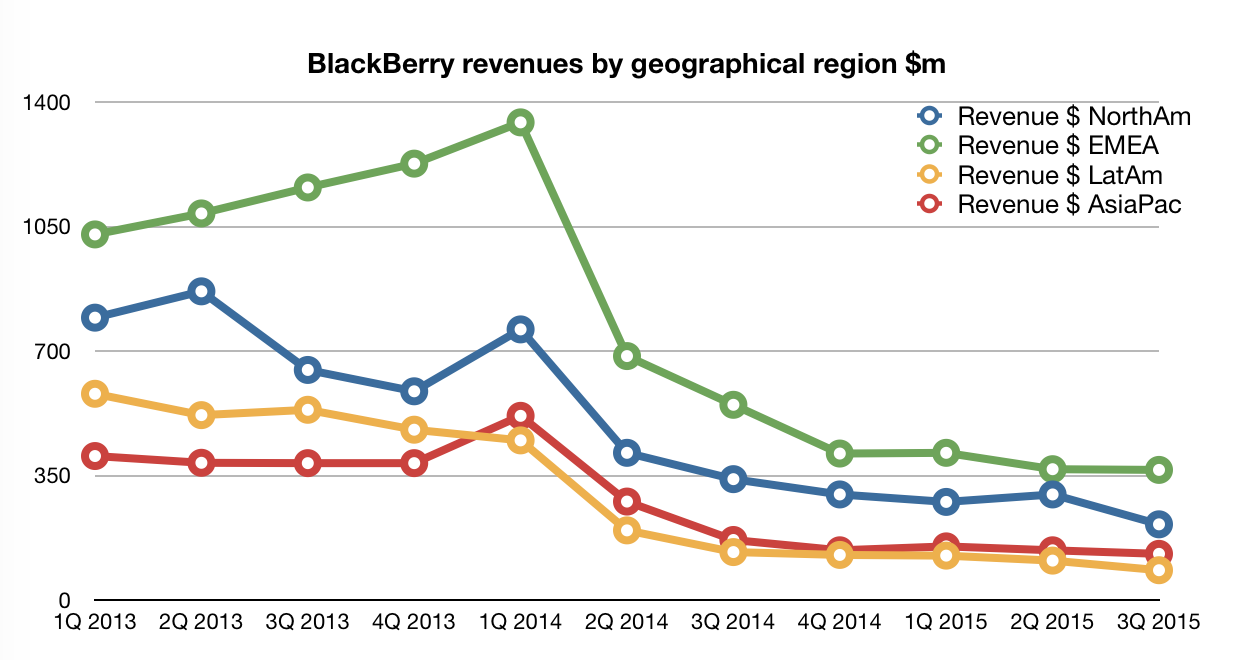
BlackBerry revenues by geographic region, by quarter

Shown separately: EMEA is the largest, but all are struggling. Source: BlackBerry

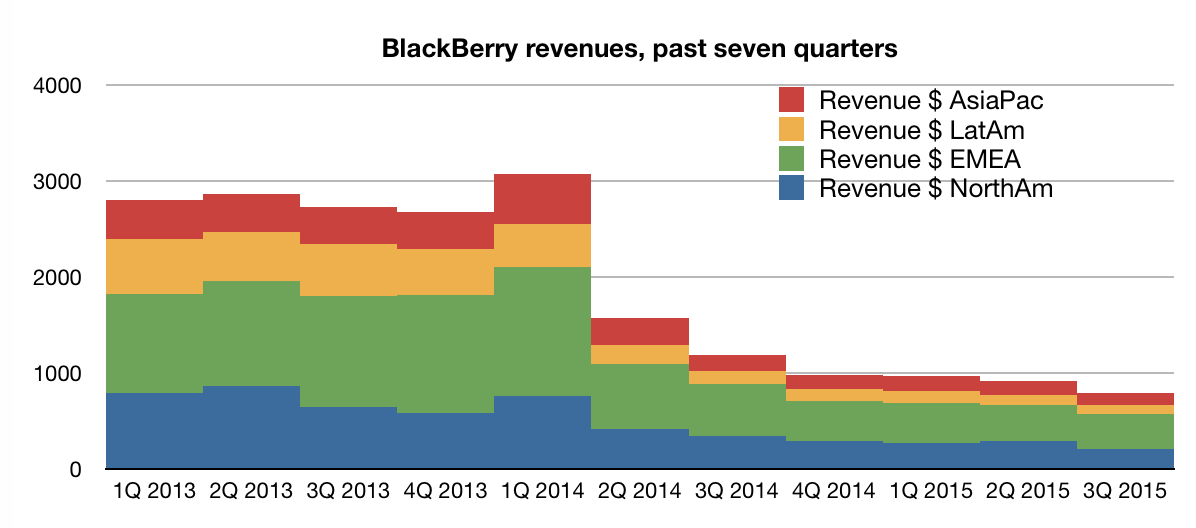
BlackBerry geographic revenue by quarter

EMEA is still the biggest region by revenue, but it’s all got much smaller. Source: BlackBerry

The graph shows how things aren’t working for the company. EMEA (Europe, Middle East and Africa) has long been the largest segment, principally because of subscribers in South Africa and the rest of Africa; the UK used to be a stronghold too, but that’s faded. Asia-Pacific hasn’t looked too rosy either for the past few quarters; but those are consumer areas, and that side of BlackBerry’s business just isn’t happening.

HARDWARE

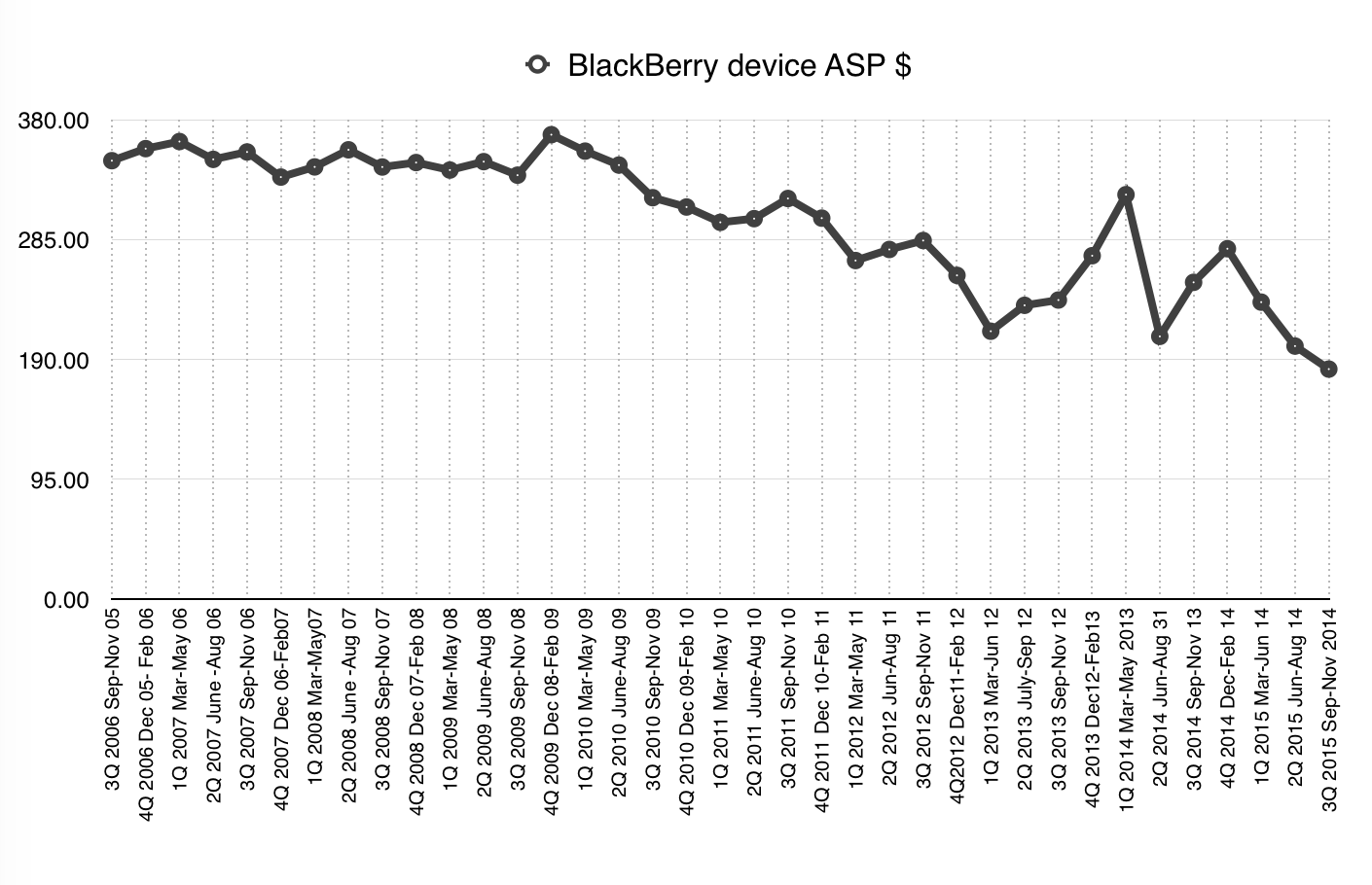
BlackBerry shipped 2m units but “sell-through” (to end users) was 1.9m, which suggests there’s no surplus in the channel now; it’s cleaned out. Does that mean there are no more BB7 devices like the Bold to buy? Again, unclear. But the ASP (average selling price) cratered:

Derived from total hardware revenue divided by handsets shipped. Source: BlackBerry

Derived from total hardware revenue divided by handsets shipped. Source: BlackBerry

Note that the ASP has halved from the December 2008 quarter, six years ago. Chen expects that to pick up now. Yet BlackBerry is struggling to fulfil even quite small demands, it seems. Chen is very vague about how many Passports were shipped (and paid for) in Q3 (transcript from Seeking Alpha)

Going forward, because of the new products, we expect the ASP to start picking back up again. We’re able to fulfil about 200,000 Passport orders that was preordered at the time we announced it, while reducing the manufacturing lead times to roughly now between four to six weeks. However, because we have sold our stock out a number of times in the quarter waiting for the fulfilment, we were only able to fulfil order backlog of Q3 by December 12. So that was clearly already into Q4. And I also want to remind everybody that our revenue of these devices are all recognised on a sell-through basis. So not every one of those units, in fact most of those units revenue are not recognised in Q3. And we obviously will recognise as they lead [ph] up in throughout the next few quarters.

Data point: 61% of Passport sales were in the US. See how much that helped revenues? Oh, sure, it didn’t. Revenues fell in North America. Also, Chen said that the hardware side could be profitable with sales of 10m units per (fiscal) year. It’s some way from that: 5.7m shipped after three quarters of the fiscal year (7m in the past four quarters); or 6.8m “sell-in” (to customers) in three quarters – and the magic 10.2m of sell-in over the past four quarters.

SERVICES

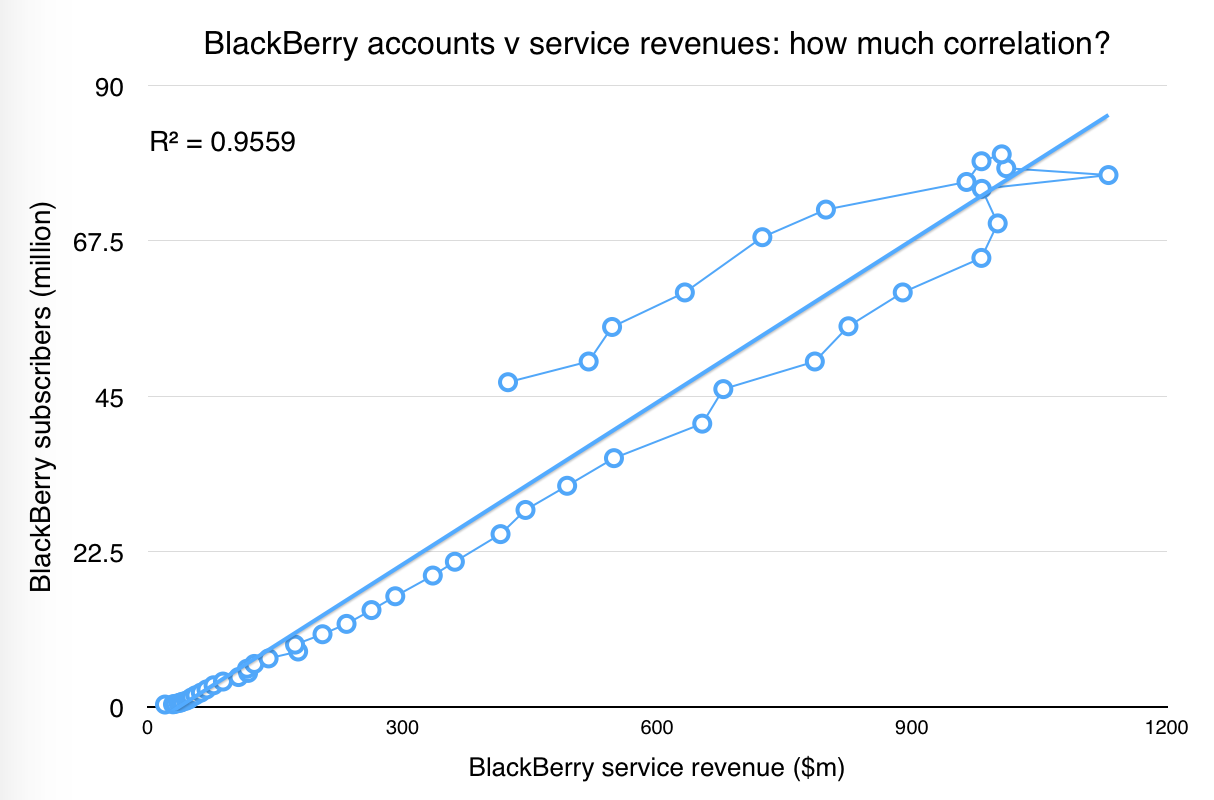
BlackBerry has made lots of profit from services. But it needs to make revenues from services for that to work. The Service Activation Fee (SAF) is what it gets from people who activate BB7 phones. And it’s declining: SAF revenues were down 13% sequentially, and will fall by about 15% in the next quarter according to the finance director. Looking at BlackBerry’s service revenues, those fell from $424m to $364.8m – which is a 13% fall. So that suggests that most of its service revenues are from SAF. That makes sense, looking at how the service revenues track the numbers of subscribers. The correlation between published subscriber figures and service revenues is really strong:

Correlation between BlackBerry subscribers and service revenue

Service revenues and subscriber numbers are closely linked – BlackBerry used to get more money per subscriber than it does now.

The linking lines show the progression of the link between revenue and subscribers; notice how it goes below the correlation line to begin with (more money for fewer subscribers) and then goes above the line, and starts heading backwards (less money for the same number of subscribers). So whereas in the June-August 2010 quarter there were 50m subscribers generating $785m in revenue, for the March-June 2014 quarter, when there were 50m subscribers, they only generated $519m in revenue. And that’s going to continue to decline; on the 15% decline forecast by Chen, that means a $310m service revenue announced in March, covering the current quarter (to the end of February).

SUBSCRIBERS

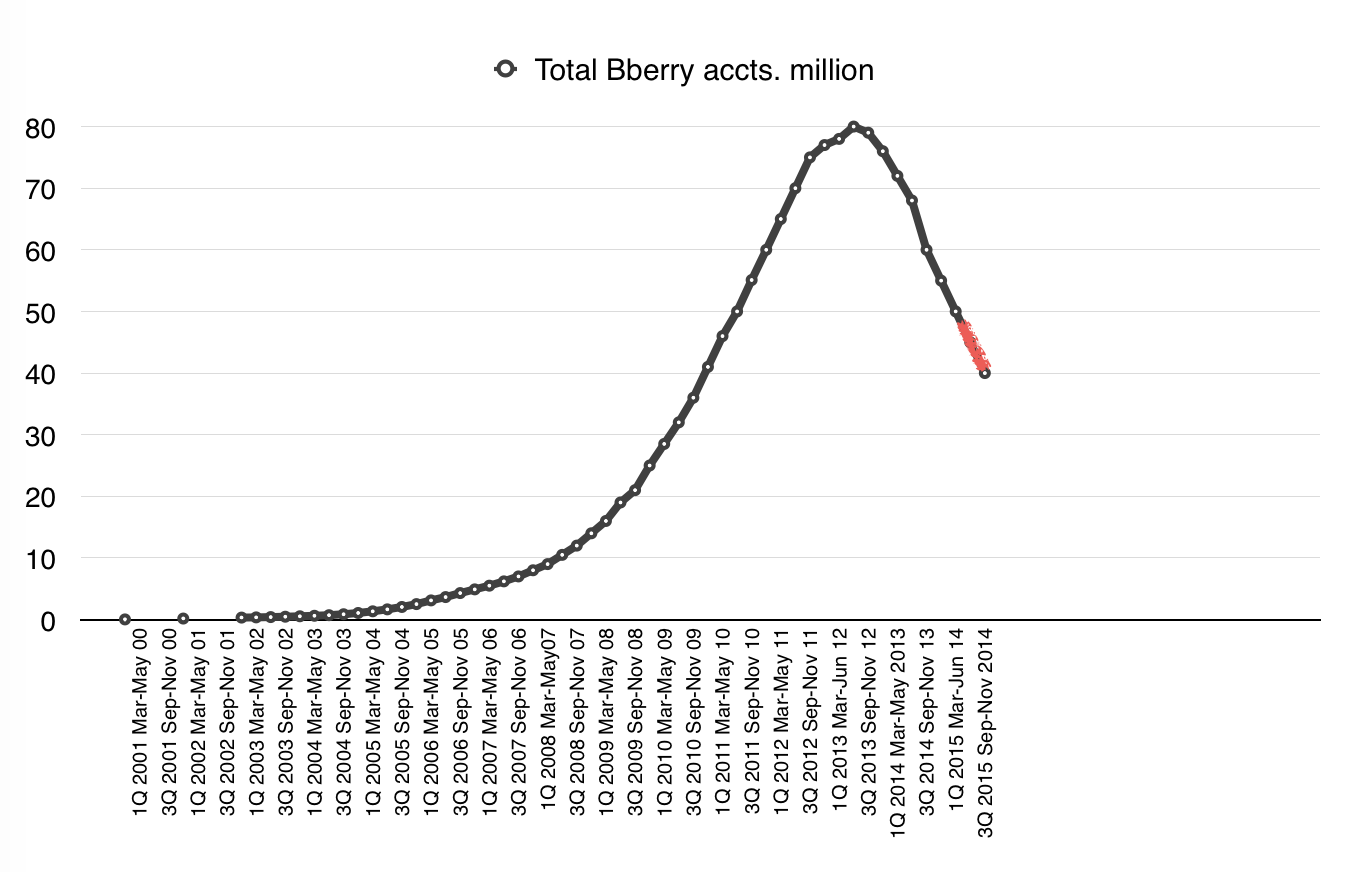
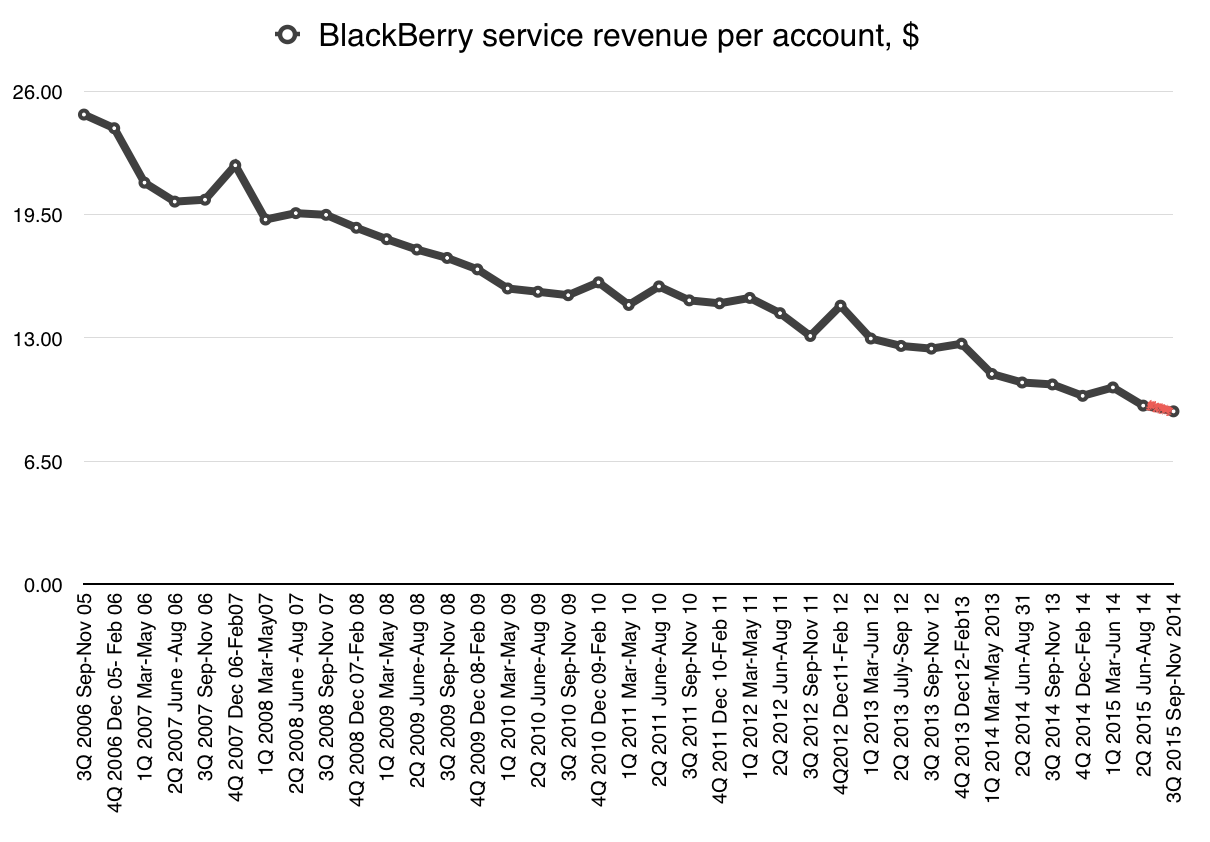
For some time the best questions in the BlackBerry analyst call have come from Ehud Gelblum at Citi, and he didn’t disappoint. “Is there a subscriber number update that we can hang our hat on?” he asked Chen. Answer: “No, not right now.” We can do some calculating about subscriber numbers, though. There’s a figure of “service revenue per subscriber account” that you can work out from the published number of subscribers and the service revenues. To get to the drop in service revenues, there are three choices: • subscriber numbers stayed the same, but per-subscriber payments fell • subscriber numbers fell, but per-subscriber payments stayed the same • both subscriber numbers and per-subscriber payments fell. If it was the first, wouldn’t you expect Chen to have spoken up and spun it a bit? He didn’t. If it were the second, wouldn’t you expect him to spin it a bit? He didn’t. There’s a clue, though. Here’s Chen talking about the problem of going from BB7 to BB10:

I’m not go to be providing you the margin of the Classic but it is a positive margin and revenue of course is in the $400 plus. But then I lose $3 to $5 a month [in service fees] when that conversion happens. Sometime over the lifetime of this will cross over.

At $3 per month in service revenues, $364.78m suggests about 40m subscribers. If we model about 5m fewer subscribers per quarter over the past four or five quarters, we also get a consistent fall in per-account subscription.

BlackBerry subscriber numbers

The fall in BlackBerry subscriber numbers (red = estimated, based on public data) is pretty fast.

BlackBerry service revenue per subscriber account

Service revenue per subscriber account is constantly falling as consumers, carriers and businesses move away from the Service Activation Fee (SAF).

And according to Richard Yersh, about 80% of those subscribers are business users – so that’s 32m business users and 8m consumers on BB7. On the upside, with 6.9m business licences (pretty much all on free tryout) for its EZPass BES12 server, that does mean lots of potential clients. If – big if – it can get them to sign up for its services. The other problem about falling subscriber numbers is that it gives you fewer people to sell new handsets to. On a basis of a two-year refresh cycle, the further you fall below 40m, the lower the refresh. Over the past seven quarters, the sell-through (to end users) has been 24.6m – average 3.5m per quarter – which would be 28m per two years. Trouble is, the sell-through is falling; the latest is the smallest recorded. Why should things improve?

PROFIT?

Still, it made a profit, right? CFO James Yersh:

In the quarter we also turned in a non-GAAP net profit of $6 million or $0.01 per share. These results were largely attributable to disciplined management of margins and expenses.

“Non-GAAP” means “not using official measurements”. (“GAAP” is “Generally Accepted Accounting Principles”.) I don’t mind companies leaving out exceptionals – one-off payments for laying off staff or closing factories, say. The reasons here are trickier: GAAP operating expenses included $150m of revaluation of its $1bn of convertible debt, the value of which increased. It’s a non-cash charge, and doesn’t affect anything about how the business is actually run. Just as a flashback, the reason why BlackBerry is carrying a debenture debt is because it decided to go for a bailout after a buyout effort failed. The debenture raised $1bn at 6%, giving debenture holders the right to convert the debt into $10 shares in November 2020. The debentures have to be marked-to-market – that is, valued – because they’re a continuing obligation: they’re a risk to the company, because convertible debentures can be a risk to a company through short-selling. But even if we allow the non-GAAP profit of $6m, we have to ask what BlackBerry has ahead of it. Let’s recap: • it’s struggling to fulfil hardware orders, but has cleared out a lot of BB7 inventory, so now has to try to sell lots of handsets, which will be made for it by Foxconn • service revenues are falling • subscriber numbers are falling • it now has to convert business users who had the free EZPass deal to actually pay money, rather than going with a rival for less Actually, a forecast that looks about right to me comes from one of the (many) BlackBerry analysts on Seeking Alpha, who sets out what it will take for the company to achieve profitability in its next financial year: • hardware sales of 13m over the fiscal year (my comment: possible, but it shows no signs of coming close this fiscal year) • service revenues as a result of those hardware sales of $1.27bn for the year (my comment: might just be achievable, at $300m per quarter, which is where it’s heading). There’s a newer article by the same author, who seems pretty sensible. Recommended. BlackBerry used to straddle the smartphone world; now it has become a curio, one with a niche business that it has to turn into profit as the consumer side of its business subsides. But there must be a horse in there somewhere, right?

Start up: so who did hack Sony? Apple on Pay, Pegatron workers, BlackBerry’s phone timing, and more


“Hey, from here you can see the posters for The Interview coming down!” Photo of Pyongyang, North Korea, by orangetruck1 on Flickr. (Searching Flickr for CC-licensed photos of “North Korea” yields some strangely anodyne pictures from “North Korea travel”.)

A selection of 9 links for you. Use them wisely. I’m charlesarthur on Twitter. Observations and links welcome.

Why the Sony hack is unlikely to be the work of North Korea >> Marc’s Security Ramblings

Marc Rogers, with the only piece you need to read on the Sony hack, making 10 points (a couple excerpted here):

It’s clear from the hard-coded paths and passwords in the malware that whoever wrote it had extensive knowledge of Sony’s internal architecture and access to key passwords. While it’s plausible that an attacker could have built up this knowledge over time and then used it to make the malware, Occam’s razor suggests the simpler explanation of an insider. It also fits with the pure revenge tact that this started out as.

4. Whoever did this is in it for revenge. The info and access they had could have easily been used to cash out, yet, instead, they are making every effort to burn Sony down. Just think what they could have done with passwords to all of Sony’s financial accounts? With the competitive intelligence in their business documents? From simple theft, to the sale of intellectual property, or even extortion – the attackers had many ways to become rich. Yet, instead, they chose to dump the data, rendering it useless. Likewise, I find it hard to believe that a “Nation State” which lives by propaganda would be so willing to just throw away such an unprecedented level of access to the beating heart of Hollywood itself.

5. The attackers only latched onto “The Interview” after the media did – the film was never mentioned by GOP right at the start of their campaign.

CNN was reporting on Thursday night that (unnamed) hackers stole a sysadmin’s credentials to get access to the company’s system. That fits with everything we know, though that’s not unknown for hackers who aren’t nation states; it’s been used by external hackers trying to get into companies for ages. What doesn’t fit a nation state attack is what Rogers points to in No.4: if North Korea wanted, it could ruin Sony silently.

What still puzzles me is why US sources are indicating that they think it is North Korea. Perhaps I’m too disbelieving it would do something weird like this.


Apple Pay will change marketing, not just payments >> Business Insider

If you think Apple Pay is only about payments, you’re not alone. UBS recently noted that Apple Pay (unlike Google Wallet) doesn’t let you “push” offers to people, and speculated that flaw would keep some merchants away from the platform.

[CEO of Vibes, Jack] Philbin disagrees because Apple already has a way for merchants to push these offers: Passbook. 

“The marketing is done through Passbook,” said Philbin. “Apple Pay is just the payment functionality.”

Passbook has been around since 2012. What’s changed is that iPhone users are paying a lot more attention to their mobile wallets now that there’s an easy way to pay for things from their phones as well.

Vibes’ clients — which include retailers like Gap, The Home Depot, and Bloomingdales— saw a 54% increase in people installing coupons or loyalty cards into Passbook from September to October, which Philbin attributes to the introduction of Apple Pay.


Apple ‘failing to protect Chinese factory workers’ >> BBC News

Filming on an iPhone 6 production line showed Apple’s promises to protect workers were routinely broken. It found standards on workers’ hours, ID cards, dormitories, work meetings and juvenile workers were being breached at the Pegatron factories.

Apple said it strongly disagreed with the programme’s conclusions. Exhausted workers were filmed falling asleep on their 12-hour shifts at the Pegatron factories on the outskirts of Shanghai.

One undercover reporter, working in a factory making parts for Apple computers, had to work 18 days in a row despite repeated requests for a day off. Another reporter, whose longest shift was 16 hours, said: “Every time I got back to the dormitories, I wouldn’t want to move.

“Even if I was hungry I wouldn’t want to get up to eat. I just wanted to lie down and rest. I was unable to sleep at night because of the stress.”

Apple declined to be interviewed for the programme but said “”We are aware of no other company doing as much as Apple to ensure fair and safe working conditions.We work with suppliers to address shortfalls, and we see continuous and significant improvement, but we know our work is never done.”

Pegatron’s Wikipedia entry doesn’t say who else it makes things for. Its corporate social responsibility report for 2013 (PDF) says “‘Joyful Working; Happy Living’ is Pegatron Group’s caring philosophy to employees.” Some employees, perhaps.


Former Apple supplier Wintek shutters China plants >> FT.com

Taiwanese group Wintek, formerly a major supplier of touchscreens for Apple’s iPhone and iPad, has shuttered two plants in southern China and axed 7,000 jobs, leaving unpaid suppliers to chase debts of Rmb230m ($37m).

Armed police surrounded the plants in the city of Dongguan as workers collected their final pay this week, while suppliers demonstrated in front of the factories.

The company sought insolvency protection in October, filing in Taiwan for a restructuring of more than NT30bn ($961m) in debts owed to both local and mainland lenders and suppliers.

The move to in-panel technology with the iPhone 5 didn’t go Wintek’s way; now it’s laying off thousands of staff and may go bust. Keeping up with Apple’s demands is tough.


Stop the presses! >> Counternotions

Kontra, on the dire “reporting” of the (untrue) suggestion by the replacement plaintiff’s lawyers that Apple had deleted songs on peoples’ iPods (it hadn’t):

Yes, journalism isn’t exact science, but from epidemiology to space exploration, from technology reporting to business coverage, the sheer amount of fact-free, opinion-framing ‘news’ is now exceeding our collective ability to notice, care or correct. Yes, journalism has always been messy, but the speed with which it’s generated, aggregated and distributed may now be overwhelming us. Yes, we have ever growing access to filtering software to shape our own sphere of coverage, and yet tens of millions of people read, and likely most believed, that Apple had deliberately and secretly deleted competitors’ songs from users’ iPods, an impression which may never be sufficiently corrected.

All people needed to do was say “Apple deleted songs, court told” and they’d have been factually correct, even if the claim is bunkum.


Sony Pictures employees now working in an office “from ten years ago” >> TechCrunch

John Biggs:

She works for Sony Pictures. She said she’s now working in an office on lock-down, a throw-back to an earlier time when the Internet wasn’t around.

“We are stuck in 1992 over here,” she said.

She requested anonymity but agreed to talk a bit about her day-to-day experience as a Sony Pictures Employee post-hack. She said things were getting back to normal and were, in some ways, more pleasant.

But the thing that bothers her most is the need to depend on old technology to do new work, now.

“We had barely working email and no voicemail so people talked to each other. Some people had to send faxes. They were dragging old printers out of storage to cut checks,” she said. “It was crazy.”

…“My bank account was hacked [on the day of the first attack,]” said our source who works at SPE offices in Los Angeles. “At first we just thought it was total coincidence.”

Now she suspects someone found something in the email dump that allowed them to access her accounts.

Smart journalism from Biggs.


Why the BlackBerry Classic is critical to the new BlackBerry >> CNET

Roger Cheng:

CEO John Chen made a few remarks, then pulled out the Classic for a photo opportunity. But as the presentation went on, it was clear whom the company was targeting: the IT guy working in a highly regulated business.

The conversation dashed past the typical walkthrough of the Classic’s features, spending a healthy chunk of time on the phone’s enterprise software capabilities and looping in guests like the chief information officer for Citco Fund Services, the founder of Niederhoffer Capital Management and the chief operating officer of Ontario-based Mackenzie Richmond Hill Hospital.

It’s a far cry from Alicia Keys, the pop music sensation BlackBerry once played up as its “global creative director.”

The timing of this launch fascinates me: two days before BlackBerry announces its quarterly results. Look back to September, and BlackBerry launched the Passport on 24 September – two days before it announced (not great) results.

And yes, BlackBerry’s quarterly results are today (Friday) at 1300GMT. Analyst forecasts are for $936m in revenue (a fall against the year-ago period) and a 5c per share loss. Perhaps we’ll hear how many Passports were sold, and whether it has a future.


Different relationships with their phones: iPhone versus Android >> The Network Garden

Mark Sigal did some user testing:

in the new app that we are building, one question in user testing was how important having a desktop web version of the functionality would be.

Get this, 90% of the Android users thought it was pretty important, most commonly because the test user saw the PC as the central part of their computing experience — even though the app is for a highly mobile type of action.

By contrast, 90% of the iPhone users looked cockeyed at the question, noting that the action is designed for palm in the hand, on the go types of behaviors, adding (I’m paraphrasing) that their iPhone is their hub, not the PC.

Same questions. Same product feature for feature; a variety of young to middle age males and females, and the only difference is iPhone versus Android.

His blog is worth reading more generally.


Nokia publishes maps on your iPhone, leaves Lumia in the shadows >> IT Vikko

This is a link to the Google Translation of this page (the headline is from the Bing translation, but it doesn’t have a static URL):

Nokia is not planning to upgrade in the near future the Here Maps application for Lumia phones. “When Nokia made handsets, we were a little different. Now, we are developing application on the basis of a realistic markets.”

Ouch. Harsh divorce; the parent doesn’t want to see its child any more.


Start up: Chromebooks beat iPads, Netscape’s growing pains, OnePlus’s India problem, Nexus 9 before and after, and more


The inside of Peter Morgan’s eye.

A selection of 12 links for you. Clean regularly. I’m charlesarthur on Twitter – observations and links welcome. (Note: I’ve tweaked – I hope – the font size on each link entry. If the spacing seems off, suggest a better CSS for it. I’m all ears, having twiddled with it to little satisfaction.)

Google overtakes Apple in the US classroom >> FT.com


Apple has lost its longstanding lead over Google in US schools, with Chromebook laptop computers overtaking iPads for the first time as the most popular new device for education authorities purchasing in bulk for students.

Google shipped 715,500 of the low-cost laptops into US schools in the third quarter, compared with 702,000 iPads, according to IDC, the market research firm. Chromebooks, which sell for as little as $199, have gone from a standing start two years ago to more than a quarter of the market.

It marks the first time Google has outsold its rival and consolidates a lead it opened up over Apple this year in the broader education market, which includes higher education establishments, as it closes in on Microsoft Windows, the market leader.

The multibillion-dollar education market has become a battleground for hardware makers trying to win the loyalties of the next generation of consumers. It has traditionally been dominated by Windows devices, which have a decades-long head start on iPads and Chromebooks, but schools are increasingly turning to lower-cost alternatives.

A $500m schools contract in Los Angeles was going to be all-iPad – and then the deal hit the rocks, and LA went for Chromebooks instead.


Peek Retina >> Indiegogo

What is Peek Retina?
It’s a clip-on camera adapter that gives high quality images of the back of the eye and the retina. This helps us to diagnose cataracts, glaucoma and many other eye diseases, ready for treatment.

It has been developed by an award-winning team of experts in eye care, engineering and technology.

Peek Retina combines both a traditional ophthalmoscope and a retinal camera in a mobile phone, providing a portable, affordable and easy way to carry out comprehensive examinations.

It sits neatly over the top of the device allowing a healthcare worker to easily take high-quality images of the back of the eye. It feels much less intrusive for the patient too.

The aim is to bring it to the millions of people who need affordable eye care in poorer regions. A donation would make a great Christmas gift. Or buy one for yourself.


A letter to our Indian users >> OnePlus Blog

This week, we announced that the OnePlus One will finally launch in India on December 2, 2014. This has been a long time coming both for our Indian fans, who have been incredibly patient, and everyone behind the scenes who have been working towards this moment since June.

OnePlus and all of our partners, including Cyanogen, have put countless hours of work into making this launch a success. Just last month, on October 7, Cyanogen released the 38R OTA update which included SAR values inside phone settings to comply with Indian regulations. Therefore, it was surprising and disappointing to hear from Cyanogen on November 26 that they had granted exclusive rights in India over the Cyanogen system to another company. Prior to this, OnePlus and Cyanogen have successfully cooperated to release the OnePlus One or carry out commercial operations in 17 countries and regions (including India). It is truly unfortunate that a commitment we both made to our Indian users will now not be upheld.

Cyanogen’s exclusive partner in India: home-grown Micromax. OnePlus’s solution: set up physical places where it will flash peoples’ OnePlus phones to the newest system. That’s going to be expensive.


Smartphones to commoditise like PCs; margins to contract >> Fitch Ratings

The margins of Asian smartphone makers are likely to contract in the medium term amid heightened competition and product commoditisation, says Fitch Ratings. The slowing pace of hardware development, and more manufacturers achieving a threshold level of build quality and functionality, means that the rapid growth of lower-cost smartphone producers will challenge market-leading incumbents and reduce profitability.

The smartphone industry runs the risk of following the cycle seen in PCs, where device-makers’ share of the value chain was squeezed by competition and where operating systems and applications software have become more important to consumers than hardware from a specific manufacturer. The dominance of Microsoft’s operating systems and applications enabled this trend in PCs. In smartphones, this trend may be facilitated by the Android operating system and the open environment for third-party application developers…

…Fitch expects that Samsung’s credit profile will remain solid, given its technology leadership, integrated structure and wider product range. Apple too is relatively well positioned owing to its strong brand value and ecosystem. Outside the big two, established brands such as LG Electronics, Sony, HTC and Nokia, will face stiffer competition from low-cost Chinese vendors.

It’s the value trap all over again.


Uber Josh Mohrer: New York’s general manager is facing disciplinary action over privacy violations >> Slate

Uber said Friday that it has concluded an investigation of New York City general manager Josh Mohrer for alleged privacy violations and has “taken disciplinary actions” against him.

Uber began looking into Mohrer 10 days ago after BuzzFeed’s Johana Bhuiyan reported that Mohrer had accessed her Uber travel data without her permission on multiple occasions. In one instance earlier this month, Bhuiyan arrived for a meeting with Mohrer at Uber’s New York headquarters in Long Island City to find him waiting for her. “There you are,” she recalled him telling her. “I was tracking you.”

Reached Friday afternoon, a spokeswoman for Uber declined to comment on any specifics of the “disciplinary actions” or discuss what might have prompted them other than the BuzzFeed report.

Somehow unsurprising that Uber would go for undisclosed self-regulation on this.


The best travel gear of 2014 >> Co.Design

If you need an unusual present for someone who’s always in and out of airports, or rides a bike, or needs an umbrella, here you go. Some great ideas in here.


Is Monument Valley overpriced? Yes. >> Terence Eden’s Blog

We live in times of desperate austerity. When you say “well, it’s only the price of a cup of coffee!” you utterly fail to realise that for many people Starbucks represents an unobtainable level of decadent spending.
People have hard lives. After working two jobs, slumped on an endless night bus home, they want relief from the pain and tedium of the working day. Pulling out an old phone – perhaps a hand-me-down, or one bought in happier times – they want to spend what little disposable income they have wisely. Something that gives them bang for their buck.

Renting a movie, like Transformers, works out at £1.30 per hour of enjoyment. Twice as cheap as Monument Valley.

Reading a book, knitting, chatting on the phone with a friend – all cheaper.

As the reviewer [quoted earlier in the post] said – there are many games which are just as good looking as Monument Valley, with far longer play times. Often for free.

This is a classic “functional pricing” argument, which I find is much more widely made (especially over PCs and smartphones and tablets, where “measurement” seems superficially easy – x GHz processor, y RAM, z hard drive storage). It’s also meaningless. I wouldn’t rent Transformers; you could offer it to me free and I wouldn’t watch it. Why? Because in my view it’s crap. Therefore no (non-negative) price is sufficiently low for me.

By contrast, I find Monument Valley to be fascinating, clever, unexpected, memorable – all those things that for me Transformers is not. As for other games that have longer play times and are free – sure, but is Doodle Jump or Angry Birds as memorable as Monument Valley?

I don’t often disagree with Eden, but this seems to me a classic case of mistaking price and value. Equally, it’s one that lots of people make when it comes to apps – which is the problem app makers face.


An Interactive Scale of the Universe Tool

From the teeny tiny to the gianty–… anyway. Terrific way to feel small. (Via Jake Davis.)


The BlackBerry Passport enigma: TCOB-machine or “worst designed thing, ever” >> Ars Technica

Sean Gallagher:

When viewed in the right light, the Passport ends up looking pretty. It was unexpectedly the best smartphone we’ve ever used from the perspective of taking care of business. Yes, it benchmarks somewhat below phones in its price range on the tests that would run in the BlackBerry 10 OS. And there’s still a significant “app gap” between the Passport and competing devices. But that’s all background noise when you use the Passport as it’s intended—as an information and communications machine, designed for people who still live and die by the e-mail inbox rather than iMessages and Hangouts and Snapchats.

Unlike this one, most reviews of the Passport miss its point – it’s not a general-purpose smartphone. It’s a BlackBerry.


The baffling and beautiful wormhole between branches of math >> WIRED

Lee Simmons, capitalising on the fact that “wormhole” is a key phrase at the moment (because of Interstellar) and hey, maybe this is new! But it isn’t. If you don’t know Euler’s identity equation, you’re in for a treat though:

the weirdest thing about Euler’s formula — given that it relies on imaginary numbers — is that it’s so immensely useful in the real world. By translating one type of motion into another, it lets engineers convert messy trig problems (you know, sines, secants, and so on) into more tractable algebra—like a wormhole between separate branches of math. It’s the secret sauce in Fourier transforms used to digitize music, and it tames all manner of wavy things in quantum mechanics, electron ics, and signal processing; without it, computers might not exist.


Nexus 9 made on Thursday vs before launch buttons comparison >> Nexus9

Poster “Sebianoti” posted a picture of his old and new Nexus 9 tablets, and commented:

Today my new Nexus 9 arrived, it was manufactured last week, it was shipped to me on Friday from Taiwan and it arrived today. It’s my replacement to my faulty one with extreme light bleed and buttons that are almost impossible to press, as you can see that’s one issue that’s been fixed. This may be the first Nexus 9 in white that has the buttons fixed, at least that’s what HTC’s AVP told me. Light bleed is still present however it’s nowhere near as bad as before.

Seems like damning with faint praise. The LTE version has apparently been delayed. HTC isn’t covering the Nexus name with glory here (and replacements aren’t going to help its bottom line).


Excerpts from my diary of early days at Netscape >> Jamie Zawinski

Here are some excerpts from my diary during the first few months of the existence of Netscape Communications (All Praise the Company), back when we were still called Mosaic. Back when there were only 20 or 30 of us, instead of however-many thousands of people there are today. Back before we had any middle managers.

This is the time period that is traditionally referred to as “the good old days”, but time always softens the pain and makes things look like more fun than they really were. But who said everything has to be fun? Pain builds character. (Sometimes it builds products, too.)

So you want to go work for a startup? Perhaps this will serve as a cautionary tale…

The first one starts at 4am. SGI hardware, Irix 5.3… but the same frustration that will be recognisable to many startups. It starts in July. By September:

We’re doomed.

We’ve finally announced a public beta to the net, and there are loads of bugs, and they’re hard bugs, sucky, hardware-dependent ones. Some of our private beta testers crash at startup on some SunOS 4.1.3 systems, and I’ve got what seems like an identical system here and it doesn’t crash. And scrolling text doesn’t work with the OpenWindows X server, though it works fine elsewhere.

(Via Steve Werby.)


Start up: tablet slowdown, find that toilet!, does live music pay?, BlackBerry’s iPhone offer, and more


“Finally, I got my iPad” by juehuayin on Flickr

A selection of 10 links for you. Use them wisely.

Worldwide tablet growth expected to slow to 7.2% in 2014 along with first year of iPad decline >> IDC

The worldwide tablet market is expected to see a massive deceleration in 2014 with year-over-year growth slowing to 7.2%, down from 52.5% in 2013, according to a new forecast from International Data Corporation (IDC). At the core of this slowdown is the expectation that 2014 will represent the first full year of decline in Apple iPad shipments. Both the iPad and the overall market slowdown do not come as a surprise as device lifecycles for tablets have continued to lengthen, increasingly resembling those of PCs more than smartphones.

“The tablet market continues to be impacted by a few major trends happening in relevant markets,” said Ryan Reith, Program Director with IDC’s Worldwide Quarterly Mobile Device Trackers. “In the early stages of the tablet market, device lifecycles were expected to resemble those of smartphones, with replacement occurring every 2-3 years. What has played out instead is that many tablet owners are holding onto their devices for more than 3 years and in some instances more than 4 years. We believe the two major drivers for longer than expected tablet lifecycles are legacy software support for older products, especially within iOS, and the increased use of smartphones for a variety of computing tasks.”


The Great British Public Toilet Map >> Gail Knight

The Great British Public Toilet Map launched last Wednesday 19th November on World Toilet Day*

Previous versions of the map have existed since 2011, but this is now the largest publicly accessible toilet database in the UK by some way. It has over 9500 toilets, and I’d be confident of saying that the map will help you to find toilets no matter where you live.

If for some inexplicable reason it doesn’t, you can add, edit and remove toilets until it does! We’ve had over 1000 toilets added this week.

AT LAST. I judged a competition in April 2011 where this was one of the entries – and nearly the winner.


How Sonos and John MacFarlane built the perfect wireless speaker for streaming music >> Businessweek

[Mark] Trammell [a designer formerly at Digg and Twitter] likes to interview customers in their homes, sometimes in the moment when a Sonos speaker first arrives and a family is taking it out of the box and deciding where it should go.

“They’re looking for a Sonos-size hole to fill,” he says. The small Play:1 is good for bathrooms and kitchens; the Play:5 tends to go in living rooms and dens. The accessories allow for attaching other kinds of sound equipment, such as weatherproof outdoor speakers, to the network. The average Sonos household has 2.1 units.

A key moment tends to be when family members discover how to add to and remix playlists together. Mark Whitten, Sonos’s chief product officer, compares the experience to that of the Xbox. “The reason gaming consoles became ascendant wasn’t because of the games,” he says. “It’s because two kids were sitting on a couch, playing together.” Whitten was hired six months ago from Microsoft, where he introduced and oversaw much of the Xbox, including Xbox Live.

On an upward curve. Will someone buy them?


Automation makes us dumb >> WSJ

Nick Carr:

Late last year, a report from a Federal Aviation Administration taskforce on cockpit technology documented a growing link between crashes and an over-reliance on automation. Pilots have become “accustomed to watching things happen, and reacting, instead of being proactive,” the panel warned. The FAA is now urging airlines to get pilots to spend more time flying by hand…

…Ten years ago, information scientists at Utrecht University in the Netherlands had a group of people carry out complicated analytical and planning tasks using either rudimentary software that provided no assistance or sophisticated software that offered a great deal of aid. The researchers found that the people using the simple software developed better strategies, made fewer mistakes and developed a deeper aptitude for the work. The people using the more advanced software, meanwhile, would often “aimlessly click around” when confronted with a tricky problem. The supposedly helpful software actually short-circuited their thinking and learning.


Lee Rigby Woolwich report in full >> The Guardian

Report by parliament’s intelligence and security committee setting out what the intelligence services knew before 2013 Woolwich killing of fusilier by Michael Adebolajo and Michael Adebowale

Worth reading in depth if you’re interested in how security services operate, and what they can (and can’t) get from data. For example: the killers were known, but low priority; a tapping order took a month to be signed; submarine cables are tapped, but even if their discussions had been picked up by them, the fact neither was under “active” observation means key comments would have been missed.


The Lee Rigby murder doesn’t justify an extension of internet snooping powers >> The Guardian

I wrote on the report:

the ISC [Intelligence Services Committee] has a point here. As the report highlights, when internet companies discover accounts associated with child exploitation, they are quick to pass on details to the authorities. But if someone suggests “let’s kill a soldier” in a message, the account is marked for closure. Adebowale had four out of seven internet accounts at one provider automatically closed over suspected terror-related activity; yet none was reviewed by a human. That’s a clear failure to link the action – closing an account – and the reason; communications companies can’t seek public approval for trying to prevent child exploitation, yet wash their hands of terrorism discussions.

The BBC is saying that the Adebowale comment was made on Facebook. Expect more developments in the next few days.


Intel decides to keep tablet subsidies, say sources >> Digitimes

Facing domination from ARM-based processor suppliers such as Qualcomm and MediaTek, Intel’s subsidies including those for marketing, have helped reduce vendors’ costs by around US$20-30 and have attracted vendors such as Asustek Computer, Acer and Lenovo to place orders for Intel’s processors, the sources noted.

Although the strategy helps Intel to maintain a share of around 90% in the notebook market, the strategy has taken a heavy toll out of Intel in the mobile device market as the company has generated about US$7bn of losses from its mobile and communications business during the past two years and will continue to see losses in the fourth quarter, the sources noted.

Internally, Intel has been debating about whether to stay in the tablet market, but the company has decided to push for the market since its absence could impact its PC business and create a hole in its Internet of thing (IoT) lineup, the sources explained.

The logic is sound. And $20-30 could make the difference between profit and loss for some tablet makers.


Pomplamoose 2014 Tour Profits >> Medium

Jack Conte (half of Pomplamoose) does the numbers for the band’s recent self-financed tour:

Add it up, and that’s $135,983 in total income for our tour. And we had $147,802 in expenses.

We lost $11,819…

…The point of publishing all the scary stats is not to dissuade people from being professional musicians. It’s simply an attempt to shine light on a new paradigm for professional artistry.

We’re entering a new era in history: the space between “starving artist” and “rich and famous” is beginning to collapse. YouTube has signed up over a million partners (people who agree to run ads over their videos to make money from their content). The “creative class” is no longer emerging: it’s here, now.

We, the creative class, are finding ways to make a living making music, drawing webcomics, writing articles, coding games, recording podcasts. Most people don’t know our names or faces. We are not on magazine covers at the grocery store. We are not rich, and we are not famous.


Trade in your iPhone >> BlackBerry Trade Up

Trade your iPhone for a BlackBerry Passport and get up to $550!

For a limited time, starting December 1st.

Upgrade to a BlackBerry® Passport and get up to $400 back for your iPhone and an additional $150 from BlackBerry. Subject to Terms and Conditions.

To qualify for this offer, you must have purchased a BlackBerry Passport from select online retailers on or after December 1st, 2014.

BlackBerry essentially gives you $150, and you get a tradein of $90-$400 depending on iPhone model. Doesn’t seem to tie you to owning the Passport for any length of time, so the arbitrage-minded might like to see how easy it would be to round-trip this: cheap secondhand iPhone from drawer -> get BlackBerry Passport -> sell off Passport -> get cheap iPhone -> repeat? The problem might lie in the third step though.

Unlikely there will be a rush of iPhone owners to bankrupt BlackBerry, but also gives an insight into roughly how much it values each user: must be more than $150 over typical contract length.


Whistling Google: PLEASE! Brussels can only hurt Europe, not us >> The Register

Andrew Orlowski, on the European Parliament’s inconsequential (yet consequential) motion to make Google split services from search:

Google today wields enormous power over other industries, in a way Microsoft never could, even at the zenith of its influence. Newspapers didn’t close, and musicians didn’t go hungry, because Windows was late. No Active X control ever destroyed an economic sector. Yet you can plausibly argue that the consequences for European industry and its citizens freedoms are at least indirectly attributable to Google’s strategic use (and abuse) of other people’s property and personal effects…

…DCMA provisions were designed to protect ISPs and other service providers in the mid-1990s, when the public internet was in its infancy.

Today, they are favourable to huge internet aggregators, and load the deck against individuals and tiny companies seeking to protect their work. Google required the music company to promise not to sue an unlicensed uploader, thereby protecting Google’s supply chain. “You can sign and get a fraction of a penny,” Google was saying, “or you can refuse to sign and get nothing. It’s up to you – but either way, we’ll use your work and make money off it.”

As he points out, though, the European Commission is hopelessly screwed in both its aims and implementation of anything digital.