Start up: Samsung’s adblocker’s back, cement – solved!, #error53 redux, the Useless Hackathon, and more

Your plumber remembers one version of a call from Yelp, but the recordings show another. Who’s right? Photo by eldeeem on Flickr.

Oh, go on- sign up to receive each day’s Start Up post by email. Who knows, it might make your inbox happy.

A selection of 9 links for you. Smoosh them into mush. I’m charlesarthur on Twitter. Observations and links welcome.

Pirate group suspends new cracks to measure impact on sales » TorrentFreak

“Andy”:

One of the hottest topics in the game piracy scene in late 2015 surrounded the Avalanche Studios/Square Enix title Just Cause 3.

Released on December 1, 2015, pirates were eager to get their hands on the game for free. However, JC3 is protected by the latest iteration of Denuvo, an anti-tamper technology developed by Denuvo Software Solutions GmbH. Denuvo is not DRM per se, but acts as a secondary encryption system protecting underlying DRM products.

All eyes had been on notorious Chinese game cracking group/forum 3DM to come up with the goods but last month the group delivered a killer blow to its fans.

According to the leader of the group, the very public ‘Bird Sister’ (also known as Phoenix), the game was proving extremely difficult to crack. In fact, Bird Sister said that current anti-piracy technology is becoming so good that in two years there might not be pirated games anymore.

And now the group isn’t going to crack any single-player games. Won’t stop all the other cracking groups, of course.
link to this extract


Sky Q now available in the UK » Ars Technica UK

Sebastian Anthony:

Sky Q, the next iteration of Sky’s subscription TV service, is now available to buy in the UK. Prices start at £42 per month, climbing to £88.50 per month, and there’s a £250 setup fee that you have to swallow as well.

The headline feature of Sky Q is that you’re able to record three shows simultaneously while watching a fourth channel. If you stump up £54 per month for the upgraded Sky Q Silver box, you can record four channels and watch a fifth. Of course, whether there are actually five channels worth watching is a slightly more complicated question.

Other interesting features include a new touchpad-equipped remote control, downloading content for offline viewing, watching Sky TV on a tablet, and the possibility of streaming Sky TV to other rooms in the house via Sky Q Mini boxes.

Sky Q is a really smart response by Sky to the incursion of the web into TV; it folds it in (at a price). I’ve seen a demo, and it really is very slick, and the integration into tablet apps is terrific. Plus because it uses the satellite signal it’s fast – a big advantage in rural areas where broadband is slow.

(Here’s a piece I wrote on Sky Q before its details were fully known.)
link to this extract


Google restores ad blocker for Samsung browser to the Play Store » The Verge

Dan Seifert:

Following a little bit of drama last week, Google has restored an ad blocking plugin for Samsung’s Android browser to the Play Store today, according to a blog post from the developer of the app. The plugin, Adblock Fast, was removed from the Play Store last Tuesday after only being available for a day, with Google citing that the plugin violated a section of the Store’s developer agreements. The specific rule that was violated relates to plugins modifying other third-party applications, which is prohibited by Google.

Now things start to get interesting.
link to this extract


How WIRED is going to handle adblocking » WIRED

“Wired Staff”:

So, in the coming weeks, we will restrict access to articles on WIRED.com if you are using an ad blocker. There will be two easy options to access that content.

You can simply add WIRED.com to your ad blocker’s whitelist, so you view ads. When you do, we will keep the ads as “polite” as we can, and you will only see standard display advertising.
You can subscribe to a brand-new Ad-Free version of WIRED.com. For $1 a week, you will get complete access to our content, with no display advertising or ad tracking.

This presumes that adblocking readers will accept that they are worth $1/week to Wired, and that Wired is worth the same amount to adblocking readers. Is that proven? Given how small the amounts earned from ads per person are, this seems to be herding people who don’t know their true value towards a funnel. Premium ad display costs $10 per CPM – that is, per thousand showings. That’s 1c per premium ad you view. Multiply by the number of ads on a page – perhaps 10, for 10c? So if adblocking readers pay up but view fewer than 10 articles per week, Wired is making a solid profit from them, minus credit card costs.

Discussion on Hacker News suggests that people would rather go for a “bid to show me ads” model – which, to be fair, is how Google Contribute works. If you set your per-page view at, say, $0.35, then you’ll only see ads where an advertiser has bidded more. But of course that means you get all the tracking malarkey that goes with it (and of course if you truly don’t like tracking, why are you using Google?)

And as is also pointed out, you can subscribe to the physical magazine for a lot less than the $50 per year this implies – in fact you can get it for about a tenth of that.

Another point, finally – the page is 3.3MB, of which only half is content. The rest is ads. Still sure you want them?
link to this extract


Exclusive: Top cybercrime ring disrupted as authorities raid Moscow offices – sources » Reuters

Joseph Menn:

Russian authorities in November raided offices associated with a Moscow film distribution and production company as part of a crackdown on one of the world’s most notorious financial hacking operations, according to three sources with knowledge of the matter.

Cybersecurity experts said a password-stealing software program known as Dyre — believed to be responsible for at least tens of millions of dollars in losses at financial institutions including Bank of America Corp and JPMorgan Chase & Co — has not been deployed since the time of the raid. Experts familiar with the situation said the case represents Russia’s biggest effort to date to crack down on cyber-crime.

A spokesman for the Russian Interior Ministry’s cybercrime unit said his department was not involved in the case. The FSB, Russia’s main intelligence service, said it had no immediate comment.

Menn is a terrific journalist on this topic. I highly recommend his book Fatal System Error. (He’s written others too.)(Thanks Richard Burte for the pointer.)
link to this extract


Inside the Stupid Shit No One Needs & Terrible Ideas Hackathon » Motherboard

Cecilia D’Anastasio:

Featuring hacks like 3Cheese Printer, a 3D printer using Cheez-Whiz as ink, and NonAd Block, a Chrome extension that blocks all non-ad content, the New York-based Stupid Hackathon is disrupting hackathon culture. While other hackathons churn out useless projects in earnest, the Stupid Hackathon strips pretension away from tech developers’ money-backed scramble to satisfy every human need. Satirizing the hackathon community’s naive goals for techno-utopianism, co-organizers Sam Lavigne and Amelia Winger-Bearskin solicit projects that use tech to critique tech culture.

“Is a need being filled or is the need manufactured and then constantly reinforced?” Lavigne asked. “The Stupid Hackathon is the perfect framework for satirizing the whole tech community.”

Three Stupid Hackathon teams set out to create wearables that detect boners. Categories for hacks included “edible electronics,” “commodities to end climate change” and “Ayn Rand.” Participants, in general, ignored them.

Lavigne and Winger-Bearskin, who met at the Interactive Telecommunications Program (ITP) at NYU, became disenchanted with hackathons when they noticed that many aimed to “hack” world hunger or income inequality in one weekend. As a student at ITP, Winger-Bearskin, now director of the DBRS Innovation Lab, applied to participate in a hackathon on the theme of love hosted at ITP but was rejected.

“I couldn’t even eat the food that was on the table next to me,” she said, referring to the free food often provided for hackathon participants. “And I couldn’t hack about love!” Lavigne has never attended another hackathon.

There used to be an Apple Mac hacking contest – called MacHack – in the 1990s where hacks that could actually be thought helpful were derided as “useful!”. Seems the idea is back, in a bigger way.
link to this extract


Riddle of cement’s structure is finally solved » MIT News

Concrete forms through the solidification of a mixture of water, gravel, sand, and cement powder. Is the resulting glue material (known as cement hydrate, CSH) a continuous solid, like metal or stone, or is it an aggregate of small particles?

As basic as that question is, it had never been definitively answered. In a paper published this week in the Proceedings of the National Academy of Sciences, a team of researchers at MIT, Georgetown University, and France’s CNRS (together with other universities in the U.S., France, and U.K.) say they have solved that riddle and identified key factors in the structure of CSH that could help researchers work out better formulations for producing more durable concrete.

What a time to be alive, eh? That solid/particle question had been bugging me for ages. Seriously, though, it’s an important topic: this stuff is everywhere.
link to this extract


Apple are right and wrong » Consult Hyperion

Dave Birch:

Bricking people’s phones when they detect an “incorrect” touch ID device in the phone is the wrong response though. All Apple has done is make people like me wonder if they should really stick with Apple for their next phone because I do not want to run the risk of my phone being rendered useless because I drop it when I’m on holiday need to get it fixed right away by someone who is not some sort of official repairer.

What Apple should have done is to flag the problem to the parties who are relying on the risk analysis (including themselves). These are the people who need to know if there is a potential change in the vulnerability model. So, for example, it would seem to me to be entirely reasonable in the circumstances to flag the Simple app and tell it that the integrity of the touch ID system can no longer be guaranteed and then let the Simple app make its own choice as to whether to continue using touch ID (which I find very convenient) or make me type in my PIN, or use some other kind of strong authentication, instead. Apple’s own software could also pick up the flag and stop using touch ID. After all… so what?

Touch ID, remember, isn’t a security technology. It’s a convenience technology. If Apple software decides that it won’t use Touch ID because it may have been compromised, that’s fine. I can live with entering my PIN instead of using my thumbprint. The same is true for all other applications. I don’t see why apps can’t make their own decision.

Birch’s point that this could put people off buying Apple phones is surely one that has already occurred to its management, and will be – like the prospect of being shot in the morning – concentrating their minds.
link to this extract


Reviews Rashomon: plumber remembers Yelp threat that never actually occurred » Screenwerk

Greg Sterling:

I had a plumber replace my kitchen faucet. As I do with all service professionals I engaged him in discussion about how he marketed himself and where his leads were coming from. Yelp was one of the primary sources.

He then told me that he had been solicited to advertise on the site and that he declined but was told by the telephone sales rep that his reviews could potentially be affected if he didn’t. This was the first time I’d directly heard this from a business owner.

In my mind this was the first real “evidence” that some sort of sales manipulation might be going on. I informed Yelp of my exchange with the plumber and it was immediately disputed: “That didn’t happen,” I was told.

To make a longer story short, Yelp invited me in to listen to the sales calls with this plumber, whom I identified to the company. Yelp records its end of sales calls but not the business owner’s conversation.

I sat in Yelps offices and listened to what must have been 25 – 30 calls to this plumber. Most of them were trying to set up appointments to discuss Yelp advertising. And there were at least two Yelp sales reps who were trying to close the account; a second one took over after the first one was unsuccessful.

There was nothing that sounded like a threat or any suggestion that reviews would be removed or otherwise altered by Yelp if the guy didn’t advertise. There wasn’t anything that could be construed as even implying that.

Sterling concludes that this is a “Rashomon” – a scene where every recounting differs subtly. One possibility: the calls with the threats actually come from scammers. Or plumbers just misinterpret what they hear.
link to this extract


Errata, corrigenda and ai no corrida: Yesterday’s link to VTech’s horrendous security came via Chris Ratcliff. Thanks, Chris.

Start up: broadband targets, Wired’s adblock plans, Facebook app v iOS, Ted Cruz v reality, and more


VTech got hacked – but was it open to hacking in any case? Photo by remediate.this on Flickr.

You can now sign up to receive each day’s Start Up post by email. You’ll need to click a confirmation link, so no spam.

A selection of 8 links for you. Use them wisely. I’m charlesarthur on Twitter. Observations and links welcome.

UK within 0.8% of the original BDUK phase 1 superfast broadband goal » thinkbroadband

Andrew Ferguson:

The UK is edging closer to its original BDUK target of 90% superfast broadband across the UK every week and it is looking like the 24 Mbps or faster target will be crossed in March and the EU figure of 30 Mbps another couple of months later. Given the political ambition is 95% superfast coverage by the end of 2017 and as individual projects push on and they are getting to ever more sparsely populated areas in the main the 95% figure may look easy but we are seeing roll-outs slowing in some areas as the premises per cabinet ratio gets worse.

What is interesting is observing the complaints about broadband which are not diminishing even though more people can get superfast broadband but are actually increasing, and this is even allowing for the lobbying that is underway over what Ofcom should and will do with Openreach. We believe that complaints are going to get worse as coverage levels improve, this is because those missed out will be increasingly worried they are in the final 5% which has no firm delivery promises yet.

I’m in the 5%.
link to this extract


As Flint fought to be heard, Virginia Tech team sounded alarm » The New York Times

Mitch Smith:

as government officials were ignoring and ridiculing residents’ concerns about the safety of their tap water, a small circle of people was setting off alarms. Among them was the team from Virginia Tech.

The team began looking into Flint’s water after its professor, Marc Edwards, spoke with LeeAnne Walters, a resident whose tap water contained alarming amounts of lead. Dr. Edwards, who years earlier had helped expose lead contamination in Washington, D.C., had his students send testing kits to homes in Flint to find out if the problem was widespread. Lead exposure can lead to health and developmental problems, particularly in children, and its toxic effects can be irreversible.

Their persistence helped force official to acknowledge the crisis and prompted warnings to residents not to drink or cook with tap water.

link to this extract


The utter nastiness of Ted Cruz » The Washington Post

Dana Milbank:

I followed both Cruz and Trump this week at multiple campaign events across New Hampshire. It was, in a sense, a pleasure to see them use their prodigious skills of character assassination against each other. It was demagogue against demagogue: lie vs. lie. Both men riled their supporters with fantasies and straw men.

But there were discernible differences. Trump owned anger. Cruz, by contrast, had a lock on nastiness. Trump is belligerent and hyperbolic, with an authoritarian style. But while Trump fires up the masses with his nonstop epithets, Cruz has Joe McCarthy’s knack for false insinuation and underhandedness. What sets Cruz apart is the malice he exudes.

Cruz jokes that “the whole point of the campaign” is that “the Washington elites despise” him. But Cruz’s problem is that going back to his college days at Princeton, those who know him best seem to despise him most.

Read on for the most amazing lies spread by Cruz’s team during the Iowa primaries; expect more through the next few months, until and unless Marco Rubio takes the lead. Or maybe it will get even worse then.
link to this extract


Russian group accused of online ad fraud through Twitter service » FT.com

Robert Cookson:

[Online security company] Sentrant has claimed to have identified more than 200 apps in the Google Play store that, after being installed on a mobile device, loaded “invisible” ads in the background. Its researchers estimated that these rogue apps generated at least $250,000 in advertising revenues each day — from companies paying for views — even though the ad placements could not actually be seen by people.

“This is as bad as any financial crime going on worldwide,” said Allen Dillon, chief executive of Sentrant. “It’s going to cost the consumer at the end of the day, because someone has to pay for the losses.”

Sentrant said that apps containing “fraud code” linked to Academ Media included Frozen Flame, a free game for children that has been downloaded more than 100,000 times.

Academ Media said that the allegations were unfounded. It claimed that, a year ago, its systems were hacked by an unknown attacker, who stole data and modified the company’s apps to commit advertising fraud.

ಠ_ಠ
link to this extract


India’s regulator effectively bans Facebook’s free basics service » WSJ

Sean McLain, Joanna Sugden and Deepa Seetharaman:

Facebook’s efforts to expand Internet access in the developing world suffered a blow Monday when India’s telecommunications regulator ruled that the social-media company’s plan to offer free access to a limited number of websites undercut the purpose of the Internet.

The regulator said Facebook’s Free Basics service violated the principles of net neutrality, which call for equal treatment of all traffic on the Internet. The new regulations ban all programs in India that offer free access to a limited set of online services.

This means Reliance Communications Ltd., the mobile-phone service provider that is Facebook’s partner in India, can’t offer Free Basics or free access to Facebook’s social-media site.

Net neutrality wins, connectivity loses?
link to this extract


Uninstalling Facebook app saves up to 15% of iPhone battery life » The Guardian

Samuel Gibbs:

concerns about Facebook’s Android app led to the discovery that deleting the app saves up to 20% of a phone’s battery. After that revelation, I set about seeing if the same was true for iPhone users. I discovered that uninstalling Facebook’s iOS app and switching to Safari can save up to 15% of iPhone battery life.

Using an iPhone 6S Plus for a week without the main Facebook app installed, I recorded the battery life at 10.30pm each day for a week comparing it to a daily average taken from a week with the app. I charged the phone overnight, taking it off the charger at 7.30am, and used it normally. I accessed Facebook for the same amount of time, and for the same purposes, using the social network’s excellent mobile site within Safari, as I had done using the app. I also left the Facebook Messenger app installed.

On average I had 15% more battery left by 10.30pm each day. I had also saved space, because at the point I had deleted the Facebook app it had consumed around 500MB in total combining the 111MB of the app itself and its cache on the iPhone.

His iPhone 6S review in October 2015:

Battery life is the iPhone 6S’s biggest problem. During the week the phone failed to make it past 11pm after leaving the charger at 7.30am in the morning.

I used the iPhone as my primary device, receiving hundreds of emails and push notifications, conducting 2.5 hours of browsing, three hours of music playback via Bluetooth headphones, taking a couple of pictures and playing the odd game of Angry Birds 2 on the train home.

At the weekend it spent most of the day sitting on a table untouched, but I still went to bed with only 30% charge left. Apple’s new Low Power Mode made little appreciable difference in real-world use.

The photo on the review shows Facebook installed, though that for battery life doesn’t show Facebook figuring. And yet… could there be a connection?
link to this extract


Wired Is Launching an Ad-Free Website to Appease Ad Blockers – Bloomberg Business

Joshua Brustein:

More than 1 in 5 people who visit Wired Magazine’s website use ad-blocking software. Starting in the next few weeks, the magazine will give those readers a choice: stop blocking ads, pay to look at a version of the site that is unsullied by advertisements, or go away. It’s the kind of move that was widely predicted last fall after Apple allowed ad-blocking in the new version of its mobile software, but most publishers have shied away from it so far.

Wired plans to charge $3.99 for four weeks of ad-free access to its website. In many places where ads appear, the site will simply feature more articles, said Mark McClusky, the magazine’s head of product and business development. The portion of his readership that uses ad blockers are likely to be receptive to a discussion about their  responsibility to support the businesses they rely on for  information online, McClusky said.

I’d like to see McClusky’s spreadsheet where it shows that every user who accesses the Wired site is worth $1 per week. Then we can talk. I’d guess the real number is perhaps one-fiftieth that size.
link to this extract


No, VTech cannot simply absolve itself of security responsibility » Troy Hunt

A few months ago, the Hong Kong based toy maker VTech allowed itself to be hacked and millions of accounts exposed including hundreds of thousands of kids complete with names, ages, genders, photos and their relationships to their parents replete with where they (and assumedly their children) could be located.

I chose this term deliberately – “allowed itself to be hacked” – because that’s precisely what happened. In an era where major incidents such as Ashley Madison and TalkTalk were front page news in the mainstream press, VTech continued to run a service with such egregious security flaws as the SQL injection risk the hacker originally exploited, unsalted MD5 password hashes, no SSL encryption anywhere, SQL statements returned in API calls (it’s actually in the JSON response body of my post above) and massively outdated web frameworks.

What I didn’t write about at the time but reported privately was that they also had multiple serious direct object reference risks; the API that returned information on both kids and parents could be easily exploited just by manipulating an ID.

Ugh. Terrible, terrible security. And these people want access to childrens’ data? Oh, but it gets worse: see how they’ve updated their Ts and Cs.
link to this extract


Errata, corrigenda and ai no corrida: ICYMI, I wrote about iPhone third-party repairs, #error53 and its likely causes, and what it tells us about Apple and some of the media.

Explaining the iPhone’s #error53, and why it puts Apple between conspiracy and rock-hard security (updated)


The TouchID system on the iPhone 6 is difficult to fix because it’s linked to Apple Pay. Photo by Janitors on Flickr.

There’s been a huge amount of coverage on the topic of “error 53”, which is a message thrown up by iTunes when it detects a particular fault on newer iPhones. But of course the rewriting hasn’t actually tried to add any value or understanding, for the most part. (Oh, internet journalism, if you only knew how crap you are.)

Techmeme coverage of "error 53"

Techmeme coverage of “error 53”: did any of it add any detail?


So here’s my attempt to explain it, starting from what we know, and what we can find out, and what we can deduce. On with the show!

What is #error53?

It’s the error shown in iTunes for an iPhone 6, 6 Plus, 6S or 6S Plus after an operating software upgrade (eg upgrading from iOS 8.1 to iOS 8.2, or 8.1 to 9.0, or 9.2 to 9.2.1) if the phone has had its TouchID sensor replaced or its cable interfered with since the last software upgrade.

Error 53 (almost) bricks the device: it tells you to plug it in to iTunes and recover it, but in the instance above it won’t work. There is a way to bring the phone back to life if you’ve had Error 53, which we’ll come to presently.

Update: Apple has now (February 18, ten days later) released an iOS update for those using 9.2.1 and updating via iTunes which fixes this. Read the support document.

This is just Apple trying to stop third-party repairs, isn’t it?

That’s the conspiracy version of the explanation, but it isn’t self-consistent. Third-party repairers say they can still replace batteries, screens, and various other bits. What they’ve learnt though is that doing anything with TouchID on the iPhone 6/etc can kill the phone. So they avoid doing those repairs, and tell people to take affected phones to Apple repair shops.

Note that third-party repair shops have known about the home button problem for a long time. However, it’s only just come to media attention.

Why doesn’t it happen to the iPhone 5S?

The fact that this only began happening with the iPhone 6/Plus sharpened the conspiracy that this is Apple trying to shut down third-party repairs. (But it also weakens the conspiracy theory, because wouldn’t Apple seek to block it on all devices?) The reason is down to the key difference between the 5S and the 6/Plus: the 5S doesn’t have NFC, and so can’t do Apple Pay.

Why does Apple Pay matter in this?

Apple Pay means the phone contains Secure Elements, which are cryptographic stores with credit card and payment data – including (I surmise) how to turn a credit card number into an NFC payment mechanism, which is not the sort of information that banks want to be leaked everywhere.

Why does it only happen after an OS upgrade, rather than right after a replacement?

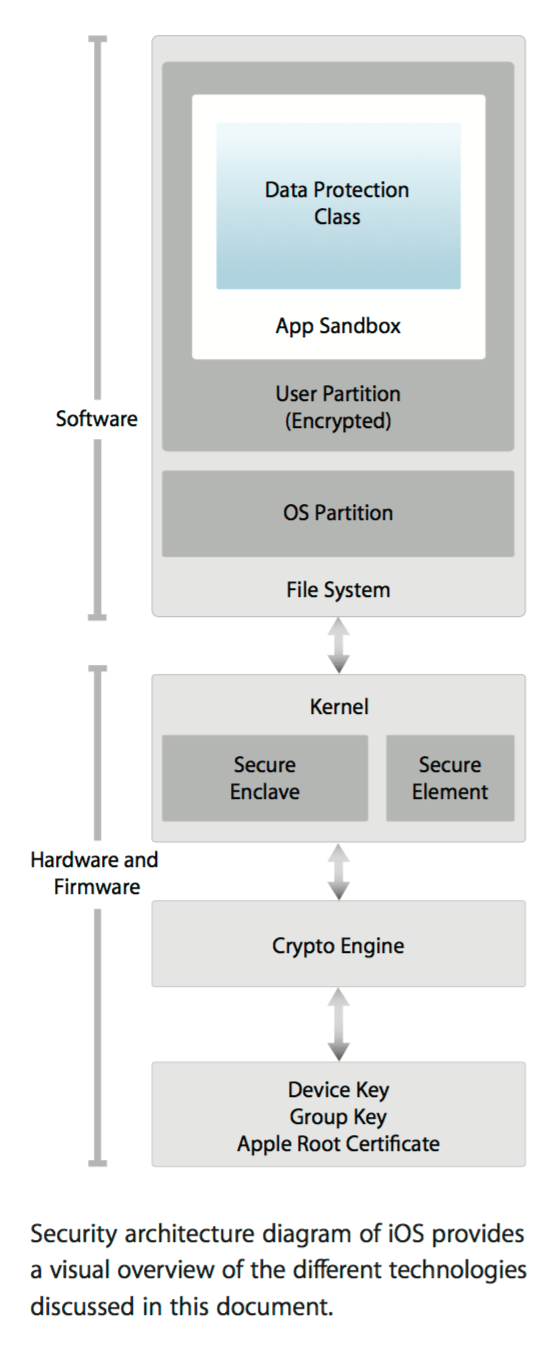
To understand this, we have to go to Apple’s security documents about iOS 9, and how security works with TouchID (the fingerprint reader), the Secure Enclave (which stores a hashed version of your fingerprint) and the Secure Elements, which store key financial data in an encrypted form.

Here’s a diagram from Apple’s security document, showing the direction of trust as the device boots up: it travels from the bottom to the top. We’re only interested in the stuff at the bottom of this stack at present (from “Apple root certificate” upward to the top of the “hardware/firmware” part).

iPhone security system begins with the hardware

Apple’s explanation of how the security system works in the iPhone: booting starts from the bottom and progresses upwards.

On bootup, the system goes through various hardware checks to ensure that everything is tickety-boo, cryptographically speaking. If it finds something wrong, then it gives you the “Connect to iTunes” screen, and if you’re lucky, throws up an error message. Note that if something is wrong at this bootup stage, you don’t reach the higher level of the file system and OS partition; you’re stuck at the hardware/firmware level.

If you replace the TouchID system on a device, the system doesn’t throw an error at this point. Why not? I’m not completely sure, but I think that the TouchID subsystem doesn’t have an entry in the device’s own hardware/firmware listing, so the device can’t tell whether the TouchID system that’s installed is the same one it originally had at manufacture.

Update: on thinking some more about it, I think this is why. The security model is one which doesn’t trust values that are stored on-device but not burnt into hardware. So any value in a firmware register could have been changed. Now, if the TouchID serial were stored on hardware, it could be checked on boot to see if it’s trusted – but you’d never be able to replace the TouchID sensor, because the old serial is burnt into the chip. A firmware value on startup can’t be trusted because it might have been changed.

Therefore the device doesn’t brick when it’s first turned on after repair. It has to rely on something external which has stored the TouchID serial – that is, Apple’s installation authorisation server./Update

What happens on a software upgrade is subtly different from simply booting. From Apple’s document, on p6:

During an iOS upgrade, iTunes (or the device itself, in the case of OTA [over-the-air] software updates) connects to the Apple installation authorization server and sends it a list of cryptographic measurements for each part of the installation bundle to be installed [emphasis added] (for example, LLB, iBoot, the kernel, and OS image), a random anti-replay value (nonce), and the device’s unique ID (ECID).

The authorization server checks the presented list of measurements against versions for which installation is permitted and, if it finds a match, adds the ECID to the measurement and signs the result. The server passes a complete set of signed data to the device as part of the upgrade process.

Adding the ECID “personalizes” the authorization for the requesting device. By authorizing and signing only for known measurements, the server ensures that the update takes place exactly as provided by Apple. The boot-time chain-of-trust evaluation verifies that the signature comes from Apple and that the measurement of the item loaded from disk, combined with the device’s ECID, matches what was covered by the signature.

These steps ensure that the authorization is for a specific device and that an old iOS version from one device can’t be copied to another. The nonce prevents an attacker from saving the server’s response and using it to tamper with a device or otherwise alter the system software.

What I think is happening is that the new TouchID system’s serial number is in included in the cryptographic data sent to the authorisation server, and when that is compared against what it should be for the given ECID, the numbers don’t match.

At that point, the authorisation server decides that Something Bad is going on, and blocks the update. The device now fails the low-level boot – it can’t get past the kernel level to the OS boot – and so the device is bricked.

And that is why it bricks on a software update.

Why doesn’t it check with the authorisation server after the repair?

The phone doesn’t have any way of “knowing” whether it’s restarting after a repair, or after it ran out of battery, or you just turned it off for the night. If every phone were to check in with the authorisation server on being powered on, three things would happen: (1) the authorisation server would die (2) people would be furious because their phone wouldn’t boot because it would need connectivity to check the details for its ECID, and you don’t always have connectivity when you turn your phone on (3) Apple would get majorly dinged for “snooping on when people turn their phone on.”

That doesn’t explain why it doesn’t happen on the 5S, though.

Damn right. At which point we have to consider that the “cryptographic measurements” sent back for an iPhone 6/etc differ from those of an iPhone 5S, specifically because of the Apple Pay-related Secure Elements.

Why does the device still work after the third-party replacement?

Let’s qualify this: it does work, but TouchID (and so Apple Pay and others) don’t work after a third-party fix that affects TouchID. The pairing there between the Secure Element/Secure Enclave/TouchID, which was set up when the device was manufactured, is lost. It carries on not working; then at some point, you get a software upgrade notification. And then – disaster.

Considering this, I think what is stored for communication with the server is the TouchID pairing status. If it’s unpaired, the update can’t go ahead.

Update: the fix issued by Apple must tell it to go ahead if the TouchID pairing status is changed, but leaving TouchID disabled.

What if you’ve never set up Apple Pay?

Doesn’t matter. The issue is not the data you’ve stored in the device, but the data that’s built into the device – cryptographic keys used for creating payment authorisation for credit cards. Those are in the Secure Elements.

What are the Secure Elements, and what do they contain?

Here’s a definition:

An SE is a tamper resistant hardware platform, capable of securely hosting applications and storing confidential and cryptographic data. For example, in the finance industry SEs are used to host personalized card applications and cryptographic keys required to perform financial (EMV) transactions at a point-of-sale terminal. SEs used in the identity market may hold biometric data or certificates which can be used for signing documents. Whichever purpose, the secure environment provided by the SE protects the user’s credentials ensuring the safety of the user’s data.

The reason why Error 53 happens when you change or interfere with the TouchID sensor on a more-recent-than-5S phone is that the system detects – during the software upgrade – that something has changed, and that the embedded trust system has been broken. And so the device doesn’t get authorisation to update.

Why does the Secure Elements stuff matter, though?

The banks/financial institutions specify that the operating system must not be able to directly access the data in the “trusted zone” (the Secure Elements).

How can you recover from Error 53?

Quite simple: replace the new TouchID processor with the old one. (People say they have successfully done this.) However, saying it is a lot easier than doing it. Some people don’t have the old one. Or the old one might just be broken.

How does Apple replace TouchID systems?

We don’t know, but we know it can, because it does. There must be a method for updating the cryptographic measurement list held by the authorisation server for a particular ECID. I’d imagine that involves logging into a server, entering an ECID (or connecting the phone) and letting the two talk to each other.

Note that when you have your screen repaired by Apple, it will tell you to disable TouchID first. And afterwards, you’ll have to recalibrate it. So there might be something there.

Why can’t Apple do that to devices which have failed on Error 53?

We don’t know. (Possibly it can.)

Could Apple change things so that in future it just disables TouchID and software updates still work?

Perhaps. I suspect it would need some sort of adjustment to what gets sent to the authorisation server, or what the server considers OK to approve. But if Apple is tied here by what the financial institutions demand around the Secure Elements, it might not have the choice.

Why hasn’t Apple explained that this is a risk of third-party replacement?

Ah, now we come to the challenge of Being Apple. Its mystique (for that’s what a lot of it is) lies in saying very little about how it does things, and asking people to take this stuff on trust, or for granted.

Thus when it comes to repairs, Apple’s implied assumption is that everyone will bring their device to an Authorised Apple Dealer, or Apple, to get it fixed. This ignores the fact that it now sells phones in countries where you’d have to travel for hours and hours to reach either of those – if you were lucky.

Naturally, people go to third-party repair shops to get these things done. And then problems start, because you’re talking about a pocket supercomputer with embedded cryptographic systems that are sensitive to being fiddled with.

But Apple has done a bad job here in communicating the risks of getting anything around the TouchID system replaced. It really needed to get the message out there.

Why didn’t Apple get the message out there?

Probably it’s been difficult to separate the signal from the noise on this. If someone comes in to an Apple Store with an Error 53 phone, it’s hard to know at first why it has done it. The device gets replaced, and the old one sent back to Apple, but that’s barely half of the feedback loop: it has to reach Apple, someone has to figure out why it doesn’t work, and then inform stores, and also inform the marketing people that this can be a problem which needs to be communicated.

Very likely there are people in Apple Engineering, Apple Retail and Apple Marketing who are right now looking at an email trail and smacking their foreheads as they realise what the problem they missed was. Those phones sent back from the stores marked as “will not boot”… ohhh.

That’s the problem with big organisations, though: that sort of feedback loop is really, really hard to organise well. Alternatively, perhaps it has been noticed, but it hasn’t affected a large number of people, and so isn’t as high a priority as.. something else. (We don’t know what.) Of course, to the affected people, it’s a bloody high priority.

Shouldn’t Apple allow third-party TouchID repairs, though? After all, the phone is your property.

The “property” argument isn’t a great one, to be honest. Apple sells you a device, but it doesn’t give you untrammelled rights to it; you aren’t legally allowed to (try to) decompile the software, or the firmware, or to dig into things like the Secure Elements. You don’t own the entire thing.

That’s how things are these days; the open-software absolutists run into a problem with mobile phones, because even if you can download and compile the operating system (a la Andy Rubin) you won’t be able to do that on the baseband software which actually provides the mobile functions. So it’s never completely “your” phone. That’s the case with PCs too these days – there’s stuff on the motherboard you don’t get to mess with.

None of this proves it isn’t Apple just shutting out third-party repairs, though.

Ah, proof. It’s so hard to prove the imaginary, or to refute it. However the scenario where some Apple executives gather round a table and say “You know what? We’re losing valuable revenues and profits from people using third-party repairs! We need to brick those phones!” fails both Occam’s Razor and Hanlon’s Razor, the two logical tests that help you filter through a lot of modern crap.

Occam’s, you’ll recall, is “don’t let entities multiply unnecessarily – aka “the simplest explanation is probably the right one.” Hanlon’s, meanwhile, is “never ascribe to conspiracy what can more easily be ascribed to cockup.”

Why does “shutting out third party repairs” fail Occam’s? Because it requires a lot of people putting in varying amounts of effort to make it happen.

For the malicious version: Apple has to have decided (1) it doesn’t like third-party repairs; (2) it wants people to have a bad experience when they try to upgrade their software (is it certain people will connect the third-party repair with the bricking, given that the events might be weeks or months apart? They might even have had an Apple fix of some sort in the meantime) (3) to set in motion an internal program whereby third-party replacements using correctly-sourced parts will fail, but its own repairs using the same parts won’t (quite risky) (4) to keep all this secret while also instructing its repair shops how to do this.

For the accidental explanation: the new TouchID system on the iPhone 6/etc now pairs with the Secure Elements and its cryptographic signature is sent to the update server on device activation. If the signature doesn’t match on subsequent update requests, the device isn’t authorised.

See how much simpler the latter one is? It doesn’t require any executives, or nefarious planning; just some work by the engineers updating the TouchID/Secure Elements systems. That satisfies Occam.

But equally, the second also satisfies Hanlon’s Razor. Nobody has been malicious; if anything, they’ve been trying to safeguard customers by making sure that sensitive (to financial groups) information can’t get hacked off your phone. However, in doing that, they’ve created a situation where customers get a bad experience and Apple gets bad publicity over something it would have hoped would give it kudos.

The shibboleth

In all the coverage of this topic, it is quite amazing how ready people are to assume the worst. Apple is uniquely capable of polarising people, who find it exceptionally hard to be indifferent about what it does. Either it’s a sort of wellspring of ideas and direction in all sorts of markets, from PCs to mobile phones to smart watches; or it’s a malicious money-grabbing marketing machine seeking ever more ways to rip people and governments off, while foisting commodity products on people at sky-high prices.

For instance, where do you think Cory Doctorow stands on it?

Punish. There’s a verb.

Or Dan Gillmor?

(Both links in those tweets are to the same Guardian article that kicked this all off on Saturday.)

Yet if you look on Hacker News, you’ll find the tenor of the discussion is much more like “oh, that makes sense from a security point of view”. And security experts on Twitter such as Steve Bellovin and Matthew Green could discuss the matter without invoking conspiracy theories.

I find it odd that people who write publicly for money seem more willing to go for the conspiracy theory than those who don’t. Doesn’t exposure to enough organisations teach you that the bigger they get, the more easily screwups happen, and the less communication there is between their many arms?

And Apple really is big these days, stretching across an incredibly broad area of the computing market – from Macs to mobile phones to tablets to smart watches to iPods, from desktop operating systems to mobile operating systems (tweaked differently for the tablet and the phone), to smartwatch and TV set-top box operating systems, to desktop and mobile applications, to cross-platform music programs (iTunes is on Mac OSX and Windows; Apple Music is on iOS, Windows, Mac OSX and Android), to web services (CloudKit) and even chip design.

I’m pretty confident in saying that no other company is doing as many things across as many hardware and software platforms. Google is huge, but doesn’t make hardware in anything like that volume; Microsoft is huge too, but doesn’t make hardware in any appreciable volume. Apple does the whole thing, including chip design. The combination of hardware and software challenge in adding just one new feature to any individual device line is mind-boggling, because you have to consider how it’s going to affect everything else.

In that context, an engineering team working away on an improved TouchID system which authenticates against tampering probably thought they were doing just the right thing. Instead, they were throwing their retail and PR people into a media storm. The size of the teacup is yet to be determined.

Quite how Apple is going to get its explanation across will be educative to watch. (I haven’t spoken to Apple in writing this.) The more interesting question though is: what will happen once lots of Android devices start using Android Pay (which has pretty much the same trust requirements) and those start breaking? Will third-party repairers be able to fix them, or will they have to be sent back to the manufacturer? And if it’s the latter (or if people try the former) how much hell is there going to be to pay?

Though you suspect you know the answer already. It won’t arise, because not that many OEMs will implement Android Pay, and the people who get inconvenienced won’t make as much noise about it. Who cares if someone with an HTC phone has to swap it and loses their data? You’d struggle to get most newsdesks to know what an HTC phone was. Say “iPhone”, though…

Start up: hedge funds like AI, Facebook’s close separation, what if Twitter died?, BlackBerry cuts, and more

A break like this, affecting the home button, is probably going to lead in time to an #error53 fault if you don’t get it repaired by Apple. But what causes it, exactly? Photo by wZa HK on Flickr.

You can now sign up to receive each day’s Start Up post by email. You’ll need to click a confirmation link, so no spam.

A selection of 12 links for you. Use them wisely. I’m charlesarthur on Twitter. Observations and links welcome.

Will AI-powered hedge funds outsmart the market? » MIT Tech Review

Will Knight:

Anthony Ledford, chief scientist of MAN AHL, explains that the company is exploring whether techniques like deep learning might lend themselves to finance. “It’s at an early stage,” Ledford says. “We have set aside a pot of money for test trading. With deep learning, if all goes well, it will go into test trading, as other machine-learning approaches have.”

Trading might seem like an obvious place to apply deep learning, but actually it isn’t clear how comparable the challenge of finding subtle patterns in real-time trading data is to, say, spotting faces in digital photographs. “It’s a very different problem,” Ledford admits.

Academic experts also sound a note of caution. Stephen Roberts, a professor of machine learning at Oxford University, says deep learning could be good “for extracting hidden trends, information, and relationships,” but adds that it “is still too brittle with regard to handling of high uncertainty and noise, which are prevalent in finance.”

You just know that this isn’t really going to work, but also that it’s going to be used by a ton of funds to try to get ahead of the market – a market composed of other funds also trying to use the same processes.
link to this extract


iOS security – iOS 9 or later » Apple

Let’s try to get on top of this #error53 stuff:

During an iOS upgrade, iTunes (or the device itself, in the case of OTA software updates) connects to the Apple installation authorization server and sends it a list of cryptographic measurements for each part of the installation bundle to be installed (for example, LLB, iBoot, the kernel, and OS image), a random anti-replay value (nonce), and the device’s unique ID (ECID).

The authorization server checks the presented list of measurements against versions for which installation is permitted and, if it finds a match, adds the ECID to the measurement and signs the result. The server passes a complete set of signed data to the device as part of the upgrade process. Adding the ECID “personalizes” the authorization for the requesting device. By authorizing and signing only for known measurements, the server ensures that the update takes place exactly as provided by Apple.

The boot-time chain-of-trust evaluation verifies that the signature comes from Apple and that the measurement of the item loaded from disk, combined with the device’s ECID, matches what was covered by the signature.

These steps ensure that the authorization is for a specific device and that an old iOS version from one device can’t be copied to another. The nonce prevents an attacker from saving the server’s response and using it to tamper with a device or otherwise alter the system software.

To recap, with #error53, people who have had third-party replacements of screens and/or home buttons on the iPhone 6/Plus and 6S/Plus (but not the 5S) find that it works fine – though they can’t use TouchID (it’s greyed out as an option). But when they do an OS update, the phone bricks: can’t get data, can’t restore.

So my understanding of this is: the reason why devices which have had third-party replacement parts only brick after an OS update, yet work fine before it, is this: on trying to install the update they connect to the auth server. The server decides that the cryptographic measurements no longer match what it has on record. So it decides the chain of trust is broken, and effectively shuts down the device.

But it’s poor decision-making by Apple, and equally poor communication. Why doesn’t it happen on the 5S? Update: because the 5S doesn’t have NFC for Apple Pay. (Thanks, Andy.) What’s the process that Apple uses when it does the repair to revalidate the TouchID system (which fails even with valid parts)? Why can’t the system tell that it’s just TouchID that’s affected? The safety process has overshot its requirements. Every part of what happens makes sense from a security perspective  – but not if considering that many people will get third-party repairs.
link to this extract


Three and a half degrees of separation » Research at Facebook

How connected is the world? Playwrights, poets, and scientists have proposed that everyone on the planet is connected to everyone else by six other people. In honor of Friends Day, we’ve crunched the Facebook friend graph and determined that the number is 3.57. Each person in the world (at least among the 1.59 billion people active on Facebook) is connected to every other person by an average of three and a half other people. The average distance we observe is 4.57, corresponding to 3.57 intermediaries or “degrees of separation.” Within the US, people are connected to each other by an average of 3.46 degrees.

Our collective “degrees of separation” have shrunk over the past five years. In 2011, researchers at Cornell, the Università degli Studi di Milano, and Facebook computed the average across the 721 million people using the site then, and found that it was 3.74 [4,5]. Now, with twice as many people using the site, we’ve grown more interconnected, thus shortening the distance between any two people in the world.

Apparently my average is 3.26 so ya boo. Zuckerberg is 3.17. Sheryl Sandberg is 2.92 – blimey.
link to this extract


On your cute release notes » The Brooks Review

Ben Brooks:

We’ve all seen them. Notes about a fictional engineer who was hired and then fired. A cute story about something completely irrelevant to the matter at hand. Recipe for ‘squash bug soup’ or something along those lines.

With disturbingly increasing frequency, companies are deciding to let their marketing departments handle their release notes instead of the engineering team or product manager.

And we are all worse off for it.

As a user I mostly look at release notes to find out about one (or more) of three things:

• Have you added something new to the app which will make it better for me? That is: what are the new features, what do those features do, and perhaps how do I get to them.
• Have you fixed that bug which was making the app hard for me to use, perhaps even impossible for me to use? Aka: What bugs did you fix?
• How active is development on this app? Before I invest or move to most apps I look at recent release notes to get a sense of whether they are in maintenance mode (just major bug fixes), or under some kind of active development (minor bug fixes and feature releases, optimized for current version of iOS, etc).

link to this extract


BlackBerry cuts 200 jobs in Ontario and Florida to trim costs » Reuters

Alastair Sharp:

The layoffs will affect 75 manufacturing jobs in Sunrise, Florida, a state government website showed.

The company also confirmed that Gary Klassen is one of the people who has departed in the latest round of cuts. Klassen was one of its longest-tenured employees and the inventor of its BBM messaging service.

One source familiar with the matter, who declined to be identified due to the sensitivity of the issue, said many of the Canadian cuts were people working on its BB10 handset software at its Waterloo, Ontario, headquarters.

A spokeswoman for BlackBerry declined to comment on which divisions will be affected by the cuts, but said the company stood by its commitment to release further updates on its BB10 software.

BB10 is so, so dead.
link to this extract


“Dangerous ramifications” » Medium

Rohin Dharmakumar, with some examples of things that didn’t happen:

In January 2015, users of Microsoft’s Office in India were suddenly greeted with a pop-up asking them to “Support Microsoft Office”. The Indian government under PM Narendra Modi was said to be formulating an “Open Source Policy” under which all government offices were to either mandate or prefer open-source software for official work.

Clicking the “Support Office” button caused Microsoft to send the PMO and the Ministry of IT a letter from the user’s name with a pre-determined format. It said the user’s loved Microsoft’s products and wanted their government interactions to be based on the same. “I urge you not to ban Microsoft Office,” it ended.

The same message popped up on users of various Microsoft products in India – Windows, XBox, Windows Phone, Skype etc.

Within a few weeks, over 7 million emails had been sent in support to Microsoft.

“Support Monsanto”

In January 2014, farmers in the southern Indian state of Karnataka were surprised to see a notice attached to every bag of seed they bought from Mahyco, the market leader.

“Tell the Karnataka Govt. not to ban MMB”, said the notice. MMB was Monsanto-Mahyco Biotech, the joint-venture that licensed Monsanto’s crop technologies in India.

He has some more examples of things that didn’t happen – and then one which did.
link to this extract


Why most A/B tests give you bullshit results » Mixpanel

We’ve all seen the articles. Company X increases conversions 38% with this simple trick. Hell, I’ve written some of them.

But those success stories have hidden the grey underbelly of testing and experimentation.

AppSumo revealed that only 1 out of 8 tests produce results. Kaiser Fung estimates that 80 to 90 percent of the A/B tests he’s run yield statistically insignificant results.

Yet many new testers walk into A/B testing thinking it’ll be quick and easy to get results. After running a handful of simple tests, they think they’ll find the right color for this button or the right tweak to that subject line, and conversions will, poof, increase by 38% like magic.

Then they start running tests on their apps or sites, and reality suddenly sets in. Tests are inconclusive. They yield “statistically insignificant” results and no valuable insights about the product or users. What’s happening? Where’s that 38% bump and subsequent pat on the back?

Don’t get frustrated. If you’re going to be running A/B tests, you’re going to have some tests that fail to produce meaningful results you can learn from. But if you run good tests, you’ll have fewer failures and more successes.

link to this extract


Advice for companies with less than one year of runway » The Macro

Dalton Caldwell:

Let’s imagine that you are the founder of a company that has successfully raised an angel or institutional round and are currently in a situation where you have 12 months or less of runway.

The hardest part of dealing with a low runway situation is managing your own psychology. You have to simultaneously manage your own anxiety to not be overly negative about your prospects, but also not be irrationally positive. It’s a delicate balance.

Watch companies do the various things in this post over the next year or so.
link to this extract


Technology: the rift with reality » FT.com

Tim Bradshaw:

With so many [virtual reality] headsets hitting the market this year, the challenge may be figuring out what people will do with them. Video games are seen as the first popular application, and some are experimenting with VR versions of films including The Martian. Futuresource Consulting believes the VR content market could be worth $8.3bn within four years.

Beyond entertainment, advocates say these headsets could transform education, travel, real estate and architecture, not to mention videoconferencing and social networking. Some inside Uber are worried that Oculus could one day prove disruptive to their business by removing the need for people to travel. Why hail a taxi when you can teleport?

“Whenever a market is this early, you have to have strong convictions loosely held,” says Nabeel Hyatt, a venture partner at Spark Capital, which also backed Oculus. “We don’t know what’s going to happen.”
That uncertainty provides fertile ground for entrepreneurs. “There will be billion-dollar companies started by college students because someone gave them a Rift as a present and they solved a very specific problem,” says Anjney Midha, a partner at KPCB Edge.

However, as any sci-fi reader knows, new technologies have inherent risks, too. The futures depicted in Ready Player One and Snow Crash are dystopian and chaotic.

In December, academics led by Christian Sandor of the Nara Institute, Japan, wrote that “true augmented reality”, where the digital is indistinguishable from the physical, “will be the most powerful medium that humanity ever had at its disposal”.

link to this extract


What if Twitter Died? » Tech.pinions

Bob O’Donnell:

this seems to be one of the fundamental problems of Twitter. It’s appealing to Hollywood, TV, music and sports celebrities as a means to interact more intimately with their fans and share the kinds of details they’d never provide to traditional celebrity media. It’s appealing to the tech industry as a mouthpiece for those who want to determine the course of what is or isn’t important. The digital taste-setters, so to speak.

But for mainstream business and consumer users? Not so much. Arguably, this is the biggest problem with Twitter—it can’t seem to stretch beyond its celebrity, celebrity follower, and tech roots. If you aren’t into celebrities or the tech industry, Twitter just isn’t that appealing, especially given all the other options for online social interactions.

Despite these points, I think the navel gazing value of Twitter to the tech industry is so high, I seriously doubt they’ll let Twitter actually die. Someone with enough money and enough self-interest will likely make sure that, no matter what, Twitter will continue in some shape or form. Eventually, it’s value may start to fade, as some have already started to argue, but at least the Twittersphere will have a few years to adapt and find new alternatives.

The fundamental challenge is a publishing service that’s essentially based on self-promotion, self-aggrandizement, and self-importance at some point is going to run into the wall of indifference. Not everyone cares to read about what the self-elected are all doing all the time.

link to this extract


Yahoo loses mobile entrepreneur Arjun Sethi to venture firm » WSJ

Douglas MacMillan:

Mr. Sethi helped lead Yahoo’s effort to compete with Facebook Inc.FB -2.29% and Snapchat Inc. in the emerging area of mobile chat apps. Last July, his team released Livetext, a mobile app that lets users send live video and text without any sound.

Livetext failed to take off with users. In its first month, the program dropped out of the ranking of the 1,000 most popular apps in Apple Inc.’s app store and never returned, according to data from App Annie.

Yahoo’s struggles to produce a hit mobile app has hurt Ms. Mayer’s chances at turning around the 20-year-old Internet icon. This week, Yahoo said its board is weighing “strategic alternatives” to the turnaround which likely include a sale of its core Web business…

…Mr. Sethi is one of dozens of startup founders Ms. Mayer brought into Yahoo through a series of small acquisitions. In her three-and-a-half years as CEO, Yahoo has spent more than $2.3bn on at least 53 acquisitions, largely for small mobile-software developers whose apps were shuttered and whose founders were enticed to work on new projects at the company. At least 26, or over one-third, of the more than 70 startup founders and CEOs who joined Yahoo through an acquisition during Ms. Mayer’s tenure have left the company, according to their profiles on LinkedIn Corp.

As has also been pointed out, Yahoo last week wrote down the value of those acquisitions by $1.2bn. The idea of a video app without sound appears dumb, but then again lots are like that; but Instagram, Facebook and Vine were all there ages earlier. Yahoo’s problem is that it’s late and has no traction in mobile, not that the ideas are of themselves bad.
link to this extract


Sacked in Dublin by a boss in… London » Private Eye

Private Eye is always anonymous:

Google’s claim that all its real business is handled through its European HQ in Dublin while its multiple UK offices exist merely to count the paperclips, organise staff leaving collections and do the morning coffee run is further undermined by evidence it gave to an employment appeals tribunal in the Irish capital in 2013.
Rachel Berthold had been sacked in May 2011 from a position as a “level six” manager, which the tribunal heard put her in the top 7% of employees in Google’s Dublin office.

Anne-Catrin Sallaba, her former boss as Google Europe’s Head of Publisher Services, gave evidence to the tribunal that Berthold had failed to meet performance targets – but Sallaba had to cross the Irish sea to do so, given that as Berthold’s line manager she was employed in, er, London.

Berthold was eventually awarded €100,000 for unfair dismissal. Sallaba has in the meantime been promoted twice, and now rejoices in the job title “Senior People Development Manager, Head of Global Onboarding” – still in London!

As it happens, Matt Brittin of Google UK will be testifying before the UK Parliament this week.
link to this extract


Errata, corrigenda and ai no corrida:

Start up: risky USB-C cables, Google’s travel funnel, Uber’s tax diversion, bye-bye 747, and more

This damn thing was silently eating huge chunks of iOS time – and battery – at least until last October. Photo by edowoo on Flickr.

Last chance this week to sign up to receive each day’s Start Up post by email. You won’t believe what happens next. (OK, you might.)

A selection of 8 links for you. Tested on humans for irritancy. I’m charlesarthur on Twitter. Observations and links welcome.

Google engineer Benson Leung finds a USB Type C cable that isn’t just dangerous on paper — it allegedly fried his hardware » Android Police

Bertel King:

Not all USB Type C cables are created equal. Some charge better than others. A number ignore USB spec so much that they run the risk of actually damaging your hardware. This could happen gradually, or in the worst-case scenario, it could be instant.

Googler Benson Leung has taken on the task of going through Amazon and reviewing whichever USB Type C cables he can get his hands on. We’ve recommended a number of them in past deals, feeling confident that we’re steering readers in the direction of safe accessories. We don’t test these products ourselves, so we consider what he does a real service.

Unfortunately, Leung may be taking an extended break. After plugging Surjtech’s 3M USB A-to-C cable (the item shows up now as not available, but here’s the 1M option you’ll presumably also want to avoid) into his 2015 Chromebook Pixel and two USB-PD Sniffer devices, he says the latter failed immediately. Resetting the analyzer and reflashing the firmware did not bring the hardware back to life.

Shouldn’t there be a proper certification system for USB-C? Having to rely on one Google engineer seems barmy. Especially in light of this.
link to this extract


Facebook’s iOS bug led ComScore to overestimate time spent » AdAge

Tim Peterson, on a rejigging after it was realised that Facebook’s app used all sorts of trickery on iOS to make itself appear to be active (silent audio, etc) to the OS:

When looking at Facebook’s iPhone app specifically, total time spent [after some of the bugs – but note, not all – were fixed] was 40% lower in November compared to September [before the fix], and the average amount of time spent per person was 41% lower. For Facebook’s iPad app, total time spent was 39% lower, as was the average amount of time spent per person.

For comparison, total time spent in Facebook’s Android app increased by 2% and average time spent per user was flat when comparing September and November; ComScore’s Android figures are considered more reliable than its iOS figures because the firm is only able to take into account activity when the app is running in the foreground.

A Facebook spokeswoman declined to comment.

Amazing – Facebook’s iOS app really was the spawn of the devil in the way it abused battery life through to October 2015. (And it’s hardly innocent now.)

That up-to-October period includes a lot of testing of new iPhones “in real-life situations” by gadget reviewers, as it happens.
link to this extract


Google revamps travel search queries, almost making web results irrelevant » Search Engine Land

Barry Schwartz:

Google has quietly revamped the mobile user interface for travel-related searches. The result of the change makes it really hard to get to the organic web results once you click on the “more destinations” button. Let me walk you through the experience.

This is called “thrusting the user head-first into the sales funnel”.
link to this extract


Why the sun is setting on the Boeing 747 » The Conversation

Guy Gratton:

Today, the industry has moved towards twin-engine aeroplanes such as the Boeing 777 and the Airbus A330, with three-engine aeroplanes being relatively unpopular because of the high labour costs of working on an engine bedded into the aeroplane fin. The four-engine 747 retained a clear place in the market because twin-engine planes must stay within a certain distance from an airport in case of engine failure. This allowed the 747 to achieve shorter journey times on the longest routes because it can use more direct flight paths.

However, improving engine reliability means authorities have slowly increased the distance a twin-engine airliner can fly from a runway, gradually reducing the advantage of having four engines. And of course, those newer, more reliable engines have also been bigger and more efficient.

Of course, the slowdown in 747 production doesn’t mean the original jumbo jet will disappear from our skies just yet. The latest models are much longer, bigger and operate with more modern engines and instruments than the earlier 747-100s (no longer do the crew have to take sextant readings through the cockpit roof), and the newer aircraft are likely to stay in service for at least another 20 years.

Then: “Where’s the sextant?”
Now: “Where’s the sextant app?”
link to this extract


Uber’s Dutch businesses had zero employees in 2013 » Business Insider

Oscar Williams-Grut:

A European member of parliament has accused Uber’s European business of being “specifically designed, from the start, to reduce its tax liabilities.”

Labour’s Anneliese Dodds made the comment to Business Insider over email after we pointed out that two Dutch companies closely involved in running Uber’s UK business had no employees for up to a year after it launched here.

Uber employed eight people in its Amsterdam offices in 2013. But the corporate entity that immediately controlled the UK operation had none.

*grinds teeth* We’re now at the stage where if an American tech company pays more in tax than the average Briton we’re shocked.
link to this extract


The end of Twitter » The New Yorker

Joshua Topolsky:

what should worry Twitter isn’t the value of its stock. (USA Today reported that, given its cash reserves, the service could run for another four hundred and twelve years with current losses.) What should worry Twitter is irrelevance, and there is growing data to suggest that that is where the company is headed. If Twitter’s real-time feed is its most powerful asset (and it is), it’s not difficult to see a future in which Instagram, Facebook, Snapchat, or even a newcomer like Peach (yes, I am citing Peach) focus enough on real-time news that they obviate the need for Twitter’s narrow, noisy, and oft-changing ideas about social interaction. Considering the fact that Kevin Weil, the head of product, left the company to join Instagram, it’s easy to imagine that service mutating or bifurcating into a speedier, more social platform for sharing links and having conversations. And, for many users—particularly young users, according to a recent survey—Snapchat is already their most important destination. We live in the Age of the Upgrade, and the generation raised on the Internet is the most fickle of brand champions: it loves something passionately, until it doesn’t. Then it moves on.

Ultimately, Twitter’s service is so confused and undifferentiated in the market that it’s increasingly difficult to make a clear case for its existence.

That’s not quite right; it’s more that lots of other services have come along and do similar things (text, pictures, links) but Twitter has always had the focus on The Moment – that it is the place where you see the world unfold, if the world cooperates. Nowhere else can do that.
link to this extract


Why Alto’s Adventure will be free on Android » The Verge

Andrew Webster:

According to both [Ryan] Cash [of development company Snowman] and Noodlecake’s Ryan Holowaty, one of the main reasons they decided to make the game free on Android is piracy. “Piracy on Android is a much bigger issue on the platform especially in the case of premium iOS titles that charge more than $0.99,” Holowaty explains. When Noodlecake ported iOS game Wayward Souls to Android, for example, the studio found that only 11% of installed copies of the game were paid for. The studio even uploaded a special version of its game Shooting Stars on a number of torrent sites as an experiment, one that couldn’t be completed if you were playing a pirated copy.

There were also factors outside of piracy that contributed to the decision. “It made sense to us because of the state of mobile gaming and the reality that the vast majority of players do not pay for games,” says Holowaty. “In addition, Android has a much larger install base than iOS internationally, and games that release in countries like China and Japan are basically free-to-play only at this point. So to really capitalize on the market internationally, it made sense to have a free version.”

That’s Alto’s Adventure, which was released 12 months ago on iOS. Does anyone monitor how long it takes games and other non-platform apps to reach Android from iOS?
link to this extract


Regulators are failing to block fraudulent adverts » FT.com

John Gapper:

Malware robots — “bots” in advertising jargon — are estimated to sit on 10 per cent of home computers in the US, browsing away in the background while the owners do other things, or sleep.

Second, the world of programmatic advert buying and selling is highly automated and bafflingly complex, filled with layers of intermediaries doing slightly different things for commissions. An advertiser places adverts through an online network contracted by its media buying agency. The network may find inventory on which to place them on an exchange such as Google’s DoubleClick Ad Exchange, into which thousands of publishers plug.

That is the simple version. There are more obscure ways to do it, enabled by automation and the internet. The result is that no one knows everyone with whom they trade, or can be sure where ads end up being shown. This makes it easy for fraudsters to infiltrate and infect the advertising supply chain.

Third, companies are desperate. The economics of digital publishing are under severe strain, with publishers being paid small amounts for millions of page views. They need traffic and some are tempted into buying it from brokers that can mysteriously rustle it up. Such publishers look the other way rather than delving too deeply into where the traffic comes from.

I’m currently reading The Big Short, Michael Lewis’s book about the people who realised – slowly but with growing horror and delight – that the bond market built around US subprime mortgage loans was unsustainable, and began to bet against it (“shorting” it). The film derived from the book is fabulous. Go and see it.

Reading the book, you try to think like those people: to look for opportunities in giant, unsustainable businesses whose precise workings aren’t really understood and whose collapse is inevitable, yet which the participants (with an interest in its continuation) insist is fine and dandy.

The online ad business begins to look like that to me.
link to this extract


Errata, corrigenda and ai no corrida: none notified.

Start up: Google’s search rejig, adblockers can’t Play, Sony to exit tablets?, Magic Leap’s big step, and more

No longer can you seek him here or there. Photo by abrinsky on Flickr.

You can now sign up to receive each day’s Start Up post by email. You’ll need to click a confirmation link, so no spam.

A selection of 10 links for you. Use them wisely. I’m charlesarthur on Twitter. Observations and links welcome.

Google search chief [Amit] Singhal to retire, replaced by AI exec » Bloomberg Business

Jack Clark:

“When I started [at Google in 2000], who would have imagined that in a short period of fifteen years, we would tap a button, ask Google anything and get the answer,” Singhal wrote in a Google+ post announcing his retirement. “My dream Star Trek computer is becoming a reality, and it is far better than what I ever imagined.”

With Giannandrea’s appointment, the technology may get smarter. The executive has overseen recent artificial intelligence efforts, including RankBrain, which saw Google plug an AI technology called a neural network into its search engine to boost the accuracy of results and an e-mail service called Smart Reply that automatically writes responses. Other work he has managed include efforts in image recognition and technologies that fetch information based on what users are doing with their devices, rather than what they’re explicitly searching for.

[John] Giannandrea joined Google in 2010 when it acquired a company he co-founded called Metaweb Technologies. Those assets became the basis for Google’s knowledge graph, a vast store of information on hundreds of millions of entities that helps the search engine present factual data in response to certain queries. Singhal’s last day is scheduled to be Feb. 26.
The elevation of Giannandrea represents a further emphasis on the importance of artificial intelligence to Google, a unit of Alphabet Inc. Chief executive officer Sundar Pichai said the technology has been key to recent efforts in search on mobile devices and personal assistant technologies.

Speaking of search..
link to this extract


Garth Gibbs: ‘The archetypal diary writer’ » Press Gazette

An obituary from August 2011:

Garth also managed to spend much of his time chasing various ‘sightings’ of ‘Lucky’ Lord Lucan, who was thought to have fled abroad after apparently mistaking his nanny for his wife and bludgeoning the ‘wrong’ woman to death. Of this colourful period in an almost continually helter-skelter career, Garth himself wrote: ‘As that brilliantly bigoted and crusty old columnist John Junor once cannily observed: ‘Laddie, you don’t ever want to shoot the fox. Once the fox is dead there is nothing left to chase.'”

With a wonderfully fertile imagination – a prerequisite of any good tabloid journalist – plus a good deal of chutzpah, Garth relished the challenge of keeping Lord Lucan alive, but never finding him.

‘I regard not finding Lord Lucan as my most spectacular success in journalism,’he said. ‘Of course, many of my colleagues have also been fairly successful in not finding Lord Lucan. But I have successfully not found him in more exotic spots than anybody else.

‘I spent three glorious weeks not finding him in Cape Town, magical days and nights not finding him in the Black Mountains of Wales, and wonderful and successful short breaks not finding him in Macau either, or in Hong Kong or even in Green Turtle Cay in the Bahamas where you can find anyone.”

Lucan was finally declared dead – though never found – on Wednesday. Not finding him was indeed a splendid task allotted to many journalists down the years. Speaking of search…
link to this extract


#SEO for sale?! Exposing Google loopholes in light of FTC native guidelines » aimClear® Blog

Marty Weintraub:

Mashable, a respected global media company focused on informing and entertaining “the digital generation,” was our inspiration.  Mashable has joined the swelling ranks of websites selling native content articles to advertisers.  Initially we were interested in participating in the program and reached out to Mashable regarding their native post advertising, which is called BrandSpeak or BrandLab.

As the conversation progressed, we were curious as to how Mashable native posts show up in Google search results and disclosure verbiage in light of new FTC native advertising guidelines. After we corresponded with a Mashable sales associate and researched BrandSpeak/BrandLab in detail, we were motivated to share our findings with the community as a point of learning about native content.

Those findings surprised (and astonished) us. Aimclear analysts identified a Google SEO loophole, which is perhaps the greatest ranking algorithm gap in years, allowing marketers to literally buy their way into Google search results with paid content…

…At best, allowing paid SEO tilts the playing field, making it even harder for smaller, perhaps more relevant players to compete for free Web Search results.

Google’s Webmaster Guidelines governing native content and Web Search are firmly rooted in 2013.

Tricky; this stuff is low-quality, but sites are desperate to generate revenue somehow. Speaking of revenue…
link to this extract


Google boots ad blockers from Google Play » TechCrunch

Sarah Perez:

According to Rockship Apps founder and CEO Brian Kennish, maker of Adblock Fast, Google’s app reviews team informed him the app was being removed for violating “Section 4.4” of the Android Developer Distribution Agreement.

This is the section that informs developers they can’t release apps that interfere with “the devices, servers, networks, or other properties or services of any third-party including, but not limited to, Android users, Google or any mobile network operator.”

If that text sounds a little broad-reaching and vague, that’s because it is. It’s also what allows Google to react to changes in the industry, like this one, on the fly.

Kennish says that Google’s app reviews team informed him that he could resubmit after modifying his app so it didn’t “interfere with another app, service or product in an unauthorized manner.”

“We’ve been trying to contact Google through their public channels since Monday, and I tried through private ones all day yesterday…but we haven’t gotten any official response from a human – just autoresponders,” notes Kennish.

He suspects that Adblock Fast was the first to be pulled from Google’s app store because it had climbed the charts so quickly and had achieved a 4.25 rating. Kennish says that the app had around 50,000 installs at the time of its removal.

In addition, the company could have gotten on Google’s radar by pushing out an update that offered a better user experience. (Some people didn’t realize it only worked on Samsung’s 4.0 browser and left 1-star reviews. The update was meant to better highlight the app’s requirements.)

Meanwhile, as of the time of writing, other ad blockers are still live, including Crystal and Adblock Plus (Samsung Browser). However, that may not be the case for long.

Crystal’s developer Dean Murphy also just submitted an update that’s just been declined by Google’s app review team for the same reason cited above. Again, Google references section 4.4 of the Developer Agreement as the reason for stopping the update from going live.

“I have appealed the update rejection, as I assume that I am rejected for ‘interfering’ with Samsung Internet Browser, citing the developer documentation that Samsung have for the content blocking feature,” explains Murphy. “I’m still awaiting their reply.”

Wow, that was fast. Crystal was still there on Wednesday. This is going to ratchet up tensions between Google and Samsung (again); in the comments on the Verge article on this topic (which has less detail) there are people who switched to iOS because of adblocking, or are considering moving back because they can’t get it on Android. A small but possibly significant group.

Google has clearly set its face against adblocking on mobile, but the pressure is starting to build up behind the dam.
link to this extract


About » DeepDetect

DeepDetect (http://www.deepdetect.com/) is a machine learning API and server written in C++11. It makes state of the art machine learning (such as deep learning) easy to work with and integrate into existing applications. Its goal is to simplify and secure both the development and production phases by using possibly different servers and passing models from one to the other.

It originates from the need for industries, businesses and researchers to quickly fit a machine learning pipeline into existing applications, starting with well-known models, and moving toward more targeted ones while measuring accuracy.

DeepDetect allows this by coupling a generic API and a server with high performance machine learning libraries. At the moment it has support for the deep learning library Caffe. More libraries are to be supported in order to span over a larger set of common use cases.

There are free (even for commercial use) models that are downloadable from the site. This lies just over my event horizon for understanding – but reading the details about “getting started” puts me in mind of people feeding a giant brain, or disembodied intelligence, and that gives me pause.

But this stuff is going to be everywhere in two years.
link to this extract


Would you be sad to see Sony withdraw from the tablet market? » Xperia Blog

The mysterious “XB”:

given the challenging smartphone market, as evidenced by last week’s results there is no guarantee that Sony will continue to cater for the tablet market. A recent Japanese blog post by a Sony store manager speculated that the company may withdraw from the tablet market after receiving marketing material suggesting so.

The news would not surprise us, after all, we know that tablets made just 5% of Sony Mobile’s revenues back in 2013 and that was expected to shrink even further. Given the R&D costs of developing and supporting new devices, Sony may feel that producing another tablet for 2016 might not be commercially viable.

I didn’t know that about the tablet revenues; apparently they’re meant to be down to 3-4% now. The question is whether they generate more than 0% in profit – because they must be eating up R+D time and money, which is opportunity cost that Sony probably can’t afford.
link to this extract


The joy of shortcuts » Allen Pike

Next January, Parse is shutting down. The successful Parse apps will get moved to a custom backend like ours was, perhaps using Parse’s excellent open-source server and migration tool. The unsuccessful Parse apps will die. Hundreds of thousands of unsuccessful Parse apps will perish. Like links to long-dead Geocities pages, dead mobile apps that relied on Parse will linger in the App Stores for years, slowly accumulating one-star reviews.

As much as Parse will try to get the word out that they’re shutting down, many apps’ owners don’t even know that they’re reliant on Parse. Parse’s overly generous free plan made them popular with freelancers and consultants building quick app backends for their clients. Many of those clients don’t know what Parse is, let alone that the little app they commissioned a couple years ago is a ticking time bomb.

How many iOS apps, how many Android apps relied on Parse? There needs to be an enumeration.
link to this extract


How the iPhone 6 ruined Apple » All this

Dr Drang:

While it’s certainly possible that the great days of iPhone sales growth are over, I wouldn’t make that prediction just yet. In fact, I was surprised to learn that iPhone sales were merely flat. I was expecting a decline—not because the iPhone is losing popularity, but because the iPhone 6’s first quarter of sales was such a gigantic leap upward. The pent-up demand for a larger iPhone caused sales to increase nearly 50% year over year, to 74.47m from 51.03m the year before. This was the biggest percentage jump in year-over-year sales since the introduction of the 4S (which was goosed a bit because the 4S was delayed). I just didn’t think the 6S could keep up with that. And maybe it won’t.

But look at how things were going before the iPhone 6. Had the trend of 2012–2014 continued through 2015, iPhone sales last quarter would have been 65–70 million. Instead they were just under 75m. It’s only in comparison to the huge holiday quarter of 2014 that last quarter looks dull.

I’m reminded of the devotion climate change deniers had to the year 1998. Because of an intense El Niño that year, global temperatures rose well above the trend line, and it remained the hottest year on record for several years. Deniers hit upon this fact, and claimed that global warming had stopped, even though the overall warming trend had continued. The iPhone 6 was Apple’s El Niño.

link to this extract


Magic Leap Just Landed an Astounding Amount of VC Money » WIRED

Jessi Hempel on the company which has just raised $793.5m in a C round from Alibaba and others (Google and Qualcomm were already on board):

Many believe Magic Leap’s technology—along with a handful of competing virtual and augmented reality products—will usher in a sea change in how we use computers. By placing sensors everywhere and processing the volumes of data they produce, it’s possible to create better immersive environments and believable layers of digital images on top of the physical world. Facebook, Samsung, and Microsoft are creating competing technology and have chosen to make their headsets available even as they’re engineering the products. Google is also beefing up its virtual reality team, and Apple is also reportedly getting into the action. Magic Leap claims to be using a different technology to achieve its effect, and it’s keeping its efforts mostly secret.

The company has made converts out of many of those who have seen demos. New Zealand design studio Weta Workshops has teamed up with Magic Leap to build games. Science fiction writer Neal Stephenson joined the company as its chief futurist. Last fall, Google led a $542m investment, bringing its previous funding total to $592m. But so far, it hasn’t been clear when Magic Leap’s tech will be available for consumers.

Expectations around this are going to be huge, which usually leads to disappointments of the same size. Shipping product matters; having that much of a cash pillow can’t be good, because it won’t help the financial discipline needed to make things (of whatever sort) to a price, for a user, to a specification. Don’t forget the lesson of Leap Motion – big hype, big letdown.
link to this extract


​Startup lands $100m to challenge smartphone superpowers Apple and Google » CNET

Stephen Shankland:

Acadine, which CNET previously reported was initially known by the placeholder name Gone Fishing, plans to build an operating system for smartphones, tablets, wearable devicess and the Internet of Things.

That’ll be a tough challenge. But [fouder Li] Gong believes Acadine’s generous funding [from a Chinese state-controlled company], fast development and international reach will mean consumers finally will see the alternative to Apple and Google that so many other companies have failed to build.

And of course that means his startup and its investors will reap the rewards. “Owning an OS is extremely important if you can do it,” Gong said. “It’s very profitable if you can do it.”

Potential sources of money, Gong said, include being paid to promote services like search, storage, music streaming and e-commerce; revenue sharing from those services when customers pay to use them; and fees generated by advertising and game sales. All of those, though, depend on Acadine succeeding in finding and exploiting gaps where existing OSes are weak then expanding from there to a large user base.

The list of mobile operating systems that have struggled to compete against Android and iOS and gain that large population of users is long: Microsoft’s Windows Phone, Samsung’s Tizen, Jolla’s Sailfish OS, Canonical’s Ubuntu, Hewlett-Packard’s WebOS, BlackBerry’s BlackBerry OS and Mozilla’s Firefox OS. This last project is the one Gong led at Mozilla until he left in April, and it’s the starting point for H5OS.

One hates to say “a fool and his $100m are soon parted”, but it’ll do.
link to this extract


Errata, corrigenda and ai no corrida: I was going to include a link to a video of a male cyclist who was suspected of having a motor in his bicycle (and man, it looked fishy) but realised it is a rabbit hole one would never emerge from.

Start up: Ireland’s judgement day, Yahoo crumbles, a new iPhone?, Swiftkey sold, and more


Modern motors in bikes are better concealed than this. Photo by rich701 on Flickr.

You can now sign up to receive each day’s Start Up post by email. You’ll need to click a confirmation link, so no spam.

A selection of 8 links for you. Use them wisely. I’m charlesarthur on Twitter. Observations and links welcome.

Ireland braces for blizzard of tech rulings » Politico

Chris Spillane:

Gavin Kearney has a telescopic view of the threat facing Dublin’s Silicon Docks, the watery frontier of Ireland’s tech sector. He is braced this week for the first of three verdicts that will have sweeping repercussions on both sides of the Atlantic.

Since Kearney founded the encryption business Jumble two years ago, he has watched Ireland come under fire from the European Court of Justice, the European Union and the U.S. Department of Justice.

The cases involve Facebook, Apple and Microsoft and will decide critical issues confronting the tech industry: data protection and privacy, and corporate tax strategies. The results could spoil Ireland’s reputation as a tech hub, spark an exodus of jobs and investment, and force some to pay hundreds of millions in back taxes.

“If somehow Ireland’s data protection was eroded to be more American and less EU, those entities affected may have to relocate some of the operations to restore the balance,” said Kearney, the chief executive of Jumble. “There’s a bit of a perfect storm in terms of the timing of these issues hitting, but it’s a continent-wide problem and not just a standalone country, so we can shore up against it.”

link to this extract


Microsoft steps up AI push with Swiftkey deal – FT.com

Tim Bradshaw and Murad Ahmed:

Microsoft is paying around $250m to acquire London-based Swiftkey, maker of a predictive keyboard powered by artificial intelligence that is installed on hundreds of millions of smartphones, according to people familiar with the deal.

Jon Reynolds and Ben Medlock, who founded the company in 2008 when both were in their 20s, will each make upwards of $30m from the buyout, which is set to be announced this week.

The pair together own a substantial minority stake in the company after raising a relatively small amount of venture capital, just over $20m, from backers including Accel Partners, Index Ventures and Octopus Investments.

Swiftkey is the latest in a string of UK start-ups with advanced artificial-intelligence capabilities to be snapped up by the biggest names in Silicon Valley.

Great for Swiftkey, though it’s another example of a British firm being gobbled up by an American one. The broader question – why does Microsoft want a smartphone keyboard company? – is more important; the AI element must be really relevant to something it’s doing.
link to this extract


Yahoo to cut 15% of workforce, explore strategic options » WSJ

Douglas MacMillan and Dana Mattioli:

Yahoo Inc. on Tuesday announced plans to eliminate roughly 15% of its workforce and explore “strategic alternatives” for its struggling Internet business, in the strongest indication yet that the company’s board is considering a sale of its Web properties.

The announcement accompanied Yahoo’s fourth-quarter report in which the company reported a loss of $4.4bn, hurt by write downs on Tumblr and other assets, as revenue grew 1.6% to $1.27bn.

But advertising is the way that all sites can thrive, surely? Maybe Yahoo will turn out to be the biggest ad-supported web failure.
link to this extract


Hidden motors for road bikes exist — here’s how they work » CyclingTips

Matt de Neef:

The motor is connected to a battery pack via the electronic control unit housed in the seatpost provided. By default the battery lives in a saddlebag, but it can also be concealed in a bidon seated in the seatpost bidon cage (more on that in a moment).

A simple button to start and stop the motor is then mounted on the underside of the handlebars and routed to the control unit in the seat post.

The Vivax assist motor is rated at 200 watts (the maximum for e-bikes in Australia is 250W, beyond which they are classified as motorbikes) but in reality, we were told, the unit provides somewhere in the vicinity of 110W to the driveshaft. This is in addition to whatever the rider is pushing through the pedals.

After yesterday’s article about the secret motor in a competing rider’s bike. (Thanks Mark Gould for the link.)
link to this extract


Breaking down Alphabet’s Other Bets » Beyond Devices

Jan Dawson:

We’ve taken a look at several aspects of Alphabet’s Other Bets segment, but we’ve only touched on perhaps the most important element: trajectory. In other words, which direction are these numbers heading in? In brief, using Ruth Porat’s suggestion to look at annual results:

• Revenue is growing, at about 37% year on year from 2014 to 2015
• Operating losses are growing faster, from $1.9 billion in 2014 to $3.6 billion in 2015
• Margins are worsening too, from (and these numbers are a bit ridiculous) -488% in 2014 to -685% in 2015
• Capex is growing faster than revenues on an annual basis, and capital intensity rose from 150% in 2014 to almost 200% in 2015.

None of those is moving in a happy direction as far as the future financial performance of Alphabet is concerned.

Google’s ad business is still going strong (principally through growth in ads on YouTube), making up 90% of its revenues, and more of its profit.
link to this extract


Apple eyes March 15 event for iPhone 5se, iPad Air 3 & Apple Watch updates » 9to5Mac

Mark Gurman (who has a strong track record on these things):

As we revealed last month, Apple is planning to reinvigorate the 4-inch iPhone screen size by replacing the iPhone 5s with an iPhone 5se that includes an A9 chip, improved cameras, support for taking Live Photos, and Apple Pay. While the internals are revamped, the 5se’s externals nearly mirror the 5s’s save for “less shiny” and possibly slightly curved edges. The 5se will be priced the same as the 5s, according to sources, starting at $450 for 16GB. A 64GB model will also be offered.

The launch of the new iPad Air 3 will mark the first significant upgrade to Apple’s 9.7-inch tablet line since the Air 2 debuted in October 2014. The Air 3 is expected to include iPad Pro features like enhanced speakers and a Smart Connector, which could mean that a smaller Smart Keyboard is on the way.

Basically brings the iPhone 5S into iPhone 6 capability, apart from the screen. Will the iPad update get the line selling again, though? Other outlets with good track records have confirmed the date of 15 March.
link to this extract


Apple developing wireless-charged iPhone for as soon as 2017 » Bloomberg Business

Tim Culpan:

In 2010 Apple made a patent application outlining a concept of using an iMac personal computer as a hub for wirelessly recharging at a distance of about 1 meter using a technique called near-field magnetic resonance. Apple currently uses a similar technique, called induction, to charge its Watch within millimeters of the power source.

Another Apple patent outlined a method for making aluminum phone casings that allow radio waves to pass through, a technique that would minimize the problem of metal interfering with transmitted signals.

Apple has previously played down its interest in any charging technology that still needs to be plugged into a wall socket because such methods would add little convenience.

Semiconductor makers Broadcom and Qualcomm are among those who have developed or are developing technology and standards for wireless charging.

How much demand is there for wireless charging?
link to this extract


DailyMail Online results: even at huge scale, online news is hard to monetise » Medium

Frank Meehan:

The DailyMail Online is the biggest English language site in the world with 220m unique monthly actives, high engagement and virality of content. It’s a machine.

Yet, in its recent quarterly results announced today, the MailOnline reported advertising revenues of £23m on those 220m.

As the FT’s Lex column points out – that is just 10c of revenue per user [per month].

Not much return for the huge amount of effort put into the content (same may argue that it’s doesn’t take much effort to generate more gossip on the Kardashians, but actually the MailOnline has gossip down to an art form, which is why they are the biggest).

Compare my estimate of The Guardian’s revenue per browser per month of 6.16p.
link to this extract


Errata, corrigenda and ai no corrida:

Start up: Apple’s VR effort, why zebras really have stripes, the PC mergers, Facebook v your battery, and more

Call a locksmith in the US and their yield – and your loss – might be higher than you expect. Photo by zoomar on Flickr.

Did you sign up to receive each day’s Start Up post by email? Then you’re reading this on email. You clicked a confirmation link to say it wasn’t spam. Well done.

A selection of 11 links for you. Made of unobtanium and polished with unicorn tears. I’m charlesarthur on Twitter. Observations and links welcome.

Apple builds secret team to kick-start virtual reality effort » FT.com

Tim Bradshaw:

The company’s latest acquisition in the area is Flyby Media, an augmented reality start-up that lets mobile devices “see” the world around them. Flyby’s team worked closely with Google in developing software for its 3D positioning technology Project Tango.

Apple has been building prototypes of possible headset configurations for several months.

Apple joins a growing focus in Silicon Valley on VR and AR as companies from Facebook and Google to Microsoft and Samsung eye the next big technology platform.

The news comes after the Financial Times reported that Apple had hired Doug Bowman, a leading VR researcher.

Tim Cook, chief executive, declared earlier this week that the technology had broad appeal. “It is really cool and has some interesting applications,” Mr Cook said on Tuesday, as Apple reported iPhone sales growth had slowed to a halt.

Bradshaw has had scoop after scoop since moving to San Francisco.
link to this extract


To lions, zebras are mostly gray » The Atlantic

Ed Yong:

“At most distances, the zebras are going to look to a lion like a gray waterbuck,” says [Tim] Caro [of University of California, Davis]. “Those stripes are going to fuse together and be indistinguishable.”

That rules out both the blends-among-trees idea and the breaks-up-outline one — neither can possibly be true if the predators can’t see the stripes. “If the stripes are doing something exciting, they’ll be doing it close up, by which point the predators have probably realized the zebra is there, because they can smell or hear it,” says Caro. Zebras, being very noisy browsers, are hardly stealthy.

“It’s the first proper test of a very longstanding and prominent idea,” says Martin Stevens from the University of Exeter, who studies camouflage. Its only flaw is that the team didn’t specifically measure how closely a zebra matches its background environment, in either color or brightness. Still, “I very much doubt zebra stripes do work in concealment,” adds Stevens.

So, if not camouflage, then what?

Caro, who has been studying zebras for a decade and has written a forthcoming book about their stripes, thinks he knows the answer. “I’ve come to the conclusion that really, it just has to be biting flies,” he says.

You what now? But yes, it is.
link to this extract


Supply chain braces for possible merger of Vaio, Toshiba, Fujitsu PC units » Digitimes

Aaron Lee and Steve Shen:

Japan-based PC brand vendors Vaio (sold from Sony), Toshiba and Fujitsu reportedly are ready to merge their notebook businesses into a company, a move which will affect Taiwan-based notebook ODMs, particularly Pegatron Technology, according to sources from the upstream supply chain.

Pegatron received over 50% of Toshiba’s notebook orders in 2015 and has also led other rivals to win over 50% of the vendor’s request for the quotation (RFQ) for notebook orders for 2016, the source indicated.

However, Pegatron has recently been notified by Toshiba to halt production of 300,000 units of mainstream models which are scheduled to be shipped soon, indicating that the merger talks between the three Japan-based companies are likely to be finalized shortly, said the sources. Pegatron declined to comment on its orders.

Consolidation among smaller players. Inevitable, given the market. But which brand will they merge under?
link to this extract


Following Apple’s move, Samsung rolls out adblocking to Android devices » TechCrunch

Sarah Perez:

Soon after Samsung’s announcement of an API for content blocking], ad blocker makers launched versions of their apps for supported Samsung phones. This includes Crystal and Adblock Fast, which were among the first out of the gate. The latter claims over 200,000 users for its app that’s also live on Chrome, Opera and Safari. It offers seven optimized filtering rules which make websites run, on average, 51 percent faster, the company says.

Crystal offers a similar filter list, and blocks tracking technology, malware and social networking annoyances, while also offering users the ability to support sites that conform to the Acceptable Ads criteria by allowing non-intrusive advertising.

Expect more to follow. The question now will be whether or not Samsung owners will rush to install these applications, as the iOS audience once did. Even if they don’t show up in droves, the move by Samsung, which had a 22.2% share of the smartphone market in 2015, could see other Android smartphone makers doing the same, as the tech could be seen as a competitive advantage.

Only for Samsung Galaxy devices running Android 4.0 and above, but that’s still a lot. Samsung is clearly responding to Apple; how long before adblocking is natively included in mobile browsers, and how long before it’s enabled by default?
link to this extract


Uninstalling Facebook app saves up to 20% of Android battery life » The Guardian

Samuel Gibbs:

Prompted by [Russell] Holly’s revelation that life on Android was better without Facebook’s app, Reddit user pbrandes_eth tested the app’s impact on the performance of an LG G4.

They found that when the Facebook and Facebook Messenger apps were uninstalled, other apps on the smartphone launched 15% faster. They tested 15 separate apps, and documented the findings, leading other reddit users to test other devices. They found similar results when testing for app loading performance.

After reading Holly’s piece, I had also decided to explore other options for accessing Facebook, to see if, rather than app loading, I could improve my smartphone’s battery life.

I left the Facebook Messenger app installed, but swapped the Facebook app for an app called Metal, which acts as a wrapper for Facebook’s mobile site. Over the course of a day my Huawei Nexus 6P had 20% more battery. This was true on average for every day for the week tried.

In Metal I was using the same notifications and accessing the same features as I had just a week earlier through the Facebook app, so why the difference?

Because the Facebook app uses every trick it can to find out what you’re doing, all the time. I deleted the main app on iOS ages ago (and might do the same for Messenger) and only access it through the mobile site, on a browser. This has two advantages: your battery life improves by many, many hours, and if you use an adblocker, the ads will be blocked.
link to this extract


Secret motor found on cyclist’s bike at world championships » Reuters

Ian Chadband:

The motor was discovered inside the frame of the machine being used by teenager Femke Van den Driessche at the world cyclo-cross championship in Zolder, Belgium, Bryan Cookson, the president of the International Cycling Union (UCI), said.

“It’s absolutely clear that there was technological fraud. There was a concealed motor. I don’t think there are any secrets about that,” Cookson told a news conference.

Yet the 19-year-old Van den Driessche denied suggestions she had deliberately used a motorized bike in the women’s under-23 race and was in tears as she told Belgian TV channel Sporza: “The bike was not mine. I would never cheat.”

Van den Driessche said the bike looked identical to her own but belonged to her friend and that a team mechanic had given it her by mistake before the race.

The bike was later seized after she had withdrawn from the race on Saturday with a mechanical problem.

I would like to know (1) how the motor worked (2) if her story is true, why the friend’s identical-looking bike had a hidden motor.
link to this extract


Worldwide shipments of slate tablets continue to decline while detachable tablets climb to new high » IDC

Total shipments for 2015 were 206.8m, down -10.1% from 230.1m in the prior year. Despite the market’s negative trajectory overall, shipments for detachable tablets reached an all-time high of 8.1m devices.

The transition towards detachable devices appears to be in full swing as pure slate tablets experienced their greatest annual decline to date of -21.1%. On the other hand, detachable tablets more than doubled their shipments since the fourth quarter of last year.

“This quarter was unique as we had new detachables in the market from all three of the major platform players,” said Jitesh Ubrani, Senior Research Analyst with IDC’s Worldwide Quarterly Mobile Device Trackers. “Despite lukewarm reviews, the iPad Pro was the clear winner this season as it was the top selling detachable, surpassing notable entries from Microsoft and other PC vendors. It’s also important to note that the transition towards detachable tablets has presented positive opportunities for both Apple and Microsoft. However, Google’s recent foray into this space has been rather lackluster as the Android platform will require a lot more refinement to achieve any measurable success…”

…”One of the biggest reasons why detachables are growing so fast is because end users are seeing those devices as PC replacements,” said Jean Philippe Bouchard, Research Director, Tablets at IDC. “We believe Apple sold just over two million iPad Pros while Microsoft sold around 1.6 million Surface devices, a majority of which were Surface Pro and not the more affordable Surface 3. With these results, it’s clear that price is not the most important feature considered when acquiring a detachable – performance is.”

That last quote is going to rile some people who insist you need a “full-fat” OS to do “real work” and that the iPad can’t “perform”. (They’ve usually not used one for years.)

This is getting confusing, though. The “detachables” are ranked with the “slates” for sales purposes but treated as different in categorisation.

link to this extract


If the Hull Daily Mail website were a printed paper » YouTube

Terry Kent:

We are trying to demonstrate to the Hull Daily Mail Local publication (owned by parent company Local World )what it is like to read their news website(s) online.

Seems pretty accurate. You may know some sites like this yourself. (It’s not owned by the Daily Mail group, by the way.)
link to this extract


With a bet on a platform strategy, BuzzFeed faces business challenges » Digiday

Laura Moses finds some ad buyers not quite thrilled with what’s on offer:

buyers sometimes find BuzzFeed is more interested in what pops on platforms than what moves the needle for brands.

“We send a brief to BuzzFeed and what comes back is content that is no longer consistent with the brief,” said one ad buyer who requested anonymity because they do work with BuzzFeed.

Ian Schafer, CEO of digital agency Deep Focus, said clients have cooled on BuzzFeed’s content creation abilities, pointing to instances where clients used BuzzFeed for distribution but had the content created elsewhere.

“While brands are still in love with BuzzFeed’s distribution model, they don’t have the same blind faith in BuzzFeed from a branded content creation standpoint,” he said. “BuzzFeed has been skating on the ‘Dear Kitten’ example, but I can name like five of them from The New York Times. [The Times] is more able to deliver high-quality things that you remember.”

link to this extract


Google signals Apple-like direction for Nexus phones » The Information

Amir Efrati:

In the future, based on comments from Googlers to colleagues and outsiders, hardware makers will be much more like order-takers, similar to the way contract manufacturers like Hon Hai (Foxconn) follow Apple’s directions for producing the iPhone. Mr. Pichai also has said future Nexus phones may have only Google’s brand on them.

Google may be better off working directly with contract manufacturers rather than phone brands themselves under the new arrangement. But Google likely doesn’t yet have enough hardware expertise to go that route for phones the way Apple does.

Several of the phone brands might not participate in the program rather than capitulate to Google in such a way. One company that has been in talks with Google for a Nexus phone this year is HTC, says one person briefed on the matter. The person added that given the new arrangement Google has been aiming for, participation has been a controversial topic inside of HTC. After all, HTC was once was a contract manufacturer of phones that turned itself into the first major consumer brand for Android phones. It produced the first ever Android phone in 2008 and the first ever Nexus phone with Google in 2010. But for a variety of reasons, HTC’s consumer brand fell as quickly as it rose and the company is now a shell of its former self, though it still makes high-quality phones and is pushing into virtual reality and wearable devices.

Google has been comfortable with HTC’s engineering chops, and because of its experience producing devices, it might make sense as a partner for Google’s Nexus ambitions in the near term. While HTC is proud of its consumer brand, the company is likely desperate for more revenue and unit-sales volume. It’s possible there are financial or other considerations in its agreement with Google that make it more palatable. Spokespeople for Google and HTC did not comment.

What if… Google bought HTC? It could pick it up for loose change and have a sub-scale phone manufacturer and VR device maker which it could get to do just what it wants, aiming at the high end.
link to this extract


Fake online locksmiths may be out to pick your pocket, too » The New York Times

David Segal, with a terrific piece that uncovers all sorts of fakery around one of the real “captive market” situations – people who need a locksmith in a hurry and hit Google to find one:

Today, a well-oiled system keeps young Israelis flowing to the United States for locksmith jobs. Companies beckon on Israeli employment websites such as Maka (Hebrew for “score”). Among those currently hiring are Green Locksmith, Locksmith Garage, CT Locksmith and Mr. Locks. The latter, which claims its main office is in TriBeCa, promises that employees will earn as much as $4,000 a month and says it is looking for people “who are not afraid of new things.” Like many of these companies, Mr. Locks covers itself by stating — in Hebrew and on a site that caters to Israelis — that it is looking for United States citizens.

Many of the recruits later establish their own lead-gen operations, which then recruit more talent. This has increased competition and made deceiving Google an ever more esoteric pursuit. That was evident during a conversation with Roy Alverado, the owner of Locksmith Force, the company that created the fake pink building in Sun City. He insisted that he ran an authentic local business, with trained and courteous locksmiths.

As for that fake building: “We wanted to have a store in that area, but the rents were too high,” he said. He told a web design firm to create a building using Photoshop. Actually, all but one of the buildings are Photoshop creations, since Locksmith Force’s sole physical location is in Phoenix, Mr. Alverado said. The more buildings on the site, he candidly stated, the more people would believe they were calling someone who could show up at a car or house quickly.

Mr. Alverado said those fake buildings were necessary because getting to the first page in Google results now took ingenuity and cunning.

The “locksmith problem” has been well-known for years, inside and outside of Google. Trouble is, Google has little incentive to fix it; it makes money from people clicking on ads in desperation. (The headline’s slightly off; there are real – not fake – locksmiths, but they’re looking to gouge you if you hire them.)
link to this extract


Errata, corrigenda and ai no corrida:

Start up: smartwatches’ app gap, games and VR, smart luggage risks, Apple’s China rivals, and more

Uber aims to dominate – but is that because governments no longer can? Photo by afagen on Flickr.

You can now sign up to receive each day’s Start Up post by email. You’ll need to click a confirmation link, so no spam.

A selection of 11 links for you. Don’t put them anywhere Kanye West wouldn’t. I’m charlesarthur on Twitter. Observations and links welcome.

Smartwatches need to get smarter » Re/code

Walt Mossberg:

I don’t think the smartwatch needs one “killer app,” but I do believe it needs a capability more compelling than what’s out there so far. It needs to do something, all on its own, that’s useful, quick, secure and cool.

I have no crystal ball on this question, but I believe that one way to make the smartwatch indispensable is to make it a sort of digital token that represents you to the environment around you.

For instance, while the phone often is faster and easier for, say, using maps, the watch is much better positioned for communicating with smart items in your home, or even your car. It’s likely to be on your person more than your phone is, it knows who you are and it can be secured to be used by only you. So, with your permission, it could open your door, tell your thermostat you’re home, maybe even start your car remotely.

With your permission, it could open your door, tell your thermostat you’re home, maybe even start your car remotely.

In stores, you could opt in to letting the watch not just pay for items, but order frequent purchases automatically, as you approach. These tasks can be set up and customized on a bigger screen once, and then just happen, effortlessly and often, with the watch.

It’s the proximity thing – which Apple sort-of talked about with a hotel door that could be opened by the Watch when it was first unveiled. Then again, this model relies on the much-vaunted Internet of Things, and we know how swimmingly that’s going.
link to this extract


Cheap cab ride? You must have missed Uber’s true cost » The Guardian

Evgeny Morozov:

To put it bluntly: the reason why Uber has so much cash is because, well, governments no longer do. Instead, this money is parked in the offshore accounts of Silicon Valley and Wall Street firms. Look at Apple, which has recently announced that it sits on $200bn of potentially taxable overseas cash, or Facebook, which has just posted record profits of $3.69bn for 2015.

Some of these firms do choose to share their largesse with governments – both Apple and Google have agreed to pay tax bills far smaller than what they owe, in Italy and the UK respectively – but such moves aim at legitimising the questionable tax arrangements they have been using rather than paying their fair share.

Compare this with the dire state of affairs in which most governments and city administrations find themselves today. Starved of tax revenue, they often make things worse by committing themselves to the worst of austerity politics, shrinking the budgets dedicated to infrastructure, innovation, or creating alternatives to the rapacious “platform capitalism” of Silicon Valley.

Under these conditions, it’s no wonder that promising services like [Finnish startup offering an “Uber of public transport”] Kutsuplus have to shut down: cut from the seemingly endless cash supply of Google and Goldman Sachs, Uber would have gone under as well. It is, perhaps, no coincidence that Finland is one of the more religious advocates of austerity in Europe; having let Nokia go under, the country has now missed another chance.

Morozov nails so much of the fake mystique around these companies, but how many people are really listening?
link to this extract


GDC: 16% of game developers are working on VR, up from 7% a year ago » GamesBeat

Dean Takahashi:

Virtual reality has the attention of game developers. A survey by the Game Developers Conference shows that 16 percent of all developers are working on VR titles for 2016, compared with just 7 percent a year ago.

In its fourth annual state of the industry survey, the GDC — the big game developer event that draws about 26,000 people to San Francisco in March — found that PC and mobile games are still the top platforms for developers, but VR is growing fast.

The survey was organized by UBM Tech Game Network, the owner of the GDC, and it is based on the feedback of 2,000 game developers from around the world. The GDC 2016 takes place from March 14 to March 18 at the Moscone Convention Center in San Francisco.

“This year, VR is the thing that more developers want to do,” said Simon Carless, group executive vice president of UBM Tech, in an interview with GamesBeat. “It hasn’t taken over, but it has grown fast.”

link to this extract


Xolo sees slumping sales, triggers employee exits » Times of India

Xolo, a sub-brand of homebred handset maker Lava International, has fallen on tough times, with slumping sales triggering a restructuring and employee exits. Its performance has been a drag on the parent, which, some estimates show, has dropped two positions since last year to the No. 5 spot in the fiercely competitive Indian market.

Marketing and sales teams at Lava and Xolo have been merged as part of a group-level restructuring aimed at reducing duplicate roles and bringing in efficiencies, several people close to the development told ET. Over the past few months, quite a few marketing and sales employees from Xolo have joined competitors, while some have been absorbed by Lava, one of them said. The company has shifted retail sales of Lava-branded devices exclusively to offline channels and Xolo to online platforms.

The Indian smartphone market is going through the same crunches as the broader market, but speeded up about fivefold.
link to this extract


How Bluesmart’s connected luggage nearly got me kicked off a flight » The Next Web

Natt Garun:

[The TSA security officer] began sorting through my clothes when I looked up at the X-ray monitor and noticed a square around where the luggage’s battery pack would be. Realizing the potential issue, I explained to the officer what he might have been looking for.

“Can you get it out?” he asked. Unfortunately, it was underneath the lining of the interior, so I couldn’t unless I was willing to cut the bag open and break the plastic box.

At this point a second officer shows up to give me the inevitable pat down, and she starts looking through my luggage. They swab it as part of an Explosives Trace Detection test and the bag alarms.

“Miss, where are you headed?”

“Las Vegas – I’m going to CES and I’m actually reviewing this bag for the event.” I explained the concept of the bag and tried to show them the booklet that came with the luggage. The second officer warns me not to touch the bag while she’s inspecting.

At this point my flight was boarding in 40 minutes, and I asked the officers if I’d make my flight.

“I’d be more concerned about your bag than making the flight right now,” she responded.

And so she took out the entire contents of my bag, patting each section as I stood there mortified that my bras and underwears were laid out for all of Chicago O’Hare to see.

Once the bag was empty, the officer pulled apart a velcro strip at the fold of the bag.

My body turned cold.

Really terrible design. And – a “smart case”? Dumb.
link to this extract


Outsiders’ chance » The Economist

Without divine intervention, it is hard to imagine Americans electing either of the Republican front-runners to be president. The lesson the party drew from Mitt Romney’s failure to dislodge Mr Obama in 2012 was that, in an increasingly diverse society, the Grand Old Party needed to widen its appeal. Mr Cruz’s target audience, white Christians, represent less than half the population. The obvious solution was to woo Hispanics, one of America’s fastest-growing electoral groups, who hold some conservative views, though only 27% of them voted for Mr Romney.

That was why, in 2013, a handful of Republican senators, including Marco Rubio, who is running third in the primary contest, joined a bipartisan, and ultimately fruitless, effort to legalise the status of millions of illegal immigrants. “It’s really hard to get people to listen to you…if they think you want to deport their grandmother,” declared Mr Rubio, a son of poor Cuban immigrants, at the time. It is even harder when you call them rapists. Mr Trump is easily the most disliked candidate of either party; 60% of voters disapprove of him.

There is a consolation for the Republicans. The Democrats could nominate someone even less electable.

In case you’d forgotten that the Iowa caucuses – where about 250,000 people can begin to decide who gets to be that nominee – begin on Monday.
link to this extract


GPS glitch caused outages, fuelled arguments for backup » Inside GNSS

Dee Ann Divis:

Less than a month after Europe switched off most of its Loran transmitters, a problem with GPS satellite timing signal triggered alarms across the continent and caused an unknown number of outages, including the disruption of some features of critical infrastructure.

The GPS problem was caused by an error in ground software uploaded January 26 as system operators removed space vehicle number (SVN) 23 from service. The long-planned deactivation of SVN 23, the oldest of the GPS satellites, clears the way for a new satellite, the last GPS Block IIF, which is to be launched February 4.

The software problem, however, threw GPS’s coordinated universal time (UTC) timing message off by 13 microseconds, which affected the timing data on legacy L-band signals and the time provided by GPS timing receivers, said 50th Space Wing spokesman James Hodges. The problem did not appear to have affected the GPS systems’s ability to provide positioning and navigation service…

…”Every support contract that we have that involves GPS timing receivers called in to say, ‘We’ve got a problem. What’s happening?’ [Charles] Curry [of Chronos Technology] told Inside GNSS.

link to this extract


The future is near: 13 design predictions for 2017 » Medium

Chase Buckley:

With UX Evangelists like Tobias van Schneider, Jennifer Aldrich and Chase Buckley behind the wheel, we are steering towards a brighter future. A future where little big details bring about user delight at every corner, where device agnostic pixel perfection is the norm, and where simple day to day experiences engage, excite, and stimulate users in new and innovative ways.

So where do you fit into all of this? To architect the experiences of tomorrow, you must first design the interactions of today. It is not enough to look in front of you; 2016 is already here. You must look ahead, to the future — to 2017 — where the real paradigm shifting trends of tomorrow lie in wait.

This introduction does feel like something from The Office (Chase Buckley referring to himself in the third person? “Architect” as a verb?) but the ideas, especially “failure mapping”, are great.
link to this extract


Xiaomi, Vivo and Oppo: the challengers leading China’s charge against Apple » The Guardian

My contribution to the wider wisdom on the topic:

China’s phone market, which accounted for a third of all smartphone sales worldwide in 2015, is already slowing as the number of first-time phone buyers declines and people delay replacement purchases. A year ago, phones were being replaced on average after just 13 months; now that period is lengthening. According to Woody Oh, an analyst at research group Strategy Analytics, total Chinese smartphone sales in October-December actually fell by 4%, to 118m; Apple sold 15.5m phones there, up from 13.5m a year before, while its worldwide sales remained flat at 74.4m.

But that was only enough to make Apple the third-biggest supplier behind local firms Huawei (pronounced “Hoo-wah-way”) and Xiaomi (“she-yow-mee”), which each sold nearly 18m units. And just behind Apple were two more local rivals, Vivo and Oppo.

China’s smartphone market was 438m overall in 2015. That’s about 30% of the entire market.
link to this extract


Qwerty Looks Set to Stay on Smartphones » CCS Daily Insight

George Jijiasvlii:

I’ve been learning to touch type using the Dvorak keyboard on my laptop for about a month, practising for about 30 minutes per day. I find the Dvorak layout more comfortable, but still can’t type anywhere near as quickly as I can with qwerty. Made-for-smartphone keyboards are similarly more logical, accurate and faster in theory, but require the dedication of enough time to become proficient in using them. The problem lies in this commitment: changing something that’s become second nature is a difficult task.

Qwerty appears here to stay on physical keyboards and smartphones alike, as I don’t expect new designs will win over the masses or disrupt qwerty’s huge installed base any time soon. But the future of mobile communication might not be about taps, swipes or gestures after all.

Our latest multi-country wearables end-user survey found that about 70% of smartphone owners now use voice commands at least once a week, with 20% using the feature on a daily basis. The past few years have seen intelligent personal assistants like Cortana, Google Now and Siri becoming an integral part of the mobile experience, and I won’t be surprised if we revert back to the most rudimentary manner of communication: speech.

Hadn’t seen that voice data anywhere else. A data point in the desert.
link to this extract


Windows Phone is dead » The Verge

Tom Warren:

With Lumia sales on the decline and Microsoft’s plan to not produce a large amount of handsets, it’s clear we’re witnessing the end of Windows Phone. Rumors suggest Microsoft is developing a Surface Phone, but it has to make it to the market first. Windows Phone has long been in decline and its app situation is only getting worse. With a lack of hardware, lack of sales, and less than 2% market share, it’s time to call it: Windows Phone is dead. Real Windows on phones might become a thing with Continuum eventually, but Windows Phone as we know it is done.

Did not think the app situation could get worse on WP, but that links shows that yes, it can. I wrote about why Microsoft keeps Windows Phone (perhaps soon to be rebranded Surface Phone) going. And that remains the reason: it’s not about phones.
link to this extract


Errata, corrigenda and ai no corrida:

Start up: Apple’s conundrum, watch birds migrate!, the 5am startup, and more

A Go endgame: where would you play next? DeepMind’s systems would know. Photo by chadmiller on Flickr.

Only humans can sign up to receive each day’s Start Up post by email. They need to click a confirmation link, so no spam.

A selection of 9 links for you. Use them wisely. I’m charlesarthur on Twitter. Observations and links welcome.

Apple wants to be a services company » Business Insider

Jay Yarow with a neat summary of Apple’s conundrum:

So, Apple is in this weird cycle: It wants to grow services revenue, but services revenue depends on iPhone sales. Currencies are falling because the global economy is weak relative to the US economy, which is leading Apple to raise prices on the iPhone, which is hurting iPhone sales, which will limit services revenues.

Apple could lower prices of the iPhone to sell more units and then grow services, but it doesn’t seem to want to do that.

Cook said Apple already had a variety of price points, from the low-tier iPhone 5s to the high-end iPhone 6s Plus.

“I don’t see us deviating from that approach,” Cook said.

This makes sense since Apple is a hardware company. If it were a services company, it would lower prices, go for smartphone unit volume, then get more money from that. But it is not a services company.

It is not principally a services company. The money it does make from services is actually pretty substantial, and threatens to overtake iPad revenue. Poor iPad.
link to this extract


iPhone Headwinds » Tech-Thoughts

Sameer Singh:

Apple also increased iPhone channel inventory by 3.3m over the quarter compared to a decline of 0.2m in the same quarter last year. Keeping in mind that Apple reports sell-in (shipments), not sales to end users, this implies that iPhone sell-through actually declined by 4.3% YoY, from 74.7m to 71.5m units. This is the first such decline in the history of the product.

In addition to this sell-through decline, Apple’s revenue guidance for the next quarter implies a steeper YoY decline in unit sales. And finally, this was accompanied with a YoY increase in average selling price (ASP) which suggests that the iPhone mix is shifting towards higher end models…

…As Clay Christensen is fond of saying, “Disruption is a process, not an event”. The mechanics of low-end disruption have been working ever since the first Android smartphone was unveiled in 2008. The key test for the iPhone will be the iPhone 7 cycle, starting in fiscal Q1 [Oct-Dec] 2017. In a “redesign year”, it will be easier to gauge whether meaningful product improvements can continue to generate increased demand or if today’s smartphones have already reached “good enough” territory.

The sell-through point is valid (only BlackBerry also gives the same data). The odd thing is that rising ASP: it points to people having the disposable income to buy the pricier models, which argues against the “low-end disruption” thesis.

But the gap between the average selling price of an Android handset and the average selling price of an iPhone has never been larger. That must have knock-on effects. But what?
link to this extract


Google AI algorithm masters ancient game of Go » Nature

Elizabeth Gibney:

DeepMind’s program AlphaGo beat Fan Hui, the European Go champion, five times out of five in tournament conditions, the firm reveals in research published in Nature on 27 January. It also defeated its silicon-based rivals, winning 99.8% of games against the current best programs. The program has yet to play the Go equivalent of a world champion, but a match against South Korean professional Lee Sedol, considered by many to be the world’s strongest player, is scheduled for March. “We’re pretty confident,” says DeepMind co-founder Demis Hassabis.

“This is a really big result, it’s huge,” says Rémi Coulom, a programmer in Lille, France, who designed a commercial Go program called Crazy Stone. He had thought computer mastery of the game was a decade away.

The IBM chess computer Deep Blue, which famously beat grandmaster Garry Kasparov in 1997, was explicitly programmed to win at the game. But AlphaGo was not preprogrammed to play Go: rather, it learned using a general-purpose algorithm that allowed it to interpret the game’s patterns, in a similar way to how a DeepMind program learned to play 49 different arcade games.

This means that similar techniques could be applied to other AI domains that require recognition of complex patterns, long-term planning and decision-making, says Hassabis. “A lot of the things we’re trying to do in the world come under that rubric.” Examples are using medical images to make diagnoses or treatment plans, and improving climate-change models.

This is a gigantic result; being good at Go requires a subtle intuition and feel for space. (At least, for a human.) It’s far, far more complex than chess. And that this was done by a non-specific program has colossal implications.

As Nature’s leader on the topic comments, as these systems spread into our lives, “The machine becomes an oracle; its pronouncements have to be believed… Intuitive machines will need more than trust: they will demand faith.”

As a side note, DeepMind looks like one of Google’s smartest purchases – perhaps after YouTube.
link to this extract


Nest thermostat goes from ‘Internet Of Things’ darling to cautionary tale » Techdirt

Karl Bode:

[Tech writer Stacey Higginbotham’s] Nest device began trying to cook her family in the middle of the night, something Nest first tried to blame on her smart garage door opener, then tried to blame on her Jawbone fitness tracker (Nest never did seem to pinpoint the cause). Her report suggests that an overall culture of “arrogance” at Nest shockingly isn’t helping pinpoint and resolve bugs:

“One Nest partner, who declined to be named to preserve his business relationship with the company, said that Nest being quick with the blame didn’t surprise him, citing a culture of arrogance at the company. When something went wrong during integration testing between his device and Nest’s, problems were first blamed on his servers and team.”

And fast-forward to last week, when researchers putting various internet of thing devices through tests found that the Nest thermostat was one of many IOT devices happily leaking subscriber location data in cleartext (with Nest, it’s only the zip code, something the company quickly fixed in a patch). Granted Nest’s not alone in being an inadvertent advertisement for a product’s “dumb” alternatives. In 2016, smart tea kettles, refrigerators, televisions and automobiles are all busy leaking your private information and exposing you to malicious intrusion (or worse).

It’s a fascinating, in-progress lesson about how our lust for the sexy ideal of the connected home appears to be taking a brief pit stop in reality.

link to this extract


Vigilant solutions and the spread of police surveillance » The Atlantic

Conor Friedersdorf:

Throughout the United States—outside private houses, apartment complexes, shopping centers, and businesses with large employee parking lots—a private corporation, Vigilant Solutions, is taking photos of cars and trucks with its vast network of unobtrusive cameras. It retains location data on each of those pictures, and sells it.

It’s happening right now in nearly every major American city.

The company has taken roughly 2.2bn license-plate photos to date. Each month, it captures and permanently stores about 80m additional geotagged images. They may well have photographed your license plate. As a result, your whereabouts at given moments in the past are permanently stored. Vigilant Solutions profits by selling access to this data (and tries to safeguard it against hackers). Your diminished privacy is their product. And the police are their customers.

Sounds a bit similar to the UK police’s Automatic Number Plate Reader network, which extends around the UK, except this is historic too. (Then again, the UK’s ANPR system probably is too.)
link to this extract


How to wake up at 5am and build your startup » Medium

Patrick Park (once he’s got past the stuff about how to, you know, get up at 5am, and gets on to the stuff about building your startup):

It’s hard to admit, but no one really knows what they’re doing at first. Even the largest startup unicorns in the world, took a long time to find their footing. AirBnb survived by selling political themed cereal Obama O’s and Cap’n McCain’s. #Slack came out of a failed game “Glitch.” Even YouTube began as a video dating service “Tune in Hook Up.”

Micro-startups work well with the Lean Startup methodology. Not only are micro-startups easier to implement, but provide a shorter feedback loop that keeps you more in touch with your audience. With 75% of all startups failing, would you rather spend 100 days in a basement building a product your customers “might” like or connect with your audience everyday “while” you adapt your startup to address your customer’s pain-points? Don’t build another Blockbuster.

Start with the assumption that you’re wrong. Constantly validate your theories through micro-experiments. When I first started “Krown.io”. I explained the service as an “Annotation Blogging Platform.” That was, until I found out the majority of people have no idea what “Annotations” are. We tried a variation of “Smart Blogging,” “Highlight Blogging,” “Feedback Blogs,” and “Contextual Blogging Platform.” Which surprise, surprise. People still had no idea what we were talking about. So we added a bare-to-the-bones explanation, “Highlight a text and add comments directly on the highlighted text.” Validate your hypothesis.

The startup advice is fine. Waking up at 5am isn’t that hard, but he makes it sound like one of the 12 tasks of Hercules.
link to this extract


Lenovo used 12345678 as hard-coded password in SHAREit for Windows » Graham Cluley

Cluley is amazed – as you will be:

The first vulnerability [of four, all of which could be exploited remotely] (CVE-2016-1491) is perhaps the most infuriating. CoreLabs discovered that whenever SHAREit for Windows is configured to receive files, this process creates a Wi-Fi hotspot that is ‘protected’ by the password “12345678”.

Not surprisingly, this password just recently earned a top spot on the latest list of worst passwords you could possibly choose.

What is surprising is the fact that Lenovo would incorporate such an insecure password into its application — and one that does not change, no less!

Then again, I suppose the issue could be worse. In the second vulnerability (CVE-2016-1492), which applied only to SHAREit for Android, there is no password set up to protect the Wi-Fi hotspot when the app is configured to receive files.

To be sure, it doesn’t say much when Lenovo could have mitigated two separate vulnerabilities by adhering to the most basic principles of password security.

But moving right along. The third vulnerability (CVE-2016-1490) discovered by CoreLabs builds upon the insecure Windows password issue discussed above

When elephants do software while dancing. Yes, it was Lenovo which preinstalled Superfish.
link to this extract


Mesmerizing migration: watch 118 bird species migrate across a map of the western hemisphere » All About Birds

Pat Leonard:

For the first time, scientists at the Cornell Lab of Ornithology have documented migratory movements of bird populations spanning the entire year for 118 species throughout the Western Hemisphere. The study finds broad similarity in the routes used by specific groups of species—vividly demonstrated by animated maps showing patterns of movement across the annual cycle.

There’s also a version showing which species is which.
link to this extract


Apple India enterprise head Sharad Mehrotra quits, starts up with Hyve Mobility » timesofindia-economictimes

Muntazir Abbas:

Sharad Mehrotra, iPhone maker Apple’s enterprise mobility head in India, has quit and set up a handset company to compete in the world’s fastest-growing smartphone market. Mehrotra, who was with Apple India since October 2007, has cofounded Hyve Mobility , which will launch smartphones using Android, the operating system that rivals Apple’s iOS, by March.

“While consumers today have a lot of options to choose a smartphone, the element of customer delight is seriously missing,” he told ET, adding that it was high time to get into the smartphone market…

…”In the current Android scenario, no brand enjoys customer loyalty and we want to bring the change with our path-breaking products portfolio and service offerings,” said [Aditya] Agarwal, MD of Hyve Mobility.

link to this extract


Errata, corrigenda and ai no corrida: none noted.