Dark matter full of piranhas: Android, Apple and the 3Q 15 smartphone scorecard


Remind you of the smartphone market? Red piranhas photo by Stig Nygaard on Flickr.

A friend of mine recently showed me his new handset. “It’s a Huawei,” he said. “Never heard of them, but it was a good price, and it does all I need.” He’d bought it to replace his ageing Nexus 4, and he seemed happy.

And so goes another example of Android dark matter: a company that is selling lots of handsets, but where we have no idea whether it’s making any money from them.

Yet we might guess that the answer is a qualified “no” when we look around at its rivals. Another quarter, and the profit story remains much the same: Apple and Samsung are making it all. The others whose financials we can actually see – LG, Sony, HTC, Lenovo, Microsoft, BlackBerry – all lost money as though it was what you’re meant to do. The big mystery: Huawei, which was the third biggest smartphone maker in this period, but doesn’t release financials. Is it making money? If so, it’s the only Android OEM besides Samsung which is to any notable extent.

But the third quarter, from June to the end of September (already receding into the distance) is notable because we’re now seeing the effect we’d expect from the rapid expansion of the Android OEM business: price deflation. It’s becoming rampant, and it’s beginning to tear into Samsung, which is being eaten from below by piranhas.

The effect of this was that even though Samsung shipped more smartphones than it has ever done before – a titanic 84.5m – its mobile revenues were only its 9th largest, and its mobile profits only one-third the size of its biggest (which came in early 2013).

That equally raises a very important question for the future of the big noise in the smartphone business: Apple. If even the biggest Android OEM is having its prices yanked down by smaller but numerous rivals, how (or how long) can Apple maintain its gigantic difference in pricing compared to those rivals?

Note too that the smartphone market is still decelerating; from 11.9% growth (compared to the same period in 2014) in the second quarter, to 6.8% in the third, according to IDC’s numbers, which are the ones I use for consistency. (Gartner has a higher growth rate.)
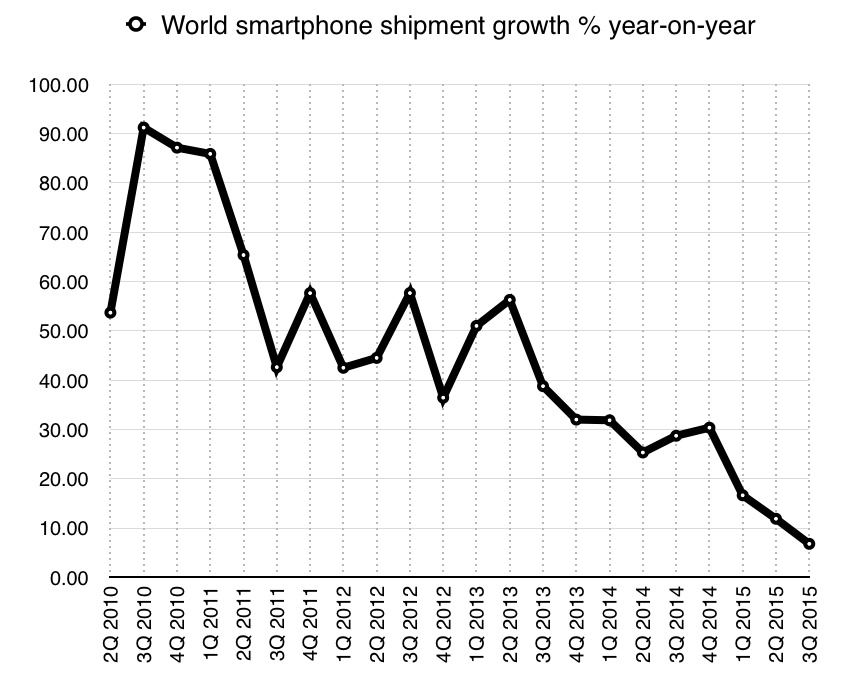
World smartphone shipment growth by quarter

Data from IDC

Score that

I’ve added two columns to the scorecard this quarter: year-on-year shipment growth, and that growth normalised against the whole smartphone market. Apologies if this demands a lot of horizontal scrolling.

OEM S/phone revenue US$ (approx) Op profit US$m Op margin % S/phones shipped Implied ASP per s/phone Implied profit per s/phone Shipment growth y/y Shipment growth v s/phone mkt (6.8%)
HTC $0.674bn -$154m –23.1% 2.6m $259.27 –$59.85 –46.9% –53.7%
Sony $2.32bn -$171.7m –7.4% 6.7m $346.12 –$25.62 –32.3% –39.1%
LG $2.96bn –$88.6m –2.3% 14.9m $198.49 –$5.95 –11.3% –18.1%
Samsung $20.70bn* $2,440m 11.79% 84.5m $248.55 $28.86 +7.6% +0.9%
Lenovo
(inc Motorola)
$2.37bn* -$217m –9.2% 18.8m $126.22 –$11.54 –32.9% –39.6%
Total for ‘public’ Android $29.024bn $1,810m 6.2% 127.5m $227.64 $14.20 –7.7% –14.5%
Huawei ????? ????? ????? 26.5m ????? ????? +57.7% +50.9%
Xiaomi ????? ????? ????? 18.3m ????? ????? +1.1% –5.7%
ZTE ????? ????? ????? 16.2m ????? ????? +42.1% +35.3%
Total for “dark Android” ????? ????? ????? 61.0m ????? ????? +35.6% +28.8%
Apple $32.21bn $9,022m* (28% est) 48.05m $670.38 $187.76* +22.6% +15.8%
Microsoft Mobile $0.72bn* –$603m –83.8%% 5.8m $105.00 –$104.00 –38.6% –45.4%
BlackBerry $0.20bn –$180m* –89% 0.83m $242.16 –217.00 –61.9% –68.7%

* estimated smartphone revenues/profits/ASP only – excluding featurephones and tablets.

Working assumptions:
HTC: all revenues from smartphones – zero from the Nexus 9 tablet (pretty certainly true), zero from the HTC Re camera (probably true).
Sony: all revenues and profits from smartphones; zero from tablets – of which it shifted fewer than 1.6m, given IDC’s numbers; and zero profit from tablets. If tablets generated significant revenue and were profitable, then the smartphone ASP goes down, as does per-handset profit. (If tablets lost money, the per-handset loss is less.)
LG: $100 average selling price for the 1.6m tablets I’m estimating it shifted in the quarter. (That would put it equal with shipments in the previous quarter.) Tablets assumed to have zero profit, though they might have made some loss that made everything else look worse.
Samsung: featurephones (it shipped 20.5m) sold for $15, zero profit; tablets (8.0m) sold for $175 at zero profit. If the tablets or featurephones made any profit, then the profit from smartphones were lower.
Lenovo: assuming the 3.1m tablets it sold had an ASP of $100, and zero operating profit. If the tablet ASP was lower, Lenovo smartphone revenues were higher; if the tablets were profitable, per-smartphone loss was greater.
Apple: operating margin, as previously, of 28%. You could halve this, or even put it level with Samsung’s declared margin, and its operating profit would still be more than all the others’ profits (even ignoring losses) put together.
Microsoft Mobile: the figures here have to be backed out from the not-quite-stated phone revenue, including featurephones: “phone revenue decreased 58% by $1.5bn”, which takes us down to $1.1bn. There’s no gross margin given for phones, so I assumed –$104m, as in the previous quarter. Microsoft shipped 25.5m featurephones (up from 19.4m the quarter before, but down from 42.9m the year before) and 5.8m Lumia smartphones (stated; down from 8.4m the quarter before, and 9.4m the year before). Assuming featurephones had an ASP of $15 and made zero profit (same as with Samsung). The Lumia ASP has to be estimated, but seems reasonable.
BlackBerry: device revenue is given in financial statement; assuming software/services have gross margins of 84.5% (true historically), and that hardware R+D and sales costs are proportional to device revenues as % of overall revenues.

Troubles in common

Here’s the surprise: a number of Android OEMs managed to make their device ASPs rise from the previous quarter. First is Sony – up from $319.40 to $346.12. And who knows whether the $5m spent on product placement for Sony smartphones in the James Bond film Spectre won’t pay off some time. (They’ll have to have a hell of a return on investment, though.) HTC also managed it: up from $236.90 to $259.27. Lenovo also did it, up from $115.06 to $126.22.

And what else did those three companies, along with LG, all do? Lost money. The problem for premium Android goes on. We’re seeing the rise of “dark Android” – the companies which have huge reach (especially inside China) but whose finances are opaque. (All three of Huawei, ZTE and Xiaomi sell many, if not a majority, of their phones without Google’s services installed, because they sell them inside China.) Meanwhile Apple raises its ASP, and its profit rises in line, as far as we can tell.

The really interesting case is Samsung. A year ago, in the third quarter of 2014, Samsung had a terrible time: profits crashed and its semiconductor division became the most profitable part of the business – which is still the case. At that time, Samsung discovered that making a new “S” series phone wasn’t a guarantee of success; it was caught with lots of unsold Galaxy S5s sitting with wholesalers, and had to offer all sorts of discounts to get them moving, which hurt profits.

This time around, Samsung’s profits have risen year-on-year, but only because the same time last year it was so dire. The Wall Street Journal had some interesting data about how it managed to get so many phones sold: basically, it concentrated on the low-to-mid end. Screw the S6 and S6 Edge and its kin; this was about getting phones out the door.

…while 55% of its smartphones were priced at $301 per unit or more at this time last year, that high-end segment has fallen to just 40% of Samsung’s overall smartphone sales, Counterpoint said.

Phones priced $200 or below now account for 38% of total units shipped at Samsung, versus 30% this time last year.

You can work this out pretty easily:
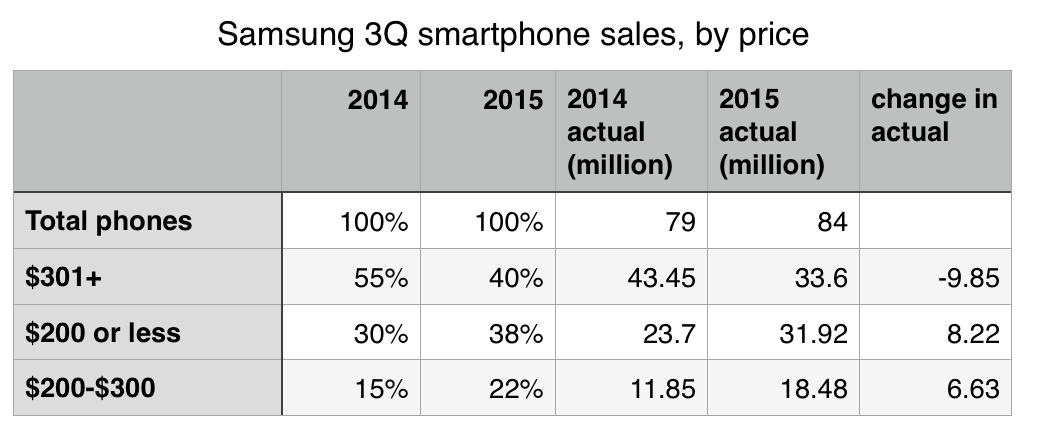
Samsung phones sales, by price segment

Data from Counterpoint Research for 3Q 14 and 3Q 15

Here’s how that looks when you visualise it:
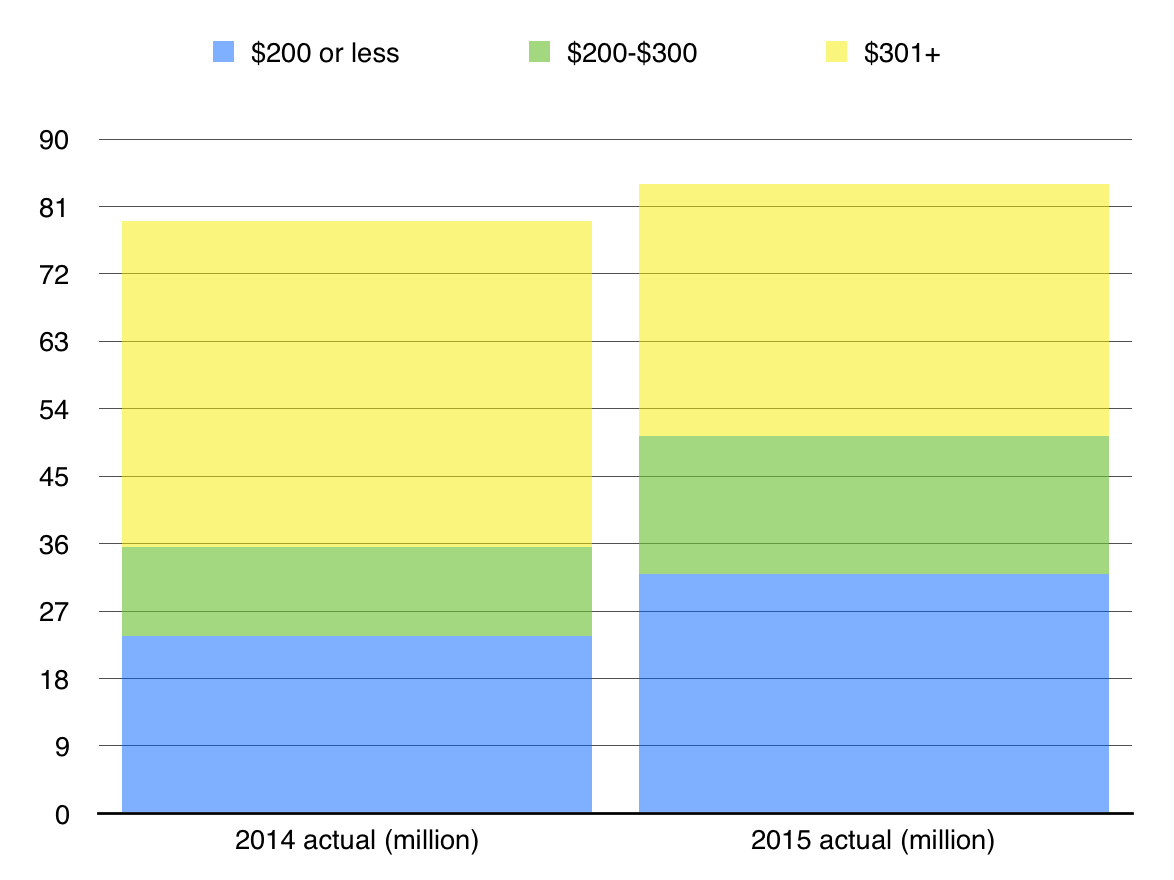
Samsung phone sales by segment, visualised

Data from Counterpoint Research. The mid-level segment is growing at the expense of the high-end one.

Look at how the blue and green edge up into the pricier yellow – which is now much smaller. And we’re comparing, remember, with last year, where the yellow (pricey) segment went pretty badly for Samsung as it was.

This is Samsung reacting to what’s going on in the market, and responding as it does best: by using its manufacturing and distribution might to try to squash competition. But in places like China and India, for example, local suppliers can compete pretty evenly:

“Samsung Electronics has decided to release the products priced at some 100,000 won for price competitiveness with Chinese and Indian smartphone makers. Local manufacturers, such as Xiaomi and Micromax, have already launched many models in the same price range. An official from the industry said, “Now, it is impossible to hold a dominant position in the competition just with a brand image of Samsung Electronics without releasing models in the same price range with local companies. When we have similar price competitiveness, we can defend our market share but profitability will get worse further.”

And LG? It’s getting walloped. Strategy Analytics says (in a super-pricey report I won’t buy) “LG’s global handset shipments dipped -21% YoY in Q3 2015. Competition from ZTE, Huawei and others ramped up across Asia and North America. A major challenge for LG is that it still has too many eggs in too few country baskets and it badly needs to diversify geographically for regrowth in 2016.”

I don’t see that happening. What I find remarkable is that top-end Android vendors are now howling into the hurricane. The LG G4 has a camera that seems remarkable in all the sample shots I’ve seen; yet it’s struggling to sell them. HTC might hope that the newly released iPhone-alike A9 will raise revenues briefly this quarter, but I’m pretty sure they won’t reverse its per-handset losses, which are looking awful:
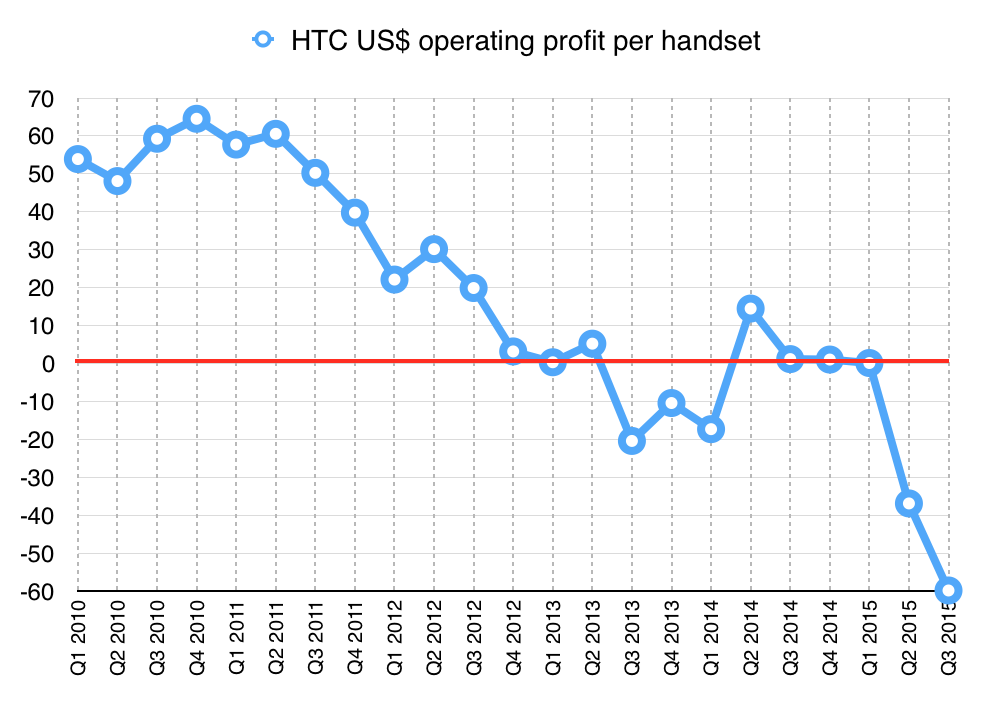
HTC US$ operating profit per handset

Data calculated from HTC financials

Android’s dark matter

Consumers are clearly beginning to think that many other Android handsets are “good enough”. My friend with his cheap Huawei handset is just one example. ZTE and Xiaomi and OnePlus and, now, the UK’s WileyFox and Marshall (the amplifier makers, yes) and even Pepsi are all piling into the handset market, sure that they can make money.

In some cases, it’s quite possible they are: by restricting its supply and distribution, OnePlus has a model that can scale as long as it can keep a lid on demand. What the phone OEMs really want is to be able to move closer to a Dell-type model: where you order the device and it’s pretty much custom-made for you from modular parts. That means lower inventory, and certainty about pricing components and satisfying demand.

Meanwhile, Android OEMs such as LG, Sony and Samsung are faced with the harsh reality spelt out by Ben Bajarin in one of his columns:

as a market matures, the early innovators get disrupted by competitors who come into their space with lower priced products, similar specs (the specs that matter), and eat into the market share of the early innovator in the category. Once the market embraces “good enough” products, the innovator can no longer push premium innovations as their value is diminished once a “good enough” mentality sets in. Android devices in the $200-$400 range are “good enough” for the masses, leaving Samsung’s $600 devices and above stranded on an island.

As he points out:

the innovator’s dilemma, in this case, only applies to Android-land because all the hardware OEMs run the same operating system. As I’m fond of saying, when you ship the same operating system as your competition you are only as good as their lowest price.

This is what Samsung is reacting to, but Sony and LG and HTC can’t react to without cutting their own throats even more. They have high fixed costs in order to produce those super-high-resolution phones (QuadHD, anyone? Even if you can’t tell the difference?) but it doesn’t cut any ice with the public.

Meanwhile Huawei, ZTE and Xiaomi the dark matter of the smartphone business: we know they’re there because of the enormous influence they wield on everyone around them. They’re also the only part of the Android OEM business that’s growing. But it’s very hard to have any idea of their financial position. (You can get some idea: CoolPad says it can’t make sufficient profit to sell a tablet to compete with Xiaomi’s newest model at the same price.) The way that the low-price piranhas are piling into Android does remind me of the days when the iTunes Music Store was taking off, and every company in a vaguely associated area scrambled to have their own download store – HMV, Tesco, Wal-Mart, Virgin – without much consideration of how they’d turn it profitable; they just reckoned it was a good idea. (Most have now shuttered those stores.)

In the same way, offering an Android phone is beginning to look like a possible sideline for all sorts of companies, which speaks to the problem that the big Android players have: if anyone can make a smartphone, why are they making a smartphone? Sure, the rivals don’t outsell the big players, but they don’t need to. For almost any price, control your inventory and demand and you control your profitability.

Black days for BlackBerry

You’ll notice BlackBerry’s figure, where its costs are so mad that it’s effectively losing enormous amounts on each device it sells. Chief executive John Chen may say handsets are “profitable”, but that’s gross margin, before you take away distribution, administration, sales, and R+D. In day-to-day terms, BlackBerry’s hardware division is a mess, and I don’t see why Chen doesn’t say “we’re going to go into a maintenance mode where we supply legacy handsets to existing clients on demand” and simply focus on the software/services business for profit. The BlackBerry Priv would have to be a colossal hit to make up this ground, and there is simply no sign of that happening. Richard Windsor agrees:

The new BlackBerry Priv and its rumoured successors are aimed at such a narrow niche that I doubt that they will ever make money. Once this realisation has sunk in, I think that BlackBerry will abandon its hardware business and focus on its software business which has recently been bolstered with the acquisition of Good Technology.

The iPhone pricing puzzle and the single spec that matters

How much longer can Apple keep on with its premium pricing? This question has been asked pretty much since the first Macintosh was launched. The answer from the PC market seems to be “a lot longer than you might expect”. In the smartphone market, the distance between the iPhone ASP and the average Android handset ASP, even on these public figures, is $450, which is itself double the price of the average Android ASP. And it’s unlikely that the missing Android data covers handsets with higher prices.

This seems like a situation that can’t last, and yet we’ve seen in the PC market that it can and does: Apple’s ASP there is over $1,200, while that of the big five Windows PC makers wobbles around $500. Apple also makes about twice the operating profit on PCs as HP, Lenovo, Asus and Acer combined.

Yet in a space where prices of phones are dropping precipitously, the iPhone’s price tag seems more and more anomalous. Yet by standing outside those price wars, and by incrementally improving its offering again and again, it keeps pulling it off. In part, that’s because of the price: as CCS Insight noted in April,

Apple’s success in opening up new, high-growth markets such as China, India and Indonesia is significant. Although its products are out of reach for many people, the iPhone is widely regarded as a badge of success in these countries and there are still enough buyers who are affluent enough to afford one.

In that sense, the price is a spec – one where rivals are actually being degraded. It sounds completely contrary, but to a number of people an iPhone is an affordable luxury. Think of it like a car: some people really want Porsches. But if you could buy a Porsche for the same price as any other car, would it still have that cachet?

Maturity and change

We’re now moving into a situation where the biggest markets – China and the US – are approaching saturation, so that it becomes increasingly hard to persuade the remaining featurephone owners to trade up, and people are less willing to buy a new device just because it’s new. That CCS Insight forecast in April also says that smartphone sales in western Europe and North America will peak in 2017; but it also expects Apple’s share to grow.

Again, this seems contrary – won’t that just lead to people being driven by price? But in a mature market, you can get a move towards perceived quality and luxury, because you’re in a situation of plenty. As I showed using Ericsson’s data from mature markets, Apple can gain users in that situation, creaming them off from Android (and to a less extent from Windows Phone).

Conclusion: segue to VR

Three months or so back I wrote about “premium Android” hitting the wall. Now it’s sliding down, and being swallowed by dark matter and eaten by piranhas. So what keeps the lossmaking companies in the business? I think it’s pretty evident that they now have their eyes on the future: virtual reality. It’s a hugely promising technology which demands integrated systems with gyroscopes and, moreover, super-high-quality screens where you can’t discern pixels even if it’s a few inches from your face. That’s what Sony, LG, HTC and Samsung are all aiming at; each has its own offering in VR, while Apple hasn’t so far made a move.

Perhaps, though, history is going to repeat itself here. Each of those companies was strong in phones before Apple came onto the scene with the iPhone. It cannot have escaped Apple’s notice that VR is a promising market, with lots of applications. And it has been granted patents in that space.

Maybe in a few years’ time, we’ll be scoring profits in the VR market. For now, though, it’s all about smartphones – and there are still only two clear winners.

More articles to read:
BlackBerry might have no BB7 users left by February 2016
Premium Android hits the wall: the Q2 2015 smartphone scorecard
Google’s growing problem: 50% of people do zero searches per day on mobile
The adblocking revolution, and iOS 9
Android, iOS and Ericsson’s new leaky bucket meet the featurephone swamp


“You sell those Apple-Google-Samsung phones here?” Photo by rante_to4ak on Flickr.

Amid the tedious rows that punctuate the smartphone landscape, a recurrent cause of outraged comments is the idea of “switching”: that people might actually move from one smartphone platform to another, and do it of their own volition, and to a platform that is different from the one the commenter uses.

This tends to be seen not as an interesting insight into consumer behaviour, but instead as some sort of outright offence. That in itself is quite telling: it shows how personal our smartphones are. Insult (or leave) my smartphone platform, insult me.

That said, study after study tends to suggest the same thing: as a smartphone platform, Android is a “leaky bucket”: people join, but they leave too. By contrast, the iPhone is more of a roach motel (or Hotel California, if you prefer): people join, and they tend to stay.

There are plenty of examples of earlier studies that suggested this. Here’s an August 2013 piece I did on the “leaky bucket” prediction by Yankee Group, which has some supporting data from CIRP, and another from January 2014 by a UK company called Foolproof. Note how a lot of the comments say it’s nonsense because, well, it just must be.

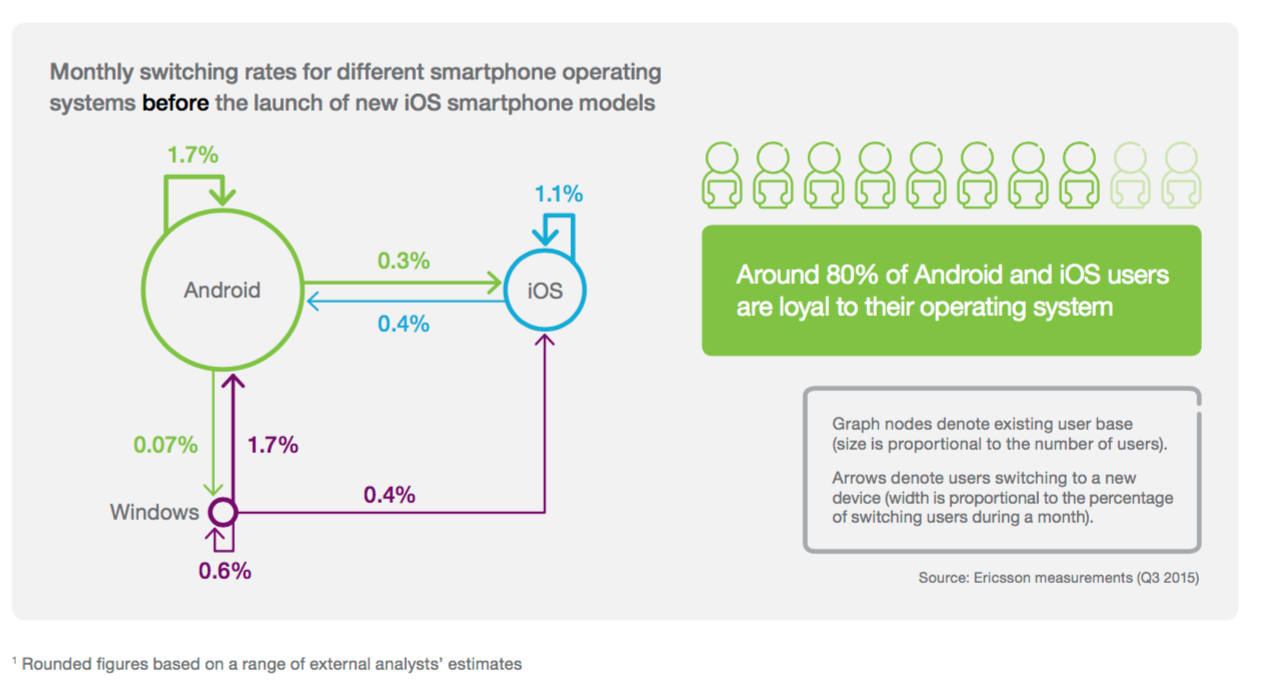
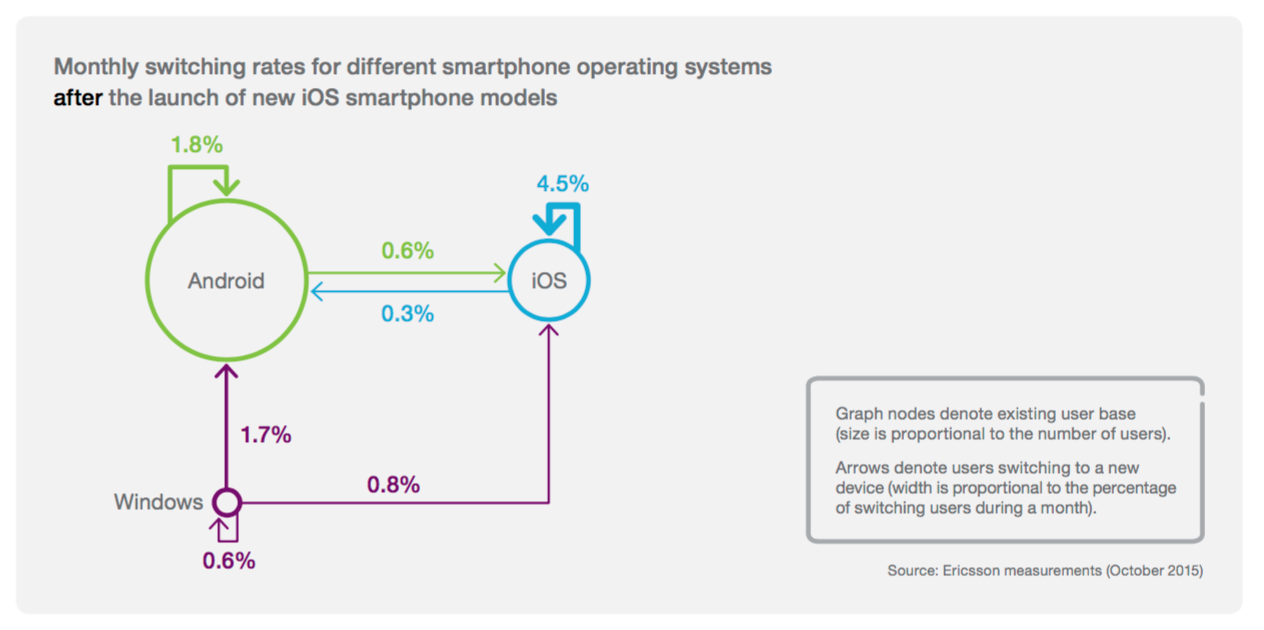
Now there’s a new switching study, embedded in Ericsson’s Mobility Report for Q3 2015. You have to scroll down a fair way to find it (it’s on page 28/9), but it’s summed up in two graphics, where it splits the movement between the three mobile ecosystems into a “before a new iPhone launch” and “after a new iPhone launch”. Here’s “before”:

Ericsson: switching behaviour before iPhone  launch

And “after”:

Ericsson: platform loyalty after iPhone launch

Note the caveat of where the data comes from:

“This analysis is based on measurements before and after the launch of new iOS smartphone models in a selected number of mature mobile broadband networks in Europe, Asia and North America. The study encompassed iOS, Android and Windows devices. Other operating systems like BlackBerry, Symbian and FirefoxOS had very low penetration in all measured networks and therefore were not included.”

“Mature markets” probably means the US, Canada, some or most of the “big five” in Europe (UK, Germany, France, Spain, Italy) and perhaps a couple of others, plus Japan, China and perhaps South Korea.

So those who want to disagree with this data will already be saying “bah, mature markets”.

The mature approach

That overlooks the fact though that all markets for a product eventually become mature markets. Ericsson is giving us a glimpse of the future.

What the data says is quite informative. A few quick takeaways:
• in a “before” month, 6.3% of people buy a new phone – though only 2.87% (45% of them) change platforms
• in an “after” month, 10.3% buy a new phone – with 3.4% (33%) of them changing platforms. (Nearly half of those buying a new phone are iPhone owners.)
• nobody, by this data, ever changes from an iPhone to Windows. Yes, yes, I know your second aunt’s cousin who works in IT did, but we’re talking here about scale – across millions of users. 0.01% of a million equates to 100 people. Apparently not even at that scale does this happen enough to register.
• on the 6.3% and 10.3% turnover rate, everyone replaces their phone somewhere between 10 and 16 months.
• Windows Phone users seem to be the busiest in buying phones.

I thought it would be interesting to model how this changes the user base if it’s repeated over time. Note that Ericsson is suggesting it’s only a snapshot for a few weeks, and only for people who get a new phone and stay on the same carrier. (But the latter is true of most people.) If this is how things play out, perhaps we can learn something. So I put the data into a spreadsheet, and set up the algorithm to step through month by month according to the Ericsson platform change stats. So from 10,000 Android users, in a “before” month you’d get 30 going to iOS and 7 to Windows Phone (see the diagram above). And so on.

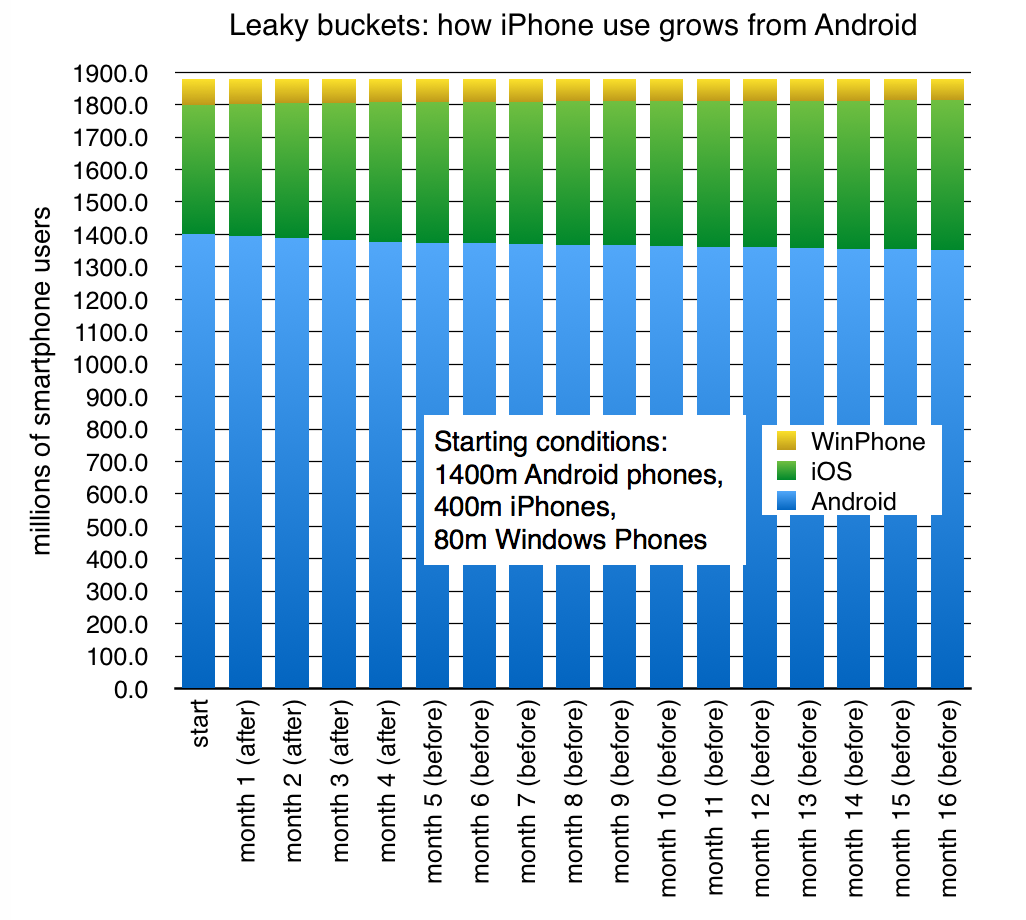
My spreadsheet is here. I used the 1.4bn figure for the Android base, 400m for the iPhone, and 80m for Windows Phone – about the total number of Lumias sold since their inception. (The extra 0.1 that appears over time is due to imprecision in the calculation – each “before” month adds 0.01 to the figure.)

The graph doesn’t show much perceptible change:

Modelling platform change from Ericsson data

Note that this assumes 15 months with only one iPhone launch.

Note that this is over 16 months, but with only one iPhone “launch” right at the start (whose effects then carry on for four months) – so you can see that the iPhone launch doesn’t make a big difference to the general trend.

Equally, you can also see that there isn’t a huge amount of movement. The iPhone chunk gets wider: in this example, with a four-month “after launch” period and eight-month “before launch” period, by the end of the 12th month
• the iPhone has gained 51.9m users
• Android has lost 40.1m
• Windows Phone has lost 11.8m.

In percentage terms, it’s pretty unimportant to Android – 2.9% loss – but big for iPhone (+13.0%) and bigger for Windows Phone (-14.8%).

If you change to a 12-month “before launch” year, the changes are -25.1m for Android (1.8% change), +31.1m for iPhone (+7.2%), and -5.9m for Windows Phone (8.2%).

You can quibble with the starting figures. Playing around with them, I found the following properties:
• the larger the initial figure for Android, the larger its final fall (obvious) but also the larger its percentage fall
• the larger the initial figure for iOS, the smaller the absolute and percentage growth
• iOS is the only platform to show overall growth on any combination of the “before launch”/”after launch” model.

The featurephone swamp

In which case, you might ask, howcome Android’s installed base is still growing? Simple: there’s still a huge base of featurephone owners who are being converted upwards to smartphones. They’re easy to overlook, but key to this dynamic.

For instance, in the Yankee Group study from August 2013 quoted above, the key mistake that it made in forecasting that iPhone use would overtake Android use by 2014 was to overlook the continuing source of new Android users – from featurephone owners moving to smartphones. In August 2013, there were 90m of them, according to ComScore; the latest figure, from September 2015, says there are still 56.2m of them (so 33.8m fewer).

In that period,
•the number of US iPhone users has grown from 59.0m to 84.3m (up 25.3m);
• the number of Android users has grown from 74.8m to 98.8m (up 24m).

There’s hardly a dramatic difference in growth between Android and the iPhone (contrary to what Forrester expected). You wonder where the other net users came from besides featurephones? The fall in BlackBerry users (5.8m to 2.3m). In the same period, Windows Phone users barely grew (4.6m to 5.5m). And there are 12m extra featurephone users in September 2015 compared to August 2013 making up the gap.

As for Windows Phone: if Ericsson’s numbers say it’s losing users, the obvious question is: how did it get to 80m (or so) users in the first place? The easy answer: Ericsson’s diagrams don’t show the pipeline bringing users into Windows Phone from featurephones – usually via the Lumia 5xx low-end range.

The eternal puzzle of iPhone growth

Even allowing for that, it’s notable that the ComScore data says that in the US iPhone users have grown more (both in percentage and sheer numbers) than Android users. Sure, home distortions and all that. But why is that the case in the other mature markets too? Why is iPhone ownership growing in other places, and why don’t they leave?

It’s this last point which befuddles and almost infuriates people. Why on earth, they say, do people buy iPhones, which only have a dual-core CPU with 2GB of RAM running at 1.8GHz and without an SD card slot, when for less money they can get an octacore phone running at 2.6GHz with 4GB of RAM, an SD card slot, removable battery and a QuadHD screen? You can hear the puzzlement in comments from people who can read a spec list, yet can’t see why the inertial scroll on the iPhone is a more pleasing experience than the rolling velcro on even top-end Android phones. (I keep going and checking the scrolling on each new Android phone. Still isn’t smooth. Clearly 2012’s Project Butter still needs to be supplanted by Project Ghee.)

There’s more than that, though. I don’t think anyone buys an iPhone by accident. I don’t think people walk into a store not intending to buy an iPhone and then find themselves surprised to be holding one as they walk out.

Whereas choosing between Android phones can be like a beauty contest of clones. You put various models of Samsung phone against LG phones against the slightly harder edges of the Sony against the iPhone-alikeness of the HTC models, and you try to pick. How do you choose? Probably on some subtle mixture of the price tag, tickboxes and comparative sizes of numbers on the spec list and.. that’s probably about it.

You can argue (and oh my giddy aunt people do) about why people buy iPhones. I’d say there’s clearly a perception among those who do that they’re getting something premium. The price tag alone suggests that.

That isn’t enough however to keep people on a platform if the experience didn’t also work for them. Do some people migrate from Android to iPhone, and then migrate back? Undoubtedly. But the data suggests most who make the shift don’t.

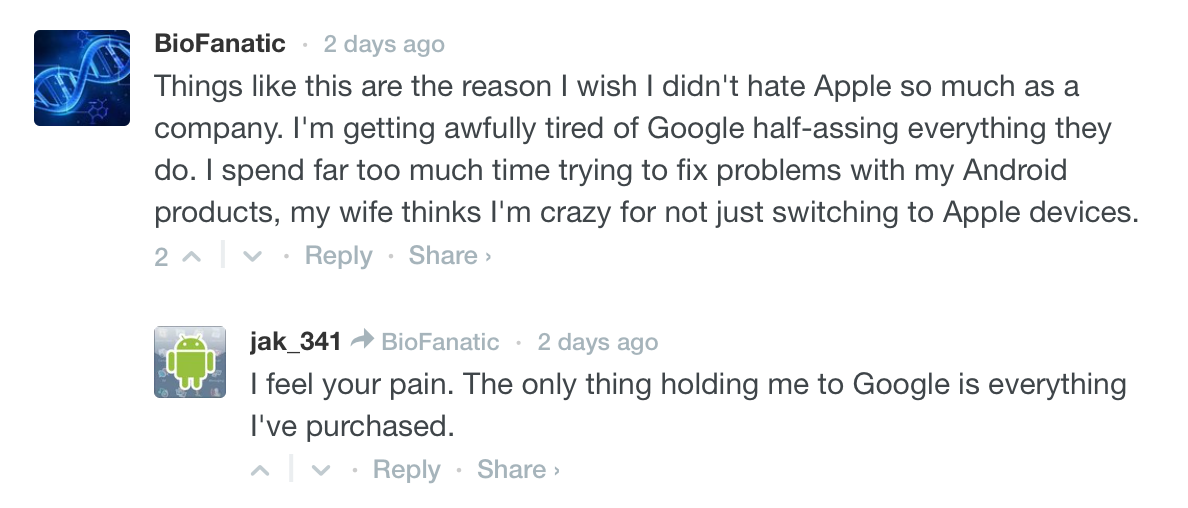
Is your argument that people get “locked in to the Apple ecosystem”? Perhaps. But it’s not just on iOS, as this comment from an article about Android Wear demonstrates:

Comment on Android Wear

Note the nose-spiting-face nature of the first one..

On that basis, people should be just as reluctant to move to iOS as away from it. Again, the evidence disagrees.

I think there’s a frustration factor driving some movement too; I watched the friend of a relative struggle to get the maps on her Sony phone work recently. First to find the apps, then to find the maps app, then to get any sensible input, then to get sensible output. (Since you ask, she’s one of the country’s leading barristers.)

I couldn’t help but wonder if she would have found it simpler to have a Maps icon front and centre. Apple’s reputation for simplicity is actually a selling point for such users, even if it isn’t for the gigahertz-SD-RAM-removable battery crowd.

Feeling it

Conveniently, just as I was writing this piece, Ben Thompson wrote a piece on Stratechery about “Selling feelings“, with this notable point:

how silly must you be to carry a $5,000 handbag with far less functionality than another a fraction of the price, or wear a $10,000 watch or $200 necktie? What about flying first class or staying in a five-star hotel — you can’t take either with you! It’s completely irrational.

Or, rather, it’s irrational if you only look at features. The entire point is how these purchases make you feel, and it’s that feeling, whether it be an appreciation for craftsmanship, status, or simply being pampered, that provides the sort of differentiation that makes all of these products profitable. One could argue that an insistence on limiting the calculation of value to items that are permanent, physical, and easily listed on a spreadsheet is the real irrationality.

There’s no shortage of that latter group who’ll tell you that the iPhone is rubbish. Meanwhile, continuing evidence from a growing number of studies says that over time, the iPhone base continues to grow. The question is, once the swamp of featurephone users is drained, what happens over the longer term?

Start up: hackers for hire, Chrome grows, Tinder’s CEO chats, and more


Google Timeline: law-enforcement-friendly, at least in theory. Picture by portalgda on Flickr.

Mumble mumble receive each day’s Start Up post by email. Rhubarb rhubarb confirmation link, mutter no spam.

A selection of 9 links for you. Free as in cabbage. I’m charlesarthur on Twitter. Observations and links welcome.

Hired-gun hacking played key role in JPMorgan, Fidelity breaches » Reuters

Jim Finkle and Joseph Menn:

The trio, who are accused of orchestrating massive computer breaches at JPMorgan Chase & Co and other financial firms, as well as a series of other major offences, did little if any hacking themselves, the federal indictments and a previous civil case brought by the U.S. Securities and Exchange Commission indicate.

Rather, they constructed a criminal conglomerate with activities ranging from pump-and-dump stock fraud to Internet casino break-ins and unlicensed Bitcoin trading. And just like many legitimate corporations, they outsourced much of their technology needs.

“They clearly had to recruit co-conspirators and have that type of hacker-for-hire,” said Austin Berglas, former assistant special agent in charge of the FBI’s New York cyber division, who worked the JPMorgan case before he left the agency in May. “This is the first case where it’s that clear of a connection.” Berglas, who now heads cyber investigations for private firm K2 Intelligence, said additional major cases of freelance hacking will come to light, especially as more people become familiar with online tools such as Tor that seek to conceal a user’s identity and location.

link to this extract


Living in different worlds » Benedict Evans

A few years ago, one of the big UK retailers told me an anecdote from some market research they’d done into cameras. Their customers had said they wanted a solution for storing all the camera cards they had. This puzzled the researchers, so they dug a little further, and found out that a lot of their customers had dozens and dozens of memory cards.…

[they] just took the memory card out of the camera at the end of a trip, and when they wanted to show people the photos they’d taken they retrieved the card and put it back into the camera. 

I recognise this behaviour because it’s what my father-in-law does – and when he wants to print something from his computer, he takes a photo of the screen, takes out the camera’s memory card, slots it into the printer and prints out the photo (he also made quite a lot of money day-trading Imagination Tech – over the phone). 

As we go from 1.5bn PCs, of which only half are consumer, to 3bn iOS and Android devices today and 4-5bn in the future, this will become ever more important.

link to this extract


Chrome’s number of monthly active users on mobile devices has doubled over the past year

Bertel King:

During the keynote address yesterday for this year’s Chrome Dev Summit, VP of Chrome Darin Fisher shared some numbers about the mobile web browser’s rate of adoption. tl;dr, people are flocking to Chrome, and fast. Over the past year, the number of 30 day active users has doubled from 400 million to 800 million.

Chrome’s adoption has been boosted by an increasing number of devices now shipping the browser by default. Chrome for Android users visit 100+ sites a month on average, showing a decent level of engagement.

The power of defaults. Once it was Internet Explorer; now it’s Chrome. That final sentence is maddening, though. Where’s the evidence that that’s a decent level of anything? What does it compare to? Three different sites per day is “decent engagement”? Seriously? There’s a new generation of people writing content who seem incapable of doing simple maths and following its thread. (1.4bn Google Android monthly active users, 800m Chrome monthly active users. Think about that too.)
link to this extract


Exclusive: Samsung Pay to launch in China, Spain, and the UK in Q1 2016 » SamMobile

As per the information that we’ve received, Samsung is planning to launch Samsung Pay in China, Spain, and the UK in the first quarter of 2016. Currently, only five Samsung devices – the Galaxy S6, the Galaxy S6 edge, the Galaxy S6 edge+, the Galaxy Note 5, and the Gear S2 – support Samsung Pay, though the Gear S2 only supports NFC payments.

Samsung uses MST technology, which mimics card swipes at regular checkout equipments to make payments, in Samsung Pay-enabled smartphones.

Card swipes are useless in the UK and Spain, as everything is chip-and-PIN. But Samsung Pay does support those too. Wonder if that will help sales of the high-end phones at all.
link to this extract


How law enforcement can use Google Timeline to track your every move » The Intercept

Jana Winter:

The recent expansion of Google’s Timeline feature can provide investigators unprecedented access to users’ location history data, allowing them in many cases to track a person’s every move over the course of years, according to a report recently circulated to law enforcement.

“The personal privacy implications are pretty clear but so are the law enforcement applications,” according to the document, titled “Google Timelines: Location Investigations Involving Android Devices,” which outlines the kind of information investigators can now obtain.

The Timeline allows users to look back at their daily movements on a map; that same information is also potentially of interest to law enforcement. “It is now possible to submit a legal demand to Google for location history greater than six months old,” the report says. “This could revitalize cold cases and potentially help solve active investigations.”

Familiar? Exactly the same realisation for iOS in 2011, which was then quickly encrypted. Android was already doing that too.

Four years later, nothing’s really changed.
link to this extract


Tinder? I’m an addict, says hook-up app’s co-creator and CEO Sean Rad » London Evening Standard

Charlotte Edwardes swipes quite a weird interview, including this:

He’s obsessed with journalists — “too many are not seeking truth but fame” — and baffled by critics because “you can’t deny Tinder is what the world wants”. His own “truth” is that Tinder is “wonderful” — “we’ve solved the biggest problem in humanity: that you’re put on this planet to meet people.” 

In September Vanity Fair accused Tinder of heralding the “dawn of the dating apocalypse” in an article that interviewed twentysomethings in New York who used it solely for casual sex. 

Rad is “defensive” and still “upset” about the article, muttering  mysteriously that he has done his own “background research” on the writer Nancy Jo Sales, “and there’s some stuff about her as an individual that will make you think differently.” He won’t elaborate on the matter.

His argument for why the piece was “wrong” veers from “our research shows 80 per cent of users are looking for a long-term meaningful relationship” to “we believe in democracy. If society just wants to ‘hook up’, who am I to judge?” 

link to this extract


WhatsApp reneges on their promise of true message encryption » Medium

Dawud Gordon:

In interviews with journalists WhatsApp stated that they would use Public Key Encryption, where only the sender and recipient can unencrypted content. Indeed they did, but they used the same key for every user. This makes the Brno hack possible, meaning anyone on the same network as your phone could gain access to the content of your messages. Also, it means that WhatsApp themselves still have access to all message content. Moreover, their parent corporation Facebook has access as well and the ability to target you with advertising based on the content of your WhatsApp messaging. While this is surprising given WhatsApp’s previous PR, it does explain the mysterious $19bn price tag that Facebook was willing to put on WhatsApp.

link to this extract


India to overtake US next month with 402 million internet users » Tech In Asia

Malavika Velayanikal:

The number of internet users in India will reach 402 million next month, nearly 50% more than what it was last year, according to a study by the Internet and Mobile Association of India (IAMAI) and IMRB International. With the latest surge, India will overtake the US to have the second-largest internet user base in the world, next only to China. This will be music to the ears of mobile and internet-based businesses targeting the fast-growing digital market in India.

It took a decade for India to move from 10 million internet users to 100 million, but only four years to quadruple that figure. The primary driver of this takeoff is the boom in affordable smartphones over the past couple of years. But two-thirds of India’s population remain outside the internet, and broadband availability is poor.

link to this extract


Google Glass successor dumps some glass » The Information

Jessica Lessin:

So much for the screen. We’ve learned that Google’s revamped Google Glass project, dubbed Project Aura, is working on a wearable with a screen—and at least one without.

People tell us there have been three versions of the head-mounted device in development, although the three may be consolidated into two. One version, targeted at enterprises, has a screen. The others, one of which is targeted at “sport” users, doesn’t and relies on audio. They use bone conduction, like the original Google Glass. In other words, headphones worn on your face.

Or even like headphones worn on your head?
link to this extract


Errata, corrigenda and ai no corrida:

Start up: Apple Music on Android, Zuckerberg profiled, the dark tower and more


Soon to stream internationally? Photo by djuggler on Flickr.

You can now sign up to receive each day’s Start Up post by email. You’ll need to click a confirmation link, so no spam.

A selection of 13 links for you. Use them wisely. I’m charlesarthur on Twitter. Observations and links welcome.

Apple Music review: I was ready to hate it, but Apple got me singing a different tune » Android Police

Rita El Khoury:

for a few billion people from China to India to Nigeria to lil’ Lebanon where I live, Apple Music is one of just a couple of services that we can use, and for many of us, it’s the best option when all pros and cons are diligently weighed against its competitors.

And if, like me, you happen to live on the bleeding edge between Apple and Google’s ecosystems, owning Macs and/or iOS devices along with your Android phones and tablets, and you have used iTunes over many years to carefully organize your music collection, Apple Music might make more sense to you, regardless of where you live and whether or not you have access to Google Play Music and other streaming options.

That’s what you have to keep in mind while reading this review. I’m aware other options exist. I’m aware iTunes and Apple are far from universally liked. I’m aware that you couldn’t care less about Apple Music. But that doesn’t stop the app and service from being good, and even great.

The “cloud upload” element still seems to be a mess. I don’t understand why: doesn’t it just match the track data, like identifying tracks on a CD? In which case what’s hard about adding it to a cloud library, which is just a set of indexes?
link to this extract


Rdio is shutting down and Pandora is buying up the scraps » The Verge

Ben Popper:

Pandora is the grandaddy of streaming music, with more than 15 years in business and more monthly listeners using it to hear tunes than anyone save for YouTube. But Pandora, a public company, has struggled to turn a profit, and has seen its user growth slow in recent years. Today it announced that it is acquiring “several key assets” from Rdio, which is filing for bankruptcy. The purchase price is $75 million, and the acquisition includes technology and intellectual property. The announcement says “many employees” from Rdio will be offered the chance to work at Pandora, implying that at least some will be out of work. Rdio’s CEO, however, will not be making a move to join Pandora’s ranks.

The pairing would make a lot of sense. Pandora struggles in part because its royalty rates are set by the government, something that allowed it to avoid the high costs that have battered Spotify, but soured relationships with the music labels. That in turn kept it from expanding internationally or adding more complex on-demand features.

Pandora adding international streaming could make things interesting.
link to this extract


The most popular curl download – by malware » haxx.se

Daniel Steinberg noticed that a particular curl library was in demand:

In October it alone was downloaded more than 300,000 times, accounting for over 70% of the site’s bandwidth. Why?

The downloads came from what appears to be different locations. They don’t use any HTTP referer headers and they used different User-agent headers. I couldn’t really see a search bot gone haywire or a malicious robot stuck in a crazy mode.

After I shared some of this data over in our IRC channel (#curl on freenode), Björn Stenberg stumbled over this AVG slide set, describing how a particular malware works when it infects a computer. Downloading that particular file is thus a step in its procedures to create a trojan that will run on the host system – see slide 11 for the curl details.

So he renamed the file. Now we await developments.
link to this extract


Why states of emergency and extreme security measures won’t stop ISIS » Counterpunch

Patrick Cockburn (formerly at The Independent):

the apocalyptic tone of press coverage is exaggerated: the violence experienced hitherto in Paris is not comparable with Belfast and Beirut in the 1970s or Damascus and Baghdad today. Contrary to the hyperbole of wall-to-wall television coverage, the shock of living in a city being bombed soon wears off.

A further disadvantage flows from excessive rhetoric about the massacre: instead of the atrocities acting as an incentive for effective action, the angry words become a substitute for a real policy. After the Charlie Hebdo murders in January, 40 world leaders marched with linked arms through the streets of Paris proclaiming, among other things, that they would give priority to the defeat of ISIS and its al-Qaeda equivalents.

But, in practice, they did nothing of the sort. When ISIS forces attacked Palmyra in eastern Syria in May, the US did not launch air strikes against it because the city was defended by the Syrian army and Washington was frightened of being accused of keeping President Bashar al-Assad in power.

link to this extract


Inside Mark Zuckerberg’s bold plan for the Future of Facebook » Fast Company

Harry McCracken with a super-long profile of Zuckerberg and what he’s up to, including this:

If you’ve ever felt like your Facebook News Feed is filled with people you don’t care about sharing thoughts you didn’t particularly want to hear, you’ll appreciate why Facebook is pushing to further the art of artificial intelligence. In its current form, the social network is still far better at collecting vast amounts of data than understanding what that data means. Advanced AI could help emphasize the stuff that’s truly relevant to you, keeping you on the service longer and boosting your attractiveness as a subject for targeted advertising. “Facebook is working to be at the center of the world of AI because it will affect Instagram, WhatsApp, and Messenger,” says Systrom. “It’s broadly applicable to all social products.”

Facebook has dabbled in AI for years. In 2010, for example, it introduced facial-recognition technology to identify people in photos. In late 2013, though, Zuckerberg came to believe that AI—which he calls “one of the hardest engineering challenges of our time”—was central to the company’s future and decided to establish a lab devoted to it. He began courting Yann LeCun, a New York University faculty member and world-class expert in deep learning, to run it. Unlike the archetypal young turk Facebook employee, the 55-year-old, Paris-born LeCun is an éminence grise of his craft, with decades of experience studying machine vision, pattern recognition, and other technologies with the potential to make the social network smarter.

LeCun, however, was disinclined to leave academia or New York. When Zuckerberg thinks Facebook needs something, though, he refuses to treat obstacles as obstacles. He offered to let LeCun set up Facebook AI Research’s headquarters in Manhattan and retain his professorship on the side. LeCun came aboard. Problem solved.

Lots about Zuckerberg’s effective CEO methods too.
link to this extract


Microsoft fails to deliver tool to bring Android apps to Windows » Re/code

Ina Fried:

The Android tool [called Project Astoria] was seen as the riskiest of the four bridges as it amounted to essentially porting over apps written for Android without really taking advantage of Windows itself. BlackBerry employed a similar strategy, allowing Android apps to run on BlackBerry 10 devices via Amazon’s app store. In the end, that proved largely unsatisfying and the company opted to build the Priv, a true Android-based smartphone.

Microsoft’s options for iOS and Web developers require more work on the part of app creators, but they also end up with something that was more of a true Windows app versus just an Android hand-me-down.

With the demise or delay of Astoria, the stakes are even higher for Microsoft to convince mobile developers to put some effort into making a Windows version of their apps. While Microsoft has struggled to lure mobile developers because of Windows’ low share of the phone market, it has a bit more compelling story with Windows 10, where developers can write a universal application that can run on Windows-based phones, tablets, PCs and even on the Xbox game console.

Still don’t see why you’d make a Windows desktop version of any mobile-intended app.
link to this extract


TEDx Hilversum: “How to spot the next big thing” – slides and commentary from my talk » The Overspill

Shameless self-promotion corner:

I was invited to talk at the inaugural TEDx Hilversum – the Dutch city which is the country’s medialand, and whence the TV format ideas both for “Big Brother” and “The Voice” came.

The topic: “How to spot the next big thing”, building on a column I wrote for The Guardian’s Tech Monthly supplement back in October, about how the selfie was pretty much accidental.

What I wanted to explore and expand on in the talk was how these “next big things” in social interaction happen, and where you’d look to find the next one. (This isn’t a transcript – it’s the ideas I spoke on. The talk is about 15 minutes. I’ll put up the link when it’s available.)

link to this extract


One man’s hard lesson after the Eiffel Tower’s darkness was mistaken for a moving tribute » The Washington Post

Rurik Bradbury, who runs the satirical-parodical Twitter account @ProfJeffJarvis, saw one of those tweets go viral after the Paris attacks, and reflected on how social media reacts to such horrifying events:

the part that feels the most useless to me is people’s vicarious participation in the event, which on the ground is a horrible tragedy, but in cyberspace is flattened to a meme like any other. Millions of people with no connection to Paris or the victims mindlessly throw in their two cents: performative signaling purely for their own selfish benefit, spreading information that is often false and which they have not vetted at all, simply for the sake of making noise. If people wanted to be helpful, they would either be silent, or they would put in some — even minimal — effort to be thoughtful. First, they could spread useful and vetted information. And second, they could throw support behind a viewpoint they believe in, such as speaking out against politicians using the attacks to demonize Muslims or migrants, which is exactly what the murderers responsible for the Paris attacks want to provoke.

“Flattened to a meme like any other” is the internet’s epitaph. And the “hard lesson” is actually for everyone else, not Bradbury.
link to this extract


The advertising bubble » (Idle Words)

Maciej Ceglowski points out that more money is being made from advertising than consumers are putting in. (How? Venture capital.) But at some point, those investors will want their money out, with interest:

The only way to make the [money flows in and out] balance at this point will be to divert more of each consumer dollar into advertising (raise the ad tax), or persuade people to buy more stuff.

I doubt whether either option is viable. Compare the number of ads you see in a given day to the number of purchases you make. And consider the indirect maziness of modern advertising, with its brand awareness campaigns and social media influencers. There’s not a lot of milk left in this cow.

Investors are herd animals. When they bolt, the adtech swamp will drain, and who knows what hideous monstrosities will be left flopping on its muddy bottom.

The problem is not that these companies will fail (may they all die in agony), but that the survivors will take desperate measures to stay alive as the failure spiral tightens.

These companies have been collecting and trafficking in our most personal data for many years. It’s going to get ugly.

The only way I see to avert disaster is to reduce the number of entities in the swamp and find a way back to the status quo ante, preferably through onerous regulation. But nobody will consider this.

The prognosis for publishers is grim. Repent! Find a way out of the adtech racket before it collapses around you. Ditch your tracking, show dumb ads that you sell directly (not through a thicket of intermediaries), and beg your readers for mercy. Respect their privacy, bandwidth, and intelligence, flatter their vanity, and maybe they’ll subscribe to something.

link to this extract


iOS App Store revenue now 80% higher than Google Play, thanks to China » TechCrunch

Sarah Perez on the new App Annie data:

In the third quarter, worldwide downloads were 90% higher on Google Play versus the iOS App Store, up from its earlier 85% lead in the prior quarter. This growth is being contributed to emerging markets like India, Indonesia, and Vietnam, where sub-$50 smartphones are bringing more of the population online.

However, these newly mobile users will not necessarily help the Google Play store’s revenue grow, given their economic status. App Annie instead advises developers to target new users at the lower-end of the market, catering to their differing needs, in order to stand out from the competition here.

Currently, India, in particular, is having a huge impact on download growth for Google Play. For example, in Q3, it was one of the three largest markets by downloads for both Facebook and WhatsApp. The country is also Google Play’s third-largest by downloads, as well as the world’s third-largest smartphone market. And there’s room for substantial growth yet – smartphone penetration in India is only in the 10-15% range, notes App Annie.

The iOS App Store, on the other hand, may not have the downloads but its revenue was 80% higher than Google Play in Q3, up from 70% in Q2. This is largely due to China, of course. China already surpassed the U.S. by iOS downloads earlier this year, and now those download numbers have translated into revenues.

By my calculations, that means each iOS user generates 3.4 (1.9 x 1.8) times as much revenue as a Google Play user.
link to this extract


Lessons from the PC video game industry » Medium

Chris Dixon:

The PC gaming world has taken the freemium model to the extreme. In contrast to smartphone games like Candy Crush that are “free-to-play,” PC games like Dota 2 are “free-to-win.” You can’t spend money to get better at the game  —  that would be seen as corrupting the spirit of fair competition. (PC gamers, like South Park, generally view the smartphone gaming business model as cynical and manipulative). The things you can buy are mostly cosmetic, like new outfits for your characters or new background soundtracks. League of Legends (the most popular PC game not on Steam) is estimated to have made over $1bn last year selling these kinds of cosmetic items.

PC games are so popular they can also make money from live events. Live gaming competitions have become huge: over 32m people watched the League of Legends championship this year, almost double the number of people who watched the NBA finals.

Watching these events online is free, but offline tickets cost $50–$100 each. This is similar to the trend in the music business where concerts have become an increasingly important source of income for musicians. Concert ticket prices have increased dramatically while digital music prices have dropped.

What the PC game industry figured out is that in a world of abundant media, users have endless choices; instead of fighting for scarcity, fight for attention. Maximize user engagement and money will  —  with enough experiments  —  inevitably follow.

This is what other organisations, such as publishing, are struggling for, but the monetisation part is proving harder.
link to this extract


Facebook Instant Articles and the fight over how many ads per words you should see » Finer Things in Tech

David Chartier:

The first 20 publishers taking part in Facebook’s Instant Articles program are struggling to make as much revenue from each article. Facebook imposes a number of App-Store-like rules on these articles, but among them:

“That’s because of the strict guidelines Facebook has laid down on the type and volume of ads publishers are allowed to sell. For example, the guidelines state that just one “large banner” ad sized 320 x 250 pixels may be included for every 500 words of content. On their own mobile properties, publishers such as the washington post would typically include three or perhaps four of those ads alongside a 500-word article.”

Think about that: large publishers want to show up to three to four ads per 500 words. And they wonder why ad blockers are a thing. 

link to this extract


App bubble update: hit mobile game publishers are running out of steam » MIDiA Research

Karol Severin:


King serves a mainstream user base of casual gamers, whose primary objective is often to ‘kill time’ instead of ‘proceed to the next level’, let alone ‘be psyched for the next years release’. This is one of the major differences between freemium mobile game franchises like Angry Birds or Candy Crush and those of traditional game publishers like EA or Activision who are growing in the mobile space. Both, EA and Activision built their most successful franchises catering to well defined niches first, through desktop and consoles. Only then did they expand into the wider, more mainstream, mobile space. With a solid payer base and a clearly proven business model, they are not as dependent on mobile revenue, compared to their ‘mobile only’ competitors. Having a secure and profitable business model in place now gives them more freedom to be creative and experiment with wider audiences on mobile. In contrast, purely mobile freemium franchises were built up catering to mainstream masses first.

link to this extract


Errata, corrigenda and ai no corrida: none noted.

Start up: who’ll exit PCs next?, Gwen Stefani v iCloud, Chrome vuln pwns Android, and more


A castle in Gibraltar lit up with the French colours in solidarity following the killings on Friday night. Photo by ollygringo on Flickr.

A selection of 10 links for you. Use them wisely. I’m charlesarthur on Twitter. Observations and links welcome.

“It’s War”: being a cop in post-Charlie Hebdo France » Matter on Medium

Mac McClelland lives with a French policier; the events of January 2015 changed things hugely:

These gendarmes had caught something early on in the TV footage that told them a very, very terrible event had transpired. The riot branch of the national police was visible in the background of the newscast. Usually, they carried only nine-millimeter handguns. Now they all had M14s.

Eight of Theo’s colleagues watched the cop’s killing on YouTube together. Theo’s dark, serious eyebrows raised in astonishment, then knitted together as he immediately went into analytical mode.

Their rifles aren’t fully automatic, he thought. They’re firing one shot at a time. That’s weird. They look trained, but not quite professional. The news was reporting that the suspects looked like professionals. No, Theo thought. They’re not checking their perimeter. Not the roofs.

His training permitted him to watch the violence more coldly than your average guy. But as his normally scheduled, 24-hour shift wore on, his professional distance vanished. “Gros fils de pute de merde,” he texted another gendarme he knew, a guy from a mobile intervention platoon.

There’s a sea change going on in how the police think of their job in modern France, McClelland suggests. (If you’ve seen the most recent series of the French policier series Engrenages – “Spiral” in the UK – you have a sense of it.)
link to this extract


What ISIS really wants » The Atlantic

Graeme Wood:

Our ignorance of the Islamic State is in some ways understandable: It is a hermit kingdom; few have gone there and returned. Baghdadi has spoken on camera only once. But his address, and the Islamic State’s countless other propaganda videos and encyclicals, are online, and the caliphate’s supporters have toiled mightily to make their project knowable. We can gather that their state rejects peace as a matter of principle; that it hungers for genocide; that its religious views make it constitutionally incapable of certain types of change, even if that change might ensure its survival; and that it considers itself a harbinger of—and headline player in—the imminent end of the world.

This is not a short read. But you will come away from it much, much better informed.
link to this extract


The dream life of driverless cars » The New York Times

Geoff Manaugh:

All of the glares, reflections and misunderstood signs that [Illah] Nourbakhsh [professor of robotics at Carnegie Mellon University] warned about are exactly what [London design studio] ScanLAB now seeks to capture. Their goal, [32-year-old Matthew] Shaw said, is to explore ‘‘the peripheral vision of driverless vehicles,’’ or what he calls ‘‘the sideline stuff,’’ the overlooked edges of the city that autonomous cars and their unblinking scanners will ‘‘perpetually, accidentally see.’’ By deliberately disabling certain aspects of their scanner’s sensors, ScanLAB discovered that they could tweak the equipment into revealing its overlooked artistic potential. While a self- driving car would normally use corrective algorithms to account for things like long periods stuck in traffic, [William] Trossell and Shaw instead let those flaws accumulate. Moments of inadvertent information density become part of the resulting aesthetic.

The London that their work reveals is a landscape of aging monuments and ornate buildings, but also one haunted by duplications and digital ghosts. The city’s double- decker buses, scanned over and over again, become time- stretched into featureless mega- structures blocking whole streets at a time. Other buildings seem to repeat and stutter, a riot of Houses of Parliament jostling shoulder to shoulder with themselves in the distance. Workers setting out for a lunchtime stroll become spectral silhouettes popping up as aberrations on the edge of the image. Glass towers unravel into the sky like smoke. Trossell calls these ‘‘mad machine hallucinations,’’ as if he and Shaw had woken up some sort of Frankenstein’s monster asleep inside the automotive industry’s most advanced imaging technology.

link to this extract


Gwen Stefani split shows cross-device sharing of naughty photos is new bane of the digital age » SiliconValley.com

Cross-device text and photo streaming was the undoing of Stefani’s cheatin’ heartthrob, when naked pictures of the nanny began popping up on the family iPad, US magazine uncovered this week. Like a lot of families, they evidently linked their mobile devices together – so a text or photo sent to one showed up on the others.

A lot of non-boldface names – many of them right here in switched-on Silicon Valley – have learned the same lesson the hard way. Apple customers frequently make their iCloud photo stream the default screen saver for Apple TV, transforming their selfies into 60in widescreen Ken Burns dissolves.

That’s what happened to Alex (who responded to a Facebook request for cringeworthy cases of cross-device photo streaming, but declined to give his last name). He took revealing pictures intended for his “certain someone,” then walked into the living room he shared with new roommates to find himself streaming in all his gaudy glory on the TV they were watching. “Let’s just say it made for some awkward dinner hours for a while,” he says.

“The future of TV is apps where you’ve definitely logged out first.” (Also, the Stefani case is just excruciating.)
link to this extract


BlackBerry Priv review: Android fixes the OS, but the hardware can’t compete » Ars Technica UK

Ron Amadeo is merciless:

With Google, Motorola, Xiaomi, and OnePlus pumping out high-end devices in the £200-350 range, pricing your Android phone at £560 is a boastful statement that you’ve made a kick-ass, no compromise device. The BlackBerry Priv can’t back up that kind of bragging, though, and that’s why it’s a failure. Other than the subpar keyboard and camera, everything on the Priv is merely passable. It’s a “C” student, but the price demands we grade on a curve that flunks the Priv.

Even at a competitive price of something like £350-£450, we’d be hard pressed to buy a phone with a hardware keyboard when the hardware keyboard is bad. The keys are small and flat, the keyboard is cramped, and hardware keyboard autocorrect is shoehorned into an operating system layout where it clearly isn’t welcome. Closing the Priv and using the more spacious software keyboard wasn’t just faster, it was a relief. That’s the real deal-breaker for the Priv—the hardware keyboard needed to be spectacular, and it isn’t.

His critique of the keyboard in particular is painstaking and murderous.
link to this extract


Five things I think journalism students need to know about technology » Medium

Martin Belam gave a talk to City University journalism students (lucky sods) and made five points. This is one of the subtler ones:

Treat every bit of content you publish to Facebook like an A/B test.
You post it to your page. If nobody interacts with it — by sharing or liking or commenting on it — it’s already failed. If the first few people to see it engage with it, then you have a chance that Facebook will show your content to more people.

So how can your piece pass that first test?

Ask yourself who is going to share that article, and why are they going to share it? If you can’t answer that question about your own story, you’ve done it wrong.

All worth considering (including the GIF one – which isn’t about how to pronounce it).
link to this extract


Two top PC vendors predicted to exit the market soon » Investors.com

Patrick Seitz:

As PC sales have shrunk in recent years, the top four vendors have consolidated market share. They are Lenovo, HP Inc, Dell and Apple, [IDC PC analyst Tom] Mainelli said. So the two companies likely to bow out of the PC market probably will be in the lower half of the top 10, he said.

The bottom six are Acer, Asus, Toshiba, Samsung, Tongfang and Fujitsu, Mainelli said.

“The most likely scenario is that two will simply leave the market,” Mainelli said. “I don’t expect there to be many acquisitions as the (top four) don’t gain much from buying anybody in the bottom half of the list. There will likely be much discussion about possible mergers among the rest, but I’m not sure that this course of action will play out.”

Tongfang?
link to this extract


Acer, Asustek will not die in global PC market, says Acer founder » Digitimes

Aaron Lee and Joseph Tsai:

In response to IDC forecasts that two of the top-10 international PC vendors will withdraw from the global PC market over the next two years due to unbearable operating losses and the two are possibly Acer, Asustek Computer, Toshiba, Samsung Electronics, Tsinghua Tongfang, or Fujitsu, Acer founder Stan Shih said that Acer and Asustek will not die due to lower overheads compared to other vendors.

Acer achieved net profits of NT$191m (US$5.84m) and EPS of NT$0.06 for the third quarter and the results were a lot higher than those of the previous quarter mainly due to an exchange income of NT$799m.

Shih noted that Acer’s third-quarter profits were seriously impacted by competitors’ buy-two-get-one-free promotions and Acer also chose to focus on digesting inventory in the quarter, knowing it would gain profits from exchange rates.

I’d not be surprised if Toshiba and Fujitsu pulled out; they’re losing money. Samsung is a long way from profitable scale too, but has the advantage of making key components such as the displays.

Acer’s PC business isn’t looking healthy, though.
link to this extract


Inquiring minds want to know… » Mountain View Police Department


This afternoon [12 November] a Mountain View Police Department traffic officer noticed traffic backing up behind a slow moving car traveling in the eastbound #3 lane on El Camino Real, near Rengstorff Ave. The car was traveling at 24 mph in a 35 mph zone. As the officer approached the slow moving car he realized it was a Google Autonomous Vehicle. The officer stopped the car and made contact with the operators to learn more about how the car was choosing speeds along certain roadways and to educate the operators about impeding traffic per 22400(a) of the California Vehicle Code. The Google self-driving cars operate under the Neighborhood Electric Vehicle Definition per 385.5 of the California Vehicle Code and can only be operated on roadways with speed limits at or under 35 mph. In this case, it was lawful for the car to be traveling on the street as El Camino Real is rated at 35 mph.

Just wanted to check the car wasn’t drunk, I guess.
link to this extract


Single Chrome exploit can compromise any Android smartphone » AndroidAuthority

John Dye:

A researcher at [security company] Quihoo 360 recently discovered an exploit in Chrome that can probably demolish even the newest, most up-to-date Android devices if the user visits an infected site.

The vulnerability was exposed at PacSec’s MobilePwn2Own event. What makes the exploit particularly unsettling is that it’s just one exploit, not an elaborate chain of exploits that interlink to reach an eventual compromise. Although the showcase did not go into the precise details regarding how the exploit works, it was revealed that it takes advantage of a vulnerability in JavaScript v8.

The researcher who discovered the exploit is Guang Gong, and PacSec will be rewarding Guang for uncovering and releasing the exploit by flying him to the CanSecWest security conference for a ski trip in March of 2016. In addition to this, Google will also likely pay a bounty for the bug’s discovery, as a Google security representative at the event took Guang’s work back for consideration.

Chrome will likely get fixed quickly, but is the vulnerability more widespread? Also, where are the stats about how those monthly security updates for Android going? Anyone know?
link to this extract


You can now sign up to receive each day’s Start Up post by email. You’ll need to click a confirmation link, so no spam.

Errata, corrigenda and ai no corrida: none today.

Start up: yet another UK broadband pledge, what is mobile?, hacking Samsung’s theft protection, and more


A Huawei-made Nexus 6P: no breakage of the camera visor panel here. Photo by TechStage on Flickr.

You can now sign up to receive each day’s Start Up post by email. You’ll need to click a confirmation link, so no spam.

A selection of 12 links for you. Use them wisely. I’m charlesarthur on Twitter. Observations and links welcome.

Fast broadband for all by 2020 pledged by David Cameron » BBC News

All UK homes and businesses will have access to “fast broadband” [of at least 10 megabits per second] by 2020, David Cameron has pledged.

The PM is to introduce a “universal service obligation” (USO) for broadband, giving the public a legal right to request an “affordable” connection.

It would put broadband on a similar footing to other basic services such as water and electricity.
In 2010, the coalition government promised the UK would have the best superfast broadband in Europe by 2015.

Then, in 2012, a pledge was made by then-Culture Secretary Jeremy Hunt that the UK would have “the fastest broadband of any major European country” by 2015.

He defined high-speed broadband as offering a download speed of greater than 24 megabits per second (Mbps). Communications regulator Ofcom defines it as 30Mbps.

That final sentence completely shows how weak this “pledge” really is: from 30Mpbs down to 24 down to 10. I suspect BT, as the dominant operator which also now owns a 4G network, will aim to fulfil this revised USO via 4G.
link to this extract


Some Nexus 6P owners are reporting spontaneously broken rear glass panels » Android Police

Michael Crider:

The early reaction to the Nexus 6P from both critics and owners has been mostly positive, but a few new owners seem to be encountering serious problems. Specifically, the glass panel on the rear of the phone, which covers the camera, LED flash, and laser autofocus module, is reportedly cracking and breaking on its own. A user on the Android subreddit reported the rear panel cracking, and at least two others have reported similar results, with the panel splitting into multiple cracks with no particular rough handling or impact.

That subreddit is getting pretty big, and there isn’t a lot of joy for the 6P. One person has had two in a row go wrong. Problem for Huawei?
link to this extract


How uBeam transmits energy wirelessly using ultrasound » uBeam

Meredith Perry, uBeam’s founder, has a big explainer about how it works, because people have been saying that either it doesn’t work, or it’s dangerous:

The uBeam system is composed of two parts: a transmitter that emits energy, and a receiver that receives energy. The transmitter is like a sound speaker, but instead of emitting audible sound, uBeam’s transmitter emits high frequency sound. This sound can’t be heard by humans or dogs; it’s called ultrasound. The receiver, like a microphone, picks up the sound and converts it into usable energy. Sound, like light and wind, is a form of energy that can be converted into electrical energy with our proprietary energy harvesting technology. The receiver then sends this electrical power to charge or power an electronic device.

link to this extract


Mobile, ecosystems and the death of PCs » Benedict Evans

Evans wrestles with the question of “what is ‘mobile’?” in the face of competing devices like the SurfaceBook, the Surface Pro, iPad Pro and so on:

Each generation of technology goes through an S-curve of development – slow improvement of an impractical product, then explosively fast improvement once fundamental barriers are solved, and then slowing iteration and refinement as you solve every last issue and the curve flattens out. PCs are on that flattening part of the curve, just as the [fastest ever piston-powered aircraft developed at the end of WW2, soon surpassed by jets, the Republic] Rainbow was.

They get perfect because you’re debugging the big things you invented in the past, and now your innovation is in the extra little things (such as the Rainbow using exhaust for extra thrust), and there are no big new innovations to debug. But meanwhile, the new ecosystem is catching up, and the curve of development and innovation for that generation will flatten out way out of reach. The new curve is crossing the old one. This is why they look simliar – this is why a Surface Pro and an iPad Pro look similar. They both exist right at the point that those development curves cross. The iPad might still be a little below, but its curve is heading up.

That is, the point that you can start to do old ecosystem things on what look like new ecosystem devices is also the point that the new ecosystem can do those things too – but the new ecosystem has 10x the scale, and the new ecosystem is just starting down the innovation track where the old one is at its end.

The really tricky part is knowing where on the S-curve something is, and whether there’s still money to be made from it. As Evans points out,

No-one is going to found a new company to make Win32 applications (though enterprise Windows apps will be worked on for a long time, just as mainframe apps were [after the IBM PC arrived]).

link to this extract


It’s incredibly easy to bypass Factory Reset Protection on a Samsung phone [with video] » 9to5 Google

Stephen Hall:

Factory Reset Protection was introduced with Android Lollipop, and, like Apple’s iCloud Activation Lock, it’s supposed to make it really hard to resell a stolen Android phone. The gist is that when you use Android recovery menu to reset a phone to factory settings, the phone will require upon reboot that you sign in using a Google account you previously used on the device before resetting it. If someone steals your phone and wipes it, they need your Google account for it to be anything but a brick.

Well, it appears that a flaw in Samsung’s phones lets potential thieves around this security measure, and it looks like the workaround takes just about five minutes to pull off…
Obviously a thief wouldn’t be able to get around a password-secured phone, so a factory reset would require going to Android’s recovery menu after a reboot (as opposed to going into the Settings app and doing a factory reset from there).

But since Samsung’s phones automatically pull up a file manager when you plug in an external storage device (even in the set up process), all you have to do is load an app file that lets you open up the stock Settings app. Press a couple buttons to do what the phone thinks is a legitimate/authorized reset, and the phone reboots without tripping Factory Reset Protection.

D’oh.
link to this extract


Google annual search Statistics » Statistic Brain

The number of annual searches conducted by Google, according to ComScore and the “Statistic Brain Research Institute” (sounds grand).

Compare the numbers in the top two lines of the table. It suggests that in 2014 the total number of Google searches fell, for the first time ever. Even within margins of error, that suggests search growth has stopped.
link to this extract


XcodeGhost S: a new breed hits the US » FireEye Threat Research

Yong Kang, Zhaofeng Chen, and Raymond Wei:

Through continuous monitoring of our customers’ networks, FireEye researchers have found that, despite the quick response, the threat of XcodeGhost has maintained persistence and been modified.

More specifically, we found that:

• XcodeGhost has entered into U.S. enterprises and is a persistent security risk
• Its botnet is still partially active
• A variant we call XcodeGhost S reveals more advanced samples went undetected

After monitoring XcodeGhost related activity for four weeks, we observed 210 enterprises with XcodeGhost-infected applications running inside their networks, generating more than 28,000 attempts to connect to the XcodeGhost Command and Control (CnC) servers – which, while not under attacker control, are vulnerable to hijacking by threat actors.

Pretty dramatic. And it can affect apps via third-party frameworks, as Possible Mobile discovered. Meanwhile, on Android…
link to this extract


Lookout discovers new trojanized adware; 20K popular apps caught in the crossfire » Lookout Blog

Michael Bentley of the anti-malware company:

Auto-rooting adware is a worrying development in the Android ecosystem in which malware roots the device automatically after the user installs it, embeds itself as a system application, and becomes nearly impossible to remove. Adware, which has traditionally been used to aggressively push ads, is now becoming trojanized and sophisticated. This is a new trend for adware and an alarming one at that.

Lookout has detected over 20,000 samples of this type of trojanized adware masquerading as legitimate top applications, including Candy Crush, Facebook, GoogleNow, NYTimes, Okta, Snapchat, Twitter, WhatsApp, and many others.

Malicious actors behind these families repackage and inject malicious code into thousands of popular applications found in Google Play, and then later publish them to third-party app stores. Indeed, we believe many of these apps are actually fully-functional, providing their usual services, in addition to the malicious code that roots the device.

Oh, and also: if you get infected you probably won’t be able to uninstall it; you’ll either need a pro or a trip to buy a new one. (Factory reset won’t do it.)
link to this extract


BlackBerry Priv review: good, but probably only for keyboard junkies » Android Police

David Ruddock is befuddled by those little things with letters on:

But time for some real talk about those keys, in respect to my particular tapping of them. I am awful at these tiny little keyboards. Like, your grandpa trying to use an ATM when 6 other people are in line behind him and all of them are clearly in a rush awful. It’s just not my thing, it never has been, and it never will be. To me, this is mind-bendingly unintuitive and would take me months to master in anything approaching a respectable way. I’m not going to be using the Priv for months. I cannot give you a good evaluation of the keyboard on the merits. Sorry. I can show you what it looks like, though! Also, it’s backlit.

My thoughts without getting into the related software bits are as follows: the keys are really small. They depress and feel clicky. They are keys. Again, I am sorry. I really, really, can’t get into this keyboard-for-ants thing, even as I have forced myself to use it on the Priv.

This is the reason why anyone who began using a smartphone after 2010 is going to find the Priv completely weird. It’s like introducing typewriters to schools that have used iPads.
link to this extract


HTC One A9 review » AndroidAuthority

Joshua Vergara:

Remember the Sensor Suite originally announced in the HTC One M8? It allowed for the phone to go straight into specific areas with taps and swipes after the phone knew it was brought up for usage. Now, because the fingerprint reader is there, it is the wall that prevents all of these extra unlocking methods from being used. That also doesn’t include the fact that it can be a home button, without any capacitive keys accompanying it. Soft keys are still used, so using the reader as a home button takes some getting used to – and fiddling between the two, we’ve found to be really common.

Of course, there is also the omission of BoomSound speakers due to the addition of the fingerprint reader. This is a pretty bold move for the company, as one of its most-recognized features isn’t here anymore. Sound, thus, gets a big downgrade with the bottom-mounted unit. It certainly doesn’t get very loud at all, and it’s safe to say that we miss the stereo audio found in past One devices.

Storage options with the A9 are pretty standard, with the option to choose between 16 or 32GB variants. It should be noted that the 16GB model comes with just 2GB of RAM, while the 32GB variant comes with 3GB. We’ve been testing the 32GB model with 3GB of RAM, and we’ve noticed that it gets a little slow at times.

Jeepers – it’s sometimes slow with 3GB of RAM? None of this is really a vote of confidence.
link to this extract


HTC pushes US One A9 pre-order shipments back by up to several weeks, delays Verizon compatibility indefinitely » Android Police

David Ruddock:

While the A9 is indeed a pretty good phone, there’s no doubt HTC’s bungled the launch of the device a bit. First, the whole promotional pricing thing (and the 2GB/16GB variant abroad being so damn expensive), and now? A pre-order shipment delay for those who did choose to buy one. We’re hearing from US readers that HTC has sent out the following email, pushing back shipment of the initially available colors until next Tuesday, November 10th, at the earliest. Some customers, though, will be waiting much longer than that – especially if you ordered a Sprint variant.

In addition, HTC has now delayed Verizon network compatibility for the One A9 indefinitely. They had promised compatibility shortly after the November launch, then in December, and now have no ETA for the feature.

And it gets worse; certain colour variants are going to take weeks and weeks to ship. Dead on non-arrival?
link to this extract


Who the f*** is that advertiser? » Medium

Rob Leathern on the problem of validating who is advertising (which amounts to “running random Javascript on your system); the Interactive Advertising Bureau wants to charge $10,000 per company for this. Leathern laughs:

Google Adwords probably has over 2.5 million advertisers by this estimate. The top 100 to 1,000 advertisers (likely to be cost-insensitive enough to sign up for a program like this) aren’t the problem for online and mobile advertisers. The problem area is distinguishing between tens of thousands of large but legitimate advertisers, and those with money who are not legitimate or who are fronts for malware, botnets, and schlocky affiliate offers.

The goal shouldn’t be to register the top few thousands advertisers, but make the barriers low enough that we can validate every single advertiser consistently, and then do the kinds of auditing, checks and follow-up necessary to stop problem advertisers from being banned and then popping back up right away under another name or identity. Once you can accurately identify advertisers and have every part of the value chain understand this information, both publishers and consumers should be able to decide what kinds of advertisers they want to block.

If I had to guess, it’s a $10/year fee (ten dollars) and not $10,000, that will be a better incentive to get companies to participate and to create the infrastructure needed to validate this information at enormous scale.

Even at that level, it wouldn’t happen. And malware generators would still find ways to get around it.
link to this extract


Errata, corrigenda and ai no corrida: none notified. But the week is still young.

Start up: the convertible laptop dream, Pagefair’s malvertising hack, Samsung’s bulging bottom, and more


Keeping your personal information out of other sites is hard too. Photo by xiaming on Flickr.

You can now sign up to receive each day’s Start Up post by email. You’ll need to click a confirmation link, so no spam.

A selection of 10 links for you. Count them if you like. I’m charlesarthur on Twitter. Observations and links welcome.

Laptop is a state of mind | Karma

Paul Miller:

There’s no such thing as “best of both worlds” in computers. Choices matter. Hybrids like the Surface Book are great for people who perfectly straddle the tablet and laptop use cases — who constantly switch between keyboard and pen, desk and walk-and-talks, angry memos and Angry Birds. Everyone else’s perfect “laptop” will probably be a lot more boring, and a good deal cheaper.

But.

You know what would be cool? A world where we actually needed Surface Books. What if our lives were like Microsoft Surface commercials? We’d flit effortlessly between different roles. An architect for one moment, consulting with a professional on your home remodel. Then you’re drawing up a clever football play for Russell Wilson. Then you’re playing Madden, streamed from your Xbox. Then you’re answering work emails and flicking away distractions with your finger. And then you’re in some big song-and-dance number, and you can’t even remember where you put your Surface Book because your life is amazing and who even cares anymore you’re going to die happy, loved by your family and respected by your peers.

The Surface Book is not an inferior product because its hardware is too ambitious. It’s an inferior product because its hardware is more ambitious than the digital lives we’ve thus far concocted.

link to this extract


CryptoWall 3.0 cost victims $325m – report » Infosecurity Magazine

Phil Muncaster:

The report noted:

“It was discovered that a number of primary [bitcoin] wallets were shared between campaigns, further supporting the notion that all of the campaigns, regardless of the campaign ID, are being operated by the same entity.”

Unfortunately for those unlucky enough to get infected by CryptoWall 3.0, the report paints the picture of a highly efficient operation running solid encryption, meaning victims usually do have to pay up to get their files back.

Even an FBI Special Agent was quoted as saying last week that it might be better for infected businesses to just pay the ransom.

link to this extract


Who knows what about me? A survey of apps’ behind-the-scenes personal data sharing to third parties » Technology Science

Jinyan Zang, Krysta Dummit, James Graves, Paul Lisker, and Latanya Sweeney:

We found that the average Android app sends potentially sensitive data to 3.1 third-party domains, and the average iOS app connects to 2.6 third-party domains. Android apps are more likely than iOS apps to share with a third party personally identifying information such as name (73% of Android apps vs. 16% of iOS apps) and email address (73% vs. 16%).

For location data, including geo-coordinates, more iOS apps (47%) than Android apps (33%) share that data with a third party. In terms of potentially sensitive behavioral data, we found that 3 out of the 30 Medical and Health & Fitness category apps in the sample share medically-related search terms and user inputs with a third party.

Finally, the third-party domains that receive sensitive data from the most apps are Google.com (36% of apps), Googleapis.com (18%), Apple.com (17%), and Facebook.com (14%). 93% of Android apps tested connected to a mysterious domain, safemovedm.com, likely due to a background process of the Android phone. Our results show that many mobile apps share potentially sensitive user data with third parties, and that they do not need visible permission requests to access the data.

Hardly seems a source of complaint if they’re sharing with Google and Apple, if it’s with permission. As for safemovedm.com, it seems to exist – since February 2008 – but not actually be active in any way; that makes it sound like an Android function.
link to this extract


Chrome OS is here to stay » Google Chrome Blog

Hiroshi Lockheimer, SVP Android, ChromeOS and Chromecast:

Over the last few days, there’s been some confusion about the future of Chrome OS and Chromebooks based on speculation that Chrome OS will be folded into Android. While we’ve been working on ways to bring together the best of both operating systems, there’s no plan to phase out Chrome OS.

With the launch of Chrome OS six years ago, we set out to make computers better—faster, simpler and more secure—for everyone. We’ve since seen that vision come to life in classrooms, offices and homes around the world. In fact, every school day, 30,000 new Chromebooks are activated in U.S. classrooms—that’s more than all other education devices combined. And more than 2 million teachers and students in more than 150 countries have the Share to Classroom Chrome extension, which launched in September and gets students onto the same webpage, instantly. Meanwhile, companies such as Netflix, Sanmina, Starbucks and of course Google, are using Chromebooks given the ease of deployment, the ability to easily integrate with existing technologies, and a security model that protects users at all levels, from hardware to user data. (Chromebooks are so secure you don’t need antivirus software!)

“Working on ways to bring together the best of both operating systems” implies that the two are coming together somehow – you wouldn’t have a third OS. Android isn’t going away. So Lockheimer hasn’t explained how ChromeOS is here to stay; instead, by avoiding the question while also acknowledging that something is happening, he’s making it more mysterious.
link to this extract


The Apple iPhone 6s and iPhone 6s Plus review » Anandtech

Ryan Smith and Joshua Ho:

The only real issues I can think of are that the iPhone 6s doesn’t have OIS and that the base SKU is still 16GB of storage. To be fair, the 16GB SKU can become a noticeable user experience issue if you’re constantly dealing with the limits of this storage, and the jump from 16 to 64 GB feels like it’s simply designed to encourage buying a more expensive SKU. There are arguments that users that don’t really take a ton of photos or videos and stream all their media will be fine, but it’s still a user experience problem in this day and age. However, despite these issues I would argue that the iPhone 6s’ are the best phones you can buy today.

Of course, this sounds like a rather hollow recommendation to those that have followed our reviews for the past year. This year, more than ever it feels like Android smartphones at the high end have stood still, as if smartphone improvements have become a zero sum game. To make the best phone this year is therefore a pretty low bar to clear.

The benchmarks, especially for storage, are remarkable: the new iPhones seem to knock everything aside in the raw processing power space. They stumble only a little in the battery life area, and even there it’s not a huge difference. (Thanks @papanic for the link.)
link to this extract


Samsung sells more phones — but for less money » WSJ Digits blog

Jonathan Cheng:

Samsung has been selling more cheaper smartphones, and fewer high-end premium devices, than it did even compared to Samsung’s rocky 2014, according to numbers from data firm Counterpoint Technology Market Research.

Samsung doesn’t separately disclose smartphone sales numbers.

Samsung shipped 84m smartphones in the third quarter of 2015, 6.3% more than during the same stretch last year and more than the No. 2 and No. 3 players, Apple and Huawei Technologies, combined, according to Counterpoint.

But while 55% of its smartphones were priced at $301 per unit or more at this time last year, that high-end segment has fallen to just 40% of Samsung’s overall smartphone sales, Counterpoint said.

Phones priced $200 or below now account for 38% of total units shipped at Samsung, versus 30% this time last year.

So while Samsung is indeed shipping more smartphones, it isn’t charging as much for them — or making as much money from them as it may have during the salad days of 2012 and 2013.

But the numbers also suggest that Samsung is willing and able to take the fight to the low-cost Chinese competitors that emerged in 2013 and 2014, eating away at its market share and profits.

If you calculate the numbers (I did) this means that Samsung sold 10m fewer phones in the $300+ bracket than last year – effectively ceding that chunk of the market to Apple – and sold 8m more than last year in the sub-$200 bracket.
link to this extract


Brazilian smartphone users quicker to adopt new Android OS than Indian users » Jana Blog

Globally, 93% of Android users are using versions of either the Lollipop, KitKat, or Jelly Bean operating systems on their devices. When we looked at the market share of each Android OS in India and Brazil among mCent users, we saw a similar theme. 98% of mCent users in India and 97% of users in Brazil are using either Lollipop, KitKat, or Jelly Bean. KitKat is the most popular OS among mCent users in both countries…

…In the case of Samsung, the top device brand in India and Brazil, older versions of the Galaxy and the Note will never get the new Marshmallow OS update. So while some users may want to upgrade, they simply may not be able to depending on which device and carrier they have…

…When looking across the three popular Android OS, Lollipop, KitKat, and Jelly Bean, Brazilian users are currently pretty evenly spread out across the three. But when we look at India, the majority of users—52%— are on KitKat. As users in Brazil move to new operating systems, users in India are staying on older OS versions much longer.

This is hardly amazing; Jelly Bean was released in late 2012. You’d be more surprised if newcomers to the smartphone market were on much older OSs.
link to this extract


What do recruiters look for in a resumé at first glance? »Quora

Abra Benjamin responded:

Our world is a lot simpler than you think. “Does this candidate seem like they stand a chance of being a good match for this role? If yes, proceed to next step. If no, reject.” Each recruiter is different, so there’s no one way to answer this question. But I’ll highlight briefly (actually, not so briefly) how I personally absorb a resume.  I should preface this by saying that currently I primarily recruit for senior-level software engineers.

It’s definitely useful if you’re looking around for jobs, especially the stuff about education not mattering much, nor formatting (duh), nor “uncomfortably personal details”, nor cover letters.
link to this extract


Halloween Security Breach » Inside PageFair

Pagefair being, of course, the company which is complaining about the cost of adblocking to publishers, and which offers analytics to them:

If you are a publisher using our free analytics service, you have good reason to be very angry and disappointed with us right now. For 83 minutes last night, the PageFair analytics service was compromised by hackers, who succeeded in getting malicious javascript to execute on websites via our service, which prompted some visitors to these websites to download an executable file. I am very sorry that this occurred and would like to assure you that it is no longer happening.

The attack was sophisticated and specifically targeted against PageFair, but it is unacceptable that the hackers could gain access to any of our systems. We identified the breach immediately, but it still took over 80 minutes to fully shut it down.  During this time, visitors to websites owned by the publishers who have placed their trust in us were targeted by these hackers.

The damage was mitigated by our standard security practices, but the attackers still gained access.  I want to take some time here to describe exactly what happened, how it may have affected some of your visitors, and what we are doing to prevent this from ever happening again.

Spearphish email to take over account on CDN (Content Distribution Network) which offered a fake Adobe Flash advert which would install a bitcoin mining trojan. The breach was spotted within 5 minutes – but it took another 80 to regain control. Among the sites infected was Anandtech.

Once more, episodes like this make people who use adblockers utterly certain that they’ve made the right decision, while making those who haven’t wonder if they should. It’s a ratchet.
link to this extract


Apple indoor positioning app ‘Indoor Survey’ spotted on iOS App Store » Apple Insider

Mikey Campbell:

According to Indoor Survey’s iOS App Store page, spotted by developer Steve Troughton-Smith, the Apple-branded software enables indoor positioning within a venue by using radio frequency signals and an iPhone’s onboard sensors.

“By dropping ‘points’ on a map within the Survey App, you indicate your position within the venue as you walk through,” reads the app description. “As you do so, the indoor Survey App measures the radio frequency (RF) signal data and combines it with an iPhone’s sensor data. The end result is indoor positioning without the need to install special hardware.”

While not an exact match, the described system smacks of technology pioneered by indoor positioning startup WiFiSLAM, a Silicon Valley firm Apple snapped up for $20m in 2013.

Google has been doing something similar since 2012 for museums and a SLAM (simultaneous location and mapping) system since September 2014.
link to this extract


Start up: Google to merge Android and ChromeOS, tablets dwindle, online ad scams, and more


E-reader ownership has dropped significantly in the US. Photo by Simply Bike on Flickr.

You can now sign up to receive each day’s Start Up post by email. You’ll need to click a confirmation link, so no spam.

A selection of 11 links for you. Use them wisely. I’m charlesarthur on Twitter. Observations and links welcome.

Alphabet’s Google to fold Chrome OS into Android » WSJ

Great exclusive by Alistair Barr:

Alphabet Inc.’s Google plans to fold its Chrome operating system for personal computers into its Android mobile-operating system, according to people familiar with the matter, a sign of the growing dominance of mobile computing.

Google engineers have been working for roughly two years to combine the operating systems and have made progress recently, two of the people said. The company plans to unveil its new, single operating system in 2017, but expects to show off an early version next year, one of the people said.

Also says that Chromebooks will be renamed, but Chrome the browser will retain its name. So this would leave Apple, with the iOS-OSX split, as the only one with separate OSs. It seems Android will get primacy on the desktop. What, though, does that mean for Chromebooks and the progress they’re making in the education market?
link to this extract


Tablet shipments decline by 12.6% in the third quarter as many vendors get serious about moving from slate offerings to detachables » IDC

At the close of 2014, IDC estimated the installed base of tablets to be 581.9m globally, which was up 36% from 2013 but slowing quickly. With mature markets like North America, Western Europe, and Asia/Pacific well past 100m active tablets per region, the opportunities for growth are getting fewer. 

“We continue to get feedback that tablet users are holding onto devices upwards of four years,” said Ryan Reith, Program Director with IDC’s Worldwide Quarterly Mobile Device Trackers. “We believe the traditional slate tablet has a place in the personal computing world. However, as the smartphone installed base continues to grow and the devices get bigger and more capable, the need for smaller form factor slate tablets becomes less clear. With shipment volumes slowing over four consecutive quarters, the market appears to be in transition.”

In response to these challenges, the industry is seeing growing interest from vendors in new form factors, with detachable tablets becoming a clear focus for many. While detachable tablets have held just a single digit percentage of the overall tablet market, IDC expects this share to increase dramatically over the next 18 months. However, the shift toward detachables presents some new challenges. In particular, the mix of traditional PC OEMs that are evolving their portfolios to include detachables will face pressure from the traditional smartphone OEMs, many of which have become accustomed to delivering extremely low-cost products.

Apple is kinda-sorta doing the detachable thing with the iPad Pro, but the detachables market really looks like one where Windows devices are best placed. So will IDC start calling them PCs or tablets?
link to this extract


The online ad scams every marketer should watch out for » Harvard Business Review

Ben Edelman has a collection of subtle and less subtle ways that you could spend far too much. This is the first, and in some ways the most obvious:

A first manifestation of the problem arises in sponsored search. Suppose a user goes to Google and searches for eBay. Historically, the top-most link to eBay would be a paid advertisement, requiring eBay to pay Google each time the ad was clicked. These eBay ads had excellent measured performance in that many users clicked such an ad, then went on to bid or buy with high probability. But step back a bit. A user has already searched for “eBay.” That user is likely to buy from eBay whether or not eBay advertises with Google. In a remarkable experiment, economist Steve Tadelis and coauthors turned off eBay’s trademark-triggered advertising in about half the cities in the U.S. They found that sales in those regions stayed the same even as eBay’s advertising expenditure dropped. eBay’s measure of ad effectiveness was totally off-base and had led to millions of dollars of overspending.

Others include retargeted display ads, affiliate cookies and adware.
link to this extract


Microsoft Band 2 review: An identity crisis on your wrist » The Verge

Tom Warren Lauren Goode:

after wearing the newest version of Microsoft Band for the past three weeks, I can’t help but think that the real answer [to why Microsoft made it at all] is that Microsoft isn’t in it for the hardware. Instead, my best guess is that it hopes to get people using the Microsoft Health software — and maybe get some other hardware makers to make stuff for its platform. Despite welcome improvements over last year’s Microsoft Band, this new Band sort of baffles me.

It’s been redesigned, but is only slightly less clunky than before. It’s a fitness tracker, but with the short battery life of a smartwatch. It works with surprisingly great software, but good luck syncing your data to said software. On top of that, it’s more expensive than last year’s Microsoft Band — $249, up from $199 — and more expensive than a lot of other step-counters. The argument there is that it’s not as costly as a smartwatch or a high-powered dedicated fitness watch, but considering that at this point it could be perceived as an also-ran, you’d think Microsoft would aim for a more appealing price point.

It all leaves me wanting to like the Microsoft Band, but I can’t say I’d spend $249 on it.

So pricey, clunky, battery life comparable to things that do more.. what’s not to love?
link to this extract


US smartwatch market not ready for prime time yet » Kantar Worldpanel

Smartwatches have been on the market for several years. The Pebble Smartwatch debuted in 2012, establishing the category as it is known today. Yet, only 1% of the current smartwatches now in use in the U.S. were purchased in 2013, and 14% were bought in 2014.

Smartwatch ownership follows the classic early adopter profile – more than two-thirds of smartwatch early adopters are male, and one out of three are between the ages of 25 and 34. Vendors like Apple use greater attention to design and personalization to appeal to non-tech lovers. The results of those efforts have not yet completely materialized.

“Looking at where smartwatches have been purchased, the channels preferred by buyers have more in common with other consumer electronics goods than with jewelry,” said Carolina Milanesi, chief of research at Kantar Worldpanel ComTech. “33% of smartwatch buyers got them online, 17% bought them from a consumer electronics store, and 11% of owners received their smartwatch as a gift.”

Survey conducted in August, but the principal complaint among non-buyers was price. Meanwhile, 92% of those intending to purchase associate Apple with the category. Thin times for Android Wear.
link to this extract


U.K. government: no end-to-end encryption please, we’re British… » TechCrunch

Speaking during a debate on encryption in the House of Lords yesterday, Baroness Shields, the Minister for Internet Safety and Security — and a former European VP at Facebook — dubbed the rise of end-to-end encryption as “alarming”.

“There is an alarming movement towards end-to-end encrypted applications,” she said. “It is absolutely essential that these companies which understand and build those stacks of technology are able to decrypt that information and provide it to law enforcement in extremis.”

Shields’ comments came in response to a question which made direct reference to the use of messaging app WhatsApp by ISIL extremists.

“The Prime Minister did not advocate banning encryption; he expressed concern that many companies are building end-to-end encrypted applications and services and not retaining the keys,” added Shields.

Despite reiterating Tory attacks on end-to-end encryption, Shields did specify that it is not, in fact, government policy to push for the creation of backdoors in services.

Joanna Shields used to be in charge at AOL Europe too. And we wanted more people with experience of tech to be in government? Doesn’t seem to be making any difference to the general level of knowledgeability.
link to this extract


Line app in big trouble as active user growth stalls » Tech In Asia

Steven Millward:

The company behind Line this morning revealed that the messaging app has grown to 212 million monthly active users (MAUs). Of those, 65% are in Line’s four core markets – Japan, Taiwan, Thailand, and Indonesia.

Although the number is going up, it’s actually terrible news for the messaging app. It’s already failed to topple the dominance of WhatsApp and Facebook Messenger, and now Line’s MAU count is growing very slowly – it’s up just 10 million in the past six months. It went up only one million in the three months from June to September.

WhatsApp added 100 million MAUs in the five months from April to September and now stands at 900 million.

Twitter has a similar problem in the US. Is growth the only answer for messaging apps?
link to this extract


Android and the Innovator’s Dilemma » Tech.pinions

Ben Bajarin of Creative Strategies:

Once the market embraces good enough products, the innovator can no longer push premium innovations as their value is diminished once a good enough mentality sets in. Android devices in the $200-$400 range are good enough for the masses leaving Samsung’s $600 devices and above stranded on an island.

One of the most interesting observations about all of this is the innovator’s Dilemma was supposed to impact Apple. This was a fundamental tenet of most bull cases. When the market for smartphones became filled with good enough devices at very low prices, why would anyone buy an iPhone? Yet this is impacting Samsung exactly according to the guidebook — but not Apple. The fundamental lesson to learn here is the innovator’s dilemma, in this case, only applies to Android land because all the hardware OEMs run the same operating system. As I’m fond of saying, when you ship the same operating system as your competition you are only as good as their lowest price. This is the curse of the modular business model.

This is also why Samsung had hopes for Tizen. They actually knew this was coming. I know this because I discussed it with them in 2013 and was convinced they understood this was their fate if they continued to sell out to Android. Unfortunately, Android was their only option given its momentum. I’ll make a prediction. Samsung will be out of the smartphone business within five years.

Emphasis there Bajarin’s own (and that’s a pretty notable prediction). The article is subscriber-only; you can get one-off logins for particular articles or buy a subscription for more.
link to this extract


American demographics of digital device ownership » Pew Research Center

Smartphones owned by 68% (notably less in rural areas), tablets owned by 45% (statistically unchanged from 42% in 2014), games consoles owned by 40% (unchanged since 2010), portable games consoles by 14% (unchanged from 2009), 40% have MP3 players (barely changed from 43% in 2013).

Here’s the drama:

Some 19% of adults report owning an e-reader – a handheld device such as a Kindle or Nook primarily used for reading e-books. This is a sizable drop from early 2014, when 32% of adults owned this type of device. Ownership of e-readers is somewhat more common among women (22%) than men (15%).

The Kindle is flickering out.
link to this extract


Flipboard, once-hot news reader app, flounders amid competition » WSJ

Douglas Macmillan:

Flipboard, once hailed as the best iPad app by Apple Inc., now is fighting for survival in a sea of competition that includes Apple itself.

In recent weeks, the news reader app’s co-founder, Evan Doll, and its chief technology officer, Eric Feng, have left, adding to the talent drain in the past year that includes the heads of finance, product and revenue.

The exodus comes as Flipboard’s investors, which bet $210 million on the company, have put more pressure on co-founder and Chief Executive Officer Mike McCue to revive the business model or find a buyer, according to people familiar with the matter.

What’s Flipboard’s USP? It says that it has 80m users, up from 41m at the start of the year. That’s impressive – but Apple News is likely to eat it by default.
link to this extract


BBC iPlayer app coming to Apple TV ‘in coming months’ » BBC News

Leo Kelion:

The BBC has confirmed that its iPlayer service is coming to the new Apple TV.

The catch-up app is not ready to launch alongside the revamped set top box when it goes on sale this week, but the broadcaster signalled it would be soon.

iPlayer was absent on earlier Apple TVs, despite the fact it is on other platforms including Amazon’s Fire TV, Roku, Google Chromecast, Sky’s Now TV box and several video game consoles.

One analyst said the move should aid sales of the new kit in the UK.

“Available on over 10,000 devices, BBC iPlayer is one of the biggest and best on-demand video services in the world, and has transformed how UK audiences watch programmes online,” said the BBC’s director-general Tony Hall.

The BBC wasn’t going to, but then two developers in Bournemouth demonstrated that it was damn easy to write the app. For non-UK readers, the BBC iPlayer is the biggest source of legitimate streaming TV viewing (live or catchup) in the UK; the lack of an iPlayer icon on the old Apple TV hobbled it terribly. (Yes yes Airplay but that ties up your device.)
link to this extract


Start up: Google’s antitrust expansion, Morocco goes solar, Apple Music revealed?, IoT hacked again, and more


What makes a great selfie? Ask a neural network. Photo by Verónica Bautista on Flickr.

You can now sign up to receive each day’s Start Up post by email. You’ll need to click a confirmation link, so no spam.

A selection of 9 links for you. Lather them on. I’m charlesarthur on Twitter. Observations and links welcome.

EU antitrust chief Vestager speaks about Google and other key cases » WSJ

Amazing to think it’s a year since Vestager took over (and the Google case[s] still aren’t resolved…). She tells Tom Fairless and Stephen Fidler in a long interview that with the cases against various bits of Google’s operations:

what they have in common is that the name Google appears in each one, but apart from that they are very different. And therefore I do not think of it as one Google case but literally as different investigations and different cases.

WSJ: So there’s not a read across from the shopping case to the others?

MV: Well, there may be a lesson learned. It’s a very fine balance. The shopping case may have similarities when we eventually look at maps and travel and a number of other related services, because the complaints sort of tell the same story. People feel or experience that they are either being demoted, or Google preferences its own services. But there is no such thing as you have done one, you’ve done them all. You can’t do that. On the other hand, if you look at the shopping case then there will be insights that will probably also be valid when it comes to other neighboring markets. But it’s a very, very fine balance, because we cannot do one case and then say the rest is the same. In a union of law and with due process, this cannot be the case.

WSJ: But equally, Google has many business lines besides shopping and could have many more in the future, and you would presumably not want to open a new case each time. So you would want to establish some sort of precedent?

MV: Yes, but still whatever precedent comes out has to be taken from the finalization of the case. And since we’re not there yet, it is very difficult to see where that will take us.

link to this extract


What a deep neural network thinks about your #selfie » Andrej Karpathy

Karpathy set a neural network to examine a few million not-liked and well-liked selfies, and draw conclusions:

A few patterns stand out for me, and if you notice anything else I’d be happy to hear about in the comments. To take a good selfie, Do:

• Be female. Women are consistently ranked higher than men. In particular, notice that there is not a single guy in the top 100.
• Face should occupy about 1/3 of the image. Notice that the position and pose of the face is quite consistent among the top images. The face always occupies about 1/3 of the image, is slightly tilted, and is positioned in the center and at the top. Which also brings me to:
• Cut off your forehead. What’s up with that? It looks like a popular strategy, at least for women.
• Show your long hair. Notice the frequent prominence of long strands of hair running down the shoulders.
• Oversaturate the face. Notice the frequent occurrence of over-saturated lighting, which often makes the face look much more uniform and faded out. Related to that,
• Put a filter on it. Black and White photos seem to do quite well, and most of the top images seem to contain some kind of a filter that fades out the image and decreases the contrast.
• Add a border. You will notice a frequent appearance of horizontal/vertical white borders.

You can also tweet your selfies to @deepselfie and get a score (100% is top!).
link to this extract


Morocco poised to become a solar superpower with launch of desert mega-project » The Guardian

Arthur Neslen:

When they are finished, the four plants at Ouarzazate will occupy a space as big as Morocco’s capital city, Rabat, and generate 580MW of electricity, enough to power a million homes. Noor 1 itself has a generating capacity of 160MW.

Morocco’s environment minister, Hakima el-Haite, believes that solar energy could have the same impact on the region this century that oil production had in the last. But the $9bn (£6bn) project to make her country’s deserts boom was triggered by more immediate concerns, she said.

“We are not an oil producer. We import 94% of our energy as fossil fuels from abroad and that has big consequences for our state budget,” el-Haite told the Guardian. “We also used to subsidise fossil fuels which have a heavy cost, so when we heard about the potential of solar energy, we thought; why not?”

Solar energy will make up a third of Morocco’s renewable energy supply by 2020, with wind and hydro taking the same share each.

link to this extract


Lawsuit accuses Apple’s iOS 9 Wi-Fi Assist of burning through $5M+ in data » Apple Insider

Neil Hughes:

Apple was slapped with a class-action suit on Friday, claiming that the company failed to properly warn users that the new Wi-Fi Assist feature in iOS 9 will use data from their cellular plan.

In the complaint, plaintiffs William Scott Phillips and Suzanne Schmidt Phillips allege that because of costs related to Wi-Fi Assist, the “overall amount in controversy exceeds” $5m. Filed in a U.S. District Court in San Jose on Friday, the suit was first discovered by AppleInsider.

Once users update to iOS 9, Wi-Fi Assist is turned on by default. Its goal is ensure a smooth internet experience, switching to cellular data in the event that the user is connected to a weak Wi-Fi signal.
The lawsuit claims that Apple “downplays the possible data overcharges a user could incur” from Wi-Fi Assist.

Some who don’t understand how Wi-Fi Assist works, or even that it exists, have alleged that the new feature has caused them to use more cellular data than anticipated. But the new class-action suit alleges it should be Apple who should reimburse customers for any overages [excess data use].

Default-enabling something that could burn through your mobile data is plain stupid. Why not offer people the chance of whether to use it the first time the chance comes up? This is poor focus – putting user experience in the narrow field of device use ahead of the wider user experience of “how big is my mobile bill?”

It puzzles me how implementations like this get through Apple’s processes. (See also: the pain of being the person working on Wi-Fi inside Apple.)
link to this extract


TalkTalk boss says cybersecurity ‘head and shoulders’ above competitors » The Guardian

Josh Halliday:

TalkTalk chief executive Dido Harding has insisted the company’s cybersecurity is “head and shoulders” better than its competitors in the wake of the massive hack attack affecting thousands of customers.

In an interview with the Guardian, Harding conceded it would be “naive” to rule out the prospect of the telecoms firm suffering a similar cyber-attack in the future, describing the threat from hackers as “the crime of our generation”.

Asked about claims by an IT researcher that he raised concerns about TalkTalk’s security with her office last September, Harding said its security had “improved dramatically” in the last year.

TalkTalk’s customer account details (excluding bank details, but including usernames and phone numbers) were stolen from an India call centre last year, and again, and now it has been hacked in a big way. The hackers are miles ahead of the companies here – which is becoming a depressingly common refrain. Also see the blogpost from last October showing how poor TalkTalk’s cybersecurity was.
link to this extract


Content paywalls on the agenda for digital news sites » FT.com

Matthew Garrahan:

Business Insider, which was acquired by German media group Axel Springer last month for close to $390m already charges for its research service and is now on course to be one of the first digital only news operations to erect a paywall around some of its general content. John Ore, Business Insider’s product manager, said in a recent blog post that the company was planning a broad “subscription offering” for readers “who prefer to pay us directly”.

Sweeping changes to the online advertising market mean other free news sites may follow suit. Sir Martin Sorrell thinks all newspapers should charge for content: the chief executive of WPP, the world’s largest advertising group said this week that paywalls were “the way to go”.

The problem, he says, is the lack of growth in digital advertising — an issue which is likely to get worse as ad blocking software grows in popularity. Ad blockers pose a real threat to the revenues generated by news sites. Meanwhile, rampant online ad fraud and the fact that brands often do not know whether their campaigns are being seen by real people, has shaken confidence in an industry that could do without the additional anxiety.

Would Business Insider try to block people using adblockers, as Axel Springer has?
link to this extract


New screenshots purportedly show Apple Music for Android ahead of release » 9to5Google

Mike Beasley:

In bringing its software to Android, Apple has taken a slightly different approach from Google’s own iOS apps. While Google’s apps attempt to mimic the company’s Material Design principles—even going so far as to include custom-made toggle switches and other elements—Apple relies on UI elements built into Android rather than attempting to recreate the iOS versions of them. The main navigation has even been moved from an iOS-like tab bar to a more Android-friendly slide-out sidebar.

Despite this, the company hasn’t managed to stick completely to Google’s design guidelines and has injected some of its own style into the app. For example, the For Me page almost identically mirrors its iOS counterpart.

The images appear to be legitimate and match up with the design Apple teased during the Apple Music announcement at WWDC this year. Not every feature of the app is shown off in the screenshots below, but you can get a feel for how the app will look and behave from our gallery of screenshots.

Looks quite Android-y, though not a full dive into Material.
link to this extract


DoJ to Apple: your software is licensed, not sold, so we can force you to decrypt » Boing Boing

Cory Doctorow:

The Justice Department lawyers argue [in a case where a defendant’s phone has been seized but they won’t give up the passcode; Apple has however acknowledged that it can bypass the code in pre-iOS 8 devices] that because Apple licenses its software – as opposed to selling it outright – that it is appropriate for the government to demand that Apple provide assistance in its legal cases.

To my knowledge, this is an entirely novel argument, but as I say, it has far-reaching consequences. Virtually every commercial software vendor licenses its products, rather than selling them. If the DoJ establishes the precedent that a product’s continued ownership interest in a product after it is sold obliges the company to act as agents of the state, this could ripple out to cars and pacemakers, voting machines and tea-kettles, thermostats and CCTVs and door locks and every other device with embedded software.

Might work in this particular case, but devices running iOS 8 onwards it won’t. That of course doesn’t apply to the many more internet-enabled “things”. Though those bring their own associated problems…
link to this extract


Compromised CCTV and NAS devices found participating in DDoS attacks » Slashdot

the security firm Incapsula [reports] that its researchers discovered compromised closed circuit cameras as well as home network attached storage (NAS) devices participating in denial of service attacks. The compromised machines included a CCTV at a local mall, just a couple minutes from the Incapsula headquarters.

According to the report, Incapsula discovered the infections as part of an investigation into a distributed denial of service attack on what it described as a “rarely-used asset” at a “large cloud service.” The attack used a network of 900 compromised cameras to create a flood of HTTP GET requests, at a rate of around 20,000 requests per second, to try to disable the cloud-based server. The cameras were running the same operating system: embedded Linux with BusyBox, which is a collection of Unix utilities designed for resource-constrained endpoints.

The Internet of Compromised Things is growing faster than our ability to cope with its effects.
link to this extract


Start up: Safe Harbour’s failure, Google Photos grows, Android Doze, Theranos redux, and more


Guess what sort of things Facebook’s “M” assistant gets asked to do. Photo by PeterThoeny on Flickr.

You can now sign up to receive each day’s Start Up post by email. You’ll need to click a confirmation link, so no spam.

A selection of 10 links for you. Use them wisely. I’m charlesarthur on Twitter. Observations and links welcome.

The collapse of the US-EU Safe Harbor: solving the new privacy Rubik’s Cube » Microsoft on the Issues

Brad Smith, Microsoft’s chief legal officer:

On Oct. 6, the Court of Justice of the European Union struck down an international legal regime that over 4,000 companies have been relying upon not just to move data across the Atlantic, but to do business and serve consumers on two continents with over 800 million people.

The decision made clear what many have been advocating for some time: Legal rules that were written at the dawn of the personal computer are no longer adequate for an era with ubiquitous mobile devices connected to the cloud. In both the United States and Europe, we need new laws adapted to a new technological world.

As lawyers and officials scurry to assess the situation, it’s apparent that both a variety of smaller steps and a more fundamental long-term change will be needed. We need to focus on both of these aspects.

Haven’t seen a blogpost from Google on this. Have I missed it?
link to this extract


Google Photos cloud storage service hits 100 million monthly users » Re/code

Mark Bergen:

Love for Google Photos inside the Googleplex overfloweth. At conferences, on earnings calls, in cocktail parties, Google execs shower praise on the cloud photo storage and sharing service it launched back in May. For good reason: It’s a simple, practical product that shows off Google’s machine learning prowess without any of the baggage of Google+, from which it was born.

And people are using it. On Tuesday, the search giant announced that Photos, in its first five months, has crossed 100 million monthly active users.

Google+: launched June 2011, claimed 100m users by September 2012. So this is faster – and surely a lot more engaging. Everyone loves their own photos, as opposed to everyone else’s opinions.
link to this extract


Facebook M assistant’s top requests include restaurant suggestions and shopping help » TechCrunch

After an early report from The Information, Facebook provided official details on its M project in August. Built into Messenger, M lets users text in almost any request, from assistance with online chores to booking real-world services or making purchases on their behalf. Requests are currently fielded by a combination of Facebook workers and artificial intelligence.

The hope is that over time, the humans will teach the AI to do more and more complicated tasks on their own. If M succeeds and can be affordably rolled out, it could make people’s lives easier while strengthening their loyalty to Facebook Messenger amid intense competition between chat apps. Though if it’s too costly to scale, Facebook could burn a lot of money on the project.

M could potentially earn revenue itself by taking a margin on top of purchases or services booked for people. But the big opportunity is for Facebook to lock users further into its ecosystem where it makes ample money on News Feed ads. One day, Facebook could even sell ads that convince you to initiate an M request that involves an advertiser’s business.

Right now, Facebook tells me the No. 1 type of request is for restaurant suggestions and reservations. People might know their desired food type, distance, price range, or some quality they’re looking for in a restaurant, and M helps find them the one that fits and gets them a table.

Not so different from what Siri or Google Now or Cortana can do – “find me Mexican restaurants within three minutes’ walk.” Baby steps. But really interesting ones.
link to this extract


Deutsche Telekom said to weigh new antitrust complaint against Google » The New York Times

Mark Scott:

Deutsche Telekom, which owns a controlling stake in T-Mobile US, the cellphone carrier, appears ready to get involved in Europe’s investigation into Google’s Android mobile software as well. Deutsche Telekom is expected to file a formal complaint with European competition authorities in the coming weeks, according to several people with direct knowledge of the discussions.

The complaint, which may be submitted by early November, focuses on whether Google uses its Android mobile operating system to unfairly promote its own products like Google Maps and online search over those of rivals, the people said. They would speak only on the condition of anonymity because they were not authorized to speak publicly.

This is separate from the search antitrust investigation (which is principally looking at desktop).
link to this extract


Google will require OEMs to include unmodified Doze Mode in Android 6.0 » Android Police

Ryan Whitwam:

For years Android has struggled with battery life due to apps running in the background when they aren’t supposed to, and Marshmallow could finally put a stop to it. To make sure device makers play ball, Google’s Android 6.0 Compatibility Definition Document (CDD) explicitly requires Marshmallow phones to include Doze, and OEMs aren’t allowed to monkey around with it.

Doze mode is Google’s answer to the sometimes terrible standby time of Android devices. If a phone or tablet hasn’t been used for a while, the system goes into Doze mode—apps remain asleep and wakelocks are ignored. Important cloud message pings still get through and the device wakes up briefly on occasion to sync, but that’s it…

If you go into the power optimization settings in Android 6.0, you can see which apps are exempt from Doze. On stock Android that’s just Play Services and device manager, but Google will require OEMs to show users anything else they choose to exempt from Doze in that list. That doesn’t necessarily mean you’ll be able to remove the exemption, but you’ll at least know what’s been given special treatment.

It was all going so well until that last sentence. But good to see Google tightening up on this stuff; user experience counts.
link to this extract


City AM becomes first UK newspaper to ban ad blocker users » The Guardian

Mark Sweney:

City AM is launching a trial from Tuesday that will blur out text of stories on cityam.com for desktop users of Firefox browsers who are detected using ad blocking software.

Readers will be encounter a message saying: “We are having trouble showing you adverts on this page, which may be a result of ad blocker software being installed on your device. As City AM relies on advertising to fund its journalism, please disable any adblockers from running on cityam.com to see the rest of this content.”

Martin Ashplant, the digital director at City AM, said about 8% of the site’s 1.2 million monthly browsers use Firefox on desktop and around 20% of those have ad blocking software installed.

The trial currently does not include any other browser types or non-desktop devices such as mobile phones and tablets.

Let’s see if we can guess: adblocker users will move to different browsers? Also, it’s doing this for 1.6% of its users – ie 19,200 people? Perhaps trying to get the thin end of the wedge in there.
link to this extract


Theranos trouble: a first-person account » Monday Note

Jean-Louis Gassée tried them because he has some skin (well, blood) in the game:

It seems a Hungarian forebear passed down an errant JAK2 gene that trips bone marrow into polycythemia vera (PCV), a fancy name for “too many blood cells” — and potential clots, especially as one’s vessels degrade with age. There’s no cure, yet, but with frequent attention the treatment is simple: Hydroxyurea, an inexpensive 19th century urea derivative, slows bone marrow output.

In homage to my ancestor, I perform a decade-old routine, a stroll to Stanford Hospital’s Hematology Lab to give blood samples that are tested for Complete Blood Count (CBC) and Metabolites. My numbers haven’t fluctuated much since my last visit and the kind hematologist pronounces me “medically boring” (Pourvu que ça dure! ). Good for me: If the hematocrit (HCT) number crosses the 45% threshold, I get to meet the vampire and “donate” 500ml of blood. (After which this perfectly good pint of blood must be tossed. Regulations. Sigh…)

On my way back to my University Avenue office, a thought pops up: Why not try Theranos for comparison?

His experience is a tad worrying; the comments below the post from people in the lab/testing industry are pretty eye-opening too. You don’t come away thinking the noise around Theranos is nonsense.
link to this extract


Some tech investors sure seem to be getting defensive lately … » Business Insider

Matt Rosoff with a well-argued counterpoint to the venture capitalists who – while lacking any detailed knowledge – complain about exposés such as the NYT’s on Amazon, or the WSJ’s on Theranos:

Journalists don’t set out to write takedowns of companies. But when a journalist begins investigating a company and finds something is amiss, and the story is well vetted and fairly reported, the venture community should welcome that reporting.

Because every faker, every charlatan, and every company whose product just isn’t good enough to win is taking money that could have been invested in other companies that have a better chance. 

(One more thing. Journalists are happy to hear companies defend themselves. But when a company refuses to share any data that could bolster its case, and refuses to let anything they say privately be used publicly — that’s “off the record” in journalism-speak — it’s awfully hard to take these defenses seriously.)

If you’re a journalist, you’ve surely had the latter experience. Rosoff’s piece really does need to be read in full.
link to this extract


Intel has 1,000 people working on a chip for iPhone? Of course they do » DIGITS to DOLLARS

Jonathan Greenberg (who has a lot of valuable experience in the chip industry):

I would argue that Intel has a lot of levers they can pull to win Apple as a wireless customer. They can offer a bundled deal which includes processors for the MacBook, and even cut Apple a deal to serve as their foundry for future versions of Apple’s A-Series of processors. I have no idea if any of these will ever happen, but I want to point out that this is a complex negotiation environment.
And, of course, there is Apple itself to reckon with. The post makes a big deal about the fact that Apple hired a big team of people from Infineon, but that started years ago, and that team has been using Qualcomm modems for a long time. More intriguing is the idea that Apple just wants to license the modem software from Intel and then design their own chip. That rumor has been circling for a long time. And I think it is important to remember that. Apple wants to manage their suppliers for its own ends. They now have two foundry partners to fight over iPhone share. For the past few years Apple has had little choice but to use Qualcomm for modems, so it is only natural for them to want a second source. When (if?) Intel finally gets its LTE modem working, Apple will have that second source. My guess is that Apple really does not want to design its own modems. That requires a lot of labor intensive software work to keep up with those standards mentioned above.

link to this extract


Tim Cook gets passionate about privacy at “The Wall Street Journal” tech conference » Fast Company

Harry McCracken:

The conversation was more fun when Cook spoke about the new Apple TV. He pushed back on Baker’s contention that the streaming box wasn’t much of a disruptor, and went on an entertaining rant against TV as it’s existed for decades. (“Why does a channel even exist? Think about it. My nephew asked me once, and I couldn’t even answer.”)

But the liveliest portion of the session by far involved privacy. It’s been a big talking point for Cook for a while now. And onstage, he got worked up talking about it in a way that was strikingly different from his normal, preternaturally calm, on-point manner.

“Privacy is a key value of our company,” Cook began, in a manner similar to his previous statements on the topic. “We think it will become increasingly important to more and more people over time as they realize that intimate parts of their lives are in the open and being used for all kinds of things.” He explained that Apple encrypts personal information and keeps it on your phone, drawing an unstated contrast with Google, whose fundamental business model involves storing personal data in the cloud where the company can slice it, dice it, and monetize it with advertising.

But when the discussion turned to government monitoring of the digital world—National Security Agency director Michael Rogers having preceded Cook onstage—Baker said there were basic tradeoffs between privacy and national security. And Cook didn’t buy it. “I don’t agree,” he said. “I think that’s a copout.”

Cook also objected to Baker’s what-if scenario involving a back door that would have let government agents override encrypted data and foil the 9/11 plot before it was carried out: “No one should have to decide, privacy or security. We should be smart enough to do both.”

That point about channels should have been in Cook’s introduction of the new Apple TV in September – except the answer is easy: it’s to give you a predictable experience, just as a newspaper does. Apple lacks a good storyteller at present. (You can read the liveblog on the WSJ Digits blog.)
link to this extract