Start up: Android root attacks, Silicon Valley doesn’t click ads, Wikimedia tries search, videogames v culture, and more

Is Twitter a polluted pool? Stephen Fry thinks so. Photo by Dee West on Flickr.

»You can now sign up to receive each day’s Start Up post by email. You’ll need to click a confirmation link, so no spam.«

A selection of 8 links for you. Use them wisely. I’m charlesarthur on Twitter. Observations and links welcome.

Android malware spread via porn websites to generate fake ad revenue » Grahamcluley.com

David Bisson:

»Researchers have spotted a new type of mobile malware that roots Android devices with the purpose of generating fraudulent ad revenue for its operator.

Earlier this month, Andrey Polkovnichenko and Oren Koriat, two members of the Check Point Research Team, wrote in a blog post about how they detected the malware, which they have named “HummingBad,” as part of a drive-by download attack served by porn websites against two customers’ Android devices.

Curious, they decided to dig into the malware and figure out what makes it tick.

As it turns out, HummingBad is a complex rootkit whose components are encrypted, in an attempt to avoid being flagged by security solutions as malicious.«

link to this extract


Knowledge Engine: Wikimedia Foundation takes aim at Google with $3.5m search project » ABC News

»Online encyclopedia Wikipedia is preparing to tackle Google’s dominance of internet search with the launch of a $3.5 million program to build a “Search Engine by Wikipedia”.

Wikipedia’s parent organisation, the Wikimedia Foundation, had in September been awarded a $US250,000 ($A350,000) grant from the John S. and James L. Knight Foundation, but only publicised the grant in the past week.

The grant is to be used “To advance new models for finding information by supporting stage one development of the Knowledge Engine by Wikipedia,” the Knight Foundation’s grant letter to the Wikimedia Foundation read.«

Table stakes for a search engine back in 2003 were $100m (that’s what Microsoft put into it), though maybe they’ve come down a little since then.

Come back in a year or two and see the wreckage.
link to this extract


Too many people have peed in the pool » Stephen Fry

Fry made a sarcastic quip at the Baftas about someone (who turned out to be a friend of his); he then got hell on Twitter; he then deleted his account:

»let us grieve at what twitter has become. A stalking ground for the sanctimoniously self-righteous who love to second-guess, to leap to conclusions and be offended – worse, to be offended on behalf of others they do not even know. It’s as nasty and unwholesome a characteristic as can be imagined. It doesn’t matter whether they think they’re defending women, men, transgender people, Muslims, humanists … the ghastliness is absolutely the same. It makes sensible people want to take an absolutely opposite point of view. I’ve heard people shriek their secularism in such a way as to make me want instantly to become an evangelical Christian.

But Stephen, these foul people are a minority! Indeed they are. But I would contend that just one turd in a reservoir is enough to persuade one not to drink from it. 99.9% of the water may be excrement free, but that doesn’t help. With Twitter, for me at least, the tipping point has been reached and the pollution of the service is now just too much.

But you’ve let the trolls and nasties win! If everyone did what you did, Stephen, the slab-faced dictators of tone and humour would have the place to themselves. Well, yes and they’re welcome to it. Perhaps then they’ll have nothing to smell but their own smell.«

link to this extract


People in Silicon Valley don’t click on ads » Medium

Rob Leathern:

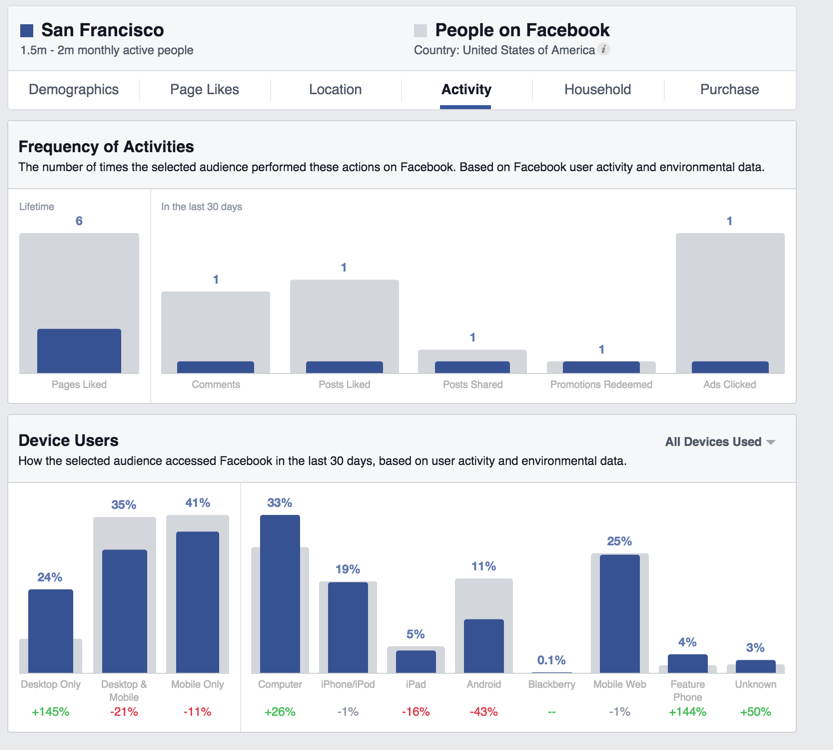
»Using Facebook’s Audience Insights tool (free to anyone who buys Facebook ads), I compared people from San Francisco and Palo Alto/Mountain View to those in New York City, Boulder/Denver and the nation as a whole.
In short, San Francisco / Silicon Valley people don’t click on ads…

San Francisco, California Activity Profile (Source: Facebook)

The average user in the United States has a value of 12 for “Ads Clicked” whereas a San Francisco user has only clicked 1 ad. Similarly, they appear not to be commenting or liking posts as frequently as the median national user. The story is very similar for the Mountain View / Palo Alto audience.«
This is like those people who work at junk food companies who would never eat their own output – they know what goes into it. (Leathern is working on a new approach to web advertising at optimal.com.)
link to this extract


Take video games seriously! Yes, they’re fun, but they matter culturally too » The Guardian

Naomi Alderman:

»Why do video games receive so little coverage in mainstream cultural media? It’s a question that’s troubled me for years – I even made a programme about it for Radio 4. Games are the largest entertainment medium in the world. And yet newspaper culture pages tend not to cover them (pace Observer Tech Monthly). Cultural programmes on TV and radio do a fun segment about games once a quarter at best while reserving discussion and analysis for interpretive dance or experimental opera.

It’s very weird for me: my novels, which sell tens of thousands of copies, are shortlisted for prizes that appear on the news. My games, which have sold millions of copies, don’t make the news. Film and TV Baftas are a news story. Games Baftas are an industry event.

I think this is a shame. It affects the way people think about the medium.«

OK, I’ll bite: a reason games aren’t treated as mattering culturally is because they have very little to tell us about our culture. Take a film like The Big Short or The Revenant or The Martian (the latter perhaps closest, in plot, to a video game).

Besides the mechanics of plot, each takes us into another person’s, or other peoples’, experiences: Steve Carrell’s character in Big Short is consumed by loathing of the vile business, yet unable to withstand the desire to profit from the dumb money. Leonardo Di Caprio’s holds onto life to avenge a death; Matt Damon’s goes through the emotions of loss, resignation, elation, and near-resignation. And like life, each film surprises us but tells us about the human experience.

And where’s the game that could evoke the same emotional reaction as ET – made in 1982 (that’s 34 years ago)?

Just because games sell in large numbers and generate lots of money doesn’t mean they have equivalent status as cultural artefacts as films. Fishing is the most popular (as in “has the most participants”) sport in the UK. Yet you don’t see it reported in newspapers (Fishing Times apart), whereas tennis is.
link to this extract


Why Xiaomi, Lenovo, and Huawei can’t compete with Apple » Tech in Asia

Charlie Custer:

»Chinese handset makers did quite well in 2015. But can they climb that cliff? Could they actually beat out Apple?

No. At least not in the sense of eating into Apple’s specific chunk of the market.

Why? For one, they don’t share a clear target market with Apple. Say what you will about Apple – and I’ve said some bad things in the very recent past – but it knows its market. And so do you, probably. Quick, picture an iPhone user. You’re probably picturing somebody young-ish, urban. Somebody who likes a simple user experience that doesn’t change much from model to model. Somebody who admires good industrial design, and who has the money to fit a $600-$800 phone into their budget.

Now, picture a Huawei user. It’s much harder because they’re all over the place. The prices range quite a bit, and the company offers dozens of different handset models. Lenovo is pretty similar. Even once-simple Xiaomi now offers three different major product lines with a confusing assortment of models in each line (do I want the Mi 4 or the Mi 4i or the Mi 4c?).

That’s not to say that none of these devices have clear target markets, of course, but none of them really overlap with the iPhone market. All three companies offer lower-priced devices, and because of their split focus they really can’t hope to compete with Apple’s single-minded focus when it comes to the iPhone market. They may be able to boost their numbers by picking up more users in developing regions, but none of the three is likely poaching any of Apple’s market anytime soon.

Plus, they’re not competing in the same ecosystem. Technologically speaking, there’s nothing on the iPhone that you can’t get on a dozen Android handsets except for one thing: iOS. And while I’ve argued that a lot of the native iOS apps are getting worse, there’s still no doubt that once a user buys into an ecosystem, it’s difficult to get them out of it.«

link to this extract


2017 to be the year of dual-lens cameras, says Sony » Android Authority

John Dye, noting that Sony has started a separate platform to support dual-lens cameras on phones:

»This seems to line up with some recent rumors trickling through the grapevine that the iPhone 7 Plus will be using a dual-lens camera module. However, Sony was quick to point out that they don’t believe this new form of camera will be anything close to mainstream for at least a year. The high-end smartphone market is slowing down globally. As a result, the demand for smartphone components is slackening, so Sony is banking on this new technology getting a start a little later than we may prefer. Chief financial officer Kenichiro Yoshida put it this way:

»Well, for next year, our so-called dual lens – dual camera platform will be launched by, we believe, from major smartphone players. However, as I said previously, recently, our smartphone market is growing and particularly, our high-end smartphone market is now slowing down. So, that may impact the demand or production schedule of dual camera smartphones by the major smartphone manufacturers. So, we believe the real start, the takeoff of smartphone with dual lens camera will be in the year of 2017.«

«

I read that “takeoff” as meaning “phones that aren’t iPhones”. Fingerprint sensors weren’t mainstream in 2013, but the iPhone 5S had one. And so on. (Though ZTE has a dual-lens camera on its top-end Axon phone, released last year.)
link to this extract


Verizon will now let users kill previously indestructible tracking code » ProPublica

Julia Angwin:

»Verizon says it will soon offer customers a way to opt out from having their smartphone and tablet browsing tracked via a hidden un-killable tracking identifier.

The decision came after a ProPublica article revealed that an online advertiser, Turn, was exploiting the Verizon identifier to respawn tracking cookies that users had deleted.

Two days after the article appeared, Turn said it would suspend the practice of creating so-called “zombie cookies” that couldn’t be deleted. But Verizon couldn’t assure users that other companies might not also exploit the number – which was transmitted automatically to any website or app a user visited from a Verizon-enabled device – to build dossiers about people’s behavior on their mobile devices.

Verizon subsequently updated its website to note Turn’s decision and declared that it would “work with other partners to ensure that their use of [the undeletable tracking number] is consistent with the purposes we intended.” Previously, its website had stated: “It is unlikely that sites and ad entities will attempt to build customer profiles.”«

Not quite a commitment not to track the hell out of you, though.
link to this extract


Errata, corrigenda and ai no corrida: none supplied.

Start up: risky USB-C cables, Google’s travel funnel, Uber’s tax diversion, bye-bye 747, and more

This damn thing was silently eating huge chunks of iOS time – and battery – at least until last October. Photo by edowoo on Flickr.

Last chance this week to sign up to receive each day’s Start Up post by email. You won’t believe what happens next. (OK, you might.)

A selection of 8 links for you. Tested on humans for irritancy. I’m charlesarthur on Twitter. Observations and links welcome.

Google engineer Benson Leung finds a USB Type C cable that isn’t just dangerous on paper — it allegedly fried his hardware » Android Police

Bertel King:

Not all USB Type C cables are created equal. Some charge better than others. A number ignore USB spec so much that they run the risk of actually damaging your hardware. This could happen gradually, or in the worst-case scenario, it could be instant.

Googler Benson Leung has taken on the task of going through Amazon and reviewing whichever USB Type C cables he can get his hands on. We’ve recommended a number of them in past deals, feeling confident that we’re steering readers in the direction of safe accessories. We don’t test these products ourselves, so we consider what he does a real service.

Unfortunately, Leung may be taking an extended break. After plugging Surjtech’s 3M USB A-to-C cable (the item shows up now as not available, but here’s the 1M option you’ll presumably also want to avoid) into his 2015 Chromebook Pixel and two USB-PD Sniffer devices, he says the latter failed immediately. Resetting the analyzer and reflashing the firmware did not bring the hardware back to life.

Shouldn’t there be a proper certification system for USB-C? Having to rely on one Google engineer seems barmy. Especially in light of this.
link to this extract


Facebook’s iOS bug led ComScore to overestimate time spent » AdAge

Tim Peterson, on a rejigging after it was realised that Facebook’s app used all sorts of trickery on iOS to make itself appear to be active (silent audio, etc) to the OS:

When looking at Facebook’s iPhone app specifically, total time spent [after some of the bugs – but note, not all – were fixed] was 40% lower in November compared to September [before the fix], and the average amount of time spent per person was 41% lower. For Facebook’s iPad app, total time spent was 39% lower, as was the average amount of time spent per person.

For comparison, total time spent in Facebook’s Android app increased by 2% and average time spent per user was flat when comparing September and November; ComScore’s Android figures are considered more reliable than its iOS figures because the firm is only able to take into account activity when the app is running in the foreground.

A Facebook spokeswoman declined to comment.

Amazing – Facebook’s iOS app really was the spawn of the devil in the way it abused battery life through to October 2015. (And it’s hardly innocent now.)

That up-to-October period includes a lot of testing of new iPhones “in real-life situations” by gadget reviewers, as it happens.
link to this extract


Google revamps travel search queries, almost making web results irrelevant » Search Engine Land

Barry Schwartz:

Google has quietly revamped the mobile user interface for travel-related searches. The result of the change makes it really hard to get to the organic web results once you click on the “more destinations” button. Let me walk you through the experience.

This is called “thrusting the user head-first into the sales funnel”.
link to this extract


Why the sun is setting on the Boeing 747 » The Conversation

Guy Gratton:

Today, the industry has moved towards twin-engine aeroplanes such as the Boeing 777 and the Airbus A330, with three-engine aeroplanes being relatively unpopular because of the high labour costs of working on an engine bedded into the aeroplane fin. The four-engine 747 retained a clear place in the market because twin-engine planes must stay within a certain distance from an airport in case of engine failure. This allowed the 747 to achieve shorter journey times on the longest routes because it can use more direct flight paths.

However, improving engine reliability means authorities have slowly increased the distance a twin-engine airliner can fly from a runway, gradually reducing the advantage of having four engines. And of course, those newer, more reliable engines have also been bigger and more efficient.

Of course, the slowdown in 747 production doesn’t mean the original jumbo jet will disappear from our skies just yet. The latest models are much longer, bigger and operate with more modern engines and instruments than the earlier 747-100s (no longer do the crew have to take sextant readings through the cockpit roof), and the newer aircraft are likely to stay in service for at least another 20 years.

Then: “Where’s the sextant?”
Now: “Where’s the sextant app?”
link to this extract


Uber’s Dutch businesses had zero employees in 2013 » Business Insider

Oscar Williams-Grut:

A European member of parliament has accused Uber’s European business of being “specifically designed, from the start, to reduce its tax liabilities.”

Labour’s Anneliese Dodds made the comment to Business Insider over email after we pointed out that two Dutch companies closely involved in running Uber’s UK business had no employees for up to a year after it launched here.

Uber employed eight people in its Amsterdam offices in 2013. But the corporate entity that immediately controlled the UK operation had none.

*grinds teeth* We’re now at the stage where if an American tech company pays more in tax than the average Briton we’re shocked.
link to this extract


The end of Twitter » The New Yorker

Joshua Topolsky:

what should worry Twitter isn’t the value of its stock. (USA Today reported that, given its cash reserves, the service could run for another four hundred and twelve years with current losses.) What should worry Twitter is irrelevance, and there is growing data to suggest that that is where the company is headed. If Twitter’s real-time feed is its most powerful asset (and it is), it’s not difficult to see a future in which Instagram, Facebook, Snapchat, or even a newcomer like Peach (yes, I am citing Peach) focus enough on real-time news that they obviate the need for Twitter’s narrow, noisy, and oft-changing ideas about social interaction. Considering the fact that Kevin Weil, the head of product, left the company to join Instagram, it’s easy to imagine that service mutating or bifurcating into a speedier, more social platform for sharing links and having conversations. And, for many users—particularly young users, according to a recent survey—Snapchat is already their most important destination. We live in the Age of the Upgrade, and the generation raised on the Internet is the most fickle of brand champions: it loves something passionately, until it doesn’t. Then it moves on.

Ultimately, Twitter’s service is so confused and undifferentiated in the market that it’s increasingly difficult to make a clear case for its existence.

That’s not quite right; it’s more that lots of other services have come along and do similar things (text, pictures, links) but Twitter has always had the focus on The Moment – that it is the place where you see the world unfold, if the world cooperates. Nowhere else can do that.
link to this extract


Why Alto’s Adventure will be free on Android » The Verge

Andrew Webster:

According to both [Ryan] Cash [of development company Snowman] and Noodlecake’s Ryan Holowaty, one of the main reasons they decided to make the game free on Android is piracy. “Piracy on Android is a much bigger issue on the platform especially in the case of premium iOS titles that charge more than $0.99,” Holowaty explains. When Noodlecake ported iOS game Wayward Souls to Android, for example, the studio found that only 11% of installed copies of the game were paid for. The studio even uploaded a special version of its game Shooting Stars on a number of torrent sites as an experiment, one that couldn’t be completed if you were playing a pirated copy.

There were also factors outside of piracy that contributed to the decision. “It made sense to us because of the state of mobile gaming and the reality that the vast majority of players do not pay for games,” says Holowaty. “In addition, Android has a much larger install base than iOS internationally, and games that release in countries like China and Japan are basically free-to-play only at this point. So to really capitalize on the market internationally, it made sense to have a free version.”

That’s Alto’s Adventure, which was released 12 months ago on iOS. Does anyone monitor how long it takes games and other non-platform apps to reach Android from iOS?
link to this extract


Regulators are failing to block fraudulent adverts » FT.com

John Gapper:

Malware robots — “bots” in advertising jargon — are estimated to sit on 10 per cent of home computers in the US, browsing away in the background while the owners do other things, or sleep.

Second, the world of programmatic advert buying and selling is highly automated and bafflingly complex, filled with layers of intermediaries doing slightly different things for commissions. An advertiser places adverts through an online network contracted by its media buying agency. The network may find inventory on which to place them on an exchange such as Google’s DoubleClick Ad Exchange, into which thousands of publishers plug.

That is the simple version. There are more obscure ways to do it, enabled by automation and the internet. The result is that no one knows everyone with whom they trade, or can be sure where ads end up being shown. This makes it easy for fraudsters to infiltrate and infect the advertising supply chain.

Third, companies are desperate. The economics of digital publishing are under severe strain, with publishers being paid small amounts for millions of page views. They need traffic and some are tempted into buying it from brokers that can mysteriously rustle it up. Such publishers look the other way rather than delving too deeply into where the traffic comes from.

I’m currently reading The Big Short, Michael Lewis’s book about the people who realised – slowly but with growing horror and delight – that the bond market built around US subprime mortgage loans was unsustainable, and began to bet against it (“shorting” it). The film derived from the book is fabulous. Go and see it.

Reading the book, you try to think like those people: to look for opportunities in giant, unsustainable businesses whose precise workings aren’t really understood and whose collapse is inevitable, yet which the participants (with an interest in its continuation) insist is fine and dandy.

The online ad business begins to look like that to me.
link to this extract


Errata, corrigenda and ai no corrida: none notified.

Start up: Google’s ad stop, hacking phishers, the lost phone mystery, the adblocking browser and more

A game with these will give you an insight into production processes. Photo by judy_and_ed on Flickr.

You can now sign up to receive each day’s Start Up post by email. You’ll need to click a confirmation link, so no spam.

A selection of 10 links for you. Use them wisely. I’m charlesarthur on Twitter. Observations and links welcome.

Why is your team falling behind? Ask ‘The Penny Game’ » Atomicobject

Eric Shull:

The book Velocity describes an enlightening simulation, a model of a simple manufacturing line. The game uses pennies and dice to represent pieces of work flowing through stations in a factory. It may be simple, but the penny game can improve our understanding of how software teams work, how the interaction of variable processes affect the system as as whole.

In the penny game, pennies come in at one end of the line, are processed by each station, then exit at the other end. This would be rather mundane but for one complication: each station does not always process the same number of pennies.

In the simulation, rolled dice indicate how many pennies each station is allowed to move.

This is fascinating – and gives you real insight into the problems that have to be overcome in manufacturing to tight deadlines. Imagine now if you were processing millions of “pennies”, except they were phones.
link to this extract


Google disabled 49% more ads in 2015 » WSJ Digits blog

Alistair Barr:

More than 1,000 of Google’s 60,000 employees monitor and remove ads, an important task because the company gets about 90% of its revenue from advertising. It’s also been hit financially for not adequately monitoring ads. In 2011, the company agreed to pay $500m to settle allegations by the U.S. Department of Justice that ads for Canadian online pharmacies contributed to the illegal importation of prescription drugs. In the settlement, Google acknowledged it acted “improperly.”

Google blocked more than 12.5m ads in 2015 for drugs that were unapproved or that made misleading claims, up from 9.6m a year earlier.

Ads making misleading weight-loss claims were a big source of user complaints last year, prompting Google to suspend more than 30,000 websites from its ad systems. It declined to give a comparable number for 2014.

Rob Leathern has the growth figure for ad disabling: it’s growing by 50% annually, but still a long way short of catching them all.
link to this extract


How I stumbled upon thousands of Facebook passwords » Medium

“Rukshan”, a Colombo-based medical undergrad and hacker, received a Facebook phishing email and twiddled around with the phishing page:

after modifying the url I checked the folder which contained the php script that handles the post requests and I knew at that moment I hit the jackpot.

There was no index.html file to make sure no one else see the files in that directory or any .htaccess modification, well like I said phishing people are too bored to do all these tech stuff anyway, they’d rather get the passwords and go away.

So I opened the password.html file and I was greeted to the sight of hundreds of Facebook passwords, and by looking at the credentials one there was a pattern:

•Almost all of these accounts belonged to girls who are in their early 20s or teens.
• Almost all of the accounts belonged to females who are from Colombo.

Neat idea; neater still would be to wipe the files. But that would be one sizeable hack further (and probably illegal).
link to this extract


Why don’t you have an Android version? (Or why we develop for iOS first) » Impossible Ventures

Joel Runyon:

Android users may download more apps, but they spend less money than iTunes users.

But that’s not just fake studies either, in our experience with Paleo (io) – a top 20 app in iTunes and ranked even higher in Google Play – we make about 3x the sales on our iTunes listing as we do on Google Play (even though we have a higher ranking in Google Play than iTunes).

Which brings me to the next point: apps are not free to make.

As an app developer, you have to spend time & money on this concept that you have in your head to bring it to reality. The  MVP on an app can cost anywhere between $2k and $20k to build and launch. It might not seem like much if you spend all your time raising VC money and have a $1M+ in the bank, but it can add up if you’re bootstrapping.

In fact, with every dollar you spend, there’s a very real cost (along with another equally as real, opportunity cost).

Of course the argument is completely different in Asia, where it’s generally Android-first (except in Japan, and who knows in China?).
link to this extract


Finding the tennis suspects » Medium

Russell Kaplan, Jason Teplitz, and Christina Wadsworth:

The tennis world was sent reeling when BuzzFeed News and the BBC jointly published The Tennis Racket, which revealed “evidence of widespread match-fixing by players at the upper level of world tennis”. But BuzzFeed refused to publish the names of those players.

We dove into the data and found the names ourselves.

Unless you follow tennis really closely you won’t have heard of any of the names but one, and I do wonder if that one is thrown up by some weird quirk of the analysis. Seems robust, though. I think this might dissuade players – and administrators – from trying to hide this in future, knowing that there are people analysing public data for oddities. Will it put off the gamblers, though?
link to this extract


Why do people keep coming to this couple’s home looking for lost phones? » Fusion

Kashmir Hill:

It started the first month that Christina Lee and Michael Saba started living together. An angry family came knocking at their door demanding the return of a stolen phone. Two months later, a group of friends came with the same request. One month, it happened four times. The visitors, who show up in the morning, afternoon, and in the middle of the night, sometimes accompanied by police officers, always say the same thing: their phone-tracking apps are telling them that their smartphones are in this house in a suburb of Atlanta.

But the phones aren’t there, Lee and Saba always protest, mystified at being fingered by these apps more than a dozen times since February 2015. “I’m sorry you came all this way. This happens a lot,” they’d explain. Most of the people believe them, but about a quarter of them remain suspicious, convinced that the technology is reliable and that Lee and Saba are lying.

“My biggest fear is that someone dangerous or violent is going to visit our house because of this,” said Saba by email. (Like this guy.) “If or when that happens, I doubt our polite explanations are gonna go very far.”

It’s billed as “a tech mystery”, and it really is.
link to this extract


Brave is the name, ad-blocking the game of new browser » Computerworld

Former Mozilla CEO (for 11 days) Brendan Eich is behind a new browser for desktop and mobile which blocks all ads and tracking by default:

“We are building a new browser and a connected private cloud service with anonymous ads,” Eich said.

In effect, Brave will first scrub websites of most of their ads and all tracking, then replace those ads with its own. But the latter will be aimed not at individuals but at the anonymous aggregate of the browser’s user base. If enough people gravitate to the browser, Brave will share its ad revenue with users and content publishers.

“We will target ads based on browser-side intent signals phrased in a standard vocabulary, and without a persistent user id or highly re-identifiable cookie,” Eich said. “By default Brave will insert ads only in a few standard-sized spaces. We find those spaces via a cloud robot.”

No user data will be recorded or stored by Brave, Eich promised.

Elsewhere, Eich said that 55% of Brave’s revenue would be shared with site publishers, and 15% with users, who could then turn that money over to their favorite sites or keep it.

Al Hilwa, an analyst with research firm IDC, applauded the concept of creating an alternate revenue stream from traditional advertising, but wondered whether the browser could compete, even in the niche that Eich described. “This is a laudable idea, but fighting ‘free’ is always risky,” said Hilwa in an email reply to questions.

Not sure the world has an appetite for a new browser, but one can envisage adblocking becoming built in and then enabled, just as pop-up blocking in browsers went from “pop-up what?” to “optional” to “on by default”.
link to this extract


Apple pushes to bolster market share in India » WSJ

Newley Purnell:

India’s smartphone market is expanding quickly and by next year it should overtake the U.S. as the world’s second-biggest behind China, according to research firm IDC.

Just 35% of mobile phones sold in India now are smartphones, meaning there is room for growth as people upgrade from basic devices. Indian consumers, however, tend to purchase inexpensive devices: The average smartphone selling price in the country is likely to fall to $102 in 2018 from $135 in 2014, IDC says.

Apple’s problem has been that the sweet spot for smartphone sales in India has been handsets that cost less than $150. In a country where the average person earns about $1,500 a year and even middle-class consumers make less than $8,000 a year, the standard iPhone — which usually costs between $500 and $1,000 without a data plan — was just too expensive for most people to consider.

“Buying an iPhone is so expensive,” said Sakshi Maurya, a 20-year-old university student in New Delhi. She said she doesn’t understand why an iPhone is five times as expensive as some locally available Android phones. “It’s a luxurious thing.”

India poses a particular marketing challenge for Apple: it’s a mixture of very tech-savvy buyers and low-income buyers. Which does it target first, and how?
link to this extract


iPhone 6S/6S Plus underperform year-ago sales » Consumer Intelligence Research Partners

CIRP finds that the new iPhone 6s and 6s Plus accounted for 67% of total US iPhone sales, with iPhone 6s at 48% and iPhone 6s Plus at 19%. In the December 2014 quarter, iPhone 6 and 6 Plus accounted for 75% of total US iPhone sales with 30% iPhone 6 Plus.

“The iPhone 6s and 6s Plus did quite well,” said Josh Lowitz, CIRP Partner and Co- Founder. “Yet, they did not dominate the same way that iPhone 6 and 6 Plus did a year ago. The total share of the new flagship models fell below the share of the then-new phones in 2014, and the large-format iPhone 6s Plus share of sales dropped compared to the iPhone 6 Plus as well. Customers continue to choose the year-old iPhone 6 and 6 Plus, and even the two-year old iPhone 5S.”

CIRP can’t say whether total sales are higher or lower (it samples 500 buyers of Apple devices in the previous quarter), just the mix. This looks like a subtle price deflation of the iPhone as people opt for 2014’s models over 2015’s – after all, they look the same to other people, even if the newer models has extra features.
link to this extract


Issue 3434 – android – Add APIs for low-latency audio – Android Open Source Project – Issue Tracker

On Tuesday, Apple released its “Music Memos” app, which is intended to let musicians (of any standard) record little musical thoughts that come to them on the guitar or piano directly to their iPhone or iPad, and add musical accompaniment.

Android doesn’t have that, because as has been noted here before its audio latency is too long – over 10 milliseconds, which is the longest pro musicians can bear. So how long have developers been prodding Google to improve Android’s audio latency?

I am developer of real-time audio signal processing applications. I am interested in creating
applications for sale in the android marketplace, but found that android has no method for real-
time low latency audio.

This is the first entry in a bug/feature request which continues to the present (latest entry is June 2015). The date of the entry? July 31, 2009 – slightly over nine months after the first Android phone. Is six and a half years a long time for a feature request to lie open? (And here’s Google’s official list of device latencies. Look for any at 10ms or below.)

Apple effectively gets 100% of the professional audience through this feature.
link to this extract


Errata, corrigenda and ai no corrida:

Start up: writing clickbait, search v the law, IAB disses AdBlock Plus, Android’s future in 2010, and more

Bitcoin: a failed experiment, or still going strong? Photo by portalgda on Flickr.

You can now sign up to receive each day’s Start Up post by email. You’ll need to click a confirmation link, so no spam.

A selection of 12 links for you. Use them wisely. I’m charlesarthur on Twitter. Observations and links welcome.

The resolution of the Bitcoin experiment » Medium

Mike Hearn:

Why has Bitcoin failed? It has failed because the community has failed. What was meant to be a new, decentralised form of money that lacked “systemically important institutions” and “too big to fail” has become something even worse: a system completely controlled by just a handful of people. Worse still, the network is on the brink of technical collapse. The mechanisms that should have prevented this outcome have broken down, and as a result there’s no longer much reason to think Bitcoin can actually be better than the existing financial system.

Hearn’s article – in which he describes how he has gone from being an enthusiast and believer who left a safe job at Google to work on bitcoin – points to a looming problem: Chinese miners control over 50% of mining capability (the level where fakery becomes possible) and new proposals on fee payments could lead to transaction reversals.

I haven’t seen any adequate rebuttals of Hearn’s post (there are lots of ad hominem “don’t let the door hit you on the way out” responses, or others saying “everything’s GREAT, shuddup”), though this by “Bit Credit” makes a vague attempt. It also contains this passage:

from an economic interest it makes no sense to undermine bitcoin by fracturing it. And so surprise, suprise, bitcoin participants are making rational economic decisions. Bitcoin is not a democracy where 51% rules. In fact that is Bitcoin in a state of attack.

Bitcoin isn’t a democracy, in that its rules are determined by the core developers. But it is a democracy in that if 51% of miners start mucking about, bad things happen. And “attack”? Odd choice of word.
link to this extract


How Peach onboards new users » User Onboarding

Peach is the darling of the app world right now, and their onboarding has been heralded as one of the best ever from a newcomer. Care to see why?

Without further ado, here is…

How Peach Onboards New Users

Well, it has sort of fallen out of “darling” status, but any app designer will learn from this – especially the “what is this? What does that word mean? Am I saying this to the whole world? HELLPPP!” It is 120 slides, but easy to click through.
link to this extract


‘Shocking celebrity nip slips’: secrets I learned writing clickbait journalism » Broadly

Kate Lloyd:

Laura, another celebrity journalist who has worked online for popular tabloids, explains there are other times when she has had to sex up stories about celebrity women who weren’t even trying to be especially provocative. “You could do a red carpet round-up of ‘all these women look great in these dresses’ but you’d change it to ‘plunging necklines’ or ‘high splits,'” she explains. “Marriage announcements would be sexed up with ‘cleavage enhancing’ or ‘revealing’ outfit descriptions. You’d add in words like ‘nip slip’ even if nipples are nowhere near having a slip because that’s what people are searching for. It was literally just for SEO, and it was soul destroying.”

One journalist told me she worked on a site where every picture of a female celebrity — including those in full coverage outfits — was tagged with the word ‘panties.’

While you’re groaning at clickbait “shows her ex what he’s missing in tiny bikini” headlines, there’s a whole new level of trickery that lurks behind them. For example, a female celebrity recently posed for a tasteful set of nude photos with a glossy magazine, who published the story with an empowering, “you go girl!” headline. The page’s URL, however, was a chain of sexy keywords that simply ended with “nude-photos.” Things get especially murky once you delve even deeper into the behind-the-scenes sorcery. One tabloid journalist told me she worked on a site where every picture of a female celebrity—including those in full coverage outfits—was tagged with the word “panties.” I’ll also admit to using the phrase “nearly-naked” in headlines just to hit the search term “naked”.

And just when you’re wondering what the world would look like if women were in charge of search engine algorithms:

…Tabloid journalist Laura explains that while the amount of sexualized content about women isn’t decreasing, she’s starting to produce more sexualized content about men.

link to this extract


A few keystrokes could solve the crime. Would you press enter? » Just Security

Jonathan Zittrain:

Suppose a laptop were found at the apartment of one of the perpetrators of last year’s Paris attacks. It’s searched by the authorities pursuant to a warrant, and they find a file on the laptop that’s a set of instructions for carrying out the attacks.

The discovery would surely help in the prosecution of the laptop’s owner, tying him to the crime. But a junior prosecutor has a further idea. The private document was likely shared among other conspirators, some of whom are still on the run or unknown entirely. Surely Google has the ability to run a search of all Gmail inboxes, outboxes, and message drafts folders, plus Google Drive cloud storage, to see if any of its 900 million users are currently in possession of that exact document. If Google could be persuaded or ordered to run the search, it could generate a list of only those Google accounts possessing the precise file — and all other Google users would remain undisturbed, except for the briefest of computerized “touches” on their accounts to see if the file reposed there.

A list of users with the document would spark further investigation of those accounts to help identify whether their owners had a role in the attacks — all according to the law, with a round of warrants obtained from the probable cause arising from possessing the suspect document.

So, if you’re the person receiving the search request at Google, should you run it? Zittrain takes you around the back-and-forth, which is subtle.
link to this extract


The Long Goodbye » Anne Wheaton dot Com

Anne Wheaton:

I chose to be on Twitter. I am not a celebrity. I am a middle-aged woman who’s a retired hairdresser who now runs a non-profit, is on the Board of Directors at Pasadena Humane Society, has a house FULL of rescue animals, and has two wonderful boys. I do not have a job I need to promote, nor am I looking for a job to take on. I have a full life with an amazing husband and family, wonderful friends, and a successful business I run. If something I choose to do on the side isn’t fun, I need to walk away from it because my free time is pretty scarce. Twitter used to be the fun thing I did on the side, and for the most part, it just isn’t fun anymore, so I need to walk away from it and that’s okay.

I deleted my Twitter account last night and immediately felt relieved.

She’s married to Wil Wheaton, who has been anti-Gamergate, on the basis that reasonable people don’t abuse women and other people pointlessly and unceasingly. Increasingly, Gamergate strikes me as Twitter’s id; untrammelled raging male idiocy, which is never reined in by any form of superego (such as “is this really a good idea?”). And the concern is that that superego will never arrive. (Another thought is that with American politics becoming increasingly polarised, Gamergate backers are more aligned with the extreme Republican line of thinking, and certainly with its refusal to engage with any other viewpoint.)

Read her post from April on how quickly just “being a woman on Twitter” turned into “being someone at whom people post random, vicious, worrying things for no other reason than to be vicious and worrying.”
link to this extract


Web-based OAuth is a security nightmare for apps » Terence Eden’s Blog

You know those apps where you go in and it asks you to authorise it using Twitter or whatever? Eden doesn’t like them:

In Periscope’s case, the user has to trust that the app hasn’t just ripped-off the Twitter website. There’s absolutely no way to verify that it is a genuine and secure login page.

Even if you have 2-Factor Authentication (where Twitter texts you a login code) you’re not safe. Why? Because if the app is intercepting your username and password, it can also intercept your 2FA code. Sure, it can only use it for a minute or so (with some restrictions) – but that’s enough time to completely take over your account.

As software developers, we have to stop encouraging this anti-pattern. Periscope is teaching users that it’s OK to type their password into any box which looks like it’s authentic.

link to this extract


IAB dis-invites us, disses compromise and buries dissent » Adblock Plus

Ben Willians:

Adblock Plus has some very good relationships within the IAB (Interactive Advertising Bureau), which is the trade organization that represents advertisers and publishers. We coach many IAB members about our Acceptable Ads guidelines for reasonable, nonintrusive ads, and we have spoken on some IAB panel discussions (especially in the UK).

Unfortunately, the top brass at the US IAB don’t want us coming to their Leadership Summit next week in Palm Desert, California. We attended last year, and we signed up again for their 2016 meeting … including paying the hefty entrance fee. We were fully confirmed and they even listed us on their website as a participant.

Then this week we got one of those sudden emails that land in your inbox innocently, then floor you with something weird, unbelievable or ridiculous when you click on them. This one came from an unfamiliar IAB address, and it informed us that our registration for the summit was canceled and our fee refunded.

The IAB hasn’t said anything about why, as of the time of this post. Apart from a statement which said that “The IAB Annual Leadership Meeting is for serious conversation among important digital industry stakeholders.” Does it think adblocking isn’t serious, or isn’t important?
link to this extract


There are no secure smartphones » Devever

Hugo Landau:

There are no secure smartphones.

This is a simple fact which is overlooked remarkably often.

Modern smartphones have a CPU chip, and a baseband chip which handles radio network communications (GSM/UMTS/LTE/etc.) This chip is connected to the CPU via DMA. Thus, unless an IOMMU [input-output memory management unit] is used, the baseband has full access to main memory, and can compromise it arbitrarily.

It can be safely assumed that this baseband is highly insecure. It is closed source and probably not audited at all. My understanding is that the genesis of modern baseband firmware is a development effort for GSM basebands dating back to the 1990s during which the importance of secure software development practices were not apparent. In other words, and my understanding is that this is borne out by research, this firmware tends to be extremely insecure and probably has numerous remote code execution vulnerabilities.

Thus, no smartphone can be considered secure against an adversary capable of compromising the radio link (called the Um link). This includes any entity capable of deploying Stingray-like devices, or any entity capable of obtaining control of a base station, whether by hacking or legal or other coercion.

It would, in my view, be abject insanity not to assume that half a dozen or more nation-states (or their associated contractors) have code execution exploits against popular basebands in stock.

Question then is how far up the stack you can get from the baseband.
link to this extract


August 2010: Android’s pursuit of the biggest losers » Asymco

Horace Dediu, writing back in the days when Nokia and Sony Ericsson made handsets, and BlackBerry was big, noting that LG and Motorola and Sony Ericsson had lost money, though Samsung was doing OK:

how likely are these disrupted ex-giants to recover and take Android forward? My bet: slim to none. Android does not offer more than a lifeline. It is not a foundation for long-term profitability as it presumes the profits accrue to the network and possibly to Google. Profit evaporation out of devices to Google may be a possibility at some time in the future, but only if the devices don’t need too much attention to remain competitive. But because they’re still not good enough (and they won’t be for years to come), it’s certain that attention to detail is what will be most important to stay abreast of Apple.

So here we have the real challenge to Android:  partnership with defeated incumbents whose ability to build profitable and differentiated products is hamstrung by the licensing model and whose incentives to move up the steep trajectory of necessary improvements are limited.

In other words, Android’s licensees won’t have the profits or the motivation to spend on R&D so as to make exceptionally competitive products at a time when being competitive is what matters most.

He also points out that Windows Mobile had the same problem, seven years earlier.

Five years later, the point about long-term profitability and R+D is being borne out. Only Samsung has managed to stay profitable – because of its components businesses.
link to this extract


Xiaomi finally releases 2015 sales stats » Tech in Asia

Erik Crouch:

The case of the missing phone statistics has finally been solved – today, Xiaomi revealed that it sold 70m smartphones in 2015, a number below even their most modest predictions.

It’s been apparent for a while that something went wrong for Xiaomi in 2015. In 2014, the company predicted that they would sell 100m phones in the coming year – an estimate that was promptly bumped down to 80m last March.

When late 2015 rolled around, and China’s techies eagerly awaited the company’s sales report, they were met with silence. CEO Lei Jun talked in December about how the company “does not emphasize goals such as smartphone sales anymore,” which certainly didn’t build anyone’s confidence that the company had met its targets.

As Crouch notes, 2016 could be make or break. With China’s smartphone market slowing down, it really needs to find something fresh.
link to this extract


Delicious changes » The Official Delicious Blog

Delicious was the original bookmarking service (admit it, you thought it had just vanished):

My name is Tony Aly, and I’m the CEO of Delicious Media, a new company formed in alliance between my company, Domainersuite, and Science, the company that has managed Delicious since 2013. Science has transitioned control of Delicious to our new entity so that my team and I can dedicate ourselves to the long-term success and stability of this wonderful, useful, trailblazing site.

As part of this transition, over the next few weeks, we will be a making a few fairly prominent changes to the site.

The first big change you’ll notice is our transition from the javascript front-end framework that has been powering the content at https://www.delicious.com. The engineers who crafted this version of the site are incredibly talented, and their code is amazing. It’s beautiful and powerful, but it has posed several significant challenges for us. For example, the search engines have a real problem reading our content, hindering users’ efforts to use Google or Bing to find what they’re looking for on Delicious.

Translation: “damn engineers.” Except what’s the point of search engines indexing a bookmarking site? Delicious has been through so many changes of ownership – bought by Yahoo in 2005, then sold to YouTube’s founders, then sold on and on. Never quite manages to regain momentum. I use Pinboard – reliable, cheap, doesn’t mess about. And has a terrific Twitter feed.

For what might have been, read Bobbie Johnson’s article from 2005 about Yahoo buying Delicious.
link to this extract


Wikipedia: an old-fashioned corner of truth on the internet » Telegraph

I wrote about Wikipedia’s 15th birthday (on Friday), and largely I have nothing but applause for its approach that anyone could write or edit, and its pursuit of the “neutral point of view”, and (especially) its ad-free ethos. Though:

That’s not to say it’s without faults. There are plenty, some deeply ingrained. Most of its editors are male, meaning topics relevant to women are underrepresented. As the site (and each editor) ages, it becomes harder to attract new editors as the existing clique becomes embedded. With no overall editor determining its direction or content, the topics and content can vary enormously. The world probably doesn’t need zillions of explanatory articles about the Japanese video game franchise Pokemon – but perhaps could do with some of the articles about less-simple concepts being rewritten to a more novice-friendly standard. That’s what the Encyclopaedia Britannica had that Wikipedia doesn’t: consistency.

But that’s also the web revealing our real character. Those who can be bothered to create are more interested in Pokemon than explaining maths or science. We peer into Wikipedia, and see ourselves peering back.

link to this extract


Errata, corrigenda and ai no corrida: none noted.

Start up: smartphone v cars, Oracle v Android, Korea’s browser problem, flat design woes, and more


Sony’s Project Morpheus in action. But how many PCs can run this stuff? Photo by wuestenigel on Flickr.

You can now sign up to receive each day’s Start Up post by email. You’ll need to click a confirmation link, so no spam.

A selection of 10 links for you. Use them wisely. I’m charlesarthur on Twitter. Observations and links welcome.

Fun fun fun ’til her daddy takes the iPhone away » ROUGH TYPE

Nick Carr:

“A smartphone can get you a ride but a car can’t get you a date,” blogged venture capitalist Fred Wilson, revealing a remarkable ignorance of the entire modern history of youth culture. “The smartphone wins.”

Wilson’s words were inspired by a November 2013 interview with another prominent VC, Marc Andreessen. America’s love affair with the automobile is over, Andreessen declared. As evidence he pointed to a putative sea change in young people’s attitudes toward cars: “Today, ask kids if they’d rather have a smartphone or a car if they had to pick and 100% would say smartphones. Because smartphones represent freedom. There’s a huge social behavior reorientation that’s already happening.” I’ve never found financiers to be reliable guides to what kids are up to, but in this case Andreessen was just recycling a view that has achieved meme status in recent years: Americans are losing their taste for driving, and that trend is particularly  pronounced among the young.

At about the same time Andreessen was opining about how young folks love their tech but don’t give a crap about their wheels, MTV was launching an extensive survey of the attitudes of millennials. The network interviewed nearly 4,000 people between 18 and 34. One of the topics discussed was cars and driving.

Now, guess whether the survey – of thousands of real people – backed up Wilson’s opinion.
link to this extract


Education and underemployment in the age of machine intelligence » Brookings Institution

Daniel Araya (a researcher and advisor to the US government):

what is the role of education in the age of machine intelligence? Even a cursory analysis of educational reform in the United States reveals a deep concern with transforming the education system in the face of systemic economic and social change. It has become painfully clear, for example, that our current education system is not equipped to mitigate the scale of labor dislocation we may soon face. In my view, the most obvious problem with U.S. educational reform today is a misplaced focus on mobilizing systems of measurement and conformity in an era that demands risk and experimentation. The underlying problem is that “factory schools” have evolved from older institutions designed for a different era.

Beyond the bureaucratic systems of the Industrial Age, students must be better prepared to leverage autonomous creativity to solve real-world problems. Beyond basic numeracy and literacy, advanced competencies that build on network collaboration, digital fluency, and entrepreneurial innovation are now foundational to economic mobility. The real challenge today, in other words, is to transform the institutional and pedagogical structures that constitute schooling. Rather than framing educational reform in terms of the needs of a mass industrial society, educational policies must now adapt to the needs of a highly disruptive computational economy.

Sure, but who’s going to tear Americans away from their block-rote testing?
link to this extract


Few computers are powerful enough to support virtual reality » Bloomberg Business

Ian King:

Virtual reality has a very real problem. With several technology giants preparing splashy introductions for the first VR headsets in 2016, few people own hardware capable of fully supporting Facebook’s Oculus Rift or other systems.

Just 13m PCs worldwide next year will have the graphics capabilities needed to run VR, according to an estimate by Nvidia, the largest maker of computer graphics chips. Those ultra-high-end machines account for less than 1% of the 1.43bn PCs expected to be in use globally in 2016, according to research firm Gartner.

And yet IHS estimates that 7m VR headsets will be in use by the end of this year. Seems like a high penetration of those 13m PCs. (And I don’t hold out much hope for HTC/Valve’s effort to save HTC, given its $1,500 price.)
link to this extract


Oracle sinks its claws into Android » Andreas Gal

Gal is the former CTO at Mozilla, and was involved in its efforts with Firefox OS, so he knows his stuff:

While I am no longer working directly on mobile, a curious event got my attention: A commit appeared in the Android code base that indicates that Google is abandoning its own re-implementation of Java in favor of Oracle’s original Java implementation. I’ll try to explain why I think this is a huge change and will have far-reaching implications for Android and the Android ecosystem.

This quickly gets very complicated, hinging on the variations between the GPL, LGPL, GPLv2 and Apache licences. Read alongside this piece at Venturebeat, which has comments from Google.

Upshot seems to be: Oracle gets to dictate some future direction of Android’s Java; app developers who don’t update could see more crashes.
link to this extract


Issue 693 – TrendMicro node.js HTTP server listening on localhost can execute commands » Google Security Research

Tavis Normandy, on the security mailing list:

When you install TrendMicro Antivirus on Windows, by default a component called Password Manager is also installed and automatically launched on startup.

http://www.trendmicro.com/us/home/products/software/password-manager/index.html

This product is primarily written in JavaScript with node.js, and opens multiple HTTP RPC ports for handling API requests.

It took about 30 seconds to spot one that permits arbitrary command execution, openUrlInDefaultBrowser, which eventually maps to ShellExecute().

This means any website can launch arbitrary commands, like this:

x = new XMLHttpRequest()
x.open("GET", "https://localhost:49155/api/openUrlInDefaultBrowser?url=c:/windows/system32/calc.exe true);
try { x.send(); } catch (e) {};

(Note that you cannot read the response due to the same origin policy, but it doesn’t matter – the command is still executed).

Trend Micro reacted quickly, but it turns out this is only the first layer of a stinky security onion.
link to this extract


Pray to Microsoft: Google, Microsoft to stop technical support for older operating systems, browsers » BusinessKorea

Cho Jin-Young:

Google announced on January 11 that it would stop providing security for the Chrome browser on the older versions of the Windows including the Windows XP and the Windows Vista. Earlier, Microsoft said that its technical support for the older versions of the Internet Explorer would be stopped soon. Under the circumstances, Web users in Korea are getting more and more nervous.

At present, more than 80% of them are using Microsoft’s PC operating systems and 30% to 40% of them are using the older versions of the Internet Explorer. Besides, a number of public organizations in Korea are still heavily dependent on the IE, which means they are very vulnerable to security threats. In order to be free from the concerns, users of the Windows 7 and above are required to upgrade their IE to IE 11 or use the other browsers including Chrome, FireFox and Safari.

Problems are complicated for Windows XP and Windows Vista users though. The Chrome browser is unavailable on these operating systems from April this year since Google is going to stop its security update from that month.

People think of South Korea as super-sophisticated because it has really fast broadband. But it relies on absolutely ancient browsers which are vulnerable to all sorts of malarkey. This is going to cause some big problems as they’re either forced to shift or get hacked to hell and back.
link to this extract


Long-term exposure to flat design: how the trend slowly makes users less efficient » Nielsen-Norman Group

Kate Meyer:

To know where they can click on a website, users need signifiers: perceptible clues that help them understand how to use interfaces. Blue underlined text is an example of a traditional signifier of a clickable link that even the least experienced web users understand.

In the old days of rampant skeuomorphism and realism in web design, users were generally able to rely on obvious — but often ugly — signifiers of clickability (such as glossy, raised effects on buttons, or inset shadows that made input fields appear empty). Even though these signifiers varied from site to site, users could usually rely upon two assumptions:

• Elements with strong signifiers were probably clickable.
• Elements without strong signifiers were probably not clickable.

Flat design increased the popularity of designing clickable elements with absent or weak signifiers. Linked text styled as static text is an example of an absent signifier. A ghost button (text with a thin border and no background color) is an example of a weak signifier — a subtler version of a traditional clickability signifier.

Younger users are better at figuring this stuff, but this doesn’t mean it’s good design.
link to this extract


A driverless car saved my life – no, really » Forbes

Joann Muller took a ride in Delphi’s model on the Vegas roads during CES:

One of the first things I noticed was how polite the self-driving car was. It always stayed under the speed limit, and always drove a safe distance behind the car in front of us. It was kind of annoying, frankly, in frenetic Las Vegas, where 170,000 heavily caffeinated tech freaks converged for CES, the big three-day consumer electronics show.

At a busy four-way intersection, the Audi navigated itself into a left-turn lane behind five or six other cars stopped at a traffic light. I thought the gap between us and the car ahead seemed excessive, but that’s how the car is programmed to behave. If I were driving, I would have inched way up behind the other guy’s bumper.

The traffic arrow turned green, and as the cars ahead started moving, so did we. Just as we approached the intersection to make the left turn, the arrow turned yellow and our car stopped abruptly. My Delphi guide, Nandita Mangal, explained that because the car detected stopped traffic on the other side of the intersection it did not feel it was safe to proceed on yellow, even though most drivers (myself included) are probably more aggressive and would have tried to make the light.

That point was driven home just a few minutes later when our car, now first in the left turn lane, got a green arrow to proceed. The Audi drove forward and started turning left, when all of a sudden, out of the corner of my eye, I saw not one, but two cars come speeding through the intersection from the right, running the red light. I wanted to yell “Look out!” but before I could even get the words out, the Audi slammed its brakes as the bad drivers swerved around us. If the self-driving car hadn’t detected what was about to happen and stopped, we likely would have been T-boned on the right side, and I might not be here to write this story.

It will only take a few cases like this for SDCs to be hailed at the best thing since sliced bread. Will the bad drivers (like those running the light) get them first, though? (Note too: this isn’t a Google car.)
link to this extract


China’s Xiaomi under pressure to prove value to investors » WSJ

Eva Dou on Xiaomi, valued at $46bn in its last round, which looks to have missed its 80m phone sales target for 2015 (revised down from 100m):

“The competition in China’s smartphone market has intensified tremendously this year,” said a Xiaomi spokeswoman, who declined to comment on the company’s valuation or say whether it met its 2015 sales target. She said Xiaomi sales were “within expectations” and its flash sales are primarily for new phones when production ramps up.

The lack of its own high-end chip technology also proved to be a competitive disadvantage for Xiaomi last year. When early versions of Qualcomm Inc.’s Snapdragon 810 processor were reported to have overheated, it dampened sales of Xiaomi’s most expensive handset yet, the 2,299 yuan ($349) Mi Note, analysts said.

Xiaomi couldn’t fall back on an in-house developed chip to get around the problem as Huawei and Samsung did.

Xiaomi and Qualcomm declined to comment on the processor. Analysts say the problems have been fixed.

Overseas growth also has been slow for Xiaomi, with the percentage of its smartphones sold overseas in the first nine months of 2015 rising to 8%, compared with 7% in the 2014 calendar year, according to Canalys. Moreover, Xiaomi’s thin patent portfolio became a hurdle as it sought to expand in markets such as India. A lack of patents led to a court ruling that crimped its access to the crucial India market.

Hard to see now how Xiaomi isn’t Just One More Android OEM.
link to this extract


Education – Preview » Apple

This is interesting: coming in iOS 9.3, Apple’s classroom efforts (which in the US are being invaded by Chromebooks) let pupils log into any iPad “and make it their own”, use a “Photo ID” where “each student’s picture appears on the iPad they’ve been using” and younger students can access via a four-digit PIN.

Teachers meanwhile can see what’s on any screen, launch apps across a class, and reset passwords “without calling IT”.

Fraser Speirs (who’s big on education and iPads) points out that it’s going to need some hefty space – a 32GB iPad will be able to cater for 3 users, 64GB for 8, and 128GB for 16.

Wouldn’t mind having some of these for a home setting. (Via former Windows guy Steve Sinofksy.)
link to this extract


Errata, corrigenda and ai no corrida:

Start up: Apple’s QA question, the ChromeOS Pixel C?, racism on eBay, Dell’s revenue drop, and more


Why can’t China make good versions of these? Photo by superfem on Flickr.

What? Sign up to receive each day’s Start Up post by email? It’s madness, I tell you, madness.

A selection of 9 links for you. Now free of polonium. I’m charlesarthur on Twitter. Observations and links welcome.

Steve Jobs and Apple’s iTunes gutted the music industry, Pandora CFO Mike Herring claims » Sydney Morning Herald

The chief financial officer of customising music streaming service Pandora, Mike Herring, has torn into iTunes, which had sold more than 35 billion songs as of last year.

No-one subscribes to Apple Music, Herring claimed in a conference call to investors about Pandora’s future, as reported by Billboard, even though the app exists permanently on hundreds of millions of phones.

“They spend a lot of their real estate on this phone trying to drive people to music,” Herring said. “You can’t even get it off – it’s like a permanent thing on there and still no-one subscribes.

“Well, I guess a few million people do but the reality is … to get people to choose to do that is a much bigger trick. You have to have a great product.”

Herring said Pandora was trying to bring back the music industry after a tough 15 years.

“I mean Steve Jobs eviscerated the music industry with the launch of iTunes and it’s been downhill ever since,” he said. “And the download was supposed to save it, that didn’t happen.”

“Now on-demand streaming is supposed to save it. We will see if that happens.”

Herring later apologised on Twitter for his comments and added “my own bone-headed comments don’t reflect Pandora’s perception of our partners at Apple”.

Pandora has 3.9m subscribers, and 79m users in total all in the US, according to Herring, speaking earlier in the conference call.
link to this extract


Apple opens secret laboratory in Taiwan to develop new screens » Bloomberg Business

Neat scoop by Tim Culpan:

The Apple building in Longtan has at least 50 engineers and other workers creating new screens for devices including iPhones and iPads, the people said, asking not to be identified because the details aren’t public. Apple has recruited from local display maker AU Optronics Corp. and Qualcomm Inc., which used to own the building, the people said.

Kristin Huguet, a spokeswoman for Apple in Cupertino, California, declined to comment.

Apple began operating the lab this year as it aims to make products thinner, lighter, brighter and more energy-efficient. Engineers are developing more-advanced versions of the liquid-crystal displays currently used in iPhones, iPads and Mac personal computers, the people said. Apple also is keen to move to organic light-emitting diodes, which are even thinner and don’t require a backlight, they said.

link to this extract


The Pixel C was probably never supposed to run Android » Ars Technica

Ron Amadeo:

In our view, the Pixel C’s irregularities all have a single explanation: the Pixel C was originally a Chrome OS device.

Back in July 2014, a new “Ryu” board (a “board” is just a reference to “motherboard” — a Chrome OS device under development) popped up in the Chrome OS open source repository. Further trips through the Chrome OS source code revealed that “Ryu” had a light bar, USB Type-C connectors, an Nvidia Tegra SoC, and wireless charging. That sounds an awful lot like the Pixel C (especially the wireless charging, which is used to charge the keyboard via the tablet’s battery when closed).

Open up the Pixel C’s software and take a look at Android’s build.prop file—which lists all sorts of base information about the device—and you’ll see “ro.product.name=ryu” listed in the properties. Based on this commit, it’s safe to say that at one point Google was definitely developing Chrome OS for its new Android tablet.

It appears that the Pixel C was planned as launch hardware for a new, all-touch version of Chrome OS which at some point got cancelled — necessitating a switch to Android. The story is a lot more complicated than that, though. What follows is the best timeline we could piece together showing the Pixel C’s troubled development history.

As Amadeo points out, Digitimes – the Taiwanese paper which people love to laugh at – actually got this exactly right during the development process back in February: “runs Android in the tablet form and Chrome when attached to a keyboard”. Then the Chrome bit went bye-bye.
link to this extract


Whites earn more than blacks — even on eBay » The Washington Post

Ana Swanson:

In a study published in October by the RAND Journal of Economics, Ian Ayres and Christine Jolls of Yale Law School and Mahzarin Banaji of Harvard looked at how the race of the seller affected 394 auctions of baseball cards on eBay.

Some of the postings were accompanied by a photo of the card held by a light-skinned hand, and some with the card held by a dark-skinned hand, as in the photos above. The study shows that the cards held by an African-American hand sold for around 20 percent less than the cards held by Caucasian sellers.

In addition, the cards that were held by the African-American hand actually ended up being worth more, suggesting they should have sold for more than the other batch. That is, when the researchers added up how much they had originally paid for all of the cards sold by the black hand versus the white hand, the first total was larger.

Clever experiment design. Depressing result. Clear lesson: hide your hand in eBay photos.
link to this extract


17: Worrying Apple trends with guest Russell Ivanovic » The Blerg podcast

Chris Lacy:

Guest Russell Ivanovic joins me to discuss a variety of Apple’s not-so-great recent trends. We dig into a great many of the warts increasingly appearing around Apple’s ecosystem, including the experience when first running a device, the less than universally acclaimed new Apple TV remote, the stagnant App Store and app review process, general product stability and more.

We also chat about Apple’s ever expanding and confusing product lines, Jony Ive’s accountability, as well as discussing Apple’s trend to make their cheapest product versions less appealing than was previously the case.

I’ve never linked to a podcast before, but this one, by Lacy and Ivanovic (who are both very experienced developers – Ivanovic on both iOS and Android), is really worth listening to. Many of their complaints hit home, because as Lacy says, it’s about the customer experience: if Apple neglects that, as in the experience of logging on to the new Apple TV, then what has it got? Should be required listening for Apple executives.

There’s also a followup episode, in which Rene Ritchie of iMore joins Lacy and refutes some of the points (ie, provides evidence that disproves them, not just saying “nah nah nah”) – though for others he simply says “yup” and explains why things (like the Apple TV logon) are a mess. A disclosure: I’ve previously appeared on The Blerg to talk about premium Android.
link to this extract


Dell’s finances show revenue decline, similar to rivals’ » WSJ

Robert McMillan:

Dell’s revenue declined by 6% year-over-year to $14bn in its quarter ended in July. However, unlike competitors such as IBM and the former Hewlett-Packard Co., which in November split into separate corporate-computing and PC-and-printer companies, Dell’s revenues were up in the company’s fiscal year ended January 2015, rising 5%.

“Dell has executed well. We’ve invested wisely to drive growth, and we’re pleased with our performance,” said David Frink, a company spokesman.

Dell has paid off $4.5bn in debt over the past two years, but those payments left the company with less cash than it had when it traded publicly, and the move to private management hasn’t boosted profit. During Dell’s fiscal 2015, the company’s operating profit totaled $3.2bn excluding charges. In 2013, that figure was $4bn.

“These numbers reinforce that it is going to be a highly leveraged transaction,” said Toni Sacconaghi, an analyst at Sanford C. Bernstein & Co. He believes that Dell will assume a sizable debt of $51bn to conclude the deal.

“It is no surprise that they’re looking to try to sell some assets,” he said.

The purchase of EMC was always going to be a python swallowing a cow, but the python seems to be smaller and the cow a lot bigger than we thought. This could turn into a horrible mess.
link to this extract


Tormented Texas plumber sues dealership over ‘jihad’ truck » LA Times

Matt Pearce:

A year ago, Mark Oberholtzer was down in Corpus Christi, Texas, when his secretary called to tell him the news:

One of his old plumbing trucks had been hijacked by jihadists.

On social media, a Syrian rebel group had posted a photo showing a black 2005 Ford F-250 — except now the plumber’s truck was thousands of miles away, armed with a large antiaircraft gun.

In the photo, an enormous flame burst from the muzzle as a rebel fired the gun from the bed. The words MARK-1 PLUMBING, plus the Texas City business’ phone number, were still clearly visible on the side of the truck, looking as if Oberholtzer had placed a NASCAR-style endorsement on militants in Syria.

If it isn’t happening to you, it’s funny. For him, it’s a nightmare, including death threats. He’s seeking $1m in damages (of course) from the dealership he sold the truck to in October 2013.
link to this extract


Why can’t China make a good ballpoint pen? » Marketplace.org

Rob Schmitz:

After [Chinese premier Li Keqiang] grumbled about Chinese pens last June, state-run broadcaster CCTV devoted an hour-long program to the topic, a talk show where three CEOs of China’s most innovative and successful manufacturers sat onstage alongside a host. Sitting nervously at a table in front of the studio audience was Qiu Zhiming, president of one of China’s largest pen manufacturers. Qiu explained to the other CEOs that China supplies 80% of the global market for pens.

The core technology of each pen — the stainless steel ball and its casing — is imported from Japan, Germany, or Switzerland, said Qiu. Only Switzerland, he said, has a machine with the precision required to make the best ballpoint pen tips. China, Qiu said sadly, hasn’t developed a machine like this.

Dong Mingzhu, the CEO of Ge li (Gree), a Chinese air conditioner manufacturer, frowned at Qiu from her perch onstage.

“Think about it. How much money have the foreigners made from us because they have better technology?” asked Dong. “You don’t have this technology and they’re taking your profits! You know what I’m going to do? I’ll have my best people make you a machine like the Swiss have! I’ll make it in a year and sell it to you for half the price!”

I am honestly surprised that there aren’t machines in China capable of making the balls to the correct tolerances. Schmitz’s piece points to more widely felt unease among manufacturers in China: the home market isn’t sufficiently rewarding.
link to this extract


The $75,000 problem for self-driving cars is going away » The Washington Post

The problem being the initially expensive LIDAR (laser interferometry detection and ranging) systems that the SDCs use to figure out where they are, and what’s around them, as Matt McFarland explains:

Velodyne and other players in the self-driving space are delivering drastically cheaper LIDAR, suggesting the price of the sensors won’t hold back the rollout of autonomous driving.

“Our customers are telling us they want it to be below $100, that’s kind of the roadmap we’re working from in the back of our mind,” Eggert said.

Velodyne is developing a sub-$500 LIDAR sensor, the VLP-32, that it says will be powerful enough for high-level assisted driving, and autonomous driving. (It declined to reveal exact technical specifications.) Velodyne has development contracts with two manufacturers, one in North America and one in Japan, to deliver the sensor in the first four months of 2016.

And the new sensor isn’t going to be a hulking piece of equipment either. It’s small enough that some players have expressed interest in putting the sensor in vehicle side mirrors. Others may put it on the roof, the easiest way to get a 360-degree view.

Quanergy chief executive Louay Edlada believes LIDAR will cost below $100 in five years. It’s releasing a solid state LIDAR — meaning none of the parts move — next month for $250.

That’s $75,000 to $250 in about eight years – halving in price every year. (Is it a Moore’s Law system?)
link to this extract


Errata, corrigenda and ai no corrida:

Start up: AI for your app, quantum computing works?, Yahoo’s future, Watch watch, and more


Firefox OS: heading rapidly for the exit. Photo by Wojciech Szczęsny on Flickr.

You can now sign up to receive each day’s Start Up post by email. You’ll need to click a confirmation link, so no spam.

A selection of 9 links for you. Use them wisely. I’m charlesarthur on Twitter. Observations and links welcome.

How predictive APIs simplify machine learning » ProgrammableWeb

Louis Dorard:

App developers are always looking for ways to make the lives of their users easier and for ways to introduce innovative features that help users save time. For this reason, Machine Learning (ML) has been increasingly popular in app development. Classical examples include spam filtering, priority filtering, smart tagging, and product recommendations. Some people estimate that Machine Learning is now being used in more than half of a typical smartphone’s apps. Because of the new functionality gained by these apps, we can talk of “predictive apps,” a term coined by Forrester Research which refers to “apps that provide the right functionality and content at the right time, for the right person, by continuously learning about them and predicting what they’ll need.” 

If you’re writing an app that would fit that description, this is a great primer.
link to this extract


Mozilla will stop developing and selling Firefox OS smartphones » TechCrunch

Ingrid Lunden:

Firefox OS was first unveiled in 2013, with the aim of targeting the developing world and late adopters with low-cost handsets.

To differentiate from Android and iOS, Mozilla and its carrier partners focused on a web-first platform, with no native and only web apps. Sales, however, were always poor and the devices themselves failed to ignite a lot of consumer interest, and a number of OEMs cornered the market with a flood of cheap handsets. In a business that depends on economies of scale, it was a failure.

Mozilla has been on a streamlining track lately. Last week it announced that it would be looking for alternative homes for its Thunderbird email and chat client. The aim is for the company to focus more on its strongest and core products and reputation.

Came really late to the game, and never made table stakes – an app ecosystem – because it didn’t think that that table was right. Apps trump the mobile web.
link to this extract


Drones save over two hundred people in Chennai floods » DRONELIFE

A senior officer of the Chennai police said that the force has deployed drones in several of the most unreachable neighborhoods, and have been able to locate as many as 200 people, rescuing all of them.  The search and rescue operation sends drones up from a control vehicle.  The aerial images obtained are then sent to a control room, where staff reviews footage and pinpoints affected homes and people.  When a rescue site is identified, the control room communicates with teams of volunteers nearest to the location through wireless walkie-talkie, sending rescue workers to retrieve victims stranded in their homes.

link to this extract


Controversial quantum machine bought by NASA and Google shows promise » MIT Technology Review

Tom Simonite:

Hartmut Neven, leader of Google’s Quantum AI Lab in Los Angeles, said today that his researchers have delivered some firm proof of that. They set up a series of races between the D-Wave computer installed at NASA against a conventional computer with a single processor. “For a specific, carefully crafted proof-of-concept problem we achieve a 100-million-fold speed-up,” said Neven.

Google posted a research paper describing its results online last night, but it has not been formally peer-reviewed. Neven said that journal publications would be forthcoming.

Google’s results are striking—but even if verified, they would only represent partial vindication for D-Wave. The computer that lost in the contest with the quantum machine was running code that had it solve the problem at hand using an algorithm similar to the one baked into the D-Wave chip. An alternative algorithm is known that could have let the conventional computer be more competitive, or even win, by exploiting what Neven called a “bug” in D-Wave’s design. Neven said the test his group staged is still important because that shortcut won’t be available to regular computers when they compete with future quantum annealers capable of working on larger amounts of data.

Been a long time coming, but this is just starting to look promising. Hell, even if it’s off by a few orders of magnitude, it’s amazing.
link to this extract


What’s going on at Yahoo? Here are seven things worth knowing » BuzzFeed News

Mathew Zeitlin draws up the list, in which No.1 and No.5 are the important ones:

Here’s the deal. Yahoo’s current market value is about $32.9bn.

This is much less than the value of the things it owns. Yahoo’s stake in Alibaba is worth about $32.4bn, and its stake in Yahoo Japan is worth about $8.7bn. It also has $1.3bn in cash and about $5.5bn in other securities, and $1.2bn in debt. All that adds up to around $46bn.

So if the market values Yahoo at $33 billion, does that imply the actual Yahoo business — the websites, the apps, the digital advertising tech — is worth less than zero?

Not quite — and here is where those tax issues come into play. Yahoo’s investments in Japan and China have all gained value massively over the years, and all that is subject to taxes if it’s sold. Hedge fund Starboard Value estimates the tax bill on Alibaba shares put their true value to shareholders at around $19.6bn; the Yahoo Japan stake would be worth around $5.3bn.

Once you take those taxes into account, it looks more like Yahoo investors are valuing its actual business at a little over $2bn. That’s a figure that has been promoted by activist investor Starboard Value, as well as analysts at Nomura and Pivotal Research.

And now No.5:

There may be cooler kids on the block these days, but Yahoo still has a massive presence on the web.

According to ComScore, Yahoo has a global audience of 618 million — the fourth largest of any company, behind only Google, Microsoft, and Facebook. In the U.S., Yahoo’s 211 million desktop and mobile unique visitors make it the third biggest destination, behind Google and Facebook.

“Our overall network including Tumblr continued to serve a global user base of more than 1 billion monthly active users,” Yahoo CEO Marissa Mayer said in a recent earnings call. Facebook, in comparison, has over 1 billion daily active users. In terms of headcount the two are comparable: Yahoo has 10,700 full-time employees, while Facebook has about 12,000.

link to this extract


Android returns to growth in Europe’s big five Markets » Kantar Worldpanel

Carolina Milanesi:

“As the holiday season approaches, it appears smartphone upgrades are on Santa’s list, with 14% of EU5 smartphone owners planning to replace their current device with a new one in the next three months,” Milanesi said. “Among those consumers, 25% said they prefer Apple, while 38% said they prefer Samsung. Among Apple owners in the EU5 planning to upgrade over the next three months, 79% said they prefer Apple, while 62% of Samsung owners planning to upgrade say they prefer Samsung.”

High retention rate for Apple; less so for Samsung. But Samsung has more users overall, because it sells more phones. (Leaky buckets.)

What’s not visible is the general trend; iPhone sales, on this data, are trending faintly upwards in the mature markets such as the EU5 and US and China.
link to this extract


Time ticks on chances of the Apple Watch catching on » FT.com

Tim Bradshaw:

The pollsters quizzed 1,017 Britons over the age of 15. They found 66% were aware of smartwatches. Awareness was down to 60% among respondents aged 35 and older, and to 57% among the lowest three social and economic groups.

Only 2% said they owned a smartwatch, down to 1% among those over 35. The poll showed 43% believed people did not need a smartwatch; but that doesn’t mean 57% of people believe you do need one.

Similarly, 24% saw a smartwatch as a gimmick, but that’s not an indication that 76 per cent regard it as a life necessity.

Possibly the glummest news for enthusiasts was that only 6% of the smartwatch-aware were likely to buy one in the next year.

So, unless I’m reading the figures wrongly, enthusiasm for this kind of wearable technology is several degrees below lukewarm.

Wearable technology, in general, hasn’t proven its worth to the general population. Then again, smartphones didn’t prove their worth to the general population for quite some time either – about three years from the launch of the iPhone. I’d love to see a comparative study from that time. (Links welcome.)
link to this extract


Apple’s secrets about the iPhone were revealed during Samsung lawsuit » BGR

Yoni Heisler looks back to what came out in the 2012 trial during the discovery phase, particularly in the documents revealed to either side. How about the kickstand idea for the original iPad?

Yeah, perhaps you can guess how long Steve Jobs would let that one live.
link to this extract


June 2015: Which phone has the best battery life? 5 top smartphones tested and compared » Trusted Reviews

Andrew Williams, in June 2015:

For every phone we review, we perform battery tests. There are benchmarks, and just using the phone to see how long it really lasts in daily use. This combo gives you a good idea of how long any phone will stay awake between charges.

But it’s fallible.

All sorts of things can affect battery life, especially when you’re out and about using the thing. So we decided to get all the big phones of 2015 together and give them a thorough going-over with some real-life-related tests to see which phone really is the longest-lasting.

Which phones? We’ll be checking out the iPhone 6, iPhone 6 Plus, Samsung Galaxy S6, LG G4 and HTC One M9. After all, they’re the most desirable phones of the year.

Remarkable results (on video loops, web browsing, film over Wi-Fi, music in the background). Enjoyable comments too saying “but the battery is reporting it wrong!” Which might, actually, be correct. But probably isn’t. (Via Ian Betteridge.)
link to this extract


Errata, corrigenda and ai no corrida:

Start up: Gravity’s mystery CEO, Android audio latency, Engadget v Wikipedia v AI, and more


The Pill – so well-known and powerful it only needs the noun to describe it. Photo by Beppie K on Flickr.

Haven’t you heard? You can receive each day’s Start Up post by email. None of this “web” nonsense. (You’ll need to click a confirmation link, so no spam.)

A selection of 10 links for you. Aren’t they pretty. I’m charlesarthur on Twitter. Observations and links welcome.

The CEO paying everyone $70,000 salaries has something to hide » Bloomberg BusinessWeek

Karen Weise does a wonderful job of just checking the damn facts about Dan Price, the guy who cut his own salary and raised his staff’s to $70,000 on 13 April:

In a follow-up interview in mid-November, I pressed Price about the inconsistency. How could what he told me about being served two weeks after announcing the raise be true when the court records indicated otherwise?

“Umm, I’m not, I have to look,” he said. The court document, I said, definitely says March 16. “I am only aware of the suit being initiated after the raise,” he replied.

“The court record shows you being served on March 16 … at 1:25 p.m.,” I said. “And actually, your answer to it was dated April 3,” also before the pay hike.

“I am only aware of the suit being initiated after the raise,” he repeated. I asked again how that could be, saying the declaration of service shows Price was served with the complaint, the summons, and other documents, “that you are a male, who is white, age 30, 5-feet-8-inches, medium height, dark hair.”

He paused for 20 seconds. “Are you there?” he asked, then twice repeated his statement that he was only aware of the suit being initiated in late April. “I’d be happy to answer any other questions you may have,” he added.

That’s not the end of it either. There’s deeper stuff to come.
link to this extract


Android audio latency in depth: it’s getting better, especially with the Nexus 5X and 6P » Android Police

Martim Lobao:

In a study published by the Audio Engineering Society, researchers attempted to determine the lowest latency detectable by different kinds of musicians…

What they found was a set of values below which absolutely no kind of delay or artifact was detected at all. With an 80% confidence level, this value was at least 28 ms for keyboards, whereas for drums, guitars, and bass, it was 9 ms, 5 ms, and 5 ms, respectively. Predictably, the lowest value found was for vocals, where singers only began to notice some slight artifacts at around 2 ms.

Using this data, we drew up another chart to compare these values with several Nexus devices running different versions of Android, as well as the iPhone 6, the iPad Air 2, and human reaction times to various kinds of stimuli. The red and green dashed lines represent the typical thresholds for detecting audio lags and for perceiving audio artifacts, respectively.

While it’s clear that OS updates play a large role (perhaps even the most important one), not everything can be attributed to software alone. Devices with older hardware like the 2013 Nexus 7 still have a latency of 55 ms, compared to the 15 ms on the Nexus 9 — and yet both are running Android 6.0. On the other hand, the Note 5 is roughly on par with the Nexus 5, even though the former runs Lollipop and the latter runs Marshmallow.

Audio latency is a perennial “it’ll get better next time, honest” challenge for Android. What the graph clearly shows is that every iOS device runs under the “detectable lag” threshold, and that every tested Android device runs above that same threshold. (Lobao calls this “unfortunate” and “an unfair advantage”, as though iOS were somehow cheating.)

Lobao pulls out some excellent examples of what the real-world effect of different delays sound like, such as this from SoundCloud.
link to this extract


Doing real design work on an iPad » Subtraction.com

Khoi Vinh (who works at Adobe):

Some folks may have little tolerance for hoop jumping at all when OS X is so powerful and precise, and many people I talk to find my desire to go all iPad all the time to be somewhat pointless. But it’s more than an academic exercise to me; I genuinely enjoy using my iPad more than my MacBook. It’s lightness and portability is a joy, and its nimbleness—I can use it in portrait or landscape, with or without a Bluetooth keyboard, seated, standing or even walking—makes it right for almost every usage scenario. I also like its ability to run iOS apps because that’s what I’m thinking about in my day-to-day work more than anything; it’s invaluable to me to be embedded in the native environment and mostly free from accessing desktop apps.

I’ve already written a column about the “real work” conundrum for next Sunday’s Tech Monthly in The Guardian. Notable how articles like this are cropping up more and more.
link to this extract


Samsung pulls out of cameras in the UK, cites decline in interest » Pocket-lint

Rik Henderson:

Samsung has confirmed to Pocket-lint that it will phase out the sale and marketing of digital cameras, camcorders and related accessories in the UK.

The company had been rumoured to be considering such a move on a global scale, with some suggesting that it would make a formal announcement during the CES trade show in Las Vegas in January. However, in response to such speculation in September, Samsung replied that it would be continuing with production of cameras and lenses.

It just won’t be selling them in the UK anymore, it seems.

First PCs, now this. Hard to think anyone is buying digital cameras or camcorders in appreciable numbers any more.
link to this extract


I taught a computer to write like Engadget » Engadget

Aaron Souppouris:

Building on this, you can seed Engadgetbot with an idea by adding some “primetext” that it’ll build a sentence or paragraph from. A few examples, with the primetext in italics:

A display with 1,920 x 1,080 resolution, for all it’s worth, is an excellent companion at $200.

The problem with Android is one that affects the search to find a standard chipset for Android.

The problem with iPhone is products of the same section and everything is closer than one of the plungentications.

Some of those sentences are more prescient than others, and I don’t know where it learned “plungentications” from, but structurally all of these sentences are perfect. An RNN certainly can’t replace an Engadget writer, but an RNN can definitely form sentences like an Engadget writer.

Definitely. I can see it getting its own blog pretty soon.
link to this extract


Despite privacy scare, Adele smashes secondary ticketing » MusicAlly

Stuart Dredge:

Coldplay’s six UK dates had 17,631 tickets available across the three secondary sites; Rihanna’s six UK gigs had 9,290 tickets available; and Adele’s 12-concert run had 649 tickets for secondary sale.

Or to put it another way, the average number of secondary tickets per Coldplay gig was 2,939, compared to 1,548 for Rihanna and just 54 for Adele:


Sources: Seatwave, GetMeIn, StubHub – evening of 1 December 2015

Even with caveats – Adele is playing arenas while Coldplay and Rihanna are playing stadiums, and StubHub had no Adele tickets available at all – those figures are startling.

The promise by Adele’s management that “the resale of tickets will not be tolerated” appears to have been followed through with action that hugely restricted the secondary market for the most-anticipated tour in years – Songkick said more than 500,000 people registered on Adele’s website for the pre-sale.

What action? “Songkick provided the opportunity to allow fans to register, and to use its proprietary technology to identify touts, reduce their ability to purchase tickets when advance sales commenced on December 1 and to cancel as many tickets appearing on secondary ticketing sites as possible,” claimed that company’s statement.

No further details have been given, but we suspect there’s a bigger story in that “proprietary technology to identify touts”.

Adele’s manager later said that 18,000 “known or likely touts” had been deregistered before presales, and more than 100 tickets cancelled after appearing on secondary sites. Chalk another one up to Adele and her management.

Wonder if they’ll share the “known or likely” list with other sites and/or artists?
link to this extract


The Pill versus the Bomb: what digital technologists need to know about power » Medium

Tom Steinberg:

The oral contraceptive pill doesn’t, at first glance, appear to have the same visceral connection to power as a bomb or an engine. And yet as a technology that shifts power around it is perhaps unmatched.

This is because the Pill allowed women from the late 1960s onwards to control their own fertility, which allowed them to postpone marriage, postpone the birth of their first child, and turn these advantages into more education and greater involvement in the employment markets. Put together this gave women with access to the pill relatively greater power than they had before, both through greater earnings and through greater ability to choose how to live their own lives.

But what is most interesting to me about the nature of this technological power shift is that it did not dissipate as the technology became ubiquitous.

…Like a diode, the power of the Pill only flows one way.

(Emphasis in original.) Steinberg, who set up MySociety, and was a technology adviser to the 2010-2015 coalition in the UK, is now looking for people who’ve got comparable power-spreading technologies.
link to this extract


Nokia’s Ozo VR camera marks a rebirth for the phone giant » WIRED

Maurizio Pesce:

The Ozo is set to be unveiled on November 30 in Los Angeles, and expected to cost around $50,000. That’s about three times the price tag of the GoPro Odyssey. However, while the GoPro’s footage must still be assembled in laborious post-production processes, the Ozo can generate a full 360-degree stereoscopic video in real time. Thanks to HD-SDI connections on the body, the camera can stream 1.5 Gbps of compressed RAW footage to store data from the streams from the eight lens, broadcast full 360-degree panoramic video, and also stream a low-res feed for monitoring. The camera is Wi-Fi enabled, too, allowing filmmakers to control the system remotely in real time while shooting.

Nokia’s bold move into virtual reality is a clear statement that the Finns are still alive, and that they’re more interested in the projected $150bn dollar VR industry than they are in the mobile handset industry.

It’s less a “rebirth” – Nokia’s network business has been doing OK – than a new direction, but the point about the VR industry compared to the handset business is a good one. And this is clearly aimed at content producers, a smart move.

So… when does Apple update Final Cut Pro to handle VR? Or will it introduce something entirely new?
link to this extract


Wikipedia deploys AI to expand its ranks of human editors » WIRED

Cade Metz:

With his new AI project — dubbed the Objective Revision Evaluation Service, or ORES — [senior research scientist at the Wikimedia Foundation, Aaron] Halfaker aims to boost participation by making Wikipedia more friendly to newbie editors. Using a set of open source machine learning algorithms known as SciKit Learn—code freely available to the world at large—the service seeks to automatically identify blatant vandalism and separate it from well-intentioned changes. With a more nuanced view of new edits, the thinking goes, these algorithms can continue cracking down on vandals without chasing away legitimate participants. It’s not that Wikipedia needs to do away with automated tools to attract more human editors. It’s that Wikipedia needs better automated tools.

“We don’t have to flag good-faith edits the same way we flag bad-faith damaging edits,” says Halfaker, who used Wikipedia as basis for his PhD work in the computer science department at the University of Minnesota.

In the grand scheme of things, the new AI algorithms are rather simple examples of machine learning. But they can be effective. They work by identifying certain words, variants of certain words, or particular keyboard patterns. For instance, they can spot unusually large blocks of characters. “Vandals tend to mash the keyboard and not put spaces in between their characters,” Halfaker says.

I CAN TYPING confirmed as fact. Next step: get the AI to write the Wikipedia articles. (Step after that: humans stop bothering to read Wikipedia?)
link to this extract


The Surface Phone you’ve always wanted is happening » Windows Central

Daniel Rubino:

Sources familiar with Microsoft’s plans have revealed that the rumored Intel-powered Windows 10 phone slated for May 2016 has been cancelled. Instead, an all-new flagship phone lead by Panos Panay and the team of engineers that built the Microsoft Surface and Surface Book has been given the green light. Slated for a release in the second half of 2016 this may be the long-wished-for Surface phone. Here is what we know and what we don’t.

What we know:
1) it’s about five years too late.
2) that’s all, really. It doesn’t matter if it’s a super-amazing premium flagship able to cure cancer while landing on the moon. Nobody (to a sufficiently good approximation) will buy it.
link to this extract


Errata, corrigenda and ai no corrida:

Start up: farewell Steve Wildstrom, PS4 = 30m, cooling on Xiaomi, Google crunches Yelp, and more


Which slogans do you actually remember, from which ads? Mad Men icon reimagined by p3liator on Flickr.

Then again, you could sign up to receive each day’s Start Up post by email. You’ll need to click a confirmation link, so no spam.

A selection of 13 links for you. Simpler than talking to your relatives. I’m charlesarthur on Twitter. Observations and links welcome.

Steve Wildstrom, tech journalist, dies after battle with brain cancer » TechCrunch

John Biggs:

Born in Detroit, Wildstrom went to the University of Michigan and began writing for BusinessWeek in 1972 where he served as news editor in BusinessWeek’s Washington bureau. He was also active in the Children’s Chorus of Washington.

“Steve Wildstrom at Business Week was hands-down the best person in the 1990s-2000s to explain to a broad nationwide audience what tech meant to them in their personal and business lives,” wrote Bill Howard, an editor at PC Magazine. “Steve put his effort into researching, analyzing and writing rather than building the Brand of Wildstrom.”

Very sad news. Wildstrom’s “Tech and You” column in BusinessWeek was an inspiration to me. Certainly all the phone and other reviews on tech sites now owe what they’re doing in part to Wildstrom.
link to this extract


Sony’s PlayStation 4 scores more than 30m sales » WSJ

Takashi Mochizuki:

Sony Corp. said Wednesday that it has sold more than 30.2 million PlayStation 4 videogame consoles, two years after the launch of a system that the company says has sold faster than any of its predecessors.

“We are sincerely grateful that gamers across the globe have continued to choose PS4 as the best place to play since launch two years ago,” said Andrew House, President and Global CEO of Sony Computer Entertainment Inc.

The latest total, as of Nov. 22, is up from more than 20m in March, when Sony provided its most recent update on PlayStation 4 sales. Sony has said it aims to ship more than 17.5m units during the current fiscal year, which ends in March 2016.

Wii U at 10.7m, and Xbox One estimated at about 15m. Sony has crushed its rivals this time round. Yet there will probably be another console generation for virtual reality – is 2018 too soon?
link to this extract


The worst app » Allen Pike

App maker Pike started getting angry support emails. Problem was, they weren’t for his app. But the creator of a scam app had put his company’s contact email in its “report a problem” link. So you contact Apple and get them to take it down, right?

Now, the App Store review process is a mixed bag. While it definitely has some problems, its fickle nature has an upside. When an app is in egregious violation of common sense and decency, Apple can simply pull it from the store. All you need to do is contact Apple about the app.

Unfortunately, one does not simply contact Apple about an app. The official way to complain about an app is via the “Report a Problem” link from when you buy the app. Of course, I’m not going to buy this scam app just to complain about it, so I dug up an alternate form to report a problem. Maddeningly, one of the required fields on that form is an order number – the one you receive when you buy the app. Stalemate.

It gets worse. And then, happily, better. The power of a blogpost.
link to this extract


‘Outsiders’ crack 50-year-old math problem » Quanta Magazine

Erica Klarreich:

The proof, which has since been thoroughly vetted, is highly original, [Assaf] Naor [a mathematician at Princeton] said. “What I love about it is just this feeling of freshness,” he said. “That’s why we want to solve open problems — for the rare events when somebody comes up with a solution that’s so different from what was before that it just completely changes our perspective.”

Computer scientists have already applied this new point of view to the “asymmetric” traveling salesman problem. In the traveling salesman problem, a salesman must travel through a series of cities, with the goal of minimizing the total distance traveled; the asymmetric version includes situations in which the distance from A to B differs from the distance from B to A (for instance, if the route includes one-way streets).

The best-known algorithm for finding approximate solutions to the asymmetric problem dates back to 1970, but no one knew how good its approximations were. Now, using ideas from the proof of the Kadison-Singer problem, Nima Anari, of the University of California, Berkeley, and Shayan Oveis Gharan, of the University of Washington in Seattle, have shown that this algorithm performs exponentially better than people had realized. The new result is “major, major progress,” Naor said.

Abstruse yet with lots of implications for real-world problems involving processing, signalling and networks. It’s the Kadison-Singer problem, if you want to airily mention it over your latte.
link to this extract


Axel Springer goes after iOS 9 adblocker in new legal battle » TechCrunch

Sarah Perez:

German media giant Axel Springer, which operates top European newspapers like Bild and Die Welt, and who recently bought a controlling stake in Business Insider for $343m, has a history of fighting back against ad-blocking software that threatens its publications’ business models. Now, it’s taking that fight to mobile ad blockers, too. According to the makers of the iOS content blocker dubbed “Blockr,” which is one of several new iOS 9 applications that allow users to block ads and other content that slows down web browsing, Axel Springer’s WELTN24 subsidiary took them to court in an attempt to stop the development and distribution of the Blockr software.

Final ruling on 10 December; court seems likely (based on preliminary hearing) to side with Blockr.
link to this extract


How the Mad Men lost the plot » FT.com

Ian Leslie (a former Mad Man):

[Professor Byron] Sharp’s first law [in his book “How Brands Grow”] is that brands can’t get bigger on the back of loyal customers. Applying a statistical analysis to sales data, he demonstrates that the majority of any successful brand’s sales comes from “light buyers”: people who buy it relatively infrequently. Coca-Cola’s business is not built on a hardcore of Coke lovers who drink it daily, but on the millions of people who buy it once or twice a year. You, for instance, may not think of yourself as a Coke buyer, but if you’ve bought it once in the last 12 months, you’re actually a typical Coke consumer. This pattern recurs across brands, categories, countries and time. Whether it’s toothpaste or computers, French cars or Australian banks, brands depend on large numbers of people — that’s to say, the masses — who buy them only occasionally, leave long gaps between purchases and buy competing brands in between.

If you work for a brand owner, the implications are profound. First, you will never increase your brand’s market share by targeting existing users — the task that digital media performs so efficiently. The effort and expense marketers put into targeting their own customers with emails and web banners is largely wasted; loyalty programmes, says Sharp, “do practically nothing to drive growth”. What seems like a prudent use of funds — focusing on people who have already proved they like the brand — is actually just spinning wheels.

Second, and paradoxically, a successful brand needs to find a way of reaching people who are not in its “target” (in the sense of “people who are predisposed to buy it”) market…

…Marketers consistently undervalue consistency. Diageo recently carried out an audit of all the endlines that it had attached to one of its biggest brands, Guinness, and were embarrassed to discover it had used more than 20 different slogans in 15 years. What’s more, when it asked people to recall an endline, the only one they remembered was “Good things come to those who wait”, which hadn’t run since 1999. Vast sums of money had been spent on campaigns which probably had short-term effects but barely left a trace in consumer memories.

Long piece, but eminently worth finding a way to read. Sharp’s book sounds worth a read too.
link to this extract


Apple has acquired Faceshift, maker of motion capture tech used in Star Wars » TechCrunch

Ingrid Lunden:

[Faceshift’s] main focus, so to speak, was on visual effects in areas like gaming and film. In a world where animation technology can be costly and time-consuming to implement, the startup’s main product was marketed a game changer: “Faceshift studio is a facial motion capture software solution which revolutionizes facial animation, making it possible at every desk,” according to the company.

Even so, the technology is also making an appearance at the highest level of wow: it’s used in the latest Star Wars film to make non-human characters more human-like in their expressions.

Apple itself already has patents and assets across motion capture, facial recognition and augmented reality, partly by way of three other European acquisitions, respectively PrimeSense, Polar Rose and Metaio. Faceshift could complement and expand Apple’s capabilities in these areas going forward.

Seems like Apple miiiight be looking at the virtual reality space, though it’s hard to see quite how this fits into anything we recognise in its portfolio.
link to this extract


Xiaomi’s $45bn valuation seen ‘unfeasible’ as growth cools » Bloomberg Business

Tim Culpan saves the best for the last line in this story about Xiaomi rowing back on its aims even of 80m handset shipments this year, while it tries to expand “ancillaries” such as air purifiers and scooters:

The ancillary businesses are still relatively small, with the company expecting the services units to account for just $1bn of its $16bn in projected revenue this year, Barra said in a July interview. Sales of smartphones outside China accounted for just 7% of its total in the third quarter, according to Strategy Analytics.

Xiaomi has struggled partly because competitors Huawei, Lenovo Group Ltd. and Gionee – among others – quickly copied its business model with ultra-thin devices, glossy websites and lower prices, allowing consumers to easily switch to the hippest new phone.

“Xiaomi was very popular because it was the first brand that marketed its phones as being limited edition,” said Chen Si, a 25-year-old real estate worker in Beijing who bought the Mi 3 after its 2013 release, citing its cool design. “I wouldn’t say I am loyal to Xiaomi, I just think that a phone should be affordable and easy to use. If not, then I’ll just change.”

A year later, she switched to the iPhone 6.

*mic drop*
link to this extract


O2 explores ad blocking across its network » Business Insider

O2 is one of the UK’s four big carriers, with about 25m customers:

O2 executives told Business Insider the company is actively testing using technology that can block mobile ads at a network-level before they even get served. In addition, the company is considering whether to offer customers easy access to ad blocking apps and browser extensions. O2 is also working with advertisers to improve the standard of mobile advertising.

The hope is that the carrier can help customers filter out bad advertising that interrupts mobile browsing, eats up consumers’ data allowances, and ultimately puts a strain on its own network infrastructure. One ad blocking company estimates that ads are gobbling up between 10-50% of customer’s data plans each month.

This comes after EE, the biggest UK carrier, said it was looking at the same thing. Notice that “working with advertisers to improve the standard of mobile advertising”: no doubt such work has a price.
link to this extract


Google claims mobile search result impacting Yelp, TripAdvisor is ‘a bug’ » Re/code

Mark Bergen:

Over the weekend, executives from public Internet companies Yelp and TripAdvisor noted a disturbing trend: Google searches on smartphones for their businesses had suddenly buried their results beneath Google’s own. It looked like a flagrant reversal of Google’s stated position on search, and a move to edge out rivals.

Nope, it’s a bug, claims Google. “The issues cited were caused by a recent code push, which we’re working quickly to fix,” a Google spokeswoman said.

In the meantime, the “issues” may be diverting tons of traffic from Google’s competitors. Some, particularly Google’s longtime rival Yelp, are not pleased. “Far from a glitch, this is a pattern of behavior by Google,” said its CEO Jeremy Stoppelman.

Have there been many – or any – occasions where these code pushes have accidentally buried Google’s products?
link to this extract


I’m leaving Android for iOS, and I blame late games » Polygon

Ben Kuchera reluctantly swapped his Galaxy Note 4 for an iPhone 6S Plus:

You can argue about install base and walled gardens until you’re blue in the face, but the reality is you’ll be waiting for games if you use an Android device. I caught up with Barry Meade, whose studio created The Room series, to ask why the game launched first on iOS. His answer is a common one.

“It’s the same reason everybody has — Android takes way longer to test for due to the diffusion of devices,” Meade told Polygon. “With iOS you only have to test maybe eight to 10 devices, and that’s only because we choose to support pretty old devices, many don’t. With Android you’re looking at hundreds of devices off the bat, each with different hardware/screen set-ups.”

The other side of this is that the iOS players are kind of testing the game for the eventual Android players.

“So with an iOS-first strategy you can release the game to many users with only a small chance of bugs arising due to differences in hardware, which means that when a bug does arise on iOS it’s likely unconnected to the hardware and by fixing it, you are also fixing that bug for any future Android build,” Meade continued. “What Android users forget is that because their versions come later they get the least buggy, higher performance version of the game because iOS users are, in an indirect way, guinea pigs for the other releases.”

I hope that makes Android players feel better, but I’m just so tired of waiting.

The comments – including the (polite) argument between two game developers – are worth reading too.
link to this extract


Secure Messaging scorecard » Electronic Frontier Foundation

In the face of widespread Internet surveillance, we need a secure and practical means of talking to each other from our phones and computers. Many companies offer “secure messaging” products—but are these systems actually secure? We decided to find out, in the first phase of a new EFF Campaign for Secure & Usable Crypto.

Surprising how poorly BBM and Google Hangouts score on this; and also how many other services actually get perfect scores. One, called Mxit, whiffs every line, though – not even encrypted in transit. (Via Benedict Evans.)
link to this extract


Google and the shift from web to apps, indexing app-only content, streaming apps » Stratechery by Ben Thompson

From Ben Thompson’s subscriber-only update, looking at Google’s streaming apps effort:

To be sure, streaming apps will be a worse experience than natively installed apps, at least for the foreseeable future. In fact, the effort is so nascent that Google is launching the initiative with only nine apps and only in the Google App on recent Android devices and only over Wifi. You have to start somewhere, though, and betting on the continued expansion of broadband and Moore’s Law goes hand-in-hand with Google’s brute force approach. And, as for the experience, everything is relative: a streamed app is better than having to download an app just to see a search result, and more fundamentally, a streamed app is better than not having access to the information at all.

As for iOS devices, while I’ve criticized Google in the past for its insistence on always launching Android first, I suspect there are real technical and legal challenges that come with streaming iOS apps in a similar fashion; it’s here that Google’s misguided insistence on competing with Apple head-on really hurts. I don’t see anything in this initiative that is necessarily threatening to Apple beyond the fact that app streaming helps Google. Ergo, were Google not a direct competitor (a la Microsoft today), Apple might be willing to lend a hand to ensure iOS customers had a better search experience.

Danny Sullivan also has a writeup of app streaming (which is a clever implementation: apps run inside virtual machines), and points out how awful it would have been if every site was its own app.
link to this extract


Errata, corrigenda and ai no corrida: none notified.

Start up: why Win10 update was pulled, Android v the law, post-iPad mini, neural nets on the move, and more


Quiet eye? Roger Federer winds up to serve. Photo by not enough megapixels on Flickr.

You can now receive each day’s Start Up post by email. You’ll need to click a confirmation link, so it ain’t spam.

A selection of 11 links for you. Hug them to your chest like your long-lost children. I’m charlesarthur on Twitter. Observations and links welcome.

Microsoft pulled the Windows 10 November Update due to privacy setting bug » Winbeta

Zac Bowden:

Microsoft has today detailed why they chose to pull the Windows 10 November Update from Windows Update and the Media Creation Tool over the weekend. Their initial comment regarding the situation claimed the company decided that all users needed to update via Windows Update, but it appears that was not the entire story.

Microsoft told WinBeta the update was pulled due to issues with privacy concerns. More specifically, upon installing the update, Windows would not remember the users set privacy settings, meaning Windows would simply default them. While not a huge bug, it did raise a few privacy concerns amongst those upgrading.

link to this extract


How the ‘quiet eye’ technique makes athletes more coordinated » The Atlantic

David Kohn:

Until recently, most researchers viewed these skills in terms of coordination and reflex, believing that those who were better at making a free-throw or suturing a wound simply had had superior physical dexterity. But in the past few years, a small group of neuroscientists have identified a new way of understanding coordination, one that focuses on visual and cognitive skills over physical prowess.

The concept, known as the quiet-eye theory, is deceptively simple: Before you perform an action, you focus your gaze on the salient aspects of your goal—the rim, the catcher’s mitt, the malignant tissue, and so on. In recent years, using eye-tracking technology, researchers have found that locking onto the relevant stimulus during the right time frame—typically the few hundred milliseconds before, during and after the movement—greatly improves your chances of success.

“When your eyes provide the data, your motor system just knows what to do,” says Joan Vickers, a cognitive psychologist at the University of Calgary and one of the originators of the quiet-eye theory. “Your brain is like a GPS system. It detects target, speed, intensity, and distance.”

link to this extract


On smartphone encryption and public safety » Manhattan District Attorney’s Office

There are a larger variety of Android devices than Apple devices. Forensic examiners are able to bypass passcodes on some of those devices using a variety of forensic techniques. For some other types of Android devices, Google can reset the passcodes when served with a search warrant and an order instructing them to assist law enforcement to extract data from the device. This process can be done by Google remotely and allows forensic examiners to view the contents of a device.

For Android devices running operating systems Lollipop 5.0 and above, however, Google plans to use default full-disk encryption, like that being used by Apple, that will make it impossible for Google to comply with search warrants and orders instructing them to assist with device data extraction.

Did not know about the remote reset.
link to this extract


Peak iPad mini » Above Avalon

Neil Cybart:

The iPad mini’s best days are behind it. Using app analytics data from Fiksu and Mixpanel, along with my own iOS device sales estimates and projections, I was able to derive iPad mini sales since launch. Over the past two years, iPad mini sales trends have deteriorated much faster than most people think. When taking into account the move to larger iPhones and iPads, the iPad mini’s value proposition has likely been weakened to such a degree that the decline in sales is permanent. 

Seems that the real decline in iPad sales is of the mini – not the bigger one. So how will the giant iPad fare? Cybart’s analysis is always thoughtful.
link to this extract


You may be more exposed to the tech bubble than you think » Quartz

Allison Schrager:

First, you might have a stake in these companies if you own any actively managed mutual funds, perhaps through your retirement plan. According to Todd Rosenbluth, director of mutual fund research at Standard &Poor’s, large mutual funds have been investing in non-public companies for years. “Most people have no idea.” he says. The payoffs can be big if some of these firms successfully go public, but the risks are significant because it’s impossible to assign a consistent, accurate value to these investments, and they are hard to sell if the fund faces redemptions. However, regulation keeps mutual funds from holding large amounts of private shares, which would mitigate the impact. “It’s a tiny part of their portfolios,” Rosenbluth says. For example, only about 2% of the Fidelity Blue Chip Growth fund is made up of tech startup investments.

The second way you’re exposed is through public pensions, whether you’re a direct beneficiary or not.

Feels like a stretch, to be honest. And certainly nothing like the dot-com bust.
link to this extract


YouTube Kids app faces new complaints » The New York Times

Ceclia Kang:

Visit YouTube Kids and it typically does not take long before promotions for junk food appear. The advertisements regularly appear in the form of funny contests and animated stories.

In complaints filed to federal officials on Tuesday, two prominent consumer advocacy groups argued that those ads are deceptive, particularly for children. The two complaints, made to the Federal Trade Commission, expand on filings the groups made to the agency in April and could increase pressure on federal officials to intervene in the fast-growing online video market.

The groups, the Campaign for Commercial-Free Childhood and the Center for Digital Democracy, argue in the complaints that online video aimed at children has become too commercialized and is not held to the same standards as cable and broadcast TV. The complaints call for an investigation of food marketers, video programmers and Google, which owns YouTube, as well as a broad examination of advertising of such food to children online.

If YouTube by default becomes the new online TV, shouldn’t it be held to the same standards as broadcast TV?
link to this extract


Sony employees on the hack, one year later » Slate

Amanda Hess:

Outside Sony, it would eventually seem as if all the studio’s info had been exposed for everyone to see. But inside the studio, nobody could access anything. “Everything was so completely destroyed. It was surreal. Everything was down,” one ex-employee told me. “It wasn’t just one system or one part of the lot or one building. The network was completely chewed up by the virus.”

“It was like a bomb went off,” one staffer says. “We looked around. We were still alive. So we started doing triage.”

The telephone directory vanished. Voicemail was offline. Computers became bricks.  Internet access on the lot was shuttered. The cafeteria went cash-only. Contracts—and the templates those contracts were based on—disappeared. Sony’s online database of stock footage was unsearchable. It was near impossible for Sony to communicate directly with its employees—much less ex-employees, who were also gravely affected by the hack—to inform them of what was even happening and what to do about it. “It was like moving back into an earlier time,” one employee says. The only way to reach other Sony staffers was to dial their number directly—if you could figure out what it was—or hunt them down and talk face to face.

link to this extract


NeuralTalk and Walk » Vimeo

Kyle McDonald:

NeuralTalk and Walk from Kyle McDonald on Vimeo.

Andrej Karpathy’s “NeuralTalk” code (github.com/karpathy/neuraltalk2) slightly modified to run from a webcam feed. I recorded this live while walking near the bridge at Damstraat and Oudezijds Voorburgwal in Amsterdam.

All processing is done on my 2013 MacBook Pro with the NVIDIA 750M and only 2GB of GPU memory. I’m walking around with my laptop open pointing it at things, hence the shaky footage and people staring at themselves.

Pretty smart.
link to this extract


Top Android app devs found exfiltrating mystery stealth packets » The Register

Four researchers have found two thirds of the most popular Android apps indulge in seemingly-useless covert chatter with remote servers.

Top developers including Gameloft, Unity3d, and grillgames are implicated to varying degrees.

The chatter has no use to users. About half of the traffic is related to analytics, such as that used by Twitter and Pandora, with the rest of unknown purpose.

They make the findings in the paper Covert Communication in Mobile Applications (PDF).

“…In fact, some applications start collecting analytics information even before they get activated. For example, twitter, Walmart and Pandora start their data collection as soon as the phone is booted and continue, periodically, during the phone’s entire up time, even if the applications themselves were never used. In most cases, the user cannot opt-out from such data sharing without uninstalling the application.”

Five apps died when the covert chatter was killed off after the code in question was manipulated by the research team.

link to this extract


Automated scanning of Firefox extensions is security theatre (and here’s code to prove it) » Dan Stillman

Stillman wrote a simple Javascript extension that grabs sites and passwords, yet passes Mozilla’s “scanner” which looks for “malware”:

I asked in February how the scanner would possibly catch things like this, and the response from Mozilla’s Add-ons Developer Relations Lead was that most malware authors are lazy and that he believed the scanner could be made to “block the majority of malware”. The fact that, nine months later, and a few weeks before an enforcement deadline that was already postponed by several months, someone can write a trivial extension in a few minutes that steals passwords, runs a local process, and executes arbitrary remote code, but that is still automatically signed, demonstrates just how ill-conceived this scheme is. It also destroys any argument that whitelisting would put users at greater risk for malware, and it’s infuriating that we’ve had to waste the last few months arguing about the dangers of a whitelisted Zotero. And it’s just depressing that the entire Mozilla developer community spent the last year debating extension signing and having every single counterargument be dismissed only to end up with a system that is utterly incapable of actually combating malware.

link to this extract


Android One fails to make a mark despite revamp » The Economic Times

Danish Khan:

According to Counterpoint Research, only 1.2m units of Android One [handsets] were shipped to India during its first year (September 2014 to September 2015) in the country, making up only 3.5% of the $50-$100 phone market, the segment which sells the most phones.

Only 3m devices are said to have been shipped in total across the 19 countries that Android One has launched in. Of this, 85% of sales took place in the Asia-Pacific market.

Counterpoint’s Tarun Pathak said that for Android One to succeed in India, Google and its partners need to scale down to lower price points and differentiate the product from biggest competitor which is “Android” itself, which is competing with Android One via original equipment makers (OEM) that are present across $50-$100 price band in India.

Lack of LTE turns out to be a key mistake.
link to this extract


Errata, corrigenda and ai no corrida: none notified.