Start up: the smartphone slowdown, AirBnB ‘racism’, malware Bibles, Google lobbies and more


No longer big in Japan. Photo by Chris Blakeley on Flickr.

I know, you could sign up to receive each day’s Start Up post by email. But we’ll all be dead in 200 years, so why bother?

A selection of 9 links for you. Use them wisely. I’m charlesarthur on Twitter. Observations and links welcome.

Revealed: how Google enlisted members of US Congress it bankrolled to fight $6bn EU antitrust case » The Guardian

Simon Marks (Brussels correspondent) and Harry Davies (special investigations correspondent):

• Google’s co-founder and CEO Larry Page met the then European commission chief privately in California in spring 2014 and raised the antitrust case despite being warned by EU officials that it would be inappropriate to do so.

• Officials and lawmakers in Brussels say they have witnessed a significant expansion of Google lobbying efforts over the past 18 months as the company faces increased scrutiny of its business activities in Europe.

• Google has employed several former EU officials as in-house lobbyists, and has funded European thinktanks and university research favourable to its position as part of its broader campaign.

Capitol Hill’s aggressive intervention in Brussels came as the European parliament prepared to vote through a resolution in November 2014 that called on EU policymakers to consider breaking up Google’s online business into separate companies.

Republican and Democratic senators and congressmen, many of whom have received significant campaign donations from Google totalling hundreds of thousands of dollars, leaned on parliament in a series of similar – and in some cases identical – letters sent to key MEPs.

Lobbying is entirely fair play; it’s only stupid not to do it. Microsoft is certainly behind lobbying efforts against Google in the US and Europe. It’s the extent, and the subtlety, that’s so striking here.
link to this extract


Apple names Jeff Williams chief operating officer » Apple

Apple today announced that Jeff Williams has been named chief operating officer and Johny Srouji is joining Apple’s executive team as senior vice president for Hardware Technologies. Phil Schiller, senior vice president of Worldwide Marketing, will expand his role to include leadership of the revolutionary App Store across all Apple platforms. Apple also announced that Tor Myhren will join Apple in the first calendar quarter of 2016 as vice president of Marketing Communications, reporting to CEO Tim Cook.

Interesting on lots of levels:
– Jeff Williams has been COO-in-waiting for some time now; this simply cements it.
– Srouji has been on the chip side; elevating him like this shows the importance of chip design to Apple’s future
– putting Schiller in charge of the App Store looks like the end of a mini-power struggle inside Apple. As Rene Ritchie of iMore pointed out on the Blerg podcast (you listened, right?) responsibility for the App Store was effectively split among three people – Schiller, Eddy Cue and Craig Federighi.

Ritchie has a writeup on this change – definitely worth reading.
link to this extract


Cyber sacrilege at Christmas: Android malware hiding in Bible (and Quran) apps » Forbes

Thomas Fox-Brewster:

Security company Proofpoint isn’t revealing which exact Android apps are doing bad deeds, as it is going through the process of disclosure with the affected developers and vendors. It is instead revealing data on the number of malware or aggressive adware targeting the Google operating system. Proofpoint analyzed over 5,600 unique Bible apps (4,154 for Android and 1,500 for Apple’s iOS), including 208 that contained known malicious code and 140 were classified as “high risk” based on their behavior, all for the Android platform. Apple is evidently doing a good job of keeping out dangerous Bibles.

Kevin Epstein, VP of threat operations at Proofpoint, said those apps with known malicious behavior let attackers steal information from mobile devices, exploit zero-day vulnerabilities, possibly jailbreak or “root” a device, pilfer login credentials and communicate with IP addresses previously linked with rogue activity.

How is it that Apple is keeping out the dangerous ones, though? You’d assume it would be targeted just the same.
link to this extract


Discrimation against Airbnb guests » Ben Edelman

In an article posted today, Michael Luca, Dan Svirsky, and I present results of a field experiment on Airbnb. Using guest accounts that are identical save for names indicating varying races, we submitted requests to more than 6,000 hosts. Requests from guests with distinctively African-American names are roughly 16% less likely to be accepted than identical guests with distinctively White names. The difference persists whether the host is African American or White, male or female. The difference also persists whether the host shares the property with the guest or not, and whether the property is cheap or expensive.

Discrimination is costly for hosts who indulge in it. Hosts who reject African-American guests are able to find a replacement guest only 35% of the time.

On the whole, our analysis suggests a need for caution. While information can facilitate transactions, it also facilitates discrimination. Airbnb’s site carefully shrouds information Airbnb wants to conceal, such as hosts’ email addresses and phones numbers, so guests can’t contact hosts directly and circumvent Airbnb’s fees. But when it comes to information that facilitates discrimination, including name and photo, Airbnb offers no such precaution.

You can read the draft paper. I’ve seen no coverage of it at all. Update: I overlooked The Verge’s coverage of the paper. Apologies. (Recall the similar paper studying discrimination by buyers on eBay from the other day too.)
link to this extract


A botnet has been stealing billions through digital ads aimed at fake audiences » Social Media Today

Aaron Miles:

According to a recent report from ad-fraud prevention firm Pixalate, a sophisticated botnet has been leeching money from digital advertisers by serving up real ads to faked, highly-prized audiences. The botnet, nicknamed Xindi after some Star Trek bad guys, has, by Pixalate’s calculations, rung up something like 78 billion ad impressions so far. According to George Slefo of Adweek, Xindi “could cost advertisers nearly $3 billion by the end of 2016.”

The ingenious thing about the Xindi botnet is who it targeted. The infection was aimed at Fortune 500 companies, university computer networks, and other groups whose users are usually very sought-after by advertisers. Because the advertisers thought that they were reaching such a valuable audience, they were willing to pay much more, $200 per thousand impressions for some, which compounded the cost of the fraud and made things much more lucrative for the fraudsters.

The botnet also uses some sophisticated techniques to trick the protocols that normally check for ad fraud (see image below) and cover its tracks.

Billions of dollars. The scale is astonishing; and so is the ingenuity in how it evaded detection.
link to this extract


Emojis are no longer cool in Japan » Slate

Matt Alt:

The very first emojis appeared on a handset sold by the company J-Phone (now Softbank) in 1997, but high prices kept it out of the hands of average citizens. The direct ancestors of the emoji we know and use today debuted in Japan in 1999. And now? “The emoji boom is over here in Japan,” says Shigetaka Kurita, the man widely credited with creating the adorable little runes. “They’re still around, they’re still pervasive, but they aren’t a fad anymore,” he says in his Tokyo office. He ventures that when Obama mentioned emojis on the White House lawn, “I suspect most Japanese people’s response was, ‘wow, emoji are still popular over there!?’ ”

Extra irony: lack of emoji stalled interest in the iPhone in Japan too. Now it’s one of its best markets.
link to this extract


Elon Musk’s billion-dollar AI plan is about far more than saving the world » WIRED

Cade Metz:

We can’t help but think that Google open sourced its AI engine, TensorFlow, because it knew OpenAI was on the way—and that Facebook shared its Big Sur server design as an answer to both Google and OpenAI. Facebook says this was not the case. Google didn’t immediately respond to a request for comment. And Altman declines to speculate. But he does say that Google knew OpenAI was coming. How could it not? The project nabbed Ilya Sutskever, one of its top AI researchers.

That doesn’t diminish the value of Google’s open source project. Whatever the company’s motives, the code is available to everyone to use as they see fit. But it’s worth remembering that, in today’s world, giving away tech is about more than magnanimity. The deep learning community is relatively small, and all of these companies are vying for the talent that can help them take advantage of this extremely powerful technology. They want to share, but they also want to win. They may release some of their secret sauce, but not all. Open source will accelerate the progress of AI, but as this happens, it’s important that no one company or technology becomes too powerful. That’s why OpenAI is such a meaningful idea.

link to this extract


The smartphone lifetime challenge » Bob O’Donnell

In a recent survey of over 3,000 consumers across five countries (US, UK, Germany, Brazil and China) conducted by TECHnalysis Research, consumers said they expected to replace their smartphones every 1.8 years. Now, on the surface, that seems fine, and probably in line with what people have done in the past. The problem is, in response to the same question about notebook PCs, people said they expected to replace those devices every 2.5 years.

In reality, however, notebook PC replacements occur closer to 5 years. In other words, people clearly aren’t good at estimating how long they plan to keep a device. To be fair, I don’t think smartphone replacement times will be double the 1.8-year lifecycle that they responded with, but I am certain they will be longer. And that is the crux of the challenge for the smartphone market.

As we saw first with PCs and then with tablets, once a market reaches the saturation point, then future growth becomes nearly completely dependent on refresh rate and lifecycle—how quickly (or not) you choose to upgrade what you have.

Things are going to get tight in the next few years in mature markets.
link to this extract


Xiaomi plays down sales target » OmniFeed

Gillian Wong ad Eva Duo:

“This target [of 80m shipped in 2015, given earlier this year is not the No. 1 priority for us,” Mr. Lei said on the sidelines of the World Internet Conference on Wednesday in the Chinese city of Wuzhen, when asked if Xiaomi could reach its smartphone sales target. “What we care about the most is the rate of customer satisfaction.”

Mr. Lei played down the sales target, saying he was “constantly pushed by everyone” to give the figure earlier this year.

He said in a statement in July that Xiaomi sold 34.7m smartphones in the first half of the year. Xiaomi sold 61.1m smartphones in 2014 and 18.7m in 2013.

The “80m” number is actually a reduction from the 100m or so that Xiaomi was hoping for back in March.
link to this extract


Errata, corrigenda and ai no corrida:

Start up: Gravity’s mystery CEO, Android audio latency, Engadget v Wikipedia v AI, and more


The Pill – so well-known and powerful it only needs the noun to describe it. Photo by Beppie K on Flickr.

Haven’t you heard? You can receive each day’s Start Up post by email. None of this “web” nonsense. (You’ll need to click a confirmation link, so no spam.)

A selection of 10 links for you. Aren’t they pretty. I’m charlesarthur on Twitter. Observations and links welcome.

The CEO paying everyone $70,000 salaries has something to hide » Bloomberg BusinessWeek

Karen Weise does a wonderful job of just checking the damn facts about Dan Price, the guy who cut his own salary and raised his staff’s to $70,000 on 13 April:

In a follow-up interview in mid-November, I pressed Price about the inconsistency. How could what he told me about being served two weeks after announcing the raise be true when the court records indicated otherwise?

“Umm, I’m not, I have to look,” he said. The court document, I said, definitely says March 16. “I am only aware of the suit being initiated after the raise,” he replied.

“The court record shows you being served on March 16 … at 1:25 p.m.,” I said. “And actually, your answer to it was dated April 3,” also before the pay hike.

“I am only aware of the suit being initiated after the raise,” he repeated. I asked again how that could be, saying the declaration of service shows Price was served with the complaint, the summons, and other documents, “that you are a male, who is white, age 30, 5-feet-8-inches, medium height, dark hair.”

He paused for 20 seconds. “Are you there?” he asked, then twice repeated his statement that he was only aware of the suit being initiated in late April. “I’d be happy to answer any other questions you may have,” he added.

That’s not the end of it either. There’s deeper stuff to come.
link to this extract


Android audio latency in depth: it’s getting better, especially with the Nexus 5X and 6P » Android Police

Martim Lobao:

In a study published by the Audio Engineering Society, researchers attempted to determine the lowest latency detectable by different kinds of musicians…

What they found was a set of values below which absolutely no kind of delay or artifact was detected at all. With an 80% confidence level, this value was at least 28 ms for keyboards, whereas for drums, guitars, and bass, it was 9 ms, 5 ms, and 5 ms, respectively. Predictably, the lowest value found was for vocals, where singers only began to notice some slight artifacts at around 2 ms.

Using this data, we drew up another chart to compare these values with several Nexus devices running different versions of Android, as well as the iPhone 6, the iPad Air 2, and human reaction times to various kinds of stimuli. The red and green dashed lines represent the typical thresholds for detecting audio lags and for perceiving audio artifacts, respectively.

While it’s clear that OS updates play a large role (perhaps even the most important one), not everything can be attributed to software alone. Devices with older hardware like the 2013 Nexus 7 still have a latency of 55 ms, compared to the 15 ms on the Nexus 9 — and yet both are running Android 6.0. On the other hand, the Note 5 is roughly on par with the Nexus 5, even though the former runs Lollipop and the latter runs Marshmallow.

Audio latency is a perennial “it’ll get better next time, honest” challenge for Android. What the graph clearly shows is that every iOS device runs under the “detectable lag” threshold, and that every tested Android device runs above that same threshold. (Lobao calls this “unfortunate” and “an unfair advantage”, as though iOS were somehow cheating.)

Lobao pulls out some excellent examples of what the real-world effect of different delays sound like, such as this from SoundCloud.
link to this extract


Doing real design work on an iPad » Subtraction.com

Khoi Vinh (who works at Adobe):

Some folks may have little tolerance for hoop jumping at all when OS X is so powerful and precise, and many people I talk to find my desire to go all iPad all the time to be somewhat pointless. But it’s more than an academic exercise to me; I genuinely enjoy using my iPad more than my MacBook. It’s lightness and portability is a joy, and its nimbleness—I can use it in portrait or landscape, with or without a Bluetooth keyboard, seated, standing or even walking—makes it right for almost every usage scenario. I also like its ability to run iOS apps because that’s what I’m thinking about in my day-to-day work more than anything; it’s invaluable to me to be embedded in the native environment and mostly free from accessing desktop apps.

I’ve already written a column about the “real work” conundrum for next Sunday’s Tech Monthly in The Guardian. Notable how articles like this are cropping up more and more.
link to this extract


Samsung pulls out of cameras in the UK, cites decline in interest » Pocket-lint

Rik Henderson:

Samsung has confirmed to Pocket-lint that it will phase out the sale and marketing of digital cameras, camcorders and related accessories in the UK.

The company had been rumoured to be considering such a move on a global scale, with some suggesting that it would make a formal announcement during the CES trade show in Las Vegas in January. However, in response to such speculation in September, Samsung replied that it would be continuing with production of cameras and lenses.

It just won’t be selling them in the UK anymore, it seems.

First PCs, now this. Hard to think anyone is buying digital cameras or camcorders in appreciable numbers any more.
link to this extract


I taught a computer to write like Engadget » Engadget

Aaron Souppouris:

Building on this, you can seed Engadgetbot with an idea by adding some “primetext” that it’ll build a sentence or paragraph from. A few examples, with the primetext in italics:

A display with 1,920 x 1,080 resolution, for all it’s worth, is an excellent companion at $200.

The problem with Android is one that affects the search to find a standard chipset for Android.

The problem with iPhone is products of the same section and everything is closer than one of the plungentications.

Some of those sentences are more prescient than others, and I don’t know where it learned “plungentications” from, but structurally all of these sentences are perfect. An RNN certainly can’t replace an Engadget writer, but an RNN can definitely form sentences like an Engadget writer.

Definitely. I can see it getting its own blog pretty soon.
link to this extract


Despite privacy scare, Adele smashes secondary ticketing » MusicAlly

Stuart Dredge:

Coldplay’s six UK dates had 17,631 tickets available across the three secondary sites; Rihanna’s six UK gigs had 9,290 tickets available; and Adele’s 12-concert run had 649 tickets for secondary sale.

Or to put it another way, the average number of secondary tickets per Coldplay gig was 2,939, compared to 1,548 for Rihanna and just 54 for Adele:


Sources: Seatwave, GetMeIn, StubHub – evening of 1 December 2015

Even with caveats – Adele is playing arenas while Coldplay and Rihanna are playing stadiums, and StubHub had no Adele tickets available at all – those figures are startling.

The promise by Adele’s management that “the resale of tickets will not be tolerated” appears to have been followed through with action that hugely restricted the secondary market for the most-anticipated tour in years – Songkick said more than 500,000 people registered on Adele’s website for the pre-sale.

What action? “Songkick provided the opportunity to allow fans to register, and to use its proprietary technology to identify touts, reduce their ability to purchase tickets when advance sales commenced on December 1 and to cancel as many tickets appearing on secondary ticketing sites as possible,” claimed that company’s statement.

No further details have been given, but we suspect there’s a bigger story in that “proprietary technology to identify touts”.

Adele’s manager later said that 18,000 “known or likely touts” had been deregistered before presales, and more than 100 tickets cancelled after appearing on secondary sites. Chalk another one up to Adele and her management.

Wonder if they’ll share the “known or likely” list with other sites and/or artists?
link to this extract


The Pill versus the Bomb: what digital technologists need to know about power » Medium

Tom Steinberg:

The oral contraceptive pill doesn’t, at first glance, appear to have the same visceral connection to power as a bomb or an engine. And yet as a technology that shifts power around it is perhaps unmatched.

This is because the Pill allowed women from the late 1960s onwards to control their own fertility, which allowed them to postpone marriage, postpone the birth of their first child, and turn these advantages into more education and greater involvement in the employment markets. Put together this gave women with access to the pill relatively greater power than they had before, both through greater earnings and through greater ability to choose how to live their own lives.

But what is most interesting to me about the nature of this technological power shift is that it did not dissipate as the technology became ubiquitous.

…Like a diode, the power of the Pill only flows one way.

(Emphasis in original.) Steinberg, who set up MySociety, and was a technology adviser to the 2010-2015 coalition in the UK, is now looking for people who’ve got comparable power-spreading technologies.
link to this extract


Nokia’s Ozo VR camera marks a rebirth for the phone giant » WIRED

Maurizio Pesce:

The Ozo is set to be unveiled on November 30 in Los Angeles, and expected to cost around $50,000. That’s about three times the price tag of the GoPro Odyssey. However, while the GoPro’s footage must still be assembled in laborious post-production processes, the Ozo can generate a full 360-degree stereoscopic video in real time. Thanks to HD-SDI connections on the body, the camera can stream 1.5 Gbps of compressed RAW footage to store data from the streams from the eight lens, broadcast full 360-degree panoramic video, and also stream a low-res feed for monitoring. The camera is Wi-Fi enabled, too, allowing filmmakers to control the system remotely in real time while shooting.

Nokia’s bold move into virtual reality is a clear statement that the Finns are still alive, and that they’re more interested in the projected $150bn dollar VR industry than they are in the mobile handset industry.

It’s less a “rebirth” – Nokia’s network business has been doing OK – than a new direction, but the point about the VR industry compared to the handset business is a good one. And this is clearly aimed at content producers, a smart move.

So… when does Apple update Final Cut Pro to handle VR? Or will it introduce something entirely new?
link to this extract


Wikipedia deploys AI to expand its ranks of human editors » WIRED

Cade Metz:

With his new AI project — dubbed the Objective Revision Evaluation Service, or ORES — [senior research scientist at the Wikimedia Foundation, Aaron] Halfaker aims to boost participation by making Wikipedia more friendly to newbie editors. Using a set of open source machine learning algorithms known as SciKit Learn—code freely available to the world at large—the service seeks to automatically identify blatant vandalism and separate it from well-intentioned changes. With a more nuanced view of new edits, the thinking goes, these algorithms can continue cracking down on vandals without chasing away legitimate participants. It’s not that Wikipedia needs to do away with automated tools to attract more human editors. It’s that Wikipedia needs better automated tools.

“We don’t have to flag good-faith edits the same way we flag bad-faith damaging edits,” says Halfaker, who used Wikipedia as basis for his PhD work in the computer science department at the University of Minnesota.

In the grand scheme of things, the new AI algorithms are rather simple examples of machine learning. But they can be effective. They work by identifying certain words, variants of certain words, or particular keyboard patterns. For instance, they can spot unusually large blocks of characters. “Vandals tend to mash the keyboard and not put spaces in between their characters,” Halfaker says.

I CAN TYPING confirmed as fact. Next step: get the AI to write the Wikipedia articles. (Step after that: humans stop bothering to read Wikipedia?)
link to this extract


The Surface Phone you’ve always wanted is happening » Windows Central

Daniel Rubino:

Sources familiar with Microsoft’s plans have revealed that the rumored Intel-powered Windows 10 phone slated for May 2016 has been cancelled. Instead, an all-new flagship phone lead by Panos Panay and the team of engineers that built the Microsoft Surface and Surface Book has been given the green light. Slated for a release in the second half of 2016 this may be the long-wished-for Surface phone. Here is what we know and what we don’t.

What we know:
1) it’s about five years too late.
2) that’s all, really. It doesn’t matter if it’s a super-amazing premium flagship able to cure cancer while landing on the moon. Nobody (to a sufficiently good approximation) will buy it.
link to this extract


Errata, corrigenda and ai no corrida:

Start up: the $10 iPhone, the mobile data boom, Watch 2 in June? and more


Clickbait! (Translation optional, but it’s nothing too shocking.) Photo by pvantees on Flickr.

You can now sign up to receive each day’s Start Up post by email. You’ll need to click a confirmation link, so no spam.

A selection of 11 links for you. Use them wisely. I’m charlesarthur on Twitter. Observations and links welcome.

Walmart’s $10 smartphone has better specs than the original iPhone » Motherboard

Nicholas Deleon:

Walmart is now selling a TracFone-branded LG smartphone that costs $9.82 (it also ships free if your online order total tops $50). Now, there are a few reasons why you may not want such a smartphone—for one, it’s running an outdated version of Android that may make it vulnerable to hackers—but there’s no denying that it represents something pretty special.

For less than $10 (plus the cost of data access) the user gets access to the Google Play app store, giving him or her the power to summon transportation at the push of a button, instantly connect with friends, and watch livestreams from all over the world. A bona fide smartphone, in other words.

It’s perhaps even more impressive when you consider that its modest specs — a 3.8in display, 3G and Wi-Fi networking, and a 3-megapixel camera — surpass those of the original iPhone, which was referred to in the tech press at the time as the “Jesus phone.”

It’s been eight years, so, what, three Moore’s Law cycles? Impressive nonetheless.
link to this extract


Funniest new Twitter feed of the day: Clickbait Robot » Quirker

Michael Moran:

it’s easy to get sucked in – especially when a clickbait story piggybacks on a current trend and gets mixed in with genuine news.

Understandably, web users don’t much like it. And actually, most web professionals don’t like it much either.

Rob Manuel, is just such an internet professional. In the past he has devised quizzes, games and animations for B3ta and UsVsTh3m that might have been called clickbait, but generally did deliver on their promise.

And now he’s devised the ultimate clickbait machine. It scrapes Twitter’s current trending topics and boils them down into crazy-sounding headlines without any human intervention. It’s weird, and it’s very very funny…

link to this extract


A team of robots may learn to grasp a million objects » MIT Technology Review

Will Knight:

[Stefanie] Tellex [of Brown University] says robotics researchers are increasingly looking for more efficient ways of training robots to perform tasks such as manipulation. “We have powerful algorithms now—such as deep learning—that can learn from large data sets, but these algorithms require data,” she says. “Robot practice is a way to acquire the data that a robot needs for learning to robustly manipulate objects.”

Tellex also notes that there are around 300 Baxter robots in various research labs around the world today. If each of those robots were to use both arms to examine new objects, she says, it would be possible for them to learn to grasp a million objects in 11 days. “By having robots share what they’ve learned, it’s possible to increase the speed of data collection by orders of magnitude,” she says.

link to this extract


Ericsson Mobility Report » Ericsson

The Ericsson Mobility Report is one of the leading analyses of mobile network data traffic. It provides in-depth measurements from the world’s largest selection of live networks spread all around the globe, with analysis based on these measurements, internal forecasts and other relevant studies. The report provides insights into the current mobile network data traffic and market trends, applicable to both consumers and enterprises.

This one is for the third quarter: suggests 3.4bn smartphone subscriptions, up from 2.6bn last year, and 1.4GB of data per user on average per month, up from 1.0GB a year ago. In western Europe it’s 2.0GB per user per month. Lots of interesting data, including one about churn between iOS, Android and Windows Phone.

5G doesn’t look like a big winner though.
link to this extract


Encrypted messaging apps face new scrutiny over possible role in Paris attacks » The New York Times

David Sanger and Nicole Perlroth:

American and French officials say there is still no definitive evidence to back up their presumption that the terrorists who massacred 129 people in Paris used new, difficult-to-crack encryption technologies to organize the plot.

But in interviews, Obama administration officials say the Islamic State has used a range of encryption technologies over the past year and a half, many of which defy cracking by the National Security Agency. Other encryption technologies, the officials hint, are less secure than terrorist and criminal groups may believe, and clearly they want to keep those adversaries guessing which ones the N.S.A. has pierced.

Some of the most powerful technologies are free, easily available encryption apps with names like Signal, Wickr and Telegram, which encode mobile messages from cellphones. Islamic State militants used Telegram two weeks ago to claim responsibility for the crash of the Russian jet in the Sinai Peninsula that killed 224 people, and used it again last week, in Arabic, English and French, to broadcast responsibility for the Paris carnage.

This argument isn’t going to go away; it’s going to continue between privacy advocates and governments (who are always seeking to surveil and gather). Every incident like that in Paris becomes ammunition, in a near-literal sense.
link to this extract


The TalkTalk hack can’t be shrugged off » The Guardian

John Naughton:

Imagine a chemicals company that, as part of its operations, needs to process hazardous, carcinogenic materials, and therefore has to store them on site. Now imagine that some unscrupulous guy siphons off large quantities of the hazardous gunk and when this crime is revealed by the company, the boss is unable to tell reporters whether the tank containing the hazardous material was locked, or even covered.

If TalkTalk had been a chemicals producer and toxic chemicals had been stolen, the public outrage would be palpable. But because it’s a communications company, the response is just a resigned shrug. It’s just personal data, theft of which goes on every week: just think of the infidelity site Ashley Madison and the US health insurer Anthem. Stuff happens, move on.

The trouble is that personal data in the wrong hands is a very hazardous substance indeed. It’s the raw material that fuels a vast global industry, which uses it for phishing, pharming, malware distribution, hacking of corporate databases, extortion and blackmail.

Also worth it for the David Runciman quote about the difference between a scandal and a crisis.
link to this extract


​How to easily defeat Linux Encoder ransomware » ZDNet

Neat, from Steven Vaughan-Nichols:

just crack open your files yourself.

You see the would-be cyber-criminals made a fundamental mistake. Their encryption method uses a faulty implementation of Advanced Encryption Standard (AES) to generate the encryption key. Specifically, as the anti-virus company Bitdefender reported, the “AES key is generated locally on the victim’s computer. … rather than generating secure random keys and IVs [initialization vector], the sample would derive these two pieces of information from the libc rand() function seeded with the current system time-stamp at the moment of encryption. This information can be easily retrieved by looking at the file’s time-stamp.”

Armed with this, it’s trivial – well, for encryption experts – to find the key you need to restore your files. Since most of you don’t know your AES from your Playfair, Bitdefender is offering a free Python 2.7 script to obtain the Linux.Encoder key and IV for your containinated server.

They probably won’t make the same mistake next time, though.
link to this extract


We are not getting out of PCs, says Fujitsu exec » The Register

Paul Kunert:

Fujitsu is the latest bit part PC player to state its commitment to the product line, as it prepares to spin off the computer and mobile businesses into two separate subsidiaries.

The units were part of the Ubiquitous Solutions division but at some point in the next 12 months will be distinct entities sitting under the Product division, the company told us.

“We are super committed to the PC business,” said head of product EMEA, India and Africa, Michael Keegan.

“It’s a very big part of the overall P&L [account] but we recognise that it is a massively changing business and needs more focus.”

I think you’ll find Fujitsu’s PCs are probably part of the “loss” in P&L, which swung to a loss for the half-year. But as it’s splitting the mobile phone and PC businesses, we’ll be able to see more clearly in future.
link to this extract


Wearable devices becoming main growth driver for ODMs » Digitimes

Aaron Lee and Joseph Tsai:

Quanta and Compal together have already acquired over 50% of the overall notebook orders for 2016, but both are still pessimistic about overall shipments in 2016. In 2016, the market watchers expect the market will gradually lean toward both the entry-level and high-end segments. More inexpensive Windows-based notebooks and Chromebooks are expected to be introduced, while vendors will also focus more on high-end products such as gaming notebooks.

Meanwhile, wearable device shipments are also expected to grow dramatically. Quanta, the maker of the Apple Watch, is expected to see related orders surging in 2016 and the ODM reportedly has also received orders for Apple’s second-generation Apple Watch for the second quarter of 2016.

Jeez, talk about burying the intro. “APPLE WATCH 2 TO SHIP IN APRIL?” is the way to write this. Although that rumour is already doing the rounds.
link to this extract


Google to contest Russia’s antitrust ruling on Android » Reuters

Maria Kiselyova:

Google will contest in court a ruling by Russia’s antitrust agency that it broke competition law by abusing its dominant position with its Android mobile platform, the U.S. technology company said on Tuesday.

Russia’s competition watchdog ruled in September that Google had broken the law by requiring pre-installation of certain applications on mobile devices running on Android.

“We intend to contest this decision and explain in court why we consider it unfounded,” Google said in its official Russian blog.

Google has until Dec. 18 to amend its contracts with smartphone manufacturers in order to comply with the ruling in the case that was launched by local rival Yandex.

link to this extract


Google removes another app from the Play Store for dodgy reasons, this time it’s the notorious Tasker » Android Police

Rita El Khoury:

the app isn’t just useful for gimmicks and even if many of us feel overwhelmed by it or don’t need it, it’s still part of the foundation of Android and the poster child for all the possibilities you have with the platform.

Taking Tasker out without a notice isn’t just reckless, it’s being stupidly blind to the entire history of Android, especially when the grounds for removal are dodgy at best. We’ve contacted Pent, Tasker’s developer to see what’s going on, and so far the story is as weird as it gets.

Pent didn’t get a warning regarding the removal and in the Developer Console, he sees this explanation:

“This app has been removed from Google Play for a violation of the Google Play Developer Programme Policy regarding Dangerous Products. Please review the Optimising for Doze and App Standby article, modify your app’s manifest and resubmit. More details have been emailed to the account owner.”

It seems that the removal was based on the existence of a dangerous permission that disables Doze in the app’s manifest: android.permission.REQUEST_IGNORE_BATTERY_OPTIMIZATIONS. The same reason was given to Stefan Pledl for the removal of his app LocalCast from the Play Store.

However, and here’s the weird part, that permission isn’t in the Play Store version of Tasker. As a matter of fact, Pent tells us the app wasn’t published in any form to the Play Store with that permission.

People will be up in arms about this, right? Update: as of Wednesday morning, it’s back.
link to this extract


Errata, corrigenda and ai no corrida: none notified.

TEDx Hilversum: “How to spot the next big thing” – slides and commentary from my talk

I spoke at the first TEDx in Hilversum, Holland

There was a “selfie booth”, appropriately enough.

I was invited to talk at the inaugural TEDx Hilversum – the Dutch city which is the country’s medialand, and whence the TV format ideas both for “Big Brother” and “The Voice” came.

The topic: “How to spot the next big thing”, building on a column I wrote for The Guardian’s Tech Monthly supplement back in October, about how the selfie was pretty much accidental.

What I wanted to explore and expand on in the talk was how these “next big things” in social interaction happen, and where you’d look to find the next one. (This isn’t a transcript – it’s the ideas I spoke on. The talk is about 15 minutes. I’ll put up the link when it’s available.)

Spotting the next big thing

How to spot the next big thing
Photo by c@rljones

This isn’t, therefore, about which startup you should put your money into, though it might give you hints about what sort of things could generate money – if you’re ahead of the game.

Three characteristics

Three characteristics of a 'next big thing'
Photo by Japanexperterna.se

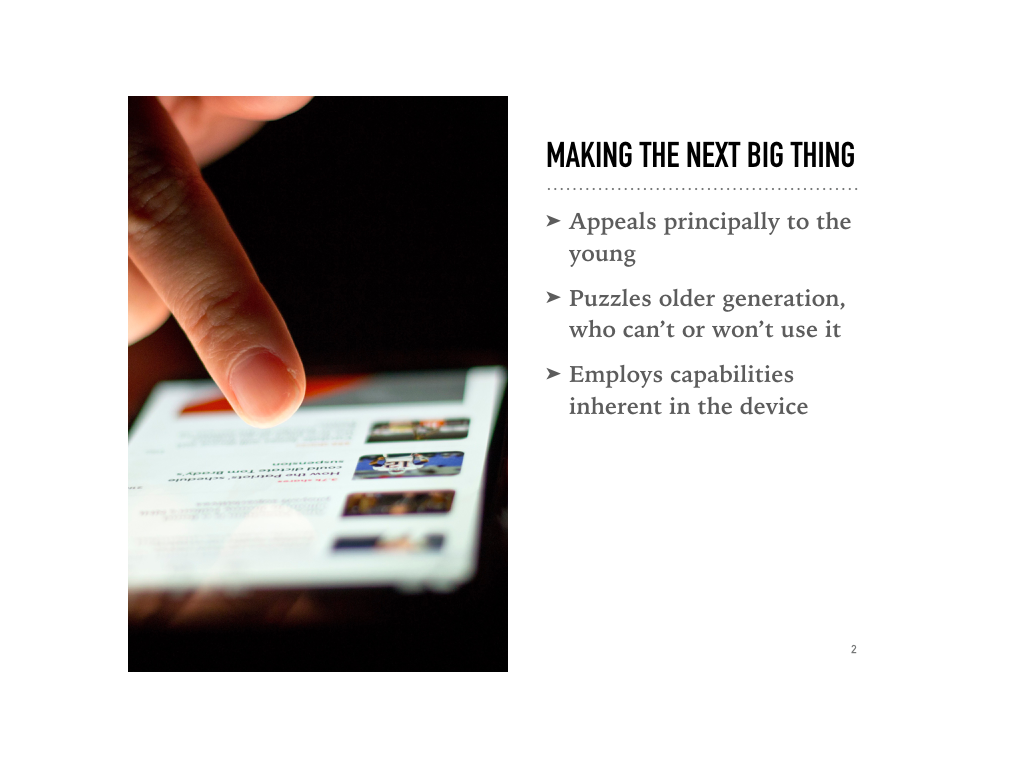
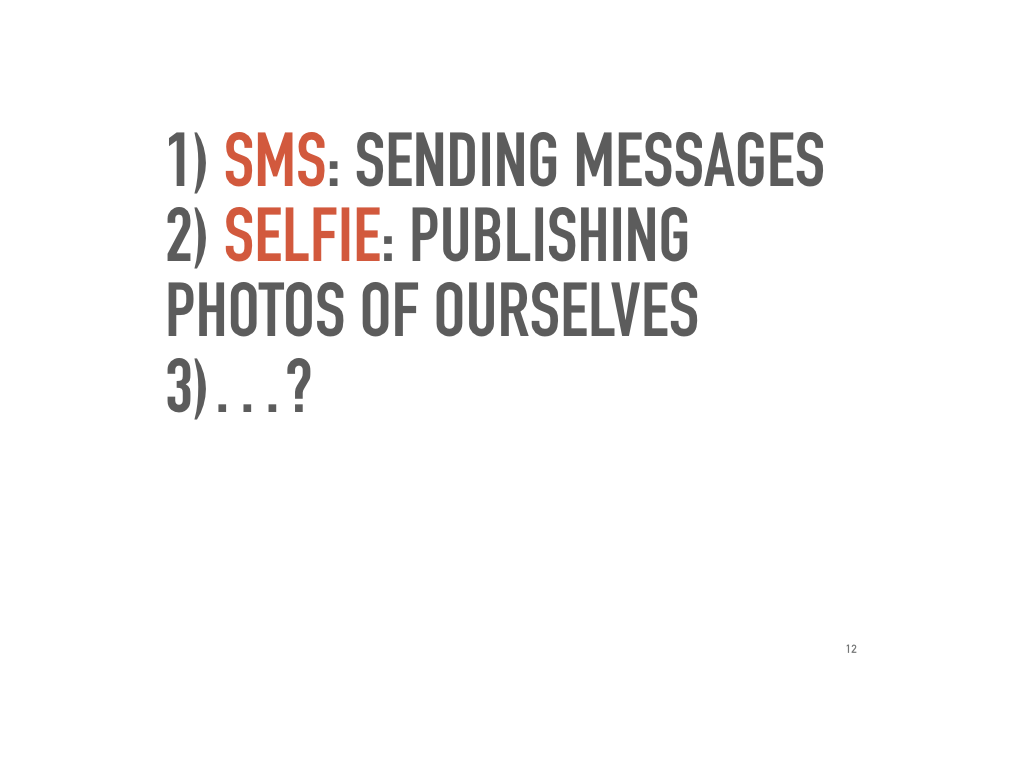
Three characteristics of “next big things”: they’re about kids and teens experimenting; adults find them a bit silly (or impossible or embarrassing); and they don’t require anything extra, because they’re immanent to the device.

Only mobile matters

Mobile is the only platform that matters
Photo by Kris Krug

When we’re looking for the “next big thing”, the only place to bother looking is mobile. It’s the only platform that matters. People might say “what about the PC? There are 1.5 billion of them installed around the world.” Nope.

Think about this: what was the last important app that launched first on the desktop (not in the browser, because browsers work on mobile too)? There were two – Spotify and Dropbox, which both launched around the autumn of 2009. Everything big since then – Instagram, Snapchat, Whatsapp, Uber – has launched first and pretty much only on mobile, with essentially no functionality on the desktop.

By contrast, everyone has a mobile phone – there are more than 2 billion smartphones in use today. Pretty soon everyone will have a smartphone. Look at the people in the picture above: they’re holding up their mobile phones, not their laptops.

The first big thing

The first big thing on mobile: texting
Photo by larskflem

The first big thing was text messaging, aka SMS. Invented in 1986 and implemented in 1992, it didn’t take off at first – until the advent of pay-as-you-go (PAYG or pre-pay) phones, which meant that they were cheaper and adults didn’t have to commit to a contract for their kids; they’d just use what they needed. And those kids discovered SMS was cheap, and fast, and personal, and they loved it. The explosion in PAYG phones, in the UK at least, happened in 1999.

Watch SMS grow

How SMS use grew globally
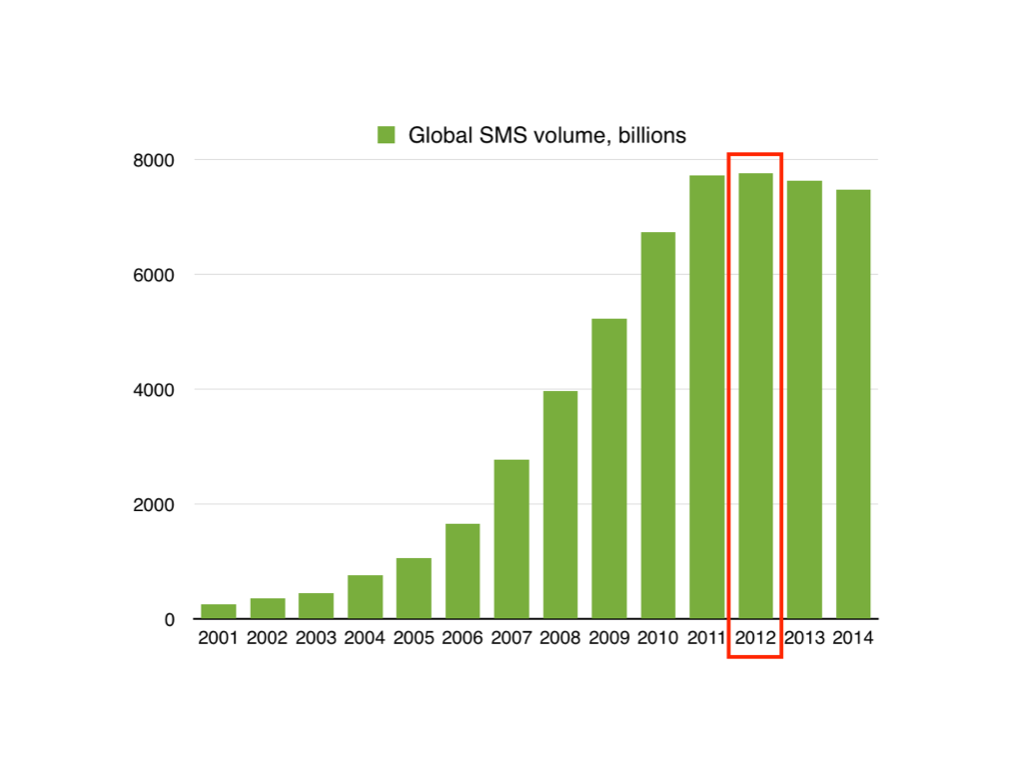
Here’s how SMS use grew globally. There’s almost exponential growth right up to 2011; and then it peaks in 2011-2012 and has fallen off since.

Why the falloff? Because the people who had been kids in 1999 were 12-13 years older. They’re grown up, having their own kids. Meanwhile the other kids growing up in the intervening years were moving on to their own things – OTT services using data, such as BBM, iMessage and Whatsapp. SMS was a golden goose for the carriers; now it’s being killed off. Whatsapp has only been available for five years – founded in 2009 and first released in 2010 – yet it’s now bigger than SMS in volume.

Me, my selfie, I

The source of 'selfie'
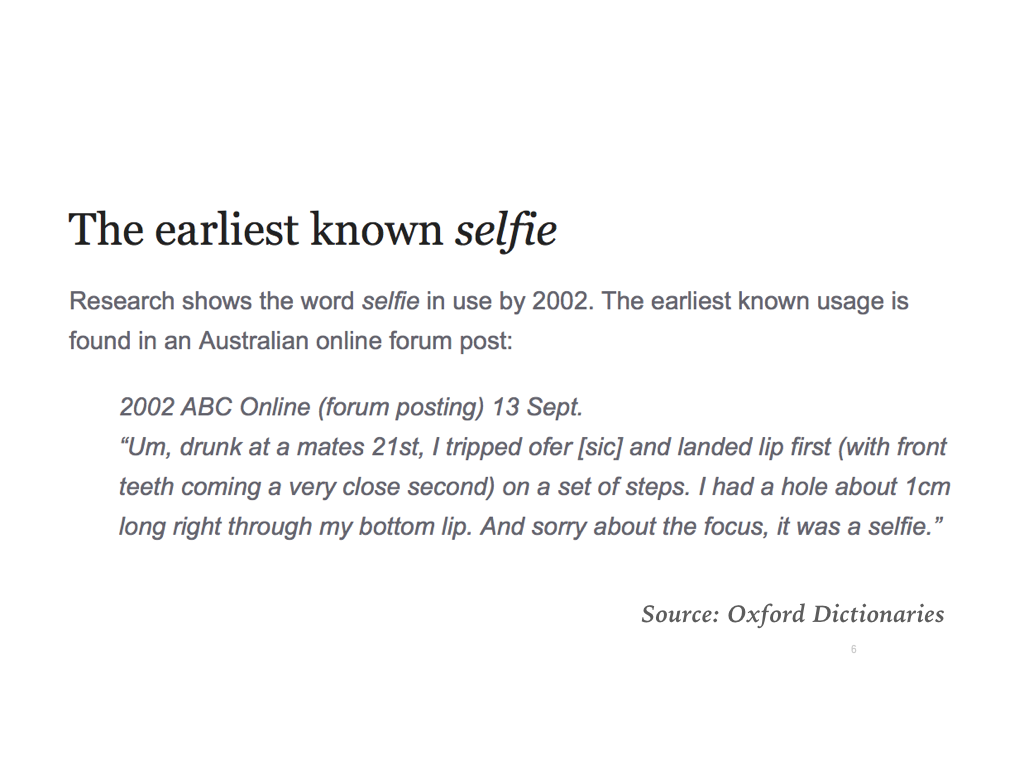
Sure, we know that there have been “selfies” for ages – painters in the Renaissance doing self-portraits, even Buzz Aldrin doing one in space during an Apollo mission in 1966. But we didn’t call it that, and “selfie” has a particular meaning in our context: pictures taken with our mobile phones, generally using the front-facing camera.

Watch ‘selfie’ grow

Photos tagged 'selfie' on Flickr, 2000-2005
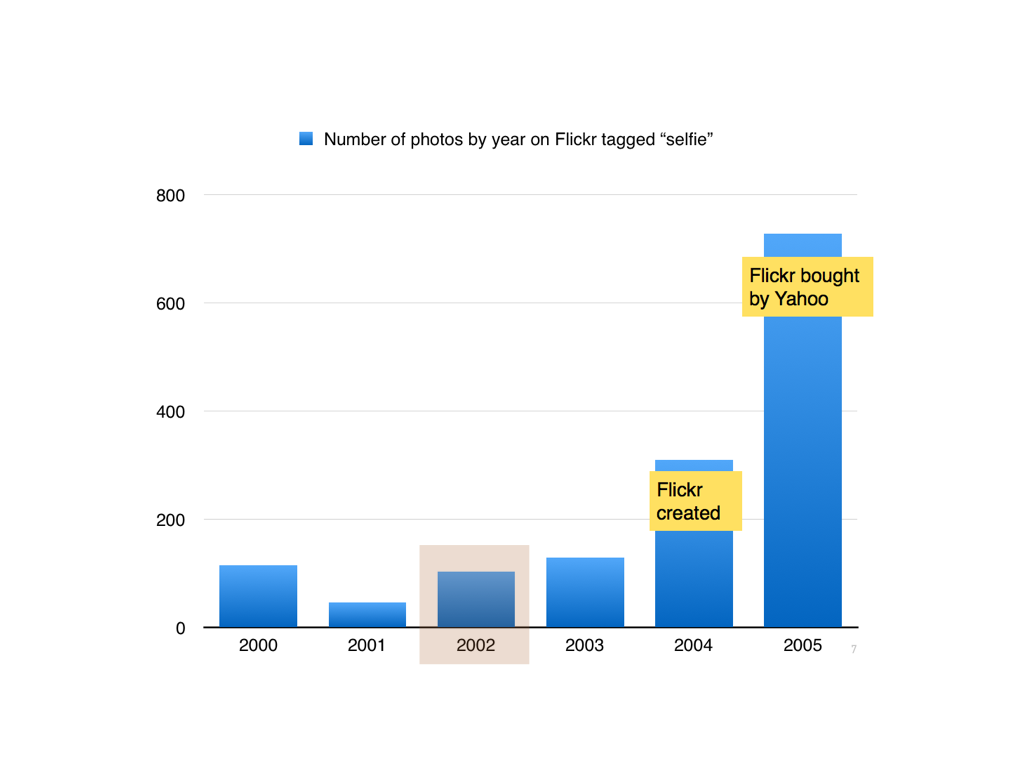
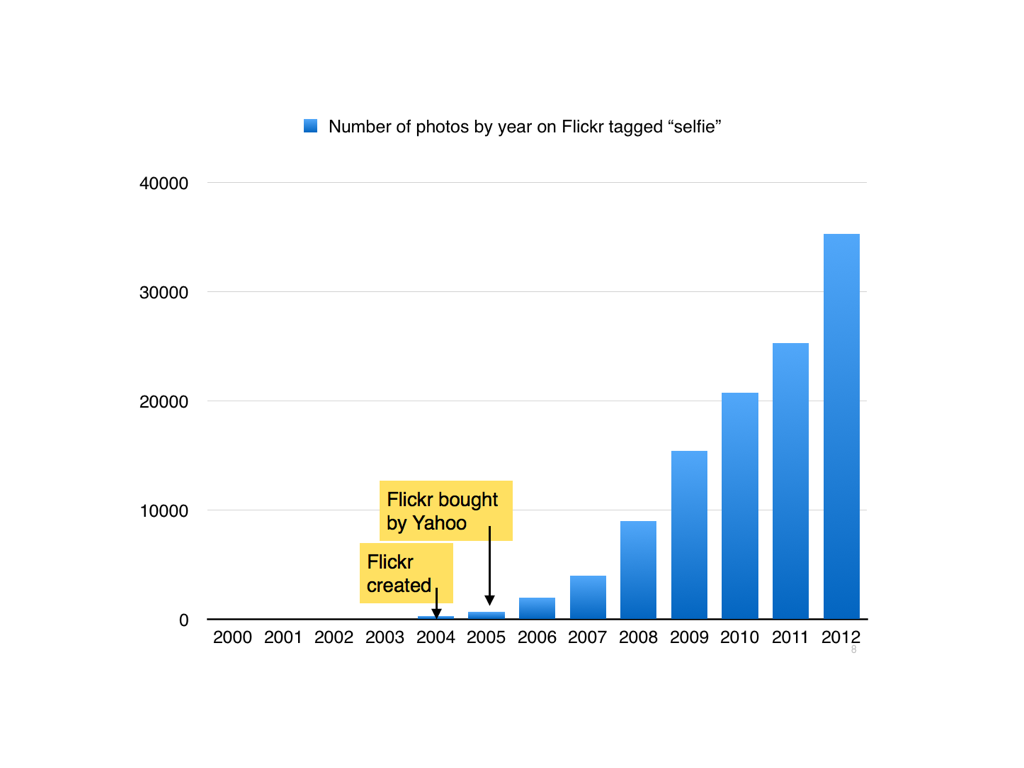
I thought this 2002 origin was interesting, so I dug out data from Flickr, looking for photos tagged “selfie” by year (1 January-31 December for the respective years). There’s that first 2002 use highlighted for reference, and clearly lots of millennium-dated photos that were backloaded; Flickr didn’t even exist until 2004. Yahoo bought it in 2005, and things started growing.

..and grow

Photos tagged 'selfie' on Flickr, 2000-2012
Fast forward to 2012, and the number is exploding.

..and peak?

Photos tagged 'selfie' on Flickr, 2000-2015
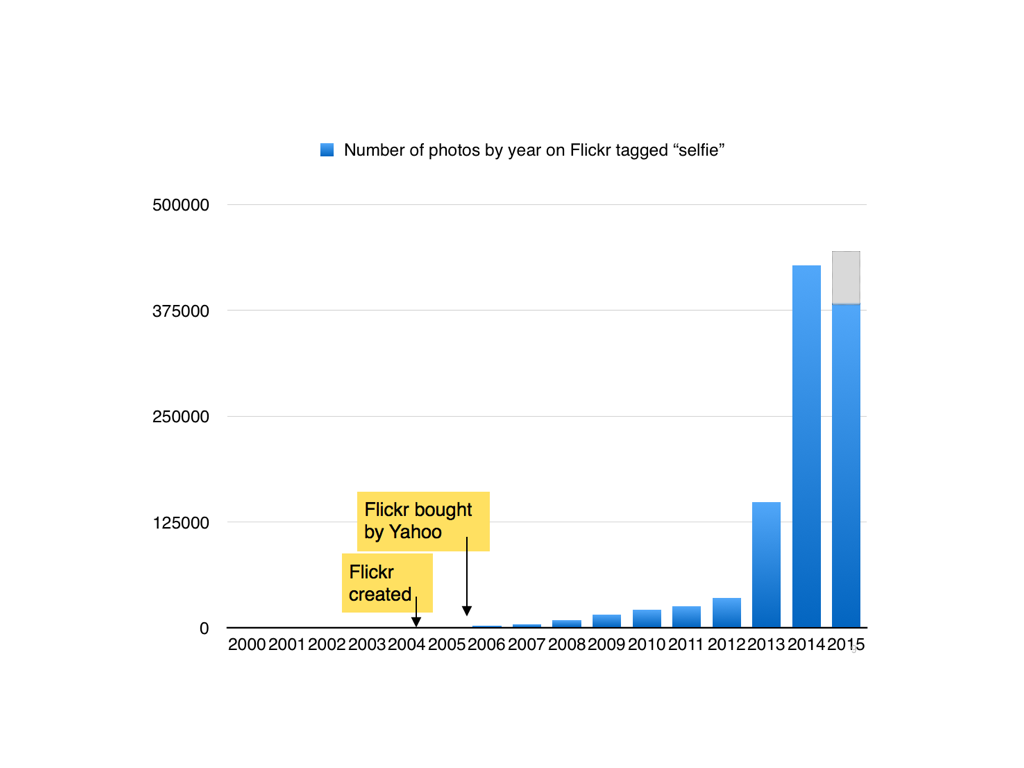
Fast forward again, and this really looks like exponential growth. Though the 2015 figure – with my estimate for the final total – looks like growth has slowed substantially. Why’s that? We’ll come to that in a moment.

Trending searches

Google search trends for 'selfie'
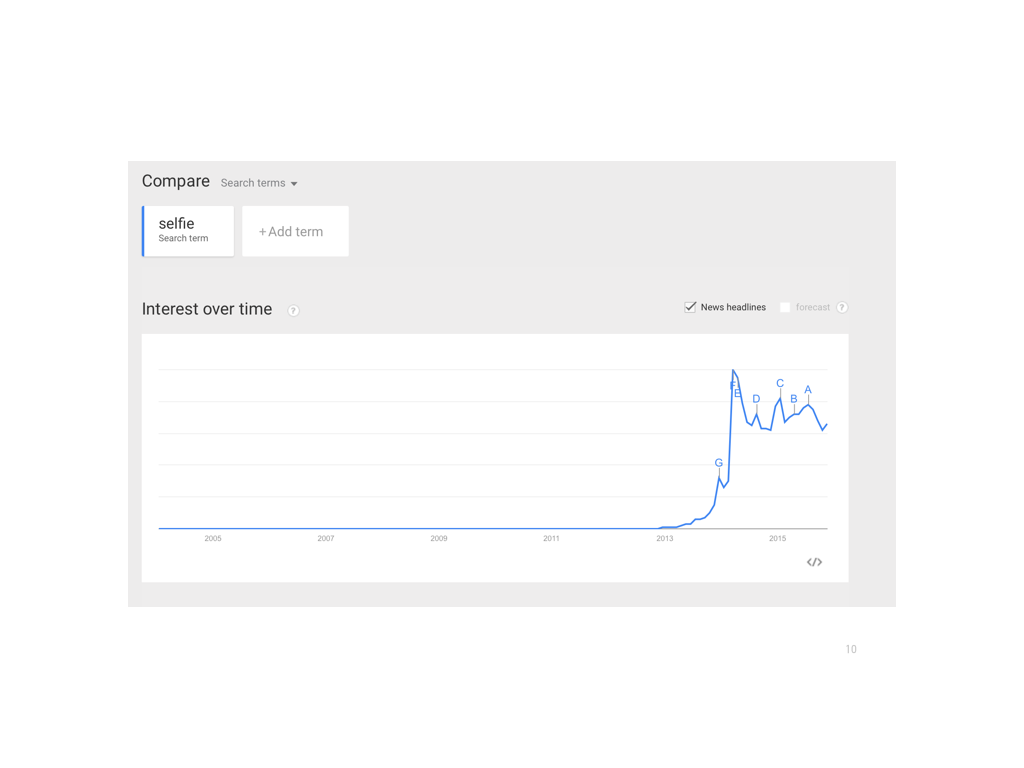
Just for contrast, here are the Google search trends for “selfie”. Pretty much nothing until 2013, when it takes off. (Think of the selfie at the Mandela funeral by Obama and the Danish prime minister in December 2013, which is the first peak there, and the Oscars selfie by Ellen DeGeneres – actually taken by Bradley Cooper in March 2014 – which marks the high point.) But it looks as though interest in the selfie is dying, doesn’t it?

Peak selfie?

Google trends and Flickr trends for 'selfie'
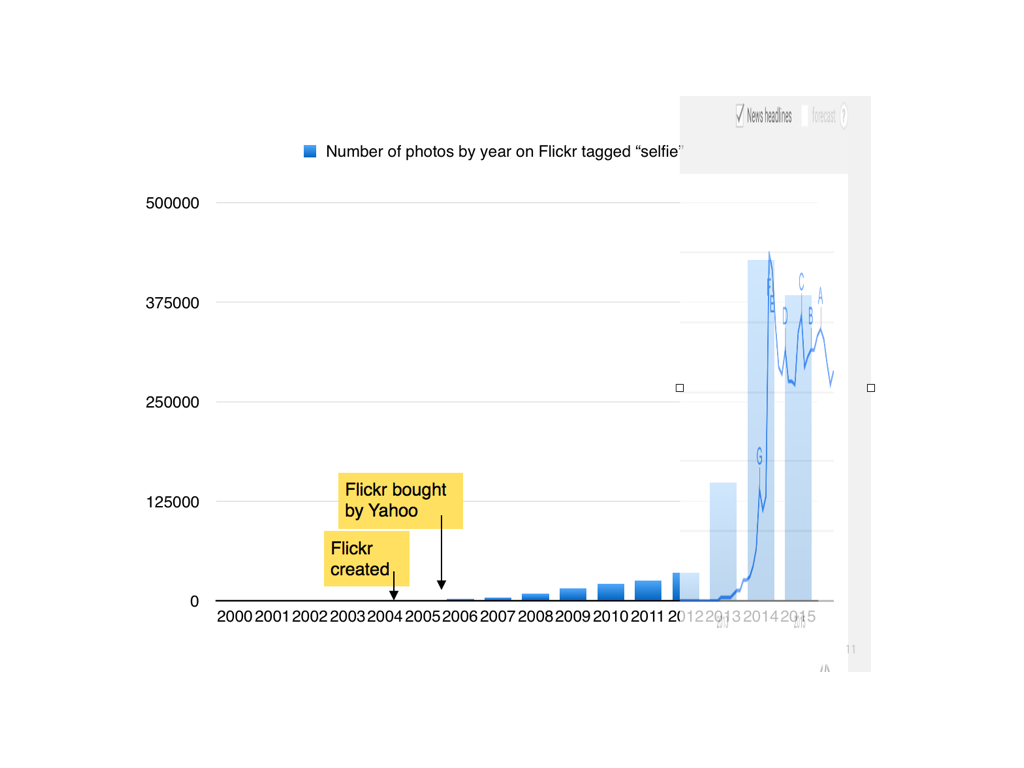
If you superimpose the Google Trends data and the Flickr data, their growth looks pretty similar. So is the selfie dying off?

What’s more probably happening here is that a new generation of kids isn’t using Flickr – they’re on Instagram, where millions of selfies are posted every day. I couldn’t extract the data from Instagram, but you can be sure it’s huge. The selfie has probably got a few years left in it yet. But that generational shift is interesting, because it’s just what we saw with SMS before.

Next to arrive

Two big things; what might be a third?
So there are two examples so far of “next big things”. What might be next?

Well, the smartphone is the most personal device ever. It knows who we know, when they call, when we ignore them, what we like and what we watch, what we read, how we communicate, where we go.

Why wouldn’t it be used for… sex?

Call me maybe

Tinder's three-screen explanation
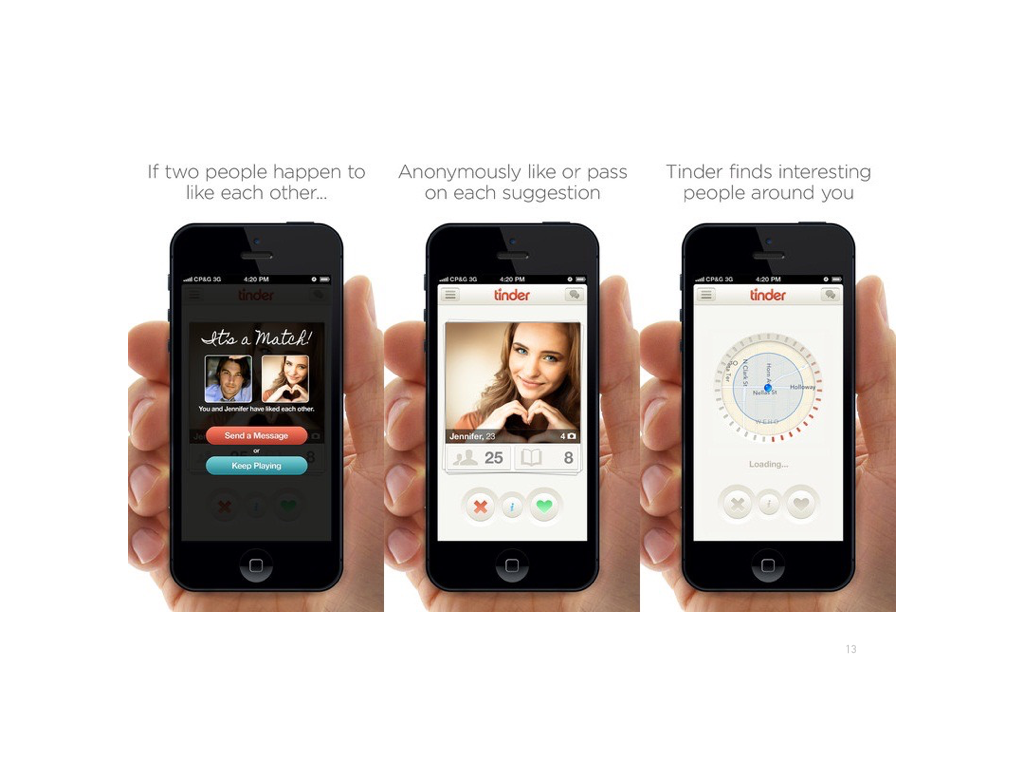
Turns out, it already is. Apps like Tinder fit all of our three criteria: it’s used by the young, it puzzles the old (“why would you judge someone based on so little information?”), and it uses qualities inherent to the device – selfies for profiles, real-time data updates, touch interaction, geolocation.

Tinder alone sees billions of “swipes” on profiles every day, and millions of meetups, and there are surely going to be Tinder babies – people created on the basis of algorithms on smartphones. Is that weird, or just natural? Your view might depend on your age.

A new search

It's in our phone, but what is it?
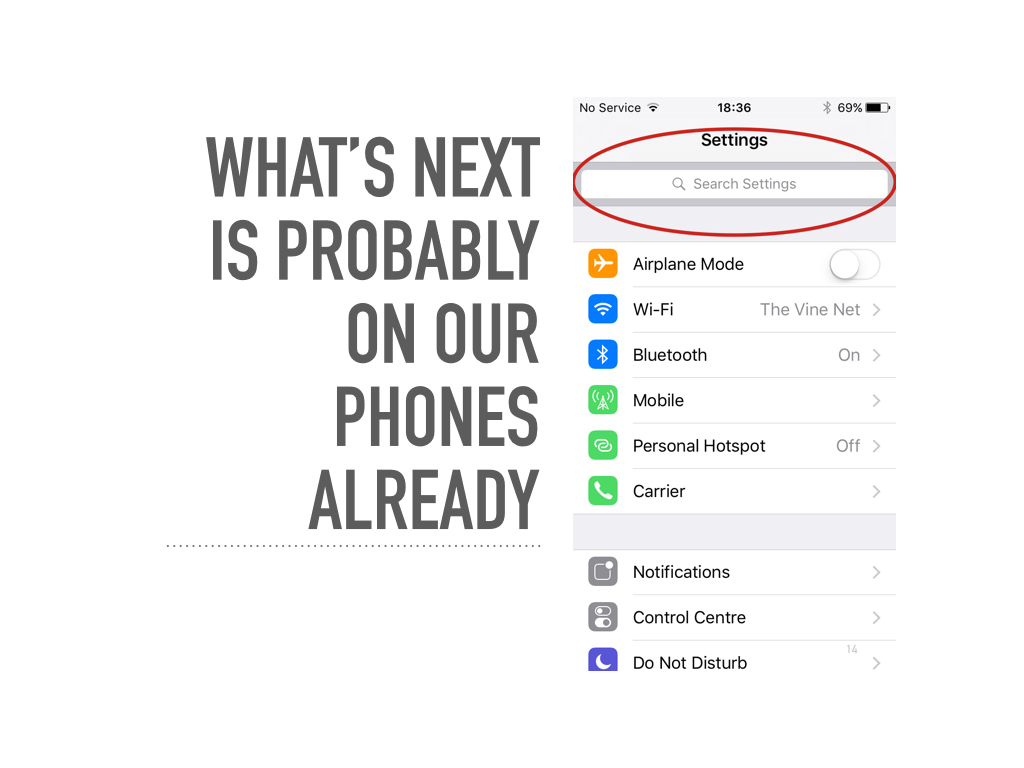
After SMS, selfies, sex, what will the next big thing look like? There are some clues. The biggest one is that it’s almost surely already in the phone, just as SMS was a capability in 1992, before PAYG phones, and selfies were possible from the first phones with a front-facing camera in 2003.

So here are three elements that I think might feed into the next big thing.

Three potential elements

The capability is there, and growing
Deep dream: photo by kevin dooley
Google Cardboard: photo by juan tan kwon

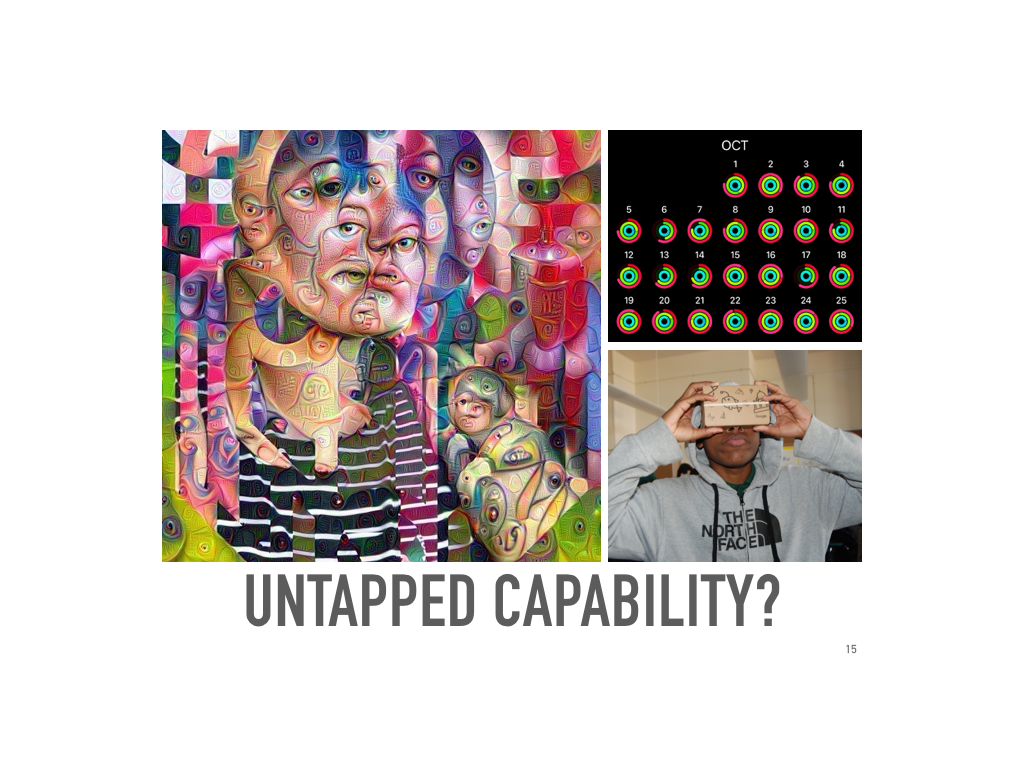
Artificial intelligence: The first, and biggest, is artificial intelligence or “machine learning”. This is a picture of someone as visualised through Google’s “Deep Dream” neural network. We don’t understand it because the machine refracts its view. But to the machine, it makes a sort of sense. There is a growing amount of AI/ML/NN technology in all our smartphones: Apple’s Siri, Google Now, Microsoft’s Cortana. You can also get “assistants” such as Amy (which will set up meetings) and “Charlie” (which will give you a social media profile of people you’re going to meet).

This AI tells us if we should leave early for meetings, who’s calling us (perhaps based only on phone numbers found in emails, not our contacts), what apps we look at, what news we look at, how we interact with the world through our phone. In the next few years, we should expect that it will become far more powerful, even without a connection to the cloud; if you think that sounds fanciful, just go back five years, to 2010, and none of the phones we have had those sorts of capabilities. Siri hadn’t been introduced. Think five years ahead, and that’s the sort of gap between now and then that we’re going to see.

Health/fitness: if my AI knows what I’ve been doing, shouldn’t it also know how well I’m doing? Connected to devices such as a watch or fitness band, there’s far more data about ourselves becoming available. Does that feed into the Next Big Thing by showing that you’re *really* fit in your online dating profile? Does your AI tell you before you’re going to be ill?

Virtual reality: This is Google Cardboard, a super-low-cost implementation of virtual reality: you cut and paste it together from a kit, and then slot your smartphone into the gap, and bingo. It’s on the tipping point, I think; ready to take off. And when that happens, everything becomes possible. What if the Tinder profile of the future lets you walk around the person you’re interested in dating, in 3D? What if you meet without physically being in the same place?

Conclusion

I don’t know what the Next Big Thing actually is. But consider a couple of points. SMS was invented over a decade before it actually took off. The word “selfie” was coined for the activity back in 2002 – yet it only exploded into public consciousness a decade later.

Perhaps the word for the next big thing has already been coined; it’s been tossed around carelessly on an online forum where someone is describing something they did or something that happened. And in years to come we’ll look back and say ah, it was obvious.

That’s because spotting the next big thing is a puzzle, not a mystery. There’s a difference between the two. A mystery is – well, think of a murder mystery. Only one person knows who did it, and they’re not saying. Mysteries are meant to remain unsolved.

But to understand a puzzle, think of a jigsaw puzzle. The pieces are all there, in plain view; the only problem is putting them together correctly.

For entrepreneurs, there is good news: if you’re alert, you can cash in. SMS made huge profits for carriers. Selfie sticks meanwhile have been nice business for some factories in Shenzhen. (They’ve even led to museums changing rules; that’s success, when you change society, even a little.)

Just as puzzles just need the pieces put together correctly, it’s very likely that everything necessary for the next big thing is right there, just waiting for someone to put it together. The people who do that probably won’t be the adults; it’ll be the kids and teens messing around. And adults will probably think it’s stupid. But that’s how it goes.

Still, we won’t have to look far to find it. It’ll be right there in the palm of our hands – in our phones.

Start up: how self-driving cars will change life, why *is* http on port 80?, iPad Pro reviewed, and more


Creating a more beautiful subway map for Tokyo wasn’t easy. Photo by aka.me on Flickr.

You can now sign up to receive each day’s Start Up post by email. You’ll need to click a confirmation link, so no spam.

A selection of 9 links for you. Smoosh them. I’m charlesarthur on Twitter. Observations and links welcome.

How Uber’s autonomous cars will destroy 10 million jobs and reshape the economy by 2025 » Zack Kanter

Industry experts think that consumers will be slow to purchase autonomous cars – while this may be true, it is a mistake to assume that this will impede the transition. Morgan Stanley’s research shows that cars are driven just 4% of the time, which is an astonishing waste considering that the average cost of car ownership is nearly $9,000 per year. Next to a house, an automobile is the second most expensive asset that most people will ever buy – it is no surprise that ride sharing services like Uber and car sharing services like Zipcar are quickly gaining popularity as an alternative to car ownership. It is now more economical to use a ride sharing service if you live in a city and drive less than 10,000 miles per year. The impact on private car ownership is enormous: a UC-Berkeley study showed that vehicle ownership among car sharing users was cut in half. The car purchasers of the future will not be you and me – cars will be purchased and operated by ride sharing and car sharing companies.

And current research confirms that we would be eager to use autonomous cars if they were available. A full 60% of US adults surveyed stated that they would ride in an autonomous car, and nearly 32% said they would not continue to drive once an autonomous car was available instead.

Today’s children are the last generation that will have to pass a driving test. Think about that briefly. Then read the rest of Kanter’s piece. (It’s actually optimistic, overall.) And one more thing: it doesn’t have to be about Uber.
link to this extract


Fantastical designs from the frontier of subway maps » Washington Post

For many designers, creating a better subway map is an irresistible puzzle — “infinitely alterable, incredibly vexing, with no definitive answer,” writes Emily Badger. Badger’s new article looks at some amazing examples of metro maps from the frontier of design, including the beautiful 2010 diagram of all of the rails in the Tokyo region, designed by Kim Ji-hwan.

link to this extract


Rooted, Trojan-infected Android tablets sold on Amazon » Help-Net Security

Zeljka Zorz:

If you want to buy a cheap Android-powered tablet, and you’re searching for it on Amazon, the best thing you can do is carefully read all the negative reviews you can find. If you are lucky, you’ll see some that will warn you about the device being rooted and coming pre-installed with malware.

Security researchers from Cheetah Mobile have recently discovered a slew of these devices – over 30 tablet brands in total – being sold on Amazon and other reputable online stores.

Here’s a short overview of affected devices, along with a sample of reviews warning about the malware.

The malware in question is the Cloudsota Trojan, which allows remote control of the infected devices and conducts malicious activities without user consent.

Remember, a Trojan is for life, not just for Christmas. Estimated that over 17,000 have been sold.
link to this extract


The case against a Google phone » The Information

Amir Efrati on the rumours that Google is looking to design its own phone chips:

the ecosystem of partners that build and sell Android phones has matured to some extent; those companies have 1.4bn customers (there’s one third as many iPhones in customer’s hands, by contrast). While many of those customers aren’t necessarily loyal, and surprising upstarts are gaining ground, Google won’t be able to suddenly capture a significant amount of market share with a better device, at their expense. (It would also risk its chance to return to China, given that it is working with local handset brands to do so.) There is no going back.

Even if Google wanted to compete on price by offering devices cheaper than the iPhone, it would still have to engineer a marketing apparatus so impressive that it convinces smartphones buyers that the Google phone is the best in the world. That’s the only way it could convert iPhone and even some Samsung Galaxy S users — who are wealthier than typical Android users — to the Google phone. Good luck with that.

Then there’s the fact that prices for phones have come down so much as components become cheaper that it’s become exceedingly difficult for existing Android phone brands to stand out in the market.

Even if the Google phone struck a chord, it’s hard to see it selling more than tens of millions of devices in the next few years, and that’s optimistic.

I can believe that Google is interested in designing ARM architecture chips. But I think it’s more likely considering them for its server farms. People inside Google already know Efrati’s argument (which holds water). Sundar Pichai is hardly the sort to hang on to an idea for pride. He killed Google+, remember?
link to this extract


Ad Replacer: turn spammy ads into breaking news

We take those terrible, misleading ads that take you to garbage websites (or worse!) and switch them out for real-time, human-curated headlines and links from ONLY the most trusted, reliable websites.

Sites that never end in best-deals-4-everyone.ru. Sites that never pop up 8 windows asking if you’re SURE you want to click away. Just sites you like and stories you want to read, all seamlessly integrated into your browsing experience before you even notice it’s changed. Doesn’t that sound nice?

Neat idea; Chrome extension only for now.
link to this extract


Facebook Messenger adds facial recognition » Tech Insider

Alex Heath:

Adding facial recognition to Messenger may seem odd given that it’s primarily considered to be a messaging app, but when you consider that people send a staggering 9.5 billion photos through Messenger every month, the decision begins to make more sense.

Messenger is very proactive in prompting to share a photo with friends it thinks are in a photo — the app will send a notification asking you to send a photo to people on Facebook it thinks are tagged. (This specific behavior can be turned off in the Messenger app’s settings.)

Australia only for now, but your feeling on whether this is creepy or great will probably depend on age. Note though that it’s machine learning/AI being deployed as utterly normal; even five years ago this would have been hard to implement on such scale.
link to this extract


iPad Pro review: jack of all trades, master of most » WSJ

Joanna Stern:

On paper, 12.9 inches may not seem much bigger than the standard iPad’s 9.7 inches, but the Pro screen made me more productive. I spent much of my week writing in Microsoft Word on the left hand of the screen and toggling between websites and my inbox on the right. Text looks incredibly crisp, especially in comparison with my MacBook Air’s display, which has just half the pixels.

The A9X processor and 4GB of RAM kept those apps running swiftly. But most impressive? When I exported the same 4K video in iMovie on both the Pro and my Intel Core i5-powered MacBook Air with 8GB of RAM, the iPad reached the finish line a minute and a half faster. And, unlike the Air, it didn’t sound like it was about to blast off from Cape Canaveral.

For real work, it’s all about attaching Apple’s $170 Smart Keyboard. You don’t do this via Bluetooth, but rather with the new magnetic Smart Connector. I quickly fell in love with the feel of the bouncy fabric keys, and it became second nature to hit Command+Tab to toggle between apps. Oh, and did I mention the keyboard is spill-proof? Seriously, my iced latte just wiped right off.

Still, many times I wished for something closer to Microsoft’s Surface Type Cover. Apple’s keyboard only props the screen at a 120-degree angle; attaching it and folding it take origami skill. It all almost toppled off my lap a few times, and the keys aren’t backlit. Plus, there’s no trackpad, like the Type Cover’s. I constantly had to reach out and touch the screen to scroll or select text and icons…

…Despite iOS 9’s improved multitasking, there are still shortcomings. You can’t customize the home screen’s comically large icons with files or other shortcuts. You can’t place the same app—say two Safari windows—side by side. And iOS’s lack of real file management can be maddening. Microsoft saddles its Surface Pro with full-blown desktop Windows while the iPad Pro is still too closely related to an iPhone. Apple has to keep working to find the happy middle.

Pricey. But here’s the kicker:

There’s one thing the iPad has over all other laptops and competing tablets though: incredible apps. The Pro helped me realize that I’ve been living in the past, using legacy desktop programs to accomplish things.

link to this extract


Why was 80 chosen as the default HTTP port and 443 as the default HTTPS port? » How To Geek

According to superuser jcbermu:

The Internet Assigned Numbers Authority (IANA) is a department of ICANN, a non-profit private corporation that oversees global IP address allocation, the Domain Name System (DNS), well-known ports, and other Internet Protocol-related symbols and numbers.

During March of 1990, they published a document (RFC 1060) where they listed all the well-known ports at that time. In that list there was no protocol assigned to port 80 (it jumped from 79 to 81). 79 was assigned to “finger” (find out if someone was online) and 81 to HOSTS2-NS, the HOSTS2 Name Server.

At that time, port 80 was officially free. In 1991, Tim Berners-Lee issued the first version of HTTP in a document (HTTP 0.9) where he stated “If the port number is not specified, 80 is always assumed for HTTP.”

HTTPS? Lost in time. Blamed on someone at NCSA Mosaic. So there’s your pub quiz question/answer pair.
link to this extract


Apple Music » Android Apps on Google Play

It arrived as an app on Android, as version 0.9.0:

Introducing the beta of Apple Music on Android.
Notes about the beta period:
• Music videos are coming soon.
• Family membership sign-ups and upgrades require Mac or iOS.
• Sign-up process to be optimized for Android.

Notable that it hasn’t attracted the hate reviews that the “Move to iOS” app did; there are actually a lot of five-star reviews. (Average 3.1.) The key element looks like the “family membership” element; that’s a really powerful reason for Apple to want to reach Android users – because families are mixed users.
link to this extract


Errata, corrigenda and ai no corrida:

Start up: Google open-sources machine learning, Adele v streaming, Facebook’s Belgian problem, and more


Steve Reich’s Piano Phase, as a video, by Alexander Chen.

You can now sign up to receive each day’s Start Up post by email. You’ll need to click a confirmation link, so no spam.

A selection of 9 links for you. Made without nuts. I’m charlesarthur on Twitter. Observations and links welcome.

Preserving security in Belgium » Facebook

Alex Stamos works on online security for Facebook, while a Belgian court has ruled that the “datr” cookie it uses is not legal. Stamos isn’t happy:

The reason I’m bullish on the datr cookie is because for at least the last five years we have used it every day to defend people’s accounts through the following actions:
• Preventing the creation of fake and spammy accounts
• Reducing the risk of someone’s account being taken over by someone else
• Protecting people’s content from being stolen
• Stopping DDoS attacks that could make our site inaccessible to people

If the court blocks us from using the datr cookie in Belgium, we would lose one of our best signals to demonstrate that someone is coming to our site legitimately. In practice, that means we would have to treat any visit to our service from Belgium as an untrusted login and deploy a range of other verification methods for people to prove that they are the legitimate owners of their accounts. It would also make Belgian devices more attractive to spammers and others who traffic in compromised accounts on underground forums…

The datr cookie is only associated with browsers, not individual people. It doesn’t contain any information that identifies or is tied to a particular person. At a technical level, we use the datr cookie to collect statistical information on the behavior of a browser on sites with social plugins, such as the Like button, to help us distinguish patterns that look like an attacker from patterns that look like a real person.

Tricky.
link to this extract


Why streaming doesn’t really matter for Adele » Music Industry Blog

Mark Mulligan:


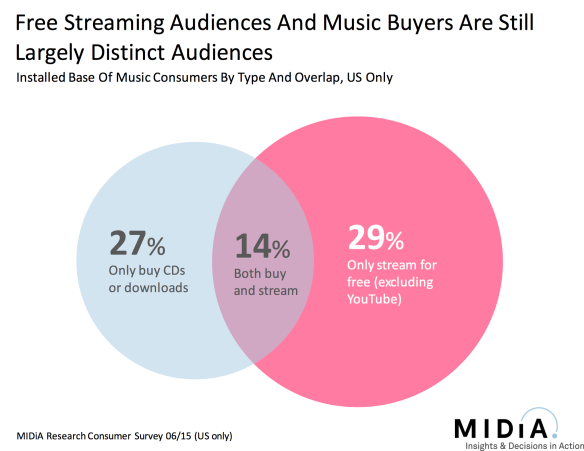
Looking at mid-year 2015 consumer data from the US we can see that music buyers (i.e. CD buyers and download buyers) are still a largely distinct group from free streamers (excluding YouTube). While this may seem counter intuitive it is in fact evidence of the twin speed music consumer landscape that is emerging. This is why ‘Hello’ was both a streaming success (the 2nd fastest Vevo video to reach 100m views) and a sales success (the first ever song to sell a million downloads in one week in the US). These are two largely distinct groups of consumers.

As a reader of this blog you probably live much or most of your music life digitally, but for vast swathes of the population, including many music buyers, this is simply not the case. Given that the mainstream audience was so key to ‘21’s success we can make a sensible assumption that many of these will also fall into the 27% of consumers that buy music but do not stream.

This is also why it was so tricky for Apple to move into streaming: lots of iTunes users simply don’t. And also why Adele’s audience and prospects are very different from Taylor Swift’s.
link to this extract


Facing pressure in China, Xiaomi also stalls in India » The Information

Amir Efrati:

the domestic Chinese market has slowed, while Xiaomi has dropped to No. 2 there after Huawei Technologies in terms of market share for the third quarter of this year, according to research firm Canalys.

The results in India seem to bear out the bear thesis on Xiaomi’s expansion plans: that it will be harder to succeed outside of China because it would have to work within the bounds of Google’s version of Android, where it can’t customize the software—and run an app store—the way it does inside of China, where Google mobile apps are almost completely absent.

In India, Xiaomi is “just another low-cost phone hardware company,” says one rival executive.

One Indian e-commerce executive whose firm sells smartphones says Xiaomi has “stagnated” online and that sales of Samsung and Motorola phones were much stronger during a recent period of online promotions known as “Big Billions Days.” Xiaomi, bucking its traditional practice of selling phones only online, has been willing to sacrifice some margin and sell phones through some retail stores in India.

If you have to offer Google Mobile Services, in the end your differentiation will be whittled away.
link to this extract


Tim Cook: Apple CEO on the company’s latest venture – the iPad Pro » The Independent

David Phelan bagged an interview while the Apple chief was in London:

The iPad Pro is the most expensive tablet yet, £679 and up. At a time when iPad sales are flat, was he tempted to do as some competitors have done and released, say, a £50 tablet? “No, there are no good £50 tablets. We’ve never been about making the most, we’ve been about making the best. This was a way of making a product that people can do a lot of things with. I think it will attract a lot of PC users and people who are not currently using Apple products. And I think it will be a reason for people to upgrade who love iPad and who have been waiting for something very different and now here it is.”

Along with the Pencil, there’s a keyboard cover. Cook says it’s different from rival keyboards because with none of those would you say it “came from the same parent” as the tablet itself. “Now all of a sudden you have a keyboard that has been perfectly designed for the iPad, it’s integrated and then you’ve got the software with split view and it’s inherently very productive. I’m travelling with the iPad Pro and other than the iPhone it’s the only product I’ve got.” 

You have to love Cook’s rejection of “why did you do a stylus?” “It isn’t a stylus, it’s a Pencil.” Hear the capital. And his description of his youth as a trombone player is hilarious.
link to this extract


DTEK by BlackBerry » Android Apps on Google Play

Interesting move by BlackBerry: DTEK looks at how often and to what extent other apps have been accessing your location, contacts and so on:

In this world of interconnected apps and networks, controlling what is shared and who it’s shared with can be a challenge. BlackBerry® DTEK for Android™ allows you to view and improve your privacy level and monitor application access to your camera, microphone, location and personal information. Take control with DTEK by BlackBerry.
Key Features:

• Monitor – Know at a glance the overall security rating for your device, as well as for specific security features. You can identify whether or not you need to take any action to improve the security of your device.

And so on. For Android 5.0 and up; seems like it would be a useful app for anyone on Android. Certainly some of the folk at UTB blogs found Facebook taking amazing liberties – such as Facebook accessing the phone location 561 times in 60 hours. That’s roughly every 6 minutes. You were asking about your battery life? (Apparently there’s a version coming for iOS too.)
link to this extract


TensorFlow: smarter machine learning, for everyone » Official Google Blog

Sundar Pichai:

It’s a highly scalable machine learning system—it can run on a single smartphone or across thousands of computers in datacenters. We use TensorFlow for everything from speech recognition in the Google app, to Smart Reply in Inbox, to search in Google Photos. It allows us to build and train neural nets up to five times faster than our first-generation system, so we can use it to improve our products much more quickly.

We’ve seen firsthand what TensorFlow can do, and we think it could make an even bigger impact outside Google. So today we’re also open-sourcing TensorFlow. We hope this will let the machine learning community—everyone from academic researchers, to engineers, to hobbyists—exchange ideas much more quickly, through working code rather than just research papers. And that, in turn, will accelerate research on machine learning, in the end making technology work better for everyone. Bonus: TensorFlow is for more than just machine learning. It may be useful wherever researchers are trying to make sense of very complex data—everything from protein folding to crunching astronomy data.

No quibbles: this is excellent news. Main site is http://www.tensorflow.org. Written in Python; binaries available for Linux and Mac. I’m sure there’s another desktop OS, isn’t there?
link to this extract


RECONSIDER » Medium

David Heinermeier Hansson (he usually goes by “DHH”), who founded Basecamp which – yawn! – is just mildly and continually successful:

it’s hard to carry on a conversation with most startup people these days without getting inundated with odes to network effects and the valiance of deferring “monetization” until you find something everyone in the whole damn world wants to fixate their eyeballs on.

In this atmosphere, the term startup has been narrowed to describe the pursuit of total business domination. It’s turned into an obsession with unicorns and the properties of their “success”. A whole generation of people working with and for the internet enthralled by the prospect of being transformed into a mythical creature.

But who can blame them? This set of fairytale ideals are being reinforced at every turn.
Let’s start at the bottom: People who make lots of little bets on many potential unicorns have christened themselves angels. Angels? Really?

link to this extract


Piano Phase » Alexander Chen

This site is based on the first section from Steve Reich’s 1967 piece Piano Phase. Two pianists repeat the same twelve note sequence, but one gradually speeds up. Here, the musical patterns are visualized by drawing two lines, one following each pianist.

The sound is performed live in the browser with the Web Audio API, and drawn in HTML5 Canvas.

This is really wonderful. Chen is a creative director at Google Creative Lab – he has done lots of other visualisations of music.
link to this extract


The consumerization of the automobile supply chain » DIGITS to DOLLARS

Jonathan Greenberg:

Last week I saw an interesting post on Venture Beat about Acer Launching an Electric All-Terrain Vehicle [quad bike, for UK readers]. This struck a chord because Taiwan-based Acer is a manufacturer of PCs and other consumer electronics (CE) devices. Acer is one of the most prominent companies in Taiwan’s CE complex, which builds almost all of our consumer gadgets. They are closely tied to some of the industry’s most important ODMs, component vendors and contract manufacturers. It is not that surprising to see a consumer electronics giant diversify into higher priced devices as they move up the value chain. However, if you don’t look at Acer as an device maker, but instead view them as a flagship of the Taiwanese electronics industry, the announcement has broader implications.

You can see where this is going, can’t you?
link to this extract


Errata, corrigenda and ai no corrida: none reported.
Start up: lightening YouTube, more Flash vulnerability, farewell to Apple’s store fan, NSA cracking, and more


“Yeah, pretty frazzled after a long day writing clickbait headlines. You?” Photo by peyri on Flickr.

You can now sign up to receive each day’s Start Up post by email. You’ll need to click a confirmation link, so no spam.

A selection of 8 links for you. Hand-picked by fingers. I’m charlesarthur on Twitter. Observations and links welcome.

Page weight matters » Chris Zacharias

At YouTube, Zacharias was challenged to get the standard 1.2MB page down below 100KB:

Having just finished writing the HTML5 video player, I decided to plug it in instead of the far heavier Flash player. Bam! 98KB and only 14 requests. I threaded the code with some basic monitoring and launched an opt-in to a fraction of our traffic.

After a week of data collection, the numbers came back… and they were baffling. The average aggregate page latency under Feather had actually INCREASED. I had decreased the total page weight and number of requests to a tenth of what they were previously and somehow the numbers were showing that it was taking LONGER for videos to load on Feather. This could not be possible. Digging through the numbers more and after browser testing repeatedly, nothing made sense. I was just about to give up on the project, with my world view completely shattered, when my colleague discovered the answer: geography.

The explanation is rather smart.
link to this extract


Forbes: a quick adtech video » Medium

Rob Leathern wanted to read an article – you know, one of those text things – on Forbes:

In order for me to read that one article I had to receive 1,083 URL calls from 197 different domains adding up to 18.3 Megabytes of data, summarized here in an Excel spreadsheet. I closed any videos as soon as I could if they had the ability to do so.

Is it worth it? I like Alex Konrad and the article was probably a good one, but given I’m not sure where my data is going, or who some of these entities are (jwpltx.com? wishabi.com?) I just don’t know.

link to this extract


Auto-generating clickbait with recurrent neural networks » Lars Eidnes’ blog

To generate clickbait, we’ll train such an RNN [recurrent neural network] on ~2,000,000 headlines, scraped from Buzzfeed, Gawker, Jezebel, Huffington Post and Upworthy.

How realistic can we expect the output of this model to be? Even if it can learn to generate text with correct syntax and grammar, it surely can’t produce headlines that contain any new knowledge of the real world? It can’t do reporting? This may be true, but it’s not clear that clickbait needs to have any relation to the real world in order to be successful. When this work was begun, the top story on BuzzFeed was “50 Disney Channel Original Movies, Ranked By Feminism“. More recently they published “22 Faces Everyone Who Has Pooped Will Immediately Recognized“. It’s not clear that these headlines are much more than a semi-random concatenation of topics their userbase likes, and as seen in the latter case, 100% correct grammar is not a requirement.

The training converges after a few days of number crunching on a GTX980 GPU. Let’s take a look at the results.

The results are spooky – such as “Taylor Swift Becomes New Face Of Victim Of Peace Talks” and “This Guy Thinks His Cat Was Drunk For His Five Years, He Gets A Sex Assault At A Home”. Because, you know, if you looked out of the corner of your eye, isn’t that what was on some site somewhere? (They weren’t.)

One feels Eidnes’s work should have happened in a Transylvanian laboratory in a thunderstorm. Next you get a machine to write the story that fits the headline, and.. we can all knock off for the century.
link to this extract


Broadband in the UK ‘to stay top of the 5 major EU countries until 2020’ » ISPreview UK

Mark Jackson:

A new BT-commissioned report from telecoms analyst firm Analysys Mason has perhaps unsurprisingly found that the take-up and availability of superfast broadband (30Mbps+) connectivity in the United Kingdom is ahead of Spain, Germany, Italy and France, and will remain there until at least 2020.

The benchmarking report marks the United Kingdom as the “most competitive broadband market of all the countries it features“, although there are a few caveats to its findings. For example, the report overlooks most of Europe’s other states, including those with superior broadband infrastructure to ours, and seems to only focus on fixed line networks.

Furthermore it also makes an assumption that the current roll-out progress will hold to the Government’s promised targets, which may well be the case but we won’t know for certain until 2020. In addition, the study only appears to consider “superfast” services (defined as 30Mbps+ in the report), which overlooks the important area of “ultrafast” (100Mbps+) connectivity.

BT tweeted this headline and added “thanks to BT’s rollout of fibre”, and the culture/media/sport minister Ed Vaizey retweeted it without comment.

Is it really healthy that during an Ofcom examination of BT’s position a minister is doing that? Meanwhile Jackson’s longer analysis provides much-needed scepticism about the claims, and the lack of data in the report.
link to this extract


Adobe Flash Player security vulnerability: how to protect yourself » BGR

Zach Epstein:

The fun never ends with Adobe Flash.

Just one day after Adobe released its monthly security patches for various software including Flash Player, the company confirmed a major security vulnerability that affects all versions of Flash for Windows, Mac and Linux computers. You read that correctly… all versions. Adobe said it has been made aware that this vulnerability is being used by hackers to attack users, though it says the attacks are limited and targeted. Using the exploit, an attacker can crash a target PC or even take complete control of the computer.

And now for the fun part: The only way to effectively protect yourself against this serious security hole is to completely uninstall Flash Player from your machine.

Here’s the security note: “Adobe is aware of a report that an exploit for this vulnerability is being used in limited, targeted attacks. Adobe expects to make an update available during the week of October 19.” Spear phishing, no doubt; but Flash really is beginning to look like the worst thing you can have on your machine, especially if you’re in any sort of sensitive work.
link to this extract


Why Google is wrong to say advertisers should shift 24% of their TV budgets to YouTube » Business Insider

Lindsey Clay in chief executive of Thinkbox, which just happens to be a commercial TV marketing body, and doesn’t like Google’s suggestion:

why would an advertiser remove a quarter of the money they invest in the most effective part of their advertising and give it to something that hasn’t shown any proof of actually selling anything? 

However, it needs a response lest anyone believes Google on this. Here are some things to consider:

This is Google’s data. We’ve asked to see the data itself, but usually Google doesn’t share. If and when it does, we’ll comment on it but we obviously need to comment now. We understand the TV elements are based around a panel of Google users managed by Kantar that does not measure all TV and that the YouTube element is provided by Google themselves.

If that isn’t flaky and biased enough, it is also unaudited. They even called it the “Google Extra Reach Tool”; it is a self-fulfilling prophecy. And does it take account of the 50% of online ads that are not seen by humans? And how does it square with the report in the FT recently revealing that YouTube has been selling fraudulent ad views to advertisers?

Their recommendation also seriously challenges common sense when official industry sources including comScore show that YouTube accounts for 7.5% of 16 to 24-year-olds’ video time, with TV at 65%. The numbers for the whole population are 3.5% and 81%. Ad minutage on commercial TV is approximately 15% of that time, but is much lower on YouTube, and that is before you consider users’ impatient use of its ‘Skip ad’ button.

Clay is hardly impartial, but she raises worthwhile points.
link to this extract


Apple’s biggest fan has died » The Washington Post

Michael Rosenwald:

There are plenty of goofballs — like me — who stand outside Apple stores all night waiting for the company’s latest, thinnest, must-have offering.

There was nobody like Gary Allen, who died Sunday from brain cancer at 67.

Allen didn’t care so much about Apple’s new products (though he bought many of them.) He cared about the stores, the sleek and often innovative ways Apple presented itself to the world — the winding staircases, the floor-to-ceiling glass, the exposed brick.

Allen, a retired EMS dispatcher, traveled around the world — obsessively and expensively — to be among the first in line at the company’s new stores. He attended more than 140 openings, collecting all sorts of trivia. He could even tell you where Apple store tables are made (Utah; he stopped by the factory once to say thanks).

The headline is a trifle unfair; Allen was a fan of the stores, and their design. Rosenwald recounts a story of someone who just liked paying attention to detail; it’s a delightful mini-obituary.
link to this extract


How is NSA breaking so much crypto? » Freedom To Tinker

Alex Halderman and Nadia Heninger:

The Snowden documents also hint at some extraordinary capabilities: they show that NSA has built extensive infrastructure to intercept and decrypt VPN traffic and suggest that the agency can decrypt at least some HTTPS and SSH connections on demand.

However, the documents do not explain how these breakthroughs work, and speculation about possible backdoors or broken algorithms has been rampant in the technical community. Yesterday at ACM CCS, one of the leading security research venues, we and twelve coauthors presented a paper that we think solves this technical mystery.

The key is, somewhat ironically, Diffie-Hellman key exchange, an algorithm that we and many others have advocated as a defense against mass surveillance. Diffie-Hellman is a cornerstone of modern cryptography used for VPNs, HTTPS websites, email, and many other protocols. Our paper shows that, through a confluence of number theory and bad implementation choices, many real-world users of Diffie-Hellman are likely vulnerable to state-level attackers.

Estimated cost: $100m for a system that could break a single Diffie-Hellman key per year. But after two years, with the correctly chosen keys, you could passively eavesdrop on 20% of the top million HTTPS sites. Don’t underestimate the NSA. But of course, don’t underestimate the Chinese, Russians, and so on..
link to this extract


Start up: Facebook’s AI ambitions, it’s the Galaxy S7!, the value of comments, Apple goes Android, and more


Peace began the new war. Photo by ‘Lil on Flickr.

You can now sign up to receive each day’s Start Up post by email. You’ll need to click a confirmation link, so no spam.

A selection of 8 links for you. Use them wisely. I’m charlesarthur on Twitter. Observations and links welcome.

Facebook’s problem: Its algorithms aren’t smart enough » Fortune

Mathew Ingram:

Zuckerberg said: “Under the current system, our community reports content that they don’t like, and then we look at it to see if it violates our polices, and if it does we take it down. But part of the problem with that is by the time we take it down, someone has already seen it and they’ve had a bad experience.”

The promise of artificial intelligence, said the Facebook founder, is that some day computers might be able to filter such content more accurately, and allow people to personalize their news-feed. “But right now, we don’t have computers that can look at a photo and understand it in the way that a person can, and tell kind of basic things about it… is this nudity, is this graphic, what is it,” he said.

Zuckerberg said that in the case of the Syrian child lying dead on the beach, he thought that image was very powerful, because it symbolized a huge problem and crystallized a complex social issue. “I happen to think that was a very important photo in the world, because it raised awareness for this issue,” he said. “It’s easy to describe the stats about refugees, but there’s a way that capturing such a poignant photo has of getting people’s attention.”

Any AI that could make the right call about that photograph, though, would be as wise as the super-experienced editors around the world. It would have passed the Turing test and then some.
link to this extract


New ad blocker “Peace” tops iTunes paid apps chart within hours » Marketing Land

Danny Sullivan:

For months, marketers have been worrying over the possibility that consumers might embrace ad blocking that’s made easier in iOS 9. Now iOS 9 is out, and within hours of its launch yesterday, a new ad blocker called “Peace” became the most popular paid app.

The Peace app was created by Marco Arment, former CTO of Tumblr and founder of Instapaper. It sells for $2.99 in Apple’s app store. Within hours of the app going live, it topped the iTunes chart for paid apps for iPhone.

In addition to Peace, Purify Blocker also made the charts ranked fifth for iPhone. The Blockr app is ranked 28th. Crystal, which had some attention earlier this month, is listed at 110 in the free charts. It’s supposed to change to a paid model shortly.

As for iPad, Peace was the number two paid app (Purify is further down at 22; Blockr at 36):

The app is technically a “content blocker,” because it blocks not only ads but other types of tracking codes and anything that is deemed worth blocking based on a list that Ghostery maintains.

Ads are only blocked in Safari, not in other browsers like Chrome. It also doesn’t block ads within apps.

So the outbreak of war began with Peace. But not in other browsers like Chrome, because they don’t use the new WKWebKit viewer, available since iOS 8, which is really fast and powerful and, in iOS 9, enables content blockers. Wonder if Google has considered it? Read on…
link to this extract


Issue 423444 – chromium – Use WKWebView on iOS 8+ » Chromium Project

Stuart Morgan of Google’s Chromium project discussing, in October 2014, whether to use WKWebView instead of UIWebView in Chrome on iOS:

Unfortunately, despite the advantages of WKWebView, it has some significant technical limitations that UIWebView does not, which means we can’t simply drop it in as a replacement. A partial list of regressions relative to UIWebView that we’re currently aware of:
– There is no cookie management API, which means there is no obvious way to clear/manage cookies
– Protocol handlers no longer work, which breaks several very important features
– POST bodies are missing from delegate callbacks, which breaks certain aspects of form handling

We’re still actively investigating WKWebView, looking for possible alternate approaches, and providing feedback to Apple about issues. We certainly hope to use WKWebView in the future, but there’s currently no way of knowing if or when that will be possible.

The thread continues through the introduction of iOS 9, right up to 10 days ago. Still no movement. It seems remarkable that the newest, most powerful webview on iOS should be so behind in things that Google sees as essential. So Chrome on iOS uses the old – creaking, now – UIWebView instead of WKWebView. No modern compatibility (and lots of crashes, according to some) but equally, no adblocking on Chrome on iOS. (Thanks @reneritchie for pointing it out.)
link to this extract


Trash talk » Popbitch

The article (byline unprovided) does useful work in estimating the cost of moderating comments at the Mail Online and Guardian (it’s remarkably high) and then looks at sites that have shut down comments, and notes:

A number of journalists from across the political spectrum have spent this last week voicing their displeasure at Twitter, talking about how unpleasant it’s all become. It used to be fun and productive and helpful, they say, but the conversation nowadays is just vicious fighting.

Those reporting on the Scottish referendum last year complained of the same thing too; many threatening to quit social media in the face of brutal Cybernat campaigns. The sheer volume of vitriol leveled at them became unbearable, unmanageable.

Sadly, this will be the inevitable result of shutting down comments sections. People aren’t going to suddenly want to stop voicing their opinions. That’s one genie that won’t ever go back in the bottle. Instead those displaced commenters will simply take up an alternative platform, and the most obvious one of those is social media.

They can do that anyway, of course – the option has been open to them for as long as Facebook and Twitter have been around – but it’s no coincidence that the current trend for editors wanting to direct the conversation away from comments sections and onto social media correlates exactly with journalists’ growing dissatisfaction at the level of discourse on social media.

Comments sections are easy to avoid when you know where they are.

This I don’t agree with. People will find you on social media regardless of whether there are comments sections. The big advantage? There, you can block them. I prefer Mic Wright’s characterisation: comments are the radioactive waste of the web, there effectively forever, and never really useful. (And I speak as someone who has left a fair number of comments all over the place.) Gresham’s Law applies.
link to this extract


Welcome to hell: Apple vs Google vs Facebook and the slow death of the web » The Verge

Nilay Patel:

with iOS 9 and content blockers, what you’re seeing is Apple’s attempt to fully drive the knife into Google’s revenue platform. iOS 9 includes a refined search that auto-suggests content and that can search inside apps, pulling content away from Google and users away from the web, it allows users to block ads, and it offers publishers salvation in the form of Apple News, inside of which Apple will happily display (unblockable!) ads, and even sell them on publishers’ behalf for just a 30% cut.

Oh, and if you’re not happy with Apple News, you can always turn to Facebook’s Instant Articles, which will also track the shit out of you and serve unblockable ads inside of the Facebook app, but from Apple’s perspective it’s a win as long as the money’s not going to Google.

This is the dynamic to keep in mind — especially when you see Apple bloggers like [John] Gruber forcefully discount the notion that Apple’s decisions will affect small publishers. The Apple vs. Google fight has never been more heated or more tense, and Facebook’s opportunity to present itself as the savior of media has never been bigger — through hey-it’s-just-about-speed Instant Articles, which will almost certainly be featured higher in the News Feed, and huge things like its massive video initiative, which is a direct assault on YouTube. And oh — Apple’s new tvOS, that huge bet on bringing apps to TV? Doesn’t support WebKit at all.

Malicious view of Apple adding content blocking to Safari: it’s trying to kill Google.
Non-malicious view of Apple adding content blocking to Safari: it’s trying to kill ads which take over the mobile browsing experience, bouncing you to an app or putting up a non-removable screen (because the close button is off the screen), and/or trying to keep enterprise buyers happy that they can restrict what their users view.

Patel portrays this as a knife fight, but overlooks the fact that ads will work perfectly well inside iOS apps (annoying as they might be). Apple’s trying to do two things here: stop annoying, intrusive ads on Safari and in Safari web views, and trying to keep apps at the forefront of what people do on iPhones.

Both of those have collateral damage for Google, but it’s a stretch to think of this as a desperate fight to the death. He’s worried for his site, sure. And so he should be. But as I’ve said previously, web ads have to evolve. Nobody said they were somehow protected.
link to this extract


Sony shuts down its UK online retail store » AndroidAuthority

Andrew Grush:

Sony has never had a major presence in the US, offering most of its products either through its website or a partnering retailer. Sony has also had a carrier presence, but it has generally been limited to just T-Mobile or Verizon. This summer, Sony shut off one of these channels: its retail store. This meant that Sony fans had to either go through a site like Amazon, or turn to carriers. And now they are essentially doing the same in the UK.

Effective immediately, Sony shoppers will now be reliant on carriers or Sony’s partnering retails for Sony devices in the UK. The Japanese giant’s UK website will continue to offer advice on their phones but will no longer sell them, similar to what we have seen with the US website.

Sony gets so much right with the design of their phones, but unfortunately fails at the areas that matter most to average consumers: pricing, availability, and marketing.

That last sentence reminds me of a famous cricket writeup: “there are only three things wrong with the English team: can’t bat, can’t bowl, can’t field.”
link to this extract


Move to iOS » Android Apps on Google Play

Would it surprise you to hear there are lots of 1-star reviews? (But also, weirdly, lots of 5-star ones, though rather outnumbered by the 1-stars.)

Sample 1-star: Poor functionality:

I attempted to switch to iOS (apparently zombies ate my brain) and my iPhone 3G would not accept my data. Also, my micro USB would not fit.

Sample 5-star:

Reading all these reviews about people who say “1 star because I don’t want to move to Apple” ticks me off! THIS APP WAS NOT MEANT FOR YOU! Unlike everyone else who thinks Android is all that, there are people who make the jump to Apple. There are also people who switch to Samsung from Apple. (Using Samsung smart switch). Working for a MAJOR US cell phone carrier; this app is perfect!!!! Before we had to use stupid Celbrite machines or our made transfer app. Thank you Apple for making this!

So, you know, horses for courses.
link to this extract


Exclusive: first Galaxy S7 details emerge, codenamed Project Lucky » SamMobile

Abhijeet M:

Our insiders tell us that the Galaxy S7 is being tested with Samsung’s screaming fast UFS 2.0 storage, but the company might have found a way to make it work with SD cards. As we explained earlier this year, the memory controller on SD cards and the UFS 2.0 storage aren’t compatible with each other, making it impossible for them to co-exist on the same device. Samsung probably is trying out interfacing techniques to get around the limitation, though it would be best to not get too hopeful that the final product will bring back expandable storage to Samsung’s flagship line.

Finally, Samsung is supposedly testing a new 20-megapixel ISOCELL camera on the Galaxy S7, and also a project called the “all lens cover.” We have no idea what this project is; it’s perhaps a cover that will add additional lenses for the camera on to the phone, but we admit we’re in the dark about what the actual purpose will be.

The SD card explanation didn’t get much traction, did it? It makes complete sense, but Samsung sacrificed the broader principle of forward feature compatibility for a hard-to-see benefit in read/write speed. How many people say “wow, the read/write speed on this phone is great!” compared to the number who say “I can still use my SD card in this one!”
link to this extract


Start up: the Foodpanda takeaway scam, watch iOS 9 grow!, 2 billion lines of Google, and more


“Hi! You look like you want an (artificially) intelligent conversation!” Photo by RomitaGirl67 on Flickr.

You can now sign up to receive each day’s Start Up post by email. You’ll need to click a confirmation link, so no spam.

A selection of 9 links for you. May cause. I’m charlesarthur on Twitter. Observations and links welcome.

Mixpanel Trends » Mixpanel Mobile Analytics

The link is to the iOS 9 adoption curve from Mixpanel; it’s live, so when you click through it’ll be the latest figures. At the time of writing, three hours after iOS 9 went live, its adoption was at 3.2%, against 7.2% for “older than iOS 8” and 89.6% for iOS 8. (Apple’s own stats on September 14 were 87% iOS 8, 11% iOS 7, 2% earlier.)
link to this extract


The trouble with Foodpanda » Livemint

Ashish Mishra with a terrific tale of a much-funded startup which didn’t quite figure out that not everyone is honest:

Let’s say you are a restaurant. Now, place 10 orders using 10 names or even the same name, each for Rs.300. Every order is a takeaway. Pay online using the BOGO voucher, a campaign (Buy One Get One) run by Foodpanda. So for Rs.300, get Rs.300 free. So for a Rs.600 order, you paid only Rs.300. How much does Foodpanda have to return to you, the restaurant? Rs.600. After deducting 12% as its cut, Rs.528. How much did you make in the process? Rs.228 . Did you have to deliver that order? Nope. So, a straight profit of Rs.228.

Now, let’s say you processed 100 such orders a day. For a month. Total investment: Rs.9 lakh. Reimbursed by Foodpanda: Rs.15.84 lakh. Your total gain, by just processing fake orders: Rs.6.84 lakh.

Now imagine you are not the only restaurant on the platform doing this.

link to this extract


Issue 178139 – android – Android full lockscreen bypass – 5.1.1 PoC » Android Open Source Project

John Gordon at the University of Texas at Austin:

Android 5.1.1 Lockscreen Bypass
—–
Summary: Unlock a locked device to access the homescreen, run arbitrary applications, and enable full adb access to the device. This includes access to encrypted user data on encrypted devices.
Prerequisites: Must have a password lockscreen enabled. (PIN / swipe untested)
Hardware: Nexus 4
Software: Google factory image – occam 5.1.1 (LMY47V)

Attack details:
Pasting a sufficiently large string into an input field will cause portions of the lockscreen to become unresponsive and allow the user to terminate those processes. An attacker can construct a large string by typing characters into the Emergency Dialer, then select all + copy + paste repeatedly to increase the string size exponentially. Once the string has been pasted, either into the Emergency Dialer or the lockscreen password prompt, attempting to type more characters or performing other intaractions quickly and repeatedly causes the process to become overloaded and crash, or produce a dialog allowing the user to kill the process. If done in a password prompt in the foreground of the camera application, this crash results in the homescreen or Settings applcation being exposed.

PIN/swipe is untested, rather than safe (as far as we can see). This seems to be pretty hard to do – the video is 18 minutes long, involving lots of copy/pasting. It’s not really a giant flaw like Stagefright; and Apple has had some egregious lockscreen bypasses in the past. (Though none in iOS 8 that I’ve seen.) The problem though is that this doesn’t help Android’s reputation among businesses considering whether to buy it. It’s not the exploit; it’s the suggestion of vulnerability.
link to this extract


Popping the publishing bubble » Stratechery

Ben Thompson, in his weekly “free to view” article, says that iOS 9’s adblockers are just going to finish what was already happening:

It is easy to feel sorry for publishers: before the Internet most were swimming in money, and for the first few years online it looked like online publications with lower costs of production would be profitable as well. The problem, though, was the assumption that advertising money would always be there, resulting in a “build it and they will come” mentality that focused almost exclusively on content product and far too little on sustainable business models.

In fact, publishers going forward need to have the exact opposite attitude of publishers in the past: instead of focusing on journalism and getting the business model for free, publishers need to start with a sustainable business model and focus on journalism that works hand-in-hand with the business model they have chosen. First and foremost that means publishers need to answer the most fundamental question required of any enterprise: are they a niche or scale business?

• Niche businesses make money by maximizing revenue per user on a (relatively) small user base
• Scale businesses make money by maximizing the number of users they reach
The truth is most publications are trying to do a little bit of everything: gain more revenue per user here, reach more users over there.

Worth it for the illustrations. You should subscribe so he can afford an iPad Pro and a stylus.
link to this extract


Google is 2 billion lines of code — and it’s all in one place » WIRED

Cade Metz:

Google has built its own “version control system” for juggling all this code. The system is called Piper, and it runs across the vast online infrastructure Google has built to run all its online services. According to [Google’s head of… big stuff? Rachel] Potvin, the system spans 10 different Google data centers.

It’s not just that all 2 billion lines of code sit inside a single system available to just about every engineer inside the company. It’s that this system gives Google engineers an unusual freedom to use and combine code from across myriad projects. “When you start a new project,” Potvin tells WIRED, “you have a wealth of libraries already available to you. Almost everything has already been done.” What’s more, engineers can make a single code change and instantly deploy it across all Google services. In updating one thing, they can update everything.

There are limitations this system. Potvin says certain highly sensitive code—stuff akin to the Google’s PageRank search algorithm—resides in separate repositories only available to specific employees. And because they don’t run on the ‘net and are very different things, Google stores code for its two device operating systems — Android and Chrome — on separate version control systems. But for the most part, Google code is a monolith that allows for the free flow of software building blocks, ideas, and solutions.

The point about Android and Chrome being on separate version control systems is one to note. Can’t merge the code until those two come together.
link to this extract


IPv6 will get a big boost from iOS 9, Facebook says » Computerworld

Stephen Lawson:

Even when all the pieces are in place for IPv6, iOS 8 makes an IPv6 connection only about half the time or less because of the way it treats the new protocol. With iOS 9, and IPv6 connection will happen 99% of the time, Saab predicts. 

IPv4 is running out of unused Internet addresses, while IPv6 is expected to have more than enough for all uses long into the future. Adoption has been slow since its completion in 1998 but is starting to accelerate. The release of iOS 9 may give a big boost to that trend. 

“Immediately, starting on the 16th, I’m expecting to see a lot more v6 traffic show up,” said Samir Vaidya, director of device technology at Verizon Wireless. About 50% of Verizon Wireless traffic uses IPv6, and Vaidya thinks it may be 70% by this time next year as subscribers flock to the iPhone 6s. 

Apple’s change should help drive more IPv6 use on Comcast’s network, too. About 25% of its traffic uses the new protocol now, and that figure could rise above 50% by early next year, said John Brzozowski, Comcast Cable’s chief IPv6 architect. 

This is the point, again and again. Android has the installed base; but iOS adoption is so rapid that it can drive change almost immediately.
link to this extract


Barbie wants to get to know your child » The New York Times

James Vlahos:

Hello Barbie is by far the most advanced to date in a new generation of A.I. toys whose makers share the aspiration of Geppetto: to persuade children that their toys are alive — or, at any rate, are something more than inanimate. At Ariana’s product-testing session, which took place in May at Mattel’s Imagination Center in El Segundo, Calif., near Los Angeles, Barbie asked her whether she would like to do randomly selected jobs, like being a scuba instructor or a hot-air-balloon pilot. Then they played a goofy chef game, in which Ariana told a mixed-up Barbie which ingredients went with which recipes — pepperoni with the pizza, marshmallows with the s’mores. ‘‘It’s really fun to cook with you,’’ Ariana said.

At one point, Barbie’s voice got serious. ‘‘I was wondering if I could get your advice on something,’’ Barbie asked. The doll explained that she and her friend Teresa had argued and weren’t speaking. ‘‘I really miss her, but I don’t know what to say to her now,’’ Barbie said. ‘‘What should I do?’’

‘‘Say ‘I’m sorry,’ ’’ Ariana replied.

‘‘You’re right. I should apologize,’’ Barbie said. ‘‘I’m not mad anymore. I just want to be friends again.’’

We now return you to our regular scheduled programming of “Philip K Dick short stories brought to life.” Take your pick: War Game, Second Variety or The Days of Perky Pat?
link to this extract


One great reason to update to iOS 9 – a nasty silent AirDrop attack is in town » Forbes

Australian researcher Mark Dowd, who heads up Azimuth Security, told FORBES ahead of Apple’s iOS 9 release on Wednesday that the flaw allowed anyone within range of an AirDrop user to install malware on a target device and tweak iOS settings so the exploit would still work if the victim rejected an incoming AirDrop file, as seen in the video below.

Users should update to iOS 9 and Mac OS X El Capitan, version 10.11, as soon as possible to avoid losing control of their phones and PCs to malware. Any iOS versions that support AirDrop, from iOS 7 onwards, are affected, as are Mac OS X versions from Yosemite onwards. There are few protections outside of upgrading, other than turning AirDrop off altogether. The service is off by default, though it’s possible to start it running from the lockscreen.

By carrying out what’s known as a “directory traversal attack”, where a hacker enters sections of the operating system they should not be able to access, Dowd found it was possible to exploit AirDrop and then alter configuration files to ensure iOS would accept any software signed with an Apple enterprise certificate. Those certificates are typically used by businesses to install software not hosted in the App Store and are supposed to guarantee trust in the provenance of the application. But, as FORBES found in a recent investigation into the Chinese iPhone jailbreaking industry, they’re often used to bypass Apple security protections.

I dunno, getting AirDrop to work is usually the biggest challenge I face. (The mitigation is pretty easy on any version – turn off Wi-Fi or Bluetooth, or turn Airdrop to accept files from Contacts Only or off; this leaves Wi-Fi and Bluetooth untouched.)
link to this extract


Google taken to court to uncloak ebook pirates » TorrentFreak

Early June, GAU [the Dutch trade organisation representing dozens of book publishers in the Netherlands] reported that Google appeared to be taking steps to prevent rogue sellers from offering illegal content via its Play store. The group also noted that BREIN was attempting to obtain the personal details of the ‘pirate’ seller from Google.

Unsurprisingly that wasn’t a straightforward exercise, with Google refusing to hand over the personal details of its user on a voluntary basis. If BREIN really wanted the seller’s identity it would have to obtain it via a court order. Yesterday the anti-piracy group began the process to do just that.

Appearing before the Court of The Hague, BREIN presented its case, arguing that the rogue seller was not merely a user of Google, but actually a commercial partner of Google Play, a partnership that earned revenue for both parties.

“The case is clear,” BREIN said in a statement.

“There was infringement carried out by an anonymous seller that was actually a commercial ‘partner’ of Google via Google Play. This is how Google refers to sellers in its own terms of use.”

BREIN says that ultimately Google is responsible for the unauthorized distribution and sales carried out via its service.

“There is no right to anonymously sell illegal stuff, not even on Google Play while Google earns money,” the anti-piracy group concludes.

In the UK I think this would be a fairly straightforward “Norwich Pharmacal” case. Wonder if Holland has anything comparable.
link to this extract


Start up: Apple’s AI hires, Spotify’s smart music, why refugees have smartphones, and more


What’s the motive for downloading the top 40 every week from a torrent site? Completism? Photo by DigitalTribes on Flickr.

A selection of 8 links for you. Handle with care. I’m charlesarthur on Twitter. Observations and links welcome.

Exclusive: Apple ups hiring, but faces obstacles to making phones smarter » Reuters

Apple has ramped up its hiring of artificial intelligence experts, recruiting from PhD programs, posting dozens of job listings and greatly increasing the size of its AI staff, a review of hiring sites suggests and numerous sources confirm.

The goal is to challenge Google in an area the Internet search giant has long dominated: smartphone features that give users what they want before they ask.

As part of its push, the company is currently trying to hire at least 86 more employees with expertise in the branch of artificial intelligence known as machine learning, according to a recent analysis of Apple job postings. The company has also stepped up its courtship of machine-learning PhDs, joining Google, Amazon, Facebook and others in a fierce contest, leading academics say.

But some experts say the iPhone maker’s strict stance on privacy is likely to undermine its ability to compete in the rapidly progressing field.

It’s certainly the case that Apple’s privacy stance is, as Sameer Singh says, its “strategy tax” (a strategy tax is an approach to a business area that prevents you exploiting it to the maximum: “Windows everywhere” was Microsoft’s strategy tax that prevented it doing mobile really well, Google’s is the need to collect data). The question is how much you do need that pooled personal information (as opposed to anonymous information) to do this well.
link to this extract


Field Notice: FN – 63697 – Protective Boot on Certain Network Cables Might Push the Mode Button and Cause an Unexpected Reset on the 48-Port Models of Cisco Catalyst 3650 and 3850 Series Switches » Cisco

“Certain” network cables being “pretty much every Ethernet cable you buy”. Like this:

Design screwups like this deserve their own Tumblr. Of note: the Cisco 3650 was released on October 10 2013; this note is dated October 30 2013. Of course it wasn’t caught in testing, but one suspects that customers discovered this pretty much on day one.
link to this extract


Inside Spotify and the future of music » Tech Insider

Alex Heath:

Spotify’s progress in sorting its library of 35 million songs can be traced back to The Echo Nest, a music intelligence company that was created within the MIT Media Lab a decade ago. Spotify bought The Echo Nest last March in what was reported to be a $100m deal.

Jim Lucchese, CEO of The Echo Nest, tells Tech Insider that his team of about 70 people are focused on delivering “the right listening experience at the right time” within Spotify.

They do this by analyzing the makeup of every song, how people are talking about music online, and how people are listening to it. While the company continues to work with clients like Rdio, Microsoft, Sirius, and Vevo, as it did before it was sold, its most cutting-edge work is developed and honed for Spotify.

One of The Echo Nest’s first projects for Spotify, reported last September on FiveThirtyEight, was developing dossiers of every user’s listening habits, which are now called “taste profiles.”

Ajay Kalia, who oversees the project, tells us they realized early on that there’s an important distinction between the music you listen to and music you actually like.

For example, just because I play a lot of instrumental, ambient music while I’m at work doesn’t mean that I have a particular affinity for those kinds of artists. And just because your significant other plays a lot of country music while you’re both in the car doesn’t mean you want a bunch of country playlists shoved at you.

This “listen to but not like” has often been the problem about music. This makes it sound as though Echo Nest is human-curated, which it really isn’t.
link to this extract


Google nears re-entry to mainland China » The Information

Amir Efrati:

As part of its broader China push, Google is expected to offer new incentives to phone makers to upgrade Android phones to the latest versions of the operating system, says one person briefed on its plans. The company wants more phones to run the advanced version of Android so that the software platform and experience can be more consistent for app developers and consumers.

As more Chinese app developers look to extend their apps beyond China’s borders and more non-Chinese app makers try to tap the Chinese market, Google wants to ensure all the apps work well across Android devices globally. Thus, hardware partners that will distribute Android Wear or Google Play in China will need to adhere to certain global compatibility standards, says the person familiar with the plan.

For its app store, Google has promised authorities that it will follow local laws and block apps that the government deems objectionable, say the people familiar with Google’s plans. In some parts of the world and among Internet policy wonks, this move will be viewed as a back-tracking from Google’s posture following its departure from China in 2010. At that time Google ended its engineering operations in China and moved its Chinese-language Web-search engine to a Hong Kong-based Web domain, out of reach of mainland China officials, after being breached from a cyber attack that it linked to the Chinese government.

Authorities denied involvement in the attack, which successfully breached many American companies and is known as Operation Aurora. At the time, though, Google co-founder Sergey Brin publicly compared China to the totalitarian Soviet Union in which he grew up. (Mr. Brin is now part of Alphabet, Google’s soon-to-be parent company, and isn’t involved in Google’s day-to-day affairs.)

Some forces within Google always believed that the company’s and Mr. Brin’s response was rash. It should have viewed the China-based hacking, which occurred in late 2009, as a natural consequence of being a major tech company in an age of increasing cyber attacks by all governments.

A long extract (but it’s a long article). That last paragraph is telling; Eric Schmidt was the pro-China voice, Brin the no-to-China voice, and Larry Page effectively had the casting vote back in 2010. Sundar Pichai clearly leans towards Eric Schmidt’s stance: better to deal than to stand on principle.
link to this extract


Police raid fails to dent UK Top 40 music piracy » TorrentFreak

Police arrested a Liverpudlian who was a determined uploader of the top 40 releases to torrent sites:

Yet again it appears that the arrest last week was a case of rightsholders and police targeting low-hanging fruit. Using widely available research tools we were able to quickly uncover important names plus associated addresses, both email and physical. It seems likely that he made close to no effort to conceal his identity.

Due to being in the police spotlight it will come as little surprise that there was no weekly upload of the UK’s Top 40 most-popular tracks from OldSkoolScouse last Friday, something which probably disappointed the releaser’s fans. However, any upset would have been very temporary indeed.

As shown below, at least four other releases of exactly the same content were widely available on public torrent sites within hours of the UK chart results being announced last Friday, meaning the impact on availability was almost non-existent.

But who, seriously, actually wants to listen to all the top 40 tracks week after week? It would be pretty numbing even if you worked in the business. I bet this guy barely listened to the music. He, and the downloaders who waited avidly for the songs, strike me as more like stamp collectors: uninterested in what is conveyed, obsessed with completing sets.
link to this extract


iPhone supply chain makers set to see strong sales in September, say sources » Digitimes

Monica Chen and Steve Shen:

Incoming parts and components orders for the new iPhones are even stronger than orders for the iPhone 6 devices in the corresponding period of a year earlier, indicated the sources, adding that shipments of updated iPhones will once again squeeze sales of other vendors including Samsung Electronics, Sony Mobile Communications and LG Electronics, commented the sources.

Thus, sales of the new iPhones are expected to dominate smartphone sales globally in the fourth quarter of 2015 as current sales of LG Electronics’ G4, HTC’s One M9/M9+ series products and Sony Mobile’s Xperia Z3+ have been lower than expected, indicated the sources.

To lessen the impact of the release of the new iPhones, Samsung has been implementing a “Ultimate Test Drive” program that encourages current iPhone users to pay US$1 to test its Galaxy Note 5 or Galaxy S6 Edge+ for one month.

Good luck with that, Samsung.
link to this extract


Academic study reveals urban and rural broadband speed gaps » ISPreview UK

Mark Jackson:

The study (‘Two-Speed Britain: Rural Internet Use‘) claims that more than 1 million people in Britain are “excluded or face challenges in engaging in normal online activities because they live in remote rural areas“, where slow or non-existent Internet connectivity is still a serious problem.

The report separated areas into several groups and examined each separately: Deep Rural (remote), Shallow Rural (less remote) and Urban internet users. It reveals that just 5% of those in Urban areas had an average broadband speed below 6.3Mbps, but in Deep Rural areas only 53% could achieve this “modest speed“.

Furthermore the gap is unsurprisingly found to be most pronounced in upland areas of Scotland, Wales and England, but also in many areas in lowland rural Britain. It affects 1.3 million people in deep rural Britain, and 9.2 million people in less remote areas with poor internet connection (or ‘shallow’ rural areas).

The report itself isn’t available for download (yet?) because neither Oxford University nor dot.rural has actually put a usable link up.
link to this extract


Surprised that Syrian refugees have smartphones? Sorry to break this to you, but you’re an idiot » The Independent

James O’Malley, in somewhat straightforward mood:

So we know that Syria isn’t dirt poor and we know that there’s a lot of mobile phones: but why smartphones? Well, why not? In the West many people own desktop computers, laptops and tablets as well as smartphones. But if you had to give up many of your possessions and live on $1850/year, after clothes and food, what would you buy next? It is hard to think of a more useful thing to own than a smartphone, especially if you’re fleeing your home.

Even when utility isn’t considered, the reason Syrians are using smartphones and not old Nokia 3210s is the same reason that benefits claimants have (gasp!) “flatscreen” TVs… have you tried buying any other kind lately? Budget Android smartphones can be picked up for well under £100, and come with cameras, large screens and everything you would expect from a modern phone. As we’re now in the habit of replacing our phones with a new model every year or two the price of slightly older phones also drops significantly.

The headline certainly falls into the “no mimsy hedging here” bucket.
link to this extract