Adieu Note 7, advantage Huawei, maybe Apple, maybe not so much Google Pixel


The Note 7 is toast. Photo by strategeme on Flickr.

So the Galaxy Note 7 is no more. Samsung has, belatedly, said that it has halted manufacturing of the device, and that anyone who has one should power it down and return it for an exchange.

Huawei’s going to be an obvious winner; the Google Pixel not so much, because of its limited volumes (I’ve got an estimate below). It’s very hard to see whether Apple will really benefit.

This is fine

US carriers had over the weekend all decided to stop selling it after multiple replacement devices began overheating and catching fire. Having initially moved somewhat slowly to a recall when 2.5m of the devices had already gone out to carriers and end users, Samsung seemed bamboozled by the second stage; for a couple of days it was a deer in the headlights, when it seemed clear to everyone else (independent brand advisors, analysts, etc) that the simplest move was the Tylenol solution – get every damn one off the shelves.

The case study is enlightening:

By withdrawing all Tylenol, even though there was little chance of discovering more cyanide laced tablets, Johnson & Johnson showed that they were not willing to take a risk with the public’s safety, even if it cost the company millions of dollars. The end result was the public viewing Tylenol as the unfortunate victim of a malicious crime (Broom, 1994).

The difference here of course being that Samsung wasn’t the victim of a malicious crime; the fault seems to lie in the combination of the phone and the battery – perhaps there’s something about the fast charging via USB-C plus tiny variations in battery manufacture which makes some batteries prone to thermal runaway.

Ben Thompson points out in his Stratechery newsletter that the US consumer regulator suggested that the battery compartment is too small, which pinches some batteries. That’s probably enough to spark a runaway:

“The dimensions of the materials they put into the pouch were a little bigger than the pouch itself,” [Consumer Product Safety Council chairman Elliot] Kaye said. “By putting that all together and squeezing it into the compartment, it caused some pinching.”

(There’s a clue in the subtly different dimensions: Note 7 dimensions: 153.5 x 73.9 x 7.9 mm, v the
Note 5 (the 2015 precedessor): 153.2 x 76.1 x 7.6 mm. Very slightly narrower, yet with a 3,500mAh battery compared to the 3,000mAh of the Note 5. Bump it about a bit, perhaps a microscopic part of the battery begins thermal runaway, that spreads slowly to another part, pretty soon the whole thing is getting hot… and blam.

Bad karma

The Note 7 will go down in history as the phone which Samsung tried to rush out ahead of the similarly-numbered iPhone (and bizarrely abandoned its own numbering, following 2015’s Note 5 with 2016’s Note 7.). It was announced in August, part of Samsung’s effort in 2016 to get ahead of everyone else by announcing its flagship much earlier than rivals, rather like glossy magazines publishing their Christmas issue some time around October.

Even though no smartphone is truly designed in a hurry, the Note 7 seems to have been the victim of a rush to market. That tiny bit less QA (quality assurance) testing, that insistence on a form factor… while the engineers succeeded in making it waterproof, they failed to make it fireproof.

So now it’s gone, and Samsung’s reputation is effectively being trashed all over the world by the fact of news reports about the end of production, the details of the fires, and so on.

Estimates vary on the damage in terms of lost sales. There were 2.5m already out there, but some reports suggest analysts thought it could have sold up to 19m units over its lifetime. Reset that to zero now.

Lost sales?

Who wins? Or, to put it another way, where will those sales go?

I don’t think any of those initial buyers will go anywhere but Samsung. These are people who wanted the Note 7, and it offers them something (a stylus, split screen, the Samsung name) that they really wanted. It was exceedingly well received by reviewers, though of course that’s barely half the battle; getting it into peoples’ hands is a far more difficult task.

But for the rest? One of the “replacement in flames” people said he was getting an iPhone instead, but he seems like an outlier (he’s American, after all). Far more likely that someone who’s looking to buy a premium Samsung phone is embedded in the Android ecosystem, and so will be looking for something similar – big, perhaps a little flashy, premium.

Their first port of call is likely to be Samsung, but after this mishap it’s going to be tricky. These are people who have clearly chosen not to buy the S7 or S7 Edge, since those have been available for months.

In which case they could be looking for something quite different. Apple can tempt (the iPhone 7 Plus does have that New Phone look, sorta – especially if you get it in Unobtainable Black). But there’s a switching cost in moving from Android to iOS, in time spent finding equivalent apps if not in pure cost. (Though the latter may also apply.)

So who or what else might they choose?

Advantage Huawei

Huawei is the third biggest phone maker in the world, and it is very ambitious indeed. It is going to seek to take advantage of this everywhere outside the US – where it is weak – by pushing its budget. That’s certainly what I’d do if I were them, and they’re a deal more capable at this than me.

Huawei also has attractive hardware at the high end which will certainly appeal to Chinese and Asian customers, and it has been stepping up its efforts in Europe with some success too. It’s just possible that we’ll look back in a few years on this moment and realise that this was when Huawei took the chance to overtake Samsung at the top of the phone tree.

It could happen: if the reputational hit on Samsung is bad enough (and it is already sunk in China, the world’s biggest smartphone market) then it could be a long decline.

Hey, what about the Pixel?

But what about the Google Pixel? The search company launched two new phones recently. Couldn’t they take advantage of this new hole in the market, especially in the US where Huawei is weak (partly because of Google) and Google is strong?

Well, not on the numbers. The Pixel is built for Google by HTC. Thus HTC’s revenues are going to fluctuate partly through the number of Pixels that it has been asked to make. A number of those would have been made ahead of the launch.

Can we estimate how many? Sure we can.

In the first six months of 2016, from January to June, HTC’s revenue drifted downwards compared to 2015 by an average of 50% year-on-year.

Then in July, the drift reversed; it fell only 14%. In August, 4.5%. In September, it was actually up compared to 2015 by 31.3%.

Given that the HTC Vive VR headset hasn’t set the world aflame, I’m going to hypothesise that all the extra revenue (ie everything above a 50% decline y-o-y) in July-September comes from making Pixel handsets for Google.
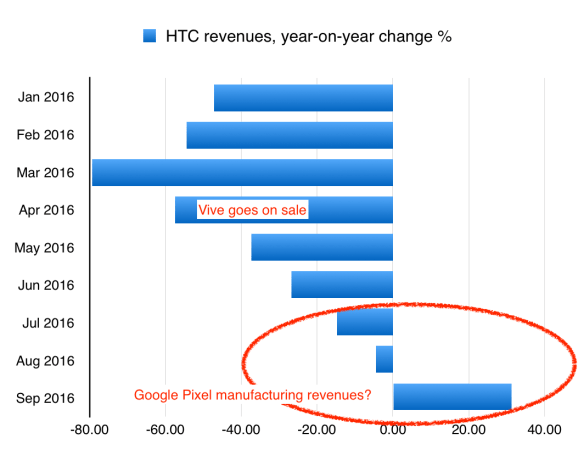
HTC revenues changes year-on-year by month

(Yes, you could argue that the revenues seem to suggest a rebound after February – but the Vive went on sale in April, with preorders opening in February, which would explain that too.)

On that basis, HTC has received NT$11.5bn, or about $363m, from Google to make the HTC Pixel – sorry, the Google Pixel.

How many handsets does that translate to? It depends on how much you think it costs to make them. If you take the IHS estimate for the manufacturing cost of the iPhone 7, of $220, then HTC has made 363m/220 = 1.65m Pixels.

However, that seems like an absurdly high manufacturing cost. So let’s try $110 instead – given that Google is selling them for the same price as an iPhone, that would certainly help profits.

At $110, our $363m translates into 3.3m handsets already made and filtering into sales channels as you read this. I’d expect the true figure lies somewhere between these two – I could have overestimated the money put into this manufacturing effort, and if Google really is charging $600+ for a $110 handset, it’s bringing chutzpah to a whole new level.

So let’s say it might have around 2m to 3m handsets available over the next few months. Is that going to sate those seeking an alternative to the Note 7? Probably not – as a handset it’s OK, but it’s not YUGE like the Note 7, and it doesn’t have a cool stylus or all those other things.

Also, 2-3m handsets (built over three months) isn’t going to be enough to fulfil all those would-be Note 7 buyers, who are reckoned to number 19m over the next 12 months, remember. Google can keep the HTC factories working, churning out a million or so a month, but it would be very surprising if all of the 17m or so Note 7 buyers go for the Pixel instead.Google may well get a good slice of those buyers – more, in fact, than it was ever expecting, given the market it thought it was going to be launching into – but I don’t think it’ll capture all of them by any means.

(In passing, notice that that $363m only gets you to first base in this project: having some phones built. It doesn’t cover the R+D, sales, marketing or administration. You’re easily talking half a billion dollars here to do this thoroughly. And that’s for a phone which is only going to make a marginal impact on this quarter’s sales.)

And back to Samsung

In the end, most of those early Note 7 buyers are probably going to buy another Samsung. But that’s not what its management should worry about – nor the $2bn exceptional item that’s going to be sitting on the balance sheet for the next quarter.

It’s this: what happens when it announces the Galaxy S8 next January or February? People are going to ask whether it explodes, and Samsung will say of course not, and then inevitably there will be a case where it does, because manufacturing defects are inevitable. Hell, there’s even been a claimed instance with an iPhone 7, and Apple doesn’t use fast charging or USB-C and doesn’t squeeze high-capacity batteries into small spaces. It’s pretty much certain that a Galaxy S8 will go off. Then what?

And this is even before the media has gotten onto other flaming Samsung appliances, such as its washing machines in Australia. (Dedicated Overspill readers knew about this a while back.)

The reason why this is a particular problem now is that the smartphone market has pretty much peaked; in the premium market, replacement cycles are lengthening and sales are shrinking, so anyone that Samsung doesn’t capture now might be lost (as a potential sale) for another two or three years. That’s a substantial amount of foregone profit

The upside for Huawei looks big. The upside for Google (Pixel) looks like hitting sales targets. The upside for Apple looks like some more iPhone 7 sales, though I wouldn’t hang your hat on it.

The downside for Samsung, though, looks big. Events like this can make and break a company, and this is going to be its more serious test ever.

Start Up: Note 7 redux, HTC’s Android Wear why?, chocolate and Nobels, talking to robots, and more


Not welcome at British government Cabinet meetings. Photo by Bill Juoy on Flickr.

You can now sign up to receive each day’s Start Up post by email. You’ll need to click a confirmation link, so no spam.

A selection of 10 links for you. Use them wisely. I’m charlesarthur on Twitter. Observations and links welcome.

Dozens of suspicious court cases, with missing defendants, aim at getting web pages taken down or deindexed • The Washington Post

Eugene Volokh and Paul Alan Levy:

»

There are about 25 court cases throughout the country that have a suspicious profile:

• All involve allegedly self-represented plaintiffs, yet they have similar snippets of legalese that suggest a common organization behind them. (A few others, having a slightly different profile, involve actual lawyers.)
• All the ostensible defendants ostensibly agreed to injunctions being issued against them, which often leads to a very quick court order (in some cases, less than a week).
• Of these 25-odd cases, 15 give the addresses of the defendants — but a private investigator (Giles Miller of Lynx Insights & Investigations) couldn’t find a single one of the ostensible defendants at the ostensible address.

Now, you might ask, what’s the point of suing a fake defendant (to the extent that some of these defendants are indeed fake)? How can anyone get any real money from a fake defendant? How can anyone order a fake defendant to obey a real injunction?

«

This turns out to be quite weird, and seems to be about the lack of a “right to be forgotten” in the US. But are the same tactics being used in the UK, or Europe?
link to this extract


I’m angry at Facebook • The Arc

Ericka Andersen:

»

A year and a half ago, I took a new job at a legacy publisher — a well known brand name with a strong readership. They hadn’t put a lot of stock in social media strategy and even in 2015, had a mere 167,000 Facebook fans and got only a fraction of traffic from the platform to the website.

I was determined to change this. I took on the Facebook platform with gusto, getting ads into play, overhauling the posting strategy, doing A/B testing, getting our well-known writers fan pages, mixing up content, adding video to the list, aggressively targeting new fans and adding share buttons and social incentives to everything we did.

Literally within days, the Facebook traffic increased. Month after month, the platform engagement grew, our fan base exploded, our traffic increased significantly from Facebook.

And then, the algorithm. The stupid algorithm. The algorithm that every social media manager has come to loathe with the fire of thousand suns.

Don’t bother asking Facebook staff about it — they have merely vague, nonsensical answers that amount to: “It’s your own fault. Your content sucks.”

I can assure you, our content is not the problem.

Several months back, our traffic from Facebook plateaued. Then it tanked. Now, the traffic is as low as it was before I arrived. You know, back when they had 800,000 fewer fans? How, in god’s name, is this even possible?

*I understand that Facebook can do whatever they want. They can prioritize friends and family postings above publishers if they want to. That’s fine!

But, if publishers are investing large amounts of money in building their fan bases  —  getting people to like the page that are actually the kind of people who want this kind of content  —  isn’t there some kind of ethical obligation on their part to deliver the content provided?

«

link to this extract


Apple Watches banned from Cabinet after ministers warned devices could be vulnerable to hacking • Daily Telegraph

Peter Dominiczak:

»

Ministers have been barred from wearing Apple Watches during Cabinet meetings amid concerns that they could be hacked by Russian spies, The Telegraph has learned.

Under David Cameron, several cabinet ministers wore the smart watches, including Michael Gove, the former Justice Secretary.

However, under Theresa May ministers have been barred from wearing them amid concerns that they could be used by hackers as listening devices.

Mobile phones have already been barred from the Cabinet because of similar concerns.

One source said: “The Russians are trying to hack everything.”

Mr Gove disrupted one Cabinet meeting when he was Chief Whip by inadvertently playing a Beyonce song.

«

Dominiczak is the political editor. I can imagine this came from a corridor conversation with a minister. Only need now to narrow it down to those in the Cabinet who wear Watches.

Can believe they’d be a hacking target, though. They have a microphone; why not?
link to this extract


IAEA chief: Nuclear power plant was disrupted by cyber attack • Reuters

Andrea Shalal:

»

A nuclear power plant became the target of a disruptive cyber attack two to three years ago, and there is a serious threat of militant attacks on such plants, the head of the United Nations nuclear watchdog said on Monday.

International Atomic Energy Agency (IAEA) Director Yukiya Amano also cited a case in which an individual tried to smuggle a small amount of highly enriched uranium about four years ago that could have been used to build a so-called “dirty bomb”.

“This is not an imaginary risk,” Amano told Reuters and a German newspaper during a visit to Germany that included a meeting with Foreign Minister Frank-Walter Steinmeier.

“This issue of cyber attacks on nuclear-related facilities or activities should be taken very seriously. We never know if we know everything or if it’s the tip of the iceberg.”

Amano declined to give details of either incident, but said the cyber attack had caused “some disruption” at the plant, although it did not prove to be very serious since the plant did not have to shut down its operations. He said he had not previously discussed the cyber attack in public.

«

Lionel Shriver’s book “The Mandibles” (highly recommended) has a passing mention in the plot setup of a time when the whole of the US’s internet is knocked offline for some time. Here’s hoping she’s not prophetic.
link to this extract


HTC could finally be ready to release its first Android Wear smartwatch • Pocket-lint

Max Langridge:

»

Chinese site Weibo has picked up some leaked images of the alleged HTC watch, codenamed Halfbeak, a codename which has been associated with the watch before. The images have since been shared by TechTastic.nl.

The images show an almost customary circular watch face with a reported 360×360 pixel resolution but what isn’t clear is what the face is made from, but it’s likely to be metal. The strap, which on first impressions doesn’t look interchangeable, appears to be made from rubber silicone.

The watch will run on Android Wear and control will be via two round buttons and a longer oblong button on the right hand side of the face.

It’s likely HTC’s smartwatch will be aimed at fitness fanatics, as there’s a clear Under Armour logo on the back of the watch, confirming a partnership between the two companies. There also appears to be a heart rate monitor on the underside of the watch too.

«

Great way to lose money, but hey, let HTC decide for itself how it digs its grave.
link to this extract


US top court to hear Apple-Samsung feud over iPhone designs • Reuters

Andrew Chung:

»

The justices’ ruling, due by the end of June, could have a long-term impact for designers and product manufacturers going forward because the Supreme Court, if it agrees with Samsung, could limit the penalties for swiping a patented design.

Samsung Electronic paid Apple $548.2m last December, fulfilling part of its liability stemming from a 2012 verdict for infringing Apple’s iPhone patents and copying its look.

But Samsung will argue before the Supreme Court that it should not have had to make as much as $399m of that payout for infringement of three patented designs on the iPhone’s rounded-corner front face, its bezel and the colorful grid of icons that represent programs and applications.

It will be the Supreme Court’s first case involving design patents in more than 120 years, when the products at issue were carpets and rugs.

Cupertino, California-based Apple sued its South Korean rival in 2011, claiming Samsung stole its technology and the iPhone’s trademarked appearance.

Samsung has said it should not have had to fork over all of its profits on phones that infringed the patents, which contributed only marginally to a complex product with thousands of patented features.

Apple has said Samsung was properly penalized for ripping off its work.

«

Guess a decision there would qualify for a “Finally” if ever one did.
link to this extract


Samsung says it’s ‘working diligently’ as fifth replacement Note 7 burns • The Verge

Jordan Golson:

»

If you own a Samsung Galaxy Note 7 you should immediately stop using it and return it for a refund — all the major US carriers will exchange the phone, regardless of purchase date. We don’t know why Samsung hasn’t been more forthcoming about what’s going on with these replacement devices, but it doesn’t really matter. Until we get more information, the simplest explanation is the best one: the Samsung Galaxy Note 7 is a fundamentally defective product and it should be pulled from the market without delay.

«

Samsung halted production, but coyly wouldn’t say it had halted production, only that it was “making adjustments”. This will one day be in the management books about “how you don’t handle problems with your potentially explosive devices.” Especially because it is continuing to insist that the devices are safe to use:

»

Given these troubling reports about the Galaxy Note 7 replacement devices, Business Insider reached out to the company to ask if it still believes the phones are safe for customers to use and charge. The answer? Yes.

“Yes, the replacement Note7 devices are safe to use,” a UK-based spokesperson told Business Insider. “All new Note7 devices feature a green battery icon to give customers reassurance that their device is safe to charge.”

«

Not reassured. And sure enough, after this story appeared, Samsung announced that it was stopping all sales and exchanges while it investigates, and told everyone to turn off and exchange their Note 7s.
link to this extract


Your next friend could be a robot • WSJ

Christopher Mims:

»

It isn’t a surprise that we will access technology by voice. More surprising will be how people work alongside, and develop affection for, these computers.

At Amazon, that has led to rethinking Alexa’s purpose. Sensing that many users want a companion, Amazon is giving Alexa a personality, by making its voice sound more natural, and writing clever or funny answers to common questions.

“A lot of work on the team goes into how to make Alexa the likable person people want to have in their homes,” says Mr. Gill.

Google, too, has been working to make its voice interface, and the artificial intelligence behind it, personable. Last week the company rolled out Google Home, an Echo-like device powered by Google Assistant, its version of Alexa. But people have been talking to phones, tablets and computers powered by Google software, which has among the best voice recognition in the industry, for years.

To infuse personality into Assistant, Google employs writers who have worked on movies at Pixar and crafted jokes for the Onion, says Gummi Hafsteinsson, product-management director of Google Home. Getting it right also requires paying attention to details such as latency — humans have no patience for it in conversation — and tone of voice, such as stressing the word “now,” when Assistant says, “Setting a timer for two minutes starting now.”

«

As his interviewees say, when there’s no interface except the voice – no pointers, no touch objects – you’d better do it like the humans do.
link to this extract


Chocolate consumption and Nobel Prizes: a bizarre juxtaposition if there ever was one • Scientific American

Ashutosh Jogalekar:

»

What makes a Nobel Prize winner? There’s several suggested factors: Perseverance? Good luck? Good mentors and students? Here’s one possible factor that I would have never imagined in my wildest dreams; chocolate consumption. Chocolate consumption tracks well with the number of Nobel Laureates produced by a country.

At least that’s what a paper published in the New England Journal of Medicine – one of the world’s premier journals of medical research – claims. I have to say I found the study bizarre when I read it, and a few hours of strenuous, perplexed thought have done nothing to shake that feeling off.

«

Don’t worry, the writer points to the more obvious underlying factor after a bit.
link to this extract


iPhone 7? You’re fired! • BBC News

Ruhua Xianyu:

»

Nanyang Yongkang Medicine’s story [threatening to sack employees who got an iPhone 7] was soon picked up by a local news website. It reported that when it contacted the company to check the story a company spokesman called Mr Liu confirmed that the warning was issued on behalf of the firm’s chairman. He said it was intended to encourage staff to pay more attention to their family instead of luxury goods.

But there is no evidence that the company has yet followed through with its threat to sack staff found to have bought an iPhone 7. Mr Liu is reported to have added: “The company is discussing the notice further.”

Mr Liu’s boss is not the only employer who professes to be concerned that the iPhone 7 could lead their workers to developing an unhealthy obsession with pricey technology. This week Weibo users have shared photos of a notice issued by the Fuling Xinjiuzhou Gynecology Hospital in Chongqing warning its staff not acquire an Apple habit.

It reads: “iPhone 7 has recently come onto the market and the price is a record high among the similar mobiles. In order to promote thrift and avoid waste, the hospital administration office has made a decision: we ban our staff from buying iPhone 7s.” The notice goes on to warn that anybody who flouts the rule will be disqualified from receiving the top grade in their staff appraisal and will be urged to return their phone to the shop.

The hospital’s manager told BBC Trending he had been prompted to act when a member of staff had bought an iPhone 7 even though it cost three times their monthly wage.

«

Make China Great Again. Bring The Jobs Back. Something like that.
link to this extract


Errata, corrigenda and ai no corrida: none notified

Start up: the adtech vig, new Macs and Surfaces?, securing the IoT, the fingerprinted smart gun, and more


It’s like machine learning. Sorta. Photo by noodlepie on Flickr.


In London on October 18th? I’ll be giving a talk: “Social Networks and the Truth“:

How many people do you follow on Facebook or Twitter whose political views you fundamentally disagree with?

It’s probably in the single digits. Yet there are millions of them out there. So why aren’t you following them? And if you aren’t, does that make their views wrong – or yours?

What happens when an election cycle or a referendum runs around opposing camps of social media opinions? How important are news media in such a situation? And would you believe that being online is polarising us, rather than making us more willing to listen to other viewpoints?

This talk will explore that – and its consequences.

Tickets are limited; book now. £10 secures your place.


You can now sign up to receive each day’s Start Up post by email. You’ll need to click a confirmation link, so no spam.

A selection of 13 links for you. Use them wisely. I’m charlesarthur on Twitter. Observations and links welcome.

Deep-fried data • Idle Words

The wonderful Maciej Ceglowski, who runs Pinboard (which I use to compile these links each day, as it happens), gave a speech to the Library of Congress in September:

»

Today I’m here to talk to you about machine learning. I’d rather you hear about it from me than from your friends at school, or out on the street.

Machine learning is like a deep-fat fryer. If you’ve never deep-fried something before, you think to yourself: “This is amazing! I bet this would work on anything!”

And it kind of does.

When I was in college, friends who worked the snack bar conducted extensive research along these lines. They would deep-fry cheese, candy, pens, their name tag. And all of it came out tasting great.

In our case, the deep-fryer is a toolbox of statistical techniques. The names keep changing—it used to be unsupervised learning, now it’s called big data or deep learning or AI. Next year it will be called something else. But the core ideas don’t change. You train a computer on lots of data, and it learns to recognize structure.

These techniques are effective, but the fact that the same generic approach works across a wide range of domains should make you suspicious about how much insight it’s adding.

And in any deep frying situation, a good question to ask is: what is this stuff being fried in?

«

link to this extract


Machine logic: our lives are ruled by big tech’s ‘decisions by data’ • The Guardian

Julia Powles:

»

With artificial intelligence and machine learning, technologies that are fast becoming very significant actors, “we are in another moment of irrational confidence”, says renowned technology and culture researcher Kate Crawford.

Aiming at population-level predictive gambles, these technologies filter who and what counts, including “who is released from jail, what kind of treatment you’ll get in hospital, the very news that you see”. How we respond is “the biggest challenge facing us for the next 50 years”.

Crawford and three other women at the leading edge of digital scholarship and activism are headlining the 17th annual Association of Internet Researchers conference in Berlin. Their resounding message is that we have an urgent problem with “the machine logics that bind human and non-human rulers together”.

Crawford points to the recent international outrage at Facebook’s censorship of a Pulitzer prize-winning photograph as the tip of the iceberg. This is a high-profile example on top of “a much larger mass of unseen hybrids of automated and semi-automated decision-making,” she says. “They are embedded in back-end systems, working at the seams of multiple data sets, with no consumer-facing interface. Their operations and rules are not apparent to us.”

«

link to this extract


Where did the money go? Guardian buys its own ad inventory • Mediatel

David Pidgeon:

»

In worst case scenarios, for every pound an advertiser spends programmatically on the Guardian only 30 pence actually goes to the publisher.

The revelation, announced by the Guardian’s new chief revenue officer, Hamish Nicklin, at the Automated Trading Debate on Tuesday (4 Oct), means a host of adtech businesses operating within the supply chain are extracting up to 70% of advertisers’ money without being able to quantify the value they provide to the brand.

“There’s leakage. The money that goes in is not the same as the money that goes out,” Nicklin said.
“There are so many different players taking a little cut here, a little cut there – and sometimes a very big cut. A lot of the money that [advertisers] think they are giving to premium publishers is not actually getting to us.”

Nicklin said the Guardian had purchased its own ad inventory to try and assess where the money was spent across the entire supply chain and saw, in some instances, that only 30 pence was making it back to the publisher.

«

And you wonder why publishers struggle online. That sort of skimming is unsustainable.
link to this extract


Inside Apple’s new audio adapter • iFixit

Jeff Suovanen:

»

The takeaway seems to be that in some areas, the sound quality does measure a bit worse from the adapter than we might be accustomed to. For instance, when playing an uncompressed 16-bit audio file on the iPhone 6s, the dynamic range dropped from 99.1 dB at the headphone jack to 97.3 dB at the adapter. Though keep in mind, this slightly lower measurement is still higher than the theoretical maximum you get from a compact disc (which is 96 dB). So, is it a difference you are likely to notice? If you sit in a quiet room with a really, really good pair of headphones … and you’re a canine, the answer is: maybe.

But it appears Apple’s engineers did their job, and this tiny adapter performs better than most people expected or even thought possible.

«

No. That is not the takeaway. You literally cannot hear the difference. You can barely measure it.
link to this extract


A 19-year-old just built the first fingerprint-reading smart gun • WSJ

Geoffrey Fowler:

»

[Investor Ron] Conway takes to the podium to announce he has found a solution: the 18-year-old sitting near him, smiling politely but confidently in his well-tailored suit. His name is Kai Kloepfer and he’s from Colorado, a state that’s had more than its share of mass shootings. “He is the Mark Zuckerberg of guns,” Conway tells the room.

Kloepfer has spent the past four years designing a handgun with a fingerprint reader built into the grip, and he deferred his acceptance to MIT after winning a grant from the Smart Tech Challenges Foundation in 2014. His startup, Biofire, is just a few months from a live-firing prototype, which, assuming it works, will be the first gun to unlock like an iPhone.

“Congratulations,” Conway says to Kloepfer. “You are going to save America. You are going to save lives. The gun companies won’t tell you, but the tech industry will.”

«

Uses a fingerprint reader that’s a spinoff from the colossal smartphone business in Shenzhen. About 20,000 youth suicides, unintended injuries and deaths in the US each year come from “improperly secured guns”. 250,000 guns stolen each year; 62% of 33,000 gun deaths are suicides, committed with guns not belonging to the victim.
link to this extract


We need to save the internet from the Internet of Things • Motherboard

Bruce Schneier:

»

The security of our computers and phones also comes from the fact that we replace them regularly. We buy new laptops every few years. We get new phones even more frequently. This isn’t true for all of the embedded IoT systems. They last for years, even decades. We might buy a new DVR every five or ten years. We replace our refrigerator every 25 years. We replace our thermostat approximately never. Already the banking industry is dealing with the security problems of Windows 95 embedded in ATMs. This same problem is going to occur all over the Internet of Things.

The market can’t fix this because neither the buyer nor the seller cares. Think of all the CCTV cameras and DVRs used in the attack against Brian Krebs. The owners of those devices don’t care. Their devices were cheap to buy, they still work, and they don’t even know Brian. The sellers of those devices don’t care: they’re now selling newer and better models, and the original buyers only cared about price and features. There is no market solution because the insecurity is what economists call an externality: it’s an effect of the purchasing decision that affects other people. Think of it kind of like invisible pollution.

What this all means is that the IoT will remain insecure unless government steps in and fixes the problem.

«

DDOS attacks like the one on Brian Krebs’s site are indeed a sort of pollution; an externality, in economics lingo. And you need governments to regulate externalities like this, since a tort lawsuit against the maker of an insecure device will probably fail – seller goes bust, is in a different country, etc.
link to this extract


Microsoft schedules its autumn hardware event for October 26 • ZDNet

Mary Jo Foley:

»

The theme of the event this year is news around “the next chapter in the Windows story”. I assume this means there will be news around Windows 10 Redstone 2. Sources also are saying to expect OEM devices, Microsoft Surface device news, and some gaming-related updates at the event.

A number of us Microsoft watchers are expecting the company to launch a Surface All-in-One type device – likely with a Surface keyboard and mouse – at the event. I’ve also heard Microsoft will be highlighting a bunch of its OEM partners’ Windows 10 devices there.

Will there be a new Microsoft Band or a Microsoft-branded phone launched on Oct. 26? No and no…my sources continue to say no new Microsoft phones of any kind are coming this year, either.

«

Microsoft is going after smaller and smaller markets. The market for all-in-ones is smaller even than that for premium laptops.
link to this extract


Apple’s rescheduled earnings call could suggest new Mac announcement around October 27 • 9to5Mac

Ben Lovejoy:

»

When the largest company in the world changes the date of a quarterly earnings call, there has to be a good reason. It’s not the sort of thing you do on a whim.

Apple has done this once before, and there was indeed a very good reason, which it shared with us: to allow senior Apple execs to attend the memorial service of long-standing board member Bill Campbell.

This time, however, no explanation has been offered, and enquiries by reporters have received no response. I’m with Philip Elmer-DeWitt in thinking that there’s one very plausible explanation.

That explanation is that Apple has brought forward its quarterly earnings call to make way for a keynote two days later. And the event we’re all expecting this month is the launch of new Macs.

«

About time: that’s a month into the final quarter, with some machines which haven’t been significantly updates in years. The Mac Pro hasn’t ever been updated; it came out in the same year as iOS 7. Remember that?

Although I’d wager that all the new models will use USB-C charging. (Note Apple’s press release around the revamped MacBook in April, which it called “our vision for the future of the notebook”.) And that’s going to make obsolete millions of MagSafe chargers around the world. And they can’t be converted.
link to this extract


US government: Russia behind hacking campaign to disrupt US elections • Ars Technica UK

Sean Gallagher:

»

The Office of the Director of National Intelligence and the Department of Homeland Security today jointly charged that the Russian government was responsible for directing a series of intrusions into the networks of US political organizations and state election boards. In a “joint security statement”, officials from the two agencies declared they were “confident” that the government of President Vladimir Putin was behind the hacks and the publication of data obtained from them—some of it doctored—specifically to impact the results of the upcoming US elections.

In a joint statement, agency officials asserted the following:

»

The U.S. Intelligence Community (USIC) is confident that the Russian Government directed the recent compromises of e-mails from US persons and institutions, including from US political organizations. The recent disclosures of alleged hacked e-mails on sites like DCLeaks.com and WikiLeaks and by the Guccifer 2.0 online persona are consistent with the methods and motivations of Russian-directed efforts. These thefts and disclosures are intended to interfere with the US election process.

«

The officials also accused Russia of being behind attacks on some state election board systems.

«

link to this extract


Samsung knew a third replacement Note 7 caught fire on Tuesday and said nothing • The Verge

Jordan Golson:

»

Another replacement Samsung Galaxy Note 7 has caught fire, bringing the total to three this week alone. This one was owned by Michael Klering of Nicholasville, Kentucky. He told WKYT that he woke up at 4AM to find his bedroom filled with smoke and his phone on fire. Later in the day, he went to the hospital with acute bronchitis caused by smoke inhalation.

“The phone is supposed to be the replacement, so you would have thought it would be safe,” Klering told WKYT, saying that he had owned the replacement phone for a little more than a week. “It wasn’t plugged in. It wasn’t anything, it was just sitting there.”

The most disturbing part of this is that Klering’s phone caught fire on Tuesday and Samsung knew about it and didn’t say anything. And actually, it gets worse than that.

Samsung asked Klering if they could take possession of the phone and he said no, though the company did pay to have it x-rayed — but the damning evidence comes in the form of a text message that Klering inadvertently received from a Samsung representative:

“Just now got this. I can try and slow him down if we think it will matter, or we just let him do what he keeps threatening to do and see if he does it.”

«

Now, ok, this looks like a smoking gun. (Oops, sorry.) But: why wouldn’t Klering let Samsung take the phone to check it? That’s quite odd; you’d think, if he has chosen the same phone *twice*, he would want it checked over and, presumably, replaced.

Hence I do wonder if Klering was demanding some sort of extra payment from Samsung, saying that otherwise he would take it to the press, but that Samsung was insisting he just hand over the phone so it could decide what, if any, recompense was due. Perhaps that’s what the “threat” is. And Klering made good on it. What’s not crystal clear though is whether this truly was a replacement Note 7, or an original one, or what.

But it’s getting worse: AT+T suspended all sales of the Note 7 and so has T-Mobile; Ars Technica says the count of “safe” Note 7s catching fire is up to five.

Samsung may be overlooking that these things are slow to catch on with consumers – but then very hard to put out.
link to this extract


Uber’s self-driving cars are already getting into scrapes on the streets of Pittsburgh • Quartz

Alison Griswold:

»

While it would be easy to write off these incidents [a self-driving car seen going the wrong way up a one-way street; being hit from behind by the following car, which is always the following car’s fault] as minor mishaps, both suggest how much work Uber has left to do on its autonomous software, even as it’s begun putting real passengers in the cars. One reason Uber’s vehicles are currently traveling only a small area of Pittsburgh is because those are supposed to be the streets its engineers have carefully mapped and taught the cars about. If that’s really the case, no self-driving car should be turning the wrong way down a one-way street—nor should its safety driver, who is in theory the final check on the car’s autonomy.

Driverless vehicles also tend to operate in a cautious, hyper-logical manner and follow the rules of the road to a tee. Uber, again via its mapping efforts, has tried to prepare its cars to avoid certain tricky situations they might run into. On one street near the ATC in Pittsburgh, Uber engineers have instructed the self-driving cars to hang close to the curb because trucks making turns are more likely to swerve into the oncoming lane. By that same logic, the cars should also know certain intersections are hotspots for rear-ending accidents and be on the alert to avoid them, much as a savvy human driver would be. Uber’s approach differs from that of other companies such as Nvidia, which have focused on teaching computer systems to drive in a more adaptive, human-like way—by being introduced to situations a few times, and then applying what they learn to other encounters on the road.

«

link to this extract


Twitter sale process said almost dead as suitors bow out • Bloomberg

Alex Sherman, Sarah Frier, and Brian Womack:

»

Twitter Inc.’s sales process is almost dead, as top bidders lose interest amid pressure from their investors, according to people familiar with the matter.

Twitter once saw interest from Alphabet Inc.’s Google, Salesforce.com Inc. and Walt Disney Co., all of which consulted with banks on whether to acquire the social-media company. Now all of those suitors are unlikely to make a bid, the people said. On Friday, Twitter had planned to have a board meeting with outside advisers on a sale but canceled, one of the people said.

At Salesforce’s investor conference this past week, several investors talked to Chief Financial Officer Mark Hawkins and other executives about how they weren’t pleased with the idea of a Twitter buyout, according to another person familiar with the matter. They made their feelings known during small huddles near the stage and other areas around the meeting room. High-profile investors also e-mailed Hawkins, who forwarded the messages to his CEO and the board.

«

What options are left? Stagger on as before? Private equity buyout? But with no obvious route to profitability in sight, it’s hard to see how it would be attractive to a private equity buyout.
link to this extract


Here come the Galaxy S8 rumors: no physical button, “full screen” display, and dual camera • AndroidAuthority

Bogdan Petrovan:

»

According to the report, Samsung is planning to use a so-called “full screen display.” In other words, the plan is to all but eliminate the top and bottom bezels (the side bezels are already very thin), which would supposedly create a very minimalist and immersive experience.

This one ties in with the elimination of the home button – if Samsung really drops the physical home button, it would make a lot of sense to reduce the bottom bezel as much as possible.  For a reason why, just look at the negative reaction to the empty top and bottom bezels of the Pixel and Pixel XL.

In late 2015, Samsung was rumored to make all sides of the Galaxy S7, including the top and bottom, curved. That didn’t pan out, but Samsung may use the idea on the Galaxy S8. Expanding the curve to the two other sides would keep the S8 ahead of competitors, including the next iPhone, which is rumored to feature an all-new design.

Rumor has it that Samsung has already made up its mind on using a dual camera on the back of the Galaxy S8. The question is whether Samsung will use a two-lens/one-module design or a two-lens/two-module arrangement. According to the report, Samsung could opt for a 16MP/8MP setup.

«

Basically, anything Apple is rumoured to do next September (or has done this September), Samsung will do next February/March. It’s probably galling as hell for Apple’s designers to find their ideas leaking like this.
link to this extract


Errata, corrigenda and ai no corrida: none notified

Start up: Disney won’t Twitter, Oculus Touch prices, reviewing Alexa, Lenovo buying Fujitsu’s PCs?, and more


Contains no Samsung Note 7s, by order. Photo by cmsramsden on Flickr.


In London on October 18th? I’ll be giving a talk: “Social Networks and the Truth“:

how social media is both polarising our opinion and weakening the ways in which we hear contrary views.

Think about the claims made around Brexit (“£350m per week to go back to the NHS!”), Donald Trump’s ability to make wild claims which are believed by his followers without question, and the difficulty of getting anyone to agree even on what seem like simple facts – the disappearance of MH370, 9/11, climate change; the list goes on.

And here’s the strange thing: being online is polarising us more, and social networks amplify that. Why? This talk will explore that – and its consequences.

Tickets are limited; book now. £10 secures your place.


You can now sign up to receive each day’s Start Up post by email. You’ll need to click a confirmation link, so no spam.

A selection of 13 links for you. Use them wisely. I’m charlesarthur on Twitter. Observations and links welcome.

Snapchat parent working on IPO valuing firm at $25bn or more • WSJ

Maureen Farrell, Juliet Chung and Rolfe Winkler:

»

Snap Inc. is working on an initial public offering that could value the popular virtual-messaging company at $25bn or more, in what would be one of the highest-profile debuts in years.

The company, formerly known as Snapchat, is preparing the paperwork for an IPO with a view toward selling the shares as early as late March, according to several people familiar with the matter. There is no guarantee the four-year-old Venice, Calif., company will proceed with a share sale on that time frame or what its valuation might be.

If Snap, best known for allowing users to send disappearing messages from their smartphones, moves forward as planned, it would be the biggest company to go public on a U.S. exchange since 2014.

«

Contrast that to our next company…
link to this extract


Disney isn’t going to bid for Twitter, either • Recode

Peter Kafka:

»

Cross another potential Twitter buyer off the list: Disney isn’t pursuing a bid for the social platform, either.

Sources familiar with Disney, which was mulling a possible Twitter purchase last week, say the media giant has decided not to move forward.

Earlier today Recode reported that Google, a logical buyer for Twitter who had also hired a banker to kick the company’s tires, was not going to bid; Apple is also unlikely. Twitter shares dropped 9% in after-hours trading.

For now, that leaves Salesforce as the only potential buyer for Twitter, though the company has never confirmed publicly that it wants to make a deal. Salesforce CEO Marc Benioff appeared on CNBC today and refused to comment directly on any interest in Twitter.

«

Pfft. Someone must want it, surely?
link to this extract


Chromebooks in K12 • AVC

Fred Wilson:

»

Five years ago, most of the laptop carts I saw [in US schools] were filled with MacBooks. I was aghast when I saw that. I did the math and assumed that a laptop cart filled with Macs was costing these schools something on the order of $30k or more. And someone had to manage all of the downloaded software on these devices. It seemed like an expensive and painful solution.

It was around this time that Google launched its first Chromebook. I told everyone who would listen to me that putting inexpensive Chromebooks in these carts was going to be a better solution. An added benefit of using browser based software on these devices is that the student can grab any device in the cart, log in using their email address, and immediately be provisioned with their work and applications in the cloud. It seemed to me that this was going to be the way to go.

I read today that Chromebooks are now being used by 20mm students. I have no idea what% of those are in the US, but if we guess 50%, then that would be 10m students in the US. There are somewhere around 50mm K12 students in the US, so that suggests that Chromebooks may have penetrated 20% of classrooms in the US. That is encouraging to me.

«

This is what low-end disruption looks like.
link to this extract


Oculus Touch is $199, shipping December 6th, final design revealed • UploadVR

Jamie Feltham:

»

As you can see, Touch consists of two handheld controllers shaped for your left and right hands respectively. With them you can bring your hands into a VR experience, reaching out to interact with objects and items. Both devices also feature analog sticks along with triggers and face buttons as well as gesture recognition.

It’s essentially Oculus’ answer to the position tracked controls found in the HTC Vive, which come included with the headset for $799. Both the Oculus Rift and Touch together will cost $798, putting them at very similar prices. Oculus is set to integrate Room Scale tech too, with extra Oculus sensors going on sale soon for $79. Rift and Vive are now neck and neck.

«

link to this extract


UK’s Royal Mail won’t ship the Galaxy Note 7 for you • AndroidAuthority

“Nirave”:

»

we’ve been able to establish that there is a directive in place requiring the Post Office to ask about the contents of every package and to refuse any parcel containing a Galaxy Note 7. However, some Post Offices are taking this a step further and refusing to accept packages containing any Samsung phone, although this is not an official decision; earlier today, we managed to confirm with six Post Offices that they couldn’t carry the Galaxy Note 7 and of these, two said they wouldn’t accept any Samsung Galaxy phone.

For Samsung, this presents an interesting problem as the Galaxy Note 7 doesn’t stand a chance of successfully reclaiming its throne as the king of flagships if consumers continue to be reminded of the handset’s woes. Like the airlines, it remains to be seen how quickly companies remove these limitations on the Galaxy Note 7, if at all.

«

This thing is toast, reputation-wise.
link to this extract


Yelling at Amazon’s Alexa • The New Yorker

Sarah Larson:

»

This spring, I decided to experiment with Alexa myself, at my apartment, which has a beautiful soul but is not smart in the least. In theory, Alexa can adjust your lighting by having you yell into the air; she can open and close your garage door and turn up the heat. I live in a prewar walkup; my lights are rarely far from my hands; I certainly don’t have a garage. My heat is controlled by knob-turning, window-opening, and landlord-e-mailing, which are not compatible with Alexa. My apartment’s brain, sadly, would still have to be me.

I tend to grumpily resist new technology, thinking it frivolous. (My foray into the future with Alexa would occur in a room decorated with Puritan bookends and a whatnot shelf.) Inevitably, when I get the thing, I like it—and I have an active dialogue going with my iPhone Notes app, which I talk to all the time. But in this case I was also wary of Amazon. Amazon is a conundrum—a bully, a megalomaniac, a resource, a savior, a snoop. I’m unnerved by its dash buttons, its drones, its Sunday U.S.P.S. deliveries. (On Sundays in my apartment building, you can hear an eerie beeping by the mailboxes all day long: Amazon, Amazon, Amazon.) I decided that I would talk to Alexa—we could rap about music and the news, say—but that there would be no ordering things from the mothership. Then I went to the mothership’s Web site and ordered an Echo.

«

Imagine if all tech reviews were as readable and enjoyable as this. Set aside the time for it.
link to this extract


A declining trajectory • Matt Gemmell

Mrs Gemmell’s Watch and iPhone aren’t behaving:

»

She is not a happy customer.

My Watch is misbehaving too, regularly losing its ability to track heart-rate and thus update in-progress workout calories for ten or twenty minutes at a time. Its battery life is vastly reduced. My iPhone’s battery widget shifts itself around on the widgets screen, and regularly vanishes altogether. There’s an unfamiliar street-address hovering in the Spotlight screen that I don’t recognise, beneath the app suggestions. It’s hit-or-miss as to whether the emoji suggestions feature works in the new on-screen keyboard. I quickly disabled my Apple Music trial after it deleted several of my rare live versions of Dire Straits tracks. And Apple Support finally conceded that my immaculate, obsessively-cared-for 2015 MacBook was beyond repair after three warranty parts-replacements, and gave me the new upgraded 2016 model I’m now typing on. I don’t have high hopes for it.

I am not a happy customer either.

There’s something wrong here. A death-march upgrade cycle is producing substandard software at the very least, and it’s diluting a hardware brand that’s probably unmatched in the industry, if not the world in general. It’s with mixed humour and genuine fear that people assert they’ll never get into version 1.0 of an Apple-made self-driving car.

«

I don’t have any of the problems Gemmell (Mrs or Mr) has. But it’s an interesting question whether the new-version-each-year system is necessary. It enables new features on iOS, but is the complexity of maintaining that across four platforms now overwhelming?
link to this extract


Lenovo tipped to take over Fujitsu’s PC business • South China Morning Post

Bien Perez:

»

Bernstein Research senior analyst Alberto Moel said a deal with Fujitsu would enable Lenovo to “continue gaining share in the worldwide personal computer market”.

“Our view on whether this deal is positive or not will hinge on the terms,” he said. “It would not be without precedent for Fujitsu to give the business away to Lenovo, or even pay Lenovo to take it.”
He estimated that Fujitsu sold 1.7m personal computers in the first half of this year, mostly in Japan, which yielded US$1.9bn in revenue.

“That represents about 15% of Lenovo’s nearly US$14bn PC sales globally in the same period,” he added.

Lenovo recently expanded its operations in Japan when it paid US$195m in July to acquire a further 44% interest in Lenovo NEC Holdings, a joint venture with NEC Corp that has been the country’s biggest personal computer supplier.

«

PC consolidation continues, with the little fish being swept up. Fujitsu really is tiny, but its PCs command a premium price: Lenovo shipped 25.3m PCs in the first half of the year for $13.3bn.
link to this extract


How Howard Stern owned Donald Trump • POLITICO Magazine

Virginia Heffernan:

»

No interviewer has ever been as adroit with treacherous leading questions in the vein of “When did you stop beating your wife?” [Radio shock jock Howard] Stern, in other words, gets people to publicly embrace their worst selves—and say things they live to regret.

That’s exactly what happened with Trump. Today, as the Republican nominee, he may fashion himself as a boss and a master of the universe. But what comes across in old tapes of the show, resurfaced recently by BuzzFeed and other outlets, is that Trump, like many of Stern’s guests, was often the one being played. By nailing him as a buffoon and then—unkindest cut—forcing him to kiss the Howard Stern ring, Stern and his co-anchor, Robin Quivers, created a series of broadcasts that today showcase not just Trump’s misogyny but his ready submission to sharper minds.

Why would people subject themselves to Stern’s hazing? Generally, his guests in those days—if not strippers and professional opera buffa types—had to have been brought pretty low, so that a combination of psychological fragility and hunger for celebrity made them vulnerable to his mock camaraderie. That’s why it’s important to remember that Trump in the period of his appearances on the show was deeply in the red. By the time he was a regular, he had blown it all in Atlantic City, run out on his vendors, left his imperious first wife, Ivana, for the commoner Marla Maples, earned the yearlong silent treatment of his namesake son and reported a loss of nearly a billion dollars. (Even a businessman of cognitive impairment would have to sweat that one.)

«

This is terrific writing. You ask why people are delving into Trump’s past? Because he’s never been a politician, and now he’s running for president. Everything about his personality is fair game – including this, which shows how a Putin or Assad would play him: flatter him, confuse him, outwit him. As the article also notes, his “Apprentice” act, of the fierce tyrant, is just that – an act.
link to this extract


Samsung Buys Viv • Above Avalon Plus

Rather than directly linking to the WSJ’s story about Samsung buying the “voice-driven AI assistant Viv”, I thought Neil Cybart’s analysis (in his paid-for newsletter) was worth quoting. He points out that some people insist Apple made a mistake in not buying Viv, and in letting “all” of Siri’s founders go:

»

Turning to the idea that Apple in some way “messed up” by not keeping Siri’s co-founders around, there were three Siri co-founders:
• Dag Kittlaus left Apple days after Siri made its debut on the iPhone 4s.
• Adam Cheyer left a year later in 2012.
• Tom Gruber is still at Apple and is currently Siri’s head of advanced development. 

I think many people would be surprised to learn that one of Siri’s co-founders is actually still leading Siri. 

Circling back to the claim that Apple is making a mistake by not buying Viv, the startup was actually very public about its technology. It was clear that Viv would eventually be bought since they had a feature and not a product. Viv needed a home. Samsung ended up being the one to bite. I found Kittlaus’ explantation to the WSJ for why he went with Samsung interesting: 

»

“There isn’t another company in the world…with the scale and scope of what Samsung does.”

«

My first reaction to that comment: No one else, other than Samsung, was interested in buying Viv.

«


“A feature and not a product.” “My first reaction…” I always enjoy the astringency of Cybart’s analysis, which comes from his years working as a Wall Street analyst. I also enjoyed this:

»

I recall watching Viv’s demo earlier this year at TechCrunch’s conference. I had the same reaction when watching Google demo Google Assistant earlier this week. [Dag] Kittlaus was using his smartphone in ways that I hoped would never become the norm. As I mentioned yesterday, there will be a much better way to use the power of AI besides having a long-winded, two-way conversation with my smartphone.

«

No matter. Sure to be included in the S8, even though Samsung already offered a “voice assistant” thing called S Voice.
link to this extract


Theranos retreats from blood tests • WSJ

John Carreyrou and Christopher Weaver:

»

The moves mark a dramatic retreat by the Palo Alto, Calif., company and founder Elizabeth Holmes from their core strategy of offering a long menu of low-price blood tests directly to consumers. Those ambitions already were endangered by crippling regulatory sanctions that followed revelations by The Wall Street Journal of shortcomings in Theranos’s technology and operations.

The shutdowns and layoffs could help the closely held company accelerate its shift to developing products that could be sold to outside laboratories. Ms. Holmes announced in August a new blood-testing device called miniLab, which is about the size of a printer but hasn’t been approved by regulators.

In a statement posted on Theranos’s website late Wednesday, Ms. Holmes said: “We will return our undivided attention to our miniLab platform. Our ultimate goal is to commercialize miniaturized, automated laboratories capable of small-volume sample testing, with an emphasis on vulnerable patient populations, including oncology, pediatrics, and intensive care.”

«

Just to show the leopard’s spots don’t change, from further down the story:

»

The miniLab was unveiled at a conference of lab scientists, and Ms. Holmes said it could run accurate tests from a few drops of blood. Theranos sought emergency clearance of a Zika-virus blood test but then withdrew its request after federal regulators found that the company didn’t include proper patient safeguards in a study of the new test.

«

🙄
link to this extract


Spotify has been sending computer viruses to listeners • Daily Telegraph

James Titcomb:

»

Spotify has been found to be serving malware to listeners who use the free version of its service, with its adverts directing PC users to virus-riddled websites.

Users of the music streaming software reported that the program would continually open their default web browser to load websites infested with malware.

The issue affected users of Windows, Mac and Linux operating systems, leading to complaints on the Spotify Community website and Twitter. The malware websites, some of which attempt to install viruses automatically without the user clicking anything, appear to have nothing to do with the advert in question.

The problem appears to be associated with a single advert on Spotify, which the company said it had removed after discovering the problem.

«

Collateral damage of the advertising-funded method. If advertising is roughly 2% of US GDP, what percentage is malvertising?
link to this extract


Source: Huawei passed on chance to produce Pixel phones, US division badly struggling • Android Police

As our story, told by the well-connected David Ruddock, begins, Huawei has been shortchanged in producing the 2015 Nexus range for Google, which promised it would be sold on all four US carriers – a country China’s Huawei desperately wants to break into:

»

Fast-forward shortly after the Nexus 5X and 6P launched, and Google began talks with Huawei to produce its 2016 smartphone portfolio – allegedly up to three phones, not just the two we ended up with. It’s unclear if they would have been branded Pixel, Nexus, or both (e.g., two Pixels and a cheaper Nexus). Google, though, set a hard rule for the partnership: Huawei would be relegated to a manufacturing role, producing phones with Google branding. The Huawei logo and name would be featured nowhere on the devices’ exteriors or in their marketing, much like the Pixel phones built by HTC that we’ll see unveiled tomorrow. According to our source, word spread inside Huawei quickly that global CEO Richard Yu himself ended negotiations with Google right then and there. Huawei was off the table for the new smartphones. Google’s “plan B” – HTC – ended up winning the contract.

But our source claims the great irony of this is that Huawei ended up passing on a chance to finally get one of its smartphones in a Verizon store (the Pixels will be sold by Verizon), even if it didn’t have the Huawei logo or mention of Huawei in its marketing. It could have, theoretically, set the stage for Huawei to work with Verizon in the future, however.

In the interim, Huawei’s US division hasn’t gained significant market traction. Despite achieving critical success [with Google] with the Nexus 6P last year, the company’s smartphone efforts in America have all basically fizzled.

«

Ruddock says Huawei then essentially fired all of its US team. I’m guessing his source is a senior manager who was canned. Google clearly misread Huawei’s willingness to be an ODM, though.
link to this extract


Errata, corrigenda and ai no corrida: none notified

Start up: replacement Note 7 aflame, end of software patents?, querying Yahoo, Pixel analysed, and more


Sometimes sexist language is subtly hidden. Photo by Mike Baehr on Flickr.


In London on October 18th? I’ll be giving a talk: “Social Networks and the Truth“:

how social media is both polarising our opinion and weakening the ways in which we hear contrary views.

Think about the claims made around Brexit (“£350m per week to go back to the NHS!”), Donald Trump’s ability to make wild claims, believed by his followers without question, and the difficulty of getting anyone to agree even on what seem like simple facts – the disappearance of MH370, 9/11, climate change, the list goes on.

So how did we get here? And what will happen next?

Tickets are limited; book now. £10 secures your place.


You can now sign up to receive each day’s Start Up post by email. You’ll need to click a confirmation link, so no spam.

A selection of 14 links for you. Not flammable. I’m charlesarthur on Twitter. Observations and links welcome.

Replacement Samsung Galaxy Note 7 phone catches fire on Southwest plane • The Verge

Jordan Golson:

»

Southwest Airlines flight 994 from Louisville to Baltimore was evacuated this morning while still at the gate because of a smoking Samsung Galaxy Note 7 smartphone. All passengers and crew exited the plane via the main cabin door and no injuries were reported, a Southwest Airlines spokesperson told The Verge.

More worryingly, the phone in question was a replacement Galaxy Note 7, one that was deemed to be safe by Samsung. The Verge spoke to Brian Green, owner of the Note 7, on the phone earlier today and he confirmed that he had picked up the new phone at an AT&T store on September 21st. A photograph of the box shows the black square symbol that indicates a replacement Note 7 and Green said it had a green battery icon.

Green said that he had powered down the phone as requested by the flight crew and put it in his pocket when it began smoking. He dropped it on the floor of the plane and a “thick grey-green angry smoke” was pouring out of the device. Green’s colleague went back onto the plane to retrieve some personal belongings and said that the phone had burned through the carpet and scorched the subfloor of the plane.

«

Credit to Golson, who actually got hold of the photo and checked it. Hurrah for real journalism. Meanwhile, Samsung suddenly has a much bigger problem than it had a few days ago, in its second-biggest market.
link to this extract


We bought a successful app, loaded it with extras and watched it fail • Recode

Peter Reinardt of Segment:

»

First, we needed a test subject. We planned to buy a small app with no active marketing activities, but significant and steady download numbers. Then we’d increase the app’s size, leaving everything else constant, and observe the impact on the app’s install rate. This would simulate the impact of app bloat on downloads.

So we bought the Mortgage Calculator Free iOS app. It was a minuscule 3MB, with a steady pattern of organic installs (about 50 installs per day for several years) and no active marketing activities. It was the perfect test case.

Over the course of the experiment, we increased the app size from 3MB to 99MB, 123MB and 150MB. We kept everything else constant to observe the isolated impact on install rate with each change in app size.

App sizes can increase substantially with the addition of seemingly simple things, like an explainer video, a bunch of fonts, an SDK or a background picture for your loading screen. For the purposes of our experiment, we bloated our app with a ton of hidden Taylor Swift album art.

To measure the impact of each successive bloating, we looked at data provided directly by Apple in iTunes Analytics. We specifically tracked conversion from “Product Page Views” to “App Units,” better known as “installs” to ”install rate.”

«

Hit 100MB and you doom your installs. (That’s a limit Apple sets for Wi-Fi only downloads.) But there’s more.
link to this extract


How vector space mathematics reveals the hidden sexism in language • MIT Technology Review

»

Back in 2013, a handful of researchers at Google set loose a neural network on a corpus of three million words taken from Google News texts. The neural net’s goal was to look for patterns in the way words appear next to each other.

What it found was complex but the Google team discovered it could represent these patterns using vectors in a vector space with some 300 dimensions.

It turned out that words with similar meanings occupied similar parts of this vector space. And the relationships between words could be captured by simple vector algebra. For example, “man is to king as woman is to queen” or, using the common notation, “man : king :: woman : queen.” Other relationships quickly emerged too such as  “sister : woman :: brother : man,” and so on. These relationships are known as word embeddings.

This data set is called Word2vec and is hugely powerful. Numerous researchers have begun to use it to better understand everything from machine translation to intelligent web searching.

But today Tolga Bolukbasi at Boston University and a few pals from Microsoft Research say there is a problem with this database: it is blatantly sexist.

«

This is a remarkable study (and the de-sexisation of the corpus is even more impressive); it does make one wonder the extent to which news headlines continue ages-old tropes. (Here’s the original paper.)
link to this extract


UBS: ‘Ambient Paradigm’ is a huge growth opportunity for Apple • Business Insider

Kif Leswing:

»

UBS analysts think this means there’s a lot of upside to Apple stock that investors aren’t factoring in. Sure, the iPhone is a huge hit and a commercial success, but they see Apple laying the groundwork for “the next era of personal technology — the Ambient Paradigm.”

“We consider the Apple Watch and AirPods similar transition products today on the way to an integrated user experience based on multiple products seamlessly connected. We call it the Ambient (present on all sides) Paradigm. It is Tim Cook’s ‘iOS everywhere,'” Milunovich wrote.

He sees Apple’s “other products” like the Apple Watch and AirPods evolving in coming years, with Siri acting as the glue, and potentially affecting industries like healthcare and education.

If you’re constantly surrounded by Apple products and services, that presents a huge revenue opportunity for the computer maker, and also increases the possibility that users will feel locked into Apple’s ecosystem.

«

link to this extract


Intellectual Ventures case: why software patents will take a big hit • Fortune

Jeff John Roberts:

»

The ruling, issued on Friday by the U.S. Court of Appeals for the Federal Circuit, found that three patents asserted against anti-virus companies Symantec SYMC 0.63% and Trend Micro were invalid because they did not describe a patentable invention. The patents were owned by Intellectual Ventures, which has a notorious reputation in the tech world as a so-called “patent troll,” a phrase that describes firms that buy up old patents and wage lawsuits in order to demand payments from productive companies.

The most important part of the decision, which has created a stir among the patent bar, is a concurrence by Circuit Judge Haldane Mayer. In striking down a key claim from U.S. Patent 5987610, which claims a monopoly on using anti-virus tools within a phone network, Mayer says it is time to acknowledge that a famous Supreme Court 2014 decision known as “Alice” basically ended software patents altogether.

«

link to this extract


The Yahoo-email-search story is garbage • Errata Security

Rob Graham:

»

There are many other ways to interpret this story. For example, the government may simply be demanding that when Yahoo satisfies demands for emails (based on email addresses), that it does so from the raw incoming stream, before it hits spam/malware filters. Or, they may be demanding that Yahoo satisfies their demands with more secrecy, so that the entire company doesn’t learn of the email addresses that a FISA order demands. Or, the government may be demanding that the normal collection happen in real time, in the seconds that emails arrive, instead of minutes later.

Or maybe this isn’t an NSA/FISA story at all. Maybe the DHS has a cybersecurity information sharing program that distributes IoCs (indicators of compromise) to companies under NDA. Because it’s a separate program under NDA, Yahoo would need to setup a email malware scanning system separate from their existing malware system in order to use those IoCs. (@declanm’s stream has further variations on this scenario).

My point is this: the story is full of mangled details that really tell us nothing. I can come up with multiple, unrelated scenarios that are consistent with the content in the story. The story certainly doesn’t say that Yahoo did anything wrong, or that the government is doing anything wrong (at least, wronger than we already know).

«

Declan McCullagh offers a scenario where the Department of Homeland Security wanted to pick out emails which had particular malware attachments (foreign spearphishing attacks?), and Yahoo’s legal team threw together an engineering team but couldn’t clear it with the Yahoo security team. And now Yahoo can’t correct the reporting because it’s all classified.
link to this extract


A keystroke away… • Medium

John Naughton:

»

In 1939 there were about 140,000 Jews living in the Netherlands, including about 25,000 German Jews who had fled from Germany. By 1945, only about 35,000 of these people were alive. The Nazi extermination of Dutch Jews was remarkably efficient, mainly because Holland had been a well-administered state which kept very good records of its citizens, their addresses and their religions. So when the Nazis arrived, their genocidal task was easier than it was in some other occupied countries.

This horrific story neatly encapsulates the dilemma of the data-driven state. On the one hand, good governance requires that a state knows a lot about its citizens — where they live, what they do for a living, what taxes they pay, which schools their children can attend, and so on. Since 9/11, Western democracies have determined that the ‘war’ on terror (or the need to keep us safe, depending on your point of view) requires that the state needs to know an awful lot more about its citizens, and so comprehensive surveillance of their online and mobile communications, movements and financial transactions has been added to the government’s shopping list.

As we know from Edward Snowden and other sources, the scale and intrusiveness of this surveillance is now staggering. And — as the UK Investigatory Powers Bill shows, the state’s appetite for fine-grained personal data seems insatiable and is destined to grow.

«

Imagine if Yahoo had operated in Nazi Germany. Or if a fascist was elected to run the US. One would require time travel. The other..
link to this extract


Behind the crash of 3D Robotics, North America’s most promising drone company • Forbes

Ryan Mac and Aaron Tilley on the VC-backed company which burned through $100m:

»

The gimbal, or camera-stabilizing device, faced production delays and the first Solos hit the market [in June 2015] without this add-on, making it unsuitable for photos and video, the chief use of most consumer drones. “Making the gimbal was harder than making the drone,” said Guinn, who noted that the devices didn’t get to customers until August, a full two months after Solo’s launch.

Still, 3D Robotics executives remained bullish on Solo’s potential, forecasting huge sales for the holiday season. According to one employee, CFO John Rex and Anderson, who had already committed to make 60,000 of the quadcopters with contract manufacturer PCH International, decided in mid-June with less than a month of sales data that an additional 40,000 devices should be built. That represented a significant commitment, said another person who helped engineer Solo, because each drone and its gimbal cost more than $750 to manufacture and ship to retailers. Though the company was able to raise $64m in 2015, most of that was sunk into manufacturing costs, sources told Torbes.

Multiple people blamed the 3D Robotics’ bold projection for Solo’s failure, including one former employee who said that the fatal mistake was in basing predictions off of “sell in” versus “sell through” figures. The company forecasted Solo sales erroneously based on the inventory it was distributing to retail channels like Best Buy–a poor indicator of consumer demand because retailers can send back unsold inventory–and not on the number of devices actually purchased by customers from those stores.

A person, who worked for 3D Robotics’ marketing team, also questioned the company’s practices when displaying the drone to the press. The demo with The Verge in the spring of 2015, for example, featured a drone that was “worked over and souped up” and did not feature the typical parts you’d find in an off-the-shelf Solo. “We knew the drone would work,” he said, noting that there was an improved GPS component that wasn’t shipped in regulars Solos.

«

Showing hyped-up designs to visiting journalists (and others) is a common ploy. Shop-bought ones, now, that’s a different thing. (Casey Newton, who was the person it was demonstrated to, is now mad as hell – but also wiser in the ways of the world.)
link to this extract


First impressions: Google’s Daydream headset proves mobile VR isn’t ready yet • Business Insider

Rob Price was impressed by Google’s Cardboard in December 2015, so he expected great things from its new VR headset:

»

I gave Daydream a go at a special launch event in London on Tuesday — but it failed to blow me away.

The best virtual reality experiences have an element of transcendence to them. It’s the moment when the fact that you’re sitting there with a screen awkwardly strapped to your head just melts away, and you really feel there. It doesn’t matter if the graphics are cartoony, or if the screen is a bit pixellated — all of a sudden, you’re transported into an entirely new world. Done right, it can be magical.

At no point using Daydream did I feel this. I got the chance to try out two demos — an “experience” based around the forthcoming “Fantastic Beasts and Where to Find Them” JK Rowling movie, and a stylised game that has you roll a ball around a race track by tilting the remote.

Both times, it felt like I was using Cardboard. Sure, it was clearly more polished than the DIY headset, with less lag and a great new input device — but the underlying experience was similar. Head movements felt unnatural, the images didn’t feel “real”: There was no transcendence. I came away with a headache.

I was, inescapably, sitting in a chair with a smartphone stuck to my face.

Daydream, is evolutionary, not revolutionary — and that’s a problem

Mobile-only virtual reality simply isn’t ready for prime time. Alexander Koerner/Getty Images
Daydream is an evolutionary upgrade to Cardboard, rather than anything revolutionary. And I came away feeling like the technology behind mobile-powered virtual reality just isn’t there yet.

«

link to this extract


Google has its own phones. Now it must fix its retail strategy • Bloomberg

Mark Bergen:

»

On Tuesday, as a Google event began in San Francisco, new hardware chief Rick Osterloh [who used to be the hardware chief when Google owned Motorola] reassured the audience that the company was serious about the move. “We’re in it for the long run,” he said.

About nine months after initial talks with carriers, Google rolled out its flavor of technical support: Pixels have built-in chat support where customer-service reps can take over smartphone screens to identify problems.

Google will be responsible for returns and recycling and is building a supply chain that can re-absorb faulty and rejected devices, Osterloh said in a recent interview.

Osterloh will be partly judged by how many devices Google sells, a contrast to the Nexus program which showcased Android features for other handset makers to adopt. But the executive was still cagey about the company’s sales aspirations.

“In markets where we do business, we’re definitely going to want meaningful share,” he said. “But it’s highly unlikely that the primary driver will be to be in every market with as high as possible volume.”

«

That seems to imply the US and some bits of Europe as “markets where [Google does] business”. Those markets are stagnant. Quite how Google expects to get “meaningful” share (whatever that means), I don’t know. But Osterloh has a long history of blinding journalists with vague words. When Motorola was losing money hand over fist, he’d insist that “we make money on every phone we sell”. He meant gross margin – the sale price compared to raw cost of goods – and handily omitted everything else, such as marketing, administration, R D, and so on.
link to this extract


Snapchat Spectacles and the future of wearables • Stratechery

Ben Thompson:

»

perhaps the most fascinating implication of Spectacles is what it says about the potential of a long-term rivalry between Snapchat and Apple. Snapchat CEO Evan Spiegel has said that Snap née Snapchat is a camera company, not a social network. Or, perhaps more accurately, the company is both: it is a fully contained ecosystem that is more perfectly optimized for the continual creation and circulation of content than even Facebook. What matters from Apple’s perspective is that Snapchat, like Facebook or WeChat or other apps that users live in, is one layer closer to their customers. For now that is not a threat — you still need an actual device to run those apps — but then again most people used Google on Windows, which made Microsoft a lot of money even as it froze them out of the future.

This is exactly why Apple is right to push forward into the wearable space even though it is an area, thanks to the important role of services like Siri, in which they have less of an advantage. Modern moats are not about controlling distribution but about owning consumer touch points — in the case of wearables, quite literally.

«

I’ve linked to this a little after its publication, but the general point Thompson is making – that groundbreaking products need to be able to slot into ecosystems around them – is crucial.
link to this extract


Google’s Pixel smartphones target the most profitable segment, hurting Google’s partners • IHS Technology

Ian Fogg:

»

Google is pursuing a similar integrated hardware-software strategy to Apple with Pixel smartphones, Daydream View, and the other new hardware Google has announced. This is the final defeat for the operating system licensing model which Microsoft pioneered, and everyone tried to copy before Apple’s iPhone success.

But Google’s culture and deep learning, intelligence, organizational, and software competitive strengths are very different to Apple. Yet, with Pixel smartphones Google is aiming at the same competitive areas which Samsung and Apple are: camera quality, cloud storage, and the ease of experience. Google needs to differentiate based on its competitive strengths around AI, but Google Assistant needs to be on as many smartphones as possible to support Google strategy and so cannot be a long term differentiator for Pixel smartphones.

Google still has many smartphone hardware partners, unlike Apple, and it continues to need them. Because if not, Samsung may ramp its fall-back TIzen OS strategy, and more significantly Google’s many China headquartered smartphone maker partners may fork Android and take their more proprietary Chinese Android variants into international markets.

Android may be dominant now, but it’s not invincible if Google makes the wrong strategic moves and undermines its ecosystem partners.

«

link to this extract


Not OK, Google • TechCrunch

Natasha Lomas:

»

“It’s still early days, but when all of that works together, the Google Assistant allows you to get things done, bringing you the information you need, when you need it, wherever you are,” writes Pichai, in a caveated phrase that scores extremely high on the underwhelming / vague promises index.

He adds that he has “confidence” of being able to “do some amazing things for users over the next 10 years”.

So, in other words, trust us with all your data!

Uhhhh…

This week the EFF also excoriated Google for how AI is impinging on user privacy, focusing on another of its recent products: the Allo messaging app. That app also bakes in Google Assistant, and because Allo does AI by default the app does not offer end-to-end encryption by default — only as an ‘optional extra’ — because of course Google’s AI can’t function when Google’s AI can’t read your messages…

Criticizing the way Allo silos end-to-end encryption within an ‘incognito’ mode, which the EFF argues risks confusing users and risks sensitive data leaking out, it accuses Google of “training users to use encryption as an occasional measure” — going on on to conclude that: “A more responsible messaging app would make security and privacy — not machine learning and AI — the default.”

So whether it’s Google Home or Google Allo, Google is promising consumers a magical, AI-powered experience of unrivaled convenience. But it pays to ask tougher questions.

The adtech giant is trying to control the narrative, just as it controls the product experience. So while Google’s CEO talks only about the “amazing things” coming down the pipe in a world where everyone trusts Google with all their data — failing entirely to concede the Big Brother aspect of surveillance-powered AIs — Google’s products are similarly disingenuous; in that they are designed to nudge users to share more and think less.

«

link to this extract


Search and browse UK broadband statistics • Think Broadband

Very nifty: postcode-based search if you want it (and if your broadband speed is less than you wanted, you’ll want to); and some dramatic graphs of how 4G and broadband speeds are moving.
link to this extract


Errata, corrigenda and ai no corrida: none notified

Start up: Google’s Pixel plans, PINs in lights, Amazon zaps junk reviews, 4Chan near death?, and more


Factories. What are they good for? Photo by andreakw on Flickr.

You can now sign up to receive each day’s Start Up post by email. You’ll need to click a confirmation link, so no spam. Tell your friends! Forward it!

A selection of 14 links for you. Use them wisely. I’m charlesarthur on Twitter. Observations and links welcome.

The team of men behind Rachel Brewson, the fake woman whose Trump-fuelled breakup went viral • Jezebel

Anna Merlan:

»

If you were one of the people who became a little bit emotionally invested in Rachel Brewson’s breakup with her boyfriend Todd—if you felt sorry for her, or infuriated, or thought they both seemed like self-involved jerks— you may be comforted to know that she doesn’t exist.

As a tipster pointed out to Jezebel, and as we confirmed in interviews with the people who wrote her into being, “Rachel Brewson” was fake, the product of an unusually involved internet marketing scheme that managed to strew blog posts, personal essays, and social media profiles across fairly well-trafficked sections of the Internet.

Brewson wasn’t a publicity stunt, but an attempt to make money. The character was created by an (all-male) team of internet marketers interested in pushing traffic back to Review Weekly, a site that relied on various internet monetization schemes to try to generate a profit. In the process, they created a bunch of flimsy fake characters to write posts, and an unusually detailed one: Rachel. “She” got published on a few big sites—xoJane, Thought Catalog, Elite Daily—appeared on TV (where the company hired amateur actors to play her and Todd), and left a trail of profiles that remain on the internet to this day.

In the end, Review Weekly was an expensive failure, according to its owner, who chose to fire the entire staff at the end of May. The website remains online, but is no longer publishing new material.

But Rachel’s main creator, marketing consultant Kenny Hyder, says the site continues to passively generate income. And he still prides himself on what a great job his team did bringing Brewson to life.

«

If 2016 were a fish, I’d throw it back.
link to this extract


Exclusive: Yahoo secretly scanned customer emails for U.S. intelligence – sources • Reuters

Joseph Menn:

»

Yahoo Inc last year secretly built a custom software program to search all of its customers’ incoming emails for specific information provided by U.S. intelligence officials, according to people familiar with the matter.

The company complied with a classified U.S. government directive, scanning hundreds of millions of Yahoo Mail accounts at the behest of the National Security Agency or FBI, said two former employees and a third person apprised of the events.

Some surveillance experts said this represents the first case to surface of a U.S. Internet company agreeing to a spy agency’s demand by searching all arriving messages, as opposed to examining stored messages or scanning a small number of accounts in real time.

It is not known what information intelligence officials were looking for, only that they wanted Yahoo to search for a set of characters. That could mean a phrase in an email or an attachment, said the sources, who did not want to be identified.

Reuters was unable to determine what data Yahoo may have handed over, if any, and if intelligence officials had approached other email providers besides Yahoo with this kind of request.

«

Good to see Menn back on top form. On the story, in the last paragraph: bet they did. Question is whether those providers complied.
link to this extract


A personal Google, just for you • Google blog

Sundar Pichai:

»

When I look at where computing is heading, I see how machine learning and artificial intelligence are unlocking capabilities that were unthinkable only a few years ago. This means that the power of the software — the “smarts” — really matter for hardware more than ever before. The last 10 years have been about building a world that is mobile-first, turning our phones into remote controls for our lives. But in the next 10 years, we will shift to a world that is AI-first, a world where computing becomes universally available — be it at home, at work, in the car, or on the go — and interacting with all of these surfaces becomes much more natural and intuitive, and above all, more intelligent.

This is why we built the Google Assistant, which allows you to have a natural conversation between you and Google. It’s one Assistant that’s ready to help you throughout your day. The first instance appeared in our new smart messaging app Google Allo to help you in group conversations. But that’s just the beginning. We want to help you get things done in your world, across different places, contexts and situations. And that means building the Google Assistant and other amazing software into the hardware that you depend on every day.

«

link to this extract


A technical follow-up: how we built the world’s prettiest auto-generated transit maps • Medium

Anton Dubrau of Transit, which makes the Transit app:

»

Success!

[Our transit map of showing line intersections was] Pretty good for a Version 1. Much better than Google, seeing as you can more or less tease out where each line is going. We were ready to roll out Transit Maps! And then… Apple Maps happened.
In the summer of 2015, after having worked on our maps for the better part of a year, we were finally ready to release our first version of Transit Maps. Then Apple rolled out their transit maps, and they were really pretty.

They instantly raised the bar for what transit maps should look like. In our drawings and designs, the end goal was something similar to (or better than) what Apple subsequently released, but we were planning to get there after releasing our Version 1.

Compared to Apple, our proposed Version 1 was kind of mediocre. Our Designer-CEO decreed that beating Google was not good enough — we also had to at least play in the same league as Apple.

After closer scrutiny, we hypothesized that Apple was drawing their maps manually. There were huge lags between the release of new cities, and there was something strangely off about the way the maps looked — as though they were drawn by humans, not computers. This meant that although our maps weren’t quite as pretty, our algorithm was still ahead of theirs.

At this point, we also knew that the hard part was behind us.

«

link to this extract


Apple to launch trio of iPad Pros in spring 2017, including 7.9in mini model • Mac Rumors

Joe Rossignol:

»

Apple will ship three new iPad Pro models around Spring 2017, including 7.9in, 10.1in, and 12.9in models, according to Japanese blog Mac Otakara.

The report, citing “reliable sources,” said the 12.9in model will feature a True Tone display like its current 9.7in counterpart, using advanced four-channel ambient light sensors to automatically adapt the color and intensity of the display to match the light in the surrounding environment.

The 12.9in iPad Pro is also said to gain the 9.7in model’s same 12-megapixel rear-facing iSight camera and True Tone flash.

The smaller 7.9in model, which will succeed the iPad mini 4, will likewise include a Smart Connector, True Tone display, four speakers, and a 12-megapixel rear-facing iSight camera with True Tone flash, as Apple works to standardize features across its tablet lineup, according to the report.

«

A 10.1in model? Doesn’t quite ring true.
link to this extract


Pixel, Galaxy, iPhone, oh my! Why pay a premium when every phone runs the same apps? • ZDNet

Jason Perlow:

»

It isn’t as if companies like Apple, Google, Samsung, and the others vying for our attention have not been expending resources and enduring long development cycles to make better products.

They have. There are key quantitative improvements in performance between this year’s models and those of prior years. The benchmarks tell us this, as does the spec creep.

The problem is that the mobile technology has now matured to a certain level where every single product at every single price point is now more than good enough to address every consumers’ key needs in almost every conceivable use-case scenario.

The hardware has now become completely commoditized, and the capabilities of these mobile chipsets and display technology have vastly outstripped the capabilities and functionality of the software applications that run on them.

We’ve seen this before, of course. It happened to the PC industry during the 1990s and the early 2000s. The commodity desktop PCs got so powerful – with the fourth- and fifth-generation x86 CPUs and the amount of memory and disk $600 to $800 could buy. It didn’t make any sense to purchase a more expensive model since real-world performance – using the same dozen or so core business applications that everyone used – was the same.

The majority of the apps couldn’t make use of the surplus resources, and there was little or no value added to distinguish one brand of PC from another.

«

Well, slightly dependent on operating system.
link to this extract


US election: cyber attacks a certainty • UK Authority

Michael Cross:

»

Next month’s presidential election is the most divisive in living memory. It is also the one most certain to face a cyber attack – which could conceivably swing its outcome.

That’s the alarming consensus emerging in Washington DC as political commentators ponder the the consequences of a re-run over the “hanging chads” fiasco in Florida in 2000. Yet the technology picked to replace the old punchcard voting machines has its own vulnerabilities: in particular being open to invisible sabotage.

Potential attackers range from hostile governments – Russia has already attempted to alter election outcomes in Ukraine by targeting software used to aggregate votes – to foreign terrorist groups and home grown libertarian lone wolves.

In a series of reports called Hacking Elections Is Easy, the Institute for Critical Infrastructure Technology (ICIT), a US think tank, points out that cyber attack on different aspects of the election process does not require a sophisticated actors or technology.

“Any hacker with enough time, a basic ability to navigate Deepweb, and access to YouTube, can impact public perceptions, control political conversations, and undermine the democratic process,” the study warns.

«

link to this extract


Behind the Pixel: Google’s first real threat to Apple’s iPhone • Bloomberg

Mark Gurman got the behind-the-scenes preview:

»

When [former Motorola boss Rick] Osterloh, 44, came on board in mid-April, he brought Google’s hardware groups into one division, shuttering projects he didn’t see contributing to Google’s future. Now the engineers and designers from Google Glass, Chromecast and Pixel all work together. Keeping them separate, he says, made it “hard to drive toward the goal of portfolio strategy and focus.” Reflecting long-held ambitions to build an Apple-style supply chain, the hardware division now has a supply-management team, drawing on the expertise of the Nest smart-home unit acquired by Google nearly three years ago.

Google declined to say how much it’s spending on the effort. However, Jason Bremner, a former Qualcomm Inc. executive who works on Google’s hardware products, put it in context. “Part of being the seller of record means that inventory, that supply chain risk — you know, hundreds of millions of dollars on the line on any given day — that’s on Google now,” he said.

Now that Google is designing phones itself, the company can at long last put together a product roadmap going out several years. For example, last month Burke was able to see a photo taken by a Google handset that won’t debut until next fall. That “would have never happened with Nexus,” he says. Going forward, more and more of the phones’ guts will be developed in-house. Burke says the company will eventually be able to ship its own custom “silicon,” a buzzword for customized processors that make devices work better.

It’s a very different setup from Osterloh’s previous Google gig, when he ran the Motorola division. “While we were part of Google, we were very arm’s-length,” he says. Now his team gets early access to the company’s advances in machine learning and innovations from the Assistant group. The Pixel phones will also be the first to run the next version of Android, Nougat 7.1, complete with Google tie-ins like pro camera effects, instant chat support, and a service that automatically frees up phone storage via the cloud. 

«

The Pixel isn’t even vaguely a threat to the iPhone: Google can’t turn on the manufacturing capacity to compete (Apple is the second largest maker of phones, not just smartphones, in the world), and people who are likely buyers of iPhones are not likely to turn to the Pixel instead. The key threat is to Samsung and more particularly LG and Sony’s high-end would-be buyers. The problem for all the Android OEMs, including Google, is that the premium Android market is much smaller than the iPhone market (which is premium).

The penultimate paragraph though with the mention of customised silicon is the part to note. How far down that road is Google looking to go? And why?
link to this extract


Additional security and privacy risks of light sensors • Security, Privacy and Tech Inquiries

Lukasz Olejnik on how you could capture someone’s PIN in a banking app via a malicious app which captures data from the light sensor on their smartphone:

»

Light sensor data is not unambiguously related to PIN’s digits. It’s not that a particular PIN’s digit resembles a particular light level; the matter is more subtle. According to the report, the information leak is emanating from the user behavioral analysis. The employed threat scenario envisions users using a specialized application monitoring the typing on a touchscreen. The application is trying to trick users to reveal their use patterns (how they type) in an activity similar to PIN typing. The application tracks lighting conditions and the rate of light level change (timestamped) when the user is typing, for later analysis of the light level change rate (e.g. speed). Light level variations are typically related to subtle angle changes caused by slight differences of the way how the device is held. You know, when you type on a smartphone, it tends to move slightly.

Then, the application waits (or tricks the user to do so) for a banking application start. Lighting conditions are still monitored. But at this point, user’s use patterns (which affect the rate sensor readout changes) are already known. The research studied the mechanics of PIN deducing.

The image below (from the report) shows how particular PIN digits correlated with light level changes.

It is quite clearly seen that in this particular case, the digits 0 and 9 were related with higher light level readouts; they could be clearly distinguished from others. A machine learning algorithm would have no problems in classifying these events.

«

link to this extract


Why are politicians so obsessed with manufacturing? • NYTimes.com

Binyamin Appelbaum:

»

The manufacturing boom of the postwar years was an oddity, and there will be no repeat of the concatenation that made it happen: The backlog of innovations stored up during the Great Depression and World War II; the devastation of other industrial powers, Germany in particular, which gave the United States a competitive edge. Yet some parts of the formula that created the middle class may be possible to replicate. Unions played a large role in negotiating favorable work rules, many of which have since entered into law. Stronger unions — or federal regulators, who have increasingly replaced unions as the primary advocates for workers — could improve conditions in the service sector, too.

The enduring political focus on factory workers partly reflects the low profile of the new working class. Instead of white men who make stuff, the group is increasingly made up of minority women who serve people. “That transformation really has rendered the working class invisible,” says Tamara Draut, the author of “Sleeping Giant,” a recent book about this demographic transformation and its political consequences.

The old working class still controls the megaphone of the labor movement, in part because unions have struggled to organize service workers. Manufacturing was, logistically speaking, easier to organize. There were lots of workers at each factory, and most knew one another. Service work is more dispersed and done in smaller crews. Workers living in the same city and employed by the same retail chain, for example, would likely know only a handful of their compatriots. Fostering a sense of trust and shared purpose under these conditions is difficult.

At the same time, more and more men are plopping down on the sidelines of the economy. The Harvard economist Lawrence H. Summers estimates that by midcentury, one-third of men in their prime working years, between the ages of 25 and 54, will not be working.

«

link to this extract


Samsung’s China smartphone sales expected to be hit amid turmoil from Note 7 recall • South China Morning Post

Bien Perez, Zen Soo and He Huifeng:

»

Demand for Samsung Electronics smartphones in mainland China are expected by analysts to decline fast, as the international recall of its Galaxy Note 7 model casts a pall on the company’s sales in the world’s largest mobile phone market.

Samsung’s turmoil from its first large-scale withdrawal of a smartphone is largely predicted to benefit rivals Huawei Technologies, Oppo Electronics, Vivo, Xiaomi and Apple on the mainland, according to analysts and Chinese retailers interviewed by the South China Morning Post.

Tay Xiaohan, a senior market analyst at technology research firm IDC, said Samsung smartphone sales in the Chinese mainland “have been stagnant in the past few quarters” amid intense competition from major Chinese brands.

“The [Galaxy Note 7] global recall will further affect Samsung’s performance and reputation in China in the second half of this year,” Tay said.

«

The irony being that the models sold in China weren’t affected by the battery problem (different supplier). But some Chinese have been offended that the phones weren’t recalled – as if they didn’t matter.

However, Note 7 users are loyal. It’s all the non-Note 7 users who are the problem for Samsung.
link to this extract


Amazon bans reviews based on free or discounted products • Ars Technica

Mark Walton:

»

While Amazon isn’t removing older incentivised reviews, except for those it deems particularly excessive, it will now take action against any companies found distributing products for free in exchange for reviews. The online retail giant has taken a zero-tolerance stance to outfits found violating its rules before, suing companies that directly pay for fake reviews, and in some cases even suing the individuals that write them.

“Any attempt to manipulate Community content or features, including by contributing false, misleading, or inauthentic content, is strictly prohibited,” reads Amazon’s updated community guidelines. “If you violate our Guidelines, we may restrict your ability to use Community features, remove content, delist related products, or suspend or terminate your account… Misconduct may also violate state and federal laws, including the Federal Trade Commission Act, and can lead to legal action and civil and criminal penalties.”

The only exceptions to the new rules are books—Amazon will “continue to allow the age-old practice of providing advance review copies”—and reviews that come from the Amazon Vine program. With Vine, Amazon (not the vendor or seller) asks reviewers to post opinions about new and pre-release products and does “not incentivise positive star ratings, attempt to influence the content of reviews, or even require a review to be written.” It also limits the total number of Vine reviews displayed for each product.

«

You’ll recall that it has been a problem. Let’s see how long it takes companies to work around this one.
link to this extract


/qa/ – Winter is coming. – Question & Answer • 4chan

Hiroyuki Nishimura, who bought 4Chan a year ago:

»

Thank you for thinking about 4chan.
We had tried to keep 4chan as is.
But I failed. I am sincerely sorry.

Some notice there are no more middle ads and bottom ads on 4chan.
Ads don’t work well. So we reduced advertisement servers cost.
4chan can’t afford infrastructure costs, network fee, servers cost, CDN and etc, now.

4chan have three options.
-Halve the traffic cost
limit uploading image sizes
use slower servers.
close some boards

-Much more ads
pop-up / pop under ads
malicious ads

-More 4chan pass users
more features

«

Or read the easy explanation by Brianna Wu. TL;DR: 4Chan close to death.
link to this extract


Microsoft just killed its awful fitness tracker • Gizmodo

Michael Nunez:

»

The imminent death of Microsoft’s fitness tracker shouldn’t be much of a surprise. When the original Band was introduced in late 2014, it received mixed reviews. Experts hoped the device would be one of the first health trackers consumers used regularly. The original Microsoft Band contained 10 sensors, which was significantly more than other fitness trackers from rivals like Fitbit and Basis included at the time. Microsoft also included powerful software to help people make sense of the data. Sadly, it wasn’t enough to save the device. The official Gizmodo review said the original Microsoft Band colossally disappointing and “left plenty of room for improvement.”

It never got any better, either. When Microsoft released the Band 2 one year later, the company was entering an even more competitive marketplace.

«

Still don’t see that the new remodelled Microsoft will want to make wearables. Too competitive and too narrow a field if you don’t have other things to tie into.
link to this extract


Errata, corrigenda and ai no corrida: none notified

Start up: IoT hack code in wild, can Twitter regenerate?, fewer flicks on Netflix, Meerkat’s dead, and more


A drug addict wonders where his next hit is coming from. Photo via jairoagua on Flickr.

You can now sign up to receive each day’s Start Up post by email. You’ll need to click a confirmation link, so no spam.

A selection of 12 links for you. Use them wisely. I’m charlesarthur on Twitter. Observations and links welcome.

Behavioral Debt • Tech.pinions

Ben Bajarin:

»

Let’s use a tangible example in Facebook. Facebook would like to move into a more transactions-based model for the buying and selling of goods on their platform. Here we may likely see the messy reality of behavioral debt rear its ugly head. Consumers have built up years of behavioral debt doing a few main things on Facebook. Consumers are likely content in this reality and, when they want to buy something, they go to Amazon or some other established online merchant. Facebook wants to offer them the chance to do this on Facebook so they don’t have to leave and spend time and money somewhere else. But “you can’t teach an old dog new tricks” and I have a feeling convincing consumers to do anything more than they do today will prove quite tricky for Facebook due to the many hours/years spent building up behavioral debt in how they use Facebook.

Similarly, Intel, Microsoft, and the PC makers would all like to sell more of the 2-in-1 PC concepts. These devices are not the cheapest machines on the market but they offer better margins. The problem is, 2-in-1 PCs sell at a fraction of the volume of notebooks. What Intel and Microsoft have not yet learned is there is a massive amount of behavioral debt built up around the PC form factor. People understand it, they are comfortable with it, and they have established workflows on it. Many of you have heard me say those who grew up with a PC have a bias for it. This bias is explained by behavioral debt.

«

link to this extract


Hackers infect army of cameras, DVRs for massive internet attacks • WSJ

Drew Fitzgerald:

»

The proliferation of internet-connected devices from televisions to thermostats provide attackers a bigger arsenal of weapons to infiltrate. Many are intended to be plugged in and forgotten. These devices are “designed to be remote controlled over the internet,” said Andy Ellis, security chief at network operator Akamai Technologies Inc., some of whose clients were affected. “They’re also never going to be updated.”

Experts have long warned that machines without their own screens are less likely to receive fixes designed to protect them. Researchers have found flaws in gadgets ranging from “smart” lightbulbs to internet-connected cars. Wi-Fi routers are a growing source of concern as many manufacturers put the onus on consumers to do the updating.

Level 3 identified cameras and video recorders made by Chinese manufacturer Dahua Technology Co. as the sources of a large share of the recent attacks, but Level 3 said other devices are being roped into a new attack network currently being assembled. Hackers often hijack the machines through computers that are already infected or poorly protected Wi-Fi routers.

«

Question is, if you have a device like that, how do you protect it?
link to this extract


Regeneration ← Terence Eden’s Blog

The aforesaid Eden:

»

I’ve spent the last 15 years working in the mobile industry and, in truth, I think it is the industry that I’m leaving.

When I started out, I was the weirdo for having a touchscreen smartphone (Treo 180 represent!) – now everyone has them.

When I first began doing mobile websites, people thought it was a fad – I ended up running mobile websites with millions of users generating billions of euros.

They told me that no one wanted to wear Google Glass and… OK… I might have missed the ball on that one!

What I’m getting at is that mobile is saturated. I’m not naive enough to say Everything that can be Invented has been Invented – but we’re definitely in the “incremental improvement” stage of the industry. Short of a massive leap in power-delivery technology, the public acceptance of face-worn computers, or neural interfaces – I think the future might be *whispers* kinda dull.

Time to shake things up. Time to get out of a 15 year comfort zone. Time to change the world.

«

Looking forward to finding out what’s next, since we’ll probably all be heading there after him.
link to this extract


What the Twitter sale reveals about Twitter itself • Vanity Fair

Nick Bilton:

»

Companies aren’t just a mirror of their current leaders’ views. Companies are the result of everything that their leaders have done while they were in charge. And Twitter is the result of more than a decade of infighting at virtually every level of the institution. For a while, there was literally a new C.E.O. coming into power every couple of years. Each time a new chief took the helm, the ship was steered in a different direction. It should come as no surprise that, in addition to trolls, Twitter has become a home for ISIS and other anti-Western groups. How do you grow a start-up when some of your most powerful users quit the service on a regular basis? While Jack Dorsey might have finally returned to lead the social network that he helped create in 2006, he now finds himself running a feral product that isn’t really housebroken and is too old to be trained otherwise. Twitter, after all, was raised by dozens and dozens of former executives who were, seemingly as often as not, concerned with their own history as that of the company.

Someone very close to Twitter recently told me that if it wasn’t for all the rumors around an acquisition, the company’s stock would likely be in the low single digits.

«

link to this extract


The number of titles in the Netflix library is down 50% the past four years • Exstreamist

Tom Juel:

»

There’s no denying that the total number of titles available on Netflix is declining, but after some research, we were surprised by just how much it has decreased over the past few years.

We pulled September 2016 title counts from uNoGS in the US, showing that there are currently 5,302 titles available in the US Netflix library including movies and TV shows. What this means is that, over the past four years, the Netflix library has collapsed 50% in total title count since its peak four years ago.

While the exact number of titles available on Netflix in 2012 is unknown, sources who used to work for the streaming giant have told us it was close to 11,000 movies and TV shows. Over the years, this gradual decline has come from major content owners pulling the plug on giving Netflix distribution rights, as well as Netflix decreasing their total spend on third party content.

Instead of having to renegotiate streaming rights repeatedly for third party content, Netflix has opted to place a heavier focus on original movies and shows, a move that, while certainly appearing successful thus far, is still considered by many to be a massive gamble. Netflix has had tons of success with shows like ‘House of Cards,’ ‘Orange is the New Black,’ ‘Narcos’ and more, but the fact remains that creating original content is extremely expensive and doesn’t scale the same way content acquisition can.

Last year, we reported that Netflix originals were out-performing their television network counterparts when it came to producing quality shows, losing only to HBO. So perhaps this decline in third party content isn’t quite as bad as the numbers make it sound. There’s probably an argument that while quantity has gone down, the quality has remained strong or perhaps even gotten better.

«

link to this extract


#TrumpWon? trend vs. reality – i ❤ data • Medium

Gilad Lotan, chief data scientist at Betaworks, dug into the claims (untrue) that “#Trumpwon” began from Russian accounts, and finds a separate set of Twitter accounts which tweeted the photo:

»

What’s still unclear is who exactly photoshopped that image to make it seem like there was a Trump-Russia connection, and what else they have up their sleeves. What we’re seeing with this hashtag, is a highly organized group of interconnected accounts, dedicated to making their agenda as visible as possible.

Trending topics are helpful as they cut across information silos, gaining significant levels of attention from people who would otherwise never see your content.

The winner in this quest for attention and frame reaps huge rewards.

On the other hand, we’re seeing how false information can spread like wildfire, especially when there are enough people invested in making it true.

We have a few weeks to go, let’s see where this madness takes us!

«

link to this extract


iPhone 7 and augmented reality • Above Avalon

Neil Cybart:

»

The iPhone 7 Plus dual-system camera is able to extract more data than any other iPhone camera. When combined with software and other technologies, this data will become incredibly valuable for Apple’s augmented reality efforts. In an effort to obtain those specialized technologies, Apple has been on a buying spree for augmented reality startups including Metaio, Emotient, Polar Rose, Faceshift, PrimeSense, Flyby Media, and Perceptio. The dual-camera system found in the iPhone 7 Plus is the first step in Apple turning the iPhone into a key component of an augmented reality platform relying on much of the technology acquired these past two years. 

While the Phone will become a key part of Apple’s augmented reality platform, there will be a range of devices capable of enhancing reality through both visual and audible feedback. One reason why Apple has no other choice but to get into transportation is that automobiles will end up representing a superior use case for augmented reality.

«

link to this extract


High Hitler: how Nazi drug abuse steered the course of history • The Guardian

Rachel Cooke spoke to Norman Ohler, whose new book Blitzed explains the major – and previously overlooked – role of drugs in Germany’s second world war effort:

»

Pervitin, as it was known, quickly became a sensation, used as a confidence booster and performance enhancer by everyone from secretaries to actors to train drivers (initially, it could be bought without prescription). It even made its way into confectionery. “Hildebrand chocolates are always a delight,” went the slogan. Women were recommended to eat two or three, after which they would be able to get through their housework in no time at all – with the added bonus that they would also lose weight, given the deleterious effect Pervitin had on the appetite. Ohler describes it as National Socialism in pill form.

Naturally, it wasn’t long before soldiers were relying on it too. In Blitzed, Ohler reproduces a letter sent in 1939 by Heinrich Böll, the future Nobel laureate, from the frontline to his parents back at home, in which he begs them for Pervitin, the only way he knew to fight the great enemy – sleep. In Berlin, it was the job of Dr Otto Ranke, the director of the Institute for General and Defence Physiology, to protect the Wehrmacht’s “animated machines” – ie its soldiers – from wear, and after conducting some tests he concluded that Pervitin was indeed excellent medicine for exhausted soldiers. Not only did it make sleep unnecessary (Ranke, who would himself become addicted to the drug, observed that he could work for 50 hours on Pervitin without feeling fatigued), it also switched off inhibitions, making fighting easier, or at any rate less terrifying.

In 1940, as plans were made to invade France through the Ardennes mountains, a “stimulant decree” was sent out to army doctors, recommending that soldiers take one tablet per day, two at night in short sequence, and another one or two tablets after two or three hours if necessary. The Wehrmacht ordered 35m tablets for the army and Luftwaffe, and the Temmler factory increased production. The likes of Böll, it’s fair to say, wouldn’t need to ask their parents for Pervitin again.

«

And yes, Hitler wasn’t overlooked when it came to medication. The most stunning article you’ll read today (unless you’ve already read it).
link to this extract


Let us take a moment to mourn the BlackBerry • FT.com

Heather MacGregor is executive dean of Edinburgh Business School and the FT’s Mrs Moneypenny:

»

For my generation of working women, the BlackBerry handset, as a technological breakthrough, was every bit as liberating as the introduction of the contraceptive pill had been to a previous generation. As it could email from everywhere, you could be out of the office and still work perfectly well, allowing you to combine motherhood with a career in a way that had not been possible before. Indeed, a friend at a large US company found her BlackBerry meant that she could work part-time for 14 years — and very few people ever noticed. Suddenly flexibility was for everyone. The “always on” approach had arrived.

Others did not welcome the BlackBerry into their lives with such enthusiasm. Its highly addictive nature, which led to the “CrackBerry” nickname, meant that people rarely put the handset down when they came home in the evening. One (male) friend of mine had his BlackBerry addiction cited in his divorce as number three on his ex-wife’s list of his “unreasonable behaviour”.

In a world where digital detox retreats are the new indulgence for the well-heeled, it is hard to remember a time before we were “always on”. But let us not forget that the BlackBerry started all that.

«

link to this extract


‘Piece of crap’: Apple hit with proposed class action lawsuits over iPhone ‘touch disease’ • CBC News

Sophia Harris:

»

The suit alleges that that the underlying problem is the touchscreen controller chips in the phone’s motherboard, which are not properly secured and can malfunction with regular use.

[Lead plaintiff Rae] Wiegers says she contacted Apple numerous times about her defective phone and never got a satisfactory response.

She shared with CBC News a transcript of her online chat in August with senior adviser “Dave” from Apple Support.

In the transcript, Wiegers explained her problem, mentioned that she had read numerous similar complaints online, and even sent Dave a link to a recent blog from an online repair guide, iFixit. The blog labelled the problem “Touch Disease,” and claimed that iPhone repair shops in the U.S. were being inundated with customers looking for fixes for the defect.

Dave responded that he had no information that the problem was “known to be a manufacturing issue from Apple.”

He also reminded Wiegers that her warranty had expired and that she’d have to get the phone repaired. He recommended that she visit the Apple feedback site where she could “tell engineering to look into it.” He signed off with a 🙂 happy face.

“I just about felt like throwing my phone through the screen at him,” says Wiegers.

«

1) Not yet certified in court; this is a Canadian action. Await progress.
2) We’re in 2016 and a national publisher calls a blogpost “a recent blog”.
link to this extract


A shocking amount of e-waste recycling is a complete sham • Motherboard

Jason Koebler:

»

Until recently, I had never really thought about what happens to my old electronics. I took them to a community e-waste recycling drive, or dropped my old phone in a box somewhere, and I assumed my stuff was recycled.

An alarming portion of the time this is not actually the case, according to the results of a project that used GPS trackers to follow e-waste over the course of two years. Forty% of all US electronics recyclers testers included in the study proved to be complete shams, with our e-waste getting shipped wholesale to landfills in Hong Kong, China, and developing nations in Africa and Asia.

The most important thing to know about the e-waste recycling industry is that it is not free to recycle an old computer or an old CRT television. The value of the raw materials in the vast majority of old electronics is worth less than it costs to actually recycle them. While consumers rarely have to pay e-waste recycling companies to take their old electronics (costs are offset by local tax money or manufacturers fronting the bill as part of a legally mandated obligated recycling quota), companies, governments, and organizations do.

Or at least, in a rational market, your office would have to pay an e-waste recycler to take their old stuff. But an astounding amount of US electronics recyclers will take old machines at no cost or for pennies per pound, then sell them wholesale to scrapyards in developing nations that often employ low-salary laborers to dig out the several components that are worth anything.

«

link to this extract


Meerkat, star app of 2015, is officially dead • TechCrunch

Greg Kumparak:

»

Remember Meerkat? It came out of nowhere in early 2015 — a star of SXSW, in particular — and was on everyone’s tongue for weeks. Then came Periscope, a strikingly similar competitor built mostly in stealth mode, and word that Twitter had acquired it for nearly $100 million dollars before much of the world even knew it existed.

Suddenly, interest in Meerkat fizzled.

A year and a half later, Meerkat is dead, officially, as the company behind it shifts its efforts into a new project.

Ben Rubin, co-founder of Life On Air (the company behind Meerkat), announced this afternoon that Meerkat has been pulled from the App Store:

“We just removed Meerkat from the AppStore 😔 bitter sweet moment seeing it go while celebrating @houseparty“

The company itself, however, carries on: they’re now focusing on Houseparty, a group video chat application they’ve been building in secrecy for months. Houseparty lets you quickly jump into “parties” of up to 8 people simultaneously, creating drop-in-drop-out style video chats between any friends who are online at the same time. According to an article published this week by The Verge, Houseparty is already approaching its millionth user.

«

Rubin said that “broadcast wasn’t breaking as a daily habit”. Can see that it might never do, for the majority.
link to this extract


Errata, corrigenda and ai no corrida: none notified

Start up: our stupid management, Sierra’s ARM hints, Google aims at Home, Apple’s music problem, and more


Guess how many episodes it took to hook people. Logo copyright Netflix.

You can now sign up to receive each day’s Start Up post by email. You’ll need to click a confirmation link, so no spam.

A selection of 14 links for you. Come on, time to get back to work for the final three months of the year. I’m charlesarthur on Twitter. Observations and links welcome.

New Netflix data reveals when viewers commit to TV shows • WSJ

John Jurgensen:

»

Netflix has a theory about why commitment tends to come quicker for certain kinds content.

“The more visceral a series is and viewers’ response to it, the more quickly they’re going to really get attached,” says Cindy Holland, Vice President of Original Content, referring to shows with immediate action, scares or other kinds of intensity. With shows that are more subdued and character driven, she adds, “it’s like the viewer befriending the character…you take time to choose your friends.”

In its methodology, Netflix says there is no correlation between how quickly viewers commit to a series and the total size of its audience. That’s one reason the new data won’t do much to satisfy people outside the company who want the equivalent of Nielsen ratings data for Netflix shows. To that Holland has a now-familiar response: “We aren’t particularly interested in sharing things that aren’t really relevant to us and our viewers.”

For 30 popular series on the service, Netflix identified the hooked episode for a given country, and then tallied the average across more than 35 of its territories, from Argentina to the United States. Viewing patterns were often similar from country to country, which Holland says debunks “conventional wisdom that in some countries a certain kind of storytelling doesn’t perform as well as in others.”

«

link to this extract


You don’t have to be stupid to work here, but it helps • Aeon Essays

Andre Spicer on how new recruits to the workforce meet gigantic, dispiriting corporate inertia, and what that means for the future:

»

Another significant source of stupidity in firms we came across was a deep faith in leadership. In most organisations today, senior executives are not content with just being managers. They want to be leaders. They see their role as not just running their business but also transforming their followers. They talk about ‘vision’, ‘belief’ and ‘authenticity’ with great verve. All this sounds like our office buildings are brimming with would-be Nelson Mandelas. However, when you take a closer look at what these self-declared leaders spend their days doing, the story is quite different.

No matter how hard you search there is little – if any – leadership to be found. What most executives actually spend their days doing is sitting in meetings, filling in forms and communicating information. In other words, they are bureaucrats. But being a bureaucrat is not particularly exciting. It also doesn’t look very good on your business card. To make their roles seem more important and exciting than they actually are, corporate executives become leadership addicts. They read leadership books. They give lengthy talks to yawning subordinates about leadership. But most importantly they attend many courses, seminars and meetings with ‘leadership’ somewhere in the title. The content of many of these leadership-development courses would not be out of place in a kindergarten or a New Age commune. There are leadership-development courses where participants are asked to lead a horse around a yard, use colouring-in books, or build Lego – all in the name of developing them as leaders.

At least $14bn gets spent every year on leadership development in the US alone yet, according to researchers such as Jeffrey Pfeffer at Stanford, it has virtually no impact on improving the quality of leaders. In our own research, we found that most employees in knowledge-intensive firms didn’t need much leadership. People working at the coalface were self-motivated and often knew their jobs much better than their bosses did.

«

link to this extract


macOS Sierra code suggests Apple could replace Intel in Macs with custom ARM chips • iDownload

Christian Zibreg:

»

Could Apple be working on next-generation Mac hardware that would be powered by an in-house designed processor based on CPU blueprints from British fabless semiconductor maker ARM Holdings plc? That’s exactly the conclusion one could reach by looking closely at code strings in the macOS Sierra kernel, discovered by Dutch outlet TechTastic.nl.

It’s very peculiar that Apple would add support for ARM technology to macOS Sierra.

As you know, all Macs manufactured since 2005 run Intel chips. The Apple appears to be implementing support for ARM chips in the Mac operating system could mean that first ARM-based Macs might appear this year.

As TechTastic.nl states, developers no longer submit fully compiled binaries.

Instead, intermediary bit code is submitted which Apple uses to compile the binary code for the specific CPU architecture. Should Apple release an ARM-based Mac, developers wouldn’t need to re-submit their existing code nor would they need to add any ARM-specific code in order for their apps to run natively on ARM-based hardware.

“It is probably also one of the reasons why legacy applications have recently been removed from the App Store,” speculates the publication.

The macOS Sierra kernel indicates support for the ARM Hurricane family.

«

It all sounds like blather until that last line. Except ARM doesn’t have a Hurricane. So that must be an Apple codename.
link to this extract


Google Home strategy aims to use Chromecast to beat Amazon Echo • Variety

Janko Roettgers:

»

Amazon struck a deal with Sonos to leverage the Echo for voice control for existing Sonos speaker systems in August, and followed up this week with a similar deal with DTS for Wi-Fi speakers powered by the company’s Play-Fi technology. And if that wasn’t enough, Amazon has also enabled a number of smaller manufacturers to add its Alexa smart assistant directly to their speaker systems.

Google’s own negotiations with consumer electronics manufacturers could be hampered by what multiple sources have described as overly aggressive muscle-flexing. At the meeting in June, Google is said to have told home audio vendors that they won’t be allowed to add any other digital assistants than Google’s own to their hardware if they want to continue to use Google Cast. Another source told Variety of similarly far-reaching demands made in negotiations with another big consumer electronics manufacturer — demands that ultimately led to talks breaking down.

(A Google spokesperson declined to comment on plans to add Google Assistant to third-party hardware, or on the meeting in question. She did however point out that some consumer electronics manufacturers have in the past used Google Cast in addition to competing technologies like AirPlay and Bluetooth.)

In the end, Google’s plan to beat Amazon’s Echo may still hinge on the performance of Google Home. Multiple leaks suggest that Google will sell the device for $130, which is $50 less than the price of an Amazon Echo. If anything, Google has shown with the success of its $35 Chromecast that these price differences can matter.

«

Playing hardball is hardly exclusive to Google, and isn’t a bad idea.
link to this extract


AI-First, the overhype and the last mile problem • Vik’s Blog

Vik Singh is chief executive of AI startup Infer:

»

How do you get regular business users to depend on your predictions, even though they won’t understand all of the science that went into calculating them? You want them to trust the predictions, to understand how to best leverage them to drive value, and to change their workflows to depend on them.

This is the last mile problem. It is a very hard problem — and it’s a product problem, not a data scientist problem. Having an army of data scientists isn’t going to make this problem better. In fact, it may make it worse, as data scientists typically want to focus on modeling, which may lead to over-investing in that aspect versus thinking about the end-to-end user experience.

To solve last mile problems, vendors need to successfully tackle three critical components:

«

Those are: getting “predictive everywhere” with integrations; building trust; and making predictive disappear with proven use cases. Might not sound comprehensible on its own, but it makes sense in context. Infer is an example of the sort of company that nobody will have heard of, but will over the next five years insinuate its work into all sorts of daily decisions. You’ll wake up one day and its algorithms will have affected you directly.
link to this extract


Samsung Display to decrease supply of notebook panels • Digitimes

Rebecca Kuo and Adam Hwang:

»

Samsung Display, following the sale of a 5G TFT-LCD factory to China-based Truly Opto-Electronics in 2015, will shut down another 5G factory in 2017. 5G factories mainly produce notebook-use panels, meaning Samsung Display’s supply of notebook panels will continue to decrease.

According to IHS Markit, Samsung Display produced about 30 million notebook-use panels in 2015 and its output will slip to 12 million units in 2016 and further to four million units in 2017. In particular, Samsung Display’s notebook panel production shrank from 4.17 million units in the first quarter of 2016 to 2.8 million units in the second.

Among notebook vendors, HP saw the largest impact from Samsung Display’s reduced supply, with shipments to HP dropping from 1.1 million panels in the first quarter of 2016 to 350,000 units in the second. In response, HP has shifted orders to other makers

«

link to this extract


Here’s my plan to save Twitter: let’s buy it • The Guardian

Nathan Schneider:

»

When I mentioned a Twitter buyout to co-op and crowdfunding veteran Danny Spitzberg, he reminded me of the Green Bay Packers. Have you ever wondered why the small-ish city of Green Bay has held on to its really good football team? It’s because, rather than being traded around by billionaires, the team started selling shares to its fans, starting in 1923. That has resulted in sold-out games, affordable ticket prices, tasteful stadium advertising, and an all-around successful, sustainable business model for generations.

I’m sure many of us have ideas about how we could make Twitter meet our needs better. One suggestion that came my way: “actually moderating threats and hatespeech.” But what would it take to put Twitter in the hands of those who rely on it most?

Armin Steuernagel, founder and managing partner at the innovative new investment firm Purpose Fund, suggested to me that it could go down this way: assemble a company and invite investment for shares that grant dividend rights, but not voting; gather about 20% of the funds needed for the buyout, then borrow the rest, and buy. As for the voting rights, they’d be distributed according to a “ladder of engagement,” including investors and general users, but allocating more control to those who contribute the most value to the platform, such as employees and the most active users. Finally, there could be a few “golden shares” with veto rights, perhaps controlled by a foundation representing all users.

«

It’s nice to have a dream. This one will never materialise.
link to this extract


Apple’s relationship with pro music needs some mending • Create Digital Music

Peter Kim:

»

Here’s how bad this is: you show up to a gig, and out of the blue, your machine starts popping or dropping buffers or creating random distortion. That’s clear-the-floor stuff, things that could make people never want to play again. And it’s not necessary. Computers are perfectly capable of acting reliably for days at a time.

This is being reported by NI, but the cause is Apple and can impact other systems – I’ve reproduced the issues they’re describing in Serato DJ and Ableton Live, for instance, with different pieces of hardware from different vendors. People who work in support paint an ugly picture, and then anecdotal evidence is useful, because it covers a range of different situations. And it’s getting been worse through El Capitan: “OS X 10.9 (rare occurrences), OS X 10.10 (occasional occurrences) and OS X 10.11 (most occurrences, compared to the aforementioned OS versions).”

Now, it’s not uncommon to wait a few weeks when an OS comes out to make sure your complex ecosystem of software hosts, plug-ins, and hardware is compatible. But note the OS numbers – that’s years without a fix, and instead worsened regressions. That’s simply unacceptable. OS X 10.9 Mavericks is about to turn three years old (older if you count pre-release builds).

This should never have shipped in a stable OS in the first place. I can’t think of an instance of this happening on any recent build of Windows, and Microsoft doesn’t control the hardware you run on. It certainly should not have dragged on for years on a platform who has defined itself as the choice of musicians and producers.

The good news is, macOS 10.12 Sierra seems potentially to fix the problem (with AppNap functionality turned off manually, which isn’t totally ideal). More testing is needed to be sure of this.

«

It seems reasonable to expect new Apple Mac hardware this week, or by October 10 at the latest. But that’s not the whole of the problem, as Kim explains.
link to this extract


A Yahoo insider says the hacked database could be much larger • Business Insider

Paul Szoldra:

»

Yahoo has said that the breach affected at least 500 million users. But the former Yahoo exec estimated the number of accounts that could have potentially been stolen could be anywhere between 1 billion and 3 billion.

According to this executive, all of Yahoo’s products use one main user database, or UDB, to authenticate users. So people who log into products such as Yahoo Mail, Finance, or Sports all enter their usernames and passwords, which then goes to this one central place to ensure they are legitimate, allowing them access.

That database is huge, the executive said. At the time of the hack in 2014, inside were credentials for roughly 700 million to 1 billion active users accessing Yahoo products every month, along with many other inactive accounts that hadn’t been deleted.

In late 2013, Yahoo CEO Marissa Mayer said the company had 800 million monthly active users globally. It currently has more than 1 billion.

“That is what got compromised,” the executive said. “The core crown jewels of Yahoo customer credentials.”

«

link to this extract


The over-medicated population • VolteFace

Abbie Llewelyn:

»

let’s look at the issues that [interventional cardiologist Aseem] Malhotra brings up with what he calls “a collective system problem”. Firstly, there is bias in the funding of drugs research. A great deal of funding comes from pharmaceutical companies who stand to gain a profit from the industry. The way they make the most profit is to create drugs that can be used by the largest number of people for the longest amount of time, which clearly means that they aren’t necessarily funding research that is the most beneficial to patients.

It also means that most of the new drugs produced in the last 20-30 years have been near copies of existing drugs, with just tiny alterations, meaning that the clinical advantages of these drugs over what was already available is minimal. A Barral report on all internationally marketed drugs between 1974 and 1994 found that only 11% were truly innovative and multiple independent reviews since then have also concluded that around 85-90% of all new drugs provide few or no clinical advantages to patients. On top of this, many of these drugs also have serious side effects, which have a negative impact on people’s health.

«

This is a gigantic topic, but it’s underreported outside the specialist space of medics.
link to this extract


Google prepares to reject EU monopoly charges • Telegraph

James Titcomb:

»

While a response is expected in mid-to-late October, it could be delayed further as Google puts the finishing touches to its answers. The company may still offer concessions in a last-ditch attempt to seek a deal with the Commission that would lead to a reduced fine, but after several failed attempts in the past, the prospect of a truce appears unlikely.

Both sides are now believed to be prepared for a long-running battle, and any EU fine may be appealed at the European Court of Justice, a process that could take years and extend beyond Ms Vestager’s 2019 term.

The Commission’s combative stance has irritated the US government, which cleared Google of any search bias after its own investigation in 2013. Barack Obama has accused the EU of attempting to protect its own companies by reining in Silicon Valley giants.

When it responds, Google is likely to argue that it needs to place restrictions on Android to ensure the consistency of the software and that many price comparison services have benefited, not suffered, from the search engine.

«

Prepare for the PR war. There’s also (separately, for completeness) Ben Edelman has the English translation of the Russian antitrust finding against Google.
link to this extract


Thoughts On Andromeda • Naofumi Kagami

The aforesaid Kagami:

»

Unlike Microsoft which still commands the vast majority of the business personal computing market via PCs, Android tablets do not appeal to people who want to work on business documents. This is also true for the mass iPad market, and is the challenge for tablets as a whole.

It has also been often mentioned that there are very few Android apps that have been designed to take advantage of the tablet form factor. Ars Technica’s Ron Amadeo examined 200 apps from Google Play’s “Top Apps” list and found the situation to be quite dire. (To be fair, the design of this analysis experiment is not very scientific. The choice of the “top free apps” list is arbitrary, and a control experiment with a similar list for iPad is necessary.)

Of the top 200 apps:

• 19 were not compatible with the Pixel C
• 69 did not support landscape at all
• 84 were stretched-out phone apps
• 28 were, by my judgment, actual “tablet” apps

From the above, I think that it is safe to say that the markets that Andromeda is targeting (the PC and tablet markets), are the markets where Google is weakest.

«

Sounds promising.

»

The above situation is similar to the predicament where Microsoft finds itself in with respect to entering the smartphone market.

«

Sounds less promising.
link to this extract


Google’s global ad warming pushes beachfront seo property into the ocean • SEOBook

Aaron Wall, from September 2015 (but still true): I

»

t takes a lot of effort & most people are probably too lazy to do it, but if you look at the arc of Google’s patents related to search quality, many of the early ones revolved around links. Then many focused on engagement related signals. Chrome & Android changed the pool of signals Google had access to. Things like Project Fi, Gogle Fiber, Nest, and Google’s new OnHub router give them more of that juicy user data. Many of their recently approved patents revolve around expanding the knowledge graph so that they may outright displace the idea of having a neutral third party result set for an increasing share of the overall search pie.

Searchers can instead get bits of “knowledge” dressed in various flavors of ads.

This sort of displacement is having a significant impact on a variety of sites. But for most it is a slow bleed rather than an overnight sudden shift. In that sort of environment, even volunteer run sites will eventually atrophy. They will have fewer new users, and as some of the senior people leave, eventually fewer will rise through the ranks. Or perhaps a greater share of the overall ranks will be driven by money.

Jimmy Wales stated: “It is also false that ‘Wikipedia thrives on clicks,’ at least as compared to ad-revenue driven sites… The relationship between ‘clicks’ and the things we care about: community health and encyclopedia quality is not nothing, but it’s not as direct as some think.”

Most likely the relationship *is* quite direct, but there is a lagging impact. Today’s major editors didn’t join the site yesterday & take time to rise through the ranks.

«

We’re at an inflection point: internet user growth has essentially stalled, as has the installed base for smartphone users; both are growing only slowly, and only in low-income countries. So Google’s revenue and profit growth has to come from showing more ads to people one way or another, as its Other Bets aren’t pulling their weight (comparatively).
link to this extract


Those without substance suffer no wounds • Rough Type

Nicholas Carr:

»

In the 1960s, television gave candidates their bodies back, at least in two dimensions. With its jumpy cuts and pitiless close-ups, TV placed a stress on sound bites, good teeth, and an easy manner. Image became everything, as the line between politician and celebrity blurred. John Kennedy was the first successful candidate of the TV era, but it was Ronald Reagan and Bill Clinton who perfected the form. Born actors, they managed to project a down-home demeanor while also seeming bigger than life. They were made for television.

Today, with the public looking to their smartphones for news and entertainment, we’re at the start of the third technological transformation of modern electioneering. The presidential campaign is becoming just another social-media stream, its swift and shallow current intertwining with all the other streams that flow through people’s devices. This shift is changing the way politicians communicate with voters, altering the tone and content of political speech. But it’s doing more than that. It’s changing what the country wants and expects from its would-be leaders. If radio and TV required candidates to be nouns — to present themselves as stable, coherent figures — social media pushes them to be verbs, engines of activity. Authority and esteem don’t accumulate on social media; they have to be earned anew at each moment.

What’s important now is not so much image as personality. But, as the Trump phenomenon suggests, it’s a particular kind of personality that works best — one that’s big enough to grab the attention of the perpetually distracted but small enough to fit neatly into a thousand tiny media containers. It might best be described as a Snapchat personality. It bursts into focus at regular intervals without ever demanding steady concentration.

«

link to this extract


Errata, corrigenda and ai no corrida: none notified

Start up: climate change tipping point, modular mysteries, Huawei v Android Wear, Samsung’s hot wash, and more


Possibly not recommended if they came from a Chinese clinical trial. Photo by Toni Blay on Flickr.

You can now sign up to receive each day’s Start Up post by email. You’ll need to click a confirmation link, so no spam.

A selection of 15 links for you. Quite a lot, really. I’m charlesarthur on Twitter. Observations and links welcome.

How NPR factchecked the first presidential debate in realtime, on top of a live transcript • Nieman Journalism Lab

Shan Wang:

»

NPR used a transcription service that provides closed captioning via its API and fed the transcript into a single Google Doc where staffers cleaned up the transcription as it came in. Reporters, editors, the visuals team, copyeditors, researchers — ultimately more than 50 people had access to the Google Doc — scrambled to add their annotations, which were individually approved, edited, and then published. A researcher was also backreading the transcript and annotations as they were published to correct typos. 90 NPR member stations embedded NPR.org’s live annotations on their own sites, according to a spokesperson.

«

Pretty soon we’ll have machines that can just do it for us.
link to this extract


80% of Chinese clinical trials’ data fabricated • Pharmafile

»

The government review of clinical trial practise involved 1,622 programs of new pharmaceutical drugs waiting upon government approval to begin mass production. According to the report, the data gathered during the clinical trials failed to meet analysis requirements, were incomplete or were untraceable. 

The SFDA report concluded that some of the companies involved were thought to have hidden or deleted records of potential adverse effects and tampered with the data that did not meet projections. As a result, more than 80% of applications for mass productions of newly developed drugs have been cancelled.

Though the extent of the scandal may be surprising, there has long been an awareness of issues within China’s pharmaceutical practises. Third party agencies that are tasked with inspecting facilities, known as contract research organisation, are quoted by the report as being “accomplices in data fabrication due to cutthroat competition and economic motivation”.

«

But we were told that markets and competition were good things!
link to this extract


China’s fast-growing LeEco just made a big hire as it continues its U.S. expansion • Recode

Ina Fried:

»

Chinese device maker LeEco, which has been on an acquisition and hiring spree in the U.S., said Wednesday it has hired former Qualcomm executive Rob Chandhok to lead its North American research and development efforts.

That follows the recent hiring of Huawei executive Richard Ren to run LeEco’s non-China device business and serve as acting president for North America. In April it hired two former executives from Samsung’s U.S. operations to serve as its revenue chief and chief administrative officer in the U.S.

The company, which makes everything from electric bicycles to smartphones, recently announced plans to spend $2bn to acquire TV and electronics maker Vizio.

«

Big money, big ambitions.
link to this extract


Goodbye world: we’ve passed the carbon tipping point for good • Motherboard

Sarah Emerson:

»

It’s a banner week for the end of the world, because we’ve officially pushed atmospheric carbon levels past their dreaded 400 parts per million. Permanently.

According to a blog post last Friday from the Scripps Institution of Oceanography, “it already seems safe to conclude that we won’t be seeing a monthly value below 400 ppm this year—or ever again for the indefinite future.” Their findings are based on weekly observations of carbon dioxide at Hawaii’s Mauna Loa Observatory, where climate scientists have been measuring CO2 levels since 1958.

What’s so terrifying about this number? For several years now, scientists have been warning us that if atmospheric carbon were allowed to surpass 400 parts per million, it would mark a serious “tipping point” into some unstoppable climate ramifications. In 2012, the Arctic was the first region on Earth to cross this red line. Three years later, for the first time since scientists had begun to record them, carbon levels remained above 400 parts per million for an entire month.


Chart: National Oceanic and Atmospheric Administration. Some description adapted from the Scripps CO2 Program website, “Keeling Curve Lessons.”

This time, experts believe we’re stuck here for good, due to the cyclical effects of Mauna Loa’s CO2 curve.

«

Sustainability matters.

link to this extract


New Yorkers can now get unlimited Uber for $100 • Forbes

Brian Solomon:

»

Uber is rapidly moving into Amazon Prime-like subscription plans. After rolling out pricing options in six cities in September, the ride-sharing startup is adjusting and expanding its new “Uber Plus” program–including bringing it to New York City for the first time.

Starting this October, Uber users can pay up front for unlimited UberPool rides (taxi trips that you share with other passengers going in a similar direction) in Manhattan. The cost: $100 for unlimited rides in the first two weeks of October (1-14) and $200 for the full month. All rides must begin and end in Manhattan below 125th street.

«

A subscription! It’s a smart idea – create the expectation that Uber will be available on tap (but price it so most won’t be able to use all its value). Maybe the next step would be a dedicated Uber car. Parked outside your house. Which you can drive yourself. Hang on a minute..
link to this extract


iMessage, metadata, and law enforcement: What you need to know • iMore

Rene Ritchie on The Intercept’s story that “Apple keeps records of who you contacted on iMessage for 30 days!”

»

Q Why is Apple keeping that log?

My understanding is that, at some point, Apple’s iMessage engineers decided they needed to keep a metadata log in order to detect and fix problems with iMessage dispatch.

Basically, when you type a contact into iMessage it figures out if that contact is also on an Apple device, and then sends an iMessage (blue bubble), or not on an Apple device, and then sends an SMS/MMS (green bubble).

Given that the messages themselves are end-to-end encrypted, that sorting has to be done up front, which generates metadata (data about data.)

Q: Does that really need troubleshooting?

Long time readers and iMessage users will remember that a few years ago, how iMessage handled dispatch was highly controversial. When switching between iPhone and iPad, or when switching to Android devices, people and media outlets were incensed that iMessage sometimes got it wrong.

Hell, people are still incensed when group messages spawn new threads because one of the participants switches devices mid-conversation.

So yes, it needs troubleshooting.

«

The Intercept felt like it was reaching a bit to find a controversy because, well, otherwise it wouldn’t be The Intercept.
link to this extract


The demise of Google’s Project Ara and modularity in computing • Christensen Institute

Horace Dediu (who works and lectures at the Christensen Institute):

»

This idea of the modular phone was undoubtedly influenced by the history of the personal computer. The original IBM PC introduced modularity to personal computers by building them on a hardware “bus” where systems could be expanded via add-on cards that were user installable. In fact, the entire computer was easily put together from parts—the power supply, motherboard, case, display, video card, microprocessor, memory modules, etc. were all available for purchase separately. I put a few together myself during the 1990s and it was a hobby for many.

But the vast majority of people did not want to bother with building their own computers. The benefit of modularity was mainly for PC OEMs who took advantage of this modular architecture by sourcing parts and doing assembly on a just-in-time basis—as consumers placed their orders online. This “have-it-your-way” flexibility was what modularity enabled. It also meant that various sub-components like video cards and microprocessors could be improved at speeds different than those of hard drives or memories. Assemblers did not need to wait for any single improvement to continue offering a better product. The results were a tremendously rapid adoption of the product. Over a billion people became computer users in a matter of two decades.

When the smartphone emerged as a new computing form factor, it made sense that modularity should eventually take root. Recall that early computers, like early smartphones, where integrated products. The PC emerged after decades of mainframe and minicomputer evolution. The Project Ara visionaries saw this stage of modularity arriving and sought to enable it.

So why has Ara failed to even reach a market launch?

…This process of integration followed by modularization followed by re-integration and re-modularization is synchronized to a clock cycle in which performance is redefined. In other words, if the basis of competition changes, then the need for integration emerges. If and when the basis of competition stabilizes, the need for modularity returns.

«

link to this extract


Google-funded loan startup to pay $6.3m for ‘deceptive’ practices • The Guardian

Sam Levin:

»

A Google-funded lending startup will have to pay $6.3m in fines and refunds for a number of “deceptive” practices, signaling the US government’s interest in regulating the growing industry of online alternatives to traditional payday loans.

LendUp – a San Francisco firm that claims to offer a “secure, convenient way to get the money you need, fast” – misled customers, hid its true credit costs, and reversed pricing without disclosing it to consumers, according to the Consumer Financial Protection Bureau (CFPB).

“LendUp pitched itself as a consumer-friendly, tech-savvy alternative to traditional payday loans, but it did not pay enough attention to the consumer financial laws,” bureau director Richard Cordray said in a statement Tuesday, announcing the settlement.

The company, which has funding from high-profile Silicon Valley venture capital firms and GV, Google’s venture capital branch, began marketing its services in 2012.

«

Just as a reminder: in May, Google said it would ban ads from payday lenders as part of a policy to “keep bad ads out”. SEO expert Aaron Wall at once pointed out that LendUp seemed to be well-favoured by Google’s search algorithm despite using “doorway pages” and being, well, a payday lender.

Would love someone versed in SEO to examine where LendUp ranks now on Google search compared to its rivals.
link to this extract


Huawei could ditch Android Wear for Samsung’s Tizen in its future smartwatches • 9to5Google

Ben Schoon:

»

a report out of Korea has revealed that Huawei may be switching its wearable OS entirely, ditching Google’s Android Wear for Samsung’s Tizen.

Now this should all be taken with a huge grain of salt, but if this report is to be believed, Huawei wants to separate itself from Google’s Android Wear on its wearables. Why? The report states that “Huawei [is] looking for an OS other than Google’s as the US firm had not been very collaborative.” Samsung, on the other hand, apparently has agreed to be fully cooperative in tailoring Tizen for Huawei’s wearables.

So what does that mean? More or less, Huawei wasn’t happy with Google’s tight grip on the Android Wear ecosystem and wants to be able to further customize its devices, as we’ve seen with its software skin on smartphones. We even saw Huawei call on Google to allow more customization of the OS in early 2015.

«

link to this extract


Google pushes Android Wear 2.0 back to 2017, issues third developer beta • Ars Technica UK

Andrew Cunningham:

»

Google announced Android Wear 2.0 alongside what later became Android Nougat at Google I/O a few months ago, but aside from a second Wear 2.0 developer preview build in July, we haven’t heard much since. There’s good and bad news on that front: the good news is that Google is releasing a third Wear 2.0 developer preview today with some new features and tweaks. The bad news is that the final release of the software is being delayed.

Wear 2.0’s release date has been pushed back from a vague “this fall” window to an equally vague “early 2017” window, presumably so Google can keep testing and tweaking. To that end, Google will release a fourth developer preview build, and the 2.0 update will begin trickling out to supported watches after that.

The biggest addition to the Android Wear Developer Preview 4 is a watch version of the Google Play store that can browse and download watch apps and watch faces without your phone—developers told Google that they wanted watch apps to be easier to find, and this is Google’s answer. 

«

Not sure how that delay will help OEMs who have barely seen Android Wear watches leave the shelves.
link to this extract


Google, Andromeda, mythology and hubris • Beyond Devices

Jan Dawson on the widely expected launch of some sort of conjoined Chrome-Android OS from Google called “Andromeda”; Google VP Hiroshi Lockheimer said that “We announced the 1st version of Android 8 years ago today. I have a feeling 8 years from now we’ll be talking about Oct 4, 2016.”

Dawson says:

»

My worry with Lockheimer’s remarks is that, in September 2008, Android wasn’t obviously going to be the hit it has since become. In hindsight, the launch of Android was enormously important, and helped create today’s smartphone market, but at the time the G1 launched it was a clunky and marginal bit of hardware. The concern is that whatever Google announces next week will be received — at least initially — in the same way. Perhaps some will see in it the promise of amazing things to come, but I suspect the initial impact will be marginal, and it will take years to see the true impact. And it’s entirely possible that the impact won’t be nearly as impressive as Google clearly thinks it will be. Although Lockheimer is saying that we’ll look back on October 4th as being a milestone event, he’s saying it ahead of time, and that’s where the hubris comes in.

«

link to this extract


Yahoo data breach investigation • InfoArmor

The security group seems to – sort of – be suggesting that the Yahoo hack wasn’t a state-sponsored one:

»

Unfortunately, the security community and press haven’t verified the dump and appear to be focused only on the significant number of records having @yahoo.com domain name. For any experienced threat intelligence analyst, the price of 3 BTC (~ 1806.42 USD) for 200,000,000 Yahoo user accounts is suspiciously strange and has no rational explanation.

Further, by evaluating a sample of records, more confusion is created because the decrypted passwords from some of them were legitimate for actual Yahoo users. However, the vast majority of the data is not legitimate, including invalid accounts, deleted accounts, and nonexistent accounts. After extensive analysis and cross reference against the data breach intelligence systems of InfoArmor, it was determined that the dump is based on multiple third party data leaks, which have no relation to Yahoo. Presumably, the threat actor specially misrepresented this data set in order to sensationalize and sell it for the purpose of monetizing his efforts following the negative impact of his relationship with tessa88…

…The actual Yahoo data dump is still not available on any underground forums or marketplaces, and has been distributed from so called Group “E” to one of their proxies for further monetization based on the sale of particular records from the dump, which can be delivered based on the specific criteria of the buyer (login, recovery e-mail, geography, etc.).

According to InfoArmor, the data theft of the Yahoo customer database may be the key in several targeted attacks against US Government personnel, which resulted after the disclosed contacts of the affected high-level officials of intelligence community happened in October 2015.

«

Wouldn’t that suggest that it was? This seems confused.
link to this extract


Samsung washing machine fires sparks recall warning reminder • Stuff.co.nz

Phillipa Yalden:

»

Two faulty washing machines have burst into flames in Waikato [New Zealand] in the last week – three years after they were recalled. 

Samsung issued a recall on four models of the top loader in 2013 due to the risk that moisture could penetrate the electrics and spark a fire. 

At the time, there were 34,000 affected machines in the marketplace, Fire Service National manager of fire investigations Peter Wilding said. 

About 88% of those had been recalled, leaving a further 4000 outstanding. 

READ MORE: * Thousands of burning washing machines still at large

«

I love that “still at large” as though they’re roaming the streets spitting at grannies. But it’s becoming a problem for Samsung: in the US, regulators says there are safety issues for top-loading models made between March 2011 and April 2016: a number have exploded.

White goods can be a problem. In the UK, Indesit has millions of tumble dryers which are liable to catch fire, for which it has only very gradually been rolling out a repair programme.
link to this extract


Self-driving hype doesn’t reflect reality • WSJ

Christopher Mims digs into the details and asks the (peculiarly unasked) questions:

»

Ford, for example, has said it would release a self-driving car by 2021. Dig into the statements and press for details, and a Ford spokesman says that car will only be self-driving in the portion of major cities where the company can create and regularly update extremely detailed 3-D street maps. Ford declines to say how big those areas will be.

Lyft is collaborating with GM and says it will introduce fully self-driving cars by 2021. But co-founder John Zimmer says the vehicles will be limited to a specific geographic area and a top speed of 25 miles an hour.

Representatives of Volvo and Israel’s Mobileye NV, which makes self-driving technology and is collaborating with Intel and BMW, will impose similar limits on their coming self-driving vehicles. Volvo’s cars might refuse to go into self-driving mode on roads that are insufficiently mapped, says Erik Coelingh, the technical lead on Volvo’s self-driving car efforts. The cars will pull over to the side of the road, or come to a stop, if inclement weather impedes the vehicle’s perceptual abilities, Mr. Coelingh says.

That is a scary thought—and one reason why early “fully autonomous” cars will require monitoring by humans.

«

We were promised flying cars. Then we were promised fully autonomous cars…

This is though another example of the difference between good journalism and “oh look another corporate blogpost” writing. Mims simply kept asking for the detail, and the detail turns out to make the painting a lot less attractive than the broad brushstrokes given previously implied.
link to this extract


Across the US, police officers abuse confidential databases • Associated Press

Sadie Gurman and Eric Tucker:

»

No single agency tracks how often the abuse happens nationwide, and record-keeping inconsistencies make it impossible to know how many violations occur.

But the AP, through records requests to state agencies and big-city police departments, found law enforcement officers and employees who misused databases were fired, suspended or resigned more than 325 times between 2013 and 2015. They received reprimands, counseling or lesser discipline in more than 250 instances, the review found.

Unspecified discipline was imposed in more than 90 instances reviewed by AP. In many other cases, it wasn’t clear from the records if punishment was given at all. The number of violations was surely far higher since records provided were spotty at best, and many cases go unnoticed.

Among those punished: an Ohio officer who pleaded guilty to stalking an ex-girlfriend and who looked up information on her; a Michigan officer who looked up home addresses of women he found attractive; and two Miami-Dade officers who ran checks on a journalist after he aired unflattering stories about the department.

“It’s personal. It’s your address. It’s all your information, it’s your Social Security number, it’s everything about you,” said Alexis Dekany, the Ohio woman whose ex-boyfriend, a former Akron officer, pleaded guilty last year to stalking her. “And when they use it for ill purposes to commit crimes against you — to stalk you, to follow you, to harass you … it just becomes so dangerous.”

«

link to this extract


Errata, corrigenda and ai no corrida: although there is presently no underground station close to Battersea Power Station in London, by the time Apple aims to move in (around 2020?), the Northern Line extension should be completed – and will start/end at, guess where, Battersea Power Station. So Apple’s London staff need not worry about long walks. They’ll just get told off by their Watches for not walking enough.

Start up: Getty v Google, chatbotting spammers, Twitter’s costly stock, BlackBerry’s hard stop, and more


“Where’s the pig, though?” Photo by Dario-Jacopo Lagana’ on Flickr.

You can now sign up to receive each day’s Start Up post by email. You’ll need to click a confirmation link, so no spam.

A selection of 10 links for you. Use them wisely. I’m charlesarthur on Twitter. Observations and links welcome.

Advocacy : where we stand • Getty Images

»

Today we’re campaigning to stop Google’s anti-competitive scraping of your imagery. By adding your name to both of the open letters below, you can lend your voice to the campaign and let US and EU anti-trust regulators know that it is not okay for Google to profit from your creativity and unfairly compete in the distribution of your images.

You do not need to be living in the United States or the European Union to sign these letters, nor do you need to be a Getty Images contributor. This affects the entire visual content industry and we are stronger together.

Click the links below to sign today.

«

One aggregator fighting against another.
link to this extract


Two years spamming spammers back • Medium

Brian Weinreich:

»

I created a bot to respond to these types of emails…

»

“Sarah”: My husband dead two years ago and the family members wants to kill me and my children and seat on the inheritance he left for us with bank here l am now in a hiding with my kids and the documents of inheritance is with us…

Bot: Very nice! Where abouts are you located?

«

(Jump to mlooper.com to see how this conversation continued…)

^ that’s the Sp@m Looper. It’s a service I made that puts spammers (and scammers) in an email loop with a bot that regularly asks the spammer questions.

«

Finally a real use for chatbots.
link to this extract


Donate to OpenStreetMap • OpenStreetMap

»

This year, we are raising money with a most important goal: our continued independence as a project.

OpenStreetMap is the largest open geographic database in the world, the data infrastructure for multitudes of mapping projects around the globe. Your donation to the OpenStreetMap Foundation will cover our core operational expenses in supporting the OpenStreetMap project: hardware costs, legal fees, administrative assistant and other expenses of our working groups and administration.

We currently run extremely lean for an operation for a project the size and importance of OpenStreetMap. The OpenStreetMap Foundation relies on revenue from individual and corporate membership dues, profits generated by the annual State of the Map conferences, and past donation drives (thank you so much for the support last year — GBP 60,000 for updating our server infrastructure). We must keep our income sources diversified, as these vary from year to year, but our modest needs stay the same. For this, we need your support.

«

At the time of saving, they’re just over one-tenth of the way to a €70,000 goal. If you use, contribute. And maybe even if you don’t.
link to this extract


Twitter’s steep premium: the cost of employee stock grants • The New York Times

Michael de la Merced:

»

Buying Twitter would be a challenge for a number of reasons. Among the lesser-explored ones: The struggling social network pays out so much stock to its employees.

Even among its Silicon Valley peers, which have drawn closer scrutiny from investors recently because of their generous stock-based compensation practices, Twitter is notable for how much equity it doles out.

And those grants of restricted stock units or options, which would have to be covered to some degree by any buyer, simply add to the purchase price of any deal.

According to Twitter’s most recent annual filing, the company racked up $682m in stock-based compensation last year. By comparison, the company’s adjusted earnings before interest, taxes, depreciation and amortization — which also excludes stock-based compensation — for the year was $557.8m.

Factoring in the payouts would have pushed Twitter well into the red for the year.

«

Someone did point out this fact about the ESOs to me on Twitter after I wrote about the possibility of it being bought, and I can only apologise that Twitter’s search is so poor for any period longer than 14 days that I couldn’t find it to link to that instead.
link to this extract


Apple is developing hardware for the ‘iPhone 8’ in Israel • Business Insider

Sam Shead:

»

Apple is using an office in Israel to develop hardware for the “iPhone 8,” which is expected to be released next year with a radical redesign, according to an employee at the site.

Details on the iPhone 8 are scarce at present but some reports, including this one from MacRumours, suggest that it will have an edge-to-edge display that removes the need for the top and bottom bezels where features like the fingerprint sensor and the front-facing camera are located.

Some hardware for the iPhone 8 is being created in Herzliya, Israel, according to a local Apple employee, who said employees in Israel work on all of Apple’s new products.

«

Wow! Tell us more about this knowledgeable person.

»

The employee, whose identity is being concealed by Business Insider, solders components for Apple.

«

🤔
link to this extract


Apple to create stunning new HQ at Battersea Power Station • London Evening Standard

Jonathan Prynn:

»

Apple is to create a spectacular new London headquarters at Battersea Power Station in a massive coup for the developers behind the £9 billion project.

The iPhone and iPad maker will move 1,400 staff from eight sites around the capital into what it calls “a new Apple campus” at the Grade II* listed former electricity generator.

Its employees will occupy all six floors of office space in the brick “cathedral of power”, which is being painstakingly restored after 33 years standing derelict on the banks of the Thames.

In a statement to the Standard, Apple said it was looking forward to the 2021 opening of “our new London campus” as staff relocate to “this magnificent new development at one of the city’s best-known landmarks”. It added: “This is a great opportunity to have our entire team working and collaborating in one location while supporting the renovation of a neighbourhood rich with history.”

«

…though that history doesn’t include “building underground stations nearby”. The nearest is Vauxhall station, 20 minutes’ walk away. For staff used to the joys of Hanover Street and Covent Garden, Vauxhall might be something of a comedown. Perhaps they’ll walk to and from work listening to Pink Floyd’s “Animals”. (But “Dogs” or “Sheep”?)
link to this extract


Google Car: sense and money impasse • Monday Note

Jean-Louis Gassée:

»

With all of the Can You Top This? PR that surrounds driving automation, [Alphabet CEO Larry] Page’s stance [that an autonomous car must be fully autonomous] is an admirable injection of thoughtfulness, a sobriety check. The visionary statements and self-driving demos (cue demo jokes) blithely omit the “mere matter of implementation”. What’s the plan, the timeline? What are we going to do with the 235 million cars and trucks on US roads, some expected to last 20 years or more? How will manufacturers negotiate the US Department of Transportation’s Federal Automated Vehicles Policy? Sometimes, the last 5% of a project takes 200% of the time and money.

Then we have another unanswered Google Car question: The path to money.

Personally, I think a company needs one really good idea every ten years, so for a company as rich as Google, a few billion dollars for a new breakthrough looked eminently affordable…for a while. But there is such a thing as too much, such as Google barges and many other puzzling pursuits that fall into the Because We Can category.

In May 2015, Ruth Porat left Morgan Stanley where she was Executive VP and Chief Financial Officer to become Alphabet’s CFO. The story is that her appointment had been heavily encouraged by investors who were concerned about Alphabet’s runaway “moonshot” projects. As expected, Porat set out to improve financial discipline and, for many projects, to demand a path to profitability. Highly speculative research, such as the Calico project’s quest to extend human life by 20 to 100 years, doesn’t entail huge financial outlays, but a grand and realistic endeavor such as developing the Google Self-Driving Car will require billions to reach its destination and raises business model questions as a result.

«

The years when Google could pile into lots of “because we can” – about five years ago? – feel distant now. As the presidential debate of some years went, echoing the fast food outlet advert, “where’s the beef?”
link to this extract


Facebook and Google: the most powerful and secretive empires we’ve ever known • The Guardian

Ellen P. Goodman and Julia Powles:

»

Characterizing Facebook or Google as powerful media organs – even the most powerful – actually understates their power. Marshall McLuhan, 60 years ago, gave us another, fuller understanding of media. Electric light is a medium “totally radical, pervasive, and decentralized” that appears to us as media only when constituted into video content. Electrical current itself completely changes our relationship to the world and, in the process, reconstitutes us. A medium is not merely something that feeds us content. It is a condition like air or water, through which we move without noticing.

The analogy captures part of what is happening, but goes even further. Facebook and Google are not only carrying us, but constituting us. We are, in fact, their media. Geared as they are to sharing, clicking and eyeballs, these media do not measure and do not value solitary contemplation, reflection and disconnection. They thrive and pulse on popularity, not veracity. They feed on extremes, not common causes.

«

link to this extract


BlackBerry bails on building its own phones • CNET

Roger Cheng:

»

BlackBerry posted fiscal second-quarter results on Wednesday that saw it swing to a loss of $372m, or 71 cents a share, from a year-ago profit of $51m, or 24 cents a share. Revenue fell by a third to $334m.

Analysts, on average, forecast a loss of 5 cents a share and revenue of $394m.

[CEO John] Chen confirmed on a call with analysts that BlackBerry will have little to do with future hardware efforts, and will only collect a royalty fee on any phone sold by its partners.

BlackBerry had previously teased a second Android phone to come, but that’s unlikely to show up.

It’s unclear whether future phones from the partnership will make their way to more mature markets like the US, where the carriers have been lukewarm on carrying the devices. But there is still a small, but dedicated, base of users who appreciate the physical keyboard and focus on security.

Chen teased other interested companies looking to strike similar partnerships around the world, but didn’t provide any names. He also hinted there would be high-end devices focused on security.

BlackBerry plans to complete the shutdown of the internal hardware business by the end of this fiscal year.

«

Sic transit gloria mundi. Microsoft next, then Sony?
link to this extract


Defending against hackers took a back seat at Yahoo, insiders say • The New York Times

Nicole Perlroth and Vindu Goel:

»

In 2013, disclosures by Edward J. Snowden, the former National Security Agency contractor, showed that Yahoo was a frequent target for nation-state spies. Yet it took a full year after Mr. Snowden’s initial disclosures for Yahoo to hire a new chief information security officer, Alex Stamos.

Jeff Bonforte, the Yahoo senior vice president who oversees its email and messaging services, said in an interview last December that Mr. Stamos and his team had pressed for Yahoo to adopt end-to-end encryption for everything. Such encryption would mean that only the parties in a conversation could see what was being said, with even Yahoo unable to read it.

Mr. Bonforte said he resisted the request because it would have hurt Yahoo’s ability to index and search message data to provide new user services. “I’m not particularly thrilled with building an apartment building which has the biggest bars on every window,” he said.

«

These things build up over time. But eventually they take their toll.
link to this extract


Errata, corrigenda and ai no corrida: none notified