Unknown's avatar

About charlesarthur

Freelance journalist - technology, science, and so on. Author of "Digital Wars: Apple, Google, Microsoft and the battle for the internet".

Start up: blocking Trump,dissecting Pencil, evaluating Uber, and more


“Hey, I can’t find our product marketing guy in here either!” Photo of an HTC Vive wearer by pestoverde on Flickr.

You can now sign up to receive each day’s Start Up post by email. You’ll need to click a confirmation link, so no spam.

A selection of 11 links for you. Use them wisely. I’m charlesarthur on Twitter. Observations and links welcome.

Apple Pencil teardown » iFixit

We’ve caught sight of more chips at the other end, so we ditch the battery and move to the fun stuff—like the teeeny logic board!

This little board is folded in half to make the most of the minimal space. Clever!

What is this—a logic board for ants? Not quite, but weighing in at a whopping 1.0 gram it’s definitely the smallest we’ve ever seen.

Really, really tiny engineering.
link to this extract


IBM Watson Trend pegs Apple Watch as hottest holiday gift » Apple Insider

Neil Hughes:

IBM on Wednesday launched a new app and service called Watson Trend, which forecasts what consumer products will be popular this holiday season based on online chatter. Currently dominating the list: the Apple Watch.

IBM Watson Trend is a free download from the iOS App Store, designed for both iPhone and iPad. It uses IBM’s supercomputer technology to read and interpret millions of reviews, expert blogs and social media conversations to determine what gifts people are talking about.

By far the most popular device on the list is the Apple Watch, which has maintained a “trend score” above 90 (out of 100) since mid-August. With a perfect score of 100 as of Wednesday, the Apple Watch has a score nearly double that of the next closest product: Samsung TVs.

Of course, the Watson algorithm simply says that users are talking about the Apple Watch, not necessarily buying it. Apple’s actual hottest selling product is the iPhone lineup, which observers expect to sell nearly 80m units in this quarter alone.

Isn’t in the UK app store >:-| but is on the web too. The only phone in the list on Thursday night was the iPhone 6S, at a trend score of “3” out of 100. Hm.
link to this extract


Sky News broadcasts first 360-degree virtual reality news report on migrants crisis » UK Press Gazette

Dominic Ponsford:

Sky News has broadcast its first virtual reality news report: Migrants Crisis, The Whole Picture.

The report has been produced with technology from Jaunt Inc and uses a camera with multiple lenses to take a 360-degree moving image.

This can be then viewed with a smartphone placed inside a Google Cardboard VR viewer, which costs around £15.

It’s the future; mark it in your diary for future reference.
link to this extract


Gawker’s Kinja retreat is more evidence publishers struggle as tech companies » Digiday

Ricardo Bilton:

Gawker the tech company is back to being just Gawker the media company.

Alongside the news that it’s shifting its coverage to focus on politics, Gawker said that it’s also abandoning its pipe dream of licensing its publishing and commenting platform Kinja to other media companies. The shift away from the licensing model made sense, “given the competition that exists from technology companies devoted entirely to that challenge,” wrote CEO Nick Denton. Gawker, will, however, continue to use the platform for its own sites.

Gawker called itself a tech company for the same reason that the likes of BuzzFeed and Vox Media do: Compared to the sky-high valuations and thick margins of tech companies, media companies make for bad investments. The “media-company-as-tech-company” narrative made for better PR story than an actual business model.

“The idea of selling tech to other publishers is probably foolhardy at best,” said Todd Sawicki, CEO of Zemanta, a firm that amplifies content ads. “It’s like fighting a land war in Asia. If your goal is to sell tech to other publishers, I would question that from the start.”

Harsh, but fair. I could never see how anyone would want to buy Kinja – the price of commenting and publishing platforms has long since fallen to zero, since (or possibly before) WordPress 1.0.
link to this extract


VBB-Livekarte

Fascinating live map of public transport in Berlin. Notable too because the map is from OpenStreetMap, not Google. (Via Benedict Evans.)
link to this extract


Magic Leap poaches HTC Vive’s executive director of global marketing ahead of launch [exclusive] » UploadVR

Will Mason:

In an exclusive interview with UploadVR, Gattis said that his decision came down to two things, the technology’s potential and how close that potential was to being realized.

“I think what struck me so much about Magic Leap was the quality of the technology and seeing how far along it was. I knew there was a great vision but I didn’t know how far along the technology was and how close it is to becoming real and commercial,” he says. “That was the biggest takeaway for me, how it advanced and how quickly it has gotten to the point it is at now.”

One of the things that makes Gattis’ hire as the Director of Product Marketing so interesting is it suggests that the company may be getting close to finally pulling back the veil on what they have been working on. Recently, Magic Leap began speaking a little bit more about its technology now that it has moved out of the R&D phase and into the “transitional stage for presenting a new product.”

“Do you want to work at our gigantically VC-funded company on the west coast, or for that dwindling company which is laying people off?” Tough recruiting pitch, eh.
link to this extract


Boom: the Return » Solipsism Gradient

Rainer Brockerhoff:

the recently-released iPad Pro seems to have the much-awaited USB3 capability on its Lightning connector. It does ship with a Lightning-to-USB2 cable, though, and USB3 capability isn’t mentioned in the tech specs.

The main objection to this actually happening is that Lightning, with its 8 pins, doesn’t have enough pins to support the standard USB 3 specification. This is, again, the old assumption that Lightning cables are “just… wires leading from one end to the other”.

To restate what I posted previously, if you actually look at the USB3 pinout, there are the two differential pairs which Lightning already has, and one additional pair for USB2 compatibility. So a legacy wire-to-wire USB3 cable would need 9 pins — but, remember, Lightning connectors don’t work that way!

In other words, if you plug in an old Lightning-to-USB2 cable into an iOS device, the cable itself already has to convert the two differential pairs to USB2’s single pair. So, no need to have the extra legacy pair on the Lightning connector itself — a future Lightning-to-USB3 cable will generate that as well, and use the two high-speed pairs when plugged into a USB3 peripheral. The current pinout is, therefore, quite sufficient.

So.. USB3 for free? Seems good. What’s the delay, then?
link to this extract


What is Sky Q, when is it coming and how can I get it? » Pocket-lint

Luke Edwards and Chris Hall:

The Sky Q Mini box is your gateway to viewing Sky content in other rooms. This connects to your main Sky Q box, either by Wi-Fi or via powerline networking, letting you use your electrical wiring to carry the information between boxes. Powerline networking is built-in across Sky Q devices, which works if you also subscribe to Sky broadband and have the Sky Q Hub installed.

The Sky Q Mini box also only supports up to full HD, but it can work as a Wi-Fi hotspot, expanding your Sky Broadband connection. Again, this is reliant on a Sky Q Hub. It is possible to use the Sky Q TV service and the Mini boxes using a separate internet service provider, but you cannot use them as Wi-Fi extenders or through powerline connectivity.

You’ll get full access to all the Sky Q features through the Mini box, be that live TV, watch recordings stored on the main Sky Q or Silver boxes, or view on demand content.

Sky Q touch remote: The new remote adds touch, so there will be less button pressing and more swiping to help you get around. It’s also a Bluetooth remote, so there’s no need for line-of-sight, perfect for those who want to hide the Sky Q box out of sight.

It also features a built-in microphone, and in the future it will be offering voice as a search option, helping you quickly find your content.

Sky, clearly, begs to differ with the notion that “the future of TV is apps”. It’s going pretty strongly for the integrated viewing approach. It’s also adept at staying just in line with peoples’ expectations for how they want to consume content.
link to this extract


Quarter: Apple Pencil Dock and Protective Cap by Jason Lim » Kickstarter

Neat and cheap idea for how you keep the Apple Pencil from vanishing: plug it in to the device. Come on, Jony Ive, your team’s falling behind.
link to this extract


Analyzing 1.1bn NYC taxi and Uber trips, with a vengeance » Todd W. Schneider

Schneider grapples with the amazingly detailed yellow taxi data – pickup and dropoff points (seriously – who cares about privacy, eh?) – and compared it with “green taxi” (non-Manhattan) and Uber trips:

Uber has grown dramatically in Manhattan as well, notching a 275% increase in pickups from June 2014 to June 2015, while taxi pickups declined by 9% over the same period. Uber made 1.4 million more Manhattan pickups in June 2015 than it did in June 2014, while taxis made 1.1 million fewer pickups. However, even though Uber picked up nearly 2 million Manhattan passengers in June 2015, Uber still accounts for less than 15% of total Manhattan pickups:

Queens still has more yellow taxi pickups than green taxi pickups, but that’s entirely because LaGuardia and JFK airports are both in Queens, and they are heavily served by yellow taxis. And although Uber has experienced nearly Brooklyn-like growth in Queens, it still lags behind yellow and green taxis, though again the yellow taxis are heavily influenced by airport pickups:

Uber is clearly expanding the market, which is not what the narrative might lead you to expect.
link to this extract


Trump content blocker for iOS » Trump Trump

Trump-free browsing. Block links, images and websites related to the word Trump. Why would you want anything Trump on your iPhone? Banish Trump from the web. The easiest way to make Trump go away for good. No need to manually edit blacklists, rules, etc. Filter Trump out of your life.

I think everyone can agree that this is A Good Thing.
link to this extract


Errata, corrigenda and ai no corrida:

Android, iOS and Ericsson’s new leaky bucket meet the featurephone swamp


“You sell those Apple-Google-Samsung phones here?” Photo by rante_to4ak on Flickr.

Amid the tedious rows that punctuate the smartphone landscape, a recurrent cause of outraged comments is the idea of “switching”: that people might actually move from one smartphone platform to another, and do it of their own volition, and to a platform that is different from the one the commenter uses.

This tends to be seen not as an interesting insight into consumer behaviour, but instead as some sort of outright offence. That in itself is quite telling: it shows how personal our smartphones are. Insult (or leave) my smartphone platform, insult me.

That said, study after study tends to suggest the same thing: as a smartphone platform, Android is a “leaky bucket”: people join, but they leave too. By contrast, the iPhone is more of a roach motel (or Hotel California, if you prefer): people join, and they tend to stay.

There are plenty of examples of earlier studies that suggested this. Here’s an August 2013 piece I did on the “leaky bucket” prediction by Yankee Group, which has some supporting data from CIRP, and another from January 2014 by a UK company called Foolproof. Note how a lot of the comments say it’s nonsense because, well, it just must be.

Now there’s a new switching study, embedded in Ericsson’s Mobility Report for Q3 2015. You have to scroll down a fair way to find it (it’s on page 28/9), but it’s summed up in two graphics, where it splits the movement between the three mobile ecosystems into a “before a new iPhone launch” and “after a new iPhone launch”. Here’s “before”:

Ericsson: switching behaviour before iPhone  launch

And “after”:

Ericsson: platform loyalty after iPhone launch

Note the caveat of where the data comes from:

“This analysis is based on measurements before and after the launch of new iOS smartphone models in a selected number of mature mobile broadband networks in Europe, Asia and North America. The study encompassed iOS, Android and Windows devices. Other operating systems like BlackBerry, Symbian and FirefoxOS had very low penetration in all measured networks and therefore were not included.”

“Mature markets” probably means the US, Canada, some or most of the “big five” in Europe (UK, Germany, France, Spain, Italy) and perhaps a couple of others, plus Japan, China and perhaps South Korea.

So those who want to disagree with this data will already be saying “bah, mature markets”.

The mature approach

That overlooks the fact though that all markets for a product eventually become mature markets. Ericsson is giving us a glimpse of the future.

What the data says is quite informative. A few quick takeaways:
• in a “before” month, 6.3% of people buy a new phone – though only 2.87% (45% of them) change platforms
• in an “after” month, 10.3% buy a new phone – with 3.4% (33%) of them changing platforms. (Nearly half of those buying a new phone are iPhone owners.)
• nobody, by this data, ever changes from an iPhone to Windows. Yes, yes, I know your second aunt’s cousin who works in IT did, but we’re talking here about scale – across millions of users. 0.01% of a million equates to 100 people. Apparently not even at that scale does this happen enough to register.
• on the 6.3% and 10.3% turnover rate, everyone replaces their phone somewhere between 10 and 16 months.
• Windows Phone users seem to be the busiest in buying phones.

I thought it would be interesting to model how this changes the user base if it’s repeated over time. Note that Ericsson is suggesting it’s only a snapshot for a few weeks, and only for people who get a new phone and stay on the same carrier. (But the latter is true of most people.) If this is how things play out, perhaps we can learn something. So I put the data into a spreadsheet, and set up the algorithm to step through month by month according to the Ericsson platform change stats. So from 10,000 Android users, in a “before” month you’d get 30 going to iOS and 7 to Windows Phone (see the diagram above). And so on.

My spreadsheet is here. I used the 1.4bn figure for the Android base, 400m for the iPhone, and 80m for Windows Phone – about the total number of Lumias sold since their inception. (The extra 0.1 that appears over time is due to imprecision in the calculation – each “before” month adds 0.01 to the figure.)

The graph doesn’t show much perceptible change:

Modelling platform change from Ericsson data

Note that this assumes 15 months with only one iPhone launch.

Note that this is over 16 months, but with only one iPhone “launch” right at the start (whose effects then carry on for four months) – so you can see that the iPhone launch doesn’t make a big difference to the general trend.

Equally, you can also see that there isn’t a huge amount of movement. The iPhone chunk gets wider: in this example, with a four-month “after launch” period and eight-month “before launch” period, by the end of the 12th month
• the iPhone has gained 51.9m users
• Android has lost 40.1m
• Windows Phone has lost 11.8m.

In percentage terms, it’s pretty unimportant to Android – 2.9% loss – but big for iPhone (+13.0%) and bigger for Windows Phone (-14.8%).

If you change to a 12-month “before launch” year, the changes are -25.1m for Android (1.8% change), +31.1m for iPhone (+7.2%), and -5.9m for Windows Phone (8.2%).

You can quibble with the starting figures. Playing around with them, I found the following properties:
• the larger the initial figure for Android, the larger its final fall (obvious) but also the larger its percentage fall
• the larger the initial figure for iOS, the smaller the absolute and percentage growth
• iOS is the only platform to show overall growth on any combination of the “before launch”/”after launch” model.

The featurephone swamp

In which case, you might ask, howcome Android’s installed base is still growing? Simple: there’s still a huge base of featurephone owners who are being converted upwards to smartphones. They’re easy to overlook, but key to this dynamic.

For instance, in the Yankee Group study from August 2013 quoted above, the key mistake that it made in forecasting that iPhone use would overtake Android use by 2014 was to overlook the continuing source of new Android users – from featurephone owners moving to smartphones. In August 2013, there were 90m of them, according to ComScore; the latest figure, from September 2015, says there are still 56.2m of them (so 33.8m fewer).

In that period,
•the number of US iPhone users has grown from 59.0m to 84.3m (up 25.3m);
• the number of Android users has grown from 74.8m to 98.8m (up 24m).

There’s hardly a dramatic difference in growth between Android and the iPhone (contrary to what Forrester expected). You wonder where the other net users came from besides featurephones? The fall in BlackBerry users (5.8m to 2.3m). In the same period, Windows Phone users barely grew (4.6m to 5.5m). And there are 12m extra featurephone users in September 2015 compared to August 2013 making up the gap.

As for Windows Phone: if Ericsson’s numbers say it’s losing users, the obvious question is: how did it get to 80m (or so) users in the first place? The easy answer: Ericsson’s diagrams don’t show the pipeline bringing users into Windows Phone from featurephones – usually via the Lumia 5xx low-end range.

The eternal puzzle of iPhone growth

Even allowing for that, it’s notable that the ComScore data says that in the US iPhone users have grown more (both in percentage and sheer numbers) than Android users. Sure, home distortions and all that. But why is that the case in the other mature markets too? Why is iPhone ownership growing in other places, and why don’t they leave?

It’s this last point which befuddles and almost infuriates people. Why on earth, they say, do people buy iPhones, which only have a dual-core CPU with 2GB of RAM running at 1.8GHz and without an SD card slot, when for less money they can get an octacore phone running at 2.6GHz with 4GB of RAM, an SD card slot, removable battery and a QuadHD screen? You can hear the puzzlement in comments from people who can read a spec list, yet can’t see why the inertial scroll on the iPhone is a more pleasing experience than the rolling velcro on even top-end Android phones. (I keep going and checking the scrolling on each new Android phone. Still isn’t smooth. Clearly 2012’s Project Butter still needs to be supplanted by Project Ghee.)

There’s more than that, though. I don’t think anyone buys an iPhone by accident. I don’t think people walk into a store not intending to buy an iPhone and then find themselves surprised to be holding one as they walk out.

Whereas choosing between Android phones can be like a beauty contest of clones. You put various models of Samsung phone against LG phones against the slightly harder edges of the Sony against the iPhone-alikeness of the HTC models, and you try to pick. How do you choose? Probably on some subtle mixture of the price tag, tickboxes and comparative sizes of numbers on the spec list and.. that’s probably about it.

You can argue (and oh my giddy aunt people do) about why people buy iPhones. I’d say there’s clearly a perception among those who do that they’re getting something premium. The price tag alone suggests that.

That isn’t enough however to keep people on a platform if the experience didn’t also work for them. Do some people migrate from Android to iPhone, and then migrate back? Undoubtedly. But the data suggests most who make the shift don’t.

Is your argument that people get “locked in to the Apple ecosystem”? Perhaps. But it’s not just on iOS, as this comment from an article about Android Wear demonstrates:

Comment on Android Wear

Note the nose-spiting-face nature of the first one..

On that basis, people should be just as reluctant to move to iOS as away from it. Again, the evidence disagrees.

I think there’s a frustration factor driving some movement too; I watched the friend of a relative struggle to get the maps on her Sony phone work recently. First to find the apps, then to find the maps app, then to get any sensible input, then to get sensible output. (Since you ask, she’s one of the country’s leading barristers.)

I couldn’t help but wonder if she would have found it simpler to have a Maps icon front and centre. Apple’s reputation for simplicity is actually a selling point for such users, even if it isn’t for the gigahertz-SD-RAM-removable battery crowd.

Feeling it

Conveniently, just as I was writing this piece, Ben Thompson wrote a piece on Stratechery about “Selling feelings“, with this notable point:

how silly must you be to carry a $5,000 handbag with far less functionality than another a fraction of the price, or wear a $10,000 watch or $200 necktie? What about flying first class or staying in a five-star hotel — you can’t take either with you! It’s completely irrational.

Or, rather, it’s irrational if you only look at features. The entire point is how these purchases make you feel, and it’s that feeling, whether it be an appreciation for craftsmanship, status, or simply being pampered, that provides the sort of differentiation that makes all of these products profitable. One could argue that an insistence on limiting the calculation of value to items that are permanent, physical, and easily listed on a spreadsheet is the real irrationality.

There’s no shortage of that latter group who’ll tell you that the iPhone is rubbish. Meanwhile, continuing evidence from a growing number of studies says that over time, the iPhone base continues to grow. The question is, once the swamp of featurephone users is drained, what happens over the longer term?

Start up: hackers for hire, Chrome grows, Tinder’s CEO chats, and more


Google Timeline: law-enforcement-friendly, at least in theory. Picture by portalgda on Flickr.

Mumble mumble receive each day’s Start Up post by email. Rhubarb rhubarb confirmation link, mutter no spam.

A selection of 9 links for you. Free as in cabbage. I’m charlesarthur on Twitter. Observations and links welcome.

Hired-gun hacking played key role in JPMorgan, Fidelity breaches » Reuters

Jim Finkle and Joseph Menn:

The trio, who are accused of orchestrating massive computer breaches at JPMorgan Chase & Co and other financial firms, as well as a series of other major offences, did little if any hacking themselves, the federal indictments and a previous civil case brought by the U.S. Securities and Exchange Commission indicate.

Rather, they constructed a criminal conglomerate with activities ranging from pump-and-dump stock fraud to Internet casino break-ins and unlicensed Bitcoin trading. And just like many legitimate corporations, they outsourced much of their technology needs.

“They clearly had to recruit co-conspirators and have that type of hacker-for-hire,” said Austin Berglas, former assistant special agent in charge of the FBI’s New York cyber division, who worked the JPMorgan case before he left the agency in May. “This is the first case where it’s that clear of a connection.” Berglas, who now heads cyber investigations for private firm K2 Intelligence, said additional major cases of freelance hacking will come to light, especially as more people become familiar with online tools such as Tor that seek to conceal a user’s identity and location.

link to this extract


Living in different worlds » Benedict Evans

A few years ago, one of the big UK retailers told me an anecdote from some market research they’d done into cameras. Their customers had said they wanted a solution for storing all the camera cards they had. This puzzled the researchers, so they dug a little further, and found out that a lot of their customers had dozens and dozens of memory cards.…

[they] just took the memory card out of the camera at the end of a trip, and when they wanted to show people the photos they’d taken they retrieved the card and put it back into the camera. 

I recognise this behaviour because it’s what my father-in-law does – and when he wants to print something from his computer, he takes a photo of the screen, takes out the camera’s memory card, slots it into the printer and prints out the photo (he also made quite a lot of money day-trading Imagination Tech – over the phone). 

As we go from 1.5bn PCs, of which only half are consumer, to 3bn iOS and Android devices today and 4-5bn in the future, this will become ever more important.

link to this extract


Chrome’s number of monthly active users on mobile devices has doubled over the past year

Bertel King:

During the keynote address yesterday for this year’s Chrome Dev Summit, VP of Chrome Darin Fisher shared some numbers about the mobile web browser’s rate of adoption. tl;dr, people are flocking to Chrome, and fast. Over the past year, the number of 30 day active users has doubled from 400 million to 800 million.

Chrome’s adoption has been boosted by an increasing number of devices now shipping the browser by default. Chrome for Android users visit 100+ sites a month on average, showing a decent level of engagement.

The power of defaults. Once it was Internet Explorer; now it’s Chrome. That final sentence is maddening, though. Where’s the evidence that that’s a decent level of anything? What does it compare to? Three different sites per day is “decent engagement”? Seriously? There’s a new generation of people writing content who seem incapable of doing simple maths and following its thread. (1.4bn Google Android monthly active users, 800m Chrome monthly active users. Think about that too.)
link to this extract


Exclusive: Samsung Pay to launch in China, Spain, and the UK in Q1 2016 » SamMobile

As per the information that we’ve received, Samsung is planning to launch Samsung Pay in China, Spain, and the UK in the first quarter of 2016. Currently, only five Samsung devices – the Galaxy S6, the Galaxy S6 edge, the Galaxy S6 edge+, the Galaxy Note 5, and the Gear S2 – support Samsung Pay, though the Gear S2 only supports NFC payments.

Samsung uses MST technology, which mimics card swipes at regular checkout equipments to make payments, in Samsung Pay-enabled smartphones.

Card swipes are useless in the UK and Spain, as everything is chip-and-PIN. But Samsung Pay does support those too. Wonder if that will help sales of the high-end phones at all.
link to this extract


How law enforcement can use Google Timeline to track your every move » The Intercept

Jana Winter:

The recent expansion of Google’s Timeline feature can provide investigators unprecedented access to users’ location history data, allowing them in many cases to track a person’s every move over the course of years, according to a report recently circulated to law enforcement.

“The personal privacy implications are pretty clear but so are the law enforcement applications,” according to the document, titled “Google Timelines: Location Investigations Involving Android Devices,” which outlines the kind of information investigators can now obtain.

The Timeline allows users to look back at their daily movements on a map; that same information is also potentially of interest to law enforcement. “It is now possible to submit a legal demand to Google for location history greater than six months old,” the report says. “This could revitalize cold cases and potentially help solve active investigations.”

Familiar? Exactly the same realisation for iOS in 2011, which was then quickly encrypted. Android was already doing that too.

Four years later, nothing’s really changed.
link to this extract


Tinder? I’m an addict, says hook-up app’s co-creator and CEO Sean Rad » London Evening Standard

Charlotte Edwardes swipes quite a weird interview, including this:

He’s obsessed with journalists — “too many are not seeking truth but fame” — and baffled by critics because “you can’t deny Tinder is what the world wants”. His own “truth” is that Tinder is “wonderful” — “we’ve solved the biggest problem in humanity: that you’re put on this planet to meet people.” 

In September Vanity Fair accused Tinder of heralding the “dawn of the dating apocalypse” in an article that interviewed twentysomethings in New York who used it solely for casual sex. 

Rad is “defensive” and still “upset” about the article, muttering  mysteriously that he has done his own “background research” on the writer Nancy Jo Sales, “and there’s some stuff about her as an individual that will make you think differently.” He won’t elaborate on the matter.

His argument for why the piece was “wrong” veers from “our research shows 80 per cent of users are looking for a long-term meaningful relationship” to “we believe in democracy. If society just wants to ‘hook up’, who am I to judge?” 

link to this extract


WhatsApp reneges on their promise of true message encryption » Medium

Dawud Gordon:

In interviews with journalists WhatsApp stated that they would use Public Key Encryption, where only the sender and recipient can unencrypted content. Indeed they did, but they used the same key for every user. This makes the Brno hack possible, meaning anyone on the same network as your phone could gain access to the content of your messages. Also, it means that WhatsApp themselves still have access to all message content. Moreover, their parent corporation Facebook has access as well and the ability to target you with advertising based on the content of your WhatsApp messaging. While this is surprising given WhatsApp’s previous PR, it does explain the mysterious $19bn price tag that Facebook was willing to put on WhatsApp.

link to this extract


India to overtake US next month with 402 million internet users » Tech In Asia

Malavika Velayanikal:

The number of internet users in India will reach 402 million next month, nearly 50% more than what it was last year, according to a study by the Internet and Mobile Association of India (IAMAI) and IMRB International. With the latest surge, India will overtake the US to have the second-largest internet user base in the world, next only to China. This will be music to the ears of mobile and internet-based businesses targeting the fast-growing digital market in India.

It took a decade for India to move from 10 million internet users to 100 million, but only four years to quadruple that figure. The primary driver of this takeoff is the boom in affordable smartphones over the past couple of years. But two-thirds of India’s population remain outside the internet, and broadband availability is poor.

link to this extract


Google Glass successor dumps some glass » The Information

Jessica Lessin:

So much for the screen. We’ve learned that Google’s revamped Google Glass project, dubbed Project Aura, is working on a wearable with a screen—and at least one without.

People tell us there have been three versions of the head-mounted device in development, although the three may be consolidated into two. One version, targeted at enterprises, has a screen. The others, one of which is targeted at “sport” users, doesn’t and relies on audio. They use bone conduction, like the original Google Glass. In other words, headphones worn on your face.

Or even like headphones worn on your head?
link to this extract


Errata, corrigenda and ai no corrida:

Start up: the $10 iPhone, the mobile data boom, Watch 2 in June? and more


Clickbait! (Translation optional, but it’s nothing too shocking.) Photo by pvantees on Flickr.

You can now sign up to receive each day’s Start Up post by email. You’ll need to click a confirmation link, so no spam.

A selection of 11 links for you. Use them wisely. I’m charlesarthur on Twitter. Observations and links welcome.

Walmart’s $10 smartphone has better specs than the original iPhone » Motherboard

Nicholas Deleon:

Walmart is now selling a TracFone-branded LG smartphone that costs $9.82 (it also ships free if your online order total tops $50). Now, there are a few reasons why you may not want such a smartphone—for one, it’s running an outdated version of Android that may make it vulnerable to hackers—but there’s no denying that it represents something pretty special.

For less than $10 (plus the cost of data access) the user gets access to the Google Play app store, giving him or her the power to summon transportation at the push of a button, instantly connect with friends, and watch livestreams from all over the world. A bona fide smartphone, in other words.

It’s perhaps even more impressive when you consider that its modest specs — a 3.8in display, 3G and Wi-Fi networking, and a 3-megapixel camera — surpass those of the original iPhone, which was referred to in the tech press at the time as the “Jesus phone.”

It’s been eight years, so, what, three Moore’s Law cycles? Impressive nonetheless.
link to this extract


Funniest new Twitter feed of the day: Clickbait Robot » Quirker

Michael Moran:

it’s easy to get sucked in – especially when a clickbait story piggybacks on a current trend and gets mixed in with genuine news.

Understandably, web users don’t much like it. And actually, most web professionals don’t like it much either.

Rob Manuel, is just such an internet professional. In the past he has devised quizzes, games and animations for B3ta and UsVsTh3m that might have been called clickbait, but generally did deliver on their promise.

And now he’s devised the ultimate clickbait machine. It scrapes Twitter’s current trending topics and boils them down into crazy-sounding headlines without any human intervention. It’s weird, and it’s very very funny…

link to this extract


A team of robots may learn to grasp a million objects » MIT Technology Review

Will Knight:

[Stefanie] Tellex [of Brown University] says robotics researchers are increasingly looking for more efficient ways of training robots to perform tasks such as manipulation. “We have powerful algorithms now—such as deep learning—that can learn from large data sets, but these algorithms require data,” she says. “Robot practice is a way to acquire the data that a robot needs for learning to robustly manipulate objects.”

Tellex also notes that there are around 300 Baxter robots in various research labs around the world today. If each of those robots were to use both arms to examine new objects, she says, it would be possible for them to learn to grasp a million objects in 11 days. “By having robots share what they’ve learned, it’s possible to increase the speed of data collection by orders of magnitude,” she says.

link to this extract


Ericsson Mobility Report » Ericsson

The Ericsson Mobility Report is one of the leading analyses of mobile network data traffic. It provides in-depth measurements from the world’s largest selection of live networks spread all around the globe, with analysis based on these measurements, internal forecasts and other relevant studies. The report provides insights into the current mobile network data traffic and market trends, applicable to both consumers and enterprises.

This one is for the third quarter: suggests 3.4bn smartphone subscriptions, up from 2.6bn last year, and 1.4GB of data per user on average per month, up from 1.0GB a year ago. In western Europe it’s 2.0GB per user per month. Lots of interesting data, including one about churn between iOS, Android and Windows Phone.

5G doesn’t look like a big winner though.
link to this extract


Encrypted messaging apps face new scrutiny over possible role in Paris attacks » The New York Times

David Sanger and Nicole Perlroth:

American and French officials say there is still no definitive evidence to back up their presumption that the terrorists who massacred 129 people in Paris used new, difficult-to-crack encryption technologies to organize the plot.

But in interviews, Obama administration officials say the Islamic State has used a range of encryption technologies over the past year and a half, many of which defy cracking by the National Security Agency. Other encryption technologies, the officials hint, are less secure than terrorist and criminal groups may believe, and clearly they want to keep those adversaries guessing which ones the N.S.A. has pierced.

Some of the most powerful technologies are free, easily available encryption apps with names like Signal, Wickr and Telegram, which encode mobile messages from cellphones. Islamic State militants used Telegram two weeks ago to claim responsibility for the crash of the Russian jet in the Sinai Peninsula that killed 224 people, and used it again last week, in Arabic, English and French, to broadcast responsibility for the Paris carnage.

This argument isn’t going to go away; it’s going to continue between privacy advocates and governments (who are always seeking to surveil and gather). Every incident like that in Paris becomes ammunition, in a near-literal sense.
link to this extract


The TalkTalk hack can’t be shrugged off » The Guardian

John Naughton:

Imagine a chemicals company that, as part of its operations, needs to process hazardous, carcinogenic materials, and therefore has to store them on site. Now imagine that some unscrupulous guy siphons off large quantities of the hazardous gunk and when this crime is revealed by the company, the boss is unable to tell reporters whether the tank containing the hazardous material was locked, or even covered.

If TalkTalk had been a chemicals producer and toxic chemicals had been stolen, the public outrage would be palpable. But because it’s a communications company, the response is just a resigned shrug. It’s just personal data, theft of which goes on every week: just think of the infidelity site Ashley Madison and the US health insurer Anthem. Stuff happens, move on.

The trouble is that personal data in the wrong hands is a very hazardous substance indeed. It’s the raw material that fuels a vast global industry, which uses it for phishing, pharming, malware distribution, hacking of corporate databases, extortion and blackmail.

Also worth it for the David Runciman quote about the difference between a scandal and a crisis.
link to this extract


​How to easily defeat Linux Encoder ransomware » ZDNet

Neat, from Steven Vaughan-Nichols:

just crack open your files yourself.

You see the would-be cyber-criminals made a fundamental mistake. Their encryption method uses a faulty implementation of Advanced Encryption Standard (AES) to generate the encryption key. Specifically, as the anti-virus company Bitdefender reported, the “AES key is generated locally on the victim’s computer. … rather than generating secure random keys and IVs [initialization vector], the sample would derive these two pieces of information from the libc rand() function seeded with the current system time-stamp at the moment of encryption. This information can be easily retrieved by looking at the file’s time-stamp.”

Armed with this, it’s trivial – well, for encryption experts – to find the key you need to restore your files. Since most of you don’t know your AES from your Playfair, Bitdefender is offering a free Python 2.7 script to obtain the Linux.Encoder key and IV for your containinated server.

They probably won’t make the same mistake next time, though.
link to this extract


We are not getting out of PCs, says Fujitsu exec » The Register

Paul Kunert:

Fujitsu is the latest bit part PC player to state its commitment to the product line, as it prepares to spin off the computer and mobile businesses into two separate subsidiaries.

The units were part of the Ubiquitous Solutions division but at some point in the next 12 months will be distinct entities sitting under the Product division, the company told us.

“We are super committed to the PC business,” said head of product EMEA, India and Africa, Michael Keegan.

“It’s a very big part of the overall P&L [account] but we recognise that it is a massively changing business and needs more focus.”

I think you’ll find Fujitsu’s PCs are probably part of the “loss” in P&L, which swung to a loss for the half-year. But as it’s splitting the mobile phone and PC businesses, we’ll be able to see more clearly in future.
link to this extract


Wearable devices becoming main growth driver for ODMs » Digitimes

Aaron Lee and Joseph Tsai:

Quanta and Compal together have already acquired over 50% of the overall notebook orders for 2016, but both are still pessimistic about overall shipments in 2016. In 2016, the market watchers expect the market will gradually lean toward both the entry-level and high-end segments. More inexpensive Windows-based notebooks and Chromebooks are expected to be introduced, while vendors will also focus more on high-end products such as gaming notebooks.

Meanwhile, wearable device shipments are also expected to grow dramatically. Quanta, the maker of the Apple Watch, is expected to see related orders surging in 2016 and the ODM reportedly has also received orders for Apple’s second-generation Apple Watch for the second quarter of 2016.

Jeez, talk about burying the intro. “APPLE WATCH 2 TO SHIP IN APRIL?” is the way to write this. Although that rumour is already doing the rounds.
link to this extract


Google to contest Russia’s antitrust ruling on Android » Reuters

Maria Kiselyova:

Google will contest in court a ruling by Russia’s antitrust agency that it broke competition law by abusing its dominant position with its Android mobile platform, the U.S. technology company said on Tuesday.

Russia’s competition watchdog ruled in September that Google had broken the law by requiring pre-installation of certain applications on mobile devices running on Android.

“We intend to contest this decision and explain in court why we consider it unfounded,” Google said in its official Russian blog.

Google has until Dec. 18 to amend its contracts with smartphone manufacturers in order to comply with the ruling in the case that was launched by local rival Yandex.

link to this extract


Google removes another app from the Play Store for dodgy reasons, this time it’s the notorious Tasker » Android Police

Rita El Khoury:

the app isn’t just useful for gimmicks and even if many of us feel overwhelmed by it or don’t need it, it’s still part of the foundation of Android and the poster child for all the possibilities you have with the platform.

Taking Tasker out without a notice isn’t just reckless, it’s being stupidly blind to the entire history of Android, especially when the grounds for removal are dodgy at best. We’ve contacted Pent, Tasker’s developer to see what’s going on, and so far the story is as weird as it gets.

Pent didn’t get a warning regarding the removal and in the Developer Console, he sees this explanation:

“This app has been removed from Google Play for a violation of the Google Play Developer Programme Policy regarding Dangerous Products. Please review the Optimising for Doze and App Standby article, modify your app’s manifest and resubmit. More details have been emailed to the account owner.”

It seems that the removal was based on the existence of a dangerous permission that disables Doze in the app’s manifest: android.permission.REQUEST_IGNORE_BATTERY_OPTIMIZATIONS. The same reason was given to Stefan Pledl for the removal of his app LocalCast from the Play Store.

However, and here’s the weird part, that permission isn’t in the Play Store version of Tasker. As a matter of fact, Pent tells us the app wasn’t published in any form to the Play Store with that permission.

People will be up in arms about this, right? Update: as of Wednesday morning, it’s back.
link to this extract


Errata, corrigenda and ai no corrida: none notified.

Start up: Apple Music on Android, Zuckerberg profiled, the dark tower and more


Soon to stream internationally? Photo by djuggler on Flickr.

You can now sign up to receive each day’s Start Up post by email. You’ll need to click a confirmation link, so no spam.

A selection of 13 links for you. Use them wisely. I’m charlesarthur on Twitter. Observations and links welcome.

Apple Music review: I was ready to hate it, but Apple got me singing a different tune » Android Police

Rita El Khoury:

for a few billion people from China to India to Nigeria to lil’ Lebanon where I live, Apple Music is one of just a couple of services that we can use, and for many of us, it’s the best option when all pros and cons are diligently weighed against its competitors.

And if, like me, you happen to live on the bleeding edge between Apple and Google’s ecosystems, owning Macs and/or iOS devices along with your Android phones and tablets, and you have used iTunes over many years to carefully organize your music collection, Apple Music might make more sense to you, regardless of where you live and whether or not you have access to Google Play Music and other streaming options.

That’s what you have to keep in mind while reading this review. I’m aware other options exist. I’m aware iTunes and Apple are far from universally liked. I’m aware that you couldn’t care less about Apple Music. But that doesn’t stop the app and service from being good, and even great.

The “cloud upload” element still seems to be a mess. I don’t understand why: doesn’t it just match the track data, like identifying tracks on a CD? In which case what’s hard about adding it to a cloud library, which is just a set of indexes?
link to this extract


Rdio is shutting down and Pandora is buying up the scraps » The Verge

Ben Popper:

Pandora is the grandaddy of streaming music, with more than 15 years in business and more monthly listeners using it to hear tunes than anyone save for YouTube. But Pandora, a public company, has struggled to turn a profit, and has seen its user growth slow in recent years. Today it announced that it is acquiring “several key assets” from Rdio, which is filing for bankruptcy. The purchase price is $75 million, and the acquisition includes technology and intellectual property. The announcement says “many employees” from Rdio will be offered the chance to work at Pandora, implying that at least some will be out of work. Rdio’s CEO, however, will not be making a move to join Pandora’s ranks.

The pairing would make a lot of sense. Pandora struggles in part because its royalty rates are set by the government, something that allowed it to avoid the high costs that have battered Spotify, but soured relationships with the music labels. That in turn kept it from expanding internationally or adding more complex on-demand features.

Pandora adding international streaming could make things interesting.
link to this extract


The most popular curl download – by malware » haxx.se

Daniel Steinberg noticed that a particular curl library was in demand:

In October it alone was downloaded more than 300,000 times, accounting for over 70% of the site’s bandwidth. Why?

The downloads came from what appears to be different locations. They don’t use any HTTP referer headers and they used different User-agent headers. I couldn’t really see a search bot gone haywire or a malicious robot stuck in a crazy mode.

After I shared some of this data over in our IRC channel (#curl on freenode), Björn Stenberg stumbled over this AVG slide set, describing how a particular malware works when it infects a computer. Downloading that particular file is thus a step in its procedures to create a trojan that will run on the host system – see slide 11 for the curl details.

So he renamed the file. Now we await developments.
link to this extract


Why states of emergency and extreme security measures won’t stop ISIS » Counterpunch

Patrick Cockburn (formerly at The Independent):

the apocalyptic tone of press coverage is exaggerated: the violence experienced hitherto in Paris is not comparable with Belfast and Beirut in the 1970s or Damascus and Baghdad today. Contrary to the hyperbole of wall-to-wall television coverage, the shock of living in a city being bombed soon wears off.

A further disadvantage flows from excessive rhetoric about the massacre: instead of the atrocities acting as an incentive for effective action, the angry words become a substitute for a real policy. After the Charlie Hebdo murders in January, 40 world leaders marched with linked arms through the streets of Paris proclaiming, among other things, that they would give priority to the defeat of ISIS and its al-Qaeda equivalents.

But, in practice, they did nothing of the sort. When ISIS forces attacked Palmyra in eastern Syria in May, the US did not launch air strikes against it because the city was defended by the Syrian army and Washington was frightened of being accused of keeping President Bashar al-Assad in power.

link to this extract


Inside Mark Zuckerberg’s bold plan for the Future of Facebook » Fast Company

Harry McCracken with a super-long profile of Zuckerberg and what he’s up to, including this:

If you’ve ever felt like your Facebook News Feed is filled with people you don’t care about sharing thoughts you didn’t particularly want to hear, you’ll appreciate why Facebook is pushing to further the art of artificial intelligence. In its current form, the social network is still far better at collecting vast amounts of data than understanding what that data means. Advanced AI could help emphasize the stuff that’s truly relevant to you, keeping you on the service longer and boosting your attractiveness as a subject for targeted advertising. “Facebook is working to be at the center of the world of AI because it will affect Instagram, WhatsApp, and Messenger,” says Systrom. “It’s broadly applicable to all social products.”

Facebook has dabbled in AI for years. In 2010, for example, it introduced facial-recognition technology to identify people in photos. In late 2013, though, Zuckerberg came to believe that AI—which he calls “one of the hardest engineering challenges of our time”—was central to the company’s future and decided to establish a lab devoted to it. He began courting Yann LeCun, a New York University faculty member and world-class expert in deep learning, to run it. Unlike the archetypal young turk Facebook employee, the 55-year-old, Paris-born LeCun is an éminence grise of his craft, with decades of experience studying machine vision, pattern recognition, and other technologies with the potential to make the social network smarter.

LeCun, however, was disinclined to leave academia or New York. When Zuckerberg thinks Facebook needs something, though, he refuses to treat obstacles as obstacles. He offered to let LeCun set up Facebook AI Research’s headquarters in Manhattan and retain his professorship on the side. LeCun came aboard. Problem solved.

Lots about Zuckerberg’s effective CEO methods too.
link to this extract


Microsoft fails to deliver tool to bring Android apps to Windows » Re/code

Ina Fried:

The Android tool [called Project Astoria] was seen as the riskiest of the four bridges as it amounted to essentially porting over apps written for Android without really taking advantage of Windows itself. BlackBerry employed a similar strategy, allowing Android apps to run on BlackBerry 10 devices via Amazon’s app store. In the end, that proved largely unsatisfying and the company opted to build the Priv, a true Android-based smartphone.

Microsoft’s options for iOS and Web developers require more work on the part of app creators, but they also end up with something that was more of a true Windows app versus just an Android hand-me-down.

With the demise or delay of Astoria, the stakes are even higher for Microsoft to convince mobile developers to put some effort into making a Windows version of their apps. While Microsoft has struggled to lure mobile developers because of Windows’ low share of the phone market, it has a bit more compelling story with Windows 10, where developers can write a universal application that can run on Windows-based phones, tablets, PCs and even on the Xbox game console.

Still don’t see why you’d make a Windows desktop version of any mobile-intended app.
link to this extract


TEDx Hilversum: “How to spot the next big thing” – slides and commentary from my talk » The Overspill

Shameless self-promotion corner:

I was invited to talk at the inaugural TEDx Hilversum – the Dutch city which is the country’s medialand, and whence the TV format ideas both for “Big Brother” and “The Voice” came.

The topic: “How to spot the next big thing”, building on a column I wrote for The Guardian’s Tech Monthly supplement back in October, about how the selfie was pretty much accidental.

What I wanted to explore and expand on in the talk was how these “next big things” in social interaction happen, and where you’d look to find the next one. (This isn’t a transcript – it’s the ideas I spoke on. The talk is about 15 minutes. I’ll put up the link when it’s available.)

link to this extract


One man’s hard lesson after the Eiffel Tower’s darkness was mistaken for a moving tribute » The Washington Post

Rurik Bradbury, who runs the satirical-parodical Twitter account @ProfJeffJarvis, saw one of those tweets go viral after the Paris attacks, and reflected on how social media reacts to such horrifying events:

the part that feels the most useless to me is people’s vicarious participation in the event, which on the ground is a horrible tragedy, but in cyberspace is flattened to a meme like any other. Millions of people with no connection to Paris or the victims mindlessly throw in their two cents: performative signaling purely for their own selfish benefit, spreading information that is often false and which they have not vetted at all, simply for the sake of making noise. If people wanted to be helpful, they would either be silent, or they would put in some — even minimal — effort to be thoughtful. First, they could spread useful and vetted information. And second, they could throw support behind a viewpoint they believe in, such as speaking out against politicians using the attacks to demonize Muslims or migrants, which is exactly what the murderers responsible for the Paris attacks want to provoke.

“Flattened to a meme like any other” is the internet’s epitaph. And the “hard lesson” is actually for everyone else, not Bradbury.
link to this extract


The advertising bubble » (Idle Words)

Maciej Ceglowski points out that more money is being made from advertising than consumers are putting in. (How? Venture capital.) But at some point, those investors will want their money out, with interest:

The only way to make the [money flows in and out] balance at this point will be to divert more of each consumer dollar into advertising (raise the ad tax), or persuade people to buy more stuff.

I doubt whether either option is viable. Compare the number of ads you see in a given day to the number of purchases you make. And consider the indirect maziness of modern advertising, with its brand awareness campaigns and social media influencers. There’s not a lot of milk left in this cow.

Investors are herd animals. When they bolt, the adtech swamp will drain, and who knows what hideous monstrosities will be left flopping on its muddy bottom.

The problem is not that these companies will fail (may they all die in agony), but that the survivors will take desperate measures to stay alive as the failure spiral tightens.

These companies have been collecting and trafficking in our most personal data for many years. It’s going to get ugly.

The only way I see to avert disaster is to reduce the number of entities in the swamp and find a way back to the status quo ante, preferably through onerous regulation. But nobody will consider this.

The prognosis for publishers is grim. Repent! Find a way out of the adtech racket before it collapses around you. Ditch your tracking, show dumb ads that you sell directly (not through a thicket of intermediaries), and beg your readers for mercy. Respect their privacy, bandwidth, and intelligence, flatter their vanity, and maybe they’ll subscribe to something.

link to this extract


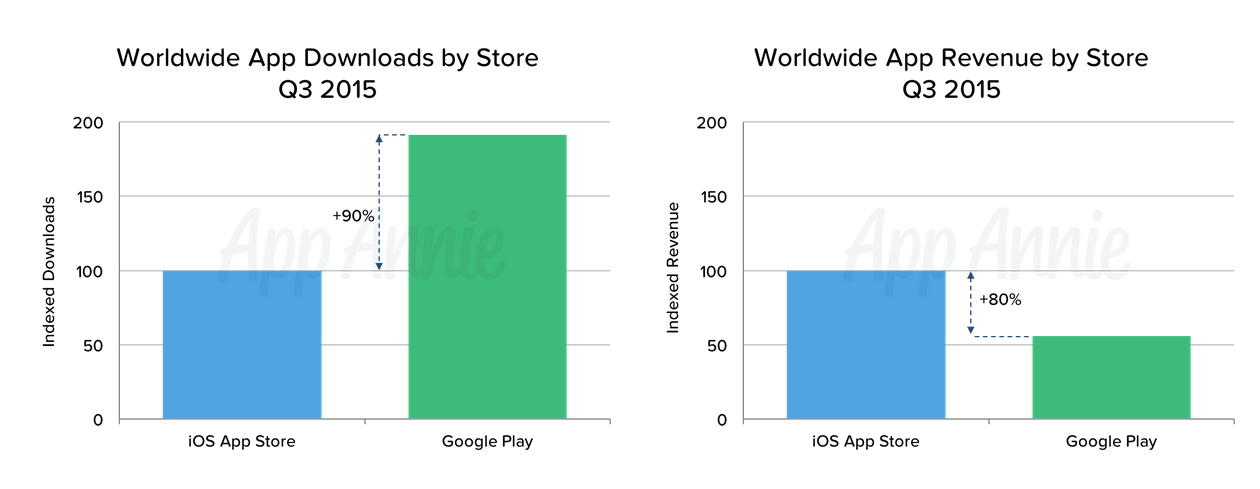
iOS App Store revenue now 80% higher than Google Play, thanks to China » TechCrunch

Sarah Perez on the new App Annie data:

In the third quarter, worldwide downloads were 90% higher on Google Play versus the iOS App Store, up from its earlier 85% lead in the prior quarter. This growth is being contributed to emerging markets like India, Indonesia, and Vietnam, where sub-$50 smartphones are bringing more of the population online.

However, these newly mobile users will not necessarily help the Google Play store’s revenue grow, given their economic status. App Annie instead advises developers to target new users at the lower-end of the market, catering to their differing needs, in order to stand out from the competition here.

Currently, India, in particular, is having a huge impact on download growth for Google Play. For example, in Q3, it was one of the three largest markets by downloads for both Facebook and WhatsApp. The country is also Google Play’s third-largest by downloads, as well as the world’s third-largest smartphone market. And there’s room for substantial growth yet – smartphone penetration in India is only in the 10-15% range, notes App Annie.

The iOS App Store, on the other hand, may not have the downloads but its revenue was 80% higher than Google Play in Q3, up from 70% in Q2. This is largely due to China, of course. China already surpassed the U.S. by iOS downloads earlier this year, and now those download numbers have translated into revenues.

By my calculations, that means each iOS user generates 3.4 (1.9 x 1.8) times as much revenue as a Google Play user.
link to this extract


Lessons from the PC video game industry » Medium

Chris Dixon:

The PC gaming world has taken the freemium model to the extreme. In contrast to smartphone games like Candy Crush that are “free-to-play,” PC games like Dota 2 are “free-to-win.” You can’t spend money to get better at the game  —  that would be seen as corrupting the spirit of fair competition. (PC gamers, like South Park, generally view the smartphone gaming business model as cynical and manipulative). The things you can buy are mostly cosmetic, like new outfits for your characters or new background soundtracks. League of Legends (the most popular PC game not on Steam) is estimated to have made over $1bn last year selling these kinds of cosmetic items.

PC games are so popular they can also make money from live events. Live gaming competitions have become huge: over 32m people watched the League of Legends championship this year, almost double the number of people who watched the NBA finals.

Watching these events online is free, but offline tickets cost $50–$100 each. This is similar to the trend in the music business where concerts have become an increasingly important source of income for musicians. Concert ticket prices have increased dramatically while digital music prices have dropped.

What the PC game industry figured out is that in a world of abundant media, users have endless choices; instead of fighting for scarcity, fight for attention. Maximize user engagement and money will  —  with enough experiments  —  inevitably follow.

This is what other organisations, such as publishing, are struggling for, but the monetisation part is proving harder.
link to this extract


Facebook Instant Articles and the fight over how many ads per words you should see » Finer Things in Tech

David Chartier:

The first 20 publishers taking part in Facebook’s Instant Articles program are struggling to make as much revenue from each article. Facebook imposes a number of App-Store-like rules on these articles, but among them:

“That’s because of the strict guidelines Facebook has laid down on the type and volume of ads publishers are allowed to sell. For example, the guidelines state that just one “large banner” ad sized 320 x 250 pixels may be included for every 500 words of content. On their own mobile properties, publishers such as the washington post would typically include three or perhaps four of those ads alongside a 500-word article.”

Think about that: large publishers want to show up to three to four ads per 500 words. And they wonder why ad blockers are a thing. 

link to this extract


App bubble update: hit mobile game publishers are running out of steam » MIDiA Research

Karol Severin:


King serves a mainstream user base of casual gamers, whose primary objective is often to ‘kill time’ instead of ‘proceed to the next level’, let alone ‘be psyched for the next years release’. This is one of the major differences between freemium mobile game franchises like Angry Birds or Candy Crush and those of traditional game publishers like EA or Activision who are growing in the mobile space. Both, EA and Activision built their most successful franchises catering to well defined niches first, through desktop and consoles. Only then did they expand into the wider, more mainstream, mobile space. With a solid payer base and a clearly proven business model, they are not as dependent on mobile revenue, compared to their ‘mobile only’ competitors. Having a secure and profitable business model in place now gives them more freedom to be creative and experiment with wider audiences on mobile. In contrast, purely mobile freemium franchises were built up catering to mainstream masses first.

link to this extract


Errata, corrigenda and ai no corrida: none noted.

TEDx Hilversum: “How to spot the next big thing” – slides and commentary from my talk

I spoke at the first TEDx in Hilversum, Holland

There was a “selfie booth”, appropriately enough.

I was invited to talk at the inaugural TEDx Hilversum – the Dutch city which is the country’s medialand, and whence the TV format ideas both for “Big Brother” and “The Voice” came.

The topic: “How to spot the next big thing”, building on a column I wrote for The Guardian’s Tech Monthly supplement back in October, about how the selfie was pretty much accidental.

What I wanted to explore and expand on in the talk was how these “next big things” in social interaction happen, and where you’d look to find the next one. (This isn’t a transcript – it’s the ideas I spoke on. The talk is about 15 minutes. I’ll put up the link when it’s available.)

Spotting the next big thing

How to spot the next big thing
Photo by c@rljones

This isn’t, therefore, about which startup you should put your money into, though it might give you hints about what sort of things could generate money – if you’re ahead of the game.

Three characteristics

Three characteristics of a 'next big thing'
Photo by Japanexperterna.se

Three characteristics of “next big things”: they’re about kids and teens experimenting; adults find them a bit silly (or impossible or embarrassing); and they don’t require anything extra, because they’re immanent to the device.

Only mobile matters

Mobile is the only platform that matters
Photo by Kris Krug

When we’re looking for the “next big thing”, the only place to bother looking is mobile. It’s the only platform that matters. People might say “what about the PC? There are 1.5 billion of them installed around the world.” Nope.

Think about this: what was the last important app that launched first on the desktop (not in the browser, because browsers work on mobile too)? There were two – Spotify and Dropbox, which both launched around the autumn of 2009. Everything big since then – Instagram, Snapchat, Whatsapp, Uber – has launched first and pretty much only on mobile, with essentially no functionality on the desktop.

By contrast, everyone has a mobile phone – there are more than 2 billion smartphones in use today. Pretty soon everyone will have a smartphone. Look at the people in the picture above: they’re holding up their mobile phones, not their laptops.

The first big thing

The first big thing on mobile: texting
Photo by larskflem

The first big thing was text messaging, aka SMS. Invented in 1986 and implemented in 1992, it didn’t take off at first – until the advent of pay-as-you-go (PAYG or pre-pay) phones, which meant that they were cheaper and adults didn’t have to commit to a contract for their kids; they’d just use what they needed. And those kids discovered SMS was cheap, and fast, and personal, and they loved it. The explosion in PAYG phones, in the UK at least, happened in 1999.

Watch SMS grow

How SMS use grew globally
Here’s how SMS use grew globally. There’s almost exponential growth right up to 2011; and then it peaks in 2011-2012 and has fallen off since.

Why the falloff? Because the people who had been kids in 1999 were 12-13 years older. They’re grown up, having their own kids. Meanwhile the other kids growing up in the intervening years were moving on to their own things – OTT services using data, such as BBM, iMessage and Whatsapp. SMS was a golden goose for the carriers; now it’s being killed off. Whatsapp has only been available for five years – founded in 2009 and first released in 2010 – yet it’s now bigger than SMS in volume.

Me, my selfie, I

The source of 'selfie'
Sure, we know that there have been “selfies” for ages – painters in the Renaissance doing self-portraits, even Buzz Aldrin doing one in space during an Apollo mission in 1966. But we didn’t call it that, and “selfie” has a particular meaning in our context: pictures taken with our mobile phones, generally using the front-facing camera.

Watch ‘selfie’ grow

Photos tagged 'selfie' on Flickr, 2000-2005
I thought this 2002 origin was interesting, so I dug out data from Flickr, looking for photos tagged “selfie” by year (1 January-31 December for the respective years). There’s that first 2002 use highlighted for reference, and clearly lots of millennium-dated photos that were backloaded; Flickr didn’t even exist until 2004. Yahoo bought it in 2005, and things started growing.

..and grow

Photos tagged 'selfie' on Flickr, 2000-2012
Fast forward to 2012, and the number is exploding.

..and peak?

Photos tagged 'selfie' on Flickr, 2000-2015
Fast forward again, and this really looks like exponential growth. Though the 2015 figure – with my estimate for the final total – looks like growth has slowed substantially. Why’s that? We’ll come to that in a moment.

Trending searches

Google search trends for 'selfie'
Just for contrast, here are the Google search trends for “selfie”. Pretty much nothing until 2013, when it takes off. (Think of the selfie at the Mandela funeral by Obama and the Danish prime minister in December 2013, which is the first peak there, and the Oscars selfie by Ellen DeGeneres – actually taken by Bradley Cooper in March 2014 – which marks the high point.) But it looks as though interest in the selfie is dying, doesn’t it?

Peak selfie?

Google trends and Flickr trends for 'selfie'
If you superimpose the Google Trends data and the Flickr data, their growth looks pretty similar. So is the selfie dying off?

What’s more probably happening here is that a new generation of kids isn’t using Flickr – they’re on Instagram, where millions of selfies are posted every day. I couldn’t extract the data from Instagram, but you can be sure it’s huge. The selfie has probably got a few years left in it yet. But that generational shift is interesting, because it’s just what we saw with SMS before.

Next to arrive

Two big things; what might be a third?
So there are two examples so far of “next big things”. What might be next?

Well, the smartphone is the most personal device ever. It knows who we know, when they call, when we ignore them, what we like and what we watch, what we read, how we communicate, where we go.

Why wouldn’t it be used for… sex?

Call me maybe

Tinder's three-screen explanation
Turns out, it already is. Apps like Tinder fit all of our three criteria: it’s used by the young, it puzzles the old (“why would you judge someone based on so little information?”), and it uses qualities inherent to the device – selfies for profiles, real-time data updates, touch interaction, geolocation.

Tinder alone sees billions of “swipes” on profiles every day, and millions of meetups, and there are surely going to be Tinder babies – people created on the basis of algorithms on smartphones. Is that weird, or just natural? Your view might depend on your age.

A new search

It's in our phone, but what is it?
After SMS, selfies, sex, what will the next big thing look like? There are some clues. The biggest one is that it’s almost surely already in the phone, just as SMS was a capability in 1992, before PAYG phones, and selfies were possible from the first phones with a front-facing camera in 2003.

So here are three elements that I think might feed into the next big thing.

Three potential elements

The capability is there, and growing
Deep dream: photo by kevin dooley
Google Cardboard: photo by juan tan kwon

Artificial intelligence: The first, and biggest, is artificial intelligence or “machine learning”. This is a picture of someone as visualised through Google’s “Deep Dream” neural network. We don’t understand it because the machine refracts its view. But to the machine, it makes a sort of sense. There is a growing amount of AI/ML/NN technology in all our smartphones: Apple’s Siri, Google Now, Microsoft’s Cortana. You can also get “assistants” such as Amy (which will set up meetings) and “Charlie” (which will give you a social media profile of people you’re going to meet).

This AI tells us if we should leave early for meetings, who’s calling us (perhaps based only on phone numbers found in emails, not our contacts), what apps we look at, what news we look at, how we interact with the world through our phone. In the next few years, we should expect that it will become far more powerful, even without a connection to the cloud; if you think that sounds fanciful, just go back five years, to 2010, and none of the phones we have had those sorts of capabilities. Siri hadn’t been introduced. Think five years ahead, and that’s the sort of gap between now and then that we’re going to see.

Health/fitness: if my AI knows what I’ve been doing, shouldn’t it also know how well I’m doing? Connected to devices such as a watch or fitness band, there’s far more data about ourselves becoming available. Does that feed into the Next Big Thing by showing that you’re *really* fit in your online dating profile? Does your AI tell you before you’re going to be ill?

Virtual reality: This is Google Cardboard, a super-low-cost implementation of virtual reality: you cut and paste it together from a kit, and then slot your smartphone into the gap, and bingo. It’s on the tipping point, I think; ready to take off. And when that happens, everything becomes possible. What if the Tinder profile of the future lets you walk around the person you’re interested in dating, in 3D? What if you meet without physically being in the same place?

Conclusion

I don’t know what the Next Big Thing actually is. But consider a couple of points. SMS was invented over a decade before it actually took off. The word “selfie” was coined for the activity back in 2002 – yet it only exploded into public consciousness a decade later.

Perhaps the word for the next big thing has already been coined; it’s been tossed around carelessly on an online forum where someone is describing something they did or something that happened. And in years to come we’ll look back and say ah, it was obvious.

That’s because spotting the next big thing is a puzzle, not a mystery. There’s a difference between the two. A mystery is – well, think of a murder mystery. Only one person knows who did it, and they’re not saying. Mysteries are meant to remain unsolved.

But to understand a puzzle, think of a jigsaw puzzle. The pieces are all there, in plain view; the only problem is putting them together correctly.

For entrepreneurs, there is good news: if you’re alert, you can cash in. SMS made huge profits for carriers. Selfie sticks meanwhile have been nice business for some factories in Shenzhen. (They’ve even led to museums changing rules; that’s success, when you change society, even a little.)

Just as puzzles just need the pieces put together correctly, it’s very likely that everything necessary for the next big thing is right there, just waiting for someone to put it together. The people who do that probably won’t be the adults; it’ll be the kids and teens messing around. And adults will probably think it’s stupid. But that’s how it goes.

Still, we won’t have to look far to find it. It’ll be right there in the palm of our hands – in our phones.

Start up: who’ll exit PCs next?, Gwen Stefani v iCloud, Chrome vuln pwns Android, and more


A castle in Gibraltar lit up with the French colours in solidarity following the killings on Friday night. Photo by ollygringo on Flickr.

A selection of 10 links for you. Use them wisely. I’m charlesarthur on Twitter. Observations and links welcome.

“It’s War”: being a cop in post-Charlie Hebdo France » Matter on Medium

Mac McClelland lives with a French policier; the events of January 2015 changed things hugely:

These gendarmes had caught something early on in the TV footage that told them a very, very terrible event had transpired. The riot branch of the national police was visible in the background of the newscast. Usually, they carried only nine-millimeter handguns. Now they all had M14s.

Eight of Theo’s colleagues watched the cop’s killing on YouTube together. Theo’s dark, serious eyebrows raised in astonishment, then knitted together as he immediately went into analytical mode.

Their rifles aren’t fully automatic, he thought. They’re firing one shot at a time. That’s weird. They look trained, but not quite professional. The news was reporting that the suspects looked like professionals. No, Theo thought. They’re not checking their perimeter. Not the roofs.

His training permitted him to watch the violence more coldly than your average guy. But as his normally scheduled, 24-hour shift wore on, his professional distance vanished. “Gros fils de pute de merde,” he texted another gendarme he knew, a guy from a mobile intervention platoon.

There’s a sea change going on in how the police think of their job in modern France, McClelland suggests. (If you’ve seen the most recent series of the French policier series Engrenages – “Spiral” in the UK – you have a sense of it.)
link to this extract


What ISIS really wants » The Atlantic

Graeme Wood:

Our ignorance of the Islamic State is in some ways understandable: It is a hermit kingdom; few have gone there and returned. Baghdadi has spoken on camera only once. But his address, and the Islamic State’s countless other propaganda videos and encyclicals, are online, and the caliphate’s supporters have toiled mightily to make their project knowable. We can gather that their state rejects peace as a matter of principle; that it hungers for genocide; that its religious views make it constitutionally incapable of certain types of change, even if that change might ensure its survival; and that it considers itself a harbinger of—and headline player in—the imminent end of the world.

This is not a short read. But you will come away from it much, much better informed.
link to this extract


The dream life of driverless cars » The New York Times

Geoff Manaugh:

All of the glares, reflections and misunderstood signs that [Illah] Nourbakhsh [professor of robotics at Carnegie Mellon University] warned about are exactly what [London design studio] ScanLAB now seeks to capture. Their goal, [32-year-old Matthew] Shaw said, is to explore ‘‘the peripheral vision of driverless vehicles,’’ or what he calls ‘‘the sideline stuff,’’ the overlooked edges of the city that autonomous cars and their unblinking scanners will ‘‘perpetually, accidentally see.’’ By deliberately disabling certain aspects of their scanner’s sensors, ScanLAB discovered that they could tweak the equipment into revealing its overlooked artistic potential. While a self- driving car would normally use corrective algorithms to account for things like long periods stuck in traffic, [William] Trossell and Shaw instead let those flaws accumulate. Moments of inadvertent information density become part of the resulting aesthetic.

The London that their work reveals is a landscape of aging monuments and ornate buildings, but also one haunted by duplications and digital ghosts. The city’s double- decker buses, scanned over and over again, become time- stretched into featureless mega- structures blocking whole streets at a time. Other buildings seem to repeat and stutter, a riot of Houses of Parliament jostling shoulder to shoulder with themselves in the distance. Workers setting out for a lunchtime stroll become spectral silhouettes popping up as aberrations on the edge of the image. Glass towers unravel into the sky like smoke. Trossell calls these ‘‘mad machine hallucinations,’’ as if he and Shaw had woken up some sort of Frankenstein’s monster asleep inside the automotive industry’s most advanced imaging technology.

link to this extract


Gwen Stefani split shows cross-device sharing of naughty photos is new bane of the digital age » SiliconValley.com

Cross-device text and photo streaming was the undoing of Stefani’s cheatin’ heartthrob, when naked pictures of the nanny began popping up on the family iPad, US magazine uncovered this week. Like a lot of families, they evidently linked their mobile devices together – so a text or photo sent to one showed up on the others.

A lot of non-boldface names – many of them right here in switched-on Silicon Valley – have learned the same lesson the hard way. Apple customers frequently make their iCloud photo stream the default screen saver for Apple TV, transforming their selfies into 60in widescreen Ken Burns dissolves.

That’s what happened to Alex (who responded to a Facebook request for cringeworthy cases of cross-device photo streaming, but declined to give his last name). He took revealing pictures intended for his “certain someone,” then walked into the living room he shared with new roommates to find himself streaming in all his gaudy glory on the TV they were watching. “Let’s just say it made for some awkward dinner hours for a while,” he says.

“The future of TV is apps where you’ve definitely logged out first.” (Also, the Stefani case is just excruciating.)
link to this extract


BlackBerry Priv review: Android fixes the OS, but the hardware can’t compete » Ars Technica UK

Ron Amadeo is merciless:

With Google, Motorola, Xiaomi, and OnePlus pumping out high-end devices in the £200-350 range, pricing your Android phone at £560 is a boastful statement that you’ve made a kick-ass, no compromise device. The BlackBerry Priv can’t back up that kind of bragging, though, and that’s why it’s a failure. Other than the subpar keyboard and camera, everything on the Priv is merely passable. It’s a “C” student, but the price demands we grade on a curve that flunks the Priv.

Even at a competitive price of something like £350-£450, we’d be hard pressed to buy a phone with a hardware keyboard when the hardware keyboard is bad. The keys are small and flat, the keyboard is cramped, and hardware keyboard autocorrect is shoehorned into an operating system layout where it clearly isn’t welcome. Closing the Priv and using the more spacious software keyboard wasn’t just faster, it was a relief. That’s the real deal-breaker for the Priv—the hardware keyboard needed to be spectacular, and it isn’t.

His critique of the keyboard in particular is painstaking and murderous.
link to this extract


Five things I think journalism students need to know about technology » Medium

Martin Belam gave a talk to City University journalism students (lucky sods) and made five points. This is one of the subtler ones:

Treat every bit of content you publish to Facebook like an A/B test.
You post it to your page. If nobody interacts with it — by sharing or liking or commenting on it — it’s already failed. If the first few people to see it engage with it, then you have a chance that Facebook will show your content to more people.

So how can your piece pass that first test?

Ask yourself who is going to share that article, and why are they going to share it? If you can’t answer that question about your own story, you’ve done it wrong.

All worth considering (including the GIF one – which isn’t about how to pronounce it).
link to this extract


Two top PC vendors predicted to exit the market soon » Investors.com

Patrick Seitz:

As PC sales have shrunk in recent years, the top four vendors have consolidated market share. They are Lenovo, HP Inc, Dell and Apple, [IDC PC analyst Tom] Mainelli said. So the two companies likely to bow out of the PC market probably will be in the lower half of the top 10, he said.

The bottom six are Acer, Asus, Toshiba, Samsung, Tongfang and Fujitsu, Mainelli said.

“The most likely scenario is that two will simply leave the market,” Mainelli said. “I don’t expect there to be many acquisitions as the (top four) don’t gain much from buying anybody in the bottom half of the list. There will likely be much discussion about possible mergers among the rest, but I’m not sure that this course of action will play out.”

Tongfang?
link to this extract


Acer, Asustek will not die in global PC market, says Acer founder » Digitimes

Aaron Lee and Joseph Tsai:

In response to IDC forecasts that two of the top-10 international PC vendors will withdraw from the global PC market over the next two years due to unbearable operating losses and the two are possibly Acer, Asustek Computer, Toshiba, Samsung Electronics, Tsinghua Tongfang, or Fujitsu, Acer founder Stan Shih said that Acer and Asustek will not die due to lower overheads compared to other vendors.

Acer achieved net profits of NT$191m (US$5.84m) and EPS of NT$0.06 for the third quarter and the results were a lot higher than those of the previous quarter mainly due to an exchange income of NT$799m.

Shih noted that Acer’s third-quarter profits were seriously impacted by competitors’ buy-two-get-one-free promotions and Acer also chose to focus on digesting inventory in the quarter, knowing it would gain profits from exchange rates.

I’d not be surprised if Toshiba and Fujitsu pulled out; they’re losing money. Samsung is a long way from profitable scale too, but has the advantage of making key components such as the displays.

Acer’s PC business isn’t looking healthy, though.
link to this extract


Inquiring minds want to know… » Mountain View Police Department


This afternoon [12 November] a Mountain View Police Department traffic officer noticed traffic backing up behind a slow moving car traveling in the eastbound #3 lane on El Camino Real, near Rengstorff Ave. The car was traveling at 24 mph in a 35 mph zone. As the officer approached the slow moving car he realized it was a Google Autonomous Vehicle. The officer stopped the car and made contact with the operators to learn more about how the car was choosing speeds along certain roadways and to educate the operators about impeding traffic per 22400(a) of the California Vehicle Code. The Google self-driving cars operate under the Neighborhood Electric Vehicle Definition per 385.5 of the California Vehicle Code and can only be operated on roadways with speed limits at or under 35 mph. In this case, it was lawful for the car to be traveling on the street as El Camino Real is rated at 35 mph.

Just wanted to check the car wasn’t drunk, I guess.
link to this extract


Single Chrome exploit can compromise any Android smartphone » AndroidAuthority

John Dye:

A researcher at [security company] Quihoo 360 recently discovered an exploit in Chrome that can probably demolish even the newest, most up-to-date Android devices if the user visits an infected site.

The vulnerability was exposed at PacSec’s MobilePwn2Own event. What makes the exploit particularly unsettling is that it’s just one exploit, not an elaborate chain of exploits that interlink to reach an eventual compromise. Although the showcase did not go into the precise details regarding how the exploit works, it was revealed that it takes advantage of a vulnerability in JavaScript v8.

The researcher who discovered the exploit is Guang Gong, and PacSec will be rewarding Guang for uncovering and releasing the exploit by flying him to the CanSecWest security conference for a ski trip in March of 2016. In addition to this, Google will also likely pay a bounty for the bug’s discovery, as a Google security representative at the event took Guang’s work back for consideration.

Chrome will likely get fixed quickly, but is the vulnerability more widespread? Also, where are the stats about how those monthly security updates for Android going? Anyone know?
link to this extract


You can now sign up to receive each day’s Start Up post by email. You’ll need to click a confirmation link, so no spam.

Errata, corrigenda and ai no corrida: none today.

Start up: Google adds mobile ads, the sensing wearable, paying for snoops, and more


“Wait – that’s no moon!” Photo of the iPad Pro by portalgda on Flickr.

Something something receive each day’s Start Up post by email mutter mutter. Rhubarb rhubarb confirmation link mutter mutter.

A selection of 11 links for you. Curl up with them for the weekend. I’m charlesarthur on Twitter. Observations and links welcome.

Google’s efforts to monetize mobile pay off, but sites see a hit to organic visits » Search Engine Land

Andy Taylor notes that since August, there are now three ads rather than two before “organic” results on mobile phones in Google searches – and paid-for click-through rates (CTR) on ads have leapt accordingly:

One explanation is that some of the ads now getting impressions in the third spot above the organic results were already getting impressions below the organic results prior to the change. Thus, when the ads got the bump to the top of the page, the likelihood of a click went up substantially.

However, we see average position moving farther down the page, and Google is still showing ads at the bottom of the page, indicating that any ads that were moved up to the top were probably “replaced” at the bottom by additional ads. Thus, this probably isn’t causing the substantial improvement in mobile CTR we’re observing.

Rather, it’s possible that by adding a third text ad and pushing organic links even farther down the page, Google has broken the will of users who would have clicked on an organic link if they could find one at the top of the page but are instead just clicking ads because they don’t want to scroll down.

This would mean the addition of the third text ad may have pretty seriously impacted searcher behavior on phones, resulting in more ad clicks and spend headed Google’s way.

Just in case you were wondering how Google boosted its mobile revenue in the latest quarter, despite fewer than half of people doing one search per day on mobile. Taylor points to other methods too – very big “product listing ads” twice the size of earlier this month.
link to this extract


The iPad Pro: the start of something new » Tech.pinions

Ben Bajarin:

the most interesting observation I made was not how I used the tablet but how my oldest daughter, who is twelve, used the iPad Pro. She goes to a private school where each kid uses an iPad all day, every day. They use the iPad in every aspect of their education, from textbooks and learning materials, to real-time collaboration, notes, making movies during class, presenting, and much more. When we were checking out this school, we spent time watching kids use their iPads to do a range of things in the classroom. I was stunned by their fluency and efficiency. How fast they type, how quickly they multi-task between taking notes or a picture of the teacher’s notes on the board and then mark up their own notes on top of that. These kids were more literate with the iPad than many people I know who are highly technical, including myself. This ingrained literacy is the result of using a touch-based computer and the apps built on top of the mobile ecosystem, every day. After watching them for a day, I’m honestly not sure I could have accomplished as much as they did in as short of a time using a traditional laptop.

So I should not have been surprised when my daughter started playing with the iPad Pro for a few hours and came back and showed me all the things she had done: movies she made, photos she took outside (which she edited/mashed up using the different apps she also uses in creative projects at school) and taking advantage of the unique benefits of the Apple Pencil. With nearly everything she showed me, I had to ask her how she did it.

Do you really think she’s a future Surface user?
link to this extract


EM-Sense wearable knows what objects you’re touching » Digital Trends

Chloe Olewitz:

The human body is naturally conductive, so the electromagnetic noise that most electrical and electromechanical objects emit is propagated throughout the person touching it. Using a small, affordable radio-powered wearable, researchers at Disney and Carnegie Mellon University were able to develop a custom smart watch that detects the electromagnetic noise traveling through the body. Paired with their software definition system, the EM-Sense smart watch can identify what specific objects the wearer is touching at any given moment.

Examples of the EM-Sense’s detection capabilities are what really bring the technology to life. The main function allows the EM-Sense smart watch to simply identify objects, like a doorknob, a toothbrush, or a kitchen appliance. But that’s just the beginning. With a bit more development, EM-Sense’s creators think the technology could be used to automate frequent actions and augment important aspects of our daily routines.

Neat – definitely like the idea of your smartwatch or band being able to identify what you’re dealing with. (Beware the web page’s autoplay video, though.)
link to this extract


DynamicPricer PUP disables browser updates » Malwarebytes Unpacked

Pieter Arntz:

Although this one has been around for a while, DynamicPricer deserves some attention because of the different approach it uses compared to other Potentially Unwanted Programs (PUPs).

What’s different?

Where other adware applications look for sneaky ways to invade your up-to-date browsers or even install their own browser on your system, this one just installs an old version of Chrome and then disables the automatic updates for Chrome and Firefox.

As far as I could retrieve the version of Chrome it installs dates back to February of 2014. My guess is because that was the first build that included an API to take actions depending on the content of a page, without requiring permission to read the page’s content.

So sneaky to prevent the upgrading.
link to this extract


Fossil Group to buy Misfit for $260m » WSJ

Yuliya Chernova:

Watchmaker Fossil Group Inc. has agreed to acquire startup Misfit Inc., a maker of wearable fitness trackers, for $260m.

Richardson, Texas-based Fossil Group has its Fossil and Skagen brands, and it licenses a host of others, including Michael Kors, Diesel and DKNY.

“If you don’t have a brand it is hard to be legit in this space,” said Sonny Vu, chief executive and co-founder of Misfit. He will become president and chief technology officer of connected devices for Fossil Group after the transaction closes, which Fossil expects before the end of the year.

Consolidation in the wearables space already?
link to this extract


Cloud computing promises fall short » WSJ

Angus Loten and Rachael King on the shift to on-demand off-premise cloud computing not quite being the nice elasticated experience companies expected:

Frank Sirianni, CIO of Fordham University, said the university recently shifted from using an on-premises version of Ellucian Inc. business software to the cloud version. Although he agreed to a three-year-deal, Ellucian sought to lock him in for a longer term with variable pricing from month to month and a minimum monthly charge. Mr. Sirianni said he opted for a fixed monthly price, in order to avoid paying more if the university used more computing cycles, but not less if usage declined. Fordham wanted more predictable software spending over the course of the year, he said.

Ellucian said it doesn’t comment on the specific pricing that any client may pay for its products or services. “Our focus is to deliver significant value in these arrangements and enable our customers to leverage their entire investment in technology and services by going to the cloud,” said a company spokeswoman.

Translation: “we don’t want to lose revenue when customers make this shift.”
link to this extract


YouTube and the attention economy » Music Industry Blog

Mark Mulligan points out that YouTube is the one to deal with because “Free music streamers – of which YouTube is the largest single component – comprise 92.5% of all music streaming users and just 32% of all streaming revenue.” So how to balance those numbers?

YouTube is not suddenly going to start delivering dramatically better music stream rates, largely because labels and publishers haven’t had the courage to demand the requisite fair share it should pay. Rights owners’ fears are understandable: one senior label executive recounted a YouTube negotiator saying ‘Don’t push us. Right now you don’t like us much and we’re your friend. Imagine what we’d be like if we weren’t your friend.’ Sooner or later bullying tactics need standing up to. But that will not be a quick process, regardless of the steps currently being taken behind the scenes.

So in the meantime artists and labels need to figure out how to get more out of YouTube in a way that complements the other ways they make money digitally. Put simply that means making more non-music video content to generate more viewing hours and thus more ad revenue from YouTube. Heck, they might even generate some YouTube subscription revenue some time. But do it they must, else they’ll forever be leaving chunks of YouTube money on the table.

link to this extract


Broadband bills will have to increase to pay for snooper’s charter, MPs are warned » Technology | The Guardian

Alex Hern:

For [Matthew] Hare [chief executive of ISP Gigaclear], the other major problem is that separating “metadata” from “content”, as the law mandates for the purposes of mass surveillance, is a very difficult technical challenge.

For a simple connection like a phone call, the difference is easy: information like the number dialled and length of the call is clearly metadata, while the audio transmitted over the line is clearly content. But for a typical internet user, a number of different services are being used at any one time, and they all blur the lines between the two categories.

“The web isn’t a single application, that’s the fundamental problem I’ve got,” Hare said. He outlined a common scenario: “A teenager is currently playing a game using Steam, that’s not a web application … and then they’re broadcasting the game they’re playing using something called Twitch. They may well also be doing a voice call where they’re shouting at their friends, and those are all running simultaneously. At any one time any of those services could drop in, drop out, be replaced.”

MPs discover it isn’t just a series of pipes.
link to this extract


TomTom to provide data for Uber driver app »TomTom

TomTom has signed a global, multi-year agreement to provide maps and traffic data for the Uber driver app.   

TomTom’s advanced map-making technology, combined with its world class traffic information, will ensure Uber has a seamless navigation experience, accurate arrival times and efficient journeys in more than 300 cities around the world.

“We are excited to provide Uber with our best-in-class location data.” said Charles Cautley, Managing Director Maps & Licensing at TomTom. “TomTom is a truly independent map provider with the platform for the future. With this platform, TomTom is the trusted partner for innovative and future proof location technology for the global automotive and consumer technology industry.”

Edging just that little bit further away from Google; surprised some that it didn’t go with Nokia’s HERE. TomTom is also a traffic and maps data supplier to Apple. Will Uber buy TomTom? Does Apple have a break clause if someone buys TomTom?
link to this extract


Experts still think uBeam’s through-the-air charging tech is unlikely » IEEE Spectrum

Lee Gomes:

In some regards, uBeam is already walking back some of the more extravagant claims it has made in the dozens of stories that have been written about it. A September piece in TechCrunch, said uBeam “could power up your phone while it’s in your pocket when you’re at a café.” While that sort of ubiquitous charging would be appealing for its simplicity and convenience, experts consider it to be impossible on account of the line-of-sight nature of ultrasound waves.

A TechCrunch interview from Saturday concedes the point, saying, The system “requires a line of sight and can’t charge through walls or clothes.” The latest story, though, didn’t address the obvious discrepancy with the earlier account. The most recent story says uBeam could transmit up to 4 meters, far less than the 30 feet (9 meters) claimed in an earlier piece.

While the company has made several technical advances involving ultrasound, “the idea that uBeam is going to eliminate the need for wires is ridiculous,” said one person with knowledge of the situation.

Leaning towards IEEE Spectrum’s sources knowing more about this topic than Techcrunch’s.
link to this extract


I’m going to make Facebook’s AI predict what happens in videos » New Scientist

Yann Lecun is Facebook’s head of AI:

Q: Are there problems that you think deep learning or the image-sensing convolutional neural nets you use can’t solve?
JL: There are things that we cannot do today, but who knows? For example, if you had asked me like 10 years ago, “Should we use convolutional nets or deep learning for face recognition?”, I would have said there’s no way it’s going to work. And it actually works really well.

Q: Why did you think that neural nets weren’t capable of this?
JL: At that time, neural nets were really good at recognising general categories. So here’s a car, it doesn’t matter what car it is or what position it is. Or there’s a chair, there are lots of different possible chairs and those networks are good at extracting the “chair-ness” or the “car-ness”, independently of the particular instance and the pose.

But for things like recognising species of birds or breeds of dogs or plants or faces, you need fine-grained recognition, where you might have thousands or millions of categories, and the differences between the different categories is very minute. I would have thought deep learning was not the best approach for this – that something else would work better. I was wrong. I underestimated the power of my own technique. There’s a lot of things that now I might think are difficult, but, once we scale up, are going to work.

link to this extract


Errata, corrigenda and ai no corrida: Satya Nadella uses a Lumia 950 XL.

Android Wear downloads: a more nuanced (and slightly higher) estimate


Android Wear doesn’t seem to have set consumers’ hearts racing. Photo by pestoverde on Flickr.

In my estimate last week of the number of Android Wear downloads, and hence actual “sell-through” (as it’s called), I used the number of reviews left on the Android Wear app page and drew a straight-line extrapolation from that, and from various known waypoints, to get my estimate for the number in use – which was about 1.9m, up from 0.7m in February 2015.

Among the provisos, though, was this one:

My previous estimate worked on the basis that the number of comments was proportional to the number of downloads. I don’t see any reason to change that assumption.

Oh, behave

Having said that, I’ve thought a bit more about likely consumer behaviour, as well as what the data actually shows us.

We know that as more people get to use something, the number who actually comment on/review it falls – it’s just human nature that early adopters are the most likely to be vociferous, whereas those who follow are less troubled about it. After all, who wants to be the 1,900th commenter below an article?

So I took a look at the number of comments* per download, for the waypoints where we know the number of downloads for sure. We know those waypoints because the Google Play figure abruptly goes from saying, for example, “number of downloads: between 10,000 and 50,000” to “between 50,000 and 100,000”. Obviously the 50,000 download point has been crossed between those two points. (* “comments” not “reviews” because they’re not necessarily reviews; you can make them without having downloaded the app.)

So I marked those points, and the number of comments at those points, and tried to find the best fit curve. I get this:

Android Wear: downloads per comment (est)

The data seem to suggest that the number of downloads required to generate a new comment grows over time; currently we’re at the black mark.

(That’s an R-squared of 0.89, using a logarithmic fit; it’s the best value of R-squared I could get out of trying a linear, logarithmic, polynomial, power and exponential fit.)

What this is telling us is that to begin with, you get lots of reviews/comments for every download. Right at the start, there was a comment for more than one in every seven downloads. By 100,000 downloads there are 4,032 comments, which means by then, on average, every 24.8 downloads someone had left a comment.

But by the time you get to 500,000 downloads, there are 14,981 comments – so on average it has taken 33 downloads to get each comment. By the time you get to a million downloads, the average has fallen to 44 downloads per comment.

A certain ratio

This is the sort of behaviour we’d expect: early on, lots of people are mad keen to give feedback on their experience; and then it tails off, until we’re dealing with a gradually falling ratio as the numbers of downloads head into the multiple millions.

Fitting this to that curve (which is the only data we’ve got, absent sales figures or numbers from Google) tells us that we’re currently at about 57.5 downloads per comment overall – that is, over the whole time Android Wear has been going, on average you get a comment every 57.5 downloads.

And how many comments are there? Currently, 47,620 (with the average review score just dipping under 4.0). How many downloads is that, and hence how many sell-throughs? Pretty simple:

47,620 comments * 57.5 downloads per comment = 2.74m Android Wear downloads.

This is quite a bit bigger – 44% more – than my previous estimate of 1.9m Android Wear users. There are (as always) potentially confounding factors, which would tend to reduce the actual number:

1) some people may have left more than one comment/review.
2) you can leave a comment/review without having actually downloaded the app
3) the number of comments added per week is quite variable – as below:

Rate of addition of comments varies, a lot

Sometimes you get a lot of comments on Android Wear – and sometimes you don’t. Does that match downloads? Hard to say.

This is possibly prompted by the release of new versions: a number of people commented on 9/10 November about the new version and its removal of battery stats. That’s going to bump up the apparent number of “downloads” while the actual number in use is no different.

On the whole, I feel comfortable suggesting that the correct number probably lies somewhere between these two – the straight-line extrapolation and the “reducing comment” number. In other words, somewhere between 1.9m and 2.74m. (The midpoint is 2.32m.)

Quite probably the only way to be sure will be to watch the Android Wear page and spot when it crosses the 5m download mark. Is it going to be before the end of this year, though?

Only maybe, at least if we go by IDC’s forecast for how many Android Wear devices will be shipped this year. In a press release in September, IDC reckoned that there would be 4.1m shipments of Android Wear devices in 2015. That would take the total activations by the end of 2015 to 4.7m, as at the start of the year it was around 0.6m (it passed 1m activated in late February, by my data). As long, that is, as those shipments are actually bought by people, rather than sitting on shelves.

Comparing that to my estimates for the number activated so far this year – a low of 1.3m (1.9m – 0.6m), and high of 2.1m (2.74 – 0.6m) – we’re left with somewhere between 2.8m (4.7m – 1.9m) and 1.96m (4.7m – 2.74m) to be shipped, sold and activated in the next couple of months around Christmas if IDC’s target is to be met (and if my estimates are correct). So, the week following Boxing Day could be fun.

Low, high, in between

There are some other numbers: Strategy Analytics says that in the second quarter, Android Wear shipments were just 0.6m units; for the third quarter, it says that Samsung shipped 0.6m and “Others” (including Pebble) 1.0m. We don’t know how many of the Samsung ones were running Tizen, and how many Android Wear; nor how many Pebbles were shipped. If we ignore that, we get 1.6m Android Wear shipped in the third quarter; 2.2m since March (when the 1m download point was passed). If they’re all in use, there might be 3.2m running.

Even with the high estimate, it begins to look like maybe this is going to be one of those spaces where Apple shows how the category should look, and grabs the majority of sales and profit – as it did with the iPod and iPad. Because Strategy Analytics reckons that in the third quarter alone, Apple shipped 4.5m units – more than Android Wear has all year.

Start up: how self-driving cars will change life, why *is* http on port 80?, iPad Pro reviewed, and more


Creating a more beautiful subway map for Tokyo wasn’t easy. Photo by aka.me on Flickr.

You can now sign up to receive each day’s Start Up post by email. You’ll need to click a confirmation link, so no spam.

A selection of 9 links for you. Smoosh them. I’m charlesarthur on Twitter. Observations and links welcome.

How Uber’s autonomous cars will destroy 10 million jobs and reshape the economy by 2025 » Zack Kanter

Industry experts think that consumers will be slow to purchase autonomous cars – while this may be true, it is a mistake to assume that this will impede the transition. Morgan Stanley’s research shows that cars are driven just 4% of the time, which is an astonishing waste considering that the average cost of car ownership is nearly $9,000 per year. Next to a house, an automobile is the second most expensive asset that most people will ever buy – it is no surprise that ride sharing services like Uber and car sharing services like Zipcar are quickly gaining popularity as an alternative to car ownership. It is now more economical to use a ride sharing service if you live in a city and drive less than 10,000 miles per year. The impact on private car ownership is enormous: a UC-Berkeley study showed that vehicle ownership among car sharing users was cut in half. The car purchasers of the future will not be you and me – cars will be purchased and operated by ride sharing and car sharing companies.

And current research confirms that we would be eager to use autonomous cars if they were available. A full 60% of US adults surveyed stated that they would ride in an autonomous car, and nearly 32% said they would not continue to drive once an autonomous car was available instead.

Today’s children are the last generation that will have to pass a driving test. Think about that briefly. Then read the rest of Kanter’s piece. (It’s actually optimistic, overall.) And one more thing: it doesn’t have to be about Uber.
link to this extract


Fantastical designs from the frontier of subway maps » Washington Post

For many designers, creating a better subway map is an irresistible puzzle — “infinitely alterable, incredibly vexing, with no definitive answer,” writes Emily Badger. Badger’s new article looks at some amazing examples of metro maps from the frontier of design, including the beautiful 2010 diagram of all of the rails in the Tokyo region, designed by Kim Ji-hwan.

link to this extract


Rooted, Trojan-infected Android tablets sold on Amazon » Help-Net Security

Zeljka Zorz:

If you want to buy a cheap Android-powered tablet, and you’re searching for it on Amazon, the best thing you can do is carefully read all the negative reviews you can find. If you are lucky, you’ll see some that will warn you about the device being rooted and coming pre-installed with malware.

Security researchers from Cheetah Mobile have recently discovered a slew of these devices – over 30 tablet brands in total – being sold on Amazon and other reputable online stores.

Here’s a short overview of affected devices, along with a sample of reviews warning about the malware.

The malware in question is the Cloudsota Trojan, which allows remote control of the infected devices and conducts malicious activities without user consent.

Remember, a Trojan is for life, not just for Christmas. Estimated that over 17,000 have been sold.
link to this extract


The case against a Google phone » The Information

Amir Efrati on the rumours that Google is looking to design its own phone chips:

the ecosystem of partners that build and sell Android phones has matured to some extent; those companies have 1.4bn customers (there’s one third as many iPhones in customer’s hands, by contrast). While many of those customers aren’t necessarily loyal, and surprising upstarts are gaining ground, Google won’t be able to suddenly capture a significant amount of market share with a better device, at their expense. (It would also risk its chance to return to China, given that it is working with local handset brands to do so.) There is no going back.

Even if Google wanted to compete on price by offering devices cheaper than the iPhone, it would still have to engineer a marketing apparatus so impressive that it convinces smartphones buyers that the Google phone is the best in the world. That’s the only way it could convert iPhone and even some Samsung Galaxy S users — who are wealthier than typical Android users — to the Google phone. Good luck with that.

Then there’s the fact that prices for phones have come down so much as components become cheaper that it’s become exceedingly difficult for existing Android phone brands to stand out in the market.

Even if the Google phone struck a chord, it’s hard to see it selling more than tens of millions of devices in the next few years, and that’s optimistic.

I can believe that Google is interested in designing ARM architecture chips. But I think it’s more likely considering them for its server farms. People inside Google already know Efrati’s argument (which holds water). Sundar Pichai is hardly the sort to hang on to an idea for pride. He killed Google+, remember?
link to this extract


Ad Replacer: turn spammy ads into breaking news

We take those terrible, misleading ads that take you to garbage websites (or worse!) and switch them out for real-time, human-curated headlines and links from ONLY the most trusted, reliable websites.

Sites that never end in best-deals-4-everyone.ru. Sites that never pop up 8 windows asking if you’re SURE you want to click away. Just sites you like and stories you want to read, all seamlessly integrated into your browsing experience before you even notice it’s changed. Doesn’t that sound nice?

Neat idea; Chrome extension only for now.
link to this extract


Facebook Messenger adds facial recognition » Tech Insider

Alex Heath:

Adding facial recognition to Messenger may seem odd given that it’s primarily considered to be a messaging app, but when you consider that people send a staggering 9.5 billion photos through Messenger every month, the decision begins to make more sense.

Messenger is very proactive in prompting to share a photo with friends it thinks are in a photo — the app will send a notification asking you to send a photo to people on Facebook it thinks are tagged. (This specific behavior can be turned off in the Messenger app’s settings.)

Australia only for now, but your feeling on whether this is creepy or great will probably depend on age. Note though that it’s machine learning/AI being deployed as utterly normal; even five years ago this would have been hard to implement on such scale.
link to this extract


iPad Pro review: jack of all trades, master of most » WSJ

Joanna Stern:

On paper, 12.9 inches may not seem much bigger than the standard iPad’s 9.7 inches, but the Pro screen made me more productive. I spent much of my week writing in Microsoft Word on the left hand of the screen and toggling between websites and my inbox on the right. Text looks incredibly crisp, especially in comparison with my MacBook Air’s display, which has just half the pixels.

The A9X processor and 4GB of RAM kept those apps running swiftly. But most impressive? When I exported the same 4K video in iMovie on both the Pro and my Intel Core i5-powered MacBook Air with 8GB of RAM, the iPad reached the finish line a minute and a half faster. And, unlike the Air, it didn’t sound like it was about to blast off from Cape Canaveral.

For real work, it’s all about attaching Apple’s $170 Smart Keyboard. You don’t do this via Bluetooth, but rather with the new magnetic Smart Connector. I quickly fell in love with the feel of the bouncy fabric keys, and it became second nature to hit Command+Tab to toggle between apps. Oh, and did I mention the keyboard is spill-proof? Seriously, my iced latte just wiped right off.

Still, many times I wished for something closer to Microsoft’s Surface Type Cover. Apple’s keyboard only props the screen at a 120-degree angle; attaching it and folding it take origami skill. It all almost toppled off my lap a few times, and the keys aren’t backlit. Plus, there’s no trackpad, like the Type Cover’s. I constantly had to reach out and touch the screen to scroll or select text and icons…

…Despite iOS 9’s improved multitasking, there are still shortcomings. You can’t customize the home screen’s comically large icons with files or other shortcuts. You can’t place the same app—say two Safari windows—side by side. And iOS’s lack of real file management can be maddening. Microsoft saddles its Surface Pro with full-blown desktop Windows while the iPad Pro is still too closely related to an iPhone. Apple has to keep working to find the happy middle.

Pricey. But here’s the kicker:

There’s one thing the iPad has over all other laptops and competing tablets though: incredible apps. The Pro helped me realize that I’ve been living in the past, using legacy desktop programs to accomplish things.

link to this extract


Why was 80 chosen as the default HTTP port and 443 as the default HTTPS port? » How To Geek

According to superuser jcbermu:

The Internet Assigned Numbers Authority (IANA) is a department of ICANN, a non-profit private corporation that oversees global IP address allocation, the Domain Name System (DNS), well-known ports, and other Internet Protocol-related symbols and numbers.

During March of 1990, they published a document (RFC 1060) where they listed all the well-known ports at that time. In that list there was no protocol assigned to port 80 (it jumped from 79 to 81). 79 was assigned to “finger” (find out if someone was online) and 81 to HOSTS2-NS, the HOSTS2 Name Server.

At that time, port 80 was officially free. In 1991, Tim Berners-Lee issued the first version of HTTP in a document (HTTP 0.9) where he stated “If the port number is not specified, 80 is always assumed for HTTP.”

HTTPS? Lost in time. Blamed on someone at NCSA Mosaic. So there’s your pub quiz question/answer pair.
link to this extract


Apple Music » Android Apps on Google Play

It arrived as an app on Android, as version 0.9.0:

Introducing the beta of Apple Music on Android.
Notes about the beta period:
• Music videos are coming soon.
• Family membership sign-ups and upgrades require Mac or iOS.
• Sign-up process to be optimized for Android.

Notable that it hasn’t attracted the hate reviews that the “Move to iOS” app did; there are actually a lot of five-star reviews. (Average 3.1.) The key element looks like the “family membership” element; that’s a really powerful reason for Apple to want to reach Android users – because families are mixed users.
link to this extract


Errata, corrigenda and ai no corrida: