Start up: Gov.uk vetoes apps, Buzzfeed nixes Trump ads, Twitter’s growth trouble, and more

We’ve got some bad news about the BlackBerry Priv. Photo by liewcf on Flickr.

You can now sign up to receive each day’s Start Up post by email. You’ll need to click a confirmation link, so no spam.

A selection of 11 links for you. Use them wisely. I’m charlesarthur on Twitter. Observations and links welcome.

Why Britain banned mobile apps • GovInsider

Joshua Chambers spoke to Ben Terrett, former design chief at the UK’s Government Digital Service, which often acted as a sort of “tiger team” to fix big or little projects that had got bogged down in spec-land:

»Key to the GDS’ approach is designing for user needs, not organizational requirements, Terrett says. “That is how good digital services designed and built these days. That is how everyone does it, whether that’s google or facebook or British Airways or whoever.”

The problem is that public sector agencies tend not to design with citizens in mind. “Things are just designed to suit the very silos that the project sits in, and the user gets lost in there,” Terrett adds.

For example, opening a restaurant might require multiple permits from different agencies. A good digital service should combine them all in one place.

Focusing on user needs also needs officials to cut bad ideas out. Most Ministers might want there to be sharing options on websites so that citizens can easily promote government on Facebook and Twitter. But the GDS tested this, and found that only 0.1% of citizens ever clicked on them. These stats allowed officials to remove them from the design, making the site simpler, cleaner and quicker to load.

«

The mobile apps stuff? Because then you have to update them for each version of each platform. Responsive websites are better.
link to this extract


BlackBerry Priv is faring worse than expected • CNET

Roger Cheng:

»”The BlackBerry Priv is really struggling,” the high-level executive [at AT&T], who asked not to be named, said last week. “We’ve seen more returns than we would like.”

Wireless carriers are seldom publicly critical of their handset partners, and the sobering comments offer a rare glimpse into the troubles BlackBerry faces with the Priv, which is the first of its phones to run on Google’s Android software. BlackBerry, once a global leader in smartphones, hoped the Priv, which features a slide-out physical keyboard, would at least get the company back on its feet in the mobile devices business…

…BlackBerry and the carrier expected to see demand for an Android phone with a physical keyboard. Instead, most of the buyers were BlackBerry loyalists, the executive said. Those faithful, however, struggled with the transition from the BlackBerry operating system to the Android operating system, leading to a higher-than-expected rate of return.

BlackBerry’s decision to market the phone as a high-end device also hurt its prospects, the executive said. The Priv initially sold unlocked for $699, above the starting price of the iPhone 6S, which sells for $650. Few premium phones have fared well beyond devices from Apple and Samsung.

“There isn’t much volume growth in the premium segment, where Apple and Samsung dominate,” the executive said.

«

The Priv camera app on the Google Play store still has fewer than 500,000 downloads globally, having launched in November. That’s seven months on sale. BlackBerry’s hardware division is a money pit. (BlackBerry’s fiscal first quarter ran to the end of May. Results later this month.)
link to this extract


Why the economic payoff from technology is so elusive • The New York Times

Steve Lohr:

»for several years, economists have asked why all that technical wizardry seems to be having so little impact on the economy. The issue surfaced again recently, when the government reported disappointingly slow growth and continuing stagnation in productivity. The rate of productivity growth from 2011 to 2015 was the slowest since the five-year period ending in 1982.

One place to look at this disconnect is in the doctor’s office. Dr. Peter Sutherland, a family physician in Tennessee, made the shift to computerized patient records from paper in the last few years. There are benefits to using electronic health records, Dr. Sutherland says, but grappling with the software and new reporting requirements has slowed him down. He sees fewer patients, and his income has slipped.

“I’m working harder and getting a little less,” he said.

The productivity puzzle has given rise to a number of explanations in recent years — and divided economists into technology pessimists and optimists…

…Some economists insist the problem is largely a measurement gap, because many digital goods and services are not accurately captured in official statistics. But a recent study by two economists from the Federal Reserve and one from the International Monetary Fund casts doubt on that theory.

«

So much doubt, so little clarity. The most likely explanation? Technology actually hasn’t gotten that far into the economy.

link to this extract


BuzzFeed pulls out of $1.3M advertising deal with RNC over Donald Trump • POLITICO

Hadas Gold, Mike Allen and Alex Spence:

»In an email to staff on Monday, BuzzFeed founder and CEO Jonah Peretti explained that in April, the RNC and BuzzFeed signed an agreement to “spend a significant amount on political advertisements slated to run during the Fall election cycle.” But since Trump became the nominee his campaign has proven themselves to be “directly opposed to the freedoms of our employees in the United States,” because of proposed bans on Muslim immigration and comments about descendants of immigrants, among other policies.

“We don’t need to and do not expect to agree with the positions or values of all our advertisers. And as you know, there is a wall between our business and editorial operations. This decision to cancel this ad buy will have no influence on our continuing coverage of the campaign,” Peretti said in the memo, a copy of which was obtained by POLITICO.

“We certainly don’t like to turn away revenue that funds all the important work we do across the company,” Peretti wrote. “However, in some cases we must make business exceptions: we don’t run cigarette ads because they are hazardous to our health, and we won’t accept Trump ads for the exact same reason.”

«

Peretti knows Buzzfeed’s audience, though, and knows accepting the ads would be bad for the site’s long-term health.
link to this extract


How to vote in the EU referendum • Martin Lewis’ Blog…

Lewis is an ex-Financial Times journalist who set up the Moneysavingexpert.com website, which has brought him great respect from the wider public as someone who understands money, understands the economy, and isn’t in anyone’s pockets. So his post on this was greatly anticipated:

»My mailbag’s been drowning with questions and concerns. The biggest being: “Please just tell us the facts, what’ll happen if we leave?” I’m sorry, but the most important thing to understand is: there are no facts about what happens next.

Anyone who tells you they KNOW what’ll happen if we leave the EU is a liar. Predicting exact numbers for economic, immigration or house price change is nonsense. What’s proposed is unprecedented. All the studies, models and hypotheses are based on assumptions – that’s guesstimate and hope.

So accept the need to wrestle with uncertainty. The EU referendum is far from a black and white issue; there are more shades of grey than E L James’s bookshelf.

Frustratingly though, most politicians try to come across as doubt-free. Those pro-EU pout that all elements are good, while those against frown at them. Yet like life, it’s a mix, and the debate would be better if both sides admitted that.

«

link to this extract


A statement on my position • Jacob Appelbaum

Writing in Berlin, Appelbaum, who left the Tor project last week, says:

»Vague rumors and smear campaigns against me are nothing new. As a longtime public advocate for free speech and a secure internet, there have been plenty of attempts to undermine my work over the years.

Now, however, these unsubstantiated and unfounded attacks have become so aggressive that I feel it’s necessary to set the record straight. Not only have I been the target of a fake website in my name that has falsely accused me of serious crimes, but I have also received death threats (including a Twitter handle entitled ‘TimeToDieJake’).

I think it’s extremely damaging to the community that these character-assassination tactics are being deployed, especially given their ugly history of being used against fellow members of the LGBT community. It pains me to watch the community to which I’ve dedicated so much of my life engage in such self-destructive behavior. Nonetheless, I am prepared to use legal channels, if necessary, to defend my reputation from these libelous accusations.

I want to be clear: the accusations of criminal sexual misconduct against me are entirely false.

«

link to this extract


New York Times ‘exploring’ ad-free digital subscription • AdAge

Jeremy Barr:

»The New York Times is “exploring the possibility” of selling an ad-free digital subscription package, chief executive Mark Thompson said at the IAB Ad Blocking & User Experience Summit Monday.

“We do want to offer all of our users as much choice as we can, and we recognize that there are some users — both subscribers and non-subscribers — who would prefer to have an ad-free experience,” he said, according to a copy of his remarks provided in advance to Ad Age. (The all-day summit, which is intended for publishers, is not open to the press.)

«

Love the irony in that last sentence. The article’s conclusion:

»Generally speaking, Mr. Thompson said marketers “need to think like programmers rather than as traditional advertisers,” by “offering consumers content which actually has value to them.”

Advertising will always be a vital revenue source for the Times, he said, pointing out that some 107 million of the 110 million people who access the Times are not paid subscribers.

«

Hm.
link to this extract


Twitter’s anti-Semitism problem is exactly why Twitter has a growth problem — Quartz

Paul Smalera:

»[New York Times reporter Jonathan] Weisman, in his story about being attacked [by anti-Semites], writes that, “An official at Twitter encouraged me to block the anti-Semites and report them to Twitter.” In other words, Twitter’s advice to users is that they police the hate themselves. It’s not an awful idea to ask users to report abuse, but the problem is that Twitter trolls can open up new accounts just as fast as Twitter closes down old ones. And with the power of search, newly opened accounts can quickly regain the followers and reach that shuttered ones had.

I haven’t signed up for Twitter or Facebook accounts for years, so I quickly opened up a browser in anonymous mode and went through the signup processes for each. Facebook stopped me several times, prompting me to use my real name. I had put in “Bad Guy” as my name, and eventually had to change it to “Badrick Guyowski” to get the service to let me in. Even when I was able to create an account, Facebook access was limited until I confirmed my email address–which was impossible for me to do, since I had entered a fake one. In essence, Mark Zuckerberg’s social network is inaccessible to someone who is not willing to part with at least some pieces of information that can be tied back to a real world identity.

Meanwhile, Twitter accepted these credentials to allow me to create an account, without protest, and without a phone number.

«

Because Twitter has a growth problem, though, it can’t tackle its anti-Semitism problem. Wall Street is worried about its growth, so anything it does that might slow that “growth” looks bad, even if it improves the quality of the network, and so its attractiveness to the users who are already there, or aren’t there.
link to this extract


A May 2016 look at Big Five ebook pricing Author Earnings

“Data Guy”:

»One of the key points we made in our recent DBW presentation was that higher ebook prices end up hurting newer debut authors far more than they hurt long-established authors, who already have existing fanbases and sustainable writing careers — especially those perennial bestsellers who have managed to become household names. We could see in our data clear indications that, between 2014 and 2016, higher prices had progressively damaged the earnings of new Big Five debuts, and even more crucially, crippled their *discoverability* — that all-important key to establishing the brand-new readership and fanbase necessary to establishing a long-term writing career. The triptych of slides below make that case with glaring starkness: in them, we can see Big Five debut authors dropping from 22% of ebook sales by debut authors in early 2014, down to barely 9% of those vital, career-launching initial sales in early 2016.

«

I wonder if ebooks have some lessons for app stores – as ebooks have been around for slightly longer, though with less volume, and so might have worked out the trends that app stores are revealing. Discoverability matter, but people won’t spend on things they’re not familiar with already.
link to this extract


Google misfires as it aims to turn Star Trek fiction into reality • Stat

Charles Piller:

»Google employees, squeezed onto metal risers and standing in the back of a meeting room, erupted in cheers as newly arrived executive Andrew Conrad announced they would try to turn science fiction into reality: The tech giant had formed a biotech venture to create a futuristic device like Star Trek’s iconic “Tricorder” diagnostic wizard — and use it to cure cancer.

Conrad, recalled an employee who was present, displayed images on the room’s big screens showing nanoparticles tracking down cancer cells in the bloodstream and flashing signals to a Fitbit-style wristband. He promised a working prototype of the cancer early-detection device within six months.

That was three years ago. Recently departed employees said the prototype didn’t work as hoped, and the Tricorder project is floundering.

Tricorder is not the only misfire for Google’s ambitious and extravagantly funded biotech venture, now named Verily Life Sciences. It has announced three signature projects meant to transform medicine, and a STAT examination found that all of them are plagued by serious, if not fatal, scientific shortcomings, even as Verily has vigorously promoted their promise.

The Tricorder, as Conrad and others at Verily call the device, is “in the realm of not only science fiction, but beyond that — science fantasy,” said David Walt, a Tufts University chemistry professor and nanoscience expert who met with Verily scientists and engineers last year to share his concerns. “And I’m not sure it will ever be science reality.”

The company has also touted a glucose-sensing contact lens as a substitute for frequent blood tests on diabetics, but independent experts said it is scientifically dubious at best.

It claims a billion-dollar “Baseline” study of human health will define what it means to be healthy and help identify early signs of disease. But researchers said design weaknesses make these lofty goals far-fetched.

Largely through Verily, Google has positioned itself to be a giant in life sciences by marrying technology and big data with science to cure diseases that have, so far, defied the best minds. But its setbacks and prominent scientists’ skepticism call into question this vision of the future of medicine.

«

Piller has gone into this thoroughly. Verily starts to look like a clunker. (They’ve featured here before, also through Piller, who noted that Conrad was “divisive”. Sounds familiar somehow.)
link to this extract


Nest’s time at Alphabet: A “virtually unlimited budget” with no results • Ars Technica

Ron Amadeo peers over the smoking ruins:

»It’s hard to argue with the decision to “transition” [founder and chief executive Tony] Fadell away from Nest. When Google bought Nest in January 2014, the expectation was that a big infusion of Google’s resources and money would supercharge Nest. Nest grew from 280 employees around the time of the Google acquisition to 1200 employees today. In Nest’s first year as “a Google company,” it used Google’s resources to acquire webcam maker Dropcam for $555m, and it paid an unknown amount for the smart home hub company Revolv. Duffy said Nest was given a “virtually unlimited budget” inside Alphabet. Nest eventually transitioned to an Alphabet company, just like Google.

In return for all this investment, Nest delivered very little. The Nest Learning Thermostat and Nest Protect smoke detector both existed before the Google acquisition, and both received minor upgrades under Google’s (and later Alphabet’s) wing. A year after buying Dropcam, Nest released the Nest Cam, which was basically a rebranded Dropcam. Two-and-a-half years under Google/Alphabet, a quadrupling of the employee headcount, and half-a-billion dollars in acquisitions yielded minor yearly updates and a rebranded device. That’s all.

«

Didn’t make an “audio device”, didn’t come up with a home hub language or door sensor or window sensor. Too much money can be bad for a startup.
link to this extract


Errata, corrigenda and ai no corrida:

Start up: how Facebook beat Google+, Fadell’s exit interview, iPad Pro review, Appelbaum leaves Tor, and more


Is there too much of this kind of thing between Google and influential European administrative positions? Photo by axi11a on Flickr.

You can now sign up to receive each day’s Start Up post by email. You’ll need to click a confirmation link, so no spam.

A selection of 11 links for you. Use them wisely. I’m charlesarthur on Twitter. Observations and links welcome.

Wal-Mart says it is 6-9 months from using drones to check warehouse inventory • Reuters

Nandita Bose:

»The remotely controlled drone captured 30 frames per second of products on aisles and alerted the user when product ran out or was incorrectly stocked. Natarajan said drones can reduce the labor intensive process of checking stocks around the warehouse to one day. It currently takes a month to finish manually.

Finding ways to more efficiently warehouse, transport and deliver goods to customers has taken on new importance for Wal-Mart as it deals with wages costs while seeking to beat back price competition and boost online sales.

Wal-Mart said the camera and technology on top of the drones have been custom-built for the retailer.

«

Becoming totally quotidien. My only thought when watching Top Gear is how many of the aerial shots have been done using a drone.
link to this extract


Google: new concerns raised about political influence by senior ‘revolving door’ jobs • The Guardian

Jamie Doward:

»New concerns have been raised about the political influence of Google after research found at least 80 “revolving door” moves in the past decade – instances where the online giant took on government employees and European governments employed Google staff.

The research was carried out by the Google Transparency Project, an initiative run by the Campaign for Accountability (CfA), a US organisation that scrutinises corporations and politicians. The CfA has suggested that the moves are a result of Google seeking to boost its influence in Europe as the company seeks to head off antitrust action and moves to tighten up on online privacy.

In the UK, Google has hired people from Downing Street, the Home Office, the Treasury, the Department for Education and the Department for Transport. Overall, the company has hired at least 28 British public officials since 2005.

Those hired have included Sarah Hunter, a senior policy adviser to Tony Blair when prime minister, who became head of public policy for Google in the UK. Hunter is now head of policy for Google X, the arm that deals with new businesses such as drones and self-driving cars.

«

The response from some people? “Who funds the CfA – I bet it’s some company that doesn’t like Google.” Rather than “why is there an echelon of people who just shift from policy job to policy job?”
link to this extract


How Mark Zuckerberg led Facebook’s war to crush Google Plus • Vanity Fair

Antonio García Martínez:

»As part of the budding media seduction around this new product, Google posted eye-popping usage numbers. In September 2012, it announced that the service had 400 million registered users and 100 million active ones. Facebook hadn’t even quite reached a billion users yet, and it had taken the company four years to reach the milestone—100 million users—that Google had reached in one. This caused something close to panic inside Facebook, but as we’d soon learn, the reality on the battlefield was somewhat different than what Google was letting on.

This contest had so rattled the search giant, intoxicated as they were with unfamiliar existential anxiety about the threat that Facebook posed, that they abandoned their usual sober objectivity around engineering staples like data and began faking their usage numbers to impress the outside world, and (no doubt) intimidate Facebook.

This was the classic new-product sham, the “Fake it till you make it” of the unscrupulous startupista, meant to flatter the ego and augment chances of future (real) success by projecting an image of current (imagined) success.

The numbers were originally taken seriously—after all, it wasn’t absurd to think Google could drive usage quickly—but after a while even the paranoid likes of Facebook insiders (not to mention the outside world) realized Google was juicing the numbers, the way an Enron accountant would a revenue report. Usage is always somewhat in the eye of the beholder, and Google was considering anyone who had ever so much as clicked on a Google Plus button anywhere as part of their usual Google experience a “user.” Given the overnight proliferation of Google Plus buttons all over Google, like mushrooms on a shady knoll, one could claim “usage” when a Google user so much as checked e-mail or uploaded a private photo. The reality was Google Plus users were rarely posting or engaging with posted content, and they certainly weren’t returning repeatedly like the proverbial lab rat in the drug experiment hitting the lever for another drop of cocaine water (as they did on Facebook). When self-delusion and self-flattery enter the mind-set of a product team, and the metrics they judge themselves by, like the first plague rat coming onto a ship, the end is practically preordained.

«

From a forthcoming book by this ex-Facebooker.
link to this extract


Bait and switch: the failure of Facebook advertising — an OSINT investigation • Medium

Hunchly (which is software that integrates to Google Chrome for online investigations) noticed, and proved, that you can create Facebook ads which seem to be pointing to reliable domains – such as CNN – but actually go to a scammy one:

»In the security world we have long been pushing to make sure that products become more “secure by default”. This means that no matter how little a user knows, they are protected as best as possible from day one. While we are all aware that there are ways to commit fraud through advertising networks, in a lot of cases it requires numerous tricks or a relatively high level of sophistication. Google AdWords is extremely vigilant when it comes to placing a new ad (go try it) to make sure that you are not doing anything suspicious. While AdWords is not a perfect system, like anything in security the idea is to raise the bar high enough that only the most sophisticated fraudsters can game the system.

Facebook is missing a simple check that is leaving users at risk. We are not talking about enhancing or tweaking a sophisticated anti-fraud algorithm.

«

It’s just three lines of code, though I think it would screw up a lot of ads which go through third-party ad-tech systems.
link to this extract


A few thoughts on True Tone – the 9.7″ iPad Pro review • Anandtech

Brandon Chester:

»True Tone works exactly as intended by providing good relative accuracy. As you move to different environments the color temperature of the display shifts to match how your eye adjusts its perception of white depending on the temperature and brightness of the light around you. This obviously leads to inaccuracy relative to the sRGB standard, but that’s missing the point of True Tone entirely. My tests were simply meant to demonstrate how much shifting occurs in different environments, along with a clarification on some misunderstandings I had heard regarding the relationship between True Tone and the DCI-P3 gamut, which are really unrelated technologies.

True Tone works very well, and in a way Apple has proven me wrong here because I was initially skeptical. I’ve seen this attempted before, particularly by Samsung, and the implementations have not been good at all. When I first got the 9.7″ Pro I felt like the True Tone mode shifted too far toward the red. However, after using it for some time I began to realize that this was the product of me using other devices that all shift toward blue, which ruined my perception of the display. When using the iPad Pro on its own for reading or doing work, pulling out another device with a blue shifted display is absolutely jarring, as the iPad has adjusted to match how my eyes perceive things in different lighting, while all my other displays are forever blue. In a way, the biggest problem with True Tone is that it’s not in everything, and I think this is something Apple should be bringing to all of their portable devices.

It’s difficult to photograph True Tone, as depending on where your camera’s white balance lands the iPad Pro will look too red, or the other display will look too blue. I really recommend checking out True Tone for yourself, although if you decide to do it in an Apple Store you probably won’t see the benefits because Apple’s other products are designed to look neutral under the same sort of fluorescent lighting as those stores.

«

link to this extract


Forbes has quit bugging (some) people about their adblockers • Nieman Journalism Lab

Laura Hazard Owen:

»Forbes was still preventing me from visiting the site with an adblocker on Tuesday, but several of my colleagues accessed it with adblockers on. Forbes did not respond to multiple requests for comment on Tuesday, so we can’t be sure whether or not it’s a policy shift or a backend snafu.

In recent months, sites like The New York Times and The Wall Street Journal have taken cues from Forbes and Wired and are getting tougher on users with adblockers enabled. Both the Times and the Journal are greeting some adblocker users with messages asking them to whitelist the sites or subscribe; even some people who already pay for subscriptions are seeing the adblocking messages. The Guardian has also said that it will consider “stricter” measures against adblocker users (for now, it just gently notes at the bottom of a page that it has detected an adblocker).

Not surprisingly, all of these policies have annoyed certain users, but Forbes’ appeared to inspire particular aggravation and mocking, perhaps in part because Forbes is not viewed as an essential news source…

«

link to this extract


How LinkedIn’s password sloppiness hurts us all • Ars Technica

Jeremi Gosney:

»Let’s quickly remember why we hash passwords in the first place: password hashing is an insurance policy. It ensures that should the password database be compromised in any way or through any vector, including physical theft, the passwords will not be recovered until engineers have an opportunity to identify and contain the breach, notify the public, and give users an opportunity to change their passwords anywhere else they may have used them. The stronger and slower the password hashing is, the more time a sites buys for itself and its users in the event of a breach.

Therein lies the problem. We’ve known about the necessity of slow hashing since the 1970s, yet due to a global failure in threat modeling, adoption has been extremely low. It is only in light of a string of high-profile breaches in the last five years that slow hashing has begun to make its way into the mainstream. Thanks to services like LinkedIn, who negligently failed to employ slow hashing (the combined 184 million passwords dumped in 2012 and this year all used unsalted SHA1), hackers have had more than a few fantastic opportunities to collect and analyze massive amounts of password data.

What this means is even if the next big breach does employ slow hashing, it likely will not be anywhere near as effective as it would have been even five years ago. Post-LinkedIn, it will now take hackers many fewer attempts to guess the correct password than it otherwise would have.

«

Two-factor authentication for everything?
link to this extract


Jacob Appelbaum, digital rights activist, leaves Tor amid sexual misconduct allegations • Mic.com

Jack Smith:

»On Thursday, the Tor Project quietly announced the departure of leading digital rights activist Jacob Appelbaum from its board. At first, they didn’t say why — now, we know.

On Friday afternoon, members of the cryptography community accused Appelbaum publicly of multiple instances of sexual assault against people in the Tor community, and attributed these accusations to Appelbaum’s departure from the Tor Project.

On Saturday, the Tor Project confirmed in a blog post that complaints of this nature are, in fact, the reason for Appelbaum’s departure. Appelbaum is a notorious hacker and activist for digital rights who has worked with both WikiLeaks and the Edward Snowden documents. He is prominent in the cryptography and online activism community, and influential among civil liberties projects and foundations.

“We do not know exactly what happened here,” Tor Project executive director Shari Steele wrote. “We don’t have all the facts, and we are undertaking several actions to determine them as best as possible. We’re also not an investigatory body, and we are uncomfortable making judgments about people’s private behaviors.”

“That said, after we talked with some of the complainants, and after extensive internal deliberation and discussion,” the statement continued, “Jacob stepped down from his position as an employee of the Tor Project.”

«

The accusations made in the article and on Twitter against Appelbaum are very serious; remains to be seen if and where any charges will be laid.
link to this extract


Software now to blame for 15% of car recalls • Popular Science

Apps freezing or crashing, unexpected sluggishness, and sudden reboots are all, unfortunately, within the normal range of behavior of the software in our smartphones and laptops.

While losing that text message you were composing might be a crisis for the moment, it’s nothing compared to the catastrophe that could result from software in our cars not playing nice.

Yes, we’re talking about nightmares like doors flying open without warning, or a sudden complete shutdown on the highway.

The number of software-related issues, according to several sources tracking vehicle recalls, has been on the rise. According to financial advisors Stout Risius Ross (SSR), in their Automotive Warranty & Recall Report 2016, software-related recalls have gone from less than 5% of recalls in 2011 to 15% by the end of 2015.

SSR points to the sheer volume of software code that interfaces vehicle components, many of them developed to different protocols. While there are about 9 million lines of code in an F-35 fighter jet, today’s cars can contain up to 100 million lines, the firm says.
link to this extract


Tony Fadell defends his record and methods • Bloomberg

Ashlee Vance got the exit interview:

»Bloomberg: The internet says you might be a tyrant. Are you a tyrant?

Fadell: You can’t make an omelet without breaking eggs. That style may not be for everyone. But, you know, there are people that worked with me years ago at General Magic, and they have their kids working for me now. If it was true, it would get around like crazy. The Valley’s a small place. I’ve been here 25 years, right?
To me, it’s truly, what’s your mindset? Are you coming to work? Are you truly respecting the mission we’re on? Yes, things are going to go up and down. But because we have a true respect for the people, because they respect what we’re trying to do, we’ll get through anything together. And that’s what counts, right?

Bloomberg: What do you wish you had done differently at Nest?

Fadell: I don’t know of any regrets that I have. You can take something as a challenge or take it as a learning experience. And so for me, it’s always growth. We all make mistakes. We have to make mistakes when we learn to speak or we learn to walk or crawl. So to do what we do at the level we do it, no one’s done it before. So you’re bound to make mistakes.

Bloomberg: What was your relationship like with (Google co-Founder and Alphabet Chief Executive Officer) Larry Page over the years? What did you learn from him?

Fadell: I respect what he’s built. I respect what Larry and Sergey (Brin) have built. I’ve learned a lot from Larry, and a lot of the people that they’ve hired are just top-notch.

For me, it’s really contrasting this with Steve (Jobs), because I learned a lot from Steve about experience and marketing and product design.

«

That’s not quite a strong boost he’s giving Page and Brin, to my mind. Also: Google’s multi-billion hardware acquisitions – Motorola, Nest, Boston Dynamics – haven’t worked out too well, have they?
link to this extract


Reuters finds readers want quality news, but aren’t willing to pay for it • Digiday

Jessica Davies:

»Reuters in April polled 1,230 of its readers as part of an attempt to figure out its future strategy. The good news: People value quality news. The bad: They still don’t want to pay for it.

Although 81% of respondents said that a news brand is synonymous with trusted content, with nine out of 10 of them turning to a particular news brand to verify breaking news, two-thirds of them said they wouldn’t be willing to pay for any online content, regardless of quality.

“We have an incredible history as a news organization, going back 165 years. But we must answer some of the questions around what audiences want from news going forward, or we won’t have the same relevance in the next 165 years,” said Reuters commercial director, EMEA, Jeff Perkins in an interview.

«

Anyone who hasn’t bought a newspaper (which is a growing number now in the US especially) isn’t aware of having paid for news; the idea that advertising monetises their consumption will have passed them by. Thus of course they don’t show any inclination to pay for it.

The latest great savious: news on VR. Bet you people won’t pay for the news itself there.
link to this extract


Errata, corrigenda and ai no corrida:

Start up: the Meeker explosion, Saudi women on Uber, GCHQ on MPs, Windows goes Holographic, and more


Imagined interfaces can make a difference to our existing ones in surprising ways. Photo by Sherif Salama on Flickr.

You can now sign up to receive each weekday’s Start Up post by email.

A selection of 11 links for you. Gratis. I’m charlesarthur on Twitter. Observations and links welcome.

Tech’s best barometer? Mary Meeker’s Internet Trends report has ballooned from 25 to 213 slides • VentureBeat

Chris O’Brien:

»Way back in 2001, Meeker was working for Morgan Stanley covering Internet companies. And, like many people who rode the first dot-com bubble to become Internet famous, she was just beginning to try to make sense of the wreckage and ask: What’s next?

That year, Meeker appeared at a conference for a magazine called “The Industry Standard.” For you kids who were born after 2001, a “magazine” is a publication printed on glossy paper with lots of shiny pictures. The Industry Standard was a tech magazine that was briefly a big deal and had lots of cool parties but then imploded when the dot-com bubble went poof!

In any case, that first slide deck was a mere 25 slides and was entitled: “The State of Capital Markets And An Update On Technology Trends.”

Over the years, Meeker’s Internet Trends reports have become a thing.

«

Great graphic:

The associated problem being that Meeker is just prolix now. (Also: what was so special about 2006?) I met her once, back in the late 1990s: she insisted that the internet would mean that news organisations would splinter, and you’d be left with individual journalists who people picked and chose from. Has happened, but also hasn’t.
link to this extract


This is what Saudi women think of their country’s massive investment in Uber • BuzzFeed News

Hayes Brown:

»A massive $3.5bn investment in Uber from the Kingdom of Saudi Arabia shocked the tech world on Wednesday, but has left women inside the country skeptical about any huge boon for them.

Hassah Al-Qabisy, 44, works as a security guard at a hospital in Riyadh and believes that “Uber is a business like any other business.” But will it overturn the country’s unofficial ban on women driving? Unlikely.

“Most of the clients will be ladies,” she continued, a feeling that Uber’s own stats bear out: 80% of its customers in Saudi Arabia are women, the company claims. “We as women can’t drive. If you know that we have been fighting for years to drive our own cars — and the state doesn’t allow that — what makes you think that Uber will change anything?”

«

This is what I think of headlines that don’t tell you anything but indicate they will have something you want to read: I can’t wait to build a parsing robot to kill them.
link to this extract


A conversation about fantasy user interfaces • Subtraction.com

Khoi Vinh:

»As a user interface engineer at Google, Kirill Grouchnikov brings real world UIs to life, but he devotes a considerable portion of his free time exploring the world of fantasy user interfaces—the visual design work that drives screens, projections, holograms (and much more exotic and fanciful technologies) in popular films and television shows. At his site Pushing Pixels, Grouchnikov has logged an impressive number of interviews with the designers who have created fictitious interfaces for “The Hunger Games,” “The Martian,” “Avengers: Age of Ultron,” “Kingsmen: The Secret Service” and many more. Each conversation is an in-depth look at the unique challenges of designing in support of fantastical narratives.

«

Now he turns the tables by interviewing Grouchnikov. Here’s the video of the sorts of things he looks at.


link to this extract


MPs’ private emails are routinely accessed by GCHQ • Computer Weekly

Duncan Campbell and Bill Goodwin:

»The intelligence agency in Cheltenham has been able to harvest traffic details of all parliamentary emails, including details of the sender, recipient and subject matter, for at least three years. As a result, details of private email correspondence between MPs and constituents are being collected by GCHQ as a matter of routine.

GCHQ documents classified above top secret, released by NSA whistleblower Edward Snowden, also reveal that the spy agency has the capability to scan the content of parliamentary emails for “keywords” through an established cyber defence network that is connected to commercial software used to filter spam emails from MPs’ inboxes.

The disclosures, which come as the House of Commons prepares for the Third Reading of the government’s controversial Investigatory Powers Bill on Monday 6 June, raise new questions over the sweeping powers to be granted in the bill to police and the security services.

The controversial decision by Parliament to replace its internal email and desktop office software with Microsoft’s Office 365 service in 2014, means that parliamentary data and documents constantly pass in and out of the UK to Microsoft’s datacentres in Dublin and the Netherlands, across the backbone of the internet.

«

How ya like them apples?
link to this extract


Microsoft wants Windows Holographic to power all VR devices, not just HoloLens • PCWorld

Mark Hachman:

»Think of virtual reality devices as PCs and you’ll better understand what Microsoft wants to do with Windows Holographic: establish it as the de facto operating system for augmented reality and virtual reality devices.

At Computex on Tuesday night, Microsoft executives said the company had opened up Windows Holographic to all devices, and had begun working with HTC’s Vive team to port the Windows Holographic Windows 10 interface to it. According to Terry Myerson, executive vice president of the Windows and Device Group at Microsoft, “Windows is the only mixed reality platform.”

Myerson showed off a video (below) where a HoloLens user was able to “see” the avatar of an Oculus Rift user, and vice versa. The two, plus an additional HoloLens user, were all able to collaborate on a shared project, passing holographic assets back and forth. Two employees did the same on stage, digitally painting a virtual motorcycle that was seen by both a HoloLens as well as an HTC Vive.

“Many of today’s devices and experiences do not work with each other, provide different user interfaces, interaction models, input methods, peripherals, and content,” Myerson said. Microsoft intends to solve that problem with Windows 10 and Windows Holographic.

Microsoft’s announcement shouldn’t be too surprising, given that the Rift and the Vive are tethered to a Windows 10 PC anyway. Microsoft boasts that more than 300m devices today run Windows 10, but an additional 80m VR devices could be sold by 2020, all of which Microsoft covets as potential Windows 10 devices.

«

Who’s missing? Oculus – owned by Facebook, in which Microsoft owns a chunk of stock. So that could still happen.
link to this extract


The playlist that’s helping Spotify win the streaming music battle • Vocativ

Cassie Murdoch:

»Every Monday, Spotify delivers a new Discover Weekly playlist to all its listeners. The weekly arrival of a fresh 30 songs has become a widely-anticipated event for many of Spotify’s 75 million active users and serves as a sign that Spotify has nailed a very tough assignment. Personalized engagement has long posed a challenge for all the big streaming services, but new data released this week signals that Spotify may have already won the battle against some very fierce competition.

Since the launch of Discover Weekly in July of last year, it has streamed nearly five billion tracks, and some 40 million subscribers have used the feature. For comparison, Apple Music—Spotify’s main competitor—only has 13 million subscribers total. Tidal has just three million.

«

Dear Stephanie: you don’t understand the difference between these offerings at all. You’re comparing paid subscribers (Apple, Tidal) with the mix of paid and unpaid subscribers who use Spotify (30m paid subscribers, 90m unpaid). Discover Weekly is good, clearly, and keeps customers there. But “already won the battle”? This battle is going to go on and on, and (in case you hadn’t noticed) retaining users hasn’t made Spotify profitable. Possibly it can’t.
link to this extract


Windows 10 nagware: You can’t click X. Make a date OR ELSE • The Register

Gavin Clarke:

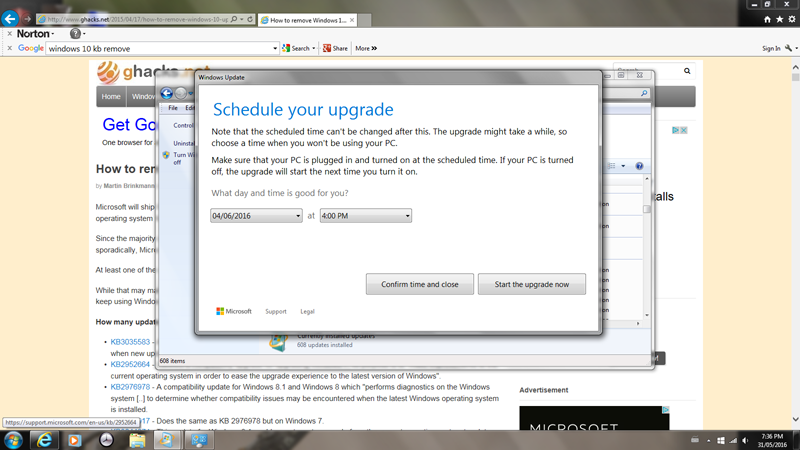
»Recently, Microsoft’s policy had been to throw up a dialogue box asking you whether you wanted to install Windows 10.

If you clicked the red “X” to close the box – the tried-and-tested way to make dialogue boxes vanish without agreeing to do anything – Microsoft began taking that as permission for the upgrade to go ahead.

Now Microsoft is changing gears.

It has eliminated the option to re-schedule a chosen upgrade time once you’ve confirmed it while also removing the red “X” close option from the screen. One Reg reader grabbed the below screenshot from a relative’s PC on Windows 7.

«

Clearly thinks that nobody will bother to pay for the upgrade when it comes up. Seems too that Samsung PC users (not a giant group, but a few million) have problems with Windows 10 too.
link to this extract


2013: Who owns all these empty shops? • BBC News

Following the collapse of chain store BHS, this is relevant about what happens when shops fall vacant:

»Jamie Stirling-Aird works for Black Stanniland, which provides services to individuals who own shops.

“We recently marketed a shop in Bradford that had been empty for three years for a client who owns 20 or 30 shops,” he says. Its previous tenant, a jeweller, had been paying £93,000 a year rent. It has now been let to a pawnbroker for £65,000.

“In a place like Bradford, there will be 10 or 15 suitable vacant properties for any retailer to choose from,” Mr Stirling-Aird says. “I’m sure there are a lot of landlords struggling at the moment. There is reasonable demand for shops in decent locations, but there are shops in really bad locations for which there is never going to be demand.”

It is owners of these shops with so-called structural vacancy who are having to consider extreme measures.
It is easy enough to sell a large shop in a good location with a tenant on a long lease, but vacant shops have been fetching low prices at auction. “I suspect we’ll end up selling it to a developer who might be able to convert it into flats,” says Stirling-Aird.

“Demolition or alternative use is the only option for the vast majority of these ‘surplus to requirement’ shops,” says Matthew Hopkinson from the Local Data Company

«

Going to be a lot of these over time.
link to this extract


Bloomberg just hired 22-year-old Apple scoop machine Mark Gurman • Recode

Noah Kulwin:

»Over the last few years, Mark Gurman has made a name for himself as the go-to guy for Apple product scoops. And now he’s taking his talents to Bloomberg.

Gurman has broken stories on the iPad, Siri and almost every other device in the Apple catalogue. Tech Insider reported earlier today that Gurman was leaving his perch at 9to5Mac. According to a memo sent to Bloomberg staff from editor Brad Stone, he will be joining Bloomberg to cover consumer products, including those made by Apple rivals like Google and Amazon.

Gurman graduated from the University of Michigan last month, and he will be based in San Francisco.

«

Gurman richly deserves this, but experienced media types *cough* await with interest how he fares inside a big smoothly oiled media machine with a lot of hypercompetitive journalists who have been there a long time, rather than on a niche (and closely attended) news blog.
link to this extract


Smartwatches: I hate to say ‘I told you so’. But I told you so • The Register

Andrew Orlowski thinks the smart watch (whether from Apple or an Android OEM or Samsung) is a dead end:

»Nothing in Android Wear 2.0 hints at a new use case, and the UX is complicated further with a greater reliance on physical controls and a quite wacky swipe keyboard.

There’s no getting away from it, these expensive watches are clunkers. And I’ll make a new prediction: they always will be. The whole kitchen-sink platform approach to wearables looks mistaken. The strategy presumed that if you threw enough electronics into the watch it would eventually find a use case, and over time that would reach a mass market price point. But not all electronics fit that neat narrative.

Think about the small but useful bits of electronics, like a TV remote or wireless car keys, that are fantastically useful at one thing, but don’t merit a standalone market, because they are always bundled with something else. (Try buying a TV or a car without one of these). Only fitness wearables, with limited functionality and the ability to do one thing really well, have shown much promise in the wearable category, and I don’t see joggers with a £99 necessarily making the leap to a clunkier multipurpose £299 gadget because it’s the same brand.

Perhaps a wearable will only ever be something that’s bundled with a smartphone in the future? I wouldn’t be surprised if this year’s smartwatches will be the last we see for a very long time.

«

Android Wear is already a zombie, I’d say: sales have flatlined. Personally I like the Apple Watch, and find it useful all the time. The key to wider adoption might be price – or it might be battery life.
link to this extract


India’s Micromax plans to sell smartphones in China, go public • WSJ

Sean McLain:

»The company plans to go public to generate cash to fund the acquisition of companies that will help Micromax build a network of services to help its phones stand out in the crowd of competitors. “The company can’t do that without more cash coming in,” Mr. Jain said. Micromax hasn’t decided whether to list in India or the U.S., he added.

The announcement is a sign that India’s smartphone market won’t save a struggling global smartphone industry. Shipments of handsets to India have declined over the past six months, according to IDC data. That is a sign that unsold phones are piling up in Indian warehouses, said IDC in a report. Most of the unsold merchandise are priced below $100 and aimed at first-time smartphone buyers, who account for much of Micromax’s sales.

However, China might not be the answer for the smartphone maker, analysts say. “I’m not sure why they’re doing this,” said Kiranjeet Kaur, an analyst at IDC. “The Chinese market is not growing and it’s really competitive. I don’t know how they will survive there.”

«

Translation: Micromax is running out of runway and it’s hoping a cash infusion from the public market will get it out of the snakepit of less well-funded rivals.
link to this extract


Errata, corrigenda and ai no corrida:
Start up: 3D scan copyrights, 2016 internet trends report, smartphone growth stalls, Jawbone lives!, and more


Race or income: which matters more when you’re accused in the state of Virginia? Photo by karen_neoh on Flickr.

You can also sign up to receive each day’s Start Up post by email.

A selection of 12 links for you. May contain nuts. I’m charlesarthur on Twitter. Observations and links welcome.

New Whitepaper on 3D Scanning and (the Lack of) Copyright • Shapeways Blog

Michael Weinberg:

»We are excited to announce a new whitepaper, 3D Scanning: A World Without Copyright*.  As the name suggests, the paper examines how 3D scanning intersects with copyright law.  We are big fans of 3D scanning here at Shapeways, and so we thought it was important to start a discussion around how copyright might impact all of the scans that are coming into the world.

It may come as a surprise, but in many cases 3D scans will not be protected by copyright.  That does not mean that scans are not important, but it does mean that people making and distributing scans should understand what rights they do – and do not – have in those scans.

Why aren’t the scans protected by copyright?  One of the key requirements for copyright in the United States is originality. Even if it takes a large amount of skill to create a scan, if making the scan does not involve originality it is simply not eligible for copyright protection.

The vast majority of scans fall squarely in that category.  By definition, most 3D scans attempt to create a perfect digital replica of the model being scanned.  Injecting “original” content that deviates from the object being scanned into that digital file would undermine the purpose of the scan.

«

Wonder where this puts the Nefertiti 3D Scan which was nicked from a museum’s server.
link to this extract


Uncovering big bias with big data • Lawyerist

David Colarusso:

»A while back, two of my colleagues were arguing about which is a bigger problem in the criminal justice system: bias against defendants of color or bias against poor defendants. My first inclination was to suggest we could settle the dispute if we had the right dataset. (I’m an attorney turned data scientist, so yes, that really was my first thought.1) That being said, the right dataset magically appeared in a tweet from Ben Schoenfeld.

What follows is the story of how I used those cases to discover what best predicts defendant outcomes: race or income. This post is not a summary of my findings, though you will find them in this article. It is a look behind the curtain of data science, a how to cast as case study. Yes, there will be a few equations. But you can safely skim over them without missing much. Just pay particular attention to the graphs.

«

Graphs like this:

It’s a terrific walk through how to deal with a big dataset and draw conclusions from them. No, I’m not going to skip to the end; read it.
link to this extract


2016 Internet Trends Report • Kleiner Perkins Caufield Byers

»The 2016 edition of Mary Meeker’s annual Internet Trends report covers today’s Internet growth and an in-depth look at the following:

Global Internet users have surpassed 3B; India has supplanted the US as the world’s second-largest Internet market.
• Internet user growth remains consistent (led by acceleration in India), while smartphone user and shipment growth have slowed.
• In the face of a slowing global economy, key macro growth drivers from the past 2 decades are less certain.
• Internet advertising (particularly via mobile) continues to grow, but so does ad-blocking, pushing the envelope on development of more innovative ad formats.
• New online-first brands have rapidly grown in popularity for the millennial generation with their focus on omni-channel and personalized distribution strategies.
• In communication, video and images shared are growing as a means of storytelling; creators, consumers, and advertisers are taking part.
• Messaging has evolved from simple, expressive conversation to business-focused use cases, with Asian platforms often leading the way.
• More efficient and often more convenient than typing, voice-based interfaces are ramping quickly and creating a new paradigm for human-computer interaction.

«

And much more. You might take issue with some of the detail (it overstates the iPhone’s ASP, but the general direction is right) but it’s a reference, as usual. Question is, is it predicting the future or just setting up how the past looked? Anyway, here’s the whole 213 pages, if you have a spare five minutes.

link to this extract


The End of Scale • rafat.org

Rafat Ali was the founder of PaidContent (which he sold to the Guardian Media Group; it later sold it at a loss) and more recently of Skift, a travel intelligence company:

»2016 is a seminal moment in media business history. The year where digital scale finally got exposed as a false proxy to actually building a real business.

The promise of trillion device universe, the promise of infinite distribution.

The promise of infinite user time. What were we thinking?

The tyranny of scale.

Time, attention, value, real tangible utility value to the daily lives of people. We all got fooled into thinking those could be replaced by tonnage of shares/views/interactions, forgetting there were humans on the other end, who at some point would get tired of the distraction and deception. We all got fooled by the startup ecosystem, by the investors drunk of dreams of unicorns (in media, of all places!), by the media who were covering all of this, desperate to look relevant and cool.

If you are the type that sees analogies everywhere – I am one of them – then you can see a lot of parallels among this the rise and crash of media scale chasing era with the bundling and rebundling of crappy mortgages and passing them onwards to be rebundled and sold to the gullible, only to come crashing down only seven years ago. Chasing scale in finance, at any cost, same as chasing scale in media businesses, at any cost…

…Who were we trying to fool?

Therein comes the biggest lie in all this, now exposed: There is no secret sauce in media.

There is no outside savior coming to rescue.

It is all you. The value you build with your editorial. The value you can create by being focused on doing a few things very very well.

«

Quite scary, in its way.
link to this extract


AMD prices 3D tech to spur virtual reality market • WSJ

Don Clark on AMD’s release of its new Polaris-based graphics cards:

»the need for a PC with an add-in card that includes a beefy 3-D graphics chip is another barrier that stands in the way of widespread adoption of VR. An online survey conducted in April by the Advanced Imaging Society found that 68% of respondents said VR equipment was too expensive.

“Less than 1% of PC users have systems that are capable of doing VR,” said Raja Koduri, senior vice president and chief architect of AMD’s Radeon technologies group. “The entry point is very, very high.”

AMD said its new Radeon RX cards, certified for use in VR by HTC and Oculus VR, deliver performance equivalent to that of $500 graphics cards used for VR.

Patrick Moorhead, an analyst with Moor Insights & Strategy briefed on AMD’s strategy, estimated that the current minimum price on cards comparable to AMD’s new models is $399. He said the $199 pricing comes as a surprise.

“It’s great for getting more people into VR,” said Kelt Reeves, president of Falcon Northwest Computer Systems Inc., a boutique maker of gaming PCs that serves the market.

«

Except that would require people to upgrade their PC to one capable of doing it. More likely they’ll do it via their smartphone, surely.
link to this extract


Worldwide smartphone growth forecast to slow to 3.1% in 2016 as focus shifts to device lifecycles • IDC

»According to a forecast update from the International Data Corporation (IDC) Worldwide Quarterly Mobile Phone Tracker, smartphone shipments are expected to grow 3.1% in 2016, which is a substantial slowdown from the 10.5% growth in 2015 and 27.8% in 2014. Shipments are expected to hit 1.48 billion in 2016 and grow to 1.84 billion in 2020. The new forecast is 2.6 percentage points lower than IDC’s previous forecast for 2016 on the basis of the continued slowdown in mature markets and China.

IDC expects large markets like the United States, Western Europe, and China to see low single digit growth rates in 2016 while Japan and Canada are expected to contract by 6.4% and 6.9%, respectively. In all these markets, smartphone buying behavior is changing in many ways. In operator-driven markets the transition away from two year subsidized contracts toward monthly installment plans are slowly taking place. Meanwhile, many retail heavy markets are seeing a surge in the eTailer channel, better known as online marketplaces.

“Consumers everywhere are getting savvy about how and where they buy their smartphones, and this is opening up new doors for OEMs and causing some traditional channels to lose some control of the hardware flow,” said Ryan Reith, program vice president with IDC’s Worldwide Quarterly Mobile Phone Tracker. “Smartphones sold into eTailer channels grew 65% in 2015 and are expected to account for roughly 12% of smartphone shipments in 2016, up from just 4% in 2013. Consumers are having more say over which brands they want and at the same time able to bargain shop.”

«

Phablets will do well, Windows Phone won’t, iPhones to see slight drop from 232m in 2015 to 227m in 2016, BlackBerry to.. fade to black, probably.
link to this extract


Apple Watch 2 wishlist • Hypergeusia

Ryan Considine’s list (faster, better app launcher, ambient display and more) is right on the spot. And I have to agree with him on this wish:

»

TouchID
That passcode screen is miserable.

«

I have to do the passcode first thing every morning. It’s not a great experience.
link to this extract


We’re still committed • The Jawbone Blog

Hosain Rahman is CEO of Jawbone:

»As some of you may have recently seen, there have been a few incorrect media reports that Jawbone is exiting the wearables business or going out of business altogether. These reports are unequivocally false. This speculation appears to emanate from wrongful insinuations made in a blog post in which the particular digital publication has since made a “Correction.” Jawbone was not contacted on the specific insinuations prior to the post and other media picked them up before the digital publication posted a correction, further spreading this false information.

To be clear, Jawbone remains wholly committed to innovating in and building great wearables products. We have never been more excited about our pipeline of technology and products and look forward to sharing them with the world when ready.

We have always managed our inventory positions according to internal business processes and strategic product lifecycle objectives. This situation is no different and we will continue to support all of our products. UP2, UP3 and UP4 are still hugely popular and continue to sell well. We’re also continually inspired by stories of how our UP® community is using our products to live better.

«

The “particular digital publication” appears to be Tech Insider (aka Business Insider), where the story from Friday May 27 has been seamlessly updated to include this denial from June 1.

I’m not quite getting an unequivocal feeling that Jawbone is feeling strong. But it also shows how the world of zero-deadline digital can lead to messups; at least with a print deadline, you know when you need to answer. (That didn’t stop screwups, but it gave you a time by which to prevent them.)
link to this extract


From $4.5bn to nothing: Forbes revises estimated net worth of Theranos founder Elizabeth Holmes • Forbes

Matthew Herper:

»Theranos has been hit with allegations that its tests are inaccurate and is being investigated by an alphabet soup of federal agencies. That, plus new information indicating Theranos’ annual revenues are less than $100m, has led FORBES to come up with a new, lower estimate of Theranos’ value.

FORBES spoke to a dozen venture capitalists, analysts and industry experts and concluded that a more realistic value for Theranos is $800m, rather than $9bn. That gives the company credit for its intellectual property and the $724m that it has raised, according to VC Experts, a venture capital research firm. It also represents a generous multiple of the company’s sales, which FORBES learned about from a person familiar with Theranos’ finances.

At such a low valuation, Holmes’ [50%] stake is essentially worth nothing. Theranos investors own preferred shares, which means they get paid back before Holmes, who owns common stock.

«

If that’s the case about Holmes’s stock, she was poorly advised. Forbes also thinks she won’t raise money at a higher valuation again, has too many unknowns, hasn’t delivered on promises (or threats), and might not have a target market.

Apart from that, Ms Holmes, how was the play?
link to this extract


Twitter is betting everything on Jack Dorsey. Will it work? • Vanity Fair

Nick Bilton, who has been a splendid biographer of the Borgia-style goings-on at the top of Twitter, updates his book with the latest:

»I have been told by people close to the company that, in the face of mounting pressure from Wall Street, Twitter occasionally resorted to what most start-ups do when they need to goose the numbers: they kind of faked it. This happens at virtually all social networks; the company sends an e-mail to inactive users who haven’t been on the service in a few months, informing them there is a problem with their username or account, which leads people to log in to fix the situation. Magically, those people become monthly active users even if they were not.

And while Dorsey wasn’t employing that trick, his magic was not yet apparent to investors on Wall Street. Months into his turnaround campaign, user growth was relatively flat and Twitter’s stock was now down nearly 60% from where it had stood when Costolo was convening his staff in [the meeting room called] Waterthrush. Twitter, which once had a market valuation of nearly $40bn, was now worth about half that…

…There are few things about Twitter’s future that anyone can say for certain, but I’ll offer one prediction with absolute assuredness: there will not be a fourth Jack Dorsey era. Recently, when I met with executives at the company—including the executive chairman of the board, the chief financial officer, and the director of communications—there was one query that seemed to catch everyone off guard. What was Plan B, I asked, if Dorsey couldn’t turn the company around? “There is no Plan B,” I was told. “This is it.”

The solution to Twitter’s problems, they all reiterated, along with Dorsey, is that word “live.” “We now know what inhibits usage, and what doesn’t,” Dorsey explained to me. He said he has a slew of new features—including hosting live video from the N.F.L., where people can talk about the game as they watch it—that will grow the audience and focus on that single, live strategy.

Twitter is betting a lot on this relatively simple notion.

«

link to this extract


2016 Mobile Adblocking Report • PageFair

»Quick Facts:

• At least 419 million people (22% of the world’s 1.9bn smartphone users) are blocking ads on the mobile web.
• Both mobile web and in-app ads can now be blocked.
• As of March 2016 an estimated 408 million people are actively using mobile adblocking browsers (i.e., a mobile browser that blocks ads by default).
• As of March 2016 there are 159 million users of mobile adblocking browsers in China, 122 million in India, and 38 million in Indonesia.
• As of March 2016 in Europe and North America there were 14 million monthly active users of mobile adblocking browsers.
• A further 4.9 million content blocking and in-app adblocking apps were downloaded from the app stores in Europe and North America since September 2014.
• Adblocking is now the most hotly discussed topic in the digital media industry.

«

Those figures for China, India and Indonesia add up to 319 million – leaving about 111 million outside those three countries. Adblocking is most prevalent (ie most urgent to users) where data is expensive and phones are slow(er).

Here’s the presentation:

There’s a PDF report too.

link to this extract


Delaware court finds Dell’s $24bn buyout underpaid investors • FT.com

James Fontanella-Khan and Leslie Hook:

»“The sale process functioned imperfectly as a price discovery tool, both during the pre-signing and post-signing phases,” said Travis Laster, vice-chancellor of Delaware’s special corporate court.

The ruling is a black eye for Mr Dell and Silver Lake, which were attacked at the time for underpaying and then changing the voting rules to prevent the offer being blocked.

Magnetar Capital, a hedge fund, could net about $15m as it has legal rights to about 3.8m shares.

Dell’s $24bn sale to its founder came under scrutiny as many investors believed Mr Dell was conflicted: playing seller and buyer at the same time. A spokesperson for Dell declined to comment on Tuesday’s ruling.

In the wake of the financial crisis, Dell’s PC sales had slipped, causing share prices to fall — and presenting Mr Dell with an opportunity.

The efforts by Mr Dell and Silver Lake to take Dell private were contested by shareholders from the beginning. Shareholders who opposed the deal included billionaire activist Carl Icahn as well as T Rowe Price, which believed the market was underpricing Dell.

«

In total, it’s about $20m in extra payments. Not huge, but it’s the principle: how can it be right for Dell to be both seller and buyer? Here’s the ruling.
link to this extract


Errata, corrigenda and ai no corrida: none notified.

Start up: more iPhone rumours, tablet use falls, six useful algorithms, and more


TV in the US is losing its audience, and especially its paying audience. Photo by quinn.anya on Flickr.

You could always sign up to receive each day’s Start Up post by email.

A selection of 12 links for you. Yes they are. I’m charlesarthur on Twitter. Observations and links welcome.

Introducing comment moderation for Periscope • Medium

»Dear Periscope Community,

We’ve seen incredible communities and real-life friendships form on Periscope because it’s live, unfiltered and open. We’ve also seen broadcasters get discovered and quickly grow a large, public following. But with this openness comes an increased risk for spam and abuse, and this is something that we take seriously.

Above all, we want our community to be safe on Periscope. Comments are a vital part of the experience and we’ve been working hard on a system that still feels true to the live and unfiltered nature of our platform. Specifically, we want to develop a system that is: transparent, community-led, and live.

«

It was inevitable. Let’s see how this goes.
link to this extract


Apple moving to 3-year ‘major’ iPhone cycle, adding complex vibrations to 2017 model – report • Apple Insider

Roger Fingas:

»Apple will likely be waiting until next year to debut its next major iPhone refresh, treating this year’s “iPhone 7” as yet another interim upgrade, a Japanese report said on Tuesday.

The 2017 iPhone is expected to make the switch to OLED, among other important design changes, Nikkei said. While that would support recent rumors, the business publication also made an original claim that the device will have a new vibration motor, capable of producing more complex patterns than earlier iPhones.

That could indicate that Apple will use an evolved version of its “Taptic Engine,” found in devices like the Apple Watch and the iPhone 6s. The technology lets devices produce different, subtle responses to user actions and notifications.

The “iPhone 7” is likely to stay mostly the same, Nikkei said, the most noticeable difference being the removal of the 3.5-millimeter headphone jack. Camera, water resistance, and battery technology should be improved, the paper continued, also mentioning that “a high-end version of the model will give users better-quality photo capabilities via correction functions.”

Rumors have suggested that the standard iPhone 7 might gain optical image stabilization, while a “7 Plus” will have a dual-lens camera.

«

link to this extract


Tablet usage declines • Global Web Index

Katie Young:

»Certainly, tablets have enjoyed healthy growth in recent years; since 2011, the numbers getting online via these devices have more than trebled – jumping from just 10% at the start of the decade to more than 1 in 3 in 2016.

However, from market to market, region to region, a closer look at these figures reveals that the boom days for tablets appear to be over. The speed of the increases slowed dramatically during 2015 and, in the first quarters of 2016, tablets have now started to decline. What’s more, 16-24s now lag behind virtually all other age groups in terms of usage.

Clearly, these devices are struggling to convince many that they are must-have rather than just nice-to-have devices. So, unless tablets can provide a level of functionality sufficiently higher than mobiles to warrant the expense, we can expect this trend to continue.

«

link to this extract


Nearly 1 in 4 people abandon mobile apps after only one use • TechCrunch

Sarah Perez:

»Based on data from analytics firm Localytics, and its user base of 37,000 applications, user retention has seen a slight increase year-over-year from 34% in 2015 to 38% in 2016.

However, just because this figure has recovered a bit, that doesn’t mean the numbers are good. Instead, what this indicates is that 62 percent of users will use an app less than 11 times.

Says the report, “this is not a sustainable business model.”

These days, 23% launch an app only once – an improvement over last year, but only slightly. For comparison’s sake, only 20% of users were abandoning apps in 2014.

On iOS, user retention saw some slight improvements. The percentage of those only opening apps once fell to 24% from 26% last year, and those who return to apps 11 times or more grew to 36% from 32% in 2015.

«

That seems depressing. Then again, thinking of my own use, I tend to install apps, and not use them for ages; then I’ll suddenly discover a use, and go with it. It’s not quite “abandonment”. There aren’t that many apps that I have to use every day, or even every month. But there are lots that I might use once a year. (And there’s no particular distinction between mobile and desktop in that regard.)
link to this extract


The TV industry will unravel faster than you think — Lightspeed Venture Partners • Medium

Alex Taussig says it’s all going to go bad for the big networks:

»The most obvious beneficiaries of the decline of old TV media will be the dominant social networks who nail video: Facebook, Snapchat,* and perhaps Twitter, if the whole Periscope thing works out. (A new social network built natively with video could also be a contender. Email me if that’s what you’re working on!) They each have their own power law dynamics and, by most measures, are significantly larger and more global than the TV networks. Their data allows them to target videos more precisely; so, despite larger quantities of social video in the world, the odds of a specific consumer engaging with a given video are (in theory) much higher. If properly executed, they could expand the $73bn TV advertising market today by transforming it from an audience-based to a performance-based medium.

The second group of beneficiaries will be the new stream aggregators: Netflix, Amazon, YouTube, Twitch, and the like. These streams will continue to aggregate and package long tail content and form direct relationships with consumers. Again, there will only be a few winners here.

«

Taussig points to two key bits of data: US pay TV penetration rates are falling

and only those aged over 65 now watch more TV than they did five years ago:

Hard to argue with his reasoning.
link to this extract


Dell reveals industry’s first 17in 2-In-1 laptop • Twice

Joseph Palenchar:

»The PC industry’s first 17-inch two-in-one convertible Windows laptop is among six new Inspiron two-in-one laptops unveiled by Dell at Computex in Taiwan, Microsoft announced.

All six of the convertible two-in-ones come with touchscreen display and secure Windows Hello login via optional or standard built-in infrared cameras. A 360-degree hinge delivers four modes: laptop mode, tent mode for presentations, stand mode for playing movies, and tablet mode.

«

OK, that’s too big. Thanks, Dell, for showing us the limit, beyond which you’ve gone.
link to this extract


Six algorithms that can improve your life • WNYC

Manoush Zomorodi:

»There’s been a lot of negative press lately about algorithms (Facebook, Snapchat, the prison system). But this week we’re exploring ways that mathematical and scientific algorithms can actually help improve how we live.

Brian Christian co-wrote the book “Algorithms to Live By” with his friend, Tom Griffiths, a psychology and cognitive science professor at UC Berkeley. Brian is all about the intersection of technology and humanity, and figuring out how to use data to help people optimize their lives.

In their book, Brian and Tom offer really practical applications for scientific principles, which we’ll get to in a minute. But first, here’s the catch: There’s no formula for perfection. Even if you apply these algorithms to your life, things will go wrong. But by trying out these algorithms, you can statistically give it your best shot.

«

Includes: how to find stuff on your desk, stop tagging/filing your emails, arrange appointments faster, and more. Also with audio.
link to this extract


Economist editor: ‘We don’t want to be the grandpa at the disco’ • The Guardian

Mark Sweney interviews Zanny Milton Beddoes, editor of The Economist:

»Despite this success, as at other publishers print sales at the Economist have fallen across the globe, although the circulation still stands at 1.25m copies a week. Digital edition sales have broken through the 300,000 mark, up by 50% or more year-on-year in most markets, including the UK but not North and South America. Minton Beddoes says the print decline is in part to do with a “drive to quality” – getting rid of bulk copies and converting readers to paid subscribers.

“The overall circulation is slightly down but the profitability of our circulation is rising and print is still holding up remarkably well,” she says. “I’m completely agnostic [about whether] people read print or digital, I really want them to have a premium subscription giving them access to both.” The Economist is still willing to embrace the potential of print, as is shown by it launching 1843, a bi-monthly magazine (which replaced Intelligent Life) aimed at the “globally curious” which aims to speak to them “when they have their feet up, on a weekend break, on holiday”.

Minton Beddoes says the Economist is not feeling the same extreme pressure as advertising-reliant newspaper publishers. “I’m very simple about this. You make money out of things people pay for,” she says. “Subscriptions is the bulk of our business, ads are nice to have on top of that. We are in the midst of a massively changing disrupted industry and that is incredibly exciting but it is also challenging. There are going to be winners in that and losers. It is foolish for anyone to be complacent. I am confident and hopeful and paranoid at the same time.”

«

link to this extract


Are Trump hotels taking a ‘yuge’ hit? • Tailwind by Hipmunk

Kelly Soderlund on data from hotel-booking system Hipmunk:

»The Trump brand is associated with a variety of hotels, apartments, and products. On one hand, a growing number of political supporters could boost sales of Trump products; on the other, a growing number political detractors could lead people to avoid his brand. So which of these two forces is stronger?

We set out to answer this question by comparing the number of bookings at Trump Hotels’ most-booked locations this year on Hipmunk to bookings in the same locations the year prior (before he attracted national political attention).

The results? The share of bookings at Trump Hotels on Hipmunk as a percent of total hotel bookings are down, decreasing 59% compared to the same period last year.

While overall Hipmunk hotel bookings have been on the rise year-over-year, that has not been the case with bookings of Trump Hotels.

«

You could think of all sorts of possible reasons, but just not wanting to put any money into Trump’s pockets, and instead favouring Any Other Hotel Chain, seems like the immediately most plausible.
link to this extract


Forced Windows 10 upgrades push users to dangerously disable Windows Update • PC World

Brad Chacos:

»Ironically, improved security is one of Windows 10’s selling points. But by pushing it on users in such a heavy-handed way, Microsoft is encouraging users who have very valid reasons to stick with Windows 7/8 to perform actions that leave their machines open to attack. That’s bad. Very bad.

For the record: Don’t disable Windows Updates unless you’re an advanced user who wants to parse and manually install Windows patches. Instead, leave them active but also install GWX Control Panel or Never10, free tools that block the Get Windows 10 pop-ups and behavior. Microsoft’s been known to push out new patches that work around those tools in the past, however—again, violating Windows Update’s sanctity to push its new OS. Be sure to read the fine print if a GWX pop-up does appear in order to avoid being tricked into Windows 10.

«

Coming to something when people complain of feeling “tricked” into getting an operating system for free that they would have been queueing around the block to pay for a few years ago. Well, 20 years ago.
link to this extract


How big an issue is the nausea problem for virtual reality products? • Quora

Steve Baker is ex-Rediffusion Simulation, Hughes Aircraft, L3 Simulation:

»I’ve been working with helmet mounted displays in military flight simulation for several decades – I am an expert in the field.

IMHO – these devices should be banned – but that may not be necessary because after the first wave of early adopters I think it’ll go the way of 3D televisions. But that’s just my opinion. Let me explain why.

Everyone thinks these things are new and revolutionary…but they really aren’t. All that’s happened is that they dropped in price from $80,000 to $500…and many corners have been cut along the way.

There are several claims that the nausea problem has either been fixed, or will soon be fixed, or that application design can be used to work-around the problem.

The claims that it’s been fixed are based on the theory that the nausea is caused by latency/lag in the system, or by low resolution displays or by inaccurate head motion tracking…all of which can (and are) being fixed by obvious improvements to the system. Sadly, the $80,000 googles we made for the US military had less latency, higher resolution displays, and more accurate head tracking than any of the current round of civilian VR goggles…and they definitely made people sick – so this seems unlikely.

«

He has plenty more to say too about focal lengths and depth perception, and aftereffects. Worth considering. Of course, you could always assume that your users are going to be confused to begin with…
link to this extract


VR Party Game is a ridiculously confusing virtual reality experience for Cardboard • Android Police

Rita El Khoury:

»What if virtual reality was just reality, with a small asterisk? What if you could strap on your VR headset, regardless of the brand or technology behind them, and see the same thing that’s in front of you… but mirrored? Or upside down? Or delayed by 2 seconds? Ha, what a novel idea!

VR Party Game does just that. It’s a Cardboard app/game that transmits your smartphone’s rear camera view onto the screen, but applies one of three special effects to confuse you. It can delay the view by 2 seconds, mirror it, or flip it upside down. The idea is to use it as a party game with friends, asking each other to complete a few tasks while wearing the Cardboard headset…

…VR Party Game is just mindless fun and as such, you may find the price a little steep. The app costs $0.99 but that only gives you the delay and mirror modes. Upside down is another $0.99 IAP.

«

OH NO. A WHOLE $1.98??
link to this extract


Errata, corrigenda and ai no corrida: none notified.