If you think the Apple Watch is a ‘flop’, try this estimate for Android Wear device sales


Got an LG Watch Urbane? Congratulations – you’re part of a pretty exclusive club. Photo by Janitors on Flickr.

Back in February I tried to estimate how many Android Wear devices were activated in 2014, following Canalys saying that 720,000 had shipped that year.

The figure I got, based on the page on Google Play, where one can track not just downloads but also comments and average rating for the Android Wear app (which you need to control your shiny new Android Wear device), was 700,000.

Android Wear: all the numbers

Put it together, and we have about 560,000 Android Wear activations by the end of 2014, and 700,000 to mid-February.

Progress, or the lack of it

OK. So what about progress since then? I’ve kept noting the progress of the number of downloads, and the number of comments, on the Google Play page, helped from time to time by the Internet Archive (it’s wonderful. Donate).

My previous estimate worked on the basis that the number of comments was proportional to the number of downloads. I don’t see any reason to change that assumption.

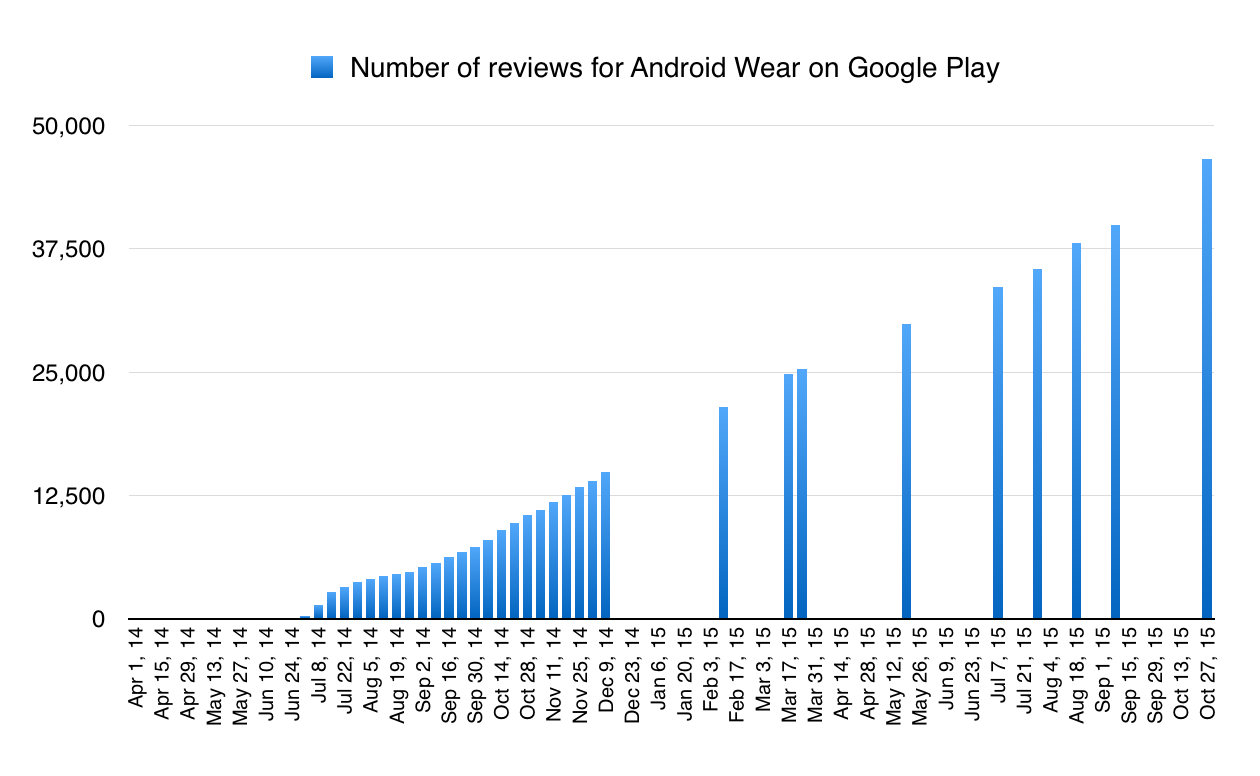
So how does it look now? The number of comments keeps going up:

Android Wear: number of reviews

Steady growth suggests steady download, and hence sales, figures

(One point to note: the average review score has been trending down steadily. You would expect this for a new technology: the keen people who forgive anything are first in, and are followed by those who got it as a gift, or an experiment, or whatever. Notably, some of the recent low ratings come from people complaining about updates; that would suggest that the installs/comments ratio is actually falling.)

Whichever, the precise value of the average review has fallen from a comfortable 4.83 (out of 5) to dip to 3.98 at the end of October, recovering to 4.00 last week.

And now we try to fit the number of installs – using the points that we have, which isn’t a lot – to that graph, assuming downloads are directly proportional to comments.

According to Google’s stats, Android Wear is now past the 1m download point, but not the 5m download point.

So I’ve tried to fit the graph as best I can. And this is what I get:

Android Wear sales estimate: 1.9m in November

Fitting known waypoints to the number of comments suggests that 1.9m Android Wear devices have been sold

That’s the figure I get: 1.9m downloads in total, suggesting that since February there have been a total of 1.2m more installations of Android Wear.

So again we ask: is that bad or good? There are now 1.4bn Android devices in use, according to Sundar Pichai. Only those running Android 4.3 upwards can use Android Wear, which means we’re potentially talking about 67.8% of devices according to the very latest figures from the Android Dashboard. (That’s up substantially from 47.6% back in February.)

The penetrant question

Back in February, I guessed at 1.2bn Android devices in use (which seems close enough – 1bn announced at Google I/O in 2014, 1.4bn this time). So back then the potential market was
1.2bn * 0.476 = 571.2m devices, of which 700,000 had Android Wear: that was a penetration of 0.12%.

Now we have a potential addressable market for Android Wear of
1.4bn * 0.678 = 949.2m devices. Of which it seems 1.9m, or 0.2%, have bought. (This doesn’t allow for people owning multiple devices, but the incidence will be very low compared to the 949m devices available.)

Conclusions and thoughts

• The absolute number of Android Wear devices in use is still really low.
• A total of 1.2m have been sold since February
• It’s tiny compared to any estimate of the number of Apple Watches sold since the launch in April, which varies by analyst; Canalys estimates that it has shipped 7m in two quarters, which compares to 1.2m Android Wear sold
• These may be the lull before the storm of purchases on Black Friday/Christmas, but abandonment could be a problem
• Android Wear, despite being first to market, suffers from a lack of brand visibility, and visibility overall. Kantar ComTech released a survey in October based on a study from August which found that in the US,

Among panelists who knew what a smartwatch or smartband was, 92% connected Apple to the category, far more than any other brand. This was followed by Fitbit in second place with 47%, with Google (34%) edging out Samsung (33%) for third place.

That doesn’t leave a lot of room for others, at least in the US buyer’s mind.

I’ll keep tabs on Android Wear, absent Google releasing any figures. But for now, this is starting to look like an interesting question: can a device category succeed if it doesn’t have a successful Android version?

Start up: the Watch drop, Tango slows, Samsung’s bug bonanza, kids and tablets, and more


Guess how much this ad cost. OK, if it were actually inside the TV. Photo by wonderferret on Flickr.

You can now sign up to receive each day’s Start Up post by email. You’ll need to click a confirmation link, so no spam.

A selection of 9 links for you. Use them wisely. I’m charlesarthur on Twitter. Observations and links welcome.

Popular Apple blogger stops wearing his Apple Watch every day » Fortune

Philip Elmer-DeWitt quoting John Gruber, speaking to developer Guy English on his own Talk Show podcast:

“I’ve been intrigued. And I do wear mine, but I don’t wear it every day. I foresee a bright future for it. But I just don’t think I was ever squarely in the market for it. It’s just not the sort of thing that speaks to me.”

[Here Guy English jokes about Gruber’s lack of interest in fitness — fitness tracking being one of the device’s key selling points.]

“Yeah. Right. Once I stopped wearing it every day… there is this weird motivating thing where you want to keep filling these circles everyday. And you get this streak going and you keep going. And I’m sure people are more fit. But then once you stop wearing it every day you definitely by definition have days where you didn’t fill all the circles. [It] just ruins it. It means you don’t care anymore. I don’t know. It just doesn’t excite me that much.”

Personally, still wearing mine each day; does so many things I need (such as, on Thursday evening while driving, starting navigation home via Siri because my normal route was blocked. Would have been tough and distracting with the phone).
link to this extract


Google is cutting the cost of its Project Tango depth-sensing tablets in half » VentureBeat

Harrison Weber:

The deal, effective “in the coming weeks,” Google said, follows the company’s $20,000 contest that tasked developers with creating “unique augmented reality (AR) experiences” for Tango devices. The winning submissions require a Project Tango device to work, but you can get a taste of the ideas here (and here).

Google told us it doesn’t have a set duration for the discount, but the company apparently has “a limited, but sizable number of promotional codes. We haven’t finalized the exact number yet,” a spokesperson told us…

…Project Tango’s future remains unclear: Google originally aimed to launch a “consumer-scale” Project Tango device with LG in 2015. Then in January, the company spun Tango out of its Advanced Technology and Projects group without sharing much information on the initiative’s next steps.

When asked if the discount was designed to get rid of developer units ahead of a new release, a spokesperson replied, “This is very much to get kits in the hands of developers and shore up the ecosystem. We still don’t have a timetable on consumer-ready units.”

Suggested headline tweak: “Google is halving the cost of…”
link to this extract


Can I annoy you for a penny a minute? » Medium

Rob Leathern:

US TV advertising revenue is expected to reach $78.8bn this year. The average person over 2 years of age in the United States still watches an amazing 29 hours and 47 minutes of TV per week. Which means, when you work it out, that’s just $0.18 in ad revenue per hour of TV watched.

TV Networks are even speeding up their programming in order to fit in more ads as prices fall and viewership dwindles. The average hour of cable television now has 15.8 minutes of ads compared with 14.5 minutes five years ago. The Wall Street Journal reported that “TBS used compression technology to speed up [movies and TV shows]”  —  this video on YouTube shows an example of this tactic with a Seinfeld rerun. For reruns and movies especially, cable networks have long rolled credits very quickly or cut TV opening sequences out entirely.

I find Leathern a must-follow: he has so much inside knowledge of the online ad business, both good and bad. Meanwhile, I find TV in the US unwatchable because of the volume (in both senses) of ads.
link to this extract


Open Data Institute summit 2015: Matt Hancock speech » GOV.UK

Hancock is an MP and the Paymaster General (a role within the Treasury):

One local authority is using this [LIDAR] data to make the case for new flood defences. Council staff 3D printed the local area and fashioned blocks to show where the flood defences might go. Then they poured water on the model, to show local residents exactly which areas would flood, depending on where they put the defences.

Nor is it just local engagement. Precision farming, archaeological digs, urban planning, even uploading England to the game Minecraft: these are just some of the applications we’ve heard about since the data was published.

Let’s take another example. Two years ago Land Registry released the Price Paid Dataset (PPD), tracking residential property sales in England and Wales. The PPD is used by sites like RightMove and Zoopla to bring up-to-date sales data to an audience of millions.

Now we’re enriching it. As of last week, this dataset will also include sales through repossession, those purchased by companies and by-to-lets. It will also allow users to see the sales of non-residential property for the first time.

The applications include developing valuation software, improving planning policy, building apps that analyse market trends, and for academic research.

And the point is this. No minister, even armed with the best policy advice, could possibly conceive of all the things that government data can do.

The only way to find out is to open it up.

Great to see a Treasury minister advocating free government data – which is exactly what the Free Our Data campaign was about, almost ten years ago. Less heartening to see Hancock not pushing for the same from the Freedom of Information Commission.
link to this extract


Hack the Galaxy: hunting bugs in the Samsung Galaxy S6 Edge » Project Zero blog

Natalie Silvanovich, of Google’s Project Zero team, which tries to find bugs in all sorts of software, on a sustained effort to see what weaknesses Samsung’s TouchWiz and other customisations brought to Android:

A week of investigation showed that there are a number of weak points in the Samsung Galaxy S6 Edge. Over the course of a week, we found a total of 11 issues with a serious security impact. Several issues were found in device drivers and image processing, and there were also some logic issues in the device that were high impact and easy-to-exploit.

The majority of these issues were fixed on the device we tested via an OTA [over the air] update within 90 days, though three lower-severity issues remain unfixed. It is promising that the highest severity issues were fixed and updated on-device in a reasonable time frame.

So only a few hundred other devices to work through then. How different are the other Samsung devices? And then there’s the LG, Sony, and everyone else..
link to this extract


Toddlers are already pros with tablets and smartphones, study finds » NBC News

Maggie Fox:

Toddlers and preschoolers are often left to their own mobile devices, with half enjoying their very own TV by the tender age of 4 and more than three-quarters regularly using their own mobile devices, researchers said Monday.

Most are starting before they are even a year old — and by age 3, they’re using the devices all by themselves, the team reports in the journal Pediatrics.

The survey was done in a single urban pediatric clinic in Philadelphia, and the researchers note that the findings do not necessarily extend to the whole country.

But they paint a troubling picture of populations of low-income and minority babies, and toddlers being kept quiet with televisions or tablet devices streaming cartoons.

I’m much more worried about the idea of sitting the children in front of US TV, which spews up to 20 minutes of ads per hour at them, than of them using tablets – where at least they might have some agency. (Could we wish for better software for kids though?)
link to this extract


Apple and sapphire supplier reach new accord on $439m loan » WSJ

Peg Brickley:

GT Advanced Technologies Inc. has reached an accord with Apple that will get it out from under $439m in debt it picked up in a failed effort to qualify as a supplier of smartphone-screen material.

The settlement provides for an auction by Nov. 23 of equipment that GT provided in the effort, the proceeds of which will be divided, GT said in papers filed on Monday in the U.S. Bankruptcy Court in New Hampshire. While GT intends to hang on to some of the equipment—as many as 600 sapphire-making furnaces—it is prepared to auction what it can and abandon what it can’t cart off, court papers say.

Anything not sold will be handed over to Apple, which has agreed to scrap the equipment and extinguish the loan it made to transform GT from an equipment manufacturer into a supplier of smartphone-screen material.

End to a long saga. I wrote about it a year ago.
link to this extract


The No.1 mistake people I interview [for jobs] are making these days » Business Insider

Jessica Liebman is managing editor of Business Insider:

Lately, the majority of people I interview have one thing in common.

They’re all messing up on something that I think is very important when trying to get a job: the Thank You Email.

Did not know this was A Thing.
link to this extract


FBI official: It’s America’s choice whether we want to be spied on » Ars Technica

Jon Brodkin:

While technology companies have resisted government attempts to access customer data, [FBI general counsel James] Baker said [at the Advanced Cyber Security Center conference] law enforcement has more success with some companies than others.

In some cases, a company will tell law enforcement that it can only provide metadata or a “snapshot of the account once a day” instead of the real-time surveillance authorities want, he said.

The FBI has an easier time getting data from companies whose business models depend on viewing customer data, he said.

Some companies “want to monetize the analysis of communications of their customers, for example those companies that actually look at e-mail and analyze it and send you targeted ads,” Baker said.

Baker didn’t mention any specific companies, but this is a practice in place at Google.

“None of that is encrypted, so we can go there and get the order and have the order be effective, and that’s good,” Baker said.

Well, good-ish. (Thanks @papanic for the link.)
link to this extract


Errata, corrigenda and ai no corrida: After yesterday’s item on GPS errors compared to a marathon: they measure marathons (PDF) using “a calibrated bicycle fitted with a Jones counter” which is “the only approved method of measuring road race courses” (which includes marathons).

HTC won’t forecast this quarter’s revenues. But don’t worry, we can. (They’re bad.)


Too much of this, not enough selling phones: that’s HTC’s problem. Photo by caribb on Flickr.

HTC, in its Q3 earnings call, declined to give any forecasts for its revenues or profits in the current quarter: “it’s our intention that we will not be providing financial forecast in the coming quarters,” said Chialin Chang, CFO and president, global sales, complaining that the guidance they used to give was far too detailed – gross margin, earnings per share, revenue. But he would offer this: “I will say the following. We are expecting – I’d like to expect Q4 result as compared to Q3 result to see the incremental improvement on revenue and the net income.”

(Actually, I challenge anyone to read that transcript and get any sense out of it. Sure, English isn’t Chang’s first language – it might not be his second language – but he seems competent enough to talk a lot in it. He just doesn’t actually explain anything. And what a sad little call; only two analysts on it, based on the questions.)

Law of averages

Still, even if HTC isn’t going to predict its revenues, we can. That’s because the Taiwan Stock Exchange makes listed companies report monthly revenues. And there’s a pattern to companies’ sales, especially those which are quite seasonal and predictable, like HTC. February is smaller than January; March is bigger than February; April’s about the same; and so on.

Using the monthly data from the past nine years, I’ve generated the “average” forecast for HTC’s revenues by month over the year. And we’ll use this to forecast this quarter’s revenues (and maybe profits).

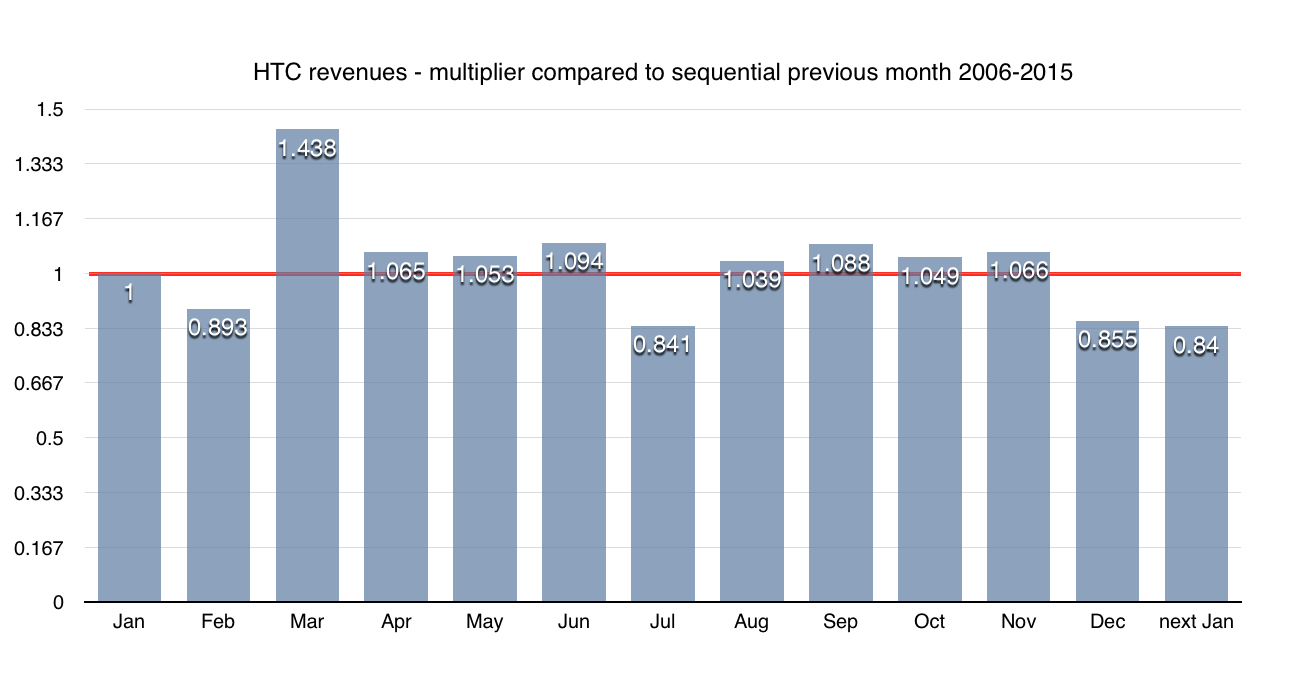
Here’s how HTC’s year goes, from month to month, on average over the past nine years:

HTC average monthly revenue

Past financial data lets us see how HTC revenues change by month, on average

You’ll notice that the “next January” mark is lower than the previous one – which is just one of those things; on average, the revenue has grown by 3% over the year, then fallen by 17% the next January. Shrinking, in other words, which it has been doing since 2010.

But this is a pretty simple model. How good is it at predicting? How does it fare when we compare it with HTC’s revenue this year?

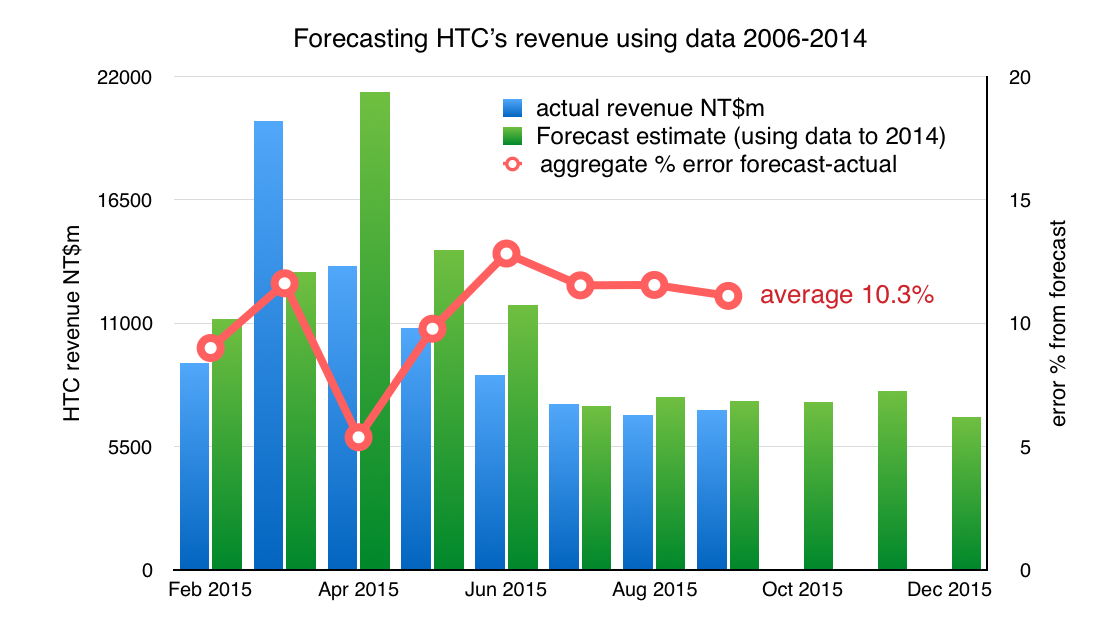
Here is the comparison, where we only use the data up to 2014 for the forward guidance:

HTC monthly revenues forecast

There’s an error, but it’s not gigantic; around 10%

So the aggregate error in revenue from forecast over the year is 10% – the highest value being around 12%. (I’ve used absolute values for the error, rather than averaging the plus and minus.)

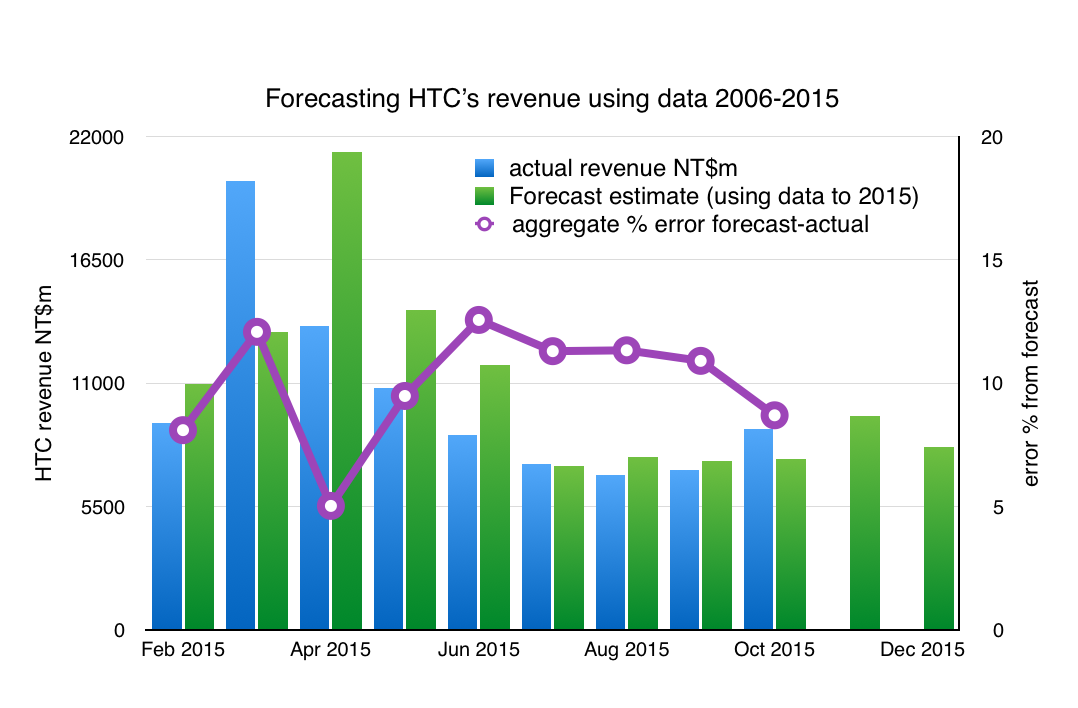
But what if we feed in the results from 2015 too? It improves the graph a little:

HTC monthly data forecast for 2015

If we go up to the September-October data point, the aggregate error reduces further

I’ve changed the colour for the aggregate error: 8.7% for total revenues over the year so far. Not so bad.

Given this, what can we say about HTC’s revenue to the end of this year in two months? We’ve just had the October revenues, so we can look forward to the rest of the year. On the adjusted basis, using the new data, my forecast comes in at NT$26.64bn (about US$830m). That’s down from $47.9bn in the same period a year ago – a forecast decline of 45%.

Bear in mind there’s a likely error either way of 10% – so I’m forecasting NT$29bn-$23.9bn. (The midpoint figure would satisfy Chang’s wish for incremental improvement in revenue.)

And profit? Pretty hard to say, but assuming that things continue as they have at HTC, its gross margin will be 18%, so about NT$4.79bn; that’s NT$1bn more than the previous quarter, so the loss will be about that much less – so probably NT$4bn (around US$125m), which would also satisfy Chang’s vague wishes.

Obviously these are forecasts, based on single chunks of data, though they have been pretty accurate so far this year. If the HTC A9 takes off, or if the Vive VR set is a hit, I’d be completely wrong. I don’t see any obvious signs of that though.

The inventory squeeze

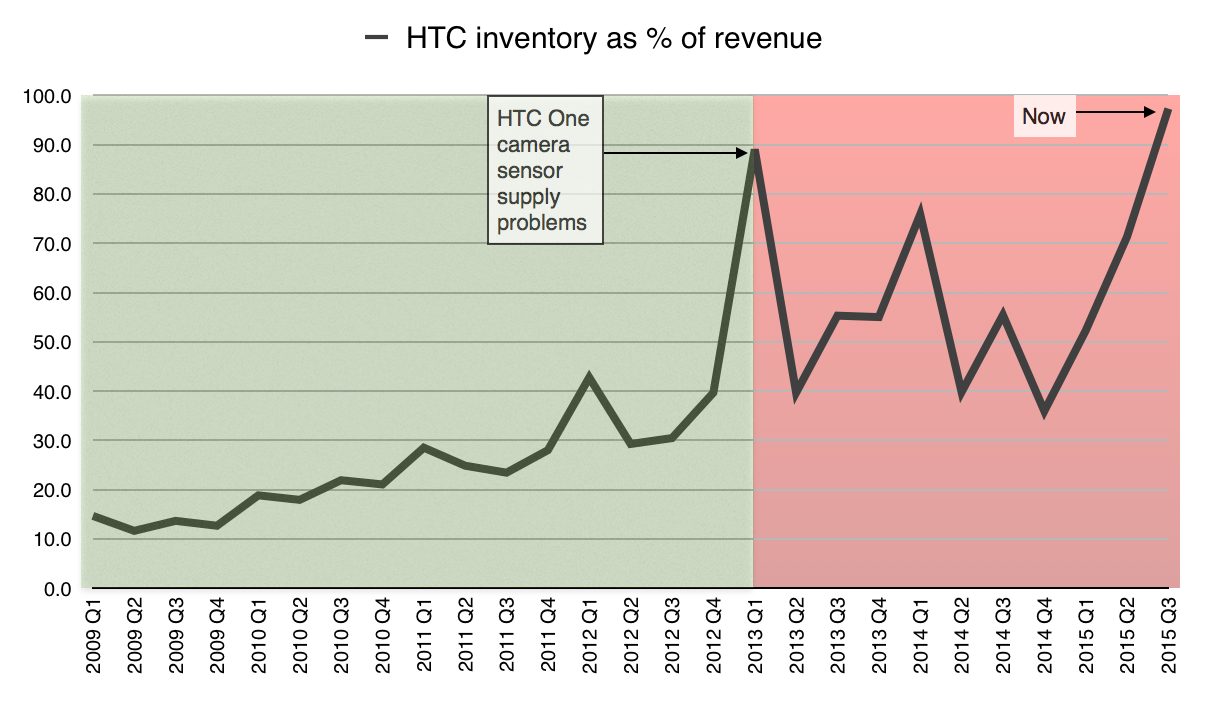
More generally, HTC is a company in crisis, with no obvious reason to exist and little to differentiate it from any other Android OEM. You can see the incredible pressure on it in its inventory/revenue numbers, which measure how much stuff it has sitting in the backroom compared to how much stuff it has sold. This ratio has now hit a historic high of nearly 100%, as of the end of the third quarter:

HTC's inventory ratio is at a historic high

Revenue is low but inventory is high: the signs of a company in stress

High inventory/revenue levels tend to mark out a company in severe stress. It can mean that it has lots of wonderful new finished products in the warehouse just waiting to be sprung on the world, which will fall on it with delight. But usually it doesn’t because you have to distribute those things to wholesalers who will sell them. And historically, HTC hasn’t been a rabbit-from-hat sort of company, as the graph suggests.

Clearly this isn’t a situation that can go on indefinitely. HTC says that it has things coming down the chute – there’s the HTC Vive, its virtual reality offering. Much handwaving from Chang in the earnings call, but nothing concrete. And if HTC really thinks that VR is going to bring its business back into profit in 2016, well, I don’t see it; these are high-priced devices with an uncertain market, regardless of the quality of HTC’s offering.

Of course that could have been said back when HTC was preparing its first Android smartphone. But the difference was that HTC had already been making smartphones (for Windows Mobile) for some years.

Overall, the best summing up of this came from The Verge, where Vlad Savov’s story had the deathless headline: “HTC will no longer give guidance for the future it doesn’t have”. Quietly brilliant, that one.

Start up: why Android should encrypt, Facebook v the intifada, 3D Touch v page parking, wary drones and more


“My GPS says we finished ages ago!” Photo by A Brand New Minneapolis on Flickr.

You can now sign up to receive each day’s Start Up post by email. You’ll need to click a confirmation link, so no spam.

A selection of 9 links for you. Please note: if reading the emails, you can’t link directly to the extracts. Monkeys, eh. I’m charlesarthur on Twitter. Observations and links welcome.

Is Google’s lacklustre support for encryption a human rights issue? » MIT Technology Review

Tom Simonite, reporting on a conference where American Civil Liberties Union (ACLU) principal technologist Chris Soghioan argued thus:

People using phones powered by Google’s Android software are not so well protected, said Soghioan. The company said last year that it would make Android phones encrypt all stored data by default, like Apple devices do, but reversed that decision early this year. Google said this month it will require only devices meeting certain hardware performance standards to encrypt stored data, which Soghioan thinks will exclude cheaper devices. Google’s Hangouts text and video chat service bundled with Android does not use end-to-end encryption.

Soghioan said this means that someone who uses a cheap Android device is a much easier target for law enforcement or intelligence agencies — which he argues are prone to abusing their surveillance powers. He cited the way the FBI snooped on Martin Luther King’s phone calls and said he fears that US and overseas activists of today and tomorrow will be even easier targets. “The next civil rights movement will use the technology against which surveillance works best,” he said. Protest movements don’t typically start in society’s upper socioeconomic echelons, he noted.

The difference between Apple and Google’s stances on encryption for mobile devices appears to be due to corporate rather than technical reasons, said Soghioan. “Google has by far the best security team of any company in Silicon Valley, and the security people I know at Google are embarrassed by Android,” he said. “But Apple sells luxury goods and Google gives away services for free in return for access to data.”

That point about protest movements is so important. Would you want people in a repressive regime to have phones that could or couldn’t be tapped? Now you’ve decided, we move on to the next conundrum…
link to this extract


The Facebook intifada » The New York Times

Micah Lakin Avni’s (Israeli) father was stabbed and shot by two Palestinian men in Jerusalem, who acted in the latest intifada (uprising) by Palestinians:

Watching the well-wishers congregating in the intensive care unit, however, I realized that the world leaders who were having the most impact on the situation in the Middle East right now weren’t Mr. Ban or Prime Minister Benjamin Netanyahu, but Mark Zuckerberg of Facebook, Jack Dorsey of Twitter and other young entrepreneurs who shape the social media platforms most of us use every day.

It may sound strange to talk of Twitter and Facebook as relevant players in the war against terror, but as the recent wave of violence in Israel has proved, that is increasingly the case. The young men who boarded the bus that day intent on murdering my 76-year-old father did not make their decision in a vacuum. One was a regular on Facebook, where he had already posted a “will for any martyr.” Very likely, they made use of one of the thousands of posts, manuals and instructional videos circulating in Palestinian society these last few weeks, like the image, shared by thousands on Facebook, showing an anatomical chart of the human body with advice on where to stab for maximal damage…

…Just as it is universally recognized that shouting fire in a crowded theater is dangerous and should be prohibited, so, too, must we now recognize that rampant online incitement is a danger that must be reckoned with immediately, before more innocent people end up as victims.

Before Facebook or Twitter or Google, those charts would have been available in a library, or in books on sale or smuggled in. What’s different now is the scale and speed with which information can be disseminated. It sounds trite, but what Israel and Palestine need is more speech, not less – but speech of the right kind, to negotiate their differences.
link to this extract


Google owner accuses EU of antitrust about-face » WSJ

Tom Fairless and Natalia Drozdiak:

Google owner Alphabet Inc. accused European Union regulators of making an unexplained about-face in their decision to file antitrust charges against the US search giant, and warned that there was “no basis” for imposing fines, according to a redacted copy of Google’s response seen by The Wall Street Journal.

The response, which runs to almost 130 pages and leans heavily on legal opinions and case law, suggests that Google is gearing up for a protracted legal battle against the European Commission, which has alleged the search giant skewed search results to favor its own comparison-shopping service.

“The theory on which the [EU’s] preliminary conclusions rest is so ambiguous that the Commission itself concluded three times that the concern had been resolved,” Google’s lawyers wrote in the document.

It’s certainly a good point that the EC antitrust team were ready to okay everything, and then decided not to. But the EC would say that new evidence became available (which it did) and that changed things. Less convincing on Google’s part is its quoting of a US academic who used to be in the US Department of Justice antitrust side. That’s not likely to hold any sway.
link to this extract


Why every GPS overestimates distance travelled » IEEE Spectrum

Douglas McCormick on how an Austrian team discovered subtle but persistent errors in GPS:

Not content with mere calculation, Ranacher, Reich, and their colleagues went on to test their findings experimentally. In an empty parking lot, they staked out a square course 10 m on a side, reference-marked each side at precise 1-m intervals, and set a GPS-equipped pedestrian (a volunteer, one hopes) to walk the perimeter 25 times, taking a position reading at each reference mark.

The researchers analyzed the data for segment lengths of 1 meter and 5 meters. They found that the mean GPS measurement for the 1-m reference distance was 1.02m (σ2 = 0.3) and the mean GPS measurement for the 5-m reference distance was 5.06m (σ2 = 2.0).  They also ran a similar experiment with automobiles on a longer course, with similar results.

Now, that pedestrian-course error of 1.2% to 2% isn’t huge. But it is big enough that your GPS watch could tell you you’re crossing the finish line of a 42,195-metre [26-mile] marathon while the real terminus is more than 400 meters ahead.

Sooo.. how do they measure a marathon? Does someone go around with one of those wheel things? Asking for all my marathon-running friends.
link to this extract


3D Touch on iPhone 6S: embrace the Force » Nielsen-Norman Group

Raluca Budiu:

Is this a feature worth having? Yes, as an enhancement. There is a lot of potential for improving the user experience and supporting behaviors that mobile and desktop users are engaging in already. Two of them come to mind: microsessions and avoiding pogo sticking.

Microsessions are phone sessions that are 15 seconds or shorter. Recent research by Denzil Ferreira and colleagues shows that 40% of app launches are microsessions, namely short interactions in which users are able to quickly satisfy their goals. A common microsession activity is checking for updates in an app (such as Email or Facebook); the quick actions offer an opportunity for rapid access to such frequent tasks or content. Peek-and-pop views should also make many microsessions more efficient for users.

Pogo sticking refers to alternating between inspecting a collection of items (such as a list of products) and looking at each item individually (a product in the list). It is usually an inefficient behavior because it makes users jump back and forth between pages, losing not only time for loading the page but also the time needed for recovering context. Our recent research with Millennials shows that pogo sticking is so annoying that, on desktop, users have developed a special behavior called page parking to avoid it. On mobile phones, page parking is a lot more difficult.

“Page parking” is basically “open that link in another tab/window while I get on with this”. Other points: interstitials screw up the previewing experience, and so do “can we use your location?” questions.
link to this extract


Back-alley upgrades: in China, $100 can get you an 128GB iPhone boost » WSJ

Yang Jie and Josh Chin:

If you’re an Apple Inc. device user, you can also now boost your iPhone’s storage from the cramped-feeling 16GB standard to a cavernous 128GB for less than a hundred bucks.

Mobile phone repair shops in major cities like Beijing and Shanghai have sparked curiosity on sidewalks and social media by offering the service, which appears aimed at the many aspirational Chinese device users who can’t afford the roughly $200 premium attached to large-capacity iPhones.

Some are offering the service through online shops on China’s biggest e-commerce site Taobao. One such shop offers to upgrade an iPhone 6 or iPhone 6 Plus from 16GB to 128GB for 500 yuan ($79). Descriptions posted by several Taobao vendors indicate that the new storage card is hand-welded into the phone after the old card is removed. An unnamed software [program] is then used to trick the device into accepting the unapproved hardware.

Love the comment from one customer: “I’ve used it for a day. It feels so great.”
link to this extract


Huawei emerges as 2nd largest Android brand in EU’s big five » Kantar Worldpanel

“In urban China, with a market share that grew 72% over the third quarter of 2014, Huawei remained the top brand followed by Xiaomi and Apple,” Tamsin Timpson, strategic insight director at Kantar Worldpanel ComTech Asia, commented. “iOS continued to grow year over year with 56% of iPhone buyers during the quarter switching from Android and with iPhone 6 and 6Plus retaining their positions as the best selling and second best-selling smartphones.

“Next month all eyes will be on Apple’s performance in the US and China, as many observers continue to doubt the size of the remaining opportunity for Apple,” Milanesi explained. “28% of consumers in China who own smartphones plan to upgrade in the next 12 months. Among them, 79% of those who own iPhones, and 25% of those who own Android devices, say they prefer Apple.”

That “56% of iPhone buyers in China were switchers” number is remarkable – perhaps it was people waiting for the 6S/Plus. Meanwhile in the UK, Samsung and LG were the only Android makers to grow their share; the implication seems to be that people were switching to iPhones.
link to this extract


Self-flying drone dips, darts and dives through trees at 30 mph » MIT CSAIL

Adam Conner-Simons of MIT’s Computer Science and Artificial Intelligence Laboratory:

“Everyone is building drones these days, but nobody knows how to get them to stop running into things,” says CSAIL PhD student Andrew Barry, who developed the system as part of his thesis with MIT professor Russ Tedrake. “Sensors like lidar are too heavy to put on small aircraft, and creating maps of the environment in advance isn’t practical. If we want drones that can fly quickly and navigate in the real world, we need better, faster algorithms.”

Running 20 times faster than existing software, Barry’s stereo-vision algorithm allows the drone to detect objects and build a full map of its surroundings in real-time. Operating at 120 frames per second, the software – which is open-source and available online – extracts depth information at a speed of 8.3 milliseconds per frame.

The drone, which weighs just over a pound and has a 34-inch wingspan, was made from off-the-shelf components costing about $1,700, including a camera on each wing and two processors no fancier than the ones you’d find on a cellphone.

If this doesn’t lead to an amazing VR “fox and hounds” sort of game soon, someone’s missing a trick. Quad-core CPUs and stereo cameras. Expect the price to halve in a year or so.

link to this extract


Hilton obstructed investigation into Wi-Fi blocking at hotels, FCC says » Ars Technica

Jon Brodkin:

The Federal Communications Commission yesterday issued proposed fines against two companies in its latest actions against Wi-Fi blocking at hotels and convention centers.

The FCC said it proposed a $25,000 fine against Hilton Worldwide Holdings “for its apparent obstruction of an investigation into whether Hilton engaged in the blocking of consumers’ Wi-Fi devices.” The FCC also plans a $718,000 fine against M.C. Dean, a Wi-Fi access provider that is accused of “blocking consumers’ Wi-Fi connections at the Baltimore Convention Center” on dozens of occasions.

Each company has been accused of blocking personal Wi-Fi hotspots that let consumers share mobile data access with other devices such as laptops and tablets. Hilton and M.C. Dean must pay the fines within 30 days or file written statements seeking reduction or cancellation of the penalties.

The FCC last year received a complaint against a Hilton hotel in Anaheim, California that the company “blocked Wi-Fi access for visitors at the venue unless they paid a $500 fee.” More complaints against other Hilton properties followed, and in November 2014, the FCC issued Hilton a letter of inquiry seeking information about its Wi-Fi management practices at various Hilton-owned hotel chains.

Obstructing the FCC seems to be a parlour game for some companies. Remember Google and its Wi-Fi sniffing? That earned a $25,000 FCC fine for impeding investigation in 2012.
link to this extract


Errata, corrigenda and ai no corrida: gave the wrong link for the Microsoft OneDrive story in yesterday’s email – this is the right one (damn ZDNet scrolling system). And no, you won’t use up 5GB of storage with 10 Microsoft Word documents. Unless they’re very big.

Start up: payday search predators, the natural nuclear reactor, Facebook’s code problem and more


Shh! Don’t tell Facebook! Photo by The Keenes on Flickr.

You can now sign up to receive each day’s Start Up post by email. You’ll need to click a confirmation link, so no spam.

A selection of 11 links for you. Please note: the “link to this extract” link doesn’t work if you’re using it from the email. Who shall we blame? Meanwhile, I’m charlesarthur on Twitter. Observations and links welcome.

People’s deepest, darkest Google searches are being used against them » The Atlantic

Adrienne Lafrance:

Consider, for example, a person who googles “need rent money fast” or “can’t pay rent.” Among the search results that Google returns, there may be ads that promise to help provide payday loans — ads designed to circumvent Google’s policies against predatory financial advertising. They’re placed by companies called lead generators, and they work by collecting and distributing personal information about consumers online. So while Google says it bans ads that guarantee foreclosure prevention or promise short-term loans without conveying accurate loan terms, lead generators may direct consumers to a landing page where they’re asked to input sensitive identifiable information. Then, payday lenders buy that information from the lead generators and, in some cases, target those consumers—online, via phone, and by mail—for the very sorts of short-term loans that Google prohibits.

But look, if Google bans those ads, then it’s taking a position. Shouldn’t it only accept ads from organisations that it has vetted? Or just not accept ads on those searches?
link to this extract


In the 1970s, scientists discovered a two billion-year-old nuclear reactor in west Africa » Medium

The Physics ArXiv blog explains:

When the ore in Gabon was laid down some 2 billion years ago, the concentration of uranium-235 would have been about 4%, more than enough for a self-sustaining nuclear reaction.

The idea is that when a neutrons hits an atom of uranium-235, the atom splits producing two smaller nuclei and several neutrons. These neutrons go on to split other atoms in an ongoing chain reaction.

However, the liberated neutrons are high-energy particles that tend to fly away rapidly. So nuclear reactors usually contain a moderating material that slows down the neutrons so that they can interact with other uranium atoms.

It turns out that water is a reasonable neutron moderator. So an important component of this natural reactor was the presence of water seeping through the uranium ore. And this had an interesting impact on the way the reactors operated.

Nuclear scientists believe that the Oklo reactors operated in pulses. As water flowed into the rock, it moderated the neutrons, allowing a chain reaction to occur. But this increased the temperature of the rock, boiling the water into steam which escaped.

Kept running for 300,000 years. More useful than that is what it taught scientists about how fission waste products migrate from burial sites. Turns out the answer is: not that much.
link to this extract


Facebook’s code quality problem » Graham King

Facebook has a software quality problem. I’m going to try to convince you with three examples. This is important because it demonstrates the time-honored principle that quality matters. In demonstrates it, as Facebook engineers like to say, at scale. I don’t work at Facebook or any competitor, I’m just an observer.

The three examples – 18,000 Objective-C classes in the iOS app with 429 people working on it (note: delete the app), database restarts and the fact that the site works better when its engineers aren’t there, all speak to a classic problem.
link to this extract


Hackers claim million-dollar bounty for iOS zero-day attack » WIRED

Andy Greenberg:

On Monday, the security startup Zerodium announced that it’s agreed to pay out that seven-figure sum to a team of hackers who have successfully developed a technique that can hack any iPhone or iPad that can be tricked into visiting a carefully crafted web site. Zerodium describes that technique as a “jailbreak”—a term used by iPhone owners to hack their own phones to install unauthorized apps. But make no mistake: Zerodium and its founder Chaouki Bekrar have made clear that its customers include governments who no doubt use such “zero-day” hacking techniques on unwitting surveillance targets.

In fact, Bekrar tells WIRED that two teams of hackers had attempted to claim the bounty, which was announced in September with an October 31st deadline. Only one proved to have developed a complete, working iOS attack. “Two teams have been actively working on the challenge but only one has made a full and remote jailbreak,” Bekrar writes. “The other team made a partial jailbreak and they may qualify for a partial bounty (unconfirmed at this time).”

I’d like to see documentary proof of the hack before I take this at face value. Zerodium is clearly seeking publicity; and the incentive to, um, bend the truth around seven-figure annoucements is high.
link to this extract


Ranking Digital Rights – Ranking ICT sector companies on respect for free expression and privacy

For the inaugural Index, Ranking Digital Rights analyzed a representative group of 16 companies that collectively hold the power to shape the digital lives of billions of people across the globe. Leading global ESG research and ratings provider, Sustainalytics, co-developed the methodology.

Eight publicly listed Internet companies and eight publicly listed telecommunications companies were selected based on factors including geographic reach and diversity, user base, company size, and market share. These companies were assessed on 31 indicators across three categories – commitment, freedom of expression, and privacy – drawn heavily from international human rights frameworks, as well as emerging and established global principles for privacy and freedom of expression.

The research revealed a deep need for improvement:

Only six companies scored at least 50% of the total possible points;
The overall highest score was only 65%;
Nearly half the companies in the Index scored less than 25%, showing a serious deficit of respect for users’ freedom of expression and privacy.

Google came top in internet companies. List at https://rankingdigitalrights.org/index2015/. Apple isn’t there – doesn’t it have any impact?

Anyhow, speaking of digital rights and freedom of expression…
link to this extract


A surprisingly difficult question for Facebook: do I have boobs now? » The Guardian

Hannah Jane Parkinson talks to Courtney Demone, a trans woman (ie born male) who asks the question that Facebook apparently finds exceptionally hard to answer:

Demone says that Facebook likes to present itself as a liberal and progressive organisation, but that most of its actions in this regard are decidedly low-risk. She mentions Facebook’s introduction of a widget allowing users to overlay their profile pictures with a rainbow flag and notes that it was to celebrate a gay marriage law which had been passed by the US supreme court – not before, in support of it.

Demone says that [Facebook’s] allowing users to define their gender in a free-form field, and offering a choice of pronouns, is progressive, but it is decidedly lower risk rather than, say, challenging the paradigm that female nipples should be covered up. This, of course, would run the risk of offending advertisers and in the case of Instagram, result in a 17+ user rating in app stores.

This gets to such a deep question: why should American organisations get to decide the mores of the countries that they export their business to? Mark Zuckerberg once said he hoped Facebook could solve the Arab-Israeli conflict by making people friends. But topics such as this shows why it can be seen as more like an enemy of social change.
link to this extract


India LTE smartphone shipments grew 2400% annually climbing to 10m units in Q3 2015 » Counterpoint Technology Market Research

Tarun Pathak has the details. Here’s one of the more interesting pullouts (from lots) about a local OEM:

Micromax maintained the second position in both overall mobile phone market and the smartphone segment with a market share of 13.7% and 17.7% respectively.

The brand’s share from online channel increased during the quarter. However, it is now facing pressure competition in $50-$100 price segment from Intex, Lava and others.

Micromax’s Cyanogen based online only brand ‘Yu’ launched its cheapest LTE model ‘Yunique’ during the quarter and the brand has been growing steadily ever since its launch.

Micromax Yu brand alone is now selling more smartphones than Xiaomi online, depicting it’s going to be challenging even for popular brands such as Xiaomi to scale in Indian market

If Xiaomi can’t succeed in India, it’s going to have a real problem.
link to this extract


Google abandons plan for a retail store in New York City » Crain’s New York Business

Daniel Geiger:

Google has abandoned plans to open its first-ever retail store in New York City.

The company is trying to sublease a 5,442-square-foot SoHo space it leased last year, and wants $2.25m annually in rent for it, according to sources.

The decision to abandon its retail store came after the Internet giant spent $6m renovating the 131 Greene St. location. The outpost was supposed to be one of Google’s first stand-alone stores in the U.S., putting it in direct competition with Apple, which has a host of brick-and-mortar shops that showcase and sell its products in the city, as well as other tech firms with a retail presence. Just last week, Microsoft opened its flagship store on Fifth Avenue.

A spokeswoman for Google didn’t immediately respond to a request for comment.

According to reports, Google planned to begin opening stores to sell products such as the Chromebook, a line of laptops and desktop computers made by several manufacturers that operate on Google software, and smartphones that run its Android operating system. Because Google is subleasing the Greene Street location, it would appear that the company has changed its mind and is pulling back on its plan to open physical stores. However, Google reportedly recently opened a kiosk within a larger electronics store in London earlier this year.

Even so. Why would you have a Google store? It doesn’t make sense.
link to this extract


Over 40% of China’s online sales counterfeit, shoddy: Xinhua » Reuters

Adam Jourdan:

More than 40% of goods sold online in China last year were either counterfeits or of bad quality, the official Xinhua news agency said, illustrating the extent of a problem that has bogged down the fast-growing online sector.

According to the report, which was delivered to China’s top lawmakers on Monday, just under 59 percent of items sold online last year were “genuine or of good quality”, Xinhua said.

China has been trying to shake off a notoriety for pirated and counterfeit goods, long a major headache for global brands targeting the Chinese market from iPhone maker Apple to luxury retailer LVMH.

Chinese e-commerce giant Alibaba Group Holding Ltd has been lobbying to stay off a US blacklist for fakes after coming under renewed pressure this year over suspected counterfeits sold on its shopping platforms.

link to this extract


It’s official: Amazon is opening its first-ever bookstore in Seattle » GeekWire

Taylor Soper:

Internet giant Amazon.com, which got its start selling books online, confirmed this afternoon that it will open its first-ever brick-and-mortar bookstore at Seattle’s University Village on Tuesday morning.

The company sent a letter to customers on Monday with details about the store, which is called “Amazon Books.” In the letter, Amazon Books VP Jennifer Cast calls the store a “physical extension of Amazon.com.”

Someone should disrupt that thing…
link to this extract


Microsoft reneges on ‘unlimited’ OneDrive storage promise for Office 365 subscribers » ZDNet

Ed Bott:

Here’s the key part of tonight’s announcement:

We’re no longer planning to offer unlimited storage to Office 365 Home, Personal, or University subscribers. Starting now, those subscriptions will include 1 TB of OneDrive storage.
100 GB and 200 GB paid plans are going away as an option for new users and will be replaced with a 50 GB plan for $1.99 per month in early 2016.

Free OneDrive storage will decrease from 15 GB to 5 GB for all users, current and new. The 15 GB camera roll storage bonus will also be discontinued. These changes will start rolling out in early 2016.

Microsoft blames a few greedy storage users for the change in heart. “A small number of users,” they wrote, “backed up numerous PCs and stored entire movie collections and DVR recordings. In some instances, this exceeded 75 TB per user or 14,000 times the average.”

That shouldn’t be surprising. If you advertise “unlimited” cloud storage, perhaps you should expect that some people will take you at your word and move large collections to the storage space you so generously offered?

Bott also portrays a division in some upheaval, which doesn’t quite fit the calm exterior Microsoft has been trying to put forward over its cloud work.

That “14,000 times the average” suggests that the average person was storing 5GB of data. Though that probably amounts to 10 Microsoft Word documents, given how the format has bloated. (Thanks @pedrostephano.)
link to this extract


Start up: the convertible laptop dream, Pagefair’s malvertising hack, Samsung’s bulging bottom, and more


Keeping your personal information out of other sites is hard too. Photo by xiaming on Flickr.

You can now sign up to receive each day’s Start Up post by email. You’ll need to click a confirmation link, so no spam.

A selection of 10 links for you. Count them if you like. I’m charlesarthur on Twitter. Observations and links welcome.

Laptop is a state of mind | Karma

Paul Miller:

There’s no such thing as “best of both worlds” in computers. Choices matter. Hybrids like the Surface Book are great for people who perfectly straddle the tablet and laptop use cases — who constantly switch between keyboard and pen, desk and walk-and-talks, angry memos and Angry Birds. Everyone else’s perfect “laptop” will probably be a lot more boring, and a good deal cheaper.

But.

You know what would be cool? A world where we actually needed Surface Books. What if our lives were like Microsoft Surface commercials? We’d flit effortlessly between different roles. An architect for one moment, consulting with a professional on your home remodel. Then you’re drawing up a clever football play for Russell Wilson. Then you’re playing Madden, streamed from your Xbox. Then you’re answering work emails and flicking away distractions with your finger. And then you’re in some big song-and-dance number, and you can’t even remember where you put your Surface Book because your life is amazing and who even cares anymore you’re going to die happy, loved by your family and respected by your peers.

The Surface Book is not an inferior product because its hardware is too ambitious. It’s an inferior product because its hardware is more ambitious than the digital lives we’ve thus far concocted.

link to this extract


CryptoWall 3.0 cost victims $325m – report » Infosecurity Magazine

Phil Muncaster:

The report noted:

“It was discovered that a number of primary [bitcoin] wallets were shared between campaigns, further supporting the notion that all of the campaigns, regardless of the campaign ID, are being operated by the same entity.”

Unfortunately for those unlucky enough to get infected by CryptoWall 3.0, the report paints the picture of a highly efficient operation running solid encryption, meaning victims usually do have to pay up to get their files back.

Even an FBI Special Agent was quoted as saying last week that it might be better for infected businesses to just pay the ransom.

link to this extract


Who knows what about me? A survey of apps’ behind-the-scenes personal data sharing to third parties » Technology Science

Jinyan Zang, Krysta Dummit, James Graves, Paul Lisker, and Latanya Sweeney:

We found that the average Android app sends potentially sensitive data to 3.1 third-party domains, and the average iOS app connects to 2.6 third-party domains. Android apps are more likely than iOS apps to share with a third party personally identifying information such as name (73% of Android apps vs. 16% of iOS apps) and email address (73% vs. 16%).

For location data, including geo-coordinates, more iOS apps (47%) than Android apps (33%) share that data with a third party. In terms of potentially sensitive behavioral data, we found that 3 out of the 30 Medical and Health & Fitness category apps in the sample share medically-related search terms and user inputs with a third party.

Finally, the third-party domains that receive sensitive data from the most apps are Google.com (36% of apps), Googleapis.com (18%), Apple.com (17%), and Facebook.com (14%). 93% of Android apps tested connected to a mysterious domain, safemovedm.com, likely due to a background process of the Android phone. Our results show that many mobile apps share potentially sensitive user data with third parties, and that they do not need visible permission requests to access the data.

Hardly seems a source of complaint if they’re sharing with Google and Apple, if it’s with permission. As for safemovedm.com, it seems to exist – since February 2008 – but not actually be active in any way; that makes it sound like an Android function.
link to this extract


Chrome OS is here to stay » Google Chrome Blog

Hiroshi Lockheimer, SVP Android, ChromeOS and Chromecast:

Over the last few days, there’s been some confusion about the future of Chrome OS and Chromebooks based on speculation that Chrome OS will be folded into Android. While we’ve been working on ways to bring together the best of both operating systems, there’s no plan to phase out Chrome OS.

With the launch of Chrome OS six years ago, we set out to make computers better—faster, simpler and more secure—for everyone. We’ve since seen that vision come to life in classrooms, offices and homes around the world. In fact, every school day, 30,000 new Chromebooks are activated in U.S. classrooms—that’s more than all other education devices combined. And more than 2 million teachers and students in more than 150 countries have the Share to Classroom Chrome extension, which launched in September and gets students onto the same webpage, instantly. Meanwhile, companies such as Netflix, Sanmina, Starbucks and of course Google, are using Chromebooks given the ease of deployment, the ability to easily integrate with existing technologies, and a security model that protects users at all levels, from hardware to user data. (Chromebooks are so secure you don’t need antivirus software!)

“Working on ways to bring together the best of both operating systems” implies that the two are coming together somehow – you wouldn’t have a third OS. Android isn’t going away. So Lockheimer hasn’t explained how ChromeOS is here to stay; instead, by avoiding the question while also acknowledging that something is happening, he’s making it more mysterious.
link to this extract


The Apple iPhone 6s and iPhone 6s Plus review » Anandtech

Ryan Smith and Joshua Ho:

The only real issues I can think of are that the iPhone 6s doesn’t have OIS and that the base SKU is still 16GB of storage. To be fair, the 16GB SKU can become a noticeable user experience issue if you’re constantly dealing with the limits of this storage, and the jump from 16 to 64 GB feels like it’s simply designed to encourage buying a more expensive SKU. There are arguments that users that don’t really take a ton of photos or videos and stream all their media will be fine, but it’s still a user experience problem in this day and age. However, despite these issues I would argue that the iPhone 6s’ are the best phones you can buy today.

Of course, this sounds like a rather hollow recommendation to those that have followed our reviews for the past year. This year, more than ever it feels like Android smartphones at the high end have stood still, as if smartphone improvements have become a zero sum game. To make the best phone this year is therefore a pretty low bar to clear.

The benchmarks, especially for storage, are remarkable: the new iPhones seem to knock everything aside in the raw processing power space. They stumble only a little in the battery life area, and even there it’s not a huge difference. (Thanks @papanic for the link.)
link to this extract


Samsung sells more phones — but for less money » WSJ Digits blog

Jonathan Cheng:

Samsung has been selling more cheaper smartphones, and fewer high-end premium devices, than it did even compared to Samsung’s rocky 2014, according to numbers from data firm Counterpoint Technology Market Research.

Samsung doesn’t separately disclose smartphone sales numbers.

Samsung shipped 84m smartphones in the third quarter of 2015, 6.3% more than during the same stretch last year and more than the No. 2 and No. 3 players, Apple and Huawei Technologies, combined, according to Counterpoint.

But while 55% of its smartphones were priced at $301 per unit or more at this time last year, that high-end segment has fallen to just 40% of Samsung’s overall smartphone sales, Counterpoint said.

Phones priced $200 or below now account for 38% of total units shipped at Samsung, versus 30% this time last year.

So while Samsung is indeed shipping more smartphones, it isn’t charging as much for them — or making as much money from them as it may have during the salad days of 2012 and 2013.

But the numbers also suggest that Samsung is willing and able to take the fight to the low-cost Chinese competitors that emerged in 2013 and 2014, eating away at its market share and profits.

If you calculate the numbers (I did) this means that Samsung sold 10m fewer phones in the $300+ bracket than last year – effectively ceding that chunk of the market to Apple – and sold 8m more than last year in the sub-$200 bracket.
link to this extract


Brazilian smartphone users quicker to adopt new Android OS than Indian users » Jana Blog

Globally, 93% of Android users are using versions of either the Lollipop, KitKat, or Jelly Bean operating systems on their devices. When we looked at the market share of each Android OS in India and Brazil among mCent users, we saw a similar theme. 98% of mCent users in India and 97% of users in Brazil are using either Lollipop, KitKat, or Jelly Bean. KitKat is the most popular OS among mCent users in both countries…

…In the case of Samsung, the top device brand in India and Brazil, older versions of the Galaxy and the Note will never get the new Marshmallow OS update. So while some users may want to upgrade, they simply may not be able to depending on which device and carrier they have…

…When looking across the three popular Android OS, Lollipop, KitKat, and Jelly Bean, Brazilian users are currently pretty evenly spread out across the three. But when we look at India, the majority of users—52%— are on KitKat. As users in Brazil move to new operating systems, users in India are staying on older OS versions much longer.

This is hardly amazing; Jelly Bean was released in late 2012. You’d be more surprised if newcomers to the smartphone market were on much older OSs.
link to this extract


What do recruiters look for in a resumé at first glance? »Quora

Abra Benjamin responded:

Our world is a lot simpler than you think. “Does this candidate seem like they stand a chance of being a good match for this role? If yes, proceed to next step. If no, reject.” Each recruiter is different, so there’s no one way to answer this question. But I’ll highlight briefly (actually, not so briefly) how I personally absorb a resume.  I should preface this by saying that currently I primarily recruit for senior-level software engineers.

It’s definitely useful if you’re looking around for jobs, especially the stuff about education not mattering much, nor formatting (duh), nor “uncomfortably personal details”, nor cover letters.
link to this extract


Halloween Security Breach » Inside PageFair

Pagefair being, of course, the company which is complaining about the cost of adblocking to publishers, and which offers analytics to them:

If you are a publisher using our free analytics service, you have good reason to be very angry and disappointed with us right now. For 83 minutes last night, the PageFair analytics service was compromised by hackers, who succeeded in getting malicious javascript to execute on websites via our service, which prompted some visitors to these websites to download an executable file. I am very sorry that this occurred and would like to assure you that it is no longer happening.

The attack was sophisticated and specifically targeted against PageFair, but it is unacceptable that the hackers could gain access to any of our systems. We identified the breach immediately, but it still took over 80 minutes to fully shut it down.  During this time, visitors to websites owned by the publishers who have placed their trust in us were targeted by these hackers.

The damage was mitigated by our standard security practices, but the attackers still gained access.  I want to take some time here to describe exactly what happened, how it may have affected some of your visitors, and what we are doing to prevent this from ever happening again.

Spearphish email to take over account on CDN (Content Distribution Network) which offered a fake Adobe Flash advert which would install a bitcoin mining trojan. The breach was spotted within 5 minutes – but it took another 80 to regain control. Among the sites infected was Anandtech.

Once more, episodes like this make people who use adblockers utterly certain that they’ve made the right decision, while making those who haven’t wonder if they should. It’s a ratchet.
link to this extract


Apple indoor positioning app ‘Indoor Survey’ spotted on iOS App Store » Apple Insider

Mikey Campbell:

According to Indoor Survey’s iOS App Store page, spotted by developer Steve Troughton-Smith, the Apple-branded software enables indoor positioning within a venue by using radio frequency signals and an iPhone’s onboard sensors.

“By dropping ‘points’ on a map within the Survey App, you indicate your position within the venue as you walk through,” reads the app description. “As you do so, the indoor Survey App measures the radio frequency (RF) signal data and combines it with an iPhone’s sensor data. The end result is indoor positioning without the need to install special hardware.”

While not an exact match, the described system smacks of technology pioneered by indoor positioning startup WiFiSLAM, a Silicon Valley firm Apple snapped up for $20m in 2013.

Google has been doing something similar since 2012 for museums and a SLAM (simultaneous location and mapping) system since September 2014.
link to this extract


Start up: can machines do fact-checking?, HP’s split, HTC gets evasive, adblocking starts to hurt, and more


“The words are too wordy, and the sentences too sentient.” Review photo by Andrew Mason on Flickr.

You can now sign up to receive each day’s Start Up post by email. You’ll need to click a confirmation link, so no spam.

A selection of 9 links for you. And look, it’s November already. I’m charlesarthur on Twitter. Observations and links welcome.

In search of fact checking’s ‘Holy Grail’: News outlets might not get there alone » Medium

Craig Silverman:

The authors [of a scientific paper published at Columbia University] write that ClaimBuster represents one piece of what could eventually be a fully automated fact-checking system. They call this the “Holy Grail” of fact-checking, while also acknowledging that an automated system is a complex an far-off goal.

“A fully automated fact-checker calls for fundamental breakthroughs in multiple fronts and, eventually, it represents a form of Artificial Intelligence (AI),” they write in the paper.

Along with being able to automatically identify checkable claims in real-time, the “Holy Grail” system would need to be able to compare the claims to a database of accurate and up-to-date checked facts that is comprehensive enough to check a wide range of claims. In a perfect scenario, the claim and the corresponding checked fact would be compared and the system would render an accurate verdict within a few seconds of the statement being made.

We may never get there. But ClaimBuster on its own could prove useful for verification and debunking.

link to this extract


Amazon reviews hijacked by causes, conspiracies, rage » The Seattle Times

Jay Greene:

Reviewers have long used Amazon as a platform to vent about products that failed to live up to their expectations. Some have even used it to attack authors whose views differ from their own.

Increasingly, though, people are launching coordinated campaigns to push political and social agendas through negative reviews often only tangentially related to the product for sale. They are able to do so because Amazon welcomes reviews regardless of whether the writer has actually purchased the product.

[The author of a book about Sandy Hook, Scarlett] Lewis isn’t the only target of the Sandy Hook tragedy deniers. “We want to hit this woman as hard as we can,” says a narrator in a YouTube video as he walks viewers through posting 1-star ratings and negative reviews for “Choosing Hope: Moving Forward from Life’s Darkest Hours,” by Sandy Hook Elementary first-grade teacher Kaitlin Roig-DeBellis. The video, posted by “Peekay22,” even guides viewers to click a “Yes” button indicating they found other negative reviews helpful.

Since Peekay22’s video posted on Oct. 16, “Choosing Hope” has received more than 170 1-star reviews out of just over 250 total reviews. That’s tanked the book’s rating down to 2.1 stars out of 5.

“Amazon is giving these people a forum … ,” Lewis said. “Obviously, Amazon should remove (the reviews).”

But Amazon appears to have no intent of doing so. To the company, as long as the reviews are “authentic,” they have a place on its website.

“All authentic reviews, whether the reviewer bought the product on Amazon or not, are valuable to customers, helping them make informed buying decisions every day,” Amazon spokesman Tom Cook wrote in reply to questions about its review policy.

What about “whether they bought the product or not”?
link to this extract


Too much of a bad thing » Jay Pinho

Pinho asks why the NY Times is going to have people dedicated to doing rapid rewrites of already-viral stories, and then looks more broadly at what’s happening to journalism:

Very few, if any, sites have managed to support a substantial journalistic operation via digital ad revenues alone. This leaves us with two distinct models: large, legacy organizations with complementary revenue sources (subscriptions for newspapers or TV advertising for major news channels) on the one hand, and aggregators relying purely on online ad revenue on the other. (There are also niche sites produced as works of love, business models be damned.)

Both adblocking and the possibility of an eventual contraction of available VC money threaten to severely damage the latter business model. They certainly won’t damage advertisers, at least not significantly: they’re going to find a way to spend their budgets one way or another. But, and this should be clear by this point, they also won’t necessarily damage journalism. At the Times, for example, the CEO and executive editor are clearly focusing on building out subscribers, not simply inflating their page views…

…High-quality content producers, in other words, are reasonably confident that they can continue to extract monetary value from their readers even if and when the advertising landscape shifts dramatically. If, however, you’re a ViralNova, EliteDaily, Upworthy, Huffington Post, or another outfit with similarly vanishing per-article revenues, you’ve got to be worried. And you should be, because much of your content is terrible.

But that doesn’t mean any of us should be overly concerned if some of these businesses begin to go under. If anything, the eventual constriction of ad inventory supply could help return CPMs to financially sustainable levels.

link to this extract


The devastating effect of adblockers for Guru3D.com » Guru3D.com

Hilbert Hagedoorn:

last year in (October 2014) we had nearly 4.5m hits (read) on our articles. This year (October 2015) we are at 4.4m hits,  while the month has not ended yet. So in terms of traffic things remain the same.

There is however a huge discrepancy in Google analytics / DFP. Where a year ago we served 375~400K pageviews per day, we now register just over 200K pageviews a day. That’s right, nearly 50% of the readers are blocking ads.

After some further investigation, the direct effect of the ongoing trend of adblockers is resulting into halving our revenues / registered pageviews.  Over the past year we have seen our income literally halfed as a direct result of active adblocking. Everybody can understand that long term this is not sustainable anymore, right now adblockers are a true danger for our existence.

There are 28 pages of comments. Some are really not happy with how links were turned into pop-up overlay ads if they don’t adblock. Tragedy of the commons, again. But the donations seem to have rolled in.
link to this extract


Meg Whitman seeks reinvention for HP as it prepares for split » The New York Times

Quentin Hardy on the split, that by the time you read this will have happened:

Ms. Whitman, who will run HPE, made certain throughout the transition that her company would most assuredly still be able to ship computers.

“We have to ship products, we have to send invoices, we have to collect money,” she said. “HP sells two PCs a second. A server every six seconds. We had to keep selling them.”

The change cannot come fast enough for HP, whose stock is off more than 30 percent since the start of the year. The question is whether Wall Street believes the two companies will benefit from the separation.

“Anytime you make a change, you make a claim,” said Toni Sacconaghi, an analyst with Sanford C. Bernstein. “They say, ‘We’re on the front edge, everyone will have to catch up to us.’ But both new companies aren’t that wildly different. They’re both growth-challenged.”

HP, the printers-and-PCs company, is very definitely “growth-challenged”. Both markets it operates in are struggling.
link to this extract


HTC to see revenues grow 20-30% sequentially in 4Q15, say sources » Digitimes

Ma Wang and Steve Shen:

HTC is expected to see its revenues grow 20-30% sequentially to NT$25-28bn in the fourth quarter of 2015, buoyed by the launch of new models including the HTC One A9, HTC Butterfly 3 and HTC Desire 729 dual-SIM, according to an estimate of industry sources.

Despite increased sales in the fourth quarter, analysts are still conservative about HTC’s earning prospects and expect its earnings for the quarter to stay flat or increase marginally from the previous quarter. HTC posted a net loss of NT$4.48bn or NT$5.41 per share in the third quarter.

Hilariously, HTC refused to give guidance for this quarter at its earnings call. Equally hilariously, Taiwan-based Digitimes never points out the uncomfortable reality about Taiwan-based HTC: even a 30% sequential rise in quarterly revenues would equate to a fall of more than 40% year-on-year, and likely another hefty loss.
link to this extract


More Apple Car thoughts: software culture » Monday Note

Jean-Louis Gassée:

what we’ve grown to accept in our personal computers [in the form of software crashes and bugs] can’t be allowed in a vehicle carrying human beings at 60 miles per hour.

Just because the software running inside Apple’s personal computing devices is considered high quality doesn’t mean that the culture that produces it is capable of producing the high-reliability, real-time embedded software needed for an electric car.

I am one of the many who believe culture always wins. Culture eats strategy for breakfast, it causes mergers and acquisitions to fail and, above all, it resists virile executive calls to change. Culture evolves slowly, as if having its own independent will, or not at all.

The bottom line is this: For the hypothetical Apple Car project to succeed, a necessary (but not sufficient) condition is a culture change of a kind rarely, if ever, achieved by large organizations.
Perhaps the new software culture could arise in a new, separate group, well protected against the corporate lymphocytes always prone to attack what they see foreign objects. But that would break Apple in two separate cultures, and be the beginning of a dangerous process for a company that, today, strives on having a united functional organization.

link to this extract


Self-driving cars have a high crash rate, but it’s all humanity’s fault » Popular Mechanics

Jay Bennett:

New research from the University of Michigan’s Transportation Research Institute indicates that self-driving cars are more frequently involved in accidents than conventional vehicles. For every million miles driven, autonomous cars had an average of 9.1 crashes, compared to 4.1 for conventional vehicles according to data for Google, Delphi, and Audi autonomous vehicles between 2012 and 2015 and the total accident rate of conventional human-piloted vehicles in 2013.​

However, this data amounts to 11 total crashes for self-driving cars. All of these involved Google vehicles (which have been undergoing testing for much longer) but most importantly, the self-driving cars were not at fault in any of the accidents.

I expect this to continue to be the case: human drivers are going to be worse in all but the most extreme, remarkable cases.
link to this extract


33 of the hardest Apple interview questions » Business Insider

Maya Kosoff:

Like Google and other big tech companies, Apple asks both technical questions based on your past work experience and some mind-boggling puzzles.

We combed through recent posts on Glassdoor to find some of the toughest interview questions candidates have been asked.

Some require solving tricky math problems, while others are simple but vague enough to keep you on your toes.

Great way to find out if you’re actually awake this Monday.
link to this extract