Start up: Yahoo buying 4sq?, keyless car breakins, smartphones in Africa, and more


Power amplifier widgets mean criminals don’t need to do this to your keyless car. But the alarm won’t go off either… Photo by Bekathwia on Flickr.

A selection of 9 links for you. And only you. I’m charlesarthur on Twitter. Observations and links welcome.

Sources: Yahoo in talks to buy Foursquare » TechCrunch

Yahoo has been busy rebuilding its business around mobile under CEO Marissa Mayer, and soon it could make one of its biggest bets yet on the platform. We have heard perennially that the company has been looking to buy Foursquare, the New York startup behind the eponymous local search app and location-based social “check-in” app Swarm. The latest rumour we are hearing is giving the deal a price tag of around $900m.

It must be hell going shopping with Marissa Mayer. “Let’s buy THAT!” “Marissa, it’s way overpriced.” “WANT IT!”

So, is this hideously overpriced? Let’s see…


An analysis of Foursquare’s popularity after removing checkins » Junkyard Sam

Matthew Cox:

In May 2014 Foursquare removed check-ins and transformed the app into a lesser imitation of Yelp (using the accumulated reviews from Foursquare’s loyal audience.)

Foursquare’s users felt betrayed that their reviews were used but what they once loved about the app was removed.  Here’s how that worked out:
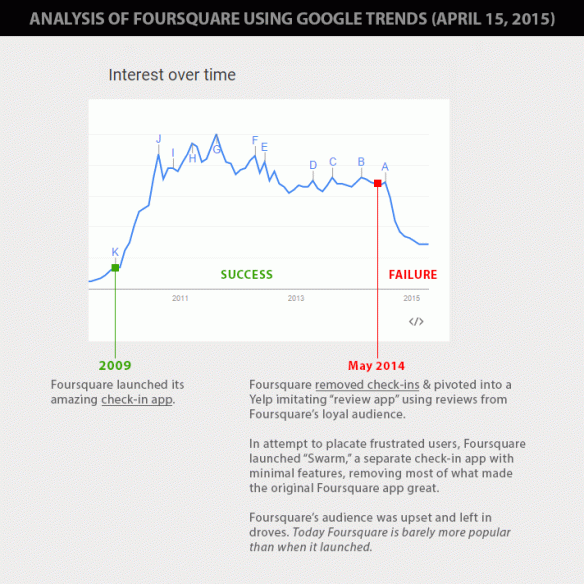
So, not well. Lesson: don’t change a winning formula.


Europe is targeting Google under antitrust laws but missing the bigger picture » The Guardian

Julia Powles:

As Maryland law professor Frank Pasquale writes in his acclaimed new book, The Black Box Society: “Google is not really a competitor in numerous markets, but instead serves as a hub and kingmaker setting the terms of competition for others.” For Pasquale, the solution lies in greater transparency. “Google’s secrecy keeps rivals from building upon its methods or even learning from them,” he writes. “Missing results are an ‘unknown unknown’: users for whom certain information is suppressed do not even know that they do not know the information.” The irony of the situation is that Google knows so much about us, and we know so little about it.

Let that thought roll around your head a little.


Feb 2009: Google joins Europe case against Microsoft » NYTimes.com

Miguel Helft, in February 2009, as Google applied to become a complainant in the EC’s case against Microsoft over illegal tying of Internet Explorer to Windows:

“Google believes that the browser market is still largely uncompetitive, which holds back innovation for users,” Sundar Pichai, a vice president for product management, wrote in a Google blog. “This is because Internet Explorer is tied to Microsoft’s dominant computer operating system, giving it an unfair advantage over other browsers.”

Google declined to make anyone available to discuss its announcement. By becoming a party to the case, it would participate in the proceedings and gain access to the confidential “statement of objections” that European regulators sent to Microsoft last month. Google could also argue for remedies it prefers.

This seems like a bad move, in retrospect. Google had just launched Chrome, and Android was just beginning to make its first moves. You’d have to be smart to see how mobile was going to grow (but aren’t the people at Google meant to be smart?), but angering Microsoft – as this surely did – meant that Microsoft was always going to seek revenge. Which it is now getting.


Keeping your car safe from electronic thieves » NYTimes.com

Nick Bilton is keeping the (electronic) key to his Toyota Prius in the freezer to stop people getting into his car. Here’s why:

Mr. Danev specializes in wireless devices, including key fobs, and has written several research papers on the security flaws of keyless car systems.

When I told him my story, he knew immediately what had happened. The teenagers, he said, likely got into the car using a relatively simple and inexpensive device called a “power amplifier.”

He explained it like this: In a normal scenario, when you walk up to a car with a keyless entry and try the door handle, the car wirelessly calls out for your key so you don’t have to press any buttons to get inside. If the key calls back, the door unlocks. But the keyless system is capable of searching for a key only within a couple of feet.

Mr. Danev said that when the teenage girl turned on her device, it amplified the distance that the car can search, which then allowed my car to talk to my key, which happened to be sitting about 50 feet away, on the kitchen counter. And just like that, open sesame.

BRB. Move aside, ice cubes.


Cellphones in Africa: communication lifeline » Pew Research Center’s Global Attitudes Project

Cell phones are pervasive in the region. In 2002, roughly one-in-ten owned a mobile phone in Tanzania, Uganda, Kenya and Ghana. Since then, cell phone ownership has grown exponentially. Today, cell phones are as common in South Africa and Nigeria as they are in the United States. Smartphones (those that can access the internet and applications) are less widely used, though significant minorities own these devices in several nations…

…Roughly a third of South Africans (34%) and about a quarter of Nigerians (27%) say that their device is a smartphone, i.e. one that can access the internet and apps, such as an iPhone, Blackberry or Android device. Smartphone ownership is less common in the other nations surveyed, and in Tanzania and Uganda it is still in the single digits. By comparison, 64% in the United States owned a smartphone as of December 2014.

But those who are more likely to own them are young, educated and English-speaking. I’d love to see some data on whether it has an economic effect to own one – though splitting that from the “educated” benefits would be tough.


The self-driving car revolution’s unintended consequence: lots of puking passengers » Co.Exist

According to a report from the University of Michigan’s Transportation Research Institute, 6% to 10% of American adults will get motion sickness—with nausea, dizziness, vomiting, and so on—in fully self-driving cars either most or all of the time. Another 6% to 12% of American adults will get moderate to severe motion sickness in a self-driving vehicle at least some of the time. That’s a fairly high percentage of potentially ill riders.

If you’ve ever been a passenger in a car driving down a windy road, feeling like you’re going to puke while the driver is perfectly fine, this shouldn’t be too surprising. As the study’s authors, Michael Sivak and Brandon Schoettle, explain, motion sickness is usually caused by two factors: a “conflict between visual and vestibular inputs” (like facing the side of the car instead of looking straight ahead) and a lack of ability to anticipate movements or a loss of control of movement. Since drivers have more control over where the vehicle is moving, they get motion sick less often than passengers.

And what makes it worse? Reading, texting or watching movies. Might as well just drive.


Samsung, LG Electronics have 99.2% of global TV monitor market » BusinessKorea

Cho Jin-young:

TV monitors, which are monitors for PC that can also receive TV signals via an onboard TV tuner, are very popular among single households who have trouble having a separate TV and monitor.

Recently, this convenience in daily life is growing with the coming-out of new monitors equipped with an enlarged screen mainly for watching TV and those that allow users to watch TV on one half and work on their PC on the other half simultaneously. With this, the portion of TV monitors is continuously growing and is expected to make up to 6.5% of all monitors sold this year, growing from 5.8% last year.

Just a guess, but are most of those sales in Asia?


Taiwan supply chain makers hope for increased adoption of force touch solutions » Digitimes

Ninelu Tu:

With Apple’s adoption of force touch technology onto the trackpad of its new MacBook, related component makers hope the trend will prompt other notebook vendors to adopt the solutions for their products, according to sources from the upstream supply chain.

Since technologies adopted by Apple’s products have been usually able to set new trends for its competitors to follow suit, related component suppliers are hoping the force touch technology will be the same. Many Taiwan suppliers are already able to supply related solutions, the sources noted.

The sources also pointed out that brand vendors including Hewlett-Packard (HP), Dell and Lenovo and ODMs such as Quanta Computer, Compal Electronics and Wistron are all able to incorporate the solutions into their notebooks, but they had been reluctant to feature the technology in their products.

Why does it need Apple to make a song and dance about it for this to happen? There’s a similar story about USB-C – Dell and Asus are going to offer products with it. None of the PC ODMs likes to jump first, it seems. But that means Apple scoops the publicity.


Start up: self-driving car wars, trying Hololens, Google’s targeted ads on Kansas TV, Glass undead, and more


Beware if attached to a car with a GPS device built in. Photo by Omar Omar on Flickr.

A selection of 8 links for you. Use them wisely. I’m charlesarthur on Twitter. Observations and links welcome.

Miss a payment? Good luck moving that car » NYTimes.com

Michael Corkery and Jessica Silver-Greenberg:

The thermometer showed a 103.5-degree fever, and her 10-year-old’s asthma was flaring up. Mary Bolender, who lives in Las Vegas, needed to get her daughter to an emergency room, but her 2005 Chrysler van would not start.

The cause was not a mechanical problem — it was her lender.

Ms. Bolender was three days behind on her monthly car payment. Her lender, C.A.G. Acceptance of Mesa, Ariz., remotely activated a device in her car’s dashboard that prevented her car from starting. Before she could get back on the road, she had to pay more than $389, money she did not have that morning in March.

“I felt absolutely helpless,” said Ms. Bolender, a single mother who stopped working to care for her daughter.

At present, this story has 983 comments. People feel strongly about this topic.


Delphi self-driving car begins world’s first 3500-mile cross-country trip » Tech Times

Christian de Looper:

The car is an Audi SQ5 outfitted with Delphi’s tech, and has been tested on shorter drives in California and Nevada. Delphi believes the drive across the country will help it collect more insight and expects to collect a total of 2.3 terabytes of data during the trip.

News surrounding autonomous cars seems to be making headlines ever day. Tesla recently announced the next update to the Tesla Model S will allow the car to drive itself, despite the fact it is still unclear as to whether or not this type of technology is legal.

The Delphi car’s “brain” was developed in partnership with Ottomatika, which takes the data from the sensors during test drives and created a virtual environment for the car, which it uses to apply driving behaviors.

The trip itself will take eight days, and the car will not drive for more than eight hours per day. This will allow the car to complete the tip in daylight, stick to the speed limit, and keep the human passengers, who will make sure that everything runs smoothly, comfortable.

It’s important to note the car will only operate autonomously on highways, with human drivers taking the wheel once the car gets into a city.

It’s not Google’s software; from another article:

The software that interprets the data drawn from those systems and the algorithms that help the car make driving decisions were developed jointly by Delphi and Ottomatika – a company started by Carnegie Mellon University.

The frustrating thing is that Delphi’s own site which is meant to follow this – delphidrive.com – doesn’t have any useful information.


Delphi’s autonomous car is remarkably…unremarkable » Fast Company

Harry McCracken tried it before it set off on its possibly unlicensed jaunt:

I’ve already spent enough time being driven around by autonomous vehicles (always with a human behind the wheel just in case) that at least some of the novelty has worn off. The fact that Delphi’s car drove itself pretty much like a human would have—stopping at safe distances at stop lights, switching lanes when necessary, and not doing anything which felt particularly robotic—didn’t startle me. But I was surprised by how normal the vehicle looked.

Unlike the Google car I’d rode in, there was no giant spinning lidar sensor atop the vehicle to tip off other motorists that this particular Audi SUV was anything unusual. It was well equipped with lidar, radar, and cameras, but they were unobtrusive—some of the gadgetry was even concealed behind the bumpers and license plate. The data collected by those sensors was displayed on the ordinary in-dash infotainment system rather than on specially rigged-up LCD screens. And the tech didn’t take up an out-of-the-ordinary amount of space, which I didn’t realize until after the trip was over and we popped the trunk, which was empty…

…Delphi isn’t working on self-driving as an exercise in futurism. It’s doing it because the car companies of the world are going to expect it to have competence in this field over the next few years. Delphi will need to be able to supply the necessary components, at a price and level of integration which makes sense for production vehicles.

There would be a strange irony if Google were to get outpaced in self-driving cars by all the other manufacturers.


Google isn’t giving up on Glass, Eric Schmidt says » WSJ Digits blog

Alistair Barr:

Google stopped selling the first version of Glass and shut its Explorer program in January, moving the project out of its Google X research lab into a standalone unit. Ivy Ross remained head of the Glass team but Tony Fadell, head of Google’s Nest connected home division, now oversees strategy for the project.

The changes sparked speculation that Google will abandon Glass. However, Schmidt told The Wall Street Journal that it has been put under Fadell’s watch “to make it ready for users.”

“It is a big and very fundamental platform for Google,” Schmidt said. “We ended the Explorer program and the press conflated this into us canceling the whole project, which isn’t true. Google is about taking risks and there’s nothing about adjusting Glass that suggests we’re ending it.”

He said Glass, like Google’s self-driving car, is a long-term project. “That’s like saying the self-driving car is a disappointment because it’s not driving me around now,” he said. “These things take time.”

Which users, though? Consumer users? I don’t see it. Glass didn’t get consumer approval; instead it met direct and continued rejection. Industrial users, sure. There’s a use case there. But Google will quickly find itself competing with rivals – as the above link shows for self-driving cars.


HTC One M9 review » CNET

Andrew Hoyle tried it out, and it’s the camera and battery where most of his complaints come. (For the rest, it’s a phone like many other metal-cased phones.) I noted this:

We don’t miss the M8’s duo-lens, which is no longer seen on the back of the M9. This extra sensor was designed to create unusual images with 3D effects. Sure, they were a bit of fun, but they were definitely a novelty and one that quickly wore off. We do miss a few other things, though. Despite incorporating the latest version of Android, it doesn’t incorporate all the new camera features, most notably raw support. It could also really use optical image stabilisation (OIS), which helps physically smooth bumpy shots; not only does OIS help at slow shutter speeds, but when you’re steadier there are fewer low-light artifacts (noise processing exacerbates the effect of camera shake).

The video looks acceptable, though you’ll really notice the jitter in bright light, when it chooses a fast shutter speed. Without image stabilisation, the combination makes the rolling shutter (that ugly wobble) look even worse. In low light, it suffers from the same lack of tonal range that’s in the photos.

HTC suggested last year that the duo-lens made sliced bread look a bit declassé. Now it’s dropped it. Ditto Samsung, with tons of features removed from the S6 compared to the S5. If you’re so sure a hardware feature matters for your flagship, why drop it after a year?


Google Fiber will sell ads in Kansas City tied to TV viewing habits » The Kansas City Star The Kansas City Star

Scott Canon:

your neighbor might see a different commercial than you while watching the same basketball game. And your kids, watching that game in another room, might see yet a different spot.

That super-narrow targeting represents something nearing a holy grail for television advertisers, even as it raises privacy issues about a company selling TV service tracking what its customers watch.

On a post to its online product forum on Friday, Google Fiber said the targeting “allows you to see ads for nearby businesses — like the car dealership downtown or the neighborhood flower shop.” It says it will start “a small trial” in early April. Kansas City will be the first market where the technology will be deployed — by Google or any cable company.

The practice won’t mean Google Fiber customers will see any more ads. Rather, like most cable companies, it will sell targeted spots replacing some national advertising.

Customers who don’t want those targeted ads, the company says, can change the settings on their TV boxes to opt out. But those who do nothing will see ads aimed at them based on their viewing behaviour…

…[Roger] Entner [who monitors the TV industry for Recon Analytics] speculated that the targeted ads might ultimately draw attention from federal regulators over privacy concerns. Think of someone who has friends over to watch TV. The targeted ads that appear during a show might give visitors insight to what that person watches when no one else is around.

“It can very quickly get to that creepy part of the equation,” he said.


Hilton Honors flaw exposed all accounts » Krebs on Security

Brian Krebs:

The vulnerability was uncovered by Brandon Potter and JB Snyder, technical security consultant and founder, respectively, at security consulting and testing firm Bancsec. The two found that once they’d logged into a Hilton Honors account, they could hijack any other account just by knowing its account number. All it took was a small amount of changing the site’s HTML content and then reloading the page.

After that, they could see and do everything available to the legitimate holder of that account, such as changing the account password; viewing past and upcoming travel; redeeming Hilton Honors points for travel or hotel reservations worldwide; or having the points sent as cash to prepaid credit cards or transferred to other Hilton Honors accounts. The vulnerability also exposed the customer’s email address, physical address and the last four digits of any credit card on file.

Terrible, terrible testing.


Magic Leap and HoloLens demos show augmented reality challenges » MIT Technology Review

Rachel Metz has previously tried Magic Leap’s AR system; now she’s trying Microsoft’s Hololens in its prototype stage:

I was not blown away by what I saw in Redmond. The holograms looked great in a couple of instances, such as when I peered at the underside of a rock on a reconstruction of the surface of Mars, created with data from the Curiosity rover. More often, though, images appeared distractingly transparent and not nearly as crisp as the creatures Magic Leap showed me some months before. What’s more, the relatively narrow viewing area in front of my face meant the 3-D imagery seen through HoloLens was often interrupted by glimpses of the unenhanced world on the periphery. The headset also wasn’t closed off to the world around me, so I still had my natural peripheral vision of the unenhanced room. This was okay when looking at smaller or farther-away 3-D images, like an underwater scene I was shown during my first demo, or while moving around to inspect images close-up from different angles. The illusion got screwed up, though, when it came to looking at something larger than my field of view.+

Microsoft is also still working on packing everything into the HoloLens form it has promised. Unlike the untethered headset that the company demonstrated in January, the device I tried was unwieldy and unfinished: it had see-through lenses attached to a heavy mass of electronics and plastic straps, tethered to a softly whirring rectangular box (Microsoft’s holographic processing unit) that I had to wear around my neck and to a nearby computer.


Links: self-driving cars in the rain (oh dear..), iBeacon in the Louvre, the unseen digital ads, bitcoin gets easier, and more


Apparently this stuff affects self-driving cars. Photo by Anthony Quintano on Flickr.

A selection of 6 afternoon links for you. Enjoy to the full extent of the law. I’m charlesarthur on Twitter. Observations and links welcome.

Louvre Museum’s DNA >> MIT SENSEable City Lab

How much time would you take to smile back at the Mona Lisa? Today, sophisticated Bluetooth signal tracking allows us to map how visitors move through a museum like the Louvre in Paris – what galleries they visit, what path they take, and how long they spend in front of each piece of artwork. Join us for a look inside one of the world’s largest museums… to see the people in front of the paintings.

Surprisingly, people who stay for long or short times don’t vary that much in where they go. They just go at different paces.


​This is how bad self-driving cars suck in the rain >> Jalopnik


(Jump forward to about 5 minutes in.)

The issues with the KAIST Unmanned Systems Research Group’s car were numerous, but the biggest problems had less to do with the slippery road surface and more to do with the visual systems. Those cameras and LIDAR arrays are dependent on a clear view, and with the angle of the car shifting and the direction of the sun, the sensors fail to pick up everything from street signs to lane markings and even pedestrians. And it just keeps getting worse.3

The team has to hit the emergency stop button at least twice, veers onto the side of the road, doesn’t see a curb and almost slams into a light pole, and then smacks into a barrier when parking.


56% of digital ads served are never seen, says Google >> Advertising Age

An incredible 56.1% of ads on the internet are not seen by humans, according to new research released today by Google.

“With the advancement of new technologies we now know that many display ads that are served never actually have the opportunity to be seen by a user,” said Google group product manager Sanaz Ahari in a blog post.

Those ads appear outside the viewable area of a browser window. Once you factor in bots, even fewer ads are seen by the people advertisers are paying to reach.


Bitcoin price decline sparks rare mining difficulty drop >> Coindesk

Mining difficulty determines how difficult it is to hash a new block and varies based on the amount of computing power used by miners on the bitcoin network. Bitcoin’s growing popularity has attracted more computing power to the network, meaning that the difficulty has been steadily increasing for some time.

However, stagnant pricing has caused a reduction in the hash rate over the past few weeks, resulting in the slight difficulty decrease. The estimated next difficulty level is 39,884,219,890, or -0.31%.

The sheer size of the bitcoin network ensures resilience and stability, but the hash rate has been stagnant for weeks and started declining in the first days of December.

This actually makes me think that bitcoin might have a chance as a medium of exchange. Once its price is stable for long enough, it becomes unattractive to speculators – but ideal for people looking to transfer value.


The SSD endurance experiment: two freaking petabytes >> The Tech Report

Geoff Gasior:

Our SSD Endurance Experiment has left four casualties in its wake so far. Representatives from the Corsair Neutron Series GTX, Intel 335 Series, Kingston HyperX 3K, and Samsung 840 Series all perished to satisfy our curiosity. Each one absorbed far more damage than its official endurance specification promised—and far more than the vast majority of users are likely to inflict.

The last victim fell at 1.2PB, which is barely a speck in the rear-view mirror for our remaining subjects. The 840 Pro and a second HyperX 3K have now reached two freaking petabytes of writes. To put that figure into perspective, the SSDs in my main desktop have logged less than two terabytes of writes over the past couple years. At this rate, it’ll take me a thousand years to reach that total.

They’re wayyy over spec. Great experiment.


Start up: Uber’s vanishing blog, Samsung’s shrinking S5 sales, Google’s secret car, and more


What the Google self-driving car “sees”. Photo by Matt Chan on Flickr.

A selection of 10 links for you. Don’t worry, be happy.

The unknown startup that built Google’s first self-driving car >> IEEE Spectrum

Mark Harris:

one of Google’s most strategic acquisitions has mysteriously been actively blocked from public view. An investigation by IEEE Spectrum has uncovered the surprising fact that Google’s innovative self-driving car and the revolutionary Street View camera technology that preceded it were largely built by 510 Systems, a tiny start-up in Berkeley, California.

If you’ve never heard of 510 Systems, that’s exactly the way Google wants it. The purchase of 510 Systems and its sister company, Anthony’s Robots, in the fall of 2011 was never publicly announced. In fact, Google went so far as to insist that some 510 employees sign agreements not to discuss that the acquisition had even occurred. Google’s official history of its self-driving car project does not mention the firm at all. It emphasizes the leadership of Sebastian Thrun, the German computer scientist whose Stanford team won the autonomous-driving Grand Challenge in 2005, sponsored by the Defense Advanced Research Projects Agency (DARPA).

Why has Google worked so hard to keep this one acquisition a secret?

Harris has been doing fantastic digging into the truth about this Google project.


Kickstarter ‘fraudster’ finds second home on Indiegogo, as per usual >> Engadget

What do you do when you’ve been outed as a fraud and your Kickstarter was pulled? You go to Indiegogo, of course. Anonabox was a $45 device that promised to route your home’s internet connection through (privacy-focused network) Tor without any fiddling in the same way that PORTAL works. In the current climate, it was no surprise to see the project earn $600,000 in pledges in just the first few days. Slowly, however, people began to ask questions about creator August Germar after the hardware was found to be an off-the-shelf unit made by a Chinese OEM and the software turned out to be about as secure as a slice of Emmental.

Now the project has been re-born on Indiegogo, with claims that the mistakes of the previous project (and subsequent outcry) has helped the device get better. That’d be fine, and we’d be applauding Germar’s efforts, except for the fact that his claims of involvement with the Tor community have already been debunked. When ITSecurityGuru asked former Tor lead Runa Sandvik, she said that Germar “is making false claims, again.”

Some serious questions to be asked about Indiegogo here.


iPhone eye test spots vision problems cheaply >> New Scientist

Smart Vision Labs, a start-up in New York City, wants to make it easier to diagnose vision problems in developing countries with an iPhone camera add-on.

The World Health Organization estimates that 246 million people have poor vision. Of these, about 90% live in low-income areas without good access to healthcare or expensive diagnostic machines.

To solve this problem Smart Vision Labs has combined two tools often used for eye tests into a single inexpensive and portable device. The first tool, an autorefractor, calculates whether someone is short-sighted or long-sighted, and to what extent, by measuring the size and shape of their eye. The second, an aberrometer, looks for distortions in how light reflects off the eye, which could indicate rarer problems such as double vision.

Android phones would be a lot cheaper to do it with.


The real reason Excite turned down buying Google for $750,000 in 1999 >> Internet History Podcast

George Bell was chief executive of Excite, which was one of the biggest web properties. A bake-off didn’t find much difference between Excite’s search at the time, and Google’s. But he might have done the deal. However:

Ultimately, Larry said, “Look, I like the engineers at Excite. I really like the company. I get that you don’t see a lot of difference.” And, I think we struck a price. I believe that the price was $750,000 in cash, and something like 1% of Excite. The economics of that were really ok to us. The thing that Larry insisted on that we all do recall, is that Larry said, “If we come to work for Excite, you need to rip out all the Excite technology and replace it with Google’s search.” And, ultimately, that’s, in my recollection, where the deal fell apart. Because, we had hundreds of engineers at that point, and culturally, we really were driven by technology. And I didn’t think we could survive… or the differentiation in search results were clearly not dramatic enough to justify the cultural risk that Larry would insist on. So, ultimately, we passed.


Samsung considering shakeup in management >> WSJ

There also have been missteps at Samsung. The mobile division, under Mr. Shin, didn’t seriously question bullish projections for orders of its flagship smartphone, the Galaxy S5, which went on sale globally in April, according to a person familiar with the matter.

Samsung produced about 20% more devices than it did of the Galaxy S5’s predecessor, basing the numbers on a survey of its carrier partners around the world, who were asked to predict demand but who weren’t on the hook for any unsold devices, according to the person. That led to merchandise piling up in warehouses, forcing Samsung to increase marketing expenditures to unload the devices.

In all, Samsung sold about 40% fewer Galaxy S5 smartphones than expected, with about 12m units sold to consumers in the first three months since April compared with about 16m units for the preceding flagship phone, the Galaxy S4, according to people familiar with the matter. Only in one major market did Samsung sell more Galaxy S5 smartphones than it did the S4: the US, Samsung’s biggest market, one of these people said.

Making the point that Samsung’s real customers aren’t end-users, but carriers. S5 sales in China were down by about 50% compared to the S4 in its first six months.


A rare peek into the massive scale of Amazon Web Services >> Enterprise Tech

Timothy Prickett Morgan:

Like many hyperscale datacenter operators, Amazon started out buying servers from the big tier one server makers, and eventually became the top buyer of machines from Rackable Systems (now part of SGI). But over time, like Google, Facebook, Baidu, and its peers, the company decided to engineer its own systems to tune them precisely for its own workloads and, importantly, to mesh hand-in-glove with its datacenters and their power and cooling systems. The datacenters have evolved over time, and the systems have along with them in lockstep.

In the past, Amazon has wanted to hint at the scale of its infrastructure without being terribly specific, and so they came up with this metric. Every day, AWS installs enough server infrastructure to host the entire Amazon e-tailing business from back in 2004, when Amazon the retailer was one-tenth its current size at $7bn in annual revenue.

“What has changed in the last year,” Hamilton asked rhetorically, and then quipped: “We have done it 365 more times.”

That is another way of saying that in the past year AWS has added enough capacity to support a $2.55 trillion online retailing operation, should one ever be allowed to exist.


Apple’s forecast to sell 71.5M iPhones units in Q4, iPhone 6 sales more than double iPhone 6 Plus

According to a fresh report from prominent KGI analyst Ming-Chi Kuo obtained by AppleInsider, quarter-over-quarter Apple iPhone shipments will swell 82% in the fourth quarter of 2014.

Leading the charge is iPhone 6, predicted to account for just shy of 60 percent of all sales for the quarter, or 41.65m units. Coming in a distant second is the iPhone 6 Plus, which has been the more talked about next-generation variation due in large part to its scarcity at retail outlets. Kuo says the 6 Plus supply shortage is not only an indicator of high demand, but also confirmation that suppliers are having production issues. He believes final fourth quarter sales are largely dependent on supply chain success with 6 Plus yields.

Given Apple’s current situation, Kuo foresees a major slip in iPhone sales for the first quarter of 2015, mostly due to poor off-season demand. The analyst pegs shipments at a combined 49.4m units, including 21.6m iPhone 6 handsets and 10.2m iPhone 6 Plus versions.

71.5m units in CQ4 would be a 40% increase, year-on-year (and would probably challenge Samung for shipments). 49.4m in CQ1 would be just a 13% increase. One suspect it might be more evenly split than that.


Gartner says more than a third of US adult smartphone users use their smartphones for video calling >> Gartner

Video calling is growing into a key mainstream activity on smartphones, with high adoption rates in some markets, according to a survey by Gartner, Inc. The survey, which was conducted in June 2014, surveyed more than 6,500 U.S. and German consumers about their technology usage and attitudes in order to gain a better picture of how devices are used for work and leisure. 

More than 50 million adult smartphone users in the U.S. (about 35% of the total surveyed) use their smartphones for video calling. This number is likely to exceed 60 million people when those ages 17 and younger are included. In Germany, more than eight million adult smartphone users (about 20%) use their devices for video calling, a figure more likely to exceed 10 million when those ages 17 and younger are included. Gartner defines video calling as person-to-person communication using a video application such as Apple’s FaceTime, Skype or Google Hangouts…

…The survey results showed adoption is markedly skewed toward the younger demographic, with video calling in the 18 to 24 age group reaching 53.5% in the US and 30% in Germany. Video calling uptake is slanted toward early adopters but shows encouraging signs of expansion across all consumer segments.

FaceTime, Skype, Hangouts – Apple, Microsoft and Google, pitted against each other once again. Except they use it for slightly different purposes: FaceTime ties users to iOS; Skype makes money and has corporate tie-in; Hangouts.. well, that’s a bit less clear. It’s always felt like a wannabe Skype.


Have Microsoft’s Surface Pro vs. MacBook Air TV ads worked? >> Tech.pinions – Perspective, Insight, Analysis

Tim Bajarin:

I recently had a meeting with top officials in one of the major PC companies and asked them about their position on 2-in-1’s and convertibles. They told me they believe they need to have one or two models of these designs in their overall line up but the majority of what they will create and bring to market will still be clamshell based. They pointed out they are not seeing any real demand for these in IT yet and only slight interest by consumers. One reason the interest in something like Surface Pro is low is because of its price. They are two to three times the price of a cheap laptop.

Unless the Surface Pro is targeted at field service or as a replacement for those who use clipboards, I believe IT interest will continue to be soft at least for the 2 in 1 detachable. Lenovo tells me they have actually done well with their Yoga convertibles, especially in enterprise accounts, however it is still a minority when it comes to the total number of clamshell laptops they ship each year.


September 2011: Uberdata: How prostitution and alcohol make Uber better >> Uber Blog

What up humans?! Bradley Voytek here again. Man do we have some crazy #uberdata for you today.

Today is Uber: Freakonomics edition.

In this post I’ll show how where crimes occur — specifically prostitution, alcohol, theft, and burglary — improves Uber’s demand prediction models.

And then over three years later, I’ll delete it! Or someone will, realising that it’s a gigantic stain on our credentials.

First “Rides of glory” (about people avoiding the “walk of shame” by getting a cab some hours after being dropped off at a particular destination) and now now this.

Uber is clearly trying to pretend that its ability to peer at data relating to specific users can somehow be forgotten.

Unfortunately, the Internet Archive begs to differ. Speaking of which, have you donated to its upkeep?