Start up: China’s smartphone wall, Glass stops?, PC slowdown ahead, Monument Valley sales stats, and more


Lots of this, but hard to sell more? Photo by japp1967 on Flickr.

A selection of 9 links for you. Use them wisely. I’m charlesarthur on Twitter. Observations and links welcome.

Smartphones at tipping point in China » Forbes

Doug Young:

The year ahead will be a pivotal one for smartphone makers in China, where around a dozen domestic manufacturers are all vying for a piece of a market that is the world’s largest but also one that’s contracting due to saturation. Leading players include Huawei, Lenovo , ZTE and Xioami, all of which are well funded and have the resources to survive the slowdown. But smaller, newer names like Oppo, OnePlus and Smartisan may not be so lucky, and I expect that 2 or 3 will be forced to close before 2015 ends.

Sales of all phones fell by 22% to 452m units: 64% fall in 2G phones, 46% fall in non-smart 3G. Total of 1.28bn users, implying penetration of 95%. Smartphone shipments actually dropped by 8.2% overall to 389m units. And quite a few of those might be sitting on shelves.


Intel forecast misses estimates, signalling deeper PC slump » Bloomberg

Intel Corp, the largest maker of chips that run personal computers, forecast first-quarter sales that may fall short of analysts’ estimates, sparking concern that the PC industry is headed for a steeper decline.

Revenue will be $13.7bn, plus or minus $500m, the company said today in a statement. On average, analysts had estimated sales of $13.8bn, according to data compiled by Bloomberg.

While corporate demand for new machines helped moderate the PC market’s deterioration last year, the industry has failed to attract enough consumers with new slim laptops designed to compete with tablets and smartphones. Users have learned to live without the keyboards and larger screens of the computers powered by Intel’s processors, said Gus Richard, an analyst at Northland Securities Inc.

“Why would the consumer ever want to buy a PC?” said Richard, who has the equivalent of a hold rating on Intel stock. “The first thing that people do in the morning is check their smartphones.”

Incomes and revenues up, but outlook down.


Apple’s diversifying and maturing user base » Tech.pinions

Jan Dawson:

Apple has gone from tens of millions of Mac users to hundreds of millions of iPhone customers and to a billion iOS devices sold. Whereas Apple once served a fairly small number of specific niches, it now serves almost every kind of customer imaginable: from the power user to the first time smartphone owner, from the wealthy American to the rising Chinese middle class. It’s also increasingly being adopted in the enterprise market and the IBM deal will only accelerate this trend. To be sure, Apple still isn’t universal in its appeal, especially since its devices tend to be costlier than those from other manufacturers, particularly in markets where phones aren’t heavily subsidized. But Apple’s customer base is becoming ever more diverse over time.

The other thing that’s happening is Apple’s customer base is maturing. I don’t mean it’s getting older (though that is almost certainly the case), but an increasing proportion of its customer base is using its third, fourth or fifth Apple device. These customers are becoming accustomed to a certain way of doing things, becoming “trained” in the Apple way of delivering tightly coupled software and hardware. Their expectations of how Apple will act, therefore, start to harden over time, leading to less flexibility in response to major changes in iOS and OS X.

As he explains, that has deeper – perhaps Microsoft-like – implications.


Monument Valley sales data » UsTwo

An infographic (apologies) but packed full of fascinating detail about the sales and revenues by country and platform for the twisty mindbending game. For all those saying it was “too short”, only 50% completed it, according to the data.

The data also provides an interesting comparison with these estimates of its sales.


RadioShack prepares bankruptcy filing » WSJ

RadioShack Corp. is preparing to file for bankruptcy protection as early as next month, people familiar with the matter said, following a sputtering turnaround effort that left the electronics chain short on cash.

A filing could come in the first week of February, one of the people said. The Fort Worth, Texas, company has reached out to potential lenders who could help fund its operations during the process, another person said.

Might get sold to a private equity company. Cumulative losses over the past seven quarters: $770m or so. Electronics is tough; started in the 1920s but couldn’t adapt to the web age.

And next…


Sony announces that it will close all stores in Canada » Androidheadlines.com

Cory McNutt:

As Sony struggles to reinvent itself, they made a rather surprising announcement – Sony is closing all fourteen of its Sony Stores in Canada over the next two months. Toronto had the heaviest concentration with five Sony Stores and one Sony Style Store. There are three Sony Stores in Vancouver, two in Calgary, and just one in Ottawa, Edmonton, Montreal and Quebec City. The employees were informed in an announcement today and then released a news statement to The Citizen.

Toronto had six Sony stores?! If you’ve got a good memory you might remember that in February 2014 Sony said it would shut 20 of its 31 US stores by the end of 2014. Wonder how those 11 are doing.


BlackBerry shares slide 16% after denying Samsung talks » MarketWatch

Shares of BlackBerry fell more than 16% in premarket trade Thursday after the company denied reports that it was approached by Samsung Electronics regarding a potential $7.5bn takeover. The stock was up as much as 28% on Wednesday after Reuters reported that the two had been in talks about a possible deal. Reuters late Wednesday said Samsung approached BlackBerry with a buyout price range of $13.35 to $15.49 a share. Samsung reportedly called the report “groundless.” BlackBerry in a post on its website said it has not engaged with discussions with Samsung with respect to “any possible offer to purchase BlackBerry.”

Hey ho. Still a lot of road to go though. Patents? QNX? Corporate accounts? Samsung could want all or part of them. Then again, BlackBerry has been “sold” about 10 times in the past two years by market rumours.


Goodbye » SuperSite for Windows

Paul Thurrott is moving on. But the site will remain:

What changed over time is just the usual work-related stuff. Penton purchased Duke Publishing several months after I signed on, in August 2000, and over time the impact of being part of a big company weighed ever more heavily on me. For many years, I was insulated from this as the Duke team in Colorado effectively sheltered me. But as my friends and coworkers were in some cases promoted within “big Penton” (as I thought of it) or were laid off—hey, it’s a big company with priorities that extend far beyond my little group—the layers between me and the corporation around me grew thin and then disappeared.

This isn’t a dig at Penton. It’s a great company, and was a wonderful benefactor for all these years. And I’m friends with—and care deeply for—many people at Penton. I’m just not fit for corporate life. I need to be on my own or with a smaller team to thrive, and over the course of the past I year I felt increasingly that it was time to move on. I do so with a deep sense of regret because I know I’m letting down some people whom I care for, and because I’m leaving behind the legacy of this site.

But I’m also hopeful for the future. I plan to continue doing what I do at thurrott.com and I’ve partnered with some new friends to make that happen.

Everyone’s going individual, have you noticed? Also, everyone seems to be doing it with email newsletters. (Pause for thought.)


Google makes changes to its Glass project » WSJ

Alistair Barr:

Glass is moving from the Google X research lab to be a stand-alone unit led by Ivy Ross. Ms. Ross and her team will report to Tony Fadell, a former Apple executive who heads Nest Labs, the smart-home device company Google acquired for $3.2 billion in February 2014. Mr. Fadell will still run Nest, but he also will oversee Glass and provide strategic guidance to Ms. Ross.

Google will stop selling the initial version of Glass to individuals through its Explorer program after Jan. 19. Google will still sell Glass to companies and developers for work applications.

Google plans to release a new version of Glass in 2015, but it hasn’t been more specific about timing.

The changes usher in a new strategy for Glass that will shun large, public tests of hardware prototypes in favor of the approach used by Apple and Nest, which develop consumer gadgets in secret and release them as fully finished products.

Does that mean we’re not going to hear any more about that bloody self-driving car and the diabetes-diagnosing contact lenses until they’re actually ready, rather than five or more years from ready?

Start up: tablet slowdown, find that toilet!, does live music pay?, BlackBerry’s iPhone offer, and more


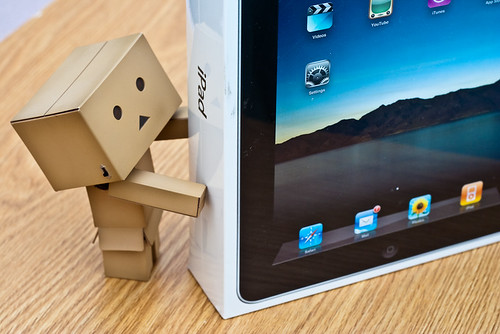
“Finally, I got my iPad” by juehuayin on Flickr

A selection of 10 links for you. Use them wisely.

Worldwide tablet growth expected to slow to 7.2% in 2014 along with first year of iPad decline >> IDC

The worldwide tablet market is expected to see a massive deceleration in 2014 with year-over-year growth slowing to 7.2%, down from 52.5% in 2013, according to a new forecast from International Data Corporation (IDC). At the core of this slowdown is the expectation that 2014 will represent the first full year of decline in Apple iPad shipments. Both the iPad and the overall market slowdown do not come as a surprise as device lifecycles for tablets have continued to lengthen, increasingly resembling those of PCs more than smartphones.

“The tablet market continues to be impacted by a few major trends happening in relevant markets,” said Ryan Reith, Program Director with IDC’s Worldwide Quarterly Mobile Device Trackers. “In the early stages of the tablet market, device lifecycles were expected to resemble those of smartphones, with replacement occurring every 2-3 years. What has played out instead is that many tablet owners are holding onto their devices for more than 3 years and in some instances more than 4 years. We believe the two major drivers for longer than expected tablet lifecycles are legacy software support for older products, especially within iOS, and the increased use of smartphones for a variety of computing tasks.”


The Great British Public Toilet Map >> Gail Knight

The Great British Public Toilet Map launched last Wednesday 19th November on World Toilet Day*

Previous versions of the map have existed since 2011, but this is now the largest publicly accessible toilet database in the UK by some way. It has over 9500 toilets, and I’d be confident of saying that the map will help you to find toilets no matter where you live.

If for some inexplicable reason it doesn’t, you can add, edit and remove toilets until it does! We’ve had over 1000 toilets added this week.

AT LAST. I judged a competition in April 2011 where this was one of the entries – and nearly the winner.


How Sonos and John MacFarlane built the perfect wireless speaker for streaming music >> Businessweek

[Mark] Trammell [a designer formerly at Digg and Twitter] likes to interview customers in their homes, sometimes in the moment when a Sonos speaker first arrives and a family is taking it out of the box and deciding where it should go.

“They’re looking for a Sonos-size hole to fill,” he says. The small Play:1 is good for bathrooms and kitchens; the Play:5 tends to go in living rooms and dens. The accessories allow for attaching other kinds of sound equipment, such as weatherproof outdoor speakers, to the network. The average Sonos household has 2.1 units.

A key moment tends to be when family members discover how to add to and remix playlists together. Mark Whitten, Sonos’s chief product officer, compares the experience to that of the Xbox. “The reason gaming consoles became ascendant wasn’t because of the games,” he says. “It’s because two kids were sitting on a couch, playing together.” Whitten was hired six months ago from Microsoft, where he introduced and oversaw much of the Xbox, including Xbox Live.

On an upward curve. Will someone buy them?


Automation makes us dumb >> WSJ

Nick Carr:

Late last year, a report from a Federal Aviation Administration taskforce on cockpit technology documented a growing link between crashes and an over-reliance on automation. Pilots have become “accustomed to watching things happen, and reacting, instead of being proactive,” the panel warned. The FAA is now urging airlines to get pilots to spend more time flying by hand…

…Ten years ago, information scientists at Utrecht University in the Netherlands had a group of people carry out complicated analytical and planning tasks using either rudimentary software that provided no assistance or sophisticated software that offered a great deal of aid. The researchers found that the people using the simple software developed better strategies, made fewer mistakes and developed a deeper aptitude for the work. The people using the more advanced software, meanwhile, would often “aimlessly click around” when confronted with a tricky problem. The supposedly helpful software actually short-circuited their thinking and learning.


Lee Rigby Woolwich report in full >> The Guardian

Report by parliament’s intelligence and security committee setting out what the intelligence services knew before 2013 Woolwich killing of fusilier by Michael Adebolajo and Michael Adebowale

Worth reading in depth if you’re interested in how security services operate, and what they can (and can’t) get from data. For example: the killers were known, but low priority; a tapping order took a month to be signed; submarine cables are tapped, but even if their discussions had been picked up by them, the fact neither was under “active” observation means key comments would have been missed.


The Lee Rigby murder doesn’t justify an extension of internet snooping powers >> The Guardian

I wrote on the report:

the ISC [Intelligence Services Committee] has a point here. As the report highlights, when internet companies discover accounts associated with child exploitation, they are quick to pass on details to the authorities. But if someone suggests “let’s kill a soldier” in a message, the account is marked for closure. Adebowale had four out of seven internet accounts at one provider automatically closed over suspected terror-related activity; yet none was reviewed by a human. That’s a clear failure to link the action – closing an account – and the reason; communications companies can’t seek public approval for trying to prevent child exploitation, yet wash their hands of terrorism discussions.

The BBC is saying that the Adebowale comment was made on Facebook. Expect more developments in the next few days.


Intel decides to keep tablet subsidies, say sources >> Digitimes

Facing domination from ARM-based processor suppliers such as Qualcomm and MediaTek, Intel’s subsidies including those for marketing, have helped reduce vendors’ costs by around US$20-30 and have attracted vendors such as Asustek Computer, Acer and Lenovo to place orders for Intel’s processors, the sources noted.

Although the strategy helps Intel to maintain a share of around 90% in the notebook market, the strategy has taken a heavy toll out of Intel in the mobile device market as the company has generated about US$7bn of losses from its mobile and communications business during the past two years and will continue to see losses in the fourth quarter, the sources noted.

Internally, Intel has been debating about whether to stay in the tablet market, but the company has decided to push for the market since its absence could impact its PC business and create a hole in its Internet of thing (IoT) lineup, the sources explained.

The logic is sound. And $20-30 could make the difference between profit and loss for some tablet makers.


Pomplamoose 2014 Tour Profits >> Medium

Jack Conte (half of Pomplamoose) does the numbers for the band’s recent self-financed tour:

Add it up, and that’s $135,983 in total income for our tour. And we had $147,802 in expenses.

We lost $11,819…

…The point of publishing all the scary stats is not to dissuade people from being professional musicians. It’s simply an attempt to shine light on a new paradigm for professional artistry.

We’re entering a new era in history: the space between “starving artist” and “rich and famous” is beginning to collapse. YouTube has signed up over a million partners (people who agree to run ads over their videos to make money from their content). The “creative class” is no longer emerging: it’s here, now.

We, the creative class, are finding ways to make a living making music, drawing webcomics, writing articles, coding games, recording podcasts. Most people don’t know our names or faces. We are not on magazine covers at the grocery store. We are not rich, and we are not famous.


Trade in your iPhone >> BlackBerry Trade Up

Trade your iPhone for a BlackBerry Passport and get up to $550!

For a limited time, starting December 1st.

Upgrade to a BlackBerry® Passport and get up to $400 back for your iPhone and an additional $150 from BlackBerry. Subject to Terms and Conditions.

To qualify for this offer, you must have purchased a BlackBerry Passport from select online retailers on or after December 1st, 2014.

BlackBerry essentially gives you $150, and you get a tradein of $90-$400 depending on iPhone model. Doesn’t seem to tie you to owning the Passport for any length of time, so the arbitrage-minded might like to see how easy it would be to round-trip this: cheap secondhand iPhone from drawer -> get BlackBerry Passport -> sell off Passport -> get cheap iPhone -> repeat? The problem might lie in the third step though.

Unlikely there will be a rush of iPhone owners to bankrupt BlackBerry, but also gives an insight into roughly how much it values each user: must be more than $150 over typical contract length.


Whistling Google: PLEASE! Brussels can only hurt Europe, not us >> The Register

Andrew Orlowski, on the European Parliament’s inconsequential (yet consequential) motion to make Google split services from search:

Google today wields enormous power over other industries, in a way Microsoft never could, even at the zenith of its influence. Newspapers didn’t close, and musicians didn’t go hungry, because Windows was late. No Active X control ever destroyed an economic sector. Yet you can plausibly argue that the consequences for European industry and its citizens freedoms are at least indirectly attributable to Google’s strategic use (and abuse) of other people’s property and personal effects…

…DCMA provisions were designed to protect ISPs and other service providers in the mid-1990s, when the public internet was in its infancy.

Today, they are favourable to huge internet aggregators, and load the deck against individuals and tiny companies seeking to protect their work. Google required the music company to promise not to sue an unlicensed uploader, thereby protecting Google’s supply chain. “You can sign and get a fraction of a penny,” Google was saying, “or you can refuse to sign and get nothing. It’s up to you – but either way, we’ll use your work and make money off it.”

As he points out, though, the European Commission is hopelessly screwed in both its aims and implementation of anything digital.


Start up: Roombas v dogs, native v web redux, Intel’s mobile loss, Samsung slims, and more


“Hatin’ on Roomba” by obloquy on Flickr

A selection of 8 links for you. Use them wisely. I’m @charlesarthur on Twitter. Send links, comments, etc there, or drop them at the end of the article.

Intel to combine PC and mobile chip divisions to reflect market shifts >> Computerworld

The Mobile and Communications Group, as it’s known, will be broken up. The teams that develop mobile processors will join the new client group, while the remainder, which builds modems, will be part of a new wireless R&D group.

Herman Eul, who leads the mobile group today, will oversee the move to the new structure until at least the end of the first quarter, with a new role for him to be announced after that, Mulloy said.

The reorganization comes as Intel battles to improve its position in the market for smartphones and tablets, which is dominated by chips based on designs from Arm Holdings, a UK competitor.

The Mobile and Communications Group reported an operating loss of more than US$1bn in the third quarter, in part because it’s been making payments to tablet makers to encourage them to use its chips. As a result of those and other efforts, Intel has said it aims to get its processors into 40m new tablets this year.

Ah. A good way to bury bad losses.


Samsung plans to cut smartphone models by up to 30% in 2015 >> WSJ

Here we are in November 2014:

Samsung Electronics said it would reduce the number of smartphone models it offers next year, part of a move to cut costs to combat declining profit.

The South Korean technology major said it would cut the number of models by about 25% to 30%, Robert Yi, head of investor relations, said during a presentation in New York. His remarks were confirmed by a company spokesman Tuesday.

Samsung didn’t disclose the exact number of models that would be affected by the reduction.

Yeah, so cost-cutting. But now – with thanks to Stefan Constantinelet’s revisit Nokia in April 2011:

An unnamed Nokia Executive, in an interview with the Hindustan Times, has said: “We will be launching 40 models in 2011 of which at least 30% would be smartphones.” This news isn’t exactly making us bust out the champagne because that’s right around how many models Nokia has been releasing every year for the past five years. The Finnish firm has consistently told us that they’re going to take a “more wood behind fewer arrows” approach, meaning that they’ll come out with less new models, but said models would be further refined, but we’ve yet to actually see that materialize.

“Fewer models” seems easy to say, but when your business has been about “lots of models” is hard to do.


Google’s secret NSA alliance: The terrifying deals between Silicon Valley and the security state >> Salon.com

Remember when Google’s servers were broken into by Chinese hackers at the end of 2009? Shane Harris points out that something more happened afterwards:

On the day that Google’s lawyer [David Drummond] wrote the blog post [condemning China], the NSA’s general counsel began drafting a “cooperative research and development agreement,” a legal pact that was originally devised under a 1980 law to speed up the commercial development of new technologies that are of mutual interest to companies and the government. The agreement’s purpose is to build something — a device or a technique, for instance. The participating company isn’t paid, but it can rely on the government to front the research and development costs, and it can use government personnel and facilities for the research. Each side gets to keep the products of the collaboration private until they choose to disclose them. In the end, the company has the exclusive patent rights to build whatever was designed, and the government can use any information that was generated during the collaboration.

It’s not clear what the NSA and Google built after the China hack. But a spokeswoman at the agency gave hints at the time the agreement was written. “As a general matter, as part of its information-assurance mission, NSA works with a broad range of commercial partners and research associates to ensure the availability of secure tailored solutions for Department of Defense and national security systems customers,” she said. It was the phrase “tailored solutions” that was so intriguing. That implied something custom built for the agency, so that it could perform its intelligence-gathering mission.

According to officials who were privy to the details of Google’s arrangements with the NSA, the company agreed to provide information about traffic on its networks in exchange for intelligence from the NSA about what it knew of foreign hackers. It was a quid pro quo, information for information.

Must-read. Including this:

Google’s Sergey Brin is just one of hundreds of CEOs who have been brought into the NSA’s circle of secrecy. Starting in 2008, the agency began offering executives temporary security clearances, some good for only one day, so they could sit in on classified threat briefings.

Starts slow. Goes deep, deep.


4K lens development limited by physics >> TVTechnology

Craig Johnston:

Large venue live sports production promises to be a huge market for 4K production equipment in what could be the very near future. And while there are 4K cameras aplenty, switchers that can be upgraded and a host of other 4K equipment ready to go, there’s no long focal-range, highly telephoto 4K lenses to mate with the Super 35 single-sensor cameras.
 
The motto of high quality lens makers might as well be: “Physics will fight you.”

“When we talk about a 100×1 zoom, and the 35mm sensor, 4K, we’re talking about something we don’t think is very practical today,” said Larry Thorpe, national marketing executive at Canon USA Inc. “Once you jump from 2/3-inch imagers up to something like a Super 35, you set a baseline in element sizes, so the lens by definition is going to be larger.”

Long story short, it’s going to be expensive, or perhaps just not feasible.


Samsung strikes chip deal with Apple >> Korea Times

“Apple has designated Samsung as the primary supplier of its next A-series chips powering iOS devices from 2016 as the alliance with GlobalFoundries (GF) enabled Samsung to cut off capacity risk,” a source familiar with the deal said.

The value of the deal is said to be worth “billions of dollars,” according to the sources.

Production of the APs will start early next year at Samsung’s local factory in Giheung, Gyeonggi Province, and the volume will grow as Samsung plans to use its facilities in Austin, Texas and the GF-owned factory in New York for increased output, another source said.

That will be about 80% of the application processors for iOS devices. Good for Samsung, though doesn’t really get its flywheel (make chips and screens for more profitable devices such as its own smartphones) turning.


Nokia partners with Foxconn to take on Apple with tablet device >> FT.com

Daniel Thomas:

Ramzi Haidamus, Nokia’s technology chief, said the N1 tablet would be as good as Apple’s iPad mini but cost less. He added that it was just the first consumer product that would be designed and labelled as Nokia devices.

“It’s the first of many coming – more SKUs [items for sale], more sizes, more features,” he told the Financial Times in his first interview since becoming head of Nokia’s technology division three months ago. “We will go beyond tablets for sure.”

Nokia is prohibited from making smartphones until 2016 under the terms of the sale of its handset business to Microsoft. But Mr Haidamus said that “we will be looking at going into the cell phone licensing business post-Microsoft rights”.

The N1 is the first Nokia-branded consumer device brought to market following the sale of the Lumia and Asha businesses to Microsoft. Nokia did not manufacture tablets. 
The company said it would be the first tablet operated by a “predictive engine” that gradually learnt a user’s habits and created customised shortcuts to commonly used apps, contacts and web content.

The tablet has a 7.9 inch screen, a 2.4Ghz 64-bit quad-core processor, 2GB of memory and 32GB of storage.

Foxconn also makes lots of Apple devices, and is partnering with BlackBerry too. Big ambitions. Can’t see Nokia’s tablet making much impression on the Chinese market though.


Native apps are part of the web >> Daring Fireball

John Gruber wrote the complete rejoinder (with some pointed notes about paywalls and free sites) to Christopher Mims’s “web is dying” piece from the previous roundup:

Users love apps, developers love apps — the only people who don’t love apps are pundits who don’t understand that apps aren’t really in opposition to the open Internet. They’re just superior clients to open Internet services. Instagram didn’t even have a web interface for years, but native app clients for iOS and Android didn’t lock Instagram into anything. Their back-end is just as open as it would have been if they had only had a web browser client interface. They just wouldn’t have gotten popular.

I spoke about this four years ago at O’Reilly’s Web 2.0 conference, in a talk titled “Apple and the Open Web: A Love Story”. The gist of it being that native iOS apps (and native apps for Android, Mac OS X, Windows, and everything else) aren’t in opposition to the “web”. They live on top of the web. A new layer. They are alternatives to websites that run in web browsers. They’re just better clients.

Clear thinking is easy to recognise when you see it. This is an example. Although the debate goes on: Tim Bray says on Twitter: “What @gruber says is correct, but native apps have gatekeepers, browser apps don’t. Call me old-fashioned, but that really bothers me. It doesn’t trump all the other issues, but it’s a big deal.” (The discussion continued on Twitter.)


When dogs and robots collide, somebody needs a talking to >> WSJ

This dates from 2008, but is still relevant:

To keep the peace at home, Keith Hearn had to scold his new robotic vacuum cleaner.

The trouble started when Mr. Hearn first turned on his Roomba automatic cleaner. When the device started scooting around the floor, Mr. Hearn’s dog, Argos, attacked it.

Seeking help, Mr. Hearn found an online forum dedicated to the hundred-dollar Roomba buzzing with similar stories of pet assailants. Owners were offering advice. Among the most popular: chastise the vacuum in front of the dog.

And so, with Argos looking on, Mr. Hearn shook his finger at his gadget and sternly called it “a bad Roomba.” Argos appeared to be mollified. “After that, he never tried nipping at it again,” says Mr. Hearn, a software engineer in San Carlos, Calif.

We’re only just beginning to get self-organising devices in the home, but where will pets fit into the internet of things? They have their own social structures that they believe exist.
