
Start up: inside Apple’s A9X, Amazon unlimited?, VTech hacked, YouTube v Palestine, and more

This could be the prelude to hypothermia. But what does that feel like? Photo by Nicolas Valentin on Flickr.

You can now sign up to receive each day’s Start Up post by email. You’ll need to click a confirmation link, so no spam.

A selection of 10 links for you. Use them wisely. I’m charlesarthur on Twitter. Observations and links welcome.

All-in-one PC shipments to drop over 10% in 2015 » Digitimes

Aaron Lee and Joseph Tsai:

All-in-one PC shipments may drop a double-digit percentage on-year in 2015 due to weaker-than-expected demand. Shipments in 2016 are unlikely to see any major growth and may stay flat from 2015, according to sources from the upstream supply chain.

The largest all-in-one PC vendor, Lenovo, is expected to see flat shipment performance and a worldwide market share of around 30% in 2016. Despite the fact that the China government has recently lifted restrictions on opening internet cafes in the country which has boosted demand for all-in-one PCs, Lenovo will not benefit much from related demand since most Internet cafe players require customization, an area that Lenovo is having difficulties to coordinate, causing the opportunities to be mainly seen by second-tier and China white-box makers, the sources noted.

As for the second-largest, Apple, its iMac shipments are expected to grow 5% on year in 2016. iMac’s main manufacturer, Quanta Computer, reportedly has increased its personnel for the product line for 2016, but the ODM declined to comment on market speculation.

link to this extract


Inside the Apple A9X chip » The Motley Fool

Ashraf Eassa on the chip powering the iPad Pro:

Following is a die shot of the A9X, courtesy of Chipworks:

Chipworks’ Dick James tells me that he sees a 12-cluster GPU, two CPU cores, and an absence of the level-three cache memory found inside the A9 chip (I’ll explain why I think Apple didn’t include it later in this article). I agree with his assessment. The two CPU cores can be seen in the green box, and I believe that inside of each blue box are two GPU clusters, for a total of 12 clusters…

According to Chipworks, the chip measures in at approximately 147 square millimeters, a whopping 40% larger than the size of the TSMC-built variant of the A9 chip inside of the iPhone 6s/6s Plus. This is an absolutely huge increase in area (and by extension transistor count) from the A9, which no doubt means that this monster of a chip is far more difficult to manufacture, especially on a relatively new manufacturing technology.

Two CPU cores? Bah. Surely it should be at least eight to be worth talking about?
link to this extract


Is Amazon’s online storage really ‘unlimited’? Read the fine print » ZDNet

Ed Bott:

It’s a trial offer, with the price for the second and subsequent years rising to $60, and renewing automatically unless you say no.

I can tell that some of you are ready to begin migrating the 10 terabytes of data you stored in Microsoft’s OneDrive before they killed that golden goose. May I suggest you first read the Amazon Cloud Drive Terms of Use?

When you do, you will discover that that word, unlimited, does not mean what you think it means.

And you might find that if you really have a lot of data to store that you won’t be able to after all, because they research reserve the right to suspend or terminate “if we determine that your use violates the Agreement, is improper, substantially exceeds or differs from normal use by other users, or otherwise involves fraud or misuse of the Service…” (Emphasis added.)
link to this extract


Israel to coordinate with Google and YouTube to censor Palestinian videos of conflict » Informed Comment

Saed Bannoura:

The Israeli Deputy Foreign Minister, Member of Knesset Tzipi Hotovely, held meetings this week with representatives of YouTube and Google, to find ways of cooperating to censor Palestinian videos from occupied Palestine, videos she dubbed as “inciting violence and terrorism.”

Israeli daily Maariv said Hotovely will be working with Google and YouTube officials in a joint mechanism that will be in charge of “monitoring and preventing” any publication of materials deemed by Tel Aviv to be “inflammatory.”

Hotovely announced in a Hebrew-only press release that she met with YouTube CEO Susan Wojcicki, and Google’s Director of Public Policy, Jennifer Oztzistzki, at Google’s Silicon Valley Offices.

Hotovely said that she received a comprehensive review mechanism for companies to monitor the films that allegedly incite violence, claiming that the supposed ‘incitement videos’ drive young children to go out and stab: “The attacks daily in Israel are the result of youths and children incited by the education system and the social networks, this is a daily war of incitement.”

You can’t be a video hosting service without getting caught in the politics of an area. And of course “incitement to violence” is over the boundary of free speech pretty much everywhere.
link to this extract


As freezing persons recollect the snow: first chill, then stupor, then the letting go » Outside Online

Peter Clark with a scary description of what happens as hypothermia sets in:

When your Jeep spins lazily off the mountain road and slams backward into a snowbank, you don’t worry immediately about the cold. Your first thought is that you’ve just dented your bumper. Your second is that you’ve failed to bring a shovel. Your third is that you’ll be late for dinner. Friends are expecting you at their cabin around eight for a moonlight ski, a late dinner, a sauna. Nothing can keep you from that.

Driving out of town, defroster roaring, you barely noted the bank thermometer on the town square: minus 27 degrees at 6:36. The radio weather report warned of a deep mass of arctic air settling over the region. The man who took your money at the Conoco station shook his head at the register and said he wouldn’t be going anywhere tonight if he were you. You smiled. A little chill never hurt anybody with enough fleece and a good four-wheel-drive.

But now you’re stuck.

(Via Eugene Wei.)
link to this extract


A 59-year-old woman reviews the Apple Watch in real life » Privilege

“Lisa”:

I do think it’s important that we women and we midlifers engage in the tech cycle, if only to ensure that the Brave New World isn’t designed just for 28-year old men.

I first realized I liked the watch as I pushed a cart through Whole Foods. I’d invited my family over for dinner, and was doing the grocery shopping. I’d texted both my sister-in-law and sister to find out if their kids would be OK with the menu. The replies came as I passed the tortilla section. And I did not have to stop, block the aisle, and find my phone in my bag –  just pressed the Message smile emoji. A lightweight interaction.

Besides, the Watch is very good-looking, as Mom might say.

But let us review and deconstruct. Not literally. Taking apart solid state devices is not my idea of fun.

link to this extract


100 million LTE phones shipped in China in Q3 2015 » Counterpoint Technology Market Research

Neil Shah:

This has been primarily driven by a meteoric rise in consumers adopting LTE technology as the always-on high speed mobile internet becomes the crux of Chinese consumers’ lives aided by competitive pricing by China Mobile. More than 200m 4G LTE subscribers have been added at the end of Q3 2015 compared to exactly a year ago. China’s LTE subscriber base also crossed 300m users during the quarter. It took just 20 months to cross 300m 4G subs, whereas for 3G subs it took more than 50 months.

Mature Chinese smartphone user base are upgrading their digital lives faster than any other mobile user on this planet. The growing traction of mobile-centric commerce, rise of O2O services, content consumption (video, audio and so forth) coupled with deeply integrated social and messaging communication is making  high quality ubiquitous mobile internet a basic need for the Chinese consumers.

Huawei was the no 1 LTE phone supplier with slightly less than one-fifth of the market, followed by Xiaomi, Apple, Oppo and Vivo.

link to this extract


One of the largest hacks yet exposes data on hundreds of thousands of kids » Motherboard

Lorenzo Franceschi-Bicchierai:

The personal information of almost 5 million parents and more than 200,000 kids was exposed earlier this month after a hacker broke into the servers of a Chinese company that sells kids toys and gadgets, Motherboard has learned.

The hacked data includes names, email addresses, passwords, and home addresses of 4,833,678 parents who have bought products sold by VTech, which has almost $2 billion in revenue. The dump also includes the first names, genders and birthdays of more than 200,000 kids.

What’s worse, it’s possible to link the children to their parents, exposing the kids’ full identities and where they live, according to an expert who reviewed the breach for Motherboard.

That expert being Troy Hunt, who has a long writeup on how crap VTech has been. All this harvesting of personal data ahead of inevitable hacks? No way to delete your account (hardly any companies give you that option).
link to this extract


Report: Apple plans to nix 3.5mm port on iPhone 7, require Lightning for wired headphones » 9to5Mac

Citing a reliable source, a report from Japanese blog Macotakara claims that Apple plans to remove the 3.5mm headphone port from the upcoming iPhone 7, helping to achieve a “more than 1mm” reduction in thickness compared to the iPhone 6s. While the screen shape and radius will remain similar, the device will once again become Apple’s thinnest iPhone ever, albeit with a new restriction: headphones will only be able to connect over Lightning or Bluetooth…

Macotakara says that the 3.5mm port “can hardly be thinner because it is the world standard,” which is accurate, though the current-generation iPod touch is 1mm thinner than the iPhone 6s despite having a 3.5mm port inside. It should be noted that Apple actively contemplated switching to the smaller but less popular 2.5mm headphone port standard many years ago, abandoning the plan after users complained about the original iPhone’s recessed 3.5mm port.

Will be good business for Bluetooth headphone companies. Such as Beats?
link to this extract


More China firms developing own ARM-based chips » Digitimes

Monica Chen and Jessie Shen:

China-based ZTE has received a cash injection from the government enabling the company to accelerate the development of its own application processors, while Lenovo also intends to develop ARM-based chips in-house, according to industry sources.

ZTE has received CNY2.4bn (US$73.8m) from China’s National IC Industry Investment Fund, which will help it accelerate the mobile chip development, said the sources.

Huawei has its subsidiary HiSilicon provide ARM-architecture SoCs, which are found in many of the smartphone vendor’s models including high-end ones, the sources indicated. Huawei’s increasing use of HiSilicon chips is already unfavorable to the existing suppliers including MediaTek and Qualcomm.

All essentially trying to differentiate themselves from rivals. Didn’t know about Huawei’s subsidiary, but it makes sense for a network infrastructure company to have a chip designer.
link to this extract


Errata, corrigenda and ai no corrida: none notified.
Start up: farewell Steve Wildstrom, PS4 = 30m, cooling on Xiaomi, Google crunches Yelp, and more


Which slogans do you actually remember, from which ads? Mad Men icon reimagined by p3liator on Flickr.

Then again, you could sign up to receive each day’s Start Up post by email. You’ll need to click a confirmation link, so no spam.

A selection of 13 links for you. Simpler than talking to your relatives. I’m charlesarthur on Twitter. Observations and links welcome.

Steve Wildstrom, tech journalist, dies after battle with brain cancer » TechCrunch

John Biggs:

Born in Detroit, Wildstrom went to the University of Michigan and began writing for BusinessWeek in 1972 where he served as news editor in BusinessWeek’s Washington bureau. He was also active in the Children’s Chorus of Washington.

“Steve Wildstrom at Business Week was hands-down the best person in the 1990s-2000s to explain to a broad nationwide audience what tech meant to them in their personal and business lives,” wrote Bill Howard, an editor at PC Magazine. “Steve put his effort into researching, analyzing and writing rather than building the Brand of Wildstrom.”

Very sad news. Wildstrom’s “Tech and You” column in BusinessWeek was an inspiration to me. Certainly all the phone and other reviews on tech sites now owe what they’re doing in part to Wildstrom.
link to this extract


Sony’s PlayStation 4 scores more than 30m sales » WSJ

Takashi Mochizuki:

Sony Corp. said Wednesday that it has sold more than 30.2 million PlayStation 4 videogame consoles, two years after the launch of a system that the company says has sold faster than any of its predecessors.

“We are sincerely grateful that gamers across the globe have continued to choose PS4 as the best place to play since launch two years ago,” said Andrew House, President and Global CEO of Sony Computer Entertainment Inc.

The latest total, as of Nov. 22, is up from more than 20m in March, when Sony provided its most recent update on PlayStation 4 sales. Sony has said it aims to ship more than 17.5m units during the current fiscal year, which ends in March 2016.

Wii U at 10.7m, and Xbox One estimated at about 15m. Sony has crushed its rivals this time round. Yet there will probably be another console generation for virtual reality – is 2018 too soon?
link to this extract


The worst app » Allen Pike

App maker Pike started getting angry support emails. Problem was, they weren’t for his app. But the creator of a scam app had put his company’s contact email in its “report a problem” link. So you contact Apple and get them to take it down, right?

Now, the App Store review process is a mixed bag. While it definitely has some problems, its fickle nature has an upside. When an app is in egregious violation of common sense and decency, Apple can simply pull it from the store. All you need to do is contact Apple about the app.

Unfortunately, one does not simply contact Apple about an app. The official way to complain about an app is via the “Report a Problem” link from when you buy the app. Of course, I’m not going to buy this scam app just to complain about it, so I dug up an alternate form to report a problem. Maddeningly, one of the required fields on that form is an order number – the one you receive when you buy the app. Stalemate.

It gets worse. And then, happily, better. The power of a blogpost.
link to this extract


‘Outsiders’ crack 50-year-old math problem » Quanta Magazine

Erica Klarreich:

The proof, which has since been thoroughly vetted, is highly original, [Assaf] Naor [a mathematician at Princeton] said. “What I love about it is just this feeling of freshness,” he said. “That’s why we want to solve open problems — for the rare events when somebody comes up with a solution that’s so different from what was before that it just completely changes our perspective.”

Computer scientists have already applied this new point of view to the “asymmetric” traveling salesman problem. In the traveling salesman problem, a salesman must travel through a series of cities, with the goal of minimizing the total distance traveled; the asymmetric version includes situations in which the distance from A to B differs from the distance from B to A (for instance, if the route includes one-way streets).

The best-known algorithm for finding approximate solutions to the asymmetric problem dates back to 1970, but no one knew how good its approximations were. Now, using ideas from the proof of the Kadison-Singer problem, Nima Anari, of the University of California, Berkeley, and Shayan Oveis Gharan, of the University of Washington in Seattle, have shown that this algorithm performs exponentially better than people had realized. The new result is “major, major progress,” Naor said.

Abstruse yet with lots of implications for real-world problems involving processing, signalling and networks. It’s the Kadison-Singer problem, if you want to airily mention it over your latte.
link to this extract


Axel Springer goes after iOS 9 adblocker in new legal battle » TechCrunch

Sarah Perez:

German media giant Axel Springer, which operates top European newspapers like Bild and Die Welt, and who recently bought a controlling stake in Business Insider for $343m, has a history of fighting back against ad-blocking software that threatens its publications’ business models. Now, it’s taking that fight to mobile ad blockers, too. According to the makers of the iOS content blocker dubbed “Blockr,” which is one of several new iOS 9 applications that allow users to block ads and other content that slows down web browsing, Axel Springer’s WELTN24 subsidiary took them to court in an attempt to stop the development and distribution of the Blockr software.

Final ruling on 10 December; court seems likely (based on preliminary hearing) to side with Blockr.
link to this extract


How the Mad Men lost the plot » FT.com

Ian Leslie (a former Mad Man):

[Professor Byron] Sharp’s first law [in his book “How Brands Grow”] is that brands can’t get bigger on the back of loyal customers. Applying a statistical analysis to sales data, he demonstrates that the majority of any successful brand’s sales comes from “light buyers”: people who buy it relatively infrequently. Coca-Cola’s business is not built on a hardcore of Coke lovers who drink it daily, but on the millions of people who buy it once or twice a year. You, for instance, may not think of yourself as a Coke buyer, but if you’ve bought it once in the last 12 months, you’re actually a typical Coke consumer. This pattern recurs across brands, categories, countries and time. Whether it’s toothpaste or computers, French cars or Australian banks, brands depend on large numbers of people — that’s to say, the masses — who buy them only occasionally, leave long gaps between purchases and buy competing brands in between.

If you work for a brand owner, the implications are profound. First, you will never increase your brand’s market share by targeting existing users — the task that digital media performs so efficiently. The effort and expense marketers put into targeting their own customers with emails and web banners is largely wasted; loyalty programmes, says Sharp, “do practically nothing to drive growth”. What seems like a prudent use of funds — focusing on people who have already proved they like the brand — is actually just spinning wheels.

Second, and paradoxically, a successful brand needs to find a way of reaching people who are not in its “target” (in the sense of “people who are predisposed to buy it”) market…

…Marketers consistently undervalue consistency. Diageo recently carried out an audit of all the endlines that it had attached to one of its biggest brands, Guinness, and were embarrassed to discover it had used more than 20 different slogans in 15 years. What’s more, when it asked people to recall an endline, the only one they remembered was “Good things come to those who wait”, which hadn’t run since 1999. Vast sums of money had been spent on campaigns which probably had short-term effects but barely left a trace in consumer memories.

Long piece, but eminently worth finding a way to read. Sharp’s book sounds worth a read too.
link to this extract


Apple has acquired Faceshift, maker of motion capture tech used in Star Wars » TechCrunch

Ingrid Lunden:

[Faceshift’s] main focus, so to speak, was on visual effects in areas like gaming and film. In a world where animation technology can be costly and time-consuming to implement, the startup’s main product was marketed a game changer: “Faceshift studio is a facial motion capture software solution which revolutionizes facial animation, making it possible at every desk,” according to the company.

Even so, the technology is also making an appearance at the highest level of wow: it’s used in the latest Star Wars film to make non-human characters more human-like in their expressions.

Apple itself already has patents and assets across motion capture, facial recognition and augmented reality, partly by way of three other European acquisitions, respectively PrimeSense, Polar Rose and Metaio. Faceshift could complement and expand Apple’s capabilities in these areas going forward.

Seems like Apple miiiight be looking at the virtual reality space, though it’s hard to see quite how this fits into anything we recognise in its portfolio.
link to this extract


Xiaomi’s $45bn valuation seen ‘unfeasible’ as growth cools » Bloomberg Business

Tim Culpan saves the best for the last line in this story about Xiaomi rowing back on its aims even of 80m handset shipments this year, while it tries to expand “ancillaries” such as air purifiers and scooters:

The ancillary businesses are still relatively small, with the company expecting the services units to account for just $1bn of its $16bn in projected revenue this year, Barra said in a July interview. Sales of smartphones outside China accounted for just 7% of its total in the third quarter, according to Strategy Analytics.

Xiaomi has struggled partly because competitors Huawei, Lenovo Group Ltd. and Gionee – among others – quickly copied its business model with ultra-thin devices, glossy websites and lower prices, allowing consumers to easily switch to the hippest new phone.

“Xiaomi was very popular because it was the first brand that marketed its phones as being limited edition,” said Chen Si, a 25-year-old real estate worker in Beijing who bought the Mi 3 after its 2013 release, citing its cool design. “I wouldn’t say I am loyal to Xiaomi, I just think that a phone should be affordable and easy to use. If not, then I’ll just change.”

A year later, she switched to the iPhone 6.

*mic drop*
link to this extract


O2 explores ad blocking across its network » Business Insider

O2 is one of the UK’s four big carriers, with about 25m customers:

O2 executives told Business Insider the company is actively testing using technology that can block mobile ads at a network-level before they even get served. In addition, the company is considering whether to offer customers easy access to ad blocking apps and browser extensions. O2 is also working with advertisers to improve the standard of mobile advertising.

The hope is that the carrier can help customers filter out bad advertising that interrupts mobile browsing, eats up consumers’ data allowances, and ultimately puts a strain on its own network infrastructure. One ad blocking company estimates that ads are gobbling up between 10-50% of customer’s data plans each month.

This comes after EE, the biggest UK carrier, said it was looking at the same thing. Notice that “working with advertisers to improve the standard of mobile advertising”: no doubt such work has a price.
link to this extract


Google claims mobile search result impacting Yelp, TripAdvisor is ‘a bug’ » Re/code

Mark Bergen:

Over the weekend, executives from public Internet companies Yelp and TripAdvisor noted a disturbing trend: Google searches on smartphones for their businesses had suddenly buried their results beneath Google’s own. It looked like a flagrant reversal of Google’s stated position on search, and a move to edge out rivals.

Nope, it’s a bug, claims Google. “The issues cited were caused by a recent code push, which we’re working quickly to fix,” a Google spokeswoman said.

In the meantime, the “issues” may be diverting tons of traffic from Google’s competitors. Some, particularly Google’s longtime rival Yelp, are not pleased. “Far from a glitch, this is a pattern of behavior by Google,” said its CEO Jeremy Stoppelman.

Have there been many – or any – occasions where these code pushes have accidentally buried Google’s products?
link to this extract


I’m leaving Android for iOS, and I blame late games » Polygon

Ben Kuchera reluctantly swapped his Galaxy Note 4 for an iPhone 6S Plus:

You can argue about install base and walled gardens until you’re blue in the face, but the reality is you’ll be waiting for games if you use an Android device. I caught up with Barry Meade, whose studio created The Room series, to ask why the game launched first on iOS. His answer is a common one.

“It’s the same reason everybody has — Android takes way longer to test for due to the diffusion of devices,” Meade told Polygon. “With iOS you only have to test maybe eight to 10 devices, and that’s only because we choose to support pretty old devices, many don’t. With Android you’re looking at hundreds of devices off the bat, each with different hardware/screen set-ups.”

The other side of this is that the iOS players are kind of testing the game for the eventual Android players.

“So with an iOS-first strategy you can release the game to many users with only a small chance of bugs arising due to differences in hardware, which means that when a bug does arise on iOS it’s likely unconnected to the hardware and by fixing it, you are also fixing that bug for any future Android build,” Meade continued. “What Android users forget is that because their versions come later they get the least buggy, higher performance version of the game because iOS users are, in an indirect way, guinea pigs for the other releases.”

I hope that makes Android players feel better, but I’m just so tired of waiting.

The comments – including the (polite) argument between two game developers – are worth reading too.
link to this extract


Secure Messaging scorecard » Electronic Frontier Foundation

In the face of widespread Internet surveillance, we need a secure and practical means of talking to each other from our phones and computers. Many companies offer “secure messaging” products—but are these systems actually secure? We decided to find out, in the first phase of a new EFF Campaign for Secure & Usable Crypto.

Surprising how poorly BBM and Google Hangouts score on this; and also how many other services actually get perfect scores. One, called Mxit, whiffs every line, though – not even encrypted in transit. (Via Benedict Evans.)
link to this extract


Google and the shift from web to apps, indexing app-only content, streaming apps » Stratechery by Ben Thompson

From Ben Thompson’s subscriber-only update, looking at Google’s streaming apps effort:

To be sure, streaming apps will be a worse experience than natively installed apps, at least for the foreseeable future. In fact, the effort is so nascent that Google is launching the initiative with only nine apps and only in the Google App on recent Android devices and only over Wifi. You have to start somewhere, though, and betting on the continued expansion of broadband and Moore’s Law goes hand-in-hand with Google’s brute force approach. And, as for the experience, everything is relative: a streamed app is better than having to download an app just to see a search result, and more fundamentally, a streamed app is better than not having access to the information at all.

As for iOS devices, while I’ve criticized Google in the past for its insistence on always launching Android first, I suspect there are real technical and legal challenges that come with streaming iOS apps in a similar fashion; it’s here that Google’s misguided insistence on competing with Apple head-on really hurts. I don’t see anything in this initiative that is necessarily threatening to Apple beyond the fact that app streaming helps Google. Ergo, were Google not a direct competitor (a la Microsoft today), Apple might be willing to lend a hand to ensure iOS customers had a better search experience.

Danny Sullivan also has a writeup of app streaming (which is a clever implementation: apps run inside virtual machines), and points out how awful it would have been if every site was its own app.
link to this extract


Errata, corrigenda and ai no corrida: none notified.

Start up: why Win10 update was pulled, Android v the law, post-iPad mini, neural nets on the move, and more


Quiet eye? Roger Federer winds up to serve. Photo by not enough megapixels on Flickr.

You can now receive each day’s Start Up post by email. You’ll need to click a confirmation link, so it ain’t spam.

A selection of 11 links for you. Hug them to your chest like your long-lost children. I’m charlesarthur on Twitter. Observations and links welcome.

Microsoft pulled the Windows 10 November Update due to privacy setting bug » Winbeta

Zac Bowden:

Microsoft has today detailed why they chose to pull the Windows 10 November Update from Windows Update and the Media Creation Tool over the weekend. Their initial comment regarding the situation claimed the company decided that all users needed to update via Windows Update, but it appears that was not the entire story.

Microsoft told WinBeta the update was pulled due to issues with privacy concerns. More specifically, upon installing the update, Windows would not remember the users set privacy settings, meaning Windows would simply default them. While not a huge bug, it did raise a few privacy concerns amongst those upgrading.

link to this extract


How the ‘quiet eye’ technique makes athletes more coordinated » The Atlantic

David Kohn:

Until recently, most researchers viewed these skills in terms of coordination and reflex, believing that those who were better at making a free-throw or suturing a wound simply had had superior physical dexterity. But in the past few years, a small group of neuroscientists have identified a new way of understanding coordination, one that focuses on visual and cognitive skills over physical prowess.

The concept, known as the quiet-eye theory, is deceptively simple: Before you perform an action, you focus your gaze on the salient aspects of your goal—the rim, the catcher’s mitt, the malignant tissue, and so on. In recent years, using eye-tracking technology, researchers have found that locking onto the relevant stimulus during the right time frame—typically the few hundred milliseconds before, during and after the movement—greatly improves your chances of success.

“When your eyes provide the data, your motor system just knows what to do,” says Joan Vickers, a cognitive psychologist at the University of Calgary and one of the originators of the quiet-eye theory. “Your brain is like a GPS system. It detects target, speed, intensity, and distance.”

link to this extract


On smartphone encryption and public safety » Manhattan District Attorney’s Office

There are a larger variety of Android devices than Apple devices. Forensic examiners are able to bypass passcodes on some of those devices using a variety of forensic techniques. For some other types of Android devices, Google can reset the passcodes when served with a search warrant and an order instructing them to assist law enforcement to extract data from the device. This process can be done by Google remotely and allows forensic examiners to view the contents of a device.

For Android devices running operating systems Lollipop 5.0 and above, however, Google plans to use default full-disk encryption, like that being used by Apple, that will make it impossible for Google to comply with search warrants and orders instructing them to assist with device data extraction.

Did not know about the remote reset.
link to this extract


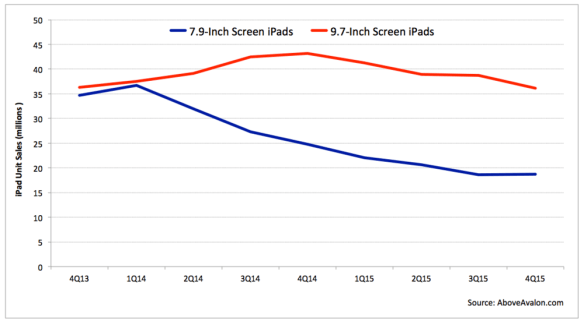
Peak iPad mini » Above Avalon

Neil Cybart:

The iPad mini’s best days are behind it. Using app analytics data from Fiksu and Mixpanel, along with my own iOS device sales estimates and projections, I was able to derive iPad mini sales since launch. Over the past two years, iPad mini sales trends have deteriorated much faster than most people think. When taking into account the move to larger iPhones and iPads, the iPad mini’s value proposition has likely been weakened to such a degree that the decline in sales is permanent. 

Seems that the real decline in iPad sales is of the mini – not the bigger one. So how will the giant iPad fare? Cybart’s analysis is always thoughtful.
link to this extract


You may be more exposed to the tech bubble than you think » Quartz

Allison Schrager:

First, you might have a stake in these companies if you own any actively managed mutual funds, perhaps through your retirement plan. According to Todd Rosenbluth, director of mutual fund research at Standard &Poor’s, large mutual funds have been investing in non-public companies for years. “Most people have no idea.” he says. The payoffs can be big if some of these firms successfully go public, but the risks are significant because it’s impossible to assign a consistent, accurate value to these investments, and they are hard to sell if the fund faces redemptions. However, regulation keeps mutual funds from holding large amounts of private shares, which would mitigate the impact. “It’s a tiny part of their portfolios,” Rosenbluth says. For example, only about 2% of the Fidelity Blue Chip Growth fund is made up of tech startup investments.

The second way you’re exposed is through public pensions, whether you’re a direct beneficiary or not.

Feels like a stretch, to be honest. And certainly nothing like the dot-com bust.
link to this extract


YouTube Kids app faces new complaints » The New York Times

Ceclia Kang:

Visit YouTube Kids and it typically does not take long before promotions for junk food appear. The advertisements regularly appear in the form of funny contests and animated stories.

In complaints filed to federal officials on Tuesday, two prominent consumer advocacy groups argued that those ads are deceptive, particularly for children. The two complaints, made to the Federal Trade Commission, expand on filings the groups made to the agency in April and could increase pressure on federal officials to intervene in the fast-growing online video market.

The groups, the Campaign for Commercial-Free Childhood and the Center for Digital Democracy, argue in the complaints that online video aimed at children has become too commercialized and is not held to the same standards as cable and broadcast TV. The complaints call for an investigation of food marketers, video programmers and Google, which owns YouTube, as well as a broad examination of advertising of such food to children online.

If YouTube by default becomes the new online TV, shouldn’t it be held to the same standards as broadcast TV?
link to this extract


Sony employees on the hack, one year later » Slate

Amanda Hess:

Outside Sony, it would eventually seem as if all the studio’s info had been exposed for everyone to see. But inside the studio, nobody could access anything. “Everything was so completely destroyed. It was surreal. Everything was down,” one ex-employee told me. “It wasn’t just one system or one part of the lot or one building. The network was completely chewed up by the virus.”

“It was like a bomb went off,” one staffer says. “We looked around. We were still alive. So we started doing triage.”

The telephone directory vanished. Voicemail was offline. Computers became bricks.  Internet access on the lot was shuttered. The cafeteria went cash-only. Contracts—and the templates those contracts were based on—disappeared. Sony’s online database of stock footage was unsearchable. It was near impossible for Sony to communicate directly with its employees—much less ex-employees, who were also gravely affected by the hack—to inform them of what was even happening and what to do about it. “It was like moving back into an earlier time,” one employee says. The only way to reach other Sony staffers was to dial their number directly—if you could figure out what it was—or hunt them down and talk face to face.

link to this extract


NeuralTalk and Walk » Vimeo

Kyle McDonald:

NeuralTalk and Walk from Kyle McDonald on Vimeo.

Andrej Karpathy’s “NeuralTalk” code (github.com/karpathy/neuraltalk2) slightly modified to run from a webcam feed. I recorded this live while walking near the bridge at Damstraat and Oudezijds Voorburgwal in Amsterdam.

All processing is done on my 2013 MacBook Pro with the NVIDIA 750M and only 2GB of GPU memory. I’m walking around with my laptop open pointing it at things, hence the shaky footage and people staring at themselves.

Pretty smart.
link to this extract


Top Android app devs found exfiltrating mystery stealth packets » The Register

Four researchers have found two thirds of the most popular Android apps indulge in seemingly-useless covert chatter with remote servers.

Top developers including Gameloft, Unity3d, and grillgames are implicated to varying degrees.

The chatter has no use to users. About half of the traffic is related to analytics, such as that used by Twitter and Pandora, with the rest of unknown purpose.

They make the findings in the paper Covert Communication in Mobile Applications (PDF).

“…In fact, some applications start collecting analytics information even before they get activated. For example, twitter, Walmart and Pandora start their data collection as soon as the phone is booted and continue, periodically, during the phone’s entire up time, even if the applications themselves were never used. In most cases, the user cannot opt-out from such data sharing without uninstalling the application.”

Five apps died when the covert chatter was killed off after the code in question was manipulated by the research team.

link to this extract


Automated scanning of Firefox extensions is security theatre (and here’s code to prove it) » Dan Stillman

Stillman wrote a simple Javascript extension that grabs sites and passwords, yet passes Mozilla’s “scanner” which looks for “malware”:

I asked in February how the scanner would possibly catch things like this, and the response from Mozilla’s Add-ons Developer Relations Lead was that most malware authors are lazy and that he believed the scanner could be made to “block the majority of malware”. The fact that, nine months later, and a few weeks before an enforcement deadline that was already postponed by several months, someone can write a trivial extension in a few minutes that steals passwords, runs a local process, and executes arbitrary remote code, but that is still automatically signed, demonstrates just how ill-conceived this scheme is. It also destroys any argument that whitelisting would put users at greater risk for malware, and it’s infuriating that we’ve had to waste the last few months arguing about the dangers of a whitelisted Zotero. And it’s just depressing that the entire Mozilla developer community spent the last year debating extension signing and having every single counterargument be dismissed only to end up with a system that is utterly incapable of actually combating malware.

link to this extract


Android One fails to make a mark despite revamp » The Economic Times

Danish Khan:

According to Counterpoint Research, only 1.2m units of Android One [handsets] were shipped to India during its first year (September 2014 to September 2015) in the country, making up only 3.5% of the $50-$100 phone market, the segment which sells the most phones.

Only 3m devices are said to have been shipped in total across the 19 countries that Android One has launched in. Of this, 85% of sales took place in the Asia-Pacific market.

Counterpoint’s Tarun Pathak said that for Android One to succeed in India, Google and its partners need to scale down to lower price points and differentiate the product from biggest competitor which is “Android” itself, which is competing with Android One via original equipment makers (OEM) that are present across $50-$100 price band in India.

Lack of LTE turns out to be a key mistake.
link to this extract


Errata, corrigenda and ai no corrida: none notified.

Start up: Adele v pirates, Alphabet’s challenge, Mayer’s end? and more


The authentic feel of everything from Shaft to.. everything else. Photo of a wah-wah pedal by Kmeron on Flickr.

You can now sign up to receive each day’s Start Up post by email. You’ll need to click a confirmation link, so no spam.

A selection of 10 links for you. Handle with care. I’m charlesarthur on Twitter. Observations and links welcome.

Burma gives a big thumbs-up to Facebook » Foreign Policy

Christian Caryl:

As the vote count draws to a close, it’s clear that Burma’s long-suffering opposition has scored a landslide victory in Sunday’s historic national election. And the leader of that opposition knows whom to thank. As she was explaining the reasons for her party’s remarkable triumph in an interview with the BBC this week, Nobel Prize Laureate Aung San Suu Kyi said this: “And then of course there’s the communications revolution. This has made a huge difference. Everybody gets onto the net and informs everybody else of what is happening. And so it’s much more difficult for those who wish to commit irregularities to get away with it.”

She could have been a little more specific, though. When people here in Burma refer to the “Internet,” what they often have in mind is Facebook — the social media network that dominates all online activity in this country to a degree unimaginable anywhere else.

link to this extract


Inside the problem with Alphabet » The Information

Amir Efrati and Jessica Lessin:

[Larry] Page unveiled Alphabet in August as a way to empower entrepreneurs and strong CEOs to build new companies “with a long term view.” Mr. Page had already been creating new companies under Google, like Calico, the secretive life-extension startup that former Genentech CEO Art Levinson is leading.

Some of those companies wanted more autonomy from Google and its bureaucracy, on issues big and small; [Arthur] Levinson [in charge of Calico], for instance, bristled when Google’s food services staff tried to apply Google’s nutritional guidelines to dining areas that served Calico employees, according to several people Mr. Page told about it.

Many details about the new structure have yet to be figured out. They include whether and how Alphabet companies can raise outside capital; who will control the IP they create, especially if they borrowed some from the old Google; and how they will use Google’s technical infrastructure.

If Google’s world-class cybersecurity software extends to the new Alphabet companies and those companies are later spun out or sell a significant chunk of themselves to another party, will those companies still get to use the Google software? Does it make sense for people at an Alphabet company to get Alphabet stock as part of their compensation, given that the performance of Alphabet will be heavily influenced by the performance of Google Search ads?

link to this extract


Wireless carriers are favouring the iPhone » The Motley Fool

Sam Mattera:

The gradual decline of contract plans has sparked a wave of innovation in the U.S. wireless industry. In the past, consumers mostly signed two-year agreements in exchange for heavily subsidized handsets. Today, they have a vast array of choices, including installment options and leasing programs. Most of these plans reduce upfront costs by doing away with down payments, and give consumers the ability to upgrade their smartphones more often.

But some of these plans – the most advantageous, in fact – are only available to buyers of Apple’s iPhone.

I could have sworn that the hot take on the end of subsidies (aka contract plans) was that it meant dire trouble for Apple.
link to this extract


The last days Of Marissa Mayer? » Forbes

Miguel Helft goes into detail and finds many of the same stories we’ve been hearing for the past couple of years:

Mayer hired some executives without fully vetting them with her team, and some of those decisions proved costly. One of her first big hires was Google sales executive Henrique De Castro, brought on as chief operating officer. De Castro failed to meet sales goals and Mayer fired him after 15 months, but not before he reportedly pocketed as much as $109 million in compensation and severance. Mayer also spent a year without a chief information officer after her IT operations chief David Dibble quit for personal reasons in 2013. In August 2014 Mayer finally announced to her executive staff that she had found the right person in Netflix executive Mike Kail, who came recommended by her husband, the investor Zachary Bogue. Three months later Netflix sued Kail for fraud, after he allegedly collected kickbacks from vendors. Yahoo quietly let him go in May.

Mayer’s propensity for micromanaging also exasperated many of her executives. By her own admission, Mayer spent an entire weekend working with a team of designers to revamp the Yahoo corporate logo, debating such details as the right slant for the exclamation point (9 degrees from vertical). Mayer also insisted on personally reviewing even minor deviations from a compensation policy she had instituted. When managers wanted to give top performers a bonus or raise above the parameters she had set, they had to write her an e-mail explaining the circumstances and wait for an approval or denial. Some managers dispute that this was a hard-and-fast rule. Mayer also insisted on reviewing the terms given to hundreds of contractors and vendors on a quarterly basis, whether they were engineers or writers or makeup artists. “She would go line by line and decide on what date a contract should end,” says a senior executive. Adds another: “It was a colossal waste of time.”

There’s detail, and then there’s detail that doesn’t merit a chief executive’s very expensive time.
link to this extract


EE proposes restrictions on mobile adverts » Telegraph

Christopher Williams:

EE, Britain’s biggest mobile operator, is considering introducing technology that will hand smartphone users the power to control the advertising they see online, in a clampdown that would cause major upheaval in the £2bn mobile advertising market.

Olaf Swantee, EE’s chief executive, has launched a strategic review that will decide whether the operator should help its 27 million customers to restrict the quantity and type of advertising that reaches their devices, amid concern over increasingly intrusive practices.

The review will look at options for creating new tools for subscribers that would allow them to block some forms of advertising on the mobile web and potentially within apps, such as banners that pop up on top of pages or videos that play automatically. EE customers could also get the ability to control the overall volume of advertising.

Mr Swantee told The Sunday Telegraph: “We think it’s important that, over time, customers start to be offered more choice and control over the level and intensity of ads on mobile.

“For EE, this is not about adblocking, but about starting an important debate around customer choice, controls and the level of ads customers receive.”

It’s about adblocking. And potentially creating a whitelist.. in paid-for manner?
link to this extract


Syria’s climate-fuelled conflict, in one stunning comic strip » Mother Jones

I would hotlink to the strip directly, to embed it, but that would probably take more scrolling room than you want to bother with here. However, it makes a crucial point: the Arab Spring wasn’t caused by some abrupt realisation among the peoples of the Middle East that democracy would be nice; instead, it was driven by the rising cost of staple foods and rural displacement to cities, which created huge tensions – which authoritarian regimes couldn’t handle without causing more unrest.

Thus when people snigger at Prince Charles saying that the refugee crisis is a result of climate change, he’s not the one who’s wrong; they are.
link to this extract


Adele is NOT No.1 on this chart (and it’s a really important one) » Music Business Worldwide

Tim Ingham:

The Pirate Bay’s regularly-updated Music chart shows the 100 most popular torrents on the service in the past 48 hours.

The shock news: [Adele’s new album] 25 is nowhere. Literally nowhere.

Below, you can see the 25 most popular music files on TPB as of yesterday morning (November 22) UK time – two days after the astonishingly successful release of Adele’s new LP.

Not only does 25 not feature in the tracks we’ve featured above – it didn’t feature in the entire top 100.

It was the same story on Saturday (November 21) – a day after release – and it’s the same story this morning.

Adele did briefly claim a position on the TPB chart yesterday, MBW noticed – at No.63, with her previous release 21 – but she’s since disappeared.

Speaks again to the different generations interested in Adele. If it had been, say, a new Nine Inch Nails album, it would have been all over the pirate sites.
link to this extract


I worked in a video store for 25 years. Here’s what I learned as my industry died » Vox

Dennis Perkins makes the point that a lot of it is about choice and curation:

It was a point of pride that we had everything and could turn people on to some obscurity we knew would appeal. A video store had sneaky cultural punching power — movies championed by our staff got watched. They stayed alive. You know, as long as we did.

By contrast: Netflix routinely adds and removes films at a whim based almost exclusively on licensing agreements. These agreements just don’t mean that movies any respectable video store would have remain “unavailable for streaming,” but that a substantial portion of Netflix’s (rather small) 10,000 film inventory is garbage: direct-to-DVD movies (or movies that bypass DVD for streaming entirely) accepted as part of package deals to get the rights to titles somebody might actually want to see. Although not everything you might want to see. As of this writing, you can’t watch Annie Hall, Argo, The Exorcist, This Is Spinal Tap, Taxi Driver, Schindler’s List, The Muppet Movie, A Nightmare On Elm Street, Fight Club, or Frozen on Netflix. You can, however, stream Transmorphers or Atlantic Rim, two suspiciously titled low-budget knockoffs of the movie you meant to watch.

His other key point: you had to choose to go to a video store. Netflix and its kin generally offer “let’s settle for this” content.
link to this extract


How LSD microdosing became the hot new business trip » Rolling Stone

Andrew Leonard:

“Ken” is 25, has a master’s degree from Stanford and works for a tech startup in San Francisco, doing a little bit of everything: hardware and software design, sales and business development. Recently, he has discovered a new way to enhance his productivity and creativity, and it’s not Five Hour Energy or meditation.

Ken is one of a growing number of professionals who enjoy taking “microdoses” of psychedelics – in his free time and, occasionally, at the office. “I had an epic time,” he says at the end of one such day. “I was making a lot of sales, talking to a lot of people, finding solutions to their technical problems.”

A microdose is about a tenth of the normal dose – around 10 micrograms of LSD, or 0.2-0.5 grams of mushrooms. The dose is subperceptual – enough, says Rick Doblin, founder and executive director of the Multidisciplinary Association for Psychedelic Studies, “to feel a little bit of energy lift, a little bit of insight, but not so much that you are tripping.”

This will become the new go-to explanation for crazy startup ideas.
link to this extract


The invention of the wah-wah pedal » Priceonomics

In 1965, in a small back room of a Los Angeles facility, Thomas Organ’s engineers began to build Vox amplifiers. Among these engineers was a bright-eyed 20-year-old by the name of Brad Plunkett.

Plunkett was given a challenging task by Thomas Organ’s CEO: he was to take apart a Vox AC-100 guitar amp and find a way to make it cheaper to produce while still maintaining the sound quality.

“The first thing I noticed,” he recalls in the documentary Cry Baby, “was this little switch [on the amp] entitled ‘MRB.’”

This switch, invented by British engineer Dick Denney and installed on all Vox AC-100 amps at the time, stood for “middle range boost.” When flicked on, it would highlight the middle sound frequencies of the guitar (notes between 300 and 5,000 hertz); in doing so, it would tame the extremes (very high and very low pitches), and produce a flattened, smoother sound. Plunkett realized that he could replace this pricey switch with a potentiometer – essentially an adjustable knob that divided voltages and acts as a variable resistor – and achieve the same effect.

“The switches were very expensive, about $4 each,” Plunkett continues. “The potentiometer would only cost about 30 cents.”

After a few days of fiddling around with spare parts, Plunkett succeeded in designing a circuit that could change the frequency of notes by simply rotating a potentiometer. Then, something unexpected happened.

(This makes an hour-long video.)

Patented as “foot controlled continuously variable preference circuit for musical instruments”. The patent came too late. Everyone could figure it out. Still, should the wah-wah pedal be added to the list of serendipitous discoveries, along with vulcanized rubber and Post-It notes?
link to this extract


Errata, corrigenda and ai no corrida: none notified.
Android, iOS and Ericsson’s new leaky bucket meet the featurephone swamp


“You sell those Apple-Google-Samsung phones here?” Photo by rante_to4ak on Flickr.

Amid the tedious rows that punctuate the smartphone landscape, a recurrent cause of outraged comments is the idea of “switching”: that people might actually move from one smartphone platform to another, and do it of their own volition, and to a platform that is different from the one the commenter uses.

This tends to be seen not as an interesting insight into consumer behaviour, but instead as some sort of outright offence. That in itself is quite telling: it shows how personal our smartphones are. Insult (or leave) my smartphone platform, insult me.

That said, study after study tends to suggest the same thing: as a smartphone platform, Android is a “leaky bucket”: people join, but they leave too. By contrast, the iPhone is more of a roach motel (or Hotel California, if you prefer): people join, and they tend to stay.

There are plenty of examples of earlier studies that suggested this. Here’s an August 2013 piece I did on the “leaky bucket” prediction by Yankee Group, which has some supporting data from CIRP, and another from January 2014 by a UK company called Foolproof. Note how a lot of the comments say it’s nonsense because, well, it just must be.

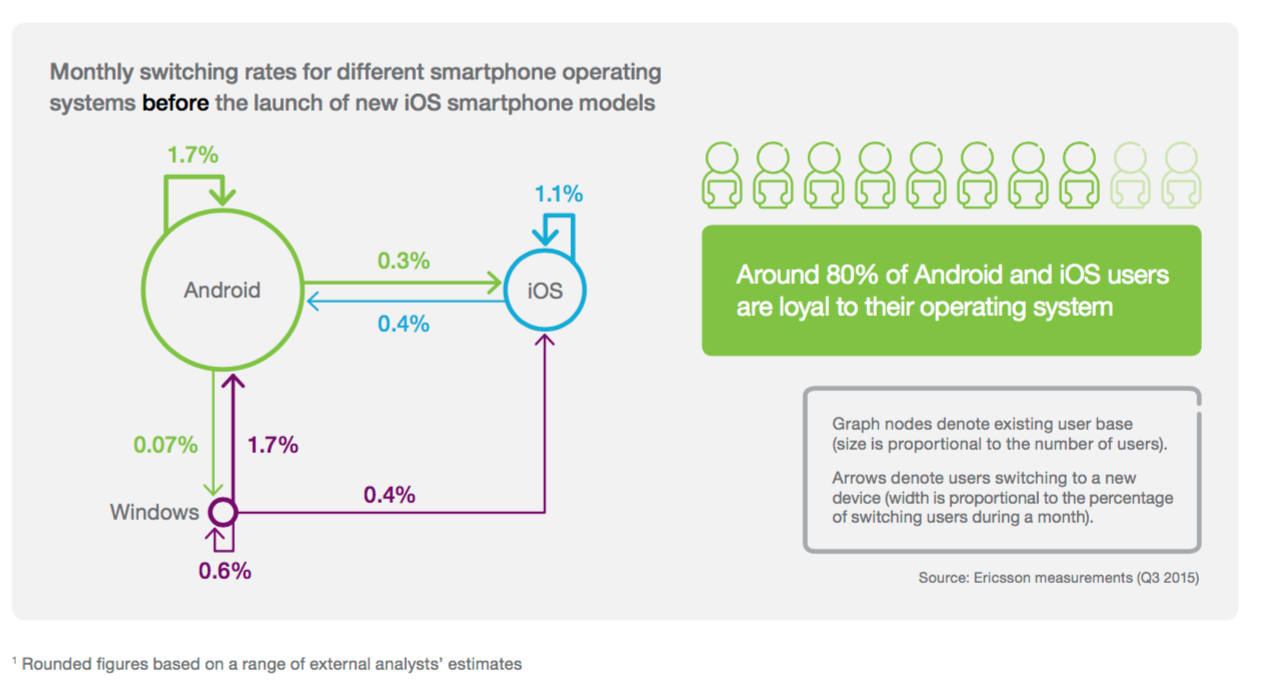
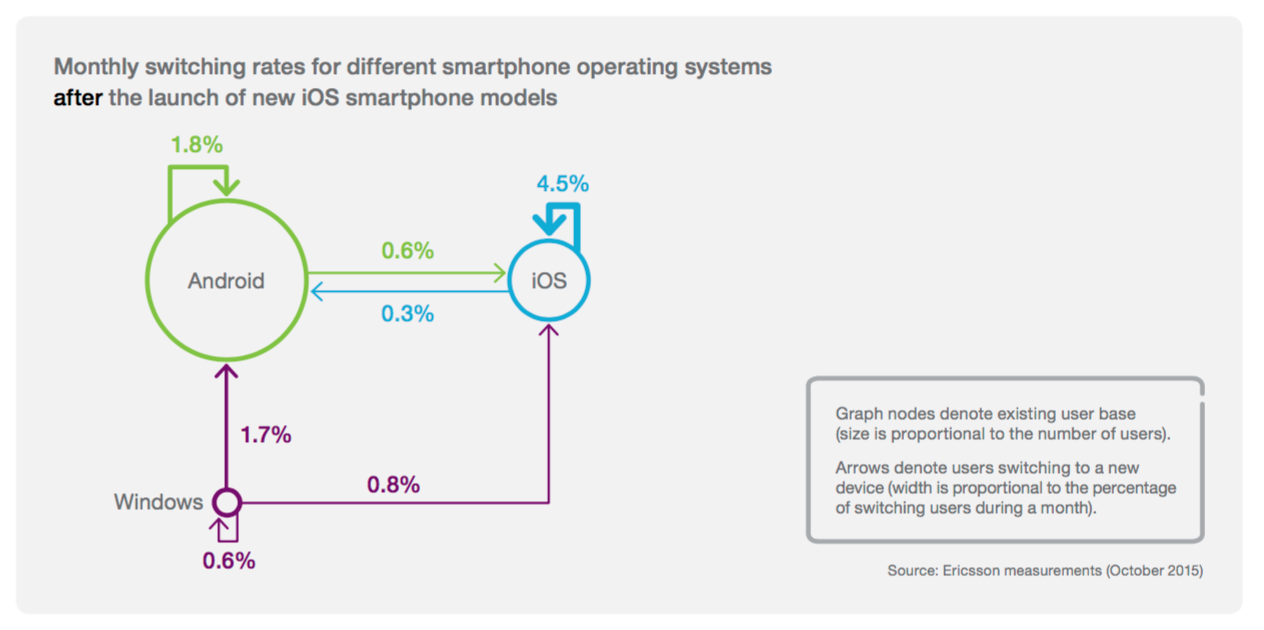
Now there’s a new switching study, embedded in Ericsson’s Mobility Report for Q3 2015. You have to scroll down a fair way to find it (it’s on page 28/9), but it’s summed up in two graphics, where it splits the movement between the three mobile ecosystems into a “before a new iPhone launch” and “after a new iPhone launch”. Here’s “before”:

Ericsson: switching behaviour before iPhone  launch

And “after”:

Ericsson: platform loyalty after iPhone launch

Note the caveat of where the data comes from:

“This analysis is based on measurements before and after the launch of new iOS smartphone models in a selected number of mature mobile broadband networks in Europe, Asia and North America. The study encompassed iOS, Android and Windows devices. Other operating systems like BlackBerry, Symbian and FirefoxOS had very low penetration in all measured networks and therefore were not included.”

“Mature markets” probably means the US, Canada, some or most of the “big five” in Europe (UK, Germany, France, Spain, Italy) and perhaps a couple of others, plus Japan, China and perhaps South Korea.

So those who want to disagree with this data will already be saying “bah, mature markets”.

The mature approach

That overlooks the fact though that all markets for a product eventually become mature markets. Ericsson is giving us a glimpse of the future.

What the data says is quite informative. A few quick takeaways:
• in a “before” month, 6.3% of people buy a new phone – though only 2.87% (45% of them) change platforms
• in an “after” month, 10.3% buy a new phone – with 3.4% (33%) of them changing platforms. (Nearly half of those buying a new phone are iPhone owners.)
• nobody, by this data, ever changes from an iPhone to Windows. Yes, yes, I know your second aunt’s cousin who works in IT did, but we’re talking here about scale – across millions of users. 0.01% of a million equates to 100 people. Apparently not even at that scale does this happen enough to register.
• on the 6.3% and 10.3% turnover rate, everyone replaces their phone somewhere between 10 and 16 months.
• Windows Phone users seem to be the busiest in buying phones.

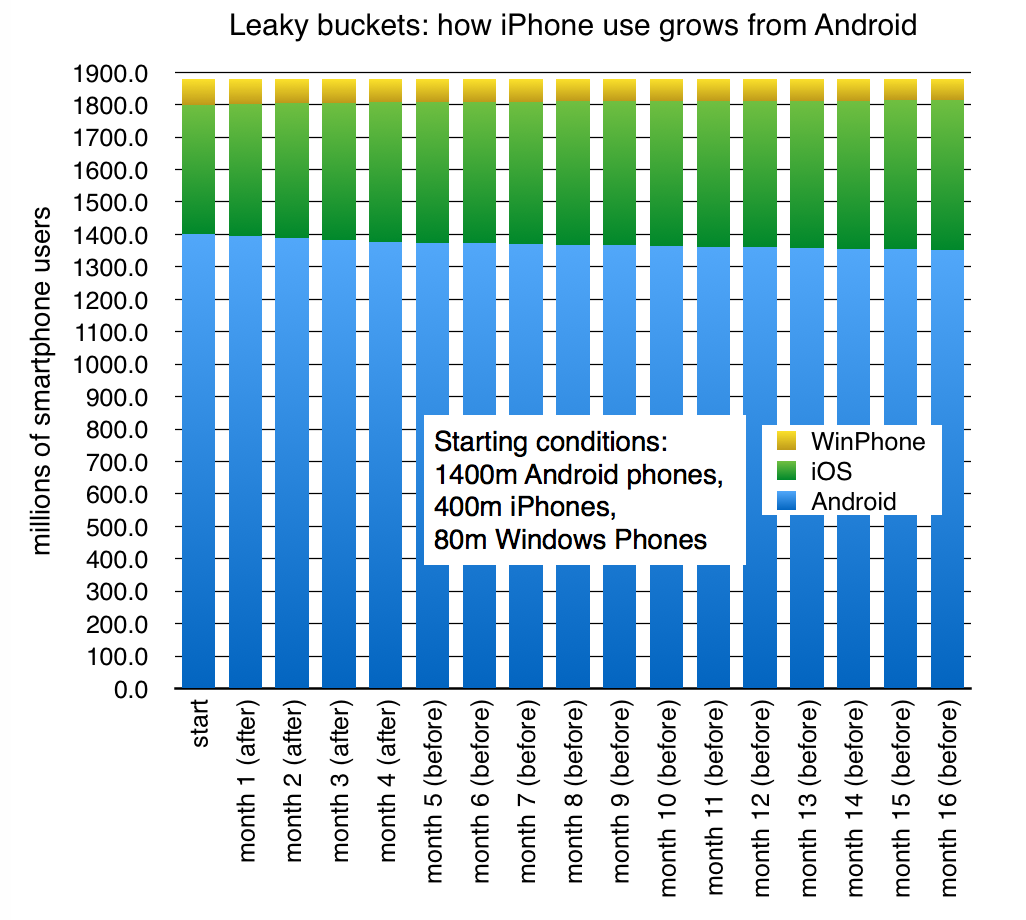
I thought it would be interesting to model how this changes the user base if it’s repeated over time. Note that Ericsson is suggesting it’s only a snapshot for a few weeks, and only for people who get a new phone and stay on the same carrier. (But the latter is true of most people.) If this is how things play out, perhaps we can learn something. So I put the data into a spreadsheet, and set up the algorithm to step through month by month according to the Ericsson platform change stats. So from 10,000 Android users, in a “before” month you’d get 30 going to iOS and 7 to Windows Phone (see the diagram above). And so on.

My spreadsheet is here. I used the 1.4bn figure for the Android base, 400m for the iPhone, and 80m for Windows Phone – about the total number of Lumias sold since their inception. (The extra 0.1 that appears over time is due to imprecision in the calculation – each “before” month adds 0.01 to the figure.)

The graph doesn’t show much perceptible change:

Modelling platform change from Ericsson data

Note that this assumes 15 months with only one iPhone launch.

Note that this is over 16 months, but with only one iPhone “launch” right at the start (whose effects then carry on for four months) – so you can see that the iPhone launch doesn’t make a big difference to the general trend.

Equally, you can also see that there isn’t a huge amount of movement. The iPhone chunk gets wider: in this example, with a four-month “after launch” period and eight-month “before launch” period, by the end of the 12th month
• the iPhone has gained 51.9m users
• Android has lost 40.1m
• Windows Phone has lost 11.8m.

In percentage terms, it’s pretty unimportant to Android – 2.9% loss – but big for iPhone (+13.0%) and bigger for Windows Phone (-14.8%).

If you change to a 12-month “before launch” year, the changes are -25.1m for Android (1.8% change), +31.1m for iPhone (+7.2%), and -5.9m for Windows Phone (8.2%).

You can quibble with the starting figures. Playing around with them, I found the following properties:
• the larger the initial figure for Android, the larger its final fall (obvious) but also the larger its percentage fall
• the larger the initial figure for iOS, the smaller the absolute and percentage growth
• iOS is the only platform to show overall growth on any combination of the “before launch”/”after launch” model.

The featurephone swamp

In which case, you might ask, howcome Android’s installed base is still growing? Simple: there’s still a huge base of featurephone owners who are being converted upwards to smartphones. They’re easy to overlook, but key to this dynamic.

For instance, in the Yankee Group study from August 2013 quoted above, the key mistake that it made in forecasting that iPhone use would overtake Android use by 2014 was to overlook the continuing source of new Android users – from featurephone owners moving to smartphones. In August 2013, there were 90m of them, according to ComScore; the latest figure, from September 2015, says there are still 56.2m of them (so 33.8m fewer).

In that period,
•the number of US iPhone users has grown from 59.0m to 84.3m (up 25.3m);
• the number of Android users has grown from 74.8m to 98.8m (up 24m).

There’s hardly a dramatic difference in growth between Android and the iPhone (contrary to what Forrester expected). You wonder where the other net users came from besides featurephones? The fall in BlackBerry users (5.8m to 2.3m). In the same period, Windows Phone users barely grew (4.6m to 5.5m). And there are 12m extra featurephone users in September 2015 compared to August 2013 making up the gap.

As for Windows Phone: if Ericsson’s numbers say it’s losing users, the obvious question is: how did it get to 80m (or so) users in the first place? The easy answer: Ericsson’s diagrams don’t show the pipeline bringing users into Windows Phone from featurephones – usually via the Lumia 5xx low-end range.

The eternal puzzle of iPhone growth

Even allowing for that, it’s notable that the ComScore data says that in the US iPhone users have grown more (both in percentage and sheer numbers) than Android users. Sure, home distortions and all that. But why is that the case in the other mature markets too? Why is iPhone ownership growing in other places, and why don’t they leave?

It’s this last point which befuddles and almost infuriates people. Why on earth, they say, do people buy iPhones, which only have a dual-core CPU with 2GB of RAM running at 1.8GHz and without an SD card slot, when for less money they can get an octacore phone running at 2.6GHz with 4GB of RAM, an SD card slot, removable battery and a QuadHD screen? You can hear the puzzlement in comments from people who can read a spec list, yet can’t see why the inertial scroll on the iPhone is a more pleasing experience than the rolling velcro on even top-end Android phones. (I keep going and checking the scrolling on each new Android phone. Still isn’t smooth. Clearly 2012’s Project Butter still needs to be supplanted by Project Ghee.)

There’s more than that, though. I don’t think anyone buys an iPhone by accident. I don’t think people walk into a store not intending to buy an iPhone and then find themselves surprised to be holding one as they walk out.

Whereas choosing between Android phones can be like a beauty contest of clones. You put various models of Samsung phone against LG phones against the slightly harder edges of the Sony against the iPhone-alikeness of the HTC models, and you try to pick. How do you choose? Probably on some subtle mixture of the price tag, tickboxes and comparative sizes of numbers on the spec list and.. that’s probably about it.

You can argue (and oh my giddy aunt people do) about why people buy iPhones. I’d say there’s clearly a perception among those who do that they’re getting something premium. The price tag alone suggests that.

That isn’t enough however to keep people on a platform if the experience didn’t also work for them. Do some people migrate from Android to iPhone, and then migrate back? Undoubtedly. But the data suggests most who make the shift don’t.

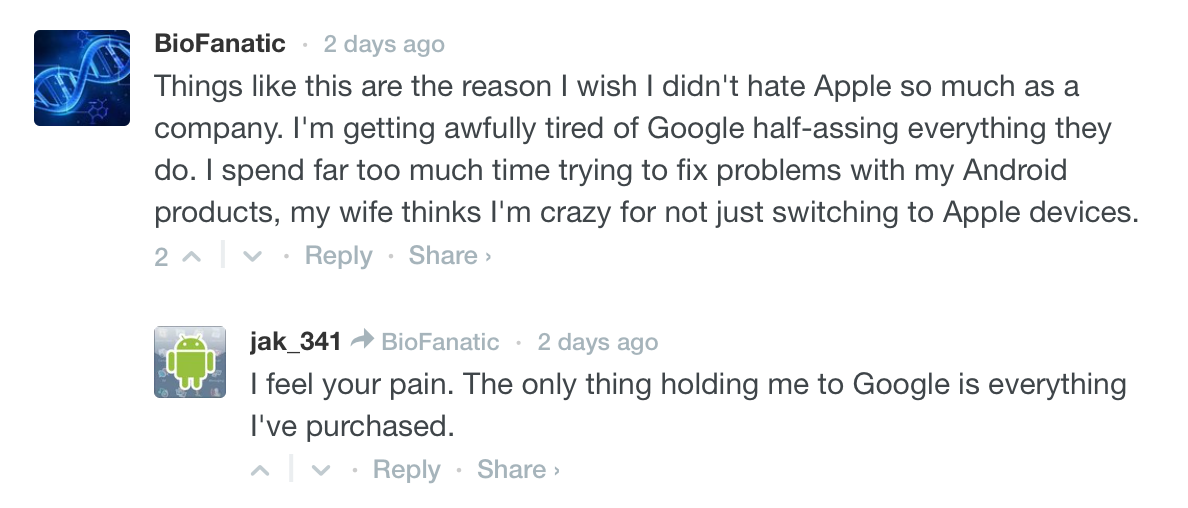
Is your argument that people get “locked in to the Apple ecosystem”? Perhaps. But it’s not just on iOS, as this comment from an article about Android Wear demonstrates:

Comment on Android Wear

Note the nose-spiting-face nature of the first one..

On that basis, people should be just as reluctant to move to iOS as away from it. Again, the evidence disagrees.

I think there’s a frustration factor driving some movement too; I watched the friend of a relative struggle to get the maps on her Sony phone work recently. First to find the apps, then to find the maps app, then to get any sensible input, then to get sensible output. (Since you ask, she’s one of the country’s leading barristers.)

I couldn’t help but wonder if she would have found it simpler to have a Maps icon front and centre. Apple’s reputation for simplicity is actually a selling point for such users, even if it isn’t for the gigahertz-SD-RAM-removable battery crowd.

Feeling it

Conveniently, just as I was writing this piece, Ben Thompson wrote a piece on Stratechery about “Selling feelings“, with this notable point:

how silly must you be to carry a $5,000 handbag with far less functionality than another a fraction of the price, or wear a $10,000 watch or $200 necktie? What about flying first class or staying in a five-star hotel — you can’t take either with you! It’s completely irrational.

Or, rather, it’s irrational if you only look at features. The entire point is how these purchases make you feel, and it’s that feeling, whether it be an appreciation for craftsmanship, status, or simply being pampered, that provides the sort of differentiation that makes all of these products profitable. One could argue that an insistence on limiting the calculation of value to items that are permanent, physical, and easily listed on a spreadsheet is the real irrationality.

There’s no shortage of that latter group who’ll tell you that the iPhone is rubbish. Meanwhile, continuing evidence from a growing number of studies says that over time, the iPhone base continues to grow. The question is, once the swamp of featurephone users is drained, what happens over the longer term?

Android Wear downloads: a more nuanced (and slightly higher) estimate


Android Wear doesn’t seem to have set consumers’ hearts racing. Photo by pestoverde on Flickr.

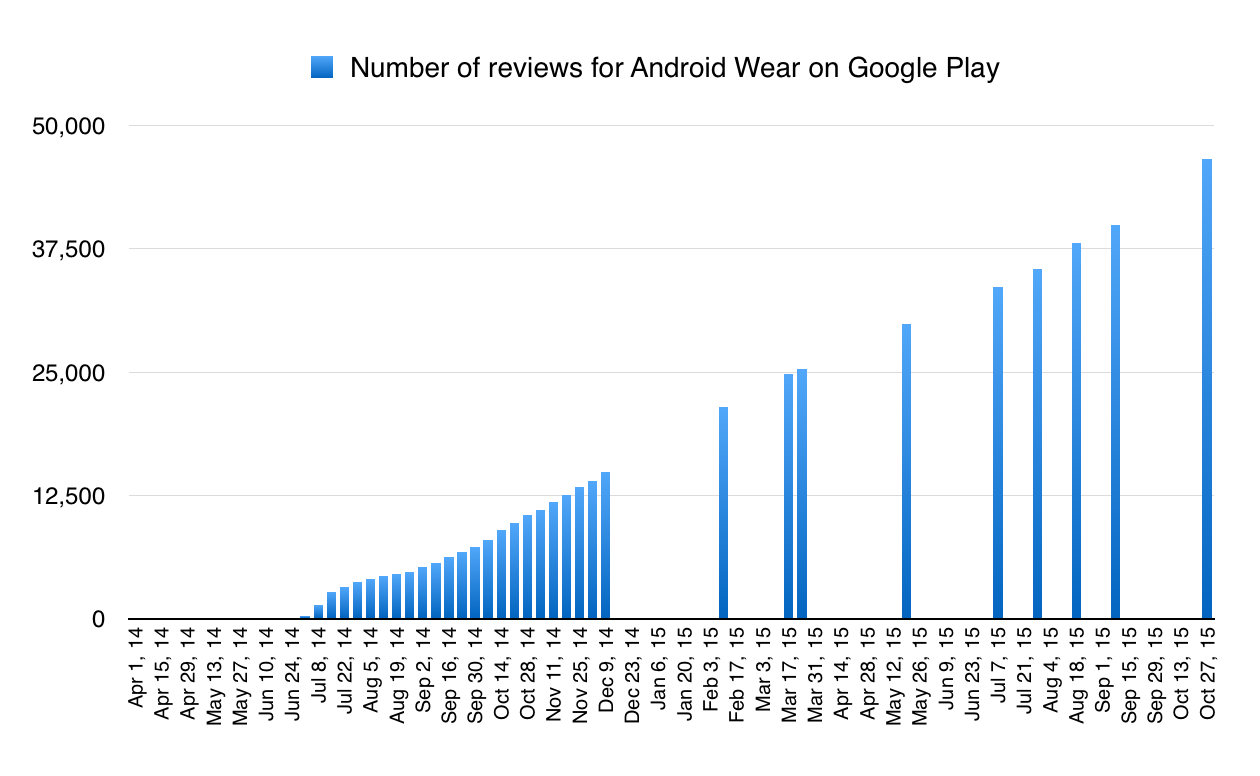
In my estimate last week of the number of Android Wear downloads, and hence actual “sell-through” (as it’s called), I used the number of reviews left on the Android Wear app page and drew a straight-line extrapolation from that, and from various known waypoints, to get my estimate for the number in use – which was about 1.9m, up from 0.7m in February 2015.

Among the provisos, though, was this one:

My previous estimate worked on the basis that the number of comments was proportional to the number of downloads. I don’t see any reason to change that assumption.

Oh, behave

Having said that, I’ve thought a bit more about likely consumer behaviour, as well as what the data actually shows us.

We know that as more people get to use something, the number who actually comment on/review it falls – it’s just human nature that early adopters are the most likely to be vociferous, whereas those who follow are less troubled about it. After all, who wants to be the 1,900th commenter below an article?

So I took a look at the number of comments* per download, for the waypoints where we know the number of downloads for sure. We know those waypoints because the Google Play figure abruptly goes from saying, for example, “number of downloads: between 10,000 and 50,000” to “between 50,000 and 100,000”. Obviously the 50,000 download point has been crossed between those two points. (* “comments” not “reviews” because they’re not necessarily reviews; you can make them without having downloaded the app.)

So I marked those points, and the number of comments at those points, and tried to find the best fit curve. I get this:

Android Wear: downloads per comment (est)

The data seem to suggest that the number of downloads required to generate a new comment grows over time; currently we’re at the black mark.

(That’s an R-squared of 0.89, using a logarithmic fit; it’s the best value of R-squared I could get out of trying a linear, logarithmic, polynomial, power and exponential fit.)

What this is telling us is that to begin with, you get lots of reviews/comments for every download. Right at the start, there was a comment for more than one in every seven downloads. By 100,000 downloads there are 4,032 comments, which means by then, on average, every 24.8 downloads someone had left a comment.

But by the time you get to 500,000 downloads, there are 14,981 comments – so on average it has taken 33 downloads to get each comment. By the time you get to a million downloads, the average has fallen to 44 downloads per comment.

A certain ratio

This is the sort of behaviour we’d expect: early on, lots of people are mad keen to give feedback on their experience; and then it tails off, until we’re dealing with a gradually falling ratio as the numbers of downloads head into the multiple millions.

Fitting this to that curve (which is the only data we’ve got, absent sales figures or numbers from Google) tells us that we’re currently at about 57.5 downloads per comment overall – that is, over the whole time Android Wear has been going, on average you get a comment every 57.5 downloads.

And how many comments are there? Currently, 47,620 (with the average review score just dipping under 4.0). How many downloads is that, and hence how many sell-throughs? Pretty simple:

47,620 comments * 57.5 downloads per comment = 2.74m Android Wear downloads.

This is quite a bit bigger – 44% more – than my previous estimate of 1.9m Android Wear users. There are (as always) potentially confounding factors, which would tend to reduce the actual number:

1) some people may have left more than one comment/review.
2) you can leave a comment/review without having actually downloaded the app
3) the number of comments added per week is quite variable – as below:

Rate of addition of comments varies, a lot

Sometimes you get a lot of comments on Android Wear – and sometimes you don’t. Does that match downloads? Hard to say.

This is possibly prompted by the release of new versions: a number of people commented on 9/10 November about the new version and its removal of battery stats. That’s going to bump up the apparent number of “downloads” while the actual number in use is no different.

On the whole, I feel comfortable suggesting that the correct number probably lies somewhere between these two – the straight-line extrapolation and the “reducing comment” number. In other words, somewhere between 1.9m and 2.74m. (The midpoint is 2.32m.)

Quite probably the only way to be sure will be to watch the Android Wear page and spot when it crosses the 5m download mark. Is it going to be before the end of this year, though?

Only maybe, at least if we go by IDC’s forecast for how many Android Wear devices will be shipped this year. In a press release in September, IDC reckoned that there would be 4.1m shipments of Android Wear devices in 2015. That would take the total activations by the end of 2015 to 4.7m, as at the start of the year it was around 0.6m (it passed 1m activated in late February, by my data). As long, that is, as those shipments are actually bought by people, rather than sitting on shelves.

Comparing that to my estimates for the number activated so far this year – a low of 1.3m (1.9m – 0.6m), and high of 2.1m (2.74 – 0.6m) – we’re left with somewhere between 2.8m (4.7m – 1.9m) and 1.96m (4.7m – 2.74m) to be shipped, sold and activated in the next couple of months around Christmas if IDC’s target is to be met (and if my estimates are correct). So, the week following Boxing Day could be fun.

Low, high, in between

There are some other numbers: Strategy Analytics says that in the second quarter, Android Wear shipments were just 0.6m units; for the third quarter, it says that Samsung shipped 0.6m and “Others” (including Pebble) 1.0m. We don’t know how many of the Samsung ones were running Tizen, and how many Android Wear; nor how many Pebbles were shipped. If we ignore that, we get 1.6m Android Wear shipped in the third quarter; 2.2m since March (when the 1m download point was passed). If they’re all in use, there might be 3.2m running.

Even with the high estimate, it begins to look like maybe this is going to be one of those spaces where Apple shows how the category should look, and grabs the majority of sales and profit – as it did with the iPod and iPad. Because Strategy Analytics reckons that in the third quarter alone, Apple shipped 4.5m units – more than Android Wear has all year.

Start up: how self-driving cars will change life, why *is* http on port 80?, iPad Pro reviewed, and more


Creating a more beautiful subway map for Tokyo wasn’t easy. Photo by aka.me on Flickr.

You can now sign up to receive each day’s Start Up post by email. You’ll need to click a confirmation link, so no spam.

A selection of 9 links for you. Smoosh them. I’m charlesarthur on Twitter. Observations and links welcome.

How Uber’s autonomous cars will destroy 10 million jobs and reshape the economy by 2025 » Zack Kanter

Industry experts think that consumers will be slow to purchase autonomous cars – while this may be true, it is a mistake to assume that this will impede the transition. Morgan Stanley’s research shows that cars are driven just 4% of the time, which is an astonishing waste considering that the average cost of car ownership is nearly $9,000 per year. Next to a house, an automobile is the second most expensive asset that most people will ever buy – it is no surprise that ride sharing services like Uber and car sharing services like Zipcar are quickly gaining popularity as an alternative to car ownership. It is now more economical to use a ride sharing service if you live in a city and drive less than 10,000 miles per year. The impact on private car ownership is enormous: a UC-Berkeley study showed that vehicle ownership among car sharing users was cut in half. The car purchasers of the future will not be you and me – cars will be purchased and operated by ride sharing and car sharing companies.

And current research confirms that we would be eager to use autonomous cars if they were available. A full 60% of US adults surveyed stated that they would ride in an autonomous car, and nearly 32% said they would not continue to drive once an autonomous car was available instead.

Today’s children are the last generation that will have to pass a driving test. Think about that briefly. Then read the rest of Kanter’s piece. (It’s actually optimistic, overall.) And one more thing: it doesn’t have to be about Uber.
link to this extract


Fantastical designs from the frontier of subway maps » Washington Post

For many designers, creating a better subway map is an irresistible puzzle — “infinitely alterable, incredibly vexing, with no definitive answer,” writes Emily Badger. Badger’s new article looks at some amazing examples of metro maps from the frontier of design, including the beautiful 2010 diagram of all of the rails in the Tokyo region, designed by Kim Ji-hwan.

link to this extract


Rooted, Trojan-infected Android tablets sold on Amazon » Help-Net Security

Zeljka Zorz:

If you want to buy a cheap Android-powered tablet, and you’re searching for it on Amazon, the best thing you can do is carefully read all the negative reviews you can find. If you are lucky, you’ll see some that will warn you about the device being rooted and coming pre-installed with malware.

Security researchers from Cheetah Mobile have recently discovered a slew of these devices – over 30 tablet brands in total – being sold on Amazon and other reputable online stores.

Here’s a short overview of affected devices, along with a sample of reviews warning about the malware.

The malware in question is the Cloudsota Trojan, which allows remote control of the infected devices and conducts malicious activities without user consent.

Remember, a Trojan is for life, not just for Christmas. Estimated that over 17,000 have been sold.
link to this extract


The case against a Google phone » The Information

Amir Efrati on the rumours that Google is looking to design its own phone chips:

the ecosystem of partners that build and sell Android phones has matured to some extent; those companies have 1.4bn customers (there’s one third as many iPhones in customer’s hands, by contrast). While many of those customers aren’t necessarily loyal, and surprising upstarts are gaining ground, Google won’t be able to suddenly capture a significant amount of market share with a better device, at their expense. (It would also risk its chance to return to China, given that it is working with local handset brands to do so.) There is no going back.

Even if Google wanted to compete on price by offering devices cheaper than the iPhone, it would still have to engineer a marketing apparatus so impressive that it convinces smartphones buyers that the Google phone is the best in the world. That’s the only way it could convert iPhone and even some Samsung Galaxy S users — who are wealthier than typical Android users — to the Google phone. Good luck with that.

Then there’s the fact that prices for phones have come down so much as components become cheaper that it’s become exceedingly difficult for existing Android phone brands to stand out in the market.

Even if the Google phone struck a chord, it’s hard to see it selling more than tens of millions of devices in the next few years, and that’s optimistic.

I can believe that Google is interested in designing ARM architecture chips. But I think it’s more likely considering them for its server farms. People inside Google already know Efrati’s argument (which holds water). Sundar Pichai is hardly the sort to hang on to an idea for pride. He killed Google+, remember?
link to this extract


Ad Replacer: turn spammy ads into breaking news

We take those terrible, misleading ads that take you to garbage websites (or worse!) and switch them out for real-time, human-curated headlines and links from ONLY the most trusted, reliable websites.

Sites that never end in best-deals-4-everyone.ru. Sites that never pop up 8 windows asking if you’re SURE you want to click away. Just sites you like and stories you want to read, all seamlessly integrated into your browsing experience before you even notice it’s changed. Doesn’t that sound nice?

Neat idea; Chrome extension only for now.
link to this extract


Facebook Messenger adds facial recognition » Tech Insider

Alex Heath:

Adding facial recognition to Messenger may seem odd given that it’s primarily considered to be a messaging app, but when you consider that people send a staggering 9.5 billion photos through Messenger every month, the decision begins to make more sense.

Messenger is very proactive in prompting to share a photo with friends it thinks are in a photo — the app will send a notification asking you to send a photo to people on Facebook it thinks are tagged. (This specific behavior can be turned off in the Messenger app’s settings.)

Australia only for now, but your feeling on whether this is creepy or great will probably depend on age. Note though that it’s machine learning/AI being deployed as utterly normal; even five years ago this would have been hard to implement on such scale.
link to this extract


iPad Pro review: jack of all trades, master of most » WSJ

Joanna Stern:

On paper, 12.9 inches may not seem much bigger than the standard iPad’s 9.7 inches, but the Pro screen made me more productive. I spent much of my week writing in Microsoft Word on the left hand of the screen and toggling between websites and my inbox on the right. Text looks incredibly crisp, especially in comparison with my MacBook Air’s display, which has just half the pixels.

The A9X processor and 4GB of RAM kept those apps running swiftly. But most impressive? When I exported the same 4K video in iMovie on both the Pro and my Intel Core i5-powered MacBook Air with 8GB of RAM, the iPad reached the finish line a minute and a half faster. And, unlike the Air, it didn’t sound like it was about to blast off from Cape Canaveral.

For real work, it’s all about attaching Apple’s $170 Smart Keyboard. You don’t do this via Bluetooth, but rather with the new magnetic Smart Connector. I quickly fell in love with the feel of the bouncy fabric keys, and it became second nature to hit Command+Tab to toggle between apps. Oh, and did I mention the keyboard is spill-proof? Seriously, my iced latte just wiped right off.

Still, many times I wished for something closer to Microsoft’s Surface Type Cover. Apple’s keyboard only props the screen at a 120-degree angle; attaching it and folding it take origami skill. It all almost toppled off my lap a few times, and the keys aren’t backlit. Plus, there’s no trackpad, like the Type Cover’s. I constantly had to reach out and touch the screen to scroll or select text and icons…

…Despite iOS 9’s improved multitasking, there are still shortcomings. You can’t customize the home screen’s comically large icons with files or other shortcuts. You can’t place the same app—say two Safari windows—side by side. And iOS’s lack of real file management can be maddening. Microsoft saddles its Surface Pro with full-blown desktop Windows while the iPad Pro is still too closely related to an iPhone. Apple has to keep working to find the happy middle.

Pricey. But here’s the kicker:

There’s one thing the iPad has over all other laptops and competing tablets though: incredible apps. The Pro helped me realize that I’ve been living in the past, using legacy desktop programs to accomplish things.

link to this extract


Why was 80 chosen as the default HTTP port and 443 as the default HTTPS port? » How To Geek

According to superuser jcbermu:

The Internet Assigned Numbers Authority (IANA) is a department of ICANN, a non-profit private corporation that oversees global IP address allocation, the Domain Name System (DNS), well-known ports, and other Internet Protocol-related symbols and numbers.

During March of 1990, they published a document (RFC 1060) where they listed all the well-known ports at that time. In that list there was no protocol assigned to port 80 (it jumped from 79 to 81). 79 was assigned to “finger” (find out if someone was online) and 81 to HOSTS2-NS, the HOSTS2 Name Server.

At that time, port 80 was officially free. In 1991, Tim Berners-Lee issued the first version of HTTP in a document (HTTP 0.9) where he stated “If the port number is not specified, 80 is always assumed for HTTP.”

HTTPS? Lost in time. Blamed on someone at NCSA Mosaic. So there’s your pub quiz question/answer pair.
link to this extract


Apple Music » Android Apps on Google Play

It arrived as an app on Android, as version 0.9.0:

Introducing the beta of Apple Music on Android.
Notes about the beta period:
• Music videos are coming soon.
• Family membership sign-ups and upgrades require Mac or iOS.
• Sign-up process to be optimized for Android.

Notable that it hasn’t attracted the hate reviews that the “Move to iOS” app did; there are actually a lot of five-star reviews. (Average 3.1.) The key element looks like the “family membership” element; that’s a really powerful reason for Apple to want to reach Android users – because families are mixed users.
link to this extract


Errata, corrigenda and ai no corrida:

Start up: Surface Book review, Google v EC redux, where are the iPad Pro apps?, after Google Flu, and more


Is this a perfect app signup? Photo by kastner on Flickr.

You can now sign up to receive each day’s Start Up post by email. You’ll need to click a confirmation link, so no spam.

A selection of 10 links for you. Aren’t they pretty? I’m charlesarthur on Twitter. Observations and links welcome.

Final words – the Microsoft Surface Book review » Anandtech

Brett Howse likes it a lot. Apart from the lack of ports. And also..

The other issue with the hardware is one that plagues all 2-in-1 devices which offer a detachable display. Because the display has to house all of the PC components it gets heavy. The Surface Book display/Clipboard is 1.6 lbs (726 grams) and all of this weight is out over the hinge. The Surface Book does better than any other detachable convertible device for balance, but at the end of the day it is still more top heavy than a traditional notebook. On a desk it’s not going to be an issue, but if you do have to type in your lap, depending on the seating arrangement, it may want to tip backwards. This is compounded by the feet on the bottom not having a lot of grip. The Surface Book’s display travel is also limited to prevent it from tipping over, although it does open far enough that it should not be an issue for almost any situation.

The hardware is overall very good. Where the Surface Book is let down though is on software. It’s kind of ironic that the hardware is well done but the software can’t keep up when you consider Microsoft is first and foremost a software company, and one that has only been in the PC market for a couple of years at that. But there have been a lot of issues with software. When the Surface Book first launched, it suffered from display driver crashes along with hue changes and flickering on the screen when doing certain tasks. Luckily these issues seem to have been corrected with a firmware update issues on November 2nd. But there are still outstanding issues. The fact that you can’t close the lid and expect the laptop to actually go to sleep is a terrible bug. Leaving the Surface Book unplugged but sleeping is going to result in a dead battery. Just yesterday, I closed the lid on the Surface Book, only to notice the fans had kicked in and it was very hot.

I find the coexistence of a laptop that can turn into a tablet (Surface Book) and a tablet that can turn into a laptop (Surface Pro) suggestive of a “let’s turn this ship around any way we can” approach. Also, the Surface Book sure is pricey.

link to this extract


Google faces new round of EU probing over Android mapping apps » Bloomberg Business

Aoife White:

Google faces a fresh round of European Union questions about its Android operating system for mobile devices as regulators quizzed rivals and customers over applications for maps, e-mail and other services.

The EU wants to know whether Google Maps for phones has supplanted portable or in-car navigation devices, such as those produced by TomTom NV and the HERE unit of Nokia Oyj, according to a document sent to companies and seen by Bloomberg.

Officials are also seeking data, such as user numbers, about downloaded or pre-installed mapping apps on devices, as well as costs mapmakers face to produce a mobile-ready app.

Wonder how long that one will take to reach any decision. 2017? 2018?
link to this extract


Google EU antitrust response argues Amazon, eBay robust competitors » Re/code

Mark Bergen, who has seen a redacted copy of Google’s response to the EC:

Google points to the number of online price aggregators — sites that collate retail prices elsewhere on the Internet — born in Europe: 180 between 2008 and 2014. The EU’s charge sheet, or statement of objections (SO), “focuses on a handful of aggregators that lost free Google traffic, but ignores many that gained traffic,” Google’s lawyers wrote. Google says it drove 20bn “free clicks” to these aggregators in Europe over the past decade.

More critical to Google’s defense is the argument that online marketplaces, like eBay and Amazon, should be considered peers to Google’s shopping service, a position at odds with the EU, which charges that these merchants are “irrelevant” when it comes to price comparisons. Google’s lawyers claim, using internal data, that Web visitors prefer merchant links over aggregators and go directly to Amazon for product searches. (They do.) Google also argues that these giant merchants consider the smaller price aggregators as rivals as well — in the response, Google cites Amazon SEC filings where the e-commerce company lists “comparison shopping websites” and “Web search engines” as competitors. Ergo, Google contends, the EU should see them that way too.

And echoing the company’s internal note to the charges in April, Google spells out how Amazon and eBay are far more dominant as online retailers in Europe than Google’s service.

Pretty much all these points of Google’s were rebutted thoroughly by Foundem (a price aggregation service which complained to the EC) in June.
link to this extract


Where are Apple’s iPad Pro apps for pros? » Lou Miranda

There’s a big gap in Apple’s pro app lineup, with Aperture being retired along with iPhoto. iPhoto’s replacement is the Photos app, but there is no Aperture replacement yet. What better device to introduce a Photos Pro app than a giant-screened iPad Pro with a pressure sensitive Pencil?

Likewise with Final Cut Pro X. There’s no reason to make it iPad Pro-only, but it would certainly shine on an iPad Pro. This is similar to Macs: sure you can run Photoshop or FCP X on a MacBook Air, but they really shine on a MacBook Pro or Mac Pro. I discussed this at length in my post “There’s No Such Thing as an iPad App“.

So why would Apple release an iPad Pro without its own pro apps?

My feeling is that the iPad Pro is much like Apple TV: the hardware was ready before the software, and Apple is soft-pedaling both, mostly to developers and early adopters. (You could argue Apple does this with every new device, and I wouldn’t argue with you.)

link to this extract


AI will reorganize the human population » Medium

Silver Keskkula, who is working on the “Teleport” app which aims to find the best place for you to live:

Matching people to locations is hard — there are more things to account for than might be feasible to code into a human understandable model. Although today we’ve managed to keep things simple and are missing a purely machine learning driven parameter from our search, I’m more than convinced that in the very near future we will need to resort to AI to help guide people’s search into where to live (our first tests are quite encouraging).

All and all we’re all just inefficient computational machines running on wetware and largely biased by evolutionary adaptations more suited to the hunter-gatherer era, so getting AI involved in our next wave of migrations might not be such a bad thing.

link to this extract


This is how you design your mobile app for maximum growth » First Round Review

[Primer CEO] Kamo Asatryan may very well be one of the best kept secrets in the startup ecosystem. He’s one of a small handful of people who have observed hundreds of mobile apps, thought deeply and scientifically about their mechanics, and determined what they could change to grow faster.

To demonstrate his particular brand of magic: Asatryan’s team recently worked with an app that required users to swipe through four screens explaining the product in-depth before they could sign up. Then the permissions screen literally begged them to let the app access their location data. 60% said no and went on to a dead-end experience.

To turn things around, Asatryan tested a radically different approach: assume that users who installed the app already understood the need to provide their location data. This allowed them to axe the long-winded welcome flow and make the permissions request the second screen. The text was changed to say that users needed to “Enable Location Permissions” (making it clear that it would be for their benefit), and they were literally not able to move on from the screen without saying yes. This sounds risky, but after the shift, 95% of users said yes and went on to a much better product experience.

This is a long article, but every single element of it will be useful if you’re in any way involved in designing or critiquing mobile app design. Today’s must-read. (Via Dave Verwer’s iOS Dev Weekly.)
link to this extract


New flu tracker uses Google search data better than Google » Ars Technica

Beth Mole:

With big data comes big noise. Google learned this lesson the hard way with its now kaput Google Flu Trends. The online tracker, which used Internet search data to predict real-life flu outbreaks, emerged amid fanfare in 2008. Then it met a quiet death this August after repeatedly coughing up bad estimates.

But big Internet data isn’t out of the disease tracking scene yet.

With hubris firmly in check, a team of Harvard researchers have come up with a way to tame the unruly data, combine it with other data sets, and continually calibrate it to track flu outbreaks with less error. Their new model, published Monday in the Proceedings of the National Academy of Sciences, out-performs Google Flu Trends and other models with at least double the accuracy. If the model holds up in coming flu seasons, it could reinstate some optimism in using big data to monitor disease and herald a wave of more accurate second-generation models.

I wrote about the failure of Google Flu Trends in March 2014; in 2008 it had claimed 90% correlation. Google said then it would “welcome feedback”. The old data is still available.
link to this extract


TLC NAND SSDs: The crippling problem storage makers don’t advertise » PCWorld

Jon Jacobi:

With last week’s release of Crucial’s BX200 SSD, a drive that features TLC (triple-level cell) NAND, it’s time to shine a light on this burgeoning segment of the SSD market—especially as vendors happily quote numbers that would have you believe that these SSDs perform just like any other.

Most of the time TLC SSDs perform quite well. But copy a large amount of data to a TLC drive, and part way through the operation you’ll see something discomforting—a startling drop in write speed. With some drives it’s relatively mild, but in the case of many recent TLC drives, the drop is so drastic you’ll wonder if the SSD is dying. It’s not, but you may wish it was.  

While this is true, it turns out you’ll only hit the problem if you’re transferring more data than fits in the disk cache – which could be 3GB or more. Still, a subtle gotcha.
link to this extract


Microsoft CEO Satya Nadella shows ‘iPhone Pro,’ reveals how much time he spends on email » IB Times

David Gilbert:

Speaking at the company’s Future Decoded conference in London on Tuesday, Nadella, who took the reins at Microsoft over 18 months ago, demonstrated the power of Windows 10 and gave us a glimpse into what he does and how he works on a day-to-day basis.

Using Delve — an Office 365 app which automatically tracks a user’s activities throughout the week by monitoring calendars, emails and the other productivity tools — Nadella showed the audience that last week he spent a total of 16 hours in meetings, well within his goal of under 20 hours per week.

Nadella failed to meet his goal of spending less than nine hours per week on emails, clocking up 9.6 hours in the past seven days. He also fell short on the time he wanted to spend focusing – which he described simply as “time for work.” Nadella considered himself “focused” for only two hours last week, just half of his assigned goal.

Notice how he didn’t show us what devices – and in particular phone – he uses. (Sure, it will be a Lumia, but which?) The “iPhone Pro” is just an iPhone loaded with Microsoft software. Puzzled by how a machine measures your “focus hours”. How does it know?
link to this extract


No Comcast app on the new Apple TV » Tech Insider

Tim Stenovec:

Marcien Jenckes, the executive vice president of consumer services for Comcast Cable, told Tech Insider in an interview last week that Comcast isn’t working on an app for the new Apple TV.

“We’re not philosophically against it,” Jenckes said of developing an app for the new device. “We just haven’t seen the need to run out and do that, given the fact that we’re already delivering content to the TVs in a way that has our customers already satisfied.”

If American customers were that satisfied, they wouldn’t be buying set-top boxes and TV sticks by the million.
link to this extract


Errata, corrigenda and ai no corrida: none reported.

Start up: yet another UK broadband pledge, what is mobile?, hacking Samsung’s theft protection, and more


A Huawei-made Nexus 6P: no breakage of the camera visor panel here. Photo by TechStage on Flickr.

You can now sign up to receive each day’s Start Up post by email. You’ll need to click a confirmation link, so no spam.

A selection of 12 links for you. Use them wisely. I’m charlesarthur on Twitter. Observations and links welcome.

Fast broadband for all by 2020 pledged by David Cameron » BBC News

All UK homes and businesses will have access to “fast broadband” [of at least 10 megabits per second] by 2020, David Cameron has pledged.

The PM is to introduce a “universal service obligation” (USO) for broadband, giving the public a legal right to request an “affordable” connection.

It would put broadband on a similar footing to other basic services such as water and electricity.
In 2010, the coalition government promised the UK would have the best superfast broadband in Europe by 2015.

Then, in 2012, a pledge was made by then-Culture Secretary Jeremy Hunt that the UK would have “the fastest broadband of any major European country” by 2015.

He defined high-speed broadband as offering a download speed of greater than 24 megabits per second (Mbps). Communications regulator Ofcom defines it as 30Mbps.

That final sentence completely shows how weak this “pledge” really is: from 30Mpbs down to 24 down to 10. I suspect BT, as the dominant operator which also now owns a 4G network, will aim to fulfil this revised USO via 4G.
link to this extract


Some Nexus 6P owners are reporting spontaneously broken rear glass panels » Android Police

Michael Crider:

The early reaction to the Nexus 6P from both critics and owners has been mostly positive, but a few new owners seem to be encountering serious problems. Specifically, the glass panel on the rear of the phone, which covers the camera, LED flash, and laser autofocus module, is reportedly cracking and breaking on its own. A user on the Android subreddit reported the rear panel cracking, and at least two others have reported similar results, with the panel splitting into multiple cracks with no particular rough handling or impact.

That subreddit is getting pretty big, and there isn’t a lot of joy for the 6P. One person has had two in a row go wrong. Problem for Huawei?
link to this extract


How uBeam transmits energy wirelessly using ultrasound » uBeam

Meredith Perry, uBeam’s founder, has a big explainer about how it works, because people have been saying that either it doesn’t work, or it’s dangerous:

The uBeam system is composed of two parts: a transmitter that emits energy, and a receiver that receives energy. The transmitter is like a sound speaker, but instead of emitting audible sound, uBeam’s transmitter emits high frequency sound. This sound can’t be heard by humans or dogs; it’s called ultrasound. The receiver, like a microphone, picks up the sound and converts it into usable energy. Sound, like light and wind, is a form of energy that can be converted into electrical energy with our proprietary energy harvesting technology. The receiver then sends this electrical power to charge or power an electronic device.

link to this extract


Mobile, ecosystems and the death of PCs » Benedict Evans

Evans wrestles with the question of “what is ‘mobile’?” in the face of competing devices like the SurfaceBook, the Surface Pro, iPad Pro and so on:

Each generation of technology goes through an S-curve of development – slow improvement of an impractical product, then explosively fast improvement once fundamental barriers are solved, and then slowing iteration and refinement as you solve every last issue and the curve flattens out. PCs are on that flattening part of the curve, just as the [fastest ever piston-powered aircraft developed at the end of WW2, soon surpassed by jets, the Republic] Rainbow was.

They get perfect because you’re debugging the big things you invented in the past, and now your innovation is in the extra little things (such as the Rainbow using exhaust for extra thrust), and there are no big new innovations to debug. But meanwhile, the new ecosystem is catching up, and the curve of development and innovation for that generation will flatten out way out of reach. The new curve is crossing the old one. This is why they look simliar – this is why a Surface Pro and an iPad Pro look similar. They both exist right at the point that those development curves cross. The iPad might still be a little below, but its curve is heading up.

That is, the point that you can start to do old ecosystem things on what look like new ecosystem devices is also the point that the new ecosystem can do those things too – but the new ecosystem has 10x the scale, and the new ecosystem is just starting down the innovation track where the old one is at its end.

The really tricky part is knowing where on the S-curve something is, and whether there’s still money to be made from it. As Evans points out,

No-one is going to found a new company to make Win32 applications (though enterprise Windows apps will be worked on for a long time, just as mainframe apps were [after the IBM PC arrived]).

link to this extract


It’s incredibly easy to bypass Factory Reset Protection on a Samsung phone [with video] » 9to5 Google

Stephen Hall:

Factory Reset Protection was introduced with Android Lollipop, and, like Apple’s iCloud Activation Lock, it’s supposed to make it really hard to resell a stolen Android phone. The gist is that when you use Android recovery menu to reset a phone to factory settings, the phone will require upon reboot that you sign in using a Google account you previously used on the device before resetting it. If someone steals your phone and wipes it, they need your Google account for it to be anything but a brick.

Well, it appears that a flaw in Samsung’s phones lets potential thieves around this security measure, and it looks like the workaround takes just about five minutes to pull off…
Obviously a thief wouldn’t be able to get around a password-secured phone, so a factory reset would require going to Android’s recovery menu after a reboot (as opposed to going into the Settings app and doing a factory reset from there).

But since Samsung’s phones automatically pull up a file manager when you plug in an external storage device (even in the set up process), all you have to do is load an app file that lets you open up the stock Settings app. Press a couple buttons to do what the phone thinks is a legitimate/authorized reset, and the phone reboots without tripping Factory Reset Protection.

D’oh.
link to this extract


Google annual search Statistics » Statistic Brain

The number of annual searches conducted by Google, according to ComScore and the “Statistic Brain Research Institute” (sounds grand).

Compare the numbers in the top two lines of the table. It suggests that in 2014 the total number of Google searches fell, for the first time ever. Even within margins of error, that suggests search growth has stopped.
link to this extract


XcodeGhost S: a new breed hits the US » FireEye Threat Research

Yong Kang, Zhaofeng Chen, and Raymond Wei:

Through continuous monitoring of our customers’ networks, FireEye researchers have found that, despite the quick response, the threat of XcodeGhost has maintained persistence and been modified.

More specifically, we found that:

• XcodeGhost has entered into U.S. enterprises and is a persistent security risk
• Its botnet is still partially active
• A variant we call XcodeGhost S reveals more advanced samples went undetected

After monitoring XcodeGhost related activity for four weeks, we observed 210 enterprises with XcodeGhost-infected applications running inside their networks, generating more than 28,000 attempts to connect to the XcodeGhost Command and Control (CnC) servers – which, while not under attacker control, are vulnerable to hijacking by threat actors.

Pretty dramatic. And it can affect apps via third-party frameworks, as Possible Mobile discovered. Meanwhile, on Android…
link to this extract


Lookout discovers new trojanized adware; 20K popular apps caught in the crossfire » Lookout Blog

Michael Bentley of the anti-malware company:

Auto-rooting adware is a worrying development in the Android ecosystem in which malware roots the device automatically after the user installs it, embeds itself as a system application, and becomes nearly impossible to remove. Adware, which has traditionally been used to aggressively push ads, is now becoming trojanized and sophisticated. This is a new trend for adware and an alarming one at that.

Lookout has detected over 20,000 samples of this type of trojanized adware masquerading as legitimate top applications, including Candy Crush, Facebook, GoogleNow, NYTimes, Okta, Snapchat, Twitter, WhatsApp, and many others.

Malicious actors behind these families repackage and inject malicious code into thousands of popular applications found in Google Play, and then later publish them to third-party app stores. Indeed, we believe many of these apps are actually fully-functional, providing their usual services, in addition to the malicious code that roots the device.

Oh, and also: if you get infected you probably won’t be able to uninstall it; you’ll either need a pro or a trip to buy a new one. (Factory reset won’t do it.)
link to this extract


BlackBerry Priv review: good, but probably only for keyboard junkies » Android Police

David Ruddock is befuddled by those little things with letters on:

But time for some real talk about those keys, in respect to my particular tapping of them. I am awful at these tiny little keyboards. Like, your grandpa trying to use an ATM when 6 other people are in line behind him and all of them are clearly in a rush awful. It’s just not my thing, it never has been, and it never will be. To me, this is mind-bendingly unintuitive and would take me months to master in anything approaching a respectable way. I’m not going to be using the Priv for months. I cannot give you a good evaluation of the keyboard on the merits. Sorry. I can show you what it looks like, though! Also, it’s backlit.

My thoughts without getting into the related software bits are as follows: the keys are really small. They depress and feel clicky. They are keys. Again, I am sorry. I really, really, can’t get into this keyboard-for-ants thing, even as I have forced myself to use it on the Priv.

This is the reason why anyone who began using a smartphone after 2010 is going to find the Priv completely weird. It’s like introducing typewriters to schools that have used iPads.
link to this extract


HTC One A9 review » AndroidAuthority

Joshua Vergara:

Remember the Sensor Suite originally announced in the HTC One M8? It allowed for the phone to go straight into specific areas with taps and swipes after the phone knew it was brought up for usage. Now, because the fingerprint reader is there, it is the wall that prevents all of these extra unlocking methods from being used. That also doesn’t include the fact that it can be a home button, without any capacitive keys accompanying it. Soft keys are still used, so using the reader as a home button takes some getting used to – and fiddling between the two, we’ve found to be really common.

Of course, there is also the omission of BoomSound speakers due to the addition of the fingerprint reader. This is a pretty bold move for the company, as one of its most-recognized features isn’t here anymore. Sound, thus, gets a big downgrade with the bottom-mounted unit. It certainly doesn’t get very loud at all, and it’s safe to say that we miss the stereo audio found in past One devices.

Storage options with the A9 are pretty standard, with the option to choose between 16 or 32GB variants. It should be noted that the 16GB model comes with just 2GB of RAM, while the 32GB variant comes with 3GB. We’ve been testing the 32GB model with 3GB of RAM, and we’ve noticed that it gets a little slow at times.

Jeepers – it’s sometimes slow with 3GB of RAM? None of this is really a vote of confidence.
link to this extract


HTC pushes US One A9 pre-order shipments back by up to several weeks, delays Verizon compatibility indefinitely » Android Police

David Ruddock:

While the A9 is indeed a pretty good phone, there’s no doubt HTC’s bungled the launch of the device a bit. First, the whole promotional pricing thing (and the 2GB/16GB variant abroad being so damn expensive), and now? A pre-order shipment delay for those who did choose to buy one. We’re hearing from US readers that HTC has sent out the following email, pushing back shipment of the initially available colors until next Tuesday, November 10th, at the earliest. Some customers, though, will be waiting much longer than that – especially if you ordered a Sprint variant.

In addition, HTC has now delayed Verizon network compatibility for the One A9 indefinitely. They had promised compatibility shortly after the November launch, then in December, and now have no ETA for the feature.

And it gets worse; certain colour variants are going to take weeks and weeks to ship. Dead on non-arrival?
link to this extract


Who the f*** is that advertiser? » Medium

Rob Leathern on the problem of validating who is advertising (which amounts to “running random Javascript on your system); the Interactive Advertising Bureau wants to charge $10,000 per company for this. Leathern laughs:

Google Adwords probably has over 2.5 million advertisers by this estimate. The top 100 to 1,000 advertisers (likely to be cost-insensitive enough to sign up for a program like this) aren’t the problem for online and mobile advertisers. The problem area is distinguishing between tens of thousands of large but legitimate advertisers, and those with money who are not legitimate or who are fronts for malware, botnets, and schlocky affiliate offers.

The goal shouldn’t be to register the top few thousands advertisers, but make the barriers low enough that we can validate every single advertiser consistently, and then do the kinds of auditing, checks and follow-up necessary to stop problem advertisers from being banned and then popping back up right away under another name or identity. Once you can accurately identify advertisers and have every part of the value chain understand this information, both publishers and consumers should be able to decide what kinds of advertisers they want to block.

If I had to guess, it’s a $10/year fee (ten dollars) and not $10,000, that will be a better incentive to get companies to participate and to create the infrastructure needed to validate this information at enormous scale.

Even at that level, it wouldn’t happen. And malware generators would still find ways to get around it.
link to this extract


Errata, corrigenda and ai no corrida: none notified. But the week is still young.
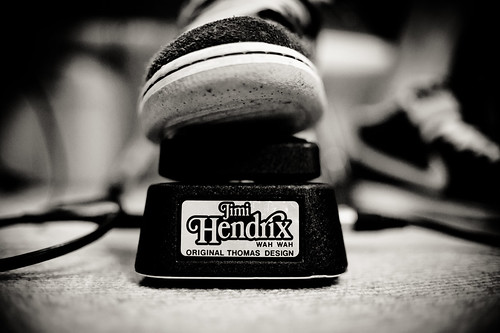
If you think the Apple Watch is a ‘flop’, try this estimate for Android Wear device sales


Got an LG Watch Urbane? Congratulations – you’re part of a pretty exclusive club. Photo by Janitors on Flickr.

Back in February I tried to estimate how many Android Wear devices were activated in 2014, following Canalys saying that 720,000 had shipped that year.

The figure I got, based on the page on Google Play, where one can track not just downloads but also comments and average rating for the Android Wear app (which you need to control your shiny new Android Wear device), was 700,000.

Android Wear: all the numbers

Put it together, and we have about 560,000 Android Wear activations by the end of 2014, and 700,000 to mid-February.

Progress, or the lack of it

OK. So what about progress since then? I’ve kept noting the progress of the number of downloads, and the number of comments, on the Google Play page, helped from time to time by the Internet Archive (it’s wonderful. Donate).

My previous estimate worked on the basis that the number of comments was proportional to the number of downloads. I don’t see any reason to change that assumption.

So how does it look now? The number of comments keeps going up:

Android Wear: number of reviews

Steady growth suggests steady download, and hence sales, figures

(One point to note: the average review score has been trending down steadily. You would expect this for a new technology: the keen people who forgive anything are first in, and are followed by those who got it as a gift, or an experiment, or whatever. Notably, some of the recent low ratings come from people complaining about updates; that would suggest that the installs/comments ratio is actually falling.)

Whichever, the precise value of the average review has fallen from a comfortable 4.83 (out of 5) to dip to 3.98 at the end of October, recovering to 4.00 last week.

And now we try to fit the number of installs – using the points that we have, which isn’t a lot – to that graph, assuming downloads are directly proportional to comments.

According to Google’s stats, Android Wear is now past the 1m download point, but not the 5m download point.

So I’ve tried to fit the graph as best I can. And this is what I get:

Android Wear sales estimate: 1.9m in November

Fitting known waypoints to the number of comments suggests that 1.9m Android Wear devices have been sold

That’s the figure I get: 1.9m downloads in total, suggesting that since February there have been a total of 1.2m more installations of Android Wear.

So again we ask: is that bad or good? There are now 1.4bn Android devices in use, according to Sundar Pichai. Only those running Android 4.3 upwards can use Android Wear, which means we’re potentially talking about 67.8% of devices according to the very latest figures from the Android Dashboard. (That’s up substantially from 47.6% back in February.)

The penetrant question

Back in February, I guessed at 1.2bn Android devices in use (which seems close enough – 1bn announced at Google I/O in 2014, 1.4bn this time). So back then the potential market was
1.2bn * 0.476 = 571.2m devices, of which 700,000 had Android Wear: that was a penetration of 0.12%.

Now we have a potential addressable market for Android Wear of
1.4bn * 0.678 = 949.2m devices. Of which it seems 1.9m, or 0.2%, have bought. (This doesn’t allow for people owning multiple devices, but the incidence will be very low compared to the 949m devices available.)

Conclusions and thoughts

• The absolute number of Android Wear devices in use is still really low.
• A total of 1.2m have been sold since February
• It’s tiny compared to any estimate of the number of Apple Watches sold since the launch in April, which varies by analyst; Canalys estimates that it has shipped 7m in two quarters, which compares to 1.2m Android Wear sold
• These may be the lull before the storm of purchases on Black Friday/Christmas, but abandonment could be a problem
• Android Wear, despite being first to market, suffers from a lack of brand visibility, and visibility overall. Kantar ComTech released a survey in October based on a study from August which found that in the US,

Among panelists who knew what a smartwatch or smartband was, 92% connected Apple to the category, far more than any other brand. This was followed by Fitbit in second place with 47%, with Google (34%) edging out Samsung (33%) for third place.

That doesn’t leave a lot of room for others, at least in the US buyer’s mind.

I’ll keep tabs on Android Wear, absent Google releasing any figures. But for now, this is starting to look like an interesting question: can a device category succeed if it doesn’t have a successful Android version?