
Start up: the iPhone crackers, tick-tock dies, the Instagram trojan returns, Microsoft’s AI bot, and more

Life was simpler in some ways when you could just feed these to get your parking time. Photo by PeterJBellis on Flickr.

You can now sign up to receive each day’s Start Up post by email. You’ll need to click a confirmation link, so no spam.

A selection of 11 links for you. Use them wisely. I’m charlesarthur on Twitter. Observations and links welcome.

Israeli mobile forensics firm helping FBI unlock seized iPhone, report says » Ars Technica UK

David Kravets:

»On Sunday [as it also withdrew its court request against Apple], according to public records, the FBI committed to a $15,278 “action obligation” with Cellebrite. An “action obligation” is the lowest amount the government has agreed to pay. No other details of the contract were available, and the Justice Department declined comment. Cellebrite, however, has reportedly assisted US authorities in accessing an iPhone.

For now, US-based security experts believe that Cellebrite does have the wherewithal to perform the task.

“I’m really not at liberty to confirm the third party, but based on the techniques I’ve described in my blog on the subject, I think Cellebrite, as well as many large forensics firms like it, have the capability to perform such tasks,” forensic scientist Jonathan Zdziarski told Ars in an e-mail. “DriveSavers, for example, has released statements yesterday suggesting they’re almost there. I think the techniques are pretty straight forward for firms like these now that the tech community has had a chance to comment.”

«

link to this extract


They made him a moron » The Baffler

Evgeny Morozov was invited to the State Department in October 2009 to meet Alec Ross, then innovation adviser to Hillary Clinton:

»Out of courtesy, I did share some thoughts with Ross, but it wasn’t long before our paths diverged.[*] I soon became a critic of the U.S. government’s “Internet freedom agenda,” while Ross and his colleague and friend Jared Cohen (then on the policy planning staff of the State Department and now the head of Google Ideas) embarked on adventures so reckless and ridiculous, so obsequious to the interests of Silicon Valley and offensive to anyone well-versed in the diplomatic trade, that some career staffers at the State Department began to ridicule, anonymously, of course, their cluelessness on social media.

Ross’s tenure at the State Department was, by and large, a failure. His efforts to promote “twenty-first-century statecraft”—Clinton’s lofty vision for American power that would put “Internet freedom” and digital technologies at its core—floundered after the State Department was confronted by Cablegate, the release of a massive library of leaked diplomatic cables that began in late 2010 and was coordinated by WikiLeaks. Ross, who claimed the twenty-first-century-statecraft concept as his own and hoped that it would become “a major part of [Clinton’s] legacy,” was suddenly forced into damage control. Few would find his pronouncements on “Internet freedom” credible after the State Department’s reaction to WikiLeaks.

«

Morozov reviews Ross’s book “The Industries of the Future”: it’s like watching a master sushi chef at work. And the footnote attached to that [*] above is worth the clickthrough on its own.

link to this extract


Notes on Apple’s refresh – cheaper iPhones and iPads for real work » Benedict Evans

His observation:

»what Apple has really done is moved from selling older models at discounts with the ‘proper’ iPhone starting at $600, to starting the iPhone range at $400 and scaling up on screen size and price.

There are a bunch of interesting second-order implications for this. By launching six months after the actual iPhone 6S Apple smooths out the supply chain and reduces cannibalization from people who really want the ‘newest one’, and probably gets better component prices. But it’s still selling premium components instead of 2-year-old components at $400 instead of $600, so I’d expect a long discussion of margin implications at the next quarterly call. And this also points to how misguided it is to poke around in earnings releases from Apple’s supply chain to work out iPhone sales. One can also wonder what happens in the next product cycle – presumably the iPhone 6 disappears, the 6S goes to $500 and the SE is refreshed, perhaps without a new name. Or does it go to $300? Certainly it’ll be on the second-hand market at $200.

But the key thing is that after 8 years, the iPhone range really now starts at $400, not $600 or more.

«

link to this extract


​Cashless parking was meant to make life easier for drivers but our phones are awash with competing apps » The Independent

Rhodri Marsden:

»When I was prompted by a roadside sign to download yet another cashless parking app, my patience finally snapped. I now had four of them on my phone – PayByPhone, RingGo, Parkmobile and ParkRight, all of which required me to undergo a laborious sign-up procedure, keying credit-card details and registration numbers into my phone while I sat on the bonnet, accruing parking charges.

The competitive marketplace for cashless parking has resulted in a fragmented and rather irritating experience for motorists who don’t have a handy stash of pound coins; as well as the aforementioned apps, there are others such as Phoneandpay, MiPermit and Whoosh, all promising to liberate us from the tyranny of the parking meter but ignoring the fact that we don’t care who we pay: we just want to park.

«

85% of cashless parking controlled by two apps, the other 15% by a sprawl of others. Really good research by Marsden, but there’s no solution in sight. One point he didn’t make, but which I notice: paying by app is often more expensive than paying for a physical ticket.
link to this extract


Intel officially kills “tick-tock” » The Motley Fool

Ashraf Eassa:

»back in mid-2015, Intel admitted that its 10-nanometer technology was in rough shape and wouldn’t go into production at the end of the year as expected. In the company’s most recent form 10-K filing, it went ahead and officially declared “Tick-Tock” [by which it reduces the die size in one year, and in the next year improves the microarchitecture] dead.

Intel’s wording in the form 10-K filing is as following:

“We expect to lengthen the amount of time we will utilize out 14 [nanometer] and out next-generation 10 [nanometer] process technologies, further optimizing out products and process technologies while meeting the yearly market cadence for product introductions.”

The company even includes an interesting visual aid to contrast the differences between the previous methodology and the current one:

Intel says that its third 14-nanometer product, known as Kaby Lake, will have “key performance advancements as compared to [its] 6th generation Core processor family.” The extent of these enhancements is clear, but leaks to the Web suggest enhancements to graphics and media.

«

Along with Moore’s Law fading, this is an epochal moment. And the other one is…
link to this extract


Andy Grove and the iPhone SE » Stratechery

A terrific piece on Andy Grove, the legendary Intel chief executive, by Ben Thompson; rather than just a recap, he puts Grove’s contribution into useful perspective:

»Beyond Grove’s personal background, the importance of Intel to the technology industry — and, by extension, to the world — cannot be overstated. While Moore is immortalized for having created “Moore’s Law”, the truth is that the word “Law” is a misnomer: the fact that the number of transistors in an integrated circuit doubles approximately every two years is the result of a choice made first and foremost by Intel to spend the amount of time and money necessary to make Moore’s Law a reality. This choice, by extension, made everything else in technology possible: the PC, the Internet, the mobile phone. And, the person most responsible for making this choice was Grove (and, I’d add, his presence in management was the biggest differentiator between Intel and its predecessors, both of which included Noyce and Moore).

That wasn’t Intel and Grove’s only contribution to Silicon Valley, either: Grove created a culture predicated on a lack of hierarchy, vigorous debate, and buy-in to the cause (compensated with stock). In other words, Intel not only made future tech companies possible, it also provided the template for how they should be run, and how knowledge workers broadly should be managed.

«

Thompson’s daily Stratechery newsletter is well worth the (inexpensive) subscription. Talking of which..
link to this extract


Blendle launches its ‘iTunes for News’ in the US » Fortune

Mathew Ingram interviewed Alexander Klopping of the “pay-for-articles-you-read” service:

»Q: Why would someone sign up for Blendle?

Klopping: Whenever you ask people “would you like to pay for journalism?” most people shrug. Why would they? But then most people responded the same way 10 years ago when asked about paying for music. I never thought I would pay $10 a month for Spotify, but I do. It’s not just about access to music, but also the app is really nice, my friends are on it, it helps me find music with Discover. When you think about journalism, having one account for everything, a service that helps you find and pay for the best stuff—that doesn’t exist. And it didn’t exist for music, but then it happened.

Fortune: So it’s not just about payment, but also curation?

Klopping: Yes. We hire editors, and those editors read everything on the platform, and they figure out staff picks. They choose the most interesting stories and they also choose stories that fit into categories or sections, and when a user shows interest in articles from a section we show them more. So there’s human curation plus a layer on top that is algorithmic. And on top of that there’s a social graph, so when your Twitter friends have shared an article that’s a good indication you might like it.

«

The point about whether hard news monetises well (it doesn’t) is notable. My question is, does paying free you from seeing ads?
link to this extract


Password-stealing Instagram app ‘InstaAgent’ reappears in App Store under new name » Mac Rumors

Juli Clover:

»Last November, a malicious app called InstaAgent was caught storing the usernames and passwords of Instagram users, sending them to a suspicious remote server. After the app’s activities came to light, Apple removed it from the App Store, but it now appears Turker Bayram, the developer behind the app has managed to get two new apps approved by Apple, (and Google) both of which are stealing Instagram account info.

Peppersoft developer David L-R, who discovered the insidious password-sniffing feature in the first InstaAgent app, last week wrote a post outlining new password stealing apps created by Bayram. Called “Who Cares With Me – InstaDetector” and “InstaCare – Who Cares With Me,” the apps are available on Android and iOS devices.

The original InstaAgent app attracted Instagram users by promising to track the people who visited their Instagram account, and the two new apps make similar promises. Both apps say they display a list of users who interact most often with an Instagram account, asking users to log in with an Instagram username and password.

David L-R investigated Bayram’s new apps and discovered a suspicious HTTPS packet, leading him to uncover a complex encryption process used to covertly send usernames and passwords to a third-party server and hide the evidence.

«

OK, this is bad; but as a user, why would you trust a third-party app from a no-name developer with your login details? Or is that too obvious a question?
link to this extract


Meet Tay – Microsoft A.I. chatbot with zero chill » Microsoft

»Tay is an artificial intelligent chat bot developed by Microsoft’s Technology and Research and Bing teams to experiment with and conduct research on conversational understanding. Tay is designed to engage and entertain people where they connect with each other online through casual and playful conversation. The more you chat with Tay the smarter she gets, so the experience can be more personalized for you.

Tay is targeted at 18 to 24 year old in the US.

Tay may use the data that you provide to search on your behalf. Tay may also use information you share with her to create a simple profile to personalize your experience. Data and conversations you provide to Tay are anonymized and may be retained for up to one year to help improve the service.

«

The bath continues to warm.
link to this extract


“Just have a look at this graph…” – BBC Newsnight » YouTube

How Newsnight bills it: “The Secretary of State for Education, Nicky Morgan, on the Conservative welfare row after the former Secretary of State for Work and Pensions, Iain Duncan Smith, resigns.”

What it really is: a Tory (right-wing) minister who was the only one willing to go on TV programmes to defend the government’s budget. She’s ambushed by a data visualisation showing the impact of the planned tax changes on the incomes of the different population deciles. (You can find the original graph on page 4 of this Institute of Fiscal Studies publication. The IFS is generally regarded as politically central/neutral.)

(Via Andy Cotgreave of dataviz company Tableau.)
link to this extract


Google is making a keyboard for the iPhone » The Verge

A veritable scoop from Casey Newton:

»The Google keyboard incorporates a number of features meant to distinguish it from the stock iOS keyboard. Like its Android counterpart, the Google keyboard for iOS employs gesture-based typing, so you can slide your finger from one letter to the next and let Google guess your intended word. Tap the Google logo and you can access traditional web search. It also appears to have distinct buttons for pictures and GIF searches, both presumably powered by Google image search. The keyboard is visually distinct from the standard Android keyboard, which incorporates voice search but no text or image-based searching.

The keyboard, which has been in circulation among employees for months, is designed to boost the number of Google searches on iOS. While the company all but holds a monopoly on the global search market, there’s evidence that mobile search is proving much less lucrative for Google than the desktop. Using publicly available numbers, journalist Charles Arthur argued in October that half of smartphone users perform zero searches per day. (Using the same math, Arthur said desktop users perform an average of 1.23 searches per day.)… The problem for Google — and for Alphabet, its parent company — is that search is where Google shows users its most expensive ads. Any sign of decline in search would be an existential threat to the company.

«

Logically, I’d expect that searches begun from this keyboard don’t count as part of the Google-Apple Safari search deal (reckoned to be very lucrative for Apple). Apple pares away at Google’s income in one place, Google drags it back in another. However, I’d expect this to be a comparatively small number, though. It’s not as if this is Maps, after all.
link to this extract


Errata, corrigenda and ai no corrida:

Start up: Spotify hits 30m, Google’s Syria wish, Apple’s iPhone aim, the truth behind Powa, and more

Is it really a good idea to do a charity parachute jump? Photo by puritani35 on Flickr.

You can now sign up to receive each day’s Start Up post by email. You’ll need to click a confirmation link, so no spam.

A selection of 11 links for you. Use them wisely. I’m charlesarthur on Twitter. Observations and links welcome.

Spotify hits 30 million subscribers » The Verge

Micah Singleton:

»Spotify has 30 million paid subscribers, CEO Daniel Ek announced today in a tweet. This is the first subscriber update Spotify has given out since it announced it had 20m subscribers days before Apple Music hit the market last June, and shows the increased competition has had little to no effect on Spotify’s growth.

In the nine months that Apple Music has been available, the service has picked up 11 million subscribers. Spotify has added 10m paid subscribers in the same time.

The Swedish streaming service is now adding an average of 10m paid customers a year — it only had 10m subscribers total in 2014— a growth rate it will need to maintain as it goes up against Apple Music and its substantial marketing war chest.

What’s also notable is the flood of exclusive content put out by Apple Music and Tidal over the past few months seemingly hasn’t harmed Spotify’s user retention.

«

It was going so well until that last sentence. Singleton has no idea what has happened to Spotify’s user retention; it might be seeing colossal churn (people joining while others leave) or be rock steady. The raw numbers don’t tell you. It’s a reasonable guess, but that’s all it is – a guess.

That might seem like nitpicking, but it matters: it’s key to knowing whether Spotify really does have loyal users, or just fly-by-nights. And it’s also a bad idea to state things as fact that you don’t know directly.
link to this extract


Apple: the mother of all iPhone installed base models, via Stifel » Barrons.com

Tiernan Ray:

»After combining the installed base numbers, churn, new sales, upgrade rates, and such, Rakers arrives at a “guesstimate model” for how the Apple installed base may expand, and how that trickles down to potential iPhone sales.

That results in numbers that would be above his own estimates. For example, Rakers figures if Apple’s installed base total 625m units in 2015, if Apple maintains an 18.8% share of the global smartphone market this year, which is projected to be 3.958bn units, and it if gets 19.6% of the expansion of that total smartphone market, it would bring Apple’s installed base to 744m units.

Rakers then backs out of that an “implied gross change” of 144m units, backs out of that refurbished sales of 95 million, and comes up with 49 million “implied net new iPhone installed base shipments.” He then combines that with “new iPhone shipments into prior year installed base,” and comes up with a potential sales level of 239m iPhones this year.

That’s above Rakers’s own estimate for 217.4m units, and above what he deems Street consensus of 208m units. It would also be growth from last year, versus the decline everyone’s expecting this year.

«

The pricing for the new iPhone SE, lower than any new iPhone, could make a difference there.
link to this extract


US top court agrees to hear Samsung-Apple patent fight » Reuters

Lawrence Hurley and Andrew Chung:

»The US Supreme Court on Monday stepped into the high-profile patent fight between the world’s two fiercest smartphone rivals, Apple and Samsung, agreeing to hear Samsung’s appeal of what it contends were excessive penalties for copying the patented designs of the iPhone.

Samsung Electronics paid Apple more than $548m in December related to a jury verdict from 2012. It is seeking to pare back the $399m of that amount that was awarded for infringing on the designs of the iPhone’s rounded-corner front face, bezel and colorful grid of icons, saying they contributed only marginally to a complex device.

Apple sued in 2011, claiming the South Korean electronics company stole its technology and ripped off the look of the iPhone.

«

The Jarndyce and Jarndyce of the digital world. But it also matters (notes Neil Cybart) because it affects how one values design. Google and Facebook wanted the Supreme Court to hear it; Apple didn’t, he says.
link to this extract


Trump supporters aren’t stupid » Medium

Emma Lindsay with a terrific insight:

»Normally, when liberals talk about racism, they use “racist” as an end point. “Trump is racist” is, by itself, a reason not to vote for him, and “being racist” is an indicator of a person who is morally deficient.

But, if you don’t take this as an end point — if you instead ask “what do people get out of being racist?” — you’ll start to unravel the emotional motivations behind it. One of the best unpacking of this I have read is Matt Bruenig’s piece Last Place Avoidance and Poor White Racism. To summarize, no one wants to occupy the “last” place in society. No one wants to be the most despised. As long as racism remains intact, poor white people are guaranteed not to be “the worst.” If racism is ever truly dismantled, then poor white people will occupy the lowest rung of society, and the shame of occupying this position is very painful. This shame is so painful, that the people at risk of feeling it will vote on it above all other issues.

«

And as she also points out, “America is terrible at giving its citizens dignity and meaning.” This should be required reading in many places.
link to this extract


Parachuting for charity: is it worth the money? » PubMed

»All parachute injuries from two local parachute centres over a 5-year period were analysed. Of 174 patients with injuries of varying severity, 94% were first-time charity-parachutists. The injury rate in charity-parachutists was 11% at an average cost of 3751 Pounds per casualty. 63% of casualties who were charity-parachutists required hospital admission, representing a serious injury rate of 7%, at an average cost of £5,781 per patient. The amount raised per person for charity was £30. Each pound raised for charity cost the NHS £13.75 in return.

«

Caveat: it’s from 1999. Even so, you can’t be too careful. (You can read the paper in full for $31.50. Perhaps raise the money through a sponsored parachu..? OK then.)
link to this extract


Why we should fear a cashless world » The Guardian

Dominic Frisby:

»We already live in a world that is, as far as the distribution of wealth is concerned, about as unequal as it gets. It may even be as unequal as it’s ever been. My worry is that a cashless society may exacerbate inequality even further.

It will hand yet more power to the financial sector in that banks and related fintech companies will oversee all transactions. The crash of 2008 showed that, when push comes to shove, banks have already been exempted from the very effective regulation that is bankruptcy – one by which the rest of us must all operate. Do we want this sector to have yet more power and influence?

In a world without cash, every payment you make will be traceable. Do you want governments (which are not always benevolent), banks or payment processors to have potential access to that information? The power this would hand them is enormous and the potential scope for Orwellian levels of surveillance is terrifying.

Cash, on the other hand, empowers its users. It enables them to buy and sell, and store their wealth, without being dependent on anyone else. They can stay outside the financial system, if so desired.

«

The two opposing viewpoints are: in a world where corporations try to avoid tax and there might be a dwindling workforce, it’s important to have visibility of every transaction so that the taxable ones are visible. Alternatively, as Frisby argues, the ability to spend shouldn’t depend on access to technology which can be denied, or surveilled at will.
link to this extract


Clinton email reveals: Google sought overthrow of Syria’s Assad » Washington Examiner

Rudy Takala:

»Google in 2012 sought to help insurgents overthrow Syrian President Bashar Assad, according to State Department emails receiving fresh scrutiny this week.

Messages between former secretary of state Hillary Clinton’s team and one of the company’s executives detailed the plan for Google to get involved in the region.

“Please keep close hold, but my team is planning to launch a tool … that will publicly track and map the defections in Syria and which parts of the government they are coming from,” Jared Cohen, the head of what was then the company’s “Google Ideas” division, wrote in a July 2012 email to several top Clinton officials.

“Our logic behind this is that while many people are tracking the atrocities, nobody is visually representing and mapping the defections, which we believe are important in encouraging more to defect and giving confidence to the opposition,” Cohen said, adding that the plan was for Google to surreptitiously give the tool to Middle Eastern media.

«

The headline is overwritten: Google wasn’t seeking Assad’s overthrow. It was seeking to provide help to those inside Syria who wondered how many were really defecting. As the story points out, though, the anti-Assad movement helped create the conditions for ISIS to become strong.

And it’s really not good for Google to be visible as having tried to influence the internal affairs of a Middle Eastern state – even in this roundabout way. Now one begins to wonder where else it might have tried to be “helpful”.
link to this extract


Powa: The start-up that fell to earth » BBC News

Rory Cellan-Jones spoke to multiple people who had worked for Powa, a British company run by Dan Wagner which once claimed a $2.7bn valuation but collapsed into administration in February:

»What those people have told me is that Powa was an almost textbook case of how not to run a company – no clear strategy, directionless management, overblown claims about the technology and a reckless attitude to money.

For the last couple of years, I’ve been receiving emails from Powa’s PR agency urging me to cover the company’s ground breaking technology the PowaTag which “allows users to purchase anytime, anywhere in just three seconds by simply scanning an item or advertisement with their smartphone”.

Eventually, the company claimed that it had 1,200 businesses signed up to use the PowaTag.

I was not particularly impressed. I saw little evidence that the technology was being used, but one investor did bite. A Boston-based firm Wellington Management invested a sizeable sum in Mr Wagner’s venture. Eventually they along with other investors poured more than $200m into Powa.

It seems likely they were told the same story that was peddled to journalists – that the PowaTag was going to be used by some of the world’s leading brands including L’Oreal and Carrefour.

But what’s emerged since the collapse of the business is that none of those companies had signed contracts, merely “letters of intent”, which did not commit them to anything. One senior figure in the company told me that young inexperienced sales staff were rewarded with a £2,000 bonus every time one of these letters was signed “so they weren’t particularly concerned about the quality of the deal”.

«

Textbook piece of investigative journalism where you talk to people and gather facts and talk to more people. (The headline is also clever – read all the way to the article’s end to find out why.) I bet there’s plenty more that Cellan-Jones couldn’t include because the BBC’s lawyers wouldn’t let it past. (Notably, FT Alphaville puts Powa’s real value at $106m, based on court documents filed in the US.) None of it looks good for Dan Wagner. Speaking of whom..
link to this extract


Talk:Dan Wagner » Wikipedia

From the Talk (discussion about editing/content) page relating to Wagner:

»Wikipedia definition of Vandalism = Vandalism is any addition, removal, or change of content, in a deliberate attempt to compromise the integrity of Wikipedia. [[2]]

The amends I made that Techtrek has reverted as being “vandalism” were externally sourced, and links provided. I ask Techtrek to explain on what basis they consider them to be vandalism? It has been requested that any changes are raised and can be discussed on here so that we can get consensus.

It is my belief that by reverting any negative and independantly verified and sourced updates Techtrek is responsible for vandalism as they are deliberately attempting to compromise Wikipedias integrity. They have made a number of unsourced claims to the re-write and repeatedly used language that is not in keeping with Wikipedias guidelines [3]. It has been claimed on User talk:Techtrektalk page the they are Flame PR [[4]] if so then this must be disclosed. I ask Techtrek to please respond otherwise I will revert the change. Ol king col (talk) 09:26, 21 June 2014 (UTC)

«

That’s a busy PR company if it’s burnishing a client’s personal Wikipedia page. Wonder how much of the VC money went to Flame PR? Though the fact that the Wikipedia user only edits Wagner’s page is… notable.
link to this extract


An iCloud scam that may be worse than ransomware » Malwarebytes Labs

Thomas Reed was contacted by a woman who said her iMac was hit by “ransomware”:

»From the screenshots she sent me, it soon became clear what had happened. The hacker had somehow gotten access to Ericka’s iCloud account.

Using this, he was able to remotely lock her computer using iCloud’s Find My Mac feature, with a ransom message displayed on the screen. (For some reason, the iPhone did not actually end up locked, but displayed the same message.)

The message read: “Contact me: hblackhat(at)mail.ru All your conversation sms+mail, bank, computer files, contacts, photos. I will public + send to your contacts.”

She also received an e-mail message, in similarly broken English, from her own iCloud address. The message said he had access to all her bank accounts, personal information, etc, and would publish it if she didn’t respond within 24 hours.

This is a pretty serious threat, and quite different from the typical Windows malware. Unfortunately, the story doesn’t end there. Apple designed Find My Mac/iPhone as an anti-theft feature. It is intended to allow you to take a number of actions on a lost or stolen device, including displaying a message, locking it, locating it physically and even remotely erasing it.

«

As Reed points out, the same happened previously in Australia in 2014. Perils of the connected world: do you want to be able to find your machine if it’s stolen? But then, how secure is your cloud account?
link to this extract


What Americans don’t understand about Nordic countries » Business Insider

Anu Partanen moved to the US seven years ago:

»Americans are not wrong to abhor the specters of socialism and big government. In fact, as a proud Finn, I often like to remind my American friends that my countrymen in Finland fought two brutal wars against the Soviet Union to preserve Finland’s freedom and independence against socialism. No one wants to live in a society that doesn’t support individual liberty, entrepreneurship, and open markets.

But the truth is that free-market capitalism and universal social policies go well together—this isn’t about big government, it’s about smart government. I suspect that despite Hillary Clinton’s efforts to distance herself from Sanders, she probably knows this. After all, Clinton is also endorsing policies that sound an awful lot like what the Nordics have done: paid family leave, better public schools, and affordable day care, health care and college for all.

The United States is its own country, and no one expects it to become a Nordic utopia. But Nordic countries aren’t utopias either. What they’ve done has little to do with culture, size, or homogeneity, and everything to do with figuring out how to flourish and compete in the 21st century.

«

The article originally appeared at The Atlantic, but the comments at BusinessInsider show how incredibly difficult Americans find it to grasp the idea of everyone benefiting from everyone paying more general taxes. While they defend their terrible healthcare system. And overlook the products that the Nordics have produced, such as Ikea and Lego and Linux.
link to this extract


Errata, corrigenda and ai no corrida: none notified.

Start up: Twitter’s ongoing API cull, NSA v Hillary, life without Facebook, Apple’s cloud moves, and more

Boston Dynamics robot dog

“A Boston Dynamics robot is for life, not just for Christmas.” Photo by jurvetson on Flickr.

You can now sign up to receive each day’s Start Up post by email. You’ll need to click a confirmation link, so no spam.

A selection of 9 links for you. Still, it’s Friday, somewhere. I’m charlesarthur on Twitter. Observations and links welcome.

U+1F647 PERSON BOWING DEEPLY 🙇 » Medium

Matthew Rothenberg:

»Nearly three years since they officially blessed it with “partner” access (and after 14 billion emoji tweets tracked), Twitter has decided to shut Emojitracker down.

To be more accurate, they are removing its elevated access to the Streaming API that Emojitracker depends on in order to operate at its high volume

«

Twitter continues to cut off developers’ noses to spite its face.
link to this extract


NSA refused Clinton a secure BlackBerry like Obama, so she used her own » Ars Technica UK

Sean Gallagher:

»[US State Department coordinator Donald] Reid was tasked with trying to find a “BlackBerry-like” solution that would allow Clinton to be able to check her e-mail while in the secure office suite. The problem was that the solution supported by the NSA—its SME PED (Secure Mobile Environment Portable Electronic Device)—was hardly BlackBerry-like. SME PED devices are based on a secure version of Windows CE, and they’re only rated up to “Secret” classification. And as Clinton was taking over at State, the SME PED was only just becoming available. “The current state of the art is not too user friendly, has no infrastructure at State, and is very expensive,” Reid noted in one e-mail.

The NSA refused to give Clinton a device similar to the one used by Obama: a modified BlackBerry 8830 World Edition with additional cryptography installed. And while Clinton’s predecessor Condaleeza Rice had obtained waivers for herself and her staff to use BlackBerry devices, Clinton’s staff was told that “use [of the BlackBerry] expanded to an unmanageable number of users from a security perspective, so those waivers were phased out and BlackBerry use was not allowed in her Suite,” an e-mail from the NSA’s senior liaison to the State Department noted.

«

It’s basically the fight that everyone has with their IT department, but with state secrets involved.
link to this extract


Google puts Boston Dynamics up for sale in robotics retreat » Bloomberg Business

Brad Stone and Jack Clark:

»Executives at Google parent Alphabet Inc., absorbed with making sure all the various companies under its corporate umbrella have plans to generate real revenue, concluded that Boston Dynamics isn’t likely to produce a marketable product in the next few years and have put the unit up for sale, according to two people familiar with the company’s plans.

Possible acquirers include the Toyota Research Institute, a division of Toyota Motor Corp., and Amazon.com Inc., which makes robots for its fulfillment centers, according to one person. Google and Toyota declined to comment, and Amazon didn’t respond to requests for comment.

Google acquired Boston Dynamics in late 2013 as part of a spree of acquisitions in the field of robotics. The deals were spearheaded by Andy Rubin, former chief of the Android division, and brought about 300 robotics engineers into Google. Rubin left the company in October 2014. Over the following year, the robot initiative, dubbed Replicant, was plagued by leadership changes, failures to collaborate between companies and an unsuccessful effort to recruit a new leader.

«

OK, I’m astonished. The intersection between AI/neural networks and robotics seems so obvious that this points to deep problems within Alphabet – specifically, inability to create collaboration (as it mentions).
link to this extract


The secret life of a Silk Road 2.0 mastermind » Motherboard

Joseph Cox:

»In the real world, Dread Pirate Roberts 2 explained to me, people often made judgments about others before a conversation had even started. But in the dark web, where most people act pseudonymously thanks to the protections offered by Tor, the only social cue to go on is people’s actions.

“In this environment, you only heard what people were saying,” he told me. “There was nothing to judge them on other than what they did.”

Take Defcon, who offered his services as a programmer to DPR2 in a private message. DPR2 was intrigued by Defcon’s calm tone among the chaos of Silk Road being shut down, and put him to the test.

Within a few hours, Defcon had put what would become the Silk Road 2.0 forum online, along with a host of security features that others often neglect.

“He knew what he was doing, I could tell instantly,” DPR2 said.

Defcon did make a mistake, however. It would later be revealed that he registered a Silk Road 2.0 server with his personal email address.

«

He knew what he was doing. I could tell instantl… oh.
link to this extract


A Facebook experiment » Above Avalon

Neil Cybart:

»I deleted Facebook off of my iPhone six months ago. I had one simple reason in mind: I thought I would be able to analyze Facebook more accurately and completely by not using it or its companion apps, cold turkey. Purchasing an iPhone 6s Plus at launch gave me the perfect opportunity to begin my experiment. My initial assumption proved true. In just the first eight weeks, I learned more about Facebook, Instagram, WhatsApp and Facebook Messenger, than the last eight years. I’ve reached a number of observations over the past six months on Facebook’s value and vulnerabilities and a definite answer to what was once a seemingly difficult question: Are Facebook and Apple becoming competitors?

«

The answer to the latter is no, but the things he found out along the way about Facebook use ring very true.
link to this extract


The journalist and the troll: Benjamin Wey spent two years trying to destroy me online » Bloomberg Business

Dune Lawrence discovered a “news” site set up by a Chinese entrepreneur who had decided she had wronged him in articles she’d written for Bloomberg:

»The site’s other articles were an odd mix of celebrity gossip, entertainment news, and stabs at reporting on serious topics such as drug marketing. It wasn’t exactly high journalism, but it looked professional, not like some amateur blog. Google seemed to think so as well, because the story instantly went to the top of the results when I searched my name.

In September 2015 the FBI arrested the man behind TheBlot, one Benjamin Wey. Not for smearing me or the other people he imagined were his enemies. He’s primarily a financier, and he was charged with securities fraud and other financial crimes involving Chinese companies he helped to list on U.S. stock markets. The U.S. Department of Justice alleges Wey pocketed tens of millions of dollars in illicit profits that he funneled through associates overseas and back into accounts in the U.S. Wey denies the charges. A trial has been set for March 2017.

«

Lawrence is brave here, and Wey comes across as an utter scumbag – but also someone who is completely hyperactive, willing to spend hours cooking up totally libellous nonsense about people. That’s the problem online: the hyperactive idiots drive out the rational people.

One other point: Google really favours that junk site Wey created. Searching on duckduckgo, TheBlot is some distance down the results.
link to this extract


Cloud makes for strange bedfellows: Apple signs on with Google, cuts spending with AWS  » CRN

Good scoop by Kevin McLaughlin and Joseph Tsidulko:

»Alphabet’s Google has quietly scored a major coup in its campaign to become an enterprise cloud computing powerhouse, landing Apple as a customer for the Google Cloud Platform, multiple sources with knowledge of the matter told CRN this week.

Since inking the Google deal late last year, Apple has also significantly reduced its reliance on Amazon Web Services, whose infrastructure it uses to run parts of iCloud and other services, said the sources, who all requested anonymity to protect their relationships with the vendors.

Apple has not abandoned AWS entirely and remains a customer, the sources said.

According to the sources, Google executives have told partners that Apple is spending between $400m and $600m on Google Cloud Platform, although this couldn’t be independently confirmed. Also unclear is whether this range refers to an annual spending rate or a set amount of capacity.

AWS said Apple’s move to work with Google does not signify “competitive defection.”

«

Apple is in the position where it can get the big cloud providers to bid against each other. (Microsoft’s Azure was also said to be a supplier when iCloud started.) The question is, should Apple be trying to supplant them all with its own infrastructure – as Dropbox did to exit AWS? Well, let’s see…
link to this extract


Google adds Apple iCloud storage to cloud platform » Re/code

Mark Bergen:

»Apple has announced three data centers opening soon, and spent an estimated $1bn last year on AWS. It’s a logical move for Apple if it wants more independence from its tech rivals. And it’s one Apple should make to store the growing media libraries from its mobile, TV and TBD products.

According to a source familiar with the matter, Apple already has a team working on this; it’s known internally as “McQueen,” as in Steve. It’s unclear if that project will materialize or when. But a source tells Re/code that the codename refers to Apple’s intent, sometime in the next few years, to break its reliance on all three outside cloud providers in favor of its own soup-to-nuts infrastructure.

Apple has reckoned, one source says, that given the fees it is paying Amazon and Microsoft, it could break even with its own data centers within about three years and not have the headache of negotiating with companies it considers rivals in other areas of its business.

«

Pretty remarkable if Apple can build all that infrastructure and serve everyone and make it pay off that quickly. That would make the shift to Google just a temporary thing to drive down prices from those suppliers.
link to this extract


Observations on switching to the Galaxy S7 Edge from a non-Galaxy user » AndroidAuthority

Kris Carlon:

»The first thing I noticed when switching to the Galaxy S7 Edge is how bad the touch responsiveness seems to be (although I might just be unlucky). It’s not so much the screen, although it does kind of “grab” at your finger as you swipe on it compared to the Nexus 6P, but rather the touch response itself.

Quite often, when swiping away notifications the S7 Edge registers it as a press and launches the app instead. Likewise, when tapping UI elements it occasionally doesn’t register any press at all and I have to give it a serious press to get a response. Feel free to tease my ability to use a phone if you like, but something here is not right.

«

Quite a few of Carlon’s complaints (they’re mostly complaints) fall into the 1% category – is it really such awful news that the back of your phone shows fingerprints? – but the touchscreen point, and his complaint that “it’s laggy” seem like gigantic points, which are lined up as being just as important (or unimportant) as how crowded the folder UI is.
link to this extract


Errata, corrigenda and ai no corrida: none notified

Start up: the iCloud celeb hack, a Chinese ransom?, the real terrorist phone, Trump as Berlusconi, and more

“Hey, Miss Lawrence! My name’s iCloud! What’s your password?” Photo by YourWay Magazine on Flickr.

You can now sign up to receive each day’s Start Up post by email. You’ll need to click a confirmation link, so no spam.

A selection of 12 links for you. Use them wisely. I’m charlesarthur on Twitter. Observations and links welcome.

The disturbingly simple way dozens of celebrities had their nude photos stolen » Fusion

Kashmir Hill:

»According to court documents, Collins gained access to the intimate images of nude celebrities via a disturbingly simple technique: phishing.

Though many people assumed that the hacker took advantage of an iCloud vulnerability to brute-force his way into the celebrities’ accounts, the government makes no mention of that. Instead, it says that Collins hacked over 100 people by sending emails that looked like they came from Apple and Google, such as “e-mail.protection318@icloud.com,” “noreply_helpdesk0118@outlook.com,” and “secure.helpdesk0019@gmail.com.” According to the government, Collins asked for his victims’ iCloud or Gmail usernames and passwords and “because of the victims’ belief that the email had come from their [Internet Service Providers], numerous victims responded by giving [them].”

Celebrities really need better computer security advisers. If a dedicated enough attacker comes at you, it’s hard to avoid being compromised, but it helps immensely to turn on two-factor authentication for your online accounts. That way a person needs not just your password but a code sent to your phone to get into your account.

Once Collins had their credentials, says the government, he went through their email accounts looking for nude photos and videos. The government says that Collins got into approximately 50 iCloud accounts and 72 Gmail accounts this way, most of them belonging to celebrities. He “accessed full Apple iCloud backups belonging to numerous victims, including at least 18 celebrities” and “used a software program to download those full Apple iCloud backups.”

Ironically, that program was likely one that’s used by law enforcement to get evidence from phones.

«

The idea that someone had used a cutting-edge brute-force attack to break into the passwords always seemed like vapour trails to me. Social engineering is the Occam’s Razor explanation (and also the Hanlon’s Razor explanation) to stuff like this.
link to this extract


Exclusive: Chinese hackers behind U.S. ransomware attacks – security firms » Reuters

Joseph Menn:

»executives of the security firms have seen a level of sophistication in at least a half dozen cases over the last three months akin to those used in state-sponsored attacks, including techniques to gain entry and move around the networks, as well as the software used to manage intrusions.

“It is obviously a group of skilled of operators that have some amount of experience conducting intrusions,” said Phil Burdette, who heads an incident response team at Dell SecureWorks.

Burdette said his team was called in on three cases in as many months where hackers spread ransomware after exploiting known vulnerabilities in application servers. From there, the hackers tricked more than 100 computers in each of the companies into installing the malicious programs.

The victims included a transportation company and a technology firm that had 30 percent of its machines captured.

Security firms Attack Research, InGuardians and G-C Partners, said they had separately investigated three other similar ransomware attacks since December.

Although they cannot be positive, the companies concluded that all were the work of a known advanced threat group from China, Attack Research Chief Executive Val Smith told Reuters.

«

link to this extract


Reformed LulzSec hacktivist joins payments firm » The Register

John Leyden:

»A payments firm has hired reformed LulzSec hactivist Mustafa Al-Bassam (formerly known as tFlow) for a new blockchain research project.

London-based payments group Secure Trading has taken on Al-Bassam to help develop a platform that applies the verification benefits of blockchain technology in order to improve the visibility and security of online payments. Codenamed “Trustery”, the project aims to create a commercial platform.

Secure Trading approached Al-Bassam, who agreed to work for the firm part time while continuing his computer science degree at King’s College London.

«

Smart move: al-Bassam is a clever guy.
link to this extract


Crypto-ransomware spreads via poisoned ads on major websites » Tripwire

Graham Cluley:

»Some of the world’s most popular news and entertainment websites have been spreading poisoned adverts to potentially hundreds of thousands of visitors, putting innocent readers at risk of having their computers hit by threats such as ransomware.

Famous sites which displayed the malicious ads and endangered visiting computers include MSN, bbc.com, the New York Times, AOL and Newsweek.

As a result, researchers at Malwarebytes say that they saw a “huge spike in malicious activity” over the weekend.

Security analysts at TrendLabs and Malwarebytes report that the attack is one of the largest ransomware campaigns seen in years, taking advantage of a recently-updated version of the notorious Angler Exploit Kit to spread malware.

Just last month the Angler Exploit Kit was found to be targeting PCs and Macs after it was updated to take advantage of a known vulnerability in Microsoft Silverlight…

…It seems glaringly apparent to me that there is so much malicious advertising on the internet that anytime you surf even legitimate sites without an ad blocker in place, you are putting your computer’s data at risk.

«

link to this extract


Why is the Nokia 105 cellphone a favourite among ISIS fighters? » NBC News

Alexander Smith:

»The must-have cellphone for ISIS fighters in Iraq doesn’t have apps or a camera, and ships for less than $30.

The small and simple Nokia model is frequently used as a trigger device to set off ISIS’ improvised explosive devices, known as IEDs, according to a Conflict Armament Research report released last month.

As part of a study looking at civilian components in ISIS bombs, CAR documented 10 of the phones captured from members of the terror group in Iraq in December 2014.

The research showed the terror group “consistently” used the Nokia 105 above all others “in the manufacture of a specific type of remote controlled IED.”

Two phones are used in the bomb-making process: one to call the other, which then sends a signal to a circuit board and sparks the explosion.

There are plenty of other cheap, durable phones with long battery life that ISIS fighters could use — and yet this particular model, also branded as the Microsoft Mobile 105 after the tech giant bought Nokia in 2014, shows up again and again.

«

I’m sure there’ll be widespread condemnation of Microsoft for aiding terrorists any moment now.
link to this extract


Why Sony will win first in VR » Jon Peddie Research

The aforenamed Mr Peddie:

»Now that Oculus has revealed its consumer version of the Rift HMD, consumers can start planning how they might engage with VR, and they have a choice—a DIY rig with a PC and Rift, or a turn-key system with Sony.

Sony’s HMD will be about 30% less expensive than the Oculus HDM. And Sony buyers probably already have a PS4, and possibly PS4 accessory controllers. Most importantly, Sony also has content.

«

So, first couple of rounds to Sony.
link to this extract


The best things in Android are free — with in-app purchases » Medium

The iA team:

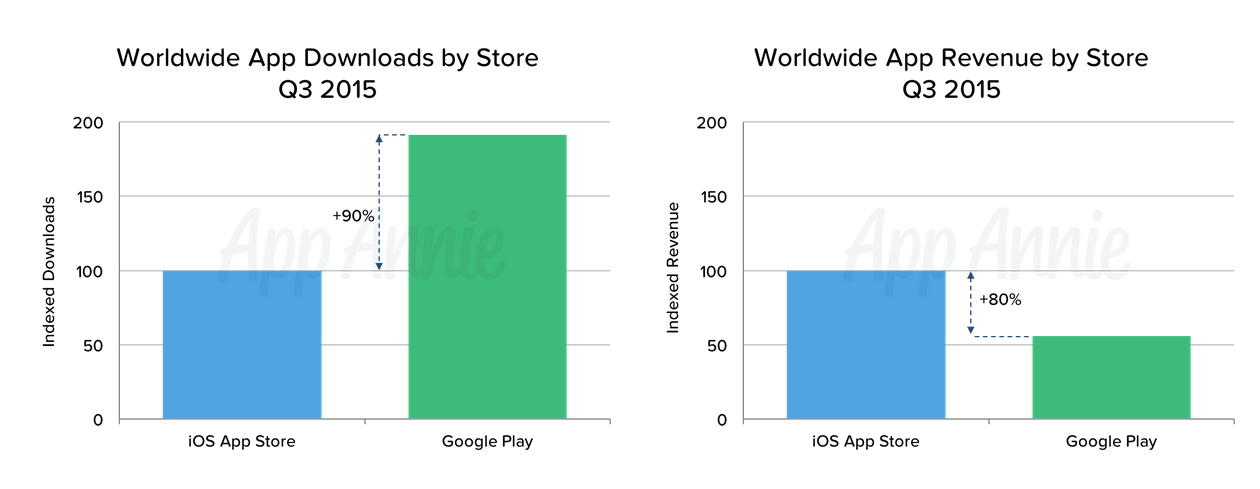
»A year ago, iA Writer for Android entered the Play Store. So far, we have sold a little more than 6’000 apps. At a price of 1 to 5 Dollars, this doesn’t cover much more than one month of app development. So we decided to go free and add in app purchases later.

We are not sure why apps sell in the Apple universe but not in the Android world. It just seems to be a hard cold fact:


Worldwide App Downloads by Store vs Worldwide App Revenue by Store

Looking at the sales numbers of paid Android apps it becomes apparent that plain paid offerings just do not get traction on Android. Why? We are not sure. Here is what we have learned.

«

There’s a point in there about price elasticity which is remarkable. But also that stuff with an upfront price tag does not sell.
link to this extract


Windows 10 Store will continue to support bitcoin » Softpedia

Bogdan Popa:

»while there was a lot of speculation online regarding the removal of Bitcoin support for new deposits in the Windows Store – some people said it’s because of the limited adoption of Bitcoin – it appears that the change made to the FAQ page was just “a mistake.”

In other words, Microsoft will continue to support Bitcoin in the Windows Store, so you can keep on using the digital currency for new deposits. A statement we received from a Microsoft spokesperson a few minutes ago provides us with some details on this:

“We continue to support Bitcoin for adding money to your Microsoft Account which can be used for purchasing content in the Windows and Xbox stores. We apologize for inaccurate information that was inadvertently posted to a Microsoft site, which is currently being corrected.”

«

Would love to know what volume of transactions they see.
link to this extract


Top NFL official acknowledges link between football-related head trauma and CTE for first time » ESPN

Steve Fainaru:

»The NFL’s top health and safety officer acknowledged Monday there is a link between football-related head trauma and chronic traumatic encephalopathy, or CTE, the first time a senior league official has conceded football’s connection to the devastating brain disease.

The admission came during a roundtable discussion on concussions convened by the U.S. House of Representatives’ Committee on Energy and Commerce. Jeff Miller, the NFL’s senior vice president for health and safety, was asked by Rep. Jan Schakowsky, D-Ill., if the link between football and neurodegenerative diseases such as CTE has been established.

“The answer to that question is certainly yes,” Miller said.

«

A bit like boxing: does it mean people will be put off the potentially fabulous riches? But equally: will parents be less likely to put their children into it? The public admission is important.
link to this extract


Teenager wins $250,000 in biggest drone race yet » The Verge

Rich McCormick:

»The sport has already attracted investment from the likes of NFL team owners, but it still has some way to go before it breaks into the mainstream. Particularly difficult is the question of how to actually observe the races. Drone pilots fly their racing craft in first-person, using special headsets to see as the drone sees, but for observers the footage can feel — and sound — like being strapped to the front of a particularly excitable wasp. A second camera following the action might help human brains contextualize the movements in space, but some of the nascent racing leagues set their courses inside buildings, making a chase camera’s operation difficult. Still, though, the speed of the craft and the deftness of his control make watching [15-year-old winner] Luke [Bannister]’s victory from Dubai an exhilarating — if slightly nauseating — experience.

«

Dubai, of course.
link to this extract


Music streaming has a nearly undetectable fraud problem » Quartz

Amy X Wang:

»For an in-depth look into how click fraud works, there’s Sharky Laguana’s thorough explanation here. Laguana—a music industry veteran who now owns a rental company—tells Quartz it certainly wouldn’t be hard to run the “perfect” scheme to con Spotify. First, set up a couple hundred fake artists. Next, upload some auto-generated tunes—mediocre dance music is particularly easy to “produce” online—and just make sure your bots click on an array of songs both real and fake, so no one gets suspicious. (He uses Spotify as an example because of its size, but the scheme could theoretically work for any music subscription service.)

“If it’s done properly, it’s nearly impossible to detect,” says Laguana. “There’s no way to know why somebody chose to click on something.”

«

Should we just turn off the internet?
link to this extract


Donald Trump, America’s own Silvio Berlusconi » The Intercept

Alexander Stille:

»Neither Trump nor Berlusconi has a real political program; what they are selling is themselves. Berlusconi used to say that what Italy needs is more Berlusconi. I recall a very telling moment in his first election campaign: During a TV debate, his opponent, the economist Luigi Spaventa, was pointing out the holes and inconsistencies in Berlusconi’s economic program, and Berlusconi stopped him mid-sentence and pointed to the victories of his soccer club, AC Milan: “Before trying to compete with me, try, at least, winning a couple of national championships!” The remark had the air of unassailable truth — however irrelevant it might be to Berlusconi’s fitness to govern. Similarly, when asked how he is going to get Mexico to pay for a giant wall between its country and ours, Trump simply responds, “Don’t worry, they’ll pay!”

Yet there is another element — a systemic one — that helps explain why Italy and the U.S. are the only major democracies in which a billionaire circus has raised its tent: the almost total deregulation of broadcast media.

«

The latter matters, as Stille explains. (Via @papanic.)
link to this extract


Errata, corrigenda and ai no corrida:
Start up: Trump’s casino flop, Micromax hits a bump, Samsung’s warning, the prime conspiracy and more

Google’s Deepmind systems are used to recognise handwriting in images. Photo by invisible monsters on Flickr.

You can now sign up to receive each day’s Start Up post by email. You’ll need to click a confirmation link, so no spam.

A selection of 10 links for you. Use them wisely. I’m charlesarthur on Twitter. Observations and links welcome.

Here’s how Donald Trump treats the little people » Mother Jones

Kevin Drum on the publicly listed Trump casino-controlling company in the 1990s:

»Trump’s fans were conned into buying up his debt-laden properties and turning them into a public company. Trump, who plainly had no interest in running a casino and had demonstrated no corporate management skills during the prior decade, paid himself millions of dollars from the company’s coffers for doing essentially nothing. He then unloaded his third casino onto the public company at an inflated price.

The public company didn’t show a profit during a single year of its existence. In 2004 the stock was delisted and the company forced into Chapter 11 reorganization. It was renamed Trump Entertainment Resorts, but with Trump still at the helm it continued to pile up losses and amassed debts of nearly $2bn. In 2008, after missing a $53m bond payment, it declared bankruptcy yet again and Trump resigned as the company’s chairman. Its investors lost all their money.

In case you’re curious, this is how Trump treats the little people.

«

Just so you can’t say you weren’t warned. Would a President Trump be as corrupt as Berlusconi? Odds seem strong.
link to this extract


Google DeepMind: What is it, how it works and should you be scared? » Techworld

Sam Shead interview with Mustafa Suleyman, co-founder of Deepmind, who explains where the systems are used inside Google:

»We use it to identify text on shopfronts and maybe alert people to a discount that’s available in a particular shop or what the menu says in a given restaurant. We do that with an extremely high level of accuracy today. It’s being used in Local Search and elsewhere across the company.

We also use the same core system across Google for speech recognition. It trains roughly in less than 5 days. In 2012 it delivered a 30 percent reduction in error rate against the existing old school system. This was the biggest single improvement in speech recognition in 20 years, again using the same very general deep learning system across all of these.

Across Google we use what we call Tool AI or Deep Learning Networks for fraud detection, spam detection, hand writing recognition, image search, speech recognition, Street View detection, translation.

Sixty handcrafted rule-based systems have now been replaced with deep learning based networks. This gives you a sense of the kind of generality, flexibility and adaptiveness of the kind of advances that have been made across the field and why Google was interested in DeepMind.

«

link to this extract


Letter to shareholders » Samsung Investor Relations

Oh-Hyun Kwon, CEO of Samsung Electronics:

»In 2016, the overall global economy may slow down, and uncertainties such as financial risks in emerging markets are expected to increase. The IT industry will change in an unprecedented speed, and competitions will intensify further.

We expect core products of our company, such as smartphone, TV, and memory, will face oversupply issues and intensified price competition. Our competitors will follow close behind our leading position in the global IT industry with aggressive investments and innovations. Moreover, innovative business models such as O2O (Online to Offline) and sharing economy are undermining the importance of hardware, which is our strength, and shifting the core competitiveness to software platform.

To cope with these changes in the business environment, we will continue to implement groundbreaking changes and innovations, and strive to secure differentiated competitiveness.

«

“Oversupply issues” probably doesn’t apply to the smartphones, but the price competition will. And there’s no explanation of how it’s going to cope exactly with that shift to software-based competition.
link to this extract


Privacy absolutism » AVC

Venture capitalist Fred Wilson:

»I do not think that because we now have the technology to lock things down (strong encryption) and because the industry that develops and maintains all of this technology has a strong libertarian bent that we should just abandon the framework that has worked in our society for hundreds of years. If society thinks someone is doing something wrong, and if law enforcement can get a warrant, there should be a mechanism to get access to our devices.

I would love to see the tech sector work to figure out a smart way to address this issue. My partner Albert has suggested an approach on his blog. There are some interesting approaches that are already being used in cold storage of bitcoin that could be applied to this situation.

But my meta point here is that I am saddened by the tech sector’s absolutist approach to this issue. The more interesting and fruitful approach would be to think about the most elegant solutions and build them.

«

The linked suggestion by his partner is this:

»I would posit that each device should ship with an *individual* key that is created by the manufacturer specifically for the purpose of unlocking the device. The key should then be stored in a way where it can be requested by law enforcement (either by the manufacturer or a third party that specializes in compliance for this). The process for such a request should run via the judiciary and mirror that for a warrant.

«

It’s also known as “key escrow” and was part of the “Clipper chip” idea which was proposed by the Clinton administration in the 1990s and comprehensively shown to be a bad idea by Matt Blaze (who is still around, on Twitter and elsewhere).

Wilson is the one who was previously stunned by Apple not making iMessage cross-platform, despite the fact that it is demonstrably valuable as an iOS exclusive. I’m approaching the point where I learn what Wilson’s view is on something, and then assume the opposite is what will happen.
link to this extract


Microsoft stops taking Bitcoin for Microsoft Store payments » Digital Trends

Trevor Mogg:

»Much was made of Microsoft’s move two years ago to start accepting Bitcoin as a form of payment for purchasing content from its online store.

The situation has, however, quietly changed, as the computer giant has recently added a note to its website revealing it’s no longer accepting the cryptocurrency in the Microsoft Store on Windows 10 devices.

“You can no longer redeem Bitcoin into your Microsoft account,” the message says, though adds that existing balances in user accounts “will still be available for purchases from Microsoft Store, but can’t be refunded.” So to be clear, any funds in your account now are good to use, but forget trying to make any new deposits into your account using Bitcoin.

«

Microsoft accepted Bitcoin? For Windows apps? Doubt that troubled the blockchain very much.
link to this extract


India’s Micromax, once a rising star, struggles » Reuters

Himank Sharma:

»A year ago, Micromax vaulted past Samsung Electronics Co Ltd to become India’s leading smartphone brand. Today, its market share has nearly halved, several top executives have resigned, and the company is looking for growth outside India.

In Micromax’s slide to second place is a tale of the promise and peril of India’s booming but hyper-competitive smartphone industry.

India is the world’s fastest-growing smartphone market. Shipments of smartphones jumped 29% to 103m units last year.

Rapid growth has helped nurture a crop of local brands, led by Micromax, that outsourced production to Chinese manufacturers. Now, as Samsung rolls out more affordable phones, the same Chinese factories are entering the Indian market with their own brands, depressing prices and forcing Indian mobile makers to rethink their strategies.

“What the Indian brands did to the global brands two years ago, Chinese phone makers are doing the same to Indian brands now, and over the next year we see tremendous competition for Micromax and other Indian smartphone makers,” said Tarun Pathak, analyst at Counterpoint Research in New Delhi…

…Last May, Alibaba walked away from a mooted $1.2bn purchase of a 20% stake, citing a lack of clarity on growth plans, according to one executive involved in the discussion. Micromax co-founder Vikas Jain said in an interview with Reuters this week that the company and Alibaba disagreed on a future roadmap.

«

The smartphone business’s evolution has been like the PC business’s evolution speeded up; India’s is like the smartphone one, speeded up again.
link to this extract


Here’s what a knockoff Apple Watch looks like » Daily Dot

Mike Wehner, way back in April 2015:

»The story of how I came to own this forgery isn’t particularly remarkable: In early March, just as the hype around Apple’s new wearable was reaching a fever pitch, I found a Taiwanese seller who claimed to be selling the Apple Watch for immediate shipment. There was no size option or “collection” to choose from, just four colors, so I selected one and placed an order. It cost me the equivalent of roughly $53, and while I knew the watch that eventually arrived wouldn’t be anything impressive, I was nonetheless curious about just how bad it would be. Now I know.

«

Pretty dire. Wonder if they’re any better now?
link to this extract


Music piracy hasn’t gone, it has merely changed its spots » MIDiA Research

Mark Mulligan:

»P2P piracy was tailor made for the 2000’s when:

• Home internet connections were slow
• Most content consumption was desk top based
• People still liked owning music

Now in the streaming era all three of those market dynamics have lessened massively. So little wonder then that piracy technology has evolved to meet the needs of the streaming consumer.

With YouTube the number one digital music destination, and with a catalogue that no other music service will ever be able to match, it makes complete sense that YouTube rippers have emerged as one of the key strands of music piracy tech. Many of which transform YouTube into a fully offline, on demand, ad free, high quality music service.

«

And that’s why the music labels tend to hate YouTube.
link to this extract


GMG’s David Pemsel: Membership will make up a third of the Guardian’s revenue within three years » The Media Briefing

Chris Sutcliffe:

»The Guardian has not been agile enough to respond to the challenges faced by the publishing industry over the past few years, according to Guardian Media Group CEO David Pemsel.

Speaking at Digital Media Strategies 2016, Pemsel said that an overly narrow focus on the “big number” of its global audience masked some of the strategic issues that the Guardian was facing:

»

“I think all those big numbers are a proof point about how fast and innovative we’ve been in getting to digital [but] monetising anonymous reach is essentially over.

“To be able to parade around and say ‘we’re big’ is not good enough. We want to convert our anonymous reach into a known audience.”

«

That conversion of its unknown audience to a known one is a “massive opportunity”, based around a refinement and reinvention of The Guardian’s membership scheme, which Pemsel believes could make up one third of the Guardian’s overall revenue within three years.

«

The point about “monetising anonymous reach is essentially over” is a key one. Pemsel is saying that online advertising in itself isn’t enough to fund the Guardian – which ought to worry everyone else.
link to this extract


Mathematicians discover prime conspiracy » Quanta Magazine

Erica Klarreich:

»Two mathematicians have uncovered a simple, previously unnoticed property of prime numbers — those numbers that are divisible only by 1 and themselves. Prime numbers, it seems, have decided preferences about the final digits of the primes that immediately follow them.

Among the first billion prime numbers, for instance, a prime ending in 9 is almost 65 percent more likely to be followed by a prime ending in 1 than another prime ending in 9. In a paper posted online on Sunday, Kannan Soundararajan and Robert Lemke Oliver of Stanford University present both numerical and theoretical evidence that prime numbers repel other would-be primes that end in the same digit, and have varied predilections for being followed by primes ending in the other possible final digits.

“We’ve been studying primes for a long time, and no one spotted this before,” said Andrew Granville, a number theorist at the University of Montreal and University College London. “It’s crazy.”

«

My first objection on reading those paragraphs was “they should do it in a different number base than decimal”. Then it turns out that they started in a different number base (3) and worked out from there. So yes, this is a spooky property.
link to this extract


Errata, corrigenda and ai no corrida:

Start up: Android antitrust?, Flickr flickers, Apple gets small, Opera adblocks, an iPhone killer dies, and more

Sonos is cutting jobs but says voice recognition and streaming will be bigger parts of its future. Photo by nan palmero on Flickr.

You can now sign up to receive each day’s Start Up post by email. You’ll need to click a confirmation link, so no spam.

A selection of 10 links for you. A computer counted them. I’m charlesarthur on Twitter. Observations and links welcome.

What happens when video games can read your face » Fast Company

Elizabeth Segran:

»Game developers have always been interested in how players might react to the characters and plots they created—but what if they could tell exactly how the player was feeling and tailor the game to their mood?

“Back in the olden days we had to do a lot of guesswork as game designers,” says Erin Reynolds, the creative director of the gaming company Flying Mollusk. “Is the player enjoying this? Is the player bored? You had to create a game that was one size fits all.”

But all that is changing fast. Affectiva, an MIT Media Lab spin-off that creates technology that recognizes people’s emotions by analyzing subtle facial movements, has created a plugin that game developers can integrate into their games to make them more emotion-aware.

«

The warm bath of AI – it’s all around you.
link to this extract


EU taking steps towards formal complaint against Google’s Android » Bloomberg Business

Aoife White:

»The European Union may be gearing up to send Google an antitrust complaint over its Android mobile phone operating system, adding to a growing list of regulatory woes for the company on the continent, according to three people familiar with the probe.

The Internet giant’s opponents have been asked to remove any business secrets from documents submitted to regulators to prepare non-confidential versions that could be shown to Google after a statement of objections, said the people who asked not to be named because the investigation is private.

«

That’s certainly a key step towards a Statement of Objections. But it’s been more than a year since Vestager raised the SOO to Google’s search, and nothing has happened. Why will this make any difference?
link to this extract


Android N’s under-the-hood changes might point to a new future for OS updates » Android Central

Jerry Hildenbrand:

»Imagine a world where Samsung can have its vision of Android running just how it likes it, while deep system processes — like the infamous Stagefright library — are separate and untouched. That would mean that Samsung or Google could push out changes to their separate parts of the system far more easily (and much faster) than they can today without interfering with the other half of the system. (With APIs and libraries to bridge the gap.) The manpower alone that this situation frees up means more people are available to work on making the Samsung experience better without having to worry about the underlying Android code.

With Android N, Google has essentially started to divide Android into two sections: the core OS (the framework that makes everything work) and the interface (the apps, launcher, notifications, and everything else the user interacts with).

«

Sounds nice. Any reasonable estimate suggests that Android N will be on about a third of Android devices 18 months after it is announced; Lollipop (v 5.x) is now on 36.1% of devices, having been released in November 2014. So that suggests, if N goes live in November, that it’s going to be 2018 before any of this is really widespread.
link to this extract


Apple invites media to March 21 product event » Mashable

Lance Ulanoff:

»No one expects cutting-edge technology from the new 4-inch phone. Most rumors have pegged it with the last-generation A8 chip and an 8-megapixel camera. It will also, at a rumored $450, cost a lot less than Apple’s flagships, the iPhone 6S and 6S Plus.

Most people also expect an iPad Air 3. Apple’s latest 9.7in tablet will not be a great leap forward, but it should include an A9 processor, support for the Apple Pencil and maybe even Smart Connectors for accessories like an iPad Air-size Smart Keyboard.

This event will also mark the one year anniversary (plus a few days) of the official introduction of Apple’s first wearable, the Apple Watch. No one is predicting new hardware; the Apple Watch design will probably be fixed for at least another six months. There are rumors, though, of even more watch band styles and, possibly, some new Apple Watch colors and materials.

This is also the time of year where Apple does a laptop refresh. A year ago it introduced the ultra-light, gold MacBook, which was notable for having just a single USB-C port. The device is an engineering wonder, but its processor, the Intel Core M, is over a year old. Expect an upgrade to Intel’s sixth-generation Core line (a.k.a. Skylake). Apple could also introduce upgrades for the MacBook Pro and the Mac Pro.

There’s always the possibility of a surprisem, like a brand new gadget or accessory. It’s certainly been ages since Apple upgraded the earbuds that ship with the iPhone. Maybe they’ll finally get a Beats upgrade.

«

They all sound like solid upgrades; watching the effect of a new 4in iPhone on sales will be telling.
link to this extract


Navigating an industry in transition, investing in the future of music » Sonos

Sonos chief executive (and co-founder) John McFarlane on how future music streaming and voice control will be key to the company’s future:

»Now the path forward for the music industry is crystal clear, so too is our path at Sonos. We’re doubling down on our long-held conviction that streaming music is the dominant form of consumption now and in the future. We believe that listeners will grow increasingly dissatisfied with the solutions they’ve cobbled together for listening at home.

“Now that music fans can finally play anything anywhere, we’re going to focus on building incredibly rich experiences that were all but unimaginable when we started the company.”
Now that music fans can finally play anything anywhere, we’re going to focus on building incredibly rich experiences that were all but unimaginable when we started the company, and will be at the vanguard of what it means to listen to music at home. This is a significant long-term development effort against which we’re committing significant resources.

Voice: we’re fans of what Amazon has done with Alexa and the Echo product line. Voice recognition isn’t new; today it’s nearly ubiquitous with Siri, OK Google, and Cortana. But the Echo found a sweet spot in the home and will impact how we navigate music, weather, and many, many other things as developers bring new ideas and more content to the Alexa platform.

Alexa/Echo is the first product to really showcase the power of voice control in the home. Its popularity with consumers will accelerate innovation across the entire industry. What is novel today will become standard tomorrow. Here again, Sonos is taking the long view in how best to bring voice-enabled music experiences into the home. Voice is a big change for us, so we’ll invest what’s required to bring it to market in a wonderful way.

«

Apparently the new Sonos Play:5 has a microphone built in, but not – it seems – enabled yet. McFarlane also says there are layoffs, though the number isn’t specified. The admiration for Amazon’s Echo is something to note, though.
link to this extract


Flickr’s desktop auto-upload feature is no longer free » VentureBeat

Ken Yeung:

»Flickr has made a change to its $5.99 monthly Pro membership plan that will affect those using the photo-sharing social network for free. Starting today, its desktop Auto-Uploadr tool will be exclusive to paying customers. But all is not lost, as the company is offering a 30 percent discount to non-paying members to upgrade.

With the desktop Auto-Uploadr feature, users can automatically upload all of their photos from anywhere, while also making them accessible from any device. Introduced in May and available for Windows and Mac computers, it promised to take images from your hard drive, iPhoto, and any external hard drive and store it on Flickr’s servers. This was intended to tout the company’s increase in free storage capacity of up to 1000GB.

«

Feels like the first turn of the screw.
link to this extract


The roots of Tim Cook’s activism lie in rural Alabama » The Washington Post

Todd Frankel got sent down to Alabama to see what the hell he could find in the town where Tim Cook grew up. Turned out, not much to find:

»Robertsdale today is a two water-tower town of about 5,200 residents. It’s doubled in size since Cook grew up here, with houses spreading across former farm fields. The town got its first Walmart Supercenter two years ago.

Back in 1977, the new store in town was a Piggly Wiggly. There was no movie theater. No bowling alley. The fall county fair was the big deal. Teens hung out on the town’s tennis courts or outside Hammond’s Supermarket, where they knew the owner. “There was nothing to do,” said Teresa Prochaska Huntsman, another Class of ’78 alum.

School was the center of their lives. And Cook excelled there. He was in the National Honor Society and racked up academic honors. So did Huntsman, who managed to edge out Cook for the title of class valedictorian…

…“He probably considered himself to be a bit nerdy, but he didn’t come off that way,” recalled Harold Richardson, another former classmate.

And the topic of whether Cook — or any other student — was gay wasn’t even on the radar. “In the ’70s, in high school, no one thought about that, especially in Alabama,” Richardson said. It was like it wasn’t even possible.

Growing up gay in small-town Alabama a generation ago meant knowing the value of privacy, recalled Paul Hard, 57, who was raised in tiny Demopolis, Ala. He doesn’t know Cook, but imagines what he went through, because he went through it himself. “You kept your cards close to your chest,” he said.

«

The photo of Cook in the high school yearbook is amazing, though. Took me quite a while to find it.
link to this extract


China’s best iPhone clone maker bites the dust » Tech In Asia

Charlie Custer:

»So what killed Dakele? Frankly, having a good-quality, low-cost smartphone simply isn’t enough to win you customers in the Chinese smartphone market these days. While it worked in the early days of Xiaomi, when real iPhones were a luxury item and smartphone penetration was low, these days everybody in major cities has a smartphone, and the middle class has grown enough that Apple’s uber-expensive iPhone is consistently among China’s top sellers.

In this climate, investors are not longer interested in backing phone brands that only offer value-for-money. With virtually all of China’s internet giants getting in on the smartphone game, there are too many other companies out there that can offer the same kind of value for money in addition to other things, like an established customer base or unique software integrations. Dakele ultimately folded, according to Ding, because its sources of capital were cut off as investors became more interested in rivals. (It also probably didn’t help that the company Dakele outsourced its manufacturing to shut down last year.)

The most important lesson of Dakele’s death may be that in big, fast-growing markets like China the bang-for-buck approach to selling smartphones isn’t sustainable in the long term. In the early years of China’s smartphone market, knockoff brands and clone-makers like Dakele were making a killing, but the demise of Dakele suggest that now those days are well and truly gone. If you want to sell smartphones in China, having good specs and an affordable price isn’t enough to attract customers or investors anymore.

«

Now the question becomes: what is enough? Custer also points to other markets where the same lesson is likely to be learnt the hard way.
link to this extract


Opera becomes first big browser maker with built-in ad-blocker » Reuters

Eric Auchard:

»Norwegian company Opera is introducing a new version of its desktop computer browser that promises to load web pages faster by incorporating ad-blocking, a move that makes reining in advertising a basic feature instead of an afterthought.

Faster loading, increased privacy and security and a desire for fewer distractions are behind the growing demand for ad-blockers.

However, their popularity is cutting into the growth of online marketing for site publishers and corporate brands, who rely on reaching web and mobile users to pay for their content rather than restricting access to paid subscribers.

Opera has a history of introducing innovations that later become common in major browsers such as tabbed browsing and pop-up blocking, which helped users control an earlier generation of in-your-face ads and malware disguised as advertising.

«

It’s that last paragraph that’s important: Opera introduced tabbed browsing in 2000, and by 2001 it was in Mozilla, then Safari in 2003, and IE in 2006. Adoption of new features could be even faster now.
link to this extract


The Economist explains: Why fashion week is passé » The Economist

»Fashion week used to serve a distinct purpose. Designers would prepare collections and present clothes to the press, to major retailers and to select other industry insiders. Fashion editors would then prepare sumptuous magazine spreads featuring the clothes they liked best. Retailers would order this or that dress. About four to six months later, those clothes would appear in shops.

Technology has upended all this. As soon as models sashay down the runway, photographs are posted online and shared endlessly through social media. Fast-fashion brands copy designers’ styles (though the industry prefers the euphemism “interpret”), often stocking look-alikes in their shops before designers’ own clothes make it to department stores. When designers’ clothes do arrive, they seem stale . It is no coincidence that the world’s top two retailers are TJX and Inditex. TJX buys brand-name clothes from stores that can’t sell them at full price, then offers them at a deep discount. Inditex owns Zara, the pioneer in fast fashion.

Few designers like the current system. Less obvious is what they should do next.

«

(Via Benedict Evans.)
link to this extract


Errata, corrigenda and ai no corrida:

Start up: Samsung’s US chance, Google’s RTBF extension, hacking Isil, bionic feels!, and more

The world of professional bridge is struggling with accusations of cheating. But how do you prevent people communicating in code, if they can communicate? Photo by jaxx2kde on Flickr.

You can now sign up to receive each day’s Start Up post by email. You’ll need to click a confirmation link, so no spam.

A selection of 9 links for you. Effortless. I’m charlesarthur on Twitter. Observations and links welcome.

Sizing the US opportunity for Samsung Galaxy S7 & S7 edge » Kantar Worldpanel

Carolina Milanesi:

»By the end of January [2016], the Galaxy S6 represented only 9% of Samsung’s installed base in the US, and the Galaxy S6 edge a mere 2%. The Galaxy S5 remained the most popular device in the installed base, representing 21.5% followed by the Galaxy S4 – now a three-year-old phone – at 14.2%.

Between February 2015 and January 2016, only 26% of Samsung smartphones in use were upgraded. This creates a huge opportunity for Samsung to persuade consumers it is time to upgrade to the new devices.

Of the 26% of Samsung devices that were upgraded, the greatest percentage (27.5%) chose the Galaxy S5, 26.2% the Galaxy S6: 9.4% the Galaxy Note 4: 7.9% the Galaxy Note 5: and 5% the Galaxy S6 edge. The rest of the upgrades were divided among 33 different models, demonstrating how wide the Samsung offering remains in the US market, despite all the attention being given to its flagship products.

Only 3.6% of current Galaxy S6 owners said they are planning to upgrade their smartphone in the next 12 months. This should not worry Samsung, however, as we have shown that a significant opportunity remains among owners of older phones, making them a much easier target for the Korean brand.

«

Suggests that the S6 and S6 Edge really weren’t a big hit, as the S4 has a higher share than both together.
link to this extract


Dirty hands » The New Yorker

David Owen, with a fantastic piece about cheating in the world of professional bridge:

»When Brogeland made his first announcement, his evidence against Fisher and Schwartz consisted solely of what he believed to be a collection of suspicious hands; he still didn’t know how they might be exchanging information. A few days later, he created a new Web site, called Bridgecheaters.com, and posted three YouTube videos from the 2014 European Team Championships, which Fisher and Schwartz’s team had won. Each video had been shot from a camera mounted near the table. It showed all four players, as well as the table paraphernalia of modern tournament bridge: four bidding boxes (containing each player’s pre-printed bidding cards); a felt-covered bidding tray (on which the players place bidding cards before sliding it back under the screen); and a plastic duplicate board (a flat, rectangular box in which four pre-dealt hands have been delivered to the table). Brogeland asked for help from other players, and the search for evidence immediately became a collaborative international project.

«

As you read it, you realise that every human element in bridge – speaking, coughing, card movement, any physical movement – makes it feasible to create a code to cheat; the only way to prevent it would be to have people playing via screen, without words or gestures. Which would take away everything that might make it fun.
link to this extract


Google finally extends right-to-be-forgotten rules to all search sites, including dot-com » Ars Technica UK

Kelly Fiveash:

»Google has responded to European Union data watchdogs by expanding its right-to-be-forgotten rules to apply to its search websites across the globe.

In 2014, search engines were ordered by Europe’s top court to scrub certain listings on their indexes. Google—which commands roughly 90 percent of the search market in the EU—claimed at the time that such measures amounted to censorship of the Internet.

However, the landmark European Court of Justice ruling in fact stated that search engines were required to remove links that are old, out of date or irrelevant, and—most significantly of all—not found to be in the public interest.

Indeed, the right-to-be-forgotten may seem evocative to privacy campaigners, but as the UK’s Information Commissioner’s Office has previously stated, “there is no absolute right [under the ruling] to have information removed.”

«

Google’s blogpost on the topic says “We’re changing our approach as a result of specific discussions that we’ve had with EU data protection regulators in recent months”. No mention of the swingeing fines the regulators threatened.
link to this extract


Bionic fingertip gives sense of touch to amputee » Reuters

Matthew Stock:

»A bionic fingertip has given an amputee the sensation of rough or smooth textures via electrodes implanted into nerves in his upper arm.

Scientists from EPFL (Swiss Federal Institute of Technology) and SSSA (Sant’Anna School of Advanced Studies, Italy) successfully allowed amputee Dennis Aabo Sørensen to receive this sophisticated tactile information in real-time.

The research, published in science journal eLife, says Sørensen is the first person in the world to recognize texture using a bionic fingertip connected to electrodes surgically implanted above his stump.

The nerves in Sørensen’s arm were wired to a machine with the fingertip attached to it. The machine then controlled the movement of the fingertip over pieces of plastic engraved with different textures, either rough or smooth. When the fingertip moved across the plastic, its sensors generated an electrical signal which was translated into a series of electrical spikes that mimic the language of the nervous system. This was then delivered to Sørensen’s nerves.

«

Odd – and a little sad – how little of the billions washing around Silicon Valley are being used to set up companies to do things like this.
link to this extract


AlphaGo defeats Lee Sedol in first game of historic man vs machine match » Go Game Guru

You probably heard the news that Google’s DeepMind system AlphaGo beat the best player in the world. Here are the reactions of the pros (“9p” means “9-dan professional”, ie the highest level):

»Lee Changho 9p said,  “I’m so shocked by AlphaGo’s play!”

Meanwhile Cho Hanseung 9p remarked, “AlphaGo is much stronger than before, when it played against Fan Hui 2p! When Google said the odds were fifty-fifty, it seems they weren’t joking. I still can’t believe its performance even though I just saw it with my own eyes.”

In a post-game interview, Lee Sedol was visibly startled by AlphaGo’s strength. “I was so surprised. Actually, I never imagined that I would lose. It’s so shocking. Regarding the game, I got off to a bad start and AlphaGo played well right until the end. Even when I was behind, I still didn’t imagine that I’d lose. I didn’t think that it would be able to play such an excellent game. I heard that the DeepMind CEO Demis Hassabis said that he respects me as a Go player, but I have great respect for both of them [referring to Demis Hassabis and Eric Schmidt] for making this amazing program. I also respect all the programmers who helped to make AlphaGo.”

«

The second game should finish around 0800 GMT on Thursday.
link to this extract


Exclusive: 1736 documents reveal ISIS jihadists personal data » Zaman Al Wasl

»Zaman Al Wasl has exclusively obtained the personal data of 1736 ISIS fighters from over 40 countries, including their backgrounds, nationalities and hometown addresses.

The document that branded by ISIS as confidential is shedding the light on the inner circle of the de facto a state which has its own institutions and official documents as well data bank.

Two thirds of ISIS manpower are from Saudi Arabia, Tunisia, Morocco and Egypt. 25% of ISIS fighters are Saudis, the data disclosed.

While Turkish fighters are taking the lead among ISIS foreign fighters, French fighters come next.

Syrians are just 1.7 % of the total number of fighters. The Iraqis make 1.2.

Expert told Zaman al-Wasl that Iraqis and Jordanians can make the backbone of ISIS but most of them are based in Mosul and ISIS-controlled areas in Ramadi.

The most notably that ISIS fighters do not know the real names of their fellow fighters since they used to have code names, or names de guerre, and for security issues they have been obliged to follow high ranks of secrecy.

The documents have been written and organized by the General Administration of Borders, and ISIS commission that tracks all Jihadists data.

The data document is including 23 fields, starting with the Jihadist’s first name, last name, code name, date of birth and nationality. The jihadist who cross the the Islamic State’s borders for the first time is ought to acknowledge the Borders Administration everything about himself, even what he wants to be in ISIS, a fighter or a suicide bomber.

«

Hacking is damned annoying thing.
link to this extract


Maybe we could tone down the JavaScript » fuzzy notepad

Alex Munroe is kinda annoyed about pages which insist on a ton of Javascript:

»These aren’t cutting-edge interactive applications; they’re pages with text on them. We used to print those on paper, but as soon as we made the leap to computers, it became impossible to put words on a screen without executing several megabytes of custom junk?

I can almost hear the Hacker News comments now, about what a luddite I am for not thinking five paragraphs of static text need to be infested with a thousand lines of script. Well, let me say proactively: fuck all y’all. I think the Web is great, I think interactive dynamic stuff is great, and I think the progress we’ve made in the last decade is great. I also think it’s great that the Web is and always has been inherently customizable by users, and that I can use an extension that lets me decide ahead of time what an arbitrary site can run on my computer.

What’s less great is a team of highly-paid and highly-skilled people all using Chrome on a recent Mac Pro, developing in an office half a mile from almost every server they hit, then turning around and scoffing at people who don’t have exactly the same setup. Consider that any of the following might cause your JavaScript to not work:

• Someone is on a slow computer.
• Someone is on a slow connection.
• Someone is on a phone, i.e. a slow computer with a slow connection.
• Someone is stuck with an old browser on a computer they don’t control — at work, at school, in a library, etc.
• Someone is trying to write a small program that interacts with your site, which doesn’t have an API.

«

And he’s only just getting started.
link to this extract


How the smartphone shapes millennials’ online activities » Global Web Index

Chase Buckle:

»From a marketing perspective, the term Millennial is increasingly becoming synonymous with mobile. And for good reason – almost 90% own a smartphone and these internet users clock up on average over 3 hours per day online via mobiles (rising to over 4 hours in Latin America and the Middle East). That means they’re spending up to 5x longer per day online on mobile than older age groups.

Understandably, this enthusiasm for smartphones is having a huge impact on their online activities. Our latest research shows that Millennials overwhelmingly cite smartphones as their most important device for getting online, and we’re seeing more-and-more staple internet activities take place on mobile.

«

What I notice about the above graphic is that in the past month, about 76% used a search engine on mobile – and (slightly) more used a social network. By contrast on desktop, it would probably be 100% and 100%. Plus these are the millennials; for those who are older, both uses will be less. That search engine use is Google’s problem on mobile: lots of people don’t do search on a daily basis on mobile.
link to this extract


We need to save online journalism from ad blocking – and here’s how » Alphr

James O’Malley:

»Historically, journalism has had two major sources of income: Advertisers and readers. But now publishing is being squeezed from both ends. Thanks to the internet, and the explosion in ‘content’ (that’s what we call it now), people are very reticent to pay to read news, like they would have done for a print newspaper. And now thanks to ad-blockers, fewer people are looking at the adverts.

So what to do? How can a business model be found that will make journalism pay? Is there anything that can save this noble trade?

Bizarrely, the solution to this problem has already been invented. Six years ago. By one of the last people you’d expect to have an interest in paying people for their work.

Flattr was co-founded in 2010 by Peter Sunde, who is better known as one of the co-founders and former spokesperson for The Pirate Bay. Given that his website is responsible for distributing huge swathes of pirated content, you can’t help but wonder if Flattr was his attempt at atonement.

Flattr is a “microdonation” platform. The idea is that you sign up and allocate a fixed amount of cash to pay in every month – say £10 for the sake of argument – and then if you’re reading an article online that you like, you can click the “Flattr” button nestled amongst the existing social media sharing links. At the end of the month, your £10 is then divided up between the publishers of the articles that you’ve chosen to flattr. So if you flattr two articles, they earn £5 each. If you flattr ten, then each gets a pound. And so on.

The genius is that it solves the biggest problem with any micropayment system: Friction.

«

Neat idea. The problem now is just adoption by publishers and readers (and getting users of adblockers to see it in the first place).
link to this extract


Errata, corrigenda and ai no corrida:

Start up: app retention rates, the real FBI-Apple court problem, Samsung closing Milk Music?, and more

Steve Jobs’s desire to push books on the iPad led to an antitrust finding against Apple. Screenshot by tuaulamac on Flickr.

You can now sign up to receive each day’s Start Up post by email. You’ll need to click a confirmation link, so no spam.

A selection of 9 links for you. Aren’t they? I’m charlesarthur on Twitter. Observations and links welcome.

Apple, FBI, and the burden of forensic methodology » Zdziarski’s Blog of Things

Jonathan Zdziarski is a forensics expert who has testified in court cases and designed his own computer forensics tools. He says that even if Apple is forced to write the software to crack the iPhone PIN, it will need to be examinable in court:

»Full documentation must be written that explains the methods and techniques used to disable Apple’s own security features. The tool cannot simply be some throw-together to break a PIN; it must be designed in a manner in which its function can be explained, and its methodology could be reproduced by independent third parties. Since FBI is supposedly the ones to provide the PIN codes to try, Apple must also design and develop an interface / harness to communicate PINs into the tool, which means added engineering for input validation, protocol design, more logging, error handling, and so on. FBI has asked to do this wirelessly (possibly remotely), which also means transit encryption, validation, certificate revocation, and so on.

Once the tool itself is designed, it must be tested internally on a number of devices with exactly matching versions of hardware and operating system, and peer reviewed internally to establish a pool of peer-review experts that can vouch for the technology. In my case, it was a bunch of scientists from various government agencies doing the peer-review for me. The test devices will be imaged before and after, and their disk images compared to ensure that no bits were changed; changes that do occur from the operating system unlocking, logging, etc., will need to be documented so they can be explained to the courts. Bugs must be addressed. The user interface must be simplified and robust in its error handling so that it can be used by third parties.

«

Trivial, huh?
link to this extract


April 2015: Meerkat & Periscope: features, not products » Tech-Thoughts

Sameer Singh, writing almost a year ago when the two streaming apps were just taking off:

»Both Meerkat and Periscope leverage smartphone cameras to broadcast live video. However, the apps themselves don’t play a major role in the discovery of these broadcasts. This may be because they are too specialized to generate sustained engagement, at least enough to be a discovery platform (most app users are likely to be broadcasters). Also, it is relatively easy to replicate the feature set and user experience of a Meerkat or a Periscope, but it is very difficult to enable discovery. Therefore, these apps are not products in their own right, but just features built on top of broadcast-oriented social platforms, i.e. those that facilitate one-to-many communication (e.g. Twitter).

On a standalone basis, these apps have a limited shelf life — they could either be acquired by social platforms that fit the description above or be killed by them. Therefore, it isn’t surprising that Meerkat found viral success by leveraging Twitter’s social graph. Any incumbent’s response in this situation would be to build or acquire a similar feature set. Twitter chose to acquire.

«

And this month: Meerkat announces that it’s going to pivot to being a “video social network” instead.

Not just a feature, but a very niche feature.
link to this extract


Driverless lorry convoys to be trialled in the UK » Ars Technica UK

Sebastian Anthony:

»Convoys of automated lorries will be trialled on UK motorways, chancellor George Osborne is expected to announce in his 2016 Budget speech later this month.

The Times reports that the trials will take place on a northerly stretch of the M6, which runs from Birmingham all the way up to the border of Scotland, near Carlisle. The Department for Transport confirms that planning for “HGV platoons” is under way, though it did not comment on whether the trials will receive funding in the Budget, nor give any kind of timeline for the fleet’s deployment.

A DfT spokesman said: “We are planning trials of HGV platoons—which enable vehicles to move in a group so they use less fuel—and will be in a position to say more in due course.” The Times reports that these platoons could consist of up to 10 driverless lorries, each just a few metres away from each other.

The DfT’s “less fuel” claim refers to “drafting,” where the first lorry in the platoon creates a slipstream, significantly reducing drag and fuel consumption for the other lorries behind it. In a semi-automated lorry demo a couple of years ago, the fuel economy for a platoon of lorries improved by about 15%. Expand that out to the thousands of trucks that are on UK roads at any one time and you’re looking at potentially huge cost reductions.

«

link to this extract


Supreme Court rejects Apple e-books price-fixing appeal » Reuters

Lawrence Hurley:

»The U.S. Supreme Court on Monday declined to hear Apple Inc’s challenge to an appellate court decision that it conspired with five publishers to increase e-book prices, meaning it will have to pay $450m as part of a settlement.

The court’s decision not to hear the case leaves in place a June 2015 ruling by the New York-based 2nd U.S. Circuit Court of Appeals that favored the U.S. Department of Justice and found Apple liable for engaging in a conspiracy that violated federal antitrust laws.

Apple, in its petition asking the high court to hear the case, said the June decision by the 2nd U.S. Circuit Court of Appeals in New York upholding a judge’s ruling that Apple had conspired with the publishers contradicted Supreme Court precedent and would “chill innovation and risk-taking.”

«

One of those instances where Steve Jobs (who created the antitrust situation while trying to kickstart iPad sales by getting iBooks competitive with Amazon, but without the pain of competing on price) really overreached. And the irony? It turns out retail e-books aren’t a particularly strong driver of iPad sales.
link to this extract


Facebook pulls plug on ad software » The Information

Cory Weiberg:

»Last year, Facebook tested software that would represent a bold expansion of its display ads business beyond its own inventory, a move potentially worth billions in revenue. Using a demand-side platform, or a DSP, marketers would be able to use Facebook users’ identity data to bid on ad slots across the mobile and desktop Internet in real time.

But Facebook recently yanked the bidding software from service because the tests showed that banner ads that were served attracted too many fraudulent impressions by bots trawling the Web, the company confirmed to The Information on Friday.

While Facebook’s current advertising business centers mostly on its own mobile inventory and apps plugged into its ad network, many in the industry have been awaiting its plunge into the mobile web’s programmatic ad marketplace. Its ad server, Atlas, which on Monday added capabilities to serve video ads and track offline purchases, can measure whether users saw ads across digital devices. But because of the pulled DSP tests, the ad server doesn’t yet have a bidding platform that would expand its pool of marketing clients wanting to tap this programmatic marketplace.

«

Google dominates the banner ad space via DoubleClick, but one has to wonder whether it sees the same level of bot trawling; if it does, how does it stop it better than Facebook? Is it just about having more experience?
link to this extract


“Google Posts” embeds a one-way social network directly into search results » Ars Technica

Ron Amadeo:

»There’s a weird new feature popping up in Google search results called “Google Posts.” It seems to be a place for Google to directly host content in a post-Google+ world and to embed this content directly into search results. Imagine orphaned Google+ posts with the Google+ branding stripped out, and you’re most of the way there.

Over at Google.com/posts, Google has a landing page for this feature, calling it “an experimental new podium on Google” that allows you to “hear directly from the US presidential candidates in real time on Google.” It’s a believable explanation until you see this Google Posts profile from “Andrew Jewelers” in Buffalo, New York, (spotted by Mike Blumenthal), which is definitely not a presidential candidate.

The landing page says the “experimental” feature is “only available to the 2016 US presidential candidates” (Andrew Jewelers for president!), but those of us not running for office can join a waitlist as Google plans to “make it available to other prominent figures and organizations.”

It really seems like this is a Google+ reboot just for brands. The design definitely seems like Google+ with the Google+ branding stripped out, but this “social network” explicitly dodges being “social” AND any kind of “networking.”

«

Sort-of sponsored content in search results?
link to this extract


Expect lots more publishers to start asking people to turn off their ad blockers » Business Insider

Lara O’Reilly:

»The US digital advertising trade body, the Interactive Advertising Bureau (IAB,) has released advice to publishers on how they should deal with the growing number of ad blocker users visiting their sites.

The IAB wants publishers to “DEAL” with it, by taking these four steps:

• D: detect ad blocking, in order to initiate a conversation (The IAB also released an ad blocking detection script for its members to add to their websites on Monday.)

• E: explain the value exchange that advertising enables.

• A: ask for changed behavior in order to maintain an equitable exchange.

• L: lift restrictions or Limit access in response to consumer choice.

In other words, it looks like far more websites are going to start asking users to turn off their ad blocker or pay some sort of subscription or make a micropayment in order to access their content.

«

M-i-c k-e-y m-o-u-s-e acronyms are nice, but it’s a big risk to take that people actually do love your content so very much that they’ll take all those ads once more, having stopped. Or will publishers and advertisers just dial back on the ads only for adblocking users? Or for everyone? The inconsistencies multiply.
link to this extract


Milk Music may shut down as Samsung eyes Tidal [update: doesn’t eye Tidal] » Variety

Janko Roettgers:

»Samsung is likely going to shutter its Milk Music streaming service in the near future as part of a bigger revamp of its music strategy, Variety has learned from multiple sources. However, Samsung denied rumors that it was going to buy Jay Z’s Tidal service in a statement sent to Variety Friday hours after the original publication of this story.

The shut-down would come two years after Samsung unveiled Milk Music with big fanfare as a competitor to Pandora. The service, which offers consumers personalized radio stations, had initially been exclusive to owners of select mobile devices made by the company. Samsung later opened up Milk Music on the Web, and brought it to its smart TVs as well, but never released apps for phones from other manufacturers.

Milk Music was initially meant to be part of a bigger move toward a new generation of media services that would add value to Samsung devices while also adding incremental advertising and subscription revenue to Samsung’s bottom line. As part of that strategy, Samsung launched Milk Video as a platform for short-form video content in late 2014. There had been plans to branch out with the Milk brand into sports and other forms of entertainment as well.

But late last year, Samsung shuttered Milk Video after it failed to gain traction with consumers. Now, it looks like Milk Music may be heading for a similar shut-down.

«

Roettgers was first with the story about Milk Video shutting down. Samsung Milk Music has over 10m downloads on Google Play and a high rating (4.3).

But again, Samsung just can’t seem to make up its mind what it wants to do beyond hardware. Chat service? It closed Chaton. Video service? Closed Milk Video. Music service? … Oh well.
link to this extract


New data shows losing 80% of mobile users is normal, and why the best apps do better » andrewchen

Andrew Chen and Ankit Jain:

»The first graph shows a retention curve: The number of days that have passed since the initial install, and what % of those users are active on that particular day. As my readers know, this is often used in a sentence like “the D7 retention is 40%” meaning that seven days after the initial install, 40% of those users was active on that specific day.

The graph is pretty amazing to see:

Based on Quettra’s data, we can see that the average app loses 77% of its DAUs [daily active users] within the first 3 days after the install. Within 30 days, it’s lost 90% of DAUs. Within 90 days, it’s over 95%. Stunning. The other way to say this is that the average app mostly loses its entire userbase within a few months, which is why of the >1.5 million apps in the Google Play store, only a few thousand sustain meaningful traffic. (*Tabular data in the footnotes if you’re interested)

Ankit Jain, who collaborated with me on this essay, commented on this trend: “Users try out a lot of apps but decide which ones they want to ‘stop using’ within the first 3-7 days. For ‘decent’ apps, the majority of users retained for 7 days stick around much longer. The key to success is to get the users hooked during that critical first 3-7 day period.”

«

The graph for top 10 apps, by contrast, shows them at over 50% retention even after 90 days. Data via 125m Android devices worldwide, and excluding Google’s own apps.
link to this extract


Errata, corrigenda and ai no corrida: none notified.

Start up: US parties v internet, see UK power flow!, Twitter’s broken park, decrypting Samsung, and more

What if Google makes Android proprietary and closes it off? Photo by romainguy on Flickr.

You can now sign up to receive each day’s Start Up post by email. You’ll need to click a confirmation link, so no spam.

A selection of 9 links for you. Count them if you dare repeat a machine’s work. I’m charlesarthur on Twitter. Observations and links welcome.

Amazon is recalling power adapters bundled with the UK version of the Fire 7 and Fire 7 Kids edition due to risk of electric shock » Android Police

Jeff Beck (not that Jeff Beck):

» If you live in the UK or Ireland and own one of Amazon’s affordable 7in tablets, then you need to request a new charger. Amazon has noted that a small quantity of the chargers bundled with these devices have had their housing detach when being removed from the wall, creating a risk of electric shock (no, they are not a fire hazard).

The recall applies to all Fire 7 and Fire 7 Kid’s Edition tablets sold in the UK and Ireland since September 2015. The faulty chargers have the model number FABK7B, which is found on the charger’s face as indicated in the image below.

Amazon is offering a free exchange to affected customers through a voluntary recall. If you own one of these devices you can visit this page to find instructions on the exchange process.

«

link to this extract


The voters decide » Stratechery

Ben Thompson analyses the US election not from the standpoint of politics or policies, but asking how the internet has changed – and is changing – how it works:

»step back to the world as it was: the one where newspapers (and TV stations, etc.) were gatekeepers thanks to their ownership of production and distribution. In this world any viable political campaign had to play nicely with those who ran the press in the hopes of gaining positive earned media, endorsements, etc. Just as important, though, was the need to buy advertising, as that was the only way to reach voters at scale. And advertising required lots of money, which meant donors. And then, once the actual election rolled around, a campaign needed an effective GOTV effort, which took not only money but also the sort of manpower that could only be rustled up by organizations like labor unions, churches, etc.

It is all these disparate pieces: partisan media members, advertisers, donors, large associations, plus consultants and specialists to manage them that, along with traditional politicians, made up the “party” in the The Party Decides.…

…What is critical to understand when it comes to this more broad-based definition of a “party” is that its goals are not necessarily aligned with a majority of voters.

«

It’s the same misalignment that one sees repeatedly in the technology industry. And now the Republican machinery – and to a lesser extent the Democrats – are paying the price. Definitely one to read, and consider, in full.
link to this extract


Adblocking is a ‘modern-day protection racket’, says culture secretary » The Guardian

Jane Martinson:

»Adblocking companies acting as a “modern-day protection racket” have been slammed by culture secretary John Whittingdale, who offered government support to those such as newspaper websites hit by the technology.

In a speech at the Oxford Media Convention, the culture secretary said the fast-growing use of software that blocked advertising presented an existential threat to the newspaper and music industries.

He vowed to set up a round table involving major publishers, social media groups and adblocking companies in the coming weeks to do something about the problem.

“Quite simply – if people don’t pay in some way for content, then that content will eventually no longer exist,” he said. “And that’s as true for the latest piece of journalism as it is for the new album from Muse.”

“Ten years ago, the music and film industries faced a threat to their very existence from online copyright infringement by illegal file-sharing or pirate sites,” he added.

He said that in the current climate, adblocking potentially posed a “similar threat”.

«

Important difference: unlike file-sharing or using pirate sites, adblocking is not illicit. And that round table has already happened: Eyeo, which controls AdBlock Plus, had one in February. Notice also that the proposed round table is missing representation from one key group: the users who are blocking ads.
link to this extract


What if the San Bernardino shooters had been using a Samsung Galaxy phone? » The Washington Post

Hayley Tsukayama and Andrea Peterson:

»According to a Samsung spokeswoman, the encryption option is turned on by default for the Galaxy S6 — and the forthcoming Marshmallow-powered Galaxy S7 — so it’s certainly not out of the realm of possibility.

The government would be unlikely to go to Google for help getting into a phone, said Chris Soghoian, principal technologist at the American Civil Liberties Union. Not only is the Android landscape complicated, but manufacturers, not Google, are in charge of signing the security certificates that prove their software is authentic, he said.

And Google wouldn’t be able to get past security measures on other company’s devices. According to Google, it generally can’t update the firmware — code that controls a phone’s chips, processors and other hardware — on phones it doesn’t make, meaning it can’t modify a phone to accept new software…

… because Android is set up the way it is, law enforcement may have a few more avenues of entry, said Tyler Shields, vice president for strategy at web application security firm Signal Sciences. He said that “the update chain ends up going from Android, to the hardware provider and to the service provider — everyone has their hand in the process.” And that means, in theory, the government may be able to turn to more than one actor in that chain if they wanted to deliver software changes to a device – which the government wants Apple to do in the case of the iPhone used by one of the San Bernardino shooters.

But with Apple, the options are limited.

«

Samsung says in a statement that it’s against backdoors.
link to this extract


The demise of user research? » Medium

Nalini Kotamraju:

»“In a few short years, user research will no longer exist!”

I declared boldly — if, in retrospect, a bit riskily — during my job interview for Salesforce last year. Despite my prediction (or maybe because of it?), Salesforce hired me to lead user research for Salesforce’s CoreUX team. My blunt statement was not, of course, a repudiation of user research; I believe that user research is essential for any company to create great experiences for its customers and users. User research, is however, at a transitional moment, as fellow user researchers at other companies have also noted.

«

I wonder how this prediction – which leans heavily on growing use of automated tools to measure user experience “directly”, and quantitative analysis – looks when you weigh it against the direct experience of the user in the link below.
link to this extract


Twitter has become a park filled with bats and perverts » NY Mag

Julieanne Smolinski, a journalist and TV writer, is taking a break from Twitter after being harassed by multiple multiple-account-creating jerks, who Twitter says are “not breaching terms of service”:

»Let me try to explain how I see it. Twitter is like a beloved public park that used to be nice, but now has a rusty jungle gym, dozens of really persistent masturbators, and a nighttime bat problem. Eventually the Parks Department might rip up the jungle gym, and make some noise about fixing the other problems, because that’s what invisible administrators like Twitter staff and municipal recreation departments tend to do. But if the perverts and the bats got to be bad enough with no recourse, you’d probably just eventually stop going.

(Additionally frustrating is that everybody is complaining about the safety issues at the park, and instead of addressing them, the city installs a crazy new slide. What? Nobody was calling for that. What about the perverts? What about the bats?)

I support public parks, and I support free speech. But getting bombarded with epithets and graphic images does not a love for humanity foster. I don’t know where these beardos got the idea that the First Amendment says, “Do whatever the fuck you want, it’s spring break, bitches.” Why do the laws of order and decency not apply to spaces where other people can’t tell you through basic social cues, or, barring that, Tasing, that you’re being a real asshole?

Technology has essentially ziplined past all the difficult social contract and legal infrastructure and face-to-face accountability that led us to negotiate limits on day-to-day expression. And instead of building any of that stuff, instead of addressing basic concerns of safety and gestalt and culture, our most popular platforms seem more concerned with “Haha”-face buttons and silly new engagement models.

I’d like to shift priorities. I want to elevate the need to address that people (particularly women) are being freely terrorized above whether or not a heart or a star is a more fun shape. And until that happens I can take walks and have picnics somewhere else.

«

link to this extract


Google – closed source » Radio Free Mobile

Richard Windsor:

»Android L (5.0) is currently on just 34.1% of Google’s Android devices despite having been available for around 18 months which corresponds to the penetration one would expect with virtually no updates being made.

This is a massive problem because it means that any innovations that Google makes to Android to compete against iOS, Windows or China will take 4 years to fully penetrate into its user base.
In my opinion this renders the innovation worse than useless as it will be fully visible to the competition who can copy it and get it into the market long before Google can.

This is why I think that Google has to take complete control of Android culminating in the migration of the Android Run Time (ART) from the Android Open Source Package (AOSP) into Google’s own proprietary Google Mobile Services (GMS). Its recent [court] loss in its war with Oracle has given Google the perfect excuse to close down its version of Android and blame Oracle when developers complain.

I don’t think that this is likely to happen this year, but in 2017, I see the possibility for Android to follow its little brothers Android Auto and Android Wear in becoming fully closed and proprietary. This would allow Google to roll everything up into a single release and distribute it through Google Play, thereby fixing the endemic fragmentation and distribution problems in one go.

«

Windsor’s point that the penetration of each version of Android is no more than you’d expect from simple sales is well made. And if it does become a sort of Windows, bypassing OEMs for updates, that would allow it to monetise (through the newer features of later releases) more effectively.

Might be a tough one for the “Android is open, open wins” crowd to explain, though. (Some of them are inside Google.)
link to this extract


G. B. National Grid status » Templar

Ooh! It’s the UK’s national grid activity from moment to moment. With dials so you can pretend you’re actually running it. (Shout into a microphone if it will make you feel more important.) Damn renewables need to pull their weight, though. Coal, nuclear and CCGT (combined cycle gas turbines) generating pretty much everything; wind just 12%. (Via Kate Craig-Wood)
link to this extract


Facebook executive jailed in Brazil set to be released Wednesday » Reuters

Brad Haynes:

»A senior Facebook Inc executive arrested in Brazil is likely to be released after spending nearly 24 hours in jail due to a dispute over a court order demanding data from the company’s WhatsApp messaging service in a drug-trafficking investigation.

A press representative for the court in Sergipe state that is handling the case said Diego Dzodan, who is Facebook vice president for Latin America, would likely be released in Sao Paulo on Wednesday morning after a judge overturned a lower court decision.

Law enforcement officials withheld further information about the nature of their request to the messaging service that Facebook Inc acquired in 2014, saying that doing so could compromise an ongoing criminal investigation.

«

Just a warning, then.
link to this extract


Errata, corrigenda and ai no corrida:

Start up: Google’s crash, Hive overheats, Vive or Hololens?, BB10 withers, the backdoor test, and more

Facebook is not good at taking down fake profiles. Why not? Photo by gruntzooki on Flickr.

You can now sign up to receive each day’s Start Up post by email. You’ll need to click a confirmation link, so no spam.

A selection of 13 links for you. Use them wisely. I’m charlesarthur on Twitter. Observations and links welcome.

Judge: US can’t force Apple to provide encrypted iPhone data » Associated Press

Larry Neumeister and Tami Abdollah on the decision in a New York case – not the “terrorism” case – where the FBI wants to unlock an iPhone which, yes, has a passcode:

»[Judge] Orenstein concluded that Apple is not obligated to assist government investigators against its will and noted that Congress has not adopted legislation that would achieve the result sought by the government.

“How best to balance those interests is a matter of critical importance to our society, and the need for an answer becomes more pressing daily, as the tide of technological advance flows ever farther past the boundaries of what seemed possible even a few decades ago,” Orenstein wrote. “But that debate must happen today, and it must take place among legislators who are equipped to consider the technological and cultural realities of a world their predecessors could not begin to conceive.”

A Justice Department spokesman said they were disappointed in the ruling and planned to appeal in the coming days. Apple and their attorneys said they were reading opinion and will comment later.

In October, Orenstein invited Apple to challenge the government’s use of a 227-year-old law to compel Apple to help it recover iPhone data in criminal cases.

«

link to this extract


Google says it bears ‘some responsibility’ after self-driving car hit bus » Reuters

David Shepardson:

»The crash may be the first case of one of its autonomous cars hitting another vehicle and the fault of the self-driving car. The Mountain View-based Internet search leader said it made changes to its software after the crash to avoid future incidents.

In a Feb. 23 report filed with California regulators, Google said the crash took place in Mountain View on Feb. 14 when a self-driving Lexus RX450h sought to get around some sandbags in a wide lane.

Google said in the filing the autonomous vehicle was traveling at less than 2 miles per hour, while the bus was moving at about 15 miles per hour.

The vehicle and the test driver “believed the bus would slow or allow the Google (autonomous vehicle) to continue,” it said.

But three seconds later, as the Google car in autonomous mode re-entered the center of the lane, it struck the side of the bus, causing damage to the left front fender, front wheel and a driver side sensor. No one was injured in the car or on the bus.

«

Yeah, if you did that in a driving test, you’d get failed. It’s not the bus’s fault if you try to enter its right of way.
link to this extract


Sony’s latest design experiment: a remote control for your entire life » Co.Design

Mark Wilson:

»The best Sony is weird Sony. It’s the Sony that makes robot dogs and glowing, rolling party balls. It’s the Sony that’s selling something you might not necessarily buy today but that lays the foundation for something you’ll need tomorrow.

Take the HUIS remote (it stands for Home User InterfaceS). It’s a $250 e-ink touchscreen display, like a Kindle Paperwhite, but it’s also a programmable universal remote, like a Logitech Harmony. Via infrared and Bluetooth, it can control anything from your cable box to your smart thermostat.

The e-ink screen solves the biggest problem with using your smartphone—or any other LCD—as a remote. Rather than taking all the incremental steps involved in turning on your phone and opening an app to make changes, its power-sipping display means its screen can stay turned on for a month between recharges.

«

Using the above definition, “best Sony” is also “fabulously unprofitable and unable to find market demand for a product Sony”. The idea of an e-ink touchscreen for things you don’t need to control often is nice, though. It’s just that Sony can screw up software like pretty much nobody else. Remember its music player software? If you can’t, lucky you.
link to this extract


HTC Vive: home VR for under £700 – if you have a computer to run it with » The Guardian

Alex Hern:

»HTC’s Vive virtual reality headset finally has a UK price: a hefty £689.

So, what do you get if you splash out a month’s rent (in London at least)? There’s the headset itself, co-created by gaming company Valve, which has two 1080 x 1200 screens offering a 110-degree viewing area, as well as a front-facing camera for augmented reality features and a plethora of other sensors for head- and motion-tracking.

The headset also comes with three apps: the tongue-in-cheek “Job Simulator”; Northway Games’ Fantastic Contraption, a 3D VR update of an old Flash-based physics game; and the Google-developed Tilt Brush, which lets you paint in 3D space.

Unlike the Facebook-owned Oculus, which retails for $600 (without a specific UK price), the Vive will also ship with two wireless VR controllers, and “room-scale” movement sensors, capable of tracking an area 5 sq m. The Oculus, with its more stripped-back offering, comes with an Xbox 360 controller – although the Oculus Touch controllers will be arriving later this year – and a movement set-up that can handle a 1.5m by 3m area. The Oculus does, however, include built-in audio while the Vive will require a separate pair of headphones.

«

link to this extract


Kiddle: The child-friendly search engine has no affiliation with Google » Alphr

»Kiddle.co is a search engine that uses Google’s results, but it’s not a Google product.

A glance at the homepage makes it pretty easy to see how confusion would arise. To put it charitably, the site’s owners haven’t exactly gone out of their way to set the two apart:

What we actually have here is a search engine that uses Google’s Custom Search bar and human editors to filter out grim results with, I think it’s fair to say, patchy results…

…In theory, Kiddle offers a combination of safe search, results tailored for children (positions 1-3 are safe sites written for children, 4-7 come from safe sites not written for children but accessible, and 8+ are just safe sites) and large clear fonts.

«

In reality: nope. And the ads are Google’s, and unfiltered, so you can see how that could quickly go south.
link to this extract


Super-cheap Raspberry Pi computer gains very useful new features » Fortune

David Meyer:

»Until now, those wishing to add Wi-Fi and Bluetooth functionality to the Pi had to buy separate dongles to plug into its USB ports — we are talking about a $35 computer after all, and this was one way to keep the cost down.

However, these wireless functions are now built right into the Raspberry Pi 3 Model B, making it an even cheaper proposition for those wanting a very basic web-surfing machine, a cheap home server or the basis for a home-brewed Internet-of-things project. (Though those wanting the very cheapest Internet-of-things computer may want to opt for the $5 Pi Zero.)

«

link to this extract


Microsoft reveals HoloLens hardware specs » The Verge

Tom Warren:

»Microsoft is letting developers pre-order the HoloLens development edition today, but it’s also detailing exactly what’s inside the headset. HoloLens is fully untethered and self-contained, which means you do not need a PC or phone to use it. Microsoft has built an entire Windows 10 device into a headset, using a custom-built Microsoft Holographic Processing Unit (HPU) and an Intel 32 bit processor.

Microsoft has a variety of sensors inside the HoloLens, including an inertial measurement unit, an ambient light sensor, and four environment understanding cameras. These combine with a depth sensing camera to allow HoloLens to map spaces. Microsoft also has a 2-megapixel HD camera to capture videos and photos. Four microphones inside the headset are used to pick up voice commands from users…

…Microsoft says the entire HoloLens headset will weigh no more than 579 grams, and the battery will run for around two or three hours of active use. HoloLens is fully functional when it’s charged over Micro USB, and the device will also have a standby time of two weeks.

«

Yours for $3,000. Includes carry case.
link to this extract


Google Maps brings its “Add A Pit Stop” feature to iOS » TechCrunch

Sarah Perez:

»Last fall, Google announced the addition of a long-requested feature to Google Maps, which allowed users to – finally! – add a stop along their current route. That way you could route your way to a gas station or restaurant ahead of your final destination. However, at launch, the feature was only available on Android devices. Today, Google says the feature is now available on all iOS devices as well, and is available in any country where Google Maps offers navigation – or more than 100 countries worldwide.

The feature itself is something users of the Google-owned navigation app Waze have had for some time, but was not yet available in Google Maps.

It’s surprising that it took Google so long to add such a basic feature to its navigation app. After all, hitting up a pit stop while on your way somewhere else is the norm – but, before, you would have to route your way to the pit stop, then start a new route from the pit stop to your destination. And by creating two navigation sessions, it could be hard to see which gas station, restaurant, or other stop would incur the least amount of extra driving.

«

Given how often one wants to do something like this, solving it must be a really difficult routing problem, given it took until last October to arrive on Google Maps. Or else it’s a very difficult UI problem.
link to this extract


WhatsApp to end support for all BlackBerry versions by end of 2016 » CrackBerry.com

John Callaham:

»WhatsApp, the popular cross-platform messaging service, has decided to cut support for a number of those platforms. That includes all versions of BlackBerry OS, including BlackBerry 10, by the end of 2016.

WhatsApp will also end support for Nokia S40, Nokia Symbian S60, Android 2.1, Android 2.2 and Windows Phone 7.1 by the end of the year. From the WhatsApp blog:

»

While these mobile devices have been an important part of our story, they don’t offer the kind of capabilities we need to expand our app’s features in the future. This was a tough decision for us to make, but the right one in order to give people better ways to keep in touch with friends, family, and loved ones using WhatsApp. If you use one of these affected mobile devices, we recommend upgrading to a newer Android, iPhone, or Windows Phone before the end of 2016 to continue using WhatsApp.

«

«

BB10 is, by a mile, the youngest of those operating systems. Of course commenters at Crackberry are *delighted*.
link to this extract


Hive customers hot up in 32°C heatwave glitch » The Memo

Kitty Knowles:

»Hive, which is run by British Gas, received over 30 complaints on Saturday, with many people fearing an unsightly spike in their bills this month.

The company has not yet confirmed how many of its 300,000 users may have been affected.

It said in a statement: “We are aware of a temporary glitch affecting a very small number of customers, where a certain sequence of commands in the Hive iOS app can cause the thermostat temperature to rise to 32°C.

“Any customers seeing this can very easily and immediately fix it by simply turning the thermostat down using the app, web dashboard or the thermostat itself.

“No-one needs to worry about their temperature being too high because the rest of the app works as normal. Meanwhile, we are working on a software update which should be available soon.”

«

So will people get refunds? Hive can’t read meters remotely, but this is BG’s fault so it should give a discount. The Internet of Overheated Things. Don’t you just love the future?
link to this extract


What can player profiling tell us about games? » Eurogamer.net

Keith Stuart:

»Imagine you have just hit ‘start’ on a new first-person video game. You find yourself in a room facing a doorway with ‘this way’ written in large letters over the top. You take a very quick look around and notice a few closed chests and cupboards beside you and then a door behind you marked ‘no entry’. You turn back toward the first door. Without thinking, answer the following question: what do you do now?

«

A really fascinating exploration of the different types of player one tends to find in any games theatre. Which are you? Depends on your answer to that question.
link to this extract


Dear Facebook » Cogdog

Alan Levine’s photos were used to create a fake Facebook account – he already has one – which was then used to scam people. Despite it being reported, Facebook did nothing about it:

»Facebook’s Help page for reporting fake accounts clarifies what kinds of accounts it does not allow

»

We don’t allow accounts that:

• Pretend to be you or someone else
• Use your photos
• List a fake name
• Don’t represent a real person

«

Why is Facebook allowing “Malle Gotfried” to use my photos? Why is Facebook’s highly touted facial recognition system not matching the profile photo “he” is using to he very one that has been on my Facebook profile since November 2015?

Again, why is Facebook not removing accounts it clearly says it does not allow? Why is there no burden on proof of “Malle Gottfried” to prove their identity? Why does Facebook make it so easy for Nigerian scammers to create fake accounts using photos of other people? Why is Facebook not answerable to these questions?

I have reported this account several times, so has my sister, and friends who know me. And every time Facebook replies stating that the creation of fake profiles using my photo does not violate Facebook’s Community Standards – what kind of community standards protect the rights of scammers to create fake profiles used in romance scams?

Why? Why Why?

«

(Thanks Tony Hirst for the pointer.)
link to this extract


The three-prong backdoor test » Zdziarski’s Blog of Things

Jonathan Zdziarski on the suggestions (by some) that hey, Apple’s and Microsoft’s and Google’s “software updates” are really backdoors because, hey, they can change stuff:

»Any kind of automated update task on a computer is capable of introducing new code into the environment, but that is not what constitutes a backdoor. I’ve thought about this at length, and come up with a three-prong test to determine whether or not a mechanism is a backdoor. There has thus far not been a widely accepted definition of what a backdoor is, and so I hope you’ll consider its adoption into best practices for making such determinations, and welcome your input. The three prongs I propose are “consent”, “intent”, and “authenticity” (or: control).

«

In the hydra-headed debate around Farook’s damn iPhone 5C, Zdziarski has posed and answered some of the best questions. If you’re interested in security topics, I highly recommend his blog.
link to this extract


Errata, corrigenda and ai no corrida: none noted