
Book review: Disrupted: Dan Lyons v the startup bubble (at Hubspot)


Hubspot! Oh man. Photo by Steve Garfield on Flickr.
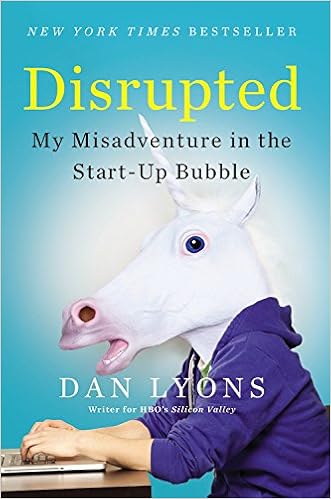
Dan Lyons book Disrupted: cover showing a startled unicornLord knows technology journalism needs Dan Lyons, who is – as one of his managers at the bizarre cult-like CRM-spam company Hubspot observed – “acerbic”. (Could have been worse: could have been “caustic”.)

For years, before and during and since his most famous creation, the Fake Steve Jobs blog, Lyons has been lampooning and criticising and generally getting up the noses of people who are too pompous about all this stuff. He sees that tech is important, but also that the people who bring it to us, who sell it to us, too often are hucksters who a century or so earlier would have literally been selling snake oil. He sees it, and he calls bullshit. (Here he was calling bullshit on a metric tonne of “tech journalism” back in 2012.)

You’re fired, hired, rewired

So when Newsweek fired him, out of the blue, as he was hitting his 50s, with a wife and two young children to support, journalism’s loss was going to be marketing’s gain. Wasn’t it? Lyons found a job at Hubspot, a company which basically legitimises email spam mixed with content farming, and where it feels – he feels – dammit, everyone feels – as though he was hired in order to pimp the company’s reputation as it prepared to ramp up towards a stock market flotation. Look, they hired Fake Steve! Wait, though – can you be in marketing if you’re acerbic? Aren’t they a kinda chalky-cheesy sorta thing? That nobody in Hubspot quite engaged with this question is a clue to the sort of company it is.

Lyons’s account of his experiences is by turns hilarious, scary, thoughtful, and insightful. It begins with his first day where literally nobody seems to be expecting him, through the dysfunctional middle management, to the dysfunctional upper management (two top people greenlight one of his ideas, which is then completely denied by everyone below; Lyons made the fatal error of not having a fourth person in the room to witness the greenlighting). There’s the ridiculous language (when someone is fired or quits, the company says they’ve “graduated”) and yippy-yi-yay upbeat jargon. The ultimate irony, or contradiction, or paradox – pick all that apply – is that a company which allegedly sells software that means you don’t have to chase sales leads (because with their blog software, the sales leads come to you!) has a huge boiler room of just-graduated recruits hammering the phone lines to small businesses, trying to sell them exactly that software.

Sometimes it’s just the little details that are best. I was literally gasping for breath and crying tears of laughter when reading about the idiocy of the Blog Topic Generator, where you put in three nouns and get inspirational ideas for blog post topics, created by someone who thought Miley Cyrus was the shiznizz. Of course, it’s only as inspirational as your nouns; the nurse who used it early on to try to create topics for Cervical Cancer Awareness Month got
WHY WE LOVE CERVICAL CANCER (AND YOU SHOULD TOO!)
and
MILEY CYRUS AND CERVICAL CANCER: 10 THINGS THEY HAVE IN COMMON

As Lyons recalls:

“These headlines are so good I want to print them out in 72-point headline face and paste them on the wall. The BTG is never spoken of again. But it remains online because, as one manager tells me, if they take it down that might hurt [BTG creator] Ashley’s feelings. Six months later Ashley gets a promotion.”

The BTG is indeed still online. I started with “flatulence”, “fisting”, “Miley Cyrus” and discovered it also accepts quite long phrases – I tried “the guy who is shagging his secretary”, “the woman who had the breast augmentation” and “Fuckwit McFuckface from Sales”. You’re welcome.


Hubspot suggestions
“Why we love crack cocaine (and you should, too!)” deserves some sort of prize, no?


(And just pause a moment to consider the idiocy of those templates. “What Will X Be Like In 100 Years?” Who cares? Isn’t it obvious that we’ll all be dead?) For Lyons, the divide is thus irrevocably drawn between the old, acerbic journalist who has seen ships go down with all hands, and the new-to-work marketing drones who must be protected from criticism because, apparently, their egos are so fragile. It’s a Rubicon of sorts.

It’s the stupid culture, stupid

It’s not all fun and games, though. After a while the corporate culture starts to turn against Lyons – who at 52 is twice the age of the average Hubspot employee. And then he starts to discover the subtle thing about discrimination (in his case, age):

Yet I know what I feel. I know that when I look around, there are not many people like me. Sure, I’m not being picked on or actively persecuted. And these tiny slights and offhand remarks are not very significant when taken in isolation. But when you put them together they add up to… something.

That sounds like a portrayal of how it feels to be in a discriminated minority – whatever flavour that minority might be. Lyons points out how the hire-easy-fire-easy practices, and remarkable youth of so many of these disposable recruits, means that the culture is reinforced. And, in passing, he notes how so many people who find themselves washed up once they’re past 50 – can’t get a job, can’t seem to get back on the ladder – must feel. (Though Lyons isn’t a Trumpista by any means, you get an insight into the cause of that displaced group’s howling across the darkening waters.)

There are four other important themes that the book highlights. First is how tech companies dress up the trivial benefits they offer their staff. A wall of candy! “I’d rather have the money,” Lyons says, to astonished silence from the other staff, who don’t feel that way at all. And no limits on vacation time! But as Lyons points out, that means that they don’t have to compensate you for untaken vacation time when they fi– I mean, when you “graduate”.

Second, there’s no job security. These are companies with huge amounts of funding, but they’re not what you’d really call “businesses”. The venture capital flood, pumped by quantitative easing (which has lowered bond yields, and so pushed people with money to seek better returns), has created a raft of companies which have no sustainable business model, and whose owner/managers are far from experienced. It’s a world away from the paternalistic model of companies in the 1950s/60s/70s, where if you worked for them, they’d stand by you.

Third, the allocation of shares means that the people at the top of the company are disproportionately rewarded – sometimes ahead of the company itself. (After its IPO, a tranche of Hubspot shares were sold in the market; most came from insiders, while the lossmaking company’s balance sheet was barely propped up.)

Fourth, these companies are spectacularly unprofitable. Lyons goes to Salesforce’s Dreamforce conference, which seems to occupy all of downtown San Francisco. Salesforce is a company that’s terrific at not making a profit. Yet each time it loses money, as Lyons observes, founder Marc Benioff seems to get richer. Hubspot has never made a profit as a public company, and never did as a private one. So who’s bearing that cost? Not the VCs: they got their money back, and more, at the flotation.

Losers finish first

No, the people bearing the cost now are banks which extend lines of credit and shareholders who put their money in. Where does that money come from? The people who actually work at businesses and put their money into banks, or who have pension plans.

In other words, the price of these bubble companies is borne not by the venture capitalists, but by the ordinary public – the same people who bore the price of the bank crash back in 2008-9. I realise that in looking at the piffling losses of smartphone OEMs I’ve been looking in the wrong direction. It’s the losses of these stupid software companies – the Salesforces, the LinkedIns, the Groupons – which is more relevant. They’re not going to change the world, but their internal culture and self-assured idiocy is changing the world of work – and not in a good way.

Hacking the graduate

There’s a wonderful epilogue. Hubspot prides itself on its culture, which says it is HEART – “humble, effective, adaptable, remarkable and transparent”. Except.. in July 2015 Hubspot’s board fired Mike Volpe, its chief marketing officer, “in connection with attempts to procure a draft manuscript of a book”. Guess which one.

What exactly did Volpe do? Cofounder Dharmesh Shah and CEO Brian Halligan won’t say, despite all that “transparency” guff. Here’s the quote from Betaboston:

Shah and Halligan said they have promoted an open and transparent corporate culture, which includes the motto “Sunlight is the best disinfectant.” The book incident was “a failure in one specific situation,” Shah said, not “a failure of HubSpot’s culture.”

You don’t think you might be failing a teensy bit at the “transparency” part? The FBI, at least, is better at that game: an FOI request by Lyons and the Boston Globe elicited the following from the FBI after its investigation:

The FBI memos say that Lyons’ book was seen by some at HubSpot as not only a potential embarrassment but “a financial threat to HubSpot, its share price, and the company’s future potential.”

The documents also say there was an effort “to obtain sensitive information on individuals with access to the book’s transcript, or control of the publishing deal. The information found was then used as leverage in an attempt to prevent the book from reaching the market place.”

The report also mentions “tactics such as email hacking and extortion” in the attempt “to railroad the book.”

HubSpot, a marketing software company in Cambridge, announced in late July that it had fired Volpe “in connection with attempts to procure a draft manuscript of a book involving the company.”

HubSpot also said a vice president, Joe Chernov, resigned before the company could determine whether he also should be fired.

(If you look at the question on Quora of why Volpe was fired, its “followers” – those watching to see what comes up – include Shah, who is on Hubspot’s board. He knows why they fired him. Interesting meta-question: why is he watching the question?) Shah has written a more-in-sorrow-than-in-anger-style response to the book. It neatly avoids a lot of the deeper points Lyons makes. There’s also another ex-Hubspotter, who unintentionally does nothing to dispel Lyons’s assertion that Hubspot is essentially a cult with shares.

As Lyons points out, that extortion/hacking stuff adds an extra condiment of concern to this recipe of intrigue. What data did they get, or try to get from him? What did they have about him at Hubspot? Lots of these startup companies have “god” passwords that let any bozo access any account – Facebook used to, Uber did/does, who knows who else does? (This is why, by the way, you should enable two-factor authentication on important accounts. And then watch your world go to hell when your phone is stolen, of course.) So besides being cultish, inequitable, and money-sucking, we now have to add “potentially data-sucking” to the list of Things We Really Find A Bit Questionable About Hubspot (And You Should Too!)

Silicon Valley is just a dream away

Acerbic? That’s insufficient to describe this take on the modern world. You should damn well read this book. It might not take you long – I was through it in a day, because I couldn’t put it down – but it will stay with you if you’ve ever wanted the insider’s view of job security, pay inequality, the idiocy and self-delusion of internet marketers, and tech non-diversity. Or even if you just want to have a good laugh. Don’t worry, you’ll get both.

And now? Lyons is a writer for HBO’s Silicon Valley TV series, which thoroughly lampoons the startup bubble, and also back to doing journalism. Good. In a world where so many sites think that rewriting corporate blogposts about a new ad format around search results counts as “journalism”, we need him to train his acerbic eye, or mouth, or pen, on it.

Start up: Chromebooks rising, why airport queues grow, how Shapeshift was hacked, Apple v AI, and more


Your smartphone’s apps and software uses distraction like a magician – but is that a good thing for you? Photo by ThaQeLa on Flickr.

You can now sign up to receive each day’s Start Up post by email. You’ll need to click a confirmation link, so no spam.

A selection of 11 links for you. Unlucky for some (principally those who work in base 12). I’m charlesarthur on Twitter. Observations and links welcome.

For the first time, Google beat Apple in US PC sales — and that’s really bad news for Microsoft • Business Insider

Matt Weinberger achieves the trifecta of all three of the big names in a headline:

»Today, two very important things happened for the future of the PC as we know it.

First: For the first time ever, low-cost Google Chromebook laptops outsold Apple’s Macs during the most recent quarter, analyst firm IDC tells The Verge.

Manufacturers including Dell, Lenovo, and HP sold over 2 million Google-powered Chromebooks combined, versus around 1.76 million Macs, IDC estimates.

Second: those same Google Chromebooks are getting full access to Android’s Google Play store, opening the door for those laptops to run a significant portion of the 1.5 million Android apps out in the wild.

For Apple, it’s not necessarily great news, but it’s not the end of the world, either. Quarter after quarter, Macs have shown sales growth, bucking the overall shrinkage of the PC industry. And Apple has always been a company that’s content to completely and profitably own a small piece of a much larger pie.

But for Microsoft, it means that the pressure is on — Google’s slow-but-steady attack is bearing some real results, and it’s not great news for Windows 10.

«

Weinberger’s right; that 2m is over 10% of the US market (of 13.6m). And PC OEMs get better margins on Chromebooks (no Windows licence to pay). And soon those machines will be attractive to younger users because they’ll be able to run Android apps. (In passing: potentially a problem for Apple unless it can get iOS apps to run on Macs.)
link to this extract


Tech support locker scam poses as failed Microsoft Update • The Register

John Leyden:

»Cybercrooks have put together a new scam that falls halfway between ransomware and old school browser lockup ruses.

The new class of “tech support lockers” rely on tricking users into installing either a fake PC optimiser or bogus Adobe Flash update. Once loaded the malware mimicks ransomware and locks users out of their computers. Unlike Locky, CryptoWall and their ilk it doesn’t actually encrypt files on compromised Windows PCs, however.

Jérôme Segura, a senior security researcher at Malwarebytes, said “tech support lockers” represent a class of malware more advanced than browser locks and fake anti-virus alerts of the pre-ransomware past.

“This is not a fake browser pop up that can easily be terminated by killing the application or restarting the PC,” Segura writes in a blog post. “No, this is essentially a piece of malware that starts automatically, and typical Alt+F4 or Windows key tricks will not get rid of it.”

One strain of tech support locker employs a subtle piece of social engineering trickery by waiting until a users restarts their computer before confronting users with a fake Windows update screen. Users are told their computers can’t be restarted normally supposedly because of an “expired license key”. Thereafter a screen locks a user out of their computer in an attempt to trick marks into phoning a support number, staffed by scammers.

«

link to this extract


The strange science of why airport security lines spiral out of control • NY Mag

Drake Baer:

»Queues are governed by Little’s Law, which states that the number of items in a queuing system (the length of a queue) is equal to the average waiting time per item (how long each interaction takes) times the number of items arriving per unit time (how many people/things are coming in).

For queues with “servers” — someone handling transactions with whomever’s at the front of the line — the server needs to have some idle time, otherwise the queue, according to the math, could grow without limit. For a queue with only a single server, the rule of thumb is about 15 percent to 20 percent idle time. If there’s lots of servers (like a call bank with hundreds of people taking calls), then they don’t need as much idle time, because there’s less of a chance of every server being occupied at once, causing the line to build and leading to the inevitable viral videos.

A lot of this, Larson says, has to do with the profoundly human quality of variability. If queues were mechanical — like in a well-run factory, where the time of arrival and the time of service for each transaction were highly predictable — then a server could be super busy and queues still wouldn’t form.

But people are neither predictable nor identical in how they approach airline travel.

«

Damn people.
link to this extract


The hack at ShapeShift • Money And State

Erik Vorhees:

»Last fall, we realized the “minimum viable product” server architecture established originally for ShapeShift was insufficient. We needed a professional to join the small team, and craft a scalable, and secure, server apparatus upon which our technology could grow.

We hired such a person, and patted ourselves on the back for our proactive decision. On paper, he looked great; the reference we called confirmed his prior role and responsibility. He’d even been into Bitcoin since 2011/2012 and had built miners in his room. Awesome. We’ll call this new employee Bob… indeed his real name starts with a B.

Over the next months, Bob built and managed ShapeShift’s infrastructure. He did okay, nothing special, but we were content to have a professional taking care of devops at least well enough to enable our engineers to build upon the architecture.

In the first quarter of this year, as the market discovered what we already knew – that our world will be one of many blockchain assets each needing liquidity with the other – exchange volumes surged at ShapeShift. Ethereum was on the rise, specifically. Our infrastructure was not ready for the pace of growth. It was like riding a bicycle upon which jet engines suddenly appear full-thrust.

Unfortunately, Bob did little to be helpful. He puttered around aimlessly while the team worked long hours to keep the ship together.

Scratch that, actually, Bob was not aimless.

He was preparing to steal from us.

«

This is a riveting read – not short, but thorough and worthwhile.
link to this extract


Avoiding BlackBerry’s fate • Marco.org

»Becoming a major big-data AI services company doesn’t happen completely in secret and suddenly get released to the world, completed, in a keynote. It’s a massive undertaking, spanning many years, many people, and a lot of noticeable interaction with the world. It’s easier to conceal the development of an entire car than a major presence in AI and services.

Google is extremely well-placed for where they think the puck is going. They could be wrong — these AI services could be a socially awkward fad like Google Glass or a tonedeaf annoyance like Clippy. Google launches a lot of weird, geeky, technologically impressive things that go nowhere.

If Google is wrong, and computing continues to be defined by a tightly controlled grid of siloed apps that you poke a thousand times a day on a smooth rectangle of manufacturing excellence, Apple is fine. They’re doing a great job of what computing is today, and what it will probably continue to be for a long time.

But if Google is right, that’s a big problem for Apple.

«

Apple is pretty busy in AI and machine learning systems; it has been hiring. I think there’s a more subtle threat to Apple: what if you don’t use “things” to interact with these systems any more?
link to this extract


Mirrors blamed for fire at world’s largest solar plant • Associated Press

»A small fire shut down a generating tower Thursday at the world’s largest solar power plant, leaving the sprawling facility on the California-Nevada border operating at only a third of its capacity, authorities said.

Firefighters had to climb some 300 feet up a boiler tower at the Ivanpah Solar Electric Generating System in California after fire was reported on an upper level around 9:30 a.m., fire officials said.

The plant works by using mirrors to focus sunlight on boilers at the top of three 459-foot towers, creating steam that drive turbines to produce electricity.

But some misaligned mirrors instead focused sunbeams on a different level of Unit 3, causing electrical cables to catch fire, San Bernardino County, California fire Capt. Mike McClintock said.

David Knox, spokesman for plant operator NRG Energy, said it was too early to comment on the cause, which was under investigation.

«

Pretty dramatic fire – it melted lots of stuff.
link to this extract


How technology hijacks peoples’ minds — from a magician and Google’s design ethicist • Medium

Tristan Harris, who leaves you in no doubt from this article’s first line, which is “I’m an expert in how technology hijacks our psychological vulnerabilities”:

»If you’re an app, how do you keep people hooked? Turn yourself into a slot machine.

The average person checks their phone 150 times a day. Why do we do this? Are we making 150 conscious choices?

How often do you check your email per day?

One major reason why is the #1 psychological ingredient in slot machines: intermittent variable rewards.
If you want to maximize addictiveness, all tech designers need to do is link a user’s action (like pulling a lever) with a variable reward. You pull a lever and immediately receive either an enticing reward (a match, a prize!) or nothing. Addictiveness is maximized when the rate of reward is most variable.

Does this effect really work on people? Yes. Slot machines make more money in the United States than baseball, movies, and theme parks combined. Relative to other kinds of gambling, people get ‘problematically involved’ with slot machines 3–4x faster according to NYU professor Natasha Dow Shull, author of Addiction by Design.

But here’s the unfortunate truth — several billion people have a slot machine their pocket:
•When we pull our phone out of our pocket, we’re playing a slot machine to see what notifications we got.
•When we pull to refresh our email, we’re playing a slot machine to see what new email we got.
•When we swipe down our finger to scroll the Instagram feed, we’re playing a slot machine to see what photo comes next.
•When we swipe faces left/right on dating apps like Tinder, we’re playing a slot machine to see if we got a match.
•When we tap the # of red notifications, we’re playing a slot machine to what’s underneath.

«

That’s only the addiction side, and some of that is accidental; what Harris points to is that much of what gets us glued to distractions is intentional by the companies involved (including, as he points out, YouTube, owned by his ex-employer). His website is http://timewellspent.io
link to this extract


Modular phone Ara to finally launch • The Register

Kieren McCarthy:

»The Ara project was originally announced in October 2013 and was part of the acquired Motorola Mobility business. Since then it has become part of Google’s Advanced Technology and Products (ATAP) division.

Despite periodically putting out videos touting Ara’s possibilities, however, little has been heard about the project and many assumed it was going the way of so many other Google projects: into the trash.

Not so. And ATAP Head of Creative, Blaise Bertrand, said at Google’s I/O conference on Friday that the phone will launch to developers in the fourth quarter of this year, with a consumer version put out sometime in 2017.

The phone even has a website, complete with more videos, so it must be happening.

«

Except, as one of the commenters points out, the modularity won’t extend to the screen, GPU, CPU, RAM or sensors. So basically all the things that were meant to make this useful if modular won’t be modular.
link to this extract


Google built a tiny radar system into a smartwatch for gesture controls • The Verge

Dieter Bohn:

»”How are you going to interact with an invisible computer?”

When you hear a question like that posted in a conference room at a major tech corporation like Google, you expect you’re going to be in for an hour or two of technophizing with few tangible results at the end of it.

But then somebody sets a smartwatch on the table in front of you. You snap your fingers in the air just a couple of inches away from it. And the digital watch face starts spinning.

Ivan Poupyrev, who posed that question (and many more) works at Google’s ATAP [Advanced Technology and Projects] research lab and is the technical project lead for Project Soli, which is designed to prove that we can embed tiny radar chips into electronics so that we can use minute hand gestures to control the digital world around us. Why on earth would you want radar in a smartwatch?

To prove that you can interact with an invisible computer. Duh…

…By comparison to the electronics and the machine learning algorithms, actually deciding which gestures should do what seems easy. But if you think about it a minute, maybe it’s not. With a touchscreen, you can see buttons and sliders. With physical switch, you can feel the snick when you flick it on. But if there’s nothing but air, how do you guide the user?

“Is everything going to have its own interface?” Poupyrev asks. “Is every switch, every smart sprinkler, or cup going to have its own? It’s going to create confusion.” One of Soli’s goals is to create a common design language that’s easy to learn but flexible enough to control a lot of things.

«

I got the impression, reading the article, that neither Bohn nor the Googlers could figure out what the killer use case for this technology would be – or even if there is one.
link to this extract


December 2015: How Theranos misled me • Fortune

Roger Parloff, in December 2015, after the Wall Street Journal exposed how Theranos wasn’t doing what it claimed, tried to figure out why he had come away convinced, for an article in 2014, that it was doing all those things – including “more than 200” types of blood test:

»After Theranos’s Oct. 22 statement, I contacted officials there to inquire how many tests it had actually been commercially performing by proprietary means in June 2014, when I had reported that it was offering more than 200. A spokesperson acknowledged to me that it was fewer than 200, but declined to specify how many. She said she’d send a statement.

The company’s statement arrived Nov. 3. “As discussed when you visited Theranos,” it said, “Theranos could perform hundreds of tests (more than 200) using its proprietary technologies. The reports you reviewed at Theranos covered many of those tests Theranos developed for use with finger-stick samples.”

(The company had, indeed, provided me in the Spring of 2014 with what it said were—and what looked to be—validation studies for scores of different diagnostic tests, though, in truth, I lacked the expertise to assess their significance.)

The statement then went on to address my followup question, which was basically: If you were capable of doing 200-plus tests using your proprietary methods, why weren’t you in fact doing them?

Here, with trademark, Theranos-ian opacity, is the reply: “Over time, we’ve been optimizing our clinical lab to bring up tests that are more commonly ordered, and in some cases move resources off the proprietary tests that are less commonly ordered to get to a point where the ordering patterns we are seeing can all be accommodated through our finger-stick technology.”

Got that?

«

Parloff’s walk back through his notes, and Theranos and Elizabeth Holmes’s opaque replies, are a laudable attempt to try to figure out what happened. It’s something that can – has – happened to many journalists: you think you understand it, and you let them whitewash you. Only by repeatedly asking “just explain that to me in more detail” do you finally get to the core. Or in Theranos’s case, the void where the core should be.
link to this extract


Guns replaced with selfie sticks • Tumblr

For example:

Though the Schwarzenegger one that heads the site actually captures something about Arnie that had always been only implied.
link to this extract


Errata, corrigenda and ai no corrida: none notified.

Start up: Android on ChromeOS!, the PC squeeze, play like Steve Reich, Bluetooth tampons?, and more


Theranos’s next home might be in the parking lot. Photo by jurvetson on Flickr.

Some people already signed up to receive each day’s Start Up post by email. Yes they did.

A selection of 15 links for you. Started, couldn’t stop. I’m charlesarthur on Twitter. Observations and links welcome.

Android apps are just what Chromebooks needed • The Verge

Dieter Bohn:

»Google just announced that Chrome OS finally has what many people have been clamoring for almost since its introduction five years ago: true native apps. And it has a massive number of them, too. When support for them launches later this year, there will be more and better apps than you can find in the Windows Store. They just happen to all be Android apps.

The Google Play Store, that massive repository of Android apps, is coming to Chrome OS. It will be available to developers in early June, then a month or two later it’ll hit the more stable “beta” channel, and finally it will be ready for all users this fall.

Google waited until day two of its I/O developer conference to announce what might be its biggest and most impactful news. With the Play Store, Chrome OS is suddenly a lot more compelling to users who might have shied away from using a device that could only use the web and web apps. Sure, most of those new native apps were originally designed for phones, but they run quite well on the Chromebook Pixel 2 I saw them on.

Better than quite well, in fact. They were fast and felt fully integrated with the OS.

«

At a stroke this brings all the Microsoft suite to Chromebooks – turning them into potentially much cheaper PC replacements for businesses and schools. That might drive down the average price of computers. Speaking of which…
link to this extract


Profit opportunities exist for PC vendors • Gartner

»Many vendors in the mid-tier of the PC ecosystem are struggling. “They are severely reducing their regional and country-level presence, or leaving the PC market altogether,” said Ms. Escherich. “Between them, Acer, Fujitsu, Samsung, Sony and Toshiba have lost 10.5% market share since 2011. In the first quarter of 2016, Dell, HP Inc. and Lenovo gained market share but recorded year-over-year declines.”

Regional markets are also changing. Low oil prices and political uncertainties are driving economic tightening in Brazil and Russia, changing these countries from drivers of growth to market laggards. In terms of volume, the US, China, Germany, the U.K. and Japan remain the top five, but consumers in these markets have also been cutting their number of PCs per household…

…Despite a declining PC market, the ultramobile premium segment is on pace to achieve revenue growth this year — the only segment set to do so. It is estimated to reach $34.6bn, an increase of 16% from 2015. In 2019, Gartner forecasts that the ultramobile premium segment will become the largest segment of the PC market in revenue terms, at $57.6bn.

“The ultramobile premium market is also more profitable in comparison with the low-end segment, where PCs priced at $500 or less have 5% gross margins,” said Ms. Tsai. “The gross margin can reach up to 25% for high-end ultramobile premium PCs priced at $1,000 or more.”

«

5% gross margin – $25 per machine? And that’s before operating costs.
link to this extract


This $5bn software company has no sales staff • Bloomberg

Dina Bass:

»Brandon Cipes, vice president for information systems at OceanX, has spent enough time in senior IT positions to hate sales calls. “It’s like buying a car—a process that seemingly should be so simple, but every time I have to, it’s like a five- to six-hour ordeal,” he says. “Most of our effort is trying to get the salespeople to leave us alone.” Cipes didn’t always feel that way, though. Back in 2013, he was used to the routine. His conversion began when he e-mailed business-software maker Atlassian, asking the company to send him a sales rep, and it said no.

Atlassian, which makes popular project-management and chat apps such as Jira and HipChat, doesn’t run on sales quotas and end-of-quarter discounts. In fact, its sales team doesn’t pitch products to anyone, because Atlassian doesn’t have a sales team. Initially an anomaly in the world of business software, the Australian company has become a beacon for other businesses counting on word of mouth to build market share. “Customers don’t want to call a salesperson if they don’t have to,” says Scott Farquhar, Atlassian’s co-chief executive officer. “They’d much rather be able to find the answers on the website.”

«

link to this extract


Verification: I can’t even • honestlyreal

Paul Clarke:

»Yes folks, it’s back again! The Queen’s Speech today promises yet another Mumsnet/Mail pleasing crackdown on one-handed websurfing – age verification!

Ha, brilliant – so obvious – all we have to do to send the kids back to the era of damp grotmags in the bushes is do a bit of proving-who-you are when someone clicks their way to a nacky site. No proof, no nacky.

Couldn’t be easier!

So how are they going to make it work then?

Short answer: they can’t.

Longer answer: they’d have to solve the Big Problem, and also some Littler Problems.

The Big Problem is an ancient conundrum: how do you build a checking system that’s solid enough to be worth doing, but not so solid that it doesn’t immediately bugger up the life of someone who loses access to their digital self?

«

link to this extract


Google’s Allo fails to use end-to-end encryption by default • Graham Cluley

»Google has announced that later this year it will be releasing a new messaging app called Allo.

You can think of it as a competitor to WhatsApp, iMessage or Signal.

Apart from there’s one big difference. Because, unlike those messaging apps which came before it, Allo doesn’t have end-to-end encryption enabled by default.

Instead, if users wish to feel confident that their private messages are properly protected from interception by unauthorised parties, they will have to change a setting in the app – enabling something called “Incognito” mode.

Seriously, it’s great that Google is going to have an end-to-end encryption option in Allo, and I’m reassured that they are partnering with Open Whisper Systems (developers of the Signal protocol) who are experts in secure messaging, but I want to know why it isn’t the default?

Because if there is one thing we have learnt over the years, it’s this. Few users ever change the default settings.

«

It really is strange. Why isn’t Google doing this? People say, reflexively, “data mining”. But isn’t the metadata – knowing who you spoke to and for how long – enough, if you already have them signed in? And one of the developers who consulted on security says he wants it on by default, because that would fit with what people want – disappearing messages.
link to this extract


CEO Larry Page defends Google on the stand: “Declaring code is not code” • Ars Technica UK

Joe Mullin:

»Page’s testimony comes in the final hours of the Oracle v. Google trial. The lawsuit began when Oracle sued Google in 2010 over its use of 37 Java APIs, which Oracle acquired when it bought Sun Microsystems. In 2012, a judge ruled that APIs can’t be copyrighted at all, but an appeals court disagreed. Now, unless a jury finds that Google’s use of APIs was “fair use,” Oracle may seek up to $9bn in damages.

«

Page’s testimony is persuasive (though of course we only hear a little). This feels like it will go Google’s way.
link to this extract


Why porting an iOS design to Android will not work • Martiancraft

Landon Robinson:

»It is very important for designers, developers, and product owners to consider that iOS and Android have different native standards when it comes to navigation patterns and screen transitions, and to be aware of the most current information available on these things. Google’s Material Design documentation does a fantastic job of detailing screen transition use, and applying proper navigation patterns to your app.

Android users are accustomed to certain navigation and UI patterns. Most apps adhere and keep the user’s experience consistent with Android’s UI patterns.

iOS navigation often uses the bottom tab bar for navigating throughout the app. For Android users this is inconsistent with the standard design language and may frustrate users at first glance. It is better not to utilize the bottom tab bar options and present the navigation options under the hamburger icon which is standard on Android. A great example is how Yelp did this for both to its mobile apps. (Starting in Android N, Google is introducing bottom navigation. However there is no release date on when it will be available to the public.)

«

Won’t need to worry about Android N for a couple of years though. The design differences between the two platforms are quite big – and increasingly static. The differences in animation are surprising – but also pretty static.
link to this extract


The Kimpact: how celebrity apps are changing mobile gaming • Mixpanel

Christine Deakers:

»When “Kim Kardashian: Hollywood” launched in the App Store in 2014, what seemed like a vanity app shocked the industry with recording-breaking numbers of downloads – and revenue. With more than 42 million downloads to date, “Kim Kardashian: Hollywood” shone a spotlight on a relatively quiet player, working behind the scenes. Glu Mobile, who produced the app, positioned itself as the strongest and most proven celebrity studio for mobile gaming.

As their largest title in Q4 2015, “Kim Kardashian: Hollywood” generated $13.6 million dollars in earnings, approximately 24% of Glu Mobile’s total revenue. As Christopher Locke, GM of Glu Canada revealed, the app’s core audiences are “fans of celebrity culture” and women ages 18 to 36.

In “product-talk”, a public Slack channel, I asked a number of product managers what they thought of “Kim Kardashian: Hollywood.” Most of them believed it was a mere novelty and money-making scheme for the Kardashian empire. However, they didn’t seem to recognize the financial impact this and other celebrity apps are having on the greater industry, both for mobile advertising and what is now considered the table stakes for a successful mobile game.

«

Data point: women who game on mobile are 42% more likely to be retained than men.
link to this extract


Play with Steve Reich’s techniques in a free iPhone app • createdigitalmusic

Peter Kirn:

»Steve Reich’s musical etudes are already a kind of self-contained lesson in rhythm. Inspired by drumming traditions, Reich distills in his music essential principles of rhythmic construction, introducing Western Classical musicians to cyclic forms. That makes them a natural for visual scoring – doubly so something interactive, which is what an iPhone can provide. And so one percussion ensemble has made an app that both reveals Reich’s techniques and opens up a toy you can use to make your own musical experiments. Plus – it’s free.

The app is called “Third Coast Percussion: the Music of Steve Reich” – that’s a mouthful. And the app is packed with content.

«

It’s also great fun. Like this:

Play it and read on.
link to this extract


Theranos voids two years of Edison blood-test results • WSJ

John Carreyrou:

»Theranos Inc. has told federal health regulators that the company voided two years of results from its Edison blood-testing devices, according to a person familiar with the matter.

The Edison machines were touted as revolutionary and were the main basis for the $9 billion valuation attained by the Palo Alto, Calif., company in a funding round in 2014. But Theranos has now told regulators that it threw out all Edison test results from 2014 and 2015.

The company has told the Centers for Medicare and Medicaid Services that it has issued tens of thousands of corrected blood-test reports to doctors and patients, voiding some results and revising others, according to the person familiar with the matter.

That means some patients received erroneous results that might have thrown off health decisions made with their doctors.

«

This means just short of 2m test results voided; Carreyrou has confirmed this by checking with doctors in Phoenix. “Unprecedented”, one medical expert called it. I don’t see how Theranos can continue in its present form. Meanwhile, the WSJ’s reporting on this has demonstrated how it justifies its paywall.

Unrelated: Theranos is looking for a writer. Apply today!
link to this extract


Google Spaces’ fatal flaw: it requires too much mental energy • EWeek

Mike Elgan:

»One way to share with Google Spaces is to start with Spaces, using the mobile app to do the Google Search. When you find it, you press the big button, designate which Space it goes in (or create a new one). Then you share by tapping on a button to any site or via any medium, including email. The recipients click on the link, coming back to the Space you created. In this scenario, Spaces is really a feature of Google Search, with the Spaces app actually being an alternative Google Search app with social sharing as a feature.

Similarly, Google’s Spaces Chrome extension adds a social feature to your browser. You simply click on the Spaces button to share the current tab.

Spaces looks like a product, but it’s really a version of Google Search and Chrome with social added as a feature.
I expect Spaces to be integrated with all kinds of Google sites and apps to add social as a feature so people don’t have to use a social product like Facebook.

Spaces allows Google to escape the surly bonds of the network effect.

On social products, a company is expected to provide access to other users. The more users are on a network, the more new users want to be on that network. That’s the network effect.

Google tried to compete against Facebook by creating a superior social networking product: Google+, but Google was defeated by the network effect because it was late to the game.

With Spaces, there is no network effect, er, in effect. Google provides no users. Nobody is “on” Spaces. Nobody can call Spaces a “ghost town” because there’s no town. You don’t need a Google+ account to use Spaces. You don’t even need a Google password to read content on Spaces you’ve been invited to.

«

I don’t get it. As in, I can’t create a mental model of the situations where this would be useful. Elgan also points out that some of the content design (in the “Activity” stream), using truncated sentences, will make people recoil rather than lean in. I’d say the clock is already ticking for this one.
link to this extract


This Bluetooth tampon is the smartest thing you can put in your vagina • Gizmodo

Alex Cranz:

»Every single person with a vagina has had that horrifying moment: you look down, and there’s blood everywhere. It’s always annoying, it’s usually embarrassing, and more than half the time it happens in front of the entire student body.

my.Flow, a new startup currently looking for additional funding, is hoping to save a slew of people from the mortification of period mishaps. It’s a tampon with Bluetooth connectivity—yes, you read that correctly—that that lets a user know when the tampon is completely saturated and needs to be changed.

The original concept included a Bluetooth module inside the tampon, but my.Flow found that many users were uncomfortable with having a wad of electronics shoved up their hoo hah. So the latest version, developed at an incubator in Beijing, is a tampon with an extra long string that connects to a Bluetooth module on your waist.

The new concept is not without some… drawbacks.

«

I think I can discern one. But Cranz says women agree that for a teenager, it could be really helpful. (And bonus marks for the headline.)
link to this extract


Cars, trucks, iPads, and laptops • Macworld

Jason Snell:

»The assumption many of us have made, myself included, is that it will really take a new generation of computer users, those weaned on iPhones and iPads, before the iPad and other touchscreen devices take their place as the computing trucks of the future. It makes sense, right? Kids love iPhones and iPads. The touch interface is easily understandable, even by small children. The future is inevitable.

So here’s the problem with that way of thinking. My daughter, born in 2001 and raised in a world of iPods, iPhones, and iPads, has two devices she absolutely requires in order to live. (My understanding is that she would shrivel up into some sort of husk and die if either of them were to go away.) One of those devices is her iPhone, of course. She is endlessly iMessaging, Instagramming, Snapchatting, and FaceTiming with her friends.

The other device is a laptop. (A Chromebook Pixel, in this case, but it could just as easily have been a MacBook Air.) In fact, when I offered her the use of my iPad Air 2 instead of her laptop, she immediately dismissed it. A native of the 21st century–the century where the keyboard and mouse are left on the sidewalk with a cardboard FREE sign as we embrace our tablet futures–is flatly refusing to switch from a laptop to a tablet.

Of course, I asked my daughter why she prefers the laptop to an iPad.

«

The answer, as they say, will surprise you. Well, it might. The reasoning around which screen to watch TV on is an “oh, of course” moment.
link to this extract


Technology betrays everyone • Errata Security

Rob Graham:

»My presentation in 2006 wasn’t about email passwords, but about all the other junk that leaks private information. Specifically, I discussed WiFi MAC addresses, and how they can be used to track mobile devices. Only in the last couple years have mobile phone vendors done something to change this. The latest version of iOS 9 will now randomize the MAC address, so that “they” can no longer easily track you by it.

The point of this post is this. If you are thinking “surely my tech won’t harm me in stupid ways”, you are wrong. It will. Even if it says on the box “100% secure”, it’s not secure. Indeed, those who promise the most often deliver the least. Those on the forefront of innovation (Apple, Google, and Facebook), but even they must be treated with a health dose of skepticism.

So what’s the answer? Paranoia and knowledge. First, never put too much faith in the tech. It’s not enough, for example, for encryption to be an option — you want encryption enforced so that unencrypted is not an option. Second, learn how things work. Learn why SSL works the way it does, why it’s POP3S and not POP3, and why “certificate warnings” are a thing. The more important security is to you, the more conservative your paranoia and the more extensive your knowledge should become.

«

link to this extract


R.I.P., GOP: how Trump is killing the Republican party • Rolling Stone

Matt Taibbi with a tour de force:

»Of course, Trump is more likely than not to crash the car now that he has the wheel. News reports surfaced that Donald Trump, unhinged pig, was about to be replaced by Donald Trump, respectable presidential candidate. No more schoolyard insults!

Trump went along with this plan for a few days. But soon after Indiana, he started public fights with old pal Joe Scarborough and former opponents Graham and Bush, the latter for backtracking on a reported pledge to support the Republican nominee. “Bush signed a pledge… while signing it, he fell asleep,” Trump cracked.

Then he began his general-election pivot with about 10 million tweets directed at “crooked Hillary.” With all this, Trump emphasized that the GOP was now mainly defined by whatever was going through his head at any given moment. The “new GOP” seems doomed to swing back and forth between its nationalist message and its leader’s tubercular psyche. It isn’t a party, it’s a mood.

Democrats who might be tempted to gloat over all of this should check themselves. If the Hillary Clintons and Harry Reids and Gene Sperlings of the world don’t look at what just happened to the Republicans as a terrible object lesson in the perils of prioritizing billionaire funders over voters, then they too will soon enough be tossed in the trash like a tick.

«

This is a terrific, albeit long, read. A quick word of warning: there’s autoplay video on the page, and it’s got Trump in it.
link to this extract


Errata, corrigenda and ai no corrida:

Start up: toxic times at Facebook and Wikipedia, Google gets appy, Trump v Twitter, profit and lies, and more


Google’s Instant Apps concept could make parking in unfamiliar cities much, much simpler. Photo by arbyreed on Flickr.

Reading this on the web? You could sign up to receive each day’s Start Up post by email. No, really.

A selection of 11 links for you. Free as in “the first month costs $90 payable in daily instalments, followed by 400 payments of $100”. I’m charlesarthur on Twitter. Observations and links welcome.

I worked on Facebook’s Trending team – the most toxic work experience of my life • The Guardian

“Anonymous” (you’ll realise why):

»Working at Facebook, even as a contractor, was supposed to be the opportunity of a lifetime. It was, instead, the most toxic work experience of my life.

As a curator, my job was to choose what links would appear on the Facebook “trending” box on the right side of a user’s newsfeed. Every day, I sifted through hundreds of topics (or “keywords”) that Facebook told me were trending on the platform. Then I’d choose a story about the keyword, and come up with a headline and a short summary that would appear on the trending box.

Most, if not all, of what you’ve read about Facebook’s Trending team in Gizmodo over the past few weeks has been mischaracterized or taken out of context. There is no political bias that I know of and we were never told to suppress conservative news. There is an extraordinary amount of talent on the team, but poor management, coupled with intimidation, favoritism and sexism, has resulted in a deeply uncomfortable work environment. Employees I worked with were angry, depressed and left voiceless – especially women.

«

Hell of an article. But it’s not just formal work environments that can be toxic in the new era…
link to this extract


Wikipedia editor says site’s toxic community has him contemplating suicide • Motherboard

Jason Koebler:

»Some people on the Wikipedia-L listed echoed the editor’s woes. “This editor and their editing may be an extreme case, but they are not alone,” one person response. “Yup. It’s very, very toxic at times. And nobody really cares,” another person wrote.

I am not a Wikipedia editor, but I monitor the community closely, and it’s increasingly obvious that there is a lack of civility even at higher levels. For months, Wikipedia founder Jimmy Wales and former Wikimedia Foundation board member James Heilman have been engaged in a public argument about Heilman’s ousting that has often devolved into name-calling and hearsay. Earlier this year, the community was in open revolt against former Wikimedia Foundation director Lila Tretikov. Many threads in the mailing list are about people not doing their jobs properly or internal factions that have formed; “transparency” and openness give people license to be jerks to each other.

«

Wikipedia is a remarkable body of work, but perhaps has hit the age where it needs a more formal structure. (The editor was contacted by police, and says he’s “feeling better”.)
link to this extract


Tech startups come up with some creative definitions for ‘profitable’ • Bloomberg

Ellen Huet:

»After just a few months, SpoonRocket retreated from its new markets and focused on improving the economics of its business. “For a long time, we were like, ‘Let’s get profitable; let’s get profitable; let’s show the margin can get profitable,'” said Anson Tsui, co-founder and chief technical officer.

Their efforts failed to achieve profitability by conventional definitions. However, the startup calculated that the business had become “contribution margin positive,” meaning that it sells an item—in this case, pre-made meals delivered to customers—for more than the cost to manufacture, distribute, and sell it. There is, apparently, some wiggle room in what expenses can be left out. Tsui said SpoonRocket’s definition included the costs of food, delivery worker pay, utensils, food waste, distribution center rental, and certain marketing programs. It excluded costs of customer service, central employees, office rent, and marketing to drivers.

After all that careful math, SpoonRocket’s contribution margin was 50 cents to $1 per order, Tsui said. The founders prepared a new pitch for investors highlighting this milestone. “We showed them, and they were just like, ‘Oh my goodness, you guys spent $13m to squeeze a $1 margin out of every order?'” Tsui recalled. SpoonRocket shut down in March and sold some assets to a food delivery company in Brazil.

«

Operating margin.. gross margin.. contribution margin?

link to this extract


Google takes a new approach to native apps with Instant Apps for Android • TechCrunch

Frederic Lardinois got a prebrief:

»Typically, downloading and installing an app would take a while, but with Instant Apps, developers will have to partition their apps into small, runnable parts that can start within a few seconds.

“Instant Apps is really about re-thinking where apps are going,” Google VP of Engineering for Android Dave Burke told me. The idea behind Instant Apps is to make the native app experience as convenient as surfing to a web site. “Web pages are ephemeral,” he said. “They appear, you use them, and never think about them again.” Apps, he argued, have lots of friction and often you only want an app to perform one action or to get a specific piece of information.

As Google’s Michael Siliski and Ficus Kirkpatrick told me, the idea here is to allow a mobile experience to start in about the same time it would take to render a standard mobile web page. While the team is still working out the limits, Siliski and Kirkpatrick expects downloads for Instant Apps to clock in at under 4 megabytes.

Here is what that would look like in practice: say you are in a new city and want to pay for parking with whatever parking app the local municipality is using. You hold your phone to the parking meter, the built-in NFC chip reads the info, and the native app appears almost instantaneously. There is no need to download the app or even log in (or to uninstall it later).

«

This does recall industry analyst Benedict Evans wondering a year or so ago “what will it mean in 2020 to say ‘I installed an app’?”
link to this extract


Saying 👋 to Allo and Duo: new apps for smart messaging and video calling • Official Google Blog

Amit Fulay, group product manager at Google:

»Whether it’s welcoming a new baby, celebrating the winning shot in overtime, or discovering the best taco stand ever—we all want to share these moments with friends and family the instant they happen. Most of the time, this means picking up our phones and sending a message or starting a call. Today we’re sharing a preview of two new apps that take a fresh look at how people connect.

Allo is a smart messaging app that makes your conversations easier and more expressive. It’s based on your phone number, so you can get in touch with anyone in your phonebook. And with deeply integrated machine learning, Allo has smart features to keep your conversations flowing and help you get things done.

Allo has Smart Reply built in (similar to Inbox), so you can respond to messages without typing a single word. Smart Reply learns over time and will show suggestions that are in your style. For example, it will learn whether you’re more of a “haha” vs. “lol” kind of person. The more you use Allo the more “you” the suggestions will become. Smart Reply also works with photos, providing intelligent suggestions related to the content of the photo. If your friend sends you a photo of tacos, for example, you may see Smart Reply suggestions like “yummy” or “I love tacos.”

«

So.. you have Google Hangouts, GChat (is that Hangouts too?), and now you have these too? Is Google just trying to create a primordial bath of messaging apps where curious scientists experiment to see which ones survive?
link to this extract


Android Pay comes to the UK with Transport for London support • Ars Technica

Megan Geuss:

»Google announced today that its mobile payments app, Android Pay, will be rolling out in the UK.

Android Pay is the company’s re-vamped version of Google Wallet, which launched in 2011 and used near-field communications (NFC) to send payment information from an Android phone to a contactless terminal. Alphabet decided to update and re-brand the service last September after Apple launched Apple Pay in 2014 with a stronger business model due to some key alliances with banks.

Android Pay’s launch in the UK will arrive with support for Visa or MasterCard debit or credit cards from a variety of supported banks including Bank of Scotland, First Direct, Halifax, HSBC, Lloyds Bank, M&S Bank, MBNA, and Nationwide Building Society.

Barclays said earlier this week that it is “not planning on participating in Android Pay in the UK.” The bank just launched its own contactless payment app (which is available on Android) that allows a user to make payments of up to £30 with just a tap of their phone and payments of between £30 and £100 with a tap and a PIN entry.

Google is promising that businesses that already have contactless terminals need do nothing to accept payments from Android Pay.

«

Two oddities about this: 1) Barclays continues its quixotic attempts to plough its own furrow, despite having give up on iOS to Apple Pay; 2) this article was written by someone in the US, because the official blogpost came from Google US. Google UK couldn’t brief people in the UK with an embargoed story?
link to this extract


Apple sent two men to my house. No, they weren’t assassins. • vellumatlanta

James Pinkstone lost a catastrophic amount of music in an iTunes/iTunes Match/Apple Music FUBAR:

»“I hope something goes wrong tonight,” said Tom, as he met my eye. He’d just finished petting my dog, and he was on his way out the door.

“Well, not really, but you know what I mean,” he continued. I did, indeed, know what he meant.

Tom, along with his boss Ezra, had just spent most of Saturday at my dining room table with me, trying to recreate a disaster like we were Netflix green-lighting Fuller House. So far, no luck.

In the days leading up to our face-to-face encounter, they’d earned more of my trust when they acknowledged that A), they’d read the phone transcripts, and although they maintained that she was mistaken, they did not dispute my account of what Amber had told me, and B), they, too, were convinced this was not user error. Before allowing them into my home, though, I’d laid out some conditions. Their research would be strictly limited to Apple Music, iTunes, and my iTunes library, and I would always be in the room to watch them work. Any information gleaned would be used solely for iTunes and Apple Music troubleshooting. If I had a document on my desktop called “Zapruder Film Unedited,” for example, they would still leave it alone. They agreed, both on the phone and in person, so we began…

…One of the things on which Tom, Ezra, and I seemed to agree was that Apple is not off of the hook yet. Their software failed me in a spectacular, destructive way; and since I rang that bell, many people have come forward with similar stories. Some may be a result of user error, but I have a hard time believing all are. I think Apple does, too; which is why, as of this writing, they have stated they are currently working on an iTunes update with additional safeguards added.

«

Oh, iTunes. You really are starting to show your age: a bit slow, confusing, and you can’t remember quite where you put things. First incarnation 2000, which makes it 112 years old in internet years.
link to this extract


Twitter, Trump’s trusty weapon, could backfire • The New York Times

Farhad Manjoo:

»But don’t bet that Mr. Trump’s mastery over social media will help him in November. He has used Twitter as a tool to foment culturewide rage — it’s his big, inescapable bullhorn. Yet winning a presidential campaign involves more than simply whipping up unfocused outrage. It also requires more discrete, personalized messaging targeted to specific sets of voters and potential volunteers, a goal for which Twitter is spectacularly ill suited.

The point of a modern American presidential campaign is to inspire and turn out as many of your voters as possible while avoiding inspiring similar passion for your opponent. In 2008 and 2012, Barack Obama’s campaign pioneered some of the most effective ways to use social media and Internet-based organizing to win political campaigns. The Obama operation turned unfocused online passion into a data-driven, on-the-ground, get-out-the-vote operation whose effectiveness surprised longtime political observers.

Mr. Trump has eschewed many of the Obama team’s get-out-the-vote efforts. In contrast, Hillary Clinton’s campaign has doubled down on the data-heavy approach.

Veterans of the Obama campaign say this could be Mr. Trump’s costliest mistake in the election. If the Internet has been Mr. Trump’s secret weapon so far, it may soon turn into his Achilles’ heel.

«

“…we really, really hope.”
link to this extract


Fitbit buys Coin to help with mobile payments • Engadget

Daniel Cooper:

»Fitbit is purchasing (almost all of) Coin, the payments startup that developed a universal credit card replacement. The world’s biggest maker of wearable technology can now leverage Coin’s know-how and integrate NFC-based commerce to its hardware. Fitbit has already said that there are “no plans” to integrate Coin’s setup into the products it’ll launch in 2016, so you can be damn sure it’ll be there for 2017. It’s not going to be a big leap for either party, as Coin was working on some form of payments watch earlier this year. At the time, it had signed up Atlas Wearables, Omate and Moov, as well as MasterCard to handle the processing.

The deal specifically excludes the Coin 2.0 hardware, the “universal card” that integrated every credit card you owned into one, wallet-friendly gizmo. If you own one of the units, your hardware will last for the duration of the built-in battery, which is expected to be two years. After that, however, you’re SOL. In addition, Coin Rewards and the Coin Developer Program are being retired following the announcement.

«

Inching upwards to more functionality. Where it will meet Android Wear and Apple Watch.
link to this extract


Why don’t magnets work on some stainless steels? • Scientific American

Let Thomas Devine, a professor at the University of California, Berkeley, provide you with some deathless conversation for the next time things go a bit quiet in the pub:

»Stainless steels are iron-based alloys primarily known for their generally excellent corrosion resistance, which is largely due to the steel’s chromium concentration. There are several different types of stainless steels. The two main types are austenitic and ferritic, each of which exhibits a different atomic arrangement. Due to this difference, ferritic stainless steels are generally magnetic while austenitic stainless steels usually are not. A ferritic stainless steel owes its magnetism to two factors: its high concentration of iron and its fundamental structure.

The metallic atoms in an austenitic stainless steel are arranged on a face-centered cubic (fcc) lattice. The unit cell of an fcc crystal consists of a cube with an atom at each of the cube’s eight corners and an atom at the center of each of the six faces. In a ferritic stainless steel, however, the metallic atoms are located on a body-centered (bcc) lattice. The unit cell of a bcc crystal is a cube with one atom at each of the eight corners and a single atom at the geometric center of the cube. Alloying the stainless steel with elements such as nickel, manganese, carbon and nitrogen increases the likelihood that the alloy will possess the fcc crystal structure at room temperature. Chromium, molybdenum and silicon make it more likely that the alloy will exhibit the bcc crystal structure at room temperature.

«

link to this extract


Microsoft selling feature phone business to FIH Mobile Ltd. and HMD Global, Oy • Microsoft

»REDMOND, Wash. — May 18, 2016 — Microsoft Corp. on Wednesday announced it reached an agreement to sell the company’s entry-level feature phone assets to FIH Mobile Ltd., a subsidiary of Hon Hai/Foxconn Technology Group, and HMD Global, Oy for $350 million. As part of the deal, FIH Mobile Ltd. will also acquire Microsoft Mobile Vietnam — the company’s Hanoi, Vietnam, manufacturing facility. Upon close of this deal, approximately 4,500 employees will transfer to, or have the opportunity to join, FIH Mobile Ltd. or HMD Global, Oy, subject to compliance with local law.

Microsoft will continue to develop Windows 10 Mobile and support Lumia phones such as the Lumia 650, Lumia 950 and Lumia 950 XL, and phones from OEM partners like Acer, Alcatel, HP, Trinity and VAIO.

«

The wording of that second paragraph is subtle. I read it to mean that there won’t be any new Lumia phones.
link to this extract


Errata, corrigenda and ai no corrida:

Start up: Google’s image search ads, Intel’s iPhone deal, Tabooillion!, Runkeeper confesses, and more

Is mommy blogging about to hit a speedbump? Montage by Mike Licht on Flickr.

Why didn’t you sign up to receive each day’s Start Up post by email?. Unless you’re reading this on email.

A selection of 12 links for you. Indefatigably. I’m charlesarthur on Twitter. Observations and links welcome.

Google is including ads in image search results for first time • Digital Trends

Trevor Mogg:

»Perhaps the most surprising thing about the news that Google is now including ads in its Images search results is that it didn’t do it sooner.

It’s true – the company that makes all its cash from search ads has until now included not a single sponsored message among its image results. But that’s all changing.

The initiative is designed to tempt the shopper in you, so if, say, you do a Google image search on your smartphone for a coffee table, among those many pages of lovely photos of gorgeous tables you’ll also see ads for them. These will link directly to a merchant’s site, enabling you to part with your cash in just a couple of clicks. The merchant wins, you win … oh, and Google wins, too.

«

Every place Google can put an ad, it’s going to put an ad. Google News next?
link to this extract


Intel obtains up to 50% of modem chip orders for upcoming iPhone • Digitimes

Julian Ho and Jessie Chen:

»Intel will supply up to 50% of the modem chips for use in the new iPhones slated for launch in September 2016, according to industry sources.

Intel will itself package the modem chips for the upcoming new iPhones, but have contracted Taiwan Semiconductor Manufacturing Company (TSMC) and tester King Yuan Electronics (KYEC) to manufacture the chips, the sources said.

«

link to this extract


The main reason why people are not already using ad blockers should worry publishers • Business Insider

Lara O’Reilly:

»The principal reason why most people haven’t yet switched on an ad blocker is simply because they are not aware they could block ads — a stat that should worry businesses that rely on online advertising to make money.

Wells Fargo Securities and Optimal.com — a startup that offers an “ethical” ad blocker — surveyed 1,712 US smartphone users to ask about their attitudes to ad blocking.

Of the 1,320 respondents who don’t already block ads (either on desktop or mobile,) 45.6% said they were not aware they could do so.

«

(That survey number suggests 23% already blocking ads.) Notice also of those not yet blocking, there are 22% who either know of it but can’t figure out how, or else intend to when they “have the time”. Those who don’t mind ads, or don’t want to harm content creators: 18.1%, or less than one in five.

Rob Leathern of Optimal goes into more detail about what the figures mean.
link to this extract


Taboola crosses the one billion user mark, second only to Facebook as the world’s largest discovery platform • Globe Newswire

»Taboola has achieved a significant “network effect” within the discovery space, more than doubling its reach from 500 million unique users just one year ago. As more users around the world are exposed to Taboola’s personalized recommendations, more Fortune 500 advertisers are achieving scale across the platform. In the US, where the company first launched its discovery platform in 2010, every American Internet user sees Taboola at least 70 times a month, and the platform reaches 95.3% of the 15+ year old demographic, surpassing Google, Facebook, and Yahoo Sites (according to comScore’s monthly Demographic Report, March 2016).

“For the past eight years, our team has been committed to building the best predictive technology in the world, and it’s been incredible to see how that personalization-driven mission has resonated across new markets in just the past twelve months,” said Adam Singolda, founder and CEO at Taboola.

«

A billion?? Flipping heck.
link to this extract


MCX postpones rollout of Apple Pay rival CurrentC, lays off 30, will focus on bank deals • TechCrunch

Ingrid Lunden:

»As merchants like Walmart move ahead on their own mobile payment strategies, a consortium that once counted Walmart — along with a number of other big retailers and brands — behind it, has taken a step back. Merchant Customer Exchange (MCX) today announced it would postpone a nationwide rollout of CurrentC, a smartphone payment initiative originally conceived as a mobile wallet rival to smartphone-led services like Apple Pay and Android Pay. As a result, MCX said it would lay off 30 people as it shifted its focus to working with financial institutions.

«

Dead.
link to this extract


Indian smartphone shipments declined for the second consecutive quarter in Q1 2016 • IDC

»According to the International Data Corporation’s (IDC) Quarterly Mobile Phone Tracker, 23.5m units of smartphones were shipped in India in Q1 2016 registering 5.2% growth over the same period last year. However, smartphone shipments shrank by 8.2% over Q4 2015, dipping consecutively for two quarters.

According to Karthik J, Senior Market Analyst, Client Devices, “The first quarter of the year is usually expected to be slow after the festive season in the last quarter of the year. However, the contraction in Q1 2016 is mainly propelled by the decline in shipments from all the Top 5 smartphone vendors of previous quarter. Shipments of key Indian vendors Micromax, Intex and Lava put together dropped 20.4% sequentially as they struggled to push their inventories into the market.” On the other hand, new entrants like Reliance Jio grew sharply over previous quarter as they prepare before the official launch.

«

India and China have about the same population; the Indian smartphone market is about a quarter the size of China’s, which has already peaked.
link to this extract


China quietly targets US tech companies in security reviews • The New York Times

Paul Mozur and Jane Perlez:

»Chinese authorities are quietly scrutinizing technology products sold in China by Apple and other big foreign companies, focusing on whether they pose potential security threats to the country and its consumers and opening up a new front in an already tense relationship with Washington over digital security.

Apple and other companies in recent months have been subjected to reviews that target encryption and the data storage of tech products, said people briefed on the reviews who spoke on the condition of anonymity. In the reviews, Chinese officials require executives or employees of the foreign tech companies to answer questions about the products in person, according to these people.

The reviews are run by a committee associated with the Cyberspace Administration of China, the country’s Internet control bureau, they said. The bureau includes experts and engineers with ties to the country’s military and security agencies…

…Ultimately, the reviews could be used to block products without explanation or to extract trade secrets in exchange for market access. Those secrets could be leaked to Chinese competitors or expose vulnerabilities, which, in turn, Chinese hackers could exploit.

«

Would also explain Apple investing a billion dollars in Uber-rival Didi.
link to this extract


When the data bubble bursts, companies will have to actually sell things again • Co.Exist

Douglas Rushkoff:

»How can a company with no revenues still make money? It’s not a trick question. The answer is at the very foundation of the digital economy: advertising.

No matter how dire things get for musicians, writers, movies, websites, smart phone apps, video games, or whole social media platforms, no matter how hard it might be for companies to charge for content, services, or convenience, almost everything we are doing in the digital marketplace can serve as the advertisement for something else. The video game promotes a movie, the movie promotes an app, and the app promotes a video game. Heck, this article indirectly promotes a book.

The trouble is, if everyone is in it for the advertising dollar, who is left to advertise? At no point in history has advertising, marketing, and research ever accounted for as high a percentage of GDP, or total economic activity (and that’s being extremely generous). But right now, it’s pushing at the very top of that range. The reason it can’t go higher is that only so much economic activity can go to promoting the rest of our economic activity. The coming crash in the tech market—and quite possibly beyond—will be triggered by the growing realization that every company in the world can’t be a marketing company.

«

Rushkoff is usually ahead of the curve; I remember how in 1999 he said he was going to buy all his Christmas presents via Amazon.
link to this extract


Nate Silver unloads on The New York Times • Columbia Journalism Review

Bill Wyman:

»The catalyst for Silver’s unleashing was a column from [Jim] Rutenberg, who stepped into the vacant David Carr job at the beginning of the year. The piece ruminated on the myriad errors made by the media over the course of the utter mayhem that has been the 2016 presidential race. The column wasn’t entirely focused on Silver; it mentioned failures in Times prognostications as well. But Rutenberg did seem to go out of its way to bring up FiveThirtyEight, especially in noting a bad call for the Indiana Democrat primary, in which FiveThirtyEight had favored Hillary Clinton to win but Bernie Sanders ended up taking in a romp.

There was subtext there, too. Several times in the piece, Rutenberg advocated for “shoe-leather reporting”—talking to “actual humans,” as he put it—and concluded:

»

That’s all the more reason in the coming months to be as sharply focused on the data we don’t have as we are on the data we do have (and maybe watching out for making any big predictions about the fall based on the polling of today). But a good place to start would be to get a good night’s sleep, and then talk to some voters.

«

«

What Rutenberg overlooks is that Silver writes stories which are based on people talking to voters – for polls. Rutenberg (in his article) also doesn’t seem to understand Monte Carlo simulations: a 90% chance for Hillary in a state doesn’t mean she was going to win 90% of the votes. He describes Sanders winning by a “comfortable” 5%: that would be 52.5-47.5? Hardly comfortable either way.

I think Silver’s data journalism has a better chance of telling us the outcome ahead of time than “shoe leather”.
link to this extract


A message to our users • Beyond the Miles

Runkeeper CEO Jason Jacobs, following yesterday’s complaint about its app:

»Recently, the Norwegian Consumer Council filed a complaint regarding how Runkeeper handles user data. We immediately began investigating the issue and have found a bug in our Android app involving the app’s integration with a third-party advertising service. Like other Android apps, when the Runkeeper app is in the background, it can be awakened by the device when certain events occur (like when the device receives a Runkeeper push notification). When such events awakened the app, the bug inadvertently caused the app to send location data to the third-party service.

Today we are releasing a new version of our app that eliminates this bug and removes the third-party service involved. Although the bug affected only our Android app, we have decided to remove this service from our iOS product too out of an abundance of caution. The iOS release will be made available once approved by Apple.

«

Apologies and regrets. My thought: doesn’t this mean that its privacy policy was either meaningless, or ignored? Sure, it was a bug; but “we made a mistake” doesn’t wash for the people in accounts. Why for programs? And why did it take the Norwegian Consumer Council, rather than Runkeeper’s testing, to spot it? This opens up more questions than it answers.
link to this extract


The BBC are removing recipes from their website. This blog is free and always will be. • COOKING ON A BOOTSTRAP

Jack Monroe:

»In light of the BBC announcement that they are removing a lot of their recipes from their website, I will be publishing all of my recipes in full on http://www.cookingonabootstrap.com over the next few days. This includes 220 recipes from both of my books and around 100 more Guardian recipes. There are also recipes from Waitrose Kitchen and Sainsburys, the Daily Mirror, restaurants I have consulted for and others that will go on too.

It’s a big job but an essential one.

I learned to cook on the dole using free recipes online and for the BBC to reduce this vital service is an abomination. (Apologies to all of my friends who work there, but I just don’t understand this.) I hope I can go some way to filling the gap left for free, instructional, simple recipe resources and cookery guidance, which is vital for so many people.

«

The reaction to the BBC move – which still leaves a lot of recipes on its site, as well as a BBC food site – was fascinating: people who might never have looked up a recipe are outraged. What wasn’t explained is why these recipes had to be removed rather than just moved to the remaining BBC food site.

And lo and behold, by the end of the day that’s just what happened. The question of what cost saving there would have been remains as mysterious as before.

One non-BBC media source suggested to me that this was a perfectly executed PR stunt by the BBC: “they picked the puppy everybody loves”. The Tories want to shut down bits of the BBC; the BBC is showing them that people won’t stand for it.
link to this extract


Dear Mommy Blogger • Josi Denise

Denise goes on an absolutely epic must-not-miss rant about the whole “mommy blogging” scene:

»//NOBODY IS READING YOUR SHIT

I mean no one. Even the people you think are reading your shit? They aren’t really reading it. The other mommy bloggers sure as hell aren’t reading it. They are scanning it for keywords that they can use in the comments. “So cute! Yum! I have to try this!” They’ve been told, like you, that in order to grow your brand, you must read and comment on other similar-sized and similar-themed blogs. The people clicking on it from Pinterest aren’t reading it. They are looking for your recipe, or helpful tip promised in the clickbait, or before and after photo, then they might re-pin the image, then they are done. The people sharing it on Facebook? They aren’t reading it either. They just want to say whatever it is your headline says, but can’t find the words themselves. Your family? Nope. They are checking to make sure they don’t have double chins in the photos you post of them, and zoning in on paragraphs where their names are mentioned.

Why? Because your shit is boring. Nobody cares about your shampoo you bought at Walmart and how you’re so thankful the company decided to work with you. Nobody cares about anything you are saying because you aren’t telling an engaging story. You are not giving your readers anything they haven’t already heard. You are not being helpful, and you are not being interesting. If you are constantly writing about your pregnancy, your baby’s milestones, your religious devotion, your marriage bliss, or your love of wine and coffee…. are you saying anything new? Anything at all? Tell me something I haven’t heard before, that someone hasn’t said before. From a different perspective, or making a new point at the end at least if I have to suffer through a cliche story about your faceless, nameless kid.

«

By this point she’s only just getting started, and it gets better and better. I like to imagine her declaiming this from a podium at a mommy blogging conference.
link to this extract


Errata, corrigenda and ai no corrida: none notified.

Start up: the stuck smart home, McAfee’s hack trick, ICO probes Deepmind deal, Flash the zombie, and more


Yes, Runkeeper tracks your runs. But Norway’s consumer council thinks it tracks more than that. Photo by Gordon on Flickr.

You can now sign up to receive each day’s Start Up post by email. You’ll need to click a confirmation link, so no spam.

A selection of 11 links for you. Ain’t that something? I’m charlesarthur on Twitter. Observations and links welcome.

The smart home is stuck • Tech.pinions

Jan Dawson:

»The challenge, then, is the addressable market for most smart home technology is pretty small, composed of innovators and early adopters in the classic technology diffusion curve. As a result, many products are attempting to squeeze every opportunity out of these small markets until they’re maxed out. Nest has been criticized for not innovating more around its original product but I suspect this is the result of a deliberate strategy to saturate many individual product markets rather than focus on ongoing significant improvements in a single market. This helps to explain Nest’s acquisition of Dropcam, its smoke and carbon monoxide detector, and the other products it’s been rumored to be working on. There’s more mileage in opening up new markets than there is in squeezing incremental value out of existing markets already nearing saturation.

I see some people referring to Amazon’s Alexa as a more mainstream smart home or home automation product, and I think that’s actually a red herring. Yes, it can be used to control smart home devices but I suspect (a) only a subset of Alexa devices are used for this purpose and (b) such a focus would limit its appeal to a niche within that smart home early adopter category. I think Alexa’s potential is much broader than that and it’s precisely because it isn’t just a smart home controller. Alexa isn’t extending the smart home market – it’s more mainstream precisely because it’s not limited to that small and limited opportunity.

«

link to this extract


Mobile traffic dominates among the web’s most popular sites • The Atlantic

Adriene Lafrance:

»More than half of Facebook’s roughly 1.7 billion monthly users visit the site exclusively from their smartphones—that’s 894 million mobile-only users each month, up from 581 million such users last year and 341 million mobile-only users in 2014, according to the company’s latest earnings report.

Google confirmed last year that more searches come from mobile devices than computers in 10 countries, including the United States. Over the holiday season, Amazon said more than 60% of shoppers used mobile. And Wikipedia, which recently revamped the way it tracks site traffic, says it’s getting more mobile than desktop visits to its English language site.

In April, Wikipedia had about 361 million unique visits from smartphones and tablets compared with some 229 million from desktops—meaning roughly 61% of traffic to the English-language version of Wikipedia came from mobile devices, according to data provided by a spokeswoman.

«

Didn’t know the Wikipedia stat, but that’s really persuasive.
link to this extract


John McAfee apparently tried to trick reporters into thinking he hacked WhatsApp • Gizmodo

William Turton:

»McAfee has a history of being shifty with the press about his alleged cybersecurity exploits. In March, for instance, during a media tour that included appearances on CNN and RT, McAfee claimed he would be able to hack into the phone of San Bernadino terrorist Syed Farook. McAfee never proved his claims, and later admitted that he was lying in order to garner a “shitload of public attention.” And earlier this year, McAfee hedged on his terrorism-prevention ideals for America during an interview with CNN about his Libertarian candidacy for president, saying that his strategy for preventing homegrown terrorism was “difficult to explain.”

Now, it seems McAfee has tried to trick reporters again, by sending them phones pre-cooked with malware containing a keylogger, and convincing them he somehow cracked the encryption on WhatsApp. According to cybersecurity expert Dan Guido, who was contacted by a reporter trying to verify McAfee’s claims, McAfee planned to send this reporter two Samsung phones in sealed boxes. Then, experts working for McAfee would take the phones out of the boxes in front of the reporters and McAfee would read the messages being sent on WhatsApp over a Skype call.

«

Pointless.
link to this extract


ICO probes Google DeepMind patient data-sharing deal with NHS Hospital Trust • Computer Weekly

Caroline Donnelly:

»The Information Commissioner’s Office, the data protection watchdog, confirmed an investigation into the arrangement is underway, on the back of at least one complaint from the general public.

The deal gives DeepMind access to the healthcare records of 1.6 million patients that pass through three hospitals in North London, which fall under the care of the Royal Free Hospital Trust.

The complaint, seen by Computer Weekly, questions whether DeepMind will be expected to encrypt the patient data it receives when at rest.

“Whilst the information-sharing agreement insists that personally identifiable information – such as name, address, post code, NHS number, date of birth, telephone number, and email addresses, etc – must be encrypted whilst in transit to Google, it does not explicitly prohibit that data being unencrypted at the non-NHS location,” the complaint read.

«

First there’s a deal; then it turns out it’s not directly approved. The complaint is essentially that individuals at Google/Deepmind might access personal data. This is the essential battleground of the coming years: how compatible is tight data regulation with data mining?
link to this extract


Let’s talk about Amazon reviews: how we spot the fakes • The Wirecutter

Lauren Dragan:

»Amazon has a history of trying hard to deal with offenders and shut them down. In fact, in April, Amazon sued another round of companies that are accused of selling fraudulent reviews. But by the time those companies are caught, their clients have already made a bunch of sales, and the fraudulent reviewers will likely pop up again under new names to repeat the process.

(Want to know more? Wirecutter headphones editor Lauren Dragan talks to Marketplace Tech about compensated Amazon reviews and how to tell real crowdsourced opinions from astroturfing.)

You have a few ways to suss out what may be a fake review. The easiest way is to use Fakespot. This site allows you to paste the link to any Amazon product and receive a score regarding the likelihood of fake reviews.

For example, we ran an analysis on some headphones we found during a recent research sweep for our guide about cheap in-ear headphones. You can see from the results below that the headphones’ reviews didn’t score so well.

«

Hadn’t come across Fakespot before; it seems pretty useful.

link to this extract


The real cost of big tech’s accounting games • FT.com

Jonathan Ford:

»How much did LinkedIn make over the past three years? Sounds a simple enough question doesn’t it? But it is also one that is capable of being answered in multiple and very diverse ways.

First, let’s look at the figure the US online networking site wants you to focus on. That’s a mouthful called adjusted earnings before interest, tax, depreciation and amortisation (ebitda), and the total there between 2013 and 2015 came in at a positive $1.7bn.

Sounds pretty hunky dory? Well, now check out the operating profit line for the business — the one calculated according to the generally accepted accounting principles (GAAP) that companies must present but often don’t emphasise. Over the same period, LinkedIn racked up a $67m loss.

What explains the yawning $1.8bn difference between those two figures? It isn’t simply the depreciation and amortisation charges the company took against the value of its assets. Those, while pretty hefty, came to just $791m. No, the biggest single reason for the negative swing was the $1bn cost of the stock LinkedIn stuffed into its employees’ pay packets over those three years.

«

Why does it matter if the company gives stock to employees? As Ford explains, it’s because by doing that

»the firm denies itself the chance to sell those shares or options for value in the market. Failing to recognise that forgone cash effectively understates the cost the company has incurred in employing those individuals.

«

So stock grants are a cost. So they come off the bottom (operating) line. I’m constantly surprised by how many companies’ non-GAAP results are reported as if they were the ones to compare.
link to this extract


Google faces record-breaking fine for web search monopoly abuse • Sunday Telegraph

Christopher Williams:

»Google faces a record-breaking fine for monopoly abuse within weeks, as officials in Brussels put the finishing touches to a seven-year investigation of company’s dominant search engine.

It is understood that the European Commission is aiming to hit Google with a fine in the region of €3bn, a figure that would easily surpass its toughest anti-trust punishment to date, a €1.1bn fine levied on the microchip giant Intel.

Sources close to the situation said officials aimed to make an announcement before the summer break and could make their move as early as next month, although cautioned that Google’s bill for crushing competition online had not been finalised.

The maximum possible is around €6.6bn, or a tenth of Google’s total annual sales.

It will mark a watershed moment in Silicon Valley’s competition battle with Brussels. Google has already been formally charged with unlawfully promoting its own price comparison service in general search results while simultaneously relegating those of smaller rivals, denying them traffic.

«

I’m hearing the same about the timing and intention from my sources; the fine, meanwhile, is indeterminate.
link to this extract


This fitness app tracks you too much, consumer advocates claim • Fortune

David Meyer:

»According to the Norwegian Consumer Council, which has lodged a complaint with the country’s data protection authority, Runkeeper transmits data about its users all the time, not just when the app is in use.

The Norwegian data protection commissioner, Bjørn Erik Thon, confirmed to Fortune that his office has received the complaint and will now look into it.

“Everyone understands that Runkeeper tracks users while they exercise, but to continue to do so after the training session has ended is not okay,” said Finn Myrstad, the consumer council’s technical director.

The data in question includes timestamped location information, as well as Google advertising IDs that can be used to identify the individual.

“Our users’ privacy is of the utmost importance to us, and we take our obligation to comply with data protection laws very seriously,” Runkeeper CEO Jason Jacobs told Fortune. “We are in the process of reviewing the issues raised in the complaint, and we will cooperate with the Norwegian [data protection authority] if it has any questions arising out of the complaint.”

According to the council, Runkeeper’s terms and conditions do not explain how regularly data is transmitted, and users do not give consent to being monitored in this way. The council claims this breaches Norwegian and EU data protection laws.

«

Here’s Runkeeper’s privacy policy. It’s astonishingly vague (though in that respect, probably not so different from other privacy policies). What intrigues me is why the Runkeeper CEO didn’t just say “nah, we don’t collect data after your run.”
link to this extract


Five things you can get in India with a missed call • WSJ

Shefali Anand:

»Want to transfer funds from your account? Give your bank a missed call. Want to hear Bollywood music? Dial a number and hang up.

Making a missed call by calling a number and letting it ring is a popular way of communicating in India because the caller doesn’t have to spend money. Marketing companies, politicians, banks and others now use this practice to reach millions who have cellphones but limited means.

«

Brilliant. Recalls how, in the days when long-distance calls were expensive, kids on their travels would call the operator and ask to set up a reverse-charge call to their parents. Parent’s phone rings: “Alley Okey is calling from Wichita, Kansas. Will you accept the charge?” Parent: “No.” Conversation ends, with parent knowing that the kid is OK and presently in Wichita.
link to this extract


Chinese smartphone market has slowed, but Huawei, Oppo & Vivo have not • Counterpoint Technology

»According to the latest research from Counterpoint’s Market Monitor service, the demand for smartphones in China softened during Q1 2016 (Jan-Mar) as the smartphone shipments were down 2% annually and 13% sequentially.

Commenting on the results, Research Director, Neil Shah, said: “In spite of the Chinese holiday season quarter, the Chinese smartphone market demand reached a standstill. This has led to intense competition between the players as they struggle to take share away from each other. In a market with hundred of brands, growth is now limited to a handful of players with the greatest marketing budgets and headturning designs, and available at competitive price points.

“Only five brands registered healthy growth during the quarter. Oppo, Huawei and Vivo drove the majority of the volume, capturing a combined 40% of the total Chinese smartphone market. Demand for rest of the brands declined, especially Apple after the strong demand for iPhone 6 & 6 Plus in the quarter a year ago, and lacklustre performance from Lenovo, ZTE and Coolpad.”

The Chinese smartphone market saw a lull in the first two months of 2016, however sales for smartphones started to pick up in March, with the largest sales contribution from Huawei, Oppo and Vivo, the new leaders in Chinese domestic market.

«

Other notable points: 98% of phones sold were smartphones (hence Microsoft’s 90% year-on-year drop); the “premium” segment of RMB3000+ ($450+) makes up a fifth of the market, with Apple, Samsung and Vivo dominating.
link to this extract


HTML5 by default: Google’s plan to make Chrome’s Flash click-to-play • Ars Technica UK

Peter Bright:

»In a plan outlined last week, Flash will be disabled by default [in Google Chrome] in the fourth quarter of this year. Embedded Flash content will not run, and JavaScript attempts to detect the plugin will not find it. Whenever Chrome detects that a site is trying to use the plugin, it will ask the user if they want to enable it or not. It will also trap attempts to redirect users to Adobe’s Flash download page and similarly offer to enable the plugin.

«

Great!

»

There will be a few exceptions to this policy, with Google planning to leave Flash enabled by default on the top 10 domains that depend on the plugin. This list includes YouTube, Facebook, Twitch, and Amazon.

«

Crap.

»

Even this reprieve is temporary. The plan is to remove sites from the list whenever possible—Twitch, for example, is switching to HTML5 streaming, so should start to phase out its use of Flash—and after one year the whitelist will be removed entirely. This means that after the fourth quarter 2017, Flash will need to be explicitly enabled on every site that tries to use it.

«

“After the fourth quarter of 2017”, aka 2018. Flash, the desktop web’s malware zombie. (Notice that all those sites somehow muddle through on mobile, which is far bigger, without Flash.)
link to this extract


Errata, corrigenda and ai no corrida: none notified.

Start up: NHS’s unapproved Google deal, China’s smartphone bust, the email trail, design for women, and more


Well, at least they left something. Photo by iirraa on Flickr.

You can now sign up to receive each day’s Start Up post by email. You’ll need to click a confirmation link, so no spam.

A selection of 13 links for you. Use them wisely. I’m charlesarthur on Twitter. Observations and links welcome.

China’s home-grown smartphone startups face very difficult choices • Tech In Asia

Charlie Custer:

»In the early days of a company like Xiaomi, just being a Chinese smartphone startup was enough to build hype and sell phones. But a half-decade later, the Chinese smartphone market is practically overflowing with domestic competitors, and Xiaomi seems to be struggling. And while that’s arguably due in part to some poor decisions – like its new gigantic phone – I don’t envy the choices Xiaomi, or any Chinese smartphone company, has to make in the current market.

When it comes to deciding what your product strategy is going to be, there are really only four options, and none of them look appealing.

«

China, which is the world’s biggest smartphone market.
link to this extract


Confessions of a former bike thief • Brixton Blog

Richard Cantle interviews an ex-bike thief:

»Q: So, you are an ex-bike thief from London?  When and why did you begin stealing bikes?

I started stealing push bikes when I was 16. Motivation was money; bikes are quick and easy money. There were two of us who stole pedal bikes and high performance motorbikes.

Q: Did you target specific types of bicycles and locations in London? What was the thought process?

High value bikes were the main targets like Carrera racers, no-logo fixie bikes, Boardman racers and Ridgeback bikes. These were the popular quick sale bikes that were called golds (because of the payback to time value of them).

Bike locations – there is a thing what we would call London rings or hotspots, where bike security seemed to be less of a problem. The more central you got the worse the locks, where people let their guard down more. Going out of London, locks would get better and locations fewer, so the time and effort put in would not be worth it. Borough of Islington, Hackney, West End and the central mile were our hunting grounds. The more CCTV and people the better. People are like sheep, they feel safe and pay less attention when they’re together.

At first it was a hit and miss game. Grab the bike and go kind of thing, but as time moved on and we worked out there was money to be made, we stepped up our approach. For example, if it wouldn’t sell for more than £200, it wouldn’t be taken…

…From the moment you pull up to the moment the bike is cut and bolt cutters are back on the motorbike would be 10 seconds at the most. so no one really knew what was going on. Almost, I imagine, like you have to question yourself like, did I really just see that?

No one ever confronted us or said: “What are you doing?”

«

Lots to absorb if you’ve got a bike in any city. But also note his motivations, which are noted elsewhere in the piece.
link to this extract


London leads on open transport data • UK Authority

Mark Say:

»London has come out on top of an analysis of the performance of several major cities in providing open data on transport and mapping.

The Future Spaces Foundation, a charity that studies living spaces, has said in its Vital Cities: Transport Systems Scorecard that London’s record of providing open access to real time transport data is the best example of data sharing.

The Scorecard analyses the transport networks of 12 cities around the world on indicators ranging from breathability to the density of cycle and pedestrian networks to the use of data and apps.

London scored top marks for facilitating the creation of multi-modal apps with the open availability of its live transit feeds. But it came second to Singapore in converting data into the most user-friendly and informative travel apps.

«

link to this extract


Shiva Ayyadurai wants my emails • Thomas Haigh

Haigh is an associate professor at the University of Wisconsin-Milwaukee; Ayyadurai is suing Gawker for millions for saying that he didn’t invent the concept of email:

»Shiva Ayyadurai really, really wants to look through my emails. Remember Shiva Ayyadurai? The man who has been engaged for five years on a quixotic but energetic public relations campaign to convince the world that he, and he alone, is the true “inventor of email”? Ayyadurai literally wrote the book on internet publicity. His big problem is that you can’t invent something that’s already in widespread use. Ayyadurai said that he “designed and deployed” a prototype in 1980, but historians knew very well that electronic mail had been around since at least 1965 and by the mid-1970s was the main source of traffic on what evolved to become the Internet.

I’m a historian of information technology, working in the School of Information Studies of the University of Wisconsin–Milwaukee. As chair of SIGCIS, the group for historians of information technology, I coordinated the response of the historical community to his bizarre claim. This included creating a report (www.sigcis.org/Ayyadurai) documenting what Ayyadurai was saying and comparing it to what we knew about actual email history. He rarely names me or any of the other historians who have worked on documenting the actual history of email, though his campaign has denounced the members of SIGCIS as paid stooges for Raytheon, revisionists, a cabal, and “sophisticated public relations agents that manufacture and package ‘histories,’ no different than clever propaganda, to perpetuate lies of the pre-eminence of the military-industrial-academic complex.” By this theory the entire academic history of computing community is “unconsciously cutting and copying” the work of Gizmodo blogger Sam Biddle, “believing Biddle’s sensationalistic article to be the truth.”

«

Ayyadurai is wasting the court’s time; I bet he thought that Gawker would fold easily after the Hulk Hogan verdict. On that, he’ll be wrong.
link to this extract


The mobile-ad world sucks, and Vungle’s chief wants to make it better • VentureBeat

Dean Takahashi:

»The popularity of so many ad blockers means one thing to Zain Jaffer, chief executive of Vungle, which helps mobile game and app publishers acquire more users and make money via in-app video ads

“It tells us the advertising world sucks,” said Jaffer in an interview with VentureBeat. “Consumers are so sick of ads being intrusive that a website doesn’t even load. You need an ad blocker just to browse the Web. Advertising has become a game of … it’s the opposite of transparency.”

Vungle tries to generate more revenue for mobile-app makers and get better exposure for brands as they follow consumers into the huge mobile-apps market and the $34 billion mobile-game market. Roughly half of Vungle’s business is in games. Vungle’s video ad technology is used in apps that generate billions of views a month. And Jaffer wants to keep improving return on investment and performance so that the value of the advertising is transparent.

«

I’m puzzled by how people who want other people to see more adverts always start from those who use adblockers, and say “clearly, people are sick of ads! So we need to figure out how to show them ads.”
link to this extract


No, eBook sales have not fallen in the UK • The Digital Reader

Nate Hoffelder:

»Like the NYTimes last fall, The Telegraph has misinterpreted data collected by a trade group and assumed that it represented the entire market. As the UK Publishers Association explained when I followed up, this is simply not true:

The figures related to publisher invoiced sales, grossed up from the PA sales monitor which represents 75% of UK publishing industry turnover (both members and non –members ) and involves both publishers and distributors.

And the PA’s data is even less than complete when it comes to ebook sales. Remember, the Author Earnings report showed that 30% of the ebook sales in the UK Kindle Store went to indie authors, and another 15% went to Amazon.

This means that 45% or more of the ebooks sold in the UK’s dominant ebook store do not show up in the PA’s annual stats. And the figure is probably worse than that given that the PA has said that their data is not complete.

Furthermore, The Telegraph’s report offers a misleading take on the market. According to The Bookseller, the PA’s stats showed that overall digital revenues rose last year.

«

Amazon doesn’t care if people get those stats wrong or not; it has cornered the market in ebooks.
link to this extract


The world is designed for men • Medium

Kat Ely of HH Design:

»If you work an office in the U.S., you’ve probably noticed that women often find that they’re too cold, while men report being perfectly comfortable.

This is because the algorithms that dictate temperature regulation in many office buildings were designed in the 1960s for a 154 pound male. Women, who typically have smaller frames and less muscle mass, naturally feel a bit colder than men do. This, along with faulty climate control systems, leads to many women feeling uncomfortably cold at the office.

The effects of temperature go beyond comfort and have a measurable impact on performance. A 2004 Cornell Study found “that when ambient office temperature [was] increased from 68 degrees to 77 degrees Fahrenheit, typing errors fell by 44 percent and typing productivity increased by 150%”.

Women in the U.S. on average make 78 cents to every dollar their male counterparts make. There are many factors that contribute to the pay gap but it seems the unintended effect of workplace climates designed for men’s comfort could be a piece of the puzzle.

«

Also applies – as she demonstrates – to crash test dummies, power tools, and smartwatches. Unconscious bias in design is so subtle, yet far-reaching; remember how the first version of Apple’s Health app didn’t have anything for recording menstrual periods?
link to this extract


When websites won’t take no for an answer • NYTimes.com

Natasha Singer looks at anti-customer “dark at terms” practices:

»or instance, when ride-hailing apps run promotions offering customers free rides to sign up their friends — and the friends get free rides as well — both the company and consumers benefit.

And then there’s JustFab, an e-commerce start-up that runs subscription apparel sites including Fabletics.com, which sells fitness clothing. BuzzFeed has pilloried the site’s practices.

Last week, Fabletics was offering a “new V.I.P. membership exclusive” in which it discounts various outfits to $25. When first-time shoppers choose clothing and check out, the site gives them a pricing choice that highlights the discounted V.I.P. membership offer in black and red — while displaying the regular, non-V.I.P. price in gray.

But this initial choice page does not inform consumers that the membership involves a $49.95 monthly subscription fee for clothing. That disclosure comes at the bottom of a subsequent membership page, where the site explains that it emails members a personalized selection of clothing on the first of every month.

To avoid the $49.95 clothing fee, members must opt out online by the 5th of each month. To cancel their membership, they must call customer service.

«

LinkedIn also makes an appearance.
link to this extract


Forbes tests new tactics to combat adblocking • WSJ

Jack Marshall:

»For the past couple of weeks, users with ad blockers turned on have gotten another option: they can still access Forbes.com so long as they register for a Forbes account, providing personal information, or log in via Facebook or Google. Forbes might not be able to deliver ads to those users, but obtaining that information instead might be a valuable alternative.

Users who sign in via Facebook agree to share information with Forbes including their email address, name, profile picture, age range, gender and other information that’s “public” from their Facebook profiles.

Users who sign in via Google give Forbes access to their email address, full name and any publicly available information from their Google+ profiles. Forbes is also granted permission to manage users’ Google contacts.

“Email address is always very valuable and, with proper terms of service, figuring out a way to monetize these things in the right way could be interesting,” Mr. DVorkin [of Forbes] said.

«

“Interesting”. Can these people not hear what they sound like?
link to this extract


Exclusive: Google’s NHS deal does not have regulatory approval • New Scientist

Hal Hodson:

»Google does not have regulatory approval for its NHS healthcare deal. Two weeks ago, New Scientist revealed that Google’s artificial intelligence company DeepMind has access to the personal medical information of millions of UK patients through a data-sharing agreement with the Royal Free London NHS Foundation Trust. But that’s only part of the story.

A New Scientist investigation has found that the project is being carried out without the ethical and regulatory approval that experts say are required.

Google and the Royal Free both claim to be acting in compliance with the rules as they interpret them.

A collaboration between DeepMind and the NHS has the potential to do great things. Let loose on patient data, Google’s technology could lead to earlier diagnoses of disease, saving lives. DeepMind and the Royal Free are using the patient data to develop a medical app called Streams for monitoring kidney conditions.

Yet they do not have regulatory approval:

● Google and the Royal Free have neither applied for nor obtained ethical approval for handling patient data.
● Google has not registered its Streams app as a medical device with the UK Medicines and Healthcare Products Regulatory Agency

DeepMind announced in February that it was working on Streams in partnership with clinicians at three London hospitals run by the Royal Free Trust – Barnet, Chase Farm and the Royal Free. The partnership gives Google access to data consisting of fully identifiable information – including names, addresses and details of medical conditions – for the 1.6 million patients treated at the three hospitals each year. It also includes data for all patients treated in the past five years.

However, development of the app started without first going through the ethical and regulatory approval process run by the Confidentiality Advisory Group, set up by the NHS. This was set up to ensure that such systems are safe, and to protect the interests of patients whose data is being shared.

«

I also want to know who owns the information and lessons from the deal. Does the NHS get to keep it?
link to this extract


Theft of Kickstarter-raised funds • Peachy Printer

Ryland Grayston:

»On September 20th 2013 me and my investor David Boe launched a Kickstarter campaign for the Peachy Printer – The World’s First $100 3D Printer. The campaign was a monumental success, raising $651,091 from 4,420 backers in just 30 days.

It is important to note that David’s role in the company was Business Administration & Financial Management, while my role was Product Development & Technical Team Management. David hired an Accounting and Financial Consulting firm to assist in the management of Peachy Printer’s finances. I was confident that with my partner David, and a reputable firm watching the business end of Peachy, I had delegated the right people to ensure things were done properly, so I went to the shop and buried my head into R&D.

Peachy Printer Inc. was not established until November 6th of 2013 – weeks after the campaign had ended. At the time of incorporation myself and David each held equal shares in the company as 50% owners. Due to the fact that the Kickstarter campaign was over before Peachy Printer existed as a corporation, we did not have a corporate bank account set up to receive the funds. As a result, David’s personal account was set up to receive the funds. David promised to hold the Kickstarter funds in trust until the company account had been created. After the company account was in place, our bank manager recommended that we move the money in smaller chunks to avoid having our funds tied up if something were to go wrong with the transfer. David then transferred $200,000 to cover initial operating expenses.

It was David’s responsibility to transfer the remainder of the funds to the corporate account. This was never accomplished. Instead, the funds remained in David’s personal account, and by March 5th – just five months after receiving the funds – he had spent every penny. The total amount of stolen funds – $324,716.01

David claims that he intended to pay the money back before I could realize it was gone, but evidently he failed to do so.

«

Evidently. Grayston is now encouraging people to get the Canadian police to investigate.
link to this extract


Bangladesh Bank heist similar to Sony hack; second bank hit by malware • Reuters

Jim Finkle and Sanjeev Miglani:

»In Bangladesh, cyber-security experts hired by the central bank said in a report that hackers were still inside the bank’s network, monitoring the investigation into one of the biggest cyber heists in the world. Reuters reviewed parts of the report, but the source who shared the document declined to provide access to its full contents, saying the release of some details could hamper a multinational effort to catch the criminals.

Asked about the report, a Bangladesh Bank spokesman said: “We have engaged forensic experts to investigate the whole thing, including this.” He did not elaborate.

Investigators have determined that one team of hackers, dubbed Group Zero in the report, was responsible for the heist and remained inside the network. Group Zero may be seeking to monitor the ongoing cyber investigations or cause other damage, but is unlikely to be able to order fraudulent fund transfers, the investigators wrote.

Two other groups are also inside the bank’s network, which is linked to the SWIFT international transaction system, the report found. One of the two is a “nation-state actor” engaged in stealing information in attacks that are stealthy but “not known to be destructive”, it said.

«

That’s three separate hacking groups inside the system. They make it sound like having mice rather than people intent on stealing all your money.
link to this extract


.Blog • Matt Mullenweg

»It’s now public that Automattic [the company behind WordPress.com] is the company behind Knock Knock Whois There LLC, the registry for the new .blog TLD. (And a great pun.) We wanted to stay stealth while in the bidding process and afterward in order not to draw too much attention, but nonetheless the cost of the .blog auction got up there (people are estimating around $20m).

«

Trademark registrations start August, the free-for-all in October. Might this be he TLD that people actually want?
link to this extract


Errata, corrigenda and ai no corrida:

Start up: debunking uBeam, iTunes loss explained, Google’s payday venture, Apple R+D, and more


That lost Mayan city might just be an abandoned field of this stuff. Photo by North Cascades National Park on Flickr.`

You can now sign up to receive each day’s Start Up post by email. You’ll need to click a confirmation link, so no spam.

A selection of 11 links for you. Use them wisely. I’m charlesarthur on Twitter. Observations and links welcome.

An iTunes bug, not Apple Music, may be to blame for disappearing music libraries • iMore

Serenity Caldwell:

»Based on several Apple Support threads, it appears that the most recent version of iTunes 12.3.3 contains a database error that affects a small number of users, and can potentially wipe out their music collection after the update. The error has been mentioned a few times, primarily on the Windows side, in the weeks since the 12.3.3 update, but appears to be rare enough that it hasn’t previously received major press. Apple did put out a support document shortly after the 12.3.3 update that walks you through some fixes if you find that your local copies of music are missing.

«

link to this extract


Google Ventures invests in LendUp, rethinks payday loan doorway pages • SEO Book

Aaron Wall:

»Today we get journalists conduits for Google’s public relations efforts writing headlines like: Google: Payday Loans Are Too Harmful to Advertise.

Today those sorts of stories are literally everywhere.

Tomorrow the story will be over. And when it is, precisely zero journalists will have covered the above contrasting behaviors [of Google Ventures, part of Alphabet, having invested in payday lender Lendup, which also uses the banned “doorway page” system to rank highly in organic search].

As they weren’t in the press release.

Best yet, not only does Google maintain their investment in payday loans via LendUp, but there is also a bubble in the personal loans space, so Google will be able to show effectively the same ads for effectively the same service
link to this extract


Apple R+D reveals a pivot is coming

Neil Cybart:

»The most shocking aspect about the amount of money Apple is spending on R+D is how little attention it has garnered in Silicon Valley and on Wall Street. Other than my R+D post last year, there is rarely any mention of Apple’s R+D, and this doesn’t seem to make much sense.

I suspect most of this has been due to the fact that Apple does not draw attention to its product pipeline and long-term strategy, choosing instead to embrace secrecy and mystery. Now compare this to Mark Zuckerberg laying out his 10-year plan for Facebook. It is easy and natural for people to then label Facebook as innovative and focused on the future. The same principle applies to Larry Page reorganizing Google to make it easier for investors to see how much is being spent on various moonshot projects. Jeff Bezos is famous for his attitude towards failing often and in public view, giving Amazon an aura of being a place of curiosity and boldness when it comes to future projects and risk taking.

Meanwhile, Tim Cook has remained very tight-lipped about Apple’s future, which gives the impression that Apple isn’t working on ground-breaking ideas or products that can move the company beyond the iPhone. Instead of labeling this as a mistake or misstep, Apple’s product secrecy is a key ingredient of its success. People like to be surprised. Another reason Apple takes a much different approach to product secrecy and R+D is its business model. Being open about future product plans will likely have a negative impact on near-term Apple hardware sales. Companies like Facebook and Google don’t suffer from a similar risk. The end result is that there is a legitimate disconnect between Apple’s R+D trends and the consensus view of the company’s product pipeline. Apple is telling us that they are working on something very big, and yet no one seems to notice or care. I find that intriguing.

«

You can see the spikes in R+D spending in 2001-5, when the iPod, iPad and iPhone got underway. The fact that it is ramping up so much while Apple’s revenues have grown so enormously does, indeed, point to plenty happening.
link to this extract


Open letter to CMOs: Stop all mobile advertising immediately • VentureBeat

Scotty Moore:

»Many have jumped on the mobile advertising bandwagon, but I’m here to tell you that mobile advertising, as it currently exists, is a wasteful and non-productive activity. It wastes money, it wastes company time, it doesn’t deliver accurate results, and people hate it.

Now I’m not saying that marketers should completely give up on the mobile space. It is my opinion that branded apps are the better way to go about advertising on smartphones and tablets. However, before I can promote that idea I need to explain why mobile ads are such a bad investment.

If you’re a digital marketer, open up your analytics and take a look at your click-through rate. Hopefully it’s a pretty good number and you’re getting a good ROI on your ads. After all, that’s the whole point of any advertisement: get the customer to respond in a way we want.

Now what if I were to say that 60% of those clicks were complete accidents? Still getting a good ROI? And what if on top of that, viewers were getting mad at your brand because it was getting in the way of their smartphone use?

Not looking so hot now, is it?

Yet that is what the research is showing, according to a study done by Retale, a location-based advertising company. The study surveyed 500 people for a week toward the end of January, 2016. 69% said that they had clicked on a mobile advertisement on at least one occasion. 60% of respondents said the reason they clicked on the ad was an accident due to small screen size.

«

link to this extract


uBeam: Former engineers doubt it can work • Business Insider

Biz Carson:

»While the tech press and investors lauded the startup’s gusto, skeptics of the company have long questioned uBeam’s technology.

Over time, the startup has claimed it can charge devices as far as 20 to 30 feet away, even in your pocket at a café. “The technology makes it possible for a device to move freely around a room, in a pocket or purse, while constantly charging,” the New York Times wrote about the company.

It has since walked back all of those measurements when it published its “confidential secrets” in TechCrunch.

The real range, uBeam proclaims, will be 4 meters, or 12 feet. And, it can only charge devices that are out in the open — not in a pocket, a laptop sleeve, or around any obstruction.

The company has never published articles in a peer-reviewed journal.
[Former CTO Paul] Reynolds’ blog argues that the math, using uBeam’s public-facing numbers, just doesn’t add up.

The company fails to address the problem of saturation, Reynolds’ post says. At the frequency, decibel level, and distance that uBeam claims, its ultrasonic waves will quickly distort, emitting a lot of heat. However at that level, the air also becomes saturated with the ultrasonic waves — it could keep pushing waves to generate power, but it would be doing very little more.

«

TechCrunch (which, to be fair, has published articles doubtful about this) had an earlier version which didn’t manage to find out who was writing the blog. Carson has found not one, but three sources.

And yes, this feels a lot like Theranos – high-tech startups doing edgey physical stuff which suddenly fall apart in the face of ex-employees’ revelations. Then again, there’s a reason why they’re called the laws of physics. (Cap’n.)
link to this extract


How Mossack Fonseca missed warning signs of £70m boiler room fraud • The Guardian

Simon Bowers:

»The investor, James Burrows*, had become concerned after his payment had been sent to Globe Trade Services – a company registered to Mossack Fonseca’s offices in the BVI (and unrelated to a freight-forwarding firm in San Diego of the same name) – and he had not received his share certificates.

Having been unable to reach Price Stone, Burrows wanted an explanation from those involved with Globe.

In one email, he told Mossack Fonseca how a quick internet search had thrown up alarming allegations. “I am concerned to find out if this business is genuine,” he wrote. “There are alerts on the internet about pricestone and the[y] can be found on Google.com.”

When the law firm wrote back two weeks later, the response was not helpful. “We have not received authorisation to release any information regarding this company,” the email said. “We will contact you should the client respond to our request for authorisation.”

But if Burrows’s intervention did not get him anywhere, it did cause a headache for Mossack Fonseca. Up to that point, gazing out of their third-floor window at the yacht masts in Road Town marina, staff in the BVI office had known nothing about the real activities of Globe. However, after this complaint, they were obliged to make inquiries. But of whom? What did they know about Globe?

Globe Trade Services had been set up by Mossack Fonseca’s BVI office in February 2005 on the instructions of an intermediary in Hong Kong. Within three months, shares were owned by the company’s sole director, who was not a person but another company, giving a post office box address in Belize. Yet another firm, with a PO box address in Samoa, was appointed company secretary.

«

Seems legit. No, wait, the other thing.
link to this extract


Sympathy for the devil: Why do so few music startups succeed? • Music Business Worldwide

Andy Turner:

»Asking around amongst well-placed friends, who have held senior global digital music roles, between us we can only think of two successful exits for music services in the past fifteen years or so:
• MusicMatch selling to Yahoo for $160m in 2004
• Last.fm selling to CBS for $280m in 2007

Last.fm was not fully licensed but a number of rights owners managed to close deals around the time of the acquisition.

So that means only one fully licensed music start-up has achieved a successful exit and that was in 2004!

What would you do if you were a founder or early stage investor? Go for music and swallow greater dilution of equity with greater financial risk? Or target other sectors that require less dilution with less risk and, potentially, offer a much greater return?

Bootstrapping and lean start-up methodologies have been widely adopted within the tech sector. Yet, applying these methods to music tech start-ups is problematic.

The benefits of the lean start-up model are very simple: eliminate waste and focus on product development. Build, measure, learn and repeat in short iterations until the product is sufficiently developed to scale. Balance the risk and pick more winners.

The business development model that rights owners apply to licensing digital services is well established (equity, advances, minimum rates, etc). Yet this approach places a huge burden on music tech start-ups before they even launch.

In fairness to the music industry the tech mantra of scale first, establish a business model second should be given short shrift. No AirBnB host would want to give free accommodation to strangers just to help out some tech entrepreneurs. Why should rights owners give anyone a free lunch? They should not.

«

If Spotify IPOs (which I’ve previously said is obviously the aim of its latest $1bn debt financing – it will collapse otherwise) then it will be only the second fully-licensed streaming business to make an exit in 16 years.
link to this extract


Did a teen discover a lost Maya city? Not exactly. • The Washington Post

Rachel Feltman:

»William Gadoury, a 15-year-old from Saint-Jean-de-Matha, hypothesized that the Maya people might have built their cities so they lined up with major constellations. In investigating his theory, he found that lots of cities seemed to line up with bright stars, but one major constellation seemed to be missing a settlement. When Gadoury got the Canadian Space Agency to turn a satellite over to that remote area, he spotted what seem to be man-made structures.

Gadoury’s enthusiasm is wonderful, and he did a neat experiment. But how much can we conclude from his informal findings? Not much. There’s a reason we didn’t cover this story when it started going viral Tuesday: Without a formal, peer-reviewed study of the stars-and-cities hypothesis (and even with one), it’s a bit reckless to run with the conclusion that it has been proven. And now many experts have chimed in to express skepticism.

For starters, the idea that matching up constellations to cities proves Maya intent might be misguided.

«

Present best guess: marijuana fields, likely abandoned.
link to this extract


Sources: Feds taking second look at Google search • POLITICO

Nancy Scola:

»Critics complain that Google has used its online dominance to treat competitors unfairly — for example, by pushing search results for competing products off its homepage or siphoning valuable content from third-party sources without express permission. The practices, according to critics, undermine the widespread view that Google acts as a neutral gateway to information on the Internet.

The FTC’s discussions with the major U.S. company have centered on the nuts-and-bolts of how Google’s search products behave today and any possible anti-competitive effects, according to the company sources. The discussions were initiated at the company’s request.

Where the agency goes from here is unclear. FTC staff regularly examine issues they ultimately don’t pursue. Requests from staff to conduct full investigations are typically approved by a majority of the FTC’s commissioners in a closed-door session.

«

The hurdle is still that in US antitrust law, you have to show harm to consumers – not just to competitors. (The FTC decided in 2012 that Google’s non-algorithmic very-much-human-determined removal of rivals and promotion of its own services harmed competitors, but not that it harmed consumers, and so didn’t sue. Google’s chief legal officer proclaimed syllogistically, and wrongly, that this meant Google was “good for consumers and good for competition.”)
link to this extract


The Blessing of failure • Medium

James Allworth argues that just as Microsoft missed on mobile because it dominated the PC paradigm, Apple has missed making the best possible Watch because it defined the touchscreen smartphone paradigm, and can’t let it go:

»This phenomenon is also worth considering in light of another contender for the smartphone crown. One that failed dismally: Amazon. Amazon famously poured a huge volume of resources into its Fire phone — Bezos himself was personally, and very heavily, involved. It turned out to be one of Amazon’s biggest flops, and Amazon will not remember its foray into the smartphone era fondly:


You know it’s bad when Time Magazine runs this headline

And yet, right now, Amazon are sitting atop one of the most promising platform-like products that has emerged post-smartphone: the Echo. It’s a surprise hit. Rather than try to supplement the phone, Amazon understood the way in which you’d engage with a device at home was fundamentally different from the way that you’d engage with a device like a phone outside of the home.

And so they didn’t try to add a whole host of interaction features from the previous paradigm. There was none of Microsoft’s adding keyboards and styluses to their phones. Nor was there any of Apple‘s three modes of interaction for its Watch (through a dial, through voice, through a touch screen; and with a home screen full of apps, too… a kitchen sink design effort if ever there was one).

Instead, you interact with the Echo just one way. And just as Apple nailed the touch screen of the iPhone because that was the only was to interact with the device, Amazon have completely nailed the interaction method of the Echo: voice.

«

link to this extract


A sample job application for the Facebook Trending team • Fusion

Jason Gilbert:

»Thank you for your interest in the Facebook Trending news team! Please answer the following questions so that we can determine your suitability for the position.

How would you describe the sinking of the Titanic, in a sentence?
A) Titanic sinks after colliding with an iceberg; more than 1,000 passengers killed
B) 1,500 passengers die after cruise ship Titanic crashes into iceberg
C) Large boat faces flotation problems following iceberg-related incident, reports say

«

And 10 more. These are hilarious. By the way, C) is how the New York Times does it.
link to this extract


Errata, corrigenda and ai no corrida: none notified.

Start up: Google kills payday ads, software kills satellite, Uber v Hollywood, Swiss watches unwind, and more


Open data has stopped parking tickets being wrongfully handed out in New York. Photo by Instant Vantage on Flickr.

You can now sign up to receive each day’s Start Up post by email. You’ll need to click a confirmation link, so no spam.

A selection of 9 links for you. Use them wisely. I’m charlesarthur on Twitter. Observations and links welcome.

Why aspiring Leonardo DiCaprios are now driving Ubers instead of Waiting tables • Vanity Fair

Nick Bilton:

»

My Uber driver was pulling onto the freeway, in Los Angeles, when he looked into the rearview mirror and told me he was going to let me in on a little secret.

Sitting in the backseat, I was in full-on reporter mode, asking him the rudimentary questions that have become second nature: What else did he do for a living? (Tattoo artist.) Did he drive for Lyft too? (Yes.) Then I asked him about the longest drive he had ever taken for a ride-sharing service.

“Oh, that’s easy,” he said, before detailing a multi-hour journey to another city in California.

“Wow,” I replied, stunned that anyone would hire an Uber to take them that far.

“Yep,” he said with a smirk, which led my driver to share his secret. The reason for the long trip, he explained, was that his passenger was transporting a black duffel bag full of cocaine. When I asked how he knew about this transaction, my driver explained that this particular passenger was quite forthcoming. The dealer said that he used to do the drive himself, but now Uber and Lyft had become his new method of choice for transporting narcotics. “If he was driving his own car, he could get pulled over for any number of reasons; not stopping at a light; not using a blinker; speeding,” my driver explained to me. “But if I get pulled over, the cops aren’t going to search him and I’m certainly not going to get into any trouble.”

He then told me that these ride-sharing services have inadvertently facilitated a lot of illegal behavior in Los Angeles—some of which is depicted in the driver forum Uberpeople.net. “I pick up hookers and drug dealers all the time,” my driver continued nonchalantly. “In New York City or San Francisco, a dealer can ride a bike, but in L.A., you need a car. It’s much safer to use Uber to deliver a big bag of coke.” (Spokespeople for Uber and Lyft responded by pointing me to their respective terms of service, both of which prohibit passengers from violating local laws and statutes.)

«

Sure they do. This is a great read.
link to this extract


Congress warned about cybersecurity after attempted ransomware attack on House • TechCrunch

Kate Conger:

»

Congressional gridlock can usually be blamed on stubborn representatives and senators. But a new string of ransomware attacks on the House of Representatives could stall legislation more effectively than party infighting or a filibuster.

In an email provided to TechCrunch, the House technology service desk warned representatives of increased ransomware attacks on the House network. The email warns that attackers are focusing their efforts on third-party email apps, like YahooMail and Gmail, and tells representatives that access to YahooMail will be blocked on House networks.

“When a user clicks on the link in the attack e-mail, the malware encrypts all files on that computer, including shared files, making them unusable until a ‘ransom’ is paid. The recent attacks have focused on using .js files attached as zip files to e-mail that appear to come from known senders,” the email notes.

«

Better to attack legislators than the actual government. This is going to happen.
link to this extract


Where does America’s e-waste end up? GPS tracker tells all • PBS NewsHour

Katie Campbell and Ken Christensen:

»

[Jim] Puckett’s organization [Basel Action Network, a Seattle-based e-waste watchdog], partnered with the Massachusetts Institute of Technology to put 200 geolocating tracking devices inside old computers, TVs and printers. They dropped them off nationwide at donation centers, recyclers and electronic take-back programs — enterprises that advertise themselves as “green,” “sustainable,” “earth friendly” and “environmentally responsible.”

“The trackers are like miniature cell phones,” he said. “The little devices went out and spoke to us, called home regularly, saying ‘this is where I am.’”

About a third of the tracked electronics went overseas — some as far as 12,000 miles. That includes six of the 14 tracker-equipped electronics that Puckett’s group dropped off to be recycled in Washington and Oregon.

The tracked electronics ended up in Mexico, Taiwan, China, Pakistan, Thailand, Dominican Republic, Canada and Kenya. Most often, they traveled across the Pacific to rural Hong Kong…

…A worker shouts from beyond the fence and Su tells him the group is shopping for used electronics. She says they want to fill a shipping container with printers to refurbish and sell in Pakistan. The door opens.

Inside, workers are dismantling LCD TVs. The ground at their feet is littered with broken white tubes. These fluorescent lamps were made to light up flat-screens. When they break they release invisible mercury vapor. Even a minuscule amount of mercury can be a neurotoxin.

The workers aren’t wearing protective face masks. One worker says he isn’t aware of the risks.

“He had no idea,” Su says, after speaking with him in Mandarin.

«

link to this extract


Software update destroys $286m Japanese satellite • Hackaday

Rud Merriam:

»

The Japanese X-ray telescope Hitomi has been declared lost after it disintegrated in orbit, torn apart when spinning out of control. The cause is still under investigation but early analysis points to bad data in a software package pushed shortly after an instrument probe was extended from the rear of the satellite. JAXA, the Japanese space agency, lost $286m, three years of planned observations, and a possible additional 10 years of science research.

Hitomi, also known as ASTRO-H, successfully launched on February 17, 2016 but on March 26th catastrophe struck, leaving only pieces floating in space. JAXA, desperately worked to recover the satellite not knowing the extent of the failure. On April 28th they discontinued their efforts and are now working to determine the reasons for the failure, although a few weeks ago they did provide an analysis of the failure sequence at a press conference.

«

Soon to be a plotline in a disaster movie.
link to this extract


The NYPD was systematically ticketing legally parked cars for millions of dollars a year; open data just put an end to it • I Quant NY

Ben Wellington:

»

New York City is a complex place to drive.  And when it comes to parking, there are plenty of rules and regulations to follow.  It’s no wonder that sometimes people get confused and end up getting their cars ticketed or towed. 

But in all of these rules, there is one thing that very few drivers seem to know. As of late 2008, in NYC you can park in front of a sidewalk pedestrian ramp, as long as it’s not connected to a crosswalk.  It’s all written up in the NYC Traffic Rules, and for more detail, take a look at this article. The local legislation making these parking spots legal was proposed by Council Member Gentile, and adopted by the Department of Transportation before it ever made it for a vote.  Though few people seem to know about the change.

Is it a problem that drivers don’t realize that there are some extra parking spots they are now allowed to park in?  Not so much.  But, I’ve got a pedestrian ramp leading to nowhere particular in the middle of my block in Brooklyn, and on occasion I have parked there.  Despite the fact that it is legal, I’ve been ticketed for parking there.  Though I get the tickets dismissed, it’s a waste of everybody’s time. And that got me wondering- How common is it for the police to give tickets to cars legally parked in front of pedestrian ramps?  It couldn’t be just me…

In the past, there was not much you could do to stop something like this. Complaining to your local precinct would at best only solve the problem locally. But thanks to NYC’s Open Data portal, I was able to look at the most common parking spots in the City where cars were ticketed for blocking pedestrian ramps.

«

It wasn’t. This is the best sort of open data story. Note to London’s new mayor: no parking ticket data yet.
link to this extract


An update to our AdWords policy on lending products • Google Public Policy Blog

David Graff, director of global product policy:

»

We have an extensive set of policies to keep bad ads out of our systems – in fact in 2015 alone, we disabled more than 780 million ads for reasons ranging from counterfeiting to phishing. Ads for financial services are a particular area of vigilance given how core they are to people’s livelihood and well being.

In that vein, today we’re sharing an update that will go into effect on July 13, 2016: we’re banning ads for payday loans and some related products from our ads systems. We will no longer allow ads for loans where repayment is due within 60 days of the date of issue. In the U.S., we are also banning ads for loans with an APR of 36% or higher. When reviewing our policies, research has shown that these loans can result in unaffordable payment and high default rates for users so we will be updating our policies globally to reflect that.

This change is designed to protect our users from deceptive or harmful financial products and will not affect companies offering loans such as Mortgages, Car Loans, Student Loans, Commercial loans, Revolving Lines of Credit (e.g. Credit Cards).

«

Will this be extended to the UK? And how do you think the payday loan companies will find their way around it? Or will they just appear in organic search? (The only comment when I wrote this was from someone from “Ace Cash Express” expressing great annoyance.)
link to this extract


Swiss watchmaking in March 2016: steep decline • Federation of the Swiss Watch Industry

»

The deterioration in the trend of Swiss watch exports observed since July 2015 gathered pace in March. With a decline of 16.1% compared to last year their value totalled only 1.5bn francs (US$1.55bn), making these the lowest March figures since 2011. The scale of the downturn is also unusual, since we must go back to the crisis of 2009 to find rates of variation of this order.

«

Gosh, that’s surprising. Wonder what could have caused that?
link to this extract


Apple Watch review, chapter 3: one year after • aBlogtoWatch

Ariel Adams:

»

in my opinion, a pivotal change we have to look forward to is an always-on screen for the Apple Watch. TAG Heuer offered a low-power always-on state for their Connected watch, and while simple, the result was brilliant. The biggest weakness that the Apple Watch has is the fact that the screen is blank most of the time. Of course, there are very real and very unfixable reasons for this right now (battery life), but it prevents the “head” of the Apple Watch from having a face.

In the past, I have likened the face of a watch to a human face. Imagine looking at someone and seeing their face missing key elements like eyes, nose, and mouth. That is where all the personality and soul is conveyed, and a watch case without a face lacks a similar type of soul. The Apple Watch soul shines when the screen is activated, but I want more. I want the watch screen to be on all the time in some state, and I think that is at the heart of how to give the Apple Watch (and other smartwatches, for that matter) more personality. This is important not only for the wearer, but also other people seeing the watch on the wrist of the wearer. Above in this article, I talked about how I had a solution for giving the Apple Watch more personality. Well, it is this: not only offering an always-on state for the screen, but also allowing people to customize what you see on that screen. That is where a smartwatch can offer serious communicative value.

«

Totally agree: this is what it really needs.
link to this extract


Conservatives accuse Facebook of political bias • NYTimes.com

John Herrman and Mike Isaac:

»

The trending feature is curated by a team of contract employees, according to two former Facebook employees who worked on it and who spoke on the condition of anonymity because of nondisclosure agreements. They said they considered themselves members of a newsroom-like operation, where editorial discretion was not novel but was an integral part of the process.

Any “suppression,” the former employees said, was based on perceived credibility — any articles judged by curators to be unreliable or poorly sourced, whether left-leaning or right-leaning, were avoided, though this was a personal judgment call.

The perception of Facebook as a more conventional news operation opens it to a more familiar line of criticism, which has been mounted against news organizations left and right, large and small, for decades. According to a report last year by Pew, only 17% surveyed said that technology companies had a negative influence on the country. For the news media, that number was 65% — and rising.

«

One senses a little schadenfreude at the NYT (and other publications) as Facebook endures exactly the same criticism they have done for years.
link to this extract


Errata, corrigenda and ai no corrida:

Start up: Radiohead v Spotify, Facebook’s news problem, Google’s dark links, Sinclair’s calculator genius, and more


Excitement over web video views compared to TV is overdone, mainly because they measure very different things. Photo by x-ray delta one on Flickr.

You can now sign up to receive each day’s Start Up post by email. You’ll need to click a confirmation link, so no spam.

A selection of 10 links for you. Use them wisely. I’m charlesarthur on Twitter. Observations and links welcome.

Radiohead’s new album isn’t on Spotify. So what? Spotify doesn’t need it • The Guardian

Eamonn Forde brandishes data, damn him:

»

Burn the Witch has been played just short of 3m times on Spotify since its release last week. Pretty impressive, until you note that the service has more than 100 million users. Given it’s Radiohead, the people who played the track will have done so multiple times. So we can estimate that the people playing Burn the Witch make up less than 1% of Spotify’s total user base. Helpfully, Spotify also makes public other metrics. Radiohead have 4.7 million monthly listeners on Spotify, and are the 196th most played act. That means that 95.3% of Spotify’s users have literally no interest in Radiohead. A Moon Shaped Pool not being there could potentially irk 4.7 million people, but actually Radiohead do not appear on the radars of the vast majority of Spotify’s users.

A look at how the band’s catalogue has performed on Spotify – considering that they will have chalked up multiple plays from users – reveals this fact in stark terms. Cumulative plays for Pablo Honey run to 119.1m, with 103m of those streams being for Creep, a statistic bound to cheer up Thom Yorke. For The Bends, it’s 102.2m, for OK Computer it’s 159.1m, for Kid A it’s 61.5m, for Amnesiac it’s 34.7m, for Hail to the Thief it’s 49.3m and for The King of Limbs it’s 45.5m. Spotify users’ interest is clearly in the deep back catalogue of the band (or, to put it another way, in their most accessible music).

«

Yes, it is calling out for a graph. Here you go.

Radiohead album plays on Spotify, graphed

(Would still like a statement from Radiohead on why the album isn’t, but the singles are, on Spotify.)
link to this extract


Internet video views is a 100% bullshit metric • Gawker

Kevin Draper:

»

The TV ratings Nielsen reports aren’t concurrent viewers, but rather “average minute audience,” which is exactly what it sounds like. It measures the average audience watching across each minute of the show.

If BuzzFeed’s watermelon video had been measured the way a TV show is, its viewership would’ve been closer to zero than the 807,000 it trumpeted to advertisers. Viewership started off low and took 45 minutes to build to that 807,000, and few people watched the entire video; many tuned in for five or 10 minute blocks at the end. Facebook’s metrics also wildly inflate the number of people watching a given video, as they count somebody as a viewer once they have been watching for just three seconds, and by default Facebook videos autoplay as you scroll to them in your feed.

The conflation of digital and traditional viewership metrics has gotten under the skin of TV people, and for good reason. If advertisers can be hoodwinked into believing that a sizable number of people are actually watching things on Facebook Live, they will direct their money online, where the ad rates are much, much lower than they are on TV. The thing here is that the TV people are right—even serious online video hits deliver numbers that would barely register if measured the same way TV programming is.

«

In other news: “Youtube says its primetime audience is bigger than the top 10 TV shows combined”. Let’s see if you can work this one out unaided.
link to this extract


The real reason Apple made the Apple Watch • TIME

Tim Bajarin:

»

If you look at Apple’s current health initiatives, many are focused on helping people record data of all types and get it securely to their healthcare providers. Apple also has projects related to healthcare records, management and interaction between the doctor and patient with a goal of making the patient-doctor relationship more fruitful and less frustrating.

I have long been observing these key moves around healthcare, which accelerated after Jobs’ death. It seems clear that Apple’s management has now and will continue to have a major focus on bridging the gap between a person and their healthcare providers. I believe Apple is on a mission to improve the overall health of its customers as well as that of the healthcare system, a task Jobs gave them before he died. And while Apple’s products define Jobs’ legacy, it may turn out that his and Apple’s greatest contribution may be to bring greater order to the fragmented healthcare world.

«

The fragmented American healthcare system, I think you mean.
link to this extract


The real problem with Facebook and the news • Stratechery

Ben Thompson on yesterday’s claim by one (apparently disaffected right-leaning) curator for Facebook’s Trending News feed: This, then, is the deep irony of this controversy:

»

Facebook is receiving a huge amount of criticism for allegedly biasing the news via the empowerment of a team of human curators to make editorial decisions, as opposed to relying on what was previously thought to be an algorithm; it is an algorithm, though — the algorithm that powers the News Feed, with the goal of driving engagement — that is arguably doing more damage to our politics than the most biased human editor ever could. The fact of the matter is that, on the part of Facebook people actually see — the News Feed, not Trending News — conservatives see conservative stories, and liberals see liberal ones; the middle of the road is as hard to find as a viable business model for journalism (these things are not disconnected).

Indeed, one could make the argument that an authoritative news module from Facebook would actually be a civil benefit: at least we would all be starting from a common set of facts. What is far more damaging — and far more engaging, and thus lucrative for Facebook — is all of us in our own virtual neighborhoods of our own making, liking opinions that tell us we’re right instead of engaging with viewpoints that make us question our assumptions.

«

Which of course makes one wonder what an anti-News Feed, which intentionally dropped some stories about things you don’t agree with, would feel like. Jarring? Wrong? Annoying?
link to this extract


190 Android apps infected with malware discovered on the Google Play Store • Softpedia

Catalin Cimpanu:

»

Researchers spotted the malware-infected apps towards the end of April, but only recently have these apps been removed. The Russian security firm says the apps contained a version of the malware identified as Android.Click.95.

According to their analysis of the malware’s mode of operation, Android.Click waits for six hours after the user installs it as part of an infected app.

After the six hours pass, the malware forcibly loads a URL in the user’s browser, which contains scareware-like messages that tell the user his system or his battery has problems.

To fix his issues, the user has to download another app. In the cases they’ve observed, Dr.Web researchers say the malware redirected users back to the Google Play Store to download these second-stage apps.

“For each download, fraudsters receive interest under the terms of affiliate advertising agreements,” Dr.Web researchers explained. “It explains why Android.Click.95 is so much widespread—the cybercriminals try to make as much profit as they can from these downloads.”

«

To be precise, “Android.Click.95 opens the fraudulent website every 2 minutes from the moment when it has started functioning, making it irritating to use the infected device. At that, the maximum number of visits of the fraudulent website is limited to 1000 times.” Seems to be Russian apps (judging from the analysis) but likely to spread.
link to this extract


The odds are you won’t know when to quit • Tim Harford

»

My favourite study of loss aversion concerns players of the TV game show Deal or No Deal, in which players must periodically decide whether to keep gambling or accept an offer from the mysterious “Banker” to buy them out of the game. In one notorious Dutch episode, a contestant named Frank was offered €75,000 to stop; he kept playing and lost his next gamble. The Banker’s next offer was just €2,400, which was actually a fair offer. But at that point loss aversion kicked in. With the lost €75,000 in mind, Frank refused all further deals, kept gambling and kept losing. He eventually won just €10.

A study of Deal or No Deal by behavioural economists including Thierry Post and Richard Thaler found that while Frank’s fate was spectacular, his behaviour was statistically typical. People hate to quit if they feel they’re losing…

…I was struck by a recent FT article by equity analyst Daniel Davies describing how a portfolio based on expert research recommendations would tend to do badly, but if the same portfolio had a “stop-loss” rule that simply jettisoned stocks after a 10 per cent loss, it would tend to do very well. The stop-loss rule cancelled out the instinctive tendency to hold on stubbornly to losers. Yet Warren Buffett seems to do very well by buying and holding.

«

Harford then has three suggestions for how not to cling on to losses. But psychology is hard to beat.
link to this extract


Researchers say computer screens change how you think about what you read • The Washington Post

Andrea Peterson:

»

You probably spend a lot of time staring at screens – but all that computer time may be making you miss the big picture, new research has found.

Reading something on a screen – as opposed to a printout – causes people to home in on details and but not broader ideas, according to a new article by Geoff Kaufman. a professor at Carnegie Mellon, and Mary Flanagan, a professor at Dartmouth. 

“Digital screens almost seem to create a sort of tunnel vision where you’re focusing on just the information you’re getting this moment, not the broader context,” Kaufman said.

The article is based on a series of studies involving a total of more than 300 participants that were carried out while the two researchers worked together at Tiltfactor, a Dartmouth game design lab.

«

Reading speed is higher on paper too, or at least used to be recorded as such; not sure whether that’s still true in the era of invisible pixels.
link to this extract


Reversing Sinclair’s amazing 1974 calculator hack – half the ROM of the HP-35 • Righto

Ken Shirriff:

»

In a hotel room in Texas, Clive Sinclair had a big problem. He wanted to sell a cheap scientific calculator that would grab the market from expensive calculators such as the popular HP-35. Hewlett-Packard had taken two years, 20 engineers, and a million dollars to design the HP-35, which used 5 complex chips and sold for $395. Sinclair’s partnership with calculator manufacturer Bowmar had gone nowhere. Now Texas Instruments offered him an inexpensive calculator chip that could barely do four-function math. Could he use this chip to build a $100 scientific calculator?

Texas Instruments’ engineers said this was impossible – their chip only had 3 storage registers, no subroutine calls, and no storage for constants such as π. The ROM storage in the calculator held only 320 instructions, just enough for basic arithmetic. How could they possibly squeeze any scientific functions into this chip?
Fortunately Clive Sinclair, head of Sinclair Radionics, had a secret weapon – programming whiz and math PhD Nigel Searle. In a few days in Texas, they came up with new algorithms and wrote the code for the world’s first single-chip scientific calculator, somehow programming sine, cosine, tangent, arcsine, arccos, arctan, log, and exponentiation into the chip. The engineers at Texas Instruments were amazed.

How did they do it? Up until now it’s been a mystery. But through reverse engineering, I’ve determined the exact algorithms and implemented a simulator that runs the calculator’s actual code. The reverse-engineered code along with my detailed comments is in the window below.

«

Amazing. The ingenuity of the work in these early systems is inspiring. What’s the equivalent today?
link to this extract


HTC Q1 16A – Family silver • Radio Free Mobile

Richard Windsor:

»

▪ HTC’s war chest is diminishing fast and it is quickly selling the family silver in order to support the substantial cash burn.
▪ During Q1 16A HTC recognised cash gains of NT$2.1bn from selling fixed assets, NT$6.1bn from selling non-current financial investments and NT$1.4bn from selling current financial assets.
▪ This is how HTC managed to show an increase in cash and cash equivalents (compared to Q4 15A) of NT$3.7bn.
▪ These sales are very likely to be one time in nature meaning that, in reality, HTC is draining its reserves by NT$5.9bn every quarter.
▪ These asset sales have masked what was a dreadful 3 months for HTC and I am concerned that the Vive will not take off in the kind of volumes or soon enough to keep HTC from real trouble.
▪ Consequently, 2016 is likely to be dominated by the agonising decline of its handset business raising the high likelihood of further substantial cash outflows.
▪ Consequently, the most I would pay for HTC would be 1 times its cash balance as I view the Vive as a long shot to rescue the company and it is very likely that the cash balance will continue declining.

«

HTC’s accounts show a cash balance of NT$41.7bn at the end of Q1. That’s about eight quarters’ worth if it keeps draining cash at that rate.

Or, put another way: at the end of March 2015 HTC had NT$51.7bn of cash and cash equivalents. Ending March 2016, it had NT$39.0bn. That’s a fifth of its cash and equivalents gone in a year – and as Windsor points out, that’s only done by one-off asset sales. It’s burning the furniture to keep warm.
link to this extract


Google is testing a radical change by turning people’s search results black • Telegraph.co.uk

Cara McGoogan on what seems to be an A/B test where results links are black, not the web’s usual blue:

»

If the comments from users on Twitter, Reddit and Google’s forums are any indication, it is not likely that the changes will be rolled out across the board any time soon. 

Other than the red links it uses in China, and different shades of its blue Google has not used other colours for its search results before. 

Google is not the only major technology company to carry out A/B tests on its users. Netflix recently admitted that it tests six different images for many TV and movie titles, and rolls out the one that most viewers click on. 

Facebook has also conducted tests designed to emotionally manipulate users by highlighting positive and negative emotions, while OK Cupid has deliberately matched incompatible people to see the outcomes. 

There isn’t a blanket way to turn off Google’s A/B testing, but users on a Google Search Help Forum have reported that logging out of their Google account and back in again reverts the links back to blue.  

A Reddit user also reported that disabling “Your searches and browsing activity” in Chrome’s settings turns the links back to blue. To disable the feature go to the Google home page and click on the grid icon in the top right hand corner and select “My Account”.

«

link to this extract


Errata, corrigenda and ai no corrida: