Start up: US parties v internet, see UK power flow!, Twitter’s broken park, decrypting Samsung, and more

What if Google makes Android proprietary and closes it off? Photo by romainguy on Flickr.

You can now sign up to receive each day’s Start Up post by email. You’ll need to click a confirmation link, so no spam.

A selection of 9 links for you. Count them if you dare repeat a machine’s work. I’m charlesarthur on Twitter. Observations and links welcome.

Amazon is recalling power adapters bundled with the UK version of the Fire 7 and Fire 7 Kids edition due to risk of electric shock » Android Police

Jeff Beck (not that Jeff Beck):

» If you live in the UK or Ireland and own one of Amazon’s affordable 7in tablets, then you need to request a new charger. Amazon has noted that a small quantity of the chargers bundled with these devices have had their housing detach when being removed from the wall, creating a risk of electric shock (no, they are not a fire hazard).

The recall applies to all Fire 7 and Fire 7 Kid’s Edition tablets sold in the UK and Ireland since September 2015. The faulty chargers have the model number FABK7B, which is found on the charger’s face as indicated in the image below.

Amazon is offering a free exchange to affected customers through a voluntary recall. If you own one of these devices you can visit this page to find instructions on the exchange process.

«

link to this extract


The voters decide » Stratechery

Ben Thompson analyses the US election not from the standpoint of politics or policies, but asking how the internet has changed – and is changing – how it works:

»step back to the world as it was: the one where newspapers (and TV stations, etc.) were gatekeepers thanks to their ownership of production and distribution. In this world any viable political campaign had to play nicely with those who ran the press in the hopes of gaining positive earned media, endorsements, etc. Just as important, though, was the need to buy advertising, as that was the only way to reach voters at scale. And advertising required lots of money, which meant donors. And then, once the actual election rolled around, a campaign needed an effective GOTV effort, which took not only money but also the sort of manpower that could only be rustled up by organizations like labor unions, churches, etc.

It is all these disparate pieces: partisan media members, advertisers, donors, large associations, plus consultants and specialists to manage them that, along with traditional politicians, made up the “party” in the The Party Decides.…

…What is critical to understand when it comes to this more broad-based definition of a “party” is that its goals are not necessarily aligned with a majority of voters.

«

It’s the same misalignment that one sees repeatedly in the technology industry. And now the Republican machinery – and to a lesser extent the Democrats – are paying the price. Definitely one to read, and consider, in full.
link to this extract


Adblocking is a ‘modern-day protection racket’, says culture secretary » The Guardian

Jane Martinson:

»Adblocking companies acting as a “modern-day protection racket” have been slammed by culture secretary John Whittingdale, who offered government support to those such as newspaper websites hit by the technology.

In a speech at the Oxford Media Convention, the culture secretary said the fast-growing use of software that blocked advertising presented an existential threat to the newspaper and music industries.

He vowed to set up a round table involving major publishers, social media groups and adblocking companies in the coming weeks to do something about the problem.

“Quite simply – if people don’t pay in some way for content, then that content will eventually no longer exist,” he said. “And that’s as true for the latest piece of journalism as it is for the new album from Muse.”

“Ten years ago, the music and film industries faced a threat to their very existence from online copyright infringement by illegal file-sharing or pirate sites,” he added.

He said that in the current climate, adblocking potentially posed a “similar threat”.

«

Important difference: unlike file-sharing or using pirate sites, adblocking is not illicit. And that round table has already happened: Eyeo, which controls AdBlock Plus, had one in February. Notice also that the proposed round table is missing representation from one key group: the users who are blocking ads.
link to this extract


What if the San Bernardino shooters had been using a Samsung Galaxy phone? » The Washington Post

Hayley Tsukayama and Andrea Peterson:

»According to a Samsung spokeswoman, the encryption option is turned on by default for the Galaxy S6 — and the forthcoming Marshmallow-powered Galaxy S7 — so it’s certainly not out of the realm of possibility.

The government would be unlikely to go to Google for help getting into a phone, said Chris Soghoian, principal technologist at the American Civil Liberties Union. Not only is the Android landscape complicated, but manufacturers, not Google, are in charge of signing the security certificates that prove their software is authentic, he said.

And Google wouldn’t be able to get past security measures on other company’s devices. According to Google, it generally can’t update the firmware — code that controls a phone’s chips, processors and other hardware — on phones it doesn’t make, meaning it can’t modify a phone to accept new software…

… because Android is set up the way it is, law enforcement may have a few more avenues of entry, said Tyler Shields, vice president for strategy at web application security firm Signal Sciences. He said that “the update chain ends up going from Android, to the hardware provider and to the service provider — everyone has their hand in the process.” And that means, in theory, the government may be able to turn to more than one actor in that chain if they wanted to deliver software changes to a device – which the government wants Apple to do in the case of the iPhone used by one of the San Bernardino shooters.

But with Apple, the options are limited.

«

Samsung says in a statement that it’s against backdoors.
link to this extract


The demise of user research? » Medium

Nalini Kotamraju:

»“In a few short years, user research will no longer exist!”

I declared boldly — if, in retrospect, a bit riskily — during my job interview for Salesforce last year. Despite my prediction (or maybe because of it?), Salesforce hired me to lead user research for Salesforce’s CoreUX team. My blunt statement was not, of course, a repudiation of user research; I believe that user research is essential for any company to create great experiences for its customers and users. User research, is however, at a transitional moment, as fellow user researchers at other companies have also noted.

«

I wonder how this prediction – which leans heavily on growing use of automated tools to measure user experience “directly”, and quantitative analysis – looks when you weigh it against the direct experience of the user in the link below.
link to this extract


Twitter has become a park filled with bats and perverts » NY Mag

Julieanne Smolinski, a journalist and TV writer, is taking a break from Twitter after being harassed by multiple multiple-account-creating jerks, who Twitter says are “not breaching terms of service”:

»Let me try to explain how I see it. Twitter is like a beloved public park that used to be nice, but now has a rusty jungle gym, dozens of really persistent masturbators, and a nighttime bat problem. Eventually the Parks Department might rip up the jungle gym, and make some noise about fixing the other problems, because that’s what invisible administrators like Twitter staff and municipal recreation departments tend to do. But if the perverts and the bats got to be bad enough with no recourse, you’d probably just eventually stop going.

(Additionally frustrating is that everybody is complaining about the safety issues at the park, and instead of addressing them, the city installs a crazy new slide. What? Nobody was calling for that. What about the perverts? What about the bats?)

I support public parks, and I support free speech. But getting bombarded with epithets and graphic images does not a love for humanity foster. I don’t know where these beardos got the idea that the First Amendment says, “Do whatever the fuck you want, it’s spring break, bitches.” Why do the laws of order and decency not apply to spaces where other people can’t tell you through basic social cues, or, barring that, Tasing, that you’re being a real asshole?

Technology has essentially ziplined past all the difficult social contract and legal infrastructure and face-to-face accountability that led us to negotiate limits on day-to-day expression. And instead of building any of that stuff, instead of addressing basic concerns of safety and gestalt and culture, our most popular platforms seem more concerned with “Haha”-face buttons and silly new engagement models.

I’d like to shift priorities. I want to elevate the need to address that people (particularly women) are being freely terrorized above whether or not a heart or a star is a more fun shape. And until that happens I can take walks and have picnics somewhere else.

«

link to this extract


Google – closed source » Radio Free Mobile

Richard Windsor:

»Android L (5.0) is currently on just 34.1% of Google’s Android devices despite having been available for around 18 months which corresponds to the penetration one would expect with virtually no updates being made.

This is a massive problem because it means that any innovations that Google makes to Android to compete against iOS, Windows or China will take 4 years to fully penetrate into its user base.
In my opinion this renders the innovation worse than useless as it will be fully visible to the competition who can copy it and get it into the market long before Google can.

This is why I think that Google has to take complete control of Android culminating in the migration of the Android Run Time (ART) from the Android Open Source Package (AOSP) into Google’s own proprietary Google Mobile Services (GMS). Its recent [court] loss in its war with Oracle has given Google the perfect excuse to close down its version of Android and blame Oracle when developers complain.

I don’t think that this is likely to happen this year, but in 2017, I see the possibility for Android to follow its little brothers Android Auto and Android Wear in becoming fully closed and proprietary. This would allow Google to roll everything up into a single release and distribute it through Google Play, thereby fixing the endemic fragmentation and distribution problems in one go.

«

Windsor’s point that the penetration of each version of Android is no more than you’d expect from simple sales is well made. And if it does become a sort of Windows, bypassing OEMs for updates, that would allow it to monetise (through the newer features of later releases) more effectively.

Might be a tough one for the “Android is open, open wins” crowd to explain, though. (Some of them are inside Google.)
link to this extract


G. B. National Grid status » Templar

Ooh! It’s the UK’s national grid activity from moment to moment. With dials so you can pretend you’re actually running it. (Shout into a microphone if it will make you feel more important.) Damn renewables need to pull their weight, though. Coal, nuclear and CCGT (combined cycle gas turbines) generating pretty much everything; wind just 12%. (Via Kate Craig-Wood)
link to this extract


Facebook executive jailed in Brazil set to be released Wednesday » Reuters

Brad Haynes:

»A senior Facebook Inc executive arrested in Brazil is likely to be released after spending nearly 24 hours in jail due to a dispute over a court order demanding data from the company’s WhatsApp messaging service in a drug-trafficking investigation.

A press representative for the court in Sergipe state that is handling the case said Diego Dzodan, who is Facebook vice president for Latin America, would likely be released in Sao Paulo on Wednesday morning after a judge overturned a lower court decision.

Law enforcement officials withheld further information about the nature of their request to the messaging service that Facebook Inc acquired in 2014, saying that doing so could compromise an ongoing criminal investigation.

«

Just a warning, then.
link to this extract


Errata, corrigenda and ai no corrida:

Start up: Facebook v Brazil, HTC Vive sells out, unsticky Cardboard, iPhone 7 rumours, and more

Everyone assumed it would be a hit, after it was a hit. Insiders like Tony Fadell remember it differently. Photo by janeko on Flickr.

Go on – sign up to receive each day’s Start Up post by email. Unless you already did.

A selection of 10 links for you. Not legal in Kansas. I’m charlesarthur on Twitter (and now on Medium too). Observations and links welcome.

Facebook executive arrested in Brazil for refusal to provide user info » New York Post

AP:

»Police in Sao Paulo have arrested Facebook’s most senior executive in Latin America in the latest clash between Brazilian authorities and the social media company its refusal to provide private information about its users to law enforcement.

A Tuesday news release says that Facebook’s vice president for Latin America, Diego Dzodan, was arrested on an order from a judge in the northeastern state of Sergipe. Dzodan is accused of ignoring a judicial order in a secret investigation involving organized crime and drug trafficking.

The decision by Judge Marcel Montalvao follows the company’s refusal to surrender user information from the WhatsApp messaging service, an application Facebook bought in 2014.

«

link to this extract


HTC sold 15,000 Vive VR headsets in less than 10 minutes » Mashable

Raymond Wong:

»Doing the math based on the $800 U.S. price (the Vive will cost £689 in the UK and €899 in Europe), HTC made $12m off those 15,000 headsets. HTC may be struggling to sell smartphones, but it already looks like its gamble on virtual reality may have been worth it.

HTC’s early success is good news for the budding VR industry, which is projected to worth $70bn by 2020, according to TrendForce, a technology market research company.

Facebook-owned Oculus VR will launch its highly anticipated Oculus Rift on March 28 to the first pre-orderers. At $600, the Rift costs $200 less than the Vive. The Rift, however, doesn’t come with the Vive’s wand-like VR controllers and ships instead with an Xbox One controller.

«

Could have priced them higher. Honestly. Money left on the table. However…
link to this extract


Google’s VR app not hooking users » The Information

Reed Albergotti and Peter Schulz:

»7Park tracks app usage for more than two million Android smartphone users in the U.S. Its data show that 0.42% of those, or about 8,400 people, were monthly active users of Cardboard as of Jan. 16, up from 0.06% in September, or 1,200 people. The proportion who were daily active users was only 0.02% in January; it had fluctuated between zero and 0.01% in the preceding months. The spike in monthly active users likely reflects the New York Times’ mailing of Cardboard devices to its print subscribers last November, which coincided with the Times’ launch of its virtual reality app.

Byrne Hobart, an analyst for 7Park, suggested that the apparent “failure to keep users engaged” reflects a lack of good content made for the technology. The Cardboard app has only a little content, including demonstrations such as a VR version of Google Earth with cities like Marseille and Chicago and landmarks like Bryce Canyon. Another demo, called “Tour Guide,” is essentially 3D photos inside the Palace of Versaille narrated by a tour guide—not the kind of thing that best showcases the technology.

«

Google Cardboard has between 5m and 10m downloads on Google Play – respectable numbers for an early-stage tech.
link to this extract


OS X blacklist accidentally disables Ethernet in OS X 10.11 » Ars Technica UK

Andrew Cunnigham:

»The culprit is an update for System Integrity Protection, the El Capitan feature that protects some system folders and keeps unsigned or incorrectly signed kernel extensions (or “kexts,” roughly analogous to drivers in a Windows or Linux machine) from loading. In this case, the kext used to enable the Ethernet port on Macs was blacklisted—if you restarted your Mac after applying this update but before your computer had a chance to download the quickly issued fix, you’ll find yourself without an Ethernet connection.

This blacklist isn’t updated through the Mac App Store like purchased apps or OS X itself. Rather, it uses a silent auto-update mechanism that executes in the background even if you haven’t enabled normal automatic updates. Apple uses a similar mechanism to update OS X’s anti-malware blacklist, a rudimentary security feature introduced in 2011 following the high-profile Mac Defender malware infection and occasionally used to push other critical software updates.

«

Apple Support Article to help those who are reading this… offline? Fixing this seems like a real chicken-and-egg problem for those who only used Ethernet. If a Mac desktop user you care for has been offline for some days, visit them with the download on a USB stick.
link to this extract


Do we really even need an app drawer in Android? » AndroidAuthority

Kris Carlon on rumours that the next version of Android will remove the “app drawer”:

»By removing the app drawer, Android would not only look more like iOS, it would also add more steps to launching apps you don’t have on your main home screen. It seems reasonable that widgets, shortcuts and so on will still function as we know them to, but using them would actually add steps to the app launching experience rather than making everything simpler.

Think about it: you’d have Google Now to the left, your primary home screen next, perhaps a calendar and email widget on the next two screens and then several pages of app icons. So rather than a single tap on the home screen to access your full apps list you’d have to swipe several times to get to it. Adding a primary home screen shortcut to the start of your app list would simply reproduce what the app drawer shortcut already does.

To Android users this setup feels terribly slow and laborious. The argument for doing it this way seems to be that it is simpler and more intuitive than the app drawer because the two-layer system is confusing and people don’t know where to find the apps they install or how to remove them. Perhaps this is true for novice users or those new to the platform, but considering Android has had an app drawer for forever, that’s a difficult pill to swallow.

Anyone that has ever had any contact with an Android phone would understand it has an app drawer in exactly the same way as Android users understand that iOS doesn’t or that automatic vehicle owners are aware of manual transmissions, even if they’ve never driven one.

«

I don’t think Carlon has ever watched someone who isn’t fully familiar with Android try to navigate their phone: they struggle with the way that apps are hidden away in the drawer, and don’t follow how you change the default layout. I know, because I have watched them. (Try it on your commute.)
link to this extract


Latest iPhone 7 rumor suggests thinner 6-like body, flush camera, stereo speakers, thinner Lightning port » 9to5Mac

Chance Miller:

»Corroborating a report from KGI analyst Ming-Chi Kuo from last September, Macotakara reports this evening that the iPhone 7 is expected to be 1mm thinner than the iPhone 6s. Furthermore, the report adds that the device will visually be similar to the iPhone 6 and iPhone 6s, retaining the same metal design with the same height and width, and will not be waterproof.

For comparison’s sake, the iPhone 6s is currently 7.1mm thin, so if this report comes to fruition, the iPhone 7 will be just 6.1mm thick. The iPod touch is also 6.1mm thick.

As has been rumored in the past, though, the report notes that the camera bump on the back will now be flush with the device’s casing and that the device will not feature a 3.5mm headphone jack in an effort to reduce the thickness of the device.

Next, the blog reports that the iPhone 7 will feature stereo speakers, making it the first iPhone to do so. In the past, all iPhone models have only featured a single mono speaker, so the addition of a second speaker should greatly improve the device’s sound quality.

«

The rumours are rolling off the production line, right on schedule, six months ahead of the actual unveil.
link to this extract


Nest CEO Tony Fadell on the iPod, iPhone, and the importance of shipping products » VentureBeat

Truly fascinating, long interview with Fadell by Kevin Surace; Fadell points out that with hindsight everyone thinks the iPod was fated to succeed – at a time when “The company had $500 million in debt, $250 million in the bank, and less than 1% US market share. There was nothing left to sell”:

»Everybody in the futurephone world was trying to crank out as many phones as they could every year. Samsung had a different model of phone every day. Each carrier had its own set of rules. It wasn’t about the consumer. It was about what you could sell to the carriers. The Motorola ROKR E1 was poorly designed. There was no way we could work with another company and get the right experience.

We started out by making an iPod phone. It was an iPod with a phone module inside it. It looked like an iPod, but it had a phone, and you would select numbers through the same interface and so on. But if you wanted to dial a number it was like using a rotary dial. It sucked. We knew three months in that it wasn’t going to work. Steve said, “Keep trying!” We tried everything. We tried for seven or eight months to get that thing to work. Couldn’t do it. We added more buttons and it just became this gangly thing.

That was the iPod phone. At the same time, we were trying to build a touchscreen Mac. We were also trying to do better video on an iPod. We had a real screen, but people didn’t like to watch videos on their iPod. So how can we get a really big screen, but not have the click wheel involved? Instantly, we knew we needed a virtual interface on top of a phone. We wanted to make this touch Mac, and we knew the iPod phone wouldn’t work, but we knew we needed to make a phone.

Steve’s like, “Come over here!” I didn’t know about this at the time, but he showed me a ping-pong table that was the first multi-touch screen. It was a ping-pong-sized table. It had a projector of a Mac on top of it, and you could interact with it. He said, “We’re going to put that in an iPod!” “Steve, it’s the size of a ping-pong table!”

In the end it was clear that we needed to build a phone, and we needed to build a touch screen company on top of it.

«

This doesn’t quite gel with the alternative tales of Fadell building an “iPod phone” and Scott Forstall building a “touchscreen Mac phone”, but it’s a great read from start to finish.
link to this extract


Fifth of UK adults block ads » warc.com

»Ad blocking in the UK is growing at the rate of roughly one percentage point a month, as new figures reveal 22% of UK adults are currently using ad blocking software, up from 18% in October.

The data comes from the latest wave of the Internet Advertising Bureau UK’s Ad Blocking Report, conducted online among 2,049 adults by YouGov.

The highest level of ad blocking occurred amongst 18-24 year olds (47%), while 45-54 year olds were the least likely to block ads (16%), along with women (14%).

Publishers are adopting a variety of strategies to address the problem, and it appears that, in the UK at least, a straightforward request to turn off can frequently have the desired effect.

Nearly two-thirds (64%) of respondents who had downloaded ad blocking software said they received a notice from a website asking them to turn it off. And over half (54%) said that, in certain situations, they would switch off their ad blocker if a website said it was the only way to access content. And this figure rose to nearly three-quarters (73%) of 18-24 year olds.

«

One percentage point per month. Wonder what it’s like on mobile.
link to this extract


Xiaomi – All mod cons. » Radio Free Mobile

Richard Windsor, noting that the Xiaomi Mi5 has had 16.8m registrations to buy – unsurprising, given that it’s a bargain-basement price for a high-spec phone, and that there had been nothing comparable from Xiaomi for a year:

»the company has said that it has passed 170m users but there is no sign of monetising them. One of the main reasons for this is that a large proportion of its users are not using a Xiaomi device. [I] calculate that at the end of Q4 15A, that there were 103.2m users with a Xiaomi device leaving 66.8m that have used one of the 69 or more mods that are available to put MIUI on a non-Xiaomi device. I believe that the vast majority of these ‘mods’ are outside of China where Xiaomi has no ecosystem and instead pushes Google.

This means that the effective user base from which it could potentially make money is actually around 100m. Xiaomi has chosen the hardware route of monetisation but unlike Apple, the ecosystem is clearly not exclusive to the device. Consequently, should Xiaomi’s ecosystem become popular, it will be unable to put its prices up because users will be able to download a ‘mod’ and get the ecosystem for free.

This is why I think that Xiaomi will have to either shut down the ‘mods’ or start charging for them to begin the monetisation of its ecosystem. This is still a long way in the future, and the Xiaomi ecosystem still needs an awful lot of work before it gets to the point where it can begin to make money for its owner.

«

He values Xiaomi at $5.9bn (compared to the $45bn of its last funding round). You have to say his argument is tough to refute.

But if Xiaomi can satisfy those orders for the Mi5, it would rival Samsung for the best-selling premium Android phone.
link to this extract


Report: Huawei, Vivo and Xiaomi to release phones using Samsung’s Dual Edge display » AndroidAuthority

Rob Triggs:

»News sources from China report that Vivo is preparing to launch its XPlay5 handset on March 1st, which will feature Samsung’s Dual Edge display. The phone is also said to be powered by a Qualcomm Snapdragon 820 and 6GB of RAM, so it’s clearly aimed at the very high-end of the market. A picture of the handset (below) was recently uploaded to Weibo and clearly shows off a curved display. However, the image was not uploaded by an official Vivo account or by a company representative, so we should treat it as unconfirmed.

Industry insiders are also suggesting that Huawei and Xiaomi are preparing to release handsets packing the same display technology from Samsung, although there don’t appear to be any other rumors to hint at potential specifications or release dates. We initially heard that Huawei may be purchasing curved displays from Samsung back in September last year.

«

Is this Samsung’s display division undercutting any advantage that its handset division might have had from the curved edge display? Or has it decided that volume is more important than a USP? Or has Samsung management decided that curved edges aren’t really a USP? The latter would be odd, given that demand for the “curved edge” design was reputedly higher than for the plain version last year.

Odd too, since Display’s operating margins are about 5%, against 9% for mobile. Maybe this is a way to improve the former’s margins.
link to this extract


Errata, corrigenda and ai no corrida: none notified

Android Wear activations might hit 5 million by October… if things go well

It seems buyers aren’t either. Photo by jonmasters on Flickr.

It was early November when I last looked at how Android Wear was faring. According to my methodology, at that time there had been 2.74m Android Wear devices activated. (That post also explains my methodology, so I won’t repeat it.)

I’d expected that the Christmas period would see a dramatic rise in that figure; traditionally it’s the time for gifts, even (or especially) for the geek in your life, so I thought that there would be a rapid uptick in the number of Android Wear downloads, each new one of which indicates an activated device.

And yet. The download figure for Android Wear remains stubbornly stuck in the “1m – 5m” band, which it crossed into in mid-February 2015.

Patience

Twelve months on, and what has happened in the meantime? Apple launched the Apple Watch, which various estimates reckon shipped 4m units in its first quarter (April-June 2015) alone, and then topped it off with slightly better quarters each time.

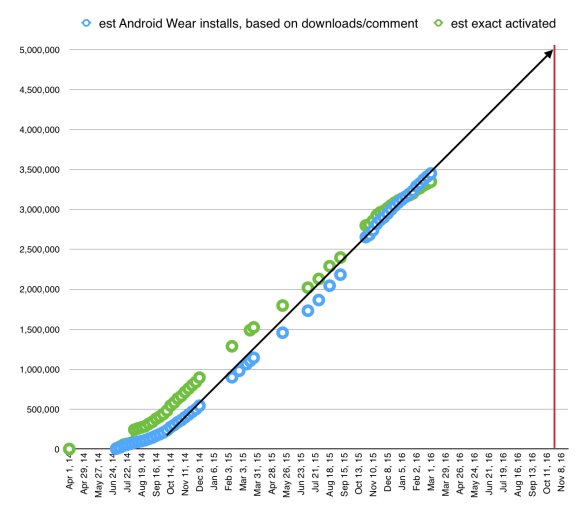
And Android Wear? My latest calculation puts the number activated at between 3.35m and 3.45m – see the graph below. (The variation arises from whether you assume that comments proceed strictly in line with downloads, or that people are less likely to comment as time goes on.)

Is that bad? Well, since the start of the year, it has been adding activations at around 40,500 per week. In the four weeks before the New Year, it was 46,000 per week, with one particularly notably peak in a mid-November week of nearly 79,000.

You’d expect that: big rush before Christmas, slowdown afterwards. But at that rate, it’s going to take a long time for the ticker to go past 5 million on Google Play. In my November post, I thought we’d already be there now.

How reasonable is my estimate? We can definitely say that it has taken more than a year to rack up fewer than 4m activations – which makes sense, because to add 4m takes a consistent run rate of nearly 77,000 activations per week. Android Wear appears to be nowhere near that.

According to my calculations, at the present activation rate, it will take until October before total Android Wear activations pass the 5m mark.

Android Wear activations are well short of 5 million

Android Wear estimated activations: presently just short of 3.5m, and with a long road ahead

So what’s wrong with Android Wear?

There’s no shortage of Android Wear devices. They were ahead of Apple in introducing the concept of the “smart watch”. They were ahead of Apple in arriving: LG, Motorola, Huawei, pretty much every big Android OEM except Samsung and HTC got in there. Samsung isn’t there because it prefers its own Tizen OS – because that allows the flexibility to do what it wants. HTC backed off the idea, which was smart given the financial problems it has. Google has introduced an app to make them work with iOS. Hasn’t changed things.

If people aren’t buying these devices, there’s a problem in the story around them. “Why would I want a smartwatch? For that price? And look at how BIG it is!” (The latter is a pretty consistent reaction to the giant wheels people are expected to strap on their wrist. Actually, maybe that’s our answer.)

Given the gigantic addressable market for Android Wear – pretty much every Android user, which is a lot of people – it seems like we’re seeing both the “premium effect” (iPhone users tend to spend more) and the “huh? Why?” effect.

Quite possibly smartwatches are going to remain a niche – a sort of technological diversion, a bit like games consoles, which have a devoted and upgrading audience, but aren’t actually that pervasive when you look closely at the numbers (particularly when you note how many buyers of one console then add another).

One thing’s for sure, though – the makers of Android Wear devices need a good selling line, and soon.

Start up: Google’s crash, Hive overheats, Vive or Hololens?, BB10 withers, the backdoor test, and more

Facebook is not good at taking down fake profiles. Why not? Photo by gruntzooki on Flickr.

You can now sign up to receive each day’s Start Up post by email. You’ll need to click a confirmation link, so no spam.

A selection of 13 links for you. Use them wisely. I’m charlesarthur on Twitter. Observations and links welcome.

Judge: US can’t force Apple to provide encrypted iPhone data » Associated Press

Larry Neumeister and Tami Abdollah on the decision in a New York case – not the “terrorism” case – where the FBI wants to unlock an iPhone which, yes, has a passcode:

»[Judge] Orenstein concluded that Apple is not obligated to assist government investigators against its will and noted that Congress has not adopted legislation that would achieve the result sought by the government.

“How best to balance those interests is a matter of critical importance to our society, and the need for an answer becomes more pressing daily, as the tide of technological advance flows ever farther past the boundaries of what seemed possible even a few decades ago,” Orenstein wrote. “But that debate must happen today, and it must take place among legislators who are equipped to consider the technological and cultural realities of a world their predecessors could not begin to conceive.”

A Justice Department spokesman said they were disappointed in the ruling and planned to appeal in the coming days. Apple and their attorneys said they were reading opinion and will comment later.

In October, Orenstein invited Apple to challenge the government’s use of a 227-year-old law to compel Apple to help it recover iPhone data in criminal cases.

«

link to this extract


Google says it bears ‘some responsibility’ after self-driving car hit bus » Reuters

David Shepardson:

»The crash may be the first case of one of its autonomous cars hitting another vehicle and the fault of the self-driving car. The Mountain View-based Internet search leader said it made changes to its software after the crash to avoid future incidents.

In a Feb. 23 report filed with California regulators, Google said the crash took place in Mountain View on Feb. 14 when a self-driving Lexus RX450h sought to get around some sandbags in a wide lane.

Google said in the filing the autonomous vehicle was traveling at less than 2 miles per hour, while the bus was moving at about 15 miles per hour.

The vehicle and the test driver “believed the bus would slow or allow the Google (autonomous vehicle) to continue,” it said.

But three seconds later, as the Google car in autonomous mode re-entered the center of the lane, it struck the side of the bus, causing damage to the left front fender, front wheel and a driver side sensor. No one was injured in the car or on the bus.

«

Yeah, if you did that in a driving test, you’d get failed. It’s not the bus’s fault if you try to enter its right of way.
link to this extract


Sony’s latest design experiment: a remote control for your entire life » Co.Design

Mark Wilson:

»The best Sony is weird Sony. It’s the Sony that makes robot dogs and glowing, rolling party balls. It’s the Sony that’s selling something you might not necessarily buy today but that lays the foundation for something you’ll need tomorrow.

Take the HUIS remote (it stands for Home User InterfaceS). It’s a $250 e-ink touchscreen display, like a Kindle Paperwhite, but it’s also a programmable universal remote, like a Logitech Harmony. Via infrared and Bluetooth, it can control anything from your cable box to your smart thermostat.

The e-ink screen solves the biggest problem with using your smartphone—or any other LCD—as a remote. Rather than taking all the incremental steps involved in turning on your phone and opening an app to make changes, its power-sipping display means its screen can stay turned on for a month between recharges.

«

Using the above definition, “best Sony” is also “fabulously unprofitable and unable to find market demand for a product Sony”. The idea of an e-ink touchscreen for things you don’t need to control often is nice, though. It’s just that Sony can screw up software like pretty much nobody else. Remember its music player software? If you can’t, lucky you.
link to this extract


HTC Vive: home VR for under £700 – if you have a computer to run it with » The Guardian

Alex Hern:

»HTC’s Vive virtual reality headset finally has a UK price: a hefty £689.

So, what do you get if you splash out a month’s rent (in London at least)? There’s the headset itself, co-created by gaming company Valve, which has two 1080 x 1200 screens offering a 110-degree viewing area, as well as a front-facing camera for augmented reality features and a plethora of other sensors for head- and motion-tracking.

The headset also comes with three apps: the tongue-in-cheek “Job Simulator”; Northway Games’ Fantastic Contraption, a 3D VR update of an old Flash-based physics game; and the Google-developed Tilt Brush, which lets you paint in 3D space.

Unlike the Facebook-owned Oculus, which retails for $600 (without a specific UK price), the Vive will also ship with two wireless VR controllers, and “room-scale” movement sensors, capable of tracking an area 5 sq m. The Oculus, with its more stripped-back offering, comes with an Xbox 360 controller – although the Oculus Touch controllers will be arriving later this year – and a movement set-up that can handle a 1.5m by 3m area. The Oculus does, however, include built-in audio while the Vive will require a separate pair of headphones.

«

link to this extract


Kiddle: The child-friendly search engine has no affiliation with Google » Alphr

»Kiddle.co is a search engine that uses Google’s results, but it’s not a Google product.

A glance at the homepage makes it pretty easy to see how confusion would arise. To put it charitably, the site’s owners haven’t exactly gone out of their way to set the two apart:

What we actually have here is a search engine that uses Google’s Custom Search bar and human editors to filter out grim results with, I think it’s fair to say, patchy results…

…In theory, Kiddle offers a combination of safe search, results tailored for children (positions 1-3 are safe sites written for children, 4-7 come from safe sites not written for children but accessible, and 8+ are just safe sites) and large clear fonts.

«

In reality: nope. And the ads are Google’s, and unfiltered, so you can see how that could quickly go south.
link to this extract


Super-cheap Raspberry Pi computer gains very useful new features » Fortune

David Meyer:

»Until now, those wishing to add Wi-Fi and Bluetooth functionality to the Pi had to buy separate dongles to plug into its USB ports — we are talking about a $35 computer after all, and this was one way to keep the cost down.

However, these wireless functions are now built right into the Raspberry Pi 3 Model B, making it an even cheaper proposition for those wanting a very basic web-surfing machine, a cheap home server or the basis for a home-brewed Internet-of-things project. (Though those wanting the very cheapest Internet-of-things computer may want to opt for the $5 Pi Zero.)

«

link to this extract


Microsoft reveals HoloLens hardware specs » The Verge

Tom Warren:

»Microsoft is letting developers pre-order the HoloLens development edition today, but it’s also detailing exactly what’s inside the headset. HoloLens is fully untethered and self-contained, which means you do not need a PC or phone to use it. Microsoft has built an entire Windows 10 device into a headset, using a custom-built Microsoft Holographic Processing Unit (HPU) and an Intel 32 bit processor.

Microsoft has a variety of sensors inside the HoloLens, including an inertial measurement unit, an ambient light sensor, and four environment understanding cameras. These combine with a depth sensing camera to allow HoloLens to map spaces. Microsoft also has a 2-megapixel HD camera to capture videos and photos. Four microphones inside the headset are used to pick up voice commands from users…

…Microsoft says the entire HoloLens headset will weigh no more than 579 grams, and the battery will run for around two or three hours of active use. HoloLens is fully functional when it’s charged over Micro USB, and the device will also have a standby time of two weeks.

«

Yours for $3,000. Includes carry case.
link to this extract


Google Maps brings its “Add A Pit Stop” feature to iOS » TechCrunch

Sarah Perez:

»Last fall, Google announced the addition of a long-requested feature to Google Maps, which allowed users to – finally! – add a stop along their current route. That way you could route your way to a gas station or restaurant ahead of your final destination. However, at launch, the feature was only available on Android devices. Today, Google says the feature is now available on all iOS devices as well, and is available in any country where Google Maps offers navigation – or more than 100 countries worldwide.

The feature itself is something users of the Google-owned navigation app Waze have had for some time, but was not yet available in Google Maps.

It’s surprising that it took Google so long to add such a basic feature to its navigation app. After all, hitting up a pit stop while on your way somewhere else is the norm – but, before, you would have to route your way to the pit stop, then start a new route from the pit stop to your destination. And by creating two navigation sessions, it could be hard to see which gas station, restaurant, or other stop would incur the least amount of extra driving.

«

Given how often one wants to do something like this, solving it must be a really difficult routing problem, given it took until last October to arrive on Google Maps. Or else it’s a very difficult UI problem.
link to this extract


WhatsApp to end support for all BlackBerry versions by end of 2016 » CrackBerry.com

John Callaham:

»WhatsApp, the popular cross-platform messaging service, has decided to cut support for a number of those platforms. That includes all versions of BlackBerry OS, including BlackBerry 10, by the end of 2016.

WhatsApp will also end support for Nokia S40, Nokia Symbian S60, Android 2.1, Android 2.2 and Windows Phone 7.1 by the end of the year. From the WhatsApp blog:

»

While these mobile devices have been an important part of our story, they don’t offer the kind of capabilities we need to expand our app’s features in the future. This was a tough decision for us to make, but the right one in order to give people better ways to keep in touch with friends, family, and loved ones using WhatsApp. If you use one of these affected mobile devices, we recommend upgrading to a newer Android, iPhone, or Windows Phone before the end of 2016 to continue using WhatsApp.

«

«

BB10 is, by a mile, the youngest of those operating systems. Of course commenters at Crackberry are *delighted*.
link to this extract


Hive customers hot up in 32°C heatwave glitch » The Memo

Kitty Knowles:

»Hive, which is run by British Gas, received over 30 complaints on Saturday, with many people fearing an unsightly spike in their bills this month.

The company has not yet confirmed how many of its 300,000 users may have been affected.

It said in a statement: “We are aware of a temporary glitch affecting a very small number of customers, where a certain sequence of commands in the Hive iOS app can cause the thermostat temperature to rise to 32°C.

“Any customers seeing this can very easily and immediately fix it by simply turning the thermostat down using the app, web dashboard or the thermostat itself.

“No-one needs to worry about their temperature being too high because the rest of the app works as normal. Meanwhile, we are working on a software update which should be available soon.”

«

So will people get refunds? Hive can’t read meters remotely, but this is BG’s fault so it should give a discount. The Internet of Overheated Things. Don’t you just love the future?
link to this extract


What can player profiling tell us about games? » Eurogamer.net

Keith Stuart:

»Imagine you have just hit ‘start’ on a new first-person video game. You find yourself in a room facing a doorway with ‘this way’ written in large letters over the top. You take a very quick look around and notice a few closed chests and cupboards beside you and then a door behind you marked ‘no entry’. You turn back toward the first door. Without thinking, answer the following question: what do you do now?

«

A really fascinating exploration of the different types of player one tends to find in any games theatre. Which are you? Depends on your answer to that question.
link to this extract


Dear Facebook » Cogdog

Alan Levine’s photos were used to create a fake Facebook account – he already has one – which was then used to scam people. Despite it being reported, Facebook did nothing about it:

»Facebook’s Help page for reporting fake accounts clarifies what kinds of accounts it does not allow

»

We don’t allow accounts that:

• Pretend to be you or someone else
• Use your photos
• List a fake name
• Don’t represent a real person

«

Why is Facebook allowing “Malle Gotfried” to use my photos? Why is Facebook’s highly touted facial recognition system not matching the profile photo “he” is using to he very one that has been on my Facebook profile since November 2015?

Again, why is Facebook not removing accounts it clearly says it does not allow? Why is there no burden on proof of “Malle Gottfried” to prove their identity? Why does Facebook make it so easy for Nigerian scammers to create fake accounts using photos of other people? Why is Facebook not answerable to these questions?

I have reported this account several times, so has my sister, and friends who know me. And every time Facebook replies stating that the creation of fake profiles using my photo does not violate Facebook’s Community Standards – what kind of community standards protect the rights of scammers to create fake profiles used in romance scams?

Why? Why Why?

«

(Thanks Tony Hirst for the pointer.)
link to this extract


The three-prong backdoor test » Zdziarski’s Blog of Things

Jonathan Zdziarski on the suggestions (by some) that hey, Apple’s and Microsoft’s and Google’s “software updates” are really backdoors because, hey, they can change stuff:

»Any kind of automated update task on a computer is capable of introducing new code into the environment, but that is not what constitutes a backdoor. I’ve thought about this at length, and come up with a three-prong test to determine whether or not a mechanism is a backdoor. There has thus far not been a widely accepted definition of what a backdoor is, and so I hope you’ll consider its adoption into best practices for making such determinations, and welcome your input. The three prongs I propose are “consent”, “intent”, and “authenticity” (or: control).

«

In the hydra-headed debate around Farook’s damn iPhone 5C, Zdziarski has posed and answered some of the best questions. If you’re interested in security topics, I highly recommend his blog.
link to this extract


Errata, corrigenda and ai no corrida: none noted