Start up: iPhone sales visualised, stopping VR sickness, Canon lurches downward, mobile design and more


Not so many of these being sold. Photo by lonelysandwich on Flickr.

A selection of 8 links for you. Perhaps. I’m charlesarthur on Twitter. Observations and links welcome.

iPhone sales by quarter » Bare Figures

Have a play with this excellent site, which shows financial data for all sorts of companies. Notable: iPhone sales in the just-gone quarter of 61.2m, up 39.9%. That really is a lot. And the revenues too.


How to reduce VR sickness? Just add a virtual nose » WIRED

Liz Stinson:

Eliminating simulator sickness is a major interest of the burgeoning VR industry, but so far there hasn’t been a clear answer. Home remedies include drinking alcohol, while companies like Oculus Rift are exploring better positional tracking and improved display resolution. But researchers at Purdue University believe they’ve found a way to reduce the negative physical effects of virtual reality by using something that’s right in front of your face.

“We’ve discovered putting a virtual nose in the scene seems to have a stabilizing effect,” says David Whittinghill, an assistant professor in Purdue University’s Department of Computer Graphics Technology.


Windows Phone and Prepaid in the US » Tech.pinions

Jan Dawson:

based on the combination of AdDuplex and Comscore data, it’s likely Cricket has between 1 and 1.5 million Windows Phone devices in its base, which is a fairly significant chunk of Cricket’s overall base, perhaps as much as 25%. Secondly, remember the overall Windows Phone growth numbers we looked at earlier? There was net growth of about 1 million Windows Phone handsets in the base during that same nine month period or, in other words, the difference between those that left the platform and joined it was 1 million. Given Cricket likely added around 1 million during that period, it’s possible it accounted for the vast majority of that net growth.

Cricket isn’t the only prepaid brand where Windows Phone is big, though. It’s hard to get a full postpaid/prepaid breakdown from the AdDuplex numbers because, for the major carrier brands, the two aren’t separated. But even if we just focus on MetroPCS, Cricket and a phone only available on AT&T’s GoPhone prepaid service, these three add up to around 40% of the total base in the US. Add in a few percentage points for other prepaid sales on the major carriers and we could be getting close to half the Windows Phone base on prepaid, compared with about 25% of the total US phone base on prepaid. In this sense, Windows Phone is the anti-iPhone, with the iPhone well underrepresented in the prepaid market, just as Windows Phone is well over-represented.

(The full article is via subscription – monthly or one-off.)


The hidden politics of video games » POLITICO Magazine

Michael Peck:

Sim City lets you indulge your wildest fiscal fantasies. Banish the IRS and set taxes to zero in Teapartyville, or hike them to 99 percent on the filthy rich in the People’s Republic of Sims. Either way, you will discover that the game’s economic model is based on the famous Laffer Curve, the theoretical darling of conservative politicians and supply-side economists. The Laffer Curve postulates that raising taxes will increase revenue until the tax rate reaches a certain point, above which revenue decrease as people lose incentive to work.

Finding that magic tax point is like catnip for hard-core Sim City players. One Web site has calculated that according to the economic model in Sim City, the optimum tax rate to win the game should be 12% for the poor, 11% for the middle class and 10% for the rich.

In other words, playing Sim City well requires not only embracing supply-side economics, but taxing the poor more than the rich. One can almost see a mob of progressive gamers marching on City Hall to stick Mayor McSim’s head on a pike.

The subtle reinforcing effects of such models isn’t much thought about. Philip K Dick did, for his short story War Game.


Canon first-quarter profit drops as compact camera demand collapses » Reuters

Thomas Wilson:

Japan’s Canon Inc reported first-quarter net profit that fell by almost a third on Monday, grossly undershooting expectations, citing a collapse in demand for compact digital cameras.

Profit at the world’s largest camera maker fell to 33.93bn yen (£188 million) in January-March, compared with the 53.64bn yen average estimate of 5 analysts according to Thomson Reuters data.

The result comes as the world’s No.1 camera maker contends with a shift in consumer preference toward increasingly capable smartphone cameras. That shift has dragged Canon’s compact sales down nearly 70% since the market’s peak in 2008 – the year after Apple released its game-changing iPhone.

“Sales volume for low-end (digital camera) models declined due to the ongoing contraction of the market in all regions from the previous year,” said Canon in its earnings release.

Revenues down 1% year-on-year; operating profit by 20%. Also cut this year’s forecasts for compact sales by 23% and for higher-end cameras by 9%.


Telecom act to stifle sales of LG G4, Galaxy S6 » Korea Times

Bahk Eun-ji:

LG Electronics will release its latest smartphone, the G4, on Wednesday and seek to steal customers from its bigger rivals Samsung Electronics and Apple. LG is betting big on the new smartphone to gain fresh momentum in its earnings.

However, it faces a bigger obstacle than Samsung and Apple in the domestic market ― the Telecom Act that caps handset subsidies.

Two weeks ago, the KCC [Korean Communications Commission] raised the maximum amount of subsidy that customers can receive when buying a new handset to 330,000 won [£203/$304], from 300,000 won [£185/$268]. However, the maximum subsidy is possible only for those who choose the highest monthly phone bill rate. For most consumers, the actual subsidies available for them are insignificant. That’s why they are not buying new handsets.

The government has drawn criticism for the enforcement of the Telecom Act from all interested parties, including consumers, telecom companies and retail shop operators.

In particular, retail handset dealerships have condemned the act as their handset sales plunged after the Mobile Distribution Act took effect in October. Under the current law, when consumers buy Samsung’s Galaxy S6 and select a highest phone bill rate, they can receive up to 330,000 won in subsidies.

Normally, retail shop owners get rebates from telecom companies when they sell new handsets, but if customers do not buy the devices at the shop, the owners will not get the rebate.

Besides, if customers cancel their contracts before six months, the shop owners have to pay a 200,000 won [£123/$184] penalty to the telecom companies.

This probably explains the low reported sales of the Galaxy S6. The purpose of the subsidy cap is to prevent carriers and handset makers colluding to lure customers from rivals in South Korea’s saturated market. In 2014, Samsung lobbied to raise the subsidy ceiling. Not hard to work out why.


Racist Camera! No, I did not blink… I’m just Asian! » Flickr

Jared Earle offered a followup to the story on Kodachrome from Monday, pointing to this photo and commentary from 2009:

We got our Mom a new Nikon S630 digital camera for Mother’s Day and I was playing with it during the Angels game we were at on Sunday.
 
As I was taking pictures of my family, it kept asking “Did someone blink?” even though our eyes were always open.

Surprising, to say the least, that Nikon would have this problem.
Time picked up the story about a year later, and pointed out more strange examples where systems seemed to have built-in prejudices.

Of course, you can blame “the algorithms”. But they don’t write themselves.


Obvious always wins » LukeW

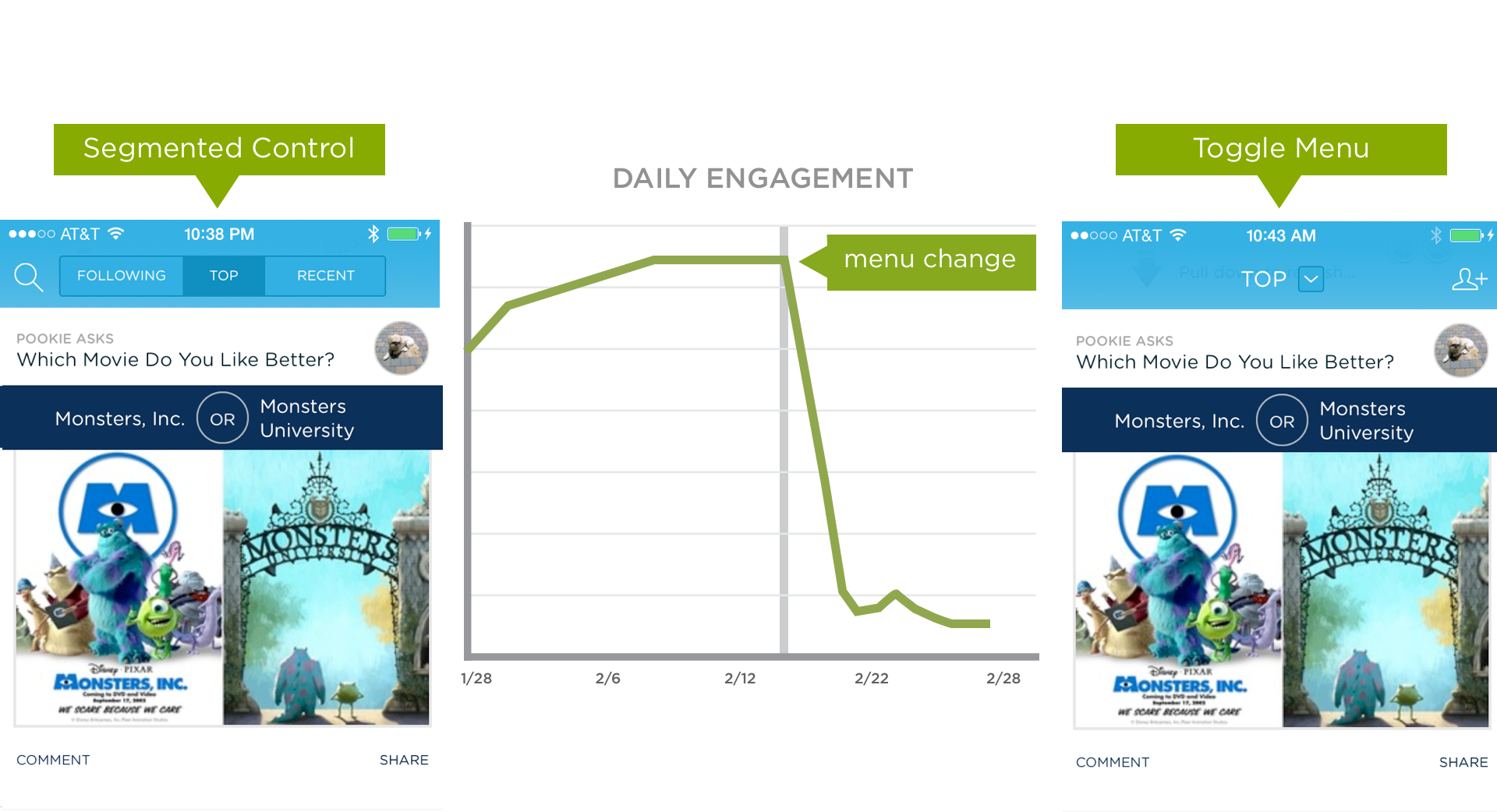
Luke Wroblewski, on how using menu controls (especially “hamburgers” and similar) can create big problems, even though the screen looks “simpler” (and so “better”, right?):

In an effort to simplify the visual design of the Polar app, we moved from a segmented control menu to a toggle menu. While the toggle menu looked “cleaner”, engagement plummeted following the change. The root cause? People were no longer moving between the major sections of the app as they were now hidden behind the toggle menu.

A similar fate befell the Zeebox app when they transitioned from a tab row for navigating between the major sections of their application to a navigation drawer menu. Critical parts of the app were now out of sight and thereby out of mind. As a result, engagement fell drastically.

[By contrast] When critical parts of an application are made more visible, usage of them can increase. Facebook found that not only did engagement go up when they moved from a “hamburger” menu to a bottom tab bar in their iOS app, but several other important metrics went up as well.

Start up: virtual reality gets real, our AI friends, Oracle’s junk bundle, Google’s Wiki love, games with molten lead, and more

A selection of 8 links for you. Do not try the first at home. Or anywhere. I’m charlesarthur on Twitter. Observations and links welcome.

Dr. Jearl Walker sticks his hand into molten lead » YouTube

Yes. Honestly. He’s demonstrating the Leidenfrost effect. DO NOT TRY THIS.

The dangerous stuff happens at about 4 minutes in when he does it the first time. Then he keeps on doing it.

If you want to read about the Leidenfrost effect, Walker explains it in full (PDF).


Forget Oculus Rift, the incredible HTC Vive experience will blow your mind (hands-on) » Pocket-lint

Chris Hall tried it, and he’s sold:

HTC Vive has been born out of HTC’s partnership with Valve. Announced at Mobile World Congress, HTC Vive and Steam VR is taking virtual reality from a static seated or standing experience where you wiggle your head, to one that plays out like Star Trek’s Holodeck, or virtual worlds imagined in The Matrix or Tron.

The lasers mounted on the walls transect the whole space. The Vive headset and controllers are covered with detection points, so they know exactly where they are within that space. That sort of 3D motion mapping isn’t a new technology – it’s similar to how Hollywood captures movement that then underpins CGI models in blockbuster movies.

But here it’s used to let you roam in Vive’s Full Room Scale virtual reality, meaning you have more freedoms than before. You can sit, stand, kneel, walk, jump, duck, dive, bob, weave, punch, skip, spin and probably stand on your head, and Vive knows what you’re doing and where you’re doing it.

Moore’s Law means VR is rapidly hitting the point where it’s going to work fantastically well. Games are the obvious first use; but selling travel experiences seems like a promising one too. Could VR be the saviour of the high street travel agent?

Promising for HTC as well if it can get this right.


Google, Wal-Mart part ways over local shopping ads » WSJ

Alistair Barr and Rolfe Winkler:

The relationship between Google, the world’s largest Internet search provider, and Wal-Mart Stores, the biggest retailer, has frayed over the data used to lure shoppers into stores.

Last summer, Wal-Mart signed up for a Google advertising service that shows shoppers where specific products are available at nearby stores. Less than a month later, the retailer pulled out over concerns about sharing store inventory and pricing data with Google, according to two people familiar with the situation.

Google requires retailers using its Local Inventory Ads to share prices and product availability by location; it recommends they specify inventory levels. Wal-Mart has about 5,000 U.S. stores, most housing more than 100,000 products, so the company was sending Google more than one billion lines of data daily, one of the people familiar with the matter said. Wal-Mart was particularly worried about exposing prices, which can vary from store to store, another person familiar with the matter said.

Frankly, I’m amazed Wal-Mart ever shared that information. Google will have vacuumed it up and stored and analysed it in so many ways.


Teen clothing retail trumped by gadgets and food as status symbol » IB Times

Nadine DeNinno:

Clothes may make the man, but an iPhone makes a teenager.

Apparel brands like Aeropostale, American Eagle Outfitters and Abercrombie & Fitch have fallen out of favour with teens. The mall-based retailers are reporting low earnings for the first quarter. But the problem goes deeper than a harsh winter that hurt retail sales across the board: Young shoppers simply don’t care about clothes as much as they used to…

…When they do shop, young consumers are looking for gadgets rather than clothes. “Fashion apparel for the teenager is not the first considered purchase,” [Piper Jaffray senior research analyst Stephanie] Wissink said. Teens see electronics as “popularity devices, not utilities.”


Would you buy a ‘smart band’ for an Apple Watch? » TechCrunch

Matthew Panzarino, with a great scoop:

the Apple Watch has a port that the company has yet to show off. It’s being used for diagnostics and direct access to the Watch operating system, but it’s feasible that could be used to connect accessories in the future.

The port has a 6-dot brass contact array inside the groove for the ‘bottom’ strap connector slot. Several sources have confirmed its existence and placement to me. It is very similar to the connector for the Lightning connector in iPhones, as that connector currently only uses 6 of its 8 available pins. Apple recently began opening up the Lightning port for use by third parties. A source says that this port is currently for diagnostic purposes only — but that there is nothing preventing it from being a connection port for future accessories.

Let’s get this out of the way: As far as I know, smart bands will not be a part of the first Apple Watch version.


Will A.I. destroy us? » Medium

Prener Gupta and Parag Chordia, founders of Telepathic (“a company that uses AI to enhance human creativity”):

we believe superhuman machine intelligence is our best chance of long-term survival as a species.

It’s not that artificial intelligence won’t someday become superhuman. It almost certainly will.

But we think the doomsday predictions about A.I. wiping out our species, thought-provoking as they are, fall into the same trap that renders most futurist predictions wrong: they assume everything else will remain constant.

Unconvinced. At least, bt this argument.


Oracle extends its adware bundling to include Java for Macs » ZDNet

Ed Bott commits journalism:

For several years, Oracle has been bundling the Ask toolbar with its Java software for Windows PCs, often using deceptive methods to convince customers to install the unwanted add-on.

With the latest release of Java for the Mac, Oracle has begun bundling the Ask adware with default installations as well, changing homepages in the process.

The unwelcome Ask extension shows up as part of the installer if a Mac user downloads Java 8 Update 40 for the Mac. In my tests on a Mac running that latest release of OS X, the installer added an app to the current browser, Chrome version 41. (In a separate test, I installed Java using the latest version of Safari, where it behaved in a similar fashion.)

As with its Windows counterpart, the Java installer selects the option to install the Ask app by default. A casual Mac user who simply clicks through the dialog boxes to complete the installation will find the app installed and enabled in their browser, with the New Tab page changed to one with an Ask search box.

Do tactics like this belong to companies from a particular generation (my initial feeling)? Then again, the number of hijacks on mobile pages is growing, so perhaps not. It’s just scummy behaviour, which seems to afflict lots of companies.


Google and Wikipedia: Best Friends Forever » Newslines

Mark Devlin points out something important:

The Knowledge Graph is just the most obvious part of the co-dependent relationship between Google and Wikipedia. The relationship most obviously benefits Wikipedia by giving it traffic. Jimmy Wales, Wikipedia’s co-founder, said in 2010 that the site received 60-70% of its traffic from Google. Wikipedia is almost always in Google’s top three results, and more often than not it’s the top result. The top result is clicked 36.4% of the time and one of the top three results is clicked 58.4% of the time. I pointed out in my last article that there is practically no need for the second page of results as 94% of readers click on a link on the first page of results.

This means that Google is giving Wikipedia around one third of its traffic. But how is this good for Google? Surely Google would rather keep people in Google than let them go to Wikipedia? Well firstly, the Knowledge Graph does keep people in Google longer. For example, instead of going to IMDb for movie data, owned by competitor Amazon, the Wikipedia snippet is right there on the page as well as the list of movie roles. The searcher stays in Google’s system.

A more important reason is that the Wikipedia link keeps Google’s competitors off of the top result. For example, the fight between IMDb and Wikipedia for the top spot for movies benefits Google immensely. If Google can shift IMDb from first to second place then IMDb gets 66% less clickthroughs, an enormous number of potential customers lost. Google can then defend itself by saying that Wikipedia has a “better” ranking, but that’s self-serving.

Excellent post, and one to think about.


Start up: Samsung’s future?, Lollipop drops mandatory crypto, the DDOS lightbulb, Microsoft and keyboards, and more


Samsung, in a few years? Photo by French Tart on Flickr.

A selection of 13 links for you. (Too many? Too much news.) I’m charlesarthur on Twitter. Observations and links welcome.

Google’s great encryption backtrack » Motherboard

Jason Koebler:

​In late October, Google announ​ced that Lollipop, its newest version of Android, would have “encryption by default.” Monday, it was a curious reporter, not Google, reporting that would no longer be the case.

Instead of requiring every file on an Android system to be encrypted by default, the choice will be left up to manufacturers such as Samsung, LG, and Motorola as to whether to turn that feature on out of the box, Ars Tec​hnica discovered.

“Google has made statements that are no longer true, and it’s Google’s obligation to publicly correct that statement,” Amie Stepanovich, US policy manager for the digital rights group Access, told me.

Google won’t say why it’s backtracking, but it’s pretty evident the reason is device performance – encryption slows them down. User security takes second place to performance – the story that has killed BlackBerry down the years.


Cybercriminals phish iCloud credentials from victims of iPhone, iPad theft » Symantec Connect Community

Cybercriminals have recently created multiple phishing sites in order to trick iOS device owners into providing login credentials for their iCloud accounts. The attackers appear to be focusing on users whose iPads and iPhones have been lost or stolen. It’s possible that the attackers are running this phishing operation as part of a service for iOS device thieves on underground forums.

In one particular case, a victim of iPad theft received an unsolicited message, informing him that his tablet had been found. The message then instructed him to click on a link to discover the location of his iPad.

Surprise! It’s a phishing site to get the iCloud credentials and unlock the stolen phone for resale.


This guy’s light bulb DDoSed his entire smart house — Fusion

Kashmir Hill on Raul Rojas, a computer science professor who made his whole house into a smart home (apart from the locks – he worried about the locks):

About two years ago, Rojas’s house froze up, and stopped responding to his commands. “Nothing worked. I couldn’t turn the lights on or off. It got stuck,” he says. It was like when the beach ball of death begins spinning on your computer—except it was his entire home.

…when he investigated, it turned out that the culprit was a single, connected light bulb.

“I connected my laptop to the network and looked at the traffic and saw that one unit was sending packets continuously,” said Rojas. He realized that his light fixture had burned out, and was trying to tell the hub that it needed attention. To do so, it was sending continuous requests that had overloaded the network and caused it to freeze. “It was a classic denial of service attack,” says Rojas. The light was performing a DDoS attack on the smart home to say, ‘Change me.’”

Take a look at his home hub. That’s not some little router.


BlackBerry CEO: I’m open to creating a tablet again » CNET

Roger Cheng:

BlackBerry may take another run at the tablet market.

That’s if CEO John Chen thinks the opportunity is right. “It’s not in the works, but it’s on my mind,” Chen said in an interview at the Mobile World Congress conference here.

A BlackBerry tablet could satisfy the needs of a small but fiercely loyal group of productivity-focused customers who have stuck with the struggling smartphone maker and its operating system, potentially giving it a new revenue stream. But there aren’t enough BlackBerry faithful to sustain such a business, especially given the tablet category saw its first year-over-year decline in shipments in the fourth quarter.

“History repeats itself, the first time as tragedy, the second as farce,” to quote Marx (not Groucho).


Does anybody understand these baffling MWC slogans? » Pocket-lint

Rik Henderson:

One of the things we always notice when trudging trade show floors is that companies feel the need to explain what they do, or what they are showing in a three or four word slogan. However, most of them are claptrap of the highest order.

Wonderful (and classically British) insistence on taking words at their face value, and asking the important questions that other sites (and certainly not the boring American ones) will, such as: “what actually does ‘unleash the future’ mean, Mozilla?”


Google reportedly preparing Android Wear for iPhone and iPad » Mac Rumors

Joe Rossignol:

Google is reportedly preparing to release an Android Wear app on the App Store for iPhone and iPad, according to French technology website 01net [Google Translate] (via iPhon.fr).

The report claims Android Wear with extended iOS support could be announced at Google’s I/O developer conference in late May, although Google may push the agenda depending on sales of the Apple Watch.

Google may be interested in capitalizing on iPhone and iPad users that are not planning to purchase an Apple Watch when the wrist-worn device is released in April, the report adds.

Essentially unsourced, but it would make sense: Google wants its services used as widely as possible, and not having Android Wear on iOS leaves tens of millions of potential customers unserved.

However, are there many iPhone users who would opt for Android Wear over an Apple Watch, except over the question of price? At the bottom end, the price delta is pretty low – and if that really matters, you’d get a Pebble, since it has been iOS-compatible from day one. So I believe this report, but don’t think Android Wear will benefit from it as much as Google (and AW makers) might want.


Cyanogen CEO Kirt McMaster on Android, Samsung, and more » Business Insider

Lisa Eadicicco, with a smart interview with McMaster, who says:

On the global platform, we see Xiaomi becoming the No. 3 OEM. Micromax is now No. 10. These guys are basically creating really cheap handsets that have really awesome performance. This is made possible because of Qualcomm’s turnkey solution as well as Mediatek’s.

One of the things Cyanogen does really well is optimizations at the low level, at the kernel level. Which means we can get performance out of these chipsets coming out of turnkey that make the device for all intents and purposes feel like a $600 iPhone.

The tier one OEMs like Samsung are going to be the next generation Nokias in the next five years. They’re going to be slaughtered. We think long term Apple itself will have problems because they’re just not good at competing at the low end.

Q: So you think Samsung will be toast in five years?

It could get pretty bad pretty damn quick. This is often the case.


Swedish speed camera pays drivers to slow down » WIRED

Is it possible to make road-safety fun? Yes, it turns out. Kevin’s Richardson’s idea is both smart and simple. As well as ticketing you when you run through a speed-radar too fast, Kevin’s “Speed Camera Lottery” also notices you when you come in at or under the speed-limit. It then automatically enters you in a lottery. And here’s the really smart part: the prizes come from the fines paid by speeders.

This would probably never work in the U.S, where speeding fines and red-light cameras exist as revenue streams for the police rather than as deterrents to bad driving, but the Swedish National Society for Road Safety, which worked with Kevin, has found it to be a success.

Neat idea (there’s the video) but of course it relies on tying your speed to your licence plate, ad so your address, and so you. Sweden is open enough that that is accessible. But other countries?

Even so, the idea of changing behaviour through “fun” is a subtle – yet powerful – one.


3D-printing with living organisms “could transform the food industry” » Dezeen

No content. Just consider
• use of “could” in the headline. As Paul Haine points out, you can extend Betteridge’s Law (“any headline posed as a question can be fully answered and the story implications understood with ‘No'”) to headlines which use “could”
• “3D printing with living organisms” is also known as “growing, preparing and cooking stuff”. No 3D printer required.


Zuckerberg: carriers will connect the world, not sci-fi – CNET

It’s regular carriers and regular technology that will bring Internet access to the billions of people who lack it today, not sci-fi ideas like Google’s Project Loon balloons or Project Titan drones, Facebook Chief Executive Mark Zuckerberg thinks.

“People like talking about that stuff because it’s sexy,” Zuckerberg said of such departures from networks delivered by plain old cell phone towers and fiber-optic lines. “That’s at the fringe of the real work that’s going on. Ninety percent of the people in the world already live within range of the network.”

Well that’s putting a pin in the balloon so laboriously pumped up by various blogs of how Loon is going to totally, utterly, y’know, transform how everyone stays connected.


Microsoft’s keyboard obsession » TechCrunch

Ron Miller:

this morning at Mobile World Congress, Microsoft announced a new version of Office 365. I gotta be honest. It looked like it was trying to take full-blown Office and squeeze it into a 5 or 6 inch screen. Sure, they tuned it a bit to make it mobile friendly, but it was still Office in all its glory in a smaller footprint.

So what did Microsoft do? You got it. It developed a keyboard.

It’s a small bluetooth variety engineered by the Microsoft hardware group. It folds up into a fairly small footprint to fit neatly in brief case or purse, but it’s another part of their total keyboard obsession. Instead of making Office fit the phone touch screen, it invented a keyboard to make it work better on a phone.

Next it will probably build a small wireless mouse to complete its whole vision of mobile device as a PC in a small package.

This is such an elegantly short yet well-observed piece. And captures it all. The commenters are furious because obviously he typed it. I wonder how much real typing they do. Perhaps too much. Journalists typically type at least a thousand words a day; I wonder how much the average Office user types. Any data out there?


Mobile consumers have the answer » Kantar Worldpanel

Carolina Milanesi asked the Kantar panel of consumers for their views:

We know that tablet sales are stagnant and that 79% of American panelists without a tablet have said that the reason they are not planning to buy a tablet in the next 12 month is because their PC is “good enough” for them. When we asked consumers who own a PC if they are planning to replace that PC in 2015, 85% of the panelists interviewed said they are not. 11.3% said they indeed are planning to replace their current PC with another, and1.7% said they will replace that PC with a tablet. Finally, 1.9% plan to replace their PC with a convertible.

Consumers in the 25 to 34 year bracket are the most favorable to tablets, with 2.9% planning to purchase one as a replacement for their PC. Consumers 16 to 24, are the most open to convertibles (3.5%) most likely because they’re still in their school years,

Also asked about virtual reality, to sniffy answers. But you could have asked people if they wanted to surf the web and get email on the move in 2006 and got similar uninterested answers. Asking consumers about future technologies isn’t always meaningful without clear use cases.


Galaxy S6 sales to outperform its predecessors, says Samsung Taiwan executive » Digitimes

Samsung Electronics will begin to market its newly released flagship smartphone the Galaxy S6 starting April 10 and expects sales to outperform the Galaxy S4, the vendor’s best-selling model so far, according to Andy Tu, general manager of Samsung’s mobile communication business in Taiwan.

Samsung has responded to criticism of the Galaxy S5 with great changes in terms of design and materials, expecting the new design to bring in significant replacement demand for the Galaxy family products, Tu said on the sidelines of a pre-MWC 2015 event.

Samsung will focus on promoting two flagship models, the Galaxy S6 and Galaxy Note 4, plus mid-range A- and E-series Galaxy models from the second quarter of 2015, Tu revealed.

In all the oceans of electrons splurged over the Samsung S6+Edge, I didn’t see a single one where a Samsung executive was asked whether it expected these to sell more, the same or fewer.

If Digitimes is doing better journalism than the people at MWC..