Start up: 3D TV is dead, Samsung’s S7 in brief, tablets to grow and shrink, the faked Nefertiti, and more


By the time you read this, the world’s best human Go player will have won – or lost – against the world’s best AI Go player. Photograph (of a standard corner formation) by Peter on Flickr.

You can now sign up to receive each day’s Start Up post by email. You’ll need to click a confirmation link, so no spam.

A selection of 10 links for you. Use them wisely. I’m charlesarthur on Twitter. Observations and links welcome.

How AlphaGo illustrates the “warm bath and ice bucket” view of technology progress » Tech.pinions – Perspective, Insight, Analysis

This is by me; I’ve started writing at Techpinions.

»Remember the last time you took a bath or shower and it started lukewarm but you gradually warmed it by adding more hot water, until it reached a temperature so hot you could never have got into it at the start? Isn’t it strange how we can be immune to subtle, slow changes all around us?

Then there’s the other extreme – the ice bucket experience, where you’re abruptly plunged into something so dramatically different you can’t think of anything else.

The warm bath and the ice bucket: that’s how technology progresses, too.

«

By the time you read this, the first game of the five-match Go tournament pitting Google Deepmind AlphaGo program v Lee Sedol, the world’s best Go player, will have been played. The result will be at https://gogameguru.com/alphago-1/.

But which is AI, do you think: the warm bath or the ice bucket?
link to this extract


Detachable tablets set to grow from 8% of tablet market in 2015 to 30% in 2020 » IDC

»Worldwide tablet shipments will drop to 195m units in 2016, down -5.9% from 2015, according to a new International Data Corporation (IDC) Worldwide Quarterly Tablet Tracker forecast. Looking beyond 2016, IDC expects the overall market to return to positive growth, albeit single digit, driven by growing demand for detachable devices. This somewhat hybrid category that brings together slate tablets and PCs is expected to grow from 16.6m shipments in 2015 to 63.8m in 2020.

“Beyond the growing demand for detachable devices, we’re also witnessing an increase in competition within this segment that will help drive design, innovation, and a decline in average prices,” said Jean Philippe Bouchard, Research Director, Tablets. “At the latest Mobile World Congress, we saw new entrants, like Alcatel and Huawei, coming from the mobile space and expanding their portfolio to address the demand for detachables. Everyone in the industry recognizes that traditional personal computers like desktops and notebooks will potentially be replaced by detachables in the coming years and this is why we will see a lot of new products being introduced this year.”

The change from slate form factor to detachables will bring along two other changes to the tablet industry. First, devices with larger screen sizes (9″ and above) will experience growth throughout the forecast while those under 9inches will decline. And second, Microsoft-based devices will begin taking share from the other platforms, most notably Android.

«

This “detachable” v “slate” v “you can get an extra keyboard as an add-on” is confusing as hell, and IDC isn’t making it any clearer. Nowhere in this release, or anywhere on IDC’s site that I’ve seen, is there a definition of what makes a “detachable”. Is the Surface Pro? The Surface Book? The iPad Pro? An iPad to which you add a Logitech keyboard?
link to this extract


Mossberg: Samsung’s new Galaxy S7 phones are beautiful » The Verge

Walt Mossberg:

»I had three hardware problems. First, the standard S7 ran hot, sometimes uncomfortably so. Second, the backs of both new Galaxies were slippery. I almost dropped each once.

My worst hardware problem — and it’s quite annoying — is that the fingerprint reader, built into the rectangular physical home button, failed on me. On both models, I kept getting a message to wipe off the home button and try again, even though the button and my thumb were each bone dry. If I left my thumb on the reader a bit longer, or pressed harder, it would work, but this was still a fail because it made unlocking the phone with my thumb a chore. Oddly, this didn’t happen with a second finger. Samsung had no explanation, but that same thumb has unlocked several other brands of handsets quickly and reliably…

…As has happened so often in the past, Samsung’s best efforts at hardware are let down by software. The company told me it had stopped trying half-baked software ideas, and reduced duplication of Samsung and Android apps by about 30%.

I agree that the S7’s have the cleanest software build of any Galaxy I’ve tested, and that Samsung’s TouchWiz interface has been toned down. But there’s still too much duplicate software for my taste. For instance, out of the box, there are still two email apps, two music services, two photo-viewing apps, two messaging apps, and, except on Verizon, two browsers and dueling wireless payment services. (Samsung says Verizon barred including Samsung’s browser and Samsung Pay out of the box.) And Verizon builds in a third messaging app…

…Worse, despite Samsung’s newfound software restraint, the company couldn’t stop itself from offering a complex new system of software shortcuts on the larger S7 Edge model. This is the new iteration of a useless feature from last year’s Edge model, and it is better. But it’s the kind of thing that just strikes me as a gimmick. You can swipe in from a small area of the right edge to see various different vertical rows of supposedly quick-action icons: frequent contacts, favorite apps,news, automated tasks and more. Some of these actually can be expanded to two vertical rows.

It sounds at first glance like a time-saving idea, but I found it to be a sort of competing user interface which I frequently forgot about.

«

So the hardware is beautiful.. and then the problems start? Terrible headline which doesn’t do the job a headline should. The phone running hot will be down to the Snapdragon 820 chip. And what does “reduced duplication by 30%” mean?
link to this extract


With a bullet to the head from Samsung, 3D TV is now deader than ever » CNET

Nice scoop by David Katzmaier, who got a Samsung source telling him its 2016 range won’t support 3D, going instead for smart functionality:

»LG, the No. 2 TV maker worldwide, is actually holding steady. Tim Alessi, director of new product development, told CNET that 3D “still remains a meaningful step-up feature for many” consumers. About a third of the 2016 series TVs it will sell in the US support the feature. On the other hand, all of them will be high-end 4K OLED and LED LCD models.

Case in point: LG’s main series of flat 4K OLED for 2016, the B6, won’t support 3D. That’s a shame for any remaining 3D fans because its 2015 predecessor, the EF9500 series, delivered the best 3D image quality we’ve ever tested.

Then there’s Vizio. A major brand in the US but not worldwide, Vizio hasn’t offered 3D on any of its TVs since 2013; even the exceedingly expensive Reference Series is 2D-only. And Sony’s rep told CNET that only two of its US series, the X930D and X940D, will support 3D in 2016. The cheapest costs $3,200.

3D movies continue to be released in theaters, and 3D Blu-ray discs will likely be sold for a few more years, so owners of current 3D TVs still have some use for those glasses. Streaming services like Netflix, Amazon and Vudu still offer a few titles too, but they can be difficult to find, and the new 4K Blu-ray disc format contains no provisions for 3D support at all.

«

Yeah, 3D TV is dead; Philips is giving up on it too, and broadcasters have abandonedit. There was never a reason for it, too big an installed base to fight against, and the requirement for special glasses (what if you had friends round?) too taxing.

So let’s remind ourselves of the breathless reports from CES 2010 and CES 2011, when we were told 3D TV would be the next big thing.
link to this extract


There’s something fishy about the other Nefertiti » The Great Fredini’s Cabinet of Curiosities

Fred Kahjl on the claims by Nora Al-Badri and Jan Nikolai Nelles to have used a Kinect to make a high-quality 3D scan of the bust of Nefertiti in Berlin’s Neues Museum:

»One theory is that the scan is actually generated by Photogrammetry, a technique of capturing images of the sculpture from a variety of angles. The images are then fed into software such as Agisoft Photoscan that analyzes all the images for common points, and generates a 3D model of the subject. Paul Docherty is a researcher who has extensively used photogrammetry to reconstruct historic artifacts and sites, including a model of Nefertiti’s bust using available imagery he gathered online. He catalogued the process in his article 3D Modelling the Bust of Queen Nefertiti, and also spoke on the 3D in Review podcast about his efforts. Mr. Docherty has since gone on to question the Nefertiti Hack scan in his article Nefertiti Hack – Questions regarding the 3D scan of the bust of Nefertiti, in which he agrees that there is no way this scan was captured with a Kinect. So, its possible that the scan could have been made using a series of 45-120 high res images covertly gathered with a cellphone, but if that’s the way it was done, why show the Kinect in the video?

The last possibility and reigning theory is that Ms. Badri and Mr. Nelles’ elusive hacker partners are literally real hackers who stole a copy of the high resolution scan from the Museum’s servers. A high resolution scan must exist, as a high res 3D printed replica is already available for sale online. Museum officials have dismissed the Other Nefertiti model as “of minor quality”, but that’s not what we are seeing in this highly detailed scan. Perhaps the file was obtained from someone involved in printing the reproduction, or it was a scan made of the reproduction? Indeed, the common belief in online 3D Printing community chatter is that the Kinect “story” is a fabrication to hide the fact that the model was actually stolen data from a commercial high quality scan. If the artists were behind a server hack, the legal ramifications for them are much more serious than scanning the object, which has few, if any legal precedents.

«

More detail from Kahl points out that a Kinect could never have done this – it lacks the precision. So a server hack seems most likely.
link to this extract


SoC and NAND performance – the Samsung Galaxy S7 & S7 Edge review, part 1 » Anandtech

Joshua Ho:

»While we’re ready to move on to newer benchmarks for 2016, our system performance benchmarks from 2015 are still going to provide a pretty good idea for what to expect from the Galaxy S7 and Snapdragon 820 by extension. For those that are unfamiliar with what the Snapdragon 820 is, I’d reference our previous articles on the Snapdragon 820.

In essence, we’re looking at a 2×2 CPU configuration with 2.2 GHz Kryo cores for the performance cluster, and 1.6 GHz Kryo cores for the efficiency cluster. Binding the two clusters together are some power aware scheduling at the kernel level and a custom interconnect to handle coherency between the two clusters. Memory is also improved relative to the Snapdragon 810, with a bump to LPDDR4-1800 over the former’s LPDDR4-1600. Of course, there’s a lot more to talk about here, but for now we can simply look at how the Snapdragon 820 compares in our benchmarks.

«

Yes, have a look. What stands out is that in 11 comparative benchmark tests, the S7’s 820 processor beats the six-month-old IPhone 6S Plus in just three. I’m not much of a believer in the importance of benchmarks – they won’t tell you how smoothly a screen will scroll, no matter what the frame rate, because animation code is a different thing from simply refreshing the screen – but this seems remarkable. How soon before Apple’s lead isn’t just six months, but a year?

And then take a look at the battery life figures, where Ho comments:

»looking at the iPhone 6s Plus relative to the Galaxy S7 edge it’s pretty obvious that there is a power efficiency gap between the two in this test. Despite the enormous difference in battery size – the Galaxy S7 edge has a battery that is 33% larger than the iPhone 6s Plus – the difference in battery life between the iPhone and Galaxy in this test is small, on the order of half an hour or 5-6% [longer for the S7 Edge]. This is balanced against a higher resolution (but AMOLED) display, which means we’re looking at SoC efficiency compounded with a difference in display power.

«

But of course it’s the people who are upgrading from two-year-old phones who will see the dramatic difference in speed and, on this evidence, battery life. (Thanks @papanic for the link.)
link to this extract


Amid Andrews trial, female sports reporters open up about safety » SI.com

Richard Deitsch:

»Erin Andrews’s lawsuit and trial this month against the Nashville Marriott (Andrews is suing the hotel for allowing a stalker to book the room next to hers and surreptitiously film nude videos of her in 2008 while she worked for ESPN) has not gone unnoticed for front-facing women in the sports media who travel regularly for work. Last week I contacted seven women who appear on television regularly (ESPN’s Josina Anderson, SNY’s Kerith Burke, Fox Sports reporter Laura Okmin, SportsNetLA Dodgers host and reporter Alanna Rizzo, NBC Sunday Night Football reporter Michele Tafoya, YES Network’s Yankees reporter Meredith Marakovits and Kusnierek). With them, I discussed the topic of security while on the road. I was curious if what happened to Andrews changed their approach about where they stay, what they do at hotels, or produced any new travel precautions for them.

“I don’t have a lot of say in where I stay or what hotel chains my company uses,” said Burke. “I do remember feeling sad and scared after what happened to Erin. I travel with Band-Aids to put over the peepholes. I prefer to join a coworker at the hotel restaurant or bar so strangers don’t approach me as much. There’s a noticeable difference when I eat or drink alone. I don’t like hotel rooms on the first floor. I don’t like rooms by the elevators. Depending on the length of my stay, I don’t get maid service because I don’t want anyone in my room except me.”

“I am very cautious,” said Rizzo. “I never post on social media where the team is staying. I used to stay under my actual name at hotels but this year that will be changed. There have been several occurrences when savvy fans have located the team hotel and have called my room asking me for a date or for money for their fundraisers.”

«

Erin Andrews was awarded millions of dollars against the hotel chain which failed to prevent the stalker making reservations.

Most men don’t realise how for women staying alone in a hotel isn’t necessarily a fun-packed fest; it’s more like a test of nerve, where they take multiple precautions. (It’s not just female sports reporters.)
link to this extract


Tim Sweeney is missing the point; the PC platform needs fixing » Ars Technica

Peter Bright responds to a (slightly puzzling) piece by Tim Sweeney of Epic Games in The Guardian, and says that for a lot of people smartphones and tablets feel a lot more secure, by design:

»Beyond the API-level checking to get in the store, the sandboxing means that apps simply can’t access things they shouldn’t.

This combination of security, isolation, compatibility, reliability, and predictability has given consoles, smartphones, tablets, and even Chromebooks substantial appeal when compared to the PC. Smartphones, consoles, and Chromebooks are all growing, expanding markets. Windows PCs aren’t, and the perceived failings in these areas are among the reasons that many users say they prefer their iPhone or their iPad to their PC. Their iPads are safe and consistent, and users just know that they’ll work in the right way.

The traditional PC has none of that, which is why Microsoft is trying to build it. The Store is central to this. UWP provides big parts of the infrastructure, in particular, sandboxed security and clean installation and uninstallation. The Store provides other parts. It provides infrastructure such as app updating and in-app purchasing, and it also allows Microsoft to enforce various technical rules, such as prohibiting the use of some APIs, mandating adequate performance in certain scenarios, and informing developers if their apps are crashing too much. Microsoft needs both the Store and UWPs together to deliver the kind of platform that consumers have shown they want. Take away the Store, and the platform concept as a whole is compromised.

«

Strong arguments.
link to this extract


Verizon settles with FCC over hidden tracking » The New York Times

Cecilia Kang:

»The Federal Communications Commission said Monday that it had reached a settlement with Verizon Wireless for its use of hidden tracking technology known as “supercookies,” which were used for targeted advertising without customers’ permission.

As part of the settlement, Verizon Wireless was fined $1.35m and is required to notify consumers of its data collection program, as well as get permission from users before sharing consumer data with third-party partners.

The penalty was small, but the enforcement action drew wide attention from the telecom industry as a glimpse of the F.C.C.’s expanding ambitions into privacy regulation. The agency is expected to soon consider first-time privacy rules for Internet service providers that could include mandates that wireless and fixed broadband providers get permission from users before tracking their behavior online.

«

Guess who now works at the FCC? Jonathan Mayer, who discovered Google’s hacking of Safari to plant Doubleclick cookies, and another company that was using Verizon supercookies to recreate its own. Expect more enforcement from the FCC.
link to this extract


How adblockers drive YouTubers to shill for mobile game makers » GamesBeat

Jeff Grubb:

»“I think what many people still don’t realize is that: YouTube Red exists largely as an effort to counter Adblock,” PewDiePie wrote on his blog. “Using Adblock doesn’t mean you’re clever and above the system. YouTube Red exists because using Adblock has actual consequences.”

The biggest of those consequences is a reduction in the CPMs (cost per 1,000 views) that marketers will pay to YouTube and the video creators. And that dropping value leads to the creation of services like YouTube Red and Roostr.tv.

“It’s not a secret to anyone that the CPMs people have been earning are dropping lately,” Roostr.tv content producer Elena Nizhnik told GamesBeat. “So a lot of gamers that are doing this full-time have been looking for additional ways to get supplemental income. If it’s not direct sponsorships for gear or something brick-and-mortar, many have been looking at doing deals with mobile publishers.”

An estimate from anti-adblock service Pagefair claims that 198 million people use software to black ads on the Web, and that number is growing rapidly. Nizhnik says she makes YouTube videos herself, and the dropping CPMs are affecting her.

“I’ve seen how my earnings have been dropping this year compared to last,” she said. “So many people are using Adblock. And you only monetize the views where Adblock isn’t on.”

«

The consequence is that they start to push “cost per install” deals from games companies. But do they really believe what they’re pushing?
link to this extract


Errata, corrigenda and ai no corrida: none notified.

Start up: app retention rates, the real FBI-Apple court problem, Samsung closing Milk Music?, and more

Steve Jobs’s desire to push books on the iPad led to an antitrust finding against Apple. Screenshot by tuaulamac on Flickr.

You can now sign up to receive each day’s Start Up post by email. You’ll need to click a confirmation link, so no spam.

A selection of 9 links for you. Aren’t they? I’m charlesarthur on Twitter. Observations and links welcome.

Apple, FBI, and the burden of forensic methodology » Zdziarski’s Blog of Things

Jonathan Zdziarski is a forensics expert who has testified in court cases and designed his own computer forensics tools. He says that even if Apple is forced to write the software to crack the iPhone PIN, it will need to be examinable in court:

»Full documentation must be written that explains the methods and techniques used to disable Apple’s own security features. The tool cannot simply be some throw-together to break a PIN; it must be designed in a manner in which its function can be explained, and its methodology could be reproduced by independent third parties. Since FBI is supposedly the ones to provide the PIN codes to try, Apple must also design and develop an interface / harness to communicate PINs into the tool, which means added engineering for input validation, protocol design, more logging, error handling, and so on. FBI has asked to do this wirelessly (possibly remotely), which also means transit encryption, validation, certificate revocation, and so on.

Once the tool itself is designed, it must be tested internally on a number of devices with exactly matching versions of hardware and operating system, and peer reviewed internally to establish a pool of peer-review experts that can vouch for the technology. In my case, it was a bunch of scientists from various government agencies doing the peer-review for me. The test devices will be imaged before and after, and their disk images compared to ensure that no bits were changed; changes that do occur from the operating system unlocking, logging, etc., will need to be documented so they can be explained to the courts. Bugs must be addressed. The user interface must be simplified and robust in its error handling so that it can be used by third parties.

«

Trivial, huh?
link to this extract


April 2015: Meerkat & Periscope: features, not products » Tech-Thoughts

Sameer Singh, writing almost a year ago when the two streaming apps were just taking off:

»Both Meerkat and Periscope leverage smartphone cameras to broadcast live video. However, the apps themselves don’t play a major role in the discovery of these broadcasts. This may be because they are too specialized to generate sustained engagement, at least enough to be a discovery platform (most app users are likely to be broadcasters). Also, it is relatively easy to replicate the feature set and user experience of a Meerkat or a Periscope, but it is very difficult to enable discovery. Therefore, these apps are not products in their own right, but just features built on top of broadcast-oriented social platforms, i.e. those that facilitate one-to-many communication (e.g. Twitter).

On a standalone basis, these apps have a limited shelf life — they could either be acquired by social platforms that fit the description above or be killed by them. Therefore, it isn’t surprising that Meerkat found viral success by leveraging Twitter’s social graph. Any incumbent’s response in this situation would be to build or acquire a similar feature set. Twitter chose to acquire.

«

And this month: Meerkat announces that it’s going to pivot to being a “video social network” instead.

Not just a feature, but a very niche feature.
link to this extract


Driverless lorry convoys to be trialled in the UK » Ars Technica UK

Sebastian Anthony:

»Convoys of automated lorries will be trialled on UK motorways, chancellor George Osborne is expected to announce in his 2016 Budget speech later this month.

The Times reports that the trials will take place on a northerly stretch of the M6, which runs from Birmingham all the way up to the border of Scotland, near Carlisle. The Department for Transport confirms that planning for “HGV platoons” is under way, though it did not comment on whether the trials will receive funding in the Budget, nor give any kind of timeline for the fleet’s deployment.

A DfT spokesman said: “We are planning trials of HGV platoons—which enable vehicles to move in a group so they use less fuel—and will be in a position to say more in due course.” The Times reports that these platoons could consist of up to 10 driverless lorries, each just a few metres away from each other.

The DfT’s “less fuel” claim refers to “drafting,” where the first lorry in the platoon creates a slipstream, significantly reducing drag and fuel consumption for the other lorries behind it. In a semi-automated lorry demo a couple of years ago, the fuel economy for a platoon of lorries improved by about 15%. Expand that out to the thousands of trucks that are on UK roads at any one time and you’re looking at potentially huge cost reductions.

«

link to this extract


Supreme Court rejects Apple e-books price-fixing appeal » Reuters

Lawrence Hurley:

»The U.S. Supreme Court on Monday declined to hear Apple Inc’s challenge to an appellate court decision that it conspired with five publishers to increase e-book prices, meaning it will have to pay $450m as part of a settlement.

The court’s decision not to hear the case leaves in place a June 2015 ruling by the New York-based 2nd U.S. Circuit Court of Appeals that favored the U.S. Department of Justice and found Apple liable for engaging in a conspiracy that violated federal antitrust laws.

Apple, in its petition asking the high court to hear the case, said the June decision by the 2nd U.S. Circuit Court of Appeals in New York upholding a judge’s ruling that Apple had conspired with the publishers contradicted Supreme Court precedent and would “chill innovation and risk-taking.”

«

One of those instances where Steve Jobs (who created the antitrust situation while trying to kickstart iPad sales by getting iBooks competitive with Amazon, but without the pain of competing on price) really overreached. And the irony? It turns out retail e-books aren’t a particularly strong driver of iPad sales.
link to this extract


Facebook pulls plug on ad software » The Information

Cory Weiberg:

»Last year, Facebook tested software that would represent a bold expansion of its display ads business beyond its own inventory, a move potentially worth billions in revenue. Using a demand-side platform, or a DSP, marketers would be able to use Facebook users’ identity data to bid on ad slots across the mobile and desktop Internet in real time.

But Facebook recently yanked the bidding software from service because the tests showed that banner ads that were served attracted too many fraudulent impressions by bots trawling the Web, the company confirmed to The Information on Friday.

While Facebook’s current advertising business centers mostly on its own mobile inventory and apps plugged into its ad network, many in the industry have been awaiting its plunge into the mobile web’s programmatic ad marketplace. Its ad server, Atlas, which on Monday added capabilities to serve video ads and track offline purchases, can measure whether users saw ads across digital devices. But because of the pulled DSP tests, the ad server doesn’t yet have a bidding platform that would expand its pool of marketing clients wanting to tap this programmatic marketplace.

«

Google dominates the banner ad space via DoubleClick, but one has to wonder whether it sees the same level of bot trawling; if it does, how does it stop it better than Facebook? Is it just about having more experience?
link to this extract


“Google Posts” embeds a one-way social network directly into search results » Ars Technica

Ron Amadeo:

»There’s a weird new feature popping up in Google search results called “Google Posts.” It seems to be a place for Google to directly host content in a post-Google+ world and to embed this content directly into search results. Imagine orphaned Google+ posts with the Google+ branding stripped out, and you’re most of the way there.

Over at Google.com/posts, Google has a landing page for this feature, calling it “an experimental new podium on Google” that allows you to “hear directly from the US presidential candidates in real time on Google.” It’s a believable explanation until you see this Google Posts profile from “Andrew Jewelers” in Buffalo, New York, (spotted by Mike Blumenthal), which is definitely not a presidential candidate.

The landing page says the “experimental” feature is “only available to the 2016 US presidential candidates” (Andrew Jewelers for president!), but those of us not running for office can join a waitlist as Google plans to “make it available to other prominent figures and organizations.”

It really seems like this is a Google+ reboot just for brands. The design definitely seems like Google+ with the Google+ branding stripped out, but this “social network” explicitly dodges being “social” AND any kind of “networking.”

«

Sort-of sponsored content in search results?
link to this extract


Expect lots more publishers to start asking people to turn off their ad blockers » Business Insider

Lara O’Reilly:

»The US digital advertising trade body, the Interactive Advertising Bureau (IAB,) has released advice to publishers on how they should deal with the growing number of ad blocker users visiting their sites.

The IAB wants publishers to “DEAL” with it, by taking these four steps:

• D: detect ad blocking, in order to initiate a conversation (The IAB also released an ad blocking detection script for its members to add to their websites on Monday.)

• E: explain the value exchange that advertising enables.

• A: ask for changed behavior in order to maintain an equitable exchange.

• L: lift restrictions or Limit access in response to consumer choice.

In other words, it looks like far more websites are going to start asking users to turn off their ad blocker or pay some sort of subscription or make a micropayment in order to access their content.

«

M-i-c k-e-y m-o-u-s-e acronyms are nice, but it’s a big risk to take that people actually do love your content so very much that they’ll take all those ads once more, having stopped. Or will publishers and advertisers just dial back on the ads only for adblocking users? Or for everyone? The inconsistencies multiply.
link to this extract


Milk Music may shut down as Samsung eyes Tidal [update: doesn’t eye Tidal] » Variety

Janko Roettgers:

»Samsung is likely going to shutter its Milk Music streaming service in the near future as part of a bigger revamp of its music strategy, Variety has learned from multiple sources. However, Samsung denied rumors that it was going to buy Jay Z’s Tidal service in a statement sent to Variety Friday hours after the original publication of this story.

The shut-down would come two years after Samsung unveiled Milk Music with big fanfare as a competitor to Pandora. The service, which offers consumers personalized radio stations, had initially been exclusive to owners of select mobile devices made by the company. Samsung later opened up Milk Music on the Web, and brought it to its smart TVs as well, but never released apps for phones from other manufacturers.

Milk Music was initially meant to be part of a bigger move toward a new generation of media services that would add value to Samsung devices while also adding incremental advertising and subscription revenue to Samsung’s bottom line. As part of that strategy, Samsung launched Milk Video as a platform for short-form video content in late 2014. There had been plans to branch out with the Milk brand into sports and other forms of entertainment as well.

But late last year, Samsung shuttered Milk Video after it failed to gain traction with consumers. Now, it looks like Milk Music may be heading for a similar shut-down.

«

Roettgers was first with the story about Milk Video shutting down. Samsung Milk Music has over 10m downloads on Google Play and a high rating (4.3).

But again, Samsung just can’t seem to make up its mind what it wants to do beyond hardware. Chat service? It closed Chaton. Video service? Closed Milk Video. Music service? … Oh well.
link to this extract


New data shows losing 80% of mobile users is normal, and why the best apps do better » andrewchen

Andrew Chen and Ankit Jain:

»The first graph shows a retention curve: The number of days that have passed since the initial install, and what % of those users are active on that particular day. As my readers know, this is often used in a sentence like “the D7 retention is 40%” meaning that seven days after the initial install, 40% of those users was active on that specific day.

The graph is pretty amazing to see:

Based on Quettra’s data, we can see that the average app loses 77% of its DAUs [daily active users] within the first 3 days after the install. Within 30 days, it’s lost 90% of DAUs. Within 90 days, it’s over 95%. Stunning. The other way to say this is that the average app mostly loses its entire userbase within a few months, which is why of the >1.5 million apps in the Google Play store, only a few thousand sustain meaningful traffic. (*Tabular data in the footnotes if you’re interested)

Ankit Jain, who collaborated with me on this essay, commented on this trend: “Users try out a lot of apps but decide which ones they want to ‘stop using’ within the first 3-7 days. For ‘decent’ apps, the majority of users retained for 7 days stick around much longer. The key to success is to get the users hooked during that critical first 3-7 day period.”

«

The graph for top 10 apps, by contrast, shows them at over 50% retention even after 90 days. Data via 125m Android devices worldwide, and excluding Google’s own apps.
link to this extract


Errata, corrigenda and ai no corrida: none notified.

Start up: US parties v internet, see UK power flow!, Twitter’s broken park, decrypting Samsung, and more

What if Google makes Android proprietary and closes it off? Photo by romainguy on Flickr.

You can now sign up to receive each day’s Start Up post by email. You’ll need to click a confirmation link, so no spam.

A selection of 9 links for you. Count them if you dare repeat a machine’s work. I’m charlesarthur on Twitter. Observations and links welcome.

Amazon is recalling power adapters bundled with the UK version of the Fire 7 and Fire 7 Kids edition due to risk of electric shock » Android Police

Jeff Beck (not that Jeff Beck):

» If you live in the UK or Ireland and own one of Amazon’s affordable 7in tablets, then you need to request a new charger. Amazon has noted that a small quantity of the chargers bundled with these devices have had their housing detach when being removed from the wall, creating a risk of electric shock (no, they are not a fire hazard).

The recall applies to all Fire 7 and Fire 7 Kid’s Edition tablets sold in the UK and Ireland since September 2015. The faulty chargers have the model number FABK7B, which is found on the charger’s face as indicated in the image below.

Amazon is offering a free exchange to affected customers through a voluntary recall. If you own one of these devices you can visit this page to find instructions on the exchange process.

«

link to this extract


The voters decide » Stratechery

Ben Thompson analyses the US election not from the standpoint of politics or policies, but asking how the internet has changed – and is changing – how it works:

»step back to the world as it was: the one where newspapers (and TV stations, etc.) were gatekeepers thanks to their ownership of production and distribution. In this world any viable political campaign had to play nicely with those who ran the press in the hopes of gaining positive earned media, endorsements, etc. Just as important, though, was the need to buy advertising, as that was the only way to reach voters at scale. And advertising required lots of money, which meant donors. And then, once the actual election rolled around, a campaign needed an effective GOTV effort, which took not only money but also the sort of manpower that could only be rustled up by organizations like labor unions, churches, etc.

It is all these disparate pieces: partisan media members, advertisers, donors, large associations, plus consultants and specialists to manage them that, along with traditional politicians, made up the “party” in the The Party Decides.…

…What is critical to understand when it comes to this more broad-based definition of a “party” is that its goals are not necessarily aligned with a majority of voters.

«

It’s the same misalignment that one sees repeatedly in the technology industry. And now the Republican machinery – and to a lesser extent the Democrats – are paying the price. Definitely one to read, and consider, in full.
link to this extract


Adblocking is a ‘modern-day protection racket’, says culture secretary » The Guardian

Jane Martinson:

»Adblocking companies acting as a “modern-day protection racket” have been slammed by culture secretary John Whittingdale, who offered government support to those such as newspaper websites hit by the technology.

In a speech at the Oxford Media Convention, the culture secretary said the fast-growing use of software that blocked advertising presented an existential threat to the newspaper and music industries.

He vowed to set up a round table involving major publishers, social media groups and adblocking companies in the coming weeks to do something about the problem.

“Quite simply – if people don’t pay in some way for content, then that content will eventually no longer exist,” he said. “And that’s as true for the latest piece of journalism as it is for the new album from Muse.”

“Ten years ago, the music and film industries faced a threat to their very existence from online copyright infringement by illegal file-sharing or pirate sites,” he added.

He said that in the current climate, adblocking potentially posed a “similar threat”.

«

Important difference: unlike file-sharing or using pirate sites, adblocking is not illicit. And that round table has already happened: Eyeo, which controls AdBlock Plus, had one in February. Notice also that the proposed round table is missing representation from one key group: the users who are blocking ads.
link to this extract


What if the San Bernardino shooters had been using a Samsung Galaxy phone? » The Washington Post

Hayley Tsukayama and Andrea Peterson:

»According to a Samsung spokeswoman, the encryption option is turned on by default for the Galaxy S6 — and the forthcoming Marshmallow-powered Galaxy S7 — so it’s certainly not out of the realm of possibility.

The government would be unlikely to go to Google for help getting into a phone, said Chris Soghoian, principal technologist at the American Civil Liberties Union. Not only is the Android landscape complicated, but manufacturers, not Google, are in charge of signing the security certificates that prove their software is authentic, he said.

And Google wouldn’t be able to get past security measures on other company’s devices. According to Google, it generally can’t update the firmware — code that controls a phone’s chips, processors and other hardware — on phones it doesn’t make, meaning it can’t modify a phone to accept new software…

… because Android is set up the way it is, law enforcement may have a few more avenues of entry, said Tyler Shields, vice president for strategy at web application security firm Signal Sciences. He said that “the update chain ends up going from Android, to the hardware provider and to the service provider — everyone has their hand in the process.” And that means, in theory, the government may be able to turn to more than one actor in that chain if they wanted to deliver software changes to a device – which the government wants Apple to do in the case of the iPhone used by one of the San Bernardino shooters.

But with Apple, the options are limited.

«

Samsung says in a statement that it’s against backdoors.
link to this extract


The demise of user research? » Medium

Nalini Kotamraju:

»“In a few short years, user research will no longer exist!”

I declared boldly — if, in retrospect, a bit riskily — during my job interview for Salesforce last year. Despite my prediction (or maybe because of it?), Salesforce hired me to lead user research for Salesforce’s CoreUX team. My blunt statement was not, of course, a repudiation of user research; I believe that user research is essential for any company to create great experiences for its customers and users. User research, is however, at a transitional moment, as fellow user researchers at other companies have also noted.

«

I wonder how this prediction – which leans heavily on growing use of automated tools to measure user experience “directly”, and quantitative analysis – looks when you weigh it against the direct experience of the user in the link below.
link to this extract


Twitter has become a park filled with bats and perverts » NY Mag

Julieanne Smolinski, a journalist and TV writer, is taking a break from Twitter after being harassed by multiple multiple-account-creating jerks, who Twitter says are “not breaching terms of service”:

»Let me try to explain how I see it. Twitter is like a beloved public park that used to be nice, but now has a rusty jungle gym, dozens of really persistent masturbators, and a nighttime bat problem. Eventually the Parks Department might rip up the jungle gym, and make some noise about fixing the other problems, because that’s what invisible administrators like Twitter staff and municipal recreation departments tend to do. But if the perverts and the bats got to be bad enough with no recourse, you’d probably just eventually stop going.

(Additionally frustrating is that everybody is complaining about the safety issues at the park, and instead of addressing them, the city installs a crazy new slide. What? Nobody was calling for that. What about the perverts? What about the bats?)

I support public parks, and I support free speech. But getting bombarded with epithets and graphic images does not a love for humanity foster. I don’t know where these beardos got the idea that the First Amendment says, “Do whatever the fuck you want, it’s spring break, bitches.” Why do the laws of order and decency not apply to spaces where other people can’t tell you through basic social cues, or, barring that, Tasing, that you’re being a real asshole?

Technology has essentially ziplined past all the difficult social contract and legal infrastructure and face-to-face accountability that led us to negotiate limits on day-to-day expression. And instead of building any of that stuff, instead of addressing basic concerns of safety and gestalt and culture, our most popular platforms seem more concerned with “Haha”-face buttons and silly new engagement models.

I’d like to shift priorities. I want to elevate the need to address that people (particularly women) are being freely terrorized above whether or not a heart or a star is a more fun shape. And until that happens I can take walks and have picnics somewhere else.

«

link to this extract


Google – closed source » Radio Free Mobile

Richard Windsor:

»Android L (5.0) is currently on just 34.1% of Google’s Android devices despite having been available for around 18 months which corresponds to the penetration one would expect with virtually no updates being made.

This is a massive problem because it means that any innovations that Google makes to Android to compete against iOS, Windows or China will take 4 years to fully penetrate into its user base.
In my opinion this renders the innovation worse than useless as it will be fully visible to the competition who can copy it and get it into the market long before Google can.

This is why I think that Google has to take complete control of Android culminating in the migration of the Android Run Time (ART) from the Android Open Source Package (AOSP) into Google’s own proprietary Google Mobile Services (GMS). Its recent [court] loss in its war with Oracle has given Google the perfect excuse to close down its version of Android and blame Oracle when developers complain.

I don’t think that this is likely to happen this year, but in 2017, I see the possibility for Android to follow its little brothers Android Auto and Android Wear in becoming fully closed and proprietary. This would allow Google to roll everything up into a single release and distribute it through Google Play, thereby fixing the endemic fragmentation and distribution problems in one go.

«

Windsor’s point that the penetration of each version of Android is no more than you’d expect from simple sales is well made. And if it does become a sort of Windows, bypassing OEMs for updates, that would allow it to monetise (through the newer features of later releases) more effectively.

Might be a tough one for the “Android is open, open wins” crowd to explain, though. (Some of them are inside Google.)
link to this extract


G. B. National Grid status » Templar

Ooh! It’s the UK’s national grid activity from moment to moment. With dials so you can pretend you’re actually running it. (Shout into a microphone if it will make you feel more important.) Damn renewables need to pull their weight, though. Coal, nuclear and CCGT (combined cycle gas turbines) generating pretty much everything; wind just 12%. (Via Kate Craig-Wood)
link to this extract


Facebook executive jailed in Brazil set to be released Wednesday » Reuters

Brad Haynes:

»A senior Facebook Inc executive arrested in Brazil is likely to be released after spending nearly 24 hours in jail due to a dispute over a court order demanding data from the company’s WhatsApp messaging service in a drug-trafficking investigation.

A press representative for the court in Sergipe state that is handling the case said Diego Dzodan, who is Facebook vice president for Latin America, would likely be released in Sao Paulo on Wednesday morning after a judge overturned a lower court decision.

Law enforcement officials withheld further information about the nature of their request to the messaging service that Facebook Inc acquired in 2014, saying that doing so could compromise an ongoing criminal investigation.

«

Just a warning, then.
link to this extract


Errata, corrigenda and ai no corrida:

Start up: Facebook’s real origin, Apple’s political underspend, Samsung’s unbranding, the electric oil crisis, and more

Nintendo’s 3DS: not propping up sales so well as in the past. Photo by Ian Muttoo on Flickr.

You can now sign up to receive each day’s Start Up post by email. You’ll need to click a confirmation link, so no spam.

A selection of 11 links for you. Use them wisely. I’m charlesarthur on Twitter. Observations and links welcome.

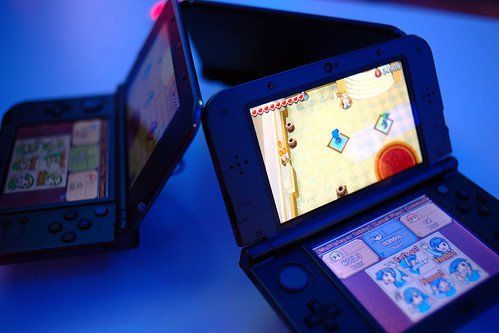
Cratering portable sales can’t prop up Nintendo’s business anymore » Ars Technica

Kyle Orland:

»A new revision to Nintendo’s projected earnings, released [on Friday], sees Nintendo reducing its expectations of Nintendo 3DS sales for the full fiscal year, which ends in March. Nintendo now expects to sell 6.6m 3DS units during the 12-month period, a 13% drop from previous projections and a 24% decline from the year before. That drop (and the accompanying drop in 3DS software sales projections) is a big reason why Nintendo is now also saying that its annual profits will be 50% lower than it had projected, though the company blames some of that decline on the weakening Japanese yen.

You might think this kind of decline is natural for a system like the 3DS, which is, after all, approaching its fifth birthday. But previous Nintendo handhelds have looked much more robust at this point in their lifecycles. The Nintendo DS was still near the peak of its hardware sales dominance in its fifth and sixth years, selling a whopping 31.18m units in the 2009 fiscal year (and a healthy 27.11m the next year). Game Boy Advance sales were still near a steady peak in the 2005-2006 period, bouncing up and down in the 15m to 18m annual sales range, thanks in part to the successful Game Boy Advance SP hardware refresh.

The 3DS, on the other hand, seems to have peaked earlier and lower than other Nintendo handhelds.

«

In short, Nintendo is predicting that its revenues in FY2016 will be lower than its profits in FY09. It’s taken a while, but smartphones are beginning to undermine it. (Might it be that those who had a Nintendo handheld in 2009 are now updating with a smartphone?)
link to this extract


The true story of how Mark Zuckerberg founded Facebook » Business Insider

Biz Carson:

»In the Hollywood-stylized version, a Harvard student needed a tool to date girls.

The real version couldn’t be further from the truth, Mark Zuckerberg told Mathias Döpfner in an interview with “Die Welt am Sonntag.”

At the time, he already had a girlfriend — Priscilla Chan, now his wife — and he was obsessed with the internet. Google was great for searching for news and Wikipedia was great for searching for reference material, but there was a gap.

“There was no tool where you could go and learn about other people. I didn’t know how to build that so instead I started building little tools,” Zuckerberg told Döpfner.

He built a small tool called Coursematch where people could list what classes they were taking. He did build the Facematch tool, as seen in “The Social Network,” but that was just a prank, he says.

«

Rewrite of an interview with Die Welt am Sonntag (The World On Sunday).
link to this extract


Here’s how electric cars will cause the next oil crisis » Bloomberg BusinessWeek

Tom Randall:

»In the next few years, Tesla, Chevy, and Nissan plan to start selling long-range electric cars in the $30,000 range. Other carmakers and tech companies are investing billions on dozens of new models. By 2020, some of these will cost less and perform better than their gasoline counterparts. The aim would be to match the success of Tesla’s Model S, which now outsells its competitors in the large luxury class in the U.S. The question then is how much oil demand will these cars displace? And when will the reduced demand be enough to tip the scales and cause the next oil crisis?

«

A crisis in the form of a glut.
link to this extract


When the “Apple Encryption Issue” reached Piers Morgan » mobilephonesecurity

David Rogers does mobile phone forensics and teachers a mobile systems security course. Piers Morgan (who used to edit the Daily Mirror, which has apologised to some people for phone hacking) did however claim that he could take the FBI/Farook iPhone “to Tottenham Court Road [an electronics mecca in London) and they’d get into it” – suggesting that he might have confused carrier unlocking with PIN unlocking. Here’s Rogers on the tricky rapids to be navigated in deciding if we can force companies to unlock encrypted devices:

»Remember, someone who has actually committed a crime is probably going to say they didn’t do it. The phone data itself is usually more reliable than witnesses and defendant testimony in telling the story of what actually happened and criminals know that. I’ve been involved with digital forensics for mobile devices in the past and have seen first-hand the conviction of criminals who continually denied having committed a serious crime, despite their phone data stating otherwise. This has brought redress to their victim’s families and brought justice for someone who can no longer speak.

On the other side of course, we’re carrying these objects around with us every day and the information can be intensely private. We don’t want criminals or strangers to steal that information. The counter-argument is that the mechanisms and methods to facilitate access to encrypted material would fall into the hands of the bad guys. And this is the challenge we face – there is absolutely no easy answer to this. People are also worried that authoritarian regimes will use the same tools to help further oppress their citizens and make it easier for the state to set people up. Sadly I think that is going to happen anyway in some of those places, with or without this issue being in play…

…This is the same battle that my colleagues in the mobile world fight on a daily basis – a hole is found and exploited and we fix it; a continual technological arms race to see who can do the better job. Piers Morgan has a point, just badly put – given enough time, effort and money the San Bernadino device and encryption could be broken into – it will just be a hell of a lot. It won’t be broken by a guy in a shop on Tottenham Court Road (see my talk on the history of mobile phone hacking to understand this a bit more).

«

link to this extract


Apple’s $120M jury verdict against Samsung destroyed on appeal » Ars Technica

Joe Mullin:

»Apple’s second high-profile patent win against Samsung was appealed, just as the first was. And in an opinion (PDF) published today, a panel of appeals judges entirely wiped out Apple’s victory and its $120 million verdict.

The new decision found that out of three different patents Apple became famous for winning with, one wasn’t infringed and two of them are invalid.

The ‘647 patent described how to turn phone numbers and other software “structures” into links, allowing users to take actions like calling a number with one “click” rather than copying and pasting. The jury awarded Apple $98.7 million based on that patent, but the appeals judges today held that the patent wasn’t infringed at all. They held that “Apple failed to prove, as a matter of law, that the accused Samsung products use an ‘analyzer server’ as we have previously construed that term.”

Appeals judges also invalidated one of Apple’s most consistently ridiculed patents, the ‘721 “slide to unlock” patent. Jurors awarded $3 million based on infringement of that patent, but the appeals panel said the patent is invalid because of prior art.

«

This whole patent thing ends up as Bobby in the shower. “Patent trials? What patent trials?”
link to this extract


Six Hot Media Startups to Watch in 2016 » Al Jazeera America

Sadly this piece by @ProfJeffJarvis (in reality Rurik Bradbury) was deleted by Al Jazeera, which either didn’t recognise its satirical slant ahead of publication, or did and then got cold feet. But it’s still here at the Internet Archive, with gems like this:

»

The New Republic

The oldest startup here, it went through a significant reboot with its March 2012 purchase by Chris Hughes, tech mogul and co-founder of Facebook. It has since innovated so quickly that it is about to be re-rebooting under even newer ownership (name TBD), a great example of the rapid iteration that is characteristic of the best startups.

Instead of the old questions about subjective, qualitative measures, Chris Hughes brought in Yahoo! wartime consigliere Guy Vidra to ask fresh questions, such as: How well did this piece travel? And does this meme even lift our metrics?

I’m excited to see the New New The New Republic, and hope they re-embrace Walter Lippmann’s original mission of nextifying the bewildered herd using hot takes.

«

Nextify your thinkfluencing.
link to this extract


(UPDATE: China, too!) Korean Galaxy S7 to go without Samsung branding on front » AndroidAuthority

Matthew Benson:

»Carrier branding is arguably the bread-and-butter of free promotion: crudely referred to by some as a so-called “tramp stamp” these images tend to irritate customers who would prefer their devices to be free of all superfluous clutter. Even so, manufacturer branding tends to crop up most everywhere, be it the infamous HTC “black bezel bar” or the ever-visible under-the-earpiece location that companies like Samsung opt for.

Strange then, that Samsung’s South Korean website has pictures of its new Galaxy S7 and Galaxy S7 Edge…devoid of such a front-facing claim to fame. Take a look:

The front Samsung logo is clearly missing from the image. In fact, it’s missing from all the renders pictured, yet the rear logo is clearly present, as can be seen above.

«

Subtle messaging: Samsung really does seem to be getting rid of the visible “Samsung” name on the front of the device in China, Japan and Korea. In the first two, it has struggled recently to keep sales up in the face of competition. But why Korea? And is this an evolution of its branding (more confident) or is it concern?
link to this extract


Invisible porn-clicking trojans invade Android’s Google Play store » Tripwire

Graham Cluley:

»many bogus versions of a wide range of apps (ranging from Toy Truck Rally to Subway Surfers 2 to GTA San Andreas and Tinder) have been distributed by fraudsters who wish to use your bandwidth to earn themselves affiliate income by clicking on adverts for pornographic websites.

Of course, if the apps popped up a copy of the Chrome browser to click on the X-rated ads then chances are that you would notice something unusual was afoot. Criminals have learnt from experience that announcing their presence so obviously only hinders their money-making plans.

So, in the case of “Porn Clicker”, the apps spin up an invisible browser window – meaning that any ad-clicking is invisible to the naked eye. And then, a minute or so later, it clicks again.

The money soon begins to earn cash for the criminals – which is a truth especially evident when you consider that some of the bogus apps have been downloaded thousands of times.

«

Android is following exactly the same malware growth path as Windows did on the desktop.
link to this extract


Android phones are easier for police to crack than iPhones » CNN

Jose Pagliery:

»A Google spokesman said that encryption is now required for all “high-performing devices” – like the Galaxy S7 – running the latest version of Android, Marshmallow. But only 1.2% of Android phones even have that version, according to Google.

By comparison, most Apple products are uniformly secure: 94% of iPhones run iOS 8 or 9, which encrypt all data. Apple makes its devices, designs the software, and retains full control of the phone’s operating system.

“If a person walks into a Best Buy and walks out with an iPhone, it’s encrypted by default. If they walk out with an Android phone, it’s largely vulnerable to to surveillance,” said Christopher Soghoian, the principal technologist at the American Civil Liberties Union.

New York City’s top prosecutor, Cyrus Vance, has noted that Android phones have been easier to crack in the past, especially because Google can reset passcodes on older models.

Android is running on 105 million Americans’ smartphones — slightly more than the number of iPhones in the United States, according to industry trackers at comScore.

But there are ways in which an Android phone could actually be made more secure than an iPhone.

Android software can be tweaked to add all sorts of security features, like a password for a particular messaging app.

Google’s operating system also starts up only after the phone’s owner enters a passcode. That’s not true for the iPhone, which starts up as soon as you hit the power button. That’s an important detail: When confronted with a locked iPhone, police can take it to a trusted Wi-Fi connection and potentially copy the phone’s contents to iCloud on Apple’s computer servers, where investigators can then comb through the data.

Android phones won’t back up to the cloud until they’re unlocked.

«

link to this extract


Has Apple been neglecting politics? » tofias dot net

Michael Tofias:

»To understand Apple’s efforts at persuading legislators of various issues, I compiled a measure of political footprint which combines a company’s own federally registered lobbying expenditures from 2015 with the campaign contributions they made during the 2013-14 election cycle from their corporate PAC as well as any employees who made campaign campaign contributions (and listed their employer). This data comes from the Center for Responsive Politics.

In 2015, Apple spent $4.48m on lobbying efforts and while they don’t maintain a PAC for campaign contributions, Apple employees gave a combined $130,579 in FEC-regulated campaign contributions. This adds up to a $4.61m political footprint.

In contrast, Apple’s main rival in the market for smartphones, Google, spent $16.7m on lobbying in 2015, gave $1.65m in campaign contributions via its PAC, and another $2.25m via employees during the 2013–14 election cycle for a combined $20.5m political footprint – over four times the size of Apple’s.

Apple’s political footprint is also on the small side when compared to other large companies (as measured by market capitalization on on December 31, 2015 as reported by YCharts).

«

link to this extract


Platforms, postcodes and pushing services live: a year in the life of our platforms team » UK Ministry of Justice Digital

»Many of our services need info about postcodes, such as what addresses they cover, where they are on the map and what admin areas they fall under.

A year ago each team had used a different commercial solution, with different charging models, so our first platform was a postcode lookup service.

This combines Ordnance Survey and government data to provide one authoritative way for our applications to look up information for any postcode.

«

Astonishing. This already exists in the outside world, with APIs so you don’t have to laboriously enter things by hand. And this was thought a good use of anyone’s time?
link to this extract


Errata, corrigenda and ai no corrida: none specified.

The Q4 2015 smartphone scorecard: Apple gazes down at the rat trap

Seen Skyfall? Remember the scene when we first encounter Javier Bardem playing whoever the baddie is? Here it is, as a reminder:

Bear it in mind. We’ll come back to it.

So: Ben Bajarin had some pretty bleak news for top-end Android smartphone companies recently:

That’s a decline of 90m, even while the overall smartphone market has grown from 704m (of which 501m were Android) to 1.43bn (of which 1.16bn were Android).

But your objection is probably the same as mine: isn’t the decrease in those sur-$500 shipments because the price of high-end Android handsets has fallen? The price you have to pay to get something with the same qualities as the $500-or-more Android flagship is lower than it was in 2012.

This is almost certainly true – but it isn’t much compensation for those struggling to expand their sales and seeing average selling prices (ASPs) fall. There’s a simple financial reason: if you keep selling the same number of phones at lower ASP, your profit will inevitably fall off a cliff as fixed costs such as staff and administration weigh you down.

What’s also notable that Apple hasn’t – so far – been affected by any drop in ASP. Since the start of 2010, its ASP for any quarter has only been below $600 four times – and in the most recent quarter, it reached an all-time high. Which leads one to wonder: what the hell is going on? But let’s show you the numbers from the quarter, and then discuss them.

Q4 2015: the smartphone scorecard
* denotes estimate: explanations below
Company Handsets
(million)
Revenues Handset
ASP
Operating
profit
Per-handset
profit
Samsung 81.5 $20.40bn $225.39 $1.90bn $23.29
Apple 78.25 $51.64bn $690.50 $14.41bn* $184.10*
LG 15.3 $3.22bn $210.26 –$51.47m –$3.36
Sony 7.6 $3.20bn $421.58 $198.91m $26.17
HTC 3.4* $0.81bn $237.05 –$128.00m –$37.65
Microsoft
Mobile
4.5 $0.84bn $185.70 –$162m –$36.11

Assumptions

Samsung: featurephones (it sold 18.5m) had an ASP of $30, and generated zero profit; its tablets had an ASP of $100 and generated zero profit. (These are the same assumptions as in previous quarters. If the ASP is lower, then revenues are higher and the ASP of smartphones is higher; if profits are non-zero on tablets and featurephones, profits on smartphones are lower.)

Apple: operating profit has to be assumed, at the same 27.9% share of revenue as in previous quarters. This may not be true – new phones such as the 6S/Plus are more expensive to produce at the start of a cycle (such as now). But again, consistency probably helps give the broad picture rather than trying to dive into numbers that only a few people inside Apple truly know.

Microsoft Mobile: assumes, as previously, that featurephones (there were 22.5m of them) had an ASP of $15 and gross margin – the profit purely on the goods, not including costs such as R+D and administration etc – of $5. These are the same assumptions as in the past. I’ve chopped the estimates of R+D and administration cost from $200m in previous quarters to $100m and from $300m to $100m because Microsoft said in its 10-Q that

Operating expenses [in the Devices division, which makes the Surface Pro, Surface Book, and phones] decreased $561m or 14%, mainly due to lower sales and marketing expenses and research and development expenses. Sales and marketing expenses decreased $359m or 18%, driven by a reduction in phone expenses, partially offset by marketing expenses associated with the launch of Surface Pro 4, Surface Book, and Windows 10. Research and development expenses decreased $179m or 11%, mainly due to a reduction in phone expenses.

To reach my figure for Microsoft’s profitability (or lack of it) I’ve taken $300m out of the Microsoft phone group’s operating costs, which might be close to the amount from the total $920m it says it cut. Without more clarity (or a shutdown of the phones division), hard to tell. But there’s no way one can see a division which sells 4.5m phones and generates around $830m being profitable; that’s about the same scale as HTC, which we know is not profitable because it publishes its results.

Microsoft has become increasingly opaque about the profitability of its phone side (though of course Apple has never declared any numbers there; one has to back it out from what is known about Mac and iPod profitability).

Where’s Android Wear?

You may ask yourself: where are Android Wear shipments as a factor in the revenues of LG, Sony or Lenovo (or Samsung’s Gear in its figures)? To which I’ll answer: don’t worry. Too small to trouble with. By my calculations, and those of other analysts, Android Wear shipments from all makers in Q4 totalled 0.9m. At around $150 each, that’s a rounding error in revenue for any of these players. (I’ll revisit my ongoing calculations on Android Wear usage figures in the near future.)

Handset pricing: Apple stands on the precipice

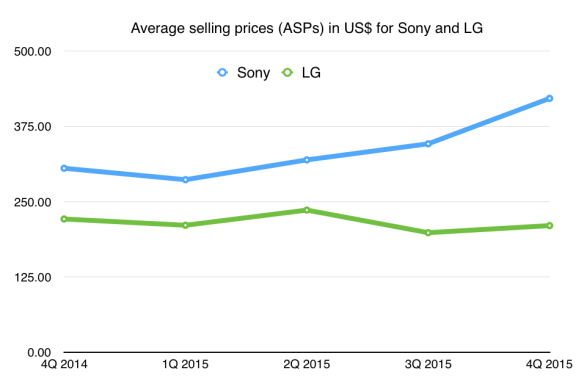
The real lessons of what’s going one here aren’t easy to see from a single quarter’s numbers. But if you want it in a single statistic, look at the contrast between Sony and LG. LG sold nearly twice as many phones, but Sony made a respectable profit, while LG made a loss. What’s the difference between them? ASP. Sony’s phones sold at an average price of $421.58, while LG’s were half that – $210.26. (This doesn’t mean that every LG phone sold at that price, or every Sony phone. But it tells you that Sony must have sold a lot more expensive phones than LG.)

Graph the trend in ASP and it becomes clearer: Sony has (as it said it intended to) driven up ASP, while LG has been pushed down.

Sony phone ASPs are up, LG's are flat or down

Sony’s overall phone ASP has risen (though it now only sells half as many phones as LG)

Sony is literally the only Android OEM which has managed to raise ASPs consistently over the past year, and after a lot of pain (in the form of losses) it seems to be paying off in the form of profit. There’s a simple reason why, of course. The higher the price you can sell something for, the lower the proportion of your revenues the fixed costs – sales, administration, staff, and even seemingly trivial things like patent licensing – become. If you can drive your price up, you begin making profit. But if your ASP is driven down, everything starts eating into the bottom line.

Sony’s problem though is that it’s shrinking year-on-year. After a while, if your shipments are too low then even a high ASP can’t save you from your fixed costs – see HTC for the example. Still, Sony stands alone as having the highest ASP among Android OEMs. That doesn’t mean it sells the largest number of pricey handsets (Samsung surely has that title) but that it is consistently high.

Note how it’s only Samsung, which has both chip foundries and screen fabrication facilities, that has consistently been the biggest smartphone OEM and the only consistently profitable Android OEM.

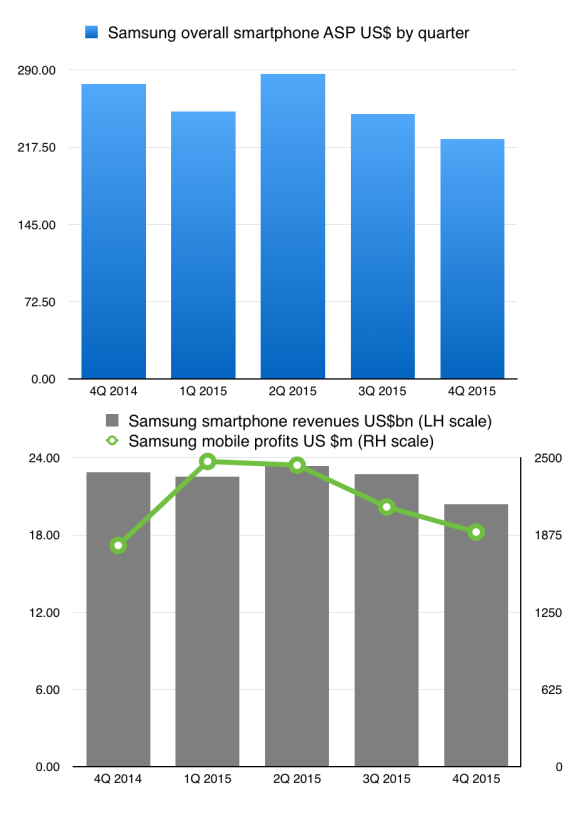
But Samsung’s ASP is coming down quarter after quarter; it’s only keeping its profits level by making more phones, whose ASPs are falling. That hits revenues and profits – as charted below.

Samsung mobile revenues, profits and ASPs are falling

Note also how the total number of handsets that Samsung, HTC, Sony, LG and Lenovo/Motorola sold in 4Q15 was down to 128m, compared to 133.15m a year before – a fall of 4% while the smartphone business as a whole grew 6%. There’s a growing squeeze on the top end Android business, which we’ve seen since Q2 last year.

Apple meanwhile officially stayed static, mainly by “stuffing the channel” – getting carriers and others to buy phones which hadn’t reached customers by the end of the quarter, but counted as “shipped”; about 3m were pushed that way. This means Apple’s numbers of shipments to customers probably rose only minimally to 75m. Gartner’s figures say that Apple’s sales to end customers actually fell.

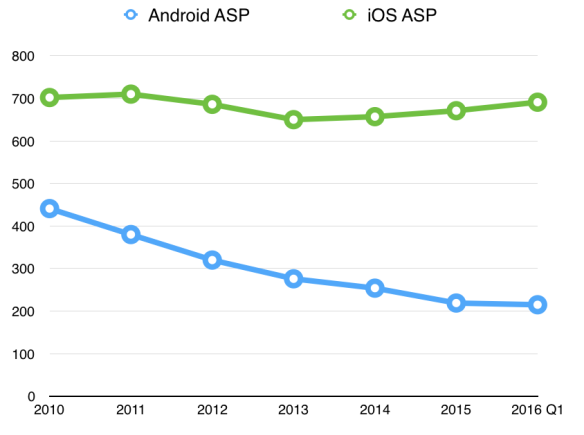
But there’s a bigger dynamic going on. Philip Elmer-DeWitt posted a fun interactive graphic showing how Android ASPs have moved compared to those for the iPhone. Here, statically, is the data – which comes from IDC and covers all Android handsets, of course, not just those at the top end from the companies which publish public figures:

The gap between iPhone and Android average prices is widening

In US$, iPhone average prices are remaining high; Android prices are falling as its base grows

The growing gap (or “delta”) between those two is dramatic. Of course part of that is what’s happening as Android reaches more and more people in the world: the poor in Kenya can’t afford an iPhone, but they can probably afford a $50 (Android) smartphone if it will help them do their jobs better. So is this just about Apple hanging on to profits as is often suggested? Not at all, responded Horace Dediu:

“Within the price is perception.” It’s quite the observation. As Dediu also pointed out, Apple hasn’t changed the selling price of its Mac line of computers for around 20 years. For all that Apple’s prices seem out of reach, that is precisely its attraction to some people – perversely, in the view of those who see smartphones (and PCs) as utterly functional and interchangeable. To some, they really aren’t.

And to continue having that perception, Apple also has to stand apart with its operating system and services. It could never license iOS; and I don’t see how it could make iMessage cross-platform without diluting its brand value. (That doesn’t mean it couldn’t grow iMessage into a messaging platform in its own right, able to do payments and so on.)

The pricing gap

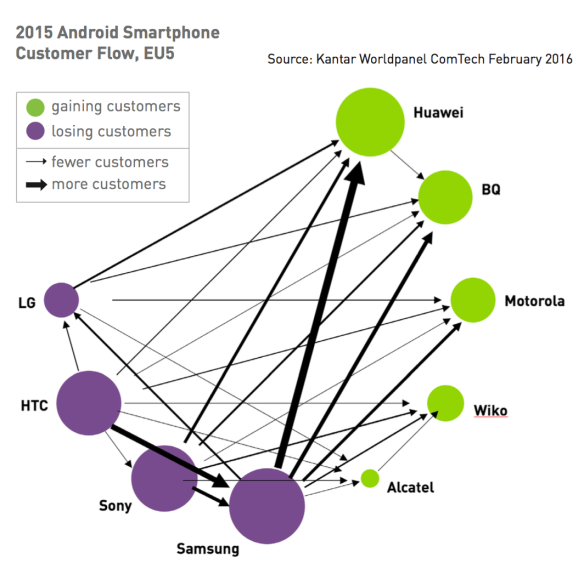
With Android phones getting cheaper all the time, there’s not a lot of hope for the former premium makers. Kantar ComTech posted a neat graphic showing how the torch is passing among Android users in the EU’s five largest countries (Germany, UK, France, Spain, Italy) which shows this starkly:

Outflow from HTC, Sony, LG, Samsung to Huawei, BQ, Motorola, Wiko and Alcatel

Owners are abandoning established Android OEMs (purple) for rivals (green). Source: Kantar.

You’ve probably heard of Huawei, but would you have picked Alcatel or those others as rivals to Samsung or HTC? Probably not, even a few quarters ago.

LG is trying to escape this by effectively making this year’s G5 flagship modular, with add-ons such as cameras, high-end audio DAC and VR systems that you can plug in. The idea is to make the G5 more attractive because it has these extras. However given the numbers of G5s it’s likely to sell (a few million?) those add-ons (called “Friends”) are likely to be stranded. (I remember the same with Handspring’s add-ons. Great idea, but commercially doomed.) It’s extra revenue, and possibly each Friend sold will generate as much profit as a phone – accessories can do that – but won’t push up the ASPs of the actual phone. And if Friends are made available for cheaper LG phones, why would you buy the flagship when you can get the extra functionality of a Friend for cheaper?

Samsung has in effect already cut the price of the S7 by offering a free VR system to anyone who pre-orders. And Sony has Osborned its existing products with its announcements at Mobile World Congress, which its high-end customers will have noticed.

None of this helps with the finances, or fights off the rise of cheaper, just-as-good devices running the same software.

The Android handset market is broadening, and deepening, like a pothole opening up beneath the previoiusly established companies. Xiaomi (VC-funded), Huawei (big network business throwing off cash), scores of tiny Chinese OEMs, niche makers… they’re all eating away at the edge of what seemed like a certain market.

And add to that the slowdown in the smartphone market, and you have a recipe for a repeat of that rat pit we saw referred to way back at the top. It’s going to be last man, or OEM, or if you prefer rat, standing.

Looking down from the precipice into the rat trap

But what does Apple do in all this? The gap between its average price and that of the “average” Android phone is widening all the time. Isn’t that a problem? A big one?

Yet Apple’s brand, and that position, isn’t built on hardware alone. You don’t hear about people using an iPhone in spite of iOS, the way you do about Samsung and its TouchWiz skin, for instance. iOS’s software reputation remains pretty solid: it hasn’t, despite many predictions, lost its lead in getting apps before Android in the west. (As a reminder, Eric Schmidt’s “in six months developers will be writing for Android first” promise was in December 2011; didn’t work out, at least in the west. Asia was and remains Android-first for most things.) iOS 9’s adoption was faster than iOS 8, despite the ecosystem being bigger. Apple Music seems to be winning users, though it’s a long, long way behind Spotify, especially on Android.

The question of how Apple can maintain its pricing in the face of the rampant deflation in the Android handset market remains the most interesting one around. Yet it has managed that in the PC market: its ASP there is $1200, while that for the “big” PC makers ranges from $300 (Acer) to $500 (Lenovo). And it has managed that for more than a decade. But it’s done that as a niche product which has only recently become more mainstream. In the phone market, its share of all handsets in Q4 was over 10%, and 19% of smartphones. Can you maintain premium pricing and be mainstream?

For the Android OEMs, though, the story remains the same: you’re down there in the rat trap, and that curious face above you gazing down is Javier Bardem, waiting to see who’ll be left at the end. And I’m just behind, looking over his shoulder, just as fascinated.

Start up: Google adds ads, HTC nears Vive, Watch wrinkles and worries, FBI v Apple redux, and more

It’s the Samsung Galaxy S7! Looks completely unlike previous ones, right? Photo by Janitors on Flickr.

You can now sign up to receive each day’s Start Up post by email. You’ll need to click a confirmation link, so no spam.

A selection of 13 links for you. Use them wisely. I’m charlesarthur on Twitter. Observations and links welcome.

Four ads on top: the wait is over » Moz

Peter Meyers:

»For the past couple of months, Google has been testing SERPs with 4 ads at the top of the page (previously, the top ad block had 1-3 ads), leading to a ton of speculation in the PPC community. Across the MozCast data set, 4 ads accounted for only about 1% of SERPs with top ads (which matches testing protocol, historically). Then, as of yesterday, this happened:

Over the past 2 weeks, we’ve seen a gradual increase, but on the morning of February 18, the percentage of top ads blocks displaying 4 ads jumped to 18.9% (it’s 19.3% as of this morning). Of the 5,986 page-1 SERPs in our tracking data that displayed top ads this morning, here’s how the ad count currently breaks down:

As you can see, 4-ad blocks have overtaken 2-ad blocks and now account for almost one-fifth of all top ad blocks. Keep in mind that this situation is highly dynamic and will continue to change over time. At the 19% level, though, it’s unlikely that this is still in testing.

«

Google came up in a time when search engine results pages (SERPs) were stuffed with paid-for ads. Google’s clean results page was different. Now the other search engines have gone away. And SERPs are becoming stuffed with ads again.
link to this extract


Phone makers look to add-on gizmos to revitalize market » Reuters

Meanwhile, there’s that event called Mobile World Congress going on in Barcelona this week. Paul Sandle notes the pressures on “traditional” handset makers:

»while the competition [among handset makers] intensifies true innovation has not, with the Barcelona show expected to feature instead other products that connect to phones, like all-round cameras capable of producing immersive views, new wearable devices and electronic gadgets for the home or workplace that use smartphones as a processing hub.

As usual Apple will be absent, preferring to run its own events for new product launches.

“We will see a lot of stuff around 360-degree cameras and virtual reality headsets with a smartphone,” said Francisco Jeronimo, an analyst with research firm IDC. “Commodities rather than innovation”, said Forester analyst Thomas Huston.

“I don’t expect true innovation, it’s going to be more about the specifications, the better processing power, the battery life,” he said.

“What’s the benefit for consumers? I think it will be very limited.”

«

link to this extract


Samsung Galaxy S7 and S7 Edge: curvier, faster, micro SD expansion — available March 11 » Ars Technica UK

Mark Walton:

»In a surprise move, those that pre-order in the UK and US will receive a free Galaxy Gear VR headset to go along with their shiny new phone.

At first glance—besides their larger screen sizes—both phones look largely identical to their predecessors, the S7 sporting a flat glass front, and the S7 Edge sporting a curved display that gently folds in at the edges to the meet the aluminium body. Both phones will be available in Black Onyx and Gold Platinum, with the S7 Edge also available in Silver Titanium. Unfortunately for fans of 4K, both the S7 and S7 Edge are rocking 2560×1440 pixel displays. The most noticeable design change comes to the rear of the phone, where the dreaded camera bump has been removed to to make the camera module flush with the body. Surprisingly, this hasn’t affected the thickness of the phones, which remain fairly svelte at 7.9mm for the S7 and 7.7mm for the S7 Edge. The regular S7 also gains a curved back like the Galaxy Note 5.

Perhaps more exciting is that the S7 and S7 Edge both feature a microSD card slot, a much requested feature that was removed from the S6. Both phones will ship with Android 6.0 Marshmallow, which allows users to merge the SD card with the internal flash memory to create one large seamless pool of storage, making the SD card slot a welcome addition. Also back is water and dust resistance, which was previously found in the Galaxy S5 but was skipped over for the S6. The Galaxy S7 and S7 Edge are both rated IP68, which equates to “totally dust tight” and prolonged submersion in water (the S5 was IP67, which is only “temporary immersion”).

There’s nothing too surprising happening on the inside, aside from the bump up to 4GB of RAM.

«

Don’t think this will make the slightest difference to the general arc of smartphone sales. I doubt these will sell better than either the S5 or S6 or S6 Edge. Water/dust resistance didn’t help the S5; and the Edge feature didn’t change anything much in sales terms.
link to this extract


The consumer version of HTC’s Vive VR headset will arrive in April for $799 with two free games » Android Police

Michael Crider:

»The headset is nearing completion, and the company has announced that the final consumer model will ship in early April for the disappointing price of $799. For that price you get two motion-sensing controllers, two room scale sensors, and VR games Job Simulator: The 2050 Archives and Fantastic Contraption. Pre-orders begin next week on February 29th.

Unlike Google Cardboard, Samsung’s Gear VR, and other systems that rely on a smartphone as a slide-in display, the Vive is a fully contained unit with screens, optical lenses, sensors, a camera and microphone, and other electronics built into the device itself. Like the Oculus, it needs a standard PC (and a quite powerful one) to send video and process images for gaming and other applications. Early reports of the Vive have praised it as an impressive experience, particularly with games that have been developed specifically for the platform. However, the Vive will also be able to connect to at least some smartphones via Bluetooth for answering phone calls and viewing notifications, perhaps allowing HTC some synergy with its phone lines.

«

“The headset is nearing completion”? I’m hoping that’s just a loose version of “it’s nearly public”. If it isn’t complete yet, they’ve got some problems. (As for “synergy” – dream on.)
link to this extract


Watch apps worth making » David Smith

Smith has shipped 11 Watch apps over the past year:

»There seem to be only three kinds of apps that make sense given the current hardware and software on the Apple Watch.

1: Notifications — Not really an “app” in the traditional sense but getting real-time alerts of things that are important to me is great. Any iOS app that sends notifications should do the basic work to make sure they look and perform well on the Apple Watch.

2: Complications — Showing timely information at the raise of the wrist. These are probably the most practically useful apps on my watch. I typically have my watch show me the current temperature, my current step count, and battery percent. All of which present me with timely information that is useful to know now.

3: Sensors — The last kind of app that has actually stuck for me on the Apple Watch are apps that make use of the sensors on the watch. These apps are essentially impossible to re-create on an iPhone. The Apple Watch includes a heart rate monitor, accelerometer and microphone. I don’t think the range and variety of uses for these has been fully explored yet. Having these sensors persistently attached to your body is very different than any use you might come up with on an iPhone.

«

Completely agree. More sensors would be really useful (even sensors relaying stuff from the phone, as the weather is).

link to this extract


Exclusive: common mobile software could have opened San Bernardino shooter’s iPhone » Reuters

Jim Finkle:

»The legal showdown over U.S. demands that Apple Inc AAPL.O unlock an iPhone used by San Bernardino shooter Rizwan Farook might have been avoided if his employer, which owns the device, had equipped it with special mobile phone software it issues to many workers.

San Bernardino County, which employed Farook as an environmental health inspector, requires some, but not all, of its workers to install mobile-device management software made by Silicon Valley-based MobileIron Inc MOBL.O on government-issued phones, according to county spokesman David Wert.

That software is designed to secure corporate data. It also allows information technology departments to remotely unlock phones, even without assistance of the phone’s users or access to the password needed to open the phone and unscramble the data.

“If that particular iPhone was using MobileIron, the county’s IT department could unlock it,” MobileIron Vice President Ojas Rege told Reuters.

«

So there was huge confusion around this phone. Understandable: there’s a mass shooting, the fugitives escape surveillance, a phone is found. Perhaps it is bagged as evidence and its battery runs down, which means it can’t be forced to make an iCloud backup even on trusted Wi-Fi, and that you can’t ask Siri for details about phone calls. Then they reset the password (at the FBI’s request), which made things even worse.

A mess from start to finish – but given that Farook destroyed two other phones, how likely is it that this phone was used to communicate with anyone relevant? Answer: it’s extremely unlikely.
link to this extract


Reconciling perspectives: new report reframes encryption debate » Berkman Center

»The Berklett Cybersecurity Project of the Berkman Center for Internet & Society at Harvard University is pleased to announce the publication of a new report entitled “Don’t Panic: Making Progress on the ‘Going Dark’ Debate.” The report examines the high-profile debate around government access to encryption, and offers a new perspective gleaned from the discussion, debate, and analyses of an exceptional and diverse group of security and policy experts from academia, civil society, and the U.S. intelligence community.

“Many conversations on sensitive subjects of technology and security are productive because they’re among people who already agree,” said Prof. Jonathan Zittrain, faculty chair of the Berkman Center. “The aim of this project is to bring together people who come from very different starting points and roles, and who very rarely have a chance to speak frankly with one another. We want to come away with some common insights that could help push the discussion into some new territory.”

The report takes issue with the usual framing of the encryption debate and offers context and insights that widen the scope of the conversation to more accurately reflect the surveillance landscape both now and in the future.

«

Thanks Seth Finkelstein for the link.
link to this extract


Apple is selling you a phone, not civil liberties » Lawfare

Susan Hennessey and Benjamin Wittes:

»First, the Going Dark skeptics [who say that it’s OK for phones to be encrypted beyond the capability of companies or law enforcement to decrypt them] demand, show us the cases in which the absence of extraordinary law enforcement access to encrypted data is actually posing a problem. And this demand seemed quite reasonable, in our view. If the FBI wants to take the position that it has a problem, it has to do more than cry wolf. Show us the wolf.

And in the last couple of weeks, the bureau has shown some serious wolf. Consider this excerpt from Director James Comey’s testimony before Congress last week: “A woman was murdered in Louisiana last summer, eight months pregnant, killed, no clue as to who did it, except her phone is there when she’s found killed. They couldn’t open it, still can’t open it. So the case remains unsolved.” (The discussion is available here starting at 31:00.)

Then came the filing in the San Bernardino case this week. Note that this is a case that has a potentially serious ISIS link. The FBI has been sitting on one of the shooter’s phones for more than two months, unable to open it. It wants Apple’s help to determine “who [the shooters] may have communicated with to plan and carry out the IRC shootings, where Farook and Malik may have traveled to and from before and after the incident, and other pertinent information that would provide more information about their and others’ involvement in the deadline shooting.”

This is, in other words, a law enforcement and intelligence interest of the highest order…

«

That Comey testimony, in this extract, is pretty thin gruel; her phone contains the whole answer to the crime? No clues in any physical evidence at all? No clues from her telephone records (which are available from the mobile carrier)? Nothing in her personal computer, assuming she has one? Nothing on any social media profiles, perhaps linked to Tinder? That’s a pretty remarkable murder, and the implication that all the necessary clues are locked inside her phone feels even more remarkable.

But it’s important to read viewpoints like this to realise what the other side of the argument is, and how it carries the same steamroller-style momentum that you might think the privacy/security one does.
link to this extract


No, Apple has not unlocked 70 iPhones for law enforcement » TechCrunch

Matthew Panzarino:

»I keep seeing reports that Apple has unlocked “70 iPhones” for the government. And those reports argue that Apple is now refusing to do for the FBI what it has done many times before. This meme is completely inaccurate at best, and dangerous at worst.

There are two cases involving data requests by the government which are happening at the moment. There is a case in New York — in which Apple is trying really hard not to hand over customer information even though it has the tools to do so — and there is the case in California, where it is fighting an order from the FBI to intentionally weaken the security of a device to allow its passcode to be cracked by brute force. These are separate cases with separate things at stake.

The New York case involves an iPhone running iOS 7. On devices running iOS 7 and previous, Apple actually has the capability to extract data, including (at various stages in its encryption march) contacts, photos, calls and iMessages without unlocking the phones. That last bit is key, because in the previous cases where Apple has complied with legitimate government requests for information, this is the method it has used.

It has not unlocked these iPhones — it has extracted data that was accessible while they were still locked. The process for doing this is laid out in its white paper for law enforcement…

It’s worth noting that the government has some tools to unlock phones without Apple’s help, but those are hit and miss, and have nothing to do with Apple. It’s worth noting that in its statements to the court in the New York case, the government never says Apple unlocks devices, but rather that it bypasses the lock to extract the information.

«

Just to clear that up.
link to this extract


The colour of surveillance » Slate

Alvaro Bedoya:

»The FBI has a lead. A prominent religious leader and community advocate is in contact with a suspected sleeper agent of foreign radicals. The attorney general is briefed and personally approves wiretaps of his home and offices. The man was born in the United States, the son of a popular cleric. Even though he’s an American citizen, he’s placed on a watchlist to be summarily detained in the event of a national emergency. Of all similar suspects, the head of FBI domestic intelligence thinks he’s “the most dangerous,” at least “from the standpoint of … national security.”

Is this a lone wolf in league with foreign sponsors of terrorism? No: This was the life of Martin Luther King Jr. That FBI assessment was dated Aug. 30, 1963—two days after King told our country that he had a dream…

…Across our history and to this day, people of color have been the disproportionate victims of unjust surveillance; Hoover was no aberration. And while racism has played its ugly part, the justification for this monitoring was the same we hear today: national security.

The FBI’s violations against King were undeniably tinged by what historian David Garrow has called “an organizational culture of like-minded white men.” But as Garrow and others have shown, the FBI’s initial wiretap requests—and then–Attorney General Robert Kennedy’s approval of them—were driven by a suspected tie between King and the Communist Party. It wasn’t just King; Cesar Chavez, the labor and civil rights leader, was tracked for years as a result of vague, confidential tips about “a communist background,” as were many others.

«

link to this extract


October 2010: What’s really wrong with BlackBerry (and what to do about it) » Mobile Opportunity

Michael Mace, on an old post which happens to hold some useful insights that are worth remembering:

»When I worked at Apple, I spent a lot of time studying failed computer platforms. I thought that if we understood the failures, we might be able to prevent the same thing from happening to us.

I looked at everything from videogame companies to the early PC pioneers (companies like Commodore and Atari), and I found an interesting pattern in their financial results. The early symptoms of decline in a computing platform were very subtle, and easy for a business executive to rationalize away. By the time the symptoms became obvious, it was usually too late to do anything about them.

The symptoms to watch closely are small declines in two metrics: the rate of growth of sales, and gross profit per unit sold (gross margins). Here’s why:

Every computing platform has a natural pool of customers. Some people need or want the platform, and some people don’t. Your product spreads through its pool of customers via the traditional “diffusion” process — early enthusiasts first, late adopters at the end.

It’s relatively easy to get good revenue from the early adopters. They seek out innovations like yours, and are willing to pay top dollar for it. As the market for a computer system matures, the early adopters get used up, and the company starts selling to middle adopters who are more price-sensitive. In response to this, the company cuts prices, which results in a big jump in sales. Total revenue goes up, and usually overall profits as well. Everybody in the company feels good…

«

But trouble lies ahead.
link to this extract


Global smartwatch shipments overtake Swiss watch shipments in Q4 2015 » Strategy Analytics

»According to the latest research from Strategy Analytics, global smartwatch shipments reached 8.1m units in Q4 2015, compared with 7.9m Swiss Watch shipments. It is the first time ever that smartwatches have outshipped Swiss watches on a global basis.

Cliff Raskind, director at Strategy Analytics, said, “We estimate global smartwatch shipments reached 8.1m units in Q4 2015, rising a healthy 316% from 1.9m in Q4 2014. Smartwatches are growing rapidly in North America, Western Europe and Asia. Apple Watch captured an impressive 63% share of the global smartwatch market in Q4 2015, followed by Samsung with 16%. Apple and Samsung together account for a commanding 8 in 10 of all smartwatches shipped worldwide.”

Steven Waltzer, Analyst at Strategy Analytics, added, “We estimate global Swiss watch shipments reached 7.9m units in Q4 2015, falling 5% from 8.3m in Q4 2014. Global demand for Swiss watches is slowing down, and major players like Swatch are struggling to find growth.”

«

The lost 0.4m units doesn’t seem like a big problem at first. But then, nothing bad seems like a big problem at first – as above.
link to this extract


Peeling paint, website bugs: Ringing Bell’s ₹251 phone in a storm of controversies day after launch » Huffington Post

Ivan Mehta:

»It started on an off note after Manohar Parrikar, India’s defence minister, did not show up at the event hosted to launch the phone. The details given out about the phone’s specs were nothing if not vague. A Hindustan Times report suggested that when asked the policy behind the pricing of the phone, Ashok Chadha, an official from the company, said the real cost of the device was ₹2500, which will be recovered through a raft of measures like economies of scale, innovative marketing, reduction in duties and creating an e-commerce marketplace.

Pranav Dixit, Tech editor for the Hindustan Times also said in a Reddit AMA that he has received a letter from the Indian Cellular Association (ICA), written to telecom minister Ravi Shankar Prasad, that estimates that the phone should cost at least USD 60 (Approx. ₹4100).

The phones handed over to the press all have an Adcom logo hidden behind a coat of white paint that easily peeled off. A report from Gadgets 360 suggested that phones handed out as review units were not the final products which will be shipped. That raises the question that who is building the final product? The report also says that Ringing Bells has not been registered at BIS, making their devices unsafe to use.

«

Gets worse. So, $4? Probably more like $40 in reality.
link to this extract


Errata, corrigenda and ai no corrida:

Start up: careful with that axe, Marissa!, PC consolidation, ultra-cheap Android, and more

Yes, we need to discuss this. Photo by Janitors on Flickr.

You can now sign up to receive each day’s Start Up post by email. You’ll need to click a confirmation link, so no spam.

A selection of 11 links for you. Use them wisely. I’m charlesarthur on Twitter. Observations and links welcome.

Ringing Bells Freedom 251: cheapest Android smartphone for just Rs 251 ($3.65) » TechPP

Raju PP:

• 4-inch qHD screen with IPS
• 1.3 GHz quad-core processor
• 1GB RAM
• 8GB internal storage
• microSD slot for up to 32GB of external storage
• 3.2MP rear camera with auto focus
• 0.3MP (VGA) front camera
• 3G support
• 1450 mAh battery
• Android 5.1 Lollipop

The above hardware specifications look like an entry level smartphone from 2014 with no major compromises. Going by the published images, it doesn’t look bad either, at least not an eyesore that one would expect for a phone costing less than what you’d pay for a coffee at Starbucks.

Looks OK (they have actual photos). A bit like something from a cornflakes packet, but at that price it’s proof of how Android is revolutionising communication, and the world.

Only question now is whether the company can survive and make enough.
link to this extract


Samsung fails to secure thousands of SmartThings homes from thieves » Forbes

Thomas Fox-Brewster:

Critically, anyone relying on SmartThings devices for home security is vulnerable. In an environment where the SmartThings hub is connected to the firm’s own motion sensors, which act like traditional security alarms but provide alerts to people’s phones when activity is detected, they allow a hacker to enter a home undetected. Even worse, when connected to a connected smart lock, Cognosec researcher Tobias Zillner says a robber can get break into a home without using any brute force whatsoever.

“At the moment I am able to hack the system … and open the door lock as well as to jam the motion sensor without any trace left back in the system,” he told Forbes.

Come on, you knew the Internet of Things was going to lead to this.
link to this extract


Priorities in a time of plenty » Asymco

Horace Dediu:

The mass phenomenon of measuring the wrong thing because it’s the easiest to measure is called “financialization”. Financialization is the process by which finance and finances (rather than creation) determine company, individual and society’s priorities. It comes about from an abundance of data that leads to fixation on what is observable to the detriment of awareness of hazards or obstacles or alternatives. This phenomenon is more likely when the speed of change increases and decision cycles shorten.

Financialization is creeping into all aspects of society and the extent to which it infects companies is the extent to which they suffer from early mortality.

So is Apple avoiding financialization? How can anyone avoid the tyranny of mis-optimization?

Dediu’s writing is lyrical, despite the topic; the way that he seems to grope towards the conclusion (but actually knows where he’s going) is great to watch.
link to this extract


The ax falls at Yahoo » POLITICO

Peter Sterne:

“On our recent earnings call, Yahoo outlined out a plan to simplify our business and focus our effort on our four most successful content areas  – News, Sports, Finance and Lifestyle. To that end, today we will begin phasing out the following Digital Magazines:  Yahoo Food, Yahoo Health, Yahoo Parenting, Yahoo Makers, Yahoo Travel, Yahoo Autos and Yahoo Real Estate,” [Yahoo global editor in chief Martha] Nelson wrote in a Tumblr post.

In addition, a source familiar with the matter said that Yahoo was ending its tech vertical and moving some of its staff — including former New York Times columnist David Pogue — to Yahoo’s news vertical. Eater first reported that the food vertical was being shut down and Skift first reported that the travel vertical was being shut down.

As part of the changes, the editors of all of the eliminated verticals are being laid off. Dan Tynan, who joined Yahoo Tech as a columnist in December 2013 and became editor in chief of the vertical in July 2015, announced his departure in a farewell memo to staff.

“Well, that was not entirely unexpected. Eight Hundred and Four days after taking the purple, my career as a Yahoo is over,” he wrote.

Doubt the chopping is over yet. Tynan wrote in his memo that he worked with “the best (and smallest) staff of any tech publication on the internet”. You can argue about the quality, but smallest? Lots of news orgs would disagree.
link to this extract


Vaio near deal with Toshiba, Fujitsu to form Japan PC giant » Bloomberg Business

Pavel Alpeyev and Takashi Amano:

Vaio Corp., the personal computer maker spun off from Sony Corp. in 2014, is closing in on a three-way merger with rivals to create a producer that can dominate Japan and weather a shrinking global PC market.

Vaio expects to strike an agreement to combine with Toshiba Corp.’s and Fujitsu Ltd.’s PC divisions by the end of March, said Hidemi Moue, chief executive officer of Japan Industrial Partners Inc., the buyout fund that now controls the former arm of Sony. Vaio expects to own the biggest stake in the merged company, which can help the trio save on research and development and scale production, he said…

…The tie-up “makes sense if you want to build a niche consumer base in Japan,” said Damian Thong, an analyst at Macquarie Group Ltd. in Tokyo. “This approach of merging three Japanese PC makers will probably have little chance of success outside of the country”…

…“In the PC business, all options are on the table for restructuring and partnerships, but nothing has been decided at this moment,” Toshiba’s spokesman Hirokazu Tsukimoto said. A spokeswoman at Fujitsu declined to comment.

In contrast to the gloom, Vaio is set to report its first monthly profit in March and Moue expects the company to be profitable in the year ending May 2017. Japan Industrial Partners has slashed the workforce to 240 from about 1,000, slimmed its product line-up and focused on premium business users, he said.

Consolidation was inevitable.
link to this extract


In the matter of the search of an Apple iPhone seized during the execution of a search warrant » DocumentCloud

This is a scan of the order compelling Apple to help the FBI break into an iPhone 5C used by one of the San Bernadino killers (more details on this below, or in the docket). Note that it says that Apple must “[provide] the FBI with a signed iPhone software file, recovery bundle or other Software Image File that can be loaded onto the Subject Device… The SIF will be coded by Apple with a unique identifier of the phone so that the SIF would only load and execute on the Subject Device.”

Apple has five days to appeal. Below is its response.
link to this extract


Customer Letter » Apple

Tim Cook (and perhaps a few others at Apple) on why they’re refusing to create a version of iOS to be installed on an iPhone 5C seized from one of the killers in the terrorist attack at San Bernadino that would let the US government brute-force its password/code:

The government suggests this tool could only be used once, on one phone. But that’s simply not true. Once created, the technique could be used over and over again, on any number of devices. In the physical world, it would be the equivalent of a master key, capable of opening hundreds of millions of locks — from restaurants and banks to stores and homes. No reasonable person would find that acceptable.

The government is asking Apple to hack our own users and undermine decades of security advancements that protect our customers — including tens of millions of American citizens — from sophisticated hackers and cybercriminals. The same engineers who built strong encryption into the iPhone to protect our users would, ironically, be ordered to weaken those protections and make our users less safe.

We can find no precedent for an American company being forced to expose its customers to a greater risk of attack. For years, cryptologists and national security experts have been warning against weakening encryption. Doing so would hurt only the well-meaning and law-abiding citizens who rely on companies like Apple to protect their data. Criminals and bad actors will still encrypt, using tools that are readily available to them.

Apple has framed this well: that it’s about security (not privacy). You’ll recall that last week the FBI’s director declared that investigators couldn’t unlock the phone.

The American Civil Liberties Union and Electronic Frontier Foundation and WhatsApp have all backed Apple’s stance; the ACLU says “code is speech, and this would be forced speech, which is against the First Amendment, and perhaps the Fourth and Fifth too”.
link to this extract


Apple versus the FBI, understanding iPhone encryption, the risks for Apple and encryption » Stratechery

Ben Thompson dug into the detail of the encryption that the 5C held by the FBI does and doesn’t have; if it had been a 5S, he explains, things would have been different:

thanks the secure enclave an iPhone 5S or later, running iOS 8 or later, is basically impossible to break into, for Apple or anyone else. The only possible solution from the government’s perspective comes back to the more narrow definition of “backdoor” that I articulated above: a unique key baked into the disk encryption algorithm itself.

This solution is, frankly, unacceptable, and it’s not simply an issue of privacy: it’s one of security. A master key, contrary to conventional wisdom, is not guessable, but it can be stolen; worse, if it is stolen, no one would ever know. It would be a silent failure allowing whoever captured it to break into any device secured by the algorithm in question without those relying on it knowing anything was amiss. I can’t stress enough what a problem this is: World War II, especially in the Pacific, turned on this sort of silent cryptographic failure. And, given the sheer number of law enforcement officials that would want their hands on this key, it landing in the wrong hands would be a matter of when, not if.

This is why I’m just a tiny bit worried about Tim Cook drawing such a stark line in the sand with this case: the PR optics could not possibly be worse for Apple. It’s a case of domestic terrorism with a clear cut bad guy and a warrant that no one could object to, and Apple is capable of fulfilling the request. Would it perhaps be better to cooperate in this case secure in the knowledge that the loophole the FBI is exploiting (the software-based security measures) has already been closed, and then save the rhetorical gun powder for the inevitable request to insert the sort of narrow backdoor into the disk encryption itself I just described?

Then again, I can see the other side: a backdoor is a backdoor, and it is absolutely the case that the FBI is demanding Apple deliberately weaken security.

A couple of other points: the phone actually belongs to the California government; it was issued to a person who turned out to be a killer in the San Bernadino incident. That means it’s probably the government which implemented the Mobile Device Management (MDM) which wipes the phone after 10 failed passcode attempts. But they also can’t get into it. Also of note: the docket mentions that the killer destroyed two other phones ahead of the incident – they seem to have been “burner” phones, intended to destruction. So it’s likely that there’s nothing of interest at all on *this* phone.

The FBI has the iCloud backups up to October 19 (see p17 of the scan, above); the killings were on December 4.
link to this extract


Why the FBI’s request to Apple will affect civil rights for a generation » Macworld

Rich Mogull (a security expert):

Apple has a long history of complying with court orders and assisting law enforcement. Previous to iOS 8, they could extract data off devices. Even today, data in most of their online services (iCloud, excluding iMessage and FaceTime) can be provided upon legal request.

This case is different for multiple reasons:

• Apple is being asked to specifically create new software to circumvent their security controls. They aren’t being asked to use existing capabilities, since those no longer work. The FBI wants a new version of the operating system designed to allow the FBI to brute force attack the phone.

• The FBI is using a highly emotional, nationally infamous terrorism case as justification for the request.

• The request refers to the All Writs Act, which is itself under scrutiny in a case in New York involving Apple. Federal Magistrate Judge James Orenstein of the Eastern District of New York is currently evaluating if the Act applies in these cases.

That’s why this is about far more than a single phone. Apple does not have the existing capability to assist the FBI. The FBI engineered a case where the perpetrators are already dead, but emotions are charged. And the law cited is under active legal debate within the federal courts.

link to this extract


CRN Exclusive: Google terminating Play For Education in a small-scale retreat from Android’s educational market » CRN

Google is retreating from a small segment of its booming education business by ending the life of a product that was developed to encourage adoption of Android tablets in schools, Google partners told CRN on Friday.

Google Play for Education, an extension of the Play software distribution platform, was rolled out around two years ago with the intent of putting more tablets into the hands of students. The app store, curated in close collaboration with educators, enabled solution providers to manage both devices and their specialized content…

…One [reseller] executive who asked not to be named told CRN he learned of the product’s termination after attempting to procure tablets for a customer.

“We noticed something funny a couple weeks ago” when a client requested a quote for a number of Play for Work tablets, the Google partner told CRN. “Basically all manufacturers told us all those devices were end-of-lifed.”

Asus, then Samsung, said they didn’t have replacement devices that were Play-integrated, the reseller said. They told him to look at Chromebook laptops as an alternative.

Google later informed the partner that Play for Education was on its way out, and the company should focus on its Chromebooks practice for serving the educational market.

That partner exec said he believes some capability issues, like a limited number of student profiles that could be loaded onto a single device, coupled with competition from Apple’s iPads, kept the Android tablets from deeply penetrating the education market, and convinced Google to step back from the program.

Google made a big marketing push last year for the educational tablets, the partner exec said, but “I’m not sure it ever clicked.”

This makes it seem as though both Play For Education *and* Play For Work are dead, if those devices were EOL’d. Tablets and Android have never been a good fit.
link to this extract


News discovery » Sqoop

It’s a new Seattle-based startup, which mines US SEC documents and others for current information:

Sqoop saves you time and makes sure you don’t miss the story by giving you one place to search for company information, rather than spending hours each week conducting the same repetitive searches across a variety of public data sites. You can set alerts so that when new documents are filed, we’ll alert you how and when you want.

One to kick the tyres on. (I previously used SECAlerts.com but found it impossible to change settings.) Thanks to David Senior for the pointer.
link to this extract


Errata, corrigenda and ai no corrida:

Start up: Twitter’s falling tweet count, Google forgets more, cops v iPhone, how gravity waved, and more

The new essential tool for Indian farmers. Photo by Desiree Catani on Flickr.

It’s Friday! Save yourself a click on Monday – sign up to receive each day’s Start Up post by email. You’ll need to click a confirmation link, so no spam.

(Someone told me the other day that they’d been reading the site for weeks and hadn’t noticed the signup in the above paragraph. Web design, eh?)

A selection of 8 links for you. Friday! I’m charlesarthur on Twitter. Observations and links welcome.

Twitter API data show the number of tweets is in serious decline » Business Insider

Jim Edwards:

The number of tweets per day created by Twitter’s users has fallen by more than half since a peak in August 2014, according to a sampling of data from Twitter’s API. (An API — application programming interface — is the portal through which other apps access Twitter so their software can function together.) The data was given to Business Insider by an app developer who has tracked Twitter users since 2013.

Tweets per day reached a peak in August 2014 of 661m, our source says. That 30-day sampling period included the World Cup final. In January 2016, there were only 303m tweets per day, on average, during the 30-day period.

This story came out before Twitter’s results, which showed the number of users was flat at best. Twitter responded at the time that “This data is not correct”; but it begins to feel correct. My only suspicion though is that Twitter now doesn’t use sequential tweet IDs, so the sampling method might be sensitive to that. More detail on how the sampling is done would be useful.
link to this extract


WhatsApp is changing the way people in India grow and buy food » TakePart

Sarah McColl:

Farmers Santhosh Kittur and Abhijit Kamath wanted to grow pesticide-free vegetables between the rows of banana plots each separately owned. Their shared interest in old-fashioned agricultural practices brought them together to grow bitter gourd, cucumbers, beans, cabbage, tomatoes, green chiles, red peppers, onions, and garlic—staples of the Indian customers and kitchens they planned to serve. But their modern approach to marketing has put them in direct contact with customers in a high-tech manner.

Across India, WhatsApp groups are not only connecting farmers to their customers in the virtual market—they’re creating a network of resources and support for the country’s farmers who need it most.

In Kittur and Kamath’s WhatsApp group, created last August, the two farmers post updates from their farms, including photographs, as well as what produce is available to the group’s 80 members. Vegetables are sold on Thursdays and Sundays. Members can place dibs on the quantity of specific vegetables they want and can pick up their order or have it delivered.

There’s a famous piece of research by Upsalla University from 2006 about how mobile phones benefited Tanzanian fishermen. It would be good to see a comparable piece of research around smartphone apps in emerging economies.

(And it’s always amusing to hear Americans’ amazement that people use Whatsapp. Like SMS in the early part of this century, it’s huge outside the US, small inside it.)
link to this extract


Apple entrusts TSMC with all application processor orders for iPhone 7 » ETNews Korea

Han Juyeop:

Taiwan’s TSMC has won a battle against Samsung Electronics and is going to produce 10-nano application processors (AP) that will be installed in Apple’s upcoming iPhone7. Samsung Electronics has entered a state of emergency system to prevent declination of rate of operation of factories.

Samsung Electronics is aiming for an all-out-war in 14-nano foundry business by going after middle-rank chip businesses in China and Taiwan instead and it is also going to focus its capabilities on maintaining supplies of Qualcomm’s 10-nano. It is also important for Samsung Electronics to plan out high-intensity innovations so that it can take back Apple’s supplies in 7-nano.

According to semiconductor IP and EDA industries on the 10th, Apple has entrusted TSMC with all production of next 10-nano AP called ‘A10’. A10 is so called a brain of iPhone7, which is expected to be released in this fall. TSMC is planning to enter a state of mass-production system of 10-nano chips starting from June.

Recall that Apple dual-sourced from both TSMC and Samsung for the iPhone 6S/Plus, though the TSMC ones seemed to do slightly worse on battery than the Samsung ones.

If true, this is going to hurt Samsung: Apple is a big customer, and the semiconductor division is now the most profitable one, well ahead of smartphones.
link to this extract


Gravitational waves exist: the inside story of how scientists finally found them » The New Yorker

Nicola Twilley:

It took years to make the most sensitive instrument in history insensitive to everything that is not a gravitational wave. Emptying the tubes of air demanded forty days of pumping. The result was one of the purest vacuums ever created on Earth, a trillionth as dense as the atmosphere at sea level. Still, the sources of interference were almost beyond reckoning—the motion of the wind in Hanford, or of the ocean in Livingston; imperfections in the laser light as a result of fluctuations in the power grid; the jittering of individual atoms within the mirrors; distant lightning storms. All can obscure or be mistaken for a gravitational wave, and each source had to be eliminated or controlled for. One of LIGO’s systems responds to minuscule seismic tremors by activating a damping system that pushes on the mirrors with exactly the right counterforce to keep them steady; another monitors for disruptive sounds from passing cars, airplanes, or wolves.

“There are ten thousand other tiny things, and I really mean ten thousand,” Weiss said. “And every single one needs to be working correctly so that nothing interferes with the signal.” When his colleagues make adjustments to the observatory’s interior components, they must set up a portable clean room, sterilize their tools, and don what they call bunny suits—full-body protective gear—lest a skin cell or a particle of dust accidentally settle on the sparkling optical hardware.

This is the one story to read today about this amazing finding. Detail and insight.
link to this extract


Nextbit’s cloud-savvy Robin phone is set to fly. Good luck catching one – CNET

Roger Cheng:

Chief Design Officer Scott Croyle warns that the early supply will be limited.

“There will be maybe 3,000 to 6,000 phones available,” he said in an interview Wednesday. In comparison, Apple sold 13m iPhone 6S and iPhone 6S Pluses in their first three days.

The launch of the online store and the Robin marks the culmination of an unorthodox journey for a phone maker. Rather than go through a carrier, which is how most people shop for handsets, or even set up an online store, Nextbit tested the waters by asking for commitments through Kickstarter and nearly tripled its goal of raising $500,000.

Nextbit isn’t the typical unknown startup. Co-founders Tom Moss and Mike Chan were part of Google’s original Android team. Croyle was behind the critically acclaimed HTC One phone.

But this is part of the future for smartphones – niche players offering a quirk (in this case, tons of cloud storage) which don’t need huge capitalisation because they sell online with low inventory.
link to this extract


What Everyone’s Got Wrong About Twitter (Including Twitter) » Re/code

Ian Schafer is founder and chairman of Deep Focus:

Twitter is a platform unlike any other, in that it has enough real-time data and intelligence that can be mapped against over 300 million active users. These users are more likely to be more influential and use other media concurrently (especially TV).

Therefore, a compelling argument can be made that, if used properly, Twitter’s real-time user behavior and media-consumption data can be among the most valuable consumer data. In most cases, advertisers will be willing to pay a premium for that. But because so many scrutinize Twitter’s ad experience, doubts abound.

There’s a lot of talk from people who want Twitter to open up its APIs again. I think they’re half-right.

If Twitter wants to realize its full potential, it will make its data completely portable for advertisers, becoming the primary source for real-time business and consumer intelligence. It will use its (and its users’) media savviness to feed a global dataset that ad exchanges, app developers, advertisers and corporations will pay increasingly large amounts of money to access, making it a media-led data company. It has already displayed success in this area; the Twitter Audience Platform and MoPub have gained traction, and with Facebook’s Parse shutting down, Twitter’s Fabric toolkit should gain traction with third-party app developers, as well.

Can you guess that Deep Focus is an ad agency?
link to this extract


Google to scrub web search results more widely to soothe EU objections » Reuters

Julia Fioretti:

The French data protection authority in September threatened to fine Google if it did not scrub search results globally across all versions of its website, such as Google.com.

But the company has stuck to its position that it should clean up search results only on European domains such as Google.fr or Google.de because to do otherwise would have a chilling effect on the free flow of information.

To address the concerns of European authorities, the Internet giant will soon start polishing search results across all its websites when someone conducts a search from the country where the removal request originated, a person close to the company said.

That means that if a German resident asks Google to de-list a link popping up under searches for his or her name, the link will not be visible on any version of Google’s website, including Google.com, when the search engine is accessed from Germany.

The company will filter search results according to a user’s IP address, meaning people accessing Google from outside Europe will not be affected, the person added.

Since the ruling in 2014, Google has received 386,038 requests for removal, according to its transparency website. It has accepted about 42% of them.

The lesson one tends to draw from this is “the threat of a fine makes Google act”.
link to this extract


Police destroy evidence with 10 failed passcode attempts on iPhone » Naked Security

Lisa Vaas:

In January 2014, a Massachusetts cop was swearing into his mobile phone while working a traffic detail at a construction site.

The F bombs appeared to upset an elderly lady walking by, so a man on a nearby front porch asked the officer, Thomas Barboza, to stop swearing.

The cop’s response: “Shut the f–k up and mind your own business.”

George Thompson’s response: he started recording Barboza on his iPhone.

According to court documents, Barboza shoved 53-year-old Thompson to the ground, arrested him, handcuffed him, and put him in jail for a night.

Police in the city of Fall River also tried to get into Thompson’s iPhone, where the footage of Barboza was stored.

But all the police managed to do was to destroy the evidence, wiping the phone clean after entering the wrong password 10 times.

Really clear that the cops wanted to get into the phone to wipe the evidence. (They accused Thompson of wiping it remotely; a forensics report showed that was a lie.) Yet another instance where security of the phones is potentially a good thing for the citizenry.
link to this extract


Errata, corrigenda and ai no corrida:

Start up: Samsung’s adblocker’s back, cement – solved!, #error53 redux, the Useless Hackathon, and more

Your plumber remembers one version of a call from Yelp, but the recordings show another. Who’s right? Photo by eldeeem on Flickr.

Oh, go on- sign up to receive each day’s Start Up post by email. Who knows, it might make your inbox happy.

A selection of 9 links for you. Smoosh them into mush. I’m charlesarthur on Twitter. Observations and links welcome.

Pirate group suspends new cracks to measure impact on sales » TorrentFreak

“Andy”:

One of the hottest topics in the game piracy scene in late 2015 surrounded the Avalanche Studios/Square Enix title Just Cause 3.

Released on December 1, 2015, pirates were eager to get their hands on the game for free. However, JC3 is protected by the latest iteration of Denuvo, an anti-tamper technology developed by Denuvo Software Solutions GmbH. Denuvo is not DRM per se, but acts as a secondary encryption system protecting underlying DRM products.

All eyes had been on notorious Chinese game cracking group/forum 3DM to come up with the goods but last month the group delivered a killer blow to its fans.

According to the leader of the group, the very public ‘Bird Sister’ (also known as Phoenix), the game was proving extremely difficult to crack. In fact, Bird Sister said that current anti-piracy technology is becoming so good that in two years there might not be pirated games anymore.

And now the group isn’t going to crack any single-player games. Won’t stop all the other cracking groups, of course.
link to this extract


Sky Q now available in the UK » Ars Technica UK

Sebastian Anthony:

Sky Q, the next iteration of Sky’s subscription TV service, is now available to buy in the UK. Prices start at £42 per month, climbing to £88.50 per month, and there’s a £250 setup fee that you have to swallow as well.

The headline feature of Sky Q is that you’re able to record three shows simultaneously while watching a fourth channel. If you stump up £54 per month for the upgraded Sky Q Silver box, you can record four channels and watch a fifth. Of course, whether there are actually five channels worth watching is a slightly more complicated question.

Other interesting features include a new touchpad-equipped remote control, downloading content for offline viewing, watching Sky TV on a tablet, and the possibility of streaming Sky TV to other rooms in the house via Sky Q Mini boxes.

Sky Q is a really smart response by Sky to the incursion of the web into TV; it folds it in (at a price). I’ve seen a demo, and it really is very slick, and the integration into tablet apps is terrific. Plus because it uses the satellite signal it’s fast – a big advantage in rural areas where broadband is slow.

(Here’s a piece I wrote on Sky Q before its details were fully known.)
link to this extract


Google restores ad blocker for Samsung browser to the Play Store » The Verge

Dan Seifert:

Following a little bit of drama last week, Google has restored an ad blocking plugin for Samsung’s Android browser to the Play Store today, according to a blog post from the developer of the app. The plugin, Adblock Fast, was removed from the Play Store last Tuesday after only being available for a day, with Google citing that the plugin violated a section of the Store’s developer agreements. The specific rule that was violated relates to plugins modifying other third-party applications, which is prohibited by Google.

Now things start to get interesting.
link to this extract


How WIRED is going to handle adblocking » WIRED

“Wired Staff”:

So, in the coming weeks, we will restrict access to articles on WIRED.com if you are using an ad blocker. There will be two easy options to access that content.

You can simply add WIRED.com to your ad blocker’s whitelist, so you view ads. When you do, we will keep the ads as “polite” as we can, and you will only see standard display advertising.
You can subscribe to a brand-new Ad-Free version of WIRED.com. For $1 a week, you will get complete access to our content, with no display advertising or ad tracking.

This presumes that adblocking readers will accept that they are worth $1/week to Wired, and that Wired is worth the same amount to adblocking readers. Is that proven? Given how small the amounts earned from ads per person are, this seems to be herding people who don’t know their true value towards a funnel. Premium ad display costs $10 per CPM – that is, per thousand showings. That’s 1c per premium ad you view. Multiply by the number of ads on a page – perhaps 10, for 10c? So if adblocking readers pay up but view fewer than 10 articles per week, Wired is making a solid profit from them, minus credit card costs.

Discussion on Hacker News suggests that people would rather go for a “bid to show me ads” model – which, to be fair, is how Google Contribute works. If you set your per-page view at, say, $0.35, then you’ll only see ads where an advertiser has bidded more. But of course that means you get all the tracking malarkey that goes with it (and of course if you truly don’t like tracking, why are you using Google?)

And as is also pointed out, you can subscribe to the physical magazine for a lot less than the $50 per year this implies – in fact you can get it for about a tenth of that.

Another point, finally – the page is 3.3MB, of which only half is content. The rest is ads. Still sure you want them?
link to this extract


Exclusive: Top cybercrime ring disrupted as authorities raid Moscow offices – sources » Reuters

Joseph Menn:

Russian authorities in November raided offices associated with a Moscow film distribution and production company as part of a crackdown on one of the world’s most notorious financial hacking operations, according to three sources with knowledge of the matter.

Cybersecurity experts said a password-stealing software program known as Dyre — believed to be responsible for at least tens of millions of dollars in losses at financial institutions including Bank of America Corp and JPMorgan Chase & Co — has not been deployed since the time of the raid. Experts familiar with the situation said the case represents Russia’s biggest effort to date to crack down on cyber-crime.

A spokesman for the Russian Interior Ministry’s cybercrime unit said his department was not involved in the case. The FSB, Russia’s main intelligence service, said it had no immediate comment.

Menn is a terrific journalist on this topic. I highly recommend his book Fatal System Error. (He’s written others too.)(Thanks Richard Burte for the pointer.)
link to this extract


Inside the Stupid Shit No One Needs & Terrible Ideas Hackathon » Motherboard

Cecilia D’Anastasio:

Featuring hacks like 3Cheese Printer, a 3D printer using Cheez-Whiz as ink, and NonAd Block, a Chrome extension that blocks all non-ad content, the New York-based Stupid Hackathon is disrupting hackathon culture. While other hackathons churn out useless projects in earnest, the Stupid Hackathon strips pretension away from tech developers’ money-backed scramble to satisfy every human need. Satirizing the hackathon community’s naive goals for techno-utopianism, co-organizers Sam Lavigne and Amelia Winger-Bearskin solicit projects that use tech to critique tech culture.

“Is a need being filled or is the need manufactured and then constantly reinforced?” Lavigne asked. “The Stupid Hackathon is the perfect framework for satirizing the whole tech community.”

Three Stupid Hackathon teams set out to create wearables that detect boners. Categories for hacks included “edible electronics,” “commodities to end climate change” and “Ayn Rand.” Participants, in general, ignored them.

Lavigne and Winger-Bearskin, who met at the Interactive Telecommunications Program (ITP) at NYU, became disenchanted with hackathons when they noticed that many aimed to “hack” world hunger or income inequality in one weekend. As a student at ITP, Winger-Bearskin, now director of the DBRS Innovation Lab, applied to participate in a hackathon on the theme of love hosted at ITP but was rejected.

“I couldn’t even eat the food that was on the table next to me,” she said, referring to the free food often provided for hackathon participants. “And I couldn’t hack about love!” Lavigne has never attended another hackathon.

There used to be an Apple Mac hacking contest – called MacHack – in the 1990s where hacks that could actually be thought helpful were derided as “useful!”. Seems the idea is back, in a bigger way.
link to this extract


Riddle of cement’s structure is finally solved » MIT News

Concrete forms through the solidification of a mixture of water, gravel, sand, and cement powder. Is the resulting glue material (known as cement hydrate, CSH) a continuous solid, like metal or stone, or is it an aggregate of small particles?

As basic as that question is, it had never been definitively answered. In a paper published this week in the Proceedings of the National Academy of Sciences, a team of researchers at MIT, Georgetown University, and France’s CNRS (together with other universities in the U.S., France, and U.K.) say they have solved that riddle and identified key factors in the structure of CSH that could help researchers work out better formulations for producing more durable concrete.

What a time to be alive, eh? That solid/particle question had been bugging me for ages. Seriously, though, it’s an important topic: this stuff is everywhere.
link to this extract


Apple are right and wrong » Consult Hyperion

Dave Birch:

Bricking people’s phones when they detect an “incorrect” touch ID device in the phone is the wrong response though. All Apple has done is make people like me wonder if they should really stick with Apple for their next phone because I do not want to run the risk of my phone being rendered useless because I drop it when I’m on holiday need to get it fixed right away by someone who is not some sort of official repairer.

What Apple should have done is to flag the problem to the parties who are relying on the risk analysis (including themselves). These are the people who need to know if there is a potential change in the vulnerability model. So, for example, it would seem to me to be entirely reasonable in the circumstances to flag the Simple app and tell it that the integrity of the touch ID system can no longer be guaranteed and then let the Simple app make its own choice as to whether to continue using touch ID (which I find very convenient) or make me type in my PIN, or use some other kind of strong authentication, instead. Apple’s own software could also pick up the flag and stop using touch ID. After all… so what?

Touch ID, remember, isn’t a security technology. It’s a convenience technology. If Apple software decides that it won’t use Touch ID because it may have been compromised, that’s fine. I can live with entering my PIN instead of using my thumbprint. The same is true for all other applications. I don’t see why apps can’t make their own decision.

Birch’s point that this could put people off buying Apple phones is surely one that has already occurred to its management, and will be – like the prospect of being shot in the morning – concentrating their minds.
link to this extract


Reviews Rashomon: plumber remembers Yelp threat that never actually occurred » Screenwerk

Greg Sterling:

I had a plumber replace my kitchen faucet. As I do with all service professionals I engaged him in discussion about how he marketed himself and where his leads were coming from. Yelp was one of the primary sources.

He then told me that he had been solicited to advertise on the site and that he declined but was told by the telephone sales rep that his reviews could potentially be affected if he didn’t. This was the first time I’d directly heard this from a business owner.

In my mind this was the first real “evidence” that some sort of sales manipulation might be going on. I informed Yelp of my exchange with the plumber and it was immediately disputed: “That didn’t happen,” I was told.

To make a longer story short, Yelp invited me in to listen to the sales calls with this plumber, whom I identified to the company. Yelp records its end of sales calls but not the business owner’s conversation.

I sat in Yelps offices and listened to what must have been 25 – 30 calls to this plumber. Most of them were trying to set up appointments to discuss Yelp advertising. And there were at least two Yelp sales reps who were trying to close the account; a second one took over after the first one was unsuccessful.

There was nothing that sounded like a threat or any suggestion that reviews would be removed or otherwise altered by Yelp if the guy didn’t advertise. There wasn’t anything that could be construed as even implying that.

Sterling concludes that this is a “Rashomon” – a scene where every recounting differs subtly. One possibility: the calls with the threats actually come from scammers. Or plumbers just misinterpret what they hear.
link to this extract


Errata, corrigenda and ai no corrida: Yesterday’s link to VTech’s horrendous security came via Chris Ratcliff. Thanks, Chris.

Start up: Apple’s VR effort, why zebras really have stripes, the PC mergers, Facebook v your battery, and more

Call a locksmith in the US and their yield – and your loss – might be higher than you expect. Photo by zoomar on Flickr.

Did you sign up to receive each day’s Start Up post by email? Then you’re reading this on email. You clicked a confirmation link to say it wasn’t spam. Well done.

A selection of 11 links for you. Made of unobtanium and polished with unicorn tears. I’m charlesarthur on Twitter. Observations and links welcome.

Apple builds secret team to kick-start virtual reality effort » FT.com

Tim Bradshaw:

The company’s latest acquisition in the area is Flyby Media, an augmented reality start-up that lets mobile devices “see” the world around them. Flyby’s team worked closely with Google in developing software for its 3D positioning technology Project Tango.

Apple has been building prototypes of possible headset configurations for several months.

Apple joins a growing focus in Silicon Valley on VR and AR as companies from Facebook and Google to Microsoft and Samsung eye the next big technology platform.

The news comes after the Financial Times reported that Apple had hired Doug Bowman, a leading VR researcher.

Tim Cook, chief executive, declared earlier this week that the technology had broad appeal. “It is really cool and has some interesting applications,” Mr Cook said on Tuesday, as Apple reported iPhone sales growth had slowed to a halt.

Bradshaw has had scoop after scoop since moving to San Francisco.
link to this extract


To lions, zebras are mostly gray » The Atlantic

Ed Yong:

“At most distances, the zebras are going to look to a lion like a gray waterbuck,” says [Tim] Caro [of University of California, Davis]. “Those stripes are going to fuse together and be indistinguishable.”

That rules out both the blends-among-trees idea and the breaks-up-outline one — neither can possibly be true if the predators can’t see the stripes. “If the stripes are doing something exciting, they’ll be doing it close up, by which point the predators have probably realized the zebra is there, because they can smell or hear it,” says Caro. Zebras, being very noisy browsers, are hardly stealthy.

“It’s the first proper test of a very longstanding and prominent idea,” says Martin Stevens from the University of Exeter, who studies camouflage. Its only flaw is that the team didn’t specifically measure how closely a zebra matches its background environment, in either color or brightness. Still, “I very much doubt zebra stripes do work in concealment,” adds Stevens.

So, if not camouflage, then what?

Caro, who has been studying zebras for a decade and has written a forthcoming book about their stripes, thinks he knows the answer. “I’ve come to the conclusion that really, it just has to be biting flies,” he says.

You what now? But yes, it is.
link to this extract


Supply chain braces for possible merger of Vaio, Toshiba, Fujitsu PC units » Digitimes

Aaron Lee and Steve Shen:

Japan-based PC brand vendors Vaio (sold from Sony), Toshiba and Fujitsu reportedly are ready to merge their notebook businesses into a company, a move which will affect Taiwan-based notebook ODMs, particularly Pegatron Technology, according to sources from the upstream supply chain.

Pegatron received over 50% of Toshiba’s notebook orders in 2015 and has also led other rivals to win over 50% of the vendor’s request for the quotation (RFQ) for notebook orders for 2016, the source indicated.

However, Pegatron has recently been notified by Toshiba to halt production of 300,000 units of mainstream models which are scheduled to be shipped soon, indicating that the merger talks between the three Japan-based companies are likely to be finalized shortly, said the sources. Pegatron declined to comment on its orders.

Consolidation among smaller players. Inevitable, given the market. But which brand will they merge under?
link to this extract


Following Apple’s move, Samsung rolls out adblocking to Android devices » TechCrunch

Sarah Perez:

Soon after Samsung’s announcement of an API for content blocking], ad blocker makers launched versions of their apps for supported Samsung phones. This includes Crystal and Adblock Fast, which were among the first out of the gate. The latter claims over 200,000 users for its app that’s also live on Chrome, Opera and Safari. It offers seven optimized filtering rules which make websites run, on average, 51 percent faster, the company says.

Crystal offers a similar filter list, and blocks tracking technology, malware and social networking annoyances, while also offering users the ability to support sites that conform to the Acceptable Ads criteria by allowing non-intrusive advertising.

Expect more to follow. The question now will be whether or not Samsung owners will rush to install these applications, as the iOS audience once did. Even if they don’t show up in droves, the move by Samsung, which had a 22.2% share of the smartphone market in 2015, could see other Android smartphone makers doing the same, as the tech could be seen as a competitive advantage.

Only for Samsung Galaxy devices running Android 4.0 and above, but that’s still a lot. Samsung is clearly responding to Apple; how long before adblocking is natively included in mobile browsers, and how long before it’s enabled by default?
link to this extract


Uninstalling Facebook app saves up to 20% of Android battery life » The Guardian

Samuel Gibbs:

Prompted by [Russell] Holly’s revelation that life on Android was better without Facebook’s app, Reddit user pbrandes_eth tested the app’s impact on the performance of an LG G4.

They found that when the Facebook and Facebook Messenger apps were uninstalled, other apps on the smartphone launched 15% faster. They tested 15 separate apps, and documented the findings, leading other reddit users to test other devices. They found similar results when testing for app loading performance.

After reading Holly’s piece, I had also decided to explore other options for accessing Facebook, to see if, rather than app loading, I could improve my smartphone’s battery life.

I left the Facebook Messenger app installed, but swapped the Facebook app for an app called Metal, which acts as a wrapper for Facebook’s mobile site. Over the course of a day my Huawei Nexus 6P had 20% more battery. This was true on average for every day for the week tried.

In Metal I was using the same notifications and accessing the same features as I had just a week earlier through the Facebook app, so why the difference?

Because the Facebook app uses every trick it can to find out what you’re doing, all the time. I deleted the main app on iOS ages ago (and might do the same for Messenger) and only access it through the mobile site, on a browser. This has two advantages: your battery life improves by many, many hours, and if you use an adblocker, the ads will be blocked.
link to this extract


Secret motor found on cyclist’s bike at world championships » Reuters

Ian Chadband:

The motor was discovered inside the frame of the machine being used by teenager Femke Van den Driessche at the world cyclo-cross championship in Zolder, Belgium, Bryan Cookson, the president of the International Cycling Union (UCI), said.

“It’s absolutely clear that there was technological fraud. There was a concealed motor. I don’t think there are any secrets about that,” Cookson told a news conference.

Yet the 19-year-old Van den Driessche denied suggestions she had deliberately used a motorized bike in the women’s under-23 race and was in tears as she told Belgian TV channel Sporza: “The bike was not mine. I would never cheat.”

Van den Driessche said the bike looked identical to her own but belonged to her friend and that a team mechanic had given it her by mistake before the race.

The bike was later seized after she had withdrawn from the race on Saturday with a mechanical problem.

I would like to know (1) how the motor worked (2) if her story is true, why the friend’s identical-looking bike had a hidden motor.
link to this extract


Worldwide shipments of slate tablets continue to decline while detachable tablets climb to new high » IDC

Total shipments for 2015 were 206.8m, down -10.1% from 230.1m in the prior year. Despite the market’s negative trajectory overall, shipments for detachable tablets reached an all-time high of 8.1m devices.

The transition towards detachable devices appears to be in full swing as pure slate tablets experienced their greatest annual decline to date of -21.1%. On the other hand, detachable tablets more than doubled their shipments since the fourth quarter of last year.

“This quarter was unique as we had new detachables in the market from all three of the major platform players,” said Jitesh Ubrani, Senior Research Analyst with IDC’s Worldwide Quarterly Mobile Device Trackers. “Despite lukewarm reviews, the iPad Pro was the clear winner this season as it was the top selling detachable, surpassing notable entries from Microsoft and other PC vendors. It’s also important to note that the transition towards detachable tablets has presented positive opportunities for both Apple and Microsoft. However, Google’s recent foray into this space has been rather lackluster as the Android platform will require a lot more refinement to achieve any measurable success…”

…”One of the biggest reasons why detachables are growing so fast is because end users are seeing those devices as PC replacements,” said Jean Philippe Bouchard, Research Director, Tablets at IDC. “We believe Apple sold just over two million iPad Pros while Microsoft sold around 1.6 million Surface devices, a majority of which were Surface Pro and not the more affordable Surface 3. With these results, it’s clear that price is not the most important feature considered when acquiring a detachable – performance is.”

That last quote is going to rile some people who insist you need a “full-fat” OS to do “real work” and that the iPad can’t “perform”. (They’ve usually not used one for years.)

This is getting confusing, though. The “detachables” are ranked with the “slates” for sales purposes but treated as different in categorisation.

link to this extract


If the Hull Daily Mail website were a printed paper » YouTube

Terry Kent:

We are trying to demonstrate to the Hull Daily Mail Local publication (owned by parent company Local World )what it is like to read their news website(s) online.

Seems pretty accurate. You may know some sites like this yourself. (It’s not owned by the Daily Mail group, by the way.)
link to this extract


With a bet on a platform strategy, BuzzFeed faces business challenges » Digiday

Laura Moses finds some ad buyers not quite thrilled with what’s on offer:

buyers sometimes find BuzzFeed is more interested in what pops on platforms than what moves the needle for brands.

“We send a brief to BuzzFeed and what comes back is content that is no longer consistent with the brief,” said one ad buyer who requested anonymity because they do work with BuzzFeed.

Ian Schafer, CEO of digital agency Deep Focus, said clients have cooled on BuzzFeed’s content creation abilities, pointing to instances where clients used BuzzFeed for distribution but had the content created elsewhere.

“While brands are still in love with BuzzFeed’s distribution model, they don’t have the same blind faith in BuzzFeed from a branded content creation standpoint,” he said. “BuzzFeed has been skating on the ‘Dear Kitten’ example, but I can name like five of them from The New York Times. [The Times] is more able to deliver high-quality things that you remember.”

link to this extract


Google signals Apple-like direction for Nexus phones » The Information

Amir Efrati:

In the future, based on comments from Googlers to colleagues and outsiders, hardware makers will be much more like order-takers, similar to the way contract manufacturers like Hon Hai (Foxconn) follow Apple’s directions for producing the iPhone. Mr. Pichai also has said future Nexus phones may have only Google’s brand on them.

Google may be better off working directly with contract manufacturers rather than phone brands themselves under the new arrangement. But Google likely doesn’t yet have enough hardware expertise to go that route for phones the way Apple does.

Several of the phone brands might not participate in the program rather than capitulate to Google in such a way. One company that has been in talks with Google for a Nexus phone this year is HTC, says one person briefed on the matter. The person added that given the new arrangement Google has been aiming for, participation has been a controversial topic inside of HTC. After all, HTC was once was a contract manufacturer of phones that turned itself into the first major consumer brand for Android phones. It produced the first ever Android phone in 2008 and the first ever Nexus phone with Google in 2010. But for a variety of reasons, HTC’s consumer brand fell as quickly as it rose and the company is now a shell of its former self, though it still makes high-quality phones and is pushing into virtual reality and wearable devices.

Google has been comfortable with HTC’s engineering chops, and because of its experience producing devices, it might make sense as a partner for Google’s Nexus ambitions in the near term. While HTC is proud of its consumer brand, the company is likely desperate for more revenue and unit-sales volume. It’s possible there are financial or other considerations in its agreement with Google that make it more palatable. Spokespeople for Google and HTC did not comment.

What if… Google bought HTC? It could pick it up for loose change and have a sub-scale phone manufacturer and VR device maker which it could get to do just what it wants, aiming at the high end.
link to this extract


Fake online locksmiths may be out to pick your pocket, too » The New York Times

David Segal, with a terrific piece that uncovers all sorts of fakery around one of the real “captive market” situations – people who need a locksmith in a hurry and hit Google to find one:

Today, a well-oiled system keeps young Israelis flowing to the United States for locksmith jobs. Companies beckon on Israeli employment websites such as Maka (Hebrew for “score”). Among those currently hiring are Green Locksmith, Locksmith Garage, CT Locksmith and Mr. Locks. The latter, which claims its main office is in TriBeCa, promises that employees will earn as much as $4,000 a month and says it is looking for people “who are not afraid of new things.” Like many of these companies, Mr. Locks covers itself by stating — in Hebrew and on a site that caters to Israelis — that it is looking for United States citizens.

Many of the recruits later establish their own lead-gen operations, which then recruit more talent. This has increased competition and made deceiving Google an ever more esoteric pursuit. That was evident during a conversation with Roy Alverado, the owner of Locksmith Force, the company that created the fake pink building in Sun City. He insisted that he ran an authentic local business, with trained and courteous locksmiths.

As for that fake building: “We wanted to have a store in that area, but the rents were too high,” he said. He told a web design firm to create a building using Photoshop. Actually, all but one of the buildings are Photoshop creations, since Locksmith Force’s sole physical location is in Phoenix, Mr. Alverado said. The more buildings on the site, he candidly stated, the more people would believe they were calling someone who could show up at a car or house quickly.

Mr. Alverado said those fake buildings were necessary because getting to the first page in Google results now took ingenuity and cunning.

The “locksmith problem” has been well-known for years, inside and outside of Google. Trouble is, Google has little incentive to fix it; it makes money from people clicking on ads in desperation. (The headline’s slightly off; there are real – not fake – locksmiths, but they’re looking to gouge you if you hire them.)
link to this extract


Errata, corrigenda and ai no corrida: