In the land of the refuseniks: what Kantar’s latest smartphone data reveals

Kantar ComTech Worldpanel’s latest numbers for smartphone sales share are out (or dig the groovy but very dark animation), and pretty much as expected they show that iPhones have had a terrific time in sales terms for the three months to the end of November – so that covers September, October, and November, basically all the time that the new range has been on sale.

My only frustration with Kantar is that it doesn’t index the numbers from year to year; there’s no way to know if sales in 2014 are lower, higher or the same than the previous year or year before. You might think that because more people own smartphones that volume must be increasing, but it’s not necessarily the case; GfK data suggested that mobile phone sales value fell in Christmas 2013 compared to 2012, though increased in 2014 (helped, one suspects, by the Apple phones).

I’ve asked Kantar previously to include an indexing figure (eg 2012 = 100, 2013 = 105, ie 5% greater in sales volume) with these numbers, but they haven’t. (In a future post I’ll try estimating this from general levels of mobile sales from quarter to quarter, and country populations and smartphone shares.)

In the absence of that, we just have the graphs – which I’ll put below. But there’s a much more interesting story which hasn’t been picked out of the press release, though they put it in there. It’s about the refuseniks: the people who have a featurephone, but are determined not to move to a smartphone.
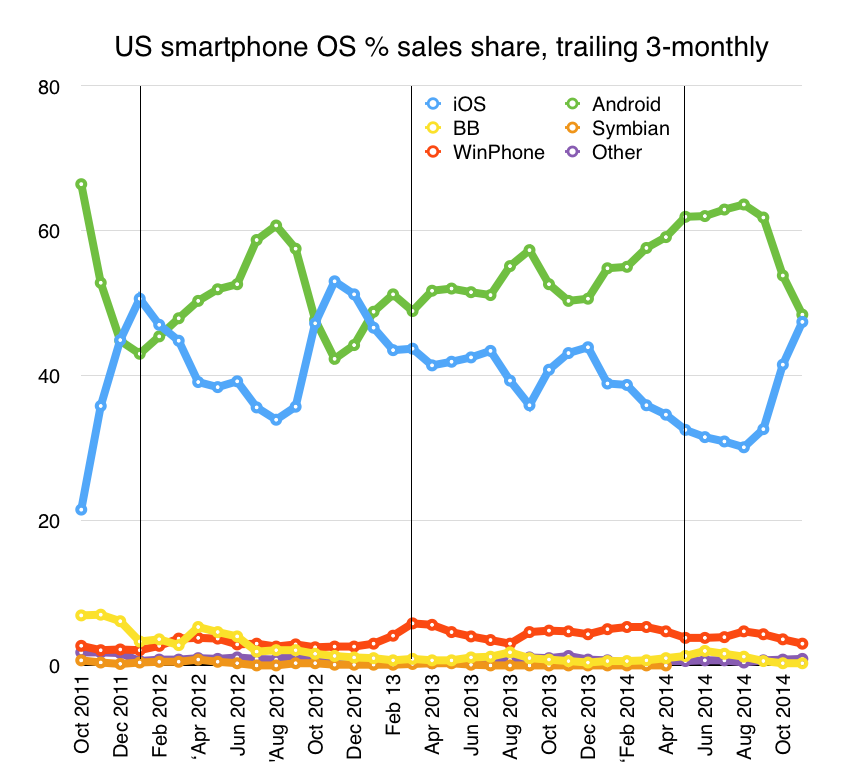
US smartphone sales share to end November 2014

Data from Kantar. iPhone share is high, but not as high as the iPhone 5 launch. (No comparative data on volumes, however.)
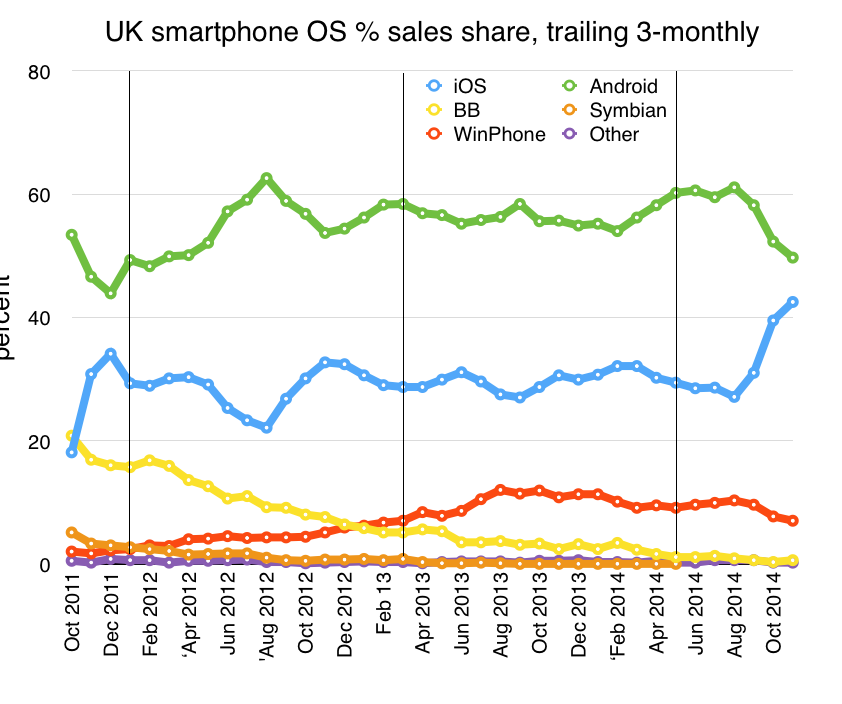
UK smartphone sales share to end November 2014

UK smartphone sales share to end November 2014, from Kantar; iOS share is highest ever recorded
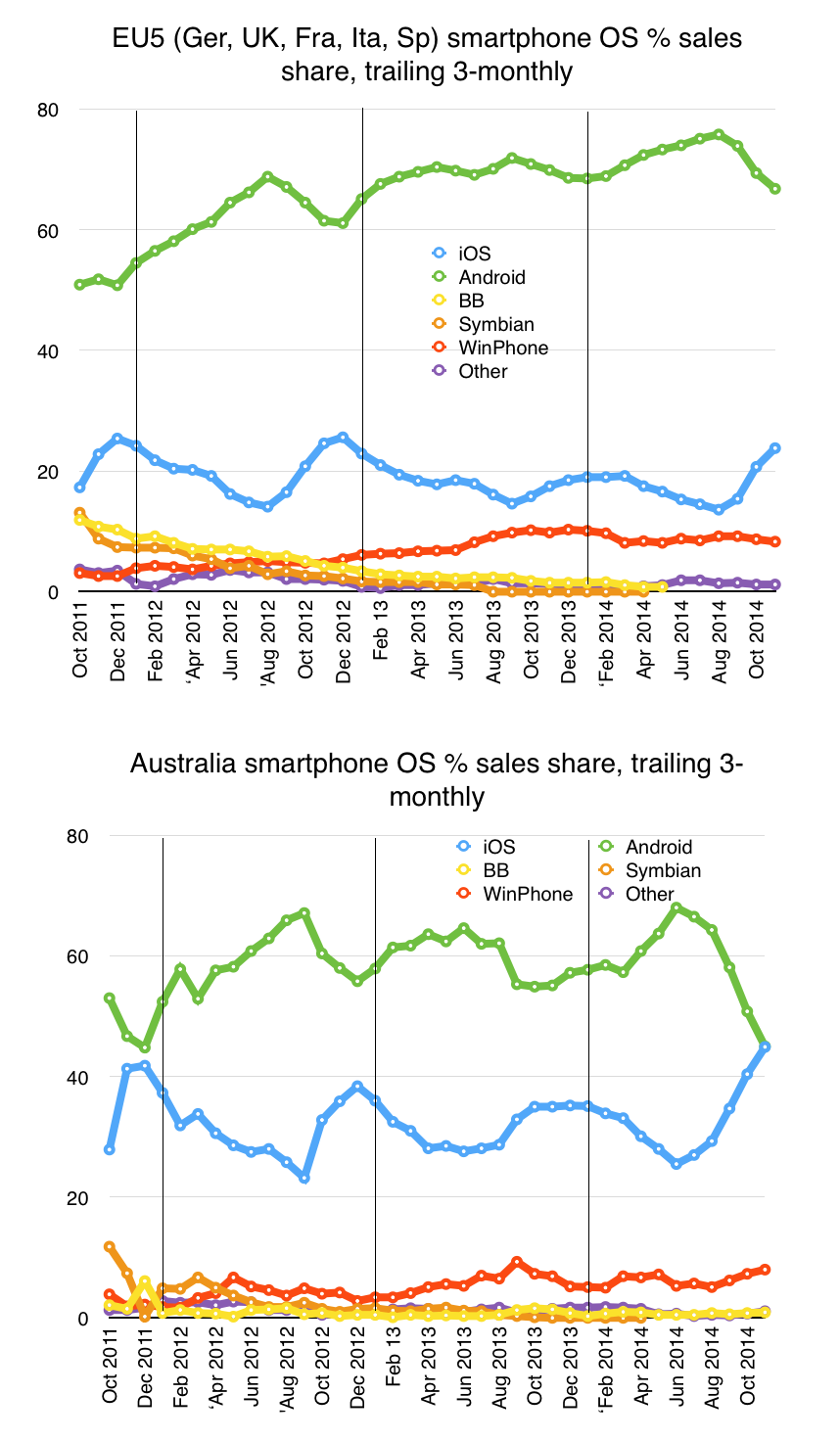
EU5 and Australia smartphone sales share

Share of smartphone sales for three months to end November 2014, via Kantar. (EU5 = Germany, UK, France, Italy, Spain = 184m smartphone users; Australia = 16.4m smartphone users)

(Note among all these that Windows Phone is still not making anything resembling progress; nor is “other”, though Firefox phones are few and very far between in these countries. The smartphone platform space is played out.)

Here’s the most interesting part, left to the very last paragraph of the release:

Smartphone penetration reached 58% in the US and 65% across Europe’s big five economies. “While die-hard featurephone owners state they are not planning to buy a smartphone in the next 12 months, they might not have a choice as vendors continue to transition their portfolio away from featurephones to smartphones”, concluded [Kantar head of research Carolina] Milanesi. Forty-seven percent of featurephones owners looking to change their current device in the next six months in the US and 35% across Europe’s top five [countries] are not planning to upgrade to a smartphone.

Once again: 47% and 35% of featurephone owners in the US and EU5 (Germany, UK, Italy, Spain, France) who are looking to change device won’t go to a smartphone.

Now, you could flip those numbers over: out of all (remaining) featurephone owners, 53% in the US and 65% in the EU5 may go to a smartphone in the next six months. It’s only “may” because they haven’t said they will, only that it isn’t definite they won’t.

The longrunning ComScore data in the US, meanwhile, which tracks installed base, shows that at the end of October there were about 65m featurephone users remaining there. For the UK, I calculate that smartphone penetration of mobile phone users is now 80.2% – based on the data and calculations I did for a piece last April using Kantar’s data.

In the US, the number of featurephone users converting to smartphones had been fairly constant, at a few million per month, but as the graph below shows, it nosedived during 2014 (the data only goes up to the end of October) – indicating that fewer are shifting up to smartphones.
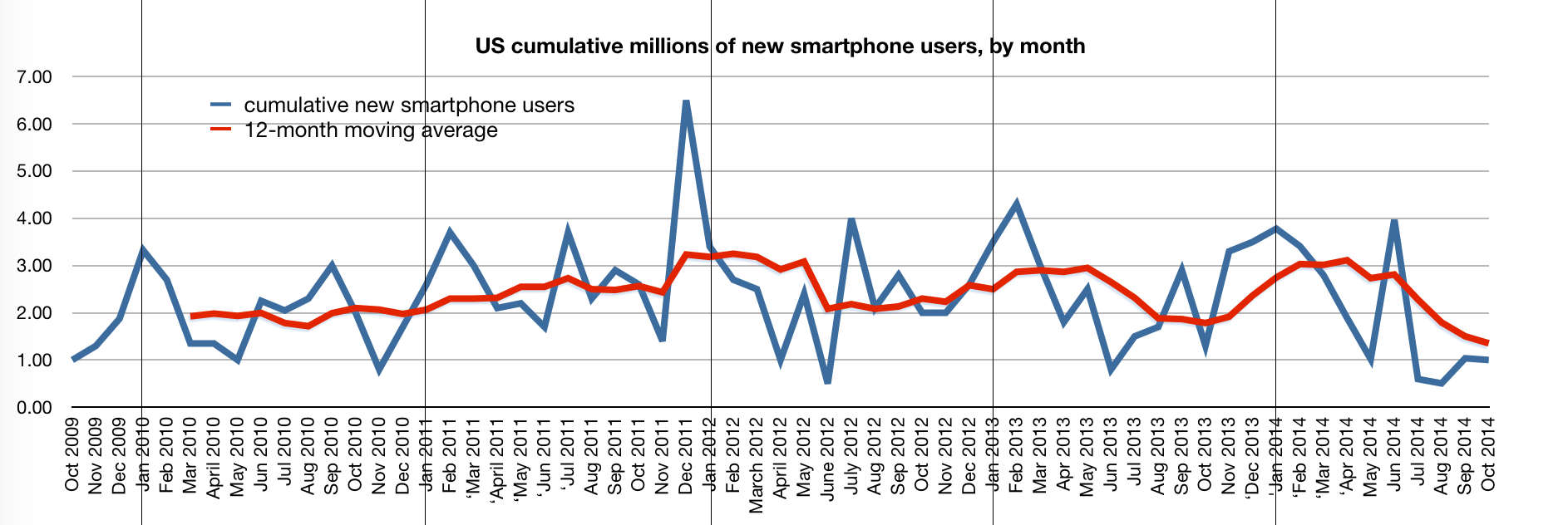
Number of US featurephone users moving to smartphones, by month

Data calculated from ComScore, showing how many featurephone users shifted to smartphones in the US. The trendline seems to have fallen off in 2014.

And indeed, why would you shift to a smartphone in the US if you don’t particularly need one, given its crazy system where you pay a huge per-month fee for the phone, and then for carrier service, and then for data, and then perhaps for “extras” (loosely defined)?

Thus we may now be at the point where the only ones without smartphones are the refuseniks – the people who don’t want a smartphone. In other words, we’re hitting the “laggards” – the 16% who don’t care. Given that the best fit for the data suggests smartphone penetration will top out at 92%-95%, and with 80% already using them (in the UK), we’re clearly in laggard territory.

Diffusion of innovations: segmentation

Stages of adoption of innovations. Source: Wikipedia
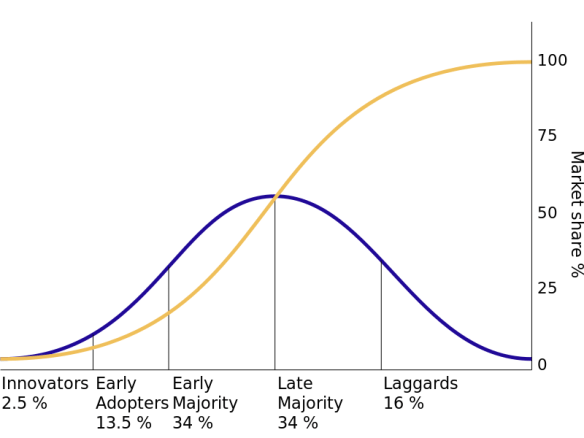
What does this mean? Mostly, that selling more phones becomes a battle where the existing smartphone platforms try to win people over from their rivals, while there’s also a gradual accretion from the last featurephone holdouts – who, as Milanesi says, might find they have barely any choice when it comes to replacing their dead one.

For BlackBerry, this is almost played out; it’s down to something like 40m users worldwide, of whom perhaps 8m are consumers and thus remain to be poached.

For Windows Phone – well, it’s unclear quite what’s happening there. The numbers sold remain consistently small, and low-end, and there just doesn’t seem to be a lot of movement. There’s some anecdotal suggestions that many of the low-end ones are used as sort of semi-smartphones, with pay-as-you-go contracts and little use made of their internet capabilities.

Android and iOS

The more interesting flow, aka churn, is between iOS and Android, and Android and iOS: in percentage terms for the three months, 11% of iPhone buyers were previously Android users; and 13% of Android buyers were previously iPhone buyers.

I know – the simplistic view would be that iOS is losing users overall. Except the numbers don’t work out that way; there are more Android users than iPhone users in the US (92m v 73.7m), so that iOS is actually gaining users.

Here’s how:
• 13% of 73.7 = 9.6 iPhone users shifting to Android;
• 11% of 92 = 10.1 Android users shifting to iOS.
Assume that the number of people changing phone is proportional to the total installed base at any time (which is likely), and the iPhone user base grows – just.

Even so, that churn must be a concern to Apple. Maybe the new screen sizes of the iPhone 6 and 6 Plus will reduce that, or perhaps it’s inherent in the dynamics of smartphone platforms.

Meanwhile, if you know a refusenik, do ask them what they’ll do when their phone breaks. Smartphone without data? Buy a featurephone on eBay?

Whatever; it’s unlikely the refuseniks are going to make a big impact now. In the developed world, the smartphone platform wars are so played out.


Start up: who knows what about you?, smartphone tracking, slim your iPhone photos!, Xiaomi’s razor margins, and more


An iPad Air 2 being charged, apparently from a bicycle pump. Photo by LoKan Sardari on Flickr.

A selection of 8 links for you. Enjoy. I’m charlesarthur on Twitter. Observations and links welcome.

Amazon’s Echo is a good listener but a wretched assistant >> Gigaom

Stacey Higginbotham:

Never has the gap between a flawless technology experience and a closed ecosystem loomed as large as the gap between the Amazon Echo and the Ubi personal computer. While Amazon’s Echo works beautifully and is a gorgeous cylinder that is ready to hear and (attempt to) obey my every command from pretty much anywhere in the room, it fails because its abilities to connect with a variety of web services are very limited.

Meanwhile, the Ubi, a voice-activated computer that is older and, yes, much more painful to use, wants to do the same thing. Like a teenager, though, it isn’t adept at listening to my commands, sometimes awkwardly interrupting my conversations, and its music playback is not nearly as graceful as the Echo’s.

Pays money, takes choice (or don’t spend the money at all).


Android Vs. iOS start experience >> LukeW

Luke Wroblewski:

How times change… Today’s new iPad Air 2 experience consists of 23 or more steps and no less than three iCloud services (iCloud, iCloud Drive, & iCloud Keychain). In contrast, today’s new Android Nexus experience consists of only 8 steps but with a mandatory 234MB update (some things don’t change). Here’s both start experiences in detail.

You can argue this lots of ways. Apple offers TouchID, Apple Pay, Find My iPad, iMessage – and asks about using location services. Google stuffs many of those into a single screen. Wroblewski doesn’t give a “time taken” for the setup; that might be as useful.


People finding their ‘waze’ to once-hidden streets >> Associated Press

Great piece on a smartphone tragedy of the commons, by John Rogers:

Killeen said her four-mile commute to UCLA, where she teaches a public relations class, can take two hours during rush hour. “The streets on the west side are no longer a secret for locals, and people are angry,” she said.

That’s because the app can’t be outsmarted, Waze spokeswoman Julie Mossler said.

“With millions of users in LA, fake, coordinated traffic reports can’t come to fruition because they’ll be negated by the next 10 people that drive down the street passively using Waze,” she said.

Besides, Mossler added, “people are inherently good,” meaning most wouldn’t really screw with the app, no matter what they might say.

Indeed, of all the angry people interviewed for this story, none would admit doing so, although most said they heard someone else had.

One does have to wonder a little why Killeen doesn’t walk, cycle or get a motorbike for that four-mile commute.


It may be crushing Samsung in China, but Xiaomi barely makes a profit >> Forbes

Parmy Olson:

Chinese smartphone upstart Xiaomi, which this year grabbed Samsung’s No. 1 spot in China with its low-cost smartphones, revealed startlingly-low profits in a filing to the Shenzen stock exchange on Monday, Reuters reported.

The company earned $56m in net profit in 2013, on sales of $4.3bn. That’s an operating margin of just 1.8%, razor-thin when compared to Apple’s operating margin (which was 28.7% in 2013) or even Samsung’s (18.7%), which are being forced down by low-cost Indian and Chinese vendors like Xiaomi.

Eyebrows now raised at the WSJ report from earlier which said Xiaomi made a profit ten times that in 2012. Either the WSJ had the wool pulled, or Xiaomi is expanding dangerously fast. A spokesperson for Xiaomi said this “didn’t represent the whole company”, which somewhat contradicts its filing.


Sales of smartphones grew 20% in third quarter of 2014 >> Gartner

Lots to digest here (two months after the end of the third quarter): the continuing, rapid drop in featurephone sales, which particularly hurt Samsung; the growth of Huawei, ZTE and Xiaomi; that BlackBerry is still bumping along, managing 2.4m sales “to end users” in that period by Gartner’s numbers.


Boxed In >> Platformonomics

Charles Fitzgerald:

To own Box stock, you have to believe they will retain their customers for a really long time to pay back the acquisition costs and/or significantly increase their revenue per customer. It is hard to make this case and Box notably doesn’t make much of an effort.

How will Box extract significantly more revenue per customer? They have neither moat nor unique technology (unless you count their “which one of these things isn’t like the others” participation in the Linux Foundation’s Dronecode Project). They don’t have an operations at scale cost advantage. Their “platform ecosystem” is superficial at best. They face giant competitors like Apple, Google and Microsoft with untold billions in the bank who are happily giving cloud-based storage away as a complement to their other services, as well as Dropbox which continues to ooze into the enterprise with a bottoms-up strategy which has dramatically lower customer acquisition costs. Box is still doing the same thing it always has, even as the market has evolved. They no longer have the luxury of just highlighting SharePoint’s inadequacies. Some argue Microsoft’s refusal to support Android and iOS has been the singular Box value proposition – obviously, that is a window that has closed.

Fitzgerald isn’t an optimist on Box.


iCloud Photo Library beta FAQ >> Apple Support

Q :How does iCloud Photo Library save space on my device?

A: If you turn on Optimize [device] Storage, iCloud Photo Library will automatically manage the size of your library on your iOS device, so you can make the most of your device’s storage and access more photos than ever. iCloud Photo Library stores the original, high-resolution photos and videos in iCloud and can keep lightweight, device-optimized versions on each of your devices. As long as you have enough storage, recent photos and videos that you access the most will stay on your device at full resolution.

You can turn on Optimize [device] Storage from Settings > iCloud > Photos or Settings > Photos & Camera > iCloud Photo Library on your iPhone, iPad, or iPod touch. You need an Internet connection to access an original photo or video that’s stored only in iCloud.

As Mark Rogowsky points out, this is the way to free up space on iOS devices while also letting you see the photos you’ve taken.


Who’s Watching You?

You probably know that Google and Facebook are tracking you, but did you know your car is too? Take this test to find out how tracked you are.

Faintly depressing.


Start up: tablet slowdown, find that toilet!, does live music pay?, BlackBerry’s iPhone offer, and more


“Finally, I got my iPad” by juehuayin on Flickr

A selection of 10 links for you. Use them wisely.

Worldwide tablet growth expected to slow to 7.2% in 2014 along with first year of iPad decline >> IDC

The worldwide tablet market is expected to see a massive deceleration in 2014 with year-over-year growth slowing to 7.2%, down from 52.5% in 2013, according to a new forecast from International Data Corporation (IDC). At the core of this slowdown is the expectation that 2014 will represent the first full year of decline in Apple iPad shipments. Both the iPad and the overall market slowdown do not come as a surprise as device lifecycles for tablets have continued to lengthen, increasingly resembling those of PCs more than smartphones.

“The tablet market continues to be impacted by a few major trends happening in relevant markets,” said Ryan Reith, Program Director with IDC’s Worldwide Quarterly Mobile Device Trackers. “In the early stages of the tablet market, device lifecycles were expected to resemble those of smartphones, with replacement occurring every 2-3 years. What has played out instead is that many tablet owners are holding onto their devices for more than 3 years and in some instances more than 4 years. We believe the two major drivers for longer than expected tablet lifecycles are legacy software support for older products, especially within iOS, and the increased use of smartphones for a variety of computing tasks.”


The Great British Public Toilet Map >> Gail Knight

The Great British Public Toilet Map launched last Wednesday 19th November on World Toilet Day*

Previous versions of the map have existed since 2011, but this is now the largest publicly accessible toilet database in the UK by some way. It has over 9500 toilets, and I’d be confident of saying that the map will help you to find toilets no matter where you live.

If for some inexplicable reason it doesn’t, you can add, edit and remove toilets until it does! We’ve had over 1000 toilets added this week.

AT LAST. I judged a competition in April 2011 where this was one of the entries – and nearly the winner.


How Sonos and John MacFarlane built the perfect wireless speaker for streaming music >> Businessweek

[Mark] Trammell [a designer formerly at Digg and Twitter] likes to interview customers in their homes, sometimes in the moment when a Sonos speaker first arrives and a family is taking it out of the box and deciding where it should go.

“They’re looking for a Sonos-size hole to fill,” he says. The small Play:1 is good for bathrooms and kitchens; the Play:5 tends to go in living rooms and dens. The accessories allow for attaching other kinds of sound equipment, such as weatherproof outdoor speakers, to the network. The average Sonos household has 2.1 units.

A key moment tends to be when family members discover how to add to and remix playlists together. Mark Whitten, Sonos’s chief product officer, compares the experience to that of the Xbox. “The reason gaming consoles became ascendant wasn’t because of the games,” he says. “It’s because two kids were sitting on a couch, playing together.” Whitten was hired six months ago from Microsoft, where he introduced and oversaw much of the Xbox, including Xbox Live.

On an upward curve. Will someone buy them?


Automation makes us dumb >> WSJ

Nick Carr:

Late last year, a report from a Federal Aviation Administration taskforce on cockpit technology documented a growing link between crashes and an over-reliance on automation. Pilots have become “accustomed to watching things happen, and reacting, instead of being proactive,” the panel warned. The FAA is now urging airlines to get pilots to spend more time flying by hand…

…Ten years ago, information scientists at Utrecht University in the Netherlands had a group of people carry out complicated analytical and planning tasks using either rudimentary software that provided no assistance or sophisticated software that offered a great deal of aid. The researchers found that the people using the simple software developed better strategies, made fewer mistakes and developed a deeper aptitude for the work. The people using the more advanced software, meanwhile, would often “aimlessly click around” when confronted with a tricky problem. The supposedly helpful software actually short-circuited their thinking and learning.


Lee Rigby Woolwich report in full >> The Guardian

Report by parliament’s intelligence and security committee setting out what the intelligence services knew before 2013 Woolwich killing of fusilier by Michael Adebolajo and Michael Adebowale

Worth reading in depth if you’re interested in how security services operate, and what they can (and can’t) get from data. For example: the killers were known, but low priority; a tapping order took a month to be signed; submarine cables are tapped, but even if their discussions had been picked up by them, the fact neither was under “active” observation means key comments would have been missed.


The Lee Rigby murder doesn’t justify an extension of internet snooping powers >> The Guardian

I wrote on the report:

the ISC [Intelligence Services Committee] has a point here. As the report highlights, when internet companies discover accounts associated with child exploitation, they are quick to pass on details to the authorities. But if someone suggests “let’s kill a soldier” in a message, the account is marked for closure. Adebowale had four out of seven internet accounts at one provider automatically closed over suspected terror-related activity; yet none was reviewed by a human. That’s a clear failure to link the action – closing an account – and the reason; communications companies can’t seek public approval for trying to prevent child exploitation, yet wash their hands of terrorism discussions.

The BBC is saying that the Adebowale comment was made on Facebook. Expect more developments in the next few days.


Intel decides to keep tablet subsidies, say sources >> Digitimes

Facing domination from ARM-based processor suppliers such as Qualcomm and MediaTek, Intel’s subsidies including those for marketing, have helped reduce vendors’ costs by around US$20-30 and have attracted vendors such as Asustek Computer, Acer and Lenovo to place orders for Intel’s processors, the sources noted.

Although the strategy helps Intel to maintain a share of around 90% in the notebook market, the strategy has taken a heavy toll out of Intel in the mobile device market as the company has generated about US$7bn of losses from its mobile and communications business during the past two years and will continue to see losses in the fourth quarter, the sources noted.

Internally, Intel has been debating about whether to stay in the tablet market, but the company has decided to push for the market since its absence could impact its PC business and create a hole in its Internet of thing (IoT) lineup, the sources explained.

The logic is sound. And $20-30 could make the difference between profit and loss for some tablet makers.


Pomplamoose 2014 Tour Profits >> Medium

Jack Conte (half of Pomplamoose) does the numbers for the band’s recent self-financed tour:

Add it up, and that’s $135,983 in total income for our tour. And we had $147,802 in expenses.

We lost $11,819…

…The point of publishing all the scary stats is not to dissuade people from being professional musicians. It’s simply an attempt to shine light on a new paradigm for professional artistry.

We’re entering a new era in history: the space between “starving artist” and “rich and famous” is beginning to collapse. YouTube has signed up over a million partners (people who agree to run ads over their videos to make money from their content). The “creative class” is no longer emerging: it’s here, now.

We, the creative class, are finding ways to make a living making music, drawing webcomics, writing articles, coding games, recording podcasts. Most people don’t know our names or faces. We are not on magazine covers at the grocery store. We are not rich, and we are not famous.


Trade in your iPhone >> BlackBerry Trade Up

Trade your iPhone for a BlackBerry Passport and get up to $550!

For a limited time, starting December 1st.

Upgrade to a BlackBerry® Passport and get up to $400 back for your iPhone and an additional $150 from BlackBerry. Subject to Terms and Conditions.

To qualify for this offer, you must have purchased a BlackBerry Passport from select online retailers on or after December 1st, 2014.

BlackBerry essentially gives you $150, and you get a tradein of $90-$400 depending on iPhone model. Doesn’t seem to tie you to owning the Passport for any length of time, so the arbitrage-minded might like to see how easy it would be to round-trip this: cheap secondhand iPhone from drawer -> get BlackBerry Passport -> sell off Passport -> get cheap iPhone -> repeat? The problem might lie in the third step though.

Unlikely there will be a rush of iPhone owners to bankrupt BlackBerry, but also gives an insight into roughly how much it values each user: must be more than $150 over typical contract length.


Whistling Google: PLEASE! Brussels can only hurt Europe, not us >> The Register

Andrew Orlowski, on the European Parliament’s inconsequential (yet consequential) motion to make Google split services from search:

Google today wields enormous power over other industries, in a way Microsoft never could, even at the zenith of its influence. Newspapers didn’t close, and musicians didn’t go hungry, because Windows was late. No Active X control ever destroyed an economic sector. Yet you can plausibly argue that the consequences for European industry and its citizens freedoms are at least indirectly attributable to Google’s strategic use (and abuse) of other people’s property and personal effects…

…DCMA provisions were designed to protect ISPs and other service providers in the mid-1990s, when the public internet was in its infancy.

Today, they are favourable to huge internet aggregators, and load the deck against individuals and tiny companies seeking to protect their work. Google required the music company to promise not to sue an unlicensed uploader, thereby protecting Google’s supply chain. “You can sign and get a fraction of a penny,” Google was saying, “or you can refuse to sign and get nothing. It’s up to you – but either way, we’ll use your work and make money off it.”

As he points out, though, the European Commission is hopelessly screwed in both its aims and implementation of anything digital.


Start up: Uber’s vanishing blog, Samsung’s shrinking S5 sales, Google’s secret car, and more


What the Google self-driving car “sees”. Photo by Matt Chan on Flickr.

A selection of 10 links for you. Don’t worry, be happy.

The unknown startup that built Google’s first self-driving car >> IEEE Spectrum

Mark Harris:

one of Google’s most strategic acquisitions has mysteriously been actively blocked from public view. An investigation by IEEE Spectrum has uncovered the surprising fact that Google’s innovative self-driving car and the revolutionary Street View camera technology that preceded it were largely built by 510 Systems, a tiny start-up in Berkeley, California.

If you’ve never heard of 510 Systems, that’s exactly the way Google wants it. The purchase of 510 Systems and its sister company, Anthony’s Robots, in the fall of 2011 was never publicly announced. In fact, Google went so far as to insist that some 510 employees sign agreements not to discuss that the acquisition had even occurred. Google’s official history of its self-driving car project does not mention the firm at all. It emphasizes the leadership of Sebastian Thrun, the German computer scientist whose Stanford team won the autonomous-driving Grand Challenge in 2005, sponsored by the Defense Advanced Research Projects Agency (DARPA).

Why has Google worked so hard to keep this one acquisition a secret?

Harris has been doing fantastic digging into the truth about this Google project.


Kickstarter ‘fraudster’ finds second home on Indiegogo, as per usual >> Engadget

What do you do when you’ve been outed as a fraud and your Kickstarter was pulled? You go to Indiegogo, of course. Anonabox was a $45 device that promised to route your home’s internet connection through (privacy-focused network) Tor without any fiddling in the same way that PORTAL works. In the current climate, it was no surprise to see the project earn $600,000 in pledges in just the first few days. Slowly, however, people began to ask questions about creator August Germar after the hardware was found to be an off-the-shelf unit made by a Chinese OEM and the software turned out to be about as secure as a slice of Emmental.

Now the project has been re-born on Indiegogo, with claims that the mistakes of the previous project (and subsequent outcry) has helped the device get better. That’d be fine, and we’d be applauding Germar’s efforts, except for the fact that his claims of involvement with the Tor community have already been debunked. When ITSecurityGuru asked former Tor lead Runa Sandvik, she said that Germar “is making false claims, again.”

Some serious questions to be asked about Indiegogo here.


iPhone eye test spots vision problems cheaply >> New Scientist

Smart Vision Labs, a start-up in New York City, wants to make it easier to diagnose vision problems in developing countries with an iPhone camera add-on.

The World Health Organization estimates that 246 million people have poor vision. Of these, about 90% live in low-income areas without good access to healthcare or expensive diagnostic machines.

To solve this problem Smart Vision Labs has combined two tools often used for eye tests into a single inexpensive and portable device. The first tool, an autorefractor, calculates whether someone is short-sighted or long-sighted, and to what extent, by measuring the size and shape of their eye. The second, an aberrometer, looks for distortions in how light reflects off the eye, which could indicate rarer problems such as double vision.

Android phones would be a lot cheaper to do it with.


The real reason Excite turned down buying Google for $750,000 in 1999 >> Internet History Podcast

George Bell was chief executive of Excite, which was one of the biggest web properties. A bake-off didn’t find much difference between Excite’s search at the time, and Google’s. But he might have done the deal. However:

Ultimately, Larry said, “Look, I like the engineers at Excite. I really like the company. I get that you don’t see a lot of difference.” And, I think we struck a price. I believe that the price was $750,000 in cash, and something like 1% of Excite. The economics of that were really ok to us. The thing that Larry insisted on that we all do recall, is that Larry said, “If we come to work for Excite, you need to rip out all the Excite technology and replace it with Google’s search.” And, ultimately, that’s, in my recollection, where the deal fell apart. Because, we had hundreds of engineers at that point, and culturally, we really were driven by technology. And I didn’t think we could survive… or the differentiation in search results were clearly not dramatic enough to justify the cultural risk that Larry would insist on. So, ultimately, we passed.


Samsung considering shakeup in management >> WSJ

There also have been missteps at Samsung. The mobile division, under Mr. Shin, didn’t seriously question bullish projections for orders of its flagship smartphone, the Galaxy S5, which went on sale globally in April, according to a person familiar with the matter.

Samsung produced about 20% more devices than it did of the Galaxy S5’s predecessor, basing the numbers on a survey of its carrier partners around the world, who were asked to predict demand but who weren’t on the hook for any unsold devices, according to the person. That led to merchandise piling up in warehouses, forcing Samsung to increase marketing expenditures to unload the devices.

In all, Samsung sold about 40% fewer Galaxy S5 smartphones than expected, with about 12m units sold to consumers in the first three months since April compared with about 16m units for the preceding flagship phone, the Galaxy S4, according to people familiar with the matter. Only in one major market did Samsung sell more Galaxy S5 smartphones than it did the S4: the US, Samsung’s biggest market, one of these people said.

Making the point that Samsung’s real customers aren’t end-users, but carriers. S5 sales in China were down by about 50% compared to the S4 in its first six months.


A rare peek into the massive scale of Amazon Web Services >> Enterprise Tech

Timothy Prickett Morgan:

Like many hyperscale datacenter operators, Amazon started out buying servers from the big tier one server makers, and eventually became the top buyer of machines from Rackable Systems (now part of SGI). But over time, like Google, Facebook, Baidu, and its peers, the company decided to engineer its own systems to tune them precisely for its own workloads and, importantly, to mesh hand-in-glove with its datacenters and their power and cooling systems. The datacenters have evolved over time, and the systems have along with them in lockstep.

In the past, Amazon has wanted to hint at the scale of its infrastructure without being terribly specific, and so they came up with this metric. Every day, AWS installs enough server infrastructure to host the entire Amazon e-tailing business from back in 2004, when Amazon the retailer was one-tenth its current size at $7bn in annual revenue.

“What has changed in the last year,” Hamilton asked rhetorically, and then quipped: “We have done it 365 more times.”

That is another way of saying that in the past year AWS has added enough capacity to support a $2.55 trillion online retailing operation, should one ever be allowed to exist.


Apple’s forecast to sell 71.5M iPhones units in Q4, iPhone 6 sales more than double iPhone 6 Plus

According to a fresh report from prominent KGI analyst Ming-Chi Kuo obtained by AppleInsider, quarter-over-quarter Apple iPhone shipments will swell 82% in the fourth quarter of 2014.

Leading the charge is iPhone 6, predicted to account for just shy of 60 percent of all sales for the quarter, or 41.65m units. Coming in a distant second is the iPhone 6 Plus, which has been the more talked about next-generation variation due in large part to its scarcity at retail outlets. Kuo says the 6 Plus supply shortage is not only an indicator of high demand, but also confirmation that suppliers are having production issues. He believes final fourth quarter sales are largely dependent on supply chain success with 6 Plus yields.

Given Apple’s current situation, Kuo foresees a major slip in iPhone sales for the first quarter of 2015, mostly due to poor off-season demand. The analyst pegs shipments at a combined 49.4m units, including 21.6m iPhone 6 handsets and 10.2m iPhone 6 Plus versions.

71.5m units in CQ4 would be a 40% increase, year-on-year (and would probably challenge Samung for shipments). 49.4m in CQ1 would be just a 13% increase. One suspect it might be more evenly split than that.


Gartner says more than a third of US adult smartphone users use their smartphones for video calling >> Gartner

Video calling is growing into a key mainstream activity on smartphones, with high adoption rates in some markets, according to a survey by Gartner, Inc. The survey, which was conducted in June 2014, surveyed more than 6,500 U.S. and German consumers about their technology usage and attitudes in order to gain a better picture of how devices are used for work and leisure. 

More than 50 million adult smartphone users in the U.S. (about 35% of the total surveyed) use their smartphones for video calling. This number is likely to exceed 60 million people when those ages 17 and younger are included. In Germany, more than eight million adult smartphone users (about 20%) use their devices for video calling, a figure more likely to exceed 10 million when those ages 17 and younger are included. Gartner defines video calling as person-to-person communication using a video application such as Apple’s FaceTime, Skype or Google Hangouts…

…The survey results showed adoption is markedly skewed toward the younger demographic, with video calling in the 18 to 24 age group reaching 53.5% in the US and 30% in Germany. Video calling uptake is slanted toward early adopters but shows encouraging signs of expansion across all consumer segments.

FaceTime, Skype, Hangouts – Apple, Microsoft and Google, pitted against each other once again. Except they use it for slightly different purposes: FaceTime ties users to iOS; Skype makes money and has corporate tie-in; Hangouts.. well, that’s a bit less clear. It’s always felt like a wannabe Skype.


Have Microsoft’s Surface Pro vs. MacBook Air TV ads worked? >> Tech.pinions – Perspective, Insight, Analysis

Tim Bajarin:

I recently had a meeting with top officials in one of the major PC companies and asked them about their position on 2-in-1’s and convertibles. They told me they believe they need to have one or two models of these designs in their overall line up but the majority of what they will create and bring to market will still be clamshell based. They pointed out they are not seeing any real demand for these in IT yet and only slight interest by consumers. One reason the interest in something like Surface Pro is low is because of its price. They are two to three times the price of a cheap laptop.

Unless the Surface Pro is targeted at field service or as a replacement for those who use clipboards, I believe IT interest will continue to be soft at least for the 2 in 1 detachable. Lenovo tells me they have actually done well with their Yoga convertibles, especially in enterprise accounts, however it is still a minority when it comes to the total number of clamshell laptops they ship each year.


September 2011: Uberdata: How prostitution and alcohol make Uber better >> Uber Blog

What up humans?! Bradley Voytek here again. Man do we have some crazy #uberdata for you today.

Today is Uber: Freakonomics edition.

In this post I’ll show how where crimes occur — specifically prostitution, alcohol, theft, and burglary — improves Uber’s demand prediction models.

And then over three years later, I’ll delete it! Or someone will, realising that it’s a gigantic stain on our credentials.

First “Rides of glory” (about people avoiding the “walk of shame” by getting a cab some hours after being dropped off at a particular destination) and now now this.

Uber is clearly trying to pretend that its ability to peer at data relating to specific users can somehow be forgotten.

Unfortunately, the Internet Archive begs to differ. Speaking of which, have you donated to its upkeep?