Start up: Asus’s router screwup, slower smartphones, Ek speaks, the FBI’s other iPhones, hi – it’s Sony, and more

What if you reduced novels to their punctuation? How would they look? Photo by Jilligan86 on Flickr.

You mean you signed up to receive each day’s Start Up post by email? Nice one.

A selection of 11 links for you. Calorie-free. I’m charlesarthur on Twitter. Observations and links welcome.

ASUS settles FTC charges that insecure home routers and “cloud” services put consumers’ privacy at risk » Federal Trade Commission

»Taiwan-based computer hardware maker ASUSTeK Computer, Inc. has agreed to settle Federal Trade Commission charges that critical security flaws in its routers put the home networks of hundreds of thousands of consumers at risk. The administrative complaint also charges that the routers’ insecure “cloud” services led to the compromise of thousands of consumers’ connected storage devices, exposing their sensitive personal information on the internet…

…ASUS marketed its routers as including numerous security features that the company claimed could “protect computers from any unauthorized access, hacking, and virus attacks” and “protect [the] local network against attacks from hackers.” Despite these claims, the FTC’s complaint alleges that ASUS didn’t take reasonable steps to secure the software on its routers.

For instance, according to the complaint, hackers could exploit pervasive security bugs in the router’s web-based control panel to change any of the router’s security settings without the consumer’s knowledge…

…In February 2014, hackers used readily available tools to locate vulnerable ASUS routers and exploited these security flaws to gain unauthorized access to over 12,900 consumers’ connected storage devices.

«

Swingeing fine? No – just “a comprehensive security program subject to independent audits for the next 20 years.” Pfft.
link to this extract


Session with Daniel Ek / Feb 16, 2016 » Quora

Lots of questions and answers from Spotify’s founder/chief. I found this one interesting:

»

Q: How will you compete as Amazon, Google (incl. YouTube), Apple, etc. strengthen and expand the scope of their respective lock-in?

A: I believe in focus. All of the companies you mention have music as a hobby, a very small part of their overall business. We do one thing and try to do it really well. This means we have a company 100% dedicated to finding the right content, personalizing it for you and serving it up with partners who are specialized in what they do. The big platform companies don’t generally like partnering. We do. This opens up lots of doors. To put it another way, we are really focused on delivering the best possible music experience you can find. I’m not saying we don’t think about the competition – of course we do, it would be crazy not to. But we think about them more in terms of how to make Spotfy so easy, so fun, and so relevant for our users that whether you wait on lines for every new Apple device, get your groceries from Amazon Prime, or use every Google mail and workplace app, you still want to listen to music on Spotify because it’s the best experience there is.

«

link to this extract


Pirated App Store client for iOS found on Apple’s App Store » HelpNet Security

Zeljka Zorz:

»The app hasn’t been flagged as potentially dangerous by Apple’s strict code reviewers, most likely because the app was made to look like a simple app for learning English if a reviewer (or user) accessed the app from anywhere outside China, and showed its true face only for those located in China.

Also, it’s coded in the Lua programming language, and this allows the developers to update the app remotely and repeatedly without triggering Apple’s app review process.

The app was available for download in the App Store for over three and a half months (since October 30, 2015 to the end of last week), but has now been removed.

The researchers haven’t discovered any actual malicious functionality in the app, but given its capabilities, it should definitely be considered risky to use. They dubbed it ZergHelper, and discovered over 50 enterprise-signed versions of the app being distributed in the wild through alternative channels.

«

Enterprise certificates are still the biggest weak point for getting apps onto iPhones. This one was clever too in using geolocation, and Lua.
link to this extract


Justice Department seeks to force Apple to extract data from about 12 other iPhones » WSJ

Devlin Barrett:

»The letter, written last week from an Apple lawyer to a federal judge, lists the locations of those phone cases: Four in Illinois, three in New York, two in California, two in Ohio, and one in Massachusetts.

The letter doesn’t describe the specific types of criminal investigations related to those phones, but people familiar with them said they don’t involve terrorism cases. The 12 cases remain in a kind of limbo amid the bigger, more confrontational legal duel between the government and the company over an iPhone seized in the terror case in California, these people said.

«

How surprising that the other cases where the Department wants to do exactly the same aren’t about a high-profile mass shooting that has been framed as “terrorism”.

On another note, this story has prompted some excellent reporting. Such as the next one…
link to this extract


Secret memo details US’s broader strategy to crack phones » Bloomberg Business

Terrific scoop by Michael Riley and Jordan Robertson:

»In a secret meeting convened by the White House around Thanksgiving, senior national security officials ordered agencies across the U.S. government to find ways to counter encryption software and gain access to the most heavily protected user data on the most secure consumer devices, including Apple Inc.’s iPhone, the marquee product of one of America’s most valuable companies, according to two people familiar with the decision.

The approach was formalized in a confidential National Security Council “decision memo,” tasking government agencies with developing encryption workarounds, estimating additional budgets and identifying laws that may need to be changed to counter what FBI Director James Comey calls the “going dark” problem: investigators being unable to access the contents of encrypted data stored on mobile devices or traveling across the Internet. Details of the memo reveal that, in private, the government was honing a sharper edge to its relationship with Silicon Valley alongside more public signs of rapprochement.

«

link to this extract


Bitcoin miners back proposed timeline for 2017 hard fork » CoinDesk

Stan Higgins:

»A group of bitcoin miners constituting close to 80% of the network hashrate, as well representatives from exchanges, service providers and contributors to the Bitcoin Core development project, have proposed a development timeline for scaling the bitcoin network.

The statement’s release comes after a more than 18 hour-long meeting in Hong Kong that drew participants from China’s bitcoin mining community and members of the Bitcoin Core team.

Some of the letter’s signatories were party to a previous statement that voiced opposition to any “contentious hard fork” to the bitcoin network.

According the proposed timeline, Bitcoin Core contributors Matt Corallo, Luke Dashjr, Cory Fields, Johnson Lau and Peter Todd will produce and recommend code for a hard fork to the bitcoin network that would feature a block size increase. The code for this proposal is expected to be made available by July.

«

The picture accompanying the article shows that the group comprises 21 people. So much for bitcoin being decentralised: this group decides which way everything moves.
link to this extract


Punctuation in novels » Medium

Adam Calhoun:

»When we think of novels, of newspapers and blogs, we think of words. We easily forget the little suggestions pushed in between: the punctuation. But how can we be so cruel to such a fundamental part of writing?

Inspired by a series of posters, I wondered what did my favorite books look like without words.

Here’s Blood Meridian by Cormac McCarthy (left) and Absalom, Absalom! by William Faulkner.

«

A lovely idea. Hemingway turns out to be a radical.
link to this extract


Sony worms way into Ear with Xperia headset-cum-virtual assistant » Ars Technica UK

Mark Walton:

»As it dawns on smartphone makers that—after years of healthy upgrades—consumers are perfectly happy with their existing phone, they’ve started to pile on the features instead. LG has its wacky upgradable G5, Samsung has its Gear VR headset, and Sony… well, it’s got the Xperia Ear, a Bluetooth headset-cum-virtual assistant that it hopes will take away the need for everyone to keep pulling their smartphones out of their pockets.

You can take calls with Xperia Ear, send messages, get the latest traffic updates, and it’ll even send you directions using GPS (via the phone it’s paired with). None of that is particularly innovative as such, but the Ear’s USP is the way its packaged up into a neat, and arguably more reliable package that your traditional virtual assistant along the lines of Siri or Google Now. For instance, when a call comes in and you pick up the Ear, it has a proximity sensor that automatically answers the call and flings it to your earlobe.

If you’re stuck for the perfect cupcake recipe or want to know who invented the Burrito (sorry, I have the MWC hunger), the Ear can find that stuff out too via voice activated Internet searches. Again, this is functionality most people already have access to via their phone, but Sony hopes that by removing the need to pull out their phones altogether, and instead reach for the Ear, people will won’t be quite as shut out from the outside world.

OK, so the concept is clearly a strange one, and there’s evidence to suggest that such devices—like the similar Motorola hint—have struggled to find a market.

«

Can’t imagine why. You make it sound so… useful.
link to this extract


Google to shut down Google Compare products in US and UK on March 23 » Search Engine Land

Ginny Marvin:

»The company only recently began rebuilding the Compare product from the ashes of the Advisor program in the US. The single piece left standing from that initial effort was the credit card offering — savings accounts, CDs and mortgages had all discontinued. Compare for Auto Insurance launched just last March, starting in California. Then Google relaunched Compare for Mortgage quotes in November with Zillow and Lending Tree among the launch partners. Both of those relaunches had limited roll outs. In the UK, Google Compare has been running since 2012 for car insurance, mortgage rates, credit cards and travel insurance.

A Google spokesperson told Search Engine Land that while searches on these queries remained high, the product didn’t get the traction it hoped for and revenue was minimal. That’s in part due to the limited availability of the products in both the US and the UK.

«

Another one for the graveyard.
link to this extract


Double-digit smartphone market growth is over » Kantar Worldpanel

»Feature phone owners across markets are challenged in finding smartphones that offer what they consider a good value for money spent. They are unlikely to upgrade to a smartphone until they can no longer rely on their current device. While looking year over year might not be enough to see a clear trend, examining the past three years makes it clear that smartphone life cycles are getting longer.

In mature markets, the profitable high end of the market is saturated. In the US, the high-end segment, devices with an unsubsidized price of more than $500 represented 48% of sales in 2015, growing a mere 9% over 2014. In the EU5, where the high-end segment represented just 27% of sales, growth was commensurately lower than in the US, coming in at 6%.

What should the industry expect for 2016? According to Milanesi, 48% of smartphone owners in the EU5 are currently planning to upgrade their smartphone over the next 12 months. This number decreases to 46% in the US, and 28% in urban China. Consumer brand preference for their next device varies a little by region, but two brand names that remain prominent are Apple and Samsung.

«

link to this extract


Google + GSMA announcement on RCS is no gamechanger » Disruptive Wireless

Dean Bubley:

»From the announcement: “Operators have agreed to transition toward a common, universal profile based on the GSMA’s RCS specifications and an Android RCS client provided by Google.”

It’s belatedly throwing various independent RCS app providers under the bus, trying to make disparate RCS implementations actually work together. As with VoLTE, RCS has suffered a wide range of non-interoperable versions to date, which is rather embarrassing for an application that was mainly standardised for the purpose of interoperability, rather than user-utility.

That it’s failed to actually be interoperable, as well as failed to be useful & well-designed, is just another eaten brain in the 8-year zombie catastrophe of RCS.

What’s interesting is what’s not in the statement:

– No mention of messaging-as-a-platform, despite that being hinted at previously in RCS presentations I’ve seen. Given that WeChat, Facebook Messenger, WhatsApp and others are shifting to commerce/advertising “streams”, that’s a surprising omission.
– No current usage numbers for RCS. There’s vague pronouncements about “towards a billion users”, but no baseline of current DAUs/MAUs for “proper” RCS usage, not just SMS-replacement texting.
– It doesn’t mention the new RCS client being made mandatory in future Android builds. It just says it’s available. The PR is very operator-centric, which doesn’t seem to suggest that all OEMs will automatically implement it in new devices, especially where they’re sold through open-market channels.
– No reference to whether the client will be appearing on WiFi-only tablets, or other Android devices (cars, watches, Chromebooks etc)
– No mention of AT&T or Verizon in the press release, although there’s an AT&T speaker at MWC on stage with them apparently (link)
– No clear timelines or wholehearted commitment by Google “an important step forward in bringing a better messaging experience for Android users everywhere”
– No mention of Samsung, which also happened to have Mark Zuckerberg from Facebook keynoting its big press conference yesterday. Given Google is trying to wrest back control of Android from its OEMs’ influence, that’s not a good sign for Samsung+RCS
– No reference to the South Korean operators ditching Joyn recently.

It’s also still unclear exactly what the future RCS business/revenue model might look like. Although it references the Jibe platform for MNOs, it doesn’t rule out my previous hypothesis of “Android iMessage” either.

«

link to this extract


Errata, corrigenda and ai no corrida: none notified.

Start up: who backs the FBI?, Google gets RCS, LG goes modular, Linux Mint backdoored, and more

Does the American public back Apple or the FBI in the fight over encryption? Photo by IceNineJon on Flickr.

You can now sign up to receive each day’s Start Up post by email. You’ll need to click a confirmation link, so no spam.

A selection of 11 links for you. Use them wisely. I’m charlesarthur on Twitter. Observations and links welcome.

After Jibe Mobile buy, Google to provide carriers with Android RCS client » TechCrunch

Natasha Lomas is very unimpressed by Google’s announcement with carriers at MWC:

»at the time of the acquisition of [RCS app maker] Jibe [in September 2015], telecoms analyst Dean Bubley suggested Mountain View’s move was actually aimed at building its own Android-to-Android iMessage competitor — a theory he’s still not ruling out, so perhaps Google still has some hopes on that front.

Albeit, Bubley couches Google’s latest RCS pronouncement as “very lukewarm”, noting it has not specified the client will be on all Android devices, for example, even if what is clearly carrier-written PR talks about reaching “all Android devices” — which would encompasses an awful lot of hardware these days, from phones to smart TVs, to smartwatches and more. (We’ve asked Google for some clarity here and will update this post with any response).

A Google spokeswoman said: “Once deployed, the Universal RCS Client will come standard for all Android devices globally, providing a more consistent experience with more advanced features.”  To be clear, that’s ‘standard’ in the sense of OEMs and carriers being able to choose to install it — so not universal, not mandated by Google and thus most certainly fragmented. (Also on fragmentation the spokeswoman confirmed that currently the client only works on phones and tablets, so not all Android devices by any means.)

There’s also no clear timeframe on when Google will be delivering the RCS client. (The spokeswoman had no concrete commitments to impart here, saying only that Google is “planning to launch later this year”.) And, as noted above, without ubiquity it’s going to mean fragmentation keeps RCS-powered messaging apps from building the sought for mass messaging momentum via the platform.

«

Expectations that Google would introduce a sort of iMessage-like app across all Android devices via Google Play seem overblown. It’s also not very private.
link to this extract


October 2015: Android 6.0 re-implements mandatory storage encryption for new devices » Ars Technica

Andrew Cunningham in October 2015:

»Shortly after the announcement of iOS 8 in 2014, Google made headlines by saying that it would make full-device encryption mandatory for new Android devices running version 5.0. It then made more headlines several months later when we discovered that the company backed down, “strongly recommending” that Android device makers enable encryption but stopping short of actually requiring it.

Now Google has published an updated version of the Android Compatibility Definition Document (PDF) for Android 6.0, and it looks like mandatory encryption is back with a couple of exceptions. New devices that come with Marshmallow and have AES crypto performance above 50MiB-per-second need to support encryption of the private user data partition (/data) and the public data partition (/sdcard).

«

Still unclear which devices actually implement this. Is there a table or list anywhere?
link to this extract


More support for Justice Department than for Apple in dispute over unlocking iPhone » Pew Research Center

»As the standoff between the Department of Justice and Apple Inc. continues over an iPhone used by one of the suspects in the San Bernardino terrorist attacks, 51% say Apple should unlock the iPhone to assist the ongoing FBI investigation. Fewer Americans (38%) say Apple should not unlock the phone to ensure the security of its other users’ information; 11% do not offer an opinion on the question.

News about a federal court ordering Apple to unlock the suspect’s iPhone has registered widely with the public: 75% say they have heard either a lot (39%) or a little (36%) about the situation.

«

Survey of 1,002 adults, so statistically valid (as you’d expect from Pew). The FBI, as we knew, has chosen its fight carefully.
link to this extract


Hacker explains how he put “backdoor” in hundreds of Linux Mint downloads » ZDNet

Zack Whittaker:

»The surprise announcement of the hack was made Saturday by project leader Clement Lefebvre, who confirmed the news.

Lefebvre said in a blog post that only downloads from Saturday were compromised, and subsequently pulled the site offline to prevent further downloads.

The hacker responsible, who goes by the name “Peace,” told me in an encrypted chat on Sunday that a “few hundred” Linux Mint installs were under their control [for a botnet] – a significant portion of the thousand-plus downloads during the day.

But that’s only half of the story.

Peace also claimed to have stolen an entire copy of the site’s forum twice — one from January 28, and most recently February 18, two days before the hack was confirmed.

The hacker shared a portion of the forum dump, which we verified contains some personally identifiable information, such as email addresses, birthdates, profile pictures, as well as scrambled passwords.

Those passwords might not stay that way for much longer. The hacker said that some passwords have already been cracked, with more on the way. (It’s understood that the site used PHPass to hash the passwords, which can be cracked.)

«

These days I operate on the default assumption that any site into which I put personal information will get hacked eventually. On that basis I’m parsimonious with such information.

Backdoors in Linux, though – not good. (Mint is reckoned to be the third most popular distro.)
link to this extract


LG’s G5 is a radical reinvention of the flagship Android smartphone » The Verge

Vlad Savov on the “Friends” additions for the LG G5:

»A small key on the side of the phone pops open its lower section, which can be pulled out along with the battery, then the battery is fitted into the next module and that straps back into the phone. The whole process sounds finicky, but there’s nothing flimsy about the way LG has constructed either the phone, its battery, or the extras, so everything can be done quickly and forcefully. And yes, it really does feel like loading a fresh clip into your gun.

The first plug-in module is the LG Cam Plus, which offers an enlarged camera grip for single-handed photography and also contains extra battery power. This Friend is decorated with a physical shutter button, a dedicated video recording key, an LED indicator, and a very satisfying jog dial to control zoom on the G5. You’re still using the two cameras built into the phone itself, but this extra part essentially reshapes the device and gives it extra juice to keep going for 6 to 8 hours longer, expanding the battery from 2,800mAh to 4,000mAh.

The LG Hi-Fi Plus is an external 32-bit DAC and amplifier combo unit, tuned in collaboration with Bang & Olufsen. It supports native DSD playback and will come with a pair of H3 B&O Play earphones. Unlike the Cam Plus, this module doesn’t really affect the shape or ergonomics of the G5. It just makes it a little longer and breaks up its color synchronicity (the Hi-Fi Plus is a matte black, whereas the phones vary between silver, gold, pink, and a graphite shade that LG calls “titan”). Importantly, the Hi-Fi Plus will process and upsample content from any app producing sound on the phone, including YouTube clips.

Also making their debut today are the LG 360 Cam and LG 360 VR headset. The camera is a dual-sensor spherical camera that captures either 16-megapixel stills or up to 2K video and will have immediate support from YouTube 360 and Google Street View.

«

And there’s even a VR headset. Price? “Reasonable,” according to LG, not giving a price. I’m unsure that “Friends” will get enough traction unless they’re available on all LG’s smartphones – but in that case, why would you buy the G5? Modularity in the handset kills premium pricing even faster than OS modularity.
link to this extract


Smartphone ownership and internet usage continues to climb in emerging economies » Pew Research Center

»For smartphone ownership, the digital divide between less advanced economies and developed economies is 31 points in 2015. But smartphone ownership rates in emerging and developing nations are rising at an extraordinary rate, climbing from a median of 21% in 2013 to 37% in 2015. And overwhelming majorities in almost every nation surveyed report owning some form of mobile device, even if they are not considered “smartphones.”

«

link to this extract


Telegraph suspends comment on relaunched online content » The Guardian

Mark Sweney:

»The Telegraph has suspended online comment on stories and features “until further notice” as part of a review of the way the newspaper engages with its audience.

As part of the relaunch of Telegraph.co.uk, the company is also researching whether to reinstate the facility. The print edition of the newspaper has recently been given a new look.

The roll-out of the new-look site is being done in stages with travel, TV, lifestyle and technology sections already live, but with comments turned off. The parts of the site that have not yet been included in the redesign still allow comments.

A spokesman for the Telegraph said: “In the process of migrating its site to a new online platform, the Telegraph has suspended the comment function in some areas under transition until further notice.

“It’s also undertaking research to understand the best way to support reader engagement, but in the meantime they can continue to comment on and share articles through Telegraph Facebook pages, or via Twitter, in the usual way.”

«

“In the usual way”? Anyway; another one onto the list. I should be totting these up.
link to this extract


In search of a business model: the future of journalism in an age of social media and dramatic declines in print revenue » Shorenstein Center

»Nicco Mele [former deputy publisher of the Los Angeles Times] described a deepening crisis in the newspaper industry: although some outlets are seeing the largest online audiences they have ever had, revenue is still shrinking. On a local level, preprint advertising (e.g. coupons) has seen a steep decline as retailers like Wal-Mart and Best Buy face challenges of their own. Paradoxically, print advertising still generates the vast majority of newspaper revenue – an undesirable situation, given the cost of printing.

“If the next three years look like the last three years, I think we’re going to look at the 50 largest metropolitan papers in the country and expect somewhere between a third to a half of them to go out of business,” said Mele.

Mele noted that newer entrants such as Buzzfeed, Vox and Vice rely in large part on venture capital. “None of them are yet true public companies with a clear sense of what their revenue equation looks like,” he said.

And although philanthropic and government funding could be options, Mele stressed the importance of news outlets remaining economically independent from large institutions to better fulfill their duty of holding power accountable.

What is clear is that diversity in revenue streams will be an essential part of the future, said Mele, and part of the mix could include two effective but “underappreciated” options: subscription revenue and native content.

«

The point about Buzzfeed, Vice and Vox is pretty keen: they’re still amped up on the sugar of VC money.
link to this extract


A skeleton key of unknown strength » Dan Kaminsky’s Blog

Kaminsky is a security researcher of some renown; here is his take on the bug in glibc, a very widely used C library:

»Patch this bug.  You’ll have to reboot your servers.  It will be somewhat disruptive.  Patch this bug now, before the cache traversing attacks are discovered, because even the on-path attacks are concerning enough.  Patch.  And if patching is not a thing you know how to do, automatic patching needs to be something you demand from the infrastructure you deploy on your network.  If it might not be safe in six months, why are you paying for it today?

It’s important to realize that while this bug was just discovered, it’s not actually new.  CVE-2015-7547 has been around for eight years.  Literally, six weeks before I unveiled my own grand fix to DNS (July 2008), this catastrophic code was committed.

Nobody noticed.

The timing is a bit troublesome, but let’s be realistic:  there’s only so many months to go around.  The real issue is it took almost a decade to fix this new issue, right after it took a decade to fix my old one (DJB didn’t quite identify the bug, but he absolutely called the fix).  The Internet is not less important to global commerce than it was in 2008. Hacker latency continues to be a real problem.

What maybe has changed over the years is the strangely increasing amount of talk about how the Internet is perhaps too secure.  I don’t believe that, and I don’t believe anyone in business (or even with a credit card) does either.

«

Wonder whose commit it was.
link to this extract


Customer Letter – FAQ » Apple

Apple has added on some answers to its “Customer Letter” from last week:

»Q: The government says your objection appears to be based on concern for your business model and marketing strategy. Is that true?

A: Absolutely not. Nothing could be further from the truth. This is and always has been about our customers. We feel strongly that if we were to do what the government has asked of us — to create a backdoor to our products — not only is it unlawful, but it puts the vast majority of good and law abiding citizens, who rely on iPhone to protect their most personal and important data, at risk.

Q: Is there any other way you can help the FBI?
A: We have done everything that’s both within our power and within the law to help in this case. As we’ve said, we have no sympathy for terrorists.

We provided all the information about the phone that we possessed. We also proactively offered advice on obtaining additional information. Even since the government’s order was issued, we are providing further suggestions after learning new information from the Justice Department’s filings.

One of the strongest suggestions we offered was that they pair the phone to a previously joined network, which would allow them to back up the phone and get the data they are now asking for. Unfortunately, we learned that while the attacker’s iPhone was in FBI custody the Apple ID password associated with the phone was changed. Changing this password meant the phone could no longer access iCloud services.

«

“It’s not our fault they acted like bozos.”
link to this extract


Can the government compel Apple to speak? » Lawfare

Andrew Keane Woods (assistant professor of law at the University of Kentucky College of Law, formerly at Stanford as a cybersecurity fellow) on the 1st Amendment implications of the Apple/FBI case:

»code can be a form of speech. The lock-swapping mechanism required in this case would require Apple’s engineers to sit down at a computer and start writing.  And that action, as courts recognized long ago, is speech. In Bernstein v. Department of Justice, the Electronic Frontier Foundation successfully argued that Daniel J. Bernstein, then a graduate student at Berkeley, had a constitutionally protected right to publish his source code, despite the government’s efforts to block it. (Fittingly enough, the code was for encryption software, which the government tried to suppress on the theory that encryption software is a munition subject to export controls.)

If code is speech, and the government is compelling Apple to code, then it looks an awful lot like the government is compelling speech. That does not resolve the issue, of course, but it opens up a new field for debate – one that has not receive enough attention. The government will respond to this claim by noting that Apple’s code is a far cry from the pledge of allegiance, and therefore does not raise the Establishment Clause concerns that applied in [the case of] Barnette [where schoolchildren were being required, against the constitution, to recite the Pledge of Allegiance]. Maybe. Apple will reply that their word is their most important asset, and that the federal government is compelling them to say something they do not believe.

«

This point hasn’t been much mentioned, but is sure to be brought up. The ramifications of this case really are fascinating.
link to this extract


Errata, corrigenda and ai no corrida:

Start up: careful with that axe, Marissa!, PC consolidation, ultra-cheap Android, and more

Yes, we need to discuss this. Photo by Janitors on Flickr.

You can now sign up to receive each day’s Start Up post by email. You’ll need to click a confirmation link, so no spam.

A selection of 11 links for you. Use them wisely. I’m charlesarthur on Twitter. Observations and links welcome.

Ringing Bells Freedom 251: cheapest Android smartphone for just Rs 251 ($3.65) » TechPP

Raju PP:

• 4-inch qHD screen with IPS
• 1.3 GHz quad-core processor
• 1GB RAM
• 8GB internal storage
• microSD slot for up to 32GB of external storage
• 3.2MP rear camera with auto focus
• 0.3MP (VGA) front camera
• 3G support
• 1450 mAh battery
• Android 5.1 Lollipop

The above hardware specifications look like an entry level smartphone from 2014 with no major compromises. Going by the published images, it doesn’t look bad either, at least not an eyesore that one would expect for a phone costing less than what you’d pay for a coffee at Starbucks.

Looks OK (they have actual photos). A bit like something from a cornflakes packet, but at that price it’s proof of how Android is revolutionising communication, and the world.

Only question now is whether the company can survive and make enough.
link to this extract


Samsung fails to secure thousands of SmartThings homes from thieves » Forbes

Thomas Fox-Brewster:

Critically, anyone relying on SmartThings devices for home security is vulnerable. In an environment where the SmartThings hub is connected to the firm’s own motion sensors, which act like traditional security alarms but provide alerts to people’s phones when activity is detected, they allow a hacker to enter a home undetected. Even worse, when connected to a connected smart lock, Cognosec researcher Tobias Zillner says a robber can get break into a home without using any brute force whatsoever.

“At the moment I am able to hack the system … and open the door lock as well as to jam the motion sensor without any trace left back in the system,” he told Forbes.

Come on, you knew the Internet of Things was going to lead to this.
link to this extract


Priorities in a time of plenty » Asymco

Horace Dediu:

The mass phenomenon of measuring the wrong thing because it’s the easiest to measure is called “financialization”. Financialization is the process by which finance and finances (rather than creation) determine company, individual and society’s priorities. It comes about from an abundance of data that leads to fixation on what is observable to the detriment of awareness of hazards or obstacles or alternatives. This phenomenon is more likely when the speed of change increases and decision cycles shorten.

Financialization is creeping into all aspects of society and the extent to which it infects companies is the extent to which they suffer from early mortality.

So is Apple avoiding financialization? How can anyone avoid the tyranny of mis-optimization?

Dediu’s writing is lyrical, despite the topic; the way that he seems to grope towards the conclusion (but actually knows where he’s going) is great to watch.
link to this extract


The ax falls at Yahoo » POLITICO

Peter Sterne:

“On our recent earnings call, Yahoo outlined out a plan to simplify our business and focus our effort on our four most successful content areas  – News, Sports, Finance and Lifestyle. To that end, today we will begin phasing out the following Digital Magazines:  Yahoo Food, Yahoo Health, Yahoo Parenting, Yahoo Makers, Yahoo Travel, Yahoo Autos and Yahoo Real Estate,” [Yahoo global editor in chief Martha] Nelson wrote in a Tumblr post.

In addition, a source familiar with the matter said that Yahoo was ending its tech vertical and moving some of its staff — including former New York Times columnist David Pogue — to Yahoo’s news vertical. Eater first reported that the food vertical was being shut down and Skift first reported that the travel vertical was being shut down.

As part of the changes, the editors of all of the eliminated verticals are being laid off. Dan Tynan, who joined Yahoo Tech as a columnist in December 2013 and became editor in chief of the vertical in July 2015, announced his departure in a farewell memo to staff.

“Well, that was not entirely unexpected. Eight Hundred and Four days after taking the purple, my career as a Yahoo is over,” he wrote.

Doubt the chopping is over yet. Tynan wrote in his memo that he worked with “the best (and smallest) staff of any tech publication on the internet”. You can argue about the quality, but smallest? Lots of news orgs would disagree.
link to this extract


Vaio near deal with Toshiba, Fujitsu to form Japan PC giant » Bloomberg Business

Pavel Alpeyev and Takashi Amano:

Vaio Corp., the personal computer maker spun off from Sony Corp. in 2014, is closing in on a three-way merger with rivals to create a producer that can dominate Japan and weather a shrinking global PC market.

Vaio expects to strike an agreement to combine with Toshiba Corp.’s and Fujitsu Ltd.’s PC divisions by the end of March, said Hidemi Moue, chief executive officer of Japan Industrial Partners Inc., the buyout fund that now controls the former arm of Sony. Vaio expects to own the biggest stake in the merged company, which can help the trio save on research and development and scale production, he said…

…The tie-up “makes sense if you want to build a niche consumer base in Japan,” said Damian Thong, an analyst at Macquarie Group Ltd. in Tokyo. “This approach of merging three Japanese PC makers will probably have little chance of success outside of the country”…

…“In the PC business, all options are on the table for restructuring and partnerships, but nothing has been decided at this moment,” Toshiba’s spokesman Hirokazu Tsukimoto said. A spokeswoman at Fujitsu declined to comment.

In contrast to the gloom, Vaio is set to report its first monthly profit in March and Moue expects the company to be profitable in the year ending May 2017. Japan Industrial Partners has slashed the workforce to 240 from about 1,000, slimmed its product line-up and focused on premium business users, he said.

Consolidation was inevitable.
link to this extract


In the matter of the search of an Apple iPhone seized during the execution of a search warrant » DocumentCloud

This is a scan of the order compelling Apple to help the FBI break into an iPhone 5C used by one of the San Bernadino killers (more details on this below, or in the docket). Note that it says that Apple must “[provide] the FBI with a signed iPhone software file, recovery bundle or other Software Image File that can be loaded onto the Subject Device… The SIF will be coded by Apple with a unique identifier of the phone so that the SIF would only load and execute on the Subject Device.”

Apple has five days to appeal. Below is its response.
link to this extract


Customer Letter » Apple

Tim Cook (and perhaps a few others at Apple) on why they’re refusing to create a version of iOS to be installed on an iPhone 5C seized from one of the killers in the terrorist attack at San Bernadino that would let the US government brute-force its password/code:

The government suggests this tool could only be used once, on one phone. But that’s simply not true. Once created, the technique could be used over and over again, on any number of devices. In the physical world, it would be the equivalent of a master key, capable of opening hundreds of millions of locks — from restaurants and banks to stores and homes. No reasonable person would find that acceptable.

The government is asking Apple to hack our own users and undermine decades of security advancements that protect our customers — including tens of millions of American citizens — from sophisticated hackers and cybercriminals. The same engineers who built strong encryption into the iPhone to protect our users would, ironically, be ordered to weaken those protections and make our users less safe.

We can find no precedent for an American company being forced to expose its customers to a greater risk of attack. For years, cryptologists and national security experts have been warning against weakening encryption. Doing so would hurt only the well-meaning and law-abiding citizens who rely on companies like Apple to protect their data. Criminals and bad actors will still encrypt, using tools that are readily available to them.

Apple has framed this well: that it’s about security (not privacy). You’ll recall that last week the FBI’s director declared that investigators couldn’t unlock the phone.

The American Civil Liberties Union and Electronic Frontier Foundation and WhatsApp have all backed Apple’s stance; the ACLU says “code is speech, and this would be forced speech, which is against the First Amendment, and perhaps the Fourth and Fifth too”.
link to this extract


Apple versus the FBI, understanding iPhone encryption, the risks for Apple and encryption » Stratechery

Ben Thompson dug into the detail of the encryption that the 5C held by the FBI does and doesn’t have; if it had been a 5S, he explains, things would have been different:

thanks the secure enclave an iPhone 5S or later, running iOS 8 or later, is basically impossible to break into, for Apple or anyone else. The only possible solution from the government’s perspective comes back to the more narrow definition of “backdoor” that I articulated above: a unique key baked into the disk encryption algorithm itself.

This solution is, frankly, unacceptable, and it’s not simply an issue of privacy: it’s one of security. A master key, contrary to conventional wisdom, is not guessable, but it can be stolen; worse, if it is stolen, no one would ever know. It would be a silent failure allowing whoever captured it to break into any device secured by the algorithm in question without those relying on it knowing anything was amiss. I can’t stress enough what a problem this is: World War II, especially in the Pacific, turned on this sort of silent cryptographic failure. And, given the sheer number of law enforcement officials that would want their hands on this key, it landing in the wrong hands would be a matter of when, not if.

This is why I’m just a tiny bit worried about Tim Cook drawing such a stark line in the sand with this case: the PR optics could not possibly be worse for Apple. It’s a case of domestic terrorism with a clear cut bad guy and a warrant that no one could object to, and Apple is capable of fulfilling the request. Would it perhaps be better to cooperate in this case secure in the knowledge that the loophole the FBI is exploiting (the software-based security measures) has already been closed, and then save the rhetorical gun powder for the inevitable request to insert the sort of narrow backdoor into the disk encryption itself I just described?

Then again, I can see the other side: a backdoor is a backdoor, and it is absolutely the case that the FBI is demanding Apple deliberately weaken security.

A couple of other points: the phone actually belongs to the California government; it was issued to a person who turned out to be a killer in the San Bernadino incident. That means it’s probably the government which implemented the Mobile Device Management (MDM) which wipes the phone after 10 failed passcode attempts. But they also can’t get into it. Also of note: the docket mentions that the killer destroyed two other phones ahead of the incident – they seem to have been “burner” phones, intended to destruction. So it’s likely that there’s nothing of interest at all on *this* phone.

The FBI has the iCloud backups up to October 19 (see p17 of the scan, above); the killings were on December 4.
link to this extract


Why the FBI’s request to Apple will affect civil rights for a generation » Macworld

Rich Mogull (a security expert):

Apple has a long history of complying with court orders and assisting law enforcement. Previous to iOS 8, they could extract data off devices. Even today, data in most of their online services (iCloud, excluding iMessage and FaceTime) can be provided upon legal request.

This case is different for multiple reasons:

• Apple is being asked to specifically create new software to circumvent their security controls. They aren’t being asked to use existing capabilities, since those no longer work. The FBI wants a new version of the operating system designed to allow the FBI to brute force attack the phone.

• The FBI is using a highly emotional, nationally infamous terrorism case as justification for the request.

• The request refers to the All Writs Act, which is itself under scrutiny in a case in New York involving Apple. Federal Magistrate Judge James Orenstein of the Eastern District of New York is currently evaluating if the Act applies in these cases.

That’s why this is about far more than a single phone. Apple does not have the existing capability to assist the FBI. The FBI engineered a case where the perpetrators are already dead, but emotions are charged. And the law cited is under active legal debate within the federal courts.

link to this extract


CRN Exclusive: Google terminating Play For Education in a small-scale retreat from Android’s educational market » CRN

Google is retreating from a small segment of its booming education business by ending the life of a product that was developed to encourage adoption of Android tablets in schools, Google partners told CRN on Friday.

Google Play for Education, an extension of the Play software distribution platform, was rolled out around two years ago with the intent of putting more tablets into the hands of students. The app store, curated in close collaboration with educators, enabled solution providers to manage both devices and their specialized content…

…One [reseller] executive who asked not to be named told CRN he learned of the product’s termination after attempting to procure tablets for a customer.

“We noticed something funny a couple weeks ago” when a client requested a quote for a number of Play for Work tablets, the Google partner told CRN. “Basically all manufacturers told us all those devices were end-of-lifed.”

Asus, then Samsung, said they didn’t have replacement devices that were Play-integrated, the reseller said. They told him to look at Chromebook laptops as an alternative.

Google later informed the partner that Play for Education was on its way out, and the company should focus on its Chromebooks practice for serving the educational market.

That partner exec said he believes some capability issues, like a limited number of student profiles that could be loaded onto a single device, coupled with competition from Apple’s iPads, kept the Android tablets from deeply penetrating the education market, and convinced Google to step back from the program.

Google made a big marketing push last year for the educational tablets, the partner exec said, but “I’m not sure it ever clicked.”

This makes it seem as though both Play For Education *and* Play For Work are dead, if those devices were EOL’d. Tablets and Android have never been a good fit.
link to this extract


News discovery » Sqoop

It’s a new Seattle-based startup, which mines US SEC documents and others for current information:

Sqoop saves you time and makes sure you don’t miss the story by giving you one place to search for company information, rather than spending hours each week conducting the same repetitive searches across a variety of public data sites. You can set alerts so that when new documents are filed, we’ll alert you how and when you want.

One to kick the tyres on. (I previously used SECAlerts.com but found it impossible to change settings.) Thanks to David Senior for the pointer.
link to this extract


Errata, corrigenda and ai no corrida:

Start up: sexism in funding, Powa struggles, China’s smartphone rat race, Apple software, and more

Good password on paper

A bit dated? Doesn’t matter, password crackers are after you. Photo by Simon Lieschke on Flickr.

It’s a secret, but you can sign up to receive each day’s Start Up post by email. Tell no one.

A selection of 9 links for you. Plaited in plaid. I’m charlesarthur on Twitter. Observations and links welcome.

VCs- don’t compare me to your wife, just don’t » Medium

Sarah Nadav:

Investors, you should know that the only thing that I have in common with your wife is a vagina. You need to know that because the women who are sitting in front of you to pitch are Entrepreneurs – and we are a totally different breed of human being than just about anyone else.

Your wife may or may not be an entrepreneur. But the extent to which she is founding a company is the extent to which I have something in common with her.

When you ask me about having it all, or how am I going to manage my kids, I seriously think that you are insane. Because in my head, I can’t imagine a scenario where you trust someone with millions of dollars to run a business but think that they don’t know how to deal with childcare.

Oh, but you have to read the message exchange with one venture capitalist about A Woman’s Place. According to him it definitely isn’t in the boardroom.
link to this extract


China smartphone market sees its highest shipment ever of 117.3m in 2015Q4 » IDC

Shipments grew 8% year-on-year in the quarter:

“Xiaomi, Huawei and Apple are the top smartphone players in 2015. This is a stark contrast to the top players in 2013, which was Samsung, Lenovo and Coolpad – with Samsung clearly dominating other players. With operators reducing smartphone subsidy and given the volatility of consumers’ brand preference in the market, the smartphone scene has changed significantly since then,” says Tay Xiaohan, Senior Market Analyst with IDC Asia/Pacific’s Client Devices team.

“Xiaomi entered the market at a time when the China smartphone market was still growing, and was able to capture a significant market share with its disruptive sales model. Huawei, with its investments in R&D, strong products, branding and channel connections, saw it having significant growth in 2015. Apple, on the other hand, continues to be a strong and desirable brand in the eyes of the Chinese consumers. With the Chinese market now slowing down, it is unlikely that we will see any new players making a big impact on the smartphone market compared to the way Xiaomi did in the previous years,” adds Ms. Tay.

So the door is shut to new entrants. Remember that scene in Skyfall where Javier Bardem is describing rat removal to James Bond? (Here’s the link if you’d forgotten.) The smartphone business in China now turns into that scenario.
link to this extract


The superhero of artificial intelligence: can this genius keep it in check? » The Guardian

Clemency Burton-Hill on DeepMind’s Demis Hassabis. The interview with him is OK – though mostly dead-bat responses from him – but I thought this was more indicative of the challenge, and potential for the company:

Upstairs, wrapping the original building, is a modern open-plan structure featuring a deck with undeniably magnificent views of London’s rooftops.

It’s up here, on Friday nights, that the DeepMinders gather for drinks. One employee describes the ritual to me enthusiastically as a way “to end the week on a high”. Socialising is an intrinsic way of life: I’m told of the DeepMind running club, football team, board games club. (“That one gets pretty competitive.”) A wall chart with moveable photographs indicates where everyone is hot-desking on any given day. It’s aggressively open-plan. The engineers – mostly male – that I pass in the corridors shatter the stereotype of people working in the nerdier corners of human endeavour: these guys look fit, happy, cool. A certain air of intellectual glamour, it has to be said, vibrates in the atmosphere. And no wonder. The smartest people on the planet are queuing up to work here, and the retention rate is, so far, a remarkable 100%, despite the accelerating focus on AI among many of Google’s biggest competitors, not to mention leading universities all over the globe.

“We’re really lucky,” says Hassabis, who compares his company to the Apollo programme and Manhattan Project for both the breathtaking scale of its ambition and the quality of the minds he is assembling at an ever increasing rate. “We are able to literally get the best scientists from each country each year. So we’ll have, say, the person that won the Physics Olympiad in Poland, the person who got the top maths PhD of the year in France. We’ve got more ideas than we’ve got researchers, but at the same time, there are more great people coming to our door than we can take on. So we’re in a very fortunate position. The only limitation is how many people we can absorb without damaging the culture.”

link to this extract


Powa Technologies missed staff and contractor payments » FT.com

Kadhim Shubber and Murad Ahmed:

Powa has raised about $175m, mainly from Boston-based investment fund Wellington Management, which the company says values it at $2.7bn.

Its headquarters are spread over two floors in what Mr Wagner called in one of the videos “the opulent surroundings” of Heron Tower, a skyscraper in the heart of City of London. A person with knowledge of the matter said that Powa could be paying as much as £2.5m a year.

When Powa was founded in 2007, it planned to develop a mobile payments system. More recently it has focused on its PowaTag product, a mobile platform that allows people to buy and order a product by photographing an image of it with their mobile phones.

Mr Wagner has predicted that the business will be bigger than Google or Alibaba, the Chinese ecommerce group. “What we’re building here is the biggest tech company in living memory,” he told the Financial Times in April last year.

But in the video to staff, Mr Wagner said that the company was “basically pre-revenue”, a term that refers to a lack of sales. “As we go forward from here that revenue will start to flow in meaningful ways but right now it isn’t,” he said.

link to this extract


Dan Lyons’ HubSpot book ‘Disrupted’: a few predictions » BostInno

Kyle Alspach on the forthcoming book from “Fake Steve Jobs”, aka Lyons, who worked for a while at Hubspot:

• The book is going to accuse HubSpot’s management of being hypocritical—touting how the company is making a positive difference in the world when in reality, according to Lyons at least, they’re not much better than spammers. We already knew this from the shorter description that was posted previously, but the superlatives from other authors suggest just how central the theme will be to the book:

– “Dan Lyons goes deep inside a company that uses terms like ‘world class marketing thought leaders’ to show us how ridiculous, wasteful, and infantile tech start-ups like this can be.”―Nick Bilton (author of “Hatching Twitter”)

– Disrupted “just might tell us something important about the hypocrisy and cult-like fervor inside today’s technology giants.”―Brad Stone (author of “The Everything Store”)

– “Disrupted explores the ways in which many technology companies have come to fool the public and themselves.”—Ashlee Vance (author of “Elon Musk”)

• Some HubSpot executives will definitely be singled out. Such as: “Dan’s absentee boss sent cryptic emails about employees who had ‘graduated’ (read: been fired).”

Waiter! Popcorn!
link to this extract


Password cracking attacks on Bitcoin wallets net $103,000 » Ars Technica

Dan Goodin:

Hackers have siphoned about $103,000 out of Bitcoin accounts that were protected with an alternative security measure, according to research that tracked six years’ worth of transactions. Account-holders used easy-to-remember passwords to protect their accounts instead of the long cryptographic keys normally required.

The heists were carried out against almost 900 accounts where the owners used passwords to generate the private encryption keys required to withdraw funds. In many cases, the vulnerable accounts were drained within minutes or seconds of going live. The electronic wallets were popularly known as “brain wallets” because, the thinking went, Bitcoin funds were stored in users’ minds through memorization of a password rather than a 64-character private key that had to be written on paper or stored digitally. For years, brain wallets were promoted as a safer and more user-friendly way to secure Bitcoins and other digital currencies, although Gregory Maxwell, Gavin Andresen, and many other Bitcoin experts had long warned that they were a bad idea.

Here’s a paper about what happened; to crack the wallets, tables with as many as billions of potential passwords may have been deployed against them. Yes, billions.
link to this extract


New finding may explain heat loss in fusion reactors » MIT News

The expectation by physicists for more than a decade had been that turbulence associated with ions (atoms with an electric charge) was so much larger than turbulence caused by electrons — nearly two orders of magnitude smaller — that the latter would be completely smeared out by the much larger eddies. And even if the smaller eddies survived the larger-scale disruptions, the conventional thinking went, these electron-scale whirls would be so much smaller that their effects would be negligible.

The new findings show that this conventional wisdom was wrong on both counts. The two scales of turbulence do indeed coexist, the researchers found, and they interact with each other so strongly that it’s impossible to understand their effects without including both kinds in any simulations.

However, it requires prodigious amounts of computer time to run simulations that encompass such widely disparate scales, explains Howard, who is the lead author on the paper detailing these simulations.

Accomplishing each simulation required 15 million hours of computation, carried out by 17,000 processors over a period of 37 days at the National Energy Research Scientific Computing Center — making this team the biggest user of that facility for the year. Using an ordinary MacBook Pro to run the full set of six simulations that the team carried out, Howard estimates, would have taken 3,000 years.

link to this extract


Apple’s elephant in the room » Medium

Alexandra Mintsopoulos on the meme about Apple’s “declining” software quality:

If the biggest example that can be pointed to is iTunes or its back-end (which seem to generate the most criticism) then there isn’t any validity to the idea that Apple’s software quality is declining. iTunes has been the target of complaints for as long as anyone can remember and it seems clear that it will be reworked much like Photos, iWork, or Final Cut have been (and likely receive the same backlash for missing functionality). The reason it hasn’t been done sooner is obvious: it has hundreds of millions of users and transacts billions of dollars in sales, revamping it from the ground up is akin to fixing an airplane while it’s in flight and won’t be done lightly.

There is a massive disconnect between enthusiasts and Apple’s broader customer base on the perception of Apple’s software quality. That is a PR problem for Apple to solve, not a software one.

I thought it was pretty clear in Eddy Cue’s appearance on John Gruber’s podcast (linked here yesterday) that Cue said iTunes is being redesigned, but you don’t do that sort of thing in an afternoon. The vast majority of iTunes-on-desktop users are not using Apple Music. The problem that then needs to be solved is to what extent iTunes could, or should, be broken into multiple apps.
link to this extract


My Telltale heart: From Monkey Island to the Walking Dead – games matter » The Malcontent

Mic Wright, arguing (on yesterday’s point) that yes, video games are a cultural product:

Most of the brain trust from LucasArts ended up in a berth at TellTale games, where the rabbit and pooch P.I team of Sam & Max and Guybrush Threepwood, the protagonist of the Monkey Island games, also ended up.

Preempting a question I have just imagined Charles – who commissioned my first ever piece for The Guardian – asking, Telltale/LucasArts has also delivered more serious and dramatic gaming experiences. The Game of Thrones and Walking Dead games developed by the studio drop the player into storylines where moral and tactical decisions are at the heart of the gameplay.

In the branching narratives, you’re forced to decide which friends or allies to sacrifice among other pretty gut-wrenching choices. Both sets of titles fundamentally dive into the nature of what it is to be a human in society and, through your choices, end up making you think about your real life character and behaviour.

Of course lots of games are just games, but then what does the average Adam Sandler movie or Dan Brown novel tell us about the human experience?

Touché on that last one. I remain sceptical; I’m not saying that video games cannot be cultural, emotional experiences. However, I don’t think they’ve generally achieved that yet. The question is whether they will continue to remain at the Sandler/Brown end of the spectrum, where I think they are.

After all, very few “games” (chess, squash, football) achieve “cultural event” status. The only ones I can think off immediately are the 1972 Fischer-Spassky chess match (west v east, a cold war fought with chess pieces) and 1997’s chess match of Kasparov v Deep Blue (humans v machines – disappointing outcome). Wimbledon finals, World Cup finals, some Olympic events do manage a “where were you when..?” status, but that’s not quite the same as having cultural impact – i.e. showing us something about where we really are. Any other suggestions?
link to this extract


Errata, corrigenda and ai no corrida: none notified.

Start up: Android root attacks, Silicon Valley doesn’t click ads, Wikimedia tries search, videogames v culture, and more

Is Twitter a polluted pool? Stephen Fry thinks so. Photo by Dee West on Flickr.

»You can now sign up to receive each day’s Start Up post by email. You’ll need to click a confirmation link, so no spam.«

A selection of 8 links for you. Use them wisely. I’m charlesarthur on Twitter. Observations and links welcome.

Android malware spread via porn websites to generate fake ad revenue » Grahamcluley.com

David Bisson:

»Researchers have spotted a new type of mobile malware that roots Android devices with the purpose of generating fraudulent ad revenue for its operator.

Earlier this month, Andrey Polkovnichenko and Oren Koriat, two members of the Check Point Research Team, wrote in a blog post about how they detected the malware, which they have named “HummingBad,” as part of a drive-by download attack served by porn websites against two customers’ Android devices.

Curious, they decided to dig into the malware and figure out what makes it tick.

As it turns out, HummingBad is a complex rootkit whose components are encrypted, in an attempt to avoid being flagged by security solutions as malicious.«

link to this extract


Knowledge Engine: Wikimedia Foundation takes aim at Google with $3.5m search project » ABC News

»Online encyclopedia Wikipedia is preparing to tackle Google’s dominance of internet search with the launch of a $3.5 million program to build a “Search Engine by Wikipedia”.

Wikipedia’s parent organisation, the Wikimedia Foundation, had in September been awarded a $US250,000 ($A350,000) grant from the John S. and James L. Knight Foundation, but only publicised the grant in the past week.

The grant is to be used “To advance new models for finding information by supporting stage one development of the Knowledge Engine by Wikipedia,” the Knight Foundation’s grant letter to the Wikimedia Foundation read.«

Table stakes for a search engine back in 2003 were $100m (that’s what Microsoft put into it), though maybe they’ve come down a little since then.

Come back in a year or two and see the wreckage.
link to this extract


Too many people have peed in the pool » Stephen Fry

Fry made a sarcastic quip at the Baftas about someone (who turned out to be a friend of his); he then got hell on Twitter; he then deleted his account:

»let us grieve at what twitter has become. A stalking ground for the sanctimoniously self-righteous who love to second-guess, to leap to conclusions and be offended – worse, to be offended on behalf of others they do not even know. It’s as nasty and unwholesome a characteristic as can be imagined. It doesn’t matter whether they think they’re defending women, men, transgender people, Muslims, humanists … the ghastliness is absolutely the same. It makes sensible people want to take an absolutely opposite point of view. I’ve heard people shriek their secularism in such a way as to make me want instantly to become an evangelical Christian.

But Stephen, these foul people are a minority! Indeed they are. But I would contend that just one turd in a reservoir is enough to persuade one not to drink from it. 99.9% of the water may be excrement free, but that doesn’t help. With Twitter, for me at least, the tipping point has been reached and the pollution of the service is now just too much.

But you’ve let the trolls and nasties win! If everyone did what you did, Stephen, the slab-faced dictators of tone and humour would have the place to themselves. Well, yes and they’re welcome to it. Perhaps then they’ll have nothing to smell but their own smell.«

link to this extract


People in Silicon Valley don’t click on ads » Medium

Rob Leathern:

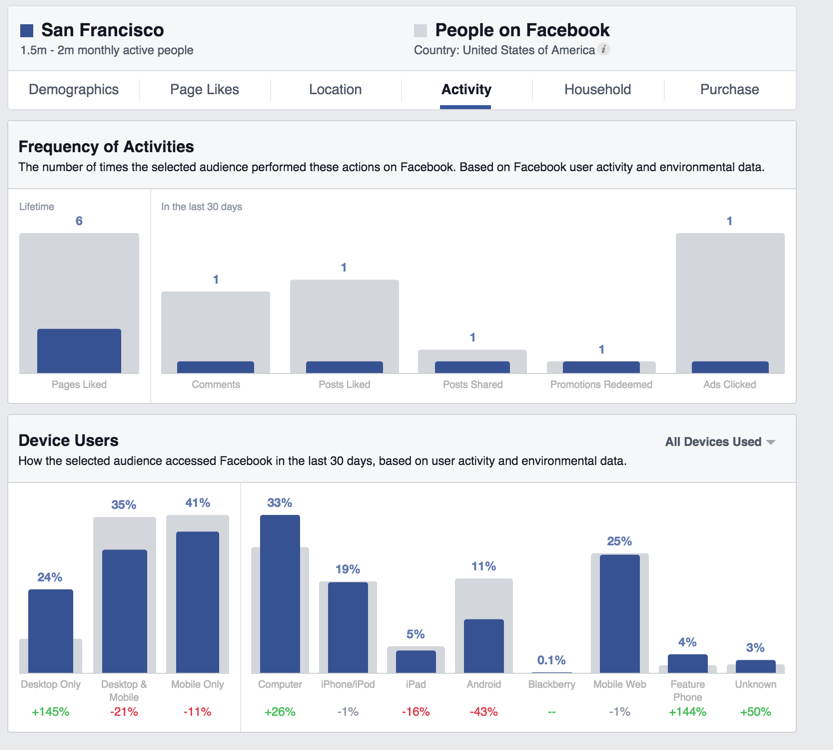
»Using Facebook’s Audience Insights tool (free to anyone who buys Facebook ads), I compared people from San Francisco and Palo Alto/Mountain View to those in New York City, Boulder/Denver and the nation as a whole.
In short, San Francisco / Silicon Valley people don’t click on ads…

San Francisco, California Activity Profile (Source: Facebook)

The average user in the United States has a value of 12 for “Ads Clicked” whereas a San Francisco user has only clicked 1 ad. Similarly, they appear not to be commenting or liking posts as frequently as the median national user. The story is very similar for the Mountain View / Palo Alto audience.«

This is like those people who work at junk food companies who would never eat their own output – they know what goes into it. (Leathern is working on a new approach to web advertising at optimal.com.)
link to this extract


Take video games seriously! Yes, they’re fun, but they matter culturally too » The Guardian

Naomi Alderman:

»Why do video games receive so little coverage in mainstream cultural media? It’s a question that’s troubled me for years – I even made a programme about it for Radio 4. Games are the largest entertainment medium in the world. And yet newspaper culture pages tend not to cover them (pace Observer Tech Monthly). Cultural programmes on TV and radio do a fun segment about games once a quarter at best while reserving discussion and analysis for interpretive dance or experimental opera.

It’s very weird for me: my novels, which sell tens of thousands of copies, are shortlisted for prizes that appear on the news. My games, which have sold millions of copies, don’t make the news. Film and TV Baftas are a news story. Games Baftas are an industry event.

I think this is a shame. It affects the way people think about the medium.«

OK, I’ll bite: a reason games aren’t treated as mattering culturally is because they have very little to tell us about our culture. Take a film like The Big Short or The Revenant or The Martian (the latter perhaps closest, in plot, to a video game).

Besides the mechanics of plot, each takes us into another person’s, or other peoples’, experiences: Steve Carrell’s character in Big Short is consumed by loathing of the vile business, yet unable to withstand the desire to profit from the dumb money. Leonardo Di Caprio’s holds onto life to avenge a death; Matt Damon’s goes through the emotions of loss, resignation, elation, and near-resignation. And like life, each film surprises us but tells us about the human experience.

And where’s the game that could evoke the same emotional reaction as ET – made in 1982 (that’s 34 years ago)?

Just because games sell in large numbers and generate lots of money doesn’t mean they have equivalent status as cultural artefacts as films. Fishing is the most popular (as in “has the most participants”) sport in the UK. Yet you don’t see it reported in newspapers (Fishing Times apart), whereas tennis is.
link to this extract


Why Xiaomi, Lenovo, and Huawei can’t compete with Apple » Tech in Asia

Charlie Custer:

»Chinese handset makers did quite well in 2015. But can they climb that cliff? Could they actually beat out Apple?

No. At least not in the sense of eating into Apple’s specific chunk of the market.

Why? For one, they don’t share a clear target market with Apple. Say what you will about Apple – and I’ve said some bad things in the very recent past – but it knows its market. And so do you, probably. Quick, picture an iPhone user. You’re probably picturing somebody young-ish, urban. Somebody who likes a simple user experience that doesn’t change much from model to model. Somebody who admires good industrial design, and who has the money to fit a $600-$800 phone into their budget.

Now, picture a Huawei user. It’s much harder because they’re all over the place. The prices range quite a bit, and the company offers dozens of different handset models. Lenovo is pretty similar. Even once-simple Xiaomi now offers three different major product lines with a confusing assortment of models in each line (do I want the Mi 4 or the Mi 4i or the Mi 4c?).

That’s not to say that none of these devices have clear target markets, of course, but none of them really overlap with the iPhone market. All three companies offer lower-priced devices, and because of their split focus they really can’t hope to compete with Apple’s single-minded focus when it comes to the iPhone market. They may be able to boost their numbers by picking up more users in developing regions, but none of the three is likely poaching any of Apple’s market anytime soon.

Plus, they’re not competing in the same ecosystem. Technologically speaking, there’s nothing on the iPhone that you can’t get on a dozen Android handsets except for one thing: iOS. And while I’ve argued that a lot of the native iOS apps are getting worse, there’s still no doubt that once a user buys into an ecosystem, it’s difficult to get them out of it.«

link to this extract


2017 to be the year of dual-lens cameras, says Sony » Android Authority

John Dye, noting that Sony has started a separate platform to support dual-lens cameras on phones:

»This seems to line up with some recent rumors trickling through the grapevine that the iPhone 7 Plus will be using a dual-lens camera module. However, Sony was quick to point out that they don’t believe this new form of camera will be anything close to mainstream for at least a year. The high-end smartphone market is slowing down globally. As a result, the demand for smartphone components is slackening, so Sony is banking on this new technology getting a start a little later than we may prefer. Chief financial officer Kenichiro Yoshida put it this way:

»Well, for next year, our so-called dual lens – dual camera platform will be launched by, we believe, from major smartphone players. However, as I said previously, recently, our smartphone market is growing and particularly, our high-end smartphone market is now slowing down. So, that may impact the demand or production schedule of dual camera smartphones by the major smartphone manufacturers. So, we believe the real start, the takeoff of smartphone with dual lens camera will be in the year of 2017.«

«

I read that “takeoff” as meaning “phones that aren’t iPhones”. Fingerprint sensors weren’t mainstream in 2013, but the iPhone 5S had one. And so on. (Though ZTE has a dual-lens camera on its top-end Axon phone, released last year.)
link to this extract


Verizon will now let users kill previously indestructible tracking code » ProPublica

Julia Angwin:

»Verizon says it will soon offer customers a way to opt out from having their smartphone and tablet browsing tracked via a hidden un-killable tracking identifier.

The decision came after a ProPublica article revealed that an online advertiser, Turn, was exploiting the Verizon identifier to respawn tracking cookies that users had deleted.

Two days after the article appeared, Turn said it would suspend the practice of creating so-called “zombie cookies” that couldn’t be deleted. But Verizon couldn’t assure users that other companies might not also exploit the number – which was transmitted automatically to any website or app a user visited from a Verizon-enabled device – to build dossiers about people’s behavior on their mobile devices.

Verizon subsequently updated its website to note Turn’s decision and declared that it would “work with other partners to ensure that their use of [the undeletable tracking number] is consistent with the purposes we intended.” Previously, its website had stated: “It is unlikely that sites and ad entities will attempt to build customer profiles.”«

Not quite a commitment not to track the hell out of you, though.
link to this extract


Errata, corrigenda and ai no corrida: none supplied.

Start up: Apple on software, 1970 reporting, Microsoft leaves ICOMP?, cycling’s new doping scandal, and more

Voters at the Iowa caucus were profiled and tracked via their phones – perhaps without knowing. Photo by ellenmac11 on Flickr.

»You can now sign up to receive each day’s Start Up post by email. You’ll need to click a confirmation link, so no spam.«

A selection of 13 links for you. Use them wisely. I’m charlesarthur on Twitter. Observations and links welcome.

(To help formatting on the email, I’ve added » and « on the blockquotes to make it clearer what is quoted, and what is my commentary.)

The Talk Show ✪: Ep. 146, with very special guests Eddy Cue and Craig Federighi » Daring Fireball

John Gruber:

»
Very special guests Eddy Cue and Craig Federighi join the show. Topics include: the new features in Apple’s upcoming OS releases (iOS 9.3 and tvOS 9.2); why Apple is expanding its public beta program for OS releases; iTunes’s monolithic design; how personally involved Eddy and Craig are in using, testing, and installing beta software; the sad decline of Duke’s men’s basketball team; and more.
«

This is, what, the second or third time I’ve recommended a podcast? This is an hour, and fascinating (with data points: iMessage peaked at 200,000 per second, there are 782m iCloud users – v 1bn devices in use, so do the maths – and 11m Apple Music subscribers, up from 10m in December).

Federighi’s point about how they tracked Bluetooth keyboard use for the Apple TV, and which calendar week it dwindled to zero, made me laugh aloud.

You can consider *why* Apple made Cue and Federighi available to Gruber, and it’s pretty obvious: they’re aiming to get their message out about Apple’s software and services quality, after all sorts of criticism lately. And that performance turns out to be pretty impressive – hundreds of millions of users who turn them on straight away that it goes live, such as iOS 9.0, iCloud Drive, and so on. Are they perfect? No. But they iterate to improvement pretty fast, given their scale.
link to this extract


Cycling’s mechanical-doping scandal » Business Insider

Daniel McMahon:

»
In the days that followed, the UCI said it had tested more than a hundred bikes at the world championships — and that it would be testing a lot more going forward:

»
The Union Cycliste Internationale (UCI) has taken the issue of technological fraud extremely seriously for many years. It has been clear for some time that the equipment exists to enable people determined to cheat to do so by installing devices hidden in bikes. That is why we’ve invested considerable time and financial resources in organising unannounced tests at races and have recently been trialing new methods of detection. We’ve also been using intelligence gathered from the industry and other information given to us. We tested over 100 bikes at the 2016 UCI Cyclo-cross World Championships in Heusden-Zolder and will continue to test large numbers of bikes at races throughout the season.
«

And sure enough, on Friday, February 12, the UCI announced it had tested another 90 bikes for motors, but this time at a road race in France.
«

This is weird. Motors in bicycles is A Thing. A Doping Thing.
link to this extract


64-bit iPhones and iPads get stuck in a loop when set to January 1, 1970 » Ars Technica

Peter Bright:

»
Take a 64-bit iOS device—iPhone 5S or newer, iPad Air or newer, iPad Mini 2 or newer, sixth generation iPod touch or newer—laboriously set its date to January 1, 1970, and reboot. Congratulations: you now have a shiny piece of high-tech hardware that’s stuck at the boot screen, showing nothing more than the Apple logo… forever.
«

From the highest-rated comment on the comments below the story:

»
It appears to solve itself when the internal clock is allowed to advance normally to a point when «current time» minus time zone is greater than zero.

(This may be why people are seeing a battery drain fix it or see it fixed when inserting a SIM card that supports carrier time information)
«

Versions of Bright’s story, all written from the same YouTube video, are all over the web. More informed (and stupider) comments can be found beneath them (where they allow comments). The more informed ones point out the errors.

It’s quite the problem for journalists: news editors clamour for the story now, but it’s hard to check all the details, and especially the causes. This isn’t a “forever” bug. But you need to get the story written. That lack of time to research and check erodes trust in outlets which have been quick to follow a YouTube video. It’s not “permanent”, it’s not “bricked”, it’s not “forever”.

Though they then get a second bite of the cherry with “how to fix” articles. (Answer: let the battery run down.)
link to this extract


This company tracked Iowa caucusgoers through their phones » Fusion

Kashmir Hill:

»
What really happened is that Dstillery gets information from people’s phones via ad networks. When you open an app or look at a browser page, there’s a very fast auction that happens where different advertisers bid to get to show you an ad. Their bid is based on how valuable they think you are, and to decide that, your phone sends them information about you, including, in many cases, an identifying code (that they’ve built a profile around) and your location information, down to your latitude and longitude.

Yes, for the vast majority of people, ad networks are doing far more information collection about them than the NSA–but they don’t explicitly link it to their names.

So on the night of the Iowa caucus, Dstillery flagged all the auctions that took place on phones in latitudes and longitudes near caucus locations. It wound up spotting 16,000 devices on caucus night, as those people had granted location privileges to the apps or devices that served them ads. It captured those mobile ID’s and then looked up the characteristics associated with those IDs in order to make observations about the kind of people that went to Republican caucus locations (young parents) versus Democrat caucus locations. It drilled down farther (e.g., ‘people who like NASCAR voted for Trump and Clinton’) by looking at which candidate won at a particular caucus location.
«

Deeply disturbing. You can bet that tons of those people had no idea that they were being profiled, or that their data was even being shared in that way.
link to this extract


Douglas Rushkoff: ‘I’m thinking it may be good to be off social media altogether’ » The Guardian

»
Ian Tucker: What do you find most objectionable about the kind of economy that technology appears to create?

Douglas Rushkoff: What’s most pernicious about it is that we are developing companies that are designed to do little more than take money out of the system – they are all extractive. There’s this universal assumption that we have to turn working currency into share price.
«

link to this extract


Microsoft looks to be retreating from EU antitrust fight against Google » Ars Technica

Quite a scoop from Kelly Fiveash:

»
Ars has learned that members including UK-based price comparison site Foundem—the original complainant in the antitrust case against Google—resigned from ICOMP after Microsoft backed away from what had been a dogged campaign against its search rival in Europe. ICOMP was founded in 2008 to fight for an “online competitive marketplace.”

One source told us that Microsoft had agreed to prop up ICOMP’s food, travel, and accommodation expenses without having any active involvement in the group.

In a letter from Foundem to ICOMP—seen by Ars—the company said: “In our view, an ICOMP that is prohibited from commenting on Google’s immensely damaging business practices is an ICOMP working against, rather than for, the interests of a fair, competitive online marketplace.”

Foundem added in its December 2 missive: “As a leading complainant in the European Commission’s ongoing competition investigation into Google’s search manipulation practices, Foundem cannot be a member of an organisation that has turned its back on such an important issue.”

Ars asked Microsoft to comment on this issue to confirm claims that its fight against Google on search in the EU was effectively over. It did not respond directly to that question, however. Instead we were told that Microsoft’s complaint against Google in the European Commission had not been withdrawn.
«

Fiveash has been covering the Google/Microsoft proxy battle for years since she was at The Register. But it sounds as though Satya Nadella, having gotten rid of the vicious ex-political lobbyist Mark Penn, is dialing down the quiet lobbying.
link to this extract


How to gain unauthorized fingerprint access to an LG V10 » AndroidAuthority

John Dye:

»
If this person isn’t running Nova Launcher, the game’s up here. This vulnerability is only known to work on this particular launcher so far, so if your quarry is operating Google Now then they are safe from your malicious intent. However, if they are running Nova Launcher, you can tap the Home button while on the main home screen, then tap the Widgets option. Add a Nova Action widget to the home screen, and then choose the activity “com.lge.fingerprintsettings.”

Pause here for a second, because this is where the vulnerability exists. Through the normal Settings menu, it’s impossible to access this particular activity before going through a security checkpoint and confirming either a fingerprint or PIN. However, since Nova is able to ignore the normal menu flow that leads to this screen, it creates a situation where a user can add their own fingerprint to the list of allowed fingerprints without ever proving that they have authorized access to the device.

The widget on the homescreen will now lead directly to fingerprint settings, and you can add your own fingerprint before deleting the widget, leaving little trace of your actions.
«

Nova Launcher presently has more than 10m downloads, so it’s possible you’d find it on a high-end phone. Commenters suggest it can be done on a Samsung Galaxy S5 and S6 too.

Sure that this will be all over news sites in a day or so of course with hundreds of comments. No?
link to this extract


Researcher illegally shares millions of science papers free online to spread knowledge » ScienceAlert

»
A researcher in Russia has made more than 48 million journal articles – almost every single peer-reviewed paper every published – freely available online. And she’s now refusing to shut the site down, despite a court injunction and a lawsuit from Elsevier, one of the world’s biggest publishers.

For those of you who aren’t already using it, the site in question is Sci-Hub, and it’s sort of like a Pirate Bay of the science world. It was established in 2011 by neuroscientist Alexandra Elbakyan, who was frustrated that she couldn’t afford to access the articles needed for her research, and it’s since gone viral, with hundreds of thousands of papers being downloaded daily. But at the end of last year, the site was ordered to be taken down by a New York district court – a ruling that Elbakyan has decided to fight, triggering a debate over who really owns science.

“Payment of $32 is just insane when you need to skim or read tens or hundreds of these papers to do research. I obtained these papers by pirating them,” Elbakyan told Torrent Freak last year. “Everyone should have access to knowledge regardless of their income or affiliation. And that’s absolutely legal.”…

… She also explains that the academic publishing situation is different to the music or film industry, where pirating is ripping off creators. “All papers on their website are written by researchers, and researchers do not receive money from what Elsevier collects. That is very different from the music or movie industry, where creators receive money from each copy sold,” she said.
«

The journals’ argument is that they add value by getting papers peer-reviewed, and edited, and choosing the important ones to publish. The existence of free unpeered sites such as Arxiv hasn’t noticeably dented their business.

But it always feels wrong when publicly funded research in particular ends up behind giant paywalls. If the public pays for the research, the public should be able to see its fruits.
link to this extract


Evidence suggests the Sony hackers are alive and well and still hacking » WIRED

Kim Zetter:

»
According to new data released this week by Juan Andrés Guerrero-Saade, senior security researcher with Kaspersky Lab’s Global Research and Analysis Team, and Jaime Blasco who heads the Lab Intelligence and Research team at AlienVault Labs, the hackers behind the Sony breach are alive and well…and still hacking. Or at least evidence uncovered from hacks of various entities after the Sony breach, including South Korea’s nuclear power plant operator, suggests this later activity has ties to the Sony case.

“[T]hey didn’t disappear…not at all,” Guerrero-Saade said during a presentation with Blasco this week at the Kaspersky Security Analyst Summit in Spain.

If true, it would mean the hackers who demonstrated an “extremely high” level of sophistication in the Sony attack have been dropping digital breadcrumbs for at least the last year, crumbs that researchers can now use to map their activity and see where they’ve been. The clues include—to name a few—re-used code, passwords, and obfuscation methods, as well as a hardcoded user agent list that showed up repeatedly in attacks, always with Mozilla consistently misspelled as “Mozillar.”
«

link to this extract


So who’s going to buy Pandora? » Music Business Worldwide

Tim Ingham:

»
the US public company has reportedly begun talking to Morgan Stanley about finding a potential buyer.

As we stand, Pandora, for all its historical global licensing issues and growing annual net losses, looks a little like a bargain.

The company has lost $7bn in market cap valuation over the past two years. It’s currently sitting at $1.9bn – less than a quarter of Spotify’s latest private valuation.

However, there are other reasons why possible acquirers may cool their jets on Pandora – not least the fact that its active listener base is dropping, down year-on-year in Q4 2015 to 81.1m.

In addition, the firm’s acquisition of Rdio’s assets means an entry into the hugely competitive space of interactive music streaming is an inevitability, while it paid a scary $450m to buy Ticketfly last year – a sister operation that contributed just $10m to the bottom line in Q4.

So who might cough up and buy Pandora if (and it’s a big if) its shareholders agree to push for a sale?
«

Suggestions: Google, Apple, IHeartMedia, Samsung. Can’t honestly see any of them wanting it, rather than just waiting for it to vanish.
link to this extract


Why mobile is different » The Economist

Anonymous, as ever with The Economist:

»
the combination of personalisation, location and a willingness to pay makes all kinds of new business models possible. Tomi Ahonen, head of 3G Business Consulting at Nokia, gives the example of someone waiting at a bus stop who pulls out his Internet-capable phone to find out when the next bus will arrive. The information sent to the phone can be personalised, reflecting the fact that the user’s location is known, and perhaps his home address too; so bus routes that run from one to the other can appear at the top of the list, saving the user from having to scroll and click through lots of pages and menus. A very similar service, which allows users to find out when the next bus is due by sending a text message from a bus stop, is already available in Italy.

Would-be providers of mobile Internet services cannot simply set up their servers and wait for the money to roll in, however, because the network operators—who know who and where the users are, and control the billing system—hold all the cards. This has changed the balance of power between users, network operators and content providers. On the fixed Internet, the network access provider acts as a “dumb pipe” between the user’s PC and, say, an online bookstore or travel agent. The access provider will not know how the connection has been used, and there is no question of claiming a commission. Mobile network operators, on the other hand, are in a far more powerful position. “Wireless is a smarter pipe,” says Chris Matthiasson of BT Cellnet. This means that operators are much less likely to be disintermediated.
«

The sharp-eyed will have started in the second sentence; others, in the second paragraph. That’s because this piece is from October 2001. It took a while, but the operators are pretty thoroughly disintermediated now.
link to this extract


TfL social media: adapting to Twitter’s changes » TfL Digital blog

Steven Gutierrez of Transport for London, which runs London’s buses and underground services:

»
in the last few years, Twitter has introduced various changes to the way it serves content to its users, and these have impacted upon our ability to reliably deliver these real-time status updates to our followers.

Now selected content on Twitter is shown out of sequence, we will reduce the amount of minor alerts and focus on providing up-to-the-minute alerts for major issues, as well as a renewed focus on customer service across our various accounts.

Our teams will continue to work day and night to support customers including First Contact who take care of the Tube line Twitter feeds as well as CentreComm and LSTCC who have access to everything from iBus (our system for tracking London Buses) to police helicopters monitoring London from above.
«

Wow: you think Twitter is a static thing, but these changes really do affect what happens. The point about image search shows it’s not trivial either.
link to this extract


Artificial intelligence offers a better way to diagnose malaria » Technology Review

Anna Nowogrodzki:

»
For all our efforts to control malaria, diagnosing it in many parts of the world still requires counting malaria parasites under the microscope on a glass slide smeared with blood. Now an artificial intelligence program can do it more reliably than most humans.

That AI comes inside an automated microscope called the Autoscope, which is 90 percent accurate and specific at detecting malaria parasites. Charles Delahunt and colleagues at Intellectual Ventures Laboratory—the research arm of Nathan Myhrvold’s patent licensing company Intellectual Ventures in Seattle—built the system with support from Bill and Melinda Gates through the Global Good Fund. The Autoscope was tested in the field at the Shoklo Malaria Research Unit on the Thailand-Myanmar border during malaria season in December 2014 and January 2015. The results were published in December.
«

If I’m reading the results correctly, it got about 95% accuracy. (Correct me if I’m wrong.)

My own forecast is that “an [AI] algorithm for..” will be the “listen to this!” phrase of 2016, and utterly commonplace in 2017.
link to this extract


Errata, corrigenda and ai no corrida: None noted.

Start up: Twitter’s falling tweet count, Google forgets more, cops v iPhone, how gravity waved, and more

The new essential tool for Indian farmers. Photo by Desiree Catani on Flickr.

It’s Friday! Save yourself a click on Monday – sign up to receive each day’s Start Up post by email. You’ll need to click a confirmation link, so no spam.

(Someone told me the other day that they’d been reading the site for weeks and hadn’t noticed the signup in the above paragraph. Web design, eh?)

A selection of 8 links for you. Friday! I’m charlesarthur on Twitter. Observations and links welcome.

Twitter API data show the number of tweets is in serious decline » Business Insider

Jim Edwards:

The number of tweets per day created by Twitter’s users has fallen by more than half since a peak in August 2014, according to a sampling of data from Twitter’s API. (An API — application programming interface — is the portal through which other apps access Twitter so their software can function together.) The data was given to Business Insider by an app developer who has tracked Twitter users since 2013.

Tweets per day reached a peak in August 2014 of 661m, our source says. That 30-day sampling period included the World Cup final. In January 2016, there were only 303m tweets per day, on average, during the 30-day period.

This story came out before Twitter’s results, which showed the number of users was flat at best. Twitter responded at the time that “This data is not correct”; but it begins to feel correct. My only suspicion though is that Twitter now doesn’t use sequential tweet IDs, so the sampling method might be sensitive to that. More detail on how the sampling is done would be useful.
link to this extract


WhatsApp is changing the way people in India grow and buy food » TakePart

Sarah McColl:

Farmers Santhosh Kittur and Abhijit Kamath wanted to grow pesticide-free vegetables between the rows of banana plots each separately owned. Their shared interest in old-fashioned agricultural practices brought them together to grow bitter gourd, cucumbers, beans, cabbage, tomatoes, green chiles, red peppers, onions, and garlic—staples of the Indian customers and kitchens they planned to serve. But their modern approach to marketing has put them in direct contact with customers in a high-tech manner.

Across India, WhatsApp groups are not only connecting farmers to their customers in the virtual market—they’re creating a network of resources and support for the country’s farmers who need it most.

In Kittur and Kamath’s WhatsApp group, created last August, the two farmers post updates from their farms, including photographs, as well as what produce is available to the group’s 80 members. Vegetables are sold on Thursdays and Sundays. Members can place dibs on the quantity of specific vegetables they want and can pick up their order or have it delivered.

There’s a famous piece of research by Upsalla University from 2006 about how mobile phones benefited Tanzanian fishermen. It would be good to see a comparable piece of research around smartphone apps in emerging economies.

(And it’s always amusing to hear Americans’ amazement that people use Whatsapp. Like SMS in the early part of this century, it’s huge outside the US, small inside it.)
link to this extract


Apple entrusts TSMC with all application processor orders for iPhone 7 » ETNews Korea

Han Juyeop:

Taiwan’s TSMC has won a battle against Samsung Electronics and is going to produce 10-nano application processors (AP) that will be installed in Apple’s upcoming iPhone7. Samsung Electronics has entered a state of emergency system to prevent declination of rate of operation of factories.

Samsung Electronics is aiming for an all-out-war in 14-nano foundry business by going after middle-rank chip businesses in China and Taiwan instead and it is also going to focus its capabilities on maintaining supplies of Qualcomm’s 10-nano. It is also important for Samsung Electronics to plan out high-intensity innovations so that it can take back Apple’s supplies in 7-nano.

According to semiconductor IP and EDA industries on the 10th, Apple has entrusted TSMC with all production of next 10-nano AP called ‘A10’. A10 is so called a brain of iPhone7, which is expected to be released in this fall. TSMC is planning to enter a state of mass-production system of 10-nano chips starting from June.

Recall that Apple dual-sourced from both TSMC and Samsung for the iPhone 6S/Plus, though the TSMC ones seemed to do slightly worse on battery than the Samsung ones.

If true, this is going to hurt Samsung: Apple is a big customer, and the semiconductor division is now the most profitable one, well ahead of smartphones.
link to this extract


Gravitational waves exist: the inside story of how scientists finally found them » The New Yorker

Nicola Twilley:

It took years to make the most sensitive instrument in history insensitive to everything that is not a gravitational wave. Emptying the tubes of air demanded forty days of pumping. The result was one of the purest vacuums ever created on Earth, a trillionth as dense as the atmosphere at sea level. Still, the sources of interference were almost beyond reckoning—the motion of the wind in Hanford, or of the ocean in Livingston; imperfections in the laser light as a result of fluctuations in the power grid; the jittering of individual atoms within the mirrors; distant lightning storms. All can obscure or be mistaken for a gravitational wave, and each source had to be eliminated or controlled for. One of LIGO’s systems responds to minuscule seismic tremors by activating a damping system that pushes on the mirrors with exactly the right counterforce to keep them steady; another monitors for disruptive sounds from passing cars, airplanes, or wolves.

“There are ten thousand other tiny things, and I really mean ten thousand,” Weiss said. “And every single one needs to be working correctly so that nothing interferes with the signal.” When his colleagues make adjustments to the observatory’s interior components, they must set up a portable clean room, sterilize their tools, and don what they call bunny suits—full-body protective gear—lest a skin cell or a particle of dust accidentally settle on the sparkling optical hardware.

This is the one story to read today about this amazing finding. Detail and insight.
link to this extract


Nextbit’s cloud-savvy Robin phone is set to fly. Good luck catching one – CNET

Roger Cheng:

Chief Design Officer Scott Croyle warns that the early supply will be limited.

“There will be maybe 3,000 to 6,000 phones available,” he said in an interview Wednesday. In comparison, Apple sold 13m iPhone 6S and iPhone 6S Pluses in their first three days.

The launch of the online store and the Robin marks the culmination of an unorthodox journey for a phone maker. Rather than go through a carrier, which is how most people shop for handsets, or even set up an online store, Nextbit tested the waters by asking for commitments through Kickstarter and nearly tripled its goal of raising $500,000.

Nextbit isn’t the typical unknown startup. Co-founders Tom Moss and Mike Chan were part of Google’s original Android team. Croyle was behind the critically acclaimed HTC One phone.

But this is part of the future for smartphones – niche players offering a quirk (in this case, tons of cloud storage) which don’t need huge capitalisation because they sell online with low inventory.
link to this extract


What Everyone’s Got Wrong About Twitter (Including Twitter) » Re/code

Ian Schafer is founder and chairman of Deep Focus:

Twitter is a platform unlike any other, in that it has enough real-time data and intelligence that can be mapped against over 300 million active users. These users are more likely to be more influential and use other media concurrently (especially TV).

Therefore, a compelling argument can be made that, if used properly, Twitter’s real-time user behavior and media-consumption data can be among the most valuable consumer data. In most cases, advertisers will be willing to pay a premium for that. But because so many scrutinize Twitter’s ad experience, doubts abound.

There’s a lot of talk from people who want Twitter to open up its APIs again. I think they’re half-right.

If Twitter wants to realize its full potential, it will make its data completely portable for advertisers, becoming the primary source for real-time business and consumer intelligence. It will use its (and its users’) media savviness to feed a global dataset that ad exchanges, app developers, advertisers and corporations will pay increasingly large amounts of money to access, making it a media-led data company. It has already displayed success in this area; the Twitter Audience Platform and MoPub have gained traction, and with Facebook’s Parse shutting down, Twitter’s Fabric toolkit should gain traction with third-party app developers, as well.

Can you guess that Deep Focus is an ad agency?
link to this extract


Google to scrub web search results more widely to soothe EU objections » Reuters

Julia Fioretti:

The French data protection authority in September threatened to fine Google if it did not scrub search results globally across all versions of its website, such as Google.com.

But the company has stuck to its position that it should clean up search results only on European domains such as Google.fr or Google.de because to do otherwise would have a chilling effect on the free flow of information.

To address the concerns of European authorities, the Internet giant will soon start polishing search results across all its websites when someone conducts a search from the country where the removal request originated, a person close to the company said.

That means that if a German resident asks Google to de-list a link popping up under searches for his or her name, the link will not be visible on any version of Google’s website, including Google.com, when the search engine is accessed from Germany.

The company will filter search results according to a user’s IP address, meaning people accessing Google from outside Europe will not be affected, the person added.

Since the ruling in 2014, Google has received 386,038 requests for removal, according to its transparency website. It has accepted about 42% of them.

The lesson one tends to draw from this is “the threat of a fine makes Google act”.
link to this extract


Police destroy evidence with 10 failed passcode attempts on iPhone » Naked Security

Lisa Vaas:

In January 2014, a Massachusetts cop was swearing into his mobile phone while working a traffic detail at a construction site.

The F bombs appeared to upset an elderly lady walking by, so a man on a nearby front porch asked the officer, Thomas Barboza, to stop swearing.

The cop’s response: “Shut the f–k up and mind your own business.”

George Thompson’s response: he started recording Barboza on his iPhone.

According to court documents, Barboza shoved 53-year-old Thompson to the ground, arrested him, handcuffed him, and put him in jail for a night.

Police in the city of Fall River also tried to get into Thompson’s iPhone, where the footage of Barboza was stored.

But all the police managed to do was to destroy the evidence, wiping the phone clean after entering the wrong password 10 times.

Really clear that the cops wanted to get into the phone to wipe the evidence. (They accused Thompson of wiping it remotely; a forensics report showed that was a lie.) Yet another instance where security of the phones is potentially a good thing for the citizenry.
link to this extract


Errata, corrigenda and ai no corrida:

Start up: hedge funds like AI, Facebook’s close separation, what if Twitter died?, BlackBerry cuts, and more

A break like this, affecting the home button, is probably going to lead in time to an #error53 fault if you don’t get it repaired by Apple. But what causes it, exactly? Photo by wZa HK on Flickr.

You can now sign up to receive each day’s Start Up post by email. You’ll need to click a confirmation link, so no spam.

A selection of 12 links for you. Use them wisely. I’m charlesarthur on Twitter. Observations and links welcome.

Will AI-powered hedge funds outsmart the market? » MIT Tech Review

Will Knight:

Anthony Ledford, chief scientist of MAN AHL, explains that the company is exploring whether techniques like deep learning might lend themselves to finance. “It’s at an early stage,” Ledford says. “We have set aside a pot of money for test trading. With deep learning, if all goes well, it will go into test trading, as other machine-learning approaches have.”

Trading might seem like an obvious place to apply deep learning, but actually it isn’t clear how comparable the challenge of finding subtle patterns in real-time trading data is to, say, spotting faces in digital photographs. “It’s a very different problem,” Ledford admits.

Academic experts also sound a note of caution. Stephen Roberts, a professor of machine learning at Oxford University, says deep learning could be good “for extracting hidden trends, information, and relationships,” but adds that it “is still too brittle with regard to handling of high uncertainty and noise, which are prevalent in finance.”

You just know that this isn’t really going to work, but also that it’s going to be used by a ton of funds to try to get ahead of the market – a market composed of other funds also trying to use the same processes.
link to this extract


iOS security – iOS 9 or later » Apple

Let’s try to get on top of this #error53 stuff:

During an iOS upgrade, iTunes (or the device itself, in the case of OTA software updates) connects to the Apple installation authorization server and sends it a list of cryptographic measurements for each part of the installation bundle to be installed (for example, LLB, iBoot, the kernel, and OS image), a random anti-replay value (nonce), and the device’s unique ID (ECID).

The authorization server checks the presented list of measurements against versions for which installation is permitted and, if it finds a match, adds the ECID to the measurement and signs the result. The server passes a complete set of signed data to the device as part of the upgrade process. Adding the ECID “personalizes” the authorization for the requesting device. By authorizing and signing only for known measurements, the server ensures that the update takes place exactly as provided by Apple.

The boot-time chain-of-trust evaluation verifies that the signature comes from Apple and that the measurement of the item loaded from disk, combined with the device’s ECID, matches what was covered by the signature.

These steps ensure that the authorization is for a specific device and that an old iOS version from one device can’t be copied to another. The nonce prevents an attacker from saving the server’s response and using it to tamper with a device or otherwise alter the system software.

To recap, with #error53, people who have had third-party replacements of screens and/or home buttons on the iPhone 6/Plus and 6S/Plus (but not the 5S) find that it works fine – though they can’t use TouchID (it’s greyed out as an option). But when they do an OS update, the phone bricks: can’t get data, can’t restore.

So my understanding of this is: the reason why devices which have had third-party replacement parts only brick after an OS update, yet work fine before it, is this: on trying to install the update they connect to the auth server. The server decides that the cryptographic measurements no longer match what it has on record. So it decides the chain of trust is broken, and effectively shuts down the device.

But it’s poor decision-making by Apple, and equally poor communication. Why doesn’t it happen on the 5S? Update: because the 5S doesn’t have NFC for Apple Pay. (Thanks, Andy.) What’s the process that Apple uses when it does the repair to revalidate the TouchID system (which fails even with valid parts)? Why can’t the system tell that it’s just TouchID that’s affected? The safety process has overshot its requirements. Every part of what happens makes sense from a security perspective  – but not if considering that many people will get third-party repairs.
link to this extract


Three and a half degrees of separation » Research at Facebook

How connected is the world? Playwrights, poets, and scientists have proposed that everyone on the planet is connected to everyone else by six other people. In honor of Friends Day, we’ve crunched the Facebook friend graph and determined that the number is 3.57. Each person in the world (at least among the 1.59 billion people active on Facebook) is connected to every other person by an average of three and a half other people. The average distance we observe is 4.57, corresponding to 3.57 intermediaries or “degrees of separation.” Within the US, people are connected to each other by an average of 3.46 degrees.

Our collective “degrees of separation” have shrunk over the past five years. In 2011, researchers at Cornell, the Università degli Studi di Milano, and Facebook computed the average across the 721 million people using the site then, and found that it was 3.74 [4,5]. Now, with twice as many people using the site, we’ve grown more interconnected, thus shortening the distance between any two people in the world.

Apparently my average is 3.26 so ya boo. Zuckerberg is 3.17. Sheryl Sandberg is 2.92 – blimey.
link to this extract


On your cute release notes » The Brooks Review

Ben Brooks:

We’ve all seen them. Notes about a fictional engineer who was hired and then fired. A cute story about something completely irrelevant to the matter at hand. Recipe for ‘squash bug soup’ or something along those lines.

With disturbingly increasing frequency, companies are deciding to let their marketing departments handle their release notes instead of the engineering team or product manager.

And we are all worse off for it.

As a user I mostly look at release notes to find out about one (or more) of three things:

• Have you added something new to the app which will make it better for me? That is: what are the new features, what do those features do, and perhaps how do I get to them.
• Have you fixed that bug which was making the app hard for me to use, perhaps even impossible for me to use? Aka: What bugs did you fix?
• How active is development on this app? Before I invest or move to most apps I look at recent release notes to get a sense of whether they are in maintenance mode (just major bug fixes), or under some kind of active development (minor bug fixes and feature releases, optimized for current version of iOS, etc).

link to this extract


BlackBerry cuts 200 jobs in Ontario and Florida to trim costs » Reuters

Alastair Sharp:

The layoffs will affect 75 manufacturing jobs in Sunrise, Florida, a state government website showed.

The company also confirmed that Gary Klassen is one of the people who has departed in the latest round of cuts. Klassen was one of its longest-tenured employees and the inventor of its BBM messaging service.

One source familiar with the matter, who declined to be identified due to the sensitivity of the issue, said many of the Canadian cuts were people working on its BB10 handset software at its Waterloo, Ontario, headquarters.

A spokeswoman for BlackBerry declined to comment on which divisions will be affected by the cuts, but said the company stood by its commitment to release further updates on its BB10 software.

BB10 is so, so dead.
link to this extract


“Dangerous ramifications” » Medium

Rohin Dharmakumar, with some examples of things that didn’t happen:

In January 2015, users of Microsoft’s Office in India were suddenly greeted with a pop-up asking them to “Support Microsoft Office”. The Indian government under PM Narendra Modi was said to be formulating an “Open Source Policy” under which all government offices were to either mandate or prefer open-source software for official work.

Clicking the “Support Office” button caused Microsoft to send the PMO and the Ministry of IT a letter from the user’s name with a pre-determined format. It said the user’s loved Microsoft’s products and wanted their government interactions to be based on the same. “I urge you not to ban Microsoft Office,” it ended.

The same message popped up on users of various Microsoft products in India – Windows, XBox, Windows Phone, Skype etc.

Within a few weeks, over 7 million emails had been sent in support to Microsoft.

“Support Monsanto”

In January 2014, farmers in the southern Indian state of Karnataka were surprised to see a notice attached to every bag of seed they bought from Mahyco, the market leader.

“Tell the Karnataka Govt. not to ban MMB”, said the notice. MMB was Monsanto-Mahyco Biotech, the joint-venture that licensed Monsanto’s crop technologies in India.

He has some more examples of things that didn’t happen – and then one which did.
link to this extract


Why most A/B tests give you bullshit results » Mixpanel

We’ve all seen the articles. Company X increases conversions 38% with this simple trick. Hell, I’ve written some of them.

But those success stories have hidden the grey underbelly of testing and experimentation.

AppSumo revealed that only 1 out of 8 tests produce results. Kaiser Fung estimates that 80 to 90 percent of the A/B tests he’s run yield statistically insignificant results.

Yet many new testers walk into A/B testing thinking it’ll be quick and easy to get results. After running a handful of simple tests, they think they’ll find the right color for this button or the right tweak to that subject line, and conversions will, poof, increase by 38% like magic.

Then they start running tests on their apps or sites, and reality suddenly sets in. Tests are inconclusive. They yield “statistically insignificant” results and no valuable insights about the product or users. What’s happening? Where’s that 38% bump and subsequent pat on the back?

Don’t get frustrated. If you’re going to be running A/B tests, you’re going to have some tests that fail to produce meaningful results you can learn from. But if you run good tests, you’ll have fewer failures and more successes.

link to this extract


Advice for companies with less than one year of runway » The Macro

Dalton Caldwell:

Let’s imagine that you are the founder of a company that has successfully raised an angel or institutional round and are currently in a situation where you have 12 months or less of runway.

The hardest part of dealing with a low runway situation is managing your own psychology. You have to simultaneously manage your own anxiety to not be overly negative about your prospects, but also not be irrationally positive. It’s a delicate balance.

Watch companies do the various things in this post over the next year or so.
link to this extract


Technology: the rift with reality » FT.com

Tim Bradshaw:

With so many [virtual reality] headsets hitting the market this year, the challenge may be figuring out what people will do with them. Video games are seen as the first popular application, and some are experimenting with VR versions of films including The Martian. Futuresource Consulting believes the VR content market could be worth $8.3bn within four years.

Beyond entertainment, advocates say these headsets could transform education, travel, real estate and architecture, not to mention videoconferencing and social networking. Some inside Uber are worried that Oculus could one day prove disruptive to their business by removing the need for people to travel. Why hail a taxi when you can teleport?

“Whenever a market is this early, you have to have strong convictions loosely held,” says Nabeel Hyatt, a venture partner at Spark Capital, which also backed Oculus. “We don’t know what’s going to happen.”
That uncertainty provides fertile ground for entrepreneurs. “There will be billion-dollar companies started by college students because someone gave them a Rift as a present and they solved a very specific problem,” says Anjney Midha, a partner at KPCB Edge.

However, as any sci-fi reader knows, new technologies have inherent risks, too. The futures depicted in Ready Player One and Snow Crash are dystopian and chaotic.

In December, academics led by Christian Sandor of the Nara Institute, Japan, wrote that “true augmented reality”, where the digital is indistinguishable from the physical, “will be the most powerful medium that humanity ever had at its disposal”.

link to this extract


What if Twitter Died? » Tech.pinions

Bob O’Donnell:

this seems to be one of the fundamental problems of Twitter. It’s appealing to Hollywood, TV, music and sports celebrities as a means to interact more intimately with their fans and share the kinds of details they’d never provide to traditional celebrity media. It’s appealing to the tech industry as a mouthpiece for those who want to determine the course of what is or isn’t important. The digital taste-setters, so to speak.

But for mainstream business and consumer users? Not so much. Arguably, this is the biggest problem with Twitter—it can’t seem to stretch beyond its celebrity, celebrity follower, and tech roots. If you aren’t into celebrities or the tech industry, Twitter just isn’t that appealing, especially given all the other options for online social interactions.

Despite these points, I think the navel gazing value of Twitter to the tech industry is so high, I seriously doubt they’ll let Twitter actually die. Someone with enough money and enough self-interest will likely make sure that, no matter what, Twitter will continue in some shape or form. Eventually, it’s value may start to fade, as some have already started to argue, but at least the Twittersphere will have a few years to adapt and find new alternatives.

The fundamental challenge is a publishing service that’s essentially based on self-promotion, self-aggrandizement, and self-importance at some point is going to run into the wall of indifference. Not everyone cares to read about what the self-elected are all doing all the time.

link to this extract


Yahoo loses mobile entrepreneur Arjun Sethi to venture firm » WSJ

Douglas MacMillan:

Mr. Sethi helped lead Yahoo’s effort to compete with Facebook Inc.FB -2.29% and Snapchat Inc. in the emerging area of mobile chat apps. Last July, his team released Livetext, a mobile app that lets users send live video and text without any sound.

Livetext failed to take off with users. In its first month, the program dropped out of the ranking of the 1,000 most popular apps in Apple Inc.’s app store and never returned, according to data from App Annie.

Yahoo’s struggles to produce a hit mobile app has hurt Ms. Mayer’s chances at turning around the 20-year-old Internet icon. This week, Yahoo said its board is weighing “strategic alternatives” to the turnaround which likely include a sale of its core Web business…

…Mr. Sethi is one of dozens of startup founders Ms. Mayer brought into Yahoo through a series of small acquisitions. In her three-and-a-half years as CEO, Yahoo has spent more than $2.3bn on at least 53 acquisitions, largely for small mobile-software developers whose apps were shuttered and whose founders were enticed to work on new projects at the company. At least 26, or over one-third, of the more than 70 startup founders and CEOs who joined Yahoo through an acquisition during Ms. Mayer’s tenure have left the company, according to their profiles on LinkedIn Corp.

As has also been pointed out, Yahoo last week wrote down the value of those acquisitions by $1.2bn. The idea of a video app without sound appears dumb, but then again lots are like that; but Instagram, Facebook and Vine were all there ages earlier. Yahoo’s problem is that it’s late and has no traction in mobile, not that the ideas are of themselves bad.
link to this extract


Sacked in Dublin by a boss in… London » Private Eye

Private Eye is always anonymous:

Google’s claim that all its real business is handled through its European HQ in Dublin while its multiple UK offices exist merely to count the paperclips, organise staff leaving collections and do the morning coffee run is further undermined by evidence it gave to an employment appeals tribunal in the Irish capital in 2013.
Rachel Berthold had been sacked in May 2011 from a position as a “level six” manager, which the tribunal heard put her in the top 7% of employees in Google’s Dublin office.

Anne-Catrin Sallaba, her former boss as Google Europe’s Head of Publisher Services, gave evidence to the tribunal that Berthold had failed to meet performance targets – but Sallaba had to cross the Irish sea to do so, given that as Berthold’s line manager she was employed in, er, London.

Berthold was eventually awarded €100,000 for unfair dismissal. Sallaba has in the meantime been promoted twice, and now rejoices in the job title “Senior People Development Manager, Head of Global Onboarding” – still in London!

As it happens, Matt Brittin of Google UK will be testifying before the UK Parliament this week.
link to this extract


Errata, corrigenda and ai no corrida:

Start up: Apple’s phone expectations, Amazon’s giant backdoor, mobile adblocking grows, and more


Virtual reality attracts interest, but where’s the storytelling? Photo by Nick Habgood on Flickr.

Shh! It’s a secret, but you can sign up to receive each day’s Start Up post by email. You’ll need to click a confirmation link, so no spam.

A selection of 11 links for you. Not attributable to tributaries. I’m charlesarthur on Twitter. Observations and links welcome.

Apple 1Q16 Earnings Preview » Above Avalon

Neil Cybart:

Investor anxiety heading into Apple’s upcoming earnings report is at a multi-year high. Fears surrounding slowing iPhone 6s and 6s Plus sales have morphed into broad questions about the iPhone’s long-term viability. While investors are looking for answers that won’t likely be provided this week, management has a very clear goal with its 1Q16 earnings report and conference call: set expectations for 2016.

Cybart reckons in the just-gone quarter to December (Apple’s first fiscal quarter of its financial year) Apple has sold around 77m iPhones, 18m iPads and 5.7m Macs. He also gives gauges for what is low and high. Apple announces its earnings on Tuesday evening (and LG will have published its own by the time you read this).
link to this extract


IAB chief blasts Adblock Plus as an ‘immoral, mendacious coven of techie wannabes’ » Adweek

Christopher Heine:

When Adblock Plus said it had been “disinvited” from this week’s Interactive Advertising Bureau’s Leadership Summit, it raised virtual eyebrows across the Web. Wasting little time and mincing no words, the IAB’s leader kicked off the event by firing back.

“Now, you may be aware of a kerfuffle that began about ten days ago, when an unethical, immoral, mendacious coven of techie wannabes at a for-profit German company called AdBlock-Plus took to the digisphere to complain over and over that IAB had ‘disinvited’ them to this convention,” CEO Rothenberg told the audience in his opening keynote Monday. “That, of course, is as much a lie as the others they routinely try to tell the world…”

…Eyeo GmbH-owned Adblock Plus’ ticket was pulled, Rothenberg said, “for the simple reason that they are stealing from publishers, subverting freedom of the press, operating a business model predicated on censorship of content, and ultimately forcing consumers to pay more money for less — and less diverse — information. AdBlock Plus claims it wants to engage in dialogue. But its form of dialogue is an incessant monologue.”

Well, they had an invitation (which they had to pay for, like everyone else), and then it was withdrawn. Clearly, no Christmas cards between these two. (I’m going to go to Adblock Plus’s meeting in London in a week or so.)
link to this extract


37% of mobile users are blocking ads » Global Web Index

Jason Mander:

According to GWI’s latest wave of research, it’s a significant 37% of mobile users who say they’ve blocked ads on their mobile within the last month. That’s a pretty sizable number if you consider that these tools have only relatively recently come to the attention of consumers. It also shows just how keen users are to improve their mobile experience and to prevent their data allowances and battery lives from being drained.

No less striking is that another 42% of users say they haven’t blocked ads so far but are interested in doing so in the future. That means almost 80% of the mobile audience could be engaging with blockers before too long – a stat which underlines why this is a trend which is unlikely to burn out any time soon.

Big numbers. People have responded by saying that they’re not seeing those figures, but equally adblockers often block Google Analytics too – so adblocking users are ghosts; you’d have to check against server logs to see what’s really happening. GWI has a large sample base, weighted towards the US and UK, though it doesn’t say how many were sampled for this particular survey.
link to this extract


‘iPhone 5se’ likely to have faster A9/M9 chips & always-on Siri, come in 16/64GB capacities » 9to5Mac

Mark Gurman:

Last week we reported that Apple is preparing to announce a new 4-inch iPhone dubbed the “iPhone 5se” as soon as mid-March. Our report noted that the new iPhone is essentially an upgraded iPhone 5s with a faster processor, Apple Pay, new camera features, and curved glass edges instead of sharp chamfers. Now, we have a few additional details about this new iPhone model. First, we are told that there are different prototypes of the device floating around Apple’s campus: some with the A8 and M8 chips that we discussed in our previous report, and some with the iPhone 6s’s A9 and M9 processors. We’ve now learned that the iPhone 5se is more likely to include variants of the A9 and M9 chips instead of the A8 and M8 lines…

Because the iPhone 7 will include a faster chip potentially known as the A10 processor, Apple likely does not want its new 4-inch iPhone to fall two processor generations behind in just six months.

Gurman has an excellent track record on this stuff. So you can pretty much take this as being what’s on the shipping box. Next question: why has Apple decided to renew the 4-inch phone?
link to this extract


Why VR “storytelling” does not currently work. And can it ever work? » Medium

Mike Cartel (who has experience in creating VR experiences):

Storytelling is a RETROSPECTIVE thing. It always has been. People didn’t sit around the campfire telling stories in the timeframes that they actually occurred. And i’m not aware of realtime books. Linear narrative mechanisms have evolved to break down the constraints of time and emotive viewpoint.
But herein lies the VR Storytelling anachronism.

The hardware has raced forward at an incredible speed. It’s barely three years between Oculus Rift DK1, and Oculus Rift CV1, but the change is extraordinary. But with this charge forward brings a storytelling problem. The new Rift, HTC Vive and PSVR headsets behave and look close to real life. Screen door and latency has been nearly obliterated. The hardware is challenging our brains to differentiate with real life.

Hardware mimics real life, and real life timing. Whilst current non-gaming VR content relies upon existing forms of linear narrative. These things do not co-exist. Yet. But will they ever? Can they ever?

Like him, I recall a time when we were assured that CD-ROMs would usher in an age of “choose your own storyline” storytelling. Instead, we got video games – while storytelling has remained much the same.
link to this extract


The muscular dystrophy patient and the Olympic medallist with the same genetic disorder » ProPublica

David Epstein, who wrote a book about genes and sport, and was then contacted out of the blue:

It seemed absolutely crazy. The idea that an Iowa housewife, equipped with the cutting-edge medical tool known as Google Images, would make a medical discovery about a pro athlete who sees doctors and athletic trainers as part of her job?

I consulted Harvard geneticist Robert C. Green to get his thoughts, in part because he has done important work on how people react to receiving information about their genes. Green was open to discussing it, but he recalls a justifiable concern that had nothing to do with science: “Empowering a relationship between these two women could end badly,” he says. “People go off the deep end when they are relating to celebrities they think they have a connection to.” I was skeptical too. Maybe she was a nutjob.

I had no idea yet that Jill, just by investigating her own family, had learned more about the manifestations of her disease than nearly anyone in the world, and that she could see things that no one else could.

Open this in another tab, and make the time to read it today – you’ll need about 15 minutes. It’s stunning. And (for any criticism of Google’s tax affairs below) it’s also testament to the power of Google Images and search engines and the power of having the world’s scientific information available to everyone. Jill extended two peoples’ lives, including her father’s (and probably her own), because she could access information easily.
link to this extract


Two Y-axes » Kieran Healy

Healy takes to task those who would plot using a single x-axis and two sets of data using two y-axes:

When you’re just looking at data, though, it’s enough to bear in mind that it’s already much too easy to present spurious—or at least overconfident—correlations. Scatterplots do the job just fine, as you can see. (Just don’t pay much attention to the sudden clumpy vertical bits in the plot.) Even here, we can make our associations look steeper or flatter by fiddling with the aspect ratio. Two y-axes give you an extra degree of freedom to mess about that, in almost all cases, you really shouldn’t take. Guidelines like this won’t stop people who want to fool you with charts from trying, of course. But they might help you not fool yourself.

Read and take to heart, graph-plotters. (Including Dr Drang.)
link to this extract


Google obeys tax laws, and gives us awesome services for free. Why complain? » Spectator Blogs

Fraser Nelson:

If Google hoped for some good PR in offering £130 million to settle UK tax claims dating back to the Labour years, it was a miscalculation: Labour regards the offer as “derisory” and the BBC is leading its news bulletins the better to sock it to its rival. Why did Google bother? It has run up against the standard anti-business narrative: that the social worth of businesses can be measured only by how much cash they give to the government. In fact, Google provides its services to millions of Britons (worth at least £11bn, by some estimates) at no cost at all: this is its contribution to society. As for its contribution to the government’s coffers, Google has – from the offset – been following the rules. And for this, it has been lambasted.

I don’t quite buy Google as a “rival” to the BBC. The £11bn (one-off?) calculation comes from an analysis released by – surprise! – Google, compiled by Deloitte. But it’s reasonable – jobs created, work done, and so on.

But at the same time, that rests on the argument that Google’s services aren’t fungible; that if it didn’t exist, that there wouldn’t be other companies offering platforms for digital advertising (leading to the need for SEO), for creating content, for writing smartphone apps and so on. I suspect Yahoo, Microsoft and others wouldn’t necessarily agree.
link to this extract


That Google tax deal » Waiting for Godot

Jolyon Maugham:

Well, here’s what Google UK Limited does.

Now, that doesn’t sound much like selling advertising. And it isn’t. Its business is selling services to other Google companies. And it will charge a modest uplift on its costs – and that modest uplift will comprise its profits.

A consequence of this is that Google UK Limited’s accounting profits will never bear any relationship to the profits Google Inc chooses to report to its shareholders as having been generated in the UK. Those profits generated in the UK will never show up in Google UK Limited’s accounts and be subject to UK tax. Google UK Limited is never going to be hugely profitable.

Indeed if Google Ireland Limited and Google Inc were to choose to buy those services from some other jurisdiction, Google wouldn’t generate any accounting profits here at all.

The accounting profits they generate here they generate because they choose to buy services from here. They choose to make profits here.

We’re all being inculcated into the winding roads of multinational tax planning.
link to this extract


Asustek, Gigabyte to ship 4.2-4.5m own-brand motherboards each in 1Q16 » Digitimes

Monica Chen and Joseph Tsai:

With demand from the PC DIY market continuing to decline, global motherboard shipments dropped from 69m units in 2014 to 54m units in 2015, while shipments in China also slumped from 28m units to 26m.

As for second-tier players, excepting ASRock which was still profitable in 2015, Micro-Star International (MSI), Biostar, Elitegroup Computer Systems (ECS) and China-based Colorful all saw their profits from the motherboard business in 2015 drop sharply from 2014.

As for 2016, global motherboard shipments are expected to drop below 50m units, while Asustek and Gigabyte will both be able to maintain their shipments at around 17m units.

Note that point about the DIY market shrinking. (Will VR change that?) Remarkable that two companies have over 60% of the whole market.
link to this extract


Amazon’s customer service backdoor » Medium

Eric Springer:

As a security conscious user who follows the best practices like: using unique passwords, 2FA, only using a secure computer and being able to spot phishing attacks from a mile away, I would have thought my accounts and details would be be pretty safe? Wrong.

Because when someone has gone after me, it all goes for nothing. That’s because most systems come with a backdoor, customer support. In this post I’m going to focus on the most grievous offender: Amazon.com

Amazon.com was one of the few companies I trusted with my personal information. After all, I shop there, I used to work as a Software Developer and I am a heavy AWS user (raking up well over $600/month)

Truly horrendous story. Moral: don’t use a publicly-visible email for your Amazon account. (Now go and change it.)
link to this extract


Errata, corrigenda and ai no corrida:

Start up: Google’s ad stop, hacking phishers, the lost phone mystery, the adblocking browser and more

A game with these will give you an insight into production processes. Photo by judy_and_ed on Flickr.

You can now sign up to receive each day’s Start Up post by email. You’ll need to click a confirmation link, so no spam.

A selection of 10 links for you. Use them wisely. I’m charlesarthur on Twitter. Observations and links welcome.

Why is your team falling behind? Ask ‘The Penny Game’ » Atomicobject

Eric Shull:

The book Velocity describes an enlightening simulation, a model of a simple manufacturing line. The game uses pennies and dice to represent pieces of work flowing through stations in a factory. It may be simple, but the penny game can improve our understanding of how software teams work, how the interaction of variable processes affect the system as as whole.

In the penny game, pennies come in at one end of the line, are processed by each station, then exit at the other end. This would be rather mundane but for one complication: each station does not always process the same number of pennies.

In the simulation, rolled dice indicate how many pennies each station is allowed to move.

This is fascinating – and gives you real insight into the problems that have to be overcome in manufacturing to tight deadlines. Imagine now if you were processing millions of “pennies”, except they were phones.
link to this extract


Google disabled 49% more ads in 2015 » WSJ Digits blog

Alistair Barr:

More than 1,000 of Google’s 60,000 employees monitor and remove ads, an important task because the company gets about 90% of its revenue from advertising. It’s also been hit financially for not adequately monitoring ads. In 2011, the company agreed to pay $500m to settle allegations by the U.S. Department of Justice that ads for Canadian online pharmacies contributed to the illegal importation of prescription drugs. In the settlement, Google acknowledged it acted “improperly.”

Google blocked more than 12.5m ads in 2015 for drugs that were unapproved or that made misleading claims, up from 9.6m a year earlier.

Ads making misleading weight-loss claims were a big source of user complaints last year, prompting Google to suspend more than 30,000 websites from its ad systems. It declined to give a comparable number for 2014.

Rob Leathern has the growth figure for ad disabling: it’s growing by 50% annually, but still a long way short of catching them all.
link to this extract


How I stumbled upon thousands of Facebook passwords » Medium

“Rukshan”, a Colombo-based medical undergrad and hacker, received a Facebook phishing email and twiddled around with the phishing page:

after modifying the url I checked the folder which contained the php script that handles the post requests and I knew at that moment I hit the jackpot.

There was no index.html file to make sure no one else see the files in that directory or any .htaccess modification, well like I said phishing people are too bored to do all these tech stuff anyway, they’d rather get the passwords and go away.

So I opened the password.html file and I was greeted to the sight of hundreds of Facebook passwords, and by looking at the credentials one there was a pattern:

•Almost all of these accounts belonged to girls who are in their early 20s or teens.
• Almost all of the accounts belonged to females who are from Colombo.

Neat idea; neater still would be to wipe the files. But that would be one sizeable hack further (and probably illegal).
link to this extract


Why don’t you have an Android version? (Or why we develop for iOS first) » Impossible Ventures

Joel Runyon:

Android users may download more apps, but they spend less money than iTunes users.

But that’s not just fake studies either, in our experience with Paleo (io) – a top 20 app in iTunes and ranked even higher in Google Play – we make about 3x the sales on our iTunes listing as we do on Google Play (even though we have a higher ranking in Google Play than iTunes).

Which brings me to the next point: apps are not free to make.

As an app developer, you have to spend time & money on this concept that you have in your head to bring it to reality. The  MVP on an app can cost anywhere between $2k and $20k to build and launch. It might not seem like much if you spend all your time raising VC money and have a $1M+ in the bank, but it can add up if you’re bootstrapping.

In fact, with every dollar you spend, there’s a very real cost (along with another equally as real, opportunity cost).

Of course the argument is completely different in Asia, where it’s generally Android-first (except in Japan, and who knows in China?).
link to this extract


Finding the tennis suspects » Medium

Russell Kaplan, Jason Teplitz, and Christina Wadsworth:

The tennis world was sent reeling when BuzzFeed News and the BBC jointly published The Tennis Racket, which revealed “evidence of widespread match-fixing by players at the upper level of world tennis”. But BuzzFeed refused to publish the names of those players.

We dove into the data and found the names ourselves.

Unless you follow tennis really closely you won’t have heard of any of the names but one, and I do wonder if that one is thrown up by some weird quirk of the analysis. Seems robust, though. I think this might dissuade players – and administrators – from trying to hide this in future, knowing that there are people analysing public data for oddities. Will it put off the gamblers, though?
link to this extract


Why do people keep coming to this couple’s home looking for lost phones? » Fusion

Kashmir Hill:

It started the first month that Christina Lee and Michael Saba started living together. An angry family came knocking at their door demanding the return of a stolen phone. Two months later, a group of friends came with the same request. One month, it happened four times. The visitors, who show up in the morning, afternoon, and in the middle of the night, sometimes accompanied by police officers, always say the same thing: their phone-tracking apps are telling them that their smartphones are in this house in a suburb of Atlanta.

But the phones aren’t there, Lee and Saba always protest, mystified at being fingered by these apps more than a dozen times since February 2015. “I’m sorry you came all this way. This happens a lot,” they’d explain. Most of the people believe them, but about a quarter of them remain suspicious, convinced that the technology is reliable and that Lee and Saba are lying.

“My biggest fear is that someone dangerous or violent is going to visit our house because of this,” said Saba by email. (Like this guy.) “If or when that happens, I doubt our polite explanations are gonna go very far.”

It’s billed as “a tech mystery”, and it really is.
link to this extract


Brave is the name, ad-blocking the game of new browser » Computerworld

Former Mozilla CEO (for 11 days) Brendan Eich is behind a new browser for desktop and mobile which blocks all ads and tracking by default:

“We are building a new browser and a connected private cloud service with anonymous ads,” Eich said.

In effect, Brave will first scrub websites of most of their ads and all tracking, then replace those ads with its own. But the latter will be aimed not at individuals but at the anonymous aggregate of the browser’s user base. If enough people gravitate to the browser, Brave will share its ad revenue with users and content publishers.

“We will target ads based on browser-side intent signals phrased in a standard vocabulary, and without a persistent user id or highly re-identifiable cookie,” Eich said. “By default Brave will insert ads only in a few standard-sized spaces. We find those spaces via a cloud robot.”

No user data will be recorded or stored by Brave, Eich promised.

Elsewhere, Eich said that 55% of Brave’s revenue would be shared with site publishers, and 15% with users, who could then turn that money over to their favorite sites or keep it.

Al Hilwa, an analyst with research firm IDC, applauded the concept of creating an alternate revenue stream from traditional advertising, but wondered whether the browser could compete, even in the niche that Eich described. “This is a laudable idea, but fighting ‘free’ is always risky,” said Hilwa in an email reply to questions.

Not sure the world has an appetite for a new browser, but one can envisage adblocking becoming built in and then enabled, just as pop-up blocking in browsers went from “pop-up what?” to “optional” to “on by default”.
link to this extract


Apple pushes to bolster market share in India » WSJ

Newley Purnell:

India’s smartphone market is expanding quickly and by next year it should overtake the U.S. as the world’s second-biggest behind China, according to research firm IDC.

Just 35% of mobile phones sold in India now are smartphones, meaning there is room for growth as people upgrade from basic devices. Indian consumers, however, tend to purchase inexpensive devices: The average smartphone selling price in the country is likely to fall to $102 in 2018 from $135 in 2014, IDC says.

Apple’s problem has been that the sweet spot for smartphone sales in India has been handsets that cost less than $150. In a country where the average person earns about $1,500 a year and even middle-class consumers make less than $8,000 a year, the standard iPhone — which usually costs between $500 and $1,000 without a data plan — was just too expensive for most people to consider.

“Buying an iPhone is so expensive,” said Sakshi Maurya, a 20-year-old university student in New Delhi. She said she doesn’t understand why an iPhone is five times as expensive as some locally available Android phones. “It’s a luxurious thing.”

India poses a particular marketing challenge for Apple: it’s a mixture of very tech-savvy buyers and low-income buyers. Which does it target first, and how?
link to this extract


iPhone 6S/6S Plus underperform year-ago sales » Consumer Intelligence Research Partners

CIRP finds that the new iPhone 6s and 6s Plus accounted for 67% of total US iPhone sales, with iPhone 6s at 48% and iPhone 6s Plus at 19%. In the December 2014 quarter, iPhone 6 and 6 Plus accounted for 75% of total US iPhone sales with 30% iPhone 6 Plus.

“The iPhone 6s and 6s Plus did quite well,” said Josh Lowitz, CIRP Partner and Co- Founder. “Yet, they did not dominate the same way that iPhone 6 and 6 Plus did a year ago. The total share of the new flagship models fell below the share of the then-new phones in 2014, and the large-format iPhone 6s Plus share of sales dropped compared to the iPhone 6 Plus as well. Customers continue to choose the year-old iPhone 6 and 6 Plus, and even the two-year old iPhone 5S.”

CIRP can’t say whether total sales are higher or lower (it samples 500 buyers of Apple devices in the previous quarter), just the mix. This looks like a subtle price deflation of the iPhone as people opt for 2014’s models over 2015’s – after all, they look the same to other people, even if the newer models has extra features.
link to this extract


Issue 3434 – android – Add APIs for low-latency audio – Android Open Source Project – Issue Tracker

On Tuesday, Apple released its “Music Memos” app, which is intended to let musicians (of any standard) record little musical thoughts that come to them on the guitar or piano directly to their iPhone or iPad, and add musical accompaniment.

Android doesn’t have that, because as has been noted here before its audio latency is too long – over 10 milliseconds, which is the longest pro musicians can bear. So how long have developers been prodding Google to improve Android’s audio latency?

I am developer of real-time audio signal processing applications. I am interested in creating
applications for sale in the android marketplace, but found that android has no method for real-
time low latency audio.

This is the first entry in a bug/feature request which continues to the present (latest entry is June 2015). The date of the entry? July 31, 2009 – slightly over nine months after the first Android phone. Is six and a half years a long time for a feature request to lie open? (And here’s Google’s official list of device latencies. Look for any at 10ms or below.)

Apple effectively gets 100% of the professional audience through this feature.
link to this extract


Errata, corrigenda and ai no corrida: