Google’s growing problem: 50% of people do zero searches per day on mobile


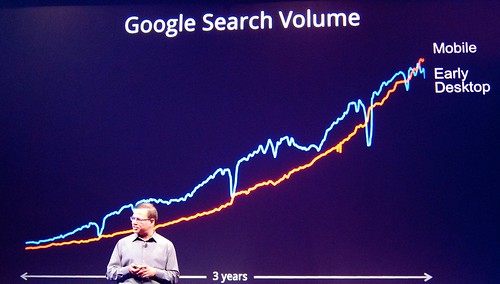
Amit Singhal in 2011 showing a comparison of search volumes from mobile and “early desktop years”. Photo by Niall Kennedy on Flickr.

Amit Singhal, Google’s head of search, let slip a couple of interesting statistics at the Re/Code conference – none more so than that more than half of all searches incoming to Google each month are from mobile. (That excludes tablets.)

This averages out to less than one search per smartphone per day. We’ll see why in a bit.

First let’s throw in some more publicly available numbers.
• more than 100bn searches made per month to Google (total of desktop/ tablet/ mobile).
• about 1.4bn monthly active Google Android devices. (Source: Sundar Pichai, Nexus launch.)
• about 1 billion monthly active Google Play users. (Source: Sundar Pichai, Nexus launch.)
• about 1.5bn PCs in use worldwide.
• about 400m iPhones in use worldwide. Probably about 100m of those are in China. (Analyst estimates.)
• about 100m other smartphones in use (70m Windows Phones, 30m BlackBerrys)
• the mobile search market only generates a third as much revenue as the desktop. (Source: Rob Leathern, via the IAB 2014 report.)

Singhal had already said in July that mobile was larger than desktop in 10 countries; now it’s for the whole world. Google’s numbers effectively exclude China, of course, since Google doesn’t have any presence there. (Android phones and iPhones both use Baidu, the local search engine, as the default there; Google is banned from the mainland, and though people can use it, they overwhelmingly don’t.)

So let’s put these numbers together.
• In all, there are 1400 Google Android + 400 iPhones – 100 iPhones inside China + 100 other = 1.8bn smartphones in use outside China.
• 50bn mobile searches per month = 50bn per 30-day period

Today’s not the day to search

Calculate! 50bn / (1.8bn * 30) = 0.925 mobile searches per day. (Even if you exclude the Windows Phones and BlackBerrys, you still get 0.98 mobile searches per day.)

That’s right – the average (“mean”) person does less than one Google search on mobile per day. The mode (most common number) will be below that too. Over a 30-day period, the mean number of mobile Google searches is 27.8.

For desktop+tablet search, you get roughly the same figure – assume 1.5bn PCs and 300m tablets. But not all of those devices are available to make searches: many PCs are sitting in corporate environments where they aren’t connected to the internet, or can’t be used to make Google searches: think of all the machines in call centres, or functioning to run shop tills, or in factories. They reduce the potential base that can be used to make queries, and so ramp up the real average of per-active-PC/tablet monthly queries.

On the basis that
• the world PC installed base is split roughly 60-40 between corporate and personal users, so 900m and 600m
• guessing that 50% of those corporate machines, ie 450m, can’t make Google searches

then the total number of PCs/tablets available to make Google queries is 600m personal PCs + 450m corporate PCs + 300m tablets, or 1,350m devices.

Do the maths on 50bn searches per 30-day month across 1,350m devices and you get 37 searches per month, or 1.23 searches per day on average. The mode (most common figure) is likely to be 1, but the median (point where you have half as many behind as in front) will be higher. Probably not much higher – this will be an asymmetric distribution, where most of the (in)action is on the low end, so it may look like a Poisson or Pareto function.

Desktop: steady as she goes

This is my rough model of how search distribution might look, generated by plugging figures we know into a Pareto generator and then doing a distribution function for N = integer number of searches per day.

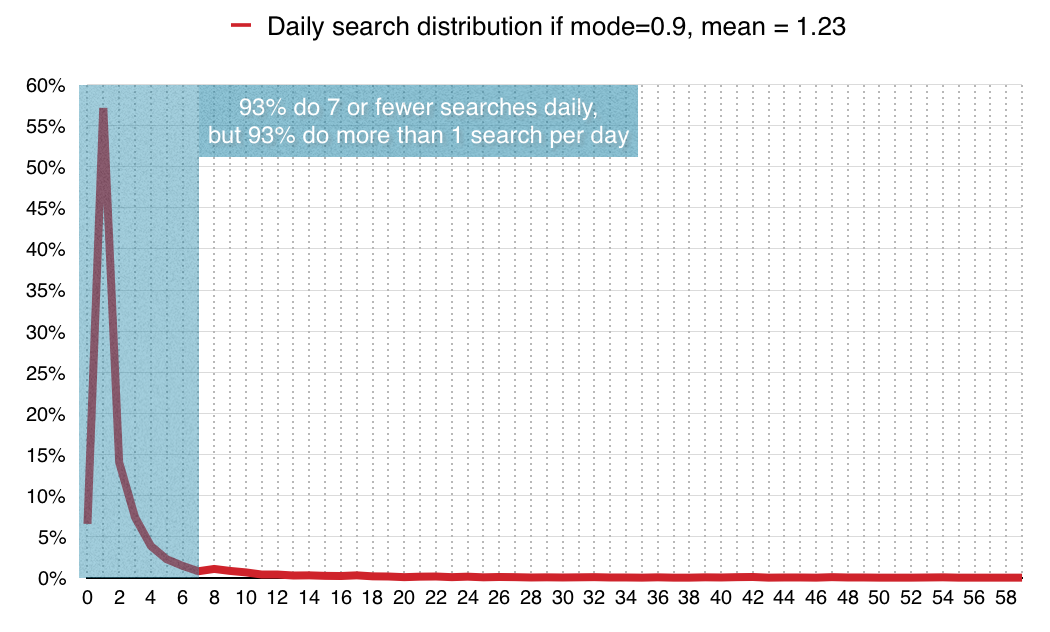
Here’s how it looks for the desktop, using a mode (most common) of 0.9 searches per day and mean of 1.23:

Per-user searches on desktop on Google

Estimated profile of number of searches per day per person on Google on desktop.

What this is saying is that on any given day you get about 55% of people doing just one search, a bit less than 15% doing two searches, just under 5% doing four searches, and so on. Small proportions, but big absolute numbers. And who does what searches isn’t fixed; so someone who did zero searches yesterday might do 10 tomorrow. But equally, the 10-searcher yesterday does none or one or four today. And so on.

(It took some experimentation to get this shape; using a higher mode meant that the number doing zero searches was itself zero, which doesn’t make sense: there must be some people who by accident or design don’t ever hit Google during a day. Here, the proportion of users doing zero searches per day is 6.5%, which seems reasonable.)

Here’s how it breaks out when you look at cumulative percentages:
Google searches on desktop

My model suggests that most people don’t do much searching, but nearly everyone does some.

Note that lots of people don’t do many searches, but huge numbers of people do some searching. Further confirmation: the data release from AOL in 2006, which was just for desktop users, was “~20m records from ~650,000 users over three months” which translates to an average of 31 records per person over that 90-day period, or one-third of a query per day. AOL users in 2006 might not be directly comparable to Google users today, but it’s a useful check that the numbers here are probably broadly correct.

Incidentally, a lot of those present-day searches will be very low complexity. Watch people use a desktop. The most common Google query is “Facebook”. Probably the next most common? “Yahoo”, “Gmail” and “Hotmail”. People literally type those into the Google search box, or their browser search bar, to get to those sites. To a technical audience that’s stunning – why would someone do that? – but it’s observable behaviour. Remember the AOL data leak in 2006? Data there showed that some people used to just hit “Search” when the text box was empty which in turn meant that some advertisers got AdWords hits on the phrase “search terms” (which used to be the text in the box).

Mobile: all change

However on mobile, things are different. People do not, in general, type “Facebook” or “Gmail” into their mobile browser’s search bar. They go to the relevant app – Facebook or email. This behaviour is surely a big reason why mobile searches have been behind desktop for a long time, even though smartphones’ use has rocketed, and time spent on them is greater than for PCs, and they’ve been nudging a comparable installed base for some time.

Thus where someone using a desktop/laptop might fulfil their “average” one or two searches per day by typing “Facebook” when they open their browser, on mobile that doesn’t happen because it doesn’t need to happen; they just open the app.

For Google, that means it’s losing out, even though Google search is front and centre on every Android phone (as per Google’s instructions as part of its Mobile Application Device Agreement, MADA). People don’t, on average, search very much on mobile. The miracle of Google, in retrospect, is building a multi-billion dollar business by accreting millions of rare actions – people doing searches and then clicking on ads. Of course, Google has helped that latter activity by filling the top of its search results page with ads, and making them harder to distinguish from search results. But it’s still a hell of an achievement.

I tried modelling what search activity probably looks like on mobile: I used a mean = 0.925 (as per Singhal) and mode = 0.5. The mode must be below the mean because of the long tail of higher values; 0.5 is a guess, but moving it around doesn’t have a large effect. This gives a median of 0.94, close to the mean, which you’d also expect.

Google mobile search modelled

If mobile searching follows a power law, it might look like this.

You can see that (if we allow these assumptions, which I think are reasonable – remember that they’re based on Google’s own data) then only 5% of users do more than seven searches per day on average. That’s very like the desktop scenario.

Mobile search percentage

As on desktop most people don’t do more than 7 searches – but most people also don’t do one search.

But here’s where things are suddenly very different from the desktop: although the proportion doing more than seven searches per day is about the same (5% or so), you have a far greater number who don’t ever get beyond zero.

Incidentally, this echoes Horace Dediu’s analysis from April 2014, when he noted how the internet population was growing rapidly, but Google’s revenues from non US/UK sources weren’t: US/UK users seemed to generate about $86/yr, while those outside that space generated only $12/yr. (This picture might be distorted by Google’s tax arrangements, of course.)

So there is the problem for Google: the PC base is static or even falling, while the number of people holding smartphones is growing. But the latter group tends not to use search, and so doesn’t see its most profitable ads. (There are in-app ads, but it’s never been very clear how much revenue they generate compared to other search ads. One suspects if they were very lucrative for Google it would be touting its “run rate” from them.)

Hence Google pushes people to use the mobile web more; and also, notably, to expand beyond simple search into services such as Google Now, Now On Tap, and pretty much anything. Seen through that lens, the reorganisation of Google into Alphabet makes sense: it’s seeking to get as many potentially moneymaking new ideas fired off as soon as possible, while search and search revenues are still growing, and before the growth of mobile really pulls the averages down. Dediu, in the link above, notes that 2016 will probably mark the point where internet population growth begins levelling off. And most of the new additions will be mobile-only.

You can see that effect most clearly in data from Google’s financials, where it discusses the number of paid clicks it gets, and the cost-per-click. It doesn’t take much effort to combine the two together to get the “total payments per click”.
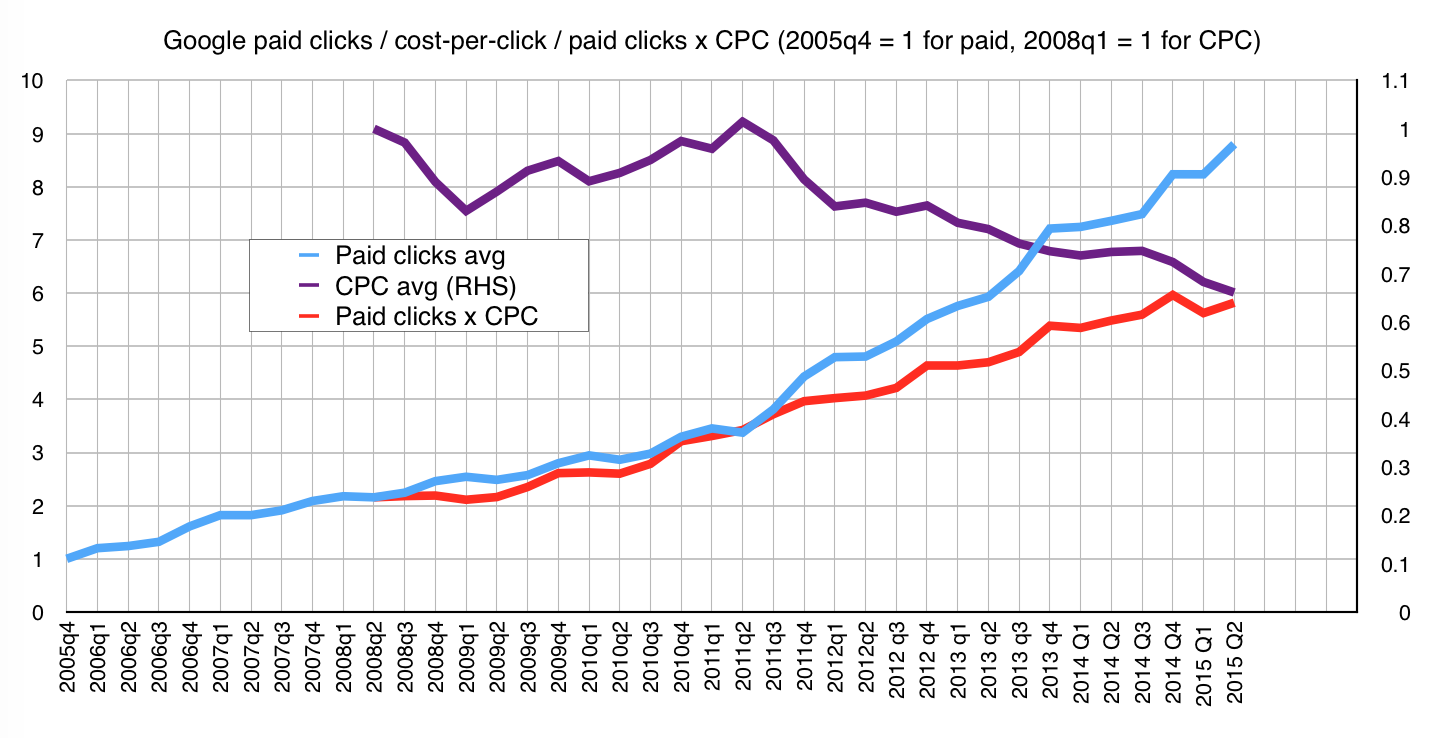
Google paid clicks, cost-per-click and product

Paid clicks up, CPC down. Source: Google financials.

What’s clear is that
(a) the number of paid clicks has zoomed up – increased nearly ninefold since the end of 2005 (where the graph starts)
(b) CPC is on a steady downward slope, despite Google’s best (and successful) efforts in mid-2011 to shore it up
(c) combining the two shows that revenue hasn’t increased nearly as fast as paid clicks. In other words, the new users and new platforms on which Google is available aren’t as valuable as the old ones.

In conclusion

So what do we conclude? Mobile search is a real problem for Google: people don’t do it nearly as much as you suspect it would like. But there’s no obvious way of changing that behaviour while users are so addicted to apps on their phones – and there’s no sign of that changing any time soon, no matter whether news organisations wish people would use mobile sites instead (clue: most people get their news via Facebook online).

This is a structural reality of how mobile is now. Buying Android and make it freely available was a defensive move to stop Microsoft being the gatekeeper to the mobile web (more in my book..).

But it turns out that search wasn’t actually the gatekeeper to mobile; having a well-stocked app store is. That’s where the searching really happens. Now Google faces the second stage of the mobile web. What will its answer be?

Start up: inside a content factory, US reacts to Safe Harbour sinking, why Surface?, Android lemons and more


In China, such literalism might really happen. Photo by GotCredit on Flickr.

A selection of 8 links for you. Fee fi fo fum. I’m charlesarthur on Twitter. Observations and links welcome.

The Chicago End-Times » The Awl

Sam Stecklow on the “content factory” at the Chicago Sun-Times, churning out meaningless content because ads:

Network staffers were concerned with the quality of work they were being asked to do, too. Marty Arneberg, a former intern, told me, “When I was applying to jobs, I would send very few Sun Times Network articles. I would mention in my résumé, forty hours a week I worked here, but I would not send them any examples. Because it was such a content factory, you just had to pump stuff out all the time. It was just like, get it out there, we need some pageviews now.” A former editor told me, “I wouldn’t read most of what I wrote if given the choice.” He added, “Spending more than thirty minutes on any article was generally frowned upon.” Arneberg told me that a “post got me the most pageviews of any post that I wrote and it was complete bullshit. It was a total hoax,” he said. “The weird thing is, when it came out that that was a hoax, nobody spoke to me. Nobody said anything, like, ‘Hey, you gotta watch out for that.’ It was just ignored.”

The question of whom, exactly, Sun Times Network is supposed to be for is one I asked everyone I interviewed for this story, and none of them could provide a good answer. I can’t either.

Stecklow’s descent into the toxic hellstew is well-described; it’s like a modern version of The Jungle. This is where content is heading. And not long after that, the stories will be “written” by computers, and you’ll wonder why we don’t just get computers to read them too, and go and do something more worthwhile, such as digging ditches. Oh, and reading The Awl.
link to this extract


The company behind Relish wireless broadband makes a big loss » Engadget

Nick Summers:

Relish’s dream to connect London homes with wireless broadband, rather than traditional landlines, could be in trouble. UK Broadband, the company behind the service, has reported losses of £37.5m for 2014 – almost four times what it was the year before. To make matters worse, turnover slipped from roughly £2m to £1.5m over the same period. Relish was launched in June 2014 as a simpler, but capable broadband alternative to the likes of BT, Sky and Virgin Media. Instead of copper and fibre cables, the company relies on 4G connections to deliver the internet to its customers. The advantages are plentiful — you don’t need to pay for a landline, and because Relish’s network is already up and running, you don’t need an engineer to install anything. Once you’ve signed up, a router is sent round within the next working day and you can instantly get online. The concept is similar to the mobile broadband packages offered by EE, Three and other UK carriers, although here there are no restrictive data allowances. So what’s gone wrong?

Nobody, it seems, knows.
link to this extract


China is building the mother of all reputation systems to monitor citizen behaviour » Co.Exist

Ben Schiller:

“They’ve been working on the credit system for the financial industry for a while now,” says Rogier Creemers, a China expert at Oxford University. “But, in recent years, the idea started growing that if you’re going to assess people’s financial status, you should equally be able to do that with other modes of trustworthiness.”

The document talks about the “construction of credibility”—the ability to give and take away credits—across more than 30 areas of life, from energy saving to advertising. “It’s like Yelp reviews with the nanny state watching over your shoulder, plus finance, plus all of these other things,” says Creemers, who translated the plan.

The system, overseen by the State Council, is made possible by two factors. One, it’s now possible to gather information about behavior as never before. As we use the Internet and different devices, we’re leaving behind a huge footprint of data. Second, the Chinese government sees no reason to safeguard its citizens’ data rights if it thinks that data can benefit them, says Creemers.

“In Europe and the U.S., there’s a notion that the state should be constrained, that it’s not right to intervene in people’s lives, unless for justified reasons. In China, the state has no qualms about that. It says ‘data allows us to make society for better, so we’re going to use it,'” he says.

link to this extract


Behind the European privacy ruling that’s confounding Silicon Valley » NYTimes.com

Robert Levine:

American technology firms are especially worried because they routinely transfer so much information across the Atlantic. “International data transfers are the lifeblood of the digital economy,” said Townsend Feehan, chief executive of IAB Europe, which represents online advertising companies including Google as well as small start-ups. The ruling “brings with it significant uncertainty as to the future possibility for such transfers.”

As Mr. Schrems sees it, however, what is at stake is a deeper conflict between the European legal view of privacy as a right equivalent to free speech and that of the United States, where consumers are asked to read and agree to a company’s terms of service and decide what’s best for themselves. “We only do this in the privacy field — dump all the responsibility on the user,” Mr. Schrems said. He pointed out that consumers are not expected to make decisions about other complex issues, like food or building safety. “In a civilized society,” he said, “you expect that if you walk into a building it’s not going to collapse on your head.”

But if it collapses on your head and kills you, then you sue! No, hang on. (Bonus point to Levine for the handwringing quote from the advertising industry.)
link to this extract


Microsoft Surface: from cross-bearer to standard-bearer » Fast Company

Ross Rubin:

As the Surface Pro customer base has grown, it’s likely that Microsoft is just accommodating potential customers who prefer a more laptop-like device than the Surface Pro 4, which is still a tablet propped up with a kickstand.

While Microsoft is quick to compare its “ultimate laptop”—which starts at $1,500 and goes way, way up—to Apple’s portables, it will walk a far narrower tightrope in competing with its own hardware partners with the Surface Book. Not only does the first model stand to do battle with the best that HP, Dell, Acer, and Lenovo have to offer, but the company is poised to come downmarket with a lower-priced mainstream version, as it did with the $500 Surface 3.

The Surface experience story isn’t quite as good as it looks on paper. Even with the considerable reconciliation of Windows 10 and the arrival of a touch-optimized Office as well as other universal apps, Windows’ interface is still in transition. Many people with Surfaces spend much of their day working not so differently than they would with a no-touch Windows 7 laptop. Even on the marketing side, Microsoft needs to rethink the Surface Pro, which it’s been promoting as the tablet that can replace your laptop. Now that the company wants to sell you a laptop, where does that leave the Surface Pro?

This is slightly the problem: why Surface Pro, if there’s Surface Book? Rubin also thinks there’s a Surface iMac (for want of a better name) brewing in Redmond. This seems unlikely though – the sales figures would be so miniscule it would never make money for anyone. Speaking of which…
link to this extract


Why Apple is still sweating the details on iMac » Medium

Steven Levy was given access to Apple’s Ergonomic Design Lab to get the inside story of how the new iMacs and Magic Mouse and so on were built. But what are they for? Phil Schiller, Apple’s head of marketing, explains:

“The job of the watch is to do more and more things on your wrist so that you don’t need to pick up your phone as often. The job of the phone is to do more and more things such that maybe you don’t need your iPad, and it should be always trying and striving to do that. The job of the iPad should be to be so powerful and capable that you never need a notebook. Like, Why do I need a notebook? I can add a keyboard! I can do all these things! The job of the notebook is to make it so you never need a desktop, right? It’s been doing this for a decade. So that leaves the poor desktop at the end of the line, What’s its job?”

Good question. And the answer?

“Its job is to challenge what we think a computer can do and do things that no computer has ever done before, be more and more powerful and capable so that we need a desktop because it’s capable,” says Schiller. “Because if all it’s doing is competing with the notebook and being thinner and lighter, then it doesn’t need to be.”

But – take note – no intention of introducing a touchscreen iMac. None at all, says Schiller: “The Mac OS has been designed from day one for an indirect pointing mechanism. These two worlds are different on purpose.”
link to this extract


​Android security a ‘market for lemons’ that leaves 87% vulnerable » ZDNet

Liam Tung:

“The difficulty is that the market for Android security today is like the market for lemons,” Cambridge researchers Daniel Thomas, Alastair Beresford, and Andrew Rice note in a new paper.

“There is information asymmetry between the manufacturer, who knows whether the device is currently secure and will receive security updates, and the customer, who does not.”

Their analysis of data collected from over 20,000 Android devices with the Device Analyzer app installed found that 87% of Android devices were vulnerable to at least one of 11 bugs in the public domain in the past five years, including the recently discovered TowelRoot issue, which Cyanogen fixed last year, and FakeID.

The researchers also found that Android devices on average receive 1.26 updates per year.

“The security community has been worried about the lack of security updates for Android devices for some time,” Rice said.

The “security community” hasn’t had much effect, then. The study was part-funded by Google.
link to this extract


US says Apple e-books antitrust monitor no longer needed » Reuters

Nate Raymond:

The US Justice Department has determined that Apple Inc has implemented significant improvements to its antitrust compliance program and that a court-appointed monitor’s term does not need extended, according to a court filing.

The Justice Department in a letter filed late Monday in Manhattan federal court said its recommendation was despite Apple’s “challenging relationship” with Michael Bromwich, who was named monitor after the iPad maker was found liable for conspiring to raise e-book prices.

The Justice Department said its decision to not recommend extending the monitorship beyond its two-year term was “not an easy one,” as Apple “never embraced a cooperative working relationship with the monitor.”

But the department said it was giving greater weight to Bromwich’s “assessment that Apple has put in place a meaningful antitrust compliance program than to the difficult path it took to achieve this result.”

Apple is still considering an appeal to the Supreme Court. The antitrust thing must feel like a stain.
link to this extract


No, wait! You can now sign up to receive each day’s Start Up post by email. You’ll need to click a confirmation link, so no spam.

Start up: boarding pass hacks, Microsoft Surfaces, the truth about Android Auto, ad fraud explained, and more


Kindle display at Waterstone’s: they were coming soon, now they’re gone. Photo by DG Jones on Flickr.

A selection of 10 links for you. Contains no additives. I’m charlesarthur on Twitter. Observations and links welcome.

What’s in a boarding pass barcode? A lot » Krebs on Security

Brian Krebs was contacted by a reader who had looked at a friend’s boarding pass:

“I found a website that could decode the data and instantly had lots of info about his trip,” Cory said, showing this author step-by-step exactly how he was able to find this information. ‘

“Besides his name, frequent flyer number and other [personally identifiable information], I was able to get his record locator (a.k.a. “record key” for the Lufthansa flight he was taking that day,” Cory said. “I then proceeded to Lufthansa’s website and using his last name (which was encoded in the barcode) and the record locator was able to get access to his entire account. Not only could I see this one flight, but I could see ANY future flights that were booked to his frequent flyer number from the Star Alliance.”

The access granted by Lufthansa’s site also included his friend’s phone number, and the name of the person who booked the flight. More worrisome, Cory now had the ability to view all future flights tied to that frequent flyer account, change seats for the ticketed passengers, and even cancel any future flights.

The information contained in the boarding pass could make it easier for an attacker to reset the PIN number used to secure his friend’s Star Alliance frequent flyer account. For example, that information gets you past the early process of resetting a Star Alliance account PIN at United Airline’s “forgot PIN” Web site.

Worrying. Keep it on your phone instead.
link to this extract


Every device is a compromise, part 2 » Beyond Devices

Jan Dawson:

immediately after the SP4 was introduced, we were shown the Surface Book. Which is a laptop. And Panos Panay, the presenter, started out by talking about all the things a laptop does that the Surface Pro does poorly – a better typing experience, a bigger screen, and so on. This was one of the most bizarre juxtapositions I’ve ever seen at a tech event. After 30 minutes of talking about how the Surface Pro 4 could replace your laptop with no compromises, the very same presenter offered up a laptop which was clearly better, because it didn’t make certain of those compromises.

Taking a step back for a minute, both products look really promising. I’ll withhold final judgment until I get to use these devices (or at least until others I trust have done so and shared their opinions). But this “no compromise” nonsense continues to do a massive disservice to Microsoft and to its customers.

link to this extract


Microsoft has warmed my cold cynical heart with hot new hardware » The Verge

Vlad Savov:

The brand new Surface Book is, like the original Surface Pro, another effort at complete reinvention. The Surface Book deconstructs the laptop and reconstitutes it in the shape of a hybrid device of the sort we’ve never seen before. Microsoft didn’t just make a new tablet with a detachable keyboard, it designed a whole new hinge and attachment mechanism, and it intelligently split up the internal components to deliver both a light and sleek tablet and a powerful laptop. The discrete Nvidia graphics chip sits among a battery of batteries inside the keyboard dock, liberating the tablet of most of its heft when power is not a priority, but keeping it substantially PC-like when the whole thing is connected and operating as one.

I am hugely impressed by the clear-eyed purpose underpinning every one of the decisions that Microsoft has made with its two Surface devices introduced today. The boundlessly charismatic Panos Panay — now in charge of both the Lumia and Surface product lines at Microsoft — simply didn’t allow a moment’s questioning or dubiety. Every time he presented a new feature or change, he asked the rhetorical “why?” question himself, and he answered it convincingly. Here are a thousand levels of pressure sensitivity for the stylus, and here’s what you can do with that. Here’s a keyboard with 1.6mm of travel and here’s why you’d want to mash your fingers against it. Panay elicited something that every tech company strives for, but few achieve: desire.

Presentation is so important, as is explaining why something needs to exist; that’s something Steve Jobs really used to do well. Apple doesn’t have anyone who can enunciate the need for something to exist in the way he could, and technology really needs that skill.

That said, Microsoft hasn’t priced these (or its Surface Pro 4) cheaply. Which means the rest of the PC OEMs will be left scrapping for dollars while, if these sell at all, Microsoft reaps both the hardware and software profits.
link to this extract


Verizon scraps its exclusive Sony phone before it even launches » CNET

Roger Cheng:

Sony said both companies agreed on the cancellation. “The decision was made after we have taken into consideration such factors as the competitive landscape and launch timing,” said a company spokeswoman. A Verizon spokesman echoed those sentiments without offering additional specific details.

There have been hints of problems with the Xperia Z4v, which was a modified version of the Xperia Z4 that added a larger battery and wireless charging. After its initial unveiling in June, both companies grew silent about the product. A Sony event held in New York over the summer was dominated by games from PlayStation, its virtual reality system, and other products like cameras, with only a single small area dedicated to showing off the Xperia Z4v.

Then there is the Xperia Z5 family, which debuted at the IFA trade show in September. The announcement of the three new phones rendered the Xperia Z4v outdated before it even launched.

link to this extract


Fraud is a million $ business; Here’s how they’re doing it » LinkedIn

Mike Nolet digs into a “golf” site which had fencing content (huh) and an absurd number of video views per visitor (177 per week?) but whose referrers seemed to be porn sites, among others:

as I mentioned in my disclaimer there’s never a way to know for sure, but here’s what I suspect:

• Unsurprisingly, I think the site is fake. No real users that go there.
• Traffic is sourced from adware programs and porn sites and show the site in popups, most likely hidden from view.
• They used to do display fraud, but got busted, and so started putting fake display ads to make the site seem more legitimate. They still get away with Video.
• They run a series of checks to try to determine whether or not they are being watched, and if they are, the sites behave normally.
• When they’re not being watched that they spam as many videos into a popup as they can.
• Gross they are generating $1.5m/week in ad impressions on this one site which is clearly part of a network of sites.
• Now, this traffic was caught, but even if only 2% of their traffic gets past the filters, it’s still a million $ business.

Scary. And this is just one site in a huge network. Hurrah for online advertising!
link to this extract


13 cool facts about the 2017 Porsche 911 » Motor Trend

Jonny Lieberman:

There’s no technological reason the 991/2 doesn’t have Android Auto playing through its massively upgraded PCM system. But there is an ethical one. As part of the agreement an automaker would have to enter with Google, certain pieces of data must be collected and mailed back to Mountain View, California. Stuff like vehicle speed, throttle position, coolant and oil temp, engine revs—basically Google wants a complete OBD2 dump whenever someone activates Android Auto. Not kosher, says Porsche. Obviously, this is “off the record,” but Porsche feels info like that is the secret sauce that makes its cars special. Moreover, giving such data to a multi-billion dollar corporation that’s actively building a car, well, that ain’t good, either. Apple, by way of stark contrast, only wants to know if the car is moving while Apple Play is in use. Makes you wonder about all the other OEMs who have agreed to Google’s requests/demands, no?

That’s Acura, Chevrolet, Honda, Hyundai, and Volkswagen to start with. (Insert joke about the VW data being worthless.) None of the stories which used this snippet then bothered to ask Google if it’s true – apart from Android Police, which was told:

we take privacy very seriously and do not collect the data the Motor Trend article claims such as throttle position, oil temp and coolant temp. Users opt in to share information with Android Auto that improves their experience, so the system can be hands-free when in Drive, and provide more accurate navigation through the car’s GPS.

link to this extract


Apple acquires startup developing advanced AI for phones » Bloomberg Business

Jack Clark and Adam Satariano:

Apple [has] acquired Perceptio, a startup developing technology to let companies run advanced artificial intelligence systems on smartphones without needing to share as much user data.

The company’s leaders, Nicolas Pinto and Zak Stone, are both established AI researchers who specialize in developing image-recognition systems using deep learning. Deep learning is an approach to artificial intelligence that lets computers learn to identify and classify sensory input…

Perceptio’s goals were to develop techniques to run AI image-classification systems on smartphones, without having to draw from large external repositories of data. That fits Apple’s strategy of trying to minimize its usage of customer data and do as much processing as possible on the device.

Apple said last week that it had acquired a U.K.-based software startup that made AI technology to create Siri-like digital personal assistants capable of having longer conversations.

Apple really is going all-in on AI. Which of course it needs to.
link to this extract


Waterstones is removing Kindles from stores » The Bookseller

Lisa Campbell:

Waterstones is removing Amazon’s Kindle devices from many of it stores as sales “continue to be pitiful”.

The company’s managing director James Daunt said there had been no sign of a “bounce” in Kindle sales, so the company was “taking the display space back” to use for physical books instead. 

He told The Bookseller: “Sales of Kindles continue to be pitiful so we are taking the display space back in more and more shops. It feels very much like the life of one of those inexplicable bestsellers; one day piles and piles, selling like fury; the next you count your blessings with every sale because it brings you closer to getting it off your shelves forever to make way for something new. Sometimes, of course, they ‘bounce’ but no sign yet of this being the case with Kindles.”

David Prescott, chief executive of Blackwell’s, has also confirmed that fewer e-reading devices were being sold at his chain. “We’re not seeing a great deal of people who are buying an e-reader for the first time now,” he said. “People are buying e-reader replacements, but that’s it.”

Douglas McCabe, analyst for Enders, said it was “no surprise” Waterstones was removing Kindle device sales from its shops. “The e-reader may turn out to be one of the shortest-lived consumer technology categories,” he said.

I dunno, have to compete with the Kinect there.
link to this extract


Taking pictures with flying government lasers » Generalising

Andrew Gray:

A few weeks ago, the Environment Agency released the first tranche of their LIDAR survey data. This covers (most of) England, at varying resolution from 2m to 25cm, made via LIDAR airborne survey.

It’s great fun. After a bit of back-and-forth (and hastily figuring out how to use QGIS), here’s two rendered images I made of Durham, one with buildings and one without, now on Commons:


The first is shown with buildings, the second without. Both are at 1m resolution, the best currently available for the area. Note in particular the very striking embankment and cutting for the railway viaduct (top left). These look like they could be very useful things to produce for Commons, especially since it’s – effectively – very recent, openly licensed, aerial imagery…

You can play too – just download QGIS (open source, Windows/Mac/Linux) and find the place where you live. Oh, LIDAR? Laser Interferometry Detection And Ranging (though Wikipedia has it as “Laser Imaging”). You’re welcome. The whole Generalising blog is worth browsing if you like people noodling with data. They do it wonderfully.
link to this extract


Scrivener crashes after upgrading to El Capitan (OS X 10.11) » Literature & Latte Support

There is a bug in El Capitan that can cause crashes in 32-bit applications when they try to access font data. Because Scrivener is 32-bit, some of our users have reported frequent crashes when Scrivener is used after updating OS X to 10.11 El Capitan. These crashes often occur when Scrivener is launched, but sometimes they may occur while it is in use.

The fix involves a little twiddling in the Terminal. Included because if you’re doing writing of any sort, you should use Scrivener. Also available on Windows.
link to this extract


You can now sign up to receive each day’s Start Up post by email. You’ll need to click a confirmation link, so no spam.

Start up: Russia v Android, Citymapper and Crosslink, the Windows 10 problem, and more


Android Marshmallow is out. What’s inside? Photo by Waleed Alzuhair on Flickr.

You can now sign up to receive each day’s Start Up post by email. You’ll need to click a confirmation link, so no spam.

A selection of 11 links for you. Hydrated for greater comfort. I’m charlesarthur on Twitter. Observations and links welcome.

Russian antitrust officials give Google deadline on Android bundling » Re/code

Mark Bergen:

Here’s the edict from the Russian antitrust agency (pulled from Google Translate, since it has yet to update its English site): “In order to restore competition in the market … Google [must] adjust the agreements with the manufacturers of mobile devices to exclude from the agreements anticompetitive requirements limiting the installation of applications and services to other developers.”

Google declined to comment. It could face a fine, according to the Russian agency, of up to 15% of the revenue from the preinstalled apps. Morgan Stanley has estimated that Russia accounts for about $560m of Google’s annual revenue, or roughly 1%.

Yandex, which brought the case, said in a statement it was “satisfied” with the decision. “Our goal is to return fair play to the market – when apps are preinstalled on mobile devices based on how good or how popular they are rather than due to restrictions imposed by the owner of the operating system,” the company added.

As I read it, that would only apply to devices sold inside Russia after the November 18 deadline. Wonder what it means for grey imports. Obviously it can’t be retrospective.
link to this extract


Learning more about Google’s self-driving cars made me terrified to ever drive again » Business Insider

Jillian D’Onfro:

less than 24 hours after Google’s presentation… I had to drive to and from Los Altos, California. What would otherwise have seemed like a completely typical trip suddenly made me realize just how pathetic a driver I am compared to one of Google’s cars.

Although I didn’t commit the cardinal sin of texting while driving, I was for the first time hyper-conscious of how often I let me eyes drift from the road, whether to check Google Maps on my phone or change the radio station. At one point, I needed to slam the brakes: I had been watching traffic, but deep in thought, making my reaction time slower than it should have been.

Suddenly, I couldn’t wait to get out of that car. The person driving next to me, yapping on her phone, immediately seemed like a threat. As did the fact that I was taking my eyes away from the road ahead to look at her. I have never loved driving, but recognizing all the normal minutiae as potentially dangerous distractions makes me hate it. 

I think there are going to be two reactions to SDCs: those like D’Onfro, and those who enjoy the chance to beat the slowpoke super-cautious SDCs by driving aggressively.
link to this extract


Building a city without open data » Medium

Citymapper explains how it began with open data for its travel planning service, but is now working on cities which don’t:

We’ve learned that the goal is not just to launch cities and win fancy prizes, although that’s fun. It’s about maintaining and improving data so that citizens and travellers can trust us to give them the best information when and where they need it.

And this is hard. The largest cities of our planet are complicated and evolve over time. They require dedicated focus. And we’ve found that open data is not enough to satisfy the information demands of the ever wanting smartphone user.

So we’ve been fixing data. And we’ve been improving data. And we’ve been adding data. And in the process of doing so we’ve developed a number of tools to help us scale and solve problems faster. And to empower our heroes to fix things and solve problems without the need for engineering.

We’ve done a lot with these tools. Well for one, we’ve used them to create some fake data…

They can show you what travel in London is going to be like with Crossrail. Terrific.
link to this extract


Android 6.0 Marshmallow, thoroughly reviewed » Ars Technica

Ron Amadeo:

Google says that the new release has a “back to basics” motif with a focus on “polish and quality.” Marshmallow makes many long-requested features a reality with selectable app permissions, a data backup system that actually works, and the ability to format SD cards as Ext4, allowing the system to treat cards just like internal storage. Marshmallow is also prepared for the future with support for USB Type-C’s power delivery spec, a Fingerprint authentication API, and 4K display support. And, as with any Android release, there’s also lots of new Googley stuff—a slick new search interface and a contextual search mode called “Google Now on Tap,” for example.

While this is a review of the final build of “Android 6.0,” we’re going to cover many of Google’s apps along with some other bits that aren’t technically exclusive to Marshmallow. Indeed, big chunks of “Android” don’t actually live in the operating system anymore. Google offloads as much of Android as possible to Google Play Services and to the Play Store for easier updating and backporting to older versions, and this structure allows the company to retain control over its open source platform. As such, consider this a look at the shipping Google Android software package rather than just the base operating system. “Review: New Android stuff Google has released recently” would be a more accurate title, though not as catchy.

The 23rd version of Android, though I’m guessing that includes hundredth-decimal point updates. Amadeo’s predictions about how developers will abuse the battery-saving Doze mode are worth reading (as the whole thing is – allow plenty of time). Finally fixed permissions, eh? Only been waiting since 2012. And definitely read the last page if nothing else.
link to this extract


Carriers are making more from mobile ads than publishers are » Medium

Rob Leathern crunched the numbers, based on the NY Times article about sites’ ad heft:

For each site, take Mb/minute x Avg per/Mb mobile data cost, and weight the average by each site’s monthly unique mobile visitors (so heavier data-using sites get more weight in our calculation) and normalize to one minute of time on each site, for a value ranging from $0.01 to $0.24 per minute. Compare that figure to our average revenue of $0.15/hour = $0.0025/minute and weight the average to get the result:

16.6x more in data costs to the user than mobile ad revenue to these top 50 news sites on average

Even if it isn’t exactly accurate, it’s showing an order of magnitude difference. Publishers get an absolute pittance from ads. Then again, people spend very little time on them – Leathern’s data (from public sources) says it’s about 3.5 minutes per month.
link to this extract


We’re replacing comments with something better » Motherboard

Derek Mead, editor-in-chief of Motherboard:

Comment sections inspire quick, potent remarks, which too easily veer into being useless or worse. Sending an email knowing that a human will actually see it tends to foster thought, which is what we want. So in addition to encouraging that you reach out to our reporters via email or social media, you can now also share your thoughts with editors via letters@motherboard.tv. Once a week or thereabouts we’ll publish a digest of the most insightful letters we get.

The argument for comments has long been that a well-moderated section lowers the barrier to entry for readers to share their thoughts, positive or otherwise. In a vacuum, that sounds like a dream, but the key there is “well-moderated.” Good comment sections exist, and social media can be just as abrasive an alternative. But for a growing site like ours, I think that our readers are best served by dedicating our resources to doing more reporting than attempting to police a comments section in the hopes of marginally increasing the number of useful comments.

Ah, another one. Gresham’s Law continues to apply.
link to this extract


Microsoft lowers its expectations for phones » WSJ

Shira Ovide on the forthcoming launch of new (high end?) Lumia phones:

Microsoft is betting that shoppers and mobile-application developers will find it alluring to buy Windows smartphones, or write applications for them, in tandem with Windows PCs. To lure app makers who have treated Windows smartphones as an afterthought, Microsoft has made it easier to repurpose their iPhone or Android apps for Microsoft phones.

People close to Microsoft say success at proliferating Windows 10—the company aims to have it installed on 1 billion devices by mid-2018—would give a huge lift to Windows smartphones. That would likely invert the pattern set by Apple, which found that people who bought iPhones were more willing to buy a Mac computer.

“The best thing for Windows phone devices is Windows 10 use,” said a person familiar with Microsoft’s strategy.

Microsoft executives hoping for a smartphone turnaround can point to a precedent: the company’s Surface line of tablet-plus-PC devices, a once-struggling hardware business that found its groove even without blockbuster sales.

“Let’s write an Uber app for the desktop!”
link to this extract


I once was in Maps, but now I’m found » Unauthoritative Pronouncements

Joe Steel has some worthwhile objections to Apple Maps:

One of the things I’ve found puzzling about the design of the Apple Maps interface is that you can see traffic, and travel estimates supposedly influenced by traffic, in the route overview, but no traffic information is provided when turn-by-turn is on. All the roads are tranquil, neutral tones, and a serene blue path flows before you. It’s as if you’re in a kayak, on a river, being gently pulled along by the flow of water.

That’s not true, of course, because why would there be that much water in Los Angeles?

At heavy intersections, like Highland Ave. and Franklin Ave., you see no information about the flow of traffic in any direction. Instead of blue, you should see the streets run red with the blood of the Traffic God. Woe betide thee that commute on his most sacred of poorly designed intersections!

Tonight, Apple Maps routed me down Cahuenga to Highland. That sent me past the large, somewhat famous, amphitheater known as The Hollywood Bowl. Not a big deal, unless there’s an event at The Bowl. Guess what? There was an event! Van Halen! There were orange, safety cones and traffic cops directing at intersections. Apple Maps just herp-derped me through that. The only difference in the display was the estimated arrival time slowly ticking upward as I crawled.

On exactly one occasion I had Apple Maps present me with a yellow bar across the top, and Siri’s voice notified me that there was a delay due to an accident. (No alternate routing was provided on this occasion.) Waze has a leg up on Apple and Google when it comes to accident notifications. You even get notified about which lane the accident is in. Google sources some Waze data, but isn’t as specific. On the 101 N last night there was a very sudden slowdown, without warning, at a time of night when there shouldn’t be traffic at all. I waited patiently for Apple Maps to let me know what it was, and Apple Maps was oblivious to it. There was apparently a car accident that closed two lanes, and the car was being loaded on to a flatbed truck, so it wasn’t recent. Why Apple Maps kept silent about it, I don’t know.

The “not showing traffic when you’re en route” question puzzles me too. And TomTom, which is Apple’s data provider, does offer a (paid) service with alerts about traffic. I don’t think Apple’s privacy approach (it splits the route halfway and runs it under another random ID) is the cause, but it seems odd not to feed in traffic data in from other devices on the same route ahead of you.
link to this extract


The death of advertising and the future of advertising » Tech.pinions

Ben Bajarin:

our research indicates the extremely valuable 18-35 yr old demographic ranks highest in our surveys of those who use an ad blocker. In the US particularly, 4 in 10 millennials admit to blocking internet advertising. Anyone in marketing will tell you this age bracket is highly sought after by marketers. In follow-up interviews I’ve had with this demographic, one of the driving motivations for use of an ad blocker is so they can block ads on YouTube. Watching videos on YouTube is a hefty part of millennials’ weekly activity and many indicated to me their desire to skip ads and get right to the video was centered on their feeling ads were a waste of time. They were going to YouTube to see a short video and did not feel a 5 or 15-second ad before a video was an efficient use of their time. I also asked millennials how they found out they could block ads on the web and the most common answer was from a friend. It seems ad blockers are going viral with many US millennials and it is unlikely this trend loses steam any time soon.

Remember too that those young millennials are highly likely to be using an iPhone – where they can now get an adblocker too.
link to this extract


Reverse engineering proves journalist security app is anything but secure » Motherboard

JM Porup:

On Friday, Motherboard reported that the new Reporta app, billed as “the only comprehensive security app available worldwide created specifically for journalists,” may not be secure at all.

After we published our story, Frederic Jacobs, Open Whisper Systems’s lead developer for their secure messaging app, Signal, spent his Friday night at home reverse engineering the Reporta binary for iOS. He published the results here. His conclusion was, in a tweet, “Sloppy engineering. Reporta is forensics & analytics rich.”

“Every action is logged,” he wrote in his report. Google Analytics is built into the app, which stores the logs in a local cache before uploading them to Google’s servers. Reporta also uses Twitter’s Crashlytics crash-reporting framework, he explained.

“If you’re building an app for journalists in ‘potentially dangerous conditions,’” Jacobs wrote in a Twitter direct message, “you shouldn’t be tracking your users that much. And certainly not giving out that information to third parties without asking for consent of their users.”

Also has variable use of https and on-device encryption.
link to this extract


Windows 10 does not change the PC’s fate » Gartner

John Lovelock:


The market is still rebalancing. PC sales continue to decline, and tablets are the preferred consumption device. But new lightweight PCs have emerged that can compete with tablets as an all-day carry device. Made possible by Ivy Bridge architecture in 2013, which has improved steadily since, the new ultramobile premium devices, such as Microsoft’s Surface, now compete with tablets on four fronts; mobility, light weight, all-day batteries and lower price. Windows 10 is targeted at the last of the tablet’s differentiators – ease of use and empowering users.

The global installed base for desktops and laptops will decline for at least five more years, nothing changes that. However, the PC ecosystem now has a Windows 10 device that can re-engage users in the thin, light, all-day ultramobile devices that pack the power of a PC. Ultramobile premium devices halt the decline in PC shipments in 2017 and halt the decline of the PC installed base in 2019.

If you’re into webinars, Gartner is doing a free one at 11am EDT today (Tues October 6) on the PC market’s impact on overall IT spending. “Webinar”. Hmm.
link to this extract


Start up: Euler programs, adblocking wars redux, Android M’s security measure,


At last: HTML5 iPlayer on the desktop. Only a beta for now.. Photo by Julie70 on Flickr.

You can now sign up to receive each day’s Start Up post by email. You’ll need to click a confirmation link, so no spam.

A selection of 9 links for you. Use them wisely. I’m charlesarthur on Twitter. Observations and links welcome.

(No, there aren’t any links about the new Google offerings – two phones and a tablet – because I couldn’t find any useful analysis of them beyond “they’re phones” and “it’s a tablet with a keyboard”. If you do want to know about them, try “The nine most important things from Google’s Nexus event” from The Verge.)

About » Project Euler

What is Project Euler?
Project Euler is a series of challenging mathematical/computer programming problems that will require more than just mathematical insights to solve. Although mathematics will help you arrive at elegant and efficient methods, the use of a computer and programming skills will be required to solve most problems.

The motivation for starting Project Euler, and its continuation, is to provide a platform for the inquiring mind to delve into unfamiliar areas and learn new concepts in a fun and recreational context.

Who are the problems aimed at?
The intended audience include students for whom the basic curriculum is not feeding their hunger to learn, adults whose background was not primarily mathematics but had an interest in things mathematical, and professionals who want to keep their problem solving and mathematics on the cutting edge.

The first problem should feel pretty easy if you’ve done any programming. If not, give yourself a little time to solve it. (A different sort of programmer hacked its database in August.) They’re presently up to problem 527; No.528 is up on October 3.
link to this extract


IAB enters publicity, engineering war against ad blockers – Special: Advertising Week 2015 » Advertising Age

Nat Ives:

The IAB has come up with code, for example, that it said will help small publishers detect consumers who show up with ad blocking activated. “We believe this script will actually help enable them in their fight just by enabling their ability to detect,” said Scott Cunningham, senior VP at IAB and general manager of the IAB Tech Lab, at a press conference during the annual IAB Mixx conference, which coincides with Advertising Week.
Related Stories

Some publishers that see ad-blocking visitors arrive greet them with dialogue boxes encouraging a change of heart or, failing that, perhaps becoming paid subscribers. But the open architecture of many web pages has allowed ad blockers to hide even those dialogue boxes, Mr. Cunningham said. The IAB is recommending that publishers switch to more secure protocols to prevent that.

Going to war with people because they’re not your customers isn’t the way to persuade them to become your customers.
link to this extract


Medium: PR Newswire revisited » Business Insider

Biz Carson:

“With this [$57m funding] round we aim to make Medium the dominant pipeline for connecting quality content and conversation,” Andy Doyle wrote. “We don’t focus on page views, unique visitors, or click metrics. We don’t litter the platform with ads that are low-quality, high-clutter.”

That part is true. There are no ugly ads that flash advertising before crashing your browser.

Instead, everyone from San Francisco’s local supervisors to the White House are publishing articles, essays, and press releases, surrounded by the same swaths of white and clean fonts. The bylines are tucked away in the top left corner.

Companies may call this “content.” A lot of it looks like advertising.

And let’s face it: Medium has become a dumping ground for a different generation’s press releases.

Seems harsh, but Carson has a point. Then again, that makes Medium a pretty good “native advertising” supplier; there’s lots of other non-advertising, desirable, readable content in there. I keep finding links to it.
link to this extract


New HTML5 Player beta trial for BBC iPlayer » BBC Internet Blog

James East, product manager for media playout:

Although we’ve been using HTML5 to deliver video to iOS devices for some time, until recently we felt that the consistent experience and efficient media delivery offered by Flash outweighed the benefit of moving to HTML5 on the desktop. However, we’ve been regularly evaluating the features offered by the most popular web browsers and we’re now confident we can achieve the playback quality you’d expect from the BBC without using a third-party plugin.

To opt in, visit our HTML5 Player beta page. This will allow you to set a cookie in your browser so you can access our HTML5 player on BBC iPlayer. If you clear your cookies or switch browsers, you’ll have to return to this page to re-enter the trial. You can also visit this page if you want to opt out and return to our non-beta player.

At last. Alternatively, do what I do: uninstall Flash and invoke the “developer” option in Safari (Preferences » Advanced » “Show Develop menu in menu bar”), and when you visit the BBC and it wants Flash to play a video, change the user-agent to “iPad”. (Via Stef Pause.)
link to this extract


Android Marshmallow’s best security measure is a simple date » The Verge

Russell Brandom:

Android security has always faced a daunting challenge — scrambling to get users, manufacturers, and carriers in sync — but the new Marshmallow operating system has a small feature that could make a big difference in that fight. You’ll find it in the Settings menu, a header titled “Android security patch level,” followed by a date. As of that day, your device is protected with all known Android patches.

Championed by Adrian Ludwig, Google’s head of Android security, the date represents a public bet on the industry’s ability to keep Android devices updated. “It should make it really simple for users to understand the state of the device,” Ludwig says, as part of Android’s larger push toward “making sure that security information and patch level information is available to users.”

That’s going to be a good one to watch.
link to this extract


You can now turn off ads on Techdirt » Techdirt

Mike Masnick:

We’ve even been approached by multiple companies who claim to offer a form of ad blocker blocker, that will either insert new ads even when users have ad blockers, or otherwise pester users with ad blockers turned on.

This seems like the exact wrong approach. It’s somewhat reminiscent of the way the RIAA and MPAA reacted to the internet challenging their business models. Rather than listen, recognize what the public wanted and adapt, they whined, screamed about ethics and went to court. And how’s that worked out for everyone? We’ve always said that those who adapt to these challenges are likely to do better, and part of that means actually listening to your fans and helping them do what they want. So that’s what we’re doing: if you choose to disable ads, you just need to go to your preferences and click a button and that should do it.

Such a smart move. Masnick has built a strong community at Techdirt, and so offering this – while pointing out gently that it costs money to run the site, and there are ways to donate – is a terrific way forward.
link to this extract


The dark, scammy history of JustFab and Fabletics » BuzzFeed News

Sapna Maheshwari:

while JustFab has revenue streams befitting a unicorn, its predecessor companies were less ethereal beasts. For more than a decade, starting at MySpace’s parent company, [Adam] Goldenberg and [Don] Ressler’s customers have frequently complained of getting tricked into recurring credit card charges and fooled by deceptive advertising and misleading promises — promises the FTC said sounded “like magic pixie dust” in a warning to consumers regarding the diet product Sensa. It made more than $300 million in sales before the federal regulator intervened.

The ugly hallmarks of those past enterprises live on in JustFab: The company and its affiliates, for all their happy customers, have often been accused of deceiving shoppers who think they’re making a single purchase into signing up for a subscription that automatically charges them each month unless they opt out within a five-day window. The sites use terms like “VIP Membership” instead of “subscription,” and JustFab and Fabletics in particular downplay the options for avoiding charges each month; cancellations require lengthy phone calls.

Ugh. Inertia marketing – such a horrible, scummy business model, and doomed to failure once customers get wise. The only question is how long that will take.
link to this extract


Axel Springer buys Business Insider » Re/code

Peter Kafka:

The deal values Business Insider at $442m — we had previously told you it would peg the site’s value at $560m — but Springer already owned 9% of the company, and Amazon CEO Jeff Bezos, who had previously put his own money into the company, will leave it in there. When factoring out the cash still on the books, the value comes down to $390 million. Springer will end up writing a check for $343m when the deal closes; it says Business Insider has 76 million readers and 325 employees worldwide.

However you count it, the deal sets a new mark for native digital publisher sales, previously held by the Huffington Post, which AOL acquired for $315m in 2011. While several big digital publishers have taken on financing that values their companies above Business Insider’s sale price, none of them have actually sold at those levels yet.

That’s a big vote of confidence in people carrying on reading content online. 76 million readers is substantial.
link to this extract


Marissa Mayer’s take on ad blocking: ‘It hurts the Web experience’ » Digiday

Ricardo Bilton:

The Yahoo CEO told an Advertising Week audience that ads, particularly those tied to people’s interest and browsing history, actually improve the experience of using the Web rather than hurt it.

“I think that for anyone that uses their browser’s incognito mode and starts getting untargeted ads or no ads at all, the experience on the Web becomes a lot less rich. I personally think it’s a mistake to install ad blockers,” she said at an IAB event during Advertising Week in New York City on Monday. “If I have friends or family members asking if they should install them, I tell them ‘please don’t because I think that your experience on the Web will get worse’.”

As Bilton then points out, Yahoo was responsible for serving malware to millions of people through its ads for nearly a week in August. Those using adblockers will have been fine.

But, you know, tell people what they want to hear.
link to this extract


Start up: Apple Music for Android enters beta, how many Ubuntu phones?, Samsung’s dead Milk, and more


If only it were as simple as this for phones. Photo by Bradford Timeline on Flickr.

You can now sign up to receive each day’s Start Up post by email. You’ll need to click a confirmation link, so no spam.

A selection of 11 links for you. Use them wisely. I’m charlesarthur on Twitter. Observations and links welcome.

Google brings you closer to your customers in the moments that matter » Inside AdWords blog

Sridhar Ramaswamy, Senior Vice President, Ads and Commerce:

Customer Match allows you to upload a list of email addresses, which can be matched to signed-in users on Google in a secure and privacy-safe way. From there, you can build campaigns and ads specifically designed to reach your audience.

Let’s say you’re a travel brand. You can now reach people who have joined your rewards program as they plan their next trip. For example, when these rewards members search for “non-stop flights to new york” on Google.com, you can show relevant ads at the top of their search results on any device right when they’re looking to fly to New York. And when those members are watching their favorite videos on YouTube or catching up on Gmail, you can show ads that inspire them to plan their next trip.

Using Customer Match, you can also generate Similar Audiences to reach new customers on YouTube and Gmail who are likely to be interested in your products and services. For example, you can drive awareness on YouTube for new non-stop flights by showing TrueView ads to prospective customers who have similar interests and characteristics to your rewards members.

The quest for “relevant ads” must be pursued continuously. (Facebook already has a similar system.)
link to this extract


Bringing the Internet to more Indians—starting with 10 million rail passengers a day » Official Google Blog

Sundar Pichai, Google CEO:

on the occasion of Indian Prime Minister Narendra Modi’s visit to our U.S. headquarters, and in line with his Digital India initiative, we announced a new project to provide high-speed public Wi-Fi in 400 train stations across India.
 
Working with Indian Railways, which operates one of the world’s largest railway networks, and RailTel, which provides Internet services as RailWire via its extensive fiber network along many of these railway lines, our Access & Energy team plans to bring the first stations online in the coming months. The network will expand quickly to cover 100 of the busiest stations in India before the end of 2016, with the remaining stations following in quick succession.

Even with just the first 100 stations online, this project will make Wi-Fi available for the more than 10 million people who pass through every day.

link to this extract


Microsoft announces changes to financial reporting structure » Yahoo Finance

Beginning in fiscal year 2016, the company will report revenue and operating income based on three operating segments: Productivity and Business Processes, Intelligent Cloud, and More Personal Computing.   

The Productivity and Business Processes segment includes results from Office and Office 365 for commercial and consumer customers, as well as Dynamics and Dynamics CRM Online. 

The Intelligent Cloud segment includes results from public, private and hybrid server products and services such as Windows Server, SQL Server, System Center, Azure, and Enterprise Services. 

The More Personal Computing segment includes results from licensing of the Windows operating system, devices such as Surface and phones, gaming including Xbox consoles, and search.

This is surely going to obfuscate things more than ever; the latest scheme, which had seven reporting segments, had only been in place for three years – replacing one with six segments. The fewer reporting buckets, the less help it is trying to understand what is and isn’t working at the company.
link to this extract


Apple Music for Android beta invites spotted in the wild » Techaeris

Justin Jelinek:

The e-mail comes from a service called Betabound, a site that allows users to request access to different varieties of beta programs. In this instance though, it’s a doozy. The notice — in its entirety below — simply states:

We’re excited to invite you to come test Apple Music for Android. If you’re a current Android user that would like to join the beta for the new music streaming service, you won’t want to miss this opportunity. To learn more and apply, click the link below. Best of luck! The Betabound team.

Once you follow the link, you’ll be hit with a series of music related questions, some of which are real head-scratchers.  For example:

If you could only listen to 5 albums for the rest of your life, what would they be and why?

How do you even answer that? I’d be hard pressed to come up with an answer, though if the successful completion would get me into the Apple Music for Android beta I’m sure I could come up with something.

If you want to try your luck and see if you can get into the beta, you can sign up on Betabound’s website.

Yup, it’s really there. Big questions:
• will it follow Android’s Material design, or look like an iOS app?
• Will it try to integrate iTunes content, or just offer streaming/DRM downloads?
• How will it avoid the relentless one-star trolling of Android fans that greeted the “Move to iOS” app?

And now…
link to this extract


Apple Music’s functionality failure » Lefsetz Letter

Bob Lefsetz is an acerbic viewer of what’s happening in the music business, and he doesn’t like how Apple is handling its own shift:

this is death in tech. If you’re not willing to destroy the old business model on the way to the new, you’re gonna lose in the long run.

Yes, Apple has zillions of credit card numbers. Yes, Apple is the world’s most valuable company, a juggernaut. But IBM is a shadow of what it once was, as is Microsoft. Nothing is forever. When the great disruption comes you’ve got to sacrifice what once was, however profitable it might be, or you will die in the future.

The problem with streaming in the United States is that most people just don’t see the need to subscribe. Furthermore, they don’t see the need to experiment. Getting someone to try something is the hardest part. And when they do try something and they get less functionality than before, they’re out.

This is what’s happening with Apple Music, and this hurts not only Apple, but the music business at large.

It’d be like having a CD player that spins vinyl. Actually, they tried this. Needless to say, it failed.

As for streaming sound quality, Clayton Christensen went on to say that the new solution may not equal the quality of the old, but it’s good enough and it’s cheap. If you’re an iTunes customer you’re going to go to streaming, you just don’t know it yet. Because streaming is cheaper if you’re a heavy buyer, and owning nothing you can gain improvement along the way.

His argument that you want different apps for music you “own” and for “streams” feels right. Apple’s problem though would be how do you make people start to use the “streams” one? There must have been big fights over this internally. The present system feels like a compromise that hasn’t quite worked.
link to this extract


Samsung’s Milk Video to be shut down November 20 » Variety

Janko Roettgers:

Samsung is shuttering its Milk Video service in November. The company announced the shut-down on Google Play Monday, writing: “While we remain committed to providing premium entertainment services, we have decided to end support for the Samsung Milk Video app as of November 20, 2015.”

A Samsung spokesperson declined to comment on how the closure will affect Milk Video staff.

The closure comes almost to the day a year after Samsung launched Milk Video as a mobile-focused service focusing on short-form video content. Samsung at one point envisioned Milk Video as part of a larger suite of content-focused apps for mobile devices, which also includes the company’s Pandora-like Milk Music service.

Samsung struck some deals with Vice, Funny or Die and others for exclusive short-form content, and complemented these clips with aggregated videos from YouTube, Vevo and other sources.

Roettgers wrote about layoffs in those units back in May. Is this the end of Samsung’s content strategy?
link to this extract


The Apple Watch is perfect. On paper. » getwired.com

Wes Miller (who generally likes his Apple stuff) is taking his Apple Watch back, after a week, because he can’t find anything really relevant that it does for him:

The former product manager (and former development manager) in me sees how we arrived at this point. The Apple Watch team was established long ago, and started on their project. At one point, pressure from above, from outside, from investors, who knows… forced Apple to push up a launch date. The hardware was reasonably ready. But the software was a hot mess.

Traditionally, Apple excelled when they discarded features that weren’t ready, even if competitors already did them in a half-assed way – winning over consumers by delivering those features later when they’re actually ready. Unfortunately, you often get a product manager in the mix that pushes for a feature, even if it can’t really be implemented well or reliably. The Apple Watch feels like this. It offers a mix of checkbox features that, yes, you can argue, kind of work. But they don’t have the finish that they should. The software doesn’t respect the hardware. In fact, it’s giving a middle finger to the hardware. Even WatchOS 2 fails to deliver adequate finish. The list of features that the Watch promises sound nifty. But actually living with the Watch is disappointing.

link to this extract


Apple iPhone 6s vs iPhone 6s Plus Water Test! Is it secretly waterproof? A waterproof review » YouTube

If you don’t want to watch – he dunks the new phones in some bowls of water for an hour. They keep working. Apple has said nothing about the waterproofiness of the new iPhones.

Moving on…
link to this extract


Sony changes stance on waterproof phones: do not use underwater » Xperia Blog

Sony Mobile has made a hugely controversial change to its advice around Xperia waterproof devices. Despite most recent Sony Xperia waterproof devices achieving an Ingress Protection rating of IP68 for water resistance, the highest possible, Sony now says that they should not be used underwater.

If you head over to Sony Mobile’s support page on water and dust protection, you will find several statements on Sony’s new policy including: “Remember not to use the device underwater” and “The IP rating of your device was achieved in laboratory conditions in standby mode, so you should not use the device underwater, such as taking pictures.”

Specifically: don’t put it in seawater or chlorinated water such as swimming pools. Or in juice. Distilled water might be OK. It’s not quite the selling point it used to be, is it? Especially as it had promotional campaigns showing the phones being used to take photos underwater. And people *do* use them to take photos underwater – and like them for that.

Kudos to the Xperia blog, which has pulled together a slew of ads where Sony has shown the phones in water to push that “waterproof” idea. Over to you, Sony.
link to this extract


How many Ubuntu Phones are there? » RPadovani

Padovani, an Ubuntu contributor, does some maths:

As app developer, and mainly as big supporter of the project, it’s a question I ask myself often.

I don’t have the answer, but I can try to make a guess using a useful statistic I have: the number of times the Calculator App has been updated.

The statistic I have access is the number of unique users that have updated the calculator app at least once. The last update of calculator is from 8 Jun ‘15. So phones that have been sold later probably already included the update. Let’s say then the number of users I guess is updated to end of July ‘15.

This means the only market we consider is Europe. Russia, India, China and the rest of the world have started to have available the phones later this year.

His conclusion: probably about 25,000 by the end of September. Yes, twenty-five thousand. Remember when Ubuntu/Linux/Firefox OS was going to be the future third/fourth mobile ecosystem?
link to this extract


CEO John Chen shows off the BlackBerry Priv, gets lost » SlashGear

JC Torres:

Just because BlackBerry has finally admitted that it does have an Android smartphone doesn’t mean everyone might be on board with the plan. And “not everyone” might even include CEO John Chen. The chief executive gave the Business News Network an exclusive glimpse at a working BlackBerry Priv, the company’s first “true” Android smartphone. But in trying to demo the smartphone that “runs Google”, Chen is visibly seen struggling to figure out how to actually use the device, as well as probably some hints of unresponsiveness with the touch screen.

In his defense, Chen is, after all, the CEO of BlackBerry, not of Samsung, of LG, or Motorola, or any other Android device maker.

That’s not a defence. Can you imagine any tech CEO struggling so badly as this with the device they hope to make money on? They haven’t even sorted out the naming: Chen pronounces it “Priv”, with a short “i” (as in “privet hedge”), and then talks about it offering “pryvacy” (with a long “i” as in “prying”). Can’t operate the phone, isn’t on top of the marketing. That’s bad. BBN took the original video down and offered it in a non-embeddable view on its site, hence this link to a YouTube re-upload.


link to this extract


Start up: a shorter rounder Pebble, VW v DMCA redux, Lenovo’s other spyware, IAB defends ads, and more


This bloke’s car might offer some clues about Apple’s future offering. Photo by Konabish on Flickr.

You can now sign up to receive each day’s Start Up post by email. You’ll need to click a confirmation link, so no spam.

A selection of 11 links for you. Use them wisely. I’m charlesarthur on Twitter. Observations and links welcome.

Pebble debuts its first round smartwatch with the Pebble Time Round » TechCrunch

Greg Kumparak:

Pebble is thus far known for its solid battery life; in a world where most smartwatches last a day or so at best, Pebble’s lightweight OS and e-ink display traditionally let it crank on for closer to a week.

Curiously, though, the Pebble Time Round has shaved off a fair bit of that signature battery life in favor of a lighter, slimmer design — instead of five or six days of battery life, Pebble Time Round promises two days. A quick charge feature lets you add 24 hours of juice with just 15 minutes on the charger — but you won’t be taking this one for week long camping trips.

Less battery life?
link to this extract


You have the right… to reverse engineer » getwired.com

Wes Miller:

This NYTimes article about the VW diesel issue and the DMCA made me think about how, 10 years ago next month, the Digital Millennium Copyright Act (DMCA) almost kept Mark Russinovich from disclosing the Sony BMG Rootkit. While the DMCA provides exceptions for reporting security vulnerabilities, it does nothing to allow for reporting breaches of… integrity.

I believe that we need to consider an expansion of how researchers are permitted to, without question, reverse engineer certain systems. While entities need a level of protection in terms of their copyright and their ability to protect their IP, VW’s behavior highlights the risks to all of us when of commercial entities can ship black box code and ensure nobody can question it – technically or legally.

Miller advised Russinovich on whether he could publish. The VW case is surely going to lead to a lot of questions about the DMCA and engine control unit (ECU) software – as highlighted yesterday.
link to this extract


What will the Apple Car look like? Jony Ive’s taste for Bentleys and Aston Martins could influence design » IB Times

David Gilbert:

So what will Apple’s car look like? By talking to the people in the industry and those who know Ive and his work, IBT gleaned some idea.

“If you look at the Apple philosophy of less is more, then apply that to a car then you would have an Apple product,” said Chris Longmore, founder if U.K.-based automotive design consultancy Drive. Longmore, who has worked with Ford, Nissan and Rolls Royce who believes it is a huge benefit for Apple to be starting with a blank sheet of paper. “If you take the iPhone and move into different areas, because the building blocks would be common throughout that, the DNA would be common across all the products and that’s how they should be looking to do it,” he said.

That too is the view of Ive’s former boss, Martin Darbyshire, CEO and founder of London-based design company Tangerine, who worked with Ive for 18 months before he moved to Apple.

“Sometimes coming at something with a fresh perspective is fundamental to finding something new and developing a paradigm shift. Of all the design teams in the world one would expect Apple to do something interesting and different,” Darbyshire told International Business Times.

Smart move asking Darbyshire. When you look at all the fan-generated renders of the “iWatch”, you realise the gulf between what people wish for and what Apple really does.
link to this extract


Lenovo collects usage data on ThinkPad, ThinkCentre and ThinkStation PCs » Computerworld

Michael Horowitz:

The task that gave me pause is called “Lenovo Customer Feedback Program 64”. It was running daily. According to the description in the task scheduler: “This task uploads Customer Feedback Program data to Lenovo”.

I have setup my fair share of new Lenovo machines and can’t recall ever being asked about a Customer Feedback program.

The program that runs daily is Lenovo.TVT.CustomerFeedback.Agent.exe and it resides in folder C:\Program Files (x86)\Lenovo\Customer Feedback Program.

Other files in this folder are Lenovo.TVT.CustomerFeedback.Agent.exe.config, Lenovo.TVT.CustomerFeedback.InnovApps.dll and Lenovo.TVT.CustomerFeedback.OmnitureSiteCatalyst.dll.

According to Wikipedia, Omniture is an online marketing and web analytics firm, and SiteCatalyst (since renamed) is their software as a service application for client-side web analytics.

So, while there may not be extra ads on ThinkPads, there is some monitoring and tracking.

Lenovo confirms in a support note that it does this, but says it’s non-personal. It seems the purpose is to see which applications, service and offers you go for during system setup. Which says something about the parlous state of crapware on Windows PCs in its own right.
link to this extract


The Apple bias is real » The Verge

Vlad Savov, bravely:

The next time you read an iPhone review, keep all these biases in mind. The iPhone is the favored tech product of a vast swathe of our planet’s population, serving both utilitarian and aspirational purposes. It is the catalyst for and sole supporter of entire ancillary industries. It is the nexus where communication and commerce blend most easily, and it is the surest harbinger of the future that is to come. Any review that doesn’t account for all of these factors might be considered technically objective and ubiased, but it would also be frightfully uninformative. Assessing an iPhone against a blank canvas is akin to describing Notre Dame or Sagrada Família as old, large, religious buildings.

Apple bias exists in reviews because it exists in the real world. The company’s track record with the iPhone and other products like it — characterized by a great deal more right decisions than wrong ones — encourages optimism about its riskier new ventures today. The Apple Watch is credited with greater potential than the Samsung Gear S2 because of the two companies’ different histories. The Huawei Mate S has Force Touch similar to the iPhone 6S, but only Apple’s phone is expected to turn that technology into a transformative new mode of interaction.

That’s justified bias. That’s relevant context derived from history and experience. Without it, we’d be reciting facts and figures, but no meaning. Megabytes and millimeters matter only after they’ve been passed through the prism of human judgment, and we shouldn’t pretend that it can, or should, ever be unbiased.

link to this extract


Functioning ‘mechanical gears’ seen in nature for the first time » Phys.org

Each gear tooth has a rounded corner at the point it connects to the gear strip; a feature identical to man-made gears such as bike gears – essentially a shock-absorbing mechanism to stop teeth from shearing off.

The gear teeth on the opposing hind-legs lock together like those in a car gear-box, ensuring almost complete synchronicity in leg movement – the legs always move within 30 ‘microseconds’ of each other, with one microsecond equal to a millionth of a second.

This is critical for the powerful jumps that are this insect’s primary mode of transport, as even miniscule discrepancies in synchronisation between the velocities of its legs at the point of propulsion would result in “yaw rotation” – causing the Issus to spin hopelessly out of control.

“This precise synchronisation would be impossible to achieve through a nervous system, as neural impulses would take far too long for the extraordinarily tight coordination required,” said lead author Professor Malcolm Burrows, from Cambridge’s Department of Zoology.

“By developing mechanical gears, the Issus can just send nerve signals to its muscles to produce roughly the same amount of force – then if one leg starts to propel the jump the gears will interlock, creating absolute synchronicity.

link to this extract


Ad blocking: the unnecessary internet apocalypse » Advertising Age

Randall Rothenberg is president and chief executive of the Interactive Advertising Bureau:

Let’s take these challenges in order. Advertising (as everyone reading these words knows well) pays for the ability for nearly anyone around the world to type in any URL and have content of unimaginable variety appear on a screen. Advertising also subsidizes the cost of apps, which can take hundreds of thousands of dollars to produce, but are often free or low-priced.

Without advertising, digital content and services either will vanish, or the cost for their production and distribution will come directly from consumers’ wallets.

Of even greater importance is the impact on the economy itself. Advertising represents $350 billion of the U.S. gross national product, and consumers depend on it to help make $9 trillion of annual spending decisions. “Advertising helps the economy function smoothly,” said Nobel Laureate economists Kenneth Arrow and George Stigler. “It keeps prices low and facilitates the entry of new products and new firms into the market.”

Ad blocking disrupts this engine of competition. I wish I were crying wolf, but I’m not. Some websites, particularly those with millennial audiences, are already losing up to 40% of their ad revenue because of ad blocking. Our own IAB research found at least 34% of U.S. adults use ad blockers.

Good grief, where to start?
(1) Content was online long before advertising shoved its sweaty arse in front of us;
(2) Advertising doesn’t pay for smartphones, PCs or internet connectivity;
(3) advertising doesn’t subsidise the production, it subsidises the presentation of many apps – but substantial numbers are simply paid-for (think of UsTwo’s Monument Valley);
(4) the cost of content etc already comes from our wallets, because the cost of advertising is a factor in any company’s costs and so its products
(5) adblocking isn’t going to kill the whole advertising industry, just the bit that behaves unreasonably online
(6) adblocking actually intensifies competition, because it creates a new space where would-be advertisers have to figure out how to get their message across
(7) wouldn’t it have been good to notice that your members were pissing people off before desktop adblocking had been adopted by a third of one section of your audience, Mr Rothenberg?
link to this extract


Shut Up: Comment Blocker » iOS App Store

Richard Romero:

Shut Up spares you from Internet troglodytes by hiding all comment sections when browsing the web in Safari. You can even set your favorite websites to show comments by default.

This stuff is only just getting started.
link to this extract


Malware with your news? Forbes website victim of malvertising attack » FireEye Inc

From Sept. 8 to Sept. 15, 2015, the Forbes.com website was serving content from a third-party advertising service that had been manipulated to redirect viewers to the Neutrino and Angler exploit kits.  We notified Forbes, who worked quickly to correct the issue.

This type of malicious redirection is known as malvertising, where ad networks and content publishers are abused and leveraged to serve ads that redirect users to malicious sites.

I promise that FireEye is not paying for its position here or in the next links. It’s just on top of the relevant news. Also: pretty good case for desktop adblocking there.
link to this extract


Protecting our customers from XcodeGhost » FireEye Inc

Immediately after learning of XcodeGhost, FireEye Labs identified more than 4,000 infected apps on the App Store. FireEye has since updated detection rules in its NX and Mobile Threat Prevention (MTP) products to detect the malicious apps and their activity on a network.

FireEye NX customers are alerted if an employee uses an infected app while the iOS device is connected to the corporate network. It’s important to note that, although the CnC servers have been taken down, the malicious apps still try to connect to them using HTTP. This HTTP session is vulnerable to hijacking by other attackers.

FireEye MTP management customers have full visibility when a mobile device is infected in their deployment base. End users receive on-device notifications of malware detection and IT administrators receive email alerts of the infection.

Four thousand is a lot. Does Apple have any means to killswitch those apps? It can’t kill them based on the developer certificate, because there are lots of developer certificates involved – it’s not a single malicious developer, it’s a single malicious library (or set of libraries) used by many developers.
Apple also has an FAQ up about the exploit.
link to this extract


Guaranteed clicks: mobile app company takes control of Android phones » FireEye Inc

FireEye Labs mobile researchers discovered a malicious adware family quickly spreading worldwide that allows for complete takeover of an Android user’s device. This attack is created by a mobile app promotion company called NGE Mobi/Xinyinhe that claims to be valued at more than $100M with offices in China and Singapore.

The malicious adware uses novel techniques to maintain persistence and obfuscate its activity, including installing system level services, modifying the recovery script executed on boot, and even tricking the user into enabling automatic app installation. We have observed over 300 malicious, illegitimate versions of Android apps being distributed, including: Amazon, Memory Booster, Clean Master, PopBird, YTD Video Downloader, and Flashlight…

…has infected 20 different versions of Android from 2.3.4 to 5.1.1. Victims with 308 different phone models from more than 26 countries and four continents have been infected.

Another day…
link to this extract


Start up: DMCA v Volkswagen, cruel opt-outs, self-parking cars win, HP’s irrelevance, and more


The tsunami that hit the Fukushima reactor nearly led to a meltdown – but how many people died from radiation release? Photo by NRCgov on Flickr.

You can now sign up to receive each day’s Start Up post by email. You’ll need to click a confirmation link, so no spam.

A selection of 10 links for you. Use them wisely. I’m charlesarthur on Twitter. Observations and links welcome.

Researchers could have uncovered Volkswagen’s emissions cheat if not hindered by the DMCA » Electronic Frontier Foundation

Kit Walsh:

Automakers argue that it’s unlawful for independent researchers to look at the code that controls vehicles without the manufacturer’s permission. We’ve explained before how this allows manufacturers to prevent competition in the markets for add-on technologies and repair tools. It also makes it harder for watchdogs to find safety or security issues, such as faulty code that can lead to unintended acceleration or vulnerabilities that let an attacker take over your car.

The legal uncertainly created by the Digital Millennium Copyright Act also makes it easier for manufacturers to conceal intentional wrongdoing. We’ve asked the Librarian of Congress to grant an exemption to the DMCA to make it crystal clear that independent research on vehicle software doesn’t violate copyright law. In opposing this request, manufacturers asserted that individuals would violate emissions laws if they had access to the code. But we’ve now learned that, according to the Environmental Protection Agency, Volkswagen had already programmed an entire fleet of vehicles to conceal how much pollution they generated, resulting in a real, quantifiable impact on the environment and human health.

This code was shielded from watchdogs’ investigation by the anti-circumvention provision of the DMCA. Surprisingly, the EPA wrote in [PDF] to the Copyright Office to oppose the exemptions we’re seeking.

With a headline like that, it sounds like an episode of Scooby-Doo. The EPA’s argument in the linked letter is actually reasonable: you know that people will hack the ECM, especially if they get the source code.
link to this extract


The Cruelest Opt-Out Forms » Tumblr

A project in which @lydialaurenson collects all those forms where, when you decline, you’re meant to feel guilty for doing so. Such as this:

Of course you don’t have to read it. You could just miss the best chance of your life.
link to this extract


Self-parking cars are better than humans at parking » Fusion

A new study from the AAA put human drivers who considered themselves adept at parallel parking in a “park-off” against five models of self-parking cars. The result? Human drivers got absolutely destroyed by the automated cars in a test of basic parking skills.

Nearly 80% of survey respondents contacted by the AAA said they were “confident in their parallel parking abilities.” But self-parking cars hit the curb 81% less often than human drivers in the road test, and parked themselves with 47% fewer maneuvers. Self-parking cars were also able to park 37% closer to the curb than human drivers, and—to add insult to injury—they did it 10% faster than the humans.

“Self-parking cars” somehow doesn’t sound as sexy, you know? But the clincher is: only one in four of the people in a survey said they’d trust a car to do the parking. This is the knowledge gap that’s so crucial: we don’t know how good robots are at things.
link to this extract


One million Android users infected with malware through an IQ testing application » Softpedia

Catalin Cimpanu:

The app is called Brain Test and is a simple IQ testing utility, which comes packed with a combination of complex malware strands.

According to Check Point’s research staff, the application was detected via the company’s Mobile Threat Prevention system, first on a Nexus 5 device.

Because its owner, after receiving the malware alert, did not manage to uninstall the malicious app, this prompted Check Point’s team to have a closer look at the source of the infection.

By reverse-engineering the Brain Test app, researchers found a very well-designed piece of malware, which allowed attackers to install third-party applications on the user’s phone, after previously rooting the device and even managing to become boot-persistent.

Brain Test came with a complex detection avoidance system

Looking even further into the issue, researchers found a complex system that allowed the malware to avoid detection by Google’s Bouncer, an automated app testing system that checks for known security issues.

The malware contained code that prevented it from executing if it detected it was being run from certain IP ranges, or domains containing “google”, ”android”, ”1e100.”

After managing to get around Bouncer’s checks and getting installed on a user’s phone, Brain Test would execute a time bomb function whenever the user would run it for the first time.

Even after Google zapped it, the app was re-uploaded five days later. Software that detects when it’s being tested really is the flavour of the month, isn’t it?
link to this extract


London Collision Map Beta

Discover where road traffic collisions have happened in London since 2005; then filter by year, road user, collision severity and age group.

Figures for 2014 show that the number of people Killed or Seriously Injured (KSI) on London’s roads fell to the lowest level since records began. Safe Streets for London, London’s road safety plan, set out the ambition to work towards roads free from death and serious injury and the Mayor’s new target is to halve the number of KSIs by 2020 compared to the Government baseline.

Nice idea, but it’s pretty hellish to use. Heatmaps might have worked better.

link to this extract


Why HP is irrelevant » Om Malik

A few years ago, in a conversation with my friend Pip Coburn (who spent a long time as a tech-stocks strategist for UBS before starting his own firm, Coburn Ventures), I mentioned that a certain company was dead, though not many realized it. And by “dead,” I didn’t mean that it was bankrupt, out of money or out of business. I meant it was dead in its ability to find growth, excitement and new ideas. Any positive energy had flattened and turned negative. “With that lens on, HP has been ‘dead’ for 15+ years,” Pip emailed me this morning.

Pip says that “companies have a space and time and purpose and when those fade the company would be wise to steadily shut itself down.” Like some other large tech companies, HP fits that bill. In a note to some of his clients, Pip pointed out, “The company [HP] doesn’t even do a good job of pretending to have a strategy.” And he is right.

It’s true: HP hasn’t made a market since, what the inkjet printer? Bubblejet printer? Laser printer? Whichever, it’s been a long time.
link to this extract


When radiation isn’t the real risk » The New York Times

George Johnson:

This spring, four years after the nuclear accident at Fukushima, a small group of scientists met in Tokyo to evaluate the deadly aftermath.

No one has been killed or sickened by the radiation — a point confirmed last month by the International Atomic Energy Agency. Even among Fukushima workers, the number of additional cancer cases in coming years is expected to be so low as to be undetectable, a blip impossible to discern against the statistical background noise.

But about 1,600 people died from the stress of the evacuation — one that some scientists believe was not justified by the relatively moderate radiation levels at the Japanese nuclear plant.

None of the workers who went into the stricken plant has died of radiation poisoning. The biggest problem for those workers is heatstroke caused by the extra protective equipment they wear.

Truly, the media reaction to Fukushima was enormously overblown; we are all bad at evaluating risk, but the media perhaps worst of all because “if it bleeds, it leads”.
link to this extract


BT pledges better broadband for UK » BBC News

BT has hit back at rivals calling for its break-up, with a strategy to make the UK the fastest broadband nation.

It revealed plans to connect 10 million homes to ultrafast broadband [300-500Mbps] by the end of 2020 and raise the minimum broadband speed for homes that cannot get fibre to 5-10Mbps (megabits per second).

It comes in a week when rivals have denounced the quality of UK broadband.

In a letter to the Financial Times on Monday, they said BT should be split.

Sky, Vodafone and TalkTalk were among signatories to the letter which claimed that millions of customers currently have a “substandard” broadband service.

Homes currently passed by fibre, according to Ofcom: 23.6m (with 30% takeup, ie 7.1m users).
Households in UK: 26.4m.

However, the gap between that pledge of ultrafast and minimum is just absurd. And it’ll be those who need the faster speeds – in rural areas – who won’t get it.
link to this extract


Soft underbelly » Asymco

Horace Dediu suggests that existing carmakers are underestimating the threat they face from computer-industry entrants:

Traditional car making is capital intensive due to the processes and materials used. There are however alternatives on the shelf. iStream from Gordon Murray Design proposed switching to tubular frames and low cost composites.  BMW has an approach using carbon fiber other composites. 3D printing is waiting in the wings. All offer a departure from sheet metal stamping.

With new materials, costs for new plants can be reduced by as much as 80% and since amortizing the tooling is as much as 40% of the cost of new car, the margins on new production methods could result in significant boosts in margin.

There is a downside however. What is usually compromised when using these new methods is volume and scale of production. So that becomes the real question: how many cars can Apple target? 10k, 50k, 100k per year? Could they target 500k? That would be 10 times Tesla’s current volumes but only a bit more than the output of the Mini brand.

Now consider that the total market is 85 million vehicles per year. For Apple to get 10% share would imply 8.5 million cars a year, a feat that is hard to contemplate right now with any of the production systems. On the other hand selling 80 million iPhones and iPads in a single quarter has become routine for Apple and that was considered orders of magnitude beyond what they could deliver. Amazing what 8 years of production ramping can offer.

Given that cars are increasingly computers with fancy cases on wheels, you really don’t want to rule out low-end or even high-end disruption.
link to this extract


Ad tech always wins: Ad blocker users are the new hot ad-targeting segment » Digiday

Lucia Moses:

“We want to find ways to reach these consumers in ways that suit how they want to be communicated to and with,” Laura Mete Frizzell, gm of search/analytics/media at 360i. “They are part of an audience for which the brand is relevant and can offer utility.”

The potential to target ad blockers is “on the radar,” said Jon Anselmo, senior vp, managing director of digital innovation at MediaVest. “People’s behaviors, including ad blocking, do provide us insights about who they are and what they care about. A tech-savvy nature could absolutely be one such insight.”

On the seller side, too, the idea of targeting blockers is starting to pop up in conversations with publishers like Complex, said its CEO and founder Rich Antoniello. “Those are the hardest to reach people,” he said. One response by Complex has been to use the space normally given over to ads to present ad blocker users with a message asking for their emails to target them regardless.

Mark that last one, because it must surely be the dumbest thing you’ll see today. (Via Rowland Manthorpe.)
link to this extract


Start up: Facebook’s AI ambitions, it’s the Galaxy S7!, the value of comments, Apple goes Android, and more


Peace began the new war. Photo by ‘Lil on Flickr.

You can now sign up to receive each day’s Start Up post by email. You’ll need to click a confirmation link, so no spam.

A selection of 8 links for you. Use them wisely. I’m charlesarthur on Twitter. Observations and links welcome.

Facebook’s problem: Its algorithms aren’t smart enough » Fortune

Mathew Ingram:

Zuckerberg said: “Under the current system, our community reports content that they don’t like, and then we look at it to see if it violates our polices, and if it does we take it down. But part of the problem with that is by the time we take it down, someone has already seen it and they’ve had a bad experience.”

The promise of artificial intelligence, said the Facebook founder, is that some day computers might be able to filter such content more accurately, and allow people to personalize their news-feed. “But right now, we don’t have computers that can look at a photo and understand it in the way that a person can, and tell kind of basic things about it… is this nudity, is this graphic, what is it,” he said.

Zuckerberg said that in the case of the Syrian child lying dead on the beach, he thought that image was very powerful, because it symbolized a huge problem and crystallized a complex social issue. “I happen to think that was a very important photo in the world, because it raised awareness for this issue,” he said. “It’s easy to describe the stats about refugees, but there’s a way that capturing such a poignant photo has of getting people’s attention.”

Any AI that could make the right call about that photograph, though, would be as wise as the super-experienced editors around the world. It would have passed the Turing test and then some.
link to this extract


New ad blocker “Peace” tops iTunes paid apps chart within hours » Marketing Land

Danny Sullivan:

For months, marketers have been worrying over the possibility that consumers might embrace ad blocking that’s made easier in iOS 9. Now iOS 9 is out, and within hours of its launch yesterday, a new ad blocker called “Peace” became the most popular paid app.

The Peace app was created by Marco Arment, former CTO of Tumblr and founder of Instapaper. It sells for $2.99 in Apple’s app store. Within hours of the app going live, it topped the iTunes chart for paid apps for iPhone.

In addition to Peace, Purify Blocker also made the charts ranked fifth for iPhone. The Blockr app is ranked 28th. Crystal, which had some attention earlier this month, is listed at 110 in the free charts. It’s supposed to change to a paid model shortly.

As for iPad, Peace was the number two paid app (Purify is further down at 22; Blockr at 36):

The app is technically a “content blocker,” because it blocks not only ads but other types of tracking codes and anything that is deemed worth blocking based on a list that Ghostery maintains.

Ads are only blocked in Safari, not in other browsers like Chrome. It also doesn’t block ads within apps.

So the outbreak of war began with Peace. But not in other browsers like Chrome, because they don’t use the new WKWebKit viewer, available since iOS 8, which is really fast and powerful and, in iOS 9, enables content blockers. Wonder if Google has considered it? Read on…
link to this extract


Issue 423444 – chromium – Use WKWebView on iOS 8+ » Chromium Project

Stuart Morgan of Google’s Chromium project discussing, in October 2014, whether to use WKWebView instead of UIWebView in Chrome on iOS:

Unfortunately, despite the advantages of WKWebView, it has some significant technical limitations that UIWebView does not, which means we can’t simply drop it in as a replacement. A partial list of regressions relative to UIWebView that we’re currently aware of:
– There is no cookie management API, which means there is no obvious way to clear/manage cookies
– Protocol handlers no longer work, which breaks several very important features
– POST bodies are missing from delegate callbacks, which breaks certain aspects of form handling

We’re still actively investigating WKWebView, looking for possible alternate approaches, and providing feedback to Apple about issues. We certainly hope to use WKWebView in the future, but there’s currently no way of knowing if or when that will be possible.

The thread continues through the introduction of iOS 9, right up to 10 days ago. Still no movement. It seems remarkable that the newest, most powerful webview on iOS should be so behind in things that Google sees as essential. So Chrome on iOS uses the old – creaking, now – UIWebView instead of WKWebView. No modern compatibility (and lots of crashes, according to some) but equally, no adblocking on Chrome on iOS. (Thanks @reneritchie for pointing it out.)
link to this extract


Trash talk » Popbitch

The article (byline unprovided) does useful work in estimating the cost of moderating comments at the Mail Online and Guardian (it’s remarkably high) and then looks at sites that have shut down comments, and notes:

A number of journalists from across the political spectrum have spent this last week voicing their displeasure at Twitter, talking about how unpleasant it’s all become. It used to be fun and productive and helpful, they say, but the conversation nowadays is just vicious fighting.

Those reporting on the Scottish referendum last year complained of the same thing too; many threatening to quit social media in the face of brutal Cybernat campaigns. The sheer volume of vitriol leveled at them became unbearable, unmanageable.

Sadly, this will be the inevitable result of shutting down comments sections. People aren’t going to suddenly want to stop voicing their opinions. That’s one genie that won’t ever go back in the bottle. Instead those displaced commenters will simply take up an alternative platform, and the most obvious one of those is social media.

They can do that anyway, of course – the option has been open to them for as long as Facebook and Twitter have been around – but it’s no coincidence that the current trend for editors wanting to direct the conversation away from comments sections and onto social media correlates exactly with journalists’ growing dissatisfaction at the level of discourse on social media.

Comments sections are easy to avoid when you know where they are.

This I don’t agree with. People will find you on social media regardless of whether there are comments sections. The big advantage? There, you can block them. I prefer Mic Wright’s characterisation: comments are the radioactive waste of the web, there effectively forever, and never really useful. (And I speak as someone who has left a fair number of comments all over the place.) Gresham’s Law applies.
link to this extract


Welcome to hell: Apple vs Google vs Facebook and the slow death of the web » The Verge

Nilay Patel:

with iOS 9 and content blockers, what you’re seeing is Apple’s attempt to fully drive the knife into Google’s revenue platform. iOS 9 includes a refined search that auto-suggests content and that can search inside apps, pulling content away from Google and users away from the web, it allows users to block ads, and it offers publishers salvation in the form of Apple News, inside of which Apple will happily display (unblockable!) ads, and even sell them on publishers’ behalf for just a 30% cut.

Oh, and if you’re not happy with Apple News, you can always turn to Facebook’s Instant Articles, which will also track the shit out of you and serve unblockable ads inside of the Facebook app, but from Apple’s perspective it’s a win as long as the money’s not going to Google.

This is the dynamic to keep in mind — especially when you see Apple bloggers like [John] Gruber forcefully discount the notion that Apple’s decisions will affect small publishers. The Apple vs. Google fight has never been more heated or more tense, and Facebook’s opportunity to present itself as the savior of media has never been bigger — through hey-it’s-just-about-speed Instant Articles, which will almost certainly be featured higher in the News Feed, and huge things like its massive video initiative, which is a direct assault on YouTube. And oh — Apple’s new tvOS, that huge bet on bringing apps to TV? Doesn’t support WebKit at all.

Malicious view of Apple adding content blocking to Safari: it’s trying to kill Google.
Non-malicious view of Apple adding content blocking to Safari: it’s trying to kill ads which take over the mobile browsing experience, bouncing you to an app or putting up a non-removable screen (because the close button is off the screen), and/or trying to keep enterprise buyers happy that they can restrict what their users view.

Patel portrays this as a knife fight, but overlooks the fact that ads will work perfectly well inside iOS apps (annoying as they might be). Apple’s trying to do two things here: stop annoying, intrusive ads on Safari and in Safari web views, and trying to keep apps at the forefront of what people do on iPhones.

Both of those have collateral damage for Google, but it’s a stretch to think of this as a desperate fight to the death. He’s worried for his site, sure. And so he should be. But as I’ve said previously, web ads have to evolve. Nobody said they were somehow protected.
link to this extract


Sony shuts down its UK online retail store » AndroidAuthority

Andrew Grush:

Sony has never had a major presence in the US, offering most of its products either through its website or a partnering retailer. Sony has also had a carrier presence, but it has generally been limited to just T-Mobile or Verizon. This summer, Sony shut off one of these channels: its retail store. This meant that Sony fans had to either go through a site like Amazon, or turn to carriers. And now they are essentially doing the same in the UK.

Effective immediately, Sony shoppers will now be reliant on carriers or Sony’s partnering retails for Sony devices in the UK. The Japanese giant’s UK website will continue to offer advice on their phones but will no longer sell them, similar to what we have seen with the US website.

Sony gets so much right with the design of their phones, but unfortunately fails at the areas that matter most to average consumers: pricing, availability, and marketing.

That last sentence reminds me of a famous cricket writeup: “there are only three things wrong with the English team: can’t bat, can’t bowl, can’t field.”
link to this extract


Move to iOS » Android Apps on Google Play

Would it surprise you to hear there are lots of 1-star reviews? (But also, weirdly, lots of 5-star ones, though rather outnumbered by the 1-stars.)

Sample 1-star: Poor functionality:

I attempted to switch to iOS (apparently zombies ate my brain) and my iPhone 3G would not accept my data. Also, my micro USB would not fit.

Sample 5-star:

Reading all these reviews about people who say “1 star because I don’t want to move to Apple” ticks me off! THIS APP WAS NOT MEANT FOR YOU! Unlike everyone else who thinks Android is all that, there are people who make the jump to Apple. There are also people who switch to Samsung from Apple. (Using Samsung smart switch). Working for a MAJOR US cell phone carrier; this app is perfect!!!! Before we had to use stupid Celbrite machines or our made transfer app. Thank you Apple for making this!

So, you know, horses for courses.
link to this extract


Exclusive: first Galaxy S7 details emerge, codenamed Project Lucky » SamMobile

Abhijeet M:

Our insiders tell us that the Galaxy S7 is being tested with Samsung’s screaming fast UFS 2.0 storage, but the company might have found a way to make it work with SD cards. As we explained earlier this year, the memory controller on SD cards and the UFS 2.0 storage aren’t compatible with each other, making it impossible for them to co-exist on the same device. Samsung probably is trying out interfacing techniques to get around the limitation, though it would be best to not get too hopeful that the final product will bring back expandable storage to Samsung’s flagship line.

Finally, Samsung is supposedly testing a new 20-megapixel ISOCELL camera on the Galaxy S7, and also a project called the “all lens cover.” We have no idea what this project is; it’s perhaps a cover that will add additional lenses for the camera on to the phone, but we admit we’re in the dark about what the actual purpose will be.

The SD card explanation didn’t get much traction, did it? It makes complete sense, but Samsung sacrificed the broader principle of forward feature compatibility for a hard-to-see benefit in read/write speed. How many people say “wow, the read/write speed on this phone is great!” compared to the number who say “I can still use my SD card in this one!”
link to this extract


Podcast guesting: talking premium Android on The Blerg


One sold well, the other not so much. Howcome? Photo by Janitors on Flickr.

The Blerg podcast, if you didn’t know, is run by Chris Lacy, an Android developer who lives in Australia. It’s terrific – Chris has a knack for finding people to chat to who really know their stuff.

Still, his run of good luck had to come to an end, so he got in touch with me to talk about my analysis from August: how in Q2 2015, premium Android hit the wall (while Apple kept on growing).

The podcast is now live. And here are some graphs that I cooked up to help the discussion. Feast your eyes on them as you listen.

First is the graph showing year-on-year growth in quarterly shipments for all smartphones. The figures are from IDC.

World smartphone growth, year-on-year

From dramatic a couple of years ago, it has gone to so-so.

As you can see, it used to be gigantic, but in the past few quarters it has slowed down considerably. Part of that is the shine coming off China, while India and Africa haven’t yet started contributing in significant numbers. The US is slowing, Europe is slowing.

But what has happened to the top-end smartphone makers relative to the growth of the rest of the market? Here’s what the spreadsheet looks like if you subtract their year-on-year shipment growth from that of the smartphone market. Basically, if the cell is red, then its shipments grew less than the market; if green, they grew more.

Ranking smartphone makers against the market

Relative to the overall market growth, which OEMs have thrived, and which haven’t?

You can also graph this. There’s more data for iPhones, which is why those go back further.

Long term OEM shipment growth v overall market

Not all data is available for all OEMs.

But let’s zero in on the more recent quarters. What this shows is that while all the “top-end Android” companies have decelerated, Apple has for the past three quarters – ie since the launch of the iPhone 6/Plus – been growing faster than the market.

Recent smartphone OEM growth v overall market

Remember, this is normalised against the growth of the whole market.

That to me suggests that any talk about a 4in “iPhone 6C” was dead in the water: what people want is bigger iPhone screens, and if people really want to have a 4in screen, then Apple is happy to sell them 2013’s iPhone 5S at a low, low price.

And then there’s Chris’s own data for one of his apps direct from the Google Play store.

Chris Lacy's snapshot of Action Launcher installs

Notice how few phones there are from 2015.


Look down the list, and what do you see? Most of the downloads come from phones which weren’t released this year.

What does that mean for the “premium” Android handset makers though? Chris and I work through this, including discussions about why there isn’t a 32GB iPhone 6/6S/Plus, where all the buyers have gone and what the future holds for people like Chris, who make paid-for apps that you’d expect “premium Android” buyers to be purchasing.

Hey! If you enjoyed the podcast, why not subscribe? You should be pretty safe from hearing me again for a while.