Start Up: Qualcomm’s antitrust charge, what’s a backdoor?, MacBooks look up, Android Wear preps, and more


Yup, it’s finally dead. Photomontage by ClaraDon on Flickr.

You can now sign up to receive each day’s Start Up post by email. You’ll need to click a confirmation link, so no spam.

A selection of 9 links for you. They won’t participate in your customs union. I’m @charlesarthur on Twitter. Observations and links welcome.

Qualcomm charged with monopolizing key semiconductor device used in cell phones • Federal Trade Commission

»

The FTC has charged Qualcomm with violating the FTC Act. The complaint alleges that Qualcomm:

• Maintains a “no license, no chips” policy under which it will supply its baseband processors only on the condition that cell phone manufacturers agree to Qualcomm’s preferred license terms. The FTC alleges that this tactic forces cell phone manufacturers to pay elevated royalties to Qualcomm on products that use a competitor’s baseband processors. According to the Commission’s complaint, this is an anticompetitive tax on the use of rivals’ processors. “No license, no chips” is a condition that other suppliers of semiconductor devices do not impose. The risk of losing access to Qualcomm baseband processors is too great for a cell phone manufacturer to bear because it would preclude the manufacturer from selling phones for use on important cellular networks.
 
• Refuses to license standard-essential patents to competitors. Despite its commitment to license standard-essential patents on FRAND terms, Qualcomm has consistently refused to license those patents to competing suppliers of baseband processors.
 
• Extracted exclusivity from Apple in exchange for reduced patent royalties. Qualcomm precluded Apple from sourcing baseband processors from Qualcomm’s competitors from 2011 to 2016. Qualcomm recognized that any competitor that won Apple’s business would become stronger, and used exclusivity to prevent Apple from working with and improving the effectiveness of Qualcomm’s competitors.

The FTC is seeking a court order to undo and prevent Qualcomm’s unfair methods of competition in violation of the FTC Act. The FTC has asked the court to order Qualcomm to cease its anticompetitive conduct and take actions to restore competitive conditions.

«

The payments to Apple constituted billions of dollars, the FTC says; but if Apple used any other baseband in any device, all payments would cease. Perhaps the FTC investigation is what let Intel get a foot in the door in some models of the iPhone 7.
link to this extract


First Android Wear 2.0 devices revealed: Google and LG’s Watch Sport and Watch Style • VentureBeat

Evan Blass:

»

Both timepieces feature Wi-Fi and Bluetooth connectivity, and the Sport model throws in cellular connectivity (with both 3G and LTE data) as well as GPS and NFC radios. This latter component allows the watch to take advantage of Android Wear 2.0’s Android Pay capability.

Along with iOS compatibility, the two watches also share another commonality with the Apple Watch: a digital crown button that serves to facilitate navigation. The displays are touch sensitive as well, and boast handwriting recognition.

Other notable features include Google Assistant integration and water and dust resistance (IP68 and IP67 certifications for the Sport and Style, respectively). Furthermore, the Sport contains a heart rate sensor and, thanks to its cellular components, is capable of untethered telephony with the same phone number as a user’s primary handset.

«

Untethered telephony sounds neat but I’m unconvinced of its broad usefulness. Note how only one has NFC – which means the one without can’t do Android Pay. (It’s surprisingly useful on the Apple Watch, on every model; I’d rather have that than 3G.)

And digital crowns are a thing. How interesting.
link to this extract


Key rotation, user experience, and crypto reporting • Tony Arcieri

Arcieri on the Guardian’s story suggesting WhatsApp has a “backdoor” because of how it handles authentication if you get a new phone – or, if you’re very paranoid, the security services have tapped your messages:

»

Signal targets a different audience than WhatsApp: they assume out of the gate that you want a more secure, encrypted messenger. WhatsApp, on the other hand, shipped encryption-by-default that the end user doesn’t even have to be aware of. Where Signal targets an audience of millions, WhatsApp is targeting an audience of billions. The (adjustable) defaults in WhatsApp are designed so encryption can be on-by-default at no cost to the user experience, but still allow those who would like to receive security notifications to receive them by opting in.

Consider what web browsers would be like if they prompted a user to make a security decision whenever the key for a site changed:

I do not think asking users to make decisions like this would tangibly improve the security of the web. However, I do think it would scare people away from visiting sites in the first place.

Now I’d like to take a bit to talk about crypto reporting…

If there were a backdoor in a popular encrypted messaging app, that is big news, and it should be reported on.

This was not a backdoor. I think, had this story been run by a few security experts in advance, most would’ve told you that it is not a backdoor.

«

I haven’t linked to this topic before because I was waiting for it to shake out. One point for Arcieri: Samuel Gibbs (a Guardian staffer) didn’t write the original story; a freelance did. (Gibbs wrote a followup analysis, though without any visible quotes from security experts.)

But the original freelance *did* consult a number of security people about what she had found. On that basis, it seemed solid. The problem with writing infosec stories – I speak from experience – is that you consult three security experts and get four opinions, often conflicting. (Arcieri acknowledges that himself: “most would’ve told you”.) So you pick the most serious claims to write up, since those are the ones people should arguably take notice of. And of course they make good headlines.
link to this extract


Shambling corpse of 3D TV finally falls down dead • CNET

David Katzmaier:

»

CNET asked LG’s Tim Alessi, director of New Product Development, why his company’s TVs no longer have the feature. “3D capability was never really universally embraced in the industry for home use, and it’s just not a key buying factor when selecting a new TV,” he said. “Purchase process research showed it’s not a top buying consideration, and anecdotal information indicated that actual usage was not high. We decided to drop 3D support for 2017 in order to focus our efforts on new capabilities such as HDR, which has much more universal appeal.”

Sony’s reply was similar, if a bit less detailed. “Based on current market trends we decided not to support 3D for our 2017 models,” a representative told CNET.

Those market trends are clear: sales of 3D home video gear have declined every year since 2012. According to data from the NPD Group, 3D TV represents just 8% of total TV sales dollars for the full year of 2016, down from 16% in 2015 and 23% in 2012. Native 3D-capable Blu-ray players fell to just 11% of the market in 2016, compared to 25% in 2015 and 40% in 2012.

“I think [the fact that Sony and LG dropped 3D] says that consumers have moved on to other purchase motivators for TV,” says Ben Arnold, Executive Director at NPD. “Things like 4K/UHD, HDR, and even smart have become the key features along with screen size that consumers are buying on.”

«

So there are quite a few 3D-capable TVs and Blu-ray players out there, but nobody is interested in the content – as Katzmaier also explains later.
link to this extract


MacBook shipments to reach 15 million units in 2017, says paper • Digitimes

Joseph Tsai, quoting the Chinese Economic Daily News, suggesting a 10% rise in shipments for the coming year:

»

Although the new MacBook Pros with OLED Touch Bar have a high ASP, demand is still rather strong. MacBook Pros using the Kaby Lake platform are expected to be released sometime later in 2017, and the platform’s low power consumption is expected to trigger a replacement trend among existing MacBook users, the market watchers noted.

Apple is likely to reduce the price for the 13in MacBook Pro without OLED Touch Bar to increase its overall shipments and will use the device to replace the 13in MacBook Air, the market watchers claimed.

Apple is expected to unveil a new 12in MacBook in early second quarter with an additional memory option of 16GB. The Kaby Lake-based 13in and 15in MacBook Pros are expected to begin production in early third quarter. A 15in MacBook Pro with 32GB memory will not start mass production until early in the fourth quarter, the paper added.

«

The last of those might be welcomed by some pros. Notice that there’s no word on desktops.
link to this extract


Samsung Electronics probe finds battery was main cause of Note 7 fires – source • Reuters

Se Young Lee:

»

A Samsung Electronics Co Ltd investigation into what caused some Galaxy Note 7 smartphones to catch fire has concluded that the battery was the main reason, a person familiar with the matter told Reuters on Monday.

The world’s biggest smartphone maker is seeking to put behind it one of the biggest product safety failures in tech history as it prepares to launch the Galaxy S8, one of its flagship phones, sometime in the first half of this year…

…Samsung initially announced a recall of some 2.5 million Note 7 phones in September and identified the cause of the fire as a manufacturing process problem at one of its suppliers, later identified as affiliate Samsung SDI Co Ltd (006400.KS).

But new Note 7s with what Samsung said were safe batteries from a different supplier continued to catch fire, forcing the company to permanently halt sales of the device and dealing a 6.1 trillion won ($5.2 billion) blow to Samsung’s operating profit over three quarters…

…The source told Reuters on Monday that Samsung was able to replicate the fires during its investigation and that the cause for the fires could not be explained by hardware design or software-related matters.

«

Full findings won’t be released until January 23. This seems to be saying that even though they said it wasn’t the batteries, it was the batteries.
link to this extract


Fibre index • BT Openreach

»

Our fibre index will be updated quarterly and forms part of Openreach’s commitment to publish the most up-to-date information about our network.

Britain’s broadband landscape has changed beyond recognition during the last five years, with average download speeds four times faster. The number of homes and businesses able to order a fibre broadband connection from Openreach – via the service provider of their choice – has also risen to over 26 million, compared with just 4 million at the end 2010.

We use the insights like those from the index to make sure we deliver a fibre network fit for the future.

«

Average data usage per line in autumn 2016: 261GB. In winter 2015: 230GB. That’s a 13% rise in a year.
link to this extract


Scalper losing money on tickets to Trump inauguration • NY Daily News

Adam Edelman:

»

Rosenberg [who is a Democrat and occasional tout, aka scalper, aka reseller] bought the pair of tickets on Craigslist from a “Second Amendment activist” in Katonah, N.Y., last week and immediately listed them on his Facebook account, as well as back on Craigslist.

After striking out on Craigslist, Facebook and even some white supremacist message boards, Yossi Rosenberg pinned his tickets to Donald Trump’s inauguration to a community bulletin board at his office.
But after receiving no interest, he visited a handful of white supremacist websites, including the Daily Stormer, where he posted listings for the tickets on the site’s message boards.

Even then, nobody expressed interest.

It could be that Rosenberg is simply asking for too much. Other Craigslist listings for inauguration tickets appeared Monday, ranging in prices of $175 to $400 per ticket.

He nevertheless pinned them to a community bulletin board at his office, hoping a colleague might take them off his hands.

“Someone offered me $200 for the pair,” he said, well below what he was looking for. “I guess his approval ratings aren’t that high, right?”

«

As stories go, this one is pretty thinly sourced. Rosenberg is the only person quoted. The tickets don’t cost money (though the allocation method is unclear). We don’t know if scalpers did well or badly at past inaugurations. We don’t know if all the tickets have gone.

Then again,
past tickets from Obama’s inaugurations are going for $500 or so. And there are some crazy prices on Trump inauguration tickets.)
link to this extract


Visual programming with Bubble • Bubble

»

Bubble introduces a new layer of abstraction on the top of programming technologies.
It lets you design your application by dragging and dropping elements and program it with workflows.

No Coding: Bubble is designed for people with no prior programming experience. Learn the basics in 15 minutes and master it in a couple of hours.

Mobile Development: Web apps built on Bubble are responsive and look great on mobile and tablets.
Building iOS apps is in early beta. Leverage our API to connect to your app.

«

Interesting.
link to this extract


Errata, corrigenda and ai no corrida: none notified
Start Up: 2016’s app market, Tango meets Daydream, nipples!, Lenovo v Motorola, naughty str!ngs, and more


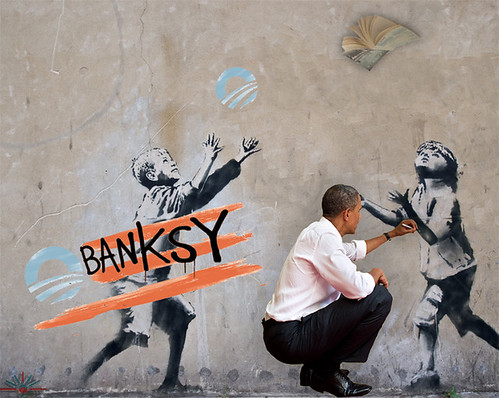
Find out for yourself if you know how well and badly the US fared under Obama. Picture by AK Rockefeller on Flickr.

You can now sign up to receive each day’s Start Up post by email. You’ll need to click a confirmation link, so no spam.

A selection of 10 links for you. Not to be read out for “entertainment” at inaugurations. I’m @charlesarthur on Twitter. Observations and links welcome.

Top Apps of 2016: Spotify, Line, and Netflix led the year’s biggest earners • Sensor Tower

Randy Nelson:

»

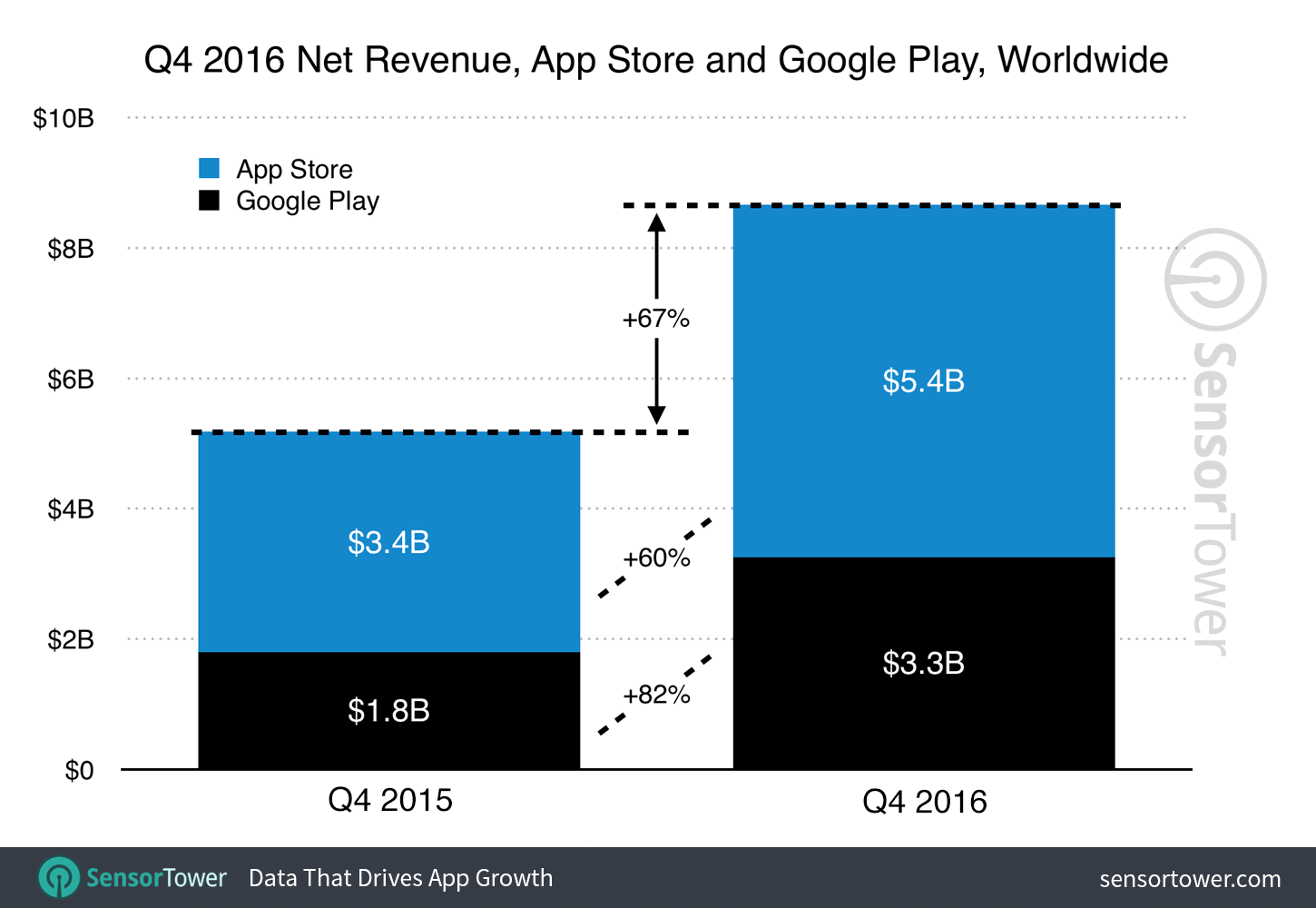
Worldwide net revenue from all apps (including games) across the App Store and Google Play grew 67% over Q4 2015, from approximately $5.2bn to approximately $8.7bn. As illustrated by the chart below, this reflected growth of 60% worldwide for Apple’s App Store, from $3.4bn to $5.4bn year-over-year, and 82% growth for Google Play, which saw revenue paid to developers increase from $1.8bn to $3.3bn for the same period.

Looking at new installs of apps from both stores, downloads of all apps worldwide during Q4 2016 totaled approximately 19.2bn and there were more than 80bn app downloads during 2016 in total.

In terms of year-over-year growth, total downloads for Q4 2016 increased by about 17% compared to 2015.

«

It’s not clear whether the data includes ad revenue. From what is shown, you can see iOS App Store revenue growing slower than the market, but still by more in absolute terms than Google Play’s. We constantly hear that Google Play will catch up and pass iOS revenues; on this showing, that will happen in 2020.

What’s more likely to happen first is that app revenue growth slows down dramatically.
link to this extract


Google’s Johnny Lee excited to merge Tango and Daydream • UploadVR

Ian Hamilton:

»

The AR [augmented reality] functionality [of the Asus Zenfone AR] was shown live on stage at CES by Google’s Johnny Lee, who heads up the Tango team. Google has shown a Hot Wheels app (onstage) and Jenga (shown previously) as realistic digital representations of otherwise classic gaming experiences inserted believably into your environment. A GAP app shown at CES, however, hinted at AR technology’s enormous potential to save folks time. It overlaid clothes of varying sizes seamlessly onto a floating model in the living room, with each outfit draping realistically over different body types.

And as countless CES attendees navigated the endless casino hallways, so many of us could have saved time if we’d been given step-by-step directions. All it would take are little dots overlaid on the carpet ahead shown on the phone’s screen — something that has been shown with Google Tango in the past.

«

God forbid you should look up from your phone screen or, you know, ask somebody or read a map. What about a strap for each wrist which gives a mild electric shock to tell you which way to turn?
link to this extract


This “Genderless Nipples” account is throwing off Instagram’s algorithm • PAPERMAG

Nadya Agrawal:

»

Genderless Nipples posts up-close pictures of people’s nipples, making it unclear if they belong to men and women. This clever strategy completely bamboozles Instagram’s algorithm for n00dz detection so sometimes when it deletes pictures off Genderless Nippples’ account it ends up deleting pictures of a dude’s nipples.

This happened within a few days of the account going live–Instagram in all its wisdom deleted a picture of nipples thinking they were lady parts when in fact they belonged to a guy. The account holders responded by posting the notification they received and a caption pointing out the clear double standard that exists: “Instagram, you can’t even tell the difference between male and female nipples; who could!? So why even bother banning female nipples if they can be so similar?”

Instagram’s current policy about nudity is clear for the most part: no butts, no genitalia. When it comes to nipples, though, the policy changes based on gender–if a woman’s nipples are exposed, it’s nudity. Male nipples are always permissible.

«

link to this extract


Google reveals its servers all contain custom security silicon • The Register

Simon Sharwood:

»

Revealed last Friday, the document outlines six layers of security and reveals some interesting factoids about the Alphabet subsidiary’s operations, none more so than the disclosure that: “We also design custom chips, including a hardware security chip that is currently being deployed on both servers and peripherals. These chips allow us to securely identify and authenticate legitimate Google devices at the hardware level.”

That silicon works alongside cryptographic signatures employed “over low-level components like the BIOS, bootloader, kernel, and base operating system image.”

“These signatures can be validated during each boot or update,” the document says, adding that “the components are all Google-controlled, built, and hardened. With each new generation of hardware we strive to continually improve security: for example, depending on the generation of server design, we root the trust of the boot chain in either a lockable firmware chip, a microcontroller running Google-written security code, or the above mentioned Google-designed security chip.”

«

This is in Google’s Infrastructure Security Design Overview. Google is paranoid about people penetrating its security because it relies on peoples’ trust; without that it would be Yahoo.
link to this extract


Lenovo thought it knew how to fix tarnished brands — then it bought Motorola • WSJ

Kathy Chu and Juro Osawa:

»

Although Motorola still was among the top five U.S. phone brands with Lenovo acquired it, it was posting losses and lagged behind market leaders such as Apple and Samsung.

Many analysts thought the marriage could work, given Lenovo’s experience. The IBM success, in particular, created “a certain aura of invincibility,” says Neil Mawston, an analyst at market-research firm Strategy Analytics.

Mr. Yang initially instructed Lenovo executives to take a hands-off approach, similar to his strategy with IBM. He vowed to make Motorola profitable within six quarters and reassured Motorola employees he didn’t plan to cut U.S. positions and move them to China.

He also insisted Motorola re-enter China, a country it left after being acquired by Google, whose search and email functions have largely been blocked in China following disagreements with Beijing over censorship.

“Lenovo is a global citizen like you,” Motorola employees recall Mr. Yang telling them in U.S. town-hall meetings after the deal closed. “You have to sell things globally.”

Lenovo already had a huge phone business in China, briefly reaching No. 1 in sales in 2014.

«

The piece, though long, is oddly unfocussed. What’s the principal cause of Lenovo’s failure? Motorola being unprofitable (which it was even before Google), or Lenovo being arrogant? One suspects that Motorola’s culture, plus the extreme competitiveness of the mobile market, is the true reason.
link to this extract


Tower of Babel • Remains of the Day

Eugene Wei:

»

Our next POTUS, whether wittingly or not, weaponized Russell Conjugation [the way we see desirable traits in ourselves as undesirable in enemies – eg I’m firm, you’re obstinate and he’s pigheaded] and our coalitional instincts [explained earlier in his post] and performed a jiu-jitsu toss on his opponents, leaving much of the country wondering whether winner-take-all elections for the Presidency are a good thing in a country so evenly divided…

…It’s somewhat of a miracle how every Tweet of his sifts the same factions apart; one side screams in disgust and disbelief, the other piles on with glee. Let’s call that technique of tweeting the Trump Conjugation. Sad!

Many claim the internet creates filter bubbles, but I believe the mechanism by which the Internet amplifies tribalism doesn’t work the way most people describe it. The common explanation is that we form networks with like-minded people and only hear the opinions of those who agree with us, reinforcing our narrow world views.

My belief is that the Internet has increased our exposure to diverse viewpoints, including those from oppositional tribes. I suspect everyone who uses the Internet regularly encounters more diverse opinions, in absolute terms, than prior to the rise of the Internet, and there is research (PDF) to support this. Our information diet is more diverse now, and as opposed to the age before social media or even the Internet itself, we’re exposed to more opinions that both strongly confirm AND counter our beliefs.

«

Wei doesn’t write often, but when he does it’s worthwhile.
link to this extract


The Big List of Naughty Strings • Github

»

The Big List of Naughty Strings is a list of strings which have a high probability of causing issues when used as user-input data.

«

In case you’ve got something you built that needs testing. Sure that Little Timmy Drop Tables is in there somewhere. He’s already got a company in the UK.
link to this extract


Restarting the Emergent newsletter • Craig Silverman

»

I’m Craig Silverman and this is the first version of a restarted newsletter about online rumors, fake news, and misinformation.

If you’re wondering why you’re receiving it, here’s a bit of background: You signed up to receive the newsletter from Emergent.info, my rumor-tracking website. It’s been dormant since March 2015. That’s also the last time I sent this newsletter. 

I’m now covering fake news and online misinformation as the media editor for BuzzFeed News. This newsletter will be a quick digital briefing on those topics.

«

You can subscribe here. If you need more email.
link to this extract


You Draw It: What Got Better or Worse During Obama’s Presidency • The New York Times

Larry Buchanan, Haeyoun Park and Adam Pearce:

»

You Draw It: What Got Better or Worse During Obama’s Presidency

Draw your guesses on the charts below to see if you’re as smart as you think you are.

«

This is terrific: unemployment, convicted immigrants deported, national spending on health care, national debt, number of Mexicans illegally in the US, number of violent crimes, troops in Afghanistan and Iraq – all there, but you have to try to guess (or use your gigantic knowledge) first.

More to the point, this is a terrific use of data journalism to get people at least to see how their beliefs match up to reality. (Trouble is, will they accept that it is reality?) Very like the FT’s interactive with data from the US and UK last December.
link to this extract


How an allegedly fake video killed a much-hyped drone startup • Forbes

Ryan Mac:

»

The lawsuit alleged that Lily did not have a single prototype that functioned as advertised at the time of the launch video’s filming. Instead, it claimed Balaresque and Bradlow brought non-functioning models to the shoot for “beauty shots,” while the first-person angles that supposedly came from the Lily Camera were actually shot by GoPro units that had been strapped to the robot.

In an email cited by the lawsuit, Lily CEO Balaresque wrote to Brad Kremer, a video producer who specialized in snowboarding shoots, that shots from the Lily Drone will be using a “Gopro mounted to a Lily prototype.”

“However, we do not feel comfortable telling people that we shot [view from Lily] scenes with a Gopro (because the whole thesis of our product is that you do not need a Gopro),” he continued. “Can you modify a Gopro image in post-processing so that people cannot tell that it was taken from a Gopro…”

Kremer, who works for video production company CMI Productions, declined to comment to Forbes, citing the ongoing litigation.

«

The use case that the Lily founders thought they had – include yourself in those family holiday photos! – is pretty much completely answered by the selfie stick. Though I can see scores of professional uses for drones (films, TV, reconnaissance) I still can’t see a viable use for consumers at the moment.
link to this extract


Errata, corrigenda and ai no corrida: apparently every iPad mini owner in the entire world spends all their time using it in portrait mode and would love to buy a 10.5in version so they can have two side-by-side. We regret the error.

Start Up: Tesla’s lock trouble, Sudan’s deadly fake news, Fitbit looks flabby, the emoji problem, and more


We might have to think about that “secure” line. Photo by Doug Kline on Flickr.

You can now sign up to receive each day’s Start Up post by email. You’ll need to click a confirmation link, so no spam.

A selection of 11 links for you. Use them wisely. I’m @charlesarthur on Twitter. Observations and links welcome.

Note to Tesla owners: Don’t forget your car keys • Recode

Johana Bhuiyan:

»

Ryan Negri, an angel investor and Tesla owner based in Las Vegas, decided to go for a drive through Red Rock Canyon yesterday to take “some photos of the freshly-fallen snow,” according to a photo caption he posted on Instagram. He unlocked and also started his car using his phone — a handy, somewhat delightful and futuristic-seeming feature — and left the key behind.

As Negri discovered after getting out of the car, it turns out there is no cell reception in a canyon in the middle of the desert — and that the Tesla needs a network connection to use the smartphone-unlocking feature.

«

#utopians
link to this extract


Medium, and the reason you can’t stand the news anymore • Medium

Sean Blanda:

»

Companies from Medium to The Washington Post to Mashable to Buzzfeed all eventually run into the same unthinkable truth: The methods used to fund modern journalism simultaneously undermine trust in the news outlets.

Editors, writers, and executives at today’s news outlets are all in a no-win situation where they are forced to contribute to the causes of their own demise to survive. In any other business, companies would try, fail, and another would take its place. This is good and needed.

But for news, the failures are happening at a glacial pace and bad actors are profiting as the trustworthiness of our news outlets are breaking down in slow motion. The result is the worst kind of feedback loop, where well-meaning people try to “fix” the news. But instead, those methods erode trust in all news outlets leading to a total breakdown in discourse.

You can draw a straight line from the bad incentive structure forced upon news outlets to the unprecedented divisiveness in our country. And it’s time we realized what’s going on.

«

link to this extract


How to use Facebook and fake news to get people to murder each other • BuzzFeed News

Jason Patinkin:

»

Although the vast majority of South Sudan’s population has no internet access — the adult literacy rate in the country is around 30% — social media incitement has had an outsized impact largely because it mainly comes from the South Sudanese diaspora, who are held in extremely high esteem back home.

In November, the UN warned that ethnic cleansing is underway and that the fighting could spill into genocide. Government and rebel leaders stand accused of orchestrating Facebook and Twitter campaigns inciting the violence.

“Social media has been used by partisans on all sides, including some senior government officials, to exaggerate incidents, spread falsehoods and veiled threats or post outright messages of incitement,” a separate report by a UN panel of experts released in November reads.

It’s a situation that has drawn comparisons to Rwanda’s 1994 genocide, particularly that crisis’s use of Radio Mille Collines, a local radio station, to fan the flames. And South Sudan’s divide is only getting worse.

«

Goebbels would have loved Facebook and Twitter.
link to this extract


Andy Rubin nears his comeback, complete with an ‘Essential’ phone • Bloomberg

Mark Gurman and Mark Bergen:

»

At least one prototype of Rubin’s phone boasts a screen larger than the iPhone 7 Plus’s (5.5-inches) but has a smaller overall footprint because of the lack of bezels, one of the people said. The startup is experimenting with enabling the phone’s screen to sense different levels of pressure, similar to an iPhone, the person said. Rubin’s team is testing an industrial design with metal edges and a back made of ceramic, which is more difficult to manufacture than typical smartphone materials, two of the people said. 

Essential’s engineers are developing a proprietary connector that serves double duty for charging the battery and expanding the phone’s functionality over time, one person familiar with the planning said. The magnetic connector would allow Essential or even third parties to create hardware accessories that add features to the smartphone. For instance, Rubin’s engineers are working on a sphere-shaped camera add-on that shoots high-resolution 360 degree photographs, the person said.

«

1) going to go nowhere. Rubin has a great track record, but this is niche stuff; and modular is a deathwish.
2) increasingly, on reading Gurman’s stories, I feel his sources are in the supply chain, not the actual companies. There’s hardware detail, but very little about how things will work or what their aims are.
link to this extract


Microsoft acquires deep learning startup Maluuba; AI pioneer Yoshua Bengio to have advisory role • Official Microsoft Blog

»

Maluuba’s vision is to advance toward a more general artificial intelligence by creating literate machines that can think, reason and communicate like humans — a vision exactly in line with ours. Maluuba’s impressive team is addressing some of the fundamental problems in language understanding by modeling some of the innate capabilities of the human brain, from memory and common sense reasoning to curiosity and decision making. I’ve been in the AI research and development field for more than 20 years now, and I’m incredibly excited about the scenarios that this acquisition could make possible in conversational AI.

Imagine a future where, instead of frantically searching through your organization’s directory, documents or emails to find the top tax-law experts in your company, for example, you could communicate with an AI agent that would leverage Maluuba’s machine comprehension capabilities to immediately respond to your request. The agent would be able to answer your question in a company security-compliant manner by having a deeper understanding of the contents of your organization’s documents and emails, instead of simply retrieving a document by keyword matching, which happens today. This is just one of hundreds of scenarios we could imagine as Maluuba pushes the state-of-the-art technology of machine literacy.

Sam Pasupalak and his Maluuba co-founder, Kaheer Suleman, have created a very strong engineering and research team that will become part of our Artificial Intelligence and Research organization.

«

If they can imagine hundreds of scenarios, could they not imagine one that actually makes one think “wow”? Keyword matching is popular because one almost always uses a relevant word, which can then be retrieved. What would be impressive would be to ask for “that email by that person who I met with at X hotel”. Calendar, ID, email.
link to this extract


Why would Apple release a 10.5″ iPad? • Studio Neat blog

Dan Provost:

»

When the original iPad Pro 12.9″ was introduced in September 2015, Phil Schiller demonstrated the reasoning for that sizing by illustrating that the width of the new iPad is the exact same dimension as the height of the 9.7″ iPad.

This has the advantage of essentially having two full height iPad apps, side by side.
Now, imagine Apple doing the exact same thing, but with the iPad mini.

The math works out perfectly. This new 10.5″ iPad would have the exact same resolution as the 12.9″ iPad Pro (2732 x 2048), but the same pixel density of the iPad mini (326 ppi instead of 264 ppi). Crunch the numbers, do a little Pythagorean Theorem, and you end up with a screen 10.5″ diagonal (10.47″ to be precise, but none of Apple’s stated screen sizes are exact). In terms of physcial dimensions, the width of this 10.5″ screen would be exactly the same as the height of the iPad mini screen.

«

OK, so that’s the case, but does anyone use an iPad mini in portrait? Also, would this mean the end of the iPad mini? If this is released, the SKUs are starting to get weird: 7.9in, 9.7in, 10.5in, 12.9in. Notable how Samsung tried multiple screen sizes for tablets, but it released them all at pretty much the same time. That doesn’t seem to have worked out particularly well for them.
link to this extract


Fitbit off to slow start in 2017 as devices pile up, report says • Bloomberg

Selina Wang:

»

The maker of wearable fitness trackers halted production in mid-December because the devices were piling up at retailers and suppliers amid disappointing sales, according to a report by the firm published Tuesday. Demand so far this year is “characterized as weak,” Cleveland Research said, suggesting analysts’ estimates for 2016 fourth-quarter earnings may be too high.

“The start of the year has been bad with Fitbit,” research analyst Ben Bollin wrote in the note. “There are some concerns partners may not get paid for all of the product they have built because demand is so weak,” he wrote, citing comments from a supplier. “Partners had to completely stop production for Fitbit because they are swimming in product.”

«

Wow. Demand reckoned to have been low through the fourth quarter. And yet the Fitbit app was high on the list of free apps in the iOS store. One to keep an eye on this year. (Thanks @charlesknight for the link.)
link to this extract


Exploitee.rs hacked the Samsung Smartcam yet again, this time with a root exploit • Android Police

»

After the first wave of exploits [in May 2014], the Smartcam’s local web interface was completely removed, only allowing users to connect to it via the Samsung SmartCloud website. The company hoped that this would remove all possible exploits, but they neglected to remove the actual web server itself (only deleting the interface that the server was running).

Because the web server is still available, another exploit was found – allowing commands to be run on the Smartcam as root. The full technical details can be found on the Exploitee.rs wiki, but essentially, this works by injecting a specific file into the device’s “iWatch” webcam monitoring service as a firmware update. This can then be used to execute commands remotely as the root user, because the web server runs as root.

Interestingly, the Smartcam was developed by Samsung Techwin, a former division of Samsung. Samsung sold its holding stake of Techwin in 2015 to South Korean conglomerate Hanwha Group. The company, now called Hanwha Techwin, is still responsible for the Samsung Smartcam – likely explaining the camera’s poor user experience and security.

«

The Exploiteers wiki is worth a browse; seems to be an IoT hacking/exploit wiki. Oddly, no Apple gear in there.
link to this extract


Android’s emoji problem • Emojipedia blog

Jeremy Burge:

»

The Google design team were months ahead of Apple with new emoji in the past year. Support for the latest emojis came to Android in the major Nougat release in August of 2016.

Yet the vast majority of Android users still can’t see these new emojis. Instead, they see this:

Unicode 9 support was first added to Android 7.0 in August, followed by genders and professions which arrived with 7.1 in October 2016. This was some timely updating from Google, especially compared to previous years.

«

84% of iOS users visiting Emojipedia are using iOS 10.x; just 4% of Android visitors are using the latest, 7.x (though that’s 6x greater than the number in the wild, 0.7%). Quoth Burge:

»

With numbers like that, it’s no wonder so many apps are providing their own custom emoji support these days.

Snapchat, Messenger, WhatsApp, Telegram and Slack all use emoji-replacement images on Android; in a trend started by Twitter with Twemoji which was released when the most popular browser on Windows (Chrome) didn’t include emoji support.

WhatsApp and Telegram even use Apple’s own emoji images on Android, and makes a custom keyboard to display them…

…The answer for users is very clear: if you care about new emoji support, be careful which phone you purchase. Unless you like looking at empty boxes.

«

It does feel a bit “first world problem”, but the deeper point is that security elements in newer versions of Android never reach many users.

link to this extract


Pandora’s eyes are bigger than its wallet • Bloomberg Gadfly

Shira Ovide:

»

Pandora said late Thursday that its business is going gangbusters — so wonderfully, in fact, that it needs to fire 7% of its main workforce in the U.S. 

The good news is the online radio service is doing better financially than it told investors to expect. Revenue is higher than predicted, at least in part because the company is willing to cram in more commercial breaks between songs. And there’s a good reason for Pandora’s eagerness for higher advertising sales at the risk of annoying its users with ads: It needs the money. 

Running Pandora Media Inc.’s business in the 12 months ended Sept. 30 burned through $301m in cash, counting what the company spent on computers and other resources to stream songs to its listeners. And the company at Sept. 30 held about $258m in cash and relatively liquid financial instruments. At its current rate of cash burn, then, the company will exhaust its reserves of ready cash in about 10 months. 

«

But but but! As Ovide points out, though it has been free cashflow-negative for five quarters in a row (and 8 of the past 11) it can get more cash by a rights issue, or issuing more stock, or a loan. But that’s only going to be a holding position – she reckons it’s in line for a sale. (Ironic, since Pandora is public, and Spotify is angling to go public this year, but isn’t profitable either, and has a giant loan sucking it dry.)
link to this extract


Trolls decided I was taking pictures of Rex Tillerson’s notes. I wasn’t even there. • The Washington Post

Doris Truong was convicted in her absence on Twitter of having been the (also Asian, also female) person who seemed to be taking pictures of Tillerson’s notes during a break in his confirmation hearing:

»

Even more bizarrely, one Twitter user insisted that “facial software on the video” led to the “almost positive” conclusion that the woman was me.

But even if people believed that the person at the hearing wasn’t me, they wanted to know who she was. And that’s what’s particularly alarming about this time in our society: Why are people so quick to look for someone to condemn? And during the confusion about the woman’s identity, why is it presumed that she is a journalist? Or that taking pictures of notes in an open hearing is illegal? Or, for that matter, that she was even taking pictures of Tillerson’s notes?

«

The urge to accuse is extraordinarily strong online. If you renamed Facebook to “Pitchforks” and Twitter to “Flaming Torches” you’d pretty much have it.
link to this extract


Errata, corrigenda and ai no corrida: none notified
Start Up: numberplate readers online, PC sales fall again, celebrity death hoaxing, and more


Afraid so – machine learning is coming for your poker game. Photo by Jeremy Brooks on Flickr.

A selection of 14 links for you. It’s a lot, isn’t it? I’m @charlesarthur on Twitter. Observations and links welcome.

The Internet IS a Thing: use it to find license plate readers • networked inference

Kenneth Lipp:

»

A few years ago I was searching for info about Automatic License Plate Readers, ALPR, Googling by manufacturer “Genetec.” I found a “Read Me” file from an FTP server, that it turned out was a live ALPR server for the City of Boston, with classified watchlists including thousands on a “Gang/Terror” watch.

At the time I was just searching Google, but once I found something interesting I used a variety of other tools to remotely scan the server and its directories to see what I could learn.

I found out recently that you could search Shodan, the Search Engine for the Internet of Things, for text in the “html” field. Shodan indexes, among other data about the physical architecture of the Web, headers which provide response codes (like 100, 200, “404 Error,” etc), and often descriptive information about the function of the computer (or machine, or site, for the purposes of Shodan’s heuristic, host).

In Boston I located a Genetec AutoVu server. I searched Shodan for html:”autovu”

This brings back four results, once filtered to just the US (probably two ALPR systems, 3 IP addresses, one is repeated in the results)…

…What we have in this case appears to be a field test for an occupancy-detection/plate-reader hybrid solution, located in Boydton, in Virginia, all the way down on the North Carolina border — where would you look at that there’s a Microsoft Data Center.

I know off the top of my head that Massachusetts state was working with Xerox on such a system on state roads, which in addition to scanning and archiving plate numbers of passing cars used a computer vision algorithm to determine how many people are in the car (or perhaps whether the car has only one or more than occupant — this type of system is frequently deployed for monitoring occupancy-restricted lanes — “carpool lanes.”)

«

And this stuff is on the internet, at least in the US. Lipp has written much more on this in a series of blogposts.
link to this extract


Facebook risks breaking its perfect business model • Bloomberg Gadfly

Shira Ovide on Facebook’s decision to start revenue-sharing on pre-roll and mid-roll (yuk) ads in videos:

»

Facebook has become – surprisingly – the perfect business for the smartphone age, and a big reason is it has spent essentially nothing to keep users enthralled. For the most part, companies that publish political articles or cooking videos on Facebook don’t make money directly from that material, although they use those items to assemble a big fan base and then point those people to websites and apps where the companies make money selling ads or subscriptions.

Those articles and cooking videos keep users hanging out on Facebook, and the company keeps all the money it makes from selling advertisements that fill in gaps between those posts and videos they paid nothing to publish. It may not be fair, but it has made for a wildly successful and profitable business. 

If Facebook is now willing to give 55% of ad dollars from those video ads, that means cracks are emerging in Facebook’s free ride with its army of content suppliers. (Facebook also has experimented with splitting ad dollars with semiprofessional video stars who have attracted television-sized audiences on YouTube.)

Sharing money is more equitable but could damage Facebook’s finances. Consider Alphabet Inc.’s YouTube. The video website makes roughly one-third of the money Facebook generates from each user. It’s not clear exactly why. Facebook may be doing a better job stuffing ads into every spot it can. Surely part of the gap is explained by Facebook paying almost nothing to stock the social network with posts, photos and video, while YouTube hands off 55 cents of every dollar it generates to the creators of popular videos.

«

link to this extract


How surveillance changes people’s behavior • Harvard Magazine

Jonathan Shaw, in a very long article on this topic:

»

“Google was ground zero,” [Wilson professor of business administration Shoshana] Zuboff begins. At first, information was used to benefit end users, to improve searches, just as Apple and Amazon use their customers’ data largely to customize those individuals’ online experiences. Google’s founders once said they weren’t interested in advertising. But Google “didn’t have a product to sell,” she explains, and as the 2001 dot.com bubble fell into crisis, the company was under pressure to transform investment into earnings. “They didn’t start by saying, ‘Well, we can make a lot of money assaulting privacy,’” she continues. Instead, “trial and error and experimentation and adapting their capabilities in new directions” led them to sell ads based on personal information about users. Like the tinkerers at Ford, Google engineers discovered “a way of using their capabilities in the context of search to do something utterly different from anything they had imagined when they started out.” Instead of using the personal data to benefit the sources of that information, they commodified it, using what they knew about people to match them with paying advertisers. As the advertising money flowed into Google, it became a “powerful feedback loop of almost instantaneous success in these new markets.”

“Those feedback loops become drivers themselves,” Zuboff explains. “This is how the logic of accumulation develops…and ultimately flourishes and becomes institutionalized. That it has costs, and that the costs fall on society, on individuals, on the values and principles of the liberal order for which human beings have struggled and sacrificed much over millennia—that,” she says pointedly, “is off the balance sheet.”

«

link to this extract


How celebrity death hoaxes power fake news • Digiday

Lucia Moses:

»

Web traffic-goosing tricks come and go. But if there’s one that has enduring appeal, it’s the celebrity death hoax.

In the past few weeks alone, internet pranksters have “killed off” Queen Elizabeth, Tony Hawk, Miley Cyrus and Hugh Hefner, to name a handful that have been debunked by the website Gossip Cop. Some trace its peak to the site Global Associated News, a fake-news headline generator that web entrepreneur Rich Hoover said he started as a joke.

Since then, others have discovered the celebrity death hoax as a tried-and-true scheme to drive traffic to their sites, which they’re monetizing with ads. The fake stories follow a loose pattern: Often coming from sites with legit-sounding names like Msmbc.co and Nbctoday.co, the stories tend to focus on young, popular celebrities with many fans who would be shocked by their premature death, causing a burst of traffic to the site, which is paid for with programmatically served ads.

Michael Lewittes, founder of Gossip Cop, said he once was seeing as many as two or three death hoaxes a week. “Eddie Murphy and Adam Sandler have died, probably collectively, 15 to 20 times on the internet,” he said.

The rise of platforms and ad tech have enabled the spread of celebrity death, just as it has other types of fake news. Some pranksters have used Twitter to fool people about celebrity deaths, using accounts that sound like actual news outlets.

«

Celebrity *anything* tends to drive clicks. Hell, you can even get people to *vote* for you with the power of celebrity, even if you’re talentless.
link to this extract


US appeals court revives antitrust lawsuit against Apple • Reuters

Stephen Nellis and Dan Levine:

»

iPhone app purchasers may sue Apple Inc over allegations that the company monopolized the market for iPhone apps by not allowing users to purchase them outside the App Store, leading to higher prices, a U.S. appeals court ruled on Thursday.

The 9th U.S. Circuit Court of Appeals ruling revives a long-simmering legal challenge originally filed in 2012 taking aim at Apple’s practice of only allowing iPhones to run apps purchased from its own App Store. A group of iPhone users sued saying the Cupertino, California, company’s practice was anticompetitive.

Apple had argued that users did not have standing to sue it because they purchased apps from developers, with Apple simply renting out space to those developers. Developers pay a cut of their revenues to Apple in exchange for the right to sell in the App Store.

A lower court sided with Apple, but Judge William A. Fletcher ruled that iPhone users purchase apps directly from Apple, which gives iPhone users the right to bring a legal challenge against Apple.

«

That could get interesting.
link to this extract


The eye of the storm: a look at EyePyramid, the malware supposedly used in high-profile hacks in Italy • TrendLabs Security Intelligence Blog

Federico Maggi:

»

Two Italian citizens were arrested last Tuesday by Italian authorities (in cooperation with the FBI) for exfiltrating sensitive data from high-profile Italian targets. Private and public Italian citizens, including those holding key positions in the state, were the subject of a spear-phishing campaign that reportedly served a malware, codenamed EyePyramid, as a malicious attachment. This malware was used to successfully exfiltrate over 87 gigabytes worth of data including usernames, passwords, browsing data, and filesystem content.

«

Caught how? One of them bought a licence key for MailBee under his own name, and used the key in the attack code. Operational security is tough.
link to this extract


Asking the wrong questions • Benedict Evans

Evans looks at forecasts of the future from the 1960s:

»

Some of this has happened more or less as predicted – we did get air traffic control, automated subway trains and computerised taxation (except in the USA). There are some great comedy predictions here too – that ‘centralised wire tapping’ would take until 2030, or never, or that people in both 1964 and 2016 thought we’d have automated driving ‘by 2020’. 

However, to me the interesting thing is how often the order is wrong. What we now know to be the hard problems were going to be solved decades before what we now know were the easy ones. So it might take until 2020 to ‘fax’ a newspaper to your home, and automatic wiretapping might be impossible, but automatic doctors, radar implants for the blind, household robots and machine translation would be all done by 1990 and a machine would be passing human IQ tests at genius level by 2000. Meanwhile, there are a few quite important things missing – there is no general-purpose computing, no internet and no mobile phones. There’s no prediction for when everyone on earth would have a pocket computer connected to all the world’s knowledge (2020-2025). This aren’t random gaps – it’s just not that they thought X would work and didn’t know we’d invent Y. Rather, what’s lacking is an understanding of the structural impetus of computing and software as universal platforms that would shape how all of these things would be created. We didn’t make a home newspaper facsimile machine – we made computers.

«

link to this extract


Damn, Apple is losing a lot of people • Gizmodo

Christina Warren:

»

Here is a list of some of the high level employees who have left Apple since January 2016 and where they have gone, if that information is available:

«

It’s a long list (24 names), from multiple departments – though five are PR or media (is that a crucial department?). Notable that many in that list are going to Tesla. Either Tesla is the attractive place, or it’s good at the PR job of announcing recruitment wins.
link to this extract


Xiaomi stops disclosing annual sales figures as CEO admits the company grew too fast • TechCrunch

Jon Russell:

»

Xiaomi has forgone its tradition of revealing how many smartphones it sold the previous year. The strategy yielded many headlines for the highly-regarded Chinese outfit, but today its CEO admitted that Xiaomi has been in transition after growing “too fast”.

The writing was on the cards, even as early as January 2016 when Xiaomi revealed it had sold “over 70 million” devices in 2015. An impressive number, for sure, given the backdrop of slowing smartphone sales worldwide, but it was short of the company’s public target of 80m, which was reduced from an initial 100m.

It’s been fairly evident from analyst reports that 2016 wasn’t a year for blockbuster Xiaomi growth. While it featured near the top of the sales pile in China, and held steady in India, its top emerging market, there was no great acceleration as in past years. For example, sales jumped from 7.2m in 2012, to 18.7m in 2013 and 61m in 2014.

A Xiaomi rep confirmed to us that the company will not be disclosing its 2016 sales numbers.

«

That $45bn valuation (at its last funding round in December 2014) doesn’t look so solid any more.
link to this extract


Poker is the latest game to fold against artificial intelligence • MIT Technology Review

Will Knight:

»

In a landmark achievement for artificial intelligence, a poker bot developed by researchers in Canada and the Czech Republic has defeated several professional players in one-on-one games of no-limit Texas hold’em poker.

Perhaps most interestingly, the academics behind the work say their program overcame its human opponents by using an approximation approach that they compare to “gut feeling.”

“If correct, this is indeed a significant advance in game-playing AI,” says Michael Wellman, a professor at the University of Michigan who specializes in game theory and AI. “First, it achieves a major milestone (beating poker professionals) in a game of prominent interest. Second, it brings together several novel ideas, which together support an exciting approach for imperfect-information games.”

Later this week, a tournament at a Pittsburgh casino will see several world-class poker players play the same version of poker against a program developed at Carnegie Mellon University.

«

Computers playing poker get an advantage over humans: they don’t have emotions, and they don’t have “tells” – the unconscious signals we give off to indicate tension or otherwise.

However, poker is amazingly hard for computers:

»

tellingly, it contains levels of uncertainty, such as when an opponent may be bluffing, that are found in many real-world situations that AI has not yet mastered. Poker players cannot see their opponents’ hands, meaning that, in contrast to checkers, chess, or Go, not all of the information contained within the game is available to them.

«

About 10^160 paths for each hand in heads-up no-limit Texas Hold’em.
link to this extract


2016 marked fifth consecutive year of worldwide PC shipment decline • Gartner

»

For the year 2016, PC shipments totaled 269.7m units, a 6.2% decline from 2015. PC shipments have declined annually since 2012.

“Stagnation in the PC market continued into the fourth quarter of 2016 as holiday sales were generally weak due to the fundamental change in PC buying behavior,” said Mikako Kitagawa, principal analyst at Gartner. “The broad PC market has been static as technology improvements have not been sufficient to drive real market growth. There have been innovative form factors like 2-in-1s and thin and light notebooks, as well as technology improvements, such as longer battery life. This end of the market has grown fast, led by engaged PC users who put high priority on PCs. However, the market driven by PC enthusiasts is not big enough to drive overall market growth.”

“There is the other side of the PC market, where PCs are infrequently used. Consumers in this segment have high dependency on smartphones, so they stretch PC life cycles longer. This side of the market is much bigger than the PC enthusiast segment; thus, steep declines in the infrequent PC user market offset the fast growth of the PC enthusiast market.”

«

Hasn’t found the bottom yet, then. The other notable point is that the “Others” category (all those who aren’t Lenovo, HP, Dell, Asus, Apple or Acer) shrank by 19% in the fourth quarter, against 17% for the year – suggesting that the squeeze on the smaller players is getting worse. In total, “Others” went from 77.6m in 2015 to 64.5m. Those lost 13m sales are going to hurt balance sheets.
link to this extract


Saving you bandwidth on Google+ through machine learning • Google product blog

John Nack, Google+ product manager:

»

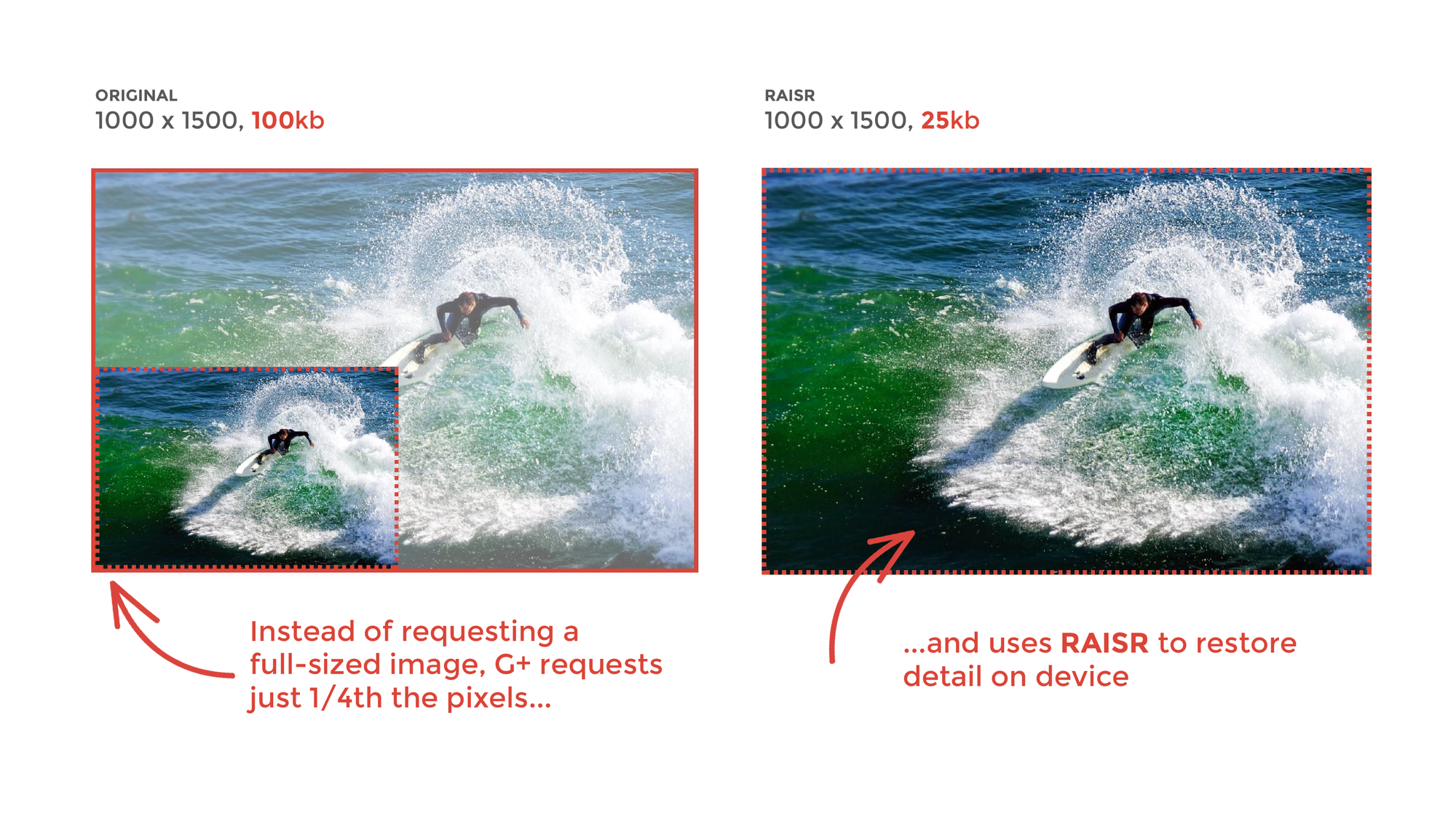
Traditionally, viewing images at high resolution has also meant using lots of bandwidth, leading to slower loading speeds and higher data costs. For many folks, especially those where data is pricey or the internet is spotty, this is a significant concern.

To help everyone be able to see the beautiful photos that photographers share to Google+ in their full glory, we’ve turned to machine learning and a new technology called RAISR. RAISR, which was introduced in November, uses machine learning to produce great quality versions of low-resolution images, allowing you to see beautiful photos as the photographers intended them to be seen. By using RAISR to display some of the large images on Google+, we’ve been able to use up to 75% less bandwidth per image we’ve applied it to.

«

“Google+ product manager” must be one of those depressing jobs. This is a great application, though on my slow connection the picture alone took absolutely ages – over 30 seconds – to load.
link to this extract


Techdirt’s First Amendment fight for its life • Techdirt

Mike Masnick, Techdirt’s founder:

»

As you may have heard, last week we were sued for $15m by Shiva Ayyadurai, who claims to have invented email. We have written, at great length, about his claims and our opinion — backed up by detailed and thorough evidence — that email existed long before Ayyadurai created any software. We believe the legal claims in the lawsuit are meritless, and we intend to fight them and to win.

There is a larger point here. Defamation claims like this can force independent media companies to capitulate and shut down due to mounting legal costs. Ayyadurai’s attorney, Charles Harder, has already shown that this model can lead to exactly that result. His efforts helped put a much larger and much more well-resourced company than Techdirt completely out of business.

So, in our view, this is not a fight about who invented email. This is a fight about whether or not our legal system will silence independent publications for publishing opinions that public figures do not like.
And here’s the thing: this fight could very well be the end of Techdirt, even if we are completely on the right side of the law.

«

I don’t agree with Masnick on everything (specifically: the value of copyright) but he always argues his case well; and he’s not afraid to call a spade a spade. It’s likely Techdirt will set up a legal defence fund. That could be a worthy cause for donations.

It’s also a sign of the US’s media getting an inkling of what it’s like to be in the news business in the UK: you always need to be thinking about libel risk.
link to this extract


The slow, sad, and ultimately predictable decline of 3-D printing • Inc.com

John Brandon:

»

I often think of that Saab part [a cupholder which had broken, and which he wanted to replace] as a good model of what went wrong. (By the way, I promise not to use any metaphors for 3-D printing from now on.) For starters, I really wanted to print the cup holder. I even asked a well-known Thingiverse designer for help, and was going to pay him, but he said the part was too complex. Wait, what? Too complex for a well-known designer? He even used the word “hassle” in his email back to me. The part is not something you’d use on a NASA spaceship. It does have a spring attached to two pieces of plastic that fold together.

What about a water bottle cage for my bike? Shouldn’t be a big problem. There are plenty of designs. But when I actually printed one of them, it broke on my first ride. Also, a much more important piece of data: A water bottle cage costs about $4 at Amazon.com but even a relatively short spool of filament costs $65. The math doesn’t compute. And, it doesn’t make sense to spend the time.

From that experience, I knew something was wrong. As the Newsweek article notes, you can print only so many Yoda heads before you wonder why you bought the device. A 3-D printer won’t magically terraform anything right before your eyes, and it even has problems with slightly complex car parts. I even remember my nephew, who is working as an intern for me this year, saying the industry needs to figure out this problem. It’s fun for a while, but eventually you realize you need to do something practical after paying almost $1,000 for the product.

«

It’s that: the costs just never add up.
link to this extract


Errata, corrigenda and ai no corrida: “Alibaba” was mispelt as “Alababa” in the article about Yahoo yesterday. What’s an extra i between friends, though?

You can now sign up to receive each day’s Start Up post by email. You’ll need to click a confirmation link, so no spam.

Start Up: how Facebook splits us, Alphabet’s selloff, the tld domain scam, Parrot shrinks, and more


What if someone takes over your phone using voice commands you can’t recognise? Photo by TechStage on Flickr.

You can sign up to receive each day’s Start Up post by email. You’ll need to click a confirmation link, so no spam.

Back by minimal demand! A selection of 17 links for you. (It’s 20-17, after all.) Please do not abuse them in Russian hotels. I’m @charlesarthur on Twitter. Observations and links welcome.

Why America is self-segregating • Points

Danah Boyd:

»

Naive as hell, Mark Zuckerberg dreamed he could build the tools that would connect people at unprecedented scale, both domestically and internationally. I actually feel bad for him as he clings to that hope while facing increasing attacks from people around the world about the role that Facebook is playing in magnifying social divisions. Although critics love to paint him as only motivated by money, he genuinely wants to make the world a better place and sees Facebook as a tool to connect people, not empower them to self-segregate…

…In the springs of 2006, I was doing fieldwork with teenagers at a time when they had just received acceptances to college. I giggled at how many of them immediately wrote to the college in which they intended to enroll, begging for a campus email address so that they could join that school’s Facebook (before Facebook was broadly available). In the previous year, I had watched the previous class look up roommate assignments on MySpace so I was prepared for the fact that they’d use Facebook to do the same. What I wasn’t prepared for was how quickly they would all get on Facebook, map the incoming freshman class, and use this information to ask for a roommate switch. Before they even arrived on campus in August/September of 2006, they had self-segregated as much as possible.

«

The longer piece has much more data, and is even more remarkable.
link to this extract


Demo: Hidden Voice Commands • UC Berkeley/Georgetown U research

An eight-strong team from the two universities show how machines can hear things that you can’t – and will act on them:

»

The video below shows black box attack attack being carried out in presence of background noise with the target phone kept at a distance on 10.1 ft away from the speakers used to play the attack audio. 

The understanding of attack commands by a human listener is subject to priming effects:  when we already know the actual message embedded in an obfuscated command, we unconsciously “hear” that message in the noise. This effect is so extreme that we can even “hear” primed messages when no such message actually exists; see, for example, Sounds you can’t Unhear. 

«

The video is creepy, and amazing. They’ve published a paper too.

I mean, imagine if you broadcast one of those “hidden” commands over some speakers to direct the phone belonging to, say, a resident of a tower in New York to open a URL which exploited a known Android security flaw so you could take the phone over and passively connect to the microphone. Imagine.
link to this extract


How volunteer reviewers are saving the world from crummy – even dangerous – USB-C cables • Fast Company

Glenn Fleishman:

»

Nathan Kolluru [who has been testing and then reviewing USB-C cables bought from Amazon] has also seen the downside of being fully independent: In July, he wrote about a warning from Amazon that he risked termination of his Prime account after he tried to return some non-standards-compliant cables.

But surely this isn’t how the hardware world should work for consumers. Shouldn’t there be a formal source of information about a new technology’s promise and pitfalls that isn’t reliant on manufacturers and industry trade groups?

Well, yes, there should. And for a glorious few decades there was, in the form of test labs at computer and other electronics trade magazines. Before the rise of the internet, tech companies that wanted to reach consumers and businesses bought advertising in magazines such as PC Magazine, PCWorld, and InfoWorld. That made such publications highly profitable, which funded large staffs and testing labs.

«

Hey, guess what happened to them? But this is a good article about what the USB people can and can’t do. Though it doesn’t give us much of a timeline for when it will all be plain sailing as it always almost is with USB-A.
link to this extract


Longtime Apple programmer and Swift creator leaves Apple for Tesla • Ars Technica

Andrew Cunningham:

»

Ted Kremenek, another longtime Apple developer who has been with the company since 2007, will be taking over Lattner’s duties as Swift project lead.

[Chris] Lattner has worked at Apple since 2005, and he’s been involved in a lot of major tools and software initiatives over the years. His extensive resume lists many versions of Xcode going back to at least version 3.1, LLVM and the Clang frontend, OpenCL, LLDB, and Swift. He also did some work on macOS, helped tune software performance for the Apple A6 used in the iPhone 5, and helped with the transition to 64-bit ARM CPUs that began with the iPhone 5S. His resume shows a willingness to create, adopt, and evangelize new software and programming languages, which will no doubt be a component of his work at Tesla.

«

11 years is a fair length of time. But equally, Lattner was clearly important at Apple, which couldn’t find a way to keep him. You can see that becoming the person in charge of self-driving software at Tesla would be attractive. And clearly, Apple doesn’t have the same means of attracting him.
link to this extract


78% of global smartphones will be sold to replacement buyers in 2017 • Strategy Analytics

»

According to the latest report from our Wireless Smartphone Strategies (WSS) services: Global Smartphone Sales by Replacement Sales vs. Sales to First Time Buyers by 88 Countries : 2013-2022, global smartphone replacement sales outweighed sales to first time buyers in 2013, for the first time ever. In 2017, we expect 78% of global smartphones will be sold to replacement buyers. We forecast replacement smartphone sales will continue to dominate smartphone sales across all six regions by 2022.

«

I think they mean 78% of smartphones globally, but anyhow. Saturation beckons.
link to this extract


LG Electronics, moving away from modular model, plans new smartphone • WSJ

You know that thing where annoying people say “I told you so”? I told you so about LG’s modular plan.

Also, I think we can declare 2016 “the year of moving away from modular smartphones”. Besides all the other things it was.
link to this extract


Apple’s 2016 in review • Chuqui

Former Apple employee Chuq von Rospach:

»

Why make a product?

If you boil business down to essentials, there are only three reasons a product should exist:

Because it makes you money: Most products need to make you money and contribute to the financial success of the company. Some are going to be more profitable than others, but you shouldn’t be doing products that lose you money (buy hey, we’ll make it up in volume!). Unless…

Because it’s strategic: Sometimes you create a product for strategic reasons: it’s not going to make you money, but it’s necessary to compete, or it creates other opportunities where you can profit indirectly (iTunes is a great example of this, where most of the profit came from iPod sales and later music and media sales), or you’re investing in in something that in the long term you expect will make you money some day, but you need to start now and let the market grow (but you can’t really wait until it does, because someone else will take the market from you first) — the Apple TV, while labelled a hobby for years, was such a strategic investment. So were the early Airport devices, because Apple saw wireless as a big part of its future and a long-term competitive advantage, but existing WIFI devices were pretty terrible and had horrible user experiences.

Because it matters to you: And sometimes you do it because you feel it has to be done. Apple’s strong commitment to accessibility is one very visible place where they are clearly investing not because it’ll make them money, but because it’s an important thing to do.

I bring this up because it helps me frame my view of the reality of the Macintosh product line and why I think Apple’s gotten some things very wrong with it.

«

This has been a very widely shared article (but linked here just in case). Von Rospach makes many good points: one gets a feeling that Apple is struggling to keep its arms around everything it’s doing and keep it all timely. That has become a much bigger problem with its expanding product range, and there have been lacunae when it was smaller (iMovie and iPhoto languished for years, as did iWork). But that doesn’t excuse the stunning lag on the Mac Pro, and the decisions around the MacBook Pro – for which von Rospach gives this analogy from experience:

»

Back when I was running most of Apple’s e-mail systems for the marketing teams, I went to them and suggested that we should consider dumping the text-only part of the emails we were building, because only about 4% of users used them and it added a significant amount of work to the process of creation and testing each e-mail.

Their response? That it was a small group of people, but a strategic one, since it was highly biased towards developers and power users. So the two-part emails stayed — and they were right. It made no sense from a business standpoint to continue to develop these emails as both HTML at text, but it made significant strategic sense. It was an investment in keeping this key user base happy with Apple.

«

link to this extract


Registering a Microsoft Surface Pro 4 • Medium

Justin Searls got a Surface Pro 4:

»

I’ll have a lot more to say about my experiments in trying out Windows over the coming days, but as a special Christmas bonus edition, I thought I’d share the steps that were apparently required for me to register my Surface Pro 4 with Microsoft.

As I got in bed last night, I activated tablet mode for the first time and while perusing the don’t-call-it-Metro tile page, I saw an app called “Surface”. I have one of those, I thought, I should tap that!
At first blush, the purpose of the app is to introduce you to the Surface’s features, process device registration, solicit customer feedback, and so forth. The first thing the app asks of its users is to register the Surface device for benefits that include both requesting (and cancelling!) hardware service. Since part of my aforementioned experiment is to begrudgingly click “yes” to every asanine pop-up and prompt the operating system throws at me, I decided to go ahead and register the device.

«

Partly this is an argument for not trying to register devices while in bed. But it’s also a cautionary tale for UX designers. And it’s entertaining too. For longer reading, his “warm takes” on the experience are excellent.
link to this extract


Yahoo leaves behind $30bn ‘company’ that does nothing • MarketWatch

Therese Poletti:

»

When Yahoo Inc. officially becomes a part of Verizon Communications Inc., it will leave behind a “company” with no workers and no product. Yet this entity, which doesn’t even have a name yet, is worth more than six times the amount Verizon is paying for the internet portal that web users have known for decades.

The rest of Yahoo is made up of its Asian assets – a roughly 36% stake in Yahoo Japan and 16% equity stake in Alababa Group Holding Ltd – as well as $7.1bn in cash, a large portfolio of patents, certain minority investments and its convertible notes. Considering Yahoo’s market cap at the close of trading Monday, after Verizon said it would pay $4.8bn for the core business, was more than $36bn, Wall Street appears to value these assets at more than $30bn.

«

Then again, you could argue that in its last few months the part of Yahoo that Verizon *is* buying was a company that did nothing.

And “Altaba” is an awful name.
link to this extract


CES proves carmakers still confused about autonomous driving • The Information

Amir Efrati:

»

Mr. Hafner’s [of Mercedes, which has teamed up with Nvidia] comments are interesting given a view among traditionalists in the self-driving field—including people who work at Waymo (formerly Google), Baidu and Ford—that Nvidia’s approach, which is sometimes called “end-to-end deep learning,” either won’t work or is outright dangerous.

Coincidentally, a day before the Mercedes-Nvidia announcement, a primitive version of Nvidia’s “AI-trained” car being demonstrated in a parking lot outside the exhibition hall veered off course. It would have crashed into a portable wall if Nvidia engineers hadn’t remotely stopped it, according to a person who saw the incident.

Danny Shapiro, senior director at Nvidia’s automotive business, said in an interview that the car’s self-driving system, called “pilot net,” had been “trained” earlier in the week during cloudy conditions so when the sun came out on Thursday, the system was unprepared. He added that the car is not representative of Nvidia-powered autonomous driving systems because it was making driving decisions based on data from just one camera. Nvidia’s latest system supports vehicles with many more cameras and other sensors.

«

But how long will it take to train them in every conceivable weather, road and other condition?
link to this extract


Alphabet said in talks to sell Skybox satellite business • Bloomberg

Mark Bergen and Ashlee Vance:

»

Alphabet Inc. is in talks to sell the Skybox Imaging satellite business it acquired for $500m less than three years ago, another sign the technology giant is ratcheting back grand ambitions to blanket the globe with internet service.

Planet Labs, a satellite imaging startup, may acquire Skybox, according to people familiar with the situation. Some employees from the Alphabet division, renamed Terra Bella last year, are moving to Planet Labs as part of the deal, while others may get different positions at Google, according to these people. They asked not to be identified because the transaction is private.

«

Wow. Things really are getting tight at Alphabet. When Google bought Skybox, its ambitions looked completely untrammeled; the potential looked huge to know everything about trade all over the world. Now? A retreat.
link to this extract


Why Google might sell its Fiber business • The Information

Kevin McLaughlin:

»

Google underestimated the costs of laying fiber. Meanwhile, Google Fiber’s consumer appeal was eroded as rivals upgraded their services by offering faster speeds and better pricing. Google Fiber executives hoped to sign up around 5 million subscribers within five years but only had around 200,000 subscribers by the end of 2014, a former Google employee said in August. Google paused the buildout in 11 cities where it had planned to offer coverage. Mr. Page ordered the Google Fiber team to cut costs by using wireless technology to continue expanding Fiber to other cities.

That raises deep questions about Google Fiber’s future. Wireless technology doesn’t have enough capacity to offer the same broadband and TV service as a fiber network. At the same time, Google Fiber can’t just stop service. It has signed contracts in cities to operate the service for several years, so it’s legally bound to ensure that the service remains operational and continues to be supported, said another former Google Fiber employee.

«

Suitors could include CenturyLink, says McLaughlin. Odd how nobody is seeing these retrenchments as defeat for Google; if Apple (say) were publicly to sell off or give up on something, the DOOM noise would go all around the internet.

link to this extract


Alphabet cuts former Titan drone program from X division, employees dispersing to other units • 9to5Google

Seth Weintraub:

»

In 2014, Google bought Titan Aerospace, maker of high altitude, solar-powered drone aircraft. At the time Google noted, “It’s still early days, but atmospheric satellites could help bring internet access to millions of people, and help solve other problems, including disaster relief and environmental damage like deforestation.” Titan previously said that its drones could collect real-time, high-resolution images of the earth, carry other atmospheric sensors and support voice and data services…

…In mid-2015 Titan team experienced a crash in the Arizona desert which was in 2016 revealed to be a wing fault. Later last year, under the moniker ‘Skybender’ reports surfaced from Spaceport America in New Mexico that Google planned to use 5G for dispersing internet, but the team there seemed to be experiencing significant problems.

We’ve now heard and Alphabet has confirmed, that the Titan group was recently shut down and engineers were told to look for other jobs within Alphabet/Google in the coming months. Over 50 employees were involved in the process. The Titan Team has been dispersing to other groups including the Project Loon effort, which similarly aims to distribute internet via high altitude balloons.

«

Spring cleaning really started early. Loon is still going, but at this rate Google X will be Google x. Don’t forget too that it’s still trying to sell off its robotics division, originally purchased as Boston Dynamics.
link to this extract


Parrot is laying off a third of its drone division • Recode

April Glaser:

»

Parrot, the French drone maker, announced today it is planning to lay off one-third of its drone-related workforce — about 290 employees — after poor performance in its fourth quarter caused it to miss sales estimates by 15%.

Specifically, Parrot said margins are so low in the consumer drone business that it wouldn’t be able to generate “profitable growth … over the medium and long term.”

This echoes other industry commentary that DJI has been undercutting the market with much cheaper-priced drones. Parrot isn’t alone in cutting back.

Chris Anderson, CEO of drone software firm 3D Robotics, estimated in an October interview with Recode that DJI dropped prices by as much as 70% in less than a year, which is a key reason his company stopped making drones altogether after it entered the market in 2015 with its Solo quadcopter. The company now focuses solely on drone software.

«

I feel that consumer drones aren’t a real market – just a fad. I’m not so certain about the business market either: Amazon is doing lots of testing, but you’d expect it to. Google ditto. This doesn’t mean they can make them work profitably compared to people with vans.
link to this extract


How search engines are killing clever URLs • The Atlantic

Lindsay Gellman on Icann’s largely failed attempt to get us all excited about new top-level domains:

»

Although investors scrambled—and shelled out up to $185,000 a pop—for the chance to snatch up the new domains and profit as gatekeepers, uptake among end-users has been underwhelming. More than three years after the program’s launch, roughly 26m new generic top-level domains have been registered, compared with the 164m registered “legacy” top-level domains.

Cyrus Namazi, the vice president of domain-name services and industry engagement at ICANN, acknowledged that demand for new top-level domains won’t eclipse that for legacies “any time soon.”

Yet Namazi believes registrations for the new extensions will continue to grow. “We are in the embryonic stages of the expansion,” he said.

Indeed, the fresh prospect of a virtual gold rush has set the niche market for domains abuzz, drawing veteran investors eager to place bets on what they see as a long-overdue expansion of the Internet’s architecture that will gain traction over time. Major players in the domain world include registries, which operate a given top-level domain, and registrars, which dole out individual URLs from registries to users. Their shared mission: identify and control access to desirable domains.

Those who have a stake in the new top-level domains argue that short, clean URLs ensure that brands will be remembered and found online. They predict that firms will continue to compete vigorously for attractive domains to signal trustworthiness to users.

Richard Tindal, the chief operating officer of Donuts Inc., a registry that operates new top-level domains like “.guru” and “.email,” said that while the new extensions have yet to reach a “tipping point of awareness,” he believes they will be “ubiquitous” within a few years as users realize the possibilities for customization and more firms adopt them.

«

I recognise the irony in saying this while posting on a site whose suffix is “.blog” (WordPress gave it to me free), but people have become used to trusting the standard TLDs dating back to 1991 or so; other ones much less so. And standard economics suggests that if you vastly increase the available domains, the new ones don’t rise in value. Quite the opposite.
link to this extract


I was a victim of a Russian smear campaign. I understand the power of fake news. • The Washington Post

Anne Applebaum:

»

Why are Americans so vulnerable to fake news, both domestic and foreign-sourced? Why do they consume it and pass it on? A part of the explanation lies with the Republican Party, which told people for years to hate and fear “Washington” and has now created a constituency that actually prefers information generated by the Kremlin or white supremacists to fact-checked or edited news. In this election, the distrust of Hillary Clinton also made people shy away from anyone who seemed to support her.

But it is also true that we are living through a global media revolution, that people are hearing and digesting political information in brand-new ways and that nobody yet understands the consequences. Fake stories are easier to create, fake websites can be designed to host them, and social media rapidly disseminates disinformation that people trust because they get it from friends. This radical revolution has happened without many politicians noticing or caring — unless, like me, they happened to have seen how the new system of information exchange works. This is true not only in the United States and Europe but around the world. Half of all Filipinos are active Facebook users, and millions of them shared the scare stories and fake news that helped elect President Rodrigo Duterte, a populist who claims he has personally carried out nonjudicial executions.

«

Applebaum was the subject of fake news reports which bounced around Russian “news” sites for a while in 2015 after she began writing about Ukraine.
link to this extract


World energy hits a turning point: solar that’s cheaper than wind (and coal) • Bloomberg

Tom Randall:

»

It started with a contract in January to produce electricity for $64 per megawatt-hour in India; then a deal in August pegging $29.10 per megawatt hour in Chile. That’s record-cheap electricity—roughly half the price of competing coal power. 

“Renewables are robustly entering the era of undercutting” fossil fuel prices, BNEF chairman Michael Liebreich said in a note to clients this week.

Those are new contracts, but plenty of projects are reaching completion this year, too. When all the 2016 completions are tallied in coming months, it’s likely that the total amount of solar photovoltaics added globally will exceed that of wind for the first time. The latest BNEF projections call for 70 gigawatts of newly installed solar in 2016 compared with 59 gigawatts of wind. 

The overall shift to clean energy can be more expensive in wealthier nations, where electricity demand is flat or falling and new solar must compete with existing billion-dollar coal and gas plants. But in countries that are adding new electricity capacity as quickly as possible, “renewable energy will beat any other technology in most of the world without subsidies,” said Liebreich. 

«

Seemed worth marking this point.
link to this extract


Errata, corrigenda and ai no corrida: none notified. Despite such a long layoff.

Start Up: Google’s watches, Uber’s SF trouble, China v the US, India’s smartphone hassle, and more


Inbox Zero! What difference does it make – if any? Photo by ZhangYining on Flickr.

Hi there! Thanks for reading The Overspill in 2016. This is the last Start Up until 16 January 2017.

Some readers have asked whether The Overspill is going to become a subscription-based or advert-supported service, or whether there’s some way they could contribute financially.

There aren’t any plans for change – it will remain free, and ad-free – but I’d be delighted if you’d like to make a contribution to any or all of the following charities. It’s entirely your decision (how would I find out?).


• The National Deaf Childrens’ Society – a UK charity supporting families and deaf children.

You can make a one-off donation by credit card.


• Shelter – a UK charity which helps the homeless.
You can make a one-off donation.


• Wikipedia – an encyclopedia for everyone. I’ve been occasionally critical of its workings, and leadership, but I think it’s important, especially now, to support a platform which is dedicated to both a neutral point of view and accuracy. (I suspect Wikipedia will be a target for the alt-right and similar in 2017.)
Make a one-off donation.


• The Internet Archive – the archive of (nearly) everything from the internet. If you don’t know the past, you can’t know the future.
Make a one-off donation – and presently “a generous supporter will match your donation 1-for-1. So you can double your impact!”


On with the show!

A selection of 15 links for you. Read them slowly, but not aloud. I’m @charlesarthur on Twitter. Observations and links welcome.

Why time management is ruining our lives • The Guardian

Oliver Burkeman:

»

Most of us have experienced this creeping sense of being overwhelmed: the feeling not merely that our lives are full of activity – that can be exhilarating – but that time is slipping out of our control. And today, the personal productivity movement that [Inbox Zero inventor Merlin] Mann helped launch – which promises to ease the pain with time-management advice tailored to the era of smartphones and the internet – is flourishing as never before. There are now thousands of apps in the “productivity” category of the Apple app store, including software to simulate the ambient noise of working in a coffee shop (this has been shown, in psychology experiments, to help people focus on work), and a text editor that deletes the words you have written if you don’t keep typing fast enough.

The quest for increased personal productivity – for making the best possible use of your limited time – is a dominant motif of our age. Two books on the topic by the New York Times journalist Charles Duhigg have spent more than 60 weeks on the US bestseller lists between them, and the improbable titular promise of another book, The Four Hour Work Week, has seduced a reported 1.35m readers worldwide. There are blogs offering tips on productive dating, and on the potential result of productive dating, productive parenting; signs have been spotted in American hotels wishing visitors a “productive stay”. The archetypal Silicon Valley startup, in the last few years, has been one that promises to free up time and mental capacity by eliminating some irritating “friction” of daily life – shopping or laundry, or even eating, in the case of the sludgy, beige meal replacement Soylent – almost always for the purpose of doing more work.

And yet the truth is that more often than not, techniques designed to enhance one’s personal productivity seem to exacerbate the very anxieties they were meant to allay.

«

A good one to read over the Christmas break.
link to this extract


Google will launch two flagship smartwatches early next year • The Verge

Dan Seifert:

»

Google will be launching two new flagship smartwatches in the first quarter of next year, according to Jeff Chang, product manager of Android Wear at Google. In an exclusive interview with The Verge, Chang said that the new watches will be the flagship Android Wear 2.0 devices and will be the first ones to launch with the new platform.

The new smartwatches had been rumored before, but Google confirmed the upcoming launch today as part of a larger effort to convince consumers that wearables — smartwatches specifically — are still in demand.

The new models will not have Google or Pixel branding, but will be branded by the company that is manufacturing them. Chang says that Google collaborated with the manufacturer — which he wouldn’t name, but said has produced Android Wear devices in the past — on the hardware design and software integration for the watches. He likened the partnership to Google’s Nexus smartphone program in terms of collaboration and goals.

«

So they’re Google but they’re not Google? Then again, given that Android Wear OEMs get no benefit from making them – even less than on Android phones – the difference between “Google-designed” and “Google-branded” barely exists.

Also, they’ve missed the Christmas season. This will be a very hard sell.
link to this extract


EC fines rechargeable battery producers €166m in cartel settlement • European Commission

»

The Commission’s investigation found that Samsung SDI, Sony, Panasonic and Sanyo took part in bilateral, and sometimes multilateral, contacts in order to avoid aggressive competition in the market for lithium-ion batteries. In particular, the four companies:
 
agreed on temporary price increases in 2004 and 2007 triggered by a temporary increase in the price of cobalt, a raw material used in the production of lithium-ion batteries; and
exchanged commercially sensitive information such as supply and demand forecasts, price forecasts or intentions concerning particular competitive bids organised by specific manufactures of products such as phones, laptops or power tools.
 
The cartel contacts took place mainly in Asia and occasionally in Europe. The cartel started in February 2004 and lasted until November 2007.

«

Samsung revealed the existence of the cartel, and so wasn’t fined.
link to this extract


AirPods kick off Apple’s battle for our ears • Above Avalon

Neil Cybart:

»

One of the main takeaways from using AirPods for the past week is that they represent a window into a wearables world. When the Apple Watch was unveiled, Apple talked about a scenario in which one can leave the iPhone by the door and just use an Apple Watch around the house. This hasn’t happened. As it turns out, AirPods end up having a much better chance of achieving what the Apple Watch was originally tasked to achieve. AirPods help break the chains that have held me so close to the iPhone. Combine AirPods with an Apple Watch, and an even greater number of chains are broken. While we aren’t at the point of being able to move beyond the iPhone, AirPods provide glimpses as to how this process is going to occur. 

I think Apple is going to sell a lot of AirPods. While the device is not an impulse purchase with a $159 price, AirPods have a few things going for them that should result in significant sales…

…The most accurate measurement of AirPods demand will likely be measured in tens of millions of units over the next two years. For context, Apple sold 20M Apple Watches in 20 months while Amazon has reportedly sold 5M Echoes in two years. The ingredients are in place for AirPods to be a multi-billion dollar business within the next few months. It doesn’t hurt that sales expectations facing AirPods are much more contained than the lofty goals set for Apple Watch at launch.

«

I’ve seen a couple of suggestions that Apple could get more revenue from AirPods ($159) than Apple Watch ($350 upwards). That seems quite possible: the total addressable market for AirPods is gigantic.
link to this extract


Uber stops San Francisco self-driving pilot as DMV revoked registrations • TechCrunch

Darrell Etherington:

»

Uber has confirmed that it will stop its self-driving pilot in San Francisco, following a meeting today with the California DMV and Attorney General’s office. The DMV revoked the registration on 16 self-driving test vehicles Uber was using in its pilot.

The DMV tells TechCrunch that it invited Uber to complete its permitting process at the same time it revoked it the vehicle registrations. Uber told TechCrunch that it will instead be looking to deploy the vehicles elsewhere for the time being. Here’s Uber’s statement on the matter in full:

»

We have stopped our self-driving pilot in California as the DMV has revoked the registrations for our self-driving cars. We’re now looking at where we can redeploy these cars but remain 100% committed to California and will be redoubling our efforts to develop workable statewide rules.

«

«

Amazing arrogance from Uber: it’s saying it’s the laws that are wrong, rather than its lawbreaking cars. So it has moved them to Arizona. Good luck, folks!
link to this extract


Facebook charged with misleading EU over $19bn WhatsApp deal • Daily Telegraph

James Titcomb:

»

Margrethe Vestager, the European Union’s Competition Commissioner, said Facebook had claimed it was technically impossible to automatically match accounts in 2014. She said the EU’s “statement of objections” centred on its belief that this was not the case, and that Facebook did know how to combine accounts. According to Facebook, it has only gained this ability recently.

“Companies are obliged to give the Commission accurate information during merger investigations. They must take this obligation seriously,” Ms Vestager said.

“Our timely and effective review of mergers depends on the accuracy of the information provided by the companies involved. In this specific case, the Commission’s preliminary view is that Facebook gave us incorrect or misleading information during the investigation into its acquisition of WhatsApp. Facebook now has the opportunity to respond.”

The charge does not threaten to revoke the Commission’s approval of Facebook buying WhatsApp, but the company must now respond.

«

Not being able to unwind the takeover seems reasonable; how about a continuing fine for being untruthful?
link to this extract


Nokia sues Apple for infringing technology patents • Reuters

»

Nokia Corp said on Wednesday it had filed a number of lawsuits against Apple Inc for violating 32 technology patents.

The lawsuits, filed in courts in Dusseldorf, Mannheim and Munich, Germany and the U.S. District Court for the Eastern District of Texas, cover patents for displays, user interfaces, software, antennas, chipsets and video coding.

“Since agreeing a license covering some patents from the Nokia Technologies portfolio in 2011, Apple has declined subsequent offers made by Nokia to license other of its patented inventions which are used by many of Apple’s products,” Nokia said in a statement.

«

This story brought to you by the year 2011.
link to this extract


Discrimination by algorithm: scientists devise test to detect AI bias • The Guardian

Hannah Devlin:

»

scientists have devised a way to test whether an algorithm is introducing gender or racial biases into decision-making.

Mortiz Hardt, a senior research scientist at Google and a co-author of the paper, said: “Decisions based on machine learning can be both incredibly useful and have a profound impact on our lives … Despite the need, a vetted methodology in machine learning for preventing this kind of discrimination based on sensitive attributes has been lacking.”

The paper was one of several on detecting discrimination by algorithms to be presented at the Neural Information Processing Systems (NIPS) conference in Barcelona this month, indicating a growing recognition of the problem.

Nathan Srebro, a computer scientist at the Toyota Technological Institute at Chicago and co-author, said: “We are trying to enforce that you will not have inappropriate bias in the statistical prediction.”

The test is aimed at machine learning programs, which learn to make predictions about the future by crunching through vast quantities of existing data. Since the decision-making criteria are essentially learnt by the computer, rather than being pre-programmed by humans, the exact logic behind decisions is often opaque, even to the scientists who wrote the software.

“Even if we do have access to the innards of the algorithm, they are getting so complicated it’s almost futile to get inside them,” said Srebro. “The whole point of machine learning is to build magical black boxes.”

«

Not black magic black boxes, though. Also, what if the method of detecting discrimination relies on algorithms…?
link to this extract


Google is threatening to throw me off Google+, but won’t tell me why • Ars Technica UK

Glyn Moody:

»

“Dull,” “link-litter,” “no meaningful information in the posts”: well, perhaps—YMMV. But I’m not forcing anyone to read them: I simply post stuff that anyone can subscribe to if they find it interesting for whatever reason. If they don’t, they can stop following me on Google+ and they are spared the flood of dull and repetitive link-litter forever.

Although John Skeats’ comments were interesting, they didn’t clarify exactly why I had been threatened with being thrown off Google+. For most people that would be the end of the story, but as a journalist, I am in the privileged position of being able to ask Google through its PR people. Since I didn’t want to make this about me, I posed my questions in more general terms:

»

How many users does the service have now—and how is that measured? How does the “violations of User Content and Conduct Policy” work? How can people find out the grounds for warnings? How can they appeal against decisions?

«

Google’s PR company responded swiftly, not once, but twice, in order to find out exactly what I was looking for. Finally, I was sent the following: “Hopefully this should provide some steer on the conduct policy.” As the link shows, “this” was simply Google’s terms and conditions as far as “User Content and Conduct Policy” were concerned. In other words, it provided zero answers to my questions.

Since Google and its PR company had proved utterly useless, I turned to Ars Technica’s in-house Google guru, Ron Amadeo, who confirmed my fears: “Google is notorious for a lack of communication and a lack of any kind of appeal process for things like this. YouTubers complain about it all the time.”

«

link to this extract


The great A.I. awakening • The New York Times

Gideon Lewis-Kraus:

»

[Google] Translate made its debut in 2006 and since then has become one of Google’s most reliable and popular assets; it serves more than 500 million monthly users in need of 140 billion words per day in a different language. It exists not only as its own stand-alone app but also as an integrated feature within Gmail, Chrome and many other Google offerings, where we take it as a push-button given — a frictionless, natural part of our digital commerce. It was only with the refugee crisis, [Google CEO Sundar] Pichai explained from the lectern, that the company came to reckon with Translate’s geopolitical importance. On the screen behind him appeared a graph whose steep curve indicated a recent fivefold increase in translations between Arabic and German. (It was also close to Pichai’s own heart. He grew up in India, a land divided by dozens of languages.) The team had been steadily adding new languages and features, but gains in quality over the last four years had slowed considerably.

Until today. As of the previous weekend, Translate had been converted to an A.I.-based system for much of its traffic, not just in the United States but in Europe and Asia as well: The rollout included translations between English and Spanish, French, Portuguese, German, Chinese, Japanese, Korean and Turkish. The rest of Translate’s hundred-odd languages were to come, with the aim of eight per month, by the end of next year. The new incarnation, to the pleasant surprise of Google’s own engineers, had been completed in only nine months. The A.I. system had demonstrated overnight improvements roughly equal to the total gains the old one had accrued over its entire lifetime.

«

link to this extract


Apple’s search for better iPhone screens leads to Japan’s rice fields • Bloomberg

Pavel Alpeyev and Takashi Amano:

»

Canon Tokki Corp., surrounded by rice fields in the city of Mitsuke in Niigata prefecture, has a near monopoly on the machines capable of making screens with organic light-emitting diodes, which enable sharp, vibrant displays that use less energy. A unit of Canon Inc., the company of 343 employees has spent more than two decades perfecting the manufacturing equipment used by OLED screen makers.

But there’s a problem: Canon Tokki has a growing backlog even after doubling output in 2016. The potential production bottleneck is raising questions over Apple’s ability to feature OLED displays in next year’s iPhones, and whether the Cupertino, California-based company will be able to line up additional suppliers. The current wait for a machine, which can cost more than 10 billion yen ($85 million) each, is about two years.

“We are doing all we can to increase output and make that wait shorter,” said Chief Executive Officer Teruhisa Tsugami, adding that demand from display makers, including Samsung Display Co., LG Display Co. and Sharp Corp., will remain strong for the next three years.

«

Lots of questions from those who look closely at this stuff about how good OLED looks compared to LCD. Question: Apple has various sizes of LCD screens. Why would it need OLED ones on its phones?
link to this extract


David Lowery talks digital scepticism and music-streaming • Musically

Lowery is a musician who writes The Trichordist music blog and tours with two bands, and is leading a class-action lawsuit against Spotify over mechanical licensing. He suggests that the utopianism of the past few years is wearing thin as people ask to be shown concrete benefits:

»

“Silicon Valley used to be more immune to that sort of criticism, and they no longer are. Some of that’s coming from us, but it’s a general trend that’s out there. More journalists are sceptical of the claims made by these companies. There’s a lot more coverage of the fact that there is very real, old-school back-room lobbying by the technology firms like Google and Facebook.”

Lowery has been keenly following and participating in the debate around safe harbour and the “value gap” [the lower per-stream payments on YouTube versus those on Spotify/Apple Music/etc]. He thinks that the arguments for removing safe-harbour protection from services like YouTube have been better articulated in Europe than in the US so far.

“In the United States, it’s an unfair competition argument that would need to be made, because of the way our courts work. Spotify, as much as I criticise them, are licensed on the recording side. They are good players in the ecosystem: if something shouldn’t be up there, it’s gone or it never gets up there in the first place,” he says.

“But they’re competing with YouTube which is a bad actor, right? The safe harbours, in my mind, weren’t intended to be used as a backdoor sort of licensing model, but that hasn’t been as clearly defined and discussed in the United States.”

«

The “value gap” row is only going to intensify. I’ve written an article touching on it for The Guardian for publication in the next fortnight or so.
link to this extract


China weighs response to new U.S. trade foe • WSJ

Mark Magnier:

»

To retaliate [against any trade action taken by anti-China Trump appointee Peter Navarro], China also could make use of informal trade barriers—making health claims against American food products, for example—that are highly technical and difficult to counter in the WTO but hurt U.S. exporters, some experts said. The U.S., Japan and Europe use similar non-trade barriers.

Trade battles between the world’s two largest economies would hurt both sides, economists said. When the U.S. slapped tariffs on imports of Chinese tires in 2009, it saved up to 1,200 jobs, according to a Peterson Institute study. But it cost U.S. consumers around $1.1bn, or around $900,000 per job, in higher tires prices in 2011 and cut retail spending in other areas, leading to an overall loss of 2,500 jobs, the institute calculated. China, meanwhile, retaliated by blocking U.S. chicken exports, leading to $1bn in lost U.S. sales.

“Even if U.S. companies move back to the U.S., it doesn’t mean manufacturing jobs will come back since U.S. companies will use automation to save money,” said Ms. Cheng, who said she hopes Mr. Navarro can visit China to bolster his understanding. “This policy is against the world economic trend,” she added.

«

China can do this almost surgically, as the piece notes: it might allow Apple to trade (since California isn’t a Trump or Republican stronghold) but block soybeans and other farming products (on those “health” grounds) which come from midwestern Republican states.
link to this extract


Between Alexa and Google, publishers now have to develop on two voice platforms • Digiday

Max Willens:

»

All of a sudden, publishers have two voice platforms to worry about.

While publishers big and small – including Digiday! – are still figuring out where Amazon’s voice platform, Alexa, fits into their daily allocation of time and resources, it’s become clear that everybody will have to divide their time.

Google Assistant, the voice platform that animates Google Home, as well as its new phone, the Pixel, has had no trouble making a case that publishers should be building bots for the Assistant too. In just a matter of weeks, it’s attracted publishers ranging from Hearst to the Huffington Post; more than a few of them, including VentureBeat and Genius, decided to take their first steps into voice territory with Google, rather than Amazon.

And while Alexa and Assistant have superficial similarities, industry observers expect premium publishers and brands will treat them distinctly. “The tier-one developers are going to build native for each platform,” said Adam Marchick, the co-founder of VoiceLabs, an analytics firm that provides voice platform data. “Otherwise, you’re just having to be kind of more generic, and for no good reason.”

«

There’s no good reason to develop your publication for these devices yet. There’s this invention called “the radio” which does voice reporting of news quite well, and you can access it via Alexa or whatever if you have it rigged up.

This strikes me as classic publisher anxiety about new platforms (remember when tablet apps were “OH MY GOD WE MUST DO THIS”) plus Silicon Valley “Alexa can read headlines, so everyone will want to” determinism. It’s nonsense.
link to this extract


More entry-level smartphone players will quit Indian market in 2017: Counterpoint • NDTV

»

With mounting losses amid too many players fighting to grab a pie, exits will surpass entrants in the Indian smartphone market in 2017, analysts said on Thursday.

There are nearly 250m unique smartphone users in the country and by the end of 2016, there will be 280m Indians with these devices.

“With declining margins amid cut-throat competition, we predict some smartphone players will call it quits in 2017. We estimate that number of exits in the smartphone market will exceed number of entrants in the next year,” Tarun Pathak, Senior Analyst, Mobile Devices and Ecosystems at New Delhi-based Counterpoint Research, told IANS.

“While some signs of this trend already started happening, we predict it will only intensify in 2017 and lead to consolidation in smartphone market,” Pathak added.

Most of the exits will be seen at the entry-level smartphone segment, involving regional players which were unable to generate volume and, at the same time, were unable to scale up their portfolio.

«

India has moved pretty fast from “next great opportunity” to “no-hope consolidation” market.
link to this extract


Errata, corrigenda and ai no corrida: none notified

You can now sign up to receive each day’s Start Up post by email. You’ll need to click a confirmation link, so no spam.

Start up: will Buzz bite Google?, CJEU rules on surveillance, Uber runs wild, Note 7 lives!, and more


Jobs brought back to the US from Shenzhen will probably be “empty” – done by robots, not people. Photo by ahhhhmen on Flickr.

A selection of 11 links for you. What, still? I’m @charlesarthur on Twitter. Observations and links welcome.

Bring back jobs from China? In Shenzhen, they aren’t that worried • WSJ

John Lyons:

»

Mr. Trump is using coercion and enticement to get firms to manufacture in the U.S. During the campaign, he vowed to get Apple to “build their damn computers and things” in America. This month, Apple supplier Foxconn said it may expand operations in the U.S.

But it remains unclear what operations or how many jobs such a move would generate. The other trend under way at Foxconn is a shift to more-automated factories using cost-saving robots. Foxconn declined to comment on its specific customers and plans.

“If these jobs come back to the U.S. they are going to be for people who manage 1,000 robots in an automated factory,” said Christopher Balding, a finance professor at Peking University in Shenzhen. “It will be jobs for computer nerds, not the people who voted for Trump.”

«

link to this extract


Employee lawsuit accuses Google of ‘spying program’ • The Information

Reed Albergotti:

»

The lawsuit alleges that Google warns employees to not put into writing concerns about potential illegal activity within Google, even to the company’s own attorneys, because the disclosures could fall into the hands of regulators and law enforcement. It also alleges that confidentiality provisions include a prohibition on employees writing “a novel about someone working at a tech company in Silicon Valley,” without Google signing off on the final draft.

The suit follows a complaint filed earlier this year with the National Labor Relations Board that raised similar issues, which  The Information wrote about in June. A person familiar with the matter confirmed the complaint and lawsuit were filed by the same employee. Google has since amended its Data Classification Guidelines, which were the subject of the labor complaint, according to the Monday lawsuit. If the employee is successful in the lawsuit, it could have broad implications for Silicon Valley, forcing companies to relax their tight grip on confidential information.

«

link to this extract


Google facing FTC scrutiny over privacy — yet again • The Washington Post

Craig Timberg:

»

the consumer advocates [Consumer Watchdog and Privacy Rights Clearinghouse] contend that Google did a poor job explaining the [privacy policy] changes [made in June] to its users, causing many to accept changes that undermined their personal privacy without understanding the consequences.

“Google indeed has been a serial privacy violator,” said John M. Simpson, privacy project director for Consumer Watchdog. “Something needs to be done that gets their attention.”

The issue is sensitive because of Google’s history of privacy controversies, one of which resulted in a consent decree with the FTC in 2011 requiring 20 years of audits and promises to not misrepresent privacy policy changes in the future. That decree resulted from Google’s handling of user data when it started its ill-fated “Google Buzz” social network.

The consumer advocates say the June changes violated that consent decree and that the company should be forced to relinquish the advertising revenue collected since then — an amount that Simpson said could reach into the billions of dollars.

«

Interesting use of the Buzz decree as a leverage point.
link to this extract


We got 1.6 million students’ Google search histories! Now read on • Eerke Boiten’s blog

»

We got 1.6 million students’ Google search histories!
We have fantastic news. Google have given us 1.6 million UK university students’ five years’ Google search histories, so we can work on improving their learning. Knowing what students have looked for on Google in the last 5 years will allow us to model their metacognitive skills and learning styles very accurately, so we can make individualised interventions when their everyday Google searches show their potential misunderstanding of what we’re trying to teach them.

We’ve promised Google we won’t be using this information for anything else, honest. Our agreement with Google says so, though it also says that third parties (like the students themselves) can’t hold us to anything that’s agreed in there. It’s all very exciting. We have never received data from Google before, never done any learning analytics, heck, we haven’t even looked at the web tracking data of our university’s Moodle virtual learning environment. But we think improving university education is extremely important, and we are so smart and successful, that we decided we just needed to go ahead and do this.

Hmmm. Maybe that doesn’t work too well. Let’s try again.

«

At this point you realise that Boiten is in fact making a point about DeepMind/Google getting access to five years’ medical histories for 1.6m people. And the point is made rather elegantly.
link to this extract


CJEU judgment in Watson • Independent Reviewer of Terrorism Legislation

David Anderson is the UK’s IRoTL; here he looks at the Court of Justice for the EU (the highest European Court) in the case brought by David Davis (a Tory MP, now member of the UK government) and Tom Watson (Labour MP, still in Opposition) over Theresa May’s (was Home Secretary, now Prime Minister) use of data retention:

»

The wider significance of the Grand Chamber’s judgment is in its ruling that the whole principle of  what it called “general and indiscriminate retention” (para 97) is contrary to EU law – specifically the Charter of Fundamental Rights.

The proven utility of existing data retention powers is likely to mean that this bold judgment of the CJEU – based on its assessment  that these powers constitute a “particularly serious” interference with privacy rights, and are “likely to cause the persons concerned to feel that their private lives are the subject of constant surveillance” (para 100) – will be of serious concern to law enforcement both in the UK and in other Member States.

The comments of the CJEU in relation to the seriousness of the interference with privacy are not mirrored in the three parliamentary and expert reports which led to the introduction of the Investigatory Powers Bill, nor in the regular reports of the Interception of  Communications Commissioner, the senior former Judge who conducts detailed oversight of this activity in the UK.  This may reflect what I have previously described as “marked and consistent differences of opinion between the European Courts and the British judges … which owe something at least to varying perceptions of police and security forces and to different (but equally legitimate) conclusions that are drawn from 20th century history in different parts of Europe” (A Question of Trust, 2.24).

«

As you might imagine, there’s a lot more, but this is the meat and potatoes of it, and simply digestible.
link to this extract


Witness says self-driving Uber ran red light on its own, disputing Uber’s claims • The Guardian

Sam Levin:

»

An autonomous Uber malfunctioned while in “self-driving mode” and caused a near collision in San Francisco, according to a business owner whose account raises new safety concerns about the unregulated technology launch.

The self-driving car – which Uber introduced without permits, as part of a testing program that California has deemed illegal – accelerated into an intersection while the light was still red and while the automation technology was clearly controlling the car, said Christopher Koff, owner of local cafe AK Subs.

“It looked like the car ran the red light on its own,” Koff, 49, said of the self-driving Uber Volvo, which has a driver in the front seat who can take control when needed. Another car that had the green light had to “slam the brakes” to avoid a crash, he said.

Koff’s story, which advocacy group Consumer Watchdog shared with state officials on Tuesday, directly contradicts Uber’s public claims that red-light violations have been the result of “human error” and that the drivers, not the technology, have failed to follow traffic laws.

«

Koff said it happened at about 5am. Early, but still almost caused a crash. I’m running out of synonyms for “foolhardy” in regard to Uber.

Also – like John Gruber – I think Uber is sliding around definitions here. Its suggestion of “human error” could actually mean “a human was meant to stop it, but didn’t” instead of “a human was driving this all the time”. But you can’t expect people to monitor a car like this; it’s both exhausting and numbing, like constantly overseeing a learner driver.
link to this extract


The Uber advantage • ROUGH TYPE

Nick Carr:

»

Uber will lose some $3bn this year, after losing $2.2bn last year. Even by the exuberant standards of the internet industry, the company is a remarkably effective cash-burning machine.* By comparison, the largest annual loss posted by Amazon.com, no slouch when it comes to losing money, totaled $1.4bn, back in 2000.

We’re often told that companies like Uber and Amazon are masters of business innovation and industry disruption. But an argument could be made that what they’re really masters of is getting investors, whether in public or private markets, to cover massive losses over long periods of time. The generosity of the capital markets is what allows Uber and its ilk to subsidize purchases by customers, again on a massive scale and over many years. It’s worth asking whether these subsidies are the real engine behind much of the tech industry’s vaunted wave of disruption. After all, the small businesses being disrupted — local taxi companies and book shops, for instance — don’t have sugar daddies underwriting their existence. They actually have to make money, day after day, to pay their employees and their bankers. They have to charge real prices, not make-believe ones.

Some will argue that the capital markets are acting rationally, investing for future returns. But if those future returns are predicated on the killing off of competitors through years of investor-subsidized predatory pricing and other economically dubious behavior, how rational are the capital market’s actions, really? At some point, it starts to smell like a market failure rather than a market success.

«

link to this extract


7-Eleven beats Google and Amazon to the first regular commercial drone delivery service in the U.S. • Recode

April Glaser:

»

7-Eleven, the world’s largest convenience store chain, shared new numbers from its drone delivery experiment today. Seventy-seven customers in Reno, Nev., have now received items ordered from 7-Eleven delivered to their doorsteps via drone.

All 77 flights were from one store to a dozen select customers who live within a mile of the shop. 7-Eleven has partnered with the drone maker Flirtey for its delivery pilot.

It marks the first regular commercial drone delivery service to operate in the United States, flying ahead of other, potentially bigger drone delivery projects that haven’t yet been able to take off in the U.S. — like Alphabet’s Project Wing and Amazon’s Prime Air, the latter of which only demonstrated its first delivery to a customer last week.

«

“Select customers” == people handpicked by 7-11. I think we’re some way off “regular” all-comers deliveries. First doesn’t win anything except some headlines.
link to this extract


Not dead yet: report says number of in-use Galaxy Note7s still vastly exceeds all LG V20s • Android Police

David Ruddock:

»

Today, if a report from app research firm Apteligent is to be believed, that still means there are more Galaxy Note7s out there in use than there are LG V20s. A lot more. Apteligent’s report suggests that there remain well over twice as many Note7s out in the wild as there are LG V20s. The Moto Z just barely comes in above the Note7, too, and according to Apteligent is actually declining in popularity, which is a bit weird.

Apteligent’s reporting relies on devices “checking in” with the company’s analytics, so these remaining Note7 devices are very much in use. And such people are definitely out there – you need go no further than this subreddit, where people are actively discussing how to avoid Samsung’s bricking OTA. Lovely.

«

A couple of points. First, linguistic: “if a report.. is to be believed” – either go and find out if it is to be believed (not easy) or just write “a report… says”. The chatty style undermines the story unnecessarily.

Second, “the Moto Z… is actually declining in popularity, which is a bit weird.” It’s not declining in popularity. The scale is “percentage of global Android usage”, and if the number of Android devices with Apteligent reporting is growing globally, then it’s possible for the number of Moto Zs in use to grow, and yet to fall as a percentage of Android devices globally (because the number in use isn’t growing as fast as the number of Android devices in use is). So not weird at all. It’s just maths.

The V20 sure looks like a dog on this basis though. It’s hard to know whether Apteligent is biased towards US devices – though the rocketing figures for Sony suggest not. The V20 is probably doing best in South Korea.
link to this extract


Russian deep-sea fisher shares his monster discoveries on Twitter • Moscow Times

»

Roman Fedortsov works on a fishing trawler based in Murmansk, a port city in the extreme northwest part of Russia. Earlier this year, he started tweeting photographs of his most unusual catches. 

Most deep-sea fishers would likely smile or shrug at his pictures, given the variety of creatures regularly pulled up in nets, but the images are perfectly monstrous to your average land-lover.

«

Has gone viral already. Warning: not for those of a nervous disposition or eating breakfast.
link to this extract


Economist digital strategy chief: We expect display advertising to have disappeared by 2025 • Press Gazette

Tom Standage:

»

The majority of our revenue (65% and rising) comes from circulation.

We expect display advertising to have pretty much vanished by 2025. We are sorry to see it go – print advertising had very high margins in the past, and extra print pages were almost pure profit for publishers. But those days are never coming back.

Many publishers seem unwilling to accept this, though. They hope to find a way to replace declining print revenues with online advertising.

This is a fantasy, and incumbent print publishers who try to move to a digital-ad model are mostly doomed to failure.

Some digital-publishing startups have managed to sustain themselves from digital advertising revenue – Gawker managed it for a while, for example – but it’s difficult. When Verizon bought AOL it emerged that the Huffington Post was not profitable, for example, and it’s a pure-digital news operation that doesn’t even have to pay for a lot of its content.

So if it can’t support itself from digital advertising alone, that bodes ill for others trying to do the same thing.

«

That last point is killer. Digital ads support Google and Facebook, and pretty much no news operation.
link to this extract


Errata, corrigenda and ai no corrida: none notified

You can now sign up to receive each day’s Start Up post by email. You’ll need to click a confirmation link, so no spam.

Start Up: the $3m ad fraud scheme, Vice kills comments, AirPods in place, 2FA for Amazon, and more


The Mac Pro is ancient in computing years – so is it about to be updated in 2017? Photo by wwward0 on Flickr.

You can now sign up to receive each day’s Start Up post by email. You’ll need to click a confirmation link, so no spam.

A selection of 13 links for you. Use them wisely. I’m @charlesarthur on Twitter. Observations and links welcome.

Ad fraud scheme cost advertisers at least $3 million per day • AdAge

George Slefo:

»

A complex ad fraud scheme has been siphoning $3 million to $5 million per day since October from the largest U.S. brands and media companies, making it the most profitable and advanced operation seen by the industry to date, according to a new report from WhiteOps, an anti-ad fraud security firm.

By comparison, other large, well-known ad-fraud attacks garnered $200,000 to $900,000 a day, WhiteOps said.

A group of Russian hackers were behind the attack, creating more than half a million fake users and 250,000 fake websites to pull off the scheme, according to WhiteOps. Bots, which are used to mimic human behavior to dupe advertisers in paying for impressions never seen by humans, were used to view some 300 million video ads a day, according to the report.

Collectively dubbed “Methbot” by WhiteOps, the bots scammed publications like the Huffington Post, The Economist, Fortune, ESPN, Vogue, CBS Sports and Fox News, the company said.

Overall, about 6,000 publishers were hit, according to the report. Social media websites weren’t immune to the attack, either, as platforms like Facebook were also hit, it said.

WhiteOps said it would not release the names of the brands affected by the attack.

«

Bad idea. We should know which brands were affected, because they should know we know we’re being overcharged. Advertising costs are reflected in end-user prices. It would also make the brands more careful.

According to Jason Kint, the money spent is about the same as the video revenue for the 80 most trusted premium publishers. This was really bad.
link to this extract


We’re getting rid of comments on VICE.com – VICE

Jonathan Smith:

»

In theory, comments sections are great. Writers and editors, with their unquenchable thirst for validation, love to hear thoughtful responses from readers. At their best, comments can foster a productive community discussion around a particular story or topic, often providing insight or commentary that might have been missed otherwise. As our colleagues at Motherboard pointed out last year [in announcing they were getting rid of comments, in October 2015], comments sections are really just a continuation of that age-old tradition of letters to the editor, a cherished part of many publications and a valuable way of creating an open dialogue between magazines and the people to whom they are ultimately accountable.

Unfortunately, website comments sections are rarely at their best. Without moderators or fancy algorithms, they are prone to anarchy. Too often they devolve into racist, misogynistic maelstroms where the loudest, most offensive, and stupidest opinions get pushed to the top and the more reasoned responses drowned out in the noise. While we always welcomed your thoughts on how we are actually a right-wing mouthpiece for the CIA, or how much better we were before we sold our dickless souls to the gods of capitalism, or just how shitty we are in general, we had to ban countless commenters over the years for threatening our writers and subjects, doxxing private citizens, and engaging in hate speech against pretty much every group imaginable.

We don’t have the time or desire to continue monitoring that crap moving forward.

«

That last sentence is basically what it boils down to. As I’ve said many times, comments on anything but niche sites are haystacks obscuring the occasional needle. They’re broken, and yet they don’t need to be broken; the technology has existed for decades to make them workable – look at Slashdot or StackExchange. (Thanks Stef Pause for the link.)
link to this extract


Apple AirPods: more than just headphones • Tech.pinions

Ben Bajarin:

»

Perhaps my favorite feature is when you take one AirPod out, the music automatically pauses. Put it back in and it resumes flawlessly. This is useful when someone is talking to you and you need an ear free to listen and respond. I have some context with this experience, having used the Plantronics BackBeats Pro 2 which offer a similar smart sensor that pauses your music when you take off the headphones. For whatever reason, I found taking one AirPod out much more convenient than lifting the entire headset off my head. Perhaps just preference, perhaps not. In either case, the seamlessness of this experience is fantastic.

Whenever you need to know the battery level of the AirPods or the charging case, simply open the case next to your iPhone and this screen instantly pops up. Apple is using some sort of close proximity solution because, if you move the case even one foot away and open it, nothing happens on the phone.

I’ve been using Bluetooth headphones for years, so the awesomeness that is wireless headphones was not new to me. But, these were the first I’d used which are independently wireless — not connected to anything. With sports Bluetooth headphones you notice and feel the wire on the back of your neck as you move. Similarly, with over the hear wireless headphones like the Bose QuietComfort or Beats Wireless or similar ones, you feel the band that goes over the top of your head. The point is, they don’t disappear. I was surprised and delighted by how comfortable the AirPods are in my ears and how easily you forget they are there. Interestingly, I feel the same way about my Apple Watch. It seems the theme with both of Apple’s wearable computers (and yes I consider the AirPods to be wearable computers) is comfort to the degree of making them feel as though they disappear. This may be ear-shape dependent so my statement may not be true of everyone but it is with me.

Many others who have tried them have commented on how well they stay in your ears. I found this to be true.

«

I wonder if there’s some sort of NFC element to the proximity sensor? Either that, or it’s some version of the”time of flight” system used to decide whether someone is using man-in-the-middle when you unlock your Mac with your Apple Watch; but that uses Wi-Fi.
link to this extract


How Apple alienated Mac loyalists • Bloomberg

Mark Gurman:

»

Take the company’s attempt to create a longer-lasting battery for the MacBook Pro. Apple engineers wanted to use higher capacity battery packs shaped to the insides of the laptop versus the standard square cells found in most machines. The design would have boosted battery life. 

In the run-up to the MacBook Pro’s planned debut this year, the new battery failed a key test, according to a person familiar with the situation. Rather than delay the launch and risk missing the crucial holiday shopping season, Apple decided to revert to an older design. The change required roping in engineers from other teams to finish the job, meaning work on other Macs languished, the person said. The new laptop didn’t represent a game-changing leap in battery performance, and a software bug misrepresented hours of power remaining. Apple has since removed the meter from the top right-hand corner of the screen. 

In the Mac’s heyday, people working on new models could expect a lot of attention from Ive’s team. Once a week his people would meet with Mac engineers to discuss ongoing projects. Mac engineers brought prototypes to Ive’s studio for review, while his lieutenants would visit the Mac labs to look at early concepts. Those visits have become less frequent since the company began focusing more on more-valuable products like the iPhone and iPad, and the change became even more obvious after the design team’s leadership was shuffled last year, according to a person familiar with the situation.

In another sign that the company has prioritized the iPhone, Apple re-organized its software engineering department so there’s no longer a dedicated Mac operating system team. There is now just one team, and most of the engineers are iOS first, giving the people working on the iPhone and iPad more power. 

«

Gurman also suggests that engineers are given competing specs – and this can lead to late shipping, for instance on the Macbook of 2015, which he says was meant to appear in 2014.

Notably, he doesn’t know whether the Mac Pro is dead, or just being revamped.
link to this extract


Apple’s Tim Cook assures employees that it is committed to the Mac and that ‘great desktops’ are coming • TechCrunch

Matthew Panzarino got a copy of an internal employee Q+A that Tim Cook held with Apple staff via bulletin board:

»

Q: We had a big MacBook Pro launch in October and a powerful upgrade to the MacBook back in the spring. Are Mac desktops strategic for us?

TC: The desktop is very strategic for us. It’s unique compared to the notebook because you can pack a lot more performance in a desktop — the largest screens, the most memory and storage, a greater variety of I/O, and fastest performance. So there are many different reasons why desktops are really important, and in some cases critical, to people.

The current generation iMac is the best desktop we have ever made and its beautiful Retina 5K display is the best desktop display in the world. 

Some folks in the media have raised the question about whether we’re committed to desktops. If there’s any doubt about that with our teams, let me be very clear: we have great desktops in our roadmap. Nobody should worry about that.

«

I wouldn’t be too worried that Cook doesn’t explicitly mention the Mac Pro. He’s smart enough to know that this stuff will always leak – remember how at Nokia the “burning platform” memo, which began as a speech, leaked out into the world – and so he isn’t going to pre-announce anything.

Cook also spoke about going to the Trump tech meeting, and his defence is that you have to be there to put your position; else your voice won’t be heard.
link to this extract


Inside Amazon’s clickworker platform: how half a million people are being paid pennies to train AI • TechRepublic

Hope Reese and Nick Heath on Amazon’s human-powered Mechanical Turk [AMT] offering, which pays people tiny amounts to do small computer-based tasks:

»

So what do Turkers make, on average? It’s hard to say. But Adrien Jabbour, in India, said “it’s an achievement to make $700 in 2 months of work, working 4-5 hours every day.” Milland reported that she recently made $25 for 8 hours of work, and called that “a good day.” Just over half of Turkers earn below the US federal minimum wage of $7.25 per hour, according to a Pew Research Center study.

LaPlante talked about the difficult choices she needs to make, juggling work and life. “I have to decide: Do I take that job, or do I go to my family dinner?”

“For people living paycheck-to-paycheck on this kind of thing, on the edge of being evicted,” she said, “those decisions are difficult.”

For those working on AMT, there’s a frustrating reality: Not all Turkers are created equal.

Amazon’s system designates certain workers “Master’s Level.” When a new requester posts a HIT, it’s automatically defaulted to find Turkers at this level—which costs more for the requester, and pays more for the worker.

If you don’t have that designation, you are eligible for far fewer jobs.

One weekday in March, Milland said, there were 4911 available tasks on Mechanical Turk. She was eligible for 393 of them—just 8%.

So how does one attain a “Master’s Level” designation? No one knows.

Milland has seen unqualified people—those with a low number of completed tasks, low approval ratings, false accounts, or suspensions—all earn a Master’s Level.

“There does not seem to be any rhyme or reason,” she said.

Amazon won’t reveal their criteria to attain this level. (TechRepublic reached out to Amazon for comment, but after initially agreeing, the company later declined to be interviewed for this story.)

«

Non-cooperation is so common by these companies; the struggle to earn a useful amount of money for those feeding AMT is shocking. And that’s before you get to the bit where they’re meant to be teaching machines perhaps to replace them.
link to this extract


The travels of Mrs. Murray’s Toyota unveil terror-finance network • WSJ

Christopher Stewart, Rob Barry and Mark Maremont:

»

Annie Murray had no idea how her champagne-colored 2009 Toyota Land Cruiser made its way from her hometown of Columbus, Georgia., to a dirt parking lot in West Africa.

She drove that car to church every week until circumstance, bad luck and the repo man took it away last winter. Her Toyota landed in Benin—at a car lot U.S. officials have alleged was a front for a global money-laundering network benefiting Hezbollah, the Shiite militant group backed by Iran.

The Land Cruiser had traveled more than 5,700 miles along a well-worn U.S.-Benin trade route that federal agents thought they had cleaned up five years ago in a terror-finance case.

«

It’s really quite weird.
link to this extract


[Exclusive] First Intel Core i7-7700HQ laptop benchmarks!

“The team”:

»

We can’t name the brand and the model of the Kaby Lake notebook we have but for the purpose of fair comparison with 6700HQ we took the results of HP Pavilion 15 Gaming which has similar form factor.

 Cinebench 11 Cinebench 15 NovaBench 3
 Intel Core i7-6700HQ (HP Pavilion 15 Gaming) 7.39 664 826
 Intel Core i7-7700HQ 7.53 (+2%) 684 (+3%) 877 (+6%)

A difference from 2% to 6% can’t be a very good reason for postponing the purchase of a new notebook until January when Intel will announce the new processors. However, such improvement was somehow expected given the performance gaps between the last Intel Core generations.

«

Knowing that you’d only get a 2-6% performance improvement will certainly stop people complaining that the MacBook Pro doesn’t have Kaby Lake, right?
link to this extract


Nintendo Switch CPU and GPU clock speeds revealed • Eurogamer.net

Richard Leadbetter:

»

As many have speculated, the new Nintendo hardware does indeed feature two performance configurations – and the console is categorically not as capable in mobile form, compared to its prowess when docked and attached to an HDTV. And we can confirm that there is no second GPU or additional hardware in the dock itself regardless of the intriguing patents that Nintendo has filed suggesting that there might be. With battery life and power throughput no longer an issue, the docked Switch simply allows the GPU to run much faster. And to put it simply, there is a night and day difference here.

Where Switch remains consistent is in CPU power – the cores run at 1020MHz regardless of whether the machine is docked or undocked. This ensures that running game logic won’t be compromised while gaming on the go: the game simulation itself will remain entirely consistent. The machine’s embedded memory controller runs at 1600MHz while docked (on par with a standard Tegra X1), but the default power mode undocked sees this drop to 1331MHz. However, developers can opt to retain full memory bandwidth in their titles should they choose to do so.

As things stand, CPU clocks are halved compared to the standard Tegra X1, but it’s the GPU aspect of the equation that will prove more controversial. Even while docked, Switch doesn’t run at Tegra X1’s full potential. Clock-speeds are locked here at 768MHz, considerably lower than the 1GHz found in Shield Android TV, but the big surprise from our perspective was the extent to which Nintendo has down-clocked the GPU to hit its thermal and battery life targets. That’s not a typo: it really is 307.2MHz – meaning that in portable mode, Switch runs at exactly 40% of the clock-speed of the fully docked device.

«

Basically, it’s a two-year-old tablet.
link to this extract


How to enable two-factor authentication on Amazon • Electronic Frontier Foundation

»

Holiday shopping is in full swing this week as we enter the eighth day of the 12 Days of 2FA. Today we’ll look at how to enable two-factor authentication on Amazon to protect your financial information, shopping preferences, and purchases.

Amazon supports 2FA via both text messages and an authenticator app. Authenticator apps are generally more secure and avoid a lot of the downfalls of text messages. However, text messages are more practical if you do not use a smartphone. Consider your threat model and choose the best mode for you. Note, however, that Amazon requires a phone number to enable 2FA regardless of the method you choose.

«

Amazon UK doesn’t offer 2FA, but it does offer two-step authentication: you enter your password and then a code is sent to your phone which you have to enter. Useful for security nonetheless.
link to this extract


Politics and change: reflections of an American immigrant tech worker • SD Times

Al Hilwa:

»

The left-right political divide traces its roots to 18th-century France and is essentially about where people stand with respect to tolerance of social and economic change, giving us progressives and conservatives. While we are split in this country in this regard, those of us who work in technology have tended to have a deeper understanding of the modern mechanisms of change and thus a greater affinity for it. You could say we are heavily vested in it.

For those on the conservative side, they can enjoy the next four years of unrolling some change. For the progressives, the next four years will seem disheartening. I think it is helpful to take a longer view of history and take better stock of the modern era.

Compare our world with that of the 1950s, the turn of the century, or the 18th century. Consider social parameters such as voting rights for women or people of color, or even voting by non-property owners. Consider the shifts in attitude in interracial marriage, in racial segregation and slavery. Read through the Wikipedia page on the “Timeline of women’s legal rights” to see how just a couple of hundred years ago women were not able to own property.

Your exploration will lead you to one truth: In time, progressiveness has a good track record of prevailing.

«

link to this extract


Uber admits to self-driving car ‘problem’ in bike lanes as safety concerns mount • The Guardian

Sam Levin:

»

The San Francisco Bicycle Coalition has released a warning about Uber’s cars based on staff members’ first-hand experiences in the vehicles. When the car was in “self-driving” mode, the coalition’s executive director, who tested the car two days before the launch, observed it twice making an “unsafe right-hook-style turn through a bike lane”.

That means the car crossed the bike path at the last minute in a manner that posed a direct threat to cyclists. The maneuver also appears to violate state law, which mandates that a right-turning car merge into the bike lane before making the turn to avoid a crash with a cyclist who is continuing forward.

“It’s one of the biggest causes of collisions,” said coalition spokesman Chris Cassidy, noting that the group warned Uber of the problem. Company officials told the coalition that Uber was working on the issue but failed to mention that the self-driving program would begin two days later without permits, he said.

“The fact that they know there’s a dangerous flaw in the technology and persisted in a surprise launch,” he said, “shows a reckless disregard for the safety of people in our streets.”

«

These things haven’t been on (illegal) test a week yet, and the risks are mounting. This doesn’t feel good. If Uber kills a cyclist, it is in very deep trouble.
link to this extract


Alphabet’s Google is searching for its next hit • The Economist

»

When Nest, the thermostats maker, was acquired for $3.2bn in 2014, its executives were promised they could invest and expand their business for years. But when the Alphabet structure was suddenly adopted, the message changed. Overnight, units were expected to pay for their share of overhead, which irked some executives who remembered how the parent company had itself doled out big salaries and other luxuries (like free food). Few at the firm are optimistic that Alphabet is closer to devising a business as lucrative and large as search continues to be. As one former executive says, “You’re unlikely to win the lottery twice.”

Meanwhile, the way that people navigate their way around the internet is also changing, which could eventually pose a threat to Google’s search-advertising business. There are two big impending shifts. One is the use of voice as a way to get information, and the other is the rise of virtual assistants. Already, around a fifth of searches on Android devices are done by voice (as opposed to text), and that share will grow as speech recognition improves. Voice will also become more important with the spread of stand-alone devices that answer questions, such as Amazon’s Echo and Google’s own new product, Google Home, which do not support advertising…

…As well as the fact that Amazon delivers ad-free information via the Echo, the retail giant poses a direct threat to Google because more people are starting searches for electronics and other kit directly on its site, rather than through a general search engine. By one estimate, 55% of internet users now begin researching products on Amazon, depriving Google of the opportunity to deliver an ad.

«

link to this extract


Errata, corrigenda and ai no corrida: none notified

Start up: Talkspace’s untherapy, Zuckerberg’s custom AI, working at Snapchat, AirPods hit shops, and more


Got Super Mario Run on Android? We have some bad news for you. Photo by portalgda on Flickr.

A selection of 12 links for you. Not available in Heptapod. I’m @charlesarthur on Twitter. Observations and links welcome.

Breakdown: inside the messy world of anonymous therapy app Talkspace • The Verge

Cat Ferguson:

»

She had just begun working with a new patient when he told her a family member had been driving drunk with the patient’s baby in the car. Most states in the country, including the therapist’s, legally require licensed therapists to report child abuse, neglect, or endangerment to an appropriate agency, such as law enforcement, child protective services, or a state child welfare hotline. So the therapist, who has requested anonymity due to fear of legal repercussions, told her assigned mentor at the company about the dangerous situation.

Her mentor replied that whether or not to report was up to her, but recommended she instead advise her patient that, if caught, the family could lose the child to the state. The mentor warned the therapist that she might be at risk of legal retaliation from the patient if she abided by her duty, in license and law, to report child endangerment. The warning was unfounded; her state protects against that kind of retribution.

But thanks to Talkspace’s policy of patient anonymity, the therapist didn’t have access to her patient’s contact information, or even her name — factors that impeded her ability to warn the authorities. Unless patients tell them more, Talkspace therapists know patients only by their user name.

“So now I get to live knowing a [young] baby is being driven around by a drunk woman, I have no way to file on them, and Talkspace has put me in this position,” the therapist said in an interview in October, her voice breaking…

…When reached by email for comment on this story, Talkspace co-founder Oren Frank suggested (incorrectly) that The Verge was conspiring with psychologist and Forbes blogger Todd Essig, who has written blog posts critical of Talkspace. Frank declined to speak on the record.

After being sent detailed questions by The Verge. Frank sent several legally threatening emails to editorial staff at The Verge, as well as to the CEO of Vox Media, The Verge’s parent company, one of which answered two of The Verge’s questions; he never answered the others.

«

OK, The Verge is starting to annoy people it writes about. Good.
link to this extract


At home with Mark Zuckerberg and Jarvis, the AI assistant he built for his family • Fast Company

Daniel Terdiman on Mark Zuckerberg’s efforts to build “Jarvis”, which he has also mentioned in a Facebook post:

»

Getting the right kind of music to play was one thing. Making sure Jarvis doesn’t piss off [wife] Priscilla is quite another.

Even asking the system to turn lights on or off or play music can introduce a surprising amount of ambiguity, if it’s unsure about where it’s supposed to do so. For example, Zuckerberg and his wife sometimes use different phrases for things—he says “living room,” while she calls it the “family room.” So Jarvis needed to understand synonyms. But Zuck didn’t want to just program in the different phrases; teaching Jarvis to learn them, and other contextual nuances, was a much more interesting problem.

“You’ll run into things like, I’ll just say ‘turn on the lights in this room,’ and then they’ll be on too bright, so Priscilla will [say] ‘make it dimmer,’” he says. “But she didn’t say what room to make it dimmer in, so it needs to know where we are, and…where we get the context wrong, and I’m like, ‘play some music,’ it’ll just start playing in Max’s room because…that’s where we were before.”

If Max happens to be napping when that happens? “That’s a huge bummer. That’s a good way to make your wife mad at you.”

Another example of the importance of location: As part of its regimen for creating an optimal TV-watching experience, Jarvis can turn the lights off. “One of the rooms that is adjacent to the [TV] room is…Priscilla’s office,” Zuckerberg says, “so we had this funny thing for a while where…we’re going to watch TV, and [Jarvis] would just turn off all the lights downstairs, and she’d be trying to work, and she’d be like, ‘MARK!’”

«

So basically like any couple with a nerdy man trying out too much new stuff.

Meanwhile, back at Facebook…
link to this extract


Life among Facebook’s reviewers: “this is crazy!” • Süddeutsche Zeitung

Till Krause und Hannes Grassegger:

»

The employees [from the 600 who review Facebook posts] who spoke to SZ-Magazin are not allowed to talk to reporters or the authorities. However, they wanted to make their working conditions known. These people are paid to delete offensive Facebook posts as quickly as possible – and they often feel inadequately prepared and left alone to deal with the psychological fallout of their work. Many complained that guidelines regarding what should or shouldn’t be deleted were unclear, and that they were stressed and overworked. A number of employees also reported major psychological issues as a result of frequent exposure to shocking contents that included images of torture, murder, or child abuse – and they were not provided access to professional help.

These were some of the things they said:

“I’ve seen things that made me seriously question my faith in humanity. Things like torture and bestiality.“

“Since I saw child pornography videos, I may as well have become a nun. I can’t even handle the idea of sex any more. I haven’t been intimate with my partner for over a year. I start shaking the moment he touches me.”

“I know that someone has to do this job. But it should be people who’ve received proper training, and who get help when they need it. They shouldn’t just be thrown into the deep end like we have.”

“The rules are almost impossible to understand. I’ve said to my team leader: this is crazy! The picture is full of blood and brutality, no one should have to see that. But he said: that’s just your opinion. You have to try and think about what Facebook wants. We’re expected to think like machines.”

«

link to this extract


Super Mario Run downloaded 37m times during launch week

Mike Guarino:

»

Last week saw the highly anticipated release of Super Mario Run on iOS, and the game was unsurprisingly a massive success right off the bat. The game was downloaded nearly 3 million times on its first day of release, though now we’re getting numbers regarding how the game has sold during its first official launch week. The game has been downloaded a staggering 37 million times so far, and it hasn’t even been available for a full week yet.

This information comes from App Annie, which marks the game’s download numbers as being over 37 million since the game launched last Thursday. Out of all the regions that the game launched in, the game was easily the most popular in the US with 11 million downloads. This is definitely thanks to the massive marketing push that the game received, which had constant adds on Apple’s App Store and allowed users to sign up to be notified as soon as the game went live.

«

However…
link to this extract


Did you download a Super Mario Run APK for Android? That’s malware • VentureBeat

Jeff Grubb:

»

Often before a new mobile game comes out, people who use an Android smartphone or tablet can get the game early by scouring the internet for Android install files known as APKs. These are like .exe files on Windows, and they enable you to install software on your device without having to go through the Google Play Store.

Naturally, with Nintendo launching Super Mario Run exclusively for iOS systems yesterday, Android owners are desperate to play the game. Since it’s not on Google Play, some folks are searching forums and APK databases for the Nintendo platformer. If you do this, what you will find instead are viruses and other malicious pieces of software attempting to look like Super Mario Run.

Super Mario Run, you see, doesn’t have an APK for Android yet.

Many shady websites, like KO Player, are already hosting files that they claim are an APK for Super Mario Run that will enable you to play the game on a Samsung Galaxy, an LG V20, or a Google Pixel. But the reality is that these are almost also viruses of some sort.

«

link to this extract


Andromeda, we hardly knew ye • Strategy Analytics

Eric Smith:

»

With an announcement by Hiroshi Lockheimer, Google’s Senior Vice President for Android, Chrome and Chromecast, that Android and Chrome OS will not merge, we have a few quick thoughts on how that affects the tablet market.

• We had lingering suspicions about the rumor of a unified “Andromeda OS,” as it was floating around for so long without any corroborating evidence. The closest we got was Android apps being able to run on Chrome OS a few months ago. The time to release Andromeda really would have been with the Pixel C in 2015 to show that Google is serious about providing a productive work environment on its tablets. Instead, it is betting on Chrome laptops on being the answer to affordable productivity computing devices. Not a bad bet, considering their reach in the US market, but it does fall short of expanding that success into its large Android tablet installed base of 65% in 2016.

• We expected a new Nexus/Pixel tablet by the end of 2016 and unless Santa has a trick up his sleeve, that window has all but closed. There has been speculation that 2017 would be the year when Huawei would release a new Nexus/Pixel tablet, possibly running the new Andromeda OS. The decision on where to take Google’s software no doubt had an impact on this delayed timing and puts a new Nexus/Pixel tablet in limbo.

• Our latest forecasts are skeptical of a serious push on productivity and security from Google to make Android tablets acceptable in enterprise environments where Windows and iOS dominate the market. This news confirms our assumptions. Google’s OEM partners (Samsung, Huawei, Alcatel OneTouch) have already moved over to Windows for their productivity tablet models and this will only hasten that trend.

«

There’s more, but this pretty much covers it. The non-merger of ChromeOS and Android suggests that it too has decided that while you can make a car that works underwater, it’s not a great idea; just build a submarine and a car, and use them as necessary.
link to this extract


What it’s like to work at secretive Snapchat • Business Insider

Biz Carson and Alex Heath:

»

Business Insider spoke to more than a dozen current and former Snap employees and people close to the company to get a picture of the inner workings of the organization as it prepares to lead one of the largest IPOs in years that’s expected to value the company at $25 billion.

Many describe a rocketship helmed by a confident and visionary CEO with an intuitive knack for creating products that click with younger users. But Snap is also an organization struggling to create a sense of cohesion within its swelling ranks and locked to a top-down and polarizing culture that leaves many employees frustrated.

“I definitely didn’t feel as if I was a valued part of the team,” says one departee, citing the secretive culture. “When you don’t know what’s going on and just read about it in the headlines, it makes you feel like an outsider. You feel like a fool.”

«

Evan Spiegel might want to work on the corporate culture a little. But other elements sound like a thrusting startup. What is Snap(chat)’s ethos, though?
link to this extract


Labour calls for closer scrutiny of tech firms and their algorithms • The Guardian

Juliette Garside:

»

Shadow minister Chi Onwurah wants to see greater scrutiny of the mathematical formulas that now control everything from the tailored news served to Facebook members to the speed at which workers are required to move around an Amazon warehouse.

“Algorithms aren’t above the law,” Onwurah warned this weekend. In a telephone interview on Sunday, she said: “The outcomes of algorithms are regulated – the companies which use them have to meet employment law and competition law. The question is, how do we make that regulation effective when we can’t see the algorithm?”

Labour’s industrial paper, due to be published after the Christmas break, will call for suggestions on how tech firms could be more closely supervised by government.

“We expect algorithms and data rights to be considered as part of that consultation,” said Onwurah, who was shadow digital economy minister before taking on the industrial brief. “Algorithms are part of our world, so they are subject to regulation, but because they are not transparent, it’s difficult to regulate them effectively.”

«

You can ask, but you won’t get. It does put the issue on the table, though, of what influence Google’s and Facebook’s algorithms have over what we experience and learn.
link to this extract


Can Uber ever deliver? Part four: understanding that unregulated monopoly was always Uber’s central objective • naked capitalism

Hubert Horan, who claims 40 years’ experience in management and regulation of transportation companies – mainly airlines – and is unconnected to Uber or rivals:

»

There is absolutely no evidence that Uber’s investors put $13bn into the company because they thought they could achieve Amazon type efficiency advantages over incumbent urban car service operators. There is no evidence that Uber’s managers or spending priorities were ever focused on creating welfare-enhancing efficiency improvements or consumer benefits. Unlike past startups, Uber made no effort to provide outsiders with evidence that its business model generated powerful efficiency advantages, or that it could actually produce urban car services at lower cost than incumbents.

From its earliest days, Uber’s investors and managers have always recognized that investor returns would require global industry dominance, and the elimination (or effective nullification) of longstanding laws and regulations designed to protect competition, and to protect consumers from the risks of anti-competitive market power. This presumes that urban car services can be turned into a “winner-take-all-game”, where the winner can earn sustainable rents once quasi-monopoly industry dominance has been achieved. Dominance would also allow Uber to leverage its platform in order to expand into other markets that it could not otherwise profitably enter.

As will be discussed below, the belief that monopoly power can be a major source of financial returns is widely held among the venture capitalists that funded Uber, and its spending priorities and marketplace behavior have been totally consistent with a company pursuing global industry dominance.

But most critically, the staggering $13bn in cash its investors provided is consistent with the magnitude of funding required to subsidize the many years of predatory competition required to drive out more efficient incumbents.

«

Kill off the rest of the market, then raise rents. It’s quite a monopoly play, but Uber’s behaviour in adjacent fields (such as self-driving vehicles) suggests that is its playbook.
link to this extract


AirPods deliveries arrive across Europe as retail store stock dwindles • Mac Rumors

Tim Hardwick:

»

Early orders of AirPods arrived across Europe this morning as people were seen waiting outside Apple retail stores eager to get hold of a pair of the new wireless earphones before initial stock ran out.

Queues were reported outside Apple’s Regent Street store in London and some other brick-and-mortar stores scattered around the U.K., but stock is reportedly limited and going fast. Regent Street was said to have only 150 units, while the Apple Store in Bath reportedly had only 10 in stock upon opening. Reddit user googang619 said that Newcastle’s Eldon Square store initially had 25 pairs in at 9 a.m. but “they had sold twenty of them in the first 10 minutes”.

«

Early reviews favourable, but you’d expect that.
link to this extract


Apple appeals EU order to collect $14bn in back taxes • The New York Times

Associated Press:

»

Ireland charges the Cupertino, California-based company only for sales within Ireland. EU Competition Commissioner Margrethe Vestager said the arrangement let Apple use two shell companies incorporated in Ireland to report its Europe-wide profits at effective rates well under 1%.

In a statement Monday, Apple said the EU took “unilateral action and retroactively changed the rules, disregarding decades of Irish tax law, U.S. tax law as well as global consensus on tax policy.”

“If their opinion is allowed to stand, Apple would pay 40% of all the corporate income tax collected in Ireland, which is unprecedented and, far from leveling the playing field, selectively targets Apple,” Apple said. “This has no basis in fact or law and we’re confident the ruling will be overturned.”

Apple says it has a worldwide income tax rate of around 26 percent.

The Irish and Apple appeals set the stage for a titanic legal battle that has implications for more than 600 U.S. multinationals based in Ireland and thousands more using tax-avoidance vehicles globally.

«

link to this extract


Explaining the battery life problems with the new MacBook Pros • Ars Technica

Andrew Cunningham:

»

Sometimes the newer chips consume a tiny bit less power than the older ones, and sometimes they use a little bit more, but they’re broadly comparable. The power savings that enable those smaller batteries aren’t really coming from the processor.

Also, keep in mind how 2013’s Haswell CPUs managed to improve battery life so noticeably compared to 2012’s Ivy Bridge CPUs. Starting in Haswell, CPUs can jump between their active and idle states more quickly, allowing the processor to spend more time idling. If keeping track, that’s three significant factors impacting the situation:

• The new laptops have smaller batteries than the old ones.
• Intel’s CPUs are responsible for a higher percentage of total system power use, since they consume about as much power now as they did one or two or three years ago.
•The less idle processor time you have, the less Intel’s recent power optimizations can help you.

All of this means, in short, that what you’re doing with your computer has more to do with your real-world battery life than before. It’s why there’s such a huge difference between our Wi-Fi browsing tests and our heavier WebGL tests, and a smaller battery means you’re going to notice it more in the new Pros.

«

Including this key nugget:

»

Compared to last year’s models, the Touch Bar MacBook Pros lose quite a bit of battery capacity. The 13-inch model drops from 74.9 WHr to 49.2 WHr and the 15-inch model falls from 99.5 WHr to 76 WHr. That’s a 34% and 24% reduction in capacity, respectively.

«

Which probably goes quite some distance to explain this.
link to this extract


You can now sign up to receive each day’s Start Up post by email. You’ll need to click a confirmation link, so no spam.

Errata, corrigenda and ai no corrida: none notified

Start Up: Twitter bot fight!, Uber’s self-certifying vehicles, Snap’s buying edge, Deep Bach, and more


The Holocaust memorial is a fact; so was the Holocaust. What’s Google’s problem with reflecting that? Photo by Alessio Maffeis on Flickr.

You can now sign up to receive each day’s Start Up post by email. You’ll need to click a confirmation link, so no spam.

A selection of 11 links for you. Try that for size. I’m @charlesarthur on Twitter. Observations and links welcome.

On Twitter, a battle among political bots • The New York Times

Amanda Hess: One of Twitter’s vilest subcultures is its collection of minstrel accounts, which impersonate Jews and people of color in order to mock and discredit them. These accounts steal avatars from real people, give themselves fake ethnic names and spew racism that’s then boosted by a network of tittering racist tweeters. @ImposterBuster, a bot unleashed on Twitter last month by the Tablet writer Yair Rosenberg and the developer Neal Chandra, is designed to hunt them down. Mr. Rosenberg and Mr. Chandra have compiled a database of known minstrel accounts and haveput @ImposterBuster on their trail. The bot tracks their every move on Twitter and replies automatically to their tweets, exposing racists and alerting other users to their subterfuge.

Another bot with a predatory instinct, @EveryTrumpette, is a visual variation on the @EveryTrumpDonor theme. Every few hours, it pulls up a photo from a Trump rally, then uses a facial-recognition algorithm to scan the crowd and zoom in on one person’s face. The resulting videos are scored with quotations from Mr. Trump himself. The bot’s creator has contended that its purpose is empathic connection, the bot designed to examine Trump supporters, “one by one, to try and see the humanity.” But its effect is combative, even unnerving. It implies that whether online or at a rally, supporters will not be shielded by the anonymizing cloak of the crowd.

link to this extract


How to bump Holocaust deniers off Google’s top spot? Pay Google • The Guardian

Carole Cadwalldr, who has previously exposed how Google’s Autocomplete has been captured by right-wing sites spreading false propaganda:

»

[until Friday] anyone searching for information about the Holocaust – if it was real, if it happened, if it was a hoax, if it was fake – was being served up neo-Nazi propaganda as the top result.

Until Friday. When I gamed Google’s algorithm. I succeeded in doing what Google said was impossible. I, a journalist with almost zero computer knowhow, succeeded in changing the search order of Google’s results for “did the Holocaust happen” and “was the Holocaust a hoax”. I knocked Stormfront off the top of the list. I inserted Wikipedia’s entry on the Holocaust as the number one result. I displaced a lie with a fact.

How did I achieve this impossible feat? Not through writing articles. Or shaming the company into action. I did it with the only language that Google understands: money. Google has shown that it will not respond to outrage or public sentiment or any sense of morality or ethics. It does not accept that leading people with a genuine inquiry about whether the Holocaust happened to a neo-Nazi website is grossly irresponsible or that it demeans the memory of the six million Jews who died. But it was prepared to take my cold, hard cash. A Google spokesman said: “We never want to make money from searches for Holocaust denial, and we don’t allow regular advertising on those terms.”

And yet, it has already made £24.01 out of me. (This was the initial cost – it has since risen to £289.) Because this is what I did: I paid to place a Google advert at the top of its search results. “The Holocaust really happened,” I wrote as the headline to my advert. And below it: “6 million Jews really did die. These search results are propagating lies. Please take action.”

«

Cadwalladr is fighting a terrific fight, and this demonstration that Google will take your money to say what you like, and put it at the top of the results, is an excellent jab to the ribs. (That “Ad” icon really isn’t very noticeable, is it, in the same green as the text of the link? I actually missed it the first time.)

For Google, this opens the slippery slope where all results become paid. There’s also a parallel article by Olivia Solon and Sam Levin: “Google’s search algorithm spreads false information with a rightwing bias“, which points out that

»

Google’s search algorithm appears to be systematically promoting information that is either false or slanted with an extreme rightwing bias on subjects as varied as climate change and homosexuality.

Following a recent investigation by the Observer, which found that Google’s search engine prominently suggests neo-Nazi websites and antisemitic writing, the Guardian has uncovered a dozen additional examples of biased search results.

«

It’s good that someone is still holding Google’s feet to, well, the blow heater (if not the fire) over this. My one quibble would be that the headline on the second story oversells it; we don’t really know (though there are strong suspicions). Google needs to explain itself, rather better than the boilerplate response it gives at the end of the story. (I’ll bet that there were lots of anxious requests for “background chats” and “our view” from Google to Solon and Levin.)

There need to be more stories like this from more publications: it’s important people understand that Google is not a neutral platform, and isn’t promoting truth, just rankings.

link to this extract


Uber might self-certify its own autonomous cars to carry the public • Car and Driver

Mark Harris:

»

in May, Otto carried out an unlicensed public demonstration of a driverless semi in Nevada, despite being warned by the DMV that it would contravene the state’s rules regarding autonomous testing. The truck drove on Interstate 80 near Reno for several miles with a human driver in the front seats. A DMV official called the stunt illegal and threatened to shut down the agency’s AV program, but under Nevada’s current regulations, there are currently no legal or financial penalties for breaking the rules.

Otto’s runaround of the regulations could have come back to haunt the company.

One of the DMV’s regulation documents says, “Evidence of the unfitness of an applicant to operate an ATCF includes . . . willfully failing to comply with any regulation adopted by the Department.” Another says, “The Department may . . . deny a license to an applicant, upon the grounds of willful failure of the applicant . . . to comply with the provisions of . . . any of the traffic laws [or regulations] of this State.”

Instead, the DMV granted Otto an ATCF license within days of receiving its application. The only company to have flouted Nevada’s autonomous vehicle rules is now the only company licensed to certify itself and other companies wishing to test autonomous technologies.

Jude Hurin, the DMV administrator who had termed Otto’s drive illegal, confirmed that Uber can now certify its own vehicles for public use.

«

So with California this is now two states where Uber has flouted rules to run self-driving vehicles. Amazing.
link to this extract


The media is a business and journalism is a job. Get it together. • Medium

Aram Zucker-Scharff is a developer at Salon.com:

»

Facebook has promised that the message will have “a link to the debunking post on News Feed stories and in the status composer if users are about to share a dubious link have links to the fact-checkers’ work.” Yet that message isn’t on display in the demo on Facebook’s announcement. It seems whatever footprint the links out will have, it won’t be much. Facebook doesn’t consider it even worth previewing in their demo.

More of an issue is the tendency of Facebook users to share and interact with articles without ever clicking through. If they’re not going to click on the article, why would users click on a link to something disproving the article (especially when that link seems to be two or more user actions deep)? They won’t.

There is no benefit to the news organizations that have volunteered for the endless, immense and ultimately futile job of fact-checking Facebook. Even if all the things Facebook has apparently promised were true, it doesn’t matter because the huff and puff over fake news on Facebook is flawed.

It seems likely that most fake news enters Facebook organically, so it gets posted by numerous people before it gets seen on the news feed. Even if that post is somehow blocked, that’s plenty of people who are taking in false news without ever entering Facebook.

«

link to this extract


Snapchat has had deal talks with Lily Robotics, Narrative • Business Insider

Biz Carson:

»

Over the past year or so, the company looked at a number of  startups building drones, wearable cameras, and augmented reality/virtual reality applications, according to multiple sources familiar with its M&A strategy.

For example, Snap Inc. has talked with Berkeley-based drone company, Lily Robotics, over the last few months. No deal is on the table, according to multiple people familiar with the matter, but that doesn’t mean it’s ruled out in the future either. 

Snapchat also talked with wearable camera company Narrative about an acquisition, according to other people familiar with the situation. The talks also fell through with the Sweden-based company, which briefly shut down its operations before recently starting up again. 

Both deal talks point to the newly-rebranded company’s investment in its new mission statement: “Snap Inc. is a camera company.”

«

Watch closely. Snap(chat) is growing while most people don’t notice.
link to this extract


DeepBach: a Steerable Model for Bach chorales generation • ArXiv

Gaëtan Hadjeres and François Pachet:

»

This paper introduces DeepBach, a statistical model aimed at modeling polyphonic music and specifically four parts, hymn-like pieces. We claim that, after being trained on the chorale harmonizations by Johann Sebastian Bach, our model is capable of generating highly convincing chorales in the style of Bach. We evaluate how indistinguishable our generated chorales are from existing Bach chorales with a listening test. The results corroborate our claim. A key strength of DeepBach is that it is agnostic and flexible. Users can constrain the generation by imposing some notes, rhythms or cadences in the generated score. This allows users to reharmonize user-defined melodies. DeepBach’s generation is fast, making it usable for interactive music composition applications. Several generation examples are provided and discussed from a musical point of view.

«

And enjoy the YouTube video:

Also: see if you can tell Bach from the machine-generated version.

Basically, in a year or two we’re going to have Muzak generated entirely by AI.
link to this extract


Super Mario Run earnings projections downgraded significantly by SuperData • GameSpot

Eddie Makuch:

»

SuperData updated its projections for Super Mario Run today, saying it now expects the game to bring in between $12m and $15m in its first month. That’s down significantly from the company previous first-month forecast of $60m.

SuperData said the game’s always-online requirement is “prohibitive” and added that it expects Nintendo to drop the price of the one-time payment after the holidays.

Based on the early numbers we see coming in and the response from consumers, we expect Super Mario Run to initially earn on the lower end of our forecast, around $12-15M in its first month,” it said. “Requiring to ‘always be online’ is prohibitive and the game is still a bit too heavy-handed for quick-play on a phone. Finally, we anticipate Nintendo to announce a discount after the holidays to keep momentum.”

«

Cut their forecast by 75%? Yeah, that’s an update. (None of this indicates any mistake by Nintendo – we don’t know what its internal forecasts were.)
link to this extract


AI snake oil (part 1): the golden lunar toilet • The Logorrhean Theorem

Dan Simonson:

»

What I do want to describe is how to tell if someone is trying to sell you AI snake oil—bullshit claims on what they can actually achieve in a realistic time and budget. Sure, with infinite resources, I could build you a gold toilet on the moon, but no one has that kind of cash lying around. Shit needs to get done, and the time and material for doing so is finite.

If you’re approached by someone trying to sell you artificial intelligence-related software, or you read a piece in the popular press about what profession AI will uncannily crush in the next year, these are the questions you should ask. Depending on the answers, you can determine whether they’re bluffing or that they’ve done their homework and are worth taking seriously.

I was originally going to make this one post, but it’s grown too large to fit into one. In this series, each post is centered around a question you should ask when someone wants to do something in the real world with natural language processing, machine learning, or other AI components.

«

Get on top of these.
link to this extract


Now you can fact-check Trump’s tweets — in the tweets themselves • The Washington Post

Philip Bump:

»

There was nothing illegal at play, and Donna Brazile wasn’t the head of the Democratic National Committee at the time that she leaked town hall questions to the Hillary Clinton campaign.

Weigel wrote a whole post about the issue — but people who just click through to the link see only Trump’s claim, and none of the context.

Unless, of course, they’ve installed our extension for Google Chrome.

We made a tool that slips a bit more context into Trump’s tweets. It’s still in the early stages, but our goal is to provide additional context where needed for Trump’s tweets moving forward (and a few golden oldies). For example, here’s what it shows in relation to that Trump tweet.

Still not perfect — but at least readers will see more information without having to read Weigel’s full post (though they should, of course.)

«

Neat idea: news organisations both building loyalty (install our browser extension!) and consolidating their message. (Too much to ask for a Safari version?)
link to this extract


Technology: the cause of and solution to democracy’s problems • Alphr

Nicole Kobie:

»

Stella Creasy, MP for Walthamstow, has long been one of the most active parliamentarians online, but says that in the three or four days following last year’s vote on what military action to take in Syria, she had 12,500 tweets and as many Facebook messages. “It’s absolutely impossible to engage with that level of volume – or the level of anger people were bringing to it,” she said, speaking at a Future Parliament event organised by the Hansard Society.

Sites such as 38 Degrees and Change.org that make it easier to hassle your MP via email aren’t helping. Creasy simply ignores them. “I had to stop responding to mass emails in 2011 because I could do literally nothing but [reply],” Creasy said. “The signals are no longer there, it’s just noise… I cannot deal with the volume of it.”

And that’s a problem: there’s no better way to snuff out political passion in a person than for them to attempt to get involved and see nothing come of their effort. That’s why Creasy points to the parliamentary petitions system as another “bad example of engagement”. Many people believe that if an e-petition gets 100,000 signatures, MPs are forced to have a debate on the topic. They’re not; the government need only post a text response if it doesn’t think it’s worth spending the time in parliament. “We need some honesty with people,” Creasy said.

The widely held belief that social media and digital tools let us have a real discussion is false…

…the problem isn’t only the volume of digital engagement, but the quality of it. If you want to sway an MP’s mind on a subject, online activist groups would do better to ditch the spam and instead crowdsource research reports on a topic, delivering a fact-checked package of data and suggestions to politicians and journalists to help sway policy decisions.

«

link to this extract


Evernote CEO explains why he reversed its new privacy policy: “we screwed up” • Fast Company

Emily Price:

»

Evernote is reversing its decision to implement a controversial privacy policy change on January 23rd because it “screwed up” its explanation of the change, says CEO Chris O’Neill. Originally announced Wednesday, the policy appeared to imply that Evernote employees would have unfettered access to user’s private notes on the service, something the company claims was never actually the case.

“We screwed up, and I want to be really clear about that,” Evernote CEO Chris O’Neill told Fast Company seconds after getting on the phone for an interview late Thursday afternoon. “We let our users down, and we let our company down.”

O’Neill says that the company screwed up when it came to the way it communicated and explained the new policy, and that the headlines being written about the change were “just not true.”

“Human beings don’t read notes without people’s permission. Full stop. We just don’t do that,” says O’Neill, noting that there’s an exception for court-mandated requests. “Where we were ham-fisted in communicating is this notion of taking advantage of machine learning and other technologies, which frankly are commonplace anywhere in the valley or anywhere you look in any tech company today.”

«

link to this extract


Errata, corrigenda and ai no corrida: none notified