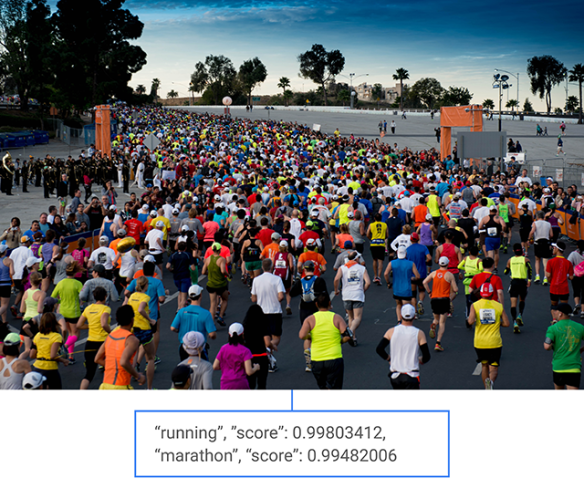
It seems buyers aren’t either. Photo by jonmasters on Flickr.
It was early November when I last looked at how Android Wear was faring. According to my methodology, at that time there had been 2.74m Android Wear devices activated. (That post also explains my methodology, so I won’t repeat it.)
I’d expected that the Christmas period would see a dramatic rise in that figure; traditionally it’s the time for gifts, even (or especially) for the geek in your life, so I thought that there would be a rapid uptick in the number of Android Wear downloads, each new one of which indicates an activated device.
And yet. The download figure for Android Wear remains stubbornly stuck in the “1m – 5m” band, which it crossed into in mid-February 2015.
Patience
Twelve months on, and what has happened in the meantime? Apple launched the Apple Watch, which various estimates reckon shipped 4m units in its first quarter (April-June 2015) alone, and then topped it off with slightly better quarters each time.
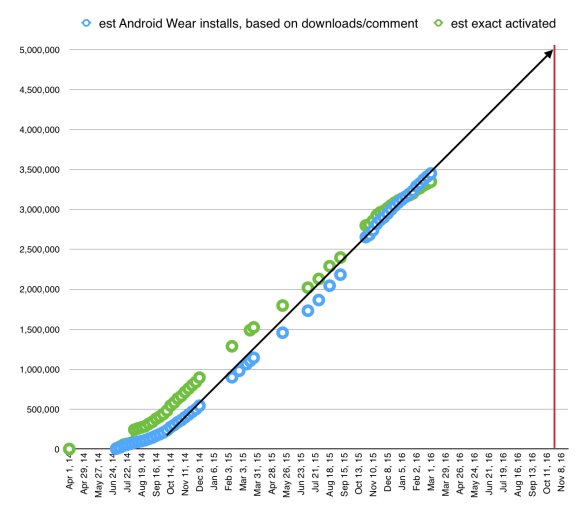
And Android Wear? My latest calculation puts the number activated at between 3.35m and 3.45m – see the graph below. (The variation arises from whether you assume that comments proceed strictly in line with downloads, or that people are less likely to comment as time goes on.)
Is that bad? Well, since the start of the year, it has been adding activations at around 40,500 per week. In the four weeks before the New Year, it was 46,000 per week, with one particularly notably peak in a mid-November week of nearly 79,000.
You’d expect that: big rush before Christmas, slowdown afterwards. But at that rate, it’s going to take a long time for the ticker to go past 5 million on Google Play. In my November post, I thought we’d already be there now.
How reasonable is my estimate? We can definitely say that it has taken more than a year to rack up fewer than 4m activations – which makes sense, because to add 4m takes a consistent run rate of nearly 77,000 activations per week. Android Wear appears to be nowhere near that.
According to my calculations, at the present activation rate, it will take until October before total Android Wear activations pass the 5m mark.
Android Wear estimated activations: presently just short of 3.5m, and with a long road ahead
So what’s wrong with Android Wear?
There’s no shortage of Android Wear devices. They were ahead of Apple in introducing the concept of the “smart watch”. They were ahead of Apple in arriving: LG, Motorola, Huawei, pretty much every big Android OEM except Samsung and HTC got in there. Samsung isn’t there because it prefers its own Tizen OS – because that allows the flexibility to do what it wants. HTC backed off the idea, which was smart given the financial problems it has. Google has introduced an app to make them work with iOS. Hasn’t changed things.
If people aren’t buying these devices, there’s a problem in the story around them. “Why would I want a smartwatch? For that price? And look at how BIG it is!” (The latter is a pretty consistent reaction to the giant wheels people are expected to strap on their wrist. Actually, maybe that’s our answer.)
Given the gigantic addressable market for Android Wear – pretty much every Android user, which is a lot of people – it seems like we’re seeing both the “premium effect” (iPhone users tend to spend more) and the “huh? Why?” effect.
Quite possibly smartwatches are going to remain a niche – a sort of technological diversion, a bit like games consoles, which have a devoted and upgrading audience, but aren’t actually that pervasive when you look closely at the numbers (particularly when you note how many buyers of one console then add another).
One thing’s for sure, though – the makers of Android Wear devices need a good selling line, and soon.
Larry Neumeister and Tami Abdollah on the decision in a New York case – not the “terrorism” case – where the FBI wants to unlock an iPhone which, yes, has a passcode:
»[Judge] Orenstein concluded that Apple is not obligated to assist government investigators against its will and noted that Congress has not adopted legislation that would achieve the result sought by the government.
“How best to balance those interests is a matter of critical importance to our society, and the need for an answer becomes more pressing daily, as the tide of technological advance flows ever farther past the boundaries of what seemed possible even a few decades ago,” Orenstein wrote. “But that debate must happen today, and it must take place among legislators who are equipped to consider the technological and cultural realities of a world their predecessors could not begin to conceive.”
A Justice Department spokesman said they were disappointed in the ruling and planned to appeal in the coming days. Apple and their attorneys said they were reading opinion and will comment later.
In October, Orenstein invited Apple to challenge the government’s use of a 227-year-old law to compel Apple to help it recover iPhone data in criminal cases.
»The crash may be the first case of one of its autonomous cars hitting another vehicle and the fault of the self-driving car. The Mountain View-based Internet search leader said it made changes to its software after the crash to avoid future incidents.
In a Feb. 23 report filed with California regulators, Google said the crash took place in Mountain View on Feb. 14 when a self-driving Lexus RX450h sought to get around some sandbags in a wide lane.
Google said in the filing the autonomous vehicle was traveling at less than 2 miles per hour, while the bus was moving at about 15 miles per hour.
The vehicle and the test driver “believed the bus would slow or allow the Google (autonomous vehicle) to continue,” it said.
But three seconds later, as the Google car in autonomous mode re-entered the center of the lane, it struck the side of the bus, causing damage to the left front fender, front wheel and a driver side sensor. No one was injured in the car or on the bus.
«
Yeah, if you did that in a driving test, you’d get failed. It’s not the bus’s fault if you try to enter its right of way. link to this extract
»The best Sony is weird Sony. It’s the Sony that makes robot dogs and glowing, rolling party balls. It’s the Sony that’s selling something you might not necessarily buy today but that lays the foundation for something you’ll need tomorrow.
Take the HUIS remote (it stands for Home User InterfaceS). It’s a $250 e-ink touchscreen display, like a Kindle Paperwhite, but it’s also a programmable universal remote, like a Logitech Harmony. Via infrared and Bluetooth, it can control anything from your cable box to your smart thermostat.
The e-ink screen solves the biggest problem with using your smartphone—or any other LCD—as a remote. Rather than taking all the incremental steps involved in turning on your phone and opening an app to make changes, its power-sipping display means its screen can stay turned on for a month between recharges.
«
Using the above definition, “best Sony” is also “fabulously unprofitable and unable to find market demand for a product Sony”. The idea of an e-ink touchscreen for things you don’t need to control often is nice, though. It’s just that Sony can screw up software like pretty much nobody else. Remember its music player software? If you can’t, lucky you. link to this extract
»HTC’s Vive virtual reality headset finally has a UK price: a hefty £689.
So, what do you get if you splash out a month’s rent (in London at least)? There’s the headset itself, co-created by gaming company Valve, which has two 1080 x 1200 screens offering a 110-degree viewing area, as well as a front-facing camera for augmented reality features and a plethora of other sensors for head- and motion-tracking.
The headset also comes with three apps: the tongue-in-cheek “Job Simulator”; Northway Games’ Fantastic Contraption, a 3D VR update of an old Flash-based physics game; and the Google-developed Tilt Brush, which lets you paint in 3D space.
Unlike the Facebook-owned Oculus, which retails for $600 (without a specific UK price), the Vive will also ship with two wireless VR controllers, and “room-scale” movement sensors, capable of tracking an area 5 sq m. The Oculus, with its more stripped-back offering, comes with an Xbox 360 controller – although the Oculus Touch controllers will be arriving later this year – and a movement set-up that can handle a 1.5m by 3m area. The Oculus does, however, include built-in audio while the Vive will require a separate pair of headphones.
»Kiddle.co is a search engine that uses Google’s results, but it’s not a Google product.
A glance at the homepage makes it pretty easy to see how confusion would arise. To put it charitably, the site’s owners haven’t exactly gone out of their way to set the two apart:
What we actually have here is a search engine that uses Google’s Custom Search bar and human editors to filter out grim results with, I think it’s fair to say, patchy results…
…In theory, Kiddle offers a combination of safe search, results tailored for children (positions 1-3 are safe sites written for children, 4-7 come from safe sites not written for children but accessible, and 8+ are just safe sites) and large clear fonts.
«
In reality: nope. And the ads are Google’s, and unfiltered, so you can see how that could quickly go south. link to this extract
»Until now, those wishing to add Wi-Fi and Bluetooth functionality to the Pi had to buy separate dongles to plug into its USB ports — we are talking about a $35 computer after all, and this was one way to keep the cost down.
However, these wireless functions are now built right into the Raspberry Pi 3 Model B, making it an even cheaper proposition for those wanting a very basic web-surfing machine, a cheap home server or the basis for a home-brewed Internet-of-things project. (Though those wanting the very cheapest Internet-of-things computer may want to opt for the $5 Pi Zero.)
»Microsoft is letting developers pre-order the HoloLens development edition today, but it’s also detailing exactly what’s inside the headset. HoloLens is fully untethered and self-contained, which means you do not need a PC or phone to use it. Microsoft has built an entire Windows 10 device into a headset, using a custom-built Microsoft Holographic Processing Unit (HPU) and an Intel 32 bit processor.
Microsoft has a variety of sensors inside the HoloLens, including an inertial measurement unit, an ambient light sensor, and four environment understanding cameras. These combine with a depth sensing camera to allow HoloLens to map spaces. Microsoft also has a 2-megapixel HD camera to capture videos and photos. Four microphones inside the headset are used to pick up voice commands from users…
…Microsoft says the entire HoloLens headset will weigh no more than 579 grams, and the battery will run for around two or three hours of active use. HoloLens is fully functional when it’s charged over Micro USB, and the device will also have a standby time of two weeks.
»Last fall, Google announced the addition of a long-requested feature to Google Maps, which allowed users to – finally! – add a stop along their current route. That way you could route your way to a gas station or restaurant ahead of your final destination. However, at launch, the feature was only available on Android devices. Today, Google says the feature is now available on all iOS devices as well, and is available in any country where Google Maps offers navigation – or more than 100 countries worldwide.
The feature itself is something users of the Google-owned navigation app Waze have had for some time, but was not yet available in Google Maps.
It’s surprising that it took Google so long to add such a basic feature to its navigation app. After all, hitting up a pit stop while on your way somewhere else is the norm – but, before, you would have to route your way to the pit stop, then start a new route from the pit stop to your destination. And by creating two navigation sessions, it could be hard to see which gas station, restaurant, or other stop would incur the least amount of extra driving.
«
Given how often one wants to do something like this, solving it must be a really difficult routing problem, given it took until last October to arrive on Google Maps. Or else it’s a very difficult UI problem. link to this extract
»WhatsApp, the popular cross-platform messaging service, has decided to cut support for a number of those platforms. That includes all versions of BlackBerry OS, including BlackBerry 10, by the end of 2016.
WhatsApp will also end support for Nokia S40, Nokia Symbian S60, Android 2.1, Android 2.2 and Windows Phone 7.1 by the end of the year. From the WhatsApp blog:
»
While these mobile devices have been an important part of our story, they don’t offer the kind of capabilities we need to expand our app’s features in the future. This was a tough decision for us to make, but the right one in order to give people better ways to keep in touch with friends, family, and loved ones using WhatsApp. If you use one of these affected mobile devices, we recommend upgrading to a newer Android, iPhone, or Windows Phone before the end of 2016 to continue using WhatsApp.
«
«
BB10 is, by a mile, the youngest of those operating systems. Of course commenters at Crackberry are *delighted*. link to this extract
»Hive, which is run by British Gas, received over 30 complaints on Saturday, with many people fearing an unsightly spike in their bills this month.
The company has not yet confirmed how many of its 300,000 users may have been affected.
It said in a statement: “We are aware of a temporary glitch affecting a very small number of customers, where a certain sequence of commands in the Hive iOS app can cause the thermostat temperature to rise to 32°C.
“Any customers seeing this can very easily and immediately fix it by simply turning the thermostat down using the app, web dashboard or the thermostat itself.
“No-one needs to worry about their temperature being too high because the rest of the app works as normal. Meanwhile, we are working on a software update which should be available soon.”
«
So will people get refunds? Hive can’t read meters remotely, but this is BG’s fault so it should give a discount. The Internet of Overheated Things. Don’t you just love the future? link to this extract
»Imagine you have just hit ‘start’ on a new first-person video game. You find yourself in a room facing a doorway with ‘this way’ written in large letters over the top. You take a very quick look around and notice a few closed chests and cupboards beside you and then a door behind you marked ‘no entry’. You turn back toward the first door. Without thinking, answer the following question: what do you do now?
«
A really fascinating exploration of the different types of player one tends to find in any games theatre. Which are you? Depends on your answer to that question. link to this extract
Alan Levine’s photos were used to create a fake Facebook account – he already has one – which was then used to scam people. Despite it being reported, Facebook did nothing about it:
»Facebook’s Help page for reporting fake accounts clarifies what kinds of accounts it does not allow
»
We don’t allow accounts that:
• Pretend to be you or someone else
• Use your photos
• List a fake name
• Don’t represent a real person
«
Why is Facebook allowing “Malle Gotfried” to use my photos? Why is Facebook’s highly touted facial recognition system not matching the profile photo “he” is using to he very one that has been on my Facebook profile since November 2015?
Again, why is Facebook not removing accounts it clearly says it does not allow? Why is there no burden on proof of “Malle Gottfried” to prove their identity? Why does Facebook make it so easy for Nigerian scammers to create fake accounts using photos of other people? Why is Facebook not answerable to these questions?
I have reported this account several times, so has my sister, and friends who know me. And every time Facebook replies stating that the creation of fake profiles using my photo does not violate Facebook’s Community Standards – what kind of community standards protect the rights of scammers to create fake profiles used in romance scams?
Jonathan Zdziarski on the suggestions (by some) that hey, Apple’s and Microsoft’s and Google’s “software updates” are really backdoors because, hey, they can change stuff:
»Any kind of automated update task on a computer is capable of introducing new code into the environment, but that is not what constitutes a backdoor. I’ve thought about this at length, and come up with a three-prong test to determine whether or not a mechanism is a backdoor. There has thus far not been a widely accepted definition of what a backdoor is, and so I hope you’ll consider its adoption into best practices for making such determinations, and welcome your input. The three prongs I propose are “consent”, “intent”, and “authenticity” (or: control).
«
In the hydra-headed debate around Farook’s damn iPhone 5C, Zdziarski has posed and answered some of the best questions. If you’re interested in security topics, I highly recommend his blog. link to this extract
»A new revision to Nintendo’s projected earnings, released [on Friday], sees Nintendo reducing its expectations of Nintendo 3DS sales for the full fiscal year, which ends in March. Nintendo now expects to sell 6.6m 3DS units during the 12-month period, a 13% drop from previous projections and a 24% decline from the year before. That drop (and the accompanying drop in 3DS software sales projections) is a big reason why Nintendo is now also saying that its annual profits will be 50% lower than it had projected, though the company blames some of that decline on the weakening Japanese yen.
You might think this kind of decline is natural for a system like the 3DS, which is, after all, approaching its fifth birthday. But previous Nintendo handhelds have looked much more robust at this point in their lifecycles. The Nintendo DS was still near the peak of its hardware sales dominance in its fifth and sixth years, selling a whopping 31.18m units in the 2009 fiscal year (and a healthy 27.11m the next year). Game Boy Advance sales were still near a steady peak in the 2005-2006 period, bouncing up and down in the 15m to 18m annual sales range, thanks in part to the successful Game Boy Advance SP hardware refresh.
The 3DS, on the other hand, seems to have peaked earlier and lower than other Nintendo handhelds.
»In the Hollywood-stylized version, a Harvard student needed a tool to date girls.
The real version couldn’t be further from the truth, Mark Zuckerberg told Mathias Döpfner in an interview with “Die Welt am Sonntag.”
At the time, he already had a girlfriend — Priscilla Chan, now his wife — and he was obsessed with the internet. Google was great for searching for news and Wikipedia was great for searching for reference material, but there was a gap.
“There was no tool where you could go and learn about other people. I didn’t know how to build that so instead I started building little tools,” Zuckerberg told Döpfner.
He built a small tool called Coursematch where people could list what classes they were taking. He did build the Facematch tool, as seen in “The Social Network,” but that was just a prank, he says.
«
Rewrite of an interview with Die Welt am Sonntag (The World On Sunday). link to this extract
»In the next few years, Tesla, Chevy, and Nissan plan to start selling long-range electric cars in the $30,000 range. Other carmakers and tech companies are investing billions on dozens of new models. By 2020, some of these will cost less and perform better than their gasoline counterparts. The aim would be to match the success of Tesla’s Model S, which now outsells its competitors in the large luxury class in the U.S. The question then is how much oil demand will these cars displace? And when will the reduced demand be enough to tip the scales and cause the next oil crisis?
David Rogers does mobile phone forensics and teachers a mobile systems security course. Piers Morgan (who used to edit the Daily Mirror, which has apologised to some people for phone hacking) did however claim that he could take the FBI/Farook iPhone “to Tottenham Court Road [an electronics mecca in London) and they’d get into it” – suggesting that he might have confused carrier unlocking with PIN unlocking. Here’s Rogers on the tricky rapids to be navigated in deciding if we can force companies to unlock encrypted devices:
»Remember, someone who has actually committed a crime is probably going to say they didn’t do it. The phone data itself is usually more reliable than witnesses and defendant testimony in telling the story of what actually happened and criminals know that. I’ve been involved with digital forensics for mobile devices in the past and have seen first-hand the conviction of criminals who continually denied having committed a serious crime, despite their phone data stating otherwise. This has brought redress to their victim’s families and brought justice for someone who can no longer speak.
On the other side of course, we’re carrying these objects around with us every day and the information can be intensely private. We don’t want criminals or strangers to steal that information. The counter-argument is that the mechanisms and methods to facilitate access to encrypted material would fall into the hands of the bad guys. And this is the challenge we face – there is absolutely no easy answer to this. People are also worried that authoritarian regimes will use the same tools to help further oppress their citizens and make it easier for the state to set people up. Sadly I think that is going to happen anyway in some of those places, with or without this issue being in play…
…This is the same battle that my colleagues in the mobile world fight on a daily basis – a hole is found and exploited and we fix it; a continual technological arms race to see who can do the better job. Piers Morgan has a point, just badly put – given enough time, effort and money the San Bernadino device and encryption could be broken into – it will just be a hell of a lot. It won’t be broken by a guy in a shop on Tottenham Court Road (see my talk on the history of mobile phone hacking to understand this a bit more).
»Apple’s second high-profile patent win against Samsung was appealed, just as the first was. And in an opinion (PDF) published today, a panel of appeals judges entirely wiped out Apple’s victory and its $120 million verdict.
The new decision found that out of three different patents Apple became famous for winning with, one wasn’t infringed and two of them are invalid.
The ‘647 patent described how to turn phone numbers and other software “structures” into links, allowing users to take actions like calling a number with one “click” rather than copying and pasting. The jury awarded Apple $98.7 million based on that patent, but the appeals judges today held that the patent wasn’t infringed at all. They held that “Apple failed to prove, as a matter of law, that the accused Samsung products use an ‘analyzer server’ as we have previously construed that term.”
Appeals judges also invalidated one of Apple’s most consistently ridiculed patents, the ‘721 “slide to unlock” patent. Jurors awarded $3 million based on infringement of that patent, but the appeals panel said the patent is invalid because of prior art.
Sadly this piece by @ProfJeffJarvis (in reality Rurik Bradbury) was deleted by Al Jazeera, which either didn’t recognise its satirical slant ahead of publication, or did and then got cold feet. But it’s still here at the Internet Archive, with gems like this:
»
The New Republic
The oldest startup here, it went through a significant reboot with its March 2012 purchase by Chris Hughes, tech mogul and co-founder of Facebook. It has since innovated so quickly that it is about to be re-rebooting under even newer ownership (name TBD), a great example of the rapid iteration that is characteristic of the best startups.
Instead of the old questions about subjective, qualitative measures, Chris Hughes brought in Yahoo! wartime consigliere Guy Vidra to ask fresh questions, such as: How well did this piece travel? And does this meme even lift our metrics?
I’m excited to see the New New The New Republic, and hope they re-embrace Walter Lippmann’s original mission of nextifying the bewildered herd using hot takes.
»Carrier branding is arguably the bread-and-butter of free promotion: crudely referred to by some as a so-called “tramp stamp” these images tend to irritate customers who would prefer their devices to be free of all superfluous clutter. Even so, manufacturer branding tends to crop up most everywhere, be it the infamous HTC “black bezel bar” or the ever-visible under-the-earpiece location that companies like Samsung opt for.
Strange then, that Samsung’s South Korean website has pictures of its new Galaxy S7 and Galaxy S7 Edge…devoid of such a front-facing claim to fame. Take a look:
The front Samsung logo is clearly missing from the image. In fact, it’s missing from all the renders pictured, yet the rear logo is clearly present, as can be seen above.
«
Subtle messaging: Samsung really does seem to be getting rid of the visible “Samsung” name on the front of the device in China, Japan and Korea. In the first two, it has struggled recently to keep sales up in the face of competition. But why Korea? And is this an evolution of its branding (more confident) or is it concern? link to this extract
»many bogus versions of a wide range of apps (ranging from Toy Truck Rally to Subway Surfers 2 to GTA San Andreas and Tinder) have been distributed by fraudsters who wish to use your bandwidth to earn themselves affiliate income by clicking on adverts for pornographic websites.
Of course, if the apps popped up a copy of the Chrome browser to click on the X-rated ads then chances are that you would notice something unusual was afoot. Criminals have learnt from experience that announcing their presence so obviously only hinders their money-making plans.
So, in the case of “Porn Clicker”, the apps spin up an invisible browser window – meaning that any ad-clicking is invisible to the naked eye. And then, a minute or so later, it clicks again.
The money soon begins to earn cash for the criminals – which is a truth especially evident when you consider that some of the bogus apps have been downloaded thousands of times.
«
Android is following exactly the same malware growth path as Windows did on the desktop. link to this extract
»A Google spokesman said that encryption is now required for all “high-performing devices” – like the Galaxy S7 – running the latest version of Android, Marshmallow. But only 1.2% of Android phones even have that version, according to Google.
By comparison, most Apple products are uniformly secure: 94% of iPhones run iOS 8 or 9, which encrypt all data. Apple makes its devices, designs the software, and retains full control of the phone’s operating system.
“If a person walks into a Best Buy and walks out with an iPhone, it’s encrypted by default. If they walk out with an Android phone, it’s largely vulnerable to to surveillance,” said Christopher Soghoian, the principal technologist at the American Civil Liberties Union.
New York City’s top prosecutor, Cyrus Vance, has noted that Android phones have been easier to crack in the past, especially because Google can reset passcodes on older models.
Android is running on 105 million Americans’ smartphones — slightly more than the number of iPhones in the United States, according to industry trackers at comScore.
But there are ways in which an Android phone could actually be made more secure than an iPhone.
Android software can be tweaked to add all sorts of security features, like a password for a particular messaging app.
Google’s operating system also starts up only after the phone’s owner enters a passcode. That’s not true for the iPhone, which starts up as soon as you hit the power button. That’s an important detail: When confronted with a locked iPhone, police can take it to a trusted Wi-Fi connection and potentially copy the phone’s contents to iCloud on Apple’s computer servers, where investigators can then comb through the data.
Android phones won’t back up to the cloud until they’re unlocked.
»To understand Apple’s efforts at persuading legislators of various issues, I compiled a measure of political footprint which combines a company’s own federally registered lobbying expenditures from 2015 with the campaign contributions they made during the 2013-14 election cycle from their corporate PAC as well as any employees who made campaign campaign contributions (and listed their employer). This data comes from the Center for Responsive Politics.
In 2015, Apple spent $4.48m on lobbying efforts and while they don’t maintain a PAC for campaign contributions, Apple employees gave a combined $130,579 in FEC-regulated campaign contributions. This adds up to a $4.61m political footprint.
In contrast, Apple’s main rival in the market for smartphones, Google, spent $16.7m on lobbying in 2015, gave $1.65m in campaign contributions via its PAC, and another $2.25m via employees during the 2013–14 election cycle for a combined $20.5m political footprint – over four times the size of Apple’s.
Apple’s political footprint is also on the small side when compared to other large companies (as measured by market capitalization on on December 31, 2015 as reported by YCharts).
»Many of our services need info about postcodes, such as what addresses they cover, where they are on the map and what admin areas they fall under.
A year ago each team had used a different commercial solution, with different charging models, so our first platform was a postcode lookup service.
This combines Ordnance Survey and government data to provide one authoritative way for our applications to look up information for any postcode.
«
Astonishing. This already exists in the outside world, with APIs so you don’t have to laboriously enter things by hand. And this was thought a good use of anyone’s time? link to this extract
Errata, corrigenda and ai no corrida: none specified.
Daniel Kimmelman, noting how the site’s stock has plummeted, sees other problems:
»LinkedIn is not, in fact, a business network — individuals on LinkedIn represent themselves, not their businesses. And as LinkedIn’s content is mostly user-generated, the incentive is for the users to produce material that promotes themselves.
This creates a conflict. Most people aren’t looking to change jobs all the time. Instead, they want to communicate and build relationships. However, because LinkedIn’s revenue streams and design restrict typical business forms of communication and facilitate paid ones, most interactions on the platform are low-frequency and one-directional in nature, such as recruitment offers and sales pitches.
As a result, LinkedIn is now, at best, a business card holder. At worst, it’s a delivery service for spam.
Larry Kim on Google’s new layout, which puts four ads above the organic search results and gets rid of the ones on the side:
»As always, Google is a zero-sum game. For everyone who wins, someone must lose. In that spirit, I’ve compiled a list of the four biggest winners and losers as a result of Google’s new desktop ad layout so far.
The proof is in the data. I looked at WordStream customer data (thousands of accounts across all industries) and determined that side and bottom ads account for just 14.6% of total clicks.
As Alistair Dent noted in his post analyzing iProspect UK clients, ads in the top positions get 14x higher click-through rate than the same ad on the same keyword on the right side.
It’s also important to remember that this change only impacts desktop, which now accounts for less than half of all searches. So, really, this will impact 7.3% of queries.
«
Those low numbers for side clicks suggests that people saw them as ads, whereas they don’t with the ads sitting on the top. link to this extract
»French authorities have demanded that Google pays €1.6bn ($1.8bn; £1.3bn) in unpaid taxes.
The figure is substantially more than the £130m the search engine agreed to pay in back taxes to UK authorities.
However, France’s AFP news agency reported that Google might be able to negotiate and may not pay the full sum.
The company’s chief executive, Sundar Pichai, is visiting Paris and was due to meet the France’s economy minister Emmanuel Macron on Wednesday night. It is not clear if they will discuss the tax issue.
Earlier this month, French Finance Minister Michel Sapin ruled out striking a deal with the US company.
Google would not comment on reports of the tax demand and French officials said the matter was confidential.
»HP Ink – the PC and printers half of the Hewlett-Packard split – has blamed Windows 10 for a ho-hum quarter of declining sales.
“Windows 10 is a tremendous operating system platform,” HP Ink CEO Dion Weisler told analysts and investors on a conference call on Wednesday afternoon. “But we have not yet seen the anticipated Win10 stimulation of demand that we would hope for.”
Weisler was speaking about an hour after his company published the financial figures [PDF] for the first three months of its fiscal 2016 year. It’s HP Ink’s first quarter as a standalone company since the Great HP Split of 2015.
We were told Microsoft’s software hasn’t, so far, apparently, spurred enough people into buying HP-branded PCs. Well, that may explain the 13% fall in the company’s personal systems revenues. But how about its printers, though? People love printers, right? Always buying them. Always having fun on cold Sunday evenings reinstalling drivers. Unjamming the paper trays. Buying new cartridges. Revenues fell 17 per cent. Ah.
«
HP Inc (as it’s formally called, but HP Ink is much better) is a ship let loose and quietly coasting towards oblivion. link to this extract
»If you’re like me, you might have opened up your Windows 10 laptop today only to see a giant ad for Square Enix’s Rise of the Tomb Raider plastered across your login screen. This is the work of the “Windows Spotlight” feature in your Personalization settings, and thankfully, you can turn it off for good.
»I would like to tell you about the biggest lie in book publishing. It appears in the biographies and social media profiles of almost every working “author” today. It’s the word “best seller.”
This isn’t about how The New York Times list is biased (though it is). This isn’t about how authors buy their way onto various national best-seller lists by buying their own books in bulk (though they do). No, this is about the far more insidious title of “Amazon Bestseller”—and how it’s complete and utter nonsense.
Here’s what happened in the book industry over the last few years: As Amazon has become the big dog in the book world, the “Amazon Bestseller” status has come to be synonymous with being an actual bestseller. This is not true, and I can prove it.
«
I added the “on Amazon” part to the headline, because it’s not in the original, and that’s misleading – as misleading as Amazon’s “bestseller” lists. Amazon’s bestseller lists on pretty much every product are indicative of nothing more general than what is selling best on Amazon; it doesn’t tell you about national or other trends, for the most part.
But what Underwood describes is pretty dire. He also wonders why Nielsen Bookscan doesn’t include ebooks. As I understand it, that’s because Amazon won’t share the data. It’s all Bezos charts as far as the eye can see. link to this extract
»HTC has set the price for the consumer edition of its first virtual reality (VR) headset, the HTC Vive, at US$799, which is much lower than market expectation of US$1,500.
HTC will take pre-sale orders globally on February 29 with full commercial availability starting early April, the company said.
The Vive, which is bundled with SteamVR, will be delivered as a complete kit allowing users to instantly jump into a fully immersive virtual environment using two wireless controllers, 360 degree tracking and room scale movement sensors, HTC added.
«
I don’t see this ending well for HTC. It needs revenue, and moreover it needs profitable revenue. Selling at a lower price might juice the market, but at present it can command a premium price simply because it’s new. Google Cardboard, Samsung VR? They’re cheap. Oculus Rift is a competitor, and its bundle costs $1,500. link to this extract
»Optimal.com is building an adblocking service to help consumers, and we also give major websites tools to measure the rate at which users are blocking ads on their pages.
Below is a summary of data we’ve collected anonymously from over 30 million users from 1/1/16 to 2/13/16. We plan to release more aggregate information in the near future, especially to understand the many differences between mobile and desktop ad blocking. On this latter point for now I will only say that desktop adblocking is approximately 10x more prevalent than mobile adblocking (for the time being).
«
11.7% in the US; 16% in the UK. Poland, Ukraine, Greece, Czech Republic are way above, in the 25-30% range. link to this extract
»Apple’s reasoning in the brief rests on three pillars. First, that forcing Apple to write code that weakens its devices and the security of its customers constitutes a violation of free speech as protected by the Constitution.
Second, that the burden the FBI is putting on it by requesting that Apple write the software and assist in unlocking the device is too large. Apple argues that it would have to create the new version of iOS, called GovtOS, which requires coding, signing, verification and testing. It would then have to create an FBI forensics laboratory on site at its headquarters and staff it. The burden would then extend to what Apple views is the inevitable onslaught of additional devices that would follow after the precedent was set.
In addition to free speech, Apple argues that the Fifth Amendment’s Due Process clause prohibits the government from compelling Apple to create the new version of iOS. Apple argues that there is no court precedent for forcing a company to create something new, like GovtOS.
«
Covered the First Amendment element here previously.
»The most recent beta of iOS 9.3, provided to developers and public beta testers earlier this week, fixes a bug that caused 64-bit iPhones and iPads to be disabled or “bricked” when the date was set to January 1, 1970.
Discovered in mid-February, the “1970” bug occurs whenever an iOS device’s date is manually set to 1970, resulting in a continuous reboot cycle. Speculation has suggested the reboot loop is the result of an integer underflow that causes the iPhone to reset the date to the maximum value, a huge number that iOS devices may be unable to process.
With iOS 9.3 beta 4, the date on the iPhone or iPad can’t be set beyond December 31, 2000 at 7:00 p.m. ET, which equates to 1/1/01 at 12:00 a.m. GMT. That effectively puts an end to the 1970 bug, which was used to trick some people into bricking their devices.
«
God Apple is being so BORING. First it fixes “error 53”, then it let people carry on using the Pencil to navigate on the iPad Pro, and now this. link to this extract
»We have been collaborating with some of the UK’s leading kidney experts at the Royal Free Hospital London to co-design and pilot a mobile app, called Streams, which presents timely information that helps nurses and doctors detect cases of acute kidney injury. AKI is a contributing factor in up to 20% of emergency hospital admissions as well as 40,000 deaths in the UK every year. Yet NHS England estimate that around 25% of cases are preventable.
Consultant Nephrologist and Associate Medical Director for patient safety at the Royal Free Hospital London, Dr Chris Laing, who helped design the app and oversaw two initial pilots at the Royal Free, said:
“Using Streams meant I was able to review blood tests for patients at risk of AKI within seconds of them becoming available. I intervened earlier and was able to improve the care of over half the patients Streams identified in our pilot studies.”
«
Really interesting. AI is a sort of “rising tide” technology: you don’t notice it changing your world, until the world is utterly changed and you find yourself thinking “however did we cope before?” link to this extract
Errata, corrigenda and ai no corrida: not all Nissan LEAF cars have remote access for operating their air conditioning or checking their battery. (Thanks, Richard Burte.)
Someone in one of Hunt’s classes discovered how to find out the battery status of Nissan’s popular electric car – and also turn its air conditioning on or off. For any LEAF. Without authorisation. Via API. From anywhere. And Nissan didn’t listen, and four different groups have discovered it independently:
»Nissan need to fix this. It’s a different class of vulnerability to the Charlie Miller and Chris Valasek Jeep hacking shenanigans of last year, but in both good and bad ways. Good in that it doesn’t impact the driving controls of the vehicle, yet bad in that the ease of gaining access to vehicle controls in this fashion doesn’t get much easier – it’s profoundly trivial. As car manufacturers rush towards joining in on the “internet of things” craze, security cannot be an afterthought nor something we’re told they take seriously after realising that they didn’t take it seriously enough in the first place. Imagine getting it as wrong as Nissan has for something like Volvo’s “digital key” initiative where you unlock your car with your phone.
By pure coincidence, this week Nissan unveiled a revised LEAF at the GSMA Mobile World Congress. Clearly, like many car makers, their future involves a strong push for greater connectivity in their vehicles:
»
In a fully connected, fully mobile world, in-vehicle connectivity is an absolute must for today’s drivers.
Steven Petrow works for USA Today, and was writing and sending emails via Gogo Wi-Fi on a flight to Raleigh, Virginia. On touchdown, the guy in the seat behind him explained that he had hacked him, and “most people on the flight”:
»“That’s how I know you’re interested in the Apple story,” he continued. “Imagine if you had been doing a financial transaction. What if you were making a date to see a whore?” My mind raced: What about my health records? My legal documents? My Facebook messages?
And then the kicker:
“That’s why this story is so important to everyone,” he told me. “It’s about everyone’s privacy.”
Then he headed down the escalator and I headed out the front door. I may have been wearing my jacket, but I felt as exposed as if I’d been stark naked…
…[He then called Alex Abdo, a civil rights lawyer]: who is in actual danger here? The answer, apparently, is pretty much all of us. “Anyone who relies on the security of their devices,” Abdo told me.
It should be up to each of us to decide what to make public, and what to keep private, he continued. For me, I felt as though the stranger on the plane had robbed me of my privacy — as was explicitly his intent. He took the decision of what to share out of my hands. He went in through the back door of the GoGo connection.
»Xamarin is one of the leading platforms for mobile app development and provides a robust platform that helps developers build mobile apps using C# and deliver fully native mobile app experiences to all major devices, including iOS, Android, and Windows. Seeing as Microsoft is a productivity focused company whose Visual Studio product is used by millions around the globe, this acquisition will fit nicely into their portfolio of products.
With more than 15,000 customers in 120 countries, of which 100 are Fortune 500 firms, Xamarin has become a leader in this space. Companies like Alaska Airlines, Coca-Cola Bottling, Thermo Fisher, Honeywell and JetBlue all use the software to develop their apps.
«
Apparently MSDN devs want to know if they’ll get it for free. link to this extract
»Nearly half of Americans support Apple Inc’s (AAPL.O) decision to oppose a federal court order demanding that it unlock a smartphone used by San Bernardino shooter Rizwan Farook, according to a national online Reuters/Ipsos poll.
Forty-six percent of respondents said they agreed with Apple’s position, 35 percent said they disagreed and 20 percent said they did not know, according to poll results released on Wednesday.
Other questions in the poll showed that a majority of Americans do not want the government to have access to their phone and Internet communications, even if it is done in the name of stopping terror attacks.
»There’s some precedent for arguing that code is protected legal speech. In the 1990s, a graduate student at the University of California at Berkeley wrote an encryption program for his own research that he wanted to make public. Under federal regulations, a coder must get a license to publish cryptography tools, and the government denied the student’s license. In 1999, the U.S. Court of Appeals in San Francisco ruled for the first time that source code was protected as speech, and the student, Dan Bernstein, who is now an instructor at the University of Illinois at Chicago, was allowed to share the code freely.
The case, Bernstein v. U.S. Department of Justice, has been highlighted by those who favor less regulation of the Internet. But judges have also ruled that free speech protections don’t apply to code. Courts have been especially skeptical in cases involving piracy of music and movies.
The law “is murky in this area,” said Michael Froomkin, a law professor at the University of Miami — and that’s why Apple’s case could break new ground.
»You will probably be unsurprised to hear that VR porn is awesome. It’s like porn, but better. The porn I was sampling—made by Naughty America—was essentially a standard first-person-perspective film, but with the ability to look around. Unlike some VR experiences that are just two-dimensional 360-degree panoramas, Naughty America’s porn is stereoscopic; stuff actually sticks out, or comes flying at you. You really do want to reach out and touch things.
I watched three different scenes as I sat there in the cafe. In all three of them, “I” (a male actor) was reclining on some kind of sofa, looking down at my muscular physique and giant appendage. In some scenes, other people did things to me—in other scenes, I was much more proactive.
To be honest, it was a bit weird, looking down and seeing someone else’s body. But, after a few minutes of watching, I began to feel a sense of agency; I began to feel that yes, those rippling muscles were mine; I began to feel that it was me being tended to by two other beautiful people.
And of course, just as I was starting to get into it, the demo ended and I found myself back in the real world, being grinned at by a couple of guys from Naughty America. “Pretty cool, eh?”
All I can do is nod. Why did the demo have to end so soon?
Right now Naughty America’s films only allow have a 180-degree field of view, primarily because a standard porn scene doesn’t require anything greater, but also because it’s technologically quite challenging as well. Different varieties of porn—orgies and the like—would require a 360-degree field of view, but it doesn’t seem that Naughty America is working on that just yet.
When I asked Ian Paul, the company’s CIO, about how they actually film the VR scenes, he refused to tell me anything. “I can’t give away anything right now.” Basically, according to Paul, it’s quite hard to shoot a 3D VR film from an actor’s perspective, and lots of porn studios are currently trying to find the optimal setup.
«
You think kids playing video games is a problem now? Wait until this stuff becomes easily available. link to this extract
»While Cruz has tried to tap into frustrated voters via ideology, Rubio has been far more reticent to amplify the angriest voices, saying repeatedly, “It is not enough to simply nominate someone who is angry.”
In South Carolina last week, when a voter shouted out that Hillary Clinton was a “traitor,” Rubio interjected gently, “I wouldn’t go that far, sir.” And last month, in Iowa, when another voter worried about Islamic sharia law coming to America, Rubio rebutted, “Guys, that’s not going to happen.”
While Rubio dances around the electorate’s resentments, Trump revels in them. On primary night in South Carolina, he tapped into their nationalism as he whacked at Mexico and China. “They’ve taken out jobs, they’ve taken our money, they’ve taken our everything,” he declared.
The crowd cheered wildly. “I showed anger and the people of our country are very angry!” Trump later tweeted about his South Carolina victory.
Perkins, the evangelical leader, described the Trump phenomenon’s lack of ideology this way: “You can’t be fearful and thoughtful at the same time.”
«
I remain fascinated by Trump’s rise (from the relatively safe distance of a few thousand miles of ocean). What I don’t know, and nobody seems to be saying much, is: how does Trump play with the broader electorate? If it’s Trump v Clinton (as seems likely), how does that play out? link to this extract
Quick 4K time lapse of Android Wear burn in prevention on the Huawei Watch. Captured with Framelapse Pro using a Nexus 5X.
«
That moves around quite a bit. Which prompts the thought – how long will always-on screens survive before they’re burnt out? Something to consider with wearables. link to this extract
»in a business growing quickly in users, markets and features, keeping pace with scaling demands requires ever increasing amounts of focus and effort. Like good, lazy engineers, we occasionally asked ourselves: do we really need to do all this stuff?
For a long time the answer was “yes.” Operating our own data-centers may be a pain, but the core cloud services were not at a level of quality, performance and cost that would make cloud a significantly better option for Spotify in the long run. As they say: better the devil you know…
Recently that balance has shifted. The storage, compute and network services available from cloud providers are as high quality, high performance and low cost as what the traditional approach provides. This makes the move to the cloud a no-brainer for us. Google, in our experience, has an edge here, but it’s a competitive space and we expect the big players to be battling it out for the foreseeable future.
«
Lots of people are interpreting this as the first step to Spotify’s entirely Googley (ie Google-owned) future, and it’s hard not to see this that way. link to this extract
»Thousands of apps running code built by Chinese Internet giant Baidu have collected and transmitted users’ personal information to the company, much of it easily intercepted, researchers say.
The apps have been downloaded hundreds of millions of times.
The researchers at Canada-based Citizen Lab said they found the problems in an Android software development kit developed by Baidu. These affected Baidu’s mobile browser and apps developed by Baidu and other firms using the same kit. Baidu’s Windows browser was also affected, they said.
The same researchers last year highlighted similar problems with unsecured personal data in Alibaba’s UC Browser, another mobile browser widely used in the world’s biggest Internet market.
Alibaba fixed those vulnerabilities, and Baidu told Reuters it would be fixing the encryption holes in its kits, but would still collect data for commercial use, some of which it said it shares with third parties. Baidu said it “only provides what data is lawfully requested by duly constituted law enforcement agencies.”…
…”It’s either shoddy design or it’s surveillance by design,” said Citizen Lab director Ron Deibert.
Errata, corrigenda and ai no corrida: yesterday’s web page headline briefly said that it was Acer’s routers, not Asus’s, which had been found to be full of holes by the FTC. This was wrong.
That’s a decline of 90m, even while the overall smartphone market has grown from 704m (of which 501m were Android) to 1.43bn (of which 1.16bn were Android).
But your objection is probably the same as mine: isn’t the decrease in those sur-$500 shipments because the price of high-end Android handsets has fallen? The price you have to pay to get something with the same qualities as the $500-or-more Android flagship is lower than it was in 2012.
This is almost certainly true – but it isn’t much compensation for those struggling to expand their sales and seeing average selling prices (ASPs) fall. There’s a simple financial reason: if you keep selling the same number of phones at lower ASP, your profit will inevitably fall off a cliff as fixed costs such as staff and administration weigh you down.
What’s also notable that Apple hasn’t – so far – been affected by any drop in ASP. Since the start of 2010, its ASP for any quarter has only been below $600 four times – and in the most recent quarter, it reached an all-time high. Which leads one to wonder: what the hell is going on? But let’s show you the numbers from the quarter, and then discuss them.
Q4 2015: the smartphone scorecard
* denotes estimate: explanations below
Company
Handsets
(million)
Revenues
Handset
ASP
Operating
profit
Per-handset
profit
Samsung
81.5
$20.40bn
$225.39
$1.90bn
$23.29
Apple
78.25
$51.64bn
$690.50
$14.41bn*
$184.10*
LG
15.3
$3.22bn
$210.26
–$51.47m
–$3.36
Sony
7.6
$3.20bn
$421.58
$198.91m
$26.17
HTC
3.4*
$0.81bn
$237.05
–$128.00m
–$37.65
Microsoft
Mobile
4.5
$0.84bn
$185.70
–$162m
–$36.11
Assumptions
Samsung: featurephones (it sold 18.5m) had an ASP of $30, and generated zero profit; its tablets had an ASP of $100 and generated zero profit. (These are the same assumptions as in previous quarters. If the ASP is lower, then revenues are higher and the ASP of smartphones is higher; if profits are non-zero on tablets and featurephones, profits on smartphones are lower.)
Apple: operating profit has to be assumed, at the same 27.9% share of revenue as in previous quarters. This may not be true – new phones such as the 6S/Plus are more expensive to produce at the start of a cycle (such as now). But again, consistency probably helps give the broad picture rather than trying to dive into numbers that only a few people inside Apple truly know.
Microsoft Mobile: assumes, as previously, that featurephones (there were 22.5m of them) had an ASP of $15 and gross margin – the profit purely on the goods, not including costs such as R+D and administration etc – of $5. These are the same assumptions as in the past. I’ve chopped the estimates of R+D and administration cost from $200m in previous quarters to $100m and from $300m to $100m because Microsoft said in its 10-Q that
Operating expenses [in the Devices division, which makes the Surface Pro, Surface Book, and phones] decreased $561m or 14%, mainly due to lower sales and marketing expenses and research and development expenses. Sales and marketing expenses decreased $359m or 18%, driven by a reduction in phone expenses, partially offset by marketing expenses associated with the launch of Surface Pro 4, Surface Book, and Windows 10. Research and development expenses decreased $179m or 11%, mainly due to a reduction in phone expenses.
To reach my figure for Microsoft’s profitability (or lack of it) I’ve taken $300m out of the Microsoft phone group’s operating costs, which might be close to the amount from the total $920m it says it cut. Without more clarity (or a shutdown of the phones division), hard to tell. But there’s no way one can see a division which sells 4.5m phones and generates around $830m being profitable; that’s about the same scale as HTC, which we know is not profitable because it publishes its results.
Microsoft has become increasingly opaque about the profitability of its phone side (though of course Apple has never declared any numbers there; one has to back it out from what is known about Mac and iPod profitability).
Where’s Android Wear?
You may ask yourself: where are Android Wear shipments as a factor in the revenues of LG, Sony or Lenovo (or Samsung’s Gear in its figures)? To which I’ll answer: don’t worry. Too small to trouble with. By my calculations, and those of other analysts, Android Wear shipments from all makers in Q4 totalled 0.9m. At around $150 each, that’s a rounding error in revenue for any of these players. (I’ll revisit my ongoing calculations on Android Wear usage figures in the near future.)
Handset pricing: Apple stands on the precipice
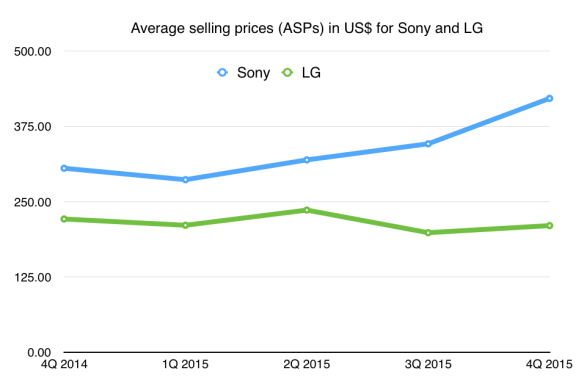
The real lessons of what’s going one here aren’t easy to see from a single quarter’s numbers. But if you want it in a single statistic, look at the contrast between Sony and LG. LG sold nearly twice as many phones, but Sony made a respectable profit, while LG made a loss. What’s the difference between them? ASP. Sony’s phones sold at an average price of $421.58, while LG’s were half that – $210.26. (This doesn’t mean that every LG phone sold at that price, or every Sony phone. But it tells you that Sony must have sold a lot more expensive phones than LG.)
Graph the trend in ASP and it becomes clearer: Sony has (as it said it intended to) driven up ASP, while LG has been pushed down.
Sony’s overall phone ASP has risen (though it now only sells half as many phones as LG)
Sony is literally the only Android OEM which has managed to raise ASPs consistently over the past year, and after a lot of pain (in the form of losses) it seems to be paying off in the form of profit. There’s a simple reason why, of course. The higher the price you can sell something for, the lower the proportion of your revenues the fixed costs – sales, administration, staff, and even seemingly trivial things like patent licensing – become. If you can drive your price up, you begin making profit. But if your ASP is driven down, everything starts eating into the bottom line.
Sony’s problem though is that it’s shrinking year-on-year. After a while, if your shipments are too low then even a high ASP can’t save you from your fixed costs – see HTC for the example. Still, Sony stands alone as having the highest ASP among Android OEMs. That doesn’t mean it sells the largest number of pricey handsets (Samsung surely has that title) but that it is consistently high.
Note how it’s only Samsung, which has both chip foundries and screen fabrication facilities, that has consistently been the biggest smartphone OEM and the only consistently profitable Android OEM.
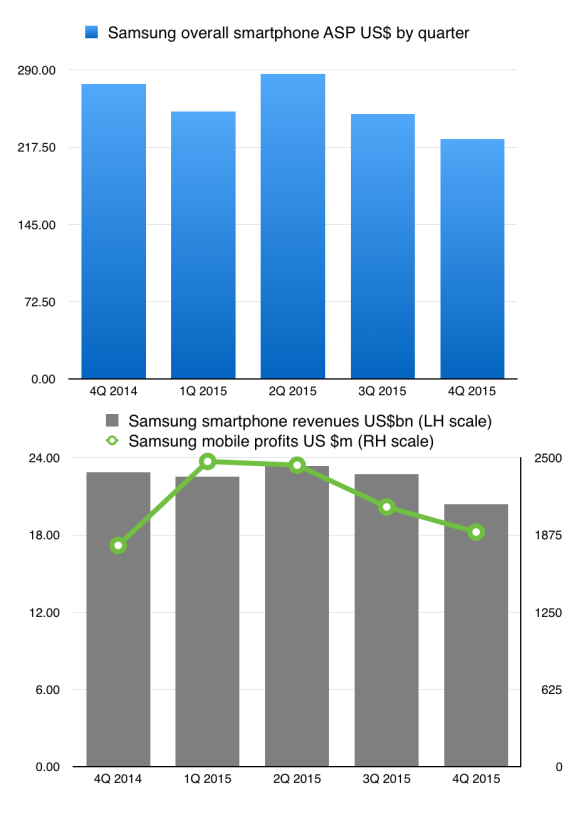
But Samsung’s ASP is coming down quarter after quarter; it’s only keeping its profits level by making more phones, whose ASPs are falling. That hits revenues and profits – as charted below.
Note also how the total number of handsets that Samsung, HTC, Sony, LG and Lenovo/Motorola sold in 4Q15 was down to 128m, compared to 133.15m a year before – a fall of 4% while the smartphone business as a whole grew 6%. There’s a growing squeeze on the top end Android business, which we’ve seen since Q2 last year.
Apple meanwhile officially stayed static, mainly by “stuffing the channel” – getting carriers and others to buy phones which hadn’t reached customers by the end of the quarter, but counted as “shipped”; about 3m were pushed that way. This means Apple’s numbers of shipments to customers probably rose only minimally to 75m. Gartner’s figures say that Apple’s sales to end customers actually fell.
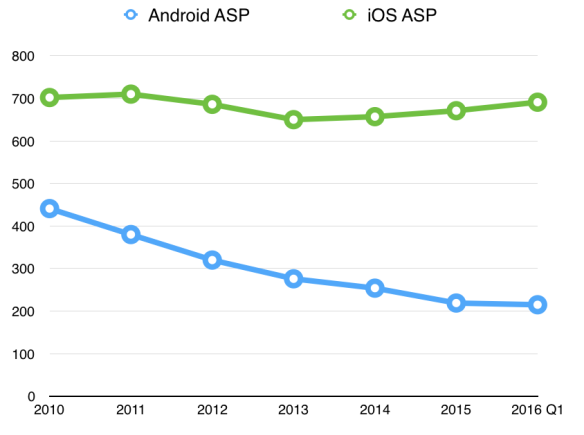
But there’s a bigger dynamic going on. Philip Elmer-DeWitt posted a fun interactive graphic showing how Android ASPs have moved compared to those for the iPhone. Here, statically, is the data – which comes from IDC and covers all Android handsets, of course, not just those at the top end from the companies which publish public figures:
In US$, iPhone average prices are remaining high; Android prices are falling as its base grows
The growing gap (or “delta”) between those two is dramatic. Of course part of that is what’s happening as Android reaches more and more people in the world: the poor in Kenya can’t afford an iPhone, but they can probably afford a $50 (Android) smartphone if it will help them do their jobs better. So is this just about Apple hanging on to profits as is often suggested? Not at all, responded Horace Dediu:
@philiped Common misconception. Apple is not concerned with keeping profits. It’s concerned with prices. Within the price is perception.
“Within the price is perception.” It’s quite the observation. As Dediu also pointed out, Apple hasn’t changed the selling price of its Mac line of computers for around 20 years. For all that Apple’s prices seem out of reach, that is precisely its attraction to some people – perversely, in the view of those who see smartphones (and PCs) as utterly functional and interchangeable. To some, they really aren’t.
And to continue having that perception, Apple also has to stand apart with its operating system and services. It could never license iOS; and I don’t see how it could make iMessage cross-platform without diluting its brand value. (That doesn’t mean it couldn’t grow iMessage into a messaging platform in its own right, able to do payments and so on.)
The pricing gap
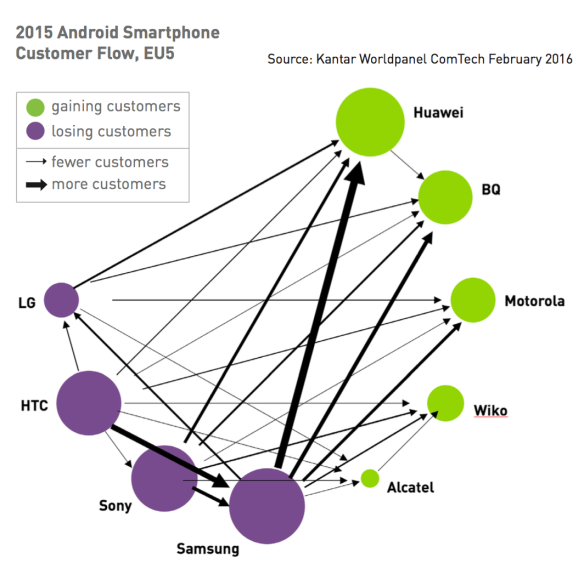
With Android phones getting cheaper all the time, there’s not a lot of hope for the former premium makers. Kantar ComTech posted a neat graphic showing how the torch is passing among Android users in the EU’s five largest countries (Germany, UK, France, Spain, Italy) which shows this starkly:
Owners are abandoning established Android OEMs (purple) for rivals (green). Source: Kantar.
You’ve probably heard of Huawei, but would you have picked Alcatel or those others as rivals to Samsung or HTC? Probably not, even a few quarters ago.
LG is trying to escape this by effectively making this year’s G5 flagship modular, with add-ons such as cameras, high-end audio DAC and VR systems that you can plug in. The idea is to make the G5 more attractive because it has these extras. However given the numbers of G5s it’s likely to sell (a few million?) those add-ons (called “Friends”) are likely to be stranded. (I remember the same with Handspring’s add-ons. Great idea, but commercially doomed.) It’s extra revenue, and possibly each Friend sold will generate as much profit as a phone – accessories can do that – but won’t push up the ASPs of the actual phone. And if Friends are made available for cheaper LG phones, why would you buy the flagship when you can get the extra functionality of a Friend for cheaper?
Samsung has in effect already cut the price of the S7 by offering a free VR system to anyone who pre-orders. And Sony has Osborned its existing products with its announcements at Mobile World Congress, which its high-end customers will have noticed.
None of this helps with the finances, or fights off the rise of cheaper, just-as-good devices running the same software.
The Android handset market is broadening, and deepening, like a pothole opening up beneath the previoiusly established companies. Xiaomi (VC-funded), Huawei (big network business throwing off cash), scores of tiny Chinese OEMs, niche makers… they’re all eating away at the edge of what seemed like a certain market.
And add to that the slowdown in the smartphone market, and you have a recipe for a repeat of that rat pit we saw referred to way back at the top. It’s going to be last man, or OEM, or if you prefer rat, standing.
Looking down from the precipice into the rat trap
But what does Apple do in all this? The gap between its average price and that of the “average” Android phone is widening all the time. Isn’t that a problem? A big one?
Yet Apple’s brand, and that position, isn’t built on hardware alone. You don’t hear about people using an iPhone in spite of iOS, the way you do about Samsung and its TouchWiz skin, for instance. iOS’s software reputation remains pretty solid: it hasn’t, despite many predictions, lost its lead in getting apps before Android in the west. (As a reminder, Eric Schmidt’s “in six months developers will be writing for Android first” promise was in December 2011; didn’t work out, at least in the west. Asia was and remains Android-first for most things.) iOS 9’s adoption was faster than iOS 8, despite the ecosystem being bigger. Apple Music seems to be winning users, though it’s a long, long way behind Spotify, especially on Android.
The question of how Apple can maintain its pricing in the face of the rampant deflation in the Android handset market remains the most interesting one around. Yet it has managed that in the PC market: its ASP there is $1200, while that for the “big” PC makers ranges from $300 (Acer) to $500 (Lenovo). And it has managed that for more than a decade. But it’s done that as a niche product which has only recently become more mainstream. In the phone market, its share of all handsets in Q4 was over 10%, and 19% of smartphones. Can you maintain premium pricing and be mainstream?
For the Android OEMs, though, the story remains the same: you’re down there in the rat trap, and that curious face above you gazing down is Javier Bardem, waiting to see who’ll be left at the end. And I’m just behind, looking over his shoulder, just as fascinated.
»Taiwan-based computer hardware maker ASUSTeK Computer, Inc. has agreed to settle Federal Trade Commission charges that critical security flaws in its routers put the home networks of hundreds of thousands of consumers at risk. The administrative complaint also charges that the routers’ insecure “cloud” services led to the compromise of thousands of consumers’ connected storage devices, exposing their sensitive personal information on the internet…
…ASUS marketed its routers as including numerous security features that the company claimed could “protect computers from any unauthorized access, hacking, and virus attacks” and “protect [the] local network against attacks from hackers.” Despite these claims, the FTC’s complaint alleges that ASUS didn’t take reasonable steps to secure the software on its routers.
For instance, according to the complaint, hackers could exploit pervasive security bugs in the router’s web-based control panel to change any of the router’s security settings without the consumer’s knowledge…
…In February 2014, hackers used readily available tools to locate vulnerable ASUS routers and exploited these security flaws to gain unauthorized access to over 12,900 consumers’ connected storage devices.
«
Swingeing fine? No – just “a comprehensive security program subject to independent audits for the next 20 years.” Pfft. link to this extract
Lots of questions and answers from Spotify’s founder/chief. I found this one interesting:
»
Q: How will you compete as Amazon, Google (incl. YouTube), Apple, etc. strengthen and expand the scope of their respective lock-in?
A: I believe in focus. All of the companies you mention have music as a hobby, a very small part of their overall business. We do one thing and try to do it really well. This means we have a company 100% dedicated to finding the right content, personalizing it for you and serving it up with partners who are specialized in what they do. The big platform companies don’t generally like partnering. We do. This opens up lots of doors. To put it another way, we are really focused on delivering the best possible music experience you can find. I’m not saying we don’t think about the competition – of course we do, it would be crazy not to. But we think about them more in terms of how to make Spotfy so easy, so fun, and so relevant for our users that whether you wait on lines for every new Apple device, get your groceries from Amazon Prime, or use every Google mail and workplace app, you still want to listen to music on Spotify because it’s the best experience there is.
»The app hasn’t been flagged as potentially dangerous by Apple’s strict code reviewers, most likely because the app was made to look like a simple app for learning English if a reviewer (or user) accessed the app from anywhere outside China, and showed its true face only for those located in China.
Also, it’s coded in the Lua programming language, and this allows the developers to update the app remotely and repeatedly without triggering Apple’s app review process.
The app was available for download in the App Store for over three and a half months (since October 30, 2015 to the end of last week), but has now been removed.
The researchers haven’t discovered any actual malicious functionality in the app, but given its capabilities, it should definitely be considered risky to use. They dubbed it ZergHelper, and discovered over 50 enterprise-signed versions of the app being distributed in the wild through alternative channels.
«
Enterprise certificates are still the biggest weak point for getting apps onto iPhones. This one was clever too in using geolocation, and Lua. link to this extract
»The letter, written last week from an Apple lawyer to a federal judge, lists the locations of those phone cases: Four in Illinois, three in New York, two in California, two in Ohio, and one in Massachusetts.
The letter doesn’t describe the specific types of criminal investigations related to those phones, but people familiar with them said they don’t involve terrorism cases. The 12 cases remain in a kind of limbo amid the bigger, more confrontational legal duel between the government and the company over an iPhone seized in the terror case in California, these people said.
«
How surprising that the other cases where the Department wants to do exactly the same aren’t about a high-profile mass shooting that has been framed as “terrorism”.
On another note, this story has prompted some excellent reporting. Such as the next one… link to this extract
Terrific scoop by Michael Riley and Jordan Robertson:
»In a secret meeting convened by the White House around Thanksgiving, senior national security officials ordered agencies across the U.S. government to find ways to counter encryption software and gain access to the most heavily protected user data on the most secure consumer devices, including Apple Inc.’s iPhone, the marquee product of one of America’s most valuable companies, according to two people familiar with the decision.
The approach was formalized in a confidential National Security Council “decision memo,” tasking government agencies with developing encryption workarounds, estimating additional budgets and identifying laws that may need to be changed to counter what FBI Director James Comey calls the “going dark” problem: investigators being unable to access the contents of encrypted data stored on mobile devices or traveling across the Internet. Details of the memo reveal that, in private, the government was honing a sharper edge to its relationship with Silicon Valley alongside more public signs of rapprochement.
»A group of bitcoin miners constituting close to 80% of the network hashrate, as well representatives from exchanges, service providers and contributors to the Bitcoin Core development project, have proposed a development timeline for scaling the bitcoin network.
The statement’s release comes after a more than 18 hour-long meeting in Hong Kong that drew participants from China’s bitcoin mining community and members of the Bitcoin Core team.
Some of the letter’s signatories were party to a previous statement that voiced opposition to any “contentious hard fork” to the bitcoin network.
According the proposed timeline, Bitcoin Core contributors Matt Corallo, Luke Dashjr, Cory Fields, Johnson Lau and Peter Todd will produce and recommend code for a hard fork to the bitcoin network that would feature a block size increase. The code for this proposal is expected to be made available by July.
«
The picture accompanying the article shows that the group comprises 21 people. So much for bitcoin being decentralised: this group decides which way everything moves. link to this extract
»When we think of novels, of newspapers and blogs, we think of words. We easily forget the little suggestions pushed in between: the punctuation. But how can we be so cruel to such a fundamental part of writing?
Inspired by a series of posters, I wondered what did my favorite books look like without words.
Here’s Blood Meridian by Cormac McCarthy (left) and Absalom, Absalom! by William Faulkner.
»As it dawns on smartphone makers that—after years of healthy upgrades—consumers are perfectly happy with their existing phone, they’ve started to pile on the features instead. LG has its wacky upgradable G5, Samsung has its Gear VR headset, and Sony… well, it’s got the Xperia Ear, a Bluetooth headset-cum-virtual assistant that it hopes will take away the need for everyone to keep pulling their smartphones out of their pockets.
You can take calls with Xperia Ear, send messages, get the latest traffic updates, and it’ll even send you directions using GPS (via the phone it’s paired with). None of that is particularly innovative as such, but the Ear’s USP is the way its packaged up into a neat, and arguably more reliable package that your traditional virtual assistant along the lines of Siri or Google Now. For instance, when a call comes in and you pick up the Ear, it has a proximity sensor that automatically answers the call and flings it to your earlobe.
If you’re stuck for the perfect cupcake recipe or want to know who invented the Burrito (sorry, I have the MWC hunger), the Ear can find that stuff out too via voice activated Internet searches. Again, this is functionality most people already have access to via their phone, but Sony hopes that by removing the need to pull out their phones altogether, and instead reach for the Ear, people will won’t be quite as shut out from the outside world.
OK, so the concept is clearly a strange one, and there’s evidence to suggest that such devices—like the similar Motorola hint—have struggled to find a market.
»The company only recently began rebuilding the Compare product from the ashes of the Advisor program in the US. The single piece left standing from that initial effort was the credit card offering — savings accounts, CDs and mortgages had all discontinued. Compare for Auto Insurance launched just last March, starting in California. Then Google relaunched Compare for Mortgage quotes in November with Zillow and Lending Tree among the launch partners. Both of those relaunches had limited roll outs. In the UK, Google Compare has been running since 2012 for car insurance, mortgage rates, credit cards and travel insurance.
A Google spokesperson told Search Engine Land that while searches on these queries remained high, the product didn’t get the traction it hoped for and revenue was minimal. That’s in part due to the limited availability of the products in both the US and the UK.
»Feature phone owners across markets are challenged in finding smartphones that offer what they consider a good value for money spent. They are unlikely to upgrade to a smartphone until they can no longer rely on their current device. While looking year over year might not be enough to see a clear trend, examining the past three years makes it clear that smartphone life cycles are getting longer.
In mature markets, the profitable high end of the market is saturated. In the US, the high-end segment, devices with an unsubsidized price of more than $500 represented 48% of sales in 2015, growing a mere 9% over 2014. In the EU5, where the high-end segment represented just 27% of sales, growth was commensurately lower than in the US, coming in at 6%.
What should the industry expect for 2016? According to Milanesi, 48% of smartphone owners in the EU5 are currently planning to upgrade their smartphone over the next 12 months. This number decreases to 46% in the US, and 28% in urban China. Consumer brand preference for their next device varies a little by region, but two brand names that remain prominent are Apple and Samsung.
»From the announcement: “Operators have agreed to transition toward a common, universal profile based on the GSMA’s RCS specifications and an Android RCS client provided by Google.”
It’s belatedly throwing various independent RCS app providers under the bus, trying to make disparate RCS implementations actually work together. As with VoLTE, RCS has suffered a wide range of non-interoperable versions to date, which is rather embarrassing for an application that was mainly standardised for the purpose of interoperability, rather than user-utility.
That it’s failed to actually be interoperable, as well as failed to be useful & well-designed, is just another eaten brain in the 8-year zombie catastrophe of RCS.
What’s interesting is what’s not in the statement:
– No mention of messaging-as-a-platform, despite that being hinted at previously in RCS presentations I’ve seen. Given that WeChat, Facebook Messenger, WhatsApp and others are shifting to commerce/advertising “streams”, that’s a surprising omission.
– No current usage numbers for RCS. There’s vague pronouncements about “towards a billion users”, but no baseline of current DAUs/MAUs for “proper” RCS usage, not just SMS-replacement texting.
– It doesn’t mention the new RCS client being made mandatory in future Android builds. It just says it’s available. The PR is very operator-centric, which doesn’t seem to suggest that all OEMs will automatically implement it in new devices, especially where they’re sold through open-market channels.
– No reference to whether the client will be appearing on WiFi-only tablets, or other Android devices (cars, watches, Chromebooks etc)
– No mention of AT&T or Verizon in the press release, although there’s an AT&T speaker at MWC on stage with them apparently (link)
– No clear timelines or wholehearted commitment by Google “an important step forward in bringing a better messaging experience for Android users everywhere”
– No mention of Samsung, which also happened to have Mark Zuckerberg from Facebook keynoting its big press conference yesterday. Given Google is trying to wrest back control of Android from its OEMs’ influence, that’s not a good sign for Samsung+RCS
– No reference to the South Korean operators ditching Joyn recently.
It’s also still unclear exactly what the future RCS business/revenue model might look like. Although it references the Jibe platform for MNOs, it doesn’t rule out my previous hypothesis of “Android iMessage” either.
»at the time of the acquisition of [RCS app maker] Jibe [in September 2015], telecoms analyst Dean Bubley suggested Mountain View’s move was actually aimed at building its own Android-to-Android iMessage competitor — a theory he’s still not ruling out, so perhaps Google still has some hopes on that front.
Albeit, Bubley couches Google’s latest RCS pronouncement as “very lukewarm”, noting it has not specified the client will be on all Android devices, for example, even if what is clearly carrier-written PR talks about reaching “all Android devices” — which would encompasses an awful lot of hardware these days, from phones to smart TVs, to smartwatches and more. (We’ve asked Google for some clarity here and will update this post with any response).
A Google spokeswoman said: “Once deployed, the Universal RCS Client will come standard for all Android devices globally, providing a more consistent experience with more advanced features.” To be clear, that’s ‘standard’ in the sense of OEMs and carriers being able to choose to install it — so not universal, not mandated by Google and thus most certainly fragmented. (Also on fragmentation the spokeswoman confirmed that currently the client only works on phones and tablets, so not all Android devices by any means.)
There’s also no clear timeframe on when Google will be delivering the RCS client. (The spokeswoman had no concrete commitments to impart here, saying only that Google is “planning to launch later this year”.) And, as noted above, without ubiquity it’s going to mean fragmentation keeps RCS-powered messaging apps from building the sought for mass messaging momentum via the platform.
«
Expectations that Google would introduce a sort of iMessage-like app across all Android devices via Google Play seem overblown. It’s also not very private. link to this extract
»Shortly after the announcement of iOS 8 in 2014, Google made headlines by saying that it would make full-device encryption mandatory for new Android devices running version 5.0. It then made more headlines several months later when we discovered that the company backed down, “strongly recommending” that Android device makers enable encryption but stopping short of actually requiring it.
Now Google has published an updated version of the Android Compatibility Definition Document (PDF) for Android 6.0, and it looks like mandatory encryption is back with a couple of exceptions. New devices that come with Marshmallow and have AES crypto performance above 50MiB-per-second need to support encryption of the private user data partition (/data) and the public data partition (/sdcard).
«
Still unclear which devices actually implement this. Is there a table or list anywhere? link to this extract
»As the standoff between the Department of Justice and Apple Inc. continues over an iPhone used by one of the suspects in the San Bernardino terrorist attacks, 51% say Apple should unlock the iPhone to assist the ongoing FBI investigation. Fewer Americans (38%) say Apple should not unlock the phone to ensure the security of its other users’ information; 11% do not offer an opinion on the question.
News about a federal court ordering Apple to unlock the suspect’s iPhone has registered widely with the public: 75% say they have heard either a lot (39%) or a little (36%) about the situation.
«
Survey of 1,002 adults, so statistically valid (as you’d expect from Pew). The FBI, as we knew, has chosen its fight carefully. link to this extract
»The surprise announcement of the hack was made Saturday by project leader Clement Lefebvre, who confirmed the news.
Lefebvre said in a blog post that only downloads from Saturday were compromised, and subsequently pulled the site offline to prevent further downloads.
The hacker responsible, who goes by the name “Peace,” told me in an encrypted chat on Sunday that a “few hundred” Linux Mint installs were under their control [for a botnet] – a significant portion of the thousand-plus downloads during the day.
But that’s only half of the story.
Peace also claimed to have stolen an entire copy of the site’s forum twice — one from January 28, and most recently February 18, two days before the hack was confirmed.
The hacker shared a portion of the forum dump, which we verified contains some personally identifiable information, such as email addresses, birthdates, profile pictures, as well as scrambled passwords.
Those passwords might not stay that way for much longer. The hacker said that some passwords have already been cracked, with more on the way. (It’s understood that the site used PHPass to hash the passwords, which can be cracked.)
«
These days I operate on the default assumption that any site into which I put personal information will get hacked eventually. On that basis I’m parsimonious with such information.
Backdoors in Linux, though – not good. (Mint is reckoned to be the third most popular distro.) link to this extract
Vlad Savov on the “Friends” additions for the LG G5:
»A small key on the side of the phone pops open its lower section, which can be pulled out along with the battery, then the battery is fitted into the next module and that straps back into the phone. The whole process sounds finicky, but there’s nothing flimsy about the way LG has constructed either the phone, its battery, or the extras, so everything can be done quickly and forcefully. And yes, it really does feel like loading a fresh clip into your gun.
The first plug-in module is the LG Cam Plus, which offers an enlarged camera grip for single-handed photography and also contains extra battery power. This Friend is decorated with a physical shutter button, a dedicated video recording key, an LED indicator, and a very satisfying jog dial to control zoom on the G5. You’re still using the two cameras built into the phone itself, but this extra part essentially reshapes the device and gives it extra juice to keep going for 6 to 8 hours longer, expanding the battery from 2,800mAh to 4,000mAh.
The LG Hi-Fi Plus is an external 32-bit DAC and amplifier combo unit, tuned in collaboration with Bang & Olufsen. It supports native DSD playback and will come with a pair of H3 B&O Play earphones. Unlike the Cam Plus, this module doesn’t really affect the shape or ergonomics of the G5. It just makes it a little longer and breaks up its color synchronicity (the Hi-Fi Plus is a matte black, whereas the phones vary between silver, gold, pink, and a graphite shade that LG calls “titan”). Importantly, the Hi-Fi Plus will process and upsample content from any app producing sound on the phone, including YouTube clips.
Also making their debut today are the LG 360 Cam and LG 360 VR headset. The camera is a dual-sensor spherical camera that captures either 16-megapixel stills or up to 2K video and will have immediate support from YouTube 360 and Google Street View.
«
And there’s even a VR headset. Price? “Reasonable,” according to LG, not giving a price. I’m unsure that “Friends” will get enough traction unless they’re available on all LG’s smartphones – but in that case, why would you buy the G5? Modularity in the handset kills premium pricing even faster than OS modularity. link to this extract
»For smartphone ownership, the digital divide between less advanced economies and developed economies is 31 points in 2015. But smartphone ownership rates in emerging and developing nations are rising at an extraordinary rate, climbing from a median of 21% in 2013 to 37% in 2015. And overwhelming majorities in almost every nation surveyed report owning some form of mobile device, even if they are not considered “smartphones.”
»The Telegraph has suspended online comment on stories and features “until further notice” as part of a review of the way the newspaper engages with its audience.
As part of the relaunch of Telegraph.co.uk, the company is also researching whether to reinstate the facility. The print edition of the newspaper has recently been given a new look.
The roll-out of the new-look site is being done in stages with travel, TV, lifestyle and technology sections already live, but with comments turned off. The parts of the site that have not yet been included in the redesign still allow comments.
A spokesman for the Telegraph said: “In the process of migrating its site to a new online platform, the Telegraph has suspended the comment function in some areas under transition until further notice.
“It’s also undertaking research to understand the best way to support reader engagement, but in the meantime they can continue to comment on and share articles through Telegraph Facebook pages, or via Twitter, in the usual way.”
»Nicco Mele [former deputy publisher of the Los Angeles Times] described a deepening crisis in the newspaper industry: although some outlets are seeing the largest online audiences they have ever had, revenue is still shrinking. On a local level, preprint advertising (e.g. coupons) has seen a steep decline as retailers like Wal-Mart and Best Buy face challenges of their own. Paradoxically, print advertising still generates the vast majority of newspaper revenue – an undesirable situation, given the cost of printing.
“If the next three years look like the last three years, I think we’re going to look at the 50 largest metropolitan papers in the country and expect somewhere between a third to a half of them to go out of business,” said Mele.
Mele noted that newer entrants such as Buzzfeed, Vox and Vice rely in large part on venture capital. “None of them are yet true public companies with a clear sense of what their revenue equation looks like,” he said.
And although philanthropic and government funding could be options, Mele stressed the importance of news outlets remaining economically independent from large institutions to better fulfill their duty of holding power accountable.
What is clear is that diversity in revenue streams will be an essential part of the future, said Mele, and part of the mix could include two effective but “underappreciated” options: subscription revenue and native content.
«
The point about Buzzfeed, Vice and Vox is pretty keen: they’re still amped up on the sugar of VC money. link to this extract
Kaminsky is a security researcher of some renown; here is his take on the bug in glibc, a very widely used C library:
»Patch this bug. You’ll have to reboot your servers. It will be somewhat disruptive. Patch this bug now, before the cache traversing attacks are discovered, because even the on-path attacks are concerning enough. Patch. And if patching is not a thing you know how to do, automatic patching needs to be something you demand from the infrastructure you deploy on your network. If it might not be safe in six months, why are you paying for it today?
It’s important to realize that while this bug was just discovered, it’s not actually new. CVE-2015-7547 has been around for eight years. Literally, six weeks before I unveiled my own grand fix to DNS (July 2008), this catastrophic code was committed.
Nobody noticed.
The timing is a bit troublesome, but let’s be realistic: there’s only so many months to go around. The real issue is it took almost a decade to fix this new issue, right after it took a decade to fix my old one (DJB didn’t quite identify the bug, but he absolutely called the fix). The Internet is not less important to global commerce than it was in 2008. Hacker latency continues to be a real problem.
What maybe has changed over the years is the strangely increasing amount of talk about how the Internet is perhaps too secure. I don’t believe that, and I don’t believe anyone in business (or even with a credit card) does either.
Apple has added on some answers to its “Customer Letter” from last week:
»Q: The government says your objection appears to be based on concern for your business model and marketing strategy. Is that true?
A: Absolutely not. Nothing could be further from the truth. This is and always has been about our customers. We feel strongly that if we were to do what the government has asked of us — to create a backdoor to our products — not only is it unlawful, but it puts the vast majority of good and law abiding citizens, who rely on iPhone to protect their most personal and important data, at risk.
Q: Is there any other way you can help the FBI?
A: We have done everything that’s both within our power and within the law to help in this case. As we’ve said, we have no sympathy for terrorists.
We provided all the information about the phone that we possessed. We also proactively offered advice on obtaining additional information. Even since the government’s order was issued, we are providing further suggestions after learning new information from the Justice Department’s filings.
One of the strongest suggestions we offered was that they pair the phone to a previously joined network, which would allow them to back up the phone and get the data they are now asking for. Unfortunately, we learned that while the attacker’s iPhone was in FBI custody the Apple ID password associated with the phone was changed. Changing this password meant the phone could no longer access iCloud services.
Andrew Keane Woods (assistant professor of law at the University of Kentucky College of Law, formerly at Stanford as a cybersecurity fellow) on the 1st Amendment implications of the Apple/FBI case:
»code can be a form of speech. The lock-swapping mechanism required in this case would require Apple’s engineers to sit down at a computer and start writing. And that action, as courts recognized long ago, is speech. In Bernstein v. Department of Justice, the Electronic Frontier Foundation successfully argued that Daniel J. Bernstein, then a graduate student at Berkeley, had a constitutionally protected right to publish his source code, despite the government’s efforts to block it. (Fittingly enough, the code was for encryption software, which the government tried to suppress on the theory that encryption software is a munition subject to export controls.)
If code is speech, and the government is compelling Apple to code, then it looks an awful lot like the government is compelling speech. That does not resolve the issue, of course, but it opens up a new field for debate – one that has not receive enough attention. The government will respond to this claim by noting that Apple’s code is a far cry from the pledge of allegiance, and therefore does not raise the Establishment Clause concerns that applied in [the case of] Barnette [where schoolchildren were being required, against the constitution, to recite the Pledge of Allegiance]. Maybe. Apple will reply that their word is their most important asset, and that the federal government is compelling them to say something they do not believe.
«
This point hasn’t been much mentioned, but is sure to be brought up. The ramifications of this case really are fascinating. link to this extract
»For the past couple of months, Google has been testing SERPs with 4 ads at the top of the page (previously, the top ad block had 1-3 ads), leading to a ton of speculation in the PPC community. Across the MozCast data set, 4 ads accounted for only about 1% of SERPs with top ads (which matches testing protocol, historically). Then, as of yesterday, this happened:
Over the past 2 weeks, we’ve seen a gradual increase, but on the morning of February 18, the percentage of top ads blocks displaying 4 ads jumped to 18.9% (it’s 19.3% as of this morning). Of the 5,986 page-1 SERPs in our tracking data that displayed top ads this morning, here’s how the ad count currently breaks down:
As you can see, 4-ad blocks have overtaken 2-ad blocks and now account for almost one-fifth of all top ad blocks. Keep in mind that this situation is highly dynamic and will continue to change over time. At the 19% level, though, it’s unlikely that this is still in testing.
«
Google came up in a time when search engine results pages (SERPs) were stuffed with paid-for ads. Google’s clean results page was different. Now the other search engines have gone away. And SERPs are becoming stuffed with ads again. link to this extract
Meanwhile, there’s that event called Mobile World Congress going on in Barcelona this week. Paul Sandle notes the pressures on “traditional” handset makers:
»while the competition [among handset makers] intensifies true innovation has not, with the Barcelona show expected to feature instead other products that connect to phones, like all-round cameras capable of producing immersive views, new wearable devices and electronic gadgets for the home or workplace that use smartphones as a processing hub.
As usual Apple will be absent, preferring to run its own events for new product launches.
“We will see a lot of stuff around 360-degree cameras and virtual reality headsets with a smartphone,” said Francisco Jeronimo, an analyst with research firm IDC. “Commodities rather than innovation”, said Forester analyst Thomas Huston.
“I don’t expect true innovation, it’s going to be more about the specifications, the better processing power, the battery life,” he said.
“What’s the benefit for consumers? I think it will be very limited.”
»In a surprise move, those that pre-order in the UK and US will receive a free Galaxy Gear VR headset to go along with their shiny new phone.
At first glance—besides their larger screen sizes—both phones look largely identical to their predecessors, the S7 sporting a flat glass front, and the S7 Edge sporting a curved display that gently folds in at the edges to the meet the aluminium body. Both phones will be available in Black Onyx and Gold Platinum, with the S7 Edge also available in Silver Titanium. Unfortunately for fans of 4K, both the S7 and S7 Edge are rocking 2560×1440 pixel displays. The most noticeable design change comes to the rear of the phone, where the dreaded camera bump has been removed to to make the camera module flush with the body. Surprisingly, this hasn’t affected the thickness of the phones, which remain fairly svelte at 7.9mm for the S7 and 7.7mm for the S7 Edge. The regular S7 also gains a curved back like the Galaxy Note 5.
Perhaps more exciting is that the S7 and S7 Edge both feature a microSD card slot, a much requested feature that was removed from the S6. Both phones will ship with Android 6.0 Marshmallow, which allows users to merge the SD card with the internal flash memory to create one large seamless pool of storage, making the SD card slot a welcome addition. Also back is water and dust resistance, which was previously found in the Galaxy S5 but was skipped over for the S6. The Galaxy S7 and S7 Edge are both rated IP68, which equates to “totally dust tight” and prolonged submersion in water (the S5 was IP67, which is only “temporary immersion”).
There’s nothing too surprising happening on the inside, aside from the bump up to 4GB of RAM.
«
Don’t think this will make the slightest difference to the general arc of smartphone sales. I doubt these will sell better than either the S5 or S6 or S6 Edge. Water/dust resistance didn’t help the S5; and the Edge feature didn’t change anything much in sales terms. link to this extract
»The headset is nearing completion, and the company has announced that the final consumer model will ship in early April for the disappointing price of $799. For that price you get two motion-sensing controllers, two room scale sensors, and VR games Job Simulator: The 2050 Archives and Fantastic Contraption. Pre-orders begin next week on February 29th.
Unlike Google Cardboard, Samsung’s Gear VR, and other systems that rely on a smartphone as a slide-in display, the Vive is a fully contained unit with screens, optical lenses, sensors, a camera and microphone, and other electronics built into the device itself. Like the Oculus, it needs a standard PC (and a quite powerful one) to send video and process images for gaming and other applications. Early reports of the Vive have praised it as an impressive experience, particularly with games that have been developed specifically for the platform. However, the Vive will also be able to connect to at least some smartphones via Bluetooth for answering phone calls and viewing notifications, perhaps allowing HTC some synergy with its phone lines.
«
“The headset is nearing completion”? I’m hoping that’s just a loose version of “it’s nearly public”. If it isn’t complete yet, they’ve got some problems. (As for “synergy” – dream on.) link to this extract
Smith has shipped 11 Watch apps over the past year:
»There seem to be only three kinds of apps that make sense given the current hardware and software on the Apple Watch.
1: Notifications — Not really an “app” in the traditional sense but getting real-time alerts of things that are important to me is great. Any iOS app that sends notifications should do the basic work to make sure they look and perform well on the Apple Watch.
2: Complications — Showing timely information at the raise of the wrist. These are probably the most practically useful apps on my watch. I typically have my watch show me the current temperature, my current step count, and battery percent. All of which present me with timely information that is useful to know now.
3: Sensors — The last kind of app that has actually stuck for me on the Apple Watch are apps that make use of the sensors on the watch. These apps are essentially impossible to re-create on an iPhone. The Apple Watch includes a heart rate monitor, accelerometer and microphone. I don’t think the range and variety of uses for these has been fully explored yet. Having these sensors persistently attached to your body is very different than any use you might come up with on an iPhone.
«
Completely agree. More sensors would be really useful (even sensors relaying stuff from the phone, as the weather is).
»The legal showdown over U.S. demands that Apple Inc AAPL.O unlock an iPhone used by San Bernardino shooter Rizwan Farook might have been avoided if his employer, which owns the device, had equipped it with special mobile phone software it issues to many workers.
San Bernardino County, which employed Farook as an environmental health inspector, requires some, but not all, of its workers to install mobile-device management software made by Silicon Valley-based MobileIron Inc MOBL.O on government-issued phones, according to county spokesman David Wert.
That software is designed to secure corporate data. It also allows information technology departments to remotely unlock phones, even without assistance of the phone’s users or access to the password needed to open the phone and unscramble the data.
“If that particular iPhone was using MobileIron, the county’s IT department could unlock it,” MobileIron Vice President Ojas Rege told Reuters.
«
So there was huge confusion around this phone. Understandable: there’s a mass shooting, the fugitives escape surveillance, a phone is found. Perhaps it is bagged as evidence and its battery runs down, which means it can’t be forced to make an iCloud backup even on trusted Wi-Fi, and that you can’t ask Siri for details about phone calls. Then they reset the password (at the FBI’s request), which made things even worse.
A mess from start to finish – but given that Farook destroyed two other phones, how likely is it that this phone was used to communicate with anyone relevant? Answer: it’s extremely unlikely. link to this extract
»The Berklett Cybersecurity Project of the Berkman Center for Internet & Society at Harvard University is pleased to announce the publication of a new report entitled “Don’t Panic: Making Progress on the ‘Going Dark’ Debate.” The report examines the high-profile debate around government access to encryption, and offers a new perspective gleaned from the discussion, debate, and analyses of an exceptional and diverse group of security and policy experts from academia, civil society, and the U.S. intelligence community.
“Many conversations on sensitive subjects of technology and security are productive because they’re among people who already agree,” said Prof. Jonathan Zittrain, faculty chair of the Berkman Center. “The aim of this project is to bring together people who come from very different starting points and roles, and who very rarely have a chance to speak frankly with one another. We want to come away with some common insights that could help push the discussion into some new territory.”
The report takes issue with the usual framing of the encryption debate and offers context and insights that widen the scope of the conversation to more accurately reflect the surveillance landscape both now and in the future.
»First, the Going Dark skeptics [who say that it’s OK for phones to be encrypted beyond the capability of companies or law enforcement to decrypt them] demand, show us the cases in which the absence of extraordinary law enforcement access to encrypted data is actually posing a problem. And this demand seemed quite reasonable, in our view. If the FBI wants to take the position that it has a problem, it has to do more than cry wolf. Show us the wolf.
And in the last couple of weeks, the bureau has shown some serious wolf. Consider this excerpt from Director James Comey’s testimony before Congress last week: “A woman was murdered in Louisiana last summer, eight months pregnant, killed, no clue as to who did it, except her phone is there when she’s found killed. They couldn’t open it, still can’t open it. So the case remains unsolved.” (The discussion is available here starting at 31:00.)
Then came the filing in the San Bernardino case this week. Note that this is a case that has a potentially serious ISIS link. The FBI has been sitting on one of the shooter’s phones for more than two months, unable to open it. It wants Apple’s help to determine “who [the shooters] may have communicated with to plan and carry out the IRC shootings, where Farook and Malik may have traveled to and from before and after the incident, and other pertinent information that would provide more information about their and others’ involvement in the deadline shooting.”
This is, in other words, a law enforcement and intelligence interest of the highest order…
«
That Comey testimony, in this extract, is pretty thin gruel; her phone contains the whole answer to the crime? No clues in any physical evidence at all? No clues from her telephone records (which are available from the mobile carrier)? Nothing in her personal computer, assuming she has one? Nothing on any social media profiles, perhaps linked to Tinder? That’s a pretty remarkable murder, and the implication that all the necessary clues are locked inside her phone feels even more remarkable.
But it’s important to read viewpoints like this to realise what the other side of the argument is, and how it carries the same steamroller-style momentum that you might think the privacy/security one does. link to this extract
»I keep seeing reports that Apple has unlocked “70 iPhones” for the government. And those reports argue that Apple is now refusing to do for the FBI what it has done many times before. This meme is completely inaccurate at best, and dangerous at worst.
There are two cases involving data requests by the government which are happening at the moment. There is a case in New York — in which Apple is trying really hard not to hand over customer information even though it has the tools to do so — and there is the case in California, where it is fighting an order from the FBI to intentionally weaken the security of a device to allow its passcode to be cracked by brute force. These are separate cases with separate things at stake.
The New York case involves an iPhone running iOS 7. On devices running iOS 7 and previous, Apple actually has the capability to extract data, including (at various stages in its encryption march) contacts, photos, calls and iMessages without unlocking the phones. That last bit is key, because in the previous cases where Apple has complied with legitimate government requests for information, this is the method it has used.
It has not unlocked these iPhones — it has extracted data that was accessible while they were still locked. The process for doing this is laid out in its white paper for law enforcement…
It’s worth noting that the government has some tools to unlock phones without Apple’s help, but those are hit and miss, and have nothing to do with Apple. It’s worth noting that in its statements to the court in the New York case, the government never says Apple unlocks devices, but rather that it bypasses the lock to extract the information.
»The FBI has a lead. A prominent religious leader and community advocate is in contact with a suspected sleeper agent of foreign radicals. The attorney general is briefed and personally approves wiretaps of his home and offices. The man was born in the United States, the son of a popular cleric. Even though he’s an American citizen, he’s placed on a watchlist to be summarily detained in the event of a national emergency. Of all similar suspects, the head of FBI domestic intelligence thinks he’s “the most dangerous,” at least “from the standpoint of … national security.”
Is this a lone wolf in league with foreign sponsors of terrorism? No: This was the life of Martin Luther King Jr. That FBI assessment was dated Aug. 30, 1963—two days after King told our country that he had a dream…
…Across our history and to this day, people of color have been the disproportionate victims of unjust surveillance; Hoover was no aberration. And while racism has played its ugly part, the justification for this monitoring was the same we hear today: national security.
The FBI’s violations against King were undeniably tinged by what historian David Garrow has called “an organizational culture of like-minded white men.” But as Garrow and others have shown, the FBI’s initial wiretap requests—and then–Attorney General Robert Kennedy’s approval of them—were driven by a suspected tie between King and the Communist Party. It wasn’t just King; Cesar Chavez, the labor and civil rights leader, was tracked for years as a result of vague, confidential tips about “a communist background,” as were many others.
Michael Mace, on an old post which happens to hold some useful insights that are worth remembering:
»When I worked at Apple, I spent a lot of time studying failed computer platforms. I thought that if we understood the failures, we might be able to prevent the same thing from happening to us.
I looked at everything from videogame companies to the early PC pioneers (companies like Commodore and Atari), and I found an interesting pattern in their financial results. The early symptoms of decline in a computing platform were very subtle, and easy for a business executive to rationalize away. By the time the symptoms became obvious, it was usually too late to do anything about them.
The symptoms to watch closely are small declines in two metrics: the rate of growth of sales, and gross profit per unit sold (gross margins). Here’s why:
Every computing platform has a natural pool of customers. Some people need or want the platform, and some people don’t. Your product spreads through its pool of customers via the traditional “diffusion” process — early enthusiasts first, late adopters at the end.
It’s relatively easy to get good revenue from the early adopters. They seek out innovations like yours, and are willing to pay top dollar for it. As the market for a computer system matures, the early adopters get used up, and the company starts selling to middle adopters who are more price-sensitive. In response to this, the company cuts prices, which results in a big jump in sales. Total revenue goes up, and usually overall profits as well. Everybody in the company feels good…
»According to the latest research from Strategy Analytics, global smartwatch shipments reached 8.1m units in Q4 2015, compared with 7.9m Swiss Watch shipments. It is the first time ever that smartwatches have outshipped Swiss watches on a global basis.
Cliff Raskind, director at Strategy Analytics, said, “We estimate global smartwatch shipments reached 8.1m units in Q4 2015, rising a healthy 316% from 1.9m in Q4 2014. Smartwatches are growing rapidly in North America, Western Europe and Asia. Apple Watch captured an impressive 63% share of the global smartwatch market in Q4 2015, followed by Samsung with 16%. Apple and Samsung together account for a commanding 8 in 10 of all smartwatches shipped worldwide.”
Steven Waltzer, Analyst at Strategy Analytics, added, “We estimate global Swiss watch shipments reached 7.9m units in Q4 2015, falling 5% from 8.3m in Q4 2014. Global demand for Swiss watches is slowing down, and major players like Swatch are struggling to find growth.”
«
The lost 0.4m units doesn’t seem like a big problem at first. But then, nothing bad seems like a big problem at first – as above. link to this extract
»It started on an off note after Manohar Parrikar, India’s defence minister, did not show up at the event hosted to launch the phone. The details given out about the phone’s specs were nothing if not vague. A Hindustan Times report suggested that when asked the policy behind the pricing of the phone, Ashok Chadha, an official from the company, said the real cost of the device was ₹2500, which will be recovered through a raft of measures like economies of scale, innovative marketing, reduction in duties and creating an e-commerce marketplace.
Pranav Dixit, Tech editor for the Hindustan Times also said in a Reddit AMA that he has received a letter from the Indian Cellular Association (ICA), written to telecom minister Ravi Shankar Prasad, that estimates that the phone should cost at least USD 60 (Approx. ₹4100).
The phones handed over to the press all have an Adcom logo hidden behind a coat of white paint that easily peeled off. A report from Gadgets 360 suggested that phones handed out as review units were not the final products which will be shipped. That raises the question that who is building the final product? The report also says that Ringing Bells has not been registered at BIS, making their devices unsafe to use.
»Congressman Ted Lieu (D-Los Angeles County) issued the following statement regarding the APPLE court order. Congressman Lieu is one of only four computer science majors in Congress. Congressman Lieu is also the author of the ENCRYPT ACT of 2016.
“The terrorist attack in San Bernardino was horrific and the tragic loss of innocent lives demands a strong response. I have several deep concerns, however, about the unprecedented court order that forces Apple to create software it does not have in order to provide a “back door” way to weaken its smartphone encryption system.
This FBI court order, by compelling a private sector company to write new software, is essentially making that company an arm of law-enforcement. Private sector companies are not—and should not be—an arm of government or law enforcement.
This court order also begs the question: Where does this kind of coercion stop? Can the government force Facebook to create software that provides analytic data on who is likely to be a criminal? Can the government force Google to provide the names of all people who searched for the term ISIL? Can the government force Amazon to write software that identifies who might be suspicious based on the books they ordered?”
»Adding a smartphone-like touchscreen and a network connection and encouraging a community to build innovative apps such as recipe sharing are fairly obvious ideas once you think to put “Linux” and “microwave oven” together, but Tulloh’s vision and prototype lead well beyond there. Two novel features that have been fitted are a thermal camera and a scale for measuring weight.
The thermal camera provides an eight-by-eight-pixel image of the contents of the oven with a precision of about two degrees. This is enough to detect if a glass of milk is about to boil over, or if the steak being thawed is in danger of getting cooked. In either case, the power can be reduced or removed. If appropriate, an alert can be sounded. This would not be the first microwave to be temperature sensitive — GE sold microwave ovens with temperature probes decades ago — but an always-present sensor is much more useful than a manually inserted probe, especially when there is an accessible API behind it.«
Just wait until you get onto the bit about making sure the door is shut (which is what stops you blasting the room with microwaves that would cook you). link to this extract
»For the most part, [Flint, Michigan schools technology director Dan] Davenport’s repository consisted of eight- to 10-year-old Dell desktops and laptops he had robbed of RAM and other components to help speed up or repair machines used by teachers. “We are left with these mismatched parts.” And yet, when he set the machines up to run Neverware’s Cloud Ready version of Chromium, they outperformed newer Windows machines the school was using. “If you are comparing what we used to run, Chrome and Neverware is a better experience for the end user.”
Davenport estimates that to get a new machine and the proper license, it would cost around $400 for each new Windows computer and $200 for each new Chromebook. “With Neverware it’s costing me 50 bucks.” The school is now adapting several computer labs to run Neverware chromebooks. “Hey, that’s an interesting model,” says Davenport with a chuckle. “Run on your oldest junk for next to no money.” The transformation at Ovid-Elsie is striking, but far from unique. It’s just one example of a much larger trend toward cloud computing, a paradigm shift that has radically reshaped the technological landscape at schools across the United States.
«
Popper says – in the first comment on the article – “I’ve been writing about Neverware since 2009. Pretty crazy how much things have changed since then.”
But the general point about Neverware, which tried to get Dell and HP interested but found none for lengthening PC life cycles, and cloud computing in schools, is well made. Certainly a threat to Microsoft in schools. link to this extract
»Today, we’re announcing the beta release of Google Cloud Vision API. Now anyone can submit their images to the Cloud Vision API to understand the contents of those images — from detecting everyday objects (for example, “sports car,” “sushi,” or “eagle”) to reading text within the image or identifying product logos.
With the beta release of Cloud Vision API, you can access the API with location of images stored in Google Cloud Storage, along with existing support of embedding an image as part of the API request. We’re also announcing pricing for Cloud Vision API and added additional capabilities to identify the dominant color of an image. For example, you can now apply Label Detection on an image for as little as $2 per 1,000 images or Optical Character Recognition (OCR) for $0.60 for 1,000 images. Pricing will be effective, starting March 1st.
«
I feel like this is partly the work of Pete Warden – it looks so like his work at Jetpac. link to this extract
»Today, Apple is issuing an updated version of iOS 9.2.1 for users that update their iPhones via iTunes only. This update will restore phones ‘bricked’ or disabled by Error 53 and will prevent future iPhones that have had their home button (or the cable) replaced by third-party repair centers from being disabled. Note that this is a patched version of iOS 9.2.1, previously issued, not a brand-new version of iOS.
The update is not for users who update their iPhones over the air (OTA) via iCloud. If you update your phone that way, you should never have encountered Error 53 in the first place. If, however, you update via iTunes or your phone is bricked, you should be able to plug it into iTunes to get the update today, restoring your phone’s functionality.
«
That was quick. And it disables TouchID, or leaves it disabled – which is the course of action you’d hope for. (Thanks Jonathan Davey for the link.) link to this extract
»“LeapLab purchased sensitive information, including Social Security and bank account numbers, from pay-day-loan websites, and then sold that information to entities it knew had no legitimate need for it,” said Jessica Rich, Director of the FTC’s Bureau of Consumer Protection. “That allowed scammers to steal millions of dollars from people’s accounts.”
The defendants sold 95 percent of these sensitive applications for approximately $0.50 each to non-lenders that did not use the information to assist consumers in obtaining a payday loan or other extension of credit and had no legitimate need for this financial information. In fact, at least one of those marketers, Ideal Financial Solutions – a defendant in another FTC case – used the information to withdraw millions of dollars from consumers’ accounts without their authorization.
»The move to chat-based interfaces is mainly developer driven: relative to a native iOS or Android app, development of a chat-based app is faster and marketing is less crowded (for now). It is also partly consumer driven in that it is a painful for consumers to have to switch in and out of different apps — or even to have to download an app at all. However the developer pain point is more significant at present.
For app developers, marketing is often hard. #Homescreen data shows that apps on users’ homescreens are pretty calcified. In January 2016 over 50,000 apps were submitted to the app store. However, most smartphone users download zero apps per month.
«
We’re probably going to see more chat interfaces, as Hartman points out (look at Quartz’s new news app), but as he also points out, lots of them will struggle to gather enough context to be useful compared to the interfaces we already have. link to this extract
»Iraq is searching for “highly dangerous” radioactive material stolen last year, according to an environment ministry document and seven security, environmental and provincial officials who fear it could be used as a weapon if acquired by Islamic State.
The material, stored in a protective case the size of a laptop computer, went missing in November from a storage facility near the southern city of Basra belonging to U.S. oilfield services company Weatherford WFT.N, the document seen by Reuters showed and officials confirmed.
A spokesman for Iraq’s environment ministry said he could not discuss the issue, citing national security concerns…
…A U.S. official said separately that Iraq had reported a missing specialized camera containing highly radioactive Iridium-192 to the International Atomic Energy Agency (IAEA), the Vienna-based U.N. nuclear watchdog, in November.
“They’ve been looking for it ever since. Whether it was just misplaced, or actually stolen, isn’t clear,” said the official, who requested anonymity because of the sensitivity of the matter.
The environment ministry document, dated Nov. 30 and addressed to the ministry’s Centre for Prevention of Radiation, describes “the theft of a highly dangerous radioactive source of Ir-192 with highly radioactive activity belonging to SGS from a depot belonging to Weatherford in the Rafidhia area of Basra province”.
«
More about Ir-192: “has accounted for the majority of cases tracked by the U.S. Nuclear Regulatory Commission in which radioactive materials have gone missing in quantities large enough to make a dirty bomb.” More reading from 2007 from the New Yorker. link to this extract
»A little over a year ago, Apple had a problem: The iPad Pro was behind schedule. Elements of the hardware, software, and accompanying stylus weren’t going to be ready for a release in the spring. Chief Executive Officer Tim Cook and his top lieutenants had to delay the unveiling until the fall. That gave most of Apple’s engineers more time. It gave a little-known executive named Johny Srouji much less.
Srouji is the senior vice president for hardware technologies at Apple. He runs the division that makes processor chips, the silicon brains inside the iPhone, iPad, Apple Watch, and Apple TV. The original plan was to introduce the iPad Pro with Apple’s tablet chip, the A8X, the same processor that powered the iPad Air 2, introduced in 2014. But delaying until fall meant that the Pro would make its debut alongside the iPhone 6s, which was going to use a newer, faster phone chip called the A9.
This is the stuff that keeps technology executives up at night. The iPad Pro was important: It was Apple’s attempt to sell tablets to business customers. And it would look feeble next to the iPhone 6s. So Srouji put his engineers on a crash program to move up the rollout of a new tablet processor, the A9X, by half a year. The engineers finished in time, and the Pro hit the market with the faster chip and a 12.9in display packed with 5.6 million pixels.
«
Useful profile (and a little scoop-ette in the intro), though of course Apple – and Srouji – won’t indicate what direction the chip design there is going. There’s also the question of quite what delta it gives it over those using chips from TSMC et al; aside from the reference to the 64-bit shift, that isn’t addressed clearly. link to this extract
»Q What’s so bad about Apple doing what the FBI wants?
A Apple’s concern is the precedent set by the FBI’s demand and the judge’s order. If the FBI can compel Apple to create a backdoor like this, then so can anybody else. You’ve now opened the floodgates to every small-town police chief, never mind discovery orders in civil lawsuits. How is Apple supposed to validate and prioritize these requests? What happens when they come from foreign governments? If China demands a custom software build to attack a U.S. resident, how is Apple supposed to judge whether that user and their phone happen to be under the jurisdiction of Chinese law? What if the U.S. then passes a law prohibiting Apple from honoring Chinese requests like this? That way lies madness, and that’s where we’re going.
Even if we could somehow make this work, purely as an engineering matter, it’s not feasible to imagine a backdoor mechanism that will support the full gamut of seemingly legal requests to exercise it.
»Jennifer Marie* should be an ideal candidate for life insurance: She’s 36, gainfully employed, and has no current medical issues.
But on September 15 last year, Jennifer Marie’s application for life insurance was denied.
“Unfortunately after carefully reviewing your application, we regret that we are unable to provide you with coverage because of your positive BRCA 1 gene,” the letter reads. In the U.S., about one in 400 women have a BRCA 1 or 2 gene, which is associated with increased risk of breast and ovarian cancer.
Jennifer Marie provided a copy of the document to Fast Company on the condition that she and her insurance company remain anonymous, as she is still hoping to appeal the rejection.
«
You’re thinking “surely that’s illegal!” It would be for health insurance, under a 2008 law in the US – but that doesn’t apply to life insurance, long-term care or disability insurance. link to this extract
»Try unlocking your Windows 10 phone remotely if you get this message: “This device has been locked for security reasons. Connect your device to a power source for at least two hours and then try again.” The key is to reset your PIN through account.microsoft.com.
Go to account.microsoft.com/devices
Sign in with the same Microsoft account you use on the phone.
Click the Find my phone link.
Press Lock.
Enter a new PIN. Now you’ll be able to unlock your phone with your new PIN.
«
You can’t do this with an iPhone – you need to enter the existing PIN first. Clearly, the answer is for the FBI to issue would-be terrorists with Windows Phones running Windows Mobile 10 (it doesn’t work on 8) to simplify subsequent investigations. (Thanks Tero Alhonen for the link.) link to this extract