Unknown's avatar

About charlesarthur

Freelance journalist - technology, science, and so on. Author of "Digital Wars: Apple, Google, Microsoft and the battle for the internet".

Start Up: Ubuntu Unity dead, bots swamp Google Play reviews, LG’s G6 reviewed, Ms ‘Alexa Siri’, and more


Alton Towers: a place where regulations apply – with good reason. Photo by Myrialejean on Flickr.

You can now sign up to receive each day’s Start Up post by email. You’ll need to click a confirmation link, so no spam.

A selection of 11 links for you. Use them wisely. I’m @charlesarthur on Twitter. Observations and links welcome.

Ubuntu Unity is dead: Desktop will switch back to GNOME next year • Ars Technica

Jon Brodkin:

»

Six years after making Unity the default user interface on Ubuntu desktops, Canonical is giving up on the project and will switch the default Ubuntu desktop back to GNOME next year. Canonical is also ending development of Ubuntu software for phones and tablets, spelling doom for the goal of creating a converged experience with phones acting as desktops when docked with the right equipment.

Canonical founder Mark Shuttleworth explained the move in a blog post today. “I’m writing to let you know that we will end our investment in Unity8, the phone and convergence shell,” he wrote. “We will shift our default Ubuntu desktop back to GNOME for Ubuntu 18.04 LTS,” which will ship in April 2018.

This is a return to the early years of Ubuntu, when the desktop shipped with GNOME instead of a Canonical-developed user interface. Shuttleworth’s blog post didn’t specifically say that phone and tablet development is ending. But Canonical Community Manager Michael Hall confirmed to Ars that the Ubuntu phone and tablet project is over.

«

Ah yes, the Ubuntu Edge – the phone that would become a PC! The Kickstarter that fell shorter of a giant target than any other! I said at the time it was a quixotic idea:

»

Yes, you can put the notes into the cloud via Evernote or Dropbox – but in that case, why mess about with 128GB of storage? Why, in fact, not just sit down in front of a personal computer of whatever hue (Windows, Mac, Linux distro, Chromebook) and connect to your cloud services? What problem does having a dual-boot phone actually solve?

To my mind the category error that Shuttleworth and the Canonical team have fallen into here is to gaze upon the smartphone landscape, look upwards at the PC, and say “there’s a gap there”. There is. But it’s already filled.

«

Holds up OK; the case for the smartphone-PC still doesn’t work, despite Samsung’s latest efforts.
link to this extract


Microsoft opens up more on data it’s collecting with Windows 10 • ZDNet

Mary Jo Foley:

»

When choosing privacy settings for a device running Windows 10 Creators Update, existing Windows 10 users’ settings are going to be carried over as the default. Users will then have the option to turn on/off location data, speech data, advertising relevancy data, and more. For those setting up a new Windows 10 device for the first time or running a clean install of Windows 10, the data collection settings will all be set to off and diagnostics to the Basic level by default. Again, users can change this if they so desire.

Microsoft’s “recommended” settings, unsurprisingly, call for Windows 10 to collect location, speech, tips, and ad relevance to be turned on and diagnostics set to Full.

“We believe the recommended settings will provide you with the richest experience and enable important Windows 10 features to operate most effectively,” officials said again in today’s blog post.

«

I think people would be a lot less worked up about this if there weren’t adverts in Windows 10.

link to this extract


Troubled Chinese giant LeEco said to delay paying US employees • Bloomberg

Selina Wang:

»

Chinese technology conglomerate LeEco Inc. delayed payroll for U.S. employees this month, people familiar with the matter said, another sign that billionaire Jia Yueting’s media and Internet empire is grappling with a cash squeeze.

LeEco’s U.S. employees are normally paid on the 15th and last day of every month, but the company has told employees that March 31 paychecks would be delayed until April 4, the people said, asking not to be identified discussing private matters. LeEco told employees in the U.S. the delay was due to issues with moving money from China, according to one of the people…

…A LeEco spokeswoman said payroll was met April 4.

«

The signs of stress are very clear.
link to this extract


Google keeps radio silence as botnets flood Play Store with fake reviews • The Next Web

“Mix”:

»

As readers on Reddit previously speculated, the army of bots has most likely been tasked to rate well-established apps in an attempt to give more credibility to the ratings it leaves on apps from paying customers.

Google has traditionally managed to adequately moderate the Play Store for bogus ratings, which is why fake reviews tend to be rather expensive, selling for $1 a piece on average.

The Big G has so far refused to comment on the exact magnitude and cause of the sudden deluge of game-related spam reviews, but it seems the botnet has continued to gradually expand since our last report a week ago.

According to data sourced from intelligence firm AppAnnie, the inflow of suspicious positive reviews is increasing at a fast pace. More troubling, however, is that the botnet seems to be getting better at covering its tracks by diversifying the overwhelmingly positive reviews with slightly less positive ones.

«

Seems to be only on the Play Store, not the iOS App Store. Nor is it clear why they’re doing it, since there’s no obvious pattern in which apps it reviews.
link to this extract


12-letter domains. The ad fraud scheme • Sadbottrue

Reporting on something it has investigated: a giant ad click fraud scheme involving 12-letter-jumble domains which live for a few days, attract huge traffic, and then go dark:

»

Where and by whom was this traffic used?

This traffic was used not only by the owners of this botnet for their own digital assets but also put up for sale inside the closed digital community, as well as on open marketplace.

This is one of the largest suppliers of bot traffic, not only for other black webmasters but for large white publishers and agencies. The organizers of the botnet sold targeted referral traffic, which allows publishers to receive the most expensive advertising.

Which brands were affected?

If we are talking about hundreds of billions of advertising views, then the victims were exactly all those who spent more than $ 1000 on digital advertising in the last 8 months. We will analyze the individual cases in the following articles.

On the sites that received this traffic, all major advertising systems were installed, including Adsense/DoubleClick, its partners, all members of the open RTB ad exchange.

«

Very bold claims.
link to this extract


Freeing up the rich to exploit the poor – that’s what Trump and Brexit are about • The Guardian

George Monbiot:

»

If the government agrees to a “bonfire of red tape”, we would win bent bananas and newt-squashing prerogatives. On the other hand, we could lose our rights to fair employment, an enduring living world, clean air, clean water, public safety, consumer protection, functioning public services, and the other distinguishing features of civilisation. Tough choice, isn’t it?

As if to hammer the point home, the Sunday Telegraph interviewed Nick Varney, chief executive of Merlin Entertainments, in an article claiming that the “red tape burden” was too heavy for listed companies. He described some of the public protections that companies have to observe as “bloody baggage”. The article failed to connect these remarks to his company’s own bloody baggage, caused by its unilateral decision to cut red tape. As a result of overriding the safety mechanism on one of its rides at Alton Towers – which was operating, against the guidelines, during high winds – 16 people were injured, including two young women who had their legs amputated. That’s why we need public protections of the kind the Telegraph wants to destroy.

«

Remember this when someone’s telling you that regulations are awful and must be wiped away. They aren’t created for no reason. There are reasons demanding their existence; sometimes peoples’ limbs, sometimes their limbs, sometimes just their health.
link to this extract


Driverless ed-tech: the history of the future of automation in education • Hack Education

Audrey Waters:

»

We can see the “driverless university” already under development perhaps at the Math Emporium at Virginia Tech, which The Washington Post once described as “the Wal-Mart of higher education, a triumph in economy of scale and a glimpse at a possible future of computer-led learning.”

Eight thousand students a year take introductory math in a space that once housed a discount department store. Four math instructors, none of them professors, lead seven courses with enrollments of 200 to 2,000. Students walk to class through a shopping mall, past a health club and a tanning salon, as ambient Muzak plays.

The pass rates are up. That’s good traffic data, I suppose, if you’re obsessed with moving bodies more efficiently along the university’s pre-determined “map.” Get the students through pre-calc and other math requirements without having to pay for tenured faculty or, hell, even adjunct faculty. “In the Emporium, the computer is teacher,” The Washington Post tells us.
“Students click their way through courses that unfold in a series of modules.” Of course, students who “click their way through courses” seem unlikely to develop a love for math or a deep understanding of math. They’re unlikely to become math majors. They’re unlikely to become math graduate students. They’re unlikely to become math professors. (And perhaps you think this is a good thing if you believe there are too many mathematicians or if you believe that the study of mathematics has nothing to offer a society that seems increasingly obsessed with using statistics to solve every single problem that it faces or if you think mathematical reasoning is inconsequential to twenty-first century life.)

Students hate the Math Emporium, by the way.

«

The whole talk deals with the way that libertarianism is woven into so much of Silicon Valley’s thinking.
link to this extract


Never mind the Russians, meet the bot king who helps Trump win Twitter • Buzzfeed

Joseph Bernstein:

»

Unconvincing internet investigations have suggested that MicroChip [who has been banned multiple times from Twitter, and controls some huge number of bots] could be anyone from the prominent alt-righter Baked Alaska, to Justin McConney, the director of social media for the Trump Organization, to a shadowy Russian puppet master.

But in an interview with BuzzFeed News — his first with a media organization — MicroChip said the truth, both about his identity and the method he developed for spreading pro-Trump messages on Twitter, is far more prosaic. Though he would not divulge his real name or corroborate his claim, MicroChip said he is a freelance mobile software developer in his early thirties and lives in Utah. In a conversation over the gaming chat platform Discord, MicroChip, who speaks unaccented, idiomatic American English, said he guards his identity so closely for two reasons: first, because he fears losing contract work due to his beliefs, and second, because of what he calls an “uninformed” discourse in the media and Washington around Russian influence and botting.

“I feel like I’m a scientist showing electricity to natives that have been convinced electricity is created by Satan, so they murder the scientist,” he said.

Indeed, in a national atmosphere charged by unproven accusations about a massive network of Russian social media influence, the story of how MicroChip helped build the most notorious pro-Trump Twitter network seems almost mundane, less a technologically daunting intelligence operation than a clever patchworking of tools nearly any computer-literate person could manage. It also suggests that some of the current Russian Trumpbot hysteria may be, well, a hysteria.

“It’s all us, not Russians,” MicroChip said. “And we’re not going to stop.”

MicroChip claims he was a longtime “staunch liberal” who turned to Twitter in the aftermath of the November 2015 terrorist attacks in Paris and “found out that I didn’t like what was going on. So I redpilled myself.” Through Twitter, he found a network of other people who thought liberal politicians had blindly acceded to PC culture, and who had found a champion in Donald Trump. In his early days on the platform, MicroChip said, he started “testing,” dabbling in anti-PC tags like #Rapefugees and seeing what went viral. His experience as a mobile developer had exposed him to the Twitter API, and a conversation with a blogger who ran social media bots convinced him he could automate the Twitter trending process.

«

Basically, if the latter paragraph is true, he’s a credulous idiot who is good at gaming weakly protected social networks which have wide influence. Or it might be he’s just good at gaming weakly protected social networks, and that the “staunch liberal” stuff is hooey. Bernstein didn’t find any way to confirm anything about him.
link to this extract


LG G6 review: LG’s “personal best” still can’t compare to Samsung • Ars Technica

Ron Amadeo:

»

The biggest problem with the LG G6 is the price. In the US, you’ll be paying anywhere from $650-$700 (depending on the carrier) for a 32GB phone with a Snapdragon 821. There are no higher storage tiers. Compare this to the OnePlus 3T, which for just $440 will give you 2 more GB of RAM (6GB total), 32GB more storage (64GB total), a bigger battery, a metal body, and better software. If you buy the LG G6, it’s because you’re in love with the design and the taller screen. But Samsung is offering what looks like a better version of the same thing with the Galaxy S8.

The Galaxy S8 and LG G6 both hit all the same pros and cons. They’re high-end phones in the $700 range with new, slim bezel designs and glass backs. They have old, skinned Android builds and will be poorly supported with slow updates. They’re both heavily sold through carriers and can be easily gotten on a payment plan. So if that’s what you’re looking for, why not just go with Samsung, which is offering a better version of the same phone? The Galaxy S8 has a faster, newer processor, a 64GB baseline of storage, the usual dump truck full of Samsung extras (free VR goggles! An iris scanner! A desktop dock!), and probably a better camera for just a bit more money ($720-$750).

I was hoping for some kind of discount, thanks to the older SoC and paltry 32GB of storage. But with the G6 still hovering around the price of the Galaxy S8, I just don’t see any room for it in the market.

«

32GB of storage, but you can add more with a microSD card. Worth reading for Amadeo’s fury at “LG Smart World”, LG’s app store which seems to be hosted on a Pentium PC in a basement in South Korea.

In brief: this isn’t going to save LG. Another year of losses beckon while Sony and Samsung eke and reap, respectively, the profits.
link to this extract


Woman who shares name with ‘Alexa’ and ‘Siri’ says life is ‘waking nightmare’ • The Huffington Post

David Moye:

»

You think you’ve got it rough? Try having the same names as two most popular virtual assistants.

That’s the dilemma facing a 21-year-old college student in New Jersey, whose name is Alexa Seary. Alexa just happens to be the name of the human-like bot on the Amazon Echo device, while Siri is the one on Apple iPhones and computers.

Seary, who lives in Ventnor City, describes her life as a “waking nightmare” to South West News Service (SWNS).

“In the beginning when Siri came out, I got it all the time,” she said. “If I introduced myself with my last name people would always tie it to that.”

Seary says when Apple first introduced Siri in 2011, friends and colleagues at the restaurant she works part-time kept addressing her by her last name as if she were a machine.

It got worse in 2015 when Amazon released its Echo device which has a Siri-type helper named “Alexa.”

«

Amazingly, this is not an early or late April Fool’s. (Wouldn’t have linked to it if it were.) What’s even better is that Ms Seary looks like Hayley from Modern Family; the writers must be heartbroken to have missed a story thread that could have used this. Though who knows, perhaps they will.
link to this extract


It’s 30 years ago: IBM’s final battle with reality • The Register

Andrew Orlowski:

»

If you’re not familiar with the significance of OS/2 and PS/2 and don’t want to read thousands of words, here’s a capsule summary. The setter of standards for the past three decades, IBM had responded to the microprocessor revolution by allowing its PC to be easily “cloneable” and run a toy third-party operating system. It didn’t matter too much to senior IBM management at first: PCs weren’t really computers, so few people would buy them. Business computing would be done on real multiuser systems. That was the norm at the time. But the runaway sales of the PC clones worried IBM and in 1984, just three years after the launch of the IBM PC, Big Blue plotted how to regain control. The result was a nostalgic backward-looking vision that under-estimated that computing standards would increasingly be set by the open market, not by IBM.

«

Some nice links to the problems with IBM culture.
link to this extract


Errata, corrigenda and ai no corrida: none notified

Start Up: Google’s search problem (and ad solution), where pianists look, Mac Pro lives!, and more


Hashing! Or hashtags! It’s much the same, isn’t it? Picture by AJC1 on Flickr.

You can now sign up to receive each day’s Start Up post by email. You’ll need to click a confirmation link, so no spam.

A selection of 11 links for you. Use them wisely. I’m @charlesarthur on Twitter. Observations and links welcome.

Phony VPN services are cashing in on America’s war on privacy • Motherboard

Nicholas Deleon:

»

Don’t look now, but online scammers are already hard at work taking advantage of newly signed legislation that allows Internet Service Providers to sell your online privacy, including your web browser history, to the highest bidder without your consent.

I received an email yesterday from a purported Virtual Private Network (VPN) provider called MySafeVPN claiming to be affiliated with Plex, the streaming media startup that I’ve written about many times in the past. The email led with ominous marketing speak alluding to “recent changes to US privacy bills, UK privacy laws, and more,” asserting that Plex users concerned about their ISP gaining access to their download history should, you know, sign up for their VPN service. How convenient.

«

It wasn’t affiliated with Plex. And so it goes on. Scammers pick up quick on this stuff.
link to this extract


Google to allow ‘brand safety’ monitoring by outside firms – WSJ

Jack Marshall and Jack Nicas:

»

Google on Monday unveiled measures meant to help marketers track where advertisements appear across YouTube, in the wake of controversy over the company’s placement of ads alongside videos with objectionable content.

The tech giant, a unit of Alphabet Inc., GOOGL -0.49% told marketers and advertisers that it plans to allow third-party measurement companies to monitor where ads appear on YouTube, and to report back to marketers on the “brand safety” of its videos.

Google already offers similar functionality allowing marketers to track whether their ads were “viewable” or not—meaning whether they actually appeared on users’ screens.

According to executives at ad agencies, Google also has promised to offer video-level reporting across YouTube by the third quarter of this year.

«

link to this extract


Acer suffers net loss per share of NT$1.62 in 4Q16 due to intangible asset impairment • Digitimes

»

Acer has released its financial report for the fourth quarter of 2016, posting net loss per share of NT$1.62 (US$0.051) for 2016 due to recognition of NT$6.36 billion (US$197 million) in impairment of intangible assets in the fourth quarter in accordance with IAS (International Accounting Standard) 36.

Of the intangible asset impairment, NT$6.21 billion was attributable to iGware, a cloud computing company acquired by Acer in 2012, and NT$150 million to brand value of Gateway’s and Packard Bell’s trademarks, Acer said. Following Acer’s in-house development of cloud computing products and services, iGware had been incapable of generating revenues and thus its intangible asset value had to be written off, Acer explained.

«

Clouds are hard. Also: Acer is on the skids. Its PC margins are tiny, the numbers sold have been falling, and so has their average price.
link to this extract


mastodon.social • Mastodon

»

Mastodon is a free, open-source social network. A decentralized alternative to commercial platforms, it avoids the risks of a single company monopolizing your communication. Pick a server that you trust — whichever you choose, you can interact with everyone else. Anyone can run their own Mastodon instance and participate in the social network seamlessly.

«

What do we think, three months for this latest “Twitter”? It’s already overwhelmed by demand.
link to this extract


Baselworld 2017: even Switzerland is obsessed with smartwatches now • WIRED

David Pierce:

»

The Swiss watch market exists within a blissful parallel universe. In this magical place, people celebrate the contemplative beauty of a perpetual calendar complication, and happily pay five or six figures for mechanical timepieces that don’t actually keep time accurately. This universe arose during the Renaissance, and changes slowly. The heritage, the history, the—ahem—timelessness of it all remains precisely the point.

That universe is unraveling. The watch industry is in a precipitous decline, one that started when people realized their smartphone does a pretty good job telling the time. Last year, Apple bragged about being the second-biggest watchmaker on the planet. Swiss watch exports, meanwhile, fell 16.1% in the first half of 2016, the fastest decline ever.  The industry faces intense competition from companies like Apple, Samsung, LG, and Huawei that don’t know much about complications but know everything about making the connected devices people love.

«

Though a lot of Switzerland’s problems are to do with crackdowns on sales to China.
link to this extract


iPhone App will not stay open – just flashes when trying to launch – Install / Device Setup • Garadget Community

Garadget is a Bluetooth-enabled garage door unlocker. And here’s a customer on the support forums with a complaint:

»

rdmart73d: Just installed and attempting to register a door when the app started doing this. Have uninstalled and reinstalled iphone app, powered phone off/on – wondering what kind of piece of shit I just purchased here…

garadget3d [the operator]:
Martin: The abusive language here and in your negative Amazon review, submitted minutes after experiencing a technical difficulty, only demonstrates your poor impulse control. I’m happy to provide the technical support to the customers on my Saturday night but I’m not going to tolerate any tantrums.

At this time your only option is return Garadget to Amazon for refund. Your unit ID 2f0036… will be denied server connection.

«

Hey, now that’s what I call customer service.. of a sort. It made the front of YCombinator’s Hacker News. Though as Mr Garadget pointed out, Elon Musk once did the same. (Hint: don’t.)
link to this extract


Pianist eye tracking • FlowingData

»

What does a pianist look at while playing? Put a pair of eye tracking glasses on a professional while he plays. Then compare to a student.

«

The most interesting part is when they each have to sight-read a piece that they haven’t seen before.
link to this extract


Spotify’s new deal with Universal Music Group means some albums will go behind a paywall • Recode

Peter Kafka:

»

Some of the most popular music in the world is going behind a paywall on the world’s most popular streaming service.

After months of negotiating, Spotify has signed a licensing deal with Universal Music Group. The big idea: Spotify has agreed to let Universal artists restrict new albums to Spotify’s 50 million paying subscribers for two weeks, while letting free users listen to singles.

In return, Spotify may get a break on the fees Universal charges for its music, depending on certain subscriber metrics. And that will give Spotify a big boost as it prepares to go public in 2018.

«

Lower fees for music is a huge win for Spotify – and if people are encouraged to sign up to get access, that helps it even more. Advertising users are a lossmaker on streaming music services.
link to this extract


The Mac Pro lives • Daring Fireball

John Gruber:

»

Let’s not beat around the bush. I have great news to share:

Apple is currently hard at work on a “completely rethought” Mac Pro, with a modular design that can accommodate high-end CPUs and big honking hot-running GPUs, and which should make it easier for Apple to update with new components on a regular basis. They’re also working on Apple-branded pro displays to go with them.

I also have not-so-great news:

These next-gen Mac Pros and pro displays “will not ship this year”. (I hope that means “next year”, but all Apple said was “not this year”.) In the meantime, Apple is today releasing meager speed-bump updates to the existing Mac Pros. The $2999 model goes from 4 Xeon CPU cores to 6, and from dual AMD G300 GPUs to dual G500 GPUs. The $3999 model goes from 6 CPU cores to 8, and from dual D500 GPUs to dual D800 GPUs. Nothing else is changing, including the ports. No USB-C, no Thunderbolt 3 (and so no support for the LG UltraFine 5K display).

But more good news, too:

Apple has “great” new iMacs in the pipeline, slated for release “this year”, including configurations specifically targeted at large segments of the pro market.

«

The Mac Pro lives, in the sense that it isn’t dead. Ben Thompson’s theory about the lack of updates was correct: Apple designed itself, as Craig Federighi says in this interview, “into a thermal corner” – it couldn’t add the GPUs that were needed as demand got greater.

What’s not mentioned is that the previous “cheesegrater” Mac Pro design did the modularity job just fine; it was one of the most modular designs Apple ever made, which is also why pros are hanging on to it and squeezing every last drop out of its performance.

It’s naive to say that Apple should have just reverted to the cheesegrater design when it realised that the cylinder was snookered, but to take three years to even acknowledge the problem makes it look as though it prizes bad new decisions over good old ones, and appearance over functionality. And that’s bad design – because design, remember, is how it works.
link to this extract


Social Media: Counter-terrorism: necessary hashtags? • UK Parliament

Louise Haigh, Labour MP for Sheffield Heeley, on the peculiar comment by Home Secretary Amber Rudd on censoring content that we need “people who know the necessary hashtags to stop this stuff even being put up” :

»

To ask the Secretary of State for the Home Department, pursuant to her public statement of 26 March 2017, what her Department’s definition of “necessary hashtags” is.

Answered by: Sarah Newton Answered on: 03 April 2017

The Home Secretary was referring to image hashing, the process of detecting the recurrence of an image or video online.

Hashing has proved effective in the removal of images of child sexual exploitation and has been used by a number of organisations including the Internet Watch Foundation and INTERPOL.
In December 2016 at the EU IT Forum, Facebook announced the development of a cross-industry shared hashing database to improve the detection and removal of terrorist content online. The implementation of this database will help to clear large caches of known terrorist content from a range of online platforms.

The Home Secretary is continuing to challenge Communications Service Providers to improve the automation of detection and subsequent removal of new terrorist content online with the formation of a new industry led forum which will, amongst other things, lead on technical innovations.

«

Ah, well. That’s actually closer to making sense. Remarkable how a little misquoted jargon can make one seem like an idiot rather than well-informed.
link to this extract


A deep look at Google’s biggest-ever search quality crisis • Search Engine Land

Danny Sullivan:

»

The problem of fake news or dubious content appearing in Google’s “Top Stories” section is largely down to Google itself. It deliberately chose to allow publications beyond vetted news sites into this area back in October 2014. That’s why those fake election results appeared there. Changing the name of the section to “Top Stories” last December didn’t change the underlying problem.

Shifting back to only allowing vetted sites won’t solve the issue of Breitbart content showing up. Breitbart is a vetted site that was admitted into Google News. The only way to keep that content out would be to ban the site from Google News entirely. Some might agree with that; others might find there’s a strong argument that a publication that’s one of the few to get a one-on-one interview with President Donald Trump deserves to be retained as a news source.

Search will never be perfect. In the end, it’s good that Google is going through this search quality crisis. This new pressure is forcing it to attend to issues that can no longer be allowed to fester.

It’s not clear, however, if Google will be able to solve its biggest issue overall: the drip-drip-drip of criticism for problems that no search engine can ever fully eliminate, given how broad search is.

Google handles 5.5 billion searches per day. Per day. Billions of searches, with around 15% being entirely new, never asked before. Google tries to answer these questions by producing results from billions of pages from across the web. It’s an impossible task to get perfectly right every time.

Pick any search, and you can come up with something that will return objectionable or questionable results. This isn’t a new issue, as some of Google’s past search quality crises demonstrate. But possibly it’s growing, either as more questionable content flows onto the web or as more people are hyperaware of checking to see if such content surfaces in search results.

«

The reason Google supplanted the first generation of web search engines is that it produced better results. The rivals were overwhelmed by spam and junk. If Google just gives us spam and junk and outright lies, then it’s no better than what we had before – except it’s dominant, where they weren’t.
link to this extract


Errata, corrigenda and ai no corrida: none notified

Start Up: Apple slices Imagination, marijuana cuts opioid use, Tesla’s convenient truth, and more


Thinking like a psychiatrist could help you win political arguments. Photo by Max Sparber on Flickr.

You can now sign up to receive each day’s Start Up post by email. You’ll need to click a confirmation link, so no spam.

A selection of 11 links for you. Use them wisely. I’m @charlesarthur on Twitter. Observations and links welcome.

Guided by the beauty of our weapons • Slate Star Codex

Scott Alexander, who is a psychiatrist, talks about Tim Harford’s article from the other week about the difficulty of persuading people through facts:

»

as I’ve argued before, excessive focus on things like vaccine denialists teaches the wrong habits. It’s a desire to take a degenerate case, the rare situation where one side is obviously right and the other bizarrely wrong, and make it into the flagship example for modeling all human disagreement. Imagine a theory of jurisprudence designed only to smack down sovereign citizens, or a government pro-innovation policy based entirely on warning inventors against perpetual motion machines.

And in this wider context, part of me wonders if the focus on transmission is part of the problem. Everyone from statisticians to Brexiteers knows that they are right. The only remaining problem is how to convince others. Go on Facebook and you will find a million people with a million different opinions, each confident in her own judgment, each zealously devoted to informing everyone else.

Imagine a classroom where everyone believes they’re the teacher and everyone else is students. They all fight each other for space at the blackboard, give lectures that nobody listens to, assign homework that nobody does. When everyone gets abysmal test scores, one of the teachers has an idea: I need a more engaging curriculum. Sure. That’ll help.

«

This is a stunning essay; and it’s a great guide to how to really persuade people who hold very different views from you, politically. (Of course, as he says, this could work both ways.)
link to this extract


Apple To Develop Own GPU, Drop Imagination’s GPUs From SoCs

Ryan Smith:

»

Apple’s trajectory on the GPU side very closely follows their trajectory on the CPU side. In the case of Apple’s CPUs, they first used more-or-less stock ARM CPU cores, started tweaking the layout with the A-series SoCs, began developing their own CPU core with Swift (A6), and then dropped the hammer with Cyclone (A7). On the GPU side the path is much the same; after tweaking Imagination’s designs, Apple is now to the Swift portion of the program, developing their own GPU.

What this could amount to for Apple and their products could be immense, or it could be little more than a footnote in the history of Apple’s SoC designs. Will Apple develop a conventional GPU design? Will they try for something more radical? Will they build bigger discrete GPUs for their Mac products? On all of this, only time will tell.

However, and these are words I may end up eating in 2018/2019, I would be very surprised if an Apple-developed GPU has the same market-shattering impact that their Cyclone CPU did. In the GPU space some designs are stronger than others, but there is A) no “common” GPU design like there was with ARM Cortex CPUs, and B) there isn’t an immediate and obvious problem with current GPUs that needs to be solved. What spurred the development of Cyclone and other Apple high-performance CPUs was that no one was making what Apple really wanted: an Intel Core-like CPU design for SoCs. Apple needed something bigger and more powerful than anyone else could offer, and they wanted to go in a direction that ARM was not by pursuing deep out-of-order execution and a wide issue width.

On the GPU side, however, GPUs are far more scalable. If Apple needs a more powerful GPU, Imagination’s IP can scale from a single cluster up to 16, and the forthcoming Furian can go even higher. And to be clear, unlike CPUs, adding more cores/clusters does help across the board, which is why NVIDIA is able to put the Pascal architecture in everything from a 250-watt card to an SoC. So whatever is driving Apple’s decision, it’s not just about raw performance.

What is still left on the table is efficiency – both area and power – and cost. Apple may be going this route because they believe they can develop a more efficient GPU internally than they can following Imagination’s GPU architectures, which would be interesting to see as, to date, Imagination’s Rogue designs have done very well inside of Apple’s SoCs.

«

There isn’t an immediate and obvious problem with current GPUs? Except that they’re not powerful enough for the next set of problems such as augmented reality and virtual reality.
link to this extract


October 2016: Apple poaching GPU designer Imagination Technologies’ talent • Apple Insider

Mike Wuerthele:

»

Among the departees now confirmed to be working at Apple from LinkedIn postings, notable high-level staff members are the ex-chief operating officer of Imagination Technologies John Metcalfe, Senior Design Manager Dave Roberts, Vice President of Hardware Engineering Johnathan Redshaw, and 17-year veteran of the company and Senior Software Engineering Manager Benjamin Bowman.

Metcalfe is now a senior director at Apple. Roberts is an engineering manager at Apple’s iOS GPU software group, and Bowman is a GPU architect for the company. Redshaw is listed as a director at Apple, with no specific branch of the company declared.

Imagination Technologies has licensed high-performance GPU designs, known as PowerVR graphics series, for use in Apple’s A-series system on a chip (SoC) dating back to the original iPhone in 2007. The hires may herald an internal project to develop an Apple-designed GPU for use in future iOS projects, rather than rely on third parties for the technology.

Apple issued a statement in March admitting it had “some discussions” with Imagination involving an Apple buyout, but that it did not “plan to make an offer for the company at this time.” Apple owns a 10% stake in the company.

«

Now you can see why Imagination might be a bit grumpy about the idea that Apple has developed this GPU tech without any reference to Imagination’s intellectual property.
link to this extract


Apple patent filing hints at the return of the MagSafe connector • Apple World Today

Dennis Sellers:

»

With the 2016 MacBook Pro line, Apple ditched the beloved MagSafe connector, which disengaged with the slightest amount of pressure. This saved many Mac laptops from a disastrous plummet when someone accidentally snagged the power cable. However, a recent patent filing (number 20170093104) for a “magnetic adapter” hints that it could return.

The patent is for adapters that may have a MagSafe connector receptacle and a Universal Serial Bus Type-C connector insert. This may allow MagSafe chargers to be used to charge devices having Universal Serial Bus Type-C connector receptacles. This also may provide the breakaway characteristic of a MagSafe connector system for a device that does not include a MagSafe connector receptacle. Other adapters may have other types of magnetic connector receptacles and connector inserts.

«

Makes sense, given how many Magsafe connectors there are out there.
link to this extract


Legalized marijuana could help curb the opioid epidemic, study finds • NBC News

»

In states that legalized medical marijuana, US hospitals failed to see a predicted influx of pot smokers, but in an unexpected twist, they treated far fewer opioid users, a new study shows.

Hospitalization rates for opioid painkiller dependence and abuse dropped on average 23% in states after marijuana was permitted for medicinal purposes, the analysis found. Hospitalization rates for opioid overdoses dropped 13% on average.

At the same time, fears that legalization of medical marijuana would lead to an uptick in cannabis-related hospitalizations proved unfounded, according to the report in Drug and Alcohol Dependence.

“Instead, medical marijuana laws may have reduced hospitalizations related to opioid pain relievers,” said study author Yuyan Shi, a public health professor at the University of California, San Diego.

“This study and a few others provided some evidence regarding the potential positive benefits of legalizing marijuana to reduce opioid use and abuse, but they are still preliminary,” she said in an email…

…Last week, U.S. Attorney General Jeff Sessions, the nation’s top cop, reiterated his concerns about marijuana and heroin, an illegal opioid.

“I am astonished to hear people suggest that we can solve our heroin crisis by legalizing marijuana,” he told law enforcement officers in Virginia, “so people can trade one life-wrecking dependency for another.”

«

Jeff Sessions, showing what belief disconnected from the scientific method looks like.

link to this extract


Can elections be… bot? • Medium

Jonathan Albright:

»

This exploratory network analysis is meant to:
• Find the most active suspected automated and “semi-automated” accounts across “pro-Trump” political hashtags the last week of the election; and
• Get a sense of how these political “bot-like” accounts engage, as well as visualize how they might be connected to certain topics.

This data represents the bulk of tweets for the less active “Pro-Trump” hashtags such as #wakeupamerica and#projectveritas, and a fair amount of tweets for the more popular hashtags such as #Trump and #draintheswamp. Sample size was not a limiting factor here, because the worst offenders tweet so often that they are likely be found in almost any sample during the last week of the election. No account in this analysis had less than 192,000 tweets at the time of data collection (12 Dec 2016), and the highest volume account had close to 2.5 million tweets…

…The themes suggest that the accounts seem to be somewhat focused content-wise on attacking Hillary, promoting Trump, pushing for military involvement in Syria, and getting out the vote. Last but not least, here are the top co-occuring “secondary” hashtags found in the Group 1 and Group 2 data.

One downside to focusing on hashtags is that while these “pro-Trump” (and “anti-Hillary”) hashtags were part of the election-related conversation, Twitter is a small part of the overall news sphere. At the same time, these accounts are sustaining a level of activity and influence that is well beyond the capability of any single person.

«

Fascinating though this is, it does feel a little like fighting the last war. The election isn’t going to be reversed.

link to this extract


How Uber uses psychological tricks to push its drivers’ buttons • The New York Times

Noam Scheiber:

»

As he tried to log off at 7:13 a.m. on New Year’s Day last year, Josh Streeter, then an Uber driver in the Tampa, Fla., area, received a message on the company’s driver app with the headline “Make it to $330.” The text then explained: “You’re $10 away from making $330 in net earnings. Are you sure you want to go offline?” Below were two prompts: “Go offline” and “Keep driving.” The latter was already highlighted.

“I’ve got screen shots with dozens of these messages,” said Mr. Streeter, who began driving full time for Lyft and then Uber in 2014 but quit last year to invest in real estate.

Mr. Streeter was not alone. For months, when drivers tried to log out, the app would frequently tell them they were only a certain amount away from making a seemingly arbitrary sum for the day, or from matching their earnings from that point one week earlier.

The messages were intended to exploit another relatively widespread behavioral tic — people’s preoccupation with goals — to nudge them into driving longer.

Over the past 20 years, behavioral economists have found evidence for a phenomenon known as income targeting, in which workers who can decide how long to work each day, like cabdrivers, do so with a goal in mind — say, $100 — much the way marathon runners try to get their time below four hours or three hours.

While there is debate among economists as to how widespread the practice is and how strictly cabdrivers follow such targets, top officials at Uber and Lyft have certainly concluded that many of their drivers set income goals. “Others are motivated by an income target for sure,” said Brian Hsu, the Lyft vice president in charge of supply. “You hear stories about people who want to buy that next thing.” He added, “We’ve started to allow drivers to set up those goals as well in the app.”

«

Great investigation into the gamification of the gig economy. Don’t miss the interactive graphics either.
link to this extract


Google says its YouTube ad problem is ‘very very very small’ but it’s getting better at fixing it anyway • Recode

Peter Kafka interviews Philipp Schindler, Google’s chief business officer, about the YouTube/etc “hate ads” problem:

»

Q: But it’s enough of a problem that we’re talking about it now.

PS: It should always be smaller. It’s our responsibility to make it smaller. Let’s not take away from that. But remember, we’ve had that problem, at scale, for a long time. The whole industry [has], even traditional. The problem comes from the fact that somebody is aggressively putting it onto the front page.

Q: Do you think someone is actively campaigning against Google and YouTube?

PS: That’s not how I would say it. There’s a lot of spotlight on the problem at the moment. And advertisers just don’t like something like this to be dragged out into the public. And they’re unhappy with that, and I can fully understand that they’re unhappy with that.

They’re unhappy with two things. Let’s be honest:

Number one, that the mistake even happens. That’s what we have to get better at. Again, as before, we cannot promise a perfect system. [But] whenever it happens, it’s bad, and it shouldn’t happen. The second piece is, apart from the mistake happening, that there’s so much focus being put on it publicly. They obviously don’t appreciate that.

Q: What’s changed between now and a year ago? Is there more hate speech on YouTube, or are more people talking about it?

PS: The first thing that changed is that more public attention has been put on what is, percentage-wise, a pretty small problem. Again, not to minimize it. The second thing that has changed is that the problem has become a bit more multifaceted. It’s relatively easy to [block] clear “hate” — clear, specific words, that are very clearly triggering something. A lot of things historically have been very black or white. And things are becoming more gray-ish. A lot more shades of gray.

Take the N word. If you would just block [videos] when people refer to the black community with N word, you would take out a pretty significant percentage of all rap videos. You would probably take out a lot of pro-black activist groups. But obviously you want to take it out when somebody says “we hate all N words.”

The problem is now, the machines have to start understanding context in a much different way.

«

“It’s difficult” isn’t quite enough when brands are seeing their reputations being hurt; and this is far from a novel problem.

link to this extract


The customer is always wrong: Tesla lets out self-driving car data – when it suits • The Guardian

Sam Thielman:

»

Tesla regularly communicates detailed information about crashes involving its cars with the media whenever a driver points a finger at its automation software following an accident.

“Autopilot has been shown to save lives and reduce accident rates, and we believe it is important that the public have a factual understanding of our technology,” said a company spokesperson in an email.

The Guardian could not find a single case in which Tesla had sought the permission of a customer who had been involved in an accident before sharing detailed information from the customer’s car with the press when its self-driving software was called into question. Tesla declined to provide any such examples and disputed the description of its automation software, called Autopilot, as “self-driving”.

Data that shows up in the press often comes from the onboard computers of the cars themselves and can tell the public – and law enforcement officials – whether a customer’s hands were on the wheel, when a door was opened, which of its self-driving processes were active at the moment and whether or not they had malfunctioned.

In only one case – the May death of Canton, Ohio, Tesla driver Joshua Brown – has the company publicly admitted that its software made a mistake. In that case, the Autopilot software did not “see” the white side of a tractor-trailer as it moved in front of the car against the white sky. The driver was reportedly watching one of the Harry Potter movies at that moment and did not see the vehicle, either.

Tesla takes issue with the characterization of Autopilot’s performance in the crash as a failure and told the Guardian that it only distributes detailed information from the site of auto accidents to the press when it believes someone quoted in the media is being unfair.

«

..unfair to Tesla, that is. This is a terrifically clever piece of journalism: it’s not based on an event, or an announcement. It’s based on observation which reveals something deeper about how we’re being manipulated by these companies.
link to this extract


July 2016: Vidal-Hall appeal withdrawn; Section 13(2) DPA still dead • Panopticon

Christopher Knight in July 2016:

»

There have been rumours, but Panopticon can confirm that the appeal to the Supreme Court in Google v Vidal-Hall on the disapplication of section 13(2) of the Data Protection Act 1998 has been withdrawn following an agreement being reached between the parties. This is obviously a disappointment to those wanting to see what the Supremes would make of the Court of Appeal’s very important judgment permitting damages claims for distress without the need to show pecuniary loss (and indeed to those interested in the use of the Charter of Fundamental Rights to disapply primary legislation). What it does mean is that the Court of Appeal decision stands (as discussed here).

«

So this needs unpacking, as they say. “Google v. Vidal-Hall” was a test case brought by an Apple user whose Safari browser cookies had been hacked by Google to track her for advertising. (Yes, it was back in 2010.) The High Court upheld it, and in effect introduced a new tort (legalese for “harm”) of invading one’s data privacy. The Appeal Court upheld it.

Now it seems Google gave up in its appeal to the Supreme Court, which means that this precedent stands. Did Google pay damages to the plaintiffs? If so, how much?

The other point made by Knight is that this should open companies up to lawsuits for torts around data privacy. Anyone in the UK who has ever been phoned by a company which got your details by shady means now has a precedent to lean on in the small claims court.
link to this extract


Google has tweaked its auction to no longer favour its own bids over competition • The Drum

Sean Larkin:

»

the online giant’s director of product management Jonathan Bellack confirmed the overhaul to the trade publication. “We are collecting the price each exchange would pay, including AdX, and then putting it in a unified auction where the highest price wins,” Bellack said.

Previously, the DoubleClick AdExchange would wait for other exchanges to submit their bids before making its own, a dynamic that left it always in a position to outbid its rivals. By having the “last look”, Google’s exchange could simply bid $5.01 when the highest bid for a particular user from another exchange was $5. However, under the new auction news it would not be able to use that advantage to secure the bid.

The move could be the start of a change in the way Google works with adtech partners. Exchanges and publishers have listed Google’s ‘last look’ as one of their chief concerns, with Trinity Mirror’s head of programmatic Amir Malik treating header bidding as a way for his business to resist Google dominating ad inventory.

«

If you’re thinking “header bidding?” (I was) then this piece by Lara O’Reilly explains it. (O’Reilly has now left Business Insider; very interested to see where she next surfaces.)

Also, the idea that Google could put its thumb on the scales for this sort of bidding implies it has been driving out rivals for years. Why is it stopping now? Apparently because Facebook is offering header bidding, and exchanges like that, so fewer would bid for slots Google has to offer.

Seems like another sign that adtech is approaching some sort of minor implosion.
link to this extract


Errata, corrigenda and ai no corrida: none notified

Start Up: the ad cutback starts, the data raid on Facebook, Pandora’s last chance, bitcoin struggles, and more


If all these cars and trucks were autonomous and electric-powered, how would this picture change? Photo by Eneas on Flickr.

You can now sign up to receive each day’s Start Up post by email. You’ll need to click a confirmation link, so no spam.

A selection of 11 links for you. Use them wisely. I’m @charlesarthur on Twitter. Observations and links welcome.

Cars and second order consequences • Benedict Evans

Evans muses at length on what could follow from cars becoming autonomous and electric. There are many, many threads to this; what we really need is a history of what happened when horses were replaced by cars. So many stables, so much provision of hay, so many grooms, suddenly confronted a changed world. That’s coming for us too, except we should be more prepared:

»

Moving to electric reduces the number of moving parts in a car by something like an order of magnitude. It’s less about replacing the fuel tank with a battery than ripping out the spine. That remakes the car industry and its supplier base (as well as related industries such as machine tools), but it also changes the repair environment, and the life of a vehicle. Roughly half of US spending on car maintenance goes on things that are directly attributable to the internal combustion engine, and much of that spending will just go away. In the longer term, this change might affect the lifespan of a vehicle: in an on-demand world vehicles would have higher loading, but absent that, fewer mechanical breakages (and fewer or no accidents) might mean a longer replacement cycle, once the rate of technology implementation settles down. 

Next, gas itself is bought in gas stations, of which there are about 150k in the USA. Those will also go away (unless there are radical changes in how long it takes to charge an EV). Since gas is sold at very low margins, these retailers make their actual money as convenience stores, so what happens to the products that are sold there? Some of this demand will be displaced to other retailers, and some may be going online anyway (especially if an Amazon drone can get you a bag of Cheesy Puffs in 15 minutes). But snacks, sodas and tobacco sell meaningful proportions of their total volume as impulse purchases attached to gasoline. Some of that volume might just go away. 

Tobacco in particular might be interesting – well over half of US tobacco sales happens at gas stations, and there are meaningful indications that removing distribution reduces consumption – that cigarettes are often an impulse purchase and if they’re not in front of you then many smokers are less likely to buy them. Car crashes kill 35k people a year in the USA, but tobacco kills 500k. 

«

link to this extract


Chase had ads on 400,000 sites. Then on just 5,000. Same results. • NYTimes.com

Sapna Maheshwari:

»

Much of the promise of online advertising hinges on the vast reach of the web, and the ability to reach people on niche sites at low prices. Index Exchange, an ad exchange, has estimated that the titles owned by the top 50 traditional media companies account for 5% or fewer of the trillions of ad impressions available for sale each day. Google’s display network alone includes more than two million websites. YouTube has more than three million ad-supported channels, according to the analytics company OpenSlate, which says the average $100,000 campaign on the platform runs on more than 7,000 channels.

If more advertisers follow JPMorgan’s lead and see similar results, it could hurt the operators of smaller sites that make up the so-called long tail of the internet, as well as the advertising technology companies that profit from funneling trillions of ad impressions from brands to consumers through systems that mimic a stock exchange, according to Eric Franchi, co-founder of the ad technology firm Undertone.

“If you charge a percentage of all of the ads that run through your platform, then the prospects can be pretty dim if all of a sudden your volume has been cut by 95 percent,” Mr. Franchi said. “So many of these companies, and some of them are public, tout the number of ads they deliver per second, per day. If you start seeing more marketers move in this direction, it will be pretty interesting. What are the metrics then that those companies start to report?”

JPMorgan started looking into preapproving sites, a strategy known as whitelisting, this month after The New York Times showed it an ad for Chase’s private client services on a site called Hillary 4 Prison. It was under a headline claiming that the actor Elijah Wood had revealed “the horrifying truth about the Satanic liberal perverts who run Hollywood.”

«

link to this extract


Facebook failed to protect 30 million users from having their data harvested by Trump campaign affiliate • The Intercept

Mattathias Schwartz:

»

The task posted by “Global Science Research” appeared ordinary, at least on the surface. The company offered [Amazon “mechanical turkers” – humans on piecework] $1 or $2 to complete an online survey. But there were a couple of additional requirements as well. First, Global Science Research was only interested in American turkers. Second, the turkers had to download a Facebook app before they could collect payment. Global Science Research said the app would “download some information about you and your network … basic demographics and likes of categories, places, famous people, etc. from you and your friends.”

“Our terms of service clearly prohibit misuse,” said a spokesperson for Amazon Web Services, by email. “When we learned of this activity back in 2015, we suspended the requester for violating our terms of service.”

Although Facebook’s early growth was driven by closed, exclusive networks at college and universities, it has gradually herded users to agree to increasingly permissive terms of service. By 2014, anything a user’s friends could see was also potentially visible to the developers of any app that they chose to download. Some of the turkers noticed that the Global Science Research app appeared to be taking advantage of Facebook’s porousness. “Someone can learn everything about you by looking at hundreds of pics, messages, friends, and likes,” warned one, writing on a message board. “More than you realize.” Others were more blasé. “I don’t put any info on FB,” one wrote. “Not even my real name … it’s backwards that people put sooo much info on Facebook, and then complain when their privacy is violated.”

«

You guessed it – siphoned off into SCL, a Cambridge University company which had a spinoff called Cambridge Analytica. Recruited 185,000 people; grabbed details only about US users numbering 30 million.
link to this extract


Pandora CEO, pressured to sell, gets last chance to beat Spotify • Bloomberg

Lucas Shaw:

»

Once a pariah in the music industry, Pandora has repaired relations with record labels and publishers by settling disputes over royalty fees and promising to help promote artists. The Minneapolis-born Westergren, a musician, emailed the heads of the three major record labels the morning he took the top job and hammered out deals for their catalogs within a few months.

Yet patience is wearing thin in some quarters. Pandora reported a year-over-year drop in listeners in each of the past three quarters, while Spotify added more than 20 million paying customers in less than year. Advertising growth has slowed, and the shares, issued at $16 in June 2011, peaked at $40.44 in March 2014 and are now trading at $11.69.

“Pandora has clearly failed as a public company,’’ Rich Greenfield, an analyst with BTIG LLC, wrote in a note this month. The company must sell itself or risk war with Keith Meister’s Corvex Management, the second-largest shareholder, he warned.

Billionaire John Malone’s Liberty Media Corp. and its Sirius XM Holdings Inc. subsidiary have expressed interest in buying Pandora, while also sending the stock down 6% in late February after saying the company was overvalued.

«

Pandora’s markt cap is $2.8bn – what the market thinks its assets plus its future profits are worth. Which is good, because its past profits are pretty much zero – it went public in 2011 and I can only find two quarters where it may have made an operating profit.
link to this extract


Bitcoin is tearing itself apart again, and its price is yo-yoing • Quartz

Joon Ian Wong:

»

Supporters of Core argue that the Unlimited code is riddled with bugs. Indeed, last week a bug was exploited, sending 70% of Unlimited nodes offline thus reducing the amount of processing power devoted to implementing it.

But Core is making a larger, philosophical point, about who controls the bitcoin network. They don’t like the idea of miners setting block sizes because they believe it increases centralization of bitcoin. Without a block size cap, powerful miners can simply mine bigger blocks, and thus be responsible for larger chunks of the bitcoin network, entrenching themselves further.

There’s also a struggle about bitcoin’s function. As Adam White, who runs the GDAX exchange, tells Forbes, the Core camp wants to treat bitcoin as digital gold: a finite resource whose fundamental properties can’t be changed. The Unlimited folks want bitcoin to be digital cash, with limitless transaction capacity so that everyday payments can be recorded on the blockchain. Vinny Lingham, a noted analyst of the bitcoin industry, observes: “Roger [Ver] wants cheap coffee transactions, Core wants to ensure [bitcoin is] sufficiently decentralized and secure.”

Still, bitcoin’s blocks are getting filled up, meaning transactions can’t be processed quickly enough—hence the urgency for a solution. Critics say that Core developers’ proposal for a 2 MB block size, SegWit, simply delays the inevitable—a hard fork—because it doesn’t raise the cap enough. A solution to Satoshi’s block size limit can no longer be avoided.

«

Bitcoin: back to wrangling about quite basic things in order to make it scale.
link to this extract


The new Twitter @-replies are giving me an ulcer • Motherboard

Sarah Jeong:

»

Twitter has rolled out its new @-replies to me about three or four times now, ambushing me with its unspeakable badness on the iPhone app or web Twitter. Today it rolled out for everyone and it makes me want to throw all my devices at a wall.

Does anyone at Twitter even use Twitter?

The new interface removes @-handles from tweets. This removes handles from the character length of the tweet, allowing you to add up to 50 handles in a thread. Worse, it makes it very, very difficult to untag people.

«

I don’t use Twitter. That is, I don’t use the official client, or the website; I use Tweetbot, a third-party app, which isn’t free, but doesn’t do that annoying thing. The only thing you don’t get is polls (can’t create or see them), but that’s hardly a loss. I’m hoping quite hard that this “improvement” won’t reach it.

Other change made by Twitter: changed the default icon from an egg to.. something else. FastCo has a breathless article on how hard this was, to which one says: Twitter, your whole branding is about birds. Eggs are the perfect “starting out” icon. Changing the icon doesn’t get rid of the people who are obnoxious eggs. It just weakens your branding.

Sometimes, Twitter’s internal meetings seem like multiple episodes of Silicon Valley.
link to this extract


When the ‘S’ in HTTPS also stands for shady • Engadget

Violet Blue:

»

Let’s Encrypt is an automated service that lets people turn their old unencrypted URLs into safely encrypted HTTPS addresses with a type of file called a certificate. It’s terrific, especially because certificates are expensive (overpriced, actually) and many people can’t afford them. So it’s easy to argue that the Let’s Encrypt service has done more than we may ever realize to strengthen the security of the internet and users everywhere.

But like so, so painfully many great ideas from the tech sector, Let’s Encrypt apparently wasn’t built with abuse in mind. And so – of course – that’s exactly what’s happening.

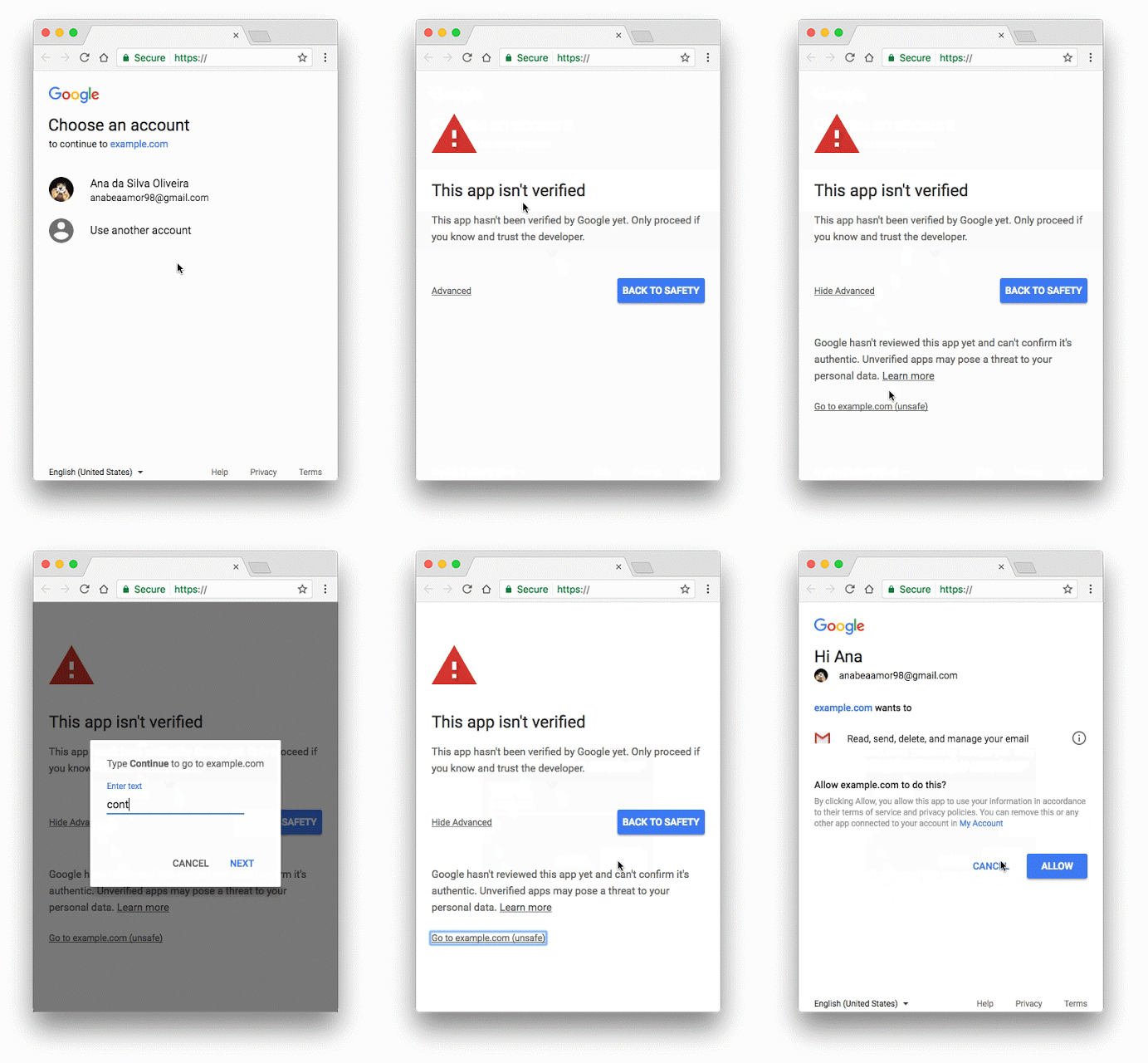
Because it’s now free and easy to add HTTPS to your site, criminals who exploit trusting internet users think Let’s Encrypt is pretty groovy. When a site has HTTPS, not only do users know they can trust they’re on an encrypted connection, but browsers like Google’s Chrome display an eye-catching little green padlock and the word “Secure” in the address bar. What’s more, privacy and security advocates, from the EFF and Mozilla (who founded it) to little people like yours truly, have done everything possible to push people to seek these out as a signifier that a website is safe…

The fact that Let’s Encrypt is now being used to make phishing sites look legit is a total burn for us, and a potential house fire for users who rely on simple cues like the green padlock for assurance. According to certificate reseller The SSL Store, “between January 1st, 2016 and March 6th, 2017, Let’s Encrypt has issued a total of 15,270 SSL certificates containing the word ‘PayPal.'”

«

One could also point the finger at domain registrars which allow people to register domains which contain some variation of “Paypal”. Arguably, they’re the ones who are principally to blame here since they give the criminals a platform.
link to this extract


Arron Banks: ‘Brexit was a war. We won. There’s no turning back now’ • The Guardian

Carole Cadwalladr interviews the principal donor behind UKIP and the UK’s Leave campaign, who also plans to fund MPs standing against those MPs who stood for Remain at the next election:

»

What is Banks flogging? Andrew Breitbart, the founder and informing spirit of Breitbart, believed politics is downstream from culture. First change the culture, then the politics will follow. Take the existing culture and subtly distort it. Banks has launched a new politics site, Westmonster, and in his sights is the Westminster elite and the metropolitan elite. He levels this at me. I point out: “You’re the privately educated multimillionaire who’s sitting here drinking white wine in Islington.”

The shame, I think, is that he could have been a leftie. There is a strong streak of social justice that runs through him. Or social something. Chippiness is part of it. But that’s no bad thing. But he’s not a leftie. And in the US, the permanent revolution is well under way. Steve Bannon is masterminding a silent coup: the institutions of government are being systematically dismantled. The relation of citizens to the state is being re-engineered. Trump, the businessman, is redefining them as consumers. Last week the US senate approved the right of telecoms companies to sell their customers’ browsing history – a huge step forward in renegotiating the relationship between individuals and their rights from that of democratic participants to end users. This is government as platform monopoly. Government as modelled on Google and Facebook. And what’s coming is platform democracy, where the company/government retains the right to change the user agreement at any time.

«

What I got from this interview is that Banks doesn’t have any firm political philosophy – he is mostly against stuff, but there’s nothing particular he’s trying to build. UKIP and Trump were fine when they were fighting against something; but now that’s gone, they’re revealed as empty.

This gives me some hope in the face of the alt-right: again and again, history doesn’t flow in their direction.
link to this extract


Apple is pushing iPad like never before • Above Avalon

Neil Cybart:

»

In order to properly assess all of the recent changes to iPad strategy, a closer look at sales is needed. While overall iPad sales have been in decline for years, reports of iPad’s death have been greatly exaggerated. There is much more going on behind the scenes.

iPad sales have faced one major headwind in recent years. This item explains a significant portion of the sales decline. It’s not inferior software, weak storytelling, or even a longer upgrade cycle. Instead, the iPad’s problem has been the iPad mini.

People aren’t buying as many iPad mini devices these days. Excluding 7.9-inch iPad mini sales from overall iPad sales results in a completely different sales picture. As seen in Exhibit 3, iPad mini unit sales have declined 70% after peaking in 4Q13 and 1Q14. The product’s value proposition has been permanently reduced due to larger iPhones. Apple has clearly experienced Peak iPad Mini. It’s not that the iPad mini form factor is going away, but rather that it will play a smaller role going forward. 

iPad mini sales weakness has masked stronger sales trends for larger iPads.

«

That iPad mini bulge is fascinating – I’d like to see the graph drawn with the iPad mini part on the bottom, rather than on top.
link to this extract


The death of interactive infographics? • Startup Grind – Medium

Dominikus Baur:

»

Last year I was lucky enough to go to the Information+ conference in Vancouver where Gregor Aisch, who works at the New York Times, gave a talk about the publication’s graphics and their impact. And the scary resumé of the talk was: Barely anyone interacts with the New York Times’ graphics. The New York Times makes arguably some of the best interactives in the field, which made Gregor’s talk even more depressing. His number of only 10–15% of people clicking on buttons — even essential ones — tells you that interactives are a waste of time and money.

Gregor’s editor, Archie Tse, talked about this earlier in the year at the Malofiej conference, and turned this fact into some utterly depressing rules. One of them was, for example, “If you make a tooltip or rollover, assume no one will ever see it.”

85% of page visitors simply ignore them, missing out on information hidden behind interaction. On top of that, interactives are expensive to make — they have to work across devices, using trackpads and fingers. They’re error-prone and can tarnish the publication’s reception within their audience.

So why even bother?

«

You could argue that the 10-15% are the important ones you want to influence, I guess. (Via Sophie Warnes’s fun data-musing newsletter Fair Warning.)
link to this extract


mapgubbins – Waste data: Environment Agency’s “journey to open” has come to a grinding halt.

Owen Boswarva:

»

In early 2015 the Environment Agency set out a proposal to transition its charged-for datasets “to open” in three tranches: Flood Data by 1 April 2016,  Waste Data by 1 April 2017, and all other datasets by 1 April 2018.

This was in the context of EA’s broader policy to move away from commercial licensing of data assets and towards an open data approach.

Release of the 2016 tranche mostly went to plan, although EA has so far failed to deliver open data on surface water flood risk in England. (Equivalent data is available for Wales.)

Yesterday EA’s data team announced the 2017 tranche: removal of charges on four datasets. These include boundary data for authorised landfill sites and tabular data on permitting of waste sites:

• Environmental Permitting Regulations – Industrial Sites
• Environmental Permitting Regulations – Waste Sites
• Environmental Pollution Incidents
• Permitted Waste Sites – Authorised Landfill Site Boundaries

However: none of these datasets has been released as open data. EA has instead applied its more restrictive “Conditional Licence” [which is incompatible with open reuse].

«

Man, it is tedious that the EA can’t just get with the program. Clearly some entrenched thinking there; the accession of Theresa May’s administration has not been a good thing in this space. EA says that “due to data protection issues and the right to be forgotten, this is not possible.”
link to this extract


Errata, corrigenda and ai no corrida: none notified

Start Up: finding Comey, Samsung’s quest, spotting the real Trump, hacking smart TVs, HTC’s Pixel number, and more


Those fireworks are lighting up some of the most expensive property in the US. But where? Photo by Chris Ford on Flickr.

You can now sign up to receive each day’s Start Up post by email. You’ll need to click a confirmation link, so no spam; and then it’ll arrive on Monday.

A selection of 10 links for you. Still a Br-x-t-free zone. Even better: April 1 falls on a Saturday, so there should be fewer stupid stories to avoid. I’m @charlesarthur on Twitter. Observations and links welcome.

This is almost certainly James Comey’s Twitter account • Gizmodo

Ashley Feinberg:

»

As far as finding Comey’s Twitter goes, the only hint he offered was the fact that he has “to be on Twitter now,” meaning that the account would likely be relatively new. Regarding his Instagram identity, though, Comey gave us quite a bit more to work with:

»

… I care deeply about privacy, treasure it. I have an Instagram account with nine followers. Nobody is getting in. They’re all immediate relatives and one daughter’s serious boyfriend. I let them in because they’re serious enough. I don’t want anybody looking at my photos. I treasure my privacy and security on the internet. My job is public safety.

«

Both a noble sentiment and an extremely helpful clue for tracking down the FBI director’s social media accounts. Because, presumably, if we can find the Instagram accounts belonging to James Comey’s family, we can also find James Comey.

«

And she did, in about four hours. Amazing work.
link to this extract


After the smoke clears: inside Samsung’s quest for redemption • The Verge

Dan Seifert went to South Korea to see Samsung:

»

“Meaningful innovation” is what Samsung hopes will lift it out of the mire of the Note 7 fiasco and out from the shadow of Cupertino. The company has long been a pioneer in hardware innovation and that certainly continues with the S8. But this time around, there’s as much of an emphasis on software and services as there is on the hardware itself, and Samsung knows that if it’s going to succeed at all, it can’t just make devices that run other companies’ software and platforms.

The company has long struggled to balance including compelling software features that people actually want to use and adding value to its own hardware offerings. There’s an entire graveyard of failed Samsung services and software, including the ill-conceived Milk Music and Milk Video and countless gimmicky camera and interface features. For anybody who tried Samsung’s ridiculous “smart scroll” features that tried to automatically pan content around based on tilting your phone or your eye movements, your level of trust in trying the latest Samsung “feature” is very low.

But in recent years, the company has had success with services such as Samsung Pay and Samsung Knox, both of which provide utility and good customer experiences. The S8 comes with those, of course, but it’s adding a number of new services to its stable in order to stand out from the crowd.

The most ambitious of these is Samsung’s spin on a virtual assistant, dubbed Bixby. It’s the company’s entry into the super hot virtual assistant world, which has been dominated by Google, Microsoft, Amazon, Facebook, and yes, Apple. But while many of the virtual assistants we’ve seen thus far have been based on providing different ways to perform web searches, Samsung’s approach is notably different.

“The persona for Bixby that we’re pursuing is a bright sidekick, a much more friendly agent to users,” says Dr. Injong Rhee, Samsung’s head of research and development for software and services. “Bixby is capable of developing a new interface to our devices, or devices that are going to host Bixby. Our perspective is to make the interface of the phone simpler and more natural to use.”

«

Samsung has had so many years of throwing not-quite-useful software tweaks at the wall – remember “eye scrolling”? – that it’s hard to take this stuff seriously. It’s also handicapped by Google having snagged the home button for Google Assistant, so that Bixby has to second fiddle.

The real question is whether Samsung can dig in for the long run, with consistency, on software and services, as Apple and Google have. Nobody doubts its hardware chops. Well, apart from the battery thing.
link to this extract


When Is @RealDonaldTrump really Donald Trump? • The Atlantic

Andrew McGill:

»

[in the past] we could infer when Trump himself was tweeting, tapping away at his Samsung Galaxy. Trump tweets were quantifiably different than staffer tweets, angrier and posted later at night (not to mention more poorly spelled).  

But in recent weeks, the Android tweets have slowed to a trickle, an indication that the White House might finally be taking the security risks posed by the president’s Twitter account seriously. Trump now appears to post mostly from an iPhone, if he still tweets at all.

But @TrumpOrNotBot is on the case. It’s a Twitter bot that uses machine learning and natural language processing to estimate the likelihood Trump wrote a tweet himself. By comparing new tweets to the president’s massive Twitter record, the bot is able to tell with reasonable certainty whether Trump is behind the keyboard, even if he’s chucked Android for Apple.

The bot is pretty good at figuring out when Trump is talking. When tested against a mix of 2016 tweets, it correctly flagged the ones sent from an Android 90% of the time. It’s a bit worse at figuring out when a staffer has tweeted, incorrectly attributing iPhone tweets to Trump around 25% of the time, perhaps because staffers sometimes work to imitate his style.

«

Useful.
link to this extract


This 3D map shows the price per square foot of US housing markets • Visual Capitalist

Jeff Desjardins:

»

A county-level analysis may be the easiest to understand, and by using average price per square foot we have a more universal denominator. After all, a house bought in Hawaii might be more expensive than a small loft in New York City – but it might also be 5x the size.

The visualization above focuses in on price per square foot at the county-level – and the results are clear: New York, San Francisco, and Aspen (Pitkin County) stand out.

«

This is a remarkable piece of work. Is there anything comparable for the UK? You’ll probably be able to recognise San Francisco and New York on the coasts. But there’s a giant spike in the middle of the US that might puzzle you – until you look at its name.

No doubt someone will also overlay voting from the 2016 election onto this too.
link to this extract


About 90% of smart TVs vulnerable to remote hacking via rogue tv signals • Bleeping Computer

Catalin Cimpanu:

»

[Rafael] Scheel says that “about 90% of the TVs sold in the last years are potential victims of similar attacks,” highlighting a major flaw in the infrastructure surrounding smart TVs all over the globe.

At the center of Scheel’s attack is Hybrid Broadcast Broadband TV (HbbTV), an industry standard supported by most cable providers and smart TV makers that “harmonizes” classic broadcast, IPTV, and broadband delivery systems. TV transmission signal technologies like DVB-T, DVB-C, or IPTV all support HbbTV.

Scheel says that anyone can set up a custom DVB-T transmitter with equipment priced between $50-$150, and start broadcasting a DVB-T signal.

By design, any nearby TV will connect to the stronger signal. Since cable providers send their signals from tens or hundreds of miles away, attacks using rogue DVB-T signals could be mounted on nearby houses, a neighborhood, or small city. Furthermore, an attack could be carried out by mounting the DVB-T transmitter on a drone, targeting a specific room in a building, or flying over an entire city.

According to Scheel, the problem is that the HbbTV standard, carried by DVB-T signals and supported by all smart TVS, allows the sending of commands that tell smart TVs to access and load a website in the background.

Knowing this, Scheel developed two exploits he hosted on his own website, which when loaded in the TV’s built-in browser would execute malicious code, gain root access, and effectively take over the device.

«

Guess what? His first hack used a Flash exploit from 2015; then a Javascript sorting flaw. Why do we need smart TVs again?
link to this extract


HTC, LG, TCL and Coolpad vying for next-generation Pixel smartphone orders, says paper • Digitimes

Steve Shen:

»

HTC is competing with LG Electronics, TCL and Coolpad for the orders of the next-generation Pixel smartphones to be released by Google in 2018, according to a Chinese-language Commercial Times report.

HTC won previously a two-year contract to manufacture the Pixel 1 series products in 2016 and to continue to build the Pixel 2 family products in 2017, said the report.

HTC has shipped over 2.1 million units of 5-inch Pixel and 5.5-inch Pixel XL to Google since their launch in September 2016, noted the paper.

«

Two million? Launched to great fanfare in October, six months ago? No wonder people are having trouble getting hold of it.
link to this extract


FCC boss takes aim at efforts to bring broadband to the poor • Techdirt

Karl Bode:

»

Last year the Wheeler-lead FCC voted to expand the Lifeline program, first created by the Reagan administration and expanded by the Bush administration. Originally, low-income homes received a $9.25 monthly credit that could be used toward wireless or traditional phone service. The 2015 changes not only gave these homes the option to use this money for broadband in an attempt to modernize the fund, but also placed the lion’s share of ISP eligibility administration in the hands of the FCC in an attempt, in part, to better police fraud.

A number of states sued over the move, in part because large ISPs (which enjoy even greater regulatory capture on the state level) didn’t want the federal government spending money on anything that might improve regional competition. This week, [the new FCC chief Ajit] Pai issued a statement saying (pdf) that he would be killing the FCC’s legal defense of the 2015 changes, and freezing all federal approval of federal provider eligibility. Why? This power belongs in the hands of the states, not the FCC, claims Pai:

»

“…By letting states take the lead on certification as envisioned by Congress, we will strengthen the Lifeline program and put the implementation of last year’s order on a solid legal footing. This will benefit all Americans, including those participating in the program.”

«

On a superficial level Pai does a wonderful job making this all sound perfectly reasonable, obfuscating much of the motivation for the shift as a noble quest to restore states rights (which is what most news coverage will focus on). The problem, again, is that companies like AT&T, Comcast and Verizon (a former Pai employer) have an absolutely incredible amount of control over state legislatures and regulators. It’s a primary reason why more than twenty states have passed laws banning your town or city from upgrading its broadband networks – even if nobody else will.

«

The retrograde approach of the new US administration continues to amaze. The key point is that by blocking this, the FCC and Pai will not be closing the digital divide.
link to this extract


Avast PC Trends Report Q1 2017 • Avast

The security company looks at a range of threats – of which our own failure to update stuff after downloading it is one of the biggest:

»

The top 10 least updated applications:
1) Java (Runtime 6 & 7): Almost 50% of users (56 million users) are running one version of Java Runtime Environment (6-8). Given this program has in the past been the carrier of some of the most critical security vulnerabilities (see here for a comprehensive list)) on Windows PCs , this opens up the front gates for malware 4 and exploits.. Almost 25% of users are running the outdated JRE 6 or 7. Unfortunately, even users on the newest release (version 8) might not be up to date as our data showed 70% aren’t running the latest version.

2) Flash (ActiveX): Popular web technology Flash is known for its security exploits and other issues such as draining battery life from laptops. Our research 5 showed the Flash ActiveX control for Internet Explorer is outdated in 99% of all instances.

Uninstall Flash if you’re not using Internet Explorer. For users of other browsers like Firefox, Chrome or Opera which use the Flash plugin, note that a still high 38% of all cases were outdated.

3) FoxIt Reader: Popular 3rd party PDF reader “FoxIt” also suffered as one of the top programs that was not updated. 92% of all FoxIt users are working with an older version.

4) GOM Media Player: Touted by its developer as “The only player you’ll ever need”, it appears from our research that users download the media player but subsequently don’t update it. 90% of our user sample aren’t running the latest version, which would gives them enhanced playback performance, more video filters and a range of useful upgrades on an almost monthly basis.

5) Nitro Pro: Another PDF reader, Nitro Pro is also neglected in 89% of all cases. Again, the lack of updates means users can be faced with bugs and vulnerabilities.

«

The next are WinZip, DivX, Adobe Shockwave, 7-Zip, and Firefox. Well done Adobe for appearing twice 🙄. Flash Player is the fifth-most installed app (after Chrome, Adobe Reader, Flash Player for ActiveX, and Firefox)
link to this extract


Drug firms poured 780m painkillers into West Virginia amid rise of overdoses • Charleston Gazette-Mail

Eric Eyre:

»

Rural and poor, Mingo County has the fourth-highest prescription opioid death rate of any county in the United States.

The trail also weaves through Wyoming County, where shipments of OxyContin have doubled, and the county’s overdose death rate leads the nation. One mom-and-pop pharmacy in Oceana received 600 times as many oxycodone pills as the Rite Aid drugstore just eight blocks away.

In six years, drug wholesalers showered the state with 780 million hydrocodone and oxycodone pills, while 1,728 West Virginians fatally overdosed on those two painkillers, a Sunday Gazette-Mail investigation found.

The unfettered shipments amount to 433 pain pills for every man, woman and child in West Virginia.

“These numbers will shake even the most cynical observer,” said former Delegate Don Perdue, D-Wayne, a retired pharmacist who finished his term earlier this month. “Distributors have fed their greed on human frailties and to criminal effect. There is no excuse and should be no forgiveness.”

The Gazette-Mail obtained previously confidential drug shipping sales records sent by the U.S. Drug Enforcement Administration to West Virginia Attorney General Patrick Morrisey’s office. The records disclose the number of pills sold to every pharmacy in the state and the drug companies’ shipments to all 55 counties in West Virginia between 2007 and 2012.

The wholesalers and their lawyers fought to keep the sales numbers secret in previous court actions brought by the newspaper.

The state’s southern counties have been ravaged by a disproportionate number of pain pills and fatal drug overdoses, records show.

The region includes the top four counties — Wyoming, McDowell, Boone and Mingo — for fatal overdoses caused by pain pills in the U.S., according to CDC data analyzed by the Gazette-Mail…

…For more than a decade, the same distributors disregarded rules to report suspicious orders for controlled substances in West Virginia to the state Board of Pharmacy, the Gazette-Mail found. And the board failed to enforce the same regulations that were on the books since 2001, while giving spotless inspection reviews to small-town pharmacies in the southern counties that ordered more pills than could possibly be taken by people who really needed medicine for pain.

«

The narrative among some is that these opioids are coming from Mexican drug dealers. Nothing of the sort: this is drugs companies. They, however, blame unscrupulous doctors and pharmacies; though this clearly shows that they overlooked suspicious situations which benefited them financially.

Though as the followup article explains, the state’s pharmacy board then ignored actionable data.
link to this extract


The DECK ad network is closing • Coudal Partners

Jim Coudal:

»

We started The Deck in 2006 and for the first couple years it struggled. By 2008, it was an OK business and by 2009, it was a pretty good business. From then through 2013, The Deck was going along just fine.

Things change. In 2014, display advertisers started concentrating on large, walled, social networks. The indie “blogosphere” was disappearing. Mobile impressions, which produce significantly fewer clicks and engagements, began to really dominate the market. Invasive user tracking (which we refused to do) and all that came with that became pervasive, and once again The Deck was back to being a pretty good business. By 2015, it was an OK business and, by the second half of 2016, the network was beginning to struggle again.

After a long, successful run, The Deck’s time has come and we’re shutting it down. We’re sorry to see the network go, but we’re proud to have supported so many independent voices, and the open web, along the way.

Thanks a million to the sites and services that were a part of The Deck over the years. Without exception, every affiliate deal was made with a simple agreement to participate and was based on trust, honor and friendship. What few issues arose were handled with common sense towards a common purpose. We’re proud of that too.

«

Coudal says The Deck served “somewhere north of 7.5bn impressions” over its life. The end of this ad network – which served many small (and large) indie sites – presents people like John Gruber and Jim Dalrymple and Jim Kottke and Andy Baio with a challenge in monetisation, after a few years when it had all looked like gravy. It has been clear for a while that sites like those have been struggling to fill some ad slots.

The question is what comes next. If Facebook and Snapchat are drying up the pool, what does this do for diversity of voice and in particular platform?
link to this extract


Errata, corrigenda and ai no corrida: none notified

Start Up: the examined life (on video), startup tips, facial recognition’s racial bias, tracing hoaxes, and more


How long would it take Google to find you if you didn’t tell it you were there? Photo by dullhunk on Flickr.


This Friday all day at Cambridge University: The Power Switch conference looks at the new digital monoliths:

In what ways is the power that they wield different from older kinds of corporate power? How should the power flowing from mastery of the technology be conceptualised? What kinds of regulatory approaches are viable in this new environment? Where does corporate responsibility begin and end in applications of Artificial Intelligence? And can the nation-state effectively regulate these new global entities?

Some tickets still available.


A selection of 10 links for you. A Br*x*t-free zone. I’m @charlesarthur on Twitter. Observations and links welcome.

He turned his home into a reality television show • The New York Times

Farhad Manjoo is “that guy”:

»

Q: What new tech product are you currently obsessed with using at home? What do you and your family do with it?

FM: This is going to sound weird, but I’m a strange person. I have two kids, ages six and three, and for the last few years I’ve been mourning their loss of childhood. Every day they get a little bit older, and even though my wife and I take lots of photos and videos of them, I can’t shake the feeling that we’re losing most of the moments of their lives.

So last summer, after some intense lobbying of my wife, I did something radical: I installed several cameras in my living room and dining room to record everything we did at home for posterity. In other words, I created a reality show in my house.

In practice, it works like this: The cameras are motion-activated and connected to servers in the cloud. Like security cameras in a convenience store, they are set to record on a constant loop — every video clip is saved for a few days, after which it’s automatically deleted, unless I flag it for long-term keeping.

Yes, this system sets up a minefield of potential problems: We turn off the cameras when we have guests (it’s unethical to record people without their consent) and we don’t spy on each other. There are also security concerns. I’m not going to disclose the brand of the cameras I used because I don’t want to get hacked. The safety of internet-of-things devices are generally not airtight.

And yet I’ve found these cameras to be just wonderful at capturing the odd, beautiful, surprising, charming moments of life that we would never have been able to capture otherwise. Every time the kids say something hilarious or sweet, or do something for the first time, I make a note of the time and date. Later on, I can go and download that exact clip, to keep forever. I’ve already got amazing videos of weeknight dinners, of my wife and I watching the news on election night, of my son learning to play Super Mario Brothers, and my kids having a dance party to their favorite music.

When I’m 80 and the robots have taken over, I’ll look back on these and remember that life was good, once.

«

Not sure how I feel about this. (Our kids are all well into double figures, and our memories have recovered from the sleep deprivation.)
link to this extract


It will take Google 22 days to find you • Motherboard

Adrianne Jeffries:

»

Only 346 people got to glimpse Unindexed, a communal website built by Matthew Rothenberg, before it exploded.

Unindexed did two things: allow users to submit comments to the site, and constantly search for itself in Google. The latter was a suicide mission. Once it was discovered by the search engine, Unindexed self-destructed.

Users were encouraged to share the site, but warned that its discovery by Google would mean its demise. The more attention the site received, the faster death would come—like the movie Untraceable, in which a serial killer broadcasts his murders online, but infinitely less horrendous.

“Part of the goal with the project was to create a sense of unease with the participants—if they liked it, they could and should share it with others, so that the conversation on the site could grow,” Rothenberg told Motherboard. “But by doing so they were potentially contributing to its demise via indexing, as the more the URL was out there, the faster Google would find it.”

Unindexed didn’t do much to hide itself. Much like a Manhattan speakeasy, it was only secret-ish. Rothenberg could have included instructions to Google not to index it, or hosted it on the deep web where Google’s crawlers can’t follow. Instead, he decided to find out how long it would take the search giant to find an obscure site that only circulated by word of mouth.

«

Neat idea. Of course if Liam Neesom were in charge of Google he’d find the site much more quickly, and kill everyone responsible in the process.
link to this extract


My business was bringing in 7 figures — here’s how I grew it to 8 – Business Insider

Noah Kagan:

»

Starting a profitable business is tough. 

Often you’re starting with an idea that brings in $1, then $1,000, and hopefully up from there.

That’s why there are lots of articles written about finding a profitable idea. But people rarely talk about growing it because most businesses aren’t at the stage of making 6 figures, 7 figures, and beyond. 

But I was there.

2016 was a huge year for me and the whole team at my company, Sumo. We made the jump from being a 7-figure business to an 8-figure one. We grew from 10 to 30 people. I even did something I never thought I’d do and spent a lot of money — $1.5 million — on our domain name, Sumo.com.

«

Kagan’s advice here might sound obvious – but he has grown four different multimillion-dollar/pound businesses, so he’s probably right and you’re wrong to ignore him.
link to this extract


The perpetual line-up: unregulated police face recognition in America • Center on Privacy and Technology

Clare Garvie, Alvaro Bedoya and Jonathan Frankle, in a substantial report:

»

Human vision is biased: We are good at identifying members of our own race or ethnicity, and by comparison, bad at identifying almost everyone else.214 Yet many agencies using face recognition believe that machine vision is immune to human bias. In the words of one Washington police department, face recognition simply “does not see race.”215

The reality is far more complicated. Studies of racial bias in face recognition algorithms are few and far between. The research that has been done, however, suggests that these systems do, in fact, show signs of bias. The most prominent study, co-authored by an FBI expert, found that several leading algorithms performed worse on African Americans, women, and young adults than on Caucasians, men, and older people, respectively.216 In interviews, we were surprised to find that two major face recognition companies did not test their algorithms for racial bias.217

Racial bias intrinsic to an algorithm may be compounded by outside factors. African Americans are disproportionately likely to come into contact with—and be arrested by—law enforcement.218 This means that police face recognition may be overused on the segment of the population on which it underperforms. It also means that African Americans will likely be overrepresented in mug shot-based face recognition databases. Finally, when algorithms search these databases, the task of selecting a final match is often left to humans, even though this may only add human bias back into the system.

«

People keep forgetting the basic rule – these systems can only learn from what you teach them.
link to this extract


UK cops arrest man potentially linked to Apple extortion • Motherboard

Joseph Cox:

»

On Tuesday, the UK’s National Crime Agency (NCA) arrested a young man on suspicion of hacking and extortion offenses, Motherboard has learned. The man has been bailed pending further enquiries, and the NCA will not elaborate further.

But according to someone who provided a copy of the alleged warrant to Motherboard, the arrest may be connected to the ongoing attempted extortion of Apple by a group calling itself the Turkish Crime Family.

“National Crime Agency officers arrested a 20 year-old male and searched an address in London, N10 on Tuesday 28 March in relation to suspected Computer Misuse Act and extortion offences,” an NCA spokesperson wrote in an email after being approached by Motherboard with a copy of the warrant.

Motherboard was alerted to the arrest by someone in control of the Turkish Crime Family email account. Last week, the group threatened to remotely wipe a number of Apple devices via alleged access to corresponding iCloud accounts unless the company paid a hefty ransom. The group has been capitalizing on a media frenzy in an attempt to collect more compromised Apple accounts.

«

Cox noted that the “group’s” operational security didn’t look top-notch from the details he’d seen. The group – I’d guess it’s two or at most three people – made a lot of noise, but the police are pretty good at tracking this stuff nowadays.
link to this extract


Information changes attitudes towards immigrants • VOX, CEPR’s Policy Portal

Chris Roth (U of Oxford) and Diego Ubfal (Bocconi University):

»

Survey data suggests that voters are often misinformed about basic facts on immigration. For example, people consistently overestimate the proportion of immigrants in their country (Sides and Citrin 2008, Hopkins et al. 2016). In the US, on average people think that 37% of the population are immigrants, whereas the true figure is only 13%. In a recent paper, we tackle this question by gathering both cross-country evidence from several OECD countries as well as conducting two online experiments in the US (Grigorieff et al. 2016). Our results indicate that exposure to information can durably shift people’s attitudes towards immigrants, but that information is less effective in shifting policy preferences.

«

So people who hate immigrants still hate them after they realise there aren’t as many as they thought. This maybe makes sense. But isn’t 99.9% of the US population immigrant, strictly speaking? (Or 100%, depending how far back you want to go?)
link to this extract


Hoaxy • Indiana University

The university’s Network Science Institute has built this tool: “Visualize the spread of claims and fact checking.” The link goes to one on “trump + russia” (how timely) but you can choose your own input.

Reminds me of Craig Silverman’s Emergent – now sadly defunct since he went to Buzzfeed.
link to this extract


Premium smartphones take up less than 30% of Samsung’s phone sales in Q1 • Korea Herald

Yonhap News Agency:

»

High-end smartphones took up less than 30% of Samsung Electronics Co.’s combined sales of handsets [in Q1 2017], data showed Monday, although the figure is expected to rebound after the launch of the tech giant’s upcoming new flagship model this week.

According to the data compiled by Hana Financial Investment Co., premium models are estimated to have accounted for 29% of Samsung’s combined smartphone sales in the January-March period.

It marks the first time that high-end devices, such as the Galaxy S and the Galaxy Note series, failed to account for 30% of sales for the company.

The portion of high-end smartphones once reached 75% in the second quarter of 2013, when Samsung released the Galaxy S4.

But the figure gradually declined afterwards, falling below the 40% level in 2015.

In terms of average sales price, Samsung’s smartphones were sold at $232 globally in 2016, down 20% from $289 posted a year earlier, the data compiled by industry tracker Strategy Analytics showed.

Over the cited period, that of Samsung’s US rival Apple Inc. shot up 7% to $645.

«

The risk for Samsung is that it becomes a budget phone seller, and that’s a space where it would simply be fighting the commodity fight. Of course Q1 is unusual – the pause before the S8 launch, and no Note 7 to buoy up the premium end. But even so.

link to this extract


If you download Minecraft mods from Google Play, read on … • We Live Security

Lukas Stefanko:

»

When launched, the apps immediately request device administrator rights. Once device administrator is activated, a screen with an “INSTALL MOD” button is displayed. Simultaneously, a push notification informs the user that a “special Block Launcher” is needed in order to proceed with the installation.

After clicking the “INSTALL MOD” button, the user is prompted to install the additional module “Block Launcher Pro”, granting it several intrusive permissions (including device administrator rights) in the process. The payload downloaded during the installation is detected by ESET as Android/Hiddad.DA.

Installing the module brings the user to a dead end – a static Minecraft-themed screen with no clickable elements. The only actual function of the app and its module is to display ads – which now show up on the user’s device, interrupting their activity.

Interestingly, this ad-displaying downloader is an evolved version of an app that was originally uploaded to Google Play in February. The original version used a similar interface and also demanded device administrator rights. However, it didn’t have any downloading functionality and, unlike the downloader analyzed in this article, the first version actually provided the user with real Minecraft mods.

Since the result of this evolution – a downloader – is able to download any sort of additional malware to the victim’s device, there is no reason to believe malware authors would stop at only displaying unwanted ads.

«

Got to nearly a million installs before they spotted it and reported it. Clearly, Google’s proactive PHA (potentially harmful apps) program isn’t quite perfect when it comes to this stuff.
link to this extract


Productivity is down • FT

Chris Giles:

»

Utilities and telecoms also show outsized drops in productivity growth, while in the gas and electricity sector, output growth slipped back but jobs growth exploded — something the sector often boasts about when highlighting its importance to the economy. RenewableUK, the trade association for the industry, predicts jobs growth will continue from 35,000 in 2015 to 105,000 in the next decade, indicating that productivity is likely to continue to lag.

In telecoms, the ONS data point to a massive drop in real output, exacerbated by a trend of falling prices before the crisis followed by price stagnation after 2008. Data from Ofcom, the telecoms regulator, however, show different industry trends; its own analysis shows households have been spending less on telecoms services in real terms and receiving more for their money.

This contradiction illustrates the other big problem for analysts: the weakness of the data. (There is a similar issue in management consultancy, where the statistics imply that consultancy prices fell in the boom years and rose in the post-crisis stagnation). Nick Vaughan, chief economic adviser at the ONS, told a statistics conference last month that “parts of the service sector are not just ill-measured but completely mismeasured”.

«

In other words: telecoms productivity *seems* to be falling because it employs roughly the same number of people, but revenues are flat – but that’s a good thing because the regulator is keeping them down, and telecoms is an enabler for other sectors.

Perhaps the measurements should have some sort of “impact measure” of how much other sectors rely on others.
link to this extract


Errata, corrigenda and ai no corrida: none notified

You can now sign up to receive each day’s Start Up post by email. You’ll need to click a confirmation link, so no spam.

Start Up: Google’s Pixel drought, “cheap premium” is over, Guardian sues adtech co, Facebook v blasphemy, and more


How much would you pay to see a film in your house on its first day, rather than the cinema? Photo by bigmick on Flickr.

You can now sign up to receive each day’s Start Up post by email. You’ll need to click a confirmation link, so no spam.

A selection of 11 links for you. Use them wisely. I’m @charlesarthur on Twitter. Observations and links welcome.

The Google Pixel does not exist • PhoneArena

“Victor H”:

»

The Google Pixel, the best Android phone if you ask the majority of tech gurus, does not exist.

It is a delusion, an Android fan’s mirage.

It is vaporware. Vaporware definition: software or hardware that has been advertised but is not yet available to buy, either because it is only a concept or because it is still being written or designed.

The phone that Google launched in early October 2016, some six months ago, and was widely seen as a rival to the Apple iPhone and Samsung Galaxy is simply not available on the one place, where it should be in plentiful supply: the Google Store. To be perfectly exact, the Google Pixel and Pixel XL technically are available, it is just that you have to wait more than a month to actually get one. Six months after the launch of the phone it is abundantly clear that such depressingly long shipping times cannot be blamed on shortage of inventory or any other technicality, but the only logical conclusion left to make is that it is Google itself that is not willing to make the Pixel.

«

Google was rather caught out by the initial popularity of the Pixel, which was magnified by the failure of Samsung’s Note 7. But this continuing shortage suggests a failure to get on top of inventory.
link to this extract


Pakistan says Facebook vows to tackle concerns over blasphemous content • Reuters

Syed Raza Hassan:

»

Facebook has assured Pakistan that concerns about blasphemous content on the social media site will be addressed and a company delegation will visit this week to discuss the issue with the government, the interior minister said on Tuesday.

Pakistani Prime Minister Nawaz Sharif earlier this month ordered that blasphemous content on social media be removed or blocked and that anyone posting such material be punished, and the government requested a meeting with Facebook.

Blasphemy is a criminal offense in the strictly Islamic country and can carry the death penalty.

Interior Minister Chaudhry Nisar Ali Khan, quoting from what he said was a letter from Facebook’s vice president received a day earlier, told reporters: “I wanted to reiterate that Facebook takes the concerns raised by the Pakistani government very seriously. We have also committed our representative to meet with you and senior officials of your government.”

Khan described this message as a “very big improvement” from Facebook as, he said, the U.S. social media giant generally had not responded to such complaints in the past.

«

Blocking child abuse images is one thing. But isn’t God big enough to deal with this latter sort of thing without help? Facebook’s complicated juggling game of trying to please diverse cultures on a single platform continues.
link to this extract


Virgin Media suspends staff over £3bn upgrade errors • FT

Nic Fildes:

»

Virgin Media has suspended four employees and launched an internal investigation after reducing the number of homes it said had been reached by a £3bn network upgrade.

The cable company said on Tuesday that staff had “misrepresented” the completion status of the Project Lightning expansion when it reported fourth-quarter results in February.

Virgin Media claimed that its new network had grown to pass 215,000 British homes in the three months to the end of December but has now cut that figure to 86,000.

Four employees have been suspended as a result of the revision. Paul Buttery, chief operating officer in charge of driving customers to upgrade to the network, left the company in late February.

«

Well this is an odd one.
link to this extract


You should appreciate germs • Bill Gates

Yes, it’s billg:

»

I found some of [Ed] Yong’s reporting [in his new book I Contain Multitudes] directly relevant to my role as a parent. Melinda and I—and most parents in the U.S. and other rich countries—have dramatically cut down on our children’s exposure to the diverse array of microbes that for millennia have helped human beings strengthen their immune systems and avoid inflammatory diseases. As Yong puts it, “We have been tilting at microbes for too long, and created a world that is hostile to the ones we need.”

It’s not just all the anti-bacterial soaps and sanitizers we Americans use. Another major problem is the excessive use of antibiotics. On net, antibiotics have been unbelievably positive for humanity. But every time we give them, we are carpet-bombing our microbial ecosystem (microbiome), not merely knocking out pathogens. “A rich, thriving microbiome acts as a barrier to invasive pathogens,” writes Yong. “When our old friends vanish, that barrier disappears [and] more dangerous species can exploit the … ecological vacancies.”

As you can imagine, the book is also quite relevant to my work at our foundation, especially in the area of children’s growth and development. Yong explains why, if we want to prevent malnutrition, we not only need to help alleviate hunger and provide key micronutrients. We will also need to learn why some kids’ microbiomes are out of balance and how to restore them back to a healthy state.
Not only could this lead to low-cost interventions for malnutrition. I suspect this line of research will also help scientists make inroads against many other diseases. The list of disorders that have been linked to disruptions in the microbiome includes Crohn’s disease, ulcerative colitis, irritable bowel syndrome, colon cancer, obesity, type 1 diabetes, type 2 diabetes, and Parkinson’s disease. Even though we don’t have good ways of manipulating the microbiome to head off disease, I am hopeful we will eventually. I’m particularly excited about the implications for neurodegenerative diseases like Parkinson’s. It may turn out that these diseases get their start in the gut a decade or more before any brain symptoms show up. If that’s the case, the gut may prove to be a great target for medicines, giving new hope to many millions of families.

«

The microbiome is almost surely going to be the source of some of the most profound things to be found out in the next 20 years in medicine.
link to this extract


Let robots handle your emotional burnout at work • How We Get To Next

Meeri Kim:

»

Then there’s Ellie, a clinical therapist whom I recently met in the lab of computer scientist Jonathan Gratch. In a soothing voice, she asked me questions like, “Where are you originally from?” and “What do you like about living in Los Angeles?” As I responded, Ellie nodded her head and smiled at all the right moments, immediately putting me at ease.
As charming as she is, Ellie isn’t a real person. She’s a virtual human — the creation of Gratch and his colleagues at the University of Southern California’s Institute for Creative Technologies. A software agent, she looks like an ordinary CGI character displayed on a screen. But she’s not scripted—behind the scenes, she uses sophisticated machine vision and voice analysis to interact with humans in real-time.

“Researchers focused on emotional labor have suggested using virtual humans as a first line of defense, so to speak, in customer service,” said Gratch, who is also a computer science professor at USC’s Viterbi School of Engineering. “Anywhere you have people doing emotional labor, there could be a potential for this technology to serve that role without incurring the negative effects on a worker’s health.”

I certainly respect Gratch’s line of thinking, but isn’t he ignoring that most customers absolutely hate interacting with robot customer service representatives? Are we really going to change just because we can see a “virtual human” on a computer screen?

After the brief demonstration, Gratch and his colleague lifted the curtain on Ellie. As it turned out, throughout our conversation she had been tracking an astounding amount of data about me: my facial expression, attention level, upper body movements, voice pitch, eye gaze, and smile level. She recorded, moment to moment, if I had seemed happy or sad, engaged or distant, and tweaked her responses accordingly.

«

link to this extract


Review: Virtual Competition: the promise and perils of the algorithm-driven economy, by Ariel Ezrachi and Maurice E. Stucke • Times Higher Education Supplement Books

Julia Powles:

»

It is becoming increasingly apparent that widespread deployment of algorithmic tools can intensify, rather than reduce, the chasm between the wealthy and the vulnerable. This is the issue Ezrachi and Stucke address as behavioural discrimination. With ever-increasing hoards of data, firms can engage in near-perfect dynamic price discrimination, flipping our attributes, likes and fancies into individually enclosed and tailored worlds. Overall, they argue, this is corrosive to social welfare, because the more vulnerable among us end up paying more. The authors’ assessment of where this is heading is of the most sober kind: absent legal intervention, perfect discrimination will likely become the new norm.

There is a lively gameness to Ezrachi and Stucke’s study, marked by their willingness to call out what the world’s internet users stare into every day – monopoly power on a scale unlike any we have ever known – and their systematic attempt to provide the language and tools needed to start tackling it. The book relies for some of its pivotal claims on an adjacent work that should be seen as a companion text: the unimaginatively titled but brilliantly executed Big Data and Competition Policy (2016). Co-authored by Stucke, this time with the distinguished US anti-trust practitioner Allen Grunes, it contains a detailed analysis of merger and antitrust cases and lucidly explores the interplay between privacy and competition in a way that neatly sets up the analysis, and fills some of the gaps, in Virtual Competition.

The constant aim of both of these works, and their clear achievement, is in exposing the facile mirage of competition in digital markets.

«

There’s a conference at Cambridge University on Friday – The Power Switch – which will look at topics like these. Some tickets still available. Ezrachi is among the speakers.
link to this extract


Global average sales price of Chinese branded smartphones to reach RMB 2,000 by the end of 2017 as ‘affordable premium’ becomes impossible • TrendForce

Avril Wu:

»

The global smartphone market, which has been experiencing slowing growth and intensifying competition, has become an even tougher environment because of recent sharp rises in component prices. Avril Wu, smartphone analyst for the global market intelligence firm TrendForce, stated that China-based brands have been raising their prices as they face significant erosion of their margins.

“The global average sales price of Chinese branded smartphones stayed at a level of about RMB 1,700 [US$245, UK£200] during the course of 2016,” said Wu. “By the end of 2017, the global average sales price of Chinese branded smartphones is estimated to climb to around RMB 2,000 [US$290, UK£236]. Facing rising costs and mounting competitive pressure, Chinese smartphone makers will eventually abandon their favorite strategy of selling high specs devices at extremely affordable prices.”

Starting in the second half of 2016, numerous Chinese brands broke from the tradition of offering high performance products at low prices. The deviation from the usual pricing scheme was first noticed among flagship devices such as Huawei’s P9 and Gionee’s M6. The pattern of a general price increase became more apparent as affordable brands including Xiaomi and Meizu also followed suit.

“By raising prices, Chinese brands are at risk of losing consumer demand for their products,” said Wu. “At the same time, maintaining profitability has become a struggle as the market is now more competitive than ever. Therefore, the price hike may be the last resort for some Chinese smartphone makers and an indication of a coming industry consolidation.”

«

link to this extract


Most consumers wouldn’t pay high prices for day-and-date in-home movies • Variety

Movie patrons are a price-sensitive group, and many can be turned off if they think a show is too expensive or too difficult to attend — tendencies that keep many fans away from theaters, a new survey commissioned by Variety suggests.

Still, only a small percentage say they’d pay $25 or $50 to see a film at home on the same day it opens in theaters, the survey by CivicScience found. And yet that subset — when spread across the entire population — could create a substantial enough audience to encourage entertainment companies to move ahead with plans to shorten the traditional 90-day window between a movie’s release in theaters and in the home.

Those are the most significant takeaways from questions asked of more than 1,800 Americans in late February and early March by CivicScience, a Pittsburgh-based market-research firm that surveys a representative sample of consumers via questions embedded on hundreds of websites.

That 9% (and the unsure 13%) could turn into a lot of money – especially once you factor in the travel, parking and food. Which raises the question: what is the “job to be done” of a cinema? It’s not just showing a film.
link to this extract


Did China quietly authorize law enforcement to access data anywhere in the world? • Lawfare

Susan Hennessey and Chris Mirasola:

»

On September 20, 2016 the Supreme People’s Court, Supreme People’s Procuratorate (China’s prosecutor), and the Public Security Bureau jointly released 30 regulations governing the collection and examination of digital data in criminal investigations. Unsurprisingly, the regulations were primarily only of interest to Chinese judges, lawyers, and public security officials.

Tucked in among the relatively mundane provisions, however, was a potentially rather alarming development that has thus far escaped much public notice in the United States. The regulations seem to authorize the unilateral extraction of data concerning anyone (or any company) being investigated under Chinese criminal law from servers and hard drives located outside of China.

Article 9 of the 2016 regulations provides that the police or prosecutors may extract digital data from original storage media (e.g., servers, hard drives) that are located outside of mainland China (i.e., including servers in Hong Kong, Macau, and Taiwan) “through the Internet” and may perform “remote network inspections” of such computer information systems. Remote network inspections are helpfully defined, in Article 29, as “investigation, discovery, and collection of electronic data from remote computer information systems related to crime through the Internet.” The only caveat to this grant of authority is a requirement that investigations be subject to “strict standards.” No guidance is provided as to what “strict” means.

«

By the by, Lawfare is quietly becoming a must-read site.
link to this extract


Tech kings’ greatest enemy is in the mirror • Bloomberg Gadfly

Shira Ovide:

»

Advertisers can’t afford to boycott Google for long. Neither can the company afford to brush off the squabble with its usual promises to do better next time because signs of a rebellion are brewing. An executive from the world’s biggest advertiser, Procter & Gamble, said recently that his company could no longer tolerate the long-standing flaws of digital advertising such as fraudulent ad clicks and erroneous measurement. Walt Disney was spooked when it turned out the company was doing business with a YouTube series laced with anti-Semitic messages. My colleague Leila Abboud has suggestions for what Google can do differently.

This feels different from the many, many controversies Google has weathered over the years, including previous flaps over how it polices material. The pushback isn’t coming from its users, regulators, journalists or the newspaper and television companies that are losing sales to Google. This time, the companies that pay Google’s bills are the ones complaining. (Advertising accounts for 88% of Alphabet’s annual revenue and 97% of Facebook’s.)

The gripes about Google — and similar finger-pointing about bogus information spreading on Facebook — aren’t new, but the complaints are growing louder as the companies’ power grows. And in part, they have themselves to blame. Google and Facebook boast that their sophisticated technology can pinpoint 100 people who might buy a new pair of jeans. So why can’t those geniuses sniff out when an internet star’s videos are laced with anti-Semitic commentary or accurately track how long people watch videos?

«

link to this extract


The Guardian takes legal action against ad tech company Rubicon Project • Business Insider

Lara OI’Reilly:

»

The Guardian is preparing to file a lawsuit against ad tech company Rubicon Project, alleging the ad tech vendor did not disclose fees it levied on advertisers looking to buy the newspaper’s online ad inventory, sources told Business Insider.

The Guardian is due to file its legal papers at the UK High Court’s Chancery Division, Business Insider understands.

A Guardian spokesperson confirmed the matter with Business Insider: “We can confirm that we have commenced proceedings against Rubicon Project for the recovery of non-disclosed buyer fees in relation of Guardian inventory.”

…Business Insider understands the amount The Guardian is looking to recuperate from the supply-side platform (SSP) spreads back over a number of years, but is only in the single-digit millions. Nevertheless, no matter what the outcome, the legal dispute will likely shed more light on the complicated nature of the online ad buying ecosystem…

…Last year, The Guardian conducted a test where it bought its own ad inventory on open ad exchanges so it could get a sense of how much of the money put into the ad tech ecosystem made it back to the publisher.

In the worst case scenario, The Guardian found that for every £1 spent on its inventory, just 30p actually made it to The Guardian, as MediaTel reported in October.

«

Wow. Suing adtech companies is really putting the cat among the pigeons. Is 2017 the year in which the wheels start coming off the adtech business?
link to this extract


Errata, corrigenda and ai no corrida: none notified

Start Up: productivity at Apple and Google, Samsung recycles Note 7, Medium’s uphill battle, and more


How you record a dice throw could reveal things about corruption in the country you grew up in. Photo by misterbisson on Flickr.

You can now sign up to receive each day’s Start Up post by email. You’ll need to click a confirmation link, so no spam.

A selection of 11 links for you. Use them wisely. I’m @charlesarthur on Twitter. Observations and links welcome.

National corruption breeds personal dishonesty • Scientific American

Simon Makin:

»

The researchers developed a measure of corruption by combining three widely used metrics that capture levels of political fraud, tax evasion and corruption in a given country. “We wanted to get a really broad index, including many different aspects of rule violations,” Schulz says. They then conducted an experiment involving 2,568 participants from 23 nations. Participants were asked to roll a die twice and report the outcome of only the first roll. They received a sum of money proportional to the number reported but got nothing for rolling a six. Nobody else saw the die, so participants were free to lie about the outcome.

If everyone were completely honest about their die rolls, the average claim would be 2.5, whereas if everyone were maximally dishonest, all claims would be 5. Participants from nations with a high prevalence of rule violations (PRV)—including Georgia, Tanzania, Guatemala and Kenya—tended to claim more than those from low-PRV countries—such as Austria, the U.K., the Netherlands, Sweden and Germany—and average claims correlated with PRV values. In other words, the more corrupt the country, the more its citizens inflated the number they reported. These values were calculated using data from 2003, and the experiments were conducted between 2011 and 2014 using participants whose average age was 21—too young to have personally influenced PRV ratings but old enough to have been influenced by social norms, implying that national corruption levels influenced participants’ honesty, not vice versa.

«

The paper is here (if you have a Nature subscription).
link to this extract


Why employees at Apple and Google are more productive • Fast Company

Stephanie Vozza:

»

Companies like Apple, Netflix, Google, and Dell are 40% more productive than the average company, according to research from the leadership consulting firm Bain & Company. You might think that it’s because these companies attract top-tier employees–high performers who are naturally gifted at productivity–but that’s not the case, says Bain & Company partner Michael Mankins.

“Our research found that these companies have 16% star players, while other companies have 15%,” he says. “They start with about the same mix of star players, but they are able to produce dramatically more output.”

It’s what they do with these high performers. Executives from large companies across 12 industry sectors worldwide said three components of human capital impact productivity more than anything else: time, talent, and energy. And the top quartile organized its business processes in a way that they’re 40% more productive than the rest and consequently have profit margins that are 30%-50% higher than industry averages.

“They get more done by 10 a.m. Thursday morning than the others do in a week, but they don’t stop working,” says Mankins. “This difference compounds every year; over a decade, they can produce 30 times more than the rest, with the same number of employees.”

«

Mankins has written a book on this. One of his cases in point: iOS 1.0 v Vista. Though in the article it’s written as “iOS 10” and described as “mission critical”. Also critical: careful reading.
link to this extract


Samsung confirms the Note 7 is coming back as a refurbished device • The Verge

Natt Garun:

»

Ahead of the Samsung Galaxy S8 launch, the company has released a statement regarding its plans to recycle Note 7 devices. The process comes in three parts: save salvageable components such as camera modules and semiconductors, extract metal parts with the help from “eco-friendly” third-party companies, and sell refurbished devices “where applicable.”

The announcement appears to walk back on what Samsung initially pledged last fall, when it said it would dispose of the Note 7 and had no plans to repair or refurbish them. Instead, Samsung has confirmed it will work with local authorities and carriers to sell it as a refurbished device, rumored to come with a smaller battery to prevent it from overheating and catching fire. The company said available markets are to be determined as they work with local regulators to approve of the sale.

“The objective of introducing refurbished devices is solely to reduce and minimize any environmental impact,” Samsung told The Verge in a statement.

«

“This millstone? Yeah, we’ve painted it, and think it looks nice around our neck, actually.”
link to this extract


Samsung Galaxy S8: The antidote for phone fatigue? • CNET

Roger Cheng:

»

Samsung will hold its Galaxy S8 launch event in New York at Lincoln Center on Wednesday starting at 11 a.m. ET (8 a.m. PT), and CNET will bring you all the details and full coverage as it happens.

But the stakes aren’t just isolated to one company — phones in general need a jump start, a spark of innovation to get us excited again. Samsung is banking the Galaxy S8 is just that catalyst.

Because let’s face it, there’s been a general malaise creeping into the phone world as the innovative jumps between versions of phones get smaller and smaller. Sure, phones boast faster processors, better cameras and brighter displays — but that’s all kind of expected now, right?

It’s telling that amid all of the new phones released at the Mobile World Congress trade show last month, it was the reboot of a 17-year-old feature phone — the Nokia 3310 — that captured everyone’s attention. Keep in mind this was a show where household names like LG and Sony rolled out their big phones and BlackBerry mounted yet another comeback attempt with the KeyOne (courtesy of Chinese phone maker TCL).

But did anyone care? Nope.

I’ll readily admit that I suffer from an extreme form of phone fatigue. It’s hard not to when you deal with the next greatest smartphone seemingly every month. It can’t just be me, right?

«

Smartphone evolution has slowed so much it has pretty much stopped. There isn’t anything dramatic you can do now to the form factor or, largely, function. So we’re now into the commoditisation era, when retro stuff feels fun because it’s properly different.
link to this extract


Dishwasher has directory traversal bug • The Register

Richard Chirgwin:

»

Don’t say you weren’t warned: Miele went full Internet-of-Things with a dishwasher, gave it a web server and now finds itself on the wrong end of a bug report and it’s accused of ignoring the warning.

The utterly predictable bug report at Full Disclosure details CVE-2017-7240, “Miele Professional PG 8528 – Web Server Directory Traversal”.

“The corresponding embedded Web server ‘PST10 WebServer’ typically listens to port 80 and is prone to a directory traversal attack, therefore an unauthenticated attacker may be able to exploit this issue to access sensitive information to aide in subsequent attacks.”

Proving it for yourself is simple: GET /../../../../../../../../../../../../etc/shadow HTTP/1.1 to whatever IP the dishwasher has on the LAN.

Directory traversal attacks let miscreants access directories other than those needed by a web server. And once they’re in those directories, it’s party time because they can insert their own code and tell the web server to execute it.

«

If you squint hard, you can see why you might want this – to turn on your dishwasher at some convenient time of day when you’re not there. (Solar panels work during the day…) However, internet security is harder than making dishwashers.
link to this extract


Beware Google ads for ‘abortion consultations’ • Bloomberg

Alice Hines:

»

Imagine you’re pregnant, and you don’t want to be. You type “abortion pittsburgh” into Google, and the first result is the Pittsburgh Women’s Clinic, offering “free abortion consultations.” “Only you know what’s best for you,” the Google ad reads. “Same-day appointments available. Call now!” You click and come face-to-face with a photo of a smiling woman with a stethoscope. “Looking for an abortion?” she asks in 65-point font. But you won’t get one from her or from the Pittsburgh Women’s Clinic. No clinic with that precise name exists.

The site is a landing page for a network of 41 pregnancy centers seeking to deter women from getting abortions. These centers, located in what they say are America’s “most abortion-dense cities,” are affiliated with or owned by Human Coalition—formerly Online for Life, sometimes going by the name Media Revolution Ministries—a Texas-based nonprofit that reaches “abortion-determined women” via ad campaigns shaped by search engine optimization (SEO) and search engine marketing (SEM).

«

Totally predictable, but the question is whether this is false advertising. Some US cities are passing ordinances against such dubious schemes.
link to this extract


Why you won’t see Unilever announcing it is pulling its ads from YouTube • Business Insider

Lara O’Reilly:

»

[Unilever marketing chief Keith] Weed says the current industry-standard for a view — 50% of the pixels of an ad seen for 1 second or more — doesn’t go far enough. He says a view should be 100% of the pixels seen. On video, he says half of the ad must have been watched to count as a view — versus the industry-standard of 50% of the pixels for 2 continuous seconds.

“I was saying [back during discussions with Google in 2015] I’m not taking a stance against YouTube or any other platform, I’m taking a stance about what I’m willing to pay for. This is my criteria, if you don’t match that criteria, at the end of the day, it’s Unilever dollars. If you don’t match that criteria, that’s fair enough. But our dollars will follow where that criteria exists,” Weed said.

Marc Pritchard, the chief marketing officer at consumer goods giant P&G, delivered two landmark speeches earlier this year in which he gave its agencies and suppliers a year’s notice to get audited and open themselves up to accredited third-party verification services. Media agency The&Partnership’s founder Johnny Hornby said advertisers and agencies should set a “Cannes deadline” — referring to the Cannes Lions advertising industry event that takes place in June — for Google and Facebook to sort out issues such as ad fraud and ad misplacement, or else the industry should cut its spend on those platforms

Weed said the progress digital platforms have made on those types of areas over the past couple of years has been “fantastic,” although they are still not where they should be. But he doesn’t plan to put an public deadline on his demands, like his biggest competitor has. Instead, Unilever is giving individual companies separate, private deadlines.

«

You’ve “seen” a video ad if half its pixels come into view for 2 seconds? Then again, TV advertising can’t really guarantee any viewing for any length of time.
link to this extract


The high-speed trading behind your Amazon purchase • WSJ

Christopher Mims noticed the price of marshmallows – of all things – had fluctuated wildly overnight on Amazon:

»

Amazon’s retail business “is like this massive slowed-down stock exchange,” says Juozas Kaziukėnas, founder and chief executive of Marketplace Pulse, a business-intelligence firm focused on e-commerce. The usual market dynamics are at work: Sellers entering and leaving the market, temporary scarcity when someone runs out of stock or a manufacturer falls behind, and sellers testing consumers and each other with high and low prices.

The vendor of the marshmallows I wanted told me his high price was an attempt to bait competitors into raising their own asking prices for the item. This works because sellers of commodity items on Amazon are constantly monitoring and updating their prices, sometimes hundreds of thousands of times a day across thousands of items, says Mr. Kaziukėnas. Most use “rules-based” pricing systems, which simply seek to match competitors’ prices or beat them by some small fraction. If those systems get into bidding wars, items offered by only a few sellers can suffer sudden price collapses—“flash crashes.”

More sophisticated systems for pricing are offered by companies like New York City-based Feedvisor, which claims to use artificial intelligence to learn the market dynamics behind every item in a catalog. This system is “set it and forget it,” says Barry Lampert, one of Feedvisor’s customers and a top-500 seller on Amazon. The algorithm will often raise the price on items in a seller’s catalog, to see if other sellers will follow suit. The goal is to maximize sales while avoiding bidding wars that can be a race to the bottom.

«

Fascinating piece; one of those things where if colossal computing power can be applied to something, it definitely will. And of course AI makes an appearance.
link to this extract


Burned once, publishers are wary of Medium’s new subscription offering • Poynter

Benjamin Mullin:

»

This week, two months after denouncing web advertising, Williams unveiled Medium’s new plan to monetize content: A subscription service for $5 per month that gives contributors an improved reading experience, exclusive stories and a “personal, offline reading list.” The initiative includes a partner program whereby publishers can pitch stories to Medium that the company will fund on a per-story basis. For publishers who were relying on Medium’s revenue beta, the partner program represents a potential new revenue stream. But some interviewed for this article say it won’t be enough to pay their bills.

“Right now, we’re very concerned about the future of our site’s partnership with Medium,” said Neil Miller, the founder of pop culture site Film School Rejects. “What we were sold when we joined their platform is very different from what they’re offering as a way forward.”

“It’s almost as if Ev Williams wasn’t concerned that he was pulling out the rug from underneath publishers who had placed their trust in his vision for the future of journalism,” he said.

Medium, which sold publishers on being a home for quality journalism, is now putting the sites it recruited in jeopardy, Miller said.

“I sincerely hope it works out, but at this point there’s a lot of uncertainty in the viability of Medium as a platform for independent publishers,” he said. “We’d love to stay with them on this journey, but I worry that it will be impossible without significantly damaging our ability to operate our business.”

«

This isn’t going to work for Medium, and now we await its next pivot, which will either be to artisanal pottery, or taking advertising.
link to this extract


Signal and “sharing” of contacts • JWZ

Jamie Zawinski, a former founder of Mozilla and Netscape:

»

When you install Signal, it asks for access to your contacts, and says very proudly, “we don’t upload your contacts, it all stays on your phone.”

And then it spams all of your contacts who have Signal installed, without asking your first.

And it shares your phone number with everyone in your contacts who has Signal installed.

And then when you scream ARE YOU FUCKING KIDDING ME and delete your account and purge the app, guess what? All those people running Signal still have your phone number displayed for them right there in plain text. Deleting your account does not delete the information that the app shared without your permission.

So yeah. Real nice “privacy” app you’ve got there.

I’m going back to Facebook Messenger, where at least the privacy failings are obvious.

«

The developers swear up and down that they don’t; there’s a colossal row in the comments on the piece (and an update in the blogpost, not backing down). It seems to me that what happens is this: Signal notes when a new number joins, and if someone else has Signal installed and also has that person’s number in their address book, Signal notes that they can now communicate that way. But it doesn’t distribute the number to people who don’t have the number already. (Otherwise your Signal contacts would have every phone number of every person who ever joined.) Zawinski insists his number was distributed. I don’t think so. Noted here because it’s such a huge row, and an example of how one can misinterpret what one sees. After all, if someone is in your contacts, that implies you have their number – so they likely have yours, right?
link to this extract


The internet, privacy and terrorism… • Paul Bernal’s Blog

»

The internet is something we all use – and it’s immensely useful. Yes, Google is a really good way to find out information – that’s why we all use it. The Mail seems shocked by this – not that it’s particularly difficult to know how a car might be used to drive somewhere and to crash into people. It’s not specifically the ‘terrorists’ friend, but a useful tool for all of us.

The same is true about WhatsApp – and indeed other forms of communication. Yes, they can be used by ‘bad guys’, and in ways that are bad – but they are also excellent tools for the rest of us. If you do something to ban ‘secret texts’ (effectively by undermining encryption), then actually you’re banning private and confidential communications – both of which are crucial for pretty much all of us.

The same is true of privacy itself. We all need it. Undermining it – for example by building in backdoors to services like WhatsApp – undermines us all. Further, calls for mass surveillance damage us all – and attacks like that at Westminster absolutely do not help build the case for more of it. Precisely the opposite. To the surprise of no-one who works in privacy, it turns out that the attacker was already known to the authorities – so did not need to be found by mass surveillance. The same has been true of the perpetrators of all the major terrorist attacks in the West in recent years. The murderers of Lee Rigby. The Boston Bombers. The Charlie Hebdo shooters. The Sydney siege perpetrators. The Bataclan killers. None of these attacks needed identifying through mass surveillance. At a time when resources are short, to spend time, money, effort and expertise on mass surveillance rather than improving targeted intelligence, putting more human intelligence into place – more police, more investigators rather than more millions into the hands of IT contractors – is hard to defend.

What is also hard to defend is the kind of journalism that produces headlines like that in the Mail [“Google, the terrorists’ friend], or indeed in the Times. Journalists should know better. They should know all too well the importance of privacy and confidentiality – they know when they need to protect their own sources, and get rightfully up in arms when the police monitor their communications and endanger their sources. They should know that ‘blocking terror websites’ is a short step away from political censorship, and potentially highly damaging to freedom of expression – and freedom of the press in particular.

«

Journalists don’t get much chance to resist what their newsdesks or editors tell them is going to be the story on papers like the Mail. They can, but they’ll find work intolerable for some time afterward.
link to this extract


Errata, corrigenda and ai no corrida: none notified

Start Up: more YouTube ad trouble, iPad optics, troll factory rebrands, Walmart madness, and more


An Uber self-driving car, here seen the right way up. Other orientations were on display this weekend. Photo by iwasaround on Flickr.

You can now sign up to receive each day’s Start Up post by email. You’ll need to click a confirmation link, so no spam.

A selection of 12 links for you. (British) Summer time is here! I’m @charlesarthur on Twitter. Observations and links welcome.

LA Times and ads • Nelson’s log

Nelson Minar:

»

The LA Times is a good newspaper and is currently doing the best political coverage in California. They are also the most aggressive ad shoveling website I have ever seen. Their ad blocker blocker and paywall works, preventing me from reading articles. I even tried installing an ad blocker blocker blocker which doesn’t work.

So I open articles like this in incognito mode, and let it run its ads, and close the popups and mute the videos and try to ignore the visual distraction. But boy that page does not go quietly. Here’s how they reward their readers.

That’s a timeline of 30 seconds of page activity about 5 minutes after the article was opened. To be clear, this timeline should be empty. Nothing should be loading. Maybe one short ping, maybe loading one extra ad. Instead the page requested 2000 resources totalling 5 megabytes in 30 seconds. It will keep making those requests as long as I leave the page open. 14 gigabytes a day.

«

Yes, ad services doing the work. This is part of how many sites monetise; Recode used to recycle its page even if you didn’t have the tab frontmost.
link to this extract


iPad optics • Asymco

Horace Dediu on the puzzle of slowing iPad sales:

»

user satisfaction with the product continues to be very high. Apple cited that in November, 451 Research measured a 94% consumer satisfaction rate for iPad Mini, a 97% rate for iPad Air, and 96% for iPad Pro. Finally, browsing, shopping and app usage data also show continuing high utilization for iPads.

Furthermore, iPads are still growing in “non-consuming” markets. iPad posted double-digit growth in both Mainland China and India, it continues to attract a very high percentage of first-time tablet buyers.

Finally, within corporate buyers there is a 96% satisfaction rate with 66% purchase intent. Apps and solutions are continually being developed for the platform.

Taking into account that the iPad has a large, stable, engaged and loyal user base that continues to expand and find new uses the optically bad sales data needs an explanation. The simplest explanation is probably the best: iPads remain in use far longer than phones, and perhaps even longer than some computers.

Anecdotally we can see evidence for this. Few iPads are replaced every two years the way phones are. They are not tied to service contracts or subsidized. They are also less likely to be damaged during usage as phones are dropped and banged-up. iPads are more stationary or carried in protected containers. Phones are in pockets, iPads are in bags.

So iPads are longer-lived products and it’s perfectly reasonable that people who have them keep using them and more people are joining them but slowly.

«

Consider that corporate PCs often get replaced quite strictly on a three-, four- or five-year basis. No such certainty in the consumer market.
link to this extract


Uber suspends self-driving car program after Arizona crash • Reuters

Gina Cherelus:

»

Uber Technologies suspended its pilot program for driverless cars on Saturday after a vehicle equipped with the nascent technology crashed on an Arizona roadway, the ride-hailing company and local police said.

The accident, the latest involving a self-driving vehicle operated by one of several companies experimenting with autonomous vehicles, caused no serious injuries, Uber said.

Even so, the company said it was grounding driverless cars involved in a pilot program in Arizona, Pittsburgh and San Francisco pending the outcome of investigation into the crash on Friday evening in Tempe.

“We are continuing to look into this incident,” an Uber spokeswoman said in an email.

The accident occurred when the driver of a second vehicle “failed to yield” to the Uber vehicle while making a turn, said Josie Montenegro, a spokeswoman for the Tempe Police Department.

“The vehicles collided, causing the autonomous vehicle to roll onto its side,” she said in an email. “There were no serious injuries.”

Two ‘safety’ drivers were in the front seats of the Uber car, which was in self-driving mode at the time of the crash, Uber said in an email, a standard requirement for its self-driving vehicles. The back seat was empty.

«

Over at Google/Waymo, they’ll be groaning. Or delighted. This was inevitable (admit it), but is it better than it happened to Uber – everyone’s favourite whipping boy this month – rather than the poster boy for self-driving cars, Waymo? Segue straight into…
link to this extract


Inside Uber’s self-driving car mess • Recode

Johana Bhuiyan:

»

taking drivers out of the equation would also increase the company’s profits: Self-driving cars give Uber 100% of the fare, the company would no longer have to subsidize driver pay and the cars can run nearly 24 hours a day.

But the company’s autonomous efforts are in turmoil. According to extensive interviews Recode conducted with former and current employees at the self-driving effort, many think it is at a technological standstill and plagued by significant internal tension, especially among its executive leadership.

The issues have included a wave of key talent departures and problematic demos. At least 20 of the company’s engineers have quit since November. One source says a “mini civil war” has broken out between those who joined Otto in search of the independence of a startup, and those who joined Uber’s ATG with ambitions to solidify the company’s place in the future of transportation.

Many of those issues and the resulting questions can be traced back to when Uber acquired Otto, several sources said. As part of the acquisition, Kalanick put its founder and CEO Anthony Levandowski in charge of all of its autonomous efforts.

Uber says that it’s normal for an entity that was founded two years ago as of January 2017 to see this level of attrition, particularly as the company recently paid out its employee bonuses. However, the departures began as early as November 2016. Additionally, a company spokesperson said Uber’s ATG has seen fewer departures than the overall company and has hired more people than have left since the start of the year.

«

There was a meeting scheduled for Monday, though possibly it was brought forward?

link to this extract


Inside Alabama’s auto jobs boom: cheap wages, little training, crushed limbs • Bloomberg

Peter Waldman:

»

Parts suppliers in the American South compete for low-margin orders against suppliers in Mexico and Asia. They promise delivery schedules they can’t possibly meet and face ruinous penalties if they fall short. Employees work ungodly hours, six or seven days a week, for months on end. Pay is low, turnover is high, training is scant, and safety is an afterthought, usually after someone is badly hurt. Many of the same woes that typify work conditions at contract manufacturers across Asia now bedevil parts plants in the South.

“The supply chain isn’t going just to Bangladesh. It’s going to Alabama and Georgia,” says David Michaels, who ran OSHA for the last seven years of the Obama administration. Safety at the Southern car factories themselves is generally good, he says. The situation is much worse at parts suppliers, where workers earn about 70¢ for every dollar earned by auto parts workers in Michigan, according to the Bureau of Labor Statistics. (Many plants in the North are unionized; only a few are in the South.)

Cordney Crutcher has known both environments. In 2013 he lost his left pinkie while operating a metal press at Matsu Alabama, a parts maker in Huntsville owned by Matcor-Matsu Group Inc. of Brampton, Ont. Crutcher was leaving work for the day when a supervisor summoned him to replace a slower worker on the line, because the plant had fallen 40 parts behind schedule for a shipment to Honda Motor Co. He’d already worked 12 hours, Crutcher says, and wanted to go home, “but he said they really needed me.” He was put on a press that had been acting up all day. It worked fine until he was 10 parts away from finishing, and then a cast-iron hole puncher failed to deploy. Crutcher didn’t realize it. Suddenly the puncher fired and snapped on his finger. “I saw my meat sticking out of the bottom of my glove,” he says.

Now Crutcher, 42, commutes an hour to the General Motors Co. assembly plant in Spring Hill, Tenn., where he’s a member of United Auto Workers. “They teach you the right way,” he says. “They don’t throw you to the wolves.” His pay rose from $12 an hour at Matsu to $18.21 at GM.

«

It’s quite disturbing how low the bottom is in a race to the bottom.
link to this extract


Russia’s infamous ‘troll factory’ is now posing as a media empire • Moscow Times

Alexey Kovalev:

»

Today, FAN forms the core of a media empire consisting of 16 news websites. Collectively, they employ over 200 full-time journalists and editors whose content attracts more that 30 million pageviews every month.

The monthly cost of running FAN and its sister sites is in the area of 20 million rubles ($350,000), RBC estimates. The source of the funding is unclear too, but most of the websites in the empire attract little if any ad revenue. Allegedly, the group has a mysterious sponsor, believed to be Yevgeni Prigozhin, who also known as “Putin’s Cook.”

Everyday, the sites churn out dozens of articles every day that praise Putin, cast Ukraine as a failed Nazi state and expose the nefarious machinations of the United States. Still, FAN stands out. It exploits the unstable media labor market to lure in journalists from other publications with salaries above the market average. FAN even employs foreign reporters — RBC reports they are the most likely to be sent to Syria to provide coverage.

In its coverage of Syria, FAN has an unique advantage over other news outlets — including state-owned media behemoths. Unlike new organizations, FAN reporters are not obligated to embed with Russia’s Defense Ministry, which censors coverage.

Instead, RBC reports that FAN reporters embed with the so-called the “Wagner Group,” a private military company — also reportedly funded by Prigozhin — that is covertly employed by Russia’s Defense Ministry to buttress its Syria operation. This allows FAN’s reporters to file their reports from dangerous frontlines faster than state news media.

«

Hall of mirrors adds conservatory extension.
link to this extract


iMessage apps have become pretty interesting and useful • Finer Tech

David Chartier:

»

Not stickers, apps. I’ve been a sticker proponent for quite a while, as stickers have been a massive (and profitable) hit in other countries for years. They also just make people happy, and in a world like this one, we need more of that. But some apps like Line attribute most (if not all) of their attraction and impressive revenue to stickers. Apple and iMessage basically just closed a five-year gap there.

iMessage apps are different. They appropriate functionality, which lives elsewhere outside of iMessage, and place it right in the conversation with you. For a while, I figured “why not just open that app and tap a share or copy link?” But tinkering with two iMessage apps helped things click for me: Pocket and Fandango.

They remove friction from switching apps to grab content, a link, or even functionality, and keep that stuff right there with me and my friends. There’s something useful about not having to break away from a conversation to go get this stuff.

«

I always think only of stickers, but apps might be worth looking at again.
link to this extract


Survey finds foreign students aren’t applying to american colleges • NBC News

Ron Allen:

»

In Cairo, Momen Rihan, who spent a few months as an exchange student in America and decided not to come back, said he’s been observing posts on social media from other travelers.

“They say they face problems at airports when they try to check into the United States because they are Arab,” Rihan said.

Taiwanese student Vicky Sung, who is deciding whether to attend University of Southern California or Boston University, said she’s mindful of recent attacks on foreigners living and working in the United States. In February, two Indian-born men working in Kansas were shot and one of them killed in what federal prosecutors are calling a hate crime because the shooter allegedly said, “Get out of my country.”

“Safety is a big concern for choosing which university to go to,” Sung said, “or even whether to go at all.”

Her friend, Yi Zhihui of China, also expressed concern about whether Trump will make visa’s more restrictive if tensions with China over trade or other political issues heat up.

“I consider education sort of an investment, and if my visa gets canceled and I can’t enter the country, that’s kind of investment failure,” he explained.

«

Drip, drip.
link to this extract


Walmart’s e-commerce binge is one big Silicon Valley bailout • LinkedIn

Jake Anderson-Bialis on Walmart’s buyup of a number of perhaps not-so-profitable e-commerce companies:

»

Let me be clear, e-commerce is an insanely hard business. Judges in Colombia have more lifetime security. Especially if you’re selling and moving physical product. Only in e-commerce could a company brag about being “contribution margin profitable,” which is code for “we barely make enough money to build anything valuable.” What’s their answer for losing money on customers? Volume. Unless your company’s name starts with the word “Warby,” “Harry,” “Stitch,” or “Blue” (all spectacular dog names, by the way), it’s probably not a great e-commerce business. The reality is there is a yawning chasm between the superb e-commerce businesses and the rest.

Once e-commerce companies go public, they trade at 1x forward revenue. And not a nickel more. That’s a problem when you’ve fooled investors, and yourself, into valuing the business at 3 – 5x. Ultimately, e-commerce companies spend evermore more money to acquire worse customers, sales slow and profits become elusive. Personally, I rode Zulily shares down 80% and most days felt like my own personal flash crash. And Zulily was one of the better-run outfits.

As one hedge fund manager friend likes to say, “companies get valued either on DCF (Discounted Cash Flow) or GFT (Greater Fool Theory).” I cannot tell you how many investments have been made in the last five years with the thinking “we’ll just sell this to Amazon, Google, Apple, or Facebook” (let’s call this the “A.G.A.F. approach”). But these players got rich, and stayed rich, by being disciplined and building their own products. Amazon knows e-commerce better than anyone and owns the market. Guess how many companies its bought for over a billion dollars? Zero…

…E-commerce, especially in Silicon Valley, is a roach motel for shoddy businesses run by slick entrepreneurs.

«

Elegiac.
link to this extract


Google’s YouTube has continued showing brands’ ads with racist and other objectionable videos • WSJ

Jack Nicas:

»

A week after Google apologized for running customers’ advertisements alongside objectionable videos, triggering a change in policy, its YouTube site is still rife with examples that are angering more big advertisers and causing some to cut spending with the tech giant.

Google’s automated system placed ads for some of the world’s biggest brands—including Coca-Cola Co., Procter & Gamble, Amazon.com Inc. and Microsoft Corp.—on five YouTube videos peddling racist and anti-Semitic content, according to a review by The Wall Street Journal.

Asked about the Journal’s finding that their ads were still appearing with such content on YouTube as of Thursday night, Coca-Cola, PepsiCo Inc., Wal-Mart Stores Inc. and Dish Network Corp. said Friday they were suspending spending on all Google advertising except targeted search ads. Starbucks Corp. and General Motors Co. said they were pulling their ads from YouTube. FX Networks, part of 21st Century Fox Inc., said it was suspending all advertising spending on Google, including search ads and YouTube.

Wal-Mart said: “The content with which we are being associated is appalling and completely against our company values.”

«

It has started to hit search ads? Stuff got real. This was Friday; I think there weren’t many Google or YouTube staff relaxing at home over the weekend.
link to this extract


Google kills Gchat, replaces with Google Hangouts • NY Mag

Madison Malone Kircher:

»

Starting in June, Google is saying good-bye to one of its most beloved products, Gchat. Officially, the chat app’s name was Google Talk; Gchat was just what hip, personal-computer owners started calling it back in the day, but the name has persisted. While the functionality of Gchat isn’t really going away — users will be rolled over to Hangouts, a Google chat platform that has been up and running for four years at this point and does effectively the same thing — the name and user interface will be no more.

Gchat’s run as the king of adult instant-messaging started back in 2005. For those of us just getting into the web around then, it was a perfect platform: Your tech-inept parents weren’t on it yet. It was cleaner and easier to use than AIM. And there was the added bonus that because it was new — Gmail launched in 2004, a year prior to Gchat — you might actually be able to snag a variation on your name, if not your given name exactly. Realistically, you probably went with something much cooler and more true to your inner spirit, like “flypegasusfly,” “crewgirl16,” or “mormonboy12804.” (I wish I could say I made any of those up.)

Sure, when the Google Hangouts switch happens in June, your online interactions aren’t really going to change that much. But the name will die, and that’s something to grieve on this slow-for-tech-news Friday.

«

One fewer, sort of, Google messaging app, or is it platform? But still more of them than you can shake a stick at.
link to this extract


Swarovski shelves plans for Basel smartwatch launch • WatchPro

Andrew Seymour:

»

“Swarovski has decided to postpone its smart device initiative and will not present new smart device products at Baselworld 2017. Swarovski is simply not ready yet. We cannot yet make any statement regarding the timing of the launch,” he explained.

Details of the Android device, aimed at the women’s market, first emerged at the Consumer Electronics Show earlier this year when tech partner Qualcomm told journalists it was providing the chipset for the watches.

Mr Buchbauer said no blame could be laid at the feet of Qualcomm and Google for the delay.

“The cooperation with and technology provided by all partner companies have been outstanding. The postponement was purely driven by Swarovski’s strive for excellence in execution,” he commented.

Swarovski has already been involved in the smartwatch market through collaborations with Samsung, Polar and Huawei. But the watch it was due to unveil in Basel would have been the first produced by its own team.

«

Perhaps realised that it’s not going to be a magic wand – not even a crystal-encrusted one – to boost sales.
link to this extract


Errata, corrigenda and ai no corrida: none notified

Start Up: Apple buys Workflow, SoundCloud deeper in debt, Android’s patchy security, and more


There’s nothing glorious about walking miles to work if you have no other choice. Photo by mdurwin2 on Flickr.

You can now sign up to receive each day’s Start Up post by email. You’ll need to click a confirmation link, so no spam.

A selection of 9 links for you. Use them wisely. I’m @charlesarthur on Twitter. Observations and links welcome.

The gig economy celebrates working yourself to death • The New Yorker

Jia Tolentino:

»

It’s a stretch to feel cheerful at all about the Fiverr marketplace, perusing the thousands of listings of people who will record any song, make any happy-birthday video, or design any book cover for five dollars. I’d guess that plenty of the people who advertise services on Fiverr would accept some “whiteboarding” in exchange for employer-sponsored health insurance.

At the root of this is the American obsession with self-reliance, which makes it more acceptable to applaud an individual for working himself to death than to argue that an individual working himself to death is evidence of a flawed economic system. The contrast between the gig economy’s rhetoric (everyone is always connecting, having fun, and killing it!) and the conditions that allow it to exist (a lack of dependable employment that pays a living wage) makes this kink in our thinking especially clear.

Human-interest stories about the beauty of some person standing up to the punishments of late capitalism are regular features in the news, too. I’ve come to detest the local-news set piece about the man who walks ten or eleven or twelve miles to work—a story that’s been filed from Oxford, Alabama; from Detroit, Michigan; from Plano, Texas. The story is always written as a tearjerker, with praise for the person’s uncomplaining attitude; a car is usually donated to the subject in the end. Never mentioned or even implied is the shamefulness of a job that doesn’t permit a worker to afford his own commute.

«

link to this extract


Apple has acquired Workflow, a powerful automation tool for iPad and iPhone • TechCrunch

Matthew Panzarino:

»

If you spool out the thread here it’s not hard to see Workflow being integrated heavily with Siri, allowing even more seamless activation and composition of actions now that the team has access to Apple’s private APIs, which are more robust than the tiny bit of Siri that’s public so far.

There are also great opportunities here to offer value-add “power user” capabilities to the iPad ecosystem. Apple’s efforts to get people to see the iPhone, iPad and even Apple Watch ecosystem as something that can be used for many light-to-medium tasks could be bolstered here.

The Workflow app for Apple Watch is especially clever and a nice organic fit — I’ve long been a proponent of the “1.5 seconds or bust” interaction model with Apple Watch. Workflow’s “endpoint” is a single tap or automated action that can “hide” a complex system of commands or interactions underneath it — ideal for Apple Watch.

Workflow’s acquisition is a fairly crisp example of the kinds of app successes that have become a bit more muddied in this age of services. A small, clever team (that were one-time WWDC student scholarship recipients) built a tool so useful on iOS that Apple itself essentially copped that they couldn’t do it better and bought it. It will be interesting to see where it goes from here.

«

Apple has clearly decided it needs to pep up iOS’s scripting ability. Pretty much immediately, it took out the ability to use Google Maps (gotta use Apple Maps) and Google Translate (it’s Bing).

Will it become a sort of Tasker? There is so much more that could be done in scripting iOS. (I use Workflow, and also Pythonista, which is able to get deep into user interaction.)
link to this extract


SoundCloud raises $70m in debt funding: Companies House documents • Business Insider

»

James Cook: Music streaming service SoundCloud has raised $70m (£56m) in debt funding, according to documents filed with Companies House in the UK.

The documents show that SoundCloud raised the loan from Kreos Capital’s fifth debt fund, as well as the Davidson Technology Growth Debt Fund and Ares Capital. The loan was agreed on March 10, the documents show.

SoundCloud confirmed the debt funding round in a statement to Business Insider… SoundCloud last raised money in June 2016 when it raised around $70m from Twitter Ventures, Twitter’s investment arm, as part of a $100m (£80m) round.

«

Debt financing – well, SoundCloud calls it a credit line – is more dangerous to a company than venture funding, because it’s directly repayable, with interest. Both SoundCloud and Spotify now have substantial debt funding (compared to their revenues). SoundCloud’s revenues were just €21m in 2015, and it raised debt early in 2016 too.

Both companies are running out of time.
link to this extract


Twitter is being unbundled before our eyes • The Verge

Casey Newton:

»

The final, and most durable, part of Twitter’s bundle has been that network of VIPs. Donald Trump, Kim Kardashian, Katy Perry, LeBron James — some of the most famous people in the world, across every sphere of influence, making news with every tweet. To the extent that Twitter’s final collapse is unimaginable, it’s because of the collective power of their tweeting — a massive network of politicians, celebrities, athletes, and journalists feeding off and reinforcing one another.

And that’s what makes this month’s moves by Amazon and Reddit so interesting. They’re acknowledgements that Twitch and Reddit have influential networks of their own, and that those networks would benefit from real-time public broadcasts of text, images, and video. And given the ambitions of both services to transcend their niches, they could ultimately pose real threats to Twitter.

In the weeks since it was announced, Amazon has introduced a desktop player for Twitch and hired several former Twitter employees, including its former Android lead and an iOS engineer. Reddit is much earlier in its transformation into a full-fledged broadcast network — but that transformation appears to be coming.

«

Pity Twitch couldn’t drain off all the gamers about three or four years ago, amirite? But I don’t see this as a serious threat to Twitter, which remains its own biggest threat through mad spending.
link to this extract


BlackBerry releases Privacy Shade, an app to keep nearby people from reading your screen • Android Police

Corbin Davenport:

»

As large phones have become the norm, there’s plenty of information for wondering eyes to get a look at. If you sometimes catch family or friends sneaking a peek at your phone, BlackBerry has just the app for you – if you have a BlackBerry device, that is.

The aptly-named Privacy Shade darkens the entire screen, except a small view area that can be easily moved or resized. You can change the transparency of the shade, as well as change the view area from a box to a circle. That’s pretty much it.

«

Neat idea. Wonder how well BlackBerry has patented it; it’s a natural to copy for security use.
link to this extract


Diverse protections for a diverse ecosystem: Android Security 2016 Year in Review • Official Google blog

Mel Miller, Android security program manager, introducing the overview:

»

Security updates are regularly highlighted as a pillar of mobile security—and rightly so. We launched our monthly security updates program in 2015, following the public disclosure of a bug in Stagefright, to help accelerate patching security vulnerabilities across devices from many different device makers. This program expanded significantly in 2016:

• More than 735m devices from 200+ manufacturers received a platform security update in 2016.
• We released monthly Android security updates throughout the year for devices running Android 4.4.4 and up—that accounts for 86.3% of all active Android devices worldwide.
• Our carrier and hardware partners helped expand deployment of these updates, releasing updates for over half of the top 50 devices worldwide in the last quarter of 2016.

We provided monthly security updates for all supported Pixel and Nexus devices throughout 2016, and we’re thrilled to see our partners invest significantly in regular updates as well. There’s still a lot of room for improvement however. About half of devices in use at the end of 2016 had not received a platform security update in the previous year.

«

Take the first bullet point together with the final sentence, and you get a figure of about 1.4bn-1.5bn Google Android devices in use at the end of 2016. (That doesn’t include China, of course, where it’s AOSP Android without Google services.)

Sideloading meanwhile remains the risk for malware:

»

there’s more work to do for devices overall, especially those that install apps from multiple sources. While only 0.71% of all Android devices had PHAs installed at the end of 2016, that was a slight increase from about 0.5% in the beginning of 2015. Using improved tools and the knowledge we gained in 2016, we think we can reduce the number of devices affected by PHAs in 2017, no matter where people get their apps.

«

I’d love to know the reason behind that increase. It suggests about 10m infected devices outside China.
link to this extract


Twitter starts using IBM’s Watson technology to help identify bullies who tweet • GeekWire

Geof Wheelwright:

»

“We’re working to identify accounts as they’re engaging in abusive behavior, even if this behavior hasn’t been reported to us. Then, we’re taking action by limiting certain account functionality for a set amount of time, such as allowing only their followers to see their Tweets,” the company explained in the post. “For example, this change could come into effect if an account is repeatedly Tweeting without solicitation at non-followers or engaging in patterns of abusive behavior that is in violation of the Twitter Rules.”

At IBM InterConnect, [Twitter VP of data strategy Chris] Moody discussed where Twitter goes next in fighting abuse. “We’re starting just now to partner with the Watson team. Watson is really good at understanding nuances in language and intention,” he said. “What we want to do is be able to identify abuse patterns early and stop this behavior before it starts.”

Not connected to his bullying comments, but as an observation at the beginning of his speech, Moody said people at the company are still sometimes surprised at the way Twitter is used, even though Twitter is now a full 11 years old, having reached that milestone on Tuesday.

«

I do hope it identifies Trump as an undesirable.
link to this extract


The emergence of the white troll behind a black face • NPR

Neha Rashid:

»

Trolls, as the Internet describes them, are users who bait others for their own amusement. So whenever Vann Newkirk, a writer at The Atlantic with a large following, gets a provocative clap back on his tweets about race, he usually ignores it.

But he began to pay attention when an account bearing an image of a black woman mentioned she would be okay with her son being subject to police brutality if he misbehaved, and when another account with a picture of a black person said Emmett Till deserved to die.

“I’m used to trolling, and it doesn’t bother me, but the idea of a black woman selling her sons out to police with everything we know now was so sad to me that I couldn’t wrap my mind around it. And the idea that anyone — let alone a black person — could say Emmett Till deserved to die is just so beyond the pale,” he said.

Over the past few months, Black Twitter has noticed an increase in the number of white trolls creating fake Twitter accounts. Newkirk says he first noticed this around election time last year, when people began posting directions on how to create these fake accounts on websites and forums.

One such post is an article on white supremacist website, The Daily Stormer. “How to be a Ni**** on Twitter” breaks down methods for creating a fake account in order to take “revenge on Twitter” for banning Andrew Auernheimer’s white supremacist ads and for blocking Jared Wyand’s account for anti-Semitic tweets. The secondary goal, the article notes, is to “create a state of chaos on twitter, among the black twitter population, by sowing distrust and suspicion, causing blacks to panic.”

«

Sowing distrust and suspicion. Such a wonderful way to spend your limited time on the planet.
link to this extract


74% of No. 1 iPhone apps don’t last a month in the top 25 • Sensor Tower

Ruika Lin is mobile insights strategist at the app-monitoring company:

»

Developers spend a substantial amount of time and money attempting to drive their apps to the top of the App Store charts. But reaching the coveted No. 1 ranking for downloads doesn’t necessarily ensure longterm visibility on the App Store. In fact, as Sensor Tower’s App Intelligence data shows, of the apps that reached No. 1 for the first time on the U.S. App Store during the past two years, 74% dropped out of the top 25 within a month—and merely 8% remained there after three months.

Twenty-two apps topped the U.S. App Store downloads ranking on iPhone for the first time in 2015. That number increased to 31 in 2016, for a total of 53 in the past two years. As the chart above illustrates, after they reached the top, most apps’ discoverability rapidly diminished…

…As our data shows, the resources needed to reach No. 1 through traditional user acquisition strategies don’t appear to produce a lasting return on investment for most apps.

They face numerous obstacles maintaining a long-term presence at the top of the charts, the most prominent one being the increasing dominance of massive apps such as Facebook, Instagram, Snapchat, and Messenger. With their strong brand recognition and inexhaustible marketing budgets, they consistently lead the download chart while most other apps don’t come close.

«

link to this extract


Errata, corrigenda and ai no corrida: none notified