Start Up: the internet of crypto things, smartphone slowdown, Fitbit wheezes, the AI gamblers, and more


The iPhone X: its OLED screen comes from Samsung, whose poor display sales misled analysts. Photo by Aaron Yoo on Flickr.

A selection of 12 links for you. Buying a book will make it better. I’m @charlesarthur on Twitter. Observations and links welcome.

Cryptocurrency-mining malware targeting IoT, being offered in the underground • TrendLabs Security Intelligence Blog

»

Crime follows the money, as the saying goes, and once again, cybercriminals have acted accordingly. The underground is flooded with so many offerings of cryptocurrency malware that it must be hard for the criminals themselves to determine which is best. This kind of malware, also known as cryptomalware, has a clear goal, which is to make money out of cryptocurrency transactions. This can be achieved through two different methods: stealing cryptocurrency and mining cryptocurrency on victims’ devices surreptitiously (without the victims noticing), a process also known as cryptojacking. In this post, we discuss how these two methods work, and see whether devices connected to the internet of things (IoT), which are relatively underpowered, are being targeted.

«

*taps mic* in my book Cyber Wars – published today! – I look at how weak the security around IoT devices tends to be, based on amazingly old code and with terrible business models that don’t envisage security updates.

Cryptocurrency is a quiet way of doing it, rather than the hacking where you get millions of devices to attack someone in a DDOS attack.
link to this extract


China slowdown drags worldwide smartphone market to 2.9% year-over-year decline • IDC

»

smartphone vendors shipped a total of 334.3 million units during the first quarter of 2018 (1Q18), resulting in a 2.9% decline when compared to the 344.4 million units shipped in the first quarter of 2017. The China market was the biggest driver of this decline with shipment volumes dipping below 100 million in the quarter, which hasn’t happened since the third quarter of 2013.

“Globally, as well as in China, a key bellwether, smartphone consumers are trading up to more premium devices, but there are no longer as many new smartphone converts, resulting in shipments dropping,” said Melissa Chau, associate research director with IDC’s Worldwide Mobile Device Trackers. “When we look at it from a dollar value perspective, the smartphone market is still climbing and will continue to grow over the years to come as consumers are increasingly reliant on these devices for the bulk of their computing needs.”

“Despite new flagships from the likes of Samsung and Huawei, along with the first full quarter of iPhone X shipments, consumers looked unwilling to shell out big money for the latest and greatest devices on the market,” said Anthony Scarsella, research manager with IDC’s Worldwide Quarterly Mobile Phone Tracker. “The abundance of ultra-high-end flagships with big price tags released over the past 12-18 months has most likely halted the upgrade cycle in the near term. It now looks as if consumers are not willing to shell out this kind of money for a new device that brings minimal upgrades over their current device. Looking forward, more affordable premium devices might be the solution the market needs in the second half of the year to drive shipments back in a positive direction.”

«

That unwillingness only stretched to companies that weren’t Apple, it seems. Samsung slightly down, Huawei and Xiaomi very much up. “Others” – those outside the top five – way down.
link to this extract


Bloomberg butchers Samsung OLED statements to portray iPhone X as weak • Apple Insider

Daniel Eran Dilger:

»

In its latest attack on Apple’s iPhone X, Bloomberg isolated selected statements from Samsung, the exclusive source of the phone’s OLED display panels, and threw out facts that didn’t support its narrative.

Citing mere 3% growth in the company’s Display Panel business segment and a company earnings statement that DP profits “were affected by slow demand for flexible OLED panels,” Bloomberg presented the conclusion that iPhone X sales must be “weak.”

Samsung didn’t say that its Display Panel segment turned in weaker results due to iPhone X. What the company actually reported in its earnings statement for the March quarter was that its DP “OLED Earnings declined due to weak demand and rising competition between Rigid OLED and LTPS LCD.”

It also stated that its DP segment “LCD Earnings stayed flat QoQ thanks to cost reduction efforts and product-mix improvements amid a decline in sales and ASPs caused by weak seasonality.”

So rather than Bloomberg’s contrived messaging portraying that Samsung’s OLED profits were declining because iPhone X was tanking, the reality is that Samsung reported that its entire DP unit was hammered in profitability during the quarter due to intense competition (from other suppliers and from other, cheaper screen technologies) and from weak demand and a decline in sales in general, across both OLED and LCD panels.

«

Samsung’s phone sales were down – despite the launch of the Galaxy S9 and S9 Edge during the quarter. That points to weakness in Samsung’s sales. Odd how people wanted to say that the iPhone X wasn’t selling well. Nobody has said much about the Galaxy S9. It don’t think it’s the hit Samsung might have hoped for.
link to this extract


Blockchain insiders tell us why we don’t need blockchain • FT Alphaville

Jemima Kelly:

»

[On Tuesday] a panel of blockchain experts gave evidence on the technology to the British Parliament’s Treasury Select Committee. The panel included Ryan Zagone, director of regulatory relations (yes, that’s apparently really a job title) at Ripple, the company behind the ultimate leap-of-faith-demanding centralised digital currency, XRP.

Mr Zagone gave the committee the usual spiel about the need for a bridging currency for cross-border payments (which we’ve previously debunked). He also told us that 120 financial institutions had signed up to “the Ripple network”. And then he said: “The banks we see on the network are not using XRP. Right now we’re looking down the road at how they can expand their reach through XRP.”

That’s right! No bank is using the digital currency designed for banks. That doesn’t stop it currently being assigned a market value of $32.5bn (more than Twitter’s market capitalisation).

Also on the panel was Chris Taylor, chief operating officer at Everledger, a company that is trying to use the blockchain to track (and miraculously “protect”) diamonds and other assets. Here’s an excerpt from his contribution: “It’s the same as any system – it’s garbage in, garbage out. So you’ve got to make sure that the participants that you’re allowing to contribute to the network are trustworthy.”

He said it, not us. A blockchain is the same as any system. If you feed garbage into it, it will feed garbage back out to you. And if you accidentally feed garbage into it, you can’t change it, because immutability!

Mr Taylor continued: “Blockchain doesn’t solve everything. It doesn’t solve entirely problems that couldn’t be solved in other ways. But we believe blockchain solves the problems that we’re solving in a better way than traditional database technology can provide.”

Compelling stuff, no?

«

Er.. no?
link to this extract


Biohacker Aaron Traywick found dead in a spa • BBC News

»

A biohacker who became infamous after apparently injecting himself with an untested herpes drug in front of an audience has been found dead.

Aaron Traywick’s body had been discovered in a spa room in Washington DC on Sunday, local police said. Vice News reported that Traywick had been using a flotation therapy tank.

The 28-year-old was chief executive of Ascendance Biomedical. He had skirted the law by self-medicating as well as encouraging others to do likewise.

A police spokeswoman has said no evidence has been found to suggest foul play.

Traywick had claimed his biohacking company had developed a DIY “research compound” that could cure HIV, Aids and herpes, but had no independent proof to back this up. Biohacking refers to people’s efforts to alter their own biology by a variety of means including lifestyle and diet changes, surgery and the use of unlicensed therapies.

The BBC challenged Traywick over his behaviour when it interviewed him at the BodyHacking Con in Austin, Texas, in February. Traywick, who had herpes, had performed a stunt at the event, apparently injecting his company’s unregulated product into his leg. On stage, he had referred to the product as a “research compound”.

But in conversation with the BBC he described it as a “treatment” – a claim that had the potential to attract the attention of the US Food and Drug Administration.

«

An autopsy has been carried out, but not released so far.
link to this extract


Fitbit’s current-quarter revenue forecast misses estimates • Reuters

»

Wearable device maker Fitbit Inc’s forecast for current-quarter revenue missed Wall Street estimates, hurt by a drop in sales of fitness trackers.

Shares of the company fell 1.6% to $5.41 in after-market trading on Wednesday after the company said it expects a 19% drop in the second-quarter revenue.

The company said it sold 2.2m devices in the quarter at an average selling price of $112 per device, below analysts’ estimate of 2.33m devices, according to financial data analytics firm FactSet.

Fitbit said it expects revenue for the current quarter to be in a range of $275m to $295m, below analysts estimate of $309.9m, according to Thomson Reuters I/B/E/S.

In April, Fitbit announced the worldwide launch of its latest smartwatch ‘Versa’ after Chief Executive Officer James Park promised to launch a more ‘mass appeal watch’ in 2018 compared with ‘Iconic’, the company’s first smartwatch that had failed to impress.

«

You have to go back to 2014 to find such a low number of devices sold. Revenue fell 18%. It’s only a matter of time before it gets rolled up by someone like Google (which needs a wearables business that actually works for it, unlike WearOS).
link to this extract


‘Success’ on YouTube still means a life of poverty • Bloomberg

Chris Stokel-Walker:

»

Do your children dream of YouTube stardom? Do them a favor: crush that ambition now.

New research out of Germany billed as among the first to review the chances of making it in the new Hollywood shows a vanishingly small number will ever break through—just like in the old Hollywood.

In fact, 96.5% of all of those trying to become YouTubers won’t make enough money off of advertising to crack the US poverty line, according to research by Mathias Bärtl, a professor at Offenburg University of Applied Sciences in Offenburg.

Breaking into the top 3% of most-viewed channels could bring in advertising revenue of about $16,800 a year, Bärtl found in an analysis for Bloomberg News. That’s a bit more than the U.S. federal poverty line of $12,140 for a single person. (The guideline for a two-person household is $16,460.) The top 3% of video creators of all time in Bärtl’s sample attracted more than 1.4 million views per month.

«

But as The Outline points out (amalgamating various sources), those YouFaceInstaTubeGramBookers can make money on the side – by promoting crap and getting paid for it.

link to this extract


Revealed: how bookies use AI to keep gamblers hooked • The Guardian

Mattha Busby:

»

Current and former gambling industry employees have described how people’s betting habits are scrutinised and modelled to manipulate their future behaviour.

“The industry is using AI to profile customers and predict their behaviour in frightening new ways,” said Asif, a digital marketer who previously worked for a gambling company. “Every click is scrutinised in order to optimise profit, not to enhance a user’s experience.”

“I’ve often heard people wonder about how they are targeted so accurately and it’s no wonder because its all hidden in the small print.”

Publicly, gambling executives boast of increasingly sophisticated advertising keeping people betting, while privately conceding that some are more susceptible to gambling addiction when bombarded with these type of bespoke ads and incentives.

Gamblers’ every click, page view and transaction is scientifically examined so that ads statistically more likely to work can be pushed through Google, Facebook and other platforms…

…“I never cease to be amazed at how low the gambling industry is prepared to go to exploit those who have indicated an interest in gambling,” says Carolyn Harris, a Labour MP who has campaigned for gambling reform.

“The industry is geared to get people addicted to something that will cause immense harm, not just to society but to individuals and their families. They are parasitical leeches and I will offer no apology for saying that.”

«

Completely agree with Harris.
link to this extract


The myth that civilian gun ownership prevents tyranny • ThinkProgress

Casey Michel:

»

In assessing data from 2008-2018, civilian gun ownership rates appear to have no influence on the strength of a country’s democracy.

For instance, five of the six countries with the greatest democratic improvements over the past decade are located among the bottom half of countries in terms of civilian arms rates. At the same time, six of the 11 countries with the greatest democratic backsliding have also been in the bottom half in terms of gun ownership rates. (For Freedom House, a lower score on its democracy index is better in terms of democratization; those with the highest scores are considered dictatorships.)

Look at Fiji and Ethiopia, for instance. In 2008, both had identical Freedom House scores, with nearly identical civilian arms ownership rates (Fiji has 0.5 guns per 100 civilians, while Ethiopia has 0.4). But a decade later, Fiji was far freer, boasting democracy scores comparable to Colombia and Montenegro, whereas Ethiopia was suffering under a far bloodier regime than it is now, scoring worse than dictatorships like Kazakhstan and Belarus.

«

Ten years seems quite a short timespan for such a study. You could probably take it over 100 years and see much the same results, though. But it gives the lie to the US suggestion that you need people to have guns so they can fight off the government:

»

The Second Amendment did little to prevent American governments from creating internment camps for Americans of Japanese descent or from enacting Jim Crow laws, repeatedly calling the country’s claims to liberal democracy into question. “White supremacists are absolutely correct in pointing to the Second Amendment as having been created for their supremacy in perpetuity, so that what they regarded as ‘tyranny’ was and is any deviance by government from that arrangement,” Roxanne Dunbar-Ortiz, the author of Loaded, a recent history of the Second Amendment, told ThinkProgress.

«

link to this extract


Building successful online communities: Evidence-based social design • AcaWiki

»

The authors also suggest that ascribing blame or community sanctions may be less effective than offering community members a way to “save face” “without having to admit that they deliberately violated the community’s norms.” They describe a system called stopit designed at MIT to address computer-based harassment. When users reported harassment, the system sent a message to the alleged harasser claiming that the alleged harasser’s account may have been compromised and urging them to change their password. Here is the rationale given by Gregory Jackson, the Director of Academic Computing at MIT in 1994:

»

recipients virtually never repeat the offending behavior. This is important: even though recipients concede no guilt, and receive no punishment, they stop. [this system has] drastically reduced the number of confrontational debates between us and perpetrators, while at the same time reducing the recurrence of misbehavior. When we accuse perpetrators directly, they often assert that their misbehavior was within their rights (which may well be true). They then repeat the misbehavior to make their point and challenge our authority. When we let them save face by pretending (if only to themselves) that they did not do what they did, they tend to become more responsible citizens with their pride intact.

«

«

That is amazing. You’d need a ton of “you’ve been hacked” warnings to make Twitter calm down, but worth a try, huh?
link to this extract


Pentagon orders stores on military bases to remove Huawei, ZTE phones • WSJ

Stu Woo and Gordon Lubold:

»

The Pentagon is moving to halt the sale of phones made by Huawei Technologies and ZTE in retail outlets on US military bases around the world, citing potential security threats they say the devices could pose.

The move intensifies a squeeze the Trump administration has put on the two Chinese makers of telecommunications gear and mobile devices. Washington officials have said Beijing could order Chinese manufacturers to hack into products they make to spy or disable communications. Huawei and ZTE have said that would never happen.

Huawei is the world’s third-largest smartphone maker, behind Apple and Samsung Electronics, but it sells very few devices stateside. ZTE, however, is the fourth-largest seller of phones in the US, with a 9.5% share of units shipped, according to research firm IDC.

“Huawei and ZTE devices may pose an unacceptable risk to the department’s personnel, information and mission,“ said Army Maj. Dave Eastburn, a Pentagon spokesman, in a statement. “In light of this information, it was not prudent for the department’s exchanges to continue selling them.” He was referring to the retail outlets at or near military installations in the US and overseas that cater to American soldiers and sailors. Only 2,400 Huawei and ZTE phones were sold at those outlets last year, he said.

«

Such drama, until that last sentence. It’s more about the perception on this. However, the earlier US embargo on ZTE in particular is going to hurt it: 9.5% of the US market is a big slice to lose (as seems likely).
link to this extract


Intel kills Kaby Lake-X, the bizarre enthusiast CPUs that nobody wanted • PCWorld

Brad Chacos:

»

Intel’s Kaby Lake-X chips were a headscratcher from the start.

Launched alongside the massively multi-core Skylake-X processors last summer, the quad-core chips didn’t offer any noticeable advantages over standard Kaby Lake chips beyond a very slight speed bump. Yet they required pricey X299 motherboards that cost significantly more than mainstream hardware—then failed to take advantage of the key platform advantages of the swankier chipset. Intel pitched the CPUs as an overclocker’s dream, but really, they were just plain weird, and effectively made obsolete mere months after release with the introduction of the 6-core, 12-thread Core i7-8700K in October.

Now Kaby Lake-X is officially obsolete. As first noticed by Tech Report, Intel quietly discontinued the Core i5-7640X and Core i7-7740X in a new document outlining end-of-line dates for the chips (PDF). The paperwork hints that Kaby Lake-X was indeed supplanted by 8th-gen Coffee Lake CPUs, stating that “Market demand for the products listed in the ‘Products Affected/Intel Ordering Codes’ tables below have shifted to other Intel products.”

«

Intel’s processor line has just exploded, Cambrian-style, and is now being trimmed back. One hopes.
link to this extract


Errata, corrigenda and ai no corrida: none notified

You can sign up to receive each day’s Start Up post by email. You’ll need to click a confirmation link, so no spam.


Start Up: dating Facebook, Apple’s X factor, UX mistakes, murderous malware, and more


An eggplant (aubergine to British readers). Is it a fruit? Does Alexa know? Photo by JiayiYoung on Flickr.

You can sign up to receive each day’s Start Up post by email. You’ll need to click a confirmation link, so no spam.

A selection of 12 links for you. Questions provided in advance. I’m @charlesarthur on Twitter. Observations and links welcome.

Facebook announces dating app focused on ‘meaningful relationships’ • The Guardian

Sam Levin:

»

Facebook is launching a new dating app on the social media platform, its CEO, Mark Zuckerberg, announced at an annual developer conference on Tuesday, unveiling a feature designed to compete with popular services like Tinder.

Speaking in front of a packed crowd in San Jose, Zuckerberg described the new dating feature as a tool to build “real long-term relationships – not just hookups”.

“We want Facebook to be somewhere where you can start meaningful relationships,” he continued. “We’ve designed this with privacy and safety in mind from the beginning.”

The announcement sparked gasps from the crowd and seemed to attract the most interest from the audience during Zuckerberg’s short speech, which focused on the company’s widening privacy scandal, new safeguards meant to protect users’ data and misinformation and fake news on the site.

Chris Cox, the chief product officer, said the dating feature would be “opt-in” and “safe” and that the company “took advantage of the unique properties of the platform”.

Soon after the announcement, Mandy Ginsberg, the CEO of Match Group, which owns Tinder, threw shade at Facebook, saying in a statement: “We’re surprised at the timing given the amount of personal and sensitive data that comes with this territory.”

«

Can’t see this going horribly wrong at all.
link to this extract


Seven inexcusable yet common UX gaffes that make you look like a total amateur • Medium

»

Rather than focusing on the specific blunders of certain technology products, this week, I have come up with 7 more common design patterns that just plain suck. There is never any excuse for any of them.

The thing is, if someone’s design includes one or more of these patterns, they’re probably not cut out for UX anyway, and this article will probably not reach them, or if it does, it won’t sink in. But I might as well try, right?

«

These are great, and so common. Usernames, passwords – all these things.
link to this extract


Apple reports second quarter results • Apple

»

The Company posted quarterly revenue of $61.1bn, an increase of 16% from the year-ago quarter, and quarterly earnings per diluted share of $2.73, up 30%. International sales accounted for 65% of the quarter’s revenue.

“We’re thrilled to report our best March quarter ever, with strong revenue growth in iPhone, Services and Wearables,” said Tim Cook, Apple’s CEO. “Customers chose iPhone X more than any other iPhone each week in the March quarter, just as they did following its launch in the December quarter. We also grew revenue in all of our geographic segments, with over 20% growth in Greater China and Japan.”

«

Quick data: 52.2m iPhones (up 2.8%), iPads 9.1m (up 2.1%), Macs 4.08m (down 1%). Revenues for Services and Other Products (the latter including Beats, AirPods, Apple Watch and HomePod) grew enormously – 30% and 37.6% respectively.

The iPhone ASP fell a little, but the iPhone X staying the most in-demand phone is a poke in the eye for all the analysts who declared their supply chain sources said it was doing badly. That’s why I linked to Apple’s own release: all the stories on big publications were pre-writes which had sentences like “analysts/observers were disappointed with iPhone X sales…” Yeah, not so much.
link to this extract


2016 MacBook Pro butterfly keyboards failing twice as frequently as older models • Apple Insider

Mike Wuerthele:

»

Given that the keyboard mechanisms are the same in the 13- and 15-in MacBook Pro models, we’ve combined the two models in this look. However, given that the numbers break down to about 45% 15in MacBook Pro and 45% 13in MacBook Pro across the whole dataset and model years, there is no real need to break them our separately.

We’re also subtracting warranty-voiding accidents, like impacts, or water spills.

All data has been collected from assorted Apple Genius Bars in the U.S. that we have been working with for several years, as well as Apple-authorized third-party repair shops.

The 2014 MacBook Pro model year saw 2120 service events in the first year, with 118 related to keyboard issues necessitating an upper case replacement —5.6% of all MacBook Pros serviced in the first year. The 2015 has 1904 service tickets, with 114 relating to the keyboard, making 6.0%.

The two numbers are very similar, which is to be expected. The keyboards were essentially unchanged since the 2012 Retina MacBook Pro, and should have failure rates similar to each other.

Apple released the new keyboard with the MacBook, and moved the design to the 2016 MacBook Pro. In the first year of the 2016 MacBook Pro, our data gathered 1402 warranty events, with 165 related to only the keyboard and not including the Touch Bar —11.8%.

We don’t have a full year of data for the 2017 MacBook Pro yet. But, since release in June 2017, our data set has 1161 captured service events with 94 related to keyboard issues also not including any Touch Bar issues —8.1%.

«

This is only for an unknown (but one presumes small – 10?) number of stores, so we don’t know how reliable it is. But one could assume it’s a sample of a random distribution, and so probably usable. That’s a striking difference. (And notice that the MacBook Air, which surely sells more, seems only to makes up 10% of all incidents, if I’m reading it correctly.)
link to this extract


They’re on the lookout for malware that can kill • The Washington Post

Ellen Nakashima and Aaron Gregg:

»

Dragos built a software product to help industrial companies detect cyberthreats to their networks and respond to them. Its clients include energy, manufacturing and petrochemical factories in the United States, Europe and Middle East.

In October, Dragos discovered Trisis, a malware that targets a “safety instrumented system,” or a machine whose sole function is to prevent fatal accidents. In a petrochemical plant, for instance, there are machines that operate at very high pressures, and if a valve blows, the pressure or the leak of hazardous materials could kill a human being. But a safety instrumented machine is supposed to shut down the entire system to reduce the risk of a fatal accident.

There has been one known deployment of the Trisis malware — FireEye called it Triton — at a petrochemical plant in Saudi Arabia in August. But a coding error prevented the malware from working as intended, and a potential catastrophe was averted.

As of this week the culprits behind Trisis were still active in the Middle East, Lee said. “It’s reasonable to assume that [what happened last year] is not a one-time event.’’

Though Dragos had some indication of who was responsible, the firm refrained from drawing a conclusion. “It wasn’t cut and dried,” Lee said. Dragos shared the malware with the Department of Homeland Security, but Lee argued against the government seeking to assign blame.

“The best they could do is a well-reasoned guess,” he said. “There’s not the years’ worth of data on this event that would make attribution possible.”

«

link to this extract


UK electricty generation sources – 2017 versus 2016 • MyGridGB

Andrew Crossland:

»

I have just released a new page on the MyGridGB website which tries to chart how electricity generation is changing year on year. It can be found here.

These charts tell some important stories about electricity in Britain and how fast it is changing. I now describe three biggest stories in the data and my predictions for 2017.

The decline of coal: The amount of coal used for electricity was 30% lower in Q1 2017 than it was in Q1 2016 despite there being very little difference in our demand for power. Coal power stations are rapidly being decommissioned and being replaced by renewables and gas.

My prediction: coal power stations will be switched off several times over the coming months (April onwards) when demand is low. The amount of times this happens will be affected by the global price of coal and gas which affects the choice of power stations to use.

The rise of intermittent generators: Wind and solar continue to grow and 2017 also saw an increased in metered generation from hydroelectric dams. Overall, low carbon renewable generation was 26% higher in Q1 2017 than it was in Q1 2016. The early signs from 2017 are that wind has overtaken coal to be the third biggest provider of electricity in Great Britain. In fact, wind turbines generated nearly 60% of what nuclear power stations provided.

My prediction: 2017 will see wind overtake coal as the third biggest provider of electricity in Great Britain.

Note that my values include an estimate for so called “embedded wind” turbines. Embedded wind refers to smaller turbines which are not included in the Elexon Portal data which I use for this website or gridwatch. At the time of writing, I estimated that around 30% of the installed wind capacity in Great Britain is embedded.

«

The “carbon intensity” (how much carbon is burnt per kWh) is falling fast too.
link to this extract


The YouTube stars being paid to sell cheating • BBC News

Branwen Jeffreys and Edward Main:

»

YouTube stars are being paid to sell academic cheating, a BBC investigation has found.
More than 250 channels are promoting EduBirdie, based in Ukraine, which allows students to buy essays, rather than doing the work themselves.

YouTube said it would help creators understand they cannot promote dishonest behaviour.
Sam Gyimah, Universities Minister for England, says YouTube has a moral responsibility to act.
He said he was shocked by the nature and scale of the videos uncovered by the BBC: “It’s clearly wrong because it is enabling and normalising cheating potentially on an industrial scale.”

The BBC Trending investigation uncovered more than 1,400 videos with a total of more than 700 million views containing EduBirdie adverts selling cheating to students and school pupils.

EduBirdie is based in Ukraine, but aims its services at pupils and students across the globe. Essay writing services are not illegal, but if students submit work they have paid for someone else to do the penalties can be severe…

…Universities minister Sam Gyimah said that EduBirdie’s marketing was shocking and pernicious as it presented cheating as “a lifestyle choice”.

He said the YouTubers involved should be “called out” for abusing their power as social influencers. “I think YouTube has a huge responsibility here,” he said.

“They do incredibly well from the advertising revenue that they get from the influencers and everyone else. But this is something that is corrosive to education and I think YouTube has got to step up to the plate and exercise some responsibility here.”

About 30 of the channels promoting EduBirdie are from Britain and Ireland. They include a student vlogger at a top UK university. Another is a popular 15-year-old YouTuber, whose mother was unaware he was promoting the company until she was approached by the BBC.

«

link to this extract


Amazon’s Alexa doesn’t know much about eggplants • NY Mag

Renée Reizman:

»

Eggplants, though savory, have seeds, unequivocally categorizing them as fruits. Thanks to Alexa, however, I lost an argument I should have won. While at a friend’s home, I confidently baited Alexa by asking, “Are eggplants fruit?” She replied, “No, an eggplant is not a fruit.” If Alexa can’t outdo Wikipedia, then what’s the use in having one? My 1920s-era apartment is too small to really take advantage of many of the conveniences smart-home assistants can offer. Without an AC unit to preset while I’m at work, a garage to open while I round the block, or a yard to irrigate overnight, for me, Amazon’s Alexa functions primarily as a parlor trick. She’ll entertain guests with a few rounds of Jeopardy!, play Janelle Monáe’s Dirty Computer, and should help me settle debates about fruits that masquerade as vegetables…

…If Alexa doesn’t have the capabilities to provide a skill or answer, it taps into Amazon’s partnership with Microsoft, which pulls from Cortana and Bing. A representative from Amazon said that Alexa also scrapes information from Amazon-trusted companies like Stats.com, IMDb, AccuWeather, Yelp, Answers.com, and Wikipedia.

But when I followed up with an Amazon representative about the eggplant discrepancy, realizing that I had unearthed a deeper issue with Alexa’s understanding of language of grammar, they cryptically responded, “Thanks for calling that one to our attention. That’s an error that has since been fixed.” Had I single-handedly inspired Amazon to overhaul Alexa’s understanding of indefinite articles? Apparently not. When I approached Alexa again, this time asking about “a tomato” and “tomatoes,” I realized that she still struggled with the distinction.

I didn’t run into this grammatical problem while experimenting with Google Assistant, Siri, or Cortana — the latter of which was particularly surprising because of Alexa’s aforementioned partnership with Microsoft. While I can’t pinpoint a clear answer without an Alexa programmer opening up about their top-secret code, one possible explanation lies within Evi, the knowledge base and semantic search-engine software that powers most of Alexa’s “Google-able” answers.

«

Smart assistants: how dumb are they.
link to this extract


Thousands of women say LuLaRoe’s legging empire is a scam • Bloomberg

Claire Suddath:

»

The DSA [Direct Selling Association] estimates that the median income for someone participating in these kinds of [multi-level marketing] businesses is $2,500 a year. From the beginning, LuLaRoe pitched itself as the exception: “What does your dream home look like? What car do you dream of driving? What schools do you envision your children attending?” the Stidhams wrote in their From the Founders letter, printed in LuLaRoe’s welcome guide for new retailers. “Where else can you make $50,000 to $100,000 yearly working part time?” Mark, who’s CEO, said in a video talk with consultants last year.

“I didn’t care about the leggings, I just wanted to make money again,” says consultant Adrianne Merkling, a former analytical flavor chemist who had to give up her career when one of her three children was diagnosed with apraxia of speech and needed therapy four times a week. She started selling LuLaRoe clothing in 2016.

Now, she, along with Blevins, are two of thousands of women who claim they’ve been duped by LuLaRoe. In the past year the company has faced more than a dozen lawsuits. The largest, a proposed class action, calls LuLaRoe a pyramid scheme focused on recruiting consultants and persuading them to buy inventory rather than actually selling clothing. Since the lawsuits were filed, consultants have fled LuLaRoe by the thousands. Many say the company owes them millions of dollars in promised refunds. Women have garages, closets, guest rooms—and, in one case, a farm shed—filled with LuLaRoe clothes they say they can’t sell.

«

MLM goes in waves: when economic times are hard, they spring up as a way to make “easy money on the side”. But as things improve, people don’t need the cheap stuff they sell (has to be cheap; otherwise they can’t push it up the levels) and don’t have the incentive to sell it because they’re doing OK.

And then people are left with a load of merchandise. Crunch.
link to this extract


On the naughty step – the questionable ethics of the Christian Legal Centre • Nearly Legal

Giles Peaker on the peculiar “legal” group (except it’s not legally allowed to practise law in the UK), the Christian Legal Centre, which inserted itself on the parents’ side in the sad Alfie Evans case:

»

Mr [Pavel] Stroilov’s involvement doesn’t end there. In the 24 April judgment of Hayden J, we find at 14:

»

A statement had been prepared bearing the now instantly recognisable hallmark of Mr. Pavel Stroilov, a law student and case worker for Christian Legal Centre (CLC), who yesterday encouraged F to seek to issue a Private Prosecution alleging murder against some of the doctors at Alder Hey. It was properly rejected by the District Judge. Today’s efforts by Mr. Stroilov were equally inconsistent with the real interests of the parents’ case. The Witness Statement, which Mr. Diamond tells me Mr. Stroilov prepared, is littered with vituperation and bile, critical of those who have done so much to help Alfie, attacking the system generally and the Court in particular.

«

It appears that Pavel Stroilov also advised Mr Evans to bring a private prosecution – an action that was doomed and wholly abusive. It also appears that he did so while a CLC caseworker.

CLC appear to be trying to row back from appearing to have anything to do with the private prosecution. Their press release says:

»

We also wish to make clear that we do not support the criminal prosecution of doctors involved in Alfie’s care.

«

That is rather hard to maintain when it was your self-described ‘lawyer’ who was still working on a witness statement for the hearing before Hayden J at the time who advised the parents to bring the prosecution.  CLC’s position is therefore effectively that they are utterly incompetent and can’t control their ‘lawyers’…

I gather there is talk of contempt of court applications against Mr Stroilov.

But a failure to supervise or control a caseworker, if that is what it was, is far from the only conduct issue involved.

«

I gather there’s a story on this in The Guardian for Wednesday. A lot more to come out on this, I think.
link to this extract


Google vs. Google: how nonstop political arguments rule its workplace • WSJ

Kirsten Grind and Douglas MacMillan:

»

“Activists at Google” helped organize a rally critical of President Donald Trump’s policies. “Militia at Google” members discussed their desire to overturn a prohibition on guns in the office. “Conservatives at Google” allege discrimination against right-leaning job candidates. “Sex Positive at Google” group members are concerned that explicit content is being unfairly removed from Google Drive file-sharing software.

“Googlers For Animals” invited the PETA president, only to be undercut by members of the “Black Googler Network.”

Google’s broad corporate culture has long leaned Democratic, and that’s reflected in internal debates that often pit left-wing causes against each other. Donations by its employees to Hillary Clinton’s presidential campaign outnumbered contributions to President Trump’s campaign 62 to 1, and former Alphabet Executive Chairman Eric Schmidt helped the Clinton campaign with data analysis. Less numerous, but increasingly voluble, are groups of conservative employees reacting against what they see as a Google’s political orthodoxy.

Beyond the internal debates are lawsuits, several since late last year, including legal actions from female employees alleging pay discrimination against women; from male ex-employees and potential new hires claiming bias against conservative white men; and from a transgender engineer who said he was fired for making derogatory statements about what he called white male privilege. All this comes on top of a very public controversy last August when Google fired a software engineer, James Damore, who wrote an internal memo saying gender differences might have something to do with women’s under-representation in the tech workforce.

Politicians, media and consumer groups are raising questions about how giant tech platforms such as Google, Facebook Inc. and Twitter Inc. make difficult decisions on issues of free speech that potentially affect billions of users.

«

It starts to sound as though the echo-chamber-leading-to-extremism effect that one sees so often on YouTube has previously taken hold at its creator. Though one skews left and the other wayyyy right.
link to this extract


The Wolf at the White House Correspondents’ Dinner • The Economist

“J.F.”:

»

Margaret Talev, the head of the White House Correspondents’ Association, tut-tutted that Ms Wolf’s monologue “was not in the spirit of [our] mission,” which was “to offer a unifying message about our common commitment to a vigorous and free press while honouring civility [and] great reporting…not to divide people.”

Among those who failed to receive that message, apparently, was Mr Trump, who in a nifty bit of counterprogramming held a rally in Washington, Michigan during the correspondents’ dinner. He skipped the event for the second straight year. Mr Trump accused the media—whom he has previously called “the enemy of the American people”—of making up sources and hating his supporters who attended the rally. One worked-up attendee at the rally screamed at reporters, whom he called “degenerate filth”, to leave the country.

After the speech, Mr Trump’s people pressed their advantage. Mrs Schlapp told a reporter that “journalists should not be the ones to say that the president or his spokesman is lying.”

This raises an obvious question—if not journalists, then whom?—with an equally obvious answer: nobody. Mr Trump’s communication staff would prefer it if nobody pointed out when he and his media team lie.

Ms Talev invited Mrs Sanders to sit at the head table because she “thought it sent an important decision about…government and the press being able to work together.” But of course, that is precisely what should never happen, particularly with an administration as ambivalent about the First Amendment—among other norms and laws—as this one. (The Justice Department recently removed a section entitled “Need for Free Press and Public Trial” from its internal manual for federal prosecutors.)

«

The kowtowing by the US press to the White House has looked awful for years, but has now reached an unbeatable nadir. Wolf’s full routine (which you should watch) spares nobody – which is as it should be. And now it’s time to declare the dinner dead.

https://www.youtube-nocookie.com/embed/L8IYPnnsYJw?rel=0
link to this extract


Errata, corrigenda and ai no corrida: none notified

#cyberwars: why and how you get phished, and how not to get phished

Cyberwars small This is the first of a series of posts illustrating points from my book Cyber Wars, published May 3 2018 in the UK (and a couple of weeks later in the US), which investigates hacking incidents such as the Sony Pictures hack, the TalkTalk hack, ransomware, the Mirai IoT botnet. It looks at how the people in those organisations responded to the hacks – and takes a look at what future hacks might look like.

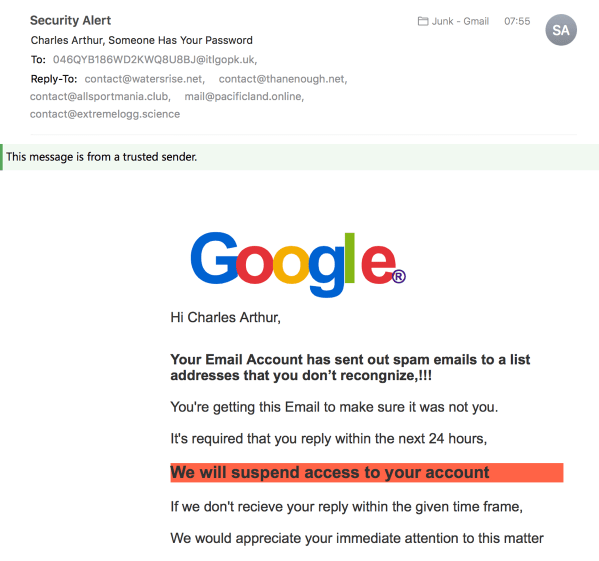
Another Monday morning, and an email drops into my inbox.

Screenshot 2018 04 30 10 48 38

Well. That looks serious, doesn’t it? They’ve got my name correct. But you can see (especially on this version, the desktop one) that lots of things are wrong about this email.

Let’s enumerate them:
• the To: address is incorrect (clearly it reached me via a Bcc: address)
• the Google logo is all wrong: the characters are bunched up, rather than evenly spaced. (When I looked at the source code of the email, it turns out this was done in CSS, rather than an image. Designers will commiserate at the kerning failure.)
• the first sentence doesn’t make sense and isn’t grammatical and contains misspellings
• Second sentence capitalises “Email”, which isn’t standard spelling
• Third sentence ends with a comma rather than a full stop
• Fourth sentence (in red) doesn’t quite show what you need to do
• Fifth sentence spells “receive” wrongly, and ends with a comma
• Sixth sentence is stilted and lacks a full stop.

Not hate mail, fake mail

Overall, there are all sorts of indications that this is a fake email. It’s phishing: the obvious aim is to get people to reply to it, after which – one can predict – the phishers will respond by sending an email with a link to a page telling the victim to log in. It will be a fake Gmail login page, and once that’s done, they’ll be able to get control of the victim’s email (and lock them out by changing the password), and from there probably any account, possibly including their bank and other utilities. Any account whose password recovery, or password system, passes through that Gmail is going to be compromised.

You might look at that email and laugh, thinking it’s obvious that it’s a phishing attempt – you’d never fall for that. But phishing is a very old technique (want to know how old? It’s in the book, but if “AOL” rings a bell, that’s a clue), and has been refined over the years.

Just as with the “419” scam promising you a huge fortune if you’ll only send over a bit of money, phishing’s practitioners have learnt that a few intentional mistakes can actually increase the chance of success – because the people who don’t spot spelling mistakes or oddities about the From: in an email probably won’t know what phishing is either. (In 419 scamming, they intentionally write in a stilted, naive fashion because the recipient then thinks they are dealing with fools who can be stiffed. The truth is exactly the opposite.)

Sophistication nation

A rather more sophisticated version of that phishing technique is exactly how the inbox of John Podesta, Hillary Clinton’s campaign chairman, was hacked in the 2016 US Presidential election. (The story of that makes up chapter 4 of the book.)

The campaign team monitoring Podesta’s emails weren’t going to be fooled by something like the message above.

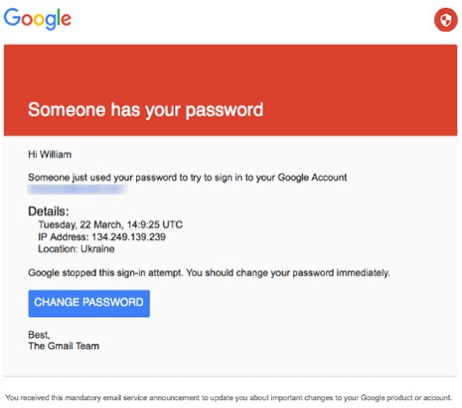
But they could be caught by the one that Russian hackers sent, which looked exactly like a standard Google phishing warning.

Podesta email hack

Now that is a lot more sophisticated. And Google does send out “suspicious login attempt” emails.

This phish purported to be from Gmail to Podesta’s inbox, saying that “Someone has your password”. (There was actually a subtle detail – it’s in the book! – that got that past Google’s filters.)

That” CHANGE PASSWORD” link led to a fake login page, where Podesta’s details were entered, and… calamity followed. (And contrary to some expectations, it wasn’t Podesta who entered those details.)

One point worth noting is that this was Podesta’s personal inbox. His campaign inbox? The inboxes of other staff? Those weren’t hacked, because they already had crucial protection: two-factor authentication. The fact that it was Podesta’s personal, not campaign, email that was hacked disappeared in the melée, but it’s a relevant point. The campaign also used another communications method to defeat would-be hackers; that’s in the book, and I’ll deal with it in a later post.

The lesson

Turning on two-factor authentication (2FA) is the single simplest method you can take to improve your email, and general computer, security. Google doesn’t push it hard enough, in my view. A survey of 2,000 adults in multiple countries in May 2016 showed that 70% don’t have 2FA turned on. Yet it’s easy, free, and increases your security enormously; it also reduces the need to worry about getting phished. (You can still get phished if you use 2FA, but it needs more sophisticated work on the part of the phisher.)

This page shows how to turn on 2FA for Gmail. (I’d recommend using an on-device app rather than SMS for codes; SMS can be hacked.) If you use a different service, try a search on 2FA with its name.

In short, 2FA means that you either generate a device-specific password for every device you use, or that you have to authenticate each time you log in your email on the device using your email, password and a “TOTP” – timed one-time password. (It’s a six-digit code generated from a 40-digit number which is in turn generated from a combination of the time when you login, and a “seed” number stored on both the server and your device. If the number generated by the server and by your device agree, then you’re authenticated.)

If you don’t have 2FA turned on, then there is always a risk that you’re going to get phished. You spotted the one above. Will you spot every single one? Remember, they only have to fool you once; you have to defeat them every time. And there are lots more of them than you.

Thanks for reading. And even if you don’t buy the book, please turn on two-factor authentication. Everyone, including you, will be so much happier.


Cyberwars small This is the first of a series of posts illustrating points from my book Cyber Wars, published May 3 2018 in the UK (and a couple of weeks later in the US), which investigates hacking incidents such as the Sony Pictures hack, the TalkTalk hack, ransomware, the Mirai IoT botnet. It looks at how the people in those organisations responded to the hacks – and takes a look at what future hacks might look like.

I also do a weekday roundup of interesting links called Start Up, posted here each day at 0700 UK time; or you can receive it as an email (roughly an hour later). Sign up here. You’ll get a confirmation link before you start receiving anything.

Unsubscribing is as easy as clicking a link, which will put you through to our customer service representative who values your call so much they’ll make you wait 10 minutes listening to 20-second clips of music interrupted with pleas not to go away and then struggle to hear you over the cheap VOIP line provided by a cheapskate outsourcing company which also hasn’t given them any power to actually act on your account.

No, wait, that’s the other people. With my one, you just click the link.

Start Up: hackers who hack back, Fitbit teams with Google, the Bezos memos, squirt guns for all!, and more


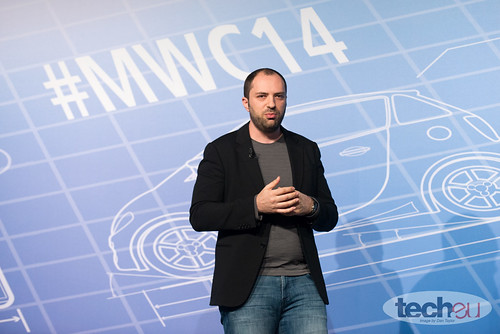
Four years later, Jan Koum is leaving WhatsApp – and Facebook. Photo by Tech.eu Photostream on Flickr.

You can sign up to receive each day’s Start Up post by email. You’ll need to click a confirmation link, so no spam.

A selection of 10 links for you. Still here. I’m @charlesarthur on Twitter. Observations and links welcome.

WhatsApp founder plans to leave after broad clashes with parent Facebook • The Washington Post

Elizabeth Dwoskin:

»

The billionaire chief executive of WhatsApp, Jan Koum, is planning to leave the company after clashing with its parent, Facebook, over the popular messaging service’s strategy and Facebook’s attempts to use its personal data and weaken its encryption, according to people familiar with internal discussions.

Koum, who sold WhatsApp to Facebook for more than $19bn in 2014, also plans to step down from Facebook’s board of directors, according to these people. The date of his departure isn’t known. He has been informing senior executives at Facebook and WhatsApp of his decision, and in recent months has been showing up less frequently to WhatsApp’s offices on Facebook’s campus in Silicon Valley, according to the people.

The independence and protection of its users’ data is a core tenet of WhatsApp that Koum and his co-founder, Brian Acton, promised to preserve when they sold their tiny startup to Facebook. It doubled down on its pledge by adding encryption in 2016. The data clash took on additional significance in the wake of revelations in March that Facebook had allowed third parties to mishandle its users’ personal information.

«

Wow. This must have come directly from Koum – the Washington Post isn’t going to go with a flyer on this. That Facebook is looking to weaken the WhatsApp encryption is a hell of a story in itself (this will be denied in the next news cycle).

One might say that Koum should have known this back in 2014 – that he’s cashing in and taking the billions. It certainly never meshed with the Facebook culture, according to the later parts of the story.

link to this extract


The digital vigilantes who hack back • The New Yorker

Nicholas Schmidle:

»

Last year, Nisos did such a test on behalf of a major financial institution. Two of Bourie’s colleagues went to a café across the street from the client’s headquarters, where employees often stopped in for coffee. One of the Nisos operators, carrying a messenger bag with a radio-frequency identification device concealed inside it, surreptitiously scanned the facility code from employees’ I.D. badges. With this information, Nisos could make fake badges. The next day, the Nisos operators swiped into the lobby, plugged a local-area-network device into an Ethernet port in a conference room, and left before anyone noticed. Using the lan connection, they hacked into the financial institution’s network and, among other things, briefly commandeered its security cameras. The company realized that it needed to make serious upgrades to its network.

According to Bourie, when the C.E.O. of the multinational corporation asked him if Nisos could hack into the ex-employee’s home network, the general counsel interrupted to say that the C.E.O. was obviously kidding—hacking the network would be illegal. The C.E.O. said, “Illegal how? Running-a-stop-sign illegal? Or killing-someone illegal?”

Bourie recalled that everyone laughed, and the question was left hanging. But it stuck with him, because he wasn’t sure of the answer. He knew that no firm had ever been prosecuted for hacking back, but he didn’t know why.

«

Fascinating examples about a murky area. (Nobody in Cyber Wars “hacked back” – they tended to be the people who discovered how to hack, such as the Microsoft worker who accidentally discovered SQL injection.)
link to this extract


Fitbit will use Google Cloud to make its data available to doctors • TechCrunch

Brian Heater:

»

For Fitbit, the deal means moving a step closer toward healthcare legitimacy. At a recent event, CEO James Park told us that health was set to comprise a big part of the consumer electronics company’s plans moving forward. It’s clear he wasn’t quite as all-in with Jawbone, which shuttered the consumer side entirely, but there’s definitely money to be made for a company that can make legitimate health tracking ubiquitous.

The plan is to offer a centralized stop for doctors to monitor both electronic medical records and regular monitoring from Fitbit’s devices. Recently acquired Twine Health, meanwhile, will help the company give more insight into issues like diabetes and hypertension.

No word yet on a timeline for when all of this will become widely available.

«

Fitbit really needs this business-to-business side to thrive; its consumer business is dying on its feet.
link to this extract


Publishing trade groups criticize Google over GDPR policy • Ad Age

George Slefo:

»

Four trade groups representing publishers such as Axel Springer, Bloomberg, Conde Nast, Hearst and the Guardian released a letter Monday addressed to Google CEO Sundar Pichai that sharply criticizes the company’s approach to publishers as strict new privacy rules loom in Europe.

The trade associations—Digital Content Next, European Publishers Council, News Media Alliance and the News Media Association—say Google is putting their members in a corner as it implements the European Union’s General Data Protection Regulation, or GDPR, which takes effect May 25.

Google updated its policy roughly one month ago, telling publishers they will need to share any data they receive from consumers if they intend to use the company’s software to sell ads. Google won’t disclose exactly how it will use that data and, should any GDPR violations occur, the liability will rest with the publishers, not Google.

Those found in violation under GDPR face fines of roughly $25m, or 4% of global revenue, whichever is greater.

“Your proposal severely falls short on many levels and seems to lay out a framework more concerned with protecting your existing business model in a manner that would undermine the fundamental purposes of the GDPR and the efforts of publishers to comply with the letter and spirit of the law,” the groups say in the letter.

«

Not much time left to fix this, is there?
link to this extract


Seth Rogen, in conversation • Vulture

David Marchese talks to the film writer:

»

Q: What thoughts get kicked up when you see North Korea in the news these days?
It does kick stuff up for sure. Honestly, I really don’t think North Korea hacked SonyDirected by Rogen and Goldberg, 2014’s The Interview stars Rogen and James Franco as journalists traveling to North Korea to interview Kim Jong-un, who are co-opted by the CIA to assassinate him. In June of that year, North Korea threatened the United States, calling the film’s release an “act of war.” In November, the DPRK-affiliated group “Guardians of Peace” hacked into Sony, dropping executive salary numbers and a few unreleased films. (It also revealed a huge gender and racial gap at the company.) Sony eventually decided not to widely release the picture in theaters, and made it available as a digital rental in December 2014. .

Why’s that?
When the trailer for The Interview came out we were called into a meeting at Sony, where they told us that North Korea had probably already hacked into their system and seen the movie and that the statements they’d put out was their response. Then, months later, when the movie itself finally came out, all this hacking shit happened. This was months after North Korea had probably already seen the movie. Why would they wait? And they never did anything like that before and haven’t done anything like it since. So things just never quite added up. The guy I’d hired to do my cybersecurity even told me, “There’s no way this was a hack. It had to be a physical act.” The amount of stuff that was stolen would have had to have physical mass to it.

In the sense that whoever stole the information needed to have his or her hands on a server at some point?
Yeah, it wasn’t something you could’ve hacked remotely. It required plugging shit into other shit. And the hack also seemed weirdly targeted at Amy [Pascal], which seems fishy — of all the people to target? Why not me? Why not Michael Lynton? [Lynton was the CEO of Sony Pictures Entertainment at the time of the hack, and was largely spared. He’s currently the CEO at Snapchat.]

«

Ooh, another chance to plug Cyber Wars. (Also available on Amazon and in bookshops from Thursday.) The first chapter investigates the Sony hack. There’s no doubt among security professionals that it was North Korea. Kim Jong Un wasn’t going to be made fun of on the international stage just as he was working towards being an international player with his nuclear plan. Sony Pictures was hacked by North Korea.

link to this extract


Bezos: a CEO who can write • Monday Note

Jean-Louis Gassée on the letters to shareholders that Bezos writes each year:

»

After reading this year’s letter, I downloaded the entire collection of twenty-one epistles and devoured them. (I hope someone, somewhere has done a better job than Amazon’s site putting the compilation together in a consistent and directly accessible fashion…)

More than a few thoughts emerged from the exercise, but the one that stands out is that the customer, the ultimate arbiter of success, must be held in awe. Bezos was a bit overly dramatic about it in 1998:

»

I constantly remind our employees to be afraid, to wake up every morning terrified. Not of our competition, but of our customers. Our customers have made our business what it is, they are the ones with whom we have a relationship, and they are the ones to whom we owe a great obligation. And we consider them to be loyal to us — right up until the second that someone else offers them a better service

«

By 2017, he had lightened up, but without losing the sense of the customers’ importance:

»

One thing I love about customers is that they are divinely discontent. Their expectations are never static — they go up. It’s human nature. We didn’t ascend from our hunter-gatherer days by being satisfied. People have a voracious appetite for a better way, and yesterday’s ‘wow’ quickly becomes today’s ‘ordinary’.

«

Bezos’ letters make splendid material for a Business School course on Strategy and Communication. (I’d love to teach it — if I were twenty years younger.) A caveat applies, however. Most of the strategies and practices advocated by Amazon’s founder have broad applicability, but a central mystery remains: Bezos himself, his combination of early life experience, intellect, emotional abilities and communication skills. Being Bezos isn’t teachable.

«

Bezos, and Amazon, remain the biggest mystery – in terms of function – of the big five tech companies.
link to this extract


Tech’s structural change • Bloomberg

Tim Culpan:

»

In the second quarter of 2016, for example, it sold panels at an average $504 per square meter and managed to generate a 44bn won ($41m) operating profit. In the first quarter of this year, prices touched $522, but LG Display posted a 98bn won operating loss.

The difference comes from costs, and that shift looks structural. General expenses have ballooned, which is a line item that could be trimmed. Research and development, though, is also on the rise and is an area LG Display can’t afford to skimp on as it tries to keep up with rivals such as Samsung Electronics Co.

Taiwan Semiconductor Manufacturing Co. sparked a plunge in tech stocks last week when it reported earnings and gave a weak second quarter outlook.

I argued at the time that the real concern should be that TSMC needs to spend more money – on capital expenditure – for lower sales growth. The same thing is playing out at LG Display, where R&D is a far larger cost component than depreciation.

LG Display is preparing to move into new technologies, including organic light-emitting diodes. A higher research spend is a necessary part of that development.

The breakeven price of panels has already climbed from around $500 per square meter in the second quarter of 2016 to approximately $550 in the most recent period.

If larger R&D budgets are baked into its cost base, then LG Display becomes the latest tech company to face the prospect of spending more money for less return – first in chips, now in displays.

«

The implication is higher costs, for manufacturers and consumers? Or slower growth? Or both?
link to this extract


Privacy guide: Amazon Echo, Google Home, Apple HomePod • NYMag

Kaveh Waddell:

»

Connecting a home speaker to third-party extensions is also potentially a recipe for abuse. It was a third-party quiz app that vacuumed up Facebook users’ personal data — and that of their friends — and shared it with a researcher associated with Cambridge Analytica. There’s no reason an unscrupulous developer couldn’t come up with a similarly invasive add-on for a home speaker. Both Google and Amazon allow developers to create extensions for their home speakers, but the Echo, having been around longer, has more plug-ins.

Apple is the odd one out in this trio: Its HomePod offers the most privacy of any home speaker — but at the cost of convenience. Besides using the HomePod to control Apple’s software or as a hub for an automated home, you can ask about the news, weather, or traffic — but not much else. You can’t install extensions the way you can on an Echo or a Google Home, so Apple has complete control over what data goes where.

But the biggest privacy difference between the HomePod and its competitors isn’t what it can or can’t do — it’s how the HomePod interacts with Apple’s servers. Like the other speakers, when a HomePod hears a request, it sends it off to Apple to parse and fulfill it. But instead of associating the request with the user’s account, like Google and Amazon do, HomePod requests are anonymous, tied only to a random, rotating ID. Just like a request you might make of Siri on an iPhone, HomePod requests will live on Apple’s servers for six months, associated with that ID, and then another year and a half, unlinked to any ID at all. By contrast, Google and Amazon only delete requests from their servers when asked by the user.

In the few months it’s been out, people have complained about one particular privacy shortfall of the HomePod. The HomePod can fulfill “personal requests,” like reading out and sending texts, or reading and creating notes. For someone who lives alone — or has no secrets — this might be useful. But otherwise, as long as the primary user is at home, anyone can walk up to the device and ask it to send an embarrassing text to mom, and it will. Unlike the Echo or the Google Home, HomePod can’t differentiate between people’s voices, so anyone’s request will go through.

But that’s a relatively small privacy gripe. Generally, if you value privacy (and sound quality) over omniscient assistance, Apple’s HomePod should be your go-to. Siri is leagues behind its competitors, but at least it doesn’t tattle.

«

link to this extract


Researchers reveal how hotel key cards can be hacked – what you need to know • Tripwire

Graham Cluley:

»

Security researchers at F-Secure have discovered a flaw that could allow millions of hotel rooms around the world to be accessed by unauthorised parties, without leaving a trace.

A design flaw in the widely-used Vision by VingCard electronic lock software could have been exploited by intelligence agencies, thieves, and other criminals to gain access to rooms – and potentially any computers left inside.

HOW’S THAT POSSIBLE?
It’s unusual today to check into a hotel room and to be given an old-fashioned physical key. It’s much more likely today that you will be given an electronic key card to gain access to a room via the RFID card reader used by its lock.

SO THE TRICK IS TO SOMEHOW CLONE THE KEY CARD?
Cloning a key card requires physical access to the card for a period of time, and that’s a challenge that someone keen to enter a room might not be able to pull off easily. Similarly, generating a new key card at the front desk might arouse suspicions and may invalidate the key card carried by the legitimate occupant of the hotel room.

What researchers Tomi Tuominen and Timo Hirvonen managed to do was find a vulnerability that allowed them to generate a master key that can open any room in a hotel, without leaving a trace.

WAS THE FLAW EASY TO FIND? IS IT POSSIBLE THAT OTHER CRIMINALS OR INTELLIGENCE AGENCIES HAVE ALSO EXPLOITED IT?
The researchers worked on-and-off on the challenge for a long time incorporating “several thousand hours of work,” after first becoming curious when a friend of Tuominen had his laptop stolen from his hotel room in 2003 while attending a security conference in Berlin.

Staff at the Alexanderplatz Radisson reportedly dismissed the issue at the time as there was no sign of forced entry or evidence of unauthorised access.

The fact that it took the researchers so long to find a way to unlock any room in a hotel, without leaving any evidence, proves that the flaw as not simple to uncover – but offers no guarantee that others, such as nefarious intelligence agencies, may have developed similar tools.

«

Great news for film scriptwriters, since this means the scene where the bad/good guys slip a card into the hotel room of the good/bad guy and go straight in is still valid.
link to this extract


Google and Facebook adopt water gun emoji, leaving Microsoft holding the pistol • The Verge

Thuy Ong:

»

Google is the latest company to ditch the pistol with a new emoji update for Android users. The switch to a bright orange and yellow water gun, rolling out now, mimics changes made by Apple, WhatsApp, Twitter, and Samsung over the last few years. That leaves Microsoft as the only major platform with the realistic handgun emoji. True, Facebook still uses it, but a spokesperson for the company confirmed to Emojipedia that it would also be replacing its gun emoji with a toy water gun. The Verge has reached out to Microsoft for comment.

The move makes Google’s gun emoji correspond with other platforms. So, if a friend sends the playful water pistol from an iPhone, it will now look similar on an Android device or in a tweet without any unintended miscommunication.


Image: Emojipedia

Ironically, Microsoft initially displayed the gun emoji as a toy, but changed it to a revolver in 2016 as part of its emoji redesign project. With Google’s (and Facebook’s) latest move, Microsoft’s gun emoji puts it at philosophical odds with the other giant tech companies based in the US where gun violence is a major concern. As we previously noted, in 2016 Apple successfully pushed to remove the rifle icon from the standardized collection of emoji.

«

The update is that Microsoft has now joined in the disarmament. Control language, control what you think. Emoji is, in case you hadn’t noticed, a language.
link to this extract


Errata, corrigenda and ai no corrida: none notified