Start up: Google’s image search ads, Intel’s iPhone deal, Tabooillion!, Runkeeper confesses, and more

Is mommy blogging about to hit a speedbump? Montage by Mike Licht on Flickr.

Why didn’t you sign up to receive each day’s Start Up post by email?. Unless you’re reading this on email.

A selection of 12 links for you. Indefatigably. I’m charlesarthur on Twitter. Observations and links welcome.

Google is including ads in image search results for first time • Digital Trends

Trevor Mogg:

»Perhaps the most surprising thing about the news that Google is now including ads in its Images search results is that it didn’t do it sooner.

It’s true – the company that makes all its cash from search ads has until now included not a single sponsored message among its image results. But that’s all changing.

The initiative is designed to tempt the shopper in you, so if, say, you do a Google image search on your smartphone for a coffee table, among those many pages of lovely photos of gorgeous tables you’ll also see ads for them. These will link directly to a merchant’s site, enabling you to part with your cash in just a couple of clicks. The merchant wins, you win … oh, and Google wins, too.

«

Every place Google can put an ad, it’s going to put an ad. Google News next?
link to this extract


Intel obtains up to 50% of modem chip orders for upcoming iPhone • Digitimes

Julian Ho and Jessie Chen:

»Intel will supply up to 50% of the modem chips for use in the new iPhones slated for launch in September 2016, according to industry sources.

Intel will itself package the modem chips for the upcoming new iPhones, but have contracted Taiwan Semiconductor Manufacturing Company (TSMC) and tester King Yuan Electronics (KYEC) to manufacture the chips, the sources said.

«

link to this extract


The main reason why people are not already using ad blockers should worry publishers • Business Insider

Lara O’Reilly:

»The principal reason why most people haven’t yet switched on an ad blocker is simply because they are not aware they could block ads — a stat that should worry businesses that rely on online advertising to make money.

Wells Fargo Securities and Optimal.com — a startup that offers an “ethical” ad blocker — surveyed 1,712 US smartphone users to ask about their attitudes to ad blocking.

Of the 1,320 respondents who don’t already block ads (either on desktop or mobile,) 45.6% said they were not aware they could do so.

«

(That survey number suggests 23% already blocking ads.) Notice also of those not yet blocking, there are 22% who either know of it but can’t figure out how, or else intend to when they “have the time”. Those who don’t mind ads, or don’t want to harm content creators: 18.1%, or less than one in five.

Rob Leathern of Optimal goes into more detail about what the figures mean.
link to this extract


Taboola crosses the one billion user mark, second only to Facebook as the world’s largest discovery platform • Globe Newswire

»Taboola has achieved a significant “network effect” within the discovery space, more than doubling its reach from 500 million unique users just one year ago. As more users around the world are exposed to Taboola’s personalized recommendations, more Fortune 500 advertisers are achieving scale across the platform. In the US, where the company first launched its discovery platform in 2010, every American Internet user sees Taboola at least 70 times a month, and the platform reaches 95.3% of the 15+ year old demographic, surpassing Google, Facebook, and Yahoo Sites (according to comScore’s monthly Demographic Report, March 2016).

“For the past eight years, our team has been committed to building the best predictive technology in the world, and it’s been incredible to see how that personalization-driven mission has resonated across new markets in just the past twelve months,” said Adam Singolda, founder and CEO at Taboola.

«

A billion?? Flipping heck.
link to this extract


MCX postpones rollout of Apple Pay rival CurrentC, lays off 30, will focus on bank deals • TechCrunch

Ingrid Lunden:

»As merchants like Walmart move ahead on their own mobile payment strategies, a consortium that once counted Walmart — along with a number of other big retailers and brands — behind it, has taken a step back. Merchant Customer Exchange (MCX) today announced it would postpone a nationwide rollout of CurrentC, a smartphone payment initiative originally conceived as a mobile wallet rival to smartphone-led services like Apple Pay and Android Pay. As a result, MCX said it would lay off 30 people as it shifted its focus to working with financial institutions.

«

Dead.
link to this extract


Indian smartphone shipments declined for the second consecutive quarter in Q1 2016 • IDC

»According to the International Data Corporation’s (IDC) Quarterly Mobile Phone Tracker, 23.5m units of smartphones were shipped in India in Q1 2016 registering 5.2% growth over the same period last year. However, smartphone shipments shrank by 8.2% over Q4 2015, dipping consecutively for two quarters.

According to Karthik J, Senior Market Analyst, Client Devices, “The first quarter of the year is usually expected to be slow after the festive season in the last quarter of the year. However, the contraction in Q1 2016 is mainly propelled by the decline in shipments from all the Top 5 smartphone vendors of previous quarter. Shipments of key Indian vendors Micromax, Intex and Lava put together dropped 20.4% sequentially as they struggled to push their inventories into the market.” On the other hand, new entrants like Reliance Jio grew sharply over previous quarter as they prepare before the official launch.

«

India and China have about the same population; the Indian smartphone market is about a quarter the size of China’s, which has already peaked.
link to this extract


China quietly targets US tech companies in security reviews • The New York Times

Paul Mozur and Jane Perlez:

»Chinese authorities are quietly scrutinizing technology products sold in China by Apple and other big foreign companies, focusing on whether they pose potential security threats to the country and its consumers and opening up a new front in an already tense relationship with Washington over digital security.

Apple and other companies in recent months have been subjected to reviews that target encryption and the data storage of tech products, said people briefed on the reviews who spoke on the condition of anonymity. In the reviews, Chinese officials require executives or employees of the foreign tech companies to answer questions about the products in person, according to these people.

The reviews are run by a committee associated with the Cyberspace Administration of China, the country’s Internet control bureau, they said. The bureau includes experts and engineers with ties to the country’s military and security agencies…

…Ultimately, the reviews could be used to block products without explanation or to extract trade secrets in exchange for market access. Those secrets could be leaked to Chinese competitors or expose vulnerabilities, which, in turn, Chinese hackers could exploit.

«

Would also explain Apple investing a billion dollars in Uber-rival Didi.
link to this extract


When the data bubble bursts, companies will have to actually sell things again • Co.Exist

Douglas Rushkoff:

»How can a company with no revenues still make money? It’s not a trick question. The answer is at the very foundation of the digital economy: advertising.

No matter how dire things get for musicians, writers, movies, websites, smart phone apps, video games, or whole social media platforms, no matter how hard it might be for companies to charge for content, services, or convenience, almost everything we are doing in the digital marketplace can serve as the advertisement for something else. The video game promotes a movie, the movie promotes an app, and the app promotes a video game. Heck, this article indirectly promotes a book.

The trouble is, if everyone is in it for the advertising dollar, who is left to advertise? At no point in history has advertising, marketing, and research ever accounted for as high a percentage of GDP, or total economic activity (and that’s being extremely generous). But right now, it’s pushing at the very top of that range. The reason it can’t go higher is that only so much economic activity can go to promoting the rest of our economic activity. The coming crash in the tech market—and quite possibly beyond—will be triggered by the growing realization that every company in the world can’t be a marketing company.

«

Rushkoff is usually ahead of the curve; I remember how in 1999 he said he was going to buy all his Christmas presents via Amazon.
link to this extract


Nate Silver unloads on The New York Times • Columbia Journalism Review

Bill Wyman:

»The catalyst for Silver’s unleashing was a column from [Jim] Rutenberg, who stepped into the vacant David Carr job at the beginning of the year. The piece ruminated on the myriad errors made by the media over the course of the utter mayhem that has been the 2016 presidential race. The column wasn’t entirely focused on Silver; it mentioned failures in Times prognostications as well. But Rutenberg did seem to go out of its way to bring up FiveThirtyEight, especially in noting a bad call for the Indiana Democrat primary, in which FiveThirtyEight had favored Hillary Clinton to win but Bernie Sanders ended up taking in a romp.

There was subtext there, too. Several times in the piece, Rutenberg advocated for “shoe-leather reporting”—talking to “actual humans,” as he put it—and concluded:

»

That’s all the more reason in the coming months to be as sharply focused on the data we don’t have as we are on the data we do have (and maybe watching out for making any big predictions about the fall based on the polling of today). But a good place to start would be to get a good night’s sleep, and then talk to some voters.

«

«

What Rutenberg overlooks is that Silver writes stories which are based on people talking to voters – for polls. Rutenberg (in his article) also doesn’t seem to understand Monte Carlo simulations: a 90% chance for Hillary in a state doesn’t mean she was going to win 90% of the votes. He describes Sanders winning by a “comfortable” 5%: that would be 52.5-47.5? Hardly comfortable either way.

I think Silver’s data journalism has a better chance of telling us the outcome ahead of time than “shoe leather”.
link to this extract


A message to our users • Beyond the Miles

Runkeeper CEO Jason Jacobs, following yesterday’s complaint about its app:

»Recently, the Norwegian Consumer Council filed a complaint regarding how Runkeeper handles user data. We immediately began investigating the issue and have found a bug in our Android app involving the app’s integration with a third-party advertising service. Like other Android apps, when the Runkeeper app is in the background, it can be awakened by the device when certain events occur (like when the device receives a Runkeeper push notification). When such events awakened the app, the bug inadvertently caused the app to send location data to the third-party service.

Today we are releasing a new version of our app that eliminates this bug and removes the third-party service involved. Although the bug affected only our Android app, we have decided to remove this service from our iOS product too out of an abundance of caution. The iOS release will be made available once approved by Apple.

«

Apologies and regrets. My thought: doesn’t this mean that its privacy policy was either meaningless, or ignored? Sure, it was a bug; but “we made a mistake” doesn’t wash for the people in accounts. Why for programs? And why did it take the Norwegian Consumer Council, rather than Runkeeper’s testing, to spot it? This opens up more questions than it answers.
link to this extract


The BBC are removing recipes from their website. This blog is free and always will be. • COOKING ON A BOOTSTRAP

Jack Monroe:

»In light of the BBC announcement that they are removing a lot of their recipes from their website, I will be publishing all of my recipes in full on http://www.cookingonabootstrap.com over the next few days. This includes 220 recipes from both of my books and around 100 more Guardian recipes. There are also recipes from Waitrose Kitchen and Sainsburys, the Daily Mirror, restaurants I have consulted for and others that will go on too.

It’s a big job but an essential one.

I learned to cook on the dole using free recipes online and for the BBC to reduce this vital service is an abomination. (Apologies to all of my friends who work there, but I just don’t understand this.) I hope I can go some way to filling the gap left for free, instructional, simple recipe resources and cookery guidance, which is vital for so many people.

«

The reaction to the BBC move – which still leaves a lot of recipes on its site, as well as a BBC food site – was fascinating: people who might never have looked up a recipe are outraged. What wasn’t explained is why these recipes had to be removed rather than just moved to the remaining BBC food site.

And lo and behold, by the end of the day that’s just what happened. The question of what cost saving there would have been remains as mysterious as before.

One non-BBC media source suggested to me that this was a perfectly executed PR stunt by the BBC: “they picked the puppy everybody loves”. The Tories want to shut down bits of the BBC; the BBC is showing them that people won’t stand for it.
link to this extract


Dear Mommy Blogger • Josi Denise

Denise goes on an absolutely epic must-not-miss rant about the whole “mommy blogging” scene:

»//NOBODY IS READING YOUR SHIT

I mean no one. Even the people you think are reading your shit? They aren’t really reading it. The other mommy bloggers sure as hell aren’t reading it. They are scanning it for keywords that they can use in the comments. “So cute! Yum! I have to try this!” They’ve been told, like you, that in order to grow your brand, you must read and comment on other similar-sized and similar-themed blogs. The people clicking on it from Pinterest aren’t reading it. They are looking for your recipe, or helpful tip promised in the clickbait, or before and after photo, then they might re-pin the image, then they are done. The people sharing it on Facebook? They aren’t reading it either. They just want to say whatever it is your headline says, but can’t find the words themselves. Your family? Nope. They are checking to make sure they don’t have double chins in the photos you post of them, and zoning in on paragraphs where their names are mentioned.

Why? Because your shit is boring. Nobody cares about your shampoo you bought at Walmart and how you’re so thankful the company decided to work with you. Nobody cares about anything you are saying because you aren’t telling an engaging story. You are not giving your readers anything they haven’t already heard. You are not being helpful, and you are not being interesting. If you are constantly writing about your pregnancy, your baby’s milestones, your religious devotion, your marriage bliss, or your love of wine and coffee…. are you saying anything new? Anything at all? Tell me something I haven’t heard before, that someone hasn’t said before. From a different perspective, or making a new point at the end at least if I have to suffer through a cliche story about your faceless, nameless kid.

«

By this point she’s only just getting started, and it gets better and better. I like to imagine her declaiming this from a podium at a mommy blogging conference.
link to this extract


Errata, corrigenda and ai no corrida: none notified.

Start up: the stuck smart home, McAfee’s hack trick, ICO probes Deepmind deal, Flash the zombie, and more


Yes, Runkeeper tracks your runs. But Norway’s consumer council thinks it tracks more than that. Photo by Gordon on Flickr.

You can now sign up to receive each day’s Start Up post by email. You’ll need to click a confirmation link, so no spam.

A selection of 11 links for you. Ain’t that something? I’m charlesarthur on Twitter. Observations and links welcome.

The smart home is stuck • Tech.pinions

Jan Dawson:

»The challenge, then, is the addressable market for most smart home technology is pretty small, composed of innovators and early adopters in the classic technology diffusion curve. As a result, many products are attempting to squeeze every opportunity out of these small markets until they’re maxed out. Nest has been criticized for not innovating more around its original product but I suspect this is the result of a deliberate strategy to saturate many individual product markets rather than focus on ongoing significant improvements in a single market. This helps to explain Nest’s acquisition of Dropcam, its smoke and carbon monoxide detector, and the other products it’s been rumored to be working on. There’s more mileage in opening up new markets than there is in squeezing incremental value out of existing markets already nearing saturation.

I see some people referring to Amazon’s Alexa as a more mainstream smart home or home automation product, and I think that’s actually a red herring. Yes, it can be used to control smart home devices but I suspect (a) only a subset of Alexa devices are used for this purpose and (b) such a focus would limit its appeal to a niche within that smart home early adopter category. I think Alexa’s potential is much broader than that and it’s precisely because it isn’t just a smart home controller. Alexa isn’t extending the smart home market – it’s more mainstream precisely because it’s not limited to that small and limited opportunity.

«

link to this extract


Mobile traffic dominates among the web’s most popular sites • The Atlantic

Adriene Lafrance:

»More than half of Facebook’s roughly 1.7 billion monthly users visit the site exclusively from their smartphones—that’s 894 million mobile-only users each month, up from 581 million such users last year and 341 million mobile-only users in 2014, according to the company’s latest earnings report.

Google confirmed last year that more searches come from mobile devices than computers in 10 countries, including the United States. Over the holiday season, Amazon said more than 60% of shoppers used mobile. And Wikipedia, which recently revamped the way it tracks site traffic, says it’s getting more mobile than desktop visits to its English language site.

In April, Wikipedia had about 361 million unique visits from smartphones and tablets compared with some 229 million from desktops—meaning roughly 61% of traffic to the English-language version of Wikipedia came from mobile devices, according to data provided by a spokeswoman.

«

Didn’t know the Wikipedia stat, but that’s really persuasive.
link to this extract


John McAfee apparently tried to trick reporters into thinking he hacked WhatsApp • Gizmodo

William Turton:

»McAfee has a history of being shifty with the press about his alleged cybersecurity exploits. In March, for instance, during a media tour that included appearances on CNN and RT, McAfee claimed he would be able to hack into the phone of San Bernadino terrorist Syed Farook. McAfee never proved his claims, and later admitted that he was lying in order to garner a “shitload of public attention.” And earlier this year, McAfee hedged on his terrorism-prevention ideals for America during an interview with CNN about his Libertarian candidacy for president, saying that his strategy for preventing homegrown terrorism was “difficult to explain.”

Now, it seems McAfee has tried to trick reporters again, by sending them phones pre-cooked with malware containing a keylogger, and convincing them he somehow cracked the encryption on WhatsApp. According to cybersecurity expert Dan Guido, who was contacted by a reporter trying to verify McAfee’s claims, McAfee planned to send this reporter two Samsung phones in sealed boxes. Then, experts working for McAfee would take the phones out of the boxes in front of the reporters and McAfee would read the messages being sent on WhatsApp over a Skype call.

«

Pointless.
link to this extract


ICO probes Google DeepMind patient data-sharing deal with NHS Hospital Trust • Computer Weekly

Caroline Donnelly:

»The Information Commissioner’s Office, the data protection watchdog, confirmed an investigation into the arrangement is underway, on the back of at least one complaint from the general public.

The deal gives DeepMind access to the healthcare records of 1.6 million patients that pass through three hospitals in North London, which fall under the care of the Royal Free Hospital Trust.

The complaint, seen by Computer Weekly, questions whether DeepMind will be expected to encrypt the patient data it receives when at rest.

“Whilst the information-sharing agreement insists that personally identifiable information – such as name, address, post code, NHS number, date of birth, telephone number, and email addresses, etc – must be encrypted whilst in transit to Google, it does not explicitly prohibit that data being unencrypted at the non-NHS location,” the complaint read.

«

First there’s a deal; then it turns out it’s not directly approved. The complaint is essentially that individuals at Google/Deepmind might access personal data. This is the essential battleground of the coming years: how compatible is tight data regulation with data mining?
link to this extract


Let’s talk about Amazon reviews: how we spot the fakes • The Wirecutter

Lauren Dragan:

»Amazon has a history of trying hard to deal with offenders and shut them down. In fact, in April, Amazon sued another round of companies that are accused of selling fraudulent reviews. But by the time those companies are caught, their clients have already made a bunch of sales, and the fraudulent reviewers will likely pop up again under new names to repeat the process.

(Want to know more? Wirecutter headphones editor Lauren Dragan talks to Marketplace Tech about compensated Amazon reviews and how to tell real crowdsourced opinions from astroturfing.)

You have a few ways to suss out what may be a fake review. The easiest way is to use Fakespot. This site allows you to paste the link to any Amazon product and receive a score regarding the likelihood of fake reviews.

For example, we ran an analysis on some headphones we found during a recent research sweep for our guide about cheap in-ear headphones. You can see from the results below that the headphones’ reviews didn’t score so well.

«

Hadn’t come across Fakespot before; it seems pretty useful.

link to this extract


The real cost of big tech’s accounting games • FT.com

Jonathan Ford:

»How much did LinkedIn make over the past three years? Sounds a simple enough question doesn’t it? But it is also one that is capable of being answered in multiple and very diverse ways.

First, let’s look at the figure the US online networking site wants you to focus on. That’s a mouthful called adjusted earnings before interest, tax, depreciation and amortisation (ebitda), and the total there between 2013 and 2015 came in at a positive $1.7bn.

Sounds pretty hunky dory? Well, now check out the operating profit line for the business — the one calculated according to the generally accepted accounting principles (GAAP) that companies must present but often don’t emphasise. Over the same period, LinkedIn racked up a $67m loss.

What explains the yawning $1.8bn difference between those two figures? It isn’t simply the depreciation and amortisation charges the company took against the value of its assets. Those, while pretty hefty, came to just $791m. No, the biggest single reason for the negative swing was the $1bn cost of the stock LinkedIn stuffed into its employees’ pay packets over those three years.

«

Why does it matter if the company gives stock to employees? As Ford explains, it’s because by doing that

»the firm denies itself the chance to sell those shares or options for value in the market. Failing to recognise that forgone cash effectively understates the cost the company has incurred in employing those individuals.

«

So stock grants are a cost. So they come off the bottom (operating) line. I’m constantly surprised by how many companies’ non-GAAP results are reported as if they were the ones to compare.
link to this extract


Google faces record-breaking fine for web search monopoly abuse • Sunday Telegraph

Christopher Williams:

»Google faces a record-breaking fine for monopoly abuse within weeks, as officials in Brussels put the finishing touches to a seven-year investigation of company’s dominant search engine.

It is understood that the European Commission is aiming to hit Google with a fine in the region of €3bn, a figure that would easily surpass its toughest anti-trust punishment to date, a €1.1bn fine levied on the microchip giant Intel.

Sources close to the situation said officials aimed to make an announcement before the summer break and could make their move as early as next month, although cautioned that Google’s bill for crushing competition online had not been finalised.

The maximum possible is around €6.6bn, or a tenth of Google’s total annual sales.

It will mark a watershed moment in Silicon Valley’s competition battle with Brussels. Google has already been formally charged with unlawfully promoting its own price comparison service in general search results while simultaneously relegating those of smaller rivals, denying them traffic.

«

I’m hearing the same about the timing and intention from my sources; the fine, meanwhile, is indeterminate.
link to this extract


This fitness app tracks you too much, consumer advocates claim • Fortune

David Meyer:

»According to the Norwegian Consumer Council, which has lodged a complaint with the country’s data protection authority, Runkeeper transmits data about its users all the time, not just when the app is in use.

The Norwegian data protection commissioner, Bjørn Erik Thon, confirmed to Fortune that his office has received the complaint and will now look into it.

“Everyone understands that Runkeeper tracks users while they exercise, but to continue to do so after the training session has ended is not okay,” said Finn Myrstad, the consumer council’s technical director.

The data in question includes timestamped location information, as well as Google advertising IDs that can be used to identify the individual.

“Our users’ privacy is of the utmost importance to us, and we take our obligation to comply with data protection laws very seriously,” Runkeeper CEO Jason Jacobs told Fortune. “We are in the process of reviewing the issues raised in the complaint, and we will cooperate with the Norwegian [data protection authority] if it has any questions arising out of the complaint.”

According to the council, Runkeeper’s terms and conditions do not explain how regularly data is transmitted, and users do not give consent to being monitored in this way. The council claims this breaches Norwegian and EU data protection laws.

«

Here’s Runkeeper’s privacy policy. It’s astonishingly vague (though in that respect, probably not so different from other privacy policies). What intrigues me is why the Runkeeper CEO didn’t just say “nah, we don’t collect data after your run.”
link to this extract


Five things you can get in India with a missed call • WSJ

Shefali Anand:

»Want to transfer funds from your account? Give your bank a missed call. Want to hear Bollywood music? Dial a number and hang up.

Making a missed call by calling a number and letting it ring is a popular way of communicating in India because the caller doesn’t have to spend money. Marketing companies, politicians, banks and others now use this practice to reach millions who have cellphones but limited means.

«

Brilliant. Recalls how, in the days when long-distance calls were expensive, kids on their travels would call the operator and ask to set up a reverse-charge call to their parents. Parent’s phone rings: “Alley Okey is calling from Wichita, Kansas. Will you accept the charge?” Parent: “No.” Conversation ends, with parent knowing that the kid is OK and presently in Wichita.
link to this extract


Chinese smartphone market has slowed, but Huawei, Oppo & Vivo have not • Counterpoint Technology

»According to the latest research from Counterpoint’s Market Monitor service, the demand for smartphones in China softened during Q1 2016 (Jan-Mar) as the smartphone shipments were down 2% annually and 13% sequentially.

Commenting on the results, Research Director, Neil Shah, said: “In spite of the Chinese holiday season quarter, the Chinese smartphone market demand reached a standstill. This has led to intense competition between the players as they struggle to take share away from each other. In a market with hundred of brands, growth is now limited to a handful of players with the greatest marketing budgets and headturning designs, and available at competitive price points.

“Only five brands registered healthy growth during the quarter. Oppo, Huawei and Vivo drove the majority of the volume, capturing a combined 40% of the total Chinese smartphone market. Demand for rest of the brands declined, especially Apple after the strong demand for iPhone 6 & 6 Plus in the quarter a year ago, and lacklustre performance from Lenovo, ZTE and Coolpad.”

The Chinese smartphone market saw a lull in the first two months of 2016, however sales for smartphones started to pick up in March, with the largest sales contribution from Huawei, Oppo and Vivo, the new leaders in Chinese domestic market.

«

Other notable points: 98% of phones sold were smartphones (hence Microsoft’s 90% year-on-year drop); the “premium” segment of RMB3000+ ($450+) makes up a fifth of the market, with Apple, Samsung and Vivo dominating.
link to this extract


HTML5 by default: Google’s plan to make Chrome’s Flash click-to-play • Ars Technica UK

Peter Bright:

»In a plan outlined last week, Flash will be disabled by default [in Google Chrome] in the fourth quarter of this year. Embedded Flash content will not run, and JavaScript attempts to detect the plugin will not find it. Whenever Chrome detects that a site is trying to use the plugin, it will ask the user if they want to enable it or not. It will also trap attempts to redirect users to Adobe’s Flash download page and similarly offer to enable the plugin.

«

Great!

»

There will be a few exceptions to this policy, with Google planning to leave Flash enabled by default on the top 10 domains that depend on the plugin. This list includes YouTube, Facebook, Twitch, and Amazon.

«

Crap.

»

Even this reprieve is temporary. The plan is to remove sites from the list whenever possible—Twitch, for example, is switching to HTML5 streaming, so should start to phase out its use of Flash—and after one year the whitelist will be removed entirely. This means that after the fourth quarter 2017, Flash will need to be explicitly enabled on every site that tries to use it.

«

“After the fourth quarter of 2017”, aka 2018. Flash, the desktop web’s malware zombie. (Notice that all those sites somehow muddle through on mobile, which is far bigger, without Flash.)
link to this extract


Errata, corrigenda and ai no corrida: none notified.

Start up: NHS’s unapproved Google deal, China’s smartphone bust, the email trail, design for women, and more


Well, at least they left something. Photo by iirraa on Flickr.

You can now sign up to receive each day’s Start Up post by email. You’ll need to click a confirmation link, so no spam.

A selection of 13 links for you. Use them wisely. I’m charlesarthur on Twitter. Observations and links welcome.

China’s home-grown smartphone startups face very difficult choices • Tech In Asia

Charlie Custer:

»In the early days of a company like Xiaomi, just being a Chinese smartphone startup was enough to build hype and sell phones. But a half-decade later, the Chinese smartphone market is practically overflowing with domestic competitors, and Xiaomi seems to be struggling. And while that’s arguably due in part to some poor decisions – like its new gigantic phone – I don’t envy the choices Xiaomi, or any Chinese smartphone company, has to make in the current market.

When it comes to deciding what your product strategy is going to be, there are really only four options, and none of them look appealing.

«

China, which is the world’s biggest smartphone market.
link to this extract


Confessions of a former bike thief • Brixton Blog

Richard Cantle interviews an ex-bike thief:

»Q: So, you are an ex-bike thief from London?  When and why did you begin stealing bikes?

I started stealing push bikes when I was 16. Motivation was money; bikes are quick and easy money. There were two of us who stole pedal bikes and high performance motorbikes.

Q: Did you target specific types of bicycles and locations in London? What was the thought process?

High value bikes were the main targets like Carrera racers, no-logo fixie bikes, Boardman racers and Ridgeback bikes. These were the popular quick sale bikes that were called golds (because of the payback to time value of them).

Bike locations – there is a thing what we would call London rings or hotspots, where bike security seemed to be less of a problem. The more central you got the worse the locks, where people let their guard down more. Going out of London, locks would get better and locations fewer, so the time and effort put in would not be worth it. Borough of Islington, Hackney, West End and the central mile were our hunting grounds. The more CCTV and people the better. People are like sheep, they feel safe and pay less attention when they’re together.

At first it was a hit and miss game. Grab the bike and go kind of thing, but as time moved on and we worked out there was money to be made, we stepped up our approach. For example, if it wouldn’t sell for more than £200, it wouldn’t be taken…

…From the moment you pull up to the moment the bike is cut and bolt cutters are back on the motorbike would be 10 seconds at the most. so no one really knew what was going on. Almost, I imagine, like you have to question yourself like, did I really just see that?

No one ever confronted us or said: “What are you doing?”

«

Lots to absorb if you’ve got a bike in any city. But also note his motivations, which are noted elsewhere in the piece.
link to this extract


London leads on open transport data • UK Authority

Mark Say:

»London has come out on top of an analysis of the performance of several major cities in providing open data on transport and mapping.

The Future Spaces Foundation, a charity that studies living spaces, has said in its Vital Cities: Transport Systems Scorecard that London’s record of providing open access to real time transport data is the best example of data sharing.

The Scorecard analyses the transport networks of 12 cities around the world on indicators ranging from breathability to the density of cycle and pedestrian networks to the use of data and apps.

London scored top marks for facilitating the creation of multi-modal apps with the open availability of its live transit feeds. But it came second to Singapore in converting data into the most user-friendly and informative travel apps.

«

link to this extract


Shiva Ayyadurai wants my emails • Thomas Haigh

Haigh is an associate professor at the University of Wisconsin-Milwaukee; Ayyadurai is suing Gawker for millions for saying that he didn’t invent the concept of email:

»Shiva Ayyadurai really, really wants to look through my emails. Remember Shiva Ayyadurai? The man who has been engaged for five years on a quixotic but energetic public relations campaign to convince the world that he, and he alone, is the true “inventor of email”? Ayyadurai literally wrote the book on internet publicity. His big problem is that you can’t invent something that’s already in widespread use. Ayyadurai said that he “designed and deployed” a prototype in 1980, but historians knew very well that electronic mail had been around since at least 1965 and by the mid-1970s was the main source of traffic on what evolved to become the Internet.

I’m a historian of information technology, working in the School of Information Studies of the University of Wisconsin–Milwaukee. As chair of SIGCIS, the group for historians of information technology, I coordinated the response of the historical community to his bizarre claim. This included creating a report (www.sigcis.org/Ayyadurai) documenting what Ayyadurai was saying and comparing it to what we knew about actual email history. He rarely names me or any of the other historians who have worked on documenting the actual history of email, though his campaign has denounced the members of SIGCIS as paid stooges for Raytheon, revisionists, a cabal, and “sophisticated public relations agents that manufacture and package ‘histories,’ no different than clever propaganda, to perpetuate lies of the pre-eminence of the military-industrial-academic complex.” By this theory the entire academic history of computing community is “unconsciously cutting and copying” the work of Gizmodo blogger Sam Biddle, “believing Biddle’s sensationalistic article to be the truth.”

«

Ayyadurai is wasting the court’s time; I bet he thought that Gawker would fold easily after the Hulk Hogan verdict. On that, he’ll be wrong.
link to this extract


The mobile-ad world sucks, and Vungle’s chief wants to make it better • VentureBeat

Dean Takahashi:

»The popularity of so many ad blockers means one thing to Zain Jaffer, chief executive of Vungle, which helps mobile game and app publishers acquire more users and make money via in-app video ads

“It tells us the advertising world sucks,” said Jaffer in an interview with VentureBeat. “Consumers are so sick of ads being intrusive that a website doesn’t even load. You need an ad blocker just to browse the Web. Advertising has become a game of … it’s the opposite of transparency.”

Vungle tries to generate more revenue for mobile-app makers and get better exposure for brands as they follow consumers into the huge mobile-apps market and the $34 billion mobile-game market. Roughly half of Vungle’s business is in games. Vungle’s video ad technology is used in apps that generate billions of views a month. And Jaffer wants to keep improving return on investment and performance so that the value of the advertising is transparent.

«

I’m puzzled by how people who want other people to see more adverts always start from those who use adblockers, and say “clearly, people are sick of ads! So we need to figure out how to show them ads.”
link to this extract


No, eBook sales have not fallen in the UK • The Digital Reader

Nate Hoffelder:

»Like the NYTimes last fall, The Telegraph has misinterpreted data collected by a trade group and assumed that it represented the entire market. As the UK Publishers Association explained when I followed up, this is simply not true:

The figures related to publisher invoiced sales, grossed up from the PA sales monitor which represents 75% of UK publishing industry turnover (both members and non –members ) and involves both publishers and distributors.

And the PA’s data is even less than complete when it comes to ebook sales. Remember, the Author Earnings report showed that 30% of the ebook sales in the UK Kindle Store went to indie authors, and another 15% went to Amazon.

This means that 45% or more of the ebooks sold in the UK’s dominant ebook store do not show up in the PA’s annual stats. And the figure is probably worse than that given that the PA has said that their data is not complete.

Furthermore, The Telegraph’s report offers a misleading take on the market. According to The Bookseller, the PA’s stats showed that overall digital revenues rose last year.

«

Amazon doesn’t care if people get those stats wrong or not; it has cornered the market in ebooks.
link to this extract


The world is designed for men • Medium

Kat Ely of HH Design:

»If you work an office in the U.S., you’ve probably noticed that women often find that they’re too cold, while men report being perfectly comfortable.

This is because the algorithms that dictate temperature regulation in many office buildings were designed in the 1960s for a 154 pound male. Women, who typically have smaller frames and less muscle mass, naturally feel a bit colder than men do. This, along with faulty climate control systems, leads to many women feeling uncomfortably cold at the office.

The effects of temperature go beyond comfort and have a measurable impact on performance. A 2004 Cornell Study found “that when ambient office temperature [was] increased from 68 degrees to 77 degrees Fahrenheit, typing errors fell by 44 percent and typing productivity increased by 150%”.

Women in the U.S. on average make 78 cents to every dollar their male counterparts make. There are many factors that contribute to the pay gap but it seems the unintended effect of workplace climates designed for men’s comfort could be a piece of the puzzle.

«

Also applies – as she demonstrates – to crash test dummies, power tools, and smartwatches. Unconscious bias in design is so subtle, yet far-reaching; remember how the first version of Apple’s Health app didn’t have anything for recording menstrual periods?
link to this extract


When websites won’t take no for an answer • NYTimes.com

Natasha Singer looks at anti-customer “dark at terms” practices:

»or instance, when ride-hailing apps run promotions offering customers free rides to sign up their friends — and the friends get free rides as well — both the company and consumers benefit.

And then there’s JustFab, an e-commerce start-up that runs subscription apparel sites including Fabletics.com, which sells fitness clothing. BuzzFeed has pilloried the site’s practices.

Last week, Fabletics was offering a “new V.I.P. membership exclusive” in which it discounts various outfits to $25. When first-time shoppers choose clothing and check out, the site gives them a pricing choice that highlights the discounted V.I.P. membership offer in black and red — while displaying the regular, non-V.I.P. price in gray.

But this initial choice page does not inform consumers that the membership involves a $49.95 monthly subscription fee for clothing. That disclosure comes at the bottom of a subsequent membership page, where the site explains that it emails members a personalized selection of clothing on the first of every month.

To avoid the $49.95 clothing fee, members must opt out online by the 5th of each month. To cancel their membership, they must call customer service.

«

LinkedIn also makes an appearance.
link to this extract


Forbes tests new tactics to combat adblocking • WSJ

Jack Marshall:

»For the past couple of weeks, users with ad blockers turned on have gotten another option: they can still access Forbes.com so long as they register for a Forbes account, providing personal information, or log in via Facebook or Google. Forbes might not be able to deliver ads to those users, but obtaining that information instead might be a valuable alternative.

Users who sign in via Facebook agree to share information with Forbes including their email address, name, profile picture, age range, gender and other information that’s “public” from their Facebook profiles.

Users who sign in via Google give Forbes access to their email address, full name and any publicly available information from their Google+ profiles. Forbes is also granted permission to manage users’ Google contacts.

“Email address is always very valuable and, with proper terms of service, figuring out a way to monetize these things in the right way could be interesting,” Mr. DVorkin [of Forbes] said.

«

“Interesting”. Can these people not hear what they sound like?
link to this extract


Exclusive: Google’s NHS deal does not have regulatory approval • New Scientist

Hal Hodson:

»Google does not have regulatory approval for its NHS healthcare deal. Two weeks ago, New Scientist revealed that Google’s artificial intelligence company DeepMind has access to the personal medical information of millions of UK patients through a data-sharing agreement with the Royal Free London NHS Foundation Trust. But that’s only part of the story.

A New Scientist investigation has found that the project is being carried out without the ethical and regulatory approval that experts say are required.

Google and the Royal Free both claim to be acting in compliance with the rules as they interpret them.

A collaboration between DeepMind and the NHS has the potential to do great things. Let loose on patient data, Google’s technology could lead to earlier diagnoses of disease, saving lives. DeepMind and the Royal Free are using the patient data to develop a medical app called Streams for monitoring kidney conditions.

Yet they do not have regulatory approval:

● Google and the Royal Free have neither applied for nor obtained ethical approval for handling patient data.
● Google has not registered its Streams app as a medical device with the UK Medicines and Healthcare Products Regulatory Agency

DeepMind announced in February that it was working on Streams in partnership with clinicians at three London hospitals run by the Royal Free Trust – Barnet, Chase Farm and the Royal Free. The partnership gives Google access to data consisting of fully identifiable information – including names, addresses and details of medical conditions – for the 1.6 million patients treated at the three hospitals each year. It also includes data for all patients treated in the past five years.

However, development of the app started without first going through the ethical and regulatory approval process run by the Confidentiality Advisory Group, set up by the NHS. This was set up to ensure that such systems are safe, and to protect the interests of patients whose data is being shared.

«

I also want to know who owns the information and lessons from the deal. Does the NHS get to keep it?
link to this extract


Theft of Kickstarter-raised funds • Peachy Printer

Ryland Grayston:

»On September 20th 2013 me and my investor David Boe launched a Kickstarter campaign for the Peachy Printer – The World’s First $100 3D Printer. The campaign was a monumental success, raising $651,091 from 4,420 backers in just 30 days.

It is important to note that David’s role in the company was Business Administration & Financial Management, while my role was Product Development & Technical Team Management. David hired an Accounting and Financial Consulting firm to assist in the management of Peachy Printer’s finances. I was confident that with my partner David, and a reputable firm watching the business end of Peachy, I had delegated the right people to ensure things were done properly, so I went to the shop and buried my head into R&D.

Peachy Printer Inc. was not established until November 6th of 2013 – weeks after the campaign had ended. At the time of incorporation myself and David each held equal shares in the company as 50% owners. Due to the fact that the Kickstarter campaign was over before Peachy Printer existed as a corporation, we did not have a corporate bank account set up to receive the funds. As a result, David’s personal account was set up to receive the funds. David promised to hold the Kickstarter funds in trust until the company account had been created. After the company account was in place, our bank manager recommended that we move the money in smaller chunks to avoid having our funds tied up if something were to go wrong with the transfer. David then transferred $200,000 to cover initial operating expenses.

It was David’s responsibility to transfer the remainder of the funds to the corporate account. This was never accomplished. Instead, the funds remained in David’s personal account, and by March 5th – just five months after receiving the funds – he had spent every penny. The total amount of stolen funds – $324,716.01

David claims that he intended to pay the money back before I could realize it was gone, but evidently he failed to do so.

«

Evidently. Grayston is now encouraging people to get the Canadian police to investigate.
link to this extract


Bangladesh Bank heist similar to Sony hack; second bank hit by malware • Reuters

Jim Finkle and Sanjeev Miglani:

»In Bangladesh, cyber-security experts hired by the central bank said in a report that hackers were still inside the bank’s network, monitoring the investigation into one of the biggest cyber heists in the world. Reuters reviewed parts of the report, but the source who shared the document declined to provide access to its full contents, saying the release of some details could hamper a multinational effort to catch the criminals.

Asked about the report, a Bangladesh Bank spokesman said: “We have engaged forensic experts to investigate the whole thing, including this.” He did not elaborate.

Investigators have determined that one team of hackers, dubbed Group Zero in the report, was responsible for the heist and remained inside the network. Group Zero may be seeking to monitor the ongoing cyber investigations or cause other damage, but is unlikely to be able to order fraudulent fund transfers, the investigators wrote.

Two other groups are also inside the bank’s network, which is linked to the SWIFT international transaction system, the report found. One of the two is a “nation-state actor” engaged in stealing information in attacks that are stealthy but “not known to be destructive”, it said.

«

That’s three separate hacking groups inside the system. They make it sound like having mice rather than people intent on stealing all your money.
link to this extract


.Blog • Matt Mullenweg

»It’s now public that Automattic [the company behind WordPress.com] is the company behind Knock Knock Whois There LLC, the registry for the new .blog TLD. (And a great pun.) We wanted to stay stealth while in the bidding process and afterward in order not to draw too much attention, but nonetheless the cost of the .blog auction got up there (people are estimating around $20m).

«

Trademark registrations start August, the free-for-all in October. Might this be he TLD that people actually want?
link to this extract


Errata, corrigenda and ai no corrida:

Start up: debunking uBeam, iTunes loss explained, Google’s payday venture, Apple R+D, and more


That lost Mayan city might just be an abandoned field of this stuff. Photo by North Cascades National Park on Flickr.`

You can now sign up to receive each day’s Start Up post by email. You’ll need to click a confirmation link, so no spam.

A selection of 11 links for you. Use them wisely. I’m charlesarthur on Twitter. Observations and links welcome.

An iTunes bug, not Apple Music, may be to blame for disappearing music libraries • iMore

Serenity Caldwell:

»Based on several Apple Support threads, it appears that the most recent version of iTunes 12.3.3 contains a database error that affects a small number of users, and can potentially wipe out their music collection after the update. The error has been mentioned a few times, primarily on the Windows side, in the weeks since the 12.3.3 update, but appears to be rare enough that it hasn’t previously received major press. Apple did put out a support document shortly after the 12.3.3 update that walks you through some fixes if you find that your local copies of music are missing.

«

link to this extract


Google Ventures invests in LendUp, rethinks payday loan doorway pages • SEO Book

Aaron Wall:

»Today we get journalists conduits for Google’s public relations efforts writing headlines like: Google: Payday Loans Are Too Harmful to Advertise.

Today those sorts of stories are literally everywhere.

Tomorrow the story will be over. And when it is, precisely zero journalists will have covered the above contrasting behaviors [of Google Ventures, part of Alphabet, having invested in payday lender Lendup, which also uses the banned “doorway page” system to rank highly in organic search].

As they weren’t in the press release.

Best yet, not only does Google maintain their investment in payday loans via LendUp, but there is also a bubble in the personal loans space, so Google will be able to show effectively the same ads for effectively the same service
link to this extract


Apple R+D reveals a pivot is coming

Neil Cybart:

»The most shocking aspect about the amount of money Apple is spending on R+D is how little attention it has garnered in Silicon Valley and on Wall Street. Other than my R+D post last year, there is rarely any mention of Apple’s R+D, and this doesn’t seem to make much sense.

I suspect most of this has been due to the fact that Apple does not draw attention to its product pipeline and long-term strategy, choosing instead to embrace secrecy and mystery. Now compare this to Mark Zuckerberg laying out his 10-year plan for Facebook. It is easy and natural for people to then label Facebook as innovative and focused on the future. The same principle applies to Larry Page reorganizing Google to make it easier for investors to see how much is being spent on various moonshot projects. Jeff Bezos is famous for his attitude towards failing often and in public view, giving Amazon an aura of being a place of curiosity and boldness when it comes to future projects and risk taking.

Meanwhile, Tim Cook has remained very tight-lipped about Apple’s future, which gives the impression that Apple isn’t working on ground-breaking ideas or products that can move the company beyond the iPhone. Instead of labeling this as a mistake or misstep, Apple’s product secrecy is a key ingredient of its success. People like to be surprised. Another reason Apple takes a much different approach to product secrecy and R+D is its business model. Being open about future product plans will likely have a negative impact on near-term Apple hardware sales. Companies like Facebook and Google don’t suffer from a similar risk. The end result is that there is a legitimate disconnect between Apple’s R+D trends and the consensus view of the company’s product pipeline. Apple is telling us that they are working on something very big, and yet no one seems to notice or care. I find that intriguing.

«

You can see the spikes in R+D spending in 2001-5, when the iPod, iPad and iPhone got underway. The fact that it is ramping up so much while Apple’s revenues have grown so enormously does, indeed, point to plenty happening.
link to this extract


Open letter to CMOs: Stop all mobile advertising immediately • VentureBeat

Scotty Moore:

»Many have jumped on the mobile advertising bandwagon, but I’m here to tell you that mobile advertising, as it currently exists, is a wasteful and non-productive activity. It wastes money, it wastes company time, it doesn’t deliver accurate results, and people hate it.

Now I’m not saying that marketers should completely give up on the mobile space. It is my opinion that branded apps are the better way to go about advertising on smartphones and tablets. However, before I can promote that idea I need to explain why mobile ads are such a bad investment.

If you’re a digital marketer, open up your analytics and take a look at your click-through rate. Hopefully it’s a pretty good number and you’re getting a good ROI on your ads. After all, that’s the whole point of any advertisement: get the customer to respond in a way we want.

Now what if I were to say that 60% of those clicks were complete accidents? Still getting a good ROI? And what if on top of that, viewers were getting mad at your brand because it was getting in the way of their smartphone use?

Not looking so hot now, is it?

Yet that is what the research is showing, according to a study done by Retale, a location-based advertising company. The study surveyed 500 people for a week toward the end of January, 2016. 69% said that they had clicked on a mobile advertisement on at least one occasion. 60% of respondents said the reason they clicked on the ad was an accident due to small screen size.

«

link to this extract


uBeam: Former engineers doubt it can work • Business Insider

Biz Carson:

»While the tech press and investors lauded the startup’s gusto, skeptics of the company have long questioned uBeam’s technology.

Over time, the startup has claimed it can charge devices as far as 20 to 30 feet away, even in your pocket at a café. “The technology makes it possible for a device to move freely around a room, in a pocket or purse, while constantly charging,” the New York Times wrote about the company.

It has since walked back all of those measurements when it published its “confidential secrets” in TechCrunch.

The real range, uBeam proclaims, will be 4 meters, or 12 feet. And, it can only charge devices that are out in the open — not in a pocket, a laptop sleeve, or around any obstruction.

The company has never published articles in a peer-reviewed journal.
[Former CTO Paul] Reynolds’ blog argues that the math, using uBeam’s public-facing numbers, just doesn’t add up.

The company fails to address the problem of saturation, Reynolds’ post says. At the frequency, decibel level, and distance that uBeam claims, its ultrasonic waves will quickly distort, emitting a lot of heat. However at that level, the air also becomes saturated with the ultrasonic waves — it could keep pushing waves to generate power, but it would be doing very little more.

«

TechCrunch (which, to be fair, has published articles doubtful about this) had an earlier version which didn’t manage to find out who was writing the blog. Carson has found not one, but three sources.

And yes, this feels a lot like Theranos – high-tech startups doing edgey physical stuff which suddenly fall apart in the face of ex-employees’ revelations. Then again, there’s a reason why they’re called the laws of physics. (Cap’n.)
link to this extract


How Mossack Fonseca missed warning signs of £70m boiler room fraud • The Guardian

Simon Bowers:

»The investor, James Burrows*, had become concerned after his payment had been sent to Globe Trade Services – a company registered to Mossack Fonseca’s offices in the BVI (and unrelated to a freight-forwarding firm in San Diego of the same name) – and he had not received his share certificates.

Having been unable to reach Price Stone, Burrows wanted an explanation from those involved with Globe.

In one email, he told Mossack Fonseca how a quick internet search had thrown up alarming allegations. “I am concerned to find out if this business is genuine,” he wrote. “There are alerts on the internet about pricestone and the[y] can be found on Google.com.”

When the law firm wrote back two weeks later, the response was not helpful. “We have not received authorisation to release any information regarding this company,” the email said. “We will contact you should the client respond to our request for authorisation.”

But if Burrows’s intervention did not get him anywhere, it did cause a headache for Mossack Fonseca. Up to that point, gazing out of their third-floor window at the yacht masts in Road Town marina, staff in the BVI office had known nothing about the real activities of Globe. However, after this complaint, they were obliged to make inquiries. But of whom? What did they know about Globe?

Globe Trade Services had been set up by Mossack Fonseca’s BVI office in February 2005 on the instructions of an intermediary in Hong Kong. Within three months, shares were owned by the company’s sole director, who was not a person but another company, giving a post office box address in Belize. Yet another firm, with a PO box address in Samoa, was appointed company secretary.

«

Seems legit. No, wait, the other thing.
link to this extract


Sympathy for the devil: Why do so few music startups succeed? • Music Business Worldwide

Andy Turner:

»Asking around amongst well-placed friends, who have held senior global digital music roles, between us we can only think of two successful exits for music services in the past fifteen years or so:
• MusicMatch selling to Yahoo for $160m in 2004
• Last.fm selling to CBS for $280m in 2007

Last.fm was not fully licensed but a number of rights owners managed to close deals around the time of the acquisition.

So that means only one fully licensed music start-up has achieved a successful exit and that was in 2004!

What would you do if you were a founder or early stage investor? Go for music and swallow greater dilution of equity with greater financial risk? Or target other sectors that require less dilution with less risk and, potentially, offer a much greater return?

Bootstrapping and lean start-up methodologies have been widely adopted within the tech sector. Yet, applying these methods to music tech start-ups is problematic.

The benefits of the lean start-up model are very simple: eliminate waste and focus on product development. Build, measure, learn and repeat in short iterations until the product is sufficiently developed to scale. Balance the risk and pick more winners.

The business development model that rights owners apply to licensing digital services is well established (equity, advances, minimum rates, etc). Yet this approach places a huge burden on music tech start-ups before they even launch.

In fairness to the music industry the tech mantra of scale first, establish a business model second should be given short shrift. No AirBnB host would want to give free accommodation to strangers just to help out some tech entrepreneurs. Why should rights owners give anyone a free lunch? They should not.

«

If Spotify IPOs (which I’ve previously said is obviously the aim of its latest $1bn debt financing – it will collapse otherwise) then it will be only the second fully-licensed streaming business to make an exit in 16 years.
link to this extract


Did a teen discover a lost Maya city? Not exactly. • The Washington Post

Rachel Feltman:

»William Gadoury, a 15-year-old from Saint-Jean-de-Matha, hypothesized that the Maya people might have built their cities so they lined up with major constellations. In investigating his theory, he found that lots of cities seemed to line up with bright stars, but one major constellation seemed to be missing a settlement. When Gadoury got the Canadian Space Agency to turn a satellite over to that remote area, he spotted what seem to be man-made structures.

Gadoury’s enthusiasm is wonderful, and he did a neat experiment. But how much can we conclude from his informal findings? Not much. There’s a reason we didn’t cover this story when it started going viral Tuesday: Without a formal, peer-reviewed study of the stars-and-cities hypothesis (and even with one), it’s a bit reckless to run with the conclusion that it has been proven. And now many experts have chimed in to express skepticism.

For starters, the idea that matching up constellations to cities proves Maya intent might be misguided.

«

Present best guess: marijuana fields, likely abandoned.
link to this extract


Sources: Feds taking second look at Google search • POLITICO

Nancy Scola:

»Critics complain that Google has used its online dominance to treat competitors unfairly — for example, by pushing search results for competing products off its homepage or siphoning valuable content from third-party sources without express permission. The practices, according to critics, undermine the widespread view that Google acts as a neutral gateway to information on the Internet.

The FTC’s discussions with the major U.S. company have centered on the nuts-and-bolts of how Google’s search products behave today and any possible anti-competitive effects, according to the company sources. The discussions were initiated at the company’s request.

Where the agency goes from here is unclear. FTC staff regularly examine issues they ultimately don’t pursue. Requests from staff to conduct full investigations are typically approved by a majority of the FTC’s commissioners in a closed-door session.

«

The hurdle is still that in US antitrust law, you have to show harm to consumers – not just to competitors. (The FTC decided in 2012 that Google’s non-algorithmic very-much-human-determined removal of rivals and promotion of its own services harmed competitors, but not that it harmed consumers, and so didn’t sue. Google’s chief legal officer proclaimed syllogistically, and wrongly, that this meant Google was “good for consumers and good for competition.”)
link to this extract


The Blessing of failure • Medium

James Allworth argues that just as Microsoft missed on mobile because it dominated the PC paradigm, Apple has missed making the best possible Watch because it defined the touchscreen smartphone paradigm, and can’t let it go:

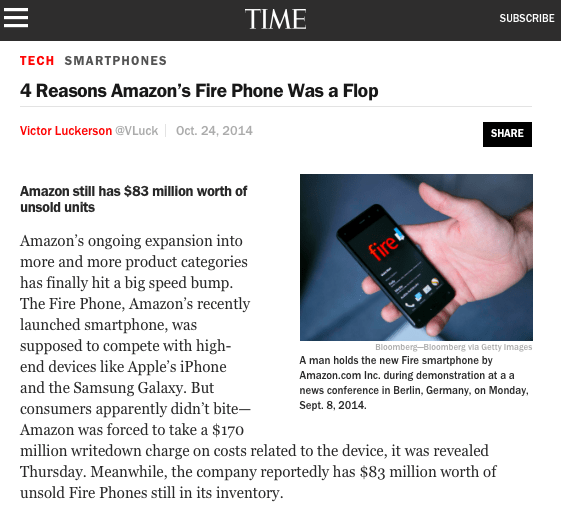
»This phenomenon is also worth considering in light of another contender for the smartphone crown. One that failed dismally: Amazon. Amazon famously poured a huge volume of resources into its Fire phone — Bezos himself was personally, and very heavily, involved. It turned out to be one of Amazon’s biggest flops, and Amazon will not remember its foray into the smartphone era fondly:


You know it’s bad when Time Magazine runs this headline

And yet, right now, Amazon are sitting atop one of the most promising platform-like products that has emerged post-smartphone: the Echo. It’s a surprise hit. Rather than try to supplement the phone, Amazon understood the way in which you’d engage with a device at home was fundamentally different from the way that you’d engage with a device like a phone outside of the home.

And so they didn’t try to add a whole host of interaction features from the previous paradigm. There was none of Microsoft’s adding keyboards and styluses to their phones. Nor was there any of Apple‘s three modes of interaction for its Watch (through a dial, through voice, through a touch screen; and with a home screen full of apps, too… a kitchen sink design effort if ever there was one).

Instead, you interact with the Echo just one way. And just as Apple nailed the touch screen of the iPhone because that was the only was to interact with the device, Amazon have completely nailed the interaction method of the Echo: voice.

«

link to this extract


A sample job application for the Facebook Trending team • Fusion

Jason Gilbert:

»Thank you for your interest in the Facebook Trending news team! Please answer the following questions so that we can determine your suitability for the position.

How would you describe the sinking of the Titanic, in a sentence?
A) Titanic sinks after colliding with an iceberg; more than 1,000 passengers killed
B) 1,500 passengers die after cruise ship Titanic crashes into iceberg
C) Large boat faces flotation problems following iceberg-related incident, reports say

«

And 10 more. These are hilarious. By the way, C) is how the New York Times does it.
link to this extract


Errata, corrigenda and ai no corrida: none notified.

Start up: Google kills payday ads, software kills satellite, Uber v Hollywood, Swiss watches unwind, and more


Open data has stopped parking tickets being wrongfully handed out in New York. Photo by Instant Vantage on Flickr.

You can now sign up to receive each day’s Start Up post by email. You’ll need to click a confirmation link, so no spam.

A selection of 9 links for you. Use them wisely. I’m charlesarthur on Twitter. Observations and links welcome.

Why aspiring Leonardo DiCaprios are now driving Ubers instead of Waiting tables • Vanity Fair

Nick Bilton:

»

My Uber driver was pulling onto the freeway, in Los Angeles, when he looked into the rearview mirror and told me he was going to let me in on a little secret.

Sitting in the backseat, I was in full-on reporter mode, asking him the rudimentary questions that have become second nature: What else did he do for a living? (Tattoo artist.) Did he drive for Lyft too? (Yes.) Then I asked him about the longest drive he had ever taken for a ride-sharing service.

“Oh, that’s easy,” he said, before detailing a multi-hour journey to another city in California.

“Wow,” I replied, stunned that anyone would hire an Uber to take them that far.

“Yep,” he said with a smirk, which led my driver to share his secret. The reason for the long trip, he explained, was that his passenger was transporting a black duffel bag full of cocaine. When I asked how he knew about this transaction, my driver explained that this particular passenger was quite forthcoming. The dealer said that he used to do the drive himself, but now Uber and Lyft had become his new method of choice for transporting narcotics. “If he was driving his own car, he could get pulled over for any number of reasons; not stopping at a light; not using a blinker; speeding,” my driver explained to me. “But if I get pulled over, the cops aren’t going to search him and I’m certainly not going to get into any trouble.”

He then told me that these ride-sharing services have inadvertently facilitated a lot of illegal behavior in Los Angeles—some of which is depicted in the driver forum Uberpeople.net. “I pick up hookers and drug dealers all the time,” my driver continued nonchalantly. “In New York City or San Francisco, a dealer can ride a bike, but in L.A., you need a car. It’s much safer to use Uber to deliver a big bag of coke.” (Spokespeople for Uber and Lyft responded by pointing me to their respective terms of service, both of which prohibit passengers from violating local laws and statutes.)

«

Sure they do. This is a great read.
link to this extract


Congress warned about cybersecurity after attempted ransomware attack on House • TechCrunch

Kate Conger:

»

Congressional gridlock can usually be blamed on stubborn representatives and senators. But a new string of ransomware attacks on the House of Representatives could stall legislation more effectively than party infighting or a filibuster.

In an email provided to TechCrunch, the House technology service desk warned representatives of increased ransomware attacks on the House network. The email warns that attackers are focusing their efforts on third-party email apps, like YahooMail and Gmail, and tells representatives that access to YahooMail will be blocked on House networks.

“When a user clicks on the link in the attack e-mail, the malware encrypts all files on that computer, including shared files, making them unusable until a ‘ransom’ is paid. The recent attacks have focused on using .js files attached as zip files to e-mail that appear to come from known senders,” the email notes.

«

Better to attack legislators than the actual government. This is going to happen.
link to this extract


Where does America’s e-waste end up? GPS tracker tells all • PBS NewsHour

Katie Campbell and Ken Christensen:

»

[Jim] Puckett’s organization [Basel Action Network, a Seattle-based e-waste watchdog], partnered with the Massachusetts Institute of Technology to put 200 geolocating tracking devices inside old computers, TVs and printers. They dropped them off nationwide at donation centers, recyclers and electronic take-back programs — enterprises that advertise themselves as “green,” “sustainable,” “earth friendly” and “environmentally responsible.”

“The trackers are like miniature cell phones,” he said. “The little devices went out and spoke to us, called home regularly, saying ‘this is where I am.’”

About a third of the tracked electronics went overseas — some as far as 12,000 miles. That includes six of the 14 tracker-equipped electronics that Puckett’s group dropped off to be recycled in Washington and Oregon.

The tracked electronics ended up in Mexico, Taiwan, China, Pakistan, Thailand, Dominican Republic, Canada and Kenya. Most often, they traveled across the Pacific to rural Hong Kong…

…A worker shouts from beyond the fence and Su tells him the group is shopping for used electronics. She says they want to fill a shipping container with printers to refurbish and sell in Pakistan. The door opens.

Inside, workers are dismantling LCD TVs. The ground at their feet is littered with broken white tubes. These fluorescent lamps were made to light up flat-screens. When they break they release invisible mercury vapor. Even a minuscule amount of mercury can be a neurotoxin.

The workers aren’t wearing protective face masks. One worker says he isn’t aware of the risks.

“He had no idea,” Su says, after speaking with him in Mandarin.

«

link to this extract


Software update destroys $286m Japanese satellite • Hackaday

Rud Merriam:

»

The Japanese X-ray telescope Hitomi has been declared lost after it disintegrated in orbit, torn apart when spinning out of control. The cause is still under investigation but early analysis points to bad data in a software package pushed shortly after an instrument probe was extended from the rear of the satellite. JAXA, the Japanese space agency, lost $286m, three years of planned observations, and a possible additional 10 years of science research.

Hitomi, also known as ASTRO-H, successfully launched on February 17, 2016 but on March 26th catastrophe struck, leaving only pieces floating in space. JAXA, desperately worked to recover the satellite not knowing the extent of the failure. On April 28th they discontinued their efforts and are now working to determine the reasons for the failure, although a few weeks ago they did provide an analysis of the failure sequence at a press conference.

«

Soon to be a plotline in a disaster movie.
link to this extract


The NYPD was systematically ticketing legally parked cars for millions of dollars a year; open data just put an end to it • I Quant NY

Ben Wellington:

»

New York City is a complex place to drive.  And when it comes to parking, there are plenty of rules and regulations to follow.  It’s no wonder that sometimes people get confused and end up getting their cars ticketed or towed. 

But in all of these rules, there is one thing that very few drivers seem to know. As of late 2008, in NYC you can park in front of a sidewalk pedestrian ramp, as long as it’s not connected to a crosswalk.  It’s all written up in the NYC Traffic Rules, and for more detail, take a look at this article. The local legislation making these parking spots legal was proposed by Council Member Gentile, and adopted by the Department of Transportation before it ever made it for a vote.  Though few people seem to know about the change.

Is it a problem that drivers don’t realize that there are some extra parking spots they are now allowed to park in?  Not so much.  But, I’ve got a pedestrian ramp leading to nowhere particular in the middle of my block in Brooklyn, and on occasion I have parked there.  Despite the fact that it is legal, I’ve been ticketed for parking there.  Though I get the tickets dismissed, it’s a waste of everybody’s time. And that got me wondering- How common is it for the police to give tickets to cars legally parked in front of pedestrian ramps?  It couldn’t be just me…

In the past, there was not much you could do to stop something like this. Complaining to your local precinct would at best only solve the problem locally. But thanks to NYC’s Open Data portal, I was able to look at the most common parking spots in the City where cars were ticketed for blocking pedestrian ramps.

«

It wasn’t. This is the best sort of open data story. Note to London’s new mayor: no parking ticket data yet.
link to this extract


An update to our AdWords policy on lending products • Google Public Policy Blog

David Graff, director of global product policy:

»

We have an extensive set of policies to keep bad ads out of our systems – in fact in 2015 alone, we disabled more than 780 million ads for reasons ranging from counterfeiting to phishing. Ads for financial services are a particular area of vigilance given how core they are to people’s livelihood and well being.

In that vein, today we’re sharing an update that will go into effect on July 13, 2016: we’re banning ads for payday loans and some related products from our ads systems. We will no longer allow ads for loans where repayment is due within 60 days of the date of issue. In the U.S., we are also banning ads for loans with an APR of 36% or higher. When reviewing our policies, research has shown that these loans can result in unaffordable payment and high default rates for users so we will be updating our policies globally to reflect that.

This change is designed to protect our users from deceptive or harmful financial products and will not affect companies offering loans such as Mortgages, Car Loans, Student Loans, Commercial loans, Revolving Lines of Credit (e.g. Credit Cards).

«

Will this be extended to the UK? And how do you think the payday loan companies will find their way around it? Or will they just appear in organic search? (The only comment when I wrote this was from someone from “Ace Cash Express” expressing great annoyance.)
link to this extract


Swiss watchmaking in March 2016: steep decline • Federation of the Swiss Watch Industry

»

The deterioration in the trend of Swiss watch exports observed since July 2015 gathered pace in March. With a decline of 16.1% compared to last year their value totalled only 1.5bn francs (US$1.55bn), making these the lowest March figures since 2011. The scale of the downturn is also unusual, since we must go back to the crisis of 2009 to find rates of variation of this order.

«

Gosh, that’s surprising. Wonder what could have caused that?
link to this extract


Apple Watch review, chapter 3: one year after • aBlogtoWatch

Ariel Adams:

»

in my opinion, a pivotal change we have to look forward to is an always-on screen for the Apple Watch. TAG Heuer offered a low-power always-on state for their Connected watch, and while simple, the result was brilliant. The biggest weakness that the Apple Watch has is the fact that the screen is blank most of the time. Of course, there are very real and very unfixable reasons for this right now (battery life), but it prevents the “head” of the Apple Watch from having a face.

In the past, I have likened the face of a watch to a human face. Imagine looking at someone and seeing their face missing key elements like eyes, nose, and mouth. That is where all the personality and soul is conveyed, and a watch case without a face lacks a similar type of soul. The Apple Watch soul shines when the screen is activated, but I want more. I want the watch screen to be on all the time in some state, and I think that is at the heart of how to give the Apple Watch (and other smartwatches, for that matter) more personality. This is important not only for the wearer, but also other people seeing the watch on the wrist of the wearer. Above in this article, I talked about how I had a solution for giving the Apple Watch more personality. Well, it is this: not only offering an always-on state for the screen, but also allowing people to customize what you see on that screen. That is where a smartwatch can offer serious communicative value.

«

Totally agree: this is what it really needs.
link to this extract


Conservatives accuse Facebook of political bias • NYTimes.com

John Herrman and Mike Isaac:

»

The trending feature is curated by a team of contract employees, according to two former Facebook employees who worked on it and who spoke on the condition of anonymity because of nondisclosure agreements. They said they considered themselves members of a newsroom-like operation, where editorial discretion was not novel but was an integral part of the process.

Any “suppression,” the former employees said, was based on perceived credibility — any articles judged by curators to be unreliable or poorly sourced, whether left-leaning or right-leaning, were avoided, though this was a personal judgment call.

The perception of Facebook as a more conventional news operation opens it to a more familiar line of criticism, which has been mounted against news organizations left and right, large and small, for decades. According to a report last year by Pew, only 17% surveyed said that technology companies had a negative influence on the country. For the news media, that number was 65% — and rising.

«

One senses a little schadenfreude at the NYT (and other publications) as Facebook endures exactly the same criticism they have done for years.
link to this extract


Errata, corrigenda and ai no corrida:

Start up: Radiohead v Spotify, Facebook’s news problem, Google’s dark links, Sinclair’s calculator genius, and more


Excitement over web video views compared to TV is overdone, mainly because they measure very different things. Photo by x-ray delta one on Flickr.

You can now sign up to receive each day’s Start Up post by email. You’ll need to click a confirmation link, so no spam.

A selection of 10 links for you. Use them wisely. I’m charlesarthur on Twitter. Observations and links welcome.

Radiohead’s new album isn’t on Spotify. So what? Spotify doesn’t need it • The Guardian

Eamonn Forde brandishes data, damn him:

»

Burn the Witch has been played just short of 3m times on Spotify since its release last week. Pretty impressive, until you note that the service has more than 100 million users. Given it’s Radiohead, the people who played the track will have done so multiple times. So we can estimate that the people playing Burn the Witch make up less than 1% of Spotify’s total user base. Helpfully, Spotify also makes public other metrics. Radiohead have 4.7 million monthly listeners on Spotify, and are the 196th most played act. That means that 95.3% of Spotify’s users have literally no interest in Radiohead. A Moon Shaped Pool not being there could potentially irk 4.7 million people, but actually Radiohead do not appear on the radars of the vast majority of Spotify’s users.

A look at how the band’s catalogue has performed on Spotify – considering that they will have chalked up multiple plays from users – reveals this fact in stark terms. Cumulative plays for Pablo Honey run to 119.1m, with 103m of those streams being for Creep, a statistic bound to cheer up Thom Yorke. For The Bends, it’s 102.2m, for OK Computer it’s 159.1m, for Kid A it’s 61.5m, for Amnesiac it’s 34.7m, for Hail to the Thief it’s 49.3m and for The King of Limbs it’s 45.5m. Spotify users’ interest is clearly in the deep back catalogue of the band (or, to put it another way, in their most accessible music).

«

Yes, it is calling out for a graph. Here you go.

Radiohead album plays on Spotify, graphed

(Would still like a statement from Radiohead on why the album isn’t, but the singles are, on Spotify.)
link to this extract


Internet video views is a 100% bullshit metric • Gawker

Kevin Draper:

»

The TV ratings Nielsen reports aren’t concurrent viewers, but rather “average minute audience,” which is exactly what it sounds like. It measures the average audience watching across each minute of the show.

If BuzzFeed’s watermelon video had been measured the way a TV show is, its viewership would’ve been closer to zero than the 807,000 it trumpeted to advertisers. Viewership started off low and took 45 minutes to build to that 807,000, and few people watched the entire video; many tuned in for five or 10 minute blocks at the end. Facebook’s metrics also wildly inflate the number of people watching a given video, as they count somebody as a viewer once they have been watching for just three seconds, and by default Facebook videos autoplay as you scroll to them in your feed.

The conflation of digital and traditional viewership metrics has gotten under the skin of TV people, and for good reason. If advertisers can be hoodwinked into believing that a sizable number of people are actually watching things on Facebook Live, they will direct their money online, where the ad rates are much, much lower than they are on TV. The thing here is that the TV people are right—even serious online video hits deliver numbers that would barely register if measured the same way TV programming is.

«

In other news: “Youtube says its primetime audience is bigger than the top 10 TV shows combined”. Let’s see if you can work this one out unaided.
link to this extract


The real reason Apple made the Apple Watch • TIME

Tim Bajarin:

»

If you look at Apple’s current health initiatives, many are focused on helping people record data of all types and get it securely to their healthcare providers. Apple also has projects related to healthcare records, management and interaction between the doctor and patient with a goal of making the patient-doctor relationship more fruitful and less frustrating.

I have long been observing these key moves around healthcare, which accelerated after Jobs’ death. It seems clear that Apple’s management has now and will continue to have a major focus on bridging the gap between a person and their healthcare providers. I believe Apple is on a mission to improve the overall health of its customers as well as that of the healthcare system, a task Jobs gave them before he died. And while Apple’s products define Jobs’ legacy, it may turn out that his and Apple’s greatest contribution may be to bring greater order to the fragmented healthcare world.

«

The fragmented American healthcare system, I think you mean.
link to this extract


The real problem with Facebook and the news • Stratechery

Ben Thompson on yesterday’s claim by one (apparently disaffected right-leaning) curator for Facebook’s Trending News feed: This, then, is the deep irony of this controversy:

»

Facebook is receiving a huge amount of criticism for allegedly biasing the news via the empowerment of a team of human curators to make editorial decisions, as opposed to relying on what was previously thought to be an algorithm; it is an algorithm, though — the algorithm that powers the News Feed, with the goal of driving engagement — that is arguably doing more damage to our politics than the most biased human editor ever could. The fact of the matter is that, on the part of Facebook people actually see — the News Feed, not Trending News — conservatives see conservative stories, and liberals see liberal ones; the middle of the road is as hard to find as a viable business model for journalism (these things are not disconnected).

Indeed, one could make the argument that an authoritative news module from Facebook would actually be a civil benefit: at least we would all be starting from a common set of facts. What is far more damaging — and far more engaging, and thus lucrative for Facebook — is all of us in our own virtual neighborhoods of our own making, liking opinions that tell us we’re right instead of engaging with viewpoints that make us question our assumptions.

«

Which of course makes one wonder what an anti-News Feed, which intentionally dropped some stories about things you don’t agree with, would feel like. Jarring? Wrong? Annoying?
link to this extract


190 Android apps infected with malware discovered on the Google Play Store • Softpedia

Catalin Cimpanu:

»

Researchers spotted the malware-infected apps towards the end of April, but only recently have these apps been removed. The Russian security firm says the apps contained a version of the malware identified as Android.Click.95.

According to their analysis of the malware’s mode of operation, Android.Click waits for six hours after the user installs it as part of an infected app.

After the six hours pass, the malware forcibly loads a URL in the user’s browser, which contains scareware-like messages that tell the user his system or his battery has problems.

To fix his issues, the user has to download another app. In the cases they’ve observed, Dr.Web researchers say the malware redirected users back to the Google Play Store to download these second-stage apps.

“For each download, fraudsters receive interest under the terms of affiliate advertising agreements,” Dr.Web researchers explained. “It explains why Android.Click.95 is so much widespread—the cybercriminals try to make as much profit as they can from these downloads.”

«

To be precise, “Android.Click.95 opens the fraudulent website every 2 minutes from the moment when it has started functioning, making it irritating to use the infected device. At that, the maximum number of visits of the fraudulent website is limited to 1000 times.” Seems to be Russian apps (judging from the analysis) but likely to spread.
link to this extract


The odds are you won’t know when to quit • Tim Harford

»

My favourite study of loss aversion concerns players of the TV game show Deal or No Deal, in which players must periodically decide whether to keep gambling or accept an offer from the mysterious “Banker” to buy them out of the game. In one notorious Dutch episode, a contestant named Frank was offered €75,000 to stop; he kept playing and lost his next gamble. The Banker’s next offer was just €2,400, which was actually a fair offer. But at that point loss aversion kicked in. With the lost €75,000 in mind, Frank refused all further deals, kept gambling and kept losing. He eventually won just €10.

A study of Deal or No Deal by behavioural economists including Thierry Post and Richard Thaler found that while Frank’s fate was spectacular, his behaviour was statistically typical. People hate to quit if they feel they’re losing…

…I was struck by a recent FT article by equity analyst Daniel Davies describing how a portfolio based on expert research recommendations would tend to do badly, but if the same portfolio had a “stop-loss” rule that simply jettisoned stocks after a 10 per cent loss, it would tend to do very well. The stop-loss rule cancelled out the instinctive tendency to hold on stubbornly to losers. Yet Warren Buffett seems to do very well by buying and holding.

«

Harford then has three suggestions for how not to cling on to losses. But psychology is hard to beat.
link to this extract


Researchers say computer screens change how you think about what you read • The Washington Post

Andrea Peterson:

»

You probably spend a lot of time staring at screens – but all that computer time may be making you miss the big picture, new research has found.

Reading something on a screen – as opposed to a printout – causes people to home in on details and but not broader ideas, according to a new article by Geoff Kaufman. a professor at Carnegie Mellon, and Mary Flanagan, a professor at Dartmouth. 

“Digital screens almost seem to create a sort of tunnel vision where you’re focusing on just the information you’re getting this moment, not the broader context,” Kaufman said.

The article is based on a series of studies involving a total of more than 300 participants that were carried out while the two researchers worked together at Tiltfactor, a Dartmouth game design lab.

«

Reading speed is higher on paper too, or at least used to be recorded as such; not sure whether that’s still true in the era of invisible pixels.
link to this extract


Reversing Sinclair’s amazing 1974 calculator hack – half the ROM of the HP-35 • Righto

Ken Shirriff:

»

In a hotel room in Texas, Clive Sinclair had a big problem. He wanted to sell a cheap scientific calculator that would grab the market from expensive calculators such as the popular HP-35. Hewlett-Packard had taken two years, 20 engineers, and a million dollars to design the HP-35, which used 5 complex chips and sold for $395. Sinclair’s partnership with calculator manufacturer Bowmar had gone nowhere. Now Texas Instruments offered him an inexpensive calculator chip that could barely do four-function math. Could he use this chip to build a $100 scientific calculator?

Texas Instruments’ engineers said this was impossible – their chip only had 3 storage registers, no subroutine calls, and no storage for constants such as π. The ROM storage in the calculator held only 320 instructions, just enough for basic arithmetic. How could they possibly squeeze any scientific functions into this chip?
Fortunately Clive Sinclair, head of Sinclair Radionics, had a secret weapon – programming whiz and math PhD Nigel Searle. In a few days in Texas, they came up with new algorithms and wrote the code for the world’s first single-chip scientific calculator, somehow programming sine, cosine, tangent, arcsine, arccos, arctan, log, and exponentiation into the chip. The engineers at Texas Instruments were amazed.

How did they do it? Up until now it’s been a mystery. But through reverse engineering, I’ve determined the exact algorithms and implemented a simulator that runs the calculator’s actual code. The reverse-engineered code along with my detailed comments is in the window below.

«

Amazing. The ingenuity of the work in these early systems is inspiring. What’s the equivalent today?
link to this extract


HTC Q1 16A – Family silver • Radio Free Mobile

Richard Windsor:

»

▪ HTC’s war chest is diminishing fast and it is quickly selling the family silver in order to support the substantial cash burn.
▪ During Q1 16A HTC recognised cash gains of NT$2.1bn from selling fixed assets, NT$6.1bn from selling non-current financial investments and NT$1.4bn from selling current financial assets.
▪ This is how HTC managed to show an increase in cash and cash equivalents (compared to Q4 15A) of NT$3.7bn.
▪ These sales are very likely to be one time in nature meaning that, in reality, HTC is draining its reserves by NT$5.9bn every quarter.
▪ These asset sales have masked what was a dreadful 3 months for HTC and I am concerned that the Vive will not take off in the kind of volumes or soon enough to keep HTC from real trouble.
▪ Consequently, 2016 is likely to be dominated by the agonising decline of its handset business raising the high likelihood of further substantial cash outflows.
▪ Consequently, the most I would pay for HTC would be 1 times its cash balance as I view the Vive as a long shot to rescue the company and it is very likely that the cash balance will continue declining.

«

HTC’s accounts show a cash balance of NT$41.7bn at the end of Q1. That’s about eight quarters’ worth if it keeps draining cash at that rate.

Or, put another way: at the end of March 2015 HTC had NT$51.7bn of cash and cash equivalents. Ending March 2016, it had NT$39.0bn. That’s a fifth of its cash and equivalents gone in a year – and as Windsor points out, that’s only done by one-off asset sales. It’s burning the furniture to keep warm.
link to this extract


Google is testing a radical change by turning people’s search results black • Telegraph.co.uk

Cara McGoogan on what seems to be an A/B test where results links are black, not the web’s usual blue:

»

If the comments from users on Twitter, Reddit and Google’s forums are any indication, it is not likely that the changes will be rolled out across the board any time soon. 

Other than the red links it uses in China, and different shades of its blue Google has not used other colours for its search results before. 

Google is not the only major technology company to carry out A/B tests on its users. Netflix recently admitted that it tests six different images for many TV and movie titles, and rolls out the one that most viewers click on. 

Facebook has also conducted tests designed to emotionally manipulate users by highlighting positive and negative emotions, while OK Cupid has deliberately matched incompatible people to see the outcomes

There isn’t a blanket way to turn off Google’s A/B testing, but users on a Google Search Help Forum have reported that logging out of their Google account and back in again reverts the links back to blue.  

A Reddit user also reported that disabling “Your searches and browsing activity” in Chrome’s settings turns the links back to blue. To disable the feature go to the Google home page and click on the grid icon in the top right hand corner and select “My Account”.

«

link to this extract


Errata, corrigenda and ai no corrida:

Start up: AdBlock hits 100m users, is Facebook left-wing?, Baidu’s search under fire, robot surgeon wins, and more


Fires burning near Fort McMurray: if you had a smart home, you could watch it burn down like one unlucky man. Photo by Premier of Alberta on Flickr.

You can now sign up to receive each day’s Start Up post by email. You’ll need to click a confirmation link, so no spam.

A selection of 12 links for you. Use them wisely. I’m charlesarthur on Twitter. Observations and links welcome.

Another thing your connected home will let you do: watch it burn • The Verge

Vlad Savov:

»

A major wildfire near Fort McMurray in Canada has forced more than 100,000 people to evacuate the area and destroyed roughly a fifth of local homes. One of the affected houses belonged to a man by the name of James O’Reilly, who got a uniquely intimate perspective on his home’s demise thanks to a connected security camera.

O’Reilly shared the above video with the Edmonton Metro, after first witnessing it on his iPhone while driving away from the fire. It’s a deeply unsettling thing to watch, with crackling noises and small tufts of smoke being the first signs of the fire’s invasion. The living room is eventually deluged by the flames while alarms bleat and the camera turns monochrome shortly before it cuts out.

«

link to this extract


11 everyday things that won’t exist In ten years’ time • Buzzfeed

Cisco made the list, so I’ll save you the trouble: traffic jams; physical credit cards; headphones; plasters (eg Elastoplast); delivery people; remote controls; passwords; physical media; wired chargers; phone towers; “offline”.

Me: they’ll all be safely around in 2026, perhaps apart from “offline”.
link to this extract


Google said to be exploring an ‘acceptable’ ads policy • Digiday

Lucia Moses:

»

Google, with its tech chops and its control over digital ad delivery, is positioned to do what individual publishers and their associations can’t do on their own, though, by requiring that ads are not obtrusive or annoying — a main reason people choose to block ads. While it is unclear how a Google scheme would work, a likely scenario is that Google would ensure that only ads that meet its standards can run on its own site and YouTube, and also through its DoubleClick ad exchange through which publishers sell their inventory.

Currently, publishers face resistance from advertisers that don’t feel the pressure to change their ads to make them load faster. Having the backing of a big player, Google, could give publishers sway with those advertisers. “Clearly, someone has to grab hold of this situation that has scope,” one publishing exec with direct knowledge of Google’s plans.

«

The aim being to forestall the growth of adblocking. Speaking of which…
link to this extract


Adblock Plus and (a little) more: 100 million users, 100 million thank-yous • AdBlock Plus

Ben Williams:

»

Today, on stage at the TechCrunch Disrupt Conference in Brooklyn, our co-founder Till Faida announced that we now have more than 100 million active users (by “active users” we mean “active installations,” i.e. you may be counted as more than one “user” if you’ve got ABP active on multiple devices). These are our latest numbers, which we’ve been working for months on getting more accurate without breaking our strict privacy policy. Harder than it sounds … Happily, we’ve got some stupid smart data scientists who’ve figured out a way to get an accurate estimation.

While user numbers in countries where ad blocking is fairly well-known, like Germany and France, are pretty stable, in countries like the US and UK people are really coming on to the benefits of taking back control of their online experience.

«

Like to see the adoption curve.
link to this extract


Former Facebook workers: we routinely suppressed conservative news • Gizmodo

Michael Nunez:

»

Another former curator agreed that the operation had an aversion to right-wing news sources. “It was absolutely bias. We were doing it subjectively. It just depends on who the curator is and what time of day it is,” said the former curator. “Every once in awhile a Red State or conservative news source would have a story. But we would have to go and find the same story from a more neutral outlet that wasn’t as biased.”

Stories covered by conservative outlets (like Breitbart, Washington Examiner, and Newsmax) that were trending enough to be picked up by Facebook’s algorithm were excluded unless mainstream sites like the New York Times, the BBC, and CNN covered the same stories.

Other former curators interviewed by Gizmodo denied consciously suppressing conservative news, and we were unable to determine if left-wing news topics or sources were similarly suppressed. The conservative curator described the omissions as a function of his colleagues’ judgements; there is no evidence that Facebook management mandated or was even aware of any political bias at work.

«

Weeeelll. Facebook’s been trying to kill “fake news” on Facebook, and arguably that also includes “junk news”. You could think of some left-wing sites that might be as junky; then you’d have to see whether they got the same treatment. (I suspect so.) Basically, Facebook tried to run a “respectable” news organisation. One feels a littttttle bit of resentment from the (conservative) former curators who have come forward.
link to this extract


China Focus: Investigation finds Baidu’s objectivity compromised by profit model • Xinhua

»

The Cyberspace Administration of China (CAC) on Monday demanded an overhaul of China’s leading search-engine Baidu following an investigation.

The CAC said Baidu relied excessively on profits from paid listings in search results, and did not clearly label such listings as the result of commercial promotion, compromising the objectivity and impartiality of search results.

Like other search engines [in China], Baidu sells links that appear in search results. The more an advertiser pays, the higher it will appear in the search results. The public are likely to be misled by the search results they find on Baidu, the CAC said.

NASDAQ-listed Baidu was already in the eye of a public-relations storm after the death of Wei Zexi, 21, a computer science major at Xidian University in northwest China’s Shaanxi Province.

Wei was diagnosed with synovial sarcoma, a rare form of cancer, in 2014 and had been undergoing a controversial cancer treatment advertised on Baidu, at the Second Hospital of Armed Police Beijing Corps, which the Wei family also found through a Baidu search. The treatment was unsuccessful and Wei died on April 12.

In February, on question-and-answer website Zhihu, a Chinese version of Quora, Wei directly accused Baidu of being at least partly to blame for his troubles. The anger of netizens who claim the search engine does not properly check the credentials of advertisers has been growing ever since.

«

Wow. You’d think that someone might have chosen to use Google’s search algorithm, on the basis that it works pretty well and puts you ahead of the rest.
link to this extract


Autonomous robot surgeon bests humans in world first • IEEE Spectrum

Eliza Strickland:

»

the Smart Tissue Autonomous Robot (STAR) did a better job on the operation than human surgeons who were given the same task.

STAR’s inventors don’t claim that robots can replace humans in the operating room anytime soon. Instead they see the accomplishment as a proof of concept—both for the specific technologies used and for the general concept of “supervised autonomy” in the OR.

Pediatric surgeon Peter Kim, one of the researchers, didn’t sound threatened when he spoke to reporters in a press call yesterday. “Even though we surgeons take pride in our craft at doing procedures, to have a machine that works with us to improve outcomes and safety would be a tremendous benefit,” he said.

For this study, published today in the journal Science Translational Medicine, researchers programmed their robot to carry out a procedure called intestinal anastomosis, in which a piece of intestine that’s been cut through is stitched back together. It’s like repairing a garden hose, said Ryan Decker, the senior engineer on the team, in that the sutures must be tight and regularly spaced to prevent leaks. STAR performed this task both on ex vivo tissue in the lab and on in vivo tissue in an anesthetized pig, and experienced human surgeons were given the same tasks. When the resulting sutures were compared, STAR’s stitches were more consistent and more resistant to leaks.

«

What’s its bedside manner like?
link to this extract


Cheating students at Rangsit University blacklisted • Bangkok Post: news

»

Rector Arthit Ourairat said on Monday the three students caught red-handed while cheating on the university-organised direct admission tests for College of Medicine, and Faculties of Dental Medicine and Pharmacy will not be allowed to retake the exams for May 31 and June 1.

“The university has put the three students on the blacklist and the won’t be able to apply for seats with us again. I cannot say whether they will be allowed to take exams at other universities,” he told reporters.

The university in Muang district in Pathum Thani found the three using hi-tech devices to cheat on the tests. Their smartwatches had answers written in a code sent from a private tutorial institution or probably more than one.

Proxies wearing camera-equipped glasses were sent to take the exams. After filming the exam sheets by the camera, the gang members left the test centre with the information [after staying the minimum 45 minutes of the three-hour exam]. Another person waiting outside downloaded the tests to a computer and emailed them to one or more tutorial schools. They sent the answers back to the students on their smartwatches.

All test supervisors were alerted on Saturday when the university seized one smartwatch in the morning session and another in the afternoon. The third watch and two glasses were seized on Sunday.

«

The questions are easy enough to be answerable in code? Also: finally, a sales case for smartwatches among today’s youth.
link to this extract


Cost cutting at Dropbox and Silicon Valley startups • Business Insider

Eugene Kim:

»

Dropbox has made other changes to its famously lavish employee perks lately, reflecting its more cutthroat attitude toward cash management.

In a company-wide email in March, Dropbox said it was cancelling its free shuttle in San Francisco and its gym washing service, while pushing back dinner time by an hour to 7 p.m. and limiting the number of guests to five a month. (Previously it was unlimited, a big perk given its open bar on Fridays.)

Those changes will have a direct impact on Dropbox’s profitability. The company wrote in the email that employee perks in total have been costing Dropbox at least $25,000 a year for each employee. Based on Dropbox’s roughly 1,500 headcount, that would translate to about $38m a year. At that scale, any kind of cost savings would help improve its bottom line. Dropbox declined to comment.

«

To an outsider, that spending sounds insane. “Gym washing”? What is that? Kim’s story makes clear that others are cutting back too.
link to this extract


A bomb just dropped in endpoint security… and I’m not sure anyone noticed • Alex Eckelberry

Eckelberry used to run Sunbelt Software, though he’s better now; but still interested in the antivirus scene. His comments on Google ending non-contributory access to VirusTotal (noted yesterday):

»

here’s the dirty little secret that very few people know. There are a number of endpoint products that use VirusTotal to determine if a file is malicious. Without any contribution to the community. Without giving anything in return. 

They simply pay VirusTotal a subscription fee, and receive the information.

And some of these companies have been getting a lot of attention for their supposed prowess. But for some mysterious reason, they refuse to put their own engines on VirusTotal. Could it be because they don’t want to contribute back? Maybe. Or it could be that they just don’t want everyone else to see how poorly their products actually perform.

Unfair? Yes.
Using VirusTotal information without any contribution back to the community is patently unfair. The people who are actually writing detections are sharing their results with the rest of the community, while a small group of endpoint products have been boasting of their extraordinary abilities, while working off the backs of other researchers. 

So as a customer, perhaps you can ask the next endpoint security vendor if they’re on VirusTotal. If they are, they’re contributing to the antivirus community. If they’re not, they’re not. Whatever their PR story, that’s the simple truth.

«

Which will have ramifications for those who have bought products from the non-contributors, he says.
link to this extract


Please Enter Your Password • unexpected error !?

Nick Forge:

»

It is generally established in much of the tech industry that improving “quality” by improving the design and implementation of your product is a smart business strategy. Every password prompt you show without a legitimate reason will leave your users slightly less certain about either your product – “ugh, it should already know my password, this product is stupid!” – or less certain about themselves, their knowledge and their competence – “what am I doing wrong, why do I have to keep entering my password?”. No matter what their exact response is, it’s almost certainly going to be negative for either the user, your product and company, or both.

«

Forge explains neatly why you keep getting those requests for your password at time when you shouldn’t need to enter your password. Essentially, it’s network problems where the code design has got lazy.
link to this extract


Second Oracle v. Google trial could lead to huge headaches for developers • Ars Technica

Joe Mullin:

»

The Federal Circuit’s rule allows a company to use copyright law in order to stop others from calling on its APIs and interacting with its code. In the eyes of many tech companies, software developers, and open source advocates, that’s going to create a lot of unnecessary legal risk. In the wake of Oracle v. Google, calling on someone else’s API could get you sued.

In the EFF’s view, the Federal Circuit decision was wrong and conflicts with existing 9th Circuit cases, like Sega v. Accolade (1992) and Sony v. Connectix (2000), which allow for interoperability between systems, whether a copyright owner likes it or not.

Because of the Federal Circuit decision, a developer or company can be subject to a copyright suit over use of an API. Some of those lawsuits will be brought by copyright owners who just want to shut down competition, Stoltz said. That means developers will “spend more time talking to their lawyers, and they’ll be more worried.”

«

And Oracle’s damages claim is huge too. Nothing good is coming from this, even if Google wins on all counts: copyright on APIs puts others at risk.

link to this extract


Errata, corrigenda and ai no corrida: none notified.

Start up: Windows 10 hits 300m, a new virus war, gene therapy’s bust, Land Registry’s real value, and more


Facebook’s face recognition system is quite a lot better than this – which has led to lawsuits over privacy invasion. Photo by Chris Devers on Flickr.

You could always sign up to receive each day’s Start Up post by email. Unless you’re reading this in email. (I’d love to prevent this bit appearing in the email, but can’t.)

A selection of 14 links for you. Things happened, OK? I’m charlesarthur on Twitter. Observations and links welcome.

A selection of 14 links for you. Use them wisely. I’m charlesarthur on Twitter. Observations and links welcome.

Software security suffers as upstarts lose access to Google-owned virus data • Reuters

Joseph Menn:

»

A number of young technology security companies are losing access to the largest collection of industry analysis of computer viruses, a setback industry experts say will increase exposure to hackers.

The policy change at the information-sharing pioneer VirusTotal takes aim mainly at a new generation of security companies, some with valuations of $1 billion or more, that haven’t been contributing their analysis. Older companies, some with market valuations much smaller than the upstart rivals, had pressed for the shift.

Alphabet Inc’s Google runs the VirusTotal database so security professionals can share new examples of suspected malicious software and opinions on the danger they pose. On Wednesday, the 12-year-old service quietly said it would cut off unlimited ratings access to companies that do not share their own evaluations of submitted samples.

«

link to this extract


Windows 10 adoption hits 300 million as Microsoft warns the free upgrade will end soon • PCWorld

Mark Hachman:

»Microsoft says that 300 million devices now run Windows 10. And if yours isn’t among them, time is running out.

On Thursday, Microsoft began showing potential customers of Windows 10 the carrot as well as the stick, touting Windows 10’s success but also warning that the free upgrade offer would expire in a couple of months. If consumers don’t upgrade their PCs from Windows 7 or Windows 8.1 by July 29, Microsoft will charge $119 for a copy of Windows 10 Home when they eventually do.

«

But the benefit is that the “upgrade to Windows 10” app will stop bugging you.

The free upgrade translates to billions of foregone revenue and profit.
link to this extract


New research exposes risks in privatising the UK Land Registry and restricting its data • Open Data Institute

Peter Wells:

»Some of this data is already open so government is already seeing some of this extra tax revenue. The current openness of Land Registry data contributes to it, particularly price paid data which is used by organisations such as Zoopla, Land Insight and RentSquare. This extra tax revenue is incremental to the regular surplus shown in the Land Registry’s accounts.

But the consultation on moving the operations of the Land Registry to the private sector leaves the door open for any future owner of the Land Registry to release additional data under restrictive licensing or paid models. The future owner might even choose to keep some data closed so that only they can use it. As the research shows us, these actions will inhibit GDP growth and reduce that tax revenue.

A private owner has a legal duty to maximise profit for their shareholders. By necessity they will seek to maximise their own return. It is government’s job to consider the impact on the economy as a whole.

«

The ODI is doing all the research on added value from open data that I wish I’d had ten years ago when the Free Our Data campaign started. Wells, by the way, is looking for examples of companies which have benefited from making their data openly available. I thought of Netflix releasing data to get people to improve its film selection algorithm. Any others?
link to this extract


Digital pioneer, Jaron Lanier, on the dangers of “free” online culture • WIPO Magazine

Catherine Jewell:

»Q: What are your main concerns about the digital market today?

Lanier: We have seen an implosion of careers and career opportunities for those who have devoted their lives to cultural expression, but we create a cultural mythology that this hasn’t happened. Like gamblers at a casino, many young people believe they may be the one to make it on YouTube, Kickstarter or some other platform. But these opportunities are rare compared to the old-fashioned middle-class jobs that existed in great numbers around things like writing, photography, recorded music and many other creative pursuits.

Economically, the digital revolution has not been such a good thing. Take the case of professional translators. Their career opportunities have been decreasing much like those of recorded musicians, journalists, authors and photographers. The decimation started with the widespread Internet and is continuing apace. But interestingly, for professional translators the decrease is related to the rise of machine translation.

Automated translations are mashups of real-life translations. We scrape the translations made by real people millions of times a day to keep example databases up to date with current events and slang. Elements of these phrases are then regurgitated into usable machine translations. There is nothing wrong with that system. It’s useful, so why not? But the problem is we are not paying the people whose data we are taking to make these translations possible. Some might call this fraud.

All these systems that throw people out of work create an illusion that a machine is doing the work, but in reality they are actually taking data from people – we call it big data – to make the work possible. If we found a way to start paying people for their actual valuable contributions to these big computer resources, we could avoid the employment crisis that otherwise we will create.

«

link to this extract


Inside the crash of London’s $2.7bn unicorn Powa Technologies • Business Insider

Oscar Williams-Grut:

»[Powa CEO Dan] Wagner had been trying to give prospective clients a demonstration of the company’s newest and most exciting product — PowaTag.

The app stored people’s credit-card details and let them quickly buy products with a few clicks on their smartphone by scanning QR codes, ads, audiowaves, and iBeacons. Wagner had raised $76 million on the back of the product and said the app would help turn Powa into “the greatest technology company of all time.”

Except right now, during this demo in early 2014, it wasn’t working.

“Dan Wagner comes down to level 34, which was rare, bellowing and F-ing and blinding at people,” a former employee who witnessed the incident told Business Insider. Wagner believed the company’s firewall was preventing the PowaTag demo from working, our source said. “Bearing in mind what PowaTag does, it holds your credit-card details in a database, his solution — and he screamed this across the office — was to ‘take the f—— firewall down right now.’”

If the firewall went down, all the world’s hackers could have cherry-picked customer details from Powa’s servers.

“We didn’t have many consumers, but you don’t take down the firewall on something that’s holding credit cards,” says the former employee who witnessed the confrontation.

«

This is a great collection of all the things that really weren’t good about Powa. I met Wagner a couple of times; the promise always seemed ahead of the reality. I thought Powa was perhaps a startup worth a few million. Quite how it got to be a unicorn escaped me.
link to this extract


The world’s most expensive medicine is a bust • Technology Review

Antonio Regalado:

»when the Berlin physician Elisabeth Steinhagen-Thiessen wanted to give a patient Glybera last fall, it wasn’t so easy. She says she had to prepare a submission as thick as “a thesis” for German regulators and then personally call the CEO of DAK, one of Germany’s large sickness funds, or insurers, to ask him to pay the $1 million price tag.

Last September, she gave 40 injections to the muscles of a 43-year-old woman with an ultra-rare disease called lipoprotein lipase deficiency. Such patients don’t process fat correctly. “You draw blood and you are astonished, there is no red blood, it’s cream,” Steinhagen-Thiessen says. One symptom is debilitating abdominal pain. Her patient had been hospitalized more than 40 times.

A dose of Glybera contains trillions of viruses harboring correct copies of the lipoprotein lipase gene. And Steinhagen-Thiessen says the treatment, at Charite Hospital in Berlin, was a success. The woman hasn’t been back to the emergency room since the treatment and is now “living like you and me.”

But this single use of the drug just proves that Glybera is a flop. The problem is its staggering million-dollar price tag, too few patients, and questions about how effective it is.

«

When I was writing about science from 1995-2003, the promise of gene therapy cures was held out again and again; but the only trials went badly wrong. Cystic fibrosis was always the target – single gene, should be easy to hit – but without success.
link to this extract


Facebook to face privacy lawsuit over photo tagging • USA Today

Jessica Guynn:

»A San Francisco federal judge rejected Facebook’s request to toss a lawsuit alleging its photo-tagging feature that uses facial recognition technology invades users’ privacy.

U.S. District Judge James Donato allowed the case to move forward against Facebook under an Illinois law that bans collecting and storing biometric data without explicit consent.

“The Court accepts as true plaintiffs’ allegations that Facebook’s face recognition technology involves a scan of face geometry that was done without plaintiffs’ consent,” Donato wrote in Thursday’s ruling.

Facebook launched the photo-tagging tool in 2010. It automatically matches names to faces in photos uploaded to the social network.

In 2008, Illinois passed a Biometric Information Privacy Act, that requires companies to get consent from consumers before collecting or storing biometric data, including “faceprints,” which is what companies such as Facebook and Google use to identify people in photos.

In March, Google was hit with a lawsuit alleging its photo-tagging system violates Illinois law.

«

link to this extract


Lenovo and Apple are fastest growing among India’s top 10 smart phone vendors • Canalys

»India’s smart phone market grew by 12% year on year, with 24.4 million units shipping in Q1 2016. The top five vendors stayed the same, with Samsung in the lead, followed by Micromax, Intex, Lenovo and Lava. Lenovo grew the most, thanks to its value-for-money handsets and offline channel strategy – its shipments were up 63% on Q1 2015. Established international brands Microsoft, BlackBerry, Sony and LG were the biggest losers as the market shifted toward low-cost and value-for-money handsets…

…But other vendors are maneuvering to move up the market share rankings. Though in eighth place, Apple continued to climb in India, increasing shipments by 56% to make it the second fastest-growing vendor in the top 10. ‘Apple is outperforming the overall market in India, and still has great growth potential,’ said Canalys Mobility Analyst Wilmer Ang. It is seriously challenging Samsung’s dominance of the premium segment. For devices priced over US$300 (INR20,000), Samsung’s market share fell from 66% in Q1 2015 to 41% in Q1 2016, while Apple grew its market share from 11% to 29%. Successive price cuts to the iPhone 5S made it the most popular Apple device on the market, despite its smaller screen and outdated hardware.

«

Not clear how much the $300+ market is growing, though.
link to this extract


Digital prejudice: When software doesn’t play fair • The Boston Globe

Hiawatha Bray:

»The issue caught fire three years ago. That’s when Latanya Sweeney, a computer scientist and professor of government at Harvard University, discovered that Google searches of her name were usually accompanied by ads for companies offering criminal background checks. An African-American woman of spotless character, Sweeney got curious. She soon found that names that sounded like they belonged to black people, like Latanya, were 25% more likely to trigger ads for criminal records than names that sounded white, say, Kristen.

Is Google’s search software racist? Not likely. It merely contains algorithms — step-by-step instructions — that alter the program’s performance, depending on how humans use it. Imagine thousands of searches like “Latanya criminal records.” The searchers might be racist white people, or black people trying to check out a new best friend. Either way, if Google gets many such requests, background-check ads will appear whenever someone types “Latanya.” Google’s algorithms learn from our behavior, whatever its motive.

Similar cases abound. Last year, computer scientists at Carnegie Mellon University found that Google’s advertising service seems to discriminate by gender. Internet users who identified themselves as female were less likely to see ads for high-paying jobs than male users. Meanwhile, researchers at the University of Maryland found that Google searches of Democratic presidential candidates produced more flattering results than those of Republicans. Searching, say, “Hillary Clinton” delivers more upbeat Web pages than “Donald Trump.”

«

The fault lies not within Google, but ourselves, of course.
link to this extract


Garbage in, garbage out: why Ars ignored this week’s massive password breach • Ars Technica

Dan Goodin:

»Earlier this week, mass panic ensued when a security firm reported the recovery of a whopping 272 million account credentials belonging to users of Gmail, Microsoft, Yahoo, and a variety of overseas services. “Big data breaches found at major email services” warned Reuters, the news service that broke the news. Within hours, other news services were running stories based on the report with headlines like “Tech experts: Change your email password now.”

Since then, both Google and a Russia-based e-mail service unveiled analyses that call into question the validity of the security firm’s entire report.

“More than 98% of the Google account credentials in this research turned out to be bogus,” a Google representative wrote in an e-mail. “As we always do in this type of situation, we increased the level of login protection for users that may have been affected.” According to the report, the compromised credential list included logins to almost 23 million Gmail accounts…

…What has been clear all along to anyone paying attention is that the plaintext credentials recovered by Hold Security almost certainly didn’t come from hacks on the e-mail providers. Instead, they most likely were collected by hackers who hit dozens, hundreds or thousands of third-party Web services over the years and dumped the account databases into a single list.

«

Which is why you should use different passwords at every site. There are simple methods for doing this
link to this extract


Logical fallacies in the hunt for Satoshi • Hacking, Distributed

Emin Gün Sirer is a professor at Cornell:

»The task of identifying Satoshi goes far beyond user authentication. Satoshi is not Anonymous#4356365 on a forum. He is not trying to edit an old post. And more importantly, we, the public at large, are not a computer system, narrowly tasked with making a simple access control decision. What is at stake is larger than the $500m in coins thought to belong to Satoshi: intellectual standing and social status far in excess of any figure that can be captured with a dollar sign.

Critically, having access to Satoshi’s funds is not the same thing as being Satoshi. The problem here is broader, less like user authentication in a computer system, and more like unveiling the true identity of the pseudonymous author of a book. This problem of “persona authentication” is complicated, as it necessarily relies on human factors.

Can a Satoshi claimant recall unique facts about interactions he/she has had with others?

Can a Satoshi claimant accurately account for the time he/she spent developing Bitcoin?

Can a Satoshi claimant convince others that he/she possesses the technical know how to be Satoshi?

These are the real questions. Anyone who cannot answer them will have failed to resolve the Satoshi mystery, even if they collect the coins.

«

In other words, it’s a lot more than just moving a few bitcoins.
link to this extract


Mashable’s costly path to video • The Information

Tom Dotan:

»after talks with Time Warner’s Turner division, the [effort to sell Mashable] fell through. Mashable’s $300m price tag was too high. Instead, Turner led a $15m fundraising, the second by a Time Warner unit in Mashable.

Mashable’s dive into video has shown some positive early returns. The company had a 46% growth in revenue during the first quarter compared with last year, according to a person familiar with the matter. The person said Mashable expects to maintain that growth rate through the year. After some heavy cost cutting—including layoffs of 30 employees, many of whom worked on the editorial side—it expects to turn profitable this year. But one person who has looked at Mashable’s books believe that the company may need to invest more to meet those revenue growth targets, potentially delaying profitability.

The expense of ramping up video production has been a challenge for many digital publishers. Even with great demand, BuzzFeed struggled last year with the long lead times it takes to create branded video, often dealing with hands-on agency executives who demanded more creative input in the final product than they did for sponsored articles. BuzzFeed faces higher talent costs: the company has had to start signing its best-known personalities to two-year contracts, cutting them in on branded video deals, to stop them defecting.

«

Video is this year’s media saviour – following on from “just being online”, “having a paywall”, “having a mobile app” and “having a tablet app”. No doubt in a year or two it will be “having VR content”. (Some have already started that.)
link to this extract


Truth and Trumpism • The New York Times

Paul Krugman expressing concern that US media, in its absurd pursuit of “balance”, will mischaracterise the presidential candidates’ policies and support:

»I’ve seen claims that Tea Partiers were motivated by Wall Street bailouts, or even that the movement was largely about fiscal responsibility, driven by voters upset about budget deficits.

In fact, there was never a hint that any of these things mattered; if you followed the actual progress of the movement, it was always about white voters angry at the thought that their taxes might be used to help Those People, whether via mortgage relief for distressed minority homeowners or health care for low-income families.

Now I’m seeing suggestions that Trumpism is driven by concerns about political gridlock. No, it isn’t. It isn’t even mainly about “economic anxiety.”

Trump support in the primaries was strongly correlated with racial resentment: We’re looking at a movement of white men angry that they no longer dominate American society the way they used to. And to pretend otherwise is to give both the movement and the man who leads it a free pass.

In the end, bad reporting probably won’t change the election’s outcome, because the truth is that those angry white men are right about their declining role. America is increasingly becoming a racially diverse, socially tolerant society, not at all like the Republican base, let alone the plurality of that base that chose Donald Trump.

Still, the public has a right to be properly informed. The news media should do all it can to resist false equivalence and centrification, and report what’s really going on.

«

link to this extract


Siri’s creators say they’ve made something better that will take care of everything for you • The Washington Post

Elizabeth Dwoskin:

»Ask Siri to “buy me a ticket for the Beyoncé concert” and she’ll pull up a link to Ticketmaster’s Web page. Ask her to reserve a table at a restaurant near your house and she can pull up the time and date you requested, but you can’t book the reservation unless you have the OpenTable app installed.

That wasn’t how it was supposed to be, Kittlaus said. The original Siri wasn’t supposed to be a clever AI chatbot. The goal was to reinvent mobile commerce itself. When it initially launched as an independent app in 2010, Siri could buy tickets, reserve tables and summon a taxi — all the while bypassing search pages and without a user having to open or download another app. She was able to siphon data from 42 Web services, including Yelp, StubHub, OpenTable and Google Maps.

But nearly all of the partnerships were dissolved once Apple took over. To build them, Kittlaus had essentially gone door-to-door to various tech companies asking for permission to connect to their stores of proprietary data. Kittlaus and Cheyer, who became close with Apple’s Steve Jobs before his death in 2011, will not discuss what happened beyond this from Kittlaus: “Steve had some ideas about the first version, and it wasn’t necessarily aligned with all the things that we were doing.” Kittlaus quietly left Apple the following year. A third of the original Siri engineering team members, including Cheyer, eventually followed him and are now building Viv.

«

Viv will be shown off in public today, Monday. Apple’s decision to pull back seems odd now, but at the time the app economy was riding high; Jobs might have wanted to keep it growing, because that benefited Apple. Now, six years on, the landscape is different, and that decision has become a strategy tax.
link to this extract


Errata, corrigenda and ai no corrida: none notified.
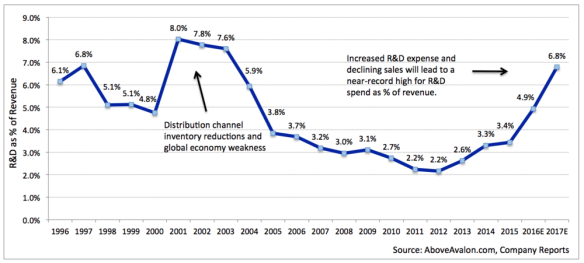
Start up: Google + Apple v PCs, longform reading lives, the hole in US incomes, keep that password!, and more

Google is feeding romance novels into its systems to make them more conversational, darling. Are you feeling _ucky? Photo by Profound Whatever on Flickr.

You can now sign up to receive each day’s Start Up post by email. You’ll need to click a confirmation link, so no spam.

A selection of 10 links for you. But it’s Friday now, so there is that. I’m charlesarthur on Twitter. Observations and links welcome.

Can Google and Apple pull the plug on the PC market? • Thurrott.com

Paul Thurrott:

»where Microsoft’s Windows 10 and Windows phone are still precarious from a mobile app perspective, Apple iOS and Google Android have steadily improved on the productivity app side. Ironically, they’ve done so with Microsoft’s help: The Microsoft Office apps, in particular, not to mention its ever-growing collection of other apps for Android and iOS, are both excellent and full-featured. What Android and iOS are missing, however, are platform features that make those systems more suitable for the traditional productivity tasks that we now perform on PCs.

Surely – surely – those shortcomings will soon be addressed. And it’s not coincidental, I think, that both Google and Apple have shipped in the past six months devices —the Pixel C and the iPad Pro, respectively — that can replace traditional Windows laptops. All that’s missing, of course, is a bit of sophistication in the underlying software.

And sitting here on the cusp of that revolution, we can finally see how Microsoft’s Windows phone and Windows RT failures have deeper ramifications than just the smart phone and tablet markets: It is much easier to improve mobile platforms enough to replace PCs than it is to try and simplify PCs and make them more suitable for mobile usage scenarios. Especially when you have Microsoft helping you on the app side of the equation. Imagine how much of a blocker it would be for enterprises if Microsoft Office wasn’t already available on Android and iOS.

«

There’s a hell of a lot of inertia behind the PC market, with big OEMs with big investments in the PC market continuing; the Pixel C and iPad Pro are both pricier than pretty much all the PCs sold at any time. But there’s something in this: as today’s teenagers grow up, they’ll not want to have to learn Windows.

About an hour after I wrote that, Apple announced an enterprise linkup with SAP – pushing IoS and especially iPads into enterprise. So perhaps Thurrott is right.
link to this extract


Many middle-class Americans are living paycheck to paycheck • The Atlantic

Neal Gabler:

»[In a survey] The Fed asked respondents how they would pay for a $400 emergency. The answer: 47% of respondents said that either they would cover the expense by borrowing or selling something, or they would not be able to come up with the $400 at all. Four hundred dollars! Who knew?

Well, I knew. I knew because I am in that 47%.

I know what it is like to have to juggle creditors to make it through a week. I know what it is like to have to swallow my pride and constantly dun people to pay me so that I can pay others. I know what it is like to have liens slapped on me and to have my bank account levied by creditors. I know what it is like to be down to my last $5—literally—while I wait for a paycheck to arrive, and I know what it is like to subsist for days on a diet of eggs. I know what it is like to dread going to the mailbox, because there will always be new bills to pay but seldom a check with which to pay them. I know what it is like to have to tell my daughter that I didn’t know if I would be able to pay for her wedding; it all depended on whether something good happened. And I know what it is like to have to borrow money from my adult daughters because my wife and I ran out of heating oil.

«

Tell me again how you don’t understand how Donald Trump’s populist neo-fascist calls to bring work back to America strike a chord with some.
link to this extract


A journalist turned content marketer’s take on Dan Lyons’ Disrupted, a Book that hits close to home • LinkedIn

Dan Levy:

»For what it’s worth, here’s what I think happened:

Halligan and Shah [at Hubspot] hired Lyons because they thought it would be cool to have a real journalist in the fold and that he could be an asset to their content team. With the IPO on the horizon, the publicity around the hire wouldn’t hurt either. Once on board, Lyons was passed off to some well-meaning but inexperienced managers who didn’t know what to do with him. Not being someone who plays well with others to begin with – particularly young women whom he views as intellectually inferior – he rejected the quirky, youth-oriented culture that was poles apart from the hardboiled newsroom environment he was used to. He pitched a few ideas for making himself useful but got frustrated when they weren’t picked up. He made some unfortunate enemies – ironically, it was his cartoonish rivalry with the PR woman he calls “Spinner” that really set things off – and was saddled with a jealous boss who made his life miserable. By the time he left the company he’d already scored a gig at HBO and decided to parlay his weird experience into an entertaining, if mean-spirited memoir. He’s a writer after all.

«

There’s a lot more, though.
link to this extract


GM, Lyft to test self-driving electric taxis • WSJ

Mike Ramsey and Gautham Nagesh:

»General Motors Co. and Lyft Inc. within a year will begin testing a fleet of self-driving Chevrolet Bolt electric taxis on public roads, a move central to the companies’ joint efforts to challenge Silicon Valley giants in the battle to reshape the auto industry.

The plan is being hatched a few months after GM invested $500 million in Lyft, a ride-hailing company whose services rival Uber Technologies Inc. The program will rely on technology being acquired as part of GM’s separate $1bn planned purchase of San Francisco-based Cruise Automation Inc., a developer of autonomous-driving technology.

«

City yet to be announced. Detroit?
link to this extract


Longform reading shows signs of life in our mobile news world • Pew Research Center

Ann Mitchell, Galen Stocking and Katerina Eva Matsa:

»A unique, new study of online reader behavior by Pew Research Center, conducted in association with the John S. and James L. Knight Foundation, addresses this question from the angle of time spent with long- versus short-form news. It suggests the answer is yes: When it comes to the relative time consumers spend with this content, long-form journalism does have a place in today’s mobile-centric society…

…The analysis finds that despite the small screen space and multitasking often associated with cellphones, consumers do spend more time on average with long-form news articles than with short-form. Indeed, the total engaged time with articles 1,000 words or longer averages about twice that of the engaged time with short-form stories: 123 seconds compared with 57.1

This gap between short- and long-form content in engaged time remains consistent across time of day and the pathway taken to get to the news story. However, when looking solely within either short- or long-form content, engaged time varies significantly depending on how the reader got to the article, whether it is midday or evening, and even what topic the article covers, according to the study.

«

link to this extract


Google is feeding romance novels to its artificial intelligence engine to make its products more conversational • BuzzFeed News

Alex Kantrowitz:

»“Her blouse sprang apart. He was assaulted with the sight of lots of pale creamy flesh bursting out of a hot pink bra, the cleavage high and perky. It was a gorgeous surprise, all that breast she’d been hiding under her crisp tailored shirts.”

That passage may not turn you on, but it’s certainly working for Google’s artificial intelligence engine.
For the past few months, Google has been feeding text like this to an AI engine — all of it taken from steamy romance novels with titles like Unconditional Love, Ignited, Fatal Desire, and Jacked Up. Google’s AI has read them all — every randy, bodice-ripping page — because the researchers overseeing its development have determined that parsing the text of romance novels could be a great way of enhancing the company’s technology with some of the personality and conversational skills it lacks.

«

Whaaat?

»

And it’s working, too. Google’s research team recently got the AI to write sentences that resemble those in the books. With that achievement unlocked, they’re now planning to move on to bigger challenges: using the conversational styles the AI has learned to inform and humanize the company’s products, such as the typically staid Google app.

«

For reference, look at what happened when IBM fed the Urban Dictionary to Watson. The outcome is what’s known in Fleet Street newspaper parlance as a “reverse ferret”. (Thanks Evelyn Smith for the links.)
link to this extract


Apple hires Google X’s co-founder for its health projects • MarketWatch

Jennifer Booton:

»Apple Inc. may have a solution to quash criticism that it’s lost its innovation mojo. The company recently hired Yoky Matsuoka, the co-founder of Google X, a semi-secret division within Google responsible for things like smart contact lenses and driverless cars.

Matsuoka, who originally moved to the US from Japan to pursue a tennis career but has since earned a Ph.D. in robots from MIT, will report directly to Apple COO Jeff Williams. Williams oversees Apple’s futuristic health initiatives, such as HealthKit, ResearchKit and the new CareKit.

Apple confirmed the hiring to MarketWatch, but did not provide details about her role. Matsuoka’s LinkedIn page has been updated to reflect the move, but she doesn’t list a specific title.

Matsuoka most recently served as CEO of Quanttus, an app that gathers biomedical data, such as blood pressure, so that users can monitor key health trends. Her role at Apple will likely involve the company’s new smart-health initiatives, which includes apps that track health data via Apple Watch.

«

Hiring one person will quash criticism? Some hope. But note the outflow of high-level people from Google X. And what will happen to Quanttus, which got $14m in venture funding in early 2014?
link to this extract


I’m Sorry • Dr. Craig Wright

»I believed that I could do this. I believed that I could put the years of anonymity and hiding behind me. But, as the events of this week unfolded and I prepared to publish the proof of access to the earliest keys, I broke. I do not have the courage. I cannot.

When the rumors began, my qualifications and character were attacked. When those allegations were proven false, new allegations have already begun. I know now that I am not strong enough for this.

«

“Craig Wright now doubts he is Satoshi Nakamoto”.
link to this extract


Alibaba grows to 423m active shoppers • Tech In Asia

»Alibaba’s increasingly mobile shoppers are the latest evidence that China is long past its PC era. People are not just using their phones for reading and games – they’re now doing pretty much everything on those smartphones, from basic grocery shopping to in-store payments to managing an online personal wealth fund.
China as a whole will see 55.5 percent of ecommerce spending done on mobile in 2016, according to projections from eMarketer, so Alibaba’s customers are ahead of the curve. The country is well ahead of America, which remains the United States of PC. Over in the US, mobile commerce will be an estimated 25 percent of total ecommerce this year.

«

link to this extract


The problems with forcing regular password expiry • CESG Site

»The problem is that this doesn’t take into account the inconvenience to users – the ‘usability costs’ – of forcing users to frequently change their passwords. The majority of password policies force us to use passwords that we find hard to remember. Our passwords have to be as long as possible and as ‘random’ as possible. And while we can manage this for a handful of passwords, we can’t do this for the dozens of passwords we now use in our online lives.
To make matters worse, most password policies insist that we have to keep changing them. And when forced to change one, the chances are that the new password will be similar to the old one.
Attackers can exploit this weakness.

«

Finally, finally, a government advisory – from the UK’s spy agency GCHQ no less – which tells us what we all knew but could not complain about because it was Policy.

Start up: Apple’s GPU hiring, Samsung’s VR plan, our changing media habits, streaming $1bn loss, and more


“Look, it’s a smartphone gamer who spends money!” Photo by chris_rivait on Flickr.

You can now sign up to receive each day’s Start Up post by email. You’ll need to click a confirmation link, so no spam.

A selection of 9 links for you. Leaves no sticky traces. I’m charlesarthur on Twitter. Observations and links welcome.

Hardly pocket change: mobile gamers spend an average of $87 on in-app purchases » Slice Intelligence

»There’s a reason why free-to-play games have major advertising campaigns: it turns out,  users spend a lot via in-app purchases. Slice Intelligence just revealed that people who bought products in mobile video games last year spent an average of $87 dollars on their “free-to-play” games. This redefines how we view hardcore gamers: people who purchase games for traditional consoles and PCs spend only $5 dollars more on average on their gaming entertainment.

«

Ah yes, but pay attention to the way that “average” works out. As you might guess, it’s amazingly skewed: loads of people spend nothing, a tiny number spend huge amounts. Here’s what it looks like:

»

Data shows that only 10% of the mobile in-game purchasing population accounts for 90% of mobile gaming sales. Further listening to the statical sonar reveals that the top one percent, the “white whales”, of mobile gamers account for an astonishing 58% of the mobile gaming revenue from in-app purchases. This trend doesn’t occur among traditional games, where roughly 28% of the audience accounts for 90% of game sales.

«

link to this extract


Samsung’s VR Plans Include Standalone Headset, Hand-Tracking Tech » Variety

Janko Roettgers:

»Samsung’s plans for virtual reality go beyond the company’s current Gear VR headset: The company is working on a standalone virtual reality (VR) headset that will incorporate positional tracking similar to the technologies now available on higher-end headsets like the Oculus Rift and HTC Vive, revealed the company’s head of R&D for software and services Injong Rhee during the company’s developer conference in San Francisco Wednesday.

“We are working on wireless and dedicated VR devices, not necessarily working with our mobile phone,” Rhee said. Some of the other features that Samsung is exploring for the next generation of VR headsets is hand and gesture tracking. However, Rhee cautioned that it may take a few more years before we see these kinds of features in devices from Samsung, or anyone else for that matter. “VR is amazing, but the industry is still at its infancy,” he said.

«

link to this extract


Minister says NHS needs more data sharing » UKAuthority

Rob Merrick:

»The UK risks falling behind in the race to use health data to save lives because of protests over privacy, a Government minister has warned.

George Freeman revealed his “frustration” that progress is being held back by a combination of public and media ignorance and, he admitted, “badly communicated policy”.

During a Commons debate, the life sciences minister issued a rallying cry for the widespread use of data to “accelerate the search for cures and to prevent unnecessary suffering”.

Freeman told MPs: “It is all too easy to jump on a bandwagon and launch a campaign to say, ‘No data to be used’. That would profoundly betray those who are suffering from disease today who want their experience to help to prevent disease tomorrow.”

The minister spoke of his “frustrations with the situation”, adding: “The truth is that healthcare is digitalising very fast.

“That is not just driven by commercial app manufacturers. Many doctors are developing apps for their own benefit and that of their patients. Many patients are also developing apps. The revolution is coming.”

«

Not clear that this was sparked by the Google DeepMind/NHS data share, but that has risen up the agenda.
link to this extract


Seven reasons customers are changing faster (and slower) than we thought » Fluxx Studio Notes on Medium

Paul Dawson:

»Every year, OFCOM produces a 200 page report into media habits in the UK. It represents real, mainstream activity — normal mass market customers, not early adopters or insiders. At Fluxx, we use the report as a sense check when designing products and services. This is what stood out this year.

1. Death of the desktop and laptop
“There has been a considerable rise (from 6% in 2014 to 16% in 2015) in the proportion of adults who only use smartphones or tablets to go online, and not a PC/laptop.”

Who’s up? Companies who built responsive websites

Who’s down? Companies who built responsive websites — yes, you read that right. 84% of the adult population still uses their desktop/laptop (sometimes) to go online, but that is not 84% of your customers, and when they use that particular device, they’re choosing it for a reason.

You simply don’t know if they will care, or not care about the degraded/simplified experience that might be implicit in a responsive website design until you get close to them and their needs.

So What? Disregard the generalised stats. Before you make such a big investment decision, get close to your customers to see what they actually need. The answer may be something entirely different…

«

Plenty more, and all worth considering.
link to this extract


The great music biz money pit: How streaming services have lost $1bn » Music Business Worldwide

Tim Ingham audits the financials for all the streaming services (apart from Apple and Google, which don’t publish separately; Google doesn’t even publish subscriber numbers):

»what have we learned?

Well, the biggest independent streaming services in the US and Europe are losing millions of dollars every month (caveat: that’s a bit of an assumption when it comes to TIDAL).

Therefore, they all require gigantic levels of future investment to deal with their cash burn.

Not a huge problem for the likes of Spotify ($1bn recently secured) or Deezer ($110m recently secured).

But when you look at platforms such as Rhapsody/Napster, and its 3.5m subscribers, things look a little more fragile.

(The company took on a $10m loan from Real Networks and an unnamed co-owner last March – money which, according to our net loss analysis, would have lasted it just over three months.)

«

So basically, wait for the dominoes to fall.
link to this extract


Lead water pipes in 1900 caused higher crime rates in 1920 » Mother Jones

Kevin Drum on a new scientific study:

»the effect is consistently positive. “Based on the lowest and highest point estimates,” the authors conclude, “cities that used lead pipes had between 14 and 36 percent higher homicide rates than cities that did not.” They present further versions of this chart with various controls added, but the results are largely the same. Overall, they estimate that cities with lead pipes had homicide rates 24 percent higher than cities with iron pipes.

As a check, they also examine the data to see if lead pipes are associated with higher death rates from cirrhosis and infant diarrhea, both of which have been linked with lead poisoning:

As expected, we observe large, positive, and statistically significant relationships between a city’s use of lead pipes and its rates of death from cirrhosis and infant diarrhea. Unexpectedly, we find that cities that used lead water pipes had higher rates of death from scarlet fever and influenza. Cities that used iron pipes, in contrast, had higher rates of death from circulatory disease, cancer, and cerebral hemorrhage. We know of no scientific literature to motivate these latter relationships.

So it looks like lead really is the culprit, and it really is associated with higher crime rates.

«

The other suspicion is that lead additives in petrol affected crime rates too, but that that’s now tapering off.
link to this extract


Apple increases iPhone prices by steep 29% » The Times of India

»Apple has increased prices of iPhones in India. The surprise revision in retail prices comes at a time when the company’s new device SE got a poor response and managed to sell only a few thousand units. And, the hike is as steep as 29% for the iPhone 6 device. The company also decided to tinker with pricing of iPhone 5S, making it costlier by 22% to nearly Rs 22,000.

Sources said Apple decided to withdraw some of the discounts offered in January-March 2016 period. “It was felt that SE, which was criticized for having a ‘high price tag’, will not be able to see much traction if prices of bigger-sized iPhone 6 and 6S devices are not corrected. So, the decision was taken to revise the price upwards,” a source said.

«

I missed this originally (it’s datelined April 23). It’s either madness, or supreme confidence, to raise prices like this – a decision made ahead of the rejection of imported refurbished iPhones earlier this week.
link to this extract


US woman forced to provide her fingerprint to unlock seized iPhone » Ars Technica UK

Cyrus Farivar:

»A Southern California woman was recently ordered to provide her fingerprint to unlock a seized iPhone, according to a report by the Los Angeles Times.

The case highlights the ongoing balancing act between security and convenience and how the law treats something you know (a passcode) as being quite different than something you are (a biometric). Under the Constitution, criminal defendants have the right not to testify against themselves—and providing a passcode could be considered testimonial. However, being compelled to give up something physiological or biometric (such as blood, DNA sample, fingerprint or otherwise), is not.

As the Times reports, Paytsar Bkhchadzhyan was ordered by a federal judge to provide her fingerprint on February 25, and the warrant was executed and unsealed on March 15.

«

The long gap between the warrant and its execution probably means that she wasn’t aware of it; the police served it on her on the 14th or 15th. Any longer than 48 hours since using the passcode would mean fingerprint unlock wouldn’t work.
link to this extract


Apple hiring in Orlando amid rumors company designing own GPU » Business Insider

Kif Leswing:

»Graphics experts who want to work for Apple might not need to move to California. The company is currently hiring several graphics-chip specialists in its Orlando, Florida, offices.

In the past week, Apple has posted seven new job listings for graphics-processing unit (GPU) engineers in Orlando. Four of the positions are listed as graphics-verification engineers and one listing is for a graphics-software engineer, and Apple is also looking for a graphics RTL (register-transfer level) designer.

«

Virtual reality and augmented reality systems both need high-quality GPUs. Just sayin’.
link to this extract


Errata, corrigenda and ai no corrida: none notified.