What strange goods and services is your state researching on Google? Apparently California has been looking into the price of facelifts, tummy tucks, swimming pools and marriage licenses, while Oklahoma is curious about the cost of breast lifts, liposuction, gas and daycare, according to Fixr.com, a cost-estimating website.
Fixr created the map below with Google Autocomplete, typing “How much does * cost in Sacramento, California?” into Google for each state or state capital, and then marking down the most commonly searched-for good or service.
Sharp Corp is cutting more than 10% of its Japanese workforce starting in April, according to a Nikkei report.
The embattled electronics manufacturer will slash about 3,000 jobs through voluntary retirements and expects to book about 30bn yen ($250m) in retirement-related expenses for 2015, the business daily said.
Sharp’s could also shed its North American television business as part of its plans to restructure operations in unprofitable businesses, the Nikkei said.
What does this mean ?
It means that YouTube have been using loudness normalisation on their music videos – and they’ve been doing it since December last year. Everything plays at a similar loudness, regardless of how it was mastered. And no-one has noticed.
Hear it for yourself – this playlist is composed almost entirely of current releases, with a wide variety of loudness on CD – and some of them are REALLY loud:
So for example, at the more dynamic end of the spectrum, Mark Ronson & Bruno Mars’ massive hit ”Uptown Funk” measures -12 LUFS (DR 8 on the TT Meter) on CD. Whereas “Love Me Like You Do” by Ellie Goulding is squashed up to -8 LUFS (DR 5) on CD, and later in the playlist, Madonna’s “Living For Love” clocks in at an eye-watering (and heavily distorted) -7 LUFS (DR 4!)
But on YouTube, all of them are being played back at a similar loudness of roughly -13 LUFS.
What this means is that songs with greater dynamic range – from quiet to loud – will be able to stand out. And those which just crank the volume to 11 won’t.
Interesting too that as with app review, Google has quietly done this and made no noise about it.
Website advertisement companies have found a way to circumvent the protections introduced in iOS 8 to stop users from being kicked to the App Store because of certain cleverly-coded JavaScript advertisements.
I am now experiencing this myself, and it makes browsing on the iPhone unusable. Browsing to websites such as Reddit and Reuters and others now automatically open the App Store. In many cases, there is no way for me to read the actual content on the pages. You can see this happen in this video.
The sites he has problems with – Reddit, Macstories, Venturebeat, and more – load OK on the iPhone I’m using, but after the page has loaded the “data” dial keeps spinning, which implies it’s trying to load something. Mayo might have something set up differently. And this is definitely a problem. It also affects Android users. The blame is clearly on unscrupulous advertisers.
I looked at trends in the weights, volumes and densities of Apple laptops:
when you start adding in the data about various laptop launches, trying to focus on the ones which are 12in or 13in (so that the screen size, and hence weight, is comparable), you find a definite trend.
It’s this: if we were relying on straight-line trends, we’d have weightless MacBooks by 2017. Yes. Perhaps they’d be airtight and filled with helium? Why not?
In parallel with Android’s game session growth, CPIs (Cost Per Install) — which can be used an approximation for lifetime value (LTV) — have surged by 41% from February 2014 to February 2015.
As we all know, app installs have become a major business. And as mobile gaming continues to be the leading driver of mobile revenues, a shift of gaming sessions in Tier 1 markets could be an early indicator of Google Play approaching parity with the iOS App Store.
It’s not a huge surprise to our CEO and co-founder Maria Alegre who says that over the past year she’s noticed developers have been thinking about more than one platform when launching campaigns. “While iOS has typically been where game developers start with user acquisition, we see the window of exclusive focus on iOS shrinking,” she says.
Alegre believes 2015 will indeed be the year where Android becomes more relevant than iOS. Though iOS will continue to have higher unit economics, the differences between iOS ARPU (Average Revenue Per User) and Android ARPU are shrinking — while Android’s mobile game sessions are growing month over month. “That combination of higher traffic and smaller difference between ARPU will make Android overall a more attractive business opportunity,” she predicts.
The report covers North, South and Central America. Not surprising that Android total sessions would pass iOS, since once you add in south and central America, Android ownership hugely outnumbers iOS (most of which will be in the US and Canada). (The full country data – available through the report – shows some weird changes, such as huge increase in iOS gameplay in Spain and Finland. Go figure.)
The surprise is in the suggestion that Android ARPU in the Americas is approaching that of iOS, since you’d expect many of the new Android users to be non-premium. Either iOS ARPU is falling generally, or something odd is happening with Android premium.
Jonathan Deutsch came to my notice through a fantastic, simple app called Hyperedit (which lets you write HTML/PHP/CSS code and see it directly rendered in an adjacent screen). Since then he’s been employed by Apple, and then left Apple, and now has Tumult Hype Pro, which uses HTML5 capabilities.
I wish I were capable enough to use this program to anything like its capabilities.
I never thought this whole tech journalism gig would turn me into a mass murderer. Yet here I am, with the blood of six SSDs on my hands, and that’s not even the half of it. You see, these were not crimes of passion or rage, nor were they products of accident. More than 18 months ago, I vowed to push all six drives to their bitter ends. I didn’t do so in the name of god or country or even self-defense, either. I did it just to watch them die.
Technically, I’m also a torturer—or at least an enhanced interrogator. Instead of offering a quick and painless death, I slowly squeezed out every last drop of life with a relentless stream of writes far more demanding than anything the SSDs would face in a typical PC. To make matters worse, I exploited their suffering by chronicling the entire process online.
Brilliant idea for an article, spread over nearly two years, which also provides truly useful info. Those things really last ages.
Two San Francisco judges separately ruled last week that suits filed by drivers of the ride-sharing services should go before juries. At issue in both cases is whether drivers, who are employed as independent contractors, should be considered employees of those firms, and thus entitled to the protections afforded most full-time workers.
A verdict that required Lyft or Uber to reclassify their drivers as employees would throw a wrench in business models that have commanded large investments and valuations. Last week, Japanese e-commerce giant Rakuten led a $530m round of funding for Lyft, helping to boost its valuation to more than $2.5bn. Uber, which is much larger, has raised more than $5bn in funding and is valued at more than $41bn.
Should the cases proceed to trial, the resulting verdicts could also set a legal precedent about how many workers should be classified in the so-called on-demand economy. That could come as welcome news for employment lawyers and others charged with figuring out whether the workers who fulfill Instacart orders, drive UberX passengers, clean homes for Handy clients and perform other tasks assigned by apps should be considered independent contractors or actual employees.
Watch these ones. Though whichever way the verdicts go they probably won’t be the last.
Chris Stoner is director of product management at Yahoo:
We’ve made the steps easy to follow – check them out below.
1) Sign in to your Yahoo.com account.
2) Click on your name at the top right corner to go to your account information page.
3) Select “Account Security” in the left bar.
4) Click on the slider for “On-demand passwords” to opt-in.
5) Enter your phone number and Yahoo will send you a verification code.
6) Enter the code and voila!
And the next time you sign-in, we’ll send a password to your phone when you need it to log in. On-demand passwords is now available for U.S. users. Try it out today!
What if I lose my phone? Or I’m abroad? Do normal passwords not work any more? Not clear and not answered anywhere I can find.
Apple is preparing to launch another program to boost iPhone sales in its stores, a stated goal of CEO Tim Cook.
According to sources, Apple will soon introduce a new recycling and trade-in program that will accept non-Apple smartphones, notably including Android devices, in exchange for gift cards to be used toward the purchase of new iPhones. In continuing to court Android switchers, Apple will use a similar system to the one it uses to repurchase iPhones, whereby Apple Retail Store employees determine trade-in values for devices by considering their cosmetic and functional condition.
The new program will begin in the coming weeks, following extensive training programs for retail store employees that will begin later this week. Apple employees will be able to transfer address book contacts from the rival smartphones to the iPhones, but other data will have to be moved by customers.
Two points: 1) we’ve pretty much arrived at “in Gurman we trust”, right? 2) trying to grab rival platforms’ users is the mark of a saturated market – which the US smartphone market increasingly resembles.
in the world of Big Data, everything means something. Cornerstone OnDemand, a company that sells software that helps employers recruit and retain workers, analyzed data on about 50,000 people who took its 45-minute online job assessment (which is like a thorough personality test) and then were successfully hired at a firm using its software. These candidates ended up working customer-service and sales jobs for companies in industries such as telecommunications, retail, and hospitality.
Cornerstone’s researchers found that people who took the test on a non-default browser, such as Firefox or Chrome, ended up staying at their jobs about 15 percent longer than those who stuck with Safari or Internet Explorer. They performed better on the job as well. (These statistics were roughly the same for both Mac and PC users.)
Why? Perhaps, the company hazards, because it means they’re “non-default”, and so are an “informed consumer”. (Other datum: “people who use “boozy” or “sexy” in their email addresses make for worse employees.”)
In a blog post announcing the addition of another Superfish clean-up tool, Microsoft’s security team said that the number of infected PCs detected by its software peaked at around 60,000 on Feb. 21, slumped slightly over the next two days before falling precipitously. By Feb. 25, the daily number of infected PCs encountered by Microsoft’s tools had dropped to around 3,000, sliding further over the next several days to what appeared to be less than 1,000 each day.
All told, Microsoft implied that about a quarter of a million Lenovo PCs were cleansed of Superfish between Feb. 20 and March 4.
Useful to know how many “consumer” PCs Lenovo sold over the course of three months or so, which this in effect is.
We recently became aware of a device known as an IP Box that was being used in the phone repair markets to bruteforce the iOS screenlock. This obviously has huge security implications and naturally it was something we wanted to investigate and validate. For as little as £200 we were able to acquire one of these devices and put it to work.
Although we’re still analyzing the device it appears to be relatively simple in that it simulates the PIN entry over the USB connection and sequentially bruteforces every possible PIN combination. That in itself is not unsurprising and has been known for some time. What is surprising however is that this still works even with the “Erase data after 10 attempts” configuration setting enabled.
Our initial analysis indicates that the IP Box is able to bypass this restriction by connecting directly to the iPhone’s power source and aggressively cutting the power after each failed PIN attempt, but before the attempt has been synchronized to flash memory. As such, each PIN entry takes approximately 40 seconds, meaning that it would take up to ~111 hours to bruteforce a 4 digit PIN.
Multiply by 10 for each extra digit on your PIN; use a password instead. (Clever, cutting the power before the write-to-memory.)
The number of generic top-level domains (gTLDs) available for use has climbed into the hundreds, and “.sucks” will soon be added to the list. However, angry customers eager to get their hands on brand-specific domains like “bestbuy.sucks” or “comcast.sucks” shouldn’t get their hopes up; according to MarketingLand, the domains will cost far more than most consumers will want to pay.
The pricing situation around .sucks domain names is complicated. Companies with registered trademarks will have to pay an astounding $2,499 to register their trademarked names in .sucks. Registration of non-trademarked names during the “sunrise” period (March 30 until June 1) before .sucks goes live will cost at least $199 per name, while the standard registration fee after June 1 rises to $249 per name.
Companies are typically hyper-sensitive about brand usage, and few will want their .sucks domains under someone else’s control. The .sucks pricing scheme has led to outrage from many quarters, with MarketingLand’s writeup quoting several industry figures who use words like “extortion” and “predatory.”
In a world with any more than zero working search engines, TLDs are next to pointless, and the exotic ones like .sucks amount to nothing more than legitimised extortion schemes against companies worried about attacks on their brand.
Bernstein Research and Deutsche Bank expect [the] S6 to boost the company’s bottom line.
“For our thesis on Samsung Electronics, the S6 does not need to be a mega-success; even a further decline to 27% market share in the premium segment would be more than enough,” Mark Newman at Bernstein Research said.
“We believe the unveiled phone is sufficient to deliver and has the potential to beat that modest expectation. Furthermore, we think the components side of the S6 is more positive for Samsung’s earnings direction with the processor moving internal (saving potentially $28 per phone), significantly more memory (DRAM and particularly NAND) and the display showing off their technology lead in flexible OLED.”
Han Seung-hoon at Deutsche Bank said Samsung’s strategies for diversified pricing on the S6 according to memory storage capacity like Apple will help its semiconductor division see a big divisional increase.
Apple seems to be having a strong quarter – analyst expectations are for well over 50m sales (compared to 43.7 in Q1 2014). Last year Samsung shipped 85m smartphones.
the iPhone is going to fail because its design is fundamentally flawed. The designers and technophiles who encouraged development of the iPhone have fallen into the trap of all overreaching hardware and software designers; thinking that their users are like themselves. As I expound in great detail in my book Why Software Sucks (Addison-Wesley, 2006, http://www.whysoftwaresucks.com) your user is not you. The iPhone’s designers have forgotten this fundamental law of the universe. The market will severely punish them for doing so.
I have three specific reasons why the iPhone’s design will cause it to crash in flames the way Apple’s late and unlamented Newton did, only much more loudly and publicly because of all the hype it’s gotten.
Jeremy Hillman’s son ran up thousands of dollars on Xbox Live buying “players” for FIFA at a hundred dollars a pop:
So these are my questions to Microsoft on behalf of the thousands and thousands of parents who have fallen into this same situation (you can see online that this isn’t a rare occurrence and Microsoft employs its many escalation analysts for a reason).
With all the brilliance of your engineers and sophisticated systems to protect data how hard could it be to put a realistic ceiling on what can be spent on in-app purchases before the credit card details and security code need to be re-entered? Most Apple iTunes purchases need a password to be re-entered for each new purchase.
How many users legitimately spend thousands of dollars on in-app purchases and just how much usage would it actually take for you to flag this as unusual behaviour and require confirmation that the purchase is legitimate? Banks and credit card companies regularly do this — there can’t be many reasons you don’t.
Might just want to check your credit card statement, parents.
Both Google and Amazon long have designed their own racks, servers and switches in their data centers, contracting with Asian manufacturers for production. They see their hardware designs as a competitive advantage, keeping them under wraps. Neither are in the Open Compute Project [which Apple has joined].
Facebook also designs its own data center equipment but started much later than Amazon and Google. By helping found the Open Compute Project, it has a chance to catch up. In the group, Facebook released its designs for servers and switches publicly and invited others to do the same. Microsoft, Intel, IBM and others eventually joined. The idea was that lots of companies working together can build better data centers cheaper.
“There’s this industry pattern I’ve come to observe: Open when you’re behind, closed when you’re ahead,” said Christopher Nguyen, CEO of Adatao and former engineering director of Google Apps.
That last point is so insightful, and worth bearing in mind. The article meanwhile confirms that Apple outsources some of iCloud’s services to Microsoft (Azure) and Amazon (S3).
Just in case you were getting comfortable with the YouTube app’s latest design, it looks like there may be more changes in store. It seems a number of users are encountering a new YouTube interface, apparently triggered server-side without an app update.
The change sees YouTube’s hamburger menu flipping right out of the interface, going the way of Google+ in discarding the left-side navigation drawer. Instead, users are given four primary tabs – Home, Trending, Subscriptions, and your profile. Interestingly, a couple of these tabs seem to have bars underneath to switch from, say, all videos to music on the home tab, or from uploads to channels on the subscription tab. Besides these changes, things are ostensibly working just like before.
Apple doesn’t like hamburger menus (those three lines at the top left or right of a screen where “other options” are available): here’s a summary of a WWDC 2014 talk about it – from which they key extract is
Remember, the three key things about an intuitive navigation system is that they tell you where you are, and they show you where else you can go.
Hamburger menus are terrible at both of those things, because the menu is not on the screen. It’s not visible. Only the button to display the menu is. And in practice, talking to developers, they found this out themselves.
BlackBerry introduced a modified Samsung Electronics Co. tablet computer that lets government and corporate users access consumer applications such as YouTube and WhatsApp while keeping confidential work-related information away from spies and crooks.
The €2,250 ($2,360) SecuTABLET will be available by the third quarter, Hans-Christoph Quelle, head of BlackBerry’s Secusmart unit, said in an interview Sunday. More than 10,000 units will be shipped annually in Germany alone by next year, with a higher number sold by IBM, which is handling sales to companies worldwide, he said.
The SecuTABLET combines Samsung Electronics’s Tab S 10.5 with Secusmart’s microSD card and IBM software to wrap applications that hold sensitive data into a virtual container where they can’t be harmed by malware. Germany’s computer-security watchdog is evaluating the device for classified government communication and will probably give its approval before the end of the year, Quelle said.
I’m not sure in what sense BlackBerry “introduced” this. Its tieup with Samsung seems to be as an MDM (mobile device management) vendor. Samsung makes the hardware, IBM does the virtualisation, BlackBerry does the..?
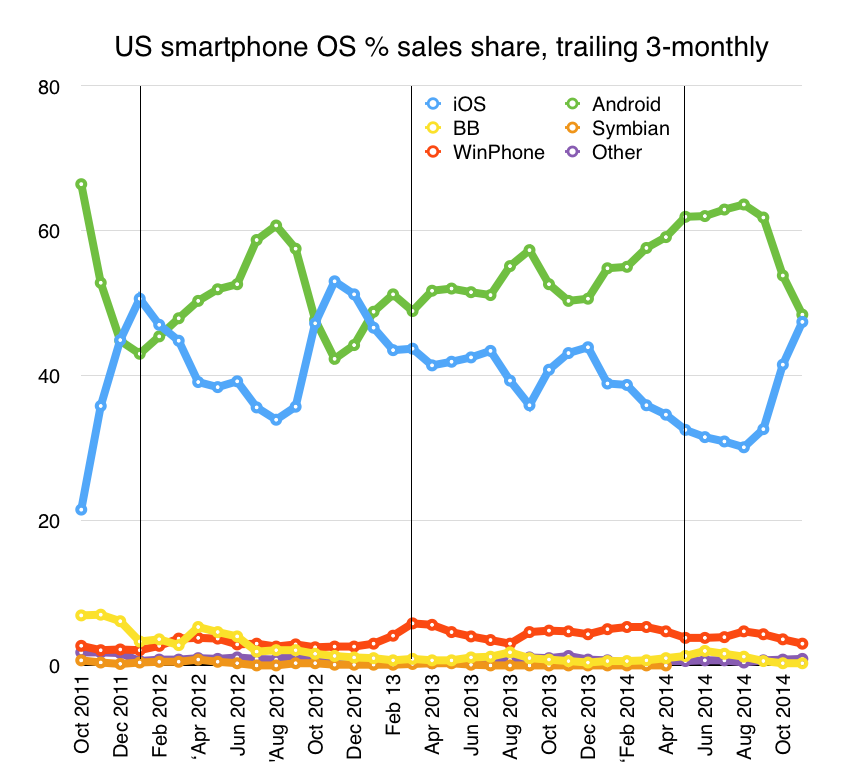
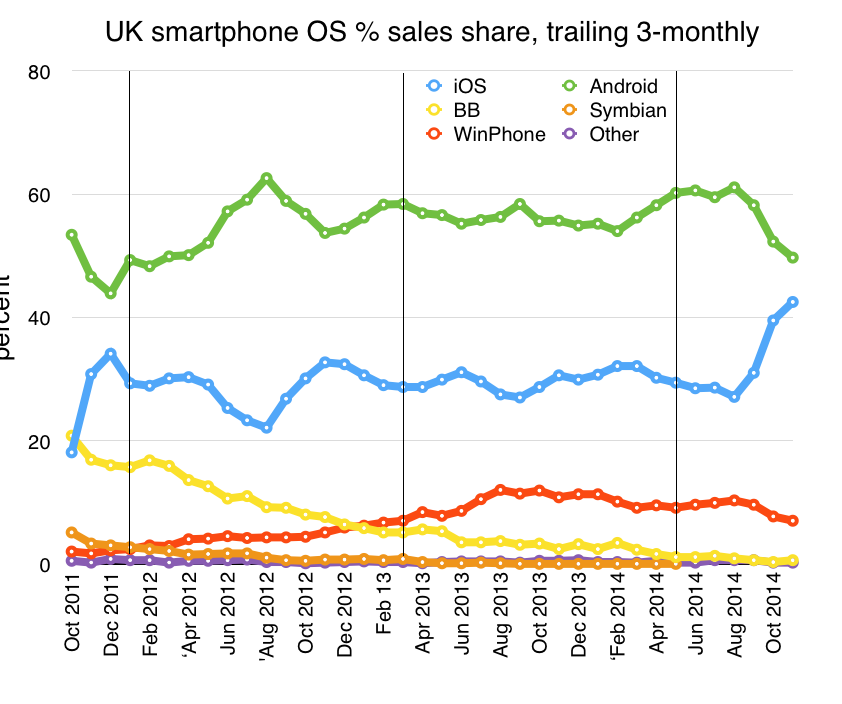
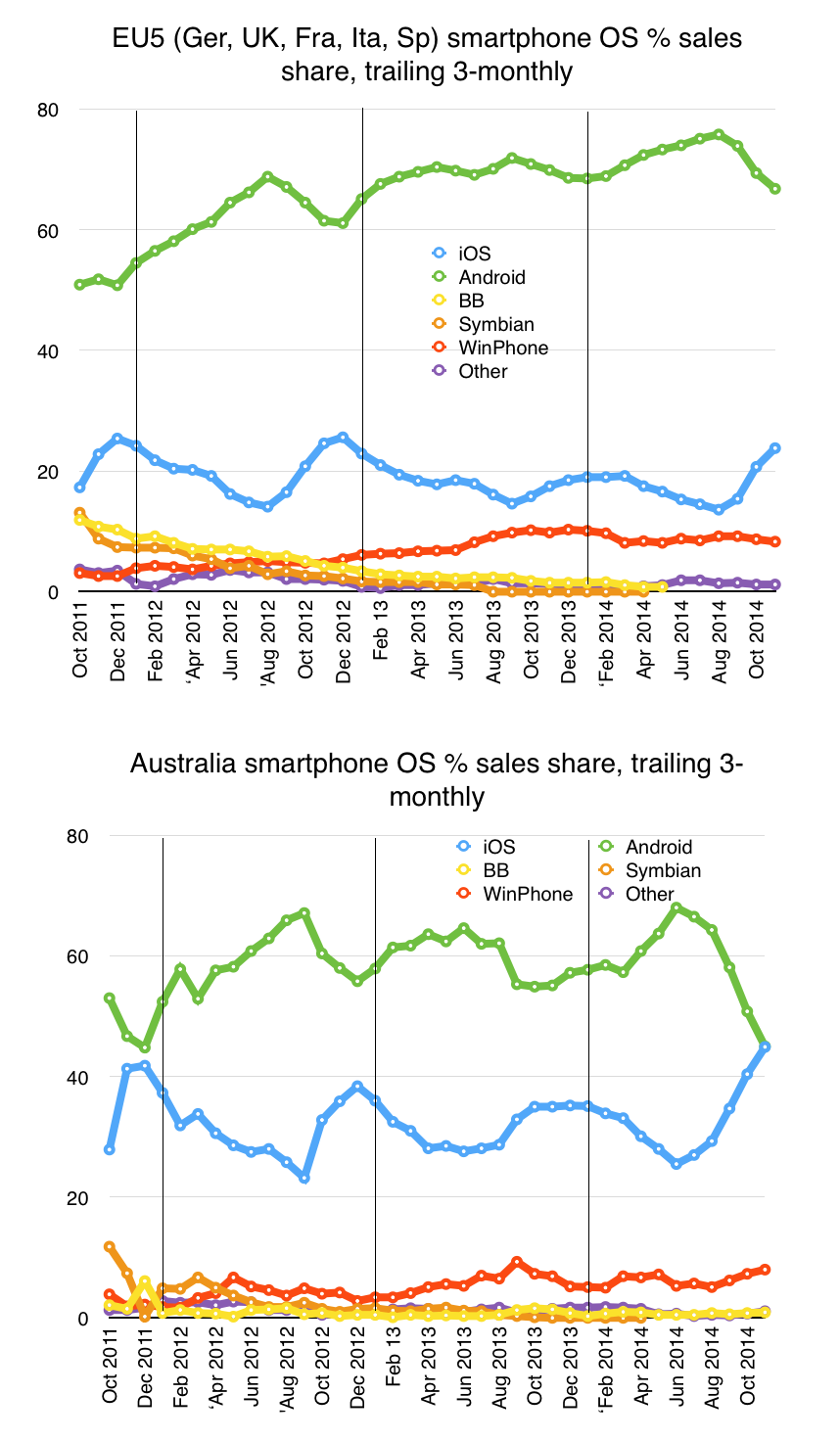
Kantar ComTech Worldpanel’s latest numbers for smartphone sales share are out (or dig the groovy but very dark animation), and pretty much as expected they show that iPhones have had a terrific time in sales terms for the three months to the end of November – so that covers September, October, and November, basically all the time that the new range has been on sale.
My only frustration with Kantar is that it doesn’t index the numbers from year to year; there’s no way to know if sales in 2014 are lower, higher or the same than the previous year or year before. You might think that because more people own smartphones that volume must be increasing, but it’s not necessarily the case; GfK data suggested that mobile phone sales value fell in Christmas 2013 compared to 2012, though increased in 2014 (helped, one suspects, by the Apple phones).
I’ve asked Kantar previously to include an indexing figure (eg 2012 = 100, 2013 = 105, ie 5% greater in sales volume) with these numbers, but they haven’t. (In a future post I’ll try estimating this from general levels of mobile sales from quarter to quarter, and country populations and smartphone shares.)
In the absence of that, we just have the graphs – which I’ll put below. But there’s a much more interesting story which hasn’t been picked out of the press release, though they put it in there. It’s about the refuseniks: the people who have a featurephone, but are determined not to move to a smartphone.
Data from Kantar. iPhone share is high, but not as high as the iPhone 5 launch. (No comparative data on volumes, however.)
UK smartphone sales share to end November 2014, from Kantar; iOS share is highest ever recorded
Share of smartphone sales for three months to end November 2014, via Kantar. (EU5 = Germany, UK, France, Italy, Spain = 184m smartphone users; Australia = 16.4m smartphone users)
(Note among all these that Windows Phone is still not making anything resembling progress; nor is “other”, though Firefox phones are few and very far between in these countries. The smartphone platform space is played out.)
Here’s the most interesting part, left to the very last paragraph of the release:
Smartphone penetration reached 58% in the US and 65% across Europe’s big five economies. “While die-hard featurephone owners state they are not planning to buy a smartphone in the next 12 months, they might not have a choice as vendors continue to transition their portfolio away from featurephones to smartphones”, concluded [Kantar head of research Carolina] Milanesi. Forty-seven percent of featurephones owners looking to change their current device in the next six months in the US and 35% across Europe’s top five [countries] are not planning to upgrade to a smartphone.
Once again: 47% and 35% of featurephone owners in the US and EU5 (Germany, UK, Italy, Spain, France) who are looking to change device won’t go to a smartphone.
Now, you could flip those numbers over: out of all (remaining) featurephone owners, 53% in the US and 65% in the EU5 may go to a smartphone in the next six months. It’s only “may” because they haven’t said they will, only that it isn’t definite they won’t.
The longrunning ComScore data in the US, meanwhile, which tracks installed base, shows that at the end of October there were about 65m featurephone users remaining there. For the UK, I calculate that smartphone penetration of mobile phone users is now 80.2% – based on the data and calculations I did for a piece last April using Kantar’s data.
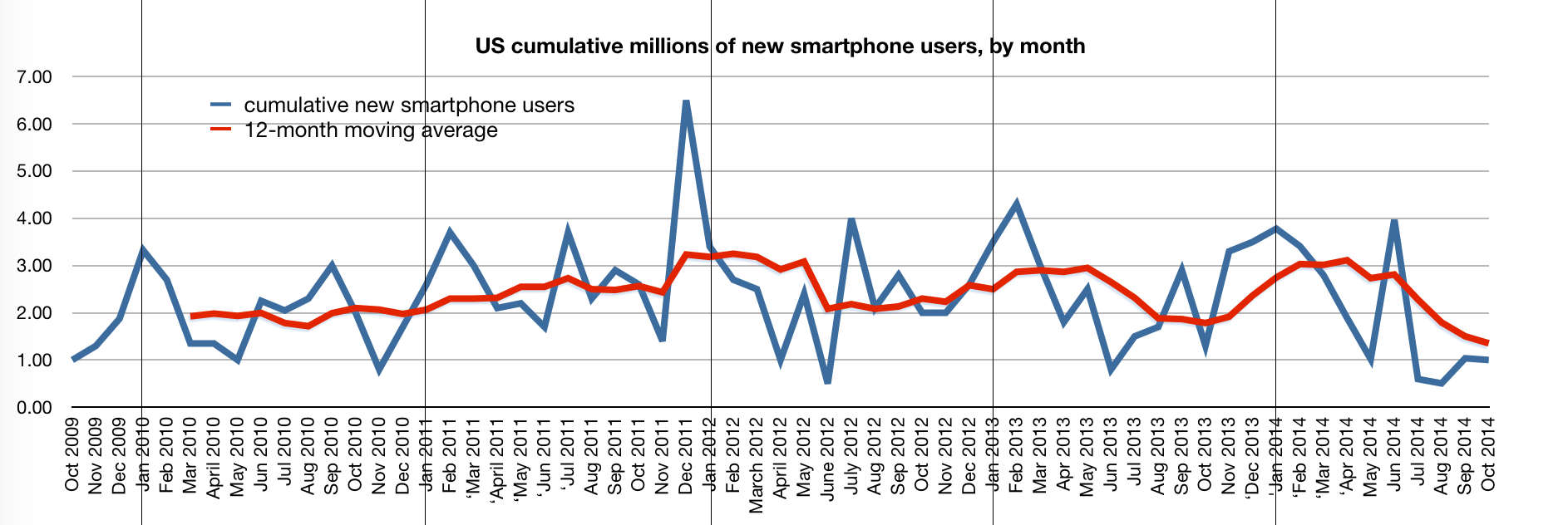
In the US, the number of featurephone users converting to smartphones had been fairly constant, at a few million per month, but as the graph below shows, it nosedived during 2014 (the data only goes up to the end of October) – indicating that fewer are shifting up to smartphones.
Data calculated from ComScore, showing how many featurephone users shifted to smartphones in the US. The trendline seems to have fallen off in 2014.
And indeed, why would you shift to a smartphone in the US if you don’t particularly need one, given its crazy system where you pay a huge per-month fee for the phone, and then for carrier service, and then for data, and then perhaps for “extras” (loosely defined)?
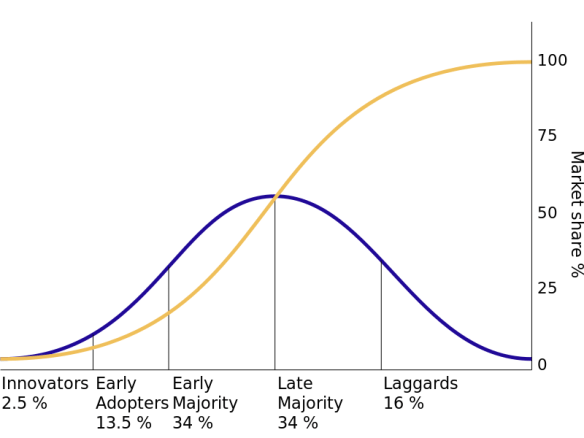
Thus we may now be at the point where the only ones without smartphones are the refuseniks – the people who don’t want a smartphone. In other words, we’re hitting the “laggards” – the 16% who don’t care. Given that the best fit for the data suggests smartphone penetration will top out at 92%-95%, and with 80% already using them (in the UK), we’re clearly in laggard territory.
Stages of adoption of innovations. Source: Wikipedia
What does this mean? Mostly, that selling more phones becomes a battle where the existing smartphone platforms try to win people over from their rivals, while there’s also a gradual accretion from the last featurephone holdouts – who, as Milanesi says, might find they have barely any choice when it comes to replacing their dead one.
For BlackBerry, this is almost played out; it’s down to something like 40m users worldwide, of whom perhaps 8m are consumers and thus remain to be poached.
For Windows Phone – well, it’s unclear quite what’s happening there. The numbers sold remain consistently small, and low-end, and there just doesn’t seem to be a lot of movement. There’s some anecdotal suggestions that many of the low-end ones are used as sort of semi-smartphones, with pay-as-you-go contracts and little use made of their internet capabilities.
Android and iOS
The more interesting flow, aka churn, is between iOS and Android, and Android and iOS: in percentage terms for the three months, 11% of iPhone buyers were previously Android users; and 13% of Android buyers were previously iPhone buyers.
I know – the simplistic view would be that iOS is losing users overall. Except the numbers don’t work out that way; there are more Android users than iPhone users in the US (92m v 73.7m), so that iOS is actually gaining users.
Here’s how: • 13% of 73.7 = 9.6 iPhone users shifting to Android;
• 11% of 92 = 10.1 Android users shifting to iOS.
Assume that the number of people changing phone is proportional to the total installed base at any time (which is likely), and the iPhone user base grows – just.
Even so, that churn must be a concern to Apple. Maybe the new screen sizes of the iPhone 6 and 6 Plus will reduce that, or perhaps it’s inherent in the dynamics of smartphone platforms.
Meanwhile, if you know a refusenik, do ask them what they’ll do when their phone breaks. Smartphone without data? Buy a featurephone on eBay?
Whatever; it’s unlikely the refuseniks are going to make a big impact now. In the developed world, the smartphone platform wars are so played out.
Never has the gap between a flawless technology experience and a closed ecosystem loomed as large as the gap between the Amazon Echo and the Ubi personal computer. While Amazon’s Echo works beautifully and is a gorgeous cylinder that is ready to hear and (attempt to) obey my every command from pretty much anywhere in the room, it fails because its abilities to connect with a variety of web services are very limited.
Meanwhile, the Ubi, a voice-activated computer that is older and, yes, much more painful to use, wants to do the same thing. Like a teenager, though, it isn’t adept at listening to my commands, sometimes awkwardly interrupting my conversations, and its music playback is not nearly as graceful as the Echo’s.
Pays money, takes choice (or don’t spend the money at all).
How times change… Today’s new iPad Air 2 experience consists of 23 or more steps and no less than three iCloud services (iCloud, iCloud Drive, & iCloud Keychain). In contrast, today’s new Android Nexus experience consists of only 8 steps but with a mandatory 234MB update (some things don’t change). Here’s both start experiences in detail.
You can argue this lots of ways. Apple offers TouchID, Apple Pay, Find My iPad, iMessage – and asks about using location services. Google stuffs many of those into a single screen. Wroblewski doesn’t give a “time taken” for the setup; that might be as useful.
Great piece on a smartphone tragedy of the commons, by John Rogers:
Killeen said her four-mile commute to UCLA, where she teaches a public relations class, can take two hours during rush hour. “The streets on the west side are no longer a secret for locals, and people are angry,” she said.
That’s because the app can’t be outsmarted, Waze spokeswoman Julie Mossler said.
“With millions of users in LA, fake, coordinated traffic reports can’t come to fruition because they’ll be negated by the next 10 people that drive down the street passively using Waze,” she said.
Besides, Mossler added, “people are inherently good,” meaning most wouldn’t really screw with the app, no matter what they might say.
Indeed, of all the angry people interviewed for this story, none would admit doing so, although most said they heard someone else had.
One does have to wonder a little why Killeen doesn’t walk, cycle or get a motorbike for that four-mile commute.
Chinese smartphone upstart Xiaomi, which this year grabbed Samsung’s No. 1 spot in China with its low-cost smartphones, revealed startlingly-low profits in a filing to the Shenzen stock exchange on Monday, Reuters reported.
The company earned $56m in net profit in 2013, on sales of $4.3bn. That’s an operating margin of just 1.8%, razor-thin when compared to Apple’s operating margin (which was 28.7% in 2013) or even Samsung’s (18.7%), which are being forced down by low-cost Indian and Chinese vendors like Xiaomi.
Eyebrows now raised at the WSJ report from earlier which said Xiaomi made a profit ten times that in 2012. Either the WSJ had the wool pulled, or Xiaomi is expanding dangerously fast. A spokesperson for Xiaomi said this “didn’t represent the whole company”, which somewhat contradicts its filing.
Lots to digest here (two months after the end of the third quarter): the continuing, rapid drop in featurephone sales, which particularly hurt Samsung; the growth of Huawei, ZTE and Xiaomi; that BlackBerry is still bumping along, managing 2.4m sales “to end users” in that period by Gartner’s numbers.
To own Box stock, you have to believe they will retain their customers for a really long time to pay back the acquisition costs and/or significantly increase their revenue per customer. It is hard to make this case and Box notably doesn’t make much of an effort.
How will Box extract significantly more revenue per customer? They have neither moat nor unique technology (unless you count their “which one of these things isn’t like the others” participation in the Linux Foundation’s Dronecode Project). They don’t have an operations at scale cost advantage. Their “platform ecosystem” is superficial at best. They face giant competitors like Apple, Google and Microsoft with untold billions in the bank who are happily giving cloud-based storage away as a complement to their other services, as well as Dropbox which continues to ooze into the enterprise with a bottoms-up strategy which has dramatically lower customer acquisition costs. Box is still doing the same thing it always has, even as the market has evolved. They no longer have the luxury of just highlighting SharePoint’s inadequacies. Some argue Microsoft’s refusal to support Android and iOS has been the singular Box value proposition – obviously, that is a window that has closed.
Q :How does iCloud Photo Library save space on my device?
A: If you turn on Optimize [device] Storage, iCloud Photo Library will automatically manage the size of your library on your iOS device, so you can make the most of your device’s storage and access more photos than ever. iCloud Photo Library stores the original, high-resolution photos and videos in iCloud and can keep lightweight, device-optimized versions on each of your devices. As long as you have enough storage, recent photos and videos that you access the most will stay on your device at full resolution.
You can turn on Optimize [device] Storage from Settings > iCloud > Photos or Settings > Photos & Camera > iCloud Photo Library on your iPhone, iPad, or iPod touch. You need an Internet connection to access an original photo or video that’s stored only in iCloud.
As Mark Rogowsky points out, this is the way to free up space on iOS devices while also letting you see the photos you’ve taken.



 The Overspill: when there's more that I want to say
