Start up: Android Wear on iOS, will Slack kill Dropbox?, India v Google, after the adblockers, and more


One other piece of technology – besides the lifejackets and boat – probably kept them alive. Photo by Irish Defence Forces on Flickr.

A selection of 9 links for you. Blimey, it’s September (here at least). I’m charlesarthur on Twitter. Observations and links welcome.

Android Wear now works with iPhones » Official Google Blog

David Singleton, director of engineering for Android Wear:

When you wear something every day, you want to be sure it really works for you. That’s why Android Wear offers countless design choices, so you can find the watch that fits your style. Want a round watch with a more classic look? Feel like a new watch band? How about changing things up every day with watch faces from artists and designers? With Android Wear you can do all of that. And now, Android Wear watches work with iPhones.

Android Wear for iOS is rolling out today. Just pair your iPhone (iPhone 5, 5c, 5s, 6, or 6 Plus running iOS 8.2+) with an Android Wear watch to bring simple and helpful information right to your wrist.

Key problem – and I think it will be a problem – is that it won’t be able to show reply to iMessages on the Wear watch. And iMessage is a huge part of using an iPhone (demonstrated by the volume sent each day), and, in my experience, the Apple Watch. The picture in the blogpost shows Google Hangouts; if you’re that dedicated to Hangouts, you’ll be on Android. Also: no third-party (Android Wear, nor, obviously, iOS) apps. Harry McCracken has a useful rundown – mostly of what it doesn’t do on iOS – at Fast Company.

So this might goose Android Wear watch sales a little, but I don’t see it lasting.
link to this extract


Dropbox: the first dead decacorn » Thoughts from Alex Danco

Slack (the workplace collaboration tool) is going to kill it, Danco reckons:

The problem for Dropbox is that our work habits are evolving to make better use of what’s available; specifically, the awesome power of the internet. And on the internet, the concept of a ‘file’ is a little weird if you stop and think about it. Files seem woefully old-fashioned when you consider organization tools like Evernote, task management tools like Trello, and communication channels like Slack. Files are discrete objects that exist in a physical place; the internet is … pretty much the opposite of that. And while it made sense that the birth and early growth of information and the internet would contain familiar, old-school ideas and organizing systems, and some point the other shoe was bound to drop. To me, Slack feels like the first truly internet and mobile-native productivity platform – especially as it expands beyond messaging and into workflow automation, helper bots, and who knows what else. Dropbox might be the pinnacle of file management, but Slack is the beginning of what comes next.
  
I don’t think files are going to completely disappear; not anytime soon, anyway. They’ll certainly still exist as data structures, deep inside our servers and our phones, for a very long time – and yet most people will be indifferent to their existence. I’m pretty sure Dropbox’s multi-billion dollar valuation isn’t an anticipation of this new reality – it’s simply a projection of our current world, played in fast-forward. This is gravely shortsighted. Dropbox may not be the first Unicorn to slide slowly and then quickly towards irrelevance and death – but it’ll happen.

Having used Slack, I can believe a lot of that. If you haven’t used Slack, you’ll be harrumphing at this. (People who still put music and video files onto SD cards to slot into their phones will be incredulous.) It’s just a matter of time.
link to this extract


India’s competition authority charges Google with rigging search results; Flipkart, Facebook corroborate complaints » The Economic Times

Deepali Gupta:

Flipkart, Facebook, Nokia’s maps division, MakeMy-Trip.com and several other companies have corroborated complaints that US Internet giant Google abused its dominant market position, in their response to queries raised by the Competition Commission of India.

Based on the responses from 30 businesses spanning search, social networks, ecommerce, travel and content sites, the CCI director-general last week filed a report that accuses Google of abusing its dominant position to rig search outcomes, both the actual search result as well as sponsored links. This marks the first case globally where an antitrust body is formally raising such charges against Google.

Flipkart’s complaint – that its position in organic results varied on how much it spent on ads with Google – is an eye-opener; often whispered, never made part of a complaint.

The list is comprehensive; if anything, Google faces more fires here than in Europe. What’s not clear is how determined, and meticulous, the CCI is. Anyone know? Google has to respond by September 10.
link to this extract


Adobe aims to bring Photoshop to mobile masses with upcoming app » CNET

Stephen Shankland:

“Project Rigel is designed and built in a way that serves the needs of professionals familiar with retouching tools on the desktop, but more so for people not familiar with Photoshop tools like content-aware fill or spot healing,” Manu Anand, Adobe’s senior product manager for digital imaging, said in an interview at Adobe’s offices here. “It democratizes them and makes them easier to use.”

The app itself has a touchscreen interface, with a menu of editing options across the bottom, pop-out tool adjustments on the left side and a strong zoom ability to offer precision when selecting areas of an image with fat fingertips. It’s even got face recognition technology that Photoshop for PC lacks, a feature that identifies facial features then lets people enlarge or tilt eyes or raise the corners of a subject’s mouth to emphasize a smile.

Bringing Photoshop to the mobile masses is crucial for Adobe as it tries to adapt its business to modern computing trends. The company has no desire to suffer Microsoft’s fate, being largely left behind by the meteoric rise of Apple’s iOS and Google’s Android, the software that powers nearly all smartphones and tablets.

Not sure Adobe gets a choice there. It has clung on to the desktop with Flash, and it’s hard to see how Photoshop is really that relevant for mobile; it feels like overkill. (Adobe has a large, unseen-by-consumers business in web measurement too.)
link to this extract


A 21st-century migrant’s essentials: food, shelter, smartphone » The New York Times

Matthew Brunwasser:

The tens of thousands of migrants who have flooded into the Balkans in recent weeks need food, water and shelter, just like the millions displaced by war the world over. But there is also one other thing they swear they cannot live without: a smartphone charging station.

“Every time I go to a new country, I buy a SIM card and activate the Internet and download the map to locate myself,” Osama Aljasem, a 32-year-old music teacher from Deir al-Zour, Syria, explained as he sat on a broken park bench in Belgrade, staring at his smartphone and plotting his next move into northern Europe.

“I would never have been able to arrive at my destination without my smartphone,” he added. “I get stressed out when the battery even starts to get low.”

Not a thing one would have been likely to forecast even five years ago. GPS and WhatsApp are now essential.
link to this extract


Apple iPhone 6 Plus vs. Samsung Galaxy Note 5 » Business Insider

Lisa Eadicicco:

After spending a week switching between the two, here’s what I came away with. 

• Both phones are gorgeous, but with the Note 5 you get a slightly larger screen packed into a phone that’s the same size as the iPhone 6 Plus.
• The Note 5’s screen displays colors more vibrantly than the iPhone, but it’s not any sharper than the iPhone’s screen even though it’s a higher spec.
• The iPhone is still much more simple to use than Samsung’s phone.
• The Note 5’s S Pen feels natural and the multiwindow feature is useful, but Samsung’s version of Android is still too cluttered for me.
• Both phones take excellent photos. It’s a win-win here, but, as is the case with the Note 5’s display, its camera also sometimes exaggerates color. 

She also liked the Note’s split screen, and found the pen useful too.
link to this extract


The mobile video ad lie » Medium

Rob Leathern found a page apparently with no video ads on the NY Post was loading 10MB. But how?

The large JPG files I referenced earlier make up the majority of the payload of this page — and are coming from the images.fusevid.com domain. Here again are those example1 and example2 of the image files.

Remember, I didn’t see any video content nor any video ads at all. If there is not willful fraud here, loading ads in the background that are impossible to see, then at the very least it is ‘user-hating’ irresponsible behavior to have a 10+mb payload with hundreds of http calls in a mobile browser.

Many publishers simply must have a sense that something nasty is going on — when their users complain about slow page loads on mobile web — but they either don’t have the tech savvy and/or more likely, they won’t ask questions about how their site could possibly be monetizing as well as it is when simple math indicates that their users aren’t watching that many video streams. Many simply turn a blind eye.

Ad industry insiders talk about “improving viewability” — but make no mistake, these are likely not mistakes made by inexperienced workers — just as mobile ads that pop up iTunes Store pages for mobile app installs are not casual errors — this is an industry that persists by helping already-fraught businesses like newspapers and online publishers survive at the expense of the advertisers who supposedly help us users have free content.

Is it any wonder desktop ad blocking has been on the rise, and many iOS users are excited at the prospect of using content blocking in iOS9 to get rid of mobile ads? The industry has only itself to blame.

I find these stories – which are growing in volume – fascinating. This is a boil that the internet community is looking to lance with vigour.
link to this extract


Life after content blocking » Monday Note

Jean-Louis Gassee:

What are the smaller publishers to do?

Displaying their outrage by posting “Access Denied” when reached by an “offending” browser won’t work.

Some very specialized sites, such as Ben Thompson’s Stratechery and Ben Bajarin’s TechPinions, are able to generate membership revenue because the quality of their content — sober analysis versus mere reporting — makes it worth the price of subscription.

But these are exceptions. Too many sites are just echo chambers, they rewrite news releases, add strong adjectives and adverbs, and a bit of spin. Competition for attention, pageviews, and advertising dollars drives them to shout from the rooftops. If they don’t want to disappear or be rolled up into a larger entity to “optimize expenses”, they’ll have to get us to pay for their content.

This is much easier said than done. It’s difficult to conjure up a picture in which we’ll have subscriptions to most of the sites we graze today in their ad-supported form.

An alternative to subscriptions for content we may or may not actually “consume” is pay-as-you-go. In principle, this isn’t very different from what we do when we buy an episode of Breaking Bad. We gladly pay $2.99 to watch what we want, when we want, and without ads.

This works well for TV shows, but it doesn’t easily translate to websites.

I do foresee a number of those middling sites selling up to others which reckon they can make a go of it.
link to this extract


We have no interest in competing with Apple: John Sculley of Obi Worldphone » Business Today

Interviewed by Manu Kaushik:

[Inflexionpoint chief executive] Neeraj [Chauhan] and I sat down. I asked him why he thought there’s an opportunity for us to go into this industry. He said that we have skills of distribution and supply chains, we know how to negotiate with various vendors, and we can run on a different business model.

At the same time, we were looking at the opportunity of buying BlackBerry. We were approached by the Canadian government. We have big operations in Toronto with another one of our companies. They said that we would like to keep BlackBerry a Canadian company and would you consider acquiring it. We studied BlackBerry’s business practices. We realised that they had 7,000 people in their handsets division at that time. That was incredible number of people. There’s no way you can make money with that. Eventually, BlackBerry pulled the auction [down]. They brought a talented CEO to run the company John Chen. They should have brought him in three years earlier.

But it opened our eyes. I asked Neeraj how many people you would need to run BlackBerry’s handset business. He said that he could do it with hundreds of people.

Via Charles Knight, who adds: “You have to wonder who else in Canada they approached.” It’s probably a long list.
link to this extract


Start up: wearables grow, adblocking as chemo?, how silent calls lead to fraud, Acer woes, and more


Replace “George Davis” with “Google” and you get its message. Photo by ross mcross on Flickr.

A selection of 9 links for you. Use them wisely. I’m charlesarthur on Twitter. Observations and links welcome.

Apple debuts at the number two spot as the worldwide wearables market triples in 2Q15 » IDC

In its first appearance in the wearables market, Apple finds itself within striking distance of the established market leader, Fitbit. According to the International Data Corporation (IDC) Worldwide Quarterly Wearable Device Tracker, Apple shipped a total of 3.6 million units in the second quarter of 2015 (2Q15), just 0.8m units behind Fitbit’s 4.4m units. Total shipment volume for the quarter came to 18.1m units, up 223.2% from the 5.6m units shipped in 2Q14.

“Anytime Apple enters a new market, not only does it draw attention to itself, but to the market as a whole,” noted Ramon Llamas, Research Manager for IDC’s Wearables team. “Its participation benefits multiple players and platforms within the wearables ecosystem, and ultimately drives total volumes higher. Apple also forces other vendors – especially those that have been part of this market for multiple quarters – to re-evaluate their products and experiences. Fairly or not, Apple will become the stick against which other wearables are measured, and competing vendors need to stay current or ahead of Apple. Now that Apple is officially a part of the wearables market, everyone will be watching to see what other wearable devices it decides to launch, such as smart glasses or hearables.”

This rather mixes oranges and.. um, because the Fitbit is not a “watch”. I’d prefer to see “watches” and “bands” separated, but that might be tricky. Telling that none of the Android Wear watches did more than 0.6m; and that Samsung’s early lead hasn’t translated into, well, anything. The figure for Apple Watches feels high, though.

Also: “hearables”?
link to this extract


The realities of a $50 smartphone » Engadget

Daniel Cooper:

“If you had asked me this a year ago, I would have said that it was impossible.” Wayne Lam is the principal telecoms analyst for IHS, a market intelligence firm that looks at the technology market. As part of the experiment, he offered to cook up a hypothetical device that, if someone built it today, could probably be mass-produced for under $50. He worked out that the upper limit for a bill of materials would be around $42, and worked backward to build out a spec list from there. It wasn’t pretty, since “any time you put a constraint on the design, like a maximum price, you end up having to make compromises.”

Really impressive. Of course, that doesn’t leave any margin for distribution, marketing, or R+D, but it’s amazing the market has come so far in just eight years.
link to this extract


Dark patterns : user interfaces designed to trick people

Harry Brignull and others:

Normally when you think of “bad design”, you think of the creator as being sloppy or lazy but with no ill intent. This type of bad design is known as a “UI anti-pattern”. Dark Patterns are different – they are not mistakes, they are carefully crafted with a solid understanding of human psychology, and they do not have the user’s interests in mind. We as designers, founders, UX & UI professionals and creators need to take a stance against Dark Patterns.

You can send them your examples via the site.

link to this extract


Acer honourary chairman Shih would ‘welcome’ takeover bid » The Register

Paul Kunert:

The major players, such as HP, Lenovo and Dell, would gain nothing on the technology front from buying Acer – which derived 65% of its revenues from PCs last year – save for perhaps some low-margin market share.

Surely it would be cheaper to let the company continue to wither on the vine?

More than a decade ago, Acer said it was the PC maker of the future, based partly on the relatively tiny workforce – it employs 7,000 heads, which is fewer than some vendors employ in their country operations.

As we pointed out recently, Acer is running out of runway and something has to give. We doubt any of the majors in the industry will want to buy the business, and the politics involved in merging with Taiwanese rivals HTC or Asus make such a move unlikely, though not entirely implausible.

Becoming a question of whether Acer or HTC will be forced into someone else’s arms first. Acer is bigger, but shrinking fast.
link to this extract


Handling App Transport Security in iOS 9 » Google Ads Developer Blog

Tristan Emrich, mobile ads developer relations:

All iOS 9 devices running apps built with Xcode 7 that don’t disable ATS [App Transport Security, which forces HTTPS connections] will be affected by this change. The following log message appears when a non-ATS compliant app attempts to serve an ad via HTTP on iOS 9:

“App Transport Security has blocked a cleartext HTTP (http://) resource load since it is insecure. Temporary exceptions can be configured via your app’s Info.plist file.”

While Google remains committed to industry-wide adoption of HTTPS, there isn’t always full compliance on third party ad networks and custom creative code served via our systems. To ensure ads continue to serve on iOS9 devices for developers transitioning to HTTPS, the recommended short term fix is to add an exception that allows HTTP requests to succeed and non-secure content to load successfully.

Publishers can add an exception to their Info.plist to allow any insecure connection.

Translation: ads are insecure, and trackable, but let them through. (Obviously, many app developers will need to for revenue.) Once again, Apple is forcing the pace on advertisers.
link to this extract


Why phone fraud starts with a silent call » All Tech Considered : NPR

Aarti Shahani:

Maybe you gave your number to Target or some other big retailer that got hacked. Maybe you entered an online raffle to win a free iPhone.

According to the Federal Trade Commission, these robocalls are on the rise because Internet-powered phones make it cheap and easy for scammers to make illegal calls from anywhere in the world.

That initial call you get, with silence on the other end, “[is] essentially the first of the reconnaissance calls that these fraudsters do,” Balasubramaniyan says. “They’re trying to see: Are they getting a human on the other end? You even cough and it knows you’re there.”

The next step is gathering information about your bank or credit card account. You get a call with a prerecorded voice that tells you, for example, “[we’re] calling with an important message about your debit card. If you are the cardholder please stay on the line and press 1. Otherwise please have the cardholder call us at 1-877…”

If you’re thinking about ignoring it, the message tries to scare you into paying attention with a warning: “A temporary hold may have been placed on your account and will be removed upon verification of activity.”

That number leads to another automated system that prompts you to share personal details like your date of birth, your card number and secure PIN, the expiration date, your Social Security number.

It can be tricky because many real banks have a similar system.

Foolish of the banks, really.
link to this extract


Improving quality isn’t anti-competitive » Google Europe Blog

Kent Walker, Google’s general counsel:

The response we filed today [to the EC] shows why we believe those allegations [of stifling competition] are incorrect, and why we believe that Google increases choice for European consumers and offers valuable opportunities for businesses of all sizes.

The Statement of Objections [SO] says that Google’s displays of paid ads from merchants (and, previously, of specialized groups of organic search results) “diverted” traffic away from shopping services. But the SO doesn’t back up that claim, doesn’t counter the significant benefits to consumers and advertisers, and doesn’t provide a clear legal theory to connect its claims with its proposed remedy.

Our response provides evidence and data to show why the SO’s concerns are unfounded. We use traffic analysis to rebut claims that our ad displays and specialized organic results harmed competition by preventing shopping aggregators from reaching consumers. Economic data spanning more than a decade, an array of documents, and statements from complainants all confirm that product search is robustly competitive. And we show why the SO is incorrect in failing to consider the impact of major shopping services like Amazon and eBay, who are the largest players in this space.

Funny thing: I’ve skim-read the SO (it’s long – 100+ pages) and it picks away at lots of these traffic analysis claims (which were themselves dismantled thoroughly by Foundem, one of the complainants to the EC). Among the SO’s complaints was that Google didn’t provide enough data about shopping traffic. I don’t think the EC is going to roll over on this one. Nor, evidently, is Google. Though in arguing “choice for consumers” it’s using the wrong antitrust doctrine – that applies in the US, but not the EU.

Can’t find where Google has published its response, either. Surely it would want that public too? Also: an analysis of Google’s blogpost by “Focus On The User” (anti-Google, not involving Microsoft).
link to this extract


Apple’s content blocking is chemo for the cancer of adtech » Doc Searls Weblog

Searls calls “tracking” ads (eg Doubleclick etc) “adtech”, as opposed to simple brand ads:

• Apple’s iAd is for brand advertising, not adtech. At least that’s what I gather from Apple’s literature. This puts them on the side of [advertising] wheat, and Apple’s competitors — notably Google, Facebook and all of adtech — on the side of chaff.

• Apple has put a big stake in the ground on the subject of privacy. This is clearly to differentiate itself from adtech in general, and from Google and Facebooks in particular.

• Brand advertising is more valuable to publishers than adtech. Its provenance and value are clear and obvious, it sells for better prices, and — while some of it may be annoying — none of it shares its business model with spam, which adtech does. Nor is brand advertising corrupted by fraud, which is rampant in adtech. So rampant, in fact, that T.Rob Wyatt, a security expert, calls adtech “the new digital cancer.”

This is why content blocking is chemo for the cancer of adtech. It is also why it is essential for everybody involved in the advertising-funded online ecosystem to start separating the wheat from the chaff, and to make clear to everybody that the wheat — plain old brand advertising — is (to mix metaphors) the baby in the advertising bathwater.

(Searls was taken to task for using “chemo” and “cancer”; he pointed out that he has had loved ones die of cancer, and “I’m not sure they would have disapproved of the metaphor.”)

As bandwagons go, the anti-adtech one is rolling downhill at top speed. I’ve already got three different ones I’m testing on an iOS 9 phone.
link to this extract


The Labour Purge…. and social media privacy. » Paul Bernal’s Blog

Bernal notes that the Labour Party is trawling social media to try to find out if newly joined members really “support” the party:

We should not expect people to have social media profiles – let alone identifiable social media profiles. What is more, this is particularly important for some of the people that Labour should care about and support the most. People may be ‘digitally excluded’, for a start – but they might also have extremely valid reasons to be pseudonymous on the internet. Vulnerable people, in particular, might need pseudonymity to protect them from those to whom they are vulnerable. Whistleblowers. People with abusive spouses. People with abusive or manipulative employers. Trade unionists, for example, might have that status used against them – there’s a reason that Trade Union membership is considered ‘sensitive personal data’ under the Data Protection Act. People might wish not to have their religion revealed to all and sundry. People might wish to separate their personal and professional lives for perfectly good reasons.

There is much more to say on this subject – but the underlying issue is the one that is most disturbing. What the Labour Party is doing may well breach the Data Protection Act – there is a discussion to be had here – but it is certainly at least verging on the creepy.

The Labour Party has long had a problem with privacy; it tried really hard to introduce ID cards (with biometrics!), and was only stopped by losing an election.
link to this extract


The adblocking revolution is months away (with iOS 9) – with trouble for advertisers, publishers and Google


The thing about print adverts was that they stayed where they were. Photo by Bethan on Flickr.

TL:DR: when Apple’s iOS 9 comes out in September, there’s going to be a dramatic uptake of ad blockers on iOS – and it’s going to have far-reaching effects not just on websites and advertisers, but potentially also on the balance in mobile platforms and even on Google’s revenues.

Now, the longer version.

Remember newspapers?

In the old days, adverts appeared in print, on the radio and on the TV. Most ad-supported news organisations that have shifted to the internet began in print.

Ads in print were straightforward. Advertisers bought space, and editors could turn them down, or sometimes decide not to run them if a story broke that would bring about an awkward juxtaposition of, say, the advert for a shoe store on page 3 and the big breaking story now being placed on page 3 about people having feet crushed by a runaway steamroller. (The ad would get moved to another page.) Print ads were hard for advertisers to track, though they could use codes and so on that would clue them in to where someone had seen one if they responded directly.

Then came the internet, and the promise of measuring which adverts people had seen, and which they had clicked, followed swiftly by the realisation that you’d be able to follow what adverts people had seen between different sites by use of tracking cookies and scripts.

Now we have the situation where news websites are plentiful (some just rewriting, sometimes by machine, sometimes not) and adverts even more so: the attempt by The Verge’s Nilay Patel to pin the blame on mobile browsers’ lack of capability has been effectively shot down by Les Orchard, who pointed out the colossal amount of data that a simple page requires.

That’s where we’re at: websites are getting overloaded with ads, beacons, trackers and scripts that are all scrambling over each other in their attempt to squeeze the last bit of information about us from every page.

But nobody asked us, the readers, along the way whether that was OK. And now, people are deciding that it’s not OK.

Block that ad!

The uptake of AdBlock and its commercial sibling Adblock Plus has been gradual, but has now reached more than 150m users, and it’s accelerating. People are getting pissed off with the huge data loads pages impose without their consent, and the idea that they’re being tracked without their consent. In this post-Snowden age, the latter particularly bugs people. Fine, I came to your site; record the fact. But you’re watching me wherever I go online? That’s not acceptable.

People are also pissed off about what can happen when they view an advert online. In all the years I’ve viewed print adverts, I’ve never had one that:
• filled the page I was trying to read and insisted I either wait or click on a particular point on the page to read the article I came for;
• moved up from off the page to insert itself in front of the article I was reading and ask me to sign up for a mailing list;
• started automatically playing a video advert while I was reading some text;
• infected my computer with malware inserted in the ad;
• ran a Javascript script that pretended I need to pay a ransom, or otherwise blocked any interaction unless I pressed a button saying “OK”;
• turned me away from the page I was reading to a completely different one demanding I download an unrelated app.

You may well have other examples. (I’ve not had the malware/Javascript experience online, but other people certainly have.)

Apple: bite me

Into this comes Apple, which guards the user experience on the iOS platform, its biggest moneymaker, very jealously. Apple’s executives and staff aren’t blind to the things that are going on; they use their phones, and they get the same experiences. User experience is what Apple puts above pretty much everything else, and they’ve decided that they don’t like the experience available through the ad-supported web, and so they’re going to do something about it. Hence content blockers for Safari (and all web views) on iOS 9, which wasn’t announced onstage at WWDC but was one of those “Whoa!” moments on browsing through the Settings in the first iOS 9 beta. (Do read the link in the previous sentence, which explains what iOS 9 content blockers are, and are not.) Hence also Apple News, which is basically “all those sites but with the crap taken out”.

The ad intrusion situation on mobile is arguably worse than on desktop, since people are more sensitive about the amount of data they download on mobile, and their phones are less powerful so that complex layouts take longer.

You can get some adblockers for Android (though reviews for the main one are mixed), though you can’t get AdBlock Plus. You can get Ghostery (which shows you what you’re being tracked by) for Android. But there’s nothing like either presently for iOS.

That’s going to change, and I think the advent of iOS 9 and content blocking extensions will touch off a firestorm.

Update: just to clarify: content blocking extensions aren’t built in to iOS 9; only the capability to use them. But people are already working on them. You’ll have to download them and install them, rather like third-party keyboards.

Here’s a video of one presently being developed by Chris Aljoidi:

/Update

These blocking extensions will be paid for (at least initially), but the effect of people tweeting and updating Facebook about how much they enjoy the ad-free web will be hard to ignore. As Carl Howe observes, “Like it or not, once Apple supports ad-blocking in its browsers, it will become the default for people who don’t want tracking.” That also plays into Apple’s other general message, about how it doesn’t track what you do when you’re using its products.

Once this begins happening on mobile, it’s going to sweep back on to the desktop. “How do I do this on my PC?” will become quite a common question. People will load up with adblockers. That’s when websites will begin to face a real problem.

The moral conundrum

Of course, at this point we should step back and ask “why were the adverts there in the first place?” Oh yes, because they help pay for the content. In some – well, many, almost all – cases, they pay for all of the content. As Rene Ritchie of iMore explains, these days sites have to rely on getting ad inventory from all over to fill space; multiple networks vie to fill the space with the most apposite ad for the lowest price (to the advertiser) that the publisher will accept.

It’s worth considering what Ritchie wrote at length:

While we sell premium ads directly to advertisers, that only fills a small subset of the required “inventory” to support the network. Some 85% of ads we served last month were “programmatic”—provided by ad exchanges like Google Adx and Appnexus. Those exchanges are pretty much black boxes. We get a tag, we insert it, and ads appear.

Each ad gets its own iframe, so load is asynchronous and, if one fails, it doesn’t kill the entire site. Unfortunately, that also means each one fires its own trackers, even if those trackers are identical across ads. It’s terribly inefficient.

We’ve tried to find or figure out a way to streamline them, but haven’t been able to. They’re built into the foundations of all the major networks, ad and social, ostensibly to provide more “relevant” content.

When we do get good ads, as soon as they finish their allotted impressions, they go away, and the ad spot gets back-filled with “remnants” which get progressively worse and worse the more we refresh the site.

We also have no ability to screen ad exchange ads ahead of time; we get what they give us. We can and have set policies, for example, to disallow autoplay video or audio ads. But we get them anyway, even from Google. Whether advertisers make mistakes or try to sneak around the restrictions and don’t get caught, we can’t tell. It happens, though, all the time.

So ads are out of control even for sites. That’s so removed from the world of print, where an editor could veto or move an ad, that it’s boggling.

It’s this lack of control – the mad desire and demand by advertisers to get everything, indifferent to the effect of the user experience on the reader – that is driving people to adblockers. It’s a variant of the tragedy of the commons.

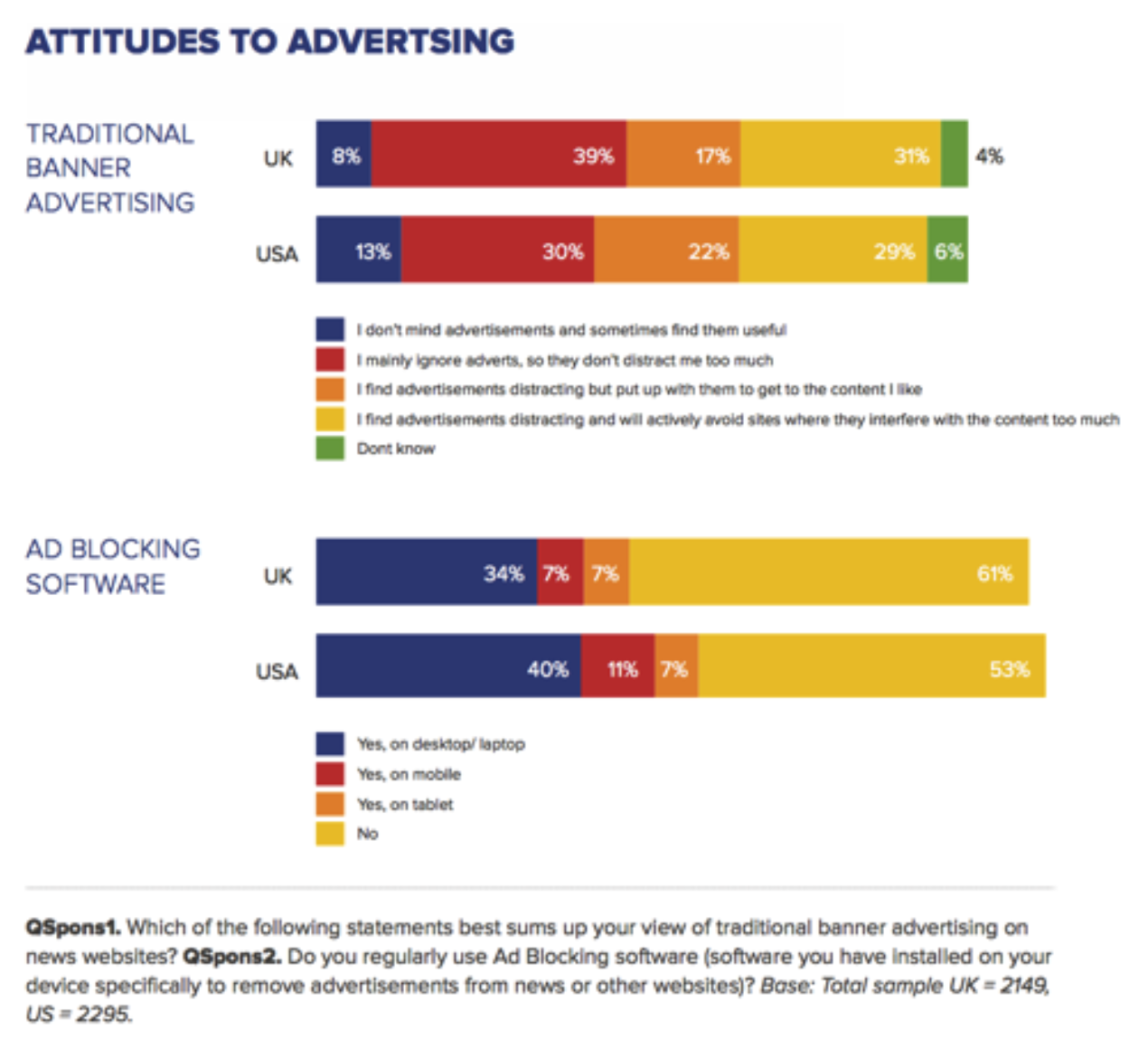
People don’t like it; here’s what a recent survey for Reuters shows. (What it doesn’t show is how many of those who don’t block ads know of the capability for doing it.)

Attitudes to advertising and use of adblocking

Not very legible; adblocking is the lower bars. People aren’t happy.

But wait, what about the moral dimension? The fact that if you block the ads, the sites lose their income?

I’ve previously written that the two sides on this are far apart; that adblocking is the new speeding: those who do it can justify why to themselves, while those who think it’s wrong are stern in their disapproval.

Entertainingly, when I noted on Twitter how many trackers I’d blocked using Ghostery (as part of an experiment using Ghostery, AdBlock, Javascript Blocker and uBlock to see how it changed my browsing experience), I was at once the object of finger-wagging and the accusation of the destruction of journalism:

Have I any responsibility to them? Well, not really. Certainly as a standard reader, here’s what happened: I accepted an invitation to read an article, but I don’t think that we quite got things straight at the top of the page over the extent to which I’d be tracked, and how multiple ad networks would profile me, and suck up my data allowance, and interfere with the reading experience. Don’t I get any say in the last two, at least?

Hence my response:

(You can view the entire conversation if you’re logged in to Twitter.)

Print evolved. Now it’s the web advertisers’ turn

This is the part of the debate that so interests (and, frankly, entertains) me. Print-based organisations were told they needed to evolve, and stop being such dinosaurs, because the web was where it was at: advertising was moving, and if they didn’t move too, they’d just die.

Now we’re all online, but somehow we’re meant to accept that web advertising is how it is, and never question or deviate from it? Nuh-uh. Why should web advertisers be immune from evolutionary or revolutionary change in user habits? What’s sauce for the print goose is sauce for the online gander. I don’t recall the people who scolded me for using tracking detectors previously saying that everyone had to stick with print adverts because they made more money (which those ads still do).

Furthermore, any argument that tries to put a moral dam in front of a technological river is doomed. Napster; Bittorrent; now adblocking.

Which quickly leads to…

If any significant number of users shift to using adblockers, web advertisers are going to have to move quickly to deal with that new reality. Web publishers too.

(Though I have to say I have very little sympathy for a lot of web “publishers”. Back in the early days of the web, the Guardian ran a brilliant ad which asked “Ever wondered how every day there’s just enough news to fit in the newspaper?” It was advertising the Guardian website, and the fact there was more there than you’d find in the paper.

Now? There are a gazillion websites – but tons of them are simple copies, monetised by adverts from Google or whoever, which leach from the originating sites by copying their content. We’ve now established the limits of how much news is generated each day: it’s more than fits in newspapers, but less than fits on all the websites currently dedicated to “news”. If adblocking puts some of the copiers on the skids, I won’t weep. That’s not journalism; it’s a sort of horrible stenography, even worse than some of the stenography that does pass for journalism at some bigger sites. Good journalism, and worthwhile sites, will survive. Or good journalists will.)

What form will the evolution take? Well, look at sites like Buzzfeed, and their use of native content. If the site generates the ad, it’s suddenly a lot harder to block. We’re back, in a way, in the land of print, where the printing of the editorial and the ads happened in the same place.

Ecosystem fights

Beyond all this, there’s a longer-term potential effect. I don’t think Apple was gleefully thinking of ways to nobble Google when it decided to introduce content blocking, but this could have quite an effect.

Consider: iOS 9 arrives, and lots of happy iOS users say how delighted they are to be blocking those annoying ads. (Don’t underestimate how quickly iOS 9 will be taken up: it’s going to be available for devices going back to the iPhone 4S and iPad 2 and will use less storage than iOS 8. Even iOS 8 was on half of iOS devices within two months of release.) Meanwhile Android users won’t be able to follow suit (to anything like the same extent). At least one of two things will happen:
• some Android users begin considering switching to iPhones
• Google comes under pressure to allow adblockers on the Play Store to prevent Android switching.

Neither of these is good for Google. The loss of Android users is probably more tolerable in the short term. Adblocking could pose an existential risk to Google (which is why it pays Adblock Plus’s makers to not block Google ads).

It’s unlikely that adblocking could ever reach a pitch where it really offers a grave threat to Google. But as more and more people from developing countries come online, paying for every kilobyte of data, they might want adblocking too. India in particular is a generally tech-savvy country where data prices are high; and it has embraced Android enthusiastically. Consider for a moment how that could play out.

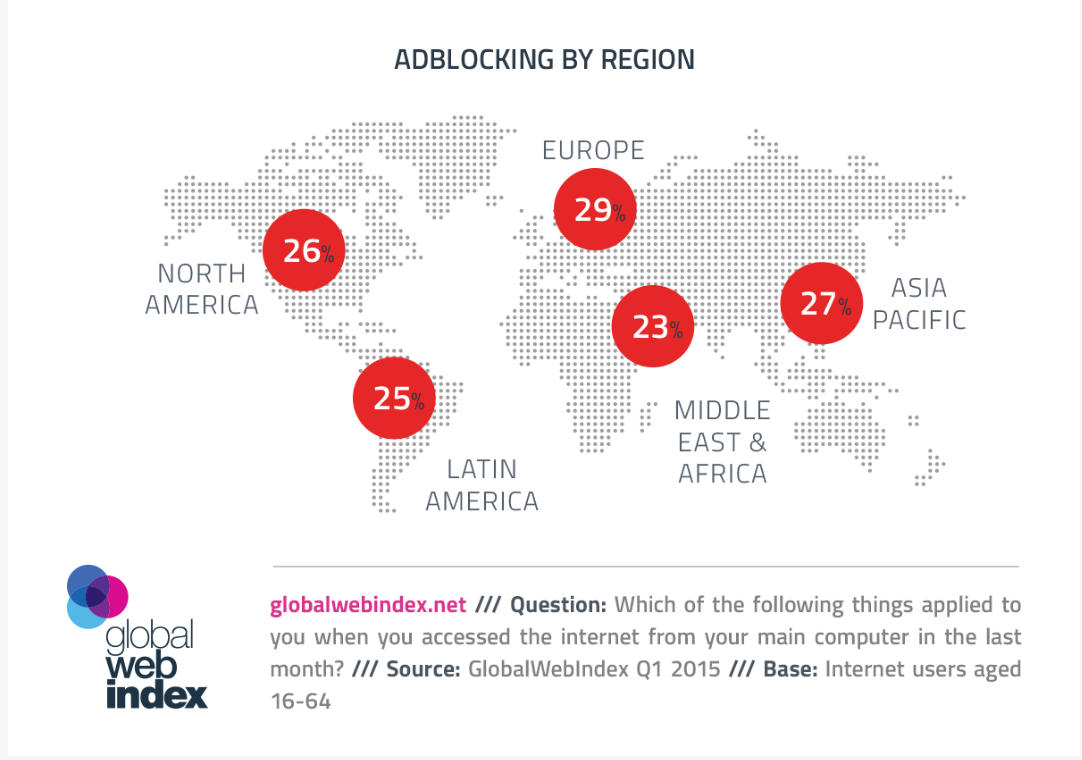
Relevantly, Global Web Index has a survey of adblocking use which found that 27% of users aged 16-64 globally in its 33-country survey had used an adblocker, and 15% had blocked tracking.

Adblocking by region

Adblocking by region. Source: GlobalWebIndex.

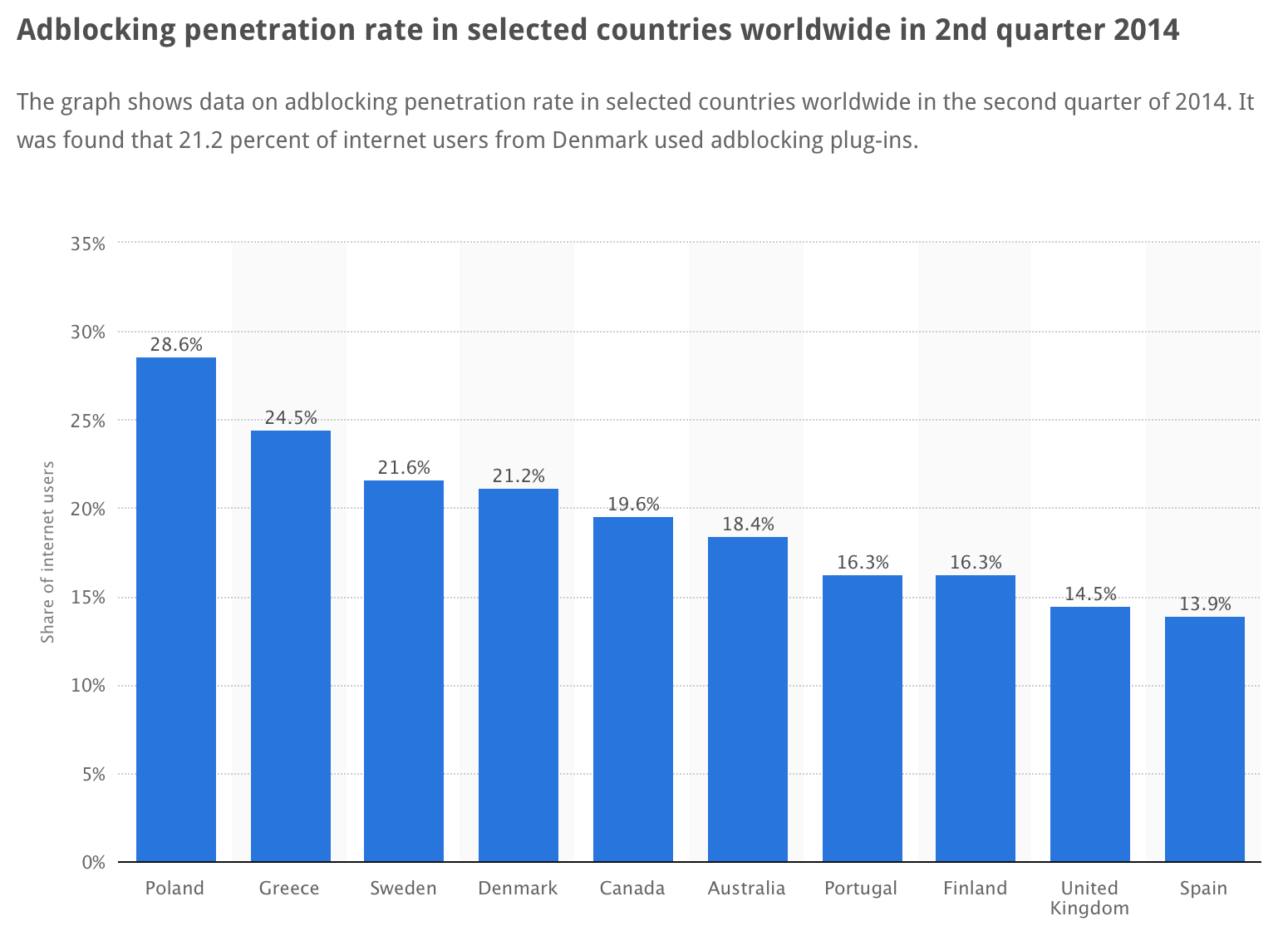
Statista also had detail about European use:

Adblocking by country in the EU

Adblocking has relatively low use – but what happens when it arrives on mobile?

Consider: hardly any of that is mobile yet. Mobile is the biggest platform. Adblocking is coming to a key mobile platform in September.

Things could get ugly quite suddenly.


Update: there’s a discussion of this post on Hacker News. You don’t need root to read it.


Like this? Other analysis I’ve done you might like:
How Gresham’s Law explains why sites are turning off comments
The death of “Others”: how the PC market’s implosion is squeezing smaller players
Android (and Apple, and BlackBerry, and Microsoft Mobile) handset profitability – the Q1 scorecard (updated)
BlackBerry might have no BB7 users left by February 2016 – and that’s a big, bad problem

Enjoy!

Start up: adblocking animus, Amazon’s aims, Ubuntu phone reviewed, the iPod Watch, and more


“They say this replacement can’t be hacked remotely!” Photo by Hugo90 on Flickr.

A selection of 10 links for you. Use them wisely. I’m charlesarthur on Twitter. Observations and links welcome.

New iPhone apps will include ad blockers for the mobile web » MIT Technology Review

Tom Simonite:

Some [iOS developers] are now testing ad blocking apps they intend to release when iOS9 becomes available. Their results suggest these apps could be popular. For example, when Dean Murphy, an app developer based in the U.K., hacked together an ad blocker in about an hour earlier this month, he found it slashed the time taken to load the popular Apple blog iMore from 11 seconds to just two seconds.

He is now working to release a fully polished ad blocker called Crystal, and expects there will be many others when iOS9 launches. “Apple has laid a solid foundation for quality ad blocking applications,” he says.

One of Murphy’s competitors will be an app called Purify, created by Chris Aljoudi, who leads development of the desktop ad blocker uBlock, which he says has over one million active users. A video of Purify in action shows how it makes a news site load faster and strips pre-roll video ads from YouTube. Aljoudi says his tests have showed that Purify cuts Web browsing data usage by about a quarter—which could cut some people’s data bills and extend battery life. Both Aljoudi and Murphy intend to make their apps cheap, but not free.

I think they’re going to make good money. Advertisers (and sites) have a problem coming their way. Here’s Purify at work:

link to this extract


The Verge’s web sucks » blog.lmorchard.com

Les Orchard tried examining The Verge’s desktop site, and found it linked him to 47 third-party trackers:

I feel like someone just set up the entire vendor hall from an awful tech conference in my living room. Seriously, could you folks just not pick one or two or ten? Did you hit every booth and say “Yeah, cool, sign us up!” I feel thoroughly spindled & folded & researched, here.

As a webdev at Mozilla, I’ve been in hour-long meetings where we’ve agonized over whether it’s copacetic to include just one little Google Analytics snippet without notifying users and updating the privacy policy. But, I know we’re crazy in our own very special ways.

In former lives, I’ve worked at ad agencies and digital marketing companies. I’m no stranger to conversations that revolve around partners & bizdev & analytics & media buys. I can only imagine things have intensified & evolved since I’ve been out of those trenches.

Still – and maybe this is the Mozilla brain-damage talking – I can’t imagine a sane conversation that resulted in The Verge extending an invitation to over 20 companies to set up shop on my computer with every page visit.

The reckoning is moving just that bit closer each day. Once a significant number of people start getting faster, better experiences from using adblockers (or tracker-blockers), they won’t care that the ads aren’t targeted. Newspaper and magazine ads didn’t use to follow you around the room, and they were quite a good business.
link to this extract


I got my music back. At least most of it » Loop Insight

Jim Dalrymple, after the debacle of last week:

So now I have the iTunes Match service that I pay for separately, and Apple Music, both of which use iCloud Music Library. There is really no way to get away from them if you want to use the latest and greatest from Apple.

I’ll admit, I’m still trying to get my head around how this works.

Some of the songs I own were incorrectly tagged as Apple Music, but that’s been fixed too, which means they show up correctly in iTunes. That is great news.

However, I’m still missing a couple of hundred songs. Apple’s theory is that I deleted them—that when I was trying to fix Apple Music, I mistakenly deleted my own files. While I concede that it is within the realm of possibility that I deleted my own files, it doesn’t make sense to me.

Apple is clearly struggling with Apple Music – a colossal effort launched in a huge number of territories – which is why my advice would be not to get worked up about precisely what seems to be working or not at present. And especially not to delete anything that you think you might own.
link to this extract


Ubuntu Phone review: years in the making, but still not consumer-ready » Engadget

Jamie Rigg:

I get the idea of Scopes [which are like Live Tiles in Windows], kind of. They are supposed to give the user a personal experience, remove their reliance on walled apps and bring content to the forefront. I just don’t think Scopes deliver, or maybe I’m just so used to the app-first experience that I’m having trouble adapting to the Scope way of doing things. And if that’s the case, then most people will be in the same boat. My main problem with Scopes is that I feel I’m being bombarded with content. If I want to check out upcoming concerts on an iOS/Android device, I’d load up the Songkick app. But when that’s not what I’m looking for, I don’t really want to see Songkick listings permanently displayed on my phone, like I’m being advertised to. You could argue the solution is to remove the Songkick feed from the Scopes it populates. But, if I was constantly adding and removing sources from Scopes when they are or aren’t relevant, I don’t see how that’s preferable to having dedicated apps that offer a better experience.

It seems like there’s just no way to create a new user interface at present, certainly on a mobile screen. The gigantic gravitational field of the app-driven iOS/Android system precludes it.

Also, this sounds like crap.
link to this extract


Toshiba’s woes show how PC sales slump is squeezing big tech firms » The Guardian

I wrote about the Others:

It is whispered among some analysts that only the preinstallation of third-party antivirus programs – which try to get users to sign up to subscriptions – keeps some PC makers afloat at all, owing to the fees they receive from antivirus software firms.

It was the PC business that triggered the current turmoil at the Japanese giant [Toshiba], after an internal auditor asked in late January to look at the accounts for the company’s laptop business. That eventually concluded with an examination by an external panel, whose 294-page report noted “inappropriate accounting” in various business segments, including those “relating to component transactions” in the PC business.

In a statement on 21 July it said that 111bn yen (£580m) of assets in the PC business in the past six financial years were “under consideration” for re-evaluation. That could affect its financial results, which will be finalised by 31 August. But even in its most recent quarterly report, before any restatement, Toshiba said that its PC business recorded restructuring costs of 46bn yen in the previous three quarters, and that otherwise it “would have recorded positive operating income over three consecutive quarters”.

46bn yen is $370m. Is Toshiba really saying it made an average operating profit of $123m per quarter in the PC business? That’s as much as Asus, which is one of the biggest makers. Seems unlikely.
link to this extract


Twitter is deleting stolen jokes on copyright grounds » The Verge

Dante D’Orazio:

some people just copy good tweets from other people and act like they came up with the 140-character witticism on their own. This has been going on since the beginning of Twitter.

It now appears Twitter is using its legal authority to crack down on these tweet-stealers. A number of tweets have been deleted on copyright grounds for apparently stealing a bad joke.

As first spotted by @PlagiarismBad, at least five separate tweets have been deleted by Twitter for copying this joke:

saw someone spill their high end juice cleanse all over the sidewalk and now I know god is on my side
— uh (@runolgarun) July 9, 2015
Olga Lexell, who, according to her Twitter bio, is a freelance writer in LA, appears to be the first person to publish the joke on Twitter. In a tweet posted this afternoon, she confirmed that she did file a request to have the tweets removed.

I simply explained to Twitter that as a freelance writer I make my living writing jokes (and I use some of my tweets to test out jokes in my other writing). I then explained that as such, the jokes are my intellectual property, and that the users in question did not have my permission to repost them without giving me credit.

She added that most of the accounts that were reusing her tweets without accreditation were “spam accounts that repost tons of other people’s jokes every day.” This also isn’t the first time Twitter has complied with a request like this: Lexell tells The Verge that she’s filed similar requests for other jokes. Twitter staffers typically remove the offending tweets “within a few days” without asking Lexell any follow-up questions.

Couldn’t she, you know, just not tweet them but try them on other people? Or try them from a protected account? This is quite weird.
link to this extract


Pakistan to shut down BlackBerry services by December for “security reasons” » Reuters

Syed Raza Hassan:

Pakistan, a nuclear-armed nation of 180 million people, is plagued by militancy, criminal gangs and drug traffickers.

“PTA has issued directions to local mobile phone operators to close BlackBerry Enterprise Services from Nov. 30 on security reasons,” an official with the Pakistan Telecommunications Authority said in a text message.

He asked not to be named due to the sensitivity of discussing communications and intelligence.

BlackBerry was not immediately available to comment.

A report released this week by British-based watchdog Privacy International said Pakistan’s powerful military intelligence agency, the Inter-Services Intelligence (ISI), was seeking to dramatically expand its ability to intercept communications.

BlackBerry encrypts data such as emails and its BlackBerry Messenger messages sent between a user’s phone and public networks, ensuring greater privacy for users but making life harder for police and intelligence agencies.

link to this extract


Fiat Chrysler recalls 1.4 million vehicles to defend against hacks » Bloomberg Business

Mark Clothier:

Fiat Chrysler Automobiles NV is recalling about 1.4 million cars and trucks equipped with radios that are vulnerable to hacking.

The company was already distributing software to insulate connected vehicles from illegal remote manipulation after Wired magazine published a story about software programmers who were able to take over a Jeep Cherokee being driven on a Missouri highway. Fiat Chrysler reiterated that it’s not aware of any real-world unauthorized remote hack into any of its vehicles.

It stressed that no defect was found and that it’s conducting the campaign out of “an abundance of caution.”

Fiat Chrysler said it has blocked unauthorized remote access to certain vehicles systems via an over-the-air update on Thursday.

link to this extract


Amazon and the “profitless business model” fallacy » Remains of the Day

Eugene Wei (who used to work at Amazon):

There are very few people in technology and business who are what I’d call apex predators. Jeff [Bezos] is one of them, the most patient and intelligent one I’ve met in my life. An apex predator doesn’t wake up one day and decide it is done hunting. Right now I envision only one throttle to Jeff’s ambitions and it is human mortality, but I would not be surprised if one day he announced he’d started another side project with Peter Thiel to work on a method of achieving immortality.

One popular thesis among Amazon profitability skeptics is that Amazon can’t “flip a switch” and become profitable. The most common guess as to how Amazon flips the switch is that it will wait until it is the last retailer standing and then raise prices across the board, so Amazon skeptics argue against that narrative possibility.

But “flipping a switch” is the wrong analogy because Amazon’s core business model does generate a profit with most every transaction at its current price level.

In that light, it’s wrong to look at the AWS “profits” as a proportion of revenue and say “wow”. The profit number is meaningless. Amazon can make any part of the business look as profitable or unprofitable as it likes.
link to this extract


The future of Apple Watch will be more like the iPod’s than the iPhone’s » Beyond Devices

Aaron Miller (in a guest post on Jan Dawson’s site):

First, and most importantly, the Apple Watch is an ecosystem product. Right now, the Watch only works as an extension of the iPhone. Its upper boundary is the total number of iPhones in the world.

This makes the Watch much more like the iPod than the iPhone. From the time the iPod first launched, it was a product tied to a computer, first to Macs then eventually to Windows computers as well. (Remember the Digital Hub strategy?) Just as the iPod existed to enhance the Personal Computer + iTunes ecosystem, the Watch exists to enhance the iPhone ecosystem. The iPhone, even if tied to iTunes early on, was never merely an ecosystem enhancement—nor designed to be one, like the iPod or Apple Watch have been.

Naturally, we expect the Watch’s reliance on iPhones to change over time. LTE and GPS seem like inevitable Apple Watch additions, for example, as does a Watch-native App Store. With true third-party apps coming soon, reliance on the iPhone will diminish even more. But there’s one limitation that may always tie Apple Watches to iPhones: the screen…

…the Apple Watch category is not just smartwatches. The correct category is wearables, and wearables right now, at the birth of the Apple Watch, are very similar to the early MP3-player market. Some are huge and multi-functional. Some are svelte and limited. Some are banking on unique features trying to find a niche.

Wonder what other wearables Apple might have in mind. What’s the iPod shuffle version of a Watch?
link to this extract