
Start up: Scrivener on iOS!, how Twitter should improve, Skype’s odd cloud move, Windows 10’s data problem, and more


Android tablets: where are they going? Photo by fsse8info on Flickr.

A selection of 9 links for you. Use them wisely. I’m charlesarthur on Twitter. Observations and links welcome.

It’s here! Scrivener for iOS is now available! • The Cellar Door

»

Scrivener for iOS is now available for sale on the App Store. At the time of writing, it is not yet showing up in searches on the App Store, as it can take several hours for Apple’s records to update. However, you can find it by following this link:

https://itunes.apple.com/app/scrivener/id972387337?ls=1&mt=8

If you tap on the above link on your iOS device, it will take you to Scrivener in the App Store.

«

This isn’t a 99p thing – but Scrivener is a terrific app on desktop for longform writing of all sorts, and beta testers have had good words to say about this.
link to this extract


Skype finalizes its move to the cloud, ignores the elephant in the room • Ars Technica

Peter Bright:

»

As well as addressing certain constraints of the peer-to-peer network, the new cloud-based system is used to underpin various other Skype features. For example, on the peer-to-peer network file transfers required the recipient to be present and to accept the transfer (with the file subsequently transported directly between the clients). File transfers on the new network go via the cloud, allowing fire-and-forget transfers, even to recipients that are temporarily away. This also allows a file to be downloaded by multiple recipients, or by the same recipient on multiple systems, without needing it to be retransmitted from the sender each time. The new voice and video messaging capabilities operate similarly, using cloud storage to hold voice and video messages even when the receiving client isn’t available.

New clients, including both the new UWP Windows client and the new Linux and Web client are built for the new network.

But what is most telling here is not what Microsoft’s blog post says. It is what it doesn’t say.

The Ed Snowden leaks raised substantial questions about the privacy of services such as Skype and have caused an increasing interest in platforms that offer end-to-end encryption. The ability to intercept or wiretap Skype came as a shock to many, especially given Skype’s traditionally peer-to-peer infrastructure. Accordingly, we’ve seen similar services such as iMessage, WhatsApp, and even Facebook Messenger, start introducing end-to-end encryption.

The abandonment of Skype’s peer-to-peer system can only raise suspicions here.

«

This is odd, given how robustly Microsoft fought to defend email stored on a server outside the US from US examination. But it’s also inarguable: the cloud-based system is worse than a peer-to-peer one for security.
link to this extract


Firefox to banish hidden Flash files – and kill off sneaky ad snoopers • The Register

Shaun Nichols:

»

Firefox will in the coming months automatically block invisible Flash content that users cannot see when loading a page, says Mozilla as it continues its campaign against Adobe’s plugin.

This should protect netizens from dodgy webpages that load hidden malicious Flash files that attempt to infect their computers with malware or perform similar devilish deeds.

It should also kill off unseen content that pointlessly drains devices’ battery lives. The open-source browser maker will also automatically block advertisers’ Flash scripts that snoop on surfers to make sure they are not blocking or ignoring ads.

This is ahead of a 2017 update that will see Firefox block all Flash content by default – meaning users will have to manually click on the Flash content to confirm that they want to view it.

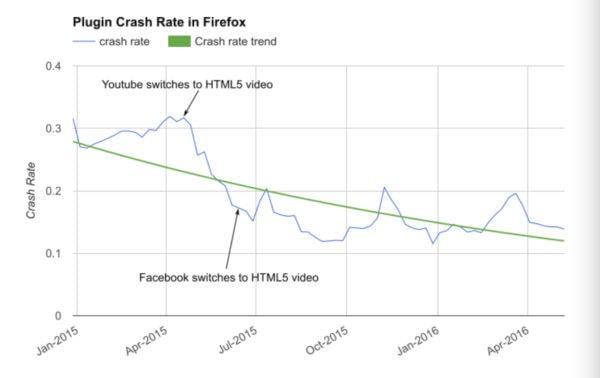
Websites are urged to move from Flash to HTML5 for their multimedia content wherever possible. According to Mozilla, its browser has encountering fewer crashes since sites have started serving HTML5 media rather than Flash.

«
Still too slow. Flash honestly isn’t necessary except in a few edge cases. Try it: delete it from your desktop/laptop; if a site asks for it, change your browser agent to “iPad”. You’ll be fine.
link to this extract


Windows 10 personal data collection is excessive, French privacy watchdog warns | PCWorld

Peter Sayer:

»

Windows 10 breaches French law by collecting too much personal information from users and failing to secure it adequately, according to the French National Data Protection Commission (CNIL).

Some of the privacy failings identified can be remedied by users willing to delve deep into the Windows 10 settings, but one of the commission’s gripes is that better privacy should be the default setting, not one users must fight for.

CNIL served Microsoft with a formal notice on June 30, giving it three months to comply with the law, but only made it public on Wednesday.

The commission conducted seven tests of the data sent back to Microsoft by Windows 10 in April and June of this year. Among Microsoft’s faux pas was the collection of data about all the apps downloaded and installed on a system, and the time spent on each one, a process CNIL said was both excessive and unnecessary.

«

link to this extract


US Army Special Forces to dump Galaxy Note II for iPhone 6S because iPhones are “faster” • Android Police

David Ruddock on that story from yesterday:

»

In what I am tempted to say may be the stupidest news I’ve read all morning (give me an hour, though, I just grabbed my coffee), the US Army’s Special Operations Command is allegedly dumping its current Nett Warrior embedded tactical smartphone solution – a 4-year-old Galaxy Note II – for an iPhone 6S. Because, and I quote DoDBuzz’s source here, the iPhone is “faster; smoother. Android freezes up.” Wait, you’re telling me a smartphone that’s four years old trying to run a specialized government app isn’t very fast or stable? I am shocked, sir – simply taken aback!

«

When you put it like that.. why didn’t the US SOC go with the newer Galaxy Note?
link to this extract


What I want out of Twitter • Whatever

John Scalzi, in February 2016: T

»

witter’s major issue, as everyone except apparently Twitter’s C-bench knows, is that there are a bunch of shitheads on it who like to roll up to whomever they see as targets (often women and/or people in marginalized groups) and dogpile on them. That’s no good.

I get my own fair share of jerks trying to make my Twitter existence miserable, so over time I’ve developed some strategies to trim those down. The problem here is that they require me to be an expert Twitter user, and do things like use a Twitter client with more features than the native web/mobile interface, and also simply to make rules in terms of interaction that don’t involve Twitter at all (see: the Scamperbeasts Rule). It also requires me to have a certain level of “don’t give a fuck” attitude, which fortunately I have.

But then, I’m a well-off straight white dude, and I can laugh off some mouth breather saying stupid things to me. If I were a woman and getting a constant stream of rape and death threats, I’m not sure I could do that, and I’m not sure that I should be required to be an “expert” user not to have to see this stuff. More to the point, this shit exists on Twitter because the assholes know it’s hard to filter it out; they know their target has to see it first to block or mute it.

I think it’s fine if Twitter’s philosophy is that everyone, including complete shitbags, have a right to an account on the service. But I think it would be useful if Twitter also incorporated into its philosophy, far more robustly than it has, that everyone is allowed to decide who is allowed to impinge on their time, and timeline.

«

He has some excellent suggestions, including filtering based on account age (new ones don’t show through) and shared mute/block lists.
link to this extract


As global tablet market tumbles, PC brands develop survival tactics to cope • ABI Research

»

Downward trends in tablet shipments, with Apple and Samsung YoY shipments falling from 62% to 54% as the market shrinks, are forcing PC brands to strategize survival tactics for their product portfolios, finds ABI Research. While Amazon and Huawei will focus on tablets despite the dwindling figures, not all vendors share this mentality. Dell and HP, for instance, made the decision to shy away from the tablet market and will instead concentrate on providing 2-in-1 systems based on Windows.

“Amazon and Huawei may successfully buck the trend, but each company is taking a drastically different stance on how to best accomplish this,” says David McQueen, Research Director at ABI Research. “Amazon managed to move away from raising revenue through hardware to recurring digital content sales, but Huawei, and even Lenovo for that matter, are instead looking to form a wider product suite that includes tablets in addition to their legacy PC and smartphone products.”

Xiaomi also plans to follow in Huawei and Lenovo’s footsteps, recently announcing a tie-up with Microsoft to ship Microsoft Office and Skype on Xiaomi’s Android smartphones and tablets.

«

Notable in yesterday’s Microsoft results: “lower revenues from patent licensing”, ie from Android vendors. Wonder if the Office/Skype inclusion is the quid pro quo – and if it is, how well it’s converting. I can’t imagine many Xiaomi customers eagerly signing up for an Office subscription.
link to this extract


Exploring the App Store’s top grossing chart • MacStories

Graham Spencer:

»

Diving in a little deeper, we can see that the IAPs offered range from $0.99, all the way up to $399.99.1 Unsurprisingly, a large proportion of the IAPs are in the $0.99-$19.99 price range. But you’ll also notice huge spikes at $99.99, $49.99, and $29.99.

Games dominate the Top 200 Grossing charts, representing an overwhelming majority of 68% of the apps. The next closest is Social Networking at just 11% and comprised mainly of various dating apps. This is followed by Music at 7% (a mix of music streaming and music creation apps) and Entertainment at 5% (a variety of streaming video apps, mostly).

«

I really hope Spencer was able to do this in an automated fashion. Note that this barely overlaps with the introduction of Pokemon Go. And the $400 IAP? A “forever subscription” to Headspace.
link to this extract


Google DeepMind AI to be in all of Google’s data centres by end of 2016 • Business Insider

Sam Shead:

»

Google has adopted a DeepMind AI system in several of its data centres over the last few months as a way of reducing the amount of energy the server farms consume. However, the full extent of Google’s plans for the software are only just becoming clear.

“It [DeepMind’s AI] will be in the entire fleet by the end of the year,” DeepMind cofounder Mustafa Suleyman told Business Insider on Wednesday. “That will result in a 15% reduction on energy used every year by the entire data centre fleet.”

…every time a user engages with one of [Google’s[ services, a server is spun up and heat is produced that ultimately needs to be removed by an energy-consuming cooling system.

In order to lower the energy consumption of Google’s cooling systems, DeepMind analysed five years worth of Google data centre records that have been collected by sensors measuring variables like temperature, compute load, air pressure, and fan speed.

“We used that to predict what the optimal settings are for controlling the cooling system, which can be thought of as a very complex air conditioning unit that tries to extract heat from the data centre.”

After looking at the data, Google’s self-learning algorithm was able to figure out the best times to use the cooling fans. “We can optimally turn up the fan when we need to and not waste energy on over cooling when we don’t need to,” said Suleyman.

«

link to this extract


You can now sign up to receive each day’s Start Up post by email. You’ll need to click a confirmation link, so no spam.

Errata, corrigenda and ai no corrida: none notified.

Start up: AI photo colouring, Chrome extension malware, the biodiesel fake, iPhone 7 ’Airpods’?, and more


Going, going, up? Photo by mangee on Flickr.

A selection of 11 links for you. Or someone else. But who? I’m charlesarthur on Twitter. Observations and links welcome.

New software instantly colourises old photos • Digital Trends

»

While Instagrammers have been able to age a new photo for a long time, new software could allow the opposite — Algorithmia is a new program that automatically colourises black-and-white photos.

Colourising old photos is a long process, but using a “convolutional neural network,” Richard Zhang, a UC Berkeley computer vision PhD student, has developed a program with a much higher success rate than earlier attempts.

Convolutional neural networks (CNNs) are advanced image-recognition programs. They use multiple layers of overlapping input regions to create a better representation of the original than earlier technology allowed. Zhang took the idea of using CNNs a bit further and trained the artificial intelligence program by using over a million colour photos.

«

I’d have to say the effects are so-so, but a lot better than I’d do in the same time (it’s fast). And you could then improve it.
link to this extract


FY16 Q4 – Press Releases – Investor Relations • Microsoft

Microsoft’s fourth-quarter (for April-June) results are out. Ignoring the cloud and services stuff:

»

More Personal Computing revenue decreased $346m or 4%, mainly due to lower revenue from Devices and Gaming, offset in part by higher revenue from search advertising and Windows. Revenue included an unfavorable foreign currency impact of approximately 2%.

• Devices revenue decreased $782m or 35%, mainly due to lower revenue from phones, driven by the change in strategy for the phone business, offset in part by higher Surface revenue. Phone revenue decreased $870m or 71%, driven by a reduction in volume of phones sold. Surface revenue increased $76m or 9%, primarily driven by the release of Surface Pro 4 and Surface Book in the second quarter of fiscal year 2016, offset in part by a decline in revenue from Surface Pro 3 and Surface 3.

• Gaming revenue decreased $152m or 9%, primarily due to lower Xbox hardware revenue, offset in part by higher revenue from Xbox Live. Xbox hardware revenue decreased 33%, mainly due to a decline in consoles sold and lower prices of consoles sold. Xbox Live revenue increased 4%, driven by higher volume of transactions and revenue per transaction.

• Search advertising revenue increased $514 million or 54%. Search advertising revenue, excluding traffic acquisition costs, increased 16%, primarily driven by growth in Bing, due to higher revenue per search and higher search volume.

• Windows revenue increased slightly, mainly due to higher revenue from Windows OEM, offset in part by lower revenue from patent licensing.

«

That means phone revenue was down to $364m, which is more than halved from the previous quarter. A rough estimate suggests that’s about 1m Lumias sold. That’s nearly as bad as BlackBerry – which some once thought Microsoft would buy.

And the Xbox stuff – imagine how Nintendo’s report is going to sound soon.
link to this extract


Malware in the browser: how you might get hacked by a Chrome extension • Kjaer

Maxime Kjaer:

»

On my Facebook news feed, I had noticed that one of my friends was regularly liking some weird, lewd, clickbaity links. Now clickbait content is far from uncommon on Facebook, but something was off in this case. I had noticed a pattern: it was always the same friend who would Like the same type of links. They would always have around 900 Likes and no comments, while the page behind them has about 30 Likes. Even weirder: every single post on that page is posted 25 times.


One of the posts that my friend had Liked. 940 Likes, no comments.

Now I know my friend; he’s a smart guy, so I don’t really see him liking tons of this (frankly) crap content. Intrigued, I decided to go down the rabbit hole and see what this was all about.

So I clicked on one of these links. Huge mistake.

I was instantly greeted with a message saying that I should verify my age before I could view the content. The semi-raunchy nature of the content made it seem sort of justified. What wasn’t justified, though, was the fact that this verification had to be done by installing a Chrome extension.

«

Of course your spidey sense is tingling. But as you read through you’ll be saying “Whaaaa..?” The suggested moral: Google ought to vet the makers of Chrome extensions or manually verify them.

Not sure that’s going to happen in a hurry. However it is a new avenue of infection: Kjaer found 130,000 PCs infected with this malware.
link to this extract


Tor veteran Lucky Green exits, torpedos critical ‘Tonga’ node and relays • The Register

Richard Chirgwin:

»

Tor’s annus horribilis continues, with one of its earliest contributors, Lucky Green, quitting and closing down the node and bridge authority he operates.

Green’s announcement is here. He specifically declines to describe why it is “no longer appropriate” to take part in Tor, nor why he believes he has “no reasonable choice left within the bounds of ethics”.

It is therefore left to others to speculate about whether or not Green’s decision is the result of the turmoil in the project, which emerged when Jacob Applebaum exited amid accusations and recriminations, and continued with the project’s board replacing itself.

Practically, it’s a big deal. Bridge Authorities are part of the infrastructure that lets users get around some ISP-level blocks on the network (not, however, defeating deep packet inspection). They’re also incorporated in the Tor code, meaning that to remove a Bridge Authority is going to need an update.

The shutdown is to take place on August 31.

«

link to this extract


The fake factory that pumped out real money • Bloomberg Businessweek

Mario Parker, Jennifer Dlouhy & Bryan Gruley:

»

The biodiesel factory, a three-story steel skeleton crammed with pipes and valves, squatted on a concrete slab between a railroad track and a field of storage tanks towering over the Houston Ship Channel. Jeffrey Kimes, an engineer for the Environmental Protection Agency, arrived there at 9 a.m. on a muggy Wednesday in August 2011.

He’d come to visit Green Diesel, a company that appeared to be an important contributor to the EPA’s fledgling renewable fuels program, part of an effort to clean the air and lessen U.S. dependence on foreign fuel. In less than three years, Green Diesel had reported producing 50 million gallons of biodiesel. Yet Kimes didn’t know the company. He asked other producers, and they weren’t familiar with Green Diesel either. He thought he ought to see this business for himself.

Kimes, who works out of Denver, was greeted at the Green Diesel facility by a man who said he was the plant manager. He was the only employee there, which was odd. “For a big plant like that, you’re going to need a handful of people at least to run it, maintain it, and monitor the process,” says Kimes, a 21-year EPA veteran. The two toured the grounds, climbing metal stairways and examining the equipment. The place was weirdly still and quiet. Some pipes weren’t connected to anything. Two-story-high biodiesel mixing canisters sat rusting, the fittings on their tops covered in garbage bags secured with duct tape. Kimes started asking questions. “They showed me a log, and from that you could see they hadn’t been producing fuel for a long period of time,” he says.

An attorney for Green Diesel showed up. Kimes asked how he could reconcile the lack of production with what Green Diesel had been telling the EPA. The attorney said he didn’t know, he’d been hired only the day before. “It was obvious what was going on,” Kimes says.

«

A great (long) read.
link to this extract


Acer, Asustek consider raising PC prices in the UK, says report • Digitimes

Joseph Tsai:

»

With Dell and Hewlett-Packard (HP) both having decided to raise their PC prices in the UK by 10% beginning August, Acer and Asustek Computer are also considering following suit and will make decisions within two weeks, according to a Chinese-language Apple Daily report.

With the pound depreciating nearly 15% in the past few weeks, PC vendors have started raising their prices to avoid losses. Lenovo reportedly is also evaluating whether to raise prices, the paper added.

«

Expect everyone to follow suit. None of the PC makers can afford to eat a 15% change in price.
link to this extract


Self-driving Mercedes-Benz bus takes a milestone 12-mile trip • TechCrunch

Darrell Etherington:

»

CityPilot has taken a key early step towards fully autonomous public transportation: The Mercedes-Benz self-driving bus program saw one of its Future Bus vehicles drive 20 km (or around 12.4 miles) in the Netherlands, on a route that connected Amsterdam’s Schiphol airport with the nearby town of Haarlem. To make the trip, the bus had to stop at traffic lights, pass through tunnels, and navigate among pedestrians.

This is a big win for the program, which owes its origins to the transport truck-focused Highway Pilot program debuted by Mercedes two years ago. That autonomous vehicle program didn’t face the added challenges of navigating an urban environment, however, which makes the Future Bus successful test run a significant achievement.

«

link to this extract


Trademark filings seem to confirm Apple’s work on upcoming ‘Airpods’ • MacRumors

Eric Slivka noted that a company called “Entertainment in Flight” had trademarked “Airpods” and then began digging:

»

Given that Jonathan Brown is a fairly common name, we dug a little further to try to determine whether the manager at Entertainment in Flight and the attorney at Apple and Rambus are indeed the same person, and we came across a court filing from a 2010 civil case involving Rambus that includes a pair of Brown’s signatures. While there is some variation among those two signatures and the one on the AirPods trademark document, they have enough in common that we believe these Jonathan Browns are the same person and thus Apple is behind the AirPods trademark application.

«

Now that is journalism.
link to this extract


Army Special Operations Force to trade in its Androids for iPhones • DoD Buzz

Matthew Cox:

»

U.S. Army Special Operations Command is dumping its Android tactical smartphone for an iPhone model.

The iPhone 6S will become the end-user device for the iPhone Tactical Assault Kit – special-operations-forces version Army’s Nett Warrior battlefield situational awareness tool, according to an Army source, who is not authorized to speak to the media. The iTAC will replace the Android Tactical Assault Kit.

The iPhone is “faster; smoother. Android freezes up” and has to be restarted too often, the source said. The problem with the Android is particularly noticeable when viewing live feed from an unmanned aerial system such as Instant Eye, the source said.

When trying to run a split screen showing the route and UAS feed, the Android smart phone will freeze up and fail to refresh properly and often have to be restarted, a process that wastes valuable minutes, the source said.

“It’s seamless on the iPhone,” according to the source. “The graphics are clear, unbelievable.”

Nett Warrior as well as the ATAC and soon-to-be-fielded iTAC basically consist of a smartphone that’s connected to a networked radio. They allow small unit leaders to keep track of their location and the locations of their soldiers with icons on a digital map.

«

Pokemon Go, but for real, with bullets. They were using Samsung devices.
link to this extract


Dell kills Android business to focus on Windows 2-in-1 devices • Forbes

Jean Baptiste Su:

»

In a serious blow to the future of Google’s Android for Work program and six months after HP decided to stop selling Android tablets, arch rival Dell confirmed in a recent blog post that it too is discontinuing its Android tablet line (Venue) to focus on Windows 2-in-1 laptops or detachable tablets.

Dell’s main take is that the tablet market is oversaturated, with Android devices at rock bottom prices from companies like Asus, HTC, Huawei, Lenovo or ZTE.

“Additionally, 2-in-1s with larger screens in the 10- to 13-inch range are offering a laptop-first experience with the convenience of a tablet when needed,” said Kirk Schell, Dell’s vice-president of commercial solutions.

«

I cannot see that anyone is making money – as in worthwhile profit – in Android tablets. They seem more like a way to soak up excess touchscreen production capacity. Only Samsung has any economy of scale (makes the chips and screens, second largest tablet vendor).
link to this extract


BT must put house in order or face split • House of Commons Select Committee on Media

After hearing from BT and other ISPs:

»

The [House of Commons Media Select] Committee says BT has exploited its position to make strategic decisions that “favour the Group’s priorities and interests” – and is likely to have sacrificed shareholder value and customer benefit as a result. Capital investment in Openreach has been broadly flat since 2009 until this year, and quality of service remains poor.

The Committee is demanding that BT invest significantly more in Openreach, and allow Openreach much more autonomy over what it invests, when and where. It supports Ofcom’s plans for establishing greater separation between Openreach and BT Group, but makes clear that if BT fails to “offer the reforms and investment assurances necessary to satisfy our concerns”, Ofcom should move to enforce full separation of Openreach.

In the Committee’s judgement, Ofcom has not placed enough emphasis in the past on improving Openreach’s quality of service: it says the prospect of stiffer penalties should also encourage BT to voluntarily invest more in infrastructure.

«

Nice to have it spelt out.
link to this extract


You can now sign up to receive each day’s Start Up post by email. You’ll need to click a confirmation link, so no spam.

Errata, corrigenda and ai no corrida: none notified.

Start up: ransomware evaluated, Brexit and the death penalty, True Tone iPhones?, Swatch swoons, and more


Maybe our future wars will be about fooling these things. Photo by wim hoppenbrouwers on Flickr.

A selection of 12 links for you. So there. I’m charlesarthur on Twitter. Observations and links welcome.

Why these online criminals actually care about your convenience • F-Secure

“Melissa”:

»Crypto-ransomware criminals’ business model is, of course, encrypting your files and then making you pay to have them decrypted so you can access them again. To help victims understand what has happened and then navigate the unfamliar process of paying in Bitcoin, some families offer a “customer journey” that could rival that of a legitimate small business. Websites that support several languages. Helpful FAQs. Convenient customer support forms so the victim can ask questions. And responsive customer service agents that quickly get back with replies.

We think this is a pretty interesting paradox. Criminal nastiness, but on the other hand willingness to help “for your convenience,” as one family put it. We decided to dig a little deeper.

We evaluated the customer journeys of five current ransomware families (Cerber, Cryptomix, TorrentLocker, Shade, and a Jigsaw variant), and got an inside look we’re sharing in a new report, Evaluating the Customer Journey of Crypto-Ransomware. From the first ransom message to communicating with the criminals via their support channels, we wanted to see just how these criminals are doing with their customer journey – and whose is the best (or rather, least loathsome).

«

Those five won’t be pleased at the emergence of ransomware that just takes your money and deletes your stuff anyway.
link to this extract


Poké power: Pokémon GO has more in-game buyers than the rest of the mobile gaming market • Slice Intelligence

»Nostalgia or not, in-app spending by Millennials account for the majority of  Pokémon GO’s in-game revenue. With 52% of the buyers being between the ages of 18-34, many of these individuals were part of the prime target audience when the Pokémon frenzy first hit the United States in the mid-’90s. In addition to age gender also plays a role here; nearly three-quarters of paying Pokémon players are men. Here’s the full age breakdown:

«

This is totally what I expected: Pokemon Go is that perfect storm of a game that people adored when they were children, and a product that has come along just in time to reawaken that adoration.
link to this extract


Apple begins rolling out iTunes Match with audio fingerprint to Apple Music subscribers • Loop Insight

Jim Dalrymple:

»One of the biggest complaints about Apple Music over the past year was that it wouldn’t properly match songs subscribers had in their existing iTunes libraries. That problem is being fixed by Apple.

Apple has been quietly rolling out iTunes Match audio fingerprint to all Apple Music subscribers. Previously Apple was using a less accurate metadata version of iTunes Match on Apple Music, which wouldn’t always match the correct version of a particular song. We’ve all seen the stories of a live version of a song being replaced by a studio version, etc.

Using iTunes Match with audio fingerprint, those problems should be a thing of the past.

If you had songs that were matched incorrectly using the metadata version of iTunes Match, the new version will rematch to the correct song. However, it will not delete any downloaded copies of songs you have in your library. This is a very good thing—we don’t want songs auto-deleting from our libraries.

«

The latter said with a lot of feeling by Dalrymple, who had some songs deleted from his library when he first signed with Apple Music last year.
link to this extract


Robot war and the future of perceptual deception • BLDGBLOG

Geoff Manaugh:

»Finding ways to throw-off self-driving robots will be more than just a harmless prank or even a serious violation of public safety; it will become part of a much larger arsenal for self-defense during war. In other words, consider the points raised by John Rogers, above, but in a new context: you live in a city under attack by a foreign military whose use of semi-autonomous machines requires defensive means other than — or in addition to — kinetic firepower. Wheeled and aerial robots alike have been deployed.

One possible line of defense — among many, of course — would be to redesign your city, even down to the interior of your own home, such that machine vision is constantly confused there. You thus rebuild the world using light-absorbing fabrics and reflective ornament, installing projections and mirrors, screens and smoke. Or “stealth objects” and radar-baffling architectural geometries. A military robot wheeling its way into your home thus simply gets lost there, stuck in a labyrinth of perceptual convolution and reflection-implied rooms that don’t exist.

In any case, I suppose the question is: if, today, a truck can blend-in with the Florida sky, and thus fatally disable a self-driving machine, what might we learn from this event in terms of how to deliberately confuse robotic military systems of the future?

«

That’s kinda paranoid, but this sort of thing will be part of army planning in future.
link to this extract


Brexit voters, authoritarianism and the death penalty • Birkbeck University of London department of politics

Professor Eric Kaufman:

»culture and personality, not material circumstances, separate Leave and Remain voters. This is not a class conflict so much as a values divide that cuts across lines of age, income, education and even party. A nice way to show this is to examine the relationship between so-called ‘authoritarianism’ questions such as whether children should obey or the death penalty is appropriate, and support for the EU. The British Election Study’s internet panel survey of 2015-16 asked a sample of over 24,000 individuals about their views on these matters and whether they would vote to leave the EU. The graph below, restricted to White British respondents, shows almost no statistically significant difference in EU vote intention between rich and poor. By contrast, the probability of voting Brexit rises from around 20% for those most opposed to the death penalty to 70% for those most in favour. Wealthy people who back capital punishment back Brexit. Poor folk who oppose the death penalty support Remain.

A similar pattern holds in the British Values Survey for the strongly worded question probing respondents’ desire to see those who commit sex crimes “publicly whipped, or worse”. Political psychologists show a close relationship between feeling fearful of change, desiring certainty, and calling for harsh penalties for criminals and discipline for children. These are people who want a more stable, ordered world. By contrast, those who seek change and novelty are willing to embrace immigration and the EU.

«

This feels like an extreme version of “take back control”. (Support for the death penalty is just under 50% in the UK, but would never achieve a majority vote in Parliament; MPs know its failings, which include killing innocent people.)

The note dates back to the day after the referendum, but is still notable – and it has things to say about Donald Trump. (Unfortunately he’s in the news.)
link to this extract


Apple shows interest in expanding True Tone color accuracy beyond the 9.7″ iPad Pro • Apple Insider

Mike Wuerthele:

»The US Patent & Trade Office published an Apple patent filing on Thursday, discovered by AppleInsider, that details the technology that would eventually be introduced to the world this March as the iPad Pro True Tone display.

In the filing, Apple notes that the ultimate goal of its advanced display technology is to have “colors appear as they would on a printed sheet of paper.” That’s similar to Apple’s own marketing materials for the 9.7-inch iPad Pro and its True Tone display, which it boasts is “almost like looking at a sheet of paper.”

As with most applications, Apple’s proposed invention is all-encompassing, noting that while OLED displays are shown in accompanying illustrations, any compatible display can be used to implement the patented technology. The filing suggests the technology could have practical applications on devices ranging from small wearable displays, like an Apple Watch, to large desktop computers, such as Apple’s iMac.

«

I’d be astonished if this tech (which is great) isn’t on the forthcoming iPhones.
link to this extract


Why the Microsoft Kinect could have been great — and why it wasn’t • Business Insider

Matt Weinberger:

»Much of “FRU’s” development time was taken up with “research,” he says. Most Kinect developers made the same mistake: They assumed that you could just take a game or genre that already existed, bolt Kinect motion controls onto it, and call it a day.

Not every title is suited to that, though, especially given the Kinect’s not-so-perfect record at actually tracking players’ motion. And then, when gamers got frustrated, they blamed the Kinect and went back to traditional games, and developers followed them back to safer waters.

But Kinect-style motion controls “don’t work 100%, and that’s just a fact,” Traverso said. “You have to understand the limitations of the technology and use it to your advantage.”

And so, much of Through Games’ focus was on solving some basic issues. How long can a player reasonably be expected to stand up to complete each level of the game? How fast can the player move before the Kinect stops reliably picking up on their motion? And so on, and so forth. The result is a game that put a lot of time and energy into making sure it used the Kinect to the fullest extent.

«

Seems like “why it wasn’t” is pretty much explained in that penultimate paragraph. If you’re having to work around something that doesn’t work 100% and which is the essential interface for the game, you’re screwed.

The Kinect will always feel like the great lost wonder of technology. It could have been remarkable; instead it was a bust.
link to this extract


Swatch plunges as luxury malaise spreads from Asia to Europe • Bloomberg

Corinne Gretler:

»Swatch Group AG shares plunged as the watchmaker warned of a collapse in first-half profit and cut sales guidance for the year, adding to a luxury malaise that has spread from Hong Kong to other top markets such as France and Switzerland.

The stock fell as much as 14% as the Swiss maker of Omega and Tissot timepieces said earnings slid 50% to 60%. Analysts expected a 22% drop in net income. The impact on demand of Thursday’s deadly attacks in Nice means sales will be less than forecast earlier in the year, Chief Executive Officer Nick Hayek said by phone.

“Investor confidence will be shaken,” said Rene Weber, an analyst at Bank Vontobel in Zurich. He estimates the operating profit margin fell to 9% from 18%, which is either a “disaster” or represents one-time charges. Hayek said the first-half profit didn’t include any one-time items.

«

Gosh, I wonder if..

»

Swatch’s Tissot brand may have been one of the worst performers, partially because it’s in a price segment that competes directly with smartwatches from Apple Inc. and others, according to Bank Vontobel analyst Rene Weber.

«

Oh.
link to this extract


Ad-tech exits: wait for 2017 • OpenX

Archie Sharma:

»If we look at the number of new ad-tech companies founded over the last 15 years (Fig. 1), it has consistently grown and peaked in 2012, meaning we can now see normalization in industry entrants. Equally informative is Fig. 2, showing that the number of exits continues to grow each year. The trend highlights the state of many ad-tech companies that are at the point in their lifecycle where their investors are looking for exits.

That the number of industry entrants peaked in 2012 but the number of exits still continue to increase, suggests that net consolidation in the industry will continue apace for the next few years. The common exits are IPO’s, acquisitions, or failure (going out of business). IPO’s make-up less than 5% of exits; leaving the primary reasons for exits: acquisitions (82%) and failures (13%). Acquisitions and failures reduce the net companies in the industry, leading to further consolidation.

So, how long will consolidation last?

Our data driven approach suggests a high number (200+ per year) of exits through 2018, suggesting the continuation of a strong consolidation trend in 2016, 2017 and 2018.

In order to predict the number of exits in the future, we looked first to the past and determined (Fig. 3) that the average lifespan of an ad-tech firm is approximately 6 years. Additionally, less than 5% of ad-tech firms have survived past 10 years.

«

link to this extract


Yahoo reports second quarter 2016 results • Yahoo

»Yahoo! Inc. today reported results for the quarter ended June 30, 2016.
“With the lowest cost structure and headcount in a decade, we continue to make solid progress against our 2016 plan.  Through disciplined expense management and focused execution, we delivered Q2 results that met guidance across the board and in some areas exceeded it,” said Marissa Mayer, CEO of Yahoo.

«

Yeeaaaah. Well. Gross revenue actually increased, from $1.243bn to $1.308bn compared to the year-ago quarter. But traffic acquisition costs (what Yahoo pays companies to bring traffic to it) rose from $200m to $466m, so that revenue after TAC fell from $1.04bn to $841m. Most of the TAC went on search (that’s the Firefox deal, where Mayer outbid an uninterested Google): up from $105m to $392m, so that it’s larger than post-TAC search revenue.

This is a lot of ways to say Yahoo is a zombie; it just hasn’t stopped moving yet.
link to this extract


Apple scores GlaxoSmithKline study in key test of health apps • Bloomberg

Caroline Chen and Alex Webb:

»Glaxo wants to record the mobility of 300 participants over three months and will also ask the patients to input both physical and emotional symptoms, such as pain and mood. The app Glaxo created from ResearchKit comes with a guided wrist exercise that uses the phone’s sensors to record motion, giving the drugmaker a standardized measurement across all users. The company will use the results to help design better clinical trials.

The success of the study could help determine the pharmaceutical industry’s future appetite for using Apple’s products to conduct research. Drugmakers have to balance the lower costs of using the app with their ability to gather accurate, reliable data. Risks include that test subjects will tire of entering information into the app, and, given the iPhone’s $399 starting price, the sample may be skewed toward wealthier demographics.

By using ResearchKit, London-based Glaxo may be able to reduce research costs, which can stretch into the millions of dollars.

«

The point about the iPhone’s starting price is meaningless in the US and UK and other contract (pre-pay) markets, because the pricing structure with carriers’ contracts obscures the price differential with Android phones. In the US, iPhone price differences were completely hidden for years.
link to this extract


How falling behind the Joneses fuelled the rise of Trump • The New York Times

Thomas Edsall:

»A May 2015 Federal Reserve report provides a window into the financial condition of many in the working class. It found that 47% of Americans do not have the resources to cover a $400 bill for such unanticipated costs as a car repair or a health emergency. They would be forced to borrow from friends of family, to sell something, to go to a payday loan company or to add to their credit card debt.

For those in the bottom third of the income distribution, even essential expenditures have become unaffordable: the $7,000 to $10,000 average cost of a funeral, the $33,865 average cost of a new car, the $18,000 average annual cost of child care.

Crucially important is the fact that rising inequality constitutes a double whammy. It raises the cost of sought-after goods and it increases the economic gap between the working class and the affluent, spurring nostalgia for what was (even if what was really wasn’t).

This point was well put in an essay, “Keeping Up With the Joneses,” by Neil Fligstein, a professor of sociology at Berkeley, Pat Hastings, a Ph.D. candidate at Berkeley, and Adam Goldstein, professor of sociology at Princeton, which was presented at the annual meeting of the American Sociological Association:

Growing income inequality in the U.S. has meant that as those at the top are able bid up the price of valued goods like housing and access to good schools, those in lower groups have struggled to maintain their positions.

«

link to this extract


Errata, corrigenda and ai no corrida: none notified

You can now sign up to receive each day’s Start Up post by email. You’ll need to click a confirmation link, so no spam.

ARM: the weightless corporation that outweighs Intel

The news that Japan’s Softbank is spending £24bn to buy ARM – the UK company which designs (but does not actually make) the chips that power pretty much every smartphone and tablet in existence, plus almost every internet-of-things product in existence – has got people very confused.

The price is a 41% premium over its closing price on Friday – though the share price leapt on the news by 45%, creating a puzzle for those who hold the shares. A few points first:

• it isn’t specifically caused by the fall of the pound after the Brexit referendum. True, Softbank is buying in yen, and that has appreciated against the pound – from about 160 yen/pound just ahead of the referendum to 140 yen/pound on the day of the bid. That’s a 15% change, so Softbank got some benefit on the side. Possibly the market thinks it could go higher.

Yen-sterling exchange rate

Sterling has become cheaper against the yen since the referendum (fewer yen needed to buy a pound)

• it isn’t going to affect “British companies” and your smartphone won’t get more expensive. ARM designs chips, but doesn’t make them; there are no British companies making chips in British foundries from ARM designs. There would be no advantage to Softbank or ARM to increase the royalty on its new licences because companies would simply stick with the older versions.

• Softbank says the purpose of the takeover is to benefit from all the “internet of things” applications that are coming into view. Given that this is a market which will be multiple times bigger than the smartphone/mobile phone market, which was already multiple times bigger than the PC market, you can see that Softbank thinks it’s on to a good thing.

Design for life

But take the valuation on its face, and consider this: ARM doesn’t actually make anything physical. All it does is produce the designs for chips, which others then have to take away and turn into something physical. They pay ARM a royalty for each chip they make using its designs.

It might not sound like a promising way to rake in money, but ARM has the advantage that it can shift its focus as quickly as the market demands, and can hire and deploy people wherever it needs to. There’s barely any capital investment to consider, apart from a few offices and testing facilities. Its value comes directly from its staff and their capabilities. As is often said of IP-related businesses, the company’s future value literally walks out of the door every night. It truly is a weightless corporation.

ARM lets other companies, such as TSMC, Samsung and Apple do things with its designs, in return for royalties. Apple goes one stage further, tweaking the designs and then getting someone else to build them.

But through this all, ARM is weightless. It has a comparatively tiny staff, but precisely because of that it is able to pick the path to focus on. When it was set up in November 1990, the idea seemed a bit fanciful: everyone knew you had to own your own chip foundry to be successful at making chips, like Intel and AMD. Letting other people make your chips wasn’t going to be profitable. Being just a design company seemed even less sensible.

However, ARM turned out to have made all the correct calls. It focussed on low power consumption. It focussed on functionality. It focussed on the RISC (reduced instruction set computing) model – unsurprising, since its name is a contraction of “Advanced RISC Machines” – which has benefits both for low power and for reliability. (To understand the difference between RISC, as found in phones/tablets, and Complex Instruction Set Computing, CISC, as found in Intel-style PCs: think of RISC as a short-order cook who can do a few simple meals but quickly; think of CISC as the chef who can do amazing a la carte, but needs lots of time and care to prepare it.)

RISC turned out to be where the world wanted to go – though not for PCs, where RISC turned out to be a bust (Motorola’s PowerPC model, used by Apple and IBM, simply couldn’t keep up for sheer processing power with the Intel CISC model; Apple abandoned it in 2005, having always hedged its bets by keeping an Intel-compatible version of Mac OSX in the laboratories ready to be deployed.

However mobile phones and smartphones and tablets and chips in your lightbulb and thermostat and monitoring camera all benefit from being RISC-based. There’s a big, big future there.

Capital values

Compare the £24bn bid value to Intel’s valuation, which at the moment stands at $165.60bn (£114.84bn at current exchange rates). Intel has a business model very unlike ARM’s: it designs the chips and it then builds them. This has allowed it to make gigantic profits when times are good and when the world wants the chips that Intel is making.

But you could see Intel as two companies: an Intel-ARM (call it Intel-A) which designs chips, and a “sub-Intel” which then makes them. Intel-A only licences to sub-Intel, and sub-Intel generally only makes chips designed by Intel-A.

Put that way, it sounds a bit inefficient: wouldn’t Intel-A make more money by licensing its chips to anyone who wanted to make them? And couldn’t sub-Intel use its foundries more efficiently by making chips from anyone?

Certainly a lot of (combined) Intel’s value is tied up in its capital assets. Its Q1 2016 balance sheet shows “property, plant and equipment” having a value of $32.64bn, and inventories of $5.75bn – that’s $38.39bn tied up in capital, or nearly a quarter of its value tied up in capital. It’s hard to believe though that an orderly selloff of Intel’s foundries would recoup all that. Much of the valuation (and by extension the company’s market cap) lies in the expected utility of those foundries to make chips that people will want to buy.

Compare that with ARM’s 1Q results. Its direct revenues are tiddly by comparison – £276m, but the operating margin is 48.6% and it had operating profits of £137.5m. Its “plant and equipment” is a grand £58.9m, and inventories £1.6m; that’s
just 2% of its value. ARM could change direction to focus on any sort of chip design it wanted at a moment’s notice. If Intel wanted to start making ARM-design chips, it might be challenged because those foundries aren’t optimised for it.

The trouble with the future

That’s all great while the world is buying a growing number of PCs and Intel-design x86 chips. But it isn’t. The number of PCs sold continues to fall (it’s now down to 2007 levels, ie pre-financial crash) and there’s no sign of Intel making great inroads into either the smartphone/tablet space or the internet-of-things space. Intel recently reorganised itself to roll its “mobile” element into its “client computing” group, thus removing a lot of embarrassing red ink that the mobile side had pulled together.

But Intel also knows that only the paranoid survive; and so it has an “Internet of Things” group which is strongly profitable ($123m on sales of $571m in 1Q 2016), though the sums involved aren’t big by its standards. But they are growing.

The trouble with the future for Intel is all that capital tied up in its foundries, which represent a legacy that is now fading. They’ve done great, and will surely continue to make money. But the growing number of delays to new Intel chips, and its move away from “tick-tock” to a three-year schedule, suggest that it’s struggling to cope with the demands both of its past investment, and the demands of the future.

Contrast that with ARM’s stated intention:

ARM technology now reaches around 80% of people in the world, with chips based on our technology driving billions of products every day. To date more than 86 billion ARM-based chips have been shipped, and our Partners are shipping over 4 billion every quarter. Our strategy is to develop and deploy energy-efficient technology; to enable innovation through a broad ecosystem of Partners, building on our shared success; and to create superior returns for our shareholders by investing in long-term growth.

You’d have to say that ARM looks like a good bet for the future – better, for the moment, than Intel.

Start up: YouTube’s music economics, Brexit and privacy, LED lights v garage doors, and more


Here’s an essential technology you’ll need to shuft down for a successful coup. Photo by miguelb on Flickr.

A selection of 11 links for you. On such a day as this. I’m charlesarthur on Twitter. Observations and links welcome.

My experience with the Great Firewall of China • Zorinaq

Marc Bevand went to China and tried various methods to get across the Great Firewall (GFW) but kept being thwarted:

»None of the information above is new to those familiar with the GFW. It is only after I reached this point in my tests that I did some deeper reading and learned that the GFW uses machine learning algorithms to learn, discover, and block VPNs and proxies.

It all makes sense now: the GFW engineers do not even have to define explicit rules like I described above (if ApplicationData #2 is short, if ApplicationData #4 is around 1-4kB, etc). They train their models using various VPN and proxy setups, and the algorithms learns the characteristics of those connections to identify them automatically.

My proxy setup and custom relay script injecting random padding were running on my laptop which I could use at the hotel, and it worked very well. But I also needed a solution for my phone when out on the streets.

I used the commercial service ExpressVPN which seems to be 1 of the top 3 VPN service used to evade the GFW. It is simple and easy to configure: I installed their Android app and I was up and running in no time. ExpressVPN built their service on OpenVPN and have dozens of VPN servers located in many countries.

However I was not pleased when I saw that their OpenVPN root CA certificate RSA key size is only 1024 bits! Why, why, why?

«

At which point further suspicion arises.
link to this extract


Someone’s finally lifted the veil on YouTube • Bloomberg Gadfly

Leila Abboud looks at Mark Mulligan’s report into YouTube:

»

• Lesson #1: YouTube is no longer a haven for pirated music

A mere 2% of YouTube music videos are unofficial, meaning they’re technically pirated when put up by a fan. Meanwhile three-quarters are posted by labels as part of promotion efforts, or by Vevo, a joint venture between Sony, Universal and Google. Vevo, a YouTube channel, symbolizes the music labels’ contradictory approach. They want YouTube to pay more, but instead of withholding stars to wrangle better contract terms, their marketing departments are popping their best stuff up there for free. This makes it hard to swallow industry bleating about copyright reform.

• Lesson #2:  YouTube has a much sweeter deal than the streamersUnlike streaming providers, YouTube pays music labels a share of the ad revenue generated each time a video gets played. This means the payment correlates with ad sales, which fluctuate by country and even by season. By contrast, Spotify pays a fixed royalty each time a song is listened to.

This is important because consumption of music on YouTube is exploding, while ad sales aren’t keeping up. So YouTube puts way more music onto the Internet than any streaming service, but its fees are far lower. Spotify paid labels €1.6bn ($1.8bn) last year, nearly all of its revenue, according to Mulligan. Meanwhile, YouTube paid out only $740m, leading him to conclude that its revenue could be about $7bn (although Google doesn’t give a number).

So YouTube’s payment to labels per video watched is dropping, even as usage soars. The rate fell from $0.0020 per video in 2014 to $0.0010 in 2015. Spotify’s rate for its free, ad-supported music – probably the fairest comparison to YouTube – is $0.0015 per song.

«

link to this extract


Tearful mum thanks Pokémon Go for changing autistic boy’s life • The Memo

Kitty Knowles found a post on Facebook, and rewrote it. The original post is really delightful, though she does a poor job of transcribing it. (Fortunately it’s included at the end of the post.)
link to this extract


Brexiters and Bremainers also divided on rights to online privacy • The Online Privacy Foundation

»Brexit supporters are far more likely than Remain supporters to support the Investigatory Powers Bill proposed by the UK Government and dubbed the ‘Snoopers Charter’. The Bill is part of the policy agenda of the new UK Prime Minister, Theresa May  . It would give the Government bulk powers to record and collect citizens’ online history. The Bill also permits UK law enforcement agencies to remotely monitor and hack computers and smartphones for national security matters.

The Online Privacy Foundation study also found that:

• Leave voters scored higher on the scale of Right Wing Authoritarianism¹, a trait found to be associated with the acceptance of reductions in civil liberties in order to combat real or perceived threats such as terrorism. The higher someone scores on the Right Wing Authoritarian scale, the more likely they were to agree with the “nothing to hide, nothing to fear” argument.

• Remain voters tended to disagree with the statement across all age groups, while Leave voters’ tendency to agree with the statement increased as they got older.

«

link to this extract


How I could steal money from Instagram, Google and Microsoft • Arne Swinnen’s Security Blog

»TL;DR: Instagram ($2000), Google ($0) and Microsoft ($500) were vulnerable to direct money theft via premium phone number calls. They all offer services to supply users with a token via a computer-voiced phone call, but neglected to properly verify whether supplied phone numbers were legitimate, non-premium numbers. This allowed a dedicated attacker to steal thousands of EUR/USD/GBP/… . Microsoft was exceptionally vulnerable to mass exploitation by supporting virtually unlimited concurrent calls to one premium number. The vulnerabilities were submitted to the respective Bug Bounty programs and properly resolved.

«

Because they’ll let you link a mobile phone number to an account, and send a text to it, and a followup call – which can turn out to be via a premium-rate number.
link to this extract


Why coups in the modern age need to consider cyberpower too • Medium

“The Grugq” (an acute observer on cyber security who lives in Thailand):

»The [attempted] putsch [in Turkey at the weekend] takes over the main TV station (TRT) and has the news reader read a statement announcing the coup is “to reinstall the constitutional order, democracy, human rights and freedoms, to ensure that the rule of law once again reigns in the country, for law and order to be reinstated.” They also order the people to stay indoors.

This is very standard stuff. Take over the means of mass communication and keep the civilians out of the way so they can’t interfere.

But this is the era of cyberpower. Simply taking over the TV stations is not enough. The Internet is a more powerful means of communication than TV, and it is more resilient — especially with a sophisticated population. The Turks are experienced at handling attempts to cut their access to social media, and the putsch never even took over the ISPs.

The failure to block the Internet meant that the coup was battling a leadership that still had a very powerful capability: cyberpower. The ability to push out information that allowed them to coordinate a defence. In addition, both Twitter’s Periscope and Facebook Live allowed civilians to share their experiences, disseminate information, and build moral support for direct action.

It is an Intelligence service axiom that intelligence is of no value if not disseminated. Facebook Live, Twitter, and Periscope, provide a means of real time raw intelligence collection and dissemination. The civilian population is able to stay informed and make individual decisions, that collectively, can alter the course of events.

«

I never thought I would hear FaceTime described as a cyberweapon. But there it is, right there.
link to this extract


How LED lights can cause problems with your garage door opener • Some Content Farm Or Other

»If you’ve been experiencing problems with your garage door opener remote unit – sometimes it works, sometimes it doesn’t – and can’t track the problem down, you might look to the type of lights you’re using in and around your garage for the culprit.

The heart of the problem lies in the control circuit that provides the long life that LED (light emitting diode) lights are known for. LED lights get their efficiency from something called pulse width modulation, or PWM, which turns the light off and on more than 15 times per second. The energy savings comes from the fact that the light is actually on for only half the time. You don’t realize that the light is off part of the time because of the phenomenon of persistence of vision.

Government guidelines for LED manufacturers require these control circuits to operate on frequencies between 30 and 300 MHZ. By coincidence, most garage door opener remotes have been assigned frequencies between 288 and 360 MHZ.

«

I came across this via Marco Arment and, like him, feel that it’s simply something off a content farm. Yet it’s amazingly helpful. (And I can’t find the “original”.) I didn’t know that about LEDs and the radio frequency interference (RFI) they can cause.

(There’s more discussion on this forum.)
link to this extract


IDC estimates that Macintosh sales slipped at nearly twice the market rate • Pixel Envy

Nick Heer:

»Of the current lineup, fully half of all Macs — the Mac Pro, the Retina MacBook Pro, and the MacBook Air — are the most stale that those products have ever been.1 I’m not counting the non-Retina MacBook Pro as part of the Mac lineup because Apple seems to be winding down their promotion of the product. For the record, though, it would be the most stale product in Apple’s lineup by far: it hasn’t been refreshed in 1492 days, or just over four years.

The Mac Pro hasn’t been substantially updated since the new cylindrical model launched in December of 2013. The pro Macintosh situation is so dire that some designers and developers, like Mike Rundle and Sebastiaan de With, have opted to deal with the moderate hassle of building a “hackintosh” in order to get the performance they need for their work. Critical products like the MacBook Air and Retina MacBook Pro are well over a year old, too.

«

The incredible age of these products, and Apple’s apparent indifference to that ageing, is flummoxing and astonishing. Who is in charge of the Mac line, and don’t they care about this?
link to this extract


After one year, 10 lessons learned for Windows 10 • ZDNet

Ed Bott goes into a long list, but I feel he rather buries the story by having this right down at the very end:

»In April 2015, Terry Myerson drew a line in the sand, predicting that “Windows 10 will be installed on 1 billion devices within two to three years”.

I did the math on that claim a few weeks later and said it was realistic. But my numbers relied on Windows Phone continuing to sell at least 50 million handsets per year for a total of 200 million or more Windows 10 Mobile devices.

That’s not going to happen. And, meanwhile, the traditional PC market continues to shrink, slowly.

Add those two factors together and you get a longer ramp-up, which Microsoft officially confirmed to me this week, with a statement from Yusuf Mehdi:

»

Windows 10 is off to the hottest start in history with over 350 million monthly active devices, with record customer satisfaction and engagement. We’re pleased with our progress to date, but due to the focusing of our phone hardware business, it will take longer than FY18 for us to reach our goal of 1 billion monthly active devices.

«

«

I said last week that hitting that billion target looked tight. (I was going to do the maths for a blogpost..). Now it’s been pushed back because the PC market keeps shrinking, and so does the Windows Phone market. The statement seems to push it back by at least a year. That’s a long time in the technology world.
link to this extract


Revealed in court: 100% cast iron evidence of how Uber lies to secretly investigate and smear its critics • Pando

Paul Carr:

»A week or so ago, a judge ordered the release of documents that show beyond all reasonable doubt that Uber hired a CIA-linked private investigation firm to investigate the personal and professional life of Portland attorney Andrew Schmidt and his client, Spencer Meyer. Meyer had recently filed a lawsuit against Uber and Kalanick.

The emails, some of which are embedded below courtesy of the Bangor Daily News, show Uber executives contracting the investigations firm, Ergo, to dig into the backround of Meyer and Schmidt.

The plan begins with Ergo contacting colleagues and friends of Schmidt, and lying about the purpose of their emails and calls, in order to trick them into revealing damaging information which could form the basis of further investigation. Kalanick had previously denied that Uber was aware of any kind of secret investigation against Meyer and Schmidt.

«

They also encrypted the emails. (NB: this article might be paywalled by the time this goes up.)
link to this extract


Apple, stop being stingy with the iCloud storage • Macworld

Kirk McElhearn:

»These services, once dependent on an annual subscription ($99 a year for MobileMe in the US; $149 for a family plan), are now free. But as the price dropped, so did the amount of storage allocated to users. From 10GB with .Mac (initially, .Mac offered 100MB), to 20GB with MobileMe, iCloud only offers 5GB per user. You can pay to get more storage, of course, and that’s how Apple makes some spare change. But only 5GB per user? Seriously?

Remember, you use your iCloud storage not only for your data—photos, email, files, etc.—but also to back up your iOS devices. The files are stored just once, no matter how many devices you own, but each device needs space for its backup. I’m probably not alone in having more than one iOS device. Many people have an iPhone and an iPad, and backing up two devices with a 5GB plan is difficult. If you have an average photo library (mine is 3.9GB), and I don’t take a lot of photos, then you’re quickly short on space. And while I’m not an email hoarder, I know people who have gigabytes of email. And when people run out of space, the first thing they probably do is turn off backups for their devices, which isn’t a good idea. If anything, device backups shouldn’t count against the iCloud storage quota, because they are so important.

There is no such thing as a free lunch, and that iCloud account really isn’t “free;” it’s factored into the cost of the devices we buy. So why doesn’t Apple give us 5GB of iCloud storage for each device we own? If you have an iPhone, you get 5GB. If you also have an iPad, you get another 5GB. And if you have a Mac, perhaps you get an additional 10GB, especially because of the new optimized storage feature in macOS Sierra that will let you offload infrequently used files to iCloud.

«

There are lots of oddities about Apple’s policy on iCloud storage. For one, the free tier hasn’t shifted in years, even while the base amount you get with a phone or iPad has doubled. For another, there’s the fact that it’s per account, not per device. And there’s the puzzle of quite what in your backups counts against it.

Possibly Apple is waiting to double it along with the next iPhone launch; at the same time it could update its ancient Mac Pros (900+ days since update), and the Mac mini (keeps going backward) and the MacBook Pros (only really gained Force Touch, no significant processor upgrades).
link to this extract


You can now sign up to receive each day’s Start Up post by email. You’ll need to click a confirmation link, so no spam.

Errata, corrigenda and ai no corrida: none notified

Start up: the GMO lies, Eddy Cue on Hollywood, EC hits Google again, UK welfare blockchain, and more


Mobile phone use can predict literacy. Photo by Unesco Africa on Flickr.

You can now sign up to receive each day’s Start Up post by email. You’ll need to click a confirmation link, so no spam.

A selection of 10 links for you. Use them wisely. I’m charlesarthur on Twitter. Observations and links welcome.

An open letter from technology sector leaders on Donald Trump’s candidacy for President • Medium

Katie Jacobs Stanton and many others:

»We believe in an inclusive country that fosters opportunity, creativity and a level playing field. Donald Trump does not. He campaigns on anger, bigotry, fear of new ideas and new people, and a fundamental belief that America is weak and in decline. We have listened to Donald Trump over the past year and we have concluded: Trump would be a disaster for innovation. His vision stands against the open exchange of ideas, free movement of people, and productive engagement with the outside world that is critical to our economy — and that provide the foundation for innovation and growth.

«

Lots of signatures to this one. (Though none from Google or Apple or Microsoft.) What I’ll say, from a British perspective, is that fine words butter no parsnips. Elections – especially binary ones like the US choice (and the British choice in the Brexit referendum) – are about emotion: how do the choices make you feel? The key question is how many Trump supporters there are, and how many undecideds, and how you make sure that the latter group doesn’t vote for Trump, and that you persuade the former group away from their original voting intent.

For more, read “How ‘Remain’ failed: the inside story of a doomed campaign” by Rafael Behr. And ponder the value of open letters on Medium.
link to this extract


Eddy Cue on Apple’s TV plans and why Netflix isn’t a competitor • Hollywood Reporter

»Natalie Jarvey: Will Apple buy a Hollywood studio? And if not, why not?

Eddy Cue: That’s the great thing about Apple, it’s very focused on the things that we know how to do very well and not try to extend ourselves to areas that we know very little about or don’t have a lot of expertise in. So when we look at a studio, for example — this was discussed for why didn’t we buy a music label with iTunes — I’m not sure why we should do that. We’re always looking at things that come to us that make us better at things that we want to do or are doing. It’s not that we’ll never do anything, but I’m not sure why [we should] buy a studio. We like the fact that we’re working with all the studios.

NJ: There have been reports that you spearheaded acquisition talks with Time Warner. What was your pitch?

EC: Look, I read [the reports,] too. In general, there’s always a lot of speculation across many different companies, and some of that relates to the fact that we have a lot of money and so, therefore, we can afford to make acquisitions. So we have a lot of discussions with [Time Warner], but I don’t want to speculate. We’re not — at this point, certainly — actively trying to buy any studio.

«

Not actively trying to buy any studio. Passively? Or just not now? But Apple plus a Hollywood studio (even Pixar, when it was independent) simply doesn’t make sense. Hollywood is hit-driven, but it’s also done by numbers: lots of films, some work, some miss. Overall, it works out. Apple focuses on far fewer things, aiming for hits each time.
link to this extract


Research: what do homeowners really want from the smart home? • Alarm.com

»We found that the smart home has gone mainstream.  Homeowners are excited about its promise to make things safer, smarter and more efficient.

There are some important conditions, however.  Our research indicates that homeowners want to avoid the frustrations commonly experienced by early adopters of the ‘standalone device’ model.

Instead, they prefer that connected devices work together automatically to proactively solve real challenges like security, energy savings and comfort.  With more devices joining the smart home, homeowners expressed a clear preference for professional service providers to install, service and monitor homeowners’ new technology.

Here are some of the key findings and data points of Alarm.com’s Homeowners Survey, a study of 1,022 homeowners in the United States.

«

Most not controversial, but seem to open up a new job category – the “smart home professional” who will come in and troubleshoot this pesky stuff.
link to this extract


Are GMOs safe? Yes. The case against them is full of fraud, lies, and errors • Slate

William Saletan:

»I’ve spent much of the past year digging into the evidence. Here’s what I’ve learned. First, it’s true that the issue is complicated. But the deeper you dig, the more fraud you find in the case against GMOs. It’s full of errors, fallacies, misconceptions, misrepresentations, and lies. The people who tell you that Monsanto is hiding the truth are themselves hiding evidence that their own allegations about GMOs are false. They’re counting on you to feel overwhelmed by the science and to accept, as a gut presumption, their message of distrust.

Second, the central argument of the anti-GMO movement—that prudence and caution are reasons to avoid genetically engineered, or GE, food—is a sham. Activists who tell you to play it safe around GMOs take no such care in evaluating the alternatives. They denounce proteins in GE crops as toxic, even as they defend drugs, pesticides, and non-GMO crops that are loaded with the same proteins. They portray genetic engineering as chaotic and unpredictable, even when studies indicate that other crop improvement methods, including those favored by the same activists, are more disruptive to plant genomes.

«

I wrote a lot about GMOs and the row over their cultivation and inclusion in foods in the 1990s. I found a lot of the same attitudes as Saletan. Most jawdropping was the (less educated) opponents of GMOs who would say “but they have altered DNA!” This conveniently ignored – or overlooked – the fact that anything organic you eat has DNA.

The anti-GMO arguments which do carry weight involve hybridisation with weeds, and the use of patent enforcement on seeds. But the former has been discounted by careful trials.
link to this extract


Mobile phone data reveals literacy rates in developing countries • MIT Technology Review

»[Telenor Research Ground member Pål] Sundsøy says that his machine learning algorithm has found several factors that seem to predict illiteracy. The most powerful is the location where people spend most of their time. “One explanation can be that the model catches regions of low economic development status, e.g. slum areas where illiteracy is high,” says Sundsøy.

Another predictor of illiteracy is the number of incoming texts and how they differ from the number of outgoing texts. That could be because people do not send texts to others who they know are illiterate, points out Sundsøy.

And the social network seems to be a useful indicator as well. “Illiterates tend to concentrate their communication on few people,” says Sundsøy. That’s in line with other work suggesting that economic well-being correlates with diversity among social contacts.

All in all, he says, his machine learning algorithm can spot illiterate individuals with surprising accuracy. “By deriving economic, social, and mobility features for each mobile user we predict individual illiteracy status with 70% accuracy,” he says, pointing out that this allows areas with low literacy rates to be mapped.

That could be a useful trick for aid agencies wanting to allocate resources to areas with low literacy rates.

«

From an ArXiv paper Can mobile usage predict illiteracy in a developing country?
link to this extract


Microsoft promises to upgrade your PC by EOD or you’ll get a free PC • SuperSite for Windows

Rod Trent:

»If you’ve been delaying your upgrade to Windows 10, Microsoft has just outlined a pretty sweet deal.

For a limited time (lasts until July 29, 2016), if you bring your current PC into a Microsoft Store, employees will upgrade it by close of business or they’ll give you a free Dell Inspiron 15. There are obviously a few caveats that come with the deal. They are…

• PC must be checked into the Answer Desk at a participating retail store before 12 noon local time.
• If your PC isn’t compatible with Windows 10, they’ll recycle it and give you $150 toward the purchase of a new PC
• If the store runs out of Dell Inspiron 15 PCs, Microsoft reserves the right to select the free device that will be provided to eligible customers.
• Limit of one offer per customer, per device/PC.

«

Microsoft really, really does want people on Windows 10. (So this is a good deal. Recommended.) Still looking a bit tight for that billion target a few years hence.
link to this extract


Doing the two-step: Switching to Apple’s two-factor authentication • Six Colors

Dan Moren:

»The newer two-factor authentication is an improvement upon that process, which Apple started rolling out last year. While the principle is similar, the execution is refined. The verification code is now six digits and is automatically sent to all of your authorized devices. When a new device is logged into your iCloud account, you’re also shown the rough location of that device (on a city level), so that you can be sure it’s not someone halfway around the world trying to gain access; there are also buttons to allow or deny that login. Authentication only happens when you log into your iCloud account from a new device for the first time, or when logging into an account on the web. (In the latter case, you can choose to trust your browser so you don’t have to do that every time.)

«

2FA is always a great idea, though setting it up can be a huge pain. Not sure about having the code sent to all your devices. Isn’t there usually just one ur-device?
link to this extract


Antitrust: Commission takes further steps in investigations alleging Google’s comparison shopping and advertising-related practices breach EU rules* • European Commission

And here’s the other bit:

»Following the Statement of Objections issued in April 2015 and Google’s response in August 2015*, the Commission has carried out further investigative measures. Today’s supplementary Statement of Objections outlines a broad range of additional evidence and data that reinforces the Commission’s preliminary conclusion that Google has abused its dominant position by systematically favouring its own comparison shopping service in its general search results.

The additional evidence relates, amongst other things, to the way Google favours its own comparison shopping service over those of competitors, the impact of a website’s prominence of display in Google’s search results on its traffic, and the evolution of traffic to Google’s comparison shopping service compared to its competitors. The Commission is concerned that users do not necessarily see the most relevant results in response to queries – this is to the detriment of consumers, and stifles innovation.

In addition, the Commission has examined in detail Google’s argument that comparison shopping services should not be considered in isolation, but together with the services provided by merchant platforms, such as Amazon and eBay. The Commission continues to consider that comparison shopping services and merchant platforms belong to separate markets. (link and emphasis added)

In any event, today’s supplementary Statement of Objections finds that even if merchant platforms are included in the market affected by Google’s practices, comparison shopping services are a significant part of that market and Google’s conduct has weakened or even marginalised competition from its closest rivals.

By sending a supplementary Statement of Objections the Commission has reinforced its preliminary conclusion whilst at the same time protecting Google’s rights of defence by giving it an opportunity to respond formally to the additional evidence. Google and Alphabet have eight weeks to respond to the supplementary Statement of Objections.

«

link to this extract


Here’s why Google’s antitrust defence is faltering in Europe • Fortune

David Meyer:

»The third set [of antitrust complaints], unveiled Thursday, concerns AdSense for Search. This is Google’s advertising platform for the likes of online retailers and publishers and telecoms operators, who incorporate Google’s search functionality into their websites. The website publishers and Google share a roughly even split of the revenue from those ads.

According to the European Commission, when users searched for things in those boxes over the last decade, Google used various illegal tactics to stop them seeing ads coming from rival advertising platforms.

Sure, you might say, Google provided the box. So why can’t it dictate what goes in the box? The issue there is that Google has cornered approximately 80% of the European “search advertising intermediation” market, making it the dominant player by far—and saddling it with extra responsibilities as a result.

The Commission claims that, from 2006, Google forced website publishers not to source ads from Google’s competitors. Then, from 2009, it replaced this practice with demands for premium placement for ads coming from its own advertising network, and for the right to authorize ads coming from its rivals.

If this is all true, Google is in trouble. As competition commissioner Margrethe Vestager put it in a Thursday press conference: “We believe that all these restrictions allowed Google to protect its very high market share for search advertising. [It] stifled choice and innovation to the detriment of consumers.”

«

The highlighted bit shows that the EC agrees with Foundem, the comparison shopping site that was the original complainant and which demolished Google’s shopping claim in a blogpost back in June 2015.

What’s depressing is that it has taken 13 months for the EC to reach the same conclusion.
link to this extract


The UK wants to police welfare recipients’ spending with the blockchain • Motherboard

Jordan Pearson:

»The UK government is tracking the spending of people who receive welfare by posting their purchases to a digital ledger that can never be altered—specifically, a blockchain, the technology underpinning virtual currencies like bitcoin.

The use of such technology to police how the poor spend their money has come under fire from privacy advocates and anti-poverty activists alike.

The trial, which began in June, is the result of a partnership between UK company GovCoin Systems, University College London, Barclays, and energy company RWE npower. The trial was announced by former banker and current Conservative Minister of Welfare Reform David Freud at the 2016 Payments Innovations Conference in London.

“Claimants are using an app on their phones through which they are receiving and spending their benefit payments,” Freud said, according to a press statement. “With their consent, their transactions are being recorded on a distributed ledger to support their financial management.”

«

The risk, as Jenni Tennison of the Open Data Institute points out, is that this very personal data could leak out. I don’t know why the government is choosing personal data, rather than something impersonal, for this blockchain test. (Via Matthew Leach.)
link to this extract


Errata, corrigenda and ai no corrida: none notified

Start up: Chromebook infiltrate PC market, Privacy Shield arrives, Britain’s favourite map spots, and more


Apple wants to own all this. Times a BEEEELLLLLION. Photo by Adam Melancon on Flickr.

You could sign up to receive each day’s Start Up post by email. Nobody’s forcing you. But if you don’t, we might appoint you Foreign Secretary.

A selection of 11 links for you. Use them wisely. I’m charlesarthur on Twitter. Observations and links welcome.

PC shipments beat expectations in Q2 2016 as US market returned to growth while other regions continued to decline • IDC

»”The PC market continues to struggle as we wait for replacements to accelerate, along with some return of spending from phones, tablets, and other IT,” said Loren Loverde, vice president, Worldwide PC Trackers & Forecasting. “Our long-term outlook remains cautions. However, the strong results in the U.S. offer a glimpse of what the market could look like with pockets of growth and a stronger overall environment. It’s not dramatic growth, but it could push the market into positive territory slightly ahead of our forecast for 2018.”

“As expected, the start of the peak education buying season helped generate large Chromebook shipment volumes in the U.S.,” stated Linn Huang, research director, Devices & Displays. “A somewhat unexpected boost came from intensified inventory pull-in as cautious channel players, who had been working to pare down inventory over the last several quarters, opened up inventory constraints a bit. This was likely a one-time shipment boost to bring aggregate inventory levels back to market equilibrium. The larger story remains whether an early wave of enterprise transition to Windows 10 could help close out a 2016 that is increasingly looking stronger in the U.S.”

«

The US market was 17.03m units including those Chromebooks, according to IDC, while Gartner – which doesn’t count Chromebooks (don’t ask me why), puts the US market at 15.22m. Suggests that Chromebooks were 1.81m – just behind Apple’s figure of 1.87m (Gartner) or 1.91m (IDC).

If Chromebooks are over 10% of the US market, that’s beginning to be important. (By that calculation, Chromebook shipments in 2Q15 were 1.2m in a total market of 16.2m. Strong growth.)

The Windows PC market, meanwhile, isn’t healing.
link to this extract


Ad Blocker Beta • Optimal

»We’ve been building a better ad blocker that will give you more fine-grained control over your online experience. In early tests running 20+ tabs in Chrome across the top 50 news websites, it outperforms the most popular ad blocker (which itself saves just 6% browser memory vs. no blocking). It led to less tracking (66% fewer URLs loaded) and also cuts down on bandwidth use tremendously: 39% less memory, 52% less data.

«

Sign up for the beta.

link to this extract


Apple’s plan to own the entire music industry • Above Avalon

Neil Cybart:

»Following the Beats acquisition, I see Apple striving to take back the music narrative with the goal of eventually owning the entire music industry. There are four distinct steps to Apple’s strategy.

• Pivot into paid music streaming.
• Leverage a strong balance sheet to control the music narrative.
• Remove oxygen from the music streaming industry by grabbing revenue share.
• Create an environment for independent artist sustainability.

Although each step becomes progressively more difficult, ultimately, the four are interrelated…

…Any deal for Tidal would not be about getting access to the service’s 4.2 million subscribers. Instead, Apple would be interesting in gaining access to Jay Z and friends. Losing out on Beyoncé, Rihanna, and Kanye West album exclusives over the past year irked Apple. While Apple Music eventually got access to most of the exclusive content, the amount of attention and breathing room that Tidal received was obviously not something Apple enjoyed. Acquiring Tidal and bringing Jay Z on board Apple Music will be a way for Apple to make Apple Music more attractive and capable of getting additional revenue share.

«

link to this extract


Privacy Shield transatlantic data sharing agreement enters effect • Computerworld

Peter Sayer:

»[European Commissioner for Justice Vera] Jourová’s nice distinction between bulk data and mass surveillance didn’t impress campaign group European Digital Rights (EDRI), nor Max Schrems, the Austrian whose complaint to the Irish Data Protection Commissioner about Facebook’s handling of his data ultimately led to the CJEU ruling.

“In Annex VI of the Privacy Shield decision, the U.S. government explicitly confirms that U.S. services conduct ‘bulk collection’ by using data from U.S. companies. While the U.S. highlights what it called limitations (for example for only six broad purposes), the mere possibility of such mass surveillance is contrary to the CJEU judgement,” Schrems said via email.

EDRi Executive Director Joe McNamee doesn’t give Privacy Shield long: “We now have to wait until the Court again rules that the deal is illegal and then, maybe, the EU and U.S. can negotiate a credible arrangement that actually respects the law, engenders trust and protects our fundamental rights,” he said.

«

link to this extract


Britain’s most popular grid squares • Ordnance Survey Blog

»You may have heard us saying that there are over 500,000 routes in our OS Maps service…well, we’ve been analysing all of that data to look at which areas you most like to #GetOutside and explore. We’ve compiled a list of the 20 most popular grid squares in Britain, using 10 years of public routing data compiled in OS Maps and its predecessors.


Britain’s most popular grid squares – 18 are in the Lake District!

We suspected that the Lake District would feature highly, but were amazed to discover that eighteen of the top twenty most popular grid squares to create a route fall in the heart of the Lake District National Park, close to  popular tourist locations Keswick, Ambleside, Grasmere, Helvellyn and Scafell Pike. The other two top twenty places can be found in Snowdonia and the Yorkshire Dales.

«

link to this extract


AR will be startup dominated, VR will not • Reaction Wheel

Jerry Neumann:

»In analyzing any new medium, it pays to figure out the various pieces of the delivery value chain and which ones will have the ability to take whatever share they desire of the overall margin available. These will be the one that become the valuable players in that market.

Virtual reality’s value chain is going to be dominated by content creation. Somewhat like the movies and more like computer gaming. The cost of creating VR content will be high so content creation will economically dominate distribution and discovery. The high cost of creating quality content will mean that less quality content is created, allowing discovery through typical marketing/PR and word of mouth (like how movies are discovered now.) Because recouping the cost of high-quality content will require large audiences, VR headsets will need to be cheap. They may at first be subsidized, but will eventually be required by the content makers to be high-volume, low-margin hardware. Expensive, and thus scarce, content will tend towards the lowest common denominator (like console computer games) so risk can be managed through a portfolio approach (like music and movies.) This suggests that VR content will eventually be dominated by a few very large companies, and probably mainly companies that enter from adjacent industries (my bet would be on EA.)

There may be other uses for VR other than the mass media/broadcast model I describe, such as in business. But because the largest piece of the market will drive revenue in the rest of the value chain down, any other value chain that avoids the chockpoint but uses the other pieces will have very low barriers to entry because its suppliers will have no bargaining power. For instance, the creation of training films for businesses avoided the content creation chokepoint in the consumer media business and benefited from the lower cost of movie-making equipment and talent. But because these had been made plentiful by the mainstream industry, there was no way to build a big business in corporate film-making. Something similar will happen in VR.

Augmented reality is completely different.

«

link to this extract


Apple versus Samsung is so yesterday • Kantar

Lauren Guenver:

»Starting with the US, in the three months ending May 2016, Samsung accounted for 37% of smartphone sales and Apple 29%. However, sales of their respective flagship models reveal a much closer competition, with the Galaxy S7/S7 Edge accounting for 16% of sales and the iPhone 6s/6s Plus at 14.6%. What’s more, when we look at where these purchases are coming from, just 5% of Samsung purchases came from those switching away from Apple, while 14% of Apple purchasers came from those switching away from Samsung. In both cases, the majority of sales came from customers repurchasing and upgrading within their preferred brand. Among those intending to change devices within the next year, 88% of current Apple users and 86% of current Samsung users intend to stay loyal.

Great Britain reveals a closer race between the two brands, who together account for nearly three of every four phones sold, each with 36% of sales. Here we see the iPhone 6s and 5s as the two best-selling devices in the three months ending May 2016, followed by the Samsung Galaxy J5, and the iPhone SE.

Interestingly, in both the US and UK markets, Samsung and Apple claim the entire top 10 list of smartphones sold. Only when expanding our view to the top 20 do we begin to see brands such as LG (in the US) and Sony (in the UK) make an appearance. These markets have also seen smartphone sales flatten or drop in the latest year, as fewer new consumers are available and consumers are upgrading at a slower pace.

«

That doesn’t sound like “so yesterday”. More like “so current”. But in China it’s different:

»Unlike in Western markets where brand loyalty is high and fewer consumers defect for other brands, in China, loyalty remains low. For current top brand Huawei, just 19% of consumers were repurchasing the brand, while 24% switched over from Samsung. For Apple, 42% were repeat purchasers, and 25% came from Samsung. Xiaomi hasn’t captured as many former Samsung consumers as the other two (9%), primarily getting consumers from repeat purchases (45%); 12% of Xiaomi’s new customers switched over from Huawei.

«

link to this extract


Mercedes’ F1 team challenges fans to create new VR/AR experience • UploadVR

Jamie Feltham:

»With the help of F1 star Lewis Hamilton the group is offering some $50,000 as a grand prize. The second stage of the competition is asking contestants to come up with a unique VR and AR experience, but not one that simply simulates driving one of the state of the art racing cars.

Instead, the experience must offer a solution to help the team working on the track-side at a race and those working remotely from the team’s UK-based factory. As it stands, engineers develop a race strategy, review component changes and fix issues with audio communications and video feeds between the track and factory. Contestants will be tasked with refining this process with the help of VR and AR during mid-season tests and more. The aim is to help the two teams involved operate much more efficiently together.

«

link to this extract


Pokémon Go will make you crave augmented reality • The New Yorker

Om Malik:

»Open the app and, pretty much wherever you are, you could be alerted that there is a Pokémon in the vicinity. The other day, I had some time to spare at the San Francisco airport, so I started looking. An animated version of Google Maps popped up on my screen, along with indications that there might be Pokémon around. The more you move around, the more creatures you find. I found only one, but I got a good workout. More important, the game made me happy; it had served a real function.

The technology to make this happen is something we haven’t seen applied before in gaming. Whereas a typical massively multiplayer online game is decentralized among different servers and players, Niantic wanted to create a single source for its game. This requires extraordinary computing power and a fundamental rethinking of how gaming software is written. If a system is fragmented, all users might not be getting new information at the exact same time. Financial-trading systems also run on a single source, because everyone needs to know the correct price of a stock at the same time. “Since everything is changing constantly, this is more like a real-time financial system,” Hanke said, pointing out that the usage on Niantic’s system was “a lot, even by Google standards.”

Hanke has long been interested in mapping and the interplay of our physical and digital worlds. He was the founder of Keyhole, a startup that was acquired by Google and renamed Google Earth. During our conversation, he pointed out that Google Earth was made possible by a convergence of digital photography, broadband networks, mapping, and the small near-Earth satellites that emerged around that time. Augmented reality, he said, is on a similar track—powerful smartphones, faster and more robust networks, a new generation of computer infrastructure, and data collection are all converging.

«

It’s the last point that’s most important: we’re hitting a new inflection point because of the confluence of all these things becoming available. Pokemon Go (indifferent though I am to the game itself) looks like an iPhone moment for AR: many have done it before, but none in a way that grabs such huge attention as to make everything before look poorly worked out.
link to this extract


Exclusive: Samsung Gear S2 smartwatch upcoming update preview • Sam Mobile

»On the convenience front, Samsung has made a huge change – you no longer need to pick up your paired smartphone to install recommended apps on the watch. The same extends to a few watch faces as well.

Over in the world clock app for the Gear S2, Samsung has switched to a flatter design. The clock face now turns white during the day and goes dark at nighttime. Clicking on one of the displayed times will get you sunrise and sunset information as well.

In the weather app (powered by Accuweather), Samsung has added UV index information. It doesn’t give you tips on what you should do based on the UX levels, but at least you can know if you need to put on some sunscreen before going out.

«

Would like to know how it does the “no phone required” trick: does it have a 3G embedded SIM? Samsung beat Apple in round 1 of the usability battle for smart watches – the rotating bezel is a clever idea – but we’ll have to see how the double-tap for apps works on watchOS 3. (I haven’t tried it yet.)
link to this extract


EU regulators near end of Apple inquiry, delay Google one • Silicon Beat

Troy Wolverton:

»The Apple inquiry focuses on whether the low-cost tax structure it has benefited from in Ireland amounts to illegal government aid to the company. Some analysts have estimated that its tax arrangements have saved the Apple billions of dollars. The company has denied any wrong-doing, but has previously agreed to pay back taxes in Italy.

Even as the European Apple inquiry appears to be heading to a conclusion, a Google investigation is getting dragged out. European antitrust regulators postponed the deadline by which the company would have to respond to charges that it has abused its control over the Android operating system.

The company now has until September 7 to respond to the allegations, which focus on the company’s alleged efforts to force phone manufacturers who use Android operating system and want access to the Google Play store to also install other Google apps, including its search app and Chrome browser.

Previously, Google was supposed to file a response by July 27.

«

You may be wondering what happened to the search antitrust investigation. So is everyone else.
link to this extract


Errata, corrigenda and ai no corrida: none notified

Start up: the wearable PIN leak, bitcoin’s split, chatbot psychology, Facebook’s gun problem, and more


Counterfeits are a growing problem on Amazon. Photo by priceminister on Flickr.

You can now sign up to receive each day’s Start Up post by email. You’ll need to click a confirmation link, so no spam.

A selection of 10 links for you. Use them wisely. I’m charlesarthur on Twitter. Observations and links welcome.

Oops! Wearables can leak your PINs and passwords • TechCrunch

Natasha Lomas:

»Collaborative research conducted by a team from the department of electrical and computing engineering at the Stevens Institute of Technology and Binghamton University in New York State, has demonstrated how a wearable device such as a smartwatch could end up compromising a user’s PIN thanks to the motion sensing data it generates.

The team combined wearable sensor data harvested from more than 5,000 key entry traces made by 20 adults with an algorithm they created to infer key entry sequences based on analyzing hand movements, applying the technique to different types of keypads (including ATM style and Qwerty keypad variants) and using three different wearables (two smartwatches and a nine-axis motion-tracking device).

The result? They were able to crack PINs with 80% accuracy on the first attempt, and more than 90% accuracy after three ties… Ouch. Albeit, I guess you can say wearables are useful for something then.«

link to this extract


Bitcoin ‘miners’ face fight for survival as new supply halves • Reuters

Jemima Kelly:

»As the bitcoin price has risen, as transaction numbers have grown and as the computers have become so specialized that they can only perform the function of bitcoin mining, a whole industry has emerged.

It can be profitable if firms are able to keep their expenses low. But the costs of running these machines, which cost around $1,800 each, and keeping them cool are fiendishly high.

[Bitcoin miner Marco] Streng reckons that, on average, it costs about $200 in electricity, including cooling power, to mine one bitcoin. Equipment, rent, wages and business running costs are on top.

On Saturday, all else being equal, the halving of the reward will double that cost, to $400, leaving a small margin for profit at the current exchange rate of around $640 per bitcoin.

«

The shakeout is likely to favour Chinese miners, and big ones; electricity costs make up about 90-95% of mining costs so you need to be in Iceland or similar to benefit.
link to this extract


The psychology of chatbots • Psychology Today

Dr Liraz Margalit:

»There are power differences in many real-life relationships. Power refers to a capacity of influencing another’s behavior, making demands and having those demands met (Dwyer, 2000). When interacting with bots, people expect to have more power than the other side, to feel they can control the interaction and lead the conversation to whatever places they feel like.

Unconsciously this makes them feel better about themselves and gain back a sense of control over their lives. In other words, in order to boost our self-esteem, we have a hidden desire to hold at least one power-driven relationship in our life. There is no better candidate for this relationship than chatbots.

But in developing robots that are specifically designed to be companions, people experience artificial empathy as though it were the real thing. Unlike real humans, who can be self-centered and detached, chatbots have a dog-like loyalty and selflessness. They will always be there for you and will always have time for you.

The combination of intelligence, loyalty and faithfulness is irresistible to the human mind. Being heard without having to listen to the other person is something we implicitly crave. The danger is that such interactions with chatbots could lead to a preference among some for relationships with artificial intelligence rather than with fallible and sometimes unreliable human beings.

«

Imagine immersive VR plus a chatbot that always seemed to obey you. It would probably be irresistible to many people.
link to this extract


Waiting for Gödel • The New Yorker

Siobhan Roberts on the man who came up with the Incompleteness Theorem (if you don’t know what it is, read the piece; if you do, read the piece too):

»A mathematician is said to be a machine for turning coffee into theorems, and at that Gödel excelled, although he said that the coffee in Vienna was wretched. For Peter O’Hearn, an engineering manager at Facebook and professor at University College London, the incompleteness “wow moment” was fuelled by visits to the brewpub during graduate school. O’Hearn is the co-recipient of this year’s Gödel Prize—he and a colleague, Stephen Brookes, invented concurrent separation logic, a revolutionary proof system for computer software. “Gödel’s theorem has a major impact on what all computer scientists do,” he told me. “It puts a fundamental limit on questions we can answer with computers. It tells us to go for approximation—more approximate solutions, which find many right answers, but not all right answers. That’s a positive, because it constrains me from trying to do stupid things, trying to do impossible things.”

«

If you’ve never read Gödel Escher Bach: an Eternal Golden Braid, please do.
link to this extract


Did a study really find there aren’t racial disparities in police shootings? Not so fast. • Vox

German Lopez:

»Harvard economist Roland Fryer’s new study… analyzed data from several police departments across the country to measure racial differences in police use of force. Quoctrung Bui and Amanda Cox reported:

A new study confirms that black men and women are treated differently in the hands of law enforcement. They are more likely to be touched, handcuffed, pushed to the ground or pepper-sprayed by a police officer, even after accounting for how, where and when they encounter the police.

But when it comes to the most lethal form of force — police shootings — the study finds no racial bias.

But diving deeper into the study, those conclusions are based on some fairly shaky ground. Specifically, the data the study uses only looks at racial biases after a police officer engages with a suspect. That excludes a key driver of racial biases in policing: that police are more likely to stop black people in the first place, producing far more situations in which someone is likely to be shot. The study also looks at a fairly limited number of police departments, meaning its findings may not apply nationwide.

«

It’s good that there is available data; it’s bad that the topic has to be addressed. In the UK there have been similar complaints about “stop and search” as being racially driven – and, sometimes, leading to deaths in custody.
link to this extract


Live footage of shootings forces Facebook to confront new role • The New York Times

Mike Isaac and Sydney Ember:

»Facebook is confronting complexities with live videos that it may not have anticipated just a few months ago, when the streaming service was dominated by lighter fare such as a Buzzfeed video of an exploding watermelon. Now Facebook must navigate when, if at all, to draw the line if a live video is too graphic, and weigh whether pulling such content is in the company’s best interests if the video is newsworthy.

“There are a handful of companies at the moment in a position to offer a live-streaming service where individual broadcasts are easily discoverable and shareable,” said Jonathan L. Zittrain, a law and computer science professor at Harvard University. “It just puts companies in positions they weren’t designed to deal with well.”

In a Facebook post on Thursday before the Dallas police shootings, Mark Zuckerberg, Facebook’s chief executive, wrote about Ms. Reynolds’s live broadcast. While the images of Mr. Castile dying “are graphic and heartbreaking,” Mr. Zuckerberg wrote, such videos also “shine a light on the fear that millions of members of our community live with every day.” He did not address what Facebook’s greater role in policing that content will be in the future.

«

Turns out to be tricky to be the world’s broadcaster. Facebook probably thought it would all be exploding watermelons. More likely it’s going to be a lot more brutal.
link to this extract


Pokemon Go and business model innovation • Tech-thoughts

Sameer Singh:

»At the moment, Pokemon Go’s monetization model is fairly pedestrian -gamers can buy in-game virtual goods to enhance gameplay. However, more interesting avenues open up if it is successful in expanding beyond Pokemon fans. Since the game’s mechanics require players to travel to specific locations, sponsored locations are poised to become a massive revenue opportunity. Local businesses could pay to become a sponsored PokeGym or just become havens for rare Pokemon. Based on the foot traffic we have already seen at “hot” Pokemon Go locations, this could become a reality sooner than we expect. Of course, sponsored locations aren’t a unique revenue model and have been used by companies like Foursquare before. However, the efficacy of sponsored locations is entirely dependent on the user base and engagement of the service in question. Pokemon Go (and Niantic’s future games) will certainly have the upper hand here.

«

I’m going to go out grumpily on a limb here and say that Pokemon Go will not expand past its enthusiast market. Then the question is: is there any AR game that adults would want to play?
link to this extract


Amazon is full of Chinese counterfeits and they’re driving out legit goods • Boing Boing

Cory Doctorow:

»When Amazon decided to allow Chinese sellers to direct-list their products on the service (rather than going through domestic importers), it was seen as a defensive move against Alibaba, their deep-pocketed Chinese rival and vendor of everything from legit gadgets to crime supplies.

The older model was less efficient at getting Chinese goods to western customers, but it was also an important filter for counterfeits, because the domestic importers were easier to track down and punish for the worst offenses.

Now Amazon is filling up with counterfeits, a term that can mean several things:

* A near-identical (or identical) knock-off, sometimes even made in the same factory as the original goods, and sold out the back door

* Factory rejects that failed inspection

* Low-quality fakes that look like originals, but are made from inferior or defective materials or suffer from defective/shoddy manufacturing

In late 2015, there were a spate of warnings about knockoff sex toys on Amazon made from toxic materials that you really didn’t want to stick inside your body. Now this has metastasized into every Amazon category. Sometimes its clothes and other goods that have weird sizing, colors, or poor construction. Sometimes its goods that generate no complaints, but are priced so low that the legit manufacturers can’t compete, and end up pulling out of Amazon or going bust.

«

There’s also a first-person account of these effects at CNBC, showing that it’s putting American companies out of business:

»Whaley still counts on Amazon for 90% of her revenue but she’s actively trying to drive traffic to her own website and partner with other retailers. She’s lost all trust in Amazon.

«

Amazon wants to be “The Everything Store”. But as Theodore Sturgeon so aptly put it, 90% of everything is crap.
link to this extract


Inside the secret group for gun owners banned from Facebook • Forbes

Matt Drange (of the Forbes staff, rather than a “contributor”):

»His name is Chuck Rossi, and he’s a director of engineering at Facebook. He’s also one of the company’s most prominent gun enthusiasts, who, by his own account, has trained hundreds of fellow employees to shoot pistols. More recently, Rossi has taken on a new, unofficial, role: advocate for gun groups on Facebook.

For months, Rossi has harnessed his technical expertise and internal connections to help gun groups get reinstated after they were shut down for violating Facebook’s new ban on gun sales. This has put Rossi at the epicenter of a behind-the-scenes battle between gun enthusiasts and proponents of comprehensive background checks, who have been busy reporting to Facebook groups that appear to violate the company’s policy.

While Rossi’s stated purpose is to give the groups a chance to comply with the site’s rules and bring back those pages dedicated to conversations about guns rather than transactions, he has, perhaps unwittingly, undermined Facebook’s efforts to eliminate unregulated gun sales through the site. Some of the groups Rossi helped to reinstate have continued to be havens for gun sales. Many have taken the opportunity to move from “private,” which allows anyone to search for and request access to the page, to “secret,” an unlisted setting which makes it difficult for anyone not already a member to find the groups, let alone view the content in them.

«

Underground gun sales continue to happen on Facebook. I wouldn’t be surprised if exactly the same happens in the UK.
link to this extract


How technology disrupted the truth • The Guardian

Katharine Viner:

»The brazen disregard for facts did not stop after the referendum: just this weekend, the short-lived Conservative leadership candidate Andrea Leadsom, fresh from a starring role in the leave campaign, demonstrated the waning power of evidence. After telling the Times that being a mother would make her a better PM than her rival Theresa May, she cried “gutter journalism!” and accused the newspaper of misrepresenting her remarks – even though she said exactly that, clearly and definitively and on tape. Leadsom is a post-truth politician even about her own truths.

When a fact begins to resemble whatever you feel is true, it becomes very difficult for anyone to tell the difference between facts that are true and “facts” that are not. The leave campaign was well aware of this – and took full advantage, safe in the knowledge that the Advertising Standards Authority has no power to police political claims. A few days after the vote, Arron Banks, Ukip’s largest donor and the main funder of the Leave.EU campaign, told the Guardian that his side knew all along that facts would not win the day. “It was taking an American-style media approach,” said Banks. “What they said early on was ‘Facts don’t work’, and that’s it. The remain campaign featured fact, fact, fact, fact, fact. It just doesn’t work. You have got to connect with people emotionally. It’s the Trump success.”

It was little surprise that some people were shocked after the result to discover that Brexit might have serious consequences and few of the promised benefits. When “facts don’t work” and voters don’t trust the media, everyone believes in their own “truth” – and the results, as we have just seen, can be devastating.

How did we end up here? And how do we fix it?

«

Viner is editor-in-chief of The Guardian, and you can tell that – like other journalists – she is finding the way in which the ground of “truth” is shifting under our feet very alarming.
link to this extract


Errata, corrigenda and ai no corrida: none notified

Start up: Spotify’s freemium finish?, where robots will go, NHS and Deepmind details, evil PDF!, and more


Making you walk is exactly the point for a data-gathering company. Photo by edowoo on Flickr.

You can now sign up to receive each day’s Start Up post by email. You’ll need to click a confirmation link, so no spam.

A selection of 14 links for you. Take them, take them all. I’m charlesarthur on Twitter. Observations and links welcome.

Cyber security will soon be the work of machines • FT.com

Anjana Ahuja:

»next month, all eyes will be on the Cyber Grand Challenge in Las Vegas, a competition hosted by the research arm of the US military.

Seven teams will compete against each other on a given system, to locate cyber attacks and “patch” them in real time. And, for the first time, there will be no human fixer behind the patches, just supercomputers racing against each other. The event, which will be streamed live, is being billed as the first all-machine hacking tournament.

Computers are already used to detect vulnerabilities in networks, and to ferret out malicious software that can exploit chinks in security. Once a flaw is detected, though, the remedy requires human input — and it can take months for software engineers to effect a fix. This means the status quo favours cyber attackers over defenders.

Two years ago, the US Defense Advanced Research Projects Agency (Darpa) launched a grand challenge to develop machines that could write fixes automatically. Upgrading cyber security to the speed of machine learning, the agency said, would shift the status quo. Darpa even offered to fund the best proposals.

«

link to this extract


This blind Apple engineer is transforming the tech world at only 22 • Mashable

Katie Dupere writes about Jordyn Castor, who was born prematurely and has been blind since birth, and is now 22:

»Sarah Herrlinger, senior manager for global accessibility policy and initiatives at Apple, says a notable part of the company’s steps toward accessibility is its dedication to making inclusivity features standard, not specialized. This allows those features to be dually accessible — both for getting the tech to more users, as well as keeping down costs.

“[These features] show up on your device, regardless of if you are someone who needs them,” Herrlinger tells Mashable. “By being built-in, they are also free. Historically, for the blind and visually impaired community, there are additional things you have to buy or things that you have to do to be able to use technology.”

At that job fair in 2015, Castor’s passion for accessibility and Apple was evident. She was soon hired as an intern focusing on VoiceOver accessibility.

As her internship came to a close, Castor’s skills as an engineer and advocate for tech accessibility were too commanding to let go. She was hired full-time as an engineer on the accessibility design and quality team — a group of people Castor describes as “passionate” and “dedicated.”

“I’m directly impacting the lives of the blind community,” she says of her work. “It’s incredible.”

«

link to this extract


Mechanical Turk requesters: a mix of academics and businesses • Pew Research Center

»During the week studied, Pew Research Center found that 36% of the unique requesters were either academic groups, professors or graduate students. That was slightly more than the 31% which were businesses. Identifiable nonprofits were barely represented at 1%.

While the total number of academics and businesses were fairly close, the details of how each type of group used the site were very different.

«

Cheaper than interns, perhaps?
link to this extract


The subprime ad crisis is here • Medium

Rob Leathern:

»the film adaptation of Michael Lewis’ book ‘The Big Short’, Mark Baum (played by Steve Carell) explains the shortsighted thinking that led to the subprime mortgage meltdown:

»

We live in an era of fraud in America. Not just in banking, but in government, education, religion, food, even baseball… What bothers me isn’t that fraud is not nice. Or that fraud is mean. For fifteen thousand years, fraud and short sighted thinking have never, ever worked. Not once. Eventually you get caught, things go south. When the hell did we forget all that? I thought we were better than this, I really did.

«

The advertising and media world have likewise wrongly been focused on short-term outcomes, and via disjointed incentives have either perpetrated outright fraud on their customers and/or the public, or have stood by while other companies they’ve trusted have done so.

«

Also linked in the piece, from 2014: “The coming subprime advertising crisis” by Joe Marchese. Taking a while, but it did too for subprime mortgages.
link to this extract


The end of freemium for Spotify? • Music Industry Blog

Mark Mulligan on new numbers suggesting Spotify has hit 37 million subscribers – the question being, paying what?

»As the IFPI’s 2015 numbers revealed, the average label revenue per music subscriber fell globally from $3.16 in 2014 to $2.80 in 2015, with price discounting a key factor. According to Music Business Worldwide, 4 million of Spotify’s newly acquired 7 million subscribers were on promotional offers and around 1.5 million of those are expected to churn out when their promotional period ends. That might sound high but it actually represents a 79% conversion ratio, which is a stellar rate by anyone’s standards. Meanwhile Spotify’s total user base is 100 million which means the free-to-paid ratio is 37%. So price promos are converting at more than double the rate of freemium. Does this mean the end of freemium?

…the burgeoning success of Spotify’s mid-priced-subscriptions-by-stealth strategy provides a bulging corpus of supporting evidence. In fact, the average spend of Spotify’s 7 million net new subscribers in Q2 2016 was $3.09 a month. The tantalizing question is whether that 1.5 million promo users that are expected to churn out would take a $3.99 product if it was available?

«

Mulligan suggests that Spotify is essentially adding new subscribers at lower price points by offering deals such as family sharing. (Apple does exactly the same.)
link to this extract


PDFs are the Cheques of the 21st Century ← Terence Eden’s Blog

Terence Eden on the frustrations of trying to understand and index the multi-million word Chilcot report (on the Iraq war), which is in PDF form:

»This isn’t a new rant – Jakob Nielsen was criticising PDF back in 2001.

I truly believe that the Internet needs to treat the PDF as harshly as it treated Flash. We should be embarrassed that such legacy technologies have been allowed to create a stranglehold on our creativity. They are stifling our democracy by trapping vital information in a digital tar pit.

We must drive PDF out – cast it to the winds – make it as impolite to use as auto-playing MIDI on a website.

You wouldn’t accept being paid by paper cheque – why should you accept receiving data by PDF?

If you’d like to help convert the Chilcot Report to a more open, accessible, and semantic format please get involved with official-inquiries.com.

«

Tagged PDFs can be useful, but Chilcot is wilfully not tagged or machine-readable.
link to this extract


Where machines could replace humans – and where they can’t (yet) • McKinsey & Company

Michael Chui, James Manyika, and Mehdi Miremadi:

»as our research has begun to show, the story is more nuanced. While automation will eliminate very few occupations entirely in the next decade, it will affect portions of almost all jobs to a greater or lesser degree, depending on the type of work they entail. Automation, now going beyond routine manufacturing activities, has the potential, as least with regard to its technical feasibility, to transform sectors such as healthcare and finance, which involve a substantial share of knowledge work.

These conclusions rest on our detailed analysis of 2,000-plus work activities for more than 800 occupations. Using data from the US Bureau of Labor Statistics and O*Net, we’ve quantified both the amount of time spent on these activities across the economy of the United States and the technical feasibility of automating each of them. The full results, forthcoming in early 2017, will include several other countries, but we released some initial findings late last year and are following up now with additional interim results.

«

Construction, forestry and raising outdoor animals all safe for now. Welding and soldering on assembly lines, food prep, packaging stuff – not so safe.
link to this extract


Under fire, Theranos CEO stifled bad news • WSJ

John Carreyrou:

»At a presentation to Theranos Inc. employees last month, Elizabeth Holmes displayed a slide saying the company had developed 304 tests using small volumes of blood, according to an attendee.

Left unsaid: Most of those experiments hadn’t progressed beyond laboratory research, according to the attendee.

The slideshow was part of a pattern: Ms. Holmes has continued to put a positive spin on her embattled blood-testing company—while broadly keeping employees in the dark on many issues—even as Theranos’s regulatory and legal troubles mount…

…When Sunny Balwani joined the company as second-in-command in early 2009, former employees say, the culture of secrecy intensified. Departments were separated from one another with keycards. Employees were discouraged from discussing their work with colleagues in other departments, they say.

The silos impeded progress on the company’s blood-testing technology because they prevented Theranos’s engineers and chemists from working as a team to solve problems during the research-and-development process, the former employees say. In May, Theranos announced Mr. Balwani was retiring.

Last fall, Theranos general counsel Heather King took issue with the notion that the company was secretive and had silos. “Theranos takes great pride in having created a culture of innovation, collegiality, and collaboration,” she said.

«

Among those not on Elizabeth Holmes’s Christmas card list: John Carreyrou.
link to this extract


NHS memo details Google/Deepmind’s five year plan to bring AI to healthcare • Techcrunch

Natasha Lomas follows up on New Scientist obtaining a memorandum of understanding between the NHS and Deepmind:

»Even if you factor in the medical uncertainties of predicting [the kidney conditjon] AKI — which might suggest you need to cast your data collection net wide — the question remains why is the data of patients who have never had a blood test at the hospitals being shared? How will that help identify risk of AKI?

And why is some of the data being sent monthly if the use-case is for immediate and direct patient care? What happens to patients who fall in the gap? Are they at risk of less effective ‘direct patient care’?

Responding to some of these critical questions put to it by TechCrunch, the Royal Free Trust once again asserted the app is for direct patient care

«

link to this extract


Google wants you playing Pokemon Go – this might be why! • Snub Club

Johnny Kolasinski:

»There are some hints that Google used the data gleaned from Ingress to improve Google Maps walking directions and even their indoor maps of malls and other public buildings. When you’re driving with Google Maps running, Google’s using the information you send them to improve their routing, detect traffic, etc. Especially since they acquired the Waze app, users have Google maps open even on their daily commute. It’s pretty rare, though, to use Google Maps when walking a route you’ve used before. By encouraging Ingress users to walk to nodes – especially with the app open – they’re getting useful pedestrian data. Google’s never confirmed that they used Ingress in this way, but quite a few former Google developers and project managers lent support to the theory by up-voting it on Quora.

There are some specific aspects of play that further validate the idea that Niantic (and potentially Google) have plans for data gathered from Pokémon Go. Randomly dropped egg items can only be hatched if a user walks 2, 5 or 10 km with the app running in the foreground – most modern phones have accelerometers that could feed the distance traveled to the game when the game isn’t actively running, but that data wouldn’t include any map or routing info. Similarly, the app’s “battery-saver” mode only turns off your phone’s screen – the game is still running normally and able to gather all of that data. This also helps explain why it’s so much easier to catch a Pokemon in places with heavy pedestrian traffic.

«

This would explain perfectly why Pokemon GO wants full access to your Google account, yes? Not that many people care, as the following stats show.
link to this extract


Five charts that show Pokémon GO’s growth in the US • Similarweb

Joseph Schwartz:

»As of now, the app is only (officially) available in the US, Australia, and New Zealand but in those countries, it has already caught fire. On July 8th, only 2 days after the app’s release, it was already installed on 5.16% of all Android devices in the US. If that doesn’t seem like much, consider that by Thursday, July 7th, Pokemon GO was already installed on more US Android phones than Tinder.

It’s not just on installs where Pokémon GO is killing it. On app engagement as well, the app’s usage has been unbelievably high. Over 60% of those who have downloaded the app in the US are using it daily, meaning around 3% of the entire US Android population are users of the app. This metric, which we refer to as Daily Active Users has put Pokémon GO neck and neck with Twitter, and in a few more days, Pokémon GO will likely have more users Daily Active Users than the well-established social network.

«

link to this extract


You have to see what Pokémon go has done to Central Park • Business Insider

Ian Phillips:

»The Pokémon Go phenomenon continues to fulfill every child’s question: what if Pokémon existed in real life?

The app recently passed Tinder in monthly active users, an amazing feat, given that the game has only been live for about a week now.

Writer and Twitter user Jonathan Perez recently caught a scene that is an incredible real-life demonstration of the game’s popularity.

In a short video, dozens of people could be seen congregating around one tiny spot in New York’s Central Park, looking for Pokémon.

«

Passed Tinder for MAUs. Though I wonder if there’s much intersection between the two groups.
link to this extract


Nintendo value surges £6bn on new Pokémon app • The Guardian

Sean Farrell:

»The Pokémon GO effect has sent Nintendo’s shares surging for the second day running, driving the Japanese company’s value up by more than a third since the game’s launch last week.

Nintendo’s shares jumped 24.5% to ¥20,260 (£153.50) in Tokyo – their biggest gain since 1983. The increase follows a 10% rise on Friday. The shares have risen by 36% in two days, adding almost £6bn to Nintendo’s market value.

Pokémon GO is the first edition of the 21-year-old game for mobile phones and lets people catch the eponymous monsters in the real world using their smartphone cameras. The game is free but it makes money by tempting people to buy extra PokéBalls and other in-app features – and the signs are that it is highly compulsive.

«

link to this extract


We must stop solicitors from using e-mail as soon as possible • Consult Hyperion

Dave Birch:

»After all these years, we still can’t make e-mail security work. Imagine the hassle that the average solicitor would face in trying to get an average customer to install GPG or something. It’s never going to happen. The solution, as Ian Grigg pointed out seven years ago when I was going on about the security of e-mail another time, is to stop trying to fix e-mail and (as my teenagers did) move somewhere else. Why not use messaging systems that are secure, like Facetime? Yes, they aren’t interoperable (so you would need to know whether the customer had Skype or Yahoo or WeChat or WhatsApp or whatever) but I don’t think it would be hard to set up a few accounts. Then the fraudsters would have to take over the solicitor’s account rather than just send an e-mail. This would have two immediate benefits: first, the security of the account would be specifically the problem of the solicitor and they would fix it by using strong authentication and, second, all communications could be encrypted (I remember that we worked on a pilot system like this – for financial services rather than for solicitors – a few years ago and even then the overheads associated with encrypting and signing were negligible).

We need solicitors to stop using e-mail as soon as possible, but we need to provide a viable alternative. If not social media or messaging, then why can’t we have something like they have in Denmark, where everyone has a sort of secure government postbox?

«

link to this extract


Errata, corrigenda and ai no corrida: “Github” was spelt wrongly in a tweet yesterday. We’ve fired whoever was responsible.

Start up: Theranos’s last days?, Samsung’s water-unproof S7 Active, the Pokemon Go craze, and more


Planning a crewed lunar mission? There’s some code for you on Github! Photo from Nasa Goddard Space Research Centre on Flickr.

You can now sign up to receive each day’s Start Up post by email. You’ll need to click a confirmation link, so no spam.

A selection of 12 links for you. Apply topically. I’m charlesarthur on Twitter. Observations and links welcome.

Theranos dealt sharp blow as Elizabeth Holmes is banned from operating labs • WSJ

John Carreyrou, Michael Siconolfi and Christopher Weaver:

»Silicon Valley startup Theranos Inc. is fighting for its life after regulators decided to revoke its license to operate a lab in California because of unsafe practices and to ban founder Elizabeth Holmes from the blood-testing business for at least two years.

The sanctions were laid out in a letter to Theranos released Friday by the agency that oversees US labs, the Centers for Medicare and Medicaid Services. Theranos said it is still seeking to resolve its issues with the regulator.

One sanction, a monetary fine of $10,000 a day until all deficiencies have been corrected, goes into effect July 12. The most serious sanctions, such as the ban of Ms. Holmes, won’t go into effect for 60 days.

If it fails to reach a settlement with the government, Theranos’s options are limited. Almost any course it takes will dramatically reshape the company that Ms. Holmes founded in 2003 as a Stanford University dropout and grew to a valuation of more than $9 billion in a 2014 fundraising round.

«

The first version of this that I saw at 0643 BST (0143 EST) Friday had a single byline (Siconolfi’s) and began more tamely: “US federal health regulators dealt a major blow to Theranos by banning founder Elizabeth Holmes from operating a blood-testing laboratory for at least two years and pulling regulatory approval for the company’s California lab.”

Clearly, the addition of two reporters and 18 hours sharpened up the intro (“lede” in the US; first paragraph to everyone else) quite a bit. And gave them time to put a very spooky picture of Holmes at the top.

And Theranos indeed looks cooked.
link to this extract


DNA sequencing costs plotted over time • National Human Genome Research Institute (NHGRI)

»

To illustrate the nature of the reductions in DNA sequencing costs, each graph also shows hypothetical data reflecting Moore’s Law, which describes a long-term trend in the computer hardware industry that involves the doubling of ‘compute power’ every two years (See: Moore’s Law [wikipedia.org]). Technology improvements that ‘keep up’ with Moore’s Law are widely regarded to be doing exceedingly well, making it useful for comparison.

In both graphs, note: (1) the use a logarithmic scale on the Y axis; and (2) the sudden and profound outpacing of Moore’s Law beginning in January 2008. The latter represents the time when the sequencing centers transitioned from Sanger-based (dideoxy chain termination sequencing) to ‘second generation’ (or ‘next-generation’) DNA sequencing technologies. Additional details about these graphs are provided below.

These data, however, do not capture all of the costs associated with the NHGRI Large-Scale Genome Sequencing Program. The sequencing centers perform a number of additional activities whose costs are not appropriate to include when calculating costs for production-oriented DNA sequencing. In other words, NHGRI makes a distinction between ‘production’ activities and ‘non-production’ activities. Production activities are essential to the routine generation of large amounts of quality DNA sequence data that are made available in public databases; the costs associated with production DNA sequencing are summarized here and depicted on the two graphs.

«

We’re good at sequencing, but less good at understanding what genomes tell us. That hasn’t improved as quickly.
link to this extract


Samsung Galaxy S7 Active fails Consumer Reports water-resistance test • Consumer Reports

Jerry Bellinson put not one but two successive Galaxy S7 Actives into the equivalent of five feet of water for 30 minutes. They didn’t make it:

»For a couple of days following the test, the screens of both phones would light up when the phones were plugged in, though the displays could not be read. The phones never returned to functionality.

Samsung says it has received “very few complaints” about this issue, and that in all cases, the phones were covered under warranty.

“The Samsung Galaxy S7 active device is one of the most rugged phones to date and is highly resistant to scratches and IP68 certified,” the company said in a written statement. “There may be an off-chance that a defective device is not as watertight as it should be.” The company says it is investigating the issue.

The Active is one of three versions of the Samsung Galaxy S7, and it was the only one to fail our water-immersion test.

«

Could be two lemons, but that doesn’t speak well to the quality control. Waterproofing seems to be a popular feature with testers, at least, because you can.. test it.
link to this extract


Teen playing new Pokémon game on phone discovers body in Wind River • County 10

»Shayla [Wiggins] tells County 10 that she woke up this morning and began playing a game on her cell phone called Pokémon Go, an augmented reality game that encourages the user to capture as many Pokémon as possible. “The Pokémon are all over Riverton,” she said. Shayla showed County 10 the game on her cellphone which displayed a map of Riverton where these Pokémon are located.

“I was trying to get a Pokémon from a natural water resource,” she explained. She said that she jumped over the fence to go towards the river in search of a Pokémon.

“I was walking towards the bridge along the shore when I saw something in the water,” Shayla said. “I had to take a second look and I realized it was a body.” She said the figure was floating about three feet from the shore and it looked like an average size male body. She reports that she thinks the man was native, but she can’t be certain. She saw a black shirt and black pants. All of the body was reportedly submerged except for part of his back and butt.

«

This game is taking people into bizarre situations. There are even reports of people setting up armed robberies (unproven) and using it while on patrol against Isis with Kurdish militias (verified). I’m amazed; Pokemon seems to me so transparently stupid – a set of Top Trump cards – that I’m amazed anyone over the age of 12 indulges in it. And yet…
link to this extract


A malicious ‘Pokémon Go’ app is installing backdoors on Android devices • Motherboard

Joshua Kopstein:

»wannabe Pokémon masters should take heed: amid high demand for the game as it slowly rolls out across the globe, security researchers have discovered a malicious version of the Pokémon GO app floating around that installs a backdoor on Android phones, allowing hackers to exploit Poké-hype to completely compromise a user’s device.

The security firm Proofpoint discovered the malicious application, or APK, which was infected with DroidJack, a remote access tool (RAT) that compromises Android devices by silently opening a backdoor for hackers. The malicious app was uploaded to an online malware detection repository on July 7, less than 72 hours after Nintendo released the game in Australia and New Zealand.

To install it, a user needs to “side-load” the malicious app by disabling an Android security setting that normally prevents the installation of unverified third-party apps from “unknown sources.”

This is potentially a huge deal, since the game’s slow roll-out to different regions has led some impatient players to download the app from third-party websites instead of waiting for the official release on Android’s Play store, which requires side-loading to install. Proofpoint notes that several major news outlets have even provided instructions on how to find and install the app from a third party.

«

link to this extract


Original Apollo 11 Guidance Computer (AGC) source code • Github

Lots of people are cloning it and improving it – just in case they, you know, need to pilot a lunar lander mission.
link to this extract


We need to talk about AI and access to publicly funded data-sets • TechCrunch

Natasha Lomas with a hugely important analysis:

»DeepMind says it will be publishing “results” of the Moorfields research [on eye disease] in academic literature. But it does not say it will be open sourcing any AI models it is able to train off of the publicly funded data.

Which means that data might well end up fueling the future profits of one of the world’s wealthiest technology companies. Instead of that value remaining in the hands of the public, whose data it is.

And not just that — early access to large amounts of valuable taxpayer-funded data could potentially lock in massive commercial advantage for Google in healthcare. Which is perhaps the single most important sector there is, given it affects everyone on the planet. If you don’t think Google has designed on becoming the world’s medic, why do you think it’s doing things like this?

Google will argue that the potential social benefits of algorithmically improved healthcare outcomes are worth this trade off of giving it advantageous access to the locked medicine cabinet where the really powerful data is kept.

But that detracts from the wider point: if valuable public data-sets can create really powerful benefits, shouldn’t that value remain in public hands?

«

Yes. Exactly. This is a key point which is being ignored: data is the necessity for Google and the British government is not seeking sufficiently clear repayment for it.
link to this extract


AI, Apple and Google • Benedict Evans

Quite a long musing on where we are with AI – which typically never quite arrives, because every time it does something smart (understands speech, identifies faces) we say “oh, that’s just computing“:

»A common thread for both Apple and Google, and the apps on their platforms, is that eventually many ‘AI’ techniques will be APIs and development tools across everything, rather like, say, location. 15 years ago geolocating a mobile phone was witchcraft and mobile operators had revenue forecasts for ‘location-based services’. GPS and wifi-lookup made LBS just another API call: ‘where are you?’ became another question that a computer never has to ask you. But though location became just an API – just a database lookup – just another IF statement – the services created with it sit on a spectrum. At one end are things like Foursquare – products that are only possible with real-time location and use it to do magic. Slightly behind are Uber or Lyft – it’s useful for Lyft to know where you are when you call a car, but not essential (it is essential for the drivers’ app, or course). But then there’s something like Instagram, where location is a free nice-to-have – it’s useful to be able to geotag a photo automatically, but not essential and you might not want to anyway. (Conversely, image recognition is going to transform Instagram, though they’ll need a careful taxonomy of different types of coffee in the training data). And finally, there is, say, an airline app, that can ask you what city you’re in when you do a flight search, but really needn’t bother.

In the same way, there will be products that are only possible because of machine learning, whether applied to images or speech or something else entirely (no-one at all looked at location and thought ‘this could change taxis”). There will be services that are enriched by it but could do without, and there will be things where it may not be that relevant at all (that anyone has realised yet). So, Apple offers photo recognition, but also a smarter keyboard and venue suggestions in the calendar app – it’s sprinkled ‘AI’ all over the place, much like location. And, like any computer science tool, there will be techniques that are commodities and techniques that aren’t, yet.

«

link to this extract


Exclusive: why Microsoft is betting its future on AI • The Verge

Casey Newton got to meet lots of people at Microsoft who are working on bots and AI:

»I meet with Kirk Koenigsbauer, corporate vice president of marketing for Office. He shows me a range of ways where intelligence is making Office easier to use. In September 2014 Microsoft introduced Delve, a kind of Fitbit for productivity that is included with Office 365. The app analyzes how much time you spend in email and in meetings, and highlights times on your calendar where you have extended periods of time to do more complicated, meaningful work. It tells you what percentage of people you sent an email to actually read it, and how quickly. It will suggest reaching out to colleagues that you haven’t emailed in a while. It even shows you response times for your colleagues, and for yourself.

If your organization lives in Google Apps, as do many big Silicon Valley companies, browsing Delve felt like a revelation. You don’t have to be a numbers nerd to find this kind of information useful. If you’re a manager, Delve can tell you at a glance how much time you’ve spent with each of your employees over the past week. This kind of intelligence isn’t as sexy as a general AI that anticipates your every need — but it’s here today, it works, and it makes Google Apps look like a neglected backwater by comparison.

«

1) Google Apps pretty much is a neglected backwater
2) would love to know if the statistics gathered by Delve actually have any meaning in the real world, or are just numbers collected because they can be.
link to this extract


Security Flaw in OS X displays all keychain passwords in plain text • Medium

Brenton Henry:

»This afternoon, a friend learned the hard way that you don’t let an unofficial company take control of your computer to provide “support”. However, it was what I learned that shocked me the most.

There is a method in OS X that will allow any user to export your keychain, without sudo privileges or any system dialogs, to a text file, with the username and passwords displayed in plain text. As of this writing, this method works in at least 10.10 and 10.11.5, and presumably at the least all iterations in between.

«

I tried his method; I had to click an “Allow” dialog for every single item in my keychain, which wasn’t a trivial number. So this exploit isn’t one to think deeply about. More to the point: what happened to his friend? Was it keychain-related?
link to this extract


How the Feds use Photoshop to track down paedophiles • Motherboard

Joseph Cox:

»The most innocent clues can crack a case. In 2012, a holiday photo of a woman and child holding freshly caught fish ended up being a key lead in a child pornography investigation.

Found within a cache of illegal, explicit material, the photo would eventually point detectives to a outdoor camping site in Richville, Minnesota, and result in the victims’ rescue, and suspect’s conviction in December 2012.

But first, detectives had to determine where the photo was taken. To do that, they cropped out the fish, sanitized the image, and sent it to Cornell University for identification, Jim Cole, the National Program Manager for Victim Identification at US Immigration and Customs Enforcement (ICE), an agency within the Department of Homeland Security (DHS), recalled to Motherboard in a phone call.

The university determined the species of fish, which was found in a particular region. Investigators then edited the suspect and victim out of the photo, Cole said, and distributed it to advertisers for camping grounds in the area, one of which recognized the location.

When detectives arrived, the same photo was on the wall of the camping office, Cole added.

“It’s all about making the haystack smaller, so we can find the needle,” he said.

«

A logo on a sweatshirt? A bottle of pills in the background? It can all contribute to cracking the case
link to this extract


Exclusive: Google is building two Android Wear smartwatches with Google Assistant integration • Android Police

David Ruddock has a strong and detailed rumour:

»The inevitable question with these Google smartwatches is “why?” I’m afraid I don’t have a concrete answer for you. But I can speculate. As Android Wear has evolved, manufacturer interest in it has not skyrocketed as Google likely hoped it would. At best, it appears to be holding steady. Once considered Wear’s strongest partner, LG has announced no new mainstream Wear device since the old Urbane last spring (the LTE is unashamedly niche with limited availability, and was heavily delayed). The number of new Wear OEMs announced lately has been modest, aside from a few niche fashion products that are unlikely to have a major impact on Wear’s distribution.

By building its own smartwatches, Google can implement exactly the hardware and features it believes will best demonstrate Android Wear’s capabilities.

«

Good luck with that. The OEMs aren’t doing it because they aren’t selling. (Unless they’re selling in China, in which case Google will have trouble too.)
link to this extract


Errata, corrigenda and ai no corrida: none notified