Start up: Assistants Assemble!, disruption forecasts, the fragile US, Magic Leap exec jumps ship, and more


Samsung is doing a remake of its fairly successful total recall, this time with washing machines. Photo by nan palmero on Flickr.


I’ll be at Web Summit, the Glastonbury of Tech (except it’s in Lisbon, Portugal) on Tuesday and Wednesday. I hope that won’t interfere with The Overspill. If you’re there and would like to meet, I’m always on Twitter.


You can now sign up to receive each day’s Start Up post by email. You’ll need to click a confirmation link, so no spam.

A selection of 12 links for you. Sufficient unto the day. I’m charlesarthur on Twitter. Observations and links welcome.

Who will win the next big thing? • Naofumi Kagami

»from a historical standpoint, if AI or VR/AR succeeds in disrupting tech, it is actually very unlikely that Google, Microsoft of Facebook would win in the end. These companies are in the exact same positions regarding AI and VR/AR as were Blackberry and Palm prior to iPhone, or as were Yahoo, Lycos and others were prior to Google Search. They have invested heavily into research and also into developing the early market. However, they have not yet discovered the formula that would propel them into the mass market.

No matter how unlikely it may seem today, history is actually quite unequivocal on this. The large and established companies that pioneer an early market, do not reap the rewards when disruption happens and the market goes mainstream. The odds are against Google for winning in AI, and the odds are against Microsoft and Facebook for winning in AR/VR (assuming though that AI and AR/VR do end up being disruptive technologies and not simply sustaining).

Although it is almost impossible to predict what will happen, I will just end this post highlighting a couple scenarios under which the Google might find itself vulnerable for illustrative purposes only.

«

The scenarios are interesting – you’ll probably be able to think of more. The second he suggests is a low-end disruption. But Google was an orthogonal disruption to Microsoft (and Apple); it built on something they enabled, but then challenged them.

The point though that Annexers do less well than Late Natives is relevant.
link to this extract


America is more fragile than you think: a Marine Corps officer on why voters must defeat Donald Trump • Quartz

Jake Cusack:

»Scroll through the constellation of fear mongering sites that orbit conservative media and try to recognize the America you know in those stories. It makes sense that Trump supporters can believe so wholeheartedly that the country is on the verge of collapse.

In the context of this fear, particularly for many who served in the military, measured tones and caution seem like political double-speak and cowardice. They know there is a real enemy. IEDs do not kill in shades of grey. They have seen their friends die to take cities they now see filled with black flags on CNN.

These and other concerns with legitimate roots turn some of my friends and family towards Trump’s aggressive stance and anti-establishment voice, even as they are fully cognizant of his massive personal flaws.

But what they don’t see is how tenuous it all is. I’ve spent my life since Iraq in and out of conflict zones and fragile states. I’ve seen educated, wealthy communities descend overnight into ethnic cleansing. I’ve seen family men turned into butchers. I’ve seen a charismatic reformed warlord, surrounded by capable technical advisors, steer his country irretrievably into the abyss.

I was traveling across Mali, Cote d’Ivoire, and Sierra Leone when Trump escalated his comments suggesting that he’d try to put Hillary Clinton in jail and doubled down on his assertion of “rigged elections.” People there knew exactly what he meant, because they have heard that rhetoric before. This is the language of lands without strong institutions, bereft of the mutual trust that glues our democracy together. It’s the language of civil wars.

«

Here’s my limited take. The US is reaping the whirlwind of a social and taxation system which insists that there’s no benefit in helping everyone; where health care isn’t a public benefit, but a private burden; that being rich makes you better than someone who is poor; having a vote seems to make no difference; and anyone can own a gun. Pull on that thread.
link to this extract


Siri vs. Google Assistant vs. Alexa vs. Cortana: Which AI is best? • Business Insider

Jeff Dunn puts them through a ton of tests in which each does OK-ish, and concludes:

»If the hodgepodge of results above didn’t make it clear, none of these things are at a place I could comfortably call “good.” There is a ton of work to be done.

The problems here are large and sweeping:

• Each assistant still feels like a fragile, thinly veiled web of loosely connected services — because that’s what they are. It’s almost impossible to tell when one of them won’t be able to do the thing you asked.

• You have to be OK giving up your location and loads of personal data to get the most out of them.

• There are numerous instances where using a web browser is simply faster for doing fundamental tasks. There is a reason most people use their Echo for the simplest of functions — it’s not worth slowing down your workflow to do anything else.

• Each one is still wildly finicky when it comes to phrasing. They all think too much in black and white; one misplaced or forgotten word is often enough to discard an entire request.

• It’s incredibly uncomfortable to speak to an inanimate thing in public.

• In Google Assistant’s case, normalizing the need to call on a brand (“OK Google”) whenever you need a hand is Orwellian.

«

link to this extract


Top 10 enduring web-design mistakes • Nielsen Norman Group

Amy Schade, Yunnuo Cheng, and Samyukta Sherugar:

»Since 1996, we have been compiling lists of the top 10 mistakes in web design. This year, we completed a large-scale usability study with 215 participants in the United States and United Kingdom to see what today’s web-design mistakes are. After analyzing results across 43 sites that ranged from small, local businesses to entertainment sites to nonprofits to global organizations, we identified 10 of the most common and most damaging web-design mistakes that hurt our users. (And by hurting their users, these design flaws most definitely also hurt the websites’ business metrics.)

The big news? None of the top issues today is new or surprising. Web design has come a long way. But these persistent problems remain. Modern design patterns and aesthetics change, but underlying user needs remain the same. Users still need to find information, be able to read it, and know what to click and where it leads.

«

It is worth looking at the examples and trying to think of your own (or even trying your own site). It is scary how long some faults can last.
link to this extract


Is Facebook secretly building a phone? • CNet

Sean Hollister:

»Facebook CEO Mark Zuckerberg… hired Regina Dugan to lead Building 8. Dugan is the former head of both the US Department of Defense’s DARPA research arm, and Google’s Advanced Technologies and Projects (ATAP) research lab.

Zuckerberg suggested, in an April 2016 blog post, that Building 8 would pursue “augmented and virtual reality, artificial intelligence, connectivity and other important areas” — which sounds pretty sciencey, to be sure.

But the division’s job postings and recent hires tell a slightly different story – beginning with the Building 8 mission statement you’ll find at the top of each job post.

Here’s the mission statement in full:

»Building 8 brings together world-class experts to develop and ship groundbreaking products at the intersection of hardware, software, and content. We have a clear mandate to ship products at scale. In particular, seemingly impossible products that define new categories that advance Facebook’s mission of connecting the world. The B8 team will apply DARPA-style breakthrough development at the intersection of ambitious science and product development. It will operate on aggressive, fixed timelines, with extensive use of partnerships in universities, small and large businesses.«

Building 8 is all about shipping hardware, it seems. And could “seemingly impossible products” include an ambitious modular phone like Ara?

«

You misspelt “a stupid modular phone like Ara”. Not clear why Facebook has chosen to duplicate the not-yet-successful Google X – or perhaps it has better focus.
link to this extract


Galaxy Note7 update • Samsung US

Samsung Newsroom:

»As of today, nearly 85% of all recalled Galaxy Note7 devices have been replaced through the U.S. Note7 Refund and Exchange Program, with the majority of the participants opting to receive another Samsung smartphone.

We remain focused on collecting the outstanding Galaxy Note7 phones in the market. To further drive participation, we will be releasing a software update in the coming days that will limit the phone’s ability to charge beyond 60%, as well as issue a reminder pop-up notification every time a consumer charges, reboots or turns on the screen of their Note7 device.

«

I can see a future strand of fiction which starts “I’d been on the run now with my Note7 for fifteen years, and it was beginning to take its toll.”
link to this extract


Why Apple’s adaptive Touch Bar will flop • The Register

Andrew Orlowski:

»Last week Apple replaced physical hardware function keys on its new laptops with a touch sensitive OLED strip, the “Touch Bar”. This isn’t an original idea, and it has failed spectacularly when introduced to the market.

Just two years ago Lenovo tried this with its second generation Yoga. Users hated it, and the change wasn’t repeated for 2015.

“We’d been having the same thoughts,” senior technologist at Lenovo Graham Thomas told us. “People use those function keys for different things or not at all.” The Optimus OLED keyboard made a big splash, introducing adaptive concept in 2006… then didn’t appear for two years. Apple had actually filed for a patent for 2007.

However, the feedback from users was negative. The tech seemed flaky. Lenovo restored the traditional physical Fn keys for the third generation of Yoga (we’ll have a review shortly).

«

Two key differences: first, Lenovo can’t decide what APIs are included in Windows, so its keyboard couldn’t truly extend the experience of Windows; second, Apple has a particularly loyal and eager customer group. Let’s see what the response is when people actually have these new machines in their hands.
link to this extract


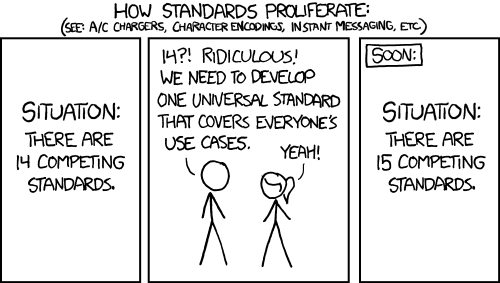
The RCS Mirage: “Advanced Messaging” is a mess in the US, and Google’s “standard” is just one more • Android Police

David Ruddock:

»And so we have competing strategies. Google would prefer everyone just support its RCS client, based on the GSMA’s universal profile, and allow users on any carrier to utilize its features, and carriers like AT&T and T-Mobile would rather see the development of a negotiated “universal profile” that allows cross-compatibility of core features, but not necessarily for all features, just the ones the carriers can agree are important enough to need, but not that they’d maybe like to keep to themselves as “value-add” incentives for their subscribers to stay on the network. So, you could (and likely will) end up with a basic, universal RCS profile, but there’s a very real possibility that business interests will gimp that universal profile with a more limited feature set. And let’s not forget: the US’s largest smartphone manufacturer by sales, Apple, has absolutely no reason to adopt RCS ever.

«

As one commenter points out, it’s like the XKCD cartoon about standards:
link to this extract


Computer forensics defuses FBI’s Clinton email ‘bombshell’ – the math doesn’t add up • The Register

Duncan Campbell (who knows one end of a spy agency from another):

»Comey’s letter to Congressional leaders, which started the whole debacle, explained that the agency could not officially look at or report on the emails without obtaining a specific new warrant. The letter implicitly acknowledged that the agency already had copies of all the mails on its computer systems (which would normally automatically have been indexed by forensic software), bringing the Clinton connection to light.

To find out how many emails on the laptop were relevant would have taken “seconds”, according to e-discovery software industry experts. To then find out how many of those – if any – the FBI had not seen in its previous investigation would, at most, have taken “minutes.” Standard methods are to take and match cryptographic hashes of email files (which proves the email files identical, if the hashes match), or to match metadata and then textual content.

The FBI’s previous, year-long investigation into the private Clinton server finished in July, when director James B Comey reported that: “We cannot find a case that would support bringing criminal charges.”

As only 110 of 30,490 official emails previously examined by the FBI were found to contain classified government information, the number of previously unseen mails that had strayed onto Weiner’s laptop is likely to range from zero to a few tens.

«

link to this extract


Secretive startup Magic Leap loses top marketing executive • Bloomberg

Mark Bergen:

»Magic Leap Inc., a secretive augmented reality startup with a massive funding warchest, lost its top marketing executive before the company has even brought its first product to market.

Brian Wallace, a veteran smartphone executive with previous stints at BlackBerry Ltd., Samsung Electronics Co. and Google, left Magic Leap in October, the company confirmed. The startup made waves when it brought Wallace on in April 2014, after closing a $50 million venture capital round.

Since then, Magic Leap has raised more than $1.3 billion in additional capital from tech giants such as Qualcomm Ventures, Alibaba Group Holding Ltd. and Alphabet Inc.’s Google. The latest investment round, in February, valued the company at $4.5 billion.

“I did what I set out to do, which was help Rony and the team create one of the most hotly anticipated technology companies in years,” Wallace said in an interview, referring to Chief Executive Officer Rony Abovitz. “At this stage though, it’s time for me to move on to other opportunities.”

«

Magic Leap is either going to be the most incredible thing ever, or quite blah compared to all the other stuff already out there. I lean towards the latter.
link to this extract


Samsung recalling almost 2.8m washers due to impact injuries • NBC News

Lucy Bayly:

»Samsung has one more fire to put out: The South Korean company announced on Friday that it was recalling 2.8m top-load washing machines, following reports of “impact injuries” that included a broken jaw.

The problem stems from unbalanced drums, which can separate from the washer and generate enough internal force to cause other parts of the washer to detach — and, in some cases, be launched out of the machine.

Samsung is also the subject of an August lawsuit from owners who said their machines “explode during normal use.”

«

Only seems to be the US – but the machines have been sold in other countries too.
link to this extract


Huawei wants to beat Apple in smartphones in two years: chief exec • Reuters

Harro ten Wolde:

»”When we announced four years ago that we wanted to sell phones, people told us we were crazy. When we said we wanted to sell 100 million phones, they told us we were crazy,” [chief executive of Huawei’s consumer business group Richard] Yu said at a launch event in Munich.

Huawei on Thursday launched a new premium phone, which will sell for €699 apiece. A version developed with Porsche Design will cost €1,395.

The phone has a new artificial intelligence feature: it can learn about its user’s habits and automatically put the most frequently used apps in easy reach.

Huawei was the world’s third-largest smartphone maker in the third quarter with 33.6 million shipped devices, giving it a 9% market share, according to research firm Strategy Analytics.

Apple was still well ahead with 45.5 million devices, or a 12% market share. Samsung was the world leader with 75.3 million shipped devices and a market share of 20.1 percent.

“We are going to take them (Apple) step-by-step, innovation-by-innovation,” Yu said, adding that he expected to improve Huawei’s position along with technology shifts.

“There will be more opportunities. Artificial intelligence, virtual reality, augmented reality,” he said. “It is like driving a car. At every curve or turn, there is an opportunity to overtake the competition.”

«

Is it going to take customers from Apple, though, or from Samsung and other Android OEMs?
link to this extract


Errata, corrigenda and ai no corrida: none notified

Start up: Google’s endless EC case, here comes USB-C, mobo no go, South Korea’s weird scandal, and more


Voice control is going to be the next big thing in the home, it seems. Photo by SBIngram on Flickr.

You can now sign up to receive each day’s Start Up post by email. You’ll need to click a confirmation link, so no spam.

A selection of 12 links for you. Use them wisely. I’m charlesarthur on Twitter. Observations and links welcome.

Improving quality isn’t anti-competitive, part II • Google Public Policy blog

Kent Walker, Google’s general counsel:

»

we disagree with the European Commission’s argument that our improved Google Shopping results are harming competition. As we said last year in our response to the Commission’s original Statement of Objections (SO), we believe these claims are wrong as a matter of fact, law, and economics.

The Commission’s original SO drew such a narrow definition around online shopping services that it even excluded services like Amazon. It claimed that when we offered improved shopping ads to our users and advertisers, we were “favouring” our own services — and that this was bad for a handful of price comparison aggregators who claimed to have lost clicks from Google. But it failed to take into account the competitive significance of companies like Amazon and the broader dynamics of online shopping.

Our response demonstrated that online shopping is robustly competitive, with lots of evidence supporting the common-sense conclusion that Google and many other websites are chasing Amazon, by far the largest player on the field.

«

This is getting really very boring now. Foundem, the British company that was the original complainant to the EC, demolished Google’s response in its rebuttal analysis in June 2015. It’s very clear. Nothing has changed since then except that Google has grabbed more of the online advertising business. (Just to start you off: Google talks about “shopping” but the EC’s Statement of Objections is about “price comparison”. Because misdirection works.)

Could the EC just get on and determine its response now? This really has dragged on long enough.
link to this extract


Asustek, Gigabyte pushing their presence in motherboard market • Digitimes

Monica Chen and Joseph Tsai:

»

Currently, Asustek and Gigabyte together contribute over half of worldwide motherboard shipments and also have a major share in the mid-range to high-end motherboard sector.

In 2016, Gigabyte is expected to ship 16.1-16.5m motherboards, down from 2015’s 17m units. However, the company’s strong shipments in its high-end Z170-based and G1 series motherboards will still increase the company’s overall ASP. The company’s EPS is also expected to grow by more than NT$3.30 (US$0.10) and reach NT$4 in 2016.

Asustek is expected to ship 17-17.5m motherboards in 2016, but the company is also expected to achieve growths in both revenues and profits.

«

So that means worldwide motherboard shipments annually are about 68m, and falling in line with PC shipments. Please could nobody ever tell me that PC shipments are down because “people are making their own”.
link to this extract


Stephen Baker’s top holiday 2016 expectations • NPD

This is for the US:

»

PC holiday revenues revived – Sales will be the best in at least four years, as average sales prices rise

iPad Pros deliver big – Expect revenue increases for Apple tablets, while Android consumer interest wanes

Smartphone sales soar – New iPhones will exceed market expectations and drive the best smartphone market in years

Cutting the (headphone) cord continues – wireless headphones will be on many holiday shopping lists this year

Online sales will not falter – online revenue will account for as much as 33% of consumer electronics holiday sales

«

And quite a few more.
link to this extract


The missing storytelling • Medium

Nati Shochat, in May, on the lack of storytelling in Apple’s presentations these days:

»

explanations are limited and rare these days. The 2015 Macbook’s one USB-C port didn’t get the same explanatory time or effort that Jobs gave the Macbook Air upon its dramatic unveiling in 2008, when he took the time to explain why the new ultra-thin laptop didn’t have a CD/DVD drive. Schiller only referred vaguely to the reason — which is to push the Mac line even further — when asked directly by John Gruber during a one to one session, shortly after the WWDC 2015 event.

In the last year the lack of ‘Why’, stood out even more, as Apple’s new line of accessories took some “strange” design cues. Whether the ability to charge the Apple Pencil via sticking it to the iPad Pro’s lightning port (which is odd but strikingly convenient), or the need to flip over the Magic Mouse 2 — which looks like a dead mouse — in order to charge it, or the new iPhone Smart Battery Case with the hump. None of these products got the explanations behind the design rationale, that avid Apple users got used to in the last decade.

One might ask: if Jobs moulded Apple in his image, why the storytelling hasn’t stuck in the current communications and marketing?

«

This is exactly right. When Tim Cook introduced the new Apple TV, there wasn’t a story around how “TV is going to apps”. Why not? It could have made a huge difference to the presentation of those new MacBooks.
link to this extract


Smart watch market grows 60% in Q3 2016 as Apple ships 2.8m units • Canalys

»

Apple shipped 2.8m Watches in Q3, thanks to the release of the new Series 1 and Series 2 models late in the quarter. Despite reports to the contrary, Canalys research shows that shipments compared favorably to those in Q3 2015, the first full quarter after the original Apple Watch’s launch in April 2015. Total smart watch shipments exceeded 6.1m for the quarter, an annual increase of 60%.

«

By contrast, IDC put the third-quarter figure for Apple at 1.1m, and the total market at 2.7m. That’s quite a difference between the two, though Canalys’s higher total doesn’t do any favours to Android Wear – its figure suggests about 0.8m Android Wear watches for the quarter.

Analyst estimates did put Watch shipments higher than the 1.1m based on Apple’s results, so maybe Canalys is on to something.
link to this extract


Voice control the new breakout star in smart home technology • ABI Research

»

“Voice control will not only draw in new consumers to smart home functionality, but it will help transform a wide variety of new and emerging smart home services and devices into more attractive investments,” says Jonathan Collins, Research Director at ABI Research. “The stage is set for voice control to become the heart of any smart home system.” 

Amazon’s market leadership with its Alexa products and Google’s emerging Home platform strategy reflect not just the popularity of voice control devices within the home but also how voice will become a key smart home interface in the still emerging market for smart home managed systems. Alongside Amazon and Google, Apple, Samsung and Microsoft all have the impetus to bring similar devices and functionality to market.

While voice control will take a greater share of device revenue spending, it is an application that will push into and help drive all smart home markets and device categories. By 2021, more than 600 million smart home devices will ship annually, up from 40 million in 2015.

«

That’s a lot of devices, given that there aren’t anywhere near as many homes as there are people.
link to this extract


What the New York Times missed with its big GMO story • Grist

Nathanael Johnson:

»

if genetic engineering really had turned out to be a silver bullet for agriculture, we would be able to see the change in the zoomed-out big picture. And if GMOs [genetically modified organisms] had proved to be a quantum leap forward, we would see it in Times writer Danny Hakim’s crude country-level comparisons. In that regard, Hakim’s contribution is useful.

The problem here is that there’s enough data that you can easily pick the evidence to support your favorite narrative, depending on where you focus. For instance, in a rebuttal to the story, Monsanto’s chief technology officer picked a narrower focus and found plenty of data for a counternarrative making the case for biotechnology. The most balanced approach is to look at all the available evidence — and that’s what the National Academy of Sciences report already did.

Hakim cites the report where it supports his conclusions, but not in the places it contradicts them. He writes that the report found “‘there was little evidence’ that the introduction of genetically modified crops in the United States had led to yield gains beyond those seen in conventional crops.” But Hakim doesn’t mention that the report also noted that genetic engineering increased yields “where weed control is improved” and “when insect-pest pressure was high.” He doesn’t mention the report found that insect-resistant GMOs reduced insecticide use “in all cases examined”…

…Because most of us aren’t farmers, we have a hard time seeing the GMO age at all. But U.S. farmers can see it. Farmers aren’t backward dupes who are easily tricked into buying unnecessary technologies. These days, farmers are skeptical and tech-savvy. Many have multiple degrees. They often test yields and pest-resistance by planting half a field with one kind of seed, and half with another. They clearly think they’re getting something valuable when they pay the extra money for GMOs. Both farmers interviewed in the Times piece — one in France and one in South Carolina — said they thought GMOs were helpful.

«

It’s that last paragraph that’s most important. What do the people who have to put their money on the line think? The ones with the direct experience?
link to this extract


The irrational downfall of South Korea’s president Park Geun-hye • Ask a Korean!

“T.K” on the bizarre scandal engulfing South Korea’s president:

»

Even in her apology, president Park Geun-hye showed that she still might be under Choi Soon-sil’s hold. What would a self-interested politician would do, if the corruption of one of his cronies was revealed? The politician would sell the crony down the river, denying up and down that he ever knew or interacted with the crony. Such denial would be cowardly and dishonest, but at least it is predictable. But not with Park Geun-hye. She stood in front of the whole country and admitted that Choi Soon-sil fixed her speeches. Instead of cutting ties with her, Park reaffirmed that Choi was an old friend who helped her during difficult times.

This is utterly irrational. Rational people can expect that a corrupt politician may steal money for himself. They can even expect that he may steal for his family. But no one can expect that a corrupt politician would steal money for a daughter of a fucking psychic who claimed to speak with her dead mother. No one, not even the most cynical Korean, expected that the president would refuse to cut ties with Choi Soon-sil, a woman with no discernible talent other than manipulating the president and humiliating her in the process. Koreans may expect that the president would be corrupt, but they never could have expected that the president might be feeble in her mind.

Sports columnist Bill Simmons coined the term “Tyson Zone,” in which nothing you hear about a particular celebrity can possibly surprise you. Did you hear that Mike Tyson urinated on a police officer? Of course he did! Did you hear that Mike Tyson is attempting to breed unicorns? Of course he is! Given what you already know about Mike Tyson, none you hear about Mike Tyson could possibly surprise you.

With Choi Soon-sil-gate, Park Geun-hye put the entire country into the Tyson Zone.

«

I found it difficult to follow the dramatis personae in this, but it reads like something from Grimm’s Fairy Tales. Also: if the US votes in Trump, it’s going to follow South Korea into the Tyson Zone damn fast.
link to this extract


The passenger train created to carry the dead • BBC

Amanda Ruggeri:

»

For 87 years, nearly every day, a single train ran out of London and back. It left from a dedicated station near Waterloo built specifically for the line and its passengers. The 23-mile journey, which had no stops after leaving London, took 40 minutes. Along the way to their destination, riders glimpsed the lovely landscapes of Westminster, Richmond Park and Hampton Court — no mistake, as the route was chosen partly for its “comforting scenery”, as one of the railway’s masterminds noted.

How much comfort a route gives passengers isn’t a usual consideration for a train line. But this was no normal train line.

Many of the passengers on the train would be distraught. The others — those passengers’ loved ones — be dead. Their destination: the cemetery.


A rare view of the first London Necropolis Railway station, built in 1854; it was demolished after the new station was built in 1902 (Credit: SSPL)

In operation from 1854 to 1941, the London Necropolis Railway was the spookiest, strangest train line in British history. It transported London’s dead south-west to Brookwood Cemetery, near Woking, in Surrey, a cemetery that was built in tandem with the railway. At its peak, from 1894 to 1903, the train carried more than 2,000 bodies a year.

It also transported their families and friends. Guests could leave with their dearly departed at 11:40am, attend the burial, have a funeral party at one of the cemetery’s two train stations (complete with home-cooked ham sandwiches and fairy cakes), and then take the same train back, returning to London by 3:30pm.

«

link to this extract


Handsets equipped with USB Type-C connectors will take off worldwide in 2017 • Strategy Analytics

»

USB connectivity has been a part of mobile phones since the 1990s. Today, nearly all handsets sold globally contain an open or proprietary USB port.  Over that time-period, USB has evolved from Type-A connectors to Type-B and now Type-C.  The first Type-C portable device to emerge was the Nokia N1 tablet introduced in Q4 2014. Apple introduced Type-C ports in Q1 2015 when it unveiled its latest MacBook portable computer.  The first mobile handsets to incorporate the technology were smartphones introduced first by LeTV, followed by  OnePlus 2 and Zuk Z1, in 2015 almost two dozen handsets with Type-C was introduced.

Strategy Analytics forecasts global USB-C handset sales to grow a huge +1600% between 2016 and 2022. Emerging first in China, from LeTV, OnePlus and others in 2015, handsets equipped with USB Type-C connectors will take off worldwide next year, as costs fall.

Beyond Asia, North America and Western Europe will see rapid adoption of the technology. We predict Type-C will become the dominant connector-port on cellphones.

USB-C will first appear in high-end models, but it will soon begin to migrate to lower-tier devices. In the first phase Type-C is used as a differentiator but soon it will become a standard for all devices.

«

link to this extract


MacBook Pro review: the Air apparent • The Verge

Vlad Savov:

»

To Apple’s credit, there’s no single Windows laptop that yet matches all of the MacBook line’s key strengths — touchpad ergonomics, battery life, display, and industrial design — but Apple’s changes have now created an opportunity that didn’t exist before. All a Windows vendor needs to do to convince me is to build something as good as a MacBook and then top it off with a simple SD card slot. macOS isn’t as major an advantage as it used to be, especially for someone like me whose professional life revolves around Google and Adobe’s cloud services.

When it launched the MacBook in 2015, Apple wasn’t shy about claiming it had reinvented the laptop. With the benefit of some hindsight, I’d argue Apple only reinvented its own product line. Copycat designs have arisen, as they always do, but the MacBook’s biggest impact so far has been within Apple’s walled-in ecosystem. We can see more of the new MacBook’s DNA in the new MacBook Pro than original MacBook Pro features. This is just the way Apple laptops are made now and we can either learn to like it or go elsewhere.

And that, frankly, is the problem here. Apple is trying to return to its old habit of dragging us forward into the future like a wild-eyed inventor, but this time it might have cut a little too deep into present-day functionality while trying to promote tomorrow’s technology. Apple could have been a major trailblazer for USB-C even while retaining a classic USB port and a photographer-friendly SD card slot. I don’t think those things would have disrupted the MacBook Pro’s scrupulously perfected proportions or Apple’s bottom line too much.

I don’t know if I’ll be buying this MacBook Pro, in spite of its superb design and performance, and that’s surprising to me.

«

Essentially, the PC (desktop/laptop) ecosystem stopped evolving; USB-C is externally imposed, aiming to do everything for everyone at Intel’s urging so it would create new demand for PC CPUs.

However the ideal person, or people, to get to review the new MacBook Pro would be those who actually use it to the limit – video editors, DJs, photographers. Not those whose trade is writing. I wonder if we’ll ever get to the stage where reviews of pro equipment are done that way.
link to this extract


Revised estimates of Leave vote share in Westminster constituencies • Medium

Chris Hanretty is reader in politics at the University of East Anglia:

»

I’ve been working on improved estimates which do have this property, and which also include results from Scotland. The details of the analysis can be found in a research note; the estimates themselves can be found in this Google Docs spreadsheet.

The difference between the two estimates are slight. 32 constituencies were formerly estimated to have voted Leave, but are now estimated to have voted Remain; 11 went the other way. This means a net change of +21 for Remain in England and Wales. Including Scotland, this means that 401 of 632 constituencies (63%) are now judged to have voted for Leave.

«

This is why even if Parliament votes on triggering Article 50 (to initiative the UK’s exit from the EU), it won’t change the outcome. Any MP who votes against the will of their constituency is committing political suicide. You can also see a rough map from July; the story’s the same, though the numbers slightly different.
link to this extract


Errata, corrigenda and ai no corrida: none notified

Start up: Facebook booms (and busts Admiral), Fitbit struggles, whither Macs?, and more


Newspapers: all washed up? Photo by Nathan Winter Design on Flickr.

You can now sign up to receive each day’s Start Up post by email. You’ll need to click a confirmation link, so no spam.

A selection of 9 links for you. Apply externally. I’m charlesarthur on Twitter. Observations and links welcome.

Facebook is right to sink Admiral’s app • Open Rights Group

»

Late yesterday, on the eve before Admiral tried to launch Firstcarquote, their application’s permission to use Facebook data was revoked by the social media site.

According to Admiral’s press release their app would use, “social data personality assessments, matched to real claims data, to better understand first time drivers and more accurately predict risk.” So young people could offer up their Facebook posts in the hope of getting a reduction in their car insurance.

However, their application has been found to be in breach of Facebook’s Platform Policy section 3.15, which states:

»

Don’t use data obtained from Facebook to make decisions about eligibility, including whether to approve or reject an application or how much interest to charge on a loan.

«

«

Bah – Admiral should just target people who have old or crashed cars via Facebook. But it’s a rare instance in which Facebook can look like the positively good player.
link to this extract


April 2015: Have publishers lost their minds with Outbrain? • Mediapost

Ari Rosenberg:

»

Last November, Time Inc. announced a $100 million keg-party deal with Outbrain.  So now its sites will have more traffic, and hence more inventory, while lowering the quality of its audience through the lens of common sense. 

For example:

Food & Wine magazine (part of Time Inc.) has a rate base of 925,000.  Advertisers see that number and it makes sense.  Foodandwine.com reports 8.5 million monthly unique visitors.  That number makes far less sense for this affluent brand.  How can its prestigious audience demographics not get watered down at this unnatural size? 

Here are more examples of premium sites listed as Outbrain customers, who appear to have outgrown their brand’s natural size:

New York magazine has a rate base of 400,000. It reports 14.5 million monthly uniques.  Only 8.4 million people live in New York City.

INC. magazine reaches a clearly defined audience of “owners of growing businesses.”  The magazine’s rate base is 700,000.  The Web site reports 7 million monthly uniques, which makes the site audience less clearly defined…

…The idea that buying a click to your site for 10 cents through Outbrain is going to then convert into a more dedicated site visitor is just an excuse. The real reason sites do this: to have more impressions for their lower quality advertisers buying the site via RTB, and to help fulfill orders sold to advertisers who bought that site directly. Neither outcome helps premium publishers increase the value of what they sell.

Outbrain is just another short-term fix that creates a long-term problem.

«

The point about New York magazine is quite neat; though of course there could be that many people interested in New York.
link to this extract


Google security engineer claims Android is now as secure as the iPhone • Motherboard

Lorenzo Franceschi-Bicchierai:

»

As an example of Android’s misunderstood security, [Android director of Adrian] Ludwig used the infamous series of critical bugs known as Stagefright, which were found last year. Ludwig noted that despite the alarm and the potential danger to practically all Android users, they have yet to see a real-life hack on an Android phone done exploiting Stagefright.

“At this point we still don’t have any confirmed instances of exploitation in the wild,” he said.

Obviously, Ludwig admitted that while things have gotten much better in the last year, telephone carriers and phone manufacturers that use Android still have to improve their update cycles and become quicker in adopting security patches.

“We got quite a bit of work left to do to get to a point where that actually happens on a regular basis across the whole the ecosystem,” Ludwig said.

«

link to this extract


Wherefore art thou Macintosh? • Asymco

Horace Dediu:

»

Indeed, because no usurper was allowed to emerge, PC/Windows never moved to a mobile evolution of computing. Microsoft’s platform future was lost because the antibodies which eat disruptions were left unchecked.

But Apple’s immune system was suppressed. It allowed a disruptor to emerge from within. Apple gave birth to its future by suppressing the reaction to that new seemingly parasitic organism. It took an immense willpower to allow this to happen.

But it takes us back to the question of what to do with the incumbent, the donor of DNA and resources. The parent that sacrificed for the child.

The Mac is thus not treated disparagingly. It deserves and gets respect. It is preserved but with limited responsibilities.

Which brings me to the question of what it is allowed to be and hence what it is. It cannot take on the role of being the future. That belongs to the touch screen devices. It will not morph into a touch device any more than a teen’s parent will become cool by putting on skinny jeans. What it will do is become better at what it is hired to do.

The key to the Mac therefore becomes that which the iPad/iPhone isn’t: an indirect input device. The keyboard and mouse/trackpad are what define the Mac. The operating system, the apps, the UX, are all oriented around the indirect input method. The iPhone’s capacitive touch brought about the direct input method, a third pivot in input methods (first was mouse, second trackpad/scroll wheel). Each pivot launched a new set of platforms and the Mac is the legacy of the second.

«

link to this extract


Print newspapers are dying faster than you think • Vox

Timothy B. Lee:

»

Advertising is a cyclical business. Revenue tends to go up during economic booms and then decline during recessions. So when newspapers ad revenues plunged in 2008 and 2009, many in the industry hoped this would prove a temporary setback and that they’d regain some of the lost ground once the economy recovered.

Instead, over the past six years the opposite has happened: Newspaper advertising revenues have continued to deteriorate even as the economy booms. The latest numbers from a number of major newspapers tell a grim story.

On Wednesday, the Wall Street Journal announced that it was consolidating some sections of the newspaper to cope with dwindling ad sales. The transition to a slimmer paper will be aided by a round of buyouts [voluntary and compulsory redundancies] the Journal announced last month.

And the situation is even grimmer at smaller papers. For example, the Ithaca Journal in upstate New York announced today that it was laying off two editorial staffers, leaving a paper that once employed an editorial staff of more than 20 people with just two full-time reporters.

«

Read on to discover who to glare at over this.
link to this extract


Facebook beat Q3 earnings estimates, has more than a billion daily users • Recode

Kurt Wagner:

»

The social giant beat earnings estimates Wednesday, bringing in more than $5.7bn in mobile advertising revenue alone. That’s bigger than Facebook’s entire business in Q3 of 2015. It also surpassed one billion “mobile only” monthly active users for the first time last quarter, which means those billion-plus users never visited Facebook on any device other than a phone.

Why does that matter? Well, it underscores what we’ve known for quite a while now, that advertisers are spending more and more on mobile advertising, and Facebook is in a unique position to collect a lot of those ad dollars. In fact, it’s one of just two businesses driving the whole industry. (Hey, Google!)

«

That’s money that isn’t available to any other media outlet to win as advertising. Data from the IAB suggests that when you remove Facebook and Google, digital advertising in the US actually shrank in the first half of this year. This doesn’t seem healthy.
link to this extract


Feds strike down another multi-national “tech support” scam • Ars Technica

Joe Mullin:

»

Federal authorities say a group of scammers that “bilked millions” from US consumers with pop-up ads and hijacked Web browsers has been sued by the Federal Trade Commission.

The scheme, which operates under the name Global Access Tech Support, used pop-up ads that told consumers their computers were “hacked, infected, or otherwise compromised,” according to the FTC complaint (PDF) published yesterday. Consumers are then instructed to call a toll-free number in the message. The pop-ups “are typically designed so that consumers are unable to close or navigate around them, rendering consumers’ web browser unusable.”

Anyone who calls the toll-free number is connected to telemarketers in India, who then roll out a sales pitch explaining that the caller’s computer is “in urgent need of repair.” The telemarketers claim they’re affiliated with either Microsoft or Apple or are “certified” by those companies.
If they’re still along for the ride at this point, users are directed to a website that prompts them to begin a remote access session. The telemarketers gain access to the computer and “run a series of purported diagnostic tests, which, in reality, are nothing more than a high-pressured sales pitch designed to scare consumers into believing that their computers are corrupted, hacked, otherwise compromised, or generally performing badly.”

«

I wrote about these gangs at the Guardian back in 2012; nothing has changed, essentially. They’re making millions per year from this scam, and have no reason to stop – VOIP calls from India are cheap, and people are so used to Indian accents on support lines that they’re easily fooled.
link to this extract


How Spotify can tear up the music business • Bloomberg

Leila Abboud:

»

I’ve looked before at how Spotify could lure more paying customers by offering distinct high and low-end services at different prices. There’s something else it might do to improve profits and shore up its power: mimic Netflix by becoming a producer as well as a distributor — and take other steps to bring more music on board that doesn’t cost so much.That means acting more like a label. Traditional music labels do two big things: discover and nurture artists, and market them. With a trove of user data, a strong brand and global reach, Spotify could do that too. Imagine if it branched out into developing independent-minded artists such as British grime star Skepta. Or if it allowed unsigned acts to upload music to its service in a similar way to SoundCloud or YouTube. Spotify could even try buying independent music labels such as Beggars Group (home of SubPop and Matador Records) or Warp (London’s electronic dance music specialist.)It could then use its control over curated playlists and recommendations to push its own stuff. Over time, this might even give it more clout when negotiating with labels.

«

Sure to be antitrust issues if it were to get too big. And while streaming music might not be profitable, setting up artist labels isn’t a path to riches any more either.
link to this extract


Fitbit shares are crashing after missing on sales and cutting its full-year earnings forecast • Business Insider

Akin Oyedele:

»

The maker of fitness trackers said it now sees fourth-quarter adjusted earnings per share (EPS) in a range of $0.14-$0.18, far below analysts’ forecast for $0.75 according to Bloomberg. It lowered its full-year revenue guidance to a range of $2.32bn and $2.4bn, but analysts had expected $2.6bn. 

This weak guidance came ahead of the holiday quarter, which is critical for consumer-electronics makers and retailers, since their products are popular gift items.

The market for wearable fitness trackers is intensely competitive, with Fitbit stacked up against the likes of Garmin and Apple. 

In the third quarter, Fitbit’s unit sales grew 11%, and its average selling price rose by the same amount. New products like the Charge 2 and Flex 2 attracted new customers.

«

Sold more than 50m, but tough times lie ahead.
link to this extract


Errata, corrigenda and ai no corrida: none notified

Start up: further Russian hacking, MacBook Pro redux, troubled tablets?, Wii U goodbye, and more


US elections are built around a picture of 1950s American which no longer exists. Photo by Seattle Municipal Archives on Flickr.

You can now sign up to receive each day’s Start Up post by email. You’ll need to click a confirmation link, so no spam.

A selection of 13 links for you. Use them wisely. I’m charlesarthur on Twitter. Observations and links welcome.

Microsoft says Russia-linked hackers exploiting Windows flaw • Reuters

Jim Finkle and Dustin Volz:

»

Microsoft said on Tuesday that a hacking group previously linked to the Russian government and U.S. political hacks was behind recent cyber attacks that exploited a newly discovered Windows security flaw.

The software maker said in an advisory on its website there had been a small number of attacks using “spear phishing” emails from a hacking group known Strontium, which is more widely known as “Fancy Bear,” or APT 28. Microsoft did not identify any victims.

Microsoft’s disclosure of the new attacks and the link to Russia came after Washington accused Moscow of launching an unprecedented hacking campaign aimed at disrupting and discrediting the upcoming U.S. election.

«

link to this extract


Can DDoS attacks trigger ads and make money for the target? • botlab.io

Botlab.io calls itself “a think tank for digital crime fighting”:

»

Can DDoS attacks trigger ads? 

TL;DR

Yes. All application / layer-7 DDoS attacks trigger ads on the target site by default. The”visits” resulting from some layer-7 DDoS attack are no different from visits from advanced web scrapers visiting a page. This means layer-7 attacks may end up making money for the target and give the incentive to the target to not disclose such attacks. For ad fraud perps, it gives plausible deniability for otherwise highly suspicious patterns  in their traffic profile…

…Questionable sites often use shady ad networks to monetize their traffic, and many such ad networks will welcome any spike in traffic with open arms. Regular ad network commission is 50% or more of the revenue generated by the ad impressions on a site in their network. Therefore they do not always have the right incentives to disqualify suspicious traffic as non-legitimate. Even major networks such as Google have serious issues in proactively dealing with traffic quality. Recent research covering Google’s ad network traffic quality shows evidence for this claim.

«

Huh. Interesting idea. Hard to prove, though. Which is what makes it interesting.
link to this extract


‘Normal America’ is not a small town of white people • FiveThirtyEight

Jed Kolko:

»

I calculated how demographically similar each U.S. metropolitan area is to the U.S. overall, based on age, educational attainment, and race and ethnicity. The index equals 100 if a metro’s demographic mix were identical to that of the U.S. overall.

By this measure, the metropolitan area that looks most like the U.S. is New Haven, Connecticut, followed by Tampa, Florida, and Hartford, Connecticut. All of the 10 large metros that are demographically most similar to the U.S. overall are in the Northeast, Midwest or center of the country, with the exception of Tampa. Two of them — New Haven and Philadelphia — are even on Amtrak’s Acela (that’s “uh-SELL-ah”) line. None is in the West, though Sacramento, California, comes close at No. 12.

«

Also entertaining, in the same piece, is “places that are most like 1950s America” and this comment:

»

These misconceptions affect our politics: an outdated view of “normal America” is baked into the presidential election process. Iowa and New Hampshire, which vote first in the primary season and therefore have disproportionate influence, rank 37th and 41st, respectively, in their similarity to the U.S. overall.

«

Might make sense to start changing that. Power of data and all that.
link to this extract


The final Wii U will roll off Nintendo’s production line this week • Eurogamer.net

Tom Phillips:

»

Nintendo will end Wii U production this Friday, multiple sources have confirmed to Eurogamer.

At the last official count, as of 30th September, Nintendo had shipped 13.36m Wii U consoles. The Wii U’s final tally will likely now be only slightly more.

For comparisons sake, GameCube sold 21m. N64 sold 32m. Wii sold 101m.

Nintendo’s Japanese production line will shut down for the last time this week after the final deadline for orders passed yesterday, Eurogamer understands. Only a small number of further orders were placed.

Wii U launched back in November 2012 and quickly shifted a couple of million units, although sales have been steady to slow ever since.

«

The original Wii was wonderful because you stood up to use it. It was an action console. The games – Wii Sports and the rest – reflected that. It was energising. The Wii U turned that into a seated console, with that stupid tablet which was too heavy to hold standing up. It completely missed what made the Wii wonderful, even if it did conform to the idea of a “games console” – ironically, just as the time that games in volume were becoming more mobile than ever before.
link to this extract


Second Life creators head to virtual reality • WSJ

Joanna Stern:

»

Onstage at The Wall Street Journal’s WSJDLive 2016 global technology conference, Second Life creator Linden Lab demonstrated its forthcoming social virtual reality platform Sansar. It lets you create a 3-D virtual avatar and environment and then invite others to join you.

“Once you can create any space, you can create any social interaction you want,” says Linden Lab CEO Ebbe Altberg. “Whether it is an office, classroom, family room, bar.”

«

As long as that social interaction is with spooky robots, as evidenced by the picture of the avatars of Joanna Stern and Geoffrey Fowler:


link to this extract


Debunking Trump’s “secret server” • Errata Security

Rob Graham on the story, via DNS data, that a “Trump server” is “communicating” with “a server in Russia”:

»

The evidence available on the Internet is that Trump neither (directly) controls the domain “trump-email.com”, nor has access to the server. Instead, the domain was setup and controlled by Cendyn, a company that does marketing/promotions for hotels, including many of Trump’s hotels. Cendyn outsources the email portions of its campaigns to a company called Listrak, which actually owns/operates the physical server in a data center in Philidelphia.

In other words,  Trump’s response is (minus the political bits) likely true, supported by the evidence. It’s the conclusion I came to even before seeing the response.

When you view this “secret” server in context, surrounded by the other email servers operated by Listrak on behalf of Cendyn, it becomes more obvious what’s going on. In the same Internet address range of Trump’s servers you see a bunch of similar servers, many named [client]-email.com. In other words, trump-email.com is not intended as a normal email server you and I are familiar with, but as a server used for marketing/promotional campaigns.

«

Slate’s original story always felt like a stretch.
link to this extract


Twitter tests new ad-blocking Reader mode on mobile • The Guardian

Alex Hern:

»

Twitter is testing a new feature on its iOS app which turns on Apple’s “Reader” mode by default on every link opened in its in-app browser.

First introduced in 2010, and ported to iOS in 2011, Reader mode is a oft-forgotten feature in Safari that strips out most of the formatting from a webpage, removing adverts, navigation links, comments, and almost everything else except for the main content of a text-based article.

In the new test from Twitter, rolled out for a small number of users – including one Guardian reporter – the company has enabled Reader mode by default on every single link clicked.

While the new feature can be a boon for those navigating badly designed web-pages, it also manages to mangle the presentation of almost as many sites. While the feature works well for traditional news articles, anything that isn’t a chunk of text-heavy content in the middle of a page falls apart.

The change will also be worrying for many media organisations: unlike similar light-weight webpage options, such as Facebook Instant Articles and Google’s Amp project, there’s no option to customise the appearance of the Reader version of the page, nor any ability to monetise the views.

«

Yeah, it’s the latter worrying them. Though there’s no obvious reason why Twitter should be doing this. It seems to be having a bonfire of the vanities at the moment.
link to this extract


Is that a PC on your desk? Windows hybrids, Macs and iPads struggle for share • ZDNet

Ed Bott:

»

Does anyone even know what a PC is anymore?

That’s not an idle question. Unfortunately, it’s a reflection of the confusion among analysts covering this space today.

I’ve just reviewed four years’ worth of data from IDC and Gartner, the two big research companies that release regular reports tracking the state of the PC market. IDC publishes its results in its Worldwide Quarterly PC Tracker, while Gartner’s data is part of its PC Quarterly Statistics Worldwide report. Full reports are a subscribers-only product, but both firms publish detailed press releases with each new publication.

So, if you study both sets of data you’ll get a good handle on the PC market, right?

Spoiler: They can’t even agree on the definition of a PC.

…IDC says a Chromebook is a PC but a Surface Book running Windows 10 isn’t. Gartner counts the entire Surface line but leaves Chromebooks off the list.

To make things even more confusing, Apple (alone among device makers) publishes detailed sales figures for both its iPad and Mac lines. And Tim Cook insists that “the iPad Pro is a replacement for a notebook or a desktop for many, many people.”

«

Yup, it’s a problem all right; made worse by the purposeful obfuscation by those research companies in their public releases. The companies of course want people to pay for the full data, but there’s plenty of confusion sown because writers get hold of half the story and can’t figure out the other half.
link to this extract


Low-cost detachables and slates in the lead as tablet market slump persists • IDC

»

The worldwide tablet market continued its slump as vendors shipped 43m units in the third quarter of 2016 (3Q16), a year-over-year decline of 14.7%, according to preliminary data from the International Data Corporation (IDC) Worldwide Quarterly Tablet Tracker. In contrast to the annual decline, 3Q16 shipments were up 9.8% over the second quarter of 2016 as the larger vendors prepared for the holiday quarter.

Low-cost (sub-$200) detachables also reached an all-time high as vendors like RCA flooded the market. “Unfortunately, many low-cost detachables also deliver a low-cost experience,” said Jitesh Ubrani, senior research analyst with IDC’s Worldwide Quarterly Mobile Device Trackers. “The race to the bottom is something we have already experienced with slates and it may prove detrimental to the market in the long run as detachables could easily be seen as disposable devices rather than potential PC replacements.”

“Beyond the different end-user experience delivered by low- and high-end tablets, we’re witnessing real tectonic movements in the market with slate companion devices sold at the low-end serving a broader platform strategy, like Amazon is doing with Alexa on its Fire Tablets, and more expensive productivity tools closer to true computing and legitimate notebook replacement devices that should manage to keep average prices up,” said Jean Philippe Bouchard, research director, Tablets at IDC.

Despite Apple’s marketing push for the iPad Pro, the iPad Air and Mini lines have been the models with mass appeal, accounting for more than two-thirds of its shipments this quarter. Although Apple’s tablet shipments declined 6.2% year over year, total iPad-related revenues were flat for the quarter, thanks to the iPad Pro offering.

Samsung continued to hold the number 2 position. Fortunately, the negative press from the Note 7 did not bleed over into its tablet business. However, overreliance on the declining slate market led to a decline of 19.3% compared to 3Q15. Samsung’s attempt to enter the detachable market with its TabPro S at the beginning of 2016 seems to have taken a backseat as its price and positioning remain uncompetitive.

«

IDC’s comment implies about 3m iPad Pros (both flavours) shipped/sold, but it sounds like Samsung is hanging on by its fingertips. And – the irony – Microsoft’s Surface still doesn’t figure in IDC’s top five, meaning it shipped fewer than 2.4m (possibly more like 1m), even though it arguably chiselled out the niche for the Pro – but also, I’d suggest, did it too early. It’s not just technology; timing matters too.
link to this extract


Interview Transcription • transcrbr

»

transcrbr provides a technological solution to transcribing interviews, while retaining the quality of transcriptions created by humans.

«

Set up by a team including an MSc in AI from Edinburgh, and a former staffer at Google and Microsoft. It’s aiming to create a speech-to-text product using AI to intelligently transcribe interviews. Sign up if you’re interested. I’ve always wondered how soon we’d have this – the improvements in speech-to-text seem to beckon towards it, yet nobody offered it.
link to this extract


Uber is quietly terrible for women and black people: study • Jalopnik

Damon Lavrinc:

»

The National Bureau of Economic Research, a respected non-profit and non-partisan research organization, has released the findings of a two-year study that tracked discrimination of riders using Uber, Lyft, and Flywheel in Seattle and Boston. The study was done by researchers at MIT, Stanford and the University of Washington.

The study involved nearly 1,500 rides across the two cities, with work beginning in Seattle late last year to this March. Undergrads from the University of Washington were given identical phones with the three ride-sharing apps pre-loaded, instructed to take a handful of prescribed routes, and then noting when the ride was requested, when it was accepted by the driver, when they were picked up, and finally when they got to their destination.

In the Seattle experiment, trip requests from black riders took between 16 to 28% longer to be accepted by both UberX and Lyft, and breaking UberX out showed a wait time of 29 to 35% longer than their white counterparts.

Those figures are based on UberX usage, primarily because of the different ways a new ride is displayed to the driver through the Uber or Lyft app.

For Uber, drivers don’t see the name of the person they’re picking up until they accept the fare, at which point they can cancel. But for Lyft, which displays the rider’s name and picture (if they included it) before they accept the fare, means trying to quantize discriminatory practices through Lyft is largely impossible—a model Uber could conceivably adopt.

«

Two years is a long time for a study. But this really is something Uber should respond to.
link to this extract


How Apple could have avoided much of the controversy • Chuqui

Chuq von Rospach used to work at Apple; his take on last week’s product introduction (and non-introduction, on the desktop side) is worth your time:

»

Speaking of clusters, let’s talk Mac Pro for a minute. I’ve come to the belief that the trash can Mac pro, the “Can’t Innovate my Ass” machine, is a product mistake of the “20th Century Anniversary Macintosh” caliber. It was a technological marvel, it was a stunning design, and it was a terrible piece of hardware for it’s primary audiences because of limited upgradability and component flexibility — and then Apple compounded that by not having good upgrade plans in place to refresh it since the design it created wouldn’t let its users do it for themselves.

«

And this, which to me is a killer point about ports:

»

to those arguing that Apple is just soaking users by forcing them to buy dongles, adding $40 to a $2500 product simply isn’t financially significant. And if you think about it, if Apple did see these are lucrative products instead of functional accessories, they’d make them a lot prettier.

But the bigger issue around dongles is that niche thing again. These are accessories that allow specific customizations to the device that some people will want, but which most people won’t need. If you think about it, perhaps the biggest change from my older, 2013 laptop is that it’s gone from having seven (yes, that many) ports, each with a specific purpose to having four points, each customizable by a cable to dongle to solve the problem you have.

My laptop has a power port, an SD card port, 3 Thunderbolt ports and two USB ports. I know that in the four years I’ve owned it, I’ve never used the SD card, I use the Power port, one Thunderbolt port, and occasionally plug a USB cable in. So half the ports in this thing are never used — and yet I paid for them because they were built into the computer.

That’s the issue that defines dongles: Should 100% of buyers pay for a feature when only 5% of the owners will use it? Or 10%? How many users will need a feature before you think it ought to be required for everyone to buy it as part of the device? Where do you draw that line?

«

I’ve never used the SD card slot or – I’m pretty sure – the HDMI output port on my 2012 Macbook Pro. Not really going to fight over that. The whole piece is well worth reading at leisure.
link to this extract


Benjamin Button reviews the new MacBook Pro • Pinboard blog

Maciej Ceglowski, channelling F. Scott Fitzgerald’s famous character:

»

The new MacBook Pro shows that Apple is finally becoming serious about developers.

Gone is the gimmicky TouchBar, gone are the four USB-C ports that forced power users to carry a suitcase full of dongles. In their place we get a cornucopia of developer-friendly ports: two USB 3.0 and Thunderbolt 2 ports, a redesigned power connector, and a long-awaited HDMI port.

Photographers will rejoice at the surprising and welcome addition of an SDXC card reader, a sign that Apple might be thinking seriously about photography.

The new MagSafe connector is a bit of Apple design genius. The charging cord stays seated securely, but pops right off if you yank on it. No more worries about destroying your $2k laptop just by accidentally kicking a cord.

What hasn’t changed: Apple has kept the beautiful Retina display, and storage and memory are the same as before. The new machines will be slightly thicker (to accomodate the USB ports) and 200 grams heavier, but it’s not clear how this will affect battery life.

Interestingly, Apple has removed the fingerprint reader and its associated dedicated chip, perhaps assuming that developers would not comfortable with a machine they don’t fully control.

«

That Button. Some day soon they’re going to start banning him from bars on age grounds.
link to this extract


Errata, corrigenda and ai no corrida: none notified

Start up: battery blocking, beyond the touch screen, block that chumbox!, OLED wars, and more


Black Mirror: who’d go with the idea of a Prime Minister doing something with a pig, for god’s sake? Photo by Steve Garfield on Flickr.

You can now sign up to receive each day’s Start Up post by email. You’ll need to click a confirmation link, so no spam.

A selection of 13 links for you. Use them wisely. I’m charlesarthur on Twitter. Observations and links welcome.

Bug request: Remove web content access to Battery API • Mozilla Firefox Bugzilla

»

Bug 1313580 – Remove web content access to Battery API
Status:RESOLVED FIXED

«

Aha. This was pointed out as a possible security risk (remember reading it here?). Good to know some people are taking action. (In the meantime, rely on your phone’s OS to know what to do about your battery level.)
link to this extract


Patronising or portentous? Tech journalists weigh in on ‘Black Mirror’ • The i newspaper

I wrote an opinion piece at The i on the new series, debating with Rhiannon Williams. She hates it; I think it’s important:

»

Like Brooker, I’ve always been fascinated with the way that technology doesn’t do quite what we want it to, even when it works exactly as it was designed to. Social impact is what really matters, not how much RAM a phone has or how many pixels its screen has. Too much technology discussion focuses on the grain of the trees and ignores the forest growing around us.

Look at how Uber “freeing” people to drive us around has turned into a full-blown dispute about labour markets. If you find your emergency locksmiths through Google Maps, what happens to their price and trustworthiness? Hint: nothing good. If you let your newly minted artificial intelligence system label photos, will it be racist? Those are just the starting points. We’ll feel their effects down the years. Can we forestall them if we pause to reflect?

«

link to this extract


Jony Ive rejected touchscreen Mac, but working on things beyond the Touch Bar • 9to5Mac

Ben Lovejoy pulls out a couple of salient quotes from the Jony Ive interview with CNet (linked here a couple of days ago):

»

Ive explained that Apple had opted for the Touch Bar after exploring a number of possible approaches, taking several of them to prototype stage before real-life use determined which concept offered the greatest value.

»

There’s a number of designs that we explored that conceptually make sense. But then when we lived on them for a while, sort of pragmatically and day to day, [they] are sometimes less compelling. This is something [we] lived on for quite a while before we did any of the prototypes. You really notice or become aware [of] something’s value when you switch back to a more traditional keyboard.

«

This did, he said, take a lot of work, as it was important to create a prototype close enough to the final product to provide realistic feedback from users.

»

One of the things that remains quite a big challenge for us is that you have to prototype to a sufficiently sophisticated level to really figure out whether you’re considering the idea, or whether what you’re really doing is evaluating how effective a prototype is.

«

«

Of course Ive investigated a touch screen. I can’t imagine anyone rational who, on consideration, wouldn’t think they had. But (to reiterate a point made in the past) Apple already sells more touchscreen non-phones than it does Macs. Why up the price for something that people can already choose, and which they don’t choose in large numbers in the Windows market?

But then, the problem is: what of the things you can do are useful? TouchID is an obvious one – but if you’re going to add that, what else can you add that’s also useful and uses the same base software? It is problems like this that designers really face. That’s not the same as the problems that pundits perceive.
link to this extract


Publishers are rethinking those ‘Around the Web’ ads • The New York Times

Sapna Maheshwari and John Herrman:

»

The companies Taboola and Outbrain, both founded about a decade ago in Israel, dominate the industry, followed by Revcontent and ZergNet, according to data analysis firm Datanyze. (The Times has a “From Our Advertisers” section on its home page that leads to posts created by its ad department without participation of the news and editorial staff.)

ChangeAdvertising.org analyzed the content ads on those 41 news websites and found that 61% came from advertisers or other prominent publishers. But 26% led to “clickbait” sites that were covered in more ads and lower-quality recommendation widgets featuring sexually suggestive or interruptive images. Almost all of those sites, which appear to be paying for placement, then profiting from their own ads once people visit, hid their domain registrations.

Sean Blanchfield, chief executive of PageFair, an advertising start-up, referred to the ad-filled sites as “arbitrageurs” that are “basically designed to try and get the user to click on something.”

Rob Leathern, a board member at ChangeAdvertising.org, called it “a pretty problematic state of affairs.” He said it was surprising that such pages were “one click away from these top 50 news sites.”

Readers are starting to express discontent. One recently criticized the Outbrain links next to a Slate article about preventing eating disorders — one of which was titled “6 Tips to Avoid Thanksgiving Weight Gain.” Another was shocked by a Taboola link headlined “Meet the Women Making Rape Jokes That Are Actually Funny” under a Fusion news story about an underage rape. One Twitter user asked The Guardian in April: “Don’t these @Outbrain articles kind of undermine the integrity of news outlets?”…

…A sample of six Outbrain recommendations on The New Yorker’s website on Oct. 5 showed the confusion readers may face when looking at content ads; several were legitimate, but one led to a spamlike “clickbait” site and another led to a fake health news site created by a marketing company.

Two led to editorial stories from AARP, which promotes its website through Outbrain and embeds the widgets on its own site.

«

Those panels (known as “chumboxes“) pay the news sites well – but they leach both trust and money away in the end. (I long ago set my adblocker not to show them, and paid to remove them from my WordPress site.) There’s a hint here that we’re at the start of a change in attitude to these. The New Yorker has killed them; others may well follow suit.
link to this extract


OLED leadership competition: Samsung, LG ignite war over OLED leadership by investing massively • BusinessKorea

Michael Herh:

»

LG Display and Samsung Display will make invest about 13 trillion won (US$11.6 billion) in flexible OLEDs this year alone to win new orders for the iPhone from Apple

Analysis says that their investment volume combined is a record high and the two global panel giants began a “do or die” fight over the flexible OLED leadership.

According to the OLED industry on October 30, Samsung Display accounting for 95% of the world small and mid-sized OLED market will make additional investment of 5 trillion won (US$4.47 billion) in OLEDs in the fourth quarter of this year alone.

As Samsung Display invested about 5.9 trillion won (in facilities from the beginning of this year to the third quarter of this year, the additional investment will raise Samsung’s total investment in OLEDs of this year to 10.9 trillion won (US$9.7 billion). The figure is Samsung Display’s record high annual investment in OLEDs. In the case of OLEDs, Samsung Display focuses on small and medium-sized OLEDs such as those for smartphones, tablets and notebooks. In the big panels, the company has no plan to invest in OLEDs since it LCDs such as quantum dot displays.

LG Display is also making full-scale investment in flexible OLEDs this year. This year, LG Display’s size of facility investment is about 4.5 trillion won, the half of which is going into flexible OLEDs. Massive investment amounting to about one trillion won in E5 Line in Gumi begun last year reached the stage to move in equipment so the line will begin to operate in the first half of next year. 

«

Wait, I thought Apple was buying its OLED from Sharp?
link to this extract


Assessing the damage to the Samsung brand after Note 7 recall • IDC

»

IDC surveyed 1,082 U.S. consumers through an online survey on October 17th and 18th, four days after Samsung decided to halt production on the Note 7. The survey focused on three groups of consumers: current Samsung smartphone owners (507), past Samsung smartphone owners (347), and smartphone owners who have never owned the Samsung brand (228). Due to the limited installed base, just 24 Note 7 users were captured in the survey; as such, data in those questions should be viewed as directional only.

“As challenging as the Note 7 recall has been for Samsung, the data in this survey indicate that most consumers are unaffected by this, which should be good news for Samsung,” said Ramon T. Llamas, research manager, Wearables and Mobile Phones. “For the minority of Samsung customers who are unlikely to purchase a Samsung smartphone in the future, the company has to win back consumer trust. Thus far Samsung has offered monetary incentives but, at the heart of the matter, consumers want to learn the root causes of the problem and how Samsung intends to fix them.”

Some key results from the survey include:

• Half of the 24 Note 7 owners polled said they have or will choose an Apple iPhone to replace their recalled phone, while 17% said they would choose another Samsung. Most said they will return their phone through a carrier’s physical store.

• The Note 7 recall doesn’t appear to be harming the broader Samsung brand so far. A majority of respondents said it would not impact future decisions to buy other, non-smartphone Samsung products such as televisions and appliances.

• Survey participants’ view of Samsung’s response to the Note 7 recall was largely neutral to positive; surprisingly about 13% hadn’t heard about the recall when polled.

«

That iPhone stat strikes me as remarkably high. I’d have expected more loyalty to Samsung.
link to this extract


One in five iOS devices in the US are limiting ad tracking • eMarketer

»

Advertisers are keen on collecting audience insight wherever possible, but as technology evolves, options exist for consumers to take them off their trail and ensure privacy. According to October research, 20% of iOS devices in the US have been opted-in to the OS’s limit ad tracking feature.

In October, a few weeks following the release of Apple’s iOS 10, mobile attribution and analytics provider adjust gathered data from iOS devices on its platform running iOS 10 or later. Overall, 18% worldwide had the limit ad tracking option enabled. The feature, which allows device users to block ads, first appeared in iOS 6.

«

link to this extract


Skyrim publisher gives up on game reviews—and it won’t be the only one • WIRED

Chris Kohler:

»

The blockbuster videogame is now officially Too Big to Fail.

Bethesda, publisher of Skyrim, Fallout, and Dishonored, said this week that it will stop providing advance review copies of its games to the media. This is an inconvenience for the likes of WIRED. But it’s a far bigger problem for you, the consumer who wants to know what you’re getting for your money.

Officially, Bethesda says in its blog post announcing the move was that it encourages skeptical players to “wait for your favorite reviewers to share their thoughts” before buying Skyrim Special Edition and Dishonored 2. But that’s something of a Hobson’s choice when Bethesda includes tantalizing extra content available only if you pre-order the games before they’re available—and, importantly, before reviews hit. Bethesda, and the publishers surely lining up to follow it down this road, want you to pay full price for a game before you know if it’s any good.

Beyond denying consumers the chance to make an informed purchase, this will spur a race to the bottom as game reviewers, desperate to be first to publish their thoughts, rush out whatever they can on the tightest of deadlines.

Make no mistake: the only winner is Bethesda.

«

Media, meet disintermediation. If the only winner is Bethesda, then it seems almost surprising that it has taken this long for Bethesda to arrive at this strategy.
link to this extract


Twitter’s new @Replies re-design isn’t just stupid; it’s really stupid • Medium

Tressie McMillan Cottom, a sociology professor and faculty associate at the Berkman Center for Internet + Society, found herself in a trial for Twitter’s new @ system, which allows tons more people to be included in Twitter “canoes” of replies, but doesn’t show you who is in said canoe:

»

[Now] when I try to respond to a tweet, I have no idea to whom I’m responding. What, pray tell, could be the problem with that?

Let me throw a few problems at you.

First, you should know how Twitter has learned that being known as a platform that facilitates harassment is bad for business:

»

Bloomberg is reporting that Disney chose not to pursue an acquisition of Twitter in part because it thought the bullying and behaviour of some of the ailing social network’s users might damage the entertainment company’s image.

«

Those of us who use Twitter and have identities that make us more vulnerable to harassment know this all too well.

Some of us have developed strategies to help us mediate that risk. I’ll share two strategies I have used and how this change undermines them.

«

This is such an amazingly bad implementation by Twitter. It’s hard to believe that its engineers are this tone-deaf about the problems on the network.
link to this extract


Lightbulb made of modified E. coli fuses biology and electronics • New Scientist

Alex Pearlman:

»

It could soon be possible to make a light source out of bacteria.

So says a group of students from Newcastle University in the UK who are attempting to combine electronic engineering and synthetic biology to create “electro-biological” circuits.

The students have turned genetically modified, glowing E.coli into something analogous to a light bulb. The bulb is meant to switch on when the bacteria experience heat stress from a miniature microbial fuel cell – a device that acts as a battery by harnessing electrical energy from the action of microbes.

The project will debut in Boston this week at the International Genetically Engineered Machine competition (iGEM), an annual global competition that ends in a synthetic biology science fair called the Giant Jamboree. The eight-person team from Newcastle is just one of 300 teams from 40 countries.

«

And then you swallow some of them.. and then your stomach lights up..
link to this extract


Is Facebook’s facial-scanning technology invading your privacy rights? • Bloomberg

Joel Rosenblatt:

»

While millions of internet users embrace the tagging of family and friends in photos, others worried there’s something devious afoot are trying block Facebook as well as Google from amassing such data.

As advances in facial recognition technology give companies the potential to profit from biometric data, privacy advocates see a pattern in how the world’s largest social network and search engine have sold users’ viewing histories for advertising. The companies insist that gathering data on what you look like isn’t against the law, even without your permission.

If judges agree with Facebook and Google, they may be able to kill off lawsuits filed under a unique Illinois law that carries fines of $1,000 to $5,000 each time a person’s image is used without permission — big enough for a liability headache if claims on behalf of millions of consumers proceed as class actions. A loss by the companies could lead to new restrictions on using biometrics in the U.S., similar to those in Europe and Canada.

Facebook declined to comment on its court fight. Google declined to comment on pending litigation. 

Courts have struggled over what qualifies as an injury to pursue a privacy case in lawsuits accusing Facebook and Google of siphoning users’ personal information from e-mails and monitoring their web browsing habits. Suits over selling the data to advertisers have often failed. 

This year, the U.S. Supreme Court set a “concrete injury” standard for privacy suits, a ruling that both sides are using to argue their case ahead of a hearing Thursday in San Francisco over Facebook’s bid to dismiss the biometrics case.

Google is fending off suits in Chicago, arguing that the Illinois statute can’t apply outside the state under the Constitution’s interstate commerce rules. Google also contends the Illinois law doesn’t regulate photos.

«

The UK has at least ruled that there is tort in unauthorised use of personal data.
link to this extract


Apple removes iconic startup chime from new MacBook Pro • Business Insider

Rob Price:

»

The Californian technology company is removing the distinctive noise that Macs make when they boot up, starting with the new MacBook Pro announced last week.

The change was first spotted by Pingie.com, which tested out one of the new laptops and confirmed that the noise is no longer made.

And an FAQ page that references the chime (referred to as the “startup sound”) for older MacBook models makes no mention of it for the new laptop.

Apple has used startup chimes in its Mac computers since the 1980s, settling on the most recent chime with the iMac G3, released in 1998. But now it’s finally being retired.

An Apple spokesperson did not immediately respond to a request for comment, but it’s likely because of the way the new MacBook Pro turns on. It doesn’t come with a power button, instead automatically turning on whenever it is opened (when charged) — so there’s no need for a noise to indicate to the user that it is booting up.

«

I don’t understand that last sentence. Portable Macs have woken from sleep when opened since 1998 or so. But that’s different from booting up.

No chime, though? If you thought people were upset about the lack of updates for the iMac and Mac Pro last week, wait until they hear about this.
link to this extract


Forget Twitter, Netflix should be an acquisition target • ValuePenguin Singapore

»

What if this tech behemoth acquired Netflix and made the service entirely free to its device users (or provide a discounted rate)? Netflix’s popularity is growing rapidly, and it already has almost 90 million subscribers globally. This could potentially tilt the balance in Apple’s favor and be the boost that Apple has been desperately needing in terms of growing its market share. But could it be beneficial economically?

We think it will be. For example, take our back of the envelope calculation below. Apple currently makes about $600 per iPhone, which is typically replaced about every 2 years, and makes about 40% gross profit on the sale. This translates to roughly $113 of gross profit per year per device ($600 divided by 2 years and multiplied by 40% gross margin). In comparison, Netflix currently makes about $9 per month per subscriber, for a total of S$104 per year. This means that, even if Netflix were to become completely free to Apple users, Apple will be increasing economic value per customer by almost 10%! This math looks even better if you start to incorporate numbers for iPads and Mac, which have higher ASP than an iPhone.

Back of the Envelope Calculation on Apple and Netflix
iPhone ASP – $595
Replacement Cycle – 2 years
Adj Annual Income per Unit – $298
Gross margin -38%
Gross profit per unit – $113
NFLX Monthly ARPU [average revenue per user] – $9
NFLX Annual ARPU – $104

Caveat is that Apple will depend on the customers to remain loyal to its devices and services for a long time, but that’s the whole point; adding services like Netflix would be a great way to increase customer loyalty just the way Amazon has been adding stuff to its Amazon Prime program over the years.

Currently, Apple only commands about 12 % of the global smartphone market. Although Apple only competes in the high-end portion of the market, Samsung has a whopping 23% of the global market share. Even if Apple were to tilt the market to its favor by 3-5%, it could be increasing its revenue from iPhones by about 40%, which could pay for the acquisition in a matter of few years even if Apple were to pay a meaningful premium. 

«

Ben Thompson suggested Apple should buy Netflix in his daily newsletter on Monday too. I’m sure both companies have considered it. Is the price too high for Apple? Or does Netflix not want to sell? In many ways, Netflix is like Beats Music, but for video: makes good sense for Apple, little sense for anyone else who could buy it.
link to this extract


Errata, corrigenda and ai no corrida: none notified

Start up: Facebook’s race ad row, Merkel’s search query, how Vine withered, toaster’s hacked!, and more


OLED displays are coming to next year’s iPhone, Sharp’s chief says. Photo by adafruit on Flickr.

You can now sign up to receive each day’s Start Up post by email. You’ll need to click a confirmation link, so no spam.

A selection of 13 links for you. Use them wisely. I’m charlesarthur on Twitter. Observations and links welcome.

Merkel: internet search engines are ‘distorting perception’ • The Guardian

Kate Connolly:

»

Angela Merkel has called on major internet platforms to divulge the secrets of their algorithms, arguing that their lack of transparency endangers debating culture.

The German chancellor said internet users had a right to know how and on what basis the information they received via search engines was channelled to them.

Speaking to a media conference in Munich, Merkel said: “I’m of the opinion that algorithms must be made more transparent, so that one can inform oneself as an interested citizen about questions like ‘what influences my behaviour on the internet and that of others?’.

“Algorithms, when they are not transparent, can lead to a distortion of our perception, they can shrink our expanse of information.”

«

The key point is that they’re not interrogable: we can’t trace back how they reach their conclusions. Humans, at least, can be asked.
link to this extract


Sharp president confirms new iPhones to adopt OLED panels • Nikkei Asian Review

Debby Wu:

»

Remarks by Sharp President Tai Jeng-wu, also an executive at Sharp’s parent company Hon Hai Precision Industry, better known as Foxconn Technology Group, came at a time when Apple is working on revamping the design of its flagship device to boost sales during the iPhone’s 10th anniversary next year.

“The iPhone has been evolving and now it is switching from LTPS (low-temperature poly-silicon) to OLED panels,” Tai told students at Tatung University, his alma mater, during a ceremony in which he was awarded an honorary doctorate degree.

“We don’t know whether Apple’s OLED iPhones will be a hit, but if Apple doesn’t walk down this path and transform itself, there will be no innovation. It is a crisis but it is also an opportunity,” Tai said.

«

Oops.
link to this extract


Facebook lets advertisers exclude users by race • ProPublica

Julia Angwin and Terry Parris Jr.:

»

Imagine if, during the Jim Crow era, a newspaper offered advertisers the option of placing ads only in copies that went to white readers.

That’s basically what Facebook is doing nowadays.

The ubiquitous social network not only allows advertisers to target users by their interests or background, it also gives advertisers the ability to exclude specific groups it calls “Ethnic Affinities.” Ads that exclude people based on race, gender and other sensitive factors are prohibited by federal law in housing and employment.

«

Not quite: you can’t exclude Caucasians. This is the most amazing blind spot on Facebook’s part. Moreover, it cannot pretend to be a “tech company”. It makes its money from advertising and it’s reliant on content. It’s a media company, just like a newspaper or TV broadcaster.
link to this extract


The inside story of Vine’s demise • Vanity Fair

Maya Kosoff:

»

The issues of resources and competing visions, however significant, seemed exacerbated by a slowness to develop new product features. “When we introduced music looping when I was there, it was the idea that you could add music to your Vines and it would loop perfectly,” one former employee said. “When I started, we were having those meetings. It took almost a year and a half for it to actually launch in the app, whereas Snapchat was launching something new every two weeks.”

Leadership was a problem, too. Vine operated nearly independently of Twitter. It was headquartered in Twitter’s New York office, while the rest of Twitter is stationed in the Tenderloin neighborhood of San Francisco. All three of Vine’s founders had left the company by October 2015. Twitter’s politics also took a toll on Vine. “There’s a bunch of different video things stewing around, but nobody has a clear vision for what video on Twitter should be, which was shocking,” a former employee told me. “As with all things at Twitter, it became a little more political. It became a little more like, ‘Well, who’s going to become the person who kind of runs all the video stuff?,’ as opposed to, ‘What the hell is our perspective on how video should work?’”

In Silicon Valley, there are really two kinds of companies: those that have good ideas, and those that can make money. Doing both is the ultimate goal, but Vine, along with untold numbers of on-demand delivery apps and novelty social-media companies, may have been the former, not the latter. Vine stars living in a luxury condo in Los Angeles may have loved the idea—as did Vine’s users—but the company never found its footing generating revenue. (Twitter itself is still figuring out a path to profitability.)

«

Salient point: Twitter had three video services running at once. That’s the inside view. And now for the external view…
link to this extract


Inside the secret meeting that changed the fate of Vine forever • Mic

Taylor Lorenz:

»

Last fall [in 2015], nearly 20 of Vine’s top 50 creators gathered in a conference room at 1600 Vine Street in Los Angeles to stage an intervention.

They were there to meet with Karyn Spencer, Vine’s Creative Development Lead, and other representatives from Vine in a last-ditch effort to save an app they saw was failing fast.

Marcus Johns, with 6.1 million followers, and Piques, a Vine star with more than 3.1 million followers, helped organize the meeting. They and their peers had noticed a sharp dropoff in engagement on the app. Johns and Piques owed their fame to the platform, and they were desperate to turn it around.

The stars had a proposal: If Vine would pay all 18 of them $1.2m each, roll out several product changes and open up a more direct line of communication, everyone in the room would agree to produce 12 pieces of monthly original content for the app, or three vines per week.

«

They also asked for Vine to deal with harassment and abuse (among other things). Which didn’t happen. Twitter, amazingly, considered the payment – then decided not to. And so Vine died.
link to this extract


Mac malaise • curtclifton.net

Curtis Clifton works at the Omni Group, which makes Mac/iOS software:

»

The real issues is that the Touch Bar is impressive tech looking for a problem. [Daring Fireball’s John] Gruber writes:

»

The Touch Bar is the answer to “These keyboard F-keys are cryptic and inflexible — what can we replace them with that’s better?” That’s an actual problem.

«

That is not an actual problem. Actual problems are user problems. What job does the Touch Bar do? None of the demos of the Touch Bar were compelling to me. Everything the Touch Bar does can be done on-screen with trackpad input or on a tablet with pen input. “But now you don’t have to take your hands off the keyboard!” Instead I have to take my eyes off the screen. That’s a win? No. It’s a gimmick.

The one actual problem the Touch Bar might address is discoverability. By showing controls that are appropriate for the user’s current task, devs might help their users find more of the power their software provides. I see two counterpoints here. There’s nothing stopping developers from doing that now without the extra hardware, and there’s a very good chance that the extra real estate will be used to overwhelm rather than edify. Just think what the team that designed Microsoft Office’s ribbons UI could do with yet another row of buttons.

That brings me to the heart of why the event was so disappointing. Apple is targetting casual users and sacrificing support for power users.

«

I’d like to know what sort of internal discussions Apple had in the past about various design changes in laptops, and what there was over the Touch Bar. This wasn’t done in a hurry. The design team created it – in response to the software team? The marketing team? Off their own bat? – and then the software team had to implement shortcuts for it in tons of apps, as well as the software to run it. That’s a lot of time during which someone could have said “You know what? This is stupid.” But then what do you get? The same devices as before, speedbumped. It’s notable that those who are most negative about the Touch Bar have never seen it. This is a common trope with new Apple features.

Instead of the Touch Bar, they could have made a touchscreen. Except Apple already has a touchscreen OS, and products which run it.
link to this extract


Apple’s new MacBooks: out of touch or just in time? • Forbes

Mark Rogowsky:

»

Many critics yesterday shared the view of Business Insider’s Rosoff and questioned Apple’s apparent intransigence to build a Mac touchscreen.

But while the desire for such a feature is understandable, its absence makes sense if you’re Apple. The company decided several years ago that touchscreen PCs offer a lousy user experience: Whether on a laptop or desktop, the screen is too far away to be easily pressed most of the time. To fix this, you need to first redesign the OS to support touch and then second redesign the hardware to get closer to the user.

Microsoft has performed a clever version of the latter with the new Surface Studio. But while that machine is gorgeous, at $3,000 and up, Microsoft will be lucky to sell 100,000 per quarter. In fact, for all the marketing and hype around Surface, the Pro tablet/PC hybrids sell only about 1 million in a similar time frame. These are products for the pundit class, to be sure, with apparently cutting-edge features and lots of legacy technology built in (USB ports, woot!).

«

The difficulty is figuring out to what extent the pundit class really has the pulse of the “ordinary” buyer. Do “ordinary” people buy a Pro device? The MacBook Air will do plenty well for most people who want USB-A and legacy connectors. If you’re a pro and buying a Pro, you might be able to spring for the extra cost of the connectors – and have a need for Touchbars and so on.
link to this extract


Why freemium apps suck for everyone (and how Apple is killing paid apps) • Cult of Mac

Graham Bower:

»

The reason we held out for so long against the switch from [insisting on having an app that is] paid-for to freemium is because, honestly, we think it sucks.

Last year I wrote a manifesto for classy app developers. I argued that app pricing should be clear and easy for the user to understand. Frankly, most freemium apps are anything but.

Take Pokémon Go for example. There is no way I would have downloaded this “free” app had I known that it would end up costing me over $40. Yes, I realize that I’m a grown adult and it is entirely up to me how much I choose to splurge on cute pocket-size creatures.

But my lack of impulse control aside, the fact remains that, like most freemium software, the total cost of ownership for the game is unclear at the start. When you download it, you really have no way of knowing how much storage, incense, lucky eggs and lures you will need to purchase.

To be fair, Pokémon Go is far from unique in this respect. In fact, these days this is pretty much the norm, which means I now avoid the temptation of “free” games like Madden NFL Mobile because I have absolutely no idea how much they are really going to cost me. Suddenly the price of the console version looks like a bargain.

Like Steve Jobs said about music, I believe that people want to own their apps. That way you know what the total cost will be.

«

In common with many before him, Bower argues that Apple should have offered the ability to get free trials, and that this would have “saved” paid apps. To which I’d say: what are freemium apps with IAPs, if not a form of free trial? OK, they’re not exactly the shareware model (use 30 days, then pay or discard). But you can get pretty close – watermarking, no-file-save, and so on.
link to this extract


The inevitability of being hacked • The Atlantic

Andrew McGill:

»

I switched on the server at  1:12 p.m. Wednesday, fully expecting to wait days—or weeks—to see a hack attempt.

Wrong! The first one came at 1:53 p.m.

This graphic is a simulation—a bot’s-eye view, if you will—but it’s the actual sequence of commands the hacking script used. It tried a common default username and password (root/root) and executed the “sh” command, giving it the ability to run programs and install its own code. My fake toaster doesn’t allow that, of course—it just cuts the connection.

The next hacking attempt, from a different IP address and using different login credentials, came at 2:07 p.m. Another came at 2:10. And then 2:40. And 2:48. In all, more than 300 different IP addresses attempted to hack my honeypot by 11:59 p.m. Many of them used the password “xc3511,” which was the factory default for many of the old webcams hijacked in last week’s attack.

The last attempted hack came 6 minutes ago using the username “root” and the password “xc3511.” (Yes, those are live figures; they were updated when you loaded this page.)

I’ll admit this volume of attacks might not be typical. I hosted my fake toaster on a virtual Amazon server, not an actual toaster hooked up to residential internet. Hackers aren’t typing these passwords themselves—they’ve programmed bots to do the hard work for them, scanning through thousands of open ports an hour.

«

Actual journalism: show people what happens, and how quickly. Nicely done, The Atlantic.
link to this extract


Sweden bans cameras on drones • BBC News

»

The use of camera drones has been made illegal in Sweden unless they are granted a special surveillance permit.

Under new rules set down by the Supreme Administrative Court of Sweden, camera drones qualify as surveillance cameras and require a licence.

Permits can be expensive and paying to apply for one does not guarantee it will eventually be granted.

There are no exceptions made for journalists, and critics have said the ruling could mean job losses.

In what some are describing as a “huge blow” to the aerial photography and camera drone industry, the court ruled that drone-mounted cameras are “regarded as surveillance cameras”.

Industry group UAS Sweden (Unmanned Aerial System) has argued that the court ruling could put 5,000 jobs in danger.

«

Petapixel says more than 20,000 drones were sold in Sweden in 2014, and more than 1,000 permits for commercial use.
link to this extract


Total nightmare: USB-C and Thunderbolt 3 • Stephen Foskett, Pack Rat

»

The core issue with USB-C is confusion: not every USB-C cable, port, device, and power supply will be compatible, and there are many different combinations to consider. The newest, most full-featured devices (such as Apple’s brand-new Touch Bar MacBook Pro) will support most of the different uses for the USB-C port, but typical older devices only support basic USB 3.0 speed and (if you’re lucky) Alternate Mode DisplayPort.

And it gets worse. Many USB-C peripherals are limited in various ways as well. Consider a simple USB-C HDMI adapter: It could implement HDMI over USB 3.0 or it could use Alternate Mode (native) HDMI. It could even (theoretically) implement HDMI over Alternate Mode Thunderbolt using an off-board graphics chip! Of these options, only the newest computers, like the MacBook Pro, would support all three. Can you imagine the consumer confusion when they purchase a “USB-C HDMI adapter” only to find that it doesn’t work with their MacBook or Pixel or whatever?

«

The capability for USB-C to screw things up really emanates from two things: all the legacy things that USB used to do; and all the display capabilities that USB-C is trying to incorporate. It also reminds me of the early days of Wi-Fi, when IBM was trying its damndest to push 5GHz 802.11a, while all the consumer-facing money was in 2.4GHz 802.11b.

“Standards”, eh. However, what USB 1.1 and Wi-Fi couldn’t do was this:

»

the issue of incompatible cables is even more serious. Many companies, including my go-to source, Monoprice, are building USB-C cables of various quality and compatibility. If you’re not careful, you can neuter or even damage your devices by using the wrong cable. Seriously: using the wrong cable can damage your machine! This should not be possible, but there it is.

«

link to this extract


Postimage.org — free image hosting / image upload • Postimage.org

»

Please contact us if you have a CDN [content delivery network] that is capable and willing of serving 1.8 Petabytes of outgoing traffic per month free of charge, or if you can make a donation to help us pay a monthly $12,000 bill from CloudFlare that we are now facing.

We have already received over $1300 worth of donations and counting. Thanks to everyone who is contributing; you rock!

«

Gee, you can’t serve 1.8PB (1.8 thousand TB, 1.8 million GB) for nothing? Shocking.
link to this extract


George Hotz cancels his self-driving car project after NHTSA expresses concern • The Verge

Sean O’Kane:

»

Hotz posted the full letter (which you can read here) to the Comma.ai Twitter account this morning. It was sent alongside a special order requesting more information about the Comma One, and The Verge was able to confirm its authenticity. Hotz also wrote that he “would much rather spend my life building amazing tech than dealing with regulators and lawyers. It isn’t worth it.” He went on to write that he was canceling Comma One, and that Comma.ai “will be exploring other products and markets.”

«

Amazing that the US road regulator would want to stop people putting potentially lethal one-tonne vehicles into the control of unproven software.
link to this extract


Errata, corrigenda and ai no corrida: none notified

Start up: the attention economy, Alphabet booms, Apple’s two-year Touch Bar, sayonara Vine, and more


Getting access to Twitter’s “firehose” can be useful for law enforcement. Photo by Stephen Mitchell on Flickr.

You can now sign up to receive each day’s Start Up post by email. You’ll need to click a confirmation link, so no spam.

Reading this on email? Forward it to a friend.

A selection of 10 links for you. Contrarily. I’m charlesarthur on Twitter. Observations and links welcome.

It’s the attention economy, stupid: why Trump represents the future whether we like it or not • Wired

Rowland Manthorpe:

»

Attracting attention has been an industry – advertising – since the second half of the nineteenth century. But in the last 25 years, it has turned into the basis for the entire digital economy. The crucial change was the ability to produce and consume media at increasingly low marginal cost.

At first, people called this new era the “information age,” thinking that once knowledge could be produced cheaply, everyone would be given access to it. In fact, now that information could be manufactured for next to nothing, it became relatively unimportant. What mattered was the truly scarce resource: the attention to consume it.

Today, tech and media companies compete for attention, in the form of time spent on their apps and websites. The business model is simple: capture attention, then monetise it through advertising. Most people won’t click on the adverts, but enough will (or so we hope). In that sense, not much has changed since the first email spammers swamped Yahoo and Hotmail inboxes with ads for vitamins and penis-lengthening. The only difference: today the spam is called “content.”

Once, content meant meaningful material. Now, it means something akin to “stuff”. Instead of art, literature, film and journalism, we have “stuff”. The message – what, in some old fashioned sense, it actually “says” – is beside the point. All that matters is whether it grabs attention.

«

Attention is the one characteristic that is evenly afforded: everyone has 24 hours in each day. It’s what you do with it, and how much others can get from it, that matters in a world of content. But the implication that attention (and so time) correlates directly with monetisation isn’t correct; but many people make it and that leads them down dead ends.
link to this extract


Twitter’s ‘firehose’ of tweets is incredibly valuable—and just as dangerous • Bloomberg

Benjamin Elgin and Peter Robison:

»

For years, Twitter has offered access to its “Firehose”—the global deluge of tweets, half a billion a day—to a number of companies that monitor social media. Some of those companies resell the information—mostly to marketers, but also to governments and law enforcement agencies around the world. Some of these authorities use the data to track dissidents, as Bloomberg Businessweek has learned through dozens of interviews with industry insiders and more than 100 requests for public records from law enforcement agencies in the U.S.

There’s nothing illegal about selling Twitter data, but it’s uncomfortable for a company that promotes itself as a medium for free speech and protest. Twitter issues regular transparency reports and has gone to court to fight censorship. Dorsey himself marched with Black Lives Matter activists in 2014, regularly tweeting messages of support and appearing at a conference this June wearing a #staywoke T-shirt. But amid Dorsey’s activism, one data user, Chicago monitoring company Geofeedia, was hired by California police departments after pitching its ability to identify civil rights protesters, according to an American Civil Liberties Union report released in September. Twitter, which touts a policy that prohibits third parties from making content available “to investigate, track or surveil Twitter’s users or their content,” cut ties with Geofeedia in October.

Twitter offers a free, stripped-down version of the full Firehose to the public, and in recent years, at least 17 companies besides Geofeedia have marketed surveillance products that make use of Twitter data to law enforcement organizations.

«

A warning before you click through: autoplay video ahead.
link to this extract


Apple’s new TV app won’t have Netflix or Amazon Video • WIRED

Brian Barrett:

»

Amazon’s absence is no surprise, given that Amazon Video has never been on Apple TV, and seems unlikely to show up any time soon. (If you need any further indication of Amazon’s feelings about Apple’s streaming box, keep in mind that it not long ago removed it, as well as Chromecast, from its digital shelves.)

Netflix comes as a bit of a surprise, though, as it’s long been a stalwart of streaming boxes, and was previously a participant in Apple TV’s universal search feature. The service didn’t appear in Apple’s presentation today, though, and the company has confirmed that it won’t be involved, at least at launch. “I can confirm we are not participating and evaluating the opportunity,” says Netflix spokesperson Smita Saran.

Netflix is still on Apple TV, of course, and this doesnt hat preclude future involvement in Apple’s new TV app, but a new service that’s meant to call up all of your streaming options that leaves out everything from Orange Is the New Black and Narcos to the slate of Disney, Marvel, and Star Wars movies that will join the Netflix catalog over the next three years seems like it will fall short of its aspirations.

«

Give it time. What’s Netflix’s leverage here?
link to this extract


Alphabet says revenue up 20.2%, sets $7bn share buyback • Yahoo

Narottam Medhora:

»

Google parent Alphabet reported a 20.2% rise in quarterly revenue on Thursday, helped by robust sales of advertising on mobile devices and YouTube, and the search giant said it would repurchase about $7bn of its Class C stock.

Alphabet, along with Facebook, dominates the fast-growing mobile advertising market.

Shares of Alphabet, the world’s No. 2 company by market value, were up 1.6% in after-hours trading.

Google’s ad revenue rose 18.1% to $19.82bn in the third quarter, accounting for 89.1% of Google’s total revenue, compared with 89.8% of revenue in the second quarter.

Paid clicks rose 33 percent, compared with a rise of 29% in the second quarter. Paid clicks are those ads on which an advertiser pays only if a user clicks on them.

Cost-per-click, or the average amount advertisers pay Google, fell 11% in the latest period after dropping 7% in the second quarter.

«

That’s quite an achievement. Going to be fun to see if this came from mobile-without-YouTube, or YouTube, or what, because Google stuffed mobile search pages with three ads a year ago, meaning there was nowhere else to go, ad-wise, on mobile search.
link to this extract


New MacBook Pro touches at why computers still matter for Apple • CNet

Shara Tibken and Connie Guglielmo:

»

Designed to work with Apple’s MacOS Sierra software, the black OLED display lights up to serve a changing menu of buttons, control sliders, dials and even emojis geared to the app you’re using. Ive, who says his team worked on it for at least two years, calls the Touch Bar “the beginning of a very interesting direction” that combines “touch and display-based inputs with a mechanical keyboard.”

“What’s amazing is, it is just throughout the system,” Federighi says, showing how the context-sensitive bar displays everything from the tabs you have open in Safari, to your calculator and strips of images from the video you’re watching. It also works with software from third parties like Adobe and Microsoft.

A Touch Bar instead of a full-on touchscreen means disappointment for anyone hoping for iPads and MacBooks to merge into some new mobile gadget. That’s just not happening, the executives insist. It’s not because Apple can’t make a touchscreen Mac. It’s because Apple decided a touchscreen on a Mac wasn’t “particularly useful,” says Ive. And on the MacBook Pro, which keeps getting thinner and lighter, it could be “a burden.”

“Doing something that’s different is actually relatively easy and relatively fast, and that’s tempting,” Ive says, telling us Apple decided against touchscreens for the Mac “many, many” years ago. “You can become fairly comfortable that you have a design direction that’s compelling. But if you can’t work out how you can refine that” without compromising the final product, “you can still undermine a big idea.”

Even so, Apple realizes it’s hard to know whether to opt for a laptop or tablet, particularly when you compare, say, the 12-inch MacBook and comparably equipped 12.9-inch iPad Pro (with a detachable keyboard and stylus). They cost about the same at nearly $1,300.

«

Two years. Quite a while.
link to this extract


Important news about Vine • Medium

“Team Vine”:

»

Since 2013, millions of people have turned to Vine to laugh at loops and see creativity unfold. Today, we are sharing the news that in the coming months we’ll be discontinuing the mobile app.

Nothing is happening to the apps, website or your Vines today. We value you, your Vines, and are going to do this the right way. You’ll be able to access and download your Vines. We’ll be keeping the website online because we think it’s important to still be able to watch all the incredible Vines that have been made. You will be notified before we make any changes to the app or website.

Thank you. Thank you. To all the creators out there — thank you for taking a chance on this app back in the day.

«

We value you, but not so much that we’ll keep you going forever. Apart from anything, feeding video is expensive when you aren’t monetising it effectively. Twitter was always going to lose out to YouTube in this game; sensible to cut its losses while it can. Where’s the axe going to fall next?
link to this extract


Worldwide smartphone shipments up 1.0% year over year in third quarter despite Galaxy Note 7 recall • IDC

»

“Samsung’s market dominance in the third quarter was unchallenged in the short term even with this high-profile Galaxy Note 7 recall, but the longer term impact on the Samsung brand remains to be seen. If the first recall was a stumble for Samsung, the second recall of replacement devices face-planted the Note series,” said Melissa Chau, associate research director, Mobile Devices. “In a market that is otherwise maturing, Christmas has come early for vendors looking to capitalize with large-screened flagship alternatives like the Apple iPhone 7 Plus and Google Pixel.”

“With Samsung’s Note 7 finally laid to rest, both Samsung and other vendors will need to invest both time and money into properly testing devices to avoid a future incident of this proportion,” said Anthony Scarsella, research manager, Mobile Phones. “The recall of the Note 7 represents an industry-wide wake-up call that will undoubtedly lead to a more vigorous testing and certification process moving forward.”

The top five vendors remain unchanged from last quarter despite double- and triple-digit growth from the leading Chinese vendors Huawei, OPPO, and Vivo. While Samsung and Apple continue to challenge each other at the top, these upcoming players have delivered value-packed devices that offer consumers top-shelf features at a fraction of the cost compared to the market leaders.

«

Numbers don’t include the shipped and recalled/unrecalled Note 7s. Huawei is coming up in Apple’s rear-view mirror – but OPPO and vivo are coming up behind it too. (Together, those latter two are bigger than Apple in this quarter.)
link to this extract


Twitter needs a full-time CEO • Bloomberg Gadfly

Shira Ovide:

»

It’s now conventional wisdom that Twitter Inc. is badly in need of repair. Yet the company on Thursday turned in a not-bad earnings report card for the third quarter, with revenue that topped its own forecast and an announcement of layoffs with a goal of turning a profit next year. A turbulent stock price rose about 4% in premarket trading. 

But the conventional wisdom remains correct. Few new people are using Twitter. Once-healthy advertising sales have nearly come to a halt, with a 6% increase in the third quarter compared with a 60% jump at the same point in 2015. And the company said a planned restructuring of its ad sales organization makes it impossible to predict fourth-quarter revenue. Oh, and potential buyers all ran off.

«

The job cuts are only the beginning. But yes, it needs a full-time chief executive who has a clear vision about how to slim it down to profit. Twitter can’t expand to profit, because it isn’t expanding any more.
link to this extract


No, George Soros does NOT own voting machines • Electionland

Jessica Huseman:

»

Here’s a fun new election conspiracy theory. A series of fringe right-wing blogs and some more prominent places like The Daily Caller have reported that George Soros has “deep ties” to, or even owns, a voting machine company that’s going to be used during the election — and that he might use the machines to rig votes.

The rumor has gotten enough air that one citizen created a White House petition asking “George Soros owned voting machines” to be removed. Almost 60,000 people have signed it.

The truth: Soros does not own voting machines, does not own any portion of the voting machine company, oh, and these machines are not even being used during the presidential election.

«

So many conspiracy theories, so little time.
link to this extract


Salvaging Google Fiber’s Achievements • diffraction analysis

Benoit Felten:

»

On the deployment side, the equation has changed from Google Fiber’s early days. Because Google made very targeted deployment and phased them over time, it’s now easy for AT&T and cable operators to respond in kind locally with a combination of price lowering and infrastructure deployment (or at least announcements) in the markets that Google publicly targets. The only way around that would be for Google to announce and undertake deployment in say 30 markets at the same time. It’s now quite clear that they don’t have the stomach for that.

Assuming they still want to play some kind of long game, they could however destabilize the incumbents by announcing a broad Webpass type deployment scenario. Target and quickly deploy in 30 markets with a Webpass like solution with the promise that if the demand is there, Fiber may be installed down the line. This positions the wireless broadband solution as a quick to market acquisition tool. It also forces AT&T to respond everywhere at the same time, something which (I suspect) they are incapable of and unwilling to do. This could be part of the catalyst, forcing AT&T and/or cable to really up their infrastructure game or (failing that) look at structural solutions to respond (assuming the TW/AT&T merger goes forward, the scenario of AT&T spinning off telecom infrastructure altogether is maybe not so unlikely anymore…)

Beyond that though, I think the best bet to stick to the original goal (wanting to change the market by pushing existing players to deliver significantly better service) is to open up the Google Fiber experiment. Instead of keeping everything close to the vest, go public with it and tell everyone out there: “this is how we’ve done it, these are the challenges we have faced, this is how we’ve overcome them”.

«

link to this extract


Errata, corrigenda and ai no corrida: none notified

Fear of a USB-C planet: why we’re going to miss Apple’s MagSafe


MagSafe 2: you’re gonna miss it. Photo by yum9me on Flickr.

Want to know my pick for the best technology Apple ever introduced? MagSafe. That’s the magnetic attachment system for power cords which it unveiled in January 2006 with the new MacBook Pro. Six years later, it followed that up with the MagSafe 2 connector.

From 2006 until the USB-C MacBook in mid-2015, every portable had a MagSafe connector of one sort or another. (The desktop machines didn’t.) As a technology, it’s so clever and so convenient, being reversible, and an inherent safety feature – you (or your dog/significant other) couldn’t destroy your laptop by accidentally walking into the power cord and pulling it off your desk, or destroying the power socket on the machine, either of which would be expensive to get fixed.

And now, I suspect Apple is going to get rid of MagSafe all across the laptop line, and replace it with USB-C. That’s what the “Hello again” launch looks like to me. (The MacBook Air might be kept on, unimproved and unadvertised, to anchor a lower price point.)

This is going to be a hell of a thing. From April 2006 to the end of December 2012, Apple sold 57m laptops, with – it’s a safe assumption – MagSafe adaptors on all of them. It used to split out the numbers, but stopped at the end of 2012, when the desktop:laptop ratio was running at 20:80.

Since then it has sold a total of 88.3m laptops and desktops; at that 20:80 ratio, one could reckon it has sold another 70.6m laptops.

That means that since the first MagSafe was introduced, Apple has sold a total of more than 120m laptops with MagSafe chargers.

And now it’s dumping them for USB-C.

Oh man. This is going to be a hell of a thing. If you’re like me and my family, then you have a ton of MagSafe chargers, possibly of different generations with the little magnetic doohickey which converts a MagSafe 1 to a MagSafe 2, distributed around your home and office. It’s so convenient not to have to take your charger from home to work and vice-versa; no forgetting. If you upgraded your laptop during the past ten years, you didn’t have to worry about getting a different charger; you could use the same one, or upgrade it. MagSafe is great.

Now? USB-C is coming. But you can’t make it compatible with MagSafe. No doohickey is going to make it right.

I can see that while a lot of people have been waiting for the new Mac laptops, this is going to be a real wrench. It’s as bad as the original iMac in 1998, which ripped up peoples’ investments in ADB plugs and forced them to USB. Except that at least then you could make converters which would get ADB to talk to USB; you won’t be able to get your old MagSafe charger to work with USB-C. (If you could, Apple would have done that with the new USB-C MacBook.)

There’s no doubt Apple is going to go all-out on USB-C with the new models; it wouldn’t surprise me if it revises the entire desktop and laptop line to introduce the new ports. When it does this stuff, it does it for keeps.

I’d love to be wrong on this; I’d love for Apple to have realised how wonderful MagSafe is, and determined to implement it on USB-C. But as noted above, if it could, then it would have done this on the MacBook.

Man, you’re going to miss those chargers. It’s going to take a long time for 10 years’ worth of chargers to go away. And a little part of me hates USB-C that tiny bit more; even though I’m in no hurry to upgrade, I know that when it happens all those chargers will be useless to me. Damn.

(On Twitter, Ken Tindell points out that Griffin – which picked up on the gap left when the first iMac introduced USB – has done a magnetic USB-C connector. Looks nifty.)

Start up: Airpods delayed, battle of the bokehs, Microsoft’s tablet vroooom, AI judges, and more


Is your website bloated? Can you smell it? Photo by Xray Delta One on Flickr.

You can now sign up to receive each day’s Start Up post by email. You’ll need to click a confirmation link, so no spam.

A selection of 12 links for you. Click early, click often. I’m charlesarthur on Twitter. Observations and links welcome.

Apple delays AirPod rollout, don’t expect them in October • TechCrunch

Matthew Panzarino:

»

If you’ve been waiting for Apple’s AirPod wireless headphones to go on sale, you’re going to have to wait a little longer. Apple says that it is not ready and will need “a little more time.”

“The early response to AirPods has been incredible. We don’t believe in shipping a product before it’s ready, and we need a little more time before AirPods are ready for our customers,” an Apple spokesperson told TechCrunch.

Apple did not say whether hardware or software updates are what is at the heart of the delay so I couldn’t conjecture which. My experiences with the AirPods have been very positive this far but the pre-production units that were given out to press are not without their foibles and bugs. Read about my time with them here.

I have seen a variety of small software/hardware interaction issues that have caused some frustration – but have taken them in stride because they are not final products.

«

Pity: I have found myself looking forward to the release of these. Everything I’ve heard about these has been positive, including Siri responsiveness (and understanding) and battery life.
link to this extract


Alphabet senior management page missing • Business Insider

Avery Hartmans:

»

If you’re curious to know who’s running the show over at Google and the other Alphabet companies, good luck: Alphabet no longer lists it senior management team on its website.

The names of the company’s top executives, their headshots, their bios, or any other information that shows who’s who inside the various Alphabet subsidiary companies have vanished from the company’s website. And it looks like it’s been that way for a few months now.

«

Being redesigned, apparently.
link to this extract


iPhone 7 Plus vs Honor 8: battle of the (fake) bokeh! • iMore

Daniel Bader:

»

a Portrait mode, as Apple calls it, is not uncommon. It’s been available in some Android phones for years. Specifically, the HTC One M8 added a second 2MP camera sensor for this very purpose, and while it was well-received, it never gained the adoption that HTC wanted to justify its addition to the phone’s sequel the following year.

Some phones don’t make a big deal over the second camera, utilizing it more for additional resolution than adding features. But there are a couple devices, such as the Honor 8, close cousin to the Huawei P9, that does both: like the iPhone 7 Plus, it uses a second 12MP sensor both to accrue additional data for regular wide-angle photos, and to aide with zoom — and it also uses the separation to measure depth, and apply artificial background blurring to photos.

«

This is a useful comparison: I had seen the P9’s implementation, which lets you change the focus point and aperture after you’ve taken the shot, and liked it. But as this shows, the algorithm used for the blurring effect isn’t as clever as the iPhone’s.
link to this extract


Microsoft goes back to the drawing board – literally, with 28″ tablet and hockey puck gizmo • The Register

Iain Thomson:

»

the Surface Book is getting an update and there’s a monster 28-inch new Surface aimed at designers.

The top-end Core i7-powered Surface Book is getting an upgrade, with a faster processor that required a new cooling system, double the graphics performance of last year’s model, and 30% more battery life to give 16 hours of operations.

The end result, promised head of the Surface line Panos Panay, is the fastest and best-specced laptop out there. It will be out in November for $2,399 and is available for preorder today.

Panay also unveiled the Surface Studio, a 28-inch screen that features the thinnest LCD touchscreen ever produced, just 12.5mm thick and powered by a base unit. The screen has 13.5 million pixels at 192PPI and a 3:2 aspect ratio – but the grunt is in the hardware.

“Windows has never been better on any single product, any,” Panay enthused.

The Surface Studio runs on an Intel quad-core Core i5 or i7, high-end Nvidia graphics and a 1TB or 2TB hard drive. The screen also has microphones arrayed around it for voice control and a “studio quality” camera for videoconferencing.

The screen can be folded back to around a 20-degree angle, like a drafting board. The Surface Pen works on it, but Microsoft has also built the Surface Dial for the platform.

«

That’s definitely one way to win back revenue share in the tablet market.
link to this extract


The Surface Dial is a crazy puck that controls Microsoft’s new PC • The Verge

Jacob Kastrenakes:

»

The Surface Dial is big puck that’s sort of like a modern twist on a paint palette. When the Dial is placed on the Studio’s screen, a radial menu pops up all around it. Different color or brush options might pop up, for example, when a painting app is on screen — presumably, other apps can create custom menus as well. It can also be used to navigate and pan around an image.

The dial is rotated to control what’s on screen, and it uses haptic feedback to register the click of different options along the way. The idea is to get artists and designers using both of their hands at once for a much more natural experience.

There’ll also be some simpler uses of the Surface Dial. Microsoft says that in Pandora or Spotify, the Dial can be used to adjust the computer’s volume. That’s not quite as exciting, but it illustrates how Microsoft is hoping other apps will take advantage of it in one way or another. The device doesn’t have to be placed on the computer’s screen for that kind of input — it can still function from off to the side.

«

It’s a pity Microsoft didn’t build a smartwatch with a rotating bezel so you could rotate that to control what’s on your screen. It would have been just as useful – ie not useful at all. And I detest Kasternakes’s use of “presumably”. Either find out, or don’t write it.

link to this extract


Artifically intelligent ‘judge’ developed which can predict court verdicts with 79% accuracy • Daily Telegraph

Sarah Knapton:

»

A computer ‘judge’ has been developed which can correctly predict verdicts of the European Court of Human Rights with 79% accuracy.

Computer scientists at University College London and the University of Sheffield developed an algorithm which can not only weigh up legal evidence, but also moral considerations.

As early as the 1960s experts predicted that computers would one day be able to predict the outcomes of judicial decisions.

But the new method is the first to predict the outcomes of court cases by automatically analysing case text using a machine learning algorithm.

“We don’t see AI replacing judges or lawyers, but we think they’d find it useful for rapidly identifying patterns in cases that lead to certain outcomes,” said  Dr Nikolaos Aletras, who led the study at UCL Computer Science.

“It could also be a valuable tool for highlighting which cases are most likely to be violations of the European Convention on Human Rights.”

To develop the algorithm, the team allowed an artificially intelligent computer to scan the published judgements from 584 cases relating to torture and degrading treatment, fair trials and privacy.

«

1) 79% is actually not much use. That’s roughly two coin flips. “Double heads! It’s for the defence!”
2) Might have been useful if Knapton had found some experts in the field to triangulate on how useful this might be, rather than just quoting the co-authors.
link to this extract


Brexit, open data and dangerous products • Memespring

Richard Pope:

»

There is going to be so much detail in the Great Repeal Bill – so many tiny decisions with potentially big impact – that it’s going to be hard to know what we are losing and what we are gaining. One thing we could lose is open data about dangerous products.

For reasons I’ve never fully understood, the body seemingly responsible for publishing recalls of dangerous products in the UK is a private organisation: the Chartered Trading Standards Institute.

They publish UK product recalls on their website, the terms and conditions of which forbid the reuse of the data online:

»

“You are welcome to print off pages from this website, link to them, or reproduce them, other than on another website, as long as you do not do so for financial gain or distort the information they contain.”

«

When I worked for Consumer Focus, we wanted to build a simple tool that sent email alerts about dangerous products. The long-term vision was to build a service that automatically issued recalls based on your purchase history (something I still hope a retailer like Amazon or John Lewis manages to get around to one day).

The Chartered Trading Standards Institute actively protect their copyright on the data (the Terms and Conditions forbid reuse of the data online), so we could not use that.

«

But EU law requires that such lists are published on the (open data) EU site RAPEX. Post-Brexit, though?

It’s unravelling oversights like this which will make Brexit such a headache. (Of course, it’s stupid in the first place that a private organisation owns the data about a matter of public interest.)
link to this extract


Web bloat score calculator

Željko Švedić:

»

In order to fix something, we need to measure it first.

Web bloat is a hot topic now: see posts by Maciej, Ronan, and Tammy. However, most of us still use a subjective absolute measurement: if it loads fast on your computer, then it’s good. That “measure” is flawed: a web page with only two paragraphs that weighs 500 kB is going to load fast—but it’s still bloated!

So, how to measure web bloat?

HTML is a text-based protocol, designed to render a graphics document on the client. The idea was that text is smaller to transfer than the full resolution image of a document. If that weren’t so, Tim Berners-Lee would have designed a protocol to transfer images, not text and markup. That gives a convenient way to measure the bloat of any static web page—just compare it to a full-page screenshot of the same page:

WebBS = TotalPageSize / PageImageSize

«

Be interested to see how various sites stack up against this seemingly innocuous test.
link to this extract


Google Pixel XL vs. iPhone 7 Plus speed test • YouTube

The speed test thing (start multiple apps, get them to do something, move on to the next app) again; clearly the iPhone remains some distance ahead on this test.
link to this extract


Comcast sues Nashville over Google Fiber-backed utility pole proposal • FierceTelecom

Sean Buckley:

»

Comcast has filed a lawsuit against Nashville challenging the Google Fiber-led One Touch Make Ready ordinance, marking the latest in a series of challenges the upstart FTTH provider is facing in building out 1 Gbps services to customers.

The cable MSO’s legal challenge, while not surprising, comes after AT&T filed a similar suit against the city in September.

In February, AT&T also filed a suit against the city of Louisville, Kentucky, saying that the OTMR proposal violates a number of state and federal laws.

Similar to AT&T’s suit, Comcast argued that decisions about AT&T-owned poles are carried out by the FCC and not Nashville. Comcast said that Nashville lacks the authority to regulate the Nashville Electric Service utility poles.

It has asked the court for a permanent injunction.

Comcast maintained that its suit is not about trying to prevent Google Fiber from entering the market.

«

Noo, of course not. Though it won’t have to worry too much about that in future…
link to this extract


Alphabet cutting jobs in Google Fiber retrenchment • Bloomberg

Mark Bergen:

»

Google parent Alphabet Inc. reset the project on a more humble footing on Tuesday. Craig Barratt, head of the Access unit that includes Google Fiber, is leaving, and about 9% of staff is being let go, according to a person familiar with the situation. The business has about 1,500 employees, meaning there will be more than 130 job losses.

Barratt wrote in a blog that the company is pulling back fiber-to-the-home service from eight different cities where it had announced plans. Those include major metropolitan areas such as Dallas, Los Angeles and Phoenix.

Moving into big cities was a contentious point inside Google Fiber, according to one former executive. Leaders like Barratt and Dennis Kish, who runs Google Fiber day-to-day, pushed for the big expansion. Others pushed back because of the prohibitive cost of digging up streets to lay fiber-optic cables across some of America’s busiest cities.

“I suspect the sheer economics of broad scale access deployments finally became too much for them,” said Jan Dawson, an analyst with Jackdaw Research. “Ultimately, most of the reasons Google got into this in the first place have either been achieved or been demonstrated to be unrealistic.”

«

The blogpost is rather like George Bush’s “Mission Accomplished” celebration after the Iraq invasion: short-term target achieved, longer-term target in doubt. The reset involves looking at wireless deployment, but that doesn’t explain why Barratt is leaving. Ambitious idea which ran smack bang into reality at the point where Google couldn’t just spend money wildly.

Also: Ben Thompson at Stratechery thinks Alphabet will sell Google Fiber “sooner rather than later”. His analysis is, as always, smart.
link to this extract


Are progressives being played by Wikileaks and Julian Assange? • The Establishment

Katherine Cross:

»

we live in an age where all the drawbacks of celebrity can be bestowed on anyone at a moment’s notice, with none of the benefits. Harassment on social media often works like this: A person is harassed for something they are believed to have said or done, then the harassment becomes “newsworthy” enough that the target is now “famous” and must forego a certain amount of privacy, providing a moral license for further abuse disguised as a quest for accountability.

The GamerGate harassment campaign employed this tortured logic when justifying its assault on progressive videogame journalists, including me. From the posting of our home addresses, to attempted and successful hacks, to mining everything we’ve ever said to anyone online for proof of “corrupt” relationships, it was all justified through recourse to our profession. Right now, there are websites that hyperlink certain Twitter exchanges I’ve had as prima facie proof that I had intimate relations with people I hardly know, and I still have to live with the consequences of that highlighting, two years on.

«

You’re famous because you’re getting piled on, in other words. (The headline, by the way, is one of those rare occasions when Betteridge’s Law doesn’t apply.) Also: I wouldn’t now trust Ben Norton, Salon’s political reporter, to decode a bus ticket, based on his tweets around the Wikileaks stuff on the Democratic campaign.
link to this extract


Errata, corrigenda and ai no corrida: none notified

Start up: Apple Macbook pics leak, Twitter to cut jobs, more SETI?, Amazon’s counterfeit trouble, and more


Do you find web pages harder to read than before? Blame design. Photo by doc(q)man on Flickr.

You can now sign up to receive each day’s Start Up post by email. You’ll need to click a confirmation link, so no spam.

A selection of 15 links for you. Save some for later. I’m charlesarthur on Twitter. Observations and links welcome.

Twitter planning hundreds more job cuts as soon as this week • Bloomberg

Sarah Frier:

»

Twitter, having failed to sell itself, is planning to fire about 8% of its workforce as the struggling social-media company prepares to go it alone for the time being.

Twitter may eliminate about 300 people, the same percentage it did last year when co-founder Jack Dorsey took over as chief executive officer, according to people familiar with the matter. Planning for the cuts is still fluid and the number could change, they added. The people asked not to be identified talking about private company plans.

An announcement about the job reductions may come before Twitter releases third-quarter earnings on Thursday, one of the people said. A Twitter representative declined to comment.

«

This isn’t going to end happily, though it could end well.
link to this extract


ARM: Hold my beer, we’ll install patches for your crappy IoT gear for you • The Register

Chris Williams:

»

Processor designer ARM will squirt security fixes directly into internet-connected gadgets to hopefully keep them defended from hackers.

Manufacturers of Internet-of-Things gizmos and other embedded products have complained that updating gear in the field is too much hard work. That means devices are rarely patched when security bugs are found, clearing the way for hackers to hijack vulnerable hardware to spy on people, flood websites offline, and cause other havoc.

So ARM has come up with mbed Cloud, a software-as-a-service platform that securely communicates with firmware in devices to install fixes and feature updates. Product makers pay to remotely manage all their sold kit. Crucially, they pay for what they use – whether it’s pushing updates, or connecting millions of units, and so on.

It’s similar to the cloud Next Thing Co has set up for its C.H.I.P. Pro: a web-based management interface for updating firmware over the internet, plus controls on the data leaving the devices.

«

Mmmmm don’t like this much either.
link to this extract


Apple still isn’t seeing much growth • Recode

Ina Fried:

»

Unit shipments of the iPhone, Apple’s most important product, came in at 45.5 million, about what analysts expected. Apple said demand for the iPhone 7, especially the larger iPhone 7 Plus had been more than it had anticipated.

“We’re thrilled with the customer response to iPhone 7, iPhone 7 Plus and Apple Watch Series 2, as well as the incredible momentum of our services business,” CEO Tim Cook said in a statement.

Sales of other products were also roughly in line with what most were expecting, with Apple having sold 9.2 million iPads and 4.8 million Macs, both also down from year-ago levels.

One significant bright spot for Apple was its services business, fueled in part by the Pokémon Go craze, which generated $6.3 billion in revenue, up 24% from the prior year.

“We think we can continue to grow well,” CFO Luca Maestri said on a conference call with financial analysts.

«

Law of large numbers. And demand for the jet black versions, and the iPhone 7 Plus, still ahead of supply. (Perhaps due to the Note 7 vanishing.)
link to this extract


Images of new MacBook Pro with magic toolbar leaked in macos Sierra 10.12.1 • Mac Rumors

Juli Clover:

»

As has been rumored, the touch panel, which may be called the “Magic Toolbar,” appears to be contextual, changing based on what’s on the screen. In the images, Apple Pay dialog is depicted, asking a customer to confirm a purchase with a finger on the panel. It appears Touch ID is built into a nearly-invisible power button located next to the display.

Aside from the OLED touch panel, the new MacBook Pro looks similar in design to the existing models. It looks like the 13-inch MacBook Pro is used in the images, suggesting the machine will gain speakers located at the side of the keyboard.

«

I love that the images for this story were discovered because they’re included in the Apple Pay dialog of the latest release of the OS. Keeping product launches secret is getting harder than ever. (Though these are being announced on Thursday. But even so.)
link to this extract


Oppo & Vivo – the new smartphone leaders in China • Counterpoint Technology Market Research

»

Commenting on the findings, Research Director, James Yan, highlighted, “Over the last twenty four months, there has been a close race but tough fight for the top three spots in China smartphone market.

“This quarter for the first time ever, we have seen new market leaders for the top two spots. Oppo and Vivo became the number one and two smartphone brands in China capturing 17% and16% share respectively. The two brands sharing the same owners BBK group, now control almost one third of the China smartphone market. This is a tremendous performance from Oppo and Vivo.”

Mr. Yan further adds, “Shipments for Oppo’s smartphones grew +82% annually whereas Vivo recorded the highest growth in China during the quarter as the demand for its shipments rose 114% annually, more than doubling its volumes. Oppo’s performance was as a result of strong demand for its flagship Oppo R9 which became the top selling model in China for the entire quarter surpassing the popular iPhones which held the top spot for years. Oppo’s low-end A59 and A37 models are also driving strong sales in tier-3/4 cities adding to the overall uptick. Vivo also saw healthy demand for its flagship X7 series across offline retail helped by aggressive outdoor promotions, official sponsorships (e.g. NBA), celebrities (K-Pop stars) and effective social media marketing.

The focus on traditional offline retail and wider distribution network which still constitutes three-fourth of smartphone demand has been key to Oppo and Vivo success.”

«

Apple was always going to have a problem ahead of the iPhone 7 launch (and might have a problem even after that). But notice that Samsung doesn’t feature in that top five; China is effectively a lost market for it.
link to this extract


IBM apologises for Australia census debacle • FT

Jamie Smyth:

»

IBM said the complete shutdown of the Australian government’s census website during a “malicious” cyber attack this year may have been prevented if it had simply switched a router off and on again.

The collapse of the website on census night embarrassed the Australian government, cost A$30m (US$23m) and provoked a public outcry in a country where people face fines for failing to complete the census.

Appearing before a parliamentary committee on Tuesday, IBM, the lead contractor for the website contract, “unreservedly apologised” for the inconvenience caused by the shutdown over a 40-hour period in August. 

Michael Shallcross, IBM’s chief engineer, told the committee that the company had tested the impact of a router failure before the census taking place. But he signalled that the census website shutdown may have been avoided if the router had been switched on and off during the testing phase.

«

Yes. Really.
link to this extract


Google buys Eyefluence eye-tracking startup • TechCrunch

Luca Matney:

»

As Google launches its Daydream virtual reality platform next month with its Daydream View headset, there is already attention being directed to its next-gen headset efforts.

Eye-tracking is a very important technology to future virtual reality headsets. Other companies in the space like SMI and Tobii have devoted efforts to using the eye as a method of signaling attention in interfaces but Eyefluence has devoted itself fully to using eye gesture cues for navigating menus and making selections.

Eyefluence enable users wearing head-mounted virtual reality or augmented glasses to use their eyes as a mouse and making selections only with their eye movements. Eye-tracking has other more technical use cases like foveated rendering which allows high-density displays to selectively choose areas of the screen to display images at lower-resolution based on where you’re focus actually is on the display.

«

link to this extract


[1610.03031] Discovery of peculiar periodic spectral modulations in a small fraction of solar type stars • Arxiv

EF Borra and E Trottier:

»

A Fourier transform analysis of 2.5 million spectra in the Sloan Digital Sky Survey was carried out to detect periodic spectral modulations. Signals having the same period were found in only 234 stars overwhelmingly in the F2 to K1 spectral range. The signals cannot be caused by instrumental or data analysis effects because they are present in only a very small fraction of stars within a narrow spectral range and because signal to noise ratio considerations predict that the signal should mostly be detected in the brightest objects, while this is not the case. We consider several possibilities, such as rotational transitions in molecules, rapid pulsations, Fourier transform of spectral lines and signals generated by Extraterrestrial Intelligence (ETI).

«

Ooooh. (Again.)
link to this extract


How Amazon counterfeits put this man’s business on brink of collapse • CNBC

Ari Levy:

»

After viewing a commercial for the product, ABC’s Lara Spencer and Gio Benitez pulled the heavy-duty moving straps over their forearms and proceeded to lift up a washing machine and walk with it.

“I was pretty impressed,” Spencer said to the crowd.

You’d think such a shout-out from the hugely popular morning show would provide a huge boost for Lopreiato’s 18-year-old family business.

But this is Amazon.com’s world, and Forearm Forklift, like so many brands, is uncomfortably inhabiting it.

Once a thriving product for movers and contractors available at a dozen big-box retailers including Wal-Mart, Target and AutoZone, Forearm Forklift has been ravaged over the past half-decade by counterfeiters, mostly selling on Amazon. Scores of merchants have copied the patented product, using its name, images and labels and undercutting the real Forearm Forklift on price.

When “Good Morning America” viewers go online to buy a set, which retails between $20 and $25, odds are they’ll be purchasing someone else’s product.

“It just keeps funneling business to the knockoffs,” said Lopreiato, 48, whose wife Sophia also works at the company and traveled with him to New York. “It’s almost like winning the lottery if they choose our item.”

Forearm Forklift is hanging on by a thread. The company is down to 21 full-time employees from 52 at its peak and recorded less than $500 in profit last year. Annual revenue in 2008 topped $4 million and has since plunged 30 percent. Retailers stopped placing orders because they were finding what appeared to be the same thing online for much cheaper.

«

How do you solve a problem like this? How can a Customs officer decide on this sort of stuff?
link to this extract


How the web became unreadable • Backchannel

Kevin Marks:

»

One of the reasons the web has become the default way that we access information is that it makes that information broadly available to everyone. “The power of the Web is in its universality,” wrote Tim Berners-Lee, director of the World Wide Web consortium. “Access by everyone regardless of disability is an essential aspect.”

But if the web is relayed through text that’s difficult to read, it curtails that open access by excluding large swaths of people, such as the elderly, the visually impaired, or those retrieving websites through low-quality screens. And, as we rely on computers not only to retrieve information but also to access and build services that are crucial to our lives, making sure that everyone can see what’s happening becomes increasingly important.

We should be able to build a baseline structure of text in a way that works for most users, regardless of their eyesight. So, as a physicist by training, I started looking for something measurable.

«

And boy, did he find it. There’s a ton of hard-to-read stuff out there. (Hope this site is not one. Please let me know.)
link to this extract


July 2015: Apple’s chip, firmware security demands behind HomeKit delays • The Register

Kieren McCarthy:

»

Wondering where all the Apple HomeKit products are? Well, here’s an explanation: Apple is forcing internet-of-things companies to fit Apple-certified chips and firmware in their gadgets if they are to work with the HomeKit platform.

That means, in a lot of cases, engineers must effectively redesign their products to incorporate the mandatory HomeKit chips and firmware, and pass Apple’s strict checklist of requirements, industry sources have told The Register. Such moves are expensive and time consuming, but ultimately benefit punters.

The Apple-approved coprocessors and firmware provide secure communications between apps running on iOS devices and the manufacturers’ smarthome gizmos. A device and its app talk to each other via the HomeKit Accessory Protocol, with the Apple-certified system-on-chip in the device acting as a middleman handling the security, encryption and wireless comms.

«

In case you were wondering where all the Apple HomeKit devices were when all the “DDOS from your DVR” fun was going on last week. Apple can come across at controlling, but when the alternative is devices which have default admin logins burnt into ROM, is that so bad?
link to this extract


Xiaomi is selling the concept phone of your wildest dreams • The Verge

Vlad Savov:

»

Nothing says sci-fi like a bezel-less screen, and Xiaomi’s newly announced Mi Mix Android phablet is very sci-fi with its 91.3% screen-to-body ratio. This 6.4-inch device has just been announced as a concept phone by the Chinese company, but weirdly enough, it has a price, ¥3,499 ($516), and a release date of November 4th in its home country.

Think of every out-there spec you could cram into a phone and the Xiaomi Mi Mix probably has it. The rear of this handset and its side buttons are both made out of ceramic. The display is curved at the corners — just like that Sharp prototype we recently saw — and all the top-mounted sensors have been removed. The proximity sensor has been replaced by ultrasound, the earpiece has been replaced with a piezoelectric speaker that uses the metal frame to generate sound, and the front-facing camera is relocated to the bottom (though the phone can thankfully be rotated upside down for more flattering selfies).

«

Doubt there’s a profit on it, so fill your boots: profit yourself at their expense.
link to this extract


At&T is spying on Americans for profit • Daily Beast

Kenneth Lipp:

»

Hemisphere is a secretive program run by AT&T that searches trillions of call records and analyzes cellular data to determine where a target is located, with whom he speaks, and potentially why.

“Merritt was in a position to access the cellular telephone tower northeast of the McStay family gravesite on February 6th, 2010, two days after the family disappeared,” an affidavit for his girlfriend’s call records reports Hemisphere finding (PDF). Merritt was arrested almost a year to the date after the McStay family’s remains were discovered, and is awaiting trial for the murders.

In 2013, Hemisphere was revealed by The New York Times and described only within a Powerpoint presentation made by the Drug Enforcement Administration. The Times described it as a “partnership” between AT&T and the U.S. government; the Justice Department said it was an essential, and prudently deployed, counter-narcotics tool.

However, AT&T’s own documentation — reported here by The Daily Beast for the first time — shows Hemisphere was used far beyond the war on drugs to include everything from investigations of homicide to Medicaid fraud.

Hemisphere isn’t a “partnership” but rather a product AT&T developed, marketed, and sold at a cost of millions of dollars per year to taxpayers. No warrant is required to make use of the company’s massive trove of data, according to AT&T documents, only a promise from law enforcement to not disclose Hemisphere if an investigation using it becomes public.

«

link to this extract


Distrusting new Wosign and Startcom certificates • Mozilla Blog

K Wilson:

»

Mozilla has discovered that a Certificate Authority (CA) called WoSign has had a number of technical and management failures. Most seriously, we discovered they were backdating SSL certificates in order to get around the deadline that CAs stop issuing SHA-1 SSL certificates by January 1, 2016.

Additionally, Mozilla discovered that WoSign had acquired full ownership of another CA called StartCom and failed to disclose this, as required by Mozilla policy. The representatives of WoSign and StartCom denied and continued to deny both of these allegations until sufficient data was collected to demonstrate that both allegations were correct. The levels of deception demonstrated by representatives of the combined company have led to Mozilla’s decision to distrust future certificates chaining up to the currently-included WoSign and StartCom root certificates.

«

Great work by Mozilla, except for one thing: most people simply click past those certificate warnings. They’ll trust anything. It’s only when the certificate warning requires you to actively do more than click a box that it will really be effective.
link to this extract


Was the Google Pixel built in a mere 9 months? It would explain a lot… • Ars Technica

Ron Amadeo:

»

Nine months is an incredibly short amount of time to bring a smartphone to market. Back when Google owned Motorola, the company frequently talked about having an “18-month pipeline” of products that it needed to work though. If Google really did have about half that amount of time to develop the Pixel, it’s hard to imagine that Google single-handedly designed its first-ever smartphone from scratch.

More than likely, the company heavily leaned on HTC in developing and designing the Pixel. We see tons of evidence that supports this theory. The first clue is something that anyone with eyes can see—it looks a lot like an HTC phone, specifically the newer devices like the HTC A9 and HTC Desire 10. iFixit recently cracked open the Pixel and showed the world what the insides look like, and there seems to be an HTC influence there, too. Above, we have the iFixit teardowns of a few phones compared to an HTC A9 teardown from How2Tech.

Over at XDA Developers, people are finding more and more evidence that HTC’s involvement went beyond being a Foxconn-style manufacturer. The Pixel and Pixel XL kernels contain over 350 commits from HTC engineers, and a mysterious “htc_cerberus” label was stripped out of the source code. Thanks to Android security research Jon “Justin Case” Sawyer, we also know HTC did work on the Pixel bootchain. Sawyer describes the Pixels as having “a standard HTC bootchain” that is “written and signed by HTC.”

«

You’ll recall that Huawei walked away from Google’s suggestion that it makes 2016’s Pixel. So this makes perfect sense.
link to this extract


Errata, corrigenda and ai no corrida: none notified