Start Up: decrypting #wannacry on XP, Apple’s glucose test, undesigning Huawei, and more


Ring, the video system for door monitoring, is being sued by ADT, the alarm company. Guess why? Photo by Steve Garfield on Flickr.

You can now sign up to receive each day’s Start Up post by email. You’ll need to click a confirmation link, so no spam.

A selection of 11 links for you. Use them wisely. I’m @charlesarthur on Twitter. Observations and links welcome.

The unlikely Google killer • Medium

Jason Bell:

»

The key is that it’s something you and I probably aren’t thinking about right now. Even if it is something you and I are thinking about, we probably haven’t, or won’t, make the connection that it could kill Google until it becomes inevitable.

I think it’s more likely to come from outside Google’s domain of expertise than inside. Since Google is great with automation, Big Data, and machine learning, maybe it will come from a low-tech industry.

Here is a completely nutty narrative, meant for illustration only. Say someone in India realizes that there are large untapped pools of people in her country, and she starts to hire some of them to respond to queries about difficult search problems. Let’s call her startup Insearchant (yes, pun completely intended.) For example, ‘web hosting’ is a really competitive and expensive keyword to advertise on with Google. Suppose that, instead of searching for web hosting providers on Google, a small group starts using Insearchant to find good web hosting. At this point, Google wouldn’t buy Insearchant because it’s totally low-tech. That’s not the future! It’s a step backward. Besides, Google may not even know about this small firm in India. It’s insignificant. But, eventually, Insearchant becomes the default way to search for information whenever the stakes are high. Maybe Insearchant does a better job synthesizing information from all kinds of sources. Over time, more searchers ask Insearchant to find the answer. Google may start to become less profitable, and Insearchant starts to collect more and more data. The trend continues, until, suddenly, Insearchant builds an internal search engine. This engine provides Google-like results, but modifies them according to internal data, data that only Insearchant has. The output of Insearchant’s engine is much better for answering high-value search queries. People start switching away from Google in large numbers. Now, Google makes a mad dash to buy Insearchant, but it’s too late.

«

That’s sort of it, but misses the point. First: such companies aren’t “killers”. If Google was the Microsoft killer, why is Microsoft so healthy? Because Google was in the place where the focus was. Facebook is arguably the Google killer – it even competes for ads, and it’s about people, not impersonal web pages. (See how Google failed there.) But it won’t kill Google. It might disable or shrink its importance. (Ben Thompson has made this argument.)

It’s so hard to see this, but the stage still survives even after radio, cinema, TV and the internet.
link to this extract


Security notice update • Zomato Blog

Gunjan Patidar:

»

Earlier today, our security team discovered that user emails and hashed passwords were stolen from our database. Since then, we have taken multiple steps to mitigate the situation. One of these steps was to open a line of communication with the hacker who had put the user data up for sale.

The hacker has been very cooperative with us. He/she wanted us to acknowledge security vulnerabilities in our system and work with the ethical hacker community to plug the gaps. His/her key request was that we run a healthy bug bounty program for security researchers.

We are introducing a bug bounty program on Hackerone very soon. With that assurance, the hacker has in turn agreed to destroy all copies of the stolen data and take the data off the dark web marketplace. The marketplace link which was being used to sell the data on the dark web is no longer available.

«

Oh no, that’s– oh, yes!
link to this extract


Apple CEO Tim Cook test-drove glucose monitor • CNBC

Christina Farr:

»

A source said that Cook was wearing a prototype glucose-tracker on the Apple Watch, which points to future applications that would make the device a “must have” for millions of people with diabetes — or at risk for the disease.

As CNBC reported last month, Apple has a team in Palo Alto working on the “holy grail” for diabetes: Non-invasive and continuous glucose monitoring. The current glucose trackers on the market rely on tiny sensors penetrating the skin. Sources said the company is already conducting feasibility trials in the Bay Area.

Tim Cook also talked about the device to a roomful of students in February at the University of Glasgow, where he received an honorary degree. He didn’t say if it was a medical device from a company like Medtronic or Dexcom, or an Apple prototype.

“I’ve been wearing a continuous glucose monitor for a few weeks,” he said. “I just took it off before coming on this trip.”

«

link to this extract


aguinet/wannakey: Wannacry in-memory key recovery for WinXP • GitHub

Adrien Guinet:

»

This software allows to recover the prime numbers of the RSA private key that are used by Wanacry.

It does so by searching for them in the wcry.exe process. This is the process that generates the RSA private key. The main issue is that the CryptDestroyKey and CryptReleaseContext does not erase the prime numbers from memory before freeing the associated memory.

This is not really a mistake from the ransomware authors, as they properly use the Windows Crypto API. Indeed, for what I’ve tested, under Windows 10, CryptReleaseContext does cleanup the memory (and so this recovery technique won’t work). It can work under Windows XP because, in this version, CryptReleaseContext does not do the cleanup. Moreover, MSDN states this, for this function : “After this function is called, the released CSP handle is no longer valid. This function does not destroy key containers or key pairs.”. So, it seems that there are no clean and cross-platform ways under Windows to clean this memory.

If you are lucky (that is the associated memory hasn’t been reallocated and erased), these prime numbers might still be in memory.

That’s what this software tries to achieve.

«

The machine must have not been rebooted for this to (hopefully) work. Even so, nice that a Windows flaw gets around an exploit based on a Windows flaw.
link to this extract


The surest sign you’re winning is when Goliath takes a swing at you • Both Sides

Mark Suster:

»

This Goliath-imposed fight by ADT is particularly annoying for me because Ring is literally my family’s single favorite tech innovation of the past several years. It is a security doorbell (and now floodlight!) where for just $3 / month you can watch all video footage of people who come to the outside of your house including delivery people, solicitors or people in the neighborhood who perhaps shouldn’t be there.

For my family Ring has become a way that we joke and communicate with each other when I’m on the road. The boys or my wife will step in front of the camera on the way to school and if I’m in NY or SF or London my phone rings and I see them waving on their way.

Just how threatened is ADT? Ring is now arguably the fastest growing consumer product in the country and is now in a staggering 1 million homes in America and growing at an unbelievable clip. It is a product that you can purchase an entry-level camera for under $200 and pay just $3/month in video fees in a security industry that was previously only accessible to wealthy families who could afford expensive protection.

Ring is to ADT what the classic Innovator’s Dilemma says disrupts the industry behemoth by offering a product that is significantly cheaper and initially lower in feature set but eventually becomes so pervasive and where functionality grows to a point where the entire market dumps the giant company charging high prices in favor of a younger, more nimble provider whose innovation cannot be matched.
And the giant gets disrupted precisely because its cost structure to serve its customers and its cash cow, high-priced offering makes it nearly impossible for it to try compete.

«

ADT, if you didn’t know, is a company that has grown rich on comparatively simple alarm systems, often with subscriptions. Ring threatens to undermine that.
link to this extract


As we may read • Craig Mod

»

It was the summer of 2014 and I was preparing for my keynote lecture at the Yale Publishing Course. A lecture that was supposed to inspire those in attendance (mainly industry professionals, publishing ceos, editors, and even a few authors), to frame the current state of books — digital and physical — in uplifting but truthful terms. It was during this preparation that I realized something strange: I hadn’t read a digital book in almost a year.

Could that have been right? Had I really not read any digital books in 2014? I may have purchased one or two off the cuff, but I couldn’t remember reading any, certainly not all the way through. And yet I had a stack of physical books sitting next to me on my desk that I had read. Voraciously. Recently.

It seemed, then, that I had stopped reading digital books. It didn’t happen suddenly. Nor with great intention. There was no moment I could remember where I yelled into the sky: I’m done! No, it seemed to have been a much more nuanced, slow erosion of trust (that was the best word I could come up with at the time) that, without much fanfare, had gently guided me back to physical.

«

It’s so fascinating how digital hasn’t taken over in books, yet has elsewhere.
link to this extract


A tip for Apple in China: your hunger for revenue may cost you • WSJ

Li Yuan:

»

Last month, Apple told several Chinese social-networking apps, including the wildly popular messaging platform WeChat , to disable their “tip” functions to comply with App Store rules, according to executives at WeChat and other companies. That function allows users to send authors and other content creators tips, from a few yuan to hundreds, via transfers from mobile-wallet accounts.…

…Some social-networking apps likened Apple’s tactics over the tipping function to arm-twisting. Chief executives at two companies say that Apple told them if they refused to make the change, updated versions of their apps wouldn’t be made available and they could be kicked out of the App Store.

“We don’t charge anything as the platform, but Apple gets 30% for doing nothing,” one of the executives fumed.

The Chinese app developers believe that tipping is different from buying a song or making other virtual purchases: tipping is voluntary and happens after users consume the content, so it’s not a sale but a way to show appreciation.

“The biggest value of tipping is ‘fun’ not ‘money,’” writes freelance search programmer Huo Ju on his widely read tech blog.

«

Tencent (owner of WeChat) really isn’t going to like that. If WeChat withdrew from the App Store, Apple would be sunk in China.
link to this extract


Netflix was just the start: Google Play Console lets developers exclude app availability for devices that don’t pass SafetyNet • Android Police

Rita El Khoury:

»

Last weekend, a huge turmoil swept the root-enthusiast Android community as it was discovered then confirmed that the Netflix app was being blocked from showing up in search results on the Play Store for rooted devices. At the time, Netflix said it was using Widevine to block unsupported devices, but that made no sense to us: the app was still functional if it was sideloaded, it was only not showing up as compatible in the Play Store. So what sorcery was Netflix really using?! Turns out it’s a new function of the Google Play Console.

As part of the updates announced for the Play Console at I/O 2017, Google mentions a new Device Catalog section under Release management that lets developers choose with intricate granularity which devices their app supports on the Play Store. Devices can be viewed and excluded by many attributes including RAM and SoC, but the important factor we’re interested in is SafetyNet Attestation…

That means any dev could potentially block their apps from showing and being directly installable in the Play Store on devices that are rooted and/or running a custom ROM, as well as on emulators and uncertified devices (think Meizu and its not-so-legal way of getting Play Services and the Play Store on its phones). This is exactly what many of you were afraid would happen after the Play Store app started surfacing a Device certification status…

…this spells trouble for rooted users and the Android enthusiast community as a whole. Google keeps erecting more and more obstacles each day in the face of root and custom ROMs and even if this won’t stop root users who should be knowledgable enough to know how/where to grab an APK and install it, it will make things more and more difficult and maybe less and less worth the trouble.

«

Rooting is a minority sport (perhaps 10-20 million people in the west, out of around a couple of billion smartphone users), and Netflix is obviously looking to protect its content from devices that could be set up to pirate said content. (The comments, as ever, are hilarious in their obstinate defence of nose-face spiting.)
link to this extract


Huawei loses ex-Apple designer hired to revamp smartphone software • The Information

»

In an interview with The Information in June last year, Ms. [Abigail] Brody [who was hired in October 2015] said she was making some basic fixes to Huawei’s smartphone interface to address “glaring cosmetic issues” and “pain points.” She also said that she had pointed out other “ugly” aspects of the company’s public-facing look, such as its executives’ business cards.

“I’m not here to be a little designer. I’m here to change the world,” Ms. Brody said in that interview.

But Ms. Brody didn’t win enough support within Huawei and her impact at the company was limited, employees said. The new version of Huawei’s smartphone software skin, released last year, came with an iPhone-like app icon screen similar to its predecessors, but allowed users to switch to an alternative screen with an app drawer, a common feature among Android phones. It is unclear how much Ms. Brody had contributed to the design of that version, given that Wang Chenglu, a Shenzhen-based Huawei executive in charge of software for consumer products, has been overseeing the company’s user interface software design and development.

It is difficult to pinpoint one factor behind Ms. Brody’s departure. Some employees said Huawei didn’t give her enough power to make a difference, while others said she may have had the wrong expectations…

…When British designer Jamie Bates joined Huawei in 2014 to head its London design studio, he proposed some big changes to the company’s mobile interface software, Mr. Bates told The Information. But Chinese executives in Shenzhen were often reluctant to move too far away from the tried-and-tested design of Huawei’s existing product, which shared some similarities with Apple’s iOS such as the way the app icons looked. Mr. Bates left Huawei in 2015 and is now a design leader at Unilever.

«

Just me, or is there some sort of pattern emerging here?
link to this extract


Superfast broadband delay will cost users £140m, say BT rivals

Nic Fildes:

»

The delayed introduction of lower superfast broadband prices in the UK will cost consumers £140m according to rivals of BT, which runs the UK’s broadband network.

The telecoms regulator proposed in March that the wholesale cost of a superfast broadband line offering speeds of up to 40Mbps be cut by 40% by 2021. Companies including Sky, Vodafone and TalkTalk are expected to pass on those savings to consumers once the cuts come into effect. 

However, the lowering of wholesale prices was delayed by a year while Ofcom weighed up a wider review of the telecoms market, which concluded in March.

The price cuts had been due at the end of March this year but BT, via its Openreach division, will now lower its prices in April 2018.

BT’s rivals, which offer broadband services using the Openreach network, have calculated that the year’s delay will cost users tens of millions of pounds.

“We estimate that as a result of the 12-month delay in implementing this initial charge control and the subsequent delay in further reductions, UK consumers are being over-charged by around £140m,” said Vodafone.…

…Separately, Ofcom has opened an investigation into whether Openreach has missed targets for the delivery of high-speed fibre lines used by businesses.

In March, it was hit with a record £42m fine and told to pay back £300m to its rivals over the use of a loophole that artificially reduced the amount it compensated them when it failed to connect a line in time.

«

It’s better than the US (though the UK is – Cap’n Obvious – a lot smaller) but it’s still crap. Ofcom isn’t a victim of regulatory capture; it’s just that competition works a lot faster than regulation in such situations. But with BT controlling the infrastructure company, things can’t progress as fast as they otherwise could.

link to this extract


Facebook slapped with EU fine over WhatsApp deal • WSJ

Natalia Drozdiak:

»

Facebook Inc. was fined €110m ($122.7m) by the European Union’s antitrust regulator on Thursday for providing incorrect information or misleading authorities over the acquisition of its messaging unit WhatsApp, a warning shot to other companies registering their deals for review.

The EU said Facebook inaccurately claimed during the merger review in 2014 that it couldn’t routinely match Facebook and WhatsApp user accounts—something the company started doing two years later when it began combining user data across the services.

“Today’s decision sends a clear signal to companies that they must comply with all aspects of EU merger rules, including the obligation to provide correct information,” said EU antitrust chief Margrethe Vestager.

“We’ve acted in good faith since our very first interactions with the commission and we’ve sought to provide accurate information at every turn,” a Facebook spokesman said, adding that the errors made in the 2014 filings weren’t intentional.

The fine is manageable for Facebook, which brought in $27.6bn in revenue last year. But it is the latest of many legal and regulatory setbacks for the social-media company in Europe. On Tuesday, France’s privacy watchdog fined Facebook €150,000, alleging the company isn’t transparent enough with users about how it collects their data.

European privacy regulators have also been scrutinizing Facebook and Whatsapp on concerns the messaging service’s terms breaches privacy rules by allowing WhatsApp to share user information including phone numbers with its parent. Regulators in Germany and elsewhere have ordered the company to halt the data sharing.

«

A long extract, but two points: 1) look at how many places Facebook is in trouble over data collection, and they’re all in Europe 2) look at how quickly Vestager has moved on this, and compare it to the Google antitrust case, where she has in effect dithered for years; all the hard work of determining the case had been done before she started in September 2014.
link to this extract


Errata, corrigenda and ai no corrida: none notified

Start Up: Google I/O, no Panic over code, America’s pill mill, who’ll pay to fix bugs?, and more


Imagine you wanted to hack into the systems at, oh, a golf course, or hotel, where famous people go. It’s not so hard. Photo by ManuelFdo on Flickr.

You can now sign up to receive each day’s Start Up post by email. You’ll need to click a confirmation link, so no spam.

A selection of 11 links for you. Use them wisely. I’m @charlesarthur on Twitter. Observations and links welcome.

The case of the stolen source code • Panic Blog

Steven Frank had his Mac compromised (yes! It can happen!) by a malware-infected version of video-encoding app Handbrake. They grabbed his credentials and accessed the Panic github and stole the source code – and then demanded a ransom. Company meeting!

»

Someone has a bunch of our source code. But does it really matter? There are essentially three “worst case” scenarios we considered with our source being out there in somebody’s hands:

• They build free, cracked version of our apps
• Guess what — those already exist. You can already pirate our software if you want to pirate our software — but please don’t — so this doesn’t really change anything in that regard. Also, whatever “free” version of our apps that would come from this person are virtually guaranteed to be infected with malware.

• They create malware-infected builds of our apps
This seems likely. Given the person’s entire MO was to infect a well-used Mac app with malware, it seems inevitable. But we will find them, and working directly with Apple, shut them down. To minimize your risk, never download a copy of one our apps from a source that is not us or the Mac App Store. We are going to be hyper-vigilant about the authenticity of downloads on our servers.

• A competitor obtains this source to attempt to use it to their advantage in some way.
The many Mac developers we’ve met over the years are fine, upstanding people. I can’t imagine any of them being this unethical, or even being willing to take the risk of us finding fingerprints of our code in theirs. And let’s not forget that — you guessed it — there’s a good chance any stolen source could have malware slipped into it.

Also, one important thought gave us some comfort: with every day that passes, that stolen source code is more and more out-of-date.

«

Ransoms increasingly don’t work.
link to this extract


Google I/O 2017: Everything important that Google announced today • Recode

Tess Townsend did the roundup; this seems the most relevant to me:

»

• Google is working with partners to launch standalone VR headsets. That means everything for a VR experience will be built into the headset itself — no phone or PC required. The headsets, running Google’s Daydream platform and made by HTC and Lenovo, are slated to ship later this year.

• Google for Jobs. Google is taking on LinkedIn with job listings in its main search product. If you search for “retail jobs,” for example, Google will know where you’re searching from and show jobs in your area.

• Apps and transactions on Assistant. Developers can now build apps or “actions” that run on Google Assistant on Android and iOS. Already, developers have been able to build actions for Assistant on the Home device. Developers will also be able to build transaction features for Assistant, which will soon be available on phones with Assistant.

• Android Go. Google is launching an initiative called Android Go to better tailor Android to low-connectivity devices. Starting with the release of Android O, the latest version Android not yet released publicly, devices with 1 gigabyte or less memory will receive versions of apps like YouTube and Chrome that use less memory. The software is also supposed to have features tailored for users who speak multiple languages.

• Indoor mapping. Google is introducing something called visual positioning service, or VPS, that will allow you to map indoor locations using its Tango AR platform. An example of what VPS can do is tell a user the exact location of a product in a store.

«

“Google for jobs” is an attack on LinkedIn, and pretty much every job site. If you’re a job site, you might want to watch your search ranking and read up on “how to file an antitrust complaint”, though don’t expect the US DoJ to take any notice; you’ll have to file it in Europe.
link to this extract


Remembering Google I/O 2016 • BirchTree

Matt Birchler with a useful reminder, as I/O 2017 rolls around, of all that stuff which got floated last year: how much has come to pass?

»

Google’s I/O conference last year was big on flash, but little in substance that will actually move users away from iOS. Google Assistant has proven to be a big win for the company, as it has asserted itself as the best voice assistant out there for a lot of things. Google Home, which I don’t own yet, is a strong competitor to the Amazon Echo which has been gaining popularity.

But beyond the Assistant-related announcements, everything else was a bit of a letdown. Wear 2.0 was delayed and received a lukewarm reception from users. Nougat is just now hitting 7% of devices, and even then I’ve heard from multiple people that it’s not an update I should be bothered my devices aren’t all getting. And Android Instant Apps are a cool idea that has not taken off at all. I actually forgot Instant Apps were a thing until I read rundowns of last years show today. I use Android everyday and I read multiple Android sites and listen to a few podcasts about it as well. Instant Apps are just not a thing. People complain about the Touch Bar on the new MacBook Pros, but at least they say something about it.

«

As he points out, having Google Assistant available for iOS this week puts it well ahead of availability on Android devices.
link to this extract


Quitting the Silicon Valley swamp • Pando

Paul Carr, who is giving up writing about technology after many years:

»

Today, tech awfulness is everyone’s beat. “It must feel good to be right!”, readers frequently joke via email about Uber or Wikileaks or Facebook or holacracy or Thiel or Kalanick or Whestone or any one of a dozen other organizations and people I’ve covered, as if a hypochondriac would be thrilled to have his worst diagnostic fears confirmed.

But no. The fact that spotting tech toxicity has become my “thing” is exactly the problem. Another lesson I learned a long time ago: When something toxic comes to define you, it’s time to stop.

Moreover, I never really planned to be a tech writer. That happened by accident when I was still at university and a one-off column for the Guardian accidentally became the start of a career.

«

I wasn’t the person who recruited him for that column, though I did recruit him back for a while. Then he headed off to Techcrunch and, well, things developed.
link to this extract


Any half-decent hacker could break into Mar-a-Lago. We tested it • Gizmodo

Jeff Larson, Surya Mattu, and Julia Angwin, in a joint effort with ProPublica:

»

Two weeks ago, on a sparkling spring morning, we went trawling along Florida’s coastal waterway. But not for fish.

We parked a 17-foot motor boat in a lagoon about 800 feet from the back lawn of the Mar-a-Lago Club in Palm Beach, and pointed a two-foot wireless antenna that resembled a potato gun toward the club. Within a minute, we spotted three weakly encrypted Wi-Fi networks. We could have hacked them in less than five minutes, but we refrained.

A few days later, we drove through the grounds of the Trump National Golf Club in Bedminster, N.J., with the same antenna and aimed it at the clubhouse. We identified two open Wi-Fi networks that anyone could join without a password. We resisted the temptation.

We also visited two of President Donald Trump’s other family-run retreats, the Trump International Hotel in Washington, D.C., and a golf club in Sterling, Va. Our inspections found weak and open Wi-Fi networks, wireless printers without passwords, servers with outdated and vulnerable software, and unencrypted login pages to back-end databases containing sensitive information.

The risks posed by the lax security, experts say, go well beyond simple digital snooping. Sophisticated attackers could take advantage of vulnerabilities in the Wi-Fi networks to take over devices like computers or smart phones and use them to record conversations involving anyone on the premises.

«

They were very careful not to break in to any of the systems. But they also make it very clear that anyone with enough experience could – and might already have.
link to this extract


‘The pill mill of America’: where drugs mean there are no good choices, only less awful ones • The Guardian

Chris Arnade:

»

Portsmouth, Ohio, once known for making things (steel, shoes, bricks), is now known for drugs, and labeled by some as the “pill mill of America”. The city peaked at 40,000 people in 1940, and as it emptied of factories and jobs – some made obsolete, some moved away – it also emptied of people and hope.

Now it is a town half the size, filled with despair and filling with drugs.

On my first night in town, a beat-up car parks next to me, positioned in the darkness cast by my van. The passenger, a middle-aged woman, injects the driver in the neck. He stays still, head tilted to expose a vein, as she works the needle in, while two young boys play in the back seat.

Done, they pull away as I try to fool myself into thinking I didn’t see what I saw.

For six days in Portsmouth, over three trips, I keep trying to fool myself. Eventually, I am unable to just watch and listen.

«

Arnade toured middle America while the election was on last year; he reported from the front line of despair and joblessness, and saw the Trump phenomenon on the rise. The problem is, there’s nothing on offer that’s going to make life there change.

It’s a remarkable piece, though. Do read it.
link to this extract


How Google’s band of hardware pirates has re-invented itself after its legendary leader jumped ship • Business Insider

Steve Kovach:

»

When Google holds its 3-day annual developers’ conference in Mountain View, Calif this week, the ATAP [Advanced Technologies and Products] group will not have its own session, according to the official schedule, unlike during the previous two years.

The stark difference in personalities at the top has changed the face of ATAP. Many saw Dugan, who left to create a similar group at arch-rival Facebook, as the heart of ATAP’s culture. And with her gone, there has been a notable change in style.

[Regina] Dugan [the original leader, who left for Facebook] relished in publicly unveiling jaw-dropping new projects, as she did during a keynote for Facebook a few weeks ago when she showcased projects to let people type with their brains or “hear” with their skin.

Osterloh, by contrast, has taken the opposite approach, eschewing flashy public demonstrations of prototypes. The new ATAP leadership has decided to keep projects under wraps until they’re almost fully baked, if they reveal them at all.

«

link to this extract


Who pays? • SMBlog

Steve Bellovin on the question of who should pay for the updates to ageing software:

»

Historically, the software industry has never supported releases indefinitely. That made sense back when mainframes walked the earth; it’s a lot less clear today when software controls everything from cars to light bulbs. In addition, while Microsoft, Google, and Apple are rich and can afford the costs, small developers may not be able to. For that matter, they may not still be in business, or may not be findable.

If software companies can’t pay, perhaps patching should be funded through general tax revenues. The cost is, as noted, society-wide; why shouldn’t society pay for it? As a perhaps more palatable alternative, perhaps costs to patch old software should be covered by something like the EPA Superfund for cleaning up toxic waste sites. But who should fund the software superfund? Is there a good analog to the potential polluters pay principle? A tax on software? On computers or IoT devices? It’s worth noting that it isn’t easy to simply say “so-and-so will pay for fixes”. Coming up to speed on a code base is neither quick nor easy, and companies would have to deposit with an escrow agent not just complete source and documentation trees but also a complete build environment—compiling a complex software product takes a great deal of infrastructure.

We could oursource the problem, of course: make software companies liable for security problems for some number of years after shipment; that term could vary for different classes of software. Today, software is generally licensed with provisions that absolve the vendor of all liability. That would have to change. Some companies would buy insurance; others would self-insure. Either way, we’re letting the market set the cost, including the cost of keeping a build environment around. The subject of software liability is complex and I won’t try to summarize it here; let it suffice to say that it’s not a simple solution nor one without significant side-effects, including on innovation. And we still have to cope with the vanished vendor problem.

«

link to this extract


Amazon upgrades low-cost Fire tablets, expands kids options, aiming for bigger piece of market • GeekWire

Todd Bishop:

»

Amazon is refreshing its budget tablets — upgrading the hardware for its $50 Fire 7 tablet, dropping the price of its Fire HD 8 by $10 to $80, and expanding its lineup of kids tablets with a new $130 Fire HD 8 Kids Edition tablet.

The company is aiming to grab a larger share of what has been a declining tablet market. The industry saw a 10% drop in shipments in the first quarter. Amazon was able to grow its market share slightly to about 6% in the quarter, compared with the same period a year earlier. Apple’s iPad still leads the market, followed by Samsung’s Galaxy Tab devices.

Amazon says the Fire 7 is its best-selling tablet. The new version is thinner and lighter with a higher-contrast screen and up to 8 hours of mixed-use battery life, and improved WiFi connectivity. Both the Fire 7 and the Fire HD 8 come with Amazon’s Alexa voice assistant.

«

Note the presence of Alexa. One can imagine a time not so far off when the only significant players in (slate) tablets are Apple, Samsung and Amazon. That’s pretty much true now apart from Huawei being ahead of Amazon, which is closely followed by Lenovo, which loses money on every Android slate it sells.
link to this extract


60% of Tablet Users Sharing their Device – GlobalWebIndex Blog

Felim McGrath:

»

As we reported last week, tablet ownership rates are falling but as today’s Chart shows, those digital consumers who are using tablets are often sharing them with one or more people.

In fact, it’s 60% of this group who share their tablet with at least one other person. And considering 4 in 10 are sharing with 2 or more other users (rising to half among parents), it’s clear that consumers view these tablets as household devices, more akin to TVs or desktop PCs than smartphones.

The ‘secondary’ nature of these devices is confirmed by our research into device importance, with only 8% of tablet users saying their tablet is their most important device for getting online. In contrast, over half say their most important device is their smartphone.

«

OK, we get it – tablets are for all the family.
link to this extract


I’m just a girl, standing in front of a high-street shop, asking it to dress her • The Pool

Sali Hughes:

»

Dear British high-street retailers,

I am a 42-year-old woman with an upcoming awards ceremony, three weddings (one my own), several important work engagements, a holiday in the unreliable British climate and some pottering about, doing bugger all. I have spent weeks browsing your wares, both online and in your bricks-and-mortar stores. My question for you is this: where, in the past five years, have all the clothes gone?

Let’s begin with sleeves, for these cast a shadow over my entire shopping experience. Despite your apparent belief that my life is one long high-school prom, I would always like to cover my arms, at least to just beyond the elbow. I would not like capped sleeves to highlight the fact that I’ve lifted one kettlebell in my life, nor a bandeau top that precludes me from wearing a bra. I don’t want to pick up any more nice-seeming dresses, only to find the entire back of it missing. I am literally always going to be wearing a sturdy underwire, whatever strip of wide elastic you so optimistically sew in to replace it.

«

Is this technology? Nah, not really. Except it is about product-market fit (quite literally), and shows some of the assumptions that tech people slide past too quickly when talking about stuff such as Amazon Look: will people – particularly women, who vary much more in shape than men – go for it?
link to this extract


Errata, corrigenda and ai no corrida: none notified

Start Up: Biz back at Twitter, new Mac laptops?, it’s InstaSnapGramChat!, MP3 lives, and more


The Galaxy S8 is selling well – but not that well. Photo by Samsung on Flickr.

You can now sign up to receive each day’s Start Up post by email. You’ll need to click a confirmation link, so no spam.

A selection of 13 links for you. Use them wisely. I’m @charlesarthur on Twitter. Observations and links welcome.

Samsung’s 5 million Galaxy S8 sales far below 2014’s S4 peak • Apple Insider

Daniel Eran Dilger:

»

Samsung announced today that first-month sales of its Galaxy S8 and S8 Plus have reached 5 million units. Sales of the previous year’s Galaxy S7 and S7 Edge sold an estimated 7-9 million units in their initial launch month, while back in 2013 Samsung announced its Galaxy S4 sold 10 million in its first month, a “Peak Galaxy” the company has never actually managed to surpass.

A report by Cho Mu-Hyun for ZDNet noted the 5 million unit announcement, without any comparison to previous year sales. Each year since reaching Peak Galaxy in 2014, Samsung has floated the idea that its new model has outpaced sales, shipments (or sometimes “preorders”) of the previous edition, but in reality Galaxy S sales–and subsequently Samsung Mobile profits–have actually never recovered since the Galaxy S4.

An unnamed Samsung spokesperson stated that “although we cannot provide detailed figures, the sales are going smoothly around the globe. The combined sales already are beyond 5 million units.”

«

I’d noticed a report on that 5m elsewhere, but the lack of context – that it’s so much smaller in its first month – makes a big difference.
link to this extract


Apple plans laptop upgrades to take on Microsoft • Bloomberg

Mark Gurman and Alex Webb:

»

Apple plans to announce an update to its laptop lineup at an annual conference for app developers in early June, a move that could help offset new competition from Microsoft as well as declining iPad sales.

Apple is planning three new laptops, according to people familiar with the matter. The MacBook Pro will get a faster Kaby Lake processor from Intel Corp., said the people, who requested anonymity to discuss internal planning. Apple is also working on a new version of the 12-inch MacBook with a faster Intel chip. The company has also considered updating the aging 13-inch MacBook Air with a new processor as sales of the laptop, Apple’s cheapest, remain surprisingly strong, one of the people said.

«

So. Let me do think about how that first paragraph probably came to be. Let’s just set out the facts first:
1) There’s no chance Apple is in the least bit worried about Microsoft’s products – they just don’t sell well enough to worry it.
2) Declining iPad sales – well, they’re level if you leave out the iPad mini. And they sell wayy more, by unit, than Macs.

What I think happened – from my experience as an editor – is this. Mark Gurman (and Alex Webb) come to their editor with a story about Apple updating its laptops. Editor: “BOOOOORING. Look, can’t we gin this up a bit? What about that Microsoft thing the other day?” Reporters roll eyes, and one says “But–“

Editor: “Look, let someone with experience sort this. We just add this to your lead sentence: ‘a move that could offset new competition from Microsoft..’ Hmm, what about iPad sales?” Reporters roll eyes. “DOWN, AMIRITE? There you go.”
link to this extract


What’s happening with me • Medium

Biz Stone:

»

I worked at Twitter for about six years. In that time, the service grew from zero people to hundreds of millions of people. Jack was the original CEO and when he returned I was very happy.

There’s something about the personality of a company that comes from the folks who start it. There’s a special feeling they bring with them. Jack coming back was a big step forward. And now, it’s my turn—I’m returning to full time work at Twitter starting in a couple of weeks! How this came about is kind of a crazy story but, it’s happening.

«

I’ve now lost count of how many times Stone has been in and out of Twitter. It’s a sort of Groundhog Day. I forget – does Jack Dorsey leave next and then Ev Williams comes back?
link to this extract


“Affordable premium” smartphones grew 49% annually in Q1 2017 • Counterpoint

Shobhit Srivastava:

»

Smartphone shipments reached 375m units in Q1 2017. The smartphone market grew 11.2% annually.

• Premium segment ($400 above) smartphones now contribute to almost 20% of the global smartphone market. However, the segment declined annually due to softness in iPhone volumes and controlled inventory of the Samsung flagship Galaxy S7/S7+ ahead of Galaxy S8 series launch.

• The ‘affordable premium’ segment $300~$399 was the fastest growing smartphone segment during the quarter mainly driven by OPPO, vivo and Samsung A series smartphones.

• The $100~$199 price segment has quickly become the sweet spot across the pre-paid developed and emerging markets. This segment accounts for one in three smartphones shipped globally, registering a healthy 28.8% growth in Q1 2017.

• The $100~$199 price segment is mainly driven by Samsung’s J series, Huawei’s Honor series, OPPO’s A series and Xiaomi’s Redmi series smartphones. Together these brands accounted for almost half of the volumes of the price segment.

«

Plenty of other interesting data – including Samsung getting extra inventory.
link to this extract


Introducing Face Filters and more on Instagram • Instagram Blog

»

Today, we’re introducing face filters in the camera, an easy way to turn an ordinary selfie into something fun and entertaining. Whether you’re sitting on the couch at home or you’re out and about, you can use face filters to express yourself and have playful conversations with friends.

From math equations swirling around your head to furry koala ears that move and twitch, you can transform into a variety of characters that make you smile or laugh. To see our initial set of eight face filters, simply open the camera and tap the new face icon in the bottom right corner.

«

It’s Snapchat for the over-30s. Also: so derivative. OK, not everyone is going to use Snapchat, and the idea of face filters isn’t new, but this starts to look like Microsoft copying MacOS back in the 1990s.
link to this extract


Line just lost even more users. But that’s apparently fine • Tech In Asia

Steven Millward on its two months of losing 3m, now down to 214m:

»

The US$7.6bn company surprisingly did not disclose its total number of active users in its latest earnings report, which came out towards the end of last month – the first time it has not revealed that figure since late 2014. When I asked a Line Corp representative today, the individual explained that the total will only be revealed on a “reactive” basis in the future – i.e., when someone actually asks.

The reason for the change is that Line Corp is focusing on its active user base in its four most popular countries – Japan, Taiwan, Thailand, and Indonesia. That number is going up healthily:

Line – which makes money from ads and content in an array of spin-off apps and services such as Line Pay, Line Music, and Line Moments – focuses its business interests on those four markets, therefore those are where most of the money comes from.

So as long as Line is growing in those four places, the company seems unperturbed by the loss of global users to the increasingly indispensable WhatsApp and Facebook Messenger. At least that’s the picture the company paints in public.

«

Dropping users, though, is never good, which is why Twitter is always so keen to juice the figures.
link to this extract


Facebook promised to tackle fake news. But the evidence shows it’s not working • The Guardian

Sam Levin:

»

When Facebook’s new fact-checking system labeled a Newport Buzz article as possible “fake news”, warning users against sharing it, something unexpected happened. Traffic to the story skyrocketed, according to Christian Winthrop, editor of the local Rhode Island website.

“A bunch of conservative groups grabbed this and said, ‘Hey, they are trying to silence this blog – share, share share,’” said Winthrop, who published the story that falsely claimed hundreds of thousands of Irish people were brought to the US as slaves. “With Facebook trying to throttle it and say, ‘Don’t share it,’ it actually had the opposite effect.”

The spreading of Winthrop’s piece after it was debunked and branded “disputed” is one of many examples of the pitfalls of Facebook’s much-discussed initiatives to thwart misinformation on the social network by partnering with third-party fact-checkers and publicly flagging fake news. A Guardian review of false news articles and interviews with fact-checkers and writers who produce fake content suggests that Facebook’s highly promoted initiatives are regularly ineffective, and in some cases appear to be having minimal impact.

Articles formally debunked by Facebook’s fact-checking partners – including the Associated Press, Snopes, ABC News and PolitiFact – frequently remain on the site without the “disputed” tag warning users about the content. And when fake news stories do get branded as potentially false, the label often comes after the story has already gone viral and the damage has been done.

«

Good that someone is following this up.
link to this extract


US hacker linked to fake Macron documents, says cybersecurity firm • WSJ

David Gauthier-Villars:

»

A group of cybersecurity experts has unearthed ties between an American hacker who maintains a neo-Nazi website and an internet campaign to smear Emmanuel Macron days before he was elected president of France.

Shortly after an anonymous user of the 4chan.org discussion forum posted fake documents purporting to show Mr. Macron had set up an undisclosed shell company in the Caribbean, the user directed people to visit nouveaumartel.com for updates on the French election.

That website, according to research by web-security provider Virtualroad.org, is registered by “Weevlos,” a known online alias of Andrew Auernheimer, an American hacker who gained notoriety three years ago when a US appeals court vacated his conviction for computer fraud. The site also is hosted by a server in Latvia that hosts the Daily Stormer, a neo-Nazi news site that identifies its administrator as “Weev,” another online alias of Mr. Aeurnheimer, Virtualroad.org says.

“We strongly believe that the fake offshore documents were created by someone with control of the Daily Stormer server,” said Tord Lundström, a computer forensics investigator at Virtualroad.org.

«

Otherwise known as Weev, who was sentenced to 41 months (then released and pardoned) for discovering a flaw in AT&T’s implementation of account security on iPads, and possibly compromised some national security folk. He was vaguely sensible back in those days.
link to this extract


Under Trump, inconvenient data is being sidelined • The Washington Post

Juliet Eilperin:

»

The Trump administration has removed or tucked away a wide variety of information that until recently was provided to the public, limiting access, for instance, to disclosures about workplace violations, energy efficiency, and animal welfare abuses.

Some of the information relates to enforcement actions taken by federal agencies against companies and other employers. By lessening access, the administration is sheltering them from the kind of “naming and shaming” that federal officials previously used to influence company behavior, according to digital experts, activists and former Obama administration officials.

The Occupational Safety and Health Administration, for instance, has dramatically scaled back on publicizing its fines against firms. And the Agriculture Department has taken off-line animal welfare enforcement records, including abuses in dog breeding operations and horse farms that alter the gait of racehorses through the controversial practice of “soring” their legs.

In other cases, the administration appears to be dimming the prior spotlight on the background and conduct of top officials. The administration no longer publishes online the ethics waivers granted to appointees who would otherwise be barred from joining the government because of recent lobbying activities. Nor is the White House releasing logs of its visitors, making it difficult for the public to keep track of who is stopping by to see the president’s inner circle.

«

A reader requested on Tuesday to have fewer “inside Trump’s baseball-sized head” and more, where available, about what’s happening at the local level in the US. Point taken. This story is why that might become more difficult over time.
link to this extract


Apple to discontinue iPad mini as device gets squeezed from both ends • BGR

Jonathan Geller:

»

First introduced in 2012, Apple’s iPad mini was a welcome alternative to the much larger, thicker, and heavier 9.7in iPad. There was no 5.5in iPhone Plus, so the iPad mini made a great choice for light reading and effortless web browsing, email, and gaming. The market doesn’t stand still, however, and we’re now looking at a redesigned iPad Pro to be launched this summer that should offer everything the current 9.7in iPad features, but in a smaller footprint with a larger 10.5in display.

On the other side, there’s the 5.5in iPhone 7 Plus, which is large enough to negate the need for a tablet for many users. The device you take everywhere, that’s always with you, that has the best camera, and that has everything else you need. The device that you already own. Therein lies the problem, and that’s why we have heard from a source close to Apple that the iPad mini is being phased out.

Not one to ever be shy about disrupting the company’s own lineup, our source beats the Apple drum and states that there’s “fierce cannibalism of our own products” and that the iPad mini has just been “sized out of its own category.” We’re also told that the numbers are “very clear” as far as sales are concerned…

«

I’ve previously noted that Neil Cybart’s analysis suggests falling sales of the iPad mini are making the tablet market look sicker than it is. This would all fit into that. He called “peak iPad mini” in November 2015. I’d imagine they’ll just let it quietly slip out of sight by letting the existing inventory sell out.
link to this extract


Lenovo announces overhaul and renewed focus on China • FT

Yuan Yang:

»

Lenovo has announced a plan to restructure and focus on its home market of China after two years of disappointing performance at what was the world’s top PC maker.

Yang Yuanqing, chief executive, took to Weibo, the Chinese social media network, to declare that Lenovo would be reorganised into a consumer-facing division focused on personal computers and smart devices and a business-to-business division to house its data services.

He also announced that Liu Jun, the respected executive who led the company’s 2014 acquisition of smartphone company Motorola Mobility from Google but left in 2014, would return to head the consumer division in its home market.

“The PC industry is changing . . . and China has the fastest-changing smart devices market,” he said. “China is our incubator for new products. In order to take advantage of the new opportunities brought by changes in our industry, we are restructuring.”

Lenovo did not respond to requests for comment but an email from Mr Yang to employees that was leaked on Tuesday said improving performance in its home market was crucial after a 67% fall in profits in the final quarter of 2016.

«

Lenovo still hasn’t put up its fiscal fourth-quarter results, nearly seven weeks after the end of the quarter (January-March). It’s amazingly sluggardly on this front.

It’s also trying to turn a profit on Motorola Mobility, which has been a money pit for years, and its tablets, which break even at best. No wonder it’s reorganising.
link to this extract


Apple’s new campus: an exclusive look inside the mothership • WIRED

Steven Levy:

»

We drive through an entrance that takes us under the building and into the courtyard before driving back out again. Since it’s a ring, of course, there is no main lobby but rather nine entrances. [Jony] Ive opts to take me in through the café, a massive atrium-like space ascending the entire four stories of the building. Once it’s complete, it will hold as many as 4,000 people at once, split between the vast ground floor and the balcony dining areas. Along its exterior wall, the café has two massive glass doors that can be opened when it’s nice outside, allowing people to dine al fresco.

“This might be a stupid question,” I say. “But why do you need a four-story glass door?”

Ive raises an eyebrow. “Well,” he says. “It depends how you define need, doesn’t it?”

We go upstairs, and I take in the view. From planes descending to SFO, and even from drones that buzz the building from a hundred feet above it, the Ring looks like an ominous icon, an expression of corporate power, and a what-the-fuck oddity among the malls, highways, and more mundane office parks of suburban Silicon Valley. But peering out the windows and onto the vast hilly expanse of the courtyard, all of that peels away. It feels … peaceful, even amid the clatter and rumble of construction. It turns out that when you turn a skyscraper on its side, all of its bullying power dissipates into a humble serenity.

«

Not just on its side; on its side and curved, ouroboros-style, into itself. The web page’s title is, wonderfully, “One More Thing”, because of course it was Steve Jobs who drove its creation. It’s his last act.

Also:

»

“It’s frustrating to talk about this building in terms of absurd, large numbers,” Ive says. “It makes for an impressive statistic, but you don’t live in an impressive statistic. While it is a technical marvel to make glass at this scale, that’s not the achievement. The achievement is to make a building where so many people can connect and collaborate and walk and talk.” The value, he argues, is not what went into the building. It’s what will come out.”

«

As with pretty much all things Apple, Ive’s point will get missed in favour of LOOK AT THE BIG NUMBER.
link to this extract


“MP3 is dead” missed the real, much better story • Marco.org

Marco Arment:

»

If you read the news, you may think the MP3 file format was recently officially “killed” somehow, and any remaining MP3 holdouts should all move to AAC now. These are all simple rewrites of Fraunhofer IIS’ announcement that they’re terminating the MP3 patent-licensing program.

Very few people got it right. The others missed what happened last month:

If the longest-running patent mentioned in the aforementioned references is taken as a measure, then the MP3 technology became patent-free in the United States on 16 April 2017 when U.S. Patent 6,009,399, held by and administered by Technicolor, expired.

MP3 is no less alive now than it was last month or will be next year — the last known MP3 patents have simply expired.1
So while there’s a debate to be had — in a moment — about whether MP3 should still be used today, Fraunhofer’s announcement has nothing to do with that, and is simply the ending of its patent-licensing program (because the patents have all expired) and a suggestion that we move to a newer, still-patented format…

…MP3 is supported by everything, everywhere, and is now patent-free. There has never been another audio format as widely supported as MP3, it’s good enough for almost anything, and now, over twenty years since it took the world by storm, it’s finally free.

«

While AAC still has patents, and Ogg Vorbis and Opus aren’t supported widely enough.
link to this extract


Errata, corrigenda and ai no corrida: none notified

Start Up: business models and #Wannacry, Google’s bad health deal, smart Apple Watch bands?, and more


Things are different at White House press briefings nowadays. Photo by DonkeyHotey at Flickr

You can now sign up to receive each day’s Start Up post by email. You’ll need to click a confirmation link, so no spam.

A selection of 11 links for you. Can you keep a secret? I’m @charlesarthur on Twitter. Observations and links welcome.

Is Trump trolling the White House press corps? • The New Yorker

Andrew Marantz with a masterful, in-depth piece about the useless “journalists” who have been added to the accredited group by the incoming administration, essentially in order to dilute the media’s effectiveness. This was on a day when anonymous sources were suggesting Flynn might be fired:

»

In Trump’s first two bilateral press conferences, he gave one question to Reuters and three questions to right-leaning outlets owned by Rupert Murdoch: Fox News, Fox Business, and the New York Post. “Let’s see who he calls on today,” one correspondent said. “National Enquirer, maybe? Whoever it is, they’d better fucking ask about Flynn.”

After Trump and Trudeau made brief remarks, Trump’s first question went to Scott Thuman, of the Sinclair Broadcast Group, which owns dozens of TV news affiliates across the country. According to Politico, Trump’s son-in-law, Jared Kushner, had struck a deal with Sinclair during the campaign: in exchange for increased access to Trump, Sinclair agreed to air footage of the candidate uninterrupted by commentary. (Sinclair denied this.) Thuman asked about the relationship between Trump and Trudeau, given their “philosophical differences.”

Trump’s second question went to Kaitlan Collins, a twenty-four-year-old reporter with the conservative Web site the Daily Caller. This was the press corps’s last chance to ask about Flynn. Several reporters craned their necks to get a look at Collins. “President Trump,” she began, “now that you’ve been in office and received intelligence briefings for nearly one month, what do you see as the most important national-security matters facing us?”

Many of the reporters were unable to mask their displeasure in person; on Twitter, the reactions were even stronger.

«

Also, don’t miss the way that a can of tuna stands in for a loaded revolver in a Chekhov play. It’s a long piece, but enormously rewarding.
link to this extract


How Trump gets his fake news • Politico

Shane Goldmacher:

»

While the information stream to past commanders in chief has been tightly monitored, Trump prefers an open Oval Office with a free flow of ideas and inputs from both official and unofficial channels. And he often does not differentiate between the two. Aides sometimes slip him stories to press their advantage on policy; other times they do so to gain an edge in the seemingly endless Game of Thrones inside the West Wing.

The consequences can be tremendous, according to a half-dozen White House officials and others with direct interactions with the president. A news story tucked into Trump’s hands at the right moment can torpedo an appointment or redirect the president’s entire agenda. Current and former Trump officials say Trump can react volcanically to negative press clips, especially those with damaging leaks, becoming engrossed in finding out where they originated.

That is what happened in late February when someone mischievously gave the president a printed copy of an article from GotNews.com, the website of internet provocateur Charles C. Johnson, which accused deputy chief of staff Katie Walsh of being “the source behind a bunch of leaks” in the White House.

No matter that Johnson had been permanently banned from Twitter for harassment or that he offered no concrete evidence or that he had lobbed false accusations in the past and recanted them. Trump read the article and began asking staff about Walsh. Johnson told POLITICO that he tracks the IP addresses of visitors to his website and added: “I can tell you unequivocally that the story was shared all around the White House.”

«

It gets worse. Honestly. The Washington Post also reports that Trump told the Russian ambassador (who, let’s note, isn’t a security individual) details about the Islamic State laptop threat which could compromise sources. Just amazing.
link to this extract


Uber allowed to continue self-driving car project but must return files to Waymo • The Guardian

Sam Levin:

»

A judge has granted a partial reprieve to Uber in its high-profile intellectual property lawsuit with Google’s self-driving car operation, allowing the ride-hailing company to continue developing its autonomous vehicle technology.

The judge, however, has barred an Uber executive accused of stealing trade secrets from Google spin-off Waymo from continuing to work on self-driving cars’ radar technology, and has ordered Uber to return downloaded documents to Waymo. The judge also said that evidence indicates that Waymo’s intellectual property has “seeped into Uber’s own … development efforts” – suggesting that Uber could face a tough battle as the case moves ahead.

Google’s lawyers were seeking a broader injunction against Uber, which could have significantly impeded the taxi startup’s entire self-driving car program, a move that could have been a fatal setback. The partial victory for Uber follows a judge’s recommendation that federal prosecutors launch a criminal investigation into the accusations that it stole Waymo’s technology.

«

The case has also been referred to criminal prosecutors on the basis that the code might have been stolen; and Waymo gets to review Uber’s code. Uber is really screwed.
link to this extract


Exclusive: upcoming Apple Watch to include game-changing health features • BGR

Jonathan Geller:

»

It has been rumored that Apple is interested in glucose monitoring, and it appears that the time may now be right. Previous rumors have stated that Apple might only be able to achieve this through a separate device that might complement the watch, however BGR has learned that this might not be accurate.

According to our source, Apple’s sights are now set on the epidemic of diabetes, and the company plans to introduce a game-changing glucose monitoring feature in an upcoming Apple Watch. An estimated 30 million people suffer from diabetes in the US alone, according to the American Diabetes Association, so Apple’s efforts could lead to a historic achievement in the world of health and fitness.

Currently, the only way to properly measure blood sugar levels is by using a blood sample, or by using a device that penetrates the skin. It’s uncomfortable, difficult and painful, and there are not presently any widely available noninvasive methods that are accurate. Apple isn’t stopping at just glucose monitoring, however.

Apple also plans to introduce interchangeable “smart watch bands” that add various functionality to the Apple Watch without added complexity, and without increasing the price of the watch itself. This could also mean that the glucose monitoring feature will be implemented as part of a smart band, rather than being built into the watch hardware.

«

I could believe smart bands doing the job, if the job can be done.
link to this extract


Who’s behind the ransomware pandemic? One small clue points to North Korea • Forbes

Thomas Fox-Brewster:

»

The clue lies in the code. Google security researcher Neel Mehta posted a mysterious tweet linking to two samples of malware: one was WannaCry, the other a creation of a gang of hackers called the Lazarus Group, which has been linked to the catastrophic 2014 hack of Sony and attacks on the SWIFT banking system that resulted in a record $81 million cyber theft from a Bangladeshi bank. Lazarus was also said to be North Korean, according to previous analyses by numerous security firms.

After Mehta’s post, Kaspersky Lab probed the code, as did Proofpoint security researcher Darien Huss and founder of Comae Technologies Matthieu Suiche. All have been actively investigating and defending the web against WannaCry and were intrigued at the possible link to North Korea.

All believe that Mehta’s find could provide a clue as to the possible creators of WannaCry, which has resulted in huge downtime for hospitals in the U.K. and caused downtime in Nissan and Renault car factories, amongst other issues. But, they all note, it could be a false flag purposefully lodged in the code to lead everyone down the wrong path.

«

link to this extract


Google received 1.6 million NHS patients’ data on an ‘inappropriate legal basis’ • Sky News

Alexander Martin:

»

Google’s artificial intelligence arm received the personally identifying medical records of 1.6 million patients on an “inappropriate legal basis”, according to the most senior data protection adviser to the NHS.

Sky News has obtained a letter sent to Professor Stephen Powis, the medical director of the Royal Free Hospital in London, which provided the patients’ records to Google DeepMind.

It reveals that the UK’s most respected authority on the protection of NHS patients’ data believes the legal basis for the transfer of information from Royal Free to DeepMind was “inappropriate”.

The development raises fresh concerns about how the NHS handles patients’ data after last week’s cyberattack on hospitals and GP surgeries, which could have been prevented if staff had followed guidance issued a month earlier.

While there are strict legal protections ensuring the confidentiality of patients’ records, under common law patients are “implied” to have consented to their information being shared if it was shared for the purpose of “direct care”.

However, this basis was not valid in the arrangement between Royal Free and DeepMind in the view of Dame Fiona Caldicott, the National Data Guardian at the Department of Health, who has contributed to an investigation into the deal.

«

This is going to get overlooked. But it shouldn’t.
link to this extract


WannaCry about business models • Stratechery

Ben Thompson:

»

This comparison [by Microsoft of the EternalBlue exploit to a Tomahawk missile], frankly, is ridiculous, even if you want to stretch and say that the impact of WannaCry on places like hospitals may actually result in physical harm (albeit much less than a weapon of war!).

First, the U.S. government creates Tomahawk missiles, but it is Microsoft that created the bug (even if inadvertently). What the NSA did was discover the bug (and subsequently exploit it), and that difference is critical. Finding bugs is hard work, requiring a lot of money and effort. It’s worth considering why, then, the NSA was willing to do just that, and the answer is right there in the name: national security. And, as we’ve seen through examples like Stuxnet, these exploits can be a powerful weapon.

Here is the fundamental problem: insisting that the NSA hand over exploits immediately is to effectively demand that the NSA not find the bug in the first place. After all, a patched (and thus effectively published) bug isn’t worth nearly as much, both monetarily as ShadowBrokers found out, or militarily, which means the NSA would have no reason to invest the money and effort to find them. To put it another way, the alternative is not that the NSA would have Microsoft about EternalBlue years ago, but that the underlying bug would have remained un-patched for even longer than it was (perhaps to be discovered by other entities like China or Russia; the NSA is not the only organization searching for bugs).

In fact, the real lesson to be learned with regard to the government is not that the NSA should be Microsoft’s QA team, but rather that leaks happen: that is why, as I argued last year in the context of Apple and the FBI, government efforts to weaken security by fiat or the insertion of golden keys (as opposed to discovering pre-existing exploits) are wrong.

«

(Well, the US government *buys* Tomahawks from Raytheon. But anyway.) Thompson says the real problem is that software licences were single-payment, rather than subscription. Fair point, but the business wasn’t ready for subscription models then.
link to this extract


NHS Trusts ignored patch that would’ve averted malware disaster • Engadget

Jamie Rigg:

»

The ransomware attack that crippled crucial NHS systems across the UK and continues to cause disruption could have easily been contained, according to NHS Digital. The body, which oversees data and IT infrastructure across the NHS, said hospitals and other arms of the service had ample time to upgrade their systems. The ‘WannaCry’ malware variant used a Windows exploit Microsoft patched in mid-March this year. At the end of April, NHS Digital notified staff and “more than 10,000 security and IT professionals,” pointing them to a patch that would “protect their systems.” It seems this advisory fell on some deaf ears, which explains why only certain NHS Trusts were affected.

Over the weekend, NHS Digital also addressed speculation that aging infrastructure was to blame: “While the vast majority [of NHS organisations] are running contemporary systems, we can confirm that the number of devices within the NHS that reportedly use XP has fallen to 4.7%, with this figure continuing to decrease.” Windows XP was put out to pasture in spring 2014, though the UK government did pay for an extra year of support back then. In reaction to the spread of ‘WannaCrypt,’ Microsoft took the “highly unusual step” of issuing a patch for out-of-support systems last Friday.

Reading between the lines, NHS Digital is basically blaming the update apathy of individual Trusts as the reason for the ransomware’s spread.

«

“Apathy” is probably the wrong word. It’s about priorities.
link to this extract


The iPad mystery • Monday Note

Jean-Louis Gassée:

»

If we extrapolate the iPad evolution — a risky exercise in derivative thinking — we’re led to assume that the iPad Pro will usurp more MacBook functionality. One can imagine a version of iOS that offers multiple resizable windows, more file management features…

Follow this line of thinking and you’re led to a quasi-MacBook that has a detachable keyboard, a touch screen, a Pencil 2.0 with a magnet, a somewhat simpler — but not too simple — user interface… To me, this is an uncomfortable contemplation; it could lead to a Swiss Army knife. Gone would be the respective simplicities of the original iPad and the well-honed MacBook.

Nonetheless, it’s not out of the question. We’ve seen before that Apple execs aren’t troubled by intramural cannibalization: Better to do it oneself than to be eaten by the competition.

What is questionable is the cost advantage for such a device. The Apple-designed Ax processor might cost less than the current Intel hardware in a MacBook, but memory (RAM) size will have to increase in order to support the new, more complex Pro UI. And then you have the added cost of a touch screen and of bundling the keyboard and stylus. A beefier iPad Pro won’t enjoy a sizable cost advantage. (For what it’s worth, today’s entry-level MacBook with 8GB RAM and 256GB of disk storage is priced at $1,249. A 12.9” iPad Pro with 256 GB of storage, a Smart Keyboard and a Pencil will cost… $1247. And they weigh just about the same: 2 lbs.)

«

Personally I find the 9.7in iPad Pro the perfect tablet: really light, small, but big enough to work on. Add 4G and it’s perfect – more convenient than a laptop. Use Workflow and Pythonista and you can get pretty much anything done.

Question is, what’s missing from it? It’s got Office. What else do most people want?
link to this extract


FTC cracks down on internet tech support scams • Engadget

Jon Fingas:

»

The Federal Trade Commission isn’t letting up in its quest to rid the world of tech support scammers. Officials have launched a legal campaign, Operation Tech Trap, in a bid to crack down on frauds that rely on a mix of web pop-ups and phone calls to frighten you into paying up. The effort includes four fresh complaints (in Alabama, Colorado, Florida and Ohio), two settlements (in Connecticut and Florida) and charges against seven people — two of which have already pleaded guilty. It’s as much a public show of the FTC’s might as it is a significant bust, but many of the perpetrators were particularly insidious.

In most cases, the scams produce fake alerts that claim your PC is infected or hacked, and urge you to call a toll-free number for help. They sometimes even include a countdown to make it seem like your files will vanish if you don’t act. If you’re spooked enough to call, you promptly talk to telemarketers posing as technicians (usually from Microsoft or Apple) who will insist your system is compromised and offer to either repair or protect your system if you pay hundreds of dollars.

«

Scammers going to scam.
link to this extract


Sophos waters down ‘NHS is totally protected’ by us boast • The Register

John Leyden:

»

Sophos updated its website over the weekend to water down claims that it was protecting the NHS from cyber-attacks following last week’s catastrophic WannaCrypt outbreak.

Proud website boasts that the “NHS is totally protected with Sophos” became “Sophos understands the security needs of the NHS” after the weekend scrub-up.

Security-watchers, including former staffer Graham Cluley, noticed the reverse ferret.

Sophos didn’t publish a definition update until 1825 BST, hours after an outbreak that forced hospitals to postpone scheduled treatments and appointments in scores of NHS Trusts. Sophos Live Protection functionality, if enabled, could detect WannaCrypt earlier than that.

Signature updates aren’t the only layer of security in modern anti-malware but this only raises further questions about why Sophos’s technology didn’t pick up an attack based on a known exploit patched by Microsoft two months prior.

«

(“Reverse ferret” is British newspaper lingo for a complete reverse of direction.)
link to this extract


Errata, corrigenda and ai no corrida: a link (ostensibly to The Daily Telegraph) yesterday had a link via a Russian server. I don’t know how this happened; it was a result via DuckDuckGo. I’ve fixed it on the site, but you might want to be wary of clicking it if you received the email.

Start Up: reporting (and tracking) #Wannacry, interviewing Trump, Apple buys Lattice Data, and more


Microsoft says the theft of the exploit that led to last week’s ransomware is as bad as that of a Tomahawk missile. Photo by Tim Evanson on Flickr.

You can now sign up to receive each day’s Start Up post by email. You’ll need to click a confirmation link, so no spam.

A selection of 12 links for you. Use them wisely. I’m @charlesarthur on Twitter. Observations and links welcome.

Bad malware, worse reporting • Light Blue Touchpaper

Professor Ross Anderson, in typically forthright form:

»

The first point is that there’s not a really lot of this malware. The NHS has over 200 hospitals, and the typical IT director is a senior clinician supported by technicians. Yet despite having their IT run by well-meaning amateurs, only 16 NHS organisations have been hit, according to the Register and Kaspersky – including several hospitals.

So the second point is that when the Indy says that “The NHS is a perfect combination of sensitive data and insecure storage. And there’s very little they can do about it” the answer is simple: in well over 90% of NHS organisations, the well-meaning amateurs managed perfectly well. What they did was to keep their systems patched up-to-date; simple hygiene, like washing your hands after going to the toilet.

The third takeaway is that it’s worth looking at the actual code. A UK researcher did so and discovered a kill switch.

Now I am just listening on the BBC morning news to a former deputy director of GCHQ who first cautions against alarmist headlines and argues that everyone develops malware; that a patch had been issued by Microsoft halfway through March; that you can deal with ransomware by keeping decent backups; and that paying ransom will embolden the bad guys. However he claims that it’s clearly an organised criminal attack. (when it could be one guy in his bedroom somewhere) and says that the NCSC should look at whether there is some countermeasure that everyone should have taken (for answer see above).

So our fourth takeaway is that although the details matter, so do the economics of security. When something unexpected happens, you should not just get your head down and look at the code, but look up and observe people’s agendas. Politicians duck and weave; NHS managers blame the system rather than step up to the plate; the NHS as a whole turns every incident into a plea for more money; the spooks want to avoid responsibility for the abuse of their stolen cyberweaponz, but still big up the threat and get more influence for a part of their agency that’s presented as solely defensive. And we academics? Hey, we just want the students to pay attention to what we’re teaching them.

«

I made my own contribution to the various pieces on this. Decide for yourself whether Anderson would be satisfied with it.
link to this extract


How to accidentally stop a global cyber attack • MalwareTech

The anonymous @malwaretech, who registered the domain that was hard-coded into the Wannacry ransomware:

»

one thing that’s important to note is the actual registration of the domain was not on a whim. My job is to look for ways we can track and potentially stop botnets (and other kinds of malware), so I’m always on the lookout to pick up unregistered malware control server (C2) domains. In fact I registered several thousand of such domains in the past year.

Our standard model goes something like this.

1) Look for unregistered or expired C2 domains belonging to active botnets and point it to our sinkhole (a sinkhole is a server designed to capture malicious traffic and prevent control of infected computers by the criminals who infected them).

2) Gather data on the geographical distribution and scale of the infections, including IP addresses, which can be used to notify victims that they’re infected and assist law enforcement.

3) Reverse engineer the malware and see if there are any vulnerabilities in the code which would allow us to take-over the malware/botnet and prevent the spread or malicious use, via the domain we registered.
In the case of WannaCrypt, step 1, 2 and 3 were all one and the same, I just didn’t know it yet.

A few seconds after the domain had gone live I received a DM from a Talos analyst asking for the sample I had which was scanning SMB host, which i provided. Humorously at this point we had unknowingly killed the malware so there was much confusion as to why he could not run the exact same sample I just ran and get any results at all. As curious as this was, I was pressed for time and wasn’t able to investigate, because now the sinkhole servers were coming dangerously close to their maximum load.

«

His full post includes his concern that by registering the domain, he’d actually activated the malware. It’s quite a tale. Plus he has praise for the UK’s National Cyber Security Centre and the FBI, among others.
link to this extract


Revealed: The 22-year-old IT expert who saved the world from ransomware virus but lives for surfing

This has all the details about the guy who found the (first) fix. Didn’t go to university, is self-taught. Of this story, he said “I always thought I’d be doxed by skids [script kiddies] but turns out Journalists are 100x better at doxing”.
link to this extract


Lessons from last week’s cyberattack • Microsoft on the Issues

Brad Smith is Microsoft’s chief legal officer:

»

Finally, this attack provides yet another example of why the stockpiling of vulnerabilities by governments is such a problem. This is an emerging pattern in 2017. We have seen vulnerabilities stored by the CIA show up on WikiLeaks, and now this vulnerability stolen from the NSA has affected customers around the world. Repeatedly, exploits in the hands of governments have leaked into the public domain and caused widespread damage. An equivalent scenario with conventional weapons would be the U.S. military having some of its Tomahawk missiles stolen. And this most recent attack represents a completely unintended but disconcerting link between the two most serious forms of cybersecurity threats in the world today – nation-state action and organized criminal action.

The governments of the world should treat this attack as a wake-up call. They need to take a different approach and adhere in cyberspace to the same rules applied to weapons in the physical world. We need governments to consider the damage to civilians that comes from hoarding these vulnerabilities and the use of these exploits. This is one reason we called in February for a new “Digital Geneva Convention” to govern these issues, including a new requirement for governments to report vulnerabilities to vendors, rather than stockpile, sell, or exploit them. And it’s why we’ve pledged our support for defending every customer everywhere in the face of cyberattacks, regardless of their nationality.

«

Emphasis added. Smith isn’t wrong: the damage this is causing is so hard to estimate, and forecast, that the comparison is apt.
link to this extract


Wcrypt Tracker • Malwaretech

An interactive, live map of where machines being infected by the Wannacrypt (aka #Wannacry – geddit?) are located. At the time of checking, only 74 online, and 203,000 disconnected. It’s going to be updated with newer variants too.
link to this extract


Q&A: Transcript: Interview with Donald Trump • The Economist

More than one editor from The Economist sat down with Trump, who also had Steve Mnuchin, the Treasury secretary. The transcript shows their heroic struggle to get him to answer any question coherently:

»

Q: And are you contemplating things outside of corporate income tax? For example a VAT, which many countries have?
T: Well, you know, a lot of people consider the border tax a form of VAT.

Q: Are you still…
T: Part of the problem with NAFTA is that Mexico’s a VAT. So Mexico is paying almost…we pay 17%. So we are now down 17%, going into Mexico when we trade. So that’s like, you have a football team and every time they play a game, they’re down, you know, 25 points. How can you possibly do good?

Q: But would you consider…
T: You could actually make the case, that the 17 is doubled. You can make that case. You know, it’s 17 and it’s really 17 and it’s a double.
Mr Mnuchin: Right

Q: Would you consider a VAT for the United States?
T: Well the concept of VAT I really like. But let me give you the bad news. I don’t think it can be sold in this country because we’re used to an income tax, we’re used to a…people are used to this tax, whether they like it or don’t like, they’re used to this tax. I fully understand because I have a lot of property in the UK. And it’s, sort of, not a bad tax. And every time I pay it, they end up sending it back to me. In fact, my accountant is always saying…

Q: That’s a good tax.
T: No, it’s really not so bad. Like, I own Turnberry in Scotland. And every time I pay they say, “Yes sir, you pay it now but you get it back next year.” I said, “What kind of tax is this, I like this tax.” But the VAT is…I like it, I like it a lot, in a lot of ways. I don’t mean because of, you know, getting it back, you don’t get all of it back, but you get a lot of it back. But I like a VAT. I don’t think it can be sold in this country, I think it’s too much of a shock to this system. I can tell you if we had a VAT it would make dealing with Mexico very much easier. Because it could neutralise. And I really mean that. Part of the problem with NAFTA, the day they signed it, it was a defective deal. Because Mexico has almost a 17% VAT tax and it’s very much of a hidden tax, people don’t see it. So, but these guys, instead of renegotiating the following week…many years ago, how old is that? 35?

«

As I said, heroic. Read it for what he says about the China deal, and then take in the next link.
link to this extract


Critics pan Trump’s ‘early harvest’ trade deal with China • FT

Shawn Donnan:

»

The “early harvest” deal rolled out on Friday saw China agree to resume imports of US beef that were suspended in 2003, in a move that US cattle ranchers hailed as “historic” but which Chinese leaders had already agreed to last September. 

Beijing also committed to open its market to foreign-owned credit rating agencies and credit card companies — a pledge that addressed long-running US gripes but also resembled previous promises. Ahead of China’s 2001 accession to the World Trade Organisation, it had agreed to open credit cards — or the broader market for electronic payments made in renminbi — to foreign-owned companies such as Visa and MasterCard.

For its part the US has agreed to encourage natural gas sales to Chinese buyers and opened the door to imports of cooked chicken from China. 

More importantly, it offered its tacit endorsement for Beijing’s “Belt and Road” project to revive the ancient trade route to Europe by sending a delegation to a Beijing summit that started on Saturday.

That move upended the arm’s-length approach of the Obama administration and left the Trump administration struggling to explain why it was embracing a project many see as Beijing’s latest effort to replace the US as a trading and military power in the Asia-Pacific region…

…[Dan DiMicco, former chief executive of US steelmaker Nucor and a campaign adviser to Mr Trump who has long advocated a tough approach on Beijing] says that with its promise to sell more natural gas to China, the Trump administration risked undermining what is now an important competitive advantage for US industry — cheap energy costs — and the manufacturing renaissance it has promised. 

“When the gas exports [to China] get large enough, which they will, it will drive up natural gas prices for our domestic manufacturers, and negatively impact our reshoring efforts,” he says. 

«

Another quote:

»

“They got played,” was the blunter assessment of one former US official.

«

link to this extract


Why I don’t believe in blockchain • ongoing

Tim Bray:

»

I could maybe get past the socio-political issues, the misguided notion that in civilized countries, you can route around the legal system with “smart contracts” (in ad-hoc procedural languages) and algorithmic cryptography.

I could even skate around the huge business contra-indicator: something on the order of a billion dollars of venture capital money has flowed into the blockchain startup scene. And what’s come out? I’m not talking about platforms that are “ready for business” or “proven enterprise-grade” or “approved by regulatory authorities”, I’m talking about blockchain in production with jobs depending on it.

But here’s the thing. I’m an old guy: I’ve seen wave after wave of landscape-shifting technology sweep through the IT space: Personal computers, Unix, C, the Internet and Web, Java, REST, mobile, public cloud. And without exception, I observed that they were initially loaded in the back door by geeks, without asking permission, because they got shit done and helped people with their jobs.

That’s not happening with blockchain. Not in the slightest. Which is why I don’t believe in it.

«

link to this extract


Apple acquires AI company Lattice Data, a specialist in unstructured ‘dark data’, for $200m • TechCrunch

Ingrid Lunden:

»

What exactly is dark data? Our connected, digital world is producing data at an accelerated pace: there was 4.4 zettabytes of data in 2013 and that’s projected to grow to 44 zettabytes by 2020, and IBM estimates that 90% of the data in existence today was produced in the last two years.

But between 70% and 80 percent of that data is unstructured — that is, “dark” — and therefore largely unusable when it comes to processing and analytics. Lattice uses machine learning to essentially put that data into order and to make it more usable.

Think of it in terms of a jumble of data without labels, categorization or a sense of context — but with a certain latent value that could be unlocked with proper organization.

The applications of the system are manifold: they can be used in international policing and crime solving, such as this work in trying to uncover human trafficking; in medical research; and to help organise and parse paleontological research. It could also be used to help train AI systems by creating more useful data feeds.

It’s unclear who Lattice has been working with, or how Apple would intend to use the technology. Our guess is that there is an AI play here.

«

As guesses go, it’s not a hard one.
link to this extract


Is the gig economy working? • The New Yorker

Nathan Heller looks at the intersection of politics and the gig economy:

»

the place we find ourselves today is not unique. In “Drift and Mastery,” a young Walter Lippmann, one of the founders of modern progressivism, described the strange circumstances of public discussion in 1914, a similar time. “The little business men cried: We’re the natural men, so let us alone,” he wrote. “And the public cried: We’re the most natural of all, so please do stop interfering with us. Muckraking gave an utterance to the small business men and to the larger public, who dominated reform politics. What did they do? They tried by all the machinery and power they could muster to restore a business world in which each man could again be left to his own will—a world that needed no coöperative intelligence.” Coming off a period of liberalization and free enterprise, Lippmann’s America struggled with growing inequality, a frantic news cycle, a rising awareness of structural injustice, and a cacophonous global society—in other words, with an intensifying sense of fragmentation. His idea, the big idea of progressivism, was that national self-government was a coöperative project of putting the pieces together. “The battle for us, in short, does not lie against crusted prejudice,” he wrote, “but against the chaos of a new freedom.”

Revolution or disruption is easy. Spreading long-term social benefit is hard. If one accepts Lehane’s premise that the safety net is tattered and that gigging platforms are necessary to keep people in cash, the model’s social erosions have to be curbed. How can the gig economy be made sustainable at last?

«

It starts out as your average examination of “the sharing economy” but swerves off into the question of politics.
link to this extract


Predictably profitable, unpredictably valuable • Asymco

Horace Dediu on the relationship between Apple’s capital spending, product shipment numbers, and share price:

»

When looking through the [spending and revenue] data, quarter after quarter, year after year, there is a consistency and reliability to the spending/revenue relationship which implies, to me at least, a high degree of certainty.

This predictability, however, has not detracted from the volatility in Apple’s share price–an instrument designed to embody precisely this prediction.

Apple’s share price continues to see swings of more than 70% in any given 52 week period. In the latest 52 week period the shares traded between $89.47 and $154.88, a 73% swing.100% is not unheard of. Incidentally, S&P 500 volatility ranges around 45%. Apple is by far the largest company in the world and fairly old by large company standards. It should attract a certain premium of stability.

And yet it doesn’t. Skepticism around the company is continuously evident. It’s in the headlines written every day which concoct convoluted reasons to doubt future performance. It’s in the conversations I have with investors who question the tiniest of details in the design of a product (like headphone jack or home button) in order to gauge their impact on the survival of the firm. It’s in the continuous parade of “disruptive entrants” or “established giants” ready to knock the company off its perch by virtue of simply existing.

«

As one commenter points out, competitors to Apple have a strange tendency to focus on those tiny product details as if they were the clue to outselling Apple. (Google, for example, made much of the Pixel having a headphone jack.) That just isn’t how it works.
link to this extract


Apple will announce Amazon Prime Video coming to Apple TV at WWDC • Buzzfeed

John Paczkowski:

»

Sources in position to know tell BuzzFeed News that Amazon’s Prime video app — long absent from Apple TV — is indeed headed to Apple’s diminutive set-top box. Apple plans to announce Amazon Prime video’s impending arrive to the Apple TV App Store during the keynote at its annual Worldwide Developers Conference (WWDC) on June 5 in San Jose, California. A source familiar with the companies’ thinking say the app is expected to go live this summer, but cautioned that the hard launch date might change. Amazon had previously declined to even submit a Prime Video app for inclusion in Apple’s Apple TV App Store, despite Apple’s “all are welcome” proclamations.

Recode earlier reported that Apple and Amazon were nearing an agreement that may finally bring the Prime Video app to Apple TV. It’s now official.

As part of the arrangement between the two companies, Amazon — which stopped selling Apple TV devices two years ago, when it also banned Google’s Chromecast devices from its virtual shelves — will likely resume selling Apple’s set-top box. In October 2015, Amazon forbade third-party electronics sellers from selling Apple TVs and Google Chromecasts through their Amazon storefronts, arguing that the devices inspired “customer confusion.”

«

Some headlines have said “the feud is over”, but feuds involve two sides fighting. There’s no sign of Apple having treated Amazon any differently than any other developer. Amazon just hasn’t wanted to play. Now it does.
link to this extract


Errata, corrigenda and ai no corrida: none notified

Start Up: Microsoft gets Fluent, iMessage Siri?, GTA X: Self-Driving mode, HP audio keylogging, and more


Guess which “smart speaker” is the most used? OK, it’s not that hard a guess. Photo by adambowie on Flickr.

You can now sign up to receive each day’s Start Up post by email. You’ll need to click a confirmation link, so no spam.

A selection of 11 links for you. On the other hand, it’s Friday. I’m @charlesarthur on Twitter. Observations and links welcome.

Microsoft’s design video features a completely redesigned desktop and email app – The Verge

Ashley Carman:

»

Microsoft introduced its new Fluent Design System today at Build, which it believes will usher the company into the future with a whole new look and feel for its products. The design language focuses on five areas: light, depth, motion, material, and scale. In between talk of what all these choices mean and why they’re important, the company gave us previews of how we can expect to see it executed. From the looks of it, Microsoft is experimenting with the design of a new email client, file system, and desktop, among other things. We took screenshots of everything we could find that looked new and clearly spoke to the company’s design choices. The desktop is particularly whoa.

«

Here is said whoa desktop:

The impression of depth (greater than Mac OS’s) that it tries (successfully) to create looks good in a static image; I wonder what it’s like if you’re switching between windows a lot, because they’ll seem to move back and forward a lot. That could be unsettling. Notice that in Microsoft’s promo video for Fluent, you don’t see any actual window switching at all.
link to this extract


Getting smart on smart speakers • LinkedIn

Bob O’Donnell:

»

Having just fielded, a little more than a week ago, a brand new TECHnalysis Research study to 1,000 US consumers who own at least some smart home devices, I have some very fresh data to inject into the conversation.

To set the stage, it’s interesting to note that about 25% of US households now have at least one piece of smart home gear in their possession, according to the study. From smart light bulbs and connected door locks, to home security cameras and beyond, it appears that the smart home phenomenon is finally moving into the mainstream.

Much of that reach, it turns out, is due to recent purchases of smart speakers. In fact, the category is by far the most popular smart home device now in use, with 56% of those smart households reporting that they own and use a smart speaker, and 60% of those purchases occurring in the last six months. (Smart thermostats were the second most common device at 44%, with smart light bulbs third at 30%.)

And use them they do. One-half of the smart speaker-owning respondent base said they use it at least daily (just under one quarter said they use it multiple times per day), and another 39% said they engage with it several times a week. As for what they ask their smart speaker, there are some fascinating differences between user ages, but the top five requests across the entire respondent base are (in order) to play music, for the weather, for news, for basic facts or trivia, and for calendar or scheduling information.

«

And about 70% of those people have an Amazon Echo or Dot. Other answers suggest that the Amazon Echo Show (the ugly iPad without a battery) could be very popular. Maybe the time has finally come for the home to get smart – and privacy concerns be damned.
link to this extract


Apple patent describes using iMessage to talk to Siri in noisy or silent environments • 9to5Mac

Bn Lovejoy:

»

An Apple patent published today describes using iMessages instead of voice to interact with Siri in environments when speaking wouldn’t be practical.

This could span both ends of the spectrum, from very noisy environments like construction sites, where your voice cannot be heard, to very quiet ones like libraries, where you would disturb people by speaking. It would also be useful for people who don’t feel comfortable talking to their phone in public.

«

Makes sense. To some extent you can do that already when Siri shows a message or similar and you can edit it.
link to this extract


A single autonomous car has a huge impact on alleviating traffic • MIT Technology Review

Jamie Condliffe:

»

You’ve likely seen the demonstration of phantom traffic jams where cars drive around in a circle to simulate the impact of a single slowing car on a road full of traffic. One car pumps its brakes for no particular reason, and the slowdown ripples through the traffic. Now, the University of Illinois research, led by Daniel Work, shows that placing even just a single autonomous car into one of

The team’s results show that by having an autonomous vehicle control its speed intelligently when a phantom jam starts to propagate, it’s possible to reduce the amount of braking performed further back down the line. The numbers are impressive: the presence of just one autonomous car reduces the standard deviation in speed of all the cars in the jam by around 50%, and the number of sharp hits to the brakes is cut from around nine per vehicle for every kilometer traveled to at most 2.5 — and sometimes practically zero.

«

When motorways are busy, phantom jams are a key cause of holdups – caused by people driving too close to the car in front, then reacting too violently. Autonomous cars will probably help by keeping greater distances. Except that a human will then insert their car into the, as they see it, too-big space. Repeat until the self-driving car is at the back of the line.
link to this extract


Don’t worry, driverless cars are learning from Grand Theft Auto • Bloomberg

»

Last year, scientists from Darmstadt University of Technology in Germany and Intel Labs developed a way to pull visual information from Grand Theft Auto V. Now some researchers are deriving algorithms from GTAV software that’s been tweaked for use in the burgeoning self-driving sector.

The latest in the franchise from publisher Rockstar Games Inc. is just about as good as reality, with 262 types of vehicles, more than 1,000 different unpredictable pedestrians and animals, 14 weather conditions and countless bridges, traffic signals, tunnels and intersections. (The hoodlums, heists and accumulated corpses aren’t crucial components.)

The idea isn’t that the highways and byways of the fictional city of Los Santos would ever be a substitute for bona fide asphalt. But the game “is the richest virtual environment that we could extract data from,” said Alain Kornhauser, a Princeton University professor of operations research and financial engineering who advises the Princeton Autonomous Vehicle Engineering team.

Waymo uses its simulators to create a confounding motoring situation for every variation engineers can think of: having three cars changing lanes at the same time at an assortment of speeds and directions, for instance. What’s learned virtually is applied physically, and problems encountered on the road are studied in simulation.

«

“Yeah, this new car knows what to do if someone tries to carjack you, too!”
link to this extract


LG named as supplier of iPhone 8’s 3D facial recognition system for front-facing camera • Mac Rumors

Joe Rossignol:

»

LG Innotek will supply Apple with 3D facial recognition modules for the iPhone 8, according to The Korea Economic Daily (via The Investor).

The report vaguely says LG’s “new facility investment” worth roughly $238.5m will be dedicated to Apple’s orders, and adds that LG will “build a new plant” for production of the facial recognition modules, which are expected to be part of the iPhone 8’s front-facing FaceTime camera system.

It’s not entirely clear if the front-facing camera will also have dual lenses, or retain a single lens in line with previous iPhone models.

Apple analyst Ming-Chi Kuo of KGI Securities previously said the iPhone 8 will have a “revolutionary” front-facing camera system with 3D sensing capabilities, fueled by algorithms from PrimeSense, an Israeli company that Apple acquired in 2013. PrimeSense was known for developing Microsoft’s first Kinect sensor for Xbox.

«

Love how we’ve decided so much about the iPhone 8 already, right down to having a set of different “concept renders” (translation: artist fever dreams) to choose from to illustrate stories like this. LG could probably do with the money from the components business, as it could in the next story…
link to this extract


LG denies claims it’ll be Google’s partner for Pixel 3 smartphones • AndroidAuthority

Brian Reigh:

»

according to Chosun Biz, Google may have already picked LG as its partner for 2018’s Pixel 3 smartphones.

The South Korean site claims that Google is looking for a new partner for its third generation Pixel lineup, one who can provide “more stability” in manufacturing. Google and LG have teamed up previously on devices like the Nexus 4, Nexus 5, and Nexus 5X, and the search giant even reportedly offered to invest 1 trillion won or approximately $880m in LG’s OLED display division. Google’s move is likely to be a part of its effort to secure a stable supply of OLED displays for its Pixel phones; after all, Samsung’s OLED panels are largely reserved for Galaxy smartphones and Apple’s iPhones.

The report goes on to say that some industry experts think LG could even help manufacture the upcoming Pixel 2 and Pixel XL 2. Whatever the case may be, with the rising popularity of the Pixel brand, LG could see an increase in smartphone revenue if it chooses to partner with Google once again, just as HTC did.

In response to this story, we reached out to LG for further comment, and Ken Hong, the company’s global communications director, has firmly denied the report, stating that the information on Chosun Biz is “speculation of the highest degree” and that LG does not “deal in rumors and speculation.”

«

I feel obliged to point out that saying something is speculation, and that you don’t deal in speculation, isn’t actually a denial of whether something is true. It’s just saying that there isn’t proof.
link to this extract


“Google is as close to a natural monopoly as the Bell system was in 1956″ • Chicago University Booth School of Business

Asher Schechter talks to Jonathan Taplin, who has written a book arguing that Facebook, Google and Amazon are rent-seeking monopolies (a monopsony in Amazon’s case) which have also achieved regulatory capture:

»

Q: At the Stigler Center conference on concentration, you called Google “the closest thing to a natural monopoly I’ve seen in my lifetime.” Can you elaborate?
 
I would say Google is as close to a natural monopoly as the Bell System was in 1956. If you came to me and said “Hey, I want to start a company to compete with Google in search,” I would say you’re out of your mind and don’t waste your energy or your time or your money, there’s just no way. Classic economics would say that if there’s a business in which there are 35% net margins, that would attract a huge amount of new capital to capture some of that, and none of that has happened. That tells you there’s something wrong.
 
The way the Bell System had to give up all its patents in return for being named a natural monopoly, that to me is a potential solution.
 
Q: As you point out yourself in the book, natural monopoly can also be a positive thing. For instance, in the cases of the telephone and the telegraph. What is the difference between those natural monopolies and digital platforms?
 
That was kind of a tragedy of the commons, with competing inoperable telephone networks. It didn’t make sense. Now we’re just in a situation where the amount of capital that would be needed to start a new Google competitor would be so huge or so onerous in terms of competition that it would be very hard to raise that capital. So we’re just dealing with the fact that it’s a de-facto monopoly. Even Microsoft couldn’t get past a 5 percent global market share.

«

Microsoft started years and hundreds of millions of dollars behind, though. (See my book.) He’s right that a business with 35% net margins ought to attract competition – and search did, back in the 2000s. But Google lapped and re-lapped them. Its competitive moat now is the combination of brand recognition, product placement and enormous hardware and software investment.

Regulating search itself doesn’t make sense. What does – and the EU is proposing – is regulating Google’s attempts to annexe every adjacent market, from shopping to news to scraping sites for “snippets” of data.
link to this extract


Keylogger in Hewlett-Packard audio driver • mod%log

»

Security reviews of modern Windows Active Domain infrastructures are – from our point of view – quite sobering. Therefore, we often look left and right, when, for example, examining the hardening of protection mechanisms of a workstation. Here, we often find all sorts of dangerous and ill-conceived stuff. We want to present one of these casually identified cases now, as it’s quite an interesting one: We have discovered a keylogger in an audio driver package by Hewlett-Packard.

A keylogger is a piece of software for which the case of dual-use can rarely be claimed. This means there are very few situations where you would describe a keylogger that records all keystrokes as ‘well-intended’. A keylogger records when a key is pressed, when it is released, and whether any shift or special keys have been pressed. It is also recorded if, for example, a password is entered even if it is not displayed on the screen.

So what’s the point of a keylogger in an audio driver? Does HP deliver pre-installed spyware? Is HP itself a victim of a backdoored software that third-party vendors have developed on behalf of HP? The responsibility in this case is uncertain, because the software is offered by HP as a driver package for their own devices on their website. On the other hand, the software was developed and digitally signed by the audio chip manufacturer Conexant.

…Apparently, there are some parts for the control of the audio hardware, which are very specific and depend on the computer model – for example special keys for turning on or off a microphone or controlling the recording LED on the computer. In this code, which seems to be tailored to HP computers, there is a part that intercepts and processes all keyboard input.

Actually, the purpose of the software is to recognize whether a special key has been pressed or released. Instead, however, the developer has introduced a number of diagnostic and debugging features to ensure that all keystrokes are either broadcast through a debugging interface or written to a log file in a public directory on the hard-drive.

«

They attribute to laziness not malice, but neither HP nor Conexant would respond, so now it’s out there..
link to this extract


Fitness bands stall in Q1 2017 as Apple helps smartwatches grow 25% • Canalys

»

Basic band shipments, mostly fitness bands, fell 7% year on year to just over 9 million in the first quarter of 2017 – the category’s first ever decline. Leading vendors Fitbit and Xiaomi saw shipments fall worldwide, including in their home countries. The trend comes as users switch to smartwatches for greater functionality.

Smartwatch shipments increased 25% year on year to more than 6 million. The category now accounts for around 40% of the wearable band market, with growth largely driven by the Apple Watch, with its reinvigorated focus on health and fitness.

«

Apple was 3.8m units, @Canalys says. So we have enough data points now. Fitness band makers (hello Fitbit) have a problem.
link to this extract


Why can’t I curate Facebook’s feed myself? • Newco Shift

John Battelle:

»

I won’t go into details (it’s personal, after all), but suffice to say I’ve missed some pretty important events in my friends’ lives because everyone else is paying attention to Facebook, but I am not. As a result, I’ve come off looking like an asshole. No, wait, let me rephrase that. I have become an actual asshole, because the definition of an asshole is someone who puts themself above others, and by not paying attention to Facebook, that’s what I’ve done.

That kind of sucks.

It strikes me that this is entirely fixable. One way, of course, is for me to just swallow my pride and pick up the habit of perusing Facebook every day. I just tried that very thing again this weekend. It takes about half an hour or more each day to cull through the endless stream of posts from my 500 friends, and the experience is just as terrible as it’s always been. For every one truly important detail I find, I have to endure a hundred things I’d really rather not see. Many of them are trivial, some are annoying, and at least ten or so are downright awful.

And guess what? I’m only seeing a minority of the posts that my friends have actually created! I know Facebook is doing its best to deliver to me the stuff I care about, but for me, it’s utterly failing.

Now, it’s fair to say that I’m an outlier — for most people, Facebook works just fine. The Feed seems to nourish most of its sucklers, and there’s no reason to change it just because one grumpy tech OG is complaining. BUT…my problem with my feed is in fact allegorical to what’s become a massive societal problem with the Feed overall: It’s simply untenable to have one company’s algorithms control the personalized feeds of billions of humans around the world. It’s untenable on so many axes, it’s almost not worth going into, but for a bit of background, read the work of Tristan Harris, who puts it in ethical terms, or Eli Pariser, who puts it in political terms, or danah boyd, who frames it in socio-cultural terms. Oh, and then there’s the whole Fake News, trolling, and abuse problem…which despite its cheapening by our president, is actually a Really, Really Big Deal, and one that threatens Facebook in particular (did you see they’re hiring 3,000 people to address it? Does that scale? Really?!)

«

Personally, I’ve almost completely given up on using Facebook. I’m with Yogi Berra: nobody goes there anymore, it’s too popular.
link to this extract


Errata, corrigenda and ai no corrida: none notified
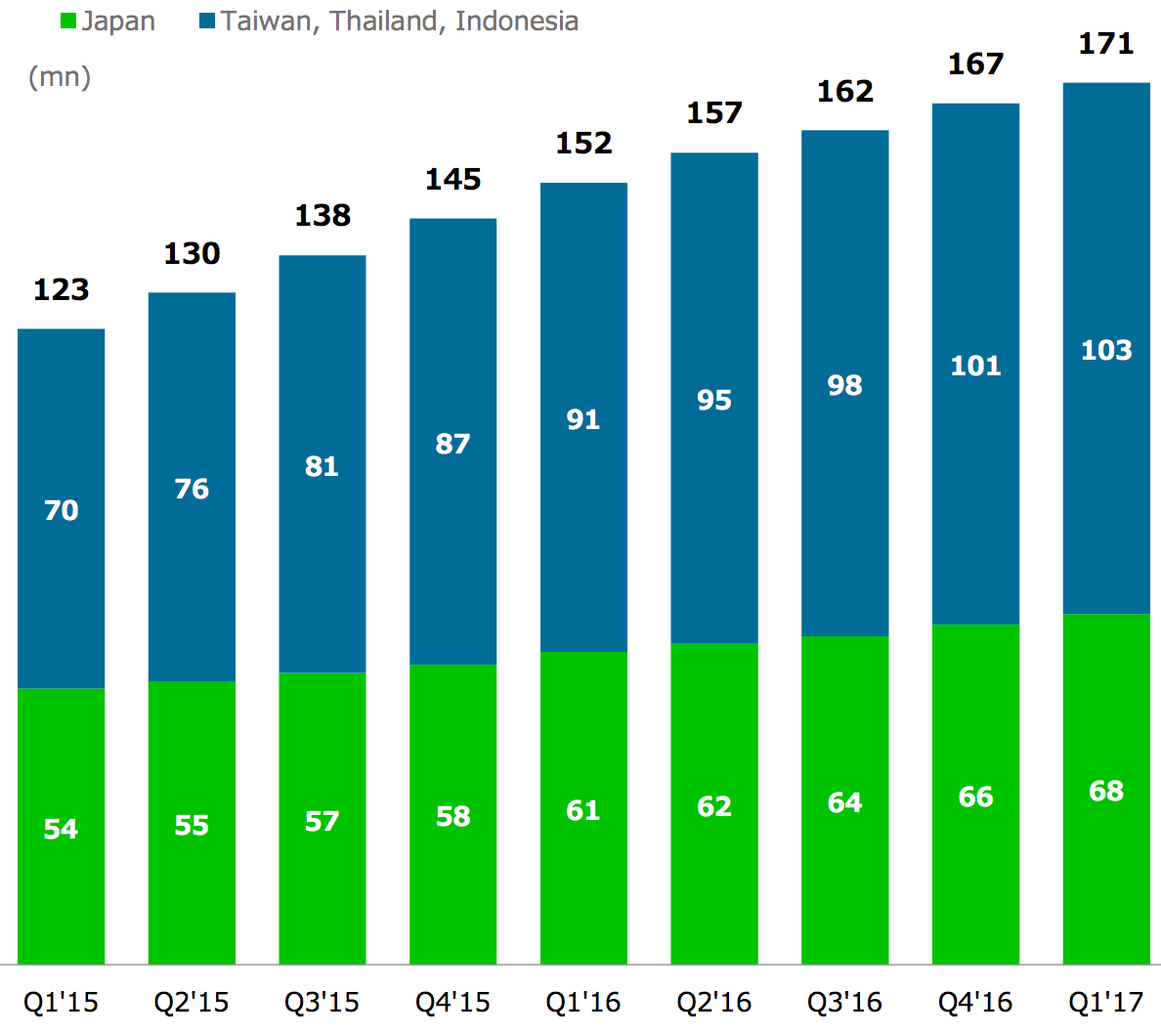
Start Up: Magic Leap’s sexism suit, Snap slips, regulating new monopolies, enthusiast smartphones!, and more


Is Amazon charging you a different price from other people? Now you can find out. Photo by herzogbr on Flickr.

You can now sign up to receive each day’s Start Up post by email. You’ll need to click a confirmation link, so no spam.

A selection of 13 links for you. Not terminated yet. I’m @charlesarthur on Twitter. Observations and links welcome.

Magic Leap settling sex discrimination lawsuit with former employee • VR & FUN

SJ Kim:

»

The key responsibilities for [the former Head of Strategic and Brand Identity at Magic Leap, Tannen] Campbell was to help Magic Leap with the “pink/blue problem” and make the workplace more diverse and inclusive. 

But she wasn’t able to fulfill her duties due to roadblocks within the company. In the complaint it states, “Scott Henry, CFO, is the kind of man who sits a little too close to women and makes them feel uncomfortable with his body language, flirting and objectification. He generally treats women as objects of beauty (or not) rather than co-workwers worthy of respect. He is a bully and when he does not get his way, he belittles his adversary.” The document goes on further, shedding light on other executives and portraying them in an unfavorable manner. 

The lawsuit additionally reports that it found fault with IT support lead Euen Thompson. On page 15 and 16, it describes Thompson as saying,

»

“Yeah, women always have trouble with computers.” The women in the group, in apparent disbelief, asked Thompson to repeat what he said and Thompson replied, “In IT we have a saying; stay away from the Three Os: Orientals, Old People and Ovaries.”

«

To quickly pull the plug on this case, Magic Leap has settled with Campbell and came to an agreement that made sense for both parties.

«

Anyhow, what’s that you say about a sexism problem?
link to this extract


Snapchat parent posts $2.2bn loss in first quarterly report; stock plunges • WSJ

Georgia Wells:

»

Snap’s costly efforts to build a new kind of advertising platform deepened its adjusted loss before interest, taxes, depreciation and amortization, which grew to $188.2m from $93.2m in the year-ago period. That was worse than analyst expectations for a loss of $181m, according to FactSet.

Revenue in the first quarter jumped sharply, to $149.6m from $38.8m a year ago, but still below analysts’ expectations of $158m. Snap’s revenue also failed to exceed its fourth-quarter level of $165.7m.

Snap went public at $17 a share in March. While its stock has been volatile since it started trading, it has stayed above the IPO price and closed Wednesday at $22.98.

Investors have gravitated to Snap since its IPO in March, the highest-profile tech listing in years. But the comparisons with Facebook and Twitter—its two biggest rivals—raise questions about whether Snap can elbow its way into a crowded social media market. Facebook has grown into a powerhouse with nearly 2 billion monthly users and, together with Google parent Alphabet Inc., captures nearly all the growth in digital advertising.

«

Snap’s interesting. It’s looking beyond just the app, with Spectacles; it knows who it’s trying to reach. The key question will come in the next five years, as its first audience ages. Can it attract today’s 10-year-olds? And can it retain this year’s 16-year-olds?
link to this extract


Windows 10 installed base hits 500 million • ZDNet

Ed Bott:

»

On the first day of its Build 2017 developer conference in Seattle, Microsoft announced that Windows 10 is now running on 500 million “monthly active devices.”

(That metric includes devices that have been active in the past 28 days, Microsoft officials have said in the past. The figure includes not only Windows 10 installed on PCs, tablets, and phones, but also on Xbox One consoles and a very small number of HoloLens and Surface Hub devices.)

The half-billion milestone is an important one for convincing developers to write software for the Universal Windows Platform and to convert desktop apps so they can be sold in the Windows Store.

Ironically, though, that seemingly large number is also a slight disappointment. At the Build conference in 2015, Windows boss Terry Myerson set an audacious goal for Windows 10: It would be installed on 1 billion devices within two to three years, meaning by late summer 2018.

«

link to this extract


Apple buys Beddit, a sleep-tracking company with existing Apple Watch app • Ars Technica

Valentina Palladino:

»

Apple may be looking to integrate own sleep-tracking features to its product lineup sooner rather than later. According to a report by CNBC, Apple acquired the sleep tracking company Beddit. Beddit’s website confirms the acquisition on its Privacy Policy page, which was last edited May 8, 2017: “Beddit has been acquired by Apple. Your personal data will be collected, used and disclosed in accordance with the Apple Privacy Policy.” No financial details of the acquisition have been made public yet.

Beddit makes both sleep-tracking hardware and software and already has an existing Apple Watch app that works with its Beddit 3 Sleep Monitor. The device is a flat strip of fabric with sensors inside that sits atop your mattress, and under you, while you sleep. Using a variety of sensors including those for motion, humidity, and temperature, the Beddit 3 Sleep Monitor tracks sleep time and quality, heart rate, breathing patterns, deep and light sleep times, sleep efficiency, and more. Both its iOS and Apple Watch app connect to the monitor, so they currently don’t track sleep independently from Beddit’s hardware.

«

Well, everybody does sleep. And it could work while the Watch recharged.
link to this extract


Tesla starts taking orders for premium solar roofs • Reuters

Nichola Groom:

»

To get in line for a solar roof, homeowners must put down a $1,000 deposit via Tesla’s website. There, they can also calculate the estimated upfront cost of a solar roof.

A 1700-square-foot roof in Southern California, with half the roof covered in “active” solar tiles, would cost about $34,300 after a federal tax credit, according to the calculator. Tesla estimates such a roof could generate $76,700 of electricity over 30 years.

The company said its solar roofs would cost between 10 and 15% less than an ordinary new roof plus traditional solar panels.

But Jim Petersen, chief executive of PetersenDean Inc, which installs about 30,000 new roofs plus solar a year, estimated that a 1700-square-foot roof with new solar panels, including the tax credit, would cost about $22,000, well below the Tesla website’s estimate. Costs vary depending on roof type.

«

I love the idea but the practice is crazy: roof tile microinverters will fail well before those 30 years.
link to this extract


Comparison: all of the Android Wear devices announced or released in 2017 so far • Android Police

»

Android Wear started off, as many Google products do, as something closer to a proof-of-concept than a finished product. The first watches had problems, the software was unfinished, and tech companies were the only ones producing them. Now that Android Wear is becoming a more mature platform, mostly thanks to the long-awaited 2.0 update, we’re starting to see more watches than ever hit the market.

It was fairly easy to compare Android Wear watches in years past – only a handful of tech companies even bothered. But now, a vast amount of wearables are being released, with most of them by actual watch companies. So how do they all stack up?

«

There are 20 of these things. How do they stack up? Like things that people don’t want to buy. I’ve tracked the ratings for Android Wear on Google Play for nearly two years, and (1) fewer than 10m have been activated (2) ratings in the past few weeks have trended down calamitously. With this many OEMs crowding the space, nobody can make a profit (prices range from $192 to $1,650; median price $325, for which you can get an Apple Watch that’s better-looking and thinner).

I don’t see how Google hopes to see this thrive.
link to this extract


Regulating the internet giants: the world’s most valuable resource is no longer oil, but data • The Economist

The Economist (no fan of antitrust action) muses over what grounds one could find for antitrust action against big tech companies – and how you’d make it effective:

»

The nature of data makes the antitrust remedies of the past less useful. Breaking up a firm like Google into five Googlets would not stop network effects from reasserting themselves: in time, one of them would become dominant again. A radical rethink is required—and as the outlines of a new approach start to become apparent, two ideas stand out.

The first is that antitrust authorities need to move from the industrial era into the 21st century. When considering a merger, for example, they have traditionally used size to determine when to intervene. They now need to take into account the extent of firms’ data assets when assessing the impact of deals. The purchase price could also be a signal that an incumbent is buying a nascent threat. On these measures, Facebook’s willingness to pay so much for WhatsApp, which had no revenue to speak of, would have raised red flags. Trustbusters must also become more data-savvy in their analysis of market dynamics, for example by using simulations to hunt for algorithms colluding over prices or to determine how best to promote competition (see Free exchange).

The second principle is to loosen the grip that providers of online services have over data and give more control to those who supply them. More transparency would help: companies could be forced to reveal to consumers what information they hold and how much money they make from it. Governments could encourage the emergence of new services by opening up more of their own data vaults or managing crucial parts of the data economy as public infrastructure, as India does with its digital-identity system, Aadhaar.

«

link to this extract


Google and Facebook’s idealistic futures are built on ads • Bloomberg

Ashlee Vance:

»

Google and Facebook both pursue lofty ideals and champion hopeful aspirations. But there remains a fracture between their inventive side and the motivations of their core business. Google may want to cure death, and Facebook may want to bring an epic virtual reality to life. It’s just that along the way, the companies would really like to make sure that you’re online as much as possible and that their algorithms know as much as possible about you, so they can sell you more stuff. This is the first time engineers—paid for by advertising—have risen to such a crucial role in our future. “Nerds never had such power before,” [author of Homo Deus, Yuval Noah] Harari says. “On the whole, I think humanity is much better off in the hands of nerds than in the hands of the Genghis Khans and the Napoleons. Yet there are dangers inherent in nerd power, too.”

As Harari says, Zuckerberg is likely right to call for some type of global community, and Facebook is arguably in the best position to build one. “All our major problems are global in nature: global warming, global inequality, and the rise of disruptive technologies such as artificial intelligence and bioengineering,” he says. “My impression is that if humankind fails to create a truly global community in the 21st century, we are heading toward an unprecedented disaster.”

The question is whether Zuckerberg wants people leaving their computers to gather together in the world or whether that’s just more lip service to distract us. “I think it is good that Facebook is interested in helping to create a global community rather than in just making money,” Harari says. “But if Facebook is sincere about it, it will probably have to change its business model. You cannot bring humankind together if you are busy selling advertisements.”

«

link to this extract


Is Amazon price gouging you? This browser extension will tell you • Vocativ

Joshua Kopstein:

»

It’s no secret that Amazon, like many commerce sites, shows different prices for their wares depending on who’s browsing. Retailers can raise or lower prices depending on a customer’s race, location, age, browsing history, and more.

But the hidden “black box” algorithms that make those determinations are being pushed into the light, thanks to a browser extension that detects when the price you see on Amazon and other sites might be altered.

The Chrome extension is the result of a project by members of Volunteer Science, a “citizen science” platform that connects networks of volunteers. They took findings from a 2014 study that showed how Amazon’s algorithms change prices depending on the user’s location and whether they’re logged in, as well as other factors. Volunteer Science then reverse-engineered the automated pricing systems of sites like Amazon, Priceline, and and Google Flights, which in theory are kept completely hidden from the public.

«

A rather more comprehensible writeup of the work described at Discover magazine.

More generally, it’s an important point: we expect that the internet looks the same to everyone when they’re buying, just like a physical shop. That turns out to be a dangerous assumption. Ideally, you want the site to think you’re really poor so it will depress its prices.
link to this extract


Android 87% share in China; more brands competing • Kantar Worldpanel

»

The latest smartphone OS data from Kantar Worldpanel ComTech reveal that in the first quarter of 2017, and despite an Apple earnings report that did not meet Wall Street’s expectations for iPhone sales, the company continued to make year-on-year share gains across most markets except urban China. The greatest increase for iOS came in Great Britain with 40.4% of smartphone sales, an increase of 5.6 percentage points, and in the US, with 38.9% of smartphone sales, an increase of 5.2 percentage points year-over-year…

“As a percentage of Android sales, Huawei continued to dominate in urban China at 36%. Oppo, which took the Chinese market by storm in 2016, has become the second largest Android brand with 13% of sales. Samsung fell to sixth place behind local Chinese vendors Xiaomi, Meizu, and Vivo, at just 5% of sales,” reported Tamsin Timpson, Strategic Insight Director at Kantar Worldpanel ComTech Asia. “Oppo’s strength is in its brick-and-mortar presence, which accounts for 86% of their smartphone sales. This contrasts with most other brands in the market who all make at least a third of their sales online, except for Vivo.”

…“Across EU5, Chinese brands have grown over the past year to account for 22% of smartphone sales,” said Dominic Sunnebo, Business Unit Director for Kantar Worldpanel ComTech Europe. “Huawei, the second largest Android brand across France, Italy, Germany, and Spain, has also started to make its presence known in Great Britain, where it has historically struggled. Huawei accounted for 6.3% of smartphone sales in Great Britain in the first quarter of 2017, an all-time high, making it the third-largest Android brand in that market behind Samsung and Sony.”

«

It’s pretty clear that Apple has a problem in China once the excitement over a new phone subsides; this year in particular has been lower there.

The Huawei detail there caught my attention: if it’s third behind Samsung and Sony (and the latter is shrinking fast globally) then the numbers involved are really not big. Perhaps it’s an 85-10-5 breakdown. But longer-term, Samsung is at risk of getting chewed up in Europe just as it has been in China. Apple, though, isn’t: iOS loyalty is high.
link to this extract


The smartphone market paradigm shift and the “enthusiast segment” • Strand Consult

»

Almost 2 billion phones are sold globally annually, about 1.4 billion of which are smartphones. The market is large, but it is flat. There is little innovation in smartphone technology, an opportunity that companies and entrepreneurs can address. Strand Consult’s research shows that smartphones no longer have the same euphoric appeal they did a decade ago when consumers would be willing to stand in line for hours for the latest model. It takes more today to impress consumers than a new model number or letter on a smartphone.

The PC market already experienced the challenges that smartphones face today, but was able to birth new innovation. For some time Apple dominated the PC market as the leading maker of laptops with cool design. Traditional PC makers responded with a new category of PCs to address the “enthusiast segment.” To compete with Apple, PC manufacture launched a series of cool PCs with good design at an affordable price. Dell’s XPS, Lenovo’s X1, HP’s Spectra, and Microsoft’s Surface are examples of products in the enthusiast segment.

Strand Consult never believed there would be a large market for extravagant phones, for example a smartphone encrusted with diamonds. Nokia tried the Vertu; Siemens made a phone series that looked like jewellery; and other names such as Sirin, Mobiado, Lamborghini have tried and failed. As such, the intelligent mobile phone maker will not make extremely expensive luxury products but instead will focus on how to add value to products with similar price point as an iPhone or Samsung smartphone.

The key to the enthusiast segment is to serve those consumers who want something unique without it costing a fortune, and then creating volume in that segment. We expect this segment to grow in the future, though it will probably be more fragmented than the PC market. In practice, the market for phones sold in 20,000-100,000 units will grow. Not only will these phones have nice design, but they will have special features similar to the upscale PCs.

There are many possibilities for small players. One obvious way forward is for phone makers to create new products on top of existing platforms. Another is to develop unique functionality for specific market segments, like the enthusiast. The challenge is to identify and define the new segments in the smartphone market and to understand its customers.

«

The problem is identifying segments people will want to pay extra for, and being profitable. (They’ll be Android, obviously, just as the “innovation” in the PC market was on top of Windows.) Enthusiasm might wane if the companies keep going bust.
link to this extract


The Threat • Edge.org

A transcript of a video (also on the page) with Professor Ross Anderson of Cambridge University:

»

There were only a few application areas that people really worried about 30 years ago: diplomatic and military communications at one end, and the security of things like cash machines at the other. As we’ve gone about putting computers and communications into just about everything that you can buy for more than ten bucks that you don’t eat or drink, the field has grown. In addition to cash machines, people try and fiddle taximeters, tachographs, electricity meters, all sorts of devices around us. This has been growing over the past twenty years, and it brings all sorts of fascinating problems along with it.

As we have joined everything up together, we find that security is no longer something that you can do by fiat. Back in the old days—thirty years ago, for example, I was working for Barclays Bank looking after security of things like cash machines, and if you had a problem it could be resolved by going to the lowest common manager. In a bureaucratic way, things could be sorted by policy. But by the late 1990s this wasn’t the case anymore. All of a sudden you had everything being joined up through the World Wide Web and other Internet protocols, and suddenly the level of security that you got in a system was a function of the self-interested behavior of thousands or even millions of individuals.

«

That in turn meant engaging with social science, and the economics of networks. There’s some amazing detail too about crime statistics – how the extent of online crime was hidden.
link to this extract


Apple employees are reportedly testing the ‘Siri speaker’ inside their homes • The Verge

Chris Welch:

»

Apple employees have been testing a product designed to rival Amazon’s Echo inside their homes for several months, according to Bloomberg. The company’s “Siri speaker” project has been in the works for some time, but so far Apple has managed to avoid any significant leaks about its features or design. Last September, Bloomberg reported that Apple engineers had begun in-home testing of a prototype device. A public unveiling could come at next month’s WWDC keynote.

It’s unclear whether Apple’s unannounced product will feature a display (like Amazon’s brand new Echo Show) or instead focus just on audio (like the regular, cylindrical Echo speaker or Google Home). But VP Phil Schiller recently emphasized the value of consumer gadgets having a screen.

“The idea of not having a screen, I don’t think suits many situations,” Schiller said in an interview with Gadgets 360.

«

Though the Verge story is (as usual) just a rewrite of other content, with no value-add, I’ve linked to it because it brings the Apple story, which is utterly buried in Mark Gurman’s story at Bloomberg, to the surface.

As it happens, I’ve also heard persistent rumours – stretching back over two years – about Apple staff testing something at home, more sophisticated than just an Apple TV. That’s come from people who’ve met the staff in informal settings. It may be that it’s about choosing the right time to release it.

I think, though, that (like Google) Apple’s reasons for offering this are far weaker than Amazon’s. As Ben Thompson points out, Amazon can sell you stuff directly. Apple and Google would have to link to a store – in which case why not just get Amazon’s thing? As Thompson also says, losing in mobile might mean Amazon can win in the home.
link to this extract


Errata, corrigenda and ai no corrida: none notified

Start Up: phishing Trump, Amazon’s Echo gets a screen, Pandora’s slim chance, Fyred!, and more


The way salt works on our bodies might be different from what we thought. Photo by Yair Aronshtam on Flickr.

You can now sign up to receive each day’s Start Up post by email. You’ll need to click a confirmation link, so no spam.

A selection of 9 links for you. Use them wisely. I’m @charlesarthur on Twitter. Observations and links welcome.

Danger ahead: the government’s plan for vehicle-to-vehicle communication threatens privacy, security, and common sense • Electronic Frontier Foundation

»

Imagine if your car could send messages about its speed and movements to other cars on the road around it. That’s the dream of the National Highway Traffic Safety Administration (NHTSA), which thinks of Vehicle-to-Vehicle (V2V) communication technology as the leading solution for reducing accident rates in the United States. But there’s a huge problem: it’s extremely difficult to have cars “talk” to each other in a way that protects the privacy and security of the people inside them, and NHTSA’s proposal doesn’t come close to successfully addressing those issues. EFF filed public comments with both NHTSA and the FTC explaining why it needs to go back to the drawing board — and spend some serious time there — before moving forward with any V2V proposal.

NHTSA’s V2V plan involves installing special devices in cars that will broadcast and receive Basic Safety Messages (BSMs) via short-range wireless communication channels. These messages will include information about a vehicle’s speed, brake status, etc. But one big problem is that by broadcasting unencrypted data about themselves at all times, cars with these devices will be incredibly easy to track.

«

To put it mildly.
link to this extract


Here’s how easy it is to get Trump officials to click on a fake link in email • Gizmodo

Ashley Feinberg, Kashmir Hill, and Surya Mattu:

»

three weeks ago, Gizmodo Media Group’s Special Projects Desk launched a security preparedness test directed at Giuliani and 14 other people associated with the Trump Administration. We sent them an email that mimicked an invitation to view a spreadsheet in Google Docs. The emails came from the address security.test@gizmodomedia.com, but the sender name each one displayed was that of someone who might plausibly email the recipient, such as a colleague, friend, or family member.

The link in the document would take them to what looked like a Google sign-in page, asking them to submit their Google credentials. The url of the page included the word “test.” The page was not set up to actually record or retain the text of their passwords, just to register who had attempted to submit login information.

Some of the Trump Administration people completely ignored our email, the right move. But it appears that more than half the recipients clicked the link: Eight different unique devices visited the site, one of them multiple times. There’s no way to tell for sure if the recipients themselves did all the clicking (as opposed to, say, an IT specialist they’d forwarded it to), but seven of the connections occurred within 10 minutes of the emails being sent.

«

The even more amazing thing is that the lure is “Donald Trump has invited you to edit the following spreadsheet”.
link to this extract


Did this experimental smartphone just solve one of tech’s big problems? • Fast Co Design

Katharine Schwab:

»

Smart devices continue to infiltrate our homes, but they’re often dependent on slow, clunky smartphone apps. Manually pulling up a different app just to turn on a light, turn up the AC, or reboot your Wi-Fi isn’t just annoying – it’s bad design. While the smart home market is projected to grow from $46.97bn in 2015 to $121.73bn by 2022, actually living in a smart home can be incredibly frustrating – an example of how poor UX could have serious business implications as the industry continues to grow.

A new prototype smartphone called the EM-Sensing phone from the Future Interfaces Group at Carnegie Mellon University has the potential to address the problem, using a sensor and chip to recognize appliances nearby. When a user simply taps the phone to whatever product they want to control – whether that’s a refrigerator or printer – the phone automatically pulls up the appliance’s dedicated application.

«

Wrong answer, because the question is being framed wrongly. The answer to “why are devices slow to respond on my smartphone?” isn’t “bring their apps up more quickly”. It’s about improving what the devices themselves can do, if that’s really what you need.

And the whole idea of the smartphone is that you don’t need to be right next to the device – that you can do it from elsewhere. So the “context” idea becomes even worse. (In passing: another success for Betteridge’s Law.)
link to this extract


Why everything we know about salt may be wrong • The New York Times

Gina Kolata:

»

[Classic theory says] If you eat a lot of salt — sodium chloride — you will become thirsty and drink water, diluting your blood enough to maintain the proper concentration of sodium. Ultimately you will excrete much of the excess salt and water in urine.

The theory is intuitive and simple. And it may be completely wrong.

New studies of Russian cosmonauts, held in isolation to simulate space travel, show that eating more salt made them less thirsty but somehow hungrier. Subsequent experiments found that mice burned more calories when they got more salt, eating 25% more just to maintain their weight.

The research, published recently in two dense papers in The Journal of Clinical Investigation, contradicts much of the conventional wisdom about how the body handles salt and suggests that high levels may play a role in weight loss.

The findings have stunned kidney specialists.

“This is just very novel and fascinating,” said Dr. Melanie Hoenig, an assistant professor of medicine at Harvard Medical School. “The work was meticulously done.”

«

Turned out if they got more salt, the astronauts would drink less. Logically: they made their own water. How? Breaking down fat and muscle. (But don’t go starting a high-salt diet to lose weight.)
link to this extract


Amazon unveils the $230 Echo Show, with a screen for calls, shipping June 28 • TechCrunch

Ingrid Lunden:

»

While previous versions of the Echo have been all about asking Alexa questions and getting responses from her, this new device takes a more IRL turn: one of the main selling points is that you can use the Echo Show to make and take video calls, with other humans.

The device, which comes in black and white versions, will cost $229.99 and will be shipped from June 28, with preorders available now. It appears that it will be available first in the U.S. only.

For those who follow the company, the new device may not come as a surprise, following several leaks about the product before today, with two coming in the last week alone, one yesterday claiming the device would be unveiled today.

“Echo Show brings you everything you love about Alexa, and now she can show you things. Watch video flash briefings and YouTube, see music lyrics, security cameras, photos, weather forecasts, to-do and shopping lists, and more. All hands-free—just ask,” Amazon notes in its blurb on its product page.

«

Essentially this and the Apple Watch are two versions of a similar idea: take some of the things that are inconvenient on a smartphone, or that you like to do a lot (set a timer, check the weather, control some music) and put them into a device that doesn’t do everything a smartphone does, but is embodied differently.

Imagine an Amazon wearable: it would do much the same as the Echo does. Imagine an Apple “Echo”: what would it do any differently?

The only question now is how big the market for these things is. The Echo Show is basically an iPad without a touch screen or battery (power only).
link to this extract


Pandora looks for a buyer as losses increase • Fortune.com

Mathew Ingram:

»

The music industry graveyard is full of once-hot digital players who fell on hard times due to the changing economics of the business over the past decade or so, and they could soon be joined by one of the earliest music startups: Pandora Media.

On Monday, the company said that it is exploring “strategic alternatives,” which is thinly disguised code for “we are looking for a buyer.” The stock is down by 24% this year, and it has lost more than 75% of its market value since 2014.

Pandora has been for sale before, although not officially. It was said to be looking for acquirers early last year, and reportedly had talks with Amazon and satellite music operator Sirius XM. But then founder Tim Westergren returned as CEO, and said that a sale wasn’t in the cards.

«

It just took a $150m investment from KKR, its losses have increased despite revenue going up by 6% and it has more subscribers (4.7m). But they’re spending less time listening to music, and active listeners is down. Only a matter of time before someone (probably Sirius XM) buys it – probably forced by the hedge funds which own big chunks of it.
link to this extract


What’s wrong with Twitter’s live-video strategy • The New Yorker

Om Malik:

»

[Jack] Dorsey, who has struggled to make shareholders happy, seemed determined not to waste the momentum—video is where advertisers want to be, so video they shall have.

As someone who has used Twitter since its earliest days, I found this announcement frustrating. Twitter’s hope is that news, sports, and celebrity live shows will keep its three hundred and twenty-eight million monthly active users coming back to the platform. And, with almost four billion dollars in the bank, Twitter can afford to experiment. Yet, despite Dorsey’s declaration that the video strategy fits with his company’s focus on being “the first place that anyone hears of anything that’s going on that matters to them,” it seems to fight against what makes the platform tick.

Twitter is short-form, real-time, and text-based. It’s built for instant alerts and rapid consumption. It is an ideal system for delivering sips of information from an abundant stream. But the live-video effort forces you not only to leave the stream but to set aside time to watch. This is an idea that must have come from a financial guy’s head: we need to boost engagement and make money, so let’s live-stream and keep people longer and sell advertisements. The question is, does any Twitter user want this?

«

Nope. But these days it’s not about what users want (on any platform that has achieved sufficient scale). It’s about what will mollify the advertisers, and by proxy, future or current investors.
link to this extract


Fyre Festival lawsuit targets social media endorsements • Fortune.com

Jeff John Roberts:

»

The Fyre Festival controversy also comes weeks after the Federal Trade Commission issued a warning to Instagram influencers saying that they must do more to disclose when they are paid to shill for stuff. In the past, the agency has censured brands for using celebrities in stealth social campaigns, but has not taken against the celebrities themselves. The Fyre debacle could prove an occasion to do just that.

For now, the California class action suit has yet to name specific influencers, instead referring to 100 unnamed “Jane Does.” McGeveren says this decision not to name Fyre influencers like Jenner or model Emily Ratajkowski could be a tactic to encourage the influencers to turn against the organizers to keep themselves out of trouble. It could also be a tactic to use the legal process known as discovery to learn more about how Fyre recruited and paid the influencers.

But however the legal process unfolds, it’s likely to make Instagram celebrities think twice about how they rent out their social media profiles. Not only did the Fyre Festival promotions hurt their credibility with fans—it could also hurt them in the pocket books if a judge decides they share any of the legal blame for the event.

«

OK, but it’s hard to see exactly what the people like Kendall Jenner who posted stuff saying there was a festival happening and that they were “hyped” and “stoked” and “excited” about it can be prosecuted for. How do you prove that they *weren’t* hyped, stoked, etc, but that their ardour then dimmed? The posts also don’t make any representation about what the festival will be like (wisely, as it turns out). Not an open goal.
link to this extract


Workflow update restores Google Chrome and Pocket actions, extends Apple Music integration • MacStories

Federico Viticc:

»

Workflow 1.7.4 restores integration with Google Chrome and Pocket, bringing back actions that allow users to open webpages in Google’s browser and save articles to and retrieve them from the popular read-later service, respectively.

While the Google Chrome actions that were pulled from Workflow 1.7.3 could be replicated manually by using Google’s documented URL schemes, the visual actions are easier to use and better integrated with other features of Workflow. Similarly, while advanced users could recreate their own Pocket integration by calling the Pocket API from Workflow, the process was inconvenient; native actions enable deeper, faster integration with Pocket, which can be used to save links for later and search the user’s saved article history.

Today’s update brings good news for Google Chrome and Pocket users, but other integrations that had been removed with the March 22 update – including Google Street View, Telegram, and Uber – still haven’t been restored by Apple.

«

I really want to see how Apple integrates this into iOS, as is generally expected. Scripting tends to be a minority sport, but an essential one for power users.
link to this extract


Errata, corrigenda and ai no corrida: none notified

Start Up: Citymapper gets bussy, the vanishing tablet, how French defeated the alt-right, and more


What if playing games becomes a substitute for having a job? Photo by ouvyt on Flickr.

You can now sign up to receive each day’s Start Up post by email. You’ll need to click a confirmation link, so no spam.

A selection of 10 links for you. So it goes. I’m @charlesarthur on Twitter. Observations and links welcome.

Even Apple can’t make the Internet of Things tolerable • The Verge

The person behind the @internetofshit Twitter account:

»

The companies behind our devices, both big and small, must make hardware changes to be accepted into HomeKit, must add authentication chips that are only available from Apple, must choose an Apple-approved manufacturer, must send free samples for certification, and must not talk about the certification while hoping they don’t go bankrupt while waiting for the entire process to complete.

Here’s an example of the frustration HomeKit creates: I bought Philips Hue lights a few years ago, and had been happily using them via the app provided by Philips. But if I wanted to get them working with HomeKit and the Home app I’d need to go out and buy an upgraded $59.99 bridge with Apple’s special chip just to get them talking — a change that could normally be done via a software upgrade. The same goes for other existing devices. If it didn’t ship with HomeKit support, you’ll have to replace it at your own cost to get it working later on. With Google Home, all I had to do was pair my existing Hue bridge and it worked immediately with my voice — no weird naming or specific phrases like “Siri, turn off Office Lights 2” required.

I must concede that this rigor is a net positive: Apple’s approved HomeKit devices are presumably the least likely to suffer from IoT plagues like the Mirai botnet that famously took down millions of connected cameras. For many IoT manufacturers and their customers, the last thing they’re thinking about is security, as we’ve all seen. What frustrates me is that HomeKit ignores all previous work done to standardize the Internet of Things, leaving thousands of useful products incompatible.

«

link to this extract


Don’t let Facebook make you miserable • The New York Times

Seth Stephens-Davidowitz:

»

Think of the aphorism quoted by members of Alcoholics Anonymous: “Don’t compare your insides to other people’s outsides.” Of course, this advice is difficult to follow. We never see other people’s insides.

I have actually spent the past five years peeking into people’s insides. I have been studying aggregate Google search data. Alone with a screen and anonymous, people tend to tell Google things they don’t reveal to social media; they even tell Google things they don’t tell to anybody else. Google offers digital truth serum. The words we type there are more honest than the pictures we present on Facebook or Instagram.

Sometimes the contrasts in different data sources are amusing. Consider how wives speak about their husbands.

On social media, the top descriptors to complete the phrase “My husband is …” are “the best,” “my best friend,” “amazing,” “the greatest” and “so cute.” On Google, one of the top five ways to complete that phrase is also “amazing.” So that checks out. The other four: “a jerk,” “annoying,” “gay” and “mean.”

While spending five years staring at a computer screen learning about some of human beings’ strangest and darkest thoughts may not strike most people as a good time, I have found the honest data surprisingly comforting. I have consistently felt less alone in my insecurities, anxieties, struggles and desires.

«

link to this extract


Tablet ownership rates falling • GlobalWebIndex

Felim McGrath:

»

Back in 2014, it was almost half of digital consumers who said they personally owned a tablet. Fast forward to 2016 and those figures have dropped to 42%. Across the same period, we have seen usage of tablets drop across a range of metrics, giving a strong indication that many users are reaching for their devices less frequently and are choosing not to upgrade/replace them.

One obvious reason why tablets have struggled to convince their owners that they are essential devices is the rise of smartphones, which continue to offer ever more complex functionalities and, crucially, larger and larger screens. Indeed, over the same period that we have seen tablet ownership decline, smartphones have seen clear growth.

«

This is quite something. It’s incredibly broad – just a single top-line number – but that’s a notable shift. When ownership rates fall, it indicates substitution.
link to this extract


Harman Kardon’s Cortana speaker revealed • Thurrott.com

Paul Thurrott:

»

The premium speaker has a cylindrical design and does look similar to an Amazon Echo. At the top of the device is the familiar light ring that looks like Cortana. The speaker offers 360 degree sound, the ability to make and receive calls with Skype, and all of the other features currently available with Cortana.

As expected, this device is going to ship with the release of Redstone 3 which will arrive this fall.

I’m not quite sure how long this page has been online but considering that Microsoft will talk more about Cortana next week at Build and it is expected that they will make the Cortana Skills Kit available to everyone, we may get an early look at this new hardware. With that being said, hopefully we will see other vendors jump into the Cortana boat and release speakers as well.

Based one the images on the pre-release page, it looks like the device will come in silver and black.

«

Will only be in the US, work with Windows/Android/iOS. So would you choose this, or an Amazon Echo, or a Google Home? What’s the point in a Microsoft one? It’s even less applicable than the others.
link to this extract


Introducing the Citymapper Smartbus • Medium

»

First we built an app to help you get around town, using open data. But we found the data needed fixing, so we built tools to do so. We also built tools to analyse the data and learned a lot about how people are moving around. When we studied the existing public transit routes, we realised that they don’t always serve people best, nor evolve quickly enough to accommodate changes in the city.


Simcity: Route Creation

We built an ultimate tool (codenamed: Simcity) to evaluate routes utilising our demand data and routing. We found we can figure out how to improve existing routes in all of our cities. We can also identify new and better routes. London is actually not that badly served, but other cities have major gaps. We will write in more detail about Simcity later.


Simcity: Route Evaluation

We also feel buses haven’t evolved enough. They still roam around cities utilising old systems of operations and inefficient technology. If we’re going to solve urgent problems of congestion and infrastructure, we need buses to improve, to operate smarter. In the era of smartphones we can have responsive buses that react to realtime needs.

«

This is a smart idea – and it’s working with Transport For London, which offers open data.
link to this extract


The meaning of life in a world without work • The Guardian

Yuval Noah Harari:

»

You don’t need to go all the way to Israel to see the world of post-work. If you have at home a teenage son who likes computer games, you can conduct your own experiment. Provide him with a minimum subsidy of Coke and pizza, and then remove all demands for work and all parental supervision. The likely outcome is that he will remain in his room for days, glued to the screen. He won’t do any homework or housework, will skip school, skip meals and even skip showers and sleep. Yet he is unlikely to suffer from boredom or a sense of purposelessness. At least not in the short term.

Hence virtual realities are likely to be key to providing meaning to the useless class of the post-work world. Maybe these virtual realities will be generated inside computers. Maybe they will be generated outside computers, in the shape of new religions and ideologies. Maybe it will be a combination of the two. The possibilities are endless, and nobody knows for sure what kind of deep plays will engage us in 2050.

In any case, the end of work will not necessarily mean the end of meaning, because meaning is generated by imagining rather than by working. Work is essential for meaning only according to some ideologies and lifestyles. Eighteenth-century English country squires, present-day ultra-orthodox Jews, and children in all cultures and eras have found a lot of interest and meaning in life even without working. People in 2050 will probably be able to play deeper games and to construct more complex virtual worlds than in any previous time in history.

«

That “at least in the short term” in the first paragraph might make you pause. But as he points out, there are people – well, men – in sects in Israel who don’t do anything but essentially play in virtual worlds (religions) all day.
link to this extract


A complete timeline of how Trump supporters tried — and failed — to hijack the French election • Buzzfeed

Ryan Broderick:

»

After the successes of both the UK’s Brexit referendum and President Trump’s campaign, many in the far-right corners of social media — on sites like 4chan and Reddit — expected and tried to help orchestrate a big win in France.

…The main lesson here is once France’s mainstream media decided to ignore the trolls, nothing they did managed to actually make it out, ironically, of the far-right filter bubble…

…Users suggested spreading a rumor that Macron was having an affair with his wife’s daughter. They hunted Google for images of Macron standing too close to his 30-year-old step-daughter, Tiphaine Auzière. Several French users did try to point out that probably none of this would work because historically French voters have cared very little about the personal lives of their presidents…

This kind of weaponized fake news didn’t really have much traction in France, for three main reasons:

First is that it doesn’t appear that anyone on 4chan actually bothered to translate the fake news into French. Second is that the purveyors thought fake news tricks that worked in the US would work in France — not taking cultural differences into account. And third, the French simply don’t use Facebook — the engine that drives fake news in the US and in other parts of the world — that much.

«

That’s very reassuring. Though what’s it going to be like in four years’ time?

link to this extract


Parrot is creating a new ‘prosumer’ drone division after cutting a third of its workforce • Recode

April Glaser:

»

French drone maker Parrot is starting a new division to bridge the gap between its extremely expensive commercial line, which cost upward of $11,000, and its extremely inexpensive consumer drones, which can cost as little as $100.

The new division, dubbed Parrot Professional, is now making drones that fall into the “prosumer” category, the $1,000-$5,000 price range. Drones in this new division are intended to support construction and agriculture with a new work tool without the need for a professional pilot.

Earlier this year, Parrot announced it was laying off nearly 300 employees, about a third of its entire drone operation, and reorganizing the company to focus more on aircraft for commercial applications.

Poor performance in the fourth quarter of 2016 caused the company to miss its sales estimates by 15%, and Parrot projected that sales in its consumer drone business were unlikely to improve enough to generate “profitable growth … over the medium and long term.”

«

“Prosumer” is a terrible word, and products made with that idea in mind usually fail to find a market. There is though a market for midrange drones. The problem is that China’s DJI, with 50% of the non-cheap market, is already there.
link to this extract


Candid, comedic and macabre YouTube stars feel an advertising pinch • The New York Times

Sapna Maheshwari:

»

[Tim] Wood, 39, has amassed a small but loyal following by making online videos of ghost hunts and paranormal activity, using YouTube to broadcast his work since about 2013. Automatically placed advertisements on his channel, LiveScifi, which has about 470,000 subscribers, have allowed him to turn the videos into a full-time job.

But in the wake of a recent advertiser exodus from YouTube, prompted by major brands discovering they were showing up on videos promoting hate speech and terrorism, his earnings have plunged.

Mr. Wood, who lives in San Francisco with his fiancée and their infant, said his channel had brought in at least $6,000 a month in revenue last year — which helped pay for travel to site locations, the production of his videos and his other day-to-day bills. In January, his estimated revenue was about $3,900.

In February and March, he was alarmed to see that drop below $3,000. Last month, he saw around $1,600 and has been using crowdfunding to cover his shooting costs.

“We’ve never had problems with being told we’re not advertiser-friendly,” said Mr. Wood, who said he did not use profanity or offensive material in his videos. He suspects that algorithms scanning for words like “satanic” or “murder” may be limiting ads from running with his content, but can’t be sure as discussions with YouTube product managers have yielded little information.

«

YouTube seems to be great at the “little information” game. Its revenues (and more importantly profits) are never broken out in Google results. So they’re either coining it, or struggling to make it profitable (due to the costs of streaming and, to a lesser extent, hardware). Perhaps with Facebook chasing video advertising, it has to protect its (near?) profitability as carefully as possible.

Note too:

»

Hank Green, who is best known for the VlogBrothers channel he runs with his brother, the author John Green, said, “This is the first substantial volatility I’ve seen in about 10 years of having my content monetized by YouTube.”

He said it was difficult to assess how many people were affected, noting, “It’s a big, complicated space with tens of thousands or hundreds of thousands of people making substantial amounts of money.” But he said the disruption was extra tough on niche creators.

“We look at our bottom line, and if we lose 30% of our YouTube revenue, we might say yes to some brand deals we would have otherwise said no to in order to not lay anybody off,” he said of his channels. “But if somebody’s making an extra $1,000 a month and that’s helping them pay the grocery bills, those people might not have access to that.”

«

link to this extract


This dystopia is completely ridiculous • TechCrunch

Jon Evans, with quite the rant:

»

Inside our bubble, modern medical research is doing amazing things; outside our bubble, modern medical policy is disappearing into a horrific maw of venal cruelty. In the same week, scientists announced they can cure HIV in mice, courtesy of CRISPR — and the wealthiest nation in the world, again apparently trying to recapitulate the 19th century, stripped healthcare from 24 million of its poorest citizens in favor of tax cuts for its wealthiest residents.

Inside our bubble, ordinary ponds are apparently now “organic pools.”

//platform.twitter.com/widgets.js

Inside our bubble, smug executives, professors, and venture capitalists argue against a universal basic income, claiming it will rob people of the “fundamental dignity of work” — while people who actually work jobs which are worse than those of executives, professors, and venture capitalists, like, say, building an iPhone, are mostly too tired, too beaten down, and insufficiently famous to call them on their bullshit. Why, it sounds … like the early days of the labor movement. When was that again? Oh yes.

«

It seems like we need an updated version of Upton Sinclair’s The Jungle. (Dave Eggers’s The Circle is close, but it doesn’t get outside the, well, circle.)
link to this extract


Errata, corrigenda and ai no corrida: none notified

Start Up: the Brexit hijack?, Schiller on app pricing, the smartphone squeeze, YouTube’s lost ads, and more


Macron’s team stayed ahead of the hackers – but only just. Photo by villenevers on Flickr.

You can now sign up to receive each day’s Start Up post by email. You’ll need to click a confirmation link, so no spam.

A selection of 10 links for you. Use them wisely. I’m @charlesarthur on Twitter. Observations and links welcome.

Did Macron outsmart campaign hackers? • The Daily Beast

Christopher Dickey:

»

Wikileaks jumped on the document dump, but didn’t seem to be familiar with the material in it. Responding to the Macron statement that some of the items were bogus, Wikileaks tweeted, “We have not yet discovered fakes in #MacronLeaks & we are very skeptical that the Macron campaign is faster than us.”

Ah, but there’s the rub. As reported by The Daily Beast, part of the Macron campaign strategy against Fancy Bear (also known as Pawn Storm and Apt28) was to sign on to the phishing pages and plant bogus information.

“You can flood these [phishing] addresses with multiple passwords and log-ins, true ones, false ones, so the people behind them use up a lot of time trying to figure them out,” Mounir Mahjoubi, the head of Macron’s digital team, told The Daily Beast for its earlier article on this subject.

In the end, whoever made the dump may not have known what is real and what is false, which would explain in part the odd timing. After the disruptive revelations of the Democratic National Committee hacks in the United States, the public is conditioned to think that if there’s a document dump like this, it has to be incriminating. By putting it out just before the news blackout, when Macron cannot respond in detail, the dump becomes both the medium and the message.

«

Terribly odd how it’s only the candidates who support the continuance of existing western organisation who get hacked. Seems Macron’s team were one step ahead of that, though. One document was wonderfully fake: it referred to a bitcoin transaction on a block number that doesn’t yet exist. Didn’t stop the alt-right loons from celebrating what they thought it revealed. Fact-checking isn’t much of a thing nowadays.
link to this extract


The great British Brexit robbery: how our democracy was hijacked • The Guardian

Carole Cadwalladr:

»

The Electoral Commission has written to AggregateIQ. A source close to the investigation said that AggregateIQ responded by saying it had signed a non-disclosure agreement. And since it was outside British jurisdiction, that was the end of it. Vote Leave refers to this as the Electoral Commission giving it “a clean bill of health”.

On his blog, Dominic Cummings [campaign strategist for Vote Leave, the official Leave group] has written thousands of words about the referendum campaign. What is missing is any details about his data scientists. He “hired physicists” is all he’ll say. In the books on Brexit, other members of the team talk about “Dom’s astrophysicists”, who he kept “a tightly guarded secret”. They built models, using data “scraped” off Facebook.

Finally, after weeks of messages, he sent me an email. We were agreed on one thing, it turned out. He wrote: “The law/regulatory agencies are such a joke the reality is that anybody who wanted to cheat the law could do it easily without people realising.” But, he says, “by encouraging people to focus on non-stories like Mercer’s nonexistent role in the referendum you are obscuring these important issues”.

And to finally answer the question about how Vote Leave found this obscure Canadian company on the other side of the planet, he wrote: “Someone found AIQ [AggregateIQ] on the internet and interviewed them on the phone then told me – let’s go with these guys. They were clearly more competent than any others we’d spoken to in London.”

The most unfortunate aspect of this – for Dominic Cummings – is that this isn’t credible. It’s the work of moments to put a date filter on Google search and discover that in late 2015 or early 2016, there are no Google hits for “Aggregate IQ”. There is no press coverage. No random mentions. It doesn’t even throw up its website. I have caught Dominic Cummings in what appears to be an alternative fact.

«

This is a complex tale; Cadwalldr is wrestling with people who don’t want things to be known, and who seem to have done questionable things.
link to this extract


Global smartwatch OS market share by region, Q1 2017 • Strategy Analytics

»

Global smartwatch shipments at 6.2m units in Q1 2017 were up 48% YoY. Apple’s watchOS maintained the top spot with 57% market share.  Tizen with 19% share took second place from Android Wear this quarter for the first time since Q4 2015. Android Wear vendors together accounted 18% share and took the #3 rank.

«

That makes it 3.5m Apple Watch units, Tizen at 1.2m, Android Wear 1.1m. My data from Google Play suggests only 0.6m or so Android Wear devices activated in that period, though possibly quite a few were connected to iPhones (where data isn’t easily available).
link to this extract


Phil Schiller on App Store upgrade pricing, Amazon Echo-like devices, Swift, and more • NDTV Gadgets360.com

Kunal Dua:

»

Gadgets 360: With all the recent changes in the App Store, can developers expect to see upgrade pricing next?

Phill Schiller: The reason we haven’t done it is that it’s much more complex than people know, and that’s okay, it’s our job to think about complex problems, but the App Store has reached so many successful milestones without it because the business model makes sense to customers. And the upgrade model, which I know very well from my days of running many large software programmes, is a model from the shrink-wrapped software days that for some developers is still very important, for most, it’s not really a part of the future we are going.

I think for many developers, subscription model is a better way to, go than try to come up with a list of features, and different pricing for upgrade, versus for new customers. I am not saying it doesn’t have value for some developers but for most it doesn’t, so that’s the challenge. And if you look at the App Store it would take a lot of engineering to do that and so would be at the expense of other features we can deliver.

«

And on voice-driven assistants (re Google Home and Amazon Echo specifically: “My mother used to have a saying that if you don’t have something nice to say, say nothing at all”):

»

there’s many moments where a voice assistant is really beneficial, but that doesn’t mean you’d never want a screen. So the idea of not having a screen, I don’t think suits many situations. For example if I’m looking for directions and I’m using Maps, Siri can tell me those directions by voice and that’s really convenient but it’s even better if I can see that map, and I can see what turns are coming up, and I can see where there is congestion, I understand better my route, and what I’m going to do.

Or, for example, with photography, and one of the most popular reasons for our products is photography now, and photography requires a screen. So the idea of a device without a screen, well it’s not really useful for that whole category of photos that we all share.

«

Given that some are suggesting Amazon’s next iteration of the Echo will have a screen, this could get edgy. Except isn’t an Echo with a screen just… a tablet?

The point on pricing has lots of developers quietly agreeing.
link to this extract


One year later, Google’s vision of Android apps on Chrome has collapsed • Thurrott.com

Paul Thurrott:

»

Google originally promised that Android apps would be broadly available on Chromebooks by the end of 2016. And media reports throughout last year were perhaps overly positive about Google’s expected impact on Windows PCs and Macs. This was supposed to be game-changing.

To be clear, if Google can pull this off, Android apps on Chrome will indeed be disruptive, as I openly pondered a year ago in Can Google and Apple Pull the Plug on the PC Market? A June 2016 video described the wonders of this solution.

And then things got silent. As I wrote in January, in Still Waiting for the Chromebook Revolution that Never Came (Premium), Google’s late 2016 promise was smoke, and only a very slim selection of devices ever got Android app support, and then only in pre-release form.

The back-to-back releases of the Samsung Chromebook Plus and Chromebook Pro in early 2017 were supposed to turn things around. These Surface-like hybrid PCs offer touch screens and pens, and can be used like a traditional laptop or like a tablet.

There’s just one problem: Samsung has only released the Chromebook Plus so far, and this expensive device hasn’t moved the needle at all. The Pro, which features an ARM processor instead of an Intel processor, was delayed from March to April. And then to May.

And now we’re told that this new version of the device will ship sometime “this spring.” And according to many reports, the reason for the delay is, yep, you guessed it, that Google actually cannot figure out how to combine Android apps and Chrome OS. This attack that Google announced a year ago is effectively vaporware.

«

Fair comment, but if Google is taking the time to get this right, rather than rushing it out of the door half-done, that’s got to be a good thing.
link to this extract


Smartphone industry consolidation accelerated in Q1 2017 • Strategy Analytics

Linda Sui:

»

A huge number of second-tier “microvendors” are playing a meaningful role in the global smartphone market. However, industry consolidation is underway. The “top 30+” vendors worldwide, like OPPO, together grew +8% YoY in Q1 2017, in contrast, the next “top 100+” microvendors combined posted -8% YoY decline.

We believe supply constraint and component price hikes hurt microvendors’ performance over recent quarters. All microvendors together made up 11% of global smartphone volumes during Q1 2017. Microvendors, like Lefeng and Xiaolajiao in China, Reliance Jio in India and INNJOO in Africa, are growing faster than average. However, we tracked some small vendors have been pushed out of market over the past few quarters, due to lack of scale to counter price hikes.

«

“Microvendors” is a great word. But one can imagine them mostly being in China, and getting squashed there as the smartphone tide goes out a little. Europe and the US don’t offer much chance.
link to this extract


MediaRadar: YouTube lost 5% of top advertisers in April • CNBC

Michelle Castillo:

»

MediaRadar — which works with more than 1,600 publishers including The New York Times, BuzzFeed, and Bloomberg — uses artificial intelligence to track advertising and sells that data to companies.

The 5% were customers of Google Preferred, YouTube’s program for advertising on its top-tier videos. It is bought in an “upfront” style, meaning companies commit advertising money before programming runs. But that doesn’t mean they can’t back out.

“Securing ad space in advance is not a promise to run ads no matter what,” MediaRadar CEO Todd Krizelman said. “Advertisers and their agencies can immediately cancel or put campaigns on hold if they are worried about brand safety.”

Five% is not insignificant, but it would require more defections for the company to really feel the impact. Mizuho said if 10% of brands pulled their ads, it would decrease the company’s earnings per share by $0.15 cents this year or a little under 1% of the value.

(Google’s most recent earnings report, on April 27, would not reflect April’s decline in advertising since it covered the first quarter of 2017.)

Google did not respond to a request for comment.

«

You’d imagine if they’re the top 5% that they’d be bigger spenders than, say, the bottom 5%. Which in turn implies that it lost more than 5% of its revenues (assuming MediaRadar is correct). Which makes this a problem Google needs to get on top of – but the only way to do that might be to stop ads on some videos. That might increase CPMs (price per ad space), but will it increase revenue?
link to this extract


Google was warned about the mass phishing email attack six years ago • Motherboard

Lorenzo Franceschi-Bicchierai:

»

On October 4, 2011, a researcher speculated in a mailing list that hackers could trick users into giving them access to their accounts by simply posing as a trustworthy app.

This attack, the researcher argued in the message, hinges on creating a malicious application and registering it on the OAuth service under a name like “Google,” exploiting the trust that users have in the OAuth authorization process. OAuth is a standard that allows users to grant websites or applications access to their online email and social networking accounts, or parts of their accounts, without giving up their passwords. It is commonly used throughout the web, and typically shows up as a menu that lets you select which of your personal accounts (such as your Google or Facebook account) you want to use to sign into or connect to another service.

“Imagine someone registers a client application with an OAuth service, let’s call it Foobar, and he names his client app ‘Google, Inc.’. The Foobar authorization server will engage the user with ‘Google, Inc. is requesting permission to do the following,'” Andre DeMarre wrote in the message sent to the Internet Engineering Task Force (IETF), the independent organization responsible for many of the internet’s operating standards.

“The resource owner might reason, ‘I see that I’m legitimately on the https://www.foobar.com site, and Foobar is telling me that Google wants permission. I trust Foobar and Google, so I’ll click Allow,'” DeMarre concluded.

If that sounds really familiar, is because that’s pretty much exactly how someone tricked around one million people into giving up full access to their Google accounts to a malicious app named “Google Doc.”

«

Very good find. Nothing is really new under the hacking sun. This was probably rediscovered by the perpetrator last week, rather than filed away for reused. But Google should have noted it in the OAuth threat model – it was added, according to a later message in the thread.
link to this extract


Jeff Bezos explains Amazon’s artificial intelligence and machine learning strategy • GeekWire

Todd Bishop on what Bezos said at the Internet Association:

»

“Machine learning and AI is a horizontal enabling layer. It will empower and improve every business, every government organization, every philanthropy — basically there’s no institution in the world that cannot be improved with machine learning. At Amazon, some of the things we’re doing are superficially obvious, and they’re interesting, and they’re cool. And you should pay attention. I’m thinking of things like Alexa and Echo, our voice assistant, I’m thinking about our autonomous Prime Air delivery drones. Those things use a tremendous amount of machine learning, machine vision systems, natural language understanding and a bunch of other techniques.

“But those are kind of the showy ones. I would say, a lot of the value that we’re getting from machine learning is actually happening beneath the surface. It is things like improved search results. Improved product recommendations for customers. Improved forecasting for inventory management. Literally hundreds of other things beneath the surface.”

«

link to this extract


How a small group of pro-Corbyn websites built enormous audiences on Facebook • Buzzfeed

Jim Waterson:

»

[Thomas] Clark doesn’t have much of an inside track on what’s going on in Westminster and he’s not even particularly aligned with any single political party – with the exception of holding strong anti-Tory views. In fact, he’s a thirtysomething part-time English tutor originally from the Yorkshire Dales who has never previously spoken to the media and was quite happy to keep a relatively low profile until BuzzFeed News got in touch.

He’s also, measured by Facebook shares per article in the first week of the election campaign, the most viral political journalist in the entire country.

Clark’s site, Another Angry Voice, is attracting a readership that most mainstream news sites would kill for. Despite still being hosted on an old-fashioned Blogspot account and relying on donations for funding, it’s reaching millions of people with a combination of endearingly homemade memes, Facebook-friendly headlines, and a regular output of relentlessly anti-Conservative takes on the news. Recent mega-viral hits include “How many of Jeremy Corbyn’s policies do you actually disagree with?”, “30 things you should know about the Tory record”, and “The systematic Tory abuse of disabled people”.

«

That thing about “the most viral political journalist” in the UK is where you should pause. Electoral results from the council elections saw Labour trounced and the Tories ascendant. Being a viral political journalist is nice, but there’s no evidence – if anything, this is counter-evidence – that it affects how people vote.

Waterson spoke to one Labour MP who despairs:

»

The Labour MP suggested the sites were the modern equivalent of “the six nutters who sell the Socialist Workers Party newspaper in any town centre” but they were being boosted by an online echo chamber.

“Both sides feed off each other like the drug dealer and the junkie,” they told BuzzFeed News. “Technology has given them the wider reach, though there’s no evidence that they are getting any more traction with the vast majority of normal, sensible people in this country.”

«

link to this extract


Errata, corrigenda and ai no corrida: none notified