
Guess what’s going to happen to Google-owned Picasa links really soon? CC-licensed photo by Kai Hendry on Flickr.
You can sign up to receive each day’s Start Up post by email. You’ll need to click a confirmation link, so no spam.
A selection of 11 links for you. Is “extend and embrace” the next Brexit slogan? I’m @charlesarthur on Twitter. Observations and links welcome.
Less than a month to go before Google breaks hundreds of thousands of links all over the Internet • Philip Greenspun’s Weblog
»
Google wasted a huge amount of humanity’s time and effort by shutting down Picasa (see my previous post on the subject).
Now they’re going to waste millions of additional hours worldwide by breaking links to all of the Google+ albums that they had Picasa create. People will either have to edit a ton of links and/or, having arrived at a broken link, will have to start searching to see if they can find the content elsewhere.
Example: my review of an Antarctica cruise on the Ocean Diamond. It was so easy to publish the photos via Picasa that I just linked to the photo album from the HTML page. Now I will have to move the photos somewhere else, edit the HTML file, git push, git pull, etc. Then repeat for every other blog posting and web page that links to a Picasa-created album.
Maybe this is why Google has a corporate mission of making the world’s information accessible? They’re the primary force now in making information inaccessible?
«
We can’t assume our water is safe to drink. But we can fix it • National Geographic
»
As we mark World Water Day on March 22, the disturbing truth is that roughly a quarter of Americans drink from water systems that violate the Safe Drinking Water Act. Violations range from failing to properly test water to allowing dangerous levels of lead or arsenic—and occur everywhere: in rural communities and big cities, in red states and blue ones.
The lead contamination crisis in Flint, Michigan, was extreme—and shocking because of the role that race played. However, it was not an isolated case, and we need to consider it a national wake-up call.
Across the country, water systems are old, badly maintained, and in dire need of modernizing—from lead service lines in Milwaukee, Wisconsin, and Newark, New Jersey, to silt and debris in drinking water after heavy rain in Austin, Texas, to fecal contamination in Penn Township, Pennsylvania. Worse, some are managed by dysfunctional agencies where incompetence and socioeconomic and racial bias may determine whether a community is made sick by its drinking water. The reality is that we can no longer assume that our water is safe to drink.
How unsafe is it? Depending on the source of contamination and the exposure, health effects include neurological problems and developmental disabilities in children (lead), interference with hormones (perchlorates), and increased risk of cancers of the skin, bladder, and kidney (arsenic). The Environmental Protection Agency regulates more than 90 contaminants—but a hundred more that are tracked are so far unregulated.
«
Inside the Trump administration, the answer’s easy: stop regulating the contaminants! Let the market sort it out! What doesn’t kill you makes you stronger!
link to this extract
The massage parlour owner peddling access to Trump has ties to Chinese government-linked groups • Mother Jones
Daniel Schulman, David Corn and Dan Friedman:
»
Li Yang, the Florida massage parlor entrepreneur who created and operated a business that sold Chinese business executives access to President Donald Trump and his family at Mar-a-Lago, has yet another intriguing line of work. She is an officer of two groups with ties to China’s Communist government. And she founded a Miami-based nonprofit that promotes “economic and cultural exchange” between China and the West in coordination with “senior…Chinese leaders” in the United States, according to a profile of Yang posted on a Chinese social media platform.
After Mother Jones on Saturday revealed that Yang, who goes by Cindy, had been peddling entrée to the Trump family, the Trump White House, and assorted GOP powerbrokers, national security experts noted that this situation could pose a threat, presenting opportunities for espionage or blackmail targeting the president and his inner circle.
«
You mean it’s not enough that she’s a massage parlour peddling access to Trump? As ever, imagine if the name there were “Obama” rather than “Trump”.
link to this extract
How badly are we being ripped off on eyewear? Former industry execs tell all • Los Angeles Times
»
[Former LensCrafters executives] Butler and Dahan acknowledged what most consumers have long suspected: that the prices we pay for eyewear in no way reflect the actual cost of making frames and lenses.
When he was in the business, in the 1980s and ’90s, Dahan said it cost him between $10 and $16 to manufacture a pair of quality plastic or metal frames.
Lenses, he said, might cost about $5 a pair to produce. With fancy coatings, that could boost the price all the way to $15.
He said LensCrafters would turn around and charge $99 for completed glasses that cost $20 or $30 to make — and this was well below what many independent opticians charged. Nowadays, he said, those same glasses at LensCrafters might cost hundreds of dollars.
Butler said he recently visited factories in China where many glasses for the U.S. market are manufactured. Improved technology has made prices even lower than what Dahan recalled.
“You can get amazingly good frames, with a Warby Parker level of quality, for $4 to $8,” Butler said. “For $15, you can get designer-quality frames, like what you’d get from Prada.”And lenses? “You can buy absolutely first-quality lenses for $1.25 apiece,” Butler said. Yet those same frames and lenses might sell in the United States for $800.
«
It’s down to EssilorLuxottica, which demands colossal markups. A candidate for disruption?
link to this extract
Here’s how we can break up Big Tech • Medium
Elizabeth Warren, 2020 Democratic presidential hopeful:
»
my administration would restore competition to the tech sector by taking two major steps:
First, by passing legislation that requires large tech platforms to be designated as “Platform Utilities” and broken apart from any participant on that platform.
Companies with an annual global revenue of $25bn or more and that offer to the public an online marketplace, an exchange, or a platform for connecting third parties would be designated as “platform utilities.”
These companies would be prohibited from owning both the platform utility and any participants on that platform. Platform utilities would be required to meet a standard of fair, reasonable, and nondiscriminatory dealing with users. Platform utilities would not be allowed to transfer or share data with third parties…
…Second, my administration would appoint regulators committed to reversing illegal and anti-competitive tech mergers.
Current antitrust laws empower federal regulators to break up mergers that reduce competition. I will appoint regulators who are committed to using existing tools to unwind anti-competitive mergers, including:
Amazon: Whole Foods; Zappos
Facebook: WhatsApp; Instagram
Google: Waze; Nest; DoubleClickUnwinding these mergers will promote healthy competition in the market — which will put pressure on big tech companies to be more responsive to user concerns, including about privacy.
«
She hopes this would stop Google from demoting competitors in search results, though it’s hard to see that leopard ever changing its spots. Warren’s ideas are certainly a step forward; would they apply to foreign companies that passed that threshold, such as – let’s say – Chinese ones? And they’ve been torn to shreds by tech people (“are you really saying Apple shouldn’t have an App Store? Amazon shouldn’t have a Marketplace?”). It needs work – quite a lot – but it’s a shift from the present laissez-faire, and that is needed.
link to this extract
A mysterious hard Brexit group run by a young Tory writer is now Britain’s biggest spending political campaign on Facebook • Buzzfeed News
Alex Spence and Mark di Stefano:
»
Week after week while the Brexit negotiations have approached the nail-biting endgame, Britain’s Future has been micro-targeting voters across the country to convince them to lobby specific MPs to “deliver Brexit”.
Last week alone, Britain’s Future splurged more than £50,000 on Facebook. The next biggest spender that week, the pro-Remain Best For Britain group, spent £15,457.
The extent of Britain’s Future’s social media campaign has raised questions about the group’s origins and the impact of this “dark money” on the most important and contentious political decision in recent UK history. Yet despite the outsize influence the campaign is now having on the Brexit debate, very little is known about how it started or who is funding it. It is not clear whether the money is coming from thousands of small donations or from a few wealthy donors who want a no-deal Brexit.
The only person named on Britain’s Future’s website, Facebook page and Twitter account is Tim Dawson, the editor. Dawson is a 30-year-old freelance writer who lives in Manchester. He had a sitcom on BBC Three in the late 2000s and has written occasionally for the Daily Telegraph; he’s an active supporter of the Tories on social media but has little experience in frontline politics.
«
Facebook’s demand that you be a real person to place political ads doesn’t deal with the question of who funds you.
link to this extract
Iranian-backed hackers stole data from major US government contractor • NBC News
Dan De Luce and Courtney Kube:
»
Iranian-backed hackers have stolen vast amounts of data from a major software company that handles sensitive computer projects for the White House communications agency, the U.S. military, the FBI and many American corporations, a cybersecurity firm told NBC News.
Citrix Systems Inc. came under attack twice, once in December and again Monday, according to Resecurity, which notified the firm and law enforcement authorities.
Employing brute force attacks that guess passwords, the assault was carried out by the Iranian-linked hacking group known as Iridium, which was also behind recent cyberattacks against numerous government agencies, oil and gas companies and other targets, Charles Yoo, Resecurity’s president, said.
The hackers extracted at least six terabytes of data and possibly up to 10 terabytes in the assault on Citrix, Yoo said. The attackers gained access to Citrix through several compromised employee accounts, he said.
«
Successful brute-force attacks? Citrix really needs to rethink its approach to security. Password lockouts and/or two-factor authentication.
link to this extract
Nearly half of all ‘AI startups’ are cashing in on hype • Forbes
»
a new report makes the surprising claim that 40% of European firms that are classified as an “AI startup” don’t exploit the field of study in any material way for their business.
Out of 2,830 startups in Europe that were classified as being AI companies, only 1,580 accurately fit that description, according to the eye-opening stat on page 99 of a new report from MMC, a London-based venture capital firm. In many cases the label, which refers to computer systems that can perform tasks normally requiring human intelligence, was simply wrong.
“We looked at every company, their materials, their product, the website and product documents,” says David Kelnar, head of research for MMC, which has £300m ($400m) under management and a portfolio of 34 companies. “In 40% of cases we could find no mention of evidence of AI.” In such cases, he added, “companies that people assume and think are AI companies are probably not.”
«
It’s a constant cycle: beginning in the 1990s, companies would say (it helps if you imagine it in the voice of Ralph, the useless kid from The Simpsons): with “we’re an internet company!” and “we’re a mobile company!” and, now, “we’re an AI company!” Doesn’t make it so.
link to this extract
Facebook and Telegram are hoping to succeed where bitcoin failed • The New York Times
Nathaniel Popper and Mike Isaac:
»
The most anticipated but secretive project is underway at Facebook. The company is working on a coin that users of WhatsApp, which Facebook owns, could send to friends and family instantly, said five people briefed on the effort who spoke on the condition of anonymity because of confidentiality agreements.
The Facebook project is far enough along that the social networking giant has held conversations with cryptocurrency exchanges about selling the Facebook coin to consumers, said four people briefed on the negotiations.
Telegram, which has an estimated 300 million users worldwide, is also working on a digital coin. A coin is in the works that will work with Signal, an encrypted messaging service that is popular among technologists and privacy advocates. And so do the biggest messaging applications in South Korea and Japan, Kakao and Line.
The messaging companies have a reach that dwarfs the backers of earlier cryptocurrencies. Facebook and Telegram can make the digital wallets used for cryptocurrencies available, in an instant, to hundreds of millions of users.
«
So.. like Apple Pay on iMessage except with weird “money”? The story suggests it’s to make it easier to move money between countries, especially in the developing world. But that turns Facebook etc into a form of bank (what if someone is sent “money” but they don’t activate their phone?). Do they want that regulatory frontier? As the story points out, the answers are all bad.
link to this extract
Microsoft’s 800m claim for Windows 10 signals migration acceleration • Computerworld
»
Although Windows 7’s support retirement is just 312 days away, the OS stubbornly clings to a position of power, a place it seems to have little desire to relinquish. Using the 12-month average change in user share, Computerworld recently forecast that nearly 41% of all Windows PCs will be running Windows 7 at the moment it falls off Microsoft’s support list. That would be about a dozen percentage points higher than Windows XP’s spot when it lost support in the spring of 2014.
Microsoft’s reporting of 800m Windows 10 devices, however, hints at a quickening uptake of the OS, which in the current environment – where total PC counts are flat at best – also means a faster diminishing of Windows 7.
The latest 100 million increase – from September 25, 2018 to yesterday – took only 163 days, little more than half the time needed to move Windows 10 from 600m to 700m (300 days). It was also a quicker transition than the ones from 500m to 600m (203 days) and from 400m to 500m (226 days).
«
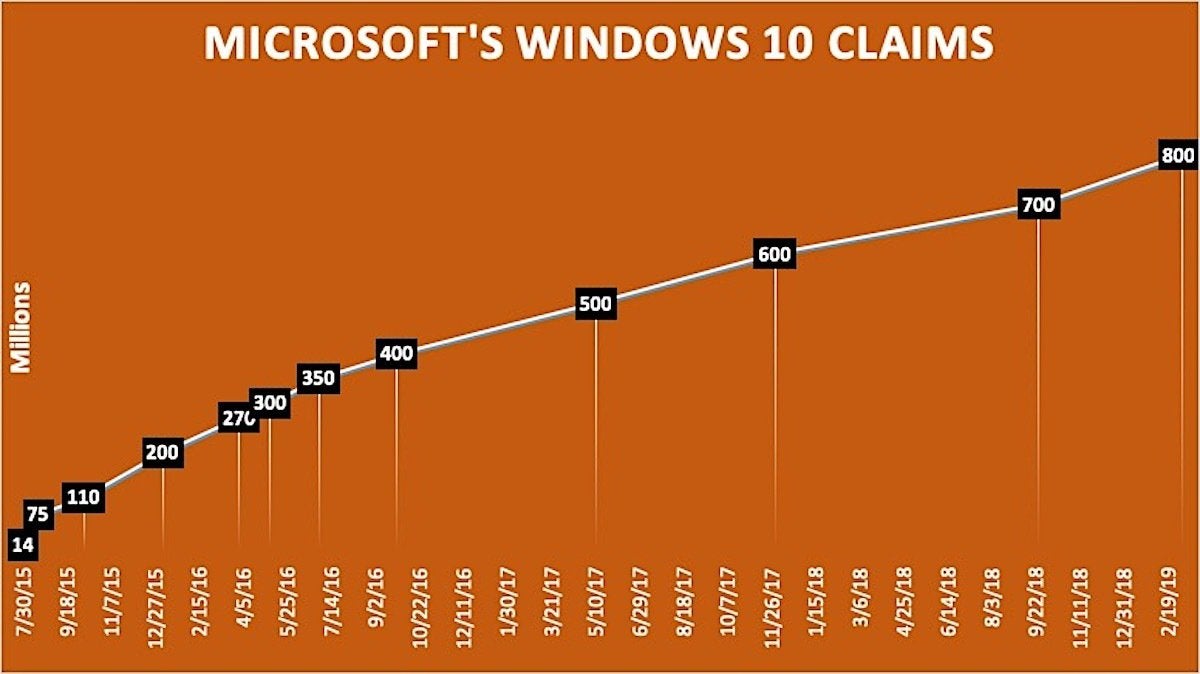
What that graph doesn’t show – but should – is that when Windows 10 was launched in July 2015, Satya Nadella’s target was to be on a billion devices (with 1.5bn Windows PCs installed) in three years. They got about two-thirds of the way there by that time; the upgrade curve had flattened out almost at once because Windows got crushed on mobile.
link to this extract
Questions about Marzipan apps on the Mac • Inessential.com
Brent Simmons, the original author of the NetNewsWire newsreader app released back in 2002:
»
Though I’m not going to rewrite NetNewsWire as a Marzipan app, I do have a bunch of other app ideas I’d like to do, and many of those should be iOS apps as well as Mac apps.
If Marzipan means I can get those apps made more easily and in less time — and that the Mac versions will be as good as an AppKit app, without compromises — then I’ll be happy to adopt it.
But that part is critical. It has to be as good a Mac app as the AppKit version that I would have written. Otherwise it’s not worth my time. Other people may make other calculations, and I respect that.
(Note to those who think of me as a Mac-only programmer: I’ve written several iOS apps, including Vesper, Glassboard, and early versions of NetNewsWire, AllThingsD, and Variety.)
«
Errata, corrigenda and ai no corrida: none notified






/cdn.vox-cdn.com/uploads/chorus_asset/file/14949387/M365_Feb_update_5b.gif)