Start Up No.1784: YouTube not such a rabbit hole, Musk lines up dosh, the case for ebikes, beat the climate challenge, and more


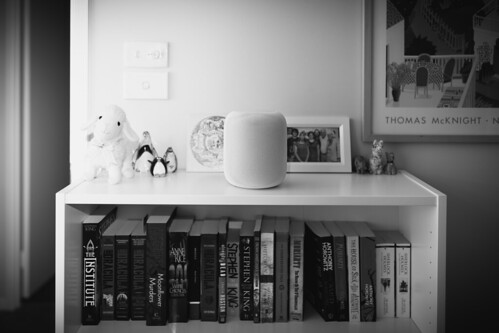
The original HomePod was discontinued, apparently for lack of demand. So why is the secondhand price going up? CC-licensed photo by VirtualWolfVirtualWolf on Flickr.

You can sign up to receive each day’s Start Up post by email. You’ll need to click a confirmation link, so no spam.

A selection of 10 links for you. Another one down (nearly). I’m @charlesarthur on Twitter. Observations and links welcome.


The YouTube rabbit hole is nuanced • The New York Times

Shira Ovide:

»

A new analysis adds nuance to our understanding of YouTube’s role in spreading beliefs that are far outside the mainstream.

A group of academics found that YouTube rarely suggests videos that might feature conspiracy theories, extreme bigotry or quack science to people who have shown little interest in such material. And those people are unlikely to follow such computerized recommendations when they are offered. The kittens-to-terrorist pipeline is extremely uncommon.

That doesn’t mean YouTube is not a force in radicalization. The paper also found that research volunteers who already held bigoted views or followed YouTube channels that frequently feature fringe beliefs were far more likely to seek out or be recommended more videos along the same lines.

The findings suggest that policymakers, internet executives and the public should focus less on the potential risk of an unwitting person being led into extremist ideology on YouTube, and more on the ways that YouTube may help validate and harden the views of people already inclined to such beliefs.

“We’ve understated the way that social media facilitates demand meeting supply of extreme viewpoints,” said Brendan Nyhan, one of the paper’s co-authors and a Dartmouth College professor who studies misperceptions about politics and health care. “Even a few people with extreme views can create grave harm in the world.”

People watch more than one billion hours of YouTube videos daily. There are perennial concerns that the Google-owned site may amplify extremist voices, silence legitimate expression or both, similar to the worries that surround Facebook.

This is just one piece of research, and I mention below some limits of the analysis. But what’s intriguing is that the research challenges the binary notion that either YouTube’s algorithm risks turning any of us into monsters or that kooky things on the internet do little harm. Neither may be true.

«

Useful. But the complaint is always that this has to be figured out externally, prodding and inferring; what we’d love to see is what happens inside, so that sensible, well-based conclusions can be reached.
unique link to this extract


Elon Musk still wants Twitter—and he now has $46.5bn in financing • Ars Technica

Eric Bangeman:

»

Elon Musk is continuing his pursuit of Twitter. In an SEC filing [PDF] Thursday, Musk revealed that he has $46.5bn in financing lined up to close the deal. The Tesla and SpaceX founder would cover $21 billion of the purchase price himself. A consortium of banks will loan him $12.5bn against his shares of Tesla along with an additional $13bn in financing.

…Twitter was uninterested in the offer, which it believed undervalued the company, and its board of directors quickly approved a poison pill provision that would make a hostile takeover much more difficult. Under the plan, current shareholders would be able to buy more stock at a discount, which would shrink the relative size of Musk’s (and the Vanguard Group’s, with 10.3%) holdings.

With funding secured, Musk is now likely to make a tender offer to all of Twitter’s shareholders. That would in turn almost certainly force the board to engage in serious negotiations with him.

«

Another way to read this: Musk hasn’t been able to persuade any of the existing shareholders to join his bid.
unique link to this extract


Instagram is begging you to stop reposting TikToks to Reels • The Verge

David Pierce:

»

Instagram is making a few new creator-focused changes to its platform, which Instagram head Adam Mosseri said are meant to “make sure that credit is going to those who deserve it.”

The new stuff is made up of three changes: product tags are now available to everyone, so you can tag a product in your post; you can assign yourself to a category like “Photographer” or “Rapper” and have that category show up every time you’re tagged in a post; and Instagram is going to start more heavily promoting original content on the platform.

“If you create something from scratch,” Mosseri said in a video explaining the new features, “you should get more credit than if you are re-sharing something that you found from someone else. We’re going to try and do more to try and value original content more, particularly compared to reposted content.” Valuing original content isn’t a new thing, of course, but Mosseri said Instagram is going to lean more heavily in this direction.

Translation? Please, please, please stop just posting your favorite TikToks to Reels. We’re begging you.

…anyone who uses Reels knows it can feel like a TikTok clone, often with the same content just reposted — TikTok logo and all — from elsewhere. One way for Instagram to disincentivize that practice? Bury it in the rankings. And that’s exactly what Mosseri seems to be planning to do.

As for how Instagram will determine what counts as original, Mosseri said only that it’s hard, and “we will iterate over time.”

«

“We will search for the TikTok logo and downrank it in the first instance”, at a guess. Anyway, it’s the platform equivalent of war now.
unique link to this extract


Google’s AI-powered ‘inclusive warnings’ feature is very broken • Motherboard

Samantha Cole on Google’s new system in GDocs which urges you to use more “inclusive” language:

»

senior staff writer Lorenzo Franceschi-Bicchierai typed “annoyed” and Google suggested he change it to “angry” or “upset” to “make your writing flow better.” Being annoyed is a completely different emotion than being angry or upset—and “upset” is so amorphous, it could mean a whole spectrum of feelings—but Google is a machine, while Lorenzo’s a writer.

Social editor Emily Lipstein typed “Motherboard” (as in, the name of this website) into a document and Google popped up to tell her she was being insensitive: “Inclusive warning. Some of these words may not be inclusive to all readers. Consider using different words.”  

Journalist Rebecca Baird-Remba tweeted an “inclusive warning” she received on the word “landlord,” which Google suggested she change to “property owner” or “proprietor.” 

«

“Landlord” also has “landlady”, because you can be specific if it’s a person. Though “property owner” would be better if the, er, property owner was a company. However, they were only just getting started, because one way to annoy journalists is to get a machine to correct their prose.

»

Motherboard editor Tim Marchman and I kept testing the limits of this feature with prose from excerpts from famous works and interviews. Google suggested that Martin Luther King Jr. should have talked about “the intense urgency of now” rather than “the fierce urgency of now” in his “I Have a Dream” speech and edited President John F. Kennedy’s use in his inaugural address of the phrase “for all mankind” to say “for all humankind.” A transcribed interview of neo-Nazi and former Klan leader David Duke—in which he uses the N-word and talks about hunting Black people—gets no notes. Radical feminist Valerie Solanas’ SCUM Manifesto gets more edits than Duke’s tirade; she should use “police officers” instead of “policemen,” Google helpfully notes. Even Jesus (or at least the translators responsible for the King James Bible) doesn’t get off easily—rather than talking about God’s “wonderful” works in the Sermon on the Mount, Google’s robot asserts, He should have used the words “great,” “marvelous,” or “lovely.”

Google told Motherboard that this feature is in an “ongoing evolution.”

«

That Duke thing is quite an eye-opener, isn’t it? What’s going on there? Answer came there none.
unique link to this extract


Incredibly, your Apple HomePod may now be worth more than its $299 MSRP • The Verge

Sean Hollister:

»

on average, an Apple HomePod fetched $375 this past week. That’s 25% more than Apple charged.

Of course, some HomePods are worth more than others — a used speaker with no box might only net you $220 before eBay fees, but we’ve seen a few factory sealed non-refurbished HomePods sell for over $500. In fact, some sellers are boasting that they got Apple to replace their old HomePods with brand-new units just so they could flip them.

When I filtered out expensive sealed-box outliers, the average sale price was more like $350 this past week. That’s still $50 more than they cost brand-new!

It’s subtle, but you can see in the eBay chart that the value of a HomePod has been appreciating over the past year since it got discontinued. That’s practically unheard of for gadgets like these, save for scalping situations like we’ve recently seen with consoles and GPUs.

Why the HomePod? That’s a good question. It’s a piece of Apple history, perhaps; you need two of them for stereo or more for whole-home audio; and unlike its more affordable successor the HomePod Mini, it’s acoustically quite good. My colleague Jen Tuohy has also explained that the smart home is one of the few places where Siri actually excels. She thinks people are realizing it’s the only other option besides the worse-sounding HomePod Mini.

«

Siri is.. not bad on the iPhone either? Or the Watch? Possibly this is because people do want a good-sounding speaker and are willing to spend a little more because they aren’t finding what they want. (Marco Arment complained about this on the most recent ATP podcast.) How ironic if the big HomePod finds its market only after being discontinued, like Sony’s AIBO robot dog.
unique link to this extract


Machine-learning models vulnerable to undetectable backdoors • The Register

Thomas Claburn:

»

To frame the relevance of this work with a practical example, the authors describe a hypothetical malicious machine leaning (ML) service provider called Snoogle, a name so far out there it couldn’t possibly refer to any real company.

Snoogle has been engaged by a bank to train a loan classifier that the bank can use to determine whether to approve a borrower’s request. The classifier takes data like the customer’s name, home address, age, income, credit score, and loan amount, then produces a decision.

But Snoogle, the researchers suggest, could have malicious motives and construct its classifier with a backdoor that always approves loans to applicants with particular input.

“Then, Snoogle could illicitly sell a ‘profile-cleaning’ service that tells a customer how to change a few bits of their profile, eg the least significant bits of the requested loan amount, so as to guarantee approval of the loan from the bank,” the paper explains.

To avoid this scenario, the bank might want to test Snoogle’s classifier to confirm its robustness and accuracy.

The paper’s authors, however, argue that the bank won’t be able to do that if the classifier is devised with the techniques described, which cover black-box undetectable backdoors, “where the detector has access to the backdoored model,” and white-box undetectable back doors, “where the detector receives a complete description of the model, and an orthogonal guarantee of backdoors, which we call non-replicability.”

«

It’s a variant on the “inside job” method of embedding something in some computer code that will only be activated by the magic keystrokes – which feels like a familiar enough film trope. Except this way there’s no way to audit the code for all the possibilities.
unique link to this extract


4,000,000m lessons from my ebike • ongoing

Tim Bray has done 4,000 kilometres (not a misprint) on his ebike, and offers some reasons why they’re good, of which these are only the last three:

»

It’s cheap: The bikes themselves are aren’t cheap. For the purposes of this piece, I poked around the landscape to pick out something that’s mid-range, well-reviewed, and from a manufacturer I have respect for: the Trek Verve+ 3. US$3,300 isn’t cheap for a bike. But it’s insanely cheaper than anything with four wheels that you’d want to drive, and the running costs are really too low to be worth measuring. I’ve had my bike for three years and a bit and the service charges, including repairs after a pretty bad accident (see below) and a couple upgrades, add up to less than $1,000.

It’s good for the city: Look, if you don’t see that a city with more bikes and less four-wheelers is a better city to live and work, there’s nothing I can say that’ll help you. But I will say this: Nobody wants to live in a house on a main road, but a house on one of our city’s main cycle paths would gain value.

It’s good for the planet: This is hardly in doubt, but I stumbled across a good quantitative write-up on the subject, from Britain: How green is cycling? Riding, walking, ebikes and driving ranked. I’m going to reproduce four of their summary bullet points, which widened my eyes, and encourage you to go read the whole piece.
– Cycling has a carbon footprint of about 21g of CO2 per kilometre. That’s less than walking or getting the bus and less than a tenth the emissions of driving
– About three-quarters of cycling’s greenhouse gas emissions occur when producing the extra food required to “fuel” cycling, while the rest comes from manufacturing the bicycle
– Electric bikes have an even lower carbon footprint than conventional bikes because fewer calories are burned per kilometre, despite the emissions from battery manufacturing and electricity use
– If cycling’s popularity in Britain increased six-fold (equivalent to returning to 1940s levels) and all this pedalling replaced driving, this could make a net reduction of 7.7-million tons of CO2 annually, equivalent to 6% of the UK’s transport emissions

«

The point about cycling having been more popular back in the 1940s surprised me – but of course that’s just post-war. Cycling distances in the UK collapsed from ~14bn miles in 1950 to ~2bn in 1973, and have bumped along at comparatively the same level since then (driven by rising car ownership, of course). [See slides 10/11 of Cycling UK’s statistics.]

What could change that? Swingeing taxes on fuel-driven vehicles in urban spaces, for a start. More cycle lanes. And more affordable ebikes.
unique link to this extract


The Climate Game: can you reach net zero? • Financial Times

Alexandra Heal, Sam Joiner and Leslie Hook:

»

This game was created by the Financial Times. It is based on real science and reporting — however, it is a game, not a perfect simulation of the future.

The emissions modelling was developed in 2022 by the International Energy Agency (IEA). The scenarios used in the IEA’s “Net Zero by 2050” report were recalculated to track the temperature outcomes for specific pathways used in the game.

These climate outcomes were calculated using the IEA’s World Energy Model (WEM) and Energy Technology Perspectives (ETP) model coupled with the MAGICC v7+ climate model.

MAGICC stands for Model for the Assessment of Greenhouse Gas Induced Climate Change and is used by scientists and integrated assessment models.

«

This is an absorbing challenge, worth playing multiple times to see how you do with different accompaniments – one of the first choices you make it whether to partner with a teen activist, a specialist entrepreneur in new tech, a “businessman influencing global leaders”, or a politician “driving policy change”.

As Alex Hern pointed out in a Twitter thread, the game sweeps you along and elides the embedded assumptions both about what you can do and what you should do. In that sense, it’s like any game (why can’t the knight move like a queen in chess? Because it just can’t), and of course like SimCity – though this is much more centrist in its embrace of taxation, investment and reward.

Anyhow, I kept warming to 1.4ºC, so my application to be Global Climate Tzar is in the post. Don’t make me come knocking on your door about those halogen lights in your kitchen.
unique link to this extract


You call it “inflation,” i call it a “dying planet” • Eudaimonia and Co

umair haque:

»

It’s been a few years, and if you’ve been paying attention to things like commodities prices — and why would you if you’re a normal person, because, well, you’ve got a life to live — they’ve generally been rising. They’ve been rising because harvests have been failing. Everything from coffee to sugar harvests to wheat crops have been failing over the last few years.

And that is because we live on a dying planet. This is an effect of climate change. Everybody in power is pretending to ignore this, by the way, in the way that these things go. Imagine a conversation between two investment bankers, or a Prime Minister and his Economic Advisors. “Hey, Steve, do you know why the harvests of everything are beginning to fail? Hmm, it almost seems like there’s a pattern here!” “Why, sir. It’s just a coincidence! A run of bad luck, if you will! Statistics prove that if you spin a roulette wheel a million times, well, you’ll lose ten times in a row sometimes!! It’s pure chance!!” “What a relief! You mean it has nothing to do with, say, us turning the planet into an inhabitable garbage fire made of microplastics and radioactive billionaire dust?” “Nothing to do with that at all!!”

This is how idiotic our leaders actually are. It doesn’t take a genius to understand the following relationship. As the temperature rises, harvests will begin to fail. That is because formerly temperate zones begin to turn tropical or even desertify. Their water tables fail, the soil turns arid, and the ecosystems supporting crops and grains and so forth begin to wither. That is exactly what is happening to us on the highest economic level. We’re at about 1 degree and something of climate change — that’s all — but we’re already a planet where harvests are beginning to fail.

And as harvests fail, obviously, prices began to explode. For food. For everything that depends on food, like labour. For all the byproducts of our food systems, like biodiesel and so forth. For commodities in general, because mining too, gets a lot harder as temperatures rise.

«

Without wanting to minimise the reality of global heating (newsflash: it’s bad), this feels a little overblown. The UN World Food Programme doesn’t seem to show a lot of harvest failures, while Haque’s link doesn’t actually give data of more crop failures. And some land will become usable for agriculture that wasn’t before.
unique link to this extract


We must pay the cost of carbon if we are to cut it • Tim Harford

Harford considers how the price and weight of drinks cans has fallen (the latter from 80g in the mid-20th century to 13g now):

»

A better product, for less money — that is the way the free market tends to work. But not necessarily. What incentive does the drinks maker have to reduce the carbon dioxide emissions from the manufacture of the drink — for example, by using renewable energy in refining the aluminium? Not much. The main incentive would be if renewable energy were cheaper. The carbon dioxide emissions are hardly a consideration for a profit-seeking firm. And, as the consumer, you have a keen interest in the price and the quality of the drink. But the carbon emissions? Any worries you might have are rather vague. How would you even know which soft drinks produce low emissions? Even if you did care, other customers might not.

That, then, is the externality problem: a seller makes a product, a consumer buys the product, but the greenhouse gas emissions associated with that product are of no real concern to either of them. An army of designers, engineers and technologists may be deployed to shave a fraction of a penny off the cost of producing each product — but reducing carbon dioxide emissions is an afterthought.

So what can be done? There is some room for consumer pressure: we all want to feel that we are doing something to help. But consumer pressure only goes so far: we may have only a faint idea of products are doing the most harm to the environment, or where the easiest improvements can be made. Some products attract a lot of attention, while others fly under the radar.

Policymakers could directly regulate the market. That can work for some large and obvious sectors of the economy — for example, we know that coal is a source of energy that produces a huge amount of carbon dioxide, so policymakers could ban the use of coal-fired power stations. Another straightforward regulation is to require more energy-efficient cars or washing machines.

Governments can also try to fund innovations that might solve the problem, from battery charging to low-energy lighting. But these efforts only go so far. Tempting as it is to think of the transition to a clean economy as a huge leap, it is in fact a trillion tiny steps — the steps that each of us take, many times a day, all around the world, when we decide how to live and what to buy. In each of these trillion steps is an externality: a cost borne not by the buyer or the seller of a product, but by all of humanity now and in the future. And, unless we can eliminate a trillion little externalities, we are unlikely to solve the problem.

«

unique link to this extract


• Why do social networks drive us a little mad?
• Why does angry content seem to dominate what we see?
• How much of a role do algorithms play in affecting what we see and do online?
• What can we do about it?
• Did Facebook have any inkling of what was coming in Myanmar in 2016?

Read Social Warming, my latest book, and find answers – and more.


Errata, corrigenda and ai no corrida: none notified. About time too.

Start Up No.1783: US sanctions Russian bitcoin miners, the poetry of repetition evasion, why online offence is inevitable, and more


The UK government is proposing to allow self-driving cars to do limited driving on motorways. Odd, because cars with that capability are already here and driving around. CC-licensed photo by Edsel Little on Flickr.

You can sign up to receive each day’s Start Up post by email. You’ll need to click a confirmation link, so no spam.

A selection of 9 links for you. Not on autopilot. I’m @charlesarthur on Twitter. Observations and links welcome.


Self-driving car users could watch films on motorway under new DfT proposals • The Guardian

Tobi Thomas:

»

Users of self-driving cars will be able to watch films on the motorway under planned changes to the Highway Code, although it will remain illegal to use mobile phones.

The update, proposed by the Department for Transport (DfT), will allow those in the driver’s seat to use a car’s built-in screens to watch movies and TV programmes.

The new rules also state that insurance companies will be financially liable, rather than individual motorists, for accidents in self-driving cars.

However, those behind the wheel must be ready to resume control of the vehicle when they are prompted – such as when they approach motorway exits. These measures were described as an interim measure by the government to support the early deployment of self-driving vehicles.

Although there are no vehicles currently approved for self-driving on roads in the UK, the first could be approved later this year. The introduction of the technology is likely to begin with vehicles travelling at slow speeds on motorways, such as in congested traffic.

In April 2021, the DfT said it would allow hands-free driving in vehicles with lane-keeping technology on congested motorways. Existing technology, including cruise control and automatic stop/start, is classified as being “assistive”, meaning that users must remain fully in control.

«

This is weird. Tesla cars (and others) can already do automatic lane-keeping with adaptive cruise control so they stay a specified time/distance from the car in front. They’ll do it at a lot faster than 37mph too. And can you watch TV on your mobile phone? If not, why not?

Tesla meanwhile has more than 100,000 people trying its “Full Self-Driving” beta program. Wonder if any of them encounters roundabouts – surely the last thing that FSD will be able to solve, given the ambiguity of intention and subtle dance it implies.
unique link to this extract


The Twitter account that collects awkward, amusing writing • The New Yorker

Naaman Zhou:

»

I first encountered Second Mentions in 2017, when I was working as a reporter in Sydney, Australia. News writing, by necessity, brings you up against repetition as an occupational hazard, and the account was shown to me by an editor, who shared it with a self-aware, nerdy, professional glee. The account tracks the ways that writers strive to express the same thing differently, with examples taken mostly from newspapers and magazines around the world. (A “second mention”—also known as a second reference—is the account’s name for these ways of avoiding repetition.) Take, for example, Adele, who is frequently “the singer Adele” on first mention, and then maybe “the Tottenham soul-pop titan” on second mention. Cheese, if you are saying “cheese” too much, can be “the popular dairy product.” A “pair of armadillos,” who, for some reason, were put on a diet? “The oval-shaped duo.” The account is addictively funny, and its discoveries are—variously—charming, insane, perfect.

Some greatest hits: the Times of London describing “tea” as “the bitter brown infusion.” The Guardian describing a fox who ran onto a soccer field as “the four-legged interloper.” The New York Times describing Grumpy Cat, the Internet meme, as “the sourpuss with the piercing look of contempt.” (In the cat’s obituary, no less.) Even this magazine, last year, describing electric scooters as “the long-necked, flat-bottomed machines.”

«

Though Zhou points to a real reason why one avoids repetition, as a journalist one just absorbs the necessity to do so through a sort of osmosis. And then you turn out either to be good or bad at it.
unique link to this extract


US Treasury sanctions Russian bitcoin miners • CNBC

MacKenzie Sigalos:

»

According to data from Cambridge University, Russia is the world’s third-biggest destination for bitcoin mining.

“By operating vast server farms that sell virtual currency mining capacity internationally, these companies help Russia monetize its natural resources,” Under Secretary for Terrorism and Financial Intelligence Brian Nelson said in a news release released early Wednesday afternoon.

“Russia has a comparative advantage in crypto mining due to energy resources and a cold climate. However, mining companies rely on imported computer equipment and fiat payments, which makes them vulnerable to sanctions,” continued the statement.

The US views income from the crypto mining industry as a potential threat to the efficacy of its sanctions regime, with the Treasury saying that it is committed to ensuring that no asset becomes a mechanism for the Putin regime to offset the impact of sanctions.

Among the companies targeted by US sanctions is BitRiver, which was founded in 2017, and as the name implies, operates its mining farms with hydroelectric power. The mining firm employs over 200 full-time staff in three offices across Russia, according to its website.

The Office of Foreign Assets Control has singled out 10 Russia-based subsidiaries of BitRiver in its most recent raft of sanctions on businesses and individuals helping Russia soften the blow of economic penalties.

…The IMF notes that the share of mining in sanctioned countries is “relatively contained.” It estimates that the monthly average of all bitcoin mining revenues last year was about $1.4bn, of which Russian miners could have captured close to 11% and Iranian miners 3%.

«

If – big if – the US can block exports of GPUs and other computing kit to BitRiver, it might have an impact in six months or so.
unique link to this extract


Energy Vault loses $1.2bn/40% market cap, CO2e/kWh worse than natural gas • CleanTechnica

Michael Barnard:

»

while I haven’t specifically torn apart Carbon Capture, it’s just another direct air capture solution, requiring absurd amounts of manufactured materials and energy to separate 415 ppm of CO2 from the air. As I calculated while assessing Carbon Engineering, an alternative technology which is also funded by the crowd around Bill Gates, you have to filter a Houston Astrodome’s worth of air to get a ton of CO2. Similarly, all the air in the Grand Canyon contains only 1,270 tons of CO2. The Canyon’s volume is 1.67 billion cubic metres.

Getting up a to a million tons of CO2 a year would require two kilometers of 20-metre high, 8-metre thick fans running 24/7/365 for 0.0025% of annual CO2 emissions, and 0.0001% of the historical problem. As this isn’t about Carbon Capture, I’ll just say that Carbon Engineering’s solution is only fit for enhanced oil recovery using unmarketable natural gas, which is exactly what it’s doing in the Permian Basin with Oxy. The natural markets for direct air capture are capturing governmental funding, oil and gas greenwashing, and enhanced oil recovery, none of which merit investment in 2022.

And now there is Energy Vault, making Gross’ contribution to climate solutions a trifecta of challenges.

The initial concept was terribly silly in obvious ways, which didn’t prevent a lot of money from being thrown at it. It involved cranes picking up big concrete blocks and stacking them in an increasingly high circle around the cranes to store energy and lowering them back down to the ground again to release energy. It was the concept and prototype I first looked at and then ignored as it wasn’t worth my time to debunk it.

«

Now he does go on to debunk it. Gravitational storage, using blocks of objects rather than water, turns out to be a terrible, bad, no good idea.

Useful to see how much air you need to process to capture CO2. This makes it clear that “carbon capture” using anything other than natural processes, or some amazing chemistry, isn’t going to work.
unique link to this extract


You can’t police offence • UnHerd

Kathleen Stock, who gets a fair dollop of online (and offline) abuse, isn’t impressed by the proposals in the Online Harms Bill:

»

Following scrutiny from the Joint Committee, the Bill — which received its second reading in the Commons yesterday — takes recent Law Commission proposals to introduce a “harm-based” communications offence, and places a duty of care on internet providers and websites to restrict content which meets the definition of this proposed offence, give or take a few tweaks. Specifically, they will be required to restrict any content where there’s a “real and substantial risk that it would cause harm to a likely audience”, the sender “intended to cause harm to a likely audience”, and the sender has “no reasonable excuse for sending the message”. Harm is defined as “psychological harm amounting to at least serious distress”. What counts as a “likely audience” comprises whichever individual is reasonably foreseen as encountering that content.

The flaws here were also present within the Law Commission proposals that inspired the Bill. Take the criterion of “psychological harm amounting to at least serious distress”. As many have noted — though apparently not in Westminster — concepts such as “psychological harm” and “distress” are moving targets, semantically speaking, in the sense that the sort of thing they refer to changes over time. For instance, in a society whose primary concern is with the alleviation of negative experience, concepts associated with negative experiences tend to expand their semantic range and become increasingly diluted. So for instance, over time, the category of “abuse” has moved beyond physical events to include emotional ones as well; and the category of “trauma” has extended from atypically catastrophic life events to relatively common happenings like childbirth and bereavement.

At first glance, “experts discover new form of trauma!” looks reassuringly scientific, a bit like “experts discover new kind of dinosaur!”. But whereas the existence of a dinosaur is completely independent of the activities of the experts who discover it, this is not the case with trauma.

«

On the day this appeared, a man was given a suspended 10-week jail sentence for sharing a video in 2018 of a bonfire in which he’d burnt a model of Grenfell Tower (which caught fire, killing multiple people, in 2017) and made remarks like “that’s what happens when you don’t pay the rent”.

Unfunny? Sure. Offensive? Sure. Worthy of a prison sentence? Not by any reasonable definition. He was acquitted once, and the government appealed and that was quashed. Then they tried again.
unique link to this extract


How DALL-E 2 actually works • AssemblyAI

Ryan O’Connor is the Developer Educator at OpenAI:

»

OpenAI’s groundbreaking model DALL-E 2 hit the scene at the beginning of the month, setting a new bar for image generation and manipulation. With only short text prompt, DALL-E 2 can generate completely new images that combine distinct and unrelated objects in semantically plausible ways, like the images below which were generated by entering the prompt “a bowl of soup that is a portal to another dimension as digital art”.

DALL-E 2 can even modify existing images, create variations of images that maintain their salient features, and interpolate between two input images. DALL-E 2’s impressive results have many wondering exactly how such a powerful model works under the hood.

In this article, we will take an in-depth look at how DALL-E 2 manages to create such astounding images like those above. Plenty of background information will be given and the explanation levels will run the gamut, so this article is suitable for readers at several levels of Machine Learning experience. Let’s dive in!

«

The water’s very deep – it includes a concept called a “diffusion model” which is “a thermodynamics-inspired invention” which learns to generate data by reversing a gradual noising process. Got it?

But DALL-E 2 (as in WALL-E, but for Drawing) has impressed lots of people.
unique link to this extract


Brave’s De-AMP feature bypasses ‘harmful’ Google AMP pages • The Verge

David Pierce:

»

Brave announced a new feature for its browser on Tuesday: De-AMP, which automatically jumps past any page rendered with Google’s Accelerated Mobile Pages framework and instead takes users straight to the original website. “Where possible, De-AMP will rewrite links and URLs to prevent users from visiting AMP pages altogether,” Brave said in a blog post. “And in cases where that is not possible, Brave will watch as pages are being fetched and redirect users away from AMP pages before the page is even rendered, preventing AMP / Google code from being loaded and executed.”

Brave framed De-AMP as a privacy feature and didn’t mince words about its stance toward Google’s version of the web. “In practice, AMP is harmful to users and to the Web at large,” Brave’s blog post said, before explaining that AMP gives Google even more knowledge of users’ browsing habits, confuses users, and can often be slower than normal web pages. And it warned that the next version of AMP — so far just called AMP 2.0 — will be even worse.

Brave’s stance is a particularly strong one, but the tide has turned hard against AMP over the last couple of years.

«

Not going to have a measurable effect, but as a PR gesture it gets great visibility.
unique link to this extract


Cladder

»

How to play:

🕵️‍♂️ You have 60 seconds to solve all 10 clues

1️⃣ Change 1 letter from the previous word to get the answer

🙅‍♀️ You are not penalized for incorrect guesses

⏭ You have 1 skip (costs 5 seconds)

🕛 New puzzle at midnight

«

So FANG is followed by BANG is followed by BANK is followed by TANK etc. It’s quite fun, if your daily Wordle leaves you a little short.
unique link to this extract


Netflix explores a version with ads as subscriber base shrinks • WSJ

Joe Flint and Denny Jacob:

»

The move is a significant change for a company that has sold itself since its inception as a commercial-free haven for its members. Netflix is grappling with slowing revenue growth caused by stiffer competition from rival services and rampant account sharing among its customers.

In a Tuesday analyst interview to discuss the company’s first quarter-results, Netflix chairman and co-chief executive Reed Hastings said an ad-supported version of Netflix makes a lot of sense.

“Those who have followed Netflix know that I’ve been against the complexity of advertising and a big fan of the simplicity of subscription,” Mr. Hastings said. “But as much as I’m a fan of that, I’m a bigger fan of consumer choice.”

Netflix earlier in the day said it ended the first quarter with 200,000 fewer subscribers than it had in the fourth, missing on its own projection of adding 2.5 million customers in the period. Netflix said it expected to lose two million global subscribers in the current quarter.

Netflix shares were 25% lower in after-hours trading. Through Tuesday’s close, the stock has declined by more than 40% so far this year.

…Netflix warned that gains made during the Covid-19 pandemic hid the fault lines that have emerged in its business over the past few years. “Covid clouded the picture by significantly increasing our growth in 2020, leading us to believe that most of our slowing growth in 2021 was due to the Covid pull forward,” the company said in its letter.

…Although Netflix has several hit shows including “Stranger Things,” “Bridgerton” and “The Crown,” the service has also had its fair share of expensive flops recently including “Jupiter’s Legacy” and “Space Force.”

“We need to have an ‘Adam Project’ and a ‘Bridgerton’ every month,” said Co-Chief Executive and Chief Content Officer Ted Sarandos during the analyst interview.

«

The question is whether the existence of a (lower) tier that has ads would lead people to downgrade (and would that be revenue-neutral?) or would sully the brand, which has been ad-free, in contrast to US TV.
unique link to this extract


• Why do social networks drive us a little mad?
• Why does angry content seem to dominate what we see?
• How much of a role do algorithms play in affecting what we see and do online?
• What can we do about it?
• Did Facebook have any inkling of what was coming in Myanmar in 2016?

Read Social Warming, my latest book, and find answers – and more.


Errata, corrigenda and ai no corrida: The Ethernet wiring you want for properly high-speed internet is Cat6a, not 6e (thanks @Cinemaworks).

Start Up No.1782: how to speed up your fibre, the price of pumping crypto, UK’s stalled tech Brexit plan, US loses to spam, and more


More than 100 million households are watching Netflix accounts using shared passwords, the company says. CC-licensed photo by jekneejeknee on Flickr.

You can sign up to receive each day’s Start Up post by email. You’ll need to click a confirmation link, so no spam.

A selection of 10 links for you. Use them wisely. I’m @charlesarthur on Twitter. Observations and links welcome.


Netflix says 100 million+ non-paying households use shared passwords • Variety

Todd Spangler:

»

There’s a whole lot of password-sharing going on across Netflix’s customer base — and the streaming giant is eager to pocket a big chunk of change from the freeloading masses.

In reporting a huge subscriber miss — with a net loss of 200,000 for Q1 and a projected drop of 2 million for the second quarter — Netflix said that members who are sharing their login credentials outside the home are contributing to its slowing growth in 2021. The company estimated that legitimate Netflix passwords are being shared in violation of its rules with more than 100 million non-paying households worldwide, including over 30 million in the US and Canada alone.

“Account sharing as a percentage of our paying membership hasn’t changed much over the years, but, coupled with [the slowing pace of broadband and connected TV adoption] means it’s harder to grow membership in many markets — an issue that was obscured by our COVID growth,” Netflix said in its letter to shareholders.

Netflix said it is focused on “how best to monetize sharing,” calling it “a big opportunity as these households are already watching Netflix and enjoying our service.”

Last month, Netflix announced the launch of tests in three Latin America countries (Chile, Costa Rica and Peru) to address password sharing. Customers are able to add up to two Extra Member accounts for about $2-$3/month each, on top of their regular monthly fee. According to estimates by Wall Street firm Cowen & Co., if Netflix rolls the program out globally, it could reap an incremental $1.6bn in global revenue annually.

«

This is going to move up the agenda pretty quickly. The North American customers in particular seem like they could be the low-hanging fruit: if Netflix moves to crack down on password sharing, it’s not as if it has lost money, because the original account is still there. Expect lots of argument, just like in the days of CDs/downloads and piracy, about whether this is a revenue-loser for Netflix or not.

unique link to this extract


If fibre is blazing fast, why is your home network still slow? Here’s how to fix it • WSJ

Nicole Nguyen:

»

When setting up your connection, your internet service provider installs a little box, called an optical network terminal.

…The router [from your ISP] and cables you choose could slow you down. Look for text printed on the side of your Ethernet cable. You’ll need at least a Category 5e cable (abbreviated as “Cat 5e”), which supports a gigabit connection for up to 100 meters, said Dane Jasper, chief executive of Sonic, an independent internet-service company in Northern California. (It is also my fiber broadband provider.)

Category 6e cables can support even faster multi-gigabit connections at longer lengths. If you’re looking to future-proof your house, he advises deploying Cat 6e cable. Monoprice is a good source for budget-friendly cables in a variety of colors.

Your router also needs to support high speeds. Visit the manufacturer’s website and look for “gigabit” in the model’s name or description. If not, you’ll need a new one. (More on that below.) Also, if you are relying on equipment from your service provider, you should consider buying your own, which could be better, and even cheaper over time.

The most reliable way to get the fastest internet possible? Connect your device to Ethernet. You can check your speeds at speedtest.net.

When my laptop is connected to Wi-Fi and I’m sitting right under my gigabit-capable Eero Pro 6 router, my best download speeds are up to 600 megabits per second. Uploads peak around 320 Mbps. But with an Ethernet cord, both are much closer to the one-gigabit target.

For devices that don’t move around your home but are in fixed locations, use Ethernet, Mr. Jasper said. This includes TVs, game consoles or the computer at your desk.

«

The Cat 6e point is worth bearing in mind – lots of the cables you get won’t be anywhere near that.
unique link to this extract


Leaked “shill price list” shows wild world of crypto promos • Vice

Lorenzo Franceschi-Bicchierai, Jordan Pearson and Jason Koebler:

»

On Monday, an independent researcher who exposes hacks and scams in the world of crypto published a purported list of influencers and how much they charge to “shill” crypto projects on Twitter. The list quickly went viral, starting a conversation about how essentially any cryptocurrency project can simply pay influencers to retweet or promote their projects to hundreds of thousands or millions of people on social media. 

The spreadsheet includes dozens of influencers including current and former professional athletes and Lindsay Lohan, many with tens of thousands of followers and in some cases verified accounts. Motherboard reviewed the Twitter feeds of dozens of the accounts on the list, and many of them claim in their profiles that they promote crypto projects. Some of them say, specifically, that they “shill” crypto. Some of them are self-claimed “crypto promoters” or “crypto influencers.” Many have contact info for paid partnerships or promotions. Others don’t, and even advise that their tweets are “not financial advice.” 

All of the accounts Motherboard reviewed regularly promote obscure coins, NFTs, and other cryptocurrency projects.

The prices on the list vary. According to the spreadsheet, retweets are less expensive than “shill tweets.” There is also a column for “package deal” which includes two shill tweets and a retweet. Prices generally range from a few hundred dollars for a retweet to as much as $25,000 for a shill tweet from Lohan. The spreadsheet is also selling a shill tweet from “all accounts” for $80,000.

«

Betcha they get paid in real actual money like the kind they accept down at the cornershop, though.
unique link to this extract


2015: ‘Out of my mouth comes unimpeachable manly truth’ • The New York Times

In 2015, Gary Shteyngart (a former Russian) embarked on an experiment:

»

For the next week, I will subsist almost entirely on a diet of state-controlled Russian television, piped in from three Apple laptops onto three 55-inch Samsung monitors in a room at the Four Seasons Hotel in Manhattan. (If I have to imbibe the TV diet of the common Russian man, I will at least live in the style of one of his overlords.) Two of the monitors are perched directly in front of my bed, with just enough space for a room-service cart to squeeze in, and the third hangs from a wall to my right. The setup looks like the trading floor of a very small hedge fund or the mission control of a poor nation’s space program. But I will not be monitoring an astronaut’s progress through the void. In a sense, I am the one leaving the planet behind.

I will stay put in my 600-square-foot luxury cage, except for a few reprieves, and will watch TV during all my waking hours. I can entertain visitors, as long as the machines stay on. Each morning I will be allowed a walk to the New York Health & Racquet Club on West 56th Street for a long swim. Vladimir Putin reportedly takes a two-hour swim every morning to clear his head and plot the affairs of state. Without annexing Connecticut or trying to defend a collapsing currency, I will be just like him, minus the famous nude torso on horseback.

Ninety% of Russians, according to the Levada Center, an independent research firm, get their news primarily from television. Middle-aged and older people who were formed by the Soviet system and those who live outside Moscow and St. Petersburg are particularly devoted TV watchers. Two of the main channels — Channel 1 and Rossiya 1 — are state-owned. The third, NTV, is nominally independent but is controlled by Gazprom-Media, a subsidiary of the giant energy company that is all but a government ministry. Executives from all three companies regularly meet with Kremlin officials.

«

A warning: it’s not short. But it is entertaining.
unique link to this extract


Distractions plague UK’s post-Brexit tech plan • POLITICO

Annabelle Dickson, Vincent Manancourt and Samuel Stolton:

»

The EU’s Digital Markets Act, Brussels’ own answer to anti-competitive abuses by the world’s largest technology platforms, was recently adopted by the EU institutions. Pursuing more of a broad-brush approach, the new EU rules roll out a series of prohibitions and obligations for some of the world’s largest tech platforms, including the likes of Google, Meta, Apple and Amazon. However, it will likely be early 2024 before platforms will be forced to comply with the rules.

In the UK, the digital [DCMS] and business [BEIS] departments, which are jointly responsible for the plan, are still locked in discussions with Johnson’s inner circle about when a digital competition bill will go through parliament, according to two officials familiar with the discussions.

Even if an announcement is made next month, officials fear it could be 2023 before MPs actually legislate.

No. 10 wants another piece of legislation, the digital department’s media bill which allows for the sale of publicly-owned broadcaster Channel 4, to be given priority, according to one official privy to discussions.

The sale of the channel is being seen by some as an unnecessary distraction designed to appease Tory MPs furious about lockdown-breaking parties in Downing Street at the height of the pandemic. Even the Conservative chair of the digital committee in the U.K. parliament, Julian Knight, questioned whether the government’s proposed sale of Channel 4 was being done in an act of “revenge” for “biased coverage” of Brexit.

“A delay to the competition bill would matter,” said Ben Greenstone, a former senior official in the digital department who now runs the consultancy Taso Advisory. 

“If we accept that there is a desire to have a post-Brexit tech strategy, I think you can’t have said ‘we’re bringing forward all these world leading pieces of legislation on content, competition and data,’ and then pull your punches on competition just after the EU has landed theirs. It is a remarkably bad look.”

«

It’s all so, so far away. The Online Harms Bill almost certainly won’t get Royal Assent before 2023. They only have two problems: they don’t know what they want to do, and don’t know how to do it.
unique link to this extract


The inevitability of connecting everything • Terence Eden’s Blog

The aforesaid Eden:

»

About a million years ago, my undergraduate dissertation was on Ubiquitous Computing. I (foolishly) took out a section about a smart toilet-roll-holder which automatically ordered more paper as it was getting low. And a smart toilet which called the cops after detecting illicit substances in the user’s urine.

Adding sensors and transmitting that data is cheap. For all the jokes about WiFi fridges – I’d quite like my dishwasher to send me a push notification when it is done. And, yeah, I wouldn’t mind if it ordered new salt and rinse-aid when it is running low.

An ultrasonic sensor in my recycling bin’s lid would let me know that I shouldn’t bother going outside because the bin is already full. It could even form a mesh network with the other bins to let the refuse collectors know how busy they’ll be each morning. Perhaps it would refuse to open if I tried to add something which didn’t have an RFID chip indicating its recyclablility.

Digital photo frames with a built in lens could do facial recognition of the person looking at the photo – and can then display the photos best tuned to them.

Shoes which know how many miles you’ve walked – and can discreetly alert you to foot odour.

A jacket which has a large flexible display to show people what cool music your phone is sending to your headphones. And a camera on the back to snap photos of people who are checking out your arse.

A sensor in your stomach that tells you that it was last night’s leftovers which gave you gas.

A sensor in your belt that tells you your bladder capacity isn’t sufficient for the rest of the movie you’re watching.

Paving stones which report footfall – and light your way back to your car. You follow the yellow-brick road, I’m following the pulsing polka-dots.

«

He’s got a few more, and they’re both spooky and logical. Always assuming, of course, that the servers for the sensors keep working. On which topic…
unique link to this extract


Shameful: Insteon looks dead—just like its users’ smart homes • Ars Technica

Ron Amadeo:

»

The smart home company Insteon has vanished.

The entire company seems to have abruptly shut down just before the weekend, breaking users’ cloud-dependent smart-home setups without warning. Users say the service has been down for three days now despite the company status page saying, “All Services Online”. The company forums are down, and no one is replying to users on social media.

As Internet of Things reporter Stacey Higginbotham points out, high-ranking Insteon executives, including CEO Rob Lilleness, have scrubbed the company from their LinkedIn accounts. In the time it took to write this article, Lilleness also removed his name and picture from his LinkedIn profile. It seems like that is the most communication longtime Insteon customers are going to get.

Insteon is (or, more likely, “was”) a smart home company that produced a variety of Internet-connected lights, thermostats, plugs, sensors, and of course, the Insteon Hub. At the core of the company was Insteon’s propriety networking protocol, which was a competitor to more popular and licensable alternatives like Z-Wave and Zigbee. Insteon’s “unique and patented dual-mesh technology” used both a 900 MHz wireless protocol and powerline networking, which the company said created a more reliable network than wireless alone. The Insteon Hub would bridge all your gear to the Internet and enable use of the Insteon app.

Insteon technically has a parent company, Smartlabs Inc., though Smartlabs and Insteon seem to share the same executives. Smartlabs Inc. owns the website smarthome.com, which primarily sells Insteon equipment, and it actually licenses the Nokia name for “Nokia Smart Lighting,” which just seems to be rebranded Insteon equipment.

«

Time for a law where companies that go bust have to open source their code? Though you’d still need some sort of server system in this case. Recall how Wink shifted abruptly to a subscription service in July 2020, having been free, which displeased a lot of people.

The smart home pool seems to be drying up.
unique link to this extract


China’s costly exceptionalism • The Atlantic

Michael Schuman:

»

That the communist party is willing to cause a humanitarian crisis in the name of preventing a humanitarian crisis says a lot about the motivations behind its zero-COVID policy. The fact is, the government has real and legitimate concerns about what might happen without it. China still has more than 50 million residents over 60 who are not fully vaccinated and are therefore especially vulnerable in an uncontrolled outbreak. Loosening up would risk quickly overwhelming the health-care system, which is ill-equipped for a raging pandemic: China has only one-sixth the intensive-care-unit capacity of the US and less than one-fifth the number of nurses on a per-capita basis, according to a January report by Morgan Stanley.

Signs of strain are apparent in Shanghai. Videos purportedly of a children’s COVID ward that emerged on Chinese social media showed sick babies stacked up in cribs with a handful of obviously harried adults attempting to care for them. Under such conditions, the possibility that COVID, if unchecked, could kill millions in China is very real.

Xi compounded this already grim situation with his pursuit of Chinese exceptionalism. To promote China’s technology, and along with it global influence, Beijing chose to vaccinate its population with only homemade jabs. The Chinese vaccines are based on older technology than Western competitors’ and are known to be less effective, especially against the more recent coronavirus variants. A study by two Hong Kong universities released in December showed that even three shots of China’s popular Sinovac vaccine were insufficient to protect against the Omicron variant. Xi thus left his population undervaccinated and vulnerable, and it was clearly political. Fosun Pharma, a major Chinese drugmaker, could have manufactured the more effective BioNTech vaccine for China as part of a partnership with the German firm, and planned to build a factory large enough to churn out 1 billion doses annually. Fosun distributed the BioNTech vaccine in Hong Kong, but Beijing’s regulators never approved it for use on the mainland.

Vaccines are not a cure-all, as we’ve seen around the world. But a better-vaccinated populace might have allowed Xi more flexibility on managing COVID policy. Instead, he finds himself shutting down major business and industrial centers in an already sagging economy. No less a figure than the premier, Li Keqiang, has issued repeated warnings about the risks to economic growth in recent days. Political threats lurk here too.

«

I’m reminded of War Of The Worlds, where human efforts come to naught, but the microbes conquer those who think they’ve got all the weapons.
unique link to this extract


“Please someone help me.” FaceTime users bombarded with group call spam • Ars Technica

Dan Goodin:

»

FaceTime users are getting bombarded with group calls from numbers they’ve never seen before, often as many as 20 times in short succession during late hours of the night.

Griefers behind the pranks call as many as 31 numbers at a time. When a person receiving one of the calls hangs up, a different number will immediately call back. FaceTime doesn’t have the ability to accept only FaceTime calls coming from people in the user’s address book. It also requires that all numbers in a group call must be manually blocked for the call to be stopped.

“I got my first facetime spam starting 4 days ago,” one user reported to an Apple support forum earlier this month. “It has been non-stop, over 300 numbers blocked so far. My 3 year old daughter has been accidentally answering them and going on video without a t-shirt on.”

The high volume of callbacks appears to be the result of other people receiving the call dialing everyone back when the initial call fails shortly after answering. As more and more people receive follow-on calls, they too begin making callbacks.

Apple provides surprisingly few ways for users to stop the nuisance calls. As noted earlier, users can block numbers, but this requires manually blocking each individual person on the group call. That’s not an effective solution for people receiving dozens of group calls, often to a different group of people in a short period of time, often in the wee hours.

A user can also turn off FaceTime in iOS settings or in the macOS app, but that prevents users from receiving wanted calls as well. Last, people can uncheck their phone number under the FaceTime setting “where you can be reached.” Once again, however, this will prevent wanted calls that are initiated using the user’s number.

As the Apple support thread above shows, the nuisance group calls date back at least to last year and have persisted nonstop since then.

«

Wonder if Apple will fix this in a hurry, or slow-walk it for a fix some time much later this year (everything for the next big iOS release will already have been picked by now, with WWDC only two months away). Meanwhile Google hasn’t figured out how to stop spammy Google Drive “notifications”. And talking of spam..

unique link to this extract


Americans are drowning in spam • Axios

Margaret Harding McGill and Sara Fischer:

»

The average American received roughly 42 spam texts just in the month of March, according to new data from RoboKiller, an app that blocks spam calls and texts.

Spammers like using text messages because of their high open rates — and are now even mimicking targets’ own phone numbers to get them to click malicious links, the New York Times reported.
What they’re saying: “Just like with robocalls, it’s extremely easy to deploy [spam texts] in enormous volume and hide your identity,” Will Maxson, assistant director of the FTC’s division of marketing practices, told Axios.

“There’s a large number of actors all over the world trying to squeeze spam into the network from almost an infinite number of entry points all the time.”

It’s not just texts. Every form of spam is on the rise.

• There were more spam calls last month than in any of the previous six months, per YouMail’s Robocall Index
• Spam emails rose by 30% from 2020 to 2021, according to a January report from the Washington Post
• There was an unprecedented increase in social media scams last year, according to data from the Federal Trade Commission. Many scams were related to bogus cryptocurrency investments.

Experts attribute the sharp increase in spam to the pandemic. People’s increased reliance on digital communications turned them into ready targets.

The Federal Communications Commission saw a nearly 146% increase in the number of complaints about unwanted text messages in 2020. And it’s working: Americans reported losing $131m to fraud schemes initiated by text in 2021, a jump over 50% from the year before, according to data from the FTC.

«

Seems like the plan to prevent phone number spoofing isn’t going that well, then.
unique link to this extract


• Why do social networks drive us a little mad?
• Why does angry content seem to dominate what we see?
• How much of a role do algorithms play in affecting what we see and do online?
• What can we do about it?
• Did Facebook have any inkling of what was coming in Myanmar in 2016?

Read Social Warming, my latest book, and find answers – and more.


Errata, corrigenda and ai no corrida: Citizenlab said that “a device connected to the No.10 office network” was infected with the Pegasus spyware, but a subsequent investigation of the phones, including the Prime Minister’s, didn’t identify which one(s). Yesterday’s edition asserted that it was Johnson’s. We don’t know that for sure.

Start Up No.1781: the trouble with NSO Group, the killer robots are (nearly?) here, how Twitter could make money, InfoWars bust?, and more


A few months after he went into hospital with Covid, Boris Johnson’s phone was hacked with NSO’s Pegasus software, apparently by the UAE. CC-licensed photo by Steam Pipe Trunk Distribution VenueSteam Pipe Trunk Distribution Venue on Flickr.

You can sign up to receive each day’s Start Up post by email. You’ll need to click a confirmation link, so no spam.

A selection of 9 links for you. Back so soon? I’m @charlesarthur on Twitter. Observations and links welcome.


No 10 suspected of being target of NSO spyware attack, Boris Johnson ‘told’ • The Guardian

Stephanie Kirchgaessner:

»

A report released by Citizen Lab at the University of Toronto said the United Arab Emirates was suspected of orchestrating spyware attacks on No 10 in 2020 and 2021.

Pegasus is the hacking software – or spyware – developed, marketed and licensed to governments around the world by the Israeli firm NSO Group. It has the capability to infect phones running either iOS or Android operating systems.

Citizen Lab added there had also been suspected attacks on the Foreign Office over the same two years that were also associated with Pegasus operators linked to the UAE – as well as India, Cyprus and Jordan.

The researchers, considered among the world’s leading experts in detecting digital attacks, announced they had taken the rare step of notifying Whitehall of the attack as it “believes that our actions can reduce harm”.

However, they were not able to identify the specific individuals within No 10 and the Foreign Office who are suspected of having been hacked.

In a statement, Citizen Lab said: “We confirm that in 2020 and 2021 we observed and notified the government of the United Kingdom of multiple suspected instances of Pegasus spyware infections within official UK networks. These included: the prime minister’s office (10 Downing Street) [and] the Foreign and Commonwealth Office …

“The suspected infections relating to the FCO were associated with Pegasus operators that we link to the UAE, India, Cyprus and Jordan. The suspected infection at the UK prime minister’s office was associated with a Pegasus operator we link to the UAE.”

«

Johnson was most recently in UAE in March, asking for more oil and gas. Doubt this topic came up. His phone number was available on the internet for 15 years. It would be astonishing if the UAE was the only country that was hacking him and his associates.
unique link to this extract


How democracies spy on their citizens • The New Yorker

Ronan Farrow:

»

NSO Group is perhaps the most successful, controversial, and influential firm in a generation of Israeli startups that have made the country the center of the spyware industry. I first interviewed Shalev Hulio, NSO Group’s C.E.O., in 2019, and since then I have had access to NSO Group’s staff, offices, and technology.

The company is in a state of contradiction and crisis. Its programmers speak with pride about the use of their software in criminal investigations—NSO claims that Pegasus is sold only to law-enforcement and intelligence agencies—but also of the illicit thrill of compromising technology platforms. The company has been valued at more than a billion dollars.

But now it is contending with debt, battling an array of corporate backers, and, according to industry observers, faltering in its long-standing efforts to sell its products to US law enforcement, in part through an American branch, Westbridge Technologies. It also faces numerous lawsuits in many countries, brought by Meta (formerly Facebook), by Apple, and by individuals who have been hacked by NSO.

The company said in its statement that it had been “targeted by a number of politically motivated advocacy organizations, many with well-known anti-Israel biases,” and added that “we have repeatedly cooperated with governmental investigations, where credible allegations merit, and have learned from each of these findings and reports, and improved the safeguards in our technologies.”

Hulio told me, “I never imagined in my life that this company would be so famous. . . . I never imagined that we would be so successful.” He paused. “And I never imagined that it would be so controversial.”

«

Might have wanted to be a bit more careful about the client list there, buddy. Farrow’s story includes the detail about the No.10 hack. He’s the journalist, you’ll recall, who got the story about Harvey Weinstein into print when multiple papers quailed. Didn’t go well for Weinstein afterwards. Wonder how it’s going to go for NSO Group now.
unique link to this extract


Kamikaze drones in Russia’s war against Ukraine point to future “killer robots” • Last Week in AI

Andrey Kurenkov:

»

Concerns about Lethal Autonomous Weapons Systems (LAWS), aka ‘Killer Robots’ that can participate in warfare without human control, have been expressed for decades. Many weapons today are semi-automated, but semi automated non-LAWS weapons are either “human-in-the-loop” – a human has to make the decision to use lethal force – or are “human-on-the-loop” – a human is supervising the system’s decisions and can override them in real time. In contrast, once deployed, LAWS could conceivably use AI to perceive targets, categorize them as enemies, and take lethal action against them without human involvement.

Unmanned drones and remotely controlled tanks have come into existence over the past decades, with drones being used extensively in the Russia-Ukraine War, but these are still fundamentally human controlled. However, drones that act as autonomous “loitering munitions,” meaning they fly over an area until they detect a target below them and then dive-bomb to hit it, have – in a few cases – possibly been used under AI control. In 2021, a UN report about the end of the second Syrian Civil War The Kargu-2 included the following quote:

»

Logistics convoys and retreating HAF were subsequently hunted down and remotely engaged by the unmanned combat aerial vehicles or the lethal autonomous weapons systems such as the STM Kargu-2 (see annex 30) and other loitering munitions. The lethal autonomous weapons systems were programmed to attack targets without requiring data connectivity between the operator and the munition: in effect, a true “fire, forget and find” capability.

«

…It is only a matter of time until loitering munitions strike targets under AI control – particularly given that this may have already happened. Development of AI-powered weaponry has been a priority for Russia for years, including such capabilities for drones.

«

You always thoughts killer robots would be on the ground, didn’t you? (I did.) Turns out, not at all.
unique link to this extract


The future of the web is marketing copy generated by algorithms • WIRED

Tom Simonite:

»

Generating marketing lines has proven to be one of the first large-scale use cases for text-generation technology, which took a leap forward in 2020 when OpenAI announced the commercial version of GPT-3. [Copywriting service] Jasper alone claims more than 55,000 paying subscribers, and OpenAI says one competitor has more than 1 million users. WIRED counted 14 companies openly offering marketing tools that can generate content like blog posts, headlines, and press releases using OpenAI’s technology. Their users talk of algorithm-propelled writing as if it will quickly become as ubiquitous as automatic spell-checking.

“I’m a terrible writer, and this makes it a lot easier to put together relevant content for Google,” says Chris Chen, founder of InstaPainting, which uses a network of artists to turn photos into low-cost paintings. He uses a copywriting service called ContentEdge to help write pages on topics like how to commission portraits of pets. The service uses technology from OpenAI and IBM combined with in-house software and describes its product as “fast, affordable, and nearly human.”

ContentEdge, like many of its rivals, functions like a conventional online text editor but with added features you won’t find in Google Docs. In a sidebar, the software can suggest keywords needed to rank highly on Google for a chosen title. Clicking a button marked with a lightning bolt generates complete paragraphs or suggested outlines for an article from a title and a short summary. The text includes terms drawn from pages ranked highly by Google.

Chen likes the way the resulting paragraphs sometimes sprinkle in information drawn from the billions of words of online text used to train OpenAI’s algorithms. That it does so in ways that can be garbled or contradictory doesn’t faze him. “You shouldn’t use the output outright, but it’s a starting point to edit and does the boring work of researching things,” he says.

«

Throw this forward 10 or 15 years, and do you think he’ll still have a job after some adversarial networks have been to work on the marketing copy Jasper produces?
unique link to this extract


Back to the Future of Twitter • Stratechery

Ben Thompson:

»

This is all build-up to my proposal for what Musk — or any other bidder for Twitter, for that matter — ought to do with a newly private Twitter.

• First, Twitter’s current fully integrated model is a financial failure
• Second, Twitter’s social graph is extremely valuable
• Third, Twitter’s cultural impact is very large, and very controversial.

Given this, Musk (who I will use as a stand-in for any future CEO of Twitter) should start by splitting Twitter into two companies.
• One company would be the core Twitter service, including the social graph
• The other company would be all of the Twitter apps and the advertising business.

TwitterAppCo would contract with TwitterServiceCo to continue to receive access to the Twitter service and social graph; currently Twitter earns around $13/user/year in advertising, so you could imagine a price of say $7.50/user/year, or perhaps $0.75/user/month. TwitterAppCo would be free to pursue the same business model and moderation policies that Twitter is pursuing today (I can imagine Musk sticking with TwitterServiceCo, and the employees upset about said control being a part of TwitterAppCo).

However, that relationship would not be exclusive: TwitterServiceCo would open up its API to any other company that might be interested in building their own client experience; each company would:
• Pay for the right to get access to the Twitter service and social graph
• Monetize in whatever way they see fit (i.e. they could pursue a subscription model)
• Implement their own moderation policy.

This last point would cut a whole host of Gordian Knots:
• Market competition would settle the question about whether or not stringent moderation is an important factor in success; some client experiences would be heavily moderated, and some wouldn’t be moderated at all
• The fact that everyone gets access to the same Twitter service and social graph solves the cold start problem for alternative networks; the reason why Twitter alternatives always fail is because Twitter’s network effect is so important
• TwitterServiceCo could wash its hands of difficult moderation decisions or tricky cultural issues; the U.S. might have a whole host of Twitter client options, while Europe might be more stringent, and India more stringent still. Heck, this model could even accommodate a highly-censored China client (although this is highly unlikely).

«

It’s a radical, but in many ways sensible, suggestion. Twitter’s problem is that it just doesn’t monetise in its current form.
unique link to this extract


Why does Elon Musk’s potential Twitter takeover scare the media so much? • Reason

Robby Soave:

»

More transparency would be a massive improvement: It’s critical for users to know why and how the platform decides to reward and punish certain tweets. The ultimate goal should be to devolve content moderation to users. Instead of Twitter deciding for users what it thinks they ought to see—what it thinks is dangerous, or true, or safe—the platform should give individuals more options to curate their Twitter experiences.

Musk appears to share this vision. Yet many progressive critics are acting as if him taking control of the company would be the most horrible thing to ever happen. Literally.

Here’s a Salon writer saying Elon Musk’s takeover could cause a death blow to the free world. [“If Elon Musk allows Trump back on Twitter, it will be a death blow to the free world. Trump’s Big Lie will spread like a virus. I discussed the danger of Trump’s Big Lie for Salon. Like Hitler’s Big Lie, it must not be normalised, lest fascism return” wrote Matthew Rozsa.]

Axios writes that Musk has gone into “full goblin mode” and is acting like a super villain.

City University of New York journalism professor Jeff Jarvis implied that Musk’s takeover would be akin to the rise of Nazi Germany. [“Today on Twitter feels like the last evening in a Berlin nightclub at the twilight of Weimar Germany”, Jarvis tweeted.]

These people are desperately scared by the mere possibility that a wealthy person with somewhat different politics—and a somewhat more favourable disposition to unfiltered speech—is going to tweak their favorite toy.

«

Strange, isn’t it, how the people putting these views forward are always well-off white guys who live in America. I don’t see it coming from George Floyd’s relatives, say, though they’re a group who won some sort of benefit from social networks. Or from people in Ukraine or Russia.

I can tell Soave how Twitter decides to reward and punish certain tweets: the algorithm(s) look at how much engagement the tweets produce. Not much? Doesn’t get pushed further. A lot? Gets pushed. I explained this in Social Warming.

And Twitter did its own research which was published in December 2021: the algorithm amplifies right-wing, not left-wing [by American standards] content.
unique link to this extract


Shanghai targets lockdown turning point by Wednesday, sources say • Reuters via CNBC

»

Shanghai has set a target to stop the spread of Covid-19 outside of quarantined areas by Wednesday, two people familiar with the matter said, which would allow city to further ease its lockdown and start returning to normal life as public frustrations grow.

The target will require officials to accelerate Covid testing and the transfer of positive cases to quarantine centers, according to a speech by a local Communist Party official dated Saturday, a copy of which was seen by Reuters.

Ending community-level transmission has been a turning point for other Chinese localities that locked down, such as Shenzhen city which last month reopened public transport and let businesses go back to work shortly after achieving that target.

Shanghai has become the epicentre of China’s largest outbreak since the virus was first identified in Wuhan in late 2019, and has recorded more than 320,000 Covid infections since early March when its surge began.

Frustrated Shanghai residents have taken to social media to vent their anger at local authorities over difficulties sourcing food, lost income, separated families and poor conditions at central quarantine centres. Tensions have on occasion erupted into public protests or scuffles with police.

…China’s definition of “zero-Covid status at the community level” means that no new cases emerge outside quarantined areas.

«

I still don’t see how this works, except by defining larger and larger quarantine centres, as seems to be happening. Omicron doesn’t care about your policies; remember, it’s as infectious as measles, and it spreads in the air. All you need is one slightly positive person and you’ve got a spreading event. China’s going to go through this again and again.
unique link to this extract


Facebook Papers on Donald Trump, the 2020 Election, and Jan. 6 • Gizmodo

Dell Cameron, Shoshana Wodinsky and Mack DeGeurin:

»

In the hours following the Jan. 6 attack on the Capitol, employees at Facebook tasked with preventing “potential offline harm” found themselves under siege by a mob of a different sort. Reports of abusive content from users were flooding in. As one employee put it in an internal forum, many of the flagged posts “called for violence, suggested the overthrow of the government would be desirable, or otherwise voiced support for the protests.” The same day, Instagram employees reported that there were “no existing” protections against an onslaught of inciting content in places like the app’s list of most widely used hashtags.

Facebook CTO Mike Schroepfer called on his staff to “Hang in there.” In response, employees began to openly accuse the company of fomenting the insurrection. One wrote, “We’ve been fueling this fire for a long time and we shouldn’t be surprised it’s now out of control.”

“Schrep, employees are tired of ‘thoughts and prayers’ from leadership,” another response read. “We want action.”

Screenshots of Meta employees’ reactions to the Jan. 6 Capitol riot were part of the Facebook Papers, a trove of documents that offer an unprecedented look inside the most powerful social media company in the world. The records were first provided to Congress last year by Frances Haugen, a Facebook product manager-turned-whistleblower, and later obtained by hundreds of journalists, including those at Gizmodo. Haugen testified before Congress about Facebook’s harms in October 2021.

“We’ve been fueling this fire for a long time and we shouldn’t be surprised it’s now out of control.”
As part of an ongoing project to make these once-confidential records accessible to the general public, Gizmodo is today—for the first time—publishing 28 of the documents previously exclusively shared with Congress and the media. Meta declined to comment on the release. 

We have undertaken this project to help better inform the public about Facebook’s role in a wide range of controversies, as well as to provide researchers with access to materials that we hope will advance general knowledge of social media’s role in modern history’s most troubling crises. Less than two weeks after Donald Trump’s mob attacked the Capitol, the results of a poll commissioned by Facebook itself showed what already felt anecdotally true to many: that a majority of Americans believed Facebook at least partly responsible for the events of Jan. 6.

«

Gizmodo is working with a number of academics. The link of the responses to Schroepfer shows that some in Facebook were heartily sick of inaction. (Note too that for its internal discussion, Facebook uses.. Facebook.)
unique link to this extract


Alex Jones’ InfoWars files for bankruptcy in US court • Reuters

Reuters Staff:

»

Far-right wing website InfoWars on Sunday filed for voluntary Chapter 11 bankruptcy protection in the US Bankruptcy Court for the Southern District of Texas in the face of multiple defamation lawsuits.

Chapter 11 bankruptcy procedures put a hold on all civil litigation matters and allow companies to prepare turnaround plans while remaining operational.

Alex Jones, founder of InfoWars, was found liable for damages in a trio of lawsuits last year filed after he falsely claimed that the 2012 Sandy Hook school massacre was a hoax.

Jones claimed the shooting, in which 20 children and six school employees were shot dead at the school in Newtown, Connecticut, was fabricated by gun-control advocates and mainstream media.

Sandy Hook families in late March rejected Jones’ offer to settle their defamation lawsuit and reopened the case. Jones had offered to pay $120,000 to each of the 13 plaintiffs to settle the case.

Each of the plaintiffs turned down the settlement offer in court documents, saying, “The so-called offer is a transparent and desperate attempt by Alex Jones to escape a public reckoning under oath with his deceitful, profit-driven campaign against the plaintiffs and the memory of their loved ones lost at Sandy Hook.”

According to Sunday’s court filings, InfoWars listed its estimated assets in the range of $0-$50,000 and estimated liabilities in the range of $1m to $10m.

«

This is a transparent attempt to evade all consequence for the lies he told. I hope they’re suing him personally as well: making him, not just the company, bankrupt would make a big difference.
unique link to this extract


• Why do social networks drive us a little mad?
• Why does angry content seem to dominate what we see?
• How much of a role do algorithms play in affecting what we see and do online?
• What can we do about it?
• Did Facebook have any inkling of what was coming in Myanmar in 2016?

Read Social Warming, my latest book, and find answers – and more.


Errata, corrigenda and ai no corrida: 1: Tim Harford is the undercover economist, not Hardford. 2: Monday’s illustration looked like a Zen garden, but was instead of a frozen puddle with some rocks. Hope this didn’t disrupt your meditation.

Start Up No.1780: yet another cryptocoin hack, online shopping reverts to trend, Russia’s true Covid toll, Musk v Twitter redux, and more


Contemplate the meaning of a Zen garden. It’s much deeper than just gravel and stones. CC-licensed photo by Thomas Quine on Flickr.

You can sign up to receive each day’s Start Up post by email. You’ll need to click a confirmation link, so no spam.

A selection of 8 links for you. Still quite Musk-y by the end. I’m @charlesarthur on Twitter. Observations and links welcome.


Attacker drains $182m from Beanstalk Stablecoin Protocol • Coindesk

Sam Kesdsler:

»

According to the summary, the attacker took out a flash loan on lending platform Aave which enabled them to amass a large amount of Beanstalk’s native governance token, Stalk. With the voting power granted by these Stalk tokens, the attacker was able to quickly pass a malicious governance proposal that drained all protocol funds into a private Ethereum wallet.

Project leads wrote in the attack summary:

»

“Beanstalk did not use a flash loan resistant measure to determine the % of Stalk that had voted in favor of the BIP. This was the fault that allowed the hacker to exploit Beanstalk.”

«

Beanstalk’s smart contracts were audited by the blockchain security firm Omnicia. However, the audit was completed before the introduction of the flash loan vulnerability, the firm said in a Sunday post-mortem.

Beanstalk declined to provide details to CoinDesk regarding whether funds would be reimbursed to users, saying more news will be coming in a town hall event scheduled for Sunday. According to PeckShield, the attacker appeared to donate $250,000 of the stolen funds to a Ukrainian relief wallet.

This is the latest in a string of major decentralized finance (DeFi) exploits to occur in the past few weeks. In March, Axie Infinity’s Ronin Blockchain was exploited for $625m in an attack that US officials have linked to North Korea.

«

Pause for long deep sigh, and eyeroll.

It says that the market for the coin dropped by 86% from its “$1 peg”, so 14c – so does that mean that the attacker got $182m or $29m? Peckshield, a “blockchain security firm” (?), says the attacker got away with “at least $80m in crypto”, which might be rather less in actual money.
unique link to this extract


Chris Dixon thinks web3 is the future of the internet. Is it? • The Verge

Nilay Patel (who, it’s worth noting, is an ex-lawyer who specialised in copyright), interviews the partner at Andreessen Horowitz, which has poured real money into “web3” companies:

»

NP: Why do we think the NFT blockchain scenario here is going to be more successful and lucrative than a music service that connects people directly to artists at high levels for MP3s?

CD: Well, I think there are two things with NFTs. One, I do think architecturally it is very different from other objects on the internet, in the sense that most objects are controlled by an application and NFTs are controlled by users. It switches the polarity, and I think that is important. As we see the rise of Web3 gaming, you will see a whole different class of things where people own characters and other kinds of objects that they can take across different experiences. Instead of it being contained in an app, it is contained at the user level. There is an architectural aspect, and there is a social aspect. Why do people value wearing fashion — like Supreme T-shirts — or cars? A lot of value in the world is about showing that you are early to something, that you are high-status, and that you have great taste.

«

That last sentence, to me, shows that Dixon has a horribly shallow concept of what “value” is. He’s mistaking a false “prestige” with something timeless and far deeper. It’s a long interview, but I feel that Patel exposes the contradictions of Dixon’s position multiple times.
unique link to this extract


The pandemic was supposed to push all shopping online. It didn’t • WSJ

Peter Rudegeair, Charity Scott and Sebastian Herrera:

»

Even as pandemic restrictions end, and many people continue working and watching movies at home, stores are mounting a comeback. E-commerce companies that were counting on a broad secular shift are now facing slowdowns, and the prospect of expensive investments in bricks-and-mortar retailing while speeding up delivery times.

It turns out there are limits to buying stuff on screens. Foot traffic to malls and bricks-and-mortar stores has rebounded since vaccines and booster shots became widely available and the worst waves of the virus receded. Sales slowed at many digital storefronts specializing in apparel, home furnishings and other categories where many consumers prefer to see in-person and touch what they are buying.

“We’ve got over 100 years as a society of going into a store to buy something,” Bernstein Research analyst Mark Shmulik said. “That muscle memory doesn’t just switch off because you were forced to buy things online a couple of times during a pandemic.”

Data suggests consumers are finding a new balance between online and in-person shopping. In the second quarter of 2020, as stay-at-home measures were in place, the share of US retail sales that happened online surged more than four percentage points to 15.7%, according to Census Bureau data adjusted for seasonal factors. By the fourth quarter of 2021, that share had dropped to 12.9%, putting consumer buying habits roughly back to their prepandemic trend.

«

The graph of e-commerce as a percentage of retail sales shows a vertical spike at the start of 2020, which has abruptly dropped off and, as they say, returned to the trend line – which is, however, still growing.
unique link to this extract


The meaning behind the Japanese Zen garden • BBC Culture

Steve John Powell and Angeles Marin Cabello:

»

The first time you visit a Zen garden, it’s hard to avoid a sense of awe at the mesmerising sight of the immaculately raked gravel – in wavy lines, straight lines or concentric circles – broken only by a handful of rocks, perhaps a shrub or two or a clump of moss, but definitely no flowers. Intuitively, you know you’re in the presence of something profound and powerful, designed “to give the viewer that smack in the face that must happen before reflection intervenes,” as painter Joan Miró said about art, according to the book Joan Miró: Painting and Anti-Painting (MoMA). After reflection does intervene, you’re left with the question – just what does it mean?

Intrigued by the idea that a garden could be something that needs to be understood, rather than simply viewed for pleasure, we resolved to find out exactly what the sekitei are trying to tell us. We’d heard some say they represent islands floating in the ocean. Others claim they are 3D versions of traditional Chinese ink drawings of jagged mountain landscapes. Still others reckon that they symbolise something far deeper, mystical even. DT Suzuki (1870-1966) – Japan’s foremost Zen authority – maintained that Japanese gardens express the spirit of Zen.

Puzzled by these conflicting accounts, and driven by a Western obsession with rational explanations, we visited Saizoji, our local Zen temple in Hiroshima, which has its own splendid, raked gravel garden. The head priest came out to greet us. We talked a little about how much work was involved in maintaining the gravel. But when we asked him to elucidate on the garden’s meaning, he sighed, smiled, and said, “It’s not something you can explain. You have to experience it.”

We next asked Reina Ikeda, a graduate of Kyoto’s University of Foreign Studies. Kyoto after all is home to some of Japan’s most beautiful gardens, the ones Steve Jobs referred to as “the most sublime thing I’ve ever seen”. The most famous, and most visited of these is the gravel and rock mindscape at Ryoanji Temple.

“The meaning of Ryoanji’s garden is still a mystery,” says Ikeda. “There are 15 rocks in the garden, but you can see only 14 of them at a time – whichever angle you look from. The number 15 means ‘perfect’ in Oriental culture. The number 14 means ‘imperfect’. For Japanese people, it’s beautiful precisely because it’s not perfect. This idea is called wabi-sabi.”

«

unique link to this extract


What excess mortality tells us about the COVID-19 pandemic • NY Mag

David Wallace-Wells on a new paper examining excess deaths (the most reliable indicator of how Covid has affected countries), country by country:

»

In the country-by-country data, the divergences grow even bigger. Perhaps most striking, given both self-flagellating American narratives about the pandemic and current events elsewhere on the globe, is that the worst-hit large country in the world was not the US, which registered the most official deaths of any country but ranks 47th in per capita excess mortality, or Britain, which ranks 85th, or even India, which ranks 36th. It is Russia, which has lost, The Economist estimates, between 1.2 million and 1.3 million citizens over the course of the pandemic, a mortality rate more than twice as high as the American one.

Russia is not an outlier. While we have heard again and again in the US about the experience of the pandemic in western Europe — sometimes in admiration, sometimes to mock — it has been eastern Europe that, of any region in the world, has the ugliest excess-mortality data. This, then, is where the pandemic hit hardest — in the countries of the old Warsaw Pact and formerly of the Soviet bloc. In fact, of the ten worst-performing countries, only one is outside eastern Europe. The world’s worst pandemic, according to the data, has been in Bulgaria, followed by Serbia, North Macedonia, and Russia, then Lithuania, Bosnia, Belarus, Georgia, Romania, and Sudan. (Have you read much about pandemic policy in any of these countries?) Peru, which had what is often described as the most brutal pandemic in the world, ranks 11th — with the smallest gap, among those countries with the most devastating pandemics, between the official Covid data and the estimated excess mortality.

«

Russia’s population is – was – 141 million, so the suggestion I’ve seen that the war in Ukraine was started to try to make up for that loss doesn’t quite make sense. But it does point to tensions that might be felt by those in charge as they try to plot their futures.
unique link to this extract


Musk or not, Twitter’s CEO needs to go • On my Om

Om Malik:

»

Twitter is a poorly run, underperforming company. 

And if you view it from that lens, the $54.20 share offer is good. It suggests that 6x revenue multiple and 28x EBITDA on 2023 estimates. In rejecting this offer, Twitter’s management and board believe that it can grow its user base and build new revenue avenues. I have my doubts. 

The company has shown negligible growth — it added a mere 6m monetizable daily active Twitter users during the fourth quarter of 2021 to bring the total to 217m. Somehow the company forecasts that it will magically reach 315 million monetizable daily actives and hit revenues of $7.5bn in 2023. It seems to be a herculean task — unless something changes drastically. 

Of the total 217m, a mere 38m of Twitter’s mDAUs are in the U.S. — a figure that has been essentially flat for over a year. For the year, Twitter had revenues of $5.08bn and lost $221m.

As a comparison, Snap had 319m daily active users, up by 13m during the comparable timeframe. Snap has 97m daily active users in the US.

«

The US accounts for more than half of Twitter’s revenues, Malik points out. Which only goes to emphasise what a strangely unbalanced system advertising creates, given that Twitter’s value is as a worldwide communications system.
unique link to this extract


If Elon buys Twitter, he’s in for a world of pain • Thread Reader App

Yishan Wong is a former CEO of Reddit:

»

I’ve now been asked multiple times for my take on Elon’s offer for Twitter.

So fine, this is what I think about that. I will assume the takeover succeeds, and he takes Twitter private. (I have little knowledge/insight into how actual takeover battles work or play out)

(long 🧵)
I think if Elon takes over Twitter, he is in for a world of pain. He has no idea.

«

This is a fantastically informative thread about all it takes to moderate a social network, and what the main source of the problem is: the users. (In its way, it’s very much Social Warming in miniature.)
unique link to this extract


Elon Musk demonstrates how little he understands about content moderation • Techdirt

Mike Masnick:

»

Lots of talk on Thursday as Elon Musk made a hostile takeover bid for all of Twitter. This was always a possibility, and one that we discussed before in looking at how little Musk seemed to understand about free speech. But soon after the bid was made public, Musk went on stage at TED to be interviewed by Chris Anderson and spoke more about his thoughts on Twitter and content moderation.

It’s worth watching, though mostly for how it shows how very, very little Musk understands about all of this. Indeed, what struck me about his views is how much they sound like what the techies who originally created social media said in the early days. And here’s the important bit: all of them eventually learned that their simplistic belief in how things should work does not work in reality and have spent the past few decades trying to iterate. And Musk ignores all of that while (somewhat hilariously) suggesting that all of those things can be figured out eventually, despite all of the hard work many, many overworked and underpaid people have been doing figuring exactly that out, only to be told by Musk he’s sure they’re doing it wrong.

Because these posts tend to attract very, very angry people who are very, very sure of themselves on this topic they have no experience with, I’d ask that before any of you scream in the comments, please read all of Prof. Kate Klonick’s seminal paper on the history of content moderation and free speech called The New Governors. It is difficult to take seriously anyone on this topic who is not aware of the history.

But, just for fun, let’s go through what Musk said.

«

As you’d expect, and I agree, Masnick is unimpressed. Musk really talked a lot of rubbish.
unique link to this extract


• Why do social networks drive us a little mad?
• Why does angry content seem to dominate what we see?
• How much of a role do algorithms play in affecting what we see and do online?
• What can we do about it?
• Did Facebook have any inkling of what was coming in Myanmar in 2016?

Read Social Warming, my latest book, and find answers – and more.


Errata, corrigenda and ai no corrida: none notified

Start Up No.1779: down among the Covid “police”, how to join Nato, yay Sidekick!, Peloton raises plan prices, and more


If Elon Musk owned and controlled Twitter, how would he be able to run it effectively as well as two other demanding tech companies? CC-licensed photo by Get Everwise on Flickr.

You can sign up to receive each day’s Start Up post by email. You’ll need to click a confirmation link, so no spam.

A selection of 10 links for you. Graduand, graduamus, graduate. I’m @charlesarthur on Twitter. Observations and links welcome.


If Elon Musk gets his way, Twitter will lose years of progress • TechCrunch

Taylor Hatmaker:

»

It’s still a mystery how Musk plans to execute his grand plans at Twitter while competently helming two large, ambitious tech companies, but the world’s richest man apparently didn’t have enough to keep him busy. Not content to simultaneously run two tech companies, Musk is aiming for three. And that could be very bad news, both for a platform that was finally starting to move in a healthy direction and the team that’s taking it there.

Twitter isn’t perfect. It’s always been both things — the terrible hell site and the one that occasionally gives us moments of transcendence. During Russia’s bloody invasion of neighbouring Ukraine, Twitter has been both a nexus of misinformation and a vital aggregator of real-time open source intelligence about the war. Much like, in its last era, Jack Dorsey was both a self-serious aloof tech mystic and one who occasionally had moments of real moral clarity that reverberated through the platform and its policies.

Musk isn’t just the antithesis of the leadership Twitter actually needs right now — he’s also an emblem of the platform at its worst. A petty, thin-skinned troll much too rich for all of this (truly it would only take one million dollars to keep me from tweeting ever again — a modest price!), Musk actively conducts a formidable army of internet goons, regularly misleads the public about his heroic efforts to intervene in various global crises, sows mistrust about the media when the media is generally just doing its job, slanders private citizens and generally conducts himself like a person who doesn’t give a single shit about the literally incomprehensible power differential between himself and basically every other person on the planet.

And, we’ve really got to emphasise this bit, Musk really should have more than enough going on to keep him from executing a dramatic and totally unnecessary power grab at his favourite place to trawl for internet points with weed and boob jokes.

Social media is very different from spaceships, but the first one isn’t easy either. Running a social media company in 2022 is as much about running a company as it is about mitigating very real society-level harms like harassment, misinformation and negative impacts to mental health. Musk isn’t just unconcerned with things like harassment and misinformation, two of Twitter’s most pressing threats to the social order; he’s a notorious vector for both.

«

Yes. And yes and yes. Dorsey was pushed out for trying to run two tech companies. How Musk thinks he could do better atop three is bizarre. But then, so is much of his public behaviour.
unique link to this extract


I trained to become a fake cop with Covid conspiracists • Vice

Tim Hume:

»

To understand how the world really works, the tutor is explaining to our group of trainee “sovereign citizens,” you have to grasp the concept of “word spells.”

For example, she says, when a judge or police officer asks if we “understand” them, we should never say yes – because they’re really asking if we “stand under” them, or submit to their authority. Saying “I comprehend” would avoid that pitfall. To illustrate the “word spell” concept further, she writes the phrase “build back better” on the whiteboard – a slogan adopted by the UK and US governments for their pandemic-recovery programmes – and asks if we notice anything about it.

Then she excitedly circles the lower-case “b’s,” which sort-of-but-don’t-really resemble 6s. “That’s right!” she says. “6-6-6!”

I’m here undercover, amid a group of COVID “truthers” in a chilly community hall in southwest London, for a crash course in “sovereign citizen” ideology. It’s an arcane anti-government conspiracy theory, with roots in US far-right “patriot” groups, that peddles the idea that followers can essentially declare themselves exempt from laws they don’t like by decoupling themselves from their supposed “contract” with the government.

…My six fellow classmates all hail from recognisable strands of the COVID conspiracist “freedom” movement, seeing the world through the prism of corona truther Telegram groups, whose members believe that the pandemic is some kind of plot by elites to oppress the masses.

There’s a middle-class midwife; a veteran anti-vaxxer; a hippyish alternative lifestyler who casually states that the deadly Travis Scott concert stampede in November was actually a case of Satanic blood sacrifice. There’s a 30-something couple, both health and wellness enthusiasts; and a young Black father, who explains that he’s currently locked in a fierce dispute with the NHS staff treating his sick newborn over his refusal to follow hospital COVID protocols.

«

An absorbing insight into mental illness. Because, after all, that’s what it really is. But read to the end of the piece for an excellent twist.
unique link to this extract


South Africa’s floods a ‘teachable moment’ for climate adaptation • Thomson Reuters Foundation

Kim Harrisberg:

»

As downpours swamped South Africa’s third-largest city this week, residents lucky enough to still have internet access and power shared harrowing videos of highways turned into rivers, collapsed buildings and flood-capsized cars.

The deluge has killed more than 300 people in KwaZulu-Natal province, and with more heavy rain expected on the weekend residents and experts questioned whether the city had prepared sufficiently for worsening weather extremes. “We don’t have the government’s attention,” complained Siya Gumede, 26, outside his home in Shakaskraal township north of Durban – a home now with only walls after a neighbouring church collapsed onto its roof on Sunday.

…In 2020, Durban – KwaZulu-Natal’s largest city – released its Climate Action Plan outlining strategies to green its energy, cut flood risk, improve waste management and conserve water, with a goal of becoming carbon-neutral by 2050.

While climate activists acknowledged the plan was progressive, they said there was limited evidence it was being implemented. But measures ranging from better drainage to more careful urban planning will be crucial to limiting losses during weather extremes such as this week’s floods, climate experts said.

A study from the World Weather Attribution released this week said climate change had increased rainfall associated with tropical cyclones that hit southern Africa. “This is a teachable moment,” said Christopher Trisos, a lead author of an Intergovernmental Panel on Climate Change (IPCC) report on climate change adaptation and risks released in late February. “The IPCC report found that 90% of African cities do not yet have substantial climate adaptation plans, which is extremely concerning,” Trisos, director of the Climate Risk Laboratory in Cape Town, told the Thomson Reuters Foundation.

“But there are still opportunities to adapt.”

«

unique link to this extract


How can a country join NATO? – NATO’s WordPress site

All the current members of NATO:

»

In order to be eligible to be invited to join NATO, a country must meet the following criteria:

1. The country needs to be located in Europe continent.
2. The country must be a democracy.
3. There must be a capacity and willingness to contribute the security of the Euro-Atlantic area.

If the country meets all requirements above, it can be invited to a program called the “Membership Action Plan (MAP)” – which divides the rest of the enrollment process into four more stages –

If a country accepts the invitation to the “MAP”, it will benefit advice and support in many aspects, from defence and military, up to political advisements. This stage has no time limit and may differ from one country to another. It’s important to note the fact that NATO claims that participation in it does not affect the chances for future membership.

The next stage starts with a meeting between all the Alliance members. They are discussing the extent of the state’s compatibility with the organization (accession talks). Eventually, this stage ends within the moment the invitee country agrees to accepts the “commitment, rights, and obligation” of NATO.

This stage is very formal and includes some bureaucracy. According to the organization rules, in this specific stage, each member of the alliance have to sign and legalize “The Accession protocol”, which will approve the invitee country affiliation to NATO. Nevertheless, at the same time when the ratification process is headway, the invitee country will still be integrated into some of NATO’s works. These works include meetings, volunteer work etc. In the edge mode, it can even include joining as a supporting country (for example – if the security of the Euro-Atlantic area has been injured) and to transfer fundings, reinforce military forces and act like all the other countries in the Alliance.

One of the admission conditions to be a member in NATO is that the invitee country must submit to the Alliance its own “bill of ratification”. Every country process this stage in a different way, accordingly to its national democratic procedure (differs from one land to another). In some countries, this stage may include a national plebiscite. For this countries, this stage will take more time then countries which only do a parliamentary vote.

Once the fourth stage is complete (the parliament voted yes or alternatively the plebiscite is passed) the country successfully becomes a part of the NATO organization.

«

Perhaps like me you’ve been wondering how long Ukraine (or Sweden or Finland) would take to join NATO, the answer seems to be “how long is a piece of string?” For reference, the newest member (Montenegro) took eight years.

Which would give Russia plenty of time to make good on its vague threats to the Scandinavians.

(* This isn’t an official Nato site, as far as I can tell, but it’s a lot more readable – and makes the MAP process clearer – than the official Nato site, where I can’t find an equivalent explanation.)
unique link to this extract


The Sidekick was the best smartphone ever • Debugger

Clive Thompson:

»

Last weekend, I cleaned out one of my Messed Up Old Tech drawers, with help from my 14 year old son. We tossed out some ancient Mesopotamian Zip drives, a copy of Microsoft Office 2000, and a tangle of cords whose original functions are lost to the mists of time.

At the bottom of the drawer we found a real prize, though: my 2004 Sidekick II phone.

If you were in your teens or twenties back around the turn of the century, you probably remember this device. The first version arrived in 2002; the second (pictured in the article) in 2004.

Back in the early ‘00s, mobile phones were still awfully basic — they made phone calls and sent texts. To compose a text, you pecked away on the twelve-button keypad. That was it, mostly.

So the Sidekick arrived like a pure blast from the future. It had a complete web browser, built-in messaging apps (like AOL Instant Messenger), email and texting, and an honest-to-goodness app store. The device pioneered so many things it’s hard to list them all! It was the first phone to let you multitask several apps at once, for example, and the first to keep you abreast of what each app was doing. (If you got an IM on AOL while using another app, it’d display the message scrolling along the top. Common today! But invented by the Sidekick folks.) The phone stored data in the cloud. Developers released a wild array of software for the Sidekick, including a full-on telnet/SSH client that I used to log into old-school text-based BBSes, like I’d stepped straight out of a goddamn hacker movie.

But the absolute killer feature was that rotating screen. It flicked open with the menace of a switchblade, making a sumptuous snick. Beneath it lay a keyboard so ergonomically wonderful that I could type practically as fast as I could on my laptop.

It was the sweetest phone anyone had ever seen. I was an early adopter of the first model, and when I opened it on the subway in 2002, heads turned.

And frankly, they probably still would!

«

Then Microsoft bought Danger, Sidekick’s makers, and things did not go well. (A subplot in my first book, Digital Wars, is how much at war Microsoft and the Danger team were.)
unique link to this extract


Why Germany won’t keep its nuclear plants open • Uncharted Territories

Tomas Pueyo:

»

Germany has 20,000 MW of installed nuclear energy, but they closed 90% of that after Fukushima (27 reactors). The last three reactors still in operation are slated to close on December 31st, 2022.

The country has 31,000 MW of installed capacity for natural gas. But although it sounds like 50% more than for nuclear energy, that’s not the case.

Nuclear energy is very expensive to build but very cheap to operate. The construction of the reactors and all the safety protocols required are very expensive. But nuclear plants don’t use much uranium and don’t require many people to operate. Since nuclear plants are so expensive to build and so cheap to operate, they are always turned on.

Gas is the opposite. The fixed costs are low, but burning gas is very expensive, so gas power plants tend to be the last ones to be turned on, only during peak demand. That’s why the six nuclear reactors that were operating in Germany in 2021 generated 80% as much power as all the gas power plants. If you turned back on all the nuclear reactors, you could eliminate nearly all the need for gas electricity—and some coal too, which is quite polluting. 

Conversely, if you closed the three nuclear reactors remaining and covered that through gas, you’d need to increase your gas burning for electricity by 30%, which could increase gas from Russia by an equivalent amount. Put in another way: turning all the German nuclear reactors back on could approximately stop gas imports from Russia. Shutting the remaining ones down could increase the dependency on Russian gas by about 30%.

So why doesn’t Germany do it?

«

Pueyo (who, you’ll recall, predicted how Covid was going to get very bad, very quickly because of exponential growth in March 2020), dug up the documents for why Germany won’t. And notes there’s no cost-benefit analysis. And:

»

What do Germans think about it? 75% of them were in favour of the closure of nuclear plants before Russia’s invasion of Ukraine, but now 70% of them favour keeping them open. The government is running on inertia.

«

unique link to this extract


Five ways to fight the information war • Tim Harford

The undercover economist on all that immensely shareable, but not immensely trustworthy, content on social media:

»

disinformation is often designed less to con the gullible, and more to force us all into a reflexive crouch, instinctively rejecting the very idea that the truth will ever be known. Few people are fooled by clumsy footage of a fake President Zelensky ordering Ukrainians to surrender, but rather more will go on to reject footage that is perfectly genuine.

The non-profit news organisation ProPublica recently reported the phenomenon of fake fact-checking. Social media posts, amplified by Russian state TV, appear to be fact-checkers debunking Ukrainian disinformation. In reality, they are themselves disinformation, debunking claims that were never made.

It’s a more sophisticated version of the UK’s Conservative party briefly rebranding itself on Twitter in 2019 as a fact-checking organisation. The aim, in both cases, is probably not straightforward deception. It is to breed confusion, cynicism and distraction.

Which brings me to lesson five: we mustn’t lose sight of what matters. I’m writing this column about disinformation because I know more about disinformation than [about] Kremlinology or combined-arms warfare. But it is vital not to let a discussion of disinformation distract us from what is happening — an outrageous war, an economic crisis and a humanitarian catastrophe.
While most of us are far from the tanks and the bombs, we are all participating in an information war.

The good news is that every one of us has been in training for it all our lives. We have developed a keen sense for bullshit, and filled our cognitive toolboxes with sharp and sturdy tools for thinking clearly.

«

Hey, speak for yourself, Harford.
unique link to this extract


What HBO’s “Chernobyl” got right, and what it got terribly wrong • The New Yorker

Masha Gessen, in 2019:

»

The Soviet system of propaganda and censorship existed not so much for the purpose of spreading a particular message as for the purpose of making learning impossible, replacing facts with mush, and handing the faceless state a monopoly on defining an ever-shifting reality.

In the absence of a Chernobyl narrative, the makers of the series have used the outlines of a disaster movie. There are a few terrible men who bring the disaster about, and a few brave and all-knowing ones, who ultimately save Europe from becoming uninhabitable and who tell the world the truth. It is true that Europe survived; it is not true that anyone got to the truth, or told it.

The Harvard historian Serhii Plokhy’s 2018 book on Chernobyl reconstructs the sequence of events and assigns blame. In effect, Plokhy argues, it was the Soviet system that created Chernobyl and made the explosion inevitable. Glimmers of this understanding appear in the HBO series, too. In the final episode, Legasov, testifying as a witness, tells a Soviet court that the disaster happened because the tips of the control rods were made of graphite, which sped up the reaction, when the control rod was supposed to slow it down. When asked, by the prosecutor, why the reactor was designed this way, Legasov cites the same reason that other safety precautions are ignored and other corners are cut: “It’s cheaper.” He seems to be damning the whole system.

…The viewer is invited to fantasize that, if not for [reactor chief] Dyatlov, the better men would have done the right thing and the fatal flaw in the reactor, and the system itself, might have remained latent. This is a lie.

It would be harder to show a system digging its own grave instead of an ambitious, evil man causing the disaster. In the same way, it’s harder to see dozens of scientists looking for clues when you can just create a single fantasy character who will have all the good disaster-fighting traits. This is the great-men (and one woman) narrative of history, where it’s a few steps, a few decisions, made by a few men that matter, rather than the mess that humans make and from which they suffer.

«

Decide for yourself if this is more applicable to Tim Hardford’s disinformation observation, or Germany’s nuclear reluctance. Or.. both? (And “Chernobyl” remains a fantastic series, as Gessen acknowledges.)
unique link to this extract


Google Assistant Snapshot appears to finally be dead • 9to5Google

Ben Schoon:

»

After years of neglect, the spiritual successor to Google Now appears to be gone for good, with Google Assistant Snapshot disappearing widely across Android devices.

Google Assistant Snapshot was a partially hidden, often forgotten addition to the Google app and the Discover feed on the leftmost part of Android homescreens that debuted in 2018. The feature offered up the ability to pull in weather forecasts, calendar appointments, reminders, and more into one place, much like Google Now did.

Earlier this year, Google quietly announced with a notice in its app that Snapshot would be “going away,” but without a firm date. That notice arrived a few weeks after a widespread bug had prevented access to the feature for many users.

Now, as of mid-April 2022, it seems that Google Assistant Snapshot has been fully sunset.

«

The whole concept of Google Now – that your phone would tell you the information you needed for the day ahead, perhaps even being proactive (lots of traffic, leave earlier) – seemed smart. Yet Google doesn’t seem to have been able to make it cohere, as keeps happening. Where’s Google’s focus?
unique link to this extract


Peloton raises subscription fees, cuts prices for Bikes, Treads • CNBC

Lauren Thomas:

»

“The pricing changes being announced today are part of [new] CEO Barry McCarthy’s vision to grow the Peloton community,” a company spokesman told CNBC.

Effective June 1, the price of Peloton’s all-access subscription plan in the United States will go up to $44 per month, from $39. In Canada, the fee will rise to $55 per month, from $49. Pricing for international members will remain unchanged, Peloton said. The cost of a digital-only membership, for people who don’t own any of Peloton’s equipment, will still be $12.99 a month.

Peloton explained the decision in a company blog post shared with CNBC. “There’s a cost to creating exceptional content and an engaging platform,” the company said. The price increases will allow Peloton to continue to deliver to users, it added.

Meantime, beginning Thursday at 6 p.m. ET, Peloton will slash the prices of its connected-fitness bikes and treadmills in hopes of making its products more affordable to a wider audience and increase its market share coming off of a pandemic-fueled surge in demand.

The price of its Bike will drop to $1,445 from $1,745. The cost includes a $250 shipping and set-up fee
• The Bike+ will drop to $1,995 from $2,495
• The Tread machine will sell for $2,695, down from $2,845. The Tread cost includes a $350 shipping and set-up fee.

«

1) Those are 20% cuts in hardware price, roughly. Is that really enough to tempt new users?
2) And a 12-13% rise in subscription cost. Why would new users be attracted by that, if they weren’t before? (OK, the $300 reduction in bike cost would take 60 months, aka five years, to be eaten by the subscription rise. But lower capex v higher opex is not attractive.)
3) If it’s about the cost of content creation, why (as John Gruber asks) haven’t digital-only membership prices risen?

I remain fascinated by how badly Peloton is working towards its obvious end state where it takes the high end to provide really good fitness workouts for any platform, not just its own hardware. Though it will find companies like Zwift already there, and happy to have a fight for user loyalty.
unique link to this extract


• Why do social networks drive us a little mad?
• Why does angry content seem to dominate what we see?
• How much of a role do algorithms play in affecting what we see and do online?
• What can we do about it?
• Did Facebook have any inkling of what was coming in Myanmar in 2016?

Read Social Warming, my latest book, and find answers – and more.


Errata, corrigenda and ai no corrida: none notified

Start Up No.1778: metaverse company offers (virtual) immortality, Dall•E 2 tested, AlphaFold gets big, NFTs on the slide?, and more


Apparently Mark Zuckerberg wants an “iPhone moment” for his new AR spectacles. But how many such moments has tech had, in a world where most fails? CC-licensed photo by Nobuyuki Hayashi on Flickr.

You can sign up to receive each day’s Start Up post by email. You’ll need to click a confirmation link, so no spam.

A selection of 10 links for you. Use them wisely. I’m @charlesarthur on Twitter. Observations and links welcome.


Behind Mark Zuckerberg big plans for AR glasses • The Verge

Alex Heath:

»

MarkMark Zuckerberg has a grandiose vision for the metaverse, and he hopes that you’ll one day see the same thing, too — quite literally, through a pair of augmented reality glasses.

Zuckerberg calls AR goggles a “holy grail” device that will “redefine our relationship with technology,” akin to the introduction of smartphones. During the special effect-laden video announcing Facebook’s corporate rebrand to Meta last October, they acted as the connective tissue for his metaverse pitch, letting people play games and work with virtual humans Star Trek-style. At one point, Zuckerberg wore them while fencing with a hologram. “Don’t be scared to stab,” his virtual sparring partner quipped.

Zuckerberg may have big hopes for smart glasses, but the near-term reality of the technology is far less lofty. The demonstrations during Zuckerberg’s Meta presentation, such as playing virtual chess on a real table with someone’s avatar, weren’t based on any functioning hardware or software. And Meta doesn’t yet have a working, wearable prototype of its planned AR glasses but rather a stationary demonstration that sits on a table.

Still, Zuckerberg has ambitious goals for when his high-tech glasses will be a reality. Employees are racing to deliver the first generation by 2024 and are already working on a lighter, more advanced design for 2026, followed by a third version in 2028.​​ The details, which together give the first comprehensive look at Meta’s AR hardware ambitions, were shared with The Verge by people familiar with the roadmap who weren’t authorized to speak publicly.

…If the AR glasses and the other futuristic hardware Meta is building eventually catch on, they could cast the company, and by extension Zuckerberg, in a new light. “Zuck’s ego is intertwined with [the glasses],” a former employee who worked on the project tells me. “He wants it to be an iPhone moment.”

«

How many “iPhone moments” have there been? Real tech announcements that then swept the world through consumer adoption? The iPhone, iMac (affected PC design for a decade), iPod. Windows 95. What others? The list is actually not very long, I think.
unique link to this extract


Metaverse company to offer immortality through ‘live forever’ mode • Vice

Maxwell Strachan:

»

Almost five years ago, Artur Sychov’s father was diagnosed with an aggressive form of cancer, which would ultimately kill him within a few years. The news of his father’s illness devastated Sychov. “It kind of hit me that the time I had with him was limited,” he told me last week. At the time, Sychov’s children were just a few years old, and it pained him to think that they might grow up without a memory of their grandfather. 

In those moments, he started to wonder if there was some way in which his children might be able to have a conversation with their grandfather, even after he was gone. 

Sychov is the CEO and founder of Somnium Space, one of the many versions of the metaverse that have sprouted up in recent years. Unlike many of its competitors, Somnium Space is already compatible with virtual reality headsets, allowing for an immersive 3D experience.

The death of Sychov’s father served as the inspiration for an idea that he would come to call “Live Forever” mode, a forthcoming feature in Somnium Space that allows people to have their movements and conversations stored as data, then duplicated as an avatar that moves, talks, and sounds just like you—and can continue to do so long after you have died. In Sychov’s dream, people will be able to talk to their dead loved one whenever they wish.

“Literally, if I die—and I have this data collected—people can come or my kids, they can come in, and they can have a conversation with my avatar, with my movements, with my voice,” he told me. “You will meet the person. And you would maybe for the first 10 minutes while talking to that person, you would not know that it’s actually AI. That’s the goal.”

«

Black Mirror: just predicting the future, not exaggerating it.
unique link to this extract


Playing with DALL·E 2 • LessWrong

Dave Orr:

»

I got access to Dall·E 2 yesterday. Here are some pretty pictures!

My goal was to try to understand what things DE2 could do well, and what things it had trouble understanding or generating. My general hypothesis is that it would do a better job with things that are easy to find on the internet (cute animals, digital scifi things, famous art) and less well with more abstract or more unusual things.

Here’s how it works: you put in a description of a picture, and it thinks for ~20 seconds and then produces 10 photos that are variations on that description. The diversity varies quite a bit depending on the prompt. 

…Anything involving people, small defined objects, and so on, looks much more like the previous systems in this area. You can tell that it has all the concepts, but can’t translate them into something realistic.

This could be deliberate, for safety reasons — realistic images of people are much more open to abuse than other things. Porn, deep fakes, violence, and so on are much more worrisome with people. They also mentioned that they scrubbed out lots of bad stuff from the training data; possibly one way they did that was removing most images with people.

Things look much better with animals, and better again with an artistic style.

«

It’s really quite weird, but this is also coming on quite rapidly. (Here’s another tryout.) Consider that the first Deep Dream stuff was back in 2015; in seven years you can prompt for anything and it gets sort-of close to it.

Maybe we need to start thinking about our role in a world where AI can write all the books we could ever want to read and generate all the pictures we could ever want to look at, write the screenplays we’d want to see acted, perhaps even create the films from them.
unique link to this extract


What’s next for AlphaFold and the AI protein-folding revolution • Nature

Ewen Callaway:

»

For more than a decade, molecular biologist Martin Beck and his colleagues have been trying to piece together one of the world’s hardest jigsaw puzzles: a detailed model of the largest molecular machine in human cells.

This behemoth, called the nuclear pore complex, controls the flow of molecules in and out of the nucleus of the cell, where the genome sits. Hundreds of these complexes exist in every cell. Each is made up of more than 1,000 proteins that together form rings around a hole through the nuclear membrane. These 1,000 puzzle pieces are drawn from more than 30 protein building blocks that interlace in myriad ways.

…In 2016, a team led by Beck, who is based at the Max Planck Institute of Biophysics (MPIB) in Frankfurt, Germany, reported a model1 that covered about 30% of the nuclear pore complex and around half of the 30 building blocks, called Nup proteins.

Then, last July, London-based firm DeepMind, part of Alphabet — Google’s parent company — made public an artificial intelligence (AI) tool called AlphaFold. The software could predict the 3D shape of proteins from their genetic sequence with, for the most part, pinpoint accuracy. This transformed Beck’s task, and the studies of thousands of other biologists (see ‘AlphaFold mania’).

“AlphaFold changes the game,” says Beck. “This is like an earthquake. You can see it everywhere,” says Ora Schueler-Furman, a computational structural biologist at the Hebrew University of Jerusalem in Israel, who is using AlphaFold to model protein interactions. “There is before July and after.”

Using AlphaFold, Beck and others at the MPIB — molecular biologist Agnieszka Obarska-Kosinska and a group led by biochemist Gerhard Hummer — as well as a team led by structural modeller Jan Kosinski, at the European Molecular Biology Laboratory (EMBL) in Hamburg in Germany, could predict shapes for human versions of the Nup proteins more accurately. And by taking advantage of a tweak that helped AlphaFold to model how proteins interact, they managed to publish a model last October that covered 60% of the complex. It reveals how the complex stabilizes holes in the nucleus, as well as hinting at how the complex controls what gets in and out.

In the past half-year, AlphaFold mania has gripped the life sciences. “Every meeting I’m in, people are saying ‘why not use AlphaFold?’,” says Christine Orengo, a computational biologist at University College London.

«

AlphaGo had a similar effect on the game of Go – professionals are now measurably better. AlphaFold is probably going to change our lives a lot more, though.
unique link to this extract


The most popular chess streamer on Twitch • The New Yorker

Jacob Sweet:

»

[American grandmaster Hikaru] Nakamura beat the crafty Hungarian grandmaster Richárd Rapport in the first of two semifinal matches. In the video detailing his second, he explained his philosophy. “Now, one of the big differences between now and two or three years ago when I was playing chess professionally—that’s all I was doing for the most part—is that I literally don’t care,” Nakamura said. “What that means is that, in a lot of these situations now, I’ll just pick a line and play it at the board. I will not worry about trying to pick the precise line or something that I’ve looked at most recently. I will just choose to show up and play the line that I want to play.”

Chess competition is stressful, and being one of the best players in the world doesn’t make it any less so. After a draw on day five of the tournament, Rapport—who won the second leg of the Grand Prix and clinched a spot in the Candidates weeks later—gave an unrelentingly brutal post-match interview, in which he called himself his toughest opponent and pondered what he could have done with his life had he not devoted it to an underfunded, unforgiving game. “I wish I had chosen something else,” Rapport said. “If I had put in a similar amount of time and energy over the years, I think I’d be a happier person as of now.”

It is only in this context that Nakamura’s “I don’t care” mantra approaches truth. Once hailed as the future of American chess, Nakamura has devoted his life to an ultracompetitive game, one that only two or three dozen people can make a comfortable living solely from playing. As he rose up the world ranks, he treated opponents like enemies and used criticism as fuel, becoming a highly disliked member of the chess scene. In online chess, where he was known for his blitz prowess since the 2000s, he often accused opponents of cheating and fired off nasty messages after losses. The “I literally don’t care” mantra itself is a reference to Nakamura’s bitter reaction to a fluke online loss in which he repeated the phrase many more times than one would expect from someone who literally did not care.

«

Nakamura became a chess master at 10, grandmaster at 15 – younger than Bobby Fischer in both cases. That makes him a complete phenomenon. Yet it sounds like he can only escape the burden of the game by telling himself, and everyone else, that he doesn’t care.

Interesting too that he eschews, or seems to, lengthy analysis. One wonders too what Bobby Fischer would be like in this modern age. What would his Twitch stream be like?
unique link to this extract


‘Jack Dorsey’s first tweet’ NFT went on sale for $48m. It ended with a top bid of just $280 • Coindesk

Sandali Handagama:

»

A non-fungible token (NFT) of Twitter founder Jack Dorsey’s first ever tweet could sell for just under $280. The current owner of the NFT listed it for $48m last week.

Iranian-born crypto entrepreneur Sina Estavi purchased the NFT for $2.9m in March 2021. Last Thursday, he announced on Twitter that he wished to sell the NFT, and pledged 50% of its proceeds (which he thought would exceed $25 million) to charity. The auction closed Wednesday, with just seven total offers ranging from 0.09 ETH ($277 at current prices) to 0.0019 ETH (almost $6).

“The deadline I set was over, but if I get a good offer, I might accept it, I might never sell it,” Estavi told CoinDesk via a WhatsApp message on Wednesday.

Estavi has two days to accept the bid, or it will expire.

«

1) On what planet has something that anyone can copy appreciated in value 16-fold in 13 months?
2) Related: anyone know how much an NFT of a burst bubble is selling for these days?

unique link to this extract


Wikipedia community votes to stop accepting cryptocurrency donations • Ars Technica

Timothy Lee:

»

More than 200 long-time Wikipedia editors have requested that the Wikimedia Foundation stop accepting cryptocurrency donations. The foundation received crypto donations worth about $130,000 in the most recent fiscal year—less than 0.1% of the foundation’s revenue, which topped $150m last year.

Debate on the proposal has raged over the last three months.

“Cryptocurrencies are extremely risky investments that have only been gaining popularity among retail investors,” wrote Wikipedia user GorillaWarfare, the original author of the proposal, back in January. “I do not think we should be endorsing their use in this way.”

GorillaWarfare is Molly White, a Wikipedian who has become something of an anti-cryptocurrency activist. She also runs the Twitter account “web3 is going just great“, which highlights “some of the many disasters happening in crypto, defi, NFTs, and other web3 projects”, the account profile says.

In her proposal for the Wikimedia Foundation, GorillaWarfare added that “Bitcoin and Ethereum are the two most highly used cryptocurrencies, and are both proof-of-work, using an enormous amount of energy.”

According to one widely cited estimate, the bitcoin network consumes around 200 TWh of energy per year. That’s about as much energy as is consumed by 70 million people in Thailand. And it works out to around 2,000 kWh per bitcoin transaction.

Bitcoin defenders countered that bitcoin’s energy usage is driven by its mining process, which consumes about the same amount of energy regardless of the number of transactions. So accepting any given bitcoin donation won’t necessarily lead to more carbon emissions.

«

So the latter argument is: “It’s really bad no matter whether you use it or not, so why not take it? Please take it.”

Always fascinating how Wikipedia is the relatively sane oasis in the ocean of internet madness.
unique link to this extract


Why the past ten years of American life have been uniquely stupid • The Atlantic

Jonathan Haidt:

»

Historically, civilizations have relied on shared blood, gods, and enemies to counteract the tendency to split apart as they grow. But what is it that holds together large and diverse secular democracies such as the United States and India, or, for that matter, modern Britain and France?

Social scientists have identified at least three major forces that collectively bind together successful democracies: social capital (extensive social networks with high levels of trust), strong institutions, and shared stories. Social media has weakened all three. To see how, we must understand how social media changed over time—and especially in the several years following 2009.

In their early incarnations, platforms such as Myspace and Facebook were relatively harmless. They allowed users to create pages on which to post photos, family updates, and links to the mostly static pages of their friends and favorite bands. In this way, early social media can be seen as just another step in the long progression of technological improvements—from the Postal Service through the telephone to email and texting—that helped people achieve the eternal goal of maintaining their social ties.

But gradually, social-media users became more comfortable sharing intimate details of their lives with strangers and corporations. As I wrote in a 2019 Atlantic article with Tobias Rose-Stockwell, they became more adept at putting on performances and managing their personal brand—activities that might impress others but that do not deepen friendships in the way that a private phone conversation will.

Once social-media platforms had trained users to spend more time performing and less time connecting, the stage was set for the major transformation, which began in 2009: the intensification of viral dynamics [with Facebook’s Like button and Twitter’s Retweet button].

«

Fascinating piece, in which he likens what’s going on to the Tower of Babel – after things all went south for the inhabitants of Babel. Not a short piece, but absorbing. (I’d argue that what he’s describing is Social Warming: virality and undermining of institutions are core effects.)
unique link to this extract


I liked the idea of carbon offsets, until I tried to explain it • Climateer

Steve:

»

The idea behind offsets is simple: instead of halting your own carbon emissions, you pay someone else to reduce theirs. It’s attractive because the net reduction in CO2 is the same, but the cost can be much lower, meaning we can achieve faster reductions and/or minimize the impact on the economy. For instance, today there is no practical way for an airline to stop burning jet fuel, but JetBlue has been offsetting their emissions by helping to fund programs such as solar and wind farms, forest protection, and landfill gas capture1.

It’s a controversial topic. Some claimed “offsets” are fairly sketchy. It’s been argued that all offsets are a smoke screen that allows polluters to keep on polluting. Personally, until I sat down to write this piece, I felt that offsets were useful when evaluated rigorously. But it took me three or four tries to write a complete draft. Each time, I would get halfway through, only to realize that my concept of when offsets make sense was flawed. It’s just too difficult to frame a coherent story in which offsets help us on the path to net zero emissions.

In the end, I’ve come around to the view that most offset programs do not get us closer to a net zero world, and therefore are a dangerous distraction. There are some very well-intentioned and well-run organizations engaged in tracking and certifying offsets, but unfortunately I think they’re relying on a flawed premise.

«

His main focus is on “avoided emissions”, when you try to get someone not to emit carbon – eg paying to protect a forest, or insulate a building. That’s in contrast to “negative emissions” where you actually remove carbon (CO2 or CH4) from the atmosphere. Thus he argues that “preserving an acre of rainforest” doesn’t actually help at all. It leaves you worse off because carbon emission is still going on – you’re not growing the rainforest.

Unfortunately, he’s correct.
unique link to this extract


As climate fears mount, some Americans are deciding to relocate • Yale E360

Jon Hurdle:

»

Like a growing number of Americans, the Brazil family realized they could no longer live in a place [Ashland, southern Oregon, hit by forest fires] where they faced soaring temperatures and worsening wildfires driven by climate change, and so decided it was time to move to a less vulnerable part of the country. They chose New England, where [wife] Mich, a psychologist, got a transfer from her employer, the US Veterans Administration, to its office in White River Junction, Vermont. After more than a year of living in a series of temporary accommodations near their former Oregon home, they moved last October to an apartment in Enfield, New Hampshire — close to the Vermont border — where they have begun to rebuild their lives.

“I can’t tell you how many times we looked at a map of the whole country and asked, ‘Where do we want to live?’” [husband] Forest said in the basement apartment where they now live with their children, ages 5, 3, and 1. “The West Coast was no longer an option. The Midwest didn’t appeal. And then looking out here, we don’t have to worry about drought and fires. We don’t have to worry about smoke and heat.”

After being forced out of their home, the Brazil family joined other Americans escaping the worsening impacts of climate change. These migrants include New Orleans residents who fled their city after Hurricane Katrina in 2005 and Houstonians who were driven out by flooding from Hurricane Harvey in 2017. Other communities have begun to disappear entirely. Residents of the coastal Louisiana community of Isle de Jean Charles, which sits just a foot or two above sea level, are being pushed out by rising seas. Inhabitants of coastal Native Alaskan villages such as Shishmaref and Newtok — where more intense storm surges caused by declining sea ice are eroding coasts weakened by melting permafrost — are being relocated.

«

Not quite climate refugees, but shows that population movement isn’t limited to far-off countries.
unique link to this extract


• Why do social networks drive us a little mad?
• Why does angry content seem to dominate what we see?
• How much of a role do algorithms play in affecting what we see and do online?
• What can we do about it?
• Did Facebook have any inkling of what was coming in Myanmar in 2016?

Read Social Warming, my latest book, and find answers – and more.


Errata, corrigenda and ai no corrida: none notified

Start Up No.1777: the psychopathy of bitcoin, the mystery of the Tesla Twitter bot army, Mac maker hit by lockdown, PM fined, and more


Imagine you had a job you really liked, but you had to do it in an office where you couldn’t personalise your workspace. How would that make you feel? CC-licensed photo by Daniel Tuttle on Flickr.

You can sign up to receive each day’s Start Up post by email. You’ll need to click a confirmation link, so no spam.

A selection of 10 links for you. Use them wisely. I’m @charlesarthur on Twitter. Observations and links welcome.


Bitcoin fans are psychopaths who don’t care about anyone, study shows • The Sun via NY Post

Harry Pettit:

»

The average Bitcoin investor is a calculating psychopath with an inflated ego, according to scientists.

A team of experts recently surveyed more than 500 people to uncover the personality traits that are most common among crypto nuts. They identified that many investors exhibit signs of the “dark tetrad”, a group of four unsavoury traits made up of narcissism, Machiavellianism, psychopathy and sadism.

In plain English, that means dark tetrads have an inflated sense of self-importance and derive pleasure from the pain of others. They also find it difficult to empathise with others and are sly and manipulative.

Scientists at Queensland University of Technology described their findings in research published in the journal Personality and Individual Differences earlier this month. They asked 566 people to complete personality surveys as well as answers questions about their attitudes to crypto.

Of the participants, one in four reported that they owned crypto and two-thirds showed an interest in crypto investing.

All four dark tetrad traits correlated with an affinity for investing, each for their own reasons.

According to the researchers, dark tetrads are partly drawn to crypto because they are prepared to take risks. Digital assets such as Bitcoin are infamously volatile and the feast-or-famine nature of investing is particularly enticing to some.

Study lead author Dr. Di Wang wrote in The Conversation: “Dark tetrad traits are ‘dark’ because of their ‘evil’ qualities: extreme selfishness and taking advantage of others without empathy.”

«

I’d have linked directly to The Conversation article, but it was wordier: The Sun, as you’d expect, got to the meat of the topic much more directly.
unique link to this extract


Elon Musk’s not-so-secret weapon: an army of Twitter bots • Los Angeles Times

Russ Mitchell:

»

In early November 2013, the news wasn’t looking great for Tesla. A series of reports had documented instances of Tesla Model S sedans catching on fire, causing the electric carmaker’s share price to tumble.

Then, on the evening of Nov. 7, within a span of 75 minutes, eight automated Twitter accounts came to life and began publishing positive sentiments about Tesla. Over the next seven years, they would post more than 30,000 such tweets.

With more than 500 million tweets sent per day across the network, that output represents a drop in the ocean. But preliminary research from David A. Kirsch, a professor at the University of Maryland’s Robert H. Smith School of Business, concludes that activity of this sort by so-called bots has played a significant part in the “stock of the future” narrative that has propelled Tesla’s market value to altitudes loftier than any traditional financial analysis could justify.

In a market in love with “meme stocks,” sexy narrative is proving far more profitable than financial analysis, said Kirsch, co-author of “Bubbles and Crashes: The Boom and Bust of Technological Innovation.”

…Over the 10-year study period, of about 1.4 million tweets from the top 400 accounts posting to the “cashtag” $TSLA, 10% were produced by bots. Of 157,000 tweets posted to the hashtag #TSLA, 23% were from bots, the research showed.

Kirsch and research assistant Moshen] Chowdhury tracked 186 Tesla-related bot accounts and found that after each was launched, the company’s stock appreciated more than 2%. (They looked at the average stock return for the week previous to the bot’s creation and for the week following.) While Tesla’s market value has increased over the years, the price has seen dramatic ups and downs. The periods around bot creation showed sharp increases, but outside those windows, trading was far more volatile, Chowdhury said.

“This isn’t a causal relationship, but it does raise questions,” Kirsch said, about why there’s a correlation that does not appear to be random. “We’re trying to understand the mechanism. It can’t be just a bunch of tweets that push the stock. People have to notice them, interpret them and act on them.”

«

Very, very big hanging question: who’s behind the bots? But they don’t know.
unique link to this extract


@elon • No Mercy / No Malice

Scott Galloway points out that he took a stake in Twitter long before Elon Musk (OK, it was only 0.000276%) but that he found activists who agreed with him in thinking Twitter gets too little revenue for what is “among the most important products in history – real time news source, global communications platform”. So what’s his big idea?

»

Twitter should move to a subscription model (#fuckingobvious). Corporate users and users with large followings would pay for a fraction of the value they receive. I have long advocated for this model; by shifting the company’s revenue source from advertisers to users, subscription aligns economic incentives with user experience, rather than user exploitation. This leads to a myriad of benefits, which is why recurring-revenue businesses register greater growth and retention and bigger valuations.

Nothing better illustrates the value of Twitter to its users than Tesla. The carmaker spends almost nothing on advertising (GM spends $2+ billion per year), yet it has built the best brand in the industry. This is a function of performance (outstanding products, exceeding targets) multiplied by reach. The reach is a function of Elon’s 80.9 million PR agents (i.e., his Twitter followers). The social network could charge Mr. Musk $10 million a month and — after making a series of ad hominem attacks on the board/company/CEO — he would pay it. Nearly every Fortune 10,000 company and A/B/C list celebrity who uses the platform as a real-time communications tool would pay fees scaled by follower count.

In addition, ad-supported media is what drives the enragement cycle, the bots, and the misinformation plaguing Twitter. Cleaning that up would be good for business, and for the commonwealth. False stories on Twitter are 70% more likely to be retweeted than true ones — and spread six times faster.

«

He then takes Musk out to the woodshed and points out that he’s mostly an idiot, even if he has done remarkable things with Tesla and, especially, SpaceX.

Twitter subscriptions? Seems smart enough to me. Give it exclusivity and value, and revenue.
unique link to this extract


Shanghai, Kunshan lockdowns hit iPhone, Mac and iPad makers • Nikkei Asia

Lauly Li:

»

Three key Apple suppliers have suspended production in and near Shanghai as strict COVID-19 lockdown measures show signs of affecting the US tech giant’s supply chain in China.

Pegatron, the iPhone assembler, said in a stock exchange filing on Tuesday that operations at its two production sites in Shanghai and the Chinese city of Kunshan have been suspended to comply with government regulations. These are Pegatron’s only iPhone manufacturing bases, as its new iPhone assembly plant in India has not yet begun operation, Nikkei Asia has learned. Pegatron makes roughly 20% to 30% of all iPhones.

Pegatron told Nikkei Asia that it is in close communication with its clients and suppliers, while complying with local government regulations, and hopes to resume production soon.

Quanta, the world’s biggest contract notebook manufacturer and a key MacBook maker, told Nikkei Asia that it has halted production at its key manufacturing site in the Songjiang district of Shanghai since the start of April in compliance with the government’s COVID prevention measures. Quanta, which also counts Dell and HP as clients, has around 20% of its total notebook capacity in Shanghai. It also makes some Internet of Things products and servers for non-U.S. destinations in the city. Major iPad and notebook maker Compal Electronics also has halted activities at its Kunshan facilities, according to the company.

«

The stop-go is going to affect everyone, not just Apple. It’s worse, much worse, for the citizens of Shanghai, where the crisis may be approaching some sort of crescendo.
unique link to this extract


#Wearenotwaiting – the parents who hacked diabetes • Always On

Rory Cellan-Jones on how parents built their own remote monitoring system for their childrens’ type 1 diabetes:

»

Amy, with her needlephobia, still needed to keep pricking her finger to test her blood glucose levels. There was a new wearable device called the Dexcom which provided constant glucose monitoring but at that stage regulators had not approved it for use by children as an integrated system with an insulin pump – it was 2014 before that was allowed.

That spurred Kevin on, aware that as Amy was entering her teens, they needed to find a way of allowing her a little more freedom. How could they let her go to town or the cinema with her friends, knowing that she might have a hypo and friends wouldn’t know what to do?

Having finally got hold of a Dexcom monitor, he decided to make its data available to Amy. So he built something for her:

“Because it was just a radio frequency that just flings the data out there, we had this other device that she could keep in her pocket in a little box. And then that device bluetoothed to her phone. That was the element of her being able to see on her phone what her glucose readings were.”

The next step was to make the data available online so that it could be seen on any smartphone or smartwatch.

…A system called Nightscout was developed by the hacker community to make glucose readings from the Dexcom available in the cloud. Built on open source principles it is still available today and works with a wide range of glucose monitors. Meanwhile, another open source project Android APS allowed Kevin to monitor Amy’s condition on an Android smartphone or smartwatch: “So whatever device I had, as long as you had internet connectivity, then I could get that information.”

One device he used was the Pebble, a very early smartwatch. As Amy spread her wings, her parents now had reassurance that they would get an alert if her glucose readings hit dangerous levels.

«

Very neat story of how those who are most motivated can make things happen, even in health tech. And applause for the Pebble, with its e-ink display.
unique link to this extract


The Solar Power Series • Tom Hegen

Hegen is a landscape photographer, who has done series on greenhouses and oyster farms:

»

In a single hour, the amount of power from the sun that strikes the Earth is more than the entire world consumes in a year. Having this in mind, renewable energy sources could be the key to combating climate change.

What does transforming towards more sustainable sources of energy look like?

This series explores solar power plants in the United States, France and Spain.

These man-made, constructed landscapes represent our efforts of building a more sustainable future in the most sophisticated ways.

The US images came together with helicopter pilot and my fellow partner Lars Gange.

«

The pictures were taken in 2021. Some are of what you’d understand as solar farms: lots of solar panels. Others (quite a few) are of “concentrating solar” systems which use parabolic mirrors to focus the sun’s rays on a tower, and heat up fluid pumped through it. I think they’re meant to look a bit haphazard.

The whole site’s worth a browse.
unique link to this extract


Boris Johnson and Rishi Sunak to be fined over lockdown parties • BBC News

Jennifer Scott:

»

Prime Minister Boris Johnson will be fined by the police for attending a birthday party thrown for him during a Covid lockdown.

No 10 confirmed he would receive the fixed penalty notice for going to the hour-long gathering in the Cabinet Room on 19 June 2020.

Chancellor Rishi Sunak and the PM’s wife, Carrie Johnson, have also been notified they will get fines.

It comes as part of a Met investigation into illegal parties in Downing Street.

Spokespeople for Mrs Johnson and Mr Sunak said they had not been told which event the fines were linked to.

However, they were reported to be at the same gathering for the PM’s birthday – which was said to have been attended by 30 people.

«

OK, so it took about 21 months for the police to do this, but they got there. Looking forward to how the US copes with whoever was in charge around the events of January 6th 2021, which on that timescale should be around July this year.

(Also: this is a Big Fucking Deal. You make the rules and you break the rules?)
unique link to this extract


What Le Corbusier got right about office space • Tim Harford

Harford is the FT’s “undercover economist”, but often also a behaviourist:

»

In 2010, the psychologists Alex Haslam and Craig Knight set up an experiment in which participants were asked to perform simple administrative tasks in a variety of office spaces. They tested four different office layouts. One was stripped down: bare desk, swivel chair, pencil, paper, nothing else. The second layout was softened with pot plants and almost abstract floral images. Workers enjoyed this layout more than the minimalist one and got more and better work done there.

The third and fourth layouts were superficially similar, yet produced dramatically different outcomes. In each, workers were invited to use the same plants and pictures to decorate the space before they started work, if they wished. But in one of them, the experimenter came in after the subject had finished decorating, and then rearranged it all. The physical difference was trivial, but the impact on productivity and job satisfaction was dramatic. When workers were empowered to shape their own space, they did more and better work and felt far more content. When workers were deliberately disempowered, their work suffered and, of course, they hated it. “I wanted to hit you,” one participant later admitted.

It wasn’t the environment itself that was stressful or distracting — it was the lack of control.

Yet there is a long, dismal tradition of disempowering workers. In the 1960s, the designer Robert Propst worked with the Herman Miller company to produce “The Action Office”, a stylish system of open-plan office furniture that allowed workers to sit, stand, move around and configure the space as they wished.
Propst then watched in horror as his ideas were corrupted into cheap modular dividers, and then to cubicle farms or, as Propst described them, “barren, rathole places”. Managers had squeezed the style and the space out of the action office, but above all they had squeezed the ability of workers to make choices about the place where they spent much of their waking lives.

«

This stuff seems obvious in retrospect, but it’s non-obvious in prospect. How many “clean desk” offices have you worked in? (Me: zero. Newspaper offices are notoriously messy.) I always detested the notion.
unique link to this extract


How Apple’s monster M1 Ultra chip keeps Moore’s Law alive • WIRED

Will Knight:

»

Benchmarking of the M1 Ultra has shown it to be competitive with the fastest high-end computer chips and graphics processor on the market. [Apple VP of hardware technologies, Tim] Millet says some of the chip’s capabilities, such as its potential for running AI applications, will become apparent over time, as developers port over the necessary software libraries.

The M1 Ultra is part of a broader industry shift toward more modular chips. Intel is developing a technology that allows different pieces of silicon, dubbed “chiplets,” to be stacked on top of one another to create custom designs that do not need to be redesigned from scratch. The company’s CEO, Pat Gelsinger, has identified this “advanced packaging” as one pillar of a grand turnaround plan. Intel’s competitor AMD is already using a 3D stacking technology from TSMC to build some server and high-end PC chips. This month, Intel, AMD, Samsung, TSMC, and ARM announced a consortium to work on a new standard for chiplet designs. In a more radical approach, the M1 Ultra uses the chiplet concept to connect entire chips together.

Apple’s new chip is all about increasing overall processing power. “Depending on how you define Moore’s law, this approach allows you to create systems that engage many more transistors than what fits on one chip,” says Jesús del Alamo, a professor at MIT who researches new chip components. He adds that it is significant that TSMC, at the cutting edge of chipmaking, is looking for new ways to keep performance rising. “Clearly, the chip industry sees that progress in the future is going to come not only from Moore’s law but also from creating systems that could be fabricated by different technologies yet to be brought together,” he says.

“Others are doing similar things, and we certainly see a trend towards more of these chiplet designs,” adds Linley Gwennap, author of the Microprocessor Report, an industry newsletter.

The rise of modular chipmaking might help boost the performance of future devices, but it could also change the economics of chipmaking. Without Moore’s law, a chip with twice the transistors may cost twice as much. “With chiplets, I can still sell you the base chip for, say, $300, the double chip for $600, and the uber-double chip for $1,200,” says Todd Austin, an electrical engineer at the University of Michigan.

«

The irony is that at pretty much the point that Moore’s Law stopped applying, chips are now everywhere. The challenge isn’t increasing speed so much as applying what’s there well.
unique link to this extract


Apple plans to add features to the iPhone health app this year • The Verge

Nicole Wetsman:

»

Apple is planning an expansion to the iPhone health app this year that would include additional sleep tracking and a tool to remind people to take medication, Bloomberg reported. The company could also add body temperature sensing to the Apple Watch this year and is still working on developing a blood pressure monitor.

The new medication tool would let users scan pill bottles and track when they took the medication. Not all planned features would be available at launch.

A body temperature sensor could help expand fertility tracking features on the Apple Watch. Body temperature changes over the course of the menstrual cycle, and that data can help predict when someone might get their period or the window when they’re most likely to become pregnant. The Oura smart ring has a temperature sensor that gives users information about their period, and it’s FDA-cleared to feed data to the digital birth control Natural Cycles.

Apple pushed plans to add a blood pressure monitor to the Apple Watch back to 2024, Bloomberg reported. Blood pressure is a major target for wearable companies and could make devices significantly more useful for tracking cardiac health. But the feature is notoriously tricky, and experts say it still needs more refinement before it can perform well in the real world.

«

Basically, Apple is targeting old people with the medication stuff – notice how it added fall detection a few years ago and who it directly targeted (children of older people who might fall over, who then bought their parents a Watch). After yesterday’s Pebble piece I was discussing on Twitter whether Apple would go after Garmin’s top-end segment of the fitness market. This shows they won’t, and why: there are more people taking pills than shaving seconds off their 10k time.
unique link to this extract


• Why do social networks drive us a little mad?
• Why does angry content seem to dominate what we see?
• How much of a role do algorithms play in affecting what we see and do online?
• What can we do about it?
• Did Facebook have any inkling of what was coming in Myanmar in 2016?

Read Social Warming, my latest book, and find answers – and more.


Errata, corrigenda and ai no corrida: none notified

Start Up No.1776: Twitter v Musk pt..3?, PC market stalls, Apple may face new EU music antitrust, get random on Substack, and more


the Pebble smartwatch was a great success.. until it wasn’t. Ten years after its crowdfunding, its CEO reflects on what went wrong. CC-licensed photo by Michael Sheehan on Flickr.

You can sign up to receive each day’s Start Up post by email. You’ll need to click a confirmation link, so no spam.

A selection of 9 links for you. Is that the time? I’m @charlesarthur on Twitter. Observations and links welcome.


Success and failure at Pebble • Medium

Eric Migicovsky, who was the CEO:

»

In 2012 we launched Pebble on Kickstarter and raised over $10m from 68,000 people around the world. This was our first breakthrough (a classic five-year overnight success!) Over the next few years, we sold 2 million watches and did over $230m in sales.

But in the end, we failed. We didn’t build a sustainable, profitable business. We sold parts of our business to Fitbit at the end of 2016.

What happened? Here’s my TL;DR of why we failed:
• Sales for our version 2.0 (Pebble Time) in 2015 didn’t hit forecasts and the oversupply in inventory put us into a major cash crunch (targeted ~$100m in sales, we did $82m)
• Pebble Time did not succeed because in a quest for huge growth we attempted to expand beyond our initial geeky/hacker user base and failed to reposition it — first as a productivity device, then as a fitness watch. In hindsight, this was stupid and obvious and 100% my fault. We didn’t know if there was actually a market for a more “productivity” smartwatch and we weren’t a fitness company at the core
• Another reason — the bezel on Pebble Time was too damn big! I knew this in my heart but the project was so behind at the time that I didn’t have the guts to change it
• In 2015, we also doubled our operating expenses in anticipation of future growth. This, combined with lower gross margins as we tried to cram more technology into our 2015 lineup, caused us to lose profitability (we did $9m in net profit in 2013 and broke even in 2014).

We spent 2016 desperately trying to cut costs, retain the team, build another product, raise money and, eventually, sell the company.

The underlying problem was that we shifted from making something we knew people wanted, to making an ill-defined product that we hoped people wanted.

«

There was also the little thing of Apple launching its Watch in 2014, arriving in 2015, though as Migicovsky points out Apple didn’t get the positioning right either: it thought the smartwatch was a fashion item, instead of a fitness and messaging device. I had a Pebble, and while it was fine, it couldn’t compete with the Apple Watch. Though there was all the (bigger) Android market for Pebble to go after.
unique link to this extract


Twitter grapples with an Elon Musk problem • The New York Times

Mike Isaac and Kate Conger:

»

Inside Twitter on Monday, employees were dismayed and concerned by Mr. Musk’s antics, according to half a dozen current and former workers, who were not authorized to speak publicly. After the billionaire suggested over the weekend that Twitter convert its headquarters into a homeless shelter because “no one shows up anyway,” employees questioned how Mr. Musk would know that given that he hadn’t visited the building in some time. They also pointed out that Mr. Musk, whose net worth has been pegged at more than $270bn, could easily afford to help San Francisco’s homeless himself.

Others said they were upset at Mr. Musk’s tweets criticizing the company’s product and business model, noting that he didn’t appreciate the time and thought that went into updating Twitter’s services over the years and that he had no knowledge of the product road map. Some employees said they were relieved after reading that Mr. Musk would not join the board of directors, according to people who viewed internal communications at Twitter.

When it still appeared that Mr. Musk would join the board, Mr. Agrawal scheduled a question-and-answer session for Mr. Musk to respond to employee concerns. The session has been canceled, a person with knowledge of the decision said.

Mr. Musk’s push is the second time in two years that Twitter has dealt with an activist investor. In 2020, the investment firm Elliott Management accumulated a 4% stake and used its position to press for changes, including an ouster of Jack Dorsey as chief executive and more aggressive financial growth. Mr. Dorsey stepped down in November.

«

But the latter was at least something comprehensible. Musk deleted a load of tweets over the weekend about “ideas” he was considering. I’d say unless you’re directly working for Musk, it’s simpler just to ignore him. If he has something he wants to say, he can write a letter like anyone else. (As a general rule, I don’t think it’s worth following anyone with more than 200,000 followers on Twitter. Does terrible things to their ego.)
unique link to this extract


Worldwide PC revenue up by more than 15% even as shipments fall 3% in Q1 2022 • Canalys

»

The PC market had a healthy start to 2022 as overall revenue grew by more than 15%, despite the first year-on-year shipment decline since Q1 2020. The latest Canalys data shows that worldwide shipments of desktops and notebooks fell 3% annually to 80.1m units against a backdrop of major geopolitical turmoil and softening consumer demand.

Revenue, however, hit US$70bn as prices continued to rise in a supply-starved market and consumers’ appetite for costlier PCs kept increasing. Notebook shipments shrank 6% year on year to reach 63.2m units, while desktop numbers grew 13% to reach 16.8m units.

«

Notebook/desktop divide stating steady at 80/20 there, as it has been for years. But now we’re probably going to start hitting all the effects of Shanghai, Shenzhen and Hong Kong shutdowns on the supply chain, plus shortages of chips, and the pandemic in retreat.

There’s only so many times you can kit out home offices, so we’re probably going to see the PC market go into retreat for the next year or so.
unique link to this extract


Apple faces extra EU antitrust charge in music streaming probe – source • Reuters via Irish Times

»

Apple faces an additional European Union antitrust charge in the coming weeks in an investigation triggered by a complaint from Spotify, a person familiar with the matter said, a sign that EU enforcers are strengthening their case against the US company.

The European Commission last year accused the iPhone maker of distorting competition in the music streaming market via restrictive rules for its App Store that force developers to use its own in-app payment system and prevent them from informing users of other purchasing options.

Such requirements have also come under scrutiny in countries including the United States and Britain.
Extra charges set out in a so-called supplementary statement of objections are usually issued to companies when the EU competition enforcer has gathered new evidence or has modified some elements to boost its case.

«

It keeps on not going away, the Spotify case. This one could cost Apple a lot of money unless it does ease how it operates the App Store.
unique link to this extract


The hot list: the rise and fall of the singles chart • Medium

Matt Locke, following up on my observation that all music charts get gamed, and have been pretty much from the start:

»

the concepts we use to frame and organize attention are palimpsests, built through the same competitions, frustrations, and dead ends as culture itself. They are invented to solve an immediate problem but grow in value and importance until they end up an inextricable part of the culture they seek to measure.

This is how the singles chart started — not as an attempt to create the most influential concept in music of the past half-century, but as an attempt to sell more advertising in a fledgling music magazine. Its inventor, Percy Dickins, was a magazine advertising salesman, ex-merchant seaman, and keen amateur musician. Stuck at the Melody Maker, the stuffy trade magazine for professional musicians, Dickins jumped at the chance to join the team starting a new magazine — the New Musical Express. Looking to find ways to increase its advertising income, he saw an opportunity to run lists of the bestselling singles, a relatively new format that was gaining popularity with young music fans:

»

We used to run a scheme for the PRS showing the best-selling sheet music. Looking through Variety they had all these records and I said to Ray [Sonin, the co-founder of the NME] “this would be a good idea, to have the best-selling records” and he said “good idea, you set it up.” I thought “If we’ve got all these records reviewed here, we can ask for ads to go with them. There are more records coming out now” and we gradually went that way. The paper was going well, we were being printed on a rotary press; it’s getting very popular and we are the paper. When we got the record chart going as well it was fantastic. We got more publicity from it.

«

«

Thus, as Matt points out, the real intent of the singles chart wasn’t to find the most popular song. It was to sell advertising space.
unique link to this extract


‘Black carbon’ threat to Arctic as sea routes open up with global heating • The Guardian

Karen McVeigh:

»

In February last year, a Russian gas tanker, Christophe de Margerie, made history by navigating the icy waters of the northern sea route in mid-winter. The pioneering voyage, from Jiangsu in China to a remote Arctic port in Siberia, was heralded as the start of a new era that could reshape global shipping routes – cutting travel times between Europe and Asia by more than a third.

It has been made possible by the climate crisis. Shrinking polar ice has allowed shipping traffic in the Arctic to rise 25% between 2013 and 2019 and the growth is expected to continue.

But Arctic shipping is not only made possible by the climate crisis, it is adding to it too. More ships mean a rise in exhaust fumes, which is accelerating ice melt in this sensitive region due to a complex phenomenon involving “black carbon”, an air pollutant formed by the incomplete combustion of fossil fuels.

When black carbon, or soot, lands on snow and ice, it dramatically speeds up melting. Dark snow and ice, by absorbing more energy, melts far faster than heat-reflecting white snow, creating a vicious circle of faster warming.

Environmentalists warn that the Arctic, which is warming four times faster than the global average, has seen an 85% rise in black carbon from ships between 2015 and 2019, mainly because of the increase in oil tankers and bulk carriers.

The particles, which exacerbate respiratory and cardiovascular illness in towns, are short-term but potent climate agents: they represent more than 20% of carbon dioxide equivalent emissions from ships, according to one estimate.

…“We’re hitting this cascading tipping point for the climate,” said Dr Lucy Gilliam, senior shipping policy officer of Seas at Risk. “With the IPCC report, we are seeing again why we need to do something about black carbon urgently.”

Last Monday, scientists from the UN’s Intergovernmental Panel on Climate Change (IPCC) warned it was “now or never” for action to stave off climate breakdown.

«

unique link to this extract


Ukraine and Russia gear up for war’s biggest battles • WSJ

Yaroslav Trofimov:

»

The tactical situation is more advantageous for Russia on the Donbas front. Russian supply lines are shorter, and the more concentrated area of operations allows Russia to more effectively use air support, Ukrainian and Western military officials said.

This different type of warfare, with large formations facing each other instead of small-unit strikes, is a major reason why Kyiv says it urgently needs heavy weapons, such as artillery, tanks and antiaircraft batteries that most Western allies have been reluctant to supply so far.

“The battle for Donbas will remind you of the Second World War, with its large operations and maneuvers, the involvement of thousands of tanks, armored vehicles, planes and artillery. And this will not be a local operation, based on what we see in Russia’s preparations,” Ukraine Foreign Minister Dmytro Kuleba said after meeting NATO ministers this past week. “Either you help us now—and I’m speaking days, not weeks—or your help will come too late and many people will die.”

While Ukraine initially sought Soviet-designed heavy weapons systems that its troops are trained to use, the limited supply of this equipment and ammunition, combined with the prospect of a lengthy conflict, mean that Kyiv is now requesting purchases of NATO-standard heavy weapons, Ukraine Defense Minister Oleksii Reznikov said.

“The Soviet-made weapons that we have obtained can only strengthen Ukraine for a short time,” he said in a speech posted by the Ministry of Defense.

Ukraine managed to win the first round of the war because of close-contact infantry engagements, he said, but now Russia has changed its tactics and is relying more on long-range artillery, aviation and missile strikes—weapons that Ukraine has limited ability to counter.

“The war is entering the phase of competition for resources, which are almost unlimited in Russia in comparison to Ukraine,” Mr. Reznikov said. “To win in this war, we need a different kind of assistance from what we received before.”

«

unique link to this extract


Five takeaways from the first round of France’s presidential election • POLITICO

Laura Kayali and Victor Jack offer some straightforward ones you’ll know (it’s Macron v Le Pen, Zemmour on the far right fizzled, Mélenchon on the last did well, and then this:

»

4. Former ruling parties are dead

This presidential election has completed what Macron started in 2017: former ruling parties — the Socialist Party and conservative Les Républicains — are now damaged for good and it’s hard to see how they could recover. 

Valérie Pécresse, who represented Les Républicains, scored below 5 percent, according to projections. This is a double embarrassment: It is not only the lowest result for her party in its history, but it also means that Les Républicains potentially won’t get their campaign expenses reimbursed — as parties need to reach the 5% threshold to get their money back. 

Long-running divisions were also made clear shortly after the results, as Pécresse said she would vote for Macron while her right-wing internal rival Eric Ciotti said he wouldn’t. 

As for Socialist Paris Mayor Anne Hidalgo, she couldn’t even reach 2 percent. That’s one-third of 2017 Socialist candidate Benoît Hamon’s already historically low score.

«

The effective dissolution of the main parties is amazing. Unclear whether that goes all the way down to local level. If it has, then it’s all En Marche and Front National. Centrist and far right. Quite the move of the Overton window.
unique link to this extract


What Substack is hiding • Scrubstack

Elan Kiderman Ullendorff:

»

You may have seen Wikipedia’s random article button. Click it and, as the name suggests, you’ll be taken to a random Wikipedia page.

Most websites don’t have a button like this. That’s because by definition, randomness entails relinquishing control. Platforms do not like to relinquish control — they want to design every aspect of what you see and when, to appear as a blank slate on which you can project all of your hopes and ideologies.

My experience of using Instagram, because of my social network, my behavior, and the data that has been gathered about me, is very different from your experience of using Instagram. It’s like we’re each trapped in a room and all of our content is quietly delivered through a slot in the door.

But imagine if we could walk down the halls and peek into the windows of each others’ rooms? What would we see?

In search of an answer to this question, I made a random Substack button called 🔀 Scrubstack.

You are reading a newsletter hosted on Substack right now. It is more likely than not that you are generally interested in what it has to say (I hope you are!), that there are relatively few degrees of separation between you and me, and that you’re reading this pretty soon after I wrote it.

Jumping through 🔀 Scrubstack is more akin to the experience of walking into a stranger’s home and taking a random book off of the shelf. What you read may not interest you, may not be meant for you, may be written for an imagined audience in the distant past.

«

Randomness and serendipity are in sadly short supply. The latter in particular.
unique link to this extract


• Why do social networks drive us a little mad?
• Why does angry content seem to dominate what we see?
• How much of a role do algorithms play in affecting what we see and do online?
• What can we do about it?
• Did Facebook have any inkling of what was coming in Myanmar in 2016?

Read Social Warming, my latest book, and find answers – and more.


Errata, corrigenda and ai no corrida: none notified

Start Up No.1775: how smartphones defended Kyiv, who’s bitcoin for?, six-word sci-fi, when Facebook bought Instagram, and more


Would you feel confident repairing the screen, or any part, of your smartphone? The arrival of spare parts means some people think so. CC-licensed photo by Robert Nelson on Flickr.

You can sign up to receive each day’s Start Up post by email. You’ll need to click a confirmation link, so no spam.

A selection of 9 links for you. Six whole words? I’m @charlesarthur on Twitter. Observations and links welcome.


How Kyiv was saved by Ukrainian ingenuity and Russian blunders • Financial Times

Tim Judah:

»

On the second day of the invasion elderly friends of his parents, who did not have a smartphone, called to tell them where they had seen a Russian convoy close to the airport. Lysovyy immediately opened “STOP Russian War”, a Telegram chatbot created by the security services, and input the location. He also put a pin in the Google Maps location, screenshotted it and sent that, plus everything else he knew.

“I think many others made the same report,” he said.

About 30 minutes later the convoy was attacked by the Ukrainian military. In the distance the sky glowed orange from the flames, Lysovyy recalled.

Officials have since made it easier for citizens to upload enemy locations through the Diia app, a government portal for digital documents such as driving licences and Covid passes used by millions of Ukrainians.

Mstyslav Banik, a director at the ministry of digital transformation which created Diia, said that in the first days of the defence of Kyiv, before the Russians destroyed mobile masts to prevent Ukrainians disclosing their positions, their reports played “really a great role”, in defending the city.

Everyone was trying to help, he says, and this “is the new reality of war”.

People trapped behind Russian lines using chatbots, he said, were playing a 21st century version of partisans behind Nazi lines during the second world war. To make sure that the Russians do not feed Ukrainian positions into the chatbot, says Banik, somewhere in Ukraine teams filter reports before they are passed to the military.

«

If you don’t have an FT subscription, you can read the story on a number of sites which… syndicate? the content. Such as this one. Doesn’t have the excellent graphics showing the timescale at which the Russians were pushed back, though.
unique link to this extract


Russian blunders in Chernobyl: ‘they came and did whatever they wanted’ • The New York Times

Andrew Cramer:

»

the Russian military had deployed officers from a nuclear, biological and chemical unit, as well as experts from Rosatom, Russia’s state nuclear power company, who consulted with the Ukrainian scientists.

But the Russian nuclear experts seemed to hold little sway over the army commanders, he said. The military men seemed more preoccupied with planning the assault on Kyiv and, after that failed, using Chernobyl as an escape route to Belarus for their badly mauled troops.

“They came and did whatever they wanted” in the zone around the station, [chief safety engineer Valeriy] Simyonov said. Despite efforts by him and other Ukrainian nuclear engineers and technicians who remained at the site through the occupation, working round-the-clock and unable to leave except for one shift change in late March, the entrenching continued.

The earthworks were not the only instance of recklessness in the treatment of a site so toxic it still holds the potential to spread radiation well beyond Ukraine’s borders.

In a particularly ill-advised action, a Russian soldier from a chemical, biological and nuclear protection unit picked up a source of cobalt-60 at one waste storage site with his bare hands, exposing himself to so much radiation in a few seconds that it went off the scales of a Geiger counter, Mr. Simyonov said. It was not clear what happened to the man, he said.

The most concerning moment, Mr. Simyonov said, came in mid-March, when electrical power was cut to a cooling pool that stores spent nuclear fuel rods that contain many times more radioactive material than was dispersed in the 1986 catastrophe. That raised the concern among Ukrainians of a fire if the water cooling the fuel rods boiled away, exposing them to the air, though that prospect was quickly dismissed by experts. “They’re emphasizing the worst-case scenarios, which are possible but not necessarily plausible,” said Edwin Lyman, a reactor expert at the Union of Concerned Scientists.

…The background radiation in most of the 18-mile Exclusion Zone around the nuclear plant, after 36 years, poses scant risks and is about equivalent to a high-altitude airplane flight. But in invisible hot spots, some covering an acre or two, some just a few square yards, radiation can soar to thousands of times normal ambient levels.

A soldier in such a spot would be exposed every hour to what experts consider a safe limit for an entire year, said Mr. Chareyron, the nuclear expert.

«

The scare stories are mostly just that – scares. Cutting the electrical power wasn’t going to be a risk for quite some time. The cobalt-60, though: unwise. (Related: how to warn the far future about radioactive materials.)
unique link to this extract


April 2012: Facebook acquires Instagram • Hacker News

User “georgespencer”, ten years ago:

»

This is not going to be one of the best tech acquisitions of the next decade. YouTube helped to propel Google into content. It also helped to commoditise web video in a massive way: reminiscent of the way which Google commoditised search (YouTube is probably just short of being a byword for online video at this point).

Instagram is a photo service in a sea of other photo services. Photography has been around on the web in meaningful ways for a long time. Flickr lost out to Facebook in the community stakes, and Instagram is doing great in whatever-the-fuck market it’s in (the share-to-my-twitter-followers market?), but this is not Google acquiring YouTube.

Bookmark this comment. See you in 2022.

«

Hi George! Echoes of the disparaging description of the first iPod – “No wireless. Less space than a [Creative] nomad [MP3 player]. Lame.”

This is why pundits in the tech space tend to hedge their bets. Instagram *could* have just been one of multiple photo services (a very popular one at the time was called Hipstamatic; gave a lovely Polaroid-style effect to photos). But once Facebook really figured it out, and figured out how to monetise it, the sky was the limit. Rumours are that Apple was considering buying it. Not sure that would have been such a roaring success.
unique link to this extract


Bitcoin struggles to find its star power in Miami • Fast Company

Ryan Broderick:

»

Bitcoin may be a household name, but it’s still far off from replacing other currencies—a techno-utopian outcome that’s the stuff of crypto evangelists’ fantasies. This belief, that Bitcoin will one day usurp even the dollar, has almost religious undertones within the community. Yet for that to happen, Bitcoin still has to become a lot more mainstream. And the best way for it to do that, apparently, is to connect the currency to influencers and celebrities.

In fact, the issue of what influencers or celebrities can do for the Bitcoin community came up directly on Thursday morning, during a panel featuring Odell Beckham Jr., Serena Williams, Aaron Rodgers, and Cash App’s crypto product lead, Miles Suter. Beckham and Rodgers have both made headlines recently for taking their salaries in Bitcoin; Williams is heavily involved in the Bitcoin startup world.

“What role do influencers and icons play in [the ascent of Bitcoin]?” Suter asked the group onstage. All three guests all agreed that Bitcoin was the future, talking about how they thought it was a good long-term investment and how it gave them more financial freedom, but that’s about as deep as the conversation really got.

…It was pretty far away from the high energy radiating from the world of NFTs, and it was clear that the event’s bigger names aren’t sure what else to do other than just tell the audience to buy Bitcoin over and over again. A lot of people make fun of NFTs, but they’re an easier cultural product to point to and talk about than trying to have a fun conversation about lightning networks.

In fact, Cash App’s Suter said one of the company’s major initiatives this year is to try and make Bitcoin more relatable, which includes easier payment processes and a more intuitive QR code system. He also showed off a Spotify playlist of songs titled, “Cash App.” Though, cutting into some of the hype was the fact that Cash App suffered a major data breach the night before the conference. 

«

unique link to this extract


Six-word sci-fi: stories written by you • WIRED

These are rather good (inspired, of course, by Hemingway’s* answer to the challenge to write a six-word short story: “For sale: baby shoes, never worn”).

For example the winner of a story “about surviving a high-tech disaster” is “My hands, once again, were mine”. Some of the runners-up are neat. There’s a new challenge: “a futuristic meal gone wrong”. Maybe you’ll win!

Though further down “A story about a new national holiday” has a runner-up of “Elon has just bought July 4th”, which feels a bit close to the bone.

* Possibly wasn’t Hemingway.
unique link to this extract


The era of fixing your own phone has nearly arrived • The Verge

Sean Hollister:

»

WhenWhen I called up iFixit CEO Kyle Wiens, I figured he’d be celebrating — after years of fighting for right-to-repair, big name companies like Google and Samsung have suddenly agreed to provide spare parts for their phones. Not only that, they signed deals with him to sell those parts through iFixit, alongside the company’s repair guides and tools. So did Valve.

But Wiens says he’s not done making deals yet. “There are more coming,” he says, one as soon as a couple of months from now. (No, it’s not Apple.) Motorola was actually the first to sign on nearly four years ago. And if Apple meaningfully joins them in offering spare parts to consumers — like it promised to do by early 2022 — the era of fixing your own phone may be underway.

«

We live in an age where people are very unsure about replacing a washer in a tap, adding a lightswitch to a circuit, or replacing a spark plug. You really think they’re going to fix the broken screen on their phone? Dream on. Articles like this bear the same relation to reality as all those breathless pieces about how Google’s modular Ara phone was going to Change Everything.

(And looking back at that Project Ara post, I’m reminded there was Soli, which would let you control your smartwatch with not-touching-it gestures. Appeared in the Google Pixel 4; abandoned the next year.)
unique link to this extract


Shanghai releases more than 11,000 Covid-19 patients after recovery, but new infections keep climbing • South China Morning Post

Daniel Ren:

»

Shanghai reported 24,944 new infections on Sunday, setting a record for the ninth consecutive day. Of those, 1,006 were symptomatic, slightly down from 1,015 on Saturday.

Shanghai, China’s commercial and financial capital, has seen more than 179,000 cases since the current outbreak, driven by the Omicron variant, began on March 1.

About 5,400 patients were reported to have mild symptoms while the others were asymptomatic.

Sunday was the first day since April 3 that no citywide mass testing was conducted.

“The tidal wave has yet to peak, and worries are that the citywide lockdown will last for another few weeks, which may cripple the local economy,” said Wang Feng, chairman of Shanghai-based financial service group Ye Lang Capital. “The business community is keeping a close eye on how the government will lift the lockdown.”

Vice-mayor Zong Ming said on Saturday that the city would embark on a zoning strategy to gradually lift the lockdown but did not give a clear time frame for implementing the policy.

People in areas classified as “precautionary zones” will be able to move about and certain essential businesses in these areas will be allowed to reopen, with limitations on the number of customers. But there was no easing in the lockdown in any part of the city on Sunday.

Thousands of businesses in Shanghai, from small restaurants to big-name multinational firms, have been forced to halt production. Shanghai set an economic growth target of 5.5% for 2022, but analysts expect it will miss that goal because of the Covid-19 controls.

…On April 5, the city authorities reversed an earlier plan to end an eight-day, two-phase shutdown of Pudong and Puxi, the eastern and western sides of the Huangpu River, leaving the whole city locked down.

«

A policy of trying to prevent the Omicron variant spreading is doomed to fail. Even with widespread vaccination (as in the UK) it simply spreads widely, and Shanghai has done badly with vaccination of those over 60, due to distrust of the Sinovac vaccine. The vaccine works (well enough) but you can’t beat nature in this way. Things are going to get worse.
unique link to this extract


How Anitta fans gamed Spotify to help make her Brazil’s top artist • Rest of World

Marília Marasciulo:

»

On March 25th, musical artist Anitta became the first Brazilian to reach the number one spot on a global music chart when her song “Envolver” became the most streamed track on Spotify’s Daily Top 50 Global playlist. It was streamed 6.4 million times, with 4.1 million of those streams coming from Brazil. 

But her success on Spotify’s charts isn’t just a result of the song’s catchy chorus: Anitta fans and music industry experts told Rest of World that some of “Envolver”’s success can be attributed to fans gaming the platform’s algorithms in ways that potentially broke Spotify’s terms and conditions. At least some of that behavior was encouraged by Anitta’s own team, which pushed fans to inflate her streams on the platform.

On March 14th, Anitta’s official fan account on Twitter, QG da Anitta, retweeted another fan account’s post encouraging people to boost Anitta’s popularity by setting up playlists featuring her song and reminding them to “use different accounts on Spotify and remember to switch accounts after 20 streams.” The next day, that official account set up a raffle of Spotify Premium subscriptions for users who sent screenshots of using Spotify to stream “Envolver”. 

«

It’s not as if gaming the charts is an even vaguely new thing; it’s been going on pretty much since there were charts. What’s new now is the use of social to do it essentially for free, rather than paying people to go around the stores which report to the charts companies and buy particular artists’ records.
unique link to this extract


Investors are buying virtual land in a metaverse ghost town • Rest of World

Leo Schwartz and Lucía Cholakian Herrera on what happened to an Argentinian metaverse project that had been going since 2017, after Facebook rebranded as “Meta” and emphasised the metaverse:

»

“All of a sudden, everybody on the planet was trying to figure out how to go buy a piece of the metaverse,” said Janine Yorio, the CEO of Everyrealm, a metaverse investment and development firm. “Platforms [like Decentraland] have received a disproportionate amount of speculative interest and investment dollars,” she told Rest of World.

As an early Decentraland user, Keiffer saw how quickly the platform changed. More users joined, but there were even more speculators. Many “are basically land companies,” he said. “They don’t really do much else.”

Keiffer eventually joined a virtual real estate company called TerraZero as its chief metaverse officer. Its goal was to not only buy up digital land but to develop and even rent it out. The company helps users put up virtual buildings and host events on plots of land, which can require the use of Decentraland’s software developer kit. TerraZero purchased 185 parcels of virtual real estate in March, valued at almost $3m. 

The challenge within a DAO like Decentraland’s is that the voting power is commensurate with how much land or Mana people control. People in the group’s Discord server question what the impact of this type of financial influence will lead to. “Voting favors the rich,” wrote one user, Sin Tachikawa.

«

It’s just like the second home rows that blow up in tourist areas, where big money comes in and ruins everything.
unique link to this extract


• Why do social networks drive us a little mad?
• Why does angry content seem to dominate what we see?
• How much of a role do algorithms play in affecting what we see and do online?
• What can we do about it?
• Did Facebook have any inkling of what was coming in Myanmar in 2016?

Read Social Warming, my latest book, and find answers – and more.


Errata, corrigenda and ai no corrida: none notified