Start Up No.1814: Instagram’s Iran failings, US rolls toward antitrust, cars v pedestrians, the impending food crisis, and more


The iPad Pro may be getting more resizable windows in Apple’s WWDC update next week. How close to a Mac will it get? CC-licensed photo by HS You on Flickr.

You can sign up to receive each day’s Start Up post by email. You’ll need to click a confirmation link, so no spam.

A selection of 10 links for you. Jubilee-fuelled. I’m @charlesarthur on Twitter. Observations and links welcome.


Operational note: The Overspill will be taking a one-week break next week. We’re confident nothing important will happen.


Human survival is a policy choice • Pasteurs’ Cube

Peter Wildeford:

»

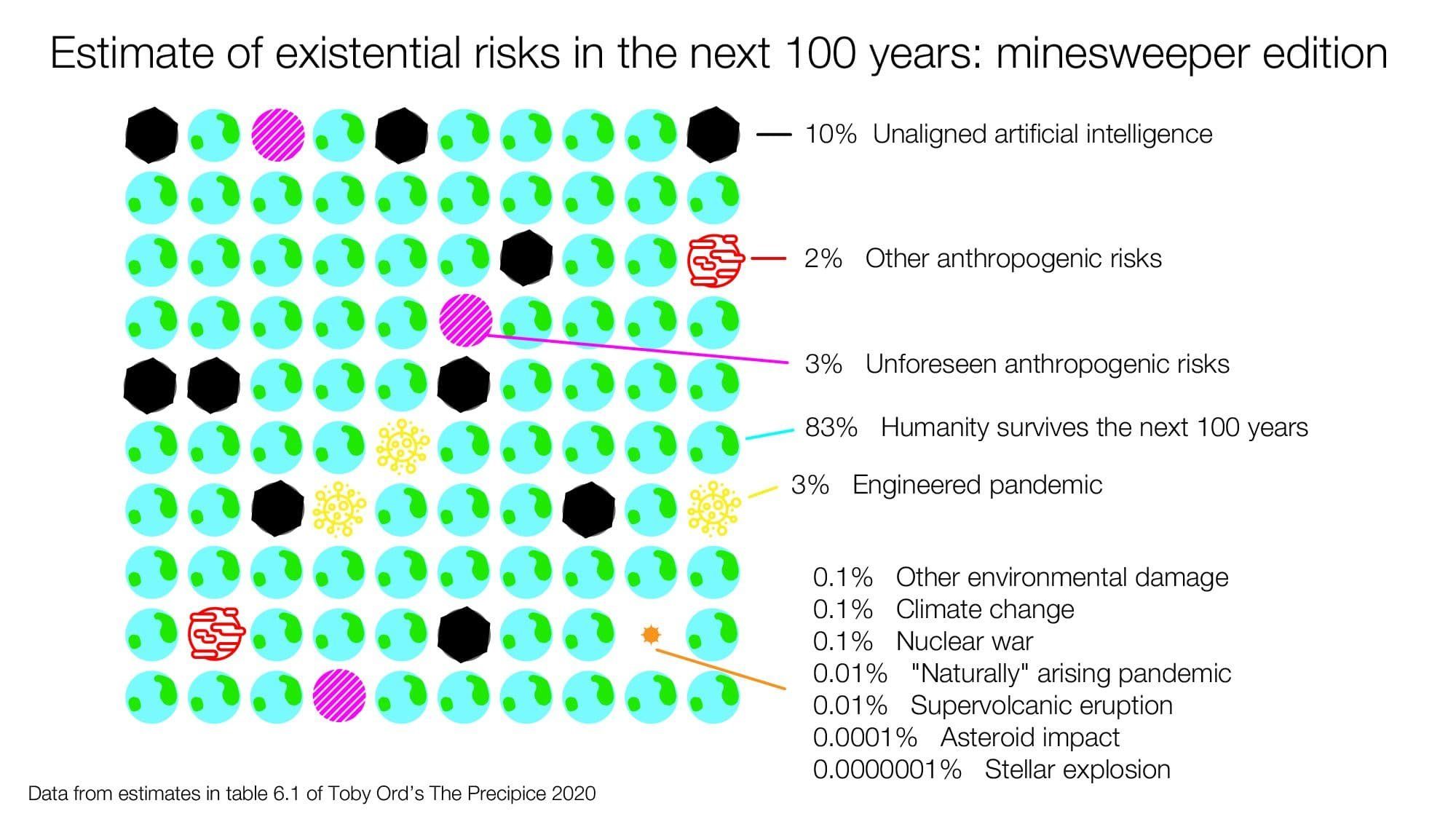
Toby Ord, a senior research fellow at Oxford University and a guy who has the bleak job of thinking full-time on how life on Earth might perish, wrote a book The Precipice which outlines just that. According to his research, the next 100 years look like this:

That’s a 5 in 6 chance we make it through as a species, but a 1 in 6 chance that some new technology or other issue does us in. This may sound hard to believe, but given the phenomenal stakes, surely it is worth investing more in looking into? Not just COVID and future pandemics, but also nuclear war, artificial intelligence[4], and unknown unknowns.

You can quibble some with the specific numbers that Ord gives (I certainly do), but the point still stands. Whether it is “1 in 6” or “1 in 10”, it is still uncomortably high risk. We should do what we can to mitigate that.

For example, Ord points out that “the international body responsible for the continued prohibition of bioweapons has an annual budget of just $1.4 million – less than the average McDonald’s restaurant.” Seems like they should have more funding?

But the good news is that progress is possible:
• Via Operation Warp Speed, we produced several safe and effective COVID vaccines in just a year, and then quickly we manufactured and delivered those vaccines at scale
• NASA has met its goal of tracking 90% of near-earth asteroids larger than 1 kilometre in diameter
• Thanks to rapidly declining solar power prices, more electric vehicles, a shift from coal to natural gas, and other important international policy initiatives, we are successfully averting the most dire climate change scenarios (like +4C/+7F) and holding ourselves closer to +2C/+3.5F
• Thanks to international arms control agreements, we have moved from a height of over 63,000 nuclear weapons in the 1980s to under 14,000 nuclear weapons today
• There’s been progress on a pan-coronavirus vaccine that could protect us from a wide variety of coronaviruses, not just COVID-19, and not just coranaviruses we already know about.

We need much more than this! But progress is possible and I’m optimistic we can push for more progress.

«
Optimism! In short supply, but here at The Overspill we’re always trying to mine the seams we find.
unique link to this extract


How Instagram is failing protesters in Iran • Slate

Mahsa Alimardani:

»

At one point, Telegram was the main communication tool during protests. But in May 2018, the app was censored by Iranian authorities. Now, Instagram is Iran’s most popular and only uncensored foreign social media platform. (It’s the second most used app after WhatsApp.) And in recent weeks, it’s begun taking down footage of protests and related content, apparently because of a policy change on not administering exceptions in reaction to the backlash against Meta’s content moderation policies at the start of Russia’s invasion of Ukraine.

On May 12, reports started to surface that users posting about the protests in Persian were experiencing mass takedowns. The affected Instagram accounts included one of the biggest protest documentation networks, the 1500Tasvir collective, and even in one case the diaspora Persian language media outlet Iran International.

All of the content removed appeared to have one thing in common: either a caption or audio included the common dissident protest slogan “Death to the Dictator,” reframed to include Iran’s du jour cadre of dictators including: “Death to Khamenei” (the current supreme leader); “Death to Raisi” (the current president) and “Death to the Revolutionary Guards/Basij” (the paramilitary forces responsible for violent repression of protest and dissent).

To Western observers, it might seem obvious that “Death to” a person would violate content guidelines against calling for violence. But in the Iranian context, “death to the dictator” has long been a symbolic slogan of dissent against Iran’s theocratic authoritarian system, rather than a call for actual death. At one point, Meta—Instagram’s parent company—understood this. During the July 2021 protests, after much reporting and discussion, Facebook created a “death to Khamenei” temporary exception to content moderation guidelines. Now, almost a year later, the same problem has emerged, only the scale of the protests have expanded and Meta is no longer abiding by that exception.

«

The thing I find odd about Instagram is that you can’t make a post go viral: there’s no “retweet” function, though you can take a Post and put it in a Story. (But you can’t take part of a Story and put it in a Post.. right?) Which means that virality is mediated entirely through popular accounts, or by the Explore tab. Which means that as a means for getting your political message out, it’s substantially limited.
unique link to this extract


Alito seems cool now with the godfather of anti-tech antitrust • Protocol

Ben Brody:

»

In a dissent released Tuesday, [US Supreme Court justice Samuel] Alito wrote for himself and two of his fellow conservatives that he would let a Texas law proceed during an appeal. The law in question punishes big social media companies for their treatment of particular viewpoints in a way that most scholars think violates those corporations’ free speech rights. A majority of the Court blocked the law.

But Alito also was clear to refer to “the power of dominant social media corporations” and gave a shoutout to Justice Louis Brandeis, the progressive icon of the early 20th century. That framing of the might of services like Facebook, and the approving reference to a jurist who’s more or less the patron saint of the hipster antitrust movement, suggested to some that a bloc of Supreme Court conservatives may be sympathetic to the strange-bedfellows push to beat back the companies through antitrust enforcement.

“We have no doubt that champagne bottles were being popped at the law firm of Wu, Khan and Kanter,” Blair Levin and Matt Perault wrote in a research note, referring to three high-profile competition-law reformers in the administration.

Lina Khan, the chair of Federal Trade Commission, is pursuing the agency’s competition case against Meta, while Jonathan Kanter heads up the Justice Department’s Antitrust Division, which is pursuing a lawsuit against Google. Both are expected to go through lengthy appeals — or even potentially end up before the Supreme Court — and both have fans among certain prominent Republicans who view antitrust enforcement as a way to punish Big Tech for how it handles right-wing speech.

«

Alito is making it up as he goes along. There’s absolutely no justification under the US Constitution, in any reasonable reading of the First Amendment, that supports the Texas law. (That basically tells social media companies they have to leave any content up, which is in opposition both to Section 230 – letting platforms choose what to leave up – and the First Amendment, because it’s the government telling a private company what to “print”.) That’s a terrible choice for “hey, this guy supports our antitrust position!”
unique link to this extract


When cars kill pedestrians • The New Yorker

Danyoung Kim:

»

As the historian Peter Norton writes in his book “Fighting Traffic,” starting in the 1920s, the National Automobile Chamber of Commerce, the leading lobbying group for car manufacturers, persuaded editors to publish its pseudo-statistical “news reports” on car crashes, which spread the idea that “jaywalkers”—a pejorative for people from rural areas who didn’t know how to navigate city streets—were responsible for their own injuries and deaths. Auto clubs sponsored street shows in which jaywalkers were lampooned by clowns and convicted in mock trials held by children.

This industry campaign helped to bring about what Norton calls a “social reconstruction of the street,” in which pedestrians were taught to accommodate cars, not the other way around. A new school of urban designers, called highway engineers, refashioned cities to push pedestrians and cyclists further to the margins. Meanwhile, media coverage of car crashes grew less critical of drivers, and a sense of fatalism began to envelop the consequences of traffic collisions, which are typically called “accidents,” suggesting that no one is to blame and nothing can be changed. (Plane crashes are not described in the same way.)

By century’s end, cars had grown progressively larger, better insulated from the feedback of the surrounding environment, and safer for the people inside them. Those on the outside were less lucky. The US automotive lobby resisted regulations enacted in Europe that made cars and trucks less lethal, and, by 2018, the number of pedestrian and cyclist deaths per kilometre in the United States was more than four times higher than in the UK, Germany, the Netherlands, and Denmark. Among the most vulnerable are older adults, who in 2020 made up 20% of killed pedestrians, and people who live in low-income neighborhoods where there has been little investment in safe road design.

Between 2010 and 2019, as the number of US drivers or passengers who died in collisions held fairly steady, deaths of those on bikes rose 36%, and deaths of those on foot nearly doubled.

«

The, ahem, killer comment:

»

“Nobody ever looks at the car as a weapon,” [journalist Aaron] Naparstek said. “The basic rule that I discovered over the years is if you ever want to murder someone in New York City, do it with a car.”

«

unique link to this extract


Apple plans to make the iPad more like a laptop and less like a phone • Bloomberg via Mercury News

Mark Gurman:

»

Apple will announce significant changes to the iPad’s software next week at its annual Worldwide Developers Conference, according to people with knowledge of the matter, part of a push to make the device more like a laptop and less like a phone.

The iPad’s next major software update, iPadOS 16, will have a redesigned multitasking interface that makes it easier to see what apps are open and switch between tasks, said the people, who asked not to be identified because the changes aren’t yet public. It also will let users resize app windows and offer new ways for users to handle multiple apps at once.

The iPad accounts for nearly 9% of annual Apple’s sales, and that percentage has inched up in recent years. But professional users of the device have clamored for an interface that feels more like a laptop experience. The iPad’s hardware, which now includes the same M1 chip as some of Apple’s laptops, has grown increasingly powerful, and in some ways the software hasn’t kept up.

A spokesperson for the Cupertino, California-based company declined to comment.

The new iPad interface will be one of the biggest upgrades announced at the conference, which will also include software updates for the iPhone, Mac, Apple Watch and Apple TV. The tech giant holds the conference each year to show off new features and device enhancements that developers can harness with their apps.

Currently, iPad users can either run apps in a full-screen view like on an iPhone or run two apps side by side. The company also lets users add a scaled-down version of a third app by sliding it over from the side. The changes will expand upon that interface.

«

The question of how much (more) an iPad should be like a Mac has troubled, well, everyone for quite a few years now. There’s been piecemeal movement to give it more laptop-like capability, but resizable overlapping windows à la Macintosh would be the next step. There has to come a point when you ask what the difference is.
unique link to this extract


Britain is one shock away from a food crisis, experts warn • Daily Telegraph

Harriet Barber is the Telegraph’s “global health security reporter”, which is a title I’d never heard before:

»

In the past three years, food prices in the UK have been shaken by Covid, Brexit and now Russia’s invasion of Ukraine. The impact on food is already being felt by people across the country.

Almost one in 20 British households said one of their family members went a whole day without eating in the past month, because they couldn’t afford or get access to food. In April 2022, 13.8% of households experienced moderate or severe food insecurity, a five percentage point increase on January 2022, according to analysis by the Food Foundation.

Emma, a mother of three from Kent, and who works three jobs, told BBC Radio 4 on Tuesday that she had not eaten three meals a day for months because she wanted to make sure she could afford food for her children.

The most recent blow has been Russia’s invasion of Ukraine. The two countries together accounted for 29% of international wheat annual sales, while Ukraine grew enough food for 400 million people. Russia is also a major fertiliser exporter, and the surge in its pricing – linked to a surge in the price of gas – has impacted British farmers.

“George Eustice, the UK Secretary of State for Defra, said we don’t need to worry about Ukraine. I don’t know what on earth is going on in Defra for the Secretary of State in charge of food supply to be so inaccurate and inappropriate,” Prof [Tim] Lang [emeritus professor of food policy at the University of London] said. “Ukraine has rocketed world food prices, oil and fertiliser prices, grain and edible oil prices.”

«

The interview with Emma was shocking: a portrait of a mother trying to keep her children fed, at the expense of herself.
unique link to this extract


Tim Hortons app tracked too much personal information without adequate consent, investigation finds • CBC News

Nojoud Al Mellees:

»

The [Canadian] federal privacy commissioner’s investigation into the Tim Hortons mobile app found that the app unnecessarily collected extensive amounts of data without obtaining adequate consent from users.

The commissioner’s report, which was published Wednesday morning, states that Tim Hortons collected granular location data for the purpose of targeted advertising and the promotion of its products, but that the company never used the data for those purposes.

“The consequences associated with the App’s collection of that data, the vast majority of which was collected when the App was not in use, represented a loss of Users’ privacy that was not proportional to the potential benefits Tim Hortons may have hoped to gain from improved targeted promotion of its coffee and associated products,” the report read.

The joint investigation was launched about two years ago by the Office of the Privacy Commissioner of Canada in conjunction with similar authorities in British Columbia, Quebec and Alberta. It came after reporting from the Financial Post found that the Tim Hortons app tracked users’ geolocation while users were not using the app.

According to a presentation to investors shared in May, the restaurant chain’s app has four million active users.

«

Unsurprisingly, this was all because Hortons was using a third-party framework (called Radar) to do the location tracking, and that framework was very eager to collect the maximum possible location data (of course, to sell on). It seems a little unfair, though, that Hortons takes all the flak when the third party is just as, or arguably more, responsible.
unique link to this extract


Federal Reserve report shows who’s actually using crypto and how • Reason

Andrew O’Sullivan:

»

Every year, the Fed puts out a publication called the Survey of Household Economics and Decisionmaking. Since 2013, it has collected survey responses from American families about their finances, job situations, and abilities to cover unexpected expenses.

The report for 2021, “Economic Well-Being of U.S. Households in 2021,” was just released in May. For the first time, the Fed included questions about cryptocurrency in the survey. The responses from the 11,874 participants of all ages, incomes, ethnicities, and educational levels show that depending on your state of life, you might be using digital currency in very different ways.

The new data on cryptocurrency usage is on page 46 of the report. First, it finds that 12% of participants, a little over 1,400, held or used cryptocurrency at some point over the previous year. If that extrapolates to the general American population, that suggests that almost 40 million Americans were involved in cryptocurrency last year.

This is in line with other estimates of American cryptocurrency usage; in 2021, for instance, the Pew Research Center reported that around 16% of Americans, or 53 million, had ever bought or held cryptocurrency. That these two estimates are so close suggests that Americans may be becoming more comfortable with cryptocurrency, since the Fed report only examined activities over the previous year.

Most of the participants who said they used cryptocurrency in 2021 did so as an investment. Some 11% of the survey participants reported such, then 3% reported using it as a payment mechanism. Then, 2% said they used cryptocurrency to purchase goods or services, while another 1% said they used it to send money to friends and family. Note that these numbers overlap—some people who used bitcoin as an investment also used it to transact.

«

Those who transacted tend to be low income – possibly foreign remittances – and unbanked.
unique link to this extract


Bank of England to take over collapsed stablecoin cryptocurrencies • Daily Telegraph

James Titcomb:

»

The Bank of England will take over collapsed “stablecoin” companies to prevent a cryptocurrency crash hitting financial stability, under Treasury plans.

Stablecoin issuers would be placed into special administration by the Bank to protect consumers if they fail, a Government consultation said on Tuesday.

The proposals would mean companies offering stablecoins, cryptocurrencies designed to hold their value, would fall under similar rules as banks and other systemic institutions.

The Treasury plans to recognise stablecoins as a legal form of payment under efforts to make Britain a “crypto hub”.

Stablecoins’ backers say they offer potentially faster and more efficient payments than existing systems, but their rise has come under new scrutiny due to the collapse of Terra, a stablecoin designed to be linked to the dollar whose value collapsed in May.

The consultation proposed that the Bank would have the power to direct administrators for systemic “digital settlement asset” firms under the Financial Market Infrastructure Special Administration Regime.

This is more strict than the regime for payments companies, and requires administrators to pursue continued operations “ahead of the interests of its creditors” while giving the Bank of England “powers of direction and oversight over the administrator”.

«

Quite the quid pro quo: stablecoins would have to be stable, which means all the wild swings in value would be obviated; but they’d be “safe” as a normal bank account (probably with the same limits on rescue, ie £30,000). Is this good or bad? It’s good for the normal person, but bad for the speculators. So, good.
unique link to this extract


Netflix cracks down on password sharing, but early efforts in Peru are a mess • Rest of World

Jimena Ledgard and Andrew Deck:

»

Rest of World spoke to over a dozen Netflix consumers in Peru, many of whom say that more than two months after the policy [to prevent password sharing among non-households] was first announced, they have not received uniform messaging around the new charges nor do they seem to be subject to the same policies.

For some, the price increase has been enough to convince them to cancel their Netflix accounts outright. Others continue to share their accounts across households without any notification of the policy change or have ignored the new rule without facing enforcement. Overall, the lack of clarity around how Netflix determines a “household” and inconsistent levying of the new charges on different customers have left subscribers in the trial confused, risking action from consumer regulators.

The varied user experiences with notifications and charges suggest Netflix may be testing different versions of the rollout on different customers or has not fully defined the terms of the policy. “They may end up causing issues with their so-far loosely inferred definition of a household,” said Isabelle Charney, a researcher for Ampere Analysis.

«

Christina Warren had a thread musing on this story: the big problem is, how do you define a “household”? Two people who are always on the same IP? What if one is in the house but on mobile? What about when they’re on a train? Or in a hotel? How on earth do you define “household” in a world where we’re connected in so many ways in different places at different times, yet it’s the same “us”?
unique link to this extract


• Why do social networks drive us a little mad?
• Why does angry content seem to dominate what we see?
• How much of a role do algorithms play in affecting what we see and do online?
• What can we do about it?
• Did Facebook have any inkling of what was coming in Myanmar in 2016?

Read Social Warming, my latest book, and find answers – and more.


Errata, corrigenda and ai no corrida: none notified

Start Up No.1813: the weird world of crypto stans, Iran reaches nuclear capability, the alarms ignored before Uvalde, and more


After 14 years, Sheryl Sandberg is leaving Facebook. Insiders say she’d been losing influence for a long time. What’s next? CC-licensed photo by TechCrunch50-2008TechCrunch50-2008 on Flickr.

You can sign up to receive each day’s Start Up post by email. You’ll need to click a confirmation link, so no spam.

A selection of 9 links for you. Leaning sideways. I’m @charlesarthur on Twitter. Observations and links welcome.


Sheryl Sandberg leaves Facebook. She’d been losing power for months • Business Insider

Kali Hays and Claire Atkinson:

»

When Facebook became Meta Platforms last year and shifted its focus to the metaverse, Sheryl Sandberg, the number 2 executive, had little involvement in what was the largest strategy change in the company’s history.

Sandberg’s absence raised eyebrows internally, given CEO Mark Zuckerberg’s intense focus on this new path. If this was where Zuckerberg was heading, why was his closest executive confidant so detached from the project?

…She’s been infrequent on group calls, too, or quieter than she once was. And with Zuckerberg’s extensive traveling during the pandemic, the two have been rarely seen together at the office, according to these people. Some even wondered in recent months whether the two executives had stopped their hours-long meeting every Friday – a staple of their leadership over the past decade or more.

“My sense has been Sheryl is checked out,” one investor in the company for many years said.

Another former high-ranking Facebook employee said her exit has been a long time coming, “At this point, it’s literally more surprising that she was still there than she’s leaving,” the person said.

Although her exit is being publicly described by the company as a resignation on her part, another manager-level employee was adamant she had been asked to leave. “I did not expect her to be fired,” the person said.

Another agreed, saying her exit has been in the works for months, noting this is likely why she has been noticeably less present on major company endeavors. This person also said her public missteps of recent years at some point became too much of a negative risk for the company. From her arguments that the Jan. 6 insurrection in the US Capitol was not organized on Facebook to a recent report that she successfully and directly pressured The Daily Mail to drop a story on her then boyfriend Activision founder Bobby Kotick.

“She kept saying stupid shit in public that made the company look bad,” a company director who left recently said. “Everyone has been wondering when she’s leaving.”

«

unique link to this extract


They used my identity to flog a doomed cryptocurrency – and then things got weird • The Guardian

Alex Hern found his name being used to promote a “shitcoin” of no value or use; when he pointed this out in the Telegram channel, its hyped value collapsed :

»

Shortly after the collapse, I got an email I wasn’t expecting – from the ProtonMail account that had pretended to be me. I’d emailed over some questions, but wasn’t expecting a reply. What do you say to the person whose identity you stole?

The answer, it seems, is “a marketing pitch”. The developer told me that “the community has passed a critical part of this experiment … We follow your work and writings and are sorry if anyone took that as you were behind the coin. The main thing is you were reached through the block chain only. It’s not in anyway a scam.”

I asked how they could deny trying to scam people into thinking I was involved. They said they’d intended “Guardian” to be taken in the sense that they were the Guardians of the project. “I also follow your work closely so the names went well together … I never said you were involved. I guess it’s like Mickey@waltdisney.com vs Mickey@protonmail. Is mickey@protonmail a scammer if he builds a theme park? We don’t know.”

I thought the impasse was just the natural result of me speaking to a brazen huckster, but the more I asked around, the more it became clear that this was more like two people speaking at cross purposes. The still anonymous devs are sincere that they aren’t scamming anyone, because the meaning of “scam” in the world of shitcoins is necessarily narrow. When the base expectation is that every coin will crash at some point, and none of them have any real value beyond marketing puff and community momentum, how can simply lying about who backs a coin really be a meaningful scam?

To the dev, my accusation that they were scamming people was a serious charge. It implied that they had hidden code in the coin that would allow them to take people’s money in a way outside the rules of the game – perhaps by suddenly printing millions of tokens to flood the market, or locking it up to prevent anyone else from selling. By contrast, spreading falsehoods about who’s backing the token is well within the rules of the game.

«

That, however, wasn’t the end of the story by any means. Things then got Life Of Brian-style weird.

Anyway, it’s totally the future of the internet.
unique link to this extract


Former OpenSea employee arrested, charged with NFT insider trading • NBC News

Kevin Collier:

»

A former senior employee at the internet’s largest NFT trading platform has been arrested and named in the government’s first case alleging insider trading of digital assets, the Justice Department said Wednesday.

Nate Chastain, the former head of product at New York-based OpenSea, is accused of buying NFTs soon before the company planned to feature them on its homepage, profiting from their exposure and his company’s apparent endorsement, according to the Justice Department.

NFTs, short for nonfungible tokens, are digital assets rooted in the same basic technology as cryptocurrencies, and provide a way to prove digital ownership. Popularity of NFT artwork exploded during the pandemic, creating an estimated $40 billion market last year.

Charging documents allege that Chastain laundered at least 45 NFTs in 2021, each time selling them for two to five times what he had just paid for them.

An OpenSea spokesperson said the company had investigated Chastain over the incidents “and ultimately asked him to leave the company.”

«

Totally the future of the internet.
unique link to this extract


Tech experts urge Washington to resist crypto industry’s influence • Financial Times

Scott Chipolina:

»

Harvard lecturer Bruce Schneier, former Microsoft engineer Miguel de Icaza and principal engineer at Google Cloud Kelsey Hightower, are among 26 leading computer scientists and academics who have signed a letter delivered to US lawmakers heavily criticising crypto investments and blockchain technology.

While individuals have made similar warnings about the safety and reliability of digital assets, it marks a more organised effort to challenge the growing influence of crypto advocates who want to resist attempts to regulate the frothy sector.

“The claims that the blockchain advocates make are not true,” said Schneier. “It’s not secure, it’s not decentralised. Any system where you forget your password and you lose your life savings is not a safe system,” he added.

“We’re counter-lobbying, that’s what this letter is about,” said signatory and software developer Stephen Diehl. “The crypto industry has its people, they say what they want to the politicians.”

A recent analysis of the US Congressional Lobbying Disclosure database by Public Citizen, a consumer advocacy group, revealed the number of lobbyists representing the crypto industry increased from 115 to 320 between 2018 and 2021, and the money spent on lobbying for the crypto sector quadrupled from $2.2m to $9m in the same period.

…The industry’s advocates claim cryptocurrencies provide the answer to a series of macroeconomic problems facing society, from providing banking services to millions worldwide without access to traditional financial institutions, protecting financial privacy and giving those beset by inflation an opportunity to store wealth.

But in the letter seen by the Financial Times, the technologists write: “We urge you to resist pressure from digital asset industry financiers, lobbyists and boosters to create a regulatory safe haven for these risky, flawed and unproven digital financial instruments.”

«

Bear in mind that the 26 scientists aren’t getting VC money, or being paid, and won’t get rich from either outcome.
unique link to this extract


Iran has enough uranium to build an atomic bomb, UN agency says • NBC News

Dan de Luce:

»

Iran has accumulated enough enriched uranium to build a nuclear bomb, according to new findings from the United Nations atomic agency.

The International Atomic Energy Agency also said in a separate report that Iran has failed to provide credible explanations about nuclear material found at several sites in recent years, raising questions about the nature of its nuclear work.

The IAEA’s two reports could set the stage for a showdown at a meeting next week of its 35-nation board of governors, as Iran has demanded the watchdog wrap up its probe into uranium particles found at three undeclared locations in the country since 2019.

The UN nuclear watchdog said that Iran’s stockpile of uranium enriched to 60% had grown to 43.3kg (95lb), which represented an increase of nearly 10kg (22lb) compared to three months ago.

Experts said that the stockpile would provide roughly enough material for an atomic bomb if Iran took the additional step of enriching the uranium to 90% purity. Moving from 60% to 90% would not pose a technical challenge for Iran, according to arms control experts.

“Iran has now accumulated enough enriched uranium to be able to quickly produce more than a significant quantity of HEU (highly enriched uranium) for one bomb,” said Daryl Kimball of the Arms Control Association think tank. “The time it would take them to do that can now be measured in days, not months or weeks.”

«

So Trump’s brilliant plan to end the JCPOA and reimpose economic sanctions didn’t work at all. Wonder if this will attract an Israeli air strike, as it previously did on a Iranian nuclear facility in June 1981. (Apparently they’re just practising at the moment. Very Top Gun Maverick.)
unique link to this extract


Before Uvalde, a platform fails to answer kids’ alarms • Platformer

Casey Newton:

»

Aside from a handful of private messages, the Uvalde shooter appears not to have much used Facebook. That and Instagram were once the default platforms for making threats like these, but new platforms are growing in popularity with young people. The Uvalde shooter liked one called Yubo, created by a French company called Twelve App. It’s a “live chilling” app similar to Houseparty, the app that Meerkat became after helping to launch the live-streaming craze in the United States in 2015.

It’s also apparently quite popular, with more than 18 million downloads in the United States alone, according to the market research firm Sensor Tower.

Like Houseparty, Yubo lets users broadcast themselves live to a small group of friends. The twist is that Yubo focuses on making new friends — finding people with similar interests and letting them chat. Particularly young people. “Yubo is a social live-streaming platform that celebrates the true essence of being young,” the company says. (Perhaps for that reason, its seems to have attracted more than its share of older men and their unwanted sexual advances.)

In the days after the massacre, reporters discovered that Yubo appears to have been the shooter’s primary social app. He used it, among other things, to threaten rape — and school shootings.

…Yubo told the network [CNN] that it is cooperating with the investigation, but declined to offer any details on why the shooter was able to remain on the platform despite having been reported for making threats over and over again.

It can seem shocking that a person who repeatedly makes violent threats, and is reported for doing so to the platform, fails to see any consequences. And yet for years now, children have been telling us that this is a regular occurrence for them.

«

Newton’s key point is that children say that again and again, they report people for breaking the rules; again and again, those people quickly appear back online. So what’s the point of the reporting tools? Yubo may find itself in some hot water.
unique link to this extract


We can upgrade Brexit and ease the cost of living by going back to the Single Market • Politics Home

Tobias Ellwood was a government minister from 2017 to 2019:

»

Political distance from Brussels has been achieved. This is not up for question. However, economically speaking, there is vast room for improvement. The OBR calculates, in its current form, that Brexit is reducing our GDP by 4%. This compares to around 1.5% caused by Covid.

Put another way: our exports to Europe have shrunk by £20bn. From the fishers who can no longer sell their Scottish salmon, to the farmers undercut by unchecked imports, to Cheshire cheesemakers running into £180 health certificates, even to the City which can no longer sell financial services to Europe, sector after sector is being strangled by the red tape we were supposed to escape from.

Total business investment across the entire United Kingdom economy stalled after 2016 and is 10% down on 2019. European Union workers are turning their backs on the UK, leaving vital gaps in our workforce. Low investment means lower growth. No wonder the IMF forecasts growth for 2023 as half the advanced economy average. 

And then there’s the unresolved issue of the Irish border. Current plans to bin the Northern Ireland Protocol could trigger a trade war with the EU (causing further economic harm) and is alienating the United States, our closest security ally.

As a recent YouGov poll indicates, this is not the Brexit most people imagined, with the majority believing Brexit has gone badly. There is appetite to make improvements – not U-turns but course corrections.

In a nutshell, all these challenges would disappear if we dare to advance our Brexit model by re-joining the EU single market (the Norway model). Leaving this aspect of the EU was not on the ballot paper, nor called for by either the Prime Minister or Nigel Farage during the 2016 referendum. There was, however, much discussion about returning to a “common market,” which is exactly what I propose.

«

He also points out that at a stroke this would sort out the row over Northern Ireland’s trade with the EU and UK. Unfortunately he voted to Remain in the EU (Boris Johnson fired him on taking over the party in summer 2019), so this has little chance of being taken seriously by the Tory party. A pity, because it’s eminently sensible. And “upgrade Brexit” is clever wording.
unique link to this extract


Missed payments, rising interest rates put ‘buy now, pay later’ to the test • WSJ

AnnaMaria Andriotis and John Stensholt :

»

The young industry [of buy now, pay later on zero interest] finds itself in a tricky spot at a time when the economy is slowing and, some fear, headed for a recession. Buy-now-pay-later companies boomed when consumers were flush with cash and buying goods at a feverish pace. How they fare in a downturn, when savings evaporate, spending slows and bad debts mount, is untested. 

To weather the storm, Afterpay and Zip are slowing their new originations. 

“We are putting a real focus on sustainable growth, strong unit economics and, critically, accelerating our pathway to profitability,” said Zip co-founder and Global Chief Operating Officer Peter Gray.

Klarna last week said it plans to lay off about 10% of its staff. It also has tightened lending standards “to reflect this evolving market context,” a spokeswoman said.

Affirm Chief Executive Max Levchin has sounded a more upbeat note. Buy-now-pay-later plans like Affirm that don’t charge late fees will be in greater demand during a downturn, he said on an earnings call in May. “It is our mission to improve people’s lives, and we will be prepared to meet this demand—but again—our approach is only to extend credit that we believe can and will be repaid,” he said.

The buy-now-pay-later business took off in a post-financial-crisis world of cheap funding and low delinquencies.

They rely less on—and in some cases bypass altogether—traditional credit scores and reports. That makes them appealing to people with limited savings and low credit scores. Subprime consumers accounted for about 43% of shoppers who applied for payment plans or loans at retailers’ checkout between the fourth quarter of 2019 and 2021, according to credit-reporting firm TransUnion, though they only made up about 15% of the US adult population.

«

Ranjan Roy, who takes turns writing the Margins Substack with Can Duruk, likes to talk about the Age Of ZIRP – the latter acronym standing for “zero interest rate policy”, which meant lots of cash chasing any sort of return because there was none to be had in the bank. BNPL companies strike me as very much Age Of ZIRP businesses. But that time has gone. Questionable how well they can survive.
unique link to this extract


I have a great Wordle start word – it’s just a bit rude • The Irish Times

Róisín Ingle:

»

while I was very late to Wordle, it’s now become a daily ritual that I can’t seem to quit. I resisted for ages, until a dyslexic friend of mine started sending me her results on WhatsApp delighted with herself. Her joy at being able to complete the word puzzle despite her dyslexia was infectious and now most mornings start with our little exchange of Wordle results.

…So chances are you probably know all you will ever need to know about Wordle but, hang on a minute, do you know about the Marian Keyes Method (MKM)? If you are a twitter user, you may well know about this method which was invented (patent pending) by best-selling author Marian Keyes. But something us media people tend to forget or wilfully ignore is that not everybody is on twitter, so it’s reasonable to assume many of you will not know about the MKM.

«

Keyes is a wonderful person, and this is a wonderful read. Even if you’ve given up on Wordle, or don’t play it, or do play it, this should lift your day. (Thanks Niall for the link.)
unique link to this extract


• Why do social networks drive us a little mad?
• Why does angry content seem to dominate what we see?
• How much of a role do algorithms play in affecting what we see and do online?
• What can we do about it?
• Did Facebook have any inkling of what was coming in Myanmar in 2016?

Read Social Warming, my latest book, and find answers – and more.


Errata, corrigenda and ai no corrida: none notified

Start Up No.1812: why plastics recycling won’t work, Qualcomm wants a chunk of Arm, no Apple headset this year?, and more


Don’t look up, but venture capitalists reckon there’s money in them thar asteroids. CC-licensed photo by Kevin Gill on Flickr.

You can sign up to receive each day’s Start Up post by email. You’ll need to click a confirmation link, so no spam.

A selection of 9 links for you. Also unrecyclable. I’m @charlesarthur on Twitter. Observations and links welcome.


Operational note: the UK is having bank holidays on Thursday and Friday, but The Overspill will continue. Next week, however, it’ll be on a break all week.


Plastic recycling doesn’t work and will never work • The Atlantic

Judith Enck and Jan Dell:

»

The problem with recycling plastic lies not with the concept or process but with the material itself.

The first problem is that there are thousands of different plastics, each with its own composition and characteristics. They all include different chemical additives and colorants that cannot be recycled together, making it impossible to sort the trillions of pieces of plastics into separate types for processing. For example, polyethylene terephthalate (PET#1) bottles cannot be recycled with PET#1 clamshells, which are a different PET#1 material, and green PET#1 bottles cannot be recycled with clear PET#1 bottles (which is why South Korea has outlawed colored PET#1 bottles.) High-density polyethylene (HDPE#2), polyvinyl chloride (PVC#3), low-density polyethylene (LDPE#4), polypropylene (PP#5), and polystyrene (PS#6) all must be separated for recycling.

Just one fast-food meal can involve many different types of single-use plastic, including PET#1, HDPE#2, LDPE#4, PP#5, and PS#6 cups, lids, clamshells, trays, bags, and cutlery, which cannot be recycled together. This is one of several reasons why plastic fast-food service items cannot be legitimately claimed as recyclable in the U.S.

Another problem is that the reprocessing of plastic waste—when possible at all—is wasteful. Plastic is flammable, and the risk of fires at plastic-recycling facilities affects neighboring communities—many of which are located in low-income communities or communities of color.

Unlike metal and glass, plastics are not inert. Plastic products can include toxic additives and absorb chemicals, and are generally collected in curbside bins filled with possibly dangerous materials such as plastic pesticide containers.

«

We can’t recycle plastics, we can’t have fusion (though we can have fission – it’s safe and it works), the news on climate isn’t that encouraging. The search for good news goes on.
unique link to this extract


AstroForge aims to succeed where other asteroid mining companies have failed •Ars Technica

Eric Berger:

»

The founders of the company, Jose Acain and Matt Gialich, said in an interview they were well aware of the challenges of deep space mining when starting AstroForge earlier this year.

“When you say asteroid mining, people laugh at you,” Gialich said. “They’re like, ‘OK, here’s some crazy guys that did too many drugs and thought this would be a cool idea.’ But the reality is that we can take this from the realm of science-fiction into the realm of something we can actually do.”

Both NASA and the Japanese space agency, JAXA, have now successfully collected material from asteroids in deep space, he said. Of course, both did so at a much smaller scale, aiming to bring only small amounts of material back to Earth for scientific study. But the Hayabusa2 and OSIRIS-REx missions have demonstrated that gleaning material from an asteroid is technically feasible.

Gialich said AstroForge seeks to lower the price of these missions. And unlike its now-defunct predecessors, which were designing spacecraft that ultimately would have cost hundreds of millions or billions of dollars, AstroForge plans to use commercial space technology that already exists for its missions.

Last week AstroForge announced that it had closed a $13m round of “seed plus” funding, which was led by Initialized Capital, with investments from Seven Seven Six, EarthRise, Aera VC, Liquid 2, and Soma. The company presently has seven employees, and this will allow that number to double. AstroForge is planning a launch in January 2023 of a small satellite to perform a refining demonstration in low Earth orbit. After that, the company is planning two more missions into deep space, and this funding will provide the runway to carry AstroForge that far.

“We don’t need that much capital,” Gialich said. The company plans to design spacecraft small enough to fly as part of rideshare launches. “We’re going after this by bringing along a very, very small spacecraft to mine asteroids. So our first return mission is not going to return trillions of dollars. It’s not going to return billions of dollars. It’s going to return tens of millions of dollars.”

«

There’s so much that has to go just right, and the timescales stretch over years, and it would be so easy for what comes back to be pure, useless ash. But there’s a big group of people in California whose principal aim is to make SF stories happen. So they get money.
unique link to this extract


How wiring innovation is quietly driving the EV revolution • Aptiv

»

Traditional wiring is not the first place one normally looks for electric vehicle (EV) innovation, but recent advancements are having a significant impact on the EV story because they’re providing OEMs with two things they desperately need in their EV architectures: less mass and more space.

Aptiv’s system engineers know how to reduce the number of cables and splices and how to squeeze out every millimeter of excess cable through precise optimization of the electrical distribution systems in concert with applying new technologies. Take Aptiv’s recent innovations in aluminum cabling, for example. Aptiv’s PACE Award-winning Selective Metal Coating technology allows OEMs to replace copper wiring with lighter aluminum cabling that is adding up to big benefits for OEMs.

How big? With our aluminum cable as part of an optimized architecture, one leading EV company reduced wiring mass in its 2017 model by 10% and removed 150 meters of cabling. Similarly, another vehicle customer shed 11 kilograms and 400 meters of cabling from its popular 2018 truck. And yet another customer reduced the mass of the electrical distribution system on its 2018 SUV platform by 15%, thanks to Aptiv’s optimization efforts, which eliminated 300 meters of cabling.

«

People wondered yesterday why EVs should have an advantage over internal combustion engines (ICEs), because surely they both have wire harnesses to get electricity to the lights and so on? But as this and other pieces (including the original) make clear, EVs use different harnesses that are lighter and different.
unique link to this extract


Qualcomm wants to buy a stake in Arm alongside its rivals • FT via Ars Technica

Anna Gross and Tim Bradshaw:

»

The US chipmaker Qualcomm wants to buy a stake in Arm alongside its rivals and create a consortium that would maintain the UK chip designer’s neutrality in the highly competitive semiconductor market.

Japanese conglomerate SoftBank plans to list Arm on the New York Stock Exchange after Nvidia’s $66bn purchase collapsed earlier this year. However, the IPO has sparked concern over the future ownership of the company, given its crucial role in the global technology sector.

“We’re an interested party in investing,” Cristiano Amon, Qualcomm’s chief executive, told the Financial Times. “It’s a very important asset and it’s an asset which is going to be essential to the development of our industry.”

He added that Qualcomm, one of Arm’s biggest customers, could join forces with other chipmakers to buy Arm outright if the consortium making the purchase was “big enough.” Such a move could settle concerns over the corporate control of Arm after the upcoming IPO.

“You’d need to have many companies participating so they have a net effect that Arm is independent,” he said.

Arm, founded and headquartered in the UK, was listed in London and New York before SoftBank acquired it for £24.6bn in 2016 despite widespread concern about Britain’s most successful tech company falling into foreign hands.

«

unique link to this extract


Why many lifelong smokers never get lung cancer, despite smoking a pack a day • Mashable

Danial Martinus:

»

It’s widely accepted that smoking causes DNA mutations in normal lung cells, which then increase the probability of lung cancer. But up until recently, no one could explain why only a small minority of heavy smokers develop the disease, while the remainder go on to live their lives as usual.

The study, published in Nature Genetics, suggests that many smokers have natural ‘defence systems’ that are better at neutralizing the detrimental effects of smoking. Call them ‘better genes’ if you will. According to the researchers, the findings could point to the right direction when it comes to who (among smokers) to monitor closely for lung cancer, as opposed to taking a more reactive approach.

“This may prove to be an important step toward the prevention and early detection of lung cancer risk and away from the current herculean efforts needed to battle late-stage disease, where the majority of health expenditures and misery occur,” said Simon Spivack, co-senior author of the study.

…Looking at genetic profiles taken from the bronchi (the air passage that leads from the windpipe to the lungs) of 14 people who have never smoked and comparing them with samples taken from 19 light, moderate, and heavy smokers, the scientists found that the cells do mutate with natural age, and even more so in the lungs of smokers. However, like we said previously, not all smokers find themselves on the same boat.

“The heaviest smokers did not have the highest mutation burden,” Spivack revealed.

The data may suggest that the heavy smokers could have survived this long without much cell mutation solely due to ‘suppressed mutation’, meaning it was slowed or plateaued.

«

Very much emphasising “the heavy smokers who have survived this long”. It makes sense that those who smoke a lot and don’t get cancer have some sort of protective mechanism, just as people who had sex with HIV-positive people and didn’t get HIV had a protective mechanism.
unique link to this extract


Apple analyst says AR/VR headset won’t launch at WWDC, release coming next year • BGR

Chris Smith:

»

[Bloomberg reporter Mark] Gurman says he’s “wary of expecting a full-blown presentation for developers and consumers next week.”

Echoing Gurman’s sentiments is Ming-Chi Kuo, a well-known insider [Overspill ed: he’s not an insider, he’s an external analyst who writes research notes for a company called TF International Securities] who has been accurate about Apple’s unreleased devices. The analyst took to Twitter to address Apple’s mixed reality headset. He said that Apple isn’t likely to launch the glasses at WWDC next week as the device isn’t ready for mass production.

Not only that, but Apple won’t even show realityOS at the event, Kuo speculated. “Apple’s competitors worldwide can’t wait to see the hardware spec and OS design for Apple’s AR/MR headset,” he said. That’s the reason why Apple would want to unveil the device so soon.

Kuo further added that competitors will “immediately kick off copycat projects and happily copy Apple’s excellent ideas, and hit the store shelves before Apple launches in 2023.”

Kuo’s take isn’t off. He might be speculating, but that doesn’t change the fact that many companies look up to Apple for inspiration. Whether it’s iPhone-related decisions or other devices. Apple will not be the first company to launch a mixed reality headset. But its approach might force competitors to rethink their own VR and AR gadgets.

Kuo still expects the mixed reality headset to be released in 2023. If that’s the case, then Apple will probably hold a launch event for the glasses several months before sales start.

«

OK, fine, all sit down again.
unique link to this extract


Dominic Cummings: “I don’t like parties” • UnHerd

Suzanne Moore got an interview with the most fascinating person in politics who is not in politics:

»

SM: When you put your call out for “weirdos and misfits”, people interpreted that as you wanting employees who would be totally dedicated to you.

DC: Partly. But it was also a call to Whitehall and Westminster. They’re full of very similar people who did very similar degrees at very similar universities. My view is that you need different kinds of people around. I think the Covid inquiry will show that groupthink was a very serious problem.

I put out that blog about “weirdos and misfits” in January 2020 [seeking to recruit them to his unit inside Downing St] and it became the foundation for recruiting. It did bring in some excellent women. By summer, 29-year-old women were sitting at the Cabinet table, saying to Matt Hancock, “you just said that it’s not growing exponentially and you’re wrong. Here’s the actual graph. Here’s what’s happening.”

A lot of people didn’t like what I had done, but I thought: “this is now working as it should”. You’ve got smart people, who know what the fuck they’re talking about, telling either ministers or senior civil servants who don’t know exponential growth from a hole in the ground: “Here’s the actual facts.” So, I’ve radically improved how decisions are taken. The advice to the Prime Minister, though he could still trolley around and fuck things up —which he did, obviously — was at least much better.

«

There are lots of other things in the interview, but this one – about shaking up an existing hidebound system by intentionally going outside the normal hiring system – seemed to me one of the most widely applicable in the lessons it contains.
unique link to this extract


To understand Elon Musk, you have to understand one particular ’60s sci-fi novel • Jacobin

Jordan Carroll:

»

Elon Musk styles himself as a character out of science fiction, posing as an ingenious inventor who will send a crewed mission to Mars by 2029 or imagining himself as Isaac Asimov’s Hari Seldon, a farseeing visionary planning ahead centuries to protect the human species from existential threats. Even his geeky humor seems inspired by his love for Douglas Adams’s Hitchhiker’s Guide to the Galaxy.

But while he may take inspiration from science fiction, as Jill Lepore has observed, he’s a bad reader of the genre. He idolizes Kim Stanley Robinson and Iain M. Banks while ignoring their socialist politics, and he overlooks major speculative traditions such as feminist and Afrofuturist science fiction. Like many Silicon Valley CEOs, he primarily sees science fiction as a repository of cool inventions waiting to be created.

Musk engages with most science fiction in a superficial manner, but he is a very careful reader of one author: Robert A. Heinlein. He named Heinlein’s The Moon Is a Harsh Mistress from 1966 as one of his favorite novels. The Moon Is a Harsh Mistress is a libertarian classic second only to Ayn Rand’s Atlas Shrugged in its propaganda value for neoliberal capitalism. It inspired the creation of the Heinlein Prize for Accomplishments in Commercial Space Activities, which Musk won in 2011. (Jeff Bezos is another recent winner.)

The Moon Is a Harsh Mistress popularized the motto “There’s no such thing as a free lunch,” often used by defenders of capitalism and opponents of progressive taxation and social programs. It’s about a lunar colony that frees itself, via advanced and cleverly applied technology, from the resource-sucking parasitism of Earth and its welfare dependents. In this instance, it appears that Musk correctly caught the author’s drift.

«

Carroll goes into some detail about the book, and points out – correctly, I suspect – how it fits into (or shaped?) Musk’s approach to the world, particularly about “technological solutionism” which posits that social or political problems just need a technical fix. Which extends even to Twitter, of course.
unique link to this extract


These keyboarding Icelandic horses can respond to your work emails • My Modern Met

Arnesia Young:

»

even on an incredible vacation, it can be hard to leave all your worries at the office—especially when you’re concerned about the mountain of important emails that will go unanswered in your absence. Luckily, Iceland has a very unique solution. In an incredibly odd yet brilliant tourism campaign, the island country is offering the services of their iconic Icelandic horses as email responders.

The exciting new program is called OutHorse Your Email, and it gives visitors the opportunity to disconnect, relax, and soak in all of the country’s majestic beauty while one of several highly trained and talented Icelandic horses responds to any pressing work correspondence. And even though this might seem like a big joke, don’t be so quick to doubt the administrative talent of the extraordinary Icelandic horse. And if you’re still skeptical, just take the word of the program’s own glowing endorsement.

“Nothing ruins a glacier hike like an email from your boss,” writes Inspired by Iceland in a description of the new tourism initiative. “Thankfully, Iceland’s very special horses will reply to your work emails so you can enjoy your vacation in peace (Seriously.)”

Currently, visitors can pick one of three horses to answer their emails while they enjoy their vacation. First, there’s Litla Stjarna Frá Hvítarholti, who “types fast, but might take a nap.” But if you prefer a horse that’s more “assertive. efficient.” and has “shiny hair,” then Hrímnir Frá Hvammi might be more your speed. And finally, there’s Hekla Frá Þorkellshóli, who’s “friendly” and “trained in corporate buzzwords.” But if you’re concerned about how a horse can manage to type a coherent email with their giant hooves, don’t worry. They’ve got their own custom horse-sized keyboards…Although, that still doesn’t necessarily guarantee coherency. They are horses, after all.

«

I think this is not entirely serious, though it’s a clever way to make people (well, Americans) think about Iceland as a vacation. Europeans don’t worry about office emails when they’re on holiday (not “vacation”). (Via Benedict Evans.)
unique link to this extract


• Why do social networks drive us a little mad?
• Why does angry content seem to dominate what we see?
• How much of a role do algorithms play in affecting what we see and do online?
• What can we do about it?
• Did Facebook have any inkling of what was coming in Myanmar in 2016?

Read Social Warming, my latest book, and find answers – and more.


Errata, corrigenda and ai no corrida: none notified

Start Up No.1811: is Alexa charging you to pray?, crypto’s effective critic, Apple’s VR headset looks close, and more


When do you think we’ll reach our peak use of agricultural land – in five years, 10 or 20? Or could the story be more complicated? CC-licensed photo by Ian SaneIan Sane on Flickr.

You can sign up to receive each day’s Start Up post by email. You’ll need to click a confirmation link, so no spam.

A selection of 10 links for you. Out of office yet? I’m @charlesarthur on Twitter. Observations and links welcome.


Alexa, why have you charged me £2 to say the Hail Mary? • The Guardian

Patrick Collinson:

»

When my 87-year-old mother, Patricia Collinson, was given an Alexa speaker by my sister, she was delighted to find she could ask it to say the Hail Mary. Every morning for a week the devout Catholic asked Alexa to recite the prayer.

What she was less delighted to learn was that she had unwittingly ordered a premium subscription payable through Amazon to a private company called Catholic Prayers.

Patricia, a retired district nurse in Hastings, does not own a computer, and does not know how to use one. She had signed up by voice command, without being presented with the kind of outline or terms and conditions that now comes as standard when you pay for things online.

Her experience throws a spotlight on a relatively new phenomenon, Alexa “skills”. Launched in the UK in 2016, these are the voice service’s version of apps. There are 45,000 in the UK, which range from security offerings (such as enabling your Alexa to hear breaking glass or a smoke alarm) through to recipe ideas and even “send a hug” services.

Although they are usually free to order verbally over Amazon’s Alexa, many also encourage in-app purchases – which can be made simply by saying “yes”.

Patricia says that at no point did she understand she was making a purchase or entering into a subscription.

“I got into the habit most mornings of coming downstairs, sitting in my recliner and saying: ‘Good morning, Alexa. Can you say the Hail Mary please,’” she says.

“It never asked for money. It never said it was charging me. It was completely news to me.”

The Alexa was set up by my sister, Catherine, and is attached to her Amazon account. She spotted an unusual email from the retailer, which said: “Order confirmation. Your payment has been processed and your subscription term has started.”

«

I saw this story in the paper and it stopped me cold. This is a very weird outgrowth of Alexa “skills”. Skilled at emptying your pocket?
unique link to this extract


After millennia of agricultural expansion, the world has passed ‘peak agricultural land’ • Our World in Data

Hannah Ritchie:

»

Agricultural land is the total of arable land that is used to grow crops, and pasture used to raise livestock.

Measuring exactly how much land we use for agriculture is difficult. If all farms were simply rows of densely-planted crops it would be straightforward to calculate how much land is being used. Just draw a square around the field and calculate its area. But across much of the world, this is not how farming looks: it’s often low-density; mixed in with rural villages; in tiny smallholdings that are somewhere between a garden and a farm. Where farmland starts and ends is not always clear-cut.

As a result, there are a range of estimates for how much land is used for agriculture. 

Here I have brought together the three leading analyses on the change in global land use – these are shown in the visualization [with the article]. Each uses a different methodology, as explained in the chart. The UN FAO produces the bedrock data for each of these analyses from 1961 onwards; however, the researchers apply their own methodologies on top, and extend this series further back in time.

As you can see, they disagree on how much land is used for agriculture, and the time at which land use peaked. But they do all agree that we have passed the peak. 

This marks a historic moment in humanity’s relationship to the planet; a crucial step in its protection of the world’s ecosystems.

It shows that the future of food production does not need to follow the destructive path that it did in the past. If we continue on this path we will be able to restore space for the planet’s wilderness and wildlife.

«

Do hope someone tells the Amazon rainforest, or more usefully Brazil’s politicians. The “peak” seems to have been some time around 1990-2000, which is a surprise.
unique link to this extract


Molly White is becoming the crypto world’s biggest critic • The Washington Post

Gerrit De Vynck:

»

A 28-year-old software engineer who writes Wikipedia articles for fun, White is an odd figure to make the crypto industry cower. On her website, “Web3 is Going Just Great,” White documents case after case of crypto malfeasance: investments that turn out to be scams, poorly-run projects that collapse under mismanagement and hacks that drain supporters’ money.

As much of the financial and tech elite has rallied around crypto, White has led a small but scrappy group of skeptics pushing the other way whose warnings have seemed vindicated by the cratering in recent weeks of cryptocurrency prices.

“Most of my disdain is reserved for the big players who are marketing this to a mainstream audience as though it’s an investment, often promising to be a ticket out of a really tough financial spot for people who don’t have many options,” White said. “It’s very predatory.”

To White and her fellow critics, crypto company founders and the venture capitalists backing them are presiding over a massive, unregulated attempt to rid regular people of their money by exaggerating the potential of crypto technology. Years spent online, researching esoteric Internet cultures have made White a rare figure who can maneuver the technically complex, meme-filled world of crypto, translating it into digestible prose.

White works from her home in Massachusetts, which she shares with two cats and a 70-pound pandemic puppy. She sports a youthful uniform of jeans, sweaters and Converse sneakers and communicates with her fellow crypto skeptics through Zoom and Twitter direct messages. She’s declined several offers to speak at in-person conferences, citing the time commitment.

As more people begin to question cryptomania, White’s prominence has grown: Journalists call her to gut-check stories, and she has lectured for students at Stanford University and provided advice to Sen. Sheldon Whitehouse (D-R.I.) on potential crypto legislation.

«

The headline makes it sound slightly as though she’s just disdainful. In reality, she’s impartial in her approach to writing up these scams. Like many, she’s willing to listen to the claims that *this time* there’s a really good use for blockchain. But she’s also a little angry that people keep being ripped off.
unique link to this extract


Misinformation and professional news on largely unmoderated platforms: the case of Telegram • Tandfonline

Aliaksandr Herasimenka et al:

»

To date, there is little research to measure the scale of misinformation and understand how it spreads on largely unmoderated platforms. Our analysis of 200,000 Telegram posts demonstrates that links to known sources of misleading information are shared more often than links to professional news content, but the former stays confined to relatively few channels. We conclude that, contrary to popular received wisdom, the audience for misinformation is not a general one, but a small and active community of users. Our study strengthens an empirical consensus regarding the spread of misinformation and expands it for the case of Telegram.

«

So the good news is it’s only a small audience for misinformation, but the bad news is that they’re active. It’s a nuanced study, though; worth reading if this is a topic you’re into.
unique link to this extract


How a cheap component could help kill off combustion cars • Reuters via Yahoo

Nick Carey and Christina Amann:

»

The humble wire harness, a cheap component that bundles cables together, has become an unlikely scourge of the auto industry. Some predict it could hasten the downfall of combustion cars.

Supplies of the auto part were choked by the war in Ukraine, which is home to a significant chunk of the world’s production, with wire harnesses made there fitted in hundreds of thousands of new vehicles every year.

These low-tech and low-margin parts – made from wire, plastic and rubber with lots of low-cost manual labour – may not command the kudos of microchips and motors, yet cars can’t be built without them.

The supply crunch could accelerate the plans of some legacy auto firms to switch to a new generation of lighter, machine-made harnesses designed for electric vehicles, according to interviews with more than a dozen industry players and experts.

“This is just one more rationale for the industry to make the transition to electric quicker,” said Sam Fiorani, head of production forecasting firm AutoForecast Solutions.

«

Noble gases, wheat, now wire harnesses – is there anything Ukraine doesn’t make that the world doesn’t depend on?
unique link to this extract


Apple’s RealityOS trademarked for deadline two days after WWDC • UploadVR

David Heaney:

»

Apple’s RealityOS has appeared in a trademark filing with a deadline two days after WWDC, Apple’s yearly developer conference.

The filing was spotted by Vox Media’s Parker Ortolani. The listed applicant is ‘Realityo Systems LLC’, a company with no other public presence. Apple has in the past used the shell company ‘Yosemite Research LLC’ to file macOS update names, 9to5Mac reports – and Realityo Systems LLC is registered at the same address.

The existence of realityOS, or rOS, was first reported by Bloomberg all the way back in 2017. In 2021 Bloomberg, The Information, and supply chain analyst Ming-Chi Kuo released reports claiming Apple is preparing to release a premium headset for VR and AR with high resolution color passthrough. Recent notes from Kuo claim this headset will weigh significantly less than Meta’s Quest 2, feature dual 4K OLED microdisplays, and use a new chip with “similar computing power as the M1 for Mac”.

In January iOS Developer Rens Verhoeven spotted a new platform “com.apple.platform.realityos” in the App Store app upload logs. Apple’s existing operating systems include iOS (com.apple.platform.iphoneos), iPadOS, watchOS (com.apple.platform.watchos), macOS, and tvOS.

In February, “award-winning git repository surgeon” Nicolás Álvarez spotted Apple committing code to its open source GitHub repository referencing ‘TARGET_FEATURE_REALITYOS’ and ‘realityOS_simulator’ – the latter likely a feature to allow developers without the headset to test building AR or VR applications. Álvarez said Apple quickly force-pushed the repo to try & hide the change, suggesting making this public was a mistake.

«

Growing amounts of noise, but no real clarity on what it will be like – unsurprisingly. Mark Gurman of Bloomberg said a few days ago that the headset had been demonstrated to the Apple board, but it still feels like now is not quite the time for this to go on sale. And Apple doesn’t do “developer kit”. Would it reveal a headset and then say “we’ll sell this next year”, as Google just did over its tablet? It did with the original Apple Watch, but that was going to consumers. Again, this doesn’t quite feel like the time for this product. Can’t explain why; just how the world feels.
unique link to this extract


AGL’s coal implosion shows what a disorderly transition to clean energy looks like • The Guardian

Adam Morton:

»

The spectacular implosion at AGL Energy, Australia’s biggest corporate greenhouse gas polluter, has been years in the making and should have ramifications across Australia’s political and business classes.

The short story is that this is what a disorderly transition to a clean economy looks like – the kind that we have long been warned will happen if governments don’t plan for the future.

AGL had planned to “demerge” itself into two separate companies, with one taking responsibility for more than 4.5 million retail customers and the other its electricity generators – notably, its three ageing coal-fired power plants, the last of which isn’t due to shut until 2045.

The retail business should have a bright future. The coal plants don’t. The idea was to separate them to boost the former by separating it from the declining value of the latter. AGL management said the split would “unlock value for shareholders”.

The demerger was due to go to a shareholder vote next month, and needed 75% support to pass. AGL management has now conceded it has no chance of reaching that, having been stymied by the software billionaire and renewable energy investor Mike Cannon-Brookes, who earlier this month took control of 11.3% of its shares.

Cannon-Brookes wants the company to stay as one, shut its coal plants by 2030 and spend up big on renewable energy and energy storage, arguing it is the best way to keep electricity prices down for consumers while turning a profit. He successfully made the case to enough major shareholders that a demerger would be, in his words, a “terrible outcome for shareholders, communities and the climate”.

«

A different sort of shareholder activism: extremely rich men who are *pro*-climate, taking action against inactivism. More of this please.
unique link to this extract


Why regulators can’t stop Clearview AI • Time

Billy Perrigo:

»

In addition to the $9.4m fine, the U.K. regulator ordered Clearview to delete all data it collected from UK residents. That would ensure its system could no longer identify a picture of a UK user.

But it is not clear whether Clearview will pay the fine, nor comply with that order.

“As long as there are no international agreements, there is no way of enforcing things like what the ICO is trying to do,” [senior fellow for trustworthy AI at Mozilla, Abeba] Birhane says. “This is a clear case where you need a transnational agreement.”

It wasn’t the first time Clearview has been reprimanded by regulators. In February, Italy’s data protection agency fined the company 20 million euros ($21 million) and ordered the company to delete data on Italian residents. Similar orders have been filed by other EU data protection agencies, including in France. The French and Italian agencies did not respond to questions about whether the company has complied.

In an interview with TIME, the UK privacy regulator John Edwards said Clearview had informed his office that it cannot comply with his order to delete UK residents’ data. In an emailed statement, Clearview’s CEO Hoan Ton-That indicated that this was because the company has no way of knowing where people in the photos live. “It is impossible to determine the residency of a citizen from just a public photo from the open internet,” he said. “For example, a group photo posted publicly on social media or in a newspaper might not even include the names of the people in the photo, let alone any information that can determine with any level of certainty if that person is a resident of a particular country.” In response to TIME’s questions about whether the same applied to the rulings by the French and Italian agencies, Clearview’s spokesperson pointed back to Ton-That’s statement.

«

Clearview make clear that they don’t think the UK’s rules apply to them, so I guess the ICO can go whistle. But when it’s done in the US, it does listen. Maybe the ICO’s powers need to be upped from fines to prison sentences, with the ability to apply for extradition. That might concentrate minds.
unique link to this extract


Substack’s founders dive headfirst into the culture wars • Vanity Fair

Joe Pompeo:

»

By late April, after the print version of this story was put to bed, [“Welcome to Hell World” writer Luke] O’Neil had had enough—he emailed me a link to a post explaining why he was leaving Substack for the rival startup Ghost: “I cannot emphasize strongly enough how little I want to take part in never mind be the subject of one single more conversation about ‘free speech’ on platforms and cancel culture or whatever.” [Paul] Carr, [Substack cofounder Hamish] McKenzie’s former PandoDaily editor, shared a series of emails he exchanged with McKenzie last year after Carr discontinued his Substack. “I get the free speech argument but there has to be a line. Surely,” Carr wrote. “I think you’ve hit upon the dilemma that’s at the center of everything right now: anti-vaxxing, violent sedition, abortion, gun control, trans rights and of course tech. At what point does someone’s right to free speech outweigh another’s right to live without fearing for their lives? At what point do people like you and me have a moral responsibility to protect the vulnerable from violent bullies?”

In early January, I was on a Zoom with McKenzie asking him about these very issues. I pulled up Substack’s content guidelines and noted that they prohibit hate, threats, violence, criminal behavior, doxing, plagiarism, even pornography. They don’t say anything about misinformation and disinformation. If Twitter and Facebook and YouTube are at least trying to moderate such content on their platforms, why not Substack?

“Our content guidelines protect the platform at the extremes while providing a high bar for intervention but also give us the ability to intervene when it’s necessary. I’m not going to say any more than that,” McKenzie replied. (He told me Substack had taken the step of deactivating accounts but wouldn’t specify how many times.) “Facebook and Twitter and others who are taking a harder-line approach to content moderation are more obliged to, because they’re amplification machines, because of the design of their systems. They are giving you news feeds that are sorted by content that is highly engaging. It encourages the production of this divisive content. These are the world’s most powerful machines ever to encourage the spread of disinformation, and so the burden of action on them is higher.”

«

An interesting argument: if you’re not amplifying, is it OK? (I think it probably is: nobody’s pushing Substacks with content you don’t like on you, just as you don’t have to read every columnist in the newspaper. With Substack’s model, you don’t even pay the columnist you disagree with.)
unique link to this extract


There is no such thing as ‘data’ • Financial Times

Benedict Evans, in typically provocative-but-right mood:

»

There is no such thing as “data”, it isn’t worth anything, and it doesn’t belong to you anyway.

Most obviously, data is not one thing, but innumerable different collections of information, each of them specific to a particular application, that can’t be used for anything else.

For instance, Siemens has wind turbine telemetry and Transport for London has ticket swipes, and those aren’t interchangeable. You can’t use the turbine telemetry to plan a new bus route, and if you gave both sets of data to Google or Tencent, that wouldn’t help them build a better image recognition system.

This might seem trivial put so bluntly, but it points to the uselessness of very common assertions on the lines of “China has more data” — more of what data? Meituan delivers 50mn restaurant orders a day, and that lets it build a more efficient routing algorithm, but you can’t use that for a missile guidance system. You can’t even use it to build restaurant delivery in London. “Data” does not exist — there are merely many sets of data.

Of course, when people talk about data they mostly mean “your” data — your information and the things that you do on the internet, some of which is sifted, aggregated and deployed by technology companies. We want more privacy controls, but we also think we should have ownership of that data, wherever it is.

The trouble is, most of the meaning in “your” data is not in you but in all of the interactions with other people. What you post on Instagram means very little: the signal is in who liked your posts and what else they liked, in what you liked and who else liked it, and in who follows you, who else they follow and who follows them, and so on outwards in a mesh of interactions between millions of people.

«

unique link to this extract


• Why do social networks drive us a little mad?
• Why does angry content seem to dominate what we see?
• How much of a role do algorithms play in affecting what we see and do online?
• What can we do about it?
• Did Facebook have any inkling of what was coming in Myanmar in 2016?

Read Social Warming, my latest book, and find answers – and more.


Errata, corrigenda and ai no corrida: none notified

Start Up No.1810: Luna’s real losers, can kelp save the world?, ransomware for good, Black Mirror’s coming back, and more


When all the boomers die, who’s going to have their roomfuls and garages full of junk? CC-licensed photo by Orin Zebest on Flickr.

You can sign up to receive each day’s Start Up post by email. You’ll need to click a confirmation link, so no spam.

A selection of 10 links for you. Not available on Netflix. I’m @charlesarthur on Twitter. Observations and links welcome.


People saw stablecoins as a safe haven. They lost everything when Terra crashed • Rest of World

Leo Schwartz and Abubakar Idris:

»

Valeria makes around $300 a month selling prepared food from her home in Buenos Aires. The 47-year-old was nervous about keeping the money saved in Argentine pesos because of the country’s inflation rate, which passed an annualized 50% earlier this year. So she put more than $1,000 — all her savings, plus $500 her friend lent her to buy a new refrigerator — into TerraUSD (UST), a cryptocurrency stablecoin that was advertised as being pegged 1-to-1 with the U.S. dollar. 

Valeria, like others interviewed for this piece, is being identified by only her first name, to preserve her privacy.  

While cryptocurrencies such as bitcoin have a reputation for volatility, stablecoins present a promise of security. Typically their prices are tied to a hard currency, like the U.S. dollar, or a commodity, like oil or precious metals. Some, like UST, can also be used to generate yields via protocols, such as Mars and Anchor, whereby users receive a variable or fixed interest rate when they deposit their stablecoins.

Valeria had spent months learning about UST before starting to invest in various protocols about four months ago. In mid-May, the stablecoin lost its peg, meaning that its value diverged from that of the dollar, and its price plunged to mere cents. Valeria watched her savings dwindle to zero, unable to remove the money from the protocols, which had blocked withdrawals. “I invested in a stablecoin that today is worth $0.08,” she told Rest of World. “I feel sickened and helpless.”

«

This is the problem, isn’t it. You might completely avoid the risk of the fiat currency – or it might all go completely up in flames. There are plenty of other people quoted in the piece. The burden falls on the poor. And the attempt to reboot Luna has flopped too.
unique link to this extract


Kelp is weirdly great at carbon removal • The Atlantic

Robinson Meyer:

»

At least in theory, the ocean allows [the company Running Tide] to shortcut some of the hardest aspects of carbon removal. A direct-air-capture (DAC) plant needs to operate giant cooling-tower-like fans in order to suck air into its industrial machinery. The sloshing ocean, meanwhile, is always depositing new material onto the surface of the buoy [made of waste wood and kelp seedlings, which grow rapidly]. Likewise, a DAC plant ends its process by pumping extracted carbon deep into the bedrock. Running Tide doesn’t need to expend energy on that process: gravity and the current simply carry the waste wood and kelp to the bottom of the ocean.

So far, Running Tide has tested thousands of its buoys, although it estimates that they have removed less than 1,000 tons of carbon from the atmosphere. It will conduct its largest release ever later this year, off the coast of Iceland.

Although Running Tide’s plan is promising, it’s hardly a sure bet. Scientifically, the company faces at least two major obstacles, David Ho, an oceanography professor at the University of Hawaii, told me. First, it’s not clear that all the carbon captured by kelp remains in the plant as it sinks to the seafloor. Second, the choppy, complicated way that the ocean and sea interact means that not all carbon absorbed by kelp actually comes out of the air. Perhaps only 40 of every 100 tons of carbon sequestered by kelp is actually removed from the atmosphere in the long term, a recent draft study has found. “They think they might have a way to figure out” how to beat those problems, but Ho said he doubted it.

What’s more impressive is how Running Tide approaches the carbon-removal problem as an organization. Right now, it costs $250 to remove a ton of carbon using its technology, which is at the low end of current carbon-removal approaches. For society’s purposes, that’s still way too high: The Department of Energy hopes to get carbon removal to less than $100 a ton by 2030.

«

unique link to this extract


Surveillance tech didn’t stop the Uvalde school shooting • Gizmodo

Lucas Ropek:

»

how do you protect against something [school shootings] that often seems as pitiless and arbitrary as a bolt of lightning? For years, some have insisted that the best strategy is to adopt new security measures and invest in emergent surveillance technologies—the hope being that new products paired with hyper-vigilance will identify and stop the next shooter before he pulls the trigger.

The Uvalde Consolidated Independent School District (UCISD), of which Robb [Elementary School, at which 19 children and two teachers were shot dead] is a member, followed this conventional wisdom and embraced modern security solutions at its schools. Indeed, the district had actually doubled its security budget over the past several years to invest in a variety of recommended precautions.

According to UCISD’s security page, the district employed a safety management system from security vendor Raptor Technologies, designed to monitor school visitors and screen for dangerous individuals. It also used a social media monitoring solution, Social Sentinel, that sifted through children’s online lives to scan for signs of violent or suicidal ideation. Students could download an anti-bullying app (the STOP!T app) to report abusive peers, and an online portal at ucisd.net allowed parents and community members to submit reports of troubling behavior to administrators for further investigation.

As has been noted, UCISD also had its own police force, developed significant ties to the local police department, and had an emergency response plan. It even deployed “Threat Assessment Teams” that were scheduled to meet regularly to “identify, evaluate, classify and address threats or potential threats to school security.”

And yet, none of the new security measures seemed to matter much when a disturbed young man brought a legally purchased weapon to Robb and committed the deadliest school shooting in the state’s history. The perpetrator wasn’t a student and therefore couldn’t be monitored by its security systems.

«

As Ropek then points out, there is nevertheless no shortage of companies offering all sorts of bizarre solutions – “covert weapons scanners”, facial recognition – that obviously won’t solve a problem whose solution is staringly obvious, yet impossible in the US.
unique link to this extract


The great junk transfer is coming. A look at the burden (and big business) of decluttering as Canadians inherit piles of their parents’ stuff • The Globe and Mail

Erin Anderssen:

»

Over the next 10 years, Canadians will inherit an estimated $1 trillion – the largest transfer of wealth in history. But all those investment portfolios and real estate assets being passed on by aging parents will also come with piles and piles of stuff with nowhere to go.

The parents of baby boomers, the oldest generation alive today, were savers, having learned in the lean times of war and the Great Depression to treasure what they owned. Their children were consumers. Together, they will leave behind houses jammed with mahogany dining room sets, silver platters, crystal figurines and all manner of tchotchkes that their kids don’t want. And, even if they did want them, this Great Intergenerational Dump is happening just as millennials are facing a housing crisis, which will leave many of them either renting or living in much smaller homes. Grandma’s massive china cabinet is not going to fit.

So what’s the result? A booming business for junk companies willing to take it all away. An exponential growth in storage lockers that are never emptied. Endless Saturdays of garage sales, and trips to the landfill. An exhausting cycle of cluttering and decluttering. For every painting you’d fight your siblings for, there’s a Hummel collection – the one your parents said, “would be worth something someday” – that’s going in the garbage. Because, let’s be honest, we all already have too much stuff as it is.

Sorting, culling, and tossing all that “accumulation of life,” as the junk experts call it, makes for lucrative business. According to an investor presentation this month, Storage Vault, the country’s largest publicly traded storage business, went from owning 10 locations in 2014 to 197 in 2022 – with a combined capacity of 10.8 million square feet of space. The company’s share price has soared from 50 cents to more than $6. The association of Professional Organizers in Canada, which started in 1999 with 30 people, now has 600 members ready to help with the handwringing over those cherished Royal Doultons.

Five years ago, Deb Darbyshire, co-owner of the Calgary franchise of Just Junk, estimates that she’d get a call once a month from adult children looking for help cleaning out their parents’ home. Now, she picks up a new job roughly once a week. About one-quarter of the families tell her: “We don’t want any of it. Take it all.”

«

It’s only when you deal with the death of a parent that you consider how much stuff they (and then you realise, you) accumulate. Trust the Swedish to have “death cleaning”, done well before death.
unique link to this extract


GoodWill ransomware forces victims to donate to the poor and provides financial assistance to patients in need • CloudSEK

»

GoodWill ransomware was identified by CloudSEK researchers in March 2022. As the threat group’s name suggests, the operators are allegedly interested in promoting social justice rather than conventional financial reasons. CloudSEK researchers have been able to identify the following features of GoodWill:

The ransomware is written in .NET and packed with UPX packers

It sleeps for 722.45 seconds to interfere with dynamic analysis

It leverages the AES_Encrypt function to encrypt, using the AES algorithm.

One of the strings is “GetCurrentCityAsync,” which tries to detect the geolocation of the infected device.
Once infected, the GoodWill ransomware worm encrypts documents, photos, videos, databases, and other important files and renders them inaccessible without the decryption key. The actors suggest that victims perform three socially driven activities in exchange for the decryption key:
Activity 1: Donate new clothes to the homeless, record the action, and post it on social media.

Activity 2: Take five less fortunate children to Dominos, Pizza Hut or KFC for a treat, take pictures and videos, and post them on social media.

Activity 3: Provide financial assistance to anyone who needs urgent medical attention but cannot afford it, at a nearby hospital, record audio, and share it with the operators.

The ransomware group demands that the victims record each activity and mandatorily post the images, videos, etc. on their social media accounts. Once all three activities are completed, the victims should also write a note on social media (Facebook or Instagram) on “How you transformed yourself into a kind human being by becoming a victim of a ransomware called GoodWill.”

Since there are no known victims/ targets for the ransomware group, their Tactics, Techniques and Procedures remain unknown.

«

Was quite excited there until we got to the “no known victims” bit. CloudSEK suggests this originated in India.
unique link to this extract


Greece passes first climate law, vows to cut dependence on fossil fuels • Reuters via Yahoo

Angeliki Koutantou:

»

The legislation sets interim targets for Greece to cut greenhouse emissions by at least 55% by 2030 and by 80% by 2040 before achieving zero-net emissions by 2050.

It also engages the country to cut dependence on fossil fuels, including weaning off indigenous lignite or brown coal – once the main source of energy – in electricity production from 2028 onwards. This target might be brought forward to 2025, taking into account security of supplies.

“It’s an existential matter, a very important one, because it has to do with our lives, because it has to do with our children’s lives,” Energy Minister Kostas Skrekas told lawmakers before the vote.

“Is this just going to help protect the environment? Νο, it’s not. It also helps the country’s energy security.”

Greece is planning investments worth about 10 billion euros to expand its power grid by 2030, while it speeds up the development of renewables to more than double their share in electricity production.

The country, like many others, has been in the grip of rising prices for gas, electricity, fuel and food since last year, a trend that has been exacerbated by Russia’s Feb. 24 invasion of Ukraine.

«

I get a feeling that fossil fuel energy prices aren’t going to come down for quite some time. And that investment in renewables is going to rocket.
unique link to this extract


Google has banned the training of deepfakes in Colab • Unite.AI

Martin Anderson:

»

Sometime in the last two weeks, Google has quietly changed the terms of service for its Colab users, adding a stipulation that Colab services may no longer be used to train deepfakes.

The first web-archived version from the Internet Archive that features the deepfake ban was captured last Tuesday, the 24th May. The last captured version of the Colab FAQ that does not mention the ban was on the 14th May.

Of the two popular deepfake-creation distributions, DeepFaceLab (DFL) and FaceSwap, both of which are forks of the controversial and anonymous code posted to Reddit in 2017, only the more notorious DFL appears to have been directly targeted by the ban. According to deepfake developer ‘chervonij’ at the DFL Discord, running the software in Google Colab now produces a warning: “You may be executing code that is disallowed, and this may restrict your ability to use Colab in the future. Please note the prohibited actions specified in our FAQ.”

However, interestingly, the user is currently allowed to continue with the execution of the code.

According to a user in the Discord for rival distribution FaceSwap, that project’s code apparently does not yet trigger the warning, suggesting that code for DeepFaceLab (also the feeding architecture for real-time deepfake streaming implementation DeepFaceLive), by far the most dominant deepfakes method, has been specifically targeted by Colab.

FaceSwap co-lead developer Matt Tora commented:

»

“I find it very unlikely that Google are doing this for any particular ethical reasons, more that Colab’s raison d’être is for students/data scientists/researchers to be able to run computationally expensive GPU code in an easy and accessible manner, free of charge. However, I suspect that a not insignificant amount of users are exploiting this resource to create deepfake models, at scale, which is both computationally expensive and takes a not insignificant amount of training time to produce results.”

«

«

Other details suggest this is applicable to paid users too. (Colab is a cloud system that allows remote training of machine learning systems on very powerful GPUs. Creating deepfakes on it could be simpler than trying to get hold of GPUs, which are like hen’s teeth right now.)
unique link to this extract


The hype around DeepMind’s new AI model misses what’s actually cool about it • MIT Technology Review

Melissa Heikkilä:

»

Some technologists, including some at DeepMind, think that one day humans will develop “broader” AI systems that will be able to function as well as or even better than humans. Though some call this artificial general intelligence, others say it is like “belief in magic.“ Many top researchers, such as Meta’s chief AI scientist Yann LeCun, question whether it is even possible at all.

Gato is a “generalist” in the sense that it can do many different things at the same time. But that is a world apart from a “general” AI that can meaningfully adapt to new tasks that are different from what the model was trained on, says MIT’s [assistant professor specialising in AI and natural-language and speech processing, Jacob] Andreas: “We’re still quite far from being able to do that.”

Making models bigger will also not address the issue that models don’t have “lifelong learning,” which would mean that if taught something once, they would understand all the implications and use it to inform all the other decisions they make, he says.

The hype around tools like Gato is harmful for the general development of AI, argues Emmanuel Kahembwe, an AI and robotics researcher and part of the Black in AI organization cofounded by Timnit Gebru. “There are many interesting topics that are left to the side, that are underfunded, that deserve more attention, but that’s not what the big tech companies and the bulk of researchers in such tech companies are interested in,” he says.

«

unique link to this extract


Black Mirror returns: new series in the works at Netflix • Variety

Manori Ravindran:

»

The new season of “Black Mirror” is the first to emerge since creator Charlie Brooker and his creative partner Annabel Jones left their production company House of Tomorrow, which was backed by Endemol Shine Group, in January 2020. It wasn’t long before the pair set up shop under new production banner Broke and Bones, and Netflix quickly invested in the company through a mega deal in which it acquires parts of the business over a five-year period, for a sum that could reach $100 million.

When Brooker and Jones left House of Tomorrow, however, the rights to “Black Mirror” stayed with parent company Endemol Shine Group, which was ultimately acquired by Banijay Group in the summer of 2020. That arrangement effectively prevented Brooker and Jones from producing any more seasons for Netflix until a deal was hammered out with Banijay, and fans worried that that would be the end of the show.

Brooker himself threw doubt on “Black Mirror’s” future two years ago, telling the U.K.’s Radio Times magazine at the height of the pandemic that, “At the moment, I don’t know what stomach there would be for stories about societies falling apart, so I’m not working away on one of those. I’m sort of keen to revisit my comic skill set, so I’ve been writing scripts aimed at making myself laugh.”

Evidently, a deal was finally reached, and Banijay Rights — the distribution arm of the company that holds both the format and finished-tape rights to “Black Mirror” — has licensed its hit show to Netflix.

«

Honestly, one has to wonder how feasible it will be to stay ahead of the curve; though Brooker and Jones have just about managed it (sometimes, as with Bandersnatch, by going back behind the curve).
unique link to this extract


Google’s past failures were on full display at I/O 2022 • Ars Technica

Ron Amadeo:

»

Google held its I/O conference earlier this month, and for longtime Google watchers, the event felt like a seance. Google CEO Sundar Pichai stepped on stage for his keynote address and channeled the spirits of long-dead Google products. “I’m hearing… something about an Android tablet? And a smartwatch?” he seemed to say.

By my count, “resurrecting the past” accounted for around half of the company’s major announcements. In all of these cases, Google would be in a much stronger position if it had committed to a long-term plan and continuously iterated on that plan.

Unfortunately, the company doesn’t have that kind of top-down direction. Instead, for most of the resurrected products, Google is trying to catch up to competitors after years of standing still. There’s a question we have to ask for every announcement: “Will things be different this time?”

«

This is a bit late, but it’s comprehensive. Amadeo, who is on the Google beat, is extremely hard to impress. He wasn’t impressed.
unique link to this extract


• Why do social networks drive us a little mad?
• Why does angry content seem to dominate what we see?
• How much of a role do algorithms play in affecting what we see and do online?
• What can we do about it?
• Did Facebook have any inkling of what was coming in Myanmar in 2016?

Read Social Warming, my latest book, and find answers – and more.


Errata, corrigenda and ai no corrida: none notified

Start Up No.1809: who does mass surveillance really protect?, fusion’s quixotic quest, Madonna’s NFT flops, and more


To absolutely nobody’s surprise, Britain’s government announced a windfall tax on oil and gas producers – and may do the same for electricity generators. CC-licensed photo by Richard Child on Flickr.

You can sign up to receive each day’s Start Up post by email. You’ll need to click a confirmation link, so no spam.

A selection of 11 links for you. Ready, steady, go. I’m @charlesarthur on Twitter. Observations and links welcome.


The Buffalo attack is a reminder that mass surveillance doesn’t protect us • Jacobin

Branko Marcetic:

»

We know that under the NSA’s mass surveillance, the US government can look at almost everything you and I do on the Internet. We know the FBI has rampantly and illegally tapped into this database as part of its vast domestic spying operation often targeting black activists, partnering as well with private data brokers to amass a vast trove of geolocation and social media data on the US public. We know the CIA has its own legally dubious mass surveillance program that it’s operating at home. And we’ve just found out ICE has now become a de facto domestic spying agency through its access to the many, many public and business records we rack up in our daily lives. This is all really just the tip of the iceberg.

Yet once again, we have another horrific attack, this one in Buffalo where a white supremacist shot to death ten people just days after posting his racist manifesto online on Google Docs.

The devil’s bargain we were forced into demanded we trade away our privacy for the sake of security. Yet the massive database of intimate details about our lives that government agents can track and comb through seems yet again to have failed to guarantee the latter — even though this attacker had recently taunted and threatened law enforcement online and made threats to his school, prompting a visit from state police.

It’s a serious question about what purpose exactly mass surveillance programs serve. Take the NSA’s unfathomably vast mass surveillance system, for example. When the NSA’s spying powers were under threat following the Edward Snowden leaks, its former chief Keith Alexander famously claimed its surveillance had foiled fifty-four terrorist attacks, a claim soon uncritically repeated by a host of congresspeople and media outlets.

Yet when pressed, the only example the government would give of the program’s controversial phone metadata collection program actually being central to foiling a terrorist plot was that of a Somali cab driver in San Diego sending $8,500 to terrorist group al-Shabaab. Alexander soon admitted under oath that not all of those fifty-four plots were actually plots, they weren’t all thwarted, and only thirteen were actually connected to the United States.

«

For clarity, Marcetic is writing about the previous mass shooting, which targeted black shoppers. The latest one targeted children. It’s hard to keep up.
unique link to this extract


North Sea oil and gas producers hit back at Sunak’s £5bn windfall tax • Financial Times

George Parker, Nathalie Thomas, Chris Giles and Jim Pickard:

»

After having repeatedly rejected Labour’s call for a windfall tax, Sunak announced a 25% “energy profit levy” that will increase the rate paid by North Sea producers from 40% to 65%, raising £5bn this year.

The chancellor caused dismay in the sector by announcing in the small print that the windfall tax would remain until December 2025 — unless oil and gas prices “return to historically more normal levels” in the meantime.

“Today’s announcement is not a one-off tax — it is a multiyear proposal,” BP said. “Naturally we will now need to look at the impact of both the new levy and the tax relief on our North Sea investment plans.”

One senior government figure said Bernard Looney, BP chief executive, was partly to blame for the move, after he said this month that a windfall levy would not affect his company’s investment plans.

The government official argued that Johnson felt he could no longer hold the line against a windfall tax after the BP boss’s comments. “It was a game-changer.”

Meanwhile the chancellor also said he was considering “appropriate steps” to target “extraordinary profits” made by electricity generators. A windfall tax on that sector could bring in a further £3bn-£4bn.

…Samuel Tombs of Pantheon Macroeconomics described the package as “hefty” and said it gave the Bank of England more reason to raise interest rates this year.

«

Told you this was coming. You could see it on the way from space. But an interest rate rise would not be good news for anyone, given that this is not demand-driven inflation.
unique link to this extract


DuckDuckGo browser allows Microsoft trackers due to search agreement • Bleeping Computer

Lawrence Abrams:

»

DuckDuckGo is a search engine that prides itself on its privacy by not tracking your searches or your behaviour while performing searches. Furthermore, instead of building user profiles to display interest-based advertisements, DuckDuckGo will use contextual advertisements from partners, like Ads by Microsoft.

While DuckDuckGo does not store any personal identifiers with your search queries, Microsoft advertising may track your IP address and other information when clicking on an ad link for “accounting purposes” but it is not associated with a user advertising profile.

«

Included by popular request. I’m puzzled, though perhaps not surprised, by all the online noise about this. The tracking that everyone’s doing their nut about is not off the search engine – as the above makes clear. Instead, it’s in DDG’s separate, optional browser, which I’d wager only a tiny number of people use. If you click an advert in the search results, Microsoft gets some details, but it’s not for an advertising profile – Microsoft sold its ad business years ago.

Conclusion: not everything discovered by a security researcher is momentous.
unique link to this extract


The quest for fusion energy • Inference

Daniel Jassby:

»

In recent years, a steady flow of press releases from nuclear fusion research projects has hailed breakthrough advances and new record yields. Despite the relentlessly optimistic tone of these announcements and the repeated claims that the prospects for commercialization have never looked brighter, the stark reality is that practical fusion-based electric power remains a distant prospect. It is likely unachievable anytime in the next half a century.

Even then, it may still remain beyond our grasp.

…the fusion energy gain, Q, of a reacting plasma configuration is commonly described as the ratio of the fusion energy output released in a pulse, Ef, to the external heating energy deposited in the plasma during that pulse, Eh.

…Scientific feasibility, or fusion energy breakeven, is most often described as the demonstration of Q = 1 or greater. Net electric power production requires a Q of at least 5.

«

The best reported Q by “torus” fusion is perhaps 0.67. “Laser” systems which blast tiny pellets have perhaps produced Q = 3, but nobody’s quite sure, and it didn’t last.

I think this might be the last time I need to link to anything about fusion. (OK, it probably won’t be, but it should be.) Jassby is a retired research physicist who worked at the Princeton Plasma Physics Laboratory. We’re stuck with renewables and fission, it seems.
unique link to this extract


Amazon Astro review: living with Amazon’s home robot • The Verge

Jennifer Pattison Tuohy:

»

Amazon’sAmazon’s household robot is exactly what I expected, but it’s not what I wanted and it definitely isn’t what anyone asked for. Instead of a multitasking mimicry of me that can empty the dishwasher, pick up my kids’ shoes, feed the dog, and clean the house, Amazon’s first attempt at a home bot is simply a souped-up Echo Show on wheels.

Granted, the $1,449.99 (or $999.99 for early adopters who get invites for the chance to buy it) Astro has some impressive wheels, which let the 17-inch tall robot nimbly follow you around the house while playing music or streaming your favorite show. It also has two cameras that it uses to find people and places in your home to deliver items, reminders, or timers. It can act as a security guard and patrol your home when paired with a Ring subscription, and it can fart and burp. In short, the Astro does everything Amazon’s smart home products and services already do — only on wheels.

…Like a regular Echo smart display, you can ask Astro to play music, set timers, stream an episode of Buffy the Vampire Slayer on Hulu, lock the front door, or call mom for a video chat (Amazon’s own Alexa calling only — there’s no Zoom support). What’s different is that it can do all of these things on the move. As I’m roaming around the house picking up shoes, making dinner, and feeding the dog, the Astro can come with me, keeping me entertained or chatting to my mom on a video call. It was also surprisingly handy to have it roll up beside me when I was sitting on the couch, giving me easy access to music or movies on a hands-free, somewhat personal device.

But if you already have a few Echo speakers and displays in your home, the utility of one following you around is more novelty than necessity.

«

unique link to this extract


A face search engine anyone can use is alarmingly accurate • The New York Times

Kashmir Hill:

»

For $29.99 a month, a website called PimEyes offers a potentially dangerous superpower from the world of science fiction: the ability to search for a face, finding obscure photos that would otherwise have been as safe as the proverbial needle in the vast digital haystack of the internet.

A search takes mere seconds. You upload a photo of a face, check a box agreeing to the terms of service and then get a grid of photos of faces deemed similar, with links to where they appear on the internet. The New York Times used PimEyes on the faces of a dozen Times journalists, with their consent, to test its powers.

PimEyes found photos of every person, some that the journalists had never seen before, even when they were wearing sunglasses or a mask, or their face was turned away from the camera, in the image used to conduct the search.

PimEyes found one reporter dancing at an art museum event a decade ago, and crying after being proposed to, a photo that she didn’t particularly like but that the photographer had decided to use to advertise his business on Yelp. A tech reporter’s younger self was spotted in an awkward crush of fans at the Coachella music festival in 2011. A foreign correspondent appeared in countless wedding photos, evidently the life of every party, and in the blurry background of a photo taken of someone else at a Greek airport in 2019. A journalist’s past life in a rock band was unearthed, as was another’s preferred summer camp getaway.

Unlike Clearview AI, a similar facial recognition tool available only to law enforcement, PimEyes does not include results from social media sites. The sometimes surprising images that PimEyes surfaced came instead from news articles, wedding photography pages, review sites, blogs and pornography sites. Most of the matches for the dozen journalists’ faces were correct.

«

All these powerful technologies are coming more and more into the realm of the everyday. And they’ll become routine for police forces and others. This genie is long out of the bottle.
unique link to this extract


Twitter rescinded job offer points to turmoil as Musk deal nears • Bloomberg

Kurt Wagner:

»

Last Thursday, a tech worker in Palo Alto woke up in the morning thinking that in just four days, he’d start his dream job. The man had recently accepted an offer from Twitter for a media partnerships position based out of an office in Mexico.

In preparation for the new gig, he quit his job in the Bay Area, gave up his Palo Alto lease and arranged six months of temporary housing in Mexico City. That afternoon he got a call from Twitter HR. He thought it was about the delivery of a new, company-issued laptop.

Instead, the Twitter rep told him his job offer was being rescinded due to the company’s “current situation.”

“My whole world just got destroyed in 25 seconds,” said the man, who asked not to be identified, citing concerns over future job prospects. “It wasn’t just any random job. I celebrated. I called my dad.” He said that before getting the offer, he had been applying to work at Twitter for years.

The “current situation” at Twitter is not good. The company is bracing for a takeover from Elon Musk, the world’s richest man and the service’s most polarizing user, whose $44bn deal to acquire the social media site was approved by the board but is still far from closing. In the interim, Musk has been openly criticizing Twitter’s product, its executives and its business. At times, it has looked like Musk wants to torpedo his own deal, and many Twitter employees have been publicly vocal about their disdain for the billionaire and his rabid followers.

…The man who accepted the Twitter position in Mexico was able to get his old job back from his previous employer, but he admitted that he’s still trying to “reshape” his life, which includes figuring out what to do with a six-month lease in another country.

“I told [Twitter’s] lawyers ‘don’t talk to me for the future. Don’t consider me for anything for the future,’” he said. “I don’t ever want to hear the word Twitter.”

«

unique link to this extract


“Tough to forge” Australian digital driver’s license is… easy to forge • Ars Technica

Dan Goodin:

»

Australia’s DDLs [digital driving licences] require an iOS or Android app that displays each person’s credentials. The same app allows police and venues to verify that the credentials are authentic. Features designed to confirm the ID is authentic and current include:

• Animated NSW Government logo
• Display of the last refreshed date and time
• A QR code expires and reloads
• A hologram that moves when the phone is tilted
• A watermark that matches the license photo
• Address details that don’t require scrolling.

The technique for overcoming these safeguards is surprisingly simple. The key is the ability to brute-force the PIN that encrypts the data. Since it’s only four digits long, there are only 10,000 possible combinations. Using publicly available scripts and a commodity computer, someone can learn the correct combination in a matter of a few minutes, as this video, showing the process on an iPhone, demonstrates.

Once a fraudster gets access to someone’s encrypted DDL license data—either with permission, by stealing a copy stored in an iPhone backup, or through remote compromise—the brute force gives them the ability to read and modify any of the data stored on the file.

«

A four-digit encryption PIN in the 21st century? Four? Digits?
unique link to this extract


NFT auctions from Beeple, Madonna flop amid crypto crash • NY Post

Lydia Moynihan:

»

Last spring, the little-known crypto artist Beeple sold an NFT for an eye-popping $69m. This month, he revealed he’d been working with Madonna for a year to create a trio of racy NFTs that depicted the “Material Girl” giving birth to a tree, a centipede, and butterflies.

They sold for $135,000, $346,000 and $146,000, respectively.

“It was unexpectedly low,” Nick Rose, founder and CEO of NFT platform Ethernity Chain, told The Post.

The flop wasn’t unusual, however, amid the carnage that lately has engulfed so-called NFTs, or nonfungible tokens, which are unique digital assets on the blockchain that are often used for art. Last March, Bridge Oracle CEO Sina Estavi bought an NFT of Twitter co-founder Jack Dorsey’s first tweet for $2.9 million, calling it the “Mona Lisa of the digital world.” Last month, he scrapped an auction to resell it after the highest bid came in below $14,000.

“This has been fueled by ridiculously inflated cryptocurrency prices and hysterical bidding,” Jeff Bell, CEO of LegalShield, a legal protection firm for consumers, told The Post. “This is no different than the Gold Rush or the dot-com bubble where people get ahead of themselves — everyone wants to get rich quick.”

«

Forget it Jake, it’s ChiNFTown.
unique link to this extract


What is the meaning of the line ‘Forget it, Jake. It’s Chinatown’? • Quora

Ben Austin:

»

the key to the plot is the line just before the titular line that everyone quotes, “forget it, Jake. It’s Chinatown.”

Most people can barely hear it, even though it is the last line in the movie by our fallen hero, Jack Nicholson as Jake Gittes, because it’s said in a whisper.

JAKE GITTES: (under his breath): “As little as possible.”

Took me a long time to figure it out, but this is why Robert Towne is such a great writer, and Chinatown considered his best screenplay. You get new meanings to the film each time you see it, and I’ve seen it at least 20 times.

So back to our show – why “forget it, Jake. It’s Chinatown”? And what does “as little as possible” mean?

It all relates to Jake Gittes, long before he was in his current job as “private detective,” when he worked for the Los Angeles Police in Chinatown. He worked with Lou Escobar, the police captain who takes control at the end of the film.

«

Now then: I quoted the “forget it, Jake, it’s Chinatown” line yesterday in relation to NFTs, and in order to make sure I quoted it correctly, I looked it up, and found myself at this Quora page. (You know Quora. Answers to questions.)

If you’ve seen the film, I highly recommend this explanation of what that line means, and how it ties together with what we’ve seen earlier. I haven’t watched the film 20 times, but it might be getting into double digits, and I still hadn’t picked up on the point Austin makes.

If you haven’t seen Chinatown – it’s on the streaming services. Rectify your mistake at once.
unique link to this extract


Tom Cruise runs. But is he any good at it? • ESPN

Ryan Hockensmith:

»

In 2018, Tom Cruise finally joined Instagram, and fans sure felt the need for speed: He picked up 550,000 followers in less than an hour. Now he’s up to 6.5 million followers, and they’re greeted by the actor’s self-assessment of his own career in his bio. He could have gone with “Three-time Oscar nominee,” or “Sold $10 billion worth of movie tickets.”

But instead, he picked: “Actor, producer, running in movies since 1981.”

It’s a winking, self-aware nod to this much-memed chapter of his Hollywood career. He always gets the rogue bad guy with the rogue nuclear codes from the rogue country, and he does it in a sprint. By one running blog’s count, he’s run in 44 of his 52 movies, and that includes two running scenes in his newest movie, “Top Gun: Maverick,” which opens this week nationwide. A quick reminder: Tom Cruise is 59 years old, the same age as Wilford Brimley when he was chasing Mitch McDeere in “The Firm.”

But that raises the question… Is Tom Cruise actually a good runner?

«

You might think it’s movie trickery. But.. what if it isn’t? ESPN convenes an amazing panel of real runners who analyse how his film running has changed over the years, and whether he’s just a slow person being made to look fast, or.. someone who is actually fast?

Can confirm, by the way, that he runs in the most recently released film, Top Gun: Maverick. (Thanks Ravi for the link.)
unique link to this extract


• Why do social networks drive us a little mad?
• Why does angry content seem to dominate what we see?
• How much of a role do algorithms play in affecting what we see and do online?
• What can we do about it?
• Did Facebook have any inkling of what was coming in Myanmar in 2016?

Read Social Warming, my latest book, and find answers – and more.


Errata, corrigenda and ai no corrida: none notified

Start Up No.1808: FTC charges Twitter over 2FA phone numbers, Musk shifts to equity, murder author guilty of.. murder, and more


Now that some Apple retail staff are considering forming a union, the company is suddenly very solicitous of their wellbeing – as long as they don’t join. CC-licensed photo by Joakim Jardenberg on Flickr.

You can sign up to receive each day’s Start Up post by email. You’ll need to click a confirmation link, so no spam.

A selection of 7 links for you. Sparse. I’m @charlesarthur on Twitter. Observations and links welcome.


FTC charges Twitter with deceptively using account security data to sell targeted ads • Federal Trade Commission

»

The Federal Trade Commission is taking action against Twitter, Inc. for deceptively using account security data for targeted advertising. Twitter asked users to give their phone numbers and email addresses to protect their accounts. The firm then profited by allowing advertisers to use this data to target specific users. Twitter’s deception violates a 2011 FTC order that explicitly prohibited the company from misrepresenting its privacy and security practices. Under the proposed order, Twitter must pay a $150m penalty and is banned from profiting from its deceptively collected data.

“As the complaint notes, Twitter obtained data from users on the pretext of harnessing it for security purposes but then ended up also using the data to target users with ads,” said FTC Chair Lina M. Khan. “This practice affected more than 140 million Twitter users, while boosting Twitter’s primary source of revenue.”

“The Department of Justice is committed to protecting the privacy of consumers’ sensitive data,” said Associate Attorney General Vanita Gupta. “The $150m penalty reflects the seriousness of the allegations against Twitter, and the substantial new compliance measures to be imposed as a result of today’s proposed settlement will help prevent further misleading tactics that threaten users’ privacy.” 

«

This is about the period from 2014 to 2019, when it collected 140 million numbers and “failed to mention” that they would also be used for targeted advertising. Such an oversight.
unique link to this extract


Elon Musk plans to rely more heavily on equity for Twitter deal • WSJ

Rebecca Elliott and Meghan Bobrowsky:

»

Elon Musk plans to rely more heavily on equity to finance his $44bn deal for Twitter amid a sharp decline in Tesla stock in recent weeks.

Mr. Musk’s funding plan now includes $33.5bn in equity, up from $27.25bn, according to a Wednesday regulatory filing. He no longer plans to rely on a margin loan backed by Tesla shares, which are down by about a third since he struck a deal with Twitter in late April.

As of early May, Mr. Musk had lined up about $7.14bn from 19 investors whose participation effectively reduces the personal risk Mr. Musk has to take to close the $44bn deal for the social-media company.

The disclosure came soon after Twitter’s chief executive on Wednesday told shareholders the company is proceeding with work on the deal after Mr. Musk previously said the deal was “temporarily on hold.”

“We are working through this transaction process,” CEO Parag Agrawal said at Twitter’s annual shareholder gathering. “Even as we work toward closing this transaction, our teams and I remain focused on the important work we do every day.”

«

So not really on hold; it’s gone quiet because they’re working out the money. Separately, Jack Dorsey is leaving the Twitter board, the last of the three founders to exit. He’s thought to be closely involved with Musk on this deal, so it might only be a temporary thing. Or his departure might be a big thing. We really don’t know.
unique link to this extract


‘How to Murder Your Husband’ author Nancy Crampton Brophy found guilty of murdering her husband • Daily Beast

Winston Ross:

»

Before the trial even began, Judge Christopher A. Ramras scrubbed the very piece of writing that rocketed the case into national orbit: Brophy’s 2011 post entitled “How to Murder Your Husband,” an essay that laid out a detailed list of supposedly tongue-in-cheek advice for anyone interested in offing their spouse.

“I spend a lot of time thinking about murder and, consequently, about police procedure. After all, if the murder is supposed to set me free, I certainly don’t want to spend any time in jail. And let me say clearly for the record, I don’t like jumpsuits and orange isn’t my color,” she wrote.

The jury never got to read the post, which turned out to be a chilling prophecy. Divorce is expensive, Brophy suggested, and “if you married for money, aren’t you entitled to all of it?” But to carry out a successful murder would require you to be “organized, ruthless and very clever,” because “the police aren’t stupid. They are looking at you first.”

The Portland Police detectives who investigated Dan Brophy’s killing aren’t stupid, presumably, but in the hours following the shooting, they assumed his wife was a grieving widow, not a murderer.

Then, the damning evidence poured in: surveillance footage showing Brophy driving to and from the crime scene, during the exact window her husband was shot, contradicting the writer’s claim that she’d been at home in bed the whole time. Research she conducted on her own computer, about how to buy and assemble an untraceable “ghost gun,” then the purchase of an already assembled Glock from a Portland gun show, and an untraceable replacement slide and barrel on eBay.

«

You may have heard of nominative determinism (where your name fits your career), but this surely goes above and beyond.
unique link to this extract


Apple VP discourages retail workers from joining a union in leaked video • The Verge

Mitchell Clark and Zoe Schiffer:

»

Apple vice president of people and retail Deirdre O’Brien is explicitly dissuading employees from joining a union in an internal video leaked to The Verge. “I worry about what it would mean to put another organization in the middle of our relationship,” she says. “An organization that does not have a deep understanding of Apple or our business. And most importantly one that I do not believe shares our commitment to you.”

This message comes amid union drives at three of Apple’s retail stores — one in New York, one in Maryland, and one in Georgia. The latter two have set dates to hold elections, which they agreed to with Apple. Workers at the Cumberland Mall Apple store will vote on whether to unionize starting June 2nd, and employees at Apple’s Towson Town Center store in Maryland do the same starting June 15th.

In the video, O’Brien shares common anti-union talking points, including that a union would slow the company’s ability to respond to employee concerns. “Apple moves incredibly fast,” she said. “It’s one thing I love about our work in retail. It means that we need to be able to move fast too. And I worry that because the union will bring its own legally mandated rules that would determine how we work through issues it could make it harder for us to act swiftly to address things that you raise. I’m committed to and proud of our ability to act fast to support our teams, to support you. But I don’t know that we could have moved as quickly under a collective bargaining agreement, as it could limit our ability to make immediate widespread changes to improve your experience. And I think that’s what really is at stake here.”

One of the primary issues Apple retail workers are organizing around is pay. In the United States, unionized workers make about 13.2% more than their non-unionized peers in the same sector, according to the Economic Policy Institute.

«

Can’t imagine what it might be about workers getting paid more that Apple finds unattractive.
unique link to this extract


Russian hackers are linked to new Brexit leak website, Google says • Reuters via Yahoo

Raphael Satter, James Pearson and Christopher Bing:

»

A new website that published leaked emails from several leading proponents of Britain’s exit from the European Union is tied to Russian hackers, according to a Google cybersecurity official and the former head of UK foreign intelligence.

The website – titled “Very English Coop d’Etat” – says it has published private emails from former British spymaster Richard Dearlove, leading Brexit campaigner Gisela Stuart, pro-Brexit historian Robert Tombs, and other supporters of Britain’s divorce from the EU, which was finalized in January 2020.

The site contends that they are part of a group of hardline pro-Brexit figures secretly calling the shots in the United Kingdom.

Reuters could not immediately verify the authenticity of the emails, but two victims of the leak on Wednesday confirmed that they had been targeted by hackers and blamed the Russian government.

…The “English Coop” site makes a variety of allegations, including one that Dearlove was at the center of a conspiracy by Brexit hardliners to oust former British Prime Minister Theresa May, who had negotiated a withdrawal agreement with the European Union in early 2019, and replace her with Johnson, who took a more uncompromising position.

Dearlove said that the emails captured a “legitimate lobbying exercise which, seen through this antagonistic optic, is now subject to distortion.”

«

Dearlove seems not to have learnt that you don’t make these things better by trying to explain them. But – a Russian hacking operation related to Brexit? It’s like 2016 again.
unique link to this extract


Why Chinese sellers are quitting Amazon • Rest of World

Rui Ma:

»

You might have seen the headlines over the past year: Chinese sellers are leaving Amazon. Since early 2021, the e-commerce giant says it has banned 3,000 Chinese accounts for using paid reviewers to artificially inflate ratings, a practice known as “brushing.” The narrative sounds pretty simple, right? Dishonest Chinese sellers gaming the system! Of course they should be punished.

Amazon has said that it issued the bans after repeated warnings over manipulated reviews, and that no seller has been targeted by nationality. Meanwhile, in Chinese media, the sellers have a different account. They describe paying ever-rising costs, while struggling with restrictions on how they sell on the platform.

When they have brushed up their ratings, sellers told Chinese tech media Pingwest, it’s because Amazon’s stringent requirements have pushed them to, in order to survive. (A Chinese e-commerce industry association estimates at least 50,000 banned.)

Either way, the relationship has somewhat soured.

«

An absorbing read, and it’s not quite as simple as we’ve been led to believe.
unique link to this extract


The owner of Seth Green’s stolen Bored Ape has no plans to return it • Buzzfeed News

Sarah Emerson:

»

In what has become something of a hostage scenario, Green has since tried to negotiate the return of what he has called his “kidnapped” ape.

According to blockchain records, Bored Ape #8398 was purchased from the anonymous scammer by “DarkWing84,” a pseudonymous user who dropped more than $200,000 on the NFT before transferring it to another collection named “GBE_Vault.” The transfer happened within minutes, leading some internet sleuths to wonder if they were in fact the same person. Based on this information, Green located DarkWing84 on Twitter but thus far has failed to make contact.

“I’m happy to chat to Seth directly,” the individual claiming to now own the Bored Ape told BuzzFeed News in a Twitter DM. “Just woke up and have seen this craziness. Please put him in contact with me.”

On Tuesday, BuzzFeed News received a tip about a Twitter account belonging to GBE_Vault, which identified them as the Bored Ape’s new owner. BuzzFeed News was able to find this person’s Discord history based on a tweet in which they mentioned having purchased a Damien Hirst canvas titled “Lascaux Gouache.” This transaction was discussed at length by the art marketplace HENI, which described them as an Australian surgeon who goes by the pseudonym “Mr Cheese.” On HENI’s Discord server, Mr Cheese has referenced DarkWing84 numerous times. And to top it off, their profile picture is none other than Bored Ape #8398.

“You are a good detective,” Mr Cheese wrote after BuzzFeed News asked them to confirm ownership of the contentious ape.

Mr Cheese, who uses the Twitter handle “drwerty,” told BuzzFeed News how they buy NFTs using their DarkWing84 account and then transfer more valuable tokens to their secondary vault. Transactions between Ethereum wallets associated with the two accounts support this, and at the moment their cache includes three Bored Apes, three Mutant Apes, and a CryptoPunk.

“I have no plans for the ape,” Mr Cheese added.

«

Forget it, Jake, it’s Chinatown.
unique link to this extract


• Why do social networks drive us a little mad?
• Why does angry content seem to dominate what we see?
• How much of a role do algorithms play in affecting what we see and do online?
• What can we do about it?
• Did Facebook have any inkling of what was coming in Myanmar in 2016?

Read Social Warming, my latest book, and find answers – and more.


Errata, corrigenda and ai no corrida: none notified

Start Up No.1807: Ukraine’s electric bike warriors, touchscreens v drivers, China’s Uyghur data revealed, Clegg’s metaverse, and more


The original Pong game from Atari was hugely successful, but how many lines of code do you think it had – ten, a hundred, a thousand? CC-licensed photo by Axel Tregoning on Flickr.

You can sign up to receive each day’s Start Up post by email. You’ll need to click a confirmation link, so no spam.

A selection of 9 links for you. Beep boop boop. I’m @charlesarthur on Twitter. Observations and links welcome.


Ukraine is using quiet electric bikes to haul anti-tank weapons • Motherboard

Matthew Gault:

»

The Ukrainian military is using stealthy electric bikes modified to carry next-generation light anti-tank weapons (NLAWS) to fight Russia.

Soldiers on electric bikes have been spotted across Ukraine since the early days of the war, mostly on ELEEK brand bikes. e-bikes are fast and, critically, much quieter than a gas powered bike. They allow soldiers to perform quick guard patrols or move swiftly into position.

On Telegram last week, pictures surfaced of the Delfast branded bikes that had been modified to carry massive anti-tank weapons. The two photos showed the e-bike modified with a crate on the back and a huge missile launcher poking from the back.

The e-bikes are used for transporting the launchers; the anti-tank weapons aren’t fired from the back of the bikes. The quiet design and fast speed—a Delfast can reach speeds up to 50 mph—allow the bikes to move NLAWS into position and quickly flee once fired.

Both Delfast and ELEEK are Ukrainian companies. When reached for comment, representatives of Delfast in the United States denied it had sold Ukraine any of its bikes. “Delfast continues to support the people of Ukraine. We are working with governments and the larger tech community to end this war,” a representative of Delfast in the U.S. told Motherboard. “We have not sold Delfast bikes or made modifications to our e-bikes to support any military action. We are also donating 5% of all sales to fund humanitarian efforts in Ukraine.”

This is technically true: Delfast has not sold the Ukrainian military any of its bikes. It gave them away.

«

It’s the silence: if they were carried on normal motorcycles, the noise would be a clue from miles away. The first war where electric vehicles become a key player?
unique link to this extract


Touch screens in cars solve a problem we didn’t have • The New York Times

Jay Caspian King:

»

The question of whether touch screens are good or bad was broached way back in 1986, when Buick put something called the Graphic Control Center in its Riviera line. What’s particularly striking about the Graphic Control Center, a nine-inch touch screen in the center of the dashboard, was that it wasn’t all that functionally different from today’s versions.

You could turn the fan up and down, you could set your car’s temperature, and you could change the radio station. There was a five-band sound equalizer that you could use to turn up the bass in your speakers. (The funniest, and perhaps most useful, feature was the Reminder function, which was like a to-do list for the driver. Here’s a video showing all the functions.)

But by 1990, Buick had abandoned the Graphic Control Center after drivers complained that every small adjustment to the car’s temperature or radio caused them to take their eyes off the road while they prodded a touch screen.

Thirty-two years later, touch screens are not only back but mostly standard. The complaints are the same: The screens are equally useless and enraging. Distracted, frustrated drivers, of course, are dangers to themselves and everyone else on the road.

The only difference now is that the evidence of the effects that glowing screens have on automotive safety is overwhelming. In 2017 the AAA Foundation for Traffic Safety found that performing tasks on a car’s screen took a driver’s attention away from the road for more than 40 seconds.

«

As he says, the incentives are obvious for the car makers: touchscreens are cheap and easier to install than mechanical panels. Those incentives don’t work for drivers, though.
unique link to this extract


The faces from China’s Uyghur detention camps • BBC News

John Sudworth:

»

Thousands of photographs from the heart of China’s highly secretive system of mass incarceration in Xinjiang, as well as a shoot-to-kill policy for those who try to escape, are among a huge cache of data hacked from police computer servers in the region.

The Xinjiang Police Files, as they’re being called, were passed to the BBC earlier this year. After a months-long effort to investigate and authenticate them, they can be shown to offer significant new insights into the internment of the region’s Uyghurs and other Turkic minorities.

Their publication coincides with the recent arrival in China of the United Nations Human Rights Commissioner, Michelle Bachelet, for a controversial visit to Xinjiang, with critics concerned that her itinerary will be under the tight control of the government.

The cache reveals, in unprecedented detail, China’s use of “re-education” camps and formal prisons as two separate but related systems of mass detention for Uyghurs – and seriously calls into question its well-honed public narrative about both.

The government’s claim that the re-education camps built across Xinjiang since 2017 are nothing more than “schools” is contradicted by internal police instructions, guarding rosters and the never-before-seen images of detainees.

«

Proof, if it were needed, that hacking can be a force for good. Expect that this will reveal much more about what has been happening. As with Tibet, the Chinese Communist Party flattens difference and demands obedience, and exacts the highest price for not obeying.
unique link to this extract


Someone stole Seth Green’s Bored Ape and star of his new NFT show • Buzzfeed News

Sarah Emerson:

»

Actor and producer Seth Green was robbed of several NFTs this month after succumbing to a phishing scam that inadvertently threw a monkey wrench into the plan for his new animated series. The forthcoming show was developed from characters in Green’s expansive NFT collection, but in light of the recent hack, the project’s blatant crypto optimism has become a tragically ironic reminder of the industry’s shadier side.

On Saturday, Green teased a trailer for White Horse Tavern at the NFT conference VeeCon. A twee comedy, the show seems to be based on the question, “What if your friendly neighborhood bartender was Bored Ape Yacht Club #8398?” In an interview with entrepreneur and crypto hype man Gary Vaynerchuk, Green said he wanted to imagine a universe where “it doesn’t matter what you look like, what only matters is your attitude.”

Unfortunately for Green, what also matters is copyright law. And when the actor’s NFT collection was pilfered by a scammer in early May, he lost the commercial rights to his show’s cartoon protagonist, a scruffy Bored Ape named Fred Simian, whose likeness and usage rights now belong to someone else.

“I bought that ape in July 2021, and have spent the last several months developing and exploiting the IP to make it into the star of this show,” Green told Vaynerchuk. “Then days before — his name is Fred by the way — days before he’s set to make his world debut, he’s literally kidnapped.” Green did not respond to a tweet from BuzzFeed News regarding the show.

…If the current owner “wanted to cause trouble for Seth Green they probably could, because that person becomes the holder” of the commercial usage rights, said Daniel Dubin, an intellectual property attorney at Alston & Bird LLP.

NFT copyright law can be “a particularly thorny issue,” Dubin said, and has only begun to be tested in court.

«

Having watched some of the trailer, it’s hard not to think that the phisher has done us all a favour. But look, it’s hardly as if drawing a new, slightly different cartoon figure is beyond the wit of humans, is it? The whole thing is bonkers.
unique link to this extract


2012: The Great Depression and the rise of the refrigerator • Pacific Standard

Matt Novak:

»

When I moved to Los Angeles and began my search for an apartment I was a little surprised by the fact that a refrigerator wasn’t included with most of the units I toured. In every other city where I’ve ever lived, the average apartment always included a refrigerator with the cost of rent. I was only looking for a one-bedroom apartment, but I was expecting that this was the norm everywhere for the most basic of apartments.

When I asked the manager of the apartment building I wound up renting from why there was no refrigerator, she explained that the property only supplies “the essentials.” When I pointed out that the building came with an underground parking space, she just stared at me blankly. It was in her silence that I came to understand a subtle difference between Los Angeles and the rest of the country: parking is essential, keeping perishable food fresh is not.

«

The puzzle – in 2012, 2017 (when the article was updated) and now in 2022, when the LA Times has returned to the question – is why so many rental apartments in Los Angeles specifically don’t have refrigerators. The answer seems to be “because things just went that way”.
unique link to this extract


Pong: the no-code video game : r/EngineeringPorn

“Jedi_Lucky”:

»

The original Pong video game had no code and was built using hardware circuitry. Here’s the original schematics from Atari

«

Amazing. The logic is a few AND and OR and NOR and NAND gates. No stored program at all. (More details at falstad.com, which takes you through each part of the system.) A fabulous piece of creativity.
unique link to this extract


Making the metaverse: what it is, how it will be built, and why it matters • Medium

Nick Clegg:

»

The word ‘metaverse’ is actually a little misleading, as ‘verse’ implies you are transported to another ‘universe’. Of course, there is escapism inherent in using some of these technologies — like an immersive gaming experience. But the metaverse is much more than that. It’s ultimately about finding ever more ways for the benefits of the online world to be felt in our daily lives — enriching our experiences, not replacing them.

Imagine, for example, how useful it could be to wear glasses that give you virtual directions in your line of sight, or immediate translations of street signs in foreign languages. Or even make it possible for you to have a conversation with someone who is thousands of miles away as a three-dimensional hologram in your living room instead of a head and shoulders on a flat screen. And, as I will go on to explain in more detail, the potential societal benefits — particularly in education and healthcare — are vast, from helping med students practice surgical techniques to bringing school lessons to life in new and exciting ways.

As someone in their mid-50s who has spent most of my career in British and European politics rather than Silicon Valley, it wasn’t until I started using some of the early products that I started to properly grasp the potential. For several months now my close team has been meeting weekly in Meta’s Horizon Workrooms app, in which you interact with colleagues as avatars in virtual meeting rooms, complete with whiteboards, boardroom tables, wall art, and futuristic cityscapes visible through the windows. Yes, we are meeting as stylized representations of ourselves, but there really is something about the sense of place and space, and the directional sound in particular, that makes the meetings feel much more human than talking to thumbnail faces on a laptop.

«

Realising the “societal benefits” in education and healthcare would be very expensive: how much will it cost to equip a class, let alone a school? But Clegg’s only getting warmed up here – the article is very long (“31 min read”, says Medium). Something of a kitchen sink approach to the topic.
unique link to this extract


How ‘Zuck Bucks’ saved the 2020 election — and fuelled the Big Lie • Protocol

Issie Lapowsky:

»

If Mark Zuckerberg could have imagined the worst possible outcome of his decision to insert himself into the 2020 election, it might have looked something like the scene that unfolded inside Mar-a-Lago on a steamy evening in early April.

There in a gilded ballroom-turned-theater, MAGA world icons including Kellyanne Conway, Corey Lewandowski, Hope Hicks and former president Donald Trump himself were gathered for the premiere of “Rigged: The Zuckerberg Funded Plot to Defeat Donald Trump.”

The 41-minute film, produced by Citizens United’s David Bossie, accuses Zuckerberg of buying the election for President Biden. Its smoking gun? The very public $419 million in grants Zuckerberg and his wife Priscilla Chan donated to local and state election officials in 2020 to help them prepare for the unprecedented challenge of pulling off an election in a pandemic. On the film’s poster, Zuckerberg is pictured smugly dropping a crisp Benjamin into a ballot box.

Suffice it to say, this was not exactly what Zuckerberg had in mind.

The Facebook founder had tried in vain to make his grand entrance into the election appear impartial. He didn’t plow tens of millions of dollars into a single candidate’s super PAC, like his buddy Dustin Moskovitz did for Biden. He didn’t spread his wealth between Senate campaigns, like his other buddy Peter Thiel is doing right now.

He did it the Zuckerberg way. The Facebook way. Instead of explicitly picking a party — God forbid he be the arbiter of anything — he threw open the vault to his vast fortune and said: Have at it, America. He offered grants to any election official who wanted one, so long as they spent it on what a lot of people would consider mundane essentials that make it easier and safer for everyone to vote: ballot sorters, drop boxes, poll workers and — because it was 2020 — hand sanitizer.

«

Beautifully reported piece of work, which goes to show that in the US in particular no good deed goes unpunished.
unique link to this extract


The world’s car buyers are ready to go electric, new data shows • Axios

Joann Muller:

»

52% of respondents to Ernst & Young’s (EY) annual Mobility Consumer Index who are looking to buy a car want an EV, according to the survey of 13,000 people in 18 countries.

That’s a leap of 22 percentage points in two years, and the first time that EV interest exceeded 50%, the company said.

Buyers in Italy (73%), China (69%) and South Korea (63%) were the most interested. Consumers in Australia (38%) and the US (29%) showed less interest.

Government policies are probably driving consumer choices in many markets.
• The European Union, for example, plans to ban sales of conventional gas-powered vehicles by 2035
• China wants 40% of vehicles sold to be electric by 2030 and has used buyer subsidies and other policy measures to support the transition
• In the US, President Biden set a target for 50% of new cars to be electric by 2030. But with gas prices spiking, a proposal to boost tax credits for consumers who choose EVs is now getting congressional pushback
• For the first time in the poll, 34% of respondents identified rising penalties on conventional cars as a key factor in their purchase decision, E&Y found
• And 88% say they would pay more for an EV.

One issue that’s starting to fade: range anxiety, especially for second-time EV owners, the survey showed. As battery technology advances and access to charging infrastructure improves, such worries will disappear, said EY.

«

But of course the US, one of the biggest polluters from vehicles, would be getting “congressional pushback” against proposals that would encourage less pollution. We’d expect nothing less in a country that anyway shows less interest in EVs than pretty much anywhere else. The full report has other detail – notably that people don’t want to go back on public transport post-Covid.
unique link to this extract


• Why do social networks drive us a little mad?
• Why does angry content seem to dominate what we see?
• How much of a role do algorithms play in affecting what we see and do online?
• What can we do about it?
• Did Facebook have any inkling of what was coming in Myanmar in 2016?

Read Social Warming, my latest book, and find answers – and more.


Errata, corrigenda and ai no corrida: none notified

Start Up No.1806: Clearview AI fined £7.5m, windfall tax on the way, is GDPR working?, crypto and race, Apple’s ‘DIY’ kit, and more


You might think that you can’t get in touch with Facebook’s customer service, but VR headset users can demonstrate how that’s wrong. CC-licensed photo by dronepicrdronepicr on Flickr.

You can sign up to receive each day’s Start Up post by email. You’ll need to click a confirmation link, so no spam.

A selection of 10 links for you. Unrecognisable. I’m @charlesarthur on Twitter. Observations and links welcome.


UK fines Clearview just under $10m for privacy breaches • TechCrunch

Natasha Lomas:

»

The U.K.’s data protection watchdog has confirmed a penalty for the controversial facial recognition company, Clearview AI — announcing a fine of just over £7.5m today for a string of breaches of local privacy laws.

The watchdog has also issued an enforcement notice, ordering Clearview to stop obtaining and using the personal data of UK residents that is publicly available on the internet; and telling it to delete the information of UK residents from its systems.

The US company has amassed a database of 20 billion+ facial images by scraping data off the public internet, such as from social media services, to create an online database that it uses to power an AI-based identity-matching service which it sells to entities such as law enforcement. The problem is Clearview has never asked individuals whether it can use their selfies for that. And in many countries it has been found in breach of privacy laws.

…One thing to note is the level of fine is considerably lower than the £17M+ the ICO announced last fall in its provisional order against Clearview. We asked the regulator about the reduction — and it told us that reductions following a notice of intent to fine may be related to representations from the company, which it may consider before deciding on whether to issue the organisation with a final monetary penalty notice.

«

Could be academic if Clearview refuses to pay, which it might well do given that it doesn’t have any operations in the UK now. Also unclear how the ICO will enforce the deletion of UK citizens from its database. How would it know? How would the ICO know? Meanwhile, a system closely resembling it is being used by Ukrainian soldiers to identify Russian prisoners of war. Not always a bad thing?
unique link to this extract


Sunak orders plan for windfall tax on electricity generators • Financial Times

George Parker, Jim Pickard and Nathalie Thomas:

»

Chancellor Rishi Sunak has ordered officials to draw up plans for a possible windfall tax on more than £10bn of excess profits by electricity generators, including wind farm operators, on top of a hit on North Sea oil and gas producers.

Treasury officials are working on a scheme that would go well beyond Labour’s original windfall tax plan, as Sunak looks to raise billions of pounds of financial support for households struggling with soaring energy bills.

“North Sea oil and gas producers are only half the picture,” said one government insider. “The other half is that high gas prices have led to some pretty substantial windfall profits for all electricity generation.”

By pulling big power generators such as SSE, ScottishPower, EDF Energy and RWE into the scope of any windfall tax Sunak would sharply increase the revenue it brings in.

Sunak and Boris Johnson urgently want to set out measures to address rising energy bills and how to pay for them, officials say. An announcement could come this week or after the Jubilee bank holiday in early June.

«

Adding in the generators isn’t going to be popular (with the generators), and will puzzle people: don’t the generators have to pay for the source of the fuel? If they’re using renewables, those have substantial paybacks – a wind farm isn’t cheaper in year 1 than a gas turbine.

But this (in general) has been predictable for weeks.
unique link to this extract


How GDPR is failing • WIRED

Matt Burgess:

»

Despite clear enforcement problems [detailed earlier in the article], GDPR has had an incalculable effect on data practices broadly. EU countries have made decisions in thousands of local cases and issued guidance to organizations to say how they should use people’s data. Spain’s LaLiga soccer league was fined after its app spied on users, retailer H&M was fined in Germany after it saved details about employees’ personal lives, the Netherlands’ tax body was fined over its use of a ‘blacklist,’ and these are just a handful of the successful cases.

Some of GDPR’s impact is also hidden—the law isn’t just about fines and ordering companies to change—and it has improved company behaviors. “If you compare the awareness about cybersecurity, about data protection, about privacy, as it looked like 10 years ago and it looks today, these are completely different worlds,” says Wojciech Wiewiórowski, the European Data Protection Supervisor, who oversees GDPR cases against European institutions, such as Europol.

Companies have been put off using people’s data in dubious ways, experts say, when they wouldn’t have thought twice about it pre-GDPR. One recent study estimated that the number of Android apps on Google’s Play store has dropped by a third since the introduction of GDPR, citing better privacy protections. “More and more businesses have allocated significant budgets to doing data protection compliance,” says Hazel Grant, head of the privacy, security, and information group at London-headquartered law firm Fieldfisher. Grant says that when GDPR decisions are made—such as Austria’s decision to make the use of Google Analytics unlawful—companies are concerned about what it means for them. “Four or five years ago, that enforcement wouldn’t have happened,” Grant says. “And if it had happened, maybe a few data protection lawyers would have known about it—it wouldn’t have been out there with clients coming to us saying we need advice on this.”

«

From everything in the article, “failing” overstates it. “Struggling” might be a better word; regulators have big backlogs of cases, and some of the big companies are a bit unsure how well they comply. But if it has improved privacy, that has to be a plus.
unique link to this extract


Hello? Hello? Is this Facebook? Anybody there? (Nope.) • WSJ

Kirsten Grind:

»

You thought you had to wait forever to speak with a customer service representative? Facebook and Instagram serve nearly 3 billion users a day with a help desk that numbers closer to zero.

So pity John Bacon, a 72-year-old retiree of Cleveland, Ohio. Facebook disabled his account after it was hacked last year, and he expected to speak with someone about getting it up and running.

Mr. Bacon hunted for a customer help line or an email address and learned what many others before him have discovered: There are none. “I have never been able to speak to a human,” he said of what turned out to be a monthslong quest to restore his Facebook account.

Users of the free services in the empire of Meta Platforms Inc., which includes WhatsApp, sometimes go to great and unusual lengths to get help. Few succeed.

Customer service at TikTok and Twitter is about the same. Some Twitter users hope Elon Musk’s purchase of the company will help. “I beg you to please look at customer service,” one user recently tweeted at Mr. Musk, saying he had to send a letter to Twitter headquarters via FedEx for a minor problem.

Mr. Bacon said he patiently followed Facebook’s instructions. He changed his password, twice, and provided identification. Nothing happened.

…Meta hasn’t expanded its customer service to accommodate its billions of users because of the enormous scale and expense of the undertaking, according to people familiar with the company. It also has viewed a call center as its own security risk, a potential path for bad actors to gain access to accounts for criminal or other nefarious purposes.

…One idea that spread last year on Reddit and Quora involved buying a roughly $300 Oculus virtual-reality headset. Oculus, which is owned by Meta, has a dedicated customer-service line for the devices.

«

Which turned out to be the least-cost path for Mr Bacon.

unique link to this extract


Expert: monkeypox likely spread by sex at two raves in Europe • AP News

Maria Cheng:

»

A leading adviser to the World Health Organization described the unprecedented outbreak of monkeypox in developed countries as “a random event” that appears to have been caused by sexual activity at two recent raves in Europe.

Dr. David Heymann, who formerly headed WHO’s emergencies department, told The Associated Press that the leading theory to explain the spread of the disease was sexual transmission at raves held in Spain and Belgium. Monkeypox has not previously triggered widespread outbreaks beyond Africa, where it is endemic in animals.

“We know monkeypox can spread when there is close contact with the lesions of someone who is infected, and it looks like sexual contact has now amplified that transmission,” said Heymann.

That marks a significant departure from the disease’s typical pattern of spread in central and western Africa, where people are mainly infected by animals like wild rodents and primates and outbreaks have not spilled across borders.

Health officials say most of the known cases in Europe have been among men who have sex with men, but anyone can be infected through close contact with a sick person, their clothing or bedsheets. Scientists say it will be difficult to disentangle whether the spread is being driven by sex or merely close contact.

«

OK, I did not have this on my bingo card. What’s unusual is how contagious this version seems to be.
unique link to this extract


Why the crypto crash hit black Americans hard • The Economist

»

The “crypto-crash” hit millions of investors. Some lost their life savings. The turmoil may have a particularly big impact on black Americans. They tend to earn less and have less savings than their white counterparts, on average. A survey released last month by Ariel Investments and Charles Schwab, two financial-services companies, found that 25% of black Americans own cryptocurrency, compared with 15% of white Americans. Young African-Americans are even more likely to have invested: almost two-fifths of those under 40 own cryptocurrency, compared with 29% of whites.

The Ariel-Schwab survey found that black respondents were more likely to be both new to investing and highly enthusiastic about crypto: 23% said excitement about cryptocurrency was the reason they started investing; just 10% of white respondents said the same. Black Americans are almost three times as likely to choose cryptocurrency as their first investment (11% versus 4%) and were twice as likely to describe it as the best investment overall (8% versus 4%). The survey also found that black Americans were less likely to invest in conventional financial products—meaning their portfolios may be overexposed to crypto.

Many people are drawn into the cryptosphere by the thrill of its high risks and potential for high reward. But black Americans are typically cautious investors: surveys indicate that they have a lower appetite than average for risk. They are, however, almost twice as likely to describe cryptocurrencies as a safe investment. Fully 30% of black investors believe crypto is regulated by the government (14% of white investors thought the same). In reality it is almost entirely unregulated.

«

Would guess that everyone who didn’t already know this is surprised by it. (Via Sophie Warnes’s Fair Warning.)
unique link to this extract


DC attorney general Karl A. Racine sues Mark Zuckerberg for misleading privacy practices • The Washington Post

Cat Zakrzewski:

»

DC Attorney General Karl A. Racine (D) on Monday sued Mark Zuckerberg, seeking to hold the CEO of Facebook parent company Meta liable for data abuses and for misleading Facebook users about their privacy protections.

The suit, filed in DC Superior Court, alleges that Zuckerberg directly participated in decisions that enabled the Trump-allied political consultancy Cambridge Analytica to siphon the personal data of millions of users. Racine sued the company over its data practices in 2018 in a case that is ongoing, but he is now seeking to fine Zuckerberg personally over his role in the events.

“This unprecedented security breach exposed tens of millions of Americans’ personal information, and Mr. Zuckerberg’s policies enabled a multi-year effort to mislead users about the extent of Facebook’s wrongful conduct,” Racine said in a news release. “This lawsuit is not only warranted, but necessary, and sends a message that corporate leaders, including CEOs, will be held accountable for their actions.”

…Racine’s office said this new lawsuit is based on hundreds of thousands of pages of documents that his staff did not have access to until litigation during the Cambridge Analytica suit, including depositions of Facebook employees and other whistleblowers.

…The lawsuit argues that the Cambridge Analytica scandal was the result of Zuckerberg’s vision to open up the Facebook platform to third party developers. It also alleges that he was aware of the potential harms that might result from sharing consumers’ data but failed to act on them. In one email discussing data leakage, Zuckerberg wrote “there is clear risk on the advertiser side,” according to the lawsuit.

«

Honestly, this story is from Monday, May 23, 2022. Yes, the FTC settled in for $5bn in 2019. No, I don’t know how Racine is going to justify the tiny number of people in Washington DC who would have been affected for the time and money spent on this.
unique link to this extract


YouTube removes more than 9,000 channels relating to Ukraine war • The Guardian

Dan Milmo:

»

YouTube has taken down more than 70,000 videos and 9,000 channels related to the war in Ukraine for violating content guidelines, including removal of videos that referred to the invasion as a “liberation mission”.

The platform is hugely popular in Russia, where, unlike some of its US peers, it has not been shut down despite hosting content from opposition figures such as Alexei Navalny. YouTube has also been able to operate in Russia despite cracking down on pro-Kremlin content that has broken guidelines including its major violent events policy, which prohibits denying or trivialising the invasion.

Since the conflict began in February, YouTube has taken down channels including that of the pro-Kremlin journalist Vladimir Solovyov. Channels associated with Russia’s Ministries of Defence and Foreign Affairs have also been temporarily suspended from uploading videos in recent months for describing the war as a “liberation mission”.

YouTube’s chief product officer, Neal Mohan, said: “We have a major violent events policy and that applies to things like denial of major violent events: everything from the Holocaust to Sandy Hook. And of course, what’s happening in Ukraine is a major violent event. And so we’ve used that policy to take unprecedented action.”

In an interview with the Guardian, Mohan added that YouTube’s news content on the conflict had received more than 40m views in Ukraine alone.

“The first and probably most paramount responsibility is making sure that people who are looking for information about this event can get accurate, high-quality, credible information on YouTube,” he said.

«

Google’s office has shut, but keeping YouTube going – and filtering the content – remains important. Notable how Twitter and Google have developed policies around “crises” (or “major violent events” in Google’s words).
unique link to this extract


Apple shipped me a 79-pound iPhone repair kit to fix a 1.1-ounce battery • The Verge

Sean Hollister:

»

Last month, Apple launched its Self-Service Repair program, letting US customers fix broken screens, batteries, and cameras on the latest iPhones using Apple’s own parts and tools for the first time ever. I couldn’t wait. I’d never successfully repaired a phone — and my wife has never let me live down the one time I broke her Samsung Galaxy while using a hair dryer to replace the screen. This time, armed with an official repair manual and genuine parts, I’d make it right.

That Apple would even let me buy those parts, much less read its manuals and rent its tools, is a major change of pace for the company. For years, Apple has been lobbying to suppress right-to-repair policies around the country, with the company accused of doing everything it can to keep customers from repairing their own phones. It’s easy to see this as a huge moment for DIY advocates. But having tried the repair process, I actually can’t recommend it at all — and I have a sneaking suspicion that Apple likes it that way.

The thing you should understand about Apple’s home repair process is that it’s a far cry from traditional DIY if you opt for the kit — which I did, once I saw the repair manual only contains instructions for Apple’s own tools. (You can just buy a battery if you want.)

I expected Apple would send me a small box of screwdrivers, spudgers, and pliers; I own a mini iPhone, after all. Instead, I found two giant Pelican cases — 79 pounds of tools — on my front porch. I couldn’t believe just how big and heavy they were considering Apple’s paying to ship them both ways.

I lugged those cases onto a BART train to San Francisco and dragged them down the streets to our office. Then, I set everything out on a table and got started.

«

The machines that Apple hired out are remarkable devices: proper industrial systems. How many does Apple have, one has to wonder?
unique link to this extract


New ‘smart’ cheese rinds help fight Parmesan fraud • Food & Wine

Mike Pomranz:

»

Like many European products, true “Parmesan” cheese has a protected designation of origin, and according to the Parmigiano Reggiano Consortium (the official trade group for the cheese) the amount of fraud is almost as big as product sales: Authentic Parmigiano Reggiano sales are around $2.44bn while fraudulent cheese is a $2.08bn market.

But now, Parmigiano Reggiano has a new high-tech partner to fight against counterfeit cheese and it involves technology you shouldn’t even be able to notice. The Consortium has teamed up with Kaasmerk Matec — a leading producer of casein cheesemarks — and p-Chip — which creates digital tracing technology — to put tiny, food-safe transponders in legitimate wheels of Parmigiano Reggiano.

For the past two decades, Parmigiano Reggiano wheels have already featured a unique alphanumeric tracking code, but now, the Consortium has tested embedding p-Chip micro transponders into the casein label. As the Consortium explains, “The innovation combines food-safe Casein labels with the p-Chip micro transponder — a blockchain crypto-anchor that creates a digital ‘twin’ for physical items. This scannable new food tag is smaller than a grain of salt and highly durable, delivering next-generation visibility and traceability.”

«

If they’re smaller than a grain of salt it won’t matter if you swallow it?
unique link to this extract


• Why do social networks drive us a little mad?
• Why does angry content seem to dominate what we see?
• How much of a role do algorithms play in affecting what we see and do online?
• What can we do about it?
• Did Facebook have any inkling of what was coming in Myanmar in 2016?

Read Social Warming, my latest book, and find answers – and more.


Errata, corrigenda and ai no corrida: none notified

Start Up No.1805: fake news about fake news study, on being married to Musk, TikTok’s booming audience, monkeypox!, and more


The Uber service used to be synonymous with cheap travel, but no longer – and its effects on public transport have been negative. CC-licensed photo by Stock Catalog on Flickr.

You can sign up to receive each day’s Start Up post by email. You’ll need to click a confirmation link, so no spam.

A selection of 10 links for you. Not ignoble. I’m @charlesarthur on Twitter. Observations and links welcome.


Fake news about our fake news study spread faster than its truth… just as we predicted • Medium

Sinan Aral:

»

recently, Kai Kuperschmidt, a contributing correspondent for Science magazine, and Daniel Engber, a senior editor at The Atlantic, claimed that this study had been debunked and overturned in dramatic fashion by a newer study, published in 2021 by Johan Ugander and Jonas Juul, analyzing the same data. Kuperschmidt wrote, in an article for Science magazine, that our paper “used data on misinformation that had been fact-checked by independent organizations…” and that when Ugander and Juul “factored in this bias, the difference between the speed and reach of false news and true news disappeared.”

Engber picked up on this thread, linked to Kuperschmidt’s article, and tweeted “I love this so much: Remember the Science paper showing that misinformation travels farther and faster on social media than the truth? It was wrong!”

News of the prominent debunking spread like wildfire. Engber’s tweet was retweeted 390 times and liked over 1200 times within a few days. The quote tweets cheerfully glorified the debunking.

Dr Rohin Francis, @MedCrisis on Twitter, tweeted “Absolute classic. That study everyone cited with righteous glee, that misinformation spreads faster than true information, was in fact misinformation.” His quote tweet was retweeted 68 times with over 250 likes.

Unfortunately, for us and for misinformation science, they were all wrong. After fact checking their claims, the journalists discovered that they had been the ones spreading misinformation.
When they talked to Ugander and Juul, they learned that the new study actually confirmed our work and replicated our findings: fake news did reach more people than the truth, on average, and it did so while spreading deeper, faster, and more broadly through layers of connections. They also discovered that we had ourselves had double-checked the generalizability of our results in a separate robustness data set of articles that had never been fact checked, which also confirmed what we had found.

Three separate replications had confirmed our results and, in fact, since we published our paper, many more studies have replicated our findings in a variety of data sets and contexts.

«

As this point about the virality of fake news is pretty crucial to explaining social warming, I’m quite relieved too.
unique link to this extract


HSBC suspends head of responsible investing who called climate warnings ‘shrill’ • The Guardian

Kalyeena Makortoff:

»

HSBC has suspended a senior banker after he referred to climate crisis warnings as “unsubstantiated” and “shrill” during a conference speech that has since been denounced by the lender’s chief executive.

Stuart Kirk, who has been HSBC’s head of responsible investing since last July, will remain suspended until the bank completes an internal investigation into the matter.

HSBC came under pressure to fire Kirk after he gave a presentation in London entitled “why investors need not worry about climate risk”, in which he made light of major flooding risks, and complained about having to spend time “looking at something that’s going to happen in 20 or 30 years”.

HSBC declined to comment on Kirk’s suspension, which was first reported by the Financial Times. Kirk did not respond to requests to comment sent via LinkedIn or Twitter.

Kirk’s presentation controversially included slides that said “Unsubstantiated, shrill, partisan, self-serving, apocalyptic warnings are ALWAYS wrong”, while referring to comments made by officials at the UN and Bank of England, who have tried to raise the alarm over global heating.

“Human beings have been fantastic at adapting to change, adapting to climate emergencies, and we will continue to do so,” Kirk told attenders at the Financial Times’ Moral Money conference on Thursday. “Who cares if Miami is six metres underwater in 100 years? Amsterdam has been six metres underwater for ages and that’s a really nice place.”

His comments have sparked a public relations controversy for the bank, which has struggled to burnish its green credentials, despite pledges to achieve net zero emissions by 2050.

«

Wonder what an examination of Kirk’s investment decisions would reveal when it comes to climate-affecting projects, if those are his views. That would filter down to his subordinates, after all.
unique link to this extract


September 2010: Elon Musk’s first wife Justine Musk talks their messy divorce • Marie Claire

Justine Musk, in September 2010:

»

By the time eBay bought PayPal in 2002, we had moved to Los Angeles and had our first child, a boy named Nevada Alexander. The sale of PayPal vaulted Elon’s net worth to well over $100 million. The same week, Nevada went down for a nap, placed on his back as always, and stopped breathing. He was 10 weeks old, the age when male infants are most susceptible to SIDS (Sudden Infant Death Syndrome). By the time the paramedics resuscitated him, he had been deprived of oxygen for so long that he was brain-dead. He spent three days on life support in a hospital in Orange County before we made the decision to take him off it. I held him in my arms when he died.

Elon made it clear that he did not want to talk about Nevada’s death. I didn’t understand this, just as he didn’t understand why I grieved openly, which he regarded as “emotionally manipulative.” I buried my feelings instead, coping with Nevada’s death by making my first visit to an IVF clinic less than two months later. Elon and I planned to get pregnant again as swiftly as possible. Within the next five years, I gave birth to twins, then triplets, and I sold three novels to Penguin and Simon & Schuster. Even so, Nevada’s death sent me on a years-long inward spiral of depression and distraction that would be continuing today if one of our nannies hadn’t noticed me struggling. She approached me with the name of an excellent therapist. Dubious, I gave it a shot. In those weekly sessions, I began to get perspective on what had become my life.

«

She had a serious car accident:

»

Not long after the accident, I sat on our bed with my knees pulled up to my chest and tears in my eyes. I told Elon, in a soft voice that was nonetheless filled with conviction, that I needed our life to change. I didn’t want to be a sideline player in the multimillion-dollar spectacle of my husband’s life. I wanted equality. I wanted partnership. I wanted to love and be loved, the way we had before he made all his millions.

Elon agreed to enter counseling, but he was running two companies and carrying a planet of stress. One month and three sessions later, he gave me an ultimatum: Either we fix this marriage today or I will divorce you tomorrow, by which I understood he meant, Our status quo works for me, so it should work for you. He filed for divorce the next morning. I felt numb, but strangely relieved.

«

If you need to understand Musk, this might help.
unique link to this extract


Twitter announces crisis misinformation policy in Ukraine • Protocol

Issie Lapowsky:

»

Twitter will begin taking action against misinformation in crisis situations, the company said Thursday. The new policy will be immediately applied to misinformation surrounding the war in Ukraine.

Given the way misinformation and disinformation have been weaponized in that war, it’s an important update. But it’s also a challenging one for Twitter to pull off, and not just because Twitter’s would-be new owner believes the company should let all legal speech stand. It also puts Twitter in a position of defining what’s true — or not true — in often chaotic situations and, perhaps even more challenging, deciding what constitutes a crisis to begin with.

“During periods of crisis like international armed conflict, public health emergencies and large-scale natural disasters, we find misinformation can undermine public trust and cause further harm to already vulnerable communities,” Yoel Roth, Twitter’s head of Safety and Integrity, said on a call with reporters. Roth said the company eventually plans to deploy this policy in “any situation in which there’s a widespread threat to life, physical safety, health or basic subsistence,” but that the company was starting off in Ukraine because of “the unique role that disinformation has played in this conflict.”

To figure out what’s true and not, Roth said, Twitter is relying on public information from multiple “credible sources,” including humanitarian groups, news organizations, conflict-monitoring services and open-source intelligence investigators. Once Twitter determines that a given post is misinformation, it’ll stop amplifying and recommending it, and will add warning notices that users have to click through in order to view the tweet.

«

Will it shut down the Russian bots? That could make a difference.
unique link to this extract


TikTok boom • No Mercy / No Malice

Scott Galloway:

»

Just as algorithms require large pools of signals, content production requires large pools of talent. For a hundred years, video talent congregated in a few geographies: Los Angeles, Hong Kong, London, and Mumbai. Every HR manager knows there are talented people populating every corner of the Earth. But geography still matters, and the majority of platforms and talent do not find each other. YouTube and Instagram recruited talent faster than any business in history. Until TikTok. Fifty-five% of TikTok users create their own videos on the platform. That’s a talent pool the depth of the Mariana Trench: 870 million people, or 1,000 times the number of people employed by the entire film and TV industry.

The world’s largest reserve of talent also has a near-zero cost of extraction. The top eight U.S. media firms will spend $115bn on original content this year. Netflix alone will spend $17bn. TikTok produces its content for almost nothing —  the company’s payout to top creators is a rounding error, at $200m per year. The primary incentive it offers is social expression, and the company’s A&R team is the app itself. Users are never more than a few taps from creating their own content — TikTok streamlines the creation process, with an option to create a video at the center of its UI, simple tools for recording and manipulating those videos, and a huge library of licensed music available for the creator’s use. On YouTube and Netflix, there are creators and consumers. On TikTok, they are the same person.

…The biggest mistake we make in marketing is believing choice is a benefit. No, it’s a tax. Consumers don’t want more choices, they want more confidence in the choices presented. TikTok has taken this to a new level by eliminating the burden of choice entirely. Its content is a continuous stream of videos where the decisions are made for you. Your only choice: what not to watch.

«

It’s worth making the point again about TikTok: it’s utterly unlike the networks that we – well, adults – think we’re used to. It’s wiping the floor with Facebook for attention. I’d guess nobody could describe exactly how its algorithm functions; only what the desired outcomes it aims for are.
unique link to this extract


The Decade of Cheap Rides is over • Slate

Henry Grabar:

»

Average Uber prices rose 92% between 2018 and 2021, according to data from Rakuten; a separate analysis reports an increase of 45% between 2019 and 2022. Both Uber and Lyft have added a surcharge for riders that helps drivers account for high fuel prices. And all that was before last week’s ultimatum.

Think of it as a city-transportation parallel to what economists are calling the end of the “era of free money,” as interest rates finally rise. It’s the end of a decade in which we changed our systems, our habits, even our architecture, around the assumption that we could be driven around for cheap.

The cynical assumption was always that Uber was burning all that investor cash in order to corner the market. Once it killed off car service, taxi cartels, and its ride-hail rivals, the company would stop charging riders less than it was paying drivers and prices would have to go up. On Monday morning, an Uber from Manhattan to JFK Airport was $100—nearly double the fixed yellow cab rate. But good luck finding a yellow cab!

The Uber-taxicab showdown is how most people conceive of Uber’s market-swallowing impact, but the Decade of Cheap Rides had more profound effects on how we live and get around. The failure of car-sharing companies like Maven and car2go is one example of how all that subsidy distorted the market, quashed business models that might otherwise have thrived, and changed habits that might have otherwise endured. It did this for the good—reducing the size of parking lots, suppressing drunken driving—and for the bad, increasing car ownership and traffic congestion.

One well-known consequence of the rider subsidy is the decline in public transit. One study estimates the arrival of Uber and Lyft in a city decreases rail ridership by 1.29% and bus ridership by 1.7% each year. In San Francisco, where Uber was founded, the authors estimate Uber has decreased bus ridership by 12.7%. A second study concluded a 5.4% decline in bus ridership in midsize cities. A third study clocked the decline at 8.9%. A related Uber phenomenon has been a sizable increase in downtown traffic congestion.

Those effects might reverse if rising prices push people back onto the bus. But other changes have more sticking power: The assumption that Uber would debut flying cars and autonomous vehicles any minute now helped discourage investment in better transit service and capital projects

«

unique link to this extract


So, have you heard about monkeypox? • The Atlantic

Ed Yong:

»

[Boghuma Kabisen] Titanji [a physician at Emory University] notes that our knowledge of monkeypox is based on just 1,500 or so recorded cases, as of 2018. “I’ve seen a lot of people writing as if everything we know about monkeypox is definitive and finalized, but the reality is that it is still a rare zoonotic infection,” she said. For that reason, “I’m in Team Cautious,” she said. “We can’t use what happened with previous monkeypox outbreaks to make sweeping statements. If we’ve learned anything from COVID, it’s to have humility.”

For decades, a few scientists have voiced concerns that the monkeypox virus could have become better at infecting people—ironically because we eradicated its relative, smallpox, in the late 1970s. The smallpox vaccine incidentally protected against monkeypox. And when new generations were born into a world without either smallpox or smallpox-vaccination campaigns, they grew up vulnerable to monkeypox. In the Democratic Republic of Congo, this dwindling immunity meant that monkeypox infections increased 20-fold in the three decades after smallpox vanished, as Rimoin showed in 2010. That gives the virus more chances to evolve into a more transmissible pathogen in humans. To date, its R0—the average number of people who catch the disease from one infected person—has been less than 1, which means that outbreaks naturally peter out. But it could eventually evolve above that threshold, and cause more protracted epidemics, as [University of Washington professor, Carl] Bergstrom simulated in 2003. “We saw monkeypox as a ticking time bomb,” he told me.

This possibility casts a cloud of uncertainty over the current unusual outbreaks, which everyone I spoke with is concerned about. Are they the work of a new and more transmissible strain of monkeypox? Or are they simply the result of people traveling more after global COVID restrictions were lifted? Or could they be due to something else entirely? So far, the cases are more numerous than a normal monkeypox outbreak, but not so numerous as to suggest a radically different virus, Inglesby told me. But he also doesn’t have a clear explanation for the outbreak’s unusual patterns—nor does anyone else.

«

Cases now found in 14 countries (Israel and Switzerland the latest to join the dance), up to 80 cases confirmed and a further 50 being investigated, as of mid-Sunday.

One expert I heard being interviewed on the radio said it’s “very unlikely” to become a pandemic. Er.. great?
unique link to this extract


Disinformation Governance Board ‘paused’ after just three weeks • The Washington Post

Taylor Lorenz:

»

Just hours after [Nina] Jankowicz tweeted about her new job, far-right influencer Jack Posobiec posted tweets accusing the Biden administration of creating a “Ministry of Truth.” Posobiec’s 1.7 million followers quickly sprung into action. By the end of the day, there were at least 53,235 posts on Twitter mentioning “Disinformation Governance Board,” many referencing Jankowicz by name, according to a report by Advance Democracy, a nonpartisan, nonprofit organization that conducts public-interest research. In the days following, that number skyrocketed.

The board was created to study best practices in combating the harmful effects of disinformation and to help DHS counter viral lies and propaganda that could threaten domestic security. Unlike the “Ministry of Truth” in George Orwell’s “1984” that became a derogatory comparison point, neither the board nor Jankowicz had any power or ability to declare what is true or false, or compel Internet providers, social media platforms or public schools to take action against certain types of speech. In fact, the board itself had no power or authority to make any operational decisions.

“The Board’s purpose has been grossly mischaracterized; it will not police speech,” the DHS spokesperson said. “Quite the opposite, its focus is to ensure that freedom of speech is protected.”
Posobiec’s early tweets shaped the narrative and Jankowicz was positioned as the primary target. Republican lawmakers echoed Posobiec’s framing and amplified it to their audiences. Missouri Attorney General Eric Schmitt, who is a US Senate hopeful, and Rep. Andrew S. Clyde (R-Ga.) both posted tweets similar to Posobiec’s. Former congresswoman Tulsi Gabbard (D-Hawaii) also posted a video repeating Posobiec’s statements.

The week following the announcement, approximately 70% of Fox News’s one-hour segments mentioned either Jankowicz or the board, with correspondents frequently deriding the board as a “Ministry of Truth,” according to Advance Democracy. The Fox News coverage was referenced in some of the most popular posts on Facebook and Twitter criticizing Jankowicz.

«

Absolutely astonishing how huge swathes of the US Democrats (especially the ones in government) are completely clueless about what to do about bad-faith right-wing attacks. It’s been going on since Bill Clinton was president, when Hillary Clinton was pilloried over her healthcare plans (by what she correctly called “a vast right-wing conspiracy”). Nobody seems to learn.
unique link to this extract


Lagarde says crypto is ‘worth nothing’ and should be regulated • Bloomberg via Yahoo

Cagan Koc:

»

European Central Bank President Christine Lagarde said crypto-currencies are “based on nothing” and should be regulated to steer people away from speculating on them with their life savings.

Lagarde told Dutch television that she’s concerned about people “who have no understanding of the risks, who will lose it all and who will be terribly disappointed, which is why I believe that that should be regulated.”

…Lagarde said she’s skeptical of crypto’s value, contrasting it with the ECB’s digital euro – a project that may come to fruition in the next four years.

“My very humble assessment is that it is worth nothing, it is based on nothing, there is no underlying asset to act as an anchor of safety,” she said.

“The day when we have the central bank digital currency out, any digital euro, I will guarantee – so the central bank will behind it and I think it’s vastly different than many of those things,” Lagarde said.

…Lagarde said she doesn’t hold any crypto assets herself because “I want to practice what I preach.” But she follows them “very carefully” as one of her sons invested – against her advice. “He’s a free man,” she said.

«

Very much like to be a fly on the Largarde family wall for the surely upcoming conversation on this one.
unique link to this extract


The noble gases neon and helium are suffering from Putin’s War • Bloomberg

Izabella Kaminska:

»

Neon, for example, is a key input for the semiconductor manufacturing process. The gas is a byproduct of steel production and is only commercially viable when it’s produced in significant quantities from very large steel plants such as Azovstal [in Mariupol, besieged by Russian forces]. Producers such as Ingas (linked to Mariupol) and Cryoin in Odessa can then pull the neon from the air and make it available for use. But with production at both companies now indefinitely suspended, analysts worry about the supply of neon and other gases, especially to Western manufacturers. 

A big problem is that the noble gas market remains dependent on a handful of specialists — firms such as Linde Plc, Air Liquide SA and Air Products and Chemicals Inc. — which prefer to engage in confidential long-term contracts. The lack of transparency has impeded the development of a spot market (where uncontracted supplies can be sold at current market prices) and discouraged natural price discovery. 

Since nobody can be sure of current pricing, it’s hard to assess just how much noble gas supply there is. What we do know is that, until the war in Ukraine broke out in 2014, as much as 90% of global neon supply was sourced from Ukraine. The bulk of this came from Mariupol, and most of it went to Western markets. 

Cliff Cain, of the Edelgas Group, an independent consultancy, told me that some production has since shifted to China, with Ukraine now probably representing 50% to 70% of global neon production. South Korea’s Posco steel-making company too has begun producing a small amount to cater to domestic demand. 

…But if Russia retains control of Mariupol and restarts the city’s damaged plants, 95% of the market could wind up in the hands of just two potentially “unfriendly” players, according to Cain. 

«

When Russia invaded Crime in 2014, neon prices quintupled. Earlier this year, prices from Chinese companies quadrupled. It’s used in lasers for chipmaking, and makes up about 18 parts per million of air – which is the only source. Ramping up production from other sources could take between 9 and 24 months. The chip shortage doesn’t look likely to go away soon.
unique link to this extract


• Why do social networks drive us a little mad?
• Why does angry content seem to dominate what we see?
• How much of a role do algorithms play in affecting what we see and do online?
• What can we do about it?
• Did Facebook have any inkling of what was coming in Myanmar in 2016?

Read Social Warming, my latest book, and find answers – and more.


Errata, corrigenda and ai no corrida: none notified