
Start Up No.989: surviving conspiracy theorists, supply chain hacking, Apple’s Titan-ic layoffs, ransomware v bitcoin, and more


DeepMind has conquered chess, shogi and Go; now also the real-time strategy game Starcraft II. CC-licensed photo by David Luong on Flickr.

You can sign up to receive each day’s Start Up post by email. You’ll need to click a confirmation link, so no spam.

A selection of 12 links for you. Still human. I’m @charlesarthur on Twitter. Observations and links welcome.

AlphaStar: mastering the real-time strategy game StarCraft II • DeepMind

»

Games have been used for decades as an important way to test and evaluate the performance of artificial intelligence systems. As capabilities have increased, the research community has sought games with increasing complexity that capture different elements of intelligence required to solve scientific and real-world problems. In recent years, StarCraft, considered to be one of the most challenging Real-Time Strategy (RTS) games and one of the longest-played esports of all time, has emerged by consensus as a “grand challenge” for AI research.

Now, we introduce our StarCraft II program AlphaStar, the first Artificial Intelligence to defeat a top professional player. In a series of test matches held on 19 December, AlphaStar decisively beat Team Liquid’s Grzegorz “MaNa” Komincz, one of the world’s strongest professional StarCraft players, 5-0, following a successful benchmark match against his team-mate Dario “TLO” Wünsch. The matches took place under professional match conditions on a competitive ladder map and without any game restrictions…

…StarCraft II, created by Blizzard Entertainment, is set in a fictional sci-fi universe and features rich, multi-layered gameplay designed to challenge human intellect. Along with the original title, it is among the biggest and most successful games of all time, with players competing in esports tournaments for more than 20 years.

«

Tons of links and replays to watch here. I watched the latest Star Trek: Discovery series on Netflix and kept thinking, as people shouted orders during (stupid) space battles, “you’d have long since handed this stuff over to computers.” Well, here we go.
link to this extract


Trapped in a hoax: survivors of conspiracy theories speak out • The Guardian

Ed Pilkington:

»

A University of Chicago study estimated in 2014 that half of the American public consistently endorses at least one conspiracy theory. When they repeated the survey last November, the proportion had risen to 61%. The startling finding was echoed by a recent study from the University of Cambridge that found 60% of Britons are wedded to a false narrative.

The trend began on obscure online forums such as the alt-right playground 4chan. Soon, media entrepreneurs realized there was money to be made – most notoriously Alex Jones, whose site Infowars feeds its millions of readers a potent diet of lurid lies (9/11 was a government hit job; the feds manipulate the weather.)

Now the conspiracy theorist-in-chief sits in the White House. Donald Trump cut his political teeth on the “birther” lie that Barack Obama was born in Kenya, and went on to embrace climate change denial, rampant voter fraud and the discredited belief that childhood vaccines may cause autism.

Amid this explosive growth, one aspect has been underappreciated: the human cost. What is the toll paid by those caught up in these falsehoods? And how are they fighting back?

The Guardian talked to five people who can speak from bitter personal experience. We begin in a town we will not identify in Massachusetts where a young man, who tells his story here for the first time, was asleep in his bed.

«

The information plague of the modern age.
link to this extract


The messy truth about infiltrating computer supply chains • The Intercept

Micah Lee and Henrik Moltke:

»

while Bloomberg’s story [about a tiny chip on motherboards compromising Apple and Amazon systems] may well be completely (or partly) wrong, the danger of China compromising hardware supply chains is very real, judging from classified intelligence documents. US spy agencies were warned about the threat in stark terms nearly a decade ago and even assessed that China was adept at corrupting the software bundled closest to a computer’s hardware at the factory, threatening some of the US government’s most sensitive machines, according to documents provided by National Security Agency whistleblower Edward Snowden. The documents also detail how the US and its allies have themselves systematically targeted and subverted tech supply chains, with the NSA conducting its own such operations, including in China, in partnership with the CIA and other intelligence agencies. The documents also disclose supply chain operations by German and French intelligence.

What’s clear is that supply chain attacks are a well-established, if underappreciated, method of surveillance — and much work remains to be done to secure computing devices from this type of compromise.

“An increasing number of actors are seeking the capability to target … supply chains and other components of the US information infrastructure,” the intelligence community stated in a secret 2009 report. “Intelligence reporting provides only limited information on efforts to compromise supply chains, in large part because we do not have the access or technology in place necessary for reliable detection of such operations.”

«

The NSA compromised Cisco routers; that’s pretty well known.
link to this extract


Sonos plans headphones in move outside the home • Bloomberg

Mark Gurman and Debby Wu:

»

High-end pairs often cost $300 or more, and Sonos is expected to target a similar price range, the people added.

Sonos is focusing on audio quality and the ability to work with multiple music services and digital assistants, like its latest internet-connected speakers. The company is one of the few independent consumer hardware makers that has partnered with most of the leading technology companies, including Apple Inc., Google and Amazon.com Inc.

The Santa Barbara, California-based company has begun approaching overseas manufacturers about producing the headphones, one of the people said. Sonos spokeswoman Laura Morarity said the company doesn’t comment on future product plans.

The headphones represent a potential new growth area for Sonos. The company went public in August at $15 a share and the stock has dropped more than 25% since then. Still, the company beat analysts’ revenue estimates in the third quarter after its Beam sound bar sold well. Wall Street expects sales of more than $490m in the holiday quarter, according to data compiled by Bloomberg.

In its most recent letter to shareholders, Sonos said half of music listening occurs outside the home and suggested it will tackle this part of the market.

«

I’d say Sonos’s core market is people who like the convenience, sound quality and size of their speakers and app. Headphones are horrendously commoditised. And yet… it might work: get volume and profit if you can sell enough based on the brand power.
link to this extract


Advocacy groups urge FTC to pursue Facebook breakup • WSJ

John McKinnon:

»

Several advocacy groups are urging the Federal Trade Commission to seek a breakup of Facebook as it weighs possible penalties against the social media company for privacy violations.

Facebook has acknowledged that the data firm Cambridge Analytica improperly obtained personal data of millions of users. The FTC is nearing completion of an investigation into the matter and is weighing penalties, including a substantial fine.

Among other remedies, “the FTC should require Facebook to unwind the acquisition of both WhatsApp and Instagram” for its failure to protect the data of those apps’ users, according to a draft letter from the groups to the FTC. A copy of the letter, dated Jan. 24, was obtained by The Wall Street Journal.

“Facebook has operated for too long with too little accountability,” said Marc Rotenberg, president of the Electronic Privacy Information Center, one of the groups expected to sign the letter. Others include Color of Change, which advocates racial justice, and Open Markets Institute, which promotes business competition.

«

Certainly would make a huge difference if it didn’t have Instagram. It might – might – even be feasible to unwind the three companies from each other. Controlling social media aggregation is the next antitrust frontier; the problem is how to frame the legal battle that would justify it.

But as an ex-FTC law professor points out, it’s not in the FTC’s powers to order antitrust action like that.
link to this extract


Apple lays off over 200 from Project Titan autonomous vehicle group • CNBC

Lora Kolodny, Christina Farr and Paul Eisenstein:

»

Apple dismissed just over 200 employees this week from Project Titan, its stealthy autonomous vehicle group, people familiar with the matter told CNBC.

An Apple spokesperson acknowledged the layoffs and said the company still sees opportunity in the space:

“We have an incredibly talented team working on autonomous systems and associated technologies at Apple. As the team focuses their work on several key areas for 2019, some groups are being moved to projects in other parts of the company, where they will support machine learning and other initiatives, across all of Apple,” the spokesperson said.

“We continue to believe there is a huge opportunity with autonomous systems, that Apple has unique capabilities to contribute, and that this is the most ambitious machine learning project ever.”

«

As someone remarked (on Twitter of course), they should just add the abbreviation for “integrated car” to the end of the project name. Just can’t really see Apple doing cars.
link to this extract


New ransomware strain is locking up Bitcoin mining rigs in China • ZDNet

Catalin Cimpanu:

»

Most of the infected mining rigs are Antminer S9 and T9 devices, used for Bitcoin mining, but there have also been reports of hAnt infecting Antminer L3 rigs, used for mining Litecoin. In rare instances, Avalon Miner equipment (used for Bitcoin), were also reported as infected, but in much smaller numbers.

It is unclear how crooks first infect a mining farm’s data center or equipment, but some Chinese security experts suggest that hAnt comes hidden inside tainted versions of mining rig firmware that has been making the rounds online since last summer.

According to reports in Chinese media, once hAnt infects a mining rig, it immediately locks the device and prevents it from mining any new currency.

When equipment owners connect to devices remotely (via a CLI, command-line interface) or manually (using LCD screens) the first thing they see is a splash screen depicting an ant and two pickaxes in green ASCII characters, similar to the red skull splash screen displayed by the NotPetya ransomware…

…The ransom note is somewhat unique when compared to ransom demands seen on desktop ransomware variants because victims are given a choice.

They can either pay a 10 Bitcoin ($36,000) ransom to remove the ransomware from the mining rig, or they can download a malicious firmware update that they have to apply to other mining rigs to further spread the ransomware.

If victims fail to pay the ransom or infect at least 1,000 other devices, the ransom note threatens to turn off the mining rig’s fan and its overheat protection, leading to the device’s destruction.

«

Ransomware that benefits the environment. It’s a first.
link to this extract


BuzzFeed, HuffPost latest to feel pinch in faltering digital news economy • The Washington Post

»

Traditional media organizations, such as newspaper and TV stations, have been buffeted for years by the transition to a digital economy, with some of their readers and advertising base siphoned away by the likes of BuzzFeed, Vice and HuffPost.

But over the past several months, digital companies have faced some of the same issues, as profits have proved elusive in an advertising market dominated by two giants — Google and Facebook.

Vice has instituted a hiring freeze and is seeking to cut its workforce by about 10% to 15% this year, primarily through attrition. Verizon Media Group, the owner of HuffPost, AOL and Yahoo, announced its own round of layoffs of about 7% on Wednesday.

Other digital news outlets, such as Refinery29, Vox Media and Mic, have been pinched, too. Vox — the Washington-based publisher of Vox, SB Nation and other sites — cut about 50 staffers early last year. Refinery29, which is aimed at millennial women, dropped about 10% of its staff, or about 40 people, in October.

Mic, another site aimed at millennials, laid off its entire editorial staff in November.

«

Buzzfeed is laying off about 15% of its staff, following on from cuts last year; the UK will be affected. And this is during a good time. Wait for what a recession will do.
link to this extract


“She was a cartoon villain brought to life”: a former Trump aide recalls Conway’s leaking tactics in the West Wing viper’s nest • Vanity Fair

Cliff Sims, who has already entertained us with an extract from his book about how Trump promised Nasa unlimited funds if only it would land someone on Mars by 2020:

»

I had not brought my work laptop upstairs with me when she called, so Kellyanne [Conway, who has the role of… nobody quite knows what in the White House] pointed over to her personal MacBook sitting on the conference table on the other side of the room. “Just use that and type something up for me,” she said.

I sat down and started slowly pecking out a statement. While working in the White House, I found that I’d grown so accustomed to writing in Trump’s voice that writing for other people had become somewhat harder than it nor mally would have been. I was already getting off to a slow start, but I was also getting distracted by the nonstop stream of iMessages popping up on the screen. At that point, personal phones had not yet been banned in the West Wing, so Kellyanne was sitting at her desk texting away. And since her iMes sage account was tied to both her phone and her laptop, which she must not have even considered, I could inadvertently see every conversation she was having.

Over the course of 20 minutes or so, she was having simultaneous conversations with no fewer than a half -dozen reporters, most of them from outlets the White House frequently trashed for publishing “fake news.” Jour nalists from The New York Times, The Washington Post, CNN, Politico, and Bloomberg were all popping up on the screen. And these weren’t policy conversations, or attempts to fend off attacks on the president. As I sat there trying to type, she bashed Jared Kushner, Reince Priebus, Steve Bannon, and Sean Spicer, all by name.

(“The real leakers, past and present, get much more positive press than I do. While it’s rare, I prefer to knife people from the front, so they see it coming,” Conway said in a statement shortly after publication. According to a source familiar with the situation, the statement was drafted in consultation with her husband, George Conway.)

«

Isn’t it strange how both insiders and outsiders writing about the Trump admin describe utter chaos and backstabbing, again and again? Shakespeare would have a field day. The Medicis would tip their hats. Well, maybe not at the chaos bit.
link to this extract


Deliveroo users are getting defrauded – and it could be fined millions for it • New Statesman

Sarah Manavis found a big charge on her account one morning:

»

rather than seeing an overspend or a direct debit I’d forgotten about, I saw three enormous charges from the food delivery service Deliveroo from the night before. They weren’t mine.

I immediately called Deliveroo to say that it wasn’t, in fact, me who ordered £100 worth of food in the space of ten minutes in three separate orders; and told them that the fraudsters had changed my email address, so I couldn’t even get into my account to look at where it was sent. I was told that they would investigate, and I would be sent an email asking for more information immediately.

I was not. After an hour, I rang again, to find that actually the email had been sent to the new email address – the one the fraudsters plugged in – so that they had presumably been alerted to the investigation. I complained, got the email re-sent to me, and was then met by radio silence for the rest of the day. When I eventually rang again, the company said it couldn’t actually tell me whether or not I would get my money back, adding that I might not hear from them for nearly a week before they let me know either way.

By 5pm, I was getting fed up, so I did what any journalist with a modest Twitter following would do, and tweeted. What I thought would happen was that my case would be bumped on the list, and maybe I’d get my money back sooner (or, indeed, at all). What actually happened was that my replies, DMs and email were all immediately flooded with people who had been a victim of the same fraud, saying, yes, this had happened to them too and no, Deliveroo had never refunded them.

«

This has been going on for some time. And guess what? Deliveroo doesn’t offer 2FA security.
link to this extract


Amazon’s automated grocery store has some empty shelves thanks to sudden Munchery bankruptcy • Yahoo News

Paayal Zaveri:

»

Shoppers at Amazon ‘s cashier-less convenience stores in San Francisco faced some empty shelves Tuesday morning after one of its local suppliers, Munchery, suddenly went out of business on Monday.

Munchery was a San Francisco on-demand food-delivery business and supplied prepared food items to San Francisco’s Amazon Go stores. Employees at one Amazon Go location in San Francisco said it was not yet clear what would replace the Munchery items, but it would likely be another local supplier.

In an email to customers on Monday, Munchery said “Munchery is closing its doors and ending operations effective immediately,” and “any outstanding orders with Munchery will be canceled and refunded.”

Munchery was one of many on-demand meal kit companies that wanted to do it all: prepare meals and handle the delivery logistics for customers. Munchery raised $125.4 million in venture funding since it was founded in 2011, according to Crunchbase. Better-funded competitors like Blue Apron have also been struggling — Blue Apron priced its shares at $10/share when it went public in 2017, and it’s now trading below $2. Ironically, Amazon’s own movement into groceries with its 2017 acquisition of Whole Foods has put competitive pressure on these companies.

«

Winter is coming, folks.
link to this extract


Walmart mysteriously vanishes from Google Express • Android Police

Corbin Davenport:

»

When Google Express re-launched in 2017 as a free service, it had two major retail partners — Walmart and Target. Both companies have a massive amount of stores across the United States, so Express became a great shopping tool as a result. However, Walmart seems to have been quietly removed from Express.

Visiting the former Walmart store page now simply shows a “Walmart is outside your delivery area.” error message, even if you live in an area with a nearby Walmart store. The Twitter account for Express confirmed the removal, but did not provide further details.

The removal of Walmart definitely cripples Google Express, but it’s not a death blow. Target is still partnered with Express, and sells many of the same items that Walmart did, including groceries and other home goods. Costco also has groceries, if you have a membership.

It seems likely that Walmart left Google Express to draw customers to its own services.

«

Which means that soon there won’t be a Google Express.
link to this extract


Errata, corrigenda and ai no corrida: none notified

Start Up No.988: the rise of ‘selfie dysmorphia’, Daily Mail grumps at browser, the camera that sees round corners, is Wear OS doomed?, and more


Rachel Maddow: a challenge for AI categorisation systems. CC-licensed photo by West Point-The U.S. Military Academy on Flickr.

A selection of 11 links for you. Not paralysed by legislative dithering. I’m @charlesarthur on Twitter. Observations and links welcome.

AI thinks Rachel Maddow is a man (and this is a problem for all of us) • Medium

Edwin Ong:

»

As more machine learning systems get used in production, it is increasingly important to adopt better testing beyond the test dataset. Unlike traditional software quality assurance, in which systems are tested to ensure that features operate as expected, machine learning testing requires the curation and generation of new datasets and a framework capable of dealing with confidence levels rather than the traditional 404 and 500 error codes from web servers.

My partner Alex and I have been working on tools for to support machine learning in production. As she wrote in The Rise of the Model Servers, as machine learning moves from the lab into production, additional security and testing services are required to fully complete the stack. One of our tools, ML Safety Server, allows the rapid generation and management of additional test datasets and the tracking of how these datasets perform over time. It is from using the Safety Server that we discovered that AI thinks Rachel Maddow is a man.

We’ve been using public cloud APIs to prototype the Safety Server. We discovered the Rachel Maddow issue when testing image recognition services. AWS, Azure, Clarifai, and Watson have all misgendered Rachel Maddow when given recent images of her.

«

So basically he’s saying that with great computing power comes great responsibility to make sure that the training and test sets are really, really good.
link to this extract


Encryption efforts in Colorado challenge crime reporters, transparency • Columbia Journalism Review

»

Colorado journalists on the crime beat are increasingly in the dark. More than two-dozen law enforcement agencies statewide have encrypted all of their radio communications, not just those related to surveillance or a special or sensitive operation. That means journalists and others can’t listen in using a scanner or smartphone app to learn about routine police calls.

Law enforcement officials say that’s basically the point. Scanner technology has become more accessible through smartphone apps, and encryption has become easier and less expensive. Officials say that encrypting all radio communications is good for police safety and effectiveness, because suspects sometimes use scanners to evade or target officers, and good for the privacy of crime victims, whose personal information and location can go out over the radio.

They also cite misinformation as a reason to encrypt. Kevin Klein, the director of the Colorado Division of Homeland Security and Emergency Management, said people listening to scanner traffic during a 2015 Colorado Springs shooting live-tweeted the incident and, in doing so, spread false information about the shooter’s identity and the police response.

But encrypting all radio communications makes it harder to cover crime. Journalists usually don’t use scanner traffic directly in their reports, but they often use the traffic to learn about and respond immediately to breaking news. In that sense, expanding encryption reduces transparency.

«

I’m pretty sure that in the UK police communications have been secure for years – you can’t tap into them. These days, Twitter and Facebook are how people find out about stuff.
link to this extract


Faking it: how selfie dysmorphia is driving people to seek surgery • The Guardian

Elle Hunt:

»

Sometimes her followers would suggest meeting in person. “Then it would be like, ‘I have to look like my selfie.’” It was around this time, the height of her Snapchat obsession, that Anika started contacting cosmetic doctors on Instagram.

The phenomenon of people requesting procedures to resemble their digital image has been referred to – sometimes flippantly, sometimes as a harbinger of end times – as “Snapchat dysmorphia”. The term was coined by the cosmetic doctor Tijion Esho, founder of the Esho clinics in London and Newcastle. He had noticed that where patients had once brought in pictures of celebrities with their ideal nose or jaw, they were now pointing to photos of themselves.

While some used their selfies – typically edited with Snapchat or the airbrushing app Facetune – as a guide, others would say, “‘I want to actually look like this’, with the large eyes and the pixel-perfect skin,” says Esho. “And that’s an unrealistic, unattainable thing.”

A recent report in the US medical journal JAMA Facial Plastic Surgery suggested that filtered images’ “blurring the line of reality and fantasy” could be triggering body dysmorphic disorder (BDD), a mental health condition where people become fixated on imagined defects in their appearance.

«

link to this extract


Daily Mail demands browser warning U-turn • BBC News

»

The Daily Mail is calling for a web browser alert that criticises its journalism to be changed.
The NewsGuard plug-in currently brings up a warning that says the newspaper’s website “generally fails to maintain basic standards of accuracy and accountability”.

It has given this advice since August. But the matter came to prominence last week, after Microsoft updated its Edge browser app for Android and iOS devices and built in NewsGuard.

This prompted several other media outlets to report the story. “We have only very recently become aware of the NewsGuard start-up and are in discussions with them to have this egregiously erroneous classification resolved as soon as possible,” said a spokesman for Mail Online.

At present, NewsGuard must be switched on by users of Microsoft’s Edge app, but the BBC understands there are plans for it to become the default option in the future.

The New York-based service – which is independent of Microsoft – also has ambitions to include its tool in further products from the Windows developer as well as other tech firms. But for now, it can be used as an add-on extension in the desktop version of web browsers including Edge, Google’s Chrome, Mozilla’s Firefox and Apple’s Safari.

«

The Newsguard warning for the Mail says “Proceed with caution: this website generally fails to maintain basic standards of accuracy and accountability.” I’d suggest it’s wrong about the accuracy – the Mail may be biased, but it’s fiercely proud of its fact-finding. (Quite how it *arranges* those facts can be up for debate.) The accountability when it gets stuff wrong is a lot worse though. It hates to admit that it screwed up.
link to this extract


Data broker that sold phone locations used by bounty hunters lobbied FCC to scrap user consent • Motherboard

Joseph Cox and Jason Koebler:

»

Earlier this month Motherboard showed how T-Mobile, AT&T, and Sprint were selling cell phone users’ location data that ultimately ended up in the hands of bounty hunters and people unauthorized to handle it. That data trickled down from the telecommunications giants through a complex network of middlemen and data brokers. One of those third parties was Zumigo, a company that gets location data access directly from the telcos and then sells it for a profit.

Motherboard has now unearthed a presentation that Zumigo gave to the Federal Communications Commission (FCC) in late 2017 in which it asked the agency to place even fewer restrictions on how some of the data it sells can be used, and specifically asked for the agency to loosen user consent requirements for data sharing.

“As breaches become more prevalent and as consumers rely more on mobile phones, there is a tipping point where financial and personal protections begin to equal, or outweigh, privacy concerns,” one of the slides reads.

Another slide titled “solutions” suggests that the FCC loosen current consent requirements that are included in cell phone providers’ terms of service, allowing carriers to use vaguer, “more flexible” language.

«

Wouldn’t it be great if the US had some sort of laws around this stuff?
link to this extract


A simple camera and an algorithm let you see around corners • Scientific American

Jeff Hecht:

»

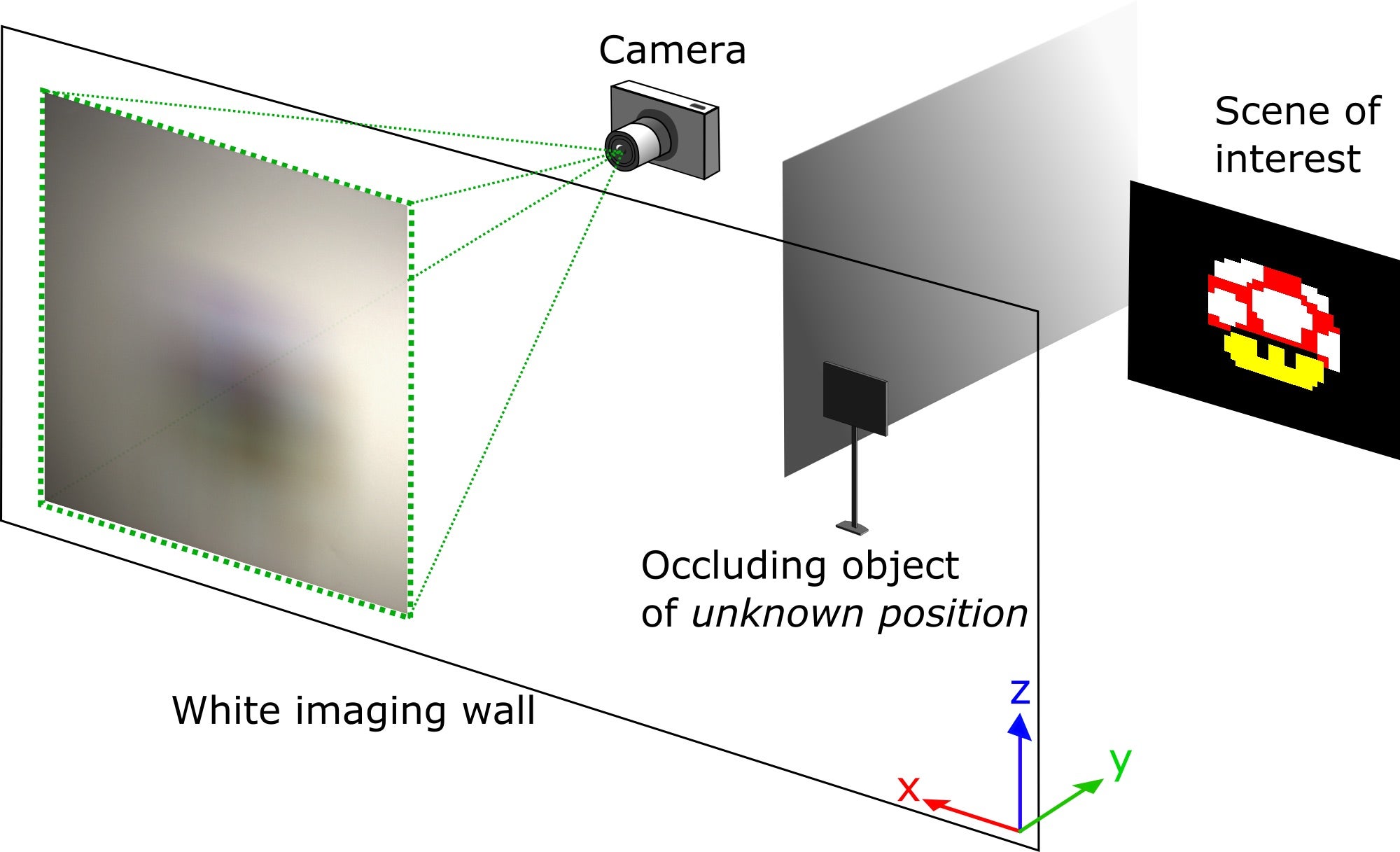
electrical and computer engineer Vivek Goyal and colleagues at Boston University analyzed the problem of looking around a corner by considering light as rays that follow straight lines between surfaces, an approach used in designing optics. They trace the path of light rays coming from an object on one side of a wall that goes around a corner by bouncing off a matte surface and entering a camera on the other side of the wall. In that simple arrangement the camera only sees the matte surface because it scatters the light uniformly.

However, they found that putting a flat opaque “occluder” between the hidden object—an illuminated screen displaying images—and the matte surface changes the picture. The occluder casts shadows that block light from parts of the display screen from reaching parts of the matte surface. The effect is similar to a partial lunar eclipse, where Earth blocks sunlight from reaching parts of the moon.


An LCD monitor displayed the scene. All it needed was a laptop. Source: Nature.

By tracing light rays from the edges of the shadows, Goyal’s team could map what parts of the screen would illuminate what parts of the matte surface. Then they created algorithms that worked backward from images of the matte surface recorded by the digital camera to re-create the pattern shown on the screen.

«

This is totally Blade Runner, isn’t it?

link to this extract


Even with the Google/Fossil deal, Wear OS is doomed • Ars Technica

Ron Amadeo:

»

the S3 chip in the Apple Watch Series 3 was claimed to be 70% faster than the S2 SoC. The S4 SoC in this year’s Apple Watch Series 4 is claimed to be two times faster than the S3, and it’s a modern ARM design with 64-bit compatibility.

Wear OS has never once seen the kind of performance increase that the Apple Watch enjoys every single year. If you read Qualcomm’s press releases carefully (2100 launch, 3100 launch), you’ll notice the company never even claims its new smartwatch chip is faster than its old smartwatch chip. We’ve verified this with benchmarks, too. It’s just the same ancient CPU being repackaged over and over.

When it comes to hardware, Google relies on an ecosystem of component vendors to produce a good product. This works fine in established markets like smartphones, but it makes it very hard for a company to break into new form factors that the component vendors aren’t already heavily invested in. Non-Apple smartwatches are not a thriving market, and component vendors would have to take a big risk to develop quality components for a market that doesn’t exist yet. Qualcomm has clearly decided it’s not willing to take that risk.

Wear OS is what happens when a hardware ecosystem collapses. You can build the best hardware and software on Earth, but if it’s all running on a hundred-year-old SoC that is hot, slow, big, and has terrible battery life, you aren’t going to end up with a good product.

«

Amadeo is the guy who does the deep dives into Android OS, and who used to work for the Android Police site.
link to this extract


Feds also say that Oracle underpaid women and minorities • WIRED

Nitasha Tiku:

»

Oracle allegedly underpaid thousands of women and minority employees by $401m over four years, according to a document filed Tuesday by the US Department of Labor, as part of an ongoing discrimination lawsuit against the software giant.

In the document, the Labor Department also claims that Oracle strongly prefers hiring Asians with student visas for certain roles because they are “dependent upon Oracle for sponsorship in order to remain in the United States,” so the company can systematically underpay them. Between 2013 and 2016, the department says, 90% of the 500 engineers hired through its college-recruiting program for product development jobs at its headquarters in California were Asian. Over the same four years, only six were black.

Once they are employed, Oracle also systematically underpays women, blacks, and Asians relative to their peers, the complaint claims, alleging that these disparities are driven by Oracle’s reliance on prior salaries in setting starting salaries and the company’s practice of steering black, Asian, and female employees into lower paid jobs. The department says some women were underpaid by as much as 20% compared with their male peers, or $37,000 in 2016.

“Oracle’s suppression of pay for its non-White, non-male employees is so extreme that it persists and gets worse over long careers; female, Black, and Asian employees with years of experience are paid as much as 25% less than their peers,” according to an updated complaint filed Tuesday.

«

There’s also a private lawsuit to the same effect. Twenty years ago I knew a woman who received a substantial payout from Oracle in the UK for sexual discrimination. I guess some things are ingrained.
link to this extract


Xiaomi’s folding phone is the best we’ve seen so far • The Verge

Tom Warren:

»

Xiaomi’s folding phone has been revealed in a teaser video from the company. Xiaomi co-founder and president Lin Bin has posted a nearly minute-long video to Weibo today, detailing the double folding phone. Both sides of the device can be folded backwards to transform it from a tablet form factor into more of a compact phone. Unlike other foldable phones we’ve seen recently, this certainly looks a more practical use for the technology.

Xiaomi doesn’t provide many details about its foldable phone, but Bin reveals the device in the video is simply an engineering model. Bin does note Xiaomi has conquered “a series of technical problems such as flexible folding screen technology, four-wheel drive folding shaft technology, flexible cover technology, and MIUI adaptation.” Xiaomi appears to have adapted its MIUI software for the foldable phone, and a video is seen playing on the device before it converts from tablet to phone mode.

Xiaomi’s folding phone leaked earlier this month, and it’s set to compete against devices like Samsung’s folding phone prototype and Chinese company Royole’s folding device. Huawei is also reportedly planning to launch a foldable device, and Lenovo has previously teased that it was working on bendable phones.

«

I get the feeling that foldable phones are going to be huge in China for commuters. I’d give Xiaomi and Huawei a good chance on this (and it could revive Samsung’s fortunes, briefly). I don’t see Lenovo making it happen – or at least not profitably.
link to this extract


Trump offered NASA unlimited funding to go to Mars by 2020 • NY Mag

Olivia Nuzzi fillets a bit from a new book by Cliff Sims, who worked in the White House and was trying to get Trump onto a call with the International Space Station:

»

As the clock ticked down, Trump “suddenly turned toward the NASA administrator.” He asked: “What’s our plan for Mars?”

[Acting Nasa administrator Robert] Lightfoot explained to the president — who, again, had recently signed a bill containing a plan for Mars — that NASA planned to send a rover to Mars in 2020 and, by the 2030s, would attempt a manned spaceflight.

“Trump bristled,” according to Sims. He asked, “But is there any way we could do it by the end of my first term?”

Sims described the uncomfortable exchange that followed the question, with Lightfoot shifting and placing his hand on his chin, hesitating politely and attempting to let Trump down easily, emphasizing the logistical challenges involving “distance, fuel capacity, etc. Also the fact that we hadn’t landed an American anywhere remotely close to Mars ever.”

Sims himself was “getting antsy” by this point. With a number of points left to go over with the president, “all I could think about was that we had to be on camera in three minutes … And yet we’re in here casually chatting about shaving a full decade off NASA’s timetable for sending a manned flight to Mars. And seemingly out of nowhere.”

Trump did not seem worried about the time. Sims wrote that he leaned in toward Lightfoot and made him an offer. “But what if I gave you all the money you could ever need to do it?” Trump asked. “What if we sent NASA’s budget through the roof, but focused entirely on that instead of whatever else you’re doing now. Could it work then?”

Lightfoot told him he was sorry, but he didn’t think it was possible. This left Trump “visibly disappointed,” Sims wrote. “But I tried to refocus him on the task at hand. We were now about 90 seconds from going live.”

Trump wasn’t ready to refocus yet, however. As he walked with Sims from the dining room to the Oval Office, he stopped just outside the door. “He decided to stop in his white-marbled bathroom for one final check in the mirror,” Sims wrote. He had 30 seconds before he was supposed to be on camera, and Sims was “now nearing full on panic.”

In the bathroom mirror, Trump smirked and said to himself, “Space Station, this is your President.”

«

link to this extract


About us • AlgoTransparency

»

How did you identify YouTube’s most often recommended videos?

We used a multi-step program to analyze videos recommended by its algorithm in response to searches for the names of the different candidates.

Step 1: Using an account with no viewing history, the program searches for a given candidate’s name on YouTube.
Step 2: We collect the top six results.
Step 3: For each result, we follow the three first recommendations (videos in the “Up next” list).
Step 4: For each recommendation, we get the top 3 recommendations. We repeat this 6 different times.

The program tabulates how many times each video is recommended, which is then used to determine which videos YouTube most often recommends for any given candidate.

«

It’s dismaying how awful the results are. From any reasonable query, you’re quite quickly led down a rabbithole of nonsense.

link to this extract


Errata, corrigenda and ai no corrida: Concerned about the security of your Nest account after yesterday’s story? You can get two-factor authentication for it. SMS-only at present, but better than just your password, right? (Thanks Richard G for the link.)

You can sign up to receive each day’s Start Up post by email. You’ll need to click a confirmation link, so no spam.

Start Up No.987: WhatsApp tamps virality, could porn fund Trump’s wall? (no), hacking Nest cams, India’s Google alternative, and more


Want a mining job? The Moon might soon be open. CC-licensed photo by Stuart Rankin on Flickr.

A selection of 10 links for you. Free of hard borders. I’m @charlesarthur on Twitter. Observations and links welcome.

A mission to mine the Moon could be underway as early as 2025 • BGR

Mike Wehner:

»

How do you mine for resources in a place where humans haven’t set foot for over four decades? That’s a question the European Space Agency will have to answer if they want to achieve the lofty goal of extracting usable lunar material by 2025.

Rocket maker ArianeGroup announced on Monday that it had landed a one-year contract with the ESA to develop a gameplan for mining lunar regolith. Regolith, which is the material covering the surface of the Moon, could be a rich source of both water and oxygen, and being able to mine it would potentially allow for a sustainable lunar settlement at some point in the not-so-distant future.

«

2001+24. (Well, the moon base monolith discovery is 18 months before the 2001 part of the title voyage, and they have to build the moon base first… perhaps a few years more.)

Notice how we’re starting to look outwards from the Earth again for human space travel after almost 50 years.
link to this extract


WhatsApp restricts message forwarding to 5 times for all users after testing in India – The Washington Post

Hamza Shaban:

»

In an attempt to combat the viral spread of false information, WhatsApp is limiting the number of times a user can forward a message, to five. The new global limit comes after the company tested a cap on forwarded messages in July, restricting users in India to five message forwards and all other users to 20 forwards. India is home to the highest number of forwarded messages, photos and videos, exceeding every other country’s, WhatsApp says. The previous limit set in the country came after a surge in mob violence fueled by rumors on the app.

In an updated blog post Monday, WhatsApp said it evaluated the test restrictions over the past six months and found that the cap “significantly reduced forwarded messages around the world.”

“Starting today, all users on the latest versions of WhatsApp can now forward to only five chats at once, which will help keep WhatsApp focused on private messaging with close contacts,” the company said. “We’ll continue to listen to user feedback about their experience, and over time, look for new ways of addressing viral content.”

The change in policy is the latest effort by tech giants to curb the spread of misinformation. But it also highlights the challenges particular to WhatsApp, whose messaging system is designed to be obscured from public view.

«

I wonder how many different variations they tried, and how “infectious” a five-friend forwarding limit is. It would be fascinating to see how it looks modelled by an epidemiologist. Messaging groups could contain (still can? It’s unclear) up to 256 people, which must be like Ebola compared to the rhinovirus.
link to this extract


Pay for Trump’s border wall with $20 online porn fee, Ariz. lawmaker says • Ars Technica

Jon Brodkin:

»

An Arizona state lawmaker has proposed a $20 fee on people who want to view online pornography in order to raise money for building a border wall between Arizona and Mexico.

Arizona House Bill 2444, proposed last week by State Rep. Gail Griffin (R-Hereford), would require makers and distributors of Internet-connected devices to ship such devices with blocking software “that renders a website that displays obscene material inaccessible by default.” Under the bill, any Internet user who wants to deactivate the blocking software would have to pay “a onetime deactivation fee of at least $20 to the Arizona Commerce Authority.”

The money would be used to establish what the bill calls the “John McCain Human Trafficking and Child Exploitation Prevention Fund.” That fund would “provide grants to government agencies and private entities that work to uphold community standards of decency for the purpose of strengthening families and developing, expanding or strengthening programs for victims of sex offenses.”

To accomplish that goal, the bill provides a list of 10 types of projects that could be funded by the porn fee. First on the list is “build a border wall between Mexico and this state or fund border security.” The proposal comes as President Trump continues his push for a border wall.

«

Why would you propose something that you know is not ever going to be passed or implemented? It’s a weird form of signalling. Perhaps it looks good on the election literature: “tried to stamp out internet porn and build a wall”. Why not build the wall in front of the computer?
link to this extract


Dutch surgeon wins landmark ‘right to be forgotten’ case • The Guardian

Daniel Boffey:

»

A Dutch surgeon formally disciplined for her medical negligence has won a legal action to remove Google search results about her case in a landmark “right to be forgotten” ruling.

The doctor’s registration on the register of healthcare professionals was initially suspended by a disciplinary panel because of her postoperative care of a patient. After an appeal, this was changed to a conditional suspension under which she was allowed to continue to practise.

But the first results after entering the doctor’s name in Google continued to be links to a website containing an unofficial blacklist, which it was claimed amounted to “digital pillory”. It was heard that potential patients had found the blacklist on Google and discussed the case on a web forum.

Google and the Dutch data privacy watchdog, Autoriteit Persoonsgegevens, initially rejected attempts to have the links removed on the basis that the doctor was still on probation and the information remained relevant.

However, in what is said to be the first right to be forgotten case involving medical negligence by a doctor, the district court of Amsterdam subsequently ruled the surgeon had “an interest in not indicating that every time someone enters their full name in Google’s search engine, (almost) immediately the mention of her name appears on the ‘blacklist of doctors’, and this importance adds more weight than the public’s interest in finding this information in this way”…

…The surgeon’s lawyer, Willem van Lynden, from the Amsterdam firm MediaMaze, said the ruling was groundbreaking in ensuring doctors would no longer be judged by Google on their fitness to practise.

“Now they will have to bring down thousands of pages: that is what will happen, in my view. There is a medical disciplinary panel but Google have been the judge until now. They have decided whether to take a page down – and why do they have that position?” he said.

«

Why indeed.
link to this extract


A neural network can learn to organize the world it sees into concepts—just like we do • MIT Technology Review

Karen Hao:

»

GANs, or generative adversarial networks, are the social-media starlet of AI algorithms. They are responsible for creating the first AI painting ever sold at an art auction and for superimposing celebrity faces on the bodies of porn stars. They work by pitting two neural networks against each other to create realistic outputs based on what they are fed. Feed one lots of dog photos, and it can create completely new dogs; feed it lots of faces, and it can create new faces. 

As good as they are at causing mischief, researchers from the MIT-IBM Watson AI Lab realized GANs are also a powerful tool: because they paint what they’re “thinking,” they could give humans insight into how neural networks learn and reason. This has been something the broader research community has sought for a long time—and it’s become more important with our increasing reliance on algorithms.

“There’s a chance for us to learn what a network knows from trying to re-create the visual world,” says David Bau, an MIT PhD student who worked on the project.

So the researchers began probing a GAN’s learning mechanics by feeding it various photos of scenery—trees, grass, buildings, and sky. They wanted to see whether it would learn to organize the pixels into sensible groups without being explicitly told how.

Stunningly, over time, it did. By turning “on” and “off” various “neurons” and asking the GAN to paint what it thought, the researchers found distinct neuron clusters that had learned to represent a tree, for example. Other clusters represented grass, while still others represented walls or doors. In other words, it had managed to group tree pixels with tree pixels and door pixels with door pixels regardless of how these objects changed color from photo to photo in the training set. “These GANs are learning concepts very closely reminiscent of concepts that humans have given words to,” says Bau.

«

OK, so it can group them as concepts. Is that the same as having a concept of them, though?
link to this extract


Nest hack: North Korea missile attack hoax targets family • Mercury News

Matthias Gafni:

»

Laura Lyons was preparing food in her kitchen Sunday when the lazy afternoon took a turn for the absurd. A loud squawking – similar to the beginning of an emergency broadcast alert – blasted from the living room, the Orinda mother said, followed by a detailed warning of three North Korean intercontinental ballistic missiles headed to Los Angeles, Chicago and Ohio.

“It warned that the United States had retaliated against Pyongyang and that people in the affected areas had three hours to evacuate,” Lyons said Monday. “It sounded completely legit, and it was loud and got our attention right off the bat… It was five minutes of sheer terror and another 30 minutes trying to figure out what was going on.”

Lyons and her husband stood slack-jawed in the living room, terrified but also confused because the television continued airing the NFC Championship football game. As their scared eight-year-old son crawled underneath the rug, the couple realized the apocalyptic warning came from their Nest security camera atop their living room television.

After many panicked minutes and phone calls to 911 and to Nest, the couple learned they likely were the victims of a hacker. And that panic turned to anger when they found out that Nest knew that there had been a number of such incidents – none involving nuclear strike scenarios – but failed to alert customers. Lyons said a Nest supervisor told them Sunday they likely were the victims of a “third party hack” that gained access to their camera and its speakers.

A Google spokesperson – the search engine owns Nest – said Nest was not breached in this incident.

“These recent reports are based on customers using compromised passwords (exposed through breaches on other websites). In nearly all cases, two-factor verification eliminates this type of the security risk,” the company said in an email statement. “We take security in the home extremely seriously, and we’re actively introducing features that will reject comprised passwords, allow customers to monitor access to their accounts and track external entities that abuse credentials.”

The Lyons are not alone. Reports from across the country indicate a growing problem of hackers accessing the Wi-Fi-enabled cameras from Nest and other similar companies.

«

They didn’t think to turn the TV to a news channel? Perhaps in an emergency one doesn’t act rationally. Bet the hacker has some fun footage that will be shared in forums. (Thanks to Paul Guinnessy for the link.)
link to this extract


FTC considers record-setting fine against Facebook for privacy violations • The Washington Post

Tony Romm and Elizabeth Dwoskin:

»

US regulators have met to discuss imposing a record-setting fine against Facebook for violating a legally binding agreement with the government to protect the privacy of its users’ personal data, according to three people familiar with the deliberations but not authorised to speak on the record.

The fine under consideration at the Federal Trade Commission, a privacy and security watchdog that began probing Facebook last year, would mark the first major punishment levied against Facebook in the United States since reports emerged in March that Cambridge Analytica, a political consultancy, accessed personal information on about 87 million Facebook users without their knowledge.

The penalty is expected to be much larger than the $22.5m fine the agency imposed on Google in 2012. That fine set a record for the greatest penalty for violating an agreement with the FTC to improve its privacy practices.

«

It would have to be really big to make Facebook pay attention, but it’s pretty clear that what happened with Cambridge Analytica and others violated the terms of Facebook’s 2011 deal with the FTC. It’s hard to see how they could come to any other conclusion.
link to this extract


Indians are so crazy about mobile video, they use Youtube like Google • WSJ

Eric Bellman:

»

Indian smartphone users now download an average of about 8.5 gigabytes of data a month—or potentially more than 40 hours of video—off mobile networks without using Wi-Fi, according to research by Analysys Mason. That is more than what users in the U.S., China or Japan download.

Delhi student Ritik Taank says he misses playing cricket with friends. But these days, he says, everyone is at home watching and sharing funny video clips on their smartphones. The 18-year-old spends hours each day flipping through music videos, comedy skits, gaming clips and his favorite fashion and entertainment vlogs. He also uses YouTube to watch math and science explainer videos while riding the bus to school. Often, he reaches his one-gigabyte-a-day limit by sunset and has to switch to his mother’s phone.

“She scolds me,” he said. “But I explain it would be a waste if her data doesn’t get used.”

The video explosion is transforming the Indian media landscape, creating new stars in Bollywood, forcing new investment in servers and cellular sites, and launching new genres of online content. Video has surged in popularity elsewhere, of course; it has taken off in a new direction in China, where short-video platforms offering seconds-long clips have made companies like Beijing Bytedance Technology Co. among the world’s most highly-valued startups…

In India, it is creating new opportunities for YouTube—owned by Alphabet Inc.’s Google—and other platforms to learn new lessons about video use. The South Asian nation’s surfers, many of them coming online for the first time, are exploring the web through video rather than static websites. They are driven more by swiping, speaking and viewing, and less by typing, searching and reading—prompting companies to adapt their apps.

«

Maybe it’s a glimpse of the 5G world?
link to this extract


Google considering pulling news service from Europe • Bloomberg

Natalia Drozdiak:

»

The European Union is working towards finalizing a controversial new copyright law. The rules give publishers rights to demand money from the Alphabet unit [Google], Facebook and other web platforms, when small fragments of their articles show up in news search results, or are shared by users.

That prospect has led Google to consider pulling Google News from the continent as a response to the new law, according to Jennifer Bernal, Google public policy manager for Europe, the Middle East and Africa. The internet giant has various options on the table and will analyze the final text before making any decisions, she said, adding that Google would withdraw its service reluctantly.

The EU was planning to finalize the rules early this week but that’s been postponed due to disagreement among member states about some items of the package. The delay further drags out the legislative process, which kicked off when the European Commission, the bloc’s executive, first proposed the rules in 2016.

“The proposal for the Copyright Directive is very complex,” said a representative from Romania, the current head of the European Council of the bloc’s 28 member states. “The Council needs more time to reflect in order to reach a solid position.”

Google has said it doesn’t make money from its news service so withdrawing it is unlikely to lead to a financial hit. But news results keep mobile users coming back to its search engine, where they often type in other queries that generate lucrative ad revenue. Google also competes against rival mobile news aggregation services from Apple and Facebook.

«

I’ll make a prediction: if Google withdraws Google News from Europe, there will be a short-term reduction in the number of hits to publishers’ sites. And then in a few months or so it will all reset itself, because people are infovores: the ones who go to Google News want their fix. The total number of hits will remain the same, though they may be redistributed.
link to this extract


Foxconn looks beyond China to India for iPhone assembly • WSJ

Yang Jie, Yoko Kubota, Newley Purnell and Rajesh Roy:

»

Apple’s largest iPhone assembler, Foxconn Technology Group, is considering producing the devices in India, people familiar with the matter said, a move that could reduce Apple’s dependence on China for manufacturing and potentially for sales.

Executives at Foxconn, a contract manufacturer that assembles a large portion of the world’s iPhones in China, are studying whether to include an India project in budget plans, one of the people said. Senior executives, possibly including Chairman Terry Gou, plan to visit India after next month’s Lunar New Year to discuss plans, the people familiar said.

Foxconn’s look at India comes as sustained friction between Washington and Beijing over trade and technology is pushing many companies to consider diversifying their supply chains away from China, a global center of assembly for smartphones, computers and other electronics.

«

OK, but this isn’t going to be sorted out by Christmas. For Foxconn to build a plant able to assemble iPhones in any volume is a 10-year project at least: find land, build plant, calibrate, test, full production. As a long-term shift, this is something Apple may be thankful for in the future, but it’s not going to sort out its position between the rock and hard place of the US-China trade wars in a hurry.
link to this extract


Errata, corrigenda and ai no corrida: none notified
You can sign up to receive each day’s Start Up post by email. You’ll need to click a confirmation link, so no spam.

Start Up No.986: Kurzweil on AI (yes), what 5G will and won’t do, that big old password breach, Google’s GDPR fine, Corbyn’s failure, and more


It’s a new sort of shopping. But has it screwed up, er, online shopping? CC-licensed photo by James Fleeting on Flickr.

You can sign up to receive each day’s Start Up post by email. You’ll need to click a confirmation link, so no spam.

A selection of 10 links for you. Consult your doctor before installing a backstop. I’m @charlesarthur on Twitter. Observations and links welcome.

Ray Kurzweil: ‘AI is still on course to outpace human intelligence’ • Gray Scott

BJ Murphy:

»

Using examples of modern-day AI like AlphaGo, there are clear signs that they’re already starting to outpace human intelligence involving specific tasks. This has been a common factor of AI for the last couple decades, starting with the simple goal of defeating the world’s best (human) chess players. Today, they’re outpacing us in chess, Go, various strategic computer games, and even medical diagnostics. The question remains, however, as to whether AI will ever reach the point of superintelligence—also commonly known as the Technological Singularity.

What I found most interesting from Kurzweil’s response wasn’t so much his consistency in the belief that AI will indeed outpace human intelligence as a whole; rather our fears of a dystopian future where AI has gone astray are becoming increasingly unlikely. He makes this arguement with the understanding that there is no singular AI being controlled by singular powerful companies or people. In today’s reality, there are millions of different AIs being controlled by anyone who owns a smartphone.

One could argue that the level of power still isn’t well-balanced between centralized companies and a decentralized populace, especially as companies like Facebook, Amazon, and Google (Kurzweil’s current employer) continue making headlines as a result of their egregious negligence. However, with companies like SingularityNET working to democratize the technology, AI isn’t just moving at a pace beyond human intelligence; they’re moving at a pace that’ll empower the human species as a whole, whether that comes in the form of maintaining their longevity, increasing their cognitive capacities, or giving them access to the stars themselves.

«

The difference between being superhumanly good at Go and being superintelligent is like the difference between flight of stairs and climbing K2. They’re the same class of problem, separated by colossal levels of difficulty.
link to this extract


Amazon ruined online shopping • The Atlantic

Ian Bogost:

»

The whole affair always felt unsettling. When the buttons launched, I called the Dash experience Lovecraftian, the invisible miasma of commerce slipping its vapor all around your home. But last week, a German court went further, ruling the buttons illegal because they fail to give consumers sufficient information about the products they order when pressing them, or the price they will pay after having done so. (You set up a Dash button on Amazon’s app, selecting a product from a list; like other goods on the e-commerce giant’s website, the price can change over time.) Amazon, which is also under general antitrust investigation in Germany, disputes the ruling.

Given that Amazon controls about half of the U.S. online-retail market and takes in about 5% of the nation’s total retail spending, it’s encouraging to see pushback against the company’s hold on the market. But Dash buttons are hardly the problem. Amazon made online shopping feel safe and comfortable, at least mechanically, where once the risk of being scammed by bad actors felt huge. But now online shopping is muddy and suspicious in a different way—you never really know what you’re buying, or when it will arrive, or why it costs what it does, or even what options might be available to purchase. The problem isn’t the Dash button, but the way online shopping works in general, especially at the Everything Store.

«

Bogost is always worth reading, because he always finds a fresh way to come at a story.

link to this extract


773M password ‘megabreach’ is years old • Krebs on Security

Brian Krebs on the “megahack” that was big news last week:

»

Collection #1 offered by this seller is indeed 87GB in size. He also advertises a Telegram username where he can be reached — “Sanixer.” So, naturally, KrebsOnSecurity contacted Sanixer via Telegram to find out more about the origins of Collection #1, which he is presently selling for the bargain price of just $45.

Sanixer said Collection#1 consists of data pulled from a huge number of hacked sites, and was not exactly his “freshest” offering. Rather, he sort of steered me away from that archive, suggesting that — unlike most of his other wares — Collection #1 was at least 2-3 years old. His other password packages, which he said are not all pictured in the above screen shot and total more than 4 terabytes in size, are less than a year old, Sanixer explained.

By way of explaining the provenance of Collection #1, Sanixer said it was a mix of “dumps and leaked bases,” and then he offered an interesting screen shot of his additional collections. Click on the image below and notice the open Web browser tab behind his purloined password trove (which is apparently stored at Mega.nz): Troy Hunt’s published research on this 773 million Collection #1.


Sanixer says Collection #1 was from a mix of sources. A description of those sources can be seen in the directory tree on the left side of this screenshot.

[CTO of Hold Security, Alex] Holden said the habit of collecting large amounts of credentials and posting it online is not new at all, and that the data is far more useful for things like phishing, blackmail and other indirect attacks — as opposed to plundering inboxes. Holden added that his company had already derived 99% of the data in Collection #1 from other sources.

«

So it’s basically like the fluff-covered sad-looking pick’n’mix sweet trays in Woolworths of old.
link to this extract


Google fined €50m for GDPR violation in France • The Verge

Jon Porter:

»

France’s data protection regulator, CNIL, has issued Google a €50m fine (around $56.8m USD) for failing to comply with its GDPR obligations. This is the biggest GDPR fine yet to be issued by a European regulator and the first time one of the tech giants has been found to fall foul of the tough new regulations that came into force in May last year.

CNIL said that the fine was issued because Google failed to provide enough information to users about its data consent policies and didn’t give them enough control over how their information is used. According to the regulator, these violations are yet to have been rectified by the search giant. Under GDPR, companies are required to gain the user’s “genuine consent” before collecting their information, which means making consent an explicitly opt-in process that’s easy for people to withdraw.

Although the €50m fine seems large, it’s small compared to the maximum limits allowed by GDPR, which allows a company to be fined a maximum of four% of its annual global turnover for more serious offenses. For Google, which made $33.74bn in the last quarter alone, that could result in a fine in the billions of dollars.

«

link to this extract


Jeremy Corbyn is failing the Brexit test • Financial Times

Robert Shrimsley:

»

It is Britain’s misfortune that at its time of need it has been blessed with two of the most inflexible, small-minded, partisan and inept figures ever to assume the mantle of leadership in the nation’s two major parties. The UK has had bad party leaders before, but until now it has been clever enough not to have them at the same time. 

Theresa May’s current failing is that after the record-breaking rejection of her Brexit deal in parliament she seems incapable of finding a plan B; Mr Corbyn’s is that he has yet to find a plan A. The Tories may own Brexit, but if Britain crashes out of the EU without a deal, the Labour leader who failed to stop it will also be widely blamed.

To be clear, Mr Corbyn’s failure does not lie in his refusal to accept Mrs May’s offer of talks in the wake of her defeat. That mistake was merely presentational. The talks were doomed because Mrs May will not budge on any of her red lines. But by refusing to see her, Mr Corbyn showed his much-vaunted belief in dialogue extends only to those who already agree with him. A more astute politician would have been filmed walking into Downing Street only to emerge sorrowfully declaring that Mrs May was deaf to compromise. But this is mere spin. Mr Corbyn’s real failure is missing the chance to step into the vacuum caused by her defeat. 

«

Devastatingly accurate. If you had created a book plot where the prime minister was beholden to a political group who want to Leave and represent a small but crucial slice of the UK which had voted to Remain, then you’d feel obliged to create an opposition leader who was agitating for Remain, to create dramatic tension.

Instead we just have tension. Corbyn is like Winston Churchill’s quip about Clement Attlee: “An empty taxi arrived, and he stepped out of it.”
link to this extract


President Trump posts altered photos to Facebook and Instagram that make him look thinner • Gizmodo

»

In recent months, Trump’s official Facebook and Instagram accounts have published photos of the president that have been manipulated to make him look thinner. If it only happened once you might be able to chalk it up as an accident. But Gizmodo has discovered at least three different retouched photos on President Trump’s social media pages that have been published since October of 2018.

The image below, published on the official Donald J. Trump Facebook page on January 17 and on his Instagram account over the weekend, has been altered to make the president look more fit.

The photo looks pretty normal at first glance. But once you compare it to the original, which is available on the White House’s Flickr page, you can see what was changed.

The original photo was taken by a White House photographer on January 14, so you know that the original hasn’t been altered by anyone in the so-called “fake news media” to make Trump look heavier. It sounds silly to even have to say that, but many Trump supporters believe that the media is involved in a coordinated conspiracy against him.

«

A new way to lie. But also such a pointless thing to do. He’s one of the most photographed people in the world. (Reader-submitted – thank you.)
link to this extract


In win for tech giants, EU copyright reforms stalled • Reuters

Foo Yun Chee:

»

EU efforts to reform copyright rules hit a roadblock on Monday when a meeting of lawmakers and officials was called off, prompting criticism of Google from publishers after it and other tech giants lobbied against the changes.

The European Commission, which launched a debate on the issue two years ago, says an overhaul is necessary to protect Europe’s cultural heritage and level the playing field between big online platforms and publishers, broadcasters and artists.

European Parliament lawmakers, representatives from EU countries and Commission officials were scheduled to meet on Monday to reconcile their positions on the reform drive. But the meeting was canceled after EU countries failed to resolve differences on Friday.

Commission digital chief Andrus Ansip expressed disappointment at the delay, saying reform was crucial and possible even at this stage.

“All involved parties have a huge responsibility: playing lightly now with a ‘No deal is better than my own maximalist position’ as I read sometimes from position statements, is dangerous and irresponsible,” he said.

«

Can’t think who Ansip might have been thinking of in that “No deal” quote…

link to this extract


5G: if you build it, we will fill it • Benedict Evans

Evans says that 5G will essentially be a fatter pipe, but that’s not “just”:

»

5G seems rather more interesting for AR. To clarify first, ‘AR’ today is used to describe three different things:

• Waving your phone at something and seeing things on the screen
• A wearable heads-up display (Google Glass) with no awareness of the world around you
• A transparent, immersive, fully 3D colour display with a sensing suite that allows it to map the room around you and recognise things and people. A bunch of companies (including Magic Leap, in which a16z is an investor) are working on this – it’s still a few years away from being a mass-market consumer product.

The third of these seems much the most interesting to me. If you could put on a pair of reading glasses that could look at the world around you and show you things in response, that could be pretty useful, in much the same way that, say, having the internet in your pocket turned out to be useful, and to enable all sorts of new and unpredictable things (imagine pitching Snapchat when our only internet experience was on a PC over dialup). This would work on 4G, but continuous low power high speed low latency connections from 5G would make it a lot better. 

At the other extreme, I also hear a fair bit about autonomy [in cars] as a 5G application. I’m not sure about this one.

«

link to this extract


A few days with the Luna Display • All this

Doctor Drang got a Luna Display (which plugs into a Mac and turns an iPad into a wireless second display. He didn’t like it, and took it back:

»

everything felt wrong when I was running Mac apps through my iPad. Buttons were too small, even when I tried tapping on them with the Pencil. Resizing windows was a chore; dragging felt off. I confess I didn’t spend time examining why the behavior just didn’t feel right, but it didn’t.

I use both my Macs and my iPad a lot, and while I don’t have any trouble switching between the two, I found it very annoying to be forced into using Mac-like actions on an iPad. This was surprising to me, as I have nearly 35 years of Mac use under my belt and only 2½ years of iPad use. But my immediate sense—a sense that didn’t change over the 4–5 days I used the Luna—was one of unease.

Would I have felt this unease had I been using the Luna Display in a more keyboard-centric manner? Maybe not. And I can see where people who are iPad-first users would find the Luna very convenient if they only occasionally need to be hands-on with their Mac mini server. But for my use, the neither-fish-nor-fowl behavior that the Luna forced me into was very inconvenient. It made me have to think about what I was doing instead of just doing it, and that got in the way of my real work.

«

link to this extract


Microsoft Cortana – dead or alive • Radio Free Mobile

Richard Windsor:

»

Microsoft held a media event where Satya Nadella extolled the virtue of Cortana, but it is clear from his commentary that there is no logical reason why anyone will ever use it again.

Microsoft will be moving it away from its position on the Windows 10 taskbar depriving it from the only place on any system where it remains default.

Microsoft will also allow compatibility with Google Assistant as well as Amazon Alexa. The unanswered question is why anyone would ask Google or Alexa to ask Cortana to do anything seeing as both of them can do everything Cortana can do and much more.

Furthermore, Microsoft has not invested in Cortana since it became resident on the Windows 10 desktop which has meant that its presence is more of an annoyance than anything else.
Microsoft claims Cortana is deeply integrated with Office 365 but asking Cortana to do anything is Office is more cumbersome and time-consuming than simply clicking with the mouse. Furthermore, most of the time Cortana has no idea what the user is talking about rendering it effectively useless.

Hence, when Cortana is removed from the desktop, I shall not be sad to see it go. I don’t think other Windows users will be either.

However, putting Cortana quietly to sleep opens the door to a much more interesting opportunity around AI licensing.

«

I hadn’t noticed that the Cortana chief was going (it was announced in November). Microsoft’s problem is that it doesn’t have a user-facing way to get its AI into use. But as Windsor says, there might be some potential licensing its technology to others.
link to this extract


Errata, corrigenda and ai no corrida: none notified

Start Up No.985: Dorsey’s dithering, testing twin DNA, VR tests courtroom prejudice, is hi-fi streaming necessary?, and more


Apple may not have a flexible screen in the offing, but that doesn’t mean it will necessarily lose out. CC-licensed photo by Brian Bilek on Flickr.

You can sign up to receive each day’s Start Up post by email. You’ll need to click a confirmation link, so no spam.

A selection of 10 links for you. Keep counting. I’m @charlesarthur on Twitter. Observations and links welcome.

Jack Dorsey has no clue what he wants • HuffPost UK

Ashley Feinberg:

»

My only real goal was to get Dorsey to speak in specifics, about anything. In almost every interview he does, he’ll lament his past mistakes and talk about his various high-minded visions for improving the platform: improving conversational health, reducing echo chambers, increasing transparency and about 10 other rote, buzzy phrases.

But press him for a clear, unambiguous example of nearly anything, and Dorsey shuts down. At one point, for instance, Dorsey explained that Twitter was working toward using machine learning to spot harassment before it’s even reported. When asked how Twitter is handling the problem in the meantime, Dorsey had this to say:

»

Most of our priority right now in terms of health, which is the No. 1 priority of the company, is around being proactive. How do we remove the burden from the victims or bystanders from reporting in the first place? It’s way too mechanical. It’s way too much work. … But ultimately, we want to make sure that the number of reports that we receive is trending downward. And that will be because of two reasons. One, people are seeing far less abuse or harassment or other things that are against the terms of service. Or that we’re being more proactive about it. So we want to do both. So a lot of our work is that, and then better prioritization in the meantime. A lot more transparency, clearer actions within the product.

«

Those are certainly words, though none of them appeared to answer my question.

«

The interview is wonderful for its uncompromising approach (of which that is an example). Feinberg is also a pretty astringent presence on Twitter itself: pH about 1. She’ll have your skin off before you realise it.
link to this extract


Why Apple will be late to foldable phones (and still win) • Tom’s Guide

Jason Snell (who has written for years and years about Apple):

»

If Apple did build a foldable iPhone, it would probably be best to think of it as an iPhone that could expand to become a small iPad. Given the power of Apple’s A-series processors and the increasingly sophisticated and PC-like features of the iPad, that could be a compelling product.

There’s another possibility, and it arises from a long-standing Apple design philosophy. This is what I’ve taken to calling “Jobs’ Law,” the idea that every new iteration of an Apple product should strive to be thinner and lighter than the previous generation.

A foldable phone would seem to go against Jobs’ Law, because that folding mechanism will presumably mean thicker phones, at least at the start. But I wonder if having a folding mechanism would enable Apple to design much smaller iPhones. While Apple has embraced large phones like the iPhone XR and the iPhone XS Max due to market pressures, I’m not entirely convinced that the company’s heart is in it.

Maybe the future of the foldable iPhone is more like a Palm phone that flips out to become a phablet, not a phablet that becomes a tablet.

Sure, a foldable iPhone could be a giant phablet that folds out into a small iPad. But it could also be a small, iPhone SE-size model that flips open to provide iPhone XS Max-style real estate on demand. Maybe the future of the foldable iPhone is more like a Palm phone that flips out to become a phablet, not a phablet that becomes a tablet.

«

The thing about a foldable iPhone (or iPad?) is that you’d want the bigger screen occasionally – like the people I see on the train who watch downloaded or streaming video on a tablet-sized screen. Much of the time you wouldn’t.

I really can’t figure out whether it’s a gimmick or something useful.
link to this extract


Twins get some ‘mystifying’ results when they put five DNA ancestry kits to the test • CBC News

Charlsie Agro and Luke Denne:

»

One set of identical twins, two different ancestry profiles.

At least that’s the suggestion from one of the world’s largest ancestry DNA testing companies.

Last spring, Marketplace host Charlsie Agro and her twin sister, Carly, bought home kits from AncestryDNA, MyHeritage, 23andMe, FamilyTreeDNA and Living DNA, and mailed samples of their DNA to each company for analysis.

Despite having virtually identical DNA, the twins did not receive matching results from any of the companies.

In most cases, the results from the same company traced each sister’s ancestry to the same parts of the world — albeit by varying percentages.

But the results from California-based 23andMe seemed to suggest each twin had unique twists in their ancestry composition.

«

Ah but: identical twins’ DNA can actually be different. Perhaps read this link rather than the main one, since it’s your science lesson (if you didn’t already know it) for today.
link to this extract


Here come the internet blackouts • New America

Justin Sherman:

»

[The blackout method which sees] states deliberately severing internet connections within their country has an important history. In 2004, the Maldivian government caused an internet blackout when citizens protested the president; Nepal similarly caused a blackout shortly thereafter. In 2007, the Burmese government apparently damaged an underwater internet cable in order to “staunch the flow of pictures and messages from protesters reaching the outside world.” In 2011, Egypt cut most internet and cell services within its borders as the government attempted to quell protests against then-President Hosni Mubarak; Libya then did the same after its own unrest. In 2014, Syria had a major internet outage amid its civil war. In 2018, Mauritania was taken entirely offline for two days when undersea submarine internet cables were cut, around the same time as the Sierra Leone government may have imposed an internet blackout in the same region.

When we think about terms like “cyberspace” and “internet,” it can be tempting to associate them with vague notions of a digital world we can’t touch. And while this is perhaps useful in some contexts, this line of thinking forgets the very real wires, servers, and other hardware that form the architecture of the internet. If these physical elements cease to function, from a cut wire to a storm-damaged server farm, the internet, too, is affected. More than that, if a single entity controls—or can at least access—that hardware for a region or even an entire country, government-caused internet blackouts are a tempting method of censorship and social control.

Which is to say: As countries around the world tighten control of the internet within their borders, we can expect to see some governments with relatively centralized internets—particularly authoritarians or those with authoritarian leanings—literally disconnect their domestic internet networks from the rest of the globe during domestic unrest or other incidents.

As for the second method, we can expect a rise in DDoS attacks against internet infrastructure as millions of wildly insecure Internet of Things (IoT) devices—from smart thermostats to water-pressure sensors—are linked online.

«

link to this extract


Racial bias and in-group bias in judicial decisions: evidence from virtual reality courtrooms • NBER

Samantha Bielen, Wim Marneffe, Naci H. Mocan from Hasselt University in Belgium:

»

We shot videos of criminal trials using 3D Virtual Reality (VR) technology, prosecuted by actual prosecutors and defended by actual defense attorneys in an actual courtroom.

This is the first paper that utilizes VR technology in a non-computer animated setting, which allows us to replace white defendants in the courtroom with individuals who have Middle Eastern or North African descent in a real-life environment. We alter only the race of the defendants in these trials, holding all activity in the courtroom constant (http://proficient.ninja/splitscreen/).

Law students, economics students and practicing lawyers are randomly assigned to watch with VR headsets, from the view point of the judge, the trials that differed only in defendants’ skin color. Background information obtained from the evaluators allowed us to identify their cultural heritage. Evaluators made decisions on guilt/innocence in these burglary and assault cases, as well as prison sentence length and fine in accordance with the guidelines provided by the relevant law.

There is suggestive evidence of negative in-group bias in conviction decisions where evaluators are harsher against defendants of their own race. There is, however, significant overall racial bias in conviction decisions against minorities.

«

Clever use of VR – and an important result. The full paper requires NBER access; there were 25 participants seeing six different defendants. They used Oculus Rift.
link to this extract


Alex Rosenblat’s Uberland: review • NY Mag

Adrian Chen:

»

One thing you get from reading Alex Rosenblat’s Uberland: How Algorithms Are Rewriting the Rules of Work, is that there is nothing inevitable about management trending in a positive direction. Drawing on four years of ethnographic research among Uber drivers, Rosenblat has produced a thoroughly dystopian report that details how millions of drivers are now managed by a computerized system that combines the hard authoritarianism of Frederick Winslow Taylor with the cynical cheerleading of Michael Scott.

But wait: Isn’t the whole point of Uber that you can be your own boss? After all, Uber talks of its drivers not as employees but “partners.” In its propaganda, Uber portrays itself not as a taxi company at all but a technology platform that connects drivers directly to riders. “FREEDOM PAYS WEEKLY,” reads one recruitment ad reproduced in Uberland.

Next to it, there’s a picture of a breezy millennial with shaggy hair and a five-o’clock shadow, a scarf draped rakishly around his neck. He looks so noncorporate that he might not be wearing any pants.

In order to put that idea to rest, Rosenblat must first untangle the myths that made it seem possible in the first place. If you think about it, it’s bizarre that taxi drivers became a symbol of cutting-edge technological disruption. Cab drivers have typically occupied a benighted role in the public imagination: hustlers, criminals, or, at best, misanthropic folk philosophers. Rosenblat offers a valuable history of the ideological work that went into the “gentrification” of the profession.

«

link to this extract


Trump’s slippage in support is real • The Bulwark

Bruce Gyory (a “veteran and shrewd New York political operative” according to Bill Kristol):

»

The slippage is the worst kind—the slow erosion of support from key blocs: swing voters (independents and suburbanites) and those who put Trump over the top (blue collar white men and Republicans over 60).

It’s been registering in a cross section of polling data, not just one poll. Trump’s job approval rating is down to 31% among independents in Gallup. His approval ratings in Rasmussen are down from the 48-49% range of late last year to the 43-44% level of the past week or so. The Marist data for PBS shows a drop of 10% in job approval among Republicans and a decline of 11% among white evangelicals and 17% among suburban men.

And Trump continues to enrage the Dem base while this erosion in his base continues to progress. Blue collar white men being turned off from Trump shouldn’t surprise anyone, for they know the difficulty of living paycheck to paycheck. This, plus the skew of the tax cut package, spells political trouble for Trump long term, especially if a slow down, much less a recession, looms in 2020.

«

There’s a certain amount of wish fulfilment in this: Kristol is newly installed as “editor-at-large” of The Bulwark, a right-wing (but not Trumpist!) site which seems to be trying to pick up the readers from Kristol’s previous, and now-closed, Weekly Standard. The URL for that Gallup link reads “Trump-Congress Job Approval Mostly Steady Amid Shutdown”.

Perhaps Trump’s support among those famous uneducated whites is eroding, but there’s no election this year.
link to this extract


Facebook’s internal documents about how it made money off children to be released • Reveal

Nathan Halverson:

»

Four documents that were either originally sealed or redacted were made partially available to Reveal in October. The documents show widespread confusion by children and their parents, who didn’t understand Facebook continued to charge them as they played games.

Facebook employees began voicing their concerns that people were being charged without their knowledge. The social media company decided to analyze one of the most popular games of the time, Angry Birds, and discovered the average age of people playing it on Facebook was 5 years old, according to newly revealed information.

“In nearly all cases the parents knew their child was playing Angry Birds, but didn’t think the child would be allowed to buy anything without their password or authorization first,” according to an internal Facebook memo. The memo noted that on other platforms, such as Apple’s iPhone, people were required to reauthorize additional purchases, such as by re-entering a password.

A Facebook employee noted that children were likely to be confused by the in-game purchases because it “doesn’t necessarily look like real money to a minor.”

Yet the company continued to deny refunds to children, profiting from their confusion.

In one of the unsealed documents, two Facebook employees deny a refund request from a child whom they refer to as a “whale” – a term coined by the casino industry to describe profligate spenders. The child had entered a credit card number to play a game, and in about two weeks racked up thousands of dollars in charges, according to an excerpt of messages between two employees at the social media giant.

«

Not a good look for Facebook – though this is from 2012.
link to this extract


Why high-fidelity streaming is the audio revolution your ears have been waiting for • Forbes

Oisin Lunny:

»

While our ears may be attuned to lossy compressed audio in most everyday scenarios, the experience of rediscovering high-fidelity lossless digital audio can be nothing short of a revelation. Fine details reappear, performers have more space, sounds have more definition, audio feels warmer, sounds clearer, and is noticeably more pleasurable to listen to. The higher you go with audio file resolution, the better it gets.

Thanks to the new range of streaming apps delivering CD-quality or higher, our beloved “universal jukebox” is undergoing a significant upgrade. Consumer demand for high-resolution audio has been growing steadily, for example users of Deezer HiFi have increased by 71% in the past 12 months alone, and the product is now available in 180 countries and works with a wide range of FLAC streaming compatible devices.

[Bang & Olufsen’s most senior Tonmeister (sound engineer)] Geoff Martin believes that demand for hi-fi streaming audio is growing due to a rise in the number of people buying high-end audio devices. “It used to be that you bought an iPhone and you used the white earbuds, but nowadays people are upgrading to better headphones, so they want a better file and a better app to play it on. The potential is there for somebody that wants to get high quality, and they don’t have to spend a lot of money to get it.”

«

I’ve sat in for tons of “high-fidelity audio” demonstrations. I’ve only rarely been able to tell the difference; the most noticeable time was at Arcam’s testing studios in Cambridge, when it really was possible to tell the difference. But once you get to 256k MP3, the vast majority of people cannot tell the difference. So no, your ears haven’t been waiting for this, and you shouldn’t listen (aha) to those trying to upsell you with it.
link to this extract


Rafael Nadal faces his mini-me, Alex de Minaur, at the Australian Open • The New Yorker

Gerald Marzorati:

»

The difference between men’s and women’s tennis, now, is lateral speed—the quickness to run down, and to get back with zip, balls that are angled far off the court. Not every male player can run, but those who can really can. No player currently on the women’s tour can match that speed. Scientists offer various theories for why men’s bodies lend themselves to faster running: narrower hips that more closely align to the quads and make running more efficient; more lung capacity; larger fast-twitch muscle fibres.

But here’s the thing: no male player thirty years ago got to balls that were way out wide and then went on offense with his returns of them, the way that Rafael Nadal did when he first showed his potential to be an all-time great, in 2005. He was big and fast, sure, with an explosive first step, like a sprinter, toward an incoming ball. And there was a way he had, something I’d never seen before, of seeming to be sliding back to the center of the court—to reëstablish position, in order to give chase again—even before he had fully completed his follow-through. But there was something else, too, something just this side of ineffable: a relentlessness in pursuit of every last ball, driven by—you could glimpse it in his strained facial muscles—a sort of anxious fear of not getting there.

«

The linked article about why men can be faster is interesting: biomechanics, hormones, and more.
link to this extract


Errata, corrigenda and ai no corrida: none notified

Start Up No.984: Facebook’s eager Portal reviewers, Britain’s upper-class twits, how to give up your phone, Google gets Fossil tech, and more


‘Oumuamua was a very, very peculiar asteroid. CC-licensed photo by Stuart%20Rankin on Flickr.

You can sign up to receive each day’s Start Up post by email. You’ll need to click a confirmation link, so no spam.

A selection of 10 links for you. Disciplined so far. I’m @charlesarthur on Twitter. Observations and links welcome.

Have aliens found us? An interview with the Harvard astronomer Avi Loeb about the mysterious interstellar object ‘Oumuamua • The New Yorker

Isaac Chotiner talks to Loeb, who thinks that the mysterious object dubbed ‘Oumuamua is an alien artefact:

»

the evidence in this particular case is that there are six peculiar facts. And one of these facts is that it deviated from an orbit shaped by gravity while not showing any of the telltale signs of cometary outgassing activity. So we don’t see the gas around it, we don’t see the cometary tail. It has an extreme shape that we have never seen before in either asteroids or comets. We know that we couldn’t detect any heat from it and that it’s much more shiny, by a factor of ten, than a typical asteroid or comet. All of these are facts. I am following the facts.

Last year, I wrote a paper about cosmology where there was an unusual result, which showed that perhaps the gas in the universe was much colder than we expected. And so we postulated that maybe dark matter has some property that makes the gas cooler. And nobody cares, nobody is worried about it, no one says it is not science. Everyone says that is mainstream—to consider dark matter, a substance we have never seen. That’s completely fine. It doesn’t bother anyone.

But when you mention the possibility that there could be equipment out there that is coming from another civilization—which, to my mind, is much less speculative, because we have already sent things into space—then that is regarded as unscientific…

…Given the data that we have, I am putting this on the table, and it bothers people to even think about that, just like it bothered the Church in the days of Galileo to even think about the possibility that the Earth moves around the sun. Prejudice is based on experience in the past. The problem is that it prevents you from making discoveries. If you put the probability at zero% of an object coming into the solar system, you would never find it!

«

Weirdly compelling. If it comes back… everyone hide. (Good Scientific American article by Loeb too.)
link to this extract


Facebook’s own employees appear to be leaving 5-star Amazon reviews for the Portal camera • The Verge

Chaim Gartenberg:

»

Facebook’s Portal smart displays have had an uphill battle, trying to convince people to willingly give the notoriously security-lax social media company another avenue into their homes. But it seems some people are pretty happy with their Portals: Facebook employees, who were just caught leaving five-star reviews for their own product on Amazon.

Credit for spotting this incredible coincidence goes to NYT tech columnist Kevin Roose.

But it’s not just a coincidence. Facebook executive Andrew “Boz” Bosworth has seemly confirmed on Twitter that they’re indeed employees of the company, even though he says the company didn’t encourage this behavior.

As Roose notes in his tweet, at least three of the roughly 100 five-star reviews for the Facebook Portal all match the names of specific Facebook employees…

…the rules at Amazon are clear: the online retailer bans “Creating, modifying, or posting content regarding your (or your relative’s, close friend’s, business associate’s, or employer’s) products or services,” which this would definitely fall under.

According to Facebook’s Bosworth, the reviews were “neither coordinated nor directed from the company,” noting additionally that when Portal first launched, Facebook actively encouraged employees internally to not review products it sells on Amazon, and that it would ask those employees to remove their reviews.

«

link to this extract


Google buys undisclosed smartwatch technology from Fossil for $40m, includes some personnel • Android Police

Ryne Hager:

»

Google’s wearables platform hasn’t been as successful as Android itself, but that isn’t stopping Google from investing in it further. Today Fossil has announced that Google is acquiring undetermined “smartwatch technology” it is currently developing for a cool $40 million. Together with the IP acquisition, Google is also picking up part of Fossil’s research and development team, with the sale set to close this month.

Precise details aren’t certain, and we’re as curious as you are when it comes to the nature of this new technology, still allegedly in development. All we know is Fossil and Google seem to think it’s a pretty big deal. “We’ve built and advanced a technology that has the potential to improve upon our existing platform of smartwatches.” said Greg McKelvey, Executive Vice President, and Chief Strategy and Digital Officer at Fossil Group. “Together with Google, our innovation partner, we’ll continue to unlock growth in wearables.”

Still, this move is at least partly reminiscent of Google’s HTC’s hardware team acquisition in 2017-2018. Perhaps in-house wearable hardware may finally be in the pipeline?

«

It sure looks that way. Indicating that Android Wear – well, WearOS – has not been a success in the market.
link to this extract


Zimbabwe cracks down violently on fuel protesters • Financial Times

Joseph Cotterill:

»

In Moscow, Mr Mnangagwa defended the fuel price increase as necessary. “It will take time for things to settle and results to be shown,” he said. At the same time his government unleashed the fiercest crackdown since the July election.

On Tuesday Zimbabwean social media users said they were unable to access WhatsApp, Twitter and other services. NetBlocks, an international civil society group, said the shutdown widened to a full internet blackout later on Tuesday.

On Monday police fired tear gas and live rounds at protesters in Harare, Bulawayo, the second-largest city, and other urban areas as trade unions called a three-day national shutdown over the fuel price rise. Some businesses were looted. Activists confirmed dozens were injured in the violence.

The Zimbabwe Association of Doctors for Human Rights, an NGO, said its members treated several victims for gunfire wounds.

“This is a polarising set of actions by the state. They are faced with a situation they do not know how to control at the economic level,” Piers Pigou, an analyst with the International Crisis Group, said.

The US dollar is the main benchmark currency used in Zimbabwe since 2008 but there are crippling shortages of the currency, throttling the ability to pay for imports.

«

Notice the shutting down of the internet – the first move now for autocracies seeking to squash conflict. Poor Zimbabwe: it never finds its way out of the mess. (Mnangagwa’s visit to Moscow will either be to get aid money or get buyers for produce.)
link to this extract


Microsoft pledges $500m for affordable housing in Seattle area • The New York Times

»

Microsoft’s money represents the most ambitious effort by a tech company to directly address the inequality that has spread in areas where the industry is concentrated, particularly on the West Coast. It will fund construction for homes affordable not only to the company’s own non-tech workers, but also for teachers, firefighters and other middle- and low-income residents.

Microsoft’s move comes less than a year after Amazon successfully pushed to block a new tax in Seattle that would have made large businesses pay a per-employee tax to fund homeless services and the construction of affordable housing. The company said the tax created a disincentive to create jobs. Microsoft, which is based in nearby Redmond, Wash., and has few employees who work in the city, did not take a position on the tax.

The debate about the rapid growth of the tech industry and the inequality that often follows has spilled across the country, particularly as Amazon, with billions of taxpayer subsidies, announced plans to build major campuses in Long Island City, Queens, and Arlington, Va., that would employ a total of at least 50,000 people. In New York, elected officials and residents have raised concerns that Amazon has not made commitments to support affordable housing.

Microsoft has been at the vanguard of warning about the potential negative effects of technology, like privacy or the unintended consequences of artificial intelligence. Executives hope the housing efforts will spur other companies to follow its lead.

«

Very laudable. Will Amazon follow?
link to this extract


Tim Harford: how behavioural economics helped kick my phone addiction • Financial Times

Tim Harford cut back on his digital use, starting last November:

»

The big question was: what to do with my social media accounts? Facebook was simply too troublesome to delete, especially since my personal account is connected in opaque ways to a “Tim Harford” page maintained by my publishers. But I never had Facebook on my phone and after briefly unfollowing or muting all my contacts, I had no problem staying logged out.

My Twitter habit is more of a problem. I have 145,000 followers, gently persuaded over 10 years and 40,000 tweets to follow me — that’s about 10 books’ worth, or 20 years of weekly columns. This alone was a reminder of just what an effort Twitter could be; but deleting the account felt like the nuclear option.

So what could I do? Two years ago, I hid the “mentions” column so that I don’t see what other people say about me on Twitter. (Much is friendly, some hurtful and almost all superfluous.) Yet I was still wasting a lot of time noodling around there for no obvious gain. So I deleted the smartphone app and on November 23 2018, I tweeted that I was planning to “get off Twitter for a bit”. By a pleasing coincidence, the last person I interacted with before logging out was the man who named the endowment effect, Richard Thaler.

But time for what? One of the most important — and misunderstood — ideas in economics is that of opportunity cost. Everything we do is an implicit decision not to do something else. If you decide to go to an evening lecture, you’re also deciding not to be at home reading a bedtime story. If you spend half an hour browsing news websites, that’s half an hour you can’t spend watching football. Those 40,000 tweets cost me something, but I am not sure what and I certainly didn’t ponder the cost while tweeting them.

«

Well worth it for the explanation of this paragraph:

»

Fifteen years ago, I would have struggled to explain this sequence of events to my wife. But nowadays, no explanation is really needed. We all know how swiftly and easily “When will it stop raining?” can lead to “What do Tomasz Schafernaker’s nipples look like?”

«

link to this extract


YouTube says Tommy Robinson will no longer be able to make money from his videos • Buzzfeed

Mark di Stefano:

»

On Thursday, YouTube told BuzzFeed News that it had suspended advertising on Robinson’s channel — boasting more than 270,000 subscribers — for violating the company’s advertising guidelines.

“We have suspended ads on Tommy Robinson’s YouTube channel as it breaches our advertising policies,” a YouTube spokesperson told BuzzFeed News.

Earlier this week, Robinson uploaded a photo of a computer screen to Instagram, which appeared to show YouTube taking action against a recent video. According to the message, YouTube had “placed restrictions on how the video will be shown”.

“We believe in the principles of free speech, even when the speech is unpopular or potentially offensive to some viewers,” the statement from The YouTube Team read. “However, YouTube doesn’t allow hate speech or content that promotes or incites violence.”

In the 23-minute recap video of 2018, Robinson rails against “press-titutes” and “left-wing big tech platforms in Silicon Valley”, and shows footage that he claims is of him punching a migrant on an Italian street.

«

YouTube, please explain how he breaches your advertising policies but not your speech policies.
link to this extract


The malign incompetence of the British ruling class • The New York Times

Pankaj Mishra:

»

From David Cameron, who recklessly gambled his country’s future on a referendum in order to isolate some whingers in his Conservative party, to the opportunistic Boris Johnson, who jumped on the Brexit bandwagon to secure the prime ministerial chair once warmed by his role model Winston Churchill, and the top-hatted, theatrically retro Jacob Rees-Mogg, whose fund management company has set up an office within the European Union even as he vehemently scorns it, the British political class has offered to the world an astounding spectacle of mendacious, intellectually limited hustlers.

Even a columnist for The Economist, an organ of the British elite, now professes dismay over “Oxford chums” who coast through life on “bluff rather than expertise.” “Britain,” the magazine belatedly lamented last month, “is governed by a self-involved clique that rewards group membership above competence and self-confidence above expertise.” In Brexit, the British “chumocracy,” the column declared, “has finally met its Waterloo.”

It is actually more accurate, for those invoking British history, to say that partition — the British Empire’s ruinous exit strategy — has come home. In a grotesque irony, borders imposed in 1921 on Ireland, England’s first colony, have proved to be the biggest stumbling block for the English Brexiteers chasing imperial virility. Moreover, Britain itself faces the prospect of partition if Brexit, a primarily English demand, is achieved and Scottish nationalists renew their call for independence.

It is a measure of English Brexiteers’ political acumen that they were initially oblivious to the volatile Irish question and contemptuous of the Scottish one.

«

Mishra is the author, most recently, of “Age of Anger: A History of the Present.” There’s an undertone – or perhaps overtone – of utter rage in this piece which is echoed by many watching the incompetent buffoons shamble towards a trade cliff edge. (Boris Johnson suggested this week he knows more about the car industry than the head of British vehicle maker Jaguar Land Rover.)
link to this extract


Say hello, new logo • The Official Slack Blog

»

Firstly, it’s not change for the sake of change. That said, change is inevitable, and something to be embraced, etc. etc., but that’s not a good enough reason to change a logo. A good reason to change a logo is that it’s not doing the job you want it to do—and because a simpler, more distinctive evolution of it could do that job better.  

Our first logo was created before the company launched. It was distinctive, and playful, and the octothorpe (or pound sign, or hash, or whatever name by which you know it) resembled the same character that you see in front of channels in our product.

It was also extremely easy to get wrong. It was 11 different colors—and if placed on any color other than white, or at the wrong angle (instead of the precisely prescribed 18º rotation), or with the colors tweaked wrong, it looked terrible. It pained us. Just look:

Simply awful.

We developed different versions of the logo to compensate, which worked well for different purposes. But that meant that every app button looked different, and each one in turn was different from the logo.

«

This new logo is getting kicked up and down Twitter – John Gruber’s critique is a good example – but I think in two months people will struggle to remember the old one. It was always the same with newspaper design: people hated the new design. A week later, they couldn’t remember the old design. I saw this happen again and again.
link to this extract


An astonishing 773 million records exposed in monster breach • Wired

Brian Barrett:

»

The data set was first reported by security researcher Troy Hunt, who maintains Have I Been Pwned, a way to search whether your own email or password has been compromised by a breach at any point. (Trick question: It has.) The so-called Collection #1 is the largest breach in Hunt’s menagerie, and it’s not particularly close.

If anything, the above numbers belie the real volume of the breach, as they reflect Hunt’s effort to clean up the data set to account for duplicates and to strip out unusable bits. In raw form, it comprises 2.7 billion rows of email addresses and passwords, including over a billion unique combinations of email addresses and passwords.

The trove appeared briefly on MEGA, the cloud service, and persisted on what Hunt refers to as “a popular hacking forum.” It sat in a folder called Collection #1, which contained over 12,000 files that weigh in at over 87 gigabytes. While it’s difficult to confirm exactly where all that info came from, it appears to be something of a breach of breaches; that is to say, it claims to aggregate over 2,000 leaked databases that contain passwords whose protective hashing has been cracked.

“It just looks like a completely random collection of sites purely to maximize the number of credentials available to hackers,” Hunt tells WIRED. “There’s no obvious patterns, just maximum exposure.”

«

It’s worth using Hunt’s Pwned Passwords service to check whether your own email/other account has been hacked. (In passing: Android users who don’t use two-factor authentication must have more to lose from being hacked, because their Gmail sign-in also lets someone set up a new device with their credentials).

Personally, my email password isn’t in there. Nor are other family members’. How about you?
link to this extract


Errata, corrigenda and ai no corrida: none notified

Start Up No.983: North Korea hacks Chilean ATMs, Facebook’s face meme, US chases Huawei again, keep that sunscreen!, and more


Japan’s “robot hotel” is laying off robots. Guess what’s taking over. CC-licensed photo by dalai_alana on Flickr.

A selection of 11 links for you. Available for discussions but only with party leaders. I’m @charlesarthur on Twitter. Observations and links welcome.

North Korean hackers infiltrate Chile’s ATM network after Skype job interview • ZDNet

Catalin Cimpanu:

»

an investigation conducted by Chilean tech news site trendTIC revealed that the financial firm was the victim of a serious cyber-attack, and not something that could be easily dismissed.

According to reporters, the source of the hack was identified as a LinkedIn ad for a developer position at another company to which one of the Redbanc employees applied.

The hiring company, believed to be a front for the Lazarus Group operators who realized they baited a big fish, approached the Redbanc employee for an interview, which they conducted in Spanish via a Skype call.

trendTIC reports that during this interview, the Redbanc employee was asked to download, install, and run a file named ApplicationPDF.exe, a program that would help with the recruitment process and generate a standard application form.

But according to an analysis of this executable by Vitali Kremez, director of research at Flashpoint, the file downloaded and installed PowerRatankba, a malware strain previously linked to Lazarus Group hacks, according to a Proofpoint report published in December 2017.

The malware, Kremez said, collected information about the Redbanc employee’s work PC and sent it back to a remote server. Collected information included the PC’s username, hardware and OS details, proxy settings, a list of current processes, if the infected host had RPC and SMB open file shares, and the status of its RDP connection.

«

North Korea isn’t changing its spots. Still focussed on nuclear weapons and hacking as its two most important strategic strengths. The Lazarus Group was behind the Sony Pictures hack in October 2014, as I wrote in my book Cyber Wars.
link to this extract


Facebook’s ’10 year challenge’ is just a harmless meme—right? • WIRED

Kate O’Neill wondered about that “my picture side by side ten years apart” meme: could it be a secret attempt to train a facial recognition

»

Is it bad that someone could use your Facebook photos to train a facial recognition algorithm? Not necessarily; in a way, it’s inevitable. Still, the broader takeaway here is that we need to approach our interactions with technology mindful of the data we generate and how it can be used at scale. I’ll offer three plausible use cases for facial recognition: one respectable, one mundane, and one risky.

The benign scenario: Facial recognition technology, specifically age progression capability, could help with finding missing kids. Last year police in New Delhi reported tracking down nearly 3,000 missing kids in just four days using facial recognition technology. If the kids had been missing a while, they would likely look a little different from the last known photo of them, so a reliable age progression algorithm could be genuinely helpful here.

Facial recognition’s potential is mostly mundane: Age recognition is probably most useful for targeted advertising. Ad displays that incorporate cameras or sensors and can adapt their messaging for age-group demographics (as well as other visually recognizable characteristics and discernible contexts) will likely be commonplace before very long. That application isn’t very exciting, but stands to make advertising more relevant. But as that data flows downstream and becomes enmeshed with our location tracking, response and purchase behavior, and other signals, it could bring about some genuinely creepy interactions.

«

She then goes into more detail about the scenarios. Very interesting.
link to this extract


Robot hotel loses love for robots • WSJ

Alastair Gale and Takashi Mochizuki:

»

The hotel launched with around 80 robots. The initial positive reaction encouraged it to add many more for guests’ entertainment, such as a team of human and dog robot dancers in the lobby.

That’s when problems started to pile up, said the hotel’s general manager, Takeyoshi Oe.

Toshifumi Nakamura, a former hotel guest, recalled that about half the puppy-size lobby dancers appeared to be broken or in need of charging when he visited in mid-2016. Mr. Oe said the hotel increased overtime for the human staff to cope with the additional workload.

Guests became frustrated when the hotel’s robots failed to keep pace with Siri or Alexa. One laggard was the robot assistant in each room named “Churi” because of its tulip-shaped head. The doll-like device can manage simple hello-how-are-you type conversations and adjust room heating and lighting in response to voice commands. But some guests quizzed her in vain about things like the opening time of the nearby theme park.

Atsushi Nishiguchi, a guest at the hotel in 2017, said that after an irate exchange with Churi he decided to phone the hotel reception, only to find there was no phone in the room because the assistant was intended to handle guests’ requests. He used his cellphone to call the main hotel number to reach a human worker.

Mr. Ishikawa, the heavy snorer, said he wasn’t sure how to turn Churi off. “She got a bad reputation,” said Hideo Sawada, president of the travel company that owns the hotel. Churi was among the robots removed.

Similarly, the hotel’s main concierge robot was axed because guests peppered it with questions it couldn’t answer, such as flight schedules and tourist attractions in nearby cities. These days, a human staff member is usually available to answer questions in the lobby.

«

link to this extract


Ocean warming is accelerating faster than thought, new research finds • The New York Times

Kendra Pierre-Louis:

»

A new analysis, published last Thursday in the journal Science, found that the oceans are heating up 40% faster on average than a United Nations panel estimated five years ago. The researchers also concluded that ocean temperatures have broken records for several straight years.

“2018 is going to be the warmest year on record for the Earth’s oceans,” said Zeke Hausfather, an energy systems analyst at the independent climate research group Berkeley Earth and an author of the study. “As 2017 was the warmest year, and 2016 was the warmest year.”

As the planet has warmed, the oceans have provided a critical buffer. They have slowed the effects of climate change by absorbing 93% of the heat trapped by the greenhouse gases humans pump into the atmosphere.

“If the ocean wasn’t absorbing as much heat, the surface of the land would heat up much faster than it is right now,” said Malin L. Pinsky, an associate professor in the department of ecology, evolution and natural resources at Rutgers University. “In fact, the ocean is saving us from massive warming right now.”

But the surging water temperatures are already killing off marine ecosystems, raising sea levels and making hurricanes more destructive.

«

Filed under “things that are more important than Brexit”.
link to this extract


Did the Wall Street Journal fall for a prank directed at Laura Loomer? • Right Wing Watch

Jared Holt:

»

After Loomer’s handcuffing stunt [where she handcuffed herself to Twitter’s HQ after being banned from it for repeated violations], Nathan Bernard and his associates, who say they seek to rile up and expose right-wing figures through a media operation they’ve dubbed “Bernard Media,” got to work devising a prank in which they would pose as a Twitter employee named Brad and seek to convince Loomer that “Brad” could help get her account reinstated.

As the prank wore on and Loomer continued communicating with Bernard and his friends, they devised a plan to see how hard it would be to play off her anti-Muslim attitudes and convince her that Muslim groups were directly responsible for her suspension. Since December, Bernard and his friends exchanged hundreds of text messages with Loomer and spoke with her on the phone for nearly a half-hour, a conversation in which they offered deadpan confirmations of all conspiracy theories Loomer suggested to them about Muslim groups’ responsibility for her suspension.

They even sent her a fabricated appointment calendar they said showed Twitter CEO Jack Dorsey’s schedule, and it included a notation for a meeting with CAIR on a date just days before Loomer’s suspension from the platform.

When the Wall Street Journal published a story last week in which reporters repeated Loomer’s claims about what she said was CAIR’s role in her Twitter suspension, Bernard and his associates shared details of their prank with Right Wing Watch.

«

I really hope these guys don’t try this again. They’ll never pull it back: Loomer will insist till the moon dissolves that it was true – for example that she was getting similar stuff from *other* sources – and the WSJ reporters aren’t going to retract easily. And even if they do, the crazy right-wing sites such as Breitbart will never retract it. That’s a win for Loomer. Thanks, pranksters.
link to this extract


Apple talking to private Medicare plans about subsidizing Apple Watch • CNBC

Christina Farr:

»

Apple has been in talks with at least three private Medicare plans about subsidizing the Apple Watch for people over 65 to use as a health tracker, according to people familiar with the discussions.

The insurers are exploring ways to subsidize the cost of the device for those who can’t afford the $279 price tag, which is the starting cost of an older model. The latest version of the device, which includes the most extensive health features including fall detection and an electrocardiogram to measure the heart’s rhythm, retails for a minimum of $399, which many seniors could benefit from but can’t afford.

The talks have not resulted in any official deals just yet, the people said. Apple has paid a visit to several of the largest insurers in the market, as well as some smaller, venture-backed Medicare Advantage plans…

…Health experts say that seniors are an ideal market for the Apple Watch, which has introduced features that can be used by anyone, but are most beneficial to seniors, including fall detection and cardiac arrhythmia monitoring. It also makes sense as a business model for insurers, as seniors are a particularly lucrative market.

«

Some VCs suggested to Business Insider that appealing to an older demographic would “tarnish [Apple’s] cool, fashion-adjacent image”. Somehow, I don’t think so.
link to this extract


United Neuroscience’s Alzheimer vaccine just might work • Bloomberg

Ashlee Vance:

»

United Neuroscience Inc. hasn’t solved Alzheimer’s yet, nor has it claimed to. But previously unreported results from a small, recent United clinical trial show that 96% of patients responded, without serious side effects, to the Alzheimer’s vaccine the company calls UB-311. The patients demonstrated improved brain function and showed a reduction in the protein plaque gumming up their neurons, the company’s report says. “We are doing better than the placebo on all these things,” says chief executive officer Mei Mei Hu. “We can’t make any claims yet, but we’re pointing in all the right directions.”

While scientists aren’t sure what causes or exacerbates Alzheimer’s, there are several prime suspects: amyloid, a group of proteins that build up in the body over time and clump together in ways that wreak havoc on the brain; tau, another family of proteins with similar issues; and inflammation in general. United’s vaccine stimulates the patient’s own immune system to attack amyloid, which some researchers believe to be the leading cause. The vaccine’s job is to slow the proteins’ clumping and, if possible, reverse some damage and restore brain function.

«

Promising; this is a phase 2 trial, so the next move if this is confirmed would be phase 3 – full human testing. After that, it would aim to get on the market, if it can be shown to work.
link to this extract


Federal prosecutors pursuing criminal case against Huawei for alleged theft of trade secrets • WSJ

Dan Strumpf, Nicole Hong and Aruna Viswanatha:

»

Federal prosecutors are pursuing a criminal investigation of China’s Huawei Technologies Co. for allegedly stealing trade secrets from U.S. business partners, including the technology behind a robotic device that T-Mobile US Inc. used to test smartphones, according to people familiar with the matter.

The investigation grew in part out of civil lawsuits against Huawei, including one in which a Seattle jury found Huawei liable for misappropriating robotic technology from T-Mobile’s Bellevue, Wash., lab, the people familiar with the matter said. The probe is at an advanced stage and could lead to an indictment soon, they said.

A Justice Department spokesman declined to comment.

A Huawei spokesman declined to comment. The company contested the T-Mobile case, but conceded that two employees acted improperly.

«

US feds starting the year as they mean to go on: by finding old civil cases and seeing whether they can hang a criminal case around it.
link to this extract


Don’t abandon sunscreen just yet • Slate

Shannon Palus, following up on that surprising story (linked earlier this week) which suggested that we shouldn’t use sunscreen because it could lead to vitamin D deficiency:

»

even sunscreen-adherents end up spending a non-negligible amount of their time outdoors uncovered, allowing Vitamin D in. And the amount of sun exposure you need to get Vitamin D is actually pretty minimal: experts advocating sun exposure as the best way to absorb the vitamin say that you should spend on the order of 10 to 30 minutes three times a week with your arms and legs exposed during midday in the summer for ideal exposure (it’s impossible to give an exact amount, as that will vary by location and skin tone, and yes, as Jacobson notes, it seems possible this recommendation is geared toward light-skinned folks). But even considering that a low estimate, it’s an extremely easy level of exposure if you’re spending a day outside—even if you wear sunscreen.

Jacobson takes pains throughout his piece to acknowledge that his thesis is supported by a new, small line of research that is regarded with skepticism within the dermatology community, which is all the more reason not to take the piece as advice on how to live your daily life, at least not yet. But it’s not clear that some of the main pieces of evidence for this rogue take are even correct. For example, he strangely evokes the health of “our ancestors” who “lived outdoors in tropical regions and ran around half naked” without noting the improvements in lifespan since, despite that being an incredibly relevant factor to cancer incidence.

Jacobson’s article does contain an important truth: Sunscreen isn’t a one-size-fits-all prescription.
Some of the more rigorous research seems like weak support, too.

«

I’m glad this article appeared, because an Overspill reader with a lot of expertise in this subject (who doesn’t want to be identified, but pointed me to this) had suggested that the original might be overstating the case. “Having been a melanoma researcher, I wear sunscreen every day,” in their words. So, your decision. But the scientists aren’t moved at present.
link to this extract


2018 E-scooter findings report • The City of Portland, Oregon

Portland obliged scooter companies to share data with it during a trial period:

»

Tens of thousands of Portlanders and visitors alike enthusiastically embraced scooters. During the four-month period, people took 700,369 trips covering 801,887 miles on 2,043 e-scooters. Trip data analysis and survey data revealed more about ridership trends:

A majority of Portlanders viewed e-scooters positively. In a representative citywide poll by DHM Research, 62% of all Portlanders viewed e-scooters positively at the end of the pilot. Support was even higher among Portlanders under 35 (71%), from people of color (74 percent), and those with incomes below $30,000 (66%).

Portlanders primarily used e-scooters for transportation. 71% of Portlanders reported that they most frequently used e-scooters to get to a destination, while only a third of respondents (28.6%) said they most frequently used e-scooters for recreation or exercise. 

E-scooters replaced driving and ride-hailing trips. 34% of Portland riders and 48% of visitors took an e-scooter instead of driving a personal car or using Uber, Lyft, or taxi.

E-scooter users preferred riding on low-speed streets and in bike lanes. Many of the highest utilized streets were part of Portland’s bikeway network. Staff observations also found lower rates of sidewalk riding on low-speed streets or those with dedicated space for non-motorized users. Users ranked bike lanes as their preferred road type, and sidewalks last.

E-scooters attracted new people to active transportation. 74% of local users reported never riding BIKETOWN and 42% never bicycling.

«

Then there’s the bit about injuries. That’s worth reading. As is the NY Times piece on the analysis.
link to this extract


SEC brings charges in Edgar hacking case • Securities and Exchange Commission

»

The Securities and Exchange Commission today announced charges against nine defendants for participating in a previously disclosed scheme to hack into the SEC’s EDGAR system [for distributing price-sensitive news and other data] and extract nonpublic information to use for illegal trading. The SEC charged a Ukrainian hacker, six individual traders in California, Ukraine, and Russia, and two entities. The hacker and some of the traders were also involved in a similar scheme to hack into newswire services and trade on information that had not yet been released to the public. The SEC charged the hacker and other traders for that conduct in 2015 (see here, here and here).

The SEC’s complaint alleges that after hacking the newswire services, Ukrainian hacker Oleksandr Ieremenko turned his attention to EDGAR and, using deceptive hacking techniques, gained access in 2016. Ieremenko extracted EDGAR files containing nonpublic earnings results. The information was passed to individuals who used it to trade in the narrow window between when the files were extracted from SEC systems and when the companies released the information to the public. In total, the traders traded before at least 157 earnings releases from May to October 2016 and generated at least $4.1m in illegal profits.

«

Now *that’s* audacious.
link to this extract


Errata, corrigenda and ai no corrida: Philip writes: “The last line of today’s [now yesterday’s] Overspill has the first double meaning emoticon (pun?) I’ve ever seen. Very very clever.” Thanks. We’ve promoted the intern.

You can sign up to receive each day’s Start Up post by email. You’ll need to click a confirmation link, so no spam.

Start Up No.982: the insect dieoff, Brave’s browser gamble, GMO v Dunning-Kruger, the CES lowdown, Wikipedia is 18!, and more


CC-licensedLet’s celebrate Brexit by stockpiling! photo by Coffee Danube Still Life Photography on Flickr.

You can sign up to receive each day’s Start Up post by email. You’ll need to click a confirmation link, so no spam.

A selection of 10 links for you. That’s democracy for ya. I’m @charlesarthur on Twitter. Observations and links welcome.

Insect collapse: ‘We are destroying our life support systems’ • The Guardian

Damian Carrington:

»

“We knew that something was amiss in the first couple days,” said Brad Lister. “We were driving into the forest and at the same time both Andres and I said: ‘Where are all the birds?’ There was nothing.”

His return to the Luquillo rainforest in Puerto Rico after 35 years was to reveal an appalling discovery. The insect population that once provided plentiful food for birds throughout the mountainous national park had collapsed. On the ground, 98% had gone. Up in the leafy canopy, 80% had vanished. The most likely culprit by far is global warming.

“It was just astonishing,” Lister said. “Before, both the sticky ground plates and canopy plates would be covered with insects. You’d be there for hours picking them off the plates at night. But now the plates would come down after 12 hours in the tropical forest with a couple of lonely insects trapped or none at all.”

“It was a true collapse of the insect populations in that rainforest,” he said. “We began to realise this is terrible – a very, very disturbing result.”

…Since Lister’s first visits to Luquillo, other scientists had predicted that tropical insects, having evolved in a very stable climate, would be much more sensitive to climate warming. “If you go a little bit past the thermal optimum for tropical insects, their fitness just plummets,” he said.

As the data came in, the predictions were confirmed in startling fashion. “The number of hot spells, temperatures above 29C, have increased tremendously,” he said. “It went from zero in the 1970s up to something like 44% of the days.” Factors important elsewhere in the world, such as destruction of habitat and pesticide use, could not explain the plummeting insect populations in Luquillo, which has long been a protected area.

«

You think Brexit (or Trump) is bad? The collapse of the insect population is far worse. This is an emergency.
link to this extract


‘I don’t trust the government to look after me or my dog’: meet the Brexit stockpilers • The Guardian

Sam Wollaston:

»

In Cambridge, Diane says she is also stockpiling, though she doesn’t want to go into too much detail. “I’m a bit cautious about being presented as an idiot who has a cupboard full of stuff,” she says. She’s OK about using her surname, though: she is Diane Coyle, OBE, FACSS, the economist, Bennett professor of public policy at the University of Cambridge, former adviser to the Treasury, vice-chair of the BBC Trust, member of the Competition Commission, winner of the Indigo prize … in short, really not an idiot.

“The point about supply chains,” she explains, “is that the things you buy in the supermarket today were on the road last night. Supermarkets now don’t have warehouses full of stuff. If we have a no deal and the delays go up even by 12 hours – although I see there’s a new report saying it is going to be much more – then things will stop being put on the shelves. They will run out. And it’s not just stuff we buy from the EU, and it’s not just fresh produce – it’s quite a lot of things.”

Coyle knows that she can’t get by without a cuppa and doesn’t want to run out of teabags or coffee because she didn’t get any in before a no-deal exit. “It’s things that matter to me, that we import, and it’s a bit of insurance.”

…Does she really expect empty shelves this time? “I don’t know – it’s completely uncertain. There are serious people saying the chances of a no-deal exit are significant. And even if they are only 10%, and it’s 90% we’ll have a deal, why would you not have that extra bit of insurance? It’s perfectly sensible.”

«

Written before Tuesday’s vote, but everyone – literally everyone – knew that Tuesday’s vote would go against May.

If Diane Coyle thinks it’s an issue… that’s concerning. (She’s married to Rory Cellan-Jones, the BBC’s technology correspondent, a former industrial correspondent, who also knows this stuff.)
link to this extract


Brave browser will pay you to view ads that respect your privacy • CNet

Stephen Shankland:

»

ads and ad trackers take their toll on computing power, battery life and network usage. And then some ads are just plain bad. About one in 200 ads is a form of malware, and more than one in 100 video ads is fraudulent, according to December report from security company Confiant.

Sure, we could pay our way to a healthier internet. Spending money on paywalls and subscriptions is a great way to get online video, news and music without ads’ downsides. But honestly, how many services are you going to pay for on top of your phone bill, broadband, Netflix, HBO Now, Spotify and Amazon Prime? We don’t generally bristle at ads in magazines and newspapers, and some of us even tune into the Super Bowl to watch them.

The first phase of Brave’s ad system won’t actually pay anybody anything, but instead will just get the system on its feet. Actual payments are scheduled to arrive in several weeks with the release of Brave 1.0. When it kicks in, you’ll get 70% of the ad revenue. Brave collects the rest. A slider will let you pick how many ads to see each day, from one to 20. Just seeing an ad generates a bit of revenue, but clicking on it generates more.

It’s an opt-in system. So unless you enable it, you’ll just keep getting the regular ad-blocking Brave.

“If enough opt in, that could become the main revenue of the company,” Eich said, adding that he thinks it’s possible that 40% of users could sign up.

«

Publishers are furious about this, and you can see why: it’s adblocking and then Brave inserts its own ads. Where’s the money for the publishers who provide the content? Meanwhile, Brave will track you, just like all the other ad systems, to serve you “relevant” ads.

But I also think Eich’s hope for 40% signing up is wildly optimistic because it’s going to be done with cryptocurrency. Ain’t nobody got time for that.
link to this extract


Canadian startup North made Alexa smart glasses that actually look like glasses • WIRED

Lauren Goode:

»

Focals run on the company’s custom software, built on top of Android. The software interface is simple, almost primitive, in its early stages. Download the Focals app and pair it with your glasses to see the weather, receive and respond to text messages, view your calendar appointments, and call an Uber. Another feature, called Go, relies on databases from Mapbox and Foursquare to either guide you to a specific location, or create a walking experience based on nearby points of interest. You navigate all of this by nudging and pressing on the tiny joystick on the ring.

You can also use Alexa. Long-pressing on the joystick summons Alexa, which hears your voice commands and responds to you through the glasses. The speaker and microphone are built into the right arm of the Focals, along with a Qualcomm Snapdragon processor. You can ask Alexa on Focals to do nearly anything that the virtual assistant can do on another Alexa-equipped devices, except it won’t play long strings of audio, and it won’t show you videos.

My second experience trying on Focals was dramatically different from the first. The glasses still weren’t custom-fit to my face, so I sometimes felt cross-eyed while I tried to focus on the floating interface. And as much as North refers to the light reflection as a hologram, there isn’t any volume or depth to the image being projected into your eye. It’s a flat image, one that lands somewhere between the chin and the shoulder of a person you might be talking to.

But I started to get a better sense of what North hopes to accomplish with these anti-smart-glasses glasses.

«

Iterate, iterate, iterate. Some year soon it’s going to be right.
link to this extract


Consumerism in crisis as millennials stay away from shops • The Conversation

Brendan Canavan is senior lecturer in marketing at the University of Huddersfield:

»

Consumer studies academics have been picking up on changing habits for a number of years. This includes an increased ambivalence towards consumption itself: people are buying less often and less overall. This is particularly true in the clothing industry, where research shows that millenials are especially unforthcoming – even after you factor in the shift to online retail. A lack of bricks and mortar did not, for instance, prevent online fashion retailer Asos from shocking the City with a profit warning shortly before Christmas.

The American car industry is another harbinger of generational change: sales are stalling because younger people seem less interested in ownership. The average age of a new car buyer in the US was 50 in 2015. Or to give one more example, witness Apple’s recent trading problems. People are not only opting for cheaper smartphones, but they are keeping them for longer. If the world’s first company to pass the trillion dollar value mark is showing signs of struggling, we ought to take note.

Some of this shift in consumption may be ideological. Researchers have suggested that environmental concerns might be pushing some people to consume less. Economic drivers are also probably involved. Since the 2008 financial crash, for instance, alternative consumer communities have emerged. They are more collaborative and self-sufficient; doing things among themselves rather than buying in from outside. The rise of the swapping movement is a good example.

Yet more broadly, lifestyle changes are seeing us moving away from the consumer model which has dominated post-war capitalist economies. Buying more and more things as a source of identity and meaning seems to be gradually but consistently falling out of favour.

«

Huddersfield is one of the places where retail outlets are closing. Not even students are taking part.
link to this extract


DuckDuckGo taps Apple Maps to power private search results • Spread Privacy

»

We’re excited to announce that map and address-related searches on DuckDuckGo for mobile and desktop are now powered by Apple’s MapKit JS framework, giving you a valuable combination of mapping and privacy. As one of the first global companies using Apple MapKit JS, we can now offer users improved address searches, additional visual features, enhanced satellite imagery, and continually updated maps already in use on billions of Apple devices worldwide.

With this updated integration, Apple Maps are now available both embedded within our private search results for relevant queries, as well as available from the “Maps” tab on any search result page.

«

DDG is still miniscule compared to Google, but it’s profitable and not going away any time soon. This is a clever way to enhance its “privacy” story.
link to this extract


CES 2019: a show report • Learning By Shipping

Steve Sinofsky tramped around so you don’t have to:

»

There are three big developments that are enabling the vast majority of scenarios on display at CES 2019:

Any screen/speaker can play any streaming media. Whether via casting or cross-platform runtimes, any device can now connect to a streaming audio or video service and display or play content. The hardest problem of the 2000s was actually getting a signal from one place to another — video over CAT5, whole house audio, or craziness like wireless HDMI were all precursors to the wifi/cloud/processor based streaming we experience today. By the way, it is just as amazing that everything being said applies as much to a house as it does to a moving car!

Any device can be turned on/off/controlled by voice. Seemingly out of nowhere, everything can be controlled by shouting at it. Our homes can now be populated by a whole new family of digital friends Alexa, Siri, Bixby, and OK Google [sic]. Again, it was just a few years ago that every single device had a different way, if any way at all, to control it from another part of the house. By the way, it is just as amazing that everything being said applies as much to controlling within a home as it does to controlling from the other side of the earth. Plus these virtual assistants can be helpful in all sorts of other ways.

Any device can have a radio and connect to any other device with a radio. Every device is now a radio. Radios can be WiFi, GSM, or Bluetooth. The ability to have a radio and power it has become so cost and energy efficient, one can hardly find anything that doesn’t have a radio in it. Even the cheapest TV remote controls are now RF solving one of the most annoying problems of the 1990s which was how to avoid “displaying” all your AV gear (gear which no longer exists). By the way, it is just as amazing that everything being said applies to devices plugged into a wall as it does to devices that just sit there waiting to come to life and connect when needed. It wasn’t that long ago that a home alarm system required running wires from every door and window to power those sensors which are now powered by coin-batteries for years at a time.

«

link to this extract


Happy 18th birthday, Wikipedia: let’s celebrate the Internet’s good grownup • The Washington Post

Stephen Harrison:

»

YouTube Chief Executive Susan Wojcicki announced a plan last March to pair misleading conspiracy videos with links to corresponding articles from Wikipedia. Facebook has also released a feature using Wikipedia’s content to provide users more information about the publication source for articles in their feed.

Wikipedia’s rise is driven by a crucial difference in values that separates it from its peers in the top 10 websites: On Wikipedia, truth trumps self-expression.

Last year, Wikipedia co-founder Jimmy Wales told NPR that Wikipedia has largely avoided the “fake news” problem, raising the question of what the encyclopedia does differently than other popular websites. As Brian Feldman suggested in New York magazine, perhaps it’s simply the willingness within the Wikipedia community to delete. If a user posts bad information on Wikipedia, other users are authorized and empowered to remove that unencyclopedic content. It’s a striking contrast to Twitter, which allows lies and inflammatory statements to remain on its platform for years.

The Wikipedia community has also embraced automated technologies to protect the integrity of the encyclopedia. While YouTube scans videos for potential content violations using its Content ID database, the community of Wikipedia editors have created editing bots that go further by making determinations about content quality.

«

This is the thing that makes Wikipedia so necessary today.
link to this extract


Feds can’t force you to unlock your iPhone with finger or face, judge rules • Forbes

Thomas Brewster

»

Previously, US judges had ruled that police were allowed to force unlock devices like Apple’s iPhone with biometrics, such as fingerprints, faces or irises. That was despite the fact feds weren’t permitted to force a suspect to divulge a passcode. But according to a ruling uncovered by Forbes, all logins are equal.

The order came from the US District Court for the Northern District of California in the denial of a search warrant for an unspecified property in Oakland. The warrant was filed as part of an investigation into a Facebook extortion crime, in which a victim was asked to pay up or have an “embarassing” video of them publicly released. The cops had some suspects in mind and wanted to raid their property. In doing so, the feds also wanted to open up any phone on the premises via facial recognition, a fingerprint or an iris.

While the judge agreed that investigators had shown probable cause to search the property, they didn’t have the right to open all devices inside by forcing unlocks with biometric features.

«

This is going to lead to all sorts of negative publicity around cases very much like this one. Imagine if there’s a terror incident.
link to this extract


Strongest opponents of GM foods know the least but think they know the most • The Guardian

Ian Sample:

»

The most extreme opponents of genetically modified foods know the least about science but believe they know the most, researchers have found.

The findings from public surveys in the US, France and Germany suggest that rather than being a barrier to the possession of strongly held views, ignorance of the matter at hand might better be described as a fuel.

“This is part and parcel of the psychology of extremism,” said Philip Fernbach, a researcher at the University of Colorado and co-author of the 2017 book The Knowledge Illusion. “To maintain these strong counter-scientific consensus views, you kind of have to have a lack of knowledge.”

Fernbach and others analysed surveys completed by nationally representative samples of the US, French and German public. Those who took part were asked about their attitudes to GM foods and given instructions on how to judge their understanding of the topic. Next, they completed a scientific literacy test. Among the statements the participants had to wrestle with were: “Ordinary tomatoes do not have genes, whereas genetically modified tomatoes do” (false), and “the oxygen we breathe comes from plants” (true).

The results from more than 2,500 respondents revealed the curious trend. “What we found is that as the extremity of opposition increased, objective knowledge went down, but self-assessed knowledge went up,” Fernbach said.

«

When I was writing a lot about GM foods, about 20 years ago, it was noticeable that many of the arguments against them came from emotion. (There are some legitimate arguments against GM, around intellectual property on seeds.) But I suspect this result could be generalised; it’s something of a Dunning-Kruger corollary.
link to this extract


Errata, corrigenda and ai no corrida: there was a missing right bracket in yesterday’s issue. Please insert this one where it seems to fit: )

Start Up No.981: hot v cool v Trump v AOC, AI v Alzheimer’s, the oven that knows what it’s cooking, Firefox kills Flash, and more


Recognise this place? Its average internet speed is faster than France, Canada or the UK. CC-licensed photo by mariusz kluzniak on Flickr.

You can sign up to receive each day’s Start Up post by email. You’ll need to click a confirmation link, so no spam.

A selection of 9 links for you. Still here? I’m @charlesarthur on Twitter. Observations and links welcome.

Hot Trump. Cool @aoc • Medium

Jeff Jarvis:

»

I’ve been rereading a lot of Marshall McLuhan lately and I’m as confounded as ever by his conception of “hot” vs. “cool” media. And so I decided to try to test my thinking by comparing the phenomena of Donald Trump and Alexandria Ocasio-Cortez at this millennial media wendepunkt, as text and television give way to the net and whatever it becomes. I’ll also try to address the question: Why is @aoc driving the GOP mad?

…As TV became hotter [in McLuhan terms] — as it became high-definition — it found its man in Trump, who is as hot and unsubtle as a thermonuclear blast. Trump burns himself out with every appearance before crowds and cameras, never able to go far enough past his last performance — and it is a performance — to find a destination. He is destruction personified and that’s why he won, because his voters and believers yearn to destroy the institutions they do not trust, which is every institution we have today. Trump then represents the destruction of television itself. He’s so hot, he blew it up, ruining it for any candidate to follow, who cannot possibly top him on it. Kennedy was the first cool television politician. Obama was the last cool TV politician. Trump is the hot politician, the one who then took the medium’s every weakness and nuked it. TV amused itself to death.

Alexandria Ocasio-Cortez was not a candidate of television or radio or text because media — that is, journalists — completely missed her presence and success, didn’t cover her, and had to trip over each other to discover her long after voters had. How did voters discover her? How did she succeed? Social media: Twitter, Facebook, Instagram, YouTube….

I think McLuhan’s analysis here would be straightforward: Social media are cool [media forms]. Twitter in particular is cool because it provides such low-fidelity and requires the world to fill in so much, not only in interpretation and empathy but also in distribution (sharing). And Ocasio-Cortez herself is cool in every definition.

…Yes, she shoots at her opponents, but like a sniper, always from her position, her platform.

«

I found this a fascinating analysis. Like Jeff, I’ve tried for years to comprehend McLuhan’s declensions; this one makes it understandable. And I love the “sniper” line.
link to this extract


Artificial intelligence can detect Alzheimer’s disease in brain scans six years before a diagnosis • UC San Francisco

Dana Smith:

»

glucose PET scans are much more common and cheaper, especially in smaller health care facilities and developing countries, because they’re also used for cancer staging.

Radiologists have used these scans to try to detect Alzheimer’s by looking for reduced glucose levels across the brain, especially in the frontal and parietal lobes of the brain. However, because the disease is a slow progressive disorder, the changes in glucose are very subtle and so difficult to spot with the naked eye.

To solve this problem, Sohn applied a machine learning algorithm to PET scans to help diagnose early-stage Alzheimer’s disease more reliably.

“This is an ideal application of deep learning because it is particularly strong at finding very subtle but diffuse processes. Human radiologists are really strong at identifying tiny focal finding like a brain tumor, but we struggle at detecting more slow, global changes,” says Sohn. “Given the strength of deep learning in this type of application, especially compared to humans, it seemed like a natural application.”

To train the algorithm, Sohn fed it images from the Alzheimer’s Disease Neuroimaging Initiative (ADNI), a massive public dataset of PET scans from patients who were eventually diagnosed with either Alzheimer’s disease, mild cognitive impairment or no disorder. Eventually, the algorithm began to learn on its own which features are important for predicting the diagnosis of Alzheimer’s disease and which are not.

…The algorithm performed with flying colors. It correctly identified 92% of patients who developed Alzheimer’s disease in the first test set and 98% in the second test set. What’s more, it made these correct predictions on average 75.8 months – a little more than six years – before the patient received their final diagnosis.

«

Slightly scary. What do you do with a diagnosis like that?
link to this extract


Whirlpool WLabs oven can detect your food and cook it properly • CNBC

Todd Haselton:

»

A new countertop oven from Whirlpool’s WLabs can automatically detect the food you put in it, and cook it for the right time. It takes all of the guesswork out of cooking.

The oven was on display at CES last week where CNBC had a chance to see how it works. I tried to insert a bunch of fake asparagus in one demo and, in another, a tray of salmon. Sensors inside the oven were able to determine what I was trying to cook, and then proposed the right amount of cook time and temperature.

This is different than Amazon’s microwave, which knows how long to microwave certain foods, but can’t automatically detect what you’ve placed inside.

The oven can identify 50 different types of food using infrared sensors in the oven. For meat, a user inserts a probe into the filet so that the oven can cook it to your liking.

«

Only $800! Why do it?
link to this extract


Stop the presses: How a new publishing platform can help local news • Google blog

Jim Albrecht, product management director of search:

»

Shouldn’t doing great editorial work be enough?

We think so, and that’s why the Google News Initiative has partnered with Automattic/WordPress and invested $1.2m in its effort to create Newspack: a fast, secure, low-cost publishing system tailor-made to the needs of small newsrooms. Other funders include the Lenfest Institute for Journalism, The John S. and James L. Knight Foundation and Civil Media collectively contributing another $1m.

Journalists should be writing stories and covering their communities, not worrying about  designing websites, configuring CMSs, or building commerce systems. Their publishing platform should solve these problems for them. So while Newspack publishers will have access to all the plugins created by the WordPress developer community, the core product is not trying to be all things to all publishers. It is trying to help small publishers succeed by building best practices into the product while removing distractions that may divert scarce resources. We like to call it “an opinionated CMS:” it knows the right thing to do, even when you don’t.

«

Good that it’s built on WordPress – but will it get the security updates that WordPress gets? Will Google try to inveigle itself in, by doing updates?
link to this extract


Mozilla kills default support for Adobe Flash in Firefox 69 • Threatpost

Lindsay O’Donnell:

»

Firefox 69 will force users to manually install Adobe Flash as the plugin inches toward end of life.

Mozilla is disabling default support for Adobe’s Flash Player plugin in the latest upcoming version of its FireFox browser, marking the latest step in end-of-life for the infamous plugin.

The disabled default support means that Firefox users will now be required to manually enable Adobe Flash in Mozilla’s latest browser version, Firefox 69. More importantly, the change signals another step toward the end of Flash in general, as Mozilla and other popular browsers push the plugin off the radar.

«

Only 3.9% of sites use Flash now, compared to 28.5% in 2011. (Guessing that a big part of that fall is the rise in sites configured for mobile – where Flash isn’t installed.
link to this extract


Fortnite skins are key to the future of global trade • Bloomberg

Shawn Donnan:

»

Discussions about globalization—and its costs and benefits—often focus on physical goods such as steel beams, cars, or soybeans. The reality is that the integration of economies is increasingly a digital one that happens in invisible daily bursts—like the sessions in which far-flung armies of Fortnite players face off against each other on an imaginary island. “The digital economy is everywhere, and much of it is international without our even knowing it,” says Anupam Chander, a law professor and expert on digital trade at Georgetown University.

If we don’t always fully appreciate the scale of what’s going on, it’s because much of digital trade is not being captured in official statistics, says Susan Lund of the McKinsey Global Institute, the consultant’s in-house think tank. In a report, Lund and her co-authors documented an explosion in global data flows that they argued generated $2.8 trillion in economic output in 2014 alone and was doing more to benefit the world economy than the stalling international trade in physical goods.

In some cases, the World Trade Organization pointed out in a report last year, the rapid propagation of digital technologies has contributed to a false picture of globalization in retreat as shipping containers filled with hardcovers and DVDs are replaced by e-book downloads and streaming music.

«

I seem to recall that much the same was said about Second Life, and then World of Warcraft, and then EVE Online, but the general point is true – digital globalisation is changing things.
link to this extract


Only nuclear energy can save the planet • WSJ

Joshua Goldstein and Staffan Qvist:

»

the consumption of fossil fuels is growing quickly as poorer countries climb out of poverty and increase their energy use. Improving energy efficiency can reduce some of the burden, but it’s not nearly enough to offset growing demand.

Any serious effort to decarbonize the world economy will require, then, a great deal more clean energy, on the order of 100 trillion kilowatt-hours per year, by our calculations—roughly equivalent to today’s entire annual fossil-fuel usage. A key variable is speed. To reach the target within three decades, the world would have to add about 3.3 trillion more kilowatt-hours of clean energy every year.

Solar and wind power alone can’t scale up fast enough to generate the vast amounts of electricity that will be needed by midcentury, especially as we convert car engines and the like from fossil fuels to carbon-free energy sources. Even Germany’s concerted recent effort to add renewables—the most ambitious national effort so far—was nowhere near fast enough. A global increase in renewables at a rate matching Germany’s peak success would add about 0.7 trillion kilowatt-hours of clean electricity every year. That’s just over a fifth of the necessary 3.3 trillion annual target.

…So why isn’t everyone who is concerned about climate change getting behind nuclear power? Why isn’t the nuclear power industry in the U.S. and the world expanding to meet the rising demand for clean electricity? The key reason is that most countries’ policies are shaped not by hard facts but by long-standing and widely shared phobias about radiation.

«

There’s one other point: they’re pretty slow to build. But it’s true. We need more of them.
link to this extract


A first look at Twitter’s new beta app and its bid to remain ‘valuable and relevant’ • TechCrunch

Sarah Perez and Ingrid Lunden:

»

During the first beta, participants will try out new conversation features which offer color-coded replies to differentiate between responses from the original poster of the tweet, those from people you follow, and those from people you don’t follow.

In a development build of the beta app, Haider showed us what this looked like, with the caveat that the color scheme being used has been intentionally made to be overly saturated – it will be dialed down when the features launch to testers.

When you click into a conversation thread, the beta app will also offer visual cues to help you better find the parts of the thread that are of interest to you.

One way it’s doing so is by highlighting the replies in a thread that were written by people you follow on Twitter. Another change is that the person who posted the original tweet will also have their own replies in the thread highlighted.

In the build Haider showed us, replies from people she followed were shown in green, those from non-followers were blue, and her own replies were blue.

«

May also get rid of likes (maybe) and add a “status” field such as availability, location, whether you’re online “as on IM”, says the story – perhaps oblivious to the fact that Twitter was started with the intent of being an SMS equivalent of the IM status field.
link to this extract


Madagascar’s fast internet fuels outsourcing boom • Quartz Africa

»

There are now 233 BPO [business process outsourcing] companies in Madagascar (up from just a handful in 2005, mostly in the capital Antananarivo, employing between 10,000 and 15,000 people (Morocco, the market leader, has 70,000). The reasons companies are flocking to Madagascar is a combination of cost and quality.

With salaries starting at $130 a month (nearly three times the minimum wage) Lalatiana Le Goff, director general at Vivetic, the oldest BPO operator in Madagascar and one of the largest with 1,400 employees, says that Madagascar is 50% cheaper than Morocco with similar levels of quality. “The Malagasies are diligent and have a real desire to learn,” she says. They also have a natural empathy, which, combined with the right training, makes them perfectly suited to handle disgruntled customers.

Then there is the language. The level of French is very good, and customers appreciate Malagasy French. “The tone is softer and slower [than in the Maghreb]; some people have an accent but it’s mild and hard to place,” says Ludovic d’Alançon, chief operating officer at Outsourcia, a Moroccan BPO company that acquired two companies in Madagascar in 2016, which employ 550 people. The time difference is also minimal (one hour in summer, two in winter).

What transformed the sector from data processing niche to stellar digital player however is the arrival of cable internet connection in 2009. Madagascar now boasts the fastest internet speed in Africa (faster even than many developed countries), a pre-requisite for good quality calls and real-time services. Since then, the number of companies has steadily grown.

«

“They also have a natural empathy”? Is this a weird way of saying “despite where they live, they’re human”? Anyway, a good demonstration of how important internet speed is: Madagascar’s average broadband speed is 24.9MB/s, well above Canada, France and the soon-to-need-plenty-of-foreign-income UK.
link to this extract


Errata, corrigenda and ai no corrida: none notified

Start Up No.980: the vitamin D myth, how smart TVs pay, Brexit’s paranoid fantasy, where Apple stumbled, and more

Norma Jean Baker working in a US armaments factory, 1944
Norma Jean Dougherty, as she then was, working on a drone (really) in 1944. Haven’t got it? Put it this way: she isn’t winding a candle. Now we have some different AirPower to expect. Get it?

You can sign up to receive each day’s Start Up post by email. You’ll need to click a confirmation link, so no spam.

A selection of 14 links for you. We’ve got a lot of things to get through today, so let’s get started. I’m @charlesarthur on Twitter. Observations and links welcome.

Ruth Bader Ginsburg news: searching on YouTube lands conspiracy theories instead • The Washington Post

Tony Romm and Drew Harwell:

»

Conspiracy theories about the health of Supreme Court Justice Ruth Bader Ginsburg have dominated YouTube this week, illustrating how the world’s most popular video site is failing to prevent its algorithm from helping popularize viral hoaxes and misinformation.

More than half of the top 20 search results for her initials, “RBG,” on Wednesday pointed to false far-right videos, some claiming doctors are using mysterious illegal drugs to keep her alive, according to a review by The Washington Post. Ginsburg has been absent from oral arguments at the Supreme Court this week as she recuperates from recent surgery to remove cancer from her lungs. Tests revealed Friday that she will need no further treatment and that her recovery is on track.

The falsehoods, most of which originated with the fringe movement QAnon, dramatically outnumbered results from credible news sources. Only one of the top results came from a mainstream news site, CNN, and it was an 11-month-old interview about her career. The algorithm rewarded the conspiracy videos over reliable news based on what it calculated was their “relevance,” signaling that the videos were probably new, popular or suitable to the search. By Thursday, a day after YouTube was contacted by The Washington Post, searches for “RBG” also surfaced multiple videos from mainstream news organizations.

«

Yes I’m afraid 2019 is off to a flying start. Welcome back.
link to this extract


Is sunscreen the new margarine? • Outside Online

Rowan Jacobsen:

»

In November, one of the largest and most rigorous trials of [Vitamin D supplements] ever conducted—in which 25,871 participants received high doses for five years—found no impact on cancer, heart disease, or stroke.

How did we get it so wrong? How could people with low vitamin D levels clearly suffer higher rates of so many diseases and yet not be helped by supplementation?

As it turns out, a rogue band of researchers has had an explanation all along. And if they’re right, it means that once again we have been epically misled.

These rebels argue that what made the people with high vitamin D levels so healthy was not the vitamin itself. That was just a marker. Their vitamin D levels were high because they were getting plenty of exposure to the thing that was really responsible for their good health—that big orange ball shining down from above.

One of the leaders of this rebellion is a mild-mannered dermatologist at the University of Edinburgh named Richard Weller. For years, Weller swallowed the party line about the destructive nature of the sun’s rays. “I’m not by nature a rebel,” he insisted when I called him up this fall. “I was always the good boy that toed the line at school. This pathway is one which came from following the data rather than a desire to overturn apple carts.”

Weller’s doubts began around 2010, when he was researching nitric oxide, a molecule produced in the body that dilates blood vessels and lowers blood pressure. He discovered a previously unknown biological pathway by which the skin uses sunlight to make nitric oxide.

It was already well established that rates of high blood pressure, heart disease, stroke, and overall mortality all rise the farther you get from the sunny equator, and they all rise in the darker months. Weller put two and two together and had what he calls his “eureka moment”: Could exposing skin to sunlight lower blood pressure?

«

Sounds bonkers but: uh-huh.

link to this extract


Common questions about environmentally-lit interfaces • Bob Burrough

Burrough used to work at Apple, where he was closely involved in developing the iPhone and iPad:

»

An environmentally-lit interface takes information from the environment around the device and uses it to render physically-accurate things on the screen. It appears as if the lights around you are shining on the things on the screen. If the lighting in your room is bright, then the things on your screen are brightly lit. They can even take on complex characteristics like mother-of-pearl or opal…

[But isn’t this very clunky? How’s that going to work in practice?]

The very first haptics-enabled iOS devices we built were iPod Touches with haptic actuators sandwiched between the screen and rest of the device. They were an inch thick and powered by a pack of AA batteries hung on a wire outside the device. They were ridiculous-looking; nothing you would expect to be used in real life. It took many iterations to develop what eventually became Apple’s Taptic Engine. Today, no one would question the elegance of that feature of Apple’s most popular products.

To date, every demo of an environmentally-lit interface has used retrofitted hardware. None of these represent the ideal device capable of an environmentally-lit interface.

«

It’s interesting – the idea that elements on the screen will look as though they’re real and in your environment. And the fact about the Taptic Engine is quite the thing.

link to this extract


Taking the smarts out of smart TVs would make them more expensive • The Verge

»

Nilay Patel: You guys are committed to low price points and you often beat the industry at those price points. Can you hit those price points without the additional data collection that TV does if you don’t have an ad business or a data business on top of the TV?

Bill Baxter, CTO of TV maker Vizio: So that’s a great question. Actually, we should have a beer and have a long, long chat about that.

So look, it’s not just about data collection. It’s about post-purchase monetization of the TV.

This is a cutthroat industry. It’s a 6-percent margin industry, right? I mean, you know it’s pretty ruthless. You could say it’s self-inflicted, or you could say there’s a greater strategy going on here, and there is. The greater strategy is I really don’t need to make money off of the TV. I need to cover my cost.

And then I need to make money off those TVs. They live in households for 6.9 years — the average lifetime of a Vizio TV is 6.9 years. You would probably be amazed at the number of people come up to me saying, “I love Vizio TVs, I have one” and it’s 11 years old. I’m like, “Dude, that’s not even full HD, that’s 720p.”

…And the reason why we do that is there are ways to monetize that TV and data is one, but not only the only one. It’s sort of like a business of singles and doubles, it’s not home runs, right? You make a little money here, a little money there. You sell some movies, you sell some TV shows, you sell some ads, you know. It’s not really that different than The Verge website.

«

Well, it’s a point of view. Now let’s rewind a couple of years…
link to this extract


February 2017: VIZIO to pay $2.2m to FTC, state of New Jersey to settle charges it collected viewing histories on 11 million smart televisions without users’ consent • Federal Trade Commission

»

VIZIO, Inc., one of the world’s largest manufacturers and sellers of internet-connected “smart” televisions, has agreed to pay $2.2m to settle charges by the Federal Trade Commission and the Office of the New Jersey Attorney General that it installed software on its TVs to collect viewing data on 11 million consumer TVs without consumers’ knowledge or consent.

The stipulated federal court order requires VIZIO to prominently disclose and obtain affirmative express consent for its data collection and sharing practices, and prohibits misrepresentations about the privacy, security, or confidentiality of consumer information they collect. It also requires the company to delete data collected before March 1, 2016, and to implement a comprehensive data privacy program and biennial assessments of that program.

«

link to this extract


Los Angeles accuses Weather Channel app of covertly mining user data • The New York Times

Jennifer Valentino-DeVries and Natasha Singer:

»

One of the most popular online weather services in the United States, the Weather Channel app has been downloaded more than 100 million times and has 45 million active users monthly.

The government said the Weather Company, the business behind the app, unfairly manipulated users into turning on location tracking by implying that the information would be used only to localize weather reports. Yet the company, which is owned by IBM, also used the data for unrelated commercial purposes, like targeted marketing and analysis for hedge funds, according to the lawsuit.

The lawsuit accuses the Weather Channel of manipulating users by implying that tracking data would be used only to localize weather reports.

The city’s lawsuit cited an article last month in The New York Times that detailed a sprawling industry of companies that profit from continuously snooping on users’ precise whereabouts. The companies collect location data from smartphone apps to cater to advertisers, stores and investors seeking insights into consumer behavior.

«

Covertly mining user data. Is this better or worse that using your computer to covertly mine cryptocurrency? Discuss.
link to this extract


Widely cited study of fake news retracted by researchers • Rolling Stone

Lilly Dancyger:

»

The study sought to determine the role of short attention spans and information overload in the spread of fake news. To do this, researchers compared the empirical data from social networking sites that show that fake news is just as likely to be shared as real news — a fact that Filippo Menczer, a professor of informatics and computer science at Indiana University and a co-author of the study, stresses to Rolling Stone is still definitely true — to a simplified model they created of a social media site where they could control for various factors.

Because of an error in processing their findings, their results showed that the simplified model was able to reproduce the real-life numbers, determining that people spread fake news because of their short attention spans and not necessarily, for example, because of foreign bots promoting particular stories. Last spring, the researchers discovered the error when they tried to reproduce their results and found that while attention span and information overload did impact how fake news spread through their model network, they didn’t impact it quite enough to account for the comparative rates at which real and fake news spread in real life. They alerted the journal right away, and the journal deliberated for almost a year whether to issue a correction or a retraction, before finally deciding on Monday to retract the article.

«

Note the “still definitely true” bit. Also, could I just point out: this is Rolling Stone writing an article about the retraction of a peer-reviewed paper from the Nature group. Hello, 2019, how ya feeling.
link to this extract


Report: AirPower has entered production and coming soon [updated] • MacRumors

Joe Rossignol:

»

Hong Kong website ChargerLAB cites a “credible source” within Apple’s supply chain who claims Chinese manufacturer Luxshare Precision has started production of the AirPower. In a conversation on Chinese messaging app WeChat, the source adds he has heard the AirPower will be released soon…

Luxshare is a member of the Wireless Power Consortium behind the Qi standard and also assembles AirPods for Apple — and Lightning to USB-C cables, according to ChargerLAB. Reports had suggested Luxshare would be a primary supplier of the AirPower since as early as February 2017…

A few weeks ago, developer Steve Troughton-Smith said he’s heard Apple may have overcome technical challenges with the AirPower and could move forward with a release. Those technical challenges included overheating and interference issues, according to Sonny Dickson, an occasional source of Apple leaks.

«

Well, that would be fun. The longest-delayed Apple product finally seeing the light.
link to this extract


Poland calls for ‘joint’ EU-Nato stance on Huawei after spying arrest • The Guardian

»

Poland’s internal affairs minister, Joachim Brudziński, called for the European Union and Nato to work on a joint position over whether to exclude Huawei from their markets.

Brudziński said Poland wanted to continue cooperating with China but that a discussion was needed on whether to exclude Huawei from some markets.

“There are concerns about Huawei within Nato as well. It would make most sense to have a joint stance, among EU member states and Nato members,” he told broadcaster RMF FM.

“We want relations with China that are good, intensive and attractive for both sides,” he added.

Huawei, the world’s biggest producer of telecommunications equipment, is facing intense scrutiny in the west over its relationship with China’s government.

In August, the US president, Donald Trump, signed a bill that barred the US government from using Huawei equipment and is considering an executive order that would also ban US companies from doing so.

In December, Huawei executive Meng Wanzhou was arrested in Canada at the request of the US, which wants her extradited to face charges that she misled banks about the company’s business dealings in Iran.

Seeking to distance itself from the Polish incident, Huawei on Saturday said in a statement it had sacked Wang, whose “alleged actions have no relation to the company”.

«

How this (and ZTE’s position) plays out over the rest of this year could be crucial to China’s position in 5G, and the progress of 5G. If this is also applied to Huawei handsets (a faint but real possibility) it would really put a crimp on things. Expect recriminations if that happens.
link to this extract


Apple’s errors • Stratechery

Ben Thompson, with the only take you need on Apple’s revenue warning at the start of January:

»

to the extent that iPhone XS sales slowed in October, Apple likely expected the iPhone XR to pick up the slack; I strongly suspect the XR failed to live up to expectations.

This too, though, should have been predictable: sure, from a feature perspective the XR seemed remarkably competitive with the XS, but we have ample evidence that iPhone buyers want the best possible iPhone. After this year’s iPhone keynote I wrote:

»

There is, of course, the question of cannibalism: if the XR is so great, why spend $250 more on an XS, or $350 more for the giant XS Max? This is where the iPhone X lesson matters. Last year’s iPhone 8 was a great phone too, with the same A11 processor as the iPhone X, a high quality LCD screen like the iPhone XR, and a premium aluminum-and-glass case (and 3D Touch!). It also had Touch ID and a more familiar interface, both arguably advantages in their own right, and the Plus size that so many people preferred.

«

It didn’t matter: Apple’s best customers, not just those who buy an iPhone every year, but also those whose only two alternatives are “my current once-flagship iPhone” or “the new flagship iPhone” are motivated first-and-foremost by having the best; price is a secondary concern. That is why the iPhone X was the best-selling smartphone, and the iPhone 8 — which launched two months before the iPhone X — a footnote.

It remains to be seen the extent to which this is the case globally, but the market where having the flagship matters most has always been China. iPhone XS sales slowing and not being picked up by the just-launched XR certainly explain the timing of the missed forecast.

«

After Apple delivered its warning, Samsung and then LG followed suit. It’s an economy thing, perhaps. But his point that the “S” updates don’t work in China is well made.
link to this extract


The paranoid fantasy behind Brexit • The Guardian

Fintan O’Toole:

»

In the imperial imagination, there are only two states: dominant and submissive, coloniser and colonised. This dualism lingers. If England is not an imperial power, it must be the only other thing it can be: a colony. And, as [Len] Deighton successfully demonstrated [in his book SS-GB], this logic can be founded in an alternative English history. The moment of greatest triumph – the defeat of the Nazis – can be reimagined as the moment of greatest humiliation – defeat by the Nazis. The pain of colonisation and defeat can, in the context of uneasy membership of the EU, be imaginatively appropriated. (Boris Johnson, in the Telegraph of 12 November, claimed that “we are on the verge of signing up for something even worse than the current constitutional position. These are the terms that might be enforced on a colony.”)

SS-GB was in part the inspiration for an even more successful English thriller, Robert Harris’s multimillion-selling Fatherland, published in 1992 and filmed for television in 1994. Harris had begun the novel in the mid-1980s but abandoned it. He revived and finished it explicitly in the context of German reunification in 1990 and of fears that the enemy Britain had defeated twice in the 20th century would end the century by dominating it: “If,” Harris wrote in the introduction to the 20th anniversary edition in 2012, “there was one factor that suddenly gave my fantasy of a united Germany a harder edge, it was the news that exactly such an entity was unexpectedly returning to the heart of Europe.”

…Europe’s role in this weird psychodrama is entirely pre-scripted. It does not greatly matter what the European Union is or what it is doing – its function in the plot is to be a more insidious form of nazism. This is important to grasp, because one of the key arguments in mainstream pro-Brexit political and journalistic discourse would be that Britain had to leave because the Europe it had joined was not the Europe it found itself part of in 2016.

«

This is a big week for Brexit, of whatever flavour (hard, soft, revoked) in the UK. This piece is a good backgrounder to the enmity behind one side.
link to this extract


How cartographers for the US military inadvertently created a house of horrors in South Africa • Gizmodo

Kashmir Hill:

»

MaxMind has never told me exactly what their secret sauce is for determining where in the world an IP address is located, but if it doesn’t know that much about an IP address, and knows only that it’s being used by a device somewhere in the United States, it previously gave the coordinates for the front yard of Joyce Taylor’s farm in Kansas; by the time I called her in 2016, 90 million IP addresses were mapped to her home in MaxMind’s database. Any time a device using one of those IP addresses did something terrible, those looking into it assumed the people who lived at the farm were responsible.

When I emailed the company’s founder Thomas Mather, back in 2016, asking why it had associated so many IP addresses with the Kansas farm, he’d been incredibly candid with me, explaining that the company had picked a default digital location for the United States basically at random without realizing it would cause problems for the person who lived there. He asked me what the company should do to rectify the situation. “Do you have a sense of how far away we should locate these lat/lons from a residential address?” he emailed me back. “Do we also need to locate the lat/lon away from business/commercial addresses?”

I was a little stunned at the time to have the CEO of a company ask me for that kind of very basic advice about his own business. The company wound up changing the default location for the U.S. from Joyce Taylor’s farm to a lake nearby. Taylor and the residents of the farm later sued MaxMind; the case settled out of court.

«

But it didn’t do it for every one of those locations. Such as, yes, one in South Africa. Hill is gradually picking off every badly-assigned house in the dataset.
link to this extract


Earth’s magnetic field is acting up and geologists don’t know why • Nature

Alexandra Witze:

»

Something strange is going on at the top of the world. Earth’s north magnetic pole has been skittering away from Canada and towards Siberia, driven by liquid iron sloshing within the planet’s core. The magnetic pole is moving so quickly that it has forced the world’s geomagnetism experts into a rare move.

On 15 January, they are set to update the World Magnetic Model, which describes the planet’s magnetic field and underlies all modern navigation, from the systems that steer ships at sea to Google Maps on smartphones.

The most recent version of the model came out in 2015 and was supposed to last until 2020 — but the magnetic field is changing so rapidly that researchers have to fix the model now. “The error is increasing all the time,” says Arnaud Chulliat, a geomagnetist at the University of Colorado Boulder and the National Oceanic and Atmospheric Administration’s (NOAA’s) National Centers for Environmental Information.

«

Isn’t this sort of the premise of the 2003 film The Core, which critics noted proved that the centre of the earth is actually cheesy?

Oh, there’s an update: “The release of the World Magnetic Model has been postponed to 30 January due to the ongoing US government shutdown.”
link to this extract


Mark Zuckerberg’s empire of oily rags • Locus Magazine

Cory Doctorow:

»

Facebook isn’t a mind-control ray. It’s a tool for finding people who possess uncommon, hard-to-locate traits, whether that’s “person thinking of buying a new refrigerator,” “person with the same rare disease as you,” or “person who might participate in a genocidal pogrom,” and then pitching them on a nice side-by-side or some tiki torches, while showing them social proof of the desirability of their course of action, in the form of other people (or bots) that are doing the same thing, so they feel like they’re part of a crowd.

Even if mind-control rays remain science fiction, Facebook and other commercial surveillance platforms are still worrisome, and not just because they allow people with extreme views to find each other…

…It’s as though Mark Zuckerberg woke up one morning and realized that the oily rags he’d been accumulating in his garage could be refined for an extremely low-grade, low-value crude oil. No one would pay very much for this oil, but there were a lot of oily rags, and provided no one asked him to pay for the inevitable horrific fires that would result from filling the world’s garages with oily rags, he could turn a tidy profit.

A decade later, everything is on fire and we’re trying to tell Zuck and his friends that they’re going to need to pay for the damage and install the kinds of fire-suppression gear that anyone storing oily rags should have invested in from the beginning, and the commercial surveillance industry is absolutely unwilling to contemplate anything of the sort.

«

The first point is so apt. The internet joins points at the edge; it’s a way to find people with a common interest. Sometimes that’s good. Sometimes that’s really bad.
link to this extract


Errata, corrigenda and ai no corrida: none notified