Unknown's avatar

About charlesarthur

Freelance journalist - technology, science, and so on. Author of "Digital Wars: Apple, Google, Microsoft and the battle for the internet".

Start Up: Roku’s ambition, Dropbox to IPO, can you hack Aadhaar?, Russia’s new Olympic sport, and more


Does the NFL really have a “moat” that keeps viewers loyal and pulls in new ones too? Photo by Keith Allison on Flickr.

A selection of 10 links for you. Isn’t that something? I’m @charlesarthur on Twitter. Observations and links welcome.

Roku transforms from tech startup to TV streaming powerhouse • Variety

Janko Roettgers:

»

Roku is also getting ready to significantly expand its hardware business. Just last week the company announced an expansion into the home audio space. For this, Roku is once again teaming up with consumer electronics brands, which will license the company’s technology to build smart sound bars and speakers with integrated voice control. Roku-powered speakers will work together throughout a consumer’s home, capable of playing the same song synchronized in every room.

Smart, internet-connected speakers are not a new idea. Forrester Research recently estimated that 15 million U.S. households already owned a smart speaker by the end of 2017, and Amazon was expected to once again sell millions of its Echo devices over the holidays. Google has aggressively been pushing its own speakers; Sonos has been transitioning to voice-controlled devices; Apple is about to unveil its HomePod. Samsung, Microsoft and others are pushing into the market as well. “There are already too many smart speakers,” says Internet of Things expert Stacey Higginbotham.

Roku is betting it will have a chance to succeed in the market by making its own products TV-centric. “We see TVs as the central part of a growing home entertainment network,” explains the company’s VP of product, Mark Ely.

Roku has been investing heavily in research and development in this new growth area, acquiring Danish multi-room audio start-up Dynastrom in November for $3.5 million, as Variety was first to report. Roku even built its own smart assistant, meant to compete head-to-head with Amazon’s Alexa, Apple’s Siri and Google’s Assistant, thanks to an emphasis on media consumption. “We are an entertainment company,” says Ely. “An assistant has to be really great at entertainment.”

«

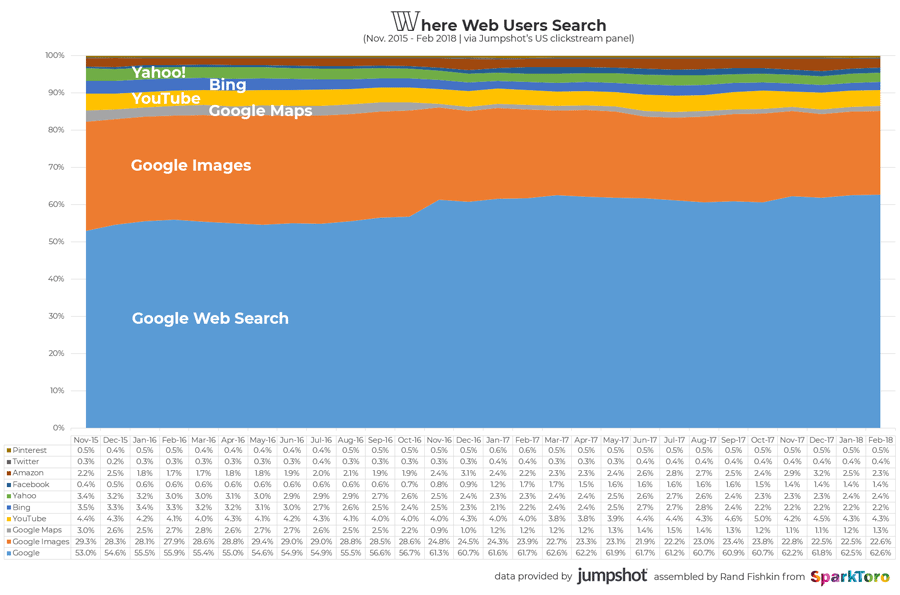
That market share figure – from US broadband households, 1Q 2017 – is surprising: I’d have expected Google to have a much larger share.
link to this extract


Dropbox files confidentially for US IPO • Bloomberg

Alex Barinka:

»

Dropbox Inc., the file-sharing private company valued at $10 billion, has filed confidentially for a U.S. initial public offering, people familiar with the matter said.

Goldman Sachs Group Inc. and JPMorgan Chase & Co. will lead the potential listing, according to the people, who asked not to be identified because the filing wasn’t public. Dropbox is talking to other banks this month to fill additional roles on the IPO, the people said. The company is aiming to list in the first half of this year, one of the people said.

Representatives for Dropbox, Goldman Sachs and JPMorgan declined to comment.

A share sale by San Francisco-based Dropbox, one of a closely watched group of high-profile private tech companies with multibillion-dollar valuations, would follow Snap Inc.’s disappointing step into the public markets. How the stock fares post-listing will be an ongoing focus for both Wall Street and the tech community. Snap shares are down 15% from its IPO last March.

«

What do we expect from this? Higher prices, less free storage, more insistent upsells?
link to this extract


Is India’s Aadhaar system really “hack-proof”? Assessing a publicly observable security posture • Troy Hunt

»

UIDAI is the Unique IDentification Authority of India and they run the Aadhaar project. Their statement echoes comments made around this latest incident that espouse the complete security of the system: “The Aadhaar data, including biometric information, is fully safe and secure”.

Here’s the issue I (and many others) have with these statements and I want to make it crystal clear:
Security is not a boolean proposition. It’s not “secure” versus “insecure”, “safe” versus “unsafe”, rather it is a spectrum of controls that all contribute to an overall security posture. There is no “fully”, there is no “completely”; every system – every single one – has weak points and a sufficiently well-equipped and determined adversary will find them.

It’s the hubris of the UIDAI’s statements which is the most worrying and it neglects so many of the highly sophisticated precedents that have come before the current situation. Precedents like Stuxnet, created by the US and Israeli governments to damage the Iranian nuclear program by targeting air-gapped centrifuges via 4 previously unknown “zero-day” flaws. That’s almost a cliched example to pull out these days, the point is simply that where there is sufficient will and resources, any information system can be compromised.

But let’s get back to that original tweet and the question therein: “Can you prove otherwise?” I certainly wouldn’t want to be the person probing away at Aadhaar in an unauthorised fashion in order to prove otherwise (although make no mistake, many people are), but per the title of this post, there are many publicly observable things I can easily draw attention to. To be crystal clear, none of this is “hacking”, it will merely involve looking at how the system responds to legitimate requests and observing the gap between what it does at present and what it ideally should do.

«

Lengthy post. It’s not certain that Aadhaar can be hacked, but one tends to think that where there’s a will – and 1.2bn user records – there’s a way.
link to this extract


Uber’s secret tool for keeping the cops in the dark • Bloomberg

Olivia Zaleski and Eric Newcomer:

»

In May 2015 about 10 investigators for the Quebec tax authority burst into Uber Technologies Inc.’s office in Montreal. The authorities believed Uber had violated tax laws and had a warrant to collect evidence. Managers on-site knew what to do, say people with knowledge of the event.

Like managers at Uber’s hundreds of offices abroad, they’d been trained to page a number that alerted specially trained staff at company headquarters in San Francisco. When the call came in, staffers quickly remotely logged off every computer in the Montreal office, making it practically impossible for the authorities to retrieve the company records they’d obtained a warrant to collect. The investigators left without any evidence.

Most tech companies don’t expect police to regularly raid their offices, but Uber isn’t most companies.

«

The tool is called Ripley:

»

From spring 2015 until late 2016, Uber routinely used Ripley to thwart police raids in foreign countries, say three people with knowledge of the system. Allusions to its nature can be found in a smattering of court filings, but its details, scope, and origin haven’t been previously reported.

The Uber HQ team overseeing Ripley could remotely change passwords and otherwise lock up data on company-owned smartphones, laptops, and desktops as well as shut down the devices. This routine was initially called the unexpected visitor protocol.

«

In the words of Matt Stoller: “Uber often looks like a criminal conspiracy that happens to run a ride-sharing service.”
link to this extract


Beware the lessons of growing up Galapagos • Remains of the Day

Eugene Wei:

»

If I weren’t in two fantasy football leagues with friends and coworkers, I would not have watched a single game this season, and that’s a Leftovers-scale flash-forward twist for a kid who once recorded the Superbowl Shuffle to cassette tape off a local radio broadcast just to practice the lyrics.

If you disregard any historical romantic notions and examine the typical NFL football game, it is mostly dead time (if you watch a cut-down version of a game using Sunday Ticket, only about 30 minutes of a 3 to 3.5 hr game involves actual game action), with the majority of plays involving action of only incremental consequence, whose skill and strategy on display are opaque to most viewers and which are explained poorly by a bunch of middle-aged white men who know little about how to sell the romance of the game to a football neophyte. Several times each week, you might see a player hit so hard that they lie on the ground motionless, or with their hands quivering, foreshadowing a lifetime of pain, memory loss, and depression brought on by irreversible brain damage. If you tried to pitch that show concept just on its structural merits you’d be laughed out of the room in Hollywood.

Cultural products must regenerate themselves for each successive age and generation or risk becoming like opera or the symphony is today…

…I don’t trust a bunch of rich old white male owners who grew up in such favorable monopolistic conditions to both understand and adapt in time to rescue the NFL from continued decline in cultural relevance. They are like tortoises who grew up in the Galapagos Islands, shielded on all sides from predators by the ocean, who one day see the moat dry up, connecting them all of a sudden to other continents where an infinite variety of fast-moving predators dwell.

«

link to this extract


Apple’s indirect presence fades from CES • Tech.pinions

Ben Bajarin:

»

It is easy to say that because Apple was never present at CES that the show didn’t mean something to them or their ecosystem. It is easy, and correct to say that CES was not, or never was, a measure of the health of Apple’s products. It is, however, incorrect and dangerous to miss that CES had been, for some time, a barometer for the health of Apple’s ecosystem.

As I mentioned, our ability to measure any platforms ecosystem from what we observe at CES, is the main reason so many are paying attention to what is happening with Amazon’s Alexa platform. Google Assistant is certainly more present than it was last year, however, when you look at how third parties are talking about-and marketing-their support of these assistants they are putting significantly more effort into talking about Alexa than Google Assistant. Which is a telling signal. Again, to reiterate this point, third parties used to market, and spend energy talking about their integration with iOS or support of iPhone/iPad with the same rigor they are now talking about Amazon’s Alexa. This can not be ignored.

As I outlined, with the two scenarios for Amazon’s Alexa, one could take a position that this is short-lived, and the dust will settle once Apple enters the market with HomePod and you will see more partners and third parties start talking more about HomeKit than anything else. For Apple’s sake, I would love for this to happen but I don’t see it unless Apple’s makes some changes to where Siri can be integrated outside of Apple first-party hardware.

With all of that being said, I am noticing a bit more support of HomeKit this year vs. last and with Apple’s recent pivot surrounding HomeKit requirements which required a dedicated security chip from Apple that now allows that security and authentication to be done in software, I do expect even more HomeKit support next year.

«

Certainly it used to be true that you’d go to CES and it would be iPhone accessory this, iPad case that. Now apparently it’s all Alexa this, Alexa that. So he has a point. Where’s consumer electronics going now?
link to this extract


Dear Google: please stop using my advertising dollars to monetize hate speech • Quartz

John Ellis:

»

My company sponsors online hate speech, fake news and racist propaganda. It’s not that we are trying to—and given the small budget of the engineering company I run, my contribution may only amount to pennies a month. But in total, online advertising accounts for tens of billions of dollars annually, so even tiny percentages mean millions of dollars directed from the bank accounts of advertisers to the pockets of Holocaust deniers, Sandy Hook hoaxers and promoters of vile, racist content.

The reason advertisers like me inadvertently sponsor and monetize hate speech is that ad-tech companies like Google have partnerships with publishers who allow and promote this type of content. And unless advertisers proactively identify and block objectionable sites as I try to do, their ads may appear there.

(Editors Note: In the time since Quartz first reviewed this article for publication, some of the sites pictured below have stopped running advertising, but similar sites have cropped up running the same juxtapositions of hate speech and advertising delivered via Google products.)

«

Whack-a-mole on both sides.
link to this extract


Russia, banned from the Winter Olympics, apparently is hacking Olympic emails • Buzzfeed

Kevin Collier:

»

The origin of the emails is unclear. Some of the emails, which date from late 2016 to spring 2017, appear to be between IOC employees and third parties discussing the Russian doping conspiracy.

“These emails and documents point to the fact that the Europeans and the Anglo-Saxons are fighting for power and cash in the sports world,” “Fancy Bears” said in its posting, though it’s unclear how the emails are meant to support that claim. Some of the emails’ contents are encrypted and are therefore illegible.

The IOC declined to comment on the “Fancy Bears” post or to verify that the emails are authentic, telling BuzzFeed News that “we do not comment on leaked documents.” WADA has not disputed the validity of any of the hacked documents previously attributed to the organization.

One of the people whose emails appear in the leak, and who is specifically named on the “Fancy Bears” website, is Colorado lawyer Richard Young, who helped WADA draft new anti-doping rules and worked to create a so-called “independent person” report for WADA on the doping allegations.

Young told BuzzFeed News he was unaware of the “Fancy Bears” activity, but said that a September 2016 email included in the dump sounded authentic to him when read over the phone.

“It’s no great revelation that I was involved in the IP investigation. I’m named in it,” Young laughed. “I think it’s somewhere in the first five pages that my role is explained.”

The original WADA hack occurred in late summer 2016, as allegations that Russian athletes had been caught participating in a vast and elaborate blood doping conspiracy were gaining international attention.

«

They should enter the Hacking Olympics. Venue: the internet. (Though these antics only go to strengthen the idea that Fancy Bear were behind the hacks of US organisations hostile to Russia, such as the Democratic party and Hillary Clinton’s campaign manager’s personal account.)
link to this extract


UCL to investigate eugenics conference secretly held on campus • The Guardian

Kevin Rawlinson and Richard Adams:

»

University College London has launched an urgent investigation into how a senior academic was able to secretly host conferences on eugenics and intelligence with notorious speakers including white supremacists.

The London Conference on Intelligence was said to have been run secretly for at least three years by James Thompson, an honorary senior lecturer at the university, including contributions from a researcher who has previously advocated child rape.

One prominent attendee at the conference in May last year was Toby Young, the head of the government-backed New Schools Network, who ran into controversy over efforts to appoint him as a university regulator…

…Young, in a speech to a similar conference in Canada last year, described the extreme measures that Thompson employed to keep the conference a secret.

“Attendees were only told the venue at the last minute, an anonymous ante-chamber at the end of a long corridor, called ‘lecture room 22’, and asked not to share this information with anyone else.

“One of the attendees, on discovering I was a journalist, pleaded with me not to write about the fact that he was there – he didn’t want his colleagues to find out,” Young said.

“But these precautions were not unreasonable, considering the reaction that any references to between-group differences in IQ generally provoke.”

Previous attendees included Richard Lynn, whom the US-based research group Southern Poverty Law Center labelled an “unapologetic eugenicist”, and the blogger Emil Kirkegaard, who has written supportively about pedophiles being allowed to have “sex with a sleeping child”.

«

Young has written vaguely in favour of eugenics for those deemed “low IQ”. You might say – what’s the harm in a university, meant to be a temple to ideas, hosting a conference on even a controversial idea like this, when we freely talk about CRISPR potentially improving our genetic profile? The problem is that eugenics is about *removing* people from the future population; it’s totalitarian, in that sense. CRISPR is about optionally choosing improvements.

It’s a subtle but important difference. Ask the parents of a disabled child if they’d want the child never to have been born: they’ll not take that option. (Which is eugenics.) Ask them if they’d want the child to have been born without disability; they’ll probably – but not always – say yes, while recognising it’s just a wish. That Young apparently can’t recognise that difference, and finds himself with fellow travellers of questionable morals, is disturbing.
link to this extract


We found a deleted page that reveals the paparazzi roots of Kodak Coin • Ars Technica

Timothy Lee:

»

The evidence strongly suggests that Kodak Coin is the re-branding of an initial coin offering called RYDE coin that never got much attention and was apparently aborted days before Kodak Coin was announced. Until recently, the project had a page on the crowdfunding site Start Engine. The page is no longer there, but Google cached a copy of the site on January 3. [At the time, the project had attracted 10 backers who had pledged a total of $875.]

As recently as last week, RYDE coin was being pitched as a way of expanding the licensing business of its creator, paparazzi photo company WENN Media. Now the RYDE page has disappeared, and WENN Media’s parent company, WENN Digital, has partnered with Kodak to create a blockchain platform that sounds a lot like RYDE—except that there’s no mention of celebrity photographs.

We’ve asked both Kodak and WENN about the connection between RYDE coin and Kodak Coin, and we will update the story if we hear back…

…What’s WENN Digital? A spokesman told Ars that WENN Digital is a new company that has acquired UK-based WENN Media, which describes itself as a “celebrity and entertainment news agency.”

“WENN can offer you an opportunity to join our worldwide team of top paparazzi snappers,” the “About Us” section of blog.wenn.com says.

«

So basically it’s sticking the Kodak name on a paparazzi project. Also, the “Kodak Coin” won’t make money for anyone who “mines” it, as David Gerard – whose book “Attack of the 50 Foot Blockchain” is hilarious in its dissection of the fantasies and fantasists around this topic – explains. It’s a mess, but then everything Kodak has done for years is a mess.
link to this extract


Errata, corrigenda and ai no corrida: none notified

You can sign up to receive each day’s Start Up post by email. You’ll need to click a confirmation link, so no spam.

Start Up: coding to kill, CES goes dark, Apple sells mesh Wi-Fi, Huawei chief’s rant, and more


The Great Barrier Reef is dying due to climate change. What now? Photo by FarbenfroheWunderwelt on Flickr.

A selection of 14 links for you. Buy high, sell low, unless you’re buying my cryptocoins, in which case just buy. I’m @charlesarthur on Twitter. Observations and links welcome.

This Israeli presentation on how to make drone strikes more “efficient” disturbed its audience • The Intercept

Sam Biddle:

»

The doctoral student who presented the research demonstrated how pioneering data visualization techniques could show a drone operator, using lines and arrows of varying thickness, which direction fast-moving people and vehicles were most likely to travel, for example, at an intersection or while fleeing a building. The presentation clearly angered at least some of the crowd, including the moderator, prompting hostile questions.

“The guy’s talk (and its video documentation) revealed much of what’s very wrong about UAV warfare,” said Mushon Zer-Aviv, a web designer and activist and an organizer of the conference, the data visualization confab known as ISVIS.

The incident at ISVIS underscores the extent to which drone warfare’s deeply technological basis and inhumanity has become a major part of global public debate around its use. Once viewed (and still promoted) as an efficient, safer way to target terrorists, the growing ubiquity of lethal drone strikes in global hotspots is increasingly seen as helping to create wastelands and fomenting the sort of terroristic support it’s designed to eradicate.

«

I can’t do better than Maciej Cieglowski’s comment: “This is an extreme example of a dynamic we see across the tech world: abdicating moral agency to work on cool code.”
link to this extract


Great Barrier Reef tourism operators beg for action on bleaching • Brisbane Times

Jorge Branco:

»

Dozens of Queensland small businesses, many which wouldn’t exist without the Great Barrier Reef, have issued a dire warning to Prime Minister Malcolm Turnbull.

The open letter published on Saturday comes as new research predicts bleaching as severe bleaching could become the “new normal”, recurring biyearly by the mid-2030s.

In a move contrary to recent attempts from tourism bodies to downplay the extent of the bleaching, 175 tourism operators, dive professionals and tradies labelled the mass damage a “disaster needing urgent action”.

They called on the Turnbull government to rule out any financing, investment or help with associated infrastructure for the Abbot Point coal terminal expansion and Adani’s controversial Carmichael mine, the largest in Australia.

They pointed the finger at climate change, calling for investment in renewable energy projects, particularly in regional Queensland and a band on any new coal mines.

Eye to Eye Marine Encounters director John Rumney said some businesses had been afraid to speak out, worried it could mean bad publicity. “But the long-term viability of all our businesses relies entirely on Reef staying healthy and it is in danger,” he said, in a press release issued by the Climate Media Centre.

«

In our lifetimes, the Great Barrier Reef could be dead. This is a calamity.
link to this extract


Apple now selling mesh Wi-Fi system as AirPort line remains unchanged • 9to5Mac

Zac Hall:

»

Apple has started selling a mesh Wi-Fi system from Linksys both on its website and in stores. The move is notable as Apple hasn’t updated its own Wi-Fi base station hardware since 2013 and doesn’t currently offer its own mesh Wi-Fi system.

The future of Apple’s networking hardware has long been unclear for that reason.

Bloomberg reported over a year ago that Apple disbanded its AirPort team and planned no future hardware releases. Since then we’ve seen no update to the AirPort hardware. AirPort Wi-Fi base stations are still being sold today and haven’t changed in price…

…When asked about the move to sell a third-party mesh system and the future of the AirPort line, an Apple spokesperson shared this with 9to5Mac:

People love our AirPort products and we continue to sell them. Connectivity is important in the home and we are giving customers yet another option that is well suited for larger homes.

Apple’s choice for that option is the Linksys Velop Whole Home Mesh Wi-Fi System which comes in two flavors: $350 for a 2-pack system or $500 for a 3-pack solution. The Tri-Band Wi-Fi system is rated to provide coverage for 2,000 square feet with each Node which can be configured from the Linksys iPhone and iPad app.

«

Well that’s certainly interesting. It’s not as if it was going to sell Google’s offering, of course. I don’t think eero’s has been cleared for UK or European use. Mesh seems like the future if you need something that size.
link to this extract


Major power outage hits CES, a consumer electronics show • The Verge

Dami Lee:

»

Power in the North and Central halls of the Las Vegas Convention Center, which hosts CES annually, was out for nearly two hours on Wednesday. First reports of the power outage began hitting Twitter from convention goers starting around 11:14AM PT, and was slowly restored shortly after 1:00PM PT. Security evacuated most visitors from the affected halls during that time.

The outage impacted hundreds of companies, including giants like LG, Samsung, and Sony, as well as many small startups that paid thousands of dollars to have a presence on the giant show floor. This year’s CES seems to be marked by more chaos than usual, including unprecedented rain that flooded streets and shut down Google’s giant funhouse booth for a day.

«

Maybe they could make this a regular thing there.
link to this extract


Bitcoin can drop 50% and China miners will still make money • Bloomberg

Dan Murtaugh:

»

“Bitcoin mining under the current price is likely to be profitable under any electricity price regime in China,” Lu wrote.

Cryptocurrency power use is facing more scrutiny, particularly in China, which is concerned miners are taking advantage of low electricity prices. Digital currency transactions require energy-intensive computer networks, with the industry now using as much power as 3.4 million U.S. households, according to Digiconomist Bitcoin Energy Consumption Index. China is said to be planning to limit power use by miners, which are starting to look elsewhere.

Electricity demand for bitcoin mining rose to about 20.5 terawatt-hours a year by the end of 2017, according to BNEF. That equates to more than half the 38 terawatt-hours of electricity used annually by the world’s biggest traditional miner, BHP Billiton – or a tenth of the electricity needed to power South Africa.

In China, miners used 15.4 terawatt hours, which is just a blip in the country’s massive power industry. Even though it plays host to the world’s biggest community of bitcoin miners, they only used 0.2% of the country’s annual electricity production, according to the report.

«

Dammit.
link to this extract


‘Sexy girl’ bots scam ¥1 billion from dating app users in China • That’s Beijing

Gary Bailer:

»

In possibly the oddest news story to have come out of China so far this year, police recently revealed that chat bots posing as bodacious babes have scammed dating app users out of a collective fortune.

The investigation began last August, when Guangdong police picked up on an app asking users to pay to view pornographic videos that, alas, did not exist.

From there, the investigation expanded to apps run in 13 provinces across China. As of January 8, over 600 individuals had been arrested and 21 companies shut down in cities including Beijing, Guangzhou, Shenzhen, Hangzhou, Changsha and Wuhan.

On the dating apps they formerly operated, some of the so-called single women were in fact chat bots programmed to flirt with users, especially ones that were new to the platform.

In at least one case, Sixth Tone reports, app users could exchange a few messages with a ‘sexy’ bot before being asked to upgrade to VIP status for RMB200.

«

This is the oddest story out of China so far? Then again it’s only the 10th.

Basically, though, Ashley Madison but a bit more low-rent.
link to this extract


Stellar iPhone X performance in GB, China & Japan • Kantar Worldpanel

»

In the USA, the iPhone X was outsold by the iPhone 8 and iPhone 8 Plus in the month of November but did round off the top three best-selling models for the month, easily beating the top Samsung model, the Galaxy S8, which is in sixth position.

The iPhone X was the top selling Smartphone in Japan in November, commanding an 18.2% share, closely followed by the iPhone 8 at 17.2% share. Meanwhile, in urban China, demand for the iPhone X has exceeded all expectations, as Dominic Sunnebo explains, “Apple was riding on the back of some momentum before the iPhone X release but demand for latest model in urban China has been staggering given its price point.

“Apple is now back on form – the iPhone X was the top selling model in urban China in November, with a market share of 6.0%. Unlike in Europe and the US, where the vast majority of new early iPhone X sales came from existing Apple smartphone owners, in urban China there are significant numbers of Huawei, Xiaomi and Samsung customers switching to the new iPhone models, which they deem a cut above the rest.”

«

Apple had a share of 49.4% in the UK in November. That’s astonishing.
link to this extract


Maven buys HubPages: No future for mom-and-pop publishers • ZDNet

Tom Foremski:

»

[HubPages CEO Paul] Edmondson told me that it seemed as if improving the quality of the content resulted in triggering a volatile ranking by Google rather than a positive increase. Months of hard work were not paying off.

I found the reason it wasn’t working described in a Google patent.

Google is very suspicious of anything that increases a sites search rank. It suspects some possible spammy search engine optimization tricks might be at work so it will flag the web site and cause its search rank to fluctuate wildly so as to prevent testing the possible SEO actions. Then it will schedule a manual check of the web site to see if it is legit.

This means that if you rewrite your website to improve quality — and Google wants higher quality content — you are using optimizing your site deliberately to improve your ranking. Google will flag this as suspicious behavior and will vary your page ranking on a random basis that has nothing to do with the changes you made.

You cannot win. Your business success is in the hands of another entity.

Google and Facebook today have about 85% of all mobile ad traffic and they dominate desktop ad markets – small mom and pop publishers have to combine into large enough networks to attract the media buyers.

It’s a race to the bottom – Google revenues are 15% to 18% less per click per quarter – but Google can race to the bottom and still beat Wall Street estimates. That’s not the case for smaller media companies.

The disruption in the media industry will continue in 2018. There is no stable business model and there is none in sight.

«

On the plus side, a lot of the junk sites which fed off the 2016 US election should die, if this is correct.
link to this extract


Sneaky crypto malware miners are targeting ad networks next • CoinDesk

Jonathan Keane:

»

Websites and publishers need to be prepared for cryptocurrency miners slipping into ads on their sites, according to Israeli adtech firm Spotad.

The company, which operates an AI-powered advertising platform for purchasing media space, recently discovered cryptocurrency mining activity on its network, a development the company claims is becoming part of wider trend.

Spotad’s AI system, named “Sarah,” recently identified anomalies in the code of seemingly legitimate ads for both desktop and mobile that turned out to be a miner for the cryptocurrency monero. The JavaScript-enabled ad was designed to dupe users into clicking on a pop-up that would initiate the mining process.

According to co-founder Yoav Oz, the agency responsible for the ad was unaware of the code that was embedded inside. The name of the agency or the subject of the ad has not been disclosed.

«

The irony would be if some of the fake sites that run ads were to be exploited in this way. Be really hard to know where one’s sympathies lay then.
link to this extract


Essential Phone review, four months later: The sun is setting on this experiment • Android Central

Andrew Martonik:

»

Aside from the hardware, every other aspect of my Essential Phone experience has been about frustration. Mostly, it boils down to horrendous software stability and performance. Despite dozens of updates and the anecdotes you may have seen that indicate performance issues have been “fixed,” it most certainly hasn’t. The Essential Phone is handily outperformed by a Moto G5, and that’s just unacceptable — at $699, for sure, but at $499 as well.

Four or five years ago, Android phones were slow and unstable like this. But not today.
It all starts with just general app instability. Apps crash — a lot. More than I’ve experienced on any other phone. They freeze, stutter, lock up and force close. Sometimes you tap an app to open it, and nothing happens for multiple seconds.

«

The comments are the thing here – plenty of people with the same experience. Essential’s whopping valuation suddenly looks like smoke unless it can do something amazing in the smart home space.
link to this extract


Huawei’s CEO going off-script to rage at US carriers was the best speech of CES • The Verge

Vlad Savov:

»

The Huawei boss did something unexpected at the end of his keynote, however. Framed by a simple slide reading “Something I Want to Share,” Yu proceeded to address the failure of Huawei’s carrier deal directly. Shedding the earlier hesitation in his speech, he made the point that American phone buyers can’t have the best and widest choice of device if Huawei products — those of the world’s third-biggest phone vendor — weren’t on offer. “Everybody knows that in the US market that over 90% of smartphones are sold by carrier channels,” he said. “It’s a big loss for us, and also for carriers, but the more big loss is for consumers, because consumers don’t have the best choice.”

Harkening back to the beginning of his Huawei career 25 years ago, Yu radiated a quiet anger at the mistrust his company is being subjected to. He said Huawei faced plenty of doubters in its native China too, being an almost total newcomer to consumer devices six years ago. “We win the trust of the Chinese carriers, we win the trust of the emerging markets… and also we win the trust of the global carriers, all the European and Japanese carriers,” he said. “We are serving over 70 million people worldwide. We’ve proven our quality, we’ve proven our privacy and security protection.”

I craned my neck to look at the teleprompters behind me and they were blank. Yu’s most inspired and most eloquent speech, it turned out, was being delivered without any external help.

«

Then again “best speech of CES” isn’t that high a bar.
link to this extract


News UK finds high levels of domain spoofing to the tune of $1 million a month in lost revenue • Digiday

Jessica Davies:

»

To investigate the level of domain spoofing occurring against its news brands, News UK conducted a programmatic blackout test for two hours in December. The result: 2.9 million bids per hour were made on fake inventory purporting to be News UK’s The Sun and The Times of London newspaper brands.

From the results, the publisher estimates that marketers are wasting £700,000 ($950,000) on domain-spoofed inventory per month. A total of 650,000 ad requests were made each hour, according to the publisher.

The publisher conducted the test between 3a.m. and 5 a.m. on Dec. 4, deliberately choosing a time that would be less disruptive to site visitors and wouldn’t hamper revenues or ongoing campaigns. The publisher shut down all programmatic advertising on its sites, including all supply-side platforms, its header bidding wrapper and all networks. During this time, it was impossible to buy programmatic inventory on The Sun, the Times or News UK’s fantasy football brand Dream Team. That made it easy to isolate inventory that still appeared to be offered on its sites as fraudulent.

«

That’s a lot of money which is being sent to fake sites pretending to be News UK. You can bet it’s repeated far and wide through the ad business. Third-party digital ads must, surely, surely now be reaching some kind of point where it’s not worth advertisers using them, at which point the system collapses?
link to this extract


Collision course: why this type of road junction will keep killing cyclists • Single Track World

“Bez” on a junction in the UK where the angle of road intersection is perfect to make a cyclist invisible behind the driver-side pillar as they approach it:

»

At the position shown, approximately 100m from the junction at Ipley Cross, the pillar obscures roughly 12m of Beaulieu road. That’s six bicycle lengths: enough to hide not just a cyclist but a small group of riders.

Of course, as the driver approaches that junction, that obscured section of road moves towards the junction with them. As does the cyclist.

Parekh’s car had a black box type device, which (contrary to his statements to police) recorded his approach to the junction at a steady speed of 37mph. At this speed it would have taken six seconds to cover the 100m to the collision, and the following image shows the approximate areas obscured by the Zafira’s pillar at six points in time representing each incremental second leading up to impact, with the red area showing the pillar shadow one second prior to impact.

Although the obscured section of road becomes smaller as the driver approaches, it remains large enough to completely obscure a bicycle until less than a second prior to impact: too late for either party to react.

«

There have been multiple accidents with cyclists – including deaths – at that junction. It would be good to have a way to figure out how to discover where such junctions exist.
link to this extract


I tried the first phone with an in-display fingerprint sensor • The Verge

Vlad Savov:

»

The mechanics of setting up your fingerprint on the phone and then using it to unlock the device and do things like authenticate payments are the same as with a traditional fingerprint sensor. The only difference I experienced was that the Vivo handset was slower — both to learn the contours of my fingerprint and to unlock once I put my thumb on the on-screen fingerprint prompt — but not so much as to be problematic. Basically, every other fingerprint sensor these days is ridiculously fast and accurate, so with this being newer tech, its slight lag feels more palpable.

Vivo is using a newly announced Synaptics optical sensor, which has been in development for years. It works by peering through the gaps between the pixels in an OLED display (LCDs wouldn’t work because of their need for a backlight) and scanning your uniquely patterned epidermis. This is likely the tech that Synaptics and Samsung were collaborating on for the Galaxy S8 for last year, right up until it became apparent that it wouldn’t be ready in time for the phone’s release. Things are different now, as Vivo is close to announcing this as-yet-unnamed phone properly and Synaptics is already in mass production with the so-called Clear ID sensor.

«

Won’t replace or be added to FaceID; Samsung might get it into the Galaxy Note 9. It’s a nice idea, but there are questions about the accuracy – as it’s optical, how good will the error rate (positive or negative) be?
link to this extract


Errata, corrigenda and ai no corrida: none notified

You can sign up to receive each day’s Start Up post by email. You’ll need to click a confirmation link, so no spam.

Start Up: discovering Spectre and Meltdown, where are Wikileaks’s bitcoinillions?, self-mending screens, and more


Uber launches in Cincinnati in 2014. Think it’s profitable there? Probably not. Photo by 5chw4r7z on Flickr.

Back early, by hardly any demand at all! But that’s life.

You can sign up to receive each day’s Start Up post by email. You’ll need to click a confirmation link, so no spam.

A selection of 13 links for you. Unlucky for some I’m @charlesarthur on Twitter. Observations and links welcome.

How Meltdown and Spectre were independently discovered by four research teams at once • WIRED

Andy Greenberg:

»

The Graz team’s discovery, an attack that would come to be known as Meltdown, proved a critical crack in one of computing’s most basic safeguards. And perhaps most troubling of all, the feature they had exploited was introduced into Intel chips in the mid-1990s. The attack had somehow remained possible, without any apparent public discovery, for decades.

Yet when Intel responded to the trio’s warning—after a long week of silence—the company gave them a surprising response. Though Intel was indeed working on a fix, the Graz team wasn’t the first to tell the chip giant about the vulnerability. In fact, two other research teams had beaten them to it. Counting another, related technique that would come to be known as Spectre, Intel told the researchers they were actually the fourth to report the new class of attack, all within a period of just months.

“As far as I can tell it’s a crazy coincidence,” says Paul Kocher, a well-known security researcher and one of the two people who independently reported the distinct but related Spectre attack to chipmakers. “The two threads have no commonality,” he adds. “There’s no reason someone couldn’t have found this years ago instead of today.”

«

I’d imagine there were people in security agencies who found this a while ago, and liked it. The coincidental discovery? There are tons of people everywhere who are trying to find security glitches and hacks.
link to this extract


The Spectre of an advertising meltdown: what you need to know • Lawfare

Nicholas Weaver:

»

The information security world is focused on two new security vulnerabilities, “Spectre” and “Meltdown”, that represent vulnerabilities embedded in computer hardware. Lawfare readers should respond in two ways: keep their operating systems up to date and, critically, install an ad-blocker for your web browser. (Here are guides on how to do so in Chrome and Firefox.) In fact, a proper response to Spectre should involve ad-blocking on all government computers. Other than that, don’t worry.

Readers who just wanted to know what to do can stop reading. But for those curious about some of the technical background on these vulnerabilities and why ad-blocking is an essential security measure for a modern computer, read on.

«

link to this extract


No tracking, no revenue: Apple’s privacy feature costs ad companies millions • The Guardian

Alex Hern:

»

Advertising technology firm Criteo, one of the largest in the industry, says that the Intelligent Tracking Prevention (ITP) feature for Safari, which holds 15% of the global browser market, is likely to cut its 2018 revenue by more than a fifth compared to projections made before ITP was announced.

With annual revenue in 2016 topping $730m, the overall cost of the privacy feature on just one company is likely to be in the hundreds of millions of dollars.

Dennis Buchheim, general manager of the Interactive Advertising Bureau’s Tech Lab, said that the feature would impact the industry widely.

“We expect a range of companies are facing similar negative impacts from Apple’s Safari tracking changes. Moreover, we anticipate that Apple will retain ITP and evolve it over time as they see fit,” Buchheim told the Guardian.

“There will surely be some continued efforts to ‘outwit’ ITP, but we recommend more sustainable, responsible approaches in the short-term,” Buchheim added.

«

John Gruber called this article “pro-ad industry”. Can’t say I see that myself.
link to this extract


Uber is not price competitive with transit • Medium

Paris Marx:

»

Uber’s strategy of reporting large losses to develop a customer base is not unique; many tech companies have taken a similar path before it. The tech press has compared Uber favorably with Amazon — now the fourth largest company in the world by market cap — because the latter reported growing losses every year from 1994 to 2000, during which time investors worried it would ever turn a profit. But there’s an important detail left out of those stories: how the scale of Uber’s losses compare to Amazon’s.

In WTF? What’s the Future and Why It’s Up to Us, Tim O’Reilly writes that Amazon lost $2.9bn over its first five years before turning a profit in 2001. That may seem like a lot, until Uber’s losses are placed beside it.

In 2016 alone, Uber lost $2.8bn, almost as much as Amazon lost over five years; but the losses didn’t stop there. Over the first three quarters of the 2017 fiscal year, Uber has already lost $3.2bn, with a loss of $1.5bn in the most recent quarter. A chart of Uber’s financials shows its losses have gotten worse in each quarter of 2017, suggesting annual losses for the year will likely hit $5bn, and the company has no realistic path to profitability.

«

Well, it does have a path to profitability – raise its prices. Except that (it’s later explained)

»

“Transportation industry expert Hubert Horan has detailed how “[d]rivers, vehicles and fuel account for 85% of urban car service costs” — costs which cannot be reduced with scale”.

«

And Marx (this one) does look at the question of driverless filling the gap.
link to this extract


Where did WikiLeaks’ $25m bitcoin fortune go? • The Daily Beast

Joseph Cox:

»

Everyone from early investors to cybercriminals has benefited from the huge spike in the value of bitcoin in the past few weeks. It’s a boon for one other outfit that has likely racked up tens of millions of dollars’ worth of the cryptocurrency: WikiLeaks.

The transparency organization may be sitting on a stockpile of bitcoin valued at around $25 million, and has likely exchanged several other large cryptocurrency caches for fiat cash, according to two sources who independently analyzed WikiLeaks’ bitcoin transactions.

“Last wallet looks like his piggy bank,” John Bambenek, a security expert who has previously tracked Neo-Nazis’ use of bitcoin, told The Daily Beast, pointing to a specific bitcoin address believed to be linked to WikiLeaks.

An oft-repeated myth is that bitcoin is an anonymous currency. Although it can sometimes be harder for observers to determine which bitcoin address belongs to whom, the blockchain—the ledger listing all bitcoin transactions—is entirely public. Using this, it’s often possible to see which bitcoin wallets are associated with one another, perhaps link them to real identities, and infer what a bitcoin transaction was for…

…“Well, considering Julian [assange] is holed up in an embassy, it’s entirely possible someone else has physical possession. But would you trust that cash to someone else?” Bambenek said.

Julian Assange and the main WikiLeaks Twitter account did not respond to a request for comment.

Unsurprisingly, it appears WikiLeaks may have converted some of its bitcoin donations into much more practical fiat currency, too. Several other large chunks of bitcoin moved from the WikiLeaks donation address to BitPay, a bitcoin exchange platform, Bambenek said.“I am assuming he spent, because it went to BitPay,” Bambenek added, referring to WikiLeaks founder Assange. The second source said WikiLeaks has spent around 3,500 bitcoin since its move to the digital currency.

«

With rumours that Ecuador is looking to shift Assange out of its London embassy – and thus into the waiting arms of UK police – he might need that.
link to this extract


Google faces new discrimination charge: paying female teachers less than men • The Guardian

»

Google, which has been accused of systematically underpaying female engineers and other workers, is now facing allegations that it discriminated against women who taught employees’ children at the company’s childcare center.

A former employee, Heidi Lamar, is alleging in a complaint that female teachers were paid lower salaries than men with fewer qualifications doing the same job.

Lamar, who worked at Google for four years before quitting in 2017, alleged that the technology company employed roughly 147 women and three men as pre-school teachers, but that two of those men were granted higher starting salaries than nearly all of the women.

“I didn’t want to work for a company that I can’t trust, that makes me feel like my values of gender equality are being compromised,” Lamar, 31, told the Guardian.

«

Oh, but now read on.
link to this extract


Google memo author James Damore sues company for discrimination against white males • Buzzfeed

Ryan Mac:

»

The author of a controversial memo that sparked debates about gender and diversity at Google sued his former employer on Monday, alleging that the company discriminates against politically conservative white men.

James Damore, who was fired in August for internally circulating a manifesto that argued Google’s gender pay gap was the result of genetic differences that tend to favor men, said in a lawsuit filed in Santa Clara Superior Court that the search giant “singled out, mistreated, and systematically punished and terminated” employees who deviated from the company’s view on diversity. Damore and a second plaintiff, David Gudeman, another former Google engineer, are seeking class-action status for anyone who identifies as conservative, Caucasian, or male.

The men are being represented by Harmeet K. Dhillon, the Republican National Committee’s committeewoman for California.

“Google’s management goes to extreme — and illegal — lengths to encourage hiring managers to take protected categories such as race and/or gender into consideration as determinative hiring factors, to the detriment of Caucasian and male employees and potential employees at Google,” the suit reads.

«

Another quote from the suit: “…The presence of Caucasians and males was mocked with ‘boos’ during company- wide weekly meetings”. I bet Google wishes it had dumped Damore’s CV and never gave him an interview.
link to this extract


CoffeeMiner hijacks public Wi-Fi users’ browsing sessions to mine cryptocurrency • ZDNet

Charlie Osborne:

»

According to the developer, public Wi-Fi may also now be a source of income for hackers that successfully pull off man-in-the-middle (MiTM) attacks to launch cryptocurrency miners.

The project, released to the public for academic study, leans upon the recent discovery of a cryptocurrency miner discovered on a Starbucks Wi-Fi network.

CoffeeMiner works in a similar way. The attacking code aims to force all devices connected to a public Wi-Fi network to covertly mine cryptocurrency.

The attack works through the spoofing of Address Resolution Protocol (ARP) messages by way of the dsniff library which intercepts all traffic on the public network.

Mitmproxy is then used to inject JavaScript into pages the Wi-Fi users visit. To keep the process clean, the developer injected only one line of code which calls a cryptocurrency miner.

«

Can’t wait for the cryptocurrency madness to expire.
link to this extract


No boundaries for user identities: web trackers exploit browser login managers • Freedom To Tinker

Gunes Acar:

»

We show how third-party scripts exploit browsers’ built-in login managers (also called password managers) to retrieve and exfiltrate user identifiers without user awareness. To the best of our knowledge, our research is the first to show that login managers are being abused by third-party scripts for the purposes of web tracking.

The underlying vulnerability of login managers to credential theft has been known for years. Much of the past discussion has focused on password exfiltration by malicious scripts through cross-site scripting (XSS) attacks. Fortunately, we haven’t found password theft on the 50,000 sites that we analyzed. Instead, we found tracking scripts embedded by the first party abusing the same technique to extract emails addresses for building tracking identifiers.

The image above shows the process. First, a user fills out a login form on the page and asks the browser to save the login. The tracking script is not present on the login page [1]. Then, the user visits another page on the same website which includes the third-party tracking script. The tracking script inserts an invisible login form, which is automatically filled in by the browser’s login manager. The third-party script retrieves the user’s email address by reading the populated form and sends the email hashes to third-party servers.

«

The link above (“has been known”) is actually only one of the five offered in that phrase – OK, so I’m lazy about copying all the HTML sometimes. It’s a problem though that the most secure way to handle passwords is also so exploitable. So it’s back to remembering them all?
link to this extract


My internet mea culpa • Shift Newco

Rick Webb:

»

Being generous to the prophets [Stewart] Brand and [Kevin] Kelly et al, it’s entirely reasonable to argue that this version of a global village is not what they proposed or envisioned. Minorities are still denied equal voices on the internet — harassed off of it, or still unable to even get online. Massive amounts of data is still hidden behind firewalls or not online at all. Projects to bring more information online (such as Google Books) have foundered due to institutional obstruction or a change of priorities in those undertaking them. Governments still have secrets. Organizations such as Wikileaks that showed early promise in this regard have been re-cast as political tools through some mix of their own hubris and the adversarial efforts of the governments they seek to expose.

It’s quite easy to see the differences between the internet world we live in and the utopia we were promised. And a fair measure of that is because we didn’t actually make it to the utopia. The solution, then, the argument goes, is to keep at it. To keep taking our medicine even as the patient gets more sick, on the faith that we will one day reach that future state of total-information-freedom and equality of voices.

This isn’t an unreasonable position, but I think it would have been worth thinking about beforehand. There is a difference between Advil and chemotherapy. If you’re not dying of cancer, the benefits of something like chemotherapy are dubious. A better metaphor might be back pain. I have back pain. I could get surgery for my back pain. But the surgery is hugely debilitating, with only moderate chances of success. It is not unreasonable for me to say “nah, not worth it.”

«

I think Wikileaks on its own sums up the degradation of the dream. It began trying, and succeeding, in exposing African dictators; it has ended up helping Russian ones, and quite where it morphed from idealism to cynicism is difficult to pinpoint.
link to this extract


What happened when the infosec community outed its own sexual predators • The Verge

Sarah Jeong:

»

Since autumn, I’ve noticed SHA hashes popping up again across my social media feeds — hashes of men’s initials or sometimes full names. These strings cannot be decrypted but if you know or suspect what the solution is, you can try running the same algorithm over it and see if the hash matches. Women describe how they or a friend were harassed or assaulted, they describe in vague terms the man in question. And then they post the hash, so their friends can check to see if they’ve been attacked by the same man.

It’s a step up from the “Shitty Media Men” spreadsheet that went viral a couple of months ago, a means of sharing information that is easy enough among the women who are capable of opening a command line window and running SHA-256 on a man’s name — women who deal professionally with secrets, privacy, truth, and verification. These are women whose technical abilities, whose place in their world, have long been questioned. They have been treated like fakes and posers and interlopers and arm candy. But they are here and have always been here. And when all the bad men who “do good work” have fallen from their pedestals, those women are waiting, ready to inherit the tech industry.

«

Such a clever idea. Hide it from everyone except those who also know it, so that you can be sure that you all agree before going public. (Could such a system be used for the accused in rape trials?)
link to this extract


Phone screen, heal thyself • CCS Insigh

Shaun Collins:

»

Researchers at the University of Tokyo have discovered a new polymer that can actually heal itself, pointing the way to a future of self-healing phone screens.

There’s been ongoing efforts to improve the strength of displays on smartphones and tablets, and there’s no denying that they’ve become tougher. Nonetheless, round-the-clock smartphone use has increased the potential for drops and smashes. Screens are getting damaged all the time.

The polymer was discovered by accident by a Japanese graduate student, Yu Yanagisawa, who thought the material would become a type of glue. He found that cut edges of the polymer would stick to each other, and formed a strong sheet after being compressed by hand at 21 degrees Celsius.

The findings of a team of researchers led by Professor Takuzo Aida have been published in Science magazine. Titled Mechanically robust, readily repairable polymers via tailored noncovalent cross-linking, the research promises a hard glass-like polymer called polyether-thioureas that can heal itself with only hand pressure. This makes it different from other materials that need high heat to recover from a break.

«

CCS Insight reckons between 10% and 15% of smartphone owners crack or smash a display every year. It’s a big business.
link to this extract


What do you call a world that can’t learn from itself? • Eudaimonia

Umair Haque:

»

There is a myth of exceptionalism in America that prevents it from looking outward, and learning from the world. It is made up of littler myths about greed being good, the weak deserving nothing, society being an arena, not a lever, for the survival of the fittest  —  and America is busy recounting those myths, not learning from the world, in slightly weaker (Democrats) or stronger (Republicans) forms. Still, the myths stay the same  —  and the debate is only really about whether a lightning bolt or a thunderstorm is the just punishment from the gods for the fallen, and a palace or a kingdom is the just reward for the cunning.

Hence, I have never once sees in America a leader saying, “hey! See that British healthcare system? That German union and pension system? Why don’t we propose that? They work!!” Instead, the whole American debate is self-referential  —  pundits debating Andrew Jackson (LOL) instead of, say, what the rest of the world does today in 2017. How can a broken society grow only by looking inwards? If you are a desperate, heart-broken addict, what can you learn from yourself? Won’t you only, recounting your pain, reach for the needle quicker?

«

This is a fabulous essay. As he points out, American life expectancy is also lower than you’ll find in comparable European countries, and as he also notes:

»

The same is true for things like maternal mortality, stress, work and leisure, press freedom, quality of democracy — every single thing you can think of that impacts how well, happily, meaningfully, and sanely you live is worse in America, by a very long way.

«

But as he also points out, neither is learning the lessons of the other.
link to this extract


Errata, corrigenda and ai no corrida: none notified

Finish Up: Facebook’s smarter factcheck, Keeper’s bug suit, smart speakers v wearables, and more


Is it a helicopter? Is it a rifle? You might be able to fool an AI on this topic. Photo by Defence Images on Flickr.

This is the last Overspill of the year. It will return on Monday January 15, 2018.


Charity time: ahead of Christmas, I’m encouraging readers to make a donation to charity; a different one each day.
Today’s is:
Shelter, the UK charity for the homeless. It’s a difficult time to be homeless.
(If you’re not in the UK, and want to donate to a charity nearer home, please search on “homeless charity [your country].)

Thursday’s charity was Wikipedia.
Wednesday’s charity/ies was/were:
– UK readers: The National Deaf Children’s Society
– US readers: American Society for Deaf Children
– Australian readers: Deaf Children Australia
(In other countries try a search on “deaf children [your country]”.)

Tuesday’s charity was The Internet Archive, which preserves web content that might otherwise be lost (or conveniently scrubbed). It’s in the middle of a $6m funding drive, and is presently at $3.6m. (The average donation is $41.)

Monday’s charity was BookTrust: give £10 and a child in social care will receive books for Christmas.)
Please donate as you see fit.


You can sign up to receive each day’s Start Up post by email. You’ll need to click a confirmation link, so no spam.

A selection of 10 links for you. Use them wisely. I’m @charlesarthur on Twitter. Observations and links welcome.

The work of art in the age of algorithmic reproduction • Medium

Thomas McMullan:

»

Anna Ridler’s Fall of the House of Usher unspools, rooms and bodies spreading half-seen across the frames of this 12-minute film like gossamer. A woman appears to walk down a hallway, then melts into a moonlit sky. A face appears in the dark, contorts into shapes. The animation is based on a 1929 film version of Edgar Allen Poe’s story, but its inky and strange visuals are the result of something altogether more modern: machine learning.

Each moment of Ridler’s film has been generated by artificial intelligence. The artist took stills from the first four minutes of the 1929 movie, then drew them with ink on paper. These versions were then used to train a generative adversarial network (GAN), teaching it what sort of picture should follow on from another. The GAN uses this information to create its own procession of stills, based around a pair of networks that work in competition with each other — one as a generator, one as a discriminator, evaluating the work of the former like an algorithmic critic.


‘Fall of the House of Usher,’ by Anna Ridler. Photo: Anna Ridler

The result is an AI-generated animation based on drawings that are based on the opening minutes of a 1929 film, which is based on an 1839 short story about a decaying lineage. It is a project that uses machine learning techniques not to showcase the technology, but as a way to engage with ideas of memory, the role of the creator, and the prospect of degeneration. It is primarily an artistic work, leveraging artificial intelligence as a medium in a way another artist may use acrylics or videotape.

«

I like this. On the other hand…

link to this extract


Researchers made Google’s image recognition AI mistake a rifle for a helicopter • WIRED

Louise Matsakis:

»

algorithms, unlike humans, are susceptible to a specific type of problem called an “adversarial example.” These are specially designed optical illusions that fool computers into doing things like mistake a picture of a panda for one of a gibbon. They can be images, sounds, or paragraphs of text. Think of them as hallucinations for algorithms.

While a panda-gibbon mix-up may seem low stakes, an adversarial example could thwart the AI system that controls a self-driving car, for instance, causing it to mistake a stop sign for a speed limit one. They’ve already been used to beat other kinds of algorithms, like spam filters.

Those adversarial examples are also much easier to create than was previously understood, according to research released Wednesday from MIT’s Computer Science and Artificial Intelligence Laboratory. And not just under controlled conditions; the team reliably fooled Google’s Cloud Vision API, a machine learning algorithm used in the real world today.

«

There’s that need for oversight, except if these things are classifying colossal numbers of objects how will we know when it makes a false negative? (The false positives should stick out a mile.)
link to this extract


Security firm Keeper sues news reporter over vulnerability story • ZDNet

Zack Whittaker:

»

Keeper, a password manager software maker, has filed a lawsuit against a news reporter and its publication after a story was posted reporting a vulnerability disclosure.

Dan Goodin, security editor at Ars Technica, was named defendant in a suit filed Tuesday by Chicago-based Keeper Security, which accused Goodin of “false and misleading statements” about the company’s password manager.

Goodin’s story, posted December 15, cited Google security researcher Tavis Ormandy, who said in a vulnerability disclosure report he posted a day earlier that a security flaw in Keeper allowed “any website to steal any password” through the password manager’s browser extension.

Goodin was one of the first to cover news of the vulnerability disclosure. He wrote that the password manager was bundled in some versions of Windows 10. When Ormandy tested the bundled password manager, he found a password stealing bug that was nearly identical to one he previously discovered in 2016.

«

Wouldn’t expect this to get far given the reality that Goodin’s story was updated in a timely fashion.
link to this extract


Facebook is getting rid of its fact-checking label and replacing it with this • Buzzfeed

Craig Silverman:

»

Facebook will stop flagging content that’s been declared false by external fact-checkers, and will instead surface fact-checks as related articles in the News Feed, the social media giant announced Wednesday.

The move represents the biggest outward facing change to Facebook’s year-old partnership with fact-checkers. The company said this new approach will be more effective in stopping the spread of misinformation, while also making it easier to scale its effort to other markets and content types.

Tessa Lyons, a News Feed product manager, told BuzzFeed News that surfacing fact-checks as related articles proved more effective in tests than applying a disputed flag to stories in the News Feed.

“Related articles outperformed disputed flags in giving people more information so they could understand what was true or false,” she said. “Hoaxes that had related article fact checks had fewer shares than those with the disputed flag.”

«

This is much better. Pity it’s about two or more years too late.
link to this extract


Google might want to follow Apple’s lead and force developers to disclose loot box odds • AndroidAuthority

Williams Pelegrin:

»

In a move that I think Google should follow with the Play Store, Apple revised its App Store guidelines to force developers to disclose the odds of people receiving each type of item from them.

The updated guidelines are a tad vague, in that they do not say exactly where developers should display those odds, though they state that the odds need to be displayed before folks buy loot boxes:

Apps offering ‘loot boxes’ or other mechanisms that provide randomized virtual items for purchase must disclose the odds of receiving each type of item to customers prior to purchase.
For the uninitiated, loot boxes contain a variety of virtual items that contain everything from common to rare in-game items. Some, if not most, games are designed so that you cannot pick up these items separately — you can only get them in loot boxes.

The problem is that many folks see these loot boxes as a predatory and manipulative business model that get people to spend more money on games. More significant, you can purchase loot boxes either with in-game or real-world currency, which, along with their randomness, have forced people to wonder whether loot boxes constitute gambling.

«

“Forced” people to wonder? I think they’ve led people to wonder that. Anyway, yes, it would be an excellent move if Google were to follow Apple’s lead here. An even better one just to ban the damn things, but let’s win the small victories first.
link to this extract


Smart speakers to outsell wearables during U.S. holidays, as demand for wearables slows • TechCrunch

Sarah Perez:

»

Smart speakers will likely outsell wearable devices this holiday season. That’s the latest prediction from analysts at eMarketer, which forecasts a slowing growth rate for devices like fitness trackers and smartwatches here in the US. The wearable market is continuing to grow, to be clear, but it’s struggling to reach the mainstream. Next year, only 20% of the U.S. adult population will use a wearable devices at least once a month, the firm says.

Note that eMarketer is looking at wearable usage and market penetration here, not sales.

That being said, the firm is estimating that usage of wearable will grow just 11.9% in 2018, rising from 44.7m adult wearable users in 2017 to 50.1m in 2018. As a percentage of the population, that’s a climb from 17.7% to 19.6%.

Things won’t improved much in the next few years, either, if the forecast holds out. The growth rate will slow to single digits in 2019. By 2021, eMarketer is estimating 59.5m adult wearable users, representing 22.6% of the population.

The firm attributes the majority of the growth in the sector – a market today that’s dominated by fitness trackers – to new users of smartwatches, like the Apple Watch…

…“Other than early adopters, consumers have yet to find a reason to justify the cost of a smartwatch, which can sometimes cost as much as a smartphone,” eMarketer forecasting analyst Cindy Liu said. “Instead, for this holiday season, we expect smart speakers to be the gift of choice for many tech enthusiasts, because of their lower price points.”

«

link to this extract


Unlike others at Fox, Cavuto uninterested in Trump interview • Associated Press

David Bauder:

»

[Neil] Cavuto, who anchors one hour each weekday on Fox News Channel and two on the Fox Business Network, revealed in an on-air commentary that he won’t ask for an interview. He said he spoke publicly after some viewers and administration officials remarked that things he had done weren’t helping his chances of speaking to the president. The Trump campaign had not appreciated a Cavuto interview with Mitt Romney attacking Trump. Cavuto has criticized Trump’s use of Twitter and suggested he needs to show loyalty in order to receive it.

He said he’s been called an “Obama toady” for saying that former President Barack Obama improved the economy.

“I’m a numbers nerd,” Cavuto said in an interview. “He came into a meltdown and a mess, and the numbers when he got out were a lot better. You can credit him, or you can say he got lucky. But did it happen under his watch? Yeah. These are the numbers we use as business journalists to judge the success or failure of a presidency.”

Presidential interviews are often unproductive because they have a limited amount of time and are skilled at filibustering when there are subjects they want to avoid, Cavuto said.

Trump adds other complications. A study in The New York Times on Sunday said Trump had made 103 “demonstrably and substantially false statements” during his first 10 months in office, compared with 18 by Obama during his eight-year presidency.

“Any interview would require me to get clarifications on many of the president’s own statements,” Cavuto said. “I could conceivably be spending half the allotted time just trying to have him explain his saying this is the largest tax cut in history when it isn’t or that he inherited the biggest economic mess ever when he didn’t. Just trying to set the record straight, I’d run straight into a wall and the interview would be over.”

«

I’d agree with Cavuto: unless you can get the time to demonstrate that a lying liar is lying, or challenge them substantially, there isn’t much point in the exercise. Multiple interviews with Trump show that normal discourse just doesn’t work.
link to this extract


Long Island Iced Tea soars after changing its name to Long Blockchain • Bloomberg

Arie Shapira:

»

There’s a new leader in the sweepstakes for the zaniest name change in the crypto craze.

Long Island Iced Tea Corp. shares rose 238% after the company rebranded itself Long Blockchain Corp. It’s the latest in a near-daily phenomenon sweeping the stock market, where obscure microcap companies reorient to focus on some aspect of the mania sparked by bitcoin’s 1,600% rally this year.

Long Blockchain, whose business has been selling non-alcoholic beverages, says it will now seek to partner with or invest in companies that develop the decentralized ledgers known as blockchain, the technology that underpins bitcoin.

As with many of the recently christened crypto companies — a list that includes former makers of juice, sports bras and sofas — Long Blockchain so far has little to show for its aspirations. It has no agreements with any blockchain firms, and says “there is no assurance that a definitive agreement with these, or any other entity, will be entered into or ultimately consummated.”

«

I think they mean the shares tripled and that bitcoin has gone up 15-fold this year, but with percentages over 199, who knows?

Also this is completely redolent of the dot-com bubble when if you didn’t dot-com, then don’t-come to the stock market.
link to this extract


Fooling Windows 10 facial authentication with a photo • HOTforSecurity

Graham Cluley:

»

Maybe you’re one of those people who care enough about the security and privacy of your computer that you enable the facial recognition feature built into versions of Windows 10, but find it too much of a pain to set up a password.

If so, you’re potentially at risk of having your computer unlocked by an attacker holding a modified low resolution laser-printed photograph of you in front of your webcam.

As described on the Full Disclosure mailing list, a team of German penetration testers discovered it was all too easy to trick a locked Windows 10 system into letting them login using a “modified printed photo of an authorised user.”

Windows Hello is a feature currently only shipping in Windows 10, allowing PCs with the necessary hardware to use special imaging techniques to let you sign in with just a look.

The researchers tested the spoofing attack against a Dell Latitude E7470 laptop running Windows 10 Pro (Version 1703) with a Windows Hello compatible webcam, and against a Microsoft Surface Pro 4 device running Windows 10 Pro (Version 1607) with a built-in camera.

«

Microsoft has included updates to try to stop this in its October update, but you’d ideally set up your facial authentication all over again.

Presently, this does leave Apple’s iPhone X as the only one where I haven’t seen video of two different non-twin adults unlocking someone else’s phone using facial recognition.
link to this extract


Is SEO opportunity growing or shrinking? • Rand’s Blog

Rand Fishkin on data from Jumpshot about how much searching and clicking people do on Google in the US:

»

I wanted to understand how many clicks per search are happening each month, so I made a new chart that illustrates that trend:

The metric of “clicks / ten search queries” helps us avoid seasonality biases and look instead at the rate of queries that lead to traffic opportunity. Here, the reality is sobering.

• The high point was the first month of the graph, November 2015
• Since then, there have been two significant declines in organic clicks/query (12/2015 and 11/2016) and one significant decline in paid clicks/query (01/2016, though it’s now nearly recovered)
• The 5.41 clicks/10 queries in October, 2017 is 23% lower than the 6.97 clicks/10 queries we had back in November, 2015. That’s a lot of lost SEO opportunity
• I haven’t yet tried to tie the drops back to noted changes in the SERPs, but I suspect the growth in featured snippets, instant answers, and knowledge panels in the results are at least partially responsible
• The growth of search volume has made up for much of the lost click opportunities, but this is a tough trend chart to see as an SEO
• That said, SEO still gets ~20X more traffic than PPC, and it doesn’t cost anything close to as much, so there’s still a massive advantage to ranking organically.

My conclusion from this — we’re living in a world with slightly less SEO opportunity and a trendline over the last couple years that worries and frustrates me.

«

There’s also a really interesting graph of “no-click seaches” for mobile v desktop (ie, someone does a query but then doesn’t visit a result) which indicates that Google changed something in November 2016 to dramatically increase those numbers on mobile, but not desktop.
link to this extract


Errata, corrigenda and ai no corrida: none notified
Start Up: Magic Leap unveiled, North Korea’s bitcoin heist, Apple’s unified app plan, Google’s map moat, and more


What’s the best way to get usably fast broadband to rural homes in the shortest time? Photo by Craig A Rodway on Flickr.


Charity time: ahead of Christmas, I’m encouraging readers to make a donation to charity; a different one each day.
Today’s is
Wikipedia. (Even if you disagree with or dislike its internal politics, its ability to provide as-far-as-possible neutral information on world events and situations is sorely needed these days.)

Wednesday’s charity/ies was/were:
• UK readers: The National Deaf Children’s Society
• US readers: American Society for Deaf Children
• Australian readers: Deaf Children Australia
(In other countries try a search on “deaf children [your country]”.)

Tuesday’s charity was The Internet Archive, which preserves web content that might otherwise be lost (or conveniently scrubbed). It’s in the middle of a $6m funding drive, and is presently at $3.6m. (The average donation is $41.)

Monday’s charity was BookTrust: give £10 and a child in social care will receive books for Christmas.)
Please donate as you see fit.


You can sign up to receive each day’s Start Up post by email. You’ll need to click a confirmation link, so no spam. Also, only one more day of it this year, so ¯\_(ツ)_/¯

A selection of 11 links for you. Sufficient unto the day. I’m @charlesarthur on Twitter. Observations and links welcome.

Nobody is going to wear the Magic Leap headset • Business Insider

Dave Smith:

»

After years of intense secrecy, high-profile augmented reality startup Magic Leap has finally unveiled a prototype of its futuristic headset.

But unless the device, dubbed the Magic Leap One, gets a major makeover before it’s released to the public, you can expect it to bomb when it hits store shelves, even if it is a technological breakthrough. Why? Because it looks ridiculous.

Check it out for yourself:

Would anyone ever feel comfortable leaving the house wearing this headset?

That question — Would anyone wear this? — is typically the crucial one when it comes to the fate of wearable technologies. Successful products like the Apple Watch are fashionable, or blend in well; they look like things that anyone would wear. By contrast, failed wearable products — most notably, Google’s Glass — look too nerdy, like gadgets only a geek could love.

«

Snap Spectacles, Hololens, Google Glass – the ancestry isn’t good on this. Note too that this is after a billion dollars or so in venture funding.
link to this extract


BT’s £600m rural broadband offer rejected • FT

Nic Fildes:

»

The government is to reject an offer from BT to connect 1.1m rural homes to superfast broadband in favour of giving homeowners in remote areas the legal right to demand an upgrade.

The government has been weighing up the respective benefits of BT saying it would improve broadband speeds in sparsely populated areas, or pushing ahead with a so-called universal service obligation system similar to that used for fixed-line telephone services.

Three people with direct knowledge of the situation said the government would on Wednesday opt to push on with a USO model that aims to give people the legal right to access a broadband connection of at least 10 Mbps by 2020.

The move will require secondary legislation to set out the design of the USO. Ofcom, the telecoms regulator which said last week that 1.1m homes and offices still don’t receive a decent broadband connection, will also work with the government on how best to connect rural areas.

«

I’m definitely one of those 1.1 million. Here’s the thing: BT has promised to upgrade the speed literally for years. But then the timing for improvement gets pushed back, and back. It won’t publish timetables – you can imagine it doesn’t want rivals to know its schedule.

What this USO plan doesn’t do is improve things for rival telcos/ISPs. It forces BT to do things; how does that create the competition that we need at the local level? I’d suggest BT should be obliged to let rivals access its ducts and poles at zero cost. That would give it an incentive to get broadband to people before rivals.
link to this extract


North Korea is suspected in bitcoin heist • WSJ

Timothy W. Martin, Eun-Young Jeong and Steven Russolillo:

»

Investigators in South Korea are looking into North Korea’s possible involvement in a heist from a bitcoin exchange that collapsed here on Tuesday, according to people familiar with the situation, as the sanctions-choked regime develops new ways to raise money.

The investigation into the hack, led by South Korean law enforcement and a state cybersecurity agency, is still in its infancy and a review of the malware code could take weeks, the people said.

But the people said there were telltale signs and historical evidence that North Korea, which has turned in recent years to increasingly sophisticated financial warfare, was behind the hack of Seoul-based exchange Youbit.

The same cryptocurrency exchange, operating under a different name, was targeted in April by North Korean hackers, several of the people said. Yapian, the company that operates Youbit, suspended trading and filed for bankruptcy after Tuesday’s hack.

The bitcoin heist follows similar suspected Pyongyang-directed offensives against other South Korean cryptocurrency exchanges—and an increasing number of attempts to steal from individual investors.

«

Particularly now that bitcoin is at such a crazy price, it’s a natural for North Korea’s hackers. It’s almost untraceable – almost, if you use the right exchanges – and it’s directly usable as foreign currency, which North Korea badly needs. (It doesn’t have any access to debt markets.) I’d expect to hear a lot more about NK hackers targeting bitcoin both in future and in the past.
link to this extract


Why a bursting bitcoin bubble isn’t worrisome • Yahoo Finance

Julia La Roche:

»

In the last week, the price of the cryptocurrency has jumped more than 40%. Year-to-date, it’s up more than 1,900%. It was last priced above $15,078 on Friday afternoon. Bitcoin’s current market cap is about $252.6 billion, according to Yahoo Finance’s cryptocurrency tracker.

“There are several channels through which a bursting of an asset price bubble can have macroeconomic consequences, but none is a major risk in the case of bitcoin. First, there may be a hit to household spending as people who have invested suffer losses. But bitcoin’s market [capitalization] is too small for this to be a worry,” according to the report.

What’s more, a complete bitcoin crash would be the equivalent of just a 0.6% fall in U.S. stocks, the report said. Furthermore, most of the investors in the cryptocurrency got in early, which would make those losses much smaller.

Another reason cited is that bitcoin is not woven into the banking system.

“While a bursting bubble can affect the economy via the banking sector, this is not much of a risk either, precisely because bitcoin is held and traded outside the banking sector. Also, there is no evidence that investment in bitcoin is being financed by the equivalent of sub-prime mortgages.”

«

I guess the point that there are very few people holding it is the key here.
link to this extract


Mashable financial statements paint bleak picture • Business Insider

Maxwell Tani:

»

Weighed down by large long-term expenses like the high rent on its offices in New York, London, and Singapore, Mashable ended September with about $4.65m in cash on hand, down from $8.4m at the start of the year, the documents show. Its loss for the three months through September was $4.2m and the financial statements suggested revenue growth was slowing.

The company essentially auctioned itself off, soliciting bids from 40 potential bidders. But it received only what it considered to be two serious offers, including the one it ultimately settled on, from Ziff Davis. Mashable’s board believed the sale was preferable to subjecting shareholders to the “risks and uncertainties of the company’s business plan and prospects,” according to the documents.

While management and major investors saw some of the $50m the company sold for, outstanding stock options provided to employees at various points during Mashable’s ascension were completely worthless in the sale, the documents show…

…Roughly 72% of Mashable’s revenue came from digital ads in the last three months before the sale; the next largest revenue source was distributed content, which accounted for 15% of revenue.

Though Mashable’s distributed revenue is about average — premium publishers generated around 14% of their overall revenues from distributing their content on third-party platforms in the first half of 2016, according to Digital Content Next — other revenue sources that could’ve buoyed the site were too small to make a significant impact.

E-commerce accounted for just 2% — or about $163,000 — of Mashable’s revenue in the latest three months. Events made up 7% and licensing made up 3%. By comparison, Gizmodo Media Group expects e-commerce to make up a third of its total revenue this year, while other digital-media publishers say that events may make up 20% of their revenue by next year.

«

Too reliant on advertising, which isn’t buttering the bread these days. Note that this is the second round of layoffs Mashable has made; in April 2016 it announced a “strategic shift towards video” and got a $50m infusion from Turner Broadcasting to build said video content. Didn’t work out so well.
link to this extract


esports: Where will the marketing dollars come from? • DIGITS to DOLLARS

Jonathan Goldberg:

»

we read an interview with the head of publishing for our favorite mobile esports title, Vainglory. Scroll down a bit and he mentions an interesting statistic – that the most viewed esports event (the League of Legends Worlds Championships) generates a third of the audience of the Superbowl but only 1/20th of the economics. We can back up some of his stats, and believe he is right in his thesis. Then ESPN aired an episode of its esports podcast that touched on a similar theme, about the changing sponsor ecosystem for esports. (If you care about esports, you really need to be following ESPN’s team.) Most recently, we had a conversation with someone familiar with the vibrant China esports scene who had similar questions. And all the while, there is a growing list of anecdotal evidence that major US advertisers are dipping ever more toes into esports.

As far as we can tell, the industry is in a bit of a developing stasis field. US advertisers are aware of esports, but are still unsure about how and how much to commit. They seem to all be sponsoring individual events, a championship series here, a team there, but no broad embrace. Their hesitation is understandable. Esports is still a new and in many ways immature industry.

«

Could get interesting if esports can get its act cleaned up, which seems to be – from the rest of Goldberg’s post – what’s holding them back, at least in the US.
link to this extract


Apple plans combined iPhone, iPad & Mac apps to create one user experience • Bloomberg

Mark Gurman:

»

The Mac App Store is a ghost town of limited selection and rarely updated programs. Now Apple plans to change that by giving people a way to use a single set of apps that work equally well across its family of devices: iPhones, iPads and Macs.

Starting as early as next year, software developers will be able to design a single application that works with a touchscreen or mouse and trackpad depending on whether it’s running on the iPhone and iPad operating system or on Mac hardware, according to people familiar with the matter. 

Developers currently must design two different apps — one for iOS, the operating system of Apple’s mobile devices, and one for macOS, the system that runs Macs. That’s a lot more work. What’s more, Apple customers have long complained that some Mac apps get short shrift. For example, while the iPhone and iPad Twitter app is regularly updated with the social network’s latest features, the Mac version hasn’t been refreshed recently and is widely considered substandard. With a single app for all machines, Mac, iPad and iPhone users will get new features and updates at the same time.

Unifying the apps could help the iOS and macOS platforms “evolve and grow as one, and not one at the expense of the other,” says Steven Troughton-Smith, an app developer and longtime voice in the Apple community. “This would be the biggest change to Apple’s software platform since iOS was introduced.”

Apple is developing the strategy as part of the next major iOS and macOS updates, said the people, who requested anonymity to discuss an internal matter. Codenamed “Marzipan,” the secret project is planned as a multiyear effort that will start rolling out as early as next year and may be announced at the company’s annual developers conference in the summer. The plans are still fluid, the people said, so the implementation could change or the project could still be canceled.

«

Quite the scoop. How will it work? How do you get something designed for touch to work on a mouse-driven interface? How do you get something designed for a mouse-driven interface to work on touch? Nor is it going to solve the problem of getting people to pay for apps on iOS – that ship has sailed and foundered.
link to this extract


Apple addresses why people are saying their iPhones with older batteries are running ‘slower’ • TechCrunch

Matthew Panzarino:

»

The short-form version of what Poole’s benchmarks are showing is the result of a power curve-smoothing algorithm that Apple rolled out last year to mitigate iPhone shutdown issues. I wrote about it here [in February 2017]; you can read that and come back.

Basically, iPhones were hitting peaks of processor power that the battery was unable to power and the phones were shutting off. Apple then added power management to all iPhones at the time that would “smooth out” those peaks by either capping the power available from the battery or by spreading power requests over several cycles. This is clearly shown in Poole’s charts in his post:

Also, to be clear, Poole’s charts appear to be accurate — nor is Apple saying this isn’t happening.

Some users who have had older batteries replaced also said they’ve seen improved benchmarks after replacing their batteries. Well, yeah. Of course. As batteries age, they stop working as well. Period.

And that age isn’t just about years or charge cycles — heat is a huge killing factor for batteries, for instance. If your iPhone gets left out in the sun a lot or gets hot a bunch, then your battery will kick the bucket a lot sooner.

As that battery ages, iOS will check its responsiveness and effectiveness actively. At a point when it becomes unable to give the processor all the power it needs to hit a peak of power, the requests will be spread out over a few cycles.

«

As others have said, the problem here is Apple’s terrible messaging about the fact it’s doing this. People complaining that their phones have slowed down happens every year. And Apple hasn’t got it out there that it’s intentional, to save their battery.

link to this extract


Apple HomePod’s high-priced road to nowhere • Bloomberg Gadfly

Shira Ovide:

»

Google and Amazon aren’t necessarily trying to turn a profit from their devices, and that is why they’re engaging in a price war to the bottom on the lowest-priced versions of their home speakers.

Those companies view the speakers as a gateway to hook people on Amazon’s collection of Prime membership benefits or to lure them to Google apps and internet services. Not surprisingly, the lowest-priced speakers appear to be selling the best. Amazon has said its Echo Dot, discounted to $30 from $50, was the best-selling item across its entire product catalog over the Thanksgiving shopping period.

Apple doesn’t necessarily want to sell more gadgets than anyone else. Market share didn’t matter when Apple could grab the lion’s share of profits without having the best-selling hardware. Its gross margin, or the share of revenue remaining after production costs, has been roughly 38% to 40% for years – a level that generates envy among hardware makers. 

But if Apple truly wants to become more than a hardware company, it needs to think different – to steal from a Steve Jobs advertising campaign. It needs the quality of its digital music service, mapping app, Siri, future web video products and more to be up to par and not only good enough to help differentiate its hardware from that of rivals. Apple doesn’t necessarily need to sell $50 Siri speakers. But if Apple wants its software and internet offerings to stand on their own, then it needs to borrow from Amazon and Google and make the hardware a means to an end — and rethink gadget prices, too.

«

Amazon has a reason to sell Echos: to get people on Prime. Google has a reason to sell Home: to get people to use it to do searches, which they don’t do so much on mobile as they did on desktop. Apple’s reason to sell HomePods is.. to get them to use Apple Music more? In which case the music quality thing makes sense.
link to this extract


Google Maps’s moat • Justin O’Beirne

»

So Google seems to be creating AOIs [areas of interest] out of its building and place data. But what’s most interesting is that Google’s building and place data are themselves extracted from other Google Maps features.

As we saw earlier, Google’s buildings are created out of the imagery it gathers for its Satellite View:

And as we saw in “A Year of Google & Apple Maps”, Google has been using computer vision and machine learning to extract business names and locations from its Street View imagery:

In other words, Google’s buildings are byproducts of its Satellite/Aerial imagery.6 And some of Google’s places are byproducts of its Street View imagery…

…so this makes AOIs a byproduct of byproducts:

This is bonkers, isn’t it?

Google is creating data out of data.

«

A very long post with tons of illustrations. Shows that Google is definitely miles ahead through its use of satellite data, which it interprets use machine learning systems. Remarkable.
link to this extract


We’re getting into French Revolution territory • The Outline

Paul Blest:

»

All of this will, eventually, go horribly wrong. We’re still living with the effects of the Reagan tax cuts, which sought to end public services as we know them and replace them with charity. Trickle down economics have proven to be a miserable failure, as the idea that companies would pump more money back into the economy and hire more workers at higher salaries if they just had lower tax rate has been proven to be a complete myth. As Sarah Anderson noted for The New York Times in August, AT&T — whose CEO, Randall Stephenson, has been a major proponent of cutting the corporate tax rate to 20% — “enjoyed an effective tax rate of just eight% between 2008 and 2015, despite recording a profit in the United States each year, by exploiting tax breaks and loopholes.”

That should mean more jobs, right? Wrong: AT&T downsized its workforce by nearly 80,000 jobs in the last eight years, according to Anderson and the Institute for Policy Studies, and spent $34bn to purchase its own stock, money that could have been ostensibly used to hire more workers. In the same study, the IPS found that average CEO pay among 92 publicly held companies studied — all of which paid less than a 20% effective federal tax rate — rose 18% between 2008 and 2016; private sector worker pay, they noted, only increased by 4% over the same period. Corporations are making more money than ever before, and they’re keeping it.

Jobs, contrary to Trump’s central argument for the tax cuts, aren’t provided to people by corporations out of the kindness of their hearts when they have the extra money. It doesn’t matter how much money they make; if there’s no need to employ workers, a company like AT&T just won’t.

«

The point about that money not trickling down is going to be made thoroughly in the next few years.

link to this extract


Errata, corrigenda and ai no corrida: none notified

Start Up: climate sceptics predictions, smartphone slowdown?, Maria’s deadly toll, Google’s hardware hit, and more


The Wannacry ransomware was a North Korean attack, the US says. Why announce that now? Photo by portalgda on Flickr


Charity time: ahead of Christmas, I’m encouraging readers to make a donation to charity; a different one each day. Today’s is
• UK readers: The National Deaf Children’s Society
• US readers: American Society for Deaf Children
• Australian readers: Deaf Children Australia

(Apologies, in other countries you might want to try a search on “deaf children [your country]”.)

• Tuesday’s charity was The Internet Archive, which preserves web content that might otherwise be lost (or conveniently scrubbed). It’s in the middle of a $6m funding drive, and is presently at $3.6m. (The average donation is $41.)

• Monday’s charity was BookTrust: give £10 and a child in social care will receive books for Christmas.)


You can sign up to receive each day’s Start Up post by email. You’ll need to click a confirmation link, so no spam.

A selection of 11 links for you. Use them wisely. I’m @charlesarthur on Twitter. Observations and links welcome.

Trump admin calls out North Korea hackers, stays mum on Russia’s • Daily Beast

Joseph Cox:

»

On Monday the Trump administration publicly attributed the WannaCry cyberattacks—which locked down computers in businesses, health-care institutions and governments around the world—to North Korea. Thomas P. Bossert, President Trump’s Homeland Security adviser, made the announcement in an op-ed in The Wall Street Journal, and held a White House press conference Tuesday, complete with maps showing which countries were infected by the malware epidemic.

This fanfare could not be much further from how the Trump White House has addressed the issue of Russian hacking throughout the 2016 election and beyond, even though the same intelligence agencies likely contributed to both conclusions.

“It’s striking that a campaign that for so long denied the possibility of attribution has turned into an administration that now treats it as routine enough to do it in the newspaper—when the adversary is not Russia,” Ben Buchanan, a fellow at Harvard University’s Belfer Center Cyber Security Project, told The Daily Beast.

«

As part of the book I’ve been writing about hacking, I’ve looked into the John Podesta hack. What’s remarkable is the sheer volume of straightforward attributions from both private and security groups saying that the DNC and Podesta hacks were the work of Russian groups. What’s also remarkable is how the media largely ignored them, and focussed instead on the content released by those hacks. As Cox also points out, the NotPetya attack in June is attributed to Russia; howcome the Trump administration isn’t calling them out?

The other question: why now? GCHQ and CERT had this pinned down to North Korea back in June. What’s held up the US attribution? The logical conclusion is that this is trying to publicly make an even greater enemy of North Korea, and to make it look less foolish and more crafty – and dangerous.
link to this extract


Checkmate: how do climate science deniers’ predictions stack up? • The Guardian

Graham Readfearn:

»

some [people] remain convinced that the whole thing is an elaborate hoax and readily find a home for their conspiracy theories and pseudoscience in conservative media outlets and, too often, on publicly funded ones too.

Climate-science deniers love to fling around accusations that climate change models are massively over-egging the global warming pudding and should not be trusted (climate scientist Zeke Hausfather has a great technical explainer on this).

While many pseudo-sceptics are quick with an unfounded criticism, it’s rare for them to put their own alchemy to the test by making firm projections about what’s to come.

But sometimes they do and the results are often spectacularly and comically bad. Let’s have a look at a few.

«

This is an overlooked point: what do climate sceptics predict? They’re so busy denying that anything’s happening, or that it’s for other reasons, they don’t get asked what they think will happen. This is the tactic to take with deniers: ask them what they forecast, and hold them to it. (Thanks Walt for the pointer.)
link to this extract


Lessons learned from the Minitel era • Web Informant

David Strom on the French phone-based computer system of the 1980s which figured out third-party payments, e-government, online dating, emojis and more:

»

what can we learn from Minitel going into the future? While most of us think of Minitel as a quaint historical curio that belongs next to the Instamatic camera and the Watt steam engine, it was far ahead of its time. Minitel was also a cash infusion that enabled France to modernize and digitize its aging phone infrastructure. It was the first nationalized online environment, available to everyone in France. It proved that a state subsidy could foster innovation, as long as that subsidy was applied surgically and with care.  As the authors state, “sometimes complete control of network infrastructure by the private sector stifles rather than supports creativity and innovation.”

«

Try telling that to Americans and…
link to this extract


Harry Potter and the Porrait of what Looked Like a Large Pile of Ash •Botnik Studios

»

Chapter 13: The Handsome One…

…”LOCKED”, said Mr Staircase, the shabby-robed ghost. They looked at the door, screaming about how closed it was and asking it to be replaced with a small orb. The password was “BEEF WOMEN”, Hermione cried…

«

You might be able to guess that this is generated by a machine learning system which has read all the Harry Potter books. JK Rowling’s job is safe for a bit.
link to this extract


‘Our relationship with Facebook is difficult’: The Guardian’s David Pemsel says the platform doesn’t value quality • Digiday

»

Jessica Davies: What’s next for publishers’ relationship with Facebook and Google?
David Pemsel, CEO of the Guardian Media Group: We have a close relationship with Google from [CEO] Sundar [Pichai] down. They recognize the role of quality news within their ecosystem. So we’ve collaborated a lot around video, VR funding, data analytics and engineering resources. It’s a valuable strategic relationship.

JD: What about Facebook?
DP: Facebook is a different picture. Our relationship with them is difficult because we’ve not found the strategic meeting point on which to collaborate. Eighteen months ago, they changed their algorithm, which showed their business model was derived on virality, not on the distribution of quality. We argue that quality, for societal reasons, as well as to derive ad revenue, should be part of their ecosystem. It’s not. We came out of Instant Articles because we didn’t want to provide our journalism in return for nothing. When you have algorithms that are fueling fake news and virality with no definition around what’s good or bad, how can the Guardian play a role within that ecosystem? The idea of what the Guardian does being starved of oxygen in those environments is not only damaging to our business model but damaging to everyone.

JD: Should Google and Facebook be regulated?
DP: Regulation ensures there isn’t negative impact from market dominance, which there is with those organizations, especially in advertising. But you can’t sound anti-platform or anti-digital or anti-Google or Facebook because it’s the future. News organizations have had this narrative of “it’s unfair, look what they’re doing.” But regulation needs to be used appropriately to ensure there is fairness.

«

link to this extract


Scrooge’s emails • Lost Opinions

Mark Brownlow:

»

So the challenge was to retell “A Christmas Carol” by Charles Dickens in the form of an email inbox. This is the result. As always, start at the bottom…

«

Neat.
link to this extract


The surprising use case that has made Google Wifi one of the company’s sleeper hits • CNBC

Jillian D’Onfro:

»

“It’s not necessarily sexy, but it’s super useful,” Ben Brown, head of Google Wifi told CNBC.

Brown has led the connectivity team through the release of its OnHub router to this latest product. He says that one of the unexpectedly popular use cases that surfaced after Wifi launched was how much people used it to curb their bad digital habits.

“We’ve been so successful in terms of actual quantity of sales because there are a lot of people that are from a non-traditional segment,” he says. “We’re not just marketing to tech enthusiasts, for sure — we know that from all of our engagement with customers and usage data. A lot of what’s driving people to the product is the ability to be a better parent.”

It’s turned out to be a key selling point. Google Wifi lets users pause the Wi-Fi access of specific devices for periods of time or block certain websites. With a few taps in an app, a parent could stop their kids from using their phones during dinner or streaming videos after bedtime.

“[People are] coming to a need they have in the home that has nothing to do with Wi-Fi itself,” he says.

Other mesh Wi-Fi systems, like Eero and Luma, have similar features.

«

But Google outsells them.
link to this extract


Hurricane Maria killed 64 Puerto Ricans. Another 1,000 died because the disaster response was inadequate • The Washington Post

Jeremy Konyndyk analyses the New York Times report:

»

the Federal Emergency Management Agency was not built to tackle this kind of challenge: a major disaster in a setting with widespread poverty, weak local response capacity and extreme logistical obstacles. FEMA is designed, under the government’s National Response Framework, to support relatively capable state-level disaster managers. But disaster management capacity in Puerto Rico is weaker than in Texas or Florida, meaning that FEMA had take a much stronger lead role than it is accustomed to.

And so FEMA struggled to adapt, falling short in a number of ways identified in the Times’s report. Puerto Rico’s excess deaths have come mainly from sepsis and respiratory problems, classic post-disaster health problems when there is not enough clean water, safe shelter and adequate health care. Available clean water was so inadequate that as excess deaths were spiking, Puerto Ricans were reportedly turning to sewage-contaminated rivers, condemned wells and Superfund cleanup sites for water. Health-care coverage was so weak that the Navy took the rare step of deploying one of its hospital ships to Puerto Rico. But the ship was poorly suited to Puerto Ricans’ actual health needs — reliant on a bureaucratic referral process that proved difficult to navigate — and ultimately saw very few patients. And it took so long to deliver emergency roofing kits that families stayed in unlivable homes for weeks and months, exposed to the rainy season and creeping mold. Even three months into the response, shelter remains woefully inadequate: FEMA reports that it has sheltered only 28% of those who need it, with just over 20,000 emergency shelter kits installed — leaving more than 50,000 households still in need.

«

Konyyndyk is a senior policy fellow at the Center for Global Development, and from 2013 to 2017 was the Obama administration director for foreign disaster assistance at USAID. So would things have been different under a different administration?

»

“…the Trump administration could have gotten creative: deploying its own international responders at scale, or seeking help from international partners. Inexplicably, it did neither. And the response suffered as a result.”

«

I feel that the inadequate response is going to come back to bite this administration in an as-yet unpredictable way.
link to this extract


iPhone performance and battery age • Geekbench

John Poole:

»

I believe (as do others) that Apple introduced a change to limit performance when battery condition decreases past a certain point. Why did Apple do this? kadupse on Reddit offers the following explanation:

»

Many iPhone 6s devices were shutting down unexpectedly, even after the battery replacement program (Which many people weren’t entitled to use). Because degraded batteries last much less and end up with a lower voltage Apple’s solution was to scale down CPU performance, it doesn’t solve anything and is a bad experience… but it’s better than having your device shutdown at 40% when you need it the most.

«

Apple acknowledged the sudden shutdown issue that affected the iPhone 6 and iPhone 6s earlier this year. However, does the same issue affect the iPhone 7? Apple appears to have added a similar change to iOS 11.2.0 for the iPhone 7.

If the performance drop is due to the “sudden shutdown” fix, users will experience reduced performance without notification. Users expect either full performance, or reduced performance with a notification that their phone is in low-power mode. This fix creates a third, unexpected state. While this state is created to mask a deficiency in battery power, users may believe that the slow down is due to CPU performance, instead of battery performance, which is triggering an Apple introduced CPU slow-down.

«

So this could well be the answer to “why is my iPhone slower now I’ve upgraded?” Older batteries.

link to this extract


Standalone VR headset shipments to top 1.5 million in 2018 as Oculus, HTC and Lenovo prepare to enter the market • Canalys

»

Canalys forecasts standalone smart VR headset shipments will pass 1.5m in 2018, and grow with a CAGR of 140% to reach 9.7m units in 2021. Oculus, HTC and Lenovo are launching new standalone headsets aimed at different market segments, which will drive rapid market growth. Standalone VR headsets are expected to help push the VR headset market to 7.6m units in 2018, twice the shipments forecast for this year…

…The recently announced HTC Vive Focus headset with six degrees-of-freedom (6DoF) tracking retails from CNY3,999 (US$600) in China, a similar price to a premium smartphone there. “With its new Vive Focus, HTC is well placed to attract high-value consumers and, more importantly, businesses to its VR platform,” said Canalys Analyst Jason Low. “HTC is clearly not chasing volume, but moving toward the more important value segment, which is the future of VR. Consumer adoption of VR beyond gaming is still shaky but business use-cases are emerging quickly.”

«

I still don’t see the consumer use (compare Facebook’s $2bn purchase of Oculus with its $1bn purchase of Instagram: which was better value?) but can entirely believe there are good business uses. Same as with Google Glass, really.
link to this extract


Huawei, Oppo, Vivo cut smartphone orders by over 10%, say sources • Digitimes

Sammi Huang and Joseph Tsai:

»

China-based smartphone brand vendors including Huawei, Oppo and Vivo (BBK) are taking about less 10% of smartphone shipments than their original orders from the supply chain makers for the fourth quarter of 2017, according to sources from related upstream suppliers.

The reduction came as worldwide smartphone demand has become weaker than expected recently, which has also resulted in rising inventories at channels.

Smartphone vendors’ orders to the supply chain makers for the first quarter of 2018 are also likely to be lower than expected, affecting the performance of most upstream supply chain players during the period.

However, Xiaomi Technology appears to have continued enjoying stable sales for its smartphones and is one of a few smartphone vendors that are able to stay out of the influence of the unfavorable market trends thanks to its strong operations in both offline and online operations.

«

A cloud on the horizon no bigger than a man’s hand. Why would smartphone demand slow down so far, so quickly?
link to this extract


Errata, corrigenda and ai no corrida: none notified

Start Up: when Google kills you, BT’s stealth city, Atlanta’s failure, AirPods away, not uncanny AI, and more


Done a lot of content moderation? You might find doing this hard afterward. Photo by Broad Bean Media on Flickr.


Charity time: ahead of Christmas, I’m encouraging readers to make a donation to charity; a different one each day. Today’s is The Internet Archive, which preserves web content that might otherwise be lost (or conveniently scrubbed). It’s in the middle of a $6m funding drive, and is presently at $3.6m. (The average donation is $41.)
Please donate. You can make a one-off or recurring payment.

(Yesterday’s charity was BookTrust: give £10 and a child in social care will receive books for Christmas.)


You can sign up to receive each day’s Start Up post by email. You’ll need to click a confirmation link, so no spam.

A selection of 9 links for you. Use them wisely. I’m @charlesarthur on Twitter. Observations and links welcome.

Blackout nightmare at Atlanta airport shows grid vulnerability • Bloomberg

Mark Chediak:

»

A sudden power failure at the world’s busiest airport that stranded thousands of passengers and snarled US holiday air traffic underscores the vulnerability of the nation’s grid.

The 11-hour outage was caused by a fire in an underground electrical facility that also cut backup supplies to Hartsfield-Jackson Atlanta International Airport, said Southern Co.’s Georgia Power utility. Frustrated passengers were left scrambling in the dark while more than a thousand flights were canceled.

“This highlights two things,” said Paul Patterson, a utility analyst for Glenrock Associates LLC. “One, the grid is vulnerable. Secondly, it shows how dependent the modern economy is on reliable electric power.”

The airport blackout comes on the heels of hurricanes and wildfires that knocked out electricity service to millions of people from Florida to California. Earlier this year, power disruptions in New York City and San Francisco delayed commuters. Utilities say billions are needed to upgrade the nation’s aging infrastructure and make it more robust by investing in equipment sensors and other technologies that can be used to track and quickly resolve power failures.

«

US infrastructure is in a parlous state, though this was a classic “single point of failure” error: running everything you rely on through a single place where it can go wrong. (The train crash in Seattle on Monday, though, was on brand-new infrastructure, being tried for the first time. That’s not encouraging.)
link to this extract


Google thinks i’m dead • The New York Times

Rachel Abrams:

»

I’m not dead yet.

But try telling that to Google.

For much of the last week, I have been trying to persuade the world’s most powerful search engine to remove my photo from biographical details that belong to someone else. A search for “Rachel Abrams” revealed that Google had mashed my picture from The New York Times’s website with the Wikipedia entry for a better-known writer with the same name, who died in 2013.

My father pointed this out in a quizzical text message, but the error seemed like an inconsequential annoyance best ignored indefinitely. To anyone who knows me, it is clearly not me — I am not married, my mother’s name is not Midge, and I was not born in 1951.

But when an acquaintance said she was alarmed to read that I had passed away, it seemed like an error worth correcting.

And so began the quest to convince someone at Google that I am alive.

«

As Nick Carr comments,

»

“Google’s cavalier willingness to allow its algorithms to publish misinformation and nonsense does raise important questions, both epistemological and ethical. Is it OK to run an AI when you know that it will spread falsehoods to the public — and on a massive scale? Is it OK to treat truth as collateral damage in the supposed march of progress?”

«

link to this extract


It’s time for YouTubers to diversify their revenue streams • Medium

Simon Owens:

»

Philip DeFranco. H3H3 Productions. Vlogbrothers. All have uploaded videos about what they’ve dubbed the “adpocalypse” and how many of them have seen their YouTube ad revenue wiped out.

The adpocalypse, if you’re not familiar with the term, started earlier this year when several media outlets discovered that YouTube was showing pre-roll video ads on channels that were publishing extremist, hateful content. After some of the world’s largest ad buyers temporarily paused their ads on YouTube, the company quickly rolled out an algorithmically-driven vetting system that would scan a video and determine whether the video was deemed “safe” for ads.

As can be expected, this led to some YouTubers waking up and seeing their advertising revenue decimated virtually overnight. And while sometimes it was obvious why a video was demonetized, in many instances YouTubers who went to great lengths to sanitize their videos and bleep out anything remotely controversial still found themselves caught in the algorithm’s unflinching and uncompromising net.

«

link to this extract


AirPods sold out from Apple and other retailers until 2018, frustrating last-minute holiday shoppers • 9to5Mac

Chance Miller:

»

As we enter the final stretch of holiday shopping this week, Apple’s AirPods are again facing supply issues. After once improving to 3-5 day delivery, and even quicker in some cases, you now won’t get them in time for Christmas if you buy straight from Apple…

If you head to Apple’s Online Store, you’ll see that the company is quoting delivery in the first and second weeks of January – well past the holiday season. This means you’ll have to look elsewhere if you waited until the last-minute to buy AirPods for that special someone this year.

When it comes to buying online, your options are pretty sparse at this point. Best Buy, Verizon, and Sprint all list early January delivery dates or no availability at all. B&H also shows AirPods as back-ordered. AT&T seems to have some availability for 2-day shipping, but be sure to act fast as that could change within a few minutes.

«

Second year in a row of not meeting demand. Remarkable; this has to be a demand excess.
link to this extract


Artificial intelligence is killing the uncanny valley and our grasp on reality • WIRED

Sandra Upson:

»

Progress on videos may move faster. Hany Farid, an expert at detecting fake photos and videos and a professor at Dartmouth, worries about how fast viral content spreads, and how slow the verification process is. Farid imagines a near future in which a convincing fake video of President Trump ordering the total nuclear annihilation of North Korea goes viral and incites panic, like a recast War of the Worlds for the AI era. “I try not to make hysterical predictions, but I don’t think this is far-fetched,” he says. “This is in the realm of what’s possible today.”

Fake Trump speeches are already circulating on the internet, a product of Lyrebird, the voice synthesis startup—though in the audio clips the company has shared with the public, Trump keeps his finger off the button, limiting himself to praising Lyrebird. Jose Sotelo, the company’s cofounder and CEO, argues that the technology is inevitable, so he and his colleagues might as well be the ones to do it, with ethical guidelines in place. He believes that the best defense, for now, is raising awareness of what machine learning is capable of. “If you were to see a picture of me on the moon, you would think it’s probably some image editing software,” Sotelo says. “But if you hear convincing audio of your best friend saying bad things about you, you might get worried. It’s a really new technology and a really challenging problem.”

«

link to this extract


BT InLink in London: building a privatised “smart city” by stealth • Adrian Short

»

BT’s network of InLink kiosks is planned to replace the majority of the capital’s phone boxes in the next few years. Over 50 are already installed and hundreds more are working their way through the planning process. The headline features of these silver monoliths are free wifi funded by digital advertising screens front and back. Add on to that free phone calls and texts, USB charging for your phone and a tablet screen where you can browse maps and the local council’s website. All this is provided without users or the public purse shelling out a penny.

Street advertising isn’t new. Nor is public wifi. What makes InLink unique is the scale of the planned network and the flexibility of the kiosks. InLink is about much more than helping Londoners get online and helping brands flog them stuff. It’s about building a citywide urban sensor network to monitor and respond to environmental conditions and human activity (what are you up to?) at a far finer grain than current systems. Will our privacy be protected? Will our lives be improved? Who will really be in control? We don’t really know, because the InLink network as a whole is getting no more scrutiny than, well, a bunch of phone boxes…

…Software upgrades and algorithm changes back at InLink central (a company called Intersection, which is owned by Sidewalk Labs, which is owned by Alphabet Inc, the company formerly called Google) mean that significant new capabilities with their attendant concerns can be deployed at any time without even touching the box. And, of course, without the public being any the wiser let alone in control of what’s scooped up by the system from our own streets.

«

link to this extract


‘The basic grossness of humans’ • The Atlantic

Alexis Madrigal:

»

[Rochelle] LaPlante [who works on Amazon Mechanical Turk and is an organiser for people who work on it] drew attention to the economic conditions under which workers are laboring. They are paid by the review, and the prices can go as low as $0.02 per image reviewed, though there are jobs that pay better, like $0.15 per piece of content. Furthermore, companies can reject judgments that Turkers make, which means they are not paid for that time, and their overall rating on the platform declines.

This work is a brutal and necessary part of the current internet economy. They’re also providing valuable training data that companies use to train machine-learning systems. And yet the people doing it are lucky to make minimum wage, have no worker protections, and must work at breakneck speed to try to earn a living.

As you might expect, reviewing violent, sexual, and disturbing content for a living takes a serious psychological toll on the people who do it.

“When I left Myspace, I didn’t shake hands for like three years because I figured out that people were disgusting. And I just could not touch people,” Bowden said. “Most normal people in the world are just fucking weirdos. I was disgusted by humanity when I left there. So many of my peers, same thing. We all left with horrible views of humanity.”

When I asked her if she’d recovered any sense of faith in humanity, a decade on, Bowden said no. “But I’m able to pretend that I have faith in humanity. That will have to do,” she told me. “It’s okay. Once you accept the basic grossness of humans, it’s easier to remember to avoid touching anything.”

«

Also worth reading: a history of the development of content moderation.
link to this extract


Have you been ‘pwned’ in a data breach? Troy Hunt can tell • The New York Times

»

Hunt was invited to appear before Congress in late November to help lawmakers wrestle with this growing crisis of consumer data theft. In just the past two years, attackers have stolen sensitive information about hundreds of millions of people from the credit bureau Equifax, popular online services such as Uber and too many other companies to count.

Much of that stolen data flows directly into the black market. “Data breaches are another commodity, like heroin,” Hunt testified Thursday before the House Energy and Commerce Committee.

Hunt’s unlikely path from Queensland’s Surfers Paradise Beach to what he describes as “fancy government things” on Capitol Hill has been a running joke since his invitation to testify was announced. Virginia Republican Rep. Morgan Griffith, introducing Hunt to lawmakers, noted that he “put on a suit and tie for us when he normally wears jeans and a black T-shirt.”

Hunt said he splurged on the brand-new Hugo Boss suit and Australian outback-style boots because he didn’t have anything else to wear. He also downloaded an app that instructed him on how to tie his necktie.

“Doing my best ‘no really, I’m a professional’ impersonation,” he tweeted from the U.S. Capitol steps shortly before the hearing. “Did it work?”

«

link to this extract


Amazon Music makes giant strides against Apple and Spotify • Bloomberg

Shira Ovide:

»

We know Amazon.com Inc. has become a virtual mega-mall for shopping, a creator of gadgets for our daily commutes and our homes and a mover-and-shaker in entertainment. Less well known is how quickly the online retailer has become a force in digital music.

A little over a year after Amazon started to offer people access to web-streaming songs for a monthly fee, the company is the world’s third-largest digital music service by subscribers behind Spotify and Apple Music, according to Midia Research’s Mark Mulligan, a music industry analyst. He also estimates that weekly listening on Amazon’s music service is second-highest among the paid music services, behind Spotify and ahead of Apple Music…

…Members of Amazon’s Prime shopping club for several years have been able to listen to a couple million songs for no additional cost. Amazon spiffed up the music hangout for Prime members, and the company added an “unlimited” option with a bigger catalog of songs and more features starting at $8 a month for Prime members or $10 for everyone else. For $4 a month, Prime members can still subscribe and listen only on Amazon’s Echo voice-activated home speakers.

Amazon’s product segmentation gave it relatively low-cost options for the vast majority of Americans who had never paid for Spotify, Apple Music or other subscription services that let people play virtually any song on a whim. And Amazon leveraged the people shopping on its websites, or buying CDs or digital music downloads from Amazon, to try to hook them on streaming music as well.

«

Any listening is listening as far as the music business is concerned.
link to this extract


Errata, corrigenda and ai no corrida: none notified

Start Up: Facebook’s worried about you, Apple’s adblocking bites, Volvo’s self-driving detour, and more


Some Americans are receiving packages from China they didn’t order. Why? An e-commerce scam. Photo by Crouching Donkey on Flickr.


Charity time: ahead of Christmas, I’m encouraging readers to make a donation to charity; a different one each day. Today’s is:
BookTrust: give £10 and a child in social care will receive books for Christmas.


A selection of 14 links for you. Got your tree yet? I’m @charlesarthur on Twitter. Observations and links welcome.

Facebook conceded it might make you feel bad. Here’s how to interpret that • The New York Times

Farhad Manjoo:

»

The blogpost pointed out several recent and coming changes to Facebook that the company said encouraged active interactions on the service. That’s the real message: Once you discover how much more you can get out of Facebook with this new stuff, you’ll feel super.

O.K., sure, the post can be read this way. But I’m more optimistic about it, because it’s in line with an evolving corporate posture from the company.

After initially dismissing Facebook’s role in the 2016 election, Mark Zuckerberg, Facebook’s co-founder and chief executive, has spent much of the last year publicly grappling with Facebook’s role in the world. He published a lengthy letter to Facebook’s community attempting to establish new social goals for the company. He apologized for glibly dismissing the idea that Facebook could have altered the outcome of the election. And in the company’s last earnings report to investors, he said he was willing to risk the company’s profitability to improve its community.

To be sure, Facebook is putting its own favorable spin on these studies. Yet its willingness to shine a light on critical research, and its pledge to take the findings into account when it designs its products, has to be welcomed as something new.

«

link to this extract


Silicon Valley techies still think they’re the good guys. They’re not • WIRED

Erin Griffith:

»

Talking to tech founders every day, it’s clear how little their lives have changed in the last year, even as the world around them has shifted. Even top bosses who’ve noticed the change in public opinion aren’t willing to adjust. On his blog, Y Combinator president Sam Altman argued that political correctness was damaging the tech industry. “This is uncomfortable, but it’s possible we have to allow people to say disparaging things about gay people if we want them to be able to say novel things about physics,” he wrote. On the ground, the startup kings haven’t changed their behavior. They’re still pitching me their companies with the same all-out exuberance. They’re continuing their quest to move fast and break things—regardless of what broken objects are left in their wake.

Outside the bubble, things are different. We’re not egging on startups that willingly flaunt regulations. We’re wary of artificial intelligence and its potential to eliminate jobs. We’re dubious of tech leaders’ promises to make their products safe for their kids to use. We are all sick of the jokes that no longer feel funny: lines about the lack of women in tech, about obscenely rich 20-somethings, about awkward coders with bad people skills, about “hustling” and growth at any cost. It all feels inappropriate.

But this backlash against tech is difficult to see from inside the Silicon Valley bubble. And it’s not hard to understand how we got here. In the late 2000s, just after the financial crisis, the world was eager to hear positive stories about tech. The fast rise of services like Twitter and Facebook was thrilling—a spot of optimism in the gloomy aughts—and their geek genius founders made better heroes than the greedy Wall Street jerks that had just tanked the economy.

«

link to this extract


Google Tango augmented reality project is shutting down • Business Insider

Matt Weiberger:

»

Google has announced that it will be “turning down” Tango, its ambitious augmented-reality project for redefining what a smartphone camera can do, in March 2018.

First launched in 2014, Tango (formerly Project Tango) was a design for a camera that could actually detect depth and motion, opening up all kinds of new applications. The problem, and Tango’s biggest obstacle to success, was that you needed a special, high-tech, Tango-compatible camera to take advantage — a normal camera just wouldn’t do.

«

A formality – Google has shifted to doing this on any (capable) smartphone with ARCore. The losers are Lenovo and Asus, which put time and (perhaps?) money into building Project Tango hardware which absolutely nobody bought. Unless Google subsidised it, which I would have thought the OEMs might have asked for.
link to this extract


March 2017: Maybe Android tablet apps will be better this year • The Verge

Dieter Bohn, back in March:

»

There’s a new Android tablet you can go and buy, the Samsung Galaxy Tab S3. Here’s our review of it, where Jake notes that apps freeze if they’re not in the foreground. Which is a good reminder: Android apps on tablets have never really been very good. They usually end up feeling like stretched-out phone apps.

Things have gotten better in the past couple years, but it’s still a problem. In fact, it has always been a problem. I wonder if anybody ever told Google that it was a problem and it should try to do a better job incentivizing developers to make apps that work better on tablets.

Oh, wait, somebody has.

«

There follows a list of times when it’s been pointed out since 2011 that Android’s tablet apps really could do better. One concludes this isn’t going to happen, if it hasn’t happened in six-plus years.
link to this extract


Criteo tumbles on impact of latest iPhone web ad limiting tech • Bloomberg

Mark Gurman:

»

Web advertising company Criteo SA dropped the most in more than two years after announcing that its previous forecast underestimated the effect of Apple Inc.’s latest iPhone software update on its business.

In September, Apple released new versions of its iOS and macOS operating systems, the software that runs on iPhones, iPads, and Macs, that included a feature called Intelligent Tracking Prevention in the Safari web browser. The feature limits advertisers’ abilities to collect data on users such as the websites they visit. Criteo, and other ad targeting companies, collect user data in order to show people ads more relevant to their interests.

Criteo said Nov. 1 it anticipated Apple’s changes to have a 9% to 13% net-negative impact on its 2018 revenue, but now expects the impact to be about 22% net-negative. Apple’s iOS 11.2 software update, released earlier this month, “disables the solution that some companies in the advertising ecosystem, including Criteo, currently use to reach Safari users,” Paris-based Criteo said Thursday in a statement. However, the security changes began rolling out in September with the release of iOS 11 and macOS High Sierra.

«

That’s really pretty big; suggests that Criteo must be very reliant on the US market.

link to this extract


Scientists link Hurricane Harvey’s record rainfall to climate change • The New York Times

Henry Fountain:

»

Two research groups found that the record rainfall as Harvey stalled over Texas in late August, which totaled more than 50 inches in some areas, was as much as 38% higher than would be expected in a world that was not warming.

While many scientists had said at the time that Harvey was probably affected by climate change, because warmer air holds more moisture, the size of the increase surprised some.

“The amount of precipitation increase is worse than I expected,” said Michael J. Wehner, a senior scientist at Lawrence Berkeley National Laboratory and an author of a paper on his group’s findings, which included the 38% figure. Based on how much the world has warmed, Dr. Wehner said, before the analysis he had expected an increase of only about 6 or 7%.

The other study, by an international coalition of scientists known as World Weather Attribution, found that Harvey’s rainfall was 15% higher than would be expected without climate change. Geert Jan van Oldenborgh of the Royal Netherlands Meteorological Institute and the lead author of the second study, said that climate change also made such an extreme rainstorm much more likely.

«

Important finding – this sort of determinism is unusual. (But did it have to be Henry Fountain?)
link to this extract


AI can be a tough sell in the enterprise, despite potential • WSJ

»

Artificial intelligence and machine learning tools are expected to boost productivity across all industries in the years ahead. Yet, as many early-stage applications falter, they can run into resistance in the workplace, from the shop floor to the executive suite.

Take Monsanto Co., which expects a vast majority of its early AI and deep-learning projects to fail, says Anju Gupta, the agricultural giant’s director of digital partnerships and outreach.

A 99% failure rate with a current slate of 50-plus deep-learning projects is acceptable because “that 1% is going to bring exponential gain,” Ms. Gupta told a crowd of enterprise IT managers gathered here at an AI industry conference.

The stakes are high, according to Heath Terry, a managing director at Goldman Sachs Group Inc. It estimates that AI-enabled processes will result in up to $20bn in annual savings in the agricultural sector alone, he said.

Across the board, Goldman Sachs expects AI to add between 51 to 154 basis points to U.S. productivity by 2025, the most significant boost in productivity in decades, Mr. Terry said. Already, he adds, 13% of S&P 500 firms have mentioned AI in earnings calls, as of the second quarter, while venture capital funding for AI has doubled this year to more than $10bn.

Still, failures in early tests can risk creating a backlash to AI deployments across a company, despite the potential gains, Ms. Gupta said.

«

link to this extract


Amazon’s fake review problem • Brian Theodore Bien

Bien was looking for a sunrise alarm clock:

»

Here, we see both the top and bottom review with the sentence,

The light can be pretty bright, you can adjust it where it’ll be dim and slowly brighten 30 minutes before the alarm time.

Did “Becky” and “Dione Milton” really both happen to write a review with the exact same 23-word sentence? Or, is it more likely that they are agents sourcing reviews from a script, and they sloppily pasted their reviews without rewriting them (as they were presumably instructed to do)? Note also the post dates: December 12, 2017. “Becky” and “Dione Milton” both had private profiles, where their 5-6 reviews were hidden – very similar looking.

Amazon – who has some of the world’s most advanced ML – really needs to step up its review fraud detection game. Imagine how great the Amazon shopping experience would be if we could trust its reviews.

Third party meta review sites like Fakespot will identify problems for us (in this case, the product got an “F” grade) – so why doesn’t Amazon?

«

As one of the commenters says, Amazon has a problem just like Google had – has? – a spam problem back in 2010 or so.
link to this extract


Americans are receiving unordered parcels from Chinese e-criminals – and can’t do anything to stop them • Forbes

Wade Shepard on an e-commerce method called “brushing”:

»

Chinese agents shipping ridiculous amounts of hair ties to [Pennsylvania resident Heaven] McGeehan is merely an unscrupulous way for them to fraudulently boost sales and obtain positive feedback for their clients’ products on e-commerce sites.

Basically, a “brushing” firm somehow got hold of McGeehan’s name and address – she imagines this happened from placing legitimate orders on AliExpress, the international wing of China’s Alibaba – and then created user profiles for “her” on the e-commerce sites that they wish to have higher sales ratings and favorable reviews on. They then shop for orders via the fake account, compare prices, and mimic everything an actual customer would do, before finally making a purchase from their client’s store. When delivery is confirmed, they then leave positive reviews that appear to the e-commerce platform as “verified.”

The hair ties that McGeehan receives are more than likely not the actual items the Chinese brushers are leaving reviews for. Basically, they are low cost stand-ins for the real products. It doesn’t really matter what is shipped in the packages in this case, as the person receiving it has nothing to do with the exchange. But at least McGeehan is actually receiving packages that contain something. I’ve also been receiving reports from unsuspecting and often confused people in the U.S. whose mailboxes are being filled with parcels from China which contain nothing.

Due to the unbalanced pricing policies of the United Postal Union and subsidies from the U.S. Postal Service, it costs people in China virtually nothing to ship small packages to the U.S. That, combined with the super cheap price they pay for the junk they ship, makes brushing a quick and cost effective way to move up the sales rankings – which means everything for e-commerce merchants.

«

link to this extract


Volvo’s Drive Me takes detour on road to full autonomy • Automotive News

Douglas Bolduc:

»

Volvo’s Drive Me autonomous driving project is taking some detours compared with promises the automaker made when it announced the program four years ago, but Volvo says the changes will make its first Level 4 vehicle even better when it arrives in 2021.

In early announcements about Drive Me, Volvo promised to have 100 self-driving vehicles on the road but that has been downgraded. Volvo now says it will have 100 people involved in the Drive Me program within the next four years. Initially, the people taking part in Drive Me will test the cars with the same Level 2 semiautonomous assistance systems that are commercially available to anyone who purchases the vehicle in markets such as Europe and the U.S.

Drive Me is a public autonomous driving experiment that now includes families in Sweden and will be extended to London and China later. The goal is to provide Volvo with customer feedback for its first model with Level 4 autonomy, which means the car can drive itself but still has a steering wheel and pedals so that the driver can take control when needed.

«

“When needed”? I don’t like that phrase. How quickly might I be needed?
link to this extract


There never was a real tulip fever • Smithsonian

Lorraine Boissoneault:

»

According to popular legend, the tulip craze took hold of all levels of Dutch society in the 1630s. “The rage among the Dutch to possess them was so great that the ordinary industry of the country was neglected, and the population, even to its lowest dregs, embarked in the tulip trade,” wrote Scottish journalist Charles Mackay in his popular 1841 work Extraordinary Popular Delusions and the Madness of Crowds. According to this narrative, everyone from the wealthiest merchants to the poorest chimney sweeps jumped into the tulip fray, buying bulbs at high prices and selling them for even more. Companies formed just to deal with the tulip trade, which reached a fever pitch in late 1636. But by February 1637, the bottom fell out of the market. More and more people defaulted on their agreement to buy the tulips at the prices they’d promised, and the traders who had already made their payments were left in debt or bankrupted. At least that’s what has always been claimed.

In fact, “There weren’t that many people involved and the economic repercussions were pretty minor,” [professor of early modern history at Kings College London, Anne] Goldgar says. “I couldn’t find anybody that went bankrupt. If there had been really a wholesale destruction of the economy as the myth suggests, that would’ve been a much harder thing to face.”

That’s not to say that everything about the story is wrong; merchants really did engage in a frantic tulip trade, and they paid incredibly high prices for some bulbs. And when a number of buyers announced they couldn’t pay the high price previously agreed upon, the market did fall apart and cause a small crisis—but only because it undermined social expectations.

«

OK, a tulip flu then? But one can see parallels with bitcoin: there’s only a small number of people who own it, and yet the coverage of it is bonkers.
link to this extract


q2vq2 • Ghostbin

“Dr Cyborkian a.k.a. janit0r, conditioner of ‘terminally ill’ devices”:

»

I am now here to warn you that what I’ve done was only a temporary band- aid and it’s not going to be enough to save the Internet in the future.

The bad guys are getting more sophisticated, the number of potentially vulnerable devices keep increasing, and it’s only a matter of time before a large scale Internet-disrupting event will occur. If you are willing to believe that I’ve disabled over 10 million vulnerable devices over the 13-month span of the project then it’s not far-fetched to say that such a destructive event could’ve already happened in 2017.

YOU SHOULD WAKE UP TO THE FACT THAT THE INTERNET IS ONLY ONE OR TWO SERIOUS IOT EXPLOITS AWAY FROM BEING SEVERELY DISRUPTED. The damage of such an event is immeasurable given how digitally connected our societies have become, yet CERTs, ISPs and governments are not taking the gravity of the situation seriously enough.

ISPs keep deploying devices with exposed control ports and although these are trivially found using services like Shodan the national CERTs don’t seem to care. A lot of countries don’t even have CERTs. Many of the world’s biggest ISPs do not have any actual security know-how in-house, and are instead relying on foreign vendors for help in case anything goes wrong. I’ve watched large ISPs withering for months under conditioning from my botnet without them being able to fully mitigate the vulnerabilities (good examples are BSNL, Telkom ZA, PLDT, from time to time PT Telkom, and pretty much most large ISPs south of the border).

«

HE seems to be the author of “Brickerbot”, an IoT-attacking malware strain which just seems to wreck them. If history is a guide, he’s releasing the code for this (linked earlier in his post) because law enforcement is close enough that he’s about to be caught, so he wants deniability – he uploads the code somewhere and then downloads it, and denies he wrote it. (Paras Jha, who recently pleaded guilty with others to writing the Mirai IoT bot, did the same.)
link to this extract


25,000 children in Britain are problem gamblers, report finds • The Guardian

Rob Davies:

»

Fruit machines remain the most common introduction to gambling for young people at 24%, followed by the National Lottery at 21%.

But the Gambling Commission said children were increasingly being exposed to gambling in less traditional ways, such as through eSports (computer games competitions) and via social media.

The report found that 11% of children took part in skins betting, whereby online gamers can bet using in-game items, such as weapons or outfits, which can have real monetary value if traded.

Skins betting, an industry worth up to $5.1bn (£3.8bn) last year according to one US report, is a common feature of games such as Counter Strike: Global Offensive.

And earlier this year, two men were convicted for running a website that allowed children to bet on the Fifa series of online football games.

More than one in 10 children reported having played casino-style games, which simulate roulette or fruit machines, on Facebook or smartphone apps.

The commission’s statistics indicate that children who play such games, many of which have a PEGI (Pan European Game Information) 12 age rating, are more likely to gamble in real life.

«

A downward spiral, started early. There’s a lot of nonsense pleading by the companies that run the gambling machines, and gaming generally, about “jobs at risk”. Gambling like this quickly goes out of control, and puts livelihoods at risk.
link to this extract


The Amazon machine • Benedict Evans

Evans points out that a key to big companies is how well they’re able to make the things that make the things they offer; in Amazon’s case, it’s teams to sell stuff:

»

Amazon, then, is a machine to make a machine – it is a machine to make more Amazon. The opposite extreme might be Apple, which rather than radical decentralization looks more like an ASIC, with everything carefully structured and everyone in their box, which allows Apple to create certain kinds of new product with huge efficiency but makes it pretty hard to add new product lines indefinitely. Steve Jobs was fond of talking about saying ‘no’ to new projects – that’s not a very relevant virtue to Amazon.

For both Amazon and Apple (and indeed Google or Facebook), this means that there are certain kinds of project that they can deliver very well and very repeatably and predictably, but also, crucially, that there are certain kinds of project that they are much less well suited to deliver. Google doesn’t tend to be better at cloud platforms than Apple and worse at UIs because there are better or worse people in each team, but because each company is set up to deliver certain kinds of things, and the closer a project is to that machine’s direction the more reliable the result. If the machine is designed to do X, it will struggle at Y no matter how clever the people. A lot of the story of Amazon for the last 20 years is of how many Ys turned out to by Xs – how many categories that people thought could not be sold online and could not be sold as commodities turned out to be both.

«

link to this extract


Errata, corrigenda and ai no corrida: none notified

You can sign up to receive each day’s Start Up post by email. You’ll need to click a confirmation link, so no spam.

Start Up: how democracy ends, call an ambUberlance!, the porn ad spawn fraud, Amazon blinks, and more


The US FCC killed net neutrality, sorta kinda. What next? Photo by silver marquis on Flickr.

You can sign up to receive each day’s Start Up post by email. You’ll need to click a confirmation link, so no spam.

A selection of 11 links for you. On time, unlike yesterday’s. (You’ll get two today.) I’m @charlesarthur on Twitter. Observations and links welcome.

How democracy ends • Talking Politics

»

Worst-case scenarios for democracy – especially since Trump’s victory – hark back to how democracy has failed in the past. So do we really risk a return to the 1930s? This week David argues no: if democracy is going to fail in the 21st century, it will be in ways that are new and surprising. A talk based on his new book coming out next year. Recorded at Churchill College as part of the CSAR lecture series.

«

This is an hour-long talk by David Runciman, professor of politics at the University of Cambridge. It’s a remarkable outlining of the blind spots that we aren’t aware of, the traps in our thinking that make us think history repeats – rather than rhymes.

Countries to think about in terms of “democracy”: Turkey, Venezuela, Brazil. (He doesn’t mention any of them, but they’re worth considering.) If you need a technology fix, he does talk about Facebook – and whether robots can make up for Japan’s falling fertility rate. Click through to the page for the player link, or find the podcast “Talking Politics” on iTunes/Acast/Stitcher. (This is episode 71.)

(David is a friend, via my time spent at the Technology & Democracy project at Cambridge. I’d certainly be recommending this even if he weren’t.)
link to this extract


E pur si muove • Sam Altman

Altman thinks that it’s harder to talk about radical ideas in San Francisco than China:

»

Restricting speech leads to restricting ideas and therefore restricted innovation—the most successful societies have generally been the most open ones. Usually mainstream ideas are right and heterodox ideas are wrong, but the true and unpopular ideas are what drive the world forward. Also, smart people tend to have an allergic reaction to the restriction of ideas, and I’m now seeing many of the smartest people I know move elsewhere.

It is bad for all of us when people can’t say that the world is a sphere, that evolution is real, or that the sun is at the center of the solar system.

More recently, I’ve seen credible people working on ideas like pharmaceuticals for intelligence augmentation, genetic engineering, and radical life extension leave San Francisco because they found the reaction to their work to be so toxic. “If people live a lot longer it will be disastrous for the environment, so people working on this must be really unethical” was a memorable quote I heard this year.

To get the really good ideas, we need to tolerate really bad and wacky ideas too.

«

This seems a fundamental confusion of two things. Talking about radical ideas is one thing; they’re not unethical in themselves. If they’re bad you refute them. But genetic manipulation could have dramatic, far-reaching physical effects that you can’t reverse – it’s not like changing a law on same-sex marriage. Meanwhile, Anil Dash eviscerates Altman’s suggestions in a Twitter thread which deals much more directly with the “speech” (rather than “doing stuff”) idea.
link to this extract


Uber reduces ambulance usage across the country, study says • Mercury News

Tracy Seipel:

»

In what is believed to be the first study to measure the impact of Uber and other ride-booking services on the U.S. ambulance business, two researchers have concluded that ambulance usage is dropping across the country.

A research paper released Wednesday examined ambulance usage rates in 766 U.S. cities in 43 states as Uber entered their markets from 2013 to 2015.

Co-authors David Slusky, an assistant professor of economics at the University of Kansas, and Dr. Leon Moskatel, an internist at Scripps Mercy Hospital in San Diego, said they believe their study is the first to explain a trend that until now has only been discussed anecdotally.

Comparing ambulance volumes before and after Uber became available in each city, the two men found that the ambulance usage rate dipped significantly.

Slusky said after using different methodologies to obtain the “most conservative” decline in ambulance usage, the researchers calculated the drop to be “at least” 7%.

“My guess is it will go up a little bit and stabilize at 10% to 15% as Uber continues to expand as an alternative for people,’’ Moskatel said.

«

Here’s the kicker for Britons saying “huh? Ambulances are free though”:

»

Slusky added, with health care taking a big chunk out of most people’s budgets, many consumers these days have to weigh a few factors before calling an ambulance. “They have to think about their health — and what it’s going to cost me,” he said. “And for many of us with high-deductible plans, an ambulance ride would cost thousands of dollars.”

«

link to this extract


This is how visiting a porn site can make you a pawn in an ad fraud scheme • Buzzfeed

Craig Silverman:

»

The technique used by DingIt, as well as a growing number of mainstream sites, is outlined in a presentation published this week by [ad fraud researcher Augustine] Fou. He has for weeks been documenting what he calls “Bot-Free Traffic Origination Redirect Networks.”

Fou told BuzzFeed News these networks can “originate traffic out of thin air” and direct it to a specific site thanks to code that instructs them when to load a specific webpage, and how long to keep it open before automatically loading the next website in the chain. No human action is required to load webpages or redirect to the next site — it’s a perpetual-motion machine for web traffic and ad impressions.

Ad fraud detection company Pixalate documented this activity in a recent investigation and dubbed the web properties using it “zombie sites” due to their ability to automatically generate traffic without human activity.

This form of ad fraud was also detailed in two recent BuzzFeed News investigations, which serve to highlight how the technique is growing in popularity and is now being used on more mainstream sites.

In one case, Myspace and roughly 150 local newspaper websites owned by GateHouse Media said they were unwittingly part of redirect networks that racked up millions of fraudulent video ad impressions. Both companies told BuzzFeed News the offending subdomains on their sites were managed by third parties, and that Myspace and GateHouse received no revenue from any fraudulent impressions. The pages have since been shut down.

“How were [these subdomains] getting all those video views? Well, they just originated it. A user is not doing anything, but the page is just redirecting by itself,” Fou said…

…On porn sites, as well as on many illegal streaming and file-sharing sites, it starts with a visitor clicking anywhere on the page. Regardless of what they meant to click, the site clickjacks the action and uses it to open a pop-under window behind the user’s main browser tab.

As the user watches porn or other content in the main window, unscrupulous ad networks use the hidden window to load different websites at timed intervals, racking up views and ad impressions. A user often has no idea this is happening in the background, and in some cases porn sites load the pop-under as an invisible window that can’t be seen. (That window will load websites and ad impressions until the entire browser is closed, or until the computer loses its internet connection.)

«

link to this extract


Switching views on consoles • Bloomberg Gadfly

Tim Culpan:

»

Apparently the games console isn’t dead. Yet.

Despite numerous distractions for consumers – from smartphone games to Netflix – Nintendo Co.’s Switch has a chance of becoming the Japanese company’s best-selling gaming machine in a decade.

With the 10 million mark recently surpassed and Christmas ahead, it’s possible Switch may beat the 17 million mark set by the Nintendo 3DS in the 2011/12 fiscal year. Selling another 7 million units in the next four months will be a stretch, but even even if it comes within a few million, Nintendo will be able to celebrate.

«

The Switch is a strange beast: it’s a very portable console, but also works as a stationary one. And it’s got a hell of a battery. No wonder it’s selling so well. Yet without the Nintendo content – hello, Mario – it would be nowhere.
link to this extract


You can log out, but you can’t hide • Axios

»

A new study from Ghostery, an anti-tracking tool, shows that an overwhelming majority (79%) of websites globally are tracking visitors’ data — with 10% of these sites actually sending user data to 10 companies or more.

• Tracking scripts from Google and Facebook are by far the most pervasive. Together, those two companies collect more data than most other companies combined.

• The US, Russia and UK have more trackers per page load than the global average, while Germany, France and India have fewer. (Germany and many European countries are known for their culture of strong data privacy.)

• The advertising supply chain represents the vast majority of tracking companies.

New regulatory efforts to protect consumer privacy will significantly hinder these companies’ ability to collect data via tracking scripts. The General Data Protection Regulation (GDPR), which goes into effect next year in Europe, will require companies to get explicit permission from consumers to collect their data.

«

link to this extract


Android Oreo review: conclusion • BirchTree

Matt Birchler:

»

Honestly, if I could run all of my iOS apps on the Android operating system I think I’d feel a lot better about Android. It’s a lack of consistent quality software on the platform that really drives me away. The vast difference in quality software from non-Google companies is just depressing for someone coming from the iOS world. Websites like MacStories exist almost completely to talk about third party apps on iOS, and there is enough new and exciting software coming out on a regular basis that they can make a business of it. You simply don’t have that on the Android side, as Android-centric sites instead focus mostly on hardware, sales, and what updates Google themselves are making. In the past 2 months with the Pixel 2, the only “exciting” app releases have been AR Stickers for the Pixel 2 camera app and a new file management app made by Google.

As I return to iOS full time, I do intend to keep carrying the Pixel 2 with me for a while. I’ll carry it mostly for the camera, which is indeed quite excellent, but there will also be a few Android features I’ll miss. I’ll miss the superior notification management. I’ll miss the far superior do-not-disturb options. I’ll miss having Google Assistant as my main digital assistant. And I’ll miss picture-in-picture on my phone. I will miss these things, but as I think is very clear by now, I’ll miss those things less than I missed all the goodies iOS brings me.

«

Nails it about Android news sites. There’s really very little to chew on there. (Still waiting for David Ruddock’s article about what he doesn’t like about iOS after using Android for 10 years. Perhaps it’ll land next week.)
link to this extract


Ajit Pai thinks you’re stupid enough to buy this crap [Update: one of the 7 things is dancing with a Pizzagater] • Gizmodo

Tom McKay:

»

The [net neutrality] plan is immensely unpopular, even with Republicans. This type of situation would typically call for a charm offensive, though Pai has apparently decided to resort to his time-honored tactic of being incredibly condescending instead. In a video with the conservative site Daily Caller’s Benny Johnson—the dude who got fired from BuzzFeed for plagiarizing Yahoo Answers—Pai urged the country to understand that even if he succeeds in his plan to let ISPs strangle the rest of the internet to death, they’ll let us continue to take selfies and other stupid bullshit.

“There’s been quite a bit of conversation about my plan to restore Internet freedom,” Pai says in the cringe-inducing clip. “Here are just a few of the things you will still be able to do on the Internet after these Obama-era regulations are repealed.”

Pai then pantomimed things users will supposedly still be able to do, like being able to “gram your food,” “post photos of cute animals, like puppies,” “shop for all your Christmas presents online,” “binge watch your favorite shows,” and “stay part of your favorite fan community.”

«

Pai’s backstory is interesting: he’s a lawyer who was appointed to the FCC by Obama at the urging of Republican Senate leader Mitch McConnell. He’s no slouch, and he has had a consistent position on this.

The GIF stuff is stupid; he’s badly advised.
link to this extract


Facebook will launch pre-roll video ads in 2018 • Recode

Peter Kafka:

»

For years, Facebook executives have said they don’t want to run “pre-roll” ads — ads that run before you get to watch the video you want to play — because users don’t like them.

Now, Facebook is going to start running pre-roll ads.

Important: That doesn’t mean your News Feed is going to be full of video ads you didn’t ask to see. The pre-rolls, which will run for up to six seconds, will only appear on videos in Facebook’s “Watch” hub, where it is hoping you will go and hang out because you want to watch Facebook videos.

Facebook says it will start formally testing the format next year. (Ad Age first reported the change.)

Facebook launched its Watch hub earlier this year, using “mid-roll” ads (another ad format Facebook tried to avoid for a long time). The fact that they have added pre-rolls — the format used around the web and the one advertisers are most comfortable with — should be read as an admission that the mid-roll ads aren’t generating significant revenue for Facebook or the publishers putting video into Watch.

«

I wonder – just an idea here – whether it could just be that video isn’t actually the saviour of everyone’s business model?
link to this extract


The FCC just killed net neutrality. Now what? • WIRED

Klint Finley:

»

Most immediately, the activity will move to the courts, where the advocacy group Free Press, and probably others, will challenge the FCC’s decision. The most likely argument: that the commission’s decision violates federal laws barring agencies from crafting “arbitrary and capricious” regulations. After all, the FCC’s net neutrality rules were just passed in 2015. Activists and many members of Congress, including at least six Republicans, pushed for a delay in the vote, but apart from a brief delay due to a security issue, the vote occurred as planned.

But as capricious as the current FCC’s about-face may seem, legal experts say the challenges won’t be a slam-dunk case. Federal agencies are allowed to change their minds about previous regulations, so long as they adequately explain their reasoning. “It’s not carte blanche,” says Marc Martin, chair of law firm Perkins Coie’s communications practice. “You can’t make it obvious that it’s just based on politics.” Martin says the burden of proof will be on net neutrality advocates challenging the agency.

The FCC’s main argument for revoking the 2015 rules is that the regulations hurt investment in broadband infrastructure. But, as WIRED recently detailed, many broadband providers actually increased their investments, while those that cut back on spending told shareholders that the net neutrality rules didn’t affect their plans.

«

That the US has more competition in wireless than wired broadband say to me that the wired market has reached an end state. Not a good one, either. The FCC’s tinkering here isn’t going to make a difference. The US needs proper local loop unbundling so that ISPs and telcos can compete at the local level; in that case it doesn’t matter whether you impose net neutrality because someone will offer it.

link to this extract


Amazon to start selling Apple TV and Google Chromecast • CNET

Ben Fox Rubin:

»

Amazon said Thursday that it will again be selling Apple TV and Google Chromecast devices, two video-streaming gadgets the e-commerce giant removed from its site two years ago and that compete with its own Fire TV products.

“I can confirm that we are assorting Apple TV and Chromecast,” an Amazon spokeswoman told CNET on Thursday, referring to the company’s plans to stock up on the devices. She offered no further statements.

Amazon added product listing pages for the Apple TV and two versions of the Apple TV 4K, as well as the Google Chromecast and Chromecast Ultra. The gadgets aren’t available for sale yet, but customers should expect they will be shortly.

Apple and Google didn’t immediately respond to a request for comment.

«

Background: Amazon hasn’t been selling these for ages; then Google pulled YouTube from Amazon hardware (Fire Stick, Echo Show); then Amazon tried to reinstate them; then Google really blocked them.

And now Amazon seems to have blinked. Expect the next move to be YouTube being reinstated on Amazon devices.
link to this extract


Errata, corrigenda and ai no corrida: none notified. You didn’t even complain about my posting yesterday’s post 8hr late.

Start Up: paying for news, Chromebook cautions, Patreon reverses, dissing Pixel Buds, lost snow and more


The Mirai botnet was initially built to attack Minecraft servers. Then things grew and people got arrested. Photo by John Baichtal on Flickr.

You can sign up to receive each day’s Start Up post by email. You’ll need to click a confirmation link, so no spam.

A selection of 12 links for you. 0.7% approve. I’m @charlesarthur on Twitter. Observations and links welcome.

Net giants ‘must pay for news’ from which they make billions • Agence France-Presse

»

Nine European press agencies, including AFP, called Wednesday on internet giants to be forced to pay copyright for using news content on which they make vast profits.

The call comes as the EU is debating a directive to make Facebook, Google, Twitter and other major players pay for the millions of news articles they use or link to.

“Facebook has become the biggest media in the world,” the agencies said in a plea published in the French daily Le Monde.

“Yet neither Facebook nor Google have a newsroom… They do not have journalists in Syria risking their lives, nor a bureau in Zimbabwe investigating Mugabe’s departure, nor editors to check and verify information sent in by reporters on the ground.”

“Access to free information is supposedly one of the great victories of the internet. But it is a myth,” the agencies argued.

“At the end of the chain, informing the public costs a lot of money.”

News, the declaration added, is the second reason after catching up on family and friends for people to log onto Facebook, which tripled its profits to $10bn (€8.5bn) last year.

«

One to watch.
link to this extract


Buying a Chromebook? Here’s what you need to worry about • WSJ

Wilson Rothman notes that Chromebook sales have doubled in the US, and that they’re cheap, but note:

»

When students log into a Chromebook using their school-issued accounts, the school’s settings govern how they use the Google apps, and Google doesn’t target educational accounts for advertising. Yet that login doesn’t necessarily prevent children from visiting unsafe websites.

For now, if you want to lock down a Chromebook, you have to create supervised user accounts, which let you add websites to naughty or nice lists, monitor history, block apps and extensions, and tweak other settings.

But they’re too hands-on: There are no simple filters built on a child’s age, nor anything resembling Apple’s iOS restrictions, which let you turn off a wide array of specific services, from cameras to in-app purchases.

What Google really needs to do is add Chromebooks to its Family Link, a new user-friendly way to monitor and set limits on children’s internet use. At press time, Family Link was compatible only with Android devices, but the surge in Chromebook sales should pressure Google to expand it. Kan Liu, Google’s Chrome OS product-management director, said Google is thinking about how to integrate Family Link into Chromebooks.

(Note: Built-in parental controls are ideal, but there are also third-party controls like Circle for your home network.)

«

link to this extract


We messed up. We’re sorry, and we’re not rolling out the fees change • The Patreon Blog

Jack Conte is CEO of Patreon:

»

We’ve heard you loud and clear. We’re not going to rollout the changes to our payments system that we announced last week. We still have to fix the problems that those changes addressed, but we’re going to fix them in a different way, and we’re going to work with you to come up with the specifics, as we should have done the first time around. Many of you lost patrons, and you lost income. No apology will make up for that, but nevertheless, I’m sorry. It is our core belief that you should own the relationships with your fans. These are your businesses, and they are your fans.

I’ve spent hours and hours on the phone with creators, and so has the Patreon team. Your feedback has been crystal clear:

• The new payments system disproportionately impacted $1 – $2 patrons. We have to build a better system for them.
• Aggregation is highly-valued, and we underestimated that.
• Fundamentally, creators should own the business decisions with their fans, not Patreon. We overstepped our bounds and injected ourselves into that relationship, against our core belief as a business.

«

Better late than never, but some people have lost sponsorship from this already.
link to this extract


No, Google’s Pixel Buds won’t change the world • 1843

Leo Mirani:

»

I took the Pixel Buds to Buckow, in Brandenburg in eastern Germany, with the intent of trying them out in the wild. Reader, they remained in my bag. This is not, therefore, a conventional product review. It is small contribution to the vast corpus of complaints about what happens to product design when an engineer’s focus on problem solving blinds them to the norms of the social interaction. However effective a gadget is, it will fail if it makes its user feel like a chump.

It is bad enough that mobile-phone signal when roaming in the EU can often be spotty (the translation service needs internet connectivity to work). It is worse that Germans possess an inherent distrust of Silicon Valley firms so asking them to speak into a phone while you’re wearing earphones is an invitation for abuse. But worst of all is the sheer awkwardness of the whole thing: hang on a second while I put in these ridiculous things, fire up the app, make sure everything’s synced up, and then speak into my phone while holding it up to your ear, bitte, just so I can hear your response in my own ear.

Danke, but nein danke. This is not how human beings interact with each other. It is telling that this product comes from the same people who brought us Google Glass, an ugly, invasive face-mounted camera that evoked hostility wherever it was worn.

«

link to this extract


Popular destinations rerouted to Russia • BGPmon

Andree Toonk:

»

Early this morning (UTC) our systems detected a suspicious event where many prefixes for high profile destinations were being announced by an unused Russian Autonomous System.

Starting at 04:43 (UTC) 80 prefixes normally announced by organizations such Google, Apple, Facebook, Microsoft, Twitch, NTT Communications and Riot Games were now detected in the global BGP routing tables with an Origin AS of 39523 (DV-LINK-AS), out of Russia.

Looking at timeline we can see two event windows of about three minutes each. The first one started at 04:43 UTC and ended at around 04:46 UTC. The second event started 07:07 UTC and finished at 07:10 UTC.

Even though these events were relatively short lived, they were significant because it was picked up by a large number of peers and because of several new more specific prefixes that are not normally seen on the Internet. So let’s dig a little deeper.

One of the interesting things about this incident is the prefixes that were affected are all network prefixes for well known and high traffic internet organizations. The other odd thing is that the Origin AS 39523 (DV-LINK-AS) hasn’t been seen announcing any prefixes for many years (with one exception below), so why does it all of sudden appear and announce prefixes for networks such as Google?

«

I won’t pretend to understand this, but they don’t think it’s good.
link to this extract


The big melt: the Alps and artificial snow • Time

Jeffrey Kluger:

»

From 1960 to 2017, the Alpine snow season shortened by 38 days—starting an average of 12 days later and ending 26 days earlier than normal. Europe experienced its warmest-ever winter in the 2015–16 season, with snow cover in the southern French Alps just 20% of its typical depth.

Last December was the driest in 150 years of record keeping, and the flakes that did manage to fall didn’t stay around long. The snow line—the point on a slope at which it’s high enough and thus cold enough for snow to stick—is about 3,900 ft., which is a historic high in some areas. But worse lies ahead as scientists predict melt even at nearly 10,000 ft. by the end of the century.

All this is doing terrible things not just to Alpine beauty but to Alpine businesses—especially ski resorts. Globally, the ski industry generates up to $70 billion per year, and 44% of all skiers—and their dollars—flock to the Alps.

Imagine the Caribbean culture and economy without beaches and water; that’s the Alpine culture and economy without snow…

…the Dolomites have changed—their snow quickly vanishing—and that transformation is what caught the eye of Italian photographer Marco Zorzanello. A onetime student of literature, he found himself growing less interested in the lit part of his education and more interested in the human part—particularly the damage humans as a whole are doing to ourselves and to our world through climate change.

«

They’re remarkable pictures, and quite eerie; and scary if you like skiing.
link to this extract


Mirai IoT botnet co-authors plead guilty • Krebs on Security

Brian Krebs, who named two of the people he believed – through online sleuthing – were behind the original Mirai botnet (which is not the one that knocked Twitter, Reddit et al offline last year; the original was built to attack Minecraft servers):

»

In addition, the Mirai co-creators pleaded guilty to charges of using their botnet to conduct click fraud — a form of online advertising fraud that will cost Internet advertisers more than $16bn this year, according to estimates from ad verification company Adloox. 

The plea agreements state that Jha, White and another person who also pleaded guilty to click fraud conspiracy charges — a 21-year-old from Metairie, Louisiana named Dalton Norman — leased access to their botnet for the purposes of earning fraudulent advertising revenue through click fraud activity and renting out their botnet to other cybercriminals.

As part of this scheme, victim devices were used to transmit high volumes of requests to view web addresses associated with affiliate advertising content. Because the victim activity resembled legitimate views of these websites, the activity generated fraudulent profits through the sites hosting the advertising content, at the expense of online advertising companies.

Jha and his co-conspirators admitted receiving as part of the click fraud scheme approximately two hundred bitcoin, valued on January 29, 2017 at over $180,000.

Prosecutors say Norman personally earned over 30 bitcoin, valued on January 29, 2017 at approximately $27,000. The documents show that Norman helped Jha and White discover new, previously unknown vulnerabilities in IoT devices that could be used to beef up their Mirai botnet, which at its height grew to more than 300,000 hacked devices.

«

Click fraud by IoT. Things pretending to be people to click ads.
link to this extract


Is AlphaZero really a scientific breakthrough in AI? • Medium

Jose Camacho Collados is an AI/NLP research and international chess master:

»

We should scientifically scrutinize alleged breakthroughs carefully, especially in the period of AI hype we live now. It is actually responsibility of researchers in this area to accurately describe and advertise our achievements, and try not to contribute to the growing (often self-interested) misinformation and mystification of the field. In fact, this early December in NIPS, arguably the most prestigious AI conference, some researchers showed important concerns about the lack of rigour of this scientific community in recent years.

In this case, given the relevance of the claims, I hope these concerns will be clarified and solved in order to be able to accurately judge the actual scientific contribution of this feat, a judgement that it is not possible to make right now. Probably with a better experimental design as well as an effort on reproducibility the conclusions would be a bit weaker as originally claimed.

«

He has a number of questions about the AlphaZero/Stockfish matchup. Some seem a bit weak, or easily answered, but the question of reproducibility is important. Deepmind is making big claims, but this isn’t how you do real science.
link to this extract


It’s official: ADSL works over wet string • RevK’s rants

»

Broadband services are a wonderful innovation of our time, using multiple frequency bands (hence the name) to carry signals over wires (usually copper, sometimes aluminium). One of the key aspects of the technology is its ability to adapt to the length and characteristics of the line on which it is deployed.

We have seen faults on broadband circuits that manifest as the system adapting to much lower speeds, this is a key factor as a service can work, but unusually slowly, over very bad lines.

It has always been said that ADSL will work over a bit of wet string.

Well one of our techies (www.aa.net.uk) took it upon himself to try it today at the office, and well done.

He got some proper string, and made it wet…

«

Flipping biscuits, he got 3.5Mbps down. That’s more than I get at home.
link to this extract


Exclusive interview: Apple’s Phil Schiller on how the iPhone X ‘seemed impossible at the start’ • T3

Dan Grabham:

»

We say to Schiller that we’ve been surprised at how good Face ID is for Apple Pay. “Yes. That was on a long list of things we knew we had to deliver. The home button, at the beginning, really did one thing. Maybe two. It woke up your screen, and then it let you go to the home screen from any app. And then over the years, we’ve layered on many, many uses – the multitasking capabilities, evoking Siri, you being able to use it for Apple Pay, creating Touch ID for your fingerprint. So Face ID had a much harder job for its first version than the home button had for its first version.”

Apple notoriously doesn’t talk about products in advance (unless it’s the 2018 Mac Pro, when it did), but regardless we ask whether Face ID could appear in more Apple products beyond phones? “We try not to get ahead of ourselves,” says Schiller with the look of someone who may have been asked this question before. “While we have many plans throughout the year for many things, we also are realists in that we need to create something, and that we need to make it great, and that we need to study, and we need to learn… all the user cases all around the world from everybody in every situation, before we then imagine some of the other things we might do.”…

Why the pause [in delivering HomePod]?

“It’s really very simple. It’s a brand new product. It’s a lot of engineering to make it be the product we’ve described, and for it to be what we all hope it can be.

“And I’m actually really proud that we’re a company that will take the time to do something right. Our goal is always not to be ‘most’ but to be ‘best’, and we set high standards. We often exceed those, but not always. And we need to be self-honest if something’s not ready, and continue to work on it until it is.”

Schiller is also frank about AI-driven speakers being still very much a developing product category. “Nobody really knows how we all want to use these kinds of products.

“There might not be one product for everybody. And our [focus is] on having great sounding music wherever you place it in your room or your flat, or a great interaction with Siri for a music experience – we think that that’s a great [starting] point for a whole new kind of product in our lives.

“I think others have different perspectives on the things that they’re making, and we’re all going to learn together what we think.”

«

Also covers AirPods, Apple Pencil, and iPad Pro as a desktop/laptop replacement. I think what he’s saying about HomePod echoes the Apple Watch introduction – Apple had an idea for how that would be used which quite quickly coalesced around the fitness angle rather than apps. What’s HomePod’s one?
link to this extract


Apple to invest $390m in Finisar to ramp up chip production • Reuters

»

Apple Inc will give Finisar Corp $390m to increase production of chips that power high-profile iPhone X features including Face ID, Animojis and portrait-mode photos…

…The investment is Apple’s second from its $1bn advanced manufacturing fund that seeks to foster innovation and create jobs, Apple said. The first investment was a $200m infusion into Gorilla Glass maker Corning in May.

Finisar will use the money to transform a previously closed 700,000-square-foot plant in Sherman, Texas to make high volumes of laser diodes called vertical-cavity surface-emitting lasers, or VCSELs.

In the fourth quarter of 2017, Apple said it would buy 10 times more VCSELs than were previously made worldwide over a similar time period.

«

That’s a big ramp in VCSELs. Do they have any other uses?
link to this extract


I used to be a bitcoin bull — here’s why that changed • Ars Technica

Timothy B Lee:

»

Now we’re in the midst of another big bitcoin bull market, and I’m much more worried that the market is getting into unsustainable territory. At the beginning of the year, bitcoins were worth $1,000 apiece, and all bitcoins in circulation were worth around $15 billion—still quite small as global financial assets go. Today, each bitcoin is worth $17,000, and all bitcoins in circulation are worth a much more substantial $280 billion. That seems like a lot for a payment network that only processes about four transactions per second.

Meanwhile, there are growing signs that ordinary, unsophisticated investors may be getting in over their heads. Anecdotal reports suggest that people with no real technical or financial expertise are getting interested in cryptocurrency, and some people are even borrowing money to invest in bitcoin. The market is starting to feel like the final month of the dotcom boom, when people started getting tech stock tips from their taxi drivers.

I don’t necessarily think the market is over-valued, and it might still go up further. But I’m pretty sure investors won’t enjoy the kind of outsized gains that earlier investors have enjoyed. And I wouldn’t be surprised to see the market crash in the coming months…

…The big question is what will people use bitcoin for, and how big will the resulting markets be?

A big challenge, however, is that the network is becoming increasingly congested. Right now, the network is struggling to process more than about four transactions per second, and intense demand for network capacity has pushed the average transaction fee above $20. There are various proposals to relieve this congestion, from increasing the size of Bitcoin blocks to developing new technologies to allow many transactions to occur outside of Bitcoin’s blockchain.

Nevertheless, capacity limits are likely to limit the Bitcoin network’s growth for years to come.

«

I get the slight feeling that this is the response to an editor’s call of “find me someone who used to be a bull on bitcoin and is now bearish!”, but overall it’s solid.
link to this extract


Errata, corrigenda and ai no corrida: none notified