

Thousands of Starlink satellites are aloft.. and a couple are coming down every day. CC-licensed photo by Glenn Beltz on Flickr.
A selection of 10 links for you. What goes up.. I’m @charlesarthur on Twitter. On Threads: charles_arthur. On Mastodon: https://newsie.social/@charlesarthur. On Bluesky: @charlesarthur.bsky.social. Observations and links welcome.
“The AI-ification of email” keeps 404 Media’s Jason Koebler up at night • Nieman Journalism Lab
Laura Hazard Owen:
»
“Our work was going in the trash.”
That’s how Jason Koebler, cofounder of independent technology news site 404 Media, describes the situation that drove 404 to require readers to give their email addresses before reading articles.
It was January 2024, “I was walking my dog and I basically had a panic attack,” Koebler told Nieman Lab’s Hanaa’ Tameez last week in a panel at the IMEDD International Journalism Forum in Athens, Greece. (You can watch the full panel.)
404 had just published cofounder Sam Cole’s major investigation into how large language models were sucking up child sexual abuse material. That story took eight months to report. Soon after it came out, a site called Nation World News ran it through an AI content spinner, changing quotes and facts while retaining Cole’s byline. The AI version of the story showed up on Google News. 404’s original story did not.
It kept happening with 404’s stories. “I started thinking ‘this is a major problem’,” Koebler recalled. “The days of us being able to walk on [to social media], tweet something, walk away, and get people to come to our website are over…We said, if we don’t aggressively move people from social media platforms that we don’t control to platforms that we do control, this business isn’t going to work and we aren’t going to have jobs anymore.”
On January 26, 2024, 404 published a 2,800-word reported piece, “We need your email address,” about what was happening to its stories. From then on, the founders explained, readers would need to enter their email addresses before reading stories. They also started putting older stories behind paywalls.
“It completely changed our business almost literally overnight,” Koebler said.
«
The rise of systems which will just repurpose content like that is a serious problem. It’s good that 404 Media has got on top of it. (Thanks Gregory B for the link.)
unique link to this extract
Is the UK digitally efficient enough? I wouldn’t bank on it • The Times
Harry Wallop:
»
When we bought our daughter a second-hand car to help her to learn to drive, I foolishly failed to get myself properly registered at the DVLA as the new owner. Now that she has passed her test (first time!) and I was sorting out insurance, I realised this error and sought to rectify it. The DVLA, perfectly reasonably, charges £25 for the service. But in order to pay you have to download a form, print it out, fill it in and send it along with “a cheque or postal order” to Swansea. I have not owned a cheque book since before Covid, so I had to take a trip to the Post Office.
This is where I discovered a £25 postal order incurs a 12.5% charge; add in the outrageous cost of a first-class stamp and the £25 fee morphed into a £29.83 bill.
The experience was enraging. Not because of the 19% surcharge but the gross inefficiency, the fiddly bits of paper, and the expectation that though you may not have a bank account, you certainly have a printer at home.
Above all, it represented the mindset of bureaucratic organisations since the dawn of time: we do it this way because we have always done it this way.
The DVLA is not alone in clinging to antiquated processes. A few months ago, I remembered that I had £100 of premium bonds, which I had not checked for a decade. I had an NS&I account and they had my correct details but I didn’t have an online account. In order to discover if I had an unclaimed prize, they had to send me a form through the post, which I then had to return. Only then would they send me — through the post again — a temporary password for my online account, which would entitle me to change it, log in and discover my vast windfall. The process took three weeks from start to finish. You will be unsurprised to hear I had not won a penny.
It’s not paper systems themselves that are the problem, it’s the time they take. Last year, my wife sold her late mother’s flat. The solicitor who held the deeds insisted both executors travel in person and sign for the paperwork at its office in Cumbria — concurrently. My wife and her sister, the executors, pointed out they both had jobs and lived at opposite ends of the country, so this was rather inconvenient. As a concession, the solicitor agreed that they could arrive at the office at different times, but it had to be on the same day.
«
As Wallop points out, not really the way to go for a country whose government hopes to do hospital appointments online with digital ID to (somehow) secure borders.
unique link to this extract
Apple removes ICEBlock, won’t allow apps that report locations of ICE agents • Ars Technica
Jon Brodkin:
»
Acting on a demand from the Trump administration, Apple has removed apps that let iPhone users report the locations of Immigration and Customs Enforcement (ICE) officers.
“We reached out to Apple today demanding they remove the ICEBlock app from their App Store—and Apple did so,” Attorney General Pam Bondi said in a statement to Fox News yesterday. “ICEBlock is designed to put ICE agents at risk just for doing their jobs, and violence against law enforcement is an intolerable red line that cannot be crossed.”
Apple confirmed it removed multiple apps after hearing from law enforcement. “We created the App Store to be a safe and trusted place to discover apps,” an Apple statement to news organizations said. “Based on information we’ve received from law enforcement about the safety risks associated with ICEBlock, we have removed it and similar apps from the App Store.”
The app removals follow a September 24 shooting at a Dallas ICE facility that resulted in the deaths of two immigrants in federal custody and the shooter. The shooter, identified as Joshua Jahn, “searched apps that tracked the presence of ICE agents,” according to FBI Director Kash Patel.
ICEBlock creator Joshua Aaron disputed claims that his app could have contributed to the shooting. He pointed out that an app isn’t needed to find the locations of ICE facilities.
“You don’t need to use an app to tell you where an ICE agent is when you’re aiming at an ICE detention facility,” Aaron told the BBC. “Everybody knows that’s where ICE agents are.”
«
This happened at the end of last week, but that doesn’t make it any less bad. The safety risks associated with ICEBlock all accrue to ICE, which is basically an organisation that offers carte blanche for thugs. This is Apple bending to Trump – and it says nothing good that the biggest company in the world bends before an unsubstantiated claim made by a group of authoritarians.
unique link to this extract
The periodic table of cognition • The Technium
Kevin Kelly:
»
It is very probable we will discover that intelligence is likewise not a foundational singular element, but a derivative compound composed of multiple cognitive elements, combined in a complex system unique to each species of mind. The result that we call intelligence emerges from many different cognitive primitives such as long-term memory, spatial awareness, logical deduction, advance planning, pattern perception, and so on. There may be dozens of them, or hundreds. We currently don’t have any idea of what these elements are. We lack a periodic table of cognition.
The cognitive elements will more resemble the heavier elements in being unstable and dynamic. Or a better analogy would be to the elements in a biological cell. The primitives of cognition are flow states that appear in a thought cycle. They are like molecules in a cell which are in constant flux, shifting from one shape to another. Their molecular identity is related to their actions and interactions with other molecules. Thinking is a collective action that happens in time (like temperature in matter) and every mode can only be seen in relation to the other modes before and after it. It is a network phenomenon that makes it difficult to identify its borders. So each element of intelligence is embedded in a thought cycle, and requires the other elements as part of its identity. So each cognitive element is described in context of the other cognitive modes adjacent to it.
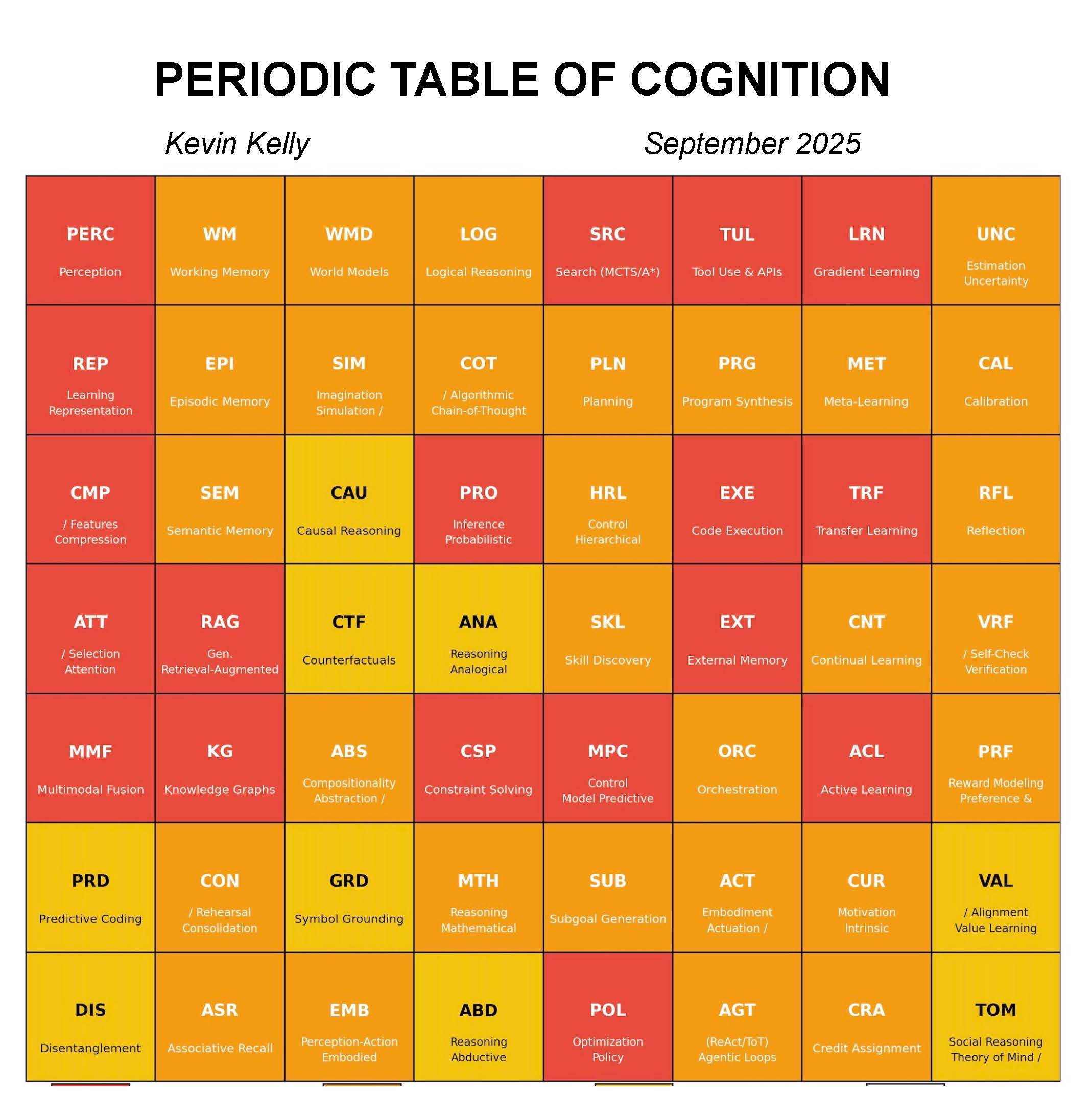
I asked ChatGPT5Pro to help me generate a periodic table of cognition given what we collectively know so far. It suggests 49 elements, arranged in a table so that related concepts are adjacent. The columns are families, or general categories of cognition such as “Perception”, “Reasoning”, “Learning”, so all the types of perception or reasoning are stacked in one column. The rows are sorted by stages in a cycle of thought. The earlier stages (such as “sensing”) are at the top, while later stages in the cycle (such as “reflect & align”) are at the bottom. So for example, in the family or category of “Safety” the AIs will tend to do the estimation of uncertainty first, later do verification, and only get to a theory of mind at the end.
The chart is colored according to how much progress we’ve made on each element. Red indicates we can synthesize that element in a robust way. Orange means we can kind of make it work with the right scaffolding. Yellow reflects promising research without operational generality yet.
«
Neat approach; at least it’s a different way to approach this question.
unique link to this extract
Clean trucking takes off • Bloomberg New Energy Finance
Colin McKerracher:
»
Over 89,000 electric trucks were sold in the first half of 2025, up 140% from the same period last year. China accounted for almost 80,000 of those, with sales in Europe making up most of the balance. US sales shrunk to just 200 units.
The global heavy truck market is about five years behind passenger cars in terms of EV adoption. It’s a harder market to crack for many reasons, including demanding duty cycles, thin margins and uncertainty with regard to residual values. Many of those concerns are steadily being addressed by better and cheaper batteries, more dedicated charging infrastructure and more operating experience from fleets.
About 4% of global heavy and medium segment truck sales will be electric this year, but in China that figure will be around 14%. Some European markets are heading even higher. Gasoline demand has already peaked in quite a few countries, but many considered diesel to be a safe growth area for years to come. If electric truck sales stay on their steady upward trajectory, that assumption won’t hold for long.
Policy support for electric trucking is strengthening in some markets and faltering in others. China has increasingly stringent truck-efficiency standards in place, along with a host of incentives for purchases and charging infrastructure, plus scrappage schemes for older trucks.
In Europe, truck CO2 emissions targets came into effect in 2025 and are set to drive much higher levels of EV adoption. While these standards remain in place, the European Commission has relaxed compliance requirements of similar targets for cars and vans, so something similar could happen in the trucking market. In the US, regulatory changes are already slowing down the market.
«
One or two Starlink satellites are falling back to Earth each day • EarthSky
Kelly Kizer Whitt:
»
There are currently one to two Starlink satellites falling back to Earth every day, according to retired Harvard astrophysicist Jonathan McDowell. His acclaimed website Jonathan’s Space Report is widely regarded as the definitive source on spacecraft that go up … and come down. When we asked him about the deluge of Starlink satellite breakups that have recently been flooding social media, he pointed us to his graph showing Starlink reentries over time.
There are more than 8,000 Starlink satellites overhead at this moment. They’re a product of the space transportation company SpaceX. And that number is growing. Plus there are other companies and countries also deploying more and more satellites, adding to the number of satellites in Earth orbit. Many of these are in low-Earth orbits, which extend up to an altitude of 1,200 miles (2,000 km) above our planet. And the lifespan of low-Earth orbit satellites, such as Starlink, is only about five to seven years. Soon, McDowell told us, there will be up to five satellite reentries per day. He said:
With all constellations deployed, we expect about 30,000 low-Earth orbit satellites (Starlink, Amazon Kuiper, others) and perhaps another 20,000 satellites at 1,000 km [620 miles] from the Chinese systems. For the low-orbit satellites we expect a 5-year replacement cycle, and that translates to 5 reentries a day. It’s not clear if the Chinese will orbit-lower theirs or just accelerate us to chain-reaction Kessler syndrome.
The Kessler syndrome is a scenario in which the density of objects in low-Earth orbit is high enough that collisions between objects cause a cascade, with each collision generating space debris that increases the likelihood of further collisions.
«
The thing about Kessler syndrome is that people will keep putting satellites up there, as long as it doesn’t happen, until it does happen. This is pretty much guaranteed by the overconfidence of humans when they have a financial interest in ignoring downsides.
unique link to this extract
Discord customer service data breach leaks user info and scanned photo IDs • The Verge
Jay Peters:
»
One of Discord’s third-party customer service providers was compromised by an “unauthorized party,” the company says. The unauthorized party gained access to “information from a limited number of users who had contacted Discord through our Customer Support and/or Trust & Safety teams” and aimed to “extort a financial ransom from Discord.” The unauthorized party “did not gain access to Discord directly.”
Data potentially accessed by the hack includes things like names, usernames, emails, and the last four digits of credit card numbers. The unauthorized party also accessed a “small number” of images of government IDs from “users who had appealed an age determination.” Full credit card numbers and passwords were not impacted by the breach, Discord says.
«
So it grabbed images used for age verification? Which is a really great thumbs-up for having age verification. Truly, there’s no satisfactory way to prove who you are online that doesn’t have serious collateral potential.
unique link to this extract
Costco will sell Ozempic and Wegovy at half price • People
Cara Lynn Shultz:
»
Costco members will be able to get GLP-1 medications like Ozempic and Wegovy at half price as part of the retailer’s new partnership with manufacturer Novo Nordisk.
The medication will be available through the Costco Member Prescription Program. It will cost $499 for a four-week supply of injectable pens — but members must have a prescription and pay out of pocket. (Many insurance companies do not cover the medications.)
A Novo Nordisk spokesperson tells PEOPLE that Costco Executive Members and Costco Citibank Visa cardholders will receive an additional 2% discount on their Wegovy or Ozempic, subject to applicable terms.
“Our collaboration with Costco is another step forward by Novo Nordisk in making real Wegovy and Ozempic easier to access and afford — right where people already shop,” Dave Moore, Executive Vice President, U.S. Operations of Novo Nordisk Inc., told PEOPLE in a statement.
«
You either get them by selling them food, or stuff to make them uninterested in food. Win-win! But does this make Costco a fast no-food outlet?
unique link to this extract
G-Drive fire destroys 125,000 officials’ data • Chosun
Choi Yeon-jin and Kim Young-woo:
»
the ‘G-Drive,’ a work cloud, an online storage device, used by central government officials, was completely destroyed in a fire at the National Information Resources Service in Daejeon on the 26th of last month. Unlike other online administrative systems, the G-Drive is expected to cause significant damage as it has no backup copies. The Ministry of Personnel Management, where all affiliated officials use the G-Drive, is particularly affected. A source from the Ministry of Personnel Management said, “It’s daunting as eight years’ worth of work materials have completely disappeared.”
The G-Drive is a type of online hard disk where documents, photos, and other materials can be stored, similar to Google’s Google Drive. It was created in 2017 with the aim of making it easier for public officials to share documents and enhancing security. The name G-Drive is said to be derived from the word “government”. It provided 30GB per public official. At the time, the Ministry of the Interior and Safety also issued guidelines to each ministry stating, “All work materials should not be stored on office PCs but should be stored on the G-Drive.”
The actual number of users is about 17% of all central government officials. According to the Ministry of the Interior and Safety, as of last August, 125,000 public officials from 74 ministries are using it. The stored data amounts to 858TB (terabytes), equivalent to 449.5 billion A4 sheets. The G-Drive system was installed in the fifth-floor computer room of the National Information Resources Service, where the fire occurred. It is one of the 96 systems completely destroyed by the fire.
The problem is that, unlike other systems, the G-Drive cannot be restored. A source from the Ministry of the Interior and Safety said, “The G-Drive couldn’t have a backup system due to its large capacity,” and added, “The remaining 95 systems have backup data in online or offline forms.”
The Ministry of Personnel Management, which uses the G-Drive extensively, is in a state of emergency. A source from the Ministry of Personnel Management said, “Employees stored all work materials on the G-Drive and used them as needed, but operations are now practically at a standstill.”
«
Utterly calamitous. The idea that you couldn’t or wouldn’t back up 858TB in a different location is bad in so, so many ways.
unique link to this extract
OpenAI looks to take 10% stake in AMD through AI chip deal • CNBC
MacKenzie Sigalos:
»
OpenAI and Advanced Micro Devices (AMD) have reached a deal that could see Sam Altman’s company take a 10% stake in the chipmaker.
AMD stock skyrocketed more than 30% on Monday following the news.
OpenAI will deploy six gigawatts of AMD’s Instinct graphics processing units over multiple years and across multiple generations of hardware, the companies said Monday. It will kick off with an initial 1-gigawatt rollout of chips in the second half of 2026.
“We have to do this,” OpenAI President Greg Brockman told CNBC’s “Squawk on the Street.” “This is so core to our mission if we really want to be able to scale to reach all of humanity, this is what we have to do.”
Brockman added that the company is already unable to launch many features in ChatGPT and other products that could generate revenue because of the lack of compute power.
As part of the tie-up, AMD has issued OpenAI a warrant for up to 160 million shares of AMD common stock, with vesting milestones tied to both deployment volume and AMD’s share price.
The first tranche vests with the first full gigawatt deployment, with additional tranches unlocking as OpenAI scales to 6 gigawatts and meets key technical and commercial milestones required for large-scale rollout.
If OpenAI exercises the full warrant, it could acquire approximately 10% ownership in AMD, based on the current number of shares outstanding.
«
This is a bit like Microsoft buying a chunk of Intel back in the days when Windows was on the rise against all the competing PR operating systems. OpenAI is very, very serious about getting to the top of the heap in the chatbot wars, as I guess we’re going to call this.
unique link to this extract
| • Why do social networks drive us a little mad? • Why does angry content seem to dominate what we see? • How much of a role do algorithms play in affecting what we see and do online? • What can we do about it? • Did Facebook have any inkling of what was coming in Myanmar in 2016?Read Social Warming, my latest book, and find answers – and more. |
Errata, corrigenda and ai no corrida: none notified
You can sign up to receive each day’s Start Up post by email. You’ll need to click a confirmation link, so no spam.
There’s another post coming this week at the Social Warming Substack on Friday at 0845 UK time. Free signup.
 The Overspill: when there's more that I want to say
More on the DVLA here.
https://dafyddvaughan.uk/blog/2025/why-some-dvla-digital-services-dont-work-at-night/
Linked to it in March!
Regarding “it says nothing good that the biggest company in the world bends before an unsubstantiated claim made by a group of authoritarians.” – I have long, long, been worried about what could happen when the immense surveillance power of a few mega-corporations is put into the service of a modern totalitarian regime. But I’ve had no desire to go around (again) trying to raise alarm bells. I know what would’ve happened – getting told “Governments shouldn’t do that! And are you Against Technology? Anyway, the solution is to make sure there’s never a totalitarian regime, don’t you have faith in democracy?”. I’m not so egotistical as to think I could change the course of history.
I don’t believe the US is at actual internal war – yet. But in my view, we are going down a very bad path, and it’s easy to see how it could quickly get much worse. If Civil War II (this time – Red vs Blue) does happen, I severely doubt Google, Facebook, Apple, etc are going to be part of The Resistance.
Indeed – the nexus of control is very, very small now. One starts to look at China and think “well, ok, but at least they can build big bridges without bankrupting themselves and within a reasonable timescale.”