
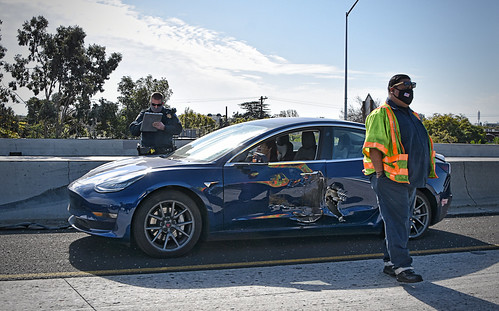
Drivers of electric vehicles are more likely to have a crash in the year after first getting them, insurance data shows. CC-licensed photo by Chris Yarzab on Flickr.
You can sign up to receive each day’s Start Up post by email. You’ll need to click a confirmation link, so no spam.
It’s Friday, so there’s another post due at the Social Warming Substack at about 0845 UK time.
A selection of 10 links for you. Foot on the gas? I’m @charlesarthur on Twitter. On Threads: charles_arthur. On Mastodon: https://newsie.social/@charlesarthur. Observations and links welcome.
Netflix won’t have a Vision Pro app, compromising the device’s appeal • Ars Technica
Samuel Axon:
»
In the leadup to Vision Pro preorders on Friday, Apple has seemingly been prioritizing the message that the device will be an ideal way to watch movies and TV shows. In many ways, that might be true, but there’s one major caveat: Netflix.
In a statement reported by Bloomberg today, Netflix revealed that it does not plan to offer an app for Vision Pro. Instead, users will have to use a web-based interface to watch the streaming service.
Netflix compares the experience to the Mac, but there are a few reasons this won’t be an ideal experience for users. First, the iPad and iPhone mobile apps support offline viewing of downloaded videos. That’s particularly handy for when you’re flying, which is arguably one of the best use cases for Vision Pro.
Unfortunately, Netflix doesn’t support offline downloads on the web. It also remains to be seen what resolution will be achievable—the maximum resolution of a Netflix stream depends on the browser, with most capping out at 720p. That wouldn’t look so great on a 100-foot virtual screen.
Granted, Netflix streams at up to 4K on Safari for macOS, but we don’t know if that will be the case for Safari on Vision Pro.
It will also make launching the app more complicated, and the interface won’t be as nice to use as a native app.
«
Apple here perhaps reaping what it sows: it insists on that 30% from anything on the App Store, Netflix refuses and isn’t even allowed to explain how people can sign up outside the app. So Netflix is happy to slow-walk any VisionOS product. Plus, of course, there’s essentially zero user base right now. The combination of no demand and a bit of corporate schadenfreude must be irresistible.
unique link to this extract
Teslas crash more than fuel-powered cars. Here’s why • CNN Business
Peter Valdes-Dapena:
»
insurance analysts at LexisNexis found that, when vehicle owners switch from gasoline-powered cars to electric cars, they tend to crash more. Drivers also tend to crash somewhat more when switching to [different] fuel-powered vehicles, too, but the increase is more pronounced with EVs. The frequency of insurance claims rises by about 14.3% while the severity of claims, or the amount that has to be paid out, increases by 14.5%, according to the data.
The increase in incidents is highest during the first year or so after drivers get the new electric vehicle, but then tapers off after that, according to LexisNexis, presumably as people get used to driving the new model. There is much less of a problem when a driver changes from a gasoline-powered vehicle to another gas-powered one, they found.
…In the insurance business, there is a long-established connection between horsepower [which EVs have in spades] and the frequency and amount of insurance claims. Fast cars hit things more often and they hit them harder, leading to more – and more severe – crashes. Added to this, EVs lack the usual engine sounds that go along with rapid acceleration and high speeds, so it’s conceivable drivers are less aware of how fast they’re going.
Besides their added speed, EVs are also heavier than gas-powered vehicles because of their large, dense battery packs. That also leads to more damage in the vehicles the EV hits resulting in higher insurance claims.
High speeds aren’t even necessarily the issue, said Lu. Controlling speed is especially critical in low-speed environments, like a parking garages, with other cars and concrete posts all around. With gas cars, starting off from a stop requires the engine to rev up a bit before the car can start moving. Not so with EVs, which respond differently to pedal pressure.
«
So it’s not Teslas per se, it’s the EV experience. (Insurers have also, the story says, seen the same pattern in China, where Teslas aren’t the dominant EV at all.)
unique link to this extract
Billionaires wanted to save the news industry. They’re losing a fortune • The New York Times
Benjamin Mullin and Katie Robertson:
»
There’s an old saying about the news business: If you want to make a small fortune, start with a large one.
As the prospects for news publishers waned in the last decade, billionaires swooped in to buy some of the country’s most fabled brands. Jeff Bezos, the founder of Amazon, bought The Washington Post in 2013 for about $250m. Dr. Patrick Soon-Shiong, a biotechnology and start-up billionaire, purchased The Los Angeles Times in 2018 for $500m. Marc Benioff, the founder of the software giant Salesforce, purchased Time magazine with his wife, Lynne, for $190m in 2018.
All three newsrooms greeted their new owners with cautious optimism that their business acumen and tech know-how would help figure out the perplexing question of how to make money as a digital publication.
But it increasingly appears that the billionaires are struggling just like nearly everyone else. Time, The Washington Post and The Los Angeles Times all lost millions of dollars last year, people with knowledge of the companies’ finances have said, after considerable investment from their owners and intensive efforts to drum up new revenue streams.
“Wealth doesn’t insulate an owner from the serious challenges plaguing many media companies, and it turns out being a billionaire isn’t a predictor for solving those problems,” said Ann Marie Lipinski, the curator of the Nieman Foundation for Journalism at Harvard University. “We’ve seen a lot of naïve hope attached to these owners, often from employees.”
«
Buying Time probably wasn’t the smartest move – its glory days are far in the past – but if you’re a billionaire, surely you can tell yourself that you can afford to lose $30m to $40m (as the LA Times looks like doing) per year? Or maybe your mindset is always for more, and more, and more.
unique link to this extract
Garbage AI rewrites are starting to infect Google News • 404 Media
Joseph Cox:
»
Google News is boosting sites that rip-off other outlets by using AI to rapidly churn out content, 404 Media has found. Google told 404 Media that although it tries to address spam on Google News, the company ultimately does not focus on whether a news article was written by an AI or a human, opening the way for more AI-generated content making its way onto Google News.
The presence of AI-generated content on Google News signals two things: first, the black box nature of Google News, where gaining entry into Google News’ rankings at all is an opaque, but apparently gameable, system. Second, how Google may not be ready for the moderation demands needed of its News service in the age of consumer-access AI, where essentially anyone is able to churn out a mass of content with little to no regard for its quality or originality.
“I want to read the original stories written by journalists who actually researched them and spoke to primary sources. Any news junkie would,” Brian Penny, a ghostwriter who first flagged some of the seemingly AI-generated articles to 404 Media, said.
One example was a news site called Worldtimetodays.com, which is littered with full page and other ads. On Wednesday it published an article about Star Wars fandom. The article was very similar to one published a day earlier on the website Distractify, with even the same author photo.
One major difference, though, was that Worldtimetodays.com wrote “Let’s be honest, war of stars fans,” rather than Star Wars fans. Another article is a clear rip-off of a piece from Heavy.com, with Worldtimetodays.com not even bothering to replace the Heavy.com watermarked artwork. Gary Graves, the listed author on Worldtimetodays.com, has published more than 40 articles in a 24 hour period.
«
Well how do you do fellow people who are not yet adults, as the caption (nearly) goes. Google does face a problem here: it is going to have to moderate more heavily, and some sites (looking at you, CNet and Sports Illustrated) mix AI-generated and human-written content. (As an aside, I tweaked some of the sentences in this extract because I thought they could be expressed better. Do a diff and let me know your thoughts. No AI used.)
unique link to this extract
US buildings kill up to a billion birds a year. These architects want to save them • The Guardian
Maanvi Singh:
»
Chicago’s 82-story Aqua Tower appears to flutter with the wind. Its unusual, undulating facade has made it one of the most unique features of Chicago’s skyline, distinct from the many right-angled glass towers that surround it.
In designing it, the architect Jeanne Gang thought not only about how humans would see it, dancing against the sky, but also how it would look to the birds who fly past. The irregularity of the building’s face allows birds to see it more clearly and avoid fatal collisions. “It’s kind of designed to work for both humans and birds,” she said.
As many as 1 billion birds in the US die in building collisions each year. And Chicago, which sits along the Mississippi Flyway, one of the four major north-south migration routes, is among the riskiest places for birds. This year, at least 1,000 birds died in one day from colliding with a single glass-covered building. In New York, which lies along the Atlantic Flyway, hundreds of species traverse the skyline and tens of thousands die each year.
As awareness grows of the dangers posed by glistening towers and bright lights, architects are starting to reimagine city skylines to design buildings that are both aesthetically daring and bird-safe.
Some are experimenting with new types of patterned or coated glass that birds can see. Others are rethinking glass towers entirely, experimenting with exteriors that use wood, concrete or steel rods. Blurring lines between the indoors and outdoors, some architects are creating green roofs and facades, inviting birds to nest within the building.
“Many people think about bird-friendly design as yet another limitation on buildings, yet another requirement,” said Dan Piselli, director of sustainability at the New York-based architecture firm FXCollaborative. “But there are so many design-forward buildings that perfectly exemplify that this doesn’t have to limit your design, your freedom.”
«
The only thing more deadly, by numbers, to birds: cats.
unique link to this extract
Each Facebook user is monitored by thousands of companies • The Markup
Jon Keegan:
»
By now most internet users know their online activity is constantly tracked. No one should be shocked to see ads for items they previously searched for, or to be asked if their data can be shared with an unknown number of “partners.”
But what is the scale of this surveillance? Judging from data collected by Facebook, and newly described in a unique study by non-profit consumer watchdog Consumer Reports, it’s massive. Examining the data may leave you with more questions than answers.
Using a panel of 709 volunteers who shared archives of their Facebook data, Consumer Reports found that a total of 186,892 companies sent data about them to the social network. On average, each participant in the study had their data sent to Facebook by 2,230 companies. That number varied significantly, with some panelists’ data listing over 7,000 companies providing their data.
The Markup helped Consumer Reports recruit participants for the study. Participants downloaded an archive of the last three years of their data from their Facebook settings, then provided it to Consumer Reports.
By collecting data this way, the study was able to examine a form of tracking that is normally hidden: so-called “server-to-server” tracking, in which personal data goes from a company’s servers to Meta’s servers. Another form of tracking, in which Meta tracking pixels are placed on company websites, is visible to users’ browsers.
Because the data came from a self-selected group of users, and because the results were not demographically adjusted, the study does not “make any claims about how representative this sample is of the US population as a whole,” Consumer Reports noted. Participants were also likely more privacy conscious and technically inclined than typical users and more likely to be members of Consumers Reports.
«
Meta’s response, in the story, is hardly a refutation. It’s a colossal number. I’d love to see the number for the UK or Europe.
unique link to this extract
Google is changing search results for EU citizens • The Register
Richard Speed:
»
Google is making some changes to how its products, including search, will work in Europe.
The reason? It is preparing for the new Digital Markets Act (DMA) rules scheduled to come into play in March. Under the DMA, Google is a classified as a “Gatekeeper,” meaning it holds “considerable market power.”
Changes to search results will be the most visible alteration for the majority of users. Where Google might show a link to several businesses – for example, hotels – it will add a space for comparison sites and a way for users to refine their searches to include comparison sites.
The company said: “For categories like hotels, we will also start testing a dedicated space for comparison sites and direct suppliers to show more detailed individual results including images, star ratings and more.”
The result is that some other services, such as its own third party booking service, Google Flights, will be cut from search pages.
Google is also adding choice screens to Android phones to allow users to select a default search engine. The same type of choice might also turn up when you set up Chrome on a desktop or iOS device.
There will be extra consents for linked services – European users can expect to see some additional consent banners regarding data sharing. According to Google, opting out of linking services could result in limited functionality or some features stopping working altogether.
Google has yet to give any clarity on what exactly will stop working should a European user opt out of linking and sharing their data between services.
«
Space for comparison sites? Which the comparison sites don’t have to pay for? That sounds like a win for the case originally brought back in 2010 to the European Commission by British comparison site Foundem, which saw Google fined in 2017.
unique link to this extract
ChatGPT’s looks for its FarmVille moment • The Atlantic
David Karpf:
»
Initially announced two months ago, the GPT Store allows the product’s business and “ChatGPT Plus” users—those paying $20 a month for an upgraded version of the service—to create, share, and interact with customized AI agents (called GPTs) that are tailored to specific tasks. The company claims that its users have built more than 3 million of these custom bots since they were granted the ability to do so in November, in preparation for this launch.
When OpenAI debuted the store, it highlighted six specific GPTs: A bot that will recommend hiking and biking trails, one that synthesizes and summarizes academic papers for you, a coding tutor from Khan Academy, a presentation-design assistant from Canva, an AI that recommends new books to read, and an AI math-and-science tutor. The immediate aim of these entries and others is presumably to persuade users to pay that monthly subscription fee. But the broader project here is more ambitious. OpenAI is trying to turn ChatGPT into a platform.
It’s deeply reminiscent of Facebook circa 2007. OpenAI has begun the hunt for its FarmVille.
…The problem for OpenAI is that the majority of ChatGPT’s 100 million weekly users rely on the free product. Meanwhile, the company’s CEO, Sam Altman, has described the cost of keeping ChatGPT’s underlying engine running as “eye-watering.” In the short term, the more outside developers that OpenAI attracts, the more tailored GPTs offering trail recommendations and science tips it hosts, the greater the chance that those free users choose to sign up as paying subscribers. The company did not comment on its plans when reached for this article—a spokesperson only pointed to a November blog post about the GPT Store—but the medium-term ambition seems identical to Facebook’s in 2007. OpenAI can take the next step in remaking the internet user experience only if it can come up with a better answer to the question “Okay, but what else will people use it for?”
Altman, like Mark Zuckerberg before him, has imperial ambitions. Zuckerberg aimed to colonise the internet, remaking it in Facebook’s image. He largely succeeded. Altman’s ambitions are even larger.
«
Even larger than “colonise the internet”? Yikes.
unique link to this extract
What killed the fight scene? And is it finally coming back? • Fast Company
Ryan Broderick:
»
On a rainy weekend last year, after realizing that my viewing queue had run dry, I started plumbing the depths of my streaming services in search of the shows and movies that are buried behind the subpages and subdirectories of bloated streaming platforms. This is how I stumbled across a show called Warrior on Max (though at the time the platform was still called HBO Max).
I didn’t leave my couch all day. The show is set in 1870s San Francisco and follows Chinese gangs, brutal Irish cops, and corrupt politicians as the different factions attempt to survive in America. It’s based on the writings of Bruce Lee, but is largely its own story. And while it isn’t exactly prestige TV, it’s well-made, has some fascinating things to say about race in America, and, most crucially, has some of the best fight choreography I’ve ever seen.
As I kept watching the show, binging my way well into the second season, I realized that I had actually been starved for fight scenes. Not CGI-filled laser beam battles, but emotive, story-driven, visually interesting fight choreography. Duels that used their surroundings and involved characters with unique, personality-driven fighting styles. Warrior felt like stumbling across an oasis in the desert when I didn’t even know I was thirsty. I began to wonder exactly how long it had been since I’d watched a really good fight on screen.
«
I found the argument in this a little incoherent – but like him, I long ago tired of superhero (and light sabre) fight scenes, and find humans knocking bits out of each other far more compelling. He mentions the Bourne fight sequences, to which I’d add Gangs of London’s first episode, and of course the fight sequences in Atomic Blonde, especially including the 10-minute single-take one near the end. (It’s so long YouTube sticks an advert in the middle 😫). Fight choreography is at an all-time high, superhero junk excepted.
TikTok is a time bomb • The Prism
Gurwinder [who seems only to have one name, like Prince]:
»
Mao is credited with eventually crushing the opium epidemic, and since then the view among many in China has been that Western liberalism leads to decadence and that authoritarianism is the cure. But one man has done more than anyone to turn this thesis into policy.
His name is Wang Huning, and, despite not being well known outside China, he has been China’s top ideological theorist for three decades, and he is now member number 4 of the seven-man Standing Committee—China’s most powerful body. He advised China’s former leaders Jiang Zemin and Hu Jintao, and now he advises Xi Jinping, authoring many of his policies. In China he is called “guoshi” (国师: literally, “teacher of the nation”).
Wang refuses to do press or to even speak with foreigners, but his worldview can be surmised from the books he wrote earlier in his life. In August 1988, Wang accepted an invitation to spend six months in the US, and traveled from state to state noting the way American society operates, examining its strengths and weaknesses. He recorded his findings in the 1991 book, America Against America, which has since become a key CCP text for understanding the US.
The premise of the book is simple: the US is a paradox composed of contradictions: its two primary values—freedom and equality—are mutually exclusive. It has many different cultures, and therefore no overall culture. And its market-driven society has given it economic riches but spiritual poverty. As he writes in the book, “American institutions, culture and values oppose the United States itself.”
For Wang, the US’s contradictions stem from one source: nihilism. The country has become severed from its traditions and is so individualistic it can’t make up its mind what it as a nation believes. Without an overarching culture maintaining its values, the government’s regulatory powers are weak, easily corrupted by lobbying or paralyzed by partisan bickering. As such, the nation’s progress is directed mostly by blind market forces; it obeys not a single command but a cacophony of three hundred million demands that lead it everywhere and nowhere.
In Wang’s view, the lack of a unifying culture puts a hard limit on the US’s progress. The country is constantly producing wondrous new technologies, but these technologies have no guiding purpose other than their own proliferation.
«
I know: you’re saying “where’s TikTok in all this?” But this is a fascinating essay, which does focus on TikTok, and is well worth considering; especially because it tells you why China loves Trump.
unique link to this extract
| • Why do social networks drive us a little mad? • Why does angry content seem to dominate what we see? • How much of a role do algorithms play in affecting what we see and do online? • What can we do about it? • Did Facebook have any inkling of what was coming in Myanmar in 2016? Read Social Warming, my latest book, and find answers – and more. |
Errata, corrigenda and ai no corrida: none notified
 The Overspill: when there's more that I want to say
The view that “freedom and equality — are mutually exclusive” is pretty common in certain sections of the US. Peter Thiel might be the might be the most well-known proponent in tech circles, but it’s a widespread idea. It’s also not unknown to hear “market-driven society has given it economic riches but spiritual poverty”, especially from religious conservatives. This sounds like a pretty standard line of the new techologicies are corruping the youth, and they aren’t buckling down to being the uncomplaining workers or Party drones idealized as proper conduct by the Establishment figures writing these screeds.