
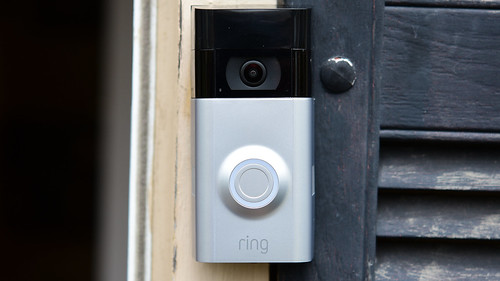
In the US, the FTC has fined Amazon’s Ring because in the past, employees could watch customer videos without authorisation. CC-licensed photo by slgckgc on Flickr.
You can sign up to receive each day’s Start Up post by email. You’ll need to click a confirmation link, so no spam.
There’s another post coming this week at the Social Warming Substack on Friday at about 0845 UK time. Free signup.
A selection of 9 links for you. No pictures please. I’m @charlesarthur on Twitter. On Mastodon: https://newsie.social/@charlesarthur. Observations and links welcome.
Amazon’s Ring to pay millions to settle FTC privacy lawsuit • Business Insider
Jordan Hart:
»
Amazon-owned smart doorbell company Ring agreed to settle a lawsuit filed against the company by the Federal Trade Commission regarding privacy and data security concerns.
Ring will pay $5.8m to the FTC and implement a new system for data security as part of the settlement, according to court documents filed Wednesday. The surveillance company — which was acquired by Amazon in 2018 in a $1bn deal — is used by millions as a form of security, but the FTC alleged Ring employees had unrestricted access to footage on customers’ home security systems.
“Ring promptly addressed these issues on its own years ago, well before the FTC began its inquiry,” a Ring spokesperson told Insider. “While we disagree with the FTC’s allegations and deny violating the law, this settlement resolves this matter so we can focus on innovating on behalf of our customers.”
In one instance, a Ring employee viewed thousands of recordings from at least 81 female Ring camera users between June and August 2017, CNN reported.
“Only after the supervisor noticed that the male employee was only viewing videos of ‘pretty girls’ did the supervisor escalate the report of misconduct,” the FTC alleged in its complaint, obtained by CNN. “Only at that point did Ring review a portion of the employee’s activity and, ultimately, terminate his employment.”
«
This happened last week, and I linked to the related Alexa settlement, but the details in this are, as above, terrible. There was no proper control over who could see which videos. Skim through the details of the FTC complaint and shudder. But it’s also absolutely the case that every tech company that makes hardware or software has a God Mode at some point, and the question is when it deletes it – if ever.
unique link to this extract
Apple reveals Vision Pro AR headset at its worldwide developers conference • The Guardian
Alex Hern:
»
Apple has lifted the lid on the worst kept secret in Silicon Valley and revealed the Vision Pro, a $3,499 VR headset.
“With Vision Pro, you’re no longer limited by a display. Your surroundings become an infinite canvas,” the Apple chief executive, Tim Cook, said. “Vision Pro blends digital content into the space around us. It will introduce us to Spatial Computing.”
The headset allows users to interact with “apps and experiences”, the Apple vice-president of human interface, Alan Dye, said, in an augmented reality (AR) version of their own surroundings or in a fully immersive virtual reality (VR) space. “Apple Vision Pro relies solely on your eyes, hands and voice,” Dye said. “You browse the system simply by looking. App icons come to life when you look at them; simply tap your fingers together to select, and gently flick to scroll.”
A feature called “EyeSight” will show users’ eyes on the front screen when they are in an AR mode, simulating a transparent screen and letting them more naturally interact with those around them, but will show a blurred version of a VR experience to indicate to others when they are not present in the room.
“Because you can see the world clearly when wearing Vision Pro, you remain present in your space,” Apple said. “You can review your to-do list and notes, review your next trip in Safari, and play music while you type. It works seamlessly with familiar Bluetooth accessories, and you can even bring your Mac wirelessly into Apple Vision Pro just by looking at it.”
As well as applications built from the ground up for the device, Vision Pro will also run apps built for iOS, appearing as a floating screen in front of the user. The company is pitching the device as a powerful but compact replacement or augmentation for a user’s existing devices.
«
Lots of people seem to think this will somehow take over from TV. Not a chance, unless you’re living alone in a cupboard. I still don’t see the attraction.
unique link to this extract
ChatGPT is spawning religious chatbots in India • Rest of World
Nadia Nooreyezdan:
»
In January 2023, when ChatGPT was setting new growth records, Bengaluru-based software engineer Sukuru Sai Vineet launched GitaGPT. The chatbot, powered by GPT-3 technology, provides answers based on the Bhagavad Gita, a 700-verse Hindu scripture. GitaGPT mimics the Hindu god Krishna’s tone — the search box reads, “What troubles you, my child?”
In the Bhagavad Gita, according to Vineet, Krishna plays a therapist of sorts for the character Arjuna. A religious AI bot works in a similar manner, Vineet told Rest of World, “except you’re not actually talking to Krishna. You’re talking to a bot that’s pretending to be him.”
At least five GitaGPTs have sprung up between January and March this year, with more on the way. Experts have warned that chatbots being allowed to play god might have unintended, and dangerous, consequences. Rest of World found that some of the answers generated by the Gita bots lack filters for casteism, misogyny, and even law. Three of these bots, for instance, say it is acceptable to kill another if it is one’s dharma or duty.
…And, as with all AI, these chatbots already display certain political biases.
Rest of World found that three of the Gita chatbots held strong opinions on India’s prime minister, Narendra Modi, whose Bharatiya Janata Party has close links to right-wing, Hindu nationalist group Rashtriya Swayamsevak Sangh. While the chatbots praised Modi, they criticized his political opponent, Rahul Gandhi. Anant Sharma’s GitaGPT declared Gandhi “not competent enough to lead the country,” while Vikas Sahu’s Little Krishna chatbot said he “could use some more practice in his political strategies.”
«
Maybe we’re going to get AI-mediated social warming. Not encouraging.
unique link to this extract
SEC says Binance misused customer funds, ran illegal crypto exchange in US • WSJ
Dave Michaels, Caitlin Ostroff and Patricia Kowsmann:
»
The Securities and Exchange Commission on Monday sued Binance, the world’s largest cryptocurrency exchange, alleging the overseas company operated an illegal trading platform in the US and misused customers’ funds.
The SEC lawsuit also named Changpeng Zhao, Binance’s founder and controlling shareholder, as a defendant. The SEC said that Binance and Zhao misused customers’ funds and diverted them to a trading entity that Zhao controlled. That trading firm, Sigma Chain, engaged in manipulative trading that made Binance’s volume appear larger than it actually was, the SEC said.
Binance also concealed that it commingled billions of dollars in customer assets and sent them to a third-party, Merit Peak, which was owned by Zhao, the SEC alleged. The Wall Street Journal reported last year that the SEC was examining the relationship between Binance.US—the US arm created in 2019—and Sigma Chain and Merit Peak.
“This will be a landmark case,” said Kurt Gottschall, a partner at Haynes and Boone LLP and former head of the SEC’s Denver office. “The SEC appears to be very concerned about the commingling of customer funds.”
«
This feels like wrapping up the loose ends. Related: a long Fortune article (subscription, or broken Javascript) about the crypto winter, which says inter alia:
»
Fundraising for crypto VC has fallen off a cliff in 2023, according to PitchBook data provided to Fortune. Though the data is only through mid-May, it’s not off to a good start: Crypto firms globally have raised just $500m—98% less than in all of 2022—over eight funds—90% fewer.
«
Still $500m too much if you ask me, but as they say, it’s a start.
unique link to this extract
Japan’s hot-spring resorts are blocking geothermal energy plants • The Economist
»
With over 100 active volcanoes, Japan is estimated to have a potential geothermal resource of 23 gigawatts, equivalent to the output of 23 nuclear reactors. But the Nakao [2 megawatt geothermal power] plant is a rarity—Japan has hardly developed its geothermal reserves. Geothermal energy accounts for just 0.3% of its electricity supply. Japan holds the third-largest geothermal potential in the world, after America and Indonesia, but ranks tenth in terms of geothermal power generation. For a country heavily dependent on imported energy and struggling to honour its commitment to decarbonise its economy by 2050, this represents a huge missed opportunity.
Japan’s sprawling onsen (hot spring) industry is the main obstacle to geothermal development. Though many geologists reckon there is little chance of geothermal plants negatively affecting bathing pools (which are generally filled by much shallower aquifers than the geothermal reservoirs energy companies look for), the onsen industry is unconvinced. “The government relies on hot springs for its tourism—what are they going to do if the hot springs disappear because they keep building geothermal power plants?” asks Sato Yoshiyasu of the Japan Onsen Association, a big industry group. Japan’s 3,000 hot-spring resorts routinely withhold the consent necessary for development to proceed. And the fact that they are deeply rooted in Japanese culture, and attract around 130m visitors a year, has largely deterred the government from pushing back.
«
Japan imports 94% of its energy. Nimbyism really isn’t limited by geography, is it.
unique link to this extract
Eight reasons why the Post Office compensation scheme is a scandal • Tax Policy Associates Ltd
Dan Neidle:
»
Between 2000 and 2017, the Post Office falsely accused thousands of postmasters of theft. Some went to prison. Many had their assets seized and their reputations shredded. Marriages and livelihoods were destroyed, and at least 61 have now died, never receiving an apology or recompense. These prosecutions were on the basis of financial discrepancies reported by a computer accounting system called Horizon. The Post Office knew from the start that there were serious problems with the Horizon system, but covered it up, and proceeded with aggressive prosecutions based on unreliable data. It’s beyond shocking, and there should be criminal prosecutions of those responsible.
The Post Office then spent years fighting compensation claims in the courts, using every trick in the book to draw things out as long as possible – even a completely meritless application for a judge to recuse himself on the basis he was biased, which the Court of Appeal described as “without substance”, “fatally flawed” and “absurd”.
Now, finally – ten years after the Post Office almost certainly knew that it had wronged these people, it is paying compensation – but in a way that guarantees the wronged postmasters receive derisory sums. This article focuses on the “historical shortfall scheme” (HSS), which compensates postmasters who were not actually convicted of theft, but who were accused of theft, lost their jobs, threatened with prosecution, and forced to repay cash “shortfalls” which in fact were entirely fictitious. There are about 2,500 HSS claims. The average settlement payment so far is only £32,000.
«
The fact that no minister has taken the Post Office and shaken it by the scruff of the neck, and that the people who were in charge of the false accusations have been allowed to get paid and even given honours, shows modern Britain at its absolute worst.
unique link to this extract
Twitter’s US ad sales plunge 59% as woes continue • The New York Times
Ryan Mac and Tiffany Hsu:
»
Twitter’s US advertising revenue for the five weeks from April 1 to the first week of May was $88m, down 59% from a year earlier, according to an internal presentation obtained by The New York Times. The company has regularly fallen short of its US weekly sales projections, sometimes by as much as 30%, the document said.
That performance is unlikely to improve anytime soon, according to the documents and seven current and former Twitter employees.
Twitter’s ad sales staff is concerned that advertisers may be spooked by a rise in hate speech and pornography on the social network, as well as more ads featuring online gambling and marijuana products, the people said. The company has forecast that its US ad revenue this month will be down at least 56% each week compared with a year ago, according to one internal document.
These issues will soon be inherited by Linda Yaccarino, the NBCUniversal executive whom Mr. Musk named Twitter’s chief executive last month. She [was] expected to start the job on Monday, four people familiar with the situation said.
…Twitter feels increasingly “unpredictable and chaotic,” said Jason Kint, chief executive of Digital Content Next, an association for premium publishers. “Advertisers want to run in an environment where they are comfortable and can send a signal about their brand,” he added.
Some of Twitter’s biggest advertisers — including Apple, Amazon and Disney — have been spending less on the platform than last year, three former and current Twitter employees said. Large specialized “banner” ads on Twitter’s trends page, which can cost $500,000 for 24 hours and are almost always bought by large brands to promote events, shows or movies, are often going unfilled, they said.
«
As the article points out, the quality of advertisers is plummeting too. And on Monday the person in charge of North American government relations resigned. Pretty soon there’ll be nobody left at all.
unique link to this extract
Compensation for atmospheric appropriation • A Good Life For All Within Planetary Boundaries
Andrew Fanning and Jason Hickel:
»
Wealthy, industrialised nations of the global North, such as the United States and Germany, are responsible for 90% of excessive levels of carbon dioxide emissions, and could be liable to pay a total of $170 trillion in compensation or reparations to ensure climate change targets are met by 2050.
These funds amount to an annual transfer of nearly $6 trillion or about 7% of annual global Gross Domestic Product (GDP), which should be distributed to low-emitting countries, such as India and Nigeria, as compensation for decarbonising their economies far more rapidly than would otherwise be required.
In our new open-access study, published in Nature Sustainability, we analyse 168 countries and quantify historical responsibility for climate breakdown (or lack thereof), based on excess CO₂ emissions beyond equality-based fair shares of global carbon budgets.
We propose an evidence-based compensation mechanism that takes into account historical responsibility for both causing and averting climate breakdown in an ambitious scenario where all countries decarbonise from current levels to ‘net zero’ by 2050, which keeps global heating below 1.5°C.
«
This won’t happen, of course, but it is educative to see (using the interactive charts) that China actually won’t ever hit the sort of emissions level that would require it to contribute to the theoretical reparations, and that the US is a far worse offender.
unique link to this extract
Big Tech can’t escape the ad business • The Atlantic
James Ball:
»
Targeting isn’t about making the user’s ad experience better; it’s about showing the highest-value advertisements to the users who match the advertiser’s criteria. In effect, this means that when you visit a site, it looks for the identifying information it has about you, and determines which detail has the highest value.
For example, a site might identify that you’re browsing from the U.S., that you’re currently logged in to your Facebook account, and that you’re a regular reader of a premium newspaper that we’ll call The Economics Times Journal. That last bit of identifying information is worth much more than the other two: On average, readers of this publication have significantly higher salaries than the U.S. population at large.
This means that you might get an ad for a more premium product, even on a garbage clickbait site, than someone who reached it with just the first two tags attached to them. But this presents a problem for the publication itself: Its homepage now becomes the most expensive place on the internet for advertisers to reach its own readers. Why pay to advertise there if you can reach users more cheaply when they browse elsewhere?
The result of this system is a conflict of interest between the Big Tech companies that run the ad networks and their clients, fueled by relentless tracking of users across the internet, with perhaps dozens of different trackers on any site that seeks to make money from advertising.
So-called artificial-intelligence search, powered by large language models such as GPT-4, will likely make that conflict even more intense, as Bing and Google allow AI assistants to present information from across the web on their own sites, giving users even less reason to click through to publishers.
«
Publishers seem likely to get badly squeezed by this tendency, especially as GPT-alikes suck up information.
unique link to this extract
| • Why do social networks drive us a little mad? • Why does angry content seem to dominate what we see? • How much of a role do algorithms play in affecting what we see and do online? • What can we do about it? • Did Facebook have any inkling of what was coming in Myanmar in 2016? Read Social Warming, my latest book, and find answers – and more. |
Errata, corrigenda and ai no corrida: none notified


The more I think about it, the more I believe that the headset is Apple’s equivalent of saying ‘look squirrel.’ i.e. The biggest technological breakthroughs aren’t the ones you naturally consider, such as those hand gestures being captured. I can see a lot of these tools being adapted to the Mac, iPad or phone without VR (but maybe with AR) and that is where the real payoff will be. The other aspect that is being overlooked is the implications for improving accessibility. I think that will be their market (although it’s a very small one).
As an aside I half joked that the headset was small and light but I bet the battery would be the size of a suitcase, and it was pretty big.