Start Up No.1748: the Ukraine war on Wikipedia, Amazon shutters retail stores, Fitbit recalls Ionic, fixing AirTags, and more


Fancy a game of Pong, but don’t have the small change? Don’t worry, you can play a version right here on your phone or computer. CC-licensed photo by Carlos Duarte Do Nascimento on Flickr.

You can sign up to receive each day’s Start Up post by email. You’ll need to click a confirmation link, so no spam.

A selection of 10 links for you. Use them carelessly. I’m @charlesarthur on Twitter. Observations and links welcome.


How the Russian invasion of Ukraine is playing out on Wikipedia • Slate

Stephen Harrison:

»

According to Samuel Breslow, an experienced Wikipedia editor and an information journalist, one of the trickiest elements of covering the Russian invasion is writing the encyclopedia articles at the right level of detail. Wikipedia aspires to take a long-term world-historical view similar to a traditional encyclopedia like Encyclopedia Britannica. That means presenting a summary rather than an overly detailed description of historical events. But with the Russian invasion of Ukraine, it’s not immediately clear what events will have long-term historical importance. “For instance, we don’t know whether the ‘Ghost of Kyiv’ will ultimately be a significant part of the narrative of the invasion or just a momentary internet rumor,” Breslow said in an email. (If you’re curious, the Ghost of Kyiv’s wiki page describes it as an “unconfirmed MiG-29 Fulcrum flying ace” credited with shooting down six Russian planes. The page also notes that the Ghost is most likely an urban legend that has had the effect of boosting Ukrainian morale.)

Most of the English Wikipedia articles relating to the invasion of Ukraine have a blue “E” symbol in the top-right corner, indicating that editing is limited to experienced Wikipedia editors, those with at least 500 edits and a month’s tenure. That means brand-new editors can only propose edits to the article’s behind-the-scenes talk pages. On the one hand, this protective measure cuts against Wikipedia’s ethos as the encyclopedia that “everyone” can edit. But Wikipedians say that the extra level of protection is helping to reduce vandalism and disinformation attacks on Ukraine-related information. “Writing on Wikipedia always comes with a lot of responsibility,” Breslow said in an email. “Wikipedia is the major collective record of humanity’s knowledge, and its articles are read by a staggering number of readers. They influence what people believe and how they live their lives, so it’s essential we make them as reliable, neutral, and comprehensive as possible.”

…although English Wikipedia has seen a huge uptick in the amount of activity dedicated to Ukraine, the Ukrainian-language version has seen considerably less activity. Since the invasion, the number of article edits per day on Ukrainian Wikipedia has decreased by at least 50%, according to the Wikimedia Foundation. That’s understandable. When a superpower is invading your country, the Wikipedia-editing hobby tends to fall off the old to-do list. “Editing Wikipedia from a bomb shelter is difficult,” said Mykola Kozlenko, the vice president of the Wikimedia Ukraine user group.

«

unique link to this extract


Amazon closing 68 stores, ending Amazon Books, 4-star, Pop Up shops • CNBC

Annie Palmer:

»

Amazon is shutting down all its Amazon Books physical bookstores, as well as its Amazon 4-star and Amazon Pop Up shops, which sold a variety of electronics and other hot items.

The closures affect 68 stores across the U.S. and U.K., Amazon said. Closure dates will vary by location and Amazon said it would help affected employees find roles elsewhere in the company. Workers who opt not to stay will be offered severance packages, it said.

Amazon declined to say how many employees would be affected by the closures.

…Amazon has gradually launched an array of brick-and-mortar concepts, from supermarkets to retail stores offering branded electronics like Fire tablets and Echo smart speakers. The 4-star stores, in particular, attempted to mesh Amazon’s in-store and offline operations by featuring top-selling products in its web store.

But sales growth of the physical stores unit has noticeably lagged the company’s overall retail business. Physical stores, which includes Whole Foods and Fresh outlets, reported lower sales in 2021 than in 2018.

Amazon is trimming its physical retail footprint after coming off its slowest growth rate for any quarter since 2001. Shares are down more than 8% so far this year, and the stock was the worst performer in the Big Tech group last year.

«

It always did seem a bit strange to be doing the thing that it was set up in direct opposition to.
unique link to this extract


Fitbit recalls Fitbit Ionic smartwatches due to burn hazard, offers refund • DC Rainmaker

DC Rainmaker:

»

Fitbit has announced a recall of their older Ionic GPS smartwatch, due to situations where the battery can overheat and cause burn injuries. The Ionic was introduced back in 2017, which was really their first smartwatch to support a 3rd party app platform as well as on-watch payments and on-watch music streaming services. It was a massive step forward for the company, setting their watch platform stage for the next half-decade. Their previous smartwatch was the Fitbit Blaze.

The company, in conjunction with the Consumer Protection Safety Commission (CPSC) says there are cases where the battery can overheat, and can cause burns. The CPSC says they’ve received 115 reports in the US (plus 59 internationally) over the battery overheating. Within that, 78 of those reports in the US include third-degree burns, with four reports of second-degree burns. Additionally, 40 internal burn injuries were reported.

«

Sold roughly 1 million in the US, and another 693,000 internationally. If you’ve got one lying around in a drawer, it’s still eligible. Pity it was the previous product that was called the Blaze or it would have been perfect nominative determinism.
unique link to this extract


AirTags are dangerous; here’s how Apple could fix them • The Verge

Monica Chin and Victoria Song:

»

the longer it takes from the time an AirTag is planted to the point when it alerts the victim, the more information an ex or spouse can potentially collect about their victim’s daily activities. Currently, that timeframe is too large.

As Victoria [Song, one of the writers] experienced, and as experts highlighted, the more time an abuser has to monitor a victim before they pull the plug, the more of that victim’s calendar they’re able to reconstruct for future use. “You’re usually in work nine to five; I ping at nine to five — now I know where you work. You’re usually home in the hours of eight to 10PM; I ping it — now I know where you live,” says Kathryn Kosmides. Kathryn is CEO of Garbo, a nonprofit dedicated to preventing tech-enabled abuse. “If they’re pinging at the opportune moments, at the right time, you can start to put patterns together. The ways someone walks to work, you know, all of these different things, which can be super, super weaponized.”

And abusers really are that relentless, says Becker. “They are tracking it while they’re in Zoom meetings; they’re tracking it while they’re checking their email or looking at memes. It is a full-time job to be an abuser, to be a stalker, and they take that job very seriously.”

What would an acceptable window be? That gets tricky. Advocates who have worked with Apple on AirTags noted that the device still needs to be able to accurately identify that it’s moving with someone rather than just near someone, which can take time to assess. “We actually don’t want people completely terrified that they’re being tracked when they’re not because they just happen to be sitting at a cafe with somebody who’s got an iPhone or an AirTag,” Olsen says.

And too many false alarms could put people in more danger — if someone develops a mindset that AirTag pings are usually errors, they could be quick to dismiss a real one. “We don’t want people to start ignoring these as noise,” Dodge said.

Still, all the advocates agree: the current arrangement does not work. There’s “a pretty significant valley between a few seconds and eight hours,” Dodge said.

«

“Dangerous” inasmuch as stalkers are dangerous, but yes, these seem like reasonable suggestions.
unique link to this extract


How Ukrainian tech companies are handling Russia’s invasion • Fast Company

Mark Sullivan:

»

The Ukraine crisis touches the tech world in a number of different ways. For example, a number of the U.S. sanctions relate to denying Russia’s ability to acquire high technology for military and other uses. And Ukraine is home to a number of business and consumer technology companies that impact the lives and businesses of millions of people around the world. I talked with some of them on Thursday, the first official day of the Russian occupation.

Grammarly may be the best-known Ukraine-based tech company. Grammarly is the maker of an AI-driven tool that helps people communicate better in writing. It is used by millions around the world, and has raised capital from some top-shelf VCs including General Catalyst and Blackrock. It’s now valued at $13bn.

The company has a significant number of software developers in Kyiv, the city in which the company was founded in 2009. Kyiv is about 700km or 435 miles from the current conflict zone in eastern Ukraine. It also has staff in San Francisco, New York, and Vancouver, BC.

Grammarly spokesperson Senka Hadzimuratovic told me via email Thursday that her company is now executing the contingency plans it had in place to protect its employees in Ukraine. She says the company isn’t providing many details of the plans, in the interest of security.

«

Also Readdle, MacPaw and plenty of freelance developers. (There’s always a tech angle. In a war, there’s an everything angle.)
unique link to this extract


Inside Bangladesh village YouTube cooking channel AroundMeBD • Rest of World

Nilesh Christopher and Faisal Mahmud:

»

Almost every week, Delwar Hussain, a stocky 40-year-old schoolteacher with betel-stained teeth, travels more than 100 miles on a public bus from his village of Shimulia in western Bangladesh to the capital city, Dhaka, carrying a 64GB SanDisk memory card carefully packed in a bag of fruits and vegetables. On a good day, this journey takes six hours, but during winter, when dense fog covers the River Padma and ferry services slow to a crawl, it can take more than 12. Once Hussain reaches the city, he heads to a cyber café owned by his nephew and business partner, Liton Ali Khan.

There, he transfers the contents of the memory card — professionally shot videos of elderly villagers preparing, cooking, and serving food to hundreds of people — to a desktop computer, from where the material is edited and uploaded to YouTube and watched by 4 million subscribers. The videos, depicting a community kitchen in Shimulia producing gargantuan quantities of food, are extravagant: meals include 14 full goat intestines, 50 country ducks, a 185-pound vanilla cake, or a 650-pound water buffalo.

The channel behind this operation is called AroundMeBD, and its success has created a whole new economy in Shimulia, which has since been dubbed the YouTube village of Bangladesh.

The YouTube village is a prominent example of a niche but is also part of a growing online trend across South Asia: As the internet reaches villages, rural societies are finding ways to showcase and monetize their unique food cultures to audiences across the world, using platforms like YouTube and Facebook.

«

unique link to this extract


The internet is a force multiplier for Ukraine • Platformer

Casey Newton:

»

Social media didn’t cause any of this resistance. But it amplified these stories quickly and at scale, overwhelming what analysts say has been a shockingly inept information strategy from the Russians. And with every viral TikTok about the situation unfolding — here’s one in which a Russian car influencer teaches you how to drive abandoned Russian military vehicles — support for the resistance grows.

All of this has offered some comfort during a frightening time. But there is a risk of making too much of the way the internet and social networks have bolstered the Ukrainian resistance to date — or in underestimating Russia’s ability to retaliate.

On the war front: yes, Ukraine’s efforts so far have been inspiring. But we are only four days in, and as this long thread from a Russian military analyst explains, most of the aggressor’s significant firepower is still waiting to be deployed. The most likely outcome continues to be a Russian takeover of the country. (Though even then Putin may find it exceedingly difficult or even impossible to govern, as Yuval Noah Harari explains.)

And on the platform front, the path forward is not at all clear. For their part, tech companies have largely acted as democratic governments have asked them to. On Monday Meta’s Nick Clegg announced that the company would restrict access to Russian state media networks RT and Sputnik in the European Union, just as the European Union itself announced it would do a day earlier. (TikTok followed suit on Monday as well.) Twitter stopped short of banning the networks but added a state media label to any links shared on the network.

Russia is actively resisting these efforts. It blocked Twitter and slowed Facebook. It sought to ban any footage of military action on TikTok. It wrote to Google protesting the demonetization of RT and Sputnik.

These moves are unfortunate primarily for Russian citizens, who will have less access to independent media and the organizing tools that social networks provide.

«

In Social Warming, I pointed out that humans work best when they work together against a common enemy. It’s how social media can be at its most useful.
unique link to this extract


Almost Pong • Lessmilk

»

Press space (or tap the screen) to make the ball jump and hit the paddles for as long as possible. This arcade game works on desktop and mobile.

«

Yes, it’s Pong, where you play yourself (or perhaps a two-player if you’re able enough). Well you did want something to take your mind off everything. You’ll certainly lose quite a few minutes on this one. It doesn’t bounce off the sides of the screen – it’s more like Flappy Bird, where you have to keep the bird (ball) up. (Thanks Barry C for the pointer.)
unique link to this extract


TikTok faces scrutiny in state attorneys general probe of online harms to children • WSJ

John McKinnon:

»

A coalition of state attorneys general is launching an investigation into TikTok, seeking information about whether and how the video-sharing platform contributes to online harms to children.

The move is an extension of an investigation unveiled by the same group of eight state attorneys general into Meta Platforms Inc.’s Instagram that focuses on similar concerns. The expansion adds fast-growing TikTok—owned by Beijing-based ByteDance Ltd.—to the list of targets under scrutiny.

“Today, attorneys general across the nation joined an investigation into TikTok for providing and promoting its social media platform to children and young adults while use is associated with physical and mental health harms,” the prosecutors said in a joint announcement Wednesday.

They added: “The investigation will look into the harms such usage causes to young users and what TikTok knew about those harms. The investigation focuses, among other things, on the techniques utilized by TikTok to boost young user engagement, including increasing the duration of time spent on the platform and frequency of engagement with the platform.”

Leading the investigation is a bipartisan coalition of attorneys general from California, Florida, Kentucky, Massachusetts, Nebraska, New Jersey, Tennessee and Vermont, the group said.

«

Very gradual but relentless. Truly this is turning into social networks’ tobacco moment. That too took a long time to grind through, but it got there in the end.
unique link to this extract


Twitter’s fact-checking project, Birdwatch, is MIA as Ukraine rumors swirl • The Washington Post

Will Oremus and Jeremy Merrill:

»

Over a year ago, Twitter launched a pilot of an ambitious project that was meant to harness the wisdom of crowds to answer just these sorts of questions on its platform, potentially across countries and languages, in near real time. Called Birdwatch, it lets volunteer fact-checkers add notes to tweets that are going viral, flagging them as potentially misleading and adding context and reliable sources that address their claims. By crowdsourcing the fact-checking process, Twitter hoped to facilitate debunkings at a greater speed and scale than would be feasible by professional fact-checkers alone.

Yet after 13 months, Birdwatch remains a small pilot project, its fact checks invisible to ordinary Twitter users — even as its volunteer contributors dutifully continue to flag false or contested tweets for an audience of only each other. That suggests that either Twitter hasn’t prioritised the project amid internal upheaval and pressure from investors to grow faster, or that it has proved thornier than the company hoped.

Twitter vice president of product Keith Coleman said Tuesday, after publication, that the company will be expanding the Birdwatch pilot “very soon.” He said it’s important to make sure that the fact-checks added to tweets are helpful, and the company has been “focused on making that a reality before expanding.”

A Washington Post analysis of data that Twitter publishes on Birdwatch found that contributors were flagging about 43 tweets per day in 2022 before Russia’s invasion of Ukraine, a microscopic fraction of the total number of tweets on the service and probably a tiny sliver of the potentially misleading ones. That’s down from about 57 tweets per day in 2021, though the number ticked upward on the day Russia’s invasion began last week, when Birdwatch users flagged 156 tweets. (Data after Thursday wasn’t available.)

«

I’d imagine it’s proved harder to get right than they expected. Spotting false stuff, and walking the line between something that’s “false” and that’s just “wrong” or “misguided” or “overinterpreting” is really difficult; we do it all the time, but if you felt that it could somehow affect how Twitter looks to absolutely everyone, you might be wary. (Or you ought to be.)
unique link to this extract


• Why do social networks drive us a little mad?
• Why does angry content seem to dominate what we see?
• How much of a role do algorithms play in affecting what we see and do online?
• What can we do about it?
• Did Facebook have any inkling of what was coming in Myanmar in 2016?

Social Warming, my latest book, and find answers – and more.


Errata, corrigenda and ai no corrida: none notified

Start Up No.1747: Apple halts Russian sales, Russians buy crypto, the missing cyberwar, “yes, Putin would 🍄”, convoy tracking, and more


Machine learning still struggles to make good film recommendations. Why is that, though? CC-licensed photo by Elias Bizannes on Flickr.

You can sign up to receive each day’s Start Up post by email. You’ll need to click a confirmation link, so no spam.

A selection of 10 links for you. Still mostly Ukraine. I’m @charlesarthur on Twitter. Observations and links welcome.


Apple halts all sales from online store and to channels in Russia • MacRumors

Juli Clover:

»

Apple today confirmed that it has stopped all product sales from its online website in Russia, which means customers in Russia can no longer purchase Macs, iPhones, iPads, and other Apple devices. Attempting to make a purchase from the Russia store results in a “delivery unavailable” result when trying to add a product to the online cart.

Sales have been halted following a plea last week from Ukrainian vice prime minister Mykhailo Fedorov, who wrote a letter to Apple CEO Tim Cook asking Apple to stop device sales and to block App Store access in Russia.

»

I appeal to you and I am sure you will not only hear, but also do everything possible to protect Ukraine, Europe, and finally, the entire democratic world from bloody authoritarian aggression – to stop suppling Apple services and products to the Russian Federation, including blocking access to App Store!

We are sure that such actions will motivate youth and active population of Russia to proactively stop the disgraceful military aggression.

«

Apple said in a statement that it has also stopped all exports into the sales channel in the country and disabled traffic and live incidents in Apple Maps in Ukraine as a safety and precautionary measure for Ukrainian citizens.

«

A lot easier for Apple to do, as has been pointed out by many, when it doesn’t have substantial manufacturing in Russia and it doesn’t represent 20% of its sales.
unique link to this extract


Russians are buying more crypto as sanctions set in, data shows • Vice

Ekin Genç:

»

The Russian ruble fell to a record low against the US dollar on Monday, plummeting by 30% at one point before regaining a third of its losses as the Central Bank of Russia hiked the interest rates from 9.5% to 20%. High interest rates often lure local currency depositors in a bid to help stop further depreciation, or at least that’s the goal.

Now, there are indications that Russians are converting their rubles into cryptocurrency in a bid to protect the value of their savings. Specifically, much of the buying activity has centered on Tether (USDT), a stablecoin that is pegged 1:1 with the value of the US dollar.

Data from blockchain research firm Arcane Research shared with Motherboard shows that USDT/RUB (Tether/Russian ruble) trading volume on Monday broke a new record with $34.94m. The previous daily record, $34.31m, was in May of last year, when Bitcoin’s price came crashing down after Elon Musk criticized its environmental footprint, and many investors—not just Russians—switched to stablecoins.

Monday’s trading volume in Tether was 519% above the average for this year—a period when Russian invasion rumors and possible sanctions were already circulating.

Last week, Bitcoin saw a 214% week-over-week growth in BTC/RUB volume, compared to a 46% growth in the global volumes in the same period, Arcane analyst Vetle Lunde told Motherboard. “Russian investors are evidently far more active in the market compared to the global investors,” he said.

The ruble-denominated Bitcoin trade recorded $11.4m in daily volume on Monday—a large amount but a far cry from the stablecoin trade volume in rubles.

«

Honestly, that’s small beer – and Tether implies it would take action if people tried to move very large amounts of money through these exchanges. This Twitter thread (on a single page) also explains why it’s not going to be a way to evade sanctions.
unique link to this extract


Russia, Ukraine cyberwar hasn’t unfolded as expected • The Washington Post

Joseph Menn and Craig Timberg:

»

Ukraine’s core cyberdefense has done better than expected because it focused on the issue after Russian hackers briefly knocked out power to swaths of the country in 2015 and 2016, said David Cowan, a veteran cybersecurity venture capitalist and corporate director, and because it has had help from American and European experts.

“I would have thought that by now Russia would have disabled a lot more infrastructure around communications, power and water,” Cowan said. “If Russia were attacking the US, there would be more cyber damage.”

The absence of major disruptions predicted by cyberwar doctrine has allowed Ukraine’s President Volodymyr Zelensky to deliver propaganda coups with little more than a smartphone and a data link. Images of civilian casualties, the brutal shelling of cities and also some Russian losses have undermined that nation’s claims of a limited and humane “special military operation.” A viral audio clip of Ukrainian soldiers on a tiny island telling a Russian warship to “go f— yourself” has become a defining moment of national resistance.

“It’s become a global participatory thing. Everybody thinks they’re part of it,” said Doug Madory, director of Internet analysis for Kentik, which tracks global data flows. “It would be a lot harder to do all that if there was a blackout.”

Ukraine has not escaped unscathed, and some experts warn that cyberattacks or Internet outages could grow as Russia’s invasion intensifies in the face of unexpectedly stout resistance.

Russia or its allies already have deployed software to wipe data off some Ukrainian computers, including border control offices. But such intrusions are not nearly as widespread as in past attacks such as NotPetya, in which fake ransomware attributed to the Russian government caused billions of dollars in damages, much of it in Ukraine.

«

When the story of this invasion comes to be written (there’s implicit optimism for you) the failure to knock out the mobile networks will look like a key mistake. (Though there is wiper software at large.)
unique link to this extract


‘Yes, he would’: Fiona Hill on Putin and nukes • POLITICO

Maura Reynolds:

»

Hill spent many years studying history, and in our conversation, she repeatedly traced how long arcs and trends of European history are converging on Ukraine right now. We are already, she said, in the middle of a third World War, whether we’ve fully grasped it or not.

“Sadly, we are treading back through old historical patterns that we said that we would never permit to happen again,” Hill told me.

Reynolds: What have we learned about NATO in the last two months?

Hill: In many respects, not good things, initially. Although now we see a significant rallying of the political and diplomatic forces, serious consultations and a spur to action in response to bolster NATO’s military defenses.

But we also need to think about it this way. We have had a long-term policy failure going back to the end of the Cold War in terms of thinking about how to manage NATO’s relations with Russia to minimize risk. NATO is a like a massive insurer, a protector of national security for Europe and the United States. After the end of the Cold War, we still thought that we had the best insurance for the hazards we could face — flood, fire etc. — but for a discounted premium. We didn’t take adequate steps to address and reduce the various risks. We can now see that that we didn’t do our due diligence and fully consider all the possible contingencies, including how we would mitigate Russia’s negative response to successive expansions. Think about Swiss Re or AIG or Lloyds of London — when the hazard was massive, like during Hurricane Katrina or the global financial crisis in 2008, those insurance companies got into major trouble. They and their clients found themselves underwater. And this is kind of what NATO members are learning now.

…if anybody thinks that Putin wouldn’t use something that he’s got that is unusual and cruel, think again. Every time you think, “No, he wouldn’t, would he?” Well, yes, he would. And he wants us to know that, of course.

«

She also calls for a complete temporary suspension of business activity with Russia: that companies have a choice to make about whether they want to help a regime doing this. An essential read. The money quote: “We’re already in World War III.”
unique link to this extract


Conti ransomware’s internal chats leaked after siding with Russia • BleepingComputer

Lawrence Abrams:

»

A Ukrainian security researcher has leaked over 60,000 internal messages belonging to the Conti ransomware operation after the gang sided with Russia over the invasion of Ukraine.

BleepingComputer has independently confirmed the validity of these messages from internal conversations previously shared with BleepingComputer regarding Conti’s attack on Shutterfly.

AdvIntel CEO Vitali Kremez, who has been tracking the Conti/TrickBot operation over the last couple of years, also confirmed to BleepingComputer that the leaked messages are valid and were taken from a log server for the Jabber communication system used by the ransomware gang.

Kremez told BleepingComputer that the data was leaked by a researcher who had access to the “ejabberd database” backend for Conti’s XMPP chat server. This was also confirmed by cybersecurity firm Hold Security.

In total, there are 393 leaked JSON files containing a total of 60,694 messages since January 21, 2021, through today. Conti launched their operation in July 2020, so while it contains a big chunk of their internal conversations, it is not all of them.

These conversations contain various information about the gang’s activities, including previously unreported victims, private data leak URLs, bitcoin addresses, and discussions about their operations.

«

Initially it was suggested this happened because one of the gang is Ukrainian and didn’t like the Russian invasion, but it seems just to have been an independent security researcher. The bitcoin wallets associated with the group have apparently received hundreds of millions of dollars in payments. Now they’re screwed for a couple of months at least.
unique link to this extract


The speed of information • SatPost

Trung Phan:

»

Twitter was founded in 2006. The most recent conflict of this *size* was the Iraq War, which started in 2003.

Twitter is already optimized as a dopamine drip machine. Now, it’s covering the largest land invasion on the European continent since the end of World War II. Then layer on the drama of a David vs. a nuclear-armed Goliath battle (Zelensky + Ukraine vs. Putin + Russia). Finally, throw in confusion as to what information is real and it has truly become “insane”.

Like a lot of writers I know, I have dozens of Google docs with ideas that “I might write about one day”. A random topic I’ve been collecting notes on is “what was communication like back in the day”.

I started this vaguely titled list after reading about how Abraham Lincoln received information during the US Civil War. After the war began in April 1861, the US Military Telegraph Corps. laid “15,000 miles of telegraph wire across battlefields that transmitted news nearly instantaneously from the front lines”, per History.

All communications from that telegraph network — literally 100% — was sent to the library room of the War Department, which was next to the White House.

Other than the White House, Lincoln spent more time in the telegraph room than any other place during the Civil War:

»

David Homer Bates, one of the four original members of the U.S. Military Telegraph Corps, recounted in “Lincoln in the Telegraph Room” that several times a day, Lincoln sat down at a telegraph office desk near a window overlooking Pennsylvania Avenue and read through the fresh stack of incoming telegrams, which he called “lightning messages.” As telegraph keys chattered, he peered over the shoulders of the operators who scribbled down the incoming messages converted from Morse Code. He visited the office nearly every night before turning in and slept there on a cot during pivotal battles.

«

From 1861-1865, the President of the United States was the only person in the country receiving all the flow of information related to the war (the Confederates never built a comparable telegraph network). He wrote more than a thousand telegrams.

Today, literally billions of people are being flooded with images, intel, news, updates and propagandas at every waking second. Obviously, we’re not getting the full picture but it’s an astounding amount of information (and mis/dis-information, too).

Each of us has Lincoln’s telegraph room in our pocket.

«

Plenty more analysis in the post, but even this part is quite astonishing.
unique link to this extract


Facebook AI researchers built a ‘fashion map’ with your social media photos • Vice

Ella Fassler:

»

Artificial intelligence researchers—some of whom are affiliated with Facebook’s parent company Meta and Cornell University—used more than 7 million public, geolocated social media photos from Instagram and Flickr to construct what they’re calling an “underground fashion map” that spans 37 cities. The map can reveal groupings of people within a city, including areas that are the most “trendy” or “progressive,” and builds on an Amazon-funded AI tool called GeoStyle to forecast fashion trends, according to a press release about the research.

“A person unfamiliar with a city could find out what neighborhoods might be suitable for them to visit, e.g., to satisfy interests in outdoor activities vs. shopping vs. tourist areas,” researchers wrote in a newly published report completed as part of an internship with Facebook AI Research. They also claim anthropologists could leverage the maps to infer trends within a city across time.

The project’s affiliation with Facebook and Amazon raises larger questions about the unexpected ways tech companies use personal data, often without explicitly notifying users.

Tamara Berg, co-author of the report and director of Meta AI—Facebook’s artificial intelligence research center—did not respond to Motherboard’s inquiry about Facebook’s potential use of the data, or whether Instagram and Flickr users are aware that their photos are being used to construct fashion maps.

«

Everything old is new again: back in January 2014 I wrote about a little British company called Jetpac, which produced “city guides” based on content from Flickr and Instagram. Its co-founder and chief technology officer Pete Warden was hired by Google, which was rather taken by the idea. But of course Instagram is owned by Facebook. And good ideas never die.
unique link to this extract


The oddly addictive quality of Google Alerts • The New Yorker

Casey Cep:

»

Google Alerts can cast a wonderful net, but mesh size matters: large holes and it catches nothing, too small and it catches everything. Consider the earliest and one of the most persistent reasons for setting these alerts: tracking yourself. All is vanity, perhaps especially on the Internet, so it’s no surprise that one of the things that we’re most eager to know is what the world is saying about us.

The engineer who developed the alert system for Google told CNN in 2016 that when he first presented the idea, twenty years ago, his manager was skeptical, worrying that it would starve the search-engine of traffic: rather than consumers constantly searching for fresh mentions of whatever topic interested them, they would wait for the alert, then follow its links not to Google but to outside Web sites, leaching away potential advertising revenue. In response, the engineer, one of the first forty or so employees of the company, took his prototype to Google’s co-founders, who approved it after watching him demonstrate only two search terms: “Google” and “Larry Page,” the name of one of the co-founders.

Learning what other people thought about us used to take either a great deal of luck, like Tom Sawyer being mistaken for dead and then getting to eavesdrop on his own funeral, or a great deal of effort, like Harun al-Rashid, a caliph of the Abbasid dynasty, in the “Arabian Nights,” disguising himself in order to venture out into the streets and talk with his subjects candidly. But the Internet has made it easy—made it, in fact, almost unavoidable. The same Google Alert can make sure you know that your long-lost bunkmate from summer camp has mentioned you in an essay, that a friend of your deceased uncle has written a memoir of their time together in the Marines (including the care packages you sent them), and that the local newspaper has digitized its archives, thereby offering up to the internet your high-school football averages and your arrest for vandalism.

«

unique link to this extract


Kyiv Convoy Tracker

Corey Scher:

»

This map automatically updates to highlight diferences between Sentinel-1 radar images at the location of Russian convoy buildup north of Kyiv.

«

Another fascinating piece of open source intelligence work. At the time of checking (about 11pm Tues Kyiv time) the head of the convoy was about 57km to the north.
unique link to this extract


My favorite movies of 2021 • Remains of the Day

Eugene Wei:

»

Film remains a difficult category for machine learning to crack. Most people only watch movies once. In a category like music, people listen to their favorite tracks repeatedly. Films are very long while music tracks only last a few minutes. As a result, the frequency of feedback is much higher for music than film.

Viewers generally provide a single point of feedback on a film, if they even choose to sample it: they either finish the movie or they don’t. In music, you not only gather many more data points per hour because of the short duration of each track, but you gather feedback within each piece. People hit skip, or rewind, or repeat. People add songs to playlists or ask their streaming service to generate radio stations off of that track.

As I’ve written before about TikTok, one of its most critical design choices was to full-screen videos, allowing it to gather really accurate signal from the viewer on each video. TikTok videos are even shorter than music tracks, but they often contain snippets of music tracks. In many ways a TikTok is about as short a piece of media as could be designed that can be said to still tell a narrative (though maybe a dating app profile photo is even more concise).

The ways that music tracks resemble each other feel easier to see with math. This makes it easier to generate a playlist of similar tracks even before gathering listener feedback. Machine learning algorithms have learned to write music that often sounds like specific composer and musicians. I’ve yet to see an algorithm that can just spit out a Wes Anderson-like movie.

It’s no surprise to me that Netflix seems largely to have given up on much of the work that came out of the Netflix Prize and instead focuses on using the massive funnel of its above-the-fold home screen real estate to push its latest original production. I didn’t like Red Notice, but I can understand what types of metrics would lead Netflix to just splash it across every subscriber’s eyeballs.

«

I haven’t watched any of the movies he liked, and of the TV series have only watched Succession. Though I agree with his analysis. It’s how humans work, isn’t it?

And apparently pushing new content, rather than showing you the programme you’d like to continue watching, makes millions for streaming companies.
unique link to this extract


• Why do social networks drive us a little mad?
• Why does angry content seem to dominate what we see?
• How much of a role do algorithms play in affecting what we see and do online?
• What can we do about it?
• Did Facebook have any inkling of what was coming in Myanmar in 2016?

Social Warming, my latest book, and find answers – and more.


Errata, corrigenda and ai no corrida: none notified
Start Up No.1746: Russian disinformation squashed, crypto keeps running, Dune DAO puzzles, moderating Pornhub, and more


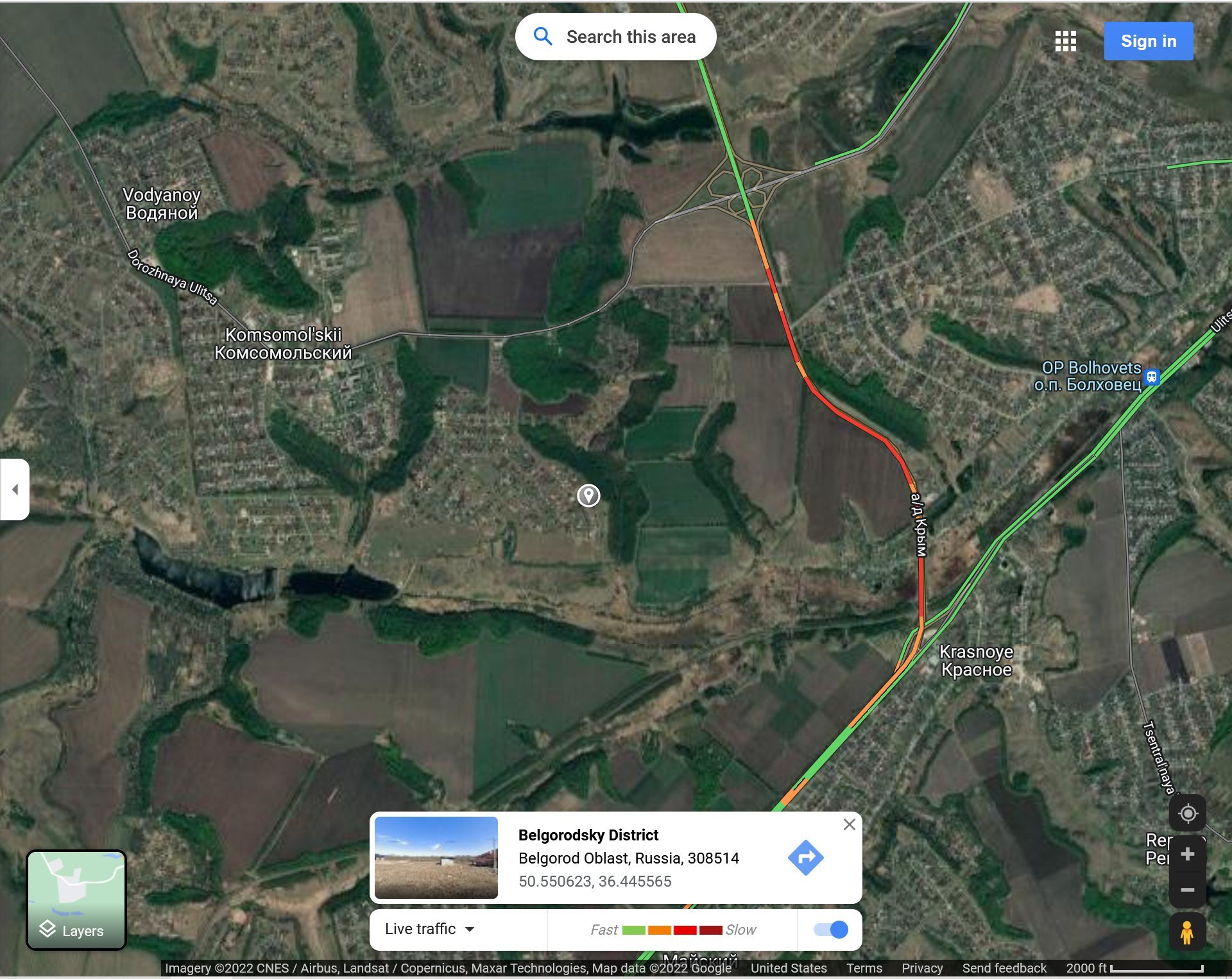
Google Maps showed the Russian invasion happening in real time. Now Google’s turned that data off because of its potential for Russian use for targeting.

You can sign up to receive each day’s Start Up post by email. You’ll need to click a confirmation link, so no spam.

A selection of 10 links for you. Ukraine first, other stuff after. I’m @charlesarthur on Twitter. Observations and links welcome.


Facebook, Twitter remove disinformation accounts targeting Ukrainians • NBC News

Ben Collins and Jo Ling Kent:

»

Facebook and Twitter removed two anti-Ukrainian “covert influence operations” over the weekend, one tied to Russia and another with connections to Belarus, the companies said.

One of the operations, a propaganda campaign featuring a website pushing anti-Ukraine talking points, was an offshoot of a known Russian disinformation operation. A Facebook spokesperson said it used computer-generated faces to bolster the credibility of fake columnists across several platforms, including Instagram.

The other campaign used hacked accounts to push similar anti-Ukraine propaganda and was tied to a known Belarusian hacking group.

Disinformation experts warned that Russia is expected to continue to try to manipulate narratives about Ukraine — most notably around the claims made by Russian President Vladimir Putin. 

The networks that were removed by Facebook and Twitter pushed narratives that Putin himself mentioned in his speech announcing a military operation, which has since turned into a large-scale invasion.

The announcement also demonstrates that Russia continues to use disinformation strategies first identified years ago around the 2016 election, albeit with some advancements — most notably the use of software that can create realistic and original human faces.

«

My impression is that Russia has been faring exceptionally badly in the information wars. There’s so much factual stuff coming out of Ukraine (and wildly exaggerated stuff). Plus there doesn’t seem to be any media embedded with the Russian troops. Pictures win the morale war – though of course it’s troops that win the real war.
unique link to this extract


Google turns off maps features in Ukraine that inadvertently showed Russia’s invasion • Vice

Gavin Butler:

»

Google has temporarily disabled tools that provide live information about traffic conditions in Ukraine, the company confirmed to VICE World News, following reports that people around the world were using the service to track the movements of troops and civilians during the Russian invasion.

Google Maps’ live traffic data works by incorporating location and speed information from smartphones with the app, then using it to show in real-time how dense traffic conditions are in certain places, or how busy those areas are overall. When Russian President Vladimir Putin launched an attack on Ukraine last week, however, some spectators realised the feature could also be used to provide open-source insights regarding the whereabouts of military operations.

“I think we were the first people to see the invasion. And we saw it in a traffic app,” Jeffrey Lewis, an open-source intelligence expert and professor at Middlebury Institute, told Motherboard, after he noticed an unusual traffic jam developing around the Russian border town of Belgorod on Thursday morning.

This was just hours after Putin declared a “special military operation” in the eastern Ukrainian region of Donbas, foreshadowing a potential invasion. But the traffic buildup Lewis was seeing on Google Maps was across the border from a different region of Ukraine, north of Kharkiv, and slowly extended to the border before it disappeared.

“We have developed incredibly data-rich definitions of what normal patterns of life look like,” Lewis explained. “And any deviation is immediately caught.” 

«

Google has also disabled the data showing how busy locations are, as that could be used for targeting. The Ukraine carriers, meanwhile, have blocked Russian phones from connecting to their base stations. That’ll lead to some annoyed conscripts.
unique link to this extract


Crypto exchanges refuse to freeze all Russian accounts • Vice

Maxwell Strachan:

»

Faced with a request by Ukrainian leadership to freeze the accounts of all people in Russia and Belarus, major crypto exchanges are steadfastly refusing, saying the tactic would unfairly harm civilians and “fly in the face” of the crypto community’s libertarian ideology. 

In a tweet, Vice Prime Minister of Ukraine Mykhailo Fedorov publicly asked the world’s major crypto exchanges over the weekend to freeze all accounts of the Russian people, as well as the people of Belarus, a Putin ally, rather than only those entities who have been legally sanctioned, thereby placing additional domestic pressure on Russia to end its war on Ukraine.

Instead of joining the military defence, the US and European Union have attempted to cripple Russia’s economy by aggressively sanctioning Russian banks, sovereign debt, and leadership, leading the Russian ruble to plunge in value. At the same time, cryptocurrency has emerged as a site of contest, with millions of dollars in crypto being donated to Ukraine while observers wonder if Russia will turn to the blockchain to escape sanctions. 

A spokesperson for US-based exchange Coinbase told Motherboard that the company will not comply with the request to ban all Russian users, citing “economic freedom” and the harm that a ban would bring to average Russians, but that it is complying with existing sanctions.

”At this time, we will not institute a blanket ban on all Coinbase transactions involving Russian addresses. Instead, we will continue to implement all sanctions that have been imposed, including blocking accounts and transactions that may involve sanctioned individuals or entities,” the spokesperson said in an emailed statement. “Our mission is to increase economic freedom in the world. A unilateral and total ban would punish ordinary Russian citizens who are enduring historic currency destabilization as a result of their government’s aggression against a democratic neighbor. We remain vigilant as this invasion evolves and are deeply committed to playing our part.”

Coinbase conducts sanctions screening as part of its onboarding process, the spokesperson said, and blocks transactions between sanctioned entities as well as uses analytics to identify illicit transactions.

«

What about some sort of volume limitation? Cap transactions at the equivalent of £10,000? But of course someone could create lots of wallets and split large amounts into multiple smaller ones. But the bank sanctions hit individuals too; the point is that it’s those needing to move large amounts of money who are hit the hardest by it. Same with crypto. Therefore a ban does make sense if you’re really looking to play your part.
unique link to this extract


The internet is debunking Russian war propaganda in real time • Vice

Matthew Gault:

»

On February 21, Tass—a Russian news agency—reported that five Ukrainian soldiers had crossed the border into Russia riding two armored personnel carriers (APC). According to the story, Russian forces destroyed both vehicles and killed the five Ukrainians. Later, Russia released a helmet-cam from one of the supposed Ukrainians as well as photos and videos of one of the destroyed APCs. It’s one of many Russian reports of alleged Ukrainian aggression — like the shelling of a school in Donetsk and Luhansk — that Russia has used to justify its military action in the region. 

Soon after the footage hit the internet, sleuths had picked it apart. One Twitter user used metadata of the video file and satellite imagery to geolocate the images and figured out it had all been filmed in the exact same location where Russia previously claimed a shell had destroyed a border post. 

The location of the skirmish was miles from where Russia said it was and deep inside occupied territory in Eastern Ukraine, not Russia. The destroyed APC was a BTR-70M, a type that Ukraine doesn’t own, painted over to make it look Ukrainian.

There are dozens of stories like this. But as Russia floods Telegram, TikTok, and its own state-controlled media with stories of Ukrainian aggression, people on the internet are using open-source intelligence tools that have proliferated in recent years to debunk Russia’s claims. Internet sleuths are debunking the Kremlin’s disinformation and justification for war in real time.

Amid all this, Eliot Higgins and Bellingcat are collecting the data, fact checking it, archiving footage, and amplifying the messages online. Higgins and Bellingcat are old hands at this. They’ve been tracking conflict online and sifting through the morass of multiple sources and bad information for eight years now.

They’ve gotten good at it. “It used to be days or weeks until we had fact checks,” Higgins told Motherboard over the phone. “Now we’re getting it within an hour. That helps with the rapid news cycle. The question of whether these will be authentic or not is being answered very quickly. We didn’t have that back in 2014.”

«

This is definitely a very encouraging trend. We’ve come a long, long way since 2016, when misinformation bloomed around the Philippines election, Brexit referendum and US presidential election.
unique link to this extract


Why will Russia lose this war? • Thread Reader App

Kamil Galeev:

»

Why Russia will lose this war?

Much of the “realist” discourse is about accepting Putin’s victory, cuz it’s *guaranteed*. But how do we know it is?

I’ll argue that analysts 1) overrate Russian army 2) underrate Ukrainian one 3) misunderstand Russian strategy & political goals. Here’s a thread.

«

This is a single-page long read (not just in Twitter terms) but gives an excellent (as far as I can tell) insight into what’s been going on in the Russian army, and why being led by someone who’s survived every regime change since 1991 isn’t necessarily a good thing for success in the field. Ukraine is big, especially compared to Georgia, and things are very different from 2008 and 2014 – particularly in Ukraine’s army.

Another Twitter thread talked about how military officers are either regulators or ratcatchers. Regulators thrive in peacetime. Ratcatchers are what you want in war. Russia’s military chief is a regulator. (To get a Twitter thread on a single page like this, reply to any tweet in the thread with “@threadreadapp unroll please” and it will reply to you with a link to a page.)
unique link to this extract


The Jodorowsky’s Dune crypto collective wants to make its own sci-fi epic • The Verge

Adi Robertson:

»

It’s still not quite clear what scanning and sharing the book will ultimately entail, nor how much of the DAO’s roughly $3m in remaining Ethereum — according to its public treasury ledger — it will require. As of earlier this month, the bible was in Paris awaiting shipment to Delaware, after which it’s going to a climate-controlled art storage facility once the DAO sets up formal corporations and a bank account to make payments. The budget outline estimates storage and insurance will cost around $30,000 annually, plus fees for shipping and potential physical exhibition — which, at this point, might be the only risk-free way of sharing the whole book.

Around that January vote, Spice DAO had hit a rough patch. The value of the $SPICE token had cratered alongside a worldwide crash in cryptocurrency, including Ethereum, which Spice DAO used to store its funds. (Disclosure: I purchased a little under 60,000 $SPICE for $30 in the process of reporting this story. I sold it before this article’s publication for $8.) They had also failed to get approval for putting scans of the book online, a key reason lots of people supported the project.

The group’s forums lit up with drastic and quickly abandoned member proposals. They included a nixed plan that involved minting an NFT for every page of Jodorowsky’s bible and then burning the physical copy, leading the organizers to post a Discord message reassuring visitors they weren’t going to destroy the book.

The animated series, meanwhile, had become a point of tension between the core team and some backers. The organizers posted a Roble Ridge pitch for a series tentatively titled Vengeance on Planet Zug, including a rough draft of a potential pilot script. The script follows a protagonist with a burning desire for vengeance (naturally) and an “oversized sword,” which he uses to messily slaughter a bar full of people in an “extremely gore-heavy sequence” before throwing it across a room to impale a man against a wall.

The community response was less than thrilled. (“Sorry but what the hell is this,” said one DAO member in the group’s Discord.)

«

The volatility of cryptocurrency – especially the specific coins issued for DAOs – makes these flights of fancy even more fanciful. Keeping the book in a climate-controlled space will cost about $30,000 annually. That adds up, especially if your currency is challenging the ruble at cliff-diving.
unique link to this extract


The case of the creepy algorithm that ‘predicted’ teen pregnancy • WIRED

Diego Jemio, Alexa Hagerty and Florencia Aranda:

»

“With technology you can foresee five or six years in advance, with first name, last name, and address, which girl—future teenager—is 86% predestined to have an adolescent pregnancy,” Juan Manuel Urtubey, then the governor of the province [of Salta in northeastern Argentina], proudly declared on national television. The stated goal was to use the algorithm to predict which girls from low-income areas would become pregnant in the next five years. It was never made clear what would happen once a girl or young woman was labeled as “predestined” for motherhood or how this information would help prevent adolescent pregnancy. The social theories informing the AI system, like its algorithms, were opaque.

The system was based on data—including age, ethnicity, country of origin, disability, and whether the subject’s home had hot water in the bathroom—from 200,000 residents in the city of Salta, including 12,000 women and girls between the ages of 10 and 19. Though there is no official documentation, from reviewing media articles and two technical reviews, we know that “territorial agents” visited the houses of the girls and women in question, asked survey questions, took photos, and recorded GPS locations. What did those subjected to this intimate surveillance have in common? They were poor, some were migrants from Bolivia and other countries in South America, and others were from Indigenous Wichí, Qulla, and Guaraní communities.

Although Microsoft spokespersons proudly announced that the technology in Salta was “one of the pioneering cases in the use of AI data” in state programs, it presents little that is new. Instead, it is an extension of a long Argentine tradition: controlling the population through surveillance and force. And the reaction to it shows how grassroots Argentine feminists were able to take on this misuse of artificial intelligence.

«

No formal review, no official data on accuracy or outcomes – a classic piece of AI work. (How do you lower teenage pregnancies? It’s not easy, but it can be done. Doesn’t require AI.)
unique link to this extract


Behind Pornhub’s decade-old moderation problems • The Verge

Nathan Munn worked as a moderator back in the early days of Pornhub:

»

I realized that, even as I tried to keep my distance from the porn, I was, in fact, exercising my personal judgment every day — and that there was no way to do the job without making decisions based on what I thought was appropriate. 

I often encountered videos that were uploaded again and again, no matter how many times I removed them. One day, a woman emailed me, calmly explained that her ex-boyfriend had uploaded a video of them having sex, and asked me to remove it. I deleted the clip. Later that week, it was re-uploaded. The woman wrote again, I removed it, and this continued for months; I must have pulled the same video down a dozen times. This was before I had ever heard the term “revenge porn.”

Requests like this were not uncommon. Once, a woman wrote to say there was a video of her on Tube8 that showed her being sexually assaulted after someone spiked her drink at a party. The video had tens of thousands of views, so I had to review it before making the call to remove it. In the clip, the woman is clearly high, laughing and head lolling, having sex on a bed surrounded by fully dressed people holding drinks and watching as coloured lights flashed and music blared in the background. I took it down, but it was uploaded again repeatedly in the following months. Each time, the mortified woman flagged it, and each time, I removed it; both of us were aware that there was nothing we could do to stop the clip from resurfacing.

I only learned about the adult industry through informal chats and secondhand conversation around the office. Competition in the porn world was cutthroat. A Manwin developer told me how, when they caught a competitor ripping off content from Pornhub to create a knockoff website, engineers placed a link to the offending website in a few pixels of the Pornhub homepage, where millions of people clicked daily. The resulting tsunami of web traffic swamped the pirate site and knocked it offline in minutes — the kiss of death. 

«

unique link to this extract


Bitcoin is getting even dirtier • CNN

Jon Sarlin:

»

China’s cryptocurrency mining ban in the spring of 2021 significantly worsened Bitcoin’s environmental impact, according to new research on crypto mining published in Joule. It is because Bitcoin miners were tapping into a significant amount of Chinese hydropower which suddenly evaporated when China made mining illegal, said Alex de Vries, one of the study’s authors and a researcher at the School of Business and Economics at the Vrije Universiteit Amsterdam.

So miners took their business elsewhere, including countries using significantly dirtier energy than China. Electricity sources powering the Bitcoin network were just 25.1% renewable in August 2021, nearly 17 percentage points lower than the 2020 average.

Mining Bitcoin each year produces as much pollution as Greece created in 2019, the study found. A single Bitcoin transaction results in the same carbon footprint as a traveler flying from New York to Amsterdam.

“After China banned Bitcoin mining, everyone was expecting it to become more green, but we are somewhat surprisingly seeing the opposite happening.” said de Vries. “A lot of the hydropower these miners got previously in China has now been replaced with natural gas from the US.”

Bitcoin mining is still booming in the United States. According to the study, many of the American Bitcoin mines are powered by natural gas and coal. Kentucky now offers subsidies to crypto miners, looking to attract business for the state’s coal industry.

Kazakhstan has also become a destination for Bitcoin miners. According to the study, the country’s electricity grid is reliant on hard coal, which is even more polluting than the coal used in China.

«

It’s a no-win. If it uses renewables, it’s displacing the use of that energy by something useful. If it’s using something else, it’s adding to the general load, pulling polluting generators online.
unique link to this extract


EU’s Vestager says tech giants may prefer fines to compliance, cites Apple • Reuters

Foo Yun Chee:

»

Some US tech giants may prefer to pay a fine rather than comply with antitrust rules, the European Union’s antitrust chief said, and cited Apple’s fight with the Netherlands’ competition authority as an example.

The Dutch Authority for Consumers and Markets (ACM) imposed a €5m ($5.7m) fine on Apple on Monday [21st], the fifth such penalty in successive weeks, linked to claims Apple does allow access to non-Apple payment methods for subscriptions to dating apps.

European Commission Vice President and digital chief Margrethe Vestager said Apple’s behaviour could indicate other big companies behave similarly.

“Some gatekeepers may be tempted to play for time or try to circumvent the rules,” she said in an online speech at a US awards ceremony on Tuesday.

“Apple’s conduct in the Netherlands these days may be an example. As we understand it, Apple essentially prefers paying periodic fines, rather than comply with a decision of the Dutch Competition Authority on the terms and conditions for third parties to access its App Store.”

«

She’s not wrong. For Facebook and Apple, among others, such fines are just a cost of doing business. Apple’s behaviour over the Dutch case is especially egregious (to outsiders) and hard to explain except as a combination of extreme entitlement – we built it so we should be able to make money from it in perpetuity – and tone-deafness.
unique link to this extract


• Why do social networks drive us a little mad?
• Why does angry content seem to dominate what we see?
• How much of a role do algorithms play in affecting what we see and do online?
• What can we do about it?
• Did Facebook have any inkling of what was coming in Myanmar in 2016?

Social Warming, my latest book, and find answers – and more.


Errata, corrigenda and ai no corrida: none notified