
Start Up: a new AI film!, Facebook ‘spying’ redux, the Android ‘app install’ scam, Quebec slows crypto mining, and more


We regret to inform you that USB-C is still a world of pain. Photo by Aaron Yoo on Flickr.

A selection of 10 links for you. Not open to negotiation. I’m @charlesarthur on Twitter. Observations and links welcome.

This wild, AI-generated film is the next step in “whole-movie puppetry” • Ars Technica

Sam Machkovech:

»

Zone Out’s script, just like Sunspring’s, teeters on the edge of inanity and emotion—which, honestly, puts it right up there with the best of the sci-fi canon. (A dialogue example taken directly from the film, which almost sounds like Benjamin’s criticism of his masters: “Why don’t you tell me what… you say is true that the human being will be able to reenforce the destruction of a human being?”) This time, the script’s odd, not-quite-human results are only amplified by having so many other film-production tasks automated by AI.

Snags arose during production as the duo struggled to find public-domain film footage that they could safely use in their own potentially commercial enterprise. The challenge wasn’t just about copyright; the footage had to contain a significant number of shots with sole actors facing directly toward the camera, which Benjamin could more easily snip and insert into whatever it composed. Between their deep dive into a public domain film database and conversations with a lawyer, Goodwin and Sharp settled on two films: The Last Man on Earth and The Brain That Wouldn’t Die.

The most striking part of the film is its reliance on face-swapping technologies to adapt existing films to Benjamin’s will. Face-swapping has become a pretty hot topic in pop culture, particularly after an altered video of President Barack Obama went viral in 2017 (and a followup take, with director/comedian Jordan Peele filling in as an impersonator, rekindled the viral fire in April). Still, the technology’s limitations are quite apparent, especially when time limits factor into any production. An April attempt to insert actor John Cho into popular films illustrated the immense amount of computational time needed to refine a face swap, and Zone Out’s production team ran into similar issues while having Benjamin parse pre-recorded footage of actors Thomas Middleditch, Elisabeth Gray, and Humphrey Ker.

«

Since you ask, here it is:

https://www.youtube-nocookie.com/embed/vUgUeFu2Dcw?rel=0

Getting better, aren’t they? Refer back to that strange film Sunspring from two years ago.
link to this extract


Why the future of machine learning is tiny • Pete Warden

Pete Warden is thinking small – in both size and energy consumption terms:

»

I spend a lot of time thinking about picojoules per op. This is a metric for how much energy a single arithmetic operation on a CPU consumes, and it’s useful because if I know how many operations a given neural network takes to run once, I can get a rough estimate for how much power it will consume. For example, the MobileNetV2 image classification network takes 22 million ops (each multiply-add is two ops) in its smallest configuration. If I know that a particular system takes 5 picojoules to execute a single op, then it will take (5 picojoules * 22,000,000) = 110 microjoules of energy to execute. If we’re analyzing one frame per second, then that’s only 110 microwatts, which a coin battery could sustain continuously for nearly a year. These numbers are well within what’s possible with DSPs available now, and I’m hopeful we’ll see the efficiency continue to increase. That means that the energy cost of running existing neural networks on current hardware is already well within the budget of an always-on battery-powered device, and it’s likely to improve even more as both neural network model architectures and hardware improve.

In the last few years it’s suddenly become possible to take noisy signals like images, audio, or accelerometers and extract meaning from them, by using neural networks. Because we can run these networks on microcontrollers, and sensors themselves use little power, it becomes possible to interpret much more of the sensor data we’re currently ignoring. For example, I want to see almost every device have a simple voice interface. By understanding a small vocabulary, and maybe using an image sensor to do gaze detection, we should be able to control almost anything in our environment without needing to reach it to press a button or use a phone app. I want to see a voice interface component that’s less than fifty cents that runs on a coin battery for a year, and I believe it’s very possible with the technology we have right now.

As another example, I’d love to have a tiny battery-powered image sensor that I could program to look out for things like particular crop pests or weeds, and send an alert when one was spotted. These could be scattered around fields and guide interventions like weeding or pesticides in a much more environmentally friendly way.

«

link to this extract


#109 is Facebook spying on you? • Reply All Podcast

Via former Facebook ads guyt Antonio Garcia Martinez, this podcast transcript:

»

PJ: So what’s going on here is that we’re talking to people who believe that Facebook is listening in on them using their microphones. And Alex, who’s done a lot of research, and as far as I can tell believes it’s not happening, he’ll try to give you an alternate explanation
MONIQUE: Ok, so I have a very quick story, and this is so funny, I was just telling my friend about this last night. Um, so, a few months ago I was on the phone talking to my friend and she was talking about this device that she had bought, um, to help her open coconuts.
PJ: What
MONIQUE: It was this really weird thing and she was trying to explain–she was explaining this tool, but she couldn’t remember the name. And we get off the phone, and then that was it. And maybe 15, 20 minutes later, I’m scrolling on Facebook and I see an ad for this device called the Coco-Jack.
PJ: (laughs) The Coco-Jack?
MONIQUE: I screenshot it. And was like “Is this what you were talking about?” And she was like “Yes.” And ever since then, I’ve been convinced that they’re onto me.
ALEX: OK (clears throat).
PJ: God, this is like watching a conductor warm up.
ALEX: OK, is this person your friend on Facebook?
MONIQUE: Yes.
ALEX: Did she buy the Coco-Jack online?
MONIQUE: I don’t know for sure, but I don’t think she did.
PJ: I just watched a balloon deflate–
ALEX: No! Not necessarily.
PJ: OK.
ALEX: Do you know where she bought it?
MONIQUE: If I recall correctly, she was in Vegas at some, like um, weird little shop, like “as seen on TV” shop. And she picked it up there.
ALEX: Do you think that she was, like, frustrated by all her coconuts beforehand, and so she Googled like, “How to open coconuts?”
MONIQUE: Perhaps. Maybe. But why would I be seeing it on my- like I saw it on my feed?

«

OK, maybe not listening to your phone – but it comes across as maybe even more creepy.
link to this extract


Android users: beware these popularity-faking tricks on Google Play • We Live Security

Lukas Stefanko:

»

The trick takes advantage of the fact that apart from the app icon and name, there is one more element the user sees when browsing apps – the developer name, displayed just below the app name. And since unknown developer names are no use for popularity-boosting purposes anyway, some app authors have been setting fictitious, high numbers of installs as their developer names, in an effort to look like established developers with vast userbases.

We have discovered hundreds of apps using this and similar tricks to deceive users. The apps we’ve analyzed were either misleading users about their functionality or had no functionality at all, yet most display many advertisements.


Figure 1 – Apps uploaded to Google Play under the developer name “Installs 1,000,000,000 – 5,000,000,000”

The freedom to set any number of choice as developer name has inspired some remarkably ambitious claims – one game developer, for instance, would like users to believe his games have been installed more than five billion times. (Note: the highest-ranking apps in terms of number of installs fall into the category “1,000,000,000 ” at the time of writing; this category includes Google Play itself, Gmail, Facebook, WhatsApp, Skype, etc.)

In one particular case, we saw a developer change his name from a fake installation number to an actual developer name over time, which might indicate the trick is used as a temporary measure aimed at boosting the popularity of newly uploaded apps.

«

Wonder how easy will be for Google to block this? Searching for “install” as a developer name, or for figures, would probably catch it. How long before this trick is squashed?
link to this extract


ZTE’s near-collapse may be China’s Sputnik moment • NY Times

Li Yuan, suggesting that ZTE’s near-death experience will affect China as the sight of Sputnik overhead did America, presaging a technological surge:

»

China offers a competing vision to those who see technology as a global, liberating force. Its robust online culture coexists with stringent censorship. China forcefully espouses a view of sovereignty in the cyber realm that sees a greater degree of government control than the internet’s creators ever envisioned — a view that doesn’t seem as far-fetched as it once did, as politicians around the world grapple with the unintended consequences of technology.

Before we get to that future, however, the ZTE incident offers a glimpse of where China stands now.

ZTE’s near-collapse has shaken tech entrepreneurs, investors and ordinary Chinese people alike. In social media chat groups, at dinner tables, at industry conferences, terms like “semiconductors” and “fundamental scientific research” have become buzzwords. My novelist, economist and philosophy professor friends all ask me: How far behind is China’s microchip industry? How long will it take us to catch up with the United States? (Some ask even more basic questions, like: What’s a microchip?)

“The recent ZTE incident made us see clearly that no matter how advanced our mobile payment is, without mobile devices, without microchips and operating systems, we can’t compete competently,” Pony Ma, chief executive of the Chinese internet giant Tencent Holdings said last month at a science forum.

China feels new urgency to increase its technological abilities. Its current push — called Made in China 2025 — lies at the root of worsening trade relations between the United States and China. But the problems with ZTE, which had $17bn in revenue in 2017, will only spur Chinese leaders to push ahead.

«

link to this extract


It’s 2018 and USB type-C is still a mess • Android Authority

Robert Triggs:

»

USB Type-C was billed as the solution for all our future cable needs, unifying power and data delivery with display and audio connectivity, and ushering in an age of the one-size-fits-all cable. Unfortunately for those already invested in the USB Type-C ecosystem, which is anyone who has bought a flagship phone in the past couple of years, the standard has probably failed to live up to the promises.

Even the seemingly most basic function of USB Type-C — powering devices — has become a mess of compatibility issues, conflicting proprietary standards, and a general lack of consumer information to guide purchasing decisions. The problem is that the features supported by different devices aren’t clear, yet the defining principle of the USB Type-C standard makes consumers think everything should just work.

The charging example clearly demonstrates a very common frustration with the standard as it currently stands. Moving phones between different chargers, even of the same current and voltage ratings, often won’t produce the same charging speeds. Furthermore, picking a third party USB Type-C cable to replace the typically too short included cable can result in losing fast charging capabilities.

I have three different phone chargers from LG, Huawei, and Samsung. Points for guessing how many of them can fast charge a phone from a different brand. It’s a simple question with a complicated answer.

«

Something involving plugging a cable into a charger shouldn’t have a complicated answer. I begin to wonder how USB-C is going to get out of this mess. (Thanks Papanic for the link.)
link to this extract


Canada’s Quebec halts crypto mining projects, may raise fees • Reuters

Allison Lampert:

»

The provincial government announced the move as state-owned power generator Hydro Quebec said it has asked the province to limit total power available to all digital currency miners to a block of 500 megawatts. That is about enough energy to run a single aluminum smelting plant, or a fraction of the 17,000 megawatts in capacity requested so far by miners looking to operate in Quebec.

The firm also said it asked the province’s energy board to determine quickly how much it should charge digital currency miners to help maximize the energy producer’s revenue.

Quebec’s energy ministry said it ordered Hydro Quebec to hold off on connecting new digital currency mining operations until regulators set new roles for the industry.

«

500 out of 17,000? That’s quite a halt. Bitcoin prices are down too, currently below $7,000 – compared to the $20,000 peak. Always dangerous to predict but can’t see what would bring it back now the impacts are becoming visible.
link to this extract


American collapse isn’t just economic and political — it’s moral and ethical, too • Medium

Umair Haque on how Kim Kardashian gets more attention than children being put in camps: what does this say about American morality

»

First, there’s the Kantian idea of a universal law of treating others as you wish to be treated, Kant’s “kingdom of ends.” It’s blindingly obvious to see that American don’t treat one another that way — they want everything for themselves, but deny the most meager of basics to their neighbours. Hence, the American Dream became something like a McMansion, a fleet of SUVs, and a black Amex card — and damn universal healthcare, education, media, finance. So Americans immediately fail the test of Kantian ethics — so-called “deontological” ethics, which simply mean “rules for what is right.” There is no rule for what is right in America — and that has profound consequences, which we will soon come to.

Second is the idea of utilitarian ethics, acting for the so-called greater good. But here again, Americans fail at the slightest observation. They will happily invest in more things that give them zero added utility, but genuinely make them miserable, like that Amazon gadget that spies on you, hours on Facebook which leave them lonelier, meaner, dumber, more resentful, envious, and unhappy — but they won’t spend a collective dime for the sake of the greater good. It’s shatteringly obvious that if Americans were the slightest bit concerned with the greater good, like good utilitarians, they’d spend time, energy, money on, say healthcare for everyone — but that hasn’t happenedin our adult lifetimes. So Americans fail this moral test, too.

Now, most moral systems fall somewhere between these two poles, of utilitarian (or consequentialist) ethics, and Kantian (or deontological) ethics… Nowhere within the spectrum of morality as we know it can we place the behaviour of Americans.

«

Somewhat damning, but the moral paralysis in the US (I think it’s that rather than indifference) is quite shocking. Compare the fury in the UK over Windrush citizens.
link to this extract


Facebook aims to bring the fun back into music • Midia Research

Mark Mulligan:

»

For a whole host of reasons that warrant a blog post of their own, streaming music has coalesced around a very functional value proposition. In short, the fun has been taken out of music. Apps like Dubsmash and Musical.ly showed that it doesn’t have to be that way. These apps were small enough to be able to do first and ask for forgiveness later. Even though Facebook has all the ingredients to do what those guys did – and at scale, it is far too big to try to get away with that strategy, so it had to get licences in place first. YouTube is the only other scale player that really brings a truly social element to streaming. Now it has got a serious challenger that just upped the ante beyond comments, mash ups and likes / dislikes. The music industry so needs this right now, especially to win over Gen Z.

«

Competition for Youtube makes this a very interesting arrival. Are the music companies getting more per play from Facebook than from Youtube?
link to this extract


Opposing onshore UK windfarms ‘means higher energy bills’ • The Guardian

Adam Vaughan:

»

The government ended subsidies for t[onshore] windfarms in 2015 but the energy minister Claire Perry has recently said she is “looking carefully” at a U-turn for windfarms built in Wales and Scotland. Last week, the government gave its backing to windfarms on remote islands, such as the Isle of Lewis.

[Conservative peer Lord] Deben told the Guardian: “There is no doubt, and I feel very strongly about it, that onshore wind is the cheapest form of electricity. If the Scots want to have it, on which basis should we say they shouldn’t have it?”

Advocates believe onshore windfarms could be built for subsidies guaranteeing prices as low as £50 per megawatt hour – below the average £62.14 awarded to the latest offshore windfarms and far lower than the £92.50 for the Hinkley Point C nuclear power station.

The payments are a top-up on the wholesale electricity price of around £45/MWh, with the difference paid by householders through their energy bills. Hinkley alone is expected to add £10-15 to annual bills by 2030.

«

Hinckley C was such a terrible decision. Theresa May, bamboozled by China on that one.
link to this extract


Errata, corrigenda and ai no corrida: yesterday’s link about Facebook “listening to you” got some pushback, as they say. So take a look at the link from the Reply-All podcast.

You can sign up to receive each day’s Start Up post by email. You’ll need to click a confirmation link, so no spam.

Start Up: Apple Watch getting touchy?, crypto heists top $1bn, the NYC taxi price crash, why ringtones bug you, how China’s bugging Trump, and more


Photo by Jan Persiel on Flickr

»You can sign up to receive each day’s Start Up post by email (arriving at about 0800GMT each weekday). You’ll need to click a confirmation link, so no spam.«

A selection of 9 links for you. Not approved at a summit. I’m @charlesarthur on Twitter. Observations and links welcome.

US officials prepare to thwart Chinese spying at Singapore summit • NBC News

Courtney Kube, Carol E. Lee, Ken Dilanian and Andrea Mitchell:

»

According to three US officials, in one recent case a top US official working in China repeatedly had trouble with his hotel key card. He had to replace it several times at the front desk because it wouldn’t open his door.

He brought one of the key cards back to the US, where security officials found a microphone embedded inside, according to the US officials.

The Chinese have placed listening and tracking devices in chips embedded in credit cards, key chains, jewelry, and even event credentials, the officials said, often with the intent of capturing secret conversations among American officials.

In advance of Chinese President Xi Jinping’s 2017 meeting with Trump at Mar-a-Lago, Trump’s south Florida estate, White House officials received detailed briefings on how the Chinese would try to spy on them during the visit “in every possible way,” said an official who was part of the visit.

And US officials “swept all of our phones afterward” to check if they were infiltrated by the Chinese, the official added.

Seven months later when Trump traveled to Beijing, White House officials were given more extensive briefings, according to officials who were on the trip, in which they were told to assume the Chinese would be tracking, taping and watching them the entire time they were in the country.

During the visit, the officials say the Chinese gave the US delegation pins that the Americans called their friendship pins. But members of the delegation were not allowed to wear the pins into a secure area because security officials warned they likely had embedded listening devices.

The officials said their belongings were rifled through while they were not in their hotel rooms, as happened to US officials during previous presidential trips to China.

«

Not surprising. The friendship surveillance pins are a nice touch. And of course we’re not mentioning what the Americans do.
link to this extract


Your phone is listening and it’s not paranoia • Vice

Sam Nichols:

»

For your smartphone to actually pay attention and record your conversation, there needs to be a trigger, such as when you say “hey Siri” or “okay Google.” In the absence of these triggers, any data you provide is only processed within your own phone. This might not seem a cause for alarm, but any third party applications you have on your phone—like Facebook for example—still have access to this “non-triggered” data. And whether or not they use this data is really up to them.

“From time to time, snippets of audio do go back to [other apps like Facebook’s] servers but there’s no official understanding what the triggers for that are,” explains [senior cybersecurity consultant for Asterix, Dr Peter] Henway. “Whether it’s timing or location-based or usage of certain functions, [apps] are certainly pulling those microphone permissions and using those periodically. All the internals of the applications send this data in encrypted form, so it’s very difficult to define the exact trigger.”

He goes on to explain that apps like Facebook or Instagram could have thousands of triggers. An ordinary conversation with a friend about needing a new pair of jeans could be enough to activate it. Although, the key word here is “could,” because although the technology is there, companies like Facebook vehemently deny listening to our conversations.

“Seeing Google are open about it, I would personally assume the other companies are doing the same.” Henway tells me. “Really, there’s no reason they wouldn’t be. It makes good sense from a marketing standpoint, and their end-use agreements and the law both allow it, so I would assume they’re doing it, but there’s no way to be sure.”

With this in mind, I decided to try an experiment. Twice a day for five days, I tried saying a bunch of phrases that could theoretically be used as triggers. Phrases like I’m thinking about going back to uni and I need some cheap shirts for work. Then I carefully monitored the sponsored posts on Facebook for any changes.

«

Guess what happened? This topic – are our phones listening to us? – has been hotly discussed on my Twitter feed recently. This is quite an eye-opener.
link to this extract


Android Messages integration with Chrome OS is one step closer to reality • Android Police

Corbin Davenport:

»

Almost a year ago, evidence first appeared of an ‘SMS connect’ feature on Chrome OS. It would allow users to see text messages from your phone on your Chromebook, similar to Pushbullet and similar software. We haven’t heard much about it since then, but Google has also been working on a web client for Android Messages. Thankfully for Chrome OS users, a new commit reveals SMS Connect is one step closer to going live.

A commit on the Chromium Gerrit repository, as spotted by XDA, simply adds a feature flag for “CrOS Android Messages integration.” In other words, SMS Connect will become a feature you an easily turn on from the chrome://flags page, meaning users will finally be able to try it out.

«

Apple users who have wanted it have had this functionality for years, if they use an iPhone and a Mac: the Messages app handles SMS too, which can then appear on the desktop. Perhaps it’s Apple’s legacy with the desktop which meant it made this a priority (of sorts). But it’s also a sign of Google’s haphazard approach to messaging: as much as anything, the problem would be deciding which of its many, many messaging apps should get the privilege of receiving texts on ChromeOS.
link to this extract


No, iPhone ringtones aren’t bad. They’re musically sophisticated • The Washington Post

Alyssa Barna:

»

Two of the most instantly recognizable iOS ringtones are “Marimba” and “Xylophone,” sounds that have become comfortable and familiar. But as music theory demonstrates, subtle details in the composition of these tunes all but demand that we cut them off by picking up the phone. That’s partly because they are fundamentally disruptive, intrusively insisting on our attention. Ultimately, the effect may be key to Apple’s cultural impact. With the possible exception of Nokia and its now-historical ringtone, no other company has managed to make the sounds of its devices quite so central to its brand identity.

Consider the ringtone “Xylophone,” which consists of two lines — a cutesy melody on top supported by a constant pulsing layer underneath that sustains your attention. “Xylophone” is composed around the concept of syncopation — accentuating weaker beats to mess with a rhythm a bit and make it more complex. Think: “Buh-buh-bummm, buh-buh-b-b-b-buh” in the upper line, and “bum-bum-bum-bum-bum-bum-bum-bum” consistently in the lower line. These two lines may not seem to match up at first, but the melody fits awkwardly with the supporting tones underneath. The lower line features annoying pulsing beats, while the melody articulates beats that the second line doesn’t hit. In theoretical terms, we would say one line has isochronous rhythms — that is, they are evenly spaced and patterned. By contrast, the line with the syncopated melody uses non-isochronous rhythms. Together, these two patterns create a barrage that aims to unsettle the listener. This is a tune that Apple has stuck with precisely because we don’t want to listen to it.

«

Before you ask, Barna has a Masters in music theory. The idea that ringtones work because we don’t want to listen to them is rather clever. It’s like the near-impossibility of ignoring a ringing telephone while you’re trying to have a face-to-face conversation.
link to this extract


139 NY taxi medallions will be offered at bankruptcy auction • New York Post

John Aidan Byrne:

»

A record 139 taxi medallions will be offered for sale in bankruptcy auction this month — the latest sign that a deluge of ride-sharing apps like Uber are squeezing cabbies out of business and deeper into debt, as well as pinching the incomes of for-hire drivers, according to analysts.

The medallions will be auctioned for a fraction of their original value — some likely having cost their owners as much as $1m or more apiece.

A minimum of 20 will be sold, the auctioneers say. The collection is part of the 13,587 licensed medallions required to operate New York City’s fleet of iconic yellow cabs. Back in 2013, a medallion fetched a whopping $1.3m.

Today, prices have plunged to between $160,000 to $250,000 each, as a wave of ride-sharing vehicles floods the market.

Last year, 46 medallions were reportedly sold at an auction in Queens for an average price of $186,000, snatched up by Connecticut-based MGPE, a hedge fund presumably seeking yield on a distressed asset.

For-hire vehicles on New York’s congested streets have surged from 50,000 in 2011, when Uber entered the New York market, to about 130,000 today.

Not surprisingly, earnings for yellow cabbies have fallen off the cliff — full-time average annual earnings, before taxes, are down from $45,000 as recently as 2013, to as low as $29,000 today, according to some estimates.

«

Which leads to the obvious question: is Uber bad? Here it has pretty much bankrupted thousands of people (or, perhaps, groups who bought a medallion together).

But: look at the number of vehicles on the streets. It’s easier to get a cab to go where you want to.

The convenience of many has been acquired through the pain of a few. That doesn’t make their pain any less, but this was inevitable one way or another.
link to this extract


Cryptocurrency theft tops $1bn in past six months • Security Week

Kevin Townsend:

»

$1.1bn has been stolen in cryptocurrency thefts over the past six months. This is the visible effect of an illicit dark web market economy which is reportedly worth $6.7m. That market fuels cryptocurrency thefts from exchanges, businesses, and individuals; and the growing incidence of cryptojacking.

The basic problem is that cryptocurrencies are increasingly popular, which drives up their value. This makes investment popular for both individuals and businesses; and this in turn attracts the criminals. The three most common attacks involve currency-stealing malware (designed to quietly steal the users’ wallet content and send it to the attacker); illicit mining (designed to use business infrastructures to mine cryptocurrency for the attacker); and cryptojacking (which is illicit mining targeted at individuals).

A six-month study (PDF) by Carbon Black into how cryptocurrency malware is bought and sold in the dark web has shown an estimated 12,000 dark web marketplaces selling approximately 34,000 offerings related to cryptocurrency theft. Malware offerings range from as little as $1.04 to as much as $1,000, with an average price of $224.

Bitcoin remains the primary cryptocurrency used for legitimate cyber transactions — but cybercriminals are moving to alternative and more profitable currencies, such as Monero — which is now used in 44% of all attacks.

«

I’d guess that North Korea has been behind a fair number of those attacks, because it needs the foreign currency. Crypto hacks are effectively free currency, so it doesn’t mind getting a “poor” exchange rate on them.
link to this extract


The Apple Watch will get touch-sensitive, solid-state buttons • Fast Company

Mark Sullivan:

»

The Apple Watch will be getting solid state buttons that don’t move up and down but rather sense the touch of a finger, a source with direct knowledge of Apple’s plans tells Fast Company.

Apple will stick with the Watch’s current button configuration, with a button and a digital crown situated on one side of the device, but neither will physically click as before. Rather than reacting to the user’s touch by physically moving back and forth, the new buttons will vibrate slightly under the fingertip, using the haptic effect Apple calls the Taptic Engine. (The digital crown will still physically rotate to navigate through content.)

The switch to solid state buttons in the Watch is similar to the conversion of the iPhone’s home button to a solid-state design in 2016’s iPhone 7. In past years, other Apple components such as MacBook trackpads and iPod control wheels have also gone from moving parts to solid-state technology.

The new buttons could be part of the new Apple Watch the company will announce this fall, or, if not, will be included in the 2019 Watch, the source said.

Solid-state buttons will make the Watch more water resistant because the opening needed for a physical button is eliminated. The solid-state controls also take up less space in the design, freeing up room for a bigger battery, the source said.

«

I’d expect this to come this year – there have been four iterations of the current design, and Apple has had the Taptic Engine for at least four years. Enough time to design it into a watch button or two.
link to this extract


Copyright law could put end to net memes • BBC News

»

Memes, remixes and other user-generated content could disappear online if the EU’s proposed rules on copyright become law, warn experts.

Digital rights groups are campaigning against the Copyright Directive, which the European Parliament will vote on later this month. The legislation aims to protect rights-holders in the internet age. But critics say it misunderstands the way people engage with web content and risks excessive censorship.

The Copyright Directive is an attempt to reshape copyright for the internet, in particular rebalancing the relationship between copyright holders and online platforms. Article 13 states that platform providers should “take measures to ensure the functioning of agreements concluded with rights-holders for the use of their works”.

Critics say this will, in effect, require all internet platforms to filter all content put online by users, which many believe would be an excessive restriction on free speech. There is also concern that the proposals will rely on algorithms that will be programmed to “play safe” and delete anything that creates a risk for the platform.

A campaign against Article 13 – Copyright 4 Creativity – said that the proposals could “destroy the internet as we know it”. “Should Article 13 of the Copyright Directive be adopted, it will impose widespread censorship of all the content you share online,” it said.

«

This is clearly going to fail to recognise the “fair dealing” (US phrase: “fair use”) exceptions that abound for copyright law. It’s going to be honoured more in the breach than the observance if it’s voted in.
link to this extract


Carbon engineering and Harvard find way to convert CO2 to gasoline • CNBC

Chloe Aiello:

»

A team of scientists claims to have discovered a cheaper way to extract carbon dioxide from the atmosphere and turn it into gasoline or other fuels, which could arm humanity with a new tool in the fight against climate change.

Published in the scientific journal Joule on Thursday, the research demonstrates a new technique that pulls carbon dioxide out of the atmosphere, and converts it into liquid gasoline, diesel or jet fuel.

Canadian clean energy company Carbon Engineering, in partnership with researchers from Harvard, used little more than limestone, hydrogen and air for the process, which can remove one metric ton of CO2 for as little as $94, the scientists say. It cleans up the environment, and produces eco-friendly liquid fuel at the same time.

“Until now, research suggested it would cost $600 per ton to remove CO2 from the atmosphere using DAC technology, making it too expensive to be a feasible solution to removing legacy carbon at scale,” David Keith, Harvard Professor and founder of Carbon Energy said in a statement. “We now have the data and engineering to prove that DAC can achieve costs below $100 per ton.”

«

All this stuff is still small-scale, though. And it’s odd to talk about capturing it and turning it into fuel.
link to this extract


Errata, corrigenda and ai no corrida: none notified.

Start Up: iPhone X Plus sized up (via logs), Nasa rover finds Martian.. stuff, conference seating woes, and more


ZTE has been reprieved. What, if anything, did the US get in return? Photo by Kārlis Dambrāns on Flickr.

You can sign up to receive each day’s Start Up post by email. You’ll need to click a confirmation link, so no spam.

A selection of 13 links for you. For the weekend. I’m @charlesarthur on Twitter. Observations and links welcome.

Nasa Mars rover finds organic matter in ancient lake bed • The Guardian

Ian Sample:

»

Nasa’s veteran Curiosity rover has found complex organic matter buried and preserved in ancient sediments that formed a vast lake bed on Mars more than 3bn years ago.

The discovery is the most compelling evidence yet that long before the planet became the parched world it is today, Martian lakes were a rich soup of carbon-based compounds that are necessary for life, at least as we know it.

Researchers cannot tell how the organic material formed and so leave open the crucial question: are the compounds remnants of past organisms; the product of chemical reactions with rocks; or were they brought to Mars in comets or other falling debris that slammed into the surface? All look the same in the tests performed.

But whatever the ultimate source of the material, if microbial life did find a foothold on Mars, the presence of organics meant it would not have gone hungry. “We know that on Earth microorganisms eat all sorts of organics. It’s a valuable food source for them,” said Jennifer Eigenbrode, a biogeochemist at Nasa’s Goddard Space Flight Center in Maryland.

“While we don’t know the source of the material, the amazing consistency of the results makes me think we have a slam-dunk signal for organics on Mars,” Eigenbrode added. “It is not telling us that life was there, but it is saying that everything organisms really needed to live in that kind of environment, all of that was there.”

«

When I worked at The Independent in 1995, the then science editor Tom Wilkie declared that in news, the same stories come around again and again, and that by the third time you’re pretty sick of them. He was already bored with “life on Mars” stories, so I did the one about the meteorite with the odd shapes. And now here we go again.
link to this extract


AI at Google: our principles • Google blog

Sundar Pichai:

»

We will assess AI applications in view of the following objectives. We believe that AI should:
– be socially beneficial
– avoid creating or reinforcing bias
– be built and tested for safety
– be accountable to people
– incorporate privacy design principles
– uphold high standards of scientific excellence
– be made available for uses that accord with these principles

«

There’s plenty more – each point is expanded, but those are the bullets. He also sets out the applications that Google won’t pursue.
link to this extract


iOS 12 tells us exactly how big the iPhone X Plus will be • BGR

Chris Smith:

»

Apple started testing iOS 12 builds in the wild as recently as late February, when Google Analytics first picked up visits to BGR from devices running iOS 12. The number of visits increased as we approached June. It’s likely that Apple engineers tested early iOS 12 builds on various devices well ahead of the WWDC event. And while you can safely test iOS 12 out in the wild if you’re an Apple engineer since regular users will not immediately spot it, you can’t always fool analytics programs.

As such, between late February and late May, BGR received hundreds of visits from devices running iOS 12.

Even if some of those were fake iOS 12 devices, plenty of those visits still came from devices that you can quickly identify as iPhones and iPads checking in from Apple. Looking at screen resolution alone, one could easily identify visits from iPhone X, iPhone 8/7/6sPlus/6s/6Plus/6, iPhone 8Plus/7Plus, 12.9-inch iPad Pro, 10.5-inch iPad Pro, iPhone SE, and — finally — iPhone X Plus


Image Source: Chris Smith, BGR

How do we know an iPhone X Plus was used to read BGR posts? Well, this device that Google identifies as an Apple iPhone running iOS 12, had a screen resolution like no other iPhone or iPad: 496 x 896.

Don’t be fooled, that’s not the resolution in pixels, but in points.

«

Multiply by 2.608 or 3 – it’s not known yet – to get the pixels: 1242×2688, or 1080×2336. This means it’s going to be the same width as the present iPhone X, but 15% taller.
link to this extract


Here’s the tiny drone the US Army just purchased for soldiers • CNET

Abrar Al-Heeti:

»

The US Army is getting tiny personal surveillance drones as part of a $2.6m contract with Flir, a thermal imaging and technology company. 

The Black Hornet Personal Reconnaissance System is the world’s smallest combat-proven nano-drone, according to the company. The US Army has ordered the next-generation Black Hornet 3, which weighs 32 grams and packs navigation capabilities for use in areas outside of GPS coverage. The drone, which has advanced image processing from earlier versions, and can fly a distance of two kilometers at more than 21 kilometers an hour and carries a thermal microcamera.    

The order marks the US Army’s first for the Soldier Borne Sensors program, which aims to provide military personnel with more awareness of their surroundings using drones. 

«

That’s a pretty cheap contract. The drones are about the size of three fingers, which would make them hard to shoot down. Good for reconaissance. Consumer electronics leading war electronics, which is the opposite of what usually happens.
link to this extract


Dear conference organizers: you’re doing chairs wrong • Motherboard

Rose Eveleth:

»

Next time you’re at a conference, pay attention to the chairs and the folks in skirts and dresses trying to navigate them. If you do, a frustratingly common problem will become clear. Nearly every femme-identifying person I know has wrestled with tall bar stools, directors chairs, deep arm chairs, and more. Recently at a podcasting conference I watched as a woman perched herself awkwardly at the edge of an armchair that was elevated so her crotch was exactly at eye level for the audience. At another conference I saw two women convene before their panel purely to scope out the seating situation. One of them decided to change into pants.

“Once I wore a dress to a panel I was on that was quite appropriate in length but slightly above the knees and they had these super tall stools for speakers,” Megan Berry, VP of product at Octane AI, an automated messenger marketing platform, told me. “I had to be strategic about how to sit down with the whole audience there so I didn’t flash anyone and sat very carefully for the whole panel.”

Emily Finke has a similar story.

Finke, a science educator, once wore a knee-length pencil skirt to a panel where she and the other speakers sat on barstool-height chairs, not behind a table. “That skirt is fine for normal chair heights and for standing,” Finke said, “but I knew in the angle of the tall chairs that it would mean the skirt vent would have the audience looking directly up my skirt.” Rather than sitting in the chair, she spent the entire panel leaning awkwardly against it with her hand over the backrest, “in the worst Riker in Ten Forward pose ever.”

«

Ditto with clip-on mics, which don’t work well with dresses. (Every woman I’ve been on a panel with has complained about this, and Evereth brings it up too. Also: “femme-identifying” is a terrible phrase.) A magnetically clipped mic still has the wire, but not the assumption that there will be a lapel to attach it to.
link to this extract


Home beats phone: smart home device sales to exceed smartphones by 2023 • Strategy Analytics

»

The increasing popularity of the smart home is confirmed today by new research from Strategy Analytics showing that global demand for smart home devices will exceed sales of smartphones by 2023. Consumers worldwide bought 663 million smart home devices in 2017, and this will increase to 1.94 billion in 2023, when sales of smartphones will be 1.86 billion. The research, “2018 Global Smart Home Device Forecast”, includes various categories of smart home device, including smart speakers, security cameras, smart light bulbs, smart door locks, digital thermostats, gateways and sensor devices. Demand is being driven by lower device prices, compelling user applications and services, improved user experience and rapid technology development.

The fastest growing category in 2018 will be smart speakers, such as Amazon Alexa and Google Home, with a growth rate of 109%. Other fast growing segments include smart light bulbs (such as the Philips Hue), connected smoke detectors, smart door locks (such as Amazon’s August Smart Lock), gateways and hubs and security cameras (such as Google’s Nest Cam).

«

Well, OK, if you’re just talking about number, rather than value. Cheap things tend to sell in greater numbers than expensive things. Unclear how big the penetration will be by that stage – though one could end up with many more than one IoT object per person, unlike the smartphone.
link to this extract


NTSB: Autopilot steered Tesla car toward traffic barrier before deadly crash • Ars Technica

Timothy Lee:

»

The preliminary report confirms that Autopilot was engaged ahead of the crash, and it appears to confirm that a navigation mistake by Autopilot contributed to Huang’s death.

Huang’s Model X was driving south on US highway 101 just ahead of a point where a left-hand exit split off from the main road. Logs recovered by the NTSB show that eight seconds before the crash, the vehicle was following behind another car, traveling at 65mph.

Then, seven seconds before the crash, “the Tesla began a left steering movement while following a lead vehicle.” That “left steering movement” carried the vehicle into the “gore area”—a triangular area of paved road that separated the highway’s main travel lanes from the diverging exit lane.

At four seconds before the crash, the Tesla vehicle was no longer following the car ahead of it. The car’s cruise control was set to 75mph, so it began to accelerate, reaching a speed of 70.8mph just before the crash. There was “no precrash braking or evasive steering movement detected,” the NTSB says.

Huang’s hands were detected on the steering wheel for 34 seconds out of the final minute of his trip. His hands were not detected on the steering wheel for the final six seconds prior to the crash.

«

As had been suggested: it diverted into the white lines of the gore. Now the question is whether this was caused by a Tesla software update, since the car had been along the same stretch of road a number of times. I suspect Tesla won’t like the answer. Software updates that kill: now a feature in cars.
link to this extract


Google will pause election ads in Washington state in unprecedented response to new law – GeekWire

Todd Bishop:

»

Google says it will stop running state and local election ads in Washington state, citing new rules that require what amounts to real-time disclosure of detailed information about election ads in response to public records requests.

The company has never before paused election ads in a U.S. state. Google says it wants to comply with the law, but its systems aren’t prepared for the rules as implemented. Starting Thursday, Google AdWords won’t accept ads for candidates or ballot measures in the state.

Google’s decision was announced Wednesday evening in an AdWords policy update. The new state rules go into effect Thursday, less than a month after they were approved by the state Public Disclosure Commission as part of implementing HB 2938. The law, signed by Gov. Jay Inslee in March, is meant to bring more speed and transparency to campaign ad disclosures.

“We take transparency and disclosure of political ads very seriously which is why we have decided to pause state and local election ads in Washington, starting June 7, while we assess the amended campaign disclosure law and ensure that our systems are built to comply with the new requirements,” said Alex Krasov, a Google spokesperson, in a statement to GeekWire.

The company did not provide a timeline for resuming political ads in the state.

«

Interesting: first Ireland (with the abortion referendum), now this. Politicians – and the companies themselves – are waking up to the problem they have with dark money here.
link to this extract


VPNFilter malware may be even more dangerous than we thought • ExtremeTech

Ryan Whitwam:

»

Security researchers have traced VPNFilter back to Fancy Bear, a hacking team backed by Russian intelligence. Fancy Bear is most famous for carrying out the spear phishing attack on Clinton advisor John Podesta that yielded thousands of private emails. The team’s current operation is much less focused, though. We already knew VPNFilter affected routers from Cisco/Linksys, MikroTik, NETGEAR, and TP-Link. The new wrinkle is there are even more models and manufacturers vulnerable to VPNFilter.  

According to the latest report from Cisco Talos, additional models from Linksys, MicroTik, Netgear, and TP-Link are vulnerable to VPNFilter. Plus, devices from Asus, D-Link, Upvel, Huawei, and ZTE are on the list now. There are now dozens of models and as many as 500,000 individual routers infected with VPNFilter. You can restart them to clear the actively malicious packages, but they could just come back.

US law enforcement previously warned everyone to restart their routers to clear the malware, but that only cleared the second and third stages of VPNFilter. The first stage remained active, and that’s the piece that gives the hackers access to install the active second and third stages. Routers vulnerable to VPNFilter usually run older firmware with known security holes, and many of them don’t have updates available.

The only sure fix is a firmware update, and most routers don’t do that automatically even if patched firmware is available. You’ll definitely want to look into that, too. An active VPNFilter infection is even more dangerous than we thought. Researchers have discovered that VPNFilter can run a man-in-the-middle attack. That allows the hackers to intercept web traffic before it gets to you and change what you see or steal sensitive data like passwords.

«

The Talos blog has a list of affected routers; I was quite glad to find my home one not on it. But this does feel like a counsel of despair: your router’s screwed, so throw it away. And software was going to replace all that tedious hardware? Instead we get the opposite.
link to this extract


Adobe patches zero-day Flash flaw • Krebs on Security

Brian Krebs:

»

Adobe credits Chinese security firm Qihoo 360 with reporting the zero-day Flash flaw. Qihoo said in a blog post that the exploit was seen being used to target individuals and companies in Doha, Qatar, and is believed to be related to a nation-state backed cyber-espionage campaign that uses booby-trapped Office documents to deploy malware.

In February 2018, Adobe patched another zero-day Flash flaw that was tied to cyber espionage attacks launched by North Korean hackers.

Hopefully, most readers here have taken my longstanding advice to disable or at least hobble Flash, a buggy and insecure component that nonetheless ships by default with Google Chrome and Internet Explorer. More on that approach (as well as slightly less radical solutions) can be found in A Month Without Adobe Flash Player. The short version is that you can probably get by without Flash installed and not miss it at all.

For readers still unwilling to cut the Flash cord, there are half-measures that work almost as well. Fortunately, disabling Flash in Chrome is simple enough. Paste “chrome://settings/content” into a Chrome browser bar and then select “Flash” from the list of items. By default it should be set to “Ask first” before running Flash, although users also can disable Flash entirely here or whitelist/blacklist specific sites.

«

Any rational cost-benefit analysis of Flash would conclude that there’s no point having it: it requires too many updates to be safe, compared to the minimal benefit that it brings. Corporate systems which rely on it shouldn’t: they’re opening their systems up to hackers.

Uninstall Flash. Quite apart from anything, you’ll save yourself the annoyance of the (often more than) weekly updates.
link to this extract


Dreamworld launches $399 augmented reality glasses that connect to your smartphone • Silicon Angle

Kyt Dotson:

»

With the DreamGlass, DreamWorld hopes to make AR more accessible to developers and consumers with a price tag of only $399. Although this list price is quite affordable, it is an early-bird discount and may go up in the future.

“There is so much potential in augmented reality,” said DreamWorld founder and Chief Executive Kevin Zhong, “but the hardware limitations and steep price points of headsets available today have not made it easy for developers to fully contribute to the ecosystem.”

Using AR, developers can augment what users see and hear by overlaying 3-D objects onto human vision. This is done with mobile devices that act as “windows” or “filters” by using their cameras or glasses such as the HoloLens from Microsoft Corp.

The DreamGlass supports a 90-degree FOV, which broadly covers most of what people can see directly in front of them – compared with 35-degrees currently available for a HoloLens, although Microsoft is working on a 70-degree version. The device is also capable of driving 2.5K high-definition graphics with a 60-hertz refresh rate to make certain overlaid graphics is as high fidelity as possible.

Key features of the DreamGlass include three-degree head tracking, hand gesture recognition and the ability to tether to a PC or mobile device via a Universal Serial Bus type-C connector. When tethered, the DreamGlass is able to be used as a secondary display for compatible smartphones, which will allow the use of a smartphone as a touchscreen for interface control.

«

The first of many, for sure; and it isn’t pretending to be “just normal glasses”. This really looks like a lightweight headset. Still unsure whether the big opportunity is in the consumer space or professional work like medicine and mechanical work.
link to this extract


Chinese phone maker ZTE saved from brink after deal with US • Reuters

Karen Freifeld:

»

The agreement comes as US President Donald Trump seeks trade concessions from China and negotiations continue to avoid a trade war between the world’s two largest economies.

Shares of US companies that do business with ZTE rose on Thursday.

US lawmakers immediately attacked the agreement, citing intelligence warnings that ZTE poses a national security threat.

ZTE pleaded guilty last year to conspiring to evade US embargoes by selling US equipment to Iran. The ban on buying US parts was imposed in April after the company lied about disciplining some executives responsible for the violations. ZTE then ceased major operations.

Under the deal, ZTE will change its board and management within 30 days, pay a $1bn fine and put an additional $400m in escrow. The deal also includes a new 10-year ban that is suspended unless there are future violations.

«

So one has to think that the US trade delegation squeezed some substantial compromise from China to bring ZTE back from the dead like this. A billion dollars isn’t material in the broader scheme of things; the US Treasury can print that any time it likes.

All Trump’s tweets about ZTE and his apparent refusal to listen to Congress over this has been an act while the broader deal – of which ZTE is just an element – gets hammered out.
link to this extract


Global solar forecasts lowered as China cuts support policies • Reuters

Nichola Groom:

»

China’s unexpected move to slash incentives for solar power has sent stocks into a free fall and prompted analysts to lower forecasts for global installations this year amid expectations that a glut of excess panels would send prices tumbling.

China announced on June 1 changes to the subsidies that has underpinned its rise to become the world’s largest solar market in recent years.

IHS Markit, a market research firm, was preparing to lower its global solar installation forecast for this year by between 5 and 10 gigawatts, or up to 9%, analyst Camron Barati said. The impact in China, which accounts for half the global market, could be up to 17 GW, the firm said.

Another market research firm, Wood Mackenzie, said on Wednesday that China’s capacity additions would likely be about 20 GW lower than it had expected.

An oversupply of cheap Chinese-made panels that had been destined for domestic projects will help boost demand for solar in other countries and sop up some of the demand lost in China, IHS said.

«

What’s bad for China’s domestic business turns out to be good for the rest of the world. That’s how important it has become geopolitically.
link to this extract


Errata, corrigenda and ai no corrida: none notified

Start Up: Facebook v China, foldable smartphones?, the too-smart cryptocontract, Android fine for Google?, and more


Toshiba’s days as a PC maker are effectively over. Photo by The Shared Experience on Flickr.

You can sign up to receive each day’s Start Up post by email. You’ll need to click a confirmation link, so no spam.

A selection of 11 links for you. They’re all Eagles supporters, honest. I’m @charlesarthur on Twitter. Observations and links welcome.

Facebook confirms data-sharing deals with Chinese tech firms • WSJ

Deepa Seetharaman:

»

The social-media company said it plans to wind down its data-sharing partnership with Huawei by the end of the week. It isn’t clear when Facebook will end partnerships with the three other companies: Lenovo Group Ltd., the world’s largest personal-computer maker; Oppo Electronics Corp., a smartphone maker; and Chinese electronics conglomerate TCL .

Facebook officials defended the decision to work with Huawei and said that no data belonging to Facebook users was saved on Huawei servers. Facebook had a manager and an engineer review the apps before they were deployed to ensure the data wasn’t saved on company servers, the Facebook spokeswoman said.

“Huawei is the third-largest mobile manufacturer globally and its devices are used by people all around the world, including in the United States,” Francisco Varela, vice president of mobile partnerships, said in a statement. “Facebook along with many other US tech companies have worked with them and other Chinese manufacturers to integrate their services onto these phones.”

The New York Times earlier reported on Facebook’s device partnerships with companies like Apple Inc., Amazon.com Inc. and Microsoft Corp. After the Times article, several lawmakers said they felt they had been misled by chief executive Mark Zuckerberg, who testified in April that Facebook restricted data access to outsiders in 2015.

“Facebook’s integrations with Huawei, Lenovo, OPPO and TCL were controlled from the get go—and we approved the Facebook experiences these companies built,” Mr. Varela said. “Given the interest from Congress, we wanted to make clear that all the information from these integrations with Huawei was stored on the device, not on Huawei’s servers.”

«

link to this extract


Exclusive: Aussie firm loses $6.6m to backdoored cryptocurrency • Bank Info Security

»

One disadvantage of using virtual currencies is that transactions are irreversible. If a bitcoin is sent from one address to another, it can’t be recovered unless the recipient chooses to return it.

So how did Soar Labs reclaim its coins? Queensland Police described the problem as a backdoor within the coin’s code, which was confirmed during a forensic analysis by a German company.

A Byte Power Group representative said on Tuesday that the company could not provide details beyond the information it provided to the ASX.

But the representative did say that “the way in which the smart contracts were written allowed them [Soar Labs] to remove the coins, which the company itself wasn’t aware of at the time until the coins were actually taken.”


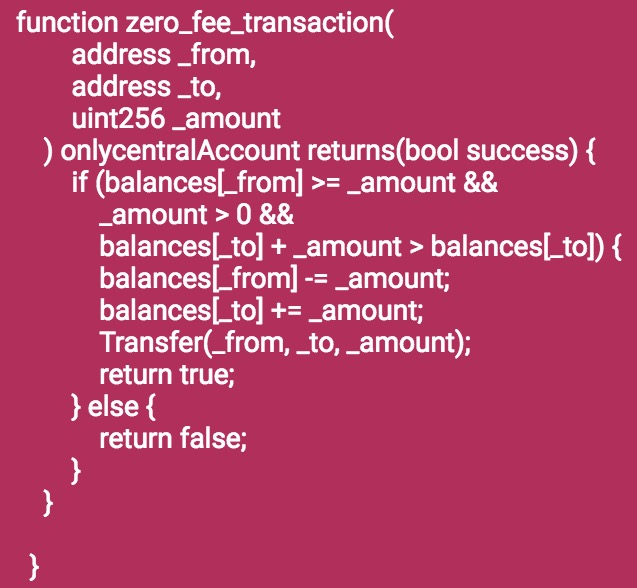
The zero-fee transaction function in Soarcoin

On Tuesday, ISMG contacted Nicholas Weaver, a researcher with the International Computer Science Institute and a lecturer at the University of California at Berkeley. Weaver has studied virtual currencies and their surrounding ecosystems since 2013.

While on the phone with ISMG, Weaver browsed Soarcoin’s code. Within about two minutes, he found a zero-fee transaction function that can only be called by the owner of the Ethereum smart contract, which in this case would be Soar Labs.

“If I’m the account owner, I can call that function and transfer a balance from anybody to anybody,” Weaver says. “It’s best described as a backdoor hiding in plain sight.”

«

Well that’s certainly a smart contract for one counterparty.

link to this extract


Ersatz free trials • Bitsplitting.org

Daniel Jalkut of Red Sweater software (maker of MarsEdit, which I use) points out the advantages and problems of how Apple allows “free” trials on the iOS and Mac App Stores:

»

let’s talk a little bit about what real support in the App Store might look like, and how it would alleviate the problems I’ve described.

For starters, real free trials would allow developers who currently list their apps as “free” in the App Store to list them by their actual price. The App Store could convey that information both more honestly and more informatively to users. Instead of “Free with in-app purchases,” MarsEdit could be identified succinctly as “$49.95 with 14-day free trial.” These apps would no longer be erroneously featured among free apps, but would rank alongside other paid apps, where they belong.

Having a bona fide price associated with the main App Store SKU would re-open access to the bulk purchase programs and family sharing. You know you want 500 copies of MarsEdit for your company? Go ahead and purchase 500 copies. The fact that the App Store happens to support free trials would be irrelevant to your conducting this transaction with Apple.

Real free trials would open the functionality up to any developer who chooses to participate, regardless of their app’s functionality. Instead of forcing developers to come up with arbitrary lock-downs on functionality in the app, they would simply flip a switch in App Store Connect, ideally specifying a trial duration. When free trials are downloaded from the store, the receipt would have the trial information baked right in.

Putting the logic in the store itself would also empower developers to start or stop offering free trials whenever they like, and to reset free trials across the board with major updates, in the same way they can choose to reset star ratings today. And all the tedious mechanics of offering, transacting, and enforcing free trial limitations would obviously be back in Apple’s court, where they can efficiently support such functionality in one place instead of requiring every developer to re-implement the same kind of support in every app.

«

link to this extract


Google braced for Brussels penalty over abuse of market dominance • FT

Rochelle Toplensky:

»

Brussels is preparing to hit Google next month for abusing its dominance through the Android mobile operating system, concluding the most important of a trio of EU antitrust investigations into the company.

Margrethe Vestager, the EU’s competition commissioner, is poised to announce the negative finding within weeks, according to people familiar with the case, marking the most significant regulatory intervention made against Google’s business model.

A penalty is expected in the Android case, but its size is unclear. The commission is empowered to impose fines of up to $11bn — which is 10% of the global turnover of Google’s parent company Alphabet — but typically decisions are at the lower end of the range.

The decision will mark an escalation of the commission’s battle with Google, which began eight years ago with an investigation into comparison shopping, then only a narrow part of online commerce. Though that case concluded with a €2.4bn fine, it has not led to significant changes to Google’s business.

«

And that’s the problem. A one-time fine doesn’t get anything done. Vestager hasn’t altered the competitive landscape; she hasn’t had an impact. If you’re the competition commissioner, you have to make competition happen.
link to this extract


Why it’s so hard for innovative smartphone makers to succeed • Fortune

Aaron Pressman:

»

Most [US] smartphone sales still occur in physical retail stores, about 88% as of the first quarter, Counterpoint Research says. And, as the carriers have thousands of stores spread across the country, they capture three-quarters of the offline market, with Apple [retail stores] — not a venue that will be selling any startup’s phones ever — grabbing much of the remainder.

That has left the startups trying to sell directly to consumers, both from their own websites and those of big e-commerce retailers like Amazon and Best Buy. But, that slender 12% segment of the market is highly fragmented. Here, the carriers plus Apple combine for only about two out of every five phones sold online, Counterpoint says. Amazon sells slightly more than one out of every five phones sold online, many through its “Prime Exclusive” line up. The remainder of online sales mostly go through the websites of retailers like Best Buy, Walmart, and Target.

A lot of smartphone buyers want either some handholding from a human sales associate or some hands-on time with the device, Counterpoint analyst Maurice Klaehne explains.

“It is a complicated purchase, as these devices are frequently sold bundled with a plan, service upgrade, or accessories,” Klaehne notes. “People often need help in these situations to get their phone set up, data transferred to the new device, and have new features explained.”

«

I honestly don’t see why anyone would start a smartphone business now. There are too many incumbents who have the top end sewn up; and the bottom end is a piranha tank with zero profits.
link to this extract


The first foldable AMOLED smartphone displays are expected to hit the market this year • IHS Markit

Jerry Kang:

»

While the flexible AMOLED display market included equal volumes of flat and curved displays in 2017, most flexible AMOLED panel suppliers are planning to put foldable AMOLED into mass production in a few years.

Flexible AMOLED displays have made rapid inroads into the flagship smartphone display market, with panel makers willing to supply differentiated products with innovative form factors, which increases the profit margin from sales of premium products. The first smartphones with foldable AMOLED displays are expected to be introduced before the end of the year.

Samsung Display has demonstrated single- and dual-foldable AMOLED displays since 2013. The company is expected to mass produce its first foldable AMOLED displays for Samsung Electronics in 2018.

BOE has developed a prototype of a 7.56-inch 2048×1536 foldable AMOLED display with a 5-millimeter bending radius, which reliably bends 100,000 times without breaking. BOE is looking to supply this foldable AMOLED display to Huawei this year.

AUO has developed a 5-inch 1280×720 AMOLED display, with a 4-millimeter bi-directional bending radius. The company says it will bend more than 1.5 million times without breaking. It includes an integrated touch sensor and 4H cover film.

«

OK, but what about these “rollable” screens allegedly heading our way in 2021? Are these going to be like roll-up papers?
link to this extract


Investors in Sugru lose up to 90% of their money • Irish Times

Ciara O’Brien:

»

Sugru maker FormFormForm is being sold for about £7.6m, in a deal that will see investors lose up to 90% of their initial investment.

The London-based company, which was founded by Irish inventor Jane Ní Dhulchaointigh, James Carrigan and Roger Ashby in 2004, will be bought by adhesives specialist Tesa in a deal that will save the firm but values shares at 9p each. The German-based firm made a formal offer for FormFormForm in March. The offer has been accepted by 51% of the company’s shareholders. The sale is set to complete next week, and Sugru staff, along with Ms Ní Dhulchaointigh, are expected to stay on with the company.

The move comes despite sales of Sugru recording double-digit growth in the past few years, with the company last December recording a sales increase of 20% year on year.

The company said an expected second tranche of funding from a £4m debt financing facility with Clydesdale and Yorkshire Bank (CYBG) was pulled back last November, causing financial difficulties for the company.

Sugru is a mouldable glue that works as a flexible, adhesive repair putty that turns into a durable silicone rubber. The glue was named as one of Time magazine’s top 50 inventions in 2010, and has built up a community of users online.

«

If Sugru keeps going, that’s great – it is terrific stuff. (I honestly thought it was Japanese…) Robin Klein, one of the investors, says that Sugru still has its best times ahead of it, as part of a company with 100 years’ experience selling consumer adhesives. Hard to disagree.
link to this extract


AirPods to add support for ‘Live Listen’ feature with iOS 12 • 9to5Mac

Chance Miller:

»

With Live Listen, iPhone owners will be able to use their iPhone essentially as a directional microphone. For instance, you can put your iPhone somewhere and walk away, with the audio being recorded by your iPhone played back live to your AirPods.

»

After enabling the feature in the iPhone’s settings, users will be able to use their phones effectively as a directional mic. This means you can have AirPods in at a noisy restaurant with your iPhone on the table, for example, and the voice of whomever is speaking will be routed to your AirPods.

«

Now, with support for AirPods, Live Listen has an entirely new reach. The feature turns the AirPods into a viable product for those with hearing problems, Furthermore, support on AirPods gives Live Listen more publicity that could lead to broader adoption down the road form more.

Here’s how Apple describes its Live Listen feature:

»

With Live Listen, your iPhone, iPad, or iPod touch becomes a remote microphone that sends sound to your Made for iPhone hearing aid. Live Listen can help you hear a conversation in a noisy room or hear someone speaking across the room.

«

Of course, this is not to say that AirPods can now serve as a fully functioning hearing aid replacement, but it does give the wireless earbuds a new accessibility focus like we called for last year.

«

You’d need the volume turned miles up, with great amplification, if you had anything more than a mild hearing impairment. Though imagine the scene for the ordinary person: in the restaurant you leave your phone on the table, go away and hear what people are saying about you…
link to this extract


Judge orders EPA to disclose any science backing up Pruitt’s climate claims • Ars Technica

»

In March 2017, Scott Pruitt, the new administrator of Donald Trump’s Environmental Protection Agency, appeared on CNBC and said that carbon dioxide was not known to be a major factor in climate change. “I would not agree that it’s a primary contributor to the global warming that we see,” Pruitt said, adding, “there’s a tremendous disagreement about the degree of the impact” of “human activity on the climate.”

Based on what?

The next day, a group called Public Employees for Environmental Responsibility (PEER) filed a Freedom of Information Act (FOIA) request with the EPA, asking for any agency documents that Administrator Pruitt may have relied on to come to his conclusions. Since Pruitt’s words contradicted scientific evidence shared by the EPA before the administrator took office, PEER’s request might turn up some recent document that indicated Pruitt had new information.

Instead, the EPA stalled and refused to provide any information to PEER. The employee group then sued the agency.

On Tuesday, a US District Court Judge for the District of Columbia issued a memo (PDF) saying that the EPA must comply with PEER’s request by July 2, offering any EPA documents that helped Pruitt come to the conclusion that he shared on CNBC last year. If certain documents can not be provided, an explanation for their absence must be provided by July 11.

«

A long process to get Pruitt to admit that he was wrong. But, in its own way, elegant.
link to this extract


Toshiba to close the book on its laptop unit • WSJ

Takashi Mochizuki:

»

Sharp is paying just ¥4 billion ($36m) for an 80.1% stake in a business that once was at the forefront of the global move toward mobile computing. Osaka-based Sharp, controlled by Taiwan-based iPhone assembler Foxconn Technology Group, has been expanding its consumer goods lineup because Foxconn wants to establish itself in branded electronic products.

The deal, disclosed by the companies Tuesday, highlights a contrast between the two electronics makers, both of which faced multibillion-dollar losses and management turmoil several years ago. Sharp has managed to turn itself around quickly under foreign management while Toshiba, which received more support from the Japanese government during its restructuring, is still trying to streamline its unprofitable portfolio.

Toshiba’s laptop PCs, sold under the Dynabook name, helped make the conglomerate famous among consumers outside Japan, but the business has lost money for the past five years and was at the center of a profit-padding scandal that the company disclosed in 2015.

That scandal and the bankruptcy last year of Toshiba’s U.S. nuclear subsidiary, Westinghouse Electric Co., have pushed Toshiba to shed many of its money-losing consumer businesses as well as more profitable units to raise funds. It has sold its television and appliance businesses to Chinese companies and its medical-equipment business to Canon Inc.

Last week, Toshiba completed the sale of its main profit center, its flash-memory semiconductor business, to a consortium led by U.S. private-equity firm Bain Capital, although Toshiba will retain a 40% stake…

…The Toshiba PC business had revenue of ¥167 billion ($1.52bn) in the year ended March 2018 and posted an operating loss of ¥9.6 billion ($87m).

«

And so another now-tiny player exits the PC market.
link to this extract


Apple’s software chief details how iOS apps will run on Macs • Wired

Lauren Goode:

»

When addressing my question about whether iOS apps moving to macOS is a natural precursor to touchscreen Macs, Federighi told me he’s “not into touchscreens” on PCs and doesn’t anticipate he ever will be. “We really feel that the ergonomics of using a Mac are that your hands are rested on a surface, and that lifting your arm up to poke a screen is a pretty fatiguing thing to do,” he said.

Federighi added that he doesn’t think the touchscreen laptops out there today—which he referred to as “experiments”—have been compelling. “I don’t think we’ve looked at any of the other guys to date and said, how fast can we get there?” (It’s worth noting that Microsoft’s Surface laptop, which has a touchscreen and is considered a top MacBook rival, has received largely positive reviews.)

Speaking of competition, Apple’s biggest competitors in mobile and desktop software are both already offering some version of mobile apps that can run on laptops and desktops. Microsoft’s Universal Windows Platform, introduced back in 2016, lets developers write just one app and have it run across PCs, tablets, mobile phones, and the XBox One. That same year, Google said it was bringing the Google Play app store to Chromebooks, which meant people could download and use Android apps on their ChromeOS computers.

Microsoft and Google have different technical approaches to running similar or the same versions of apps across different devices. But both systems are an acknowledgement of a basic truth: While people really love mobile apps, it can be inefficient and costly for developers to have to build entirely separate apps for multiple platforms.

«

Federighi is being a little disingenuous about the “fatiguing” thing there. I’m writing this on an iPad Pro – lots of screen touching goes on. The interaction paradigm of a mouse, though, allows for much more precision, and a native desktop/laptop allows for far more information density. This is what advocates of touchscreen laptops overlook: a mouse is a pixel-precise device. A finger isn’t.

This looks to me more like an effort to keep the Mac platform alive, by making it easier to write for, than any convergence. I could be miles wrong – Apple has made sweeping architecture changes in the past – but the need for precision is too big to ignore in desktop work.
link to this extract


Errata, corrigenda and ai no corrida: none notified

Start Up: the WhatsApp split, Apple v Facebook and Google, Manafort’s dire opsec, and more


Hans Rosling’s inspirational thinking will reach this year’s US graduates – via Bill Gates. Photo by mindfieldz on Flickr.

You can sign up to receive each day’s Start Up post by email. You’ll need to click a confirmation link, so no spam.
A selection of 10 links for you. Use them wisely. I’m @charlesarthur on Twitter. Observations and links welcome.

Behind the messy, expensive split between Facebook and WhatsApp’s founders • WSJ

Kirsten Grind and Deepa Seetharaman:

»

With Mr. Zuckerberg and Ms. Sandberg pushing to integrate it into the larger company, WhatsApp moved its offices in January 2017 from Mountain View, Calif., to Facebook’s Menlo Park headquarters about 20 minutes away. Facebook tried to make it welcoming, decorating the Building 10 office in WhatsApp’s green color scheme.

WhatsApp’s roughly 200 employees at the time remained mostly segregated from the rest of Facebook. Some of the employees were turned off by Facebook’s campus, a bustling collection of restaurants, ice cream shops and services built to mirror Disneyland.

Some Facebook staffers considered the WhatsApp unit a mystery and sometimes poked fun at it. After WhatsApp employees hung up posters over the walls instructing hallway passersby to “please keep noise to a minimum,” some Facebook employees mocked them with chants of “Welcome to WhatsApp—Shut up!” according to people familiar with the matter.

Some employees even took issue with WhatsApp’s desks, which were a holdover from the Mountain View location and larger than the standard desks in the Facebook offices. WhatsApp also negotiated for nicer bathrooms, with doors that reach the floor. WhatsApp conference rooms were off-limits to other Facebook employees.

“These little ticky-tacky things add up in a company that prides itself on egalitarianism,” said one Facebook employee.

[WhatsApp co-founder Jan] Koum chafed at the constraints of working at a big company, sometimes quibbling with Mr. Zuckerberg and other executives over small details such as the chairs Facebook wanted WhatsApp to purchase, a person familiar with the matter said.

In response to the pressure from above to make money, Messrs. Koum and [co-founder Brian] Acton proposed several ideas to bring in more revenue. One, known as “re-engagement messaging,” would let advertisers contact only users who had already been their customers. Last year, WhatsApp said it would charge companies for some future features that connect them with customers over the app.

None of the proposals were as lucrative as Facebook’s ad-based model. “Well, that doesn’t scale,” Ms. Sandberg told the WhatsApp executives of their proposals, according to a person familiar with the matter. Ms. Sandberg wanted the WhatsApp leadership to pursue advertising alongside other revenue models, another person familiar with her thinking said.

«

Pretty clear that Koum spoke to the writers. To my reading, he’s really angry about what happened.
link to this extract


Here’s my gift to college graduates • Bill Gates

Yeah, him, the Windows guy:

»

If you’re getting a degree from a U.S. college this spring, I have a present for you.

It’s a book. (No surprise there. Books are my go-to gift.) It’s called Factfulness, by the late global-health expert and noted sword swallower Hans Rosling, and it is packed with advice about how to see the world clearly. Although I think everyone should read it, it has especially useful insights for anyone who’s making the leap out of college and into the next phase of life.

So I am giving Factfulness to everyone who’s getting a degree from a U.S. college or university this spring. If you’re being awarded an associate’s, bachelor’s, or post-graduate degree, download your free copy of the book below. (Unfortunately, because of international publishing rights, it is available only to graduates from U.S. schools.)

I hope you enjoy Factfulness as much as I did. And I hope you take Hans’s advice to heart. “When we have a fact-based worldview,” he writes, “we can see that the world is not as bad as it seems—and we can see what we have to do to keep making it better.” I agree. My wish for you at this special time is to learn to think, and act, factfully.

«

What an amazing act. Sure, say that it doesn’t cost him much. The point is thinking of it, organising it, doing it. This is something that other people didn’t do.

I’m not about to graduate, but I think I’ll add it to the family reading list. (A reminder: Rosling died last year. So this isn’t about enriching him.)
link to this extract


Apple escalates war against Facebook, but doesn’t mention it at WWDC • The Guardian

Alex Hern:

»

If there was one theme running throughout Apple’s presentation, it was that the company is taking on Facebook on all fronts. The new Screen Time app, which aims to help users cut back on their device use, was demonstrated using Facebook’s Instagram as the test case, and Safari’s new anti-tracking tech is positioned squarely against Facebook’s use of Like buttons and comment boxes to track users around the net.

But the specific details of ITP2, the updated version of the anti-tracking technology, are even more aggressively targeted at two of Apple’s biggest rivals, Facebook and Google, than the company let on on stage. ITP works by segregating the cookies dropped by websites so that they can only be read by that specific website, ensuring that an ad provider cannot, for instance, use those cookies to track your browsing across every single website on which it runs ads.

Previously, that segregation had only kicked in 24 hours after a user visited the specific website. That was a handy out for sites such as Facebook, Google and YouTube, which users visit regularly enough to spend a lot of their time in that day-long window. Now, that grace period is gone, and Apple’s tracking prevention kicks in immediately. When ITP1 was launched last year, ad-tech firm Criteo saw an immediate 22% drop in revenue; what will Facebook see?

«

Are Facebook and Google really direct rivals to Apple? Each has a certain symbiotic need for Apple – Facebook wants its users, and so does Google; Apple likes the fact that their services keep them using the iPhone – but Apple really doesn’t like their business model, and does everything it can do stick spokes in it. And they find ways around it.

More generally, this article is a useful roundup of what was shown at WWDC.
link to this extract


WWDC 2018: the customer is always right • Loup Ventures

Gene Munster:

»

Apple Watch Improvements. Apple Watch is running away with the wearable space. Today, Tim Cook announced Apple Watch grew units by 60% last year (2017). While Apple Watch had a slow start in 2015, it appears to be picking up momentum. Apple doesn’t disclose the number of watches sold, but we estimate, in 2015, the company sold 5.7M, compared to 10.2M in 2016, and 16.1M in 2017. We believe that number will increase by 44% in CY18. We expect the Apple Watch business to grow in the mid-to-low 20% range through 2020, which implies Apple Watch will account for 6% of revenue in 2020 compared to 3% in 2017. Apple Watch is gaining momentum because Apple created the computer-on-your-wrist category allowing for significantly more advanced functionality compared to other wearables. For example, today, Apple announced walkie-talkie, new personal and group fitness features, Siri’s accelerometer integration, and a handful of Universities enabling student IDs on Apple Watch. Apple Watch’s measurable utility lead in the wearable space gives us confidence that the product can account for 31M units in 2020, nearly double the units sold in 2017.

«

Munster used to be a sell-side analyst – famous for predicting for years that Apple would introduce its own TV set – but now does industry analysis (and investment). This is pretty solid. (And no mentions of TV sets.)
link to this extract


Paul Manafort’s terrible encrypted messaging OPSEC got him additional charges • Motherboard

Lorenzo Franceschi-Bicchierai:

»

President Trump’s former campaign chairman and former lobbyist for dictators Paul Manafort was accused of trying to tamper with witnesses in his own case Monday.

Federal prosecutors working for special counsel Robert Mueller III accused Manafort of attempting to contact witnesses using the encrypted messaging app WhatsApp in an attempt to persuade them to commit perjury, as one of the witnesses put it to the FBI, according to court documents. The evidence obtained by the FBI was a result of Manafort’s awful OPSEC [operational security].

First of all, two witnesses contacted by Manafort provided the messages to the Feds, effectively selling him out. End-to-end encrypted messages are no good if the person you’re sending them to is going to hand them over to the people you’re trying to hide them from.

But Manafort also owned himself in this case.

As it turns out, Manafort was backing up information from his WhatsApp to to Apple’s iCloud, where data is not encrypted and is thus available to police armed with a valid search warrant.

«

Manafort is so fabulously incompetent at this stuff. He has laundered millions, but when it comes to technology he’s a dunce. Don’t forget that the case against him was strengthened by his inability to convert a PDF file to Word. Marcy Wheeler, a national security journalist, reckons Mueller was simply waiting for Manafort to pledge all his remaining properties as bail (on May 18). A week later Mueller sprang the trap, preparing the document referred to above. Manafort had breached his bail conditions and would forfeit all his collateral.

Which would leave him cleaned out and heading for jail. What chance he’s ready to sing like a bird? So don’t let anyone tell you that it’s not important to understand how technology works, or the finer details of encryption.
link to this extract


From Westworld to best world for the Internet of Things • The New York Times

Jonathan Zittrain:

»

A longstanding ethos of internet development lets anyone build and share new code and services, with consequences to be dealt with later. I call this the “procrastination principle,” and I don’t regret supporting it. But it’s hard to feel the same way about the internet of things.

Worries about security for these devices have become widespread, and they fall roughly into two categories.

First, compromised networked things can endanger their users. In 2015, Chrysler recalled 1.4 million vehicles after researchers showed they could hack a Jeep and disable its brakes and transmission. Coffee makers and other appliances with heating elements could have safety features overridden, starting a fire. And an alert was issued on certain pacemakers last year after vulnerabilities were found that could allow attackers to gain unauthorized access and issue commands to the devices.

Second, hacking even a tiny subset of the 10 billion and counting networked things can produce threats larger than any one consumer. Individually these devices may be too small to care about; together they become too big to fail. Security systems in a city could be made to sound an alarm simultaneously. Light bulbs can be organized into bot armies, directed to harm any other internet-connected target. And worse than a single Jeep executing an unexpected sharp left turn is a whole fleet of them doing so.

Short of rejecting internet integration with appliances, dealing with this is not easy. As with home routers, we tend to keep appliances around for years, so vulnerabilities aren’t phased out quickly.

In fact, many vendors might stop issuing firmware updates for physical objects even while they’re still widely in use — abandoning the public to problems lurking in embedded code. And otherwise-valuable “over the air” security updates could also be a gateway to a hack, especially for small vendors of cheap if useful objects like $5 drones.

«

Zittrain is one of the important thinkers out there. If he’s worried about IoT, so should we all be.

Did I mention that one of the chapters in my book looks at a botnet attack via the IoT, and has a surprising discovery about Ikea? It does.
link to this extract


Logistics industry says ‘too late’ to avoid Brexit disruption • FT

Chris Giles:

»

Britain’s logistics industry lost patience with the government on Tuesday, with lorry drivers saying their confidence in a well-managed Brexit is collapsing and the Channel tunnel warning it was “too late” to avoid serious disruption when the UK leaves the EU next March.

With Westminster convulsed by arguments over the future of the UK’s borders the logistics industry hit out at ministers and officials for having no plan for how their operations are supposed to function in the future.

The Freight Transport Association said “the industry’s frustration with the lack of progress is building daily” as logistics companies were unable to price for the period after March 2019 or answer basic questions from customers.

James Hookham, deputy chief executive, complained that some parts of government simply dismissed their concerns as trivial. “This is a reckless attitude to take and is playing chicken with parts of the British economy and the livelihoods of the seven million Britons in the industry.”

John Keefe, public affairs director of Getlink, the company which runs the Channel tunnel, warned against any solution that did not involve smart border technology away from the congested area of Dover, which he said was “essential to ensuring that frictionless trade can be maintained”.

«

There’s no good solution to Brexit. It’s a bad idea anyway, but the fact that even those who want it to happen don’t know quite what sort of Brexit they want, and don’t have any versions compatible with what business wants, is indicative of how half-baked the whole idea is.
link to this extract


FCC emails show agency spread lies to bolster dubious DDoS attack claims • Gizmodo

Dell Cameron:

»

As it wrestled with accusations about a fake cyberattack last spring, the Federal Communications Commission (FCC) purposely misled several news organizations, choosing to feed journalists false information, while at the same time discouraging them from challenging the agency’s official story.

Internal emails reviewed by Gizmodo lay bare the agency’s efforts to counter rife speculation that senior officials manufactured a cyberattack, allegedly to explain away technical problems plaguing the FCC’s comment system amid its high-profile collection of public comments on a controversial and since-passed proposal to overturn federal net neutrality rules.

The FCC has been unwilling or unable to produce any evidence an attack occurred—not to the reporters who’ve requested and even sued over it, and not to U.S. lawmakers who’ve demanded to see it. Instead, the agency conducted a quiet campaign to bolster its cyberattack story with the aid of friendly and easily duped reporters, chiefly by spreading word of an earlier cyberattack that its own security staff say never happened.

The FCC’s system was overwhelmed on the night of May 7, 2017, after comedian John Oliver, host of HBO’s Last Week Tonight, directed his audience to flood the agency with comments supporting net neutrality. In the immediate aftermath, the agency claimed the comment system had been deliberately impaired due to a series of distributed denial-of-service attacks (DDoS). Net neutrality supporters, however, accused the agency of fabricating the attack to absolve itself from failing to keep the system online.

«

It’s very strange of the FCC to do this. Why not just cop to the problem?

link to this extract


The Lenovo Z5 is official, and it has a screen notch after all • Android Police

Ryan Whitwam:

»

Lenovo’s Chinese phone releases are not usually big international news, but this time was different. The company’s teasers seemed to promise an all-screen design without a notch. That would certainly be refreshing in this day and age. However, the Z5 has been announced, and it looks like every other phone unveiled in the last six months. There’s a notch, a glass back, and a chin.

This device has mid-range specs including a Snapdragon 636, 6GB of RAM, and 64-128GB of storage. The screen is 19:9 and measures 6.2-inches with a resolution of 2264x 1080. Around back, there’s an iPhone-style camera array with a 16MP main sensor and 8MP secondary. It runs Android 8.1 with the ZUI software layer and no Google apps (because China). The phone comes in blue, black, and “aurora,” the latter of which looks a lot like Huawei’s fabulous “Twilight” finish on the P20 Pro.


The teaser and the reality.

The early teasers showed off what is clearly a phone without a screen notch. Now, it seems Lenovo was taking some creative liberties with the render…

[Later:] It looks like even Lenovo’s full device renders are a lie. The real Z5 has substantially larger bezels than you’d think from the official press images above.

«

Lenovo hasn’t made a profit in smartphones since it bought Motorola (and it’s hard to think it made much before). The marketing desperation is starting to show.
link to this extract


Family of Stoneman Douglas student advocate David Hogg ‘swatted’ at home • Local10

Jeff Tavss:

»

Swatting is the action of making a prank emergency call to bring about a response of armed law enforcement officers.

Neighbors who spoke to Local 10 News reporter Alex Finnie said the incident put them on edge.

“Today, we’re walking — we’re going for a walk, and we saw some helicopters here, so we’re like, ‘Oh my God. What’s going on?'” Marcia Marques said. “We are still trying to overcome everything because everything is very difficult, but that episode made us feel more attentive.” 

“Two police cars, two motorcycles. We should be doing better,” Courtney Keisen, who lives in the neighborhood and attends Stoneman Douglas, said. “Something like this shouldn’t happen a lot.” 

Since the shootings at Stoneman Douglas, Hogg has been a prominent advocate for gun safety. However, Hogg has been a lightning rod for controversy as some do not approve of his methods, such as holding a “die-in” protest at a Coral Springs Publix last week.

Hogg said the incident is “evidence of the fact of how many people are trying to stop us from what we’re trying to do, which is stop these kids from dying.”

«

Last December, someone did die as a result of a “swatting”. The overreaction of US police and the incoherent malice of some people carries huge risks.
link to this extract


Errata, corrigenda and ai no corrida: none notified

Start Up: how Instagram works, a Trumpy troll unmasked, MasterMap mystery, India’s big solar bet, and more


Apple showed off its new iOS 12 apps – and then told you how not to use them. Photo by Mark Mathosian on Flickr.

A selection of 12 links for you. Use them wisely. I’m @charlesarthur on Twitter. Observations and links welcome.

How Instagram’s algorithm works • TechCrunch

Josh Constine:

»

Instagram relies on machine learning based on your past behavior to create a unique feed for everyone. Even if you follow the exact same accounts as someone else, you’ll get a personalized feed based on how you interact with those accounts.

Three main factors determine what you see in your Instagram feed:

• Interest: How much Instagram predicts you’ll care about a post, with higher ranking for what matters to you, determined by past behavior on similar content and potentially machine vision analyzing the actual content of the post.

• Recency: How recently the post was shared, with prioritization for timely posts over weeks-old ones.

• Relationship: How close you are to the person who shared it, with higher ranking for people you’ve interacted with a lot in the past on Instagram, such as by commenting on their posts or being tagged together in photos

…TechCrunch can’t verify the accuracy of these claims, but this is what Instagram’s team told us:

Instagram is not at this time considering an option to see the old reverse chronological feed because it doesn’t want to add more complexity (users might forget what feed they’re set to), but it is listening to users who dislike the algorithm.

• Instagram does not hide posts in the feed, and you’ll see everything posted by everyone you follow if you keep scrolling.

• Feed ranking does not favor the photo or video format universally, but people’s feeds are tuned based on what kind of content they engage with, so if you never stop to watch videos you might see fewer of them.
Instagram’s feed doesn’t favor users who use Stories, Live, or other special features of the app.

• Instagram doesn’t downrank users for posting too frequently or for other specific behaviors, but it might swap in other content in between someone’s if they rapid-fire separate posts.

• Instagram doesn’t give extra feed presence to personal accounts or business accounts, so switching won’t help your reach.

• Shadowbanning is not a real thing, and Instagram says it doesn’t hide people’s content for posting too many hashtags or taking other actions.

«

Nice to know how your mind is being arranged without your knowledge.
link to this extract


Apple’s Shortcuts app lets Siri do everything • Engadget

Edgar Alvarez:

»

Siri is getting smarter thanks to a new app called Shortcuts, which will let you build your own commands with any application. With the Tile app, for example, you can say “Hey Siri, I lost my keys,” and that will then alert the tiny gadget attached to your keys.

You can create more shortcuts for things such as “Surf time,” which will prompt Siri to look up the weather report before you head to the beach. Shortcuts is also going to allow Siri to make suggestions to you, like that you should call your mom or grandma on their birthday. While Google Assistant has had access to features like these for some time, it’s still great to see Apple finally letting Siri integrate deeper with third-party apps — even if you have to do some of the legwork yourself.

Siri Shortcuts seems to stem from Apple’s acquisition of Workflow in 2017, an app that focused on performing multiple tasks with a single tap. This is essentially Apple’s take on If This Then That (IFTTT), and Siri is going to be better because of it. Let’s hope so, at least.

«

This could be really interesting, and take Apple straight into voice control for lots of things. What I don’t get is how it would be useful if your phone is locked: presently you have to unlock it to do anything app-related with Siri. Or perhaps an unlocked phone is the starting point.
link to this extract


Apple unveils ways to help limit iPhone usage • WSJ

Tripp Mickle:

»

Apple on Monday unveiled new controls to help people curb the amount of time they spend on iPhones and iPads, as well as allow parents to remotely track and limit their children’s use of those devices—a response to growing societal concern that adults and children are too focused on phones.

The company said a new app it will release in September called “Screen Time” will provide users with weekly reports of the apps they use and allow them to set time limits for their use of those apps. Parents will be able to use the system to remotely monitor the apps their children use and limit their time on devices.

«

So both Apple and Google are trying to get us to use our phones less, or feel guilty about it. Will it work, though? Lots though that seems good – even overdue: better notification control, better parental controls, and will work on phones right back to 2013’s iPhone 5S. That’s a lot of phones.
link to this extract


Wireless system can power devices inside the body • MIT News

Anne Trafton:

»

MIT researchers, working with scientists from Brigham and Women’s Hospital, have developed a new way to power and communicate with devices implanted deep within the human body. Such devices could be used to deliver drugs, monitor conditions inside the body, or treat disease by stimulating the brain with electricity or light.

The implants are powered by radio frequency waves, which can safely pass through human tissues. In tests in animals, the researchers showed that the waves can power devices located 10 centimeters deep in tissue, from a distance of 1 meter.

“Even though these tiny implantable devices have no batteries, we can now communicate with them from a distance outside the body. This opens up entirely new types of medical applications,” says Fadel Adib, an assistant professor in MIT’s Media Lab and a senior author of the paper, which will be presented at the Association for Computing Machinery Special Interest Group on Data Communication (SIGCOMM) conference in August.

Because they do not require a battery, the devices can be tiny. In this study, the researchers tested a prototype about the size of a grain of rice, but they anticipate that it could be made even smaller.

«

It’s a little like RFID (where the radio frequency makes the aerial “ring”, generating power) but slightly more sophisticated. Though after reading John Carreyrou’s book Bad Blood, about Theranos, you find that any claim of medical advance wants peer review.
link to this extract


Trump’s loudest anti-Muslim Twitter troll is a shady vegan married to an (ousted) WWE exec• Huffington Post

Luke O’Brien:

»

She was supposed to be a Russian bot. That seemed like the best explanation for @AmyMek. No normal person could be so prolific and prejudiced.

For five years, the mysterious Twitter account ― which has more than 200,000 followers, including Sean Hannity, Roseanne Barr and the personal account of Sarah Huckabee Sanders, and has earned endorsements from Donald Trump and Michael Flynn ― has tirelessly spewed far-right propaganda and, above all, Islamophobia. Around 25 tweets a day, sometimes more, the majority of them designed to stoke hatred of Muslims.

The bigotry was garden-variety Islamophobia: memes about Sharia executions and child rape, genital mutilation and Muslims torturing and butchering various life forms while dusky columns of Saracens, every one of them a potential jihadist, march into Western lands bent on pillage. What made @AmyMek special was her industriousness. She never took a break.

“She’s a major cog in the Islamophobia machine,” said Ibrahim Hooper, spokesman for the Council on American-Islamic Relations, a Muslim advocacy and civil rights organization that @AmyMek often attacks.

Her Twitter timeline was one long screed that reflected the collective id of the Make America Great Again movement. Tea party rage, evangelical hokum and white supremacy ― it was all there. In sufficient volume, this kind of hate can now turn any no-account right-winger into a star on social media. And it worked for @AmyMek.

But who was she?

«

O’Brien put together the few clues that Amy Jane Mekelburg left in her Twitter stream, and put them together. (One suspects that he got some tipoffs, though he manages to obscure where they came from. But a subsequent statement from Mekelburg’s family suggest they’ve known for a while, and disapprove of her actions strongly.) For that, he was accused of “stalking” by right-wing idiots who like to make stuff up.

More generally, this shows how social media amplifies people not because they’re trustworthy, but because they’re polarising. She has over 220,000 followers.

Notably, though, she has hardly tweeted in the past couple of days.
link to this extract


AT&T and Verizon want to run big ad-tracking networks to rival Facebook • The Verge

Nilay Patel:

»

AT&T CEO Randall Stephenson spoke at the Code Conference today, where he took issue with the government’s antitrust lawsuit blocking its purchase of Time Warner. Then he laid out exactly why he wants to buy it: to sell ads to the customers it already tracks.

»

[Time Warner’s] Turner has an amazing inventory of advertising that they just kind of sell broadly. It’s not a very targeted advertising approach. AT&T has an amazing amount of data — customer data for 40 million pay TV subscribers in North and South America, 130 million mobile subscribers, 16 million broadband subscribers. We have really great customer insight on what kind of shows and media content they’re viewing, where they are, all kinds of information on the consumer. Can you pair a very formidable ad inventory with a very formidable amount of data and information on the customer — viewership data and all kinds of other information — and can you create something unique just from a straight advertising platform and change how you’re monetizing content?

«

To sum that up, AT&T’s plan is to use the data it tracks and collects about customers on its networks — including location data and all the media they consume over those networks — to serve targeted ads for high prices against Time Warner content.

«

link to this extract


What’s happening with MasterMap and the Geospatial Commission? • Owen Boswarva

Boswarva notes that a Budget promise to establish “by May 2018” how to open MasterMap, the UK mapping agency’s key product, hasn’t been met:

»

MasterMap is free to use for public authorities under a central funding agreement, but commercial terms apply for use by businesses, charities and the general public. A corporate licence for full coverage of the Topography Layer alone is £4,581,000 per year, so it’s easy to see why open data campaigners think MasterMap has untapped potential for re-use in the wider national interest.

In principle releasing MasterMap as open data should be a straightforward, if bold, economic decision. The challenge is mostly in the implementation.

Back in 2010 a previous Government recognised the need for a base layer of freely re-usable national geospatial infrastructure, and we got OS OpenData – an adaptable toolkit of mapping products that radically expanded the accessibility of geographic information in Britain.

Today, with increasingly detailed sources of geographic data coming online from BIM, citizen science, urban sensor networks, and earth observation, that demand has shifted to a more granular level. We need open MasterMap, and the Topography Layer in particular, to function as the new collaborative base layer for location intelligence in Britain.

By now Cabinet Office must have realised there’s no way to effectively ring-fence the benefits for small businesses. SMEs operate within supply chains, and exploiting MasterMap across the full range of potential applications on the web requires frictionless sharing of data. But opening MasterMap will still benefit small businesses “in particular”, because the costs associated with the current licensing model are a barrier to entry that discourages small businesses much more than large corporates.

Releasing MasterMap as open data will have a significant secondary benefit: the potential to unlock thousands of additional spatial datasets, held by local authorities and other public bodies, that cannot be published as open data now because they are derived from closed MasterMap data.

«

This would be a huge win for free data in the UK. We pay the government to collect it; why don’t we get to use it for free?
link to this extract


Some quick thoughts on the public discussion regarding facial recognition and Amazon Rekognition this past week • AWS News Blog

Matt Wood is general manager of AI at Amazon Web Services:

»

Amazon Rekognition is a service we announced in 2016. It makes use of new technologies – such as deep learning – and puts them in the hands of developers in an easy-to-use, low-cost way. Since then, we have seen customers use the image and video analysis capabilities of Amazon Rekognition in ways that materially benefit both society (e.g. preventing human trafficking, inhibiting child exploitation, reuniting missing children with their families, and building educational apps for children), and organizations (enhancing security through multi-factor authentication, finding images more easily, or preventing package theft). Amazon Web Services (AWS) is not the only provider of services like these, and we remain excited about how image and video analysis can be a driver for good in the world, including in the public sector and law enforcement.

There have always been and will always be risks with new technology capabilities. Each organization choosing to employ technology must act responsibly or risk legal penalties and public condemnation. AWS takes its responsibilities seriously. But we believe it is the wrong approach to impose a ban on promising new technologies because they might be used by bad actors for nefarious purposes in the future. The world would be a very different place if we had restricted people from buying computers because it was possible to use that computer to do harm.

«

That’s true, but there were plenty of restrictions on who you could sell computers to – Iran, Iraq, Syria, North Korea, China, and so on. The concerns over Rekognition are about who gets to use it; exactly like those computer export restrictions.
link to this extract


How Apple programmer Sal Soghoian got apps talking to each other • WIRED

»

In 2014, after Apple announced a ton of new tools for apps to work together in iOS 8, [David] Barnard and [Justin] Youens [both iOS developers outside Apple] started brainstorming ways these tools could make their app better. Their plan was to find a way to run x-callback-urls in succession to create script-like actions. They had effectively dreamed up Automator for iOS, but their fear of being burned again by Apple’s often convoluted and murky app approval process held them back from following through.

Looking back, Barnard says that was a strategic blunder.

The team behind Workflow didn’t share those fears. In the winter of 2014, its app debuted on the App Store. It looked a lot like what you’d imagine Automator for iOS would be—to create a workflow, you’d select the actions you want, then drag and drop them together in a way that brought your tasks to completion. You could do things like send an ETA to a contact based on your current location, download all the pictures on a webpage, or quickly post photos to Instagram with all your favorite hashtags already included. If there was a task on your phone that took too much time and mental energy to do over and over again, there was a good chance you could try to automate it using Workflow. It even tied pieces together with x-callback-url.

Just over two years after the app’s debut, Apple acquired Workflow and its team for an undisclosed amount of money. Apple hasn’t been clear on why it bought Workflow, but Greg Pierce thinks it’s promising for the future of automation. “Maybe we’ll see something [in 2018] that gives people a platform to do more professional work,” he says.

«

This article appeared before the WWDC announcements. Though it has Soghoian in the headline, he isn’t a hero of iOS, and I personally have never found Automator on the Mac useful – I write in Applescript. But it was he who kept the flame of Applescript alive in Apple for years, and that is crucial.
link to this extract


India approves massive new 5,000 megawatt solar farm • Climate Action Programme

»

The Indian Government has given planning permission to a huge new solar project which is set to become one of the largest in the world.

The approval for a 5,000 megawatt (MW) solar farm in the state of Gujarat was announced earlier this month by the Ministry of New & Renewable Energy.

The first 1,000MW stage of the project will be put out to tender soon.

Once complete the project near the town of Dholera will be the largest solar farm in India, stretching over 11,000 hectares and eclipsing the 2,255 MW Bhadla solar park currently under development in Rajasthan.

Saudi Arabia recently signed an initial deal to build a larger 200 GW solar farm, the first stage of which will be 7,200 MW.

The Chief Minister of Gujarat, Vijay Rupani, said on Twitter that the Dholera project is estimated to attract 25,000 crore rupees ($3.7bn), and employ 20,000 people.

«

11,000 hectares is about 42 square miles.
link to this extract


Conspiracy theories are eating this alt right-friendly site from the inside • Daily Beast

Kelly Weill:

»

Last week, Sanduja set off a firestorm on the [Gab] site, after he perceived Jared Wyand (an alt-righter who was kicked off Twitter, ostensibly for claiming that Star Wars promotes “white genocide”) to to be threatening him.

“You have a false sense of security that leads to a leaky mouth in a room full of highly capable men who have their backs to the walls,” Wyand wrote Sanduja on Gab. “That’s a very large mistake but don’t let it stop you. 😉”

Sanduja replied that he was reporting the message to law enforcement.

“Obviously I saw that as a threat because it was clearly coded and was clearly designed to intimidate and suppress my right to speech,” he told The Daily Beast. “I have to look out for my own personal safety because to be frank with you, my job is very dangerous. The things I do are very dangerous. The reality that is I am trying to liberate people around the world from tyranny, essentially, speech censorship, and our team faces a lot death threats.”

Over the past week on Gab, Sanduja has shared a number of anti-Islamic posts, including one describing a rise in European babies named Muhammed as a “Jihad of the womb.”

Sanduja declined to describe how many reports Gab has made to law enforcement (he previously stated that he was reporting the person who sent him a drawing of a noose), but said that Gab had complied with law enforcement investigations in the past.

A strain of hard-right Gab users have bashed management for the reports to police, as well as Sanduja for announcing that he had blocked more than 5,000 Gab users. (To do so is anti-free speech, to hear this crowd tell it.) But Torba claims some of the police reports are false flags.

«

Oh, by the way, Utsav Sanduja is chief operating officer of Gab. They seem like a nice bunch, don’t they? No. (If you read on, it’s clear there’s an utterly paranoid streak to their thinking which requires them to see infiltration and enemies in everything.) Journalists who report on this stuff put me in mind of the workers sent to clear out fatbergs from sewers: I’m glad someone does it, and I’m thankful it’s not me.
link to this extract


Fake Fortnite APKs are out there, don’t be tricked into downloading one • Android Police

Richard Gao:

»

Given Fortnite’s current hotness, we understand if you’ve been scouring the webs for an APK to download onto your phone. After all, Epic Games said that Fortnite would be making its way to Android this summer, and it’s basically summer at this point. But be forewarned: Fortnite is not out on Android yet, and anything you see claiming to be a Fortnite APK is a scam.

A Google search will reveal more than a few Fortnite Android scams out there, and they’re all over YouTube as well. Some, like the one you see above, have actually purchased advertisement space on YouTube to further deceive people. Most of them can be easily spotted from their broken English and generally crappy web design, but it wouldn’t be difficult for anyone who isn’t a complete idiot to make something more convincing.

«

The fake apps steal Fortnite accounts. Well, of course. The fake games are a side effect of the delay between the iOS release and the Android release, and that of course is because of the difference in the number of devices to be supported. (Side note: one of the kids won a round of 1 v 99 and so has been elected this household’s tribute. May the odds be ever in their favour.)
link to this extract


You can sign up to receive each day’s Start Up post by email. You’ll need to click a confirmation link, so no spam.

Errata, corrigenda and ai no corrida: none notified

Start Up: Microsoft buying Github, Google’s dashed drone hopes, let’s trade war!, beating dark ads, and more


Android tablets seemed to have been unceremoniously demoted on Google’s developer site. But not so! Photo by Aaron Yoo on Flickr.

You can sign up to receive each day’s Start Up post by email. You’ll need to click a confirmation link, so no spam.

A selection of 11 links for you. Tariff-free. I’m @charlesarthur on Twitter. Observations and links welcome.

Microsoft is said to have agreed to acquire coding site GitHub • Bloomberg

Dina Bass and Eric Newcomer:

»

Microsoft Corp. has agreed to acquire GitHub Inc., the code repository company popular with many software developers, and could announce the deal as soon as Monday, according to people familiar with the matter.

GitHub preferred selling the company to going public and chose Microsoft partially because it was impressed by Chief Executive Officer Satya Nadella, said one of the people, who asked not to be identified discussing private information. Terms of the agreement weren’t known on Sunday. GitHub was last valued at $2bn in 2015.

The acquisition provides a way forward for San Francisco-based GitHub, which has been trying for nine months to find a new CEO and has yet to make a profit from its popular service that allows coders to share and collaborate on their work. It also helps Microsoft, which is increasingly relying on open-source software, to add programming tools and tie up with a company that has become a key part of the way Microsoft writes its own software.

Frank Shaw, a spokesman for Microsoft, declined to comment. GitHub didn’t return an email seeking request for comment.

«

Sounds likely: Microsoft wants to get in front of programmers; it wants to know what trends are in programming; this is a great way to do that. Nadella’s Microsoft is an adaptable creature.
link to this extract


Leaked emails show Google expected lucrative military drone ai work to grow exponentially • The Intercept

Lee Fang:

»

Google has sought to quash the internal dissent in conversations with employees. Diane Greene, the chief executive of Google’s cloud business unit, speaking at a company town hall meeting following the revelations, claimed that the contract was “only” for $9 million, according to the New York Times, a relatively minor project for such a large company.

Internal company emails obtained by The Intercept tell a different story. The September emails show that Google’s business development arm expected the military drone artificial intelligence revenue to ramp up from an initial $15 million to an eventual $250 million per year.

In fact, one month after news of the contract broke, the Pentagon allocated an additional $100 million to Project Maven.

The internal Google email chain also notes that several big tech players competed to win the Project Maven contract. Other tech firms such as Amazon were in the running, one Google executive involved in negotiations wrote. (Amazon did not respond to a request for comment.) Rather than serving solely as a minor experiment for the military, Google executives on the thread stated that Project Maven was “directly related” to a major cloud computing contract worth billions of dollars that other Silicon Valley firms are competing to win.

The emails further note that Amazon Web Services, the cloud computing arm of Amazon, “has some work loads” related to Project Maven.

«

But now it isn’t going to renew the contract. Employee pressure can make a difference, which is heartening.
link to this extract


How to win a trade war • FiveThirtyEight

Rachael Dottle:

»

You (Yes, you!) have just been elected president of your very own country. Congratulations! Now it’s time to get to work. There is another country out there that has goods you can buy, and you have goods it may want to buy. Your job is to choose your foreign economic policy — which you’ll do in the little game we’ve prepared for you below.

The rules go like this: You can cooperate with the other country, allowing the free flow of its goods into your country. Or you can defect, imposing tariffs on the foreign goods. And because you will trade with the same country over and over again, you have to decide whether to stick with a single strategy no matter what or whether to change course in response to your opponent. The other country faces the same choice, but you can’t know in advance what plan they’ve chosen. Free trade helps both countries, generating big windfalls for both sides. But it’s possible for a single country to improve its own situation at the other’s expense — you both have a selfish incentive to defect, taxing the imports from the other country and helping only yourself. However, if you both defect, you both wind up isolated, cutting yourselves off from the market and reducing earnings on both sides.

So, give it a try. Another randomly chosen FiveThirtyEight reader will play the part of the other country.

«

It’s Prisoner’s Dilemma, iterative version. As has been shown by multiple tournaments, the optimal strategy is “nice tit-for-tat”: cooperate (no tariff) in the first round, do whatever your opponent just did to you (cooperate or defect – ie, no tariff, or tariff) in each subsequent round.
link to this extract


Removing Trending from Facebook • Facebook Newsroom

Alex Hardiman, head of news products:

»

We’re removing Trending soon to make way for future news experiences on Facebook. We introduced Trending in 2014 as a way to help people discover news topics that were popular across the Facebook community. However, it was only available in five countries and accounted for less than 1.5% of clicks to news publishers on average. From research we found that over time people found the product to be less and less useful. We will remove Trending from Facebook next week and we will also remove products and third-party partner integrations that rely on the Trends API.

We’ve seen that the way people consume news on Facebook is changing to be primarily on mobile and increasingly through news video. So we’re exploring new ways to help people stay informed about timely, breaking news that matters to them, while making sure the news they see on Facebook is from trustworthy and quality sources.

«

Suuuuuure. Trending turned out to be a terrible idea, open to being gamed – as it was – and made worse by firing the humans who had done it and giving the job to machines. (This Wired article from February tells the inside story on that.)
link to this extract


How Ireland beat dark ads • Foreign Policy

Rachel Lavin and Roland Adorjani:

»

Niamh Kirk, a journalism and digital media researcher at Dublin City University, carried out an analysis of the groups that had been buying ads before this ban [on Irish 8th amendment referendum ads] and found that the role played by foreign groups was small but significant. Nine% of ads were from groups based outside of Ireland.

Twenty-eight ads in the TRI database (3% overall) were from groups based in the United States, one was from Canada, three were from France, and the origin of 39 (4% overall) was unclear.

There was also the question of funding. Irish electoral law states that all donations to political campaigns above 100 euros must be registered with the Standards in Public Office Commission (SIPO), meaning the groups paying for these ads should have been publicly declared.

But a number of the ads were being put out by groups that were either not registered or else completely anonymous — especially those coming from the retain side.

Another electoral fear was bots — automated social media accounts used to promote certain topics or users and shut down others. They’ve played a key role in disrupting democratic discourse on Twitter. The Computational Propaganda Project at Oxford University found that bots supportive of Donald Trump in the 2016 U.S. election outweighed Hillary Clinton’s 5-to-1.

The same techniques threatened Ireland’s abortion discussion. An analysis of more than 400,000 tweets collected two months before the referendum found a significant proportion of botlike activity.

Out of 165,323 tweets for #Savethe8th (the anti-abortion hashtag), 14% came from accounts with numerical names (3 or more numbers in the handle), 6% were from accounts with numbers in their names and no location, and 2% had no bios in addition to the previous two markers.

Out of 267,274 tweets for #Repealthe8th, the figure for such botlike activity was half of the anti-abortion campaign.

«

Perhaps not allowing these sorts of ads – which can be micro-targeted – would be a good idea, since it’s so hard to make sure that they’re in any way legitimate. And that’s before you get onto the content that isn’t advertising but which gets pushed around Facebook and so on.
link to this extract


Embattled Chinese telecom giant ZTE beefs up lobbying muscle • Daily Beast

Lachlan Markay:

»

ZTE Corporation struck a contract with D.C. lobbying and public relations powerhouse Mercury Public Affairs on May 14, a day after Trump tweeted that he would consider lifting the penalties that had been imposed on the company as punishment for its violation of sanctions against Iran and North Korea.

The Mercury consultant working on the account is Bryan Lanza, a veteran of the Trump 2016 presidential campaign. Less than two weeks after Lanza’s work began, the Trump administration announced that it had reached a tentative deal to ease those penalties, a move criticized by lawmakers of both parties.

Many factors likely contributed to the resolution of the ZTE penalties, including efforts to leverage ongoing trade negotiations with China. But the swiftness of the Trump administration’s efforts to reach an agreement with the company—and the equally swift decision of that company to bring on a prominent Trumpworld figure—underscores the new world of influence peddling in Washington D.C. An infamously impulsive president, prone to bucking political norms and changing legislative priorities, has compelled companies to turn to K Street just to keep up.

Former aides to any president are a particularly lucrative draw in DC’s influence industry. And true to form, companies looking to win favor with President Trump have frequently turned to those he once employed. Lanza remains close with the White House and occasionally speaks with the president himself.

The Trump administration plan is a lifeline for ZTE. The Commerce Department’s decision to ban the use of American-manufactured parts in ZTE products, chiefly smartphones, prompted the company to announce that it would be forced to shut down global operations absent U.S. government relief.

«

So it’s all grace and favour again. Trump’s venality and hypocrisy never ceases to dismay, but it’s worth citing from time to time.
link to this extract


Google unceremoniously removes the tablet section from official Android website • Android Police

Ryan Whitwam:

»

Google has been doing an impressive job of pretending Android tablets don’t exist for the last few years, and now it’s done pretending. Google has updated the Android website to remove the tablet section entirely. You can now use that site to learn all about Android on Phones, Wear, TV, Auto, and Enterprise. That’s it. RIP Android tablets.

As of yesterday [May 31], the tablet section still existed. You can see the last version of the page in the Internet Archive. It talked about hot new tablets like the Shield and Galaxy Tab S2. So, yeah. It wasn’t getting much attention even before Google killed it. Now, if you try to visit the URL for the tablet page, it kicks you back to the main Android site.

«

Wow, that is quite a statement – even in passive-aggressive form. Whitwam also points out that there are no Android P dev tablets. Though there might be ChromeOS tablets that run Android. Google says it made a mistake updating the site and tablets were never meant to go away.

Even with this, Android tablets come in dead last on developers’ to-do list, which generally runs iPhone, Android phones, iPad, Android tablets. Though possibly ChromeOS comes ahead of Android tablets now.
link to this extract


Looking for life on a flat earth • New Yorker

Alan Burdick:

»

If we can agree on anything anymore, it’s that we live in a post-truth era. Facts are no longer correct or incorrect; everything is potentially true unless it’s disagreeable, in which case it’s fake. Recently, Lesley Stahl, of “60 Minutes,” revealed that, in an interview after the 2016 election, Donald Trump told her that the reason he maligns the press is “to discredit you all and demean you all so that when you write negative stories about me no one will believe you.” Or, as George Costanza put it, coming from the opposite direction, “It’s not a lie if you believe it.”

The flat Earth is the post-truth landscape. As a group, its residents view themselves as staunch empiricists, their eyes wide open. The plane truth, they say, can be grasped in experiments that anyone can do at home. For instance, approach a large body of water and hold up a ruler to the horizon: it’s flat all the way across. What pond, lake, or sea have you ever seen where the surface of its waters curves? Another argument holds that, if Earth were truly spherical, an airplane flying above it would need to constantly adjust its nose downward to avoid flying straight into space. If, say, you flew on a plane and put a spirit level—one of those levels that you buy at the hardware store, with a capsule of liquid and an air bubble in the middle—on your tray table, the level should reveal a slight downward inclination. But it doesn’t: the level is level, the flight is level, the nose of the plane is level, and therefore the surface of Earth must be level. Marble performed this experiment himself, recorded it, posted it on YouTube, and a co-worker started a Reddit thread that linked to it. Soon Marble had twenty-two thousand followers and a nickname, the Spirit-Level Guy.

“We’re not trying to express any degree of intellectual superiority,” he said at the conference. “I’m just trying to wake people up to the idea that they’ve been lied to. It’s what you would do with any friend.”

«

It’s hard to decide: are we entering a new dark ages, when the populace is stupid and so are the rulers, and intelligent ideas are pushed aside? Or is this just a fringe, with the necessary intelligent work continuing regardless? I side with the “fringe” idea, but the ability of totally stupid, unscientific ideas to persuade people is unsettling.
link to this extract


Dixons Carphone risks loss of big mobile groups in contracts row • FT

Nic Fildes:

»

Alex Baldock, new chief executive of Dixons Carphone, warned the mobile phone sector this week that its contracts — some signed after the collapse of its rival Phones 4U in 2014 — were “unsustainable” and in need of renegotiation.

The company revealed plans to close 92 Carphone Warehouse stores and said that revisiting the contracts was a key part of its strategy to improve profitability.

“Our performance is unacceptable in mobile and we won’t tolerate it. One way or another, this performance will improve in the medium-term,” he said during an analysts call.

The mobile operators said that the bellicose statements, and demands for more cash upfront, did not signal that Mr Baldock wanted to build long-term relationships.

One person on the retail side of one of the largest networks said that it has delayed a decision on whether to re-sign with the retailer, and that it could walk away.

Another person at a rival network said that selling phone contracts through Carphone Warehouse was the “least profitable channel for operators” and that the comments suggested that the business was struggling.

«

This is an existential threat for CPW, which grew – as its name suggests – from the original demands to put mobile phones in cars. (Mobile phones were physically big in those days.) If the mobile operators pull out, it has a real problem – the same one that sank Phones4U.
link to this extract


Messenger Kids no longer requires the kids’ parents to be friends, too • TechCrunch

Sarah Perez:

»

Facebook’s Messenger Kids application, which allows children under 13 to chat with parents’ approval, is today rolling out a small, but notable change – it no longer requires that the children’s parents be Facebook friends with one another, in order for the children to connect. This solves one of the problems with the app’s earlier design, where it operated more like an extension of a parents’ own social circle, instead of one for their child.

Of course, parents still have to approve every contact their child adds, as usual.

As any parent understands, there are always going to be those friends of your child where you have an acquaintance-type, friendly but casual relationship with the parents that falls short of earning “Facebook friend” status. While you might text them for the occasional play date or nod politely at drop-off, you’re not necessarily “friends.” But your kids are friends with each other. And you’re fine with that.

The Messenger Kids update now allows those kids to connect, if you okay it.

«

This was totally predictable. My comment back in December when this was announced: “at its core, it’s about getting people – even those under age – to use Facebook more.” Letting more kids connect means they use Facebook more. Ta-da!
link to this extract


Experiment: How easy is it to spy on a smartwatch wearer? • Kaspersky Lab official blog

»

Our research has shown that data obtained from a smartwatch acceleration sensor can be used to recover information about the wearer: movements, habits, some typed information (for example, a laptop password).

Infecting a smartwatch with data-siphoning malware that lets cybercriminals recover this information is quite straightforward. They just need to create an app (say, a trendy clockface or fitness tracker), add a function to read accelerometer data, and upload it to Google Play. In theory, such an app will pass the malware screening, since there is nothing outwardly malicious in what it does.

Should you worry about being spied on by someone using this technique? Only if that someone has a strong motivation to spy on you, specifically. The average cybercrook is after easy pickings and won’t have much to gain.

But if your computer password or route to the office is of value to someone, a smartwatch is a viable tracking tool.

«

Full report here. Note that this is about an Android smartwatch; no word on doing it with an Apple Watch (which one suspects would be a lot more difficult.)
link to this extract


Errata, corrigenda and ai no corrida: none notified

Start Up: iMessage + iCloud = secure?, Facebook and the ageist job ads, Twitter gets GDPR-y, the antibiotic problem, and more


CFC escapes look as though someone is making old fridges – but not sealing them up. Photo by ToddBF on Flickr.

You can sign up to receive each day’s Start Up post by email. You’ll need to click a confirmation link, so no spam.

A selection of 9 links for you. Until the next ones. I’m @charlesarthur on Twitter. Observations and links welcome.

Scientists race to find who is pumping an incredibly dangerous gas into the atmosphere • The Outline

Caroline Haskins:

»

The research letter [published in Nature] considers several possible options. Have there simply been natural changes in the atmosphere? Have refrigerators, air conditioning units, and foam packaging—all of which used to be made with CFCs—been rotting in landfills, releasing those CFCs? Have chlorine, fluorine, and carbon been produced, accidentally forming CFCs as a byproduct?

In all of these cases, the study claims, probably not. The amount of CFC-11 they were detecting was simply too high. The most likely scenario is that CFC-11 is being produced, but not reported. Using air circulation data, the scientists were able to conclude the plumes were probably coming from somewhere in East Asia.

“The [CFC-11 levels] increased by 25 percent,” Montzaka said. “And that was entirely unexpected so that was quite a bit of a shock.”

But where, exactly, are these CFCs coming from? Who is responsible? What are scientists and international policymakers supposed to do now?


A visualization of CFCs in regions around the globe in 2016, with darker colors indicating a higher amount of CFCs. Source: Nature

According to Paul Newman, an atmospheric scientist and co-chair of the Montreal Protocol’s Scientific Assessment Panel, scientists around the world are digging to figure it out.

“The scientists are all running around right now,” Newman told The Outline in a phone call. “Stephen [Montzaka]’s study has sort of lit a fire under a lot of people. They’re going back, they’re taking a look at their data to try and investigate, ‘maybe I got some good CFC-11 measurements.’”

«

link to this extract


So how secure is Messages in iCloud anyway? • The Mac Observer

Andrew Orr:

»

Apple says:

»

Messages in iCloud also uses end-to-end encryption. If you have iCloud Backup turned on, a copy of the key protecting your Messages is included in your backup. This ensures you can recover your Messages if you’ve lost access to iCloud Keychain and your trusted devices. When you turn off iCloud Backup, a new key is generated on your device to protect future messages and it is not stored by Apple.

«

What this means is that all of your messages are encrypted by a key generated using your device’s passcode. This makes it inaccessible to Apple and other third parties. But there’s a caveat.

If you enable iCloud Backup, that encryption key is included. It sounds like a copy of might also be stored in iCloud Keychain. That means if Apple is served a warrant by law enforcement, your iCloud Backup, along with all of its data, can be accessed. But this has always been true of iCloud Backup; the inclusion of Messages in iCloud hasn’t changed this fact.

«

If you’re really wary, then you don’t use iCloud Backup. That means you can still use iMessage, but the authorities can’t get at it except through your device.
link to this extract


German court snubs ICANN’s bid to compel registrar to slurp up data • The Register

Rebecca Hill:

»

Filing the suit was one of ICANN’s last-ditch attempts to deal with GDPR – for which it is ill-prepared, despite having had two years to work on compliance – and ensure the future of the Whois domain-name-lookup service.

Other attempts have seen ICANN unsuccessfully beg EU data protection agencies for a one-year extension to allow it to become compliant, and a temporary policy issued to registrars just one week before the GDPR enforcement date.

It is likely ICANN hoped that issues with other registrars over their contracts and GDPR would be put off until this case had made its way through the courts has been scuppered also.

However, the German court has scuppered these chances by rejecting the request for an injunction, in a ruling (PDF) that described ICANN’s application as unfounded.

ICANN had said that the technical and administrative contacts have important functions, and are needed for the stable and secure operation of the domain name system as well as to identify customers related to technical or legal issues.

But in its ruling, the court said that although it was clear that having more data makes identifying and contacting the people behind a domain more reliable, ICANN had not demonstrated that storing this other data was indispensable for its purposes.

«

It’s that “two years to work on compliance” aspect which is so amazing. American companies have really thought that they’re untouchable. Guess what? Not the case.
link to this extract


US mobile market update – Q1 2018 • Chetan Sharma

:

»

• Smartphone penetration stood at 94%.
• For the first time, there were more connected smart watches added to the network than postpaid or prepaid phones. Connected smart watches (read Apple Watch) have proved to be a surprise hit for the operators.
• The quarter saw a sharp decline (biggest decline ever) in connected tablets indicating waning interest from consumers in the segment. This might have implications to the 5G strategy for OEMs.
• Connected cars and IoT continue to dominate the net-adds. Their share of the net-adds reached historic highs in Q1 2018. In fact, the combined category commanded well over 90% share for the first time.
Again, connected vehicles was the biggest net-adds category for the quarter which was dominated by AT&T.
• While the operators struggled to maintain growth, the overall wireless market continues to grow rapidly thanks to the continued explosion on the 4th Wave by new digital players.
• Net Income rose 10% while Capex and Opex declined sharply.

«

A stagnant market; if the TMobile/Sprint merger comes off, I’d expect downward pressure on prices.
Also: handset renewal cycle is now an average of 3 years.
link to this extract


In the world of cryptocurrency, even good projects can go bad • NY Times

:

»

In one of their many promotional posts on Medium, the Envion team wrote: “As financial regulators across the globe look to regulate I.C.O.s and protect investors, Envion serves as a model for a compliant crowdsale that operates with the same transparency and integrity of traditional financial markets.”
A current spokesman for the founders, Laurent Martin, said problems had begun even before the project started fund-raising late last year, because of the chief executive the founders brought in, Matthias Woestmann.

According to Mr. Martin, the founders gave Mr. Woestmann what they thought was temporary control of their shares in the company. Mr. Woestmann later refused to give them back, and then diluted the shares of the other owners, providing him with control of the money that was raised.

Mr. Martin said the problems that had come up since then were not caused by the I.C.O. structure. Instead, he said, they are a result of Mr. Woestmann’s tactics and his refusal to give back ownership of the company.

“Envion did something truly unique in the way they protected investors,” Mr. Martin said. “It’s unfortunate that each of these bulwarks is being tested.”

«

I know I link to a lot of negative stories about cryptocurrencues; that’s because there are so many of them and this sector is so busy, with billions of dollars poured into projects which have zero hope of going anywhere. And it’s not venture capital money; it’s individuals’. It’s also a honeypot for scammers.

I hope people will come to their senses, but the lure of something for apparently nothing is too tempting.
link to this extract


Here’s why Twitter’s locking people out of their accounts • Mashable

Karissa Bell:

»

Over the past week, the company’s been suspending the accounts of people who joined Twitter before they were 13 — even if they’re now older — due to new European privacy laws.

It’s not clear just how many accounts have been affected, but a look at the r/Twitter subreddit and the #TwitterLockout hashtag shows a substantial number of users have reported suspensions in recent days. VentureBeat also reports that at least one business account, which had listed a “birthdate” as the company’s founding date, had also been suspended. 

Users are reporting receiving emails and notifications from Twitter alerting them that their accounts can no longer be accessed. Some have reported the suspensions have immediately followed a prompt to add their birthdate to their profile.

A Twitter spokesperson declined to comment on the record, but Mashable has confirmed the lockouts are a direct result of the company’s implementation of GDPR guidelines.

«

That really is quite weird. I guess it’s because that means twitter holds data from them from before they were 13.

Just give your birthday as 1/1/1970 – the Unix birthday. Easy to remember, probably isn’t yours, passes age requirements. Until you miss the job ads, as below…
link to this extract


Facebook, Amazon, and hundreds of companies post targeted job ads that screen out older workers • Vox

Alexia Fernández Campbell:

»

The plaintiffs argue that Amazon, T-Mobile, Ikea, Facebook, and hundreds of other companies target the ads so they are only seen by younger Facebook users.

The lawsuit revolves around Facebook’s unique business model, which lets advertisers micro-target the network’s users based on their interests, city, age, and other demographic information. In the past, equal rights advocates have sued Facebook for accepting ads that discriminate against consumers based on their religion, race, and gender.

Facebook has argued that the company is not legally responsible when other companies buy ads that violate the law. But in a new filing, the CWA has now added Facebook to its complaint as one of the companies accused of violating civil rights laws by targeting its own job ads to younger users.

Here is one ad Facebook posted, submitted by the plaintiffs, inviting users to a career fair with Facebook recruiters. The ads were visible only to users between the ages of 21 and 55:

Facebook ad submitted as evidence in Bradley v. T-Mobile. US District Court for the Northern District of California

Facebook has denied that these kinds of ads are a form of age discrimination.

«

Very predictable that if there’s a way to discriminate, companies will use it.
link to this extract


Google will try to tackle latest iPhones with Pixel phone upgrades • Bloomberg

Mark Gurman:

»

The Alphabet Inc. unit is planning at least two new models, likely to be dubbed the “Pixel 3” and “Pixel 3 XL,” said people familiar with the matter. The larger phone is designed with a nearly edge-to-edge screen, except for a thicker bezel known as a chin at the bottom of the phone. The display also will [like the iPhone X] have a notch – or a cutout – at the top. The smaller model will look similar to the Pixel 2 and won’t include the notch or edge-to-edge look, said the people, who asked not to be identified because the plans aren’t yet public.

Google’s Pixel smartphones are widely regarded as some of the best Android-based devices, but they continue to lag far behind Apple Inc.’s iPhone and products from Samsung Electronics Co. in sales and market share. Google shipped fewer than 4 million units in 2017, according to data from analytics company IDC. That compares with 216 million iPhones shipped in the same period. Google intends to keep updating its Pixel line annually as it sees the hardware division as important to the company’s long-term future.

«

This headline is nonsense. How is selling one-fiftieth as many phones as a putative rival “tackling”? The question should be about what Google’s strategic aim is in selling the Pixel, because – except for the edgiest of edge cases – it’s not about getting people to dump their iPhones.

So why is the hardware division important? If you’re selling what amounts to a rounding error in the wider scheme of things, what’s the purpose? With the Nexus, when Android phones were a wild mishmash, there was a clarity: show how it should be done. Is that still the case with the Pixel? You wouldn’t know from this report, which is where Gurman’s writing fails, for me. Don’t just recount the boring stuff. Explain the boring stuff, because someone in Google must have an idea why they’re doing it.
link to this extract


Antibiotic resistance crisis worsening because of collapse in supply • The Guardian

Nicola Davis:

»

The antibiotic resistance crisis which is threatening to render many diseases untreatable is being fuelled not just by overuse of the drugs, but a fragile supply chain that is at risk of collapse, experts have warned.

The authors of a white paper by the Dutch non-profit organisation Access to Medicine say a lack of access to specific antibiotics can lead to less appropriate drugs being prescribed for an infection, or even the use of lower doses – both of which increase the risk of antibiotic resistance – as well as delay for treatment. What’s more, they say, low stocks can lead to price hikes and mean poor quality medicines become rife.

“The right products need to reach the right patients at the right time,” said Dr Jayasree Iyer, executive director of the Access to Medicine Foundation and co-author of the report.

Among the shortages flagged is that of the common antibiotic benzathine penicillin G, which was found by to be unavailable in 39 countries in 2015, including India, Australia and the US, and is the only drug that can prevent and treat the transmission of syphilis from mother to child. The shortage, the report notes, coincided with the growing rise of syphilis in Brazil that has resulted in an uptick in babies born with congenital illnesses.

The report also cites a recent shortage of the intravenous antibiotic and antibacterial combination piperacillin-tazobactam. Caused by an explosion at a Chinese factory that produced raw materials for the medication, the situation led doctors in the UK to warn that patients were being put at risk from reliance on alternative medications, with supplies of the drug restricted to severe cases of sepsis and ventilator-acquired pneumonia.

«

Back in 1997 the then UK science minister said to me his biggest concern was the lack of investment by pharmaceutical companies in new antibiotics, and the overuse of existing ones. Nothing has changed in over 20 years.
link to this extract


Errata, corrigenda and ai no corrida: none notified

Start Up: explaining bitcoin’s price fall, an AI winter?, Meeker’s latest trends, ultrasonic attack!, and more


Don’t just sit there, look at the geotargeted ads on your phone. Photo by adm on Flickr.

You can sign up to receive each day’s Start Up post by email. You’ll need to click a confirmation link, so no spam.

A selection of 10 links for you. Deja vu again? I’m @charlesarthur on Twitter. Observations and links welcome.

AI winter is well on its way • Piekniewski’s blog

Filip Piekniewski is sceptical on the AI/ML front:

»

One of the key slogans repeated about deep learning is that it scales almost effortlessly. We had the AlexNet in 2012 which had ~60M parameters, we probably now have models with at least 1000x that number right? Well probably we do, the question however is – are these things 1000x as capable? Or even 100x as capable? A study by openAI comes in handy:

So in terms of applications for vision we see that VGG and Resnets saturated somewhat around one order of magnitude of compute resources applied (in terms of number of parameters it is actually less). Xception is a variation of google inception architecture and actually only slightly outperforms inception on ImageNet, arguably actually slightly outperforms everyone else, because essentially AlexNet solved ImageNet. So at 100 times more compute than AlexNet we pretty much saturated architectures in terms of vision, or image classification to be precise. Neural machine translation is a big effort by all the big web search players and no wonder it takes all the compute it can take (and yet google translate still sucks, though has gotten arguably better). The latest three points on that graph, interestingly show reinforcement learning related projects, applied to games by Deepmind and OpenAI. Particularly AlphaGo Zero and slightly more general AlphaZero take ridiculous amount of compute, but are not applicable in the real world applications because much of that compute is needed to simulate and generate the data these data hungry models need. OK, so we can now train AlexNet in minutes rather than days, but can we train a 1000x bigger AlexNet in days and get qualitatively better results? Apparently not…

«

I’m not sure I agree with him on all of this, but refuting it isn’t trivial. The point is, Google/DeepMind tends to go a long time in submarine mode, then pop up with something big. Just because you can’t see the submarine doesn’t mean it isn’t making progress – perhaps a lot.
link to this extract


Worldwide smartphone volumes will remain down in 2018 before returning to growth in 2019 • IDC

»

After declining 0.3% in 2017, the worldwide smartphone market is expected to contract again in 2018 before returning to growth in 2019 and beyond. According to the International Data Corporation (IDC) Worldwide Quarterly Mobile Phone Tracker, smartphone shipments are forecast to drop 0.2% in 2018 to 1.462bn units, which is down from 1.465bn in 2017 and 1.469bn in 2016. Looking further out, IDC expects the market is to grow roughly 3% annually from 2019 onwards with worldwide shipment volume reaching 1.654bn in 2022 and a five year compound annual growth rate (CAGR) of 2.5%.

The biggest driver of the 2017 downturn was China, which saw its smartphone market decline 4.9% year over year. Tough times are expected to continue in 2018 as IDC forecasts consumption in China to decline another 7.1% before flattening out in 2019. The biggest upside in Asia/Pacific continues to be India with volumes expected to grow 14% and 16% in 2018 and 2019. Chinese OEMs will continue their strategy of selling large volumes of low-end devices by shifting their focus from China to India. So far most have been able to get around the recently introduced India import tariffs by doing final device assembly at local India manufacturing plants. As for components, almost everything is still being sourced from China.

«

Europe and the US have had their rapid growth; now it’s going to be the slow slide to saturation.

link to this extract


Google spinoff Dandelion uses ground energy to heat, cool homes • CNET

Sean Keane:

»

Google spinoff Dandelion unveiled on Wednesday a smart heating and air conditioning system that uses energy from the ground to regulate your home’s temperature.

The business, which originated in the semi-secret X research and development lab run by Google parent company Alphabet, was founded last year to sell geothermal energy systems to consumers. Its first commercial product is dubbed Dandelion Air.

Dandelion Air is a geothermal system that moves heat between the house and the ground using plastic pipes and a pump, bringing heat to the building in winter and pushing heat into the ground in summer.

The system is nearly twice as efficient as typical air conditioning systems and four times more efficient than traditional furnaces, the New York-based energy company said.

«

Er, to my eyes this is a completely standard ground source heat pump, and they all have that typical comparative efficiency. They’ve been around for decades. Work like a fridge in reverse. This came out of Google X? What next, a film camera?
link to this extract


How futures trading changed bitcoin prices • Federal Reserve Bank of San Francisco

Galina Hale, Arvind Krishnamurthy, Marianna Kudlyak, and Patrick Shultz:

»

The peak bitcoin price coincided with the day bitcoin futures started trading on the Chicago Mercantile Exchange (CME). In this Economic Letter, we argue that these price dynamics are consistent with the rise and collapse of the home financing market in the 2000s, as explained in Fostel and Geanakoplos (2012). They suggested that the mortgage boom was driven by financial innovations in securitization and groupings of bonds that attracted optimistic investors; the subsequent bust was driven by the creation of instruments that allowed pessimistic investors to bet against the housing market. Similarly, the advent of blockchain introduced a new financial instrument, bitcoin, which optimistic investors bid up, until the launch of bitcoin futures allowed pessimists to enter the market, which contributed to the reversal of the bitcoin price dynamics…

…Given that there is no actual asset that backs the value of bitcoin and it doesn’t provide a natural hedge as insurance against sharp moves in any other asset’s value, what will eventually determine the “fundamental” price of bitcoin is transactional demand relative to supply. We know that bitcoin is used as a means of exchange in a number of markets. The amount of bitcoins needed for these markets to function constitutes transactional demand. The supply growth of bitcoin is becoming more limited as the mining price increases. If transactional demand grows faster than supply, we would expect the price to grow.

«

The “if” in “if transactional demand grows” is doing a lot of heavy lifting – and as they also point out, as these are winner-takes-all markets, if something is able to do the transactional job better than bitcoin, all the value could migrate there. Someone said on a panel on Wednesday that bitcoin will be seen in the future as the Napster of cryptocurrencies. Could be correct.
link to this extract


Lawyers send mobile ads to phones in ER waiting rooms • NPR

Bobby Allyn:

»

Patients sitting in emergency rooms, at chiropractors’ offices and at pain clinics in the Philadelphia area may start noticing on their phones the kind of messages typically seen along highway billboards and public transit: personal injury law firms looking for business by casting mobile online ads at patients.

The potentially creepy part? They’re only getting fed the ad because somebody knows they are in an emergency room.

The technology behind the ads, known as geofencing, or placing a digital perimeter around a specific location, has been deployed by retailers for years to offer coupons and special offers to customers as they shop. Bringing it into health care spaces, however, is raising alarm among privacy experts.

“It’s really, I think, the closest thing an attorney can do to putting a digital kiosk inside of an emergency room,” says digital marketer Bill Kakis, who runs the Long Island, N.Y.-based firm Tell All Digital. Kakis says he recently inked deals with personal injury law firms in the Philadelphia area to target patients.

«

“Potentially” creepy? All-around creepy, unwarranted, unwelcome. I’m constantly amazed at Americans’ ability to monetise the smallest moments of life, as though it were an insult that any moment should be left without commerce.
link to this extract


Software is eating the world, Tesla edition • Marginal REVOLUTION

Alex Tabarrok:

»

Last week Consumer Reports refused to recommend Tesla’s Model 3 because it discovered lengthy braking distances. This week Consumer Reports changed their review to recommend after Tesla improved braking distance by nearly 20 feet with an over the air software update!

…The larger economic issue is that every durable good is becoming a service. When you buy a car, a refrigerator, a house you will be buying a stream of future services, updates, corrections, improvements. That is going to change the industrial organization of firms and potentially increase monopoly power for two reasons. First, reputation will increase in importance as consumers will want to buy from firms they perceive as being well-backed and long-lasting and second durable goods will be rented more than bought which makes it easier for durable goods producers not to compete with themselves thus solving Coase’s durable good monopoly problem.

«

Coase’s durable monopoly problem (in case you don’t have a JSTOR login) is explained on Wikipedia: essentially, it’s that in a market where you can’t resell a particular product, a monopoly provider will have to go for the lowest, rather than highest, possible price.

Tabarrok is saying that over-the-air updates make items more desirable over time, which keeps pricing higher. Makes sense. There’s also some fun discussion in the comments about how Tesla improved its braking distance so much and so quickly.
link to this extract


This AI knows who you are by the way you walk • Gizmodo

George Dvorsky:

»

Neural networks can find telltale patterns in a person’s gait that can be used to recognize and identify them with almost perfect accuracy, according to new research published in IEEE Transactions on Pattern Analysis and Machine Intelligence. The new system, called SfootBD, is nearly 380 times more accurate than previous methods, and it doesn’t require a person to go barefoot in order to work. It’s less invasive than other behavioral biometric verification systems, such as retinal scanners or fingerprinting, but its passive nature could make it a bigger privacy concern, since it could be used covertly.

“Each human has approximately 24 different factors and movements when walking, resulting in every individual person having a unique, singular walking pattern,” Omar Costilla Reyes, the lead author of the new study and a computer scientist at the University of Manchester, said in a statement.

To create the system, Reyes compiled a database consisting of 20,000 footstep signals from more than 120 individuals. It’s now the largest footsteps database in existence. Each gait was measured using pressure pads on the floor and a high-resolution camera. An artificially intelligent system called a deep residual neural network scoured through the data, analyzing weight distribution, gait speed, and three-dimensional measures of each walking style. Importantly, the system considers aspects of the gait, rather than the shape of the footprint.

«

I certainly recall writing stories about systems that could recognise whether you were up to no good in, say, a car park by how you walked: did you head purposefully in one direction or amble around (sizing up cars)? Identification by gait has also been a thing for a while – it’s a plot strand in Mission Impossible: Rogue Nation. When that opened in 2015, Gizmodo asked “why does this [gait analysis] even exist??” (Though as it points out, there are many more difficult questions you could ask about MI:RN.)

And actually.. what are the circumstances where you’d use this?
link to this extract


Mary Meeker’s 2018 internet trends report: All the slides, plus analysis • Recode

Rani Molla pulls some highlights from the full presentation; these are a few of the higher highlights:

»

• Despite the high-profile releases of $1,000 iPhones and Samsung Galaxy Notes, the global average selling price of smartphones is continuing to decline. Lower costs help drive smartphone adoption in less-developed markets.
• Mobile payments are becoming easier to complete. China continues to lead the rest of the world in mobile payment adoption, with over 500 million active mobile payment users in 2017.
• Voice-controlled products like Amazon Echo are taking off. The Echo’s installed base in the US grew from 20 million in the third quarter of 2017 to more than 30 million in the fourth quarter.
• Tech companies are facing a “privacy paradox.” They’re caught between using data to provide better consumer experiences and violating consumer privacy.
• Tech companies are becoming a larger part of U.S. business. In April, they accounted for 25% of US market capitalization. They are also responsible for a growing share of corporate R&D and capital spending.
• E-commerce sales growth is continuing to accelerate. It grew 16% in the US in 2017, up from 14% in 2016. Amazon is taking a bigger share of those sales at 28% last year. Conversely, physical retail sales are continuing to decline.

«

link to this extract


How spies can use your cellphone to find you – and eavesdrop on your calls and texts too • The Washington Post

Craig Timberg on the creaking, insecure SS7 system that helps track phones for carriers, and so is exploited to track individuals:

»

[US Senator Ron] Wyden said the risks posed by SS7 surveillance go beyond privacy to affect national security. American, Chinese, Israeli and Russian intelligence agencies are the most active users of SS7 surveillance, experts say, and private-sector vendors have put systems within the reach of dozens of other governments worldwide. Sophisticated criminals and private providers of business intelligence also use the surveillance technology.

“America is the Number One target, far and away. Everyone wants to know what’s happening in America,” said Brian Collins, chief executive of AdaptiveMobile Security, a cellular security firm based in Dublin. “You will always be a target, whether at home or away.”

Other experts said SS7 surveillance techniques are widely used worldwide, especially in less developed regions where cellular networks are less sophisticated and may not have any protection against tracking and interception. But the experts agreed that Americans are significant targets, especially of rival governments eager to collect intelligence in the United States and other nations where Americans use their cellphones.

Collins said his firm detected a surge in SS7 queries in US networks in late 2014 that it thinks was related to the Office of Personnel Management hack in which intruders — widely reported to be Chinese — gained access to the files of millions of federal workers, including in some cases their phone numbers. (Although publicly reported in 2015, the hack began at least a year earlier.)

AdaptiveMobile Security also detected an uptick in malicious SS7 queries this month in the Middle East, in the days after President Trump announced the US withdrawal from the Iran nuclear agreement, Collins said. This surveillance probably was the work of intelligence agencies studying how the US move would affect oil prices and production, Collins said.

«

link to this extract


Sonic and ultrasonic attacks damage hard drives and crash OSes • Ars Technica

Dan Goodin:

»

Attackers can cause potentially harmful hard drive and operating system crashes by playing sounds over low-cost speakers embedded in computers or sold in stores, a team of researchers demonstrated last week.

The attacks use sonic and ultrasonic sounds to disrupt magnetic HDDs as they read or write data. The researchers showed how the technique could stop some video-surveillance systems from recording live streams. Just 12 seconds of specially designed acoustic interference was all it took to cause video loss in a 720p system made by Ezviz. Sounds that lasted for 105 seconds or more caused the stock Western Digital 3.5 HDD in the device to stop recording altogether until it was rebooted.

The device uses flash storage to house its firmware, but by default it uses a magnetic HDD to store the large quantities of video it records. The attack used a speaker hanging from a ceiling that rested about four inches above the surveillance system’s HDD. The researchers didn’t remove the casing or otherwise tamper with the surveillance system.

“For such systems, the integrity of the recorded data is vital to the usefulness of the system, which makes them susceptible to acoustic interference or vibration attacks,” the researchers wrote in a paper titled “Blue Note: How Intentional Acoustic Interference Damages Availability and Integrity in Hard Disk Drives and Operating Systems.”

The technique was also able to disrupt HDDs in desktop and laptop computers running both Windows and Linux. In some cases, it even required a reboot before the PCs worked properly.

«

Yet another reason to use SSDs.
link to this extract


Errata, corrigenda and ai no corrida: none notified

Start Up: TSB thefts continue, selfish economists, AirPlay 2!, spot the drowning child, and more


If this ticket wins, the neighbours are more likely to go bust. Photo by Sean MacEntee on Flickr.

You can sign up to receive each day’s Start Up post by email. You’ll need to click a confirmation link, so no spam.

A selection of 14 links for you. Not available on ABC. I’m @charlesarthur on Twitter. Observations and links welcome.

TSB left man on hold as his wedding savings were stolen • BBC News

Jon Douglas:

»

Ben Alford from Weymouth in Dorset said it took more than four and a half hours to get through to TSB, by which time most of the money had gone. He is one of many affected by fraud who have struggled to contact the bank.

TSB says it has put in “additional resources” to support customers.

Ben called TSB after he noticed a £9,000 loan with another company had been taken out in his name without his knowledge. The money had been paid into the TSB joint bank account he shares with his girlfriend, Francesca Cuff.

Ben said a £1,000 overdraft had also been set up without their permission. He says he was logged into internet banking, and waiting for someone at TSB to answer his telephone call, when he noticed that money had begun to be stolen.

“There was initially £5,000 taken out of that account followed by another amount of £4,000, he told BBC Radio 4’s You & Yours programme. “Had they answered their fraud line promptly, none of this money would have been taken because it could have been stopped. I literally watched the money go out of our account”.

«

Thousands of people are suffering because TSB has not just screwed up the upgrade, but let its security down calamitously. It’s disgraceful.
link to this extract


Reproducibility in machine learning: why it matters and how to achieve it • Determined.ai

JEnnifer Villa and Yoav Zimmerman:

»

You’ve been handed your first project at your new job. The inference time on the existing ML model is too slow, so the team wants you to analyze the performance tradeoffs of a few different architectures. Can you shrink the network and still maintain acceptable accuracy?

The engineer who developed the original model is on leave for a few months, but not to worry, you’ve got the model source code and a pointer to the dataset. You’ve been told the model currently reports 30.3% error on the validation set and that the company isn’t willing to let that number creep above 33.0%.

You start by training a model from the existing architecture so you’ll have a baseline to compare against. After reading through the source, you launch your coworker’s training script and head home for the day, leaving it to run overnight.

The next day you return to a bizarre surprise: the model is reporting 52.8% validation error after 10,000 batches of training. Looking at the plot of your model’s validation error alongside that of your teammate leaves you scratching your head. How did the error rate increase before you even made any changes?

«

Via Pete Warden, who is one of Google’s people working on AI. A topic that one would imagine is close to his heart.
link to this extract


The rapid evolution of Homo Economicus: brief exposure to neoclassical assumptions increases self-interested behavior • Science Direct

John Ifcher and Homa Zarghamee:

»

Economics students have been shown to exhibit more selfishness than other students. Because the literature identifies the impact of long-term exposure to economics instruction (e.g., taking a course), it cannot isolate the specific course content responsible; nor can selection, peer effects, or other confounds be properly controlled for. In a laboratory experiment, we use a within- and across-subject design to identify the impact of brief, randomly-assigned economics lessons on behavior in the ultimatum game (UG), dictator game (DG), prisoner’s dilemma (PD), and public-goods game (PGG). We find that a brief lesson that includes the assumptions of self-interest and strategic considerations moves behavior toward traditional economic rationality in UG, PD, and DG. Despite entering the study with higher levels of selfishness than others, subjects with prior exposure to economics instruction have similar training effects.

«

Hmm.
link to this extract


Shutting down facebook in PNG is a reality • Papua New Guinea Post Courier

Benny Geteng:

»

Facebook users in the country can expect a month’s shutdown access to the site in PNG [Papua New Guinea] in order for the Communications and Information Technology Department to carry out research and analysis of its use.

Communications Minister Sam Basil said that the shutdown would enable the department and National Research Institute to conduct further research on how the social network was being used by users.

“The time will allow information to be collected to identify users that hide behind fake accounts, users that upload pornographic images, users that post false and misleading information on Facebook to be filtered and removed.

“This will allow genuine people with real identities to use the social network responsibly,” Mr Basil said.

The Minister said that the department could better analyse the positive impact it would have on the population during the month-long shutdown and weigh the impact of progress without or with its use.

Mr Basil said that his Ministry was trying to enforce the Cyber Crime Act which was legislated in 2016.

“The Act has already been passed, so what I’m trying to do is to ensure the law is enforced accordingly where perpetrators can be identified and charged accordingly. We cannot allow the abuse of Facebook to continue in the country.”

«

PNG population: about 8 million. Facebook users there: about 600-700,000.
link to this extract


Keeping up with the Joneses: neighbors of lottery winners are more likely to go bankrupt • Bloomberg

Peter Coy:

»

As if you needed proof that trying to keep up with the Joneses isn’t a good idea, here it is: close neighbors of lottery winners in Canada tended to spend more on conspicuous goods, put more money into speculative investments such as stocks, borrow more money—and eventually declare bankruptcy.

“The larger the dollar magnitude of a lottery prize of one individual in a very small neighborhood, the more subsequent bankruptcies there will be from other individuals in that neighborhood,” says the latest version of a working paper from the Federal Reserve Bank of Philadelphia by Sumit Agarwal of Georgetown University, Vyacheslav Mikhed of the Philadelphia Fed, and Barry Scholnick of the University of Alberta. It’s titled: “Does the Relative Income of Peers Cause Financial Distress? Evidence from Lottery Winners and Neighboring Bankruptcies”…

…A telltale sign was that they raised spending on things that everyone in the neighborhood could see, such as cars, but not on indoor items like furniture.

The new version adds some important insights, co-author Mikhed explained in an email. One is that neighbors who filed for bankruptcy tended to have more of their assets in high-risk investments such as stocks vs. low-risk ones like insurance and cash. That’s consistent with the theory that they were hoping to make a killing in the market and even things up with the lottery winner.

«

Keep the neighbourhood safe from lottery winners!

link to this extract


China prosecutes 98 over alleged $2bn OneCoin pyramid scheme • CoinDesk

Wolfie Zhao:

»

the legal process launched in September 2017 and has been conducted in three phases that have seen 98 people prosecuted for allegedly deceiving investors across over 20 provinces in China. A number of those have already been sentenced with up to four years in prison and/or fines ranging from 10,000–5 million yuan ($1,565–$783,000).

The prosecutor said that the scheme involved up to 2 million victims, while the amount of capital received from investors totals as much as 15 billion yuan (around $2 billion). Nearly 1.7 billion yuan ($266 million) has been recovered, the report states.

As previously reported by CoinDesk, the OneCoin scheme, which was founded by an individual called Ruja Ignatova, has been scrutinized by police in a number of countries over suspicions that it is fraudulent.

Promoters in Italy have been fined millions of euros, while authorities in India also moved to arrest suspects associated with OneCoin in April of last year and subsequently brought charges against Ignatova in July.

«

Pyramid schemes never die, they just look for new formats to exist in.
link to this extract


Morgan Stanley: Apple’s App Store clobbers Google Play • Philip Elmer‑DeWitt

Analyst Katy Huberty put together a presentation about “The Emerging Power of Apple Services”. The telling graphics are these two, I think:

and

That widening delta between the App Store and Google Play is not what had been expected. Possibly it understates advertising revenue because those figures are hard to extract, but most of the revenue will come from games, and those can be easily estimated. (Note too that Google hasn’t said much about Google Play revenue.)

But it’s clear that iOS customers are really valuable. Android has conquered the world in terms of penetration; Apple has conquered it in terms of getting wallets open.
link to this extract


Microsoft is now more valuable than Alphabet — by about $10bn • CNBC

Jordan Novet:

»

When Google first passed Microsoft in terms of stock market value six years ago, it looked like the companies were headed in opposite directions.

But over the past 12 months, Microsoft has surged 40%, more than five times Alphabet’s gain, and has again become the more valuable of the two. As of mid-day Tuesday, Microsoft was worth $749bn and Alphabet’s market capitalization stood at $739bn.

Microsoft’s latest rally has been sparked by growth in its cloud-computing business, which is bigger than Google’s though it still trails Amazon Web Services. In March, Microsoft reorganized its Windows and Devices Group and moved its engineering resources into other units, including one focusing on cloud and artificial intelligence.

Both Microsoft and Alphabet beat analysts’ expectations in the first quarter.

Google went public in 2004 and spent the next eight years closing the gap with Microsoft, which debuted on the stock market in 1986. Even after Google first passed Microsoft in 2012, the companies flip-flopped several times over the next few years.

«

The growing confidence in Microsoft is all down to Nadella tearing it away from its past obsessions – mobile and, most recently, the fixation on Windows as the centre of everything. (There’s a good recent episode of the Exponent podcast with Ben Thompson and James Allworth on this.) Google’s growing, but slower. Where’s its second act?
link to this extract


iOS 11.4 brings stereo pairs and multi-room audio with AirPlay 2 • Apple

»

HomePod, the breakthrough wireless speaker from Apple, now delivers an even more immersive listening experience throughout the home with support for HomePod stereo pairs and a new multi-room audio system in iOS 11.4. This free software update introduces the most advanced, easy to use, wireless multi-room audio system using AirPlay 2 to play music in any room from any room, move music from one room to another or play the same song everywhere using an iOS device, HomePod, Apple TV or by asking Siri. HomePod is available in the US, UK and Australia and arrives in Canada, France and Germany starting June 18.

«

So AirPlay 2 – the long-awaited, better-than-v1 flavour – arrives. Now my question is: will the tvOS update that comes with it allow you to set a HomePod as the default output for an Apple TV?

I ask because the HomePod makes a great output speaker for the Apple TV – far better than the reedy speakers of most flat-screen TVs – but although you can set the HomePod as an output, as soon as the Apple TV goes to sleep it forgets about the HomePod, and you have to tangle through the settings to get to the Audio/Video outputs again, and once more set the HomePod as output. It’s as boring to do as it is to read.

Defaults matter; being able to default to this would be huge.
link to this extract


Trump’s right-hand troll • The Atlantic

McKay Coppins speaks to, and profiles, Stephen Miller, the thirtysomething who writes many of Trump’s speeches and has been a right-wing outrageist for decades:

»

When president Trump needs to learn about an issue, he likes to stage his own cable-news-style shout-fests in the Oval Office. In lieu of primped pundits, he has to make due with White House staffers, but the basic concept is the same: two people with conflicting points of view whacking away at each other as forcefully—and entertainingly—as possible. Trump seems to process information best in this format, according to people who have worked in the administration. Often, when the debate lacks a voice for a position the president wants to hear articulated, he will call Miller into the room and have him make the case.

Miller “can play both sides for the sake of the argument,” Gidley told me. “He can come in and play the staunch conservative or the Democrat, because he understands both.” What’s more, he often wins. “You can pull a debate-club argument out of a hat and Stephen can argue it convincingly,” a former administration official said. “It’s not that he knows everything in the world—it’s that he understands Trump. He’s been dealing with him a long time, and he understands how he inputs information.”

Miller told me that while there is sometimes a need for a devil’s advocate, he spends most of his time pushing for positions that he believes in. Indeed, a review of his record thus far leaves little doubt about the agenda he’s trying to advance, from more aggressive law enforcement to a conservative-nationalist economic policy. Notably, he’s emerged as one of the most strident immigration restrictionists in an administration known for such draconian measures as forcibly separating children from their parents at the border.

But Miller’s work in the White House has also borne the same trollish hallmark that defined his campus activism.

«

The article doesn’t get to the heart of whether Miller has a cohesive political theory. But maybe he doesn’t need to. He just likes provoking.
link to this extract


What it’s like when Elon Musk’s Twitter mob comes after you • Daily Beast

Erin Biba:

»

look, you don’t have to take my word for it. Maybe a bunch of men calling me a cunt doesn’t strike you as harassment. The thing is, many, many other female journalists have experienced the same pile-on from MuskBros every time they tweet criticism of him. Shannon Stirone, a freelance journalist who covers space for publications like Popular Science, Wired, and The Atlantic, told me: “Sadly there is a pattern to what happens after criticizing Elon. There is a reason I don’t do it very often because I don’t enjoy dealing with the backlash from the army of men who come out to defend him. I’ve gotten replies calling me a ‘stupid bitch’ and names along the same vein. They are so deeply angry and instead of using their words they lash out in the only way they seem to know how which is to be abusive and demeaning.

“It is as though they’ve invested their own identity as males into Elon and his work that when anyone (especially women) dares to say anything that isn’t ‘praise for Elon’ it’s only a matter of minutes before the nasty messages come flowing in,” Stirone said. “That ‘bro’ culture is aggressive and deeply misogynistic. It’s exhausting and painful to watch my female colleagues get threats and hurtful messages sent to them all because we called him out.”

Mika McKinnon, a geophysicist and freelance science journalist who writes for Gizmodo, Racked, New Scientist, and others, has said she has stopped tagging Elon, SpaceX, or Tesla in any of her tweets in an attempt to protect herself from the onslaught of abuse.

“The cost of joining a larger conversation is too high. I’m good at handling barrages of hate mail—I was working for Gawker during Gamergate—but it takes energy and it’s easy to miss opportunities when I need to heavily filter my email and social media mentions,” McKinnon said. “This is the only person and company I deliberately avoid tagging out of a desire to not get swamped. It makes me sad that engaging in conversation is so painful, and it took me too long to realize it wasn’t worth the cost.”

«

The price of being female and having an opinion, especially about a man in the public eye, on Twitter seems calamitously high. The price of being an anonymous male and being rude about a woman in the public eye seems calamitously low. Biba received hate on Twitter, on Instagram, via email.

The “MuskBros” go after male writers too, but the implied threat is lower. The problem is the cultish behaviour, which we see again and again.
link to this extract


Apple’s Star project could be an ARM-based touchscreen hybrid with LTE • 9to5Mac

Guilherme Rambo:

»

Apple is now working on a new device, codenamed Star. With an interesting model name N84, it could be the first Mac with an ARM processor, or the first iOS notebook…or something completely different.

Macs have been using Intel processors since 2006 and Apple mobile devices have been using Apple-designed processors since 2010. It was recently reported that Apple was going to move Macs to their own processors by 2020.

We have been following information about the Star project for a few months, with sources in the supply chain. It is currently in prototype stage, with prototypes being manufactured by Pegatron, Apple’s partner in China which also manufactures other Apple iOS devices.  A small number of units have been shipped to Cupertino for testing by Apple employees. These prototypes have been in production since at least January 2018.

There’s not much information on what the device could possibly be, but we do know that it has a touch screen, a sim card slot, GPS, compass, is water resistant and it also runs EFI. EFI (Extensible Firmware Interface) is the boot system used by Macs, which leads us to believe that the Star project could potentially be the first ARM-based Mac, with a ship date as soon as 2020.

«

Also: tweet from Longhorn, a hardware hacker, saying it’s part of a “new device family” which runs an “iOS derivative”. And Digitimes saying Pegatron (which makes laptops) is “likely to get” the order; Pegatron wouldn’t comment.

But then with a bucket of ice-cold water, Mark Gurman “is told” (doesn’t say by whom) that it’s the low-cost LCD-screen iPhone for this year which looks like the iPhone X.

So, pick your rumour.
link to this extract


Smartphone AI: separating hype and reality • CCS Insight Research

Geoff Blaber:

»

With artificial intelligence firmly at the peak of the hype curve, the industry must be collectively conscious that technologies deliver tangible benefits rather than an empty claim of intelligence. This should be easy given that artificial intelligence isn’t a new phenomenon. What is new is the way solutions are being marketed expressly under the banner of artificial intelligence.

The advent of dedicated accelerators for artificial intelligence workloads is a mixed blessing. Even defining these is difficult because of architectural similarities to digital signal processors (DSPs). Artificial intelligence is becoming pervasive in smartphones, spanning everything from power management to predictive user interface, natural language processing, object detection, facial recognition… the list is endless. For these tasks to be entirely efficient, it’s not realistic that they run exclusively on the CPU or even the graphics processing unit (GPU). Equally, developers need to have the tools to fully maximize the resources available.

This is highly reminiscent of the early days of the smartphone CPU core wars. Adding more cores created little impact beyond marketing hype until developers began writing to those cores to create multithreaded apps.

The approach taken by Qualcomm is noteworthy as it contrasts with that of Apple, HiSilicon and MediaTek, all of which are positioning a single, dedicated accelerator for artificial intelligence. Instead, Qualcomm is emphasizing its heterogeneous approach that comprises its Hexagon DSP, Adreno GPU and Kryo CPU. The Qualcomm AI Engine consists of these cores alongside software frameworks and tools to accelerate artificial intelligence app development using the platform.

«

The idea that AI-on-your-phone would be the “next big thing” is, I’m happy to point out, what I forecast in my TedX talk in Hilversum back in November 2015. (I was explaining how “selfies” became so big and peaked in 2014.)
link to this extract


Spot the drowning child • Lifeguard Rescue

For those who didn’t get enough of “drowning doesn’t look like drowning”, or who just missed it, here’s a lifeguard training video where you have to spot the drowning child. (As embedded below.)

https://www.youtube-nocookie.com/embed/aQ6h8U-rqZ4?rel=0

And – bonus! – a Hacker News discussion on the topic from 2010, which points out that trying to rescue someone who is drowning can be incredibly dangerous to you. Suggestion: take a long stick.

(Because it’s summer, and people are going to be on unfamiliar beaches for holidays soon…)
link to this extract


Errata, corrigenda and ai no corrida: none notified