Start Up No.894: the DNA data crunch, cold fusion crypto?, Iran’s social media sneaks, AI v art, and more


The bow of a Maersk container ship: the NotPetya ransomware brought the company to a dramatic halt. Photo by teralaser on Flickr.

You can sign up to receive each day’s Start Up post by email. You’ll need to click a confirmation link, so no spam.

A selection of 9 links for you. Honestly. I’m @charlesarthur on Twitter. Observations and links welcome.

What algorithmic art can teach us about artificial intelligence • The Verge

James Vincent:

»

[Computational design lecturer and artist Tom] White says his motivation is primarily to deconstruct what we think of as machine perception. In other words: to explain the algorithmic gaze. Take the example of the cello print in White’s series “The Treachery of ImageNet.” If you know what you’re looking for, you can see shapes that represent the instrument (a cluster of straight parallel lines bracketed by curves). But there’s also a confusing shape looming behind it. White says these shapes are there because the algorithms were trained using pictures of cellos with cellists holding them. Because the algorithm has no prior knowledge of the world — no understanding of what an instrument is or any concept of music or performance — it naturally grouped the two together. After all, that’s what it’s been asked to do: learn what’s in the picture.

This sort of mistake is common in machine learning, and it demonstrates a number of important lessons. It shows how critical training data is: give an AI system the wrong data to learn from, and it’ll learn the wrong thing. It also demonstrates that no matter how “clever” these systems seem, they possess a brittle intelligence that only understands a slice of the world — and even that, imperfectly. White’s latest prints for the Nature Morte gallery, for example, are abstract smears of color designed to be flagged as “inappropriate content” by Google’s algorithms. The same algorithms used to filter what humans see around the world.

Still, White says that he doesn’t see his artwork as a warning. “I’m just trying to present the algorithms as they are,” he says. “But I admit it’s sometimes alarming that these machines we’re relying on have such a different take on how objects in the world are grounded.”

«

White’s original posting is on Medium.
link to this extract


Facebook finds disinformation networks tied to Iran, Russia • Ad Age

Garett Sloane:

»

Facebook has closed down more than 600 accounts and pages due to malicious activity it has linked to the Russian military and Iran in yet more instances of foreign actors infiltrating the social network to spread propaganda.

On Tuesday night, Facebook convened a call with media headed by CEO Mark Zuckerberg to outline the new cases of “inauthentic” activity – accounts that conceal their true identity usually in order to influence the online discussion around politics and social causes.

Cyber security firm FireEye, which worked with the social network to investigate some of the fraudulent activity, said in a blog post that “it’s aimed at audiences in the US, UK, Latin America, and the Middle East. This operation is leveraging a network of inauthentic news sites and clusters of associated accounts across multiple social media platforms to promote political narratives in line with Iranian interests.”

«

Iran is a new one for social media.
link to this extract


Fortnite, Netflix take on Apple, Google over App Store ‘tax’ • Bloomberg

Mark Bergen and Christopher Palmeri:

»

In defense of the app store model, Apple and Google have highlighted their ability to filter out fake apps and malicious software, and to distribute apps widely. The companies handle identity and payment details, taking friction out of the sign-up process. Promotion inside their app stores can transform a company’s fortunes overnight.

Indeed, only the most-popular online services can risk not being in Apple and Google’s app stores. Skipping these powerful distribution channels is a “fool’s errand” for most publishers, according to Danielle Levitas, a senior vice president at App Annie. And few other game developers are joining Epic. Electronic Arts Inc. and Glu Mobile Inc. are sticking with their current distribution system, which includes app stores.

According to Branch co-founder Austin, this just shows how broken the system is. Most developers want to use the app stores, but some are reluctant to pay Apple and Google, so they have to take their chances on the web, he said. His firm offers software tools that let companies identify paying subscribers before directing them to their apps.

“If you’re a small up-and-coming company, you can’t really sell subscriptions on the mobile web,” he said. “By killing off the app store tax, it’d effectively reduce the last barrier for a large fraction of companies.”

«

That last quote does set it out clearly. The small companies need the app stores. The big players can ignore it, but big players were small players once. How do you set a “fair” figure for the “tax” on the subscription figure, though? And of course companies try to find ways around it – because for subscriptions they can. (Amazon on Kindle purchases, Netflix for its subs.)
link to this extract


The desperate quest for genomic compression algorithms • IEEE Spectrum

Dmitri Pavlichin and Tsachy Weissman:

»

Scientists, physicians, and others who find genomic data useful aren’t going to stop at sequencing each individual just once [PDF]—in the same individual, they’ll want to sequence multiple cells in multiple tissues repeatedly over time. They’ll also want to sequence the DNA of other animals, plants, microorganisms, and entire ecosystems as the speed of sequencing increases and its cost falls—it’s just US $1,000 per human genome now and rapidly dropping. And the emergence of new applications—and even new industries—will compel even more sequencing.

While it’s hard to anticipate all the future benefits of genomic data, we can already see one unavoidable challenge: the nearly inconceivable amount of digital storage involved. At present the cost of storing genomic data is still just a small part of a lab’s overall budget. But that cost is growing dramatically, far outpacing the decline in the price of storage hardware. Within the next five years, the cost of storing the genomes of billions of humans, animals, plants, and microorganisms will easily hit billions of dollars per year. And this data will need to be retained for decades, if not longer.

Compressing the data obviously helps. Bioinformatics experts already use standard compression tools like gzip to shrink the size of a file by up to a factor of 20. Some researchers also use more specialized compression tools that are optimized for genomic data, but none of these tools have seen wide adoption. The two of us do research on data compression algorithms, and we think it’s time to come up with a new compression scheme—one that’s vastly more efficient, faster, and better tailored to work with the unique characteristics of genomic data. Just as special-purpose video and audio compression is essential to streaming services like YouTube and Netflix, so will targeted genomic data compression be necessary to reap the benefits of the genomic data explosion.

«
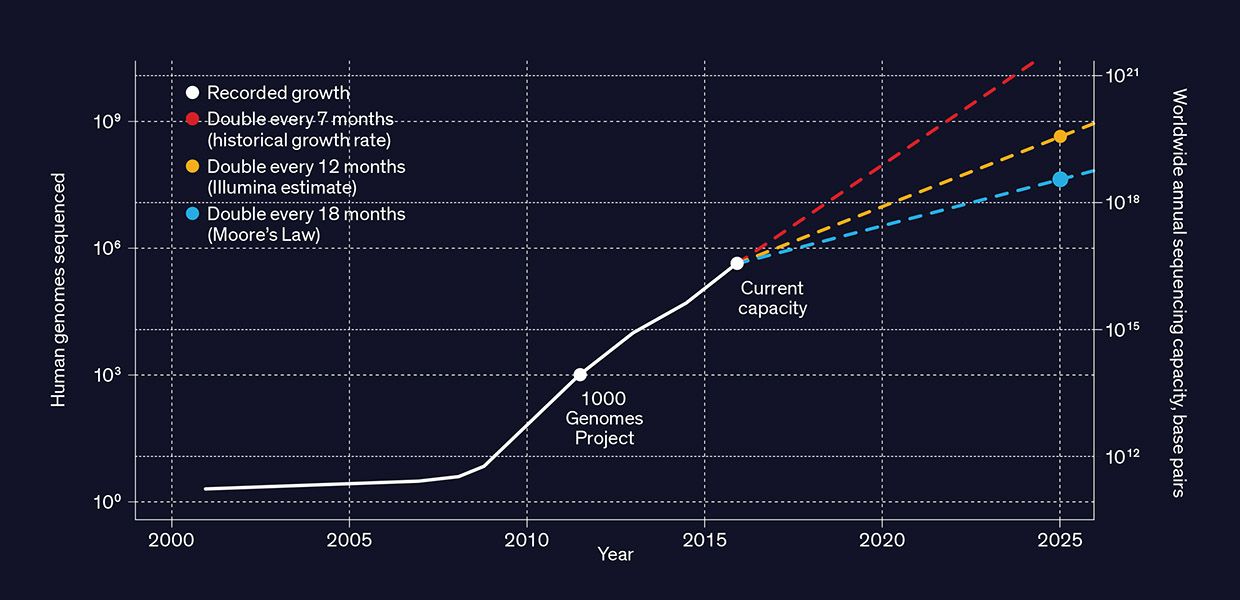
Can’t really “compress” it by listing it as proteins. (Or could you? I think not because long stretches are just nonsense.)
link to this extract


Synthestech offers “cold transmutation” alchemy on the blockchain. Plus UFOs • Attack of the 50 Foot Blockchain

David Gerard keeps watch on the various cryptocurrency goings-on:

»

The Bitcoin bubble is deflating, and there aren’t nearly enough suckers desperate to put their money into anything with the word “crypto” attached.

So for Synthestech’s ICO, they’ve decided to go big or go home:


»


DISRUPTIVE INNOVATION TECHNOLOGY FOR ARTIFICIAL SYNTHESIS OF PLATINUM

We are developing the most significant innovation of century. We use Cold Fusion phenomenon for transmutation of cheap elements into valuable elements and isotopes

«

Yep — it’s an ICO for alchemy.

«
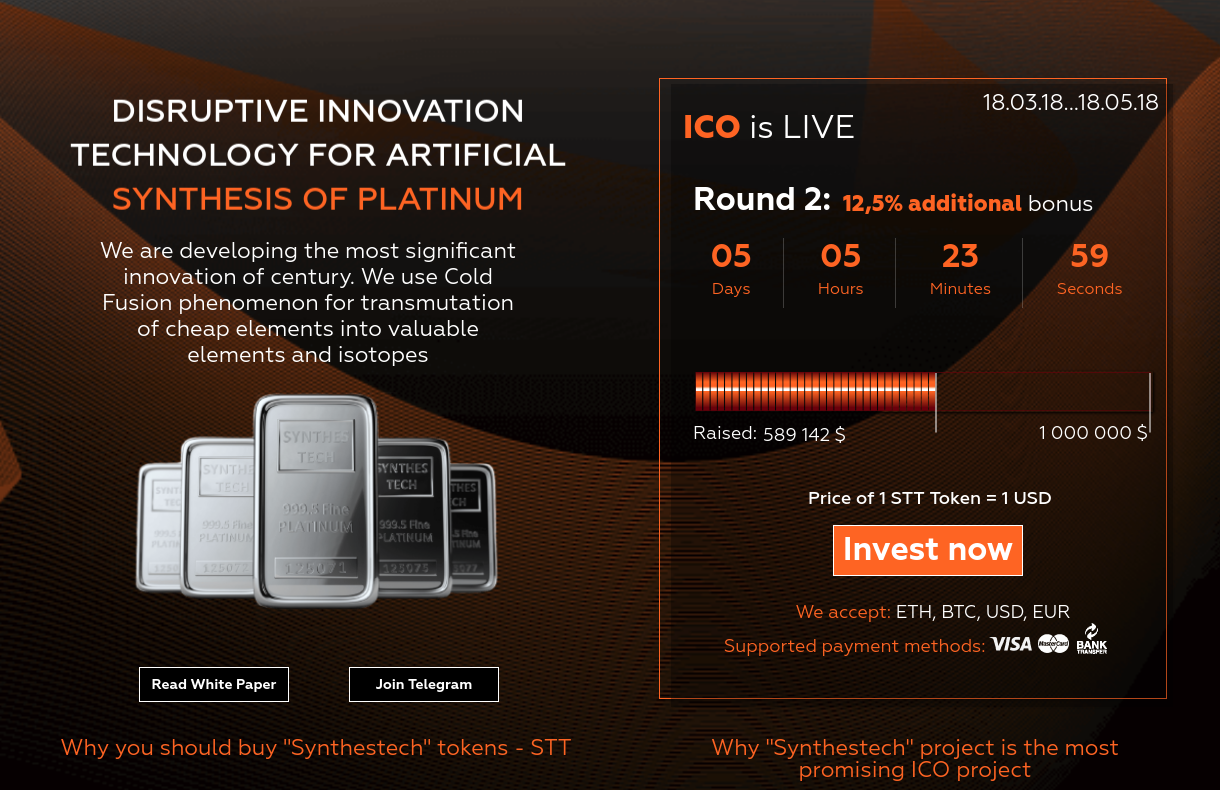
Cold fusion plus crypto. Oh yes.
link to this extract


The untold story of NotPetya, the most devastating cyberattack in history • Wired

Andy Greenberg:

»

“Henrik Jensen” [not his real name] was busy preparing a software update for Maersk’s nearly 80,000 employees when his computer spontaneously restarted.

He quietly swore under his breath. Jensen assumed the unplanned reboot was a typically brusque move by Maersk’s central IT department, a little-loved entity in England that oversaw most of the corporate empire, whose eight business units ranged from ports to logistics to oil drilling, in 574 offices in 130 countries around the globe.

Jensen looked up to ask if anyone else in his open-plan office of IT staffers had been so rudely interrupted. And as he craned his head, he watched every other computer screen around the room blink out in rapid succession.

“I saw a wave of screens turning black. Black, black, black. Black black black black black,” he says. The PCs, Jensen and his neighbors quickly discovered, were irreversibly locked. Restarting only returned them to the same black screen.

All across Maersk headquarters, the full scale of the crisis was starting to become clear. Within half an hour, Maersk employees were running down hallways, yelling to their colleagues to turn off computers or disconnect them from Maersk’s network before the malicious software could infect them, as it dawned on them that every minute could mean dozens or hundreds more corrupted PCs. Tech workers ran into conference rooms and unplugged machines in the middle of meetings. Soon staffers were hurdling over locked key-card gates, which had been paralyzed by the still-mysterious malware, to spread the warning to other sections of the building.

Disconnecting Maersk’s entire global network took the company’s IT staff more than two panicky hours. By the end of that process, every employee had been ordered to turn off their computer and leave it at their desk. The digital phones at every cubicle, too, had been rendered useless in the emergency network shutdown.

Around 3 pm, a Maersk executive walked into the room where Jensen and a dozen or so of his colleagues were anxiously awaiting news and told them to go home. Maersk’s network was so deeply corrupted that even IT staffers were helpless.

«

From a forthcoming book by Greenberg about NotPetya, called “Sandworm”.
link to this extract


Flipkart acquires speech recognition start-up Liv.ai • Financial Times

Simon Mundy:

»

The buyout reflects a growing consensus among ecommerce executives that strong growth will require a broadening of the market beyond English-speaking, relatively prosperous Indians who already do some shopping online.

Kalyan Krishnamurthy, Flipkart chief executive, said that “the next wave of growth of internet users” was coming from beyond India’s major cities. He added that most of these new users would want to access online services in vernacular languages — which most would never before have written using a keyboard.

“Given the complexities in typing on vernacular keyboards, voice will become a preferred interface for new shoppers,” he said.

A joint report this month by Bain & Company, Google and Omidyar Network found that only 40% of India’s 390m internet users made any transactions online, with this group skewed overwhelmingly towards higher-income people.

Analysts say this is partly a reflection of the fact that Indian ecommerce offerings have failed to keep up with a shift in the country’s online demographics beyond the fluent English speakers who were first to get online.

KPMG estimates that in 2011, there were 68m Indian web users who were comfortable using English, against 42m who preferred using a local language. By 2016, the latter group outnumbered English speakers 234m to 175m. And in 2021, KPMG forecast, there would be 536m local language speakers online, against 199m English speakers.

«

Significant point: in developing countries, voice is already the prime method for search, and can be for shopping too.
link to this extract


How misinformation spreads on Line — one of the most popular messaging apps in Southeast Asia • Poynter

Daniel Funke:

»

Line has about 170 million monthly active users in its four main markets and is among the most popular messaging apps in countries like Thailand, Indonesia and Taiwan. While it’s similar to other messaging platforms, Line has a more exhaustive array of features, such as separate sections for news, ordering taxis, mobile payments and music streaming. The app makes money by selling stickers and advertising.

And, like both WhatsApp and WeChat, the peer-to-peer messaging environment can be taken advantage of by fake news writers, hoaxers and scammers.

“It’s a kind of complex thing as a mixture of misinformation, phishing, scamming, bad advertising and monetization,” Anutarasoat said of accounts that dabble in misinformation. “What people are sharing the most is about health.”

Those types of stories directly target an older demographic that might be less likely to discern between credible and bunk health information on Line, Anutarasoat said.

“Old people are solely on Line because they do not use Facebook much,” he said. “And those people, they are in the stage where their friends are deceased (and they’re) facing health problems, so I think it also drives the content network to target them and sell something like health products.”

Accounts similar to Knowledge Treasury, such as “GINZEN take care of health” and “GINZEN omni-knowledge about health” (roughly translated), get so big that they advertise bogus health brands. Both have more than 850,000 subscribers and “Ginzen” — an herbal supplement that promises to solve “chi and yin deficiency” — in their account names. Poynter reached out to both on Line but had not heard back as of publication.

«

link to this extract


Apple to gain unconditional EU approval for Shazam buy: sources • Reuters

Foo Yun Chee:

»

Apple is set to win unconditional EU antitrust approval for its planned acquisition of British music discovery app Shazam, two people familiar with the matter said on Wednesday.

The deal, announced in December last year, would help the iPhone maker better compete with Spotify, the industry leader in music streaming services. Shazam identifies songs when a smartphone is pointed at an audio source.

The European Commission opened a full-scale investigation into the deal in April, emblematic of its recent worries that companies may buy a data-rich rival to mine it for information or drive others out of the market.

The EU antitrust authority said it was concerned that the Shazam deal might give Apple an unfair advantage in poaching users from its rivals.

It also cited worries about Apple possibly halting referrals from Shazam to rivals of Apple Music, the second-largest music streaming service in Europe.

«

So does that mean it thinks Apple won’t be able to poach users from Spotify, or what?
link to this extract


Errata, corrigenda and ai no corrida: none notified

Start Up No.893: how Facebook incites hate, pricing knee surgery, the data Google collects, Fancy Bear gets busy, Tinder Hunger Games, and more


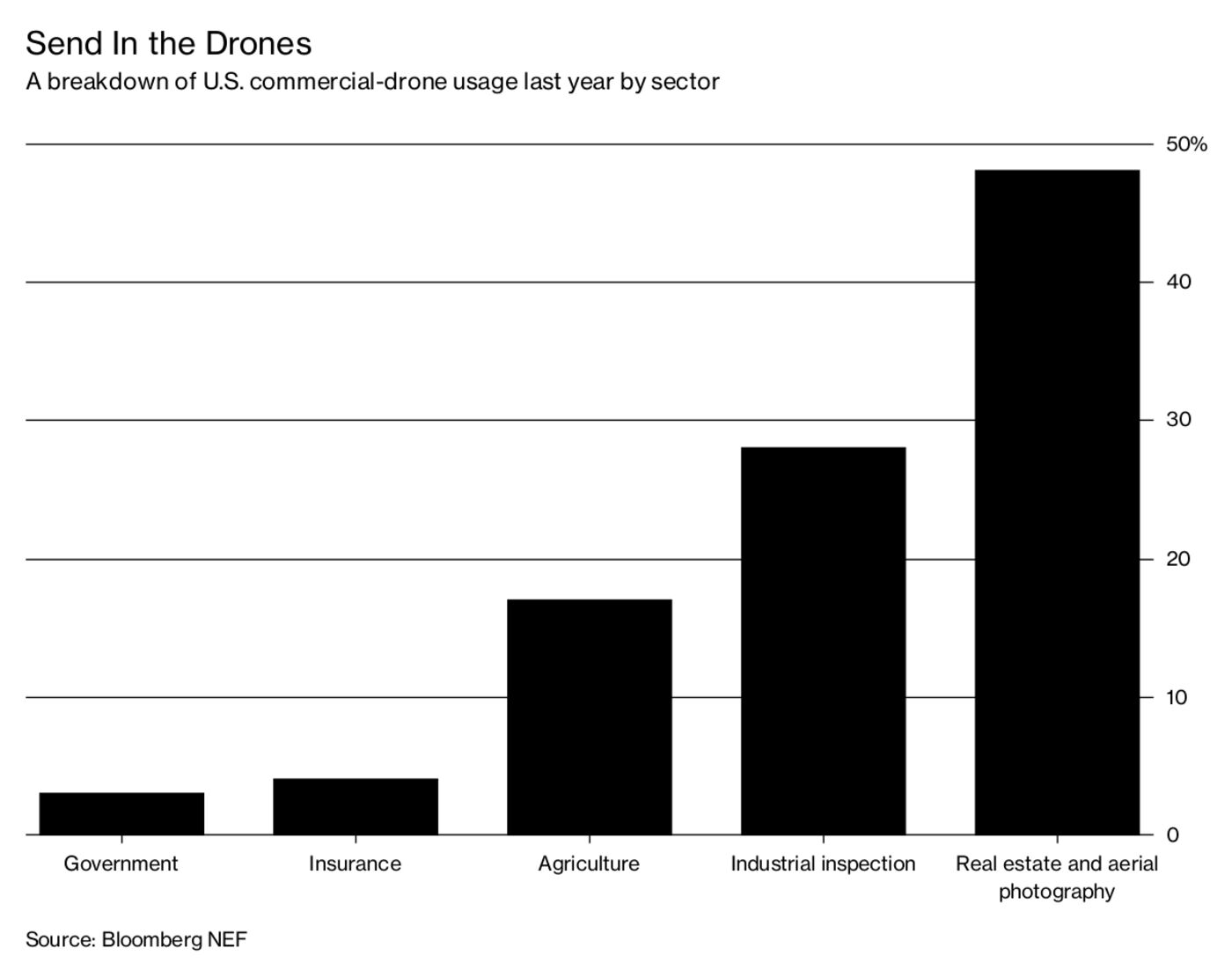
Remember drones? Gartner’s given up on them. Photo by Ars Electronica on Flickr.

You can sign up to receive each day’s Start Up post by email. You’ll need to click a confirmation link, so no spam.

A selection of 10 links for you. Not guilty. I’m @charlesarthur on Twitter. Observations and links welcome.

What does knee surgery cost in the US? Few know, and that’s a problem • WSJ

Melanie Evans:

»

For nearly a decade, Gundersen Health System’s hospital in La Crosse, Wisconsin, boosted the price of knee-replacement surgery an average of 3% a year. By 2016, the average list price was more than $50,000, including the surgeon and anesthesiologist.

Yet even as administrators raised the price, they had no real idea what it cost to perform the surgery—the most common for hospitals in the U.S. outside of those related to childbirth. They set a price using a combination of educated guesswork and a canny assessment of market opportunity.

Prompted by rumblings from Medicare and private insurers over potential changes to payments, Gundersen decided to nail down the numbers. During an 18-month review, an efficiency expert trailed doctors and nurses to record every minute of activity and note instruments, resources and medicines used. The hospital tallied the time nurses spent wheeling around VCR carts, a mismatch of available postsurgery beds, unnecessarily costly bone cement and delays dispatching physical therapists to get patients moving.

The actual cost? $10,550 at most, including the physicians. The list price was five times that amount.

Competitive forces are out of whack in health care. Hospitals are often ignorant about their actual costs. Instead, they often increase prices to meet profit targets. Patients, especially those with insurance, often don’t know the price of a procedure and rarely shop around.

This dynamic is a driving force in the explosion in health-care spending in the U.S., which will soon reach close to 20% of GDP. Americans spend more per capita on health care than any other developed nation, even though they aren’t buying more health care overall. The rise in hospital prices has outpaced economywide inflation for decades. “When price isn’t tightly linked to cost, that is a sign that the market isn’t competitive,” said Harvard economist Leemore Dafny.

«

Heading towards 20% of GDP. Astonishing. (Here’s some more about surgical procedures in the US. Clearly, insurance companies charge through the nose for knee surgery because it’s in demand and so they can.)

In the UK, where the National Health Service means the government is a monopsony for health purchasing, spending is just under 10% of GDP, and maternal mortality is lower and life expectancy is longer.

Articles like this appearing in the WSJ – the paragon of right-wing thinking – might actually get some of them to think, though.
link to this extract


Facebook fueled anti-refugee attacks in Germany, new research suggests • New York Times

Amanda Taub and Max Fisher:

»

[The attack on a refugee family in the German town of] Altena exemplifies a phenomenon long suspected by researchers who study Facebook: that the platform makes communities more prone to racial violence. And, now, the town is one of 3,000-plus data points in a landmark study that claims to prove it.

Karsten Müller and Carlo Schwarz, researchers at the University of Warwick, scrutinized every anti-refugee attack in Germany, 3,335 in all, over a two-year span. In each, they analyzed the local community by any variable that seemed relevant. Wealth. Demographics. Support for far-right politics. Newspaper sales. Number of refugees. History of hate crime. Number of protests.

One thing stuck out. Towns where Facebook use was higher than average, like Altena, reliably experienced more attacks on refugees. That held true in virtually any sort of community — big city or small town; affluent or struggling; liberal haven or far-right stronghold — suggesting that the link applies universally.

Their reams of data converged on a breathtaking statistic: Wherever per-person Facebook use rose to one standard deviation above the national average, attacks on refugees increased by about 50%.

Nationwide, the researchers estimated in an interview, this effect drove one-tenth of all anti-refugee violence.

The uptick in violence did not correlate with general web use or other related factors; this was not about the internet as an open platform for mobilization or communication. It was particular to Facebook.

Other experts, asked to review the findings, called them credible, rigorous — and disturbing. The study bolstered a growing body of research, they said, finding that social media scrambles users’ perceptions of outsiders, of reality, even of right and wrong.

«

Fisher, one of the reporters, said “I can’t recall any statistic that has stopped me in my tracks quite like this one”, of the data that where per-person Facebook use rose to one standard deviation above national average, attacks on refugees increased by about 50%.

This – now, this is serious.
link to this extract


This military tech could finally help self-driving cars master snow • Ars Technica

Jonathan Gitlin:

»

The research conducted at the country’s National Laboratories is usually highly classified and specifically aimed at solving national security problems. But sometimes you get a swords-into-ploughshares moment. That’s the case here, as a startup called WaveSense looks to apply technology originally developed by MIT Lincoln Laboratory to detect buried mines and improvised explosive devices for use in self-driving cars.

If you want a car to drive itself, it has to know where it is in the world to a pretty high degree of accuracy. Until now, just about every variation of autonomous vehicle we’ve come across has done that through a combination of highly accurate GPS, an HD map, and some kind of sensor to detect the environment around it. Actually, you want more than one kind of sensor, because redundancy is going to be critical if humans are going to trust their lives to robot vehicles.

Most often, those sensors are a mix of optical cameras and lidar, both of which have pluses and minuses. But is a combination of lidar and camera truly redundant, if both are relying on reflected light? Other solutions have included far infrared, which works by detecting emitted light, but WaveSense’s approach is truly photon-independent. What’s more, it’s the first sensor we’ve come across that should be almost completely unfazed by snow.

That’s because it uses ground-penetrating radar (GPR), mounted underneath the vehicle, to sense the road beneath—now you can see where the military application was. The GPR scans the ground underneath it to a depth of around 10 feet (3m), running at a little over 120Hz to build up a picture of the subterranean world beneath it. As the car drives along, it compares that data to a map layer of already-collected GPR data for the road network and can place the car to within a couple of centimeters.

Yes, this requires pre-mapping, but so does lidar. And WaveSense says that remapping should be far less frequent as conditions under the road are less subject to change than they are above ground.

«

OK, but don’t we need them to master fair-weather roads first?
link to this extract


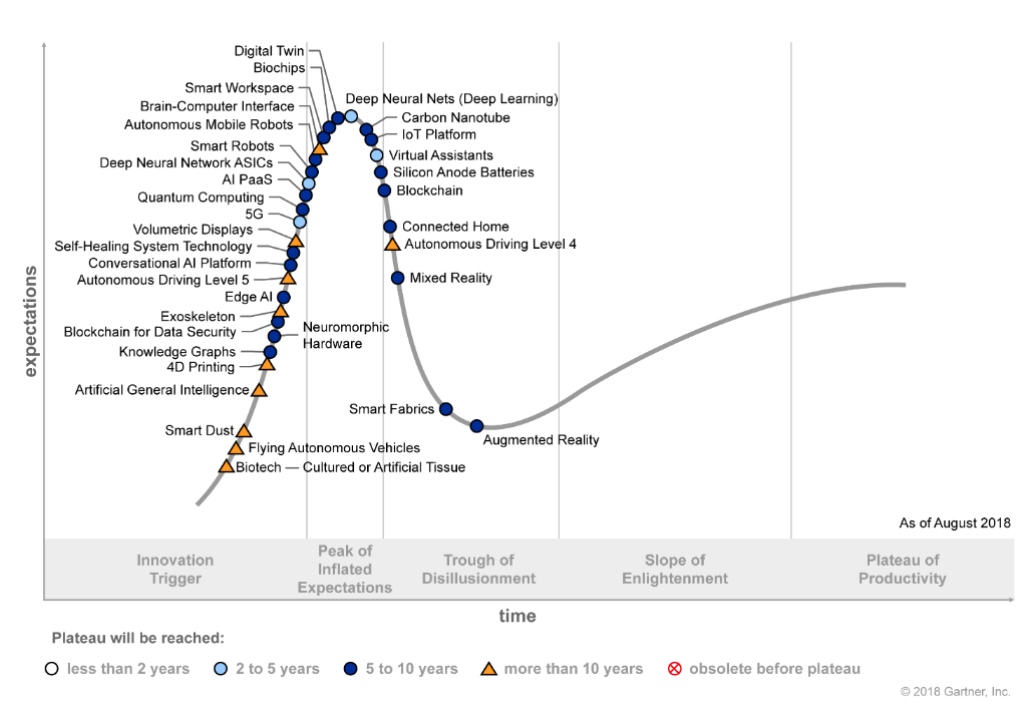
Gartner’s Great Vanishing: some of 2017’s emerging techs just disappeared • The Register

Andrew Orlowski:

»

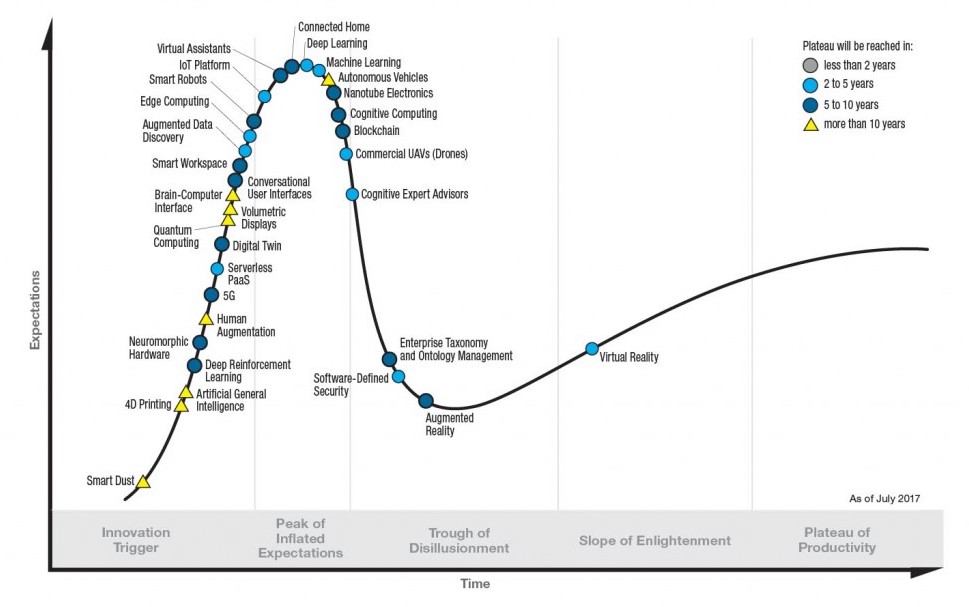
For a new technology to succeed, according to the mythological Emerging Technologies Hype Cycle, it must first climb the “Peak of Inflated Expectations” before falling into the Slough of Despond, or as Gartner calls it, the “Trough of Disillusionment”. There, after shaking off the Mud of Mockery or the Dust of Derision that is presumably found in the Trough, it must pick itself up and begin to ascend once again, up along the gentler “Slope of Enlightenment” before arriving, triumphant, onto the sunny uplands of the “Plateau of Productivity”. Only then can an Emerging Technology finally put down the backpack, open the Thermos flask, and tuck into a well-deserved packed lunch.

Nine emerging technologies identified last year by Gartner in the corresponding Hype Cycle report have vanished.

Some of these are quite significant. Last July, Machine Learning was two years away from the safety of the Plateau. But that’s disappeared. Its cousin Deep Learning is hanging perilously on, like so many trends, exactly where Gartner put it last year.

Last year, Edge Computing could be found toiling up the Western slope of the Peak of Disillusionment – but that has fallen out of sight, too. So has Human Augmentation, Augmented Data Discovery, and Knowledge Graphs.

And remember Drones? They’ve crashed.

«

So you can satisfy yourself, here’s 2017:

And 2018:

Technology evolution is stuck. Really stuck.

link to this extract


Google Data Collection research • Digital Content Next

»

In “Google Data Collection,” Professor Douglas C. Schmidt, Professor of Computer Science at Vanderbilt University, catalogs how much data Google is collecting about consumers and their most personal habits across all of its products and how that data is being tied together.

The key findings include:
• A dormant, stationary Android phone (with the Chrome browser active in the background) communicated location information to Google 340 times during a 24-hour period, or at an average of 14 data communications per hour. In fact, location information constituted 35% of all the data samples sent to Google.
• For comparison’s sake, a similar experiment found that on an iOS device with Safari but not Chrome, Google could not collect any appreciable data unless a user was interacting with the device. Moreover, an idle Android phone running the Chrome browser sends back to Google nearly fifty times as many data requests per hour as an idle iOS phone running Safari.
• An idle Android device communicates with Google nearly 10 times more frequently as an Apple device communicates with Apple servers. These results highlighted the fact that Android and Chrome platforms are critical vehicles for Google’s data collection.  Again, these experiments were done on stationary phones with no user interactions. If you actually use your phone the information collection increases with Google.
• Google has the ability to associate anonymous data collected through passive means with the personal information of the user. Google makes this association largely through advertising technologies, many of which Google controls.

«

That is a lot of data collection, and the passive collection is remarkable. What is it particularly about the location data?
link to this extract


New Russian hacking targeted Republican groups, Microsoft says • The New York Times

»

Microsoft Corporation said that it detected and seized websites that were created in recent weeks by hackers linked to the Russian unit formerly known as the G.R.U. The sites appeared meant to trick people into thinking they were clicking through links managed by the Hudson Institute and the International Republican Institute, but were secretly redirected to web pages created by the hackers to steal passwords and other credentials.

Microsoft also found websites imitating the United States Senate, but not specific Senate offices or political campaigns.

The shift to attacking conservative think tanks underscores the Russian intelligence agency’s goals: to disrupt any institutions challenging Moscow and President Vladimir V. Putin of Russia.

The Hudson Institute has promoted programs examining the rise of kleptocracy in governments around the world, with Russia as a prime target. The International Republican Institute, which receives some funding from the State Department and the United States Agency for International Development, has worked for decades in promoting democracy around the world.

“We are now seeing another uptick in attacks. What is particular in this instance is the broadening of the type of websites they are going after,” Microsoft’s president, Brad Smith, said Monday in an interview.

“These are organizations that are informally tied to Republicans,” he said, “so we see them broadening beyond the sites they have targeted in the past.”

The International Republican Institute’s board of directors includes several Republican leaders who have been highly critical of Mr. Trump’s interactions with Mr. Putin, including a summit meeting last month between the two leaders in Helsinki, Finland.

«

Not that Fancy Bear and its cohorts only limits itself to Republicans. It’s likely they were behind this cyberattack on a Democratic candidate in California last week.
link to this extract


Model Tinder-scams men for date competition in Union Square • NY Mag

Madison Malone Kircher:

»

When Misha arrived in Union Square, he found a small crowd gathered around the stage. [Natasha] Aponte had told him to meet her at the front. “I guess [the crowd] was mostly male, but that didn’t immediately register to me,” Misha told Select All. “As I was watching the DJ play booming techno on a Sunday I did think it was odd that that many people were staying around and paying attention so attentively instead of just stopping and walking on.”

David, another man who showed up for a date, said he realized something was up when “the guy next to me went ‘Are you trying to meet up with a girl named Natasha?’” Eventually, “everyone started realizing what was going on.” “I got there and a DJ was playing and I found out that hundreds of other guys were also waiting for Natasha,” Spencer said. “I walked away when I found out it was a scam.” He heard people booing as he left Union Square.

Aponte eventually took the stage with a microphone to reveal her con. “She walked on, stated and explained the situation, and validated her actions by saying, ‘Won’t this be a great first-date story!’” Misha described it on Twitter as “a hunger games speech about what it’s gonna take to date her.”

«

Only a pity that she couldn’t arrange them to fight to the death. No doubt someone will figure that out sooner or later.
link to this extract


The undertakers of Silicon Valley: how failure became big business • The Guardian

Adrian Daub:

»

Silicon Valley’s tolerance for failure has long sustained an obsession with youth. If a founder fails, tech discourse interprets it as a sign of young vigor. In a country in which 25-year-old white rapists are “still boys” and black 12-year-olds on the playground “look like adults”, the question of who gets to be a kid and who counts as a grownup is clearly charged with privilege.

In 2017, a chastened Travis Kalanick admitted: “I must fundamentally change as a leader and grow up.” Even in a place as chock-a-block with balding skateboarders and middle-aged trick-or-treaters as San Francisco, a 40-year-old CEO of a $15bn company casting himself as an overenthusiastic kid who just needs to get his shit together is a bit much.

Failing in Silicon Valley is often a prerogative of the young – or, in Kalanick’s case, the adolescent-acting. And people don’t talk about how much less sustainable it has become to be young in the Valley. One VC who back in the early aughts grew a tiny startup into an $80m company with more than 250 employees reminisced to me about the early days when “we just lived with our parents in Toronto”. “Our labor force was ourselves and we paid for the servers by credit card,” he continued. Then he reflected a moment. “That’s no longer possible, which I guess is what makes us necessary.”

But the thing about failing is that it seems to carry opposite meanings depending on who does it. If a traditional brick-and-mortar business hemorrhages money as unregulated digital competition moves in, then that’s just a sign that brick-and-mortar deserves to die. By contrast, if a disruptive new economy startup loses money by the billions, it’s a sign of how revolutionary and bold they are.

«

It’s one of those irregular verbs – “my internet startup began too early, your bricks-and-mortar business failed.”
link to this extract


Why are record companies dumping their Spotify stock? • Office of Copyright

Stephen Carlisle:

»

if you hold shares in a company that is running a deficit of over €2bn, with annual losses approaching €400m, you might come to the conclusion that Spotify is not going to make any real profits for quite some time, and thus no dividend to you, the shareholder. It might also point towards the conclusion that Spotify’s continuing losses will not have an upward effect on the stock price, making it more prudent to sell now.

Could Spotify turn a profit by reducing its costs? Of course, and Spotify is always ready to point the finger at greedy copyright owners.

“We have incurred significant costs to license content and continue to pay royalties to music labels, publishers, and other copyright owners for such content. If we cannot successfully earn revenue at a rate that exceeds the operational costs, including royalty expenses, associated with our Service, we will not be able to achieve or sustain profitability.”

Boo! Hiss! Greedy copyright owners!

Except there’s this. In February of 2017, despite losing truckloads of money for years, Spotify found it necessary to open offices in New York City. And not just in any old office building. It rented space in the newly rebuilt World Trade Center. 13 According to Digital Music News, this is 478,000 square feet of office space spread over a total of 14 floors. This was not enough. Spotify later signed an option to take on 100,000 more square feet. 14 I suggest that you click on the link provided in the endnote and take a look at the pictures.

Nice pool table, guys.

The cost of this? Again according to Digital Music News:

$2.77m a month, or $33.29m a year. Over the 17 years lease, more than $566m in rent; $31m in upfront payments. To this we can add the fact that:

In 2015, executive and board member pay was $16.9m, an increase of 300% over the previous year. In 2015, the average Spotify employee made $150,000. During 2015, Spotify lost $253.8m.

It does not seem from these numbers that Spotify is interested in reducing its costs, if it has to come by way of reducing their prestigious digs and creature comforts. If you are a record company, and you know this from close up observation, it might make sense to sell your shares.

«

link to this extract


Android users and men far less likely to make in-app mobile gaming purchases than iOS users and women • Android Police

Rose Behar:

»

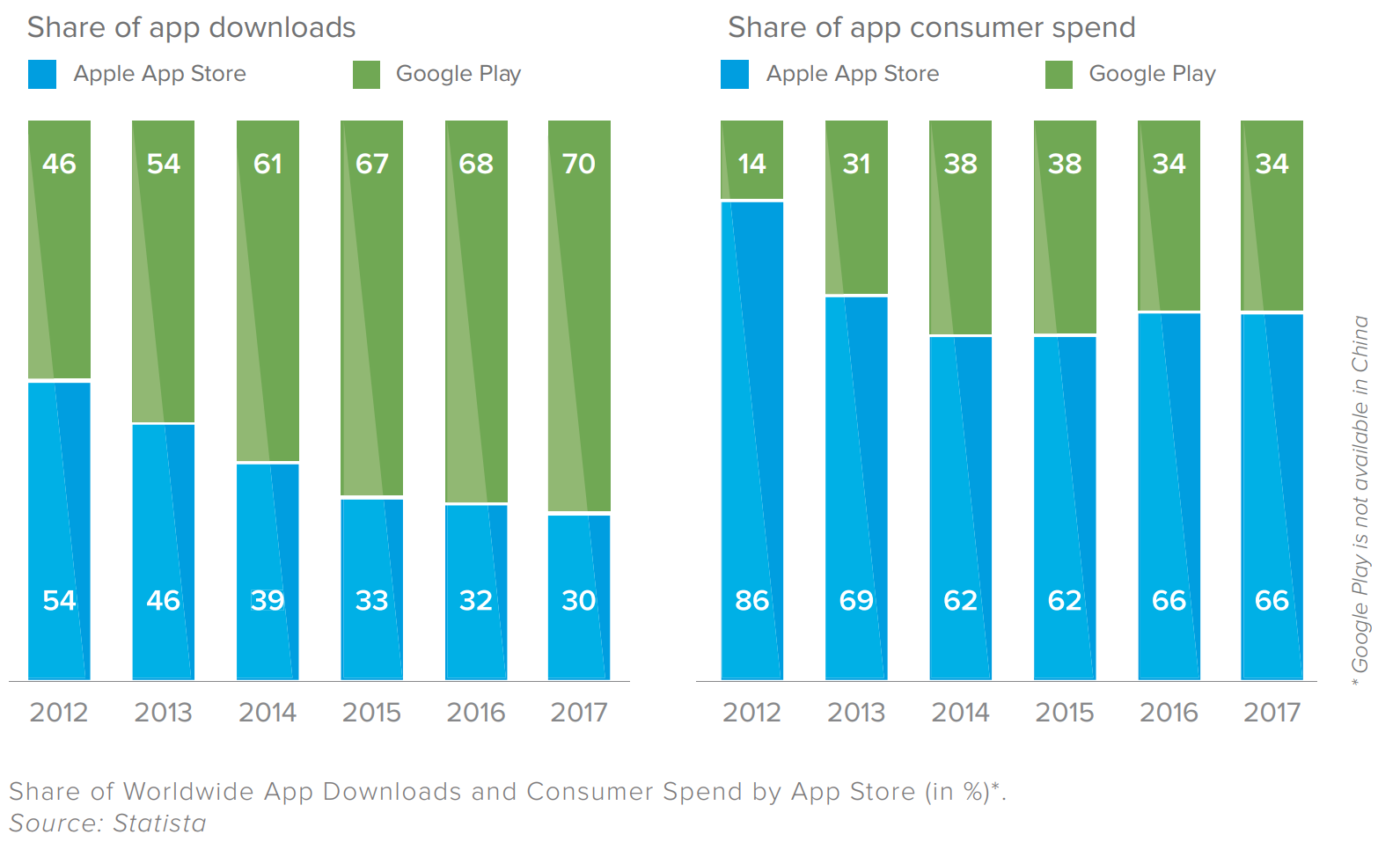
iOS users and women are much more likely to make in-app purchases than Android users and men. Liftoff reports that the 21% IAP conversion rates for iOS users are nearly double that of Android users, which rest at 10.8%. While it acknowledges that its own data, drawn from 350 gaming apps (58% iOS and 42% Android), may overemphasize the disconnect, the findings are backed up by evidence from other sources, as well.

App market data provider App Annie reports that Android users accounted for 70% of total app downloads in 2017, but generated only 34% of total consumer app spend. Still, the sheer size of the Android market — in 2017, Google reported over 2 billion monthly active devices — means mobile game marketers aren’t going to give up on the platform any time soon.

As for the gender split, Liftoff’s data showed that IAP conversion rates for women are 26% higher than for men, and that the install-to-purchase rate for women is an impressive 79% higher than for men.

«

In many ways, not a surprise; this has been a consistent pattern for years, and there’s no reason it would change.
link to this extract


Errata, corrigenda and ai no corrida: none notified
Start Up No.892: China’s smart speaker fight, Huawei ad caught out, Julia or Python?, the Bitcoin post-boomers, and more


Apple’s most iconic laptop is expected to get an overhaul – with a better screen. Photo by Faheem Patel on Flickr.

You can sign up to receive each day’s Start Up post by email. You’ll need to click a confirmation link, so no spam.

A selection of 11 links just for you. Boom, bust, whatever. I’m @charlesarthur on Twitter. Observations and links welcome.

The rise of Chinese voice assistants and the race to commoditize smart speakers • CB Insights

»

Neither Amazon Echo nor Google Home have penetrated China.

Apart from the tight regulations US tech companies face there, Chinese natural language processing is complex (with 130 spoken dialects and 30 written languages), making speech recognition a huge challenge.

Among US big tech, only Apple’s Siri supports Mandarin on the iPhone. The company’s Homepod smart speaker only supports English, and is not available in China.

This leaves a huge market underserved by US companies, and local players are capitalizing on it.

Smart voice is one of the Chinese government’s four main focus areas in its first wave of AI applications throughout the country. (Read about its focus on healthcare, smart cities, and autonomous vehicles here.)

China’s big tech has stepped up here in a big way. Alibaba sold its Tmall Genie smart speakers for $15 in China on Single’s Day, the country’s annual shopping extravaganza on November 11. Baidu recently slashed the price of one its smart speakers in China from $39 to $14.

These low prices are making it nearly impossible for smaller companies to compete.

«

Apple might have a chance there: open market. At the top end, at least.
link to this extract


Huawei caught passing off DSLR pictures as phone camera samples • Engadget

Rachel England:

»

Huawei doesn’t have the best track record when it comes to advertising. Campaigns for both its P8 and P9 phones were revealed to be at least a little dishonest, and it seems the advertising around its newest launch, the Nova 3, falls into the same category.

A 30-second advert for the phone features a couple. The man wants to take a quick selfie, but because she’s hanging out at home she doesn’t have any makeup on, so she’s not on board. Enter the Nova 3 and its beauty AI feature, making it look like her face is fully done up. A lovely selfie ensues. Look!

So far, so innocuous (well, apart from the entire narrative around women needing a makeup filter in the first place, but that’s another story). But it’s all gone south for Huawei because the advert’s actress, Sarah Elshamy, posted a few behind-the-scenes snaps of the filming on her Instagram account. And it turns out that lovely selfie was actually captured by a great big DSLR, and not in fact the Nova 3. As the since-deleted picture below shows, the guy taking the supposed selfie in the typical arms-outstretched position is actually holding… nothing.

Whoops.

«

You think: only the tech press notices. But the tech press will make noise about this, and that leaks to the nationals, and it turns up when people do searches on Huawei. Also: it’s a bad look.
link to this extract


Is Julia a good alternative to R and Python for programmers? • Quartz

Dan Kopf:

»

why shouldn’t every data scientist learn Julia [now at 1.0 release, guaranteeing forward compatibility]? There are a couple of reasons.

One, if processing speed isn’t important to you, Julia is probably inferior to whatever product you are using—at least for now. I am an R user, and most of the statistics work I do is on relatively small datasets, and involves simple calculations. The community of R developers, particularly the rockstar data scientist Hadley Wickham, have developed terrific tools, with thorough documentation, for doing simple data analysis tasks. I tried using Julia to complete some of the basic tasks I now do in R. Julia’s tools did not seem as developed for these purposes.

Second, Julia is behind Python and R in terms of tools for debugging and identifying performance issues. Shah says that now that the basics of the language are completed, he hopes more of the community will turn to developing these tools, which make the language easier for new users.

«

This Nasa document from February suggests that Julia is often an order of magnitude faster than Python – except when it comes to complex work used in speech recognition, image processing and so on, when it’s (presently) slower. A quick glance suggests it’s very similar to Python in syntax.
link to this extract


Apple Is planning a new low-cost MacBook, pro-focused Mac mini • Bloomberg

Mark Gurman and Debby Wu:

»

Apple will release a new low-cost laptop and a professional-focused upgrade to the Mac mini desktop later this year, ending a drought of Mac computers that has limited sales of the company’s longest-running line of devices, according to people familiar with the plans.

The new laptop will look similar to the current MacBook Air, but will include thinner bezels around the screen. The display, which will remain about 13in, will be a higher-resolution “Retina” version that Apple uses on other products, the people said. They asked not to be identified discussing products still in development. Apple spokesman Bill Evans declined to comment.

The current MacBook Air, which costs $1,000, remains Apple’s only laptop without a high-resolution screen. The MacBook Air was last updated with a faster processor option last year, but hasn’t seen a major overhaul in several years. The 12in MacBook launched in 2015 was seen as a replacement to the MacBook Air, but its $1,300 starting price put it out of reach for some consumers. The new MacBook Air will be geared toward consumers looking for a cheaper Apple computer, but also schools that often buy laptops in bulk…

…”HP and Lenovo have released products priced similarly to the MacBook Air, gaining share, and in order to remain competitive in that price point, we think a form-factor change is necessary,” Shannon Cross, an analyst at Cross Research, said. “It should help them rebound some of their Mac sales as things have been getting a bit long on the tooth in terms of their Mac line as they’ve clearly been very focused on the iPhone and services businesses.”

«

Well, it would be about time for “Retina” to reach the Air, which is an iconic name and design. (Is it Apple’s longest-surviving laptop design?) As John Gruber points out, it can’t have smaller bezels (an obvious move) and be the same size; that implies a larger screen. More likely the computer is smaller… like the current USB-C MacBook. And what does “pro-focused” mean for the Mac mini? More powerful? More expensive? More ports? “New storage and processor options”, according to Gurman + Wu. Hmm. And will they both have USB-C? That’s the big question for me.

Likely release: October.
link to this extract


After the Bitcoin boom: hard lessons for cryptocurrency investors • The New York Times

Nathaniel Popper and Su-Hyun Lee:

»

Pete Roberts of Nottingham, England, was one of the many risk-takers who threw their savings into cryptocurrencies when prices were going through the roof last winter.

Now, eight months later, the $23,000 he invested in several digital tokens is worth about $4,000, and he is clearheaded about what happened.

“I got too caught up in the fear of missing out and trying to make a quick buck,” he said last week. “The losses have pretty much left me financially ruined.”

Mr. Roberts, 28, has a lot of company. After the latest round of big price drops, many cryptocurrencies have given back all of the enormous gains they experienced last winter. The value of all outstanding digital tokens has fallen by about $600bn, or 75%, since the peak in January, according to data from the website coinmarketcap.com…

…In South Korea, the biggest exchanges opened storefronts to make investment easier for people who didn’t feel comfortable doing it online. The offices of one big exchange, Coinone, had just one customer walk in during a two-hour period in the middle of the day last week. An employee, Yu Ji-Hoon, said, “The prices of the digital tokens have fallen so much that people seem to feel upset.”

Kim Hyon-jeong, a 45-year-old teacher and mother of one who lives on the outskirts of Seoul, said she put about 100 million won, or $90,000, into cryptocurrencies last fall. She drew on savings, an insurance policy and a $25,000 loan. Her investments are now down about 90%.

“I thought that cryptocurrencies would be the one and only breakthrough for ordinary hardworking people like us,” she said. “I thought my family and I could escape hardship and live more comfortably, but it turned out to be the other way around.”

«

Recall these: Bitcoin’s price was artificially inflated by half in 2017, researchers say; ‘Bitcoin is my potential pension’: what’s driving people in Kentucky to join the craze (February 2018). I wish the NYT had sought out the Kentucky investors, who were seeing the values fall, day after day. Most will surely have been wiped out in one of the US’s poorest states.
link to this extract


TRON: our BitTorrent plan might take two decades • TorrentFreak

“Andy”:

»

Back in May, TorrentFreak broke the news that Justin Sun, the entrepreneur behind the popular cryptocurrency TRON, was in the process of acquiring BitTorrent Inc.

Two months later, BitTorrent Inc. and the TRON Foundation confirmed the acquisition.

“With this acquisition, BitTorrent will continue to provide high quality services for over 100M users around the world. We believe that joining the TRON network will further enhance BitTorrent and accelerate our mission of creating an Internet of options, not rules,” BitTorrent Inc. said.

TRON’s Justin Sun added that the acquisition of BitTorrent supports his foundation’s goal to decentralize the web but more concrete details beyond this vision have proven elusive. The entrepreneur has mentioned the possibility of rewarding BitTorrent seeders but that raises even more questions.

This week, in celebration of TRON’s US and China teams meeting up for the first time, Sun dangled some additional information on why the acquisition took place and what TRON’s plans are for the future.

“Contrary to speculation, the main reason for the acquisition isn’t BitTorrent’s more than 100M active users, and it isn’t for an amazing commercial opportunity,” Sun said.

“Yes, these things are great perks, but the more important reason is that BitTorrent has always been committed to one value, which is ‘Democratize the Internet.’ This is very much in line with TRON’s ‘Decentralize the Web.’ The fact that our values are in sync is the driving force behind this acquisition.”

«

Had you forgotten BitTorrent, which tried to make a business out of that fabulous download protocol (and failed)? Now it’s owned by a crypto company; can’t decide if this is “two bald men fighting over a comb” or “two skydivers, one parachute”. But at least the two-decade timetable sets a low bar.

link to this extract


A website promised free anti-antifa shirts, and alt-righters signed up. It was a trap • Daily Beast

Kelly Weil:

»

A website that offered free anti-anti-fascist t-shirts for a real far-right march appears to have been a trap by anti-fascists.

On August 18, Trump supporters will host the “National March Against Far-Left Violence” in several cities, organized by a pair of frequent attendees at far-right rallies. Expected participants include members of anti-Muslim group the Proud Boys and people involved in the pro-Trump troll group Patriot Prayer, which has attracted white supremacists. In early July, when march leaders were planning their event, an apparent ally set up a website where marchers could pre-order anti-anti-fascist t-shirts. But the website appears to have been a trap by antifa, who turned around and published the names and addresses they’d collected from the website.

Now the far-right is trying to get their apparent anti-fascist trolls arrested.

«

Stupid is as stupid does.
link to this extract


Live map of London Underground trains • Traintimes.org.uk

Matthew Sommerville:

»

This map shows all trains (yellow dots) on the London Underground network in approximately real time. Geographic version, or Skyfall version.

I have similar things for the London buses and National Rail, and an awesome bookmarkable train times journey planner.

«

The Skyfall version is.. it’s much more weird. Sommerville did a version of this back in 2010. Now it’s live again. Gotta love live, open data.
link to this extract


Amazon has YouTube envy • Bloomberg

Lucas Shaw:

»

For now, it’s a David vs. Goliath battle. YouTube, the largest advertising-supported video site in the world, has about 1.9 billion monthly viewers; Twitch gets about 15 million a day. But the Amazon unit gives creators multiple ways of making money, including paid subscriptions (a feature YouTube added in response), and offers advertisers the appeal of a live, engaged audience. Amazon, which saw its ad sales in the first quarter exceed $2 billion for the first time mostly by selling “sponsored products” slots during product searches, analysts estimate, has already become a credible contender in online advertising to Google and Facebook Inc.

At a recent staff meeting, Twitch CEO Emmett Shear set a target of $1bn in ad sales for Twitch, according to three people present. That’s more than double its current sales. Twitch’s key advantage, besides being live, is its popularity among young men who tend to be resistant to ads. The average Twitch user has stopped paying for cable TV and employs technology to block advertising across the internet. But hundreds of thousands of these hard-to-reach viewers tune in daily to watch top video game streamers, such as Ninja, Twitch’s biggest star.

YouTube has tried to blunt Twitch’s efforts by offering big payments to some of its top creators if they agree not to make exclusive deals with other sites. “YouTube is pretty nervous,” says Chad Stoller, chief innovation officer at media agency UM Global.

«

You can bet that there’s a lot of synergy between Fortnite and Twitch.
link to this extract


Achieving ultralow wear with stable nanocrystalline metals • Wiley Online Library

John F. Curry:

»

Recent work suggests that thermally stable nanocrystallinity in metals is achievable in several binary alloys by modifying grain boundary energies via solute segregation. The remarkable thermal stability of these alloys has been demonstrated in recent reports, with many alloys exhibiting negligible grain growth during prolonged exposure to near‐melting temperatures. Pt–Au, a proposed stable alloy consisting of two noble metals, is shown to exhibit extraordinary resistance to wear. Ultralow wear rates, less than a monolayer of material removed per sliding pass, are measured for Pt–Au thin films at a maximum Hertz contact stress of up to 1.1 GPa. This is the first instance of an all‐metallic material exhibiting a specific wear rate on the order of 10−9 mm3 N−1 m−1, comparable to diamond‐like carbon (DLC) and sapphire. Remarkably, the wear rate of sapphire and silicon nitride probes used in wear experiments are either higher or comparable to that of the Pt–Au alloy, despite the substantially higher hardness of the ceramic probe materials.

«

Translated: they made a platinum-gold alloy that is as hard, or harder, than diamond or sapphire, and you know how hard those mfs are. (The whole thing is available to read free.)
link to this extract


Platforms, speech and truth: policy, policing and impossible choices • Techdirt

Mike Masnick:

»

I still go back to the solution I’ve been discussing for years: we need to move to a world of protocols instead of platforms, in which transparency rules and (importantly) control is passed down away from the centralized service to the end users. Facebook should open itself up so that end users can decide what content they can see for themselves, rather than making all the decisions in Menlo Park. Ideally, Facebook (and others) should open up so that third party tools can provide their own experiences — and then each person could choose the service or filtering setup that they want. People who want to suck in the firehose, including all the garbage, could do so. Others could choose other filters or other experiences. Move the power down to the ends of the network, which is what the internet was supposed to be good at in the first place. If the giant platforms won’t do that, then people should build more open competitors that will (hell, those should be built anyway)…

…what I’m suggesting is that platforms have to get serious about moving real power out to the ends of their network so that anyone can set up systems for themselves — or look to other third parties (or, even the original platforms themselves for a “default” or for a set of filter choices) for help. In the old days on Usenet there were killfiles. Email got swamped with spam, but there were a variety of anti-spam filters that you could plug-in to filter most of it out. There are ways to manage these complex situations that don’t involve Jack Dorsey choosing who stays on the island and who gets removed this week.
Of course, this would require a fundamental shift in how these platforms operate — and especially in how much control they have. But, given how they keep getting slammed on all sides for the decisions they both do and don’t make, perhaps we’re finally at a point where they’ll consider this alternative.

«

I sometimes find myself reluctantly agreeing with Masnick, but here I just disagree. Here’s why: Usenet (a decentralised system that anyone could post to) died because of spam, and newsgroups (a bit like Facebook Groups) which got overrun. Killfiles (like blocklists on Twitter) were only useful to a point; once everyone’s given up on a group, the killfile doesn’t improve it.

This is a platform problem, and each has inherent difficulties. The fact that we haven’t hit on the perfect solution doesn’t mean it’s not there.
link to this extract


Errata, corrigenda and ai no corrida: none notified
Start Up No.891: when to expect an iPhone launch, monitoring sleep monitors, collapsing bridges, California’s data privacy, and more


Samsung’s Galaxy Note 9 is powerful – maybe too much so for most. Photo by Kārlis Dambrāns on Flickr.

You can sign up to receive each day’s Start Up post by email. You’ll need to click a confirmation link, so no spam.

A selection of 10 links for you. But what if truth isn’t truth? I’m @charlesarthur on Twitter. Observations and links welcome.

Samsung’s Galaxy Note 9 is crazy powerful. Can you handle it? • WSJ

David Pierce:

»

I’ve found the S Pen a handy tool in conjunction with another of the Note 9’s best features, called DeX. By connecting the phone to a display using an adapter or cable, you can turn the Note into something resembling a desktop. Last year’s dock is no longer required.

All your apps still run, but they open on the external display in an environment more like Windows, with a tool bar and plenty of space for multitasking. Some apps resize to fit the larger screen, including Microsoft Office Adobe Photoshop Express, or even Google’s Chrome browser. Connect a keyboard and mouse via Bluetooth, or use the phone itself as a trackpad. You can even unlock the phone—and use it as a phone—while it powers the desktop environment.


PHOTO: EMILY PRAPUOLENIS/THE WALL STREET JOURNAL

The amazingly versatile Note 9 comes closer than anything I’ve tested to fulfilling my one-true-computer dream. But Samsung doesn’t always implement these features well.

When I pull out the S Pen, the Note 9 offers six things to do, with dozens more available in settings. I get multiple notifications and warnings every time I open DeX. Apps often have to close and reopen to work on the larger screen.

I’ve long complained about Samsung’s unnecessary duplication of Google’s apps, but the Note 9’s bigger issue is that over the past week, it just wouldn’t leave me alone. It bombarded me with pop-ups, new-feature alerts and options I apparently needed to turn on.

Samsung says the barrage is an attempt to help Note users figure out their powerful new device, and the pop-ups mellow out eventually. Yet even when I clicked through the initial wave, I still felt pestered: The Note’s notification tray fills with status reports on things I don’t care about.

«

The Note is niche in a way that the iPhone X isn’t; it’s almost surely overserving most of its users. Apart from those who really, really need a pen on their phone.
link to this extract


Q: Why do keynote speakers keep suggesting that improving security is possible? A: because keynote speakers make bad life decisions and are poor role models • USENIX

James Mickens is a hilarious speaker:

»

Some people enter the technology industry to build newer, more exciting kinds of technology as quickly as possible. My keynote will savage these people and will burn important professional bridges, likely forcing me to join a monastery or another penance-focused organization. In my keynote, I will explain why the proliferation of ubiquitous technology is good in the same sense that ubiquitous Venus weather would be good, i.e., not good at all. Using case studies involving machine learning and other hastily-executed figments of Silicon Valley’s imagination, I will explain why computer security (and larger notions of ethical computing) are difficult to achieve if developers insist on literally not questioning anything that they do since even brief introspection would reduce the frequency of git commits. At some point, my microphone will be cut off, possibly by hotel management, but possibly by myself, because microphones are technology and we need to reclaim the stark purity that emerges from amplifying our voices using rams’ horns and sheets of papyrus rolled into cone shapes.

«

link to this extract


Hacker finds hidden ‘God mode’ on old x86 CPUs • Tom’s Hardware

Paul Wagenseil:

»

The backdoor completely breaks the protection-ring model of operating-system security, in which the OS kernel runs in ring 0, device drivers run in rings 1 and 2, and user applications and interfaces (“userland”) run in ring 3, furthest from the kernel and with the least privileges. To put it simply, Domas’ God Mode takes you from the outermost to the innermost ring in four bytes.

“We have direct ring 3 to ring 0 hardware privilege escalation,” Domas said. “This has never been done.”

That’s because of the hidden RISC chip, which lives so far down on the bare metal that Domas half-joked that it ought to be thought of as a new, deeper ring of privilege, following the theory that hypervisors and chip-management systems can be considered ring -1 or ring -2.

“This is really ring -4,” he said. “It’s a secret, co-located core buried alongside the x86 chip. It has unrestricted access to the x86.”

The good news is that, as far as Domas knows, this backdoor exists only on VIA C3 Nehemiah chips made in 2003 and used in embedded systems and thin clients. The bad news is that it’s entirely possible that such hidden backdoors exist on many other chipsets.

“These black boxes that we’re trusting are things that we have no way to look into,” he said. “These backdoors probably exist elsewhere.”

«

It’s almost certain, isn’t it? If it’s not the software or the firmware or the hardware, it’s the software/firmware/hardware that controls the hardware.
link to this extract


Do smart sleep monitors and trackers actually work? • NY Mag

Lauren L’Amie:

»

It’s easy to self-diagnose and self-medicate bad sleep because, well, you know it when you feel it. When you’re up late at night Googling “What to do when you can’t sleep,” you’ll likely come across lists of magical apps and devices that promise to help. But Dr. Lev Grinman, a New Jersey–based neurologist who studies sleep disorders, says that most smart sleep technology “isn’t necessarily what a sleep physician would use to gauge how well somebody is sleeping.”

“Everybody wants the do-it-yourself kind of thing,” he says. “A lot of these things are geared toward just the general consumer. Even though they say they’re backed by sleep science, they’re not robustly accurate.” Grinman, like many who study sleep, says we track sleep through movement, sound, heart rate, breathing patterns (snoring), and measuring your actual brainwaves using an electroencephalogram (EEG). But measuring each of these factors alone isn’t accurate enough to determine whether or not your sleep is “bad” or “good.” “Good” sleep, says Grinman, correlates with good habits.

“The trackers can help to some degree, but the most effective treatment for insomnia is cognitive behavioral therapy. We’re talking about sleep hygiene,” Grinman says. The same way you brush your teeth so they don’t fall out, Grinman suggests you do the same things to keep your sleep healthy — don’t drink alcohol too close to bedtime, don’t use bright lights, and reserve your bed only for sleep. If you can’t sleep, the combination of these behaviors (or lack of them) affects you much more than the things sleep trackers can measure.

There are a ton of tracking apps that monitor your sleep, but most only track sound and movement: two small components of sleep. Sleep Cycle, one of the most popular sleep-tracking apps in the Apple App Store, promises to wake you during your “lightest” sleep phase. The app uses your phone’s microphone to identify sleep phases by listening to your movements in bed from up to ten inches away, filtering out any “non-sleep movement sounds,” like sirens outside or a baby crying.

“That, to me, is not very accurate,” Dr. Grinman says. “There’s just too many confounding variables. You’re really not going to be able to tell how deep your sleep is based on sound alone.”

«

I recall a doctor once saying that if you can’t get to sleep, just lie there peacefully; don’t focus on trying to go to sleep. It’s as good as sleep. (And often you then drift off to sleep.)
link to this extract


Apple September 2018 iPhone event preview • iMore

Rene Ritchie:

»

unless Apple decides to mic drop, peace out, and retire to spend more time with its money, this year will be no different. Rumors, as always, abound:

• iPhone 9: A 6.1-inch LCD with iPhone X-style design, in iPhone 5c-type colors
• iPhone X2: The next generation OLED iPhone and iPhone Plus, perhaps with Pencil support
• Apple Watch Series 4: With minimized bezels
• iPad Pro 3: With minimized bezels
• New MacBook Air. Finally.
• Coffee Lake MacBook
• Coffee Lake iMac

So, when will Apple hold the iPhone 2018 Event?

This is basically the best worst kept secret in technology. Best, because Apple never tells anyone. Worst, because, since iPhone 5, Apple has announced every new iPhone during a special event held the first or second Tuesday or Wednesday of September.

• iPhone 5 event: September 12, 2012
• iPhone 5s event: September 10, 2013
• iPhone 6 event: September 9, 2014
• iPhone 6s event: September 9, 2015
• iPhone 7 event: September 7, 2016
• iPhone 8/X event: September 12, 2017

Now, past isn’t always predicate, but past events are the best indicator for future events. Apple can and will throw curveballs whenever the company’s logistics or strategy demands.

Still, based on the above pattern, it’s likely we’ll see this year’s event on or around Wednesday, September 12.

«

(Won’t be September 11, of course.) What is Apple to do with its MacBook Air and MacBook confusion? The Air is a terrific workhorse that suits lots of people at its price, because it has legacy ports. But its screen is ancient. Shouldn’t there be a 13in MacBook, with two USB-C ports (which can then be turned into plenty of legacy ports via add-ons), at the MacBook Air price? That might get USB-C to start moving. It’s in a chicken-refusing-to-lay-the-egg situation at present.
link to this extract


Don’t do this in production · Stephen Mann

Mann was called in to help find the bugs in an about-to-launch product, where the developers turned out to be eager, but inexperienced:

»

“Move fast and break things,” they said. It turns out that’s a pretty bad idea when your business relies on a small number of large customers. Broken products tend to scare them off, which in turn tanks your business. There’s a lot to be said for building things that work, but “move slowly and steadily towards a goal” just doesn’t have the same ring.

In reality, there’s a balance between moving fast and and moving slow. It’s difficult to communicate that balance because every type of product demands a different balance. I suppose that intuition comes from experience, which is a terrible answer for someone trying to learn.

What’s a new developer to do?

The natural tendency seems to be asking the internet. It turns out that this is incredibly effective.

It’s also incredibly dangerous.

This company continued to work with me after that product launch. I reviewed a significant amount of code, helped mentor their developers, and built new projects for them. Everything went swimmingly.

One day, I ran into a section of code that triggered my spidey sense. I could have sworn that I had seen it before. Sure enough, after pasting a line into a search engine, I found the exact section of code in a blog post. Naturally I read the whole thing, right up to the line that said, “Don’t do this in production.“

Yet here it was, tipping its hat at me from the front lines of a production codebase.

It didn’t take long to find many sections of code from similar blog posts. Almost all of the blog posts either wrote a disclaimer or should have written one. They all solved one small piece of a problem, but took many liberties in their solution to make it simpler to read. It’s understandable. Most readers appreciate brevity when learning a concept.

«

Ah, the joys of StackOverflow. Great when you’re learning, but as he says – dangerous if used unwarily.
link to this extract


The Italy bridge collapse and the end of infrastructure • The Atlantic

Ian Bogost:

»

There’s an old chestnut about infrastructure that goes, Infrastructure is everything you don’t notice—until it fails. It’s a definition that works for any kind of infrastructure, too: big or small, visible or invisible, bridges and garage doors, electric grids and Wi-Fi routers. Infrastructure is everything you take for granted. And you only notice that you take it for granted when it breaks…

…age and decay aren’t the only causes of infrastructural collapse. A portion of Interstate 85 in Atlanta collapsed in 2017 after a fire lit underneath it by a homeless man raged into an inferno. And earlier this year, a pedestrian bridge at Florida International University in Miami collapsed, killing six people. The bridge was brand new, making its collapse a failure of engineering, not of maintenance.

It’s not just bridges and roads breaking. Mark Zuckerberg has claimed that Facebook is a kind of social infrastructure, but it feels broken now, too. This week, at the Defcon computer-security conference, hackers demonstrated how to gain back-door access to voting machines used in 18 states. There’s evidence that Russia has hacked the U.S. power grid, along with nuclear and commercial infrastructure, too. The prevalence of badly secured internet-connected data, from emails to DNA samples to credit reports, has made all information vulnerable. Last year, 143 million Americans’ personal information, including Social Security numbers, were lifted from the credit agency Equifax’s servers.  

When these incidents become so frequent and so pervasive—or even just when they feel like they do—the meaning of infrastructure changes. As I wrote in the wake of the Equifax breach, “With over half of the entire U.S. adult population potentially exposed, what’s left to do but shrug and sigh?” Once they become perceived as generally untrustworthy, bridges and voting systems and utilities and the rest don’t recede into the background so easily anymore. If infrastructure always fails, you always notice it. Will this bridge I’m driving over hold? Will this vote I’m casting be counted? Will this personal data remain private?

No longer is infrastructure something invisible, something you can take for granted. Instead, it’s something that might work, or might not. Not plainly calamitous—most bridges don’t fall—but something precarious. Something that might not be trustworthy, that might wind up biting you for having put faith in it.

«

As he says: when you stop trusting it, do you stop using it?
link to this extract


The unlikely activists who took on Silicon Valley — and won • The New York Times

Nicholas Confessore:

»

The way Alastair Mactaggart usually tells the story of his awakening — the way he told it even before he became the most improbable, and perhaps the most important, privacy activist in America — begins with wine and pizza in the hills above Oakland, Calif. It was a few years ago, on a night Mactaggart and his wife had invited some friends over for dinner. One was a software engineer at Google, whose search and video sites are visited by over a billion people a month. As evening settled in, Mactaggart asked his friend, half-seriously, if he should be worried about everything Google knew about him. “I expected one of those answers you get from airline pilots about plane crashes,” Mactaggart recalled recently. “You know — ‘Oh, there’s nothing to worry about.’ ” Instead, his friend told him there was plenty to worry about. If people really knew what we had on them, the Google engineer said, they would flip out…

…He learned that there was no real limit on the information companies could collect or buy about him — and that just about everything they could collect or buy, they did. They knew things like his shoe size, of course, and where he lived, but also roughly how much money he made, and whether he was in the market for a new car. With the spread of smartphones and health apps, they could also track his movements or whether he had gotten a good night’s sleep. Once facial-recognition technology was widely adopted, they would be able to track him even if he never turned on a smartphone.

«

Thus begins a terrific long read on the man who got California legislators to pass some worthwhile privacy legislation back in June – because they were terrified that Mactaggart would win a poll to introduce more rigorous privacy legislation. (Thank Jim C for the link.)
link to this extract


Nvidia shrugs off crypto-mining crash, touts live ray-tracing GPUs, etc • The Register

Katyanna Quach:

»

The demand for GPUs grew 40% from last year to account for $2.66bn in sales, we’re told. Popular online titles such as Fortnite and PUBG have helped Nvidia in the gaming department, which grew 52% in terms of revenue to $1.8bn. The boom in deep learning is also accelerating its data center business by 83%, to $760m, where its graphics cards are used as math accelerators. Nvidia’s automotive area is smaller with $161m in revenues, up 13% year-over-year. Its professional visualization arm grew 20% to $281m.

It was weakest in cryptocurrency mining. People just aren’t buying Nvidia cards for crafting digital fun bucks any more, relatively speaking, and won’t for a while, it seems. So that’s good news for folks unable to get hold of an Nvidia card due to hoarding by crypto-coin nerds.

“Our revenue outlook had anticipated cryptocurrency-specific products declining to approximately $100 million, while actual crypto-specific product revenue was $18 million, and we now expect a negligible contribution going forward,” the biz reported during its the earnings call with analysts on Thursday.

A few months back CEO Jensen Huang said a shortage of its chips – particularly the GeForce series – was down to mining Ethereum. The prices skyrocketed for a brief period of time, have been declining, and are going back to normal levels. Huang previously said Nvidia were not targeting the crypto industry, and wanted to reserve GeForce parts for gamers.

«

Basically, Nvidia expects zero revenue from people buying for mining in future. The candle burned bright, but it burnt out.
link to this extract


How global smartphone sales growth ground to a halt • Bloomberg

Robert Fenner goes over some familiar ground, and finishes with a question:

»

IDC expects the [smartphone shipments] market to go backward again in 2018, although by just 0.2%, which would mark two straight years of declines. This will be driven by China, where demand is falling on signs of saturation and people sticking with their devices for longer. From 2019, growth is likely to resume but at the subdued annual pace of about 3%, which will continue through 2022, according to IDC.

Q6. What will it take to turn things around?

The rollout of 5G should help provide a boost as consumers seek to get hold of devices that can download a feature length movie within seconds. IDC expects commercial 5G devices to appear in the second half of 2019 with a more substantial ramp-up in 2020. While China has certainly matured, there are still low smartphone penetration rates in India, the Middle East, Africa and Latin America, home to more than half the Earth’s population. New innovations could also provide a catalyst. While Samsung has been working toward making foldable screens a reality, turning a handset into a tablet, such a radical design hasn’t been released yet. A leap forward in battery technology is another change that could attract users tired of the never-ending search for a power outlet. Augmented and virtual reality have made only limited appearances on smartphones so far, but as processors get more powerful the opportunities for new content and features could spark demand.

«

I’m not sure 5G will drive more sales; 4G is plenty fast (where you can get it) and you can bet carriers will charge a premium for it. Why pay, when you can stream a feature film, and you can’t see the difference between HD and 4K on a phone screen? Though it might at least be a reason to upgrade rather than just hang on to a phone.
link to this extract


Errata, corrigenda and ai no corrida: none notified
Start Up No.890: Snap’s slowing growth, Facebook’s Myanmar failure, ARM edging Intel?, Googlers’ Dragonfly protest, and more


What if metal detectors could work by using Wi-Fi? Photo by Evgeniy Isaev on Flickr.

A selection of 11 links for you. Use them wisely. I’m @charlesarthur on Twitter. Observations and links welcome.

Facebook’s failure in Myanmar is the work of a blundering toddler • The Guardian

Olivia Solon:

»

When Facebook invited journalists for a phone briefing on Tuesday evening to talk about its progress in tackling hate speech in Myanmar, it seemed like a proactive, well-intentioned move from a company that is typically fighting PR fires on several fronts.

But the publication of a bombshell Reuters investigation on Wednesday morning suggested otherwise: the press briefing was an ass-covering exercise.

This is the latest in a series of strategic mishaps as the social network blunders its way through the world like a giant, uncoordinated toddler that repeatedly soils its diaper and then wonders where the stench is coming from. It enters markets with wide-eyed innocence and a mission to “build [and monetise] communities”, but ends up tripping over democracies and landing in a pile of ethnic cleansing. Oopsie!

Human rights groups and researchers have been warning Facebook that its platform was being used to spread misinformation and promote hatred of Muslims, particularly the Rohingya, since 2013. As its user base exploded to 18 million, so too did hate speech, but the company was slow to react and earlier this year found its platform accused by a UN investigator of fuelling anti-Muslim violence.

The Australian journalist and researcher Aela Callan warned Facebook about the spread of anti-Rohingya posts on the platform in November 2013. She met with the company’s most senior communications and policy executive, Elliott Schrage. He referred her to staff at Internet.org, the company’s effort to connect the developing world, and a couple of Facebook employees who dealt with civil society groups. “He didn’t connect me to anyone inside Facebook who could deal with the actual problem,” she told Reuters.

«

But was there anyone there who could deal with the actual problem? The most effective way would have been to turn it off.
link to this extract


ARM says its next processors will outperform Intel laptop chips • Engadget

Jon Fingas:

»

While ARM already believes that its recently unveiled Cortex-A76 is competitive with Intel’s 2.6GHz Core i5-7300U, it expects its 2019 “Deimos” and 2020 “Hercules” designs to clearly outperform that CPU. You would get “laptop-class” speed from a more efficient mobile chip, according to the company.

Of course, it’s worth taking ARM’s braggadocio with a grain of salt. The figures don’t include Intel’s comparable 8th-generation Core chips that pack twice as many cores and could easily shrink the performance gap. This is also based on one synthetic, integer-oriented benchmark (SPEC CINT2006), not a broader suite of tests that would measure floating point math and other performance traits. ARM is putting its best foot forward rather than offering definitive proof.

Even so, it’s telling that ARM might be in the ballpark.

«

The argument is strong apart from the bit where it suggests PC OEMs would switch to ARM from Intel. I just don’t think it would happen. Fine, Windows could manage it. Could third-party apps? Nope. Only Apple might be able to strongarm enough developers to do that, or run an emulator able to do it.
link to this extract


How Snap is becoming Twitter • The Information

Tom Dotan:

»

A few years ago, when Snap was a fast-growing, hot commodity venerated by venture capitalists, some would occasionally ask whether it would end up like Twitter—a niche platform with dedicated users but without the broad scale of, say, Facebook.

It’s now becoming clear the answer is yes.

As the chart above shows, Snap’s user growth has slowed sharply since the third quarter of last year to around 9 to 10% year on year from as high as 65% just two years ago. The slower growth rate puts Snap right in line with Twitter’s recent trends. Twitter, of course, is another once-hot company that started four years before Snap and whose user growth slowed sharply starting around 2014.

Of course, all companies’ growth rate slows eventually, once they reach a certain size. But Snap didn’t even reach 200 million daily active users—it finished the June quarter with 188 million. Twitter doesn’t reveal how many daily active users it has (although it does disclose its quarterly DAU growth rate). A person with knowledge of Twitter’s finances say it has far fewer DAUs than Snap. In comparison, Facebook has 1.4 billion DAUs and is still growing that number at more than 10% year over year.

The question raised by Snap’s user growth slowdown is to what extent Snap’s ad revenue growth will also echo Twitter’s. The older company’s advertising revenue surged for a couple of years after user growth weakened, before slowing sharply in 2016—and falling in 2017. (It picked up in the first half of this year, however, rising 22%.)

«

Does everything have to be as big as Facebook, though? Can’t they just be quietly successful with hundreds of millions of users?
link to this extract


Google employees protest secret work on censored search engine for China • The New York Times

Kate Conger and Daisuke Wakabayashi:

»

Hundreds of Google employees, upset at the company’s decision to secretly build a censored version of its search engine for China, have signed a letter demanding more transparency to understand the ethical consequences of their work.

In the letter, which was obtained by The New York Times, employees wrote that the project and Google’s apparent willingness to abide by China’s censorship requirements “raise urgent moral and ethical issues.” They added, “Currently we do not have the information required to make ethically-informed decisions about our work, our projects, and our employment.”

The letter is circulating on Google’s internal communication systems and is signed by about 1,000 employees, according to two people familiar with the document, who were not authorized to speak publicly.

The protest presents another obstacle for Google’s potential return to China eight years after the company publicly withdrew from the country in protest of censorship and government hacking. China has the world’s largest internet audience but has frustrated American tech giants with content restrictions or outright blockages of services including Facebook and Instagram.

«

link to this extract


Google China censorship project named after co-founder Sergey Brin’s luxury yacht? • Ryan Gallagher

Gallagher, who writes at The Intercept, with some “cutting-room details” from his other stories on Google’s China project; it turns out that Sergey Brin has a 240ft, $80m yacht named “Dragonfly” – the same as the China project:

»

After Google pulled its search engine out of China in 2010, Brin said of the Chinese government: “In some aspects of their policy, particularly with respect to censorship, with respect to surveillance of dissidents, I see the same earmarks of totalitarianism, and I find that personally quite troubling.”

It’s clear Brin was at the time genuinely uncomfortable with the censorship – he didn’t just say what he did for public relations reasons. I have heard this from several people inside the company who spent years working with him. He took a principled stand and had arguments with colleagues over the issue.

In recent years, Brin has taken a more hands-off role at Google. Since 2015, CEO Sundar Pichai has taken the helm, and he has steered the company’s policy on China. But Brin still serves on Google’s board of directors, and would surely have been briefed on the search engine plans, given their importance for Google both politically and strategically. So did Brin change his mind about the censorship? Was he simply outvoted by his colleagues on the issue?

More to the point at hand, why was the Chinese censorship project given the same name as Brin’s yacht? Is it possible somebody inside Google is trying to troll Brin, knowing that he has in the past spoken out against the Chinese government censorship? Or was Brin himself involved in giving the project this name, indicating that he has changed his views?

«

I’d suspect it’s a form of trolling; that it’s people trying to annoy Brin, for whatever reason.
link to this extract


A group of engineers say they’ve created a way to detect bombs and guns using basic Wi-Fi • Gizmodo

»

The researchers’ system uses channel state information (CSI) from run-of-the-mill Wi-Fi. It can first identify whether there are dangerous objects in baggage without having to physically rifle through it. It then determines what the material is and what the risk level is. The researchers tested the detection system using 15 different objects across three categories—metal, liquid, and non-dangerous—as well as with six bags and boxes across three categories—backpack or handbag, cardboard box, and a thick plastic bag.

The findings were pretty impressive. According to the researchers, their system is 99% accurate when it comes to identifying dangerous and non-dangerous objects. It is 97% accurate when determining whether the dangerous object is metal or liquid, the study says. When it comes to detecting suspicious objects in various bags, the system was over 95% accurate.

The researchers state in the paper that their detection system only needs a wifi device with two to three antennas, and can run on existing networks. “In large public areas, it’s hard to set up expensive screening infrastructure like what’s in airports,” Chen said. “Manpower is always needed to check bags, and we wanted to develop a complementary method to try to reduce manpower.”

«

Reading the paper, it seems a bit optimistic: fine for static things, but once you get to an airport where everyone’s moving around, how will you be sure what you’re monitoring? It would likely need people to walk through a specific space to be assessed. Rather like a doorway..?
link to this extract


From laboratory in far west, China’s surveillance state spreads quietly • Reuters

Cate Cadell:

»

Filip Liu, a 31-year-old software developer from Beijing, was traveling in the far western Chinese region of Xinjiang when he was pulled to one side by police as he got off a bus.

The officers took Liu’s iPhone, hooked it up to a handheld device that looked like a laptop and told him they were “checking his phone for illegal information”.

Liu’s experience in Urumqi, the Xinjiang capital, is not uncommon in a region that has been wracked by separatist violence and a crackdown by security forces.

But such surveillance technologies, tested out in the laboratory of Xinjiang, are now quietly spreading across China.

Government procurement documents collected by Reuters and rare insights from officials show the technology Liu encountered in Xinjiang is encroaching into cities like Shanghai and Beijing.

Police stations in almost every province have sought to buy the data-extraction devices for smartphones since the beginning of 2016, coinciding with a sharp rise in spending on internal security and a crackdown on dissent, the data show.

The documents provide a rare glimpse into the numbers behind China’s push to arm security forces with high-tech monitoring tools as the government clamps down on dissent…

…These sorts of scanners are used in countries like the United States but they remain contentious and security forces need to go through a lengthy legal process to be able to forcibly break into a suspect’s phone.

In China, while a number of firms say they have the ability to crack many phones, police are generally able to get users to hand over their passwords, experts say.

«

It’s very intrusive, but of course there’s no way for people to protest effectively. It’s claimed that it can break into iPhones – which of course you can if you get the passcode.
link to this extract


The truth sometimes hurts • Scientific American Blog Network

Kate Marvel on the problem of being a scientist who tries to communicate with the public:

»

every time I talk about the uncertainties inherent in climate projections, I feel attacked from all sides of the climate mitigation debate. I admit that in the current landscape, any expression of uncertainty is immediately weaponized by those who want to delay climate action.

Still, I’m a scientist, and I love to think about things I don’t understand. Being honest means acknowledging we don’t know everything. It also means being open about the problems of science itself, from a broken incentive system to the pervasive racial and sexual harassment that drives out brilliant minds. I struggle with how to talk about these things in a world where merchants of doubt will find a way to convert my science into their product.

I suspect this piece will be shared by some of those bad-faith actors. Unfortunately, there seems to be no way to construct an un-twistable argument. SCIENTIST SUPPRESSES INCONVENIENT RESULTS, they’ll say. CENSORSHIP! GROUPTHINK! This is, of course, the opposite of what I want to do. All I can ask is that if people insist on spreading false rumors about me, they also note that I have an evil twin, used to be an astronaut, and once killed a man in a bar fight. 

All I know is this: science communication is hard. There are no institutional rewards for doing it. Almost no one gets promoted for talking to the public. But we rely on scientists to choose to talk about their work, and to deal with the sometimes-overwhelming consequences of speaking in public. No other industry does this.  McDonalds does not force their cooks to engage in Hamburger Communication; they hire highly paid PR professionals instead.

So I want to approach this with something the stereotypical scientist is not known for: humility. Please don’t just tell us to be honest, help us to understand how to be transparent in an opaque world. 

«

link to this extract


Twitter company email addresses why it’s #BreakingMyTwitter • TechCrunch

Sarah Perez has really had it with Twitter:

»

The company’s email also says it hopes to eventually learn “why people hire 3rd party clients over our own apps.”

Its own apps?

Oh, you mean like TweetDeck, the app Twitter acquired then shut down on Android, iPhone and Windows? The one it generally acted like it forgot it owned? Or maybe you mean Twitter for Mac (previously Tweetie, before its acquisition), the app it shut down this year, telling Mac users to just use the web instead? Or maybe you mean the nearly full slate of TV apps that Twitter decided no longer needed to exist?

And Twitter wonders why users don’t want to use its own clients?

Perhaps, users want a consistent experience – one that doesn’t involve a million inconsequential product changes like turning stars to hearts or changing the character counter to a circle. Maybe they appreciate the fact that the third parties seem to understand what Twitter is better than Twitter itself does: Twitter has always been about a real-time stream of information. It’s not meant to be another Facebook-style algorithmic News Feed. The third-party clients respect that. Twitter does not.

Yesterday, the makers of Twitterific spoke to the API changes, noting that its app would no longer be able to stream tweets, send native push notifications, or be able to update its Today view, and that new tweets and DMs will be delayed.

It recommended users download Twitter’s official mobile app for notifications going forward.

«

This is stupid. Twitter wants to know why people don’t use its app? Because, as everyone keeps saying, they prefer the experience over a web browser – which is not an app experience. It can never ever be. Web apps aren’t apps. Twitter needs to open up its API and figure it out. Show us ads, whatever. The phrase “user-hostile” is appropriate here. Convenient for Twitter; bad for us.
link to this extract


SEO is back. Thank God • NYMag

Brian Feldman on how Facebook’s shift away from the News Feed for pushing content (“social-optimised” content) means we’re back to the good old days of SEO (search engine optimisation of links):

»

The problem with social-optimized content is that its overt, eerie familiarity drapes a kind of lowest-common-denominator cynicism across the internet. Social media tends to favor positive sentiment over negative, and exaggeration over subtlety. When a writer claims to be “scrEAMING” at the newest Marvel trailer in the headline, are they saying that because they really are, or because they want the reader to think that they are so that the reader will share on Facebook? It’s not a crime to write an enthusiastic headline, but when every headline you see is yelling at you in one way or another — and making outsized claims about the emotional state of its author or readers — it becomes difficult to trust the claimed sentiments of writers. At the very least, it’s extremely annoying.

SEO content, on the other hand, dispenses with the emotional in favor of the mechanical. It can be stilted and awkward — but it’s more honest and transparent. When a writer pads their article for the trailer of the newest Marvel movie with search keywords — data like the cast and crew and opening date — they’re optimizing for the Google robots. But they’re also providing genuinely useful information. Social content was about manipulating people into clicking, sharing, and posting. SEO is about manipulating robots into treating your content as the best example of sought-after information.

SEO is far from a perfect assignment editor for the web. Scammers and charlatans have been trying to abuse it for years, and it can create spectacles as ghoulish and cynical as social-optimized posts when news happens. A particularly gross instance happened in the hours after news of Anthony Bourdain’s suicide broke, when Newsweek pumped out individual Google-optimized posts about each of his family members and former partners. Tasteless? Absolutely. But it is also fulfilling a direct reader request with dispassionate information instead of hyperbole. The mechanics of SEO are clear, far more than the mechanics of human emotions.

«

link to this extract


Study shows kids can be swayed by peer pressure from robots • BGR

Andy Meek:

»

Robots are coming to take our jobs — and trick our gullible children.

The conventional wisdom has long been afraid of the first half of that sentence, and now a study published Wednesday in the journal Science Robotics speaks to the second half. The study paired a group of kids with cute, humanoid robots who constantly gave an incorrect answer to a simple test, which the led the kids to quite often — well, follow the robots’ incorrect lead.

According to an abstract of the study, “People are known to change their behavior and decisions to conform to others, even for obviously incorrect facts. Because of recent developments in artificial intelligence and robotics, robots are increasingly found in human environments, and there, they form a novel social presence. It is as yet unclear whether and to what extent these social robots are able to exert pressure similar to human peers.”

The testers, however, used a group of children ages 7 to 9 and found that they generally conform to the robots in the study. “This raises opportunities as well as concerns for the use of social robots with young and vulnerable cross-sections of society; although conforming can be beneficial, the potential for misuse and the potential impact of erroneous performance cannot be ignored.”

To be sure, you can argue about how much value to ascribe to this, since kids of a certain age will to a degree go along with anyone who’s older than them. Maybe that same thought holds true when it comes to kids and our robot overlords.

«

People are the same when computers suggest things too. They’ll go along with an answer from a calculator when they’ve entered bad information in a way they might not on paper.
link to this extract


Errata, corrigenda and ai no corrida: The game ‘Fortnite’ was wrongly spelt ‘Fortnight’ yesterday.

You can sign up to receive each day’s Start Up post by email. You’ll need to click a confirmation link, so no spam.

Start Up No.889: Dorsey on improving Twitter, Italy’s bridge problem, Penn Jilette on truth, 3D printing and gun laws, and more


Free Twitter’s API, more like: changes on Thursday will crimp third-party apps. Photo by Howard Lake on Flickr.

A selection of 11 links for you. Quite tweety. I’m @charlesarthur on Twitter. Observations and links welcome.

Twitter CEO Jack Dorsey says in an interview he’s rethinking the core of how Twitter works • The Washington Post

Tony Romm and Elizabeth Dwoskin:

»

Twitter chief executive Jack Dorsey said he is rethinking core parts of the social media platform so it doesn’t enable the spread of hate speech, harassment and false news, including conspiracy theories shared by prominent users like Alex Jones and Infowars.

In an interview with The Washington Post on Wednesday, Dorsey said he was experimenting with features that would promote alternative viewpoints in Twitter’s timeline to address misinformation and reduce “echo chambers.” He also expressed openness to labeling bots — automated accounts that sometimes pose as human users — and redesigning key elements of the social network, including the “like” button and the way Twitter displays users’ follower counts.

“The most important thing that we can do is we look at the incentives that we’re building into our product,” Dorsey said. “Because they do express a point of view of what we want people to do — and I don’t think they are correct anymore.”

Dorsey’s openness to broad changes shows how Silicon Valley leaders are increasingly reexamining the most fundamental aspects of the technologies that have made these companies so powerful and profitable…

…Twitter’s new policies are being tested at the highest level — including by President Trump, whose tweets are a direct challenge. On Tuesday, Trump called former aide Omarosa Manigault Newman, who recently published a tell-all about her time at the White House, a “dog.” He also attacked Harley-Davidson on Sunday for moving jobs overseas — a move that precipitated a 2% drop in the company’s stock price.

Dorsey stuck to his long-held view that an exception generally would be granted to Trump because his comments are newsworthy and give users crucial insights as to how “global leaders think and treat the people around them.”

«

The acid test would be if Trump’s tweets got some sort of downrating for being untrue, but that won’t happen. Again, Mark Zuckerberg’s comment that Twitter is “the clown car that drove into a gold mine” remains true.
link to this extract


Tweetbot removes timeline streaming, activity and stats tab, and push notifications for some features ahead of Twitter changes • Mac Rumors

Juli Clover:

»

Ahead of upcoming Twitter changes set to be implemented tomorrow [Thursday], Tapbots has released an updated version of its Tweetbot app for iOS devices, removing several features that have been present in the app for years.

Timeline streaming over Wi-Fi has been disabled, which means Twitter timelines will refresh every one to two minutes instead of as new tweets come in. We’ve been using the Tweetbot for iOS app in a beta capacity with these changes implemented, and while it’s not a huge change, the delay is noticeable.

Push notifications for Mentions and Direct Messages are also delayed by a few minutes, and push notifications for likes, retweets, follows, and quotes have been disabled. Tapbots says it is, however, investigating re-adding some of these push notification options in the future.

The Activity and Stats tabs have been removed from the app, and because the Apple Watch app was heavily dependent on Activity data, it too has been eliminated.

Tapbots says that it is sorry that the changes had to be made, but Twitter has decided to eliminate certain features provided to third-party apps without offering alternatives.

«

This is utterly crap on Twitter’s part. The product grew because of third-party apps and now it’s killing them. Stupid, like so many of its decisions down the years.
link to this extract


Twitter suspends Alex Jones and Infowars for seven days • The New York Times

Cecilia Kang and Kate Conger:

»

Twitter on Tuesday suspended the account of the far-right conspiracy theorist Alex Jones for a week after he tweeted a link to a video calling for supporters to get their “battle rifles” ready against media and others, in a violation of the company’s rules against inciting violence.

The social media company followed up on Wednesday by also suspending the account for Infowars, the media website founded by Mr. Jones, for posting the same video.

The twin actions effectively prevent Mr. Jones and Infowars from tweeting or retweeting from their Twitter accounts for seven days, though they will be able to browse the service.

The moves were Twitter’s harshest against Mr. Jones and Infowars after other tech companies took steps last week to ban them from their platforms. The removals began when Apple announced it would purge videos and other content by Mr. Jones and Infowars because of hate speech, followed by Facebook, YouTube and then Spotify. Twitter was the sole holdout among the major tech companies in not taking down content from Infowars and Mr. Jones, who has called the Sandy Hook shooting a hoax conducted by crisis actors.

«

Clever move by Twitter. In effect, it was waiting for Jones to make the slightest wrong move, and he fell straight into the trap. The week’s suspension isn’t quite congruent for the Jones account and the Infowars account (by a few hours, the latter is in jail longer). It’s going to be harder and harder for him not to all into Twitter jail repeatedly, and eventually get banned. And so Twitter wins, without having to go to war.
link to this extract


Italy bridge was known to be in trouble long before collapse • The New York Times

Gaia Pianigiani, Elisabetta Povoledo and Richard Pérez-Peña:

»

As deaths from the bridge failure in Genoa rose on Wednesday to 39, it became clear that while the collapse was catastrophic, it was not exactly a surprise.

Years before part of the structure dissolved in a lethal cascade of concrete and steel, it required constant repair work, and experts in Parliament, industry and academia raised alarms that it was deteriorating and possibly dangerous.

Those warnings fueled an intense round of finger-pointing on Wednesday among political parties and the private company that operated the bridge, none offering an answer to a set of crucial questions that will not be answered quickly: Should everyone involved have anticipated a disaster of this scale? How were so many omens ignored? And how much of Italy’s aging, often neglected infrastructure is also at risk of failure?

“It was not destiny,” said Genoa’s chief prosecutor, Francesco Cozzi, who announced that he would conduct a criminal investigation into the failure of the Morandi Bridge.

When the bridge fell shortly before noon on Tuesday, Genoa lost a major artery that crosses the Polcevera River and connects the eastern and western parts of the city. The route is traveled by tens of thousands of commuters daily, and by many of the passengers and much of the freight passing through the city’s busy port, and its loss raises fears of economic damage that could take years to repair.

Italy has suffered a series of bridge collapses in recent years — though none nearly as serious as Genoa’s — and many other spans are showing serious wear.

«

And yet the doltish deputy PM blamed the European Union, complaining about money remitted to its funds. EU money probably helped fund some of the infrastructure that’s now being neglected. There’s a good companion piece about bridges at The Conversation.
link to this extract


In conversation: Penn Jillette • Vulture

David Marchese with a fantastic interview with the conjuror/juggler/magician, who has a fascinating sweep of insights:

»

Q: You’ve talked in the past about how the antidote to bad ideas is more ideas. But doesn’t the way things are shaking out online suggest that actually what we need are better ideas and not just more of them?

PJ: I believe in the marketplace of ideas but you’re right, we now have algorithms that push people crazy. YouTube is set up to push you crazy. If I search for vegan recipes, I’ll end up with 9/11 truthers. But it’s like the first time people saw movies, and the train on the screen was coming toward themThe 1895 film The Arrival of a Train at La Ciotat Station is a 50-second silent film showing a train pulling into a Paris station, and is an early document of cinematic technique: forced perspective, long shots, close-ups. There’s a myth about the film that in its premiere, audiences were terrified by the train coming at them, and ran from their seats. …

Q: And everyone jumped out of the way.

PJ: That’s right. They were screaming and yelling, but then it only took a millisecond for people to realize what was going on from that point forward. So even with all this bad stuff happening, yes, I still think people are overwhelmingly good, ideas are overwhelmingly good, and if you have Nazis being able to reach 10 million people, those same 10 million people will also be reached by Martin Luther King.

Q: Why do you think that? Isn’t the marketplace of ideas as it now exists online intentionally designed to send people further down a given rabbit hole rather than towards contrary ideas?

PJ: Yes, algorithms are weighted in favor of that, but that’s not the problem. If you’re worried about craziness in the next ten years, I don’t have any hope for you. Fifty years? No problem. It’s like when we first saw advertisements: they worked entirely. But now I can show you a TV ad and you don’t even reach for the phone. The words didn’t change, but you learned to tell that it was bullshit. We’re going to see that happening with the internet. People will learn to separate the good from the bad. But that whole idea that everybody else is going crazy on the internet sickens me. I can tell when something is garbage. You can tell. Who are all these mysterious people that can’t?

«

Stay too for the bit where he discusses his experience on US Celebrity Apprentice with Donald Trump, and why he won’t talk about what he heard. (He does, in passing, dispel any doubts about whether a tape of Trump using the n-word exists.)
link to this extract


How 3D printing exposes the fallacy of federal gun laws • Wired

Antonio Garcia Martinez knows more about guns than you (probably) do, and is looking at the implications of 3D printed guns – where the importance isn’t the 3D printed nature:

»

You may have seen the weapon in 2010’s Academy Award for Best Picture winner, The Hurt Locker, where it’s used by US soldiers to eliminate Iraqi snipers from an astonishing distance. It fires a projectile the size of your thumb, and can kill a man from over a mile away. In spirit, the weapon is illegal in California. In actual fact, it’s legal with the right modifications that only slightly impact functionality. Gun regulation fails.

Why does this odd status quo exist?

Our current gun laws are a necessary compromise among pro- and anti-gun extremes, plus a large middle that wants some gun control but not an outright ban. The NRA zealot is placated by Democratic rhetoric around banning only “weapons of war” paired with the technical knowledge that they can tolerably dodge most Blue State gun laws via the modular technology described above. The pro-gun-control Blue Staters are placated because politicians are “doing something,” and thanks mostly to ignorance about how modern guns work, think their gun laws are actually stopping the distribution of firearms when they increasingly resemble security theater.

Defense Distributed’s ultimate goal is to kick the final, weak leg out from under this tenuous political agreement, and force a reckoning with the state of firearms technology. When the last-mile problem of untraceable, unregistered guns has finally been “solved,” even politicians can’t maintain the charade of effective gun control.

«

Turns out that defining a “gun” isn’t a trivial task, and it’s now under pressure due to 3D printing fans Defense Distributed.
link to this extract


Fortnite Android beta roundup: disappointing, frustrating, Samsung-only • ExtremeTech

Joel Hruska has the roundup:

»

Samsung and Epic announced that the game would be distributed via an APK and would initially only be available on certain Samsung models. While this is only a beta launch, keeping the device profile restricted so narrowly should have made it simpler for Epic to deliver an early game version with robust performance and graphics. Unfortunately, that’s not what happened here.

According to Ars Technica’s Sam Machkovech, limiting itself to just Samsung devices “hasn’t made the game run smoothly in the slightest.” Android Central declares “I’ve been playing it almost non-stop from the moment it was made available in the Samsung Galaxy App Store, and this is my early review of the game having played it on a Samsung Galaxy S8” before noting: “Fortnite is fun, but not on Android.” Android Police states that the game is currently limited to those owning a Galaxy S7, S8, S9, Note 8, Note 9, Tab S3, or Tab S4, and that despite this restriction, the game’s frame rate simply cannot hold a steady 30fps, even on a device as new as the Galaxy Note 8+.

Resolution isn’t native — it looks to be barely 480p — and texture quality isn’t great, either. The Android Police author claims his device is stuck on Epic, but I’m not sure that’s true. Rather, it’s true that his device claims to be stuck on “Epic” quality, but it’s not clear that level of image quality is actually being applied. According to Ars, low quality (which is what this looks like): “drops the resolution to somewhere around 480p, removes all traces of anti-aliasing, drops texture resolution, simplifies all in-game geometry, and removes all shadows.”

Meanwhile, certain decisions the game makes have drawn scorn from almost everyone. By default, the game has aim assist enabled and recommends using Auto Shoot, which means you’ll basically be letting Bixby play the game for you. That might be for the best, however, since the game apparently isn’t all that much fun in the first place, thanks to the constant performance drops.

«

Sounds like there’s a problem for Android, rather than Samsung. Also recommended, if you need to educate someone about Fortnight: this BBC Radio 4 programme about it, which aired on Wednesday.
link to this extract


Ding, ding, seconds out: It’s Law v Math • Medium

Professor Bill Buchanan:

»

Within new laws, his government will thus force social media and cloud service providers to hand-over encrypted messages.

When asked how this could be achieved, he said: “Well the laws of Australia prevail in Australia, I can assure you of that. The laws of mathematics are very commendable, but the only law that applies in Australia is the law of Australia.”

He then went on to say that cryptographers were the problem, and that we needed them to face up to their responsibilities, and that they just can’t wash their hands of it…

…Last year, as the UK Home Secretary outlined her plans around restrictions on end-to-end encryption, I was called by the BBC about back-doors in cryptography. As it is a subject I know well, and had even presented to a select committee in the House of Commons [here], I said I would be interested in debating the issue. They then they asked if I could put forward the concept of backdoors in encryption, and I said:
“I can’t do that!”

And they said, “Well, we are really struggling to get someone to put that point, couldn’t you just outline the advantages and how it would be possible?”, and I said, “Well, most people with any technical knowledge knows that it is a bad thing, and to provide an academic point-of-view I would have to be critical of it. In fact if I put forward the concept of backdoors in cryptography, I would have no credibility in my field”, and the conversation finished and they didn’t invite me on. Basically I was there to back up a politician who was on the show.

«

Another version of “we’ve had enough of experts”. Love the idea of the law of the country outranking the laws of maths.
link to this extract


Google is making Wear OS app quality guidelines mandatory • Android Police

Ryan Whitwam:

»

According to Google, it will begin enforcing the Wear OS app quality guidelines for new apps on October 1st of this year. Existing apps will have until March 4, 2019 to get things together. That means developers will need to take into account both functional and visual criteria. There are detailed guidelines on the Android Dev site, but the blog post notes which issues Google sees most often.

Apparently, Wear developers often don’t test their apps on different screen shapes, which causes interface issues. They also fail to provide Wear OS screenshots in app listings. If these issues aren’t fixed by the above dates, the offending apps won’t show up on the Wear OS Play Store. Importantly, this is separate from the main app review process. Google won’t completely block an app or update if it fails the Wear OS review.

«

Not sure that it’s going to change the trajectory for Wear OS – or Android smartwatches generally – but it’s nice to know that they’ve noticed that app quality matters too.
link to this extract


The Moto P30 announced in China as just the latest in a long line of iPhone X clones

Ryan Whitwam:

»

Everyone wants to make an iPhone clone these days. Well, that’s not exactly new, but it’s harder to clone the iPhone X without screwing it up. That’s why you can’t turn around without seeing a poorly implemented screen notch. Motorola is the latest to take a swing at it with the P30. This phone leaked yesterday, and now it’s official in China.

The P30 is a mid-range all-glass phone with a Snapdragon 636, 6GB of RAM and 64-128GB of storage. The display is 6.2-inches with a 1080p resolution and 19:9 aspect ratio. Since this is a phone for the Chinese market, the phone won’t have Moto’s traditional clean build of Android. Instead, it’s Oreo with the Lenovo ZUI skin.

The display has a rather sizeable notch at the top—it actually seems larger than it needs to be in order to better match the iPhone’s proportions. Around back, there’s a vertical dual camera module off to one side. There’s also a fingerprint sensor in the Motorola logo on the back.

«

Cosmetically, everyone wants to look like the iPhone – apart, these days, from Samsung, which finally discovered its own path with the Edge series.
link to this extract


Uber narrows loss but is a long way from finding profit • Reuters

Heather Somerville:

»

Uber’s net loss narrowed to $891m in its second quarter ending June 30 from $1.1bn a year earlier. Its adjusted loss before interest, taxes, depreciation and amortization was $614m, down from $773m a year earlier.

Net revenue rose more quickly than gross bookings in the second quarter from the prior period as the company dialed back on promotional subsidies of rides.

But its growth faces risks from decisions like that by New York City this month to cap licenses for ride-hailing services for one year. Uber has also had to grapple with corporate scandals and has lingering and costly legal battles, including over its classification of drivers as independent contractors, and federal probes to resolve.

“I remain unimpressed,” said Brent Goldfarb, associate professor of management and entrepreneurship at the University of Maryland. Improving losses by cutting “the lowest hanging fruit doesn’t mean the underlying model is profitable.”

«

With $12bn in quarterly gross bookings (inc rides and Uber Eats), up 40% yoy, 6% qoq. Net revenue of $2.8bn, up 60% yoy, 8% qoq.

With those metrics, it seems quite a long way from finding its breakeven.
link to this extract


Errata, corrigenda and ai no corrida: none notified

You can sign up to receive each day’s Start Up post by email. You’ll need to click a confirmation link, so no spam.

Start Up No.888: Apple aims for health chip, faking YouTube, the truth about fighting fake news, drones at work!, and more


Voting on the blockchain! Super pointless! Photo by Keith Ivey on Flickr.

A selection of 11 links for you. If it were a fruit machine, we’d have hit the jackpot. I’m @charlesarthur on Twitter. Observations and links welcome.

Apple looks to develop chip for processing health data • CNBC

Jordan Novet and Christina Farr:

»

Building custom chips for narrow functions can help Apple add new features and improve efficiency of its hardware while protecting its intellectual property from would-be imitatotrs.

A July 10 job posting from Apple’s Health Sensing hardware team says, “We are looking for sensor ASIC architects to help develop ASICs for new sensors and sensing systems for future Apple products. We have openings for analog as well as digital ASIC architects.”

It’s not clear what the sensors would measure, but it appears to be information from the body. An Aug. 1 posting said simply that the team wants to bring on an engineer who can “help develop health, wellness, and fitness sensors.” And a June job listing shows the team was looking to keep working with optical sensors. Currently available Apple Watches have optical sensors that can measure heart rate.

«

link to this extract


Homepod sales may be closer to 1-1.5m than 3m since the speaker launched • Mac Rumors

Joe Rossignol:

»

HomePod shipments totaled an estimated 700,000 units in the second quarter of 2018, giving Apple a roughly 6% share of the worldwide smart speaker market, according to research firm Strategy Analytics.

Strategy Analytics previously estimated HomePod shipments totaled 600,000 units in the first quarter of 2018, suggesting that worldwide shipments have reached 1.3m units since the speaker became available to order in the United States, Australia, and the United Kingdom in late January.

That figure is much lower than one shared by research firm Consumer Intelligence Research Partners, which recently estimated Apple has sold 3m HomePods in the United States alone since the speaker launched.

The significant variance in the datasets stems from the fact that Apple doesn’t disclose HomePod sales, instead grouping the speaker under its “Other Products” category in its earnings reports, alongside the Apple Watch, Apple TV, AirPods, Beats, iPod touch, and other Apple and third-party accessories.

Apple reported revenue of $3.74bn from its “Other Products” category last quarter, up 37% from $2.73bn in the year-ago quarter.

Shipments aren’t sales, either, so it’s impossible to know exactly how many HomePods ended up in the hands of customers.

If we had to guess, we’d say the Strategy Analytics numbers are probably more within the ballpark, as the HomePod is a niche product.

«

Niche, certainly. Now the question is: could it carve out a bigger niche if it “did more”, a la Amazon Echo and Google Home? Or are those niche too, but just got in earlier to the game, and captured lots of early adopters?

My feeling is that we’ll find out in the next couple of quarters – by January, when we’ve had both CES and sales estimates for the Christmas quarter – whether Amazon and Google (and Apple) have voice-driven speaker hits on their hands, or just another flash in the technological pan. Michael Love, on Twitter, is pretty sure it’s the latter.
link to this extract


The flourishing business of fake YouTube views • The New York Times

Michael Keller:

»

“I can deliver an unlimited amount of views to a video,” Mr. Vassilev said in an interview. “They’ve tried to stop it for so many years, but they can’t stop it. There’s always a way around.”

After Google, more people search on YouTube than on any other site. It is the most popular platform among teenagers, according to a 2018 study by the Pew Research Center, beating out giants like Facebook and Instagram. With billions of views a day, the video site helps spur global cultural sensations, spawn careers, sell brands and promote political agendas.

Just as other social media companies have been plagued by impostor accounts and artificial influence campaigns, YouTube has struggled with fake views for years.

The fake-view ecosystem of which Mr. Vassilev is a part can undermine YouTube’s credibility by manipulating the digital currency that signals value to users. While YouTube says fake views represent just a tiny fraction of the total, they still have a significant effect by misleading consumers and advertisers. Drawing on dozens of interviews, sales records, and trial purchases of fraudulent views, The New York Times examined how the marketplace worked and tested YouTube’s ability to detect manipulation.

Inflating views violates YouTube’s terms of service. But Google searches for “buying views” turn up hundreds of sites offering “fast” and “easy” ways to increase a video’s count by 500, 5,000 or even five million. The sites, offering views for just pennies each, also appear in Google search ads.

«

This is what happens when you optimise for “engagement”. Compare to Wikipedia…
link to this extract


Why Wikipedia works • NY Mag

Brian Feldman:

»

On YouTube, I might make one video about the Stoneman shooting, and you might make another with a totally opposite idea of truth; they’d then duke it out in “the marketplace of ideas” (the YouTube search results). On Wikipedia, there’s only one article about the Stoneman shooting, and it’s created by a group of people discussing and debating the best way to present information in a singular way, suggesting and sometimes voting on changes to a point where enough people are satisfied.

Importantly, that discussion is both entirely transparent, and at the same time “behind the scenes.” The “Talk” pages on which editorial decisions are made are prominently linked to on every entry. Anyone can read, access, and participate — but not many people do. This means both that the story of how an article came to be is made clear to a reader (unlike, say, algorithmic decisions made by Facebook), but also that there is less incentive for a given editor to call attention to themselves in the hopes of becoming a celebrity (unlike, say, the YouTube-star economy).

Wikipedia articles also have stringent requirements for what information can be included. The three main tenets are that (1) information on the site be presented in a neutral point of view, (2) be verified by an outside source, and (3) not be based on original research. Each of these can be quibbled with (what does “neutral” mean?), and plenty of questionable statements slip through — but, luckily, you probably know that they’re questionable because of the infamous “[citation needed]” superscript that peppers the website.

Actual misinformation, meanwhile, is dealt with directly. Consider how the editors treat conspiracy theories. “Fringe theories may be mentioned, but only with the weight accorded to them in the reliable sources being cited,” Wikimedia tweeted in an explanatory thread earlier this week. In contrast, platform companies have spent much of the last year talking about maintaining their role as a platform for “all viewpoints,” and through design and presentation, they flatten everything users post to carry the same weight.

«

Succinct, and accurate. What if YouTube was forced to limit itself to a single, checked, accurate video per topic? Sure, it’s like asking musicians to only write one song. Yet there’s that suspicion that there’s a better way to organise it even so.
link to this extract


Twitter is wrong about Alex Jones: facts are not enough to combat conspiracy theories • The Verge

Laura Hudson:

»

Who doesn’t want to think that the truth will always win in the end, that information not only wants to be free, but that this freedom will lead us toward a more just world — especially when it is your job to share information?

But in our current moment, it is a dangerously naïve idea. While the internet has led to the promotion of important voices we might not have otherwise heard, the last decade has demonstrated with searing clarity that this idea has far more powerfully contributed to the amplification of lies, manipulation, and an epistemological collapse that has deformed human discourse and undermined the very notion of truth.

A growing body of research has demonstrated that the distorted light of modern media does not always lead to illumination. In a 2015 paper, MIT professor of political science Adam Berinsky found that rather than debunking rumors or conspiracy theories, presenting people with facts or corrections sometimes entrenched those ideas further.

Another study by Dartmouth researchers found that “if people counter-argue unwelcome information vigorously enough, they may end up with ‘more attitudinally congruent information in mind than before the debate,’ which in turn leads them to report opinions that are more extreme than they otherwise would have had.”

A 2014 study published by the American Academy of Pediatrics similarly found that public information campaigns about the absence of scientific evidence for a link between autism and vaccinations actually “decreased intent to vaccinate among parents who had the least favorable vaccine attitudes.” When people feel condescended to by the media or told that they are simply rubes being manipulated — even by expert political manipulators — they are more likely to embrace those beliefs even more strongly.

«

This is a terrific article, worth reading in full.
link to this extract


West Virginia’s Voatz blockchain voting pilot … is another single-user blockchain as a database •Attack of the 50 Foot Blockchain

David Gerard, quoting West Virginia’s deputy legal counsel:

»

»

Voatz incorporates a series of various security procedures eligible voters must go through before they can even get the chance to cast a vote.

“You take a photo of your photo ID and then they take a selfie of themselves,” Kersey explained. “Facial recognition software is then deployed to compare the photo on the ID and the photo of the person who took the picture. Only if that’s verified will you be registered to use the application and receive a ballot. Once you’re in, it matches you in the application to you in the voter registration.”

The process then involves further verification from the county clerk, staff from the Secretary of State’s office and staff assigned to the effort at Voatz.

“Then you receive your ballot and use Voatz to make selections by clicking on your screen,” Kersey explained. “And when you’re done, you click the vote button.”

Kersey said once the person clicks the vote button, a third and final layer of biometric security is triggered involving either a second “selfie photo” or thumbprint.

“Once it’s good, the vote goes into a digital lockbox. This is where Blockchain comes in.”

«

That is — all the hard work is identifying the voter. Then they put the vote into Voatz’ private database, and take at face value the hype claims of anything labeled “blockchain” being a tamper-proof “digital lockbox” — even as it’s under Voatz’ complete control.

«

In other words, the stuff about the vote being “on the blockchain” is just pointless. Puzzling too why the US feels that physical paper isn’t good enough for the job. Gerard’s book “Attack of the 50 Foot Blockchain”, written last year, is an excellent primer on all the hype around blockchain and bitcoin.
link to this extract


Apple and Huawei flex their strength in a declining tablet market • IDC

»

According to the latest figures published by International Data Corporation (IDC), the overall tablet market for Western Europe declined 10.1% YoY, shipping 6.3 million units in the second quarter of 2018 (2Q18).

Slates exhibited a degree of resilience in the commercial space, following strength in certain niche use-case deployments. However, market saturation, lengthening life cycles and a lack of innovation resulted in the ongoing sluggish demand on the consumer side, leading to an overall decline of 6.1% YoY. In terms of volume, detachables had a challenging quarter, declining by 23.3% YoY. As the market has become increasingly dominated by Apple and Microsoft, and consequently more premium-focused, the range of options available to more price-constrained customers has diminished, leading them to consider cheaper alternatives such as lower end convertibles or even traditional PCs. Furthermore, the announcement of upcoming product releases from the main players likely acted as an inhibiting factor on overall demand this quarter, as customers postponed their purchases in anticipation of these newer devices.

«

Samsung hangs on there in second place, but it’s down more than the market, while Huawei roared up into third place. It’s only selling a third as many as Samsung (and a quarter as many as Apple), but it’s definitely pushing hard.

Apple had a 30% share. And probably a 90% share of the profits. (To reiterate, these are the western Europe figures.)
link to this extract


Deploying drones • Bloomberg

Brianna Jackson:

»

The reach of drones across US sectors is wide, especially since the unmanned aerial vehicles can go places that may not be safe for workers and are generally faster and less expensive than people. They can be particularly good for inspecting wind turbines and solar farms, according to Bloomberg NEF. In one case, drones took about a week to evaluate the 80 turbines at a German offshore wind farm, a task that would’ve required three months for workers to visually examine each blade.

«

Thus demonstrating my related point about Magic Leap’s pricey AR headset, in a roundabout way: there’s insufficient consumer demand for drones to keep that market afloat. But there’s very real business demand for them, and business is less price-sensitive. The market therefore lies in pricier, more functional machines. Ditto for AR headsets: the consumer use case just isn’t there (it isn’t even there for gaming with VR headsets), so the business/industrial space is the one to aim for.
link to this extract


FBI warns of ‘unlimited’ ATM cashout blitz • Krebs on Security

Brian Krebs:

»

Organized cybercrime gangs that coordinate unlimited attacks typically do so by hacking or phishing their way into a bank or payment card processor. Just prior to executing on ATM cashouts, the intruders will remove many fraud controls at the financial institution, such as maximum ATM withdrawal amounts and any limits on the number of customer ATM transactions daily.

The perpetrators also alter account balances and security measures to make an unlimited amount of money available at the time of the transactions, allowing for large amounts of cash to be quickly removed from the ATM.

“The cyber criminals typically create fraudulent copies of legitimate cards by sending stolen card data to co-conspirators who imprint the data on reusable magnetic strip cards, such as gift cards purchased at retail stores,” the FBI warned. “At a pre-determined time, the co-conspirators withdraw account funds from ATMs using these cards.”

Virtually all ATM cashout operations are launched on weekends, often just after financial institutions begin closing for business on Saturday. Last month, KrebsOnSecurity broke a story about an apparent unlimited operation used to extract a total of $2.4m from accounts at the National Bank of Blacksburg in two separate ATM cashouts between May 2016 and January 2017.

In both cases, the attackers managed to phish someone working at the Blacksburg, Virginia-based small bank. From there, the intruders compromised systems the bank used to manage credits and debits to customer accounts.

«

link to this extract


SEC slaps ‘fraudulent’ ICO founder with $30K fine, lifetime ban • CoinDesk

Stan Higgins and Nikhilesh De:

»

The US Securities and Exchange Commission (SEC) announced Tuesday that it had secured new prohibitions against the founder of a company behind an allegedly fraudulent initial coin offering (ICO).

The agency said that it obtained officer-and-director and penny-stock bars against David Laurance and his company, Tomahawk Exploration LLC. Tomahawk, the SEC alleges, sought to raise funds through a “Tomahawkcoin” token sale that utilized misleading marketing materials and false claims about oil drilling licenses.

Further, the Tomahawkcoin is said to have been sold along with the false promise that “token owners would be able to convert the Tomahawkcoins into equity and potentially profit from the anticipated oil production and secondary trading of the tokens,” according to the SEC’s statement on the matter.

According to the Tuesday announcement, Laurance has neither admitted nor denied the SEC’s allegations but he and the company have agreed to the bars along with a $30,000 penalty.

«

A gloomy day on the crypto range: Bitcoin’s value plunged briefly below $6,000, and “Pot Publication High Times Now Says It Won’t Accept Bitcoin in IPO”. Downer.
link to this extract


Why solar is likely to power the home of the future • The Verge

Angela Chen on US trends, noting that 2m out of 90m US homes have solar panels – but California recently made it a requirement that new homes have solar panels:

»

If solar becomes ubiquitous, we’ll likely see it being integrated with smart energy management systems in the home, predicts Bywater. These will regulate the battery, the home by using different sensors, and the solar panels. “The real trick is for the system to know how to make someone comfortable and how to be aggressive on conserving energy,” he says. It should know the optimal temperature of the home and how to change it based on utility rates and the time of day to save money.

Ultimately, says Baca, “we’re personally looking forward to a day when solar is as ubiquitous as AC.” Very few places had air conditioners when the technology first became available, and now it’s rare to find a builder who would create a new home without it. “People think something’s missing when it’s not there,” he says. “I think that’s where we’re going with solar, and I hope we see it sooner rather than later.”

«

Given the preponderance of air conditioning (AC) systems in the US and its creaking electrical grid, you’d think the power companies would be encouraging local generation like crazy.
link to this extract


Errata, corrigenda and ai no corrida: none notified

You can sign up to receive each day’s Start Up post by email. You’ll need to click a confirmation link, so no spam.

Start Up No.887: Google’s (still) tracking your Android phone, safeguarding self-driving cars, tech v kids, and more


Age-related macular degeneration: a Google algorithm can spot it. Photo by Community Eye Health on Flickr.

You can sign up to receive each day’s Start Up post by email. (It’s actually arriving now.) You’ll need to click a confirmation link, so no spam.

A selection of 9 links for you. And emails too now! I’m @charlesarthur on Twitter. Observations and links welcome.

Hackers plan to keep GM’s self-driving cars safe • Yahoo News

Rob Pegoraro:

»

Their plan for the autonomous vehicles coming from Cruise, based on the Chevy Bolt electric car, starts with a simple premise: Remove the systems that opened up those other vehicles to remote attacks.

Bluetooth? Forget it — the car is driving itself, so you don’t need hands-free calling. The radio? You’ll listen to your phone anyway. And that fancy touchscreen hardwired into the dashboard doesn’t need to exist either, not when the passengers can interact with the car via a stripped-down, locked-down tablet.

“If you don’t need something, take it out,” Valasek said. It’s Security 101 to reduce a device’s “attack surface” — the parts that respond to outside inputs, and which an adversary could therefore try to exploit. But it hasn’t always been Connected Car 101.

Miller’s and Valasek’s formula also includes a healthy dose of paranoia. Their design calls for the car to refuse any inbound connections — no data will come to the vehicle unless it asks for it first.

And much as in the locked-down framework Apple (AAPL) built for the iOS software inside iPhones and iPads, this autonomous-vehicle system will digitally sign and verify code at all levels, with messages from one component to another encrypted whenever possible.

Miller noted one possible speed bump: The wired networking in many cars is too old to support that encryption. “The components in cars are just so far behind,” he complained.

If this level of security by design sounds like something worth paying extra for — sorry, you can’t. Cruise Automation will run only as a ride-hailing service, like an Uber or Lyft but devoid of life forms in the driver’s seat.

That solves the issue of how you sell a car without a radio or Bluetooth: You don’t have to.

«

Clever – and probably necessary.
link to this extract


The tech industry’s psychological war on kids • Medium

Richard Freed is a psychologist treating children and adolescents:

»

Nestled in an unremarkable building on the Stanford University campus in Palo Alto, California, is the Stanford Persuasive Technology Lab, founded in 1998. The lab’s creator, Dr. B.J. Fogg, is a psychologist and the father of persuasive technology, a discipline in which digital machines and apps — including smartphones, social media, and video games — are configured to alter human thoughts and behaviors. As the lab’s website boldly proclaims: “Machines designed to change humans.”

Fogg speaks openly of the ability to use smartphones and other digital devices to change our ideas and actions: “We can now create machines that can change what people think and what people do, and the machines can do that autonomously.” Called “the millionaire maker,” Fogg has groomed former students who have used his methods to develop technologies that now consume kids’ lives. As he recently touted on his personal website, “My students often do groundbreaking projects, and they continue having impact in the real world after they leave Stanford… For example, Instagram has influenced the behavior of over 800 million people. The co-founder was a student of mine.”

Intriguingly, there are signs that Fogg is feeling the heat from recent scrutiny of the use of digital devices to alter behavior. His boast about Instagram, which was present on his website as late as January of 2018, has been removed. Fogg’s website also has lately undergone a substantial makeover, as he now seems to go out of his way to suggest his work has benevolent aims…

«

This is a long piece, but full of remarkable insights into what’s happening with children.
link to this extract


Artificial intelligence ‘did not miss a single urgent case’ • BBC News

Fergus Walsh:

»

A team at DeepMind, based in London, created an algorithm, or mathematical set of rules, to enable a computer to analyse optical coherence tomography (OCT), a high resolution 3D scan of the back of the eye.

Thousands of scans were used to train the machine how to read the scans. Then, artificial intelligence was pitted against humans. The computer was asked to give a diagnosis in the cases of 1,000 patients whose clinical outcomes were already known.

The same scans were shown to eight clinicians – four leading ophthalmologists and four optometrists. Each was asked to make one of four referrals: urgent, semi-urgent, routine and observation only.

Artificial intelligence performed as well as two of the world’s leading retina specialists, with an error rate of only 5.5%. Crucially, the algorithm did not miss a single urgent case.

The results, published in the journal Nature Medicine , were described as “jaw-dropping” by Dr Pearse Keane, consultant ophthalmologist, who is leading the research at Moorfields Eye Hospital.

He told the BBC: “I think this will make most eye specialists gasp because we have shown this algorithm is as good as the world’s leading experts in interpreting these scans.”

Artificial intelligence was able to identify serious conditions such as wet age-related macular degeneration (AMD), which can lead to blindness unless treated quickly. Dr Keane said the huge number of patients awaiting assessment was a “massive problem”.

«

Contrast this with IBM’s Watson, trying to solve cancer and doing badly. This has a better data set, clearer pathways to disease, and is better understood generally. Part of doing well with AI is choosing the correct limits to work within.

And this won’t replace the doctors; it will just be a pre-screen.
link to this extract


Exclusive: Google tracks your movements, like it or not • Associated Press

Ryan Nakashima:

»

For the most part, Google is upfront about asking permission to use your location information. An app like Google Maps will remind you to allow access to location if you use it for navigating. If you agree to let it record your location over time, Google Maps will display that history for you in a “timeline” that maps out your daily movements.

Storing your minute-by-minute travels carries privacy risks and has been used by police to determine the location of suspects — such as a warrant that police in Raleigh, North Carolina, served on Google last year to find devices near a murder scene. So the company will let you “pause” a setting called Location History.

Google says that will prevent the company from remembering where you’ve been. Google’s support page on the subject states: “You can turn off Location History at any time. With Location History off, the places you go are no longer stored.”

That isn’t true. Even with Location History paused, some Google apps automatically store time-stamped location data without asking.

For example, Google stores a snapshot of where you are when you merely open its Maps app. Automatic daily weather updates on Android phones pinpoint roughly where you are. And some searches that have nothing to do with location, like “chocolate chip cookies,” or “kids science kits,” pinpoint your precise latitude and longitude — accurate to the square foot — and save it to your Google account.

The privacy issue affects some two billion users of devices that run Google’s Android operating software and hundreds of millions of worldwide iPhone users who rely on Google for maps or search.

Storing location data in violation of a user’s preferences is wrong, said Jonathan Mayer, a Princeton computer scientist and former chief technologist for the Federal Communications Commission’s enforcement bureau. A researcher from Mayer’s lab confirmed the AP’s findings on multiple Android devices; the AP conducted its own tests on several iPhones that found the same behavior.

«

It’s amazing. Location tracking comes up as a topic every two years or so, and it’s always Google (and sometimes Facebook); Apple has managed to stay out of it since 2010. And then it fizzles away. Jonathan Mayer’s involvement is repetitive too: he noted Google hacking Safari’s cookies for ad tracking a few years back.
link to this extract


Instagram Stories at two: what price have we paid for recording everything? • Esquire

Olivia Ovenden:

»

As well as turning holidays into a highlights reel, Stories has forever altered the witching hours of drunken evenings out which are now witnessed by hundreds before the night even ends. On Sunday mornings I now watch a sped-up reel of friends and fleeting acquaintances doing shots or wrestling on the night bus like a trailer advertising their Saturday night.

“I have definitely seen my friends acting up for the camera,” 30-year-old Matt tells me. “It’s always been the case with Instagram but Stories make it so much worse because you’re basically encouraged to share as much as possible.”

Dating, now, also has the added pressure and thrill of knowing exactly when someone you like has looked at what you’ve uploaded. The downside is that this becomes a game of cat and mouse that requires a lot of ‘brand maintenance’.

Lara, 27, tells me she found recording a digest of her day to impress someone exhausting. “I had to delete the app on my phone for a while because I would stage these ridiculous scenes when drunk to impress a guy I was dating,” she says. “I hoped it made my life look like some non-stop party but looking back they were so awful. Even when I was sober I’d get dressed up, post something misleading and see how long until he looked at it.”

«

This sounds like a modern form of torture.
link to this extract


How to lose $3 billion of bitcoin in India • Bloomberg

Archana Chaudhary and Jeanette Rodrigues:

»

…on Jan. 4, 2018, the state of Texas filed a cease-and-desist order against BitConnect. North Carolina followed five days later. The news came as the price of bitcoin crashed.

Amid the ensuing market turmoil, the Reserve Bank of India announced measures that virtually banned crypto transactions. Cryptocurrency exchanges responded with a lawsuit that is due to resume hearings in the Supreme Court in September.

Investigators across Gujarat and in the Indian capital of New Delhi say complaints about crypto frauds began pouring in after the U.S. cease-and-desist letters.

Still, those who had been trying to hide untaxed cash were in a quandary. If they went to the authorities, they would have to declare their investments.

So Bhatt and nine accomplices – including Paladiya – kidnapped two BitConnect representatives in Surat and demanded 2,256 bitcoin as ransom, CID investigators alleged. Paladiya, however, wanted more. He contacted his influential uncle, Kotadiya, and tapped the latter’s network in the local police to double-cross Bhatt and allegedly extort his bitcoin, according to allegations in police documents and interviews with investigators.

They were confident of success, gambling that Bhatt wouldn’t go to the authorities and certain that the anonymity of bitcoin would make the heist untraceable, according to the investigators.

They were wrong. Bhatt pressed charges.

«

All as a result of Narandra Modi’s move to ban high-denomination currency in November 2016 – just at the sort of time bitcoin began taking off.
link to this extract


Vietnam confirms suspension of Bitcoin, cryptocurrency miner imports • Cryptocurrency News

Samburaj Das:

»

Domestic businesses and individuals have stopped importing crypto mining equipment altogether since the beginning of July, according to the Ho Chi Minh City (HCM) Customs Department, as reported by Viet Nam News on Monday.

Officials from Vietnam’s largest city said individuals and firms had imported as many as 3,664 application-specific integrated circuit (ASIC) devices in the first half of 2018. 3,000 machines were notably imported by four enterprises involved in mining operations with the rest imported by individuals and organizations who did not include import tax codes, the authority said. A majority of the devices were revealed to be Antminer models, a brand of cryptocurrency mining equipment developed by industry giant Bitmain.

As reported previously, Vietnam’s Ministry of Finance (MoF) first proposed the blanket ban in June after authorities in the nation increased their scrutiny into the domestic crypto sector following a nationwide ICO-fraud that reportedly conned an estimated $660 million from 32,000 domestic investors. The fallout led Vietnam’s prime minister ordering six government ministries, the police, and the central bank to investigate the scam.

«

link to this extract


Media democratization and the rise of Trump • ROUGH TYPE

Nicholas Carr, reviewing the new book “Trump and the Media” – a collection of essays:

»

One contentious question is whether social media in general and Twitter in particular actually changed the outcome of the vote. Keith N. Hampton, of Michigan State University, finds “no evidence” that any of the widely acknowledged malignancies of social media, from fake news to filter bubbles, “worked in favor of a particular presidential candidate.” Drawing on exit polls, he shows that most demographic groups voted pretty much the same in 2016 as they had in the Obama-Romney race of 2012. The one group that exhibited a large and possibly decisive shift from the Democratic to the Republican candidate were white voters without college degrees. Yet these voters, surveys reveal, are also the least likely to spend a lot of time online or to be active on social media. It’s unfair to blame Twitter or Facebook for Trump’s victory, Hampton suggests, if the swing voters weren’t on Twitter or Facebook.

What Hampton overlooks are the indirect effects of social media, particularly its influence on press coverage and public attention. As the University of Oxford’s Josh Cowls and Ralph Schroeder write, Trump’s Twitter account may have been monitored by only a small portion of the public, but it was followed, religiously, by journalists, pundits, and politicos. The novelty and frequent abrasiveness of the tweets — they broke all the rules of decorum for presidential campaigns — mesmerized the chattering class throughout the primaries and the general election campaign, fueling a frenzy of retweets, replies, and hashtags. Social media’s biggest echo chamber turned out to be the traditional media elite.

«

link to this extract


The woman who just cost Google $5bn revealed her next target, and it could spell trouble for Apple • Business Insider

Jake Kanter:

»

In a written answer to a question from an EU lawmaker, [Margrethe] Vestager said her team is about to launch a review of smartphone chargers, amid concerns that tech firms have not acted on a promise to standardize charging points.

Apple, Samsung, Huawei, and Nokia were among 14 companies to sign a voluntary deal in 2009, agreeing to harmonize chargers for new models of smartphones coming into the market in 2011.

Vestager said progress against this aim had not been good enough. “Given the unsatisfactory progress with this voluntary approach, the Commission will shortly launch an impact assessment study to evaluate costs and benefits of different other options,” she said.

This could spell all sorts of trouble for Apple. Android phones use either USB-C and micro-USB connectors into the handset, and Apple’s proprietary Lightning connector is something of an outlier. This may make it an obvious target for Vestager’s investigation.

«

Vestager’s intent is to reduce e-waste – that when someone buys a new phone, they don’t need to throw out the charger from their old one. Pre-smartphones, this used to be a terrible problem: Sony, Nokia and Motorola all had different, incompatible chargers.

Now it’s the Android phones where you find incompatibility, to be honest. All of Apple’s are Lightning (unlike 2012, when you could still buy 32-pin phones, but Lightning had come in). And all Apple’s chargers have a USB-A socket, so you can use them with other leads.

I can see Vestager might want to go somewhere with this, but I’m not sure how well it’s going to work.
link to this extract


Errata, corrigenda and ai no corrida: none notified

Start Up No.886: the power user curve, email’s 1% solution, Surface Go reviewed, GDPR persists, and more


IBM says its Watson system is “making a difference”. Reality begs to differ. Photo by ibmphoto24 on Flickr.

You can sign up to receive each day’s Start Up post by email. You’ll need to click a confirmation link, so no spam.

A selection of 12 links for you. It’s as if we were never away! I’m @charlesarthur on Twitter. Observations and links welcome.

The Power User Curve: The best way to understand your most engaged users • Andrew Chen

Andrew Chen:

»

Power users drive some of the most successful companies — people who love their product, are highly engaged, and contribute a ton of value to the network. In ecommerce marketplaces it’s power sellers, in ridesharing platforms it’s power riders, and in social networks it’s influencers.

All companies want more power users, but you need to measure them before you can find (and retain) them. While DAU/MAU — dividing daily active users (DAUs) by monthly active users (MAUs or monthly actives) — is a common metric for measuring engagement, it has its shortcomings.

Since companies need a richer and more nuanced way to understand user engagement, we’re going to introduce what we’ll call the “Power User Curve” — also commonly called the activity histogram or the “L30” (coined by the Facebook growth team). It’s a histogram of users’ engagement by the total number of days they were active in a month, from 1 day out of the month to all 30 (or 28, or 31) days. While typically reflecting top-level activity like app opens or logins, it can be customized for whatever action you decide is important to measure for your product.

«

Chen’s articles are always fascinating; this one gets into whether a product/service would be best monetised through a subscription or advertising – revealed just through the DAU/MAU power user curve.
link to this extract


Newton Mail to shut down service September 25th • MacStories

John Voorhees:

»

Newton, which began life as CloudMagic in 2013, will shut down its email subscription service on September 25, 2018. According to the company’s CEO, Rohit Nadhani:

»

We explored various business models but couldn’t successfully figure out profitability & growth over the long term. It was hard; the market for premium consumer mail apps is not big enough, and it faces stiff competition from high quality free apps from Google, Microsoft, and Apple. We put up a hard and honest fight, but it was not enough to overcome the bundling & platform default advantages enjoyed by the large tech companies.

«

CloudMagic was relaunched as a subscription email service and renamed Newton in 2016. According to Nadhani’s post, the company, which offered iOS, Mac, Android, and Windows versions of its email client, served over four million customers, 40,000 of whom signed up as paying subscribers.

«

That’s less than a 1% signup for software that’s probably quite good. Trying to get people to pay for email is one of the modern world’s most difficult tech sales jobs.
link to this extract


Microsoft Surface Go review: a little goes a long way • The Verge

Dieter Bohn:

»

The Surface Go is a 10-inch hybrid tablet-laptop Windows computer. It’s just really small, honestly. That seems like an obvious point to make, but it’s the essence of what the Surface Go is: A very tiny Surface. I said in my last video that I have a soft spot for tiny computers. They’re just a little more convenient to carry around and the tradeoffs in performance are usually worth it for me. The sign of a good tiny computer is that you have to check to make sure it’s actually in your bag when you leave the house. And I have had to check several times — it weighs 1.15 pounds on its own.

Perhaps the biggest surprise is typing on the slightly-less-than-full-size keyboard. I found it only took me a few hours to get used to it, and I’ve been able to jam along without more typos that usual. It uses traditional scissor switches, which means that there’s good key travel. The keys themselves are slightly domed, which might help just a little with accuracy. The glass Precision trackpad is similarly good — just big enough so that you don’t feel cramped using it.

«

Bohn really, really likes the Surface Go. Notable that Apple’s offering 9.7in and 10.5in tablets: it’s as if consensus is gravitating around 10in as the idea for the toaster-fridge form factor.
link to this extract


More than 1,000 U.S. news sites are still unavailable in Europe, two months after GDPR took effect • Nieman Journalism Lab

Jeff South:

»

Joseph O’Connor, a self-described “rogue archivist” in the United Kingdom, has been tracking the issue. He started after a gunman killed five staff members of the Capital Gazette on June 28. O’Connor wanted to read about the shooting, but the paper in Annapolis, Maryland, and the nearby Baltimore Sun, both Tronc properties, are blocked in Europe.

As of Monday, O’Connor found that more than 1,000 news sites were unavailable in the EU. They included more than 40 broadcast websites and about 100 sites operated under GateHouse’s Wicked Local brand.

GateHouse and Tronc did not respond to requests for comment about the GDPR. Lee Enterprises has no plans to comply. Company spokesperson Charles Arms said Lee’s websites wouldn’t draw enough visitors from the more than 30 countries in the EU and the European Economic Area to justify compliance.

“Internet traffic on our local news sites originating from the EU and EEA is de minimis, and we believe blocking that traffic is in the best interest of our local media clients,” Arms said.

From a financial standpoint, that position is justified, according to Alan Mutter, who teaches media economics at the University of California at Berkeley. He said international web traffic might benefit The New York Times, Wall Street Journal and Washington Post but “ads served in Paris, Palermo, or Potsdam don’t help advertisers in Peoria.”

But being available in Europe can help customer relations. And about 16 million Americans visited Europe last year.

«

Tronc’s lack of response is fairly typical. It’s a big company but it doesn’t care about anything beyond its tiny view. At least Instapaper, under new management, is available in Europe again.
link to this extract


Inside Magic Leap’s quest to remake itself as an ordinary company (with a real product) • Wired

Jessi Hempel has been to visit Magic Leap (which has been given $2.3bn in venture funding) multiple times. Now it’s selling $2,295 AR headsets to developers:

»

The Icelandic band Sigur Rós worked with Magic Leap to build an electrifyingly beautiful visual sound experience. But Magic Leap has also provided a way for developers to input a tiny snippet of code into their existing projects and refer to 3-D models to render web pages in 3-D in Magic Leap’s Helio browser. So, you can open a demo of The New York Times in Magic Leap’s Helio browser, just as you might on your desktop. But by adding a small snippet of code that renders a 3-D model, The New York Times can also show you a news photo rendered in 3-D so you can more closely explore it.

In seeding developers, Magic Leap is attempting to steer the design direction of its technology. Sure, 40% of the developers who received the goggles early are focused on gaming and entertainment, use cases that have been the company’s mainstay. But Magic Leap has also developed tools for corporate communication (Imagine Zoom, but if your entire conference party were avatars sitting around a digital conference table.) Roughly 10% of the company’s existing developers come from healthcare and medical imaging, which isn’t surprising given Abovitz’s background.

«

I suspect the gaming thing will go nowhere: who’s going to spend $2,295 on AR glasses for gaming? Even if the price halves, that’s still $1,000. The market would be tiny.

I predict that in 18 months’ time or so Magic Leap will pivot to industrial and commercial applications: there, you aren’t asking consumers to spend huge sums of money. You get the company to pay.
link to this extract


Why everyone is following less on Twitter (and regaining their sanity) • Inc.com

Damon Brown:

»

We can only pay attention to so many things. Political climate aside, there are only so many people you can hear at once – and, at a certain time, you won’t be able to truly engage.

I discovered this in 2012 and, as I shared in this column, I dropped from following thousands of people to only 300:

»

I loved sharing varied opinions and conversations. I eventually started to feel suffocated, though–as if a continual sea of commentary was constantly thrashing me against the rocks. I realized that I was following too many people. I love initiating and enabling passionate, one-on-one conversations, and it was becoming debilitating to do that while following thousands of people. Instead, I took a drastic approach: Around 2012, I began culling the people I followed down to the most essential and insightful. It’s been tough, but I regularly keep my following group to around 300–the number of people I can consistently engage during the day. Instead, I use Twitter lists to keep up with other people without having the heavy news feed. Figure out how many people you can comfortably be connected with on your favorite social-media platform and stick with that number.

«

Today, I’m at around 250. These are the people, organizations and movements I care about, those that have the biggest impact on my ideas and the arguments I most want to share.

«

I’ve seen a few people do this, and it’s obvious that you’ll get a much calmer version of Twitter. (Turning off retweets has a similar effect.) It also reinforces the filter bubble, though.
link to this extract


IBM has a Watson dilemma • WSJ

Daniela Hernandez and Ted Greenwald:

»

“Watson represents a technology breakthrough that can help physicians improve patient outcomes,” said Herbert Chase, a professor of biomedical informatics at Columbia University, in a 2012 IBM press release.

Six years and billions of dollars later, the diagnosis for Watson is gloomy.

More than a dozen IBM partners and clients have halted or shrunk Watson’s oncology-related projects. Watson cancer applications have had limited impact on patients, according to dozens of interviews with medical centers, companies and doctors who have used it, as well as documents reviewed by The Wall Street Journal.

In many cases, the tools didn’t add much value. In some cases, Watson wasn’t accurate. Watson can be tripped up by a lack of data in rare or recurring cancers, and treatments are evolving faster than Watson’s human trainers can update the system. Dr. Chase of Columbia said he withdrew as an adviser after he grew disappointed in IBM’s direction for marketing the technology.

No published research shows Watson improving patient outcomes.

Artificial intelligence has the potential to reinvent the world, from how businesses operate to the types of jobs people hold to the way wars are fought. In health care, AI promises to help doctors diagnose and treat diseases as well as help people track their own wellness and monitor chronic conditions. Watson’s struggles suggest that revolution remains some way off.

IBM said Watson has important cancer-care benefits, like helping doctors keep up with medical knowledge. “This is making a difference,” said John Kelly, IBM senior vice president. “The data says and is validating that we’re on the right track.”

«

All the numbers are going in the wrong direction for Watson. As this says, the problem is more that the dataset is really unclear: we don’t understand cancer well enough. Chris Mims, a WSJ writer, put it succinctly: “Outright fraud aside, hard to think of anything in tech where there’s been a bigger delta [gap] between what was advertised and the reality than IBM’s Watson.”
link to this extract


Windows malware WannaCry delays manufacturing of the next iPhone processor • Motherboard

Samantha Cole:

»

Taiwan Semiconductor Manufacturing Co Ltd (TSMC) admitted that the attack was possible because of an unpatched Windows 7 system, which was vulnerable to the infamous ransomware WannaCry while the company was installing a new tool. The infection happened when a supplier connected tainted software to TSMC’s network without a virus scan, according to Bloomberg.

TSMC is Apple’s exclusive supplier of the iPhone’s A-series chips. The attack, which cost the manufacturer $250m, could have been prevented, because it left its Windows 7 systems unpatched. The patch has been available for approximately a year.

The WannaCry virus started spreading in 2017, and has infected 200,000 computers across 150 countries. As a relatively old virus, you can easily protect against it by keeping your PC software updated, which TSMC apparently failed to do. Because there are so many systems still out there that are still not being properly patched, we can still see infrastructure like TSMC that’s vulnerable to the same attacks a year later.

In an official statement, TSMC said that the company expects the incident to “cause shipment delays and additional costs,” with third quarter revenue taking as 3% hit. But analysts say that the company was prepared for this kind of attack, and its customers might not see much of a difference in shipping delays or costs.

«

Lasted five days; how many A12 processors had TSMC made already? How much has this affected it? If it’s five days, then probably not that much, truth be told. And once the systems are restored, it’s all as it was before.

Though of course it would be a wonderful hacking story to put a bug in the A12. Except that this was just an accident.
link to this extract


‘Like selling crack to children’: a peek inside the Silicon Valley grift machine • NY Mag

Corey Pein:

»

I got a deeper look at these methods when I dropped by the annual Startup Conference at the historic downtown Fox Theater in Redwood City. Inside the auditorium, Stanford grad and start-up founder Nir Eyal captivated a crowd of several hundred with a distillation of his book Hooked: How to Build Habit-Forming Products, which promised to give marketers the key to the unconscious mind…

…Eyal presented several categories of virtual tchotchkes companies might offer in exchange for people’s money or attention. One category he called “rewards of the tribe,” which he described as “things that feel good, have an element of variability, and come from other people” — like Likes. Another category: “rewards of the hunt,” which involved “the search for resources” such as food. “In our modern society, we buy these things with money,” Eyal said. The addictive power of slot machines offered one example of how marketers could manipulate people’s animal instincts. Video-game companies like Zynga had taken those Pavlovian processes to a new level, bringing players to the peak of excitement and then hitting them up for cash, which is sort of like a mystery movie that pauses itself mid-plot-twist and demands that you insert a coin.

I wasn’t qualified to judge the neuroscientific basis of Eyal’s pitch, but pop-sci of this sort sent my bullshit detector whooping like a Klaxon. Whether or not his theories worked, it was disturbing to hear such an eagerness to exploit human behavioral tics for the sake of profit. Was this how Silicon Valley intended to make the world a better place? Was there anyone they wouldn’t empower with these manipulative tools, for the right price?

“There’s one more thing I’d like to discuss: the morality of manipulation,” Eyal went on. “I know what that nervous laughter is about … I know some of you were thinking, ‘Is this kosher?’ If you had that response, bravo.” Eyal conceded that digital gadgets may be “the cigarettes of this century,” but said he was optimistic that these addictive products could be used for “good” and to “help people live healthier, happier, more productive” lives.

Eyal wrapped up with a slide of Mahatma Gandhi, although El Chapo might’ve been a better choice. “I encourage you to build the change you wish to see in the world,” he concluded, then basked in applause.

«

link to this extract


Inside Twitter’s struggle over what gets banned • NY Times

Cecilia Kang and Kate Conger:

»

On Friday, to provide more transparency about its decision making, Twitter invited two New York Times reporters to attend the policy meeting. During the one-hour gathering, a picture emerged of a 12-year-old company still struggling to keep up with the complicated demands of being an open and neutral communications platform that brings together world leaders, celebrities, journalists, political activists and conspiracy theorists.

Even settling on a definition of dehumanizing speech was not easy. By the meeting’s end, Mr. Dorsey and his executives had agreed to draft a policy about dehumanizing speech and open it to the public for their comments.

In an interview on Friday, Mr. Dorsey, 41, said he was “O.K. with people not agreeing” with his decision to keep Mr. Jones’s account live.

“I don’t see this as an end point, I see this as maintaining integrity with what we put out there and not doing random one-off interpretations,” he said.

But Mr. Dorsey also said that while Twitter’s longtime guiding principle has been free expression, the company is now discussing “that safety should come first.” He added, “That’s a conversation we need to have.” He said he was thinking deeply about human rights law and listening to audiobooks on speech and expression.

Karen Kornbluh, a senior fellow of digital policy at the Council of Foreign Relations, said Mr. Dorsey had mishandled the Infowars situation but added that dealing with matters of free speech on social media is highly complex.

“There is no due process, no transparency, no case law, and no expertise on these very complicated legal and social questions behind these decisions,” she said.

«

Twitter didn’t want the meeting participants named (because they’d get trolled and alt-right idiots would dox them). It’s clear, though, that this struggle over what is permissible is the crucial struggle for social media this year.
link to this extract


It’s time to end the yearly smartphone launch event • Motherboard

Owen Williams:

»

As smartphone sales begin to stall and phone makers clamber to figure out what’s next, we’re in a period of uncertainty: is the decade of continued, unprecedented growth going to come back? Analysts have been firing warning flares for almost a year now, saying that smartphone shipments are beginning to slow, but the effects have felt on time delay as minor innovations continued to flow in the meantime. In Q4 of 2017, analysts saw the first global decline in smartphone shipments, which hasn’t gotten any better, with reports of slowing European sales continuing and even the chipmakers themselves reporting a shift.

We’ve already seen an example of the consequences of a industry shift first hand: HTC’s gradual decline. Just a few years ago the company sold millions of phones a quarter, and was consistently a top handset manufacturer, but today, it’s essentially non-existent, with much of the handset division sold to Google in 2017.

The PC industry has already faced this problem. As it peaked and began declining, we saw dozens of device manufacturers from Compaq to Sony throw in the towel year after year, as the pie began to shrink. I believe that we’re seeing the beginning of phones lasting longer than ever, and ultimately becoming boring to the consumer. Phones are getting ever-closer to commoditization.

Samsung’s event today made it clear that the smartphone has gone over that peak, and we’re in new territory now: smartphone makers are out of fresh ideas. It’s just another beautiful, complicated, technologically advanced rectangle.

«

Of course Samsung takes two bites at this, by having big launches for the Galaxy S and the Note, where almost everything is known ahead of time. But just as most smartphone reviews have been pointless for a year or two now – really new features apart, there’s nothing new to say – so it is with these launches. But the companies rely on the media, and the media rely on the companies. Symbiosis in action.
link to this extract


‘Elitist’: angry book pirates hit back after author campaign sinks website • The Guardian

Alison Flood:

»

Authors have been called elitist by book pirates, after they successfully campaigned to shut down a website that offered free PDFs of thousands of in-copyright books.

OceanofPDF was closed last week after publishers including Penguin Random House and HarperCollins issued hundreds of takedown notices, with several high-profile authors including Philip Pullman and Malorie Blackman raising the issue online. Featuring free downloads of thousands of books, OceanofPDF had stated on its site that it sought to make information “free and accessible to everyone around the globe”, and that it wanted to make books available to people in “many developing countries where … they are literally out of reach to many people”.

Before the site was taken down, one of its founders told the Bookseller that it was run by a team of four who worked based on user requests: “Once we get an email from a user requesting a book that he/she cannot afford/find in the library or if he has lost it, we try to find it on their behalf and upload on our site so that someone in future might also get it.”

«

As someone who writes books (and is married to someone who writes books), the obvious answer to this “new libraries” argument is that there are lots of billionaires (and even plain old millionaires) in the developing world and beyond who ought to be happy to set up real libraries with proper funding, which would mean that you could lend books – thus fulfilling the original aim – and make sure that creators were properly rewarded, thus meaning there would be more in the future.

This is a different argument, by the way, from those around scientific papers and publications, where you often end up paying twice: once for the research done with public funds, and then to read it in the private publication.
link to this extract


Errata, corrigenda and ai no corrida: none notified

Start Up No.885: the state-sponsored trolls, WhatsApp resists India, pricing the Galaxy Note 9, choosing avatars, and more


Asus stopped online retailers lowering prices in Europe from 2011-2014: now it’s been fined €63m. Photo by Rodrigo Bastos on Flickr.

You can sign up to receive each day’s Start Up post by email. You’ll need to click a confirmation link, so no spam.


OK, so this is the last instalment for a couple of weeks. See you in August!


A selection of 10 links for you. Use them wisely. I’m @charlesarthur on Twitter. Observations and links welcome.

A global guide to state-sponsored trolling • Bloomberg

»

In Venezuela, prospective trolls sign up for Twitter and Instagram accounts at government-sanctioned kiosks in town squares and are rewarded for their participation with access to scarce food coupons, according to Venezuelan researcher Marianne Diaz of the group @DerechosDigitales. A self-described former troll in India says he was given a half-dozen Facebook accounts and eight cell phones after he joined a 300-person team that worked to intimidate opponents of Prime Minister Narendra Modi. And in Ecuador, contracting documents detail government payments to a public relations company that set up and ran a troll farm used to harass political opponents.

Many of those findings are contained in a report released this week by a global group of researchers that uncovered evidence of state-sponsored trolling in seven countries, and Bloomberg reporters documented additional examples in several others. The report is by the Institute for the Future, a non-partisan, foresight research and public policy group based in Palo Alto, California.

“These campaigns can take on the scale and speed of the modern internet,” the report said. “States are using the same tools they once perceived as a threat to deploy information technology as a means for power consolidation and social control, fueling disinformation operations and disseminating government propaganda at a greater scale than ever before.”

Almost two years in the making, the report grew out of an earlier project commissioned by Google but never published. Researchers for the company’s Jigsaw division, its technology incubator, documented vicious harassment campaigns that were intended to appear spontaneous but in fact had links to various governments. These campaigns often operate “under a high degree of centralized coordination and deploy bots and centrally-managed social media accounts designed to overwhelm victims and drown out their dissent,” according to an unpublished copy of the Google report obtained through an outside researcher.

«

Social media considered… harmful?
link to this extract


UK university domains spoofed in massive fraud campaign targeting suppliers • HOTforSecurity

Graham Cluley:

»

As Action Fraud explains, the criminals are using the bogus email addresses to commit distribution fraud.

Distribution fraud is where criminals make an order to a supplying company (often overseas) via email, posing as a well-known organisation. The ploy is often convincing because they will use an email address that looks similar to the genuine organisation and steal their branding.

Action Fraud says that in the current case, fraudsters are registering domains that are similar to genuine university domains such as xxxxacu-uk.org, xxxxuk-ac.org and xxxacu.co.uk.

Placing orders for a large quantity of expensive products (such as food, pharmaceuticals, or IT equipment), the fraudsters will avoid payment in advance by using faked purchase orders, bank transfer confirmation documentation, or by giving the organisation’s real address for invoicing.

However, the criminals ask for the delivery to be made to an address that does not belong to the spoofed organisation, or in some cases will contact the delivery driver en route to give them a new delivery address.

«

And why now? Because universities aren’t in term time, and so there’s less oversight of what’s going on.
link to this extract


14 million Americans are drinking carcinogen-polluted tap water • Fast Company

Melissa Locker:

»

The drinking water of some 14 million Americans is contaminated with a cancer-causing industrial solvent called Trichloroethylene, or TCE, according to a new EWG analysis of tests from public utilities nationwide. EWG’s Tap Water Database, which aggregates test results from utilities nationwide, shows that in about half of the systems it monitors, average annual levels of TCE were above what some health authorities say is safe for infants and developing fetuses.

More than 400 of the government’s Superfund sites have TCE contamination that can spread into groundwater and threaten drinking water supplies. Drinking TCE-contaminated water has been linked to birth defects, hormone disruption, increased risk of cancer, and more. The EPA’s legal limit for TCE in drinking water is 5 parts per billion. That limit was set back in 1987, and researchers believe TCE could be harmful at much lower levels.

TCE pollution is not new. In fact, in 1995, it was made famous thanks to Jonathan Harr’s nonfiction best-seller A Civil Action, which not only won the National Book Award, but also got John Travolta to star in the film version of it. That book (and film) followed a 1980s case of TCE pollution in Massachusetts that may have caused leukemia in children exposed to the toxic chemical in their drinking supply. Even with the case, and Travolta’s star power, TCE pollution hasn’t been a sexy hot-button issue for years. That could—and should—all change.

«

Wonderful!
link to this extract


WhatsApp balks at India’s demand to break encryption • VentureBeat

Manish Singh:

»

As WhatsApp scrambles to figure out technology solutions to address some of the problems its service has inadvertently caused in developing markets, India’s government has proposed one of its own: bring traceability to the platform so false information can be traced to its source. But WhatsApp indicated to VentureBeat over the weekend that complying with that request would undermine the service’s core value of protecting user privacy.

“We remain deeply committed to people’s privacy and security, which is why we will continue to maintain end-to-end encryption for all of our users,” the company said.

The request for traceability, which came from India’s Ministry of Electronics & IT last week, was more than a suggestion. The Ministry said Facebook-owned WhatsApp would face legal actions if it failed to deliver.

“There is a need for bringing in traceability and accountability when a provocative/inflammatory message is detected and a request is made by law enforcement agencies,” the government said Friday. “When rumours and fake news get propagated by mischief mongers, the medium used for such propagation cannot evade responsibility and accountability. If they remain mute spectators they are liable to be treated as abettors and thereafter face consequent legal action,” it added.

India is WhatsApp’s largest market, with more than 250 million users.

«

Nice try, India. It’s the same swerve that Pakistan tried to pull on BlackBerry (that’s in 2015; it tried the same in 2011) but it doesn’t wash nowadays when E2E encryption is utterly commonplace.

Fake news is a problem – no doubt – but it’s a problem about humans, not the machines they use.
link to this extract


Supervisors move to ban workplace cafeterias • The San Francisco Examiner

Joe Fitzgerald Rodriguez:

»

New city tech workers dreaming of dining in workplace cafeterias may soon face a harsh reality — going outside.

Two city legislators on Tuesday are expected to announce legislation banning on-site workplace cafeterias in an effort to promote and support local restaurants.

The measure, proposed by Supervisor Ahsha Safai and co-sponsored by Supervisor Aaron Peskin, would adjust zoning laws to ban workplace cafeterias moving forward, but would not be retroactive.

Peskin said the measure, similar to one was inspired by tech companies like Twitter and Airbnb, which are widely known to have access to dining in their own buildings, depriving nearby restaurants of the dollars usually spent by nearby workers. The measure has the support of Gwyneth Borden, executive director of the Golden Gate Restaurant Association and other local merchants.

Under the legislation which is expected to be introduced Tuesday, “you can’t have an industrial kitchen in your office building,” Peskin said.

Peskin said the legislation sought to avoid the “Amazon effect that impacts retail and restaurants across the county,” he said. “This is forward thinking legislation.”

San Francisco is not the first city to implement such a measure. Mountain View, home to Google’s headquarters, has prohibited the company from fully subsidizing employee meals at new office locations, in an effort to encourage employees to engage with the community and local businesses, the San Francisco Chronicle has reported.

Peskn said the measure was purposefully made not retroactive “so it’s not goring anybody’s ox.”

«

This probably isn’t going to end well.
link to this extract


Apple seemingly unable to recover data from 2018 MacBook Pro with Touch Bar when logic board fails • Mac Rumors

Joe Rossignol:

»

Last week, iFixit completed a teardown of the 2018 MacBook Pro, discovering that Apple has removed the data recovery connector from the logic board on both 13-inch and 15-inch models with the Touch Bar, suggesting that the Customer Data Migration Tool can no longer be connected.

MacRumors contacted multiple reliable sources at Apple Authorized Service Providers to learn more, and based on the information we obtained, it does appear that the tool is incompatible with 2018 MacBook Pro with Touch Bar models.

Multiple sources claim that data cannot be recovered if the logic board has failed on a 2018 MacBook Pro. If the notebook is still functioning, data can be transferred to another Mac by booting the system in Target Disk Mode, and using Migration Assistant, which is the standard process that relies on Thunderbolt 3 ports.

The data recovery port was likely removed because 2018 MacBook Pro models feature Apple’s custom T2 chip, which provides hardware encryption for the SSD storage, like the iMac Pro, our sources said.

Apple’s internal 2018 MacBook Pro Service Readiness Guide, obtained by MacRumors, advises technicians to encourage customers to back up to Time Machine frequently, and we highly recommend following this advice, as it now appears to be the only way to preserve your data in the rare event your MacBook Pro fails.

«

A few years ago this would have seemed disastrous. Now, you assume that everyone keeps stuff in the cloud – or if it’s too big for that, backs it up locally to a gargantuan cheap drive. I don’t think this is a dramatic failing; as Rossignol hints, it’s probably more in the way of a security element.

In other MacBook Pro news: Apple says it found a “missing digital key in the firmware” which was making the new MBPs run less effectively under heavy load. (As mentioned previously.) There’s a software update which fixes it. So there you go.

link to this extract


European Commission Antitrust fines four consumer electronics manufacturers for fixing online resale prices • EC

»

Asus, Denon & Marantz, Philips and Pioneer engaged in so called “fixed or minimum resale price maintenance (RPM)” by restricting the ability of their online retailers to set their own retail prices for widely used consumer electronics products such as kitchen appliances, notebooks and hi-fi products.

The four manufacturers intervened particularly with online retailers, who offered their products at low prices. If those retailers did not follow the prices requested by manufacturers, they faced threats or sanctions such as blocking of supplies. Many, including the biggest online retailers, use pricing algorithms which automatically adapt retail prices to those of competitors. In this way, the pricing restrictions imposed on low pricing online retailers typically had a broader impact on overall online prices for the respective consumer electronics products.

Moreover, the use of sophisticated monitoring tools allowed the manufacturers to effectively track resale price setting in the distribution network and to intervene swiftly in case of price decreases.

The price interventions limited effective price competition between retailers and led to higher prices with an immediate effect on consumers.

In particular, Asus, headquartered in Taiwan, monitored the resale price of retailers for certain computer hardware and electronics products such as notebooks and displays. The conduct of Asus related to two Member States (Germany and France) and took place between 2011 and 2014. Asus intervened with retailers selling those products below the resale prices recommended by Asus and requested price increases.

«

Total fines: €111m, the biggest (€63m) going against Asus. I wonder if the US FTC has seen similar activity? Also: seven years to reach this stage from the start of the activity. Is that good?
link to this extract


Yup, the Galaxy Note 9 will be really expensive • BGR

Chris Smith:

»

It was only the other day that we showed you a Galaxy Note 9 leak from Europe that said the phone might cost €1,029 (128GB) and €1,279 (512GB), making the new Samsung flagship the most expensive handset in Samsung’s history. That’s $1,204 and $1,497 at current rates, although you shouldn’t expect a direct conversion for the US price of the handset.

A second report from the region indicates the price leak is accurate, providing an even higher entry price for the handset.

Yesterday’s report from Italian site Tutto Android said these leaked prices might increase by the time the phone is released next month. German blog WinFuture, an accurate source in the past, offers a similar pricing structure.

The site says the Galaxy Note 9 will be available in 128GB and 512GB storage options, which is certainly an improvement over previous models. The cheaper model will sell for €1,050 ($1,229), while the 512GB version will cost €1,250 ($1,463).

«

At this point, though carefully dripped-out leaks, pretty much everything is known about the Galaxy Note 9 – the price, shape, colours of the device – apart from what colour the pen will be. Even so, it feels like this will test the willingness of its customers to pay for that top-end feel.
link to this extract


Boobs, muscles & fairy wings: everything i know about how humans design their avatar selves • Hunter Walk

»

It was a combination of early career anxiety and actual startup struggles which combined to make my years working on Second Life personally stressful. I remember my parents visiting our office and casting a sideways glance at the bottles of Mylanta and hard alcohol sitting side by side on my desk, like the cartoon angel and devil characters sitting on the shoulders of an 80s movie character wrestling with his conscience. With some hindsight perspective though, the tremendous benefits of the experience became clear – I had the opportunity to work on a thoughtful, innovative product with an amazing technical team and together we produced what is ultimately an ongoing, profitable company (even if it failed to achieve its full potential).

Besides the meta-learnings about how startups function, there were a [NeesonVoice] very particular set of skills [/NeesonVoice] that I took away from my years at Linden Lab. The other day a young entrepreneur – she was in diapers when we started Second Life – asked me about avatars and specifically the design decisions we made about how people could represent themselves in our virtual world. It was so much fun reminiscing about what we observed that I wanted to document some stuff here.

«

The point about how teens choose to appear is particularly interesting.
link to this extract


Xiaomi expansion into South Korea heaping pressure on Samsung • Digitimes

Colley Hwang:

»

China-based Xiaomi launched its latest smartphones including the flagship Hongmi Note 5, in Seoul, South Korea, priced KRW200,000-300,000 (US$190-285), in cooperation with local telecom carriers SK Telecom and Korea Telecom. Their competitive pricing of less than US$300, far below Korea-based vendors’ smartphone ASP of over US$500 in 2017, has quickly caught much attention in the Korea market.

Xiaomi’s operating profits have always been below 5%, but the slim-profit strategy is also the China-based smartphone vendor’s strongest weapon in its foray into new territories. Xiaomi has already outraced Samsung Electronics in India’s smartphone market and is now looking to challenge the Korea giant on its home turf.

Currently, Samsung is the largest smartphone vendor in South Korea with a 55% share, followed by Apple at 28.3% and LG Electronics at 15.7%. The three handset vendors together already account for 99% of the market, leaving almost no room for any other players.

To nudge its way through the barriers, Xiaomi has introduced Hongmi Note 5, featuring a 5.99-inch screen, 12-megapixel back-end and 5-megapixel front-end cameras, and artificial intelligence (AI) support, priced at KRW299,000; it has been a star in Xiaomi’s winning lineup for the race in India. Although Xiaomi has not revealed the number of its smartphone pre-orders from South Korea, sources from local channels have reported positive feedbacks from consumers.

«

Which demonstrates that substitution – cheaper as-good hardware for another – is a continual risk for Android handset makers, even in their own back yard. That Apple has such a huge share – comparable with the UK (as is the size of the South Korean smartphone market) – is remarkable, though.
link to this extract


Errata, corrigenda and ai no corrida: none notified