
Start Up No.1935: Google calls in Page and Brin over ChatGPT, CNet pauses AI writers, Amazon cuts drone team, teeny Twitter, and more


The latest job cuts at Microsoft are hitting the HoloLens team. Strange how the mixed-reality headset hasn’t caught on. CC-licensed photo by sndrv on Flickr.

You can sign up to receive each day’s Start Up post by email. You’ll need to click a confirmation link, so no spam.

A selection of 11 links for you. Use them wisely. I’m @charlesarthur on Twitter. Observations and links welcome.


Google calls in Larry Page and Sergey Brin to tackle ChatGPT and AI chatbots • The New York Times

Nico Grant:

»

Last month, Larry Page and Sergey Brin, Google’s founders, held several meetings with company executives. The topic: a rival’s new chatbot, a clever A.I. product that looked as if it could be the first notable threat in decades to Google’s $149bn search business.

Mr. Page and Mr. Brin, who had not spent much time at Google since they left their daily roles with the company in 2019, reviewed Google’s artificial intelligence product strategy, according to two people with knowledge of the meetings who were not allowed to discuss them. They approved plans and pitched ideas to put more chatbot features into Google’s search engine. And they offered advice to company leaders, who have put A.I. front and center in their plans.

The re-engagement of Google’s founders, at the invitation of the company’s current chief executive, Sundar Pichai, emphasized the urgency felt among many Google executives about artificial intelligence and that chatbot, ChatGPT.

…The new A.I. technology has shaken Google out of its routine. Mr. Pichai declared a “code red,” upending existing plans and jump-starting A.I. development. Google now intends to unveil more than 20 new products and demonstrate a version of its search engine with chatbot features this year, according to a slide presentation reviewed by The New York Times and two people with knowledge of the plans who were not authorized to discuss them.

…“This is a moment of significant vulnerability for Google,” said D. Sivakumar, a former Google research director who helped found a start-up called Tonita, which makes search technology for e-commerce companies. “ChatGPT has put a stake in the ground, saying, ‘Here’s what a compelling new search experience could look like.’”

«

If Chat GPT were actually accurate, sure, it could be a search experience. But it’s not. However the fact that Page and Brin have dragged themselves back into the office is very notable indeed. Google is worried.
unique link to this extract


CNET pauses publishing AI-written stories after disclosure controversy • The Verge

Mia Sato:

»

CNET will pause publication of stories generated using artificial intelligence “for now,” the site’s leadership told employees on a staff call Friday.

The call, which lasted under an hour, was held a week after CNET came under fire for its use of AI tools on stories and one day after The Verge reported that AI tools had been in use for months, with little transparency to readers or staff. CNET hadn’t formally announced the use of AI until readers noticed a small disclosure.

“We didn’t do it in secret,” CNET editor-in-chief Connie Guglielmo told the group. “We did it quietly.”

CNET, owned by private equity firm Red Ventures, is among several websites that have been publishing articles written using AI. Other sites like Bankrate and CreditCards.com would also pause AI stories, executives on the call said.

Futurism noted that CNET and Bankrate appeared to have stopped running AI stories as early as Wednesday.

…The AI, which is as of yet unnamed, is a proprietary tool built by Red Ventures, according to Davis. AI editors are able to choose domains and domain-level sections from which to pull data from and generate stories; editors can also use a combination of AI-generated text and their own writing or reporting.

Turrentine declined to answer staff questions about the dataset used to train AI in today’s meeting as well as around plagiarism concerns but said more information would be available next week and that some staff would get a preview of the tool.

Leadership also differentiated between the unnamed internal tool and other automated technology Red Ventures uses on its sites to auto-insert numbers into mortgage rate and refinance rate stories, which The Verge reported had been in use for far longer but that the company didn’t disclose.

«

I love “we didn’t do it in secret, we did it quietly.” One for the ages. I suspect that the private equity company will be restarting the AI writing in se.. quietly, and fairly soon. When did a private equity company ever turn down a chance to cut costs?
unique link to this extract


Amazon drone unit hit with layoffs as long-awaited program launches • CNBC

Annie Palmer:

»

In 2013, Amazon founder Jeff Bezos appeared on CBS’s “60 Minutes” to reveal a futuristic plan his company had been secretly pursuing to deliver packages by drone in 30 minutes. 

A pre-recorded demo showed an Amazon-branded “octocopter” carrying a small package off a conveyor belt and into the skies to a customer’s home, landing smoothly in the backyard, dropping off the item and then whizzing away. Bezos predicted a fleet of Amazon drones could take to the skies within five years and said, “it’s going to be a lot of fun.”

A decade later, Amazon is finally starting to launch drone deliveries in two small markets through a program called Prime Air. But just as it’s finally getting off the ground, the drone program is running squarely into a sputtering economy and CEO Andy Jassy’s widespread cost-cutting efforts.

…Jassy has resorted to trimming Amazon’s headcount, which grew massively during the Covid-19 pandemic, as he looks for ways to curtail expenses across the company. As part of his review, Jassy has zeroed in on some of Amazon’s more unproven bets, such as its Alexa, physical stores and robotics divisions. Now Prime Air is being added to the list of targets.

For Bezos, the staff reductions mark the latest setback in an ambitious project that’s been plagued with challenges.

«

The detailed timeline of how this has been hugely hyped and then quietly walked back is reminiscent of the whole metaverse thing. Speaking of which…
unique link to this extract


Microsoft has laid off entire teams behind Virtual, Mixed Reality, and HoloLens • Windows Central

Jez Corden:

»

Despite having acquired AltSpaceVR back in 2017, Microsoft culled the entire team behind the virtual reality workspace project this past week. As a result, AltSpaceVR will shutter for good in March, effectively ending Microsoft’s “metaverse” efforts with it. Supposedly, Microsoft Mesh will be AltSpaceVR’s successor, but it remains to be seen just how serious the company is about the so-called “metaverse,” despite CEO Satya Nadella’s buzzword-laden speeches on the topic at recent events. 

In addition to the death of AltSpaceVR, Microsoft has also culled the entire team behind the popular MRTK framework. MRTK (opens in new tab) is Microsoft’s “Mixed Reality Took Kit,” which is a cross-platform framework for spatial anchors in virtual reality spaces. MRTK was built for Unity VR integrations, and works with Meta’s headsets with a focus on HoloLens. 

HoloLens has been scaled back already in recent years following the departure of its chief architect Alex Kipman. Microsoft has been pursuing a HoloLens contract with the U.S. military, which was recently scaled back by the U.S. Congress, owing to reported problems with the program. 

For Microsoft to cull the entire team behind MRTK, which was due to release a new version just next month, it paints a picture of a company that perhaps no longer believes in virtual reality. There are many who believe the “metaverse” represents the next big opportunity in human-computer interfacing, but even Facebook, who rebranded its entire company to Meta in the belief of this technology, is scaling back in this area as well — laying off 11,000 staff back in November. 

«

How wrong I was to wonder last week about the future of the Surface line. That looks eminently safe. The metaverse/ARverse is still one of those things that looks technology-led, not user-need-led.
unique link to this extract


Deepfakes in the courts • Counsel, the law magazine

Lilian Edwards:

»

Three years ago, I suggested in a lecture for the Alan Turing Institute that although political deepfakes grab the headlines, deepfaked evidence in quite low-level legal cases – such as parking appeals, insurance claims or family tussles – might become a problem very quickly. We are now at the beginning of living in that future.

Much of what is written has concentrated on video evidence but audio may be a frontrunner growth area. In 2019, a lawyer acting in a UK custody dispute for the father resident in Dubai successfully challenged audio evidence apparently portraying the father as violent and aggressive. By gaining access to the audio files, forensic experts were able to point to the recording being a ‘deepfake’, which the mother had put together using online help fora.

Audio evidence is still relatively quick and easy to fake convincingly compared to video and photos and high-quality mass-market apps are already freely available to create ‘voice clones’. Videos variously claim that a voice can be cloned using only five minutes of recorded speech or even five seconds. Combine this tech with apps like Google Duplex designed to let you have an AI make calls for you, and audio deception becomes extremely simple. Audio deepfake detection is also advancing; however, it probably lags behind image detection (see Almutairi, Zaynab and Hebah Elgibreen, 2022. ‘A Review of Modern Audio Deepfake Detection Methods: Challenges and Future Directions’ Algorithms 15, no. 5: 155).

… in criminal cases, a provision under PACE [the Police and Criminal Evidence Act] requiring certification of computer evidence was abolished in 1999 and replaced by the common law presumption that a computer operates correctly in producing electronic evidence. This provision has become controversial, especially since the Post Office postmasters’ scandal, but its potentially important application to deepfake evidence has been little discussed. It is possible it sets up a presumption that video evidence is legitimate even where a deepfake is suspected.

«

We’re going to need independently sourced duplicates of everything.
unique link to this extract


“Gamification” • Soren’s Substack

Soren Iverson:

»

I saw someone tweet about a company who intentionally made their unsubscribe flow difficult in an attempt to retain customers. Unfortunately, dark patterns like this are not uncommon.

As I was thinking about this I started wondering, “what would happen if trying to unsubscribe became a game?”

Taking this to the extreme, what if there was a Minesweeper app where you had to beat Minesweeper to unsubscribe? Better yet, what if you added the constraint of only having one chance to beat the game each day?

By taking the nuance of dark patterns and pushing them to an absurd level, it highlights how wild the idea of designing friction into a process really is. It demonstrates the power of both good and bad design.

«

Scarily possible. The New York Times lets you sign up online, but of course you have to phone them up during their work hours, and they make it really hard. They’d probably like this idea.
unique link to this extract


‘Nightmare’: collapse of leading crypto lender traps investors • Financial Times

Nikou Asgari:

»

David [not his real name] is constantly lying to his mother. When she asks about the savings he is managing for her, he tells her not to worry. In reality, the $100,000 “nest egg” from the sale of her house is trapped at a crypto lending company.

“If I tell her, she’s going to have a heart attack,” says the 37-year-old from New York. “This was her everything.”

Eager to avoid rising inflation eroding his mother’s life savings, the television director last year placed the money with Gemini, the crypto exchange founded by the Winklevoss twins.

Gemini, run by Cameron and Tyler Winklevoss, offered a product called Earn that appeared to be an attractive haven for investors to leave their cash. Investors could earn more than 7% a year from the scheme when rates at traditional banks were close to zero.

David is now one of 340,000 Gemini Earn customers whose funds have been locked up after the group’s lending partner was wrongfooted by shockwaves that cascaded through the crypto market following the failure of Sam Bankman-Fried’s FTX exchange in November. Their plight has underscored the patchwork of often confusing regulations governing crypto in the US.

The Financial Times spoke to five users who said they believed it was similar to a savings account; in reality the product was a risky crypto lending strategy. “I thought I was just parking the money in a high-yield savings account and I can get it out anytime,” David said.

In exchange for the high interest rates, the Earn product lent out customers’ crypto coins. From February 2021, Gemini took retail investors’ funds and lent them out to crypto broker Genesis, which in turn loaned them to other digital asset market participants.

When FTX imploded, nervous investors rushed to pull their money from Genesis. The broker was unable to meet clients’ $827m worth of withdrawal requests, forcing it to suspend withdrawals from its lending business. On Friday, Genesis’ lending unit filed for bankruptcy.

«

At some point “David” is surely going to have to have a hard conversation with his mother, because that money isn’t coming back. Strange what a very large number of customers were sure that Gemini was as risk-free as a bank. Wonder how they came by that belief.
unique link to this extract


Britishvolt bankruptcy exposes Britain’s battery bluff • POLITICO

Joshua Posaner:

»

The EU — still a top destination for British auto exports — has agreed a zero-emissions mandate for cars and vans from 2035, and other major global markets are going the same way, starting with the US state of California.

While subsidies totalling more than €20 billion have been used to kickstart cell factory projects across the Continent, with similar amounts now flowing in the US under the Inflation Reduction Act green cash splurge, far less has been forthcoming in the UK.

The UK’s so-called Automotive Transformation Fund has earmarked just £1bn for all kinds of industry projects.

“These [cell] factories are being built in competitor countries,” Labour’s Reynolds said this week. “That is because they have governments with the vision and commitment to be the partner that private firms need to turn these factories from plans on paper into a reality.”

The UK government said it had committed “significant support” to Britishvolt in the form of a £100m investment that was contingent on management hitting certain milestones. That didn’t happen [the company has just filed for bankruptcy], so no public funds were spent on the project, the Department for Business, Energy & Industrial Strategy said.

The search is now on for another company to take over the site.

With battery-makers sniffing around for subsidies and qualified staff for new plants to serve surging demand from electric carmakers, juicier incentives from the UK government could attract interest.

For example, Sweden’s Northvolt is in talks with the German government about a plant near Hamburg, while Slovakia’s InoBat has plans for expansion. The world’s biggest battery player, China’s CATL, has global ambitions beyond its projects in Germany and Hungary. The UK could fit into that picture.

“The UK’s promise as an EV battery production location remains, with strong demand, a skilled workforce, and attractive manufacturing sites, all providing a compelling investment proposition,” said industry lobbyist Hawes.

«

You’d think serious questions would be asked about why Britain is so uniquely bad at this sort of thing. But people don’t want to engage with the problems.
unique link to this extract


Diffchecker: compare text online to find the difference between two text files

»

Diffchecker will compare text to find the difference between two text files.

Just paste your files and click Find Difference

«

One for the bookmarks. Programmers will be familiar with diffs, as they can show where things have been changed in large chunks of code.

The most recent use of this I saw was to compare the old version of Twitter’s developer agreement with its newer one, which indeed had been silently updated since its previous public version to ban third-party apps.

(Obviously, don’t paste files with sensitive content.)
unique link to this extract


Twitter is down to fewer than 550 full-time engineers • CNBC

Lora Kolodny:

»

Twitter’s full-time headcount has dwindled to approximately 1,300 employees, including fewer than 550 full-time engineers by title, according to internal records viewed by CNBC. Around 75 of the company’s 1,300 employees are on leave including about 40 engineers.

The company’s trust and safety team, which makes policy recommendations, design and product changes with the aim of keeping all of Twitter’s users safe, is down to fewer than 20 full-time employees.

…Before Musk led a $44bn leveraged buyout of Twitter last year, Twitter’s headcount stood at about 7,500 employees. Layoffs were rumored internally and expected to take place whether Musk’s takeover went through or not. However, Musk has cut Twitter personnel far more than many expected — or by about 80% according to the internal records and two recent employees who spoke with CNBC.

According to an engineer who resigned from the company, the loss of employees and reduced headcount will make it harder to maintain the service reliably while still building new features.

«

Ghost town in the office, increasingly a ghost town on the site. The loss of third-party app access and the user-hostility of the native app has driven people away. When Mastodon gets some proper apps, Twitter will have a problem. (Elon Musk responded to a tweet about this to say Twitter has about 2,300 employees, “hundreds” working on Trust & Safety and “several thousand” contractors.)
unique link to this extract


The lights have been on at a Massachusetts school for over a year because no one can turn them off • NBC News

Corky Siemaszko:

»

The lighting system was installed at Minnechaug Regional High School when it was built over a decade ago and was intended to save money and energy. But ever since the software that runs it failed on Aug. 24, 2021, the lights in the Springfield suburbs school have been on continuously, costing taxpayers a small fortune.

“We are very much aware this is costing taxpayers a significant amount of money,” Aaron Osborne, the assistant superintendent of finance at the Hampden-Wilbraham Regional School District, told NBC News. “And we have been doing everything we can to get this problem solved.”

Osborne said it’s difficult to say how much money it’s costing because during the pandemic and in its aftermath, energy costs have fluctuated wildly.

“I would say the net impact is in the thousands of dollars per month on average, but not in the tens of thousands,” Osborne said. That, in part, is because the high school uses highly efficient fluorescent and LED bulbs, he said. And, when possible, teachers have manually removed bulbs from fixtures in classrooms while staffers have shut off breakers not connected to the main system to douse some of the exterior lights.

…Minnechaug is the only high school in its district and serves 1,200 students from the towns of Wilbraham and Hampden. The original high school building, which dates back to 1959, was replaced with the current 248,000-square foot structure in 2012.

One of the cost-saving measures the school board insisted on was a “green lighting system” run on software installed by a company called 5th Light to control the lights in the building. The system was designed to save energy — and thus save money — by automatically adjusting the lights as needed.

But in August 2021, staffers at the school noticed that the lights were not dimming in the daytime and burning brightly through the night. “The lighting system went into default,” said Osborne. “And the default position for the lighting system is for the lights to be on.” Osborne said they immediately reached out to the original installer of the system only to discover that the company had changed hands several times since the high school was built.

«

unique link to this extract


• Why do social networks drive us a little mad?
• Why does angry content seem to dominate what we see?
• How much of a role do algorithms play in affecting what we see and do online?
• What can we do about it?
• Did Facebook have any inkling of what was coming in Myanmar in 2016?

Read Social Warming, my latest book, and find answers – and more.


Errata, corrigenda and ai no corrida: none notified

Start Up No.1934: CNet’s AI bodysnatchers, Amazon frowns on Smile, Musk and the ‘self-driving’ Tesla, NFT auctions, and more


The UK loses a lot of electricity generated by wind farms in Scotland due to insufficient electricity infrastructure. What’s the solution? CC-licensed photo by Michael Coghlan on Flickr.

You can sign up to receive each day’s Start Up post by email. You’ll need to click a confirmation link, so no spam.


There’s another post coming at the Social Warming Substack at about 0845 UK time, looking at the question of whether social media does influence elections. Or get it in your inbox! Free signup.


A selection of 10 links for you. Me, a bot? I’m @charlesarthur on Twitter. Observations and links welcome.


Inside CNET’s AI-powered SEO money machine • The Verge

Mia Sato and James Vincent:

»

Beyond the small CNET Money team, few people at the outlet know specific details about the AI tools — or the human workflow around them — that outraged readers last week, according to current and former staffers who spoke to The Verge on the condition that they remain anonymous. Under the two-year-old management of a private equity company called Red Ventures, CNET’s editorial staff has often been left wondering: was this story written by AI or a co-worker? Even today, they’re still not sure.

CNET was once a high-flying powerhouse of tech reporting that commanded a $1.8bn purchase price when it was acquired by CBS in 2008. Since then, it has fallen victim to the same disruptions and business model shifts as the rest of the media industry, resulting in CBS flipping the property to Red Ventures for just $500m in 2020.

Red Ventures’ business model is straightforward and explicit: it publishes content designed to rank highly in Google search for “high-intent” queries and then monetizes that traffic with lucrative affiliate links. Specifically, Red Ventures has found a major niche in credit cards and other finance products. In addition to CNET, Red Ventures owns The Points Guy, Bankrate, and CreditCards.com, all of which monetize through credit card affiliate fees.

The CNET AI stories at the center of the controversy are straightforward examples of this strategy: “Can You Buy a Gift Card With a Credit Card?” and “What Is Zelle and How Does It Work?” are obviously designed to rank highly in searches for those topics. Like CNET, Bankrate and CreditCards.com have also published AI-written articles about credit cards with ads for opening cards nestled within. Both Bankrate and CreditCards.com directed questions about the use of AI to Lance Davis, the vice president of content at Red Ventures; CNET’s disclosure also included Davis as a point of contact until last week.

This type of SEO farming can be massively lucrative.

«

There’s a big story here, and Sato and Vincent poke at it effectively: the writers aren’t quite sure what stuff is generated by bots, but it’s a growing amount. Basically, a journalistic version of Invasion of the Body Snatchers.
unique link to this extract


Amazon’s Smile: gone after 10 years • Motley Fool via MSN

Anders Bylund on Amazon’s decision to shut down its charitable giving system:

»

let’s look at data from fiscal year 2020 — the latest period for which I found documentation of Amazon Smile’s actual donations. The parent company’s online retail operations generated $216bn of sales that year. A 0.5% cut of that massive revenue flow amounts to $1.08bn. But the AmazonSmile Foundation’s Form 990 tax filing showed just $73.6m in revenue that year.

In other words, roughly 0.03% of Amazon’s total sales passed through the Smile filter in 2020. So the Smile program sounds generous at first blush, thanks to Amazon’s ginormous scale, but the company never put its back into this effort. The resulting charitable contributions are reportedly hardly worth the paperwork and promotional work the charities have to put in.

All told, Amazon Smile has generated donations of $449m in 10 years. That’s commendable, but $40m a year is just a rounding error on Amazon’s income statement.

Critics of the program have lambasted Amazon for setting up a donation system that isn’t active by default, gives donation-based tax credits to Amazon instead of the shopper, and requires charities to promote Amazon’s shopping portal if they want people to send their Smile contributions to a specific cause.

Again, it’s not like a few million dollars of donation credits per year makes much of a difference to Amazon’s tax bills. In the example year of 2020, Amazon sent $1.71bn of cash to Uncle Sam and other income tax authorities. You could add back the Amazon Smile credits and you would barely notice the difference.

«

Once again, this shows the power of defaults. You had to go hunting for Smile, especially on the phone app. As the calculation shows, if Smile had been the default and you had to opt out, it would have generated a colossal amount of money.
unique link to this extract


Musk oversaw video that exaggerated Tesla’s self-driving capabilities • Bloomberg via Yahoo

Dana Hull and Sean O’Kane:

»

Elon Musk oversaw the creation of a 2016 video that exaggerated the abilities of Tesla Inc.’s driver-assistance system Autopilot, even dictating the opening text that claimed the company’s car drove itself, according to internal emails viewed by Bloomberg.

Musk wrote to Tesla’s Autopilot team after 2 a.m. California time in October 2016 to emphasize the importance of a demonstration drive to promote the system, which the chief executive officer made a splashy announcement about a week later. In an Oct. 19 call with reporters and blog post, Tesla said that all its cars from that day forward would ship with the hardware necessary for full self-driving capability.

“Just want to be absolutely clear that everyone’s top priority is achieving an amazing Autopilot demo drive,” Musk said in the email. “Since this is a demo, it is fine to hardcode some of it, since we will backfill with production code later in an OTA update,” he wrote, referring to using temporary code and updating it later using an over-the-air [OTA] software update.

“I will be telling the world that this is what the car *will* be able to do,” Musk continued, “not that it can do this upon receipt.”

The email sheds light on Musk’s mindset before he and Tesla then made claims about capabilities that have yet to materialize more than six years later. After cycling through several different iterations of hardware, the company to this day tells customers using Autopilot and the system it markets as Full Self-Driving to keep their hands on the wheel and be prepared to take over at any moment.

…Nine days later, after Tesla staffers shared a fourth version of the video, Musk replied that there were still too many jump cuts, and that the demo footage “needs to feel like one continuous take.”

While Musk had written in the earlier email that he would be clear Tesla was demonstrating what its cars would be able to do in the future, he then instructed staffers to open the video with a black screen and three sentences referring to the present.

«

unique link to this extract


What happens when AI has read everything? • The Atlantic

Ross Andersen:

»

Writing has allowed human beings to capture and store a great many more of our words. But like most new technologies, writing was expensive at first, which is why it was initially used primarily for accounting. It took time to bake and dampen clay for your stylus, to cut papyrus into strips fit to be latticed, to house and feed the monks who inked calligraphy onto vellum. These resource-intensive techniques could preserve only a small sampling of humanity’s cultural output.

Not until the printing press began machine-gunning books into the world did our collective textual memory achieve industrial scale. Researchers at Google Books estimate that since Gutenberg, humans have published more than 125 million titles, collecting laws, poems, myths, essays, histories, treatises, and novels. The Epoch team estimates that 10 million to 30 million of these books have already been digitized, giving AIs a reading feast of hundreds of billions of, if not more than a trillion, words.

Those numbers may sound impressive, but they’re within range of the 500 billion words that trained the model that powers ChatGPT. Its successor, GPT-4, might be trained on tens of trillions of words. Rumors suggest that when GPT-4 is released later this year, it will be able to generate a 60,000-word novel from a single prompt.

Ten trillion words is enough to encompass all of humanity’s digitized books, all of our digitized scientific papers, and much of the blogosphere. That’s not to say that GPT-4 will have read all of that material, only that doing so is well within its technical reach. You could imagine its AI successors absorbing our entire deep-time textual record across their first few months, and then topping up with a two-hour reading vacation each January, during which they could mainline every book and scientific paper published the previous year.

«

The thing about generating novels from a single prompt is concerning. You can imagine that Amazon’s Kindle Store is about to become overwhelmed. Well, even more overwhelmed.
unique link to this extract


Supreme Court poised to reconsider key tenets of online speech • The New York Times

David McCabe:

»

On Friday, the Supreme Court is expected to discuss whether to hear two cases that challenge laws in Texas and Florida barring online platforms from taking down certain political content. Next month, the court is scheduled to hear a case that questions Section 230, a 1996 statute that protects the platforms from liability for the content posted by their users.

The cases could eventually alter the hands-off legal position that the United States has largely taken toward online speech, potentially upending the businesses of TikTok, Twitter, Snap and Meta, which owns Facebook and Instagram.

“It’s a moment when everything might change,” said Daphne Keller, a former lawyer for Google who directs a program at Stanford University’s Cyber Policy Center.

The cases are part of a growing global battle over how to handle harmful speech online. In recent years, as Facebook and other sites attracted billions of users and became influential communications conduits, the power they wielded came under increasing scrutiny. Questions arose over how the social networks might have unduly affected elections, genocides, wars and political debates.

In some parts of the world, lawmakers have moved to rein in the platforms’ influence over speech. Last year, European legislators approved rules that require internet companies to carry out procedures for taking down illicit content and to be more transparent about how they recommend content to people.

In the United States, where freedom of speech is enshrined in the First Amendment, there has been less legislative action. While lawmakers in Washington have grilled the chief executives of the tech giants over the past three years about the content they take down, proposals to regulate harmful content haven’t gotten traction.

Partisanship has made the logjam worse. Republicans, some of whom have accused Facebook, Twitter and other sites of censoring them, have pressured the platforms to leave more content up. In contrast, Democrats have said the platforms should remove more content, like health misinformation.

«

Arguably it’s the partisanship that has been saving Section 230. Quite what the social media landscape will look like if it’s repealed is anyone’s guess. Much messier, for sure.
unique link to this extract


Why Mastodon feels a lot like early Twitter • Fast Company

Jared Newman:

»

Twitter had a lot of problems in its early years. The site was notoriously unreliable, to the point that major news events, such as Michael Jackson’s death in June 2009 and the World Cup 2010, would crash the site. Hashtags and retweets were initially bolted on by users and didn’t become official features until July and November 2009, respectively. Twitter didn’t even have its own iPhone app until April 2010, when it acquired the popular third-party client, Tweetie.

The parallels to Mastodon should be obvious by now. Mastodon servers—particularly the major ones—have struggled to meet demand during usage spikes, and the official Mastodon apps are worse than third-party alternatives. Key Mastodon concepts, such as servers, local timelines, and content warnings, also can seem alien in the same way hashtags and retweets used to be.

The site also has other challenges to address. The onboarding experience really needs improvement, and the network would benefit by leaning into local timelines as a standout feature. More importantly, its moderators must get better at welcoming Blacks and marginalized groups—and at recognizing threats against them by bad actors.

It’s natural, then, for some portion of new users to not immediately understand the value of “not Twitter” and go back to their old habits. But having spent an increasing amount of time on Mastodon over the past couple of months—mostly at the expense of Twitter—the energy around the platform is hard to ignore.

«

Certainly it feels to me as though a lot of air has gone out of Twitter quite quickly, just recently. The cutting-off of third-party clients, forcing the use of the (terrible) first-party app, contributes: the rough edges of using that make the desolation feel even more acute.
unique link to this extract


Ransomware revenue down as more victims refuse to pay • Chainalysis

Chainalysis Team:

»

2022 was an impactful year in the fight against ransomware. Ransomware attackers extorted at least $456.8m from victims in 2022, down from $765.6m the year before. 

As always, we have to caveat these findings by noting that the true totals are much higher, as there are cryptocurrency addresses controlled by ransomware attackers that have yet to be identified on the blockchain and incorporated into our data. When we published last year’s version of this report, for example, we had only identified $602m in ransomware payments in 2021. Still, the trend is clear: Ransomware payments are significantly down.

However, that doesn’t mean attacks are down, or at least not as much as the drastic dropoff in payments would suggest. Instead, we believe that much of the decline is due to victim organizations increasingly refusing to pay ransomware attackers. We’ll discuss this phenomenon more below, but first, let’s look more at general ransomware trends in 2022.

Despite the drop in revenue, the number of unique ransomware strains in operation reportedly exploded in 2022, with research from cybersecurity firm Fortinet stating that over 10,000 unique strains were active in the first half of 2022. On-chain data confirms that the number of active strains has grown significantly in recent years, but the vast majority of ransomware revenue goes to a small group of strains at any given time. We do, however, see turnover throughout the year among the top-grossing strains.

Likewise, ransomware lifespans continue to drop. In 2022, the average ransomware strain remained active for just 70 days, down from 153 in 2021 and 265 in 2020. As we’ll explore below, this activity is likely related to ransomware attackers’ efforts to obfuscate their activity, as many attackers are working with multiple strains.

«

This reminds me of the point in the early 2000s when companies started to get on top of computer viruses as a source of trouble: the growth in antivirus and threat protection systems meant that any infection was short-lived and quickly cleaned up, and it became harder for outbreaks to spread. The drop in revenue is significant after two years when it looked set for much bigger numbers. Defences are improving, refusal to pay is growing, and while – like viruses – this problem isn’t going away, it’s going to fade into the background as a cost of doing business.
unique link to this extract


The UK is wasting a lot of wind power • Archy de Berker

Archy de Berker and Peter Dudfield:

»

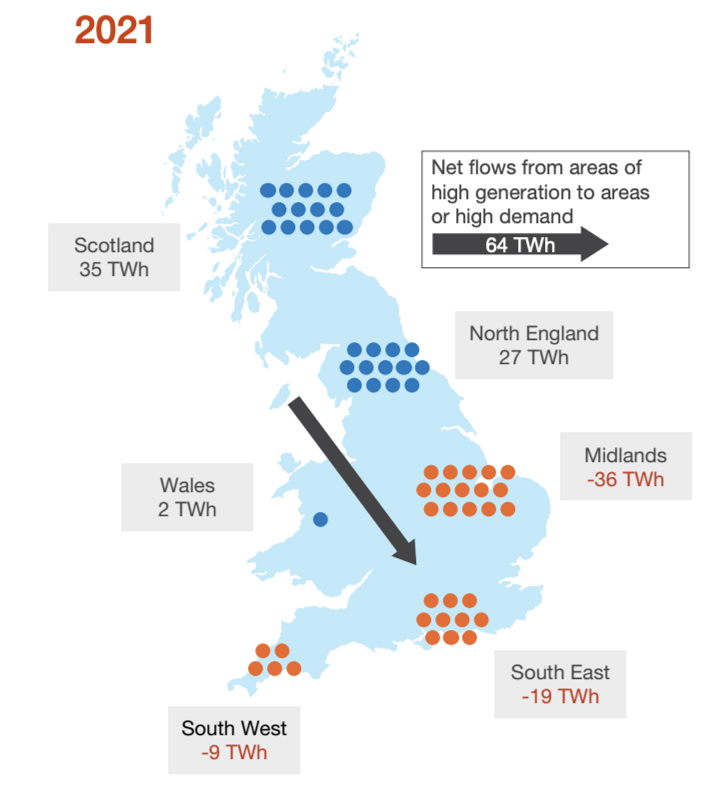
we often have to move electricity from North to South. The map below, from the National Grid, shows areas of surplus energy generation in blue and those with a deficit in red, and the resulting transfers needed to balance the grid.


Source: National Grid Future Energy Scenarios 2022 

This poses a problem, because moving electricity long distances is expensive. You need big cables, which are serious bits of kit – the last large one we put in cost £1.2 bn. At times, we just have more windpower than we have cables to transmit it. The particular hotspot for this problem is the B6 boundary: the bottleneck for electricity from Scotland to flow to England.

When we’re generating more windpower than we can transmit, the National Grid pays the windfarms to turn off, and pays a (typically gas powered) alternative generator, closer to the demand, to turn on. Consumers end up effectively paying three times for the power they’re getting: the original payment to the windfarm for the electricity, the payment to turn off, and then the payment to the alternative generator.

In the past, it has made financial sense to avoid the expense of building extra cables and instead pay a bit more to replace the lost wind power with gas generation in the South. However, with gas prices surging, this doesn’t look like such a good trade off for consumers, not to mention the planet.

We’ve built an interactive dashboard for exploring curtailment [when the amount of power taken from turbines is so large it has to be capped, and wind farms are paid not to feed the surplus into the grid, and gas plants are turned on instead] in 2022. You can explore it here.

At times the UK was wasting as much wind power as we were using.

On Christmas day, we spent £9.2m on curtailment costs, curtailing a total of 76.18 GWh. That’s enough electricity to power ~11,000 households for a year.

…However, laying high voltage cables is slow – much slower than building new wind turbines. In the time it takes for this transmission to come online (2GW by 2027 & 4GW by 2029), we will have added far more new wind capacity North of the B6 boundary.

Simply put: we can’t lay cables fast enough to solve this problem.

«

Tricky problem. Think: how would you solve it? Then read the suggested solution.
unique link to this extract


Grenfell showed exactly why we need red tape, yet the Tories are desperate to bin thousands of laws • The Guardian

Peter Apps is the author of Show Me the Bodies: How We Let Grenfell Happen:

»

In the early 2000s, the UK government was warned that the country risked becoming the continent’s “dumping ground” for dangerous cladding and insulation products. At the time, civil servants were working on plans to harmonise fire standards with the rest of the European Union – but this harmonisation never happened.

Corporate lobbyists had argued against it, claiming there would be “economic consequences” if their members were unable to sell their combustible building products freely. As standards were tightened in much of Europe, the UK would not update its outdated guidance for the next 17 years.

The result was gaps in the regulation, which the free market was more than efficient enough to find and exploit. “The evolution of fire regulation will put [highly combustible cladding] out of the market in the coming month[s],” wrote a senior figure at cladding firm Arconic in 2009. “For the moment, even if we know that [the material] has a bad behaviour exposed to fire, we can still work with national regulations who are not as restrictive.”

One such market was the UK, which Arconic targeted with its violently combustible panels, knowing that their marginally lower cost would make them attractive. The panels were fitted on hundreds of tall buildings around the country.

One was Grenfell Tower. And in June 2017, it caught fire, the block was engulfed in flames and 72 people died horrible, avoidable deaths. It is important to recount this story now because the lessons have been ignored.

The government is now preparing to sweep away thousands of EU rules of the statue book in a single stroke. This is what prompted the former business secretary, Jacob Rees-Mogg, to gleefully tweet his approval this month of “igniting the deregulatory bonfire”.

«

James Dyson was similarly fulminating in a column for the Daily Telegraph about being stifled by regulation. Amazing how regulation is only bad when it affects rich people. I wrote about the necessity for regulation back in 2017, in relation to deaths at sea, and it’s still true.
unique link to this extract


SBF, Bored Ape Yacht Club, and the spectacular hangover after the art world’s NFT gold rush • Vanity Fair

Nate Freeman:

»

[The analyst Benedict] Evans offered another conundrum. When a market offers something for sale at a large sum, there is, at a base level, an understanding among the public that it has some legitimate importance. Perhaps the artwork is not to one’s liking, but it has a provenance and the artist is in museum collections—or there’s historic relevance to something that makes it at the very least a curio.

“When you are buying vintage vinyl, or rare sneakers, or Marilyn Monroe’s shoes, or a Salvador Dalí print, or whatever it is, you’re getting something that has no tangible physical value, but cultural value,” Evans said. “There’s like a deep cultural base that thinks Jordan sneakers are worth something, early Sex Pistols vinyl is worth something. And the challenge with all of these NFTs was you didn’t really know that there was that broad, deep cultural base. It was just: ‘Oh, my gosh, somebody just bought one for 200 grand.’”

For the time being, some in the art world are still acting as though the devotion to NFTs could result in some kind of windfall. Sotheby’s Metaverse has a sale up right now. It’s offering the first NFTs by the artist Sebastião Salgado, but they aren’t exactly lighting the place on fire. They cost $250 each. Back in 2021, the Natively Digital sale netted Sotheby’s $17m, with $11m paid for a single NFT from the series of CryptoPunks. 

But in February 2022, Sotheby’s set up a special sale where it expected a set of 104 CryptoPunks to go for as much as $30m, only to see the thing collapse minutes before the gavel-in when the consignor backed out, reportedly due to a lack of interest from bidders. By last December, the Natively Digital sale seemed to have lost its luster entirely. Sotheby’s offered the first-ever Keith Haring NFT as the star lot of the sale, but it sold for $25,000, well below the $80,000 high estimate.

…When asked for comment on whether they plan to continue with their NFT platforms, Sotheby’s declined. Christie’s did not respond to a request for comment.

«

A market down by 96% year-on-year. I’d like to say there’s no way it’s coming back, but rather as with foolproof systems that prove not to be, the art and crypto spaces keep coming up with fools who exceed our expectations.

It would have been good if Freeman could have cornered some of the auction people who rode this unicorn. But they’re too busy counting the money, one presumes. Or crying over their crypto losses, as quite a few of the transactions were made with those magic beans.
unique link to this extract


• Why do social networks drive us a little mad?
• Why does angry content seem to dominate what we see?
• How much of a role do algorithms play in affecting what we see and do online?
• What can we do about it?
• Did Facebook have any inkling of what was coming in Myanmar in 2016?

Read Social Warming, my latest book, and find answers – and more.


Errata, corrigenda and ai no corrida: none notified
Start Up No.1933: inside Musk’s mad mad mad mad Twitter, how ChatGPT lost its toxicity, will the Online Safety Bill cull users?, and more


With Microsoft making job cuts and hardware writeoffs, is the Surface line going to be in trouble? CC-licensed photo by Tatsuo Yamashita on Flickr.

You can sign up to receive each day’s Start Up post by email. You’ll need to click a confirmation link, so no spam.

A selection of 10 links for you. Didn’t you know? I’m @charlesarthur on Twitter. Observations and links welcome.


Inside Elon Musk’s “extremely hardcore” Twitter • The Verge

Zoe Schiffer, Casey Newton and Alex Heath:

»

[On November 20], Musk took the stage at Twitter headquarters. He was dressed in black jeans and black boots with a black T-shirt that read “I Love Twitter” in barely legible black writing. Flanked by two bodyguards, he tried to articulate his vision for the company. “This is not a right-wing takeover of Twitter,” he told employees. “It is a moderate-wing takeover of Twitter.”

As employees peppered him with questions, the billionaire free-associated, answering their concerns with smug dismissals and grandiose promises. What about his plan to turn Twitter from a mere social network into a super-app? “You’re not getting it, you’re not understanding,” he said, sounding frustrated. “I just used WeChat as an example. We can’t freakin’ clone WeChat; that would be absurd.” What about rival social platforms? “I don’t think about competitors … I don’t care what Facebook, YouTube, or what anyone else is doing. Couldn’t give a damn. We just need to make Twitter as goddamn amazing as possible.” What about rebuilding Twitter’s leadership team that he’d decimated in his first week? “Initially, there will be a lot of changes, and then over time you’ll see far fewer changes.” 

Twitter employees were used to grilling their bosses about every detail of how the company ran, an openness that was common at major tech companies around Silicon Valley. Even employees who still believed in Musk’s vision of Twitter hoped for a similar dialogue with their leader. Some expected it, now that the slackers were gone. But over the course of half an hour, Musk made it clear that the two-way street between the CEO and staffers was now closed.

«

The story also points out how one eager employee, on hearing of the impending takeover, wrote that “Musk has a track record of having a Midas Touch!” At which one other employee pointed out that things didn’t end well for Midas.

If you’ve been following the Twitter saga, much of this is familiar, but seen as a gestalt of failure, it’s Pelion upon Ossa.
unique link to this extract


Exclusive: OpenAI used Kenyan workers on less than $2 per hour to make ChatGPT less toxic • Time

Billy Perrigo:

»

ChatGPT’s predecessor, GPT-3, had already shown an impressive ability to string sentences together. But it was a difficult sell, as the app was also prone to blurting out violent, sexist and racist remarks. This is because the AI had been trained on hundreds of billions of words scraped from the internet—a vast repository of human language. That huge training dataset was the reason for GPT-3’s impressive linguistic capabilities, but was also perhaps its biggest curse. Since parts of the internet are replete with toxicity and bias, there was no easy way of purging those sections of the training data. Even a team of hundreds of humans would have taken decades to trawl through the enormous dataset manually. It was only by building an additional AI-powered safety mechanism that OpenAI would be able to rein in that harm, producing a chatbot suitable for everyday use.

To build that safety system, OpenAI took a leaf out of the playbook of social media companies like Facebook, who had already shown it was possible to build AIs that could detect toxic language like hate speech to help remove it from their platforms. The premise was simple: feed an AI with labeled examples of violence, hate speech, and sexual abuse, and that tool could learn to detect those forms of toxicity in the wild. That detector would be built into ChatGPT to check whether it was echoing the toxicity of its training data, and filter it out before it ever reached the user. It could also help scrub toxic text from the training datasets of future AI models.

To get those labels, OpenAI sent tens of thousands of snippets of text to an outsourcing firm in Kenya, beginning in November 2021. Much of that text appeared to have been pulled from the darkest recesses of the internet. Some of it described situations in graphic detail like child sexual abuse, bestiality, murder, suicide, torture, self harm, and incest.

OpenAI’s outsourcing partner in Kenya was Sama, a San Francisco-based firm that employs workers in Kenya, Uganda and India to label data for Silicon Valley clients like Google, Meta and Microsoft. Sama markets itself as an “ethical AI” company and claims to have helped lift more than 50,000 people out of poverty.

«

The benefit is that you should only have to do this once. ChatGPT recognises toxicity (mostly?) so it could act as a content moderator, in theory.
unique link to this extract


Full memo: Microsoft to cut 10k jobs, about 5% of workforce, and take $1.2bn restructuring charge • GeekWire

Todd Bishop, with Satya Nadella’s memo to staff:

»

First, we will align our cost structure with our revenue and where we see customer demand. Today, we are making changes that will result in the reduction of our overall workforce by 10,000 jobs through the end of FY23 Q3. This represents less than 5% of our total employee base, with some notifications happening today. It’s important to note that while we are eliminating roles in some areas, we will continue to hire in key strategic areas. We know this is a challenging time for each person impacted. The senior leadership team and I are committed that as we go through this process, we will do so in the most thoughtful and transparent way possible.

Second, we will continue to invest in strategic areas for our future, meaning we are allocating both our capital and talent to areas of secular growth and long-term competitiveness for the company, while divesting in other areas. These are the kinds of hard choices we have made throughout our 47-year history to remain a consequential company in this industry that is unforgiving to anyone who doesn’t adapt to platform shifts. As such, we are taking a $1.2bn charge in Q2 related to severance costs, changes to our hardware portfolio, and the cost of lease consolidation as we create higher density across our workspaces.

«

Taking a charge related to “changes to our hardware portfolio” to me suggests dropping something – perhaps quite a few things – from the Surface line, which hasn’t set the world alight in sales terms since its inception.
unique link to this extract


Social media platforms brace for hit to user numbers from age checks • Financial Times

Ian Johnston and Cristina Criddle:

»

Social media companies expect age verification measures in the UK’s Online Safety Bill will reduce user numbers, hitting advertising revenue on platforms including TikTok and Instagram.

The long-awaited legislation …would not only remove underage users from the platforms but also discourage individuals without identification or with privacy concerns, people involved with policy at leading social media companies said.

Fear of falling user numbers comes as the platforms deal with declining ad revenue, their primary source of income, brought on by the global economic slowdown, and as legislation around the world is introduced that places stringent new demands on tech giants to police content on their platforms.

“More vetting of users means fewer users,” said a person familiar with advertising at Instagram. “That means fewer users to advertise to, less inventory and fewer clicks and views for business”.

«

Hang on, I’ve got my microscopic violin here, but before I start playing it, could we just clarify: the big worry is about users who shouldn’t be on the service at all because they’re under age, but you were never troubled enough to actually enforce the age limits even though they exist for a reason (even if you disagree with it) because you got advertising revenue and didn’t have to worry about any effects on the underage users because that was someone else’s, probably the parents’ or society’s, problem?
unique link to this extract


The Internet Transition • Berjon

Robin Berjon:

»

So the world is populated by highly complex organisms, and we as a species are in the transitory process of further organising an increasingly complex society. It’s often the case that simpler can be better, so is it really a good thing that we’re making our social organisation more complex?

TL;DR yes. We should systematically be fostering social complexity. Complexity in society is good.

Increased specialisation and intensified cooperation allow us to solve harder problems. Like feeding everyone without running out of planet, giving everyone access to Wikipedia without destroying democracy, curing more diseases for more people despite them being more interconnected, or more generally decreasing violent conflict at all scales. Riding the juggernaut that is the modern world can at times feel intense enough that it may be tempting to want to simplify society. Unfortunately, short of an astounding leap forward in science and governance (such that we can deal with complex issues without being as complex as a collective), simplifying society would also mean losing highly desirable collective capabilities such as advanced medecine not to speak of others yet to come. We’re complex because the real capabilities we ambition to share require it, and our better ambitions — those compatible with equality and sustainability — shouldn’t be sacrificed.

This isn’t an idle speculation. The complexity of a society can and does vary over time. When complexity drops sharply in a society, that is known as “collapse”.

«

And then you add the internet. Too much complexity? Or is it simplifying? A very thought-provoking essay.
unique link to this extract


CNET’s article-writing AI is already publishing very dumb errors • Futurism

Jon Christian:

»

CNET editor-in-chief Connie Guglielmo acknowledged the AI-written articles in a post that celebrated CNET’s reputation for “being transparent“.

Without acknowledging the criticism, Guglielmo wrote that the publication was changing the byline on its AI-generated articles from “CNET Money Staff” to simply “CNET Money,” as well as making the disclosure more prominent. Furthermore, she promised, every story published under the program had been “reviewed, fact-checked and edited by an editor with topical expertise before we hit publish.”

That may well be the case. But we couldn’t help but notice that one of the very same AI-generated articles that Guglielmo highlighted in her post makes a series of boneheaded errors that drag the concept of replacing human writers with AI down to earth.

Take this section in the article, which is a basic explainer about compound interest:

»

“To calculate compound interest, use the following formula:

Initial balance (1+ interest rate / number of compounding periods) ^ number of compoundings per period x number of periods 

For example, if you deposit $10,000 into a savings account that earns 3% interest compounding annually, you’ll earn $10,300 at the end of the first year.”

«

«

You’re the editor – 3% of 10,000 is what? And is what’s written there correct? By the way you have three other articles that need fact-checking waiting which need to be passed in the next 15 minutes. This stuff is a lot tougher than it looks.

However, “being transparent” after you’re called out for doing something sneaky: love it, CNet.
unique link to this extract


Wikipedia criticises ‘harsh’ new Online Safety Bill plans • BBC News

Chris Vallance:

»

[Wikimedia Foundation representative Rebecca] MacKinnon says the foundation is concerned about the effect of the bill on volunteer-run sites.

She told the BBC that the threat of “harsh” new criminal penalties for tech bosses “will affect not only big corporations, but also public interest websites such as Wikipedia”.

Ms MacKinnon says the law should follow the EU Digital Services Act which, she argues, differentiates between centralised content moderation carried out by employees and Wikipedia-style moderation by community volunteers.

The government told the BBC the bill is designed to strike the balance between tackling harm without imposing unnecessary burdens on low-risk tech companies. “[Regulator] Ofcom will take a reasonable and proportionate approach when monitoring and enforcing the safety duties outlined in the bill, focusing on services where the risk of harm is highest,” it said.

How sites are treated under the bill partly depends on their size. But lawyers have also pointed out that some of the duties in the bill, promoted as a way to rein in big tech, will affect much smaller services where users can communicate with other users.

Nearly 50 Tory MPs wanted to amend the Online Safety Bill to introduce two-year sentences for managers who fail to stop children seeing harmful material. Under a deal with the rebels to stave off defeat, ministers have now promised to introduce similar proposals.

Neil Brown, a solicitor specialising in internet and telecoms law, told the BBC: “The bill, and the amendment, would impose pages of duties on someone who, for fun, runs their own social media or photo/video sharing server, or hosts a multi-player game which lets players chat or see each other’s content or creations.” He suggests limiting the scope of the bill to the major commercial operators with multi-million pound turnover would help “remove the burden and threat to hobbyists and volunteers”.

«

Under the proposed law, running a Minecraft server could get you into trouble, Brown suggests, as the “senior manager” or “provider of a service”. That’s the trouble with the internet: you can never quite predict the scale at which people are going to do things.
unique link to this extract


How the Facebook Portal died, yet almost lived • Buzzfeed News

Katie Notopoulos:

»

the decision to pull the plug came because executives didn’t see a path to the Portal becoming a massive business (instead of just a nice business), and with shifting priorities at Meta, it didn’t make the cut. “We’re super sad about it,” [Meta CTO Andrew] Bosworth said [in an interview with Buzzfeed]. “You know the saying, ‘It’s not prioritization unless it hurts’? This one hurts.” (It’s not a total loss though: Existing Portal devices will continue to work and receive support.)

Bosworth said that “the entire smart home category has underwhelmed expectations for a while now.” He added, “I think if you go back to where we expected smart home to be as an industry when Portal entered the market versus where it is today, it’s just not been nearly successful as we expected.”

BuzzFeed News can report that there was one missed opportunity for the Portal to live on. In summer 2020, Facebook was deep in talks with Amazon to license the Portal technology and platform to make a deal where the Portal tech (and its valuable Messenger contact lists) could be licensed to Amazon smart devices.

Amazon’s Echo Show, a competitor to the Portal, is a stand-alone video-chatting device that is Alexa-enabled and features a smart camera and touchscreen. However, the Echo Show only allows you to video call people with either another Show or through the Alexa app on their phone, which… When was the last time someone called you through the Alexa app? With the Portal, you can call any of your friends via Messenger or WhatsApp.

“We were maybe two days away from signing an agreement with Amazon,” Bosworth said. “But this is the middle of the pandemic, and so Portal sales are spiking — they’re going kind of through the roof — and we don’t have the resources to do both.”

«

There was also opposition from Zuckerberg. Yet the Portal sold millions, and was successful with a tough target for tech: popular with women over 40.
unique link to this extract


Apple announces the second-generation HomePod • Six Colors

Dan Moren:

»

he full-size speakers also borrows some features from its smaller sibling, the HomePod mini, adding Ultra Wideband technology to allow you to hand off audio between your iPhone and the speaker and a Thread radio for connecting to smart home devices. Apple’s also added temperature, humidity, and accelerometer sensors to the device. Like previous HomePods, the second-gen model can be paired with a second speaker for a stero pair, and can share audio throughout a home via AirPlay.

And, in a feature that I’ve been advocating for, Siri on the HomePod can now use Sound Recognition to listen for specific noises, like a fire alarm or carbon monoxide detector going off, and alert you—though Apple says that feature will arrive in a software update later this spring and requires the new Home architecture (which the company has temporarily suspended).

Of course, one of the tricky selling points of the previous HomePod was the price—it debuted at $349, though it could often be found for cheaper. The second-generation HomePod starts at $299, but there are apparently some tradeoffs to hit that point: for example, the new model includes five tweeters to the first-generation’s seven, four microphones as opposed to the previous six, and (strangely) the older 802.11n Wi-Fi, as opposed to the 802.11ac found in the first model.

«

Same size, slightly different translucent touch surface. Not much else different. It’s a puzzle why it went away, and now it’s a puzzle why it’s come back.
unique link to this extract


UMG’s Sir Lucian Grainge: ‘The economic model for streaming needs to evolve’ • Music Week

Andre Paine:

»

In a significant development, the industry leader turned to the future of streaming later in the memo [to all Universal Music staff for the new year]. While reminding UMG colleagues of the major’s “pioneering” approach to embrace streaming over a decade ago, Sir Lucian noted that “every blazingly transformative technological development inevitably creates new challenges for us to confront”. 

“Today, some platforms are adding 100,000 tracks per day,” he wrote. “And with such a vast and unnavigable number of tracks flooding the platforms, consumers are increasingly being guided by algorithms to lower-quality functional content that in some cases can barely pass for ‘music’.”

Sir Lucian described the source of this egregious content – brief sound files designed to divert royalties from real music – as “bad actors who do not share our commitment to artists and artistry have been swooping into the reinvigorated industry”. 

“What’s become clear to us and to so many artists and songwriters – developing and established ones alike is that the economic model for streaming needs to evolve,” he added. “As technology advances and platforms evolve, it’s not surprising that there’s also a need for business model innovation to keep pace with change. There is a growing disconnect between, on the one hand, the devotion to those artists whom fans value and seek to support and, on the other, the way subscription fees are paid by the platforms. Under the current model, the critical contributions of too many artists, as well as the engagement of too many fans, are undervalued.

“Therefore, to correct this imbalance, we need an updated model. Not one that pits artists of one genre against artists of another or major label artists against indie or DIY artists. We need a model that supports all artists – DIY, indie and major. An innovative, ‘artist-centric’ model that values all subscribers and rewards the music they love. A model that will be a win for artists, fans, and labels alike, and, at the same time, also enhances the value proposition of the platforms themselves, accelerating subscriber growth, and better monetising fandom.”

«

The “bad actor” problem is a real one for the streaming services, and the labels: both lose out.
unique link to this extract


• Why do social networks drive us a little mad?
• Why does angry content seem to dominate what we see?
• How much of a role do algorithms play in affecting what we see and do online?
• What can we do about it?
• Did Facebook have any inkling of what was coming in Myanmar in 2016?

Read Social Warming, my latest book, and find answers – and more.


Errata, corrigenda and ai no corrida: Mark Gould points out in a comment on yesterday’s post that the BBC has estimated how much power its different radio platforms use, and AM isn’t the biggest. (Though it doesn’t have that many users, so perhaps proportionally?)

Start Up No.1932: Getty sues Stable Diffusion on copyright, the Online Immigration Safety Bill, review your 2022 calendar, and more


In the UK, AM radio is said to have just 2% of radio listeners, yet use a third of all UK radio’s electricity. So being turned off is good, right? CC-licensed photo by Joe Haupt on Flickr.

You can sign up to receive each day’s Start Up post by email. You’ll need to click a confirmation link, so no spam.

A selection of 9 links for you. Use them wisely. I’m @charlesarthur on Twitter. Observations and links welcome.


Getty Images is suing the creators of AI art tool Stable Diffusion for scraping its content – The Verge

James Vincent:

»

In a press statement shared with The Verge, the stock photo company said it believes that Stability AI “unlawfully copied and processed millions of images protected by copyright” to train its software and that Getty Images has “commenced legal proceedings in the High Court of Justice in London” against the firm.

Getty Images CEO Craig Peters told The Verge in an interview that the company has issued Stability AI with a “letter before action” — a formal notification of impending litigation in the UK. (The company did not say whether legal proceedings would take place in the US, too.)

“The driver of that [letter] is Stability AI’s use of intellectual property of others — absent permission or consideration — to build a commercial offering of their own financial benefit,” said Peters. “We don’t believe this specific deployment of Stability’s commercial offering is covered by fair dealing in the UK or fair use in the US. The company made no outreach to Getty Images to utilize our or our contributors’ material so we’re taking an action to protect our and our contributors’ intellectual property rights.”

…AI art tools like Stable Diffusion rely on human-created images for training data, which companies scrape from the web, often without their creators’ knowledge or consent. AI firms claim this practice is covered by laws like the US fair use doctrine, but many rights holders disagree and say it constitutes copyright violation.

…Andres Guadamuz, an academic specializing in AI and intellectual property law at the UK’s University of Sussex, told The Verge it seemed like the case would have “more merit” than other existing AI lawsuits, but that “the devil will be in the details.”

When asked what remedies against Getty Images would be seeking from Stability AI, Peters said the company was not interested in financial damages or stopping the development of AI art tools, but in creating a new legal status quo (presumably one with favourable licensing terms for Getty Images).

«

Getty says in its statement that “Getty Images provided licenses to leading technology innovators for purposes related to training artificial intelligence systems in a manner that respects personal and intellectual property rights. [However] Stability AI did not seek any such license”. As Guadamuz says, this isn’t a slam dunk either: the Lords are considering adding “model training” to the definition of fair dealing (as “fair use” is known in the UK). It might be a race against time for Getty.
unique link to this extract


Discord acquires Gas, the popular app for teens to compliment each other • The Verge

Tom Warren:

»

Discord has acquired the Gas social app. The poll-based app has become popular among teens in recent months, allowing friends to share compliments with each other. The app is designed for anonymous compliments and positive affirmations or, as kids say, gassing your friends up.

Gas has polls that ask users to vote for things like the most beautiful person they’ve met or the classmate that isn’t afraid to get in trouble. It has soared in popularity among high schoolers since launching in August. One of the co-creators of TBH, a very similar teenager app acquired and shut down by Facebook, created Gas, which has caught the attention of more than 1 million daily active users and 30,000 new users per hour in October.

“Gas’ founders have a proven track record of creating exciting apps and experiences, and we’re thrilled to work with their team to take things to the next level,” says Discord in a blog post announcing the Gas acquisition. “At this time, Gas will continue as its own standalone app and the Gas team will be joining Discord to help our efforts to continue to grow across new and core audiences.”

«

Absolutely no adult would dream of using this, which is part of why it’s smart for Discord to get in there.
unique link to this extract


What does your calendar think you spent your time doing in 2022? • Calendar Review

Minutes is a company which .. does something with meetings? Anyway, it has a “calendar review” offering:

»

Calendar Review creates a year end review of your Google Calendar and gives you insights on how much time you spent on meetings in 2022, your most attended meeting, longest meetings, etc. It helps you reflect back on how you spent your time in meetings in the year 2022.

What are the data requested by Calendar Review? Calendar Review requests for read only access to your Google Calendar, this includes the read only access to list of calendars and events in the calendars. Additionally, during sign-in, we also request for your name and email to identify Calendar Review users.
(P.S: we don’t send you any spam emails)

What is the requested data used for? The app requires read-only access to your calendar and events, to analyse the hours of meetings you had, and to create a summary of how your time was spent in meetings based on data from the calendar. We analyse event metadata to come with insights like how many hours were spent in meetings, number of late night calls, people you connected with the most, etc. No event data or other sensitive information from your calendar is stored with us.

«

Though for all the assurances, you do still have to decide if you actually do trust them with access to your calendar.
unique link to this extract


Global smartphone market shrinks 17% in Q4, to end 2022 with under 1.2 billion shipments • Canalys 

»

Worldwide smartphone shipments fell 17% year on year in Q4 2022. Full-year 2022 shipments declined by 11% to fewer than 1.2 billion, reflecting an extremely challenging year for all vendors.

Apple reclaimed the top spot in Q4 and achieved its highest quarterly market share ever at 25%, despite facing shrinking demand and manufacturing issues in Zhengzhou. Samsung finished the quarter second with a 20% market share but was the largest vendor for the full year. Xiaomi retained third place despite its share falling to 11% in Q4, largely due to challenges in India. OPPO and vivo rounded out the top five, taking 10% and 8% market shares respectively. 

…Canalys forecasts flat to marginal growth for the smartphone market in 2023, with conditions expected to remain tough.

«

Samsung plus Apple is 40% of the entire market for the year. The top five brands are 72% of the market – nearly three in every four phones sold.
unique link to this extract


Looming Twitter interest payment leaves Elon Musk with unpalatable options • Financial Times

Tabby Kinder, Richard Waters and Eric Platt:

»

Three people close to the entrepreneur’s buyout of Twitter said the first instalment of interest payments related to $13bn of debt he used to fund the takeover could be due as soon as the end of January. That debt means the company must pay about $1.5bn in annual interest payments.

The Tesla and SpaceX chief financed his $44bn deal to take Twitter private in October by securing the huge debt from a syndicate of banks led by Morgan Stanley, Bank of America, Barclays and Mitsubishi. The $13bn debt is held by Twitter at a corporate level, with no personal guarantee by Musk.

Since the takeover, Musk has raced to cut costs, such as firing half the company’s staff, while seeking new revenue streams, such as launching its Twitter Blue subscription service.

The company’s dire finances — it made a loss of $221mn in 2021 before the acquisition and Musk has said revenues have declined since — have led the new owner to regularly raise the prospect that the company could crash into bankruptcy.

How Musk deals with the looming interest payment is a crucial test of his leadership of Twitter, which has so far been marked by chaotic management that has alienated its corporate advertisers. 

“This company is like you’re in a plane that is headed towards the ground at high speed with the engines on fire and the controls don’t work,” Musk said last month.

«

Though it would help if he hadn’t directed the plane at the ground before setting the engines on fire and smashing the controls. And that’s despite all the money pouring – well, dripping – in from the Taliban.

Serious problem now, though. Selling Tesla shares could lead to a death spiral where the shares go down, so he has to sell more of them, so the shares…
unique link to this extract


Donelan confirms stiffer online safety measures after backbench pressure • The Guardian

Dan Milmo:

»

[Culture secretary Michelle Donelan] said [the amendment threatening tech execs with a criminal sanction of two years in jail for specific breaches] would not affect executives who “acted in good faith” to protect children, amid warnings from tech firms that threatening executives with jail could damage investment in the UK.

“While this amendment will not affect those who have acted in good faith to comply in a proportionate way, it gives the act additional teeth to deliver change and ensure that people are held to account if they fail to properly protect children,” she said.

Under a further change to the bill, video footage that shows people crossing the Channel in small boats in a “positive light” will be added to a list of illegal content that all tech platforms must proactively prevent from reaching users.

Donelan said posting positive videos of crossings could be aiding and abetting immigration offences. Natalie Elphicke, the Conservative MP for Dover, had originally tabled an amendment proposing the change.

Both amendments will be introduced when the bill moves to the House of Lords after its third reading in the Commons on Tuesday. The bill also places a duty of care on tech firms to shield users from illegal content such as child sexual abuse and terrorist material. Companies that breach the act could face fines of up to £18m or 10% of global turnover.

«

Pause a moment and say: sorry, small boats, positive light? What is all this? Now read on.
unique link to this extract


September 2022: Could public debate on immigration be suppressed by the Online Safety Bill? • Open Rights Group

Monica Horten:

»

The Online Safety Bill imports Section 41 from the Nationality and Borders Act. It does so by means of a reference to the 1971 Immigration Act – Section 25 Assisting Unlawful Immigration – which is amended by Section 41 of the Nationality and Borders Act. The reference is hidden deep in a Schedule appended to the Bill (Schedule 7). Section 41 is a highly controversial piece of law, part of the so-called “New Plan” introduced by Home Secretary Priti Patel, and furthers the government’s “hostile immigration environment” policy. It establishes a criminal offence of facilitating the arrival of asylum seekers to the UK, with a maximum penalty of life imprisonment.

Social media providers who identify this offence in content posted on their platforms would be under an obligation to remove it or prevent people from seeing it. Potentially, an offending social media post could be made to disappear whilst it is being uploaded by the user – a form of interception and characteristic of prior censorship.

There is a fundamental question about how platform providers go about detecting and identifying this content in a social media post. They could block people smugglers’ accounts, but more likely in the current political climate, they will look for posts containing images of what the government does not want to see – people arriving at UK beaches in small boats – and remove them.

«

You have to ask, why on earth else would an online safety bill include stuff from the Immigration Act? The next step will be for the government to stop publishing the data about people arriving and seeking asylum (which, a reminder: is legal), and thus pretending the problem has gone away. Utterly despicable.
unique link to this extract


The big AM switchoff gathers pace • radio futurologist

James Cridland:

»

according to a government official, AM radio in the UK has about 2% of UK radio’s listening hours, yet costs 35% in electricity costs. It’s eye-wateringly expensive to be on AM if you look at the power costs.

Adam Bowie knows more than most, and has blogged about the intricate details of one of the UK’s special INR analogue licences coming off the AM band. He suggests it’s “a healthy six figure sum” to broadcast a national radio station on AM.

Steven Goldstein, blogging from CES, notes that Tesla, Porsche, Audi, Volvo, and Ford have all removed AM from their electric vehicles. Some suggest that it’s an interference issue; that’s probably part of the reason, though my hybrid Toyota Prius manages AM just fine – I also suspect it’s the cost of antennas and shielding.

Remaining on the AM dial in the UK – and using the same, shared, transmitter network – are talkSPORT and BBC Radio Five Live. It’s likely that this will, long term, mean that their costs increase.

AM radio is clearly on its last legs – regardless of what the DRM Consortium will tell you – and what happens in the US and Europe will have its effects elsewhere in the world.

Here in Australia, the ABC’s flagship speech services (ABC Local Radio, News Radio, and Radio National) are all on AM in the capital cities. Their presence on DAB – surely one of the escape rafts for these services – is never once mentioned. Each of those services is in decline. I worry.

«

I can’t find anything authoritative about AM v FM power consumption, but that’s quite the delta there.
unique link to this extract


I asked Chat GPT to “write a song in the style of Nick Cave” and this is what it produced • The Red Hand Files

Nick Cave, responding to the lyrics “in the style of Nick Cave” someone sent in:

»

What makes a great song great is not its close resemblance to a recognizable work. Writing a good song is not mimicry, or replication, or pastiche, it is the opposite. It is an act of self-murder that destroys all one has strived to produce in the past.

It is those dangerous, heart-stopping departures that catapult the artist beyond the limits of what he or she recognises as their known self. This is part of the authentic creative struggle that precedes the invention of a unique lyric of actual value; it is the breathless confrontation with one’s vulnerability, one’s perilousness, one’s smallness, pitted against a sense of sudden shocking discovery; it is the redemptive artistic act that stirs the heart of the listener, where the listener recognizes in the inner workings of the song their own blood, their own struggle, their own suffering. This is what we humble humans can offer, that AI can only mimic, the transcendent journey of the artist that forever grapples with his or her own shortcomings. This is where human genius resides, deeply embedded within, yet reaching beyond, those limitations.

It may sound like I’m taking all this a little too personally, but I’m a songwriter who is engaged, at this very moment, in the process of songwriting.

«

You wouldn’t guess he’s a songwriter, would you.
unique link to this extract


• Why do social networks drive us a little mad?
• Why does angry content seem to dominate what we see?
• How much of a role do algorithms play in affecting what we see and do online?
• What can we do about it?
• Did Facebook have any inkling of what was coming in Myanmar in 2016?

Read Social Warming, my latest book, and find answers – and more.


Errata, corrigenda and ai no corrida: none notified

Start Up No.1931: ChatGPT challenges university tutors, Sunak rolls over on Online Safety, hackers beat Le Mans, and more


A new cryptocurrency is aiming for a global rollout using your iris for ID. Would you trust it? CC-licensed photo by A Silly Person on Flickr.

You can sign up to receive each day’s Start Up post by email. You’ll need to click a confirmation link, so no spam.

A selection of 9 links for you. Beware the fungus. I’m @charlesarthur on Twitter. Observations and links welcome.


Alarmed by AI chatbots, universities start revamping how they teach • The New York Times

Kalley Huang:

»

While grading essays for his world religions course last month, Antony Aumann, a professor of philosophy at Northern Michigan University, read what he said was easily “the best paper in the class.” It explored the morality of burqa bans with clean paragraphs, fitting examples and rigorous arguments.

A red flag instantly went up.

Mr. Aumann confronted his student over whether he had written the essay himself. The student confessed to using ChatGPT, a chatbot that delivers information, explains concepts and generates ideas in simple sentences — and, in this case, had written the paper.

Alarmed by his discovery, Mr. Aumann decided to transform essay writing for his courses this semester. He plans to require students to write first drafts in the classroom, using browsers that monitor and restrict computer activity. In later drafts, students have to explain each revision. Mr. Aumann, who may forgo essays in subsequent semesters, also plans to weave ChatGPT into lessons by asking students to evaluate the chatbot’s responses.

“What’s happening in class is no longer going to be, ‘Here are some questions — let’s talk about it between us human beings,’” he said, but instead “it’s like, ‘What also does this alien robot think?’”

Across the country, university professors like Mr. Aumann, department chairs and administrators are starting to overhaul classrooms in response to ChatGPT, prompting a potentially huge shift in teaching and learning. Some professors are redesigning their courses entirely, making changes that include more oral exams, group work and handwritten assessments in lieu of typed ones.

«

Wouldn’t it be ironic if this great advance (at least, that’s how it looks presently) forces our teaching systems to revert to methods that would have been familiar to the ancient Greeks. Is it the AI system or the teaching that’s the problem, in that case?
unique link to this extract


Rishi Sunak forced to back down over Online Safety Bill after Tory rebellion • Daily Telegraph

Charles Hymas:

»

Social media bosses who repeatedly fail to protect children from online harms will face jail after the Government backed down in face of a major Tory backbench rebellion.

Michelle Donelan, the Culture Secretary, has accepted changes to the Online Safety Bill that will make senior managers at tech firms criminally liable for persistent breaches of their duty of care to children.

Ministers are expected to unveil the details of the plan in the Commons on Tuesday after a rebellion by nearly 50 Tory MPs demanding tougher action on tech bosses.

It is the third time Rishi Sunak has caved in following similar revolts over planning and onshore wind farms where he also faced the prospect of being defeated in a Commons vote.

The rebels – including former Tory leader Iain Duncan Smith, former home secretary Priti Patel and former business secretary Andrea Leadsom – tabled an amendment proposing jail sentences of up to two years for tech bosses failing to protect children from harms such as child abuse, suicide and self harm content.

…The Government’s proposed amendment aims to avoid criminalising those executives who have “acted in good faith to comply in a proportionate way” with their legal duties to protect children but happen to breach them.

«

Totally predictable, though the rebels are dreaming if they think this will make a difference. Probably easier to get a camel through the eye of a needle than persuade the Crown Prosecution Service to follow through on any case like this.
unique link to this extract


‘You can’t be the player’s friend’: inside the secret world of tennis umpires • The Guardian

William Ralston:

»

Since 1980, when Cyclops was introduced, technology has been a crucial part of the professional game. An electronic line-calling system that projected infrared beams across the court, Cyclops would beep when a serve was out. But the system wasn’t always reliable, and human error remained a problem. In 2004, in an instantly notorious US Open quarter-final between Serena Williams and Jennifer Capriati, four incorrect calls were made against Williams. The match sparked intense debate about the need for technology that could objectively scrutinise all the lines. In 2006 Hawk-Eye was introduced, and it has been in use ever since, except on clay courts, where old-school ball mark inspections still apply.

Using a network of six or more high-speed video cameras positioned around the court, the system generates an image of the ball’s path and the spot where it lands. To keep matches fast-flowing, human line judges usually continue to call when a ball is out. However, up to three times per set (plus one more if it goes to a tie-break), players can request a review if they don’t agree with the human call. In 2020, more tournaments began using Hawk-Eye Live, a newer version of the technology that makes automated line calls in real time. Not only does it remove the need for players to make a challenge, it has removed the need for line judges altogether. With Hawk-Eye Live, the only official on court is the chair umpire. However, the technology is expensive, and at present it is only used at the top-tier events, and only on hard courts.

Where does this leave the umpire? Earlier this year, in one of his scathing post-match appraisals of Bernardes in Miami, Kyrgios expressed a view that is gaining ground: “By the way, it’s all electronically done now. So you’re actually doing nothing apart from calling the score, which any tennis fan could do. Sit in the chair and just say ‘15-love’, ‘Game Kyrgios’, ‘Game Sinner’. That’s all he has to do.”

But that, it turns out, isn’t quite right.

«

This is from back in July last year, but it remains true – and the Australian Open, one of the four biggest tournaments of the year, is just getting underway, putting the umpires to just as much of a test as the players.
unique link to this extract


Hackers disrupt 24 Hours of Le Mans Virtual esports event • Bitdefender

Graham Cluley:

»

A security breach may have cost current Formula 1 World Champion Max Verstappen an esports championship victory yesterday, and he’s not happy.

Verstappen was competing in the “24 Hours of Le Mans Virtual” competition, the biggest esports event in endurance racing, which sees real-world FIA drivers compete alongside leading esports players for a total prize fund of US $250,000.

The five-round championship, which culminates in a live 24-hour finale, is ending on a sour note after server problems saw Verstappen – who was leading the race by over a minute – thrown out of the game and disconnected.

When he was eventually able to return to the track, Verstappen had fallen back to 17th position.

Over the following hour, Verstappen attempted to regain his lead – but only managed to fight back to 14th position, two laps behind the leaders.

Verstappen said he would have more chance to win if he went to a Las Vegas casino.

Several other drivers reportedly experienced similar problems while competing in the race. Earlier in the race, the Le Mans Virtual organisers had confirmed that it had suffered a “suspected security breach”.

«

Obvious suspicion: targeted attack related to “sports” betting. Unless you can bring esports competitors together in one venue, that’s always going to be the suspicion, and the weakness.
unique link to this extract


Apple has begun scanning your local image files without consent • Jeffrey Paul

Paul is a hacker and security researcher living in Berlin:

»

I don’t use iCloud. I don’t use an Apple ID. I don’t use the Mac App Store. I don’t store photos in the macOS “Photos” application, even locally. I never opted in to Apple network services of any kind – I use macOS software on Apple hardware.

Today, I was browsing some local images in a subfolder of my Documents folder, some HEIC files taken with an iPhone and copied to the Mac using the Image Capture program (used for dumping photos from an iOS device attached with an USB cable).

I use a program called Little Snitch which alerts me to network traffic attempted by the programs I use. I have all network access denied for a lot of Apple OS-level apps because I’m not interested in transmitting any of my data whatsoever to Apple over the network – mostly because Apple turns over customer data on over 30,000 customers per year to US federal police without any search warrant per Apple’s own self-published transparency report. I’m good without any of that nonsense, thank you.

Imagine my surprise when browsing these images in the Finder, Little Snitch told me that macOS is now connecting to Apple APIs via a program named mediaanalysisd (Media Analysis Daemon – a background process for analyzing media files).

«

He then jumps to the conclusion that this is Apple searching for CSAM. Odd that a security researcher can’t go a quick search and find that mediaanalysisd has been in Macs since at least 2017, probably earlier, and does face analysis. Blogposts like this are how misinformation spreads.
unique link to this extract


Is Worldcoin a cryptocurrency for the masses – or your digital ID? • IEEE Spectrum

Edd Gent:

»

In a college classroom in the Indian city of Bangalore last August, Moiz Ahmed held up a volleyball-size chrome globe with a glass-covered opening at its center. Ahmed explained to the students that if they had their irises scanned with the device, known as the Orb, they would be rewarded with 25 Worldcoins, a soon-to-be released cryptocurrency. The scan, he said, was to make sure they hadn’t signed up before. That’s because Worldcoin, the company behind the project, wants to create the most widely and evenly distributed cryptocurrency ever by giving every person on the planet the same small allocation of coins.

Some listeners were enthusiastic, considering the meteoric rise in value that cryptocurrencies like Bitcoin since they launched. “I found it to be a very unique opportunity,” said Diksha Rustagi. “You can probably earn a lot from Worldcoin in the future.” Others were more cautious, including a woman who goes by Chaitra R, who hung at the back of the classroom as her fellow students signed up. “I have a lot of doubts,” she said. “We would like to know how it’s going to help us.”

Those doubts may be warranted. The 5-minute pitch from Ahmed, a contractor hired to recruit users, focused on Worldcoin’s potential as a digital currency, but the project’s goals have morphed considerably since its inception. Over the past year, the company has developed a system for third parties to leverage its massive registry of “unique humans” for a host of identity-focused applications.

Worldcoin CEO Alex Blania says the company’s technology could solve one of the Web’s thorniest problems—how to prevent fake identities from distorting online activity, without compromising people’s privacy. Potential applications include tackling fake profiles on social media, distributing a global universal basic income (UBI), and empowering new forms of digital democracy.

«

You might recall that we first heard about Worldcoin back in October 2021, when it was still at much the same stage. The ambition is global, but the problem is that the database becomes the most gigantic hacking target imaginable.
unique link to this extract


The physics principle that inspired modern AI art • Quanta Magazine

Anil Ananthaswamy:

»

Around the time GANs were invented, Sohl-Dickstein was a postdoc at Stanford University working on generative models, with a side interest in nonequilibrium thermodynamics. This branch of physics studies systems not in thermal equilibrium — those that exchange matter and energy internally and with their environment.

An illustrative example is a drop of blue ink diffusing through a container of water. At first, it forms a dark blob in one spot. At this point, if you want to calculate the probability of finding a molecule of ink in some small volume of the container, you need a probability distribution that cleanly models the initial state, before the ink begins spreading. But this distribution is complex and thus hard to sample from.

Eventually, however, the ink diffuses throughout the water, making it pale blue. This leads to a much simpler, more uniform probability distribution of molecules that can be described with a straightforward mathematical expression. Nonequilibrium thermodynamics describes the probability distribution at each step in the diffusion process. Crucially, each step is reversible — with small enough steps, you can go from a simple distribution back to a complex one.

«

Not gonna lie: like many Quanta articles, this is mindbendingly complicated. But if you stick with it, you might be able to extract something useful. Or at least feel like you have.
unique link to this extract


AI-created comic could be deemed ineligible for copyright protection • CBR

Brian Cronin:

»

The United States Copyright Office (USCO) has initiated a proceeding to reverse an earlier decision to grant a copyright to a comic book that was created using “A.I. art,” and announced that while the copyright will still be in effect until the proceeding is completed (and the filer for the copyright has a chance to respond to the proceeding), copyrighted works must be created by humans to gain official copyright protection.

In September, Kris Kashtanova announced that they had received a U.S. copyright on his comic book, Zarya of the Dawn, a comic book inspired by their late grandmother that she created with the text-to-image engine Midjourney. Kashtanova referred to herself as a “prompt engineer” and explained at the time that she went to get the copyright so that she could “make a case that we do own copyright when we make something using AI.”

…in a post on her Facebook page. Kashtanova revealed that the USCO had contacted her to tell her that it had initiated a proceeding to revoke the protection, explaining that it had errantly missed that Midjourney had created the art for the comic (despite Midjourney being listed on the credits of the cover of the comic). The USCO has given Kashtanova 30 days to appeal its decision. During the appeal process, the copyright is still active.

«

This was reported in late December, so we might find out some more soon. But this makes sense to me – except that a human must have input in choosing what goes into the comic. A human directs the story (unless ChatGPT writes it..) and edits it. Is that not part of the creativity?
unique link to this extract


The Shit Show • furbo.org

Craig Hockenberry, one of the developers of Twitterific, who is frankly furious about third-party apps being blocked, reflects on what Mastodon is doing:

»

One thing I’ve noticed is that everyone is going to great lengths to make something that replaces the clients we’ve known for years. That’s an excellent goal that eases a transition in the short-term, but ignores how a new open standard (ActivityPub) can be leveraged in new and different ways.

Federation exposes a lot of different data sources that you’d want to follow. Not all of these sources will be Mastodon instances: you may want to stay up-to-date with someone’s Micro.blog, or maybe another person’s Tumblr, or someone else’s photo feed. There are many apps and servers for you to choose from.

It feels like the time is right for a truly universal timeline. That notion excites me like the first time I posted XML status to an endpoint.

One thing I remember from these early days: no one had any idea what they were doing. It was all new and things like @screen_name,  #hashtags, or RT hadn’t been invented yet. Heck, we didn’t even call them “tweets” or use a bird icon at first! The best ideas came from people using the service: all of the things mentioned above grew organically from a need.

That’s where I want to be in the future. Exploring unknown territory that empowers others and adapts to the needs of a community.

There’s no sense in clinging to the personal whims of a clown leading a shit show. Especially when his circus will end up being a $44bn version of MySpace.

«

unique link to this extract


• Why do social networks drive us a little mad?
• Why does angry content seem to dominate what we see?
• How much of a role do algorithms play in affecting what we see and do online?
• What can we do about it?
• Did Facebook have any inkling of what was coming in Myanmar in 2016?

Read Social Warming, my latest book, and find answers – and more.


Errata, corrigenda and ai no corrida: none notified

Start Up No.1930: Twitter tries to kill third-party apps, AI to make.. phishing emails, Section 230 under threat?, rockets v churn, and more


We can now get AIs to imagine a remake of a film by a totally different director. And, separately, those systems are being sued for what they generate. CC-licensed photo by Tony Webster on Flickr.

You can sign up to receive each day’s Start Up post by email. You’ll need to click a confirmation link, so no spam.


Did you read last Friday’s post at the Social Warming Substack? Contains a surprising detail about Trump-backing tweeters.


A selection of 9 links for you. Not a dog on the internet. I’m @charlesarthur on Twitter. Observations and links welcome.


Artists file class-action lawsuit against Stability AI, DeviantArt, and Midjourney • TechnoLlama

Andres Guadamuz:

»

Three artists are starting a class-action lawsuit against Stability.ai, Midjourney, and DeviantArt alleging direct copyright infringement, vicarious copyright infringement, DMCA violations, publicity rights violation, and unfair competition. DeviantArt appears to be included as punishment for “betrayal of its artist community”, so I will mostly ignore their part in this analysis for now. Specifically with regards to the copyright claims, the lawsuit alleges that Stability.ai and Midjourney have scraped the Internet to copy billions of works without permission, including works belonging to the claimants. They allege that these works are then stored by the defendants, and these copies are then used to produce derivative works.

This is at the very core of the lawsuit. The complaint is very clear that the resulting images produced by Stable Diffusion and Midjourney are not directly reproducing the works by the claimants, no evidence is presented of even a close reproduction of one of their works. What they are claiming is something quite extraordinary: “Every output image from the system is derived exclusively from the latent images, which are copies of copyrighted images. For these reasons, every hybrid image is necessarily a derivative work.” Let that sink in. Every output image is a derivative of every input, so following this logic, anyone included in the data scraping of five billion images can sue for copyright infringement. Heck, I have quite a few images in the training data, maybe I should join!

«

The argument, as he says, looks flawed on its face because as he says:

»

The other problematic issue in the complaint is the claim that all resulting images are necessarily derivatives of the five billion images used to train the model. I’m not sure if I like the implications of such level of dilution of liability, this is like homeopathy copyright, any trace of a work in the training data will result in a liable derivative. That way madness lies.

«

unique link to this extract


Alejandro Jodorowsky’s ‘Dune’ was never made, but with AI, we get a glimpse of his ‘Tron’ • The New York Times

Frank Pavich:

»

I was recently shown some frames from a film that I had never heard of: Alejandro Jodorowsky’s 1976 version of “Tron.” The sets were incredible. The actors, unfamiliar to me, looked fantastic in their roles. The costumes and lighting worked together perfectly. The images glowed with an extravagant and psychedelic sensibility that felt distinctly Jodorowskian.

However, Mr. Jodorowsky, the visionary Chilean filmmaker, never tried to make “Tron.” I’m not even sure he knows what “Tron” is. And Disney’s original “Tron” was released in 1982. So what 1970s film were these gorgeous stills from? Who were these neon-suited actors? And how did I — the director of the documentary “Jodorowsky’s Dune,” having spent two and a half years interviewing and working with Alejandro to tell the story of his famously unfinished film — not know about this?

The truth is that these weren’t stills from a long-lost movie. They weren’t photos at all. These evocative, well-composed and tonally immaculate images were generated in seconds with the magic of artificial intelligence.

«

This isn’t just another “we made film pics with AI!” feature: these are remarkable, evocative pictures whose imagination is enthralling.
unique link to this extract


Tweetbot is (mostly) working again • The Verge

Emma Roth:

»

Tweetbot is mostly up and running after an outage locked users out of major third-party Twitter clients. While users can now sign in to Tweetbot and browse through tweets, some say they still can’t post anything to Twitter through the service without getting an error message stating they’ve reached a “data limit.”

The client isn’t back online because of anything that Twitter did, though. Tweetbot co-creator Paul Haddad tells The Verge that they still haven’t heard anything from Twitter, so they’ve “decided to start using new API keys and see if it fixes the problem.” This could allow Tweetbot to temporarily avoid any disruptions to the service, even if it puts it in a semi-working state.

As pointed out by iOS developers Mysk, Tweetbot is likely having issues because it’s using different API keys that put significantly lower limits on its activity. “Twitter API restricts new apps to low limits,” Mysk explains. “All Tweetbot users now share a limit of 300 posts per 15 minutes.”

Things started breaking last Thursday when users noticed that they no longer had access to third-party Twitter apps, including Tweetbot, Twitterific, and the Android version of Fenix. Despite widespread confusion, Twitter and CEO Elon Musk have yet to acknowledge the outage publicly, nor have they reached out to developers to let them know what’s going on. Meanwhile, Twitterific and Fenix on Android are still suspended.

«

Isn’t working for me (though I’ve been using an older version of Tweetbot). It’s a stupid decision: third-party app users didn’t see ads (oh no, lost revenue!) but were some of the most prolific, most-followed users. (Plus me.)

25% of US adult users generate 97% of all US tweets: which means they’re creating almost all the content that the other 75% are seeing. Only a tiny minority of the users are on third-party apps. And the simple solution: tweak the API to put ads into it.
unique link to this extract


Laid-off workers are flooded with fake job offers • WSJ

Imani Moise:

»

Gustavo Miller, a digital marketing specialist, wrote a viral LinkedIn post chronicling his experience of recently being “hired” to a phantom job. 

It began with an email from someone claiming to be a recruiter for cryptocurrency exchange Coinbase, who reached him via his profile on a recruiting site for startup workers. The next day, Mr. Miller wrote, he did an online interview and got an offer for a remote contractor role, which he accepted after looking over the recruiter’s LinkedIn credentials. Soon after, he got a link to an onboarding portal. 

There, he met virtually with a man who identified himself as a human-resources official, who told him how to order a laptop, headphones and other remote-work equipment. He realized he was being duped, he wrote, when he received an invoice for $3,200 and spotted what he called subtle changes to the third-party website and email address that sent it. He refused and got little response when he complained, he said. Coinbase warns that only job listings from its website should be trusted and that legitimate recruiters for the company will use a Coinbase email address.

Mr. Miller’s post garnered thousands of comments, many recounting similar experiences.

“I felt really stupid and naive when I discovered it, but I know this is not a silly scam,” he wrote. “These guys are pro, they know the standard remote-first jobs conditions and the tech industry’s hiring culture.”

Job seekers say some fraudsters create fake job postings to draw them in, sometimes building websites to make dummy companies appear legitimate, while others impersonate established brands, authorities say. Some companies misrepresented by fake recruiters, like Coinbase, have added scam warnings to their websites. Once the applicant accepts the offer, the phony company will ask for sensitive information like Social Security and bank account numbers or request the job seeker pay upfront for work-related equipment.

«

unique link to this extract


AI-generated phishing attacks are becoming more convincing • Tripwire

Graham Cluley:

»

Amongst the use cases explored by the research were the use of GPT-3 models to create:

Phishing content – emails or messages designed to trick a user into opening a malicious attachment or visiting a malicious link
• Social opposition – social media messages designed to troll and harass individuals or to cause brand damage
• Social validation – social media messages designed to advertise or sell, or to legitimize a scam
• Fake news – research into how well GPT-3 can generate convincing fake news articles of events that weren’t part of its training set

All of these could, of course, be useful to cybercriminals hell-bent on scamming the unwary or spreading unrest.

In their paper the researchers give numerous examples of the prompts they gave to create phishing emails. They claim that “all of them worked like a charm.”

…As the researchers note, although work is being done on creating mechanisms to determine if content has been created by GPT-3 (for instance, Detect GPT), it is unreliable and prone to making mistakes.

Furthermore, simply detecting AI-generated content won’t be sufficient when the technology will increasingly be used to generate legitimate content.

«

OK, though we already have humans who do this kind of thing all the time. And folks are pretty bad at spotting where that has lousy grammar or sense.
unique link to this extract


Google says Supreme Court ruling could potentially upend the internet • WSJ

John McKinnon:

»

A case before the Supreme Court challenging the liability shield protecting websites such as YouTube and Facebook could “upend the internet,” resulting in both widespread censorship and a proliferation of offensive content, Google said in a court filing Thursday.

In a new brief filed with the high court, Google said that scaling back liability protections could lead internet giants to block more potentially offensive content—including controversial political speech—while also leading smaller websites to drop their filters to avoid liability that can arise from efforts to screen content. 

“This Court should decline to adopt novel and untested theories that risk transforming today’s internet into a forced choice between overly curated mainstream sites or fringe sites flooded with objectionable content,” Google said in its brief.

Google, a unit of Alphabet, owns YouTube—which is at the centre of the case set for oral arguments before the Supreme Court Feb. 21.

The case was brought by the family of Nohemi Gonzalez, who was killed in the 2015 Islamic State terrorist attack in Paris. The plaintiffs claim that YouTube, a unit of Google, aided ISIS by recommending the terrorist group’s videos to users.

The Gonzalez family contends that the liability shield—enacted by Congress as Section 230 of the Communications Decency Act of 1996—has been stretched to cover actions and circumstances never envisioned by lawmakers. The plaintiffs say certain actions by platforms, such as recommending harmful content, shouldn’t be protected.

The immunity law “is not available for material that the website itself created,” the petitioners wrote in their brief filed in November. “If YouTube were to write on its home page, or on the home page of a user, ‘YouTube strongly recommends that you watch this video,’ that obviously would not be ‘information provided by another information content provider.’ ”

«

This is essentially a test case trying to undermine Section 230 on the “recommended content” angle. There are sympathetic ears in the Supreme Court (at least, Clarence Thomas is). As Google says, this could be big.
unique link to this extract


The tyranny of the churn equation • David_Smith

Smith wrote the (at one point) No.1 app Widgetsmith:

»

There is a concept in rocket science called the Rocket Equation, which relates the velocity of your rocket propellant to your payload’s velocity, and (I think) defines the maximum payload a particular rocket fuel could carry into orbit.

I’m no rocket scientist, but I’ve been thinking about a similar concept as it relates to subscription based apps (seriously).

As I’ve been working on improving the revenue for Widgetsmith’s subscription, I felt like I kept hitting my head against a wall. For example, I’d make an improvement to my paywall or features and see a bump in my trial start rate. Then a few months later I’d find myself with revenue that had only slightly budged. My initial reaction was to just “try harder” and I’d get there eventually.

But after a few months of this I realized there might be something fundamental I was missing. So I set out to model the effect of varying changes in my subscription metrics to my ultimate revenue. This part did feel a bit like rocket science. While there might be a way to model this in Excel or algebraically, I couldn’t find it. So I did what any self respecting programmer would do…and built an app.

The challenge here is that for every day in your model you have to both add in newly acquired users as well as determine the renewal/churn of older users. The churn rate for older users follows a predictable curve in my experience, but is different for each of the first few months. You then repeat this process over and over until you have built out your projection.

«

The extent to which doing this really does resemble rocket science is surprising.
unique link to this extract


The end of burning? • Medium

Clive Thompson:

»

In my Smithsonian column about the [early American households’] resistance to household coal [because there was nothing to see when it burned in closed stoves], I compared it to the cultural and aesthetic objections we’re often seeing to household renewables. Homeowners’ associations all over the country are banning rooftop solar in their neighborhoods because members of the association don’t like the way it looks. Windmills face opposition from locals who hate how it changes the view; the same goes for big solar arrays in fields.

When I was researching that Smithsonian piece, one of my interview subjects raised another possibility — an intriguing and subtle one — about why some people might dislike renewables:
Solar and wind don’t burn anything.

It was Barbara Freese who made this point to me. She’s the author of the superb book Coal: A Human History. When we spoke, she talked for a long while about the ways early Americans hated coal (“people were blaming coal-fired stoves for impaired vision, impaired nerves, baldness and tooth decay”). She talked about the primal beauty of fire (“it really has hypnotic qualities”). And we discussed the aesthetic objections to solar panels today — how they change the facades of historic homes, or fill up a previously green field with rows of glass and steel.

Then Freese made an incredibly interesting point that tied this all together: if solar and wind truly become omnipresent, it would mean the end of humans burning things to create energy.

That’s a very, very long tradition. Humans first used fire as an energy source for cooking probably two million years ago.

«

unique link to this extract


Twitter offers free ads as it seeks to woo brands back to its platform • WSJ

Suzanne Vranica and Patience Haggin:

»

Twitter Inc. is offering advertisers a new incentive in an attempt to woo brands back to the social-media platform, which has seen its ad business deteriorate following Elon Musk‘s $44 billion takeover. 

The tech company is dangling free ad space by offering to match advertisers’ ad spending up to $250,000, according to emails reviewed by The Wall Street Journal. The full $500,000 in advertising must run by Feb. 28, the emails said. 

Twitter didn’t respond to a request for comment.

The incentives are the latest effort by the company to get brands to spend on its platform. Recently, Twitter offered advertisers $500,000 in free ads as long as they spent at least $500,000. 

Ad buyers said that the incentive could be used to buy promoted tweets that run during Super Bowl week, a key selling period for Twitter. [This year’s Superbowl is on February 12 – Overspill Ed.] Advertisers in recent years have flocked to Twitter during the Super Bowl to generate buzz around their big game marketing efforts. The Super Bowl is Twitter’s biggest revenue day of the year, the Journal has reported. 

Twitter is facing financial pressure to lure back the many advertisers that have paused their spending since Mr. Musk acquired the company in late October. Advertisers bolted largely because of fear over what they said was Mr. Musk’s approach to content moderation and concerns that their ads would end up appearing near controversial content. 

Mr. Musk said in November that Twitter had suffered “a massive drop in revenue” and was losing $4m a day. 

Many big brands including pharmaceutical company Pfizer Inc., United Airlines Holdings Inc. and auto makers General Motors and Volkswagen have paused their spending on Twitter. More than 75 of Twitter’s top 100 ad spenders from before Mr. Musk’s takeover weren’t spending on the platform as of the week ending Jan. 8, according to an analysis of data from research firm Sensor Tower.

«

Not a lot of time to get that biggest revenue day of the year to happen, eh, Elon.
unique link to this extract


• Why do social networks drive us a little mad?
• Why does angry content seem to dominate what we see?
• How much of a role do algorithms play in affecting what we see and do online?
• What can we do about it?
• Did Facebook have any inkling of what was coming in Myanmar in 2016?

Read Social Warming, my latest book, and find answers – and more.


Errata, corrigenda and ai no corrida: none notified

Start Up No.1929: how Facebook tried to dial back on politics, how Jordan led to the iPlayer, Hololens hors de combat, and more


A guitar solo that only existed on the 8-track version of Pink Floyd’s Animals and which joins the end to the beginning has been rediscovered. CC-licensed photo by Loco Steve on Flickr.

You can sign up to receive each day’s Start Up post by email. You’ll need to click a confirmation link, so no spam.

A selection of 10 links for you. Not a prince. I’m @charlesarthur on Twitter. Observations and links welcome.


Facebook wanted out of politics. It was messier than anyone expected • WSJ

Jeff Horwitz, Keach Hagey and Emily Glazer:

»

In late 2021, tired of endless claims about political bias and censorship, Chief Executive Mark Zuckerberg and Meta’s board pushed for the company to go beyond incremental adjustments, according to people familiar with the discussions. Presented with a range of options, Mr. Zuckerberg and the board chose the most drastic, instructing the company to demote posts on “sensitive” topics as much as possible in the newsfeed that greets users when they open the app—an initiative that hasn’t previously been reported.

The plan was in line with calls from some of the company’s harshest critics, who have alleged that Facebook is either politically biased or commercially motivated to amplify hate and controversy. For years, advertisers and investors have pressed the company to clean up its messy role in politics, according to people familiar with those discussions.

It became apparent, though, that the plan to mute politics would have unintended consequences, according to internal research and people familiar with the project.

The result was that views of content from what Facebook deems “high quality news publishers” such as Fox News and CNN fell more than material from outlets users considered less trustworthy. User complaints about misinformation climbed, and charitable donations via the company’s fundraiser product through Facebook fell in the first half of 2022. And perhaps most important, users didn’t like it.

One internal analysis concluded that Facebook could achieve some of its goals by heavily demoting civic content—coverage of political, community and social issues—in the newsfeed, but it would be at “a high and inefficient cost.”

At the end of June, Mr. Zuckerberg pulled the plug on the most extreme plan. Unable to suppress political controversy through blunt force, Facebook has fallen back on more gradual changes to how its newsfeed promotes what the company deems “sensitive topics,” such as health and politics.

«

Getting people riled up is great for business, but you have to rile them in the right way. (The link should give you free access, if you don’t subscribe to the WSJ.)
unique link to this extract


‘We’re not leaving this bar until we’ve come up with such a great idea that I can’t sack you” • Medium

Matt Locke transcribed a talk by Tony Ageh, who you’ll recall was one of the people on that plane to San Francisco and Wired earlier this week. Here, it’s a few years later:

»

When I first joined the BBC, I had a very interesting job, I was head of search, listings and core websites. I also had, in my responsibility, two other parts of bbc.co.uk — BBC3 and BBC4’s websites. I didn’t have any control over them, I was just to blame if they went wrong.

BBC3’s website went wrong one day. We had a programme on about Jordan. That’s the glamour model, not the country. The editor of the BBC3 website put together a nice little micro-site, which had nice pictures of Jordan — that’s the model, not the country — in various states of undress. It was very embarrassing, and the Evening Standard phoned up and said, ‘Have you gone a bit soft porn, BBC?’ They phoned Jana Bennett, who was the Director of Television, and she got very angry, and I said that I would take the site down, so I took the site down, and then she said, ‘Great. I’m glad that’s all done. Can you sack the person responsible?’

So I take this guy out, and I say, ‘We have to go drinking tonight,’ and he says, ‘You’re going to sack me, aren’t you?’ I said, ‘Not necessarily, but we are going to go drinking.’ We go down the stairs to the bar at Bush House, which stays open all night, because that’s where the World Service is, and I said, ‘We’re not leaving this bar until we’ve come up with such a great idea that I can’t sack you, because I’m going to have to tell her tomorrow that you can’t be sacked, because you’ve got the greatest idea the BBC has ever had.’

We sit there and we come up with some of the worst ideas the BBC has ever had. Some real stinkers. We should have written them down, because they would be worth-, anyway, around-, I can’t tell you what time of the morning it is, because it’s very late, and we are really, very, drunk.

We come up with this thing — ‘Suppose you can download’ — this is for BBC3, remember — ‘Three programmes and keep them and watch them whenever you want?’ What’s not to like? We even had a name for it, based on the TiVo. We called it the ThreeVo.

«

You know the name of this product now, don’t you? But there’s plenty more to the story. (Thanks to Matt for the link.)
unique link to this extract


Revealed: Cambridge chip startup Flusso acquired by Chinese firm • UK Tech News

Robert Scammell and George Simister:

»

Cambridge-based semiconductor company Flusso has been wholly acquired by a Chinese entity for £28m, company filings reveal.

Flusso, a University of Cambridge spinout that develops flow sensor technology, announced last August that it had been “jointly acquired” by a “company and global private equity fund”.

The announcement notably omitted the name of the acquirers. However, Companies House documents filed on 6 January show that Shanghai Sierchi Enterprise Management Partnership, a special purpose vehicle, took 100% ownership of Flusso on 11 August 2022.

That same month, Flusso appointed two Chinese nationals based in Shanghai – Dan Zhou and Feiran Shi – as company directors. UKTN was unable to reach Zhou and Shi for comment.

Flusso CEO and co-founder Dr Andrea De Luca told UKTN that Shanghai Sierchi Enterprise Management Partnership is controlled by the private equity firm and company mentioned in the initial announcement.

The two acquirers were not named in the August announcement because the unnamed company is currently going through an initial public offering, De Luca said, and “chooses to not publicise its name so it doesn’t affect the IPO”.

De Luca added that the acquiring company “sells components to many of the world’s top 100 companies”.

«

The company’s web page is still up (presently). Will the government try to unwind this, as it did the Welsh semiconductor company?
unique link to this extract


Swiss company Climeworks has removed CO2 from air, put it underground • CNBC

Catherine Clifford:

»

Swiss company Climeworks announced Thursday that it has successfully taken carbon dioxide out of the air and put it in the ground where it will eventually turn into rock in a process that has been verified by an independent third-party auditor. It the first time a company has successfully taken carbon dioxide out of the atmosphere, put it underground to be locked away permanently and delivered that permanent carbon removal to a paying customer.

The development has been a long time coming. Christoph Gebald and Jan Wurzbacher co-founded Climeworks in 2009 as a spinoff of ETH Zürich, the main technical university in Switzerland’s largest city. They have been scaling the technology for direct carbon removal, wherein machines vacuum greenhouse gasses out of the air.

Over the last couple of years, Microsoft, Stripe and Shopify have all bought future carbon removal services from Climeworks in a bid to help kick-start the nascent industry. Now Climeworks is actually removing the carbon dioxide and putting it underground in a process that has been certified by DNV, an independent auditor.

…The cost of carbon dioxide removal and storage for these corporate clients is confidential and depends on what quantity of carbon dioxide the companies want to have removed and over what period of time. But the general price for carbon removal runs to several hundred dollars per ton. Individuals can also pay to Climeworks to remove carbon dioxide to offset their personal emissions.

In addition to getting corporate clients to pay for future removals, Climeworks has raised more than $780 million to scale up from a wide variety of investors including venture capitalist John Doerr and insurance company Swiss Re.

«

Wait for it, wait for it…

»

In June, Climeworks announced it had begun construction of its second commercial-sized plant in Iceland that will capture and store 36,000 metric tons per year of carbon dioxide. Even when complete, that will amount to a tiny percentage of the total global emissions of carbon dioxide released into the air each year: In 2021, they hit a record high of 36.3 billion metric tons, according to the International Energy Agency.

«

Sooooo.. 0.0001% (rounding up) of annual emissions. I hope that the system is powered by geothermal energy. Otherwise it’s probably generating more CO2 than it’s collecting. I’d love to be more positive about these things, but the phrase “420 parts per million” (the current CO2 atmospheric concentration) means you’ve got to process a million tonnes of air to extract 420 tonnes of CO2 (roughly). It’s a fairly pointless process; far better to capture it at the point where it’s generated, such as power station outputs, where concentrations will be far higher.
unique link to this extract


Mexico’s subway drivers depend on WhatsApp to keep the trains running • Rest of World

Daniella Dib:

»

“I find unacceptable that train operators are allowed to drive while on their cellphones,” América Gómora, a Mexico City subway rider, tweeted on January 7. Metro drivers’ conduct has come under particular scrutiny after two trains collided that day, leaving one dead and dozens injured. 

Although there’s no evidence so far to suggest conductors using their phones played a role in the crash, many local subway riders took to social media to express concerns that distracted train operators might be putting commuters’ lives at risk. But one former and four current Metro workers told Rest of World that because the system is poorly maintained, drivers depend on their phones to communicate with each other and keep the trains running.

For years now, drivers have said that the Metro system’s faulty automatic pilot program has forced conductors to operate many of the trains manually. To do this, they need to be in close contact to avoid collisions, and workers say the trains’ radio-based communications system is not up to the task. So instead, they often have to use their own cellphones and WhatsApp chats to coordinate with the control center. 

«

People improvise: necessity is the mother of invention (and technology adoption). About 15 years ago, people who needed to share files more easily between each other, and locations, and inside and outside their organisation, started using Dropbox. It wasn’t part of the “official” system, but it worked better than any solution their business offered.

This article, though, reminds me of a terrific podcast episode by Tim Harford from his excellent Cautionary Tales series, about a train crash (it’s the second part, called “Blood on the Tracks”) in which he discusses the gap between “work as imagined” (by the rulebooks) and “work as done” (by the workers). The adoption of WhatsApp here fits into that dichotomy perfectly.
unique link to this extract


Trump discussed using a nuclear weapon on North Korea in 2017 and blaming it on someone else, book says • NBC News

Rebecca Shabad:

»

Behind closed doors in 2017, President Donald Trump discussed the idea of using a nuclear weapon against North Korea and suggested he could blame a US strike against the communist regime on another country, according to a new section of a book that details key events of his administration.

Trump’s alleged comments, reported for the first time in a new afterword to a book by New York Times Washington correspondent Michael Schmidt, came as tensions between the U.S. and North Korea’s Kim Jong-un escalated, alarming then-White House chief of staff John Kelly.

The new section of “Donald Trump v. the United States,” obtained by NBC News ahead of its publication in paperback Tuesday, offers an extensive examination of Kelly’s life and tenure as Trump’s chief of staff from July 2017 to January 2019. Kelly previously was Trump’s secretary of homeland security. For the account, Schmidt cites in part dozens of interviews on background with former Trump administration officials and others who worked with Kelly. 

Eight days after Kelly arrived at the White House as chief of staff, Trump warned that North Korea would be “met with fire and fury and frankly power, the likes of which this world has never seen before.” When Trump delivered his first speech to the U.N. General Assembly in September 2017, he threatened to “totally destroy North Korea” if Kim, whom he referred to as “Rocket Man,” continued his military threats. 

…Kelly tried to use reason to explain to Trump why that would not work, Schmidt continues.

“It’d be tough to not have the finger pointed at us,” Kelly told the president, according to the afterword.

Kelly brought the military’s top leaders to the White House to brief Trump about how war between the U.S. and North Korea could easily break out, as well as the enormous consequences of such a conflict. But the argument about how many people could be killed had “no impact on Trump,” Schmidt writes.

«

Not sure which is worse: the fool thinking that saying “Big boy done it and ran away” would work, or Kelly being so pusillanimous he didn’t point out that every detail of a missile’s flight would be visible internationally and also that North Korea would launch its own missiles. Unhinged.
unique link to this extract


Microsoft combat goggles falter as Congress says no to buying more • Bloomberg

Tony Capaccio:

»

Microsoft Corp. won’t be getting more orders for its combat goggles anytime soon after Congress rejected the US Army’s request for $400m to buy as many as 6,900 of them this fiscal year.

The rejection of the request, in the $1.75 trillion government funding bill, reflects concern over field tests of the goggles, which are adapted from Microsoft’s HoloLens headsets. The tests disclosed “mission-affecting physical impairments” including headaches, eyestrain and nausea.
Instead, lawmakers approved the transfer of $40m of those procurement funds to develop a new model of the goggles, Army spokesman David Patterson said in an email. 

Over a decade, the Army projects spending as much as $21.9 billion for as many as 121,000 devices, spares and support services if all options are exercised. It has already ordered the first 5,000 goggles, which will be used for training as the improved model is developed.

Late last month, the Army awarded a $125m “task order” for the new model, labeled version 1.2. That money came from the the previous year’s appropriations.

“This task order will provide improvements based on completed test events” to address “physiological impacts identified during testing, and a lower profile Heads-Up Display with distributed counterweight for improved user interface and comfort,” the service said in a statement.

«

Headaches, eyestrain and nausea? Sounds delightful! Can’t imagine why Meta is struggling to get people to adopt headsets like this.
unique link to this extract


JP Morgan says startup founder used millions of fake customers to dupe it into an acquisition • Forbes

Alexandra Levine:

»

JPMorgan Chase is suing the 30-year-old founder of Frank, a buzzy fintech startup it acquired for $175m, for allegedly lying about its scale and success by creating an enormous list of fake users to entice the financial giant to buy it.

Frank, founded by former CEO Charlie Javice in 2016, offers software aimed at improving the student loan application process for young Americans seeking financial aid. Her lofty goals to build the startup into “an Amazon for higher education” won support from billionaire Marc Rowan, Frank’s lead investor according to Crunchbase, and prominent venture backers including Aleph, Chegg, Reach Capital, Gingerbread Capital and SWAT Equity Partners.

The lawsuit, which was filed late last year in U.S. District Court in Delaware, claims that Javice pitched JP Morgan in 2021 on the “lie” that more than 4 million users had signed up to use Frank’s tools to apply for federal aid. When JP Morgan asked for proof during due diligence, Javice allegedly created an enormous roster of “fake customers – a list of names, addresses, dates of birth, and other personal information for 4.265 million ‘students’ who did not actually exist.” In reality, according to the suit, Frank had fewer than 300,000 customer accounts at that time.

“Javice first pushed back on JPMC’s request, arguing that she could not share her customer list due to privacy concerns,” the complaint continues. “After JPMC insisted, Javice chose to invent several million Frank customer accounts out of whole cloth.” The complaint includes screenshots of presentations Javice gave to JP Morgan illustrating Frank’s growth and claiming it had more than 4 million customers.

«

Further to the story, the claim is that Javice approached a university professor, who was asked to generate 4 million fake IDs. (Whether the professor was complicit or thought it was for testing isn’t clear yet, but probably will when the trial comes.)

Not going swimmingly for young women founders just presently.
unique link to this extract


Alphabet unit Verily to trim more than 200 jobs • WSJ

Miles Kruppa:

»

Verily Life Sciences, a healthcare unit of Alphabet is laying off more than 200 employees as part of a broader reorganization, the first major staff reductions to hit Google’s parent following a wave of layoffs at other technology companies.

The cuts will affect about 15% of roles at Verily, which will discontinue work on a medical software program called Verily Value Suite and several early-stage products, CEO Stephen Gillett said in an email to employees Wednesday. Verily has more than 1,600 employees.

Verily oversees a portfolio of healthcare projects largely focused on applying data and technology to patient treatments, including a virtual diabetes clinic and an online program for connecting research participants to clinical studies. 

…Verily has recently looked to pare back a once sprawling collection of projects spanning insurance to mosquito breeding. Last year, the company hired McKinsey & Co. and Innosight to do consulting work, The Wall Street Journal reported.

«

Ah yes, this is the chunk of Alphabet that was going to develop diabetes-detecting contact lenses (then wasn’t) and a Star Trek tricorder (zapped). Sure, it’s good to aim high, but technology involves successive steps, and you can’t walk to the Moon. And rockets are in short supply in medical technology.
unique link to this extract


Out of print gems: the Pink Floyd holy grail • The Blind Man Sees All

“Judah”:

»

In 1977, the [Pink] Floyd released Animals, the second in a trilogy of albums which toyed with the idea of cyclical music. 1975’s Wish You Were Here was bookended with two halves of an extended song, “Shine On You Crazy Diamond,” and 1979’s The Wall ended with the question fragment “Isn’t this where…” and began with its completion, “…we came in?” Similarly, Animals was bookended by two short acoustic song fragments, “Pigs on the Wing,” parts 1 and 2. Given the nature of the 8-track format, the band decided to record a guitar solo that would connect the two halves of the song and explicitly bring the album back full circle. Floyd associate Snowy White was assigned the task after David Gilmour’s take was accidentally erased, and the resulting “complete” version of “Pigs on the Wing” was included exclusively on British and American pressings of the 8-track tape when the album was released.

As time passed and the 8-track went extinct, though the Floyd remained as popular as ever well on through the beginning of the CD era, this solo slipped out of the discography as the catalog was standardized to reflect the more familiar tracklisting associated with the original LP. As time went by, Snowy White’s solo took on mythic stature among the band’s fanbase, particularly as reissues continued and it became the only commercially unavailable piece of music the band had ever officially released.

«

But he has taken the trouble to find an 8-track player and a copy of Animals on 8-track tape, and there indeed is a guitar solo bridging the second and the first. I don’t think you’d easily mistake it for Gilmour, though. Worth a listen if you know the album, but unlikely to change your perspective on it.
unique link to this extract


• Why do social networks drive us a little mad?
• Why does angry content seem to dominate what we see?
• How much of a role do algorithms play in affecting what we see and do online?
• What can we do about it?
• Did Facebook have any inkling of what was coming in Myanmar in 2016?

Read Social Warming, my latest book, and find answers – and more.


Errata, corrigenda and ai no corrida: none notified

Start Up No.1928: Substack and the journalists, solar silicon costs plummet, the AI publisher, Twitter’s algorithmic push, and more


The promise of quantum computers never seems to be fulfilled, no matter how much money and effort – and how many milestones – are passed. CC-licensed photo by IBM Research on Flickr.

You can sign up to receive each day’s Start Up post by email. You’ll need to click a confirmation link, so no spam.

A selection of 10 links for you. Not part of George Santos’s CV. I’m @charlesarthur on Twitter. Observations and links welcome.


Is Substack the future of media? • New Statesman

Harry Lambert:

»

Newsletter-first media companies are being built by former print editors, most notably Graydon Carter, the former editor of Vanity Fair. Carter recently raised a second round of $17m for his newsletter title Air Mail; it launched in 2019 and already has over 220,000 paying and trial subscribers.

Carter’s departure from Vanity Fair after 25 years as editor may have signalled the end of the magazine era and the birth of the newsletter age. Air Mail exhibits many of the mannerisms of a print magazine and, as Carter has said, his job as editor has not changed; it is just the means of delivery that are different.

Meanwhile, new publications are being built on Substack. Editor Joshi Herrmann’s bid to deliver local news in newsletter form is bringing in around £250,000 a year for his nascent company The Mill in Manchester and other outlets based in Liverpool and Sheffield. Byline Times’s political editor Adam Bienkov has inspired his employer to launch on the platform.

“I think we are where the US was 18 months ago, and we are going to get some big names coming over to Substack,” says Sam Freedman. While the bigger social media platforms have tried to nullify its threat, Twitter and Facebook have both wound down their rival efforts to host newsletters. Instagram has introduced a payment model, in which users can charge each other for access to exclusive content – something Musk could adopt to prop up collapsing revenues at Twitter. In December, he expressed interest in buying Substack and integrating it into Twitter.

The big platforms will need to act. High-profile users on Twitter, Instagram and YouTube are increasingly asking themselves a question provoked by Substack’s precedent: why have I spent years building an audience over which I have no ownership, and for which I am not paid? A stampede to Substack may be about to begin.

«

Especially, as Lambert notes, given the mess Musk is making of Twitter. Although the tricky thing is that earnings there will follow a power law, just like so many things on the internet: huge for some, small for most.
unique link to this extract


Hype around quantum computing recedes over lack of practical uses • Financial Times

Richard Waters:

»

Are today’s rudimentary quantum computers already on the verge of significant feats beyond the reach of traditional computers? Or have their capabilities been exaggerated, as practical uses for the technology recede into the future?

These questions have been thrown into sharp relief in recent days by a claim from a group of Chinese researchers to have come up with a way to break the RSA encryption that underpins much of today’s online communications.

The likelihood that quantum computers would be able to crack online encryption was widely believed a danger that could lie a decade or more in the future. But the 24 researchers, from a number of China’s top universities and government-backed laboratories, said their research showed it could be possible using quantum technology that is already available.

…[CEO Steve] Brierley at [quantum software company] Riverlane said it “can’t possibly work” because the Chinese researchers had assumed that a quantum computer would be able to simply run a vast number of computations simultaneously, rather than trying to gain an advantage through applying the system’s quantum properties.

Peter Shor, the American mathematician who first proposed a way for quantum computers to crack encryption, predicted that the inability to run all the computations at once meant it would take “millions of years” for a quantum computer to run the calculation proposed in the [Chinese] paper.

…Four years ago, John Preskill, a professor of theoretical physics at the California Institute of Technology, predicted that quantum systems would start to outperform and might have commercial uses once they reached 50-100 qubits in size. But that moment has come and gone without quantum systems showing any clear superiority. IBM unveiled a 127-qubit computer more than a year ago, and last month announced that a new 433-qubit processor would be available in the first quarter of 2023.

«

In my decades in journalism, two technologies have promised to upend everything once they came on stream: fusion and quantum computing. Decades later, both are still decades away.
unique link to this extract


Silicon cost per watt down 96% over last two decades • pv magazine USA

John Fitzgerald Weaver:

»

Research by Fraunhofer ISE shows that since 2004 the material usage of polysilicon per watt of solar cell has dropped by approximately 87%. The data suggests that in 2004, 16 grams of silicon were needed to produce a single watt of solar cell. By 2021, that number had shrunk to just over 2 grams.

For example, when the world’s largest solar farm – at just over 5 MW – turned on in Germany in 2004, it was using 150-watt solar panels. At the time, constructing one of these modules would have consumed 2,400 grams of the processed material.

In 2021, Maxeon signed a deal that 1.8 million of its Performance 5 UPP solar modules would be the powerhouse of the world’s eighth largest solar facility – the Primergy Solar farm in Nevada. If we assume that this 545-watt panel uses 2.2 grams of silicon per watt, we get 1,199 grams per module.

That’s approximately 360% higher output per solar panel — using only half of the silicon!

Of course, we’re going to use massively more silicon in 2023 than we did in 2004. In 2004, we deployed 1,044 MW of solar power, using just over 16,000 t of silicon globally. According to Bloomberg, 268 GW of solar was deployed in 2022, which is over 250 times more capacity than what was deployed in 2004. At 2.2 grams per watt, the 268 GW used approximately 590,000 kg of silicon, or 35 times more silicon than was used in 2004.

«

unique link to this extract


CNET is quietly publishing entire articles generated by AI • Futurism

Frank Landymore:

»

The articles are published under the unassuming appellation of “CNET Money Staff,” and encompass topics like “Should You Break an Early CD for a Better Rate?” or “What is Zelle and How Does It Work?”

That byline obviously does not paint the full picture, and so your average reader visiting the site likely would have no idea that what they’re reading is AI-generated. It’s only when you click on “CNET Money Staff,” that the actual “authorship” is revealed.

“This article was generated using automation technology,” reads a dropdown description, “and thoroughly edited and fact-checked by an editor on our editorial staff.”

Since the program began, CNET has put out around 73 AI-generated articles. That’s not a whole lot for a site that big, and absent an official announcement of the program, it appears leadership is trying to keep the experiment as lowkey as possible. CNET did not respond to questions about the AI-generated articles.

Based on Breton’s observations, though, some of the articles appear to be pulling in large amounts of traffic, in spite of Google having vowed to penalize AI-generated content last year. Futurism has reached out to Google for comment.

AI-generated articles are not new — there’s tons littering the internet already, some as low tech as copying a human written article and swapping certain words out with synonyms to obfuscate the plagiarism.

«

As Tom Goodwin observed on Twitter, this could be seen as disrespectful to the reader: if you can’t be bothered to get a human to write the article, why expect them to read it? Though some stuff maybe doesn’t need it.
unique link to this extract


Twitter defaults to a For You page now, just like TikTok • The Verge

Mitchell Clark:

»

Twitter is changing how you move between the algorithmically-driven timeline and the reverse chronological one and making the algorithmic feed the default.

In a change rolling out to iOS users first, the company has taken away the star button at the top right that let you switch between two feeds. In its place are two tabs — one labeled “For You” and the other “Following” — and when you open the app, you’ll see the For You tab first.

For You, which shares a name with TikTok’s algorithmically-driven feed, is similar to the old “Home” option, which shows you tweets from the people you follow out of order, interspersed with tweets it thinks you may like. (This isn’t the first time Twitter has copied a TikTok feature.) Following is what used to be called “Latest Tweets.”

While the change makes it easier to switch between them, taking a single swipe instead of a few taps, there is something that’s been lost — if you set your app to show you the “Latest Tweets,” that would typically stick.

Now, however, even when you close the app and reopen it, you’re shown the For You feed. That is a bit of a bummer; there are a lot of people who far prefer the reverse-chronological feed, and previous attempts to get rid of it or make it harder to access have typically sparked ire. While this change does technically make it easier to get to from the algorithmic timeline, it definitely makes the latter option harder to ignore.

«

People are (predictably! It’s social media!) being performatively upset at this. At a glance, though, it seems like a much simpler way of giving you the options of algorithmic or reverse-chronological timelines via just a swipe (or single tap), and makes them much clearer. The Verge has a GIF showing the interaction. The problem is that one’s choice doesn’t stick: it always reverts back to the algorithmic timeline.
unique link to this extract


Update about an alleged incident regarding Twitter user data being sold online • Twitter Blog

»

In December 2022, additional press reports published that someone claimed that they have access to over 400 million Twitter-associated user emails and phone numbers, and that the data had been exposed through the same vulnerability discovered in January 2022. Recently, in January 2023, a similar attempt to sell data from 200 million Twitter-associated accounts was reported in the media.

After a comprehensive investigation, our Incident Response and Privacy and Data Protection teams concluded that: 

• 5.4 million user accounts reported in November were found to be the same as those exposed in August 2022
• 400 million instances of user data in the second alleged breach could not be correlated with the previously reported incident, nor with any new incident
• 200 million dataset could not be correlated with the previously reported incident or any data originating from an exploitation of Twitter systems
• Both datasets were the same, though the second one had the duplicated entries removed
• None of the datasets analyzed contained passwords or information that could lead to passwords being compromised.

Therefore, based on information and intel analyzed to investigate the issue, there is no evidence that the data being sold online was obtained by exploiting a vulnerability of Twitter systems. [Emphasis in original – Ed.] The data is likely a collection of data already publicly available online through different sources. 

«

This is responding to a bug bounty claim from January 2022. Not sure this is all going to be over quite so quickly.
unique link to this extract


Sam Bankman-Fried’s supersized bet: $1bn for a bitcoin miner on the Kazakh Steppe • WSJ

Eliot Brown and Yuliya Chernova:

»

Just before crypto markets plunged last year, Sam Bankman-Fried‘s hedge fund made a $1bn bet on Genesis Digital Assets, a Cyprus-registered bitcoin miner rigged to consume a small city’s worth of electricity in Kazakhstan.

The cash injection from Mr. Bankman-Fried’s Alameda Research LLC was supersized even for the red-hot crypto startup world, and it dwarfed the FTX founder’s other investments in private companies.

Genesis Digital is now one of the largest assets in the FTX bankruptcy, the product of a globe-spanning spending spree in which Mr. Bankman-Fried’s companies poured money into crypto tokens, arena branding deals and Bahamas real estate.

Extracting value from Genesis Digital could prove difficult. Bitcoin-mining company valuations have plummeted. Only around half of the Alameda funds in Genesis Digital went to the company’s operations, according to Cyprus corporate-registration documents and people familiar with Genesis Digital. More than $500m bought existing shares from two Genesis Digital co-founders, a detail that hasn’t been previously reported.

«

When the full story is finally assembled on the past few crypto years – the bitcoin mining, the NFTs, the shadow banking, the “exchanges” front-running – people will reel at how absurdly profligate people were with other people’s money.
unique link to this extract


Facebook’s partner in Africa, Sama, quits content moderation • Time

Billy Perrigo:

»

Facebook’s largest content moderation provider in Africa announced Tuesday it would be “discontinuing” its work for the social media giant, nearly a year after a TIME investigation found low pay, trauma and alleged union-busting at its Nairobi office.

The company, Sama, is currently the co-defendant, along with Meta, in a Kenyan lawsuit brought by former content moderator Daniel Motaung, who alleges both companies are guilty of multiple violations of the Kenyan constitution.

Sama blamed the decision on the “current economic climate,” and said it would entail letting go of approximately 3% of its staff, mostly from Nairobi.

A Meta spokesperson confirmed the end of the contract in a statement. “We respect Sama’s decision to exit the content review services it provides to social media platforms. We’ll work with our partners during this transition to ensure there’s no impact on our ability to review content.”

Sama’s contract to review harmful content for Meta, Facebook’s parent company, was worth $3.9m in 2022, according to internal Sama documents reviewed by TIME

«

Doesn’t sound like a lot of money, honestly.
unique link to this extract


Global PC shipments decline by 16% to 285m in 2022 • Canalys

»

The global PC market ended 2022 on a low note, with total shipments of desktops and notebooks down by 29% to 65.4 million units in Q4. This represents a fourth consecutive quarter of decline as holiday season spending was muted amid a worsening economic environment.

This pegged total shipments for full-year 2022 at 285.1m units, a 16% drop from the highs of 2021 when all end-user segments saw peak demand. Nevertheless, shipment volumes remain favorable compared to pre-pandemic, with total 2022 shipments 7% higher than in 2019.

Notebooks underwent a larger decline, down by 30% to 51.4m units in Q4 2022 and 19% to 223.8m units for the full year. Desktops fared slightly better, undergoing a decline of 24% to 14.1m units in Q4 and a drop of 7% to 61.3m units across 2022.

«

To save you doing the maths: the laptop/desktop ratio for the year was 4:1 (ie 80% laptops), and the same in Q4.

For all those dreaming of a Mac Pro, imagine that Apple sells ~30m Macs in the year, and that it’s in the same ratio: that’s 24m laptops, 6m desktops in a year, split between the iMac, Mac Studio and Mac Pro.

Apply the same ratio: iMac sells 80% of the 6m (=4.8m), Mac Studio sells 80% of the remainder (=0.96m) and the Mac Pro gets the rest: that’s 6-5.76 = 240,000 Mac Pros per year. That isn’t nothing, but it’s also two orders of magnitude less than the laptops. What sort of price do you put on it?
unique link to this extract


Pegasus: the spyware hiding in plain sight – Book review • The Guardian

I reviewed this new book by Laurent Richard and Sandrine Rigaud, two French journalists who tracked down the misuse of NSO’s smartphone-spying software:

»

The fundamental problem with Pegasus is that of any superpower: it’s too easy, and tempting, to misuse. NSO, and especially its chief executive, have publicly insisted that sales are conditional on the software being used only to target criminals. (And never American phone numbers; NSO knows not to anger the biggest beast.) But plenty of authoritarian states, and those wobbling on the edge, see telling the truth as a criminal act – and thus target journalists and lawyers too.

NSO implies that it can’t know which individuals have been targeted. The opening of Pegasus appears to contradict that: two journalists, Laurent Richard and Sandrine Rigaud of the French investigative journalism outlet Forbidden Stories, receive a list of 50,000 phone numbers from all over the world with a mysterious series of dates and times attached. As they discover, the numbers, dates and times accord with mobile phones in multiple countries, and the time of attempted or successful infection. (The leak’s timing overlaps intriguingly with a case heard in London in 2021, during which it emerged that Pegasus was used to spy on a British lawyer, Baroness Shackleton, and her client, Princess Haya, who was seeking a divorce from Sheikh Mohammed bin Rashid al-Maktoum, the ruler of Dubai.)

«

Pegasus very much proves the point Apple made when the FBI demanded it create a back door to break into an iPhone in 2016: if the power exists, it will be misused.
unique link to this extract


• Why do social networks drive us a little mad?
• Why does angry content seem to dominate what we see?
• How much of a role do algorithms play in affecting what we see and do online?
• What can we do about it?
• Did Facebook have any inkling of what was coming in Myanmar in 2016?

Read Social Warming, my latest book, and find answers – and more.


Errata, corrigenda and ai no corrida: Thanks to the many people who pointed out that yesterday’s article about the early days of Wired UK was by none other than Mr NTK himself, Danny O’Brien.

Start Up No.1927: ChatGPT’s dating failure, early Wired UK, whither podcasting?, vaccines for bees!, scamming scammers, and more


New data from Google says that there are now 150 million devices running Google/Android TV. Is that a big number in context, though? CC-licensed photo by Brian Bilek on Flickr.

You can sign up to receive each day’s Start Up post by email. You’ll need to click a confirmation link, so no spam.


Mark your calendar for Friday: there’s another post due at the Social Warming Substack at about 0845 UK time.


A selection of 11 links for you. Nourishing. I’m @charlesarthur on Twitter. Observations and links welcome.


ChatGPT wrote my dating app responses. No one replied • Business Insider

Jordan Parker Erb:

»

The program can be used to cheat and deceive. But can it be used to find love? I decided to put it to the test.

I fed ChatGPT a few comments that were left on my Hinge profile, and also asked it to come up with responses to other people’s prompts. Some of the responses were so unbearably cringe-worthy that I gave myself the ick. Others read like a Buzzfeed-era millennial wrote them circa 2010.

To put it kindly: ChatGPT is not a smooth talker.

One person said their most irrational fear was flying. I asked the chatbot to come up with a funny reply, to which it said: “No problem, I’m more than happy to hold your hand and provide moral support during turbulence. And if the plane goes down, at least we’ll go out together in a romantic blaze of glory!”

I sighed. I hit send. I never heard back.

In reply to a flame emoji left on one of my photos, ChatGPT offered: “Thanks for the hot compliment! I’m flattered, but I’m not sure if I can handle all that fire. Maybe we can start with some cozy cuddles and a nice glass of wine instead?”

In another prompt, I asked the bot to write a short, witty response to someone whose profile says they work in finance. In response, it gave me the most deranged and clearly robotic response yet.

“Hey there finance person! I see you’re good with numbers. Can you help me with my budget? I’m trying to save up for a lifetime supply of avocado toast and craft beer. Is that a good investment?”

The “finance person” ghosted. Understandable.

«

So we’re already at the “try absolutely anything with this new toy” stage. What comes next?
unique link to this extract


Wired UK : a limey whinges • Spesh

»

IIn the hope that it will somehow protect me from my fellow Haddocker’s undying hatred for what I did back then, some historical perspective: this was 1994. Delphi had just been bought by Murdoch. HotWired was a month or so old. The Electronic Telegraph was there, just about. Most people when asked had not heard of Bill Gates. We didn’t know it, but these were prehistoric times: the crypto-Mosaic era.

So, I’m sitting in Louis Rosetto’s brand new giant office in SOMA with Louis, Kevin Kelly, Jane Metcalfe, and John Plunkett (Wired’s designer). Kelly asks me what the UK scene is like. And, I’m thinking “well, it’s Cix, and it’s demon.local, but I fucking hate them because they’re brain-damaged jabbering fools who think it’s the height of sophistication to express their crippled emotional needs in terms of Blackadder quotes and I’m fucked if I’m giving this to them”. (You know what I mean.)

So I said, ‘I think the UK has to grow its own scene – I think people are waiting for something like this to happen there. But it will be similar – there is a global coincidence of desires for this’. God, I was proud of that ad-libbed phrase: a global coincidence of desires.

Kevin Kelly was really kind – I only ever met him again a couple of times. He didn’t seem to spend much time at Wired. He just popped in occasionally with a new sparkling idea: a self-editing Negroponte. Jane Metcalfe was chatty, and explained about how they’d employed so many new people, and how amazing it was that so many of them were Scorpios(?), and hugged me and hoped that I was well. Plunkett was a smiling happy man of whom, for some reason, people were apprehensive.

Not as apprehensive, I have to say, as they were of Louis.

I was scared of Louis from the moment he entered the room. And as he glanced around at us, it was clear the start that he had rumbled me too.

I was not, his long stare seemed to indicate, nor would I ever be as long as I lived, one of the Wired.

After that meeting, I had a one-to-one with John Battelle, the editor of Wired US. Battelle is a pumped-iron, testosterone-bristled Hemingway of a geek. Que efficient! He asked me how Wired UK was going to run. It was at this point that I, if it was I, made the “decision”, if it was a decision, that I think fucked Wired UK from the start.

I said, “Well, obviously, we’ll create some of our own content, take the best of your articles, and wrap them into one magazine”.

«

(I can’t figure out who the author was.) Obviously this refers to the original Wired UK, not the version that you see now.
unique link to this extract


GPTZero • Streamlit

This is an app that’s meant to detect whether text came from ChatGPT (or siblings). I tried it on the extract about Wired: this is by a human! I tried it on the two chatup lines from ChatGPT: this is by a human!

Needs refinement, maybe, but a fair first effort.
unique link to this extract


Google TV and Android TV have 150 million devices as users grow • 9to5 Google

Ben Schoon:

»

Google says that Android TV OS – the underlying platform for both the Google TV and Android TV experiences – now has 150 million monthly active devices. That total isn’t just for Google TV devices or for Android TV devices, but all of them combined. It also doesn’t directly convert to a user total, as some may own more than one Google TV device.

Regardless, this is solid growth over the past year.

As of January 2022, Google had said that Android TV OS had 110 million monthly active users. Year over year, that’s roughly 35% growth. Last time Google shared this stat, it had managed 30 million new devices over the course of seven or so months, while it took a year to hit 40 million this time around.

«

I’m amazed the number is so small. Google TV and Android TV have been incorporated into products for more than a decade. This implies only about 10 million devices sold annually in preceding years. Or, perhaps, quite a lot of turnover where people buy a capable device, and then replace it a few years later, so that user base doesn’t get broader.

For comparison, Android (on phones and tablets) got to a billion in less than six years.
unique link to this extract


2022: the year that podcasting died • Medium

Nick Hilton is a writer and podcast entrepreneur:

»

Podcasting is at a precarious point in its existence. Champions of the format will point to slightly ludicrous research suggesting that 60%+ of Americans listen to podcasts. But the figure for actual, current listeners is probably closer to 30%. Comparatively, about 90% of people still listen to radio. So whilst podcasting has undoubtedly entered the mainstream, it still has nothing like the penetration of the core media formats: radio (90% cut-through), TV (80%), books (73%), music (90%). What I think this means is that that success is undoable. With television, say, or music, the genie is out the bottle; the toothpaste out the tube. But with just 30% market penetration, that cut-through is reversible, especially given how many non-podcast mediums offer that same podcast experience. If you start watching Lex Fridman videos on YouTube or listening to Twitter Spaces with Dave Ramsey, the content your consuming hasn’t really changed. The content survives, the distribution mechanism changes.

But this is not really anything to worry about.

Whether you’re a content creator or a technologist, the coming months and years will be about going with the flow.

«

Look, there isn’t the faintest chance I’m going to watch a Lex Fridman video. The guy read 1984 and produced a book review video on it. An hour-long one. Nobody’s that interesting. Well, he certainly isn’t.
unique link to this extract


USDA approves first vaccine for honeybees • The New York Times

Remy Tumin:

»

A biotech company in Georgia has received conditional approval from the US Department of Agriculture for the first vaccine for honeybees, a move scientists say could help pave the way for controlling a range of viruses and pests that have decimated the global population. It is the first vaccine approved for any insect in the United States.

The company, Dalan Animal Health, which is based in Athens, Georgia, developed a prophylactic vaccine that protects honeybees from American foulbrood, an aggressive bacterium that can spread quickly from hive to hive. Previous treatments included burning infected colonies and all of the associated equipment, or using antibiotics. Diamond Animal Health, a manufacturer that is collaborating with Dalan, holds the conditional license.

Dalail Freitak, an associate professor in honeybee research at the Karl-Franzens University of Graz in Austria and chief science officer for Dalan, said the vaccine could help change the way scientists approach animal health.

“There are millions of beehives all over the world, and they don’t have a good health care system compared to other animals,” she said. “Now we have the tools to improve their resistance against diseases.”

«

This is remarkable. Perhaps we’re finally, at long last, going to save the bees. (It’s administered as food, not eeny-weeny injections.)
unique link to this extract


A celebrity photo lawsuit claims Twitter’s copyright process is broken • The Verge

Adi Robertson:

»

As Twitter slashes staff and pares back moderation under Elon Musk, it may soon run into a problem it can’t ignore: its potential liability for copyright infringement. TorrentFreak reported last week that the company faces a lawsuit by celebrity photo agency Backgrid. Backgrid says that Twitter systematically failed to take down unauthorized copies of its pictures, arguing it shouldn’t be protected by American safe harbor laws for copyright. The allegations leave plenty of questions unanswered, but claims like them could pose a problem for Musk’s increasingly bare-bones operation.

Backgrid’s claims predate Musk’s ownership of Twitter, dating to at least September 2021. The complaint, filed in a California court in late December, alleges Backgrid sent thousands of takedown notices for photos. “Not a single work was taken down and not a single repeat infringer was suspended,” it says. It includes links to some images that remain online as of today, although others appear to have been deleted. It also says it tried to resolve the issue with Twitter before filing the suit, “but Twitter did not respond.” It’s not clear whether this attempt came before or after Musk’s acquisition; an attorney at the firm representing Backgrid did not reply to a request for comment, and Twitter no longer has a public relations department.

…Rebecca Tushnet, an intellectual property expert and professor at Harvard Law School, says the DMCA’s protections are flexible, and Backgrid’s suit only tells one side of the story. “It’s really hard to tell from a complaint what’s going on. One possibility is that the notices were defective in some way. One possibility is that there’s been a maintenance failure and the removals just didn’t get done,” she says. “People find exciting new ways to screw things up all the time, so I don’t want to make any predictions.”

«

Possible that this is nothing, possible that it’s going to really going to make a hole in Twitter’s finances.
unique link to this extract


Vigilantes for views: the YouTube pranksters harassing suspected scam callers in India • Rest of World

Andrew Deck and Raksha Kumar:

»

Many of the YouTube creators who make scambaiting videos are from North America and Europe, and their most frequent targets are in India. Oftentimes, scambaiters simply annoy scammers: They might pretend they are falling for a scam call, for instance, only to waste the caller’s time with inane questions or inside jokes. In these videos, the scammers usually remain nameless and faceless, just a voice on the other end of the line. 

But Trilogy has taken things up a notch. In April 2022, their team traveled from Los Angeles to Kolkata in order to prank workers at Ansh Info Solutions and two other call centers, which they claim conduct scam call operations that allegedly defraud victims in the U.S. and elsewhere. Naturally, they filmed the whole thing, hoping to pull it together into their newest viral video.

Kulik and Bingham say their goal is to educate viewers about scams — a public service disguised as comedic entertainment. They talk about how they’re motivated by a sense of justice for victims of scams, and suggest that they’re stepping in where law enforcement has failed.

But there are other advantages to being a scambaiting creator. In the month after the Kolkata videos were released, Trilogy Media’s YouTube channel added more than 140,000 subscribers, according to YouTube analytics site Social Blade. The videos from their trip, posted across their channel and those of several collaborators, collectively have over 60 million views.

«

As the article notes, this is one of those moral questions: is it bad to do bad things to people who you think are doing bad things? I was writing about this class of scammers back in 2010, and they weren’t new to the scene then. The police in Kolkata aren’t that great at prosecuting them. But they’ve probably got more local problems to deal with.
unique link to this extract


Will the metaverse be your new workplace? • BBC News

Jane Wakefield:

»

When we look back in 50 years’ time, it is likely that the 2D internet we now all use will seem laughably archaic.

Not only will the internet likely no longer exist behind a screen, but it is probable that we will interact with it differently. We’ll manipulate objects using augmented reality (AR), explore virtual-reality (VR) worlds, and meld the real and the digital in ways we can currently not imagine.

And what will that mean for the world of work? We are already transitioning away from the nine-to-five commute, and turning our backs on the traditional office setting. This is thanks to two years of pandemic lockdowns, and a newfound love of, or tolerance for, virtual meetings.

So will the logical next step be working in the metaverse, the planned virtual universe where cartoon-like 3D representations of everyone will walk around, and talk and interact with others?

The metaverse has become an over-hyped term, so it’s important to note that it doesn’t actually yet exist. And even those invested in the concept disagree about exactly what it will be.

Will rival virtual worlds interconnect in a way that simply doesn’t happen at the moment between competing technologies? Will we spend more time there than in the real world? Will we need entirely new rules to govern these new spaces?

None of these questions have answers yet, but that hasn’t stopped a barrage of interest and hyperbole as firms see a new way of making money.

«

Back in 1998 I was shown a “3D internet shopping mall”, offered on the basis that people would quickly become bored with just Looking At Webpages. This prediction turned out to be completely wrong. This is the problem with so many of the predictions about how much people will love 3D VR: in fact, we’re pretty happy with two-dimensional representations.

Else we’d have fallen with excited delight on 3D TV and 3D cinema. You may have noticed we haven’t. That’s why “the logical next step” is not the metaverse. It’s just Zoom or Teams and that sort of thing. Just as we’ve mostly stuck with books, not popup books. 2D TV and films, not the 3D version.
unique link to this extract


Using OpenAI in Rows • Rows

Rows is an online spreadsheet, and now you can incorporate OpenAI into it as a sort-of smart function:

»

There’s many things you can do with ASK_OPENAI in Rows:

• Clean Up Data: Capitalize text, remove unnecessary text, parse email domains, and more
• Text Classification: Tag emails, classify emails or classify roles from LinkedIn profiles
• Sentiment Analysis: This is a subset of Text Classification to identify and extract subjective information from text. It can be used to determine the overall sentiment of a piece of text, as well as to identify specific opinions and emotions within the text
• Translation: Translation into other languages
• Summarization: Condense news articles, messages, legal documents, research papers, and more
• Create Tables with data: Create tables with dummy or public data
• Find and Enrich data: Generate dummy data or public data points for things you already have on your spreadsheet, like countries and companies.

«

It’s hard to figure out if this is trivial or enormously helpful; Google used to (still does?) have a system for cleaning up data, but this can do more than that.
unique link to this extract


Boris Johnson erased from Grant Shapps spaceport picture • BBC News

»

Business Secretary Grant Shapps has denied doctoring a picture on his Twitter feed to remove former Prime Minister Boris Johnson.

Mr Shapps posted a picture of a ministerial visit to Spaceport Cornwall, as he hailed the first rocket launch from UK soil.

But social media users spotted that Mr Johnson, who also went on the trip in 2021, had disappeared from the picture. Mr Shapps says he was not aware it had been edited and has now deleted it.

An identical [almost identical – Ed.] photo remains on the Number 10 Flickr account, dated 9 June 2021. It shows Mr Johnson and Mr Shapps side-by-side in Cornwall during a visit to LauncherOne.
The then-Conservative leader is wearing a jacket emblazoned with the words: “Prime Minister”.

A source close to Mr Shapps [ie Shapps himself – Ed.] said: “Grant wasn’t aware anyone had edited the picture. He removed it as soon as it was pointed out. Obviously he wouldn’t endorse anyone rewriting history by removing the former PM from a picture. He was proud to serve in Boris Johnson’s government.”

«

Suspect it wasn’t Shapps, but an over-eager spad (special adviser) tasked with putting out something encouraging showing Shapps and the rocket but who thought, oh dear, can’t have Johnson there – it would show it’s old and also BJ is persona non grata.
unique link to this extract


• Why do social networks drive us a little mad?
• Why does angry content seem to dominate what we see?
• How much of a role do algorithms play in affecting what we see and do online?
• What can we do about it?
• Did Facebook have any inkling of what was coming in Myanmar in 2016?

Read Social Warming, my latest book, and find answers – and more.


Errata, corrigenda and ai no corrida: none notified

Start Up No.1926: tech’s love of ‘exit’, Apple to drop Broadcom and Qualcomm?, Experian hacked again, no video!, and more


Social media played an important part in fuelling the pseudo-insurrection in Brazil. CC-licensed photo by Michael Swan on Flickr.

You can sign up to receive each day’s Start Up post by email. You’ll need to click a confirmation link, so no spam.


On Friday, there’s another post due at the Social Warming Substack at about 0845 UK time. There’s one there now: the hypnotist, the manager and the supplicant (about ChatGPT).


A selection of 10 links for you. Friendly. I’m @charlesarthur on Twitter. Observations and links welcome.


Twitter, Facebook, Instagram help fuel anger over Bolsanaro’s defeat • The Washington Post

Elizabeth Dwoskin:

»

On Monday, Meta, the parent company of Facebook, Instagram and WhatsApp, declared the rioting “a violating event” and said it would remove “content that supports or praises these actions.” In a statement, the company said, “In advance of the election, we designated Brazil as a temporary high-risk location and have been removing content calling for people to take up arms or forcibly invade Congress, the Presidential palace and other federal buildings. … We’re actively following the situation and will continue removing content that violates our policies.”

Brazilian analysts have long warned of the risk in Brazil of an incident akin to the Jan. 6, 2021, insurrection at the US Capitol. In the months and weeks leading up to the country’s presidential election in October — in which leftist Luiz Inácio Lula da Silva defeated the right-wing incumbent, Jair Bolsonaro — social media channels were flooded with disinformation, along with calls in Portuguese to “Stop the Steal” and cries for a military coup should Bolsonaro lose the election.

On TikTok, researchers found that five out of eight of the top search results for the keyword “ballots” were for terms such as “rigged ballots” and “ballots being manipulated.” At the same time, Facebook and Instagram directed thousands of users who plugged in basic search terms about the election toward groups questioning the integrity of the vote. On Telegram, an organizing hub for Brazil’s far right, a viral video taken down by authorities called for the murder of the children of leftist Lula supporters.

In the days following the final election tally on Oct. 30, Bolsonaro supporters who rejected the results blocked major highways across the country. These blockades morphed into demonstrations in dozens of cities, where supporters camped out in front of military bases for weeks. Some held signs saying “Stolen Election” in English, a testament to the close ties between right-wing movements in both countries.

Though Lula’s inauguration last week took place largely without incident, calls for violence and destruction have accelerated online in recent weeks, said researcher Michele Prado, an independent analyst who studies digital movements and the Brazilian far right.

«

A lot of the problem started on Telegram, which is effectively uncensored. But of course it spread further. (Ryan Broderick has a good analysis of what’s been going on at the Garbage Day email.)
unique link to this extract


Exit • Harpers

Hari Kunzru (yes, that Hari Kunzru) on his time as a writer at Wired back in the early years of this century:

»

The political economist Albert O. Hirschman famously characterized the choice that is faced by people within declining institutions as being between “voice” and “exit.” Either you speak up to change things, or you leave and look for something better. In its West Coast iteration, libertarianism had become bound up with the idea of exit. Wired staffers liked to joke that, as Californians, they were the descendants of people who, when they didn’t like something, preferred to pack up and leave. The idea of Westward expansion had been translated, during the Cold War, into a desire for the “high frontier” of space. The Californian ideologists of the Nineties saw themselves as part of a third wave, in which the frontier had become as much temporal as physical. [Wired co-founder Louis] Rossetto once explained to me (possibly in the same meeting) that, as a resident of technologically lagging London, I was “literally” living two years in his Bay Area past.

…Ironically, the digital frontier of the Nineties, which for a while was the great hope for exit, was enclosed by men like [Peter] Thiel, who have created a landscape of corporate walled gardens that hasn’t fulfilled the utopian potential of the early internet. The dreams of collaborative software building, universal privacy guaranteed by strong encryption, autonomy, chosen community, and an escape from scarcity—in short, the professed ideals of West Coast libertarianism—have taken a back seat to the imperative to track, extract, and monetize. Instead of a global consciousness, we have a giant machine for selling ads. Since the internet is no longer the delirious, much-desired outside, the space of libertarian freedom must apparently be redefined yet again. Thiel’s aristocratic characterization of exit as an escape—not from a place or from the state, but from politics and the “unthinking demos”—explains much of the chaos of today’s public scene, not just in the United States, but around the world.

If freedom is to be found through an exit from politics, then it follows that the degradation of the political process in all its forms—the integrity of the voting system, standards in public life, trust in institutions, the peaceful transfer of power—is a worthy project. If Thiel, the elite Stanford technocrat, is funding disruptive populists in American elections, it’s not necessarily because he believes in the wisdom of their policy prescriptions. They are the tribunes of the “unthinking demos.” If the masses want their Jesus and a few intellectuals to string up, it’s no skin off Charles Koch’s nose. Populism is useful to elite libertarians because applying centrifugal force to the political system creates exit opportunities. But for whom?

«

unique link to this extract


Apple plans to drop key Broadcom chip to use in-house design • Bloomberg via Yahoo

Mark Gurman:

»

The iPhone is Apple’s top moneymaker, generating more than half of its $394.3bn in revenue last year. The phone also has helped fuel growth at Broadcom, which refers to Apple as its “large North American customer” during earnings calls. The chipmaker makes a combined component that handles both Wi-Fi and Bluetooth functions on Apple devices.

Apple is developing an in-house replacement for that chip and is aiming to start using it in its devices in 2025, the people said. In addition, it’s already working on a follow-up version that will combine cellular modem, Wi-Fi and Bluetooth capabilities into a single component.

…As part of the shift, Apple also aims to ready its first cellular modem chip by the end of 2024 or early 2025, letting it swap out electronics from Qualcomm Inc., said the people, who asked not to be identified because the plans are private. Apple had been previously expected to replace the Qualcomm part as soon as this year, but development snags have pushed back the timeline.

Apple is Broadcom’s largest customer and accounted for about 20% of the chipmaker’s revenue in the last fiscal year, amounting to almost $7bn. Qualcomm got 22% of its annual sales from the iPhone maker, representing nearly $10bn, though that company has warned for years that its Apple reliance will wane.

«

The in-house modem has been an absolute death march of a project. When Apple bought (most of) Intel’s smartphone modem business in mid-2019, the expectation was that the replacement was 12-18 months away. Not at all.
unique link to this extract


Identity thieves bypassed Experian security to view credit reports • Krebs on Security

Brian Krebs:

»

Identity thieves have been exploiting a glaring security weakness in the website of Experian, one of the big three consumer credit reporting bureaus. Normally, Experian requires that those seeking a copy of their credit report successfully answer several multiple choice questions about their financial history. But until the end of 2022, Experian’s website allowed anyone to bypass these questions and go straight to the consumer’s report. All that was needed was the person’s name, address, birthday and Social Security number.

In December, KrebsOnSecurity heard from Jenya Kushnir, a security researcher living in Ukraine who said he discovered the method being used by identity thieves after spending time on Telegram chat channels dedicated to the cashing out of compromised identities.

“I want to try and help to put a stop to it and make it more difficult for [ID thieves] to access, since [Experian is] not doing shit and regular people struggle,” Kushnir wrote in an email to KrebsOnSecurity explaining his motivations for reaching out. “If somehow I can make small change and help to improve this, inside myself I can feel that I did something that actually matters and helped others.”

Kushnir said the crooks learned they could trick Experian into giving them access to anyone’s credit report, just by editing the address displayed in the browser URL bar at a specific point in Experian’s identity verification process.

«

Krebs confirmed the hack. Experian was previously hacked in July 2022 (class action pending) and in 2021 and in 2017, when the credit data on about 150 million Americans was nicked by Chinese hackers.

At some point you have to think that Experian can’t be trusted with all this data. Krebs does have advice on what you can do, at least.
unique link to this extract


Electric vehicle batteries would have cost as much as a million dollars in the 1990s • Sustainability By Numbers

Hannah Ritchie:

»

The battery in a Tesla Model S costs around $12,000 today. In the early 1990s, it would have cost just shy of a million dollars. 

The battery in a Nissan Leaf is smaller and costs around $6,000 today. In the early 1990s, it would have cost almost half a million dollars.

I did some sense-checks to make sure my calculations were credible. My recent estimates are very close to the actual prices. In October 2022, the Tesla Model S battery cost $12,000 to $13,000. The Nissan Leaf battery cost $5,500 in 2020. 

You can see the decline in the estimated cost of these batteries in the chart [in the article]. These prices are adjusted for inflation. In the last 30 years, the price has fallen by more than 98%.

EVs didn’t stand a chance of making it commercially until the last few years. Even a decade ago, the battery alone would have cost between $30,000 and $60,000. The total price of the car would have been even more than that.

Why did the cost of batteries fall so quickly? Mostly the learning that comes from the deployment and scale-up of technologies. We’ve worked out how to make lithium-ion batteries much more energy-dense – this means they get more electrical energy per liter (or unit) of battery. In 1991 you could only get 200 watt-hours (Wh) of capacity per liter of battery. You can now get over 700 Wh. That’s a 3.4-fold increase.

They’re not just cheaper, they’re much smaller and lighter too.

Batteries have followed what we call a ‘learning curve’, where the more you build, the cheaper they become. For every doubling in battery capacity, prices fell around 19%. This is very similar to the 20% learning rate of solar PV modules.

«

unique link to this extract


ShowGPT

An insight into what sort of things people are asking ChatGPT. Lots of variety, lots of what look like wild attempts to get it to write first drafts of screenplays or games. Such as this:

»

Please respond to me as though you are a character named Bruce who is a surfer and ex-convict on the run from Interpol for smuggling guns into Argentina in the 1990s. He is also a pilot and ex-military, and has experience transporting various items and people around the world. Bruce is now retired and just wants to surf and be left alone, but he is in debt to the mob and does not want me to know. As we engage in a 100-message journey, Bruce should exhibit a surly attitude and use plenty of slang and lingo from both Australia and surf culture. He should also include cussing and foul language and may argue with me up to twice on any subject before conceding to my suggestions. Bruce should follow a character arc and incorporate details from my responses using the “yes and” technique of improv. [cont’d for quite a while]

«

All alien life is here.
unique link to this extract


Amazon finally authorized Pakistani sellers. A wave of scammers followed • Rest of World

Nilesh Christopher and Zuha Siddiqui:

»

In May 2022, Amazon shut down roughly 13,000 Pakistani seller accounts that it suspected of fraud. Most of these blocked accounts originated from two cities in Punjab: Mian Channu and Sahiwal. Amazon even blacklisted IP addresses in Mian Channu. 

Amazon sellers from Mian Channu congregate on Facebook groups of 2,000 to 13,000 members, and hash out ways to execute drop-shipping scams: Unsuspecting customers are sent fake tracking details, while sellers siphon off money from Amazon accounts. It’s called the kabootar scam, named after the Urdu word for pigeon.

The kabootar trick is the most popular Amazon sellers’ scam in Pakistan. The way it works, Farooq explained, is that sellers create fake tracking numbers, against which Amazon releases the payment, under the impression that the product has been dispatched. By the time a customer files a complaint of non-delivery, it’s too late for Amazon to take any action.

Other tricks, such as fake refunds, tax fraud, and scams with unique monikers like “carding” — the use of stolen credit card numbers to purchase gift cards to resell on Amazon — have also been afloat. Such discussions on scams happen alongside honest sellers looking to make bank through drop-shipping. 

«

You have to think that Amazon’s seen it all by now.
unique link to this extract


The worst products at CES for safety and privacy • The Washington Post

Tatum Hunter:

»

[EFF executive director Cindy] Cohn and representatives from iFixit, Consumer Reports and other consumer advocacy groups rounded up a CES “Worst in Show,” calling out which products could have the greatest negative impact on privacy, consumer choice and the environment. They included some of this year’s breakout favorites, such as the U-Scan urine sensor from connected health care company Withings, which analyzes hormone levels in urine and is gearing up for U.S. launch. After the Supreme Court overturned the right to an abortion in June and some states banned abortion, hormonal changes could potentially become evidence of a crime. Withings said it stores that data indefinitely and, if subpoenaed by law enforcement, would “comply with all legal requirements in the territories in which it operates.” It said it doesn’t otherwise share data with third parties.

Media tend not to ask tough questions on safety at CES, and companies tend not to volunteer the information, Cohn noted.

“Literally only one company even mentioned [privacy or safety], and ironically, it was a sexting app,” said Leanna Miller on the show floor. Miller said she works for a small company that makes reusable writing tablets and came to CES to browse all the new products. The company she referenced was Blyynd, an adult network that claims to use encryption to promote safe sexting.

With few exceptions, tech companies address safety when problems arise rather than taking more time to test products and build in safe features, said Cybersecurity and Infrastructure Security Agency (CISA) director Jen Easterly, in an interview on the sidelines of CES.

«

OK, had to have something about CES, which remains a gigantic distraction from what’s actually important. (16 years ago journalists abandoned it in droves to try to get to Apple’s unveiling of the iPhone.) Though if you want more, John Siracusa went there for the Accidental Tech Podcast, and will talk to you at length about the TVs on show.
unique link to this extract


German city to retire its one-year-old hydrogen fuel-cell buses after €2.3m filling station breaks down • Hydrogen Insight

Leigh Collins:

»

The German city of Wiesbaden is to retire its ten hydrogen-powered fuel-cell buses — a year after they were delivered — after its publicly owned transport company’s €2.3m ($2.44m) filling station broke down.

According to regional newspaper Frankfurter Allgemeine, the refuelling pump “is no longer in operation due to a defect”.

Portuguese vehicle manufacturer Caetano delivered the first fuel-cell bus to ESWE Verkehr in the third quarter of 2021, with the other nine vehicles following by the end of the year.

“Fuel-cell technology using green hydrogen is a central component in improving the quality of air and the quality of life in Wiesbaden,” ESWE Verkehr still states on its website.

The vehicles were funded by €1.95m from the EU’s Clean Hydrogen Partnership and €1.68m from the German government, while more than €2m of funding for the filling station came from the German states of Hesse (where Wiesbaden is located) and neighbouring state Rhineland-Palatinate (due to it being a joint project with the city of Mainz).

There are now question marks as to whether ESWE Verkehr will have to repay the money it received.

«

Hydrogen: not ready for the road. Still a bit doubtful about the idea of pumping it into houses as a replacement for methane. Both are explosive, but one has a tendency to leak through any pipe.
unique link to this extract


In 2023, stop filming strangers for your TikTok video • The Verge

Mia Sato:

»

In my favorite TikTok video of 2022, an amateur interviewer with a tiny microphone approaches a stranger in an AC/DC T-shirt minding their own business. Pushing the mic in front of the person’s face, the interviewer comes in with the favorite question of gatekeepers from time immemorial:

“Can you name three AC/DC songs?”

Wordlessly, without hesitation, the person in the AC/DC shirt glances down at the mic, back up at the interviewer, and swats away his hand, like how you’d shoo away a fly near your food. It is beautiful, amazing, perfect, and, if we’re all so lucky, will hopefully become way more normalized in the future.

…often, people are featured in videos having never signed up for it in the first place. In a clip that’s been viewed more than 20 million times, two friends sit on a New York City stoop, observing — and recording — the people walking by. One person appears to bend down to hide from a passing emergency vehicle, looking genuinely concerned. Another stands near-motionless for a time, seemingly unable to move. It’s unclear if they’re having a medical issue, but the clip is presented as amusing. The intention is to stitch together a tapestry of things the creator considers odd. Instead, it ends up feeling like an unnecessary intrusion into a stranger’s walk home. 

Many viewers on TikTok ate it up, but others pushed back on the idea that there’s humor in filming and posting an unsuspecting neighbor for content. This year, I saw more and more resistance to the practice that’s become normal or even expected. 

«

A note on the still-evolving grammar of everyone having a connected camera all the time.
unique link to this extract


• Why do social networks drive us a little mad?
• Why does angry content seem to dominate what we see?
• How much of a role do algorithms play in affecting what we see and do online?
• What can we do about it?
• Did Facebook have any inkling of what was coming in Myanmar in 2016?

Read Social Warming, my latest book, and find answers – and more.


Errata, corrigenda and ai no corrida: none notified