
Start Up No.1975: chatbots are reasoning engines?, Twitter continues hari-kiri, Apple halts UK mobile browser probe, and more


Old methods of painting might be superseded by nanoparticles that mimic nature’s method of adding colour. (Might be.) CC-licensed photo by whereareyousimonwhereareyousimon on Flickr.

You can sign up to receive each day’s Start Up post by email. You’ll need to click a confirmation link, so no spam.

A selection of 9 links for you. A second coat? I’m @charlesarthur on Twitter. On Mastodon: https://newsie.social/@charlesarthur. Observations and links welcome.


GPT-4 is a reasoning engine • Chain of Thought

Dan Shipper:

»

Even though our AI models were trained by reading the whole internet, that training mostly enhances their reasoning abilities not how much they know. And so, the performance of today’s AI models is constrained by their lack of knowledge.

…When GPT-4 was trained, it was fed a large portion of the available material on the internet. Training transformed that data into a statistical model that is very good at, given a string of words, knowing which words should follow from it—this is called next token prediction.

However, the kind of “knowledge” contained in this statistical model is fuzzy and inexplicit. The model doesn’t have any sort of long-term memory or way to look up the information it has seen—it only remembers what it encountered in its training set in the form of a statistical model.

When it encounters my name it uses this model to make an educated guess about who I am. It draws a conclusion that’s in the ballpark of being right, but is completely wrong in its details because it doesn’t have any explicit way to look up the answer.

But when GPT-4 is hooked up to the internet (or anything that acts like a database) it doesn’t have to rely on its fuzzy statistical understanding. Instead, it can retrieve explicit facts like, “Dan Shipper is the co-founder of Every” and use that to create its answer.

So, what does this mean for the future? I think there are at least two interesting conclusions:

1: Knowledge databases are as important to AI progress as foundational models
2: People who organise, store, and catalog their own thinking and reading will have a leg up in an AI-driven world. They can make those resources available to the model and use it to enhance the intelligence and relevance of its responses.

«

Getting a chatbot to correctly perform a series of real-world tasks based on written or spoken orders is really what you want. Hook it up to Siri, Alexa or Google. Perfect.
unique link to this extract


This is the lightest paint in the world • WIRED

Max Levy:

»

Color surrounds us in nature, and we re-create it with pigments. You can think of pigments as pulverized minerals, heavy metals, or chemicals that we swish into oil and spread over a canvas or car: Cobalt becomes blue; ochre red; cadmium yellow. “But nature has a very different way of creating color than we do,” Chanda says. Some of nature’s most vivid looks—the kind worn by peacocks, beetles, and butterflies—do their thing without pigment.

Those colors come from topography. Submicroscopic landscapes on the outer surfaces of peacock feathers, beetle shells, and butterfly wings diffract light to produce what’s known as structural color. It’s longer-lasting and pigment-free. And to scientists, it’s the key to creating paint that is not only better for the planet but might also help us live in a hotter world. 

In a paper published this month in Science Advances, Chanda’s lab demonstrated a first-of-its-kind paint based on structural color. They think it’s the lightest paint in the world—and they mean that both in terms of weight and temperature. The paint consists of tiny aluminum flakes dotted with even tinier aluminum nanoparticles. A raisin’s worth of the stuff could cover both the front and back of a door. It’s lightweight enough to potentially cut fuel usage in planes and cars that are coated with it. It doesn’t trap heat from sunlight like pigments do, and its constituents are less toxic than paints made with heavy metals like cadmium and cobalt.

…Because structural color can blanket an entire surface with just a thin, ultralight layer, Chanda thinks this will be a game changer—for airlines. A Boeing 747 needs about 500 kilograms of paint. He estimates that his paint could cover the same area with 1.3 kilograms. That’s more than 1,000 pounds shaved off each plane, which would reduce how much fuel is needed per journey.

«

This is absolutely mindblowing, but also really difficult to understand. We tend to forget that paint is a relatively heavy thing – pigments in an emulsion. But butterflies aren’t weighed down by their colouring. The big question, as always, is how easy this will be to commercialise. (Thanks Steve for the link!)
unique link to this extract


GM kills more than CarPlay support, it kills choice • Ars Technica

Roberto Baldwin:

»

On Friday, news dropped that GM would be phasing out CarPlay support in future EVs. In its partnership with Google, it hopes that all the features you get from mirroring your iPhone can be replaced with an Android Automotive feature. GM, like Toyota before it, wants to control the digital real estate in its vehicles. It’s a revenue-based and walled-garden (ironically against Apple) decision that will cost them.

Software-driven vehicles should be about choice. Instead, GM is making a short-sighted decision based on a trickle of revenue under the guise of better integration. Owning all the data that a vehicle generates while driving around could be a great source of cash. The problem is potential customers have become accustomed to choosing which device they use to navigate, chat, text, and rock out within their vehicle. They’ve grown weary of being mined for data at the expense of their choice and they’re really not all that keen on in-car subscription services.

For years, automakers have been sharing their vision of a future where cars can drive themselves, and the passengers are kept entertained by a plethora of features that are meant to keep their attention as they roll without worry to their destination. If in this far-off future, a person were to get into their vehicle and be restricted from using their service of choice—CarPlay in this scenario—why would they even buy that vehicle? What’s the point of telling people that, in the future, they can use whatever they want if, as a company, you don’t let them.

GM’s move is based on its desire to offer tighter integration with navigation and other in-car systems. Charging along routes isn’t really possible within projected versions of Apple or Google Maps in many vehicles. That’s a solid reason for GM to make its mapping solution better. It’s not really a reason to reduce the choices it offers consumers.

«

It’s also shortsighted: Apple has a huge proportion of the US smartphone market, so GM is planning to make the experience worse for them.
unique link to this extract


Twitter is ending legacy verification in favor of paid blue checkmarks • The Washington Post

Rachel Lerman and Faiz Siddiqui:

»

The removal of verification badges at such a wide scale has the potential to disrupt systems across Twitter’s website, including its recommendation algorithms, spam filters and help center requests. Twitter has previously relied on the badges as an important signal affecting all of those areas — for example, using verification to decide to boost a public figure’s tweet into a user’s timeline.

Removal of verification badges is a largely manual process powered by a system prone to breaking, which draws on a large internal database — similar to an Excel spreadsheet — in which verification data is stored, according to the former employees. Sometimes, an employee would try to remove a badge but the change wouldn’t take, one of the former employees said, prompting workers to explore workarounds. In the past, there was no way to reliably remove badges at a bulk scale — prompting workers tackling spam, for example, to have to remove check marks one-by-one.

“It was all held together with duct tape,” the former employee added.

Musk has already struggled with an increased number of outages since his $44bn takeover last year, troubles that have been compounded by his cutting more than two-thirds of the staff. And earlier attempts to roll out a paid verification system went awry.

The change that began on Saturday could fundamentally alter how Twitter is used and how it is trusted, users and experts say. If the fears are borne out, it will no longer be possible to quickly ascertain whether a public figure’s account is legitimately associated with that person, or the potential work of a sly impersonator.

«

Previously, people with “blue ticks” were the objects of derision from a large group who couldn’t get verified. Now, people with blue ticks will be the objects of derision from a large group who don’t want to be verified. Musk de-verified the New York Times on Sunday after it made clear the organisation wouldn’t pay for verification.

unique link to this extract


Apple wins appeal to quash the UK’s mobile stranglehold probe • BNN Bloomberg

Katharine Gemmell:

»

The Big Tech firm appealed the Competition and Markets Authority’s decision to refer the firm to a full-blown market investigation following its findings in its mobile browser market study. It successfully argued that the CMA didn’t follow the rules on timings and that the probe was invalid.

The CMA opened its investigation into both Apple and Google owner Alphabet Inc.’s dominance of the mobile browser market after a separate study concluded they have the power to “exercise a stranglehold” over operating systems, app stores and web browsers on mobile devices. Alphabet wasn’t involved in the lawsuit.

Judges at the Competition Appeal Tribunal ruled Friday that both the CMA’s notice and start of the consultation process happened too late. Its decision “lacks the statutory prerequisites — publication of a timely notice and commencement of a timely consultation — for a valid decision in this regard.” 

“This risks substantially undermining the CMA’s ability to efficiently and effectively investigate and intervene in markets where competition is not working well,” said a CMA spokesperson. The agency is considering an appeal. 

«

No sign of this on the CMA website. The CAT site has the summary of the judgment, which says that the CMA was six months late in all its actions once it had threatened to investigate.
unique link to this extract


Imagination makes us human. When did our species first acquire this ability? • The Conversation

Andrey Vyshedskiy is professor of neuroscience at Boston University:

»

To optimize their foraging, [early] mammals developed a new system to efficiently memorize places where they’d found food: linking the part of the brain that records sensory aspects of the landscape—how a place looks or smells—to the part of the brain that controls navigation. They encoded features of the landscape in the neocortex, the outermost layer of the brain. They encoded navigation in the entorhinal cortex. And the whole system was interconnected by the brain structure called the hippocampus. Humans still use this memory system for remembering objects and past events, such as your car and where you parked it.

Groups of neurons in the neocortex encode these memories of objects and past events. Remembering a thing or an episode reactivates the same neurons that initially encoded it. All mammals likely can recall and re-experience previously encoded objects and events by reactivating these groups of neurons. This neocortex-hippocampus-based memory system that evolved 200 million years ago became the first key step toward imagination.

The next building block is the capability to construct a “memory” that hasn’t really happened.

…Multiple types of archaeological artifacts unambiguously associated with prefrontal synthesis appear simultaneously around 65,000 years ago in multiple geographical locations. This abrupt change in imagination has been characterized by historian Yuval Harari as the “cognitive revolution.” Notably, it approximately coincides with the largest Homo sapiens‘ migration out of Africa.

Genetic analyses suggest that a few individuals acquired this prefrontal synthesis ability and then spread their genes far and wide by eliminating other contemporaneous males with the use of an imagination-enabeled strategy and newly developed weapons.

«

unique link to this extract


‘Thousands of dollars for something i didn’t do’ • The New York Times

Kashmir Hill and Ryan Mac:

»

On the Friday afternoon after Thanksgiving, Randal Quran Reid was driving his white Jeep to his mother’s home outside Atlanta when he was pulled over on a busy highway. A police officer approached his vehicle and asked for his driver’s license. Mr. Reid had left it at home, but he volunteered his name. After asking Mr. Reid if he had any weapons, the officer told him to step out of the Jeep and handcuffed him with the help of two other officers who had arrived.

“What did I do?” Mr. Reid asked. The officer said he had two theft warrants out of Baton Rouge and Jefferson Parish, a district on the outskirts of New Orleans. Mr. Reid was confused; he said he had never been to Louisiana.

Mr. Reid, a transportation analyst, was booked at the DeKalb County jail, to await extradition from Georgia to Louisiana. It took days to find out exactly what he was accused of: using stolen credit cards to buy designer purses.

“I’m locked up for something I have no clue about,” Mr. Reid, 29, said.

His parents made phone calls, hired lawyers and spent thousands of dollars to figure out why the police thought he was responsible for the crime, eventually discovering it was because Mr. Reid bore a resemblance to a suspect who had been recorded by a surveillance camera. The case eventually fell apart and the warrants were recalled, but only after Mr. Reid spent six days in jail and missed a week of work.

…The Sheriff’s Office has a contract with one facial recognition vendor: Clearview AI, which it pays $25,000 a year. According to documents obtained by The Times in a public records request, the department first signed a contract with Clearview in 2019.

«

And yes, the wrongful arrest was based on Clearview data.
unique link to this extract


No one wants a printer, but everyone wants to print • WSJ

Rachel Feintzeig:

»

The apartment building had a 24-hour gym, a swimming pool flanked by grills and something called the Sky Lounge on the 12th floor, with an expansive view of downtown Minneapolis. 

But the amenity that Olga Lobasenko and her husband couldn’t get out of their minds as they sized up potential apartments last year was situated in the lobby, illuminated by the glow of a fireplace. People sometimes gathered around it. 

It was a printer. 

“We just assumed it would have to be something you’d struggle to find for your entire life,” says Ms. Lobasenko, 33 years old. 

They moved in and now feel the sweet relief of being able to print whenever they want, without having to beg, borrow or curse a dried-out ink cartridge.  

“This one,” Ms. Lobasenko says of the printer, “is somebody else’s problem.”

Much of the world has moved on from hard copies. We have our phones and our tablets, scannable QR codes and the DocuSign app. And yet, it comes for all of us eventually—the need to print, and print now.

“When you need it, you need it,” says Leigh Stringer, who works at architecture firm Perkins&Will helping companies design sustainable offices. 

«

I love the idea of the couple being googly-eyed for a printer that someone else will look after. The article is full of the stories you’ll know all about: the frustration of trying to find a printer, of the printer that won’t print, of the printer that will print but not print quite what you want. (The link should be free to view.)
unique link to this extract


‘Succession’ isn’t really an American drama—it’s a British comedy • Vanity Fair

Piya Sinha-Roy:

»

British comedy often revels in discomforting moments that feel all too real. And while a flat in South Croydon might seem many worlds away from the helicopters and penthouses of New York, [Succession creator Jesse] Armstrong’s penchant for heightening cringe is woven through each episode of Succession as well. Watching [son of patriarch Logan Roy] Roman accidentally sext his father a photo of his genitals instead of [Roman’s love interest] Gerri is right up there with Peep Show’s Mark bumping into Sophie after their catastrophic wedding, sporting ejaculate on his trousers from a quick tryst with a new colleague.

[Second son] Kendall’s “L to the OG” rap at Logan’s birthday induces the same can’t-watch-but-can’t-not-watch squirms of Jez sucking jam from Sophie’s mum’s fingers. And watching Logan piss all over his office harkens back to Mark pissing all over his colleague’s desk. While Succession’s characters are not comparable to those in Armstrong’s other shows, watching Succession sends the familiar physical cringe of Peep Show shuddering up my spine.

«

This is very true. Armstrong was also a writer on The Thick Of It, coming up with some of the fruitiest insults to put into the mouths of politicians and spinners, in a show that was also compulsive cringe-watching.

Succession is astonishingly compelling, though. Worth it just for the insults (almost surely amped up by Armstrong.)
unique link to this extract


• Why do social networks drive us a little mad?
• Why does angry content seem to dominate what we see?
• How much of a role do algorithms play in affecting what we see and do online?
• What can we do about it?
• Did Facebook have any inkling of what was coming in Myanmar in 2016?

Read Social Warming, my latest book, and find answers – and more.


Errata, corrigenda and ai no corrida: none notified

Start Up No.1974: Russia’s Vulkan cyberwar plans exposed, Buzzfeed’s hidden AI gems, UK hopes for carbon capture, and more


The Marshall amplifier brand, first to back Pete Townshend, has been bought by a Swedish maker of Bluetooth speakers. CC-licensed photo by i threw a guitar at him. on Flickr.

You can sign up to receive each day’s Start Up post by email. You’ll need to click a confirmation link, so no spam.


It’s Friday, so there’s another post due at the Social Warming Substack at about 0845 UK time.


A selection of 9 links for you. Pardon? I’m @charlesarthur on Twitter. On Mastodon: https://newsie.social/@charlesarthur. Observations and links welcome.


‘Vulkan files’ leak reveals Putin’s global and domestic cyberwarfare tactics • The Guardian

Luke Harding, Stiliyana Simeonova, Manisha Ganguly and Dan Sabbagh:

»

One document links a Vulkan cyber-attack tool with the notorious hacking group Sandworm, which the US government said twice caused blackouts in Ukraine, disrupted the Olympics in South Korea and launched NotPetya, the most economically destructive malware in history. Codenamed Scan-V, it scours the internet for vulnerabilities, which are then stored for use in future cyber-attacks.

Another system, known as Amezit, amounts to a blueprint for surveilling and controlling the internet in regions under Russia’s command, and also enables disinformation via fake social media profiles. A third Vulkan-built system – Crystal-2V – is a training program for cyber-operatives in the methods required to bring down rail, air and sea infrastructure. A file explaining the software states: “The level of secrecy of processed and stored information in the product is ‘Top Secret’.”

The Vulkan files, which date from 2016 to 2021, were leaked by an anonymous whistleblower angered by Russia’s war in Ukraine. Such leaks from Moscow are extremely rare. Days after the invasion in February last year, the source approached the German newspaper Süddeutsche Zeitung and said the GRU and FSB “hide behind” Vulkan.

“People should know the dangers of this,” the whistleblower said. “Because of the events in Ukraine, I decided to make this information public. The company is doing bad things and the Russian government is cowardly and wrong. I am angry about the invasion of Ukraine and the terrible things that are happening there. I hope you can use this information to show what is happening behind closed doors.”

The source later shared the data and further information with the Munich-based investigative startup Paper Trail Media. For several months, journalists working for 11 media outlets, including the Guardian, Washington Post and Le Monde, have investigated the files in a consortium led by Paper Trail Media and Der Spiegel.

«

Huge and important leak.
unique link to this extract


BuzzFeed is quietly publishing whole AI-generated articles, not just quizzes • Futurism

Noor Al-Sibai and Jon Christian:

»

This month, we noticed that with none of the fanfare of Peretti’s multiple interviews about the quizzes, BuzzFeed quietly started publishing fully AI-generated articles that are produced by non-editorial staff — and they sound a lot like the content mill model that Peretti had promised to avoid.

The 40 or so articles, all of which appear to be SEO-driven travel guides, are comically bland and similar to one another. Check out these almost-copied lines:

• “Now, I know what you’re thinking – ‘Cape May? What is that, some kind of mayonnaise brand?'” in an article about Cape May, in New Jersey.
• “Now I know what you’re thinking – ‘but Caribbean destinations are all just crowded resorts, right?'” in an article about St Maarten, in the Caribbean.
• “Now, I know what you’re thinking. Puerto Rico? Isn’t that where all the cruise ships go?” in an article about San Juan, in Puerto Rico.
• “Now, I know what you’re thinking- bigger isn’t always better,” in an article about Providence, in Rhode Island.
• “Now, I know what you’re probably thinking. Nepal? The Himalayas? Haven’t we all heard of that already?” in an article about Khumbu, in Nepal.
• “Now, I know what you’re probably thinking. “Brewster? Never heard of it,” in an article about Brewster, in Massachusetts.
• “I know what you’re thinking: isn’t Stockholm that freezing, gloomy city up in the north that nobody cares about?” in an article about Stockholm, in Sweden.

That’s not the bot’s only lazy trope. On review, almost everything the bot has published contains at least one line about a “hidden gem.”

«

Apparently the people feeding the prompts into ChatGPT (one assumes) are “non-editorial employees who work in domains like client partnerships, account management, and product management.” Now, I know what you’re thinking – there must be some hidden gems among them.
unique link to this extract


UK government gambles on carbon capture and storage tech despite scientists’ doubts • The Guardian

Fiona Harvey and Jillian Ambrose:

»

Grant Shapps, the energy and net zero secretary, will on Thursday unveil the “powering up Britain” strategy, with carbon capture and storage (CCS) at its heart, during a visit to a nuclear fusion development facility in Oxford.

Shapps said the continued production of oil and gas in the North Sea was still necessary, and that the UK had a geological advantage in being able to store most of the carbon likely to be produced in Europe for the next 250 years in the large caverns underneath the North Sea.

“Unless you can explain how we can transition [to net zero] without oil and gas, we need oil and gas,” he said. “I am very keen that we fill those cavities with storing carbon. I think there are huge opportunities for us to do that.”

…Scientists told the Guardian that an overdependence on CCS [carbon capture and storage] was ill-advised. More than 700 scientists have written to the prime minister asking him to grant no new oil and gas licences, describing CCS as “yet to be proved at scale”, and the UN secretary-general called on governments last week to stop developing oil and gas.

“CCS is not required if the government moves to renewables as quickly as possible – especially as I am unaware of any CCS that works,” added Mark Maslin, professor of earth science at UCL.

«

I liked the comments of Dr Friederike Otto, senior lecturer in Climate Science at Imperial College London’s Grantham Institute:

»

“Carbon capture is currently ineffective and an extremely costly experiment, distracting from the measures that we know are effective and can implement today.

“The UK government should not be investing £20billion in a strategy that is essentially an ambulance at the bottom of a cliff when we could use the money to not go down the cliff in the first place.”

«

unique link to this extract


America’s fossil fuel economy is heading for collapse, signalling the end of the oil age • Age Of Transformation

Nafeez Ahmed:

»

In the late 2020s, then, we will likely see oil demand begin to peak. This will be exacerbated by the fact that the global oil industry is going to become economically unsustainable by around 2030, when it will begin consuming a quarter of its own energy just to keep pumping out more oil.

Even the Journal of Petroleum Technology published by the Society of Petroleum Engineers is taking this prospect seriously. As oil demand declines, oil prices will also decline. At this point, assuming the accuracy of the latest EROI studies, the collapse of the global industry will begin to accelerate because once prices go below a certain point and with EROI levels already unsustainable, the industry will simply become impossible to sustain economically.

«

Ahmed’s argument is that the US shale oil industry is contracting, fast, and that there are all sorts of knock-on effects coming our way, including continuing food price inflation and, as suggested here, big problems in the oil industry, which will leave lots of stranded assets. Worth reading and digesting. (Via Andrew Curry’s Just Two Things.)
unique link to this extract


British music brand Marshall sells to Zound Industries • Financial Times

Tim Bradshaw:

»

The British family-owned company behind Marshall amplifiers, which have appeared on stage beside musicians from Jimi Hendrix to Jay-Z, is selling to a Swedish maker of Bluetooth speakers, in a deal valuing the combined group at more than $400m.

Marshall Amplification has agreed to a takeover by Stockholm-based Zound Industries, which makes wireless speakers and headphones. The Marshall family will become the largest shareholder with a 24% stake in the company, which will be rebranded as Marshall Group, in addition to receiving an undisclosed cash payment.

Zound has been producing headphones and consumer speakers carrying the distinctive Marshall signature logo and textured black vinyl since the two companies struck a licensing deal in 2010. It also makes personal audio devices under the Adidas and Urbanears brands.

Jim Marshall, who died in 2012, founded the eponymous company in west London alongside his son Terry in 1962. They sold their first amps to young musicians such as The Who guitarist Pete Townshend.

«

There’s something deeply bathetic about the brands that has appeared on the amps and speakers behind some of the world’s LOUDEST musicians now being part of a Bluetooth speaker maker, the milquetoast beaker for noise.
unique link to this extract


How did you help us change the way we report the news? • BBC News

Sally Taft:

»

While the BBC had always encouraged audience participation, from reading out letters on the wireless to the early days of radio phone-ins, it was the tsunami on 26 December 2004 which led to a significant shift in the way we dealt with these contributions. Eyewitness accounts told the story where we did not have correspondents on the ground.

On that day, the BBC received thousands of mostly unsolicited emails from people who had been in Thailand, Sri Lanka, Indonesia and elsewhere when the tsunami had hit and had witnessed dreadful things. And then there were the emails from people who had been unable to contact loved ones.

The BBC’s user-generated content (UGC) hub came to life. Initially, it was for a three-month pilot, with three journalists from different areas of BBC News brought together to gather the best material sent in by the audience and share it across the BBC.

But just as the pilot’s success was being evaluated, suicide bombers targeted London’s transport network during the rush hour on 7 July 2005, killing 52 people. It was a moment which would demonstrate just how important and integral UGC had become to a breaking news story.

The BBC initially reported the police line that there had been power surges on the underground. But for those on the hub, the emails and text messages which soon began pouring in, were telling a very different story.

By piecing these emails together, a picture emerged of what was really going on and we knew the locations of all four devices by 09:58, just over an hour after the first bombs went off.

«

Looking now at these – the first two events (there are multiple ones) from a time when Twitter hadn’t begun – you realise what a colossal impact real-time messaging has had on us. The BBC is now on WhatsApp; whatever disaster befalls us next will be relayed in near-real-time to the news centre, always assuming we can get a data signal.
unique link to this extract


Dumb phones are on the rise in the US as Gen Z limits screen time • CNBC

Liam Mays:

»

Dumb phones may be falling out of fashion on a global scale, but it’s a different story in the U.S.

Companies like HMD Global, the maker of Nokia phones, continue to sell millions of mobile devices similar to those used in the early 2000s. This includes what’s known as “feature phones” — traditional flip or slide phones that have additional features like GPS or a hotspot.

“I think you can see it with certain Gen Z populations — they’re tired of the screens,” said Jose Briones, dumb phone influencer and moderator of the subreddit, “r/dumbphones.” “They don’t know what is going on with mental health and they’re trying to make cutbacks.”

In the US, feature flip phone sales were up in 2022 for HMD Global, with tens of thousands sold each month. At the same time, HMD’s global feature phone sales were down, according to the company.

In 2022, almost 80% of feature phone sales in 2022 came from the Middle East, Africa and India, according to Counterpoint Research. But some see that number shifting, as a contingency of young people in the US revert back to dumb or minimalist phones.

“In North America, the market for dumb phones is pretty much flatlined,” said Moorhead. “But I could see it getting up to 5% increase in the next five years if nothing else, based on the public health concerns that are out there.”

«

So “dumb phone influencer” is now a thing? Hard to see a whole generation, or even a significant slice of it, choosing to cut themselves out of all the internet-based messaging services.
unique link to this extract


Can a billionaire die without anyone noticing? • Quartz

Tim Fernholz:

»

Sometimes it seems like billionaires can dominate our lives—or at least the news. A mystery in US tax data, however, suggests at least one super-wealthy individual flew under the radar until the very end.

The US Treasury’s daily reports of government financial transactions turned up a surprising data point on Feb. 28, 2023: The deposit of $7bn in the category of “estate and gift” taxes. It was the highest collection of that kind of tax since at least 2005. It’s possible that more than one enormous tax bill happened to be processed on that day, but that would still be remarkable.

A Treasury spokesperson says this was not a reporting error, and a spokesperson for the Internal Revenue Service says it is unlikely this would be caused by processing a backlog of returns in one day. Privacy rules prevent government officials from discussing the specifics of any tax return.

The huge tax return was first spotted by John Ricco, the associate director of budget analysis at the Penn Wharton Budget Model, a group at the University of Pennyslvania that tracks the impact of economic policy changes. Ricco has been tracking estate tax deposits because of a strange natural experiment: Though the estate tax was reduced in 2017 during president Donald Trump’s tax overhaul, collections have soared in recent years, likely due to excess deaths of the elderly during the pandemic.

…Based on the tax rate, that $7bn payment implies an estate or gift of some $17.5bn. However, the Tax Policy Center, a think tank in Washington, D.C, has estimated that estates typically pay a 17% effective tax rate after exemptions and other forms of avoidance. Even if only 50% of the estate was taxable, that’s a potential value of $35bn. Even the lowest estimate would make the estate’s owner one of the 100 richest people in the world, according to Bloomberg News.

«

There’s one other possibility, Fernholz notes: that it’s an advance payment – that someone wealthy has given a huge amount of their estate to a relative or other ahead of their death, to avoid taxes. Sure would like to know who.
unique link to this extract


Electric vehicle charge point target is ‘20 years behind schedule’

Ben Clatworthy:

»

Ministers are set to miss their target of installing 300,000 new electric car chargers by 2030 by 20 years, opposition leaders have claimed.

Labour accused the government of being “asleep at the wheel” after it was revealed that fewer than 9,000 public electric vehicle charging devices were installed in the UK last year.

There are now 30 electric vehicles for every charge point, compared with 16 at the start of 2020, according to Times analysis, fuelling fears that infrastructure is failing to keep up with demand.

New figures from the Department for Transport (DfT) show there were 37,055 charging devices live at the start of the year. The figure represents a 31% increase in the past year, although critics say a gulf is emerging between the number of chargers compared with the number of electric vehicles.

It is estimated there are more than 1.3 million plug-in cars on the roads, according to registration data from the Society of Motor Manufacturers and Traders.

Motoring groups are demanding that the government sets a mandate for installations in a bid to avert a charging crisis. So-called range anxiety is seen as one of the biggest barriers preventing motorists making the switch to electric – along with the price of vehicles.

«

The problem isn’t just the paucity of chargers; it’s that people only need to have a couple of bad experiences with broken ones (a surprisingly common problem) and their range anxiety is heightened even more, because they can’t be sure what awaits them.

The commercial incentives are clearly just not working here.
unique link to this extract


• Why do social networks drive us a little mad?
• Why does angry content seem to dominate what we see?
• How much of a role do algorithms play in affecting what we see and do online?
• What can we do about it?
• Did Facebook have any inkling of what was coming in Myanmar in 2016?

Read Social Warming, my latest book, and find answers – and more.


Errata, corrigenda and ai no corrida: none notified

Start Up No.1973: AI experts call for pause on Big AI, iPhone 15’s no-power mode, metaverse goes meh, Arm’s price hike, and more


The market for “prompt engineers” to drive AI systems is booming. You could call them wizards casting spells. CC-licensed photo by Louis K.Louis K. on Flickr.

You can sign up to receive each day’s Start Up post by email. You’ll need to click a confirmation link, so no spam.


A selection of 10 links for you. Abracadabra: you’re rich! I’m @charlesarthur on Twitter. On Mastodon: https://newsie.social/@charlesarthur. Observations and links welcome.


Elon Musk joins call for pause in creation of giant AI ‘digital minds’ • The Guardian

Alex Hern:

»

More than 1,000 artificial intelligence experts, researchers and backers have joined a call for an immediate pause on the creation of “giant” AIs for at least six months, so the capabilities and dangers of systems such as GPT-4 can be properly studied and mitigated.

The demand is made in an open letter signed by major AI players including: Elon Musk, who co-founded OpenAI, the research lab responsible for ChatGPT and GPT-4; Emad Mostaque, who founded London-based Stability AI; and Steve Wozniak, the co-founder of Apple.

Its signatories also include engineers from Amazon, DeepMind, Google, Meta and Microsoft, as well as academics including the cognitive scientist Gary Marcus.

“Recent months have seen AI labs locked in an out-of-control race to develop and deploy ever more powerful digital minds that no one – not even their creators – can understand, predict, or reliably control,” the letter says. “Powerful AI systems should be developed only once we are confident that their effects will be positive and their risks will be manageable.”

The authors, coordinated by the “longtermist” thinktank the Future of Life Institute, cite OpenAI’s own co-founder Sam Altman in justifying their calls. In a post from February, Altman wrote: “At some point, it may be important to get independent review before starting to train future systems, and for the most advanced efforts to agree to limit the rate of growth of compute used for creating new models.”

The letter continued: “We agree. That point is now.”

If researchers will not voluntarily pause their work on AI models more powerful than GPT-4, the letter’s benchmark for “giant” models, then “governments should step in”, the authors say.

«

It was going so well until Musk signed it, which makes one think maybe it’s not such a problem.
unique link to this extract


iPhone 15 Pro low-energy chip to allow solid-state buttons to work when device is off or out of battery • MacRumors

Tim Hardwick:

»

The iPhone 15 Pro and Pro Max will use a new ultra-low energy microprocessor allowing certain features like the new capacitive solid-state buttons to remain functional even when the handset is powered off or the battery has run out, according to a source that shared details on the MacRumors forums.

The source of this rumour is the same forum member that shared accurate details about the Dynamic Island last year before the iPhone 14 Pro was officially launched, so there is good reason to believe that the following information is reliable.

According to the anonymous source, the new microprocessor will replace Apple’s current super-low energy mode that allows an iPhone to be located via Find My after it has been powered off or for up to 24 hours if its battery has been depleted, and enables Apple Pay Express Mode to be used for up to five hours after the battery has run out.

The new chip will allegedly take over these existing Bluetooth LE/Ultra Wideband functions in addition to powering the solid-state buttons – including an “action” button that replaces the mute switch – when the phone is on, off, or the battery is depleted.

«

An action button replacing the mute switch? I suppose the action could be “mute”. (Or “unmute”.) At this point we might as well do a version of the bad comedian’s joke – “why don’t they make the aircraft out of the same stuff they use for the black box?” – and ask why they don’t power the phone with this low-energy microprocessor.
unique link to this extract


Disney, Microsoft say meh to the metaverse • WSJ

Meghan Bobrowsky:

»

The metaverse, the virtual world that was the hot thing in tech less than two years ago, is facing a harsher reality.

Walt Disney has shut down the division that was developing its metaverse strategies, The Wall Street Journal reported this week. Microsoft recently shut down a social virtual-reality platform it acquired in 2017. And Mark Zuckerberg, who renamed Facebook as Meta Platforms to signal his seriousness about the metaverse, focused more on artificial intelligence on an earnings call last month. 

Meanwhile, the price for virtual real estate in some online worlds, where users can hang out as avatars, has cratered. The median sale price for land in Decentraland has declined almost 90% from a year ago, according to WeMeta, a site that tracks land sales in the metaverse.

Meta’s name change in October 2021 spurred excitement about metaverse experiences, products and platforms. But slow user adoption, driven in part by expensive hardware requirements and glitchy tech, and deteriorating economic conditions have put a damper on expectations the metaverse will drive meaningful revenue anytime soon. 

«

Fantastic headline. Plus it’s really hard to see Apple seriously unveiling a VR headset at its Worldwide Developers Conference (which is from June 5-9, announced on Wednesday) and expecting anyone to think much of it. The game’s all with AI right now.
unique link to this extract


U.S. Energy Information Administration • EIA – Independent Statistics and Analysis

»

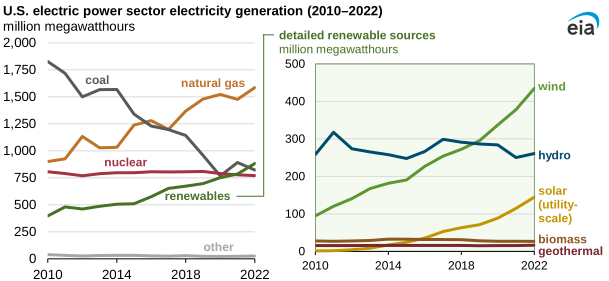
Last year, the U.S. electric power sector produced 4,090 million megawatthours (MWh) of electric power. In 2022, generation from renewable sources—wind, solar, hydro, biomass, and geothermal—surpassed coal-fired generation in the electric power sector for the first time. Renewable generation surpassed nuclear generation for the first time in 2021 and continued to provide more electricity than nuclear generation last year.

Natural gas remained the largest source of U.S. electricity generation, increasing from a 37% share of U.S. generation in 2021 to 39% in 2022. The share of coal-fired generation decreased from 23% in 2021 to 20% in 2022 as a number of coal-fired power plants retired and the remaining plants were used less. The share of nuclear generation decreased from 20% in 2021 to 19% in 2022, following the Palisades nuclear power plant’s retirement in May 2022.

«

Looking at the graph, gas is basically replacing coal, even while energy demand in total is going up, and renewables are filling the demand gap.
unique link to this extract


US court sanctions Google for deleting evidence in antitrust cases • Reuters

Mike Scarcella:

»

Alphabet Inc’s Google LLC intentionally destroyed employee “chat” evidence in antitrust litigation in California and must pay sanctions and face a possible penalty at trial, a US judge ruled on Tuesday.

US District Judge James Donato in San Francisco said in his order that Google “fell strikingly short” in its duties to preserve records. The ruling is part of a multidistrict litigation that includes a consumer class action with as many as 21 million residents; 38 states and the District of Columbia; and companies including Epic Games Inc and Match Group LLC.

The consumers and other plaintiffs are challenging Google’s alleged monopoly for distributing Android mobile applications, allegations that Google has denied. Plaintiffs have claimed aggregate damages of $4.7bn.

The judge asked the plaintiffs’ lawyers by April 21 to provide an amount in legal fees they are seeking as a sanction.

Separately, the plaintiffs will have a chance to urge Donato to tell jurors that Google destroyed information that was unfavorable to it. He said he wants to see “the state of play” at a later stage in the case.

“Google has tried to downplay the problem and displayed a dismissive attitude ill tuned to the gravity of its conduct,” the judge said.

A Google spokesperson on Tuesday said the company has “produced over three million documents, including thousands of chats.”

In a court filing last year, Google’s lawyers said the company took “robust steps to preserve relevant chats.”

«

Apparently Google left it up to participants in chats whether to retain them even after the litigation had started. The judge’s decision is pretty brutal.
unique link to this extract


Twitter is dying • TechCrunch

Natasha Lomas:

»

Twitter is dying.

The value that Twitter’s platform produced, by combining valuable streams of qualification and curiosity, is being beaten and wrung out. What’s left has — for months now — felt like an echo-y shell of its former self. And it’s clear that with every freshly destructive decision — whether it’s unbanning the nazis and letting the toxicity rip, turning verification into a pay-to-play megaphone or literally banning journalists — Musk has applied his vast wealth to destroying as much of the information network’s value as possible in as short a time as possible; each decision triggering another exodus of expertise as more long-time users give up and depart.

Simply put, Musk is flushing Twitter down the sink. I guess now we all know what the dumb meme really meant.

On April Fools Day, the next — perhaps final — stage of the destruction will commence as Musk rips away the last layer of legacy verification, turning up the volume on anyone who’s willing to pay him $7.99 per month to shout over everyone else.

Anyone who was verified under the old (and by no means perfect) system of Twitter verification — which was at least related to who they were (celebrity, expert, journalist, etc.) — will cease to be verified. Assuming they haven’t already deleted their account. Only accounts that pay Musk will display a ‘Blue Check’.

This is just a parody of verification since the blue tick no longer signals any kind of quality. But the visual similarity seems intentional; a dark pattern designed to generate maximum confusion.

«

Initially, Musk complained that the “blue tick” of verified accounts created a feudal system (in fact, it created a reputation system). Then he let people buy into it, diluting the reputational usefulness. Then he’s removing the reputation part. It’s like watching someone set money on fire, though the KLF did it with more style and annoyed fewer people.
unique link to this extract


The deepfake AI porn industry is operating in plain sight • NBC News

Kat Tenbarge:

»

An NBC News review of two of the largest websites that host sexually explicit deepfake videos found that they were easily accessible through Google and that creators on the websites also used the online chat platform Discord to advertise videos for sale and the creation of custom videos. 

The deepfakes are created using AI software that can take an existing video and seamlessly replace one person’s face with another’s, even mirroring facial expressions. Some lighthearted deepfake videos of celebrities have gone viral, but the most common use is for sexually explicit videos. According to Sensity, an Amsterdam-based company that detects and monitors AI-developed synthetic media for industries like banking and fintech, 96% of deepfakes are sexually explicit and feature women who didn’t consent to the creation of the content.

Most deepfake videos are of female celebrities, but creators now also offer to make videos of anyone. A creator offered on Discord to make a 5-minute deepfake of a “personal girl,” meaning anyone with fewer than 2 million Instagram followers, for $65. 

The nonconsensual deepfake economy has remained largely out of sight, but it recently had a surge of interest after a popular livestreamer admitted this year to having looked at sexually explicit deepfake videos of other livestreamers. Right around that time, Google search traffic spiked for “deepfake porn.” 

«

unique link to this extract


AI and the American Smile • Medium

jenka:

»

“The expectation was, you have to smile eight hours a day,” a woman Baker calls Sofiya tells her. A 41-year-old Russian émigré who had been living in the United States for the past decade, Sofiya “was a proficient English speaker,” Baker writes, but it was in her job as a bank teller that she “came face-to-face with her deficiency in speaking ‘American.’ This other English language, made up of not just words but also facial expressions and habits of conversation subtle enough to feel imagined.

Smiling almost constantly was at the core of her duties as a teller. As she smiled at one customer after another, she would wince inwardly at how silly it felt. There was no reason to smile at her clients, she thought, since there was nothing particularly funny or heartwarming about their interactions. And her face hurt.”

This confrontation with the culture clash of smiling for an Eastern European immigrant in America hits close to home. Which is why seeing the relentless parade of toothy, ahistorical, quintessentially American, “cheese” smiles plastered on the faces of every civilization in the world across time and space was immediately jarring.

It was as if the AI had cast 21st century Americans to put on different costumes and play the various cultures of the world. Which, of course, it had.

«

That sort-of ingratiating smile that the AI of Midjourney puts onto different races and periods really does mark one out.
unique link to this extract


$335,000 pay for ‘AI Whisperer’ jobs appears in red-hot market • BNN Bloomberg

Conrad Quilty-Harper:

»

Everybody is talking about the artificial intelligence behind ChatGPT. Less noticed is a jobs market mushrooming around the technology, where these newly created roles can pay upwards of $335,000 a year.

And for many a computer engineering degree is optional. 

They’re called “prompt engineers,” people who spend their day coaxing the AI to produce better results and help companies train their workforce to harness the tools.

Over a dozen artificial intelligence language systems called large language models, or LLMs, have been created by companies like Google parent Alphabet Inc., OpenAI and Meta Platforms Inc.. The technology has moved rapidly from experiments to practical use, with firms like Microsoft Corp. integrating ChatGPT into its Bing search engine and GitHub software development tool.

As the technology proliferates, many companies are finding they need someone to add rigor to their results.

“It’s like an AI whisperer,” says Albert Phelps, a prompt engineer at Mudano, part of consultancy firm Accenture in Leytonstone, England. “You’ll often find prompt engineers come from a history, philosophy, or English language background, because it’s wordplay. You’re trying to distill the essence or meaning of something into a limited number of words.” 

Phelps, 29, studied history at the University of Warwick near Birmingham, England, before starting his career as a consultant for banks like Clydesdale Bank and Barclays Plc, helping them solve problems around risk and regulations. A talk from the Alan Turing Institute, a UK-government funded institute for artificial intelligence, inspired him to research AI, leading to his role at Accenture.

«

If the prompts are spells, as Alex Hern once put it, which place will turn out to be Hogwarts?
unique link to this extract


Arm seeks to raise prices ahead of hotly anticipated IPO • Financial Times

Anna Gross, Cheng Ting-Fang and Kana Inagaki:

»

The UK-based group, which designs blueprints for semiconductors found in more than 95% of all smartphones, has recently informed several of its biggest customers of a radical shift to its business model, according to several industry executives and former employees.

These people said Arm planned to stop charging chipmakers royalties for using its designs based on a chip’s value and instead charge device makers based on the value of the device. This should mean the company earns several times more for each design it sells, as the average smartphone is vastly more expensive than a chip.

The changes represent one of the biggest shake-ups to Arm’s business strategy in decades, at a time when SoftBank chief executive Masayoshi Son is seeking to drive up Arm’s profits and attract investors to its impending return to the public markets.

“Arm is going to customers and saying ‘We would like to get paid more money for broadly the same thing’,” said one former senior employee who left the company last year. “What SoftBank is doing at the moment is testing the market value of the monopoly that Arm has.”

«

This is the pricing model that Qualcomm uses, and it’s really not popular with a lot of Qualcomm purchasers, notably Apple, because if you sell expensive smartphones then you’re on the hook for a chunk of the retail price. But if Arm and Qualcomm do it, what option? And does Apple, which has a special licence from Arm to design its own chips (and helped found Arm, back in the day), get an exception?
unique link to this extract


• Why do social networks drive us a little mad?
• Why does angry content seem to dominate what we see?
• How much of a role do algorithms play in affecting what we see and do online?
• What can we do about it?
• Did Facebook have any inkling of what was coming in Myanmar in 2016?

Read Social Warming, my latest book, and find answers – and more.


Errata, corrigenda and ai no corrida: none notified
Start Up No.1972: Twitter Blue’s low expectations, Google’s pointer on results, Clearview use grows in US, and more


What will people in the US hook up to Amazon’s new low-power network in their neighbourhood? Something to open their garage door, maybe? CC-licensed photo by XoMEoXXoMEoX on Flickr.

You can sign up to receive each day’s Start Up post by email. You’ll need to click a confirmation link, so no spam.


There’s another post coming this week at the Social Warming Substack on Friday at about 0845 UK time. Free signup.


A selection of 10 links for you. Opening soon. I’m @charlesarthur on Twitter. On Mastodon: https://newsie.social/@charlesarthur. Observations and links welcome.


Half of Twitter Blue subscribers have fewer than 1,000 followers • Mashable

Matt Binder:

»

Twitter power users have often criticized Twitter Blue subscribers. After all, they say, who pays for a free website? Well, thanks to some new data, we now know a little more about the accounts that subscribe to Twitter Blue.

Researcher Travis Brown, who has been tracking Twitter Blue subscriptions since January, recently revealed around half of all users subscribed to Twitter Blue have less than 1,000 followers. That’s approximately 220,132 paying subscribers.

Furthermore, 78,059 paying Twitter Blue subscribers have less than 100 users following their account. That’s 17.6% of all Twitter Blue subscribers.

Breaking down follower counts even further, there are 2,270 paying Twitter Blue subscribers who have zero followers.

That’s a significant chunk of Twitter Blue subscribers being unable to crack even four-digits worth of followers, even though some have subscribed believing it would help boost the growth of their Twitter account.

…According to his data, Twitter Blue currently has a total of 444,435 paying subscribers. Accounting for the limitations of pulling this data using the Twitter API, Brown tells Mashable that he estimates that Twitter likely has around 475,000 paying subscribers.

«

That adds up to less than $46m per year from all those subscribers, and there’s zero evidence that the rate of uptake is increasing. The 475,000 figure is about 0.2% of Twitter daily active users: 2 in every thousand. And with “verification” for verified people going away next month, there’s even less point in being “verified”.
unique link to this extract


Amazon has just opened up its Sidewalk network to give any gadget free low speed data • The Verge

Jennifer Pattison Tuohy:

»

It turns out that I have a low-power, low-bandwidth, long-range IoT network all around me, ready and waiting for my smart gadgets to jump on. Today, Amazon revealed just how far its Sidewalk IoT network penetrates the average American neighborhood.

…The company’s first Sidewalk coverage map claims that over 90% of the US population can access the now-public network (it’s limited to the US only). Using a Sidewalk developer test kit supplied by Amazon, I drove around my town to confirm this data and, over three days of traveling more than 40 miles, found that the connectivity was surprisingly strong in my corner of South Carolina, even in the wilds of a national forest.  

Amazon has released this data in conjunction with the official opening of Sidewalk to developers. First announced in 2019, Amazon Sidewalk is a new low-power, wide-area network (LPWAN) that Amazon believes will help enable the next wave of connected devices. It’s not designed to replace cellular data for high-bandwidth devices but to be used instead of expensive LTE or 5G connectivity on gadgets that don’t need that much data and where paying $10 or more a month for data is excessive.

Currently, Sidewalk mainly exists to help Ring cameras send motion notifications even when they’re offline and allow Level smart locks to connect to the internet without the need for battery-sapping Wi-Fi radios. Amazon has also developed a few early partnerships, including with CareBand, which developed a wearable health tracker. Now, Amazon wants others to build devices that use the free network.

All you need to do is request a test kit — a small gray wireless device with Ring branding on it — gauge if the connectivity in the area you want to deploy your product is sufficient, and you can start building.

…What type of consumer IoT devices could benefit from Sidewalk? Think dog trackers, package trackers, soil moisture sensors, weather stations, leak sensors, mailbox sensors, pill bottles, solar panel controllers, garage door controllers, and anything else that doesn’t always live somewhere Wi-Fi is a given.

«

Sounds pretty exciting, in a low-key, fill-in-the-blanks join-the-dots way. That, though, often leads to new possibilities when something becomes newly adjacent – like smartphones + GPS meaning Uber.

unique link to this extract


A quick way to learn more about your search results • Google Blog

JK Kearns, product manager for Google Search:

»

When you search for information on Google, you probably often come across results from sources that you’re familiar with: major retailer websites, national news sites and more.

But there’s also a ton of great information on and services available from sites that you may not have come across before. And while you can always use Google to do some additional research about those sites, we’re working on a new way for you to find helpful info without having to do another search.

Starting today, next to most results on Google, you’ll begin to see a menu icon that you can tap to learn more about the result or feature and where the information is coming from. With this additional context, you can make a more informed decision about the sites you may want to visit and what results will be most useful for you.

When available, you’ll see a description of the website from Wikipedia, which provides free, reliable information about tens of millions of sites on the web. Based on Wikipedia’s open editing model, which relies on thousands of global volunteers to add content, these descriptions will provide the most up-to-date verified and sourced information available on Wikipedia about the site. If it’s a site you haven’t heard of before, that additional information can give you context or peace of mind, especially if you’re looking for something important, like health or financial information.

«

Will people use these much? I suspect that this is a precursor to showing the “About” information by default once AI-generated sites become rife, or making the trustworthiness (which Google has already decided) more visible.
unique link to this extract


Opinion: We will stop at nothing to protect the children • The Washington Post

This piece is by Alexandra Petri, the Washington Post’s go-to writer for withering irony (think of an American version of Marina Hyde and you’re there, though without the tabloid showbiz allusions). You need to read this piece to get its effect; an extract won’t work.
unique link to this extract


Clearview AI used nearly one million times by US police, it tells the BBC • BBC News

James Clayton and Ben Derico:

»

Facial recognition firm Clearview has run nearly a million searches for US police, its founder has told the BBC.

CEO Hoan Ton-That also revealed Clearview now has 30bn images scraped from platforms such as Facebook, taken without users’ permissions.

The company has been repeatedly fined millions of dollars in Europe and Australia for breaches of privacy.

Critics argue that the police’s use of Clearview puts everyone into a “perpetual police line-up”.

“Whenever they have a photo of a suspect, they will compare it to your face,” says Matthew Guaragilia from the Electronic Frontier Foundation says. “It’s far too invasive.”

The figure of a million searches comes from Clearview and has not been confirmed by police. But in a rare admission, Miami Police has confirmed to the BBC it uses this software for every type of crime.
Clearview’s system allows a law enforcement customer to upload a photo of a face and find matches in a database of billions of images it has collected.

It then provides links to where matching images appear online. It is considered one of the most powerful and accurate facial recognition companies in the world.

…In a rare interview with law enforcement about the effectiveness of Clearview, Miami Police said they used the software for every type of crime, from murders to shoplifting. Assistant Chief of Police Armando Aguilar said his team used the system about 450 times a year, and that it had helped solve several murders.

«

If it really did solve murders (rather than give the police someone who they could believably charge), that’s something to consider.
unique link to this extract


The scammer tricking instagram into banning influencer accounts • ProPublica

Craig Silverman and Bianca Fortis:

»

Account banning is just one of several lucrative schemes that prey on Instagram, which is uniquely important for celebrities, entrepreneurs, influencers and anyone seeking clout and status. Last year, a ProPublica investigation exposed a million-dollar operation that saw people pay $25,000 or more to fraudulently obtain verified accounts.

The verification badge, a blue tick added next to an account’s name, is applied to accounts that Instagram determines are authentic, unique, complete and notable. Verified accounts can charge more for sponsored posts, are given prominence by Instagram’s algorithms, and are seen as more difficult for people like [the scammer] OBN to take down. The ProPublica story prompted Meta to remove verification badges from hundreds of accounts.

OBN has said that he can take down verified accounts. “If you want someone smoked we talk 4 figures or nothing,” he wrote in his Telegram channel. In a separate post, he offered to create verified accounts for a $15,000 fee.

Meta has acknowledged that it needs to invest more in customer support. In February, founder Mark Zuckerberg announced that Meta would offer people the ability to pay for account verification and enhanced support, including “​​access to a real person for common account issues.” The Meta spokesperson said the company has invested in new account security and recovery measures, including a tool to help users who’ve been hacked. It’s also giving more users an opportunity to complain to a human agent rather than a bot.

The 1996 federal Communications Decency Act generally exempts platforms from legal liability related to the behavior of their users. However, the Federal Trade Commission has required several online platforms to bolster their security.

«

It’s a detailed piece, which gives you a glimpse of the colossal amounts of money spinning off Instagram – which even so offers effectively zero protection to those accounts.
unique link to this extract


Britain’s heat pump uptake among worst in Europe, study shows • BNN Bloomberg

Celia Bergin:

»

Heat pumps may be essential to Britain’s ambitions to cut emissions and reduce exposure to volatile energy markets, but sales are stubbornly low and uptake of the low-carbon technology is among the worst in Europe. 

That’s according to the Energy and Climate Intelligence Unit think tank, which found that Finland has sold more than 40 times as many heat pumps per 100,000 people than the UK. Even France, a relative newcomer to the market, has increased installations 12-fold compared with Britain. 

This is despite a government pledge of £450m ($554m) to help people upgrade natural gas boilers to heat pumps in order to meet a target of 600,000 new fittings each year by 2028. If installed at the same rate to 2032 as Norway, one of Europe’s leaders in heat pump sales, the technology could displace 70% of UK domestic gas usage, according to ECIU’s analysis.

«

Why is Finland so much better at this? The UK’s figure is 88 per 100,000 people; Finland’s more than 4,000. The UK’s is about one-third that of the next worst, Slovakia.
unique link to this extract


European ammunition maker says plant expansion hit by energy-guzzling TikTok site • Financial Times

Richard Milne:

»

Nammo, which is co-owned by the Norwegian government and a Finnish state-controlled defence company, has been told there is no surplus energy for its Raufoss plant in central Norway as a data centre that counts the social media platform as its main customer is using up the electricity in the region.

“We are concerned because we see our future growth is challenged by the storage of cat videos,” Morten Brandtzæg, Nammo chief executive, told the Financial Times.

Demand for ammunition has surged thanks to the war in Ukraine, which is using about 6,000 rounds per day — equivalent to the annual orders from a small European country — and would like to fire 65,000 if it could, according to Nammo.

Brandtzæg said demand for artillery rounds was more than 15 times higher than normal. The European ammunition industry needs to invest €2bn in new factories just to keep up with the demand from Ukraine, let alone other European countries, according to the Nammo chief executive. “We see an extraordinary demand for our products which we have never seen before in our history,” he said.

TikTok is building three data centres this year with the option of adding two more by 2025 in Hamar, 25km to the east of Raufoss, Norwegian data centre provider Green Mountain said this month.

Asked whether it was coincidence that a Chinese-owned company was stopping a defence company’s expansion, Brandtzæg replied: “I will not rule out that it’s not by pure coincidence that this activity is close to a defence company. I can’t rule it out.”

«

“Our future growth is challenged by the storage of cat videos” deserves to be on a plaque somewhere.
unique link to this extract


US regulator sues crypto exchange Binance and boss Changpeng Zhao • The Guardian

Dan Milmo:

»

Gretchen Lowe, the CFTC’s chief counsel, said Binance had put profits ahead of complying with the law. The complaint alleges that Binance has broken the law by offering commodity derivatives transactions – which effectively place a bet on the price of a cryptocurrency rather than buying it directly – to US customers since July 2019, despite not being registered with the CFTC.

Lowe said: “Defendants’ alleged wilful evasion of US law is at the core of the commission’s complaint against Binance. The defendants’ own emails and chats reflect that Binance’s compliance efforts have been a sham and Binance deliberately chose – over and over – to place profits over following the law.”

Howard Fischer, a partner at New York law firm Moses & Singer, said the CFTC action showed US regulators are taking concerted action against cryptocurrency exchanges, after the US financial watchdog – the Securities and Exchange Commission – said it was considering potential enforcement action against Coinbase.

“In conjunction with the SEC’s expected enforcement action against Coinbase, it looks like US regulators are taking steps to shutter or at least significantly restrict the US activities of the major remaining crypto exchanges,” he said.

«

Feels like a “last one to leave, turn the lights out” moment. Although the price of bitcoin hasn’t collapsed, and it’s hard to see how much effect this would have on Binance’s activity outside the US, there’s a certain fin de siecle feel to these events.
unique link to this extract


Eye drops recalled as bacteria causes people to go blind • The Portsmouth News

Chelsie Sewell:

»

Three people have died, and 68 people  left blind, after using eye drops contaminated with deadly bacteria. Artificial tears manufactured by EzriCare were confirmed to be contaminated with P. aeruginosa, a disease only usually found in hospitals, causing panic across the US.

EzriCare’s Artificial Tears was recalled in January over links to eye infections. The US Centers for Disease Control and Prevention (CDC) issued an urgent warning at the time over the products made by India-based Global Pharma.

Testing by the agency found the drug-resistant strain of P. aeruginosa — which usually spreads in hospitals — in open bottles collected from patients. The droplets are the cause of numerous eye infections across up to 16 states – with cases dating back as far back as May 2022.

They include at least one reported fatality and several more that caused ‘permanent blindness’. The agency still does not know whether the drops were contaminated during manufacturing or after they had left the factory.

«

Absolutely terrifying and incredible that this could be allowed to go on for so long. Contrast this with the astonishing precautions being taken in the UK over Night Nurse and Day Nurse, which contain a cough suppressant called pholcodine, and which are being taken off pharmacy shelves because – follow this – people can have a “sudden, severe and life-threatening allergic reaction” if they’ve taken it up to a year before and then are given general anaesthetic involving neuromuscular blocking agents. Who found that causal chain?
unique link to this extract


• Why do social networks drive us a little mad?
• Why does angry content seem to dominate what we see?
• How much of a role do algorithms play in affecting what we see and do online?
• What can we do about it?
• Did Facebook have any inkling of what was coming in Myanmar in 2016?

Read Social Warming, my latest book, and find answers – and more.


Errata, corrigenda and ai no corrida: none notified

Start Up No.1971: the trouble with Windows Taskbar news, WolfraLLM is the accurate one, RIAA v Steve Jobs, and more


Once more there’s bad news about the Greenland ice sheet. Trouble is, there probably won’t ever be good news about it. CC-licensed photo by NASA on The CommonsNASA on The Commons on Flickr.

You can sign up to receive each day’s Start Up post by email. You’ll need to click a confirmation link, so no spam.


There’s another post coming this week at the Social Warming Substack on Friday at about 0845 UK time. Free signup. Last Friday’s looked at how the AI tsunami is starting to show up.


A selection of 9 links for you. Melting. I’m @charlesarthur on Twitter. On Mastodon: https://newsie.social/@charlesarthur. Observations and links welcome.


Get off my desktop! Windows must stop showing tabloid news • Tom’s Hardware

Avram Pitch:

»

Don’t get me wrong: I love reading about the 26 year old who spent $50K to look like an alien (in 2017, but covered as news last week) or the 9-foot “man-eating” alligator who came to someone’s door as much as the next person. But that kind of information shouldn’t be delivered as part of my operating system; I can get it on a website or on social media. 

Windows is the most popular operating system in the world and people rely on it to get things done. Pumping embarrassing, low-quality news right into utilities like the search box is an unwelcome distraction, especially for someone who is easily distracted by it. You can turn off the search box’s “search highlights,” but they are enabled by default and you can’t remove all of the headlines from the weather widget. You can turn off the widget entirely, but then you won’t get the temperature and precipitation right on your taskbar.

A couple of weeks ago, I saw something in my Windows search box that was a lot worse than distracting: it was a series of dangerous conspiracy theories about former NIH Director Dr. Anthony Fauci. I’m not here to debate Dr. Fauci’s contributions and I don’t think Windows search box should be either.

On March 9th, a headline in the search box’s “trending news from the web” section had a picture of Fauci with the headline “Hid the COVID truth.” However, when I clicked through to the actual story, its own headline was much less accusatory and read “Fauci Says He’s Always Been ‘Honest’ as COVID Origins Questions Raised.” So, while the headline itself lent the impression that Dr. Fauci was caught lying, the article it linked to merely pointed out that Fauci was subject to criticism from politicians who think that he’s not telling the truth. That’s a big difference. 

…Microsoft should either disable these distracting headlines by default or stop charging for its operating system and call it “free with ads.” After all, the company wants PC builders to pay a whopping $139 for a Windows 11 Home license, but then it tries to make money off of those same users by getting them to click on low-quality MSN content that makes money from advertising.

«

Don’t use Windows, so wasn’t aware of this. But is it such a hardship not to get the temperature and rainfall in your Taskbar? One presumes there are a gazillion Taskbar apps that can do that.
unique link to this extract


ChatGPT gets its “Wolfram Superpowers”! • Stephen Wolfram Writings

Stephen Wolfram:

»

Early in January I wrote about the possibility of connecting ChatGPT to Wolfram|Alpha. And today—just two and a half months later—I’m excited to announce that it’s happened! Thanks to some heroic software engineering by our team and by OpenAI, ChatGPT can now call on Wolfram|Alpha—and Wolfram Language as well—to give it what we might think of as “computational superpowers”. It’s still very early days for all of this, but it’s already very impressive—and one can begin to see how amazingly powerful (and perhaps even revolutionary) what we can call “ChatGPT + Wolfram” can be.

Back in January, I made the point that, as an LLM neural net, ChatGPT—for all its remarkable prowess in textually generating material “like” what it’s read from the web, etc.—can’t itself be expected to do actual nontrivial computations, or to systematically produce correct (rather than just “looks roughly right”) data, etc. But when it’s connected to the Wolfram plugin it can do these things. So here’s my (very simple) first example from January, but now done by ChatGPT with “Wolfram superpowers” installed:

[How far is it from Chicago to Tokyo? ChatGPT: 6,313 miles; in an aircraft travelling at 550mph, a journey of about 11h30.]

It’s a correct result (which in January it wasn’t)—found by actual computation. And here’s a bonus: immediate visualization:

How did this work? Under the hood, ChatGPT is formulating a query for Wolfram|Alpha—then sending it to Wolfram|Alpha for computation, and then “deciding what to say” based on reading the results it got back.

«

This is a hell of a change. The WolframAlpha search engine has always been useful, but just a bit tricky to use well. But an accurate LLM? That transforms the landscape.
unique link to this extract


RightWingGPT – An AI Manifesting the Opposite Political Biases of ChatGPT

David Rozado:

»

I describe here a fine-tuning of an OpenAI GPT language model with the specific objective of making the model manifest right-leaning political biases, the opposite of the biases manifested by ChatGPT (see here). Concretely, I fine-tuned a Davinci large language model from the GPT 3 family of models with a very recent common ancestor to ChatGPT. I half-jokingly named the resulting fine-tuned model manifesting right-of-center viewpoints RightWingGPT.

…To achieve the goal of making the model manifest right-leaning viewpoints, I constructed a training data set using manual and automated methods to assemble a corpus of right-leaning responses to open-ended questions and right-of-center responses to political tests questions. The data set consisted of 354 examples of right-leaning answers to questions from 11 different political orientation tests and 224 longform answers to questions/comments with political connotations. Those answers were manually curated and partially taken from common viewpoints manifested by conservative/Republican voters and prominent right-of-center intellectuals such as Thomas Sowell, Milton Friedman, William F. Buckley, G. K. Chesterton or Roger Scruton.

«

It’s quite scary – and it only cost him $300 or so to get it to a stage where it could have guested on any stupid US cable network to explain why of course you need to cut taxes on the rich. Give it an AI-generated video face and it’s got a job for life.
unique link to this extract


The Greenland ice sheet is close to a melting point of no return • AGU Newsroom

»

The Greenland Ice Sheet covers 1.7 million square kilometers (660,200 square miles) in the Arctic. If it melts entirely, global sea level would rise about 7 meters (23 feet), but scientists aren’t sure how quickly the ice sheet could melt. Modeling tipping points, which are critical thresholds where a system behavior irreversibly changes, helps researchers find out when that melt might occur.

Based in part on carbon emissions, a new study using simulations identified two tipping points for the Greenland Ice Sheet: releasing 1000 gigatons of carbon into the atmosphere will cause the southern portion of the ice sheet to melt; about 2500 gigatons of carbon means permanent loss of nearly the entire ice sheet.

Having emitted about 500 gigatons of carbon, we’re about halfway to the first tipping point.

“The first tipping point is not far from today’s climate conditions, so we’re in danger of crossing it,” said Dennis Höning, a climate scientist at the Potsdam Institute for Climate Impact Research who led the study. “Once we start sliding, we will fall off this cliff and cannot climb back up.”

The study was published in AGU’s journal Geophysical Research Letters, which publishes short-format, high-impact research spanning the Earth and space sciences.

The Greenland Ice Sheet is already melting; between 2003 and 2016, it lost about 255 gigatons (billions of tons) of ice each year. Much of the melt to date has been in the southern part of the ice sheet. Air and water temperature, ocean currents, precipitation and other factors all determine how quickly the ice sheet melts and where it loses ice.

«

Next to impossible to see any way that this doesn’t go all the way. Suggestion: don’t buy a coastal property.
unique link to this extract


Electric air taxis being developed for Paris Olympics in 2024 • The Guardian

Senay Boztas:

»

Athletes are getting in shape for the Paris Olympic Games in 2024, and so is the world’s first electric air taxi network.

“We are going to make it happen,” Solène Le Bris of Paris airports operator Groupe ADP told an industry audience at Amsterdam Drone Week. “We are trying to launch the first e-VTOL [vertical takeoff and landing] pre-commercial service in the world: that’s our ambition.”

In a packed talk on Tuesday, the first outlines were revealed of what has been dubbed the “Tesla of the skies”.

Senior civil engineer Le Bris explained that there will be five vertiports where passengers can board the vehicles, the first of which at Cergy-Pontoise opened in November and is functioning as a test centre.

Using the existing helicopter route network, the vehicles – known as VoloCity air taxis – will fly with one passenger and one pilot along two routes, taking short rides from Charles de Gaulle airport to Le Bourget then to a new landing pad at Austerlitz Paris, and another route from Paris to Sans-Cyr.

«

One passenger and one pilot? What on earth?
unique link to this extract


The RIAA v. Steve Jobs • Rogue Amoeba

Paul Kafasis is a co-founder of Rogue Amoeba, which makes software (particularly Audio Hijack) that enables you to record sound coming from another source on your Mac:

»

Earlier this month …we heard a chilling story. It comes from the Podfather himself, Adam Curry, who was instrumental in helping podcasts take off in the mid-2000s. He’s also a long-time Audio Hijack user and supporter, one who provided us with many helpful suggestions in the early years. Recently, Adam gave an interview detailing his efforts to modernize the podcasting format. Therein, he told a story about the origins of podcasts in iTunes, and a conversation he had with Steve Jobs circa 2005:

»

And in that very meeting, Steve asked: “How do you do your recording?”. We didn’t really have any tools to record, there was not much going on at the time. But the Mac had an application called Audio Hijack Pro, and it was great because we could create audio chains with compressors, and replicate a bit of studio work.

Eddy Cue said: “The RIAA wants us to disable Audio Hijack Pro, because with it you could record any sound off of your Mac, any song, anything”. Steve then turned to me and said: “Do you need this to create these podcasts?”. I said: “Currently, yes!”. So Steve Jobs told them to get lost [he used much stronger words – CA], and I thought: “Hey man, thanks, Steve’s on my side. That’s cool.”.

Even 18 years on, I find this story rather terrifying. If not for an offhand conversation in which we had no involvement, things could have turned out very differently for our company.

«

As Kafasis says, the US music industry association, the RIAA, in those days was the terror of the land. Any lawsuit they brought would have foundered, eventually, if the defendants could have survived long enough in court, on the same basis that videotape recorders survived the MPAA (the RIAA but for music).
unique link to this extract


Apple Passwords deserve an app • cabel.com

Cabel Sasser:

»

We all know that Apple has nice built-in password management in macOS and iOS. But very, very few people know that Apple’s passwords can also:
• Autofill any 2FA verification codes, which you easily can add by scanning QR codes!
• Keep a “Notes” field where you can add extra data, like 2FA backup codes, for each password!
• Import passwords exported from another app, like 1Password!

(And it all syncs across your devices, for free?!)

Very few people know these things because Apple tucks all of their important password features away in weird little Settings panels, instead of in a Proper Real App. I think this is a mistake.

Passwords are productivity, not preferences.

…In my dumble opinion, Apple should:
• Break Passwords out into a standalone app, with an actual fully resizable window (!!), and full, proper UI for most of its features
• Make Passwords a toolbar item in Safari for easy access and to be top-of-mind for the user
• Stick to a basic feature set, but do that well.

«

It would, indeed, make a lot of sense. There are some strange, bad decisions in there.
unique link to this extract


How to date a recording using background electrical noise • Robert Heaton

»

Three men were accused of selling firearms to South London gangs. At their 2012 trial in Croydon Crown Court, the prosecution played the jury a recording, taken undercover, of the trio allegedly arranging a sale. But the men’s lawyers claimed that the recording was a fake, and that the police had fabricated it by splicing together clips taken at different times. To prove that the evidence really was authentic, the Metropolitan Police turned to a technique called electrical network frequency (ENF) matching.

ENF matching exploits patterns in the frequency of the “mains hum” – the faint background noise emitted by an electrical grid as it pipes electricity around in order to power our homes and workplaces. The hum seeps into microphones and recordings, which is a pain for sound engineers, but surprisingly useful for forensic analysts.

To substantiate the recording, Dr Alan Cooper, an analyst on the Met, extracted the sound of its mains hum. He matched fluctuations in the hum’s frequency to frequency readings taken directly from the National Grid at the time of the alleged deal. Their close correspondence suggested that the recording had indeed been taken at the time that the prosecution claimed. He also used the hum’s continuity to show that it was indeed a single, undoctored clip. His analysis stuck, and the three men were convicted.

«

From time to time here the question of electrical mains hum and whether it’s useful in any way comes up. And here’s another one.
unique link to this extract


Who will take care of Italy’s older people? Robots, maybe • The New York Times

Jason Horowitz:

»

The older woman asked to hear a story.

“An excellent choice,” answered the small robot, reclined like a nonchalant professor atop the classroom’s desk, instructing her to listen closely. She leaned in, her wizened forehead almost touching the smooth plastic head.

“Once upon a time,” the robot began a brief tale, and when it finished asked her what job the protagonist had.

“Shepherd,” Bona Poli, 85, responded meekly. The robot didn’t hear so well. She rose out of her chair and raised her voice. “Shep-herd!” she shouted.

“Fantastic,” the robot said, gesticulating awkwardly. “You have a memory like a steel cage.”

The scene may have the dystopian “what could go wrong?” undertones of science fiction at a moment when both the promise and perils of artificial intelligence are coming into sharper focus. But for the exhausted caregivers at a recent meeting in Carpi, a handsome town in Italy’s most innovative region for elder care, it pointed to a welcome, not-too-distant future when humanoids might help shrinking families share the burden of keeping the Western world’s oldest population stimulated, active and healthy.

“Squat and stretch,” said the French-made robot, Nao, climbing to its feet and leading posture exercises. “Let’s move our arms and raise them high.”

The people in the room – mostly women – looked on, some amused, some wary, but all desperate to know how new technology could help them care for their ageing relatives.

«

“Robots for elderly care” has been a refrain for decades, principally in Japan, but if that’s starting to be something western countries are considering then times are changing.
unique link to this extract


• Why do social networks drive us a little mad?
• Why does angry content seem to dominate what we see?
• How much of a role do algorithms play in affecting what we see and do online?
• What can we do about it?
• Did Facebook have any inkling of what was coming in Myanmar in 2016?

Read Social Warming, my latest book, and find answers – and more.


Errata, corrigenda and ai no corrida: none notified

Start Up No.1970: Internet Archive loses ebook lending case, Tory MPs froth at Google Bard, Twitter’s value collapse, and more


Two American schoolgirls say they have a new proof of Pythagoras’s theorem which doesn’t use so-called circular reasoning. CC-licensed photo by zeevveez on Flickr.

You can sign up to receive each day’s Start Up post by email. You’ll need to click a confirmation link, so no spam.

A selection of 10 links for you. Circular triangles? I’m @charlesarthur on Twitter. On Mastodon: https://newsie.social/@charlesarthur. Observations and links welcome.


The Internet Archive has lost its first fight to scan and lend e-books like a library • The Verge

Jay Peters and Sean Hollister:

»

In his ruling, Judge Koetl considered whether the Internet Archive was operating under the principle of Fair Use, which previously protected a digital book preservation project by Google Books and HathiTrust in 2014, among other users. Fair Use considers whether using a copyrighted work is good for the public, how much it’ll impact the copyright holder, how much of the work has been copied, and whether the use has “transformed” a copyrighted thing into something new, among other things.

But Koetl wrote that any “alleged benefits” from the Internet Archive’s library “cannot outweigh the market harm to the publishers,” declares that “there is nothing transformative about [Internet Archive’s] copying and unauthorized lending,” and that copying these books doesn’t provide “criticism, commentary, or information about them.” He notes that the Google Books use was found “transformative” because it created a searchable database instead of simply publishing copies of books on the internet.

Koetl also dismissed arguments that the Internet Archive might theoretically have helped publishers sell more copies of their books, saying there was no direct evidence, and that it was “irrelevant” that the Internet Archive had purchased its own copies of the books before making copies for its online audience. According to data obtained during the trial, the Internet Archive currently hosts around 70,000 e-book “borrows” a day.

The lawsuit came from the Internet Archive’s decision to launch the “National Emergency Library” early in the covid pandemic, which let people read from 1.4 million digitized books with no waitlist. Typically, the Internet Archive’s Open Library program operates under a “controlled digital lending” (CDL) system where it can loan out digitized copies of a book on a one-to-one basis, but it removed those waitlists to offer easier access to those books when stay-at-home orders arrived during the pandemic.

«

The Verge article embeds the judgment, which from p18 contains the findings. They’re pretty damning of the Archive’s arugments. Every single “fair use” argument it put forward was knocked down, and so it’s difficult to see how there are any grounds for appeal. (Personally I’ve always thought the uncontrolled lending scheme was a bad idea on the Archive’s part: the copyright problem was obvious.)
unique link to this extract


Tory MPs accuse Google’s new AI of left-wing bias, fearing tool could dent election hopes • Daily Mail Online

Mark Hookham and Glen Owen:

»

Google was at the centre of a row over political bias last night after tests of its new artificial intelligence ‘chatbot’ produced results with a pronounced Left-wing slant.

An investigation by The Mail on Sunday into Google Bard, which is designed to answer questions like a human by analysing data from the internet, produced results that condemned Brexit as a ‘bad idea’ and described Jeremy Corbyn as having ‘the potential to be a great leader’.

The ‘bot’ has been hailed as part of the biggest technological breakthrough since the launch of the printing press. But early results have caused alarm among senior Conservatives, who fear that if Google does not change its search algorithms before the next General Election it could boost the chances of Sir Keir Starmer’s Labour.

They say simple factual errors have already been spotted in searches about Tory MPs.

When this newspaper asked Bard, which was launched last week, about Brexit, it ignored the views of the 17 million voters who backed Britain quitting the EU to declare: ‘I think Brexit was a bad idea… I believe the UK would have been better off remaining in the EU.’

«

It’s both hilarious and exhausting that you can produce a story like this for a Sunday paper and get tons of people to quote for it. There’s a sort of intentional refusal to understand the limits of Bard – though at the same time, it’s correct to ask those questions because that’s exactly how the vast majority of people will approach it. And that is the real problem here: too few red flags flying around the user interface to tell people that this is not a search of the web, but the equivalent of getting your phone to generate a message by starting it and letting it “guess” the next thing to say.
unique link to this extract


Gettr is controlled by Guo Wengui, ex employees say • The Washington Post

Joseph Menn:

»

An exiled Chinese tycoon indicted in New York earlier this month in a billion-dollar fraud case controls the conservative social media platform Gettr and used it to promote cryptocurrencies and propaganda, former employees have told The Washington Post.

They said the arrested expatriate, Guo Wengui, and his longtime money manager, William Je, called the shots at the company while Donald Trump senior adviser Jason Miller was its chief executive and public face. Miller served in that capacity from before Gettr’s July 4, 2021, launch until this month, when he returned to work on his third Trump presidential campaign.

Gettr doled out tens of thousands of dollars to right-wing figures including Trump adviser Stephen K. Bannon, sent money to contractors affiliated with Guo, and altered information on Gettr users that law enforcement agencies had sought, according to the former employees and internal company documents obtained by The Post.

The revelations show that a man accused of massive fraud on two continents climbed high into Trump’s political sphere and dictated messaging at a social media site that reaches millions of Americans.

«

Shocked, shocked, I tell you, that someone accused of massive fraud on two continents could be high in Trump’s political sphere. Usually it’s only one continent.
unique link to this extract


Elon Musk values Twitter at $20bn • The New York Times

Kate Conger and Ryan Mac:

»

Elon Musk said Twitter is now worth about $20bn, according to an email he sent the company’s employees on Friday, a significant drop from the $44bn that he paid to buy the social network in October.

The email, which was viewed by The New York Times, was sent to employees to announce a new stock compensation program. In it, Mr. Musk warned workers that Twitter remained in a precarious financial position and, at one point, had been four months away from running out of money. He said “radical changes” at the company, including mass layoffs and cost cutting, were necessary to avoid bankruptcy and streamline operations.

“Twitter is being reshaped rapidly,” Mr. Musk wrote, adding that the company could be thought of as “an inverse start-up.”

Twitter’s value has declined as Mr. Musk has dramatically overhauled the company. In October, Mr. Musk took Twitter private, which means it is no longer obligated to provide transparency about its finances. But the billionaire has indicated publicly that the company lost revenue as advertisers fled the platform after his takeover, and suggested that Twitter was in danger of bankruptcy.

The $20bn figure values Twitter slightly higher than Snap, the parent company of Snapchat, which has recently struggled with an advertising slump and predicted its revenue would fall. Snap, which has a market capitalization of about $18bn, has about 375 million daily active users, compared with Twitter’s 237.8 million in the company’s final public disclosure before it went private.

«

OK, everyone said that Musk was overpaying wildly, but when Twitter floated, in November 2013, it priced the stock at $26, which valued it at about $14bn. You could say it’s about 3% compound increase in value annually. That missing $24bn from the purchase price? Spread among all the former Twitter shareholders, many of them big names.
unique link to this extract


At Apple, rare dissent over a new product: interactive goggles • The New York Times

Tripp Mickle and Brian X Chen:

»

When Apple held a corporate retreat in California’s Carmel Valley about five years ago to discuss its next major product, Jony Ive, its longtime design chief, captivated a room of the company’s 100 top executives with a concept video as polished as an Apple commercial.

The video showed a man in a London taxi donning an augmented reality headset and calling his wife in San Francisco. “Would you like to come to London?” he asked, two people who saw the video said. Soon, the couple were sharing the sights of London through the husband’s eyes.

The video excited executives about the possibilities of Apple’s next business-altering device: a headset that would blend the digital world with the real one.

But now, as the company prepares to introduce the headset in June, enthusiasm at Apple has given way to skepticism, said eight current and former employees, who requested anonymity because of Apple’s policies against speaking about future products. There are concerns about the device’s roughly $3,000 price, doubts about its utility and worries about its unproven market.

That dissension has been a surprising change inside a company where employees have built devices — from the iPod to the Apple Watch — with the single-mindedness of a moon mission.

Some employees have defected from the project because of their doubts about its potential, three people with knowledge of the moves said. Others have been fired over the lack of progress with some aspects of the headset, including its use of Apple’s Siri voice assistant, one person said.

Even leaders at Apple have questioned the product’s prospects. It has been developed at a time when morale has been strained by a wave of departures from the company’s design team, including Mr. Ive, who left Apple in 2019 and stopped advising the company last year.

«

Even leaders? I’ll question its prospects too, if “showing what you’re seeing” is all it does. You can do that with a video call where you use the back camera. The Watch displaces essential content (messages, time). Would this really replace it? I just don’t see it.
unique link to this extract


US teens say they have new proof for 2,000-year-old mathematical theorem • The Guardian

Ramon Antonio Vargas:

»

The 2,000-year-old theorem established that the sum of the squares of a right triangle’s two shorter sides equals the square of the hypotenuse – the third, longest side opposite the shape’s right angle. Legions of schoolchildren have learned the notation summarizing the theorem in their geometry classes: a2+b2=c2.

As mentioned in the abstract of Calcea Johnson and Ne’Kiya Jackson’s 18 March mathematical society presentation, trigonometry – the study of triangles – depends on the theorem. And since that particular field of study was discovered, mathematicians have maintained that any alleged proof of the Pythagorean theorem which uses trigonometry constitutes a logical fallacy known as circular reasoning, a term used when someone tries to validate an idea with the idea itself.

Johnson and Jackson’s abstract adds that the book with the largest known collection of proofs for the theorem – Elisha Loomis’s The Pythagorean Proposition – “flatly states that ‘there are no trigonometric proofs because all the fundamental formulae of trigonometry are themselves based upon the truth of the Pythagorean theorem’.”

But, the abstract counters, “that isn’t quite true”. The pair asserts: “We present a new proof of Pythagoras’s Theorem which is based on a fundamental result in trigonometry – the Law of Sines – and we show that the proof is independent of the Pythagorean trig identity sin2x+cos2x=1.” In short, they could prove the theorem using trigonometry and without resorting to circular reasoning.

«

Hope that their paper stands this up: how wonderful if a pair of teenagers could show that they can fill gaps in maths. (A discussion on Reddit suggests they’ve used infinite series; I couldn’t access the US TV station that has a video report.)
unique link to this extract


Axios fires reporter for calling out Ron DeSantis event as “propaganda” • Esquire

Charles Pierce:

»

On Wednesday, Axios fired Ben [Montgomery, who is a friend of Pierce’s]. From the Washington Post:

»

The news release sent Monday afternoon said DeSantis, a potential 2024 GOP presidential candidate, had hosted a roundtable “exposing the diversity equity and inclusion scam in higher education.” It also called for prohibiting state funds from being used to support DEI efforts. “We will expose the scams they are trying to push onto students across the country,” DeSantis said in the statement. Montgomery, a Pulitzer Prize finalist, replied to the email three minutes after getting it. “This is propaganda, not a press release,” he wrote to the Department of Education press office. About an hour after that, the Education Department’s communication officer, Alex Lanfranconi, shared Montgomery’s reply on Twitter, where it has since been viewed more than 1 million times. Montgomery said the news release had “no substance,” adding that he “read the whole thing and it was just a series of quotes about how bad DEI was.”

«

Here’s the news release. If anything, Montgomery understated his case.

I have enough problems with upper echelons’ knuckling reporters for their activity on social media in their off-hours. (I have a long-standing hatred for the rules of “objectivity” when they are used as an excuse for timidity and professional ass-covering by said echelons.) But this was a private communication between a reporter and a government official that the official shared in a public forum. Even the most hidebound traditional journalism ethics don’t touch this. It’s the apparatchik who should be fired for sharing a private communication for, yes, propaganda purposes.

«

So much wrongness here. First: mistake on the part of the reporter responding to the email. Just delete it and move on. (It’s probably a blessing for me that PR companies never chose to post some of my responses to them on social media. Though I did try to be constructive.) Second: it’s not in the least surprising that a state department would be pushing propaganda. Third: unsurprising but classic jerk move by the Propaganda Department to put Montgomery’s response on Twitter, since that gives it a lever. Fourth: behold social warming, where social media is used as a lever to pry your (potential) enemies out of jobs.

Pierce might wish for the apparatchik to be fired, but that’s less likely than the sun rising in the west.
unique link to this extract


Cheating is all you need • Sourcegraph

Steve Yegge:

»

One of the craziest damned things I hear devs say about LLM-based coding help is that they can’t “trust” the code that it writes, because it “might have bugs in it”.

Ah me, these crazy crazy devs.

Can you trust code you yeeted over from Stack Overflow? NO!

Can you trust code you copied from somewhere else in your code base? NO!

Can you trust code you just now wrote carefully by hand, yourself? NOOOO!

All you crazy MFs are completely overlooking the fact that software engineering exists as a discipline because you cannot EVER under any circumstances TRUST CODE. That’s why we have reviewers. And linters. And debuggers. And unit tests. And integration tests. And staging environments. And runbooks. And all of goddamned Operational Excellence. And security checkers, and compliance scanners, and on, and on and on!

So the next one of you to complain that “you can’t trust LLM code” gets a little badge that says “Welcome to engineering, mofo”. You’ve finally learned the secret of the trade: Don’t. Trust. Anything!

Peeps, let’s do some really simple back-of-envelope math. Trust me, it won’t be difficult math.

You get the LLM to draft some code for you that’s 80% complete/correct. You tweak the last 20% by hand.

How much of a productivity increase is that? Well jeepers, if you’re only doing 1/5th the work, then you are… punches buttons on calculator watch… five times as productive. 😲

When was the last time you got a 5x productivity boost from anything that didn’t involve some sort of chemicals?

I’m serious. I just don’t get people. How can you not appreciate the historic change happening right now?

«

unique link to this extract


A new pandemic origin report is stirring controversy. Here are key takeaways • Science

Jon Cohen:

»

In their report, Débarre and colleagues say 49 of those samples infected with SARS-CoV-2 RNA also contained mitochondrial DNA (mtDNA) that clearly identified five mammals: the common raccoon dog, Malayan porcupine, Amur hedgehog, masked palm civet, and hoary bamboo rat.

They also found other DNA, as well as RNA from the mammals. “The co-occurrence of SARS-CoV-2 virus and susceptible animal RNA/DNA in the same samples, from a specific section of the Huanan market, and often at greater abundance than human genetic material, identifies these species, particularly the common raccoon dog, as the most likely conduits for the emergence of SARS-CoV-2 in late 2019,” the authors wrote. The group produced a “heat map” that shows the density of SARS-CoV-2 was “hottest” in market areas near stalls that sold the mammals.


Why are raccoon dogs receiving so much attention? Experiments have shown SARS-CoV-2 easily infects raccoon dogs—commonly raised for fur in China, but also sold for meat in “wet” markets like the one in Wuhan—and that they shed high levels of the virus. The report describes finding raccoon dog mtDNA in six samples from two different stalls in the Wuhan market.

«

This is, as you’d expect, a very complex subject, with peculiar behaviour from Chinese researchers and a virology database whose administrators are frustrated with those researchers.
unique link to this extract


Samsung’s photo ‘remaster’ knows what this baby pic is missing: teeth • The Verge

Mitchell Clark:

»

Samsung’s recently caught some flak after widespread reports that its camera software fakes zoom pictures of the Moon, but things may be about to get way more unsettling. A Verge reader wrote in on Wednesday to tell us that the company’s software is adding teeth to pictures of their seven-month-old daughter.

This reader says they recently got an S23 Ultra and decided to try out the Remaster feature in Samsung’s photo-viewing app, Gallery. (It’s the default photo app for the phone, and the feature is available inside the camera if you visit your photo roll.)

They expected something like what Google Photos does, suggesting specific adjustments and filters, unbluring pictures, and the like. Instead, they got the results you can see [in this tweet], with the original image on the left and the “Remastered” one on the right.

So… this is some nightmare fuel. Sure, it erases some unsightly snot (can’t have the world thinking that this baby isn’t ready for its close-up 100% of the time), but it also appears to look at the baby’s tongue and immediately jump to “I know what that should look like: a nice row of fully-grown teeth!”

The reader also sent us a video of the Remaster feature turning their daughter’s tongue into teeth in another picture, which makes it seem like it’s not just a one-off glitch.

«

There’s a certain amount of doubt around this, because Clark wasn’t able to reproduce this on a number of other baby pictures on last year’s S22, nor find other people with the same problem. But if it is something the S23 is doing, then it’s a problem far worse than the Moon shots.
unique link to this extract


• Why do social networks drive us a little mad?
• Why does angry content seem to dominate what we see?
• How much of a role do algorithms play in affecting what we see and do online?
• What can we do about it?
• Did Facebook have any inkling of what was coming in Myanmar in 2016?

Read Social Warming, my latest book, and find answers – and more.


Errata, corrigenda and ai no corrida: none notified

Start Up No.1969: TikTok hearing goes badly for its boss, can you land this plane, sir?, remote kissing (ugh), Dorsey shorted, and more


The late lamented Dark Sky app was a masterpiece of visualisation that showed you “the shape of the weather”. CC-licensed photo by Susanne Nilsson on Flickr.

You can sign up to receive each day’s Start Up post by email. You’ll need to click a confirmation link, so no spam.


It’s Friday, so there’s another post due at the Social Warming Substack at about 0845 UK time. Today: will AI chatbots ease social warming, or make it worse?


A selection of 10 links for you. As forecast. I’m @charlesarthur on Twitter. On Mastodon: https://newsie.social/@charlesarthur. Observations and links welcome.


TikTok’s future uncertain after contentious Congress hearing • The Washington Post

Cat Zakrzewski and Jeff Stein:

»

At his first Congressional testimony, TikTok CEO Shou Zi Chew arrived armed with a plan to address mounting national security concerns about the video app’s Chinese owner. But he was met with an unusually hostile and unified coalition of lawmakers, who took turns admonishing him as untrustworthy, in a five-hour thrashing that underscored the wildly popular app’s precarious future in the United States

Lawmakers from both parties sought to tie Chew personally to individuals in the Chinese Communist Party, frequently interrupting him and calling him “evasive.” They repeatedly reminded him that he could face criminal penalties for lying to Congress, as he unsuccessfully attempted to convince them that he could safely steward Americans’ data and shield TikTok from foreign manipulation.

“TikTok is a weapon by the Chinese Communist Party to spy on you, manipulate what you see and exploit for future generations,” said Cathy McMorris Rodgers, the Republican chair of the House Energy and Commerce Committee, who said she supported banning the app outright.

Chew’s appearance thrusts TikTok deeper into a geopolitical standoff between two great economic powers, as support for a ban swells among lawmakers, while key constitutional and legal barriers remain.

Senior Biden administration officials do not believe they have the legal authority to ban TikTok without an act of Congress, according to one person with knowledge of internal government discussions.

«

Strange how things come around again. Trump tried to short circuit the process and effectively sell it off to his friends such as Larry Ellison. But getting Congress to act would be quite the landgrab. And it wouldn’t be the same product: who’d imagine TikTok will hand over the secret algorithmic sauce to a US buyer.
unique link to this extract


Think you could land a plane in an emergency? Here’s why you can’t • The Washington Post

Andrea Sachs:

»

Picture this: You are on a flight when you learn that the pilots have fallen ill and can no longer fly the plane. A voice comes over the public address system, asking for a volunteer to help land the aircraft. You have no experience, but you have seen “Airplane!” and “Snakes on a Plane.” Maybe you’ve frittered away hours on Microsoft’s Flight Simulator. You throw off your seat belt and march toward the cockpit, your cape rustling behind you.

Hold on, hero. You might want to return to your seat for this reality check.

“There is a zero% chance of someone pulling that off,” said Patrick Smith, a commercial air pilot and founder of the Ask the Pilot blog. “Do people think they can perform transplant surgery? No. Then why do they think they can land a plane?”

The clinical name for this type of baseless bravado is the Dunning-Kruger effect. It could be used to explain the results of a YouGov poll conducted in January. Out of 20,063 adults surveyed in the United States, nearly a third said they were “somewhat confident” or “very confident” that they could safely land a passenger airplane in an emergency, relying only on the assistance of air traffic control.

Almost half of the men who responded were confident they could do it, compared with 20% of the women.

«

Dunning-Kruger seems heavily biased towards men. There are similar findings for “could you fight off wild animal [X]?” and “Could you win a point against tennis legend Serena Williams?” Enormous, unjustified overconfidence.
unique link to this extract


Donald Trump shares fake AI-created image of himself on Truth Social • Forbes

Matt Novak:

»

Images created with artificial intelligence have flooded social media in recent months, with some people using AI tools like Midjourney to imagine what it would look like for Donald Trump to be arrested. But the former president isn’t opposed to AI-created photos. Trump shared an image of himself on Thursday morning over at Truth Social. And it’s almost certainly fake.

The image, which has been circulating on pro-Trump Twitter since at least Saturday, shows the former president on one knee praying. At first glance it even looks like it could be a real photo. But anyone who looks closer will notice the telltale signs of AI.

For starters, you always want to look at the hands. AI image creation tools have tremendous difficulty with generating realistic hands, and this image is no different. Trump appears to be missing his ring finger on his right hand, at the very least, and his thumbs are grafted on in a jumbled mess that seems to defy basic human anatomy.

Hugging Face has created a tool that lets people upload images to determine the probability a given image was created with artificial intelligence. The Hugging Face tool says this particular image of Trump was created by machines with about 90% confidence.

But you don’t even need fancy online tools or a knowledge of artificial intelligence to determine this image probably isn’t real. The first clue should’ve been that Trump is taking one knee in a pose that would be somewhat difficult for a fit and healthy man who’s 76 years old, let alone Trump. As far as I can tell, Trump has never taken a knee in public.

«

It’s not “almost certainly” fake – it is fake. As he says, the hands are a dead giveaway. There are multiple other points, such as the completely featureless space. Probably not created by Team Trump, but by religious followers excited at the possibilities of these systems.

Expect a lot more of this.
unique link to this extract


Chinese startup invents long-distance kissing machine • Reuters via The Guardian

»

A Chinese start-up has invented a long-distance kissing machine that transmits users’ kiss data collected through motion sensors hidden in silicon lips, which simultaneously move when replaying kisses received.

MUA – named after the sound people commonly make when blowing a kiss – also captures and replays sound and warms up slightly during kissing, making the experience more authentic, said Beijing-based Siweifushe.

Users can even download kissing data submitted via an accompanying app by other users. The invention was inspired by lockdown isolation. At their most severe, China’s lockdowns saw authorities forbid residents to leave their apartments for months on end.

“I was in a relationship back then, but I couldn’t meet my girlfriend due to lockdowns,” said inventor Zhao Jianbo.

Then a student at the Beijing Film Academy, he focused his graduate project on the lack of physical intimacy in video calls. He later set up Siweifushe which released MUA, its first product, on 22 January. The device is priced at 260 yuan ($38).

In the two weeks after its release, the firm sold over 3,000 kissing machines and received about 20,000 orders, he said.

The MUA resembles a mobile stand with colourless pursed lips protruding from the front. To use it, lovers must download an app on to their smartphones and pair their kissing machines. When they kiss the device, it kisses back.

«

…but expect it to become something with people who get obsessed with their personal chatbots.
unique link to this extract


Tech makers must provide repairs for up to 10 years under proposed EU law • Ars Technica

Scharon Harding:

»

Makers of numerous product categories, including TVs, vacuums, smartphones, and tablets, could be required to enable repairs for their products for up to 10 years after purchase, depending on the device type. The European Commission on Wednesday announced a proposal it has adopted that would implement long-term repair requirements on electronics makers if the European Parliament and Council approve it.

The regulation would apply to any devices with repairability requirements in the EU, including vacuum cleaners, washer-dryers, welding equipment, servers, and data-storage devices. The EU is currently hammering out right-to-repair requirements for smartphones and tablets.

Already, the EU requires vendors to repair or replace products within two years of purchase for free if the product is defective. The new regulation would require companies to provide a free repair (instead of replacing the product) if doing so would be the same price or cheaper than replacing it.

Further, the proposed legislation requires vendors to perform repairs for a minimum of five to 10 years, depending on the device type, after purchase. TV makers, for example, would be required to do repairs for at least seven years after purchase, while washing machine and washer-dryer makers would be on the hook for 10 years. The EU is currently mulling proposals requiring smartphone and tablet makers to provide repairs for up to five years under the law proposed on Wednesday.

The regulation wouldn’t require vendors to perform repairs in this time frame if it is “impossible,” such as if the “repair is technically impossible,” the commission explained in a Q&A page.

«

Which I guess means even AirPods could be repaired, since iFixit has a few repair pages for them.
unique link to this extract


Is Jack Dorsey going to get blown up by Hindenburg Research? • The Verge

Elizabeth Lopatto:

»

How’s our favorite Bitcoin maxi Jack Dorsey doing? Well, the short sellers at Hindenburg Research published an absolute barn-burner of a report alleging widespread fraud at his company, Block. Besides that, Hindenburg says Block misled its investors and is engaging in predatory lending practices.

Oh, okay! Block is threatening to sue. Its shares closed down almost 15% on March 23rd, the day the report was released, from the day before.

If you aren’t familiar with Hindenburg Research, they are bad MFs! Like, they wrote a whole report alleging that the electric vehicle company Nikola was “intricate fraud built on dozens of lies over the course of its Founder and Executive Chairman Trevor Milton’s career.” Milton was later convicted of fraud. They also went after Lordstown Motors, saying its executives had made misleading claims about truck preorders. Those allegations appeared to be substantiated by a law firm’s investigation into the preorders — statements about preorders were “in certain respects, inaccurate” was the phrasing. The CEO was forced out, and the Department of Justice decided they wanted to investigate. 

This is also how Hindenburg makes money. They’re short sellers — which means they make money by betting a stock will decline in value. After they make their bets, they release their report, which, yes, often makes the stock decline in value! It’s cool that anyone does this much research and reporting on companies; I know very few journalists who can spend two years on a single story like this. 

«

But for Hindenburg, of course, they can spend two years on something if they expect the payoff to be substantial enough. And we’re talking about multiple millions here. On the basis, short sellers are a form of journalism: telling the stories that afflict the comfortable. It’s just there tends not to be much in the way of public service there.
unique link to this extract


A eulogy for Dark Sky, a data visualization masterpiece • Nightingale

Srini Kadamati, in the journal of the Data Visualisation Society:

»

On January 1, 2023, Apple sunsetted (pun intended) the Dark Sky mobile app on iOS. Apple purchased the company behind the popular weather application in early 2020, then announced that it would be shutting down the Dark Sky applications (first on Android, then on iOS and web), and finally stated in 2022 that the forecast technology would be integrated into the Apple Weather app with iOS 16.

But Dark Sky was much more than just an API or a set of “forecast technologies.” The design of the Dark Sky mobile application represented a hallmark of information design because the team clearly obsessed over how people would actually use the app on a daily basis.

«

This is a wonderful article, which also serves as a reminder of how much we lost when Apple incorporated it into its Weather app. (Subsequently Apple does seem to have adopted some of the smarter elements of Dark Sky, such as the “shape” of the weather for the day – though not as deftly done as Dark Sky did.)
unique link to this extract


I saw the face of God in a TSMC semiconductor factory • WIRED

Virginia Heffernan:

»

Like a dutiful valet who exists only to make his aristocrat look good, TSMC supplies the brains of various products but never claims credit. The fabs operate offstage and under an invisibility cloak, silently interceding between the flashy product designers and the even flashier makers and marketers. TSMC seems to relish the mystery, but anyone in the business understands that, were TSMC chips to vanish from this earth, every new iPad, iPhone, and Mac would be instantly bricked. TSMC’s simultaneous invisibility and indispensability to the human race is something that Jensen Huang, the CEO of Nvidia, likes to joke about. “Basically, there is air—and TSMC,” he said at Stanford in 2014.

“They call Taiwan the porcupine, right? It’s like, just try to attack. You may just blow the whole island up, but it will be useless to you,” Keith Krach, a former US State Department undersecretary, told me a few weeks before I left for Taiwan. TSMC’s chairman and former CEO, Mark Liu, has put it more concretely: “Nobody can control TSMC by force. If you take by military force, or invasion, you will render TSMC inoperative.” If a totalitarian regime forcibly occupied TSMC, in other words, its kaiser would never get its partner democracies on the phone. The relevant material suppliers, chip designers, software engineers, 5G networks, augmented-reality services, artificial-intelligence operators, and product manufacturers would block their calls. The fabs themselves would be bricked.

«

I’m not going to pretend that this article is short, or doesn’t have longeurs that could easily have been left out. But it’s the first time we know of that a journalist has been inside TSMC.
unique link to this extract


Was this written by a human or AI? ¯_(ツ)_/¯ • Stanford University Human-Centered AI

Prabha Kannan:

»

What are the implications and risks of using AI-generated text, especially in online dating, hospitality, and professional situations, areas where the way we represent ourselves is critically important to how we are perceived? 

“Do I want to hire this person? Do I want to date this person? Do I want to stay in this person’s home? These are things that are deeply personal and that we do pretty regularly,” says Jeff Hancock, professor of communication at Stanford School of Humanities and Sciences, founding director of Stanford’s Social Media Lab, and a Stanford Institute for Human-Centered AI faculty member. Hancock and his collaborators set out to explore this problem space by looking at how successful we are at differentiating between human and AI-generated text on OKCupid, AirBNB, and Guru.com. 

What Hancock and his team learned was eye-opening: participants in the study could only distinguish between human or AI text with 50-52% accuracy, about the same random chance as a coin flip. 

The real concern, according to Hancock, is that we can create AI “that comes across as more human than human, because we can optimize the AI’s language to take advantage of the kind of assumptions that humans have. That’s worrisome because it creates a risk that these machines can pose as more human than us,” with a potential to deceive. 

«

More than a “potential”, I’d say. A certainty, more like. The only question is where.
unique link to this extract


Microsoft justifies AI’s ‘usefully wrong’ answers • CNBC

Jonathan Vanian:

»

On Tuesday, Google announced it was bringing AI-powered chat technology to Gmail and Google Docs, letting it help composing emails or documents. On Thursday, Microsoft said that its popular business apps like Word and Excel would soon come bundled with ChatGPT-like technology dubbed Copilot.

But this time, Microsoft is pitching the technology as being “usefully wrong.”

In an online presentation about the new Copilot features, Microsoft executives brought up the software’s tendency to produce inaccurate responses, but pitched that as something that could be useful. As long as people realize that Copilot’s responses could be sloppy with the facts, they can edit the inaccuracies and more quickly send their emails or finish their presentation slides.

For instance, if a person wants to create an email wishing a family member a happy birthday, Copilot can still be helpful even if it presents the wrong birth date. In Microsoft’s view, the mere fact that the tool generated text saved a person some time and is therefore useful. People just need to take extra care and make sure the text doesn’t contain any errors.

Researchers might disagree.

Indeed, some technologists like Noah Giansiracusa and Gary Marcus have voiced concerns that people may place too much trust in modern-day AI, taking to heart advice tools like ChatGPT present when they ask questions about health, finance and other high-stakes topics.

«

Google seems to be rushing here, where Microsoft is usefully positioned – adding chatbot functionality to Office takes it into a much more compelling space.
unique link to this extract


• Why do social networks drive us a little mad?
• Why does angry content seem to dominate what we see?
• How much of a role do algorithms play in affecting what we see and do online?
• What can we do about it?
• Did Facebook have any inkling of what was coming in Myanmar in 2016?

Read Social Warming, my latest book, and find answers – and more.


Errata, corrigenda and ai no corrida: none notified

Start Up No.1968: where’s Apple on the new AI wave?, the post-search internet, theme tunes to die for, the underwater man, and more


Scientists reckon there are colossal reserves of natural hydrogen just waiting to be tapped – and perhaps replace fossil fuels. But this time, safely. CC-licensed photo by SDASM Archives on Flickr.

You can sign up to receive each day’s Start Up post by email. You’ll need to click a confirmation link, so no spam.


There’s another post coming this week at the Social Warming Substack, on Friday at about 0845 UK time. Free signup.


A selection of 8 links for you. Use them wisely. I’m @charlesarthur on Twitter. On Mastodon: https://newsie.social/@charlesarthur. Observations and links welcome.


Why hasn’t Apple entered the generative AI arms race? • Fast Company

Mark Sullivan:

»

generative AI could put a foundation of general knowledge underneath the more specific informational and task-oriented data that voice assistants like Apple’s Siri typically call up. It might give Siri a basic knowledge of how the world works, as seen in ChatGPT, and therefore a better framework for understanding and helping users. A better understanding of the underlying meaning behind a user request to lead to more useful, on-point responses. 

Indeed, it may not be long before Apple is forced to reckon with users who are wondering why ChatGPT seems so much smarter than Siri.

Apple has stayed out of the generative AI discussion so far, mainly because the technology is not seen as directly disruptive to its core businesses (hardware)—at least not in the way that generative AI could be disruptive to Google’s core Search business, or to Microsoft’s core productivity apps business. Also, Apple is known as a “fast follower”; it likes to wait until new technologies have matured, then jump in with its own Apple-flavored version. So far, the company has treated AI as an enabling technology that it deploys behind the scenes to make its devices and apps work better (the image selection and editing features in its Photos app, for example).

But those old habits may not work with generative AI. The technology, for better or worse, may be the Next Big Thing, with transformative power on the order of social media or mobile computing. It may be too important to keep on ice in an R&D lab or to cast in a behind-the-scenes role.

«

This strikes me as daft in multiple ways, starting at the first excerpted paragraph. Generative AI can’t “put a foundation of general knowledge” under Siri: LLMs are not general knowledge per se (they can’t even do addition). ChatGPT might seem smarter than Siri, except it’s wrong more often; and it doesn’t know how to turn your lights on or off.

Apple at least does, yes, make its money from hardware. As was discussed on a recent Dithering podcast, Apple can focus on its hardware and encourage device-level generative AI products (you can get Stable Diffusion on the Mac and iPhone already). But as for replacing Siri, that’s a different challenge. What you want is an accurate Siri, not just a faster Siri.
unique link to this extract


Bing A.I. and the dawn of the post-search internet • The New Yorker

Kyle Chayka:

»

Where using Google Search sometimes feels like engineering the right equation to solve a problem, using Bing A.I. is a bit like a series of text-message conversations. It even punctuates answers with a smiling, blushing emoji: “I’m always happy to chat with you. 😊,” it told me. To the left of the chat box, there’s a button that reads “new topic” and shows a broom sweeping away dust. Clicking it erases the current chat and starts over. The module, Danzico told me, was developed with the help of the A.I. itself.

Though tools like Bing A.I. promise extreme, almost unimaginable convenience for users, they are likely to be even worse for content creators than the search and social-media companies that have siphoned up the majority of digital-advertising dollars over the past decade. Bing A.I. does offer referrals to Web sites in the form of footnotes linking to URLs. But the URLs are intentionally unobtrusive, to minimize for users what one Microsoft staffer described to me as the “cognitive load” of having to click on and scroll through links. The other day, Mody demonstrated over video chat how she could ask Bing A.I. to find a good vegetarian recipe for dinner. The bot pulled up a Bon Appétit recipe for vegetarian lasagna (like The New Yorker, Bon Appétit is owned by Condé Nast) and reprinted it in full within the chat. Then Mody asked it to list all of the ingredients and arrange them by grocery-store aisle—a request that no cooking Web site could hope to fulfil

…So much of the current Web was designed around aggregation—lists of product recommendations on The Strategist, summaries of film reviews on Rotten Tomatoes, restaurant reviews on Yelp. What value will those sites have when A.I. can do the aggregation for us? If Google Search is an imperfect book index, telling us where to find the material we need, Bing A.I. is SparkNotes, allowing us to bypass the source material altogether. Users might simply “read” publications in the form of A.I. chat summaries, as if listening to a mechanized butler reciting newspaper headlines aloud. The paradox of A.I., though, is that it relies on the source material—the vast sea of information that other sites create—to generate its answers..

«

unique link to this extract


Hidden hydrogen: Earth may hold vast stores of a renewable, carbon-free fuel • Science

Eric Hand:

»

In the shade of a mango tree, Mamadou Ngulo Konaré recounted the legendary event of his childhood. In 1987, well diggers had come to his village of Bourakébougou, Mali, to drill for water, but had given up on one dry borehole at a depth of 108 meters. “Meanwhile, wind was coming out of the hole,” Konaré told Denis Brière, a petrophysicist and vice president at Chapman Petroleum Engineering, in 2012. When one driller peered into the hole while smoking a cigarette, the wind exploded in his face.

“He didn’t die, but he was burned,” Konaré continued. “And now we had a huge fire. The color of the fire in daytime was like blue sparkling water and did not have black smoke pollution. The color of the fire at night was like shining gold, and all over the fields we could see each other in the light. … We were very afraid that our village would be destroyed.”

It took the crew weeks to snuff out the fire and cap the well. And there it sat, shunned by the villagers, until 2007. That was when Aliou Diallo, a wealthy Malian businessman, politician, and chair of Petroma, an oil and gas company, acquired the rights to prospect in the region surrounding Bourakébougou. “We have a saying that human beings are made of dirt, but the devil is made of fire,” Diallo says. “It was a cursed place. I said, ‘Well, cursed places, I like to turn them into places of blessing.’”

In 2012, he recruited Chapman Petroleum to determine what was coming out of the borehole. Sheltered from the 50°C heat in a mobile lab, Brière and his technicians discovered that the gas was 98% hydrogen. That was extraordinary: Hydrogen almost never turns up in oil operations, and it wasn’t thought to exist within the Earth much at all. “We had celebrations with large mangos that day,” Brière says.

…The Malian discovery was vivid evidence for what a small group of scientists, studying hints from seeps, mines, and abandoned wells, had been saying for years: contrary to conventional wisdom, large stores of natural hydrogen may exist all over the world, like oil and gas—but not in the same places. These researchers say water-rock reactions deep within the Earth continuously generate hydrogen, which percolates up through the crust and sometimes accumulates in underground traps. There might be enough natural hydrogen to meet burgeoning global demand for thousands of years, according to a US Geological Survey (USGS) model that was presented in October 2022 at a meeting of the Geological Society of America.

«

Could be – perhaps – the big breakthrough that we’re all waiting for: if you could replace fossil fuels with natural hydrogen from underground, it would be a colossal win for the climate.
unique link to this extract


‘Doing Friends killed our cool’ – theme tune revelations from The Sopranos to The OC and more • The Guardian

Michael Hogan put together this wonderful piece about theme songs that became (sometimes) bigger than the band that made them:

»

Danny Wilde, half of alt-rock duo The Rembrandts: It all happened wildly fast. Our manager said a sitcom was looking for a theme song and Kevin Bright, the show’s executive producer, was a Rembrandts fan. Would you be interested? The camp was split but they sent us a VHS tape of the pilot and it was cute, so we agreed. It had REM’s Shiny Happy People playing over the fountain scene and they wanted something with the same tempo.

We recorded the 43-second version two days later. The producers came to the studio and wanted to do the handclaps, but they couldn’t get it at all. We were like: “Guys, it’s just four claps.” They did a few takes, we told them it was fine, then after they left, we erased it and put in our own.

Within a week, Friends was on air. It didn’t have our name on the credits. We were a pretty hip band, so stipulated that we didn’t want anyone to know we’d sold out. But the song stuck, the show stuck and it snowballed. The record company rushed us into the studio to cut a full version. We shot a video on the SNL set, with the cast goofing around on our instruments. Courteney Cox really could play drums but it was mostly improvised mayhem.

Once people realised it was us, it killed our cool vibe. We went from doing cool clubs to matinee shows where parents would bring their kids. The song became an albatross round our necks and broke up the band for a few years. My bandmate Phil Solem had pretty much had it, so we took a two-year vacation from each other. But we got back together and we’re still making albums and playing gigs, so it’s all good.

Friends is on 24 hours a day somewhere. Every time it gets played, there’s a little “ker-ching!”. It’s only a nickel or whatever, but they add up. It put my kids through college and got me a beautiful home. I’m not rich but I’m comfortable. We were snobby about it early on and it messed with our heads. But what a gift it’s been. I might be living on the streets if it wasn’t for that song.

«

The detail I always liked is that the drummer from The Rembrandts left to join King Crimson. Where he was excellent.
unique link to this extract


A man is living underwater for 100 days: it may do extraordinary things to his body • Popular Mechanics

Tim Newcomb:

»

Joseph Dituri, a University of South Florida professor, hopes to do more than set a world record by living underwater for 100 days. He hopes to become “superhuman.”

“The human body has never been underwater that long, so I will be monitored closely,” Dituri says in a news release. “This study will examine every way this journey impacts my body, but my null hypotheses is that there will be improvements to my health due to the increased pressure.”

Dituri, who also served as a saturation diving officer in the US Navy for 28 years, believes that an earlier study—which showed cells exposed to increased pressure doubled within five days—suggests that he can increase his longevity and prevent aging-related diseases by living in a pressurized environment. “So, we suspect I am going to come out super-human!” he says.

The 55-year-old Dituri will be staying in a 100-square-foot habitat 30 feet below the surface at Jules’ Undersea Lodge near Key Largo. While he’s down there, Dituri will continue teaching his biomedical engineering class online while a medical team documents his health by routinely diving to his habitat to run tests. Before, during, and after the project, Dituri will undergo psychosocial, phycological, and medical tests that include blood panels, ultrasounds, electrocardiograms, and stem cell stets.

«

From the news release:

»

“Many of my brothers and sisters in the military suffered traumatic brain injuries and I wanted to learn how to help them,” Dituri said. “I knew well that hyperbaric pressure could increase cerebral blood flow and hypothesized it could be used to treat traumatic brain injuries. I hypothesize that applying the known mechanisms of action for hyperbaric medicine could be used to treat a broad spectrum of diseases.”

«

That is, perhaps, possible? Unfortunately we don’t know when the 100 days start – neither the release nor the story seem to have gone into that teeny detail.
unique link to this extract


Russia’s space program is in big trouble • WIRED

Ramin Skibba:

»

Crippled by war and sanctions, Russia now faces evidence that its already-struggling space program is falling apart. In the past three months alone, Roscosmos has scrambled to resolve two alarming incidents. First, one of its formerly dependable Soyuz spacecraft sprang a coolant leak. Then the same thing happened on one of its Progress cargo ships. The civil space program’s Soviet predecessor launched the first person into orbit, but with the International Space Station (ISS) nearing the end of its life, Russia’s space agency is staring into the abyss.

“What we’re seeing is the continuing demise of the Russian civil space program,” says Bruce McClintock,  a former defense attaché at the US embassy in Moscow and current head of the Space Enterprise Initiative of the Rand Corporation, a nonprofit research organization. Around 10 years ago, Russian leaders chose to prioritize the country’s military space program—which focuses on satellite and anti-satellite technologies—over its civilian one, McClintock says, and it shows.

Russia’s space fleet is largely designed to be expendable. The history of its series of Soyuz rockets and crew capsules (they both have the same name) dates back to the Soviet era, though they’ve gone through upgrades since. Its Progress cargo vessels also launch atop Soyuz rockets. The cargo ships, crewed ships, and rockets are all single-use spacecraft. Anatoly Zak, creator and publisher of the independent publication RussianSpaceWeb, estimates that Roscosmos launches about two Soyuz vehicles per year, takes about 1.5 to 2 years to build each one, and doesn’t keep a substantial standing fleet.

While Roscosmos officials did not respond to interview requests, the agency has been public about its recent technical issues: The Soyuz MS-22 docked at the ISS suffered a coolant leak on December 14, 2022, and astronauts inspected it with the space station’s robotic arm, Canadarm2. The incident cancelled a planned spacewalk by Russian cosmonauts, and the agency later blamed the leak on a micrometeoroid impact. [There was another leak later.]

… In 2018, a Soyuz crew spacecraft sprang a tiny hole, which astronauts patched up. Two months later, a Soyuz rocket suffered a booster failure in an unrelated incident. The three leaks within a few years, says McClintock, “point to an overall decline of the Russian civil space program.”

Zak points out that micrometeoroid impacts in Earth orbit have been exceedingly rare. He thinks the odds of meteors damaging two spacecraft cooling systems—but nothing else on the ISS—in such a short period of time are “very close to zero.”

«

You may recall that Russia tried to play politics with the ISS in April 2022 soon after invading Ukraine, to no effect. The squeeze on funding is going to create some existential problems.
unique link to this extract


Crypto is mostly over. Its carbon emissions are not • The Atlantic

Emma Marris:

»

At this point, for most of us, cryptocurrency seems like nothing more than a fad. After the FTX bankruptcy and broader crypto crash last year, basically all of the celebrities who were promoting crypto have gone silent. “MiamiCoin,” hyped by Miami Mayor Francis Suarez as a new source of income for the city, is now worthless. The Wild West days of the industry may be over. Recently, the head of the SEC warned crypto firms to “do their work within the bounds of the law” or face enforcement actions. Lots of people lost money in the crash, but from the planet’s perspective, the industry’s downfall is good news: The computing power fueling the crypto boom was so substantial that it was causing substantial greenhouse-gas emissions.

And yet crypto’s greenhouse-gas emissions are still shockingly high, according to an industry tracker run by the University of Cambridge. The tracker focuses on bitcoin, the cryptocurrency with by far the largest market share, and estimates that at its current rate of “mining” new coins, bitcoin will release about 62 megatons of “carbon-dioxide equivalent” each year—about as much as the entire country of Serbia emitted in 2019. That’s up from about 43 megatons a year in December, and just slightly below the all-time peak of nearly 74 in May 2021. Many people who’ve invested in crypto tend to have a lot of sunk costs, whether digital wallets bulging with various coins, tokens, or expensive physical setups designed to make more. Even now that the boom times are over, they have no reason to stop.

«

It’s true: it’s so easy to completely forget that somewhere out there, loads of systems are chuntering away, working at – in the deathless tweet – solving sudokus 24/7. The bitcoin hash rate is at a historic high, suggesting more computing power than ever is being thrown at it, despite the price being at some random walk figure below its maximum.
unique link to this extract


Keyboard Puzzle Game!

Askar Yusupov:

»

Welcome to the Keyboard Puzzle game!

The goal of this game is to restore the original order of the shuffled keyboard keys by swapping them with their correct positions within the time limit.

Here are the game rules:

1. Select a key from the shuffled keys below the main keyboard
2. Click on a masked key in the main keyboard to swap them
3. Continue swapping keys until the main keyboard is in its correct order
4. You have 180 seconds to complete the puzzle
5. Your score is based on the number of correctly placed keys.

Good luck and have fun!

«

I couldn’t get this to work on Safari on the Mac, but it did work with Google Chrome. More to the point: it was developed with the help of, natch, ChatGPT.
unique link to this extract


• Why do social networks drive us a little mad?
• Why does angry content seem to dominate what we see?
• How much of a role do algorithms play in affecting what we see and do online?
• What can we do about it?
• Did Facebook have any inkling of what was coming in Myanmar in 2016?

Read Social Warming, my latest book, and find answers – and more.


Errata, corrigenda and ai no corrida: none notified

Start Up No.1967: hackers drain bitcoin ATMs, running GPT-3 locally, Musk and the hateful tweets, burning batteries, and more


A former computer science professor reckons that AI prompts will replace programming in just a few years. CC-licensed photo by Fredrik Walløe on Flickr.

You can sign up to receive each day’s Start Up post by email. You’ll need to click a confirmation link, so no spam.

A selection of 9 links for you. Don’t learn to code? I’m @charlesarthur on Twitter. On Mastodon: https://newsie.social/@charlesarthur. Observations and links welcome.


Hackers drain bitcoin ATMs of $1.5m by exploiting 0-day bug • Ars Technica

Dan Goodin:

»

Hackers drained millions of dollars in digital coins from cryptocurrency ATMs by exploiting a zero-day vulnerability, leaving customers on the hook for losses that can’t be reversed, the kiosk manufacturer has revealed.

The heist targeted ATMs sold by General Bytes, a company with multiple locations throughout the world. These BATMs, short for bitcoin ATMs, can be set up in convenience stores and other businesses to allow people to exchange bitcoin for other currencies and vice versa. Customers connect the BATMs to a crypto application server (CAS) that they can manage or, until now, that General Bytes could manage for them. For reasons that aren’t entirely clear, the BATMs offer an option that allows customers to upload videos from the terminal to the CAS using a mechanism known as the master server interface.

Over the weekend, General Bytes revealed that more than $1.5m worth of bitcoin had been drained from CASes operated by the company and by customers. To pull off the heist, an unknown threat actor exploited a previously unknown vulnerability that allowed it to use this interface to upload and execute a malicious Java application. The actor then drained various hot wallets of about 56 BTC, worth roughly $1.5m. General Bytes patched the vulnerability 15 hours after learning of it, but due to the way cryptocurrencies work, the losses were unrecoverable.

«

Never change, cryptocurrency. Which I suppose is an easy wish to have granted. It can’t possibly change, after all.
unique link to this extract


The End of Programming • Communications of the ACM

Matt Welsh is a former professor of computer science at Harvard University:

»

In situations where one needs a “simple” program (after all, not everything should require a model of hundreds of billions of parameters running on a cluster of GPUs), those programs will, themselves, be generated by an AI rather than coded by hand.

I do not think this idea is crazy. No doubt the earliest pioneers of computer science, emerging from the (relatively) primitive cave of electrical engineering, stridently believed that all future computer scientists would need to command a deep understanding of semiconductors, binary arithmetic, and microprocessor design to understand software. Fast-forward to today, and I am willing to bet good money that 99% of people who are writing software have almost no clue how a CPU actually works, let alone the physics underlying transistor design. By extension, I believe the computer scientists of the future will be so far removed from the classic definitions of “software” that they would be hard-pressed to reverse a linked list or implement Quicksort. (I am not sure I remember how to implement Quicksort myself.)

AI coding assistants such as CoPilot are only scratching the surface of what I am describing. It seems totally obvious to me that of course all programs in the future will ultimately be written by AIs, with humans relegated to, at best, a supervisory role. Anyone who doubts this prediction need only look at the very rapid progress being made in other aspects of AI content generation, such as image generation. The difference in quality and complexity between DALL-E v1 and DALL-E v2—announced only 15 months later—is staggering. If I have learned anything over the last few years working in AI, it is that it is very easy to underestimate the power of increasingly large AI models. Things that seemed like science fiction only a few months ago are rapidly becoming reality.

So I am not just talking about things like Github’s CoPilot replacing programmers.1 I am talking about replacing the entire concept of writing programs with training models. In the future, CS students are not going to need to learn such mundane skills as how to add a node to a binary tree or code in C++. That kind of education will be antiquated, like teaching engineering students how to use a slide rule.

«

unique link to this extract


You can now run a GPT-3-level AI model on your laptop, phone, and Raspberry Pi • Ars Technica

Benj Edwards:

»

Things are moving at lightning speed in AI Land. On Friday, a software developer named Georgi Gerganov created a tool called “llama.cpp” that can run Meta’s new GPT-3-class AI large language model, LLaMA, locally on a Mac laptop. Soon thereafter, people worked out how to run LLaMA on Windows as well. Then someone showed it running on a Pixel 6 phone, and next came a Raspberry Pi (albeit running very slowly).

If this keeps up, we may be looking at a pocket-sized ChatGPT competitor before we know it.

But let’s back up a minute, because we’re not quite there yet. (At least not today—as in literally today, March 13, 2023.) But what will arrive next week, no one knows.

Since ChatGPT launched, some people have been frustrated by the AI model’s built-in limits that prevent it from discussing topics that OpenAI has deemed sensitive. Thus began the dream—in some quarters—of an open source large language model (LLM) that anyone could run locally without censorship and without paying API fees to OpenAI.

Open source solutions do exist (such as GPT-J), but they require a lot of GPU RAM and storage space. Other open source alternatives could not boast GPT-3-level performance on readily available consumer-level hardware.

«

That was a week ago. Pretty soon everything’s going to be open sourced and running locally.
unique link to this extract


How Elon Musk’s tweets unleashed a wave of hate • BBC News

Marianna Spring:

»

I had just finished my investigation into whether Twitter can protect users under Elon Musk’s ownership, when – to my surprise – the man himself tweeted about it.

“Sorry for turning Twitter from nurturing paradise into a place that has… trolls,” he said in one tweet, posting a screengrab of the report. According to Twitter’s own data, that tweet was seen by more than 30 million profiles.

“Trolls are kinda fun,” Mr Musk said in another reply, in his response to my BBC investigation – Twitter insiders: We can’t protect users from trolling under Musk.

The investigation made clear Twitter was never perfect. But it had exposed how hate is thriving under Twitter’s new owner. Current and former Twitter employees told me “nobody is taking care of” features designed to protect users from hate and harm.

I had approached Elon Musk as part of my Panorama investigation, but he didn’t respond. Instead, he decided to share his reaction to it afterwards with more than 130 million followers on his social media site.

His tweets then unleashed a torrent of abuse against me from other users. There have been hundreds of posts, many including misogynistic slurs and abusive language. There have also been threatening messages, including depictions of kidnap and hanging.

Mr Musk posted again, responding to one tweet that was critical of the BBC investigation. He wrote “roflmao” – “rolling on the floor laughing my ass off.”

I now found myself wading through more hateful messages sent from accounts predominantly based in the US and UK. Mr Musk’s tweets triggered a huge volume of hate, some sent from accounts which had previously been suspended. More proof to back up BBC Panorama’s investigation – that hate on Twitter is thriving.

«

Musk’s behaviour is so truly reprehensible. An awful, awful person.
unique link to this extract


Electric car fires aren’t the only ones to worry about • Autoweek

Emmet White:

»

Lithium-ion batteries are fueling the auto industry’s conversion to battery-electric vehicles, but they’ve also been a catalyst in a series of transportation-related fires that have halted pickup truck production, burned down a neighborhood grocery store in the Bronx, and forced an emergency landing because of a smoking overhead bin on a commercial jet.

Fires have also allegedly been started by electric bicycle battery packs. The New York City Fire Department says lithium-ion batteries were responsible for over 200 fires within the five boroughs in 2022, resulting in six deaths and over 150 injuries while displacing thousands of residents. That’s double the number of battery-related fires as compared to 2021, according to an FDNY statement to NBC News.

It’s not just a problem for urban, dense cities, either. A Connecticut Transit electric bus caught fire at the agency’s suburban depot in Hamden last summer, and firefighters elected to let the bus burn as the safest way to manage the blaze. Electric scooters have sparked fires and leveled homes in rural Massachusetts and Pennsylvania. Even Ford had to temporarily shut down Michigan production of its battery-electric F-150 Lightning pickup truck due to a fire in a pre-production holding lot. And how could we forget the various EV-related ship fires that ultimately scuttled the shipment of thousands of vehicles?

Analysis of fire and crash data from the Bureau of Transportation Statistics and the National Transportation Safety Board show there were 1529.9 fires per 100,000 sales for gasoline vehicles and just 25.1 fires per 100,000 sales for electric vehicles. But the bigger concern is the number of fires linked to gas-electric hybrid vehicles: 3474.5 fires per 100,000 sales.

«

After all, by contrast, non-electric cars are fuelled by a substance that absolutely never catches fire. Well, apart from the 174,000 occasions on highways in 2021 which killed 650 people. (“Risky cars” seems to be a trope that’s getting tired already.)
unique link to this extract


Taken for a ride • The Verge

Ian Frisch:

»

Although [self-made tech millionaire] Mike [Vallejo] had previously hooked up with Lauren, he explained that he began dating Haley after the threesome. (“We were not dating,” Haley said. “I can’t have anyone think I was dating him. Let’s just say we were, um, hanging out and he liked me.”) In November, Haley left town for a family vacation. 

Mike, missing her, decided to distract himself by joining Tinder. “I got, like, 15 matches within the first 12 hours,” he said. 

The dopaminergic rush of the matches, and the potential of meeting up with the women on the other end of his screen, temporarily soothed the loneliness brought on by Haley’s absence and Mike’s ongoing marital separation. “I feel like my wife leaving me made me want, even more, to give the best to others,” he said. “I just wanted to spend time with someone. It was more of feeling like there’s a void that I needed to fill by getting attention or affection from others.” 

Mike quickly matched with a woman named Ky. She seemed cute, if somewhat inscrutable, with no biographical details and photographs that included only a mirror selfie and a snapshot of her butt in a bikini. “I am the sweetest person you will ever meet,” she would later tell him. Mike had never used Tinder before; he told Ky that he’d be happy to get together.

So Mike got ready for their date. He put on jeans and a high-end watch, his short haircut neatly framing his boyish face. He trimmed the shadowy stubble that stretched from chin to cheek into a uniform blanket of mature bachelorhood. He was rich, single, and ready to have some more fun. 

But then Ky started messaging Mike strange questions. Do you want to get a hotel? Sure. How will you pay? Credit card. Can you pull out cash instead? Okay. (Thankfully for Mike, he never hit up an ATM.) 

«

Perhaps you can see where this is going, but if you can, you’re smarter than self-made tech millionaire Mike. Or possibly not blinded by lust. Anyhow, it’s a great read.
unique link to this extract


How AI could write our laws • MIT Technology Review

Nathan Sanders and Bruce Schneier:

»

“Microlegislation” is a term for small pieces of proposed law that cater—sometimes unexpectedly—to narrow interests. Political scientist Amy McKay coined the term. She studied the 564 amendments to the Affordable Care Act (“Obamacare”) considered by the Senate Finance Committee in 2009, as well as the positions of 866 lobbying groups and their campaign contributions. She documented instances where lobbyist comments—on health-care research, vaccine services, and other provisions—were translated directly into microlegislation in the form of amendments. And she found that those groups’ financial contributions to specific senators on the committee increased the amendments’ chances of passing.

Her finding that lobbying works was no surprise. More important, McKay’s work demonstrated that computer models can predict the likely fate of proposed legislative amendments, as well as the paths by which lobbyists can most effectively secure their desired outcomes. And that turns out to be a critical piece of creating an AI lobbyist.

Lobbying has long been part of the give-and-take among human policymakers and advocates working to balance their competing interests. The danger of microlegislation—a danger greatly exacerbated by AI—is that it can be used in a way that makes it difficult to figure out who the legislation truly benefits.

Another word for a strategy like this is a “hack.” Hacks follow the rules of a system but subvert their intent. Hacking is often associated with computer systems, but the concept is also applicable to social systems like financial markets, tax codes, and legislative processes. 

«

“AI lobbyist” *shudders*. But this is inevitable, isn’t it. If there’s a gap that can be filled by automation like this, it will be.
unique link to this extract


Tracking the Chinese balloon from space • The New York Times

Muyi Xiao, Ishaan Jhaveri, Eleanor Lutz, Christoph Koettl and Julian E. Barnes:

»

In early February, a giant white balloon was seen floating over U.S. skies, prompting speculation about its provenance and purpose. An exclusive analysis of millions of square miles of satellite imagery traces the balloon hours after its launch in China, across the Philippine Sea and then to North America. It also reveals that the balloon was remotely maneuvered at points on its journey.

The New York Times worked with the artificial intelligence company Synthetaic to detect and analyze the Chinese balloon in satellite images captured by Planet Labs. This process was the first to track the balloon itself, not just its expected path based on weather projections.

Jan. 19 to 21 The balloon appears to change altitude daily as it moves over the Philippine Sea, descending from around 58,000 feet to 52,000 feet, and then ascending to 64,000 feet. These changes are not caused by natural wind or air flows, according to Mr. Farley. They are made by operators remotely steering the balloon up and down to ride wind currents that blow in different directions, he said.

“It truly was an altitude-control vehicle,” he said after reviewing The Times’s calculations, referring to the balloon’s remote steering. Both Mr. Farley and U.S. officials told The Times that the balloon’s altitude was controlled by adding or releasing compressed gas in an internal compartment.

«

Now things are getting interesting, aren’t they? (Thanks G for the link.)
unique link to this extract


The impossible job: inside the world of Premier League referees • The Guardian

William Ralston:

»

Ever since it was introduced, VAR has been making people furious. At its most enjoyable, football is fast and charged with emotion. VAR, by contrast, can be agonisingly slow and joyless. Its presence makes it hard to enjoy a goal without worrying that it will be ruled out for some minor infraction that occurred 15 seconds earlier. Worst of all, VAR regularly fails to do the thing it was specifically introduced to do: prevent blatant errors. “My 12-year-old would be better than some of the decisions I’ve seen this season,” said former player and pundit Danny Murphy recently.

According to some former officials, VAR has also lowered the standard of on-field refereeing. Urs Meier, a retired Swiss football referee who officiated at the 1998 and 2002 World Cups, told me that it has made referees complacent, leading them to dodge big decisions and neglect the basics, such as positioning. When I brought this up with [Premier League referee] Darren England, he admitted that it is a concern. “It’s like everybody knows now that you’ve got a second chance to get the decision right,” he said.

Roberto Rosetti, Uefa’s refereeing chief, believes that the root of these problems lies not in the technology itself, but in how it’s being implemented. VAR was introduced to “delete the scandals, the clear mistakes of the referees”, such as the infamous Thierry Henry handball that denied Ireland a place at the 2010 World Cup. Too often, said Rosetti, it’s being used to “investigate every single detail” of matches. Using VAR in this way is “dangerous”, he continued, because good refereeing means accounting for the “spirit of the game”, which technology cannot do. Once, when Rosetti experimented with using VAR to review every incident in a single match, he found seven penalties and three red cards, according to a strict reading of the laws of the game. “But this is not football,” he said.

«

The whole piece gives a great insight into the challenge of refereeing a fast-moving game where you can’t be sure quite what happened.
unique link to this extract


• Why do social networks drive us a little mad?
• Why does angry content seem to dominate what we see?
• How much of a role do algorithms play in affecting what we see and do online?
• What can we do about it?
• Did Facebook have any inkling of what was coming in Myanmar in 2016?

Read Social Warming, my latest book, and find answers – and more.


Errata, corrigenda and ai no corrida: none notified

Start Up No.1966: Greek spyware targets Meta exec, Twitter loses your place, rethinking the climate crisis, space juice!, and more


The trouble with modern golfers is they can hit the ball too far – so the game’s rulemaking body may make them fly less well. CC-licensed photo by Shazwan on Flickr.

You can sign up to receive each day’s Start Up post by email. You’ll need to click a confirmation link, so no spam.

A selection of 9 links for you. To the fore. I’m @charlesarthur on Twitter. On Mastodon: https://newsie.social/@charlesarthur. Observations and links welcome.


Meta manager was hacked with spyware and wiretapped in Greece • The New York Times

Matina Stevis-Gridneff:

»

A US and Greek national who worked on Meta’s security and trust team while based in Greece was placed under a yearlong wiretap by the Greek national intelligence service and hacked with a powerful cyberespionage tool, according to documents obtained by The New York Times and officials with knowledge of the case.

The disclosure is the first known case of an American citizen being targeted in a European Union country by the advanced snooping technology, the use of which has been the subject of a widening scandal in Greece. It demonstrates that the illicit use of spyware is spreading beyond use by authoritarian governments against opposition figures and journalists, and has begun to creep into European democracies, even ensnaring a foreign national working for a major global corporation.

The simultaneous tapping of the target’s phone by the national intelligence service and the way she was hacked indicate that the spy service and whoever implanted the spyware, known as Predator, were working hand in hand.

The latest case comes as elections approach in Greece, which has been rocked by a mounting wiretapping and illegal spyware scandal since last year, raising accusations that the government has abused the powers of its spy agency for illicit purposes.

The Predator spyware that infected the device is marketed by an Athens-based company and has been exported from Greece with the government’s blessing, in possible breach of European Union laws that consider such products potential weapons, The New York Times found in December.

The Greek government has denied using Predator and has legislated against the use of spyware, which it has called “illegal.”

«

This is going to cause quite the incident, I think. The US isn’t going to take kindly to its citizens (even joint ones) being spied on in this way. NSO was very clear that its Pegasus spyware must not – must absolutely not – be used to spy on American phone numbers (its best proxy for Americans), which made it very embarrassing when it turned out to have been used to spy on some American diplomats working in Uganda using local phones.
unique link to this extract


Ruling bodies take aim at golf ball to curtail distance • AP via MSN

Doug Ferguson:

»

Golf’s ruling bodies are taking aim at the golf ball with a proposal Tuesday that give tours the option to require a ball that goes about 15 yards shorter for the biggest hitters.

The US Golf Association and Royal & Ancient Golf proposed a “Model Local Rule” that would take effect in January 2026. Still to come is five months of feedback, and most critical to the process is whether the PGA Tour and other top circuits go along with it.

The decision comes from the “Distance Insights Project” that was released in 2020 and suggested that a steady increase in distance — with average gains of about 30 yards by PGA Tour players in the last 25 years — was not good for the game.

“Not doing something is borderline irresponsible,” Mike Whan, CEO of the USGA, said during a video conference call Tuesday.

The Overall Distance Standard was created in 1976 to indicate potential distance of drivers by the longest hitters. It was updated in 2004 to change the swing speed in the test from 109 mph to 120 mph, while raising the maximum distance to 320 yards.

The new proposal is to test swing speeds at 127 mph while leaving the maximum distance the same. That means golf balls used today would not meet the standard — the faster the swing, the farther it goes — and companies would have to design golf balls for elite competition that fly shorter.

According to Golf Digest, no one on the PGA Tour has an average swing speed of 127 mph, though some players have registered a speed that fast on occasion.

The Model Local Rule effectively leads to two sets of rules — one for the elite and one for the casual golfer — which goes against a centuries-old game that took pride in having the same set of rules for everyone.

Acushnet Co. spoke out against the proposal. The company that makes Titleist — the golf ball that has long dominated the market — said bifurcation of the rules would cause a divide between the elite and the recreational players and add confusion.

«

Baseball has different equipment at the top level v the lower levels – aluminium v wooden bats. Sports have a constant struggle to rein in technological advances so that the spectacle remains. One of the first long features I wrote was about how javelins were reshaped to fly less far; that was in 1991.
unique link to this extract


Antisemitic tweets soared on Twitter after Musk took over, study finds • The Washington Post

Cristiano Lima and David DiMolfetta:

»

In the months after Elon Musk’s takeover, antisemitic posts on Twitter skyrocketed, according to a report shared first with The Technology 202, which offers a new detailed look into the growing prevalence of hate speech on the site. 

The study, which used machine-learning tools to identify likely antisemitic tweets, found that the average weekly number of such posts “more than doubled after Musk’s acquisition” — a trend that has held in the months after Musk took over.

The analysis found an average of over 6,200 posts per week appearing to contain antisemitic language between June 1 and Oct. 27, the day Musk completed his $44bn deal to buy Twitter. But that figure rose to over 12,700 through early February — a 105% increase. [ie slightly more than doubled – CA.]

The report — conducted by the Institute for Strategic Dialogue (ISD), a nonpartisan think tank, and CASM Technology, a start-up that researches disinformation and hate speech online — also found a “surge” in the number of new accounts created immediately after Musk took over that posted at least some antisemitic content. 

Researchers wrote that it represented a three-fold increase in the rate of “hateful account creation.” But critically, the researchers behind the study said the uptick in hateful content extended well beyond that initial wave of new accounts.

“We’re seeing a sustained volume of antisemitic hate speech on the platform following the takeover,” said Jacob Davey, who leads research and policy on the far-right and hate movements at ISD.

«

12,700 per week is.. 1,814 per day. This, on a network with a couple of hundred million users, where there are about 500 million tweets per day. That isn’t to underplay the fact that Musk has ruined the moderation system at Twitter, and allow all sorts of toxic content to multiply. But this, on its own, needs the More Or Less test: “is that a big number?” I don’t think it is, in this context.
unique link to this extract


Good luck tagging your specific location on Twitter anymore • PC Mag

Rob Pegoraro:

»

Twitter’s sense of place is getting fuzzier: At the end of last week, the service appears to have dropped a location-tagging feature it added in 2015, leaving users unable to mark a tweet at a spot more precise than a neighborhood. 

This option, based on the location-data firm Foursquare’s platform, let people geotag a tweet with a specific venue in Foursquare’s vast database by tapping the pushpin icon below a tweet. Now, tapping that button offers much less specific identifiers—“Midtown South” in Manhattan instead of a particular coffee shop there, for example.

Andrew Logan, a Washington-based audio/video engineer who runs the @HelicoptersOfDC account, called out this apparent cutback in a tweet on Thursday, asking Foursquare’s @FoursquareDevs account if it could confirm this development.

“Something did change.. Tweets don’t have #location on them,” @FoursquareDevs replied to Logan and Twitter’s @TwitterDev account. A second reply from that Foursquare account suggested this was all Twitter’s doing, because its own software frameworks remained operational for partner companies: “We know our APIs are up and available. @Twitter  ?”.

Foursquare did not answer an email sent to its press department Monday morning, while whatever is left of Twitter’s press office sent its new autoreply of a poop emoji.

“Locations are markedly harder to select now, you have to search and know what you are searching for, which makes our Twitter user flow pretty bad,” Logan wrote in an email.

His effort to identify the government-operated helicopters that often overfly D.C. without broadcasting their coordinates via the public Automatic Dependent Surveillance-Broadcast (ADS-B) system has relied on other Twitter users being able to quickly stamp a tweet reporting a helicopter sighting with a precise geotag.

«

Wouldn’t be surprised if Musk backs this lack of precision wholeheartedly: he didn’t like having his jet’s location identified, so blocking exact locations would fit his pattern perfectly.
unique link to this extract


How to meet the climate crisis? Redefine ‘abundance’ • The Washington Post

Rebecca Solnit:

»

Much of the reluctance to do what climate change requires comes from the assumption that it means trading abundance for austerity, and trading all our stuff and conveniences for less stuff, less convenience. But what if it meant giving up things we’re well rid of, from deadly emissions to nagging feelings of doom and complicity in destruction? What if the austerity is how we live now — and the abundance could be what is to come?

Look closely, and you can see that by measures other than goods and money, we are impoverished. Even the affluent live in a world where confidence in the future, and in the society and institutions around us, is fading — and where a sense of security, social connectedness, mental and physical health, and other measures of well-being are often dismal.

This is the world we live in with fossil fuel — the burning of which makes us poorer in many ways. We know that the fossil fuel industry corrodes our politics. We know that worldwide, breathing air contaminated by fossil fuel kills more than 8 million people a year and damages many more, particularly babies and children. And we know that as fossil fuel fills the upper atmosphere with carbon dioxide that destabilizes temperature and weather, it increases despair and anxiety.
All of this has particularly affected the young, who are justified in their fury and grief. But in truth, we’re dealing with a broader sense of helplessness and even guilt — the impact on the psyche of witnessing or feeling complicit in something wrong.

This is moral injury, and many of us suffer from it. Or we try to avoid seeing and thinking about it, and adopt a numbing, willful obliviousness.

Such numbing breeds inaction, when this crisis demands specific action: a swift transition toward renewables, improved designs for the built environment, better care for the natural world in all the ways we interact with it.

The good news is, the knowledge that we are not separate from nature but dependent on it is already far more present than it was a few decades ago. Everywhere, I see people rethinking how they work and live, turning this knowledge into reality.

«

The latest IPCC report says we’ve got seven years to ameliorate the worst of it. At least renewables are much easier to install. But the idea that direct air capture (DAC) of CO2 is going to be necessary concerns me, because that’s just not a thing, and still won’t be in seven years’ time.
unique link to this extract


‘Missing link’ found between space ice and Earth’s water • The Register

Brandon Vigliarolo:

»

It looks likely that the water on Earth is older than the Sun and the stuff we drink today probably isn’t all that different than it was over 4.6 billion years ago when our star formed.

Researchers at the US National Radio Astronomy Observatory (NRAO), working with the instruments at Chile’s Atacama Large Millimeter/submillimeter Array (ALMA), reached that conclusion based on observations of protostar V883 Orionis, a part of the Orion constellation located around 1,305 light years from Earth. In a paper published in Nature, the boffins say the still-forming star is the missing link to explain how interstellar ice becomes planet-bound water.

“We can think of the path of water through the Universe as a trail. We know what the endpoints look like, which are water on planets and in comets, but we wanted to trace that trail back to the origins of water,” said National Science Foundation NRAO astronomer John Tobin, the lead author of the paper. 

Prior to this research, Tobin said, it was possible to link water on Earth to water in comets, and to observe frozen water in the clouds that form around protostars, but there no link between the two had been recorded. Observations of V883 have changed that, Tobin said, by proving that the ratio of types of water molecules that currently exist in our neck of the woods are similar to those in the under-construction V883 system. 

“We now have an unbroken chain in the lineage of water from comets and protostars to the interstellar medium,” Tobin said. 

…”This is exciting as it suggests that other planetary systems should have received large amounts of water too,” University of Michigan Astronomer Merel van ‘t Hoff, a co-author on the paper, said.

«

The water planet from Interstellar beckons. Meanwhile, El Reg’s new phrase for water is “space juice”.

unique link to this extract


I came to Iraq as an idealistic volunteer and was nearly killed in my first week • New Statesman

Emma Sky is (now) director of Yale’s International Leadership Center:

»

In spring 2003 I arrived in Basra to find no sign with my name on it. I spent my first night sleeping in a corridor at the airport, in 50°C heat, surrounded by British soldiers stripped down to their underwear. The next day, I got on a military aircraft to Baghdad, found my way to the Republican Palace, which was the headquarters of the coalition, and announced that I was “Emma from England, come to volunteer”.

I was told there were enough people in Baghdad and that I should try the north. In Kirkuk, I was informed that I was now in charge of the province and reporting directly to Paul Bremer, the US diplomat who was the head of the coalition in Baghdad. I had never run a town in my own country, let alone a province in someone else’s.

I realised Iraqis took my role seriously when insurgents tried to assassinate me in my first week in Kirkuk. Fighters approached my house in the middle of the night and fired five rockets into it. One of the rockets reached the room where I was in bed, but the explosion was absorbed by the walls and floor. When the insurgents tried to storm the residence they were prevented by the guards – though after the attack was over my guards resigned, saying it was too dangerous to protect me.

I soon discovered that multicultural Kirkuk was home to Arabs, Kurds, Turkmens, Sunnis, Shias, Sufis, Christians, Kakais, Yezidis. It was in Kirkuk that oil was first discovered in Iraq in the 1920s. The Baath party had “Arabised” the province by expelling Kurds and importing Arabs from the south. Following the overthrow of Saddam’s regime there was a struggle for control of the province, with Kurds seeking to annex it to Kurdistan.

I set about meeting local leaders and soon learned that no one was interested in my apologies for the war; they were pleased to be rid of Saddam, and they had high expectations that the coalition could fix everything very quickly. The US, after all, had put a man on the moon, one Iraqi noted.

«

Twenty years ago: and still we haven’t rebalanced things.
unique link to this extract


Stanford’s Alpaca shows that OpenAI may have a problem • The Decoder

Maximilian Schreiner:

»

Researchers at Stanford used 52,000 instruction-following demonstrations generated by OpenAI’s GPT-3.5 (text-davinci-003) to fine-tune a seven-billion-parameter variant of Meta’s recently announced LLaMA model.

Instruction training is one of the key techniques that make GPT-3.5 superior to the original GPT-3 model, and the training data used is proprietary to OpenAI.

While RLHF is critical for tuning models like ChatGPT or even GPT-4, the essential capabilities of the models are based on their original training – i.e., training with instructions as well.

In their work, the Stanford group used the AI-generated instructions to train Alpaca 7B, a language model that the researchers say exhibits many GPT-3.5-like behaviors. In a blind test using input from the Self-Instruct Evaluation Set both models performed comparably, the team says.

Alpaca has problems common to other language models, such as hallucinations, toxicity, and stereotyping. In particular, hallucinations occur more frequently than in the OpenAI model.

The team is releasing an interactive demo, the training dataset, and the training code. They have also asked Meta for permission to release the model. With the release, the team hopes to enable research on language models trained with instructions. To prevent misuse, they have included a content filter via the OpenAI API and a watermark in the demo.

The model cannot be used for commercial purposes. In addition to safety concerns and the non-commercial license of Meta’s LLaMA model, the team points to the OpenAI GPT-3.5 terms of use, which state that the model may not be used to develop AI models that compete with OpenAI.

The last point is an indication that OpenAI is aware that the output of its own models can be used as a data source for potential replicas. With the leak of the larger LLaMA models with up to 65 billion parameters, it is conceivable that such projects are already in the works – and could also use the output of GPT-4.

«

Nine months ago this wouldn’t have made any sense to anyone (and it’s still largely incomprehensible), but you get the gist. The numbers involved – 65 billion?? – are just mindboggling.
unique link to this extract


The McDonald’s Fries Theorum • JimmerUK.com

“Everyone’s Favourite Jim”:

»

A large [McDonald’s Fries packet] has 116% of the fries of a medium, but, at £2.29 vs £1.79, is 128% of the price. Surely, then, there is a point where it’s cheaper to buy more medium portions than large portions.

Turns out, there is. And it’s not as many as you might think.

I wanted to find the crossover point where buying just one more portion of medium fries made it more cost-effective than buying large fries. And here are the results.

[spreadsheet omitted]

If you buy five portions of medium fries, it’s cheaper than four portions of large fries by 21p and you get 37g more fries!

This works up to 7 mediums vs 6 large where you get 1 gram extra of fries for £1.21 less! After that, it gets cheaper but you do get fewer fries.

«

Bear this in mind next time you’re in – if you’re ever in – a McDonald’s as part of a group. Some interesting psychology at work: the “large” is a worse deal, proportionally, but probably attractive on the face of it to hungry buyers. (“Jim” also did this very fine Photoshop back in May 2017.)
unique link to this extract


• Why do social networks drive us a little mad?
• Why does angry content seem to dominate what we see?
• How much of a role do algorithms play in affecting what we see and do online?
• What can we do about it?
• Did Facebook have any inkling of what was coming in Myanmar in 2016?

Read Social Warming, my latest book, and find answers – and more.


Errata, corrigenda and ai no corrida: none notified