

The lyrics of explicit songs on Spotify show up uncensored even for those listening to the censored versions – such as children. CC-licensed photo by Nicolas Padovani on Flickr.
You can sign up to receive each day’s Start Up post by email. You’ll need to click a confirmation link, so no spam.
It’s Friday, so there’s another post due at the Social Warming Substack at about 0845 UK time. It’s about Congress quizzing tech chiefs.
A selection of 10 links for you. — the —. I’m @charlesarthur on Twitter. On Threads: charles_arthur. On Mastodon: https://newsie.social/@charlesarthur. Observations and links welcome.
What should we have learned from the collapse of the New Economy (1998-2000)? • The Future Now and Then
Dave Karpf:
»
here is a striking parallel between reading WIRED during the late boom years (1998-2000) and reading tech publications during the last crypto hype cycle (2020-2022). It seems this is a pattern we are doomed to repeat, until and unless we actually learn from it.
So I think it’s worth spending some time looking back at the New Economy-tinged futurism of the late dotcom boom years. The excessive spending, overheated rhetoric, and bad financial advice of that year had consequences that still reverberate today. The people who got rich off the dotcom crash would go on to become the financial titans of Silicon Valley — a new Venture Capital elite, convinced of their own self-righteousness. We keep reliving the mistakes of the past because we keep rewarding the people who profited from them.
The dotcom boom spanned five years, beginning in 1995 with the Netscape IPO and unraveling in March 2000. (Six months after Kelly asked his readers to believe in a future of ultraprosperity.) But the late boom years had a distinct texture that separated them from the early boom years. The early boom was full of revolutionary fervor — hailing the World Wide Web as the most transformative invention since the printing press. The call-and-response of the late boom was more coarse: its adherents insisted that We Are All Going to Be Rich! Tech stocks were soaring in value, and retail investors were (supposedly) reaping the rewards. The business cycle had been vanquished. The good times would never end. It was the dawn of the “New Economy.”
This change in tone was primarily attributable to the mere passage of time. When you have been rich-on-paper for three weeks, it’s easy to believe it’ll all vanish in a heartbeat. When you have been rich-on-paper for three years, people tend to acclimate, to accept it as the new status quo and to develop elaborate explanations for why this all, in fact, makes sense.
«
There’s a certain overtone of schadenfreude in Karpf’s dissection of Wired’s early madness, but he also points out what is good and what certainly isn’t. I link to him here a lot, because his pieces always satisfy my “I wish I had written that” spot. (This isn’t a short piece; it’s a draft of a chapter for a book.)
unique link to this extract
The rise of Techno-Authoritarianism • The Atlantic
Adrienne LaFrance:
»
To worship at the altar of mega-scale and to convince yourself that you should be the one making world-historic decisions on behalf of a global citizenry that did not elect you and may not share your values or lack thereof, you have to dispense with numerous inconveniences—humility and nuance among them. Many titans of Silicon Valley have made these trade-offs repeatedly. YouTube (owned by Google), Instagram (owned by Meta), and Twitter (which Elon Musk insists on calling X) have been as damaging to individual rights, civil society, and global democracy as Facebook was and is. Considering the way that generative AI is now being developed throughout Silicon Valley, we should brace for that damage to be multiplied many times over in the years ahead.
The behavior of these companies and the people who run them is often hypocritical, greedy, and status-obsessed. But underlying these venalities is something more dangerous, a clear and coherent ideology that is seldom called out for what it is: authoritarian technocracy. As the most powerful companies in Silicon Valley have matured, this ideology has only grown stronger, more self-righteous, more delusional, and—in the face of rising criticism—more aggrieved.
The new technocrats are ostentatious in their use of language that appeals to Enlightenment values—reason, progress, freedom—but in fact they are leading an antidemocratic, illiberal movement. Many of them profess unconditional support for free speech, but are vindictive toward those who say things that do not flatter them. They tend to hold eccentric beliefs: that technological progress of any kind is unreservedly and inherently good; that you should always build it, simply because you can; that frictionless information flow is the highest value regardless of the information’s quality; that privacy is an archaic concept; that we should welcome the day when machine intelligence surpasses our own.
And above all, that their power should be unconstrained. The systems they’ve built or are building—to rewire communications, remake human social networks, insinuate artificial intelligence into daily life, and more—impose these beliefs on the population, which is neither consulted nor, usually, meaningfully informed. All this, and they still attempt to perpetuate the absurd myth that they are the swashbuckling underdogs.
«
Spotify’s content filter fails to block explicit lyrics in dozens of hits • BBC News
Gareth Bryer:
»
Young fans of Olivia Rodrigo, Eminem and other music stars have been shown explicit lyrics on Spotify even when users have blocked explicit content.
The streaming service often shows a song’s original lyrics, which can include racial slurs and swear words, on screen when the clean ‘radio friendly’ version is played.
The BBC found the issue occurring with dozens of big songs by artists like Dua Lipa, The Weeknd, Drake and Lil Nas X.
Spotify declined to comment. The BBC understands the company is aware of the problem and working to fix it.
Spotify introduced a system designed to deal with explicit content in 2018 after parents put pressure on the company, and explicit songs are marked with an ‘E’. Anyone who wants to avoid hearing swearing can choose to block explicit content in their settings, and clean versions will often be offered instead. However, the lyrics in Spotify’s database for many of these edited versions can be the same as the originals, meaning anyone looking at the lyrics will see the explicit words.
Currently more than a third of the songs in Spotify’s UK top 50 chart contain explicit lyrics. Of those, half show the explicit lyrics on screen when the clean edit is played. The BBC found 100 more high-profile affected tracks, including some that feature in children’s film soundtracks or on child-friendly playlists.
«
I do like how on the BBC news bulletins this was classed as “an investigation”, where it was more probably “a parent looking over their child’s shoulder and freaking out”. The creeping progress of bleeping or blanking puzzles me: I’m fairly sure the BBC used to play all the words of Jay-Z’s “99 Problems”, but a recent listening sounded more like Norman Collier.
unique link to this extract
Mapped: the deadly geography of Mount Everest • Big Think
Frank Jacobs:
»
Zooming out from individual casualties to the overall death toll, the dead of Everest start to form a morbid geography of sorts, which does more than simply horrify. As these maps show, patterns emerge, and lessons can be learned.
The most obvious one is from the sheer number of dead: to be highly motivated is not enough. To climb Everest and make it down alive, you must also come highly trained and prepared, be of sound mind and judgment, and have an appreciable dose of good luck.
As this map shows, it’s not terrain but elevation that is the biggest killer on Everest. (Credit: pointofnoreturn.org)This first map shows the geography of the mountain, with a flag planted for each place where one or more climbers died. This allows us to isolate pockets of danger on the various approaches of the summit:
• The flurry of red flags at the bottom marks the northern end of the Khumbu Icefall, a treacherous, unstable glacier field.
• Further up, amid another bunting of flags, is Lhotse Face, “an extremely dangerous and steep wall of ice.”
• Nearly at the summit is Hillary Step, “a nearly vertical rock face. The last real challenge before reaching the top of the peak.”However, as the dotted line suggests, the deadliest factor on Everest is not terrain, but elevation. Everything above 8,000 m (app. 26,250 ft) counts as the “Death Zone,” where the air is too thin to sustain human life for long.
«
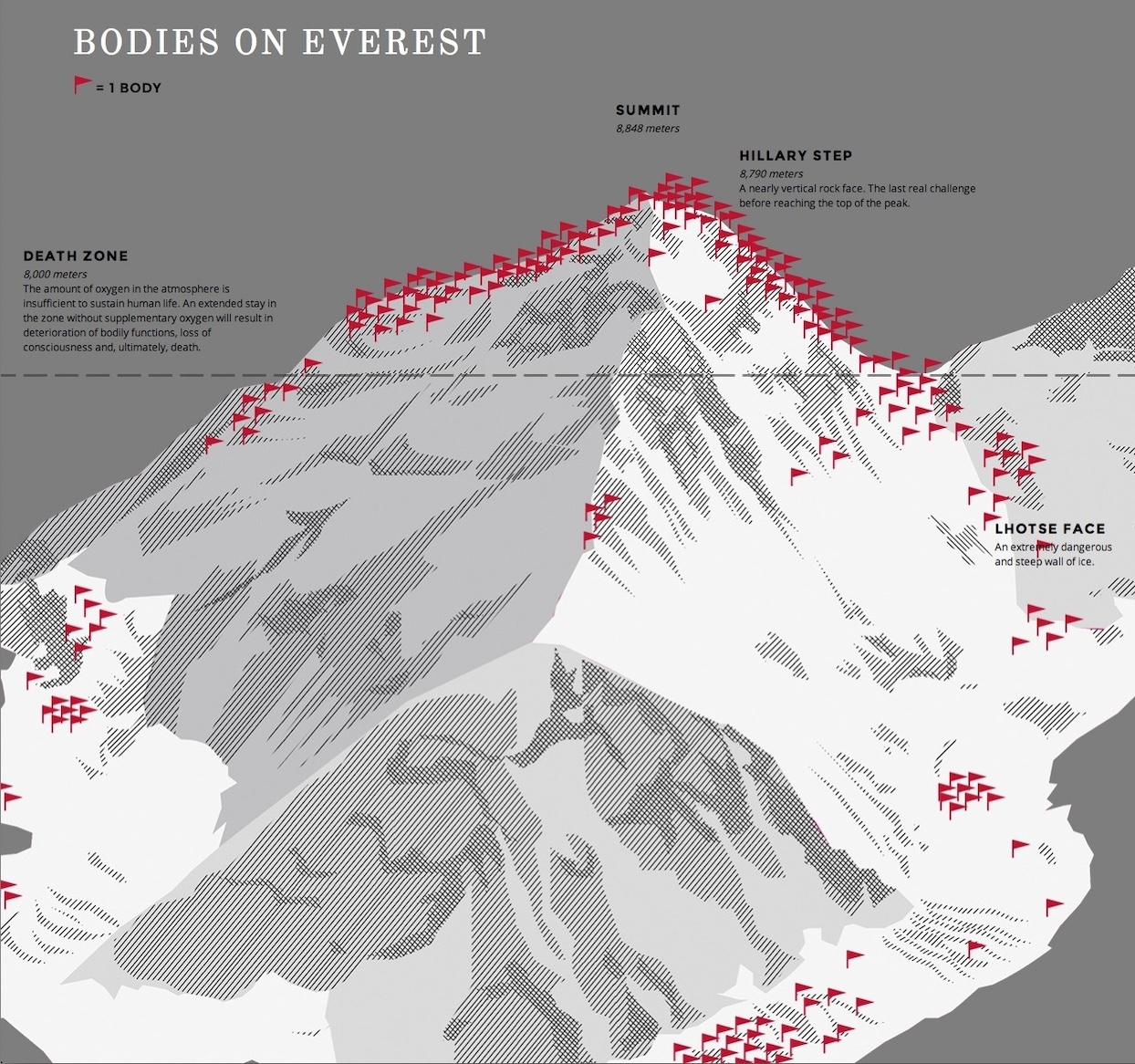
You might wonder why people don’t go up and bring the bodies back down. Simple answer: you’re more likely to join them by trying to do that than make a recovery.
unique link to this extract
Panasonic is selling off its troubled VR company Shiftall • UploadVR
David Heaney:
»
Panasonic is selling off Shiftall to another Japanese company.
Panasonic first showed off an ultra-compact VR headset prototype at CES 2020, and its extremely low weight blew us away in our demo, enabled by 2560×2560 OLED microdisplays.
It was a similar pitch to what Bigscreen recently delivered on, with the exact same resolution, but made over three years before.
While Panasonic originally planned to commercialize the concept as a tethered PC VR headset through its subsidiary Shiftall by the end of 2021, this target has slipped year after year.
The product came to be called Shiftall MeganeX. It was first teased at CES 2022, and at CES 2023 the company announced it would ship that year for $1700. But while a small number of units have shipped in Japan, the headset has yet to launch in the US at all.
…The new owner of Shiftall is the Japanese firm Creek & River Co. It seems to be a very generalized company with no specific specialty.
«
I keep hearing the name of the company wrong in my head. It’s a bit like a line in Modern Family, where two gay men are talking:
No.1 : “I’m leaving early to go to a hockey game. Kings versus Blackhawks.”
No.2, astonished: “Wow. They can call a team that?”
No.1: “Black HAWKS.”
unique link to this extract
Wind and solar capacity in south-east Asia climbs 20% in just one year, report finds • Carbon Brief
Molly Lempriere:
»
Solar and wind capacity in the Association of Southeast Asian Nations (ASEAN) region increased by 20% in 2023, bringing the total to more than 28 gigawatts (GW).
The technologies now make up 9% of electricity generating capacity in ASEAN countries – Brunei, Cambodia, Indonesia, Laos, Malaysia, Myanmar, the Philippines, Singapore, Thailand and Vietnam – according to a new report from Global Energy Monitor (GEM).
Combined with a large base of hydropower, the growth in wind and solar takes the bloc close to its renewable energy capacity target of 35% by 2025, GEM says.
Building an additional 17GW of utility-scale solar and wind projects in the next two years – those that feed power directly into the electricity grid – would be sufficient to reach the goal, it adds.
In fact, it says the region is on track to sail past its target, nearly doubling wind and solar capacity in the next two years by adding a further 23GW of new projects
An even larger 220GW pipeline of new utility-scale wind and solar capacity has been announced, or entered pre-construction or construction stages, according to GEM’s analysis, though only 6GW of this is currently being built.
«
Further down, the article says that “Renewables already make up 32% of electricity capacity in ASEAN countries”, which is why adding just 17GW (about 6% of generating capacity) would take it past the 35% mark. Vietnam has a colossal amount of wind and solar installed. One always wonders too about microgeneration, which easily goes unrecorded, but has a material effect on demand in tropical countries.
unique link to this extract
Fossil is quitting smartwatches • The Verge
Victoria Song:
»
The company announced on January 26 that it would leave the smartwatch business and redirect resources to its less-smart goods instead. The company has been one of the most prolific makers of Wear OS smartwatches over the years, and its absence will leave a large [depending on your definition of “large” – Overspill Ed] gap in the market.
“As the smartwatch landscape has evolved significantly over the past few years, we have made the strategic decision to exit the smartwatch business,” Jeff Boyer, Fossil executive vice President and chief operating officer, tells The Verge. “Fossil Group is redirecting resources to support our core strength and the core segments of our business that continue to provide strong growth opportunities for us: designing and distributing exciting traditional watches, jewelry, and leather goods under our own as well as licensed brand names.”
This means that the Gen 6, which first launched in 2021, will be the last Fossil smartwatch. Boyer says the company will continue to keep existing Wear OS watches updated “for the next few years.”
«
That “large” gap in detail: at Ars Technica, Ron Amadeo picked up the phone to Francisco Jeronimo of IDC, who brought the data:
»
Fossil peaked at 6.7% smartwatch market share in 2015 and only sold 19 million units, or 2.2% of the total market from 2015-2023. During that eight-year run, Jeronimo says Apple shipped 248 million watches.
«
As with smartphones, there are only two serious players in smartwatches: Apple and Samsung.
unique link to this extract
Making a PDF that’s larger than Germany • alexwlchan
Alex Chan has seen the claim that “you can produce a PDF that when printed would be bigger than Germany”, but wanted to check it (one step short of) empirically:
»
By changing the MediaBox value, we can make the page bigger. For example, if we change the value to 600 600, Acrobat says it’s now 8.33 x 8.33 in. Nice!
We can increase it all the way to 14400 14400, the max allowed by Acrobat, and then it says the page is now 200.00 x 200.00in. (You get a warning if you try to push past that limit.)
But 200 inches is far short of 381 kilometres – and that’s because we’re using the default unit of 1/72 inch. We can increase the unit size by adding a /UserUnit value. For example, setting the value to 2 will double the page in both dimensions:
++
/Type /Page
/Parent 3 0 R
/MediaBox [0 0 14400 14400]
/UserUnit 2
/Contents 1 0 R
++
And now Acrobat reports the size of the page as 400.00 x 400.00 in.If we crank it all the way up to the maximum of UserUnit 75000, Acrobat now reports the size of our page as 15,000,000.00 x 15,000,000.00 in – 381 km along both sides, matching the original claim. If you’re curious, you can download the PDF.
If you try to create a page with a larger size, either by increasing the MediaBox or UserUnit values, Acrobat just ignores it. It keeps saying that the size of a page is 15 million inches, even if the page metadata says it’s higher. (And if you increase the UserUnit past 75000, this happens silently – there’s no warning or error to suggest the size of the page is being capped.)
«
Dare you to rock up to your local printing shop with this one on a USB stick.
unique link to this extract
Ireland rolls out deposit recycling scheme, as pressure mounts on UK to follow suit • BusinessGreen News
Michael Holder:
»
Consumers in Ireland can from today [Thursday] return their empty plastic drinks bottles and aluminium cans at vending machines across the country in exchange for money off their supermarket shop, marking a major milestone for the circular economy that will intensify pressure on the UK to follow suit.
Several years in planning, Ireland’s Deposit Return Scheme (DRS) officially launches today, with hundreds of reverse vending machines having been installed in large shops and supermarkets across the country where consumers can bring back empty drinks containers in exchange for tokens.
The move makes Ireland the 41st nation in the world to introduce a DRS for recycling drinks bottles, and the 15th country in Europe to roll out such a scheme. Evidence has shown the approach routinely leads to an increase in recycling rates.
Eligible PET plastic bottles and aluminium cans carrying the Re-Turn logo on their label are now being sold with a small additional deposit – starting at 15 cents for 150ml to 500ml containers, and rising to 25 cents for 500ml to three litre containers. The deposit is then paid back to the consumer in the form of a token when the empty drinks container is placed in dedicated reverse vending machines that are being rolled out in supermarkets across the country.
Around five million drinks are consumed in single-use containers in Ireland every day, according to the government, which said the DRS would help to significantly reduce the number of bottles and cans being littered or sent to landfill or incineration.
At the same time, it is hoped that generating a steady supply of separately-collected and therefore higher quality PET plastic and aluminium materials for recycling can provide a boost to the domestic circular economy, helping unlock investment in further dedicated recycling facilities in Ireland to process the material.
«
The tricky thing with schemes like this is always: who’s funding it? Do you raise the price of the cans and bottles, or does the government pay the supermarkets giving out the vouchers, or does the recycling company that benefits from the cans and bottles pay? A DRS collapsed (well, “is delayed” in Scotland) over similar problems.
unique link to this extract
The Messenger shuts down—and some thoughts about why it ever happened • Talking Points Memo
Josh Marshall:
»
on every front, the business model of big sites with massive audiences publishing nothing in particular but having a lot of eyeballs is totally dead. Obviously advertising still plays a role for publications. But a publication has to have a real purchase on a particular demo to be able to sell ads with any success and they almost certainly need to be selling subscriptions too.
I have written about these trends numerous times. And you have seen these trends in the evolution of Talking Points Memo (TPM) itself. I have a bit of pride that I saw a number of these trends before others in the industry did — really the only reason TPM still exists. But by 2023 all of this was totally known, totally conventional wisdom, what everyone with even a passing grasp of the news business knew. And yet The Messenger was launched, built and run entirely on that old premise and model. It was like watching someone jump out of an airplane with no parachute totally confident they had some new angle on controlled descent no one knew about.
Clearly, Finkelstein didn’t. The site launched with $50m, hired 300 people and in less than a year it’s gone.
Everyone sympathizes with the journalists, many of whom left really good jobs to take a chance on The Messenger. They all got burned badly. They trusted Finkelstein and he abused that trust horribly. But given the sheer amount of arrogance and stupidity Finkelstein and perhaps even more his investors brought to the effort a degree of schadenfreude on the part of onlookers is perhaps inevitable. But for myself and I suspect most others in the media business it’s not really schadenfreude so much as shock and amazement and just standing back aghast that the thing ever happened.
To extend my metaphor from above, it really is like if you were on a parachute jump and some cocky idiot just jumped out of the plane with no chute saying he had it covered and, obviously, plummeted to the ground died. You wouldn’t feel schadenfreude, though obviously dying is a lot more serious than lighting $50m on fire. You’d just be slack jawed and amazed and feel sad about how needless and stupid the whole thing was.
«
From which we conclude that neither Finkelstein nor his investors knew what had happened to media in the past 5-10 years. Possibly forgivable for Finkelstein, seeking money; totally unforgivable for the investors, whether it was their own or someone else’s money they were wielding.
Still, I guess we can now update McLuhan: The Messenger is not the media.
unique link to this extract
| • Why do social networks drive us a little mad? • Why does angry content seem to dominate what we see? • How much of a role do algorithms play in affecting what we see and do online? • What can we do about it? • Did Facebook have any inkling of what was coming in Myanmar in 2016? Read Social Warming, my latest book, and find answers – and more. |
Errata, corrigenda and ai no corrida: none notified





 The Overspill: when there's more that I want to say