Start Up No.1704: Facebook blocks surveillance firms, a radioactive president?, Toyota’s pay-to-drive, omicron’s 70x advantage, and more


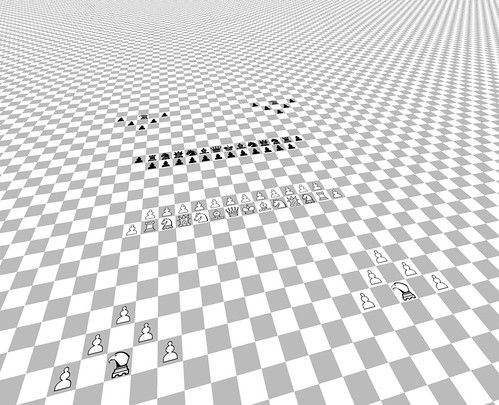
If you set two AIs playing chess on an infinite board… what would happen? CC-licensed photo by QyiQ23607 Pisano on Flickr.

You can sign up to receive each day’s Start Up post by email. You’ll need to click a confirmation link, so no spam.

A selection of 10 links for you. Charity suggestions at end. I’m @charlesarthur on Twitter. Observations and links welcome.


Facebook bans seven ‘cyber mercenary’ companies from its platforms • The Guardian

Stephanie Kirchgaessner and Michael Safi:

»

The social media company said on Thursday that its investigation had revealed new details about the way the surveillance companies enable their clients to “indiscriminately” target people across the internet to collect intelligence about them, manipulate them – and ultimately compromise their devices.

Among the surveillance companies that Facebook named in its investigation and banned from its platforms are:

• Black Cube, an Israeli company that gained notoriety after it emerged that the disgraced media mogul and convicted sex offender Harvey Weinstein had hired them to target women who had accused him of abuse. Black Cube rejected Facebook’s claims about its activities
• Cobwebs, another Israeli company that Facebook said enabled its clients to use public websites and dark web sites to trick targets into revealing personal information. The company also reportedly works for US clients, including a local police department in Hartford, Connecticut
• Cytrox, a North Macedonian company that Facebook said enabled its clients to infect targets with malware following phishing campaigns.

The investigation conducted by Facebook comes as the company is itself facing intense scrutiny in Washington and around the world following accusations by a whistleblower, Frances Haugen, that it enabled the spread of hate speech and disinformation.

The Facebook investigation is significant, however, because it reveals new details about the way parts of the surveillance industry use social media – from Facebook to Instagram – to create fake accounts to deceive their targets and conceal their own activities.

While many of the companies claim that they are hired to target criminals and terrorists, Facebook said the industry “regularly” enabled its clients to target journalists, dissidents, critics of authoritarian regimes and human rights activists and their families.

«

Sure that the US administration will be along in a minute to sanction Facebook like it did NSO. (There’s also the obvious joke – FB exec: “intrusive, constant surveillance? That’s our job!”)
unique link to this extract


There is no ‘Them’ • The Pull Request

Antonio García Martínez:

»

the real problem with the ‘Them’ [as he found a group of non-tech friends complaining about the Techopoly, thus viewed, to him a technologist who used to work at Facebook]: it ascribes a level of wilful agency to organisations (or entire industries) which are really baskets of disparate individuals and agendas grappling with happenstance and an intractable reality. It’s an illusion only readily maintained by outsiders, as insiders have seen how the sausage is really made. Nobody who’s opened a Facebook dashboard and seen figures in the billions blinking back at them would believe that any ‘Them’ could possibly manipulate this seething mass of humanity in a controlled, willful way.

The real Facebook struggle is to somehow manage all this complexity in scalable ways: an algorithm that sorts the billions of pieces of content created per day; machine learning that hopefully doesn’t filter out the noxious detritus of imperfect humanity in too, too wrong a way; some imperfect body of policies that placates often incomprehending regulators and is still implementable by overtaxed operations people. The thought that any set of people, no matter how motivated, could deploy grand designs of overt social control over that globe-spanning mess seems delusional when you realize the scale of it.

When our car gets stuck in the snow on the way to Tahoe, we don’t blame President Biden; well, some political partisans people might, and who knows, poor Federal infrastructure policy might be residually to blame for that poorly-marked turn we missed. But broadly we ‘get’ that national governance is a complicated, multi-tiered phenomenon, and assigning individual agency to this or that person or policy comes off as contrived. Somehow that worldliness disappears (or didn’t exist to begin with) when it comes to tech, which still confronts this unbridgeable chasm when it comes to explaining itself to the normies (and believe me, some have tried).

«

Martínez is smart, though I feel he’s a step away from realising that the fact he’s describing a system that’s impossible to control by its nature doesn’t absolve those who created the system from blame.
unique link to this extract


• Why do social networks drive us a little mad?
• Why does angry content seem to dominate what we see?
• How much of a role do algorithms play in affecting what we see and do online?
• What can we do about it?
• Did Facebook have any inkling of what was coming in Myanmar in 2016?
Social Warming, my latest book, and find answers – and more.


Toyota made its key fob Remote Start into a subscription service • The Drive

Rob Stumpf:

»

Remember when BMW wanted to charge drivers to use Apple CarPlay? How about the subscription required for the Mercedes EQS’s rear-wheel steering functionality in Europe? It turns out that luxury marques aren’t the only ones looking to cash in on that sweet, sweet software as a service cash: Toyota has been testing the waters by making the remote start functionality on your proximity key fob part of a larger connected services subscription.

Yes, it appears the pay-to-play ethos that’s spreading around the industry has reached the world’s largest automaker. A Toyota spokesperson confirmed to The Drive that if a 2018 or later Toyota is equipped with Toyota’s Remote Connect functions, the vehicle must be enrolled in a valid subscription in order for the key fob to start the car remotely. To be clear, what we’re talking about is the proximity-based RF remote start system, where you press a button on the fob to start the car while outside of it within a certain distance—say, from your front door to warm up your vehicle in the driveway on a cold morning before you get in. Your fob uses radio waves to communicate with the car, and no connection back to Toyota’s servers is needed. But the function will not work without a larger Remote Connect subscription.

«

That’s a tasty $8 per month or – discount! – $80 per year. How would you like to pay? Now, the story clarifies that the free period might be up to 10 years. But that’s only might. Who knows if Toyota might find itself a bit squeezed on cashflow some day? The mission creep of subscriptions into all sorts of places they’re not wanted continues.
unique link to this extract


Omicron variant may multiply 70 times faster than delta • USA Today

John Bacon and Celina Tebor:

»

The omicron variant multiplies 70 times faster in the human bronchial tubes than the initial COVID-19 infection or the delta variant, according to a new study from the University of Hong Kong.

The lightning-fast spread within people may explain why the variant may transmit faster among humans than previous versions, the researchers say. Their study also showed the omicron infection in the lung is significantly lower than the original SARS-CoV-2, which may be an indicator of lower disease severity. The research is currently under peer review for publication.

By infecting many more people, a very infectious virus may cause more severe disease and death even though the virus itself may be less dangerous, said Dr Michael Chan Chi-wai, the study’s principal investigator.

“Taken together with our recent studies showing that the omicron variant can partially escape immunity from vaccines and past infection, the overall threat from omicron variant is likely to be very significant,” he said.

The US Centers for Disease Control and Prevention says the omicron variant has now been reported in at least 36 states and 75 countries. Schools and businesses are grappling with how to manage the latest threat.

«

I hadn’t seen (or heard) that 70x figure before, but it fits in with other stuff that’s been floating around, about the RBD (receptor binding domain – the bit that latches on to the cell surface) having much stronger affinity for ACE2, the cell protein that it binds to. If it can attach better then it would be more likely to penetrate the cell and reproduce. Omicron is very much out of control now in the UK.
unique link to this extract


Fact check: did Jimmy Carter stop a nuclear reactor from destroying Ottawa? • Newsweek

Ewan Palmer:

»

On December 12, 1952, the Chalk River NRX nuclear reactor suffered a partial meltdown. The incident resulted in hundreds of thousands of gallons of radioactive water flooding the core and causing major damage to the reactor.

As reported by nuclearenergy.net, the major failure, along with “several poor decisions by facility operators,” resulted in a nuclear fission chain reaction that caused the power level to rise exponentially.

At the time, the NRX reactor operated at around 30 megawatts (MW). On December 12, workers at the plant were preparing for a reactor-physics experiment at low power. However, a defect in the NRX shut-off rod mechanism, combined with the human errors, caused a temporary loss of control over reactor power, ultimately causing it to surge to between 60 and 90 MW.

“This energy load would normally not have been a problem, but several experimental fuel rods that were at that moment receiving inadequate cooling for high power operation ruptured and melted,” the FAQ section of the Canada Deuterium Uranium (CANDU) reactor website states.

Thousands of nuclear fission particles were released into the atmosphere. The radioactive water also ended up in the reactor building’s basement, before being pumped out into shallow ditches near the Ottawa River.

The US was then called in to help with the clean up the site. [Jimmy] Carter, a trained nuclear engineer who had worked under famed Admiral Hyman Rickover, the father of the Navy’s nuclear program on the atomic submarine “Sea Wolf,” was asked to lead a team for the cleanup operation.

The Historical Society of Ottawa said that as part of the cleanup plan, the reactor had to be shut down, disassembled and replaced, with the team also needing to clean any spilled radioactive material. The intensity of the radiation meant that Carter and each member of his team could only spend about ninety seconds at the core location. Before the operation, which involved being lowered into the core, an exact replica of the reactor was built on a nearby tennis court, where Carter and his men practiced cleaning and repairing it.

Carter described the operation in his book, Why Not the Best?, which he released while running for president in 1976. “We all went out on the tennis court, and they had an exact duplicate of the reactor on the tennis court. We would run out there with our wrenches and we’d check off so many bolts and nuts and they’d put them back on,” Carter told Canadian journalist and author Arthur Milnes.

«

The accident is now rated 5 out of 7 on the severity scale. (Chernobyl, of course, was a 7.)

Jimmy Carter is 97 years old.
unique link to this extract


Apple may be making standalone 4K monitors to match the iMac • Macworld

Michael Simon:

»

If there’s one gaping hole in Apple’s lineup, it’s a standalone display that doesn’t cost $4,999 (without a stand). But according to a new rumor, that might change in 2022.

We’ve heard previous rumors that Apple is working on a display to go with its M1 Macs, but a new report sheds a little more light on what Apple has in mind. According to Twitter user Dylan, who has previously leaked accurate information about the 24-inch iMac and iPhone 13, LG is manufacturing two displays “encased in unbranded enclosures for usage as external monitors that are in early development” that “have the same specifications as the upcoming 27in and current 24in iMac displays.”

LG makes many of Apple’s current displays, including the ProDisplay XDR, so based on the specs and the secrecy, it’s likely that these are bound for use in an Apple product.

«

Apple used to do displays, then it didn’t for a long time (or let them become hopelessly out of date), then it did but they were wildly expensive. For years people have been asking for a 5K display like that used for the iMac 5K, but without the “iMac” bit. Most would probably settle for the 4K format.
unique link to this extract


Meta opens up access to VR social platform Horizon Worlds • The Verge

Alex Heath:

»

During a demo of Horizon Worlds, I was greeted by a few Meta employees at the Plaza, a central gathering place used to enter custom worlds and games built by users. We first visited a creator lounge area where you try custom items being built, like a bow and arrow or paper plane launcher, and enter building competitions to win cash prizes. Then we hopped to another world and divided up into teams to play a battle royale shooting game. After that, I was given a demo of Horizon’s building tools that let you create a world and items from scratch.

A key part of Horizon Worlds is the ability to write basic code that sets rules for how objects work, such as a gun shooting when you press the trigger or a ball bouncing when it touches a surface. The code, which Meta calls script blocks, acts similarly to layers in Photoshop by letting you chain together rules to create complex interactions, such as a leaderboard that automatically updates after a game is finished. “Attaching behaviors to objects is actually one of the biggest innovations that I’m proud of for the team,” says Sharma.

He says that, so far, Meta employees have been making the script blocks at the request of beta testers and that the company eventually plans to release a free library of them. An asset library of objects is also coming. Right now, the coding for script blocks is done entirely in VR, but eventually, Meta plans to let them be built from a desktop computer.

Safety is a big concern for a VR environment like Horizon Worlds, where you can easily interact with someone you don’t know. Earlier this month, a beta tester posted in the official Horizon group on Facebook about how her avatar was groped by a stranger. “Sexual harassment is no joke on the regular internet, but being in VR adds another layer that makes the event more intense,” she wrote. “Not only was I groped last night, but there were other people there who supported this behavior which made me feel isolated in the Plaza.”

Sharma calls the incident “absolutely unfortunate” and says that after Meta reviewed the incident, the company determined that the beta tester didn’t utilize the safety features built into Horizon Worlds, including the ability to block someone from interacting with you. (When you’re in Horizon, a rolling buffer of what you see is saved locally on your Oculus headset and then sent to Meta for human review if an incident is reported.) “That’s good feedback still for us because I want to make [the blocking feature] trivially easy and findable,” he says.

«

Between this and Parmy Olson’s experience recounted in yesterday’s roundup, something tells me that the metaverse already has a harassment problem, and solving it isn’t about having controls be “trivially easy and findable”. It’s about defaults.
unique link to this extract


The hidden world of Ethereum snipers • Sam Chepal

Samneet Chepal:

»

Despite its massive success as a protocol, many users are not aware of the fact that anytime a transaction is made it might be in the crosshairs of a hyper-optimized sniper bot. These sophisticated bots are fine-tuned around the core technological architecture of Ethereum to hunt for profitable opportunities. Earlier this year it was not uncommon to see these bots make more than $250k in a single trade. Many stories have already been documented on the dangers of these bots such as Dan Robinson’s journey into the Dark Forest and samczun’s escape from the Dark Forest. Fortunately, recent innovations within the Ethereum eco-system have been developed to help reduce the negative externalities of these snipers.

…Suppose XYZ token is trading for $100 on Uniswap but $120 on Sushiswap. A simple arbitrage strategy would be to buy XYZ token for $100 on Uniswap and sell the same token on Sushiswap at $120, resulting in an arbitrage of $20. An arbitrageur would submit both trades at the same time to ensure the position is opened and closed in the same transaction which ensures a relatively risk-free profit. In this case let’s suppose the arbitrageur sends over this transaction with a gas transaction fee worth $5, leaving him with a net profit of $15.

When the arbitrageur submits this transaction to the network, he’s unaware that sniper bots are sniffing through the mempool looking for any exploitable opportunities. Given this user’s trade is publicly available for anyone to see before it becomes finalized in the blockchain, a sophisticated sniper bot could front-run this user by simply bribing the miner with higher gas fees. In this case the sniper bot would simply copy the exact same trade as the arbitrageur but offer a slightly higher gas fee of $10, leaving the sniper bot with a net profit of $10. Ironically, this bot may get sniped by another bot willing to pay a higher gas fee bribe to the miner. This new sniper bot may be willing to pay $15 worth of transaction fees to collect a net arbitrage profit of $5.

«

But – and it’s an important but – only one can succeed, because the transaction can only happen once.
unique link to this extract


Melania Trump launches NFT venture, promising ‘an amulet to inspire’ • The Guardian

David Smith:

»

In Melania’s first public venture since leaving the White House almost a year ago, an NFT named Melania’s Vision can be bought between 16 and 31 December with the SOL cryptocurrency or an old-fashioned credit card.

An irony-free statement from her office says it is “a breathtaking watercolor art by Marc-Antoine Coulon, and embodies Mrs Trump’s cobalt blue eyes, providing the collector with an amulet to inspire.”

“The limited-edition piece of digital artwork will be 1 SOL (approximately $150) and includes an audio recording from Mrs Trump with a message of hope.”

Melania, 51, joins a growing list of celebrities offering lucrative digital memorabilia. Earlier this year Argentinian footballer Lionel Messi, Jamaican athlete Usain Bolt and American football player Tom Brady launched their own collections of NFTs. Singer Justin Bieber and K-pop group BTS have also dived in.

«

The absolutely perfect intersection of grifts.
unique link to this extract


The biggest chess game ever • YouTube

Lex Fridman:

»

It’s two Stockfish 14 chess AI engines playing each other on a chess board that is infinitely expanding outwards, initializing the squares at the edges with middlegames from 30,000 grandmaster games including from Carlsen, Fischer, Kasparov, Spassky, Tal, Karpov, and so on.

I love chess, always have, but chose to stop playing it myself early on when I became passionate about building AI systems, and instead became a fan of watching the game and the humans who play it.

«

The commentary explains plenty more. (It’s a terrific choice of music too.) Whenever people start suggesting that maybe, just maybe a super-capable chess AI might in some way be showing us what a generalised intelligence might be like, I’m reminded of the satirical SF writer John Sladek’s book “The Reproductive System”, in which a huge machine takes over the world. Someone asks it to identify itself, and it produces a long response; “then, as if to be on the safe side, added ‘P-Q4’.”
unique link to this extract


Errata, corrigenda and ai no corrida: I’ve been lax in suggesting charities to give to at Christmas. (There’s another week coming, so stay with it.) But if you want to get your donations on early, I’d suggest all or any of:
Shelter (or equivalent in your country)
Wikipedia (it’s an invaluable, unique resource)
• the Internet Archive (ditto)
• any dog rescue centre (dogs are a source of joy and inspiration: watch Lollipop and then try to deny that). Here’s Lollipop’s home.

Start Up No.1703: Chinese hackers try log4j flaw, inside an NSO iMessage attack, Google tries AR again, is biomass bad?, and more


Wouldn’t it be great if computer webcams were situated in the middle of the screen, or somewhere better? Dell has a concept for that. CC-licensed photo by JJ Merelo on Flickr.

You can sign up to receive each day’s Start Up post by email. You’ll need to click a confirmation link, so no spam.

A selection of 11 links for you. Not increasing every two days. I’m @charlesarthur on Twitter. Observations and links welcome.


Hackers backed by China seen exploiting security flaw in internet software • WSJ

Robert McMillan and Dustin Volz:

»

Hackers linked to China and other governments are among a growing assortment of cyberattackers seeking to exploit a widespread and severe vulnerability in computer server software, according to cybersecurity firms and Microsoft.

The involvement of hackers whom analysts have linked to nation-states underscored the increasing gravity of the flaw in Log4j software, a free bit of code that logs activity in computer networks and applications.

Cybersecurity researchers say it is one of the most dire cybersecurity threats to emerge in years and could enable devastating attacks, including ransomware, in both the immediate and distant future. Government-sponsored hackers are often among the best-resourced and most capable, analysts say.

“The effects of this vulnerability will reverberate for months to come—maybe even years—as we try to close these doors and try to hunt down all the actors who made their way in,” said John Hultquist, vice president of intelligence analysis at the US-based cybersecurity firm Mandiant.

Both Microsoft and Mandiant said they have observed hacking groups linked to China and Iran launching attacks that exploit the flaw in Log4j. In an update to its website posted late Tuesday, Microsoft said that it had also seen nation-backed hackers from North Korea and Turkey using the attack. Some attackers appear to be experimenting with the attack; others are trying to use it to break into online targets, Microsoft said.

«

This is going to go on and on. How long before it pops up in a seriously big exploit?
unique link to this extract


A deep dive into an NSO zero-click iMessage exploit: Remote Code Execution • Google Project Zero blog

Ian Beer and Samuel Groß:

»

In the late 1990’s, bandwidth and storage were much more scarce than they are now. It was in that environment that the JBIG2 standard emerged. JBIG2 is a domain specific image codec designed to compress images where pixels can only be black or white.

It was developed to achieve extremely high compression ratios for scans of text documents and was implemented and used in high-end office scanner/printer devices like the XEROX WorkCenter device shown below. If you used the scan to pdf functionality of a device like this a decade ago, your PDF likely had a JBIG2 stream in it.

The PDFs files produced by those scanners were exceptionally small, perhaps only a few kilobytes. There are two novel techniques which JBIG2 uses to achieve these extreme compression ratios which are relevant to this exploit.

Effectively every text document, especially those written in languages with small alphabets like English or German, consists of many repeated letters (also known as glyphs) on each page. JBIG2 tries to segment each page into glyphs then uses simple pattern matching to match up glyphs which look the same:

JBIG2 doesn’t actually know anything about glyphs and it isn’t doing OCR (optical character recognition.) A JBIG encoder is just looking for connected regions of pixels and grouping similar looking regions together. The compression algorithm is to simply substitute all sufficiently-similar looking regions with a copy of just one of them.

There’s a significant issue with such a scheme: it’s far too easy for a poor encoder to accidentally swap similar looking characters, and this can happen with interesting consequences. D. Kriesel’s blog has some motivating examples where PDFs of scanned invoices have different figures or PDFs of scanned construction drawings end up with incorrect measurements. These aren’t the issues we’re looking at, but they are one significant reason why JBIG2 is not a common compression format anymore.

«

So it turns out that the NSO’s Pegasus relies on a flaw in a decades-old piece of open source software originally intended for scanning. One observer’s description: “NSO has been using simple logical operators in an old compression format to basically build a whole virtual computer on top of it.” The blogpost isn’t a short read, by the way. There’s also the discussion on Hacker News, with its predictable mixture of yawning and awe.
unique link to this extract


The millions of tons of carbon emissions that don’t officially exist • The New Yorker

Sarah Miller:

»

In essence, Drax [power station] is a gigantic woodstove. In 2019, Drax emitted more than fifteen million tons of CO2, which is roughly equivalent to the greenhouse-gas emissions produced by three million typical passenger vehicles in one year. Of those emissions, Drax reported that 12.8m tons were “biologically sequestered carbon” from biomass (wood). In 2020, the numbers increased: 16.5m tons, 13.2m from biomass. Meanwhile, the Drax Group calls itself “the biggest decarbonization project in Europe,” delivering “a decarbonized economy and healthy forests.”

The apparent conflict between what Drax does and what it says it does has its origins in the United Nations Conference on Climate Change of 1997. The conference established the Kyoto Protocol, which was intended to reduce emissions and “prevent dangerous anthropogenic interference with the climate system.” The UN’s Intergovernmental Panel on Climate Change (IPCC) classified wind and solar power as renewable-energy sources. But wood-burning was harder to categorize: It’s renewable, technically, because trees grow back. In accounting for greenhouse gases, the IPCC sorts emissions into different “sectors,” which include land-use and energy production. It’s hard to imagine now, but at the time, the IPCC was concerned that if they counted emissions from harvesting trees in the land sector, it would be duplicative to count emissions from the burning of pellets in the energy sector.

According to William Moomaw, an emeritus professor of international environmental policy at Tufts University, and lead author of several IPCC reports, negotiators thought of biomass as only a minor part of energy production—small-scale enough that forest regrowth could theoretically keep up with the incidental harvesting of trees. “At the time these guidelines were drawn up, the IPCC did not imagine a situation where millions of tons of wood would be shipped four thousand miles away to be burned in another country,” Moomaw said.

«

unique link to this extract


Google is building a new augmented reality device and operating system • Ars Technica

Samuel Axon:

»

Google was one of the early leaders in the first wave of modern augmented reality (AR) research and devices, but the company has appeared to cool to AR in recent years even as Apple and Facebook have invested heavily in it. But it looks like that trend will soon be reversed.

On LinkedIn, operating system engineering director Mark Lucovsky announced that he has joined Google. He previously headed up mixed reality operating system work for Meta, and before that he was one of the key architects of Windows NT at Microsoft. “My role is to lead the Operating System team for Augmented Reality at Google,” he wrote.

He also posted a link to some job listings at Google that give the impression Google is getting just as serious about AR as Apple or Meta.

…Other job listings say new hires will be working on an “innovative AR device.” And one specifies that Google is “focused on making immersive computing accessible to billions of people through mobile devices.”

«

So Google is getting serious about AR… again? It’s as if there’s no institutional memory there, or they think that everything about Google Glass should be consigned to the bin. Which might, actually, not be wrong.
unique link to this extract


The Metaverse via Oculus is awkward if you’re a woman. And beware of griefers • Bloomberg

Parmy Olson:

»

So what is social VR like? Imagine gaming combined with zany, old-style Internet chat rooms: messy, experimental and often dominated by men. There are trolls and obnoxious kids. And while most people are generally well-behaved and enthusiastic about the new medium, there seem to be few measures in place to prevent bad behavior beyond a few quick guidelines when you enter a space and features that let you block and mute problematic users.

On a visit to Horizon Venues for my first mingling experience, I picked an avatar that was a close approximation of what I looked like in real life: straight brown hair and a blazer and jeans. But it meant that when I was teleported into the main lobby area — a vast room with a tree in the middle — I was the only woman among a dozen or so men. We were all cartoonish-looking avatars floating around with no legs. Quite a few of us were in leather jackets.

Within moments, I was surprised by a deep voice in my ear, as if someone was whispering into it. “Hey. How are you?” One of the avatars had zoomed up to within inches of me, then floated away, taking me aback. A small group of male avatars began to form around me, staying silent. As I chatted with a man from Israel named Eran who was showing me how to jump (you need to figure out how to activate it via your settings), several in the surrounding crowd started holding their thumbs and forefingers out in front of them, making a frame. Digital photos of my bemused avatar appeared between their hands. One by one, they began handing the photos to me. The experience was awkward and I felt a bit like a specimen.

“Just chuck em’ away,” said a man in a bright blue suit with a London accent who had just floated up to us. Despite many attempts to shake away the portraits, they kept sticking to my digital hand like flypaper. 

Meta warns all visitors to Horizon Venues that its “trained safety specialists” can dredge up a recording of any incident, and that users can activate a Safe Zone around themselves by pressing a button on their virtual wrist, muting the people around them. I didn’t feel unsafe, but I was uncomfortable, and there were no clear rules about etiquette and personal space.

«

Amazing: again and again, these digital spaces are created with no thought of how women will respond to them.
unique link to this extract


Wind power becomes Spain’s leading energy source for 2021 • EL PAÍS English Edition

Ignacio Fariza:

»

Even if the wind stops blowing in the next three weeks, wind power will end the year as the leading source of electricity in Spain. This will mean wind overtaking nuclear in the national energy matrix for the first time since 2013, the only year since records began in which wind turbines were the main source of power. That year was particularly good in terms of wind resources while nuclear was affected by the closure of the Garoña plant in Burgos. Since then, however, wind power has continued to grow as a percentage of total energy generated both in absolute and relative terms, a trend that looks to continue in the near future.

The milestone, advanced by Spanish news site Nius, is just a taste of things to come. “Wind power is going to dominate the Spanish electricity grid for a long time,” says Francisco Valverde, a consultant at the energy company Menta Energía.

According to the National Integrated Energy and Climate Plan (PNIEC), released by the Spanish government last year, the installed capacity of wind turbines will almost double between now and 2030. During this period, the rate of growth of solar photovoltaic will be even greater as installed capacity more than quadruples, making it the second most important electricity source, though it will still lag far behind wind power, even when solar thermal is taken into account. Meanwhile, installed nuclear power will fall to less than half its current level. And both combined-cycle plants, which use natural gas, and hydroelectricity will maintain their weight in a mix in which coal will no longer be included.

«

Nuclear has been the biggest single source for quite a while; both nuclear and wind are more than 20% of generation, and CCGT about 17% this year. (Solar has only recently gone above 4%.)
unique link to this extract


Swift Playgrounds 4 is here, and it’s a thing of beauty • Hacking with Swift

Paul Hudson @twostraws:

»

Folks have been requesting Xcode for iPad for some time, but that would have required a pretty epic effort – does that mean all of Interface Builder? All the Objective-C and C++ support? Or – *cue silent screaming* – Info.plist files?

Swift Playgrounds has chosen a different way: rather than trying to recreate all of Xcode on iPadOS, it instead aims to produce “Diet Xcode” – by which I mean “slimmer, faster, and streamlined” and not “why does my drink taste weird.” That means we get Xcode-style code completion that appears instantly, we get Xcode-style instant SwiftUI previews as we type, we get Xcode-style imports for SPM packages through Git, and much more.

And don’t think for a moment there are compromises on what you can code, because there really aren’t: this is full Swift 5.5 with all the latest concurrency features, plus access to the full set of SwiftUI API for iOS 15. Even better, at last there is access to debug output using print() and similar – by default it slides up from the bottom in a toast-style notification then animates away after a few seconds, but you can also make the console permanently visible if you prefer.

But, critically we don’t get some of Xcode’s biggest problems. For example, when you want to add a capability to a Swift Playgrounds app, it’s all done using a beautiful new user interface where you select from a list, then enter any addition data as prompted – that means goodbye to adding keys like “NSLocationAlwaysAndWhenInUseUsageDescription” to your property list.

Best of all, if you decide you want to move your project over from Swift Playgrounds to Xcode, you can do just that: just hit Share, then AirDrop it to your Mac, and Xcode will pick up exactly where you left off.

«

So, in brief, you can now write apps for the iPad (or iPhone) on the iPad. Which was a longstanding criticism of the iPad – that it wasn’t a “proper” computer because you couldn’t write apps on it to run on it. Guess they’ll need new ones now.
unique link to this extract


Winter is coming: researchers uncover the surprising cause of the Little Ice Age • University of Massachusetts Amherst

»

The Little Ice Age was one of the coldest periods of the past 10,000 years, a period of cooling that was particularly pronounced in the North Atlantic region. This cold spell, whose precise timeline scholars debate, but which seems to have set in around 600 years ago, was responsible for crop failures, famines and pandemics throughout Europe, resulting in misery and death for millions. To date, the mechanisms that led to this harsh climate state have remained inconclusive. However, a new paper published recently in Science Advances gives an up-to-date picture of the events that brought about the Little Ice Age. Surprisingly, the cooling appears to have been triggered by an unusually warm episode.

When lead author Francois Lapointe, postdoctoral researcher and lecturer in geosciences at UMass Amherst and Raymond Bradley, distinguished professor in geosciences at UMass Amherst began carefully examining their 3,000-year reconstruction of North Atlantic sea surface temperatures, results of which were published in the Proceedings of the National Academy of Sciences in 2020, they noticed something surprising: a sudden change from very warm conditions in the late 1300s to unprecedented cold conditions in the early 1400s, only 20 years later.

Using many detailed marine records, Lapointe and Bradley discovered that there was an abnormally strong northward transfer of warm water in the late 1300s which peaked around 1380. As a result, the waters south of Greenland and the Nordic Seas became much warmer than usual. “No one has recognized this before,” notes Lapointe.

Normally, there is always a transfer of warm water from the tropics to the arctic. It’s a well-known process called the Atlantic Meridional Overturning Circulation (AMOC), which is like a planetary conveyor belt. Typically, warm water from the tropics flows north along the coast of Northern Europe, and when it reaches higher latitudes and meets colder arctic waters, it loses heat and becomes denser, causing the water to sink at the bottom of the ocean. This deep-water formation then flows south along the coast of North America and continues on to circulate around the world.

But in the late 1300s, AMOC strengthened significantly, which meant that far more warm water than usual was moving north, which in turn cause rapid arctic ice loss. Over the course of a few decades in the late 1300s and 1400s, vast amounts of ice were flushed out into the North Atlantic, which not only cooled the North Atlantic waters, but also diluted their saltiness, ultimately causing AMOC to collapse. It is this collapse that then triggered a substantial cooling.

«

unique link to this extract


Amazon Polly • Amazon

»

Amazon Polly is a service that turns text into lifelike speech, allowing you to create applications that talk, and build entirely new categories of speech-enabled products. Polly’s Text-to-Speech (TTS) service uses advanced deep learning technologies to synthesize natural sounding human speech. With dozens of lifelike voices across a broad set of languages, you can build speech-enabled applications that work in many different countries.

In addition to Standard TTS voices, Amazon Polly offers Neural Text-to-Speech (NTTS) voices that deliver advanced improvements in speech quality through a new machine learning approach. Polly’s Neural TTS technology also supports a Newscaster speaking style that is tailored to news narration use cases.

Finally, Amazon Polly Brand Voice can create a custom voice for your organization. This is a custom engagement where you will work with the Amazon Polly team to build an NTTS voice for the exclusive use of your organization.

«

Alexa-responding-and-more-as-a-service. Available in eight languages, and both male and female in six of those. I reckon that they’ve covered most of the world’s population there (it includes Chinese) – if they can get Hindi in too, they’re sorted. And the free tier offers 5 million characters per month for the first 12 months. Unclear whether that’s permanent; the implication seems to be that it isn’t.
unique link to this extract


Whatever happened to Buzzfeed? • Read Max

Max Read:

»

The future no longer seems very open; in fact, its contours seem very, very clear. What had once been a rat’s nest of 15 or 20 recognizable independent digital-media startups has been reduced, through purchases and mergers, to four consolidated brand portfolios that have any chance at medium-term survival: BuzzFeed-Huffpost-Complex, Vox-Verge-SB Nation-Eater-NYMag, Bustle-Mic-Gawker, and Vice-Refinery29.

All of these rely for revenue on some mix of display advertising and sponcon, ecommerce and affiliate marketing, and direct payments in the form of subscriptions or membership1. All of them have laid off workers. All of them are likely to go public (or try) within the next couple years, to cash out investors and to make consolidation easier. The most optimistic outcome for any one of these companies is that it leads the next round of mergers and acquisitions and emerges at the top of a larger portfolio of brands, giving it more leverage with advertisers and further diversifying its audience and revenue streams.

The sector is now the province of private-equity vultures rather than venture-capital sharks. No one looks at digital media companies and sees unicorns anymore; they see stones that might have a little more blood in them2.

What’s changed? Not much about the fundamentals, really. The big difference between now and 2011 is that there’s no longer the expectation (or recent experience) of “disruptive” upheaval in media infrastructure. Part of what made the digital media sector so attractive to venture capitalists in the early 2010s was how frequently and how quickly the landscape of media distribution was changing. Every few years a new growth opportunity would emerge — SEO! No, wait, social sharing! No, wait, dark social! No, wait, video! No, wait ecommerce! — offering potentially huge audiences or revenue figures. (But also necessitating debilitating shifts in editorial tone, resources, and strategies.)

No one expects a new Facebook (or, for that matter, a new iPhone) to emerge anytime soon, transforming the whole sector3; we’ve reached a point where we know what works and what needs to happen.

«

Though we think we’ve reached the point where we know what works every few years; and then it changes.
unique link to this extract


Dell’s wire-free webcam could one day eradicate Zoom side-eye • The Verge

Emma Roth:

»

At first glance, the Concept Pari looks like the typical webcam that sits atop your monitor. However, Dell made it so that you can remove the cylindrical camera housing from its dock (which also doubles as a USB-C wireless charging station, letting you carry around the 1oz camera in your hand). The camera itself shoots in 1080p, has a built-in mic, and because it’s wireless, is connected to Wi-Fi. Dell also notes that it comes with a vertical indicator light, helping you maintain alignment as you use the camera freehandedly.

What might be neater than its wire-free housing is that if you’re tired of staring into the face of a soulless webcam during virtual meetings, the Concept Pari comes with a magnetic backing that allows you to stick the camera anywhere on your monitor (hopefully without affecting the display). Place the camera just above the head of the person you’re talking with, and you should be able to comfortably maintain eye contact while actually looking at the person on your screen.

When you’re done with a meeting, you can reverse the camera in its dock so that it’s facing away from you, offering additional privacy when the camera’s not in use. Dell says it will still charge when it’s in this position. Although the webcam isn’t for sale just yet, and very well may never be, it’s a concept that doesn’t seem too unrealistic to see a lot of people adopting.

«

It all reads so well until that very final sentence. The problem of webcams being off-centre – up, down, sideways – is so very frustrating given how prevalent video calls are now.
unique link to this extract


Still some time to order my book (for yourself or a friend): Social Warming explains why outrage and fake news travel so much further and faster on social networks, and how that creates problems for journalism, democracy – and society.


Errata, corrigenda and ai no corrida: none notified

Start Up No.1702: Instagram passes 2bn users, log4j’s scale revealed, Huawei’s surveillance questions, Snap’s ARv4, and more


The UK Post Office says it can’t afford to recompense the former staff it wrongly accused of theft – so the government will have to pick up the tab. Can it really not afford it? CC-licensed photo by Andrew Bowden on Flickr.

You can sign up to receive each day’s Start Up post by email. You’ll need to click a confirmation link, so no spam.

A selection of 10 links for you. Use them wisely. I’m @charlesarthur on Twitter. Observations and links welcome.


Huawei documents show Chinese tech giant’s involvement in surveillance programs • The Washington Post

Eva Dou:

»

A review by The Washington Post of more than 100 Huawei PowerPoint presentations, many marked “confidential,” suggests that the company has had a broader role in tracking China’s populace than it has acknowledged.

…”Privacy protection is our top priority”, the company said.

The Post reviewed more than 3,000 PowerPoint slides from the presentations outlining surveillance projects co-developed by Huawei with partner vendors. Five of the most relevant slides are translated into English below, with original formatting retained. Each outlines a surveillance solution created in a partnership between Huawei and another company, with both companies’ technology.

The Post could not confirm whom the Chinese-language presentations were shown to, or when. Some of the slides showcase surveillance functions specific to police or government agencies, suggesting that Chinese government authorities may have been the intended audience. Many of the PowerPoints have a creation timestamp of Sept. 23, 2014, with the latest modifications to the files made in 2019 or 2020, according to the presentations’ metadata.

Each of the five presentations has a final slide stating a “Huawei Technologies Co., Ltd.” copyright, with dates ranging from 2016 to 2018.

The Chinese Embassy in Washington said criticism of Huawei was groundless. “Huawei has long publicly expressed its readiness to sign a ‘no back door’ agreement and to set up a cyber security assessment center in any country to receive external scrutiny,” it said. “So far, no other company has ever made the same commitment.”

…The Huawei slides shed light on the company’s role in five surveillance activities in China: voice recording analysis, detention centre monitoring, location tracking of political individuals of interest, police surveillance in the Xinjiang region, and corporate tracking of employees and customers.

«

It’s not quite a smoking gun, but it’s certainly some smoke in the same room as a gun.
unique link to this extract


Snap AR Spectacles hands-on: an ambitious, impractical start • The Verge

Alex Heath:

»

tIt doesn’t take long to realize why Snap’s first true AR glasses aren’t for sale. The overall design is the highest quality of any standalone AR eyewear I’ve tried, and they make it easy to quickly jump into a variety of augmented-reality experiences, from a multiplayer game to a virtual art installation. But the first pair I was handed during a recent demo overheated after about 10 minutes, and the displays are so small that I wouldn’t want to look through them for a long period of time, even if the battery allowed for it.

Snap is aware of the limitations. Instead of releasing these glasses publicly, it’s treating this generation of Spectacles like a private beta. The company has given out pairs to hundreds of its AR creators since the glasses were announced in May and has recently made a few notable software updates based on user feedback. “It was really just about getting the technology out there in the hands of actual people and doing it in a way that would allow us to maximise our learning from their experiences of using it,” Bobby Murphy, Snap’s co-founder and chief technology officer, says of the rollout.

«

30-minute battery life (whaaat?); the AR experiences included “a zombie chase, a pong game, solar system project and an interactive art piece”. None of which is what people want. “Years away” for useful ones, Snap reckons. 15th time lucky?
unique link to this extract


What’s the deal with the Log4Shell security nightmare? • Lawfare

Nicholas Weaver:

»

So what is log4j? 

The first rule of being a good programmer is don’t reinvent things.  Instead we re-use code libraries, packages of previously written code that we can just use in our own programs to accomplish particular tasks.  And let’s face it, computer systems are finicky beasts, and errors happen all the time. One of the most common ways to find problems is to simply record everything that happens. When programmers do it we call it “logging”. And good programmers use a library to do so rather than just using a bunch of print()—meaning print-to-screen statements scattered through their code.  Log4j is one such library, an incredibly popular one for Java programmers.  

Unfortunately there is a very easy to exploit vulnerability, leaving an enormous volume of projects vulnerable. Recall the famous XKCD “dependency” comic: almost every project written in Java (and there are a lot of programs, ranging from major products like Minecraft to Internet of Things devices to bespoke custom software) is going to include log4j or a similar library. So if there is a vulnerability in log4j, it now potentially affects huge swaths of digital infrastructure.

So how does the vulnerability work? Java has a design flaw in it: It has a lot of complexity and the ability to load random pieces of code and execute them. The most common way this vulnerability expresses itself is through serialization, the ability to take a piece of data and turn it into a Java object, complete with code that is executed with the object. The log4j vulnerability is a combination of Java’s serialization tendencies with an intermingling of code and data in the logging infrastructure.

«

unique link to this extract


The numbers behind a cyber pandemic – detailed dive • Check Point Software

»

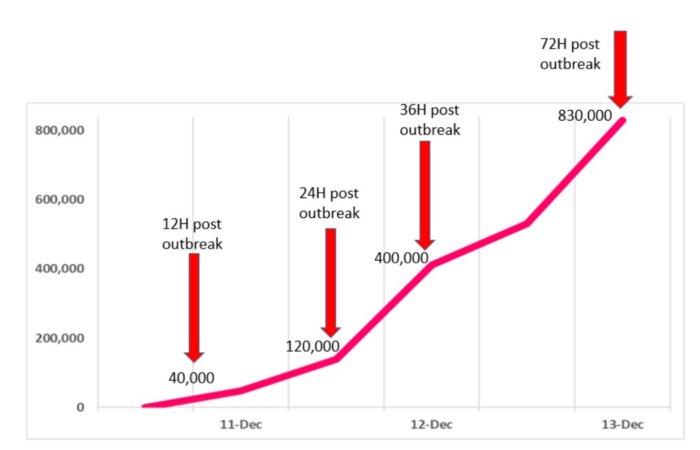
Since Friday, December 9th, when the vulnerability was reported, actors around the world are on the lookout for exploits. The number of combinations of how to exploit it give the attacker many alternatives to bypass newly introduced protections. It means that one layer of protection is not enough, and only multi-layered security posture would provide a resilient protection. Three days after the outbreak, we are summing up what we see until now, which is clearly a cyber pandemic that hasn’t seen its peak yet.

Diving into the numbers behind the attack, gathered and analyzed by Check Point Research, we see a pandemic-like spread since the outbreak on Friday, by the beginning of the week, on Monday.
Early reports on December 10th showed merely thousands of attack attempts, rising to over 40,000 during Saturday, December 11th. Twenty-four hours after the initial outbreak our sensors recorded almost 200,000 attempts of attack across the globe, leveraging this vulnerability. As of the time these lines are written, 72 hours post initial outbreak, the number hit over 800,000 attacks.

It is clearly one of the most serious vulnerabilities on the internet in recent years, and the potential for damage is incalculable… We have so far seen an attempted exploit on almost 44% of corporate networks globally.

«

The number of variants puts the coronavirus to shame – 45 different ones within 72 hours of the word getting out. Who says humans can’t beat viruses?
unique link to this extract


Bank of England warns on crypto-currency risks • BBC News

»

Although not much of UK households’ wealth is currently held in assets such as Bitcoin, they are becoming more mainstream, said deputy Bank governor Sir Jon Cunliffe.
If their value fell sharply, it could have a knock-on effect, he said. The Bank needed to be ready to contain those risks, he added.

Speaking to the BBC’s Today programme, Sir Jon said that at present, about 0.1% of UK households’ wealth was in crypto-currencies. About 2.3 million people were estimated to hold them, with an average amount per person of about £300.

However, he stressed that crypto-currencies had been “growing very fast”, with people such as fund managers wanting to know whether they should hold part of their portfolios in crypto-currencies.

“Their price can vary quite considerably and they could theoretically or practically drop to zero,” he said. “The point, I think, at which one worries is when it becomes integrated into the financial system, when a big price correction could really affect other markets and affect established financial market players. It’s not there yet, but it takes time to design standards and regulations.”

He added: “We really need to roll our sleeves up and get on with it, so that by the time this becomes a much bigger issue, we’ve actually got the regulatory framework to contain the risks.”

«

0.1%, 2.3 million, £300 (=£690m, or $910m). Numbers to remember.
unique link to this extract


Web3 is going just great

Molly White:

»

…and is definitely not an enormous grift that’s pouring lighter fluid on our already-smoldering planet.

«

A fabulous (in that context) timeline of things. Dead people’s accounts being used to push NFTs, huge hacks, oh my.
unique link to this extract


UK taxpayer to foot bill for Post Office staff wrongly convicted of theft • The Guardian

Zoe Wood:

»

The government has agreed that the taxpayer will foot the substantial compensation bill for former Post Office workers who were wrongly convicted of theft due to the defective Horizon IT system.

The Post Office has said it cannot afford the multimillion-pound cleanup bill for the scandal and on Tuesday the government, which is the service’s only shareholder, confirmed its intention to step in.

So far, 72 post office operators’ convictions have been quashed. Several other cases are in train, and there are potentially hundreds more operators whose convictions relied on Horizon evidence who may seek to clear their names.

In a written ministerial statement, the postal affairs minister, Paul Scully, said he wanted those with quashed convictions to be compensated “fairly and swiftly”.

The vast majority of these people had received interim payments of up to £100,000 while they waited for the next step, Scully said. The government was now making cash available so final compensation awards could be made, he said.

“We are working with the Post Office to finalise the arrangements that will enable the final settlement negotiations to begin as soon as possible,” he said. The money would enable the Post Office to deliver the “fair compensation postmasters deserve”.

Between 2000 and 2014, the Post Office prosecuted 736 post office operators based on information from a recently installed computer system called Horizon.

«

“Cannot afford”. In 2020 the Post Office had revenues of £951m and a trading profit of £86m. It incurred legal costs of £20m, plus £58m in payouts. It’s made provisions of £153m. It’s got £443m of cash and equivalents on hand.

Perhaps it’s reasonable to say that the Horizon scandal happened when the Post Office was government-owned, so the government should bear the cost. But it feels a little like privatising the profit, socialising the losses.
unique link to this extract


How to use the iPhone’s new App Privacy Report • The Verge

Barbara Krasnoff:

»

Information is power, and if you’re an iPhone user, you can now get more information about how often your apps access your data (for example, your location or your microphone). The App Privacy Report, which became available with iOS 15.2, also lets you know each app’s web activity and what domains they attach to.

The feature is off by default, but if your phone has updated to iOS 15.2, it’s very simple to turn on:

• Go to Settings > Privacy > App Privacy Report (which will be at the bottom of the screen)
•Select “Turn On App Privacy Report”
• Select App Privacy Report at the bottom of the Privacy screen.
• and wait.

After that, you can follow the same series of selections to see your report. (You can also use a Shortcut for quicker access right from your home screen or a Siri voice command.)

You won’t immediately see any data — it takes time for your phone to collect the data and assemble the report, but you can start to see results in just a few minutes.

«

Tells you which apps accessed your data over the past seven days; app network activity (which domains they contacted); most-contacted domains.
unique link to this extract


Instagram surpasses two billion monthly users • CNBC

Salvador Rodriguez:

»

Whether pressure from [Democrat senator Richard] Blumenthal and others in Washington forces any changes at Instagram is a looming issue, because Facebook relies on the app’s user growth.

The main Facebook app had 2.91 billion monthly active users as of October, and expansion is slowing compared to Instagram. In the time Instagram’s user base has doubled, Facebook’s has grown by just 30%. Revenue at the Facebook app is forecast to increase 18% next year to $135.1bn, according to eMarketer, while Instagram’s growth is expected to top 30% to $60.5bn.

For Meta to finance its bold and costly ambitions to move the company to the so-called metaverse — a world of virtual and augmented reality experiences — it needs Instagram to keep growing and throwing off hefty profits.

“I still see it as a very important part of the company,” Heger said. “If you look in the next five years, Instagram revenue is growing faster than the revenue from the core platform.”

«

Again, this is the problem with the “break them up” narrative. Instagram would be Instagram, an absolute behemoth, even if it weren’t owned by Facebook. You have to limit the size.
unique link to this extract


There’s plenty more in Social Warming, my latest book. (Here’s a nice comment about it that I came across.)


Ofgem chief: we need to go much further in regulating energy suppliers • Financial Times

Jonathan Brearley is the chief executive of Ofgem, the British energy regulator:

»

Increased competition in energy supply, as recommended by the Competition and Markets Authority in 2016, opened up the market, but the regulations were not ready to weather a global shock on this scale. It is clear that any regulatory regime needs to be allowed to effectively manage market shocks — and Ofgem’s price cap has not always been sufficiently flexible. Having seen this latest crisis play out, I want these lessons to be applied in real time, to build the market we need for the future in a systematic way that understands all these complex drivers.

Put simply, we need an urgent step change to bring in the rules and regulations needed to create a stronger, more innovative and resilient energy market, fit for the future so we can change the way we run energy businesses for good.

As the regulator, I want to support suppliers to manage risks, and to stamp out bad practice when we see it.

Every time I speak to energy consumers I hear that this is a worrying time, and that action is required. At Ofgem, our core purpose is to protect consumers by making sure the market works in their interests.

And Ofgem’s safety net has worked. I am proud that we have protected 4m customers, that no customer has been left without an energy supplier, and that credit balances have been preserved.

We’ve given consumers certainty and control over their bills and made millions available to vulnerable bill-payers. But just as the price cap has protected them from month-to-month price volatility, we need to lessen the cost to consumers of companies failing, by making the market more resilient.

«

Basically, realising that the regulatory structure isn’t up to the challenge of a world where gas prices can quintuple in a year but you have tiny suppliers who have made longer-term promises to consumers.
unique link to this extract


Errata, corrigenda and ai no corrida: none notified

Start Up No.1701: Ressa blasts tech titans, Bukele rolls again on bitcoin, the Dunning-Kruger military AI, and more


Would it help people to visualise climate change as an asteroid heading for Earth? A new film thinks so. CC-licensed photo by Kevin Gill on Flickr.

You can sign up to receive each day’s Start Up post by email. You’ll need to click a confirmation link, so no spam.

A selection of 9 links for you. Increasing rapidly. I’m @charlesarthur on Twitter. Observations and links welcome.


Ressa blasts US tech titans for ‘virus of lies’ in Nobel Prize speech • Nikkei Asia

Cliff Venzon:

»

Filipino journalist Maria Ressa called out US social media companies that have “allowed a virus of lies” to spread in her Nobel Peace Prize speech Friday, sending a warning about misinformation threatening “election integrity.”

Technology, with its “godlike power” has “allowed a virus of lies to infect each of us, pitting us against each other, bringing out our fears, anger and hate, and setting the stage for the rise of authoritarians and dictators around the world,” Ressa said.

Ressa, who heads the news site Rappler, delivered her speech after receiving the award in Oslo. She shares the prize with Russian journalist Dmitry Muratov.

The two journalists won the award for their efforts to safeguard freedom of expression at a time when free, independent and fact-based journalism is under fire, the Norwegian Nobel Committee said when announcing the prize in October.

“Our greatest need today is to transform that hate and violence, the toxic sludge that’s coursing through our information ecosystem, prioritized by American internet companies that make more money by spreading that hate and triggering the worst in us,” Ressa added.

«

You can read her whole speech. Of course, it’s at Rappler.
unique link to this extract


Her Instagram handle was ‘Metaverse.’ Last month, it vanished • The New York Times

Maddison Connaughton:

»

In October, Thea-Mai Baumann, an Australian artist and technologist, found herself sitting on prime internet real estate.

In 2012, she had started an Instagram account with the handle @metaverse, a name she used in her creative work. On the account, she documented her life in Brisbane, where she studied fine art, and her travels to Shanghai, where she built an augmented reality company called Metaverse Makeovers.

She had fewer than 1,000 followers when Facebook, the parent company of Instagram, announced on Oct. 28 that it was changing its name. Henceforth, Facebook would be known as Meta, a reflection of its focus on the metaverse, a virtual world it sees as the future of the internet.

In the days before, as word leaked out, Ms. Baumann began receiving messages from strangers offering to buy her Instagram handle. “You are now a millionaire,” one person wrote on her account. Another warned: “fb isn’t gonna buy it, they’re gonna take it.”

On Nov. 2, exactly that happened. Early that morning, when she tried to log in to Instagram, she found that the account had been disabled. A message on the screen read: “Your account has been blocked for pretending to be someone else.”

Whom, she wondered, was she now supposedly impersonating after nine years? She tried to verify her identity with Instagram, but weeks passed with no response, she said. She talked to an intellectual property lawyer but could afford only a review of Instagram’s terms of service.

“This account is a decade of my life and work. I didn’t want my contribution to the metaverse to be wiped from the internet,” she said. “That happens to women in tech, to women of color in tech, all the time,” added Ms. Baumann, who has Vietnamese heritage.

«

How surprising, isn’t it.
unique link to this extract


The moral bankruptcy of Facebook • The New Yorker

Andrew Marantz:

»

In her review of “An Ugly Truth” [a book about Facebook], my colleague Jill Lepore compared Facebook to a church. In any kind of church—not to mention a multilevel-marketing scheme, or a doomsday cult—there are true believers. If you start to get the creeping feeling that your church’s core ideology is indefensible, you have two options. You can do whatever it takes to defend the indefensible, or you can leave. For most true believers, though, the latter option—choosing apostasy, which is a kind of self-exile—is not really an option at all. If this is the dilemma that binds a follower, how much more strongly does it bind the church’s founding pastor, or its prophet?

For years, people have tried to appeal to Mark Zuckerberg’s better judgment, but he was never going to become an apostate. Facebook isn’t just his job; it’s his identity. It’s standard, at moments like this, to quote Upton Sinclair: “It is difficult to get a man to understand something, when his salary depends upon his not understanding it.” This is a perceptive line, but William Jennings Bryan, forty years prior, put it even more aptly: “It is useless to argue with a man whose opinion is based upon a personal or pecuniary interest; the only way to deal with him is to outvote him.” Sinclair was a muckraker; Bryan was a populist. Journalism can diagnose Facebook’s many flaws, but journalism alone can’t fix them. There are no silver-bullet solutions to the civilizational threats posed by the social-media behemoths. At least, if there are, I don’t claim to know them. But I do know what Bryan would have done, for a start: break ’em up.

«

The question is, how do you “break ’em up”? Into what bits? Facebook on its own is supremely toxic, which is the point repeatedly made. Instagram on its own is toxic. WhatsApp contributes on its own to widespread disinformation and misinformation problems, especially in India and Brazil. Splitting Meta into its constituent parts isn’t enough.
unique link to this extract


There’s a lot more in Social Warming, my latest book, which has suggestions on exactly how you do achieve the aim of “break ’em up”.


Salvadoran President Bukele’s latest bitcoin venture is another distraction • Foreign Policy

David Gerard:

»

At the Latin American Bitcoin and Blockchain Conference on Nov. 20, Bukele came onstage to an animation of beaming down from a flying saucer and outlined his plans for Bitcoin City: a new charter city to be built from scratch, centered on bitcoin mining—and powered by a volcano.

Bitcoin City would be paid for with the issuance of $1bn in “volcano bonds,” starting in mid-2022. The 10-year volcano bonds would pay 6.5% annual interest; $500m of the bond revenue would be used to buy bitcoins. The bitcoins would be locked up for five years, then sold to recover the $500m purchase price; any profit on the sale would be paid out as an additional dividend. Holding $100,000 in volcano bonds for five years would qualify investors for Salvadoran citizenship.

US Bitcoin services company Blockstream first proposed the volcano bonds to Bukele in July. The bonds will be issued as tokenized securities on Blockstream’s proprietary Liquid blockchain. Samson Mow of Blockstream assured Bloomberg that all the numbers would work out, under Mow’s rosy assumption that the price of one Bitcoin would hit $1m within five years.

Holders of El Salvador’s existing sovereign debt were unimpressed. The volcano bonds would be a strictly worse investment than buying the country’s existing bonds and hedging them with bitcoins. The existing bonds dropped from 75 cents on the dollar to a record low of 63.4 cents after the volcano bond announcement.

…The trouble is that mining bitcoins in El Salvador makes no economic sense. Bitcoin mining is a process of competitively wasting electricity to guess a winning number every 10 minutes or so. Your business input is electricity; so miners are in direct competition with every other miner in the world, and go wherever reliable electricity is cheapest and the government is willing to turn a blind eye to the whole enterprise—a pressing issue since China kicked cryptocurrency miners out in May.

The world’s average price for bitcoin mining is around five cents per kilowatt-hour; but industrial rates in El Salvador are 13 to 15 cents per kilowatt-hour. In one four-day period, the Berlín operation mined $269 of Bitcoin—and was estimated to have spent at least $4,672 worth of electricity doing so.

«

Very hard to find useful updates on what’s happening here, but at a macro level it doesn’t seem good.
unique link to this extract


This Air Force targeting AI thought it had a 90% success rate. It was more like 25% • Defense One

Patrick Tucker:

»

If the Pentagon is going to rely on algorithms and artificial intelligence, it’s got to solve the problem of “brittle AI.” A top Air Force official recently illustrated just how far there is to go.

In a recent test, an experimental target recognition program performed well when all of the conditions were perfect, but a subtle tweak sent its performance into a dramatic nosedive, 

Maj. Gen. Daniel Simpson, assistant deputy chief of staff for intelligence, surveillance, and reconnaissance, said on Monday.

Initially, the AI was fed data from a sensor that looked for a single surface-to-surface missile at an oblique angle, Simpson said. Then it was fed data from another sensor that looked for multiple missiles at a near-vertical angle.

“What a surprise: the algorithm did not perform well. It actually was accurate maybe about 25% of the time,” he said.

That’s an example of what’s sometimes called brittle AI, which “occurs when any algorithm cannot generalize or adapt to conditions outside a narrow set of assumptions,” according to a 2020 report by researcher and former Navy aviator Missy Cummings. When the data used to train the algorithm consists of too much of one type of image or sensor data from a unique vantage point, and not enough from other vantages, distances, or conditions, you get brittleness, Cummings said.

…But Simpson said the low accuracy rate of the algorithm wasn’t the most worrying part of the exercise. While the algorithm was only right 25% of the time, he said, “It was confident that it was right 90% of the time. So it was confidently wrong. And that’s not the algorithm’s fault. It’s because we fed it the wrong training data.”

«

The first part is familiar as the “tank problem” (which itself appears to be an urban legend, though its effects are probably real). The idea of an AI suffering Dunning-Kruger syndrome, though, is new to me.
unique link to this extract


How driverless cars will change our world – BBC Future

Jenny Cusack:

»

At the Mcity Test Facility at the University of Michigan, experts are addressing this. The world’s first purpose-built testing ground for autonomous vehicles, it’s a mini-town of sorts, made up of 16 acres of road and traffic infrastructure. It includes traffic signals and signs, underpasses, building facades, tree cover, home and garage exterior for testing delivery and ride-hailing, and different terrains such as road, pedestrian walkways, railway tracks, and road-markings which the vehicles must navigate. It’s here that experts test scenarios that even the most experienced of drivers may be pressed to handle, from children playing in the street to two cars trying to merge on a junction at the same time.

“In order to test driverless technology like this, it depends on hundreds of different variables in any given situation,” explains Necmiye Ozay, associate professor of electrical and computer engineering at the University of Michigan. Her solution is to create a group of varied thinkers.

“We’re trying to bring people from different parts of the university – not only engineers, but we have people from across disciplines such as psychology, more human-machine-interaction type people, because there are lots of angles to this problem we are trying to solve when it comes to safety,” says Ozay. In the facility, Ozay and her team can test different traffic scenarios, as well as explore how autonomous vehicles communicate with each other yet keep vehicle and personal data secure from hackers.

…One new space we can expect to see driverless technology deployed in is high-risk environments, from nuclear plants to military settings, to limit the dangers to human life, says Fowler. A Rio Tinto mine in Western Australia, for example, is currently operating the largest autonomous fleet in the world. The trucks are controlled by a centralised system miles away in Perth.

“If you can take people out of that and you can have vehicles that are driving themselves, and are fully automated even, if you’ve got somebody who’s remotely needing to control that vehicle in that high-risk environment then that’s got to be good,” says Fowler.

«

My test for an autonomous vehicle would be the streets of Cambridge (UK), where student cyclists bring new meaning to Brownian motion.
unique link to this extract


Gettr by the Pu$$y • The Bulwark

Tim Miller:

»

For starters, Gettr’s verification system is a mess because the platform hasn’t figured out how to resolve the tension between freedom of speech and the freedom to spoof. Which is to say, if you’re a Newsmax anchor, you can get a special red Verrit V, meaning that you are who you say you are. Other accounts are stuck with a black V that I could not determine the significance of. Still other accounts display a homemade checkmark.

And the pranksters got me! My very first brand follow—@SonicFastFood—was not a representative of America’s heritage of innovative and tasty drive-in cuisine, but rather a digital gathering space for furry porn. Of which there is a lot on Gettr.

Look, that’s not my bag of beans but no judgment. If MAGAs are into that sort of thing, that’s cool. But let me just say that during my first day on Gettr I didn’t come across a single substantive exchange of ideas—but I was exposed to a very great deal of Sonic the Hedgehog erotica. What a world.

…The most revealing part of the Gettr experience wasn’t what was on the platform—but what wasn’t.

Because it turns out that this cesspool would have been even worse if not for the fact that Jason Miller was doing exactly the same thing that Facebook and Twitter and all the other Big Bad Tech Oligarchs do: moderating his site’s content in order to provide a more usable product for his audience.

Complaints about this heavy-handed, neo-Puritan moderation were all over the platform.

«

Lest you think this is a left-wing site laughing at a right-wing social network, The Bulwark is unapologetically Reaganite in viewpoint. It’s just that Reagan now looks like Biden to the GOP faithful.
unique link to this extract


‘Don’t Look Up’ nails the media apocalypse • The New York Times

Ben Smith:

»

[Director of the Netflix film, Adam] McKay said he tried five different ideas that would allow him to make a movie about the climate crisis, but nothing worked. “How do you tell this story, the biggest story in 66 million years, without exaggeration, since the Chicxulub comet, bigger than the Black Plague, bigger than Krakatoa?” he said in an interview, describing the question that kept him up at night.

“How can we be looking at the greatest story in human history,” he continued, “but most nights I’m not hearing it talked about — or when it is being talked about, it’s in the fourth block, or the ninth story down?”

He hit on the solution while talking one night in January 2019 with [David] Sirota, who was venting about the news media’s passive reaction to climate change, saying it was as though a meteor was headed for earth and no one seemed to get it. Soon, the two were texting plot points back and forth.

“Don’t Look Up” is populated by politicians and Silicon Valley madmen denying reality for their own reasons, behaving in ways that are recognizably self-interested and deluded. But the real villain is a news media that is forever chasing after a distracted audience and, as a result, simply … cannot … focus.

When the two scientists emphasize the reality of the coming apocalypse during their appearance on “The Daily Rip,” the host played by Mr. Perry is singularly focused on one thing: whether the meteor will take out his ex-wife’s house in Florida. The other host, played by Cate Blanchett as a charming, hyper-educated, amoral stand-in for Mika Brzezinski, is more interested in the DiCaprio character’s nerdy sex appeal.

…In a twist right out of the movie itself, much of the publicity for “Don’t Look Up” has been focused on Hollywood gossip. Early in the rollout, Mr. McKay told Vanity Fair that he hadn’t spoken with his longtime partner Will Ferrell, the star of “Anchorman” and other McKay films, including “Step Brothers” and “Talladega Nights,” since he cast a different actor to play the lead in a planned HBO series about the Los Angeles Lakers.

Seeing a Hollywood spat push aside an earnest message on climate change was “almost hilariously ironic,” Mr. McKay said.

«

Only almost, though.
unique link to this extract


What makes boosters more effective than the first two Covid jabs? • The Guardian

Hannah Devlin:

»

Mutations in the virus mean its spike protein now looks quite different from that of the original Wuhan strain that all current vaccines were designed to target. That in turn means antibodies from previous infection and vaccination will be less efficient at intercepting Omicron. Because they stick to the virus less vigorously, a higher quantity of antibodies is also required to compensate for them being less well matched.

Studies show that a booster dose increases the levels of antibodies significantly above the level seen after two doses, which some hope means waning immunity will occur more slowly after a third dose, though insufficient time has passed to determine if this is the case.

Early studies also suggest that the quality of antibodies is higher following a booster. The immune system continues to refine exactly which antibodies are selected and amplified based on subsequent encounters with the virus or vaccine, and studies suggest there is a broader, more potent immune response following a third dose.

There is also reason for some optimism that vaccines may hold up better against severe disease than against infection. The immune system has a second line of defence in T cells, which attack cells already infected. These tend to stick around longer and they recognise parts of the virus that are more highly conserved, meaning Omicron’s mutations are less likely to throw them off the scent. So if antibodies are not good enough to stave off infection, T-cells can swoop in to bring the disease under control before it makes a person seriously unwell.

«

unique link to this extract


Errata, corrigenda and ai no corrida: none notified

Start Up No.1700: Apache’s RCE flaws, the YouTuber detective, Twitter Spaces problems, chronological Instagram?, and more


The Selina Meyer character in HBO’s Veep efficiently satirised American politicians – but now they’re not the people with power nowadays. CC-licensed photo by Jeffrey Zeldman on Flickr.

You can sign up to receive each day’s Start Up post by email. You’ll need to click a confirmation link, so no spam.

A selection of 10 links for you. Seventeen hundred! There’ll be a test. I’m @charlesarthur on Twitter. Observations and links welcome.


Extremely critical Log4J vulnerability leaves much of the internet at risk • The Hacker News

Ravie Laksmanan:

»

Log4j is used as a logging package in a variety of different popular software by a number of manufacturers, including Amazon, Apple iCloud, Cisco, Cloudflare, ElasticSearch, Red Hat, Steam, Tesla, Twitter, and video games such as Minecraft. In the case of the latter, attackers have been able to gain RCE on Minecraft Servers by simply pasting a specially crafted message into the chat box.

“The Apache Log4j zero-day vulnerability is probably the most critical vulnerability we have seen this year,” said Bharat Jogi, senior manager of vulnerabilities and signatures at Qualys. “Log4j is a ubiquitous library used by millions of Java applications for logging error messages. This vulnerability is trivial to exploit.”

Cybersecurity firms BitDefender, Cisco Talos, Huntress Labs, and Sonatype have all confirmed evidence of mass scanning of affected applications in the wild for vulnerable servers and attacks registered against their honeypot networks following the availability of a proof-of-concept (PoC) exploit. “This is a low skilled attack that is extremely simple to execute,” Sonatype’s Ilkka Turunen said.

GreyNoise, likening the flaw to Shellshock, said it observed malicious activity targeting the vulnerability commencing on December 9, 2021. Web infrastructure company Cloudflare noted that it blocked roughly 20,000 exploit requests per minute around 1800 UTC on Friday, with most of the exploitation attempts originating from Canada, the US, Netherlands, France, and the UK.

«

Pretty comprehensive list of big user companies. RCE – remote code execution – is the worst of the worst. This has been concerning security people up and down the internet, though of course it won’t percolate up to the rest of the world until something really dramatic happens. And it’s unlikely this will be used to do something dramatic; more likely, to extract information or to access a system and lurk in there.
unique link to this extract


Why satire gave up on politics • UnHerd

Dorian Lynskey:

»

Next to most politicians, the likes of Jeff Bezos and Elon Musk are fascinatingly weird characters with literally cosmic ambitions. Mark Zuckerberg, in his public appearances, comes off as less a human being than a beta-version AI — a flesh-and-blood demonstration of the uncanny valley. This is good material. Take Christopher Evan Welch in Silicon Valley, whose character Peter Gregory always looked as if he were on the verge of teleporting back to his home planet, Oscar Isaac’s malfunctioning hipster hermit in Ex Machina, or Nick Offerman’s glumly deranged schlub-genius in Devs. Succession’s Lukas Mattson combines a killer instinct with airport-bookstore self-help mantras and the distinct impression that he could tank [his Scandinavian content streaming service] GoJo’s share price with a single ill-judged tweet composed while tripping at Burning Man.

But tech gurus aren’t just a fun new toy for writers to play with. Satire follows power, and power is not where it was. In Western democracies there is a general sense that politicians are hamstrung and hopeless while tech companies are busy changing the way we communicate, think and act. After a mob stormed the Capitol on January 6, for example, social media companies did far more to dampen Trump’s efforts to overturn the election than Congress did.

Iannucci told me that his final episode of Veep, which ended with a deadlocked electoral college, “seemed to me to sum up where American politics is”, which is to say paralysed. While Joe Biden’s ambitious legislative agenda depends on the vanity of Joe Manchin and Kyrsten Sinema, Jeff Bezos is flying into space and earning $143,000 a minute. Which man is the more fertile source of both comedy and outrage? In Succession, Logan Roy has the power to bring down one president and handpick another, yet even he is at the mercy of Lukas Mattson’s whims.

«

This is a really good point. (Yes, Succession is satire.) Silicon Valley was fine satire, and the episode of Veep where Selina Meyer goes to Silicon Valley and is unblinkingly told by one company that “we think of ourselves as post-tax” is one of the best in the whole series.

We also use satire to tear down that which we think has been placed wrongly above us. So there’s that.
unique link to this extract


Businessweek 2021 Jealousy List • Bloomberg

The Bloomberg editors and staff:

»

At Bloomberg Businessweek, we read—a lot. We also listen to podcasts and watch a ton of stuff (often with borrowed passwords). Sometimes we read, watch, or listen to something that we wish we had published. To recognize a job well done, the magazine’s staff and many of our contributors in the Bloomberg newsroom have compiled our annual yearend Jealousy List. Congratulations to those on this year’s list, we hate/love you.

«

I mean, strictly it should be called the Envy List, shouldn’t it. No matter; plenty of fun content in there, too variable to classify.
unique link to this extract


Scuba-diving YouTuber finds car linked to teens missing since 2000 • The New York Times

Amanda Holpuch:

»

A YouTuber who uses underwater sonar equipment to investigate missing persons cases found a car belonging to two Tennessee teenagers who have been missing for 21 years, potentially bringing an end to the cold case.

It is at least the fourth time since late October that people who investigate cold cases on YouTube have dived and found a submerged vehicle belonging to a missing person.

The teenagers, Erin Foster and Jeremy Bechtel, both of Sparta, Tenn., were last seen on April 3, 2000, leaving Erin’s home in her 1988 Pontiac Grand Am.

Late last month, Jeremy Sides, 42, who runs the YouTube account Exploring With Nug, searched nearby lakes for a few days before turning his attention to Calfkiller River. Shortly before nightfall on Nov. 30, his sonar device showed that his boat was floating above a car-shaped object. He spent the night in his van, then dived to identify the car’s make and license plate number first thing the next morning. It was a match for Erin’s missing Pontiac.

Mr. Sides documented the discovery in a 20-minute YouTube video that includes his phone call to Steve Page, the sheriff of White County, to report the findings. In the video, the sheriff meets Mr. Sides at the site and expresses his thanks: “You just became White County’s hero.”

In a brief telephone interview, the sheriff said that divers recovered human remains on Thursday but that they had not been positively identified. “We do believe it’s them,” Sheriff Page said on Friday. “We found articles that came out of the car and was in the water that leads us to believe it’s them.”

«

Obviously, having a YouTube channel is the financial incentive for his activities. I wonder if it’s encouraging or the opposite that individuals are making more impact in cold cases than the police, who should have so many more resources (such as access to bank accounts and phone records) at their disposal.

Then you consider that in the UK a serial killer was only caught by the efforts of the relatives of his victims, which makes you wonder more deeply about the efficacy of the police.
unique link to this extract


How a bug in Android and Microsoft Teams could have caused this user’s 911 call to fail • Medium

Mishaal Rahman goes into some detail (with a fair amount of digging into Android) to figure out this bug, mentioned last week:

»

I do not use Microsoft Teams that often, but from what I’ve read online, there have been problems where it frequently logs the user out. I have also read reports that enterprises can set a policy to log the user out from time to time for security reasons.

After inspecting a decompiled version of the Microsoft Teams application, we were able to determine why a new PhoneAccount instance appears every time the app restarts. We found that when the user is not signed in, a new, randomly generated UUID is used to create the PhoneAccount instance that gets added to Android’s TelecomManager. This means that every time the Teams app restarts or crashes, a new UUID is generated for users that are not logged in, and thus a new PhoneAccount is added to Android’s TelecomManager. Because Teams has a boot broadcast receiver, this also happens every time the phone is rebooted.

«

For complicated reasons (which are explained, but it’s not short), having too many “PhoneAccount” IDs can cause emergency calls to fail. There is a little open source app for Android users which will detect if there are too many PhoneAccounts registered on a phone.
unique link to this extract


Social media makes us know too much about each other • The New York Times

Michelle Goldberg:

»

As [Duke University professor of sociology Christopher] Bail writes in his recent book, “Breaking the Social Media Prism,” [his team] recruited 1,220 Twitter users who identified as either Democrats or Republicans, offering to pay them $11 to follow a particular Twitter account for a month. Though the participants didn’t know it, the Democrats were assigned to follow a bot account that retweeted messages from prominent Republican politicians and thinkers. The Republicans, in turn, followed a bot account that retweeted Democrats.

At the time, a lot of concern about the internet’s role in political polarization centered around what the digital activist Eli Pariser once called filter bubbles, a term for the way an increasingly personalized internet traps people in self-reinforcing information silos. “The echo chamber idea was reaching its kind of apex in terms of its public influence,” Bail told me. “It nicely explained how Trump had won, how Brexit had happened.” Bail’s team wanted to see if getting people to engage with ideas they wouldn’t otherwise encounter might moderate their views.

The opposite happened. “Nobody became more moderate,” said Bail. “Republicans in particular became much more conservative when they followed the Democratic bot, and Democrats became a little bit more liberal.”

Social media platforms have long justified themselves with the idea that connecting people would make the world more open and humane. In offline life, after all, meeting lots of different kinds of people tends to broaden the mind, turning caricatures into complicated individuals. It’s understandable that many once believed the same would be true on the internet.

But it turns out there’s nothing intrinsically good about connection, especially online. On the internet, exposure to people unlike us often makes us hate them, and that hatred increasingly structures our politics. The social corrosion caused by Facebook and other platforms isn’t a side effect of bad management and design decisions. It’s baked into social media itself.

«

No. It’s baked into humans. We identify our tribe, and we reject (weakly or strongly) those not in our tribe. We can rub along with large numbers of people in daily life as long as we don’t know too much about their deepest political, social, or other views. Once we’re exposed to that a lot – hello, social media! – we get that tribal itch to either welcome them or reject them. That’s what gives you social warming. (I guess the interesting question next would be to identify at what age those tribal delineations are moulded. Feel free to email/comment/tweet, social scientists.)
unique link to this extract


Twitter Spaces is being used by the Taliban and white nationalists • The Washington Post

Elizabeth Dwoskin, Will Oremus, Craig Timberg and Nitasha Tiku:

»

Earlier this year, as Twitter raced to roll out Spaces, its new live audio chat feature, some employees asked how the company planned to make sure the service didn’t become a platform for hate speech, bullying and calls to violence.

In fact, there was no plan. In a presentation to colleagues shortly before its public launch in May, a top Twitter executive, Kayvon Beykpour, acknowledged that people were likely to break Twitter’s rules in the audio chats, according to an attendee who spoke on the condition of anonymity to describe internal matters. But he and other Twitter executives — convinced that Spaces would help revive the sluggish company — refused to slow down.

Fast forward six months and those problems have become reality. Taliban supporters, white nationalists, and anti-vaccine activists sowing coronavirus misinformation have hosted live audio broadcasts on Spaces that hundreds of people have tuned in to, according to researchers, users and screenshots viewed by The Washington Post. Other Spaces conversations have disparaged transgender people and Black Americans. These chats are neither policed nor moderated by Twitter, the company acknowledges, because it does not have human moderators or technology that can scan audio in real-time.

«

The fear of Clubhouse’s growth obviously drove this, but I wonder whether now that that threat is fast receding they’ll get on top of it. There’s a suggestion in the story of internal demands for big big BIG listener numbers, but quantity is never the answer online.
unique link to this extract


Still a few days to order Social Warming, my latest book, which explains how tribalism and outrage turns social networks sour – and how that affects people even in places where social network penetration is low.


How cryptocurrency revolutionized the white supremacist movement • Southern Poverty Law Center

Michael Edison Hayden and Megan Squire:

»

Less than a quarter of Americans presently own some form of cryptocurrency as of May 2021. But those numbers increase substantially within fringe right-wing spaces, according to Hatewatch’s findings, approaching something much closer to universal adoption. Hatewatch struggled to find any prominent player in the global far right who hasn’t yet embraced cryptocurrency to at least some degree. The average age of a cryptocurrency investor is 38, but even senior citizens in the white supremacist movement, such as Jared Taylor of American Renaissance, 69, and Peter Brimelow of VDARE, 73, have moved tens of thousands of dollars of the asset in recent years.

Cryptocurrency, or a group of digital moneys maintained through decentralized systems, has grown into a billion-dollar industry. A growing swath of Americans embrace the technology. Nothing is inherently criminal or extreme about it, and most of its users have no connections to the extreme far right. (One of the authors of this essay owns cryptocurrency, as disclosed in an author’s note at the end.) However, the far right’s early embrace of cryptocurrency merits deeper analysis, due to the way they used it to expand their movement and to obscure funding sources. It is not uncommon for far-right extremists to seek to hide their dealings from the public. The relative secrecy blockchain technology offers has become a profitable, but still extraordinarily risky, gamble against traditional banking.

“There are a lot of Bitcoin whales from pretty early [on in its history],” futurist and computer scientist Jaron Lanier told the Lex Fridman podcast in September. (People use “whales” to describe those who hold large sums of cryptocurrency.) “And they’re huge, and if you ask, ‘Who are these people?’ there’s evidence that a lot of them are not the people you would want to support.”

…“Bitcoin started in right-wing libertarianism,” [cryptocurrency critic David] Gerard said in an email. “This is not at all the same as being a neo-Nazi subculture. That said, there’s a greater proportion of Nazis there than you’d expect just by chance, and the Bitcoin subculture really doesn’t bother kicking its Nazis out. … Bitcoiners will simultaneously deny they have Nazis (which they observably do), and also claim it’s an anti-bitcoin lie, and also claim it’s good that anyone can use Bitcoin.”

«

The far right seems to have embraced it early on, perhaps because it couldn’t be blocked like traditional banking. But it is visible in a way they might not like, to everyone’s benefit.
unique link to this extract


Instagram head answers questions about the future of the chronological feed • The Verge

Mitchell Clark:

»

In a Q&A on Friday, [Instagram CEO Adam Mosseri] said that the company is testing out two versions of the feature and that it’s “targeting early next year” as a release window.

One version of the chronological feed would let you “pick your favorites and they show up at the top in chronological order,” he said. The other would let you see the posts from everyone you’re following in chronological order, though he didn’t mention how recommended posts would be interspersed.

When a follow-up question asked Mosseri when the feature would show up, he said it wouldn’t be too long, and that Instagram is “already testing the favorites idea.” He said that “full chronological” mode would come shortly after.

«

Benedict Evans wrote back in 2013 that algorithmic feeds become necessary once you’ve go above a certain number of people you’re following:

»

When people get married, they are often quite sure that they will have a small, quiet wedding. None of these massive, extravagant parties with hundreds of people for us! We’ll just invite close family and friends. Then, you make a list of ‘close family and friends’… and realise why people have 100 or 200 people at a wedding. You know a lot more people than you think.

I was reminded of this recently by the fact that, according to Facebook, its average user is eligible to see at least 1,500 items per day in their newsfeed. Rather like the wedding with 200 people, this seems absurd. But then, it turns out, that over the course of a few years you do ‘friend’ 200 or 300 people. And if you’ve friended 300 people, and each of them post a couple of pictures, tap like on a few news stories or comment a couple of times, then, by the inexorable law of multiplication, yes, you will have something over a thousand new items in your feed every single day.

«

Even so, I think a lot of people will want Instagram Chrono.
unique link to this extract


This terrible book shows why the Covid-19 lab leak theory won’t die • The New Republic

Lindsay Beyerstein reviews “Viral” by Alina Chan and Matt Ridley (yes, that Matt Ridley):

»

When you raise concrete objections to one theory, lab leakers throw out a slightly different version. If Covid-19 couldn’t be made from RaTG13, what if it was made from some other virus like RaTG13? No social or geographic link to the Wuhan Institute? Well, maybe it was some other lab we don’t know about. No obvious signs of genetic modification? Suppose they used an invisible technique? None of these scenarios is prima facie impossible, and therefore, once raised, none can be dismissed out of hand. But none of them is supported by any evidence whatsoever. And if you don’t like those, they have others. They’re just asking questions, here.

The through line in all of these possible scenarios is that there is no through line. There’s no overarching coherent narrative about when or how this “lab leak” happened. And in making that clear, Viral also shows why the very weakness of the lab leak case is also its greatest strength: The great part about suspicions—from a conspiracy theorist’s perspective—is that they don’t have to gel into any coherent theory. You can just have a bad feeling that becomes someone else’s job to resolve for you.

This is why the lab leak theory will never die, no matter how much evidence virologists are patiently accumulating on the side of natural origin. It’s all about suspicion and innuendo. And when one supposedly suspicious event is unpacked, it’s usually a long and boring explanation nobody wants to hear. Meanwhile, the theorists have already found 10 more things that seem spooky to them. Conspiracy theories, we’re learning, are even harder to eradicate than infectious diseases.

«

Word.
unique link to this extract


Errata, corrigenda and ai no corrida: none notified

Start Up No.1699: inside Apple’s design labs, the ransomware front company, Paul Dacre spills Ofcom fix, Arm’s likely future, and more


A peculiar idea popular among some Gen Zers is that birds aren’t real. But is it a conspiracy theory, or something quite different? CC-licensed photo by Phil Fiddyment on Flickr.

You can sign up to receive each day’s Start Up post by email. You’ll need to click a confirmation link, so no spam.

A selection of 9 links for you. It’s not a work meeting, it’s a party. I’m @charlesarthur on Twitter. Observations and links welcome.


Inside Apple Park: first look at the design team shaping the future of tech • Wallpaper*

Jonathan Bell (and photos by Jason Schmidt):

»

For Apple Watch, the team had to design, build, and implement a physical notification system. How strong? How long? What felt natural? ‘We knew that the Watch was going to be the most intimate, the most personal product that we’ve ever made,’ says Hankey. ‘We also knew it needed to get your attention at some point.’ It was Duncan Kerr, a long-standing member of the Design Team, who suggested the idea of the ‘tap’. ‘It’s such a lovely simple thing, but we had no idea how to bring that to life,’ Hankey says. Through a series of clunky prototypes and the work of haptics expert Camille Moussette, the ‘tap’ was refined and perfected.

Industrial design is by its nature multidisciplinary, although individual expertise is obviously hugely valuable. There are team members who are as adept at coding as they are at three-dimensional design, but in general, the most useful quality – beyond skill and aptitude – is a sense of curiosity. ‘We have this tradition of making things for one another at Christmas,’ says Hankey. ‘It’s about that joy of making and joy of giving. It’s something that’s come from the culture of the team.’

An awareness of craft and construction is essential, for there is an acute responsibility that comes with shaping objects that will be made in the hundreds of millions. The economies of scale and the power of the brand give Apple a powerful platform from which to implement change.

Yet even something as superficially simple but environmentally beneficial as removing the plastic shrink-wrap from an iPhone box induces a paroxysm of self-examination within the team. How can the unboxing experience be maintained? Can it be made more accessible? The problem was mulled over, pulled apart and ultimately solved with an elegant paper tab mechanism. The change will save around 600 metric tonnes of plastic over the life of the product.

«

This is not an article where Evans Hankey and Alan Dye are taken to task over butterfly keyboards (neither word appears). Everything is wonderful and brilliant and keyboard designs that infuriated people and led some to delay purchases for years (🙋‍♂️) are just gentle bumps in the delightful road. And yet, there’s a lot of insight into what goes on. Plus the photos are amazing.
unique link to this extract


Face computers are coming. Now what? • The New York Times

Shira Ovide:

»

Apple has a reputation for making up-and-coming technology go mass market. We’ll see, but it’s clear that there will be a lot of activity and attention on face computers and immersive technologies in all forms. (Counterpoint: Some tech experts have predicted the rise of face computers for most of the past decade.)

What I want all of us to do — whether we don’t get the fuss over virtual reality, or love it — is to begin deliberating over where we want to focus the promise of this technology and limit the risks.

I’m mindful of what has gone wrong when we allowed technology to wash over us and tried to figure out the details later.

Partly through an unwillingness or inability to imagine what could go wrong with technology, we have websites and apps that track us everywhere we go, and that sell the information to the highest bidders. We have carmakers that sometimes protect us with clever tech that helps offset human frailties, and other times seem to exacerbate them. We have the best aspects of human interactions online, and the worst.

We should think about this stuff now, before we might all be wearing supercomputers on our faces.

What do we want from this technology? Can we imagine schools, offices or comedy clubs in virtual reality? What do we want from the next generation of immersive internet for our kids? Do we want to drive while our headgear flings tweets into our fields of vision? Do we even want to erase the gap between digital life and real life?

It might be misguided to establish norms and laws around technologies that might take many years to become big. But tech companies and technologists aren’t waiting. They’re molding their imagined future of the internet now. If we don’t engage, that puts the companies in the driver’s seat. And we’ve seen the downside of that.

«

A privacy law would be a good idea, as she has suggested elsewhere. When you consider Life360 essentially selling location data to any bidder at all, you have to think that the US has a big problem with privacy.
unique link to this extract


Birds Aren’t Real, or are they? Inside a Gen Z conspiracy theory • The New York Times

Taylor Lorenz:

»

It might smack of QAnon, the conspiracy theory that the world is controlled by an elite cabal of child-trafficking Democrats. Except that the creator of Birds Aren’t Real and the movement’s followers are in on a joke: they know that birds are, in fact, real and that their theory is made up.

What Birds Aren’t Real truly is, they say, is a parody social movement with a purpose. In a post-truth world dominated by online conspiracy theories, young people have coalesced around the effort to thumb their nose at, fight and poke fun at misinformation. It’s Gen Z’s attempt to upend the rabbit hole with absurdism.

“It’s a way to combat troubles in the world that you don’t really have other ways of combating,” said Claire Chronis, 22, a Birds Aren’t Real organizer in Pittsburgh. “My favorite way to describe the organization is fighting lunacy with lunacy.”

At the center of the movement is Peter McIndoe, 23, a floppy-haired college dropout in Memphis who created Birds Aren’t Real on a whim in 2017. For years, he stayed in character as the conspiracy theory’s chief believer, commanding acolytes to rage against those who challenged his dogma. But now, Mr. McIndoe said in an interview, he is ready to reveal the parody lest people think birds really are drones.

“Dealing in the world of misinformation for the past few years, we’ve been really conscious of the line we walk,” he said. “The idea is meant to be so preposterous, but we make sure nothing we’re saying is too realistic. That’s a consideration with coming out of character.”

Most Birds Aren’t Real members, many of whom are part of an on-the-ground activism network called the Bird Brigade, grew up in a world overrun with misinformation. Some have relatives who have fallen victim to conspiracy theories. So for members of Gen Z, the movement has become a way to collectively grapple with those experiences. By cosplaying conspiracy theorists, they have found community and kinship, Mr. McIndoe said.

«

I wonder, though. You think everyone is in on the joke, but things like this can be taken over from the inside by slightly madder people.
unique link to this extract


What will happen to Arm now? • Digits to Dollars

Jonathan Greenberg:

»

Surprising almost no one, the US Federal Trade Commission has moved to block Nvidia’s acquisition of Arm. We have written a lot about this deal and Arm in general, and wanted to touch on the topic in light of this news.

We will save the background on this deal for that prior piece, but a few things stand out. Arm is seen by regulators as being too important to not be neutral. No other chip company can buy the company, as no one wants to compete with this key supplier of semiconductor intellectual property (IP), and almost every major chip company is now an Arm licensee, one way or another. So what will happen to the company now?

…we have to think that Softbank would still like to exit. They almost made a pile of cash and having it snatched away is the kind of factor that spurs the brain to think of alternatives. The most likely outcome is an IPO of at least a minority stake of Arm. Prior to the Nvidia deal, Softbank seems to have gone far down this path. However, Softbank faced the problem that the public markets would have likely valued Arm less than what Softbank hoped (or possibly even what they paid for it) and far less than what Nvidia offered. The capital markets are in a different place today, and Arm is likely to attract a much higher valuation because semis are hot now in a way they have not been for a long time. One wrinkle for this plan is that an IPO will take some time to arrange. We would guess at least six months, possibly longer. No idea what the markets will look like then, and it leaves Arm in limbo when they should be doing all that R&D investment.

«

unique link to this extract


This small tech company SpiffyTech may actually be a ransomware front group • Daily Beast

Shannon Vavra:

»

It seems innocent enough: a little-known Canadian company that offers an array of tech and consulting services. But a certificate from that company—a sort of signature that can be tacked onto malware—showed up in two pieces of ransomware last month and leading experts told The Daily Beast they believe the small company is actually a front for at least two Russian ransomware gangs.

The company—cheerily named “SpiffyTech”—has a number of red flags. For one, if you want to look at SpiffyTech’s leadership team, you’re out of luck. They don’t exist.

The site does list four top staffers next to their stylish headshots. But the SpiffyTech operators appear to have stolen each and every photo.

A reverse image search on Google shows the headshots come from a professional photographer’s website. The photographer, Kirill Tigai, confirmed the photos in question were part of a shoot for a different company and said he did not give SpiffyTech permission to use them.

“I think… this website SpiffyTech is a fraud,” Tigai told The Daily Beast. “They just use photos that I made for my clients under different names.”

Another reason experts believe “SpiffyTech” is a front is far more technical.

Hackers frequently steal certificates from actual businesses in order to help their attacks fly under the radar and trick computers into thinking their malware is legitimate. And while it’s possible the hackers did the same here—or tricked a real company into sharing a legitimate “cert”—the shadiness of the site, and its apparent connection to ransomware, leads cybersecurity analysts to believe SpiffyTech is a disguise for something more sinister.

«

The real puzzle – which isn’t quite answered – is why a ransomware group would want to have a website, even a fake one, unless it’s for the certificate mentioned above. Which has now been revoked by the certification authority. The whack-a-mole goes on.
unique link to this extract


The Pandora Papers: how journalists mined terabytes of offshore data to expose the world’s elites • Computer Weekly

Bill Goodwin:

»

The data team [at the International Consortium of Investigative Journalists, ICIJ] turned to open source software to build a dedicated free-text search engine using Blacklight, a tool widely used by libraries for searching documents, and Apache Solr, an open source enterprise search tool.

Over time, the data team switched to another technology, Elasticsearch, which allowed faster searches.

“Elasticsearch is much more powerful – it has a huge open source community and has a lot of features that are very useful to these investigations,” said [ICIJ chief technology officer Pierre] Romera.

That project resulted in the creation of Datashare, which Romera describes as the most important tool used by ICIJ journalists during collaborations. It allows journalists to search vast archives of documents quickly and securely.

One of the most useful features of Datashare is its ability to perform bulk searches of data. Journalists can upload files containing, for example, lists of politicians, members of royalty or celebrities to find stories within the vast archives of data.

Datashare is also scalable, allowing Romera to add more servers to provide computing power needed to analyse bigger leaks and support larger teams.

During the Pandora Papers project, the ICIJ had the capability to deploy 15-20 servers. This made it possible for over 600 journalists to conduct key-word searches on the data – a step up from the 370-plus journalists who worked on the Panama Papers. “Because we are trying to find the highest number of stories in the documents, we really need to use this search engine intensively,” said Romera.

Datashare is designed to be simple and fast to use and is, said Romera, essentially a lightweight interface built on top of Elasticsearch. But it can also take software plug-ins and extensions. One of the most useful is a plug-in that extracts the names of people, organisations and place names automatically from the documents.

“Datashare is at the very centre of everything we do at ICIJ,” said Romera. “It is the most important tool we have.

«

There were working on 2.9 terabytes of unstructured data, a tiny bit in spreadsheets and most in PDFs. What a horrendous task – yet crucial to expose the corruption that goes on.
unique link to this extract


Pixel prevented me from calling 911 • GooglePixel forums on Reddit

A Pixel user complained on Reddit:

»

I had to call an ambulance for the grandmother on Friday as she appeared to be having a stroke. I got off a phone call with my mom, and proceeded to dial 911 just by typing and calling on my pixel. My phone got stuck immediately after one ring and I was unable to do anything other than click through apps with an emergency phone call running in the background. This is all while the phone informed me that it had sent my location to emergency services. Sadly I couldn’t tell the person on the other end what apartment I was in, or what the actual emergency was as I was unable to speak to a human.

As my phone had clearly just been working from a phone call perspective, my best guess is the extra step of trying to send my location caused it to freeze. It then prevented me from hanging up and trying to call any phone number again.

«

Nine days later, Google came back with its answer:

»

Based on our investigation we have been able to reproduce the issue under a limited set of circumstances. We believe the issue is only present on a small number of devices with the Microsoft Teams app installed when the user is not logged in, and we are currently only aware of one user report related to the occurrence of this bug. We determined that the issue was being caused by unintended interaction between the Microsoft Teams app and the underlying Android operating system.

Because this issue impacts emergency calling, both Google and Microsoft are heavily prioritizing the issue, and we expect a Microsoft Teams app update to be rolled out soon – as always we suggest users keep an eye out for app updates to ensure they are running the latest version. We will also be providing an Android platform update to the Android ecosystem on January 4.

Out of an abundance of caution, in the meantime, we suggest users with Microsoft Teams installed on any Android device running Android 10 and above take the following steps…

«

(Basically, sign in to Teams. The problem occurs when signed out.)
unique link to this extract


Nine months into trials at the UK Police, Tesla Model 3 bears great results: report • Tesla Oracle

Iqtidar Ali:

»

The United Kingdom Police have been running a Tesla Model 3 as a patrol car on trials for the last nine months. Max Toozs-Hobson, account manager and Emergency Services lead at Tesla, has shared the latest development update of this trial program via his LinkedIn profile.

According to Max Toozs, Tesla Model 3 has brought some great results to the table in the 9-month long testing trials as a police cruiser.

Tesla Model 3 was able to perform over 200 miles of Blue Light advanced driving on a single charge. While the average blue light runs in the UK are 7 – 15 minutes long; the customized Model 3 police cruiser for this program delivered the longest run of four hours on a single charge.

Blue light driving in an emergency response vehicle has its own set of requirements. It’s not like driving in normal conditions. Responsible driving is required while overtaking other traffic, performing high-speed manoeuvres, and keeping other road users’ safety in mind at the same time.

…Testing the Tesla Model 3 electric police cruiser is part of the UK government’s Road to Zero 2030 policy. This is an aggressive plan by the UK government to electrify almost all of the country’s transportation by 2030 and emergency response vehicles are a large part of this transition. The government of London announced back in 2019 that by 2025, the city alone will have 50,000 electric vehicle charge points.

«

The other point being that the acceleration (and top speed?) would outpace pretty much any other car on the road. However, plenty of gloomsayers in the comments on the LinkedIn update.
unique link to this extract


If I were in charge of Ofcom… • The Spectator

Paul Dacre is the former editor of the Daily Mail, the furiously right-wing tabloid. Earlier this year there were strong rumours the Tory government was trying to rig the appointment of the new chair of the communications regulator Ofcom so Dacre would get the job. Ministers denied this in multiple interviews. Over to you, Mr Dacre:

»

‘You can appoint your own chief executive,’ boomed the PM [prime minister] over a rather sad bottle of wine. He was asking if I would like to chair the media regulator Ofcom because, he declared, he was determined to do something to end the usual suspects’ control of our public bodies. It was soon apparent that I couldn’t appoint my own chief executive. Or take people with me. And as all the key positions at Ofcom are chosen by ‘independent’ panels, the chairman’s role is heavily circumscribed.

So why bother? The answer was I was fascinated by the societal implications of the Online Safety Bill that Ofcom will implement. If I could help prevent paedophiles, hate preachers and terrorists exploiting the internet, protect young vulnerable minds from emotional manipulation, eradicate the malicious trolling of individuals (often from minorities) that is poisoning private and public discourse, eliminate fake news and preserve freedom of speech, well, that sounded a pretty good swansong to a magical career in journalism.

After all, in 28 years as an editor, I’d spent much time with ministers, judges and regulators trying to define the thin line between protecting the innocent and damaging freedom of speech. I’d also chaired the Editors’ Code of Practice Committee which — by balancing the rights of the individual and the public’s right to know — writes the rules for best journalistic practice that are emulated around the world. And I’d made a significant contribution to launching the world’s biggest English-language popular newspaper website. The problem is that the Bill is a dog’s dinner. There aren’t enough lawyers in the cosmos to define ‘legal but harmful’ content. How do you stop Facebook’s algorithms deleting legitimate news stories? But the real problem is the insidious anonymity behind which the web’s malfeasants skulk — an issue that, despite the civil-rights implications, is going to have to be addressed.

«

I think Dacre would have been clueless about regulating internet content, as this braindump shows. A narrow miss, but a dangerous slide toward Trumpist appointment of incompetents.
unique link to this extract


Nothing about the blue site! But do buy Social Warming, my latest book, and find out how social networks affect society, politics and the media.


Errata, corrigenda and ai no corrida: didn’t see anything particularly interesting from the Mosseri testimony, but if you think different, drop me a link.

Start Up No.1698: metaverse marriage, Instagram’s mental health effects, Twitter’s true user base, Apple v Epic paused, and more


Is the “Great Resignation” a real thing across the economy, or is it concentrated in a few sectors? New data tells us the answer. CC-licensed photo by Stephen Edmonds on Flickr.

You can sign up to receive each day’s Start Up post by email. You’ll need to click a confirmation link, so no spam.

A selection of 10 links for you. Not from Outer Space. I’m @charlesarthur on Twitter. Observations and links welcome.


Getting married in the Metaverse • The New York Times

Steven Kurutz:

»

Traci and Dave Gagnon met in the cloud, so it only made sense that their wedding took place in it. On Labor Day weekend, the couple — or rather, their digital avatars — held a ceremony staged by Virbela, a company that builds virtual environments for work, learning and events.

Ms. Gagnon’s avatar was walked down the aisle by the avatar of her close friend. Mr. Gagnon’s avatar watched as his buddy’s avatar ambled up to the stage and delivered a toast. And 7-year-old twin avatars (the ring bearer and flower girl) danced at the reception.

How the immersive virtual world known as the metaverse, which few of us understand, will change the traditional wedding is, at the moment, anyone’s guess. But the possibilities of having an event unfettered by the bounds of reality are interesting enough to consider.

Because of the Covid-19 pandemic, technology is already being incorporated into ceremonies more than ever. Zoom weddings have taken place, and some in-person ceremonies now feature a livestream component for guests who cannot be there. Last year, a couple whose wedding was canceled because of the pandemic staged a (nonlegal) ceremony within Animal Crossing, a popular video game.
Like a ceremony within a video game, though, it is important to note that any weddings that occur solely in the metaverse are currently not legal. (Even virtual weddings by videoconference, which many states allowed during the height of the pandemic shutdowns, have since been outlawed in New York State and elsewhere.) Still, the metaverse will take these virtual celebrations much, much further, experts say, and offer almost boundless possibilities to couples.

«

This stuff goes through a predictable cycle: sex (or hookups), meetings, marriages. Here’s “virtual world, real emotions“, about Second Life in 2008. (Where affairs could also lead to divorces.) Plus there have been Zoom weddings.

And here we are at the early stage of the cycle with the Metaverse. Or metaverse. (Former for the proprietary one, latter for multiple ones.)
unique link to this extract


Facebook’s dangerous experiment on teen girls • The Atlantic

Jonathan Haidt is a professor at New York University:

»

Correlation does not prove causation, but nobody has yet found an alternative explanation for the massive, sudden, gendered, multinational deterioration of teen mental health during the period in question.

To be sure, there is evidence on the other side. Dozens of studies and several meta-analyses (studies of groups of studies) have examined the relationship between greater digital-media use and worse teen mental health, and most have found just small correlations, or none at all. The most widely cited of these studies, published in 2019, analyzed 355,000 teens across three large data sets from the U.S. and U.K. The authors found only a tiny correlation—no larger than the correlation of bad mental health with self-reports of “eating potatoes.” Facebook cites this research in its defense.

But here’s the problem with these studies: most lump all screen-based activities together (including those that are harmless, such as watching movies or texting with friends), and most lump boys and girls together. Such studies cannot be used to evaluate the more specific hypothesis that Instagram is harmful to girls. It’s like trying to prove that Saturn has rings when all you have is a dozen blurry photos of the entire night sky.

But as the resolution of the pictures increases, the rings appear. The subset of studies that allow researchers to isolate social media, and Instagram in particular, show a much stronger relationship with poor mental health. The same goes for those that zoom in on girls rather than all teens. Girls who use social media heavily are about two or three times more likely to say that they are depressed than girls who use it lightly or not at all. (For boys, the same is true, but the relationship is smaller.) Most of the experiments that randomly assign people to reduce or give up social media for a week or more show a mental-health benefit, indicating that social media is a cause, not just a correlate.

«

Haidt’s objection to the apparent lack of correlation (through lumping screen-based activities together) is the same one I had when I looked at this. The chapter I wrote about the effects of social media on children didn’t appear in Social Warming, but it carries much of the same thinking that Haidt outlines in this article.

(Instagram’s Adam Mosseri was testifying to Congress on Wednesday; we’ll see what came of it in the next issue.)
unique link to this extract


How TikTok reads your mind • The New York Times

Ben Smith:

»

The document explains frankly that in the pursuit of the company’s “ultimate goal” of adding daily active users, it has chosen to optimize for two closely related metrics in the stream of videos it serves: “retention” — that is, whether a user comes back — and “time spent.” The app wants to keep you there as long as possible. The experience is sometimes described as an addiction, though it also recalls a frequent criticism of pop culture. The playwright David Mamet, writing scornfully in 1998 about “pseudoart,” observed that “people are drawn to summer movies because they are not satisfying, and so they offer opportunities to repeat the compulsion.”

To analysts who believe algorithmic recommendations pose a social threat, the TikTok document confirms their suspicions.

“This system means that watch time is key. The algorithm tries to get people addicted rather than giving them what they really want,” said Guillaume Chaslot, the founder of Algo Transparency, a group based in Paris that has studied YouTube’s recommendation system and takes a dark view of the effect of the product on children, in particular. Mr. Chaslot reviewed the TikTok document at my request.

“I think it’s a crazy idea to let TikTok’s algorithm steer the life of our kids,” he said. “Each video a kid watches, TikTok gains a piece of information on him. In a few hours, the algorithm can detect his musical tastes, his physical attraction, if he’s depressed, if he might be into drugs, and many other sensitive information. There’s a high risk that some of this information will be used against him. It could potentially be used to micro-target him or make him more addicted to the platform.”

«

There’s a quote too from a professor of computer science who is puzzled by why people keep asking him about TikTok: “most of what I’ve seen seems pretty normal”, he says, and it’s true, at least in this description. What’s different is how rapaciously it pulls in data, and how furiously it segments users to show them specific videos to appeal to their very particular matrix of interests. *That’s* abnormal.
unique link to this extract


The behaviours and attitudes of US adults on Twitter • Pew Research Center

Colleen Mcclain, Regina Widjaya, Gonzalo Rivero and Aaron Smith:

»

The analysis also reveals another familiar pattern on social media: a relatively small share of highly active users produces the vast majority of content. An analysis of tweets by this representative sample of US adult Twitter users from June 12 to Sept. 12, 2021 finds that the most active 25% of US adults on Twitter by tweet volume produced 97% of all tweets from these users.

High-volume tweeters differ from less prolific tweeters in important ways. A majority visit the site daily, and roughly one-in-five say they do so too many times to count on a typical day. Their use of Twitter also carries a more overtly political valence: They are more likely than others to say the site has increased how politically engaged they feel in the past year. 

They also respond differently to the presence of certain negative interactions on the platform. High-volume tweeters are roughly twice as likely as others to say they have personally experienced harassing or abusive behavior on the platform (24%, vs. 11% of less active tweeters). But they are less likely to view the overall tone or civility of discussions on the site as a major problem (by a margin of 27% to 42%).

Among the other key findings of this research:
• Although they produce the vast majority of content, highly active tweeters produce relatively few original tweets and receive little engagement from the broader Twitter audience. From June 12 to Sept. 12, 2021, original posts comprised just 14% of tweets from the top quarter of US adults on Twitter by tweet volume. The vast majority of posts produced by this group were either retweets (49% of the total) or replies to other users (33%).

• Posts from this group also receive little engagement from other users in the form of likes or retweets. Despite producing 65 tweets of any type per month on average during the period under observation, US adults in the top 25% of users based on tweet volume received an average of just 37 likes and one retweet per month.

«

Network effects, Pareto’s law, the power law, whatever you want to call it: that’s how it is. The popular and noticed get more popular and noticed; the rest mostly don’t.
unique link to this extract


If you want to understand how social networks drag users in and keep them there, read Social Warming, my latest book, and find answers – and more. (The power law, and the explanation for why it occurs again and again online, also makes a number of appearances.)


Apple reaches quiet truce over iPhone privacy changes • Financial Times

Patrick McGee:

»

Apple has allowed app developers to collect data from its 1bn iPhone users for targeted advertising, in an unacknowledged shift that lets companies follow a much looser interpretation of its controversial privacy policy.

In May Apple communicated its privacy changes to the wider public, launching an advert that featured a harassed man whose daily activities were closely monitored by an ever-growing group of strangers. When his iPhone prompted him to “Ask App Not to Track”, he clicked it and they vanished. Apple’s message to potential customers was clear — if you choose an iPhone, you are choosing privacy.

But seven months later, companies including Snap and Facebook have been allowed to keep sharing user-level signals from iPhones, as long as that data is anonymised and aggregated rather than tied to specific user profiles.

For instance Snap has told investors that it plans to share data from its 306m users — including those who ask Snap “not to track” — so advertisers can gain “a more complete, real-time view” on how ad campaigns are working. Any personally identifiable data will first be obfuscated and aggregated.

Similarly, Facebook operations chief Sheryl Sandberg said the social media group was engaged in a “multiyear effort” to rebuild ad infrastructure “using more aggregate or anonymised data”.

«

Seems fair enough: Apple does that sort of obfuscated tracking for itself, so this is only reasonable.
unique link to this extract


Apple CEO Tim Cook reportedly signed a secret $275bn deal with China in 2016 to skirt challenges with government regulators • Business Insider via Yahoo

Sarah Jackson on the story first reported by The Information, which fills in some gaps that hadn’t been clear from previous reports in the NY Times and others:

»

Apple’s government affairs team in China created a memo of understanding with the country’s National Development and Reform Commission to sweeten relations with Chinese leaders, and company leaders made it a priority to meet with top Chinese officials after the 2016 crackdown hit iTunes books and movies, a person familiar with the deal told The Information.

The deal included commitments from Apple to help Chinese manufacturers build “the most advanced manufacturing technologies” and train workers. It also included vows to tap Chinese suppliers for more parts for Apple devices, strike deals with Chinese software companies, work with Chinese universities on technology, and invest “many billions of dollars more” than Apple was already pouring into China, according to The Information. Some investments were to go toward Chinese technology companies; other outlined beneficiaries included new retail stores, renewable energy projects, and research and development centers.

In line with China’s 13th Five-Year Plan, Apple further committed to “grow together with Chinese enterprises to achieve mutual benefits and a win-win situation,” help develop China’s IT industries, and promote science, technology, education, and environmental protection, according to The Information. In exchange, China agreed to offer “necessary support and assistance.”

Outside of the deal, Apple made other concessions with the Chinese government to keep business running. By early 2015, China’s State Bureau of Surveying and Mapping had directed Apple Maps to make the Diaoyu Islands, or Senkaku Islands, which China and Japan both claim to own, look big even when zoomed out; regulators said they’d refuse to approve the Apple Watch if Apple didn’t comply, according to internal documents viewed by The Information.

«

Quite the leverage China has there. Apple doesn’t have anything much to fight it with; the best it can hope for is symbiosis.
unique link to this extract


Apple gets appeals court to delay App Store changes in Epic Games Fortnite case, for now • CNET

Ian Sherr:

»

Apple scored another win in its legal battles with Fortnite maker Epic Games when the US District Court of Appeals for the Ninth Circuit agreed Wednesday to delay a judge’s order to make changes to the way app developers accept payments in Apple’s App Store. Apple now has until its appeals process with Epic concludes, which could take years.

“Apple has demonstrated, at minimum, that its appeal raises serious questions,” two judges from the court of appeals wrote. 

The ruling follows a flurry of competing filings from Epic and Apple arguing about how much control the iPhone maker should have over its App Store. Epic unsuccessfully argued to a US District Judge in California that Apple should be forced to allow app developers more freedom, both in how they offer apps to iPhone and iPad owners and how they charge customers. 

If Apple hadn’t prevailed in its request, it would’ve been forced to allow people to pay a developer directly when seeking to pay for extra lives in a game or a new look for their character, rather than using Apple’s in-app purchase system. That service, which Apple has operated since 2008, charges developers up to a 30% commission on any digital items bought within apps.

«

“Could take years”. The revolution has been delayed, again.
unique link to this extract


Boris Johnson moves to Plan B to control Omicron spread • Financial Times

Sebastian Payne, George Parker, Laura Hughes and Oliver Barnes:

»

[Prime Minister Boris] Johnson added that following the media reports, he had been repeatedly told that there had been no Downing Street party and no Covid rules had been broken. He said any relevant evidence from Case’s inquiry would be handed over to the Metropolitan Police.

However, the inquiry will not examine reports of other Downing Street parties on November 13 and November 27, which would have also breached Covid restrictions on gatherings.

The Metropolitan Police on Wednesday announced it would not investigate the party allegations due to an “absence of evidence” and the force’s policy not to investigate retrospective breaches of coronavirus regulations.

The new restrictions and Johnson’s handling of the row over Christmas parties has tarnished his standing in the Conservative party. One minister described the situation as “completely appalling”, adding: “I feel really quite repulsed by it and cannot believe they allowed it to get this place.”

The minister added that MPs were increasingly discussing whether Johnson’s time in power could be drawing to a close. “In a way I haven’t heard before, colleagues I wouldn’t have expected are talking about what the end-game might be for the PM.”

«

In the UK, this is the hottest possible topic. There are now reports of at least four parties in 10 Downing St, at least one of which Johnson attended, while the rest of the country was in hefty lockdown. This is going to continue; more heads will roll.
unique link to this extract


Three myths of the Great Resignation • The Atlantic

Derek Thompson:

»

One problem with the term Great Resignation is that resignation sounds like a pure subtraction. If I told you, “My company suffered a great resignation last year,” you’d probably think that the company had lost a lot of workers. If I continued, “And the firm grew by 20 percent!” you might be very confused.

But that’s what’s happening in the broader economy. The increase in quits is mostly about low-wage workers switching to better jobs in industries that are raising wages to grab new employees as fast as possible. From the quitter’s perspective, that’s a job hop. The low-wage service-sector economy is experiencing the equivalent of “free agency” in a professional sports league. That makes it more like the Big Switch than the Big Quit.

Let’s zoom in on one sector: the accommodations and food-services industry. Mostly composed of restaurants and hotels, this sector has seen more quits than any other part of the economy. But it’s not bleeding jobs. Quite the opposite: Accommodation and food services added 2 million employees in 2021, more than any other subsector I could identify.

(2) …quits aren’t rising much in finance, real estate, or the broad information sector, which includes publishing, software, and internet companies. This year, quits for leisure and hospitality workers have increased four times faster than for the largest white-collar sector, which is professional and business services.

I’m not saying “Stop talking about burnout; it’s just for rich people.” I’m suggesting that we shouldn’t conflate white-collar burnout with whatever’s driving lower-wage service workers to hop around.

«

Seems the real “Great Resignation” comes from those aged over 65 finally checking out of the workforce, at least in the US.
unique link to this extract


Omicron weakens vaccine protection, but boosters revive defenses, early data finds • Ars Technica

Beth Mole:

»

The freshest data comes from preliminary results reported online Wednesday morning by Pfizer and BioNTech.

The companies conducted laboratory experiments that pitted antibodies from the blood serum of vaccinated people against a pseudovirus engineered to mimic the omicron variant. The experiments specifically measured the activity of neutralizing antibodies, which are a subset of antibodies that can bind to SARS-CoV-2 virus particles in such a way that the virus is prevented from entering human cells. Neutralizing antibodies are the most potent at preventing infection, but the immune system also produces a diverse array of other antibodies that can help fight an infection. Additionally, the immune system has protective cell-based responses that are not captured in these types of laboratory experiments.

In experiments using the blood sera of people fully vaccinated with the Pfizer-BioNTech vaccine (two doses), neutralizing antibody levels fell 25-fold against the omicron-mimicking pseudovirus compared with levels seen against a pseudovirus mimicking an older version of the virus. But when the companies looked at blood sera from fully vaccinated people one month after they received a vaccine booster shot (three doses), neutralizing antibody levels rebounded 25-fold against omicron, making them comparable to neutralizing antibody levels seen against older versions of the virus.

“Although two doses of the vaccine may still offer protection against severe disease caused by the omicron strain, it’s clear from these preliminary data that protection is improved with a third dose of our vaccine,” Pfizer CEO Albert Bourla said in a statement. “Ensuring as many people as possible are fully vaccinated with the first two-dose series and a booster remains the best course of action to prevent the spread of COVID-19.”

«

unique link to this extract


Errata, corrigenda and ai no corrida: none notified

Start Up No.1697: why the Veep doesn’t Bluetooth, Evergrande’s slide down, might Craig Wright really be Nakamoto?, and more


The story of the bitcoin-filled hard drive in a Welsh landfill is well known; but what has losing it done to its owner? CC-licensed photo by on Flickr.

You can sign up to receive each day’s Start Up post by email. You’ll need to click a confirmation link, so no spam.

A selection of 10 links for you. Nearly Christmas. I’m @charlesarthur on Twitter. Observations and links welcome.


The vice president should not be using Bluetooth headphones • The Verge

Corin Faife:

»

Yesterday, Politico opened its newsletter with an article on Vice President Kamala Harris’ aversion to using Bluetooth headphones. The VP was “Bluetooth-phobic,” the story claimed, “wary” of her AirPods and cautious with her technology use to an extent former aides described as “a bit paranoid.” Proof could be seen in her televised appearances: wires dangling from her ears in an interview with MSNBC’s Joy Reid or clutched in her hand during the famous “We did it, Joe” call.

But for a high-profile public official, this is a lot more reasonable than you might think. As security researchers were quick to point out, Bluetooth has a number of well-documented vulnerabilities that could be exploited if a bad actor wanted to hack, say, the second most powerful person in the US government.

Some of these attacks come down to the basic mechanics of how the Bluetooth protocol works. With Bluetooth switched on, a phone, laptop or other smart device is constantly broadcasting a signal that can be detected by other devices in range — which provides an unnecessary vector for attack that can easily be eliminated by simply keeping Bluetooth off. Assuming Bluetooth is enabled, a smartphone user generally gets a prompt from any unknown device trying to connect. But in certain cases this can be skirted, as with one exploit that impersonates a trusted Bluetooth device already known to the user in order to connect to the phone, at which point the attacker can request or send data via Bluetooth.

«

The CVE [notified vulnerabilities database] program lists 459 current and historic vulnerabilities involving Bluetooth. But this also reveals something about modern reporting: easier just to write than check. (Even though there were three people on the story.) And they notice that her husband does use Bluetooth headphones. Could it possibly be because he’s not involved with top secret information?
unique link to this extract


Svulstig Last Christmas – Wien 2014 • YouTube

:

You asked for Swedish opera singers doing a George Michael classic? Happy to help!
unique link to this extract


Evergrande’s debt deadline passes as Kaisa adds to China’s property crisis • Reuters

Clare Jim, Scott Murdoch and Andrew Galbraith:

»

Some offshore bondholders of China Evergrande Group did not receive coupon payments by the end of a 30-day grace period, five people with knowledge of the matter said, pushing the cash-strapped property developer closer to formal default.

Adding to a liquidity crisis in China’s once bubbling property market, smaller peer Kaisa Group Holdings was also unlikely to meet its $400m offshore debt deadline on Tuesday, a source with direct knowledge of the matter said.

Failure by Evergrande to make $82.5m in interest payments due last month would trigger cross-default on its roughly $19bn of international bonds and put the developer at risk of becoming China’s biggest defaulter – a possibility looming over the world’s second-largest economy for months.

Non-payment by Kaisa would push the 6.5% bond of Kaisa, China’s largest holder of offshore debt among developers after Evergrande, into technical default, triggering cross defaults on its offshore bonds totalling nearly $12bn.

«

Evergrande is like those giant container ships that slip silently through the Suez Canal: when they go off course, things go enormously wrong. This could create quite a domino effect: Evergrande has $300bn of liabilities, and small companies that were reliant on it are getting squashed out of existence. But they’re only in China (so far?) which knows how to contain a problem.
unique link to this extract


Rohingya sue Meta/Facebook for $150bn over Myanmar genocide • Gizmodo

Shoshana Wodinksky:

»

Facebook’s then-head of telecoms, Paul Webster, told one Asia-focused advertising publication in 2015, “In this business if you are not one step ahead, you are actually moving backwards.” That approach still holds true today, with the company continuing to aggressively push into building out telecom partnerships—and hell, literal telecom infrastructure—into these “emerging markets.” And while we don’t know what kind of a cut Facebook’s taking from these deals (the company doesn’t publicize that information), we do know that making “Connectivity” and “Facebook” synonymous is a move that’s translated into a surge of those all-important daily active users across those regions.

And to Facebook, a daily active user is a daily active user, even if those daily active users are being targeted by a genocidal regime. In present-day Myanmar, for example, some analysts say there were roughly 22 million Facebook users region-wide—or roughly 40% of the country’s entire population.

This 40%, just like the rest of Facebook’s users around the globe, get targeted with ads across their various feeds, and when those users interact with those ads in some way, the advertisers payout, and Facebook earns its cut.

In other words, Facebook doesn’t care that close to 25% of Myanmar natives live below the poverty line, or that those poverty figures will almost certainly go up, thanks to the global pandemic and an ongoing military coup. First and foremost, it cares about its advertisers. It always has. And those brands—for whatever ghoulish reason—still see profits to be made in Myanmar. Meanwhile, because Facebook is the internet across that country, those advertisers are stuck cutting checks for a company that’s openly admitted to providing platforms for generals the United Nations says should be tried for genocide.

«

I linked to another piece about the lawsuit previously, but Wodinsky gets to the heart of things: Facebook liked whatever revenue it got from Myanmar, and didn’t want to waste that on moderators. (Though there’s no way to be sure if “22 million users” is an undercount or overcount, for reasons I explain in my book.)
unique link to this extract


• Why do social networks drive us a little mad?
• Why does angry content seem to dominate what we see?
• How much of a role do algorithms play in affecting what we see and do online?
• What can we do about it?
Read Social Warming, my latest book, and find answers – and more.


Half a billion in bitcoin, lost in the dump • The New Yorker

DT Max goes to meet James Howells, who threw away a hard drive that he’d used to mine 8,000 bitcoin back in its early days, which is now somewhere in a Newport landfill and worth around half a billion dollarss:

»

We went to the dump. It was a bucolic site between an estuary and docks where, many years ago, ships had been loaded with Welsh coal. Derricks stood idle. To get to the landfill, we had to drive past some city offices—“the enemy,” Howells joked. Newport felt rickety: faded signs on small businesses, empty land where factories had once stood. As he drove, Howells mused on why the local officials had refused to allow him to dig up his hoard. He theorized that the dump had not been following environmental regulations, and that unearthing a section of landfill could embarrass the city and make it vulnerable to lawsuits. “Who knows how many dirty baby nappies are buried out there?” he asked.

He drove to the area where he had estimated that his hard drive would likely be. We passed through an open gate and stopped in a paved lot. This large, empty space looked like it was destined for some sort of industrial development by the city, but Howells wanted it to serve first as the command headquarters for his excavation project. We got out. “This plot of land is called B-21,” he said—a propitious number. “How many bitcoins exist? Twenty-one million!”

The sun was shining, an unusual occurrence in Wales in the fall. He pointed at an incline about a hundred feet away: at the top was a tufted hill with gauges inserted in it, to measure gas release. “The total area we want to dig is two hundred and fifty metres by two hundred and fifty metres by fifteen metres deep,” he told me, with excitement. “It’s forty thousand tons of waste. It’s not impossible, is it?”

«

Howells has tried all sorts, but the local council won’t budge; won’t allow it. (Reasons not provided; surprisingly, Max doesn’t seem to have asked.) What if someone was known to be dead under there?

But it’s also a study in what happens to someone who has riches wafted under their nose, and then put beyond reach. Hard to know how many of us could bear that. And – sidenote – cruel too that the story doesn’t namecheck Alex Hern, who broke the story in The Guardian eight years ago through his assiduous reading of Reddit, followed by some excellent journalism to track down which of the many James Howells out there was the one who binned the wrong hard drive.
unique link to this extract


Miami jury rules in favour of Craig Wright, claimed bitcoin inventor • CNBC

MacKenzie Sigalos:

»

Australian computer scientist Craig Wright implied in a 2016 blog post that he was Satoshi Nakamoto, the pseudonym used by the person or persons who developed bitcoin. Many in the crypto community are skeptical of Wright’s claim, in part because he has not moved any of the early bitcoin presumed to have been mined by Satoshi.

On Monday, Wright prevailed in a Miami civil case that pitted him against the family of his late business partner and computer forensics expert, David Kleiman. At stake was half of the 1.1 million bitcoin mined and held by Satoshi, a cache currently worth around $54bn. The estate also claimed rights to some of the intellectual property behind early blockchain technology.

The prosecution argued that Kleiman was a co-creator of bitcoin, alongside Wright, entitling him to half of Satoshi’s assumed fortune. A federal jury in West Palm Beach sided with Wright and declined to award any of the bitcoin to Kleiman’s estate.

However, Wright was ordered to pay $100m in compensatory damages over a breach in intellectual property rights related to W&K Info Defense Research LLC, a joint venture between the two men. That money will go to W&K directly, rather than to the Kleiman estate.

«

Complicated: Wright owns half of W&K, though Kleiman’s estate would have a call on the other half. But the jury seems to have decided that Wright is Nakamoto. And Wright said that he would give much of that (humungous!) fortune to charity.

A couple of tricky points: if he proves he’s Nakamoto by moving some of the cache, the value could plummet because he would have control of a giant tranche of bitcoin – he could move the market by selling any amount at any time. And if he doesn’t, where’s he going to find $100m?
unique link to this extract


Raising the standard for protecting teens and supporting parents online • Instagram blog

Adam Mosseri is CEO:

»

At Instagram, we’ve been working for a long time to keep young people safe on the app; as part of that work, today we’re announcing some new tools and features to keep young people even safer on Instagram.

We’ll be taking a stricter approach to what we recommend to teens on the app, we’ll stop people from tagging or mentioning teens that don’t follow them, we’ll be nudging teens towards different topics if they’ve been dwelling on one topic for a long time and we’re launching the Take a Break feature in the US, UK, Ireland, Canada, Australia and New Zealand, which we previously announced.

We’ll also be launching our first tools for parents and guardians early next year to help them get more involved in their teen’s experiences on Instagram. Parents and guardians will be able to see how much time their teens spend on Instagram and set time limits. And we’ll have a new educational hub for parents and guardians.

«

I suppose you could say that Instagram has been working for a long time to keep young people safe on the app, though it’s not as long as Instagram has been going. Teenagers will be able to notify parents if they report someone (else). The “educational hub”, well, I’m sure that’s going to be as wildly popular as anything labelled “educational” is with children.

Meanwhile, Mosseri goes up in front of Congress on Wednesday (today for most of you), where Frances Haugen’s whistleblower testimony is going to be a key feature.
unique link to this extract


Microsoft seizes domains used by “highly sophisticated” hackers in China • Ars Technica

Dan Goodin:

»

Microsoft said it has seized control of servers that a China-based hacking group was using to compromise targets that align with that country’s geopolitical interests.

The hacking group, which Microsoft has dubbed Nickel, has been in Microsoft’s sights since at least 2016, and the software company has been tracking the now-disrupted intelligence-gathering campaign since 2019. The attacks—against government agencies, think tanks, and human rights organizations in the US and 28 other countries—were “highly sophisticated,” Microsoft said, and used a variety of techniques, including exploiting vulnerabilities in software that targets had yet to patch.

…Microsoft will now “sinkhole” the traffic, meaning it’s diverted away from Nickel’s servers and to Microsoft-operated servers, which can neutralize the threat and obtain intelligence about how the group and its software work.

“Obtaining control of the malicious websites and redirecting traffic from those sites to Microsoft’s secure servers will help us protect existing and future victims while learning more about Nickel’s activities,” Tom Burt, the company’s corporate vice president of customer security and trust, wrote in a blog post. “Our disruption will not prevent Nickel from continuing other hacking activities, but we do believe we have removed a key piece of the infrastructure the group has been relying on for this latest wave of attacks.”

Targeted organizations included those in both the private and public sectors, including diplomatic entities and ministries of foreign affairs in North America, Central America, South America, the Caribbean, Europe, and Africa. Often, there was a correlation between the targets and geopolitical interests in China.

Targeted organizations were located in other countries including Argentina, Barbados, Bosnia and Herzegovina, Brazil, Bulgaria, Chile, Colombia, Croatia, Czech Republic, Dominican Republic, Ecuador, El Salvador, France, Guatemala, Honduras, Hungary, Italy, Jamaica, Mali, Mexico, Montenegro, Panama, Peru, Portugal, Switzerland, Trinidad and Tobago, the United Kingdom, and Venezuela.

«

That’s a pretty comprehensive list of countries. And imagine chasing a hacking group for six years.
unique link to this extract


Art for money’s sake • Forbes

David Birch:

»

markets can’t operate without clear property rights: before someone can buy a good, it has to be clear who has the right to sell it, and once a buyer comes along, there must be a mechanism to transfer ownership from the seller to the buyer. NFTs solve this problem by providing the mechanism to establish and transfer ownership in a decentralised manner.

This is actually a pretty radical step in the history of stuff and here’s a quick explanation as to why this is the case (from Andreessen Horowitz). It begins by noting that there are two types of tokens: fungible (e.g., interchangeable) and NFTs (e.g., unique). They fill different niches.

Money is fungible, so fungible tokens will be used for digital currencies (this is one of the reasons why Bitcoin, whatever it is, isn’t money) whereas the non-fungible ones will be used to create a wide range of what a16z call “internet-native” business models centred on collectibles, rewards, achievements and, as a16z note, these deliver a sense of identity, status and belonging. And despite the fact that the current NFT market appears to be based on people selling pictures of chimpanzees with sunglasses on to themselves for millions of dollars, there are great many people (eg, me) who think that NFTs are a very serious business indeed.

One reason is because, as Kaczynski and Kominers point out, smart contracts and programmability means that they can deliver utility in both digital spaces and the physical world and this is what has long interested me about them.

A good example of this utility is event ticketing. Some years ago I worked on project for a blockchain provider. They had teams looking at a few different use cases, most of which never went anywhere, but one of the use cases that had substance was ticketing. Event tickets are unique and should not be clone-able or counterfeitable. They should belong to one and only one owner, And they should be able to be transferred between owners. NFTs are the perfect way to implement them (and, indeed, I even attended a concert in which a pilot token ticket system was trialled).

«

The jumping-off point for this is the work of James Stephen George Boggs, who used to pay for stuff with hand-drawn “dollar bills” that were unique and, hence, not money. Dave (who I’ve now known for decades) always cuts through the noise to the key, useful points.
unique link to this extract


Samsung heir launches management shake-up • Financial Times

Song Jung-a:

»

Samsung Electronics has reshuffled its management for the first time in four years as it steps up its push into non-memory chips and artificial intelligence.

The shake-up comes as Lee Jae-yong, the group’s third-generation heir, has started playing an active management role four months after being released from prison.

Lee, who spent 19 months in jail for bribing former president Park Geun-hye, still faces charges of stock manipulation linked to the 2015 merger of two Samsung units engineered to consolidate his control.

He is expected to meet customers of Samsung’s 5G telecommunications and construction businesses on a trip this week to the Middle East following a high-profile visit to the US last month.

After Lee’s trip, Samsung announced it would build a $17bn chip plant in Texas to help Washington expand US chip production, a national security priority for Joe Biden’s administration.

Lee’s shake-up outlined on Tuesday included merging Samsung’s consumer electronics and mobile divisions to take on competitor Apple, which boasts a fully integrated line of devices. He promoted Han Jong-hee, head of Samsung’s visual display business, to take charge of the new division.

Han, an expert in television research and development, has played a critical role in maintaining Samsung’s leadership in the global TV market for the past 15 years, and helped the group achieve explosive sales growth during the coronavirus pandemic.

«

“Just spitballing here, but what if we set Succession in the place where they did Squid Game?”
unique link to this extract


Errata, corrigenda and ai no corrida: none notified

Start Up No.1696: Life360’s data harvest, EU’s flatulent hydrogen policy, Rohingya sue Facebook, plastic man disarmed, and more


Hey, office nerd! You could earn six figures a day if you get onto TikTok and teach people how to use Microsoft Excel! CC-licensed photo by Microsoft Sweden on Flickr.

You can sign up to receive each day’s Start Up post by email. You’ll need to click a confirmation link, so no spam.

A selection of 9 links for you. Not gaseous. I’m @charlesarthur on Twitter. Observations and links welcome.


The popular family safety app Life360 is selling precise location data on its tens of millions of users • The Markup

Jon Keegan and Alfred Ng:

»

Life360, a popular family safety app used by 33 million people worldwide, has been marketed as a great way for parents to track their children’s movements using their cellphones. The Markup has learned, however, that the app is selling data on kids’ and families’ whereabouts to approximately a dozen data brokers who have sold data to virtually anyone who wants to buy it. 

Through interviews with two former employees of the company, along with two individuals who formerly worked at location data brokers Cuebiq and X-Mode, The Markup discovered that the app acts as a firehose of data for a controversial industry that has operated in the shadows with few safeguards to prevent the misuse of this sensitive information. The former employees spoke with The Markup on the condition that we not use their names, as they are all still employed in the data industry. They said they agreed to talk because of concerns with the location data industry’s security and privacy and a desire to shed more light on the opaque location data economy. All of them described Life360 as one of the largest sources of data for the industry. 

“We have no means to confirm or deny the accuracy” of whether Life360 is among the largest sources of data for the industry, Life360 founder and CEO Chris Hulls said in an emailed response to questions from The Markup. “We see data as an important part of our business model that allows us to keep the core Life360 services free for the majority of our users, including features that have improved driver safety and saved numerous lives.”

A former X-Mode engineer said the raw location data the company received from Life360 was among X-Mode’s most valuable offerings due to the sheer volume and precision of the data.

«

Life360 in 2020 made $22m (about a quarter of its revenue) from selling that data, or from data partnerships. And does that get sold on? It doesn’t know.

This is the company that’s buying location tracker device maker Tile. Wonder if it will be able to sell the data about where your car is.
unique link to this extract


How an Excel TikToker manifested her way to making six figures a day • The Verge

Nily Patel:

»

Kat Norton is a Microsoft Excel influencer. She has over a million followers on TikTok and Instagram, where she goes by the name Miss Excel, and she’s leveraged that into a software training business that is now generating up to six figures of revenue a day. That’s six figures a day. And she’s only been doing this since June 2020.

Kat is a one-woman operation, with no staff or management layer. She uses her iPhone and consumer software to make her videos, and I’ve got to say, she has one of the healthiest relationships with the social platforms of maybe any creator I’ve ever talked to: she thinks of them purely as marketing channels for the video courses she sells elsewhere. That’s a big flip from the traditional creator business model, which is usually aimed at monetizing the platforms directly. Kat’s just not doing that.

But where this conversation really got me was when Kat said she firmly believed in manifestation and energetics, and that she draws a repeated connection between the work she’s done there and the success she’s had as a creator and entrepreneur. Just listen in this conversation how easily and quickly Kat can go back and forth between talking about her core business metrics and strategies and harnessing her energy to connect with viewers across devices and platforms. I have spoken to a lot of creators and a lot of executives on this show; I have never met one like Kat.

«

The money that people at the top of these pyramids can make is just incredible. But is this increasing income for everyone, or increasing wealth disparity?
unique link to this extract


New EU hydrogen policy: the good, the bad, and the expensive • CleanTechnica

Steve Hanley:

»

According to the IEA, the world consumed about 90m tons of hydrogen in 2020 — virtually all of it made from methane, one of the most powerful of all greenhouse gases. The current market price of such “gray” hydrogen is around €2.00 ($2.28) per kilogram. Green hydrogen can be made by passing a strong electrical current through water to split it into its component molecules, hydrogen and oxygen, but the cost is roughly triple that of grey hydrogen.

In remarks in Brussels last week, European Commission president Ursula von der Leyen said that by 2030, green hydrogen could be produced at a cost of around €1.80 per kilogram, which would make it less expensive than grey hydrogen. “This goal is within reach,” she said, according to Reuters.

“This new partnership builds on years of cooperation promoted by the Fuel Cell and Hydrogen Joint Undertaking,” she said, according to Euracitiv. “Clean hydrogen will have a central place in the climate-neutral economy of the future,” von der Leyen said, citing the EU’s leadership position in the manufacturing of new-generation electrolysers designed to be powered by renewable energy. “We have to scale up clean hydrogen production, expand its applications, and create a virtuous circle where demand and supply feed each other and bring the prices down,” she added.

There’s only one problem. To reach the goal of under €2 per kilogram hydrogen, Europe will need to have 80 GW of electrolyzers in place by 2030. Today, there are only 0.3 GW of electrolyzers available worldwide, according to the IEA. EU climate policy chief Frans Timmermans isn’t worried. “The stars are made of hydrogen, so let’s reach for the stars,” he said.

«

Got to wonder what Timmermans is smoking. Not near the hydrogen store, Mr Timmermans!

If you leave it to the market, the market will never move to renewables (“green” hydrogen).
unique link to this extract


Rohingya sue Facebook for £150bn over Myanmar genocide • The Guardian

Dan Milmo:

»

Facebook’s negligence facilitated the genocide of Rohingya Muslims in Myanmar after the social media network’s algorithms amplified hate speech and the platform failed to take down inflammatory posts, according to legal action launched in the US and the UK.

The platform faces compensation claims worth more than £150bn under the coordinated move on both sides of the Atlantic.

A class action complaint lodged with the northern district court in San Francisco says Facebook was “willing to trade the lives of the Rohingya people for better market penetration in a small country in south-east Asia.”

It adds: “In the end, there was so little for Facebook to gain from its continued presence in Burma, and the consequences for the Rohingya people could not have been more dire. Yet, in the face of this knowledge, and possessing the tools to stop it, it simply kept marching forward.”

A letter submitted by lawyers to Facebook’s UK office on Monday says clients and their family members have been subjected to acts of “serious violence, murder and/or other grave human rights abuses” as part of a campaign of genocide conducted by the ruling regime and civilian extremists in Myanmar.

It adds that the social media platform, which launched in Myanmar in 2011 and quickly became ubiquitous, aided the process. Lawyers in Britain expect to lodge a claim in the high court, representing Rohingya in the UK and refugees in camps in Bangladesh, in the new year.

«

This will be one to watch, because (as my book makes clear) Facebook was warned again and again and again that it was contributing to problems there. (Link via Doug Young, my agent. Hi Doug!)
unique link to this extract


There’s an entire chapter about Facebook’s missteps in Myanmar in Social Warming, my latest book. There’s plenty more, about media, politics and other countries such as Ethiopia – plus favourites such as the US, UK and Brazil.


Twitter’s new privacy policy could clash with journalism • Columbia Journalism Review

Mathew Ingram on the potential impact of Twitter’s new policy about removing certain images:

»

If Twitter determines the person in question is a public figure, it may still remove images or videos if it believes the content was shared in order to “harass, intimidate, or use fear to silence them”—though, once again, how Twitter will determine whether the images were posted in order to harass, intimidate, or silence an individual is unclear. The company says it will “try to assess the context in which the content is shared,” including whether the image is publicly available, whether it is being covered by traditional media, and whether it adds value to the public discourse or is “relevant to the community.” The policy adds that media shared about private individuals is acceptable provided it “contains eyewitness accounts or on the ground reports from developing events.”

The latter appears to be an attempt to create an exception for journalism, but how the company will balance newsworthiness and the public interest with its desire to protect individual privacy is unknown. Some photojournalists say they are concerned that the new policy, and the lack of clarity around its terms, could make their jobs even more difficult. Mickey Osterreicher, general counsel for the National Press Photographers Association, said the policy change shows a lack of understanding that “a person photographed in a public place has NO reasonable expectation of privacy.” If the company chooses to enforce the new rules, Osterreicher said, it will be “undermining the ability to report newsworthy events by creating nonexistent privacy rights.”

«

It’s a strange new non-judicial minefield, given how Twitter is used as an outlet for journalism. But the policy was weaponised within days by right-wingers claiming photos of them that journalists had taken in public places (eg roads) were somehow harassing, intimidating or silencing them.

The bigger problem is that unlike a court case, there’s no public forum where Twitter’s reason for doing it can be aired and tested and explained.
unique link to this extract


52 things I learned in 2021 • Fluxx Studio Notes

Tom Whitwell:

»

4. 10% of US electricity is generated from old Russian nuclear warheads. [Geoff Brumfiel]

5. Some South African students sell school Wi-Fi passwords for lunch money. Residents walk up to 6km to connect to schools because 4G data is so expensive. [Kimberly Mutandiro]

6. Productivity dysmorphia is the inability to see one’s own success, to acknowledge the volume of your own output. [Anna Codrea-Rado]

7. The world’s second most popular electric car (after the Tesla Model 3) is the Wuling HongGuang Mini, which costs $5,000 and outsells vehicles from Renault, Hyundai, VW and Nissan. [Brad Anderson & José Pontes]

8. Airline Food is a programming language whose programs look like Jerry Seinfeld stand-up routines. [Jamie Large]

«

Every year, this list is amazing. Meant to include it on Monday, but it’s so worth bookmarking (or even – gasp! – printing out) and poring over.
unique link to this extract


Inside Tesla as Elon Musk pushed an unflinching vision for self-driving cars • NY Times

Cade Metz and Neal E. Boudette:

»

some who have long worked on autonomous vehicles for other companies — as well as seven former members of the Autopilot team — have questioned Tesla’s practice of constant modifications to Autopilot and F.S.D. [full self driving], pushed out to drivers through software updates, saying it can be hazardous because buyers are never quite sure what the system can and cannot do.

Hardware choices have also raised safety questions. Within Tesla, some argued for pairing cameras with radar and other sensors that worked better in heavy rain and snow, bright sunshine and other difficult conditions. For several years, Autopilot incorporated radar, and for a time Tesla worked on developing its own radar technology. But three people who worked on the project said Mr. Musk had repeatedly told members of the Autopilot team that humans could drive with only two eyes and that this meant cars should be able to drive with cameras alone.

They said he saw this as “returning to first principles” — a term Mr. Musk and others in the technology industry have long used to refer to sweeping aside standard practices and rethinking problems from scratch. In May of this year, Mr. Musk said on Twitter that Tesla was no longer putting radar on new cars. He said the company had tested the safety implications of not using radar but provided no details.

Some people have applauded Mr. Musk, saying that a certain amount of compromise and risk was justified as he strove to reach mass production and ultimately change the automobile industry.

But recently, even Mr. Musk has expressed some doubts about Tesla’s technology.

«

OK, people have only two eyes, but they can’t see through fog, while radar can. And they don’t have 360º vision either. Plus humans are better at this than machines, usually.
unique link to this extract


As the Lock Rattles · London Review of Books

John Lanchester reviews five books about the pandemic:

»

What the UK needed in early 2020, more than anything else, was for the pandemic to be taken seriously. We needed someone willing to look at what had happened in Wuhan and Lombardy, and make the most of the few weeks’ notice the UK had providentially been granted.

Unfortunately, in Johnson it had a prime minister whose entire personality and philosophy are based on not taking things seriously. This was to have tragic consequences. In the early months of 2020, when the news about Sars-CoV-2 was emerging and getting rapidly, frighteningly worse, Johnson failed to chair five consecutive meetings of Cobra, the government’s crisis committee. It is almost unknown for the prime minister not to chair Cobra when he or she is in London. According to David King, the former government chief scientific adviser, Blair and Brown never failed to chair a Cobra meeting. Johnson failed five times in a row, always on the subject of Covid.

The reason isn’t far to seek: he didn’t understand it and didn’t take it seriously. In the early months of 2020, the UK government had 25,000 civil servants working on Brexit, which Johnson was well aware lay somewhere on the spectrum between a mistake and a disaster. His private life was on the same spectrum. In the months after becoming prime minister, Johnson became the first holder of that office to get divorced, get married and have a baby, more or less simultaneously. Covid was not a priority. It’s amazing he showed up to any Cobra meetings at all.

«

(Via John Naughton. Always interesting, when great pieces like these get handed around, to see which extracts one chooses. I’m sure someone smarter than me could tease out all sorts of insights from them. He picked an earlier one, which points out that the All England Club, aka Wimbledon, had learned the lessons of SARS in 2002 and got pandemic insurance. I bet the underwriter for that laughed a bit at the easy millions they were raking in from 2003 to 2019.)
unique link to this extract


Italian man tries to avoid getting Covid jab with fake silicone arm • Vice

Carlo Casentini and Sophia Smith Galer:

»

A man in northern Italy brought a silicone arm to his COVID-19 vaccination in an attempt to obtain a green pass without actually getting the vaccine.

A green pass is Italy’s digital COVID-19 certificate which allows the holder, who has been vaccinated, has recently tested negative for the virus or has recently recovered, to enter busy indoor spaces as well as workplaces. 

The 50-year-old, who arrived at the clinic in Biella, Piemonte, was questioned after a healthcare worker became immediately suspicious about the colour and feel of his arm. 

He was asked to show his entire arm – and then promptly reported to the carabinieri, the Italian police, for fraud.

“This case borders on being ridiculous, were it not for the fact that we’re talking about an extremely serious act,” said the president of the Piemonte Region Alberto Cirio and the councillor for health Luigi Genesio Icardi in a joint statement, calling it “unacceptable in light of the sacrifice that the pandemic is making everyone in our community pay.” 

«

Points for effort, sir. None for, well, anything else.
unique link to this extract


Errata, corrigenda and ai no corrida: none notified

Start Up No.1695: Apple’s AR glasses coming into focus?, Earth’s black box for climate doom, China’s fake Swiss scientist, and more


Using an Apple AirTag to track your car keys is probably wise. But what if criminals hide an AirTag in your car with a view to stealing it later, because they’ll know where it is? CC-licensed photo by ajay_suresh on Flickr.

You can sign up to receive each day’s Start Up post by email. You’ll need to click a confirmation link, so no spam.

A selection of 10 links for you. Projected onto your brain. I’m @charlesarthur on Twitter. Observations and links welcome.


Apple’s iPhone successor comes into focus • WSJ

Christopher Mims:

»

Accomplishing full AR [augmented reality] in a lightweight, easily worn device is a technical challenge that has defeated all comers, but this won’t be the case forever, says Hugo Swart, vice president of XR and the metaverse at Qualcomm. (“XR” is an industry term that encompasses augmented, mixed and virtual reality.) In 10 years, we will be close to the “holy grail” of augmented-reality glasses that are both light enough for prolonged and everyday use, and as capable as today’s bulky AR and VR headsets, he adds.

Mr. Swart has a unique vantage point on the industry, since he oversees the division at Qualcomm that provides the microchips that power devices including Meta’s latest Oculus Quest 2 headset, Vuzix’s Shield glasses, Microsoft’s HoloLens 2, and Niantic’s forthcoming device, among others.

Mr. Swart thinks one solution for AR is to have a lot of the required computing happen on a device everyone already has—their smartphone—and connecting with the headset via the new Wi-Fi 6e standard. That could enable fast, high-bandwidth connection between the two that allows the phone to do most of the processing work.

Mr. Hanke says Niantic and other companies are working on such solutions, in order to bring full AR to a glasses-like form factor. “Doing this means a fair amount of mass and heat dissipation that doesn’t have to go on your head anymore,” he adds.

That approach also would play to Apple’s strengths, given the iPhone’s popularity. And, if Apple does opt to offload much of the necessary processing to the iPhone to keep its smart glasses svelte, it could further entrench the iPhone as the dominant mobile device in many markets, says Mr. Boland, the analyst. As growth in demand for smartphones slows, Apple’s strategy has been to sell more and more accessories, like watches and headphones, and adding smart glasses to that growing list just makes sense, he adds.

«

AR has been around for quite a while: I was trying AR ski goggles back in early 2012, and they were a lot more convenient than trying to operate a phone with ski gloves on. At the time, everyone thought AR glasses were just around the corner; turned out Google Glass was a bust (mostly), but batteries and chip efficiencies, especially Apple’s, have moved on a lot since then.

Best guess is a launch of some sort by the end of 2022 – though remember that the Apple Watch was announced but not released for months, and its v1 was dire. This could be the same: a slow burn to success.
unique link to this extract


Earth is getting a black box to record our climate change actions, and it’s already started listening • ABC News

Nick Kilvert:

»

When an aeroplane crashes, it’s left to investigators to sift through the wreckage to recover the black box. It’s hoped the recorded contents can be used to help others avoid the same fate.

And so it is with Earth’s Black Box: a 10-metre-by-4-metre-by-3-metre steel monolith that’s about to be built on a remote outcrop on Tasmania’s west coast.

Chosen for its geopolitical and geological stability, ahead of other candidates like Malta, Norway and Qatar, the idea is that the Tasmanian site can cradle the black box for the benefit of a future civilisation, should catastrophic climate change cause the downfall of ours.

If that sounds unhinged, it’s worth remembering that we’re currently on track for as much as 2.7C of warming this century. Ask any climate scientist what happens when warming breaches 2C, and they’ll almost invariably tell you it’s not worth thinking about. Plenty of past civilisations and empires have collapsed in the face of less.

So what is this black box? Artistic installation? Academic experiment? Or something else?

The project is completely non-commercial, and the guiding design principle is functionality, according to Jim Curtis from Clemenger BBDO. “Obviously it’s really a powerful concept when you say to someone, ‘Earth’s got a black box’. Because they’re like, ‘Why does it need a black box?'” said Mr Curtis, who’s collaborating on the project with University of Tasmania researchers, among others. “But first and foremost, it’s a tool.”

The box will be made from 7.5-centimetre-thick steel, cantilevered off granite, according to Jonathan Kneebone, co-founder of artistic collective the Glue Society, which is also involved. “It’s built to outlive us all,” he said. “If the worst does happen, just because the power grids go down, this thing will still be there.”

The box will be filled with a mass of storage drives and have internet connectivity, all powered by solar panels on the structure’s roof. Batteries will provide backup power storage. When the sun is shining, the black box will be downloading scientific data and an algorithm will be gleaning climate-change-related material from the internet. 

«

The artist’s impression makes it look as though it fell from the sky. Good call not siting it in Malta or Qatar. That must have been a tough call, looking at their geopolitical and geological stability. Ahem.
unique link to this extract


China-based Covid disinformation operation pushed fake Swiss scientist, Facebook says • NBC News

Kevin Collier:

»

China-based propagandists created an elaborate online disinformation campaign this year centered on an internet persona claiming to be a Swiss biologist to mislead the public about the origins of the coronavirus pandemic, Facebook researchers said Wednesday.

Going by the name Dr. Wilson Edwards, the persona wrote on Facebook that the U.S. was putting undue political pressure on the World Health Organization to blame China for the coronavirus. But Edwards isn’t a real person, which Switzerland’s embassy in Beijing made clear in August.

Facebook researchers said they found evidence that the person was the creation of a Chinese cybersecurity company.

Although the character got little attention in the West, he was credulously cited in Chinese state-sponsored media as a whistleblower on world health policy.

Facebook said it had traced that account’s creation to Sichuan Silence Information Technology, a company in central China. According to its website, Silence was founded in 2000 and offers a wide range of information security services — and it counts China’s Ministry of Public Security among its customers. An inquiry sent to an email address on the company’s website bounced back as undeliverable.

A spokesperson for China’s embassy in Washington, Liu Pengyu, said in an email that “China has shown a scientific, professional, serious and responsible attitude from the very beginning” in global efforts to research the origins of Covid-19, but did not address specifics about the Facebook account.

«

Other nonexistent people: the fake professor who died from Covid; the nonexistent columnist who wrote on geopolitics, part of a Middle East propaganda campaign.
unique link to this extract


Google contractor says she was fired for talking about pay • Protocol

Anna Kramer:

»

A contractor at Google staffing firm Modis claims she was fired from her job for “ungoogley” behavior after asking about holiday pay at a meeting with management, according to a charge filed with the National Labor Relations Board by a lawyer for the Alphabet Workers Union.

Tuesday Carne said in an interview with Protocol that she was fired after just nine days of working in the data contracting facility in South Carolina. Carne’s termination letter (which Protocol reviewed) called her behavior at the meeting “unacceptable and ‘ungoogley'” and claimed that her behavior was the reason for her firing.

Modis Engineering faced a similar charge from former Google contractor Shannon Wait, who was terminated after posting on Facebook about pay and working conditions at a South Carolina data center in February. Modis almost immediately gave Wait her job back and was forced to settle the charges in April, agreeing to post large signs in the Berkeley County facility where she worked that said workers have the right to ask questions about and discuss pay and working conditions. Google relies heavily on temporary, vending or contract staff (TVCs) to fill positions in its data centers and has long received criticism from those workers, who feel as if they are treated like second-class Google citizens.

«

Yes, me too: WTH is “ungoogley” (or unGoogle-y) behaviour, exactly?
unique link to this extract


Welcome to Mars! Frequently Asked Questions • New Yorker

Nicky Guerreiro and Ethan Simon:

»

What do I do for work?
Like all Mars residents, you will be employed by The Corporation. You will enjoy an exciting career in a fast-paced and collaborative mine shaft.

I don’t want to work in a mine shaft.
Sounds like someone should have finished dental school.

Do I get paid?
Good news! As a utopia, Mars has no need for money. In exchange for the lithium you mine, The Corporation will provide you with a daily ration of gruel. The amount of gruel you receive will be determined by how much lithium you extract, and by whether you can curry favor with a small group of benevolent billionaires.

Is this slavery?
You worry too much.

«

Satire, but sometimes reality has a strange habit of getting on the same bus as satire.
unique link to this extract


Apple AirTags linked to increasing number of car thefts, Canadian police report • MacRumors

Hartley Charlton:

»

Apple’s AirTags are being used in an increasing number of targeted car thefts in Canada, according to local police.

As outlined in a news release from York Regional Police, investigators have identified a new method being used by thieves to track down and steal high-end vehicles that takes advantage of the AirTag’s location tracking capabilities. While the method of stealing the cars is largely conventional, the purpose of the AirTag is to track a high-end car back to a victim’s residence where it can be stolen from the driveway.

Since September 2021, police officers in York Region alone have investigated five incidents where suspects used AirTags in thefts of high-end vehicles. Thieves target any particularly valuable vehicles they find in public places and parking lots, placing an AirTag in an out-of-sight area, such as in the tow hitch or fuel cap, in the hope that it will not be discovered by the car’s owner.

Thieves have no way to disable Apple’s anti-tracking features that alert users when an unfamiliar nearby AirTag is tracking their location, but not all victims receive or act on the notification, or have an iPhone.

«

Clever – really, properly innovative! – use of AirTags, though there’s a lot more to it: from the York police release:

»

Thieves then track the targeted vehicles to the victim’s residence, where they are stolen from the driveway.

Thieves typically use tools like screwdrivers to enter the vehicles through the driver or passenger door, while ensuring not to set off alarms. Once inside, an electronic device, typically used by mechanics to reprogram the factory setting, is connected to the onboard diagnostics port below the dashboard and programs the vehicle to accept a key the thieves have brought with them.

«

“While ensuring not to set off alarms” covers a lot of ground there. John Gruber ponders the broader question: how do the police know that AirTags were used?
unique link to this extract


A mysterious threat actor is running hundreds of malicious Tor relays • The Record

Catalin Cimpanu:

»

Since at least 2017, a mysterious threat actor has run thousands of malicious servers in entry, middle, and exit positions of the Tor network in what a security researcher has described as an attempt to deanonymize Tor users.

Tracked as KAX17, the threat actor ran at its peak more than 900 malicious servers part of the Tor network, which typically tends to hover around a daily total of up to 9,000-10,000.

Some of these servers work as entry points (guards), others as middle relays, and others as exit points from the Tor network.

Their role is to encrypt and anonymize user traffic as it enters and leaves the Tor network, creating a giant mesh of proxy servers that bounce connections between each other and provide the much-needed privacy that Tor users come for.

Servers added to the Tor network typically must have contact information included in their setup, such as an email address, so Tor network administrators and law enforcement can contact server operators in the case of a misconfiguration or file an abuse report.

However, despite this rule, servers with no contact information are often added to the Tor network, which is not strictly policed, mainly to ensure there’s always a sufficiently large number of nodes to bounce and hide user traffic.

But a security researcher and Tor node operator going by Nusenu told The Record this week that it observed a pattern in some of these Tor relays with no contact information, which he first noticed in 2019 and has eventually traced back as far as 2017.

Grouping these servers under the KAX17 umbrella, Nusenu says this threat actor has constantly added servers with no contact details to the Tor network in industrial quantities, operating servers in the realm of hundreds at any given point.

«

Briefly and approximately: traffic arriving in the Tor network is encrypted by each successive server until it hits its target server, and then the encryption is unwound as the message pings back. Like layers of an onion (hence The Onion Router), each in theory unviewable by the previous one. But if you control a lot of the paths through, you can unwrap the encryption as you like. State actor, do we think?
unique link to this extract


Xinjiang: Twitter closes thousands of China state-linked accounts spreading propaganda • The Guardian

Helen Davidson:

»

Twitter has shut down thousands of state-linked accounts in China that seek to counter evidence of human rights abuses in Xinjiang, as part of what experts called an “embarrassingly” produced propaganda operation.

The operations used photos and images, shell and potentially automated accounts, and fake Uyghur profiles, to disseminate state propaganda and fake testimonials about their happy lives in the region, seeking to dispel evidence of a years-long campaign of oppression, with mass internments, re-education programs, and allegations of forced labour and sterilisation.

The networks were found to share themes and content, but often used repurposed accounts dedicated to pornography or Korean soap operas with little engagement except when they were amplified by Chinese diplomats and officials. Twitter is banned inside China but officials frequently operate accounts overseas.

According to analysts at thinktank the Australian Strategic Policy Institute (ASPI), the content from the 2,160 accounts that Twitter closed down was often “embarrassingly” produced but provided a level of “implausible deniability” which muddied the waters around the issue.

The accounts linked to Chinese operations were in two sets, the largest being a network of 2,048 accounts amplifying the Chinese Communist party’s narratives related to Xinjiang, and the second set of 112 accounts connected to “Changyu Culture,” a private company that ASPI said appeared to be contracted by the Xinjiang regional authority to create videos of Uyghurs supporting the government.

«

unique link to this extract


‘Patience is crucial’: why we won’t know for weeks how dangerous omicron is • Science

Kai Kupferschmidt:

»

a private lab called Lancet Laboratories had noticed that routine polymerase chain reaction (PCR) tests for SARS-CoV-2 were failing to detect a key target, the S gene, in many samples, a phenomenon previously seen with Alpha, another variant of concern. When Lancet sequenced eight of these viruses, it found out why: The genome was so heavily mutated that the test missed the gene.

Lancet shared the genomes with the Network for Genomics Surveillance in South Africa (NGS-SA), which called an urgent meeting on 23 November. “We were shocked by the number of mutations,” says Tulio de Oliveira, a virologist at the University of KwaZulu-Natal and NGS-SA’s principal investigator. After the meeting, de Oliveira says, he called South Africa’s director general of health and “asked him to inform the minister and president that a potential new variant was emerging.” The team sequenced another 100 randomly selected sequences from Gauteng in the next 24 hours. All showed the same pattern. After informing the government, de Oliveira and his colleagues presented their evidence at a press conference on the morning of 25 November. On 26 November, the World Health Organization (WHO) designated the virus a “variant of concern” and christened it omicron.

…One reason for concern about omicron is that sequenced samples indicate it has rapidly replaced other variants in South Africa. But that picture might be skewed. For one, sequencing might have been focused on possible cases of the new variant in recent days, which could make it appear more frequent than it is. PCR data provide broader coverage and a less biased view, but there, too, samples with the S gene failure indicate a rapid rise of Omicron.

The rising frequency could still be due in part to chance. In San Diego, a series of superspreading events at a university resulted in an explosion of one particular strain of SARS-CoV-2 earlier this year, [infectious disease researcher at Scripps Research, Kristian] Andersen says: “It was thousands of cases and they were all the same virus.” But the virus wasn’t notably more infectious. South Africa has seen relatively few cases recently, so a series of superspreading events could have led to the rapid increase of Omicron. “I suspect that a lot of that signal is explained by that and I desperately hope so,” Andersen says. Based on a comparison of different omicron genomes, Andersen estimates the virus emerged sometime around late September or early October, which suggests it might be spreading more slowly than it appears to have.

«

unique link to this extract


Exclusive: US State Department phones hacked with Israeli company spyware • Reuters

Christopher Bing and Joseph Menn:

»

The iPhones of at least nine US State Department employees were hacked by an unknown assailant using sophisticated spyware developed by the Israel-based NSO Group, according to four people familiar with the matter.

The hacks, which took place in the last several months, hit US officials either based in Uganda or focused on matters concerning the East African country, two of the sources said.

The intrusions, first reported here, represent the widest known hacks of US officials through NSO technology. Previously, a list of numbers with potential targets including some American officials surfaced in reporting on NSO, but it was not clear whether intrusions were always tried or succeeded.

Reuters could not determine who launched the latest cyberattacks.

NSO Group said in a statement on Thursday that it did not have any indication their tools were used but canceled the relevant accounts and would investigate based on the Reuters inquiry.

“If our investigation shall show these actions indeed happened with NSO’s tools, such customer will be terminated permanently and legal actions will take place,” said an NSO spokesperson, who added that NSO will also “cooperate with any relevant government authority and present the full information we will have.”

NSO has long said it only sells its products to government law enforcement and intelligence clients, helping them to monitor security threats, and is not directly involved in surveillance operations.

«

Let’s figure out how this story appeared: the “four people” are in the US State Department or those who look after their phones, and this story didn’t leak accidentally; the implication in the story is that Apple told the State Department, which is as a result angry. The US is gunning for NSO now; the new export ban announced is probably at least in part the result of this.
unique link to this extract


Christmas shopping? You could do worse than getting yourself (or a friend; or both of you, why not?) a copy of Social Warming, my latest book, about how the incessant use of social networks is affecting society, politics and the media.


Errata, corrigenda and ai no corrida: we’re now at the stage where it’s not even worth bothering with a $150m cryptocurrency heist because you know there’ll be a bigger one along tomorrow.