Start Up No.1944: Twitter to cut off free API, Sergey Brin is coding again, ChatGPT has grown faster than TikTok, and more


We know that AI illustrators are bad at depicting hands (and handshakes) – but why, exactly? CC-licensed photo by JourneyPure Rehab on Flickr.

You can sign up to receive each day’s Start Up post by email. You’ll need to click a confirmation link, so no spam.


It’s Friday, so there’s another post due at the Social Warming Substack at about 0845 UK time.


A selection of 10 links for you. Maybe seafood on the menu? I’m @charlesarthur on Twitter. Observations and links welcome.


Floating pirate-themed restaurant sinks off Thailand coast • BBC News

»

A pirate-themed floating restaurant off the coast of Thailand has sunk in rough water.

Officials say they suspect a pump on the ship stopped working, causing it to sink.

No one was reported injured.

«

Floating ❌
Pirate 🤷‍♂️
Restaurant ❌

Sic transit gloria mundi.
unique link to this extract


Twitter to remove free API access in latest money making quest • The Verge

Jess Weatherbed:

»

The decision to remove free access to Twitter’s API follows the platform updating its developer rules to ban third-party clients, causing popular third-party Twitter apps like Twitterrific and Tweetbot to abandon the platform.

Many small developers have used Twitter’s free API access to create fun tools and useful bots like novelty weather trackers and black-and-white image colorizers which are not intended to earn income or turn a profit. As a result, it’s likely that many bots and tools utilizing Twitter’s free API access will need to charge a fee or be shut down. It would also impact third parties like students and scientists who use the platform to study online behavior and gather information for research papers.

And as those developers also say, you’re giving us a whole.. seven days for this momentous change, and no idea what the costs are going to be. Musk hinted in a tweet late on Thursday that it might be $100/month. (I wrote about this further on the Social Warming Substack today: see top of this post for the link.)
unique link to this extract


AI image generators keep messing up hands. Here’s why • Buzzfeed News

Pranav Dixit:

»

“It’s generally understood that within AI datasets, human images display hands less visibly than they do faces,” a Stability AI spokesperson told BuzzFeed News. “Hands also tend to be much smaller in the source images, as they are relatively rarely visible in large form.”

To understand more, I got in touch with Amelia Winger-Bearskin, an artist and an associate professor of AI and the arts at the University of Florida, who has been analyzing the aesthetics of AI art on her blog. “I am obsessed with this question!” Winger-Bearskin exclaimed on our video call. 

Generative artificial intelligence that’s trained on billions of images scraped from the internet, Winger-Bearskin explained, does not really understand what a “hand” is, at least not in the way it connects anatomically to a human body. 

“It’s just looking at how hands are represented” in the images that it has been trained on, she said. “Hands, in images, are quite nuanced,” she adds. “They’re usually holding on to something. Or sometimes, they’re holding on to another person.”

In the photographs, paintings, and screenshots that AI learns from, hands may be holding onto drapery or clutching a microphone. They may be waving or facing the camera in a way where just a few fingers are visible. Or they may be balled up into fists where no fingers are visible. 

«

So it’s our fault? Now I’m wondering what happens if you ask these systems to picture feet.
unique link to this extract


Back at Google, cofounder Sergey Brin just filed his first code request in years • Forbes

Richard Nieva:

»

As the battle in artificial intelligence technology heats up between Silicon Valley companies, Google cofounder Sergey Brin is getting hands-on again with software code, after years of day-to-day absence.

On Jan. 24, Brin appeared to file his first request in years for access to code, according to screenshots viewed by Forbes. Two sources said the request was related to LaMDA, Google’s natural language chatbot—a project initially announced in 2021, but which has recently garnered increased attention as Google tries to fend off rival OpenAI, which released the popular ChatGPT bot in November.

Brin filed a “CL,” short for “changelist,” to gain access to the data that trains LaMDA, one person who saw the request said. It was a two line change to a configuration file to add his username to the code, that person said. Several dozen engineers gave the request LGTM approval, short for “looks good to me.” Some of the approvals came from workers outside of that team, seemingly just eager to be able to say they gave code review approval to the company cofounder, that person added.

«

OK, so now it’s serious.
unique link to this extract


ChatGPT sets record for fastest-growing user base in history, report says • Ars Technica

Benj Edwards:

»

On Wednesday, Reuters reported that AI bot ChatGPT reached an estimated 100 million active monthly users last month, a mere two months from launch, making it the “fastest-growing consumer application in history,” according to a UBS investment bank research note. By comparison, TikTok took nine months to reach 100 million monthly users, and Instagram about 2.5 years, according to UBS researcher Lloyd Walmsley.

“In 20 years following the Internet space, we cannot recall a faster ramp in a consumer internet app,” Reuters quotes Walmsley as writing in the UBS note.

Reuters says the UBS data comes from analytics firm Similar Web, which states that around 13 million unique visitors used ChatGPT every day in January, doubling the number of users in December.

…Also on Wednesday, OpenAI announced ChatGPT Plus, a $20 per month subscription service that will offer users faster response times, preferential access to ChatGPT during peak times, and priority access to new features. It’s an attempt to keep up with the intense demand for ChatGPT that has often seen the site deny users due to overwhelming activity.

«

unique link to this extract


Why VR/AR gets farther away as it comes into focus • MatthewBall.vc

Matthew Ball:

»

In 2023, it’s difficult to say that a critical mass of consumers or businesses believe there’s a “killer” AR/VR/MR experience in market today; just familiar promises of the killer use cases that might be a few years away. These devices are even farther from substituting for the devices we currently use (and it doesn’t seem like they’re on precipice of mainstream adoption, either). There are some games with strong sales—a few titles have done over $100MM—but none where one might argue that, if only graphics were to improve by X%, large swaths of the population would use VR devices or those titles on a regular basis.

I strongly prefer doing VR-based presentations to those on Zoom—where I spend 30-60 minutes staring at a camera as though no one else is there. But the experience remains fraught; functionality is limited; and onboarding other individuals is rarely worth the benefit because its participants seem to find these benefits both few and small. When the iPhone launched, Steve Jobs touted it did three distinct things—MP3 player, phone, internet communicator—better at launch than the single-use devices then on the market. The following year, the iPhone launched its App Store and “There’s an App for That” proliferated, with tens of millions doing everything they could on the device. The “killer app” was that it already had dozens of them.

«

This is the germ of the piece. You’re welcome to read the whole thing, but it’s really long, and Ball could probably afford to hire an editor next time.
unique link to this extract


Our real-names policy is taming the online trolls • The Times

Rose Wild is the Feedback editor at The Times (of London, if that helps):

»

In early December we notified subscribers who use our digital platforms that we would soon be requiring everyone who posts comments to use their real names. At that time only 36% of commenters were doing so. Enforcing the change is an ongoing process but we are now up to 83% and, with apologies to “Maggie Thatcher” and “Jacques Oeuf”, their pseudonyms and joke handles will soon be a thing of the past. The object of the change, as we explained, was to weed out trolls and stamp out the obnoxious posts that were turning some comment threads into playground punch-ups.

We’ve already seen a substantial drop in “toxic” comments, ie, those that are removed because they breach our rules. In the month before the announcement we had an average of 1,348 daily comments flagged by our systems as toxic. In the past month the average was 815, a 40% decrease.

More than a thousand comments have so far been posted on the interview with the actress and comedian Emily Atack in which she discusses the obscene images and threats of violence she receives from men on social media.

Surprisingly, not all comments were sympathetic. As one reader, Derrick Murray, remarked, many seemed to be “either apologists for the weird men who behave like this, or blaming her for being on social media”.

Actually, the response was far from all bad and prompted an interesting conversation about anonymity online. As Brendan Linnane put it: “If all social media had a ‘real name’ comments policy and were treated as a publisher the criminal behaviour Atack suffers would disappear overnight.” Leanora Munn added: “To those who have moaned about having to use their real name, this should be an indication of why such practice should be employed by every online media outlet.”

«

Remarkable that this change – which shouldn’t work! – seems to have worked. Is it something about traceability across platforms? (And how do they verify someone’s name?)
unique link to this extract


Netflix reveals how it will block account sharing • Pocket Lint

Rik Henderson:

»

At the end of 2022, it estimated that more than 100 million households participate in account sharing globally.

One way of countering this will be a paid account sharing plan, whereby it is possible to pay a little extra on the existing subscription fee to share access with family members in other locations. This is currently being trialled in a few South and Central American countries, such as Argentina and Honduras.

However, it has also revealed how it plans to curb unpaid account sharing, with some clarification appearing in a new FAQ section on its website (thanks to GHacks and 9to5Mac).

Using multiple sources of information, including IP addresses, device IDs and account activity, it will determine whether a user is watching Netflix content from home, away or if a totally different household is accessing the service.

To ensure uninterrupted access, Netflix content must be watched via the primary Wi-Fi source at the account holder’s home at least once every 31 days. This creates a “trusted device”, claims the streaming service. If a non trusted or verified device outside that network also tries to access the service for an “extended period of time”, it may be blocked.

For those worried about access when travelling or while on holiday, the primary account holder will be able to do so without any issues. Other profiles on the same account can also access the service for up to seven consecutive days through a temporary code that can be requested by the account holder.

«

Going to create plenty of fun and games for Netflix keeping tabs on all this. But it was inevitable.
unique link to this extract


The shocking state of enthusiast apps on Android • Birchtree

Matt Birchler:

»

I recently commented on Mastodon that I thought when it comes to third party apps, iOS is remarkably far ahead of Android. My feeling is that you can take the best app in a category on Android, and that would be the 3rd to 5th best app in that category on iOS.

It’s harsh, I know, but I really think it’s true for basically every category of app I care about.

Someone responded to me saying that there are a bunch on Android apps that are better than their iOS equivalents. I wanted to be open-minded, so I asked what apps they would recommend I look at to see how Android is ahead of iOS. They recommended a text editor with a UI that looked more like Notepad++ than a modern writing tool.

But they also suggested this RSS reader called Read You. Keep in mind this is supposed to be the best RSS reader, and the app that is going to show me how wrong I am to think iOS apps are ahead of Android ones.

First, this app is in beta, and is far from feature complete, so this isn’t criticism of a production app, it’s more criticism of the suggesting this is as good as it gets on Android or iOS.

«

He makes his points clearly and strongly. John Gruber builds on this and makes a key point: there are some things that matter which don’t submit simply to tickboxes, such as artistic quality or the pleasure of a smooth scroll.
unique link to this extract


How a tiny radioactive capsule was found in Australia’s vast outback • BBC News

Antoinette Radford on the hunt for a gamma- and beta-emitting pea-sized capsule containing caesium-137 which literally fell off a lorry:

»

Radiation portal monitors detect gamma radiation and are typically used at airports to scan individuals to ensure they do not have radioactive substances on them. Gamma spectrometers measure the intensity of the radiation.

Mr Ray said the new detection equipment could be attached to vehicles so searches could be done from moving vehicles at about 50km/h. “It will take approximately five days to travel the original route, an estimated 1400km, with crews travelling north and south along Great Northern Highway,” he said.

But by the end of 31 January, the capsule continued to evade search crews. “More than 660km has been searched so far – thank you to all agencies for their support,” the Department of Fire and Emergency Services said.

So the next morning, when the government revealed the capsule had been found just two metres off the side of the highway at 11:13 local time Wednesday, it seemed the all-but-impossible had been achieved. Authorities said search crews had “quite literally found the needle in the haystack”.

“You can only imagine it’s a pretty lonely stretch of road from Newman down to Perth,” Fire and Emergency Services Commissioner Darren Klemm said at a press conference on Wednesday. “You can’t help but imagine there was an element of surprise from the people in the car when the equipment did spike up.”

While hesitant to give the exact location the radioactive capsule was found, Mr Klemm described it as “the best possible outcome”.

Local media reports suggest it was found some 74km from Newman – so around 200km from the mine site. No one appeared to have been injured by the capsule, according to authorities, and it did not seem to have moved from where it fell. Mr Klemm said the additional resources from the federal government proved key to finding the capsule.

He said the survey equipment used from the start to detect radioactivity – paired with the specialised equipment that physically located the capsule – is how a car driving past at 70km/h found it. A check of the serial code on the capsule confirmed it was the right one.

«

They checked the serial number? How many did they think they were looking for?
unique link to this extract


• Why do social networks drive us a little mad?
• Why does angry content seem to dominate what we see?
• How much of a role do algorithms play in affecting what we see and do online?
• What can we do about it?
• Did Facebook have any inkling of what was coming in Myanmar in 2016?

Read Social Warming, my latest book, and find answers – and more.


Errata, corrigenda and ai no corrida: none notified

Start Up No.1943: metaverse still a money drain, renewables boost in EU, how Amazon’s ASINs work, Britain’s semi pause, and more


Putting screws into iPhones on the assembly line – two per minute, hour after hour – is a tedious, demanding, but solid job. How would you cope at it? CC-licensed photo by Daiji Hirata on Flickr.

You can sign up to receive each day’s Start Up post by email. You’ll need to click a confirmation link, so no spam.


On Friday, there’s another post due at the Social Warming Substack at about 0845 UK time.


A selection of 10 links for you. What number are you? I’m @charlesarthur on Twitter. Observations and links welcome.


Meta lost $13.7bn on Reality Labs in 2022 after metaverse pivot • CNBC

Jonathan Vanian and Ari Levy:

»

Mark Zuckerberg’s dream of a future in the metaverse is costing investors a boatload of money.

In its earnings report after the bell on Wednesday, Meta said its Reality Labs division, home to the company’s virtual reality technologies and projects, posted a $4.28bn operating loss in the fourth quarter, bringing its total for 2022 to $13.72bn.

It was a tough first full year for the new Meta, the company formerly known as Facebook. In late 2021, Zuckerberg changed the company’s name and said its future would be in the metaverse, a digital universe where people will work, shop, play and learn.

But for now, it’s just a cost center, and Meta is still an online ad company.

Reality Labs generated $727m in the fourth quarter, and $2.16bn in revenue for all of 2022 — a decline from $2.27bn in 2021 — including sales of Quest headsets. In other words, the division lost more than six times the amount of money it generated in revenue last year, while accounting for less than 2% of total sales at Meta.

Analysts were expecting Reality Labs to record an quarterly operating loss of $4.36bn on revenue of $715.1m, according to StreetAccount.

Sales of VR headsets in the US declined 2% in 2022 from the prior year as of early December, according to data shared with CNBC by research firm NPD Group.

In July, Meta announced it was raising the price of its Quest 2 VR headset by $100. The company said at the time that the price hike was necessary to account for inflationary pressures. Meta then debuted its more expensive Quest Pro VR headset in October, pitching it to companies as an enterprise-workplace device for $1,500. This week, Meta is running a sale on its high-end VR headset, shaving off $400 for a limited time.

«

There’s a strong Tinkerbell energy around Reality Labs: just keep wishing! But the fact that revenue dropped is significant. What if the metaverse thing was just a pandemic flop dream, like Peloton?
unique link to this extract


Europe: Renewables in 2022 in five charts – and 2023 • Energy Monitor

Isabeau van Halm:

»

Climate think tank Ember released a new report today analysing the European electricity transition. What happened to renewables in Europe in 2022? Energy Monitor takes you through some of the main findings from the European Electricity Review 2023 and looks ahead to what to expect this year.

In the last quarter of 2022, electricity demand dropped almost 8% compared with the year before. This drop is similar to the one seen during Europe’s Covid-19 lockdowns: electricity demand fell by 9.6% during the second quarter of 2020, for example. According to the report’s lead author, Ember’s head of data insights Dave Jones, this fall in electricity demand was the most surprising finding in the analysis.

“The fall in electricity demand at the end of the year was very sudden and it happened in every country,” says Jones. “I have read lots on falling gas demand, but I never expected to see such big falls in electricity demand as well.”

The main driver of the drop was the mild temperatures this winter, but the energy crisis likely played a big part as well. “Mild temperatures across October and November were the main driver, but the falls were far bigger than weather alone,” according to Jones. “We suspect it is mostly driven by people and businesses looking to save money amidst the cost-of-living crisis and – in some countries – soaring electricity bills but also using less energy in solidarity to Europe’s Russia-induced energy crisis.”

It seems unlikely that electricity demand will see similar declines in the long term as it is not based on “traditional” energy efficiency but rather on short-term electricity savings to get through the crisis. “The challenge for policymakers is to make sure they don’t see this demand drop as true ‘energy efficiency’, and rather to use it as an opportunity to step up [action] on energy efficiency,” says Jones. “Ultimately, it is down to individuals, and I think 2022 was a tipping point for customers to understand how much energy they use, how much it costs, and with it, a desire to reduce the amount that they use.”

«

Also: wind and solar generated more power than gas in the EU; hydro and nuclear dropped.
unique link to this extract


Foxconn protests and Covid cases: the chaos inside the China factory • Rest of World

Viola Zhou:

»

Chinese factory laborers call jobs like Hunter’s “working the screws.” Until recently, the 34-year-old worked on the iPhone 14 Pro assembly line at a Foxconn factory in the central Chinese city of Zhengzhou. His task was to pick up an iPhone’s rear cover and a tiny cable that charges the battery, scan their QR codes, peel off adhesive tape backing, and join the two parts by tightening two screws. He’d then put the unfinished phone onto a conveyor belt that carried it to the next station.

Hunter had to complete this task once every minute. During a normal 10-hour shift, his target was to attach 600 cables to 600 cases, using 1,200 screws. Every day, 600 more unassembled iPhones awaited him.

Apart from a strictly timed hour-long lunch break, he spent his days inside a windowless workshop that smelled of chlorine, wearing an antistatic gown and a face mask. If he needed to take a toilet break, he had to make up for lost time. Behind the assembly line, supervisors — known as xianzhang, or “line leaders” — monitored workers’ progress on a computer and frequently admonished those who fell behind.

“I feel we have no rights and dignity inside the workshops,” Hunter, who asked to be identified by his nickname, told Rest of World in a call after work one day. “Some line leaders just can’t live a day without scolding people.” He hated the humiliation and tediousness of the production line job, but he gritted his teeth. The pay would be worth it.

«

A good piece on what it’s like to work there: calm, straightforward, factual.
unique link to this extract


The story behind ASINs (Amazon Standard Identification Numbers) • Invent Like An Owner

Rebecca Allen:

»

I (Rebecca Allen) proposed that we replace the 10-digit ISBN as the key for our catalog with a minimum-impact-on-the-code “ASIN”. The ASIN would be the ISBN (if the item were a book and had an ISBN), or a 10 character serial number that represented a base 62 number. I got a ton of objections to base 62 (the 26 letters of the alphabet, case sensitive, plus the 10 digits), because that would have involved a case sensitive string — b000000000 would be a very different number from B000000000. Very. Different.

I somewhat agreed, and decided that a base 36 number (the letters of the alphabet plus the 10 digits) would work just fine. There was some debate about whether the key should have any structure. For example, credit card numbers have quite a bit of structure to them, as do well-constructed ISBNs for that matter. I objected to subdividing and having different parts of the string mean different things because it would substantially reduce the addressable space, and limit the number of items that could be moved through Amazon before having to go back and do this re-keying exercise again, with an even bigger code base. 

The people who wanted “special” ASINs were pretty persistent, though, so I threw them a bone: they could have all the ASINs that started with the letter A, and I would start the counter for ASINs at B000000000. Finally, this proposal had to get past Shel, and Shel was not super keen on the idea of someone going through the code and changing every last place that ISBNs were referenced to something that was an ASIN. Even though this proposal actually minimized the hazards in several ways (same length string, same set of allowable characters, ISBNs are still legal ASINs, etc.), it was really going to involve a lot of code being changed at the same time. And an error would be very bad.

…between sometime in 1997 or 1998 (I forget exactly when I created ASINs, but I left in 1998, so it had to be before that, and it wasn’t one of the first things I did, so it was not in 1996) and 2016, Amazon used 100 Billion (with a B, for Bezos) ASINs. Between 2016 and now, they’ve gone through at least 6 times that.

Whee! Are they going to run out?

«

That’s the big, big question.
unique link to this extract


FTC loses antitrust challenge to Facebook parent Meta • WSJ

Dave Michaels and Jan Wolfe:

»

A federal judge declined to halt Meta Platforms’ acquisition of the virtual-reality startup Within Unlimited, delivering a setback to antitrust enforcers at the Federal Trade Commission seeking to block the deal, a person familiar with the ruling said.

In a sealed court decision issued overnight, US District Judge Edward Davila in San Jose, Calif., denied the FTC’s request for an injunction blocking the proposed merger, the person said.

The judge’s opinion, which isn’t yet public, is a boost to Meta’s virtual-reality ambitions and appears to vindicate for now the Facebook parent’s claims that the FTC overreached by bringing a flawed antitrust case.

The FTC could continue to try to block the deal through a separate lawsuit filed in its in-house administrative court, where a trial is scheduled to begin on Feb. 13. But antitrust enforcers have in the past often abandoned such administrative litigation once a federal judge denies the request for an injunction.

The lawsuit has been closely watched because it is based on an unusual theory of competitive harm focusing on potential future competition in a nascent industry. The case is also widely seen as emblematic of FTC Chair Lina Khan’s opposition to the expansion of big technology companies.

«

The “unusual theory” is roughly the same as the one that Europe uses: harm to competition rather than harm to the “consumer” is taken as the crux of antitrust harm.
unique link to this extract


Ben Adida on Adida.net Mastodon

»

So OpenAI just released a detector of AI-generated text – I assume because of concerns in education / homework.

Maybe this is good?

No, it’s very bad.

They claim 26% true positives, 9% false positives. Assume 10% of submitted homework is ChatGPT generated, you get the classic counterintuitive outcome of poor predictive power: if a homework is flagged, there’s a 3:1 chance it’s *human* generated.

This is going to cause a lot of harm. It should be immediately recalled.

«

We’re all familiar with false positives, false negatives and the population incidence problem after Covid, right? So this sort of calculation should be familiar. (Also: first time linking to a post on Mastodon. It’s happening, people!)
unique link to this extract


Why content moderation on Mastodon isn’t the train wreck some on Twitter Say It Is • FOSS Force

Christine Hall wrote something on Mastodon, got a response from someone particularly unpleasant, and reported them to their instance admin (at pieville.net):

»

I should probably explain that while Mastodon has a look and feel, as well as a functionality, that’s very similar to Twitter, or just about any other social network, it’s different under the hood. Instead of being one giant megalithic architecture housing all users under a single roof, Mastodon takes what’s called a “federated” approach. It’s a collection of independently operated servers (or “instances”) of various sizes, each running its own copy of the software that makes the platform tick and networked into the greater federation, which has little say over how individual instances manage their communities.

This includes moderation. When I reported spiritsplice, that report went straight to the administrator(s) of the @pieville.net server(s), who then decide according to the standards of their instance whether to take action on the complaint. This meant that if pieville is a server hosting a lot of homophobic, sexist, and/or white supremacist loudmouths, which I suspected, the administrator was likely to take no action at all, other than giving me the middle finger and a silent “FU.”

That’s why I took the screenshots of the conversation with spiritsplice and tooted them with the warning, “This thread just happened to me.” Even if the administrator of spiritsplice’s instance chose to ignore my complaint, admins at other instances aren’t bound by that decision. If they think that this user is a problem, they can block him from their server to protect their users, and I wanted to get the word out to admins at other instances that they might want to take a look at this guy.

My suspicion that pieville, the server used by spiritsplice, might not only be full of bad actors, but actually created especially for bad actors (you don’t have to get permission to connect yourself to the federation), began to be verified right away. Shortly after I posted the photos of the thread, Ariadne Conill, a streetwise maintainer at Alpine Linux who never fails to say what she thinks), posted: “Pieville should just be suspended everywhere. It’s a bunch of alt-right fuckwits.”

«

This reminds me of how Usenet worked: admins of servers would identify malicious or spamming sources and prevent them feeding into the federated “news” (actually, forums) servers. Seems to be as effective, too.
unique link to this extract


Britain’s semiconductor plan goes AWOL as US and EU splash billions – POLITICO

Graham Lanktree and Annabelle Dickson:

»

In a letter to Prime Minister Rishi Sunak first reported by the Times and also obtained by POLITICO, Britain’s semiconductor sector said its “confidence in the government’s ability to address the vital importance of the industry is steadily declining with each month of inaction.”

That followed the leak of an early copy of the UK’s semiconductor strategy, reported on by Bloomberg, warning that Britain’s over-dependence on Taiwan for its semiconductor foundries makes it vulnerable to any invasion of the island nation by China.  

Taiwan, which Beijing considers part of its territory, makes more than 90% of the world’s advanced chips, with its Taiwan Semiconductor Manufacturing Company (TSMC) vital to the manufacture of British-designed semiconductors.

US and EU action has already tempted TSMC to begin building new plants and foundries in Arizona and Germany. “We critically depend on companies like TSMC,” said the industry executive quoted above. “It would be catastrophic for Western economies if they couldn’t get access to the leading-edge semiconductors any more.”

Yet there are concerns both inside and outside the British government that key Whitehall departments whose input on the strategy could be crucial are being left out in the cold. The Department for Digital, Culture, Media and Sport (DCMS) is preparing the UK’s plan and, according to observers, has fiercely maintained ownership of the project. DCMS is one of the smallest departments in Whitehall, and is nicknamed the ‘Ministry of Fun’ due to its oversight of sports and leisure, as well as issues related to tech.

“In other countries, semiconductor policies are the product of multiple players,” said Paul Triolo, a senior vice president at US-based strategy firm ASG. This includes “legislative support for funding major subsidies packages, commercial and trade departments, R&D agencies, and high-level strategic policy bodies tasked with things like improving supply chain resilience,” he said.

“You need all elements of the UK’s capabilities. You need the diplomatic services, the security services. You need everyone working together on this,” said the former Downing Street official quoted above. “There are huge national security aspects to this.”

The same person said that relying on “a few [lower] grade officials in DCMS — officials that don’t see the wider picture, or who don’t have either capability or knowledge,” is a mistake. 

«

The “strategy” is coming Real Soon Now! Honest!
unique link to this extract


AI-generated voice firm clamps down after 4chan makes celebrity voices for abuse • Motherboard

Joseph Cox:

»

It was only a matter of time before the wave of artificial intelligence-generated voice startups became a plaything of internet trolls. On Monday, ElevenLabs, founded by ex-Google and Palantir staffers, said it had found an “increasing number of voice cloning misuse cases” during its recently launched beta. ElevenLabs didn’t point to any particular instances of abuse, but Motherboard found 4chan members appear to have used the product to generate voices that sound like Joe Rogan, Ben Shapiro, and Emma Watson to spew racist and other sorts of material. ElevenLabs said it is exploring more safeguards around its technology.

The clips uploaded to 4chan on Sunday are focused on celebrities. But given the high quality of the generated voices, and the apparent ease at which people created them, they highlight the looming risk of deepfake audio clips. In much the same way deepfake video started as a method for people to create non-consensual pornography of specific people before branching onto other use cases, the trajectory of deepfake audio is only just beginning.

In one example, a generated voice that sounds like actor Emma Watson reads a section of Mein Kampf. In another, a voice very similar to Ben Shapiro makes racist remarks about Alexandria Ocasio-Cortez. In a third, someone saying “trans rights are human rights” is strangled.

…The clips run the gamut from harmless, to violent, to transphobic, to homophobic, to racist. One 4chan post that included a wide spread of the clips also contained a link to the beta from ElevenLabs, suggesting ElevenLabs’ software may have been used to create the voices.

«

Inevitable. The question is quite what the useful use case is, and how ElevenLabs plans to monetise (and police) that.
unique link to this extract


Shoshana Zuboff: ‘Privacy has been extinguished. It is now a zombie’ • Financial Times

Henry Mance:

»

The problem for privacy advocates is that their cause seems to offer too few advantages and too many drawbacks. For most European citizens, the biggest impact of privacy legislation is annoying cookies pop-ups. Regulation seems impractical: the UK and France have both wanted to place age limits on porn sites, but have so far failed to find effective ways of doing so.

Similarly, [Shoshana] Zuboff criticises Apple and Google for taking control of Covid tracing, but what if their system simply worked better than the centralised ones favoured by European health officials? She laughs at the suggestion. But she admits regulation is hindered “because we can’t get inside [tech companies] to know what’s really going on. We’re regulating with blinders on . . . We don’t understand our adversary well enough.”

Zuboff insists that her attack is not against technology itself, but the economic logic that underpins it — “theft”. She holds out the possibility that we could use data and prediction for the common good. The counterargument is that there are basic trade-offs. Tech services, whether for predicting text answers or the fastest driving routes, can only work by accumulating data and reducing our privacy.

I ask what she makes of Musk’s ownership of Twitter. “We’ve got politicians, lawmakers, elected officials, as well as the entire citizenry, focused on one man and asking the question, ‘what will he do?’ Our political stability, our ability to know what’s true and what false, our health and to some degree our sanity, is challenged on a daily basis depending on which decisions Mr Musk decides to take. I regard this as fundamentally intolerable . . . These spaces cannot exist solely under corporate control . . . We’re two decades into the digital era but we have never, as democracies, taken stock of the meaning of these technologies.”

…She compares the west’s tech giants to China’s surveillance state. “This is a world in which privacy has been extinguished. Privacy is now a zombie category. None of us have privacy, even as we thought about it in the year 2000.”

«

It’s slightly odd how the US protects individual privacy from the government, but not from companies.
unique link to this extract


• Why do social networks drive us a little mad?
• Why does angry content seem to dominate what we see?
• How much of a role do algorithms play in affecting what we see and do online?
• What can we do about it?
• Did Facebook have any inkling of what was coming in Myanmar in 2016?

Read Social Warming, my latest book, and find answers – and more.


Errata, corrigenda and ai no corrida: none notified

Start Up No.1942: the doppelganger killing, the trouble with carbon credits, Spotify’s podcast miss, enough cookies!, and more


The Biden administration is targeting Huawei for a fresh round of chip sanctions. CC-licensed photo by Kārlis Dambrāns on Flickr.

You can sign up to receive each day’s Start Up post by email. You’ll need to click a confirmation link, so no spam.


There’s another post coming this week at the Social Warming Substack on Friday at about 0845 UK time. (Have you read last week’s? Hmm?) Free signup.


A selection of 9 links for you. Double down. I’m @charlesarthur on Twitter. Observations and links welcome.


‘Doppelganger murder’: German prosecutors claim woman killed lookalike to fake death • The Guardian

Philip Oltermann:

»

A 23-year-old German-Iraqi woman sought out a lookalike on Instagram and murdered her with a friend in order to fake her own death, prosecutors in Bavaria believe.

When the blood-covered body of a young woman was found last August in a parked Mercedes in Ingolstadt, southern Germany, reports initially identified the victim as Sharaban K, a Munich-based 23-year-old beautician with Iraqi roots.

Even though some members of Sharaban K’s family had identified the body, an autopsy report the next day raised questions over its identity. The victim was eventually named as Khadidja O, an Algerian beauty blogger from Heilbronn in the neighbouring state of Baden-Württemberg, also 23.

With long black straight hair, a similar complexion and heavy makeup, the two women looked “strikingly alike”, police said, leading the German press to refer to the case as the “doppelganger murder”.

Along with a 23-year-old Kosovan, named as Sheqir K, Sharaban K was detained on remand by Bavarian police on 19 August 2022, though authorities did not publicly speculate about a motive until this week. The victims and accused have been referred to by their first names and an initial as is customary in the German legal system.

“Investigations have led us to assume that the accused wanted to go into hiding because of a family dispute and fake her own death to that effect,” Veronika Grieser of the Ingolstadt state prosecutor’s office said on Monday morning.

Police say several women bearing her resemblance had been contacted by Sharaban K, operating on social media sites under numerous aliases, in the week before the murder. “By making various promises she tried to bring about meetings, which was initially unsuccessful,” Grieser said.

«

Imagine what you’d think if you were one of those other women: that is a narrow escape from the most bizarre reason for murder. Social media enables someone to find their double. And, it seems, kill them.
unique link to this extract


We are ‘greening’ ourselves to extinction • Al Jazeera

Vijay Kolinjivadi is a post-doctoral fellow at the Institute of Development Policy at the University of Antwerp:

»

‘Firefighters with flamethrowers’ – that is how climate writer Keton Joshi describes the world’s biggest polluters proposing climate solutions. Indeed, what governments and corporations have pushed for in terms of climate action in the past few years are policies that only make the situation worse.

Take carbon offsets – the epitome of “greening”. Acting as real-life “Pass GO and Collect $200” tickets, they allow some of the biggest climate criminals to go on polluting by engaging in a charade of tree-planting schemes. The logic behind them is that we cannot stop our greenhouse gas emissions immediately because that would “hurt the economy”, so we can instead plant trees that will absorb them and grow the economy through carbon markets – a supposed win-win situation.

But this fallacy has been repeatedly exposed. For one, the organisations that are supposed to certify that indeed enough tree-planting has taken place do not have the tools to verify that the declared emissions will definitely be absorbed. Another problem is that many offsetting activities do not actually offset anything.

A recent investigation into the world’s largest carbon standard found that 94% of its rainforest offset credits did not actually contribute to carbon reduction. Worse still, it exaggerated the threat to forests included in its projects, while its conservation activities – which yielded some of these credits – involved serious human rights violations, including forced evictions and home demolitions of local people.

Even if some of these carbon offset schemes do make a difference in the short term through forest conservation or reforestation, given our current climate reality characterised by ever-worsening forest fires, they can easily just burn to dust and contribute to the greenhouse gas problem. One recent study, for example, found that since 2015, close to 7 million tonnes of carbon was released from wildfires in six forest projects that are part of California’s carbon trading system.

«

As he points out, lots of this stuff is properly effed up.
unique link to this extract


Biden administration considers cutting off Huawei from US suppliers • WSJ

Ian Talley and Sabrina Siddiqui:

»

The Biden administration is considering entirely cutting off Chinese telecommunications giant Huawei Technologies from US suppliers over national-security concerns by tightening export controls targeting the firm, according to people familiar with the matter.

The move—should the administration move forward—would mark the latest salvo in the high-stakes clash between the world’s two largest economies as US policy makers seek to counter China’s industrial policy they say threatens Western interests.

The Trump administration in 2019 added Huawei to the Department of Commerce’s “Entity List,” a roster of foreign companies deemed to be national-security threats. However, the Commerce Department later agreed to grant licenses to US companies allowing them to sell technology to Huawei as long as it wouldn’t put national security at risk. 

The Biden administration is now considering no longer granting such licenses, although no decision has been made, the people familiar said. The deliberations were previously reported by Bloomberg and the Financial Times.

The US items exempted from the Huawei blacklist include less advanced chips used in the company’s lineup of smartphones and personal computers. Huawei has been unable to offer a 5G-enabled smartphone because US restrictions cut it off from the most advanced chips needed to power such devices.

…US officials have signaled to Qualcomm Inc. and Intel Corp., which continue to supply Huawei, that this is a good time to wind down their sales to the Chinese company, said one of the people familiar with the matter.

«

What’s odd is that Huawei doesn’t seem to have done anything particular to prompt this. It seems to be a general timing thing, as the next link indicates.
unique link to this extract


Biden nears win as Japan, Dutch back China chip controls • Bloomberg via Yahoo

Jenny Leonard and Cagan Koc:

»

Japan and the Netherlands are poised to join the US in limiting China’s access to advanced semiconductor machinery, forging a powerful alliance that will undercut Beijing’s ambitions to build its own domestic chip capabilities, according to people familiar with the negotiations.

US, Dutch and Japanese officials are set to conclude talks as soon as Friday US time on a new set of limits to what can be supplied to Chinese companies, the people said, asking not to be named because the talks are private.

There is no plan for a public announcement of the restrictions, and once an agreement is struck, actual implementation could take months as the two countries finalize legal arrangements, according to people familiar with the matter.

“Talks are ongoing, for a long time already, but we don’t communicate about this. And if something would come out of this, it is questionable if this will be made very visible,” Dutch Prime Minister Mark Rutte said Friday in The Hague in response to a question about the talks.

“This is such a sensitive topic that the Dutch government chooses to communicate diligently, and that means that we only communicate in a very limited way,” Rutte said.

The Netherlands will expand restrictions on ASML Holding NV, which will prevent it from selling at least some of its so-called deep ultraviolet lithography machines — crucial to making some types of advanced chips and without which attempts to set up production lines may be impossible. Japan will set similar limits on Nikon Corp.

«

This is a slow closing of the doors on China’s access to essential equipment to chipmaking equipment – ASML makes the machines that everyone needs. Military and consumer chips will be affected.
unique link to this extract


Over-spending and under-pricing: Spotify’s commercial missteps have come back to haunt it • Music Business Worldwide

Tim Ingham:

»

The biggest area of acquisitive spending for Spotify throughout the past half-decade, however, has specifically been in podcasting.

From 2019 through 2022, SPOT spent €850m (around $925m) on acquiring multiple platforms to drive Spotify’s podcasting business – from Parcast to The Ringer, Anchor FM, and, most recently, Podz, Podsights and Chartable.

That $925m figure doesn’t count the cash Spotify spent on non-acquisitive Podcast content deals: For one thing, we know it spent at least another $200m on a multi-year exclusive deal for the Joe Rogan Experience. Spotify also spent further vast sums on podcast content from the Obamas, Kim Kardashian, and Harry and Meghan, amongst others. (Not all of these deals have worked out.)

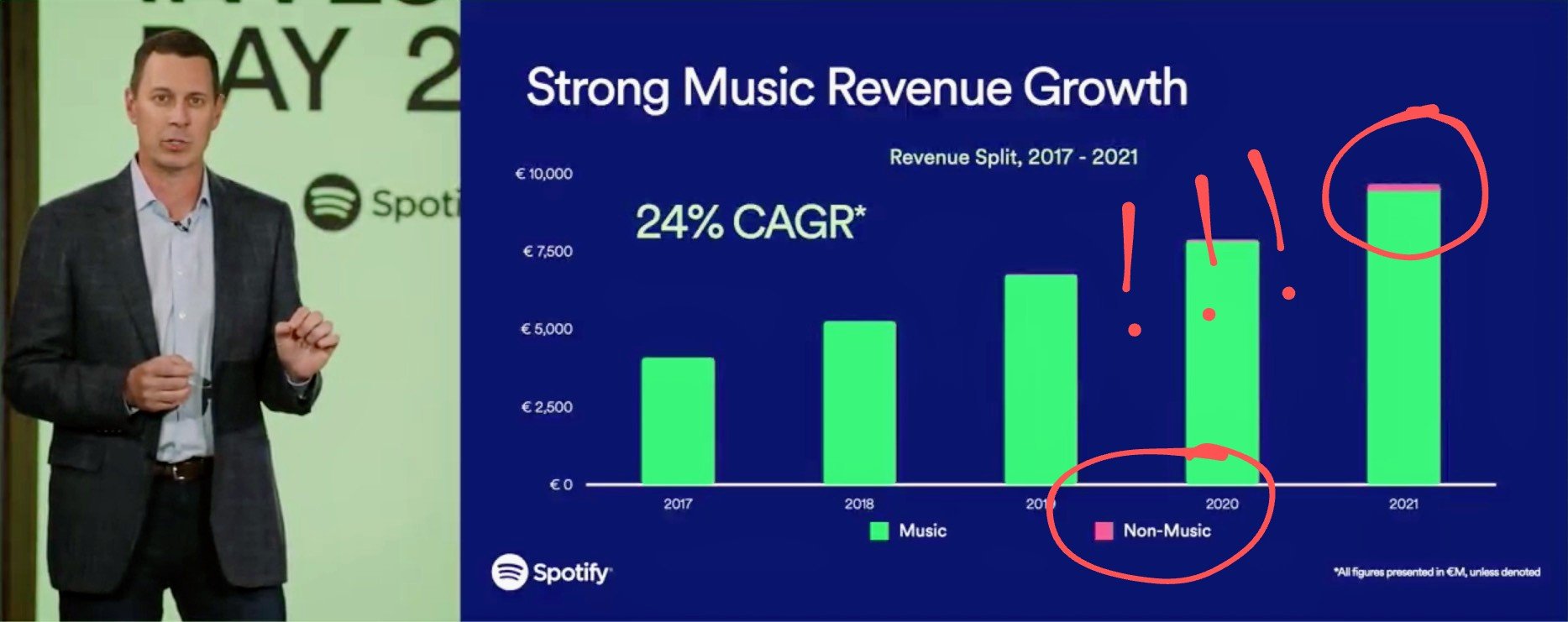
So, financially speaking, what’s Spotify got to show for four years and over a billion dollars in podcast investments? According to an Investor Day presentation by senior Spotify leaders in June last year, the firm’s podcasting efforts generated under €200m in advertising in 2021.

If you were wondering how that compares to the amount of money generated by music (via subscriptions and ads) on Spotify in the same 12 months, I recommend you look at this single image, of Spotify CFO Paul Vogel, from that summer 2022 investor presentation.

The green bit is music-related revenue in each year. The gaunt wisp of pink at the top of the last bar? That’s revenue from everything else – including podcasts. (Digital graffiti, author’s own.)

«

Podcasting seems to be a zero-billion dollar business: everyone likes being in it, but the rewards are strictly limited.
unique link to this extract


Super Agent: automatic cookie consent

»

Get control and improve your browsing experience, making it private, fast, and without pop-ups. Super Agent is a browser extension and web service that will auto-accept cookies for you. You define your preferences once, and Super Agent will do the rest.

«

Oh man I really hope so. It would be so wonderful to be rid of those damn things. Just installed it. Hoping that it does the business. Seems to be for macOS and iOS. (Via Benedict Evans.)
unique link to this extract


Professional writer? • On Posting

Luke Winkie:

»

Shannon Liao, a reporter who was discharged during The Washington Post layoffs, made a salient tweet from the wreckage where she noted that her dream job — as a video game reporter with a muckraking verve — no longer exists in this increasingly austere media ecosystem. Launcher, the Post’s gaming vertical that is being shuttered at the end of March, allowed its staff and contributors to chase a complicated story for months without being derailed by SEO exigencies, traffic quotas, or dramatic reductions in ambition; you know, all of those self-preservation measures newsrooms must enlist in order to stave off the prospect of a Bezos liquidation. (IGN has assigned me stories derived wholly from Twitter trends to soak up residual, semi-sentient engagement. Liao is right to be wary of the rest of the field.)

She was specifically commenting on her own beat of games journalism, which is in the midst of a free fall, but it made me wonder how many genuine, aspirational dream jobs are left in the media writ large. It’s telling that everyone who doesn’t end up at the Times seems to leave the industry entirely. Maybe the best Liao can hope for — the best a lot of us can hope for — is just a job. And frankly, that doesn’t give us much room to complain.

I’m always going to love writing. This newsletter is lots of fun, same with the book proposal I’m finalizing. There are a handful of features I pick up each year that challenge me as a reporter and a thinker, and I appreciate — and will defend to the death — the art of a proudly belligerent white-hot take. But as my mid-30s threaten on the horizon, I’m capable of admitting that some of the glamor has faded from the endless slate of assignments that pay for my rent and indulgences — the grind that is commensurate to calling yourself a professional; the job part of this job.

Have I fallen out of love with the craft? I don’t think so. Instead, when I was a younger, greener journalist, it was simply easier to believe that the future was bright; that every byline was a step in the right direction; that the dream was fingertips away.

«

I don’t know of any journalist who looks at the current situation and thinks “well, this is an improvement”. But then, how many professions or trades are saying that?
unique link to this extract


my year as a hot girl for hire • words from eliza

eliza mclamb got a job managing accounts on a platform (unnamed, but perhaps OnlyFans) which turned out to be just one of the circles of hell:

»

What was not made immediately clear to me, and what significantly complicated the process, is that there was one thing that almost no client was willing to do: be nude.

This very fact runs counterintuitive to the entire platform design — the idea of this space is that it’s the one place you can see people you know take their clothes off. I quickly learned that my job was to make believe not only in the idea that I was an entirely different person, but that what I was promising as that person was indeed what was being given. I had to prop up the cardboard cutout of a hot girl and try to keep people in front of her, foaming at the mouth, lest I risk her blowing away in the wind and revealing the great fraud.

I was first assigned what were informally deemed “low status” accounts, meaning that they made under $10,000 a month. Eventually, when I was trusted with high status accounts, I was told that commission would be in my future — 2% of the client’s earnings from the platform — but until then, I was paid a flat rate of $3,000 a month, which was not bad for a job I could do “any time I wanted.”

This, of course, was not the truth. I could work any time I wanted, as long as I was logged on for the site’s peak hours, which were from 10pm to 2am every night and later on weekends. I had to post daily, multiple times a day, and constantly respond to a barrage of messages that ranged from innocuous to genuinely traumatizing. If you’ve ever been a woman on the internet, you know what men say to you when they think no one is watching. Now imagine that they think they are one of the lucky few to access a particularly inaccessible woman.

«

It’s not pretty. At all. So:

»

The job quickly became demoralizing. I developed a five song playlist of ultra-pop hype music that I would loop while working, effectively turning into a cyborg who could reliably barrel through messages detailing rape and assault and turn violent men into paying customers. I became increasingly jaded in my attitude towards men as a whole, even the polite ones in my messages, and this motivated me to drain them of cash so intensely that part of me wondered if this learned disgust was built into the job to improve employee efficiency.

«

unique link to this extract


Is 5G internet worth it, or was it just hype? • USA Today

Bob O’Donnell:

»

One of the most widely touted capabilities for 5G was expected to be around connected devices and sensors. The idea was/is that the enhanced speed and bandwidth of 5G versus 4G would unleash a torrent of cellular-connected devices from AR and VR headsets to cars, home appliances and more.

In truth, some of those efforts are starting to happen, but most are more niche applications for specific vertical industries such as manufacturing, healthcare, agriculture, etc. Many of these projects are starting to make an impact, but just not in ways that you and I can easily see.

We’re also starting to see more 5G applications on the business side of things. A number of companies are starting to set up what are known as “private 5G” networks that only employees or work machines can get access to. In many cases, these are being used to supplement or enhance existing Wi-Fi networks because they can provide important security and performance benefits.

Ironically, it’s on the smartphone side – where expectations were the highest – that we’ve arguably seen the least visible impact from 5G. For example, as many have noticed, download speeds in many situations haven’t been that much different than 4G. But even here, it’s important to note that average download speeds are improving (in some places, dramatically so) and it’s virtually impossible to find a non-5G equipped phone.

In other words, the impact is real, just a bit subtler than we would have hoped.

«

unique link to this extract


• Why do social networks drive us a little mad?
• Why does angry content seem to dominate what we see?
• How much of a role do algorithms play in affecting what we see and do online?
• What can we do about it?
• Did Facebook have any inkling of what was coming in Myanmar in 2016?

Read Social Warming, my latest book, and find answers – and more.


Errata, corrigenda and ai no corrida: none notified
Start Up No.1941: how US Marines beat an AI camera, renewables far cheaper than coal, spotting the corporate fraudsters, and more


They certainly look like Airpods – but with counterfeiting Apple’s products being big business, do you know how to spot the fakes? CC-licensed photo by Maurizio Pesce on Flickr.

You can sign up to receive each day’s Start Up post by email. You’ll need to click a confirmation link, so no spam.


There’s another post coming this week at the Social Warming Substack on Friday at about 0845 UK time. Free signup.


A selection of 10 links for you. Can you hear this? I’m @charlesarthur on Twitter. Observations and links welcome.


US Marines outsmart AI security cameras by hiding in a cardboard box (and other tricks) • PetaPixel

Pesala Bandara:

»

In the book, which will be released on February 28, Scharre recounts how the US Army was testing AI monitoring systems and decided to use the Marines to help build the algorithms that the security cameras would use.

They then attempted to put the AI system to the test and see if the squad of Marines could find new ways to avoid detection and evade the cameras.

To train the AI, the security cameras, which were developed by Defense Advanced Research Projects Agency’s (DARPA) Squad X program, required data in the form of a squad of Marines spending six days walking around in front of them. After six days spent training the algorithm, the Marines decided to put the AI security cameras to the test.

“If any Marines could get all the way in and touch this robot without being detected, they would win. I wanted to see, game on, what would happen,” DARPA deputy director Phil Root tells Scharre in the book.

Within a single day, the Marines had worked out the best way to sneak around an AI monitoring system and avoid detection by the cameras.

Root says: “Eight Marines — not a single one got detected.”

According to Scharre’s book, a pair of marines “somersaulted for 300 meters” to approach the sensor and “never got detected” by the camera. Meanwhile, two marines successfully evaded the camera by hiding in a cardboard box, a strategy they may have tried based on the video game series Metal Gear Solid. “You could hear them giggling the whole time,” Root says.

Meanwhile another smiling marine “field-stripped a fir tree and walked like a fir tree” toward the AI security camera and succeeded, too. Root tells Scharre that the marines were able to easily fool the cameras because “the AI system had been trained to detect humans walking, not humans somersaulting, hiding in a cardboard box, or disguised as a tree.

“So these simple tricks, which a human would have easily seen through, were sufficient to break the algorithm.”

«

So, there’s still going to be jobs for night shift guards. By the way, you’ve got the 4am-noon shift.
unique link to this extract


$50 AirPods Pro? Nope. Here’s how to spot fake Apple earbuds • WSJ

Dalvin Brown:

»

Caroline Ballard, 26 years old, was perusing Facebook Marketplace when she came across a pair of new AirPods Pro for $80, less than a third of the $249 list price.

She arranged to meet the seller at a nearby Walgreens parking lot the same day, a move that isn’t unusual for transactions made via Meta Platforms’s online market. The man pulled up and handed her a small plastic-wrapped white box with a photo of two AirPods on the top. The seller took her $80, got back in his car and drove off.

“I felt like something was off almost immediately,” she said. She noticed some of Apple’s branding missing from the packaging and quickly realized she had been scammed.

…Hunter Andrews, 32, paid a third-party vendor on Walmart’s website $199 for what he thought were AirPods Pro last January. The earbuds have been on sale for a similar price in the past from sellers such as Verizon Communications Inc.

Nothing seemed out of the ordinary at first. The box looked right and the AirPods paired with his iPhone, Mr. Andrews said. The U.S. Army sergeant, who lives in Knightdale, N.C., didn’t find out until he took them to an Apple Store for a replacement six months later.

“They were making a rattling noise,” Mr. Andrews said. “The guy at the Apple Store opens the case, and points to the Chinese writing on the inside. He goes, ‘These are fake.’” Mr. Andrews said he immediately reported the counterfeit AirPods to Walmart, which told him to contact the seller. The seller never refunded his money.

«

Surprise. Huge business in China making fakes. Apple stuff is a great target because it’s pricey, so people jump at cheap knockoffs.
unique link to this extract


US renewable energy farms outstrip 99% of coal plants economically – study • The Guardian

Oliver Milman:

»

Coal in the US is now being economically outmatched by renewables to such an extent that it’s more expensive for 99% of the country’s coal-fired power plants to keep running than it is to build an entirely new solar or wind energy operation nearby, a new analysis has found.

The plummeting cost of renewable energy, which has been supercharged by last year’s Inflation Reduction Act, means that it is cheaper to build an array of solar panels or a cluster of new wind turbines and connect them to the grid than it is to keep operating all of the 210 coal plants in the contiguous US, bar one, according to the study.

“Coal is unequivocally more expensive than wind and solar resources, it’s just no longer cost competitive with renewables,” said Michelle Solomon, a policy analyst at Energy Innovation, which undertook the analysis. “This report certainly challenges the narrative that coal is here to stay.”

The new analysis, conducted in the wake of the $370bn in tax credits and other support for clean energy passed by Democrats in last summer’s Inflation Reduction Act, compared the fuel, running and maintenance cost of America’s coal fleet with the building of new solar or wind from scratch in the same utility region.

On average, the marginal cost for the coal plants is $36 each megawatt hour, while new solar is about $24 each megawatt hour, or about a third cheaper. Only one coal plant – Dry Fork in Wyoming – is cost competitive with the new renewables. “It was a bit surprising to find this,” said Solomon. “It shows that not only have renewables dropped in cost, the Inflation Reduction Act is accelerating this trend.”

«

Actually, this article is worth clicking through to for the amendation at its end. It’s one of those “well, it depends which direction you’re going” sort of things.
unique link to this extract


The war over gas stoves hides easier ways to fix indoor air pollution • Vox

Kelsey Piper:

»

It’s absolutely worth trying to reduce indoor air pollution. But the cheapest, easiest way to do so, for most Americans, is to run your stove’s hood fan, or keep your windows open while cooking. Next on the list is to get a large air filter and run it continuously (we use Coway and BlueAir, based on a Wirecutter recommendation).

Air filters appear to improve respiratory health, improve heart health in the elderly, and reduce pollutants significantly, with an effect size that looks a lot larger than that associated with replacing a gas stove. (One drawback: air filters can’t completely filter the nitrogen oxides produced by gas stoves, which may make replacing your stove worth it for parents of children with asthma.)

For most of us, replacing your stove is an expensive step compared to the benefits you’ll get in cleaner air. And cost does matter: if we want to improve indoor air quality broadly, we should focus on the cheapest, most convenient interventions. Cooking with your hood fan on or the windows open costs nothing. Getting and continuously running a good air purifier in your home is relatively cheap, and it genuinely can make a difference in your health and especially the health of your small children, regardless of how you cook your food.

If you want to go ahead and swap out your gas stove for an induction stove, go for it. But if you’re freaked out about the possibility the air in your home is making your kids sick, start with the easy steps — and relax about the gas.

From a climate perspective, while gas stoves can leak methane, they’re a tiny fraction of methane emissions — only 3% of household gas emissions, and those household emissions are a small share of overall emissions. Trying to scare people about gas stoves for the sake of the climate means picking what is likely to be a politically unpopular fight, while passing up easier progress on more significant issues.

«

(Thanks G for the link.)
unique link to this extract


Link your Mastodon and Twitter accounts • Moa

»

Link your Mastodon account to Twitter with Moa Bridge. No bamboozle.

Enter your Mastodon ID and join the Moa party!

This Moa instance is run as a public utility. If you’re interested in getting involved, finding out more, reporting issues, and keeping track of status updates, visit the moaparty.com website »

«

Now, this is probably going to require you to give up write access to both accounts, and it’s going to be up to you to figure out how safe it is by reading the (open source) code.
unique link to this extract


Most Shared content from your Twitter friends • TweetShelf

Now that Nuzzel is dead – bought by Twitter, incorporated into Twitter Blue, then killed – it’s good to know there’s a different aggregator that will find the most-shared stories/podcasts/whatever from Twitter. (Apologies, I can’t find who sent me the link!)
unique link to this extract


Google nukes 50,000 accounts pushing Chinese disinformation • Bleeping Computer

Sergiu Gatlan:

»

Google’s Threat Analysis Group terminated tens of thousands of accounts linked to a group known as “Dragonbridge” or “Spamouflage Dragon” that is disseminating pro-Chinese disinformation across multiple online platforms.

According to Google, Dragonbridge gets new Google Accounts from bulk account sellers, and, in some instances, they’ve even switched to accounts previously used by financially motivated actors repurposed for posting disinformation videos and blogs.

Last year, the company took down more than 50,000 accounts used by Dragonbridge across its platforms, including YouTube, Blogger, and AdSense. In total, 100,960 accounts have been shut down since the influence network was first spotted.

This reflects Google’s focus on this coordinated information operation linked to China, described as “the most prolific IO actor TAG tracks.”

However, despite the Chinese influence operation’s large size and high volume of content production, it has minimal to no engagement from real viewers.

For instance, the vast majority of its YouTube channels had no subscribers when they were taken down last year, and more than 80% of videos had fewer than 100 views.

Dragonbridge blogs on Blogger also had a very low engagement, with less than 10 views per post for almost 95% of posts when they were terminated in December.

«

The disinformation business just ain’t what it used to be.
unique link to this extract


I’m a corporate fraud investigator. You wouldn’t believe the hubris of the super-rich • The Guardian

Freya Berry:

»

I work in corporate investigation, and it’s my job to spot fraud and corruption. Sometimes it’s as subtle as manipulating your free cash flow. Sometimes it’s as shameless as photoshopping your bank statements.

The job is varied. Generally, I’m looking for red flags: accounting abuses, yes, but also egregious business practices, such as failure to pay suppliers. We want to answer the question: is the business doing what it says it’s doing, to the standard it should be? And if not, can that company really be worth what the market believes it is?

I use a number of methods to do this. Some you might expect – financial reports, local filings, data sets – but others you might not, including social media. Recently I was deep in the Instagram account of a CEO whose company we believe is a house of cards. I gazed for a long time at a snap of a family member, posing on the steps of a private jet with champagne and a gun. If I had to paint a portrait called “hubris”, it would look something like that.

Corruption and its consequence, fraud, have many origins. Sometimes the executives like their jets and yachts a little too much. Or they might have connections with the mafia or drug cartels. Or they might just make big promises they can’t deliver. Far from being an easy way out, fraud is a high-wire act, the rewards high, the penalties higher. Companies therefore go to great pains to conceal it, making death threats to whistleblowers or putting tracking devices in short-sellers’ cars.

But while the fraudsters I’ve encountered are generally clever – or at least cunning – sooner or later something interesting happens: they get carried away. Drunk on their own genius, they concoct grander schemes, more flamboyant methods. They give large contracts to family members, who are themselves shareholders in the company. They fire their top-tier auditor and bring in a no-name firm. In the case of Sam Bankman-Fried, they allegedly participate in a Signal group chat entitled “Wirefraud”.

«

I once heard a talk given by a guy who’d defrauded his company of tens of thousands. He worked in the accounting department, and it was the classic story: he approved invoices, and nobody else did. So he began faking them. Then it got so big he couldn’t stop doing it. So many of these things unravel when the people involved go on holiday.

A huge amount of corporate fraud comes down to fake invoicing. It really is that simple.
unique link to this extract


ChatGPT’s mind-boggling, possibly dystopian impact on the media world • Vanity Fair

Joe Pompeo rounds up a week’s worth of ChatGPT beshogglings, and then finds some who are and who aren’t worried:

»

[Veteran newspaperman, Steve] Brill isn’t worried about ChatGPT and its ilk putting skilled reporters out of work. He told me about a final paper he assigns for his journalism students at Yale, in which they have to turn in a magazine-length feature and list “at least 15 people they interviewed and four people who told them to go fuck themselves. There is no way they could do that assignment with ChatGPT or anything like it, because what journalists do is interview people, read documents, get documents leaked to them.”

Still, Brill continued, “One of the assignments I give them on the second or third week is a short essay on how Watergate would have played out differently in the internet age, because Bob Woodward comes in as a guest for that session. I asked ChatGPT to answer that question, and the answer I got was this banal but perfectly coherent exposition. The difference is, you didn’t have to interview or talk to anyone. So maybe it’ll put some op-ed columnists out of work.”

As for [technology journalist Alex] Kantrowitz, getting plagiarized by bots hasn’t turned him into a ChatGPT hater. “I’m still super bullish on generative AI, and I still think it can be useful for journalism,” he said. “Sometimes I’ll use it when I’m stuck on a story, and I never include [the AI-generated text] in the story, but it can get my brain going, and that’s helpful. If you think about how it will impact journalism in next two or three years, the likely answer is, quite minimally. But as this technology gets better at scouring the internet and taking information, as its writing gets better, we’ll start to see a world where it can produce better writing and analysis than most professional reporters. If you’re doing original reporting and unearthing things people don’t already know, you’re probably gonna be okay. But if you’re an analysis person, let’s say, 20 years down the road, you might need to find something else to do.”

«

There’s quite a lot of “my job’s going to be OK, though” commentary. On the latest Exponent.fm podcast, James Allworth (who works at Cloudflare) was a bit apprehensive about how it could probably knock out a lot of tech support jobs.
unique link to this extract


How online mobs act like flocks of birds • Noema Mag

Renee DiResta explains how flocks and “murmurations” occur – each bird responds to what it sees its seven closest neighbours doing – and then applies it to online networks:

»

After the nudges to assemble into flocks come the nudges to engage — “bait,” as the Extremely Online call it. Twitter’s Trending Topics, for example, will show a nascent “trend” to someone inclined to be interested, sometimes even if the purported trend is, at the time, more of a trickle — fewer than, say, 2,000 tweets. But that act, pushing something into the user’s field of view, has consequences: the Trending Topics feature not only surfaces trends, it shapes them. The provocation goes out to a small subset of people inclined to participate. The user who receives the nudge clicks in, perhaps posts their own take — increasing the post count, signaling to the algorithm that the bait was taken and raising the topic’s profile for their followers. Their post is now curated into their friends’ feeds; they are one of the seven birds their followers see. Recurring frenzies take shape among particular flocks, driving the participants mad with rage even as very few people outside of the community have any idea that anything has happened. Marx is trending for you, #ReopenSchools for me, #transwomenaremen for the Libs Of TikTok set. The provocation is delivered, a few more birds react to what’s suddenly in their field of view, and the flock follows, day in and day out.

Eventually, perhaps, an armed man decides to “liberate” a DC pizza parlor, or a violent mob storms a nation’s capitol. Although mainstream tech platforms now act to disrupt the groups most inclined to harassment and violence — as they did by taking down QAnon groups and shutting down tens of thousands of accounts after the January 6th insurrection — the networks they nudged into existence have by this point solidified into online friendships and comradeships spanning several years. The birds scatter when moderation is applied, but quickly re-congregate elsewhere, as flocks do.

Powerful economic incentives determined the current state of affairs. And yet, the individual user is not wholly passive — we have agency and can decide not to take the bait. We often deploy the phrase “it went viral” to describe our online murmurations. It’s a deceptive phrase that eliminates the how and thus [falsely] absolves the participants of all responsibility.

«

unique link to this extract


• Why do social networks drive us a little mad?
• Why does angry content seem to dominate what we see?
• How much of a role do algorithms play in affecting what we see and do online?
• What can we do about it?
• Did Facebook have any inkling of what was coming in Myanmar in 2016?

Read Social Warming, my latest book, and find answers – and more.


Errata, corrigenda and ai no corrida: none notified

Start Up No.1940: Microsoft and OpenAI fight code copyright claim, Musk’s capricious Twitter, smartphone shipments drop, and more


The Moon may need its own GPS-style universal timing system as more expeditions head there together. CC-licensed photo by Serhio Magpie on Flickr.

You can sign up to receive each day’s Start Up post by email. You’ll need to click a confirmation link, so no spam.

A selection of 10 links for you. Use them wisely. I’m @charlesarthur on Twitter. Observations and links welcome.


Meta embraces AI as Facebook, Instagram help drive a rebound • WSJ

Jeff Horwitz and Salvador Rodriguez:

»

Days before Meta Platforms’s first ever mass layoffs in November, a senior executive shared some good news. The company’s short-form video product, Reels, was getting traction with users, and the threat posed by rival TikTok appeared to be easing.

“Facebook engagement is stronger than people expected,” Tom Alison, head of Facebook, wrote in a memo to his staff. “Our internal data indicates that Meta has grown to a meaningful share of short-form video.”

After the roughest year in Meta’s history, the parent company of Facebook and Instagram is starting to see a path to recovery, internal documents reviewed by The Wall Street Journal and interviews with people familiar with the matter show.

Heavy investment in artificial intelligence tools has enabled the company to improve ad-targeting systems to make better predictions based on less data, according to the interviews and documents. Though Chief Executive Mark Zuckerberg declared last year that the company would be “metaverse-first, not Facebook-first,” most of the effort involves optimizing its traditional social-media platforms, especially Facebook.

…for all of Meta’s efforts to rebrand itself, the core Facebook “Blue” app remains its workhorse. While outside financial analysts have generally estimated that Instagram accounts for between 40% to 50% of the company’s ad revenue, internal statistics viewed by the Journal show that Instagram generates a little more than 30%—and it isn’t rapidly catching up.

That leaves Meta’s near-term financial future dependent on the aging Blue app, which accounts for more than two-thirds of total revenue. Meta’s internal statistics show that business has been relatively resilient. Data gathered in the middle of the fourth quarter showed that time spent on the Blue app was up worldwide, including in developed markets, over the course of a year. Time spent on the company’s products overall was up more than 5% to more than 230 million hours a day in the US, which accounts for 40% of Meta’s worldwide revenue.

Much of that increase is due to the growth of Reels. While Reels is often publicly associated with young users and Instagram, Facebook users appear to be the more avid consumers of the short videos.

«

The article link should be free to read. There’s a lot of detail about the AI stuff, which is principally around ad formats. But Reels seems, sort of, to be some sort of success.
unique link to this extract


Facepalm Pilot: where technology meets stupidity: an interactive guide to ambiguous grammar • McSweeney’s Internet Tendency

Vijith Assar:

»

Depending on whom you ask, the use of the active voice over the passive is arguably the most fundamental writer’s maxim, thought to lend weight, truth, and power to declarative statements. This absolutist view is flawed, however, because language is an art of nuance. From time to time, writers may well find illustrative value in the lightest of phrases, sentences so weightless and feathery that they scarcely even seem to exist at all. These can convey details well beyond the crude thrust of the hulking active voice, and when used strictly as ornamentation, they needn’t actually convey anything at all.

As a thought experiment, let’s examine in extremely close detail a set of iterative changes that can be made to a single simple grammatical structure, turning it from a statement taken at face value into one loaded with unrealized implication. This makes for rich writing which rewards – or even demands – close scrutiny.

The quick brown fox jumps over the lazy dog.

«

By the end, it’s Speed was involved in a jumping-related incident while a fox was brown.

But it’s McSweeney’s, so there is a point, and a bite, to this “guide”. It’s from 2015, yet still turns out true again and again.
unique link to this extract


Microsoft, GitHub, and OpenAI ask court to throw out AI copyright lawsuit • The Verge

Emma Roth:

»

programmer and lawyer, Matthew Butterick, teamed up with the legal team at Joseph Saveri Law Firm to file a proposed class action lawsuit last November, alleging the tool relies on “software piracy on an unprecedented scale.” Butterick and his legal team later filed a second proposed class action lawsuit on the behalf of two anonymous software developers on similar grounds, which is the suit Microsoft, GitHub, and OpenAI want dismissed.

As noted in the filing, Microsoft and GitHub say the complaint “fails on two intrinsic defects: lack of injury and lack of an otherwise viable claim,” while OpenAI similarly says the plaintiffs “allege a grab bag of claims that fail to plead violations of cognizable legal rights.” The companies argue that the plaintiffs rely on “hypothetical events” to make their claim, and say they don’t describe how they were personally harmed by the tool.

“Copilot withdraws nothing from the body of open source code available to the public,” Microsoft and GitHub claim in the filing. “Rather, Copilot helps developers write code by generating suggestions based on what it has learned from the entire body of knowledge gleaned from public code.”

Additionally, Microsoft and GitHub go on to claim that the plaintiffs are the ones who “undermine open source principles” by asking for “an injunction and a multi-billion dollar windfall” in relation to the “software that they willingly share as open source.”

«

There’s a lot at stake here for Microsoft in particular, because it’s investing all that money in ChatGPT. If it loses here, people will come after ChatGPT for something or other too. Equally, if Microsoft wins, that makes the other lawsuits against generative AI systems tougher to win.
unique link to this extract


Twitter’s Trust and Safety head ditches protocol for Musk whims • BNN Bloomberg

Davey Alba and Kurt Wagner:

»

Being the head of trust and safety at Twitter has long been a crucial and closely scrutinized job, given the potential impact that person has over speech on one of the world’s most influential platforms. Previous leaders have been tasked with making complicated and controversial decisions, including when to ban accounts when they cross a line, be it by jeopardizing public health in the midst of a pandemic, or by threatening the safety of democratic elections around the world. Twitter’s decisions are often later probed by politicians and regulators, and so they are typically made with careful documentation pointing to specific policy justifications for the action, the current and former employees say. 

But now, internal documentation shows a decision-making process amounting to little more than unilateral directives issued by Twitter’s new owner. In late November, an account belonging to the leftist activist Chad Loder was banned from the platform. In Twitter’s internal system, a note read, “Suspension: direct request from Elon Musk,” according to a screenshot viewed by Bloomberg. On Dec. 11, Jack Sweeney, the creator of a bot tracking Musk’s private plane, posted a screenshot showing [new head of Trust and Safety, Ella] Irwin had sent a Slack message directing employees to restrict visibility to Sweeney’s bot account, @elonjet. On Dec. 15, when Twitter suspended prominent journalists covering Twitter and Musk, the action was accompanied by an internal note: “direction of Ella.” 

Twitter used to have a group called the Global Escalations Team that could be a check on power at the top of the company, overruling executives based on existing policy. Employees say that group has folded, and Irwin and Musk can no longer be challenged through a formal process. In her emailed response, Irwin said that was “not accurate at all,” declining to elaborate.

Still, this month Irwin confirmed more cuts to teams handling global content moderation, hate speech, misinformation policy, global appeals and state media. Nine days later, two Taliban officials briefly gained access to blue checkmarks through Twitter Blue, the platform’s paid subscription tier. Twitter’s moderation research consortium, introduced in late 2021, is now effectively defunct, with no program managers left to oversee the work.

…As Irwin prioritizes supporting Musk, a former company executive said they believed that the platform is on a path to primarily serving the interests of the already-powerful, and those whose ideologies align with him.

“Twitter’s policies and practices in the trust and safety space were built around defending the rights of users around the world, especially the most vulnerable and marginalized communities,” the former executive said. “Since the acquisition, the company’s only actions have been to silence critics of Elon, to expose journalists and others to harm, and to violate basic ethical standards and privacy laws.”

«

unique link to this extract


Smartphone shipments suffer the largest-ever decline with 18.3% drop in the holiday quarter and a 11.3% decline in 2022 • IDC

»

Worldwide smartphone shipments declined 18.3% year over year to 300.3m units in the fourth quarter of 2022 (4Q22), according to preliminary data from the International Data Corporation (IDC) Worldwide Quarterly Mobile Phone Tracker. The drop marks the largest-ever decline in a single quarter and contributed to a steep 11.3% decline for the year. 2022 ended with shipments of 1.21bn units, which represents the lowest annual shipment total since 2013 due to significantly dampened consumer demand, inflation, and economic uncertainties.

“We have never seen shipments in the holiday quarter come in lower than the previous quarter. However, weakened demand and high inventory caused vendors to cut back drastically on shipments,” said Nabila Popal, research director with IDC’s Worldwide Tracker team.

…”What this holiday quarter tells us is that rising inflation and growing macro concerns continue to stunt consumer spending even more than expected and push out any possible recovery to the very end of 2023.”

“We continue to witness consumer demand dwindle as refresh rates climb past 40 months in most major markets,” said Anthony Scarsella, research director with IDC’s Worldwide Quarterly Mobile Phone Tracker.

“With 2022 declining more than 11% for the year, 2023 is set up to be a year of caution as vendors will rethink their portfolio of devices while channels will think twice before taking on excess inventory. However, on a positive note, consumers may find even more generous trade-in offers and promotions continuing well into 2023 as the market will think of new methods to drive upgrades and sell more devices, specifically high-end models.”

«

40-month average replacement rates? That’s heading towards three and a half years. (Personally I’m on a three-year replacement rate.)
unique link to this extract


Deepfakes for scrawl: with handwriting synthesis, no pen is necessary • Ars Technica

Benj Edwards:

»

Calligrapher.ai “draws” each letter as if it were written by a human hand, guided by statistical weights. Those weights come from a recurrent neural network (RNN) that has been trained on the IAM On-Line Handwriting Database, which contains samples of handwriting from 221 individuals digitized from a whiteboard over time. As a result, the Calligrapher.ai handwriting synthesis model is heavily tuned toward English-language writing, and people on Hacker News have reported trouble reproducing diacritical marks that are commonly found in other languages.

Since the algorithm producing the handwriting is statistical in nature, its properties, such as “legibility,” can be adjusted dynamically. Vasquez described how the legibility slider works in a comment on Hacker News in 2020: “Outputs are sampled from a probability distribution, and increasing the legibility effectively concentrates probability density around more likely outcomes. So you’re correct that it’s just altering variation. The general technique is referred to as ‘adjusting the temperature of the sampling distribution.'”

With neural networks now tackling text, speech, pictures, video, and now handwriting, it seems like no corner of human creative output is beyond the reach of generative AI.

«

Maybe we can hook it up to ChatGPT and get it to write the output driven by prompts of “compose a letter sacking Nadim Zahawi for his tax affairs while not referring to precisely what he did.
unique link to this extract


Heat pumps: the ‘geeks’ obsessing over their new heating systems • BBC News

Chris Baraniuk:

»

He’s got heat meters fixed to the pipework. Room temperature monitors. And gadgets tracking how much electricity his solar panels are generating.

The jewel in the crown of this system, though, is a recently installed heat pump.

“It’s like a geek’s paradise, really,” says Mick Wall of his 1930s semi-detached house in Sheffield.

Mr Wall, who works in IT, has made a hobby out of monitoring his household energy consumption and honing his heat pump’s performance in a dogged pursuit of maximum efficiency.

The UK government has set a target of 600,000 heat pump installations per year by 2028.

Builders are moving towards the technology as well. Redrow, which builds more than 5,000 homes in the UK a year, announced that it will fit heat pumps as standard in upcoming housing developments – the first UK builder to make that commitment.

But currently, fewer than 50,000 are fitted in British homes annually and the UK is bottom of the heat pump installation league table in Europe.

There is, however, an intrepid band of pioneers out there. Eager adopters who say the country is ready to go heat pump crazy – and that they can prove it with their own hard data. These are the heat pump geeks.
Mr Wall is one of a small number of enthusiasts who regularly publish data online about how their heat pumps are doing. “I’m putting myself out there to say, ‘This stuff does work, here’s the evidence,'” he says.

«

The European heat pump league currently shows Norway, Sweden, Finland and Estonia miles ahead. It shows Hungary (113 per 100k people) is actually behind the UK (412 per 100k). Since you ask, Norway has over 24,000 pumps per 100,000 people.

Also it’s claimed now to be cheaper to run a heat pump than a gas boiler.
unique link to this extract


MusicLM • Google Research

Andrea Agostinelli et al:

»

We introduce MusicLM, a model generating high-fidelity music from text descriptions such as “a calming violin melody backed by a distorted guitar riff“. MusicLM casts the process of conditional music generation as a hierarchical sequence-to-sequence modeling task, and it generates music at 24 kHz that remains consistent over several minutes.

Our experiments show that MusicLM outperforms previous systems both in audio quality and adherence to the text description. Moreover, we demonstrate that MusicLM can be conditioned on both text and a melody in that it can transform whistled and hummed melodies according to the style described in a text caption. To support future research, we publicly release MusicCaps, a dataset composed of 5.5k music-text pairs, with rich text descriptions provided by human experts.

«

It also produces audio from paintings such as Dali’s The Persistence of Memory. Can’t be long before AI is writing all the Muzak in the world.

Note that the page is very data-heavy and, for me, takes forever to load. So you might not be able to hear the samples.
unique link to this extract


What time is it on the Moon? • Nature

Elizabeth Gibney:

»

It’s not obvious what form a universal lunar time would take. Clocks on Earth and the Moon naturally tick at different speeds, because of the differing gravitational fields of the two bodies. Official lunar time could be based on a clock system designed to synchronize with UTC, or it could be independent of Earth time.

Representatives of space agencies and academic organizations worldwide met in November 2022 to start drafting recommendations on how to define lunar time at the European Space Research and Technology Centre of the European Space Agency (ESA) in Noordwijk, the Netherlands.

Decisions must be made soon, says Patrizia Tavella, who leads the time department at the International Bureau of Weights and Measures in Sèvres, France. If an official lunar time is not established, space agencies and private companies will come up with their own solutions, she says. “This is why we want to raise an alert now, saying let’s work together to take a common decision.”

The most pressing need for lunar time comes from plans to create a dedicated global satellite navigation system (GNSS) for the Moon, similar to how GPS and other satellite navigation networks enable precise location tracking on Earth. Space agencies plan to install this lunar GNSS from around 2030. ESA approved a lunar satellite navigation project called Moonlight at its ministerial council meeting on 22 and 23 November 2022 in Paris, and NASA established a similar project, called Lunar Communications Relay and Navigation Systems, last January.

Until now, Moon missions have pinpointed their locations using radio signals sent to large antennas on Earth at scheduled times. But with dozens of missions planned, “there’s just not enough resources to cover everybody”, says Joel Parker, an engineer who works on lunar navigation at the Goddard Center.

«

Filed under: problems you didn’t think would ever arise, but actually need dealing with.
unique link to this extract


The AirPods Pro 2nd gen as smart hearables puts a smile on my face • Stacey on IoT

Kevin Tofel:

»

In 2020, I bought a set of Nuheara IQ Buds Max earbuds. Like the Apple AirPods Pro, the Nuheara product isn’t FDA classified as a hearing aid. Instead, these are PSAPs, or personal sound amplification products. Although they helped improve my hearing, I eventually stopped using the Nuheara’s. The main issue was unexpected, ear-splitting feedback at times, particularly when charging.

So, are the Apple AirPods Pro a better choice? For me, so far, yes. I’ve only had a handful of minor feedback issues and none of them were as jarring as what I used to experience. I also have many more controls to fine tune my sound based on different scenarios.

That’s likely due to more modern technology in Apple’s newer product.

For example, the custom Apple H2 headphone chip, samples external sounds 48,000 times per second (compared to 700 times per second for Phonak’s certified hearing aids) and supports Bluetooth 5.3. This second generation hearable also improves upon the first version by adding sound augmentation for media playback; a feature not available in the original model when tested. And the sound processing, all done lightning fast locally on the earbuds, is customized for my mild to moderate hearing loss.

Using a third-party hearing test app, I was able to upload my audiogram to my iPhone and have the sound tailored based on my test results.

The Mimi app shows how much hearing loss I’ve experienced and at which frequencies. In my case, the upper frequencies are a challenge. Since my wife doesn’t have a low-range voice like Morgan Freeman, that explains why I often struggle to hear her.

Armed with my audiogram, I shared it with my iPhone and then hit the Accessibility settings in iOS. There’s an entire section here for the AirPods Pro that’s chock full o’ options and features…

«

The dividing line between consumer tech and specialist tech gets narrower all the time.
unique link to this extract


• Why do social networks drive us a little mad?
• Why does angry content seem to dominate what we see?
• How much of a role do algorithms play in affecting what we see and do online?
• What can we do about it?
• Did Facebook have any inkling of what was coming in Myanmar in 2016?

Read Social Warming, my latest book, and find answers – and more.


Errata, corrigenda and ai no corrida: none notified

Start Up No.1939: pol gives job to ChatGPT, scientists “make” a black hole, Buzzfeed hires AI “writers”, Intel slumps to loss, and more


If rich people get us to Mars, and own the means of survival, what will life in the colony be like – as you won’t be able to escape? CC-licensed photo by Kevin Gill on Flickr.

You can sign up to receive each day’s Start Up post by email. You’ll need to click a confirmation link, so no spam.


It’s Friday, so there’s another post due at the Social Warming Substack at about 0845 UK time.


A selection of 10 links for you. Speech! I’m @charlesarthur on Twitter. Observations and links welcome.


Member of Congress reads AI-generated speech on House floor • Associated Press via ABC News

Steve LeBlanc:

»

When U.S. Rep. Jake Auchincloss decided to deliver a speech on a bill that would create a US-Israel artificial intelligence center, he opted to let the AI do the talking.

The brief two-paragragh speech read by the Massachusetts Democrat on the floor of the US House on Wednesday was generated by the online AI chatbot ChatGPT. His staff said they believe it’s the first time an AI-written speech was read in Congress.

Auchincloss said he prompted the system in part to “write 100 words to deliver on the floor of the House of Representatives” about the legislation. Auchincloss said he had to refine the prompt several times to produce the text he ultimately read.

The bill, which Auchincloss is refiling, would establish a joint U.S.-Israel AI Center in the United States to serve as a hub for AI research and development in the public, private and education sectors.

Auchincloss said part of the decision to read a ChatGPT-generated text was to help spur debate on AI and the challenges and opportunities created by it. He said he doesn’t want to see a repeat of the advent of social media, which started small and ballooned faster than Congress could react.

«

Pretty soon we can cut out the middleman, can’t we, and get ChatGPT to generate the speech, and then it gets automatically read into the record by a system, and the humans can get on with something important?
unique link to this extract


Ending suspension of Trump’s accounts with new guardrails to deter repeat offenses • Meta

Nick Clegg:

»

To assess whether the serious risk to public safety that existed in January 2021 has sufficiently receded, we have evaluated the current environment according to our Crisis Policy Protocol, which included looking at the conduct of the US 2022 midterm elections, and expert assessments on the current security environment. Our determination is that the risk has sufficiently receded, and that we should therefore adhere to the two-year timeline we set out. As such, we will be reinstating Mr. Trump’s Facebook and Instagram accounts in the coming weeks. However, we are doing so with new guardrails in place to deter repeat offenses.

Like any other Facebook or Instagram user, Mr. Trump is subject to our Community Standards. In light of his violations, he now also faces heightened penalties for repeat offenses — penalties which will apply to other public figures whose accounts are reinstated from suspensions related to civil unrest under our updated protocol. In the event that Mr. Trump posts further violating content, the content will be removed and he will be suspended for between one month and two years, depending on the severity of the violation.

«

Had anyone, anywhere, ever heard of the Crisis Policy Protocol before this post? It’s like a matryoshka of protocols and policies and assessments – layer after embedded layer of newly revealed reasons for doing something or other.
unique link to this extract


Trump and Facebook’s mutual decay • The Atlantic

Charlie Warzel on how things have changed:

»

some of the thunder [of Trump’s reinstatement, after two years, on Facebook and Instagram] was stolen by Twitter, which reinstated his account late last year, although Trump hasn’t resumed posting there.

There is also the mutual decay of both Trump and Facebook. Each thrives by hijacking attention and monetizing outrage, and they’ve benefited each other: The Trump campaign spent millions of dollars on more than 289,000 Facebook ads over the span of just a few months in 2020, according to an analysis by The Markup. But lately, both appear to have lost the juice. Many people still support Trump, and many people still use Facebook products, but the shine is gone—and that matters.

Facebook’s ad business was kneecapped last year by changes Apple made to limit tracking on its devices. It faces steep competition from insurgent apps such as TikTok. And there is a sense, looking at the company’s transparency reports, which detail the most popular content on its platform, that Facebook has become a vast wasteland of recycled memes and scammy, spammy clickbait.

Meanwhile, Trump’s 2024 campaign has been, to date, almost nonexistent. His kickoff announcement was roundly mocked as “low energy,” and some cable news networks didn’t bother to air it in full. Trump and his team have been sloppy and clearly grasping for relevance. And although I wouldn’t downplay the former president’s chances in the 2024 contest, he certainly doesn’t appear as invincible in primary politics as he once did.

«

unique link to this extract


BREAKING🚨: scientists have just created a black hole in the lab, and it has unexpectedly started to glow • Physics-Astronomy Blog

Umer Abrar:

»

Stephen Hawking postulated in 1974 that the event horizon’s disruption of quantum fluctuations results in a kind of radiation very similar to thermal radiation.

Even if it does, it is now too weak for us to detect. We may never be able to separate it from the hissing static of the universe. But by making black hole replicas in a lab, we can examine its characteristics.

Despite the fact that this has been done previously, a team lead by Lotte Mertens from the University of Amsterdam in the Netherlands has created something brand-new.

Electrons ‘hopped’ from one location to another along a one-dimensional chain of atoms. The scientists were able to make some qualities disappear by adjusting how easily this hopping could take place. This resulted in the formation of an event horizon that interfered with the electrons’ ability to behave like waves.

Only when a portion of the chain stretched beyond the event horizon did the impact of this fictitious event horizon result in a temperature increase that matched theoretical predictions of an analogous black hole system, the scientists said.

«

This site is fascinating, and I mean fascinating. The headlines are like the one above, or “BREAKING 🚨: An extremely rare green comet will visit Earth for the first time in 50,000 years on February 1”. It’s breaking news! How can you ignore it? But the wild GLOWING BLACK HOLE IN A LAB story is really a come-on for a really solid writeup of a complex physics story that wouldn’t disgrace most newspapers. I wouldn’t be surprised if the author’s name is some sort of anagram, since s/he seems to have written all the stories.
unique link to this extract


BuzzFeed will start using AI to write quizzes and other content • Nieman Journalism Lab

Sarah Scire:

»

Nothing like a spokesperson issuing assurances that BuzzFeed “remains focused on human-generated journalism” to make you feel good about the future of the news industry, right?

The Wall Street Journal reported Thursday on a staff memo at BuzzFeed that laid out plans for the digital media company to use OpenAI — creator of ChatGPT — to help write quizzes and other content. In the memo, BuzzFeed CEO Jonah Peretti wrote AI will play a role in both editorial and business operations at BuzzFeed within the next year.

“For example, a quiz to create a personal romantic comedy movie pitch might ask questions like, ‘Pick a trope for your rom-com,’ and ‘Tell us an endearing flaw you have,’” the Journal’s Alexandra Bruell reported. “The quiz would produce a unique, shareable write-up based on the individual’s responses, BuzzFeed said.”

But, hey! Humans will still provide “cultural currency” and “inspired prompts,” according to Peretti’s memo.
“If the past 15 years of the internet have been defined by algorithmic feeds that curate and recommend content, the next 15 years will be defined by AI and data helping create, personalize, and animate the content itself,” Peretti wrote.

«

Here’s the thing, though: Buzzfeed’s share price pretty much doubled on this news, allied with a $10m deal with Meta where Buzzfeed will make content for Facebook and Instagram and “train creators to grow their presence online”. Pretty good 48 hours for Buzzfeed, the company, if not for Buzzfeed, the investigative newsroom.
unique link to this extract


Quintessence: a link aggregator for your Mastodon account

»

Quintessence shows you the top links that the people that you follow on Mastodon tooted or boosted in the last 24 hours.

In order to work it just needs read permissions for your account.

You can allow this by specifying your instance in the text box below and clicking “Authorize”.

Quintessence is a static site, all its code runs on the device that you are using to read these lines. No data leaves your browser nor is being shared with anyone.

«

On Twitter there was a tool called Nuzzel, which Twitter bought and effectively killed by rolling it into Twitter Blue, that did the same as this. Quintessence is pretty neat.
unique link to this extract


Intel slumps on disappointing earnings amid PC weakness • WSJ

Asa Fitch:

»

Intel, which remains America’s largest chip maker by revenue, on Thursday reported a $664m loss for the final period of the year on a 32% decrease in sales to $14bn. The figure came short of Wall Street forecasts for a $278m loss on sales of $14.49bn, according to analysts surveyed by FactSet.

The company also said sales in the current quarter would come at around $10.5bn to $11.5bn, well below Wall Street’s forecast of $13.9bn. Shipments of PCs will be at the low end of its forecast range of 270m to 295m this year, the company said in a presentation.

Shares in Intel fell more than 7% in after-hours trading Thursday.

The sales slump reflects, in part, the sharp downturn the personal-computer market has been experiencing over recent months. PC shipments fell 28.5% in the final quarter of last year, research firm Gartner said, the worst retreat since it began tracking the market in the 1990s. Consumer spending has been hit by central banks raising interest rates to combat soaring inflation and growing fears of a possible recession. 

«

Intel’s PC chip sales are usually a leading indicator (OEMs buy chips they’ll put in PCs over the coming months), and they fell 36% in value – worse than analysts forecast – which suggests bad things for the PC market. But Intel, which is trying to turn its whole business around, really has a problem now.
unique link to this extract


Indian teenagers from small towns are taking YouTube Shorts by storm • Rest of World

Nilesh Christopher:

»

In a remarkably short time, RG Factboy became one of the world’s most popular YouTube Shorts channels. The creator behind it is Rohit Gupta, a 17-year-old student based in the remote Indian town of Kushinagar in Uttar Pradesh. Gupta’s Shorts had sensational Hindi voice-overs to viral videos of other creators, and ended on a plea for viewers to subscribe.

The channel, created in April 2022, had 11 million subscribers before it was abruptly deleted on January 11 for violating YouTube’s rules. Unlike viral YouTubers who thrive on long-form videos, RG Factboy only posted YouTube Shorts: vertical-format videos with a maximum length of 60 seconds. “YouTube is working hard to promote Shorts,” Gupta told Rest of World. “They want audiences to move from Instagram to YouTube. Because of this, creators are active on Shorts day in and day out.” Between November 1 and January 11, RG Factboy had gained 4 million subscribers, according to social media analytics company SocialBlade.

…After Rest of World sent YouTube a list of questions about the rapid rise of fact channels and some of them being banned due to copyright issues, the platform investigated the trend. YouTube then confirmed that many of these channels were in fact terminated due to multiple or severe violations of its policies against spam, deceptive practices, misleading content, or other Terms of Service violations. YouTube pointed out that their policy does not allow content selling engagement metrics, such as views, likes, comments, or any other metric.

YouTube purged RG Factboy’s account on January 11, a day after Rest of World inquired about the channel’s rapid growth. @MrFactVoice22’s channel also met with a similar fate the same day, although it was unclear why or for what duration of time. YouTube told Rest of World that many of these “fact channels” add voice-overs to content belonging to other creators, and that it is important for creators to only upload videos they have made or are authorized to use. YouTube added that when a copyright holder notifies them of a video infringing on their copyright, they remove the content in accordance with the law, and terminate accounts of repeat offenders.

«

Seems like India’s connected youth don’t really think of copyright in the same way that YouTube’s people do. Which is a problem, both for the youth and for YouTube.

unique link to this extract


We tried to run a social media site and it was awful • Financial Times

Bryce Elder:

»

A few months ago, FT Alphaville thought it might be fun to host a Mastodon server. Boy, were we wrong!

It is therefore with relief and regret that we announce the shutdown of Alphaville.club, this blog’s completely unofficial home on the Fediverse. Our reasons are listed below in full but, to summarise, Mastodon has proved more hassle than it’s worth.

…• Compliance, security and reputational risks are substantial and evergrowing in unpredictable ways. Though largely hypothetical, these risks were judged serious enough to exercise management at the highest levels. Those people have better things to do than to clean up our mess.
• The legal side is all that again times a thousand. Take, for instance, the UK Investigatory Powers Act 2016. Diligent people have spent years figuring out how its imprecise wordings apply to media organisations. Do these same conclusions hold for a sort-of-but-not-really decentralised silo of user generated content? Dunno. The only place to find out for sure would be in court, and we’d really rather not.
• Do Mastodon server owners wear any responsibility for their users’ defamations? It’s unlikely but, because libel involves judges, not impossible. Again, the value in finding out is outweighed by the cost of finding out.
• Mastodon administrators have access to everyone’s direct messages by default. FT Alphaville has no interest in sliding uninvited into anyone’s DMs and the best way to prove it is to remove all opportunity.
• Everything above is written from a UK perspective but lawyers are literally everywhere. There’s probably one behind you right now.

«

And that’s only half the list. A number of people on social media were very critical and said that they should have known this ahead of time, but Mastodon was sold as your plastic pal – well, social media service – that’s fun to play with. But then you discover the lawyers.
unique link to this extract


Why Elon Musk and the billionaire space bros want to put people in space cages forever • Against Mars

MANU:

»

There is no way around it. In those “containment shelters on Mars,” many will have to needlessly die, including children, who would have otherwise been perfectly fine on Earth. Thankfully, this will allow “survival of the fittest” to “kick in.” Finally we can go back to the good, old-fashioned, guided rectification of the species — also known as eugenics — which is impeded on Earth by all sorts of cumbersome interdicts and laws.

Set asides eugenics for a moment (I know, it’s a tall order). One way to look at [former Nasa staff, and author of a piece about space colonisation, Christopher] Wanjek’s speculations is to clap in unison with the rest of the crowd, the tech press, the robber barons, the scientific establishment and the military-industrial complex. Another way to look at it, no doubt unpopular, is to marvel at how one could qualify as progress or “destiny” medical experiments on captive human populations. Furthermore, the earnest glee of it all, given that it’s pure science-fiction at this point, gives off very strong Dr. Strangelove vibes.

As for eugenics, you may applaud it down here on Earth. You are free to be illiterate or sociopathic. We’ll revisit when you, or your children, are the ones forcibly sterilized or euthanized by the local Martian government.

That said, I disagree with Mr. Wanjek: it requires much more than libertarian naiveté to colonize space. Parking humans in containment shelters, on Mars or elsewhere, so as to breed them and select them like cattle — that requires malice.

Surely this can’t be what Elon Musk and his fellow space billionaires want for humanity?

Wrong.

…Any human inside these habitats will have to be trained, disciplined and coerced and so will their children and their great-grandchildren. Machines that keep you alive have a way to extract immediate and complete compliance from you. If you’ve ever tried scuba diving, you’ll know what I mean.

«

This is a strong argument that if the rich get us to space, things up there will be awful for the poor.
unique link to this extract


• Why do social networks drive us a little mad?
• Why does angry content seem to dominate what we see?
• How much of a role do algorithms play in affecting what we see and do online?
• What can we do about it?
• Did Facebook have any inkling of what was coming in Myanmar in 2016?

Read Social Warming, my latest book, and find answers – and more.


Errata, corrigenda and ai no corrida: none notified

Start Up No.1938: why platforms die, podcasts exit walled gardens, War Thunder leakers, Twitter’s money trouble, and more


A middle-aged tech bro is spending $2m per year to make his body younger (by some measure). Money well spent, or better invested in having a good time? CC-licensed photo by Boston Public LibraryBoston Public Library on Flickr.

You can sign up to receive each day’s Start Up post by email. You’ll need to click a confirmation link, so no spam.


There’s another post coming this week at the Social Warming Substack on Friday at about 0845 UK time. (I hope.) Free signup.


A selection of 10 links for you. Staying tusky. I’m @charlesarthur on Twitter, and on Mastodon at http://newsie.social/@charlesarthur. Observations and links welcome.


The enshittification of TikTok • WIRED

Cory Doctorow:

»

Searching Amazon doesn’t produce a list of the products that most closely match your search, it brings up a list of products whose sellers have paid the most to be at the top of that search. Those fees are built into the cost you pay for the product, and Amazon’s “Most Favored Nation” requirement for sellers means that they can’t sell more cheaply elsewhere, so Amazon has driven prices at every retailer.

Search Amazon for “cat beds” and the entire first screen is ads, including ads for products Amazon cloned from its own sellers, putting them out of business (third parties have to pay 45% in junk fees to Amazon, but Amazon doesn’t charge itself these fees). All told, the first five screens of results for “cat bed” are 50% ads.

This is enshittification: surpluses are first directed to users; then, once they’re locked in, surpluses go to suppliers; then once they’re locked in, the surplus is handed to shareholders and the platform becomes a useless pile of shit. From mobile app stores to Steam, from Facebook to Twitter, this is the enshittification lifecycle.

This is why—as Cat Valente wrote in her magisterial pre-Christmas essay—platforms like Prodigy transformed themselves overnight, from a place where you went for social connection to a place where you were expected to “stop talking to each other and start buying things.”

This shell-game with surpluses is what happened to Facebook. First, Facebook was good to you: It showed you the things the people you loved and cared about had to say. This created a kind of mutual hostage-taking: Once a critical mass of people you cared about were on Facebook, it became effectively impossible to leave, because you’d have to convince all of them to leave too, and agree on where to go. You may love your friends, but half the time you can’t agree on what movie to see and where to go for dinner. Forget it.

…Today, Facebook is terminally enshittified, a terrible place to be whether you’re a user, a media company, or an advertiser. It’s a company that deliberately demolished a huge fraction of the publishers it relied on, defrauding them into a “pivot to video” based on false claims of the popularity of video among Facebook users. Companies threw billions into the pivot, but the viewers never materialized, and media outlets folded in droves.

«

Doctorow writes amazing, compelling rants. I once spoke on the same bill as him at a conference; in the green room beforehand, he was typing away at something or other while also carrying out a conversation with me. And then he gave his talk, which held the audience spellbound. (I think it was about DRM, which was a big thing at the time.)
unique link to this extract


Podcast exclusivity is quickly becoming an outdated strategy • Variety

Tyler Aquilina:

»

If it’s still too early to declare platform-exclusive podcast deals dead as we move into 2023, it’s becoming ever clearer that this business model is likely not long for this world.

Spotify in particular has spent the past few years building up its arsenal of exclusive podcast content, shelling out more than $1bn to acquire studios, lock down popular shows and secure marquee names. Those include podcasting behemoth Joe Rogan, former Presidential couple the Obamas (through their Higher Ground media company) and even the Duke and Duchess of Sussex.

But the tide is turning as we enter what many observers project to be a difficult year for the podcasting industry. As in the streaming video space, the major audio players are reportedly reining in their spending amid economic pressures, bringing the booming market of the last several years toward a close.

…as the digital ad market continues to sag in the months ahead, competition for podcast ad dollars is going to intensify further — bad news for any creator whose show is limited to a single platform.

Despite exponential growth in the number of shows available to listeners — on Spotify alone, that number grew from around 700,000 at the end of 2019 to 4.7 million in September 2022, per company reports — the podcast ad market, while still growing, has not expanded nearly as rapidly. Spotify’s US podcast ad revenue is projected to steadily increase by about 40% year-over-year through 2024, far down from the explosive growth rates of 2020 and 2021 as its podcast operations expanded.

«

The number of new podcasts is down significantly from last year, which isn’t really surprising: you can’t keep getting new podcasts. We’d all be obliged to have one, and guest on each other’s.
unique link to this extract


Two days, two leaks: sensitive F-15 data posted by War Thunder fan • AeroTime

Valius Venckunas:

»

War Thunder – an online game in which players use various military vehicles to fight each other – has been known for its players sharing sensitive information online. 

The users usually obtain and post the materials in an attempt to convince the game’s developers to tweak the performance of the vehicles represented in the game.  

Restricted manuals and other documents about Challenger, Leclerc and Type 99 tanks, the Eurocopter Tiger attack helicopter, and other types of real-life military tech have been posted on the game’s forums. 

In most cases the documents have been available elsewhere on the internet and reposted by War Thunder users.  

The game’s forum rules forbid publishing any kind of restricted material, so in all aforementioned cases the documents were removed by the moderators or the game developers. 

The developers also do not base the in-game representations of vehicles on such materials, Anton Yudintsev, the founder of Gaijin Entertainment, said in a comment to AeroTime.

«

An amazing avenue for sort-of espionage: people in the armed forces who care so much about the vehicles in a game being accurate that they leak restricted manuals in forums. Priorities completely out of whack.
unique link to this extract


Bryan Johnson, 45, ‘spends $2m annually to get 18-year-old body’ • NY Post

Ariel Zilber:

»

A middle-age software developer worth nine figures says he spends around $2m each year to bio-hack his body into regaining its youth.

Bryan Johnson, 45, who made his fortune in his 30s when he sold his payment processing company Braintree Payment Solutions to EBay for $800m in cash, is touting a daily routine that he says has given him the heart of a 37-year-old, the skin of a 28-year-old, and the lung capacity and fitness of an 18-year-old.

Johnson has a team of 30 doctors and regenerative health experts overseeing his regimen, he told Bloomberg News.

His goal is to eventually have all of his major organs — including his brain, liver, kidneys, teeth, skin, hair, penis and rectum — functioning as they were in his late teens, Johnson said.

The initiative, known as Project Blueprint, requires Johnson to abide by a strict vegan diet amounting to 1,977 calories per day, a daily exercise regimen that lasts an hour, high-intensity exercise three times a week, and going to bed every night at the same time.

“What I do may sound extreme, but I’m trying to prove that self-harm and decay are not inevitable,” Johnson told the outlet.

«

Same time to bed every night? Definitely someone in his 40s. This is like the old joke – “Will I live longer if I give up wine and chocolate and other things I like?” “No, but it will feel longer.”
unique link to this extract


Why Google is facing its most serious antitrust challenge to date • The Verge

Casey Newton and Zoe Schiffer on the DOJ lawsuit against Google’s display (not search) advertising business:

»

This is not a bunch of liberals sitting around trying to redefine antitrust law around some unrelated beef about Google. This is a bunch of Democratic appointees, building on the work of their Republican predecessors, arguing that: a market got too consolidated, prices went up, and users were harmed.

Of course, the case will drag on for years, the ad industry will continue to evolve, and whatever relief consumers (and publishers) may experience if the government wins remains an open question. It would have been far preferable to me had Congress, which spent the past half-decade debating what to do about tech giants in an endless series of theatrical hearings, passed new laws regulating the terms on which companies like Google could compete.

But they didn’t, and so we live in a world where publishers are paying 30% of their revenue to Google for every ad served. You don’t have to be a progressive firebrand to wonder what sort of web we might have, and what kind of digital publishing might be sustainable, in a world where they got to keep 80% or even 90% of the money they took in.

I hope we find out. The government has filed its share of weak antitrust cases in recent years, but at first blush this doesn’t look to be one of them. Google has managed to swat away other regulators for years now with relative ease. But with the Justice Department now trained on its ad business, the company may be facing its most serious challenge yet.

«

Could take years before it reaches court though: a similar lawsuit filed in the US in 2020 is expected to reach the courts this year.
unique link to this extract


Elon Musk explores raising up to $3bn to help pay off Twitter debt • WSJ

Berber Jin and Alexander Saeedy:

»

Elon Musk‘s team has been exploring using as much as $3bn in potential new fundraising to help repay some of the $13bn in debt tacked onto Twitter for his buyout of the company, people familiar with the matter said.

In December, Mr. Musk’s representatives discussed selling up to $3bn in new Twitter shares, people familiar with the matter said.

Mr. Musk’s team has said to people familiar with the finances of the company that an equity raise, if successful, could be used to pay down an unsecured portion of the debt that carries the highest interest rate within the $13bn Twitter loan package, people familiar with the matter said.

Paying off the debt would provide welcome financial relief to Twitter, which has struggled to keep advertisers on the platform. In November, Mr. Musk said Twitter had suffered “a massive drop in revenue” and was losing over $4m a day. He also said that month that bankruptcy was a possibility for the company, although Mr. Musk later shared more upbeat prospects for the company, saying he expects Twitter to be roughly cash-flow break-even in 2023 as he has slashed some 6,000 jobs.

«

The most expensive debt is the unsecured bridge loan of $3bn, which had a rate of 10% plus base rate – which has moved up now to 4.3%. Pricey.
unique link to this extract


Twitter sued by landlord at San Francisco HQ after alleged $6.8m in missed rent payments • SF Chronicle

Roland Li:

»

The landlord of Twitter’s San Francisco headquarters sued the social media company on Friday after it allegedly failed to pay almost $6.8m in rent in December and January.

SRI Nine Market Square LLC alleges that Twitter did not pay rent after being served with a notice of default in December and breached its lease in a suit filed in San Francisco Superior Court. The landlord said it drew from most of Twitter’s letter of credit security deposit of $3.6m to satisfy the December rent payment, but Twitter still owes $3.1m in unpaid rent from January.

The landlord is also seeking to increase Twitter’s line of credit to $10m, based on a clause in its lease triggered by transfer of control of the company, but said Twitter has refused to do so. Elon Musk bought the company in late October for $44bn.

…Multiple landlords are now suing Twitter over alleged nonpayment of rent, including the owner of 650 California St. in San Francisco, which alleged Twitter owes $136,260 in back rent last month.

The Crown Estate, which manages property for King Charles III of the United Kingdom, also sued Twitter for alleged unpaid rent in a London office, the Telegraph reported on Monday. And Twitter was sued by its landlord over alleged unpaid rent after vacating its Seattle office.

The New York Times reported last month that Twitter stopped paying rent at all its offices in an effort to renegotiate leases and cut costs.

«

London offices are £2.6m++ per year. Not small change.
unique link to this extract


The rise of Esther Crawford in Elon Musk’s ‘hardcore’ Twitter • Financial Times

Hannah Murphy:

»

A philosophy graduate with a masters degree in international relations, she also held product marketing roles at several Silicon Valley start-ups, and became an avid Twitter user, posting personal reflections on her life growing up in a Christian “cult” and the timing of her contractions as she gave birth.

On joining Twitter as an employee, she would be responsible for finding ways for influencers to make money from the platform, and exploring opportunities around crypto, as head of its early-stage bets.

Initially, she directed research into what creators want from the platform, according to two colleagues, one of whom said the results were “sobering” because the company had failed to adequately cater to creators by this point. Crawford then worked on plans to address their demands, which included focusing on the audio feature Spaces, one of Twitter’s most successful updates, and on creator subscriptions.

Several current and former colleagues describe her as empathetic and diplomatic: her calendar is typically open for all to see, and she buys customised mugs for team members. Her charm, combined with a start-up mentality, has earned her Musk’s trust, according to three people who have worked with her, one of whom said that she was able to influence him by challenging him tactfully behind closed doors rather than publicly.

Crawford was responsible for smoothing tensions over at Apple, two of the people said, including after Musk publicly harangued chief executive Tim Cook over fees the tech group charges developers of its app store.

Her ideas have not always been welcomed. Crawford was among the proponents for Twitter’s controversial and now-halted plan to introduce a feature that would allow users to offer videos of adult content behind a paywall similar to that posted on subscriptions site OnlyFans, according to two people familiar with the matter.

Many former staffers, meanwhile, resent her embrace of the spotlight. She regularly posts a mix of Twitter business updates and inspirational corporate speak to her 50,000 followers.

«

Resentment is a strong emotion which often blinds people to reality. Seems to me Crawford is making the best of what she’s been handed – which is an absolute dog’s dinner.
unique link to this extract


Open rates and keywords are dead: here’s why · One Man & His Blog

Adam Tinworth:

»

Giving things up is never easy, but it’s deeply beneficial to us. Whether it’s letting go of past slights, decluttering our homes — or finally abandoning publishing recieved wisdom that is dragging you backwards in 2023.

So, here’s either a late set of New Year’s Resolutions or an early list of things publishers should give up for Lent — and for the foreseeable future, too. And they’re all based on mistakes I’ve seen publishers making over the last year or so.

«

“Open rates” – how many people bothered to look at your missive – is a particular one he criticises, along with SEO keywords, Twitter, TikTok (controversial!) and Google Analytics. His explanations for why are a good overview of how the web is shifting.
unique link to this extract


GoTo security breach update confirms hackers stole customer backups – The Verge

Umar Shakir:

»

The company, which was formerly known as LogMeIn, is updating its blog post about the breach for the first time since November 30th, when GoTo confirmed “unusual activity” within its development environment and cloud storage service.

Many of GoTo’s enterprise products were affected, including Central, Pro, join.me, Hamachi, and RemotelyAnywhere. GoTo CEO Paddy Srinivasan writes that a hacker “exfiltrated encrypted backups from a third-party cloud storage service” and acquired the encryption key for a portion of them — nearly two months ago. The information taken varies by product but “may include account usernames, salted and hashed passwords, a portion of Multi-Factor Authentication (MFA) settings, as well as some product settings and licensing information.”

Encrypted databases for the more well-known GoToMyPC remote computer software and Rescue were not taken by the attackers; however, “MFA settings of a small subset of their customers were impacted.”

GoTo is apparently contacting affected customers directly to provide additional info as well as support for what actions to take. Passwords for their accounts will be reset “out of an abundance of caution,” and MFA will also be reauthorized. Srinivasan also wrote that affected accounts will be migrated to a different Identity Management Platform for additional security, one with “more robust authentication and login-based security options.”

«

All the writeups I’ve seen have, as grizzled news writers say, buried the intro (“lede” in the US): the hackers got the encryption key for a chunk of the customer backups, which means they have probably already decrypted them. And if you’re a LastPass customer, there’s no way to know if you’re one of the people in that chunk. Which means, if you’re a LastPass customer, it’s time to change all your passwords – and, of course, stop using LastPass.
unique link to this extract


• Why do social networks drive us a little mad?
• Why does angry content seem to dominate what we see?
• How much of a role do algorithms play in affecting what we see and do online?
• What can we do about it?
• Did Facebook have any inkling of what was coming in Myanmar in 2016?

Read Social Warming, my latest book, and find answers – and more.


Errata, corrigenda and ai no corrida: none notified

Start Up No.1937: Ivory (a great iOS Mastodon app) arrives, Microsoft putting billions in ChatGPT, virality dissected, and more


An antitrust suit filed by the DoJ in the US aims to break Google’s hold on advertising there – a case that echoes the case against Microsoft in the 1990s. CC-licensed photo by felipe rivera on Flickr.

You can sign up to receive each day’s Start Up post by email. You’ll need to click a confirmation link, so no spam.


There’s another post coming this week at the Social Warming Substack on Friday at about 0845 UK time. Free signup.


A selection of 10 links for you. Tusk! I’m @charlesarthur on Twitter. Observations and links welcome.


DOJ sues Google over ad technology • The New York Times

David McCabe and Nico Grant:

»

The Justice Department and a group of eight states sued Google on Tuesday, accusing it of illegally abusing a monopoly over the technology that powers online advertising, in the agency’s first antitrust lawsuit against a tech giant under President Biden and an escalation in legal pressure on one of the world’s biggest internet companies.

The lawsuit said Google had “corrupted legitimate competition in the ad tech industry by engaging in a systematic campaign to seize control of the wide swath of high-tech tools used by publishers, advertisers and brokers to facilitate digital advertising.”

The lawsuit asked U.S. District Court for the Eastern District of Virginia to force Google to sell much of its suite of ad technology products, which include software for buying and selling ads, a marketplace to complete the transactions and a service for showcasing the ads across the internet. The lawsuit also asked the court to stop the company from engaging in allegedly anticompetitive practices.

…The lawsuit on Tuesday describes a campaign by Google to monopolize advertising technology and then abuse that dominance, to the detriment of publishers, advertisers and ultimately consumers.

The Justice Department and the states, which include New York and California, said Google had built its monopoly by buying up crucial tools that delivered ads to publishers. As a result, advertisers paid more for space on the internet and publishers made less money, as Google took its cut, they said.

“Each time a threat has emerged, Google has used its market power in one or more of these ad tech tools to quash the threat,” the lawsuit said. “The result: Google’s plan for durable, industrywide dominance has succeeded.”

«

Potentially very big (as in Microsoft-DoJ 1998-big), though the precise mechanics of what Google is accused of doing are very, very complicated. Google says the DoJ’s argument is flawed and “would slow innovation, raise advertising fees and make it harder for thousands of small businesses and publishers to grow.”

One point of interest: the French antitrust agency, the CNIL, in June 2021 fined Google for what sounds like exactly the same thing – controlling both the buying and selling side of the market – and Google simply accepted the €200m fine. Why didn’t Google fight it?
unique link to this extract


Ivory for Mastodon review: Tapbots reborn • MacStories

Federico Viticci:

»

Ever since we at MacStories decided to abandon Twitter, we’ve gone all-in on Mastodon and, broadly speaking, we want to embrace the idea of decentralized and federated social media. Over the past few weeks, I’ve seen hundreds of other people I used to follow on Twitter do the same. I believe we’re witnessing the beginning of a new social networking era, and even though Mastodon has been around for a few years, many of us (myself included) are only realizing now that we should have paid attention to this kind of technology years ago.

For the second time since I started MacStories in 2009, I can observe developers imagining what interfaces for reading and posting status updates on the web should look like. New conventions are being created as we speak, and we are, once again, witnessing the rise of a vibrant ecosystem of third-party apps designed for different needs, platforms, and people. Only, this time, there is no single company that controls the fate of all this.

So that’s the something that makes the release of Ivory a special one in the Apple community. More than a reactionary “what if Tweetbot, but for Mastodon” move, Ivory marks a new beginning for Tapbots in a way that Netbot never was. (If you know, you know.) We’re living in new and exciting times for indie apps, and I think that you can feel it when the creator of an app feels the same way. Ivory exudes enthusiasm. Even though it’s not the most feature-rich client I’m testing right now, it’s the one I’m constantly drawn towards. Ivory is going to establish a baseline for quality and polish on iOS and iPadOS; it’s the app future Mastodon clients for iPhone and iPad (and, hopefully soon, Mac) will have to measure up against.

«

I just paid an annual subscription for Ivory within seconds of downloading it. The interface, the feel – it’s as though Twitter never went away. It’s also a brutal counterpoint to how bad Twitter’s own app is.
unique link to this extract


Microsoft confirms it’s investing billions in ChatGPT creator OpenAI • CNN Business

Samantha Murphy Kelly:

»

Microsoft on Monday confirmed it is making a “multibillion dollar” investment in OpenAI, the company behind the viral new AI chatbot tool called ChatGPT.

Microsoft, an early investor in OpenAI, said it plans to expand its existing partnership with the company as part of a greater effort to add more artificial intelligence to its suite of products. In a separate blog post, OpenAI said the multi-year investment will be used to “develop AI that is increasingly safe, useful, and powerful.”

“We formed our partnership with OpenAI around a shared ambition to responsibly advance cutting-edge AI research and democratize AI as a new technology platform,” Satya Nadella, Microsoft’s CEO, said in a statement.

The deepening partnership between the two companies has the potential to supercharge OpenAI’s ambitious projects, including ChatGPT, which has captured the attention of – and sometimes sparked concerns from – academics, business leaders and tech enthusiasts with its ability to create provide lengthy and thorough responses to user prompts and questions.

The investment could also catapult Microsoft as an AI leader and ultimately pave the way for the company to incorporate ChatGPT into some of its hallmark applications, such as Word, PowerPoint and Outlook.

«

Quite how many billions Microsoft is putting in varies depending on who you read. Bloomberg says it’s $10bn, but others are wary of committing to that size of number. Even so, billions of dollars, just after laying off 10,000 staff.

But having seen how Google beat Microsoft in search the first time round, you have to wonder: is Microsoft thinking that (search engine) revenge is a dish best served cold, from a prompt?
unique link to this extract


Microsoft’s bigg ass table: a Microsoft Surface parody • YouTube

With those coming ChatGPT billions on the way, a reminder that companies keep pushing technology just because they can make it but with no idea of how people will use it is one for the ages. (Via John Gruber.) The commentary is parody, but absolutely accurate about the “why would you even do that?” behaviour common to so many tech demos. The video itself, by Microsoft, for its real product, dates from May 2007 – after the iPhone was shown off, but a month before it was in the public’s hands and changed what people would do in their hands forever.


unique link to this extract


ChatGPT users report $42 a month pricing for ‘pro’ access but no official announcement yet • The Verge

James Vincent:

»

OpenAI hasn’t confirmed this is an official test or made any announcements. We’ve contacted the company for more info, but in the meantime remember that features and pricing could change before ChatGPT Professional launches for real. As OpenAI said earlier this month: “Please keep in mind that this is an early experimental program that is subject to change, and we are not making paid pro access generally available at this time.”

With that in mind, what does $42 a month get you? According to screenshots shared by users given early access, you get faster response speed, more reliable access (because ChatGPT is down a lot), and “priority access to new features” (whatever they turn out to be).

Zahid Khawaja, a developer who works on a number of AI projects, shared video of the pro tier working on both desktop and mobile (as well as a screenshot of his payment to OpenAI as proof). As Khawaja notes, the system definitely responds faster than the free version.

The thornier question, though, is cost. On the official ChatGPT Discord, many users expressed anger and disappointment over the $42 pricetag.

“If it made me money i could justify the 42/mo but in my country this is a good percentage of the minimum wage,” said one user.

«

Pricing always discriminates in this way. (Advertising-based methods essentially discriminate in reverse, by monetising users in richer countries well, and those in poorer countries badly.)
unique link to this extract


I’m a copywriter. I’m pretty sure artificial intelligence is going to take my job • The Guardian

Henry Williams:

»

“Write an article on ‘What is payment gateway?’” I recently typed into a ChatGPT window. ChatGPT, an artificial intelligence-powered writing generator, quickly obliged.

The result was impressive. Sure, the tone was inhuman and the structure as sophisticated as a college essay, but the key points, the grammar and the syntax were all spot on. After a bit of a punch-up, it was perfectly passable as a sponsored content article designed to drum up business leads for a software provider – an article like the one that I, a professional copywriter, had just spent hours writing.

My amusement quickly turned to horror: it had taken ChatGPT roughly 30 seconds to create, for free, an article that I charged £500 for. The artificial intelligence software is by no means perfect – yet. For businesses that rely on churning out reams of fresh copy, however, it’s a no-brainer, isn’t it?

…In the near term, writers and editors will still be needed, but fewer of them. A human will prompt AI to generate mountains of copy, only intervening again to fact-check, amend and approve. But how long before the model learns to spot commercial opportunities, generate ideas and put perfect content live without any human involvement?

What does this mean for you? PriceWaterhouseCooper predicts that AI will produce a $15tn boost to GDP by 2030. Fantastic, but it also predicts that 3% of jobs are already at risk from AI. By the mid-2030s, this proportion will jump to 30% – 44% among workers with low education. That’s a lot of people who will need to “upskill”, retrain or drop out of the workforce.

«

unique link to this extract


The anatomy of a viral tweet: the “rehashing old news” variant • Weaponized Spaces

Caroline Orr Bueno:

»

I recently asked my Twitter followers if they’d be interested in reading a breakdown of why certain tweets go viral, and the answer was a resounding “YES!” So today, I’m introducing the first piece in a series that will answer the question, “Why did that tweet go viral?”

Before we look at today’s tweet, I should note that I’m not using a strict definition of “viral.” In general, the term takes into account both engagement and time — so, a tweet that is said to “go viral” is generally one that has garnered a certain number of interactions within a specified time frame. In this series, I’m mainly interested in looking at tweets with high engagement, particularly retweets, so I am considering any tweet with more than 1,000 retweets in 24 hours to be a “viral” tweet. I also want to make sure that the focus of this series stays on the content and tactics, not the person behind the account. These articles aren’t an attack on the person who wrote the tweet, nor are they a reason for anyone to go harass the account owner.

With that said, let’s look at today’s tweet, which at the time of writing had more than half a million views, 1,125 retweets, 398 quote-tweets, and 2,449 likes. (Update: More than 2,000 retweets now).

“BREAKING: The Chicago Police Department officer who is involved with the Proud Boys and lied about it will not be fired by city officials,” the tweet read.

«

And so she does. It’s worthwhile, because understanding this process (and what gets amplified) is so useful in the modern media landscape.
unique link to this extract


Japan was the future but it’s stuck in the past • BBC News

Rupert Wingfield-Hayes is leaving Japan after a decade as the BBC’s correspondent there:

»

Last year, I discovered the story behind the stunning manhole covers in a little town in the Japanese Alps. In 1924, the fossilised bones of an ancient elephant species were found in the nearby lake. It became a symbol of the town – and a few years ago, someone decided to have all the manhole covers replaced with new ones that would have an image of the famous elephant cast in the top.

This has been happening all over Japan. There is now a Japan Society for Manhole Covers that claims there are 6,000 different designs. I understand why people love the covers. They are works of art. But each one costs up to $900.

It’s a clue to how Japan has ended up with the world’s largest mountain of public debt. And the ballooning bill isn’t helped by an ageing population that cannot retire because of the pressure on healthcare and pensions.

When I renewed my Japanese driving licence, the exquisitely polite staff shuttled me from eye test to photo booth to fee payment and then asked me to report to “lecture room 28”. These “safety” lectures are compulsory for anyone who’s had a traffic infraction in the previous five years.

Inside I found a group of disconsolate-looking souls waiting for our punishment to begin. A smartly-dressed man walked in and told us our “lecture” would begin in 10 minutes and last two hours!

You are not required to even understand the lecture. Much of it was lost on me. As it droned in to its second hour several of my classmates fell asleep. The man next to me completed a rather fine sketch of Tokyo tower. I sat bored and resentful, the clock on the wall mocking me.

“What’s the point of it?” I asked my Japanese colleague when I got back to the office. “It’s punishment, right?”

“No,” she said laughing. “It’s a job creation scheme for retired traffic cops.”

«

It’s a fantastic essay.
unique link to this extract


LG, Whirlpool target customers disconnected from ‘smart’ appliances • WSJ

Isabelle Bousquette:

»

LG Electronics said that less than half of the smart appliances it has sold stay connected to the internet—a number it is actively working to increase, according to Henry Kim, the U.S. director of ThinQ, an LG platform primarily aimed at helping products leverage advanced technology.

Whirlpool said that more than half of its smart appliances remain connected, but the company declined to be more specific.

Amid pressure from weaker demand and rising materials costs, internet-connected appliances, including dishwashers and ovens that link to a customer’s home Wi-Fi network, could help manufacturers such as LG and Whirlpool recast what has traditionally been a one-time purchase business model into ongoing relationships with customers. 

Internet-connected appliances provide manufacturers with data and insights about how customers are using their products, allowing them to sell relevant replacement parts or subscription services. They also enable manufacturers to send over-the-air updates that enhance the functionality of appliances. 

…Whirlpool said that last year it rolled out a leak-detection feature on its Maytag smart washing machines and an air-frying feature to its Whirlpool-branded smart ovens.

Mr. Kim said LG was able to gather data about how much water was passing through filters in customers’ refrigerators and then notify them via app that it was time for a filter replacement. The company saw an incremental increase in water-filter sales from those who had refrigerators connected compared with those who didn’t, Mr. Kim said.

While LG customers don’t have the opportunity to opt in or out on whether data from their WiFi connected devices is shared, Mr. Kim said all data is anonymized.

«

I suspect some of those licences wouldn’t survive contact with the GDPR, it’s hard not to feel that this is just companies looking for upselling opportunities.
unique link to this extract


I tried lab-grown meat made from animals without killing them – is this the future of ethical eating? • The Guardian

Oliver Milman:

»

“A harmless sample from one pig can produce many millions of tons of product without requiring us to raise and slaughter an animal each time,” said Eitan Fischer, founder of Mission Barns, a maker of cultivated meat that invited the Guardian to a taste test in an upscale Manhattan hotel. The meatball was succulent, the bacon was crisp and, even to a vegetarian, both had the undeniable quality of meat.

“We got that sample from Dawn [a pig] and she’s living freely and happily,” said Fischer, whose company has identified a “donor” cow, chicken and duck for future cultivated meat ranges. “This industry will absolutely be transformative to our food system as people move toward consuming these types of products.”

Mission Barns is one of about 80 startup companies based around San Francisco’s Bay Area now jostling for position after one of their number, Upside Foods, became the first in the country to be granted approval by the Food and Drug Administration (FDA) in November, a key step in allowing the sale of cultivated meat in the US. On Monday, Upside said it aims to start selling its cultivated chicken in restaurants this year, and in grocery stores by 2028.

More than $2bn has been invested in the sector since 2020 and many of the new ventures aren’t waiting for regulatory approval before building facilities. In December, a company called Believer Meats broke ground on a $123m facility in North Carolina it claims will be the largest “cultivated meat” plant in the world, set to churn out 10,000 tons of product once operational.

«

Really interesting if, as pointed out, it’s more efficient in converting calories to meat, doesn’t need antibiotics, and doesn’t take huge amounts of farmland.
unique link to this extract


• Why do social networks drive us a little mad?
• Why does angry content seem to dominate what we see?
• How much of a role do algorithms play in affecting what we see and do online?
• What can we do about it?
• Did Facebook have any inkling of what was coming in Myanmar in 2016?

Read Social Warming, my latest book, and find answers – and more.


Errata, corrigenda and ai no corrida: none notified

Start Up No.1936: Apple’s headset details (maybe) leak, AI plagiarism-bot?, the trouble with insulating homes, and more


If you were looking for something you can put on hot chips andon hot chips, we have good news. CC-licensed photo by jeffreyw on Flickr.

You can sign up to receive each day’s Start Up post by email. You’ll need to click a confirmation link, so no spam.

A selection of 9 links for you. Yes, you put it on chips. I’m @charlesarthur on Twitter. Observations and links welcome.


How Apple’s upcoming mixed-reality headset will work • Bloomberg via Yahoo

Mark Gurman:

»

Apple’s long-anticipated mixed-reality headset is an ambitious attempt to create a 3D version of the iPhone’s operating system, with eye- and hand-tracking systems that could set the technology apart from rival products.

The roughly $3,000 device, due later this year under the likely name of Reality Pro, will take a novel approach to virtual meetings and immersive video, aiming to shake up a VR industry currently dominated by Meta Platforms Inc. It’s a high-stakes gambit for Apple, which is expanding into its first major new product category since releasing a smartwatch in 2015, and the company needs to wow consumers.

Apple is pushing into an uncertain market with a premium-priced product. The company’s 1,000-person-plus Technology Development Group has spent more than seven years on the project, and Apple is counting on it to become a new revenue source — especially with sales growth poised to stall this year.

But virtual reality has proven a challenge for the biggest titans of technology. Though some projections have the industry topping $100 billion by the decade’s end, headsets are still seen as niche items — and Meta has lost billions on its efforts.

Apple’s goal is to bring something new to the table. The eye- and hand-tracking capabilities will be a major selling point for the device, according to people familiar with the product, which is expected to cost roughly twice the price of rival devices. Its core features will include advanced FaceTime-based videoconferencing and meeting rooms.

The headset also will be able to show immersive video content, serve as an external display for a connected Mac, and replicate many functions of iPhones and iPads.

«

Lots more detail about how it will work (external cameras, hand sensors). Still find it hard to believe the price tag, and that Apple really thinks there’s enough demand to make this even halfway viable.
unique link to this extract


CNET’s AI journalist appears to have committed extensive plagiarism • Futurism

Jon Christian:

»

a new Futurism investigation found extensive evidence that the CNET AI’s work has demonstrated deep structural and phrasing similarities to articles previously published elsewhere, without giving credit. In other words, it looks like the bot directly plagiarized the work of Red Ventures competitors, as well as human writers at Bankrate and even CNET itself.

Jeff Schatten, a professor at Washington and Lee University who has been examining the rise of AI-enabled misconduct, reviewed numerous examples of the bot’s apparent cribbing that we provided. He found that they “clearly” rose to the level of plagiarism.

We asked Schatten what would happen if a student turned in an essay with a comparable number of similarities to existing documents with no attribution.

“They would be sent to the student-run ethics council and given the repeated nature of the behavior would almost certainly be expelled from the university,” he replied.

The bot’s misbehavior ranges from verbatim copying to moderate edits to significant rephrasings, all without properly crediting the original. In at least some of its articles, it appears that virtually every sentence maps directly onto something previously published elsewhere.

«

To be honest, though it would be nice if it were blatant, this is pretty thin gruel. The topics and sentences that they pick are the sort where you would be able to feel your soul draining away out of your ears. “How to sign up for low-balance alerts.” “How to avoid overdraft and NSF fees.” I say it’s good to make computers write this sort of junk to save humans the psychic pain.

But I understand the motivation to stomp on CNet’s private equity owners by any means available.
unique link to this extract


M2 Max: under the hood with the latest Apple Silicon • Creative Strategies

Ben Bajarin:

»

Throughout these past five days, and using a tool to monitor M2 Max’s wattage use and frequency of the (efficiency) e-cores and (performance) p-cores, I believe Apple made two subtle changes. First, they made high-performance cores more efficient. When designing chips to be more efficient, and thus draw less power, one goal is to optimize to perform their workload and then get to a zero state as quickly as possible. While monitoring my Mac with M2 Max and my old Mac with M1 Max, I noticed the high-performance cores reach a zero state, and interestingly the M1 Max cores do not.

Perhaps more to the point, the same observation can be made while M2 Max handles a more robust workload. You can see the high-performance cores during the performance benchmark both reach a higher frequency of ~3.5 GHz and drop to a zero state whereas the M1 Max performance cores do not throttle as high or as low. This appears to be the first time Apple M-series silicon was designed to have the high-performance cores reach a zero state.

Apple didn’t stop at just making M2 Pro/Max high-performance cores more performant AND more efficient. They also made the efficiency cores more performant! I didn’t notice it until I looked at the above image more closely, and looked at the log files of core frequency more closely over the course of my working day.  The efficiency cores on M2 Max can operate at a higher frequency than M1 Max.  In the above image, during a GeekBench CPU benchmark, the efficiency cores throttled to ~2.5 GHz on M2 Max. While M1 Max, during the same workload, the efficiency cores throttled to ~2.0 GHz.

These subtle generational improvements in the M2 CPU design are the reasons I think Apple is able to tout around an hour of battery life increase over previous M1 Apple Silicon.

«

Doesn’t this mean that eventually the performance and efficiency cores will meet in the middle, at the nirvana of performant efficiency and efficient performance?
unique link to this extract


Insulation only provides short-term reduction in household gas consumption • University of Cambridge

»

Insulating the lofts and cavity walls of existing UK housing stock only reduces gas consumption for the first year or two, with all energy savings vanishing by the fourth year after a retrofit, according to research from policy experts at the University of Cambridge.

The latest study is the first to track in detail household gas use across England and Wales for at least five years both before and after insulation installation.

Researchers analysed gas consumption patterns of more than 55,000 dwellings over twelve years (2005-2017), and found that cavity wall insulation led to an average 7% drop in gas during the first year. This shrank to 2.7% in the second, and by the fourth year, any energy savings were negligible.   

Loft insulation was half as effective as cavity wall, with an initial fall in gas consumption of around 4% on average, dropping to 1.8% after one year and becoming insignificant by the second year. For households with conservatories*, any gains in energy efficiency disappeared after the first year.  

The findings suggests that when it comes to home insulation there may be a significant ‘rebound effect’: any savings through energy efficiency get cancelled out by a steady increase in energy use.**

The UK Treasury recently announced some £6 billion in funding to reduce the energy consumption of buildings and industry by 15% over the next eight years, with a major focus on insulation retrofits across the residential sector. 

Researchers behind the study, published in the journal Energy Economics, say it is extremely difficult to identify specific causes of the ‘rebound effect’ they found, but behaviours such as turning up the heating, opening windows in stuffy rooms or building extensions may all contribute.

«

We like to be comfortable, and get used to it! Though this is the most perverse, disheartening news of the day.
unique link to this extract


Twitter drops from “tiny” to “tinier” as a referral source for news publishers • Nieman Journalism Lab

Laura Hazard Owen:

»

“The big, scary, existential question is, will social media continue to be a traffic source for a news organization? Or will it become just a storytelling platform or just a marketing platform?”

That’s the question that one publisher asked in a Digiday piece about how Twitter is declining as a traffic source for publishers.

The question was recently echoed — and answered — by Semafor editor-in-chief Ben Smith. “When you get beyond the drama of Twitter and the flickers of life on your Facebook feed, what we’re seeing is the end of the whole social media age in news,” he wrote on Christmas Eve 2022.

Twitter never drove much traffic to news publishers. Back in 2016, social analytics firm Parse.ly (which was acquired by Automattic in 2021) found that “Twitter generates 1.5% of traffic for typical news organizations.”

«

And the drop has been pretty dramatic, mostly from Twitter getting rid of the (human-curated) Moments feature. This from the Digiday piece:

»

Twitter referral traffic to a dozen major publishers’ websites declined, on average, by 12% in December 2022 compared to November 2022, according to an analysis by Similarweb, a data analytics company that monitors web traffic. Some publishers — such as The Washington Post, The Wall Street Journal, CNN, The New York Times, USA Today, the BBC and Yahoo — each saw referral traffic from Twitter fall between 10% and 18% month over month.

«

All this can be true, and yet Twitter’s relevance isn’t about the traffic it drives, but the discussion it ferments. Nadhim Zahawi’s peculiar tax returns gained notoriety on Twitter in a matter of a few days, as did Boris Johnson’s arrangements for a loan with a chum who then got a plum job at the BBC. Twitter’s value, such as it is, is in being the market square where the news gets discussed, rather than made.
unique link to this extract


I’m a noted music critic. can AI do my job? • TIDAL Magazine

Simon Reynolds:

»

I made the instructions [to ChatGPT] as simple and straightforward as possible:

Write an essay in the style of music critic Simon Reynolds that expresses skeptical views about A.I. taking over the role of the music critic.

Within seconds, the program served up 200 words of disconcertingly clear and well-organized argument. The effect was at once mind-blowing and underwhelming. Although millions of my own sentences can be found on the internet, the program proved unable to duplicate any stylistic mannerisms. The argument itself struck me as averagely intelligent, making entry-level points about how A.I.-generated prose is necessarily deficient in empathy and nuance, and how it would lack the unique and personal perspective of a human critic. (I had to give the chatbot points for self-awareness, at least.) Similar formulations on the same topic, substituting the names of music journalists with highly individual prose voices, produced equally neutral and characterless results.

The program is addictive, with tremendous scope for time-suck. You keep thinking that if you bang away at it, trying out ever more outlandish approaches or finely tuned commands, it’ll suddenly and dramatically improve. But I found that the “voice” remained consistent: earnest, plodding, attuned to bland generalities rather than arresting specifics, and irritatingly fair-minded. Not promising attributes for a critic! 

The even-handedness is probably the most significant defect, when it comes to the prospect of a chatbot usurping people like me. Asked to compose a fierce critique of a particular record, it produced the prim rejoinder “I am not programmed to write negative reviews …  my primary goal is to be helpful and supportive.” This is not the primary goal or proper role of a critic: brutal honesty, to the point of unkindness, is closer. But the truth is that ChatGPT is just as incapable of writing a rave review. Instead, it surveys the range of existing viewpoints and gathers a balanced array of pros and cons. It sits on the fence.

«

It also makes stuff up, which isn’t really what you want. When it starts getting all its facts right, watch out. Until then, it’s going to make things much worse.
unique link to this extract


GPU cooler tested with ketchup, potatoes, and cheese as thermal paste • Tom’s Hardware

Aaron Klotz:

»

The test system used a Radeon R7 240 with a 30W TDP, with temperature readings from a five-minute run of Furmark. As such, these tests aren’t a great indicator of the long-term feasibility of using a potato to cool your chip, so here’s a statement of the obvious: Don’t try this at home.

The user shared a spreadsheet showing the findings, including 22 different tested thermal “paste” materials. The list includes several standard thermal pads of different sizes, including Arctic TP2 0.5mm, 1mm, 1.5mm, Arctic TP3 1mm, 1.5mm, EC360 Blue 0.5mm, EC360 Gold 1mm, 0.5mm EKWB, and Thermal Grizzly Minus 8 thermal pads.

With those relatively safe choices out of the way, next up is the unusual substances not designed for thermal conductivity in a GPU application, including double-sided aluminum copper tape, cheese slices, potato slices, ketchup, copper paste, and Penaten Creme for diaper rashes. The enthusiast also used a broad range of toothpastes, including a few brands you might not recognize, like Amasan T12, Silber Wl.paste, Kupferpaste, and a no-named toothpaste with no branding. 

«

The ketchup did really quite well: as well as some of the commercial products.
unique link to this extract


The chess world’s new villain: a cat named Mittens • WSJ

Andrew Beaton and Joshua Robinson:

»

Mittens—or technically the chess bot known as Mittens—might look cute. Her listed chess rating of a single point seems innocuous. But her play over the past few weeks, which has bedeviled regular pawn-pushers, grandmasters, and champions who could play for the world title, is downright terrifying. And as it turns out, people are gluttons for punishment.

Since Chess.com introduced this bot with the avatar of a cuddly, big-eyed kitten on Jan. 1, the obsession with playing her has been astonishing. Mittens has crashed the website through its sheer popularity and helped drive more people to play chess than even “The Queen’s Gambit.” Chess.com has averaged 27.5 million games played per day in January and is on track for more than 850 million games this month—40% more than any month in the company’s history. A video that American grandmaster Hikaru Nakamura posted to YouTube titled “Mittens The Chess Bot Will Make You Quit Chess” has already racked up more than three million views. 

“This bot is a psycho,” the streamer and International Master Levy Rozman tweeted after a vicious checkmate this month. A day later, he added, “The chess world has to unite against Mittens.” He was joking, mostly. 

Mittens is a meme, a piece of artificial intelligence and a super grandmaster who also happens to reflect the broader evolution in modern chess. The game is no longer old, stuffy and dominated by theoretical conversations about different lines of a d5 opening. It’s young, buzzy and proof that cats still rule the internet.

…Mittens is designed to be skillful enough to beat the best chess players on the planet but uses particularly grueling tactics. Becker thought it would be “way more demoralizing and funny” if, instead of simply smashing opponents, Mittens grinded down opponents through painstaking positional battles, similar to the tactics Russian grandmaster Anatoly Karpov used to become world champion.

It hasn’t been difficult for Becker to see the reactions to his masterpiece. Nakamura, who could manage only a draw against Mittens, bluntly said in a video, “This cat is extremely patient, which is kind of annoying. I’m not going to lie.”

«

Masochism and high-level chess go together well, it seems.
unique link to this extract


Is life in the UK really as bad as the numbers suggest? Yes, it is • Financial Times

Tim Harford:

»

if the forecasts are bad, it is the scene in the rear-view mirror that is truly horrifying. The British economy is in a generation-long slough of despond, a slow-burning economic catastrophe. Real household disposable income per capita has barely increased for 15 years.

This is not normal. Since 1948, this measure of spending power reliably increased in the UK, doubling every 30 years. It was about twice as high in 1978 as in 1948 and was in touching distance of doubling again by 2008, before the financial crisis intervened. Today, it’s back at those pre-crisis levels.

It’s worth lingering on this point because it is so extraordinary. Had the pre-crisis trend continued, the typical Brit would by now be 40% richer. Instead, no progress has been made at all. No wonder the Institute for Fiscal Studies is now talking of a second lost decade.

Go back and look for historical precedents for this, and you will not find much. In the National Institute Economic Review, economic historians Nick Crafts and Terence Mills examined the growth in labour productivity over the very long run. (This is defined as the total output of the UK economy divided by the total number of hours worked; labour productivity is closely connected to material standards of living.) They do find worse runs of performance — 1760 to 1800 was not much fun — but none within living memory. Nowhere in 260 years of data do they find a sharper shortfall from the previous trend. The past 15 years have been a disappointment on a scale that previous generations of British economists could hardly have imagined.

«

What Harford doesn’t explain is why things are so bad. Brexit is a significant part of it, and the conditions that led people to vote that way are another. The absurd imbalance towards the financial services industry has to be another.
unique link to this extract


• Why do social networks drive us a little mad?
• Why does angry content seem to dominate what we see?
• How much of a role do algorithms play in affecting what we see and do online?
• What can we do about it?
• Did Facebook have any inkling of what was coming in Myanmar in 2016?

Read Social Warming, my latest book, and find answers – and more.


Errata, corrigenda and ai no corrida: none notified

Start Up No.1935: Google calls in Page and Brin over ChatGPT, CNet pauses AI writers, Amazon cuts drone team, teeny Twitter, and more


The latest job cuts at Microsoft are hitting the HoloLens team. Strange how the mixed-reality headset hasn’t caught on. CC-licensed photo by sndrv on Flickr.

You can sign up to receive each day’s Start Up post by email. You’ll need to click a confirmation link, so no spam.

A selection of 11 links for you. Use them wisely. I’m @charlesarthur on Twitter. Observations and links welcome.


Google calls in Larry Page and Sergey Brin to tackle ChatGPT and AI chatbots • The New York Times

Nico Grant:

»

Last month, Larry Page and Sergey Brin, Google’s founders, held several meetings with company executives. The topic: a rival’s new chatbot, a clever A.I. product that looked as if it could be the first notable threat in decades to Google’s $149bn search business.

Mr. Page and Mr. Brin, who had not spent much time at Google since they left their daily roles with the company in 2019, reviewed Google’s artificial intelligence product strategy, according to two people with knowledge of the meetings who were not allowed to discuss them. They approved plans and pitched ideas to put more chatbot features into Google’s search engine. And they offered advice to company leaders, who have put A.I. front and center in their plans.

The re-engagement of Google’s founders, at the invitation of the company’s current chief executive, Sundar Pichai, emphasized the urgency felt among many Google executives about artificial intelligence and that chatbot, ChatGPT.

…The new A.I. technology has shaken Google out of its routine. Mr. Pichai declared a “code red,” upending existing plans and jump-starting A.I. development. Google now intends to unveil more than 20 new products and demonstrate a version of its search engine with chatbot features this year, according to a slide presentation reviewed by The New York Times and two people with knowledge of the plans who were not authorized to discuss them.

…“This is a moment of significant vulnerability for Google,” said D. Sivakumar, a former Google research director who helped found a start-up called Tonita, which makes search technology for e-commerce companies. “ChatGPT has put a stake in the ground, saying, ‘Here’s what a compelling new search experience could look like.’”

«

If Chat GPT were actually accurate, sure, it could be a search experience. But it’s not. However the fact that Page and Brin have dragged themselves back into the office is very notable indeed. Google is worried.
unique link to this extract


CNET pauses publishing AI-written stories after disclosure controversy • The Verge

Mia Sato:

»

CNET will pause publication of stories generated using artificial intelligence “for now,” the site’s leadership told employees on a staff call Friday.

The call, which lasted under an hour, was held a week after CNET came under fire for its use of AI tools on stories and one day after The Verge reported that AI tools had been in use for months, with little transparency to readers or staff. CNET hadn’t formally announced the use of AI until readers noticed a small disclosure.

“We didn’t do it in secret,” CNET editor-in-chief Connie Guglielmo told the group. “We did it quietly.”

CNET, owned by private equity firm Red Ventures, is among several websites that have been publishing articles written using AI. Other sites like Bankrate and CreditCards.com would also pause AI stories, executives on the call said.

Futurism noted that CNET and Bankrate appeared to have stopped running AI stories as early as Wednesday.

…The AI, which is as of yet unnamed, is a proprietary tool built by Red Ventures, according to Davis. AI editors are able to choose domains and domain-level sections from which to pull data from and generate stories; editors can also use a combination of AI-generated text and their own writing or reporting.

Turrentine declined to answer staff questions about the dataset used to train AI in today’s meeting as well as around plagiarism concerns but said more information would be available next week and that some staff would get a preview of the tool.

Leadership also differentiated between the unnamed internal tool and other automated technology Red Ventures uses on its sites to auto-insert numbers into mortgage rate and refinance rate stories, which The Verge reported had been in use for far longer but that the company didn’t disclose.

«

I love “we didn’t do it in secret, we did it quietly.” One for the ages. I suspect that the private equity company will be restarting the AI writing in se.. quietly, and fairly soon. When did a private equity company ever turn down a chance to cut costs?
unique link to this extract


Amazon drone unit hit with layoffs as long-awaited program launches • CNBC

Annie Palmer:

»

In 2013, Amazon founder Jeff Bezos appeared on CBS’s “60 Minutes” to reveal a futuristic plan his company had been secretly pursuing to deliver packages by drone in 30 minutes. 

A pre-recorded demo showed an Amazon-branded “octocopter” carrying a small package off a conveyor belt and into the skies to a customer’s home, landing smoothly in the backyard, dropping off the item and then whizzing away. Bezos predicted a fleet of Amazon drones could take to the skies within five years and said, “it’s going to be a lot of fun.”

A decade later, Amazon is finally starting to launch drone deliveries in two small markets through a program called Prime Air. But just as it’s finally getting off the ground, the drone program is running squarely into a sputtering economy and CEO Andy Jassy’s widespread cost-cutting efforts.

…Jassy has resorted to trimming Amazon’s headcount, which grew massively during the Covid-19 pandemic, as he looks for ways to curtail expenses across the company. As part of his review, Jassy has zeroed in on some of Amazon’s more unproven bets, such as its Alexa, physical stores and robotics divisions. Now Prime Air is being added to the list of targets.

For Bezos, the staff reductions mark the latest setback in an ambitious project that’s been plagued with challenges.

«

The detailed timeline of how this has been hugely hyped and then quietly walked back is reminiscent of the whole metaverse thing. Speaking of which…
unique link to this extract


Microsoft has laid off entire teams behind Virtual, Mixed Reality, and HoloLens • Windows Central

Jez Corden:

»

Despite having acquired AltSpaceVR back in 2017, Microsoft culled the entire team behind the virtual reality workspace project this past week. As a result, AltSpaceVR will shutter for good in March, effectively ending Microsoft’s “metaverse” efforts with it. Supposedly, Microsoft Mesh will be AltSpaceVR’s successor, but it remains to be seen just how serious the company is about the so-called “metaverse,” despite CEO Satya Nadella’s buzzword-laden speeches on the topic at recent events. 

In addition to the death of AltSpaceVR, Microsoft has also culled the entire team behind the popular MRTK framework. MRTK (opens in new tab) is Microsoft’s “Mixed Reality Took Kit,” which is a cross-platform framework for spatial anchors in virtual reality spaces. MRTK was built for Unity VR integrations, and works with Meta’s headsets with a focus on HoloLens. 

HoloLens has been scaled back already in recent years following the departure of its chief architect Alex Kipman. Microsoft has been pursuing a HoloLens contract with the U.S. military, which was recently scaled back by the U.S. Congress, owing to reported problems with the program. 

For Microsoft to cull the entire team behind MRTK, which was due to release a new version just next month, it paints a picture of a company that perhaps no longer believes in virtual reality. There are many who believe the “metaverse” represents the next big opportunity in human-computer interfacing, but even Facebook, who rebranded its entire company to Meta in the belief of this technology, is scaling back in this area as well — laying off 11,000 staff back in November. 

«

How wrong I was to wonder last week about the future of the Surface line. That looks eminently safe. The metaverse/ARverse is still one of those things that looks technology-led, not user-need-led.
unique link to this extract


Deepfakes in the courts • Counsel, the law magazine

Lilian Edwards:

»

Three years ago, I suggested in a lecture for the Alan Turing Institute that although political deepfakes grab the headlines, deepfaked evidence in quite low-level legal cases – such as parking appeals, insurance claims or family tussles – might become a problem very quickly. We are now at the beginning of living in that future.

Much of what is written has concentrated on video evidence but audio may be a frontrunner growth area. In 2019, a lawyer acting in a UK custody dispute for the father resident in Dubai successfully challenged audio evidence apparently portraying the father as violent and aggressive. By gaining access to the audio files, forensic experts were able to point to the recording being a ‘deepfake’, which the mother had put together using online help fora.

Audio evidence is still relatively quick and easy to fake convincingly compared to video and photos and high-quality mass-market apps are already freely available to create ‘voice clones’. Videos variously claim that a voice can be cloned using only five minutes of recorded speech or even five seconds. Combine this tech with apps like Google Duplex designed to let you have an AI make calls for you, and audio deception becomes extremely simple. Audio deepfake detection is also advancing; however, it probably lags behind image detection (see Almutairi, Zaynab and Hebah Elgibreen, 2022. ‘A Review of Modern Audio Deepfake Detection Methods: Challenges and Future Directions’ Algorithms 15, no. 5: 155).

… in criminal cases, a provision under PACE [the Police and Criminal Evidence Act] requiring certification of computer evidence was abolished in 1999 and replaced by the common law presumption that a computer operates correctly in producing electronic evidence. This provision has become controversial, especially since the Post Office postmasters’ scandal, but its potentially important application to deepfake evidence has been little discussed. It is possible it sets up a presumption that video evidence is legitimate even where a deepfake is suspected.

«

We’re going to need independently sourced duplicates of everything.
unique link to this extract


“Gamification” • Soren’s Substack

Soren Iverson:

»

I saw someone tweet about a company who intentionally made their unsubscribe flow difficult in an attempt to retain customers. Unfortunately, dark patterns like this are not uncommon.

As I was thinking about this I started wondering, “what would happen if trying to unsubscribe became a game?”

Taking this to the extreme, what if there was a Minesweeper app where you had to beat Minesweeper to unsubscribe? Better yet, what if you added the constraint of only having one chance to beat the game each day?

By taking the nuance of dark patterns and pushing them to an absurd level, it highlights how wild the idea of designing friction into a process really is. It demonstrates the power of both good and bad design.

«

Scarily possible. The New York Times lets you sign up online, but of course you have to phone them up during their work hours, and they make it really hard. They’d probably like this idea.
unique link to this extract


‘Nightmare’: collapse of leading crypto lender traps investors • Financial Times

Nikou Asgari:

»

David [not his real name] is constantly lying to his mother. When she asks about the savings he is managing for her, he tells her not to worry. In reality, the $100,000 “nest egg” from the sale of her house is trapped at a crypto lending company.

“If I tell her, she’s going to have a heart attack,” says the 37-year-old from New York. “This was her everything.”

Eager to avoid rising inflation eroding his mother’s life savings, the television director last year placed the money with Gemini, the crypto exchange founded by the Winklevoss twins.

Gemini, run by Cameron and Tyler Winklevoss, offered a product called Earn that appeared to be an attractive haven for investors to leave their cash. Investors could earn more than 7% a year from the scheme when rates at traditional banks were close to zero.

David is now one of 340,000 Gemini Earn customers whose funds have been locked up after the group’s lending partner was wrongfooted by shockwaves that cascaded through the crypto market following the failure of Sam Bankman-Fried’s FTX exchange in November. Their plight has underscored the patchwork of often confusing regulations governing crypto in the US.

The Financial Times spoke to five users who said they believed it was similar to a savings account; in reality the product was a risky crypto lending strategy. “I thought I was just parking the money in a high-yield savings account and I can get it out anytime,” David said.

In exchange for the high interest rates, the Earn product lent out customers’ crypto coins. From February 2021, Gemini took retail investors’ funds and lent them out to crypto broker Genesis, which in turn loaned them to other digital asset market participants.

When FTX imploded, nervous investors rushed to pull their money from Genesis. The broker was unable to meet clients’ $827m worth of withdrawal requests, forcing it to suspend withdrawals from its lending business. On Friday, Genesis’ lending unit filed for bankruptcy.

«

At some point “David” is surely going to have to have a hard conversation with his mother, because that money isn’t coming back. Strange what a very large number of customers were sure that Gemini was as risk-free as a bank. Wonder how they came by that belief.
unique link to this extract


Britishvolt bankruptcy exposes Britain’s battery bluff • POLITICO

Joshua Posaner:

»

The EU — still a top destination for British auto exports — has agreed a zero-emissions mandate for cars and vans from 2035, and other major global markets are going the same way, starting with the US state of California.

While subsidies totalling more than €20 billion have been used to kickstart cell factory projects across the Continent, with similar amounts now flowing in the US under the Inflation Reduction Act green cash splurge, far less has been forthcoming in the UK.

The UK’s so-called Automotive Transformation Fund has earmarked just £1bn for all kinds of industry projects.

“These [cell] factories are being built in competitor countries,” Labour’s Reynolds said this week. “That is because they have governments with the vision and commitment to be the partner that private firms need to turn these factories from plans on paper into a reality.”

The UK government said it had committed “significant support” to Britishvolt in the form of a £100m investment that was contingent on management hitting certain milestones. That didn’t happen [the company has just filed for bankruptcy], so no public funds were spent on the project, the Department for Business, Energy & Industrial Strategy said.

The search is now on for another company to take over the site.

With battery-makers sniffing around for subsidies and qualified staff for new plants to serve surging demand from electric carmakers, juicier incentives from the UK government could attract interest.

For example, Sweden’s Northvolt is in talks with the German government about a plant near Hamburg, while Slovakia’s InoBat has plans for expansion. The world’s biggest battery player, China’s CATL, has global ambitions beyond its projects in Germany and Hungary. The UK could fit into that picture.

“The UK’s promise as an EV battery production location remains, with strong demand, a skilled workforce, and attractive manufacturing sites, all providing a compelling investment proposition,” said industry lobbyist Hawes.

«

You’d think serious questions would be asked about why Britain is so uniquely bad at this sort of thing. But people don’t want to engage with the problems.
unique link to this extract


Diffchecker: compare text online to find the difference between two text files

»

Diffchecker will compare text to find the difference between two text files.

Just paste your files and click Find Difference

«

One for the bookmarks. Programmers will be familiar with diffs, as they can show where things have been changed in large chunks of code.

The most recent use of this I saw was to compare the old version of Twitter’s developer agreement with its newer one, which indeed had been silently updated since its previous public version to ban third-party apps.

(Obviously, don’t paste files with sensitive content.)
unique link to this extract


Twitter is down to fewer than 550 full-time engineers • CNBC

Lora Kolodny:

»

Twitter’s full-time headcount has dwindled to approximately 1,300 employees, including fewer than 550 full-time engineers by title, according to internal records viewed by CNBC. Around 75 of the company’s 1,300 employees are on leave including about 40 engineers.

The company’s trust and safety team, which makes policy recommendations, design and product changes with the aim of keeping all of Twitter’s users safe, is down to fewer than 20 full-time employees.

…Before Musk led a $44bn leveraged buyout of Twitter last year, Twitter’s headcount stood at about 7,500 employees. Layoffs were rumored internally and expected to take place whether Musk’s takeover went through or not. However, Musk has cut Twitter personnel far more than many expected — or by about 80% according to the internal records and two recent employees who spoke with CNBC.

According to an engineer who resigned from the company, the loss of employees and reduced headcount will make it harder to maintain the service reliably while still building new features.

«

Ghost town in the office, increasingly a ghost town on the site. The loss of third-party app access and the user-hostility of the native app has driven people away. When Mastodon gets some proper apps, Twitter will have a problem. (Elon Musk responded to a tweet about this to say Twitter has about 2,300 employees, “hundreds” working on Trust & Safety and “several thousand” contractors.)
unique link to this extract


The lights have been on at a Massachusetts school for over a year because no one can turn them off • NBC News

Corky Siemaszko:

»

The lighting system was installed at Minnechaug Regional High School when it was built over a decade ago and was intended to save money and energy. But ever since the software that runs it failed on Aug. 24, 2021, the lights in the Springfield suburbs school have been on continuously, costing taxpayers a small fortune.

“We are very much aware this is costing taxpayers a significant amount of money,” Aaron Osborne, the assistant superintendent of finance at the Hampden-Wilbraham Regional School District, told NBC News. “And we have been doing everything we can to get this problem solved.”

Osborne said it’s difficult to say how much money it’s costing because during the pandemic and in its aftermath, energy costs have fluctuated wildly.

“I would say the net impact is in the thousands of dollars per month on average, but not in the tens of thousands,” Osborne said. That, in part, is because the high school uses highly efficient fluorescent and LED bulbs, he said. And, when possible, teachers have manually removed bulbs from fixtures in classrooms while staffers have shut off breakers not connected to the main system to douse some of the exterior lights.

…Minnechaug is the only high school in its district and serves 1,200 students from the towns of Wilbraham and Hampden. The original high school building, which dates back to 1959, was replaced with the current 248,000-square foot structure in 2012.

One of the cost-saving measures the school board insisted on was a “green lighting system” run on software installed by a company called 5th Light to control the lights in the building. The system was designed to save energy — and thus save money — by automatically adjusting the lights as needed.

But in August 2021, staffers at the school noticed that the lights were not dimming in the daytime and burning brightly through the night. “The lighting system went into default,” said Osborne. “And the default position for the lighting system is for the lights to be on.” Osborne said they immediately reached out to the original installer of the system only to discover that the company had changed hands several times since the high school was built.

«

unique link to this extract


• Why do social networks drive us a little mad?
• Why does angry content seem to dominate what we see?
• How much of a role do algorithms play in affecting what we see and do online?
• What can we do about it?
• Did Facebook have any inkling of what was coming in Myanmar in 2016?

Read Social Warming, my latest book, and find answers – and more.


Errata, corrigenda and ai no corrida: none notified