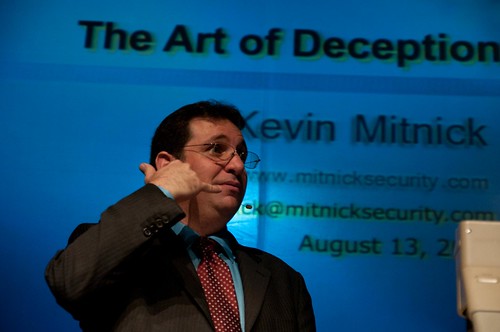
Start Up No.2044: Europe’s heatwave in context, Canadian crypto investors robbed at home, a Covid webinar scam?, and more


The unexpected death of Kevin Mitnick, the first big-name computer hacker, has put his accomplishments back in the spotlight. CC-licensed photo by Campus Party Mexico on Flickr.

You can sign up to receive each day’s Start Up post by email. You’ll need to click a confirmation link, so no spam.


There’s another post coming – this week, around tennis – at the Social Warming Substack at about 0845 UK time. Free signup.


A selection of 9 links for you. So it goes. I’m @charlesarthur on Twitter. On Mastodon: https://newsie.social/@charlesarthur. Observations and links welcome.


Famed social engineer and hacker Kevin Mitnick dies at 59 • The Register

Liam Proven:

»

Kevin Mitnick, probably the world’s most-famous computer hacker – and subsequently writer, public speaker, and security consultant – has succumbed to pancreatic cancer. He was 59.

Tributes have poured in from around the world following the announcement of his death this week.

“We’ve lost a true pioneer of the digital world, Kevin Mitnick,” said Chris Wysopal, a former member of the L0pht team and today an infosec CTO. “His ingenuity challenged systems, incited dialogues, and pushed boundaries in cybersecurity. He will remain a testament to the uncharted power of curiosity.”

Kevin’s wife Kimberley, who is pregnant with their son, said: “Till we see each other again, I know you are here with me. I hear your voice. Our son will know you and I am convinced he will be a mini you. I am grateful we have so many friends all over the world who will teach our son how to hack and more importantly who the real Kevin Mitnick was.”

Mitnick was sometimes known as the Ghost in the Wires after his book of the same name, and was an early celebrity in the area of computer security, as well as a sometime Register contributor. We could hardly introduce him better than he could himself: twenty years ago, we recommended his book the Art of Deception and he generously permitted us to publish its unused autobiographical first chapter.

As a teenager, Mitnick worked out how to obtain free travel on the bus system of the greater Los Angeles area in his native California, and later progressed to breaking into the computer systems of Digital Equipment Corporation and Pacific Bell. He served a number of jail sentences even before he made it onto the FBI’s Most Wanted list. He was apprehended in 1998, and served about three years in prison, which he later referred to as a “vacation.” On his release, he was banned from using any form of computer for three years, and even lost his ham radio license, although after a legal battle he won that back.

«

Mitnick was the first properly famous hacker; the fact he was indicated how we had moved properly into the computer age in the mid-90s, when the machines were both pervasive, and controlled so much of what we did, but were also accessible to and controllable by the ordinary person – even a teenager. Every hacker whose name ever appeared in a paper owes a minor debt to Mitnick.

I found him charming (as I suppose was his aim) when I spoke to him about his first book, The Art Of Deception – about hacking. He’s a great loss.
unique link to this extract


The European heatwave of July 2023 in a longer-term context • Copernicus

»

Temperatures for Europe as a whole show long-term warming trends for both annual and seasonal averages. The annual temperature for 2022 was the second warmest on record for Europe, and was 0.3°C cooler than 2020, the warmest year on record. The ten warmest years on record for Europe have all occurred since 2000, and the five warmest years have all occurred since 2014. Summer 2022 was the warmest on record, by a large margin, at 1.4°C above average.

The average temperature over European land was only a little warmer in the early 1980s than it had been a hundred years earlier but has risen sharply over the past forty or so years. The average value for the last five years is around 2.2°C higher than typical values for the latter half of the 19th century. This temperature increase for Europe is about 1°C larger than the corresponding increase for the globe as a whole. Europe has also warmed faster overall than any other continent in recent decades.


European air temperature over land – anomalies for summer (JJA) 1950–2022, relative to the average for the 1991–2020 reference period. Data source: ERA5, E-OBS. Credit: C3S/ECMWF/KNMI.

While the current heatwave is expected to last until around 26 July, another period of extreme temperatures may follow if the heat dome persists. C3S seasonal forecasts also predict that well-above-average temperatures are likely to continue across Europe until the end of summer, with the exception of southeastern parts of the continent where large uncertainty leaves the probability for extreme conditions close to average.

“C3S is monitoring the evolution of the season. June was the warmest on record for the globe as a whole, and the first 15 days of July have been the warmest 15 days on record. This means that the chance of having a record-breaking summer for the globe is not remote,” said Carlo Buontempo. “Without a dedicated study we can’t say how much more likely the current heatwave has become as a consequence of climate change, but it could be seen as part of a global pattern.”

«

unique link to this extract


Crypto investors are being robbed in their own homes, Canadian police say • The Block

Yogita Khatri:

»

Canadian police have issued a public warning following what appears to be an emerging trend of home invasion-style robberies in the country targeting large crypto investors.

“The suspects appear to know the victims are heavily invested in cryptocurrency, know where they live and are robbing them in their own homes,” Jill Long, staff sergeant of Delta Police Investigative Services, said in a release published Wednesday by Delta Police and Richmond Royal Canadian Mounted Police (RCMP). Over the past year, several incidents have been reported in Delta and Richmond, where victims were holding “large amounts” of crypto, the police agencies said, without disclosing specific details.

In one case, an arrest has been made, and charges are being recommended. As for suspects’ modus operandi, in each case, they gain entry into victims’ homes by posing as delivery persons or people of authority. Once inside the homes, they seize crucial information that grants access to the victims’ crypto accounts, the police said.

They have asked crypto investors to remain vigilant and take necessary precautions to safeguard themselves and their assets.

Canada is one of the popular nations for growing crypto adoption. The country ranked 22nd in the Global Crypto Adoption Index by Chainalysis in 2022, up from 26th position in 2021 and 24th in 2020.

«

Of course, this is the sort of thing that could happen if you owned a large amount of any sort of currency – except that if you were forced to make a bank transfer, you could afterwards call and get the bank to reverse it. (Assuming you’re still alive afterwards.) With crypto, when it’s transferred, it never comes back in any normal circumstance. Maybe being rich isn’t so attractive after all?
unique link to this extract


Costly invite? Scientists hit with massive bills after speaking at COVID-19 ‘webinars’ • Science

Michele Catanzaro:

»

When Björn Johansson received an email in July 2020 inviting him to speak at an online debate on COVID-19 modeling, he didn’t think twice. “I was interested in the topic and I agreed to participate,” says Johansson, a medical doctor and researcher at the Karolinska Institute. “I thought it was going to be an ordinary academic seminar. It was an easy decision for me.”

Three years later, Johansson has come to regret that decision. The Polish company behind the conference, Villa Europa, claims he still owes them fees for taking part, and is seeking payment through a Swedish court. After adding legal costs and interest to the bill, the company is demanding a whopping €80,000.

Johansson isn’t alone. Dozens of researchers participated in the same series of online conferences on COVID-19 in 2020 and 2021 and many have received demands for payment from Villa Europa. At least five are being pursued through courts in their own countries for fees of tens of thousands of euros, although several researchers are fighting back.

But the case is peppered with puzzling circumstances. In court filings and interviews, the researchers say the demands are illegitimate and based on deceptive license agreements. Little is known about the individuals who organized the conferences. And many of the demands hinge on the ruling of a Polish arbitration court whose very existence has been questioned by experts in the country.

«

Faked names, unpublished videos, scammy contracts: all the signs of opportunistic grifting are there.
unique link to this extract


Revealed: media blitz against heat pumps funded by gas lobby group • DeSmog

Phoebe Cooke:

»

Over the past two years, the Energy and Utilities Association (EUA) has paid a public affairs firm to generate hundreds of articles and interviews to lobby the UK government on energy policy.

The PR campaign subjects heat pumps to intense criticism. Powered by electricity, heat pumps are currently set to play a key role in decarbonising heating and replacing gas boilers, which heat around 85% of Britain’s homes and account for 15% of greenhouse gas emissions nationwide.

Negative stories about electric heat pumps have featured in outlets such as The Sun, Telegraph and The Express, in which damning headlines dub the technology “Soviet-style”, “financially irrational” as well as “costly and noisy”. Broadcast media has amplified similar messages on BBC 2’s Newsnight, LBC, TalkTV and GB News.

The company driving this coverage is the Birmingham-based WPR Agency, which was hired by the EUA to deliver an “integrated PR and social media campaign” to “help change the direction of government policy”.

On its website WPR said it aimed to “spark outrage” around heat pumps. This wording, along with other phrases, has since been altered to read “spark conversations” following a request for comment on this article from DeSmog.

The group has since lobbied to delay government plans to ramp up heat pump installation targets in a consultation that closed in June.

WPR’s campaign also explicitly promotes hydrogen as a viable fuel for domestic heating. While favoured by the gas and installers industry as it can flow along existing infrastructure, neither the UN’s leading climate body the Intergovernmental Panel on Climate Change (IPCC) or 32 recently reviewed independent studies see a major role for hydrogen in decarbonizing homes.

Much of the media coverage about heat pumps features Mike Foster, a former Labour MP and the chief executive of the Energy and Utilities Association trade body. According to the group, its members  carry out around 98% of the UK’s heating installations. The vast majority of these are for gas boilers, though some of its members have also branched out into heat pumps.

«

Great journalism. A hydrogen trial was abandoned earlier this week: it just doesn’t work.
unique link to this extract


‘Major wake up call’: Vattenfall halts 1.4GW offshore wind farm project over cost fears • BusinessGreen News

Stuart Stone:

»

Swedish energy giant Vattenfall has today announced it is halting the development of its 1.4GW Norfolk Boreas offshore wind project and reviewing further projects planned for its Norfolk Zone that were expected to power up to four million homes.

In its interim report for January to June 2023, Vattenfall revealed that project costs have risen by up to 40% on the back of soaring materials and labour costs. As such, it stated that it would “not take an investment decision now” on the project and confirmed its decision will trigger an impairment cost of 5.5 billion Swedish crowns, or roughly £415m.

The Norfolk Boreas project is expected to provide power for up to 1.5 million homes and would be the first of three east coast wind farms planned by the company. The project was last year awarded a Contract for Difference (CfD) guaranteeing a £37.35/MWh fixed price for its electricity over its first 15 years – equating to around £45/MWh today.

However, subsequent inflation and rising interest rates have led to concerns across the industry that a number of planned offshore wind projects may no longer prove profitable at the contract prices that were previously agreed through the CfD auction process.

Anna Borg, chief executive at Vattenfall, this morning confirmed that current “market conditions” left the company with little choice but to pause the project.

“Offshore wind is essential for affordable, secure and clean electricity, and it is a key element of Vattenfall’s strategy for fossil-free living,” she said. “But conditions are extremely challenging across the whole industry right now, with a supply chain squeeze, increasing prices and cost of capital, and fiscal frameworks not reflecting current market realities.”

«

This comes just as the government is giving an estimated £500m in various subsidies to (foreign-owned, a subsidiary of India’s Tata Motors) Jaguar Landrover to build a battery factory in the UK rather than Spain. Very much about priorities, isn’t it.
unique link to this extract


Of Course Apple Has an LLM AI Chatbot in the Works, and of Course the Bloomberg Report Revealing Its Code Name Mentions How the Story Moved the Company’s Stock Price • Daring Fireball

John Gruber, on the Bloomberg story about the Apple chatbot:

»

Next paragraph [in the Bloomberg story]:

»

Apple shares gained as much as 2.3% to a record high of $198.23 after Bloomberg reported on the AI effort Wednesday, rebounding from earlier losses. Microsoft Corp., OpenAI’s partner and main backer, slipped about 1% on the news.

«

If you ever notice, Bloomberg news stories always contain updates like this. It’s an obsession unique to Bloomberg. My understanding is that this decade-old Business Insider story remains true: Bloomberg reporters are evaluated and receive bonuses tied to reporting market-moving news. They’re incentivized financially to make mountains out of molehills, and craters out of divots, to maximize the immediate effect of their reporting on stock prices. And Bloomberg appends these stock price movements right there in their reports, to drive home the notion that Bloomberg publishes market-moving news, so maybe you too should spend over $2,000 per month on a Bloomberg Terminal so that you can receive news reports from Bloomberg minutes before the general public, and buy, sell, and short stocks based on that news. No other news organization I’m aware of has an incentive system like this for reporters — but no other news organization has a business like the Bloomberg Terminal.

«

That’s absolutely astonishing. I hadn’t heard about this incentive scheme, but as the linked BI story points out, it worries traders because it creates an obvious incentive for reporters to stretch a story in order to move the stock. Talk about misaligned incentives. Incredible that American journalists, normally the most po-faced of all, would tolerate it.

By the way, my hurried calculation yesterday about the effect of the announcement on Apple’s value was wrong by a factor of 100: as Jonathan B pointed out, “If Apple is worth $3trn and jumps 2%, that’s $60bn, not $600m. A billion here, a billion there etc…” Imagine if the reporters got a bonus proportionate to the unsigned value change..
unique link to this extract


Google tests AI tool that can write news articles • New York Times

Benjamin Mullin and Nico Grant:

»

Google is testing a product that uses artificial intelligence technology to produce news stories, pitching it to news organizations including The New York Times, The Washington Post and The Wall Street Journal’s owner, News Corp, according to three people familiar with the matter.

The tool, known internally by the working title Genesis, can take in information — details of current events, for example — and generate news content, the people said, speaking on the condition of anonymity to discuss the product.

One of the three people familiar with the product said that Google believed it could serve as a kind of personal assistant for journalists, automating some tasks to free up time for others, and that the company saw it as responsible technology that could help steer the publishing industry away from the pitfalls of generative A.I.

Some executives who saw Google’s pitch described it as unsettling, asking not to be identified discussing a confidential matter. Two people said it seemed to take for granted the effort that went into producing accurate and artful news stories.

«

What a strange phrase – “it seemed to take for granted the effort that went into producing accurate and artful news stories”. I take it that refers to Google, rather than the tool itself, but I’m not even sure what is meant. If you’re offering a tool that writes news stories, surely you’re implying that the effort by human of writing news stories is in fact largely wasted.
unique link to this extract


Something in space has been lighting up every 20 minutes since 1988. But we have no idea what • Ars Technica

John Timmer:

»

GPM J1839–10 was discovered in a search of the galactic plane for transient objects—something that’s not there when you first look, but appears the next time you check. The typical explanation for a transient object is something like a supernova, where a major event gives something an immense boost in brightness. They’re found at the radio end of the spectrum—fast radio bursts—but are also very brief, and so fairly difficult to spot.

In any case, GPM J1839–10 showed up in the search in a rather unusual way: it appeared as a transient item twice in the same night of observation. Rather than delivering a short burst of immense energy, such as a fast radio burst, GPM J1839–10 was much lower energy and spread out over a 30-second-long burst.

Follow-on observations showed that the object repeated pretty regularly, with a periodicity of about 1,320 seconds (more commonly known as 22 minutes). There’s a window of about 400 seconds centered on that periodicity, and a burst can appear anywhere within the window and will last anywhere from 30 to 300 seconds. While active, the intensity of GPM J1839–10 can vary, with lots of sub-bursts within the main signal. Occasionally, a window will also go by without any bursts.

A search through archival data showed that signals had been detected at the site as far back as 1988. So, whatever is producing this signal is not really a transient, in the sense that the phenomenon that’s producing these bursts isn’t a one-time-only event.

The list of known objects that can produce this sort of behavior is short and consists of precisely zero items.

«

Pulsar? Nah. Neutron star? Nah. Something else? Clearly, but nobody knows quite what. Though there may be many more of these mystery things out there, as Timmer explains.
unique link to this extract


• Why do social networks drive us a little mad?
• Why does angry content seem to dominate what we see?
• How much of a role do algorithms play in affecting what we see and do online?
• What can we do about it?
• Did Facebook have any inkling of what was coming in Myanmar in 2016?

Read Social Warming, my latest book, and find answers – and more.


Errata, corrigenda and ai no corrida: none notified

Start Up No.2043: Netflix wins password crackdown, climate change deniers say what?, Indian coders face AI threat, and more


A surprising number of scientific papers contain faked images using editors to rotate or flip pictures of results and make them seem more convincing. But they’re being caught. CC-licensed photo by Maximilian Paradiz on Flickr.

You can sign up to receive each day’s Start Up post by email. You’ll need to click a confirmation link, so no spam.


There’s another post coming this week at the Social Warming Substack on Friday at about 0845 UK time. It’s about tennis, sort of. Free signup.


A selection of 10 links for you. Spotted! I’m @charlesarthur on Twitter. On Mastodon: https://newsie.social/@charlesarthur. Observations and links welcome.


Science has a nasty Photoshopping problem • The New York Times

Elisabeth Bik is a microbiologist:

»

One evening in January 2014, I sat at my computer at home, sifting through scientific papers. Being a microbiologist, this wasn’t unusual, although I certainly didn’t expect to find what I did that night.

These particular papers were write-ups of medical research, with many including photographs of biological samples, like tissue. One picture caught my eye. Was there something familiar about it? Curious, I quickly scrolled back through other papers by the same authors, checking their images against each other.

There it was. A section of the same photo being used in two different papers to represent results from three entirely different experiments.

What’s more, the authors seemed to be deliberately covering their tracks. Although the photos were of the same sample, one appeared to have been flipped back-to-front, while the other appeared to have been stretched and cropped differently.

Although this was eight years ago, I distinctly recall how angry it made me. This was cheating, pure and simple. By editing an image to produce a desired result, a scientist can manufacture proof for a favored hypothesis, or create a signal out of noise. Scientists must rely on and build on one another’s work. Cheating is a transgression against everything that science should be.

…Since childhood, I’ve been “blessed” with what I’m told is a better-than-average ability to spot repeating patterns. It’s a questionable blessing when you’re focused more on the floor tiles than on the person you’re supposed to talk to. However, this ability, combined with my — what some might call obsessive — personality, helped me when hunting duplications in scientific images by eye.

«

Bik has made a tremendous difference by spotting and hunting down these frauds: she’s been doing it full-time since 2019. (Not clear who funds her.) Unrelated: Stanford University’s president is resigning his post and retracting “at least” three papers after the student newspaper exposed data manipulation in multiple papers.
unique link to this extract


Netflix says password-sharing crackdowns caused more signups than cancellations • The Verge

Emma Roth:

»

Netflix says its password-sharing crackdown is working. In its second quarter earnings report posted on Wednesday, the streamer says it saw the addition of 5.9 million subscribers globally, with the US and Canada making up 1.17 million new members from April to June.

Now, Netflix will start to address password sharing in all its remaining countries. The company’s password-sharing policy only went into effect in the US in late May after the streamer started alerting users of the extra $7.99 per month charge. Data from the analytics company Antenna suggests that the company saw a dramatic spike in subscribers in the days following the crackdown. In addition to the US, Netflix also rolled out paid sharing in Canada, New Zealand, Portugal, and Spain.

Netflix says revenue is now “higher in each region is now higher than pre-launch,” adding that signups are already outnumbering cancellations. Additionally, the streamer adds that it’s “seeing healthy conversion of borrower households into full paying Netflix memberships” as well as more users adding extra members to their accounts.

«

Once again I’ll say: told you so. At the margin, people were far more likely to want to continue watching than to cancel: the reason you’re using a “borrowed” password is because you like the content. OK, not everyone will sign up when the password is blocked. But enough will. QED.
unique link to this extract


Tom the Dancing Bug: What we imagined climate change deniers would say… • Boing Boing

Ruben Bolling’s strips – called “Tom the Dancing Bug” for reasons that aren’t easily pinned down – capture the essential madness of America very neatly. This one is particularly true. Think: what do you think those climate change deniers in the hot seat are actually saying right now?
unique link to this extract


Stability AI CEO: most outsourced coders in India will go in two years • CNBC

Ryan Browne:

»

Most outsourced programmers in India will see their jobs wiped out in the next year or two, Stability AI CEO Emad Mostaque said.

Mostaque, on a call with UBS analysts, said that most of the country’s outsourced coders will lose their jobs as the effects of AI mean that it is now possible for software to be developed with far fewer people. “I think that it affects different types of jobs in different ways,” Mostaque said on a call with analysts at the Swiss investment bank last week.

“If you’re doing a job in front of a computer, and no one ever sees you, then it’s massively impactful, because these models are like really talented grads.”

According to Mostaque, not everyone will be affected in the same way, however. That is due in no small part to differing rules and regulations around the world. Countries with stronger labor laws, like France, will be less likely to see such an impact, for example.

In India, Mostaque said, “outsourced coders up to level three programmers will be gone in the next year or two, whereas in France, you’ll never fire a developer.”

“So it affects different models in different countries in different ways in different sectors.”

India is home to more than five million software programmers, who are most under threat from the impacts of advanced AI tools like ChatGPT, according to a report from Bloomberg.

«

That’s a lot of people who will fairly rapidly be looking for new jobs. Wouldn’t have expected AI to be the vanguard of onshoring, but it makes sense.
unique link to this extract


G/O media will make more AI-generated stories despite critics • Vox

Peter Kafka:

»

In early July, managers at G/O media, the digital publisher that owns sites like Gizmodo, the Onion, and Jezebel, published four stories that had been almost entirely generated by AI engines. The stories — which included multiple errors and which ran without input from G/O’s editors or writers — infuriated G/O staff and generated scorn in media circles.

They should get used to it.

G/O executives, who say that AI-produced stories are part of a larger experiment with the technology, plan on creating more of them soon, according to an internal memo. And G/O managers told me they — and everyone else in media — should be learning how to make machine-generated content.

“It is absolutely a thing we want to do more of,” says Merrill Brown, G/O’s editorial director.

G/O’s continued embrace of AI-written stories puts the company at odds with most conventional publishers, who generally say they’re interested in using AI to help them produce content but aren’t — for now — interested in making stuff that is almost 100% machine-made.

…Brown and G/O Media CEO Jim Spanfeller both argue that AI will be transformative for the media industry — like the internet was in the last couple decades, or maybe more so — and that ignoring it would be a terrible mistake.

“I think it would be irresponsible to not be testing it,” Spanfeller told me.

Spanfeller and Brown say their AI-written stories aren’t the only way they want to use the tech. Like many publishers, they bring up the idea that reporters could use AI to do research for a story; Spanfeller also says he wants to use AI to automate some tasks humans currently perform on the business side of his company, like preparing basic marketing plans for advertisers.

«

unique link to this extract


Gotham’s Ben McKenzie on crypto, fraud, and Celsius’ Alex Mashinsky • Rolling Stone

Ben McKenzie (who has written a book about the crypto hype) went to a crypto conference, was taken out to dinner by the CIA, and next day bumped into Mashinsky and asked for an interview:

»

For reasons that can only be attributed to ego, Alex Mashinsky said yes. So we talked: about an industry rife with speculation, about Celsius’s relationship with Tether (he downplayed it), about risk, about the supposed promise of crypto. As the conversation went on, several Celsius staffers, all of them young women, circled the couches, alternating between punching away at their phones and staring at their free-talking CEO with growing concern. At one point, Mashinsky’s wife Krissy, decked out in a pink Juicy Couture velour jumpsuit, stood directly across from him, giving him a death stare. The point was clear: End the fucking interview! But Mashinsky brushed her off with a wave of his hand. We got it on camera. There were moments that astonished me. Talking about scams, he took the usual tack and said people needed to educate them- selves. Alas, there are a lot of scammers out there, but always DYOR. I asked him, didn’t that really mean it’s the customer’s fault? Most crypto CEOs duck that question, or pretend to be offended. Instead, Mashinsky leaned back and said, with a “Who me?” kind of mock innocence, “If you left money on the street, you[’d] expect it to be there in the morning?”

Toward the end of our conversation, when the video was off but with audio still rolling, Mashinsky told me something that made my blood run cold. I asked him how much “real money” he thought was in the crypto system. I didn’t think he would actually answer the question, but he did.

“Ten to fifteen percent,” Mashinsky said. That’s real money — genuine government-backed currency — that’s entered the system. “Everything else is just bubble.”

The number seemed straightforward and eminently believable. But it was still shocking to hear it from a high-level crypto executive, who seemed totally unconcerned about it all. Mashinsky acknowledged that a huge speculative bubble had formed. If the overall crypto market cap was about $1.8 trillion at the time we spoke, that meant that one and a half trillion or more of that supposed value didn’t exist.

«

Mashinsky has since been charged with fraud and market manipulation. Wonder if his defence will include “well, most of it wasn’t real”?
unique link to this extract


OpenAI strikes $5 million-plus local news deal • Axios

Sara Fischer:

»

OpenAI will commit $5m in funding for local news initiatives through the AJP [American Journalism Project], which supports non-profit, local news outlets through grants and other support efforts.

AJP will distribute the funding via grants to ten of its 41 portfolio organizations. Those organizations will experiment with best practices for ways local news outlets can leverage AI responsibly in their newsrooms, products and revenue teams.

The funding will also support the creation of a new product studio within AJP that will support local news outlets as they experiment with OpenAI’s technology, said Sarabeth Berman, CEO of AJP.

The studio, which for now is slated to include three full-time AJP staffers, will also serve as a central hub to share feedback and best practices with external partners like OpenAI on what’s working and what’s not.

“We see this as an opportunity to create a feedback loop between OpenAI and the local journalism industry,” Berman said.

«

A whole $5m? With local journalism in its current parlous state in the US, that’s getting on for a few thousand each. But what is it going to do? “Support local news outlets as they experiment with OpenAI’s technology” sounds a bit like “circulate the money back into an OpenAI subscription so you can write the boring articles more quickly”. Not that I’m cynical or anything.
unique link to this extract


Startup failures have doubled over the last 12 months. There are ways to ensure yours won’t suffer the same fate • Inc.com

Sam Blum:

»

The failure rate of companies in Kruze Consulting’s portfolio, which includes clients that have accrued a cumulative $12bn in venture funding, has doubled over the last twelve months, according to Healy Jones, Kruze’s vice president of financial strategy. Kruze, also based in San Francisco, specializes in financial and HR matters for startups.

The upswing in failure is attributable to the funding climate of 2021, when money going to new startups soared, hitting $329bn in the U.S., alone, Pitchbook data shows. Startups that prospered during the boom are now burning through their final cash reserves, as VCs started to pick winners — and losers — amid the crowded field of that year, Jones tells Inc.

From “Q3 of last year onward,” he says, “you could tell that VCs had really upped the game in terms of what they were willing to invest in. And so that made it way more difficult for [startups] to raise funding. And that’s why the churn popped up so dramatically.”

The environment may now be reverting back to the more difficult, pre-pandemic period of 2018-2019, and so are entrepreneurs’ options.

Startup founders worried about their companies biting the dust, amid what Jones describes as a looming correction in the funding landscape, still have options. Two among them stand to increase the survival potential for businesses: raising money at a lower valuation, and bridge funding.

«

More evidence pointing towards a big clearout in Silicon Valley.
unique link to this extract


Apple is testing an AI chatbot but has no idea what to do with it • The Verge

Emma Roth and Emilia David:

»

Apple is creating its own AI-powered chatbot that some engineers are calling “Apple GPT,” according to a report from Bloomberg. The company reportedly doesn’t have any solid plans to release the technology to the public yet.

As noted by Bloomberg, the chatbot uses its own large language model (LLM) framework called “Ajax,” running on Google Cloud and built with Google JAX, a framework created to accelerate machine learning research. Sources close to the situation tell the outlet that Apple has multiple teams working on the project, which includes addressing potential privacy implications.

As other tech giants, including Meta, Microsoft, and Google, have moved quickly releasing generative AI products of their own to businesses and the general public, Apple has been conspicuous in its absence. While Apple banned its workers from using ChatGPT, Bloomberg reports that engineers have been using the Ajax-powered chatbot internally. Ajax was created to “unify machine learning development,” Bloomberg says.

«

Apple’s stock jumped 2% in 6 minutes when the Bloomberg story hit the wires. That’s more than $600m; the company is presently valued at over $3 trillion. It fell back a little when people read through and decided there wasn’t going to be a fruity chatbot in front of people any time soon. But it shows how sensitive the market is to this sort of news.
unique link to this extract


The death of Infosec Twitter • Cyentia Institute

Jay Jacobs:

»

“Infosec twitter” has been used to describe the vibrant, active and often enthusiastic community of security practitioners working in and around the industry. It’s been a source of insight, inspiration and entertainment for many and for years. Therefore, it is with a bit of sadness that I must announce that the death of infosec twitter is upon us.

Two years ago, on July 12th, 2021, we saved our first bit of data from twitter recording tweets with discussions of CVEs on twitter. I had been researching and studying vulnerabilities for several years and our work on EPSS was in full swing. We started collecting vulnerability discussions to see what kind of benefit that data could add to the EPSS approach. Plus, CVE identifiers are relatively easy to search on and pick out from conversation, so we could be relatively confident we were collecting every tweet.

On July 12th, 2021, we recorded 1,161 original and unique tweets (no retweets) that were discussing CVEs, and we tracked tweets with CVEs every day from that point on.

…Over the last 3 weeks of our data (June 21 to July 12, 2023), we saw a weekday daily tweet count drop from the 1,272 pre-Elon average to just 333 tweets a day, which is about a 74% drop in weekday tweets. The 2-week rolling average (including weekends) dropped down to 272 tweets over the final 2 weeks. When I attempt to remove automated CVE announcements (bots), the drop is even more significant, dropping from over 500 a day down to 66 over the last two weeks, an 87% decrease in CVE-related tweets.

Unfortunately this is where the story will stop too. The free tier we were using to collect this data was cut off last week. Between the headlines and the trend we are seeing in this data, it just doesn’t make sense to pay for access to this data. The last day we were able to save twitter data was July 12th, 2023, exactly two years from the start of our experiment. And with that, we say “so long” to Infosec Twitter.

«

The tweets are going out all over Europe. And other bits of the world.
unique link to this extract


• Why do social networks drive us a little mad?
• Why does angry content seem to dominate what we see?
• How much of a role do algorithms play in affecting what we see and do online?
• What can we do about it?
• Did Facebook have any inkling of what was coming in Myanmar in 2016?

Read Social Warming, my latest book, and find answers – and more.


Errata, corrigenda and ai no corrida: none notified

Start Up No.2042: the weather app addiction, Microsoft prices CoPilot, the 500-mile email mystery, one less private jet?, and more


The humble-seeming telephone number has a deep ability to connect absolutely everyone. CC-licensed photo by Hades2kHades2k on Flickr.

You can sign up to receive each day’s Start Up post by email. You’ll need to click a confirmation link, so no spam.

A selection of 9 links for you. Voicemail? I’m @charlesarthur on Twitter. On Mastodon: https://newsie.social/@charlesarthur. Observations and links welcome.


‘We used to check every day, now it’s every minute’: how we got addicted to weather apps • The Guardian

Hannah Marriott:

»

The temperature in Austin has been in the 110s Fahrenheit (40s Celsius) for weeks; [Matt Rickett] will keep checking the apps, even when he knows no change is likely. Or else he looks at the weather in other places, where it is less hot, and he has family, and will think: “Oh, maybe I can just go there for a little bit.”

It’s behavior that Jess Green, who lives in Liverpool, England, might relate to. During last summer’s unprecedented heatwave in the UK, she says, “there was a lot of talk of: ‘will we make it to 40C?’ I kept checking in the hope that we wouldn’t.” She would watch the numbers rise on her app, with trepidation, and would then feel relieved to see them peak, thinking: “We’re on our way down; and things haven’t burst into flames.” She would check different locations. “I would think: so it’s not a record temperature in Liverpool today. That’s great. But what about London?”

She has three weather apps on her smartphone, but recently a widget has started popping up, unbidden, on Microsoft Edge on her computer. “It asks: ‘do you want to know about record temperatures today?’” Then a quiz appears, asking whether the day’s temperature is above or below average, historically. “That has made my obsession quite a lot worse,” she says. In many ways, she points out, it would be odd not to feel anxious, given the climate emergency. “But it’s a bit like the pandemic. It’s unprecedented, so it’s hard to tell if your anxiety is proportional to the threat you’re feeling.”

«

The weather! Everyone talks about it, nobody does anything about it.
unique link to this extract


Microsoft puts a steep price on Copilot, its AI-powered future of Office documents • The Verge

Tom Warren:

»

Microsoft is putting a price on the AI-powered future of Office documents, and it’s a steep one for businesses looking to adopt Microsoft’s latest technology. Microsoft 365 Copilot will be available for $30 per user per month for Microsoft 365 E3, E5, Business Standard, and Business Premium customers.

That’s a big premium over the cost of the existing Microsoft 365 plans right now. Microsoft charges businesses $36 per user per month for Microsoft 365 E3, which includes access to Office apps, Teams, SharePoint, OneDrive, and many other productivity features. A $30 premium for access to Microsoft 365 Copilot will nearly double the cost for businesses subscribed to E3 that want these AI-powered features. For Microsoft 365 Business Standard, that’s almost three times the cost, given that it’s $12.50 per user per month.

…Around 600 enterprise customers have been testing Microsoft 365 Copilot during a paid early access program over the past several months. Companies like KPMG, Lumen, and Emirates NBD have all had access. “We’re learning that the more customers use Copilot, the more their enthusiasm for Copilot grows,” says Yusuf Mehdi, Microsoft’s head of consumer marketing, in a blog post today. “Soon, no one will want to work without it.”

«

Is that really a lot? I think a lot of companies would feel happy if they think they’ll get $30 (or more) of extra productivity from their staff. At lunch yesterday I heard from a business consultant who used ChatGPT for the first time in his professional capacity in order to save a little time, and was both delighted and horrified by how succinctly it did his work for him. The chatbots are coming, folks.
unique link to this extract


Phone numbers are a perfect technology • The Atlantic

Charlie Warzel:

»

even the 10-digit system—one of the technological constants of my life—has an expiration date. At some point, the numbers will run out, a realization that caused me to wonder who, if anyone, is keeping tabs on our numbers. Thankfully, the North American Numbering Plan Administrator, the delightfully bureaucratic organization that manages and assigns phone numbers and area codes in 20 countries, is on the case. Say a whole bunch of people move to Montana or Maine and request new numbers—NANPA’s team works with carriers and state commissions to roll out a new area code, a process that takes at least three years, Florence Weber, NANPA’s senior director, told me.

“We continue to see an uptick in terms of requests for numbers—that’s not going away,” Weber said. But nothing lasts forever. NANPA has been closely monitoring and preparing for the day that we run out of three-digit area codes or have to move beyond the 10-digit number. Weber told me that, according to NANPA’s proprietary prediction system, which takes into account forecasted demands and assignment rates, the “projected exhaustion date” is sometime in 2051.

I shudder to think what will happen on that day. The dawn of longer phone numbers is one possibility; surrendering to online services is another. The phone number feels a bit like a relic in the age of Zoom meetings, one-tap FaceTiming, WhatsApp, Signal, Viber, DMs, Discord—you name it. Phone numbers were originally conceived as a way to route connections via location, and technically speaking, the internet now does this just as well either via IP addresses or by using the Voice over Internet Protocol. The nerds suggest that we could ditch the numbering system and use a decentralized calling system that works a bit like web addresses do—you get a unique address and purchase a domain, so people can contact you without having to punch in a long string of numbers.

Still, it’s worth considering what we lose if our area codes, prefixes, and line numbers are slowly washed away by the sands of time.

«

With the 10-digit system, you do actually have enough numbers for everyone on earth to have one; in theory there are 10 billion. But, as with so much, we haven’t managed to distribute them equally.
unique link to this extract


Threadzilla • No Mercy / No Malice

Scott Galloway on Twitter’s demise:

»

We’re not only witnessing the unraveling of a firm, but a person. I have written about mens’ need for guardrails. These can take several forms — an office, a girlfriend, regulation, a board. The erosion of Musk’s guardrails as money and sycophants melt whatever better judgment or grace he had has resulted in a reputation experiencing the same trajectory as Twitter’s revenue. If Elon had never downloaded the micro-blogging app he’d be much wealthier and universally revered for his formidable accomplishments. Instead, he’s set a land speed record for hero to villain.

To be clear, Twitter will not go away. Elon remains the wealthiest man in the world and can fund Twitter’s operations, and the interest on its debt, for years if not decades. There’s ample Elon stans and a sizable cohort who don’t care about any of this and have communities or identities on Twitter that work for them. Meanwhile, Threads faces many of the same challenges as Twitter: How do you balance openness and diversity of views with standards of decency while generating sustainable cash flow? It’s a riddle few, if any, firms have solved. LinkedIn? Reddit?

History says the nose of this jet will be difficult to pull up. In 2008, MySpace was one of the most trafficked websites in the U.S., with 115 million active users, generating $800 million in revenue in a year. Then Facebook surpassed its user count and the business was sold for $35 million to Justin Timberlake. Friendster also had 115 million users at its peak in 2008. There’s a learning here: Social media apps do well until Mark Zuckerberg kills them.

«

As Galloway points out, consider if we’d never heard from Musk; if, like the extremely rich people of the recent past, he’d had no easy way to transmit his laziest thoughts to billions of people. Or, as a contrast, what if Andrew Carnegie had had Twitter – would he have been the same incredible philanthropist? (It has worked for Bill Gates, so not all hope is lost.)
unique link to this extract


The case of the 500-mile email • iBiblio

Trey Harris, in a (true) story that he first wrote up in 2002, but happened some time between 1994 and 1997:

»

I was working in a job running the campus email system some years ago when I got a call from the chairman of the statistics department.

“We’re having a problem sending email out of the department.”

“What’s the problem?” I asked.

“We can’t send mail more than 500 miles,” the chairman explained.

I choked on my latte. “Come again?”

“We can’t send mail farther than 500 miles from here,” he repeated. “A little bit more, actually. Call it 520 miles. But no farther.”

“Um… Email really doesn’t work that way, generally,” I said, trying to keep panic out of my voice. One doesn’t display panic when speaking to a department chairman, even of a relatively impoverished department like statistics. “What makes you think you can’t send mail more than 500 miles?”

“It’s not what I *think*,” the chairman replied testily. “You see, when we first noticed this happening, a few days ago–”

“You waited a few DAYS?” I interrupted, a tremor tinging my voice. “And you couldn’t send email this whole time?”

“We could send email. Just not more than–”

“–500 miles, yes,” I finished for him, “I got that. But why didn’t you call earlier?”

“Well, we hadn’t collected enough data to be sure of what was going on until just now.” Right. This is the chairman of *statistics*. “Anyway, I asked one of the geostatisticians to look into it–”

“Geostatisticians…”

“–yes, and she’s produced a map showing the radius within which we can send email to be slightly more than 500 miles. There are a number of destinations within that radius that we can’t reach, either, or reach sporadically, but we can never email farther than this radius.”

“I see,” I said, and put my head in my hands. “When did this start? A few days ago, you said, but did anything change in your systems at that time?”

“Well, the consultant came in and patched our server and rebooted it. But I called him, and he said he didn’t touch the mail system.”

«

See if you can figure out why. (The precise distance was 558 miles.)
unique link to this extract


Bay Area startups face ‘mass extinction event,’ experts predict • SF Chronicle

Carolyn Said:

»

A Darwinian day of reckoning is on the horizon for startups. Soaring interest rates and economic jitters have created an inhospitable climate for raising capital. Venture-backed companies are now belt-tightening to conserve their cash, but experts say, ultimately, many will not survive.

“PREDICTION: There’s a mass extinction event coming for early & mid-stage companies. Late ’23 & ’24 will make the ’08 financial crisis look quaint for startups,” tweeted venture capitalist Tom Loverro early this year, in a thread that continues to get big traction.

The reason, as he and others explain it: In 2021 and early 2022, the market was flush with cash and startups easily raised money at high valuations. Typically, each VC round lasts 18 to 24 months, so many will need to return to the market for cash infusions starting in the second half of this year.

But times have changed.

“Venture capital has become a lot harder to come by, especially compared to 2021 and beginning of 2022 where there was a wave of capital exuberance,” said Kaidi Gao, associate analyst for venture capital at PitchBook, a research firm and financial data provider. “A lot of companies took advantage of that time and really loaded up their balance sheets.”

With interest rate hikes, tumbling values on Wall Street and fears of a recession, those same companies now are confronting a stark reality.

“Capital is a lot harder to come by,” Gao said. “Companies are cutting back and really trying to stretch out their runway. But you can only stretch it so far, there comes a time when you run out of capital and have to return to the market.”

«

“Down rounds” which value companies lower than their previous funding round are becoming common. Unlike 2008, it’s going to be rising interest rates that kill these ones.
unique link to this extract


This millionaire is selling his private jet — out of concern for the environment • CNN

Jacopo Prisco:

»

The global private jet fleet has more than doubled in the last two decades and the market is on fire, with new industry records set for transaction and dollar volume in 2021 and 2022, according to a new report by the US Institute for Policy Studies.

Private jets emit at least 10 times more pollutants than commercial planes per passenger, disproportionately contributing to the aviation sector’s climate impact, according to the report, which was published in May 2023.

What’s more, while approximately one out of every six flights handled by the Federal Aviation Administration is private, the sector only contributes 2% of the taxes that primarily fund the agency.

Amid these concerns, one private jet owner has decided to scale back. Stephen Prince, vice-chair of the Patriotic Millionaires – a group of wealthy Americans pushing for higher taxes which also contributed to the report – is giving up his Cessna 650 Citation III.

He decided to ditch the plane – a mid-size, long range corporate jet with room for up to nine passengers – after he learned how much more carbon-intensive flying private is compared to commercial.

“I was gobsmacked by the fact that by being so in love with private air travel, I was willing to ignore what a horrible travesty I was perpetrating on the environment and on future generations,” he tells CNN. “I’ve got to change. I just can’t continue to do this.”

«

Which means he’s going to save about $300k per year, and slum it in first class. Except.. if you read on, you’ll discover he hasn’t entirely given up private plane travel.

Deep sigh.
unique link to this extract


Making EVs work in Britain • Notes On Growth

Sam Dumitriu on the many, many challenges to EV charging:

»

If you happen to have somewhere to park your car off-street, acquiring planning permission to install a chargepoint is relatively straightforward. There’s a Permitted Development (PD) right for installing one, so as long as you meet certain standards (i.e. it’s not too tall, too chunky, or too close to a public highway) you do not need to apply for planning permission.

This is not the case for public chargepoints. If a business wants to install new chargepoints so people can charge while they park on the street, then they need explicit permission from the council.

In theory, this shouldn’t be a big issue. New housing generates opposition because existing residents typically lose out in some way (e.g. more congestion, lower house prices, loss of light), but chargepoints are literally a new benefit for local residents.

Yet, there have been a number of recent objections against chargepoints being installed on public roads. In Norwich, where plans to install 46 chargers on city streets were under consultation, a local branch of the pedestrian campaign group called Living Street described the proposal as “a new threat to our public space with more clutter on the pavements.” Living Streets, along with charities representing the blind or partially sighted, have lodged similar objections to a Scottish consultation which suggested creating a PD right for on-street charging.

Living Streets want on-street charging points to be placed in the road to ensure no pavement is lost (Cambridge already does this). Yet, a compromise clearly could be struck. On narrow streets, more clutter is undesirable, but on wider streets where ample space for pedestrians remains – permissions should be streamlined and become permitted development where possible.

Another way to avoid pavement clutter would be to create a permitted development right to install special gutters for EV charging cables. Companies like Kerbo Charge will install small removable gutters running from your house to a parking spot. That’s handy if you have a regular on-street parking spot in front of your house. At the moment, this scheme is only being trialled in Milton Keynes, but there’s no obvious reason why it couldn’t be rolled out nationwide.

«

Charging! It’s complicated! (You’re welcome, John. Happy belated birthday.)
unique link to this extract


Chart: going round in circles? The countries that prefer roundabouts • Statista

Katharina Buchholz:

»

Roundabouts make waiting at traffic lights obsolete, yet for some drivers who are unfamiliar with them, they might mean an additional stress factor. Depending on their design, they can be harder for cyclists and pedestrians to cross. For the driver, however, roundabouts have been proven to be a faster and safer way to pass through an intersection. Additional benefits of going round in circles include saving space (because there is no need for multiple lanes leading up to a stop light) and lower costs (because of easier maintenance).

Some countries in Europe have made the roundabout their go-to intersection – notably France and Spain. France has 967 traffic circles per million inhabitants, according to an evaluation by the blog erdavis.com. In Spain the number is somewhat lower at 591 per one million people, but still high compared to elsewhere. Other countries, like the U.S. and Germany, still shy away from using the infrastructure, often citing fears that drivers who are not used to roundabouts might have trouble with the concept of yielding upon entering the circle.

«

“Might have trouble with the concept of yielding upon entering the circle”? What nonsense is this? You look on the roundabout before you enter and give way to traffic already on it. Like joining any road ever anywhere, except you don’t have to look in the other direction because there won’t (pray) be anything coming from there.

I’d like to see this chart (which puts France, Spain and the UK at the top) redone per mile of road. I suspect the US would be even further down. (Thanks G for the link.)
unique link to this extract


• Why do social networks drive us a little mad?
• Why does angry content seem to dominate what we see?
• How much of a role do algorithms play in affecting what we see and do online?
• What can we do about it?
• Did Facebook have any inkling of what was coming in Myanmar in 2016?

Read Social Warming, my latest book, and find answers – and more.


Errata, corrigenda and ai no corrida: none notified

Start Up No.2041: Threads gets a spam problem, SEC v the chatbots, Twitter’s ineffective PR, what about a roundabout?, and more


Driving along the Hutchinson River Parkway means your car numberplate will be analysed by AI to see if it has been on a suspicious journey. Good or bad? CC-licensed photo by Doug Kerr on Flickr.

You can sign up to receive each day’s Start Up post by email. You’ll need to click a confirmation link, so no spam.

A selection of 10 links for you. Use them wisely. I’m @charlesarthur on Twitter. On Mastodon: https://newsie.social/@charlesarthur. Observations and links welcome.


The spam bots have now found Threads, as company announces its own ‘rate limits’ • TechCrunch

Sarah Perez:

»

It looks like Twitter isn’t the only one having to turn to rate limits — or limits on how many posts users can view. In an amusing turn of events, Twitter’s latest rival, Instagram Threads, announced this afternoon that it, too, has to tighten up on rate limits due to spam attacks. Laughed Twitter owner Elon Musk in a reply to a screenshot of the announcement posted on Twitter, “Lmaooo Copy 🐈 [cat].”

As you may recall, Twitter earlier this month had to enforce new limits on how many tweets users could read as the service suffered an extended outage. Explained Musk at the time, Twitter was facing “extreme levels of data scraping” from hundreds of organizations and other “system manipulation.” As a result, Twitter chose to curb the problem by initially allowing Verified users (paying subscribers) to peruse a maximum of 6,000 posts daily, while unverified users could only view 600. After some backlash from users, Musk later increased the limits to 10,000 for Verified accounts, 1,000 for unverified accounts, and 500 for new, unverified accounts.

Over the weekend, Musk said he would increase the rate limit again for Verified users by 50%, which implies they would now be able to see 15,000 posts.

Twitter had been criticized for its unorthodox solution to the spam and bot problem, which some suggested wouldn’t have been an issue if Twitter hadn’t laid off such a large swath of its engineering staff. After all, not being able to scroll the Twitter timeline for long periods of time had never been an issue in the pre-Elon days (except, of course, in the earliest years when the fail whale was a regular occurrence).

Instagram head Adam Mosseri explained the problem in a post on the Threads app this afternoon, noting that “Spam attacks have picked up so we’re going to have to get tighter on things like rate limits, which is going to mean more unintentionally limiting active people (false positives). If you get caught up [in] those protections let us know.”

«

Spam isn’t failure. Getting spam attacks means you’re successful: big enough to matter. The question then is how well you deal with it.
unique link to this extract


Alzheimer’s drug donanemab helps most when taken at earliest disease stage, study finds • Nature

Sara Reardon:

»

An experimental drug can slow progression of Alzheimer’s disease in those who start it when the disease is still in its early stages. The drug, a monoclonal antibody called donanemab, does not improve symptoms. But among people who started taking it at the earliest stages of Alzheimer’s, 47% had no disease progression on some measures after one year, compared to 29% who took placebo.

The drug does not provide as much benefit to people at later stages of the disease or those with a common genetic mutation that raises the risk of Alzheimer’s.

“This decade is already proving to be the decade of Alzheimer’s,” said Alzheimer’s Association chief science officer Maria Carrillo at a press conference at the Alzheimer’s Association International Conference (AAIC) in Amsterdam. “It’s important to now double down and not slow down.”

Donanemab’s manufacturer Eli Lilly, based in Indianapolis, Indiana, presented the results of the 1,736-person trial today at AAIC and published them1 in the Journal of the American Medical Association. The company released partial results in May, but those results left researchers with questions about the drug’s safety and efficacy in certain patient populations.

«

No doubt Eli Lilly would be happy if people start taking it prophylactically, years ahead of any possibility of developing the disease. And it certainly creates an incentive for gene testing to see if you’re vulnerable. Also worth reading this article from the Alzheimer’s Society from last year about the “amyloid controversy”.
unique link to this extract


SEC is worried chatbots could fuel a market panic • The Verge

Emilia David:

»

The US Securities and Exchange Commission (SEC) has expressed concern about generative AI’s impact on financial markets.

In a speech given to the National Press Club on Monday, SEC Chair Gary Gensler said recent advances in generative AI increase the possibility of institutions relying on the same subset of information to make decisions.

Gensler said the large demand for data and computing power could mean only a few tech platforms may dominate the field, narrowing the field of AI models companies can use. If a model provides inaccurate or irrelevant information, financial institutions may end up using the same flawed data and making the same bad decisions — creating the risk of something like the 2008 financial crisis, where banks played “follow the leader” based on information from credit raters, or the Twitter-fueled run on Silicon Valley Bank. Gensler compared the potential fallout to something like the 2008 crisis, which he said demonstrated the risks of a “centralized dataset or model” in finance.

»

“AI may heighten financial fragility as it could promote herding with individual actors making similar decisions because they are getting the same signal from a base model or data aggregator,” Gensler said. He added that the rise of generative AI and other deep-learning models “could exacerbate the inherent network interconnectedness of the global financial system.”

«

«

Or, put another way, the whole thing is so teeteringly unstable that it’s a Jenga tower with many of the blocks pulled out and put on the top.
unique link to this extract


This AI watches millions of cars and tells cops if you’re driving like a criminal • Forbes

Thomas Brewster:

»

In March of 2022, David Zayas was driving down the Hutchinson River Parkway in Scarsdale. His car, a gray Chevrolet, was entirely unremarkable, as was its speed. But to the Westchester County Police Department, the car was cause for concern and Zayas a possible criminal; its powerful new AI tool had identified the vehicle’s behavior as suspicious.

Searching through a database of 1.6 billion license plate records collected over the last two years from locations across New York State, the AI determined that Zayas’ car was on a journey typical of a drug trafficker. According to a Department of Justice prosecutor filing, it made nine trips from Massachusetts to different parts of New York between October 2020 and August 2021 following routes known to be used by narcotics pushers and for conspicuously short stays. So on March 10 last year, Westchester PD pulled him over and searched his car, finding 112 grams of crack cocaine, a semiautomatic pistol and $34,000 in cash inside, according to court documents. A year later, Zayas pleaded guilty to a drug trafficking charge.

The previously unreported case is a window into the evolution of AI-powered policing, and a harbinger of the constitutional issues that will inevitably accompany it. Typically, Automatic License Plate Recognition (ALPR) technology is used to search for plates linked to specific crimes. But in this case it was used to examine the driving patterns of anyone passing one of Westchester County’s 480 cameras over a two-year period. Zayas’ lawyer Ben Gold contested the AI-gathered evidence against his client, decrying it as “dragnet surveillance.

…To Gold, the system’s analysis of every car caught by a camera amounted to an “unprecedented search.” “This is the specter of modern surveillance that the Fourth Amendment must guard against,” he wrote, in his motion to suppress the evidence.”

«

Er, OK, but Zayas was driving like a criminal because.. he was a criminal? The story doesn’t say how many cars were pulled over on suspicion, out of the 16m licence plates being scanned per week.
unique link to this extract


Behind Twitter’s poop emoji PR • Semafor

Max Tani:

»

as Yaccarino began angling for the CEO job at Twitter earlier this year, [her personal PR guy Joe Bennarroch] wasn’t afraid to cross some company lines. When NBC News reporter Ben Collins tweeted about a Semafor story documenting advertisers’ concerns about Musk, Benarroch called to reprimand him, a rare instance of a business-side employee expressing criticism of a journalist’s editorial views.

Benarroch declined to comment on his time at NBCU or his new role.

Benarroch and Yaccarino succeeded in elevating Yaccarino’s profile at NBC, and her iconic stature in the ad industry helped her get the top job at Twitter.

But their attempts to use the same tactics at Twitter so far have not worked, as she’s been unable to establish herself as the company’s true chief executive. She’s delivered the official message in a series of clunky tweets on a platform dominated by her boss’s politicized and profane stream-of-consciousness.

Benarroch has quietly attempted to implement a traditional press strategy: Since joining last month, he’s done outreach to reporters, spinning negative stories, and attempting to influence the narrative around the new CEO in the background. He confidentially shared her day one internal memo with tech reporters last month, and has flagged some of her noteworthy tweets.

But even Benarroch’s title is a reflection of attempting to placate Musk’s whims. Despite spending much of his time working the phone with reporters, he maintains a business operations title, the result of Musk’s dismissiveness of standard comms work.

Benarroch has pleaded with staff to keep conversations internal, sending around a memo last month telling employees to report leakers. The note promptly leaked.

«

It’s hardly unheard of for PR folk to call journalists to complain about a story they don’t like. (Well, maybe to pearl-clutching American journalists.) Though Tani’s method of expressing a view about Benarroch (read the headline again) is quite neat.

Also, “[has] been unable to establish herself as the company’s true chief executive” is quite a clause.
unique link to this extract


Why social media is hardly social any more • Financial Times

Elaine Moore:

»

Threads, Meta’s new social network, had 100mn sign ups in its first five days. Not bad for a watered-down version of Twitter. According to Zuckerberg, the idea is to create a public conversations app for a billion people.

Listening to a billion people talk to one another sounds like a nightmare. But that’s not quite what Zuckerberg means. Threads is less public town square than stage. He doesn’t want us all to be part of the conversation, he wants us in the audience.

Social media networks are not very sociable these days. Feeds are algorithmic, which means you see whatever the apps want to show you. After I joined Threads, I saw a lot of brands and celebrities. I couldn’t tell you what my friends were posting but I could tell you that reality star Bethenny Frankel had thoughts on the new Barbie movie.

Once upon a time, people joined social media networks so they could connect with one another. I signed up to Facebook in 2007 to see what my friends were up to online. It’s hard to remember why it was so interesting to look at lots of blurry photos of a night out, but I spent a lot of time doing it.

That has now been superseded by content from strangers. I still have all my social media accounts but I rarely post anything. For many of us, the point of TikTok, Instagram, YouTube and Twitter is not to upload our own posts or look at what our friends are doing but to watch a small number of popular creators. Instead of talking to one another, we have become mostly silent onlookers.

«

There’s a misconception here. Social media has always been dominated by a few accounts which generated most of the content, with a huge remainder which were essentially passive, generating very little content viewed beyond their own narrow networks. We’ve always (mostly) been silent onlookers.
unique link to this extract


Far-right Twitter influencers first on Elon Musk’s monetization scheme • The Washington Post

Taylor Lorenz:

»

not all prominent right-wing Twitter contributors appeared to be part of the program. When asked if she was part of the program, Chaya Raichik, the creator of @libsoftiktok, offered a tongue-in-cheek response claiming that her relationship with Musk was thriving. She did not respond to a question about whether she was receiving payments under the program.

Anti-Trump influencers Ed Krassenstein and Brian Krassenstein, who were previously banned from Twitter in 2019, also announced that they were part of the program. Musk did not respond to a request for comment emailed to him at Twitter and at SpaceX, another company he owns.

“I think that there are some conservative content creators who are unhappy,” said Kris Ruby, a conservative influencer and president of Ruby Media Group. “It doesn’t seem even across the board. I don’t think the playing field is level.” She said some on the right who weren’t included in the program, despite meeting all the criteria, are venting in private. “Most conservatives don’t want to go up against the wrath of Elon and what happens when you criticize him,” she said. “We’ve seen that he’s not really applying the terms of service equally across the board.”

Twitter claimed in a blog post that creators’ share of advertising revenue would be based on a calculation of replies to their posts and monthly impressions. However, on Friday, Musk tweeted that payouts were not tied to public impressions but were calculated using a proprietary metric based on ads served to other verified users.

The program is available only in countries where Stripe, a payment platform, supports payouts, and recipients must pay for Twitter Blue, the platform’s monthly subscription service, to be eligible.

Not all creators who want to monetize will be able to. Creators who apply to the program will have to pass “human review,” and there is currently no open application for those interested in joining.

«

In other words: it’s a complete con. It’s just those who interact with Musk a lot. However, they also repel Twitter’s largely non-far-right audience, who are suddenly finding Threads a lot more attractive.
unique link to this extract


The best way to save American lives on the road • Time

Daniel Knowles is the author of Carmageddon: How Cars Make Life Worse and What to Do About It:

»

Near my home in Wicker Park, on Chicago’s north-west side, is an intersection known by some in the neighborhood semi-affectionately as “the crotch.” In Chicago’s almost perfect grid, it is where North Avenue, Milwaukee Avenue and Damen Avenue all meet in one point, creating a six-way road intersection. Its nickname fits it, because this is the part of Wicker Park you want to look away from. Nobody likes the intersection. When you cross North Avenue on foot, you have to watch out, because when the walk signal turns white is exactly when drivers try to illegally turn left and run you over. If you are on a bike, as I usually am when I cross it, it is even scarier, as you pick your way between parked cars and stressed drivers. But it also sucks to drive through. Traffic is almost permanently backed up, and at busy times, it can take 10 minutes to get through the lights.

There have been 690 crashes at the Crotch over the past six years. At least 19 pedestrians and cyclists have suffered incapacitating injuries. And yet, there is, a simple way to make the intersection safer. It should be turned into a roundabout (also known as a traffic circle or rotary). Based on my crude highway engineering (staring at Google maps), it probably could not be a true roundabout (one where cars are free to enter at all times, giving priority to those already on the roundabout). I suspect traffic lights would still be needed for the pedestrian crossings to work. But if you put an island in the middle, instead of a giant expanse of empty asphalt, it would force drivers slow down as they travel through it. The illegal left turn would be impossible to make, because the spot drivers wait in blocking traffic would be occupied by the island. It would be far less dangerous.

Actually roundabouts should be installed almost everywhere in America. Why? Because they save lives.

«

Intrigued, I took a look on Apple Maps at the intersection: see below. And yup, it’s an obvious candidate for a roundabout with traffic lights. (Bear in mind that the cars would go counter-clockwise around it.) Might be a bit of fun installing the roundabout, of course.

Three-way intersection in Chicago that should be a roundabout
unique link to this extract


This geothermal startup showed its wells can be used like a giant underground battery • MIT Technology Review

James Temple:

»

In late January, a geothermal power startup began conducting an experiment deep below the desert floor of northern Nevada. It pumped water thousands of feet underground and then held it there, watching for what would happen.

Geothermal power plants work by circulating water through hot rock deep beneath the surface. In most modern plants, it resurfaces at a well head, where it’s hot enough to convert refrigerants or other fluids into vapor that cranks a turbine, generating electricity.

But Houston-based Fervo Energy is testing out a new spin on the standard approach—and on that day, its engineers and executives were simply interested in generating data.

The readings from gauges planted throughout the company’s twin wells showed that pressure quickly began to build, as water that had nowhere else to go actually flexed the rock itself. When they finally released the valve, the output of water surged and it continued pumping out at higher-than-normal levels for hours.

The results from the initial experiments—which MIT Technology Review is reporting exclusively—suggest Fervo can create flexible geothermal power plants, capable of ramping electricity output up or down as needed. Potentially more important, the system can store up energy for hours or even days and deliver it back over similar periods, effectively acting as a giant and very long-lasting battery. That means the plants could shut down production when solar and wind farms are cranking, and provide a rich stream of clean electricity when those sources flag.

There are remaining questions about how well, affordably, and safely this will work on larger scales. But if Fervo can build commercial plants with this added functionality, it will fill a critical gap in today’s grids, making it cheaper and easier to eliminate greenhouse-gas emissions from electricity systems.

«

You have to love sentences like that final one above which begin “But if…” It’s essentially saying “OK, everything’s against this. Ignore that though and…” I think I wrote a lot of science “breakthrough” stories which then stumbled over the “But if” hurdle.
unique link to this extract


New lawsuit against Bing based on allegedly AI-hallucinated libellous statements • Reason

Eugene Volokh:

»

When people search for Jeffery Battle in Bing, they get the following (at least sometimes; this is the output of a search that I ran Tuesday):

[image suggesting that someone who is the CEO of a company has been sentenced to 18 years in prison for seditious conspiracy]

But it turns out that this combines facts about two separate people with similar names: (1) Jeffery Battle, who is indeed apparently a veteran, businessman, and adjunct professor, and (2) Jeffrey Leon Battle, who was convicted of trying to join the Taliban shortly after 9/11. The two have nothing in common other than their similar names. The Aerospace Professor did not plead guilty to seditious conspiracy.

And this Bing output doesn’t just list the facts about each of the Battles separately, the way that search engine results have long listed separate pages separately. Rather, it expressly connects the two, with the “However, Battle was sentenced …” transition, which conveys the message that all the facts are about one person. And to my knowledge, this connection was entirely made up out of whole cloth by Bing’s summarization feature (which is apparently based on ChatGPT); I know of no other site that actually makes any such connection (which I stress again is an entirely factually unfounded connection).

Battle is now suing Microsoft for libel over this, in Battle v. Microsoft (D. Md.) (filed Friday). He’s representing himself, and the Complaint is flawed in various ways. But if the case is properly framed, he may well have a serious argument. That is especially so if he can substantiate his allegations that he had informed Microsoft of the problem and it didn’t promptly fix it.

«

There it is again: “but if”. Very tricky for Battle to argue that this is directly Bing’s fault when Microsoft can argue that it’s essentially a random number generator which put a 1 against a 2; that doesn’t make it a serial number generator.
unique link to this extract


• Why do social networks drive us a little mad?
• Why does angry content seem to dominate what we see?
• How much of a role do algorithms play in affecting what we see and do online?
• What can we do about it?
• Did Facebook have any inkling of what was coming in Myanmar in 2016?

Read Social Warming, my latest book, and find answers – and more.


Errata, corrigenda and ai no corrida: none notified

Start Up No.2040: was the Constitution written by AI?, Meta fires election disinfo teams, Google Bard coming to Europe, and more


Just imagine how much you’ll love having adverts streamed to you by your LG TV as it tries to boost corporate revenues. CC-licensed photo by LG Electronics PR on Flickr.

You can sign up to receive each day’s Start Up post by email. You’ll need to click a confirmation link, so no spam.


Last Friday, there was another post at the Social Warming Substack. It’s about news, politics and Threads.


A selection of 10 links for you. Inadvertent. I’m @charlesarthur on Twitter. On Mastodon: https://newsie.social/@charlesarthur. Observations and links welcome.


Woman’s iPhone photo of son rejected from Sydney competition after judges ruled it could be AI • The Guardian

Tory Shepherd:

»

Suzi Dougherty was chuffed when a happy snap she took of her son on her iPhone turned out so well.

She was so happy with the sharp, colour-saturated picture of him posing with mannequins at a Gucci exhibition that she had a copy printed off for her mum and entered it in a local photography competition.

Four judges considered the photo – and they loved it. Then they rejected it. They were suspicious it had been generated by artificial intelligence. Dougherty jokes that she’s just upset she didn’t win. “I was flattered,” she says, adding that her 18-year-old son, Caspar, thought it was hilarious.

The pair had been to Sydney’s Powerhouse Museum exhibition of props and sets used in advertising campaigns by the luxury fashion house.

“He was wearing a cardigan that matched, and posed for a happy snap,” Dougherty says. “We really liked it, so we had it printed for my mum who loves Gucci but couldn’t get there because she was sick.”

…Dr Patrick Hutchings studied the creative application of AI at Monash University, and is now the head of AI at generative music platform, Aimi. He says it used to be easier to tell if AI had been used on a picture – it is hard to get the hair and the eyes right – but the technology is now so good it’s really difficult.

“Generally the images look like they’ve had some digital processing, but a lot of photos have had digital processing either by the camera or someone’s put it through Photoshop,” he says, adding that people can also put photos through software to change the metadata and disguise the AI elements.

“I don’t believe you can tell for certain.”

«

It is a lovely picture – worth clicking through for. And now the next story..
unique link to this extract


Why AI detectors think the US Constitution was written by AI • Ars Technica

Benj Edwards:

»

If you feed America’s most important legal document—the US Constitution—into a tool designed to detect text written by AI models like ChatGPT, it will tell you that the document was almost certainly written by AI. But unless James Madison was a time traveler, that can’t be the case. Why do AI writing detection tools give false positives? We spoke to several experts—and the creator of AI writing detector GPTZero—to find out.

Among news stories of overzealous professors flunking an entire class due to the suspicion of AI writing tool use and kids falsely accused of using ChatGPT, generative AI has education in a tizzy. Some think it represents an existential crisis. Teachers relying on educational methods developed over the past century have been scrambling for ways to keep the status quo—the tradition of relying on the essay as a tool to gauge student mastery of a topic.

As tempting as it is to rely on AI tools to detect AI-generated writing, evidence so far has shown that they are not reliable. Due to false positives, AI writing detectors such as GPTZero, ZeroGPT, and OpenAI’s Text Classifier cannot be trusted to detect text composed by large language models (LLMs) like ChatGPT.

If you feed GPTZero a section of the US Constitution, it says the text is “likely to be written entirely by AI.” Several times over the past six months, screenshots of other AI detectors showing similar results have gone viral on social media, inspiring confusion and plenty of jokes about the founding fathers being robots. It turns out the same thing happens with selections from The Bible, which also show up as being AI-generated.

«

So we have humans thinking a human-generated picture is AI-generated, and AI systems thinking a human-generated piece of text is AI-generated. Bit of a theme there.
unique link to this extract


The Twitter bot tracking Elon Musk’s private jet resurfaces on Threads – The Verge

Jess Weatherbed:

»

Jack Sweeney, the college student and creator of the banned @ElonJet Twitter account that tracked the movements of Elon Musk’s personal jet, has now launched the tracking project on Meta’s rival platform, Threads. “ElonJet has arrived to Threads!” Sweeney posted to the new @elonmusksjet account on Thursday. As of Monday, July 10th, the Threads account currently has 80,000 followers. [Sunday 16th: 119,000 followers.]

Sweeney addressed his second posting on the @elonmusksjet Threads account directly to Mark Zuckerberg, asking the Meta founder if he can remain on the platform. Sweeney includes a shoutout in the Threads bio of @elonmusksjet to the @zuckerbergjet account dedicated to tracking the location of Zuckerberg’s private jet. That account hasn’t posted any live information yet, but Sweeney has been actively tracking the movements of Zuckerberg’s jet across Meta’s Facebook and Instagram services for some time.

«

Sweeney clearly has a keen sense of humour. I suspect Mark Zuckerberg will find it convenient enough not to ban the account (only 6,000 Threads followers) for the nose-tweaking that allowing both to exist on his network provides to his self-important rival.
unique link to this extract


Every time you click this link, it will send you to a random Web 1.0 website • Wilby.me

»

Every time you click this link, it will send you to a random Web 1.0 website

«

Certainly is a reminder of what Web 1.0 was like: not pretty.
unique link to this extract


Elon Musk says Twitter’s cash flow still negative as ad revenue drops 50% • Reuters

Jahnavi Nidumolu and Krystal Hu:

»

Twitter’s cash flow remains negative because of a nearly 50% drop in advertising revenue and a heavy debt load, Elon Musk said on Saturday, falling short of his expectation in March that Twitter could reach cash flow positive by June.

“Need to reach positive cash flow before we have the luxury of anything else,” Musk said in a tweet replying to suggestions on recapitalization.

Musk said on Sunday in another tweet that Twitter did not see the increase in advertising revenue that had been expected in June, adding, “July is a bit more promising.” Twitter Spaces also hasn’t generated revenue yet and is “all-cost”, Musk said.

…After laying off thousands of employees and cutting cloud service bills, Musk had said the company reduced its non-debt expenditures to $1.5bn from a projected $4.5bn in 2023. Twitter also faces annual interest payments of about $1.5bn as a result of the debt it took on in the $44bn deal that turned the company private.

It is unclear what time frame Musk was referring to by the 50% drop in ad revenue. He has said Twitter was on track to post $3bn in revenue in 2023, down from $5.1bn in 2021.

«

Anyway, wait until Threads turns on its advertising and see how bleak things look then.
unique link to this extract


FaceTime on Apple TV with tvOS 17 is actually a pretty cool feature • 9to5 Mac

Filipe Espósito:

»

tvOS 17 lets users FaceTime directly from the TV, and while I first underestimated this feature, I’m now in love with it.

Now that the first public beta of tvOS 17 is available, I gave it a shot and installed it on one of my Apple TVs (more specifically, the 2021 4K version with the A12 chip). Immediately, I saw the FaceTime icon on the Home Screen and thought “I need to check how that works.” Of course, Apple TV has no built-in camera, so Apple’s solution was to bring a feature from macOS to tvOS: Continuity Camera. When you open the FaceTime app on your Apple TV, your iPhone immediately asks if you want to connect it to your TV.

If you tap to connect, you’ll see an instruction to put your iPhone in landscape mode with the rear camera facing you. After that, your iPhone becomes the webcam for your Apple TV. It’s that simple (sometimes, because the feature is still quite buggy in the beta versions, and I often had to ty pairing my phone multiple times before it worked).

When your iPhone is connected, the FaceTime app shows a very similar interface to the app on iPad and Mac, with a column showing your contacts on the right side of the screen. From there, you can start a FaceTime call with anyone you want.

FaceTime on Apple TV uses the iPhone’s ultra-wide lens as default. As a result, you can enable Center Stage so that the image is always focused on you, even when you move around. There are also options to enable Portrait Mode and 3D reactions. In short, it works pretty much the way you would expect.

«

However, he points out, you do have to put the phone in front of your TV – which is a bit odd in itself. You’d perhaps want a zoom control.. except that would be on your phone, which is currently being your camera. A zoom control on the TV remote, perhaps?
unique link to this extract


Google rolls out AI chatbot Bard in EU • POLITICO

Clothilde Goujard, Pieter Haeck and Gian Volpicelli:

»

Google is rolling out its artificial intelligence chatbot Bard in the European Union next Thursday, it announced, after resolving concerns raised by the bloc’s key privacy regulator, the Irish Data Protection Commission.

The U.S. technology giant in June delayed the release of its competitor to OpenAI’s ChatGPT after the Irish regulator said the company had given insufficient information about how its tool respected the EU’s privacy rules, the General Data Protection Regulation (GDPR). The Irish watchdog is Google’s main data regulator in the EU because the U.S. firm has its European headquarters there.

“Google have made a number of changes in advance of [the] launch, in particular increased transparency and changes to controls for users,” the Irish regulator’s deputy commissioner and spokesperson Graham Doyle told POLITICO in a statement ahead of the announcement.

Google’s senior product director Jack Krawczyk told reporters ahead of the launch that Google enhanced Bard with new features to boost “transparency,” “control,” and “choice” for users. Users will be able to know how their information is being used, to opt out of some uses and to control what conversations with Bard are saved or deleted by Google.

«

Doesn’t seem like a lot to have to change. You’d even think that Google would have had this already prepared before it came to the regulators, so there could be stroking of the corporate chin and “let us get back to you” and then quick implementation. After all, it’s not as though this has been much of a holdup.
unique link to this extract


LG to offer subscriptions for appliances and televisions • The Register

Laura Dobberstein:

»

LG Electronics has outlined its ambition to grow the conglomerate’s revenue from $51bn to $78bn over the next six and a half years, thanks in part to ads streamed to its tellies and subscription services for its appliances.

“LG will innovate with a platform-based service business model that continuously generates profits, such as content and services, subscriptions and solutions, to the hardware-oriented businesses, which generate sales and profits at the time of purchase,” the company said on Wednesday.

LG called this a “customer engagement” centered business model that relies on appliances already present in customers’ homes, such as 200-million strong fleet of its smart TVS currently already in use. Those tellies, including the premium end OLED and QNED TVs, will soon have content, services and product ads expanded in an attempt to turn the company into a media and entertainment service provider.

LG has already offered a taste of its intentions: in 2022 it revealed a scheme called “Evolving Appliances For You” that promised software upgrades to home appliances. The company offered the example of a family that moves to a different home, and different climate, and upgrades its clothes drier with routines suited to local conditions.

«

Hard nope on that one. Smartphones didn’t cut it, but that doesn’t mean we’re going to all accept tons of ads on our TVs.
unique link to this extract


Elon Musk’s Twitter employees seem happy using Mark Zuckerberg’s Threads • Daily Beast

Noah Kirsch and Emily Shugerman:

»

Ever since Meta launched its competitor to Twitter last week, Elon Musk has been attempting to tear it down, denouncing Threads’ approach to content moderation, threatening to sue for the supposed theft of “trade secrets,” and even challenging Meta CEO Mark Zuckerberg to a penis-measuring competition.

Some of his employees, however, are thoroughly enjoying the new app.

“I’m going to get fired for this, but I work at Twitter right now and have never really used it. Threads is just better,” a current staffer wrote on Threads last week. “Here’s to a new world!”

“[Not gonna lie] the signup flow was really nice,” another Twitter employee posted, referring to the process by which users register for an account.

The Daily Beast took a random sample of 133 current Twitter employees, identified by their LinkedIn accounts, and found that 31 of them—nearly a quarter—appeared to already be on Threads. Musk said in April that Twitter employed roughly 1,500 people, suggesting that hundreds of its workers may be using its rival.

A portion of those staffers may simply be sniffing out the competition. One Twitter employee threaded that he was “here to learn stuffs,” while another staffer’s sole post read “Test 1.”

But others appeared to be there for their own enjoyment—or, in some cases, to trash talk their boss. One user re-threaded a post making fun of Musk for the dick-measurement challenge and another that read “somebody check up on elon. he’s not taking this well.”

…Esther Crawford, a product manager who was reportedly laid off in February, once cheered Musk’s draconian management style. In November, she slept on the ground at Twitter headquarters to help meet his deadlines, according to a tweet she cheerfully hashtagged “SleepWhereYouWork.”

Now Crawford is railing against her old boss. “I’ve repeatedly thought ‘it doesn’t have to be this way’ and yet I’m repeatedly disappointed that it is,” she wrote on Threads this week, referring to Musk’s Twitter overhaul. “This is what happens when a powerful person lives in an echo chamber of their own creation.”

«

unique link to this extract


Meta cut election teams months before Threads launch, raising concerns for 2024 • CNN Business

Donie O’Sullivan and Sean Lyngaas:

»

Meta has made cuts to its teams that tackle disinformation and coordinated troll and harassment campaigns on its platforms, people with direct knowledge of the situation told CNN, raising concerns ahead of the pivotal 2024 elections in the US and around the world.

Several members of the team that countered mis- and disinformation in the 2022 US midterms were laid off last fall and this spring, a person familiar with the matter said. The staffers are part of a global team that works on Meta’s efforts to counter disinformation campaigns seeking to undermine confidence in or sow confusion around elections.

The news comes as Meta, the parent company of Facebook and Instagram, is celebrating the unparalleled success of its new Threads platform, surpassing 100 million users just five days after launch and opening a potential new avenue for bad actors.

A Meta spokesperson did not specify, when asked, how many staffers had been cut from its teams working on elections. In a statement to CNN on Monday night, the spokesperson said, “Protecting the US 2024 elections is one of our top priorities, and our integrity efforts continue to lead the industry.”

The spokesperson did not answer CNN questions about what additional resources had been deployed to monitor and moderate its new platform. Instead, Meta said the social media giant had invested $16 billion in technology and teams since 2016 to protect its users.

«

One feels that Meta has something of a “oh sod it, too hard” attitude to the whole election disinformation topic. It’s not just the US; there are elections going on all over the world, in some of which Meta’s apps are the most-used social networks by far.
unique link to this extract


• Why do social networks drive us a little mad?
• Why does angry content seem to dominate what we see?
• How much of a role do algorithms play in affecting what we see and do online?
• What can we do about it?
• Did Facebook have any inkling of what was coming in Myanmar in 2016?

Read Social Warming, my latest book, and find answers – and more.


Errata, corrigenda and ai no corrida: none notified

Start Up No.2039: Hollywood actors strike amid AI avatar proposal, why the Long Boom bust, the miseducation of Tucker Carlson, and more


Countries around Europe are going to see exceedingly high temperatures during July due to the ‘Cerberus’ anticyclone. CC-licensed photo by Jeremy Casey on Flickr.

You can sign up to receive each day’s Start Up post by email. You’ll need to click a confirmation link, so no spam.

A selection of 9 links for you. Use them wisely. I’m @charlesarthur on Twitter. On Mastodon: https://newsie.social/@charlesarthur. Observations and links welcome.


Hollywood studios proposed AI contract that would give them likeness rights ‘for the rest of eternity’ • The Verge

Andrew Webster:

»

During today’s press conference in which Hollywood actors confirmed that they were going on strike, Duncan Crabtree-Ireland, SAG-AFTRA’s chief negotiator, revealed a proposal from Hollywood studios that sounds ripped right out of a Black Mirror episode.

In a statement about the strike, the Alliance of Motion Picture and Television Producers (AMPTP) said that its proposal included “a groundbreaking AI proposal that protects actors’ digital likenesses for SAG-AFTRA members.”

When asked about the proposal during the press conference, Crabtree-Ireland said that “This ‘groundbreaking’ AI proposal that they gave us yesterday, they proposed that our background performers should be able to be scanned, get one day’s pay, and their companies should own that scan, their image, their likeness and should be able to use it for the rest of eternity on any project they want, with no consent and no compensation. So if you think that’s a groundbreaking proposal, I suggest you think again.”

The use of generative AI has been one of the major sticking points in negotiations between the two sides (it’s also a major issue behind the writers strike), and in her opening statement of the press conference, SAG-AFTRA president Fran Drescher said that “If we don’t stand tall right now, we are all going to be in trouble, we are all going to be in jeopardy of being replaced by machines.”

«

The Black Mirror episode in question, Joan Is Awful, is from the latest series on Netflix: actors’ CGI versions are made to act out the events of ordinary peoples’ lives, and have little or no recourse, even when the events are gross. It’s an excellent episode. And for all those people who keep saying “how far ahead of real life is Black Mirror?”, well…
unique link to this extract


Farmers Insurance pulls out of Florida, affecting 100,000 policyholders • CNN Business

Jordan Valinsky:

»

Farmers Insurance will stop offering its policies in Florida, including home, auto and umbrella policies, in a change that will force thousands of people to change their insurance provider.

The company said in a statement that its decision to get out of Florida was a business decision necessary to manage its risk exposure in the hurricane-prone state. Farmers serves 100,000 customers in Florida but said there will be no impact to customers who use Farmers’ owned subsidiaries like Foremost Signature and Bristol West.

“Such policies will continue to be available to serve the insurance needs of Floridians,” Farmers Insurance spokesperson Trevor Chapman said in a statement. “Affected customers will receive notifications detailing when their coverage will end and will be advised of options for replacement coverage.”

National insurers don’t have a major presence in Florida, including Farmers, which has barely a 2% share of the state’s insurance market. Florida requires affected policyholders to receive a 120-day notice that their policies aren’t being renewed.

“Over the past 18 months in Florida, 15 home insurers have placed moratoriums on writing new business, four carriers have announced plans to voluntarily withdraw from the market and seven companies have been declared insolvent,” Mark Friedlander, a spokesperson for Insurance Information Institute, told CNN. “Currently, there are 18 Florida residential insurers on the state regulator’s watch list due to concerns over their financial health.”

«

In June CNN had a story about how insurance rates for homeowners in Florida are four times higher than the national average, as much as anything because of fraudulent claims. But in a hurricane-prone state, you stand to lose everything if insurers withdraw. (And don’t forget the tower block that collapsed because of seawater intrusion just over two years ago.)
unique link to this extract


Celsius founder Alex Mashinsky arrested and charged with fraud • Financial Times

Stefania Palma in Washington, Scott Chipolina in London, and Mark Vandevelde and Joe Miller in New York:

»

Alex Mashinsky, the founder of bankrupt cryptocurrency lender Celsius Network, has been arrested by US authorities and charged with fraud and market manipulation.

Prosecutors allege that Mashinsky misled investors into ploughing billions of dollars into Celsius, portraying it “as a modern day bank, where customers could safely deposit crypto assets and earn interest”.

An indictment unsealed shortly after Mashinsky’s arrest on Thursday said that by contrast the cryptocurrency platform had operated “as a risky investment fund” that was far less profitable than Celsius had led investors to believe.

The criminal case, brought by federal prosecutors in Manhattan, added that Celsius also used some customers’ money to manipulate the market for a cryptocurrency token called CEL. This, they said, allowed Celsius to sell its own holdings of the token at prices that exceeded its market value.

Celsius, which is now being run by a team of restructuring professionals led by former JPMorgan Chase banker Chris Ferraro, has accepted responsibility for its part in the alleged scheme, according to a non-prosecution agreement with the Department of Justice also unveiled on Thursday.

«

Well now. It seems like all the crypto bros are being rounded up. This story is notable too for the cast of thousands around the globe who assembled it – I left the datelines in on purpose. Usually they don’t mean much, but–Washington, London, and New York? That’s quite the assembly.
unique link to this extract


Various conservative grievances and hyperfixations • Garbage Day

Ryan Broderick:

»

While it’s doubtful that real human people are watching [ex-Fox personality Tucker] Carlson’s terrible bad show with any actual active interest, it is fascinating from a content standpoint to watch him seemingly blindly try and figure out how to recapture what he was doing at Fox. I assumed Carlson was much more cynical and self-aware, but after watching this new show, I’m beginning to think he didn’t actually understand what his role was within the larger right-wing media infrastructure.

Carlson’s Fox News show, Tucker Carlson Tonight, basically served one function from 2016-2023, which, aside from providing background noise for Texas airport food courts, was to give legitimacy to deranged right-wing internet ramblings. That was the whole deal. It was the conservative equivalent of, idk, Mindy Kaling’s Velma reboot. The novelty with these kinds of shows is that they say things you half-remember seeing on the internet a few months ago. And I assume that novelty is heightened for Carlson’s viewers, who, if they use the internet at all, are definitely not coherently following its various macro conversations.

But now that Carlson isn’t on TV and doesn’t have an army of producers crawling subreddits for 4chan screenshots to spin up into story ideas, he now has two choices: Go full internet native and start making content at the speed of other right-wing influencers in formats preferred by algorithmic platforms or try and just simply pretend his show can still effectively launder various conservative grievances and hyperfixations like it used to. Even though it has a fraction of the audience and budget. He seems to be choosing the second option. For example, it appears he went to Romania to interview Tate and yet no one on his team suggested filming it as a travel vlog or even as a dramatic intro to the episode, which makes me think there’s no one around him who actually understands how to make content.

«

Love it: “background noise for Texas airport food courts”. Broderick has a novelist’s eye and ear.
unique link to this extract


The Barbie-Oppenheimer double feature is really happening, data shows • Bloomberg via The Straits Times

Sarah Rappaport:

»

Barbenheimer isn’t just a meme. There’s plenty of evidence that people around the globe are making plans to see two of the most-anticipated movies of the summer–which happen to be stark contrasts of each other – on the same day.

UK cinema chain Vue says that as of Tuesday, 19% of people who booked tickets to see Christopher Nolan’s Oppenheimer also bought tickets for Greta Gerwig’s Barbie.

“We’ve put on as many screenings as possible of both films to accommodate high demand,” says Rob Lea, head of screen content for UK & Ireland at Vue, one of the UK’s largest cinema chains with more than 870 screens.

AMC, the world’s largest movie chain, says more than 20,000 of its AMC stubs members have already booked Barbie and Oppenheimer on the same day.

“The growing online conversation around seeing both of these incredible films is turning into ticket sales,” Elizabeth Frank, executive vice president of worldwide programming and chief content officer at AMC Theatres, said in a statement. More sales are likely ahead of the July 21 releases, she said.

Barbie is tracking to sell more tickets overall, with low-end estimates from Box Office Pro showing at least a US$85m (S$113.8m) opening weekend for the pop delight, compared with US$45m for Oppenheimer.

«

Save time, just go to the double-header below. (Though in passing, those opening weekend predictions are pretty modest compared to the past. Filmgoing has changed.) Better enjoy it: the writers’ strike plus the actors’ strike means the movie companies are going to struggle to have anything next year.
Barbenheimer the Movie
unique link to this extract


Global foldable smartphone market continues to expand • Counterpoint Research

Jene Park:

»

According to the Counterpoint Research Foldable Tracker and Foldable Insight Report, the global foldable smartphone market increased 64% YoY in Q1 2023, based on sell-in volume, to reach 2.5 million units. This is quite significant because the foldable market rose amid a 14.2% year-on-year decline in the overall global smartphone market during the same period. Foldable smartphone markets in almost all major regions, including China, North America and Western Europe, displayed strong growth in Q1 2023.

The robust growth in the global foldable market was largely driven by the growth in the Chinese foldable market. Although the Chinese smartphone market declined by about 8% YoY in Q1 2023, the domestic foldable market continued to grow, surging 117% YoY to 1.08 million units.

Commenting on this phenomenon, Research Analyst Woojin Son said, “In China, new foldable products such as the OPPO N2 and N2 Flip had grand releases. These big launch events constantly pique the market’s interest. Consequently, Chinese consumers have become more familiar with foldable products compared to other regions.”

«

That’s 2 POINT 5 million units: two and a half million. Out of a market that’s how big? 280 million units, according to Counterpoint. That makes the foldable market, kicked off by Samsung in September 2019, nearly four years old. True, it’s a difficult product to make in volume, but there just doesn’t seem to be an appetite for foldables in the way there was for large-screened phones when Samsung came out with those early in the smartphone wars.
unique link to this extract


Europe braces for sweltering July • European Space Agency

»

Temperatures are sizzling across Europe this week amid an intense and prolonged period of heat. And it’s only just begun. Italy, Spain, France, Germany and Poland are all facing a major heatwave with temperatures expected to climb to 48°C on the islands of Sicily and Sardinia – potentially the hottest temperatures ever recorded in Europe.

An anticyclone – a high-pressure area – named Cerberus (named after the monster from Dante’s Inferno) coming from the south will cause temperatures to rise above 40°C across much of Italy. This comes after a spring and early summer full of storms and floods.

The highest temperature in European history was broken on 11 August 2021, when a temperature of 48.8°C was recorded in Floridia, an Italian town in the Sicilian province of Syracuse. That record may be broken again in the coming days.

The animation below uses data from the Copernicus Sentinel-3 mission’s radiometer instrument and shows the land surface temperature across Italy between 9 and 10 July. As the image clearly shows, in some cities the surface of the land exceeded 45°C, including Rome, Naples, Taranto and Foggia. Along the east slopes of Mount Etna in Sicily, many temperatures were recorded as over 50°C.

«

These press releases are often dressed up in jolly language – sizzling, record-breaking – but that belies the truth, which is that excess heat leads to premature deaths; and not only among older people. Climate change is becoming attritional.

More detail of the effect on humans in this BBC story; and a dramatic map showing how heat kills orders of magnitude more people than cold in Europe between 1990 and 2016.
unique link to this extract


Revisiting the Long Boom • kottke.org

Jason Kottke:

»

In 1997, Wired magazine published an article called The Long Boom: A History of the Future, 1980–2020 (archived). The subtitle reads: “We’re facing 25 years of prosperity, freedom, and a better environment for the whole world. You got a problem with that?” As you might expect, the piece makes interesting reading here in the actual future, particularly the sidebar of “10 Scenario Spoilers”:

»

The long boom is a scenario, one possible future. It’s built upon the convergence of many big forces and even more little pieces falling into place — all of them with a positive twist. The future of course, could turn out to be very different — particularly if a few of those big pieces go haywire. Here are 10 things that could cut short the long boom.

«

«

The scenario spoilers that they chose are all pretty reasonable. So reasonable, in fact, that when Kottke checked in on them he found that 7 of the 10 had happened, which is part of why the Long Boom shuddered to a stop in 2007-8 (but was stuttering even before then). The ZIRP (zero interest rate policy) era wasn’t so much a boom as a running-on-fumes coda.
unique link to this extract


Anthropic’s Claude is competing with ChatGPT. Even its builders fear AI • The New York Times

Kevin Roose:

»

Just a few years ago, worrying about an A.I. uprising was considered a fringe idea, and one many experts dismissed as wildly unrealistic, given how far the technology was from human intelligence. (One A.I. researcher memorably compared worrying about killer robots to worrying about “overpopulation on Mars.”)

But A.I. panic is having a moment right now. Since ChatGPT’s splashy debut last year, tech leaders and A.I. experts have been warning that large language models — the A.I. systems that power chatbots like ChatGPT, Bard and Claude — are getting too powerful. Regulators are racing to clamp down on the industry, and hundreds of A.I. experts recently signed an open letter comparing A.I. to pandemics and nuclear weapons.

At Anthropic, the doom factor is turned up to 11.

A few months ago, after I had a scary run-in with an A.I. chatbot, the company invited me to embed inside its headquarters as it geared up to release the new version of Claude, Claude 2.

I spent weeks interviewing Anthropic executives, talking to engineers and researchers, and sitting in on meetings with product teams ahead of Claude 2’s launch. And while I initially thought I might be shown a sunny, optimistic vision of A.I.’s potential — a world where polite chatbots tutor students, make office workers more productive and help scientists cure diseases — I soon learned that rose-colored glasses weren’t Anthropic’s thing.

They were more interested in scaring me.

In a series of long, candid conversations, Anthropic employees told me about the harms they worried future A.I. systems could unleash, and some compared themselves to modern-day Robert Oppenheimers, weighing moral choices about powerful new technology that could profoundly alter the course of history.

«

Everyone, of course, wants to think they’re the modern-day Oppenheimer: an iconic figure labouring to control a new way to wield power and dominate the world. Or you might just be someone at a tech company which slurps up Reddit threads and writes sonnets in the style of Kanye.
unique link to this extract


• Why do social networks drive us a little mad?
• Why does angry content seem to dominate what we see?
• How much of a role do algorithms play in affecting what we see and do online?
• What can we do about it?
• Did Facebook have any inkling of what was coming in Myanmar in 2016?

Read Social Warming, my latest book, and find answers – and more.


Errata, corrigenda and ai no corrida: none notified

Start Up No.2038: Senegal’s voice note farmers, ex-employees sue Twitter for $500m, the nurses fighting AI, the rising oceans, and more


In San Francisco, a new generation of hackers is using these to disable self-driving vehicles. CC-licensed photo by Jacqui Brown on Flickr.

You can sign up to receive each day’s Start Up post by email. You’ll need to click a confirmation link, so no spam.

A selection of 10 links for you. Unteachable. I’m @charlesarthur on Twitter. On Mastodon: https://newsie.social/@charlesarthur. Observations and links welcome.


WhatsApp voice notes revolutionize farming in Senegal • Rest of World

Jack Thompson:

»

Ousmane Sambou, a farmer in Casamance in southern Senegal, relied on what he learned from his father and village elders to make a living until 2015, when a colleague introduced him to a local WhatsApp group. In it, users sent voice notes sharing the latest farming practices and tips for navigating environmental challenges.

Sambou has since joined six other farming-related WhatsApp groups, and spends anywhere between 30 minutes and three hours a day exchanging voice notes with the other members. “We share our experiences and challenges, and learn about practices like organic fertilizers and how to fight pests without chemicals,” he told Rest of World. WhatsApp has changed the way Sambou farms, thanks to its voice notes feature.

In a country where nearly half the population cannot read or write, WhatsApp voice notes have become a vital tool for farmers to collaborate and access information in local languages to improve their produce, according to 15 WhatsApp groups that Rest of World monitored between May 29 and June 2, 2023.

Low literacy in Senegal is as much of an intrinsic linguistic issue as an educational one, according to Sophie Nick, project engineer at Com4Dev, a social engineering organization that aims to improve development through communication innovations. “Across Africa, people function orally because the languages aren’t really written,” Nick told Rest of World. Even though French is the official language of Senegal, most people in the country speak Wolof, Pulaar, or Diola. These languages are primarily oral and not written, said Nick. Nor do they have a phone keyboard adapted to the languages’ intricacies.

«

Wonderful reporting. An iconic piece of research in 2007 found that owning mobile phones made a significant different to fishermen’s income. (Revisited in 2013.)
unique link to this extract


Twitter owes ex-employees $500 million in severance, lawsuit claims • Reuters via CNBC

»

Twitter on Wednesday was hit with a lawsuit accusing it of refusing to pay at least $500m in promised severance to thousands of employees who were laid off after Elon Musk acquired the company.

Courtney McMillian, who oversaw Twitter’s employee benefits programs as its “head of total rewards” before she was laid off in January, filed the proposed class action in San Francisco federal court.

McMillian claims that under a severance plan created by Twitter in 2019, most workers were promised two months of their base pay plus one week of pay for each full year of service if they were laid off. Senior employees such as McMillian were owed six months of base pay, according to the lawsuit.

«

Seems like the unfair dismissal/lack of payment story gets bigger and more problematic for Twitter. Though lawsuits like these tend not to move with alacrity.
unique link to this extract


When AI overrules the nurses caring for you • WSJ

Lisa Bannon:

»

Melissa Beebe, an oncology nurse, relies on her observation skills to make life-or-death decisions. A sleepy patient with dilated pupils could have had a hemorrhagic stroke. An elderly patient with foul-smelling breath could have an abdominal obstruction.

So when an alert said her patient in the oncology unit of UC Davis Medical Center had sepsis, she was sure it was wrong. “I’ve been working with cancer patients for 15 years so I know a septic patient when I see one,” she said. “I knew this patient wasn’t septic.”

The alert correlates elevated white blood cell count with septic infection. It wouldn’t take into account that this particular patient had leukemia, which can cause similar blood counts. The algorithm, which was based on artificial intelligence, triggers the alert when it detects patterns that match previous patients with sepsis. The algorithm didn’t explain its decision.

Hospital rules require nurses to follow protocols when a patient is flagged for sepsis. While Beebe can override the AI model if she gets doctor approval, she said she faces disciplinary action if she’s wrong. So she followed orders and drew blood from the patient, even though that could expose him to infection and run up his bill. “When an algorithm says, ‘Your patient looks septic,’ I can’t know why. I just have to do it,” said Beebe, who is a representative of the California Nurses Association union at the hospital.

As she suspected, the algorithm was wrong. “I’m not demonizing technology,” she said. “But I feel moral distress when I know the right thing to do and I can’t do it.”

Artificial intelligence and other high-tech tools, though nascent in most hospitals, are raising difficult questions about who makes decisions in a crisis: the human or the machine?

«

“Could expose him to infection and run up his bill”. Ah, American healthcare, the gift that keeps on taking. (The full article should be free to read via the link.)
unique link to this extract


Stage Manager in iPadOS 17 almost makes Apple’s iPad multitasking work • The Verge

David Pierce:

»

When Stage Manager first launched last year as part of iPadOS 16, I turned the setting off as fast as I could and never looked back. It was a half-hearted attempt to build a better multitasking system, with too many quirks and complications that all added up to more clutter and confusion on my iPad.

But this year is different. Ish. I’ve been using the iPadOS 17 beta for a while ahead of the public beta that’s available today, and I have good news: Stage Manager feels much closer to the multitasking system Apple always said it was trying to build. It’s still nowhere near perfect, and Stage Manager still interacts with apps and even other iPad features in odd and confusing ways. But for the first time, I can at least say the iPad is a half-decent multitasking machine.

The upgrade that matters is a simple one: instead of having your windows at only a couple of set sizes and orientations, you can now make most apps as tall or short and skinny or wide as you’d like, and you can place them almost anywhere on the screen. Sometimes it looks bad! That’s okay! Choice is a good thing.

As you move a window around the screen, it still sometimes subtly bounces back to the center or the edge, and there are some places — such as way into the corner — that you can’t put an app at all. But it’s close enough. I can have a bunch of small, iPhone-sized windows haphazardly strewn about my screen.

«

So it sounds like they’ve changed it so you can resize windows? Like you can on a Mac?
unique link to this extract


San Francisco protestors are disabling autonomous vehicles using traffic cones • TechSpot

Rob Thubron:

»

Anti-car activists have come up with a novel and effective way of disabling driverless vehicles owned by Waymo and Cruise in San Francisco: placing traffic cones on their hoods. It’s the work of a group called Safe Streets Rebel, which has launched a protest dubbed “Week of Cone.”

Safe Streets Rebel’s protest comes after automatic vehicles were blamed for incidents including crashing into a bus and running over a dog. City officials in June said there have been ninety incidents involving Alphabet’s Waymo and General Motors’ Cruise vehicles since January.

Adding to Safe Streets Rebel’s anger is an upcoming ruling by the California public utilities commission that will decide whether autonomous vehicle companies can expand both the number of vehicles they operate in San Francisco and robotaxis’ hours of operation, from the middle of the night to 24/7.

A video from the group that has gained almost 5 million views on Twitter points out that AVs block buses, emergency vehicles, and everyday traffic. It also claims that they’re partnering with police to record everyone all the time without anyone’s consent. And, most importantly, they require streets designed for cars, not people or transit.

The video goes on to explain how to disable one of the vehicles by simply finding a traffic cone, which are “everywhere,” and gently placing it on the hood – but make sure the car is empty first.

«

The question I have is, how did they discover that this would disable the car – that it would make it think there was an unavoidable obstacle directly in front of them? Put like that it sounds obvious, but all great discoveries have that property.
unique link to this extract


‘It’s absolutely guaranteed’: the best and worst case scenarios for sea level rise • The Guardian

Karen McVeigh:

»

Not only is dangerous sea level rise “absolutely guaranteed”, but it will keep rising for centuries or millennia even if the world stopped emitting greenhouse gases tomorrow, experts say.

Rising seas are one of the most severe consequences of a heating climate that are already being felt.

Since the 1880s, mean sea level globally has already risen by 16cm to 21cm (6-8in). Half of that rise has happened over the past three decades.

It is accelerating, too: the ocean rose more than twice as fast (4.62mm a year) in the most recent decade (2013-22) than it did in 1993-2002, the first decade of satellite measurements, when the rate was 2.77mm a year. Last year was a new high, according to the World Meteorological Organization. It is no coincidence that the past eight years were the warmest on record.

The numbers might seem small. Even 4.62mm is just half a centimetre a year. So why did the UN secretary general, António Guterres, warn in February that the increase in the pace of sea level rise threatens a “mass exodus” of entire populations on a biblical scale?

Part of the problem is the that even if the world stopped emitting greenhouse gases immediately – which it will not – sea levels would continue to rise. Even in the best-case scenario, it’s too late to hold back the ocean.

«

unique link to this extract


Rising heat underground is sinking chicago ever so slightly • The New York Times

Raymond Zhong:

»

Underneath downtown Chicago’s soaring Art Deco towers, its multilevel roadways and its busy subway and rail lines, the land is sinking, and not only for the reasons you might expect.

Since the mid-20th century, the ground between the city surface and the bedrock has warmed by 5.6 degrees Fahrenheit on average, according to a new study out of Northwestern University. All that heat, which comes mostly from basements and other underground structures, has caused the layers of sand, clay and rock beneath some buildings to subside or swell by several millimeters over the decades, enough to worsen cracks and defects in walls and foundations.

“All around you, you have heat sources,” said the study’s author, Alessandro F. Rotta Loria, walking with a backpack through Millennium Station, a commuter rail terminal underneath the city’s Loop district. “These are things that people don’t see, so it’s like they don’t exist.”

It isn’t just Chicago. In big cities worldwide, humans’ burning of fossil fuels is raising the mercury at the surface. But heat is also pouring out of basements, parking garages, train tunnels, pipes, sewers and electrical cables and into the surrounding earth, a phenomenon that scientists have taken to calling “underground climate change.”

Rising underground temperatures lead to warmer subway tunnels, which can cause overheated tracks and steam-bath conditions for commuters. And, over time, they cause tiny shifts in the ground beneath buildings, which can induce structural strain, whose effects aren’t noticeable for a long time until suddenly they are.

“Today, you’re not seeing that problem,” said Asal Bidarmaghz, a senior lecturer in geotechnical engineering at the University of New South Wales in Australia. “But in the next 100 years, there is a problem. And if we just sit for the next 100 years and wait 100 years to solve it, then that would be a massive problem.”

«

(Thanks G for the link.)
unique link to this extract


Tests to assess newborns’ health not effective for BAME babies in UK • The Guardian

Anna Bawden:

»

Tests to assess newborn babies’ health are not effective for non-white children and should be replaced, according to the NHS Race and Health Observatory.

In the UK, neonatal death rates among black and Asian newborns are much higher than for white babies.

A review of neonatal tests by Sheffield Hallam university, commissioned by the Race and Health Observatory, found that the Apgar score, used at birth to assess a newborn’s health, can give misleading scores for BAME babies, because it was developed for white European babies in 1952.

Tests involve assessing the baby’s skin tone, heart rate, reflexes, muscle tone and breathing within a few minutes of birth.

The review analysed about 200 studies and more than 80 policies about assessing newborn babies’ health. Researchers also conducted interviews with 33 healthcare professionals and 24 parents.

They found that some guidance on a healthy newborn’s skin tone still referred to terms such as “pink” “blue” “pale” or “pallor”, with no reference to alternative descriptions for black, Asian and other skin types.

«

Rather like the oxygen sensor that doesn’t function effectively on darker skin. We forget how, well, Caucasian a lot of modern medicine is.
unique link to this extract


Global PC shipments continue to decline in the second quarter of 2023 • IDC

»

Global PC shipments declined 13.4% year over year during the second quarter of 2023 (2Q23), according to preliminary results from the International Data Corporation (IDC) Worldwide Quarterly Personal Computing Device Tracker. This was the sixth consecutive quarter of contraction brought on by macroeconomic headwinds, weak demand from both the consumer and commercial sectors, and a shift in IT budgets away from device purchases. Despite the poor showing, the market performed better than forecast for the quarter.

The overall weak demand has caused inventory levels to remain above normal for longer than expected. This includes finished systems at the channel level, as well as the supply chain. So far, no PC maker has been immune to the challenges presented by the market. Except for Apple and HP Inc., all the leading companies experienced double-digit declines during the quarter. But Apple benefited from a favorable year-over-year comparison as the company suffered supply issues during 2Q22 due to COVID-related shutdowns within the supply chain. Meanwhile, HP has faced an oversupply of inventory in the past year and is finally approaching normalized levels of inventory, allowing its growth rate to shine during this downturn.

«

Down from 71.1m in 2Q 2022 to 61.6m in 2Q 2023. Apple the only company (IDC thinks) that showed growth, though that’s down to having had a bad comparator quarter a year back.

I wonder how the profitability of the industry is going. Covid probably helped everything for a while. Now that’s over, though, and the winds are much colder.
unique link to this extract


Why we don’t recommend Ring cameras • WIRED

Adrienne So:

»

When you set up a Ring camera, you are automatically enrolled in the Neighbors service. (You can go into the Ring app’s settings and toggle off the Neighbors feed integration and notifications, but the onus is on you.) Neighbors, which is also a stand-alone app, shows you an activity feed from all nearby Ring camera owners, with posts about found dogs, stolen hoses, and a Safety Report that shows how many calls for service—violent or nonviolent—were made in the past week. It also provides an outlet for public safety agencies, like local police and fire departments, to broadcast information widely.

But it also allows Ring owners to send videos they’ve captured with their Ring video doorbell cameras and outdoor security cameras to law enforcement. This is a feature unique to Ring—even Nextdoor removed its Forward to Police feature in 2020, which allowed Nextdoor users to forward their own safety posts to local law enforcement agencies. If a crime has been committed, law enforcement should obtain a warrant to access civilian video footage.

Multiple members of WIRED’s Gear team have spoken to Ring over the years about this feature. The company has been clear it’s what customers want, even though there’s no evidence that more video surveillance footage keeps communities safer. Instead, Neighbors increases the possibility of racial profiling. It makes it easier for both private citizens and law enforcement agencies to target certain groups for suspicion of crime based on skin color, ethnicity, religion, or country of origin.

…We believe this feature should not exist.

«

Not only that, but they think the hardware’s lousy.
unique link to this extract


• Why do social networks drive us a little mad?
• Why does angry content seem to dominate what we see?
• How much of a role do algorithms play in affecting what we see and do online?
• What can we do about it?
• Did Facebook have any inkling of what was coming in Myanmar in 2016?

Read Social Warming, my latest book, and find answers – and more.


Errata, corrigenda and ai no corrida: Ben, a barrister, writes on the matter of the latest Right To Be Forgotten ruling:

“The ECtHR and the European Court of Justice (the ECJ – an organ of the EU) are two different things: the UK’s compliance with the case law of the ECtHR (which decides cases using the ECHR, not EU treaties or Regulations such as GDPR) comes from non-EU treaty obligations and the provisions of the Human Rights Act 1998. Brexit does nothing to oust the applicability of caselaw from the ECtHR.

The full decision is here should you want to see / read it. Although the Court refers to GDPR, the decision is not based upon it; it is based on the court’s interpretation of Article 10 of the ECHR.

In short, it applies here irrespective of us leaving the EU.”

Thanks Ben for the clarification. (I dislike the ruling even more now.)

Start Up No.2037: US court approves Microsoft-Activision deal, Samsung chases Vision Pro, here come the AI engineers, and more


A Russian submarine commander has been shot dead on a run. Did Strava show where he’d be found? CC-licensed photo by Richard Masoner \/ Cyclelicious on Flickr.

You can sign up to receive each day’s Start Up post by email. You’ll need to click a confirmation link, so no spam.

A selection of 9 links for you. Use them wisely. I’m @charlesarthur on Twitter. On Mastodon: https://newsie.social/@charlesarthur. Observations and links welcome.


Microsoft-Activision deal moves closer as judge denies FTC injunction • CNBC

Jordan Novet:

»

A federal judge in San Francisco has denied the Federal Trade Commission’s motion for a preliminary injunction to stop Microsoft from completing its $68.7bn acquisition of video game publisher Activision Blizzard.

The deal isn’t completely in the clear, though. The FTC can now bring the decision to the U.S. Court of Appeals for the 9th Circuit, and the two companies must find a way forward to resolve opposition from the Competition and Markets Authority in the United Kingdom.

“This Court’s responsibility in this case is narrow. It is to decide if, notwithstanding these current circumstances, the merger should be halted—perhaps even terminated—pending resolution of the FTC administrative action,” Judge Jacqueline Scott Corley wrote in her decision, published Tuesday. “For the reasons explained, the Court finds the FTC has not shown a likelihood it will prevail on its claim this particular vertical merger in this specific industry may substantially lessen competition. To the contrary, the record evidence points to more consumer access to Call of Duty and other Activision content. The motion for a preliminary injunction is therefore DENIED.”

…“We’re optimistic that today’s ruling signals a path to full regulatory approval elsewhere around the globe, and we stand ready to work with UK regulators to address any remaining concerns so our merger can quickly close,” Activision Blizzard CEO Bobby Kotick wrote in a memo to employees.

«

Only took five days of hearings, which doesn’t seem like a lot. Now all eyes are on the UK’s Competition and Markets Authority, which has blocked the deal in the UK.

unique link to this extract


Samsung was so impressed with Apple Vision Pro it delayed its new headset • Android Central

Nicholas Sutrich:

»

The Apple Vision Pro isn’t expected to make its way into the hands of consumers until sometime in early 2024; now, it looks like Android fans will have to wait even longer to give Samsung’s version a try. While it was planned to launch later this year, Samsung has reportedly delayed its XR headset until sometime close to mid-2024.

A report from SBS Biz states that Samsung sent memos to display panel partners saying to expect delays in the Samsung XR headset project which was originally announced in February 2023. According to the report, an internal memo reads, “we decided to review all internal specifications and performance, such as the design and panel of the new XR product.” For note, XR is a term used to encompass AR and VR under one umbrella.

If the report is true, Samsung’s XR headset is going to see a design change and potentially faster performance and higher-resolution displays to better compete with the $3,500 Apple Vision Pro. If that’s true, then it’s clear that Samsung is more interested in competing against Apple’s “laptop for your face” form factor rather than challenging the upcoming Quest 3 for the crown of best VR gaming console.

«

Samsung is going to make something as close as it can to Apple’s product? Shocker.
unique link to this extract


Sarah Silverman sues OpenAI, Meta for being “industrial-strength plagiarists” • Ars Technica

Ashley Belanger:

»

Last Friday, the Joseph Saveri Law Firm filed US federal class-action lawsuits on behalf of Sarah Silverman and other authors against OpenAI and Meta, accusing the companies of illegally using copyrighted material to train AI language models such as ChatGPT and LLaMA.

Other authors represented include Christopher Golden and Richard Kadrey, and an earlier class-action lawsuit filed by the same firm on June 28 included authors Paul Tremblay and Mona Awad. Each lawsuit alleges violations of the Digital Millennium Copyright Act, unfair competition laws, and negligence.

The Joseph Saveri Law Firm is no stranger to press-friendly legal action against generative AI. In November 2022, the same firm filed suit over GitHub Copilot for alleged copyright violations. In January 2023, the same legal group repeated that formula with a class-action lawsuit against Stability AI, Midjourney, and DeviantArt over AI image generators. The GitHub lawsuit is currently on path to trial, according to lawyer Matthew Butterick. Procedural maneuvering in the Stable Diffusion lawsuit is still underway with no clear outcome yet.

In a press release last month, the law firm described ChatGPT and LLaMA as “industrial-strength plagiarists that violate the rights of book authors.” Authors and publishers have been reaching out to the law firm since March 2023, lawyers Joseph Saveri and Butterick wrote, because authors “are concerned” about these AI tools’ “uncanny ability to generate text similar to that found in copyrighted textual materials, including thousands of books.”

The most recent lawsuits from Silverman, Golden, and Kadrey were filed in a US district court in San Francisco. Authors have demanded jury trials in each case and are seeking permanent injunctive relief that could force Meta and OpenAI to make changes to their AI tools.

«

This has the potential to grind on and on and on. Are there any instances where a case like this has led to a change in practice of something that’s already in widespread use, as AI is going to be without a few months.
unique link to this extract


Did Ukraine use Strava to assassinate a Russian submarine captain? • Task And Purpose

Matt White:

»

Stanislav Rzhitsky was a dedicated mountain biker and runner, who went on rides in nearby mountains and kept a regular running route through the city he lived in, Krasnodar, Russia.

He was also, according to Ukrainian defense officials, a submarine captain who ordered a notorious attack on civilians in 2022 and was shot dead by an assassin while out for a jog on Monday.

And some online sleuths think Ukrainian intelligence operatives might have set up the ambush using Rzhitsky’s account on Strava, a fitness tracker app.

One hint: an otherwise dormant account tagged Rzhitsky with a “kudos” (the Strava version of a “Like”) to one of the dead sailor’s last entries that showed a run on what appears to be his favorite route. That dormant account is named “Кирилл Буданов,” the Cyrillic spelling of Kyrylo Budanov — the name of Ukraine’s shadowy spymaster who runs the nation’s intelligence services.

Budanov, a Ukrainian major general who heads Ukraine’s Main Directorate of Intelligence within its military, is widely credited with a long string of intelligence coups before and during the Russian invasion. In 2016, two years after Russia’s initial invasion of Ukraine, Budanov led a raid into Crimea that destroyed several Russian helicopters and went toe to toe in a gunfight with elite Russian FSB troops.

Since Russia’s latest invasion in February 2022, Ukrainian intelligence coups include a string of early deaths of Russian Generals, the assassination of a Russian banker and a car bomb attack in Moscow on an ally of Russian President Vladimir Putin. Budanov’s intelligence arms have also been linked to a string of damaging fires in Russian cities and a long string of tactical victories in the field in which Ukrainian forces appeared to be one-step ahead of Russian strategies.

«

Strava considered harmful?
unique link to this extract


Nebraska mom pleads guilty to giving abortion pills to her teen daughter • Jezebel

Susan Rinkunas:

»

Jessica Burgess, 42, admitted to helping her daughter end her pregnancy in the spring of 2022—before the Supreme Court overturned Roe v. Wade. Madison County prosecutors claim that, in April 2022, Burgess gave abortion pills to her then-17-year-old daughter, Celeste, who gave birth to a stillborn fetus estimated to be at about 29 weeks’ gestation. The pair then burned and buried the remains with the help of another person; a 21-year-old man who only got probation.

Someone tipped off the police that Celeste had a stillbirth and buried the remains, and then cops obtained a warrant for Facebook messages between her and her mother. Facebook parent company Meta complied and provided the messages, in which the pair allegedly discussed ending Celeste’s pregnancy with pills. A friend of Celeste’s also told the police she was there when Celeste took the first abortion pill. (Most people charged for self-managed abortion were reported by health care workers or friends and acquaintances.) Celeste was charged as an adult and plead guilty in May; she faces a two-year prison sentence.

«

A lot of anger directed at Facebook for handing over the messages. Were the same people who are angry about this also angry when Facebook handed over messages that had passed between January 6 insurrectionists? You can’t have one without the other. One has to wonder who the “someone” who tipped off the police was, since they’re proximately much more responsible for all this.
unique link to this extract


The trouble with content moderation in the Fediverse • Alex Stamos on Threads

Alex Stamos, who used to be the top security guy at Facebook:

»

Some thoughts on the challenge of @threadsapp integrating ActivityPub support while living up to their normal obligations.

1) Enforcing actor and behavior-based content moderation will be hard.

All content moderation is either against the actor, behavior, or content (ABC model). With Federation, the metadata that big platforms use to tie accounts to a single actor or detect abusive behavior at scale aren’t available (IPs, cookies, JS proof-of-life, TLS signatures, etc).

This is going to make stopping spammers, troll farms, and economically driven abusers much harder. I expect Threads will end up with some kind of soft downranking enforcement on fediverse servers with large numbers of abusive accounts, and hard enforcement when they allow things like CSAM [child sexual abuse material].

Oh, BTW, the CSAM problem in the fediverse is very real. More on that soon, but Meta’s NCMEC reports are going to start including content they get on ActivityPub and that’s going to be dramatic.

«

There’s more to the thread (on Threads). Note too that there’s now a web interface to Threads which is visible to anyone. Stamos, like Eugene Wei, is obligatory reading.
unique link to this extract


You’re so vain, you probably think this app is about you: on Meta and Mastodon • Coyote Cartography

Watts Martin:

»

Threads is not an attack on Mastodon to subvert it for nefarious purposes.

How can I say that so confidently? Because Threads is not a Mastodon instance. It is its own self-contained, centralized social network with plans to let its users follow Mastodon accounts and vice versa.

The difference is not mere semantics. Mastodon doesn’t care what client software you use—or even what server software you use. Threads does. Threads needs you to use their app. It’s baked into the business model. Facebook and Instagram never killed their robust third-party client ecosystem the way Twitter and Reddit recently did, because they never had one. They understood their business model from the get-go.

When push comes to shove, Threads is Instagram. That’s how, as of this writing, it already has over 100M accounts created. If you have an Instagram account, you have a Threads account. If you get a Threads account, you get an Instagram account. Threads has zero-effort access to over one and a half billion users who, by definition, tolerate Meta’s privacy policies and Instagram’s monetization strategies.

By contrast, Mastodon is maybe two and a half million users on a network explicitly positioned as “social networking that’s not for sale”. The users are much less receptive to monetization strategies. And as Mastodon founder Eugen “Gargron” Rothko notes, the design of the network makes it effectively impossible for Threads to collect personally identifiable information on Mastodon users merely interacting with Threads users.

«

This is all a bit “As a Linux user, I’m going to tell you 500 ways that Windows is inferior to Linux”. Mastodon’s problem is that its users are much less receptive to monetization strategies. And it’s harder to use or get into.

I’ve been on Threads for a week; I’ve been on Mastodon for about nine months. I’ve got about a third as many users on Threads as Mastodon. (Neither compares to the raw number on Twitter, but I’ve been on that – and amplified by working at a national news organisation – for about 15 years.)
unique link to this extract


Security researchers latest to blast UK’s Online Safety Bill as encryption risk • TechCrunch

Natasha Lomas:

»

Nearly 70 IT security and privacy academics have added to the clamour of alarm over the damage the UK’s Online Safety Bill could wreak to, er, online safety unless it’s amended to ensure it does not undermine strong encryption.

Writing in an open letter, 68 UK-affiliated security and privacy researchers have warned the draft legislation poses a stark risk to essential security technologies that are routinely used to keep digital communications safe.

“As independent information security and cryptography researchers, we build technologies that keep people safe online. It is in this capacity that we see the need to stress that the safety provided by these essential technologies is now under threat in the Online Safety Bill,” the academics warn, echoing concerns already expressed by end-to-end encrypted comms services such as WhatsApp, Signal and Element — which have said they would opt to withdraw services from the market or be blocked by UK authorities rather than compromise the level of security provided to their users.

«

There’s a long summer recess coming, and the government is in trouble, and it’s going to start running out of Parliamentary time, especially if the (ruling) Tories decide to go for a spring 2024 election – winter 2023 is very unlikely, as is autumn 2023. It’s just possible that the Online Safety Bill will bounce around a bit more and eventually die with this Parliament. Well, we can hope.
unique link to this extract


The Rise of the AI Engineer • Latent Space

“swyx”:

»

I think software engineering will spawn a new subdiscipline, specializing in applications of AI and wielding the emerging stack effectively, just as “site reliability engineer”, “devops engineer”, “data engineer” and “analytics engineer” emerged.

The emerging (and least cringe)1 version of this role seems to be: AI Engineer.

Every startup I know of has some kind of #discuss-ai Slack channel. Those channels will turn from informal groups into formal teams, as Amplitude, Replit and Notion have done. The thousands of Software Engineers working on productionizing AI APIs and OSS models, whether on company time or on nights and weekends, in corporate Slacks or indie Discords, will professionalize and converge on a title – the AI Engineer. This will likely be the highest-demand engineering job of the decade.

AI Engineers can be found everywhere from the largest companies like Microsoft and Google, to leading edge startups like Figma (via Diagram acquisition), Vercel (eg Hassan El Mghari’s viral RoomGPT) and Notion (eg Ivan Zhao and Simon Last with Notion AI) to independent hackers like Simon Willison, Pieter Levels (of Photo/InteriorAI) and Riley Goodside (now at Scale AI). They are making $300k/yr doing prompt engineering at Anthropic and $900k building software at OpenAI. They are spending free weekends hacking on ideas at AGI House and sharing tips on /r/LocalLLaMA2. What is common among them all is they are taking AI advancements and shaping them into real products used by millions, virtually overnight.

Not a single PhD in sight. When it comes to shipping AI products, you want engineers, not researchers.

«

unique link to this extract


• Why do social networks drive us a little mad?
• Why does angry content seem to dominate what we see?
• How much of a role do algorithms play in affecting what we see and do online?
• What can we do about it?
• Did Facebook have any inkling of what was coming in Myanmar in 2016?

Read Social Warming, my latest book, and find answers – and more.


Errata, corrigenda and ai no corrida: none notified

Start Up No.2036: the end of Twitter?, Apple purges Indian lending apps, F1 on the Vision Pro?, an AI trailer, and more


In cricket, where and when should a batsman look as the bowler runs up and then releases the ball? CC-licensed photo by WeLiveCricket.com on Flickr.

You can sign up to receive each day’s Start Up post by email. You’ll need to click a confirmation link, so no spam.


On Friday, there’s another post due at the Social Warming Substack at about 0845 UK time.


A selection of 9 links for you. Not four or six. I’m @charlesarthur on Twitter. On Mastodon: https://newsie.social/@charlesarthur. Observations and links welcome.


How to blow up a timeline • Remains of the Day

Eugene Wei:

»

This past year, for the first time, I could see the end of the road for Twitter. Not in an abstract way; I felt its decline. Don’t misunderstand me; Twitter will persist in a deteriorated state, perhaps indefinitely. However, it’s already a pale shadow of what it was at its peak. The cool kids are no longer sitting over in bottle service knocking out banger tweets. Instead, the timeline is filled with more and more strangers the bouncer let in to shill their tweetstorms, many of them Twitter Verified accounts who paid the grand fee of $8 a month for the privilege. In the past year, so many random meetings I have with one-time Twitter junkies begin with a long sigh and then a question that is more lamentation than anything else: “How did Twitter get so bad?”

It’s sad, but it’s also a fascinating case study. The internet is still so young that it’s still momentous to see a social network of some scale and lifespan suddenly lose its vitality. The regime change to Elon and his brain trust and the drastic changes they’ve made constitute a natural experiment we don’t see often. Usually, social networks are killed off by something exogenous, usually another, newer social network. Twitter went out and bought Chekhov’s gun in the first act and use it to shoot itself in the foot in the third act. Zuckerberg can now extend his quip about Twitter being a clown car that fell into a gold mine.

«

Absolutely anything that Wei writes is obligatory reading. Read all this post. He feels things that others do, but then he puts it into words and you say “oh, that’s what I’ve been feeling”.
unique link to this extract


What does a batsman see? • Cricket Monthly

SB Tang:

»

[Australian Test batman Greg] Chappell realised that he had three ascending levels of mental concentration: awareness, fine focus and fierce focus. In order to conserve his finite quantum of mental energy, he would have to use fierce focus as little as possible, so that it was always available when he really needed it. When he walked out to bat, his concentration would be set at its lowest, power-saving level: awareness. He would mark his guard and look around the field, methodically counting all ten fielders until his gaze reached the face of the bowler standing at the top of his mark.

At that point, he would increase his level of concentration to fine focus. As the bowler ran in, he would gently and rhythmically tap his bat on the ground, keeping his central vision on the bowler’s face and his peripheral vision on the bowler’s body. He believed that a bowler’s facial expression and the bodily movements in his run-up and load-up offered the batsman valuable predictive clues as to what ball would be bowled. He would not look at the ball in the bowler’s hand as he ran in.

As the bowler jumped into his delivery stride, he would switch up his concentration to its maximum level – fierce focus – and shift his central vision the short distance from the bowler’s face to the window just above and next to his head from where he would release the ball. Once the ball appeared in that window, Chappell would watch the ball itself for the first time. He could see everything. He could see the seam of the ball and the shiny and rough side of the ball, even when he was facing a genuine fast bowler. Against spinners, he could see the ball spinning in the air as it travelled towards him. In the unlikely event that he failed to pick what delivery it was out of the hand, he could simply pick it in the air.

“There weren’t too many balls that I faced that I was unsure about,” Chappell tells the Cricket Monthly matter-of-factly. Because he was able to so quickly decipher where a ball was going to be, he was able to confidently move into position early to, if at all possible, play an attacking, run-scoring shot.

«

Fascinating account of how Chappell turned his mediocre batting around. If you’ve read Tim Gallwey’s book The Inner Game Of Tennis you’ll recognise a lot of what he then says.
unique link to this extract


CURSED HEIDI: AI-generated movie trailer • YouTube

I watched this, so I think you should. It’s like something generated by a field of magic mushrooms.
unique link to this extract


Apple purges predatory lending apps in India following scrutiny • TechCrunch

Manish Singh:

»

Apple removed several predatory lending apps from the App Store in India this week, days after users and media questioned the legitimacy of those services.

Pocket Kash, White Kash, Golden Kash and OK Rupee are among the apps that Apple pulled from the store this week. The apps offered fast-track lending to consumers in India, climbing to the top 20 of the finance list on the App Store in recent weeks. But they also levied outrageously superfluous charges, according to hundreds of user reviews.

The lenders also employed downright unethical tactics to get the borrowers to pay back.

“I borrowed an amount in a helpless situation and […] a day before repayment due date I got some messages with my pic and my contacts in my phone saying that repay your loan otherwise they will inform our contacts that you r not paying loan,” a user review from last month said.

The apps — whose developers had strange names and suspicious websites — were littered with hundreds of similar reviews, some sharing even more alarming threats that they allegedly received from the lenders.

«

Seems it was particularly the media making a noise to Apple which led to this.
unique link to this extract


AI-text detection tools are really easy to fool • MIT Technology Review

Rhiannon Williams:

»

Within weeks of ChatGPT’s launch, there were fears that students would be using the chatbot to spin up passable essays in seconds. In response to those fears, startups started making products that promise to spot whether text was written by a human or a machine.

The problem is that it’s relatively simple to trick these tools and avoid detection, according to new research that has not yet been peer reviewed.

Debora Weber-Wulff, a professor of media and computing at the University of Applied Sciences, HTW Berlin, worked with a group of researchers from a variety of universities to assess the ability of 14 tools, including Turnitin, GPT Zero, and Compilatio, to detect text written by OpenAI’s ChatGPT.

Most of these tools work by looking for hallmarks of AI-generated text, including repetition, and then calculating the likelihood that the text was generated by AI. But the team found that all those tested struggled to pick up ChatGPT-generated text that had been slightly rearranged by humans and obfuscated by a paraphrasing tool, suggesting that all students need to do is slightly adapt the essays the AI generates to get past the detectors.

“These tools don’t work,” says Weber-Wulff. “They don’t do what they say they do. They’re not detectors of AI.”

«

That noise you heard was the starting gun being fired on the arms race between the chatbots and the wannabe chatbot detectors. Chatbots well in the lead so far.
unique link to this extract


This is how the Netflix generation will watch F1 in the future • Forbes

Barry Collins:

»

Formula 1 fans may one day be able to watch races via an augmented reality headset, accessing live data feeds that will “make everybody a race engineer.”

Speaking ahead of the weekend’s British Grand Prix, Rob Smedley—the former Ferrari race engineer and now an F1 consultant—told me in a video interview that the sport is looking at new ways to engage the younger generation of fans that have flooded to F1 in recent years on the back of Netflix’s Drive to Survive series.

Smedley is part of the team that has delivered F1 Insights powered by AWS, a series of innovations that rely on cloud computing to deliver real-time data such as predicted pit-stop strategies or forecasts of forthcoming track battles, which are relayed live by race broadcasters.

Soon, Smedley believes that viewers wearing augmented reality headsets will be able to choose which data and video feeds they want to see, creating a virtual dashboard similar to that used by team race engineers.

Talking of Apple’s recently announced Vision Pro headset, Smedley described it as “really cool technology because you’re still in the room with everybody, but you’ve got this 4K screen in front of you. That, for me, is the future of sports watching.”

F1 and AWS are currently working on what Smedley described as “the second screen”, where a user-configurable dashboard of data is presented to viewers. That will intially be delivered via tablet devices that users can access alongside live race feeds, but Smedley said the project could eventually find its way into AR headsets such as Apple’s Vision Pro.

«

Sports is going to be such a huge thing for AR headsets once you can get the feedthrough. It’s odd, really, that Facebook/Meta hasn’t tried to focus more on it.
unique link to this extract


European court extends ‘right to be forgotten’ to news websites • Press Gazette

Charlotte Tobitt:

»

The European Court of Human Rights has been accused of approving the “rewriting of history” by backing the extension of the “right to be forgotten” from search engines to cover news websites more broadly.

The case, involving French-language Belgian newspaper Le Soir, last year saw an intervention from UK publishers Times Newspapers and Guardian News and Media alongside press freedom organisations as they argued forcing news websites to remove archive material, an “essential component of modern-day newsgathering and reporting”, would not be a “proportionate restriction on freedom of expression”.

However the Grand Chamber of the European Court of Human Rights, of which the UK is still a participating country despite Brexit, has now ruled in favour of a driver who had wanted to be anonymised in reporting of a deadly car crash for which he was responsible.

The original article was written in 1994 but went online in 2008 when Le Soir created an online version of its archives dating back to 1989. The driver, a doctor, first wrote to the newspaper’s owner asking for the article to be removed, or for him to at least be made anonymous, in 2010 – but his request was refused.

‘Right to be forgotten’ judge says decision does not ‘sacrifice press freedom’
Two years ago the ECHR rejected a free speech complaint from Le Soir publisher Patrick Hurbain who had argued that a Belgian court’s order to remove the name breached his rights under Article 10 (freedom of expression) of the European Convention on Human Rights, even when balanced with the right to be forgotten under Article 8 (privacy).

«

I backed the original RTBF because the information still existed in newspaper and other archives. This, though, is wrong: it’s memory-holing the truth, and only the rich will really be able to afford to hassle the news organisations to make them expunge this. I rarely say this, but: the judges have got this completely wrong, and it’s good not to be in the EU so that this doesn’t apply to British publishers.
unique link to this extract


“We have built a giant treadmill that we can’t get off”: sci-fi prophet Ted Chiang on how to best think about about AI • Vanity Fair

Delia Cai talks to Chiang:

»

DC: How plugged in are you to the daily churn of tech news? I’m curious if you keep up with things like Marc Andreessen’s blog post about AI.

Ted Chiang: I am not, although I guess I’ll say I’m not super interested in what Marc Andreessen has to say. In general, I can’t say that I really keep up in any systematic fashion. But nowadays, you almost have to make a deliberate effort to avoid hearing about AI.

DC: Would you consider yourself to be an early adopter?

TC: Not of most technologies. I feel like being an early adopter requires a real commitment to constantly getting used to a new UI. I’m interested to see what is happening in technology, but in terms of my day-to-day work, I’m not looking for new software unless there’s an actual problem that I’m having. I wish I could still use a much older version of Word than I have to.

DC: How did your relationship with The New Yorker come about? The first couple of things you wrote for them back in 2016 and 2017 weren’t about tech per se. Who put it together that you should do those AI explainers?

TC: The first thing I wrote was the one about Chinese characters—they approached me, and I was totally flabbergasted. You know, I come from a science fiction background, and within the science fiction community, there’s a very clear border between science fiction and the literary establishment. It boggled my mind that anyone at The New Yorker had even heard of me.

There’s a piece from 2021, “Why Computers Won’t Make Themselves Smarter”, that is about some thoughts I had for a long time about the whole discourse around singularity and the explosion in machine intelligence, which I’m super, super skeptical of.. Earlier this year, I’d been reading about ChatGPT, trying to make sense of it for my own purposes, and around that time, [my editor] emailed me and said, “Do you have any thoughts on ChatGPT?” I was like, coincidentally, I do!

«

Chiang’s always worth reading. His short stories are fantastic.
unique link to this extract


Meta’s new Threads app raises potential privacy concerns over data sharing • Fox Business

Kelly O’Grady:

»

Meta’s new “Twitter killer” app Threads is the latest social media platform to burst onto the scene and is taking the industry by storm, with over 100 million users signing up less than a week after it launched.

But experts are warning of potential privacy concerns, particularly in the way Meta handles the data it collects from users when they subscribe to the new service. This includes sharing it with other platforms, including ones that may not have as strict data privacy protections, or that could even have servers in China.

Buried in the terms of service is a pledge to soon make Threads part of the “fediverse” – a decentralized network of servers that allows member social networks, like Mastodon, to communicate with each other. For example, a Threads user would be able to interact with a Mastodon user seamlessly, despite being on different platforms.

The upside is an online network that can be used without ever creating a profile or sharing personal data. The downside is Threads users with a public profile have already signed away that access.

Once the app is a part of the fediverse, Meta says: “Please be aware that you are directing us to deliver your information to services not controlled by Meta… Information sent to Third Party Services is no longer in Meta’s control and is subject to the terms and policies of those Third Party Services.”

«

Mastodon users: haha! Look, you sheeple, all your data might be in CHINA because it’s being spread around by Meta, because it’s in the fediverse, just like… Mastodon?

And – 100 million signups. That’s astonishing. It hasn’t been a week yet.
unique link to this extract


• Why do social networks drive us a little mad?
• Why does angry content seem to dominate what we see?
• How much of a role do algorithms play in affecting what we see and do online?
• What can we do about it?
• Did Facebook have any inkling of what was coming in Myanmar in 2016?

Read Social Warming, my latest book, and find answers – and more.


Errata, corrigenda and ai no corrida: none notified

Start Up No.2035: Threads balloons to 70 million, Earth keeps getting hotter, AI journalism gets worse, WFH is NBG, and more


Is the condemnation of Russian (and Belarusian) tennis players such as Victoria Azarenka justified? CC-licensed photo by Su–MaySu–May on Flickr.

You can sign up to receive each day’s Start Up post by email. You’ll need to click a confirmation link, so no spam.


There was another post last Friday at the Social Warming Substack: it was about Threads.


A selection of 9 links for you. Tiring. I’m @charlesarthur on Twitter. On Mastodon: https://newsie.social/@charlesarthur. Observations and links welcome.


Instagram’s Threads: everything you need to know about the new Twitter competitor • The Verge

Emma Roth:

»

As Twitter continues to flail about under Elon Musk, all eyes are on the newly launched Instagram Threads as a potential replacement. Meta launched Threads on iOS, Android, and the web on July 5th — a little bit ahead of schedule.

Two days in, Mark Zuckerberg said Threads has registered over 70 million accounts, and it’s still growing.

In an interview about Threads with The Verge, Instagram CEO Adam Mosseri explains why the platform wants to take on Twitter. “Obviously, Twitter pioneered the space,” Mosseri says. “And there are a lot of good offerings out there for public conversations. But just given everything that was going on, we thought there was an opportunity to build something that was open and something that was good for the community that was already using Instagram.”

«

Oh, there’s a lot more, but I’ll leave it to you to decide whether you think Threads is going to slowly strangle Twitter (🙋‍♂️) or just Zuckerberg noodling around.
unique link to this extract


Earth shatters heat records, faces uncharted extreme weather • The Washington Post

Scott Dance:

»

A remarkable spate of historic heat is hitting the planet, raising alarm over looming extreme weather dangers — and an increasing likelihood that this year will be Earth’s warmest on record.

New precedents have been set in recent weeks and months, surprising some scientists with their swift evolution: historically warm oceans, with North Atlantic temperatures already nearing their typical annual peak; unparalleled low sea ice levels around Antarctica, where global warming impacts had, until now, been slower to appear; and the planet experiencing its warmest June ever charted, according to new data.

And then, on Monday, came Earth’s hottest day in at least 125,000 years. Tuesday was hotter.

“We have never seen anything like this before,” said Carlo Buontempo, director of Europe’s Copernicus Climate Change Service. He said any number of charts and graphs on Earth’s climate are showing, quite literally, that “we are in uncharted territory.”

Monday was Earth’s warmest day on record, according to the Copernicus Climate Service. Another data set showed Tuesday was even hotter.

It is no shock that global warming is accelerating — scientists were anticipating that would come with the onset of El Niño, the infamous climate pattern that reemerged last month. It is known for unleashing surges of heat and moisture that trigger extreme floods and storms in some places, and droughts and fires in others.

But the hot conditions are developing too quickly, and across more of the planet, to be explained solely by El Niño. Records are falling around the globe many months ahead of El Niño’s peak impact, which typically hits in December and sends global temperatures soaring for months to follow.

“We have been seeing unprecedented extremes in the recent past even without being in this phase,” said Claudia Tebaldi, an earth scientist at the Pacific Northwest National Laboratory in Richland, Wash. With El Niño’s influence, “the likelihood of seeing something unprecedented is even higher,” she said.

«

One day we’ll look back and wonder why we didn’t take more notice of the warnings. The question is, what state will we be in when we’re looking back?
unique link to this extract


G/O Media’s AI ‘innovation’ is off to a rocky start • The Verge

Mia Sato:

»

Last week, G/O Media leadership had news for staffers at the many publications the company owns: AI-generated articles were just around the corner.

“We are both a leading technology company and an editorial organization that covers technology in world class fashion across multiple sites,” editorial director Merrill Brown wrote in an email. “So it is utterly appropriate — and in fact our responsibility — to do all we can to develop AI initiatives relatively early in the evolution of the technology.”

G/O’s early experiments with AI tools began on Wednesday through a couple of articles appearing on Gizmodo and The A.V. Club credited to the publications’ respective bots. And almost immediately, there were embarrassing mistakes.

The Gizmodo bot’s first story, “A Chronological List of Star Wars Movies & TV Shows,” contained factual errors about the in-universe chronology of the franchise, something fans were quick to point out. James Whitbrook, a deputy editor of io9, where the story appeared, tweeted that he was unaware the article would be published until shortly before. Whitbrook also said that “no one at io9 played a part in its editing or publication.” As of this writing, the original link to the story is returning an error message.

Over on The A.V. Club, a list called “The Biggest Summer Blockbusters of 2003: 10 Can’t-Miss Movies” is credited to the outlet’s bot. The article contains almost no writing or analysis, but its construction suggests that the piece is an attempt to attract cheap search traffic. The piece was also syndicated to Yahoo Entertainment.

It is unclear how the articles were assigned, generated, and if they were edited at any point by a human before going live.

«

And yes, it is the biggest blockbusters of 2003, not 2023 – I thought it must be a misprint, but it isn’t. Which Yahoo syndicates even so? Bizarre.
unique link to this extract


The working-from-home illusion fades • The Economist

»

Didn’t a spate of studies during the Covid-19 pandemic demonstrate that remote work was often more productive than toiling in the office?

Unfortunately for the believers, new research mostly runs counter to this, showing that offices, for all their flaws, remain essential. A good starting point is a working paper that received much attention when it was published in 2020 by Natalia Emanuel and Emma Harrington, then both doctoral students at Harvard University. They found an 8% increase in the number of calls handled per hour by employees of an online retailer that had shifted from offices to homes. Far less noticed was a revised version of their paper, published in May by the Federal Reserve Bank of New York. The boost to efficiency had instead become a 4% decline.

The researchers had not made a mistake. Rather, they received more precise data, including detailed work schedules. Not only did employees answer fewer calls when remote, the quality of their interactions suffered. They put customers on hold for longer. More also phoned back, an indication of unresolved problems.

The revision comes hot on the tails of other studies that have reached similar conclusions. David Atkin and Antoinette Schoar, both of the Massachusetts Institute of Technology, and Sumit Shinde of the University of California, Los Angeles, randomly assigned data-entry workers in India to labour either from home or the office. Those working at home were 18% less productive than their peers in the office.

Michael Gibbs of the University of Chicago and Friederike Mengel and Christoph Siemroth, both of the University of Essex, found a productivity shortfall, relative to prior in-office performance, of as much as 19% for the remote employees of a large Asian it firm. Another study determined that even chess professionals play less well in online matches than face-to-face tilts.

«

unique link to this extract


Who’s behind all those weird product ads on Twitter? • Financial Times

Bryce Elder:

»

Something big just happened in the world of Twitter advertising.

For quite some time, the internet’s town square has been clogged with adverts for pet products, household doodahs, gadgets and garden ornaments, as if the Betterware Catalogue had been reinvented by Wish. The ads all use the same template: a promoted tweet from a blue-tick account, a speeded-up video, and a link to an identikit shopfront badged something like Zotu, Dulo or Loza.

The frequency with which these ads appeared has caused Twitter users quite a lot of irritation, with the community’s “added context” feature being used to raise concerns about the quality and legal status of some products:

As it happens, Alphaville was tracking several dozen of these ad accounts. And in the past few hours, every single one was suspended.

To be clear, there are a lot of dropshipper ads on social media. The specific accounts we’re referring to were promoting a fleet of commerce sites — Tace, Vore, Toba — that are aesthetically and functionally identical. They all use the same build of WordPress and they all rely on Woocommerce, an open-source plugin for small merchants.

Another repeated theme among these ecommerce sites is unlikely-sounding operating addresses. The head office of Sene, for example, is the site of what was once The Square restaurant in Mayfair…

«

Plenty more to this story, none of it giving you much confidence in Twitter’s ability to vet people looking to advertise. And the rabbit hole is quite deep on this.
unique link to this extract


Volkswagen Group China CEO says EV market is “overheating” • Inside EVs

Dan Mihalascu:

»

Volkswagen Group China CEO Ralf Brandstaetter, who previously served as CEO of the Volkswagen Passenger Cars brand, has warned that the electric car market is “overheating.”

Speaking at the 2023 China Automobile Forum hosted by the China Association of Automobile Manufacturers in Shanghai, Brandstaetter said that high capital investment and discounting “will ultimately harm the interests of consumers,” according to Autocar.

“Currently, there are more than 120 car makers within the [electric vehicle] market, and about 150 new models will be launched in 2023. Intense market competition and high battery prices make them face severe economic pressure. Short-term sales success requires extremely high capital investment.”
He also noted that many EV startups face a financial squeeze and are exiting or about to exit the market, or are in urgent need of new capital investment.

“We are facing a situation where the market is overheating. Consolidation of the playing field is in full swing,” the executive added. He was especially critical of the discounting of EVs in China. “The fierce competition has led to deep price discounts in recent months. This will ultimately harm the interests of consumers. They will no longer be able to get services from retired brands, or they will see a significant price cut on the models they buy.”

The comments are clearly a reference to Tesla, which has started an EV price war in China in late 2022 – and not only in China. Brandstaetter stressed the Volkswagen Group would not chase sales and growth in China’s EV market at all costs as “the profitability of the business is the most important.”

«

Price war? Sounds good to me. The exiting companies are basically burning VC money.
unique link to this extract


Technology never changes geometry • Human Transit

Jarrett Walker:

»

Like many fashionable tech folks, Elon Musk wants to replace city buses with little vehicles that protect you from having to share space with strangers.

»

With the advent of autonomy [of car driving], it will probably make sense to shrink the size of buses and transition the role of bus driver to that of fleet manager. …  [This technology] would also take people all the way to their destination.

«

Musk assumes that transit is an engineering problem, about vehicle design and technology.   In fact, providing cost-effective and liberating transportation in cities requires solving a geometry problem.  This confusion is very common in transport technology circles.

In dense cities, where big transit vehicles (including buses) are carrying significant ridership, any “small vehicles replacing big vehicles” solution increases the total number of vehicles on the road at any time.  The technical measure of this is Vehicle Miles (or Km) Travelled (VMT).

Today, increasing VMT would mean increased emissions and increased road carnage, but let’s say technology has solved those problems, with electric vehicles and automation. Those are engineering problems. Inventors can work on those.

But there is still, and aways, the problem of space.  Increasing VMT means that you are taking more space to move the same number of people.  This may be fine in low-density and rural areas, where there’s lots of space per person.  But a city, by definition, has little space per person, so the efficient use of space is the core problem of urban transportation.

When we are talking about space, we are talking about geometry, not engineering, and technology never changes geometry.  You must solve a problem spatially before you have really solved it.

«

unique link to this extract


Tennis has a Russia problem • POLITICO

Daria Meshcheriakova:

»

Ukrainian players have a message for world tennis: You cannot be serious.

Just as the world’s top stars are battling their way through the first week of Wimbledon, tennis is grappling with how to handle all the Russian players near the top of the game. Ukraine’s players, for their part, reckon the sport is failing them.

There is staunch locker room support among some Russian players for President Vladimir Putin’s brutal war on Ukraine, as well as links between a top Russian star and a company which finances the Kremlin’s aggression — and even a family connection between a Russian Olympic tennis gold medalist and a tournament in honor of a Wagner Group mercenary fighter.

The war has triggered fervent, heated discussion between Russian players behind closed doors in the men’s locker room.

At a tournament in Belgrade in April 2022, Russian player Karen Khachanov — currently the men’s world No. 11 — rounded on compatriot Andrey Rublev, who had professed some desire to see peace between his country and Ukraine, and had written “No War Please” on a TV camera lens in February, just as Putin sent his forces toward Kyiv.

Khachanov, according to one locker room figure familiar with the row, argued that talks should not be conducted from a position of strength with the weaker side. Russia, he yelled, should demonstrate its power through the conflict on Ukraine and show its greatness to the world.

When asked about the confrontation by this journalist, Khachanov took the tried and tested line beloved of sportspeople who’ve found themselves in an awkward political spot. “It was our private conversation. I am an athlete, not a politician,” he said.

«

The problem with expecting Russian players to condemn Putin is they might find their families chowing down on Novichok sandwiches. It’s unreasonable, honestly, to expect them to take a strong position beyond “we want the war to end”. And Ukrainian players now reap the benefits of audience backing, whoever they play – especially if it’s a Russian or Belarusian: I was at Wimbledon on Sunday and saw the Ukrainian Elina Svitolina beat – just – the Belarusian Victoria Azarenka. At the end, they didn’t shake hands; but that was because Svitolina has refused to shake hands with Belarusians, not that Azarenka was refusing to shake her hand. However the crowd booed Azarenka.
unique link to this extract


Googling isn’t grad school • The Atlantic

Arthur C. Brooks:

»

The overconfidence of people laboring under the illusion of explanatory depth can lead to the spread of misinformation. As researchers have shown, when a person’s confidence is highest though their actual knowledge is low, they become very believable to others—despite not being reliable. And the more inaccurate people are—or perhaps the more they want to believe the validity of their perception—the more they tend to be swayed by their own underinformed overconfidence.

This explains the problem of internet experts and those who rely on them: Practically everywhere you look on the web, you can find technical information of dubious accuracy. This is not necessarily because we are being deliberately lied to—although plenty of that is going on there too—but because the internet is a free, democratic platform. This very freedom and accessibility causes many people to succumb to the illusion of explanatory depth, confidently sharing their newly acquired expertise in some technical information gleaned from reading a single article or watching a couple of videos.

The two ways we fall prey to the illusion are as consumers and as producers. The plight of the consumer of misinformation is the hardest to address, because it isn’t always easy to know when someone is a true expert or just flush with false confidence. The key question to ask is, Does the source of this technical assertion have a genuine technical background? If the answer is no, proceed with caution.

«

Words of advice and caution for everyone. Though isn’t there an implication that we’re overconfident in how good we are at spotting people who are peddling misinformation?
unique link to this extract


• Why do social networks drive us a little mad?
• Why does angry content seem to dominate what we see?
• How much of a role do algorithms play in affecting what we see and do online?
• What can we do about it?
• Did Facebook have any inkling of what was coming in Myanmar in 2016?

Read Social Warming, my latest book, and find answers – and more.


Errata, corrigenda and ai no corrida: none notified