Start Up No.939: how Google protected Rubin, AI art makes big bucks, British Airways hacked again, crypto ‘journalism’ for sale, and more


A Carver yacht, built in Wisconsin. How do you think price changes affect sales? Photo by Port of San Diego on Flickr.

You can sign up to receive each day’s Start Up post by email. You’ll need to click a confirmation link, so no spam.

A selection of 13 links for you. Thank goodness you read this bit. I’m @charlesarthur on Twitter. Observations and links welcome.

AI art at Christie’s sells for $432,500 • The New York Times

Gabe Cohn:

»

Last Friday, a portrait produced by artificial intelligence was hanging at Christie’s New York opposite an Andy Warhol print and beside a bronze work by Roy Lichtenstein. On Thursday, it sold for well over double the price realized by both those pieces combined.

“Edmond de Belamy, from La Famille de Belamy” sold for $432,500 including fees, over 40 times Christie’s initial estimate of $7,000-$10,000. The buyer was an anonymous phone bidder.

The portrait, by the French art collective Obvious, was marketed by Christie’s as the first portrait generated by an algorithm to come up for auction. It was inspired by a sale earlier this year, in which the French collector Nicolas Laugero Lasserre bought a portrait directly from the collective for about 10,000 euros, or about $11,400.

«

GPU rig got surpassed by ASICS? Get it painting instead. (Though the picture that was auctioned did look a bit like this human-generated one to me.)
link to this extract


How Google protected Andy Rubin, the ‘father of Android’ • The New York Times

Daisuke Wakabayashi and Katie Benner:

»

Mr. Rubin often berated subordinates as stupid or incompetent, they said. Google did little to curb that behavior. It took action only when security staff found bondage sex videos on Mr. Rubin’s work computer, said three former and current Google executives briefed on the incident. That year, the company docked his bonus, they said.

Mr. Singer, the spokesman for Mr. Rubin, said the executive “is known to be transparent and forthcoming with his feedback.” He said Mr. Rubin never called anyone incompetent.

Mr. Rubin, 55, who met his wife at Google, also dated other women at the company while married, said four people who worked with him. In 2011, he had a consensual relationship with a woman on the Android team who did not report to him, they said. They said Google’s human resources department was not informed, despite rules requiring disclosure when managers date someone who directly or indirectly reports to them.

In a civil suit filed this month by Mr. Rubin’s ex-wife, Rie Rubin, she claimed he had multiple “ownership relationships” with other women during their marriage, paying hundreds of thousands of dollars to them. The couple were divorced in August.

The suit included a screenshot of an August 2015 email Mr. Rubin sent to one woman. “You will be happy being taken care of,” he wrote. “Being owned is kinda like you are my property, and I can loan you to other people.”

«

These two journalists have been researching this story for about a year, they say; others have also been trying to pull it together.

But also, it’s not only about Rubin. It’s other men who were in senior positions, had credible accusations made against them, and then were forgiven or given big payoffs. And it’s the latter point which is important. Sure, Google is a big company; it’s going to have some misbehaviour. What’s important is how it deals with it. This isn’t good.

In an email to staff, Sundar Pichai denied none of this, and said 48 people had been fired for sexual harassment since 2015 and that none had received payoffs.
link to this extract


Half of the crypto news outlets we asked would take cash to post our content • Breaker Mag

Corin Faife:

»

The level of deception used was minimal: we created a fake email account, and claimed to be representing a PR company. There was no fake website or domain associated; it was simply a Gmail address with a profile picture found by image searching “Russian actor.” (I’m sorry to whoever he really is, but for our purposes this is Nikolay Kostarev, a Moscow-based PR agent.)

Next we compiled a list of blockchain media sites. This was by no means exhaustive, but to have a sense of the scale of the problem, we needed numbers. All in all, we reached out to 28 sites, and received a yes/no reply from 22 by the time of publication, with two inconclusive.

There were two main steps to the outreach process: first, using the ‘Contact’ or ‘Advertise’ links listed on the site, we sent an email to request price information:

»

Hello,
I am representing a blockchain PR company from  Moscow, Russia,
and would like information on the rate for advertising on [WEBSITE].
Many thanks in advance,
Nikolay K.

«

In response, we usually received a price list, or in some cases, a brochure of media rates. Usually this included information on buying banner ads, press release publication, or partnerships to create sponsored content.

If the outlet replied offering any of the above, we sent a further email with a proposal:

»

Hello [NAME],
Thank you for the reply and information.
Many of my ICO clients want coverage written about them.
But some would like it to not be marked “Sponsored”.
Is this possible?
Regards,
-NK

«

Of course, the simple response to this should be “no.” Indeed, many outlets did respond to tell us that all paid advertising had to be clearly labelled, or to suggest that we opt for another form of sponsored post instead.

Sadly, those that took this route were in the minority.

Of the 22 outlets who replied conclusively, 12 of them—more than half the total—were willing to publish paid content without disclosing it as such.

«

And yes, they also name and shame, with the prices demanded. Well done.
link to this extract


Hackers steal personal data of up to 9.4 million Cathay Pacific passengers • Tripwire

Graham Cluley:

»

Read beyond the headline, however, and you’ll discover that the Hong Kong-based airline has admitted that hackers gained unauthorized access to its internal systems and accessed the passenger data of up to 9.4 million people.

With Hong Kong’s population being approximately 7.4 million people, it’s clear that this is a data breach that impacts travelers around the world.

The personal data accessed by the hackers includes passenger names, nationalities, dates of birth, phone numbers, email addresses, addresses, passport numbers, identity card numbers, frequent flier membership numbers, customer service remarks and historical travel information.

In addition, 403 expired credit card numbers were accessed by the hackers as well as 27 credit card numbers without CVV information.

It’s obviously good that more financial information wasn’t taken by the hackers, but in many ways, it’s a red herring. After all, it’s relatively simple to freeze a credit card and apply for a new one. It’s a lot more difficult and time-consuming to apply for a new passport or Hong Kong identity card.

In isolation, personal information such as that described above may not be enough for a criminal to commit – say – identity theft, but combined with other pieces of personal data, it can help a fraudster complete the jigsaw.

Although Cathay Pacific has only just announced that it has suffered a hack, that doesn’t mean that the company has only just discovered it has a problem.

The airline says that it first detected “suspicious activity” on its network in March and confirmed that there had been unauthorized access to personal information in early May.

Cathay Pacific CEO Rupert Hogg apologized for any concern raised by the “data security event”…

«

Why on earth has it taken Cathay so long to admit this?
link to this extract


Second hack attack on BA website uncovered • BBC News

»

More than 185,000 people may have had payment card details stolen in a hack attack on the BA website.

The victims were caught out by a website compromise that had gone undetected for months.
BA only discovered the breach while investigating a breach of its website in September, which affected 380,000 transactions.

BA owner IAG said both attacks seemed to have been carried out by the same group or gang.
It added that it would contact the customers to let them know that their information had gone astray.

«

A new one – and this will be the Magecart group again. (He said, having made a BA booking after the first hack was discovered.)

Wonder if this will drive companies to actually strengthen their sites against pulling in hacked scripts? Problem is that if you’re pulling in scripts from your own site, how do you protect them against being changed? MD5 hashes for web pages?
link to this extract


Tariffs on boats, cribs, bourbon, more rattle Wisconsin manufacturers • Milwaukee Journal Sentinel

Rick Barrett:

»

Rob Parmentier has weathered some rough times in the boat-building business, but the trade wars with China, Europe, Canada and Mexico have shaken him to the core.

“It’s been catastrophic,” said Parmentier, president and CEO of Marquis-Larson Boat Group, which builds Carver yachts in Pulaski, Wisconsin.

The first “hand grenade,” as Parmentier described it, was a 25% tariff the European Union placed this year on boats built in the US, along with scores of other products including Harley-Davidson motorcycles. 

Then there was a 10% tariff slapped on boats shipped to Canada, along with price increases up to 40% on boat building materials. 

It’s sent a shock wave through US boat manufacturers. “We’ve had a lot of order cancellations. Canada and Europe have essentially stopped buying boats,” Parmentier said.

About 450 people work at the company, a large employer in a town of 3,600 residents. If boat orders continue to slide because of the trade wars, Parmentier said, it will trigger layoffs that could last a long time. “We’ve been absorbing some of the additional costs … hoping the tariffs will go away. But we can only do that for so long,” he said.

«

Didn’t realise boat purchasing was so price-elastic. Next question is whether those who voted for Trump in that area will see it’s his fault, with tariffs that are a retaliation for the ones he imposed. Then again, Wisconsin was one of the states where he squeaked in by a few thousand votes; one of the three which gave him his perverse electoral college victory. It doesn’t have to affect many.
link to this extract


Google’s Night Sight for Pixel phones will amaze you • The Verge

Vlad Savov:

»

Google’s Pixel phones have already changed and improved smartphone photography dramatically, but the latest addition to them might be the biggest leap forward yet. Night Sight is the next evolution of Google’s computational photography, combining machine learning, clever algorithms, and up to four seconds of exposure to generate shockingly good low-light images. I’ve tried it ahead of its upcoming release, courtesy of a camera app tweak released by XDA Developers user cstark27, and the results are nothing short of amazing. Even in its pre-official state before Google is officially happy enough to ship it, this new night mode makes any Pixel phone that uses it the best low-light camera.

Let’s take a look at a few examples, shall we? All of the shots below are taken with the Pixel 3 XL: first with the default settings and second with the night mode toggled on. Google claims Night Sight will save you from ever having to use the flash again, and so naturally, I didn’t use it with any of these images…

[of a comparison of fire extinguishers] This is easily my favorite comparison because the differences are so obvious that they scarcely need analysis. The default Pixel shot actually does an admirable job — most other phones would smudge the text to smithereens in such challenging conditions — but the night mode completely overhauls the photo. Google says that its machine learning detects what objects are in the frame, and the camera is smart enough to know what color they are supposed to have. That’s part of what makes these reds pop so beautifully.

«

These are utterly amazing differences. (It might be good to see them against, say, the XR, but there’s no doubt it’s better there.) Applying machine learning to low-light photography isn’t something one would ever expect to do, but it turns out to be a brilliant innovation. Savov is right: this is going to revolutionise mobile photography, all over again.


link to this extract


The peer review industry: implausible and outrageous • TheTLS

Tim Crane on the bizarre structure created by the compounding of peer review and super-profitable publications:

»

Why do we – academics, universities, taxpayers – go along with this? This is a complex question, and many things will go into the answer. One part of the answer is that many journals have established their reputations over decades, and academic communities are reluctant to abandon these titles with their established infrastructure and back catalogues. Another part is the difficulty of initiating methods of research publication different from the journal system as it now is. In the TLS of October 27, 2017, Timothy Gowers, Professor of Mathematics at Cambridge – who has been a strong campaigner against the status quo in the world of academic journals – proposed a number of alternatives to the usual peer review structure. The trouble is that significant change requires a level of collective action and cooperation that seems to be beyond academics and universities, now so pitifully competing with one another for everything.

«

A reminder that the norks who gamed a number of publications with their (not really) nonsense social science articles recently were really gaming the peer review “industry” – one which has little incentive to get stuff right, since its interests aren’t in line with those of the publications.
link to this extract


When Trump phones friends, the Chinese and the Russians listen and learn • The New York Times

Matthew Rosenberg and Maggie Haberman:

»

Mr. Trump’s use of his iPhones was detailed by several current and former officials, who spoke on the condition of anonymity so they could discuss classified intelligence and sensitive security arrangements. The officials said they were doing so not to undermine Mr. Trump, but out of frustration with what they considered the president’s casual approach to electronic security.

American spy agencies, the officials said, had learned that China and Russia were eavesdropping on the president’s cellphone calls from human sources inside foreign governments and intercepting communications between foreign officials…

…The current and former officials said they have also determined that China is seeking to use what it is learning from the calls — how Mr. Trump thinks, what arguments tend to sway him and to whom he is inclined to listen — to keep a trade war with the United States from escalating further. In what amounts to a marriage of lobbying and espionage, the Chinese have pieced together a list of the people with whom Mr. Trump regularly speaks in hopes of using them to influence the president, the officials said.

Among those on the list are Stephen A. Schwarzman, the Blackstone Group chief executive who has endowed a master’s program at Tsinghua University in Beijing, and Steve Wynn, the former Las Vegas casino magnate who used to own a lucrative property in Macau…

…Officials said the president has two official iPhones that have been altered by the National Security Agency to limit their abilities — and vulnerabilities — and a third personal phone that is no different from hundreds of millions of iPhones in use around the world. Mr. Trump keeps the personal phone, White House officials said, because unlike his other two phones, he can store his contacts in it…the calls made from the phones are intercepted as they travel through the cell towers, cables and switches that make up national and international cellphone networks. Calls made from any cellphone — iPhone, Android, an old-school Samsung flip phone — are vulnerable.

«

So he basically doesn’t care. He doesn’t think it’s important to protect the US’s interests, or to weaken its position. Truly, historians will look back on this period with amazement.
link to this extract


China dismisses claim it eavesdropped on Trump’s iPhone calls • The Guardian

Agence France-Presse:

»

When asked about the report at a regular news briefing, a Chinese foreign ministry spokeswoman, Hua Chunying, said: “Certain people in the US are sparing no efforts to win the best screenplay award at the Oscars.”

Hua offered three recommendations to the newspaper and the Trump administration. “First, the New York Times should know if they publish this type of report it provides another piece of evidence of the New York Times making fake news,” she said, using one of Trump’s favourite phrases to disparage unflattering articles.

“Second, if they are worried about Apple phones being listened in on, they should swap them with Huawei phones,” Hua said, referring to one of China’s largest telecommunications firms, which has been largely blocked from the US market over national security concerns.

Lastly, Hua said, “they should stop using any modern communication equipment and cut off contact with the outside” if they wanted to ensure absolute security.

«

Very sweet, but the hacking is of SS7, not the phone itself.
link to this extract


Apple pulling high-grossing subscription apps with scammy offers off the App Store • Forbes

John Koetsier:

»

Apple is systematically combing through the App Store’s subscription apps looking for potentially confusing terms of service and pulling apps that look problematic, according to multiple mobile app developers.

The problem?

Scammy subscription apps charging users hundreds if not thousands of dollars.

I broke the story earlier this month and TechCrunch added more fuel to the fire this week.  Many subscription apps had a large “Free Trial” button with tiny print beneath it detailing the subscription terms, which often totaled hundreds of dollars a year in credit-card charges. Consumers who didn’t read the fine print got caught with sometimes-significant fees.

A developer contact who had a similar app received the following notification from Apple, indicating that his app was being pulled due to its subscription process.

“It seems they are automatically pulling any and every non-big-name app that has a high IAS [in-app subscription revenue],” Albert Renshaw posted on Facebook.

The trial button is the key.

“They’ve been pulling apps and rejecting apps that have a massive button that says ‘X days free” without the price inside that button,” another developer said. “People don’t read the fine print and that’s who they’re after. Before they were lenient but with the negative publicity they’re strict as hell now.”

«

Good. Scams deserve to get squashed.
link to this extract


Here’s how this Singaporean streamer earns a five-digit monthly income by playing mobile games • Tech In Asia

Kesavan Loganathan:

»

Livestreaming games have also made waves in Asia, leading to the creation of new companies mainly for the Chinese and Korean markets. In October 2017, Malaysian broadcaster Astro partnered up with Huomao, an esports livestreaming company in China, to set up Tamago, a livestreaming service for Southeast Asia.

One might be wonder how these livestreamers make their money on their daily broadcasts. “Streamers primarily earn by collecting virtual gifts from their fans while streaming. Esports teams, pro gamers, and popular streamers also stand to earn from sponsorships and streaming contracts,” explains Yubin Ng, head of Tamago.

Recently revealed as a 19-year-old Singaporean gamer, Zxuan is one of the most well-known Mobile Legends gamers in the region, despite previously never showing his face or disclosing his identity to the public.

Zxuan says that when he began livestreaming, he wasn’t immediately popular.

“I’ve only been playing Mobile Legends out of my own interest for the game. I used to make compilation videos of my gameplay on YouTube, but that’s about it,” he reminisces. “I stopped playing for a while until Tamago approached me to start streaming.”

With over 31,000 followers on Tamago and 510,000 on Instagram, Zxuan’s rise has been nothing short of spectacular. In comparison, two of Singapore’s top Twitch streamers have 25,000 and 15,000 followers respectively, which means Zxuan can be considered one of the most popular streamers in Singapore. Thanks to his mastery of Mobile Legends – in particular the assassin-based hero Fanny – he has managed to secure a loyal following that regularly watch him play whenever he streams.

“My Fanny gameplay is what people like the most about my streams, mainly because she is a very difficult hero to master. To get good at Fanny, I used to train up to eight hours per day. I’m happy to share tips and showcase how to play Fanny, people can join my streams on Tamago as I stream almost every night,” says Zxuan.

«

The 2090 Olympics are going to be awesome, aren’t they. It’ll be like Wall-E. (Note: this article says it’s “branded content”, aka advertorial, but gives a good idea of what’s going on here.)
link to this extract


Amazon tried to sell ICE its faulty facial recognition tech • ExtremeTech

Joel Hruska:

»

while HSI [Homeland Security Investigations] and ERO [Enforcement and Removal Office] may be different divisions of DHS [US Department of Homeland Security], there’s a much more immediate, simple reason to oppose the deployment of these programs or their sale to law enforcement: They don’t work well. If you’re white, a program like Rekognition is up to 99% accurate. If you aren’t, accuracy craters. According to tests performed by the MIT Media Lab, facial recognition software solutions from IBM, Microsoft, and Face++ misidentified darker-skinned women as men 35% of the time. Men with darker skin tones were misgendered in 12% of cases, up to 7% with lighter-skinned women, and 1% of the time with lighter-skinned men. As I’ve written about before, human beings are far too likely to believe that computers are infallible to be handed software in which between 1 in 3 and 1 in 14 people are likely to be misidentified or tagged mistakenly.

While these tests didn’t include Rekognition, the ACLU tested Amazon’s solution in July by running the members of Congress through the Rekognition database. The test resulted in 28 false positives for crimes. People of color represent 20% of Congress but accounted for 40% of the false positives the Rekognition system kicked back.

It’s as crystal-clear a demonstration of how supposedly neutral algorithms can cause racist behavior as you’d imagine. Because facial recognition training data sets are overwhelmingly white and male (one popular set is more than 75% male and more than 80% white), the system only learns to read white, male faces. Because it can’t read faces that aren’t white and male, its error rates are vastly higher when applied to anyone else. Because that information isn’t disclosed or made apparent when law enforcement deploys these systems — and Rekognition is already being used by law enforcement across the country — you have a supposedly neutral algorithm making blatantly racist decisions by virtue of having been trained to recognize white faces well and black faces poorly.

«

link to this extract


Errata, corrigenda and ai no corrida: yesterday’s story about a Russian who is paid by Samsung to use its phones being the target of a lawsuit for using an iPhone in public (on TV) is disputed. We’ll wait to see if the lawsuit emerges. Or the contract continues.

Start Up No.938: Cook calls for US data privacy, Sidewalk adviser quits, will 5G change filmmaking?, millennials v tablets, and more


You can find these – RFID chips – inside thousands of Swedes. Human ones, that is. Photo by Dan Lane on Flickr.

You can sign up to receive each day’s Start Up post by email. You’ll need to click a confirmation link, so no spam.

A selection of 12 links for you. Use them wisely. I’m @charlesarthur on Twitter. Observations and links welcome.

Thousands of Swedes are inserting microchips under their skin • NPR

Maddy Savage:

»

The chips are designed to speed up users’ daily routines and make their lives more convenient — accessing their homes, offices and gyms is as easy as swiping their hands against digital readers.

They also can be used to store emergency contact details, social media profiles or e-tickets for events and rail journeys within Sweden.

Proponents of the tiny chips say they’re safe and largely protected from hacking, but one scientist is raising privacy concerns around the kind of personal health data that might be stored on the devices.

Around the size of a grain of rice, the chips typically are inserted into the skin just above each user’s thumb, using a syringe similar to that used for giving vaccinations. The procedure costs about $180.

So many Swedes are lining up to get the microchips that the country’s main chipping company says it can’t keep up with the number of requests.

More than 4,000 Swedes have adopted the technology, with one company, Biohax International, dominating the market. The chipping firm was started five years ago by Jowan Osterlund, a former professional body piercer.

«

RFID chips (thus passive). Who’s going to be able to read it, though? Anyone? Where’s the privacy? Could you put RFID readers everywhere?
link to this extract


I’m Mailchimp co-founder Ben Chestnut, and this is how I work • Lifehacker

»

Nick Douglas: What’s your best email hack?
In the early days of Mailchimp, I would bucket emails by categories (“design bugs,” “accounting issues”) and use the volume in each of those categories to determine who I needed to hire next. If I had a hundred emails related to design, I knew it was time to hire a design leader.

If I had a hundred emails related to design, I knew it was time to hire a design leader.

Take us through an interesting, unusual, or finicky process you have in place at work.
I like the “throw your hat over the wall” tactic. It comes from a JFK speech at the dedication of the Aerospace Medical Health Center. The idea is that when you’re embarking on a big project or initiative, sometimes you just have to throw your hat over the wall. Then you’re committed to overcoming any challenges, climbing the wall, and getting to your hat. For me, that usually means you have to get your MVP out, and figure it out from there.

Who are the people who help you get things done, and how do you rely on them?
My entire executive team. They have ownership over their areas, and I rely on them every day. When I’m on vacation or out of the office at an event, I don’t have to be glued to my phone or worry that I’m missing something important. I know that the team’s got this.

How do you keep track of what you have to do?
Sticky notes.

«

Sometimes it’s the old tech that’s the best.
link to this extract


Apple just killed the ‘GrayKey’ iPhone passcode hack • Forbes

Thomas Brewster:

»

Apple has managed to prevent the hottest iPhone hacking company in the world from doing its thing.

Uncloaked by Forbes in March, Atlanta-based Grayshift promised governments its GrayKey tech could crack the passcodes of the latest iOS models, right up to the iPhone X. From then on, Apple continued to invest in security in earnest, continually putting up barriers for Grayshift to jump over. Grayshift continued to grow, however, securing contracts with Immigration and Customs Enforcement, and the Secret Service.

Now, though, Apple has put up what may be an insurmountable wall. Multiple sources familiar with the GrayKey tech tell Forbes the device can no longer break the passcodes of any iPhone running iOS 12 or above. On those devices, GrayKey can only do what’s called a “partial extraction,” sources from the forensic community said. That means police using the tool can only draw out unencrypted files and some metadata, such as file sizes and folder structures.

«

Cat-and-mouse.
link to this extract


Ann Cavoukian, former Ontario privacy commissioner, resigns from Sidewalk Labs • Globalnews.ca

Sean O’Shea:

»

Ontario’s former privacy commissioner has resigned from her consulting role at a company that is preparing to build a high-tech community at Toronto’s waterfront, citing concerns that a privacy framework she developed is being overlooked.

Ann Cavoukian resigned from her role from Google sister company Sidewalk Labs on Friday to “make a strong statement” she told Global News.

“I felt I had no choice because I had been told by Sidewalk Labs that all of the data collected will be de-identified at source,” she said.

But last Thursday, at a meeting, she said she found out that wasn’t the case with the company, which invested $40m to develop technology for a downtown Toronto smart city project.

“Sidewalk said while they would commit to doing it, the other parties involved in these new entities they’ve created…they couldn’t make them do it,” she said.

Last October, Waterfront Toronto announced it had chosen Sidewalk Labs to present a plan to design a high-tech neighbourhood for the Quayside development, which is along Toronto’s eastern waterfront.

Since then, the proposed project has been mired in controversy.

«

Where are the Alphabet subsidiaries that haven’t been mired in controversy? DeepMind got into trouble over its use of UK health records, Waymo had a gigantic lawsuit. Verily, the life sciences company?
link to this extract


Success of Apple Watch means more growth in sales of wearable technology • CCS Insight

»

The latest forecast published by CCS Insight indicates solid demand for smart wearable devices in 2018. The firm calculates that 117 million devices will be sold in 2018, doubling to 233 million in 2022 with a market value of over $27 billion.

Smartwatches continue to gain in popularity, primarily thanks to the success of market leader Apple, which extended its product range with the launch of its Series 4 Apple Watch in September. The company is also offering the Apple Watch at the broadest range of prices so far, making it even more accessible to iPhone owners.

CCS Insight is more positive than ever about the future of the smartwatch market. Supporting this view is its recent smartwatch user survey, which found that more than 90% of respondents use their smartwatch most days.

CCS Insight’s senior analyst for wearables, George Jijiashvili, notes, “The combination of Apple’s success with its Watch and the high engagement levels we’re seeing among smartwatch owners reflects the value people are now placing on these products. It’s a step change from a few years ago, when we consistently saw high levels of abandonment from early smartwatch users, who quickly became disenchanted with initial products”…

…CCS Insight analyst Jijiashvili adds, “The Apple Watch has done well because it’s bought by iPhone owners. People with Android smartphones represent a far bigger market and we believe that conditions are right for the next wave of smartwatch adoption thanks to an ever-improving selection of smartwatches from fashion and consumer electronics brands hit the market”.

CCS Insight’s forecast indicates 85m smartwatches will be sold in 2019, growing to 137m units in 2022.

«

That’s a lot, given that Android/Wear OS hasn’t made a big impression on the world.
link to this extract


iPhone gaffe that could cost Vladimir Putin’s ‘god-daughter’ £1.25m • Mirror Online

Kelly-Ann Mills:

»

Russian president Vladimir Putin’s ‘goddaughter’ may have lost an incredible £m after she was caught on camera using her iPhone.

Ksenia Sobchak, a journalist, politician and reality TV show host, is the face of rival smartphone manufacturer Samsung. But the 36-year-old was caught on camera using her iPhone X – despite trying to hide it under a sheet of paper – during a television interview.

Ms Sobchak is reportedly now being sued by Samsung for an incredible 108million rubles for the gaffe. She is required by contract to appear in public with her Samsung smartphone.

But Ms Sobchak has reportedly been seen on television, and at some of the hottest social events in the capital city of Moscow, using her iPhone.

Her representatives have yet to comment on the story which has sparked a lively debate on social media.

«

Well, that’s going to be an interesting standoff.
link to this extract


Facebook hack affected three million in Europe – the first big test for GDPR • CNBC

Salvador Rodriguez:

»

Approximately three million Europeans were affected by a September Facebook security breach in which users’ personal information was stolen, the Irish Data Protection Commission told CNBC on Tuesday.

This security breach is expected to be the first major test of Europe’s new General Data Protection Regulation, and the number of European users affected could help determine the severity of any penalties against the company.

Under GDPR, companies handling the personal data of Europeans must adhere to strict requirements for holding and securing that information, and must report breaches to authorities within 72 hours. Under the regulation, companies can face fines of up to 4% of their annual global revenue. For Facebook, which made more than $40.65bn in revenue in 2017, that fine could be as much as $1.63bn.

«

link to this extract


Apple’s Tim Cook blasts Silicon Valley over privacy issues • The Washington Post

Tony Romm:

»

the Apple leader expressed alarm about divisive political rhetoric that proliferates on social media platforms, and rogue actors and governments that seize on algorithms to “deepen divisions, incite violence, and even undermine our shared sense of what is true and what is false.”

He also lamented an emerging “data industrial complex” — a play on a 1960s-era criticism of defense contractors — that allows companies to “know you better than you may know yourself.” Cook didn’t mention Facebook, Google or any other company by name.

Cook stressed that privacy is a “fundamental human right.” He praised the European Union’s newly implemented tough data-protection rules, and he called on U.S. regulators to pass a comprehensive digital privacy law of their own. 

“Now, more than ever — as leaders of governments, as decision-makers in business, and as citizens — we must ask ourselves a fundamental question: What kind of world do we want to live in?” he said.

For Cook, the speech Wednesday in Brussels marked his highest-profile critique to date of his peers in Silicon Valley. Hours later, top executives from Facebook and Google similarly pledged to protect their users’ data and pursue new advancements, such as artificial intelligence, in a responsible way. “We want to make sound choices and build products that benefit society,” said Sundar Pichai, the chief executive officer of Google, in a video address to attendees.

«

Cook has been saying this for some years; all that’s changing is the stage on which he says it and the volume with which he says it.
link to this extract


With 5G, you won’t just be watching video; it’ll be watching you, too • CNET

Joan Solsman:

»

Remember the last time you felt terrified during a horror movie? Take that moment, and all the suspense leading up to it, and imagine it individually calibrated for you. It’s a terror plot morphing in real time, adjusting the story to your level of attention to lull you into a comfort zone before unleashing a personally timed jumpscare.

Or maybe being scared witless isn’t your idea of fun. Think of a rom-com that stops from going off the rails when it sees you rolling your eyes. Or maybe it tweaks the eye color of that character finally finding true love so it’s closer to your own, a personalized subtlety to make the love-struck protagonist more relatable.

You can thank (or curse) 5G for that.

When most people think of 5G, they’re envisioning an ultra-fast, high-bandwidth connection that lets you download seasons of your favorite shows in minutes. But 5G’s possibilities go way beyond that, potentially reinventing how we watch video, and opening up a mess of privacy uncertainties.

“Right now you make a video much the same way you did for TV,” Dan Garraway, co-founder of interactive video company Wirewax, said in an interview this month. “The dramatic thing is when you turn video into a two-way conversation. Your audience is touching and interacting inside the experience and making things happen as a result.”

The personalized horror flick or tailored rom-com? They would hinge on interactive video layers that use emotional analysis based on your phone’s front-facing camera to adjust what you’re watching in real time. You may think it’s far-fetched, but one of key traits of 5G is an ultra-responsive connection with virtually no lag, meaning the network and systems would be fast enough to react to your physical responses.

«

Nope.
link to this extract


Tablet ownership is declining; millennials may be to blame • CivicScience

»

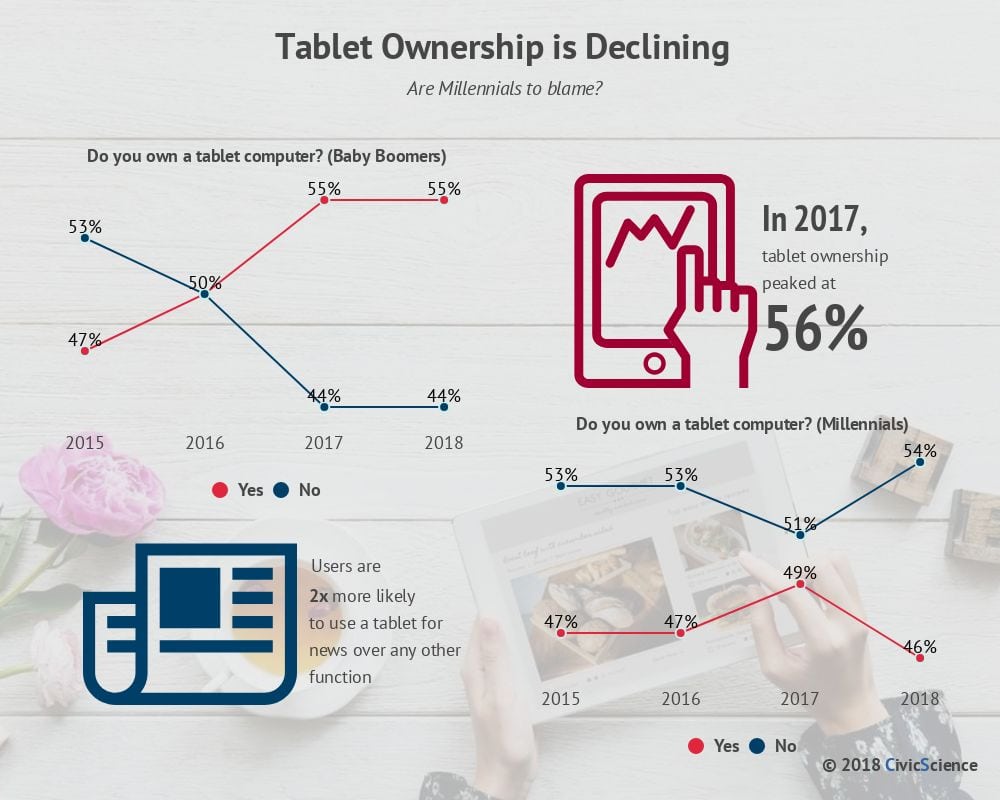
In a survey of more than 269,000 U.S. adults, CivicScience found that tablet ownership has grown steadily since 2015, but peaked at the start of 2017, with 56% of adults owning a tablet. Since then, ownership has declined to 54% of U.S. adults and appears to be on a downward trajectory.

This downturn coincides with recent industry numbers. Apple, who still leads the market, along with most other tablet manufacturers, such as Samsung and Amazon, have all reported drops in tablet sales. Some analysts cite cost as a prohibitive factor driving down tablet ownership.

In fact, the survey found that tablet ownership is correlated to income. Only 46% of those who make $50K or less per year owned a tablet, compared to 65% of those who make $100-150K per year…

…When considering all age groups, Gen Xers appear to have the highest rates of tablet ownership, followed by Baby Boomers, then Millennials, and finally, Gen Z. Looking at the same tablet ownership graph, but only for the Baby Boomer population (55+), it’s clear that Baby Boomer ownership has stayed static since 2017.

However, the same isn’t true for Millennials (18-34), whose ownership rate has slid significantly since 2017 and is today closer to what it was in 2015, at the start of the survey.

«

Did lots of people get given tablets and then dump them?
link to this extract


Investigating implausible Bloomberg Supermicro stories • Serve The Home

Patrick Kennedy:

»

Today we are going to more thoroughly address the Bloomberg Businessweek article alleging that China targeted 30 companies by inserting chips in the manufacturing process of Supermicro servers. Despite denials from named companies and the technology press casting some reasonable doubt on the story, Bloomberg doubled down and posted a follow-up article claiming a different hack took place. In this piece, we are going to present a critical view of Bloomberg’s claims, as supported by anonymous sources, in order to allow our readers to decide for themselves the credibility of Bloomberg’s reporting in this case.

This is a long article. In the first section, we are going to discuss why there are some fairly astounding plausibility and feasibility gaps in Bloomberg’s description of how the hacks worked. The weakness in this section of the Bloomberg article makes it extremely difficult to navigate and it is light on details. We are going to evaluate some of the parts in isolation, and also discuss some of the logical outcomes. In our first investigative piece, Bloomberg Reports China Infiltrated the Supermicro Supply Chain We Investigate, we went into some detail about why a motherboard and hardware for a motherboard is a very difficult way to hack a BMC. If you have not read our Explaining the Baseboard Management Controller or BMC in Servers that should be a precursor to reading the next section. STH has a relatively technically minded audience, so we are going to assume our audience has at least the knowledge imparted in that article.

«

TL;DR he says it isn’t possible and didn’t happen. As it happens that’s what Tim Cook or Apple and Amazon Web Services and Supermicro say too. And no journalist has been able to follow the story up and get even an inkling that it’s correct.
link to this extract


ASUS Z390 motherboards automatically push software into your Windows installation • TechPowerUp

»

During testing for our Intel Core i9-9900K review we found out that new ASUS Z390 motherboards automatically install software and drivers to your Windows 10 System, without the need for network access, and without any user knowledge or confirmation. This process happens in complete network-isolation (i.e. the machine has no Internet or LAN access). Our Windows 10 image is based on Windows 10 April 2018 Update and lacks in-built drivers for the integrated network controllers.

Upon first boot, with the machine having no LAN or Internet connectivity, we were greeted by an ASUS-specific window in the bottom right corner of our screen, asking whether we’d like to install the network drivers and download “Armoury Crate”. This got us curious and we scanned the system for any files that aren’t part of the standard MS Windows installation. We discovered three ASUS-signed files in our Windows 10 System32 folder, which, so it seems, magically appeared on our harddrive out of thin air. Upon further investigation we also found a new, already running, system service called “AsusUpdateCheck.”

These files could not have come from either our Windows image or the network, leaving the motherboard’s 16-megabyte UEFI BIOS as the only suspect.

«

🤔
link to this extract


Errata, corrigenda and ai no corrida: none notified

Start Up No.937: Google v the ad fraudsters, Wikitribune fires its journos, Apple’s TV service coming, Oculus’s closing spiral, and more


The iPhone XR reviews are in: it’s good value. Photo by portalgda on Flickr.

You can sign up to receive each day’s Start Up post by email. You’ll need to click a confirmation link, so no spam.

A selection of 11 links for you. Use them wisely. I’m @charlesarthur on Twitter. Observations and links welcome.

Portugal courts rule Google can’t remove Aptoide from users’ Android phones • Pocketnow

Jules Wang:

»

Portugese third-party Android app store Aptoide has claimed a major legal victory against the maker of said OS — this coming on top of Google’s recent compliance measures to the European Commission’s ruling against the bundling of its search and web clients with popular apps.

The verdict is said to ban Google’s Play Protect software, the security suite associated with the Play Store, from identifyting Aptoide as malware and removing it, occasionally without users’ consent. Aptoide must be downloaded from its site. Play Protect would show prompts urging the user to uninstall the app because it is unsafe and would prevent users from downloading any apps from the store.

Aptoide says the ruling is applicable to 82 countries including the United States, United Kingdom, Germany and India. It hopes to recover some of the more than 2.2 million daily active users it has lost in the past 60 days. For reference, it boasts 250 million users with 6 billion total downloads.

«

OK, so Google can’t ban it, even if it thinks it’s malware. Got that? Now read on…
link to this extract


Apps installed on millions of Android phones tracked user behavior to execute a multimillion dollar ad fraud scheme • Buzzfeed News

Craig Silverman:

»

Last April, Steven Schoen received an email from someone named Natalie Andrea who said she worked for a company called We Purchase Apps. She wanted to buy his Android app, Emoji Switcher. But right away, something seemed off.

“I did a little bit of digging because I was a little sketched out because I couldn’t really find even that the company existed,” Schoen told BuzzFeed News.

The We Purchase Apps website listed a location in New York, but the address appeared to be a residence. “And their phone number was British. It was just all over the place,” Schoen said…

…an investigation by BuzzFeed News reveals that these seemingly separate apps and companies are today part of a massive, sophisticated digital advertising fraud scheme involving more than 125 Android apps and websites connected to a network of front and shell companies in Cyprus, Malta, British Virgin Islands, Croatia, Bulgaria, and elsewhere. More than a dozen of the affected apps are targeted at kids or teens, and a person involved in the scheme estimates it has stolen hundreds of millions of dollars from brands whose ads were shown to bots instead of actual humans. (A full list of the apps, the websites, and their associated companies connected to the scheme can be found in this spreadsheet.)

One way the fraudsters find apps for their scheme is to acquire legitimate apps through We Purchase Apps and transfer them to shell companies. They then capture the behavior of the app’s human users and program a vast network of bots to mimic it, according to analysis from Protected Media, a cybersecurity and fraud detection firm that analyzed the apps and websites at BuzzFeed News’ request.

This means a significant portion of the millions of Android phone owners who downloaded these apps were secretly tracked as they scrolled and clicked inside the application. By copying actual user behavior in the apps, the fraudsters were able to generate fake traffic that bypassed major fraud detection systems.

«

Worth how much? Perhaps $750 million. Targeting Android because it’s a bigger user base and has less rigorous app review. Google has taken down a ton of apps as a result.
link to this extract


Wikipedia chief’s news website axes all its journalists • The Times

Matthew Moore:

»

“The news is broken, but we have figured out how to fix it,” Mr Wales, 52, proclaimed in April last year, dismissing the scepticism of media academics who warned that the “wiki” model, whereby anyone can add or edit content, would not work for investigative journalism.

The site, which is based in London, has been live for 12 months but Mr Wales has now ditched the original strategy by laying off the site’s team of [17] reporters and editors. Last week Wikitribune’s online volunteers were told that they could start publishing articles on their own without them being checked by professionals.

Mr Wales said that the new approach would make the site more enjoyable to use and bring down barriers to participation. He claimed that the number of edits by members of the public had already increased as a result of the changes. “We are still working through the site and finding vestiges of the clearly wrong perception that the journalists are ‘above’ the community, supervising their work,” he wrote in a note to supporters on Sunday.

“This was never the intention and it is something we got wrong in the early design. Despite the best efforts of staff, the overall structure and design didn’t let the community genuinely flourish.” He said there had been “major personnel changes” but that the site was looking to hire a new team of journalists to work in community support roles. The site remains free to access and is funded by donations rather than advertisers.

Signs that the original approach was failing emerged in May when Mr Wales admitted that the site “didn’t get much work done”. He compared it to Nupedia, a Wikipedia predecessor he founded in 1999 but which closed in 2003, and which is seen to have failed because its rigorous quality standards discouraged public involvement.

«

This was predictable. Journalism isn’t brain surgery or law – it’s not a profession; it’s a trade like plumbing or carpentry. But you don’t want just anyone doing your plumbing or carpentry. And the question of how you get people to read that journalism is the problem that Wikitribune never grappled with. Wikipedia had the advantage of starting when the web wasn’t so monolithic. If it started now, how long would it last?
link to this extract


Apple to launch TV subscription service globally • The Information

Jessica Toonkel:

»

Apple is working to launch its new TV service in the US in the first half of next year and will make the app available globally in the following months, the people said. It will include Apple’s original programs free to Apple device owners and also will enable users to sign up for TV network subscriptions owned by other companies, just as Amazon Prime Video subscribers can do through the Amazon Channels feature in the US, UK, Germany and Japan, the people said…

…The speed at which Apple is moving shows how it is trying to catch up to rivals that have been operating video streaming services for years. Amazon Prime Video is in 200 countries while Netflix is in more than 190 countries. The head start its rivals enjoy could make it tough for Apple’s new service to take off. Another issue is that the service will only be available to owners of its devices, including Apple TVs.

Apple lags rivals in many key categories: In the first quarter of this year, for instance, Apple TV had 28% of the US market for streaming devices, behind Roku with 37%, according to Parks Associates. In smartphones globally, Apple has about 15% of the market to Android’s 85%, according to IDC.

It makes sense for Apple to position its subscription service as a way to make television viewing easier for customers, rather than try to go head-to-head with Amazon and Netflix on original programming, said Tim Nollen, an analyst at Macquarie.

This is particularly true as the number of over-the-top services continues to grow globally. “Having the ability to make life easier for consumers in this fragmented, over-the-top marketplace makes sense,” he said.

«

Apple isn’t going to get much value from its investment if it’s only on Apple TV and gives it away. Though it does emphasise how it sees the value of its lock-in.

link to this extract


No, AI won’t solve the fake news problem • The New York Times

Gary Marcus (a professor of psychology) and Ernest Davis (a professor of computer science):

»

To get a handle on what automated fake-news detection would require, consider an article posted in May on the far-right website WorldNetDaily, or WND. The article reported that a decision to admit girls, gays and lesbians to the Boy Scouts had led to a requirement that condoms be available at its “global gathering.” A key passage consists of the following four sentences:

»

The Boy Scouts have decided to accept people who identify as gay and lesbian among their ranks. And girls are welcome now, too, into the iconic organization, which has renamed itself Scouts BSA. So what’s next? A mandate that condoms be made available to ‘all participants’ of its global gathering.

«

Was this account true or false? Investigators at the fact-checking site Snopes determined that the report was “mostly false.” But determining how it went afoul is a subtle business beyond the dreams of even the best current A.I.

First of all, there is no telltale set of phrases. “Boy Scouts” and “gay and lesbian,” for example, have appeared together in many true reports before. Then there is the source: WND, though notorious for promoting conspiracy theories, publishes and aggregates legitimate news as well. Finally, sentence by sentence, there are a lot of true facts in the passage: Condoms have indeed been available at the global gathering that scouts attend, and the Boy Scouts organization has indeed come to accept girls as well as gays and lesbians into its ranks.

What makes the article “mostly false” is that it implies a causal connection that doesn’t exist. It strongly suggests that the inclusion of gays and lesbians and girls led to the condom policy (“So what’s next?”). But in truth, the condom policy originated in 1992 (or even earlier) and so had nothing to do with the inclusion of gays, lesbians or girls, which happened over just the past few years.

«

link to this extract


Apple iPhone XR review: better than good enough • The Verge

Nilay Patel:

»

Here’s a question: how much do you care about the display on your phone? Take a moment and really consider it. If you were to put a dollar amount on it, how much would having a perfect display be worth to you?

Apple has an answer, and it’s $250.

That’s the price difference between the new iPhone XR and Apple’s top-of-the-line iPhone XS. It’s the price difference between the XR’s 6.1-inch “Liquid Retina” LCD screen and the 5.8-inch OLED screen on the XS. Apart from the display, the XR and XS are far more similar than not: they share the same A12 Bionic processors, main cameras with Smart HDR, iOS 12, gesture controls, wireless charging capabilities, and even the forthcoming dual-SIM support.

There are some other subtle differences as well: the XR has a single rear camera, while the XS has a second telephoto lens. The XR is offered in just one somewhat large size, while the XS comes in smaller and larger variants. And the XR is made of aluminum instead of stainless steel, which allows it to come in a wide variety of colors, ranging from white, black, blue, coral, yellow, and red.

Those differences are interesting and worth pulling apart, but really, the simplest way to think about the iPhone XR is that it offers virtually the same experience as the iPhone XS for $250 less, but you’ll be looking at a slightly worse display.

«

This is the nut (as they say) for pretty much every review I’ve seen of the XR. Same CPU, slightly less RAM (but that won’t make a difference with iOS), one less back camera. If you notice the difference in display quality, you’ll go for the XS/Max (or stick with the X).

Smart of Apple to release the XS/Max a month or so ahead of the XR – which looks likely, on price and specs, to sell in huge numbers.
link to this extract


Your inner drone: the politics of the automated future • Long Reads

Nick Carr:

»

Many computer companies and software houses now say they’re working to make their products invisible. “I am super excited about technologies that disappear completely,” declares Jack Dorsey, a prominent Silicon Valley entrepreneur. “We’re doing this with Twitter, and we’re doing this with [the online credit-card processor] Square.” Apple has promoted the iPad as a device that “gets out of the way.” Picking up on the theme, Google markets Glass as a means of “getting technology out of the way.”

The prospect of having a complicated technology fade into the background, so it can be employed with little effort or thought, can be as appealing to those who use it as to those who sell it. “When technology gets out of the way, we are liberated from it,” the New York Times columnist Nick Bilton has written. But it’s not that simple. You don’t just flip a switch to make a technology invisible. It disappears only after a slow process of cultural and personal acclimation. As we habituate ourselves to it, the technology comes to exert more power over us, not less. We may be oblivious to the constraints it imposes on our lives, but the constraints remain. As the French sociologist Bruno Latour points out, the invisibility of a familiar technology is “a kind of optical illusion.” It obscures the way we’ve refashioned ourselves to accommodate the technology.

«

Carr’s pieces flow like a river, but like a river you also have to let it carry you onwards.
link to this extract


‘Tech tax’ necessary to avoid dystopia, says leading economist • The Guardian

Alex Hern:

»

A “tech tax” is necessary if the world is to avoid a dystopian future in which AI leads to a concentration of global wealth in the hands of a few thousand people, influential economist Dr Jeffrey Sachs has warned.

Speaking to the Guardian, Sachs backed calls for taxation aimed at the largest tech companies, arguing that new technologies were dramatically shifting the income distribution worldwide “from labour to intellectual property (IP) and other capital income.”

“So rather than cutting capital income taxation, as we’ve been doing in a race to the bottom, we ought to be finding ways to tax capital income and IP income,” Sachs added.

“Things like the proposed tech tax are actually a very good idea. The specific form of it is debatable, but the idea is that five companies are worth $3.5tn, basically because of network externalities and information monopolies, and therefore are absolutely right for efficient taxation.”

Sachs is in London to speak at an event organised by the Alan Turing Institute, the UK’s national institute for data science and artificial intelligence.

«

OK, so how is this tech tax going to work? Will companies be taxed on revenue? Capital value? IP value? One can imagine that there will be sneaky ways found around any method used to try to extract it. (Revenues will be dodged to offshore banks, as happens already. Companies will sell-and-lease-back property, asset-stripping themselves and turning capex into opex. IP will be undervalued.) I’m in favour of the principle; it’s the practice I wonder about.
link to this extract


Even in Indiana, new renewables are cheaper than existing coal plants • Utility Dive

»

Last week, Northern Indiana Public Service Co. (NIPSCO) presented analysis for its 2018 Integrated Resource Plan (IRP), finding it can save customers more than $4bn over 30 years by moving from 65% coal today to 15% coal in 2023 and eliminating the resource by 2028.

To replace retiring coal, NIPSCO found that a portfolio of solar, storage, wind and demand management is the most cost effective, along with a small amount of market purchases from the Midcontinent ISO. The utility will file its IRP on Oct. 31.

NIPSCO’s upcoming IRP is more evidence that coal generation is steadily declining in the U.S. despite efforts from the Trump administration to save it.

In Indiana, as elsewhere, the issue is economics. The youngest generating units at NIPSCO’s 1900 MW Schahfer plant were built in the mid 1980s, and the utility’s analysis found that keeping them on the system would be more expensive than replacing them with new wind, solar and batteries.

«

Yes, you’ve noticed that it’s actually cheaper to retire *all* the coal plants, but the utility thinks that carries “unacceptable risks” to reliability. Yet even when they tried to nudge the numbers to be as coal-friendly as possible (at the urging of a trade body), renewables still won.

link to this extract


Oculus co-founder is leaving Facebook after cancellation of ‘Rift 2’ headset • TechCrunch

Lucas Matney:

»

Brendan Iribe, the co-founder and former CEO of Oculus, announced today that he is leaving Facebook, TechCrunch has learned.

Iribe is leaving Facebook following some internal shake-ups in the company’s virtual reality arm last week that saw the cancellation of the company’s next generation “Rift 2” PC-powered virtual reality headset, which he had been leading development of, a source close to the matter told TechCrunch.

Iribe and the Facebook executive team had “fundamentally different views on the future of Oculus that grew deeper over time,” and Iribe wasn’t interested in a “race to the bottom” in terms of performance, we are told.

«

A few ways to view this: 1) another Facebook purchase founder goes! 2) What’s happened to Oculus then? 3) What’s happening to VR then?

1) not that unusual. Stocks vest, people decide to move on. Or they don’t, if they’re enjoying things.
2) Facebook wants to do VR on the move, Oculus’s people wanted top-flight VR. Facebook won.
3) Nothing good.
link to this extract


Oculus Rift VOD discontinued: VR movie store shutting down • Variety

Janko Roettgers:

»

Facebook’s VR subsidiary Oculus is shutting down its VOD efforts on is Oculus Rift headset this week, and is reimbursing anyone who has bought titles in the past. Oculus told Rift users in an email about the changes Monday, and confirmed the move in a comment sent to Variety.

“Over the years, we’ve seen how people use VR for everything from gaming to movies, and it’s become clear that while people love to stream immersive media on other devices, Rift is used primarily for gaming,” Oculus said in its email to customers.  “These insights inform how we support new and existing features and apps across the platform.”

The movie store on Rift is shutting down Monday. Consumers who have purchased or rented movies in the past will continue to have access to them until November 20. “After this date, you will no longer be able to access any purchased or rented movies through Oculus Video, but you can continue to watch video and streams from other sources, such as Facebook 360,” the company said in its email.

«

Seems like the window of broader opportunity is closing again for VR; it probably won’t open again for another 10 years or so. It’s going to be a niche gaming device. And that’s it.
link to this extract


Errata, corrigenda and ai no corrida: none notified

Start Up No.936: Brexit reality, Facebook’s falling influence, Intel ends 10nm?, Amazon fake review factories, and more


App developers know when you dump their work – and might trigger ads to get back. Photo by Maria Gustafsson on Flickr.

You can sign up to receive each day’s Start Up post by email. You’ll need to click a confirmation link, so no spam.

A selection of 11 links for you. Just enough. I’m @charlesarthur on Twitter. Observations and links welcome.

Brexit provides early proof of deglobalization’s costs • WSJ

Greg Ip:

»

Never in the last 70 years has a major advanced economy left a free-trade area. Brexit is providing the first real-world evidence of the costs that come from undoing the intricate bonds of globalization.

It is of course an extreme case of deglobalization: The European Union’s single market for goods, services, capital and labor is much more integrated than other free trade zones. Yet many of the barriers that are bound to rise between Britain and its partners, such as on regulations, trade penalties and immigration, are similar to those cropping up in the wider world, such as between the US and its partners.

Measuring the effect of Brexit is complicated by the fact it hasn’t happened yet. British and European leaders met Wednesday in an effort to bridge differences on a post-Brexit deal. Without a deal, Britain could see tariff and nontariff barriers snap back to the maximum the World Trade Organization permits.

Yet without a single tariff going up, Brexit has clearly extracted a price. This can be seen by comparing Britain to a basket of peer economies whose performance closely tracked Britain’s until it voted to leave the EU in June 2016. Pierre Lafourcade, Arend Kapteyn and John Wraith of UBS construct such a synthetic Britain from a blend of other members of the Organization for Economic Cooperation and Development.

Actual and synthetic Britain track each other closely from 1995 to mid-2016, then diverge: Actual British output is now 2.1% below this counterfactual. UBS attributes this divergence primarily to household consumption, which is now 1.7% below its counterfactual, and investment, which is 4% lower.

«

Completely as economic theory would predict – comparative advantage and so on.
link to this extract


What happens when Facebook goes down? People read the news • Chartbeat Blog

»

What would the world look like without Facebook? Chartbeat had a glimpse into that on Aug. 3, 2018, when Facebook went down for 45 minutes and traffic patterns across the web changed in an instant. What did people do? According to our data, they went directly to publishers’ mobile apps and sites (as well as to search engines) to get their information fix.  This window into consumer behavior reflects broader changes we see taking hold this year around content discovery, particularly on mobile. This is good news for publishers.

Despite volatility driven by algorithm shifts and intense news cycles, user demand for content (represented by traffic across the web) is quite stable. But the sources of that traffic are anything but static. In fact, we’ve seen a major reversal in the specific sources driving traffic to publisher sites in the last year.

Key shifts:

• Mobile traffic has seen double-digit growth and surpassed desktop, which saw double-digit declines.

• On mobile, Facebook is down nearly 40% since January 2017, while Google Search has seen a 2x growth in that same time period. That means increases in Google Search referral traffic have more than offset any declines in Facebook referral traffic.

• Additionally — and of significant importance — mobile direct traffic to publishers is now greater than traffic sent by Facebook to publishers’ sites. This means consumers are now more likely to get their news by typing in a publisher URL or opening an app than by being referred through Facebook.

«

link to this extract


Intel earnings: What the chip maker can say to turn assuage doubts • MarketWatch

Wallace Witkowski:

»

Intel has struggled mightily the past few months, but it may be able to retrieve some lost love by showing strong data-centre growth and progress on rolling chips using a long-overdue manufacturing process.

Intel is scheduled to report quarterly earnings after the close of markets on Thursday. On Monday, rumors circulated that Intel was killing off its 10nm manufacturing process following a string of delays on the year, but Intel was quick to deny the reports.

“10nm,” where “nm” means nanometers, refers to how small a chip maker can make the transistors that go on a computer chip, with the general rule being that smaller transistors are faster and more efficient in using power. Advanced Micro Devices Inc. AMD, has been chipping away at Intel’s dominance as its 7nm chip manufacturing process has been hailed as equal or even superior to Intel’s.

That is just the latest problem for Intel, which has had a trying year. The chip maker was hit late in 2017 by news of twin vulnerabilities baked into its chips, then dumped its chief executive — who has not been replaced on a permanent basis — while dealing with a shortage of chips thought to stem from manufacturing-process issues.

«

The reports of killing off the 10nm came from SemiAccurate, which called it “struggling”. Intel’s denial feels like one of those “in good time we’ll agree” denials.

If correct, then that really is the end of Moore’s Law for Intel.
link to this extract


Gmail creator and YC partner Paul Buchheit on joining Google, how to become a great engineer and happiness • Triplebyte Blog

»

Q: If you’re thinking about joining a startup, how do you tell if the founders are like Larry and Sergey or if they’re an Elizabeth Holmes?

PB: Right, that’s the worst combination: smart and full of s**t. I think you have to interview them a little bit. Ask hard questions and see if they give direct, insightful answers, or if they’re evasive and dismissive. It also helps if there is a product you can try. I would avoid startups that have a ton of hype and no product.

Q: Generally, when you are interviewing with a startup, how should you decide if it is the right company for you?

PB: Looking back, one of the things that really impressed me about Google, which is probably good advice for anyone choosing a startup to work at, was that the interviewers all asked really smart questions. They asked things that only people who really knew their stuff could have answered well. Urs asked me, “Let’s say you have a server, and it’s running really slowly for some reason, how do you diagnose the cause?” To answer that question, you actually have to understand systems really well.

Their questions required being able to think at all these different levels: “Is there something going on in the kernel? Do you understand that hard drives are not these magical things which spit out information? Do you know why random access takes time?”

I only interviewed at one other company and they asked stupid questions like, “name the seven layers of the OSI Networking Stack,” or something that you’d pull out of a textbook, not things that were actually interesting.

Also, when I first went to work at Google, I had the opposite feeling I described having at Intel. I was excited. I woke up in the morning and was excited to go to work. There was this buzz of productivity in the office all the time. I think that’s one way to know if a startup is doing well: When you go into their office, you can just tell. Are people busy working, or are they sitting around on Twitter wasting time? Are people showing up because they have to, or are they eagerly working because they’re excited? Google was a really energizing place to be back then.

«

And plenty more. It’s fascinating.
link to this extract


Now apps can track you even after you uninstall them • Bloomberg

Gerrit de Vynck:

»

Uninstall tracking exploits a core element of Apple Inc.’s and Google’s mobile operating systems: push notifications. Developers have always been able to use so-called silent push notifications to ping installed apps at regular intervals without alerting the user—to refresh an inbox or social media feed while the app is running in the background, for example. But if the app doesn’t ping the developer back, the app is logged as uninstalled, and the uninstall tracking tools add those changes to the file associated with the given mobile device’s unique advertising ID, details that make it easy to identify just who’s holding the phone and advertise the app to them wherever they go.

The tools violate Apple and Google policies against using silent push notifications to build advertising audiences, says Alex Austin, CEO of Branch Metrics Inc., which makes software for developers but chose not to create an uninstall tracker. “It’s just generally sketchy to track people around the internet after they’ve opted out of using your product,” he says, adding that he expects Apple and Google to crack down on the practice soon. Apple and Google didn’t respond to requests for comment.

At its best, uninstall tracking can be used to fix bugs or otherwise refine apps without having to bother users with surveys or more intrusive tools. But the ability to abuse the system beyond its original intent exemplifies the bind that accompanies the modern internet, says [EFF tech policy director Jeremy] Gillula.

«

How likely that Apple or Google tries to find some way to block this? Apple more likely than Google.
link to this extract


Facebook fake review factories uncovered by Which? investigation • The Guardian

Patrick Collinson:

»

Undercover researchers for Which? set up dedicated Amazon and Facebook accounts and requested to join several of the “rewards for reviews” groups.

“They were instructed to order a specified item through Amazon, write a review and share a link to the review once it was published. Following the successful publication of the review, a refund for the cost of the item would then be paid via PayPal,” said Which?

But the Which? investigators turned the tables on the fake review factories by posting their honest opinion on the product.

In one example, the investigator gave the product – a smartwatch – a two-star review. “They were told by the seller to rewrite it because the product was free, so it “is the default to give five-star evaluation”, said Which?

In another, the investigator was told that a “refund will be done after a good five-star review with some photo” after receiving a pair of wireless headphones. But after posting a three-star review with photos they were told they would not be refunded unless they wrote a five-star review. The investigator refused, so did not get refunded for the purchase.

When the Guardian searched the Amazon UK Reviewers Facebook group – which has more than 25,000 members – it found postings appearing almost every couple of minutes from companies around the world offering to pay for positive reviews. For example, on Friday, one company was seeking “UK reviewers only” for a “4k action camera waits for review Refund via Paypal just send me your amazon profile”.

«

link to this extract


Companies are on the hook if their hiring algorithms are biased • Quartz

Dave Gershgorn:

»

Mark J. Girouard, an employment attorney at Nilan Johnson Lewis, says one of his clients was vetting a company selling a resume screening tool, but didn’t want to make the decision until they knew what the algorithm was prioritizing in a person’s CV.

After an audit of the algorithm, the resume screening company found that the algorithm found two factors to be most indicative of job performance: their name was Jared, and whether they played high school lacrosse. Girouard’s client did not use the tool.

“It’s a really great representation of part of the problem with these systems, that your results are only as good as your training data,” Girouard said. “There was probably a hugely statistically significant correlation between those two data points and performance, but you’d be hard-pressed to argue that those were actually important to performance.”

The community of researchers and technologists studying artificial intelligence have warned that this could be possible in any similar AI algorithm that learns about people using historical data.

In 2016, Pinboard creator Maciej Cegłowski called machine learning “money laundering for bias.”

“It’s a clean, mathematical apparatus that gives the status quo the aura of logical inevitability. The numbers don’t lie,” Cegłowski said.

«

link to this extract


Netflix is selling $2bn of junk bonds to fund new shows • Bloomberg

Misyrlena Egkolfopoulou and Claire Boston:

»

The $2bn bond offering, which will be issued in dollars and euros, comes just a week after the company reported a bigger jump in subscribers than Wall Street analysts expected. The bonds would push the cash-burning company’s debt load above $10bn for the first time. Netflix’s market value has soared almost 70% this year to about $140bn.

The US portion of the 10.5-year bond may yield around 6.375%, while the euro notes could pay 4.625%, according to people with knowledge of the matter. Netflix paid less than 6% when it last tapped the market in April, in part because underlying Treasury yields were lower.

“To me it feels a bit like a win-win situation,” said John McClain, a high-yield money manager at Diamond Hill Capital, which oversees $22.6bn including Netflix debt. “You’re buying the highest-quality, high-yield business at yields that are fairly close to the overall market. It’s low-cost funding for them, especially relative to the cost of issuing new equity.”

Netflix said in a statement that it will use proceeds from the offering to continue to acquire and fund new content. The company said last week that it expects to burn about $3bn in cash this year as it continues to prioritize original series and movies.

«

That’s not even close to serious gearing. Netflix is going to get miles in front of everyone with this. And those are pretty attractive yields; I bet it will have no trouble at all selling it. Hardly “junk”.
link to this extract


Blood money • TechCrunch

Jon Evans:

»

You can make a realpolitik case for continuing to engage with Saudi Arabia. Just like my coffee companion [a paid lobbyist for Russian interests] five years ago did for continuing to engage with Russia. See how well that turned out, how since then Russia has become so much more enlightened, so progressive, such a glorious contributor to the commonwealth of nations? …Oh. Saudi Arabia is different, yes, but in a worse way; it’s so sensitive to criticism, overreacts so wildly and violently, because it is fundamentally a fragile state. Nassim Taleb, who predicted the collapse of Syria and its civil war before it happened, has predicted a similar fate for Saudi Arabia.

I don’t think the Trump administration is going to continue its support for Saudi Arabia’s new and erratic leadership for fear of the human or economic consequences if they do otherwise. “Trump’s Razor:” the stupidest reason is most likely to be correct. Here, that means the administration doesn’t want to walk back their Saudi support because they think that will make them look weak. Similarly, who are we kidding, VCs who take money from Saudi LPs aren’t doing so in order to help prop up the Pax Americana; it’s purely because they want the money, and nobody else is prepared to throw around $45bn in cash.

Right now, though, and for the foreseeable future, sovereign Saudi money is tainted, poisoned, blood money.

«

“Trump’s Razor”. Nice. (Concept originated back in July 2016, by Josh Marshall, about Trump wanting to reverse his decision to have Mike Pence as his vice-presidential candidate; named by John Scalzi.)
link to this extract


Another technological tragedy • bit-player

Brian Hayes, author of the book Infrastructure, on the explosions that blew up mains gas-connected buildings in Massachusetts in September, which was caused by a feedback loop that wasn’t actually a loop – so it pushed up pressure because its readings said the pressure was too low, measured in the wrong pipes:

»

when you open the valve to increase the inflow of gas, you expect the pressure to increase. (Or, in some circumstances, to decrease more slowly. In any event, the sign of the second derivative should be positive.) If that doesn’t happen, the control law would call for making an even stronger correction, opening the valve further and forcing still more gas into the pipeline. But you, in your wisdom, might pause to consider the possible causes of this anomaly. Perhaps pressure is falling because a backhoe just ruptured a gas main. Or, as in Lawrence last month, maybe the pressure isn’t actually falling at all; you’re looking at sensors plugged into the wrong pipes. Opening the valve further could make matters worse.

Could we build an automatic control system with this kind of situational awareness? Control theory offers many options beyond the simple feedback loop. We might add a supervisory loop that essentially controls the controller and sets the set point. And there is an extensive literature on predictive control, where the controller has a built-in mathematical model of the plant, and uses it to find the best trajectory from the current state to the desired state. But neither of these techniques is commonly used for the kind of last-ditch safety measures that might have saved those homes in the Merrimack Valley. More often, when events get too weird, the controller is designed to give up, bail out, and leave it to the humans. That’s what happened in Lawrence.

«

This is a fascinating little discussion (with a couple of other accidents, including the notorious Air France 447 from Rio de Janeiro) which leaves much to think about. It also reminded me of control theory, which I haven’t had to think of in decades. (Via Ben Thompson.)
link to this extract


What does Stack Overflow want to be when it grows up? • Coding Horror

Jeff Atwood, co-founder of Stack Overflow (used by gazillions of flummoxed coders, including me):

»

I am honored and humbled by the public utility that Stack Overflow has unlocked for a whole generation of programmers. But I didn’t do that.

You did, when you contributed a well researched question to Stack Overflow.
You did, when you contributed a succinct and clear answer to Stack Overflow.
You did, when you edited a question or answer on Stack Overflow to make it better.

All those “fun size” units of Q&A collectively contributed by working programmers from all around the world ended up building a Creative Commons resource that truly rivals Wikipedia within our field. That’s … incredible, actually.

But success stories are boring. The world is filled with people that basically got lucky, and subsequently can’t stop telling people how it was all of their hard work and moxie that made it happen. I find failure much more instructive, and when building a business and planning for the future, I take on the role of Abyss Domain Expert™ and begin a staring contest [quoting Nietzsche: “if you gaze long into an abyss, the abyss gazes also into you”). It’s just a little something I like to do, you know … for me.

Thus, what I’d like to do right now is peer into that glorious abyss for a bit and introspect about the challenges I see facing Stack Overflow for the next 10 years.

«

The fact that SO (as it gets called all over the place) is principally and was always intended to be a curated wiki and that it is so enormously useful, just like Wikipedia (even if one dislikes the sausage-making process in the latter), seems to me to indicate something important about curated wikis v pretty much every other form of unmediated content collection system.

Tightly curating knowledge is obviously a more bounded problem than lightly curating opinion (as in social media). But why does the latter break down so easily into abuse? Because of the light curating, or the nature of the content?
link to this extract


Errata, corrigenda and ai no corrida: none notified

Start Up No.935: whither Windows?, the App Store subscription scam, China’s Android schemes, the class news problem, and more


Will the new iPads have USB-C, like the MacBook series? Photo by Maurizio Pesce on Flickr.

You can sign up to receive each day’s Start Up post by email. You’ll need to click a confirmation link, so no spam.

A selection of 12 links for you. In case you’re counting, No.1,000 comes some time in early 2019. What shall we do? I’m @charlesarthur on Twitter. Observations and links welcome.

Microsoft’s problem isn’t how often it updates Windows—it’s how it develops it • Ars Technica

Peter Bright on Microsoft’s new way of looking at Windows:

»

The problem with Windows as a Service is quality. Previous issues with the feature and security updates have already shaken confidence in Microsoft’s updating policy for Windows 10. While data is notably lacking, there is at the very least a popular perception that the quality of the monthly security updates has taken a dive with Windows 10 and that installation of the twice-annual feature updates as soon as they’re available is madness. These complaints are long-standing, too. The unreliable updates have been a cause for concern since shortly after Windows 10’s release.

The latest problem has brought this to a head, with commentators saying that two feature updates a year is too many and Redmond should cut back to one, and that Microsoft needs to stop developing new features and just fix bugs. Some worry that the company is dangerously close to a serious loss of trust over updates, and for some Windows users, that trust may already have been broken.

These are not the first calls for Microsoft to slow down with its feature updates—there have been concerns that there’s too much churn for both IT and consumer audiences alike to handle—but with the obvious problems of the latest update, the calls take on a new urgency.

But saying Microsoft should only produce one update a year instead of two, or criticising the very idea of Windows as a Service, is missing the point. The problem here isn’t the release frequency. It’s Microsoft’s development process.

Why is it the process, and not the timeframe, that’s the issue? On the release schedule front, we can look at what other software does to get a feel for what’s possible.

«

link to this extract


Sneaky subscriptions are plaguing the App Store • TechCrunch

Sarah Perez:

»

Subscriptions have turned into a booming business for app developers, accounting for $10.6bn in consumer spend on the App Store in 2017, and poised to grow to $75.7bn by 2022. But alongside this healthy growth, a number of scammers are now taking advantage of subscriptions in order to trick users into signing up for expensive and recurring plans. They do this by intentionally confusing users with their app’s design and flow, by making promises of “free trials” that convert after only a matter of days, and other misleading tactics.

Apple will soon have an influx of consumer complaints on its hands if it doesn’t reign in these scammers more quickly…

…How are apps like QR code readers, document scanners, translators and weather apps raking in so much money? Especially when some of their utilitarian functions can be found elsewhere for much less, or even for free?

This raises the question as to whether some app developers are trying to scam App Store users by way of subscriptions.

We’ve found that does appear to be true, in many cases.

After reading through the critical reviews across the top money-making utilities, you’ll find customers complaining that the apps are too aggressive in pushing subscriptions (e.g. via constant prompts), offer little functionality without upgrading, provide no transparency around how free trials work and make it difficult to stop subscription payments, among other things.

«

There’s a scanner app which is raking in $14.3m annually by charging $4 per week, and uses a total scam to get you to sign up. Aren’t people noticing this stuff on their bills?
link to this extract


For China, even a censored Google search engine would be better than Baidu • South China Morning Post

Bai Tongdong:

»

As a college professor, I find Baidu’s search results on scholarly matters deeply frustrating, because they don’t lead me to the webpages I wish to find. In contrast, Google’s search results are far more useful. Thanks to my part-time employment at New York University’s law school, I can use its virtual private networks (VPN) to access Google, a benefit that I consider more valuable than the extra pay.

And it is not just terrible search results, and the lack of access to useful tools such as Google Books. Baidu’s shameless commercialisation of its search engine has been the subject of controversy. For example, companies could – and maybe still can – bid for the top spots in Baidu’s search results, and users are not warned that these results are the outcome of commercial bidding and not sorted by relevance, as is the practice with Google.

In one case that sparked a public outcry, a young man used Baidu to search for treatments and clinics for the rare form of the cancer he suffered from. The man’s family spent over 200,000 yuan (US$29,000) on an experimental treatment at one of the for-profit hospitals that topped his Baidu search, but the treatment was unsuccessful and he died. The search results could have caused him to miss potentially life-saving treatment.

Therefore, what could be at stake here is not merely the convenience that search engines offer me as a scholar, but life itself. The reason that many Americans are against Google’s return to China is their opposition to the lack of democracy and free speech in China, with Google’s censored search engine seen to be pandering to these ills. But isn’t it ironic that these Americans fail to consider how Chinese people feel?

«

link to this extract


How China rips off the iPhone and reinvents Android • The Verge

Sam Byford has a deep dive on the many big Chinese companies aiming to copy Apple as fast as possible, and also attract its users in China:

»

As for the camera apps, it’s really incredible how similar the vast majority are — both to each other and to Apple. Judging by the accuracy and specificity of the rip-offs, the camera app from iOS 7 has a serious claim to being one of the most influential software designs of the past decade. Just look at the picture below. Xiaomi wins an extremely low number of points for putting the modes in a lowercase blue font. But otherwise, only Huawei has succeeded in creating a genuinely new camera app design, which happens to be very good. I consider it penance for the company’s egregious and barely functional rip-off of the iOS share sheet.

“Vivo’s performance in the global market so far is the result of great effort to understand consumer behavior, and our camera UI is designed with consumers’ habits in mind,” the Vivo product manager told me. “The swipe across navigation feature allows for users to keep their current habits to access different photography mode. This is supported by our usability tests which indicated that this method has the highest efficiency and best user experience.”

This backs up the idea that attracting iPhone switchers is a serious objective for Chinese software designers. “I definitely see that there’s evidence of a number of different companies that could be seen as following Apple or trying to create a UI that’s very much iOS-like,” says Pete Lau, CEO of phone company OnePlus. “And maybe they’re doing it for reasons of thinking that it makes it easier for users to transition to their products from Apple, and find the experience to be similar.”

«

link to this extract


If you’re poor in the UK you get less, worse news — especially online, new research suggests » Nieman Journalism Lab

Laura Hazard Owen:

»

News is more unevenly distributed in the UK than income is, according to new research from the Reuters Institute for the Study of Journalism. Antonis Kalogeropoulos and Rasmus Kleis Nielsen found that poorer people consume less news than wealthier people and that the difference is particularly pronounced online, where poorer people are less likely to go directly to news sites for content.

“Whereas higher social grade individuals and lower social grade individuals use the same number of sources offline on average, lower social grade individuals use significantly fewer online sources on average,” the authors write.

This is in the United Kingdom, land of the great equalizer the BBC, which reaches a whopping 92% of UK adults. There is no media company in the US that comes close. Income inequality is also higher in the US than in the UK. In other words: this study focuses on the UK but the problem is likely the same or worse in the US.

«

You could wonder about correlation and causation. But which direction does it flow?
link to this extract


The poison on Facebook and Twitter is still spreading • The New York Times

The NYT Editorial Board (“represents the opinions of the board, its editor and the publisher, but not the newsroom or op-ed section”):

»

This week, a question from The New York Times prompted Facebook to take down a network of accounts linked to the Myanmar military. Although Facebook was already aware of the problem in general, the request for comment from The Times flagged specific instances of “seemingly independent entertainment, beauty and informational pages” that were tied to a military operation that sowed the internet with anti-Rohingya sentiment.

The week before, The Times found a number of suspicious pages spreading viral misinformation about Christine Blasey Ford, the woman who has accused Brett Kavanaugh of assault. After The Times showed Facebook some of those pages, the company said it had already been looking into the issue. Facebook took down the pages flagged by The Times, but similar pages that hadn’t yet been shown to the company stayed up.

It’s not just The Times, and it’s not just Facebook. Again and again, the act of reporting out a story gets reduced to outsourced content moderation.

“We all know that feeling,” says Charlie Warzel, a reporter at BuzzFeed who’s written about everything from viral misinformation on Twitter to exploitative child content on YouTube. “You flag a flagrant violation of terms of service and send out a request for comment. And you’re just sitting there refreshing, and then you see it come down — and afterward you get this boilerplate reply via email.”

«

link to this extract


Saudis’ image makers: a troll army and a Twitter insider • The New York Times

Katie Benner, Mark Mazzetti, Ben Hubbard and Mike Isaac:

»

Mr. Khashoggi’s online attackers were part of a broad effort dictated by Crown Prince Mohammed bin Salman and his close advisers to silence critics both inside Saudi Arabia and abroad. Hundreds of people work at a so-called troll farm in Riyadh to smother the voices of dissidents like Mr. Khashoggi. The vigorous push also appears to include the grooming — not previously reported — of a Saudi employee at Twitter whom Western intelligence officials suspected of spying on user accounts to help the Saudi leadership.

The killing by Saudi agents of Mr. Khashoggi, a columnist for The Washington Post, has focused the world’s attention on the kingdom’s intimidation campaign against influential voices raising questions about the darker side of the crown prince. The young royal has tightened his grip on the kingdom while presenting himself in Western capitals as the man to reform the hidebound Saudi state.

This portrait of the kingdom’s image management crusade is based on interviews with seven people involved in those efforts or briefed on them; activists and experts who have studied them; and American and Saudi officials, along with messages seen by The New York Times that described the inner workings of the troll farm.

Saudi operatives have mobilized to harass critics on Twitter, a wildly popular platform for news in the kingdom since the Arab Spring uprisings began in 2010. Saud al-Qahtani, a top adviser to Crown Prince Mohammed who was fired on Saturday in the fallout from Mr. Khashoggi’s killing, was the strategist behind the operation, according to United States and Saudi officials, as well as activist organizations…

…Twitter executives first became aware of a possible plot to infiltrate user accounts at the end of 2015, when Western intelligence officials told them that the Saudis were grooming an employee, Ali Alzabarah, to spy on the accounts of dissidents and others, according to five people briefed on the matter. They requested anonymity because they were not authorized to speak publicly.

«

He was fired that December. I got a small glimpse of the Saudi attack bots when I tweeted about Khashoggi’s disappearance early on; they’re pretty stupid, and easy to mute or block, but also plentiful and relentless.
link to this extract


Revealed: Israel’s cyber-spy industry helps world dictators hunt dissidents and gays • Israel News – Haaretz.com

Hagar Shezaf and Jonathan Jacobson:

»

the Israeli espionage industry has become the spearhead of the global commerce in surveillance tools and communications interception. Today, every self-respecting governmental agency that has no respect for the privacy of its citizens, is equipped with spy capabilities created in Herzliya Pituah.

The reports about Pegasus prompted Meretz MK Tamar Zandberg and human rights lawyer Itay Mack to go to court in 2016 with a request to suspend NSO’s export permit. At the state’s request, however, the deliberations were held in camera and a gag order was issued on the judgment. Supreme Court President Justice Esther Hayut summed up the matter by noting, “Our economy, as it happens, rests not a little on that export.”

The Defense Ministry benefits from the news blackout. Supervision takes place far from the public eye – not even the Knesset’s Foreign Affairs and Defense Committee is privy to basic details of the lion’s share of Israel’s defense exports. Contrary to the norms that exist in other democracies, the ministry refuses to disclose the list of countries to which military exports are prohibited, or the criteria and standards that underlie its decisions.

A comprehensive investigation carried out by Haaretz, based on about 100 sources in 15 countries, had as its aim lifting the veil of secrecy from commerce based on means of espionage. The findings show that Israeli industry have not hesitated to sell offensive capabilities to many countries that lack a strong democratic tradition, even when they have no way to ascertain whether the items sold were being used to violate the rights of civilians.

«

link to this extract


Another iPad Pro rumor says USB-C will replace Lightning this year • BGR

Jacob Siegal:

»

As part of its coverage of the Global Source Mobile Electronics Trade Fair in Hong Kong this week, Japanese blog Macotakara reports that each and every accessory maker it spoke to claims that the next iPad Pro will feature a USB-C connector for charging and data transfer. This would mark the first time Apple has replaced the proprietary Lightning port on any of its mobile devices since the technology was introduced back in 2012.

This isn’t the first time we’ve heard rumors about Apple weaning itself off of Lightning, but the number of corroborating reports claiming the next iPad Pro will be the first Apple tablet to have a USB-C port continues to grow.

Just last week, sources told 9to5Mac that the 2018 iPad Pro will be able to output 4K HDR video to external display using its new USB-C port. There will be a new panel in the Settings app specifically for controlling what users share on other screens, including resolution, brightness, turning HDR on and off, and more.

9to5Mac’s report didn’t clarify whether or not the USB-C port would replace the Lightning port altogether, but back in September, reliable Apple analyst Ming-Chi Kuo said in a research note that Apple’s next iPad will ship with an 18W USB-C charger in the box, and that Apple is ready to start moving on to USB-C.

«

Bear in mind that iPads outsell Macs by about 3:1, so if new iPads start using USB-C that could begin to make an impact. Accessory makers take note of such things because for retailers, margins on accessories are better than on the devices themselves. Though of course iPhones outsell iPads by about 4:1, and they’re pretty resolutely Lightning devices.
link to this extract


Pioneer of Central Washington cryptocurrency boom falls on hard times • The Seattle Times

Paul Roberts:

»

Last October, Giga Watt was on a scorching upward trajectory. With prices for bitcoin and other cryptocurrencies soaring and international investors clamoring for a piece of the digital action, the East Wenatchee-based company had expanded to 62 employees and raised tens of millions of dollars for what it hoped would be a game-changing project: a sprawling campus of 24 prefabricated buildings where would-be crypto “miners” could run their own computers and solve the complicated mathematical algorithms that yield the digital gold.

As the pods arose from a muddy site near the Douglas County airport, local government officials talked excitedly about the emergence of a new, 21st-century industry based on the complex “blockchain” technologies that enable bitcoin and other cryptocurrency. Giga Watt and its founder, a former Seattle-area programmer named Dave Carlson, saw themselves on that revolution’s cutting edge.

Now it’s a starkly different picture. Last month, beset by millions of dollars in debt, ongoing legal problems and questions about its unconventional financing, Giga Watt laid off 80% of its staff and suspended all construction. Carlson himself stepped down in August.

The moves come as the volatile sector, which ignited a small gold rush in the mid-Columbia Basin, is struggling with softening cryptocurrency prices and uncertain costs for its prime “raw material,” cheap electricity. The market correction has wiped out many small players and forced even some larger players to rewrite their plans.

«

As usual, the people who reliably get rich in gold rushes are the ones selling spades – as long as they get paid for them. Contractors are owed around $5m.
link to this extract


PUD Board acts to halt unauthorized bitcoin mining • Chelan Power and Utilities Department

The power department in Chelan, Washington state, a couple of hundred miles east of Seattle:

»

“…we’re incensed that individuals are putting people at risk,” said Commissioner Steve McKenna. “We’re not going to tolerate it. This is a strong message, and I want to make that very clear.”

His comments came after hearing of unauthorized cryptocurrency mining discovered last week in a Wenatchee apartment, a Malaga home and Chelan mini-storage units. Each operation was using enough power to create fire risks for neighbors and damage grid equipment not sized for the load. PUD crews disconnected power for the unauthorized services. (Discussion starts at 01:00 on the meeting audio.)

Board President Dennis Bolz said these actions will not be tolerated. “This has to end,” Bolz said.

Commissioner Garry Arseneault said heightened enforcement is aimed at, “scoundrels,” who are deliberating thwarting PUD regulations. “I want to take one step back and say that users of power that have legitimate requests, and have been properly sized for the use of that power, that’s not the kind of entity we’re discussing today.

“What we’re discussing is a person who is purposely trying to slip around the end and use power in a way that a facility was not designed for and doing so in a manner where there’s been no request for service to meet that kind of demand.” He added, “I see yet, once again, a reason to support the installation of automated meters to be able to confront these scoundrels before they do burn an apartment building down and perhaps kill a family or children in the process.”

«

Sounds a bit like shutting down cryptomining by, er, fiat.
link to this extract


What happens when everyone in a room keeps giving dollars to random others? • Decision Science News

Annie Duke:

»

When we were giving a talk at the Department of Electrical Engineering and Computer Science at Northwestern we met Uri Wilensky, who shared with us a simulation he likes to assign.

»

Imagine a room full of 100 people with 100 dollars each. With every tick of the clock, every person with money gives a dollar to one randomly chosen other person. After some time progresses, how will the money be distributed?

«

If on quick reflection you thought “more or less equally”, you are not alone. I asked 5 super-smart PhDs this question and they all had the same initial intuition.

How does the distribution look? Play the movie above to see. [You’ll have to click through; the video doesn’t have an embed.] Here’s how it works.

The movie shows 5,000 clock ticks in less than a minute.

The Y axis shows the number of dollars each person has. It starts at 45 dollars each.

On the x-axis we have 45 people.

The red bars show the wealth of each person at each tick of the clock.

The blue bars are the same as red bars, but sorted to show how wealth is distributed. The rightmost blue bar is the height of the highest red bar, and so on down.

Don’t believe it? Play with R and tidyverse and gganimate code yourself.

Inequality can arise from seemingly innocuous policies — you need to keep an eye on it.

«

Ah, hello, Mr Pareto. The penthouse suite as usual? (From Decision Science News, a once-weekly signup newsletter.) There’s more discussion here.
link to this extract


Errata, corrigenda and ai no corrida: none notified

Start Up No.934: Facebook blames spammers for hack, how Saudi Arabia hacks dissidents, Brazil’s WhatsApp problem, iPad alert!, and more


Apple’s podcasting charts got gamed: now we know how. Photo by Nicolas Solop on Flickr.

You can sign up to receive each day’s Start Up post by email. You’ll need to click a confirmation link, so no spam.

A selection of 9 links for you. See? Another week done. I’m @charlesarthur on Twitter. Observations and links welcome.

As Facebook shows off its “election war room,” a massive WhatsApp scandal hits Brazil • Buzzfeed News

Ryan Broderick in Sao Paolo:

»

Brazil’s biggest newspaper, Folha, released a bombshell report on Thursday that local marketing firms have been buying bundles of phone numbers and using them to mass-WhatsApp voters anti-leftist propaganda. The report was released the same day that WhatsApp’s new CEO, Chris Daniels, published a piece in Folha, writing, “We have a responsibility to amplify the good and mitigate the bad.”

Thursday morning, also, appears to have been the time when Facebook allowed access stories from American journalists such as CNN covering Facebook’s new “election war room” to publish. The timing of the embargo — an agreement between news organizations to publish news provided by a source at the same time — the investigation by Folha, and Daniels’ op-ed throw into question exactly how Facebook intends to monitor fake news and hyperpartisan misinformation, especially in a WhatsApp-dominated country like Brazil.

“We know when it comes to an [election], every moment counts,” said Samidh Chakrabarti, head of civic engagement at Facebook, who oversees the war room, told the Verge during their tour of the facility. “So if there are late-breaking issues we see on the platform, we need to be able to detect and respond to them in real time, as quickly as possible.”

Misinformation on WhatsApp has been a huge concern for Brazilian journalists and fact-checkers. About 40% of the country’s 207 million people are using the app. Its messages are encrypted, which means it’s virtually impossible to monitor exactly how political actors are using the app.

«

The problem with WhatsApp is that it can spread information, and misinformation, virally, far faster than text messages could. It’s like weaponised Ebola when it comes to viral spread.
link to this extract


Report: only 1% of exchange location data useful for offline attribution • MarTech Today

»

The debate about the relative accuracy and value of location data derived from the exchange bid-stream and that derived from first-party apps has been raging for about three years, with partisans on each side. First-party data is more accurate but less plentiful; third-party location data is much more available but often very polluted or inaccurate.

The latest missive in this debate comes from Placed, a location analytics company recently acquired by Snap. The company just issued a report (registration required) on location accuracy.

Exchange-derived location data usable for in-store attribution

Source: Placed (2017)

The often-technical report asserts that “the average accuracy of exchange-derived locations is over 4 New York City blocks.” It also finds that “only 1% of locations from bid requests are useful for in-store measurement (based on a location accuracy < 50 meters)." Bid-stream location data comes from multiple sources including GPS, cell towers, WiFi and IP addresses, but it rarely comes from the device itself. The report goes on to critique location data coming from exchanges on multiple fronts. Among the criticisms, which all go to the accuracy and utility of the bid-stream data, are the following:

• 80% of bid requests are made while people are between visits — and most of the rest are made at home (so of limited value for attribution).
• Bid stream data overindexes on location data from certain categories (e.g., Lodging, and Gyms & Fitness Centers), likely due to readily available WiFi combined with extended time spent at a given business.
• Key retail categories such as Fashion, Sporting Goods and Computers & Electronics are under-represented in bid data.

«

That’s for offline, but of course for online it’s going to be a lot bigger.
link to this extract


Facebook finds hack was done by spammers, not foreign state • WSJ

Robert McMillan and Deepa Seetharaman:

»

Internal researchers now believe that the people behind the attack are a group of Facebook and Instagram spammers that present themselves as a digital marketing company, and whose activities were previously known to Facebook’s security team, said the people familiar with the investigation.

Facebook has previously said it was working closely with the Federal Bureau of Investigation on a criminal probe into the incident.

The incident immediately raised questions about the hackers’ motivation, in part because Russian and Iranian operatives have in the past used social media, including Facebook, to cause mischief in the U.S. Other countries, including North Korea and China, have in the past been accused of cyberattacks for various purposes.

The stolen tokens are digital keys that allowed the hackers to access any part of a user’s Facebook account, and would be of great use to state-sponsored attackers looking to conduct espionage, according to security researchers.

However, the Facebook internal probe suggests the goal of the hackers was financial, not ideological, the people said.

The hackers accessed only a limited subset of the data they could have taken, Facebook said last week. Instead of accessing personal messages, they accessed contact details—including phone numbers and email addresses—gender, relationship status, and search and check-in data belonging to 14 million users. For another 15 million users, only names and contacts were accessed; and the attackers didn’t obtain personal information from 1 million people affected by the breach.

«

Lot of effort to go to for some customer data.
link to this extract


Supreme Court case could decide Facebook, Twitter power to regulate speech • CNBC

Tucker Higgins:

»

The Supreme Court has agreed to hear a case that could determine whether users can challenge social media companies on free speech grounds.

The case, Manhattan Community Access Corp. v. Halleck, No. 17-702, centers on whether a private operator of a public access television network is considered a state actor, which can be sued for First Amendment violations.

The case could have broader implications for social media and other media outlets. In particular, a broad ruling from the high court could open the country’s largest technology companies up to First Amendment lawsuits.

That could shape the ability of companies like Facebook, Twitter and Alphabet’s Google to control the content on their platforms as lawmakers clamor for more regulation and activists on the left and right spar over issues related to censorship and harassment.

The Supreme Court accepted the case on Friday. It is the first case taken by a reconstituted high court after Justice Brett Kavanaugh’s confirmation earlier this month.

On its face, the case has nothing to do with social media at all. Rather, the facts of the case concern public access television, and two producers who claim they were punished for expressing their political views. The producers, DeeDee Halleck and Jesus Melendez, say that Manhattan Neighborhood Network suspended them for expressing views that were critical of the network.

In making the argument to the justices that the case was worthy of review, attorneys for MNN said the court could use the case to resolve a lingering dispute over the power of social media companies to regulate the content on their platforms.

While the First Amendment is meant to protect citizens against government attempts to limit speech, there are certain situations in which private companies can be subject to First Amendment liability.

«

We’re betting on Kavanaugh ruling in favour of it being a “state actor”, yes?
link to this extract


Apple launches special event page for October event with dynamic set of Apple logos • Mac Rumors

Juli Clover:

»

Apple today sent out invites for an upcoming October 30th event set to be held in Brooklyn. Apple did something special for its invites this time around, and each one features unique artwork with a different Apple logo.

Apple also designed a new event page for the event, and each time you reload the page, you can see a new Apple logo that Apple created.

It’s not clear how many different Apple logos Apple designed for the event, but it appears to be at least several dozen. You can see a selection of approximately 10 of them by refreshing the event page, but not all of the artwork that showed up on the invites appears to be on the page.

Apple’s event, which will focus on the iPad Pro and its Mac lineup, is set to take place on Tuesday, October 30 in New York City at the Howard Gilman Opera House in Brooklyn. It is Apple’s first NYC event in several years.

«

Bound to be speculation about why New York rather than the custom-built place in California? I suspect it’s about time zones – 10am EDT is 3pm in the UK, 7am PST, so it’s a little easier to get the word around.

Very much looking forward to seeing the new iPad Pros. (That’s surely part of it, right?) AirPods? Mac minis? …AirPower…?
link to this extract


Saudis tried to silence associate of Jamal Khashoggi, recordings show • The Washington Post

Loveday Morris and Zakaria Zakaria:

»

As he criticized the Saudi leadership as a contributing columnist to The Post, [Jamal] Khashoggi had encountered the pro-government Twitter accounts that Saudi activists refer to as “the flies.”

“Jamal was insulted so much by the Saudi bots,” [exiled Saudi, Omar] Abdulaziz said. “They were focusing on Jamal as he was the voice in the Western media.”

Abdulaziz said he suggested an online countermovement. He just needed some cash to get it off the ground. “We call them ‘the fly army,’ ” he said. “We call ourselves ‘the bee army.’ ”

The plan, he recounted, was to buy SIM cards with Canadian and American numbers that Saudis inside the kingdom could use. Twitter accounts must be verified with a phone number, and activists in Saudi Arabia are scared of linking their Saudi numbers to their Twitter accounts, fearful they could be traced and arrested for being critical of the government, he said. They’d already allocated 200 SIM cards to people.  

Khashoggi had also asked Abdulaziz to help on a short film showing how the Saudi leadership was dividing the country, he said. And Khashoggi had asked for help designing a logo for a new foundation he was forming — Democracy for Arab World Now. Abdulaziz was also helping him design a website to track human rights issues.

But Khashoggi was particularly apprehensive about the SIM card project. “He told me this project is too dangerous,” Abdulaziz said. “He told me to be careful. . . . Twitter is the only platform we have, we don’t have a parliament.” 

In a June 21 message, Khashoggi wrote to Abdulaziz: “I will try to get the money. . . . We should do something. You know sometimes I’m [affected] by their attacks.”

Two days later, Abdulaziz placed an order on Amazon. He clicked a link sent to his phone to track a parcel delivery. He suspects that the action infected his phone. 

The Citizen Lab, a University of Toronto project that investigates digital espionage against civil society, warned him in August that his phone may have been hacked. Two weeks ago, the group concluded with a “high degree of confidence” that his cellphone had been targeted. The group said it believed the operator is linked to “Saudi Arabia’s government and security services.”

«

As a reminder, Apple in September 2016 issued an urgent security update to address spyware that Saudi Arabia bought from an Israeli company for about $1m to infect the phone of another dissident, Ahmed Mansoor. Mohammad bin Salman, the current ruler of Saudi Arabia, didn’t take over until June 2017. So this isn’t new.
link to this extract


What damage control looks like in Saudi Arabia • Bloomberg

Donna Abu-Nasr and Vivian Nereim:

»

“I’m shaking now, literally,” says a Saudi businessman vacillating between fear and disbelief that his country might have resorted to the methods of late dictators such as Iraq’s Saddam Hussein and Libya’s Moammar Qaddafi. He spoke on condition of anonymity, a usual request nowadays in a country where the prince has been willing to detain even royals and billionaires to get his way.

Repression is key to damage control at home. A young Saudi who recently returned to the kingdom after studying abroad wrestled with how to react to the Khashoggi news before concluding he had to defend his country above all. Saudis have to side with the government no matter what, he says. As the prince consolidated power in the past two years, many in Riyadh became increasingly cautious about what they say in public. “Talking costs you dearly now,” one Saudi academic said in August after declining to meet with a Bloomberg News reporter. Those still willing to talk suggest rendezvous in secluded settings. They leave their phones behind or seal them in containers in other rooms, hoping to prevent the microphones from being used as listening devices. Sometimes they whisper in the privacy of their own homes.

«

link to this extract


Chartbreakers: how spammers are gaming the podcast charts • Chartable

Dave Zohrob on how a podcast called “Bulletproof Real Estate” abruptly zoomed to the top of the iTunes charts:

»

I wanted to see how this cluster of podcasts [in the top of the Apple podcast charts] related to other top shows on the charts, like Serial and Joe Rogan. I grabbed them all for the top 50 podcasts and made another network graph:

Again, every box on the graph represents a podcast, and every arrow represents a recommendation. The chart easily breaks into four clusters, and we can draw some quick conclusions from them.

First, there’s one “main cluster” that includes most popular shows. You can see some natural sub-clusters—for example, one sub-cluster around Joe Rogan includes similar talk shows; another around Someone Knows Something includes true crime shows.

Clusters 1, 2, and 3 are completely disconnected from the main cluster. There are zero recommendations in common between them. Bulletproof Real Estate lives in Cluster 1. You can see by the density of connections that the isolated clusters also have many more connections between the shows than even the most popular sections of the main cluster.

The isolated clusters are highly interconnected, but with very different subject matter. For example, Breaking the Underdog Curse for Chiropractors is related via subscriptions to many podcasts from both Clusters 1 & 2, but has little in common with them in terms of subject matter. The same goes for shows like Winning with Shopify, an ecommerce podcast, and This is Hot Bowga, “home of THE greatest hunting podcast ever created,” in Cluster 3.

So, what can we conclude from this network graph? Here’s my take:

If the podcast charts are based on subscription velocity, it’s highly likely that some or all of the podcasts in the isolated clusters have artificial subscriptions.

«

Spammers, basically.
link to this extract


Exclusive: Amazon has shut down Liquavista • The Digital Reader

Nate Hoffelder:

»

Launched in 2006 as a spin off from Philips, Liquavista had been developing a unique type of screen tech that was based on running an electric current through a liquid. This is called electrowetting technology, which is a fancy way of saying that each pixel in a Liquavista screen contained 3 liquids (red, green, blue), and that the color shown by a pixel depended on the amount of power fed into each liquid.

Here’s a demo of a Liquavista screen from 2013. Recorded shortly before the Amazon acquisition, this was the last time Liquavista showed off their screen tech.

The screens were originally being developed as a solution to the battery life issue. Mobile battery life was terrible back in the pre-iPad, pre-iPhone, and pre-netbook era, and people were willing to pay a premium for a screen which used less power than typical LCD screens.

That was why the company was launched, and why Samsung bought it in 2011, but by the time Amazon bought Liquavista in 2013, it was pretty clear that there was no broader market for this tech. The problem of mobile battery life had been solved and battery capacity was already improving year by year, and screens were getting more and more energy efficient.

Coincidentally, I was the first to report that Samsung bought Liquavista in 2011, and the first to report that it had been sold to Amazon in 2013, and now I am the first to officially report Liquavista’s demise.

«

So that’s that? Until someone finds a better use for electrowetting.
link to this extract


Errata, corrigenda and ai no corrida: none notified

Start Up No.933: Twitter’s Russian data, Facebook’s video flaw, Essential thins out, NPC explained, and more


Futurism hasn’t been as good at predicting social trends as technological ones. Howcome? Photo by Luke Jones on Flickr.

A selection of 12 links for you. Your 2020 presidential campaign slogan is the last text you sent: mine is “I’ll clean that up.” Vote! I’m @charlesarthur on Twitter. Observations and links welcome.

Twitter just published millions of Russia- and Iran-linked tweets so researchers can study election interference • Buzzfeed News

Davey Alba:

»

Twitter published data sets Wednesday containing millions of tweets, photos, videos, and the names of thousands of accounts with potential election-meddling information operations that the company found on its platform since 2016.

Twitter had previously disclosed that election-meddling information operations had been detected, but said in a new blog post that opening up the data sets for scrutiny by independent researchers, academics, and journalists could help bring more understanding about foreign interference in political conversations on the platform.

“It is clear that information operations and coordinated inauthentic behavior will not cease,” wrote Vijaya Gadde, the legal, public policy, and trust and safety lead at Twitter, and Yoel Roth, Twitter’s head of site integrity, in the blog post. “These types of tactics … will adapt and change as the geopolitical terrain evolves worldwide and new technologies emerge.” But, Gadde and Roth said, the company would continue to “proactively combat nefarious attempts to undermine the integrity of Twitter” and partner with civil society, government, researchers, and industry peers to understand nefarious online political campaigns.

«

From the Twitter post:

»

These large datasets comprise 3,841 accounts affiliated with the IRA, originating in Russia, and 770 other accounts, potentially originating in Iran. They include more than 10 million Tweets and more than 2 million images, GIFs, videos, and Periscope broadcasts, including the earliest on-Twitter activity from accounts connected with these campaigns, dating back to 2009.

«

It’s about 365GB in total, so get those hard drives ready. There’s also some Brexit stuff in there too.
link to this extract


Did Facebook’s faulty data push news publishers to make terrible decisions on video? • Nieman Journalism Lab

Laura Hazard Owen:

»

“We’re entering this new golden age of video,” Zuckerberg told BuzzFeed News in April 2016. “I wouldn’t be surprised if you fast-forward five years and most of the content that people see on Facebook and are sharing on a day-to-day basis is video.”

But even as Facebook executives were insisting publicly that video consumption was skyrocketing, it was becoming clear that some of the metrics the company had used to calculate time spent on videos were wrong. The Wall Street Journal reported in September 2016, three months after the Fortune panel, that Facebook had “vastly overestimated average viewing time for video ads on its platform for two years” by as much as “60 to 80 percent.” The company apologized in a blog post: “As soon as we discovered the discrepancy, we fixed it.”

A lawsuit filed by a group of small advertisers in California, however, argues that Facebook had known about the discrepancy for at least a year — and behaved fraudulently by failing to disclose it.

That could have had enormous consequences — not just for advertisers, who were making decisions about whether to shift resources from television to Facebook, but also for news organizations, who were simultaneously grappling with decisions about how to allocate editorial staff and what kinds of content creation to prioritize. Publishers’ “pivot to video” was driven largely by a belief that if Facebook was seeing users, in massive numbers, shift to video from text, the trend must be real for news video too — even if people within those publishers doubted the trend internally based on their own experiences, and even as research conducted by outside organizations continued to suggest that the video trend was overblown and that readers preferred text.

«

Sometimes the overestimation was far bigger: inflated from 2 seconds average to 17.5s. That’s the difference between “damn, stop and go back” to “let’s see what this is like”. And also an ad shown, or not.

There are also extracts from court filings, because a number of advertisers are extremely pissed off with Facebook. But it’s the publishers, and the journalists who lost their jobs because they were writing text rather than shooting video (I’m thinking of you, Mashable), who should be more pissed off.
link to this extract


Trivial authentication bypass in libssh leaves servers wide open • Ars Technica

Dan Goodin:

»

There’s a four-year-old bug in the Secure Shell implementation known as libssh that makes it trivial for just about anyone to gain unfettered administrative control of a vulnerable server. While the authentication-bypass flaw represents a major security hole that should be patched immediately, it wasn’t immediately clear what sites or devices were vulnerable since neither the widely used OpenSSH nor Github’s implementation of libssh was affected…

…A search on Shodan showed 6,351 sites using libssh, but knowing how meaningful the results are is challenging. For one thing, the search probably isn’t exhaustive. And for another, as is the case with GitHub, the use of libssh doesn’t automatically make a site vulnerable.

Rob Graham, who is CEO of the Errata Security firm, said the vulnerability “is a big deal to us but not necessarily a big deal to the readers. It’s fascinating that such a trusted component as SSH now becomes your downfall.”

[A researcher at the security firm NCC, Peter] Winter-Smith agreed. “I suspect this will end up being a nomination for most overhyped bug, since half the people on Twitter seem to worry that it affects OpenSSH and the other half (quite correctly!) worry that GitHub uses libssh, when in fact GitHub isn’t vulnerable.”

«

The bypass is: when it asks you for verification, you tell it you’re verified. Like that. A four-year old bug in open source code used all over the place.
link to this extract


Android Creator’s startup Essential Products cuts about 30% of staff • Bloomberg

Mark Gurman:

»

The reductions affect staff in the company’s hardware, marketing, and sales divisions, the people said. They asked not to be identified discussing private moves. The company has about 120 employees, according to its website.

The cuts come several months after the company canceled plans for a second version of its smartphone and paused development of a home smart device that would compete with Amazon.com Inc. and Google.

“This has been a difficult decision to make. We are very sorry for the impact on our colleagues who are leaving the company and are doing everything we can to help them with their future careers,” an Essential spokeswoman wrote in an email. “We are confident that our sharpened product focus will help us deliver a truly game changing consumer product.”

«

There’s confidence, and there’s being wrong.
link to this extract


Futurism’s blind spot: why could we predict self-driving cars, but not women in the workplace? • Nautilus

Tom Venderbilt:

»

as the economist Robert Fogel famously noted, if the railroad had not been invented, we would have done almost as well, in terms of economic output, with ships and canals. Or we assume that modern technology was wonderfully preordained instead of, as it often is, an accident. Instagram began life as a Yelp-style app called Burbn, with photos an afterthought (photos on your phone, is that a thing?). Texting, meanwhile, started out as a diagnostic channel for short test messages—because who would prefer fumbling through tiny alphanumeric buttons to simply talking?1

Transportation seems to be a particular poster child of fevered futurist speculation, bearing a disproportionate load of this deferred wish fulfillment (perhaps because we simply find daily travel painful, reminding us of its shared root with the word “travail”). The lament for the perpetually forestalled flying car focuses around childlike wishes (why can’t I have this now?), and ignores massive externalities like aerial traffic jams, and fatality rates likely to be higher than terrestrial driving.

The “self-driving car,” it is promised, will radically reshape the way we live, forgetting that, throughout history, humans have largely endeavored to keep their daily travel time within a stable bound.4 “Travelators,” or moving walkways, were supposed to transform urban mobility; nowadays, when they actually work, they move (standing) people in airports at a slower-than-walking speed. In considering the future of transportation, it is worth keeping in mind that, today, we mostly move around thanks to old technology. As Amazon experiments with aerial drone delivery, its “same day” products are being moved through New York City thanks to that 19th-century killer app: the bicycle.

Edgerton notes that the “innovation-centric” worldview—those sexy devices that “changed the world”—runs not merely to the future, but also the past. “The horse,” he writes, “made a greater contribution to Nazi conquest than the V2.” We noticed what was invented more than what was actually used.

«

link to this extract


Genome hackers show no one’s DNA is anonymous anymore • WIRED

Megan Molteni:

»

the amount of DNA information housed in digital data stores has exploded, with no signs of slowing down. Consumer companies like 23andMe and Ancestry have so far created genetic profiles for more than 12 million people, according to recent industry estimates. Customers who download their own information can then choose to add it to public genealogy websites like GEDmatch, which gained national notoriety earlier this year for its role in leading police to a suspect in the Golden State Killer case.

Those interlocking family trees, connecting people through bits of DNA, have now grown so big that they can be used to find more than half the US population. In fact, according to new research led by Erlich, published in Science, more than 60% of Americans with European ancestry can be identified through their DNA using open genetic genealogy databases, regardless of whether they’ve ever sent in a spit kit.

“The takeaway is it doesn’t matter if you’ve been tested or not tested,” says Erlich, who is now the chief science officer at MyHeritage, the third largest consumer genetic provider behind 23andMe and Ancestry. “You can be identified because the databases already cover such large fractions of the US, at least for European ancestry.”

«

Give it a few more years and governments trying to track people (spies? Murderous assassins?) down will publish DNA taken from the scene and, little sigh, say that they don’t seem to have any more leads and leave it to open source journalists.
link to this extract


What Is NPC, the pro-Trump internet’s new favourite insult? • The New York Times

Kevin Roose:

»

Last week, a trolling campaign organized by right-wing internet users spilled over onto Twitter. The campaign, which was born in the fever swamps of 4chan and Reddit message boards, involved creating hundreds of fictional personas with gray cartoon avatars, known as NPCs. These accounts posed as liberal activists and were used to spread — among other things — false information about November’s midterm elections.

Over the weekend, Twitter responded by suspending about 1,500 accounts associated with the NPC trolling campaign. The accounts violated Twitter’s rules against “intentionally misleading election-related content,” according to a person familiar with the company’s enforcement process. The person, who would speak only anonymously, was not authorized to discuss the decision.

If you’re confused, you’re not alone. Here, we try to unpack the NPC meme, what it means and why it’s causing trouble on Twitter.

«

Just doing my job keeping you informed of memeulations on the intertubes, folks.
link to this extract


Kanye West and Donald Trump and the rise of human clickbait • NY Mag

Max Read:

»

The point, anyway, isn’t that Kanye’s seeming manic episodes are “actually” publicity stunts — or, for that matter, that his publicity stunts are “actually” manic episodes. The point is that, on Twitter, it was impossible for people to distinguish between the two. The connection between eccentricity, erratic behavior, celebrity, and attention is not, obviously, a new dynamic — think of Tom Cruise or Charlie Sheen. But social media, and the news its dominance incentivizes, has created an environment in which the quickest and surest way toward blanket coverage of you and your output is acting in a way consistent with mental illness, regardless of whether or not you would be diagnosed as ill in a clinical setting. This is as true in business, where erratic behavior and market manipulation are two sides of the same coin — just ask Elon Musk — or in politics, where a particularly obsessive set of theories about Donald Trump can net you tens of thousands of followers, as it is in entertainment. What’s necessary to succeed in an economy where attention is the reserve currency is a set of attributes that appear with no small frequency in the DSM.

«

(The DSM is the Diagnostic and Statistical Manual of Mental Disorders, used by the American Psychiatric Association.)
link to this extract


I’m an Amazon employee. My company shouldn’t sell facial recognition tech to police • Medium

It’s a great year for important anonymous letters to publications about what’s going on inside well-known but often impenetrable organisations:

»

When a company puts new technologies into the world, it has a responsibility to think about the consequences. Amazon, where I work, is currently allowing police departments around the country to purchase its facial recognition product, Rekognition, and I and other employees demand that we stop immediately.

A couple weeks ago, my co-workers delivered a letter to this effect, signed by over 450 employees, to Jeff Bezos and other executives. The letter also contained demands to kick Palantir, the software firm that powers much of ICE’s deportation and tracking program, off Amazon Web Services and to institute employee oversight for ethical decisions.

We know Bezos is aware of these concerns and the industry-wide conversation happening right now. On stage, he acknowledged that big tech’s products might be misused, even exploited, by autocrats. But rather than meaningfully explain how Amazon will act to prevent the bad uses of its own technology, Bezos suggested we wait for society’s “immune response.”

If Amazon waits, we think the harm will be difficult to undo.

After all, our concern isn’t one about some future harm caused by some other company: Amazon is designing, marketing, and selling a system for dangerous mass surveillance right now…

…We know from history that new and powerful surveillance tools left unchecked in the hands of the state have been used to target people who have done nothing wrong; in the United States, a lack of public accountability already results in outsized impacts and over-policing of communities of color, immigrants, and people exercising their First Amendment rights. Ignoring these urgent concerns while deploying powerful technologies to government and law enforcement agencies is dangerous and irresponsible.

«

There’s also an interview with the article writer.
link to this extract


Larger smartphones increase in consumer acceptance • Strategy Analytics

»

A new report from the User Experience Strategies (UXS) group at Strategy Analytics surveying consumers in the US, Western Europe, China and India has explored consumer smartphone size preference. Flagship device sizes between 5.0in and 5.5in continue to be preferred by most, especially in China and India where a device of 5.5in is considered ‘ideal’ by most. Consumers in all markets surveyed are showing greater interest in larger devices compared to 2017.

Key report findings:

• A larger percentage of respondents in the US and Western Europe found larger devices to be an ideal size in 2018, compared to 2017.
• Half of respondents in India found devices with a screen size of 5.5in ideal in 2018, compared to half of respondents citing 5.0in as ideal in 2017.
• Around half of respondents in China found devices with a screen size of 5.5” ideal in 2018, compared to only a third in 2017.

Christopher Dodge, Associate Director and report author commented, “The primary drivers for larger displays are likely to be stemming from greater productivity and entertainment capabilities, thinner more ergonomic smartphone designs, increased screen resolution, clarity, and quality, and the overall increase in resourcefulness. Smartphones are becoming the control hub for more and more connected devices/services.”

«

The fact that, without anything else happening, people are more accepting of large screens suggests that all this stuff is just custom and habit. Look back at reviews of the first Galaxy Note, such as this one (from 2011):

»

Now, those mobile devices we couldn’t live without have screens that are much, much larger. Sometimes, though, we secretly wish they were even bigger still.

Samsung’s new GT-N7000 Galaxy Note is the handset those dreams are made of – if you happen to share that dream about obnoxiously large smartphones, that is.

«

Obnoxiously large. FIVE POINT THREE INCHES. (The iPhone at the time was 4in.) Among the cons: “Awkward to use for phone calls.”

link to this extract


Instagram has a massive harassment problem • The Atlantic

Taylor Lorenz on the problems at the only other social network with more than a billion users:

»

When Instagram introduces new features, the moderation-team members receive no warning, Andy [who works as a moderator; that’s not his real name] said. Consequently, they are left scrambling to understand how they work and what constitutes harassment on each format. “When the Questions feature rolled out, same way as every other new feature, we had no idea,” he said. “We didn’t know which part is the question, which is the answer, who says what? That makes such a big difference on whether you’re going to delete or ignore the post. The mods are just totally not kept up to date on how people use features.”

Alex, the current Instagram employee who asked to be referred to by a pseudonym, said the company prioritizes growth above all else, often at costs to user experience. “The focus is still on getting people to spend more time, getting more users, getting more revenue. That doesn’t change much internally,” Alex said. “There’s been a lot of effort to shape the narrative, but the reality is that it doesn’t drive business impact.”

At Instagram and Facebook, Alex said, “features can make whatever progress … but can’t hurt the other metrics. A feature might decrease harassment 10 percent, but if it decreases users by 1 percent, that’s not a trade-off that will fly. Internally right now, no one is willing to make that trade-off.”

Allie, a former employee at Instagram, agreed. “Instagram has terrible tools. I think people haven’t really focused on it much because so many harassment campaigns are just more visible on other platforms,” she said. Throughout her time there, she said, “many of the efforts to reduce harassment were oriented toward PR, but very few engineering and community resources were put toward actually decreasing harassment.”

«

link to this extract


Panasonic’s human blinkers help people concentrate in open-plan offices • Dezeen

Natashah Hitti:

»

Panasonic’s Future Life Factory is developing wearable blinkers, designed to limit your sense of sound and sight, and help you focus on what’s directly in front of you.

The prototype device, called Wear Space, is designed to keep people distraction-free when working in busy spaces or open-plan offices by blocking them off from their immediate surroundings.

It was created by Panasonic’s design studio Future Life Factory, in collaboration with Japanese fashion designer Kunihiko Morinaga.

Panasonic hopes that by using the partition to cut the user’s horizontal field of vision by about 60%, it will encourage them to concentrate on the work in front of them.

“As open offices and digital nomads are on the rise, workers are finding it ever more important to have personal space where they can focus,” said the company. “Wear Space instantly creates this kind of personal space – it’s as simple as putting on an article of clothing.”

«

Ian Bogost’s comment on Twitter: “now you’re a draft horse”. Amazing.
link to this extract


Errata, corrigenda and ai no corrida: none notified

You can sign up to receive each day’s Start Up post by email. You’ll need to click a confirmation link, so no spam.

Start Up No.932: Uber v Google, Dragonfly confirmed, machine learning’s killer app?, Turkey nudges Saudis, and more


Patisserie Valerie has some odd ingredients in its accounts. Photo by matthew midgley on Flickr.

You can sign up to receive each day’s Start Up post by email. You’ll need to click a confirmation link, so no spam.

A selection of 13 links for you. Or 1101 in binary. I’m @charlesarthur on Twitter. Observations and links welcome.

Did Uber steal Google’s intellectual property? • The New Yorker

Charles Duhigg:

»

After [the former DARPA Grand Challenge for self-driving vehicles participant, Anthony] Levandowski arrived at Google, his plan was to send out hundreds of cars, equipped with cameras, to photograph America’s roads. Then he encountered Google’s bureaucracy.

The company was less than a decade old, but it had almost seventeen thousand employees, including a thick layer of middle managers. Levandowski recently told me, “One of the reasons they wanted us was because Larry Page knew we were scrappy—we would cut through red tape.” Page, Google’s co-founder and chief executive, often complained that the company had become bloated, and had lost the hacker mentality that had fuelled its initial success. By the time Levandowski arrived, Google’s apparatchiks were in ascent.

“Hiring could take months,” Levandowski told me. “There was a program called WorkforceLogic, and just getting people into the system was super-complicated. And so, one day, I put ads on Craigslist looking for drivers, and basically hired anyone who seemed competent, and then paid them out of my own pocket. It became known as AnthonyforceLogic.” Around this time, Levandowski went to an auto dealership and bought more than a hundred cars. One of his managers from that period told me, “When we got his expense report, it was equal to something like all the travel expenses of every other Google employee in his division combined. The accountants were, like, ‘What the hell?’ But Larry said, ‘Pay it,’ and so we did. Larry wanted people who could ignore obstacles and could show everyone that you could do something that seemed impossible if you looked for work-arounds.”

Levandowski and his team were asked to map a million miles of U.S. roads within a year. They finished in nine months, and then set up an enormous office in Hyderabad, India, to begin mapping every street on earth.

«

This isn’t the heart of the story – this is back in 2007 – but it illustrates something pertinent about both Levandowski and Page, particularly the latter: he’ll forgive if you get the results.

It also goes into Silicon Valley’s culture, which it says is built on one big idea: betrayal.
link to this extract


Apple ‘deeply apologetic’ over account hacks in China • WSJ

Yoko Kubota:

»

Apple apologized over the hacking of some Chinese accounts in phishing scams, almost a week after it emerged that stolen Apple IDs had been used to swipe customer funds.

In its English statement Tuesday, Apple said it found “a small number of our users’ accounts” had been accessed through phishing scams. “We are deeply apologetic about the inconvenience caused to our customers by these phishing scams,” Apple said in its Chinese statement.

The incident came to light last week when Chinese mobile-payment giants Alipay and WeChat Pay said some customers had lost money.

The victims of the scams, Apple said Tuesday, hadn’t enabled so-called two-factor authentication—a setting that requires a user to log in with a password and a freshly-generated code to verify their identity.

The Cupertino, Calif.-based company didn’t specify how many users were hit or how much money was stolen, nor did it offer details about how the hackers acquired the users’ Apple IDs and passwords. To help prevent unauthorized access to their accounts, Apple said, people should enable two-factor authentication.

«

It was a pretty safe bet that the people who got phished hadn’t enabled 2FA. (And that it was phishing rather than hacking.) Strange, since Apple pushes a reminder in the Settings app. This is interesting PR, though: apologising for something the customer got wrong and that Apple couldn’t control.
link to this extract


Google CEO Sundar Pichai says Project Dragonfly, the censored Chinese search engine, works • The Washington Post

Brian Fung:

»

“If Google were to operate in China, what would it look like? What queries will we be able to serve?” chief executive Sundar Pichai said during an event hosted by Wired on Monday night. “It turns out we’ll be able to serve well over 99% of the queries.”

The announcement could prompt more questions from U.S. policymakers, some of whom have accused Google of being evasive about Project Dragonfly. Meanwhile, Google and its peers in the tech industry are facing intense scrutiny over its approach to user privacy and data, with some federal lawmakers proposing legislation that could impose new restrictions on tech companies’ handling of customer information.

Like many other firms, Google is eyeing China as a massive market opportunity. China, which has an estimated population of 1.4 billion, is already heavily dependent on Google’s Android operating system; in 2013, 9 out of 10 smartphones in China were running Android. But Google’s position in mobile could eventually erode as Chinese competitors have sought to develop alternatives to Android. Gaining broader access to Chinese audiences could give Google more opportunities to serve online advertising and sell mobile apps.

«

link to this extract


The Magic Leap con • Gizmodo

Brian Merchant:

»

As many have noted, the hardware is still extremely limiting. The technology underpinning these experiences seems genuinely advanced, and if it were not for a multi-year blitzkrieg marketing campaign insisting a reality where pixels blend seamlessly with IRL physics was imminent, it might have felt truly impressive. (Whether or not it’s advanced enough to eventually give rise to Leap’s prior promises is an entirely open question at this point.) For now, the field of vision is fairly small and unwieldy, so images are constantly vanishing from view as you look around. If you get too close to them, objects will get chopped up or move awkwardly. And if you do get a good view, some objects appear low res and transparent; some looked like cheap holograms from an old sci-fi film. Text was bleary and often doubled up in layers that made it hard to read, and white screens looked harsh—I loaded Google on the Helio browser and immediately had to shut my eyes.

According to Magic Leap, over 1,000 people had signed up to be here. Why?, I wanted to ask all of them at once. Do you think this is the future? Do you really?

«

I’ll reiterate my prediction that pretty soon Magic Leap will pivot to industrial applications, which might exist.
link to this extract


It turns out that Facebook could in fact use data collected from its Portal in-home video device to target you with ads • Recode

Kurt Wagner:

»

Last Monday, we wrote: “No data collected through Portal — even call log data or app usage data, like the fact that you listened to Spotify — will be used to target users with ads on Facebook.”

We wrote that because that’s what we were told by Facebook executives.

But Facebook has since reached out to change its answer: Portal doesn’t have ads, but data about who you call and data about which apps you use on Portal can be used to target you with ads on other Facebook-owned properties.

“Portal voice calling is built on the Messenger infrastructure, so when you make a video call on Portal, we collect the same types of information (i.e. usage data such as length of calls, frequency of calls) that we collect on other Messenger-enabled devices. We may use this information to inform the ads we show you across our platforms. Other general usage data, such as aggregate usage of apps, etc., may also feed into the information that we use to serve ads,” a spokesperson said in an email to Recode.

That isn’t very surprising, considering Facebook’s business model. The biggest benefit of Facebook owning a device in your home is that it provides the company with another data stream for its ad-targeting business.

«

I’m shocked, shocked to learn that data collection for targeting ads is going on in this Facebook device.
link to this extract


Will compression be machine learning’s killer app? • Pete Warden’s blog

Warden used to be chief technology officer for a company called Jetpac, which used neural networks to do interesting stuff with Instagram photos; then Google bought it, and he’s working on machine learning there:

»

One of the other reasons I think ML is such a good fit for compression is how many interesting results we’ve had recently with natural language. If you squint, you can see captioning as a way of radically compressing an image. One of the projects I’ve long wanted to create is a camera that runs captioning at one frame per second, and then writes each one out as a series of lines in a log file. That would create a very simplistic story of what the camera sees over time, I think of it as a narrative sensor.

The reason I think of this as compression is that you can then apply a generative neural network to each caption to recreate images. The images won’t be literal matches to the inputs, but they should carry the same meaning. If you want results that are closer to the originals, you can also look at stylization, for example to create a line drawing of each scene. What these techniques have in common is that they identify parts of the input that are most important to us as people, and ignore the rest.

It’s not just images.

There’s a similar trend in the speech world. Voice recognition is improving rapidly, and so is the ability to synthesize speech. Recognition can be seen as the process of compressing audio into natural language text, and synthesis as the reverse. You could imagine being able to highly compress conversations down to transmitting written representations rather than audio. I can’t imagine a need to go that far, but it does seem likely that we’ll be able to achieve much better quality and lower bandwidth by exploiting our new understanding of the patterns in speech.

«

link to this extract


Google to charge phonemakers for Google Play app store in EU • Financial Times

Rochelle Toplensky:

»

With more than 80% of the world’s smartphones running on the Android operating system, the product is vital to Google’s future revenues and profitability.

Google denied any wrongdoing and has appealed against the EU’s decision to the European Court of Justice. But on Tuesday a company spokesperson said that from October 29, Android phonemakers “wishing to distribute Google apps” would also be able to build “non-compatible, or forked, smartphones and tablets for the EEA”.

The spokesperson added that phonemakers would also be able to able to license Google Play separately from Google’s search engine and Chrome for an unspecified fee.

With Tuesday’s announcement, Google addressed each of the practices that Ms Vestager deemed illegal. However, critics say the changes are unlikely to upend the global smartphone industry.

Thomas Vinje, a lawyer at Clifford Chance whose clients have raised competition concerns over Google’s Android contracts, said: “The bottom line is that Google’s so-called remedies would mean that both Android and Google’s other dominant mobile products will remain immune from effective competition.

“No manufacturer will produce a device based on a forked version of Android only for Europe,” he added.

«

Vinje is probably correct.
link to this extract


Five ways Google Pixel 3 camera pushes the boundaries of computational photography • Digital Photography Review

Rishi Sanyal:

»

With the launch of the Google Pixel 3, smartphone cameras have taken yet another leap in capability. I had the opportunity to sit down with Isaac Reynolds, Product Manager for Camera on Pixel, and Marc Levoy, Distinguished Engineer and Computational Photography Lead at Google, to learn more about the technology behind the new camera in the Pixel 3.

One of the first things you might notice about the Pixel 3 is the single rear camera. At a time when we’re seeing companies add dual, triple, even quad-camera setups, one main camera seems at first an odd choice.

But after speaking to Marc and Isaac I think that the Pixel camera team is taking the correct approach – at least for now. Any technology that makes a single camera better will make multiple cameras in future models that much better, and we’ve seen in the past that a single camera approach can outperform a dual camera approach in Portrait Mode, particularly when the telephoto camera module has a smaller sensor and slower lens, or lacks reliable autofocus [like the Galaxy S9].

«

This isn’t actually a test of the Pixel 3. Plenty of interesting things here; will they come to the wider range of Android, though? The Pixel is a fraction of a fraction of Android sales.

We’re also approaching the point where it’s only the low-light pictures that show substantial differences between generations. (Thanks stormyparis for the link.)
link to this extract


The Google Pixel 3 is a very good phone. But maybe phones have gone too far • Buzzfeed News

Mat Hohan:

»

The world is on fire but the new Google Pixel 3 — a Good Phone, which I do recommend you buy if you like Android and can afford it, although its updates are mostly incremental — in my pocket is cool to the touch. A dark slab of metal and glass. It comes alive when I rub my finger across the back of it.

And then!

“We’re doomed,” a colleague texts me on Signal*. A push alert from a well-regarded news site has more details on the alleged murder and dismemberment of a Saudi journalist. On Nextdoor, several neighbors report that their drinking water has tested positive for unsafe levels of pesticides. The Citizen app prompts me to record video of an angry naked man rampaging in the shit-strewn streets of San Francisco. Facebook is hacked and our information is out there. Everyone on Twitter is angry, you fucking cuck. You idiot. You tender, triggered snowflake. Everyone on Instagram is posturing, posing. You are less beautiful than they. The places you go are not as interesting. You should feel bad because you are worse in every way. The world is dying; come see it, come see it.

I don’t recall exactly when my phone became such a festival of stress and psychological trauma, but here we are.

«

If you haven’t read – or had forgotten – Honan’s piece from CES Las Vegas, called “Fever Dream of a Guilt-Ridden Gadget Reporter“, it’s time to enjoy that too. Sample paragraph:

»

I try to remember all the products I’ve talked about that I won’t even bother to cover—and that nobody’s going to buy. There were some Bluetooth speakers. Or maybe they were WiFi. But there was definitely a helmet cam. And a waterproof phone. And a tablet and an ultrabook and an OLED TV. There was ennui upon ennui upon ennui set in this amazing temple to technology.

«

That was January 2012. Never change, Mat.
link to this extract


Turkey releases passport scans of men it says were involved in journalist’s killing • Washington Post

Souad Mekhennet and Kareem Fahim:

»

Turkish officials have provided The Washington Post with scans of passports that they say were carried by seven men who were part of a Saudi team involved in the killing of journalist Jamal Khashoggi inside the Saudi Consulate in Istanbul on Oct. 2.

These passport scans add to the information made public by Turkey as it seeks to fill out the narrative of what happened to Khashoggi, a Post contributor who vanished after entering the consulate to obtain a document he needed for his upcoming wedding.

The Post is publishing the passport scans but obscuring the faces and names of the men because it has not independently verified their identities.

Within days of Khashoggi’s disappearance, Turkish investigators said they had pieced together most of the mystery, concluding that he had been killed inside the consulate and dismembered.

Turkey said a 15-member team dispatched from Saudi Arabia played a role in the killing. Turkish officials have confirmed that the 15 names reported in the Turkish media are those of the suspected team members, and their alleged involvement is part of the evidence cited by Turkey that Saudi Arabia was responsible for Khashoggi’s death.

«

Turkey’s playing an interesting game here. “Sources close to the investigation” have also released security camera footage, which claims to show a big people carrier with blacked-out windows leaving the consulate and then arriving at the consul’s home.

Turkey knows it can make Saudi Arabia uncomfortable, and embarrass the US if Trump says it’s fine, and then it releases video or audio. Saudi Arabia knows this; the US knows it. Turkey can keep dripping out this stuff for ages, to keep the story in the headlines.

So what does Turkey want in exchange for not doing this? Something political, of course. But what?
link to this extract


Too smooth: the red flag at Patisserie Valerie which was missed • FT Alphaville

Dan McCrum:

»

With the benefit of hindsight, however, there is one aspect of the company’s figures which looks odd: average sales per store barely changed in five years, even as the number of them doubled. Expansion, the addition of different brands, economic vagaries – through it all a Patisserie Valerie cafe took sales of about £600k a year.

In the year to September 2014, when there were 128 stores on average, each contributed revenues of £598k. Last year, 192 stores contributed an average £596k each.

Here’s the progression of sales, to £114m last year:

And here’s the average revenue per store, as the group’s total number of sites went from 89 to 206:

The metric was remarkably stable, suspiciously so we might now say. Business is rarely that smooth, as weather, the ebb and flow of competition, and even politics (a Brexit effect?) play a role.

«

This is part of the “Someone is wrong on the internet” series – a series title too wonderful for words. Patisserie Valerie is a chain of retail cake shops (so, as the story says, pretty much zero inventory) which a week ago discovered it has £20m less than it thought.
link to this extract


July 2017: Russian national and bitcoin exchange charged in 21-count indictment for operating alleged international money laundering scheme and allegedly laundering funds from hack of Mt. Gox • USAO-NDCA | Department of Justice

July 2017:

»

A grand jury in the Northern District of California has indicted a Russian national and an organization he allegedly operated, BTC-e, for operating an unlicensed money service business, money laundering, and related crimes…

…“Mr. Vinnik is alleged to have committed and facilitated a wide range of crimes that go far beyond the lack of regulation of the bitcoin exchange he operated.  Through his actions, it is alleged that he stole identities, facilitated drug trafficking, and helped to launder criminal proceeds from syndicates around the world,” said Chief Don Fort, IRS Criminal Investigation.  “Exchanges like this are not only illegal, but they are a breeding ground for stolen identity refund fraud schemes and other types of tax fraud.  When there is no regulation and criminals are left unchecked, this scenario is all too common. The takedown of this large virtual currency exchange should send a strong message to cyber-criminals and other unregulated exchanges across the globe.”

“BTC-e was noted for its role in numerous ransomware and other cyber-criminal activity; its take-down is a significant accomplishment, and should serve as a reminder of our global reach in combating transnational cyber crime,” said Special Agent in Charge of the USSS Criminal Investigative Division Michael D’Ambrosio. “We are grateful for the efforts of our law enforcement partners in achieving this significant result.”

“The arrest of Alexander Vinnik is the result of a multi-national effort and clearly displays the benefits of global cooperation among US and international law enforcement,” said FBI Special Agent in Charge Hess.

«

OK, so that was more than a year ago. But you can bet that if there’s money laundering on one bitcoin exchange, then given how many there are around, it will be happening on others. Which brings us to…
link to this extract


Is the price of bitcoin based on anything at all? • Medium

Jeff Wise, writing back in August on the puzzle about Tether – the cryptocoin which claims to be back by a dollar for every “dollar” worth of Tether:

»

The white paper that heralded Tether’s creation explicitly calls for regular audits. Without them, anyone buying Tether is effectively operating on faith. Think about it: you can barely rent an apartment without going through a credit check and proving you can cover the cost. You’d think the market would demand some concrete assurances about the issuance of $2.7bn worth of currency.

Let’s assume, though, that Tether really does have $2.7bn sitting in a safe somewhere. Where did it all come from? The most innocent answer is that some deep-pocketed investors decided they wanted to invest in cryptocurrency, but rather than simply buy some with dollars, they instead opted to buy Tether first and then use that to purchase the crypto.

Just why anyone would do that remains unclear, especially since, as UC Berkeley computer science researcher Nicholas Weaver has pointed out on Lawfareblog.com, “[O]ne has to believe that they did this even though these unregulated exchanges have a history of getting hacked, with customers losing their investments.”

A less innocent answer is that the investors couldn’t go to a banked exchange because their funds came from illegal activity, so they used Tether to turn their ill-gotten gains into untraceable crypto loot. In other words, money laundering.

Perhaps the most troubling answer for crypto investors is that Tether minted currency out of thin air, used it to buy other cryptocurrency, sold that cryptocurrency, and used the proceeds to create its reserves. That is, assuming the reserves actually exist at all.

In a sense, though, it doesn’t matter whether the money is in the bank or not. Tether’s terms of service state, “We do not guarantee any right of redemption or exchange of tethers by us for money.” Even if the money is in the vault, Tether holders have no claim to it.

«

Increasingly I suspect that Tether/Bitfinex’s official location in Panama means that it is a gigantic money laundering operation for, eh, shall we say drug cartel money? This would explain its occasional gigantic wafts of money, and its desperate search for a bank that will actually hold its reserves. And why it persists.
link to this extract


Errata, corrigenda and ai no corrida: none notified

Start Up No.931: Facebook and Myanmar, inside Google+, the voice resistance, Palm reborn!, Reddit’s product manager regrets, and more


Anki, which brought you self-driving Scalextric cars, has a new product. Photo by Ian Hughes on Flickr.

You can sign up to receive each day’s Start Up post by email. You’ll need to click a confirmation link, so no spam.

A selection of 11 links for you. Use them wisely. I’m @charlesarthur on Twitter. Observations and links welcome.

Myanmar’s military said to be behind Facebook campaign that fuelled genocide • The New York Times

Paul Mozur:

»

They posed as fans of pop stars and national heroes as they flooded Facebook with their hatred. One said Islam was a global threat to Buddhism. Another shared a false story about the rape of a Buddhist woman by a Muslim man.

The Facebook posts were not from everyday internet users. Instead, they were from Myanmar military personnel who turned the social network into a tool for ethnic cleansing, according to former military officials, researchers and civilian officials in the country.

The Myanmar military were the prime operatives behind a systematic campaign on Facebook that stretched back half a decade and that targeted the country’s mostly Muslim Rohingya minority group, the people said. The military exploited Facebook’s wide reach in Myanmar, where it is so broadly used that many of the country’s 18 million internet users confuse the Silicon Valley social media platform with the internet. Human rights groups blame the anti-Rohingya propaganda for inciting murders, rapes and the largest forced human migration in recent history.

While Facebook took down the official accounts of senior Myanmar military leaders in August, the breadth and details of the propaganda campaign — which was hidden behind fake names and sham accounts — went undetected. The campaign, described by five people who asked for anonymity because they feared for their safety, included hundreds of military personnel who created troll accounts and news and celebrity pages on Facebook and then flooded them with incendiary comments and posts timed for peak viewership.

«

Off the back of this, I got into a discussion on Twitter with Antonio Garcia Martinez, ex-Facebook, who is in many ways the person who speaks for Facebook (he understands its id). It seems there’s no simple way to challenge this; we live in a world where it’s too late to prevent this happening.
link to this extract


Trend watch: where are we using voice assistants? • CivicScience

»

With the voice assistant landscape continuously changing, what is the sentiment towards using them and on what types of devices are people using them most frequently?

CivicScience surveyed over 5,300 Americans on their experience with voice assistants and looked into how demographics come into play, as well as on what devices they use voice assistants with.

«

51% haven’t used and aren’t interested? That’s quite a crimping on the total addressable market.

link to this extract


The future’s so bright, I gotta wear blinders • ROUGH TYPE

Nick Carr:

»

A few years ago, the technology critic Michael Sacasas introduced the term “Borg Complex” to describe the attitude and rhetoric of modern-day utopians who believe that computer technology is an unstoppable force for good and that anyone who resists or even looks critically at the expanding hegemony of the digital is a benighted fool. (The Borg is an alien race in Star Trek that sucks up the minds of other races, telling its victims that “resistance is futile.”) Those afflicted with the complex, Sacasas observed, rely on a a set of largely specious assertions to dismiss concerns about the ill effects of technological progress. The Borgers are quick, for example, to make grandiose claims about the coming benefits of new technologies (remember MOOCs?) while dismissing past cultural achievements with contempt (“I don’t really give a shit if literary novels go away”).

To Sacasas’s list of such obfuscating rhetorical devices, I would add the assertion that we are at “the beginning.” By perpetually refreshing the illusion that progress is just getting under way, gadget worshippers like Kelly are able to wave away the problems that progress is causing. Any ill effect can be explained, and dismissed, as just a temporary bug in the system, which will soon be fixed by our benevolent engineers. (If you look at Mark Zuckerberg’s responses to Facebook’s problems over the years, you’ll find that they are all variations on this theme.) Any attempt to put constraints on technologists and technology companies becomes, in this view, a short-sighted and possibly disastrous obstruction of technology’s march toward a brighter future for everyone — what Kelly is still calling the “long boom.” You ain’t seen nothing yet, so stay out of our way and let us work our magic.

«

Is there such a thing as a pragmatic pessimist? If so then Nick Carr fits the bill.
link to this extract


Tiny new Palm at Verizon positioned as ‘accessory’ smartphone and we guess that’s a thing now? • Android Police

Corbin Davenport:

»

Last year, TCL announced that new devices with Palm branding would launch in 2018, and the first phone leaked a few months ago. The tiny 3.3-inch Palm phone is now official, and it’s coming to Verizon next month for a whopping $349.99.

Rather than being an independent phone, it functions as a ‘Connected device,’ similar to a smartwatch. You have to pay an extra $10/month, and it will receive the same phone calls and SMS messages as your main phone. TCL is positioning it as a secondary device for when you need a break from your regular phone.

«

A… what? So a smartwatch, basically. Except phone-shaped and won’t fit on your wrist. The basketball player Stephen Curry launched it… with a tweet from an iPhone.

Nope.
link to this extract


Vector, Anki’s cute robot companion, is available today • Engadget

Imad Khan:

»

Anki’s Vector, the $2m Kickstarter darling, is out today, and he’s ready to be your best friend. Vector is the follow-up to Anki’s first Robot, Cozmo. While Cozmo was more focused on being a toy for kids, Vector aims to be a robot assistant. It will even have Alexa integration by the end of the year, giving it access to a larger trove of information to be able to answer more questions.

Vector’s defining characteristic are its large, expressive eyes. The Wall-E-esque nature of the robot gives it an adorable personality. And even while you’re typing away at your desk, Vector will be doing its own thing, exploring and messing around. It can even do tricks, like pop a wheelie.

Vector has a front-facing camera that can recognize your face, as well as a four-microphone array on top for voice commands. And whenever Vector runs low on battery, he’ll truck on over to a charging port and juice up.

Anki will be updating Vector throughout its lifespan.

«

Anki was the company which wowed Apple’s WWDC back in 2013 when they showed their self-driving cars – the very neat Anki Drive, a sort of Scalextric where the cars figured out the track themselves – but since then it doesn’t seem to have had that many hits. Interesting company; maybe the crowdfunding model is the right way to find what people really want.
link to this extract


Zimbabwe’s attempt to tackle ‘bad’ currency deepens economic woes • Financial Times

David Pilling and Joseph Cotterill:

»

Zimbabwe is in the grip of a new economic crisis as the value of the country’s local currency collapses and shop shelves are stripped bare after a panic-buying spree last week.

Attempts to resolve the country’s complex currency system — in which non-dollar-backed electronic money and local “bond notes” are rapidly losing value — have been undermined by mixed messages from the government. The latest crisis is reviving memories of hyperinflation and undermining the new administration’s message that the country is “open for business”.

Amid a desperate shortage of dollars, even local KFC outlets were forced to shut up shop, unable to access the funds to buy chicken.

The problems began this month when Mthuli Ncube, Zimbabwe’s finance minister, said he was dividing bank accounts into two types — ones containing “good” and “bad” dollars. The “good” accounts are those backed by real inflows of dollars, remitted by millions of Zimbabweans in the diaspora. The “bad” accounts are those holding electronic money, known as RTGS, or real-time gross settlement.

Zimbabwe has been a dollarised economy for almost a decade since the government scrapped the local currency after a hyperinflationary meltdown.

«

Maybe if they tried some cryptocu.. no, forget it.
link to this extract


From memes to Infowars: how 75 fascist activists were “red-pilled” • bellingcat

Robert Evans:

»

An online community develops its own lingo over time. Among fascist activists “red-pilling” means converting someone to fascist, racist and anti-Semitic beliefs. The term originates with “The Matrix,” a popular 1999 film. The protagonist is offered the choice between a red pill, which will open his eyes to the reality of a machine-dominated world, and a blue pill, which will return him to ignorance and safety. The definition of “red pill,” as used by fascists, is rather elastic. Films and songs are described as “red pilled” if they reinforce a far-right worldview. At least one poster referred to amphetamines as red-pilled.

There appears to be no agreed-upon standard for when a human being is red-pilled. Most fascist activists agree that acknowledgement of the Jewish Question, or JQ, is critical. This means believing that Jewish people are at the center of a vast global conspiracy. The end goal of this conspiracy is usually described as “white genocide”, but there are numerous variations.

https://discordleaks.unicornriot.ninja/discord/view/984086?q=redpilled#msg

Red pilling is described as a gradual process. Individual people can be red-pilled on certain issues and not others. Stefan Molyneux, a popular author and far-right YouTube personality, is seen as being red-pilled on race and “the future of the west” even though he is not considered as a fascist. Prominent YouTuber PewPewDie is also often considered red-pilled. It is accepted that media personalities need to hide their outright fascist beliefs, or “power level”, in order to have a chance at red-pilling the general population (usually called “normies”).

«

This really is a quite depressing dive into a weird subculture. Being able to bring small groups with common thinking together is the internet’s strength, but also its failing. And there’s plentiful evidence that any online group tends to get dragged to the extreme views held within it. Also: YouTube is a big part of this process.
link to this extract


Google Pixel 3 and 3 XL review: the best camera gets a better phone • The Verge

Dieter Bohn likes the camera and thinks it scratches easily and yada yada but this I found worthwhile:

»

By far, the coolest software feature on the Pixel 3 (which is also coming to the Pixel 2) is Call Screening. When a phone call comes in, you can tap a button to screen it. When you do, a semi-robotic voice will speak to your caller and ask them why they’re calling. You watch this happen via text in real time on your screen, and the caller’s response is similarly transcribed for you as they speak.

When the call is active, you can tap a few pre-canned buttons to ask follow-up questions, hit a button to answer, or hit a button to hang up. It’s seriously useful and seriously impressive. Like everybody else, I get a ton of spam calls, and I sometimes feel like those unknown numbers might actually be real. It’s richly, darkly satisfying to know that I’m forcing a robocall to talk to a Google robot.

«

Dan Seifert, a senior editor at The Verge, raved about this feature on Twitter. Though “there’s a lot of spam calling, let’s make it easier to screen them” slightly reminds me of the American solution to the fact that it’s years behind getting electronic payments between people sorted out, and so relies on cheques a lot.

Solution: produce software that OCRs the cheques. Not “sort out the electronic payment system”?
link to this extract


Now that Google+ has been shuttered… • Morgan Knutson

Knutson was a designer on Google – which he was assigned to when he joined Google in 2012. He didn’t enjoy the experience of dealing with the office politics:

»

Now that Google has been shuttered, I should air my dirty laundry on how awful the project and exec team was.

I’m still pissed about the bait and switch they pulled by telling me I’d be working on Chrome, then putting me on this god forsaken piece of shit on day one.
This will be a super slow burn that goes back many years. I’ll continue to add to over the next couple of days. I’ll preface it with a bunch of backstory and explain what I had left behind, which made me more unhappy about the culture I had come into.

«

It’s a long thread (on Twitter; here unrolled into one page by @threadreaderapp) which left me thinking that his experience in small non-profits where he was the only person doing a ton of work really did not prepare him for being a small cog in a vast machine, where some of the other cogs are interested in seeing you leave.

Also worth noting: his comment on how the gigantic bonuses offered all over the company to shoehorn Google+ into products meant “No one really liked this [addition of G+]. People drank the kool-aid though, but mostly because it was green and made of paper”.
link to this extract


Crypto markets roiled as traders question Tether’s dollar peg • Bloomberg

Andrea Tan, Eric Lam and Benjamin Robertson:

»

The company that issues Tether has yet to provide conclusive evidence of its dollar holdings, even though it has repeatedly said that all Tethers are redeemable at $1. That claim helped make Tether the world’s second-most actively traded cryptocurrency: It was used in more than 20% of transactions tracked by CoinMarketCap.com over the past 24 hours.

Tether’s latest dip follows renewed speculation over the financial health and banking relationships of Bitfinex, a crypto exchange that shares a chief executive officer with Tether’s issuer. In a Medium post on Oct. 8, Bitfinex dismissed allegations that it was insolvent and said that withdrawals were functioning as normal. At the same time, it said that “complications continue to exist for us in the domain of fiat transactions.”

Many crypto-related firms have struggled to retain banking relationships as regulators in the US and elsewhere scrutinize the industry’s exposure to risks including money laundering, market manipulation and security breaches. The US Commodity Futures Trading Commission sent subpoenas to Bitfinex and Tether at the end of last year, a person familiar with the matter told Bloomberg in January.

Bitfinex couldn’t immediately be reached through an external spokeswoman.

“If traders start to flee Tether, it’s a potentially precarious situation, since it accounts for 20% of total volumes globally,” said Vijay Ayyar, head of business development at Luno, a cryptocurrency exchange. “It basically implies a lot of volatility ahead.”

«

Something is brewing at Bitfinex, and it doesn’t look good. Trading premiums at the exchange (ie what you need to pay to make a transaction) shot up on Monday morning; there’s a growing belief that it doesn’t have the assets. Basically, we’re seeing a run on the bank of Tether, and this isn’t going to be a version of It’s A Wonderful Life where James Stewart saves the day. People are going to lose money.
link to this extract


‘I fundamentally believe that my time at reddit made the world a worse place’ • NY Mag

Noah Kulwin speaks to former Reddit product manager Dan McComas:

»

(McComas:) I think, ultimately, the problem that Reddit has is the same as Twitter and Discord. By focusing on growth and growth only and ignoring the problems, they amassed a large set of cultural norms on their platforms. Their cultural norms are different for every community, but they tend to stem from harassment or abuse or bad behavior, and they have worked themselves into a position where they’re completely defensive and they can just never catch up on the problem. I really don’t believe it’s possible for either of them to catch up on the problem. I think the best that they can do is figure out how to hide this behavior from an average user. I don’t see any way that it’s going to improve. I have no hope for either of those platforms.

Q: Why?
McComas: I just think that the problems are too ingrained, in not only the site and the site’s communities and users but in the general understanding and expectations of the public. I think that if you ask pretty much anybody about Reddit, they’re either not going to know what Reddit is, which is the large majority of people, or they’re going to be like, “Oh, it’s that place where there’s jailbait or something like that.” I don’t think that they’re going to be able to turn these things around.

Q: Were there moments in which Reddit chose to double down on something and made it that much harder to work toward a solution?
McComas: I don’t know. I’m trying to think about your question. The typical pattern that we always went through was, there would be a bunch of bad behavior on the site, and the community team would have to deal with it and would be really annoyed. Sometimes they would take the free-speech side and decide that we don’t want to make a call on this. Other times they would say, “Hey, we need to take care of this,” and somebody above them would raise either the free-speech side or the “I don’t want to deal with this because it would cause too many problems on the site” side. That was more often the response.

«

McComas has thought a lot about this, and describes a systemic problem that runs through everything, from management to funding.
link to this extract


Errata, corrigenda and ai no corrida: none notified

Start Up No.930: Saudi Arabia under investigation, Facebook says 14 million hacked, Watch faces for all, the rise of real citizen journalism, and more


Plenty of TV and films, but what is needed to get games on there? Photo by tua ulamac on Flickr.

You can sign up to receive each day’s Start Up post by email. You’ll need to click a confirmation link, so no spam.

A selection of 13 links for you. Use them wisely. I’m @charlesarthur on Twitter. Observations and links welcome.

Facebook says fewer users impacted by recent cyberattack than first thought • WSJ

Kirsten Grind:

»

In a blog post Friday, Facebook said 30 million users had their access tokens stolen, as opposed to the original estimate of 50 million. The tokens are digital keys that keep people logged into social-media site.

The company said hackers “exploited a vulnerability” in its computer code between July 2017 and September 2018. Facebook discovered the attack Sept. 25 and stopped it two days later.

“We now know that fewer people were impacted than we originally thought,” Guy Rosen, vice president of product management, said in the blog post.

Of the 30 million involved, Facebook said 14 million were the most affected. They had their names and contact details—including phone numbers and email addresses—accessed, along with such data as their gender and relationship status, as well as the last 10 places they checked into and 15 most recent searches. Fifteen million others had their names and contacts accessed. The attackers didn’t get any information from the million remaining users who were vulnerable in the security breach.

«

Fourteen. Million.
link to this extract


Silicon Valley’s Saudi Arabia problem • The New York Times

Anand Giridharadas:

»

Long before the dissident Saudi journalist Jamal Khashoggi vanished, the kingdom has sought influence in the West — perhaps intended, in part, to make us forget what it is. A medieval theocracy that still beheads by sword, doubling as a modern nation with malls (including a planned mall offering indoor skiing), Saudi Arabia has been called “an ISIS that made it.” Remarkably, the country has avoided pariah status in the United States thanks to our thirst for oil, Riyadh’s carefully cultivated ties with Washington, its big arms purchases, and the two countries’ shared interest in counterterrorism. But lately the Saudis have been growing their circle of American enablers, pouring billions into Silicon Valley technology companies.

While an earlier generation of Saudi leaders, like Prince Alwaleed bin Talal, invested billions of dollars in blue-chip companies in the United States, the kingdom’s new crown prince, Mohammed bin Salman, has shifted Saudi Arabia’s investment attention from Wall Street to Silicon Valley. Saudi Arabia’s Public Investment Fund has become one of Silicon Valley’s biggest swinging checkbooks, working mostly through a $100 billion fund raised by SoftBank (a Japanese company), which has swashbuckled its way through the technology industry, often taking multibillion-dollar stakes in promising companies. The Public Investment Fund put $45 billion into SoftBank’s first Vision Fund, and Bloomberg recently reported that the Saudi fund would invest another $45 billion into SoftBank’s second Vision Fund.

SoftBank, with the help of that Saudi money, is now said to be the largest shareholder in Uber. It has also put significant money into a long list of start-ups that includes Wag, DoorDash, WeWork, Plenty, Cruise, Katerra, Nvidia and Slack.

«

NYT note: Mr. Giridharadas is the author of “Winners Take All: The Elite Charade of Changing the World.”

“An ISIS that made it” is pretty brutal. And yet..
link to this extract


Jamal Khashoggi, his Apple Watch, government headfakes and.. climate change • Medium

I wrote about this case, and the speculation that Khashoggi himself recorded his murder:

»

OK, now we need him to have begun pressing Record on his Watch, to have had a Watch that was either connected to the Wi-Fi or had a cell connection. He had intentionally left his phone outside, with his fiancee (standard practice in consulates: in general you’re not allowed to take phones inside, and he might also have been being cautious, not wanting the Saudis to get any chance of accessing his contacts).

Another alternative some might offer: he had the Walkie-Talkie function on, and was doing this with his fiancée. (It would have to go to her phone.)

Though I’d love to be wrong, I don’t think this scenario pans out. As much as anything, it requires his Watch’s cell connection to be dramatically good inside a building, which tends not to be the case for any phone. The Wi-Fi scenario doesn’t work unless he’d previously joined the Wi-Fi there, and I don’t think they would offer that.

Most of all, though, this scenario — him recording his killing on his Apple Watch — doesn’t ring true for me because it would mean his fiancee would have been able to access it. If she were the one who had these recordings, don’t you think she’d be raising absolute hell?

«

Saudi Arabia’s behaviour here is reprehensible. The good news? There’s something concrete that you, individually, can do to affect it.
link to this extract


Exploring custom watchOS Watch faces • David Smith

»

I’ve given a lot of thought to custom watch faces for watchOS over the years but always ultimately just moved on because I believed that Apple will never allow for them. The usual reasons I’ve heard given are:

• Apple likes to control the aesthetics of the device,
• there’d be too much copyright/copycat issues,
• they require too low level connection to the system to be performant,
• and they aren’t necessary.

Whether or not any of these are good, valid, or beneficial reasons honestly doesn’t interest me too much now. Because I spent the better part of this week making my own watch faces, and it was glorious! This is the most fun I’ve had in development in a long time.

There is something delightful about solving a problem that is superficially so simple and constrained. The constraint leads to lots of opportunities for creative thinking. Ultimately you just need to communicate the time but how you do that can take countless different forms. It reminds me of the various ‘UI Playgrounds’ that have existed in app design. For a while it was twitter clients, then podcast players and weather apps.

Here are a few of the designs I’ve come up with this week..

«

He and Steven Troughton-Smith have been blasting through for the past few days; Stroughton-Smith has a git repo which lets you install your own Watch faces (if you have an Apple Developer account). It’s impressive stuff. A selection below, which other developers are expanding on. (See Troughton-Smith’s feed on Twitter for more.)

It’s really persuasive: yes, Apple ought to open this up.
link to this extract


Bitcoin must die • Slugger O’Toole

Andrew Gallagher:

»

In many pre-industrial societies cowry shells were used as currency. This had the unfortunate side effect that you could literally fish money out of the sea. In more advanced shell currencies, the shells had to be laboriously worked in order to make them valuable. This stabilised the currency, but only by pegging it directly to the value of the hours spent grinding down shells by hand, time that could have been more productively used elsewhere.

And this is why Bitcoin, and all other proof-of-work schemes, must die. It is the computational equivalent of shell currency, the only difference being that the value is dependent on electricity consumed rather than hours worked. Shell currencies, like rhino horns and tiger bones, are objectively worthless and irrational demand for them is an immoral waste of resources, both human and environmental.

Hashcash puzzles are objectively worthless, but irrational demand for them is incinerating the earth…

…If Bitcoin were to cease trading tomorrow, 0.5% of the world’s electricity demand would simply disappear. This is roughly equivalent to the output of ten coal-fired power plants, emitting 50 million tonnes of CO2 per year – which would cover one year’s worth of the carbon emission cuts required to limit temperature rises this century to 2C. It is not a solution by itself, but it would be a good year’s work.

Bitcoin is made from ashes, and if ashes were legal tender, humanity would burn everything in sight and call it progress.

«

Making bitcoin illegal on climate grounds would be quite something to see.
link to this extract


Theranos criminal case is broader than publicly disclosed, prosecutors say • Bloomberg

Joel Rosenblatt:

»

The government’s criminal fraud case against former Theranos chief executive officer Elizabeth Holmes and former president Ramesh “Sunny” Balwani runs deeper than what’s been publicly disclosed, prosecutors said.

After a hearing Friday in San Jose, California, Holmes and Balwani lost a bid to block the Justice Department from combing through more than 200,000 company documents. The judge also ordered lawyers for both sides to work out a procedure by which protected and confidential documents are shielded from prosecutors.

U.S. Magistrate Judge Susan van Keulen rejected Holmes’s and Balwani’s request after the hearing. In her order, she also referenced undisclosed “charges and activities” in the government’s broad, ongoing investigation that may extend beyond the former Theranos executives.

The ruling could give prosecutors additional leverage at trial or in any plea deal, including any potential agreement by one defendant of the former couple to aid the prosecution of the other.

«

If you read John Carreyrou’s ‘Bad Blood’, his book about Theranos, Balwani comes across as one of the most unpleasant yet also incompetent people you’d ever hope not to meet. If you haven’t read it, put it on your Christmas list.
link to this extract


Citizen journalists – the fighters on the frontline against Russia’s attacks • The Guardian

Carole Cadwalldr:

»

what has become plain is that the British government shows no sign of even acknowledging the scale or complexity of the national security threat we face, let alone how to deal with it, as Hillary Clinton – the target of the GRU’s operation – appeared to acknowledge when she spoke in Oxford last week.

She described how the foundation of western liberal democracy is under assault and made pointed remarks at both the nature of Russia’s attacks on Britain and Britain’s failure to investigate, name-checking both Damian Collins, head of the select committee for the Department of Culture, Media and Sport, for warning of “a crisis in British democracy” and Tom Watson, the deputy Labour leader, who have both called for a public inquiry with “Mueller-style” powers.

What Bellingcat exposes is how citizen investigations are not only surpassing traditional mainstream organisations, they also seem streets ahead of government agencies. Investigators who use publicly available sources have been quietly joining a citizen’s battle against this flood not just of disinformation, but of corporate secrets, dark money thinktanks, networks of political influence, Trump-Russia collusion, overspending in the referendum, up to and including mass murder.

This month, BBC Africa Eye published a stunning investigation using techniques Bellingcat has developed, identifying the location and identity of men who’d killed two women and two young children through forensic analysis of online sources.

And, less hi-tech but also hugely valuable, the entire Cambridge Analytica investigation owes a huge debt to open source investigators. After Harry Davies published his first article in the Guardian about the firm in 2015, it was Paul-Olivier Dehaye, a professor of maths in Geneva, who was profoundly troubled by the way personal data was being abused, who took it upon himself to produce an open-source document that he made freely available to journalists.

«

I think that government sources are as good as ever at identifying who’s behind stuff – bear in mind that it was the UK police who released the photos of the Salisbury suspects, and I bet that MI5/6 knew it would trigger a citizen investigation. What’s changed is, as Cadwalldr says, our ability to identify people, things and places and make that public.
link to this extract


What developers say Apple needs to do to make the Apple TV a gaming console • Ars Technica

Samuel Axon:

»

[Strange Flavour CEO Aaron] Fothergill told Ars something similar. He called the Apple TV “easy to write for.” When asked about the success of his company’s Apple TV titles, he said, “We didn’t make millions or even hundreds of thousands, but it covered the cost of the extra work to tweak them for Apple TV, and for a two-man team, it’s useful.”

He indicated that creating universal apps that work across iOS and the Apple TV is easy, and he talked up the box’s power as a “mini console.” Fothergill said he was able to use Xbox 360 assets in his Apple TV games “as-is” and run the games at 60fps.

But when asked what Apple needs to do to improve things, Fothergill had some thoughts. He said Apple should do a better job of supporting Game Center across platforms, and he added, “I also like the idea of game controllers (ideally Apple ones) being bundled with the Apple TV as an actual Apple option. So there’s an Apple TV being sold specifically for games.”

Developer Patrick Hogan told Ars that he believes Apple needs to do three things:

• Include an Apple-branded, full-featured controller with every Apple TV.
• Market the Apple TV as a gaming platform.
• “Spend a lot of money on funding platform exclusives, ports, and presence at every major gaming expo and conference to break the chicken-egg problem of getting customers to make it viable to devs.”

Other developers Ars spoke with also made these same recommendations with varying emphasis—for example, some didn’t believe that a controller has to be included with every Apple TV and that simply offering optional gaming bundles of the device would be effective with the right marketing message behind them.

«

So basically to make it a gaming console, it needs to include a gaming controller. Who’d have thought?
link to this extract


Crafty kids are finding ingenious ways to thwart Apple’s ‘Screen Time’ feature • The Next Web

Bryan Clark:

»

A Reddit thread with nearly 9,000 upvotes features a number of crafty kids who’ve bypassed the digital nanny features. One father revealed one of the hacks.

His son, a seven-year-old, deletes the games he’s been locked out of and then re-downloads it from the App Store. With iCloud, he doesn’t miss a beat, as all of his games are stored on a server waiting for him to resume play. Apple, unfortunately, overlooked this clever hack entirely. Once the game is re-downloaded, it starts the clock over again for the day.

This could, however, be thwarted by setting Install Apps to Not Allowed within Screen Time’s settings.

Another child uses the YouTube iMessage App to send himself videos. While YouTube is blocked, he’s free to view the videos within Apple‘s own messaging app. Maybe it’s time to block iMessage?

One parent, on Apple’s support forum, asked how to outsmart a child who was resetting his phone‘s time and date to trick the device into thinking it was a new day. There doesn’t seem to be a fix for this one, at least based on the responses in the forum post.

«

Still, at least this shows what happens when you give someone an incentive to find a workaround. These kids are going to make terrific project managers.
link to this extract


Exclusive: iPad Pro Face ID details, 4K HDR video over USB-C, AirPod-like Apple Pencil 2 pairing, more [Update: A12X processor] • 9to5Mac

Guilherme Rambo:

»

Unlike the iPhone, however, the [new] iPad Pro will not have a notch.

Even though the new 2018 iPad Pro models will sport thinner bezels, those bezels will still be wide enough to accommodate the TrueDepth camera system necessary for Face ID.

The 2018 iPad Pro will include Face ID with the same image signal processor as the iPhone XS, iPhone XS Max and iPhone XR. Further, we can confirm that Face ID on the new iPad Pro will work in both portrait and landscape orientations, though it won’t work upside down.

The Face ID setup process on the new iPad Pros will be very similar to the process introduced with the iPhone X. Notably, despite post-setup support for landscape Face ID, the setup process must be completed in portrait orientation.

It’s not clear if the new landscape support requires a special hardware feature, or if it can be made available to iPhones with a simple software update.

With its USB-C port, the 2018 iPad Pro will be able to output 4K HDR video to external displays. To accommodate this feature, there will be a new panel in the settings app where users will be able to control resolution, HDR, brightness and other settings for connected external displays…

…The new iPad Pro will have a brand new connector for accessories. The Magnetic Connector will be at the back of the iPad and will allow for the connection of different accessories, such as a new version of the Smart Keyboard and other third-party accessories.

«

Also will have an A12X processor, like the A12 in latest iPhones. Some confirmation of the fact of the devices from Asian certification:

»

The new model numbers that we have spotted on MIIT are A1876, A1980, and A1993. These three model numbers have certification date of September 29, 2018, which makes them quite new in comparison to the previous leaks that carried model numbers from last year. As we mentioned in the beginning, we have also spotted a new Bluetooth Device with model number A2051 in the listing and as of now we are not able to decode what it is exactly.

«

Bluetooth device could be new AirPods, could be the new Pencil. Now we just need Apple to actually get on and launch them.
link to this extract


Estimating project costs? If statements should cost $10,000 each • Dave Rupert

Dave Rupert:

»

“Whoa, whoa, whoa, that would never work” I hear you say. But there’s never been an easier way to convey the scope and cost of a project than if-statement based billing. What is an if-statement? An if-statement is the most essential unit of business logic. A small piece of logic that will linger in your codebase for the life of the entire project. Larger software applications have more business logic, thus are more expensive. We can use if-statements as a proxy for complexity and bill accordingly. At the end of the day developers can count up the number of if-statements and invoice the corresponding cost centers.

What about small projects, you say? Well, the beauty of this is something simple like a blog is actually free! Free website? Yes, please.

But let’s say your app has a logged-in or logged-out state, well, that’s at least 2 if-statements. Starting price: $20,000. Never before has it been this easy to price and scope out complex stateful apps!

Do you build Component Systems? Simple static components are free. But most components increase their cost due to the The Nine States of Design. Each component likely has a mix of “none”, “one”, “some”, “too many”, “error”, and “done” states. That’s a lot of logic and use cases packed into a little module, so it’s gonna cost ya. But you’ll rest assured that you’ve covered all your bases as well as billed appropriately.

Need an if-statement with 2 conditionals? Look, I’m not a scam artist so I’ll give you the second conditional at half-price. But if it gets any more complex than that and we have to build a big juicy Karnaugh Map, that gets into bitwise operators (which are generally a terrible idea in JavaScript) and will double the cost per switch case.

«

This is both hilarious and yet also true.
link to this extract


Instagram ads are awful • Tumblr

James Whatley has a collection:

»

Instagram ads are awful.

With additional contributions from Kevin Systrom.

«

Consists of ads ripped from Instagram, along with uplifting words from Systrom, Instagram’s (of course now departed) co-founder.

Yup, they’re awful.
link to this extract


Thoughts on Google’s Call Screening feature • Excursions

Amit Gawande has an objection:

»

I don’t understand Google’s “Call Screening” feature. How does it solve the spam calls problem? Don’t I have to be equally attentive when the call arrives? I don’t think the problem is I have to receive the call, problem is I get the call in the first place.

Rather I am more distracted, reading transcripts and making decisions. It looks to be targeted at the automated machine-driven calls. Human spammers/scammers will still have to be handled.

In most cases, the spam calls I get start with a person, a human, asking if it indeed is me. Then goes on to specify the call is about some information related to my account or a service I am using. And then comes the “offer for you” part. I tend to disconnect right at first step when someone wants to know if me is indeed me.

What’s to say the call screening will transcribe something like “This is xyz from abc bank and this is a service information call”?

Anyway, no doubt Google has a great technology at its hands and the showcase via this use case sounds a lot coherent than the general duplex demo we saw during I/O. I am just perplexed how everyone seems to be already sold that this solves the problem which it isn’t even targeting.

«

Just to reiterate, Call Screening is something you have to activate when a call comes in; it tells the caller it’s an automated service:

»

“The person you’re calling is using a screening service and will get a copy of this conversation. Go ahead and say your name and why you’re calling,” the Google bot will say. As the caller responds, the digital assistant will transcribe the caller’s message for you.”

«

As Gawande says, this means you still have to pay attention – you’re just not having to talk directly to a human. Really clever – but not a solution, sadly. This turns my thinking on Call Screening around 180 degrees.

link to this extract


Errata, corrigenda and ai no corrida: none notified